HOA KAREN TORE DOWN MY ACCESS CHAIN OVERNIGHT—SO I REPLACED IT WITH A STEEL GATE AND CAMERAS
𝗣𝗔𝗥𝗧 𝟮
The road had existed long before Stonebrook Ridge.
It began behind my equipment barn and followed the southern edge of my property before reaching the county road.
My deed described it as a private maintenance access.
Nothing complicated.
Nothing shared.
No public right-of-way.
No residential easement.
No HOA rights.
I used it to reach fence lines, utility poles, drainage areas, and the back fields.
Occasionally, the regional power company used it because one recorded easement allowed maintenance crews to reach transmission poles.
That was it.
For years, nobody questioned it.
Then Stonebrook Ridge’s main entrance intersection went under construction.
Residents suddenly faced a longer commute.
Traffic backed up.
Drivers discovered my road.
At first it was one car.
Then another.
I posted a sign.
PRIVATE PROPERTY — NO THROUGH TRAFFIC
Three days later, the sign disappeared.
So I installed two posts and a heavy steel chain.
For almost three weeks, the problem stopped.
Then somebody tore the posts out.
Standing beside the broken chain that morning, I realized a lightweight solution was no longer enough.
My first call was to Owen Kesler.
Owen was an independent surveyor I had hired years earlier.
“Need you to verify a boundary.”
“That sounds expensive.”
“Only if you’re wrong.”
He laughed.
“Where?”
“South maintenance road.”
“I know the parcel.”
“Bring everything.”
He arrived after lunch with recorded plats, survey equipment, and copies of my deed.
We spent two hours walking the line.
Owen drove markers.
Measured offsets.
Checked monuments.
Then pointed down the road.
“Entirely yours.”
“How far inside?”
“Varies.”
He checked his notes.
“Thirty-one feet at the narrowest point. Forty-six at the widest.”
“So Stonebrook Ridge touches none of it.”
“Correct.”
“Any residential easement?”
“No.”
“Public right-of-way?”
“No.”
“Anything allowing them to drive through?”
“The power utility easement.”
“For residents?”
“Unless thirty households became electrical linemen overnight, no.”
That settled ownership.
Then Owen found something else.
He showed me a printed Stonebrook Ridge notice dated ten days earlier.
At the bottom was a small map.
My road had been labeled:
WEST EMERGENCY AND RESIDENT EXIT
I read it twice.
“Where did you get this?”
“County planning packet. Somebody attached it to a traffic update.”
“They renamed my road.”
“Looks that way.”
“They never contacted me.”
“I assumed not.”
That changed the dispute.
Residents had not merely discovered a shortcut.
Someone in Stonebrook Ridge leadership had officially directed them toward it.
I called Troy Beckett.
Troy installed commercial gates.
I explained what happened.
His response was immediate.
“You want another chain?”
“No.”
“Good.”
“What do you recommend?”
“Something nobody can remove quietly.”
“That sounds right.”
By three that afternoon, his crew was digging.
Two steel posts.
Nearly four feet into the ground.
Reinforced concrete.
Heavy cross-member.
Twelve-foot gate.
Placed forty feet inside my parcel so nobody could claim I had erected anything on disputed ground.
Then the cameras.
Troy suggested two.
I asked for four.
One covering the approach.
One aimed directly at the lock and hinges.
One dedicated to license plates.
And a fourth hidden farther back among the trees, pointed toward the other cameras.
Troy looked at me.
“Why point a camera at the cameras?”
“Because if someone damages them, I want video of that too.”
He smiled.
“You’ve done this before.”
“Enough.”
Everything recorded to encrypted cloud storage.
Motion alerts came directly to my phone.
New signs went up.
PRIVATE ROAD — NO HOA ACCESS
And:
VIDEO SURVEILLANCE IN USE
At about five that evening, Marissa arrived.
She stopped outside the work area.
“What is this?”
“A gate.”
“I can see that.”
“Then we’re making progress.”
She folded her arms.
“You’re escalating a neighborhood problem.”
“No.”
“You replaced a simple chain with commercial security.”
“Yes.”
“This road is being used by our residents.”
“That stopped today.”
“You cannot unilaterally interfere with community access.”
“Watch me.”
She looked toward Troy.
“Do you know you’re building an illegal obstruction?”
Troy kept working.
I answered for him.
“It’s inside my property.”
“The HOA will fine you.”
That one nearly made me laugh.
“I’m not in your HOA.”
“You’re interfering with Stonebrook Ridge operations.”
“I’m farming.”
“Our counsel will handle this.”
“Great.”
Marissa pointed toward the gate.
“This won’t last any longer than the chain.”
Troy stopped tightening a bolt.
Looked at her.
Then at me.
I said nothing.
The camera above the gate had recorded every word.
By sunset, the work was finished.
I closed the gate.
Locked it.
Checked the camera feed.
Four angles.
Clear video.
Clear audio.
I went home.
At 1:17 the next morning, my phone buzzed.
Motion detected.
I opened the feed.
A pickup truck approached from Stonebrook Ridge.
Two men got out.
Flashlights.
They walked around the gate.
Inspected the hinges.
Checked the concrete footings.
Looked through the fence.
They touched nothing.
After several minutes, they left.
I saved the footage.
At 2:42, another alert.
Silver SUV.
Marissa.
She stepped out.
Alone.
She photographed the gate.
The lock.
The posts.
Each visible camera.
Then made a phone call.
The microphone caught fragments.
“…remove the whole structure…”
Pause.
“…before daylight…”
Interesting.
I saved that too.
The next morning, Stonebrook Ridge emailed me.
Formal demand.
Remove the gate within twenty-four hours.
Reason:
Obstruction of established access route used for essential resident travel.
I hired Paige Dempsey that afternoon.
Real estate attorney.
She read the letter once.
Then again.
“What do you notice?”
“They don’t say easement.”
She smiled.
“Exactly.”
“Why?”
“Because somebody writing this knows they cannot prove one.”
Her advice was simple.
No phone arguments.
No threats.
No touching anyone’s vehicles.
Everything in writing.
Everything documented.
We sent one reply.
Provide the recorded instrument granting Stonebrook Ridge vehicular access across my parcel.
Nothing else.
If they had an easement, they could provide the number.
They never did.
Two days later, Marissa sent us a photograph.
Old map.
Dotted line through my property.
She claimed it proved community access.
Owen examined it.
Marketing map.
Prepared by Stonebrook Ridge’s original developer.
Not recorded.
Not attached to any deed.
No legal effect.
Then I noticed another clip in the camera archive.
4:06 a.m.
Service truck.
Stonebrook Ridge maintenance contractor.
The driver got out.
Measured the distance between the gate posts.
Measured the fence opening.
Wrote dimensions on a clipboard.
Drove away.
Somebody was planning something.
Monday morning answered what.
I had barely finished my coffee when another motion alert appeared.
Three workers stood at my gate.
Service truck.
Cutting tools.
Heavy-duty equipment.
I drove down.
The crew leader held a work order.
“What are you doing?”
“Removing unauthorized obstruction.”
“Authorized by whom?”
“Stonebrook Ridge HOA.”
“Parcel number?”
He checked.
His eyes moved toward Owen’s survey stakes.
Marked.
Tagged.
Official.
He hesitated.
“Sir, we were told this is a shared access lane.”
“It isn’t.”
Then Marissa arrived.
“Continue.”
The crew leader looked at her.
“Ownership looks disputed.”
“It isn’t.”
I said:
“You are standing on my recorded parcel. I do not consent to removal of the gate.”
The camera was six feet above us.
I made sure my words were clear.
Marissa pointed at the gate.
“Take it down.”
The crew leader shook his head.
“Our contract doesn’t cover dismantling structures when land ownership is contested.”
“There is no contest.”
“There appears to be.”
“You’re being paid.”
“We’re leaving.”
Marissa’s face tightened.
The crew packed up.
Once they were gone, she changed arguments.
“The gate is a safety hazard.”
“How?”
“It blocks emergency evacuation.”
“Show me the approved evacuation plan.”
“It’s community policy.”
“County approval.”
She said nothing.
I called the fire marshal’s office myself.
Stonebrook Ridge had one approved entrance.
Eastern gate.
My road was not listed.
Never evaluated.
Never approved.
Not emergency access.
Then Owen found a document that made the HOA’s position worse.
Years earlier, the original Stonebrook developer had approached the prior owner of my land.
Requested an easement across the same road.
The owner refused.
In writing.
The county file still contained the letter.
Paige read it.
“This is useful.”
“Why?”
“Because the developer knew they needed permission.”
“And didn’t get it.”
“Exactly.”
Stonebrook’s predecessor had acknowledged private ownership.
They had asked.
Been refused.
Now Marissa was pretending permission was unnecessary.
For one night, I thought the gate had ended the physical side of the problem.
I was wrong.
At 11:38 p.m., my phone buzzed.
Silver SUV.
Marissa.
Passenger with her.
A man I did not recognize.
They opened the rear hatch.
Pulled out a heavy tow chain.
I sat up in bed.
The man wrapped the chain around one steel post.
Then connected the other end to the SUV.
They were going to pull the gate down.
I could have driven out.
Could have confronted them.
Could have called Marissa.
Instead, I called law enforcement.
Then kept watching.
The SUV reversed.
Chain tightened.
Engine accelerated.
The gate shuddered.
Post held.
Again.
Harder.
The frame groaned.
Concrete held.
Marissa waved at the driver to try again.
Third attempt.
Nothing.
Then the man noticed the camera.
He pointed.
Marissa looked up.
He covered one lens with a rag.
Then twisted another camera toward the trees.
Marissa seemed to relax.
She thought they had eliminated the evidence.
They forgot about camera four.
The hidden one.
It recorded everything.
SUV.
Plate.
Tow chain.
Marissa.
The man.
Damage to the visible cameras.
Every second.
They eventually gave up.
Drove away.
The next morning, I received an email from Marissa.
I read it twice because I almost could not believe she had sent it.
Caleb, we have learned unknown vandals may have damaged your surveillance system overnight. Stonebrook Ridge will fully cooperate in identifying those responsible.
I forwarded it to Paige.
Her reply came almost instantly.
Do not answer.
Then:
That email is evidence.
She was right.
Marissa had tried to establish a false story before she knew what my hidden camera recorded.
I filed a report.
Sheriff Ellis Rourke arrived within the hour.
He did not assume anything.
Walked the boundary.
Reviewed the deed.
Looked at Owen’s markers.
Examined the gate.
Then watched video from the damaged cameras.
“Anything else?”
“Yes.”
I opened camera four.
Ellis watched.
No one spoke.
The clip ended.
He looked toward Stonebrook Ridge.
“Send me the original file.”
“I will.”
“Unedited.”
“Yes.”
“This isn’t a road dispute anymore.”
“No.”
“This is property damage.”
That changed everything.
Marissa shifted tactics.
No more midnight confrontation.
Now came paperwork.
Stonebrook Ridge’s attorney sent an alleged access easement.
Formal language.
Parcel description.
Signature from a previous owner.
At first glance, convincing.
Paige needed about five minutes.
“No recording number.”
I nodded.
“Description doesn’t match your current parcel.”
She kept reading.
Then stopped.
“This signature date is impossible.”
“How?”
“The supposed signer had already sold the land before this date.”
Owen investigated.
The document came from an old negotiation between Stonebrook’s original developer and the previous owner.
It had never been completed.
Never signed.
Never recorded.
The original draft still existed.
Across every page:
DRAFT — NOT FOR EXECUTION
Stonebrook’s version somehow lacked the watermark.
Paige did not accuse them of altering it.
Not yet.
She sent one request.
Please provide certified recorded copy from county recorder.
Silence.
Then vague promises that they were researching it.
That was when Graham Lyle contacted me.
HOA board member.
He asked to meet privately.
We sat at a diner outside town.
“I never supported opening your road.”
“I figured somebody on that board had sense.”
He smiled nervously.
“Marissa told us you verbally agreed.”
“I didn’t.”
“She said the paperwork was being finalized.”
“It wasn’t.”
Graham opened a folder.
Board minutes.
One sentence was highlighted.
WEST ROUTE MAY BE OPENED TEMPORARILY DESPITE UNRESOLVED OWNERSHIP QUESTIONS.
I looked at him.
“When?”
“Before residents started using your road.”
“So they knew.”
“Yes.”
“Who proposed opening it?”
Graham hesitated.
“Marissa.”
There it was.
Not confusion.
Not accidental trespass.
Planned access despite unresolved ownership.
Graham also showed me a neighborhood circulation map.
Distributed before my chain was torn down.
My road was labeled:
WEST EXIT
Marissa had spent weeks claiming residents began using the route spontaneously.
The HOA’s own documents proved otherwise.
Paige sent a preservation letter.
Emails.
Texts.
Maps.
Work orders.
Minutes.
Video.
Invoices.
Everything had to be retained.
Stonebrook’s board suddenly realized the problem was bigger than a gate.
I added steel bollards near the gate.
Nothing dangerous.
Nothing hidden.
Simply stronger protection.
Marissa tried money next.
First right-of-way offer.
Far below market value.
I declined.
Second offer.
Nearly triple.
Declined.
Paige finally asked:
“Are you sure you don’t want to negotiate?”
“Yes.”
“Why?”
“Because I need the road.”
“For what?”
“Equipment building.”
I showed her my plans.
Agricultural storage facility.
Expanded operations.
Tractor traffic.
Deliveries.
Livestock equipment.
Thirty Stonebrook cars cutting through twice a day would destroy the usefulness of the road.
This had never been about squeezing money from the HOA.
I did not want the easement.
Marissa responded by filing a county complaint against my gate.
Unpermitted structure.
Inspector came.
Marissa came too.
The inspector measured.
Setback.
Height.
Distance from public road.
Gate width.
Survey location.
Everything complied.
His report:
No violation.
And because the gate sat well inside my parcel, the inspection strengthened my position.
Then Marissa claimed prescriptive rights.
Years of continuous use.
That failed even faster.
Historical satellite images showed the road blocked.
Previous owner testified it had been closed.
My photographs showed chains and barriers.
The regular Stonebrook traffic began only after their entrance construction.
Weeks.
Not years.
No legitimate prescriptive claim.
Sheriff Ellis then found Marissa’s nighttime companion.
Not a Stonebrook resident.
Contractor she had hired.
He cooperated.
Turned over text messages.
One from Marissa:
THE CHAIN CAME DOWN EASY. THE NEW GATE NEEDS TO DISAPPEAR THE SAME WAY.
That message ended the mystery.
Paige filed for an injunction.
Our evidence:
Recorded deed.
Certified survey.
County records.
Previous owner’s easement refusal.
Broken chain.
Tire tracks.
Camera footage.
Marissa photographing the gate after midnight.
Maintenance crew measuring it.
Service crew arriving with cutting tools.
Hidden camera showing tow-chain attempt.
Marissa’s false email blaming vandals.
Board minutes admitting ownership was unresolved.
Draft easement missing its watermark.
Contractor texts.
HOA maps labeling my road as an exit before permission existed.
Stonebrook’s evidence:
Marketing map.
Unrecorded draft.
Failed prescriptive claim.
Nothing else.
The judge issued a temporary order quickly.
Stonebrook Ridge.
Its board.
Its employees.
Its contractors.
Its agents.
Nobody could enter my parcel or interfere with the gate.
Marissa continued telling residents she was protecting the community.
But her intention was no longer the issue.
You do not gain rights to private land because a shortcut is convenient.
You do not create an easement through repetition.
And you certainly do not acquire ownership by tearing down somebody’s barrier at night.
Stonebrook called a special board meeting.
Graham proposed suspending Marissa’s authority.
For the first time, she sat at the far end of the table.
The HOA attorney was asked one question.
“Does Stonebrook Ridge possess a recorded vehicular easement across Caleb Whitmore’s parcel?”
He hesitated.
Then answered:
“No recorded easement has been located.”
That changed the room.
Residents started asking why their dues were being used to fight over property the HOA apparently had no right to use.
Marissa blamed me.
Said I was isolating Stonebrook.
That made no sense.
The subdivision’s legal entrance remained open.
I had never touched it.
Their inconvenience came from construction at their own intersection.
Not from anything I had done.
The board suspended Marissa’s authority.
No contractor orders without approval.
No legal notices without board review.
No unilateral expenditures connected to my property.
The vandalism investigation continued separately.
Several weeks later, Stonebrook abandoned its claim entirely.
Settlement negotiations were short.
I wanted clarity.
Written acknowledgment:
Stonebrook held no vehicular rights over my property.
No easement.
No implied access.
No prescriptive access.
No emergency route.
No west exit.
They agreed.
They reimbursed the damage to the original posts and chain.
Paid for the damaged cameras.
Covered related expenses.
Every internal Stonebrook map had to remove the west-exit label.
Every resident received written notice.
The road was private.
No Stonebrook resident, contractor, employee, or board member could use it without my express permission.
No one connected to the HOA could touch the gate.
Marissa lost the presidency shortly afterward.
No dramatic speech.
No public scene.
Paper ballot.
Done.
Stonebrook solved its traffic problem eventually.
They worked with the county.
Improved their real entrance.
Used their own property.
Spent their own money.
Exactly what they should have done from the beginning.
My gate stayed.
Troy came back once to repair the camera mount Marissa’s contractor had twisted.
He looked at the steel posts.
“Still happy you didn’t replace the chain?”
I looked at camera four.
“Very.”
Owen laughed.
“You spent a lot of money proving a point.”
“No.”
“What did you prove?”
“That the chain wasn’t the important part.”
He waited.
“A chain tells people not to enter.”
I pointed toward the cameras.
“Those tell you what people do when they think nobody is watching.”
That was the entire story.
Marissa believed the road became community property because residents wanted it.
When a sign said otherwise, the sign disappeared.
When a chain said otherwise, the chain was torn down.
When a steel gate said otherwise, she hired people to remove it.
When the gate resisted, she came back at night with a tow chain.
Then she disabled the cameras she could see.
Her mistake was assuming the cameras she could see were the only cameras that existed.
The road went quiet again.
No commuters.
No HOA SUVs.
No work crews.
No midnight visitors.
Only my truck.
Farm equipment.
The occasional utility vehicle with actual recorded rights.
Exactly as it had been before Stonebrook decided convenience mattered more than ownership.
One evening I drove down after rain.
The gate stood dark against the sunset.
The replacement camera blinked above it.
Beyond the trees, I could see construction equipment working near Stonebrook’s legitimate entrance.
They were finally fixing their own traffic problem.
I stopped.
Unlocked the gate.
Drove through.
Closed it behind me.
The latch settled into place.
Simple.
Quiet.
Final.
The original chain had been enough for anyone acting in good faith.
Marissa was not.
She tore it down because she believed removing a barrier erased the boundary.
Instead, she gave me every reason to build something stronger.
And once the steel gate went up, the most important thing I added was never the concrete, the reinforced posts, or the lock.
It was the fourth camera hidden in the trees.
Because two nights after Marissa laughed at my new gate, that camera recorded her trying to rip it out of the ground.
And from that moment forward, the dispute stopped being about whose story sounded more convincing.
The footage had already answered that.
Have you finished reading the story and want to read it again?
The HOA tore down my private-road chain overnight.
By sunset, I had replaced it with a steel gate and four cameras.
Two nights later, one hidden camera caught exactly who came back to destroy it.
My name is Caleb Whitmore.
At 5:40 on a foggy Tuesday morning, I was driving my pickup along the maintenance road that crossed my ninety-four acres when I saw something lying in the mud.
At first, I thought a tree limb had fallen across the ditch.
Then I recognized the steel links.
My chain.
I stopped the truck.
The two posts that had held it across the road for nearly three weeks were leaning sideways, half ripped out of the ground.
The industrial padlock was broken into two pieces.
Thirty feet farther down the ditch, the chain itself lay twisted and covered in mud.
Fresh tire tracks crossed the road.
Not one set.
Several.
I stepped out.
The air smelled like wet grass and diesel, and the fog was still low enough that Stonebrook Ridge, the gated subdivision beside my land, looked almost invisible beyond the tree line.
But the tracks told me exactly where the vehicles had come from.
They started inside Stonebrook Ridge.
Crossed my boundary.
Followed my private maintenance road.
Then exited onto the county road nearly a mile south.
Someone had decided my farm road was a shortcut.
And sometime during the night, somebody had decided my chain was the only thing standing in the way.
I did not drive to the HOA clubhouse.
I did not start calling residents.
I did not kick the broken lock into the ditch.
I photographed everything.
The posts.
The chain.
The lock.
The tire tracks.
The disturbed soil.
I measured the distance each post had been pulled.
Logged the location.
Saved the images.
Then a silver SUV came around the bend from the direction of Stonebrook Ridge.
It was moving much too comfortably for a vehicle traveling on land its driver did not own.
The SUV stopped beside me.
The window lowered.
A woman looked out.
Sharp eyes.
Expensive sunglasses even though the sun had barely risen.
“What happened here?”
“You tell me.”
She frowned.
“Excuse me?”
“This is private property.”
She glanced at the damaged posts.
“That chain was blocking residents.”
“That was the idea.”
“You can’t block community access.”
“This isn’t community access.”
She opened the door and stepped out.
“My name is Marissa Vain. I’m president of Stonebrook Ridge.”
“Caleb Whitmore.”
“I know who you are.”
That told me something.
She looked toward the broken chain.
“More than thirty households have been using this road all week.”
“Without permission.”
“The road is already functioning as temporary community access.”
I stared at her.
“Who granted that?”
“No one has to grant access to a road already being publicly used.”
That was the moment I stopped treating the situation as confusion.
Marissa did not believe permission mattered.
She believed enough trespassing could turn somebody else’s road into HOA property.
I bent down.
Picked up the broken padlock.
Placed it in a plastic evidence bag from my truck.
Marissa watched me.
“Are you putting the chain back?”
“No.”
Her smile appeared.
She thought she had won.
She had not.
By sunset, the chain would be gone permanently.
In its place would stand a twelve-foot steel gate anchored into reinforced concrete, four high-resolution cameras, motion lights, license-plate recording, and enough cloud storage to document every person who decided my boundary was optional.
Marissa saw the gate that evening.
She laughed.
Two nights later, she came back after midnight.
That was when the cameras changed everything.
PART2
The road had existed long before Stonebrook Ridge.
It began behind my equipment barn and followed the southern edge of my property before reaching the county road.
My deed described it as a private maintenance access.
Nothing complicated.
Nothing shared.
No public right-of-way.
No residential easement.
No HOA rights.
I used it to reach fence lines, utility poles, drainage areas, and the back fields.
Occasionally, the regional power company used it because one recorded easement allowed maintenance crews to reach transmission poles.
That was it.
For years, nobody questioned it.
Then Stonebrook Ridge’s main entrance intersection went under construction.
Residents suddenly faced a longer commute.
Traffic backed up.
Drivers discovered my road.
At first it was one car.
Then another.
I posted a sign.
PRIVATE PROPERTY — NO THROUGH TRAFFIC
Three days later, the sign disappeared.
So I installed two posts and a heavy steel chain.
For almost three weeks, the problem stopped.
Then somebody tore the posts out.
Standing beside the broken chain that morning, I realized a lightweight solution was no longer enough.
My first call was to Owen Kesler.
Owen was an independent surveyor I had hired years earlier.
“Need you to verify a boundary.”
“That sounds expensive.”
“Only if you’re wrong.”
He laughed.
“Where?”
“South maintenance road.”
“I know the parcel.”
“Bring everything.”
He arrived after lunch with recorded plats, survey equipment, and copies of my deed.
We spent two hours walking the line.
Owen drove markers.
Measured offsets.
Checked monuments.
Then pointed down the road.
“Entirely yours.”
“How far inside?”
“Varies.”
He checked his notes.
“Thirty-one feet at the narrowest point. Forty-six at the widest.”
“So Stonebrook Ridge touches none of it.”
“Correct.”
“Any residential easement?”
“No.”
“Public right-of-way?”
“No.”
“Anything allowing them to drive through?”
“The power utility easement.”
“For residents?”
“Unless thirty households became electrical linemen overnight, no.”
That settled ownership.
Then Owen found something else.
He showed me a printed Stonebrook Ridge notice dated ten days earlier.
At the bottom was a small map.
My road had been labeled:
WEST EMERGENCY AND RESIDENT EXIT
I read it twice.
“Where did you get this?”
“County planning packet. Somebody attached it to a traffic update.”
“They renamed my road.”
“Looks that way.”
“They never contacted me.”
“I assumed not.”
That changed the dispute.
Residents had not merely discovered a shortcut.
Someone in Stonebrook Ridge leadership had officially directed them toward it.
I called Troy Beckett.
Troy installed commercial gates.
I explained what happened.
His response was immediate.
“You want another chain?”
“No.”
“Good.”
“What do you recommend?”
“Something nobody can remove quietly.”
“That sounds right.”
By three that afternoon, his crew was digging.
Two steel posts.
Nearly four feet into the ground.
Reinforced concrete.
Heavy cross-member.
Twelve-foot gate.
Placed forty feet inside my parcel so nobody could claim I had erected anything on disputed ground.
Then the cameras.
Troy suggested two.
I asked for four.
One covering the approach.
One aimed directly at the lock and hinges.
One dedicated to license plates.
And a fourth hidden farther back among the trees, pointed toward the other cameras.
Troy looked at me.
“Why point a camera at the cameras?”
“Because if someone damages them, I want video of that too.”
He smiled.
“You’ve done this before.”
“Enough.”
Everything recorded to encrypted cloud storage.
Motion alerts came directly to my phone.
New signs went up.
PRIVATE ROAD — NO HOA ACCESS
And:
VIDEO SURVEILLANCE IN USE
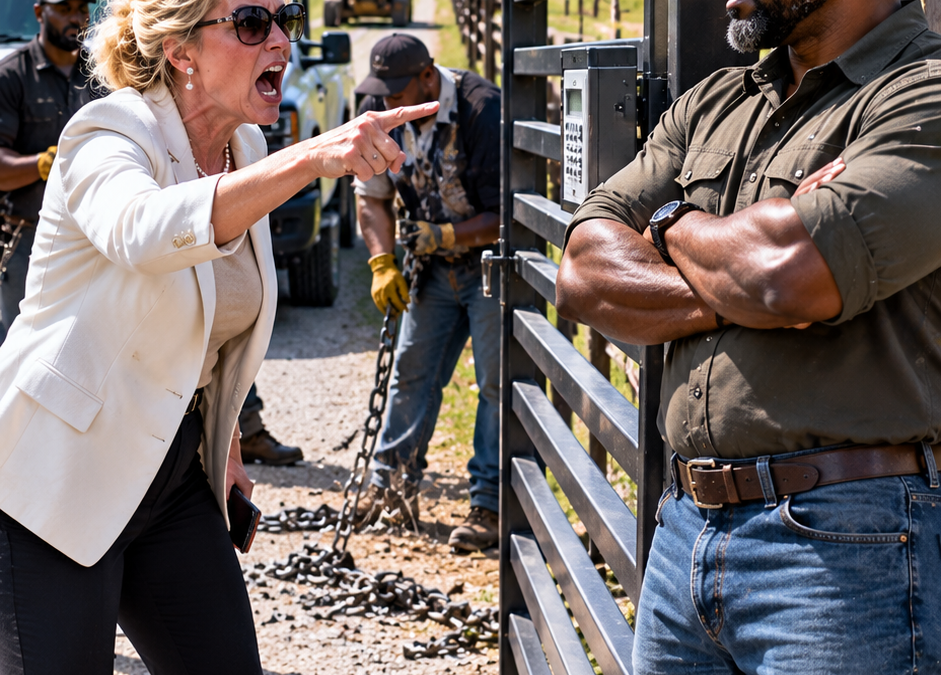
At about five that evening, Marissa arrived.
She stopped outside the work area.
“What is this?”
“A gate.”
“I can see that.”
“Then we’re making progress.”
She folded her arms.
“You’re escalating a neighborhood problem.”
“No.”
“You replaced a simple chain with commercial security.”
“Yes.”
“This road is being used by our residents.”
“That stopped today.”
“You cannot unilaterally interfere with community access.”
“Watch me.”
She looked toward Troy.
“Do you know you’re building an illegal obstruction?”
Troy kept working.
I answered for him.
“It’s inside my property.”
“The HOA will fine you.”
That one nearly made me laugh.
“I’m not in your HOA.”
“You’re interfering with Stonebrook Ridge operations.”
“I’m farming.”
“Our counsel will handle this.”
“Great.”
Marissa pointed toward the gate.
“This won’t last any longer than the chain.”
Troy stopped tightening a bolt.
Looked at her.
Then at me.
I said nothing.
The camera above the gate had recorded every word.
By sunset, the work was finished.
I closed the gate.
Locked it.
Checked the camera feed.
Four angles.
Clear video.
Clear audio.
I went home.
At 1:17 the next morning, my phone buzzed.
Motion detected.
I opened the feed.
A pickup truck approached from Stonebrook Ridge.
Two men got out.
Flashlights.
They walked around the gate.
Inspected the hinges.
Checked the concrete footings.
Looked through the fence.
They touched nothing.
After several minutes, they left.
I saved the footage.
At 2:42, another alert.
Silver SUV.
Marissa.
She stepped out.
Alone.
She photographed the gate.
The lock.
The posts.
Each visible camera.
Then made a phone call.
The microphone caught fragments.
“…remove the whole structure…”
Pause.
“…before daylight…”
Interesting.
I saved that too.
The next morning, Stonebrook Ridge emailed me.
Formal demand.
Remove the gate within twenty-four hours.
Reason:
Obstruction of established access route used for essential resident travel.
I hired Paige Dempsey that afternoon.
Real estate attorney.
She read the letter once.
Then again.
“What do you notice?”
“They don’t say easement.”
She smiled.
“Exactly.”
“Why?”
“Because somebody writing this knows they cannot prove one.”
Her advice was simple.
No phone arguments.
No threats.
No touching anyone’s vehicles.
Everything in writing.
Everything documented.
We sent one reply.
Provide the recorded instrument granting Stonebrook Ridge vehicular access across my parcel.
Nothing else.
If they had an easement, they could provide the number.
They never did.
Two days later, Marissa sent us a photograph.
Old map.
Dotted line through my property.
She claimed it proved community access.
Owen examined it.
Marketing map.
Prepared by Stonebrook Ridge’s original developer.
Not recorded.
Not attached to any deed.
No legal effect.
Then I noticed another clip in the camera archive.
4:06 a.m.
Service truck.
Stonebrook Ridge maintenance contractor.
The driver got out.
Measured the distance between the gate posts.
Measured the fence opening.
Wrote dimensions on a clipboard.
Drove away.
Somebody was planning something.
Monday morning answered what.
I had barely finished my coffee when another motion alert appeared.
Three workers stood at my gate.
Service truck.
Cutting tools.
Heavy-duty equipment.
I drove down.
The crew leader held a work order.
“What are you doing?”
“Removing unauthorized obstruction.”
“Authorized by whom?”
“Stonebrook Ridge HOA.”
“Parcel number?”
He checked.
His eyes moved toward Owen’s survey stakes.
Marked.
Tagged.
Official.
He hesitated.
“Sir, we were told this is a shared access lane.”
“It isn’t.”
Then Marissa arrived.
“Continue.”
The crew leader looked at her.
“Ownership looks disputed.”
“It isn’t.”
I said:
“You are standing on my recorded parcel. I do not consent to removal of the gate.”
The camera was six feet above us.
I made sure my words were clear.
Marissa pointed at the gate.
“Take it down.”
The crew leader shook his head.
“Our contract doesn’t cover dismantling structures when land ownership is contested.”
“There is no contest.”
“There appears to be.”
“You’re being paid.”
“We’re leaving.”
Marissa’s face tightened.
The crew packed up.
Once they were gone, she changed arguments.
“The gate is a safety hazard.”
“How?”
“It blocks emergency evacuation.”
“Show me the approved evacuation plan.”
“It’s community policy.”
“County approval.”
She said nothing.
I called the fire marshal’s office myself.
Stonebrook Ridge had one approved entrance.
Eastern gate.
My road was not listed.
Never evaluated.
Never approved.
Not emergency access.
Then Owen found a document that made the HOA’s position worse.
Years earlier, the original Stonebrook developer had approached the prior owner of my land.
Requested an easement across the same road.
The owner refused.
In writing.
The county file still contained the letter.
Paige read it.
“This is useful.”
“Why?”
“Because the developer knew they needed permission.”
“And didn’t get it.”
“Exactly.”
Stonebrook’s predecessor had acknowledged private ownership.
They had asked.
Been refused.
Now Marissa was pretending permission was unnecessary.
For one night, I thought the gate had ended the physical side of the problem.
I was wrong.
At 11:38 p.m., my phone buzzed.
Silver SUV.
Marissa.
Passenger with her.
A man I did not recognize.
They opened the rear hatch.
Pulled out a heavy tow chain.
I sat up in bed.
The man wrapped the chain around one steel post.
Then connected the other end to the SUV.
They were going to pull the gate down.
I could have driven out.
Could have confronted them.
Could have called Marissa.
Instead, I called law enforcement.
Then kept watching.
The SUV reversed.
Chain tightened.
Engine accelerated.
The gate shuddered.
Post held.
Again.
Harder.
The frame groaned.
Concrete held.
Marissa waved at the driver to try again.
Third attempt.
Nothing.
Then the man noticed the camera.
He pointed.
Marissa looked up.
He covered one lens with a rag.
Then twisted another camera toward the trees.
Marissa seemed to relax.
She thought they had eliminated the evidence.
They forgot about camera four.
The hidden one.
It recorded everything.
SUV.
Plate.
Tow chain.
Marissa.
The man.
Damage to the visible cameras.
Every second.
They eventually gave up.
Drove away.
The next morning, I received an email from Marissa.
I read it twice because I almost could not believe she had sent it.
Caleb, we have learned unknown vandals may have damaged your surveillance system overnight. Stonebrook Ridge will fully cooperate in identifying those responsible.
I forwarded it to Paige.
Her reply came almost instantly.
Do not answer.
Then:
That email is evidence.
She was right.
Marissa had tried to establish a false story before she knew what my hidden camera recorded.
I filed a report.
Sheriff Ellis Rourke arrived within the hour.
He did not assume anything.
Walked the boundary.
Reviewed the deed.
Looked at Owen’s markers.
Examined the gate.
Then watched video from the damaged cameras.
“Anything else?”
“Yes.”
I opened camera four.
Ellis watched.
No one spoke.
The clip ended.
He looked toward Stonebrook Ridge.
“Send me the original file.”
“I will.”
“Unedited.”
“Yes.”
“This isn’t a road dispute anymore.”
“No.”
“This is property damage.”
That changed everything.
Marissa shifted tactics.
No more midnight confrontation.
Now came paperwork.
Stonebrook Ridge’s attorney sent an alleged access easement.
Formal language.
Parcel description.
Signature from a previous owner.
At first glance, convincing.
Paige needed about five minutes.
“No recording number.”
I nodded.
“Description doesn’t match your current parcel.”
She kept reading.
Then stopped.
“This signature date is impossible.”
“How?”
“The supposed signer had already sold the land before this date.”
Owen investigated.
The document came from an old negotiation between Stonebrook’s original developer and the previous owner.
It had never been completed.
Never signed.
Never recorded.
The original draft still existed.
Across every page:
DRAFT — NOT FOR EXECUTION
Stonebrook’s version somehow lacked the watermark.
Paige did not accuse them of altering it.
Not yet.
She sent one request.
Please provide certified recorded copy from county recorder.
Silence.
Then vague promises that they were researching it.
That was when Graham Lyle contacted me.
HOA board member.
He asked to meet privately.
We sat at a diner outside town.
“I never supported opening your road.”
“I figured somebody on that board had sense.”
He smiled nervously.
“Marissa told us you verbally agreed.”
“I didn’t.”
“She said the paperwork was being finalized.”
“It wasn’t.”
Graham opened a folder.
Board minutes.
One sentence was highlighted.
WEST ROUTE MAY BE OPENED TEMPORARILY DESPITE UNRESOLVED OWNERSHIP QUESTIONS.
I looked at him.
“When?”
“Before residents started using your road.”
“So they knew.”
“Yes.”
“Who proposed opening it?”
Graham hesitated.
“Marissa.”
There it was.
Not confusion.
Not accidental trespass.
Planned access despite unresolved ownership.
Graham also showed me a neighborhood circulation map.
Distributed before my chain was torn down.
My road was labeled:
WEST EXIT
Marissa had spent weeks claiming residents began using the route spontaneously.
The HOA’s own documents proved otherwise.
Paige sent a preservation letter.
Emails.
Texts.
Maps.
Work orders.
Minutes.
Video.
Invoices.
Everything had to be retained.
Stonebrook’s board suddenly realized the problem was bigger than a gate.
I added steel bollards near the gate.
Nothing dangerous.
Nothing hidden.
Simply stronger protection.
Marissa tried money next.
First right-of-way offer.
Far below market value.
I declined.
Second offer.
Nearly triple.
Declined.
Paige finally asked:
“Are you sure you don’t want to negotiate?”
“Yes.”
“Why?”
“Because I need the road.”
“For what?”
“Equipment building.”
I showed her my plans.
Agricultural storage facility.
Expanded operations.
Tractor traffic.
Deliveries.
Livestock equipment.
Thirty Stonebrook cars cutting through twice a day would destroy the usefulness of the road.
This had never been about squeezing money from the HOA.
I did not want the easement.
Marissa responded by filing a county complaint against my gate.
Unpermitted structure.
Inspector came.
Marissa came too.
The inspector measured.
Setback.
Height.
Distance from public road.
Gate width.
Survey location.
Everything complied.
His report:
No violation.
And because the gate sat well inside my parcel, the inspection strengthened my position.
Then Marissa claimed prescriptive rights.
Years of continuous use.
That failed even faster.
Historical satellite images showed the road blocked.
Previous owner testified it had been closed.
My photographs showed chains and barriers.
The regular Stonebrook traffic began only after their entrance construction.
Weeks.
Not years.
No legitimate prescriptive claim.
Sheriff Ellis then found Marissa’s nighttime companion.
Not a Stonebrook resident.
Contractor she had hired.
He cooperated.
Turned over text messages.
One from Marissa:
THE CHAIN CAME DOWN EASY. THE NEW GATE NEEDS TO DISAPPEAR THE SAME WAY.
That message ended the mystery.
Paige filed for an injunction.
Our evidence:
Recorded deed.
Certified survey.
County records.
Previous owner’s easement refusal.
Broken chain.
Tire tracks.
Camera footage.
Marissa photographing the gate after midnight.
Maintenance crew measuring it.
Service crew arriving with cutting tools.
Hidden camera showing tow-chain attempt.
Marissa’s false email blaming vandals.
Board minutes admitting ownership was unresolved.
Draft easement missing its watermark.
Contractor texts.
HOA maps labeling my road as an exit before permission existed.
Stonebrook’s evidence:
Marketing map.
Unrecorded draft.
Failed prescriptive claim.
Nothing else.
The judge issued a temporary order quickly.
Stonebrook Ridge.
Its board.
Its employees.
Its contractors.
Its agents.
Nobody could enter my parcel or interfere with the gate.
Marissa continued telling residents she was protecting the community.
But her intention was no longer the issue.
You do not gain rights to private land because a shortcut is convenient.
You do not create an easement through repetition.
And you certainly do not acquire ownership by tearing down somebody’s barrier at night.
Stonebrook called a special board meeting.
Graham proposed suspending Marissa’s authority.
For the first time, she sat at the far end of the table.
The HOA attorney was asked one question.
“Does Stonebrook Ridge possess a recorded vehicular easement across Caleb Whitmore’s parcel?”
He hesitated.
Then answered:
“No recorded easement has been located.”
That changed the room.
Residents started asking why their dues were being used to fight over property the HOA apparently had no right to use.
Marissa blamed me.
Said I was isolating Stonebrook.
That made no sense.
The subdivision’s legal entrance remained open.
I had never touched it.
Their inconvenience came from construction at their own intersection.
Not from anything I had done.
The board suspended Marissa’s authority.
No contractor orders without approval.
No legal notices without board review.
No unilateral expenditures connected to my property.
The vandalism investigation continued separately.
Several weeks later, Stonebrook abandoned its claim entirely.
Settlement negotiations were short.
I wanted clarity.
Written acknowledgment:
Stonebrook held no vehicular rights over my property.
No easement.
No implied access.
No prescriptive access.
No emergency route.
No west exit.
They agreed.
They reimbursed the damage to the original posts and chain.
Paid for the damaged cameras.
Covered related expenses.
Every internal Stonebrook map had to remove the west-exit label.
Every resident received written notice.
The road was private.
No Stonebrook resident, contractor, employee, or board member could use it without my express permission.
No one connected to the HOA could touch the gate.
Marissa lost the presidency shortly afterward.
No dramatic speech.
No public scene.
Paper ballot.
Done.
Stonebrook solved its traffic problem eventually.
They worked with the county.
Improved their real entrance.
Used their own property.
Spent their own money.
Exactly what they should have done from the beginning.
My gate stayed.
Troy came back once to repair the camera mount Marissa’s contractor had twisted.
He looked at the steel posts.
“Still happy you didn’t replace the chain?”
I looked at camera four.
“Very.”
Owen laughed.
“You spent a lot of money proving a point.”
“No.”
“What did you prove?”
“That the chain wasn’t the important part.”
He waited.
“A chain tells people not to enter.”
I pointed toward the cameras.
“Those tell you what people do when they think nobody is watching.”
That was the entire story.
Marissa believed the road became community property because residents wanted it.
When a sign said otherwise, the sign disappeared.
When a chain said otherwise, the chain was torn down.
When a steel gate said otherwise, she hired people to remove it.
When the gate resisted, she came back at night with a tow chain.
Then she disabled the cameras she could see.
Her mistake was assuming the cameras she could see were the only cameras that existed.
The road went quiet again.
No commuters.
No HOA SUVs.
No work crews.
No midnight visitors.
Only my truck.
Farm equipment.
The occasional utility vehicle with actual recorded rights.
Exactly as it had been before Stonebrook decided convenience mattered more than ownership.
One evening I drove down after rain.
The gate stood dark against the sunset.
The replacement camera blinked above it.
Beyond the trees, I could see construction equipment working near Stonebrook’s legitimate entrance.
They were finally fixing their own traffic problem.
I stopped.
Unlocked the gate.
Drove through.
Closed it behind me.
The latch settled into place.
Simple.
Quiet.
Final.
The original chain had been enough for anyone acting in good faith.
Marissa was not.
She tore it down because she believed removing a barrier erased the boundary.
Instead, she gave me every reason to build something stronger.
And once the steel gate went up, the most important thing I added was never the concrete, the reinforced posts, or the lock.
It was the fourth camera hidden in the trees.
Because two nights after Marissa laughed at my new gate, that camera recorded her trying to rip it out of the ground.
And from that moment forward, the dispute stopped being about whose story sounded more convincing.
The footage had already answered that.








