𝗙𝗨𝗟𝗟 𝗦𝗧𝗢𝗥𝗬 HOA Karen Threw a Luxury Realtor Party on My Land — I Rolled In With My Tractor and Shut It Down
𝗙𝗨𝗟𝗟 𝗦𝗧𝗢𝗥𝗬
My grandfather’s old John Deere was sleeping under a layer of barn dust.
It was ugly.
Heavy.
Loud.
And considerably more honest than anything Vanguard Estates had built in the previous two years.
I turned the key.
The engine rolled twice, coughed black smoke toward the rafters, and came alive with a deep mechanical thrum that you could feel in your teeth.
My blue tick hound, Gideon, began circling the tires like he had been waiting his whole life for this exact assignment.
“Come on,” I told him.
We headed toward the lake.
I could have driven the Ford.
The Ford would have been faster.
But I had just discovered a sales event operating on my shoreline after somebody cut off a gate my father built.
Speed was no longer my priority.
Clarity was.
A tractor provides clarity.
By the time I rounded the last stand of willows, I could hear music.
Not country music.
Not bluegrass.
Some soft, expensive instrumental arrangement designed to make wealthy people feel as though nothing bad had ever happened within several miles of them.
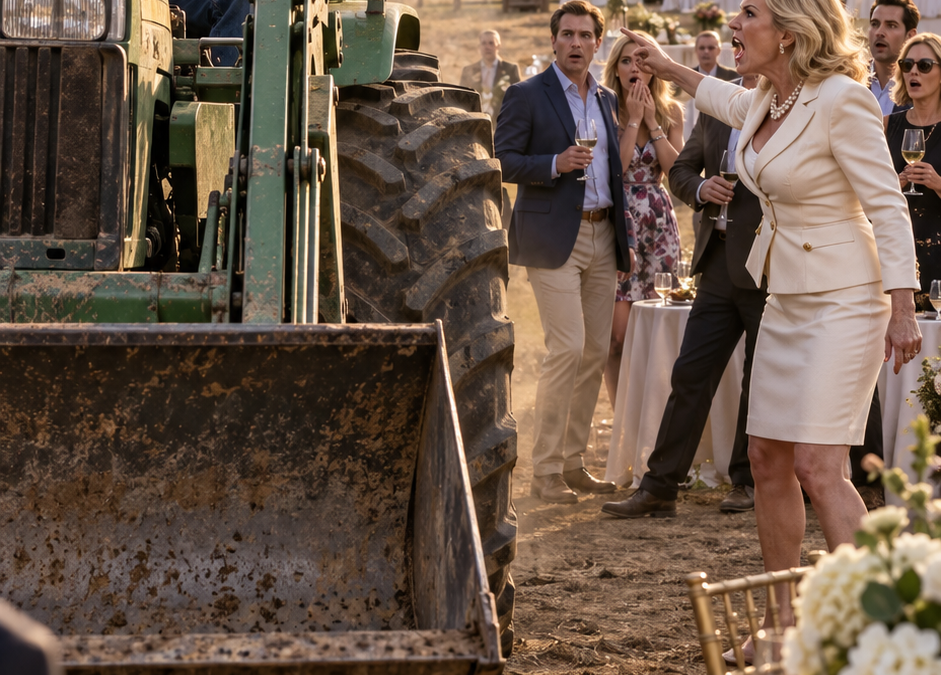
Then I saw the tent.
White marquee.
Cocktail tables.
Champagne flutes.
Black-vested caterers.
Maybe thirty prospective buyers and investors milling across my meadow.
Twelve luxury vehicles were parked on the soft shoreline.
Teslas.
Range Rovers.
Porsches.
An Escalade.
Their tires had sunk into the clover and left ruts deep enough to hold water.
One sign beside my dock showed an architectural rendering of a commercial marina.
FUTURE CLUBHOUSE & MARINA ACCESS — GOLD MEMBERS ONLY
I stopped the tractor.
For several seconds, I simply sat there.
There is a particular kind of anger that becomes quieter the larger it gets.
I had passed through shouting anger.
This was surveying anger.
Measuring anger.
The kind where you start noticing everything.
Number of cars.
Position of tent stakes.
Tire damage.
Generator location.
Portable bar.
Dock sign.
Three unpermitted temporary structures.
Two survey flags.
And standing in the center of it all, explaining my lake to strangers, was Eleanor Vance Dumont.
Eleanor was forty-eight.
President of the Vanguard Estates HOA.
Platinum-blond hair sprayed into a helmet.
Beige linen suit.
Red nails.
Leather clipboard.
She looked like somebody had taken a corporate retreat brochure and taught it to issue fines.
I heard her as I approached.
“We intend to dredge this entire cove to create sufficient depth for premium watercraft.”
A man in sunglasses asked:
“What about older boats?”
Eleanor laughed.
“Our covenants will maintain a certain aesthetic standard.”
Of course they would.
God forbid a lake contain a boat with emotional history.
I killed the tractor engine.
The sudden silence got everyone’s attention.
Eleanor looked over.
Her expression froze.
Then recovered.
“Arthur.”
“Eleanor.”
“You’re back early.”
I looked around.
“Apparently.”
“We expected you Monday.”
“That would explain the trespassing.”
Several guests exchanged glances.
Eleanor smiled at them.
“Excuse us.”
Then she walked toward me.
Her heels sank into the mud almost immediately.
It improved my mood slightly.
“Arthur, I’m glad you’re here.”
“You cut my gate.”
“We had an event schedule.”
“You cut my gate.”
“You weren’t answering.”
“You cut my gate.”
She exhaled.
“Oh, don’t be dramatic.”
“I’m not.”
“It was an old industrial eyesore.”
“My father built it.”
“And we’re replacing it.”
“With what?”
“Stone pillars. Automated access. Something consistent with Vanguard’s architectural language.”
“I don’t speak Vanguard.”
“Arthur.”
She lowered her voice.
“We’re increasing the value of this entire area.”
“My area doesn’t need your help.”
“You’re looking at this emotionally.”
“No.”
I pointed toward the dock rendering.
“I’m looking at strangers buying marina access to a lake you don’t own.”
Her smile thinned.
“This is part of the master development.”
“No.”
“Arthur—”
“No.”
“We discussed acquisition.”
“You offered to buy my land.”
“And you refused without considering what we were offering.”
“I considered it.”
“For five minutes.”
“It only took one.”
She crossed her arms.
“Let’s be practical.”
That phrase usually means someone is preparing to explain why your rights are inconvenient.
“You’re one man living alone on one hundred fifty acres.”
“I also have Gideon.”
The dog looked at her.
She ignored him.
“You cannot reasonably maintain all of this forever.”
“I’ve managed.”
“The county is moving toward higher-density planning throughout the basin.”
“Not here.”
“We are prepared to give you a generous settlement.”
“I don’t want it.”
“A lifetime clubhouse membership.”
“No.”
“You could keep the cabin.”
“I already own the cabin.”
“On five private acres.”
“I own one hundred fifty.”
“The HOA would assume management of the lake.”
“No.”
“Shoreline maintenance.”
“No.”
“Wildfire mitigation.”
“No.”
She leaned closer.
“Arthur, you don’t have a choice.”
That got my attention.
“I don’t?”
“No.”
“Go on.”
She removed a document from her clipboard.
“State recreational water-access law.”
I almost smiled.
She mistook that for uncertainty.
“Natural bodies of water above a certain size adjoining utility corridors may be subject to recreational access easements.”
I looked at the paper.
It lacked the recorder seal.
No engineer certification.
No complete legal description.
Wrong header.
It was not an easement.
It was an application.
A draft.
Possibly a fantasy.
“You filed an application.”
“We have temporary authority.”
“No.”
“Our attorney disagrees.”
“Your attorney can disagree from the county recorder’s office.”
She held the page higher.
“This document gives us access.”
“It gives you nothing.”
Her face reddened.
“Arthur—”
“I did this work thirty-five years.”
“I know your résumé.”
“You should read it again.”
I took out my phone.
Started recording.
Then I slowly filmed the tent.
Cars.
Marina rendering.
Guests.
Eleanor.
“What are you doing?”
“Preserving memories.”
“Turn that off.”
“No.”
I looked at the crowd.
“Everybody here has ten minutes to leave.”
Nobody moved.
One realtor laughed.
Eleanor looked genuinely stunned.
“You cannot shut down a licensed real-estate showcase.”
“Watch me.”
“These people are invited guests.”
“By a trespasser.”
“I am the HOA president.”
“On the other side of the ridge.”
“We have development rights.”
“Show me the deed.”
She raised the application.
“Not that.”
Her mouth tightened.
“The executed easement is pending.”
“Then your authority is pending too.”
A man near the champagne table slowly placed down his glass.
Good instincts.
“Ten minutes,” I repeated.
Eleanor stepped toward me.
“If you interfere with this event, Vanguard will sue you for lost contracts.”
“Then you should spend the next nine minutes finding a good lawyer.”
“You wouldn’t dare tow these vehicles.”
“My cousin Jed runs heavy recovery.”
I pointed at a Porsche whose rear wheels were buried in mud.
“He’s got a new rotator truck he’s been dying to try.”
A woman holding a brochure whispered something to her husband.
They started toward their Range Rover.
Eleanor raised her voice.
“Nobody is leaving.”
Half the people immediately began leaving.
Authority is funny that way.
It works beautifully until one person tests whether it actually exists.
By minute seven, realtors were folding displays.
The caterers were stuffing trays into vans.
Investors were attempting three-point turns on my meadow.
One Tesla spun its tires and sprayed mud across a woman’s white trousers.
I had to look away so she wouldn’t see me enjoying it.
Eleanor was last.
Of course.
Her Escalade sat by the tent.
She pointed at me.
“This isn’t over.”
“No.”
“I’ll have the sheriff here Monday.”
“Call him tonight.”
“You threatened my guests.”
“I gave trespassers time to leave.”
“You destroyed our promotional structure.”
“Your promotional structure replaced my gate.”
“I will take this basin from you in court.”
I looked at the lake.
“No, you won’t.”
“You’re a dinosaur, Arthur.”
“Maybe.”
She opened the SUV door.
“Dinosaurs get paved over.”
Then she drove away, throwing mud behind her.
I stood there until the last vehicle disappeared.
Then the basin became quiet again.
Not fully.
The meadow was damaged.
My gate was destroyed.
Plastic cups rolled under a table.
Somebody had dropped a gold brochure beside the dock.
I picked it up.
THE CASCADES AT VANGUARD ESTATES
Exclusive marina.
Private lake access.
Premium shoreline parcels.
Membership packages.
Deposits accepted.
They were not merely planning.
They were selling.
I carried the brochure home.
Then I went into my study.
My study was not impressive.
No floor-to-ceiling glass.
No designer shelves.
Just old survey cabinets, brass instruments, rolled plats, tax receipts, deed books, geological maps, and one banker’s lamp that had belonged to my father.
I made coffee.
Opened the cabinets.
And started reading.
Sovereign Basin’s title went back through my family to an old federal land patent.
The lake.
Shoreline.
Aquifer.
Alluvial margins.
No recorded public recreation covenant.
No HOA rights.
No deed transfer.
No easement signed by me.
That much I already knew.
But I kept going.
Vanguard’s Phase One plat.
County road deed.
1952 transportation easement.
Developer survey.
Flood-realignment records from 1972.
Something bothered me.
I laid the maps side by side.
The modern Vanguard survey treated the current pavement as if it marked the historic county road centerline.
It didn’t.
A flood in 1972 had pushed the usable road alignment east.
The county rebuilt the asphalt.
But the legal easement had never been expanded.
In most circumstances, that might have become an obscure historical issue nobody cared about.
Except Vanguard Estates had built its entrance assuming pavement equaled ownership.
The inbound lane.
Sidewalk.
Stone monument.
Fiber conduit.
Part of the landscaping.
All sat outside the old public easement.
On land still included in my deed.
I checked again.
Then again.
Surveyors learn early that excitement is the enemy of accuracy.
At 2:14 in the morning, I found the buried brass cap noted in the 1952 record.
I knew that cap.
I had physically located it thirty years earlier.
Fifteen feet east of where Vanguard thought the boundary sat.
I leaned back.
Gideon was asleep beside the desk.
“Well.”
His ear moved.
“They’ve been selling my lake.”
He opened one eye.
“And they paved their front door across my land.”
The eye closed.
Dogs are difficult to impress.
I called Sheriff Dan Thomas Friday morning.
Dan and I had gone to school together.
He had become sheriff.
I became the man who called him about property lines.
“Art.”
“Dan.”
“I heard.”
“I assumed you would.”
“Eleanor has called my office six times.”
“Only six?”
“She says you terrorized investors with a tractor.”
“I parked it.”
“She says you destroyed HOA property.”
“They put it where my gate was.”
“She says the lake is subject to a temporary recreational easement.”
“No.”
“I figured.”
I told him about the cut gate.
The sales brochures.
The easement application.
Then the road.
He became quiet.
“How certain are you?”
“Surveyor certain.”
“That phrase worries me.”
“The inbound lane is on my parcel.”
“How much?”
“Fifteen-foot strip.”
“Whole lane?”
“Most of it.”
“Entrance sign?”
“Yes.”
“Sidewalk?”
“Yes.”
“Fiber?”
“Looks like it.”
Dan sighed.
“What are you planning?”
“Maintenance.”
“Art.”
“Boundary maintenance.”
“That is worse.”
I told him I wanted to file formal complaints for trespass and property destruction.
Then I asked him to be at the Vanguard entrance Saturday morning.
“Why?”
“So nobody claims they were surprised.”
“Keep it legal.”
“That’s the idea.”
My next call was Billy Miller.
Miller Brothers Excavation & Security Fencing.
Billy had known me since high school.
“What do you need?”
“A gate.”
“What kind?”
“The kind people respect.”
He laughed.
“That specific?”
“Industrial.”
“How industrial?”
“Paper-mill closure industrial.”
The laughter stopped.
“Oh.”
“And bollards.”
“How many?”
“Enough.”
“Arthur, are we defending against vehicles or armored cavalry?”
“HOA.”
“Armored cavalry would be easier.”
His crew arrived that afternoon with survey equipment.
We located the old brass monument.
Verified coordinates.
Checked the legal description.
Laid everything against the 1952 deed.
Billy stared at the asphalt.
“They really built on it.”
“Yes.”
“Their only entrance?”
“Outbound lane is legal.”
“So people can leave.”
“Yes.”
“Getting back in?”
“That becomes interesting.”
He smiled.
“I always liked you, Art.”
Saturday morning started at six.
Diesel engines.
Post-hole auger.
Concrete truck.
Steel.
Survey stakes.
By eight-thirty, an eight-foot industrial security gate crossed the disputed inbound strip.
Four deep-set bollards.
Fence along the shoulder.
Reflective sign.
PRIVATE PROPERTY — SOVEREIGN BASIN — NO ACCESS WITHOUT AUTHORIZATION
I parked the John Deere behind it.
Not because I needed to.
Because I had become fond of symbolism.
The first resident arrived at 8:45.
Silver BMW SUV.
Pastel golf shirt.
He stopped ten feet from the gate.
Stared.
Got out.
“What is this?”
“Morning.”
“I have a tee time.”
“That sounds serious.”
“Open the gate.”
“No.”
“This is Vanguard Boulevard.”
“Partly.”
“What does that mean?”
“The inbound lane was built on my property.”
He laughed.
Then realized I wasn’t.
“Our HOA owns this road.”
“No.”
“It’s a public road.”
“Outbound portion falls within the county easement.”
He looked toward the open lane.
“So I can leave?”
“Yes.”
“And come back?”
“Not through my land.”
“That’s insane.”
“You’re welcome to discuss it with your board.”
He grabbed the gate.
“We pay for this road.”
“You paid the wrong person.”
His face turned red.
He called Eleanor.
By 9:15, cars were backed up.
Residents filmed.
Argued.
Called attorneys.
One man demanded I let him through because he was a surgeon.
I informed him land deeds were famously indifferent to medical training.
Then Eleanor arrived.
Black Escalade.
Fast.
She came down the outbound lane, crossed the landscaped median, crushed a flower bed maintained by her own HOA, and stopped inches from my gate.
The door flew open.
She stepped out in a crimson blazer.
“ARTHUR CROSS!”
“Morning, Eleanor.”
“What have you done?”
“Put up a fence.”
“This is kidnapping!”
I looked around.
“No one seems kidnapped.”
“You have trapped a hundred families!”
“The outbound lane is open.”
“How are they supposed to get home?”
“Excellent question for the developer.”
“This is a public right-of-way!”
“No.”
“It is!”
“No.”
She slammed her clipboard against the steel.
“We have municipal approval.”
“Municipal approval doesn’t convey my title.”
“You cannot own Vanguard Boulevard.”
“I don’t.”
She paused.
“I own fifteen feet underneath the lane you’re currently standing beside.”
“That is absurd.”
I handed her a copy of the 1952 deed.
“Public easement ends here.”
I pointed.
“Your developer followed modern pavement instead of the recorded monument.”
“You manufactured this.”
I almost laughed.
“You think I went back to 1952 and moved county records?”
“I don’t care about ancient deeds!”
“That seems to be your organization’s central difficulty.”
She stepped closer.
“I have three buses of investors arriving in thirty minutes.”
“Then call them.”
“This is a million-dollar sales weekend!”
“Not on my land.”
“I’ll sue you.”
“Get in line.”
“You will lose everything.”
A voice behind the tractor said:
“I wouldn’t make plans around that, Eleanor.”
Sheriff Dan Thomas stepped into view.
Two deputies followed.
With them was a woman in a gray suit holding a leather folder.
Eleanor’s posture changed.
“Sheriff.”
“Eleanor.”
“Thank God.”
That phrase never ends well for the person saying it in front of law enforcement.
“Arrest him.”
Dan looked at me.
Then at her.
“For what?”
“He blocked the road.”
“He blocked his land.”
“He destroyed our sales event.”
“On his lake.”
“He’s interfering with lawful development.”
The woman in gray opened her folder.
“Mrs. Dumont?”
Eleanor looked at her.
“Yes?”
“My name is Melissa Marcus. State Real Estate Licensing and Securities Board.”
Eleanor stopped.
Marcus continued.
“I’m serving an administrative cease-and-desist order regarding the Vanguard Lakeshore marketing program.”
Eleanor’s face lost color.
“What?”
“You are directed to immediately cease marketing, advertising, accepting reservations, collecting deposits, or representing ownership interests in parcels associated with Sovereign Basin and Covenant Pool.”
“This is ridiculous.”
“We reviewed the brochures.”
“The brochures are conceptual.”
“They advertise a marina.”
“Future development.”
“On Mr. Cross’s deed land.”
“We have an easement.”
Agent Marcus opened another page.
“You presented this document?”
Eleanor glanced at it.
“Yes.”
“The temporary recreational access approval.”
“Yes.”
“It is fraudulent.”
The crowd became silent.
Eleanor blinked.
“No.”
“The county engineer’s signature is forged.”
Her mouth opened.
“My developer gave me that.”
Marcus didn’t react.
“The recorder number does not exist.”
“I didn’t prepare it.”
“The seal is fabricated.”
“I didn’t know.”
“The legal description references land your HOA does not own.”
“This is a misunderstanding.”
Sheriff Thomas stepped closer.
“No, Eleanor.”
She looked at him.
He held another document.
“This part isn’t administrative.”
Two deputies moved forward.
“What are you doing?”
“I have a warrant.”
Eleanor stared.
“For what?”
“Forgery-related filing, fraudulent real-estate representations, criminal trespass, and property damage connected to the destruction of Art’s gate.”
“This is insane.”
“Turn around.”
She stepped back.
“Do you know who my husband is?”
Dan sighed.
“Yes.”
“My brother is the county prosecutor.”
“Yes.”
“He’ll destroy this case.”
“No.”
“What does that mean?”
“He recused himself.”
Her face changed again.
Dan added:
“He signed the referral before recusing.”
That silenced her.
“He knows what this looks like.”
“This is a conspiracy.”
“No.”
“You’re all protecting him because he’s local.”
“No.”
“You’re backward hillbillies protecting some old man sitting on worthless swamp land!”
Several Vanguard residents visibly flinched.
I did not.
I had heard worse from coal companies.
One deputy took her wrist.
Eleanor jerked away.
“Don’t touch me!”
“Ma’am.”
“I am president of this HOA.”
The handcuffs closed.
Click.
Sharp.
Final.
One hundred people watched.
Several raised phones.
People she had fined for trash cans.
People she had threatened over paint colors.
People whose landscaping requests sat unapproved for months.
Nobody intervened.
Eleanor looked at me.
Her face was furious and frightened at the same time.
“This is your fault.”
I shook my head.
“No.”
“You did this.”
“You cut my gate.”
The deputies walked her toward the cruiser.
Her heels slipped once on the gravel.
She caught herself.
The investors never arrived.
Their buses turned around before reaching Vanguard Estates.
By Monday, Phase Two financing had frozen.
Within forty-eight hours, the major investors withdrew.
Not because of me.
Because developers dislike three things.
Unclear title.
Fraud investigations.
And access roads that belong to somebody they forgot to purchase.
Vanguard Group’s financial position collapsed quickly.
The development company filed for bankruptcy by the end of the month.
The HOA itself was left holding a problem it had inherited from people who had already begun blaming one another.
One hundred homes.
One legal inbound lane issue.
One pissed-off surveyor.
The new board came to my porch three weeks later.
Arthur Pendleton led them.
He had been elected interim president after Eleanor’s removal.
He arrived in an old station wagon.
No Escalade.
Another promising sign.
“Art.”
“Arthur.”
We had the same first name, which forced everyone else to pay attention.
He held an envelope.
“We need to talk about access.”
“I assumed.”
“First, this.”
He handed me the envelope.
Inside was a formal written apology.
And a settlement check.
The HOA agreed to compensate me for the destroyed gate, meadow damage, unauthorized commercial use, and survey-related damages.
We negotiated final figures through counsel.
It came to one hundred fifty thousand dollars.
Eleanor would probably have called that extortion.
I called it expensive catering.
Then we addressed the road.
Arthur looked embarrassed.
“We need that lane.”
“I know.”
“The alternative engineering options are enormous.”
“I know.”
“We could rebuild the entry.”
“You could.”
He looked toward the ridge.
“That would cost millions.”
“Probably.”
“So.”
“So.”
He took a breath.
“Would you lease the strip?”
“Yes.”
The relief on his face was immediate.
Then I told him the terms.
Ninety-nine years.
Five thousand dollars per month.
Annual inflation adjustment.
HOA responsible for pavement, insurance, utilities, drainage, and any future damage.
No implied rights beyond the defined road strip.
No access to Sovereign Basin.
No rights to Covenant Pool.
No recreational easement.
No marina rights.
No development option.
No expansion authority.
No HOA covenant could ever attach to my remaining acreage through the lease.
Arthur read everything.
“That’s expensive.”
“So was my gate.”
He nodded.
“We’ll take it.”
“You should show it to counsel.”
“We already have.”
“Then counsel is smarter than the last group.”
“Low bar.”
I smiled.
“Fair.”
The agreement was recorded.
Properly.
With the correct seals.
Correct signatures.
Correct legal description.
A concept Eleanor apparently considered unfashionable.
Once it was signed and the first payment cleared, I opened the gate.
Residents could drive home normally again.
The neighborhood settled.
Phase Two remained canceled.
The marina disappeared from marketing materials.
The word “Covenant Pool” vanished from every Vanguard brochure.
The ridiculous lakeshore club renderings were removed from the clubhouse.
The plastic entrance arch never returned.
My original steel gate was repaired by the same foundry family that had fabricated parts for my father decades earlier.
Billy helped hang it.
We reused as much original steel as possible.
When the new hinges settled onto their pins, I stood there longer than I expected.
Billy noticed.
“You all right?”
“Yeah.”
“Thinking about your dad?”
“Yeah.”
He nodded.
No further questions.
Good friends know when silence is the correct tool.
Eleanor’s criminal case moved more slowly than the real-estate collapse.
Courts do not operate at the speed of neighborhood gossip.
The state pursued the forged document.
Investigators traced the marina marketing.
Deposits.
Internal emails.
Sales materials.
One email became especially memorable.
Eleanor had written that once enough buyers were committed, Mr. Cross would have “no economically rational alternative” except to sell.
I read that line twice.
Then laughed.
She never understood me.
That was the problem.
She thought my land was an underperforming asset.
I thought it was home.
Those are not competing valuations.
They are different languages.
Her lawyers eventually negotiated a resolution involving fraud-related counts, restitution, licensing sanctions, probation conditions, and a permanent prohibition on participating in certain real-estate marketing activities during the applicable term.
Her HOA career ended.
Her real-estate ambitions ended more thoroughly.
The forged easement became part of the public court record.
For a woman obsessed with presentation, that may have been the cruelest consequence.
People could search her name and find the document.
Forever.
Vanguard Estates survived.
Barely.
The luxury branding softened.
Homeowners were more interested in competent governance than champagne launches after the bankruptcy.
Arthur Pendleton’s new board removed several of Eleanor’s more absurd rules.
The exact approved shade of mailbox post black remained.
Civilization has limits.
But people could plant native flowers.
Some restrictions on lawn height relaxed.
A proposed rule banning visible vegetable gardens disappeared.
Someone even suggested converting a drainage strip into native meadow.
I nearly drove my tractor over to congratulate them.
Nearly.
The 99-year lease payments arrived every month.
Five thousand dollars.
By direct deposit.
I sometimes thought about refusing them on principle.
Then I remembered they were using my land.
Principle is valuable.
So is rent.
I used part of the settlement to restore the shoreline.
The SUV ruts were aerated.
Regraded.
Reseeded with clover.
Damaged areas around the dock were repaired.
No commercial marina.
No dredging.
No tiki bar.
No golden-member boat slips.
The only vessels on Covenant Pool that autumn were wood ducks and my old aluminum fishing boat.
Perfect.
Three weeks after the settlement, Arthur drove down to my gate.
He handed me another letter.
“What’s this?”
“Formal apology from the board.”
“I already got one.”
“This one’s from the residents.”
I read it.
Short.
No legal language.
No excuses.
It acknowledged that people had attended sales presentations without questioning ownership claims.
It apologized for damage to the land.
It thanked me for allowing a lawful road lease instead of forcing reconstruction.
I folded it.
“Tell them I appreciate it.”
Arthur looked toward the meadow.
“Can I ask something?”
“You usually do.”
“What are you going to do with all this?”
I looked around.
“Nothing.”
He laughed.
“No, seriously.”
“So am I.”
“One hundred fifty acres.”
“Yes.”
“Lakefront.”
“Yes.”
“Forest.”
“Yes.”
“You could sell part of it for conservation homes. Five-acre lots. Very low density.”
“No.”
“Conservation trust?”
“Maybe someday.”
“Public park?”
“No.”
“Trails?”
“No.”
He smiled.
“You’re difficult.”
“That opinion has broad support.”
Arthur walked toward the gate.
Then stopped.
“The residents still don’t understand why you won’t develop.”
I looked across Covenant Pool.
Late sunlight lay across the water.
“Because not everything has to become something else.”
He waited.
I continued.
“The lake is already a lake.”
“The forest is already forest.”
“The meadow is already meadow.”
“That’s enough.”
Arthur nodded slowly.
“I think I’m beginning to understand.”
“That puts you ahead of Eleanor.”
He laughed.
Then drove home.
Autumn came.
Sugar maples went orange.
The nights cooled.
Gideon grew slower.
I spent more evenings on the porch.
Sometimes I looked toward the ridge where Vanguard Estates lights appeared one by one.
From a distance, it looked peaceful.
It probably was.
Most residents were normal people who had bought houses and trusted glossy brochures.
They had not personally cut my gate.
They had not forged easements.
They had not organized a sales party on my shoreline.
That distinction mattered.
I could have punished them harder.
The road error gave me leverage.
Real leverage.
I could have refused every lease.
Forced the developer and HOA into years of litigation.
Made one hundred families live with one-way access chaos while somebody designed a new entrance.
A younger version of me might have enjoyed that.
The man I became through thirty-five years of boundary disputes understood something simpler.
A boundary is not revenge.
It is an agreement about where conflict stops.
So I leased the road.
They paid.
My ownership remained intact.
Their homes remained accessible.
And everybody knew exactly where the line was.
That was enough.
I kept the original turquoise brochure in my map cabinet.
Sometimes I pull it out.
The front shows Covenant Pool.
Computer-generated marina.
Clubhouse.
Boats.
Happy couples in white clothes.
At the bottom:
YOUR PRIVATE LAKESHORE LIFE BEGINS HERE
No.
It didn’t.
But the brochure is useful.
Not as evidence anymore.
As comedy.
Eleanor had arranged caterers, realtors, investors, architects, signage, transportation, and marketing for a property she had never bothered to verify she could sell.
That takes a special kind of confidence.
The sort produced when nobody around you has said no recently.
Her whole plan depended on me eventually surrendering.
Sell once the buyers were committed.
Accept the money.
Move into a five-acre corner.
Become “honorary” member of a club built on my own land.
She never considered that I might value ownership more than optimization.
People who treat everything as an asset eventually meet something that refuses pricing.
For Eleanor, that was Sovereign Basin.
For me, it was never complicated.
My grandfather restored those hills.
My father refused logging offers that would have cleared them.
My mother taught me where the springs surfaced after heavy rain.
I had buried dogs there.
Spread ashes there.
Rebuilt fences there.
Mapped every line.
No clubhouse membership could compete with that.
Money buys land every day.
It does not automatically buy meaning.
That winter, I replaced several old survey posts.
Not because the lines were disputed anymore.
Because I wanted the next generation to find them easily.
Brass caps.
Recorded coordinates.
Photographs.
Descriptions.
I updated the parcel survey and filed it.
Arthur asked why.
“You already won.”
“That’s why.”
“I don’t follow.”
“My father knew the boundary.”
“I knew the boundary.”
“Eleanor still managed to build a fantasy on top of bad paperwork.”
He nodded.
“So you’re making sure nobody gets confused again.”
“Exactly.”
Boundaries work only when remembered.
That lesson applied beyond land.
Vanguard forgot the boundary between marketing and ownership.
Eleanor forgot the boundary between HOA authority and private property.
The developer forgot the boundary between pavement and deed.
Investors forgot the boundary between a beautiful rendering and a legal asset.
Everybody stepped over a line because they assumed somebody else had checked it.
Nobody had.
Except the old man with the tractor.
I still drive that John Deere.
Not often.
It leaks hydraulic fluid.
The seat spring squeaks.
The paint has faded.
You can hear it coming half a mile away.
Exactly as intended.
The next spring, Vanguard held its first community event under the new board.
Arthur sent me an invitation.
NEIGHBOR APPRECIATION PICNIC
I stared at it.
Then called him.
“Is this on your property?”
“Yes.”
“Any marina presentations?”
“No.”
“Any sales agents?”
“No.”
“Any white vinyl arches?”
“Absolutely not.”
“Then I might come.”
I did.
For twenty minutes.
People were awkward at first.
A few apologized.
One man, the surgeon who had shouted at me about his golf tee time, approached holding a paper plate.
“Mr. Cross.”
“Doctor.”
He looked embarrassed.
“I was an ass.”
“Yes.”
He laughed.
“I suppose I deserved that.”
“You did.”
“I didn’t know about the survey issue.”
“I know.”
“I thought you were just some angry neighbor blocking the road.”
“I know.”
He glanced toward my basin.
“Eleanor told us you were trying to extort the development.”
“That also sounds like her.”
He nodded.
“I’m sorry.”
“Accepted.”
Then he held up the plate.
“Burger?”
“No.”
“Worth asking.”
A little girl was chasing bubbles nearby.
Residents were talking.
Normal.
No champagne.
No investors.
No one promising exclusivity.
I realized I didn’t hate Vanguard Estates.
I hated what Eleanor had tried to turn my land into.
There was a difference.
That mattered too.
I went home before sunset.
Gideon met me by the porch.
We walked down to Covenant Pool.
The clover had returned.
No tire ruts.
No signs.
No strangers.
A wood duck slipped between the reeds.
The lake was flat enough to reflect the ridge.
I sat on the dock.
Gideon lay beside me.
“You know what’s funny?”
He sighed.
“They spent millions trying to buy a view.”
His tail moved once.
“I’ve had it the whole time.”
The dog remained unimpressed.
A few months later, the repaired steel gate received its final coat of paint.
Industrial gray.
Same as my father used.
Billy suggested black powder coating.
I told him to go home.
He did.
When the paint dried, I stood beside the gate and ran my hand over the repaired hinge.
The grinder marks were still visible beneath the finish.
I could have had them polished out.
I didn’t.
Scars are useful records.
So are survey monuments.
So are court filings.
So are photographs of white tents on private meadows.
One afternoon, a Vanguard resident stopped while I was checking the gate.
“Why didn’t you replace it with something nicer?”
I looked at him.
“Nicer than what?”
“You know. Stone columns. Automatic decorative gates.”
“It opens.”
“Sure.”
“It closes.”
“Yes.”
“Then it’s nice.”
He laughed.
Fair enough.
That became the joke around the basin.
People would ask if I planned to modernize something.
My answer:
“It works.”
There is freedom in that standard.
The gate worked.
The meadow worked.
The lake worked.
The old cabin worked.
Eleanor’s master plan failed largely because she could not tolerate things working without her improving them.
Improvement is one of the most dangerous words in development.
Sometimes it means fixing.
Sometimes it means monetizing.
Sometimes it means destroying an old steel gate so catering vans can get through.
The state case eventually ended.
Vanguard Group’s bankruptcy wound down.
Investors recovered part of what they could.
The HOA reorganized financially.
The 99-year road lease became one of its largest fixed expenses.
Every month, five thousand dollars left their account and arrived in mine.
Gary Miller once called it the most expensive fifteen feet in the county.
I corrected him.
“Not expensive.”
“What?”
“Properly valued.”
He laughed.
Surveyors are tedious people.
We care about terminology.
I put most of the lease money into a land-management account.
Forest health.
Culverts.
Erosion control.
Invasive-species removal.
Gate maintenance.
Eventually, conservation planning.
There was something pleasing about Vanguard’s money helping preserve the exact place they had tried to sell.
I never told them that.
It felt too poetic.
Eleanor moved away after the legal proceedings.
Her house sold.
I heard she blamed me until the end.
Maybe she still does.
I can live with that.
Some people need an enemy because admitting they created their own disaster would require a level of self-survey they are unwilling to perform.
I know what happened.
She cut a gate.
Hosted a commercial party on land she didn’t own.
Advertised a marina she had no right to build.
Presented a fraudulent easement.
Accepted deposits and commitments connected to property outside her title.
Then threatened the owner when he objected.
All I did was read the paperwork.
And bring a tractor.
I think that is why the story spread.
Not because of the arrest.
Not even because of the gate across Vanguard Boulevard.
People liked the tractor.
There is something understandable about a man arriving at a champagne real-estate party on a sixty-year-old piece of farm equipment.
A visual argument.
No speech necessary.
One side had architectural renderings.
I had a John Deere.
One side had marketing language.
I had a deed.
One side had a temporary-easement application pretending to be authority.
I had thirty-five years of knowing what recorded authority actually looks like.
And when everything cleared away, only one side still owned the land.
Years later, if somebody asks me what the most important piece of equipment I used was, they expect me to say the tractor.
It wasn’t.
It was the parallel rule on my desk.
Or maybe the old county plat.
Or the brass survey cap buried six inches under clover.
Something small.
Boring.
Accurate.
That is usually what defeats arrogance.
Not something dramatic.
A measurement.
A signature.
A line that was always there.
The last time Arthur Pendleton visited, we stood at the boundary between Sovereign Basin and Vanguard Estates.
The steel gate was closed behind us.
He looked toward the lake.
“You ever regret not selling?”
“No.”
“Not once?”
“No.”
“Even for the numbers they were talking about?”
“No.”
He smiled.
“You’re either the least financially ambitious man I know or the most stubborn.”
“Those are not mutually exclusive.”
He laughed.
Then pointed toward the repaired gate.
“Eleanor really thought she could take all of this.”
“No.”
Arthur looked at me.
“What do you mean?”
“She never thought she was taking it.”
I watched wind move through the pines.
“She thought she was improving it.”
He went quiet.
That was the whole problem.
A thief who knows he is stealing may stop when caught.
A person convinced theft is improvement is far more dangerous.
Because every boundary becomes an obstacle.
Every refusal becomes ignorance.
Every owner becomes selfish.
Every old thing becomes waste waiting for somebody sophisticated enough to monetize it.
Eleanor believed she was bringing the future to Sovereign Basin.
The future arrived.
It cut my gate.
Parked twelve SUVs on wet clover.
Poured champagne beside my dock.
Promised a commercial marina to strangers.
And left in handcuffs.
The basin remained.
That is the part I care about.
Not her humiliation.
Not the settlement.
Not the rent checks.
The lake remained.
No dredging.
No condos.
No private club.
No Gold Member docks.
Just water.
Pines.
Mud.
Birds.
The same quiet my family had spent generations protecting.
On cold autumn evenings, I sit on the porch with Gideon’s successor—a younger hound named Amos now—and listen to the valley settle after dark.
Sometimes I can see the glow of Vanguard Estates over the ridge.
Their homes are still there.
Their entrance road still crosses my fifteen-foot strip.
Their fiber lines still run beneath land they once assumed nobody would notice.
And every month, exactly on schedule, the HOA pays rent for the privilege.
I don’t celebrate when the deposit appears.
Usually.
But once a year, on the anniversary of Eleanor’s realtor party, I make coffee before sunrise and walk down to the steel gate.
I unlock it.
Swing it open.
Then close it again.
Just to hear the latch.
Metal against metal.
A simple sound.
A boundary doing its job.
Eleanor Dumont thought a glossy brochure could turn my lake into her amenity.
She thought a temporary filing could become ownership if she spoke confidently enough.
She thought investors, lawyers, and money could make an old survey line disappear.
But land has a longer memory than people like Eleanor.
And the morning she finally learned that lesson, it wasn’t her multimillion-dollar sales team standing at the entrance to Sovereign Basin.
It was my old tractor.
My recorded deed.
My steel gate.
And a sheriff who knew exactly which side of the line she was standing on.
Have you finished reading the story and want to read it again?
HOA Karen Threw a Luxury Realtor Party on My Land — I Rolled In With My Tractor and Shut It Down
They cut the steel gate off my land.
By sunset, strangers were drinking champagne beside my private lake.
Then I found the survey mistake that put their entire luxury subdivision in a position they never saw coming.
My name is Arthur Cross, though everybody who has known me longer than ten minutes calls me Art.
I was fifty-nine when this happened, and by then I had spent thirty-five years working as a cadastral land surveyor and geological inspector, which is a complicated way of saying I made a living telling people exactly where their property ended and somebody else’s began.
You would be surprised how many people become philosophers the moment a survey pin tells them they own less land than they thought.
I had seen arguments over fence posts.
Driveways.
Creeks.
Mineral rights.
Timber.
A cow barn built three feet over a line in 1979.
I had seen men who had been friends for forty years stop speaking over twelve inches of dirt.
But I had never seen anything as shameless as what Vanguard Estates did to Sovereign Basin.
The basin had been in my family for generations.
One hundred fifty acres of Appalachian foothill country wrapped around a spring-fed lake we called Covenant Pool.
White pine.
Oak.
Hemlock.
Clover meadows.
A timber-frame barn.
One old cabin.
And a steel entrance gate my father, Caleb, had welded in 1968.
Three-inch structural pipe.
Foundry hinges.
Heavy enough that two grown men complained every time we removed it for maintenance.
That gate had survived storms, runaway cattle, one drunk hunter in a pickup, and half a century of winter salt.
Then I came home one humid afternoon and found it lying in the grass.
Cut clean through.
An angle grinder had gone through the hinges.
The metal was still warm.
Where my gate had been, somebody had erected a white vinyl arch with a turquoise banner across it.
WELCOME TO THE CASCADES AT VANGUARD ESTATES — EXCLUSIVE LAKESHORE PRIVATE CLUB
My driveway.
My gate.
My land.
Their sign.
A young man in a navy blazer and sockless boat shoes stood beneath it holding brochures.
He smiled when I stepped out of my truck.
“Welcome to the Vanguard Lakeshore Showcase.”
I looked at the destroyed gate.
“Who cut this?”
His smile weakened.
“The development committee removed the old barricade to accommodate catering and executive transportation.”
“Barricade?”
“Yes, sir.”
“That was my gate.”
He blinked.
“You must be Mr. Cross.”
“That depends. Are you about to tell me I’m trespassing?”
He laughed nervously.
“No, sir. Mrs. Dumont mentioned an adjoining resident.”
I stared at him.
“Adjoining.”
“Yes.”
“Son, you’re standing forty yards inside my property.”
His clipboard moved against his chest.
He introduced himself as Tyler, junior marketing coordinator for Vanguard Group.
Then he used the phrase that told me exactly what kind of afternoon I was about to have.
“Mrs. Dumont has been trying to reach you about the easement harmonization program.”
I looked at my cut gate again.
Then at the white plastic arch.
Then at Tyler.
“Easement harmonization.”
“Yes, sir.”
“That is a remarkably expensive way to pronounce trespassing.”
I went to the truck.
Pulled out a steel crowbar.
Tyler’s face changed.
I walked back to the arch.
“Sir?”
I drove the crowbar into one vinyl upright.
“Sir, that installation cost almost three thousand dollars.”
I pulled.
The hollow post split with a crack.
The banner collapsed into the gravel.
Tyler jumped backward and dropped half his brochures.
I hooked the plastic frame with logging tongs and dragged it into the ditch.
“It’s trash on my driveway,” I told him. “And I don’t allow dumping.”
His mouth was open.
“Mrs. Dumont is going to—”
“Where is she?”
“Down at the lake.”
“Good.”
I looked toward the barn.
“Tell her I’m coming.”
Then I went to get the tractor.
PART2
My grandfather’s old John Deere was sleeping under a layer of barn dust.
It was ugly.
Heavy.
Loud.
And considerably more honest than anything Vanguard Estates had built in the previous two years.
I turned the key.
The engine rolled twice, coughed black smoke toward the rafters, and came alive with a deep mechanical thrum that you could feel in your teeth.
My blue tick hound, Gideon, began circling the tires like he had been waiting his whole life for this exact assignment.
“Come on,” I told him.
We headed toward the lake.
I could have driven the Ford.
The Ford would have been faster.
But I had just discovered a sales event operating on my shoreline after somebody cut off a gate my father built.
Speed was no longer my priority.
Clarity was.
A tractor provides clarity.
By the time I rounded the last stand of willows, I could hear music.
Not country music.
Not bluegrass.
Some soft, expensive instrumental arrangement designed to make wealthy people feel as though nothing bad had ever happened within several miles of them.
Then I saw the tent.
White marquee.
Cocktail tables.
Champagne flutes.
Black-vested caterers.
Maybe thirty prospective buyers and investors milling across my meadow.
Twelve luxury vehicles were parked on the soft shoreline.
Teslas.
Range Rovers.
Porsches.
An Escalade.
Their tires had sunk into the clover and left ruts deep enough to hold water.
One sign beside my dock showed an architectural rendering of a commercial marina.
FUTURE CLUBHOUSE & MARINA ACCESS — GOLD MEMBERS ONLY
I stopped the tractor.
For several seconds, I simply sat there.
There is a particular kind of anger that becomes quieter the larger it gets.
I had passed through shouting anger.
This was surveying anger.
Measuring anger.
The kind where you start noticing everything.
Number of cars.
Position of tent stakes.
Tire damage.
Generator location.
Portable bar.
Dock sign.
Three unpermitted temporary structures.
Two survey flags.
And standing in the center of it all, explaining my lake to strangers, was Eleanor Vance Dumont.
Eleanor was forty-eight.
President of the Vanguard Estates HOA.
Platinum-blond hair sprayed into a helmet.
Beige linen suit.
Red nails.
Leather clipboard.
She looked like somebody had taken a corporate retreat brochure and taught it to issue fines.
I heard her as I approached.
“We intend to dredge this entire cove to create sufficient depth for premium watercraft.”
A man in sunglasses asked:
“What about older boats?”
Eleanor laughed.
“Our covenants will maintain a certain aesthetic standard.”
Of course they would.
God forbid a lake contain a boat with emotional history.
I killed the tractor engine.
The sudden silence got everyone’s attention.
Eleanor looked over.
Her expression froze.
Then recovered.
“Arthur.”
“Eleanor.”
“You’re back early.”
I looked around.
“Apparently.”
“We expected you Monday.”
“That would explain the trespassing.”
Several guests exchanged glances.
Eleanor smiled at them.
“Excuse us.”
Then she walked toward me.
Her heels sank into the mud almost immediately.
It improved my mood slightly.
“Arthur, I’m glad you’re here.”
“You cut my gate.”
“We had an event schedule.”
“You cut my gate.”
“You weren’t answering.”
“You cut my gate.”
She exhaled.
“Oh, don’t be dramatic.”
“I’m not.”
“It was an old industrial eyesore.”
“My father built it.”
“And we’re replacing it.”
“With what?”
“Stone pillars. Automated access. Something consistent with Vanguard’s architectural language.”
“I don’t speak Vanguard.”
“Arthur.”
She lowered her voice.
“We’re increasing the value of this entire area.”
“My area doesn’t need your help.”
“You’re looking at this emotionally.”
“No.”
I pointed toward the dock rendering.
“I’m looking at strangers buying marina access to a lake you don’t own.”
Her smile thinned.
“This is part of the master development.”
“No.”
“Arthur—”
“No.”
“We discussed acquisition.”
“You offered to buy my land.”
“And you refused without considering what we were offering.”
“I considered it.”
“For five minutes.”
“It only took one.”
She crossed her arms.
“Let’s be practical.”
That phrase usually means someone is preparing to explain why your rights are inconvenient.
“You’re one man living alone on one hundred fifty acres.”
“I also have Gideon.”
The dog looked at her.
She ignored him.
“You cannot reasonably maintain all of this forever.”
“I’ve managed.”
“The county is moving toward higher-density planning throughout the basin.”
“Not here.”
“We are prepared to give you a generous settlement.”
“I don’t want it.”
“A lifetime clubhouse membership.”
“No.”
“You could keep the cabin.”
“I already own the cabin.”
“On five private acres.”
“I own one hundred fifty.”
“The HOA would assume management of the lake.”
“No.”
“Shoreline maintenance.”
“No.”
“Wildfire mitigation.”
“No.”
She leaned closer.
“Arthur, you don’t have a choice.”
That got my attention.
“I don’t?”
“No.”
“Go on.”
She removed a document from her clipboard.
“State recreational water-access law.”
I almost smiled.
She mistook that for uncertainty.
“Natural bodies of water above a certain size adjoining utility corridors may be subject to recreational access easements.”
I looked at the paper.
It lacked the recorder seal.
No engineer certification.
No complete legal description.
Wrong header.
It was not an easement.
It was an application.
A draft.
Possibly a fantasy.
“You filed an application.”
“We have temporary authority.”
“No.”
“Our attorney disagrees.”
“Your attorney can disagree from the county recorder’s office.”
She held the page higher.
“This document gives us access.”
“It gives you nothing.”
Her face reddened.
“Arthur—”
“I did this work thirty-five years.”
“I know your résumé.”
“You should read it again.”
I took out my phone.
Started recording.
Then I slowly filmed the tent.
Cars.
Marina rendering.
Guests.
Eleanor.
“What are you doing?”
“Preserving memories.”
“Turn that off.”
“No.”
I looked at the crowd.
“Everybody here has ten minutes to leave.”
Nobody moved.
One realtor laughed.
Eleanor looked genuinely stunned.
“You cannot shut down a licensed real-estate showcase.”
“Watch me.”
“These people are invited guests.”
“By a trespasser.”
“I am the HOA president.”
“On the other side of the ridge.”
“We have development rights.”
“Show me the deed.”
She raised the application.
“Not that.”
Her mouth tightened.
“The executed easement is pending.”
“Then your authority is pending too.”
A man near the champagne table slowly placed down his glass.
Good instincts.
“Ten minutes,” I repeated.
Eleanor stepped toward me.
“If you interfere with this event, Vanguard will sue you for lost contracts.”
“Then you should spend the next nine minutes finding a good lawyer.”
“You wouldn’t dare tow these vehicles.”
“My cousin Jed runs heavy recovery.”
I pointed at a Porsche whose rear wheels were buried in mud.
“He’s got a new rotator truck he’s been dying to try.”
A woman holding a brochure whispered something to her husband.
They started toward their Range Rover.
Eleanor raised her voice.
“Nobody is leaving.”
Half the people immediately began leaving.
Authority is funny that way.
It works beautifully until one person tests whether it actually exists.
By minute seven, realtors were folding displays.
The caterers were stuffing trays into vans.
Investors were attempting three-point turns on my meadow.
One Tesla spun its tires and sprayed mud across a woman’s white trousers.
I had to look away so she wouldn’t see me enjoying it.
Eleanor was last.
Of course.
Her Escalade sat by the tent.
She pointed at me.
“This isn’t over.”
“No.”
“I’ll have the sheriff here Monday.”
“Call him tonight.”
“You threatened my guests.”
“I gave trespassers time to leave.”
“You destroyed our promotional structure.”
“Your promotional structure replaced my gate.”
“I will take this basin from you in court.”
I looked at the lake.
“No, you won’t.”
“You’re a dinosaur, Arthur.”
“Maybe.”
She opened the SUV door.
“Dinosaurs get paved over.”
Then she drove away, throwing mud behind her.
I stood there until the last vehicle disappeared.
Then the basin became quiet again.
Not fully.
The meadow was damaged.
My gate was destroyed.
Plastic cups rolled under a table.
Somebody had dropped a gold brochure beside the dock.
I picked it up.
THE CASCADES AT VANGUARD ESTATES
Exclusive marina.
Private lake access.
Premium shoreline parcels.
Membership packages.
Deposits accepted.
They were not merely planning.
They were selling.
I carried the brochure home.
Then I went into my study.
My study was not impressive.
No floor-to-ceiling glass.
No designer shelves.
Just old survey cabinets, brass instruments, rolled plats, tax receipts, deed books, geological maps, and one banker’s lamp that had belonged to my father.
I made coffee.
Opened the cabinets.
And started reading.
Sovereign Basin’s title went back through my family to an old federal land patent.
The lake.
Shoreline.
Aquifer.
Alluvial margins.
No recorded public recreation covenant.
No HOA rights.
No deed transfer.
No easement signed by me.
That much I already knew.
But I kept going.
Vanguard’s Phase One plat.
County road deed.
1952 transportation easement.
Developer survey.
Flood-realignment records from 1972.
Something bothered me.
I laid the maps side by side.
The modern Vanguard survey treated the current pavement as if it marked the historic county road centerline.
It didn’t.
A flood in 1972 had pushed the usable road alignment east.
The county rebuilt the asphalt.
But the legal easement had never been expanded.
In most circumstances, that might have become an obscure historical issue nobody cared about.
Except Vanguard Estates had built its entrance assuming pavement equaled ownership.
The inbound lane.
Sidewalk.
Stone monument.
Fiber conduit.
Part of the landscaping.
All sat outside the old public easement.
On land still included in my deed.
I checked again.
Then again.
Surveyors learn early that excitement is the enemy of accuracy.
At 2:14 in the morning, I found the buried brass cap noted in the 1952 record.
I knew that cap.
I had physically located it thirty years earlier.
Fifteen feet east of where Vanguard thought the boundary sat.
I leaned back.
Gideon was asleep beside the desk.
“Well.”
His ear moved.
“They’ve been selling my lake.”
He opened one eye.
“And they paved their front door across my land.”
The eye closed.
Dogs are difficult to impress.
I called Sheriff Dan Thomas Friday morning.
Dan and I had gone to school together.
He had become sheriff.
I became the man who called him about property lines.
“Art.”
“Dan.”
“I heard.”
“I assumed you would.”
“Eleanor has called my office six times.”
“Only six?”
“She says you terrorized investors with a tractor.”
“I parked it.”
“She says you destroyed HOA property.”
“They put it where my gate was.”
“She says the lake is subject to a temporary recreational easement.”
“No.”
“I figured.”
I told him about the cut gate.
The sales brochures.
The easement application.
Then the road.
He became quiet.
“How certain are you?”
“Surveyor certain.”
“That phrase worries me.”
“The inbound lane is on my parcel.”
“How much?”
“Fifteen-foot strip.”
“Whole lane?”
“Most of it.”
“Entrance sign?”
“Yes.”
“Sidewalk?”
“Yes.”
“Fiber?”
“Looks like it.”
Dan sighed.
“What are you planning?”
“Maintenance.”
“Art.”
“Boundary maintenance.”
“That is worse.”
I told him I wanted to file formal complaints for trespass and property destruction.
Then I asked him to be at the Vanguard entrance Saturday morning.
“Why?”
“So nobody claims they were surprised.”
“Keep it legal.”
“That’s the idea.”
My next call was Billy Miller.
Miller Brothers Excavation & Security Fencing.
Billy had known me since high school.
“What do you need?”
“A gate.”
“What kind?”
“The kind people respect.”
He laughed.
“That specific?”
“Industrial.”
“How industrial?”
“Paper-mill closure industrial.”
The laughter stopped.
“Oh.”
“And bollards.”
“How many?”
“Enough.”
“Arthur, are we defending against vehicles or armored cavalry?”
“HOA.”
“Armored cavalry would be easier.”
His crew arrived that afternoon with survey equipment.
We located the old brass monument.
Verified coordinates.
Checked the legal description.
Laid everything against the 1952 deed.
Billy stared at the asphalt.
“They really built on it.”
“Yes.”
“Their only entrance?”
“Outbound lane is legal.”
“So people can leave.”
“Yes.”
“Getting back in?”
“That becomes interesting.”
He smiled.
“I always liked you, Art.”
Saturday morning started at six.
Diesel engines.
Post-hole auger.
Concrete truck.
Steel.
Survey stakes.
By eight-thirty, an eight-foot industrial security gate crossed the disputed inbound strip.
Four deep-set bollards.
Fence along the shoulder.
Reflective sign.
PRIVATE PROPERTY — SOVEREIGN BASIN — NO ACCESS WITHOUT AUTHORIZATION
I parked the John Deere behind it.
Not because I needed to.
Because I had become fond of symbolism.
The first resident arrived at 8:45.
Silver BMW SUV.
Pastel golf shirt.
He stopped ten feet from the gate.
Stared.
Got out.
“What is this?”
“Morning.”
“I have a tee time.”
“That sounds serious.”
“Open the gate.”
“No.”
“This is Vanguard Boulevard.”
“Partly.”
“What does that mean?”
“The inbound lane was built on my property.”
He laughed.
Then realized I wasn’t.
“Our HOA owns this road.”
“No.”
“It’s a public road.”
“Outbound portion falls within the county easement.”
He looked toward the open lane.
“So I can leave?”
“Yes.”
“And come back?”
“Not through my land.”
“That’s insane.”
“You’re welcome to discuss it with your board.”
He grabbed the gate.
“We pay for this road.”
“You paid the wrong person.”
His face turned red.
He called Eleanor.
By 9:15, cars were backed up.
Residents filmed.
Argued.
Called attorneys.
One man demanded I let him through because he was a surgeon.
I informed him land deeds were famously indifferent to medical training.
Then Eleanor arrived.
Black Escalade.
Fast.
She came down the outbound lane, crossed the landscaped median, crushed a flower bed maintained by her own HOA, and stopped inches from my gate.
The door flew open.
She stepped out in a crimson blazer.
“ARTHUR CROSS!”
“Morning, Eleanor.”
“What have you done?”
“Put up a fence.”
“This is kidnapping!”
I looked around.
“No one seems kidnapped.”
“You have trapped a hundred families!”
“The outbound lane is open.”
“How are they supposed to get home?”
“Excellent question for the developer.”
“This is a public right-of-way!”
“No.”
“It is!”
“No.”
She slammed her clipboard against the steel.
“We have municipal approval.”
“Municipal approval doesn’t convey my title.”
“You cannot own Vanguard Boulevard.”
“I don’t.”
She paused.
“I own fifteen feet underneath the lane you’re currently standing beside.”
“That is absurd.”
I handed her a copy of the 1952 deed.
“Public easement ends here.”
I pointed.
“Your developer followed modern pavement instead of the recorded monument.”
“You manufactured this.”
I almost laughed.
“You think I went back to 1952 and moved county records?”
“I don’t care about ancient deeds!”
“That seems to be your organization’s central difficulty.”
She stepped closer.
“I have three buses of investors arriving in thirty minutes.”
“Then call them.”
“This is a million-dollar sales weekend!”
“Not on my land.”
“I’ll sue you.”
“Get in line.”
“You will lose everything.”
A voice behind the tractor said:
“I wouldn’t make plans around that, Eleanor.”
Sheriff Dan Thomas stepped into view.
Two deputies followed.
With them was a woman in a gray suit holding a leather folder.
Eleanor’s posture changed.
“Sheriff.”
“Eleanor.”
“Thank God.”
That phrase never ends well for the person saying it in front of law enforcement.
“Arrest him.”
Dan looked at me.
Then at her.
“For what?”
“He blocked the road.”
“He blocked his land.”
“He destroyed our sales event.”
“On his lake.”
“He’s interfering with lawful development.”
The woman in gray opened her folder.
“Mrs. Dumont?”
Eleanor looked at her.
“Yes?”
“My name is Melissa Marcus. State Real Estate Licensing and Securities Board.”
Eleanor stopped.
Marcus continued.
“I’m serving an administrative cease-and-desist order regarding the Vanguard Lakeshore marketing program.”
Eleanor’s face lost color.
“What?”
“You are directed to immediately cease marketing, advertising, accepting reservations, collecting deposits, or representing ownership interests in parcels associated with Sovereign Basin and Covenant Pool.”
“This is ridiculous.”
“We reviewed the brochures.”
“The brochures are conceptual.”
“They advertise a marina.”
“Future development.”
“On Mr. Cross’s deed land.”
“We have an easement.”
Agent Marcus opened another page.
“You presented this document?”
Eleanor glanced at it.
“Yes.”
“The temporary recreational access approval.”
“Yes.”
“It is fraudulent.”
The crowd became silent.
Eleanor blinked.
“No.”
“The county engineer’s signature is forged.”
Her mouth opened.
“My developer gave me that.”
Marcus didn’t react.
“The recorder number does not exist.”
“I didn’t prepare it.”
“The seal is fabricated.”
“I didn’t know.”
“The legal description references land your HOA does not own.”
“This is a misunderstanding.”
Sheriff Thomas stepped closer.
“No, Eleanor.”
She looked at him.
He held another document.
“This part isn’t administrative.”
Two deputies moved forward.
“What are you doing?”
“I have a warrant.”
Eleanor stared.
“For what?”
“Forgery-related filing, fraudulent real-estate representations, criminal trespass, and property damage connected to the destruction of Art’s gate.”
“This is insane.”
“Turn around.”
She stepped back.
“Do you know who my husband is?”
Dan sighed.
“Yes.”
“My brother is the county prosecutor.”
“Yes.”
“He’ll destroy this case.”
“No.”
“What does that mean?”
“He recused himself.”
Her face changed again.
Dan added:
“He signed the referral before recusing.”
That silenced her.
“He knows what this looks like.”
“This is a conspiracy.”
“No.”
“You’re all protecting him because he’s local.”
“No.”
“You’re backward hillbillies protecting some old man sitting on worthless swamp land!”
Several Vanguard residents visibly flinched.
I did not.
I had heard worse from coal companies.
One deputy took her wrist.
Eleanor jerked away.
“Don’t touch me!”
“Ma’am.”
“I am president of this HOA.”
The handcuffs closed.
Click.
Sharp.
Final.
One hundred people watched.
Several raised phones.
People she had fined for trash cans.
People she had threatened over paint colors.
People whose landscaping requests sat unapproved for months.
Nobody intervened.
Eleanor looked at me.
Her face was furious and frightened at the same time.
“This is your fault.”
I shook my head.
“No.”
“You did this.”
“You cut my gate.”
The deputies walked her toward the cruiser.
Her heels slipped once on the gravel.
She caught herself.
The investors never arrived.
Their buses turned around before reaching Vanguard Estates.
By Monday, Phase Two financing had frozen.
Within forty-eight hours, the major investors withdrew.
Not because of me.
Because developers dislike three things.
Unclear title.
Fraud investigations.
And access roads that belong to somebody they forgot to purchase.
Vanguard Group’s financial position collapsed quickly.
The development company filed for bankruptcy by the end of the month.
The HOA itself was left holding a problem it had inherited from people who had already begun blaming one another.
One hundred homes.
One legal inbound lane issue.
One pissed-off surveyor.
The new board came to my porch three weeks later.
Arthur Pendleton led them.
He had been elected interim president after Eleanor’s removal.
He arrived in an old station wagon.
No Escalade.
Another promising sign.
“Art.”
“Arthur.”
We had the same first name, which forced everyone else to pay attention.
He held an envelope.
“We need to talk about access.”
“I assumed.”
“First, this.”
He handed me the envelope.
Inside was a formal written apology.
And a settlement check.
The HOA agreed to compensate me for the destroyed gate, meadow damage, unauthorized commercial use, and survey-related damages.
We negotiated final figures through counsel.
It came to one hundred fifty thousand dollars.
Eleanor would probably have called that extortion.
I called it expensive catering.
Then we addressed the road.
Arthur looked embarrassed.
“We need that lane.”
“I know.”
“The alternative engineering options are enormous.”
“I know.”
“We could rebuild the entry.”
“You could.”
He looked toward the ridge.
“That would cost millions.”
“Probably.”
“So.”
“So.”
He took a breath.
“Would you lease the strip?”
“Yes.”
The relief on his face was immediate.
Then I told him the terms.
Ninety-nine years.
Five thousand dollars per month.
Annual inflation adjustment.
HOA responsible for pavement, insurance, utilities, drainage, and any future damage.
No implied rights beyond the defined road strip.
No access to Sovereign Basin.
No rights to Covenant Pool.
No recreational easement.
No marina rights.
No development option.
No expansion authority.
No HOA covenant could ever attach to my remaining acreage through the lease.
Arthur read everything.
“That’s expensive.”
“So was my gate.”
He nodded.
“We’ll take it.”
“You should show it to counsel.”
“We already have.”
“Then counsel is smarter than the last group.”
“Low bar.”
I smiled.
“Fair.”
The agreement was recorded.
Properly.
With the correct seals.
Correct signatures.
Correct legal description.
A concept Eleanor apparently considered unfashionable.
Once it was signed and the first payment cleared, I opened the gate.
Residents could drive home normally again.
The neighborhood settled.
Phase Two remained canceled.
The marina disappeared from marketing materials.
The word “Covenant Pool” vanished from every Vanguard brochure.
The ridiculous lakeshore club renderings were removed from the clubhouse.
The plastic entrance arch never returned.
My original steel gate was repaired by the same foundry family that had fabricated parts for my father decades earlier.
Billy helped hang it.
We reused as much original steel as possible.
When the new hinges settled onto their pins, I stood there longer than I expected.
Billy noticed.
“You all right?”
“Yeah.”
“Thinking about your dad?”
“Yeah.”
He nodded.
No further questions.
Good friends know when silence is the correct tool.
Eleanor’s criminal case moved more slowly than the real-estate collapse.
Courts do not operate at the speed of neighborhood gossip.
The state pursued the forged document.
Investigators traced the marina marketing.
Deposits.
Internal emails.
Sales materials.
One email became especially memorable.
Eleanor had written that once enough buyers were committed, Mr. Cross would have “no economically rational alternative” except to sell.
I read that line twice.
Then laughed.
She never understood me.
That was the problem.
She thought my land was an underperforming asset.
I thought it was home.
Those are not competing valuations.
They are different languages.
Her lawyers eventually negotiated a resolution involving fraud-related counts, restitution, licensing sanctions, probation conditions, and a permanent prohibition on participating in certain real-estate marketing activities during the applicable term.
Her HOA career ended.
Her real-estate ambitions ended more thoroughly.
The forged easement became part of the public court record.
For a woman obsessed with presentation, that may have been the cruelest consequence.
People could search her name and find the document.
Forever.
Vanguard Estates survived.
Barely.
The luxury branding softened.
Homeowners were more interested in competent governance than champagne launches after the bankruptcy.
Arthur Pendleton’s new board removed several of Eleanor’s more absurd rules.
The exact approved shade of mailbox post black remained.
Civilization has limits.
But people could plant native flowers.
Some restrictions on lawn height relaxed.
A proposed rule banning visible vegetable gardens disappeared.
Someone even suggested converting a drainage strip into native meadow.
I nearly drove my tractor over to congratulate them.
Nearly.
The 99-year lease payments arrived every month.
Five thousand dollars.
By direct deposit.
I sometimes thought about refusing them on principle.
Then I remembered they were using my land.
Principle is valuable.
So is rent.
I used part of the settlement to restore the shoreline.
The SUV ruts were aerated.
Regraded.
Reseeded with clover.
Damaged areas around the dock were repaired.
No commercial marina.
No dredging.
No tiki bar.
No golden-member boat slips.
The only vessels on Covenant Pool that autumn were wood ducks and my old aluminum fishing boat.
Perfect.
Three weeks after the settlement, Arthur drove down to my gate.
He handed me another letter.
“What’s this?”
“Formal apology from the board.”
“I already got one.”
“This one’s from the residents.”
I read it.
Short.
No legal language.
No excuses.
It acknowledged that people had attended sales presentations without questioning ownership claims.
It apologized for damage to the land.
It thanked me for allowing a lawful road lease instead of forcing reconstruction.
I folded it.
“Tell them I appreciate it.”
Arthur looked toward the meadow.
“Can I ask something?”
“You usually do.”
“What are you going to do with all this?”
I looked around.
“Nothing.”
He laughed.
“No, seriously.”
“So am I.”
“One hundred fifty acres.”
“Yes.”
“Lakefront.”
“Yes.”
“Forest.”
“Yes.”
“You could sell part of it for conservation homes. Five-acre lots. Very low density.”
“No.”
“Conservation trust?”
“Maybe someday.”
“Public park?”
“No.”
“Trails?”
“No.”
He smiled.
“You’re difficult.”
“That opinion has broad support.”
Arthur walked toward the gate.
Then stopped.
“The residents still don’t understand why you won’t develop.”
I looked across Covenant Pool.
Late sunlight lay across the water.
“Because not everything has to become something else.”
He waited.
I continued.
“The lake is already a lake.”
“The forest is already forest.”
“The meadow is already meadow.”
“That’s enough.”
Arthur nodded slowly.
“I think I’m beginning to understand.”
“That puts you ahead of Eleanor.”
He laughed.
Then drove home.
Autumn came.
Sugar maples went orange.
The nights cooled.
Gideon grew slower.
I spent more evenings on the porch.
Sometimes I looked toward the ridge where Vanguard Estates lights appeared one by one.
From a distance, it looked peaceful.
It probably was.
Most residents were normal people who had bought houses and trusted glossy brochures.
They had not personally cut my gate.
They had not forged easements.
They had not organized a sales party on my shoreline.
That distinction mattered.
I could have punished them harder.
The road error gave me leverage.
Real leverage.
I could have refused every lease.
Forced the developer and HOA into years of litigation.
Made one hundred families live with one-way access chaos while somebody designed a new entrance.
A younger version of me might have enjoyed that.
The man I became through thirty-five years of boundary disputes understood something simpler.
A boundary is not revenge.
It is an agreement about where conflict stops.
So I leased the road.
They paid.
My ownership remained intact.
Their homes remained accessible.
And everybody knew exactly where the line was.
That was enough.
I kept the original turquoise brochure in my map cabinet.
Sometimes I pull it out.
The front shows Covenant Pool.
Computer-generated marina.
Clubhouse.
Boats.
Happy couples in white clothes.
At the bottom:
YOUR PRIVATE LAKESHORE LIFE BEGINS HERE
No.
It didn’t.
But the brochure is useful.
Not as evidence anymore.
As comedy.
Eleanor had arranged caterers, realtors, investors, architects, signage, transportation, and marketing for a property she had never bothered to verify she could sell.
That takes a special kind of confidence.
The sort produced when nobody around you has said no recently.
Her whole plan depended on me eventually surrendering.
Sell once the buyers were committed.
Accept the money.
Move into a five-acre corner.
Become “honorary” member of a club built on my own land.
She never considered that I might value ownership more than optimization.
People who treat everything as an asset eventually meet something that refuses pricing.
For Eleanor, that was Sovereign Basin.
For me, it was never complicated.
My grandfather restored those hills.
My father refused logging offers that would have cleared them.
My mother taught me where the springs surfaced after heavy rain.
I had buried dogs there.
Spread ashes there.
Rebuilt fences there.
Mapped every line.
No clubhouse membership could compete with that.
Money buys land every day.
It does not automatically buy meaning.
That winter, I replaced several old survey posts.
Not because the lines were disputed anymore.
Because I wanted the next generation to find them easily.
Brass caps.
Recorded coordinates.
Photographs.
Descriptions.
I updated the parcel survey and filed it.
Arthur asked why.
“You already won.”
“That’s why.”
“I don’t follow.”
“My father knew the boundary.”
“I knew the boundary.”
“Eleanor still managed to build a fantasy on top of bad paperwork.”
He nodded.
“So you’re making sure nobody gets confused again.”
“Exactly.”
Boundaries work only when remembered.
That lesson applied beyond land.
Vanguard forgot the boundary between marketing and ownership.
Eleanor forgot the boundary between HOA authority and private property.
The developer forgot the boundary between pavement and deed.
Investors forgot the boundary between a beautiful rendering and a legal asset.
Everybody stepped over a line because they assumed somebody else had checked it.
Nobody had.
Except the old man with the tractor.
I still drive that John Deere.
Not often.
It leaks hydraulic fluid.
The seat spring squeaks.
The paint has faded.
You can hear it coming half a mile away.
Exactly as intended.
The next spring, Vanguard held its first community event under the new board.
Arthur sent me an invitation.
NEIGHBOR APPRECIATION PICNIC
I stared at it.
Then called him.
“Is this on your property?”
“Yes.”
“Any marina presentations?”
“No.”
“Any sales agents?”
“No.”
“Any white vinyl arches?”
“Absolutely not.”
“Then I might come.”
I did.
For twenty minutes.
People were awkward at first.
A few apologized.
One man, the surgeon who had shouted at me about his golf tee time, approached holding a paper plate.
“Mr. Cross.”
“Doctor.”
He looked embarrassed.
“I was an ass.”
“Yes.”
He laughed.
“I suppose I deserved that.”
“You did.”
“I didn’t know about the survey issue.”
“I know.”
“I thought you were just some angry neighbor blocking the road.”
“I know.”
He glanced toward my basin.
“Eleanor told us you were trying to extort the development.”
“That also sounds like her.”
He nodded.
“I’m sorry.”
“Accepted.”
Then he held up the plate.
“Burger?”
“No.”
“Worth asking.”
A little girl was chasing bubbles nearby.
Residents were talking.
Normal.
No champagne.
No investors.
No one promising exclusivity.
I realized I didn’t hate Vanguard Estates.
I hated what Eleanor had tried to turn my land into.
There was a difference.
That mattered too.
I went home before sunset.
Gideon met me by the porch.
We walked down to Covenant Pool.
The clover had returned.
No tire ruts.
No signs.
No strangers.
A wood duck slipped between the reeds.
The lake was flat enough to reflect the ridge.
I sat on the dock.
Gideon lay beside me.
“You know what’s funny?”
He sighed.
“They spent millions trying to buy a view.”
His tail moved once.
“I’ve had it the whole time.”
The dog remained unimpressed.
A few months later, the repaired steel gate received its final coat of paint.
Industrial gray.
Same as my father used.
Billy suggested black powder coating.
I told him to go home.
He did.
When the paint dried, I stood beside the gate and ran my hand over the repaired hinge.
The grinder marks were still visible beneath the finish.
I could have had them polished out.
I didn’t.
Scars are useful records.
So are survey monuments.
So are court filings.
So are photographs of white tents on private meadows.
One afternoon, a Vanguard resident stopped while I was checking the gate.
“Why didn’t you replace it with something nicer?”
I looked at him.
“Nicer than what?”
“You know. Stone columns. Automatic decorative gates.”
“It opens.”
“Sure.”
“It closes.”
“Yes.”
“Then it’s nice.”
He laughed.
Fair enough.
That became the joke around the basin.
People would ask if I planned to modernize something.
My answer:
“It works.”
There is freedom in that standard.
The gate worked.
The meadow worked.
The lake worked.
The old cabin worked.
Eleanor’s master plan failed largely because she could not tolerate things working without her improving them.
Improvement is one of the most dangerous words in development.
Sometimes it means fixing.
Sometimes it means monetizing.
Sometimes it means destroying an old steel gate so catering vans can get through.
The state case eventually ended.
Vanguard Group’s bankruptcy wound down.
Investors recovered part of what they could.
The HOA reorganized financially.
The 99-year road lease became one of its largest fixed expenses.
Every month, five thousand dollars left their account and arrived in mine.
Gary Miller once called it the most expensive fifteen feet in the county.
I corrected him.
“Not expensive.”
“What?”
“Properly valued.”
He laughed.
Surveyors are tedious people.
We care about terminology.
I put most of the lease money into a land-management account.
Forest health.
Culverts.
Erosion control.
Invasive-species removal.
Gate maintenance.
Eventually, conservation planning.
There was something pleasing about Vanguard’s money helping preserve the exact place they had tried to sell.
I never told them that.
It felt too poetic.
Eleanor moved away after the legal proceedings.
Her house sold.
I heard she blamed me until the end.
Maybe she still does.
I can live with that.
Some people need an enemy because admitting they created their own disaster would require a level of self-survey they are unwilling to perform.
I know what happened.
She cut a gate.
Hosted a commercial party on land she didn’t own.
Advertised a marina she had no right to build.
Presented a fraudulent easement.
Accepted deposits and commitments connected to property outside her title.
Then threatened the owner when he objected.
All I did was read the paperwork.
And bring a tractor.
I think that is why the story spread.
Not because of the arrest.
Not even because of the gate across Vanguard Boulevard.
People liked the tractor.
There is something understandable about a man arriving at a champagne real-estate party on a sixty-year-old piece of farm equipment.
A visual argument.
No speech necessary.
One side had architectural renderings.
I had a John Deere.
One side had marketing language.
I had a deed.
One side had a temporary-easement application pretending to be authority.
I had thirty-five years of knowing what recorded authority actually looks like.
And when everything cleared away, only one side still owned the land.
Years later, if somebody asks me what the most important piece of equipment I used was, they expect me to say the tractor.
It wasn’t.
It was the parallel rule on my desk.
Or maybe the old county plat.
Or the brass survey cap buried six inches under clover.
Something small.
Boring.
Accurate.
That is usually what defeats arrogance.
Not something dramatic.
A measurement.
A signature.
A line that was always there.
The last time Arthur Pendleton visited, we stood at the boundary between Sovereign Basin and Vanguard Estates.
The steel gate was closed behind us.
He looked toward the lake.
“You ever regret not selling?”
“No.”
“Not once?”
“No.”
“Even for the numbers they were talking about?”
“No.”
He smiled.
“You’re either the least financially ambitious man I know or the most stubborn.”
“Those are not mutually exclusive.”
He laughed.
Then pointed toward the repaired gate.
“Eleanor really thought she could take all of this.”
“No.”
Arthur looked at me.
“What do you mean?”
“She never thought she was taking it.”
I watched wind move through the pines.
“She thought she was improving it.”
He went quiet.
That was the whole problem.
A thief who knows he is stealing may stop when caught.
A person convinced theft is improvement is far more dangerous.
Because every boundary becomes an obstacle.
Every refusal becomes ignorance.
Every owner becomes selfish.
Every old thing becomes waste waiting for somebody sophisticated enough to monetize it.
Eleanor believed she was bringing the future to Sovereign Basin.
The future arrived.
It cut my gate.
Parked twelve SUVs on wet clover.
Poured champagne beside my dock.
Promised a commercial marina to strangers.
And left in handcuffs.
The basin remained.
That is the part I care about.
Not her humiliation.
Not the settlement.
Not the rent checks.
The lake remained.
No dredging.
No condos.
No private club.
No Gold Member docks.
Just water.
Pines.
Mud.
Birds.
The same quiet my family had spent generations protecting.
On cold autumn evenings, I sit on the porch with Gideon’s successor—a younger hound named Amos now—and listen to the valley settle after dark.
Sometimes I can see the glow of Vanguard Estates over the ridge.
Their homes are still there.
Their entrance road still crosses my fifteen-foot strip.
Their fiber lines still run beneath land they once assumed nobody would notice.
And every month, exactly on schedule, the HOA pays rent for the privilege.
I don’t celebrate when the deposit appears.
Usually.
But once a year, on the anniversary of Eleanor’s realtor party, I make coffee before sunrise and walk down to the steel gate.
I unlock it.
Swing it open.
Then close it again.
Just to hear the latch.
Metal against metal.
A simple sound.
A boundary doing its job.
Eleanor Dumont thought a glossy brochure could turn my lake into her amenity.
She thought a temporary filing could become ownership if she spoke confidently enough.
She thought investors, lawyers, and money could make an old survey line disappear.
But land has a longer memory than people like Eleanor.
And the morning she finally learned that lesson, it wasn’t her multimillion-dollar sales team standing at the entrance to Sovereign Basin.
It was my old tractor.
My recorded deed.
My steel gate.
And a sheriff who knew exactly which side of the line she was standing on.








