𝗣𝗔𝗥𝗧 𝟮 HOA Karen Threatened to Foreclose on My Home and Take My Daughter Away—Then She Brought Fake Federal Agents Into My Yard
part 2
I didn’t call the police first.
I wanted to.
Believe me.
But years in repair work had taught me something that applies to more than furnaces.
When a system is failing, don’t start ripping parts out because one thing is making noise.
Listen.
Measure.
Trace.
Find the actual fault.
So I started with paper.
Every complaint notice went into a folder.
Inspector name.
Date.
Time.
Result.
Fee.
Photograph.
Every email.
Every letter.
Every unwanted visit.
Then I reviewed my old security footage.
The cheap cameras had originally been installed because Olivia felt better seeing the little red lights above the garage.
I expected maybe to find Marjorie photographing the house from the road.
What I found made my skin crawl.
10:40 p.m.
Marjorie near the drainage ditch.
Camera pointed toward my kitchen window.
Another night.
She crossed the empty property behind June’s house while June was at a medical appointment and filmed my workshop.
Then two clips that made me stop the playback.
Olivia arriving home from school.
Backpack on.
Ponytail moving behind her.
Marjorie standing near the fence with her phone angled directly toward the porch.
Documenting the time my daughter came home.
I watched the second clip twice.
Then a third time.
Anger is hot.
This wasn’t.
This was cold.
The kind that settles into your chest when someone has crossed so far beyond acceptable behavior that the argument inside you ends.
I spent money I didn’t have.
Six high-definition cameras.
Night vision.
Audio.
Motion alerts.
Cloud backup.
The guy at the hardware store asked if I expected burglars.
“Something like that.”
By Monday, Marjorie gave the new system its first useful footage.
I was on a laundromat roof replacing a failed compressor when an alert appeared.
Phil Raskin was in my side yard.
Measuring the shed setback.
Another man photographed Olivia’s garden.
Marjorie stayed on the sidewalk giving directions.
I watched the video while hot condenser air blew across my face.
“Keep going,” I whispered.
“Please keep going.”
That night, June brought soup.
Older neighborhood women have apparently agreed that emotional emergencies require containers nobody is allowed to return empty.
She brought her cousin too.
Norah Price.
Real estate attorney.
Gray curls.
Sharp eyes.
Laugh like somebody who enjoyed watching arrogant people discover footnotes.
Norah spread Marjorie’s documents across my kitchen table.
She read them.
Turned one page.
Then another.
Finally, she leaned back.
“This is nonsense.”
I let out a breath.
“How much nonsense?”
“Expensively laminated nonsense.”
“They’re threatening five hundred a day.”
“Daniel, real authority doesn’t come from a printer.”
She tapped the page.
“It comes from recorded covenants. Deed restrictions. Bylaws. An actual legal entity with a lawful relationship to this specific parcel.”
She flipped the document toward me.
“This calls the organization three different names.”
I looked.
She was right.
Residents Association.
Neighborhood Standards Council.
Briar Lake Community Compliance Committee.
No registered legal entity.
No deed reference.
No instrument number.
No recorded covenant.
For the first time in weeks, my chest loosened.
Norah noticed.
“Don’t relax yet.”
“Why?”
“Because fake authority still hurts people when everybody believes it.”
She pointed toward the notices.
“Marjorie understands appearance.”
She was right.
Two days later, Marjorie rented the basement hall at St. Mark’s Church for what she called an emergency neighborhood safety meeting.
Norah told me to attend.
“Why?”
“Because if somebody is building a public case against you, learn what case they’re building.”
The hall smelled like coffee, old carpet, and floor cleaner.
About thirty neighbors sat in folding chairs.
Marjorie stood at the front beside a projector.
The first image appeared.
My property.
Aerial photograph.
Not Google Maps.
Professional quality.
Red circle around the shed.
Red circle around my truck.
Red circle around Olivia’s raised garden beds.
Red arrow toward the gravel path she used to keep mud out of the house.
Marjorie pointed.
“Unauthorized commercial operation.”
Next slide.
“Potential hazardous material storage.”
Next.
“Unapproved landscape modifications.”
Next.
“Community liability exposure.”
A red arrow pointed at my compost bin.
Apparently coffee grounds and banana peels had become a municipal crisis.
I almost laughed.
Then I looked at the room.
People believed her.
Not everyone.
But enough.
Some faces showed fear.
Others suspicion.
One man wouldn’t look at me.
That was Marjorie’s real talent.
She turned uncertainty into fear before anyone had time to ask for evidence.
Afterward, Luis from the next street pulled me aside.
“She told my wife our homeowner’s insurance could be canceled because of your property.”
“That isn’t how insurance works.”
“I know that now.”
Another neighbor, Kelly, said Marjorie had warned residents they could face personal liability if they supported me.
There it was.
Pressure.
Financial.
Social.
Reputational.
Make people afraid that standing beside me would bring trouble to their own door.
Then I got lucky.
One digital copy of the aerial photographs still contained metadata.
My nephew helped me pull it.
Photography ordered by Stonebridge Land Partners.
I had never heard the name.
Norah had.
Developer.
Buying older properties around Briar Lake.
Once we started looking, the pattern became ugly.
The Coldwells sold after weeks of violation threats.
Mrs. Keen, a widow, sold below market after repeated drainage complaints.
Luis had received low offers from Stonebridge shortly after Marjorie began threatening him over his fence.
The sequence repeated.
Complaint.
Pressure.
Fines.
Embarrassment.
Then an offer.
Clean logo.
Fast closing.
Easy escape.
Norah sat in my kitchen staring at the records.
“If we can establish coordination, we’re looking at something much more serious than fake HOA enforcement.”
“How serious?”
“Potential fraud. Coercive conduct. Maybe conspiracy depending on communications and who knew what.”
I looked toward Olivia’s garden.
“They’re hunting people.”
Norah didn’t correct me.
Marjorie escalated.
Zoning complaint.
Business licensing.
Environmental health.
Fire marshal.
Alleged chemical storage.
Illegal commercial HVAC operations.
Electrical waste.
Contaminated soil.
Inspectors began arriving so often Olivia could identify departments by vehicle color.
Most found nothing.
That didn’t matter.
Rumors spread.
Two clients delayed work because someone told them my license was under investigation.
One canceled entirely.
Then Olivia stopped taking the bus.
I found her sitting beside the tomato beds one evening.
Crying quietly.
I sat next to her.
Neither of us spoke for a while.
Then she asked:
“Why does she hate us?”
I wanted to say because she hates people she cannot control.
But Olivia was fifteen.
Old enough to understand cruelty.
Young enough to still hope cruelty came with a logical explanation.
“I don’t think she hates us.”
“Then why?”
“I think she wants something.”
“What?”
“I don’t know yet.”
She looked at me.
“And we’re in the way?”
“Yes.”
That was the closest I could get to truth without putting adult ugliness on her shoulders.
The next envelope arrived by private courier.
Heavy paper.
Federal-looking seal.
EMERGENCY FEDERAL ENVIRONMENTAL NOTICE.
Immediate inspection required.
Possible contamination.
Criminal obstruction.
Property seizure.
Penalty up to five hundred thousand dollars.
I sent it to Norah.
She came over that evening.
Read the first page.
Stopped.
Her whole expression changed.
“What?”
“This isn’t neighborhood nonsense anymore.”
“Fake?”
“Yes.”
“How fake?”
“Fake government authority.”
She looked toward me.
“Real federal environmental agencies don’t operate like this, and private neighborhood groups do not issue federal warrants.”
Then my phone chimed.
Motion alert.
Back garden.
Midnight.
I opened the live feed.
Marjorie.
Phil.
Blue disposable gloves.
Flashlights.
They crossed the fence near Olivia’s garden.
Marjorie carried something.
Two small containers.
Phil dug near the raised beds.
They buried them.
I watched without breathing.
Olivia had planted basil there.
I watched Marjorie smooth the soil over with her shoe.
Every muscle in my body tightened.
I stood.
Norah grabbed my wrist.
“No.”
“They’re in my daughter’s garden.”
“I can see them.”
“They’re planting something.”
“I know.”
“I am going out there.”
“No.”
I looked at her.
“Daniel, listen to me.”
“They’re burying evidence.”
“Then let the cameras show it.”
“They’re ten yards from my daughter’s bedroom.”
“And if you storm outside angry?”
I knew the answer.
She didn’t need to say it.
Marjorie wanted angry Daniel Mercer.
Dangerous tradesman.
Unstable divorced father.
The outsider losing control.
Norah whispered:
“Let her present the lie.”
I forced myself back into the chair.
It was one of the hardest things I have ever done.
The following morning, I went to county records.
A clerk named Mr. Harwood pulled an old parcel file.
Plats.
Original subdivision documents.
Amendments.
Restrictions.
I read until my eyes hurt.
Then I found it.
Parcel A1.
My parcel.
Original corner tract.
The sentence was plain enough that even exhausted legal language could not hide it.
Parcel A1 shall remain exempt from all association covenants and residential-use restrictions, preserving workshop, utility, garden, and agricultural rights retained by the founding owner.
I read it again.
Thirty-four years.
My lot had not merely failed to join Briar Lake.
It was expressly exempt.
Workshop.
Garden.
Utility use.
Exactly the things Marjorie was calling violations.
I called Norah.
“Found something.”
“What?”
I read the paragraph.
Silence.
Then she laughed.
One beautiful second.
“Daniel.”
“Yeah?”
“That isn’t a shield.”
“What is it?”
“A sword.”
Saturday night, we planned.
Not revenge.
Exposure.
Norah would attend as my attorney.
June would get neighbors there.
Luis would bring his brother, who worked for city council.
Mina Cross, a local reporter, would be nearby.
I would do one thing.
Let Marjorie talk.
Sunday morning, I made eggs for Olivia.
She kept looking at me.
“Dad.”
“Yeah?”
“Are we going to be okay?”
I wanted to promise her everything.
I had learned not to.
“By tonight, people are going to know the truth.”
She nodded.
That was enough.
By 1:30, neighbors started arriving.
June brought cookies because apparently public exposure of fraud also requires baked goods.
Luis came.
Kelly.
People who had ignored me for weeks.
Some looked embarrassed.
Some nervous.
Norah arrived in a navy dress carrying a leather folder.
Calmest person in the yard.
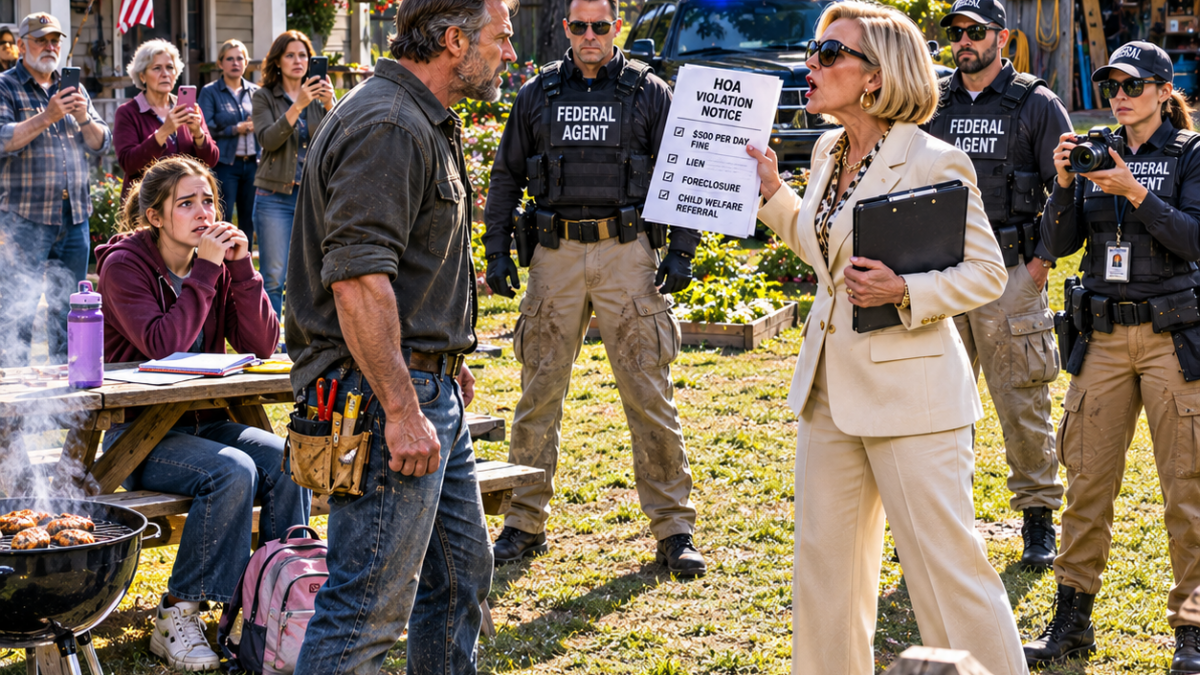
At exactly two, Marjorie entered.
Dark blazer.
Fake federal badge clipped near the lapel.
Phil followed wearing a blue windbreaker labeled ENVIRONMENTAL RESPONSE LIAISON.
Two men behind them carried silver equipment cases and clipboards.
Marjorie looked radiant.
Confident.
She believed the fear campaign had worked.
“Thank you for attending this emergency environmental briefing.”
The yard quieted.
Olivia stayed inside.
“Preliminary testing indicates hazardous contamination at the Mercer property. Federal intervention is now required to protect community safety.”
One fake agent opened a silver case.
Tubes.
Meters.
Props arranged carefully.
Marjorie pointed toward my workshop.
“Unauthorized mechanical operations have produced possible chemical exposure. Soil remediation and temporary property seizure may be required.”
Temporary property seizure.
She said it casually.
I looked toward Norah.
Tiny shake of the head.
Not yet.
I folded my arms.
“What federal agency are you representing today, Marjorie?”
She smiled.
“Federal Environmental Authority.”
There is no legitimate federal agency by that exact name with the powers she was claiming.
But most people in the yard didn’t know that.
That was the point.
Phil stepped forward.
“Failure to cooperate may constitute criminal obstruction.”
His voice cracked on criminal.
Then Marjorie did something I will never forgive.
She turned toward the neighbors.
“Because a minor lives on this property, child welfare officials may also need to evaluate possible exposure.”
My entire body changed.
Not metaphorically.
My vision narrowed.
Hands curled.
Heat moved through my chest.
Home was one thing.
Money another.
She had just introduced my daughter into the threat.
June touched my wrist.
One tap.
I breathed.
Marjorie kept going.
She raised another document.
“Emergency environmental warrant.”
Fake seal.
Heavy paper.
Official-looking signature.
“Immediate interior and exterior inspection is authorized.”
The two men moved toward my workshop.
Norah whispered.
“Now.”
I stepped between them and the shed.
Not fast.
Not shouting.
“Before anybody walks another foot, everyone here needs to understand exactly what’s happening.”
Marjorie rolled her eyes.
“This is not a debate.”
“No.”
I looked at the cameras.
Then the neighbors.
“It’s evidence.”
Her expression changed.
Tiny flicker.
First crack.
Norah handed me the deed.
Real county stamp.
Real filing.
Real parcel description.
“This is my deed.”
Marjorie laughed.
“Your deed doesn’t override federal—”
Norah stepped forward.
“My name is Norah Price. I represent Daniel Mercer.”
Silence.
She opened the document.
“Let’s begin with the authority Ms. Bell has been claiming over Parcel A1.”
Then she read.
Slowly.
Clearly.
Parcel A1 shall remain exempt from all association covenants and residential-use restrictions, preserving workshop, utility, garden, and agricultural rights retained by the founding owner.
Nobody moved.
Marjorie blinked.
Phil stared at the grass.
The two fake agents stopped walking.
Norah closed the deed.
“In plain English, Daniel Mercer’s property has never been subject to Briar Lake association covenants. Not today. Not after a compliance vote. Not because someone created a laminated inspection form. Never.”
Luis’s brother stepped forward.
He had already confirmed with the relevant public offices that no federal environmental seizure or emergency proceeding existed at my address.
“No federal action has been issued against this parcel.”
Mina raised her camera.
“Ms. Bell, which federal office issued the badge you’re wearing?”
Marjorie looked toward her.
“What?”
“Agency name. Office location. Contact.”
One of the men with the silver cases began packing.
The second walked toward the gate.
Phil leaned toward Marjorie.
“Maybe we should leave.”
“Be quiet.”
But her voice had changed.
No blade.
No certainty.
I opened my own folder.
“Since everyone is here, let’s finish.”
I showed the county complaint notices.
Grass.
Mailbox.
Truck.
Workshop.
Then screenshots from my cameras.
Marjorie photographing my windows at night.
Marjorie watching Olivia come home.
Phil measuring my shed without permission.
Then the aerial photographs.
Stonebridge metadata.
People started murmuring.
Then I showed the midnight footage.
Marjorie in blue gloves.
Phil digging in Olivia’s garden.
Two containers being placed in the soil.
The yard exploded.
June covered her mouth.
Luis swore.
Kelly said:
“Oh my God.”
Marjorie raised her voice.
“This video has been manipulated.”
“No.”
Norah answered.
“It has been backed up with original timestamps.”
I looked around.
“Those containers are still exactly where they left them.”
That silenced people again.
Norah had already advised me not to touch them.
Their retrieval would be handled properly.
Then came Stonebridge.
The Coldwells.
Mrs. Keen.
Luis.
Lowball offers after enforcement pressure.
I didn’t accuse anyone of a crime as a final legal conclusion.
I stated what we could document.
The sequence.
The company.
The dates.
The photographs Stonebridge paid for.
The homeowners targeted.
The offers that followed.
Norah handled the legal wording.
“If evidence establishes coordinated use of false enforcement threats to depress property owners into sales, several civil and potentially criminal issues may arise. That determination belongs to investigators and courts, not this gathering.”
That was important.
We weren’t becoming Marjorie.
We didn’t need fake authority.
Facts were enough.
A woman near the fence said:
“You told me Daniel’s workshop would invalidate our insurance.”
Marjorie looked toward her.
“I said it could create exposure.”
Luis spoke.
“You told my wife supporting him could make us liable.”
“I was discussing neighborhood risk.”
Another resident:
“You said foreclosure proceedings had already been authorized.”
Marjorie took a step backward.
People were comparing notes.
That was the thing she had always prevented.
One lie works when each person hears it alone.
A room full of people repeating their versions turns manipulation into a pattern.
Marjorie’s kingdom did not collapse because I shouted.
It collapsed because everybody started talking at the same time.
She tried one last move.
“That deed could be fraudulent.”
Norah smiled.
Not kindly.
“You’ll enjoy discussing that theory with County Records.”
Then she looked toward the fake environmental paperwork.
“And the appropriate state and federal authorities may be very interested in these documents.”
Mina zoomed the camera toward Marjorie’s badge.
For the first time since I met her, Marjorie Bell looked small.
Not physically.
Authority had left her body.
The blazer was still expensive.
The clipboard still in her hand.
The badge still clipped to her chest.
But everyone could see the costume.
Two days later, county officials collected copies of the documents and reviewed the complaint trail.
The planted containers were handled as evidence rather than something I dug up in anger.
Norah began helping residents preserve records.
Stonebridge Land Partners stopped calling people on Renfield Road.
That didn’t prove every allegation by itself.
It did end the pressure almost immediately.
Phil refunded several “inspection fees” and posted an apology that sounded like his attorney was standing directly behind him while he typed it.
Marjorie disappeared from neighborhood meetings.
Within a week, a moving truck sat outside her white colonial.
People assumed that was the ending.
It wasn’t.
Not for me.
Public exposure takes minutes.
Getting your daughter to feel safe again takes longer.
Olivia walked to the bus stop for the first time in weeks.
I watched from the porch without telling her.
She reached the corner.
Turned.
Saw me.
Rolled her eyes.
Then waved.
That was victory.
She replanted basil where the containers had been buried.
I helped.
Badly.
“Dad.”
“What?”
“You’re drowning it.”
“Plants need water.”
“They need oxygen too.”
“That’s dramatic.”
“You’re an HVAC technician. You literally understand airflow.”
I stepped away from the watering can.
She smiled.
That was victory too.
June organized Sunday suppers.
Luis helped me rebuild the section of fence people had been cutting through.
Kelly apologized for believing Marjorie’s meeting presentation.
Some neighbors didn’t apologize.
I learned not to need everyone to.
The neighborhood did not transform into paradise.
People still complained about dogs.
Parking.
Noise.
Tree branches.
Humans remain humans even after a tyrant moves away.
But conversations changed.
If somebody said:
“Neighborhood Standards says—”
Someone else asked:
“Which standards?”
If a letter appeared:
“Where is the legal authority?”
If a committee proposed a rule:
“Does it actually apply to this property?”
Questions.
That was the reform.
Not revolution.
Questions.
Norah told me once:
“Marjorie’s greatest asset wasn’t paperwork.”
“What was?”
“People’s embarrassment.”
I understood immediately.
Most people hate admitting they don’t understand legal language.
Someone shows them a document with a seal.
Uses words like lien.
Compliance.
Jurisdiction.
Environmental hazard.
Federal.
Foreclosure.
They panic quietly rather than asking:
Who are you?
What law?
What authority?
Where is this recorded?
Marjorie built power inside that silence.
She nearly used it to take my home.
The Stonebridge records became part of civil claims filed by several affected homeowners.
County officials reviewed whether complaint systems had been misused.
Other agencies reviewed the fake governmental materials.
I stayed out of conclusions that weren’t mine to make.
I had learned something from Marjorie.
People become dangerous when they start treating suspicion as proof.
So I stayed disciplined.
I knew what happened to me.
I knew what the cameras recorded.
I knew what the deed said.
I knew Marjorie entered my property.
I knew she had surveillance photographs.
I knew fake documents were used.
I knew containers were buried in Olivia’s garden.
I knew Stonebridge ordered aerial photographs and contacted pressured owners.
What criminal charges, if any, ultimately belonged to whom was for investigators.
That distinction mattered.
Emotional revenge says destroy the enemy.
Legal justice says preserve the evidence.
I chose the second.
Six months later, we held a barbecue in the same backyard where Marjorie had threatened foreclosure and child welfare.
My grill smoked.
June brought too much food.
Luis brought folding tables.
Tessa came over.
Olivia laughed so hard at something that lemonade came out her nose.
She screamed.
Tessa nearly fell out of her chair.
I laughed until my ribs hurt.
For a second, I remembered the first Saturday after we moved in.
Chicken on the grill.
Two girls pretending to study.
The world ordinary.
That was what Marjorie almost stole.
Not real estate.
Ordinary life.
People underestimate how valuable ordinary becomes after someone makes you afraid inside your own home.
The first months after everything happened, I still checked cameras too often.
A car slowed.
I looked.
Someone walked near the ditch.
I checked.
Olivia came home late.
My stomach tightened.
Eventually, I realized Marjorie’s surveillance continued inside my head after she was gone.
That made me angry in a different way.
So I started turning the monitor off.
Fifteen minutes.
Then an hour.
Then entire evenings.
I didn’t remove the cameras.
I’m not stupid.
But I stopped letting them become windows I stared through waiting for danger.
There is a difference between security and captivity.
Marjorie never understood that either.
She lived in the white colonial surrounded by cameras.
Perfect hedges.
Perfect shutters.
Perfect control.
June once said her house looked like “a smile with teeth behind it.”
I understood now.
A person can build so much control around themselves that eventually control becomes the only way they know how to feel safe.
Then anyone independent looks threatening.
My workshop threatened Marjorie because she didn’t approve it.
Olivia’s garden threatened her because it existed outside her standards.
My truck threatened her because it looked like work.
My property threatened her because the deed placed a hard limit around her influence.
She called that disorder.
I called it home.
One afternoon, Mr. Harwood from County Records called.
He had found older documents connected to Parcel A1.
Original filing notes.
The founding landowner had insisted on the exemption because he operated a workshop and small agricultural plot before the surrounding subdivision existed.
He did not want future neighborhood rules to erase existing rights.
I drove down and read the note.
One dead property owner from decades earlier had anticipated a problem he would never live to see.
I thought about that for a long time.
Rights often survive because somebody bothers to write them down before the conflict exists.
Marjorie believed time favored her.
The neighborhood grew around the property.
People forgot the exemption.
Committee structures changed.
Old documents disappeared into county folders.
Then she arrived and treated institutional memory like ownership.
But paper waited.
Thirty-four years.
Quiet.
Then Norah opened the file and read one paragraph aloud in my yard.
That was enough.
I made copies for Olivia.
She looked at them.
“You want me to keep property records?”
“Yes.”
“Dad, I’m fifteen.”
“Perfect age to begin appreciating archival documentation.”
“You’re becoming Walter.”
“That is deeply offensive.”
She laughed.
Then stored the copy anyway.
Divorce had made me afraid I couldn’t give her stability.
Marjorie made that fear worse.
For weeks, I believed another adult could take away the one thing I had managed to build correctly.
What I eventually learned was that stability isn’t the absence of threat.
It’s knowing what to do when one arrives.
Olivia watched me get scared.
She also watched me document.
Call an attorney.
Read the deed.
Ask questions.
Wait.
That mattered.
Children do not need fathers who never feel fear.
They need adults who show them fear does not make every decision.
Months later, Olivia had a school assignment about civic responsibility.
She asked me:
“Does what happened count?”
“As what?”
“Government.”
“No.”
“Exactly.”
“What?”
She smiled.
“That’s my point.”
Her essay was about the difference between official authority and people pretending to have it.
She got an A.
I accused Norah of ghostwriting.
Norah said:
“Olivia writes better than you.”
Probably true.
The civil claims around the neighborhood took time.
Some residents had strong documentation.
Others didn’t.
Some losses were recoverable.
Some were not.
Mrs. Keen had already sold her home.
The fact that pressure influenced her decision didn’t magically reverse the transaction.
That hurt.
Justice arrives late sometimes.
Late justice cannot always restore the original life.
Norah told me that bluntly.
“You’re going to have to accept some people won’t be made whole.”
“I don’t like that.”
“The law isn’t a time machine.”
I thought about the divorce.
Laura—Olivia’s mother, still alive, still part of our daughter’s life—had told me something similar years earlier.
“You keep wanting every bad thing corrected.”
“Is that wrong?”
“Impossible.”
Maybe I had spent too much of my life repairing equipment.
Machines are satisfying.
Bad motor?
Replace it.
Low refrigerant?
Find leak.
Clogged drain?
Clear it.
People aren’t systems you return to factory settings.
Sometimes you repair what you can and learn to live around the scar.
Marjorie left scars.
Olivia stopped trusting neighborhood adults for a while.
I became suspicious of official-looking letters.
June admitted she had known Marjorie was cruel but never imagined she was capable of the things recorded on camera.
Luis felt guilty that he had stayed quiet.
Nobody reset instantly.
But the neighborhood became more honest.
That’s what mattered.
A year later, Briar Lake residents formed an actual voluntary neighborhood association.
Properly registered.
Limited purpose.
No fake enforcement power.
No fines.
No liens.
Its main responsibilities were organizing cleanups, sharing emergency information, and arguing about the annual picnic.
June became treasurer.
Walter refused any title because he said committees shortened life expectancy.
Luis chaired meetings.
They invited me to join.
I declined.
Politely.
“I support you from over here.”
Luis pointed across the imaginary boundary between his yard and mine.
“Parcel A1?”
“Parcel A1.”
That became a neighborhood joke.
Someone brought a cake to the barbecue with PARCEL A1 written in frosting.
Olivia nearly died of embarrassment.
I loved it.
Humor is another way fear leaves a place.
You know something no longer controls you when you can joke about it without pretending it never hurt.
Marjorie never came back to a public meeting.
I saw her once months later.
Grocery store.
Frozen food aisle.
She saw me at the other end.
For a moment, neither of us moved.
I expected anger.
Maybe some final remark.
She turned her cart and left.
That was enough.
I didn’t need an apology.
There are apologies that heal.
There are apologies people use to reduce consequences.
I didn’t know which kind hers would have been.
Better to let silence remain silence.
The most important apology I received came from Phil.
He stopped by one afternoon.
No vest.
No clipboard.
Just an older man holding an envelope.
“I owe you money.”
Inside were copies of payments he had returned to several families.
“Why are you showing me this?”
“Because I want you to know.”
“Know what?”
“I was stupid.”
I looked at him.
“That isn’t the same as taking responsibility.”
“I know.”
He swallowed.
“Marjorie told me we had authority. I liked feeling useful. People listened when I wore the vest.”
That answer was painfully honest.
He continued.
“I didn’t ask why.”
“No.”
“I should have.”
“Yes.”
He nodded.
“I’m sorry.”
I didn’t forgive him instantly.
Didn’t shake his hand and tell him everything was fine.
It wasn’t.
But I told him:
“Do better next time somebody hands you authority you haven’t earned.”
He nodded again.
Then left.
Norah later told me that was surprisingly mature.
I told her not to ruin my reputation.
The planted containers disturbed me longer than anything else.
Not because I feared what was inside.
The proper authorities eventually handled them.
What stayed with me was the location.
Olivia’s garden.
Someone had looked at sunflowers, basil, tomatoes, the tiny handwritten labels my daughter made from popsicle sticks, and decided that was the place to manufacture evidence.
It was calculated.
Personal.
Designed so a later “inspection” could discover something exactly where Marjorie wanted it found.
For weeks after the containers were removed, Olivia refused to plant there.
She used pots near the porch instead.
One spring morning, I found her kneeling beside the old bed.
Bag of soil.
Basil seedlings.
I didn’t say anything.
She looked over.
“What?”
“Nothing.”
“You’re staring.”
“I’m allowed to stare. My property.”
She rolled her eyes.
Then handed me a trowel.
We planted together.
That was another victory nobody reported.
No cameras.
No neighbors.
No legal documents.
Just dirt beneath our fingernails.
Marjorie tried to turn the garden into evidence.
Olivia turned it back into a garden.
That’s what healing looks like most of the time.
Not speeches.
Use.
A place becomes yours again because you use it for what it was meant for.
The workshop returned to being a workshop.
I fixed compressors.
Rebuilt a fan motor.
Stored copper tubing.
No one photographed it.
My work truck left before sunrise.
No anonymous noise complaint arrived.
The grill smoked.
Nobody called environmental health.
Every ordinary action felt slightly rebellious at first.
Then eventually just ordinary.
That was when I knew we were okay.
Stonebridge became the subject of scrutiny beyond my property.
I learned enough to understand that development companies often use legal acquisition strategies aggressively, but whether specific people at Stonebridge had crossed criminal lines in every transaction was not mine to declare.
Norah kept reminding everyone:
“Facts first.”
The metadata mattered.
Low offers mattered.
Communications mattered.
Timing mattered.
But legal conclusions require evidence, not neighborhood anger.
I respected that.
Because the entire mess began when Marjorie did the opposite.
She treated suspicion like fact.
She said my workshop looked commercial.
Therefore it was illegal.
My truck looked industrial.
Therefore I posed risk.
Someone visited at night.
Therefore suspicious activity.
Olivia’s garden could theoretically hold chemicals.
Therefore contamination.
That way of thinking destroys people.
I wasn’t going to copy it just because the target changed.
The reporter, Mina Cross, eventually published a long investigation.
She focused less on me than I expected.
She wrote about fear-based neighborhood enforcement.
Fake authority.
Property pressure.
How official-looking documents can intimidate homeowners who cannot afford lawyers.
Mrs. Keen’s sale.
The Coldwells.
Other families.
I liked that.
My story was one piece.
Not the whole thing.
For a while, people called me brave.
That bothered me.
I had Norah.
Cameras.
A deed.
Neighbors willing to help.
A reporter.
A stable job, even after rumors cost me some clients.
Many people targeted by this kind of pressure have less.
Single seniors.
Families living paycheck to paycheck.
People terrified of any letter containing the word lien.
People who cannot spend money on six cameras.
Justice shouldn’t depend on who can afford better documentation.
That became something I cared about.
Norah and I put together a simple packet for neighborhood residents.
Not legal advice.
Just questions.
What is the legal entity?
Where are the covenants recorded?
Does the rule actually apply to your parcel?
Who authorized the fine?
What appeal process exists?
Is the government agency named in the notice real?
Can the document be verified through an official public number rather than the contact printed on the paper?
Simple questions.
Marjorie had counted on nobody asking them.
We made sure more people would.
Olivia designed the cover.
She titled it:
BEFORE YOU PANIC, CHECK.
I told her that sounded bossy.
She said:
“Runs in the family.”
Fair.
Years later, the one scene I remember most clearly is not the fake federal briefing.
Not the deed reveal.
Not Marjorie’s face when Mina asked which federal office issued her badge.
It is Olivia sitting at the kitchen table weeks earlier.
“Dad, did we move somewhere people don’t want us?”
That was the deepest wound.
Because the house was supposed to answer that question for her.
This is where you belong.
Your room.
Your garden.
Your porch.
Your father’s stupid grill.
Your life.
Marjorie contaminated that feeling.
For a while.
Not permanently.
That distinction is everything.
A bully can interrupt safety.
They don’t automatically own what comes after.
We rebuilt the feeling.
One Sunday supper at a time.
One bus stop walk.
One repaired fence board.
One basil plant.
One evening without checking cameras.
That was the real ending.
Not Marjorie leaving.
Us staying.
Six months after the confrontation, we held the barbecue.
Same yard.
Same grill.
Different atmosphere.
June brought potato salad.
Walter complained that nobody knew how to set a fence post properly anymore.
Luis burned burgers.
Tessa and Olivia laughed at something none of us understood.
Kids ran through the grass.
Neighbors talked.
No one cared that my workshop trim needed paint.
I stood near the grill holding the same kind of barbecue tongs I had held the day Marjorie threatened foreclosure.
That detail hit me unexpectedly.
Same object.
Same yard.
Completely different feeling.
Olivia walked over.
“You’re burning the chicken.”
“I’m developing flavor.”
“You said that last time.”
“And I was right.”
“You were not.”
She took the tongs.
I let her.
The sun went down behind the conservation land.
Smoke rose.
People stayed.
Nobody measured anything.
Nobody photographed my shed.
Nobody warned me about daily fines.
I realized I hadn’t thought about Marjorie in hours.
That was freedom.
People often think justice means the person who hurt you suffers equally.
I don’t.
Maybe I did once.
Now I think justice is returning reality to its proper shape.
My parcel was mine.
The record proved it.
My daughter was safe.
The neighborhood knew the truth.
The fake authority was exposed.
Residents learned to question.
Civil claims moved through actual legal channels.
Public agencies reviewed what belonged to them.
Marjorie’s costume power disappeared.
I did not need her destroyed.
I needed her unable to do it again.
There is a difference.
One evening, Norah sat on my porch.
We drank coffee.
“You know,” she said, “you were extremely annoying during this case.”
“How?”
“You wanted everything fixed immediately.”
“Reasonable.”
“No.”
“People were being hurt.”
“Yes.”
“Then speed seems useful.”
“Law is slow.”
“I noticed.”
She smiled.
“But you did one thing right.”
“One?”
“Consistently.”
“What?”
“You kept letting her talk.”
I thought about the church meeting.
The fake inspection.
The environmental briefing.
Every time Marjorie felt powerful, she added another statement to the record.
Another threat.
Another claim.
Another document.
Pride made her careless.
“She thought silence meant I was afraid.”
Norah nodded.
“Most people who rely on intimidation do.”
“Was I?”
“Were you afraid?”
“Yes.”
“Of course.”
“Olivia?”
“Mostly.”
Norah looked toward the garden.
“That probably kept you disciplined.”
She was right.
If it had been only me, I might have confronted Marjorie earlier.
Olivia forced me to think beyond satisfaction.
I didn’t need a dramatic moment.
I needed a safe outcome.
That changed how I handled everything.
Maybe fatherhood is mostly that.
Trading the reaction you want for the result your child needs.
The final county review cleared the complaints that had no valid basis.
My professional license remained intact.
Clients came back.
A few apologized for canceling.
One seafood restaurant owner called.
“Danny, I heard what happened.”
“Yeah.”
“I feel terrible.”
“You canceled a service call.”
“I thought you were under environmental investigation.”
“So did half the neighborhood.”
“You mad?”
“I charge weekend rates now.”
He laughed.
I charged normal rates.
Mostly.
Life recovered economically too.
Slowly.
The lost hours still mattered.
Attorney costs mattered.
Camera system mattered.
Work missed for inspections.
Some damages became part of claims.
Some became the price of defending ourselves.
I don’t romanticize that.
Standing up for yourself can be expensive even when you’re right.
That’s another reason fake authority works.
Bad actors know defending a right often costs more in the short term than surrendering it.
Marjorie expected exhaustion to make me sell.
Stonebridge offered an exit.
That’s what made the pattern so effective.
Create enough pain.
Then offer relief.
People don’t always sell because they believe the buyer is fair.
Sometimes they sell because they’re tired.
I understood Mrs. Keen better after that.
At first, part of me wondered:
Why didn’t she fight?
Then I remembered Olivia crying beside the tomatoes.
Another few months of that?
Another dozen inspections?
More lost jobs?
Everyone has a threshold.
Marjorie made a business out of finding it.
That was what enraged me most.
Not that she misused neighborhood rules.
That she treated human exhaustion as leverage.
Years after she left, June and I talked about it.
We were replacing a thermostat in her hallway.
“You know what bothers me?” she said.
“Your filter hasn’t been changed in ten months.”
“Besides that.”
“Unclear.”
“I knew she was bad.”
“You warned me.”
“I didn’t do anything.”
“What would you have done?”
“Something.”
“You didn’t know what she was doing.”
“I knew enough.”
I shut the panel.
“June.”
She looked at me.
“Guilt feels productive because it hurts. Doesn’t mean it is.”
She laughed.
“Where’d you learn that?”
“Divorce.”
She handed me a lemon bar.
“Your therapy is weird.”
Probably.
The neighborhood records committee eventually adopted one rule I loved.
Every official communication had to identify its legal authority.
Not just “standards require.”
Actual citation.
Bylaw section.
Recorded covenant.
Public code if applicable.
Appeal contact.
Effective date.
It made notices longer.
It also made nonsense harder.
Walter said:
“Nothing scares a bully like page numbers.”
He had a point.
Marjorie used ambiguity.
Specificity killed it.
The same was true with the fake federal paper.
Emergency environmental authority.
Sounds frightening.
Which agency?
Which statute?
Which office?
Which case number?
Which authorized officer?
The words dissolved under questions.
That’s something I told Olivia when she began driving.
“If somebody sounds official, don’t panic.”
She groaned.
“Dad.”
“Verify.”
“Dad.”
“Call the actual organization.”
“Dad.”
“Don’t use a phone number printed on a suspicious letter.”
“I’m trying to learn parallel parking.”
“Related skill.”
“It is absolutely not.”
Parenting teenagers is legal justice of another kind.
The house improved over time.
I replaced the porch supports.
Painted the workshop.
Fixed the drainage.
Not because Marjorie wanted them fixed.
Because I did.
That distinction made every project satisfying.
Olivia chose sunflower yellow for one section of garden fencing.
It was objectively terrible.
I approved immediately.
No committee.
No standard.
No color chart.
Every time I saw it, I smiled.
One afternoon, Walter stood beside it.
“That color is an offense.”
“File a complaint.”
“With who?”
I pointed at Olivia.
“She is the governing authority.”
Walter shook his head.
“Worse than Marjorie.”
Olivia heard him.
“Five hundred dollars a day, Walt.”
We laughed until June came outside to see what happened.
That was how the neighborhood finally processed the trauma.
Not by pretending it was funny.
By reclaiming the language.
Fine.
Compliance.
Inspection.
Authority.
Words that once made people tense became jokes because everyone knew where the real limits were.
Marjorie’s biggest theft had been certainty.
Nobody knew what rules were real.
What fines were legitimate.
What power she actually possessed.
Once the documents were checked, certainty returned.
That is why legal justice mattered.
Feelings change.
Records remain.
The recorded deed didn’t care whether Marjorie was persuasive.
The exemption didn’t care whether thirty neighbors believed her.
County filings did not bend because she wore a badge.
Truth doesn’t always win quickly.
But some truths are very patient.
Parcel A1 waited thirty-four years in a dusty file.
Then one afternoon, Norah read it in my yard and ended a performance Marjorie had spent weeks constructing.
I think about that whenever somebody says paperwork is boring.
Boring saved my house.
One evening, long after everything settled, Olivia and I sat on the back steps.
She was seventeen then.
Almost finished with high school.
The basil was enormous.
My knees were worse.
She asked:
“Were you ever actually scared we’d lose the house?”
I considered lying.
Then didn’t.
“Yes.”
“How much?”
“A lot.”
“You acted like you knew everything.”
“That is called parenting.”
She laughed.
Then grew serious.
“Why didn’t you tell me?”
“Because you were fifteen.”
“I knew anyway.”
“I know.”
She looked across the yard.
“Was that why you put up all the cameras?”
“Partly.”
“Were you scared for me?”
“Yes.”
She nodded.
Then said something that caught me off guard.
“I was scared for you too.”
I looked at her.
“Why?”
“Because you were getting that quiet thing.”
“What quiet thing?”
“When you’re really mad and you stop talking.”
Apparently children study their parents better than parents realize.
She continued.
“I thought you were going to do something.”
“I almost did.”
“What stopped you?”
“You.”
Her face changed.
“Me?”
“I didn’t want you learning that the way to protect your home was to become more dangerous than the person threatening it.”
She looked at the garden.
“So you used paperwork.”
“Embarrassing, isn’t it?”
She smiled.
“A little.”
Then rested her head on my shoulder.
That conversation mattered more than any public humiliation Marjorie experienced.
Because Olivia understood what I wanted her to understand.
Standing up for yourself does not require losing yourself.
That was the line.
I had spent years repairing machines by finding the fault instead of smashing the whole unit.
Marjorie was not the neighborhood.
Stonebridge was not every developer.
Phil was not every retired neighbor.
Fake documents were not the law.
Separating those things kept anger from spreading beyond the people responsible.
That became important after the confrontation.
Several neighbors who had believed Marjorie expected me to hate them.
I didn’t.
I was angry.
Different thing.
Kelly once apologized three times in the same conversation.
Finally, I said:
“You were scared.”
“That’s not an excuse.”
“No.”
“Then why aren’t you mad?”
“I am.”
She blinked.
“Oh.”
“You can be angry and still talk to somebody.”
That seemed new to both of us.
The divorce had taught me bad lessons about conflict.
Everything felt binary.
Winner.
Loser.
Right.
Wrong.
Leave.
Stay.
Marjorie forced me to learn a better version.
Boundaries without cruelty.
Documentation without obsession.
Anger without destruction.
Justice without fantasy.
Those were harder.
Also more useful.
By the time Olivia left for college, the house looked nothing like the tired place I bought.
New porch.
Healthy garden.
Workshop organized enough that I could find most things without swearing.
The sunflower-yellow fence remained.
She made me promise not to repaint it.
I lied and said I would think about it.
On moving day, she stood beside the car.
“Dad.”
“Yeah?”
“Don’t become weird when I leave.”
“Too late.”
“I mean weirder.”
“I’ll do my best.”
Then she pointed toward the garden.
“Water the basil.”
“Plants need oxygen.”
She smiled.
“I’m proud of you.”
That one stopped me.
“For what?”
“You didn’t let her make you leave.”
I hugged her.
After she drove away, I sat on the porch longer than I want to admit.
The house felt too quiet.
But not threatening.
Just quiet.
The kind I had wanted from the beginning.
I realized Marjorie had become a chapter.
Not the book.
That was the final victory.
People who control through fear want permanence.
They want you thinking about them after they’re gone.
Adjusting your behavior.
Expecting the next threat.
Checking windows.
Reading every envelope with a racing heart.
The day you stop doing that, they lose the last piece of power.
I kept the cameras.
Kept the deed in a fireproof box.
Kept copies of everything important.
But I stopped living like another Marjorie was waiting at the gate.
Most people aren’t.
That’s worth remembering too.
The world contains bullies.
It also contains June with lemon bars.
Walter with bad jokes.
Norah with real estate law.
Luis with a drill.
Teenage girls who care more about basil than property disputes.
A reporter who asks where the fake badge came from.
A county clerk who finds a forgotten paragraph.
Systems fail.
People also repair them.
That is the fuller story.
One October afternoon, I stood near the side gate where Marjorie had entered with her little inspection crew.
The original latch had rusted.
I replaced it.
Nothing symbolic.
Just maintenance.
When I finished, I closed the gate.
Click.
Simple.
Legal.
Mine.
I looked toward the spot where Olivia’s notebook had fallen years earlier.
Grass.
Nothing else.
The memory was still there.
But it no longer owned the ground.
That’s the thing about places.
People can contaminate them with fear.
Then time and ordinary life slowly reclaim them.
The backyard became a backyard again.
The workshop became a workshop.
The garden became a garden.
My home became a home.
Marjorie had threatened five-hundred-dollar daily fines.
Foreclosure.
Government seizure.
Child welfare.
She used cameras, neighbors, fake officials, fabricated documents, planted evidence, and fear.
In the end, none of those things changed the legal fact she had refused to accept.
Parcel A1 was never hers to regulate.
My property had been exempt for thirty-four years.
One recorded paragraph outlasted every lie.
And one quiet decision mattered almost as much.
I didn’t give her the angry man she needed.
I gave her time.
Time to send more letters.
Time to create more documents.
Time to walk onto camera.
Time to bury containers.
Time to stand in front of thirty people wearing a fake badge and claim a federal authority nobody could verify.
Arrogant people often believe patience means surrender.
Sometimes patience is simply giving them enough room to finish the record against themselves.
I learned that from Marjorie.
I hope I never need the lesson again.
But if another envelope arrives someday with a frightening seal and words designed to make me panic, I know exactly what I’ll do.
I won’t bow.
I won’t explode.
I’ll read.
I’ll verify.
I’ll document.
I’ll ask who granted the authority.
I’ll protect my daughter.
I’ll protect my home.
And if the person on the other side is depending on fear to make fake power look real, I’ll give them the one thing Marjorie Bell could never survive.
A room full of people looking at the same evidence at the same time.
Because that afternoon in my backyard taught me something I will carry for the rest of my life.
Bullies don’t always kick down doors.
Sometimes they wear blazers.
Carry clipboards.
Print seals.
Speak gently about compliance.
They count on exhaustion doing what the law cannot.
They count on fear keeping neighbors separated.
They count on you being too embarrassed to say you don’t understand.
Too tired to check the deed.
Too frightened to ask whether the badge is real.
Marjorie counted on all of it.
She was almost right.
Then Olivia asked whether we had moved somewhere people didn’t want us.
That question became the line I would not let her cross.
I couldn’t control Marjorie.
Couldn’t control Stonebridge.
Couldn’t control rumors.
But I could decide whether my daughter learned that home belonged to whoever sounded most official.
The answer was no.
Home belonged to the people who had the legal right to be there.
Safety belonged to the truth.
Authority had to prove itself.
And fear did not get to sign the deed.
Months after the barbecue, I sat on the porch at sunset.
No violation notice.
No strange car.
No drone.
The only sound was wind through conservation woods and Olivia singing badly in the kitchen while making something that smelled suspiciously burned.
I leaned back.
For the first time since Marjorie entered our lives, I wasn’t waiting for the next move.
There was no next move.
Only home.
That was the justice I had wanted from the beginning.
Not watching Marjorie lose.
Watching my daughter breathe again.








