𝗙𝗨𝗟𝗟 𝗦𝗧𝗢𝗥𝗬 HOA Karen Threatened to Call the Sheriff on My Goats—She Had No Idea the Chief Was My Uncle
𝗣𝗔𝗥𝗧 𝟮
Gerald chuckled once.
“That’s what she’s saying.”
Then he told me something more useful.
Diane had posted a photograph of my fence on a Ridgecrest Estates social media page.
The caption said:
Working to resolve this eyesore for our community.
“Did you see it yourself?” I asked.
“Yes.”
“Did you save it?”
“Yes.”
Of course he had.
Gerald Pruitt had been keeping receipts before people started using that phrase metaphorically.
“Print it for me.”
“Already did.”
Three weeks later, a second certified letter arrived.
The fine had doubled to $800.
There was now another alleged violation:
Failure to respond to official HOA correspondence.
I laughed at that one.
Not because it was funny.
Because somebody had apparently decided that ignoring an invalid demand created a second valid demand.
Then I reached the paragraph that mattered.
Ridgecrest Estates HOA reserves the right to enforce community standards on all properties within or adjacent to the Ridgecrest Estates planned community, including properties whose owners have not formally acknowledged HOA jurisdiction.
I read the sentence four times.
Adjacent.
That was their theory.
Not covenant.
Not agreement.
Not annexation.
Adjacent.
If that theory were correct, every HOA in America could govern whatever property happened to sit beside it.
A farm.
A church.
A commercial parcel.
A public park.
Another subdivision.
All because those properties were nearby.
I put the second letter beside the first.
Then I called Patricia Wren.
Patricia had practiced agricultural and real-property law in Millhaven County for twenty-two years.
I remembered her from a zoning hearing years earlier because she had been the only lawyer in the room who seemed uninterested in hearing herself speak.
Her questions were short.
Specific.
And devastating when somebody did not have an answer.
I brought her both HOA letters.
My deed.
A county map.
And a copy of Ridgecrest Estates’ CC&Rs that I had downloaded from county records.
Patricia read everything.
She underlined the word adjacent in Diane’s letter.
Then she turned to the CC&Rs.
Section 1, Paragraph 2 defined Ridgecrest Estates as all lots and common areas contained within the planned community shown in Plat Book 44, pages 112 through 118.
Patricia tapped the paragraph.
“Their jurisdiction ends here.”
I nodded.
She tapped my deed.
“Your property isn’t here.”
“No.”
“Never has been?”
“No.”
“No annexation?”
“No.”
“No voluntary submission?”
“No.”
“No recorded restrictive covenant?”
“No.”
She removed her glasses.
“Then this is not complicated.”
She held up Diane’s letter.
“This is a letter.”
Then she held up my deed.
“This is ownership.”
That distinction would eventually decide everything.
But Patricia did not recommend suing immediately.
Instead, she gave me four assignments.
Current boundary survey.
Certified deed chain back to 1947.
Certified Ridgecrest Estates plat.
Written statement from somebody with direct long-term knowledge of the fence and property boundary.
“Why all four?” I asked.
“Because right now, you know you’re right.”
She slid the documents back toward me.
“I want to make it impossible for anyone else to pretend they don’t know you’re right.”
The survey came first.
Dale Hutchins had been surveying Millhaven County for thirty years.
His father had done the same work before him.
Dale arrived early one morning while fog still covered the creek bottom.
He walked the property for two days.
I joined him along the eastern boundary.
He located monuments.
Set iron pins.
Compared his readings against the older metes-and-bounds descriptions.
At three points near Ridgecrest Estates, he showed me where my fence stood relative to the actual property line.
Fourteen feet inside at the closest point.
Thirty-one feet inside at the farthest.
That surprised even me.
For years, I had known the fence was on my side.
I had not realized how conservatively my father had positioned some sections.
Dale smiled.
“Your fence isn’t even close enough for them to argue over.”
He filed the survey with the county.
I obtained a certified copy.
Next came the deed chain.
I spent two afternoons at the Register of Deeds office.
Loretta, who had worked there thirty years, pulled the records.
Instrument No. 1947-AC0214.
Amos Callaway’s original purchase.
Then the 1963 acquisition.
Transfer after my father’s death.
Finally, 2004-CR0881.
Every conveyance properly executed.
Every recording complete.
No gaps.
No competing ownership.
No Ridgecrest Estates anything.
Loretta stacked the certified copies.
“That’s about as clean as they come,” she said.
The third document was the Ridgecrest Estates plat.
Plat Book 44, pages 112 through 118.
It showed every residential lot.
Street.
Common area.
And exterior boundary.
Between Ridgecrest Estates and my land sat a county road right-of-way dating to 1938.
At no point did their recorded plat cross into my acreage.
They were nearby.
That was all.
Adjacent had done a remarkable amount of work in Diane’s imagination.
In property law, it did none.
Gerald supplied the final piece.
He came to my house one Saturday holding a notarized statement he had typed himself.
It described four decades of observing the property.
The historical fence.
The former pasture before Ridgecrest Estates was built.
And Diane’s activity near my property.
Attached was her social media post with my fence photograph.
Working to resolve this eyesore for our community.
Gerald had printed the posting date on the reverse side.
“I think that’ll do,” he said.
“It’ll do.”
I took the full file to Patricia.
She arranged everything across her conference table.
Survey.
Deeds.
Plat.
Gerald’s affidavit.
HOA correspondence.
County agricultural zoning.
For nearly twenty minutes she said nothing.
Finally she leaned back.
“They have no colorable claim.”
I waited.
“There is no recorded instrument extending their HOA to your parcel. No covenant. No deed restriction. No easement. No jurisdiction.”
She picked up the first fine letter.
“This is unenforceable.”
The second.
“Also unenforceable.”
Then the paragraph threatening animal control.
“And the county permits livestock on your parcel.”
I nodded.
Patricia continued.
“They’re demanding money you don’t owe based on authority they don’t have.”
That afternoon, she drafted a formal notice.
Certified mail.
Return receipt requested.
It identified my parcel by instrument number.
Listed the deed chain.
Cited Dale’s survey.
Referenced Ridgecrest Estates’ own plat.
Quoted its CC&Rs.
And cited the county agricultural ordinance.
The conclusion was simple.
Ridgecrest Estates possessed no authority over my property.
The $1,200 in accumulated fines was rejected.
Any additional enforcement attempt would be treated as interference with my property rights.
Nine days later, the signed return receipt came back.
Then everything became quiet.
Gerald eventually heard that Ridgecrest Estates’ attorney had reviewed Patricia’s notice.
The lawyer apparently told the board exactly what Patricia had told me.
Their position had no legal merit.
Around the same time, Diane’s social media post vanished.
That could have ended it.
It should have.
Instead, Diane started looking for another angle.
Through people in town, I learned she had contacted the county assessor.
A title company.
Eventually a private title-search firm.
She was searching for a cloud on the Callaway title.
An old easement.
A missed covenant.
Anything that might justify the authority she had already claimed.
She found nothing.
That should tell you something about institutional overreach.
Sometimes people discover they are wrong and correct themselves.
Other times, they discover they are wrong and begin searching for evidence that will somehow make them retroactively right.
Diane belonged to the second category.
Around that time, Uncle Raymond stopped by.
I had not called him about the HOA.
I did not need to.
Millhaven County was not large enough for a dispute involving the Callaway name to remain invisible forever.
Raymond leaned against my kitchen counter while I made coffee.
He was older than my father had been when he died, but he still carried himself like the deputy I remembered from childhood.
“You got yourself an HOA now?” he asked.
“No.”
He smiled.
“That isn’t what I’m hearing.”
“They think they’re my HOA.”
“That seems inconvenient.”
“For them.”
He laughed.
Then his expression changed.
“I heard somebody mentioned calling us about livestock.”
“Diane did.”
Raymond nodded slowly.
“And?”
“And nothing.”
“Good.”
I looked at him.
“You sound disappointed.”
“No. I’m relieved.”
He took the coffee I handed him.
“If that woman calls my department, she’ll get treated exactly like anybody else. We check jurisdiction. We check county law. We document the complaint.”
“I know.”
“And your goats are legal.”
“I know that too.”
He pointed at me with the cup.
“Then don’t turn me into part of your property case.”
I smiled.
“I wasn’t planning to.”
“Good.”
That was why I had not mentioned Raymond to Diane.
Family was family.
Law was law.
I did not need my uncle’s badge to defend land my deed already protected.
But knowing Diane had threatened to summon a department headed by a man who had personally repaired my grandfather’s fence years earlier did add a certain irony.
The real battle arrived through lawyers.
Instead of withdrawing its claims, Ridgecrest Estates hired an Austin property attorney named Strickland.
His response argued that the HOA possessed implied authority over adjacent properties when their use materially affected the character of the planned community.
That sentence fascinated Patricia.
She read it twice.
Then called me.
“They’re going forward.”
“On what?”
“Apparently on the theory that if your property affects their residents, they get to regulate you.”
“Is that a thing?”
“No.”
“Then why file it?”
“Because lawyers sometimes get paid to make the best argument available, not a good one.”
The HOA cited three cases.
Patricia read all three.
None involved anything like our facts.
Each dispute concerned parties connected through a recorded covenant or common development scheme.
I shared nothing with Ridgecrest Estates.
Not a declaration.
Not a plat.
Not a subdivision.
Not an easement.
Nothing.
So Patricia filed for declaratory judgment.
We asked the court to determine that Ridgecrest Estates HOA possessed no authority over Parcel 2004-CR0881.
We sought a permanent injunction preventing further fines, notices, or enforcement attempts.
We asked for attorney’s fees.
And we attached the record.
The hearing was scheduled for the second Tuesday in June.
I arrived at the Millhaven County Courthouse at 8:30 that morning wearing a dark wool blazer that had belonged to my father.
The June air was already warm.
I carried a banker’s box.
Inside were the original deed.
Certified deed chain.
Survey.
Recorded HOA plat.
Gerald’s affidavit.
County zoning regulations.
Both HOA letters.
Everything.
Diane was already there.
She sat beside Strickland.
And yes, she had brought the clipboard.
For some reason, seeing it on the counsel table made me feel calmer.
The clipboard had been part of the performance from the beginning.
The documents in my box were something else entirely.
Judge Clara Fitch took the bench at exactly nine.
She had been a county judge for fourteen years and had a reputation for impatience with arguments that confused volume with substance.
Strickland went first.
He argued for roughly twenty minutes.
Community character.
Reasonable expectations.
External impacts.
Adjacent land.
Planned-community principles.
He used adjacent seven times.
I counted.
His argument was polished.
If you had not seen the documents, it might even have sounded persuasive.
That is the danger of legal-sounding language.
It can make an unsupported claim appear temporarily respectable.
Then Patricia stood.
She displayed the Ridgecrest Estates plat.
“Your Honor, this is the recorded development.”
She pointed to the boundary.
“Ridgecrest Estates ends here.”
Then Dale’s survey.
“This is Mr. Callaway’s parcel.”
Another line.
“The fence itself is between fourteen and thirty-one feet inside his surveyed property.”
Then the county right-of-way.
“Between the two recorded properties is an additional public right-of-way.”
She displayed the CC&Rs.
“The association’s declaration defines its jurisdiction as the lots and common property shown in Plat Book 44, pages 112 through 118.”
She paused.
“Mr. Callaway’s property does not appear in those pages.”
Judge Fitch looked at Strickland.
Patricia continued.
“There is no declaration binding Mr. Callaway. No deed restriction. No annexation. No easement. No voluntary submission. No recorded instrument connecting Parcel 2004-CR0881 to Ridgecrest Estates.”
Then came the line I still remember.
“Proximity is not jurisdiction.”
Patricia sat down.
Judge Fitch looked at Strickland.
“Counsel, identify for me the recorded instrument that gives Ridgecrest Estates authority over Mr. Callaway’s land.”
Strickland began explaining implied authority.
Judge Fitch interrupted.
“I asked for an instrument.”
He paused.
“There is no separate instrument, Your Honor.”
“Then what property interest does your client possess?”
“Our position is that—”
“What property interest?”
Another pause.
“The HOA is asserting an implied enforcement interest arising from the effect of the adjacent land use upon community character.”
Judge Fitch wrote something.
“So none.”
Strickland tried again.
“The association’s position—”
“I understand the position.”
She looked down at the documents.
“I am asking for its legal source.”
He had none.
The ruling came that afternoon.
Judge Fitch found that Ridgecrest Estates possessed no legal authority over my parcel.
Recorded or implied.
The $1,200 in HOA fines were void.
The notices were unenforceable.
The association was permanently prohibited from issuing future fines, violation notices, or enforcement actions against me or my property.
Then Judge Fitch turned to attorney’s fees.
She awarded $11,400.
Payable by the HOA.
The association had pursued a claim without a colorable legal foundation.
Finally, Judge Fitch said something that sounded so much like my grandfather that for a second I forgot where I was.
“The record is clear.”
She paused.
“It has always been clear.”
That was it.
No shouting.
No dramatic confession.
No police raid.
No goats being hauled away.
No need for Chief Raymond Callaway to arrive in uniform and rescue me from anything.
The law had done exactly what it was supposed to do once somebody forced everyone to read the documents.
Afterward, Patricia and I packed the banker’s box.
I placed every document back in order.
Diane did not approach me.
I did not approach her.
Outside, Patricia shook my hand.
“If they don’t pay within sixty days, call me.”
“They’ll pay.”
“They probably will.”
I drove home along the county road.
Past Ridgecrest Estates.
Past the stone entrance.
Past the western edge Diane had once called an eyesore.
The old Callaway fence was exactly where it had been that morning.
Exactly where it had been the previous year.
And long before that.
The goats were grazing when I pulled into the drive.
One of the Nubian does lifted her head.
Looked at me.
Then went back to eating.
I laughed.
Months of certified mail.
Surveyors.
Lawyers.
Court filings.
Thousands of dollars in fees.
And the animals responsible for starting the whole thing had no idea anything had happened.
I leaned on the fence.
The creek moved below me.
Late sunlight reached the limestone ridge.
My grandfather used to stand there after work and watch shadows stretch across the valley.
My father told me Amos rarely spoke during those moments.
He just watched.
I think I understand why now.
When you have worked hard enough to know a piece of ground, sometimes there is nothing useful to say about it.
It is simply there.
That evening, I took the court judgment into the back bedroom.
Opened the filing cabinet.
And found the folder.
First HOA letter.
Second letter.
Gerald’s printed social media post.
Survey.
Deed chain.
Plat.
Patricia’s notice.
Court filings.
Judgment.
I placed Judge Fitch’s order at the back.
Then I saw my grandfather’s tin box in the bottom drawer.
I opened it.
There were the receipts.
Thin paper.
Faded ink.
Installment payments from 1947.
Amos had saved every one because he understood something I had spent months relearning.
A man who cannot prove what belongs to him can eventually find himself arguing with somebody who claims it does not.
Confidence is cheap.
Paperwork is patient.
I held one receipt under the light.
Then returned it carefully.
The next Sunday, Raymond came for dinner.
My daughter was there.
A few relatives.
Nothing formal.
Halfway through the meal, Raymond looked toward the window.
“You still got those dangerous goats?”
“Unfortunately.”
“Any uprisings?”
“Not yet.”
He nodded.
“Keep us advised.”
Everyone laughed.
Then my daughter asked him whether Diane had ever actually called his department.
Raymond wiped his mouth with a napkin.
“She made an inquiry.”
I looked at him.
“You never told me that.”
“You didn’t ask.”
“What happened?”
“One of the deputies checked the zoning.”
“And?”
Raymond shrugged.
“He told her livestock was permitted.”
My daughter started laughing.
Raymond continued.
“She asked whether we could remove the animals as a nuisance.”
“What did he say?”
“That she’d need evidence of an actual criminal or county ordinance violation.”
“And then?”
“She mentioned the HOA rules.”
I already knew what came next.
Raymond smiled.
“He told her we’re not HOA enforcement.”
That was the closest law enforcement ever came to becoming part of the case.
No favors.
No family intervention.
No dramatic use of influence.
Just jurisdiction.
Diane called the county because she assumed authority would support authority.
Instead, the deputy checked the law.
That was enough.
I preferred it that way.
If Raymond had personally stepped in, Diane could have spent the next five years telling people I won because my uncle ran the department.
I did not.
I won because my deed was older than Ridgecrest Estates.
Because my land was outside its plat.
Because my livestock was lawful.
Because Dale Hutchins surveyed the boundary.
Because Loretta produced an unbroken deed chain.
Because Gerald preserved evidence.
Because Patricia asked the correct questions.
And because when Judge Fitch asked the HOA attorney for the source of his client’s authority, he had nothing to put on the table.
Diane’s mistake was not disliking goats.
People are allowed to dislike goats.
They smell like goats.
They climb on things.
They can be loud.
They will investigate absolutely anything you leave within reach of their mouths.
If Ridgecrest Estates residents preferred manicured landscaping and chlorine-blue swimming pools, that was their choice.
Their mistake was believing preference created jurisdiction.
It did not.
A homeowners association is powerful only where its governing documents legally reach.
Past that line, it is simply another organization with opinions.
That difference can become difficult for people to see when they spend years enforcing rules successfully inside their own boundaries.
Authority becomes habitual.
Habit becomes confidence.
Then somebody forgets to ask where the line ends.
Diane forgot.
My grandfather never did.
Neither did my father.
And because they had taught me to keep records, I did not either.
Years later, the fence still stands.
Some original cedar posts remain.
Others I have replaced.
The pen is still sixty yards inside my land.
The goats changed over time, as livestock does.
But we kept Nubians.
My daughter, grown now, still insists they were worth every minute of trouble.
I tell her the goats were never the trouble.
The trouble was a piece of paper sent by somebody who had not read the other pieces of paper that came before it.
Instrument 1947-AC0214.
Instrument 2004-CR0881.
Plat Book 44.
Dale Hutchins’s survey.
Those documents did not suddenly become true when Judge Fitch ruled.
They had always been true.
The court simply forced Ridgecrest Estates to acknowledge them.
Sometimes I walk to the limestone ridge near sunset.
The valley looks much as it did when I was young.
Different houses in the distance.
More traffic.
Ridgecrest Estates lights glowing to the east.
But the creek still follows the same bottom.
The pasture still slopes toward it.
The cedar line still catches wind before the rest of the property does.
And when the light is right, I can almost picture Amos standing there.
A man who once watched his family lose land.
Then spent the rest of his life making sure his children would never have to guess what belonged to them.
He kept receipts.
My father kept folders.
I kept both.
Diane brought a clipboard.
In the end, that difference mattered.
Because authority does not come from sounding official.
It does not come from a badge printed by an HOA management company.
It does not come from a certified letter.
It does not come from saying adjacent often enough that people stop asking what the word actually means.
Authority comes from law.
Ownership comes from title.
And boundaries come from the record.
Diane threatened to call law enforcement because of my goats.
She did not know the man heading the county department was my uncle.
But that was never what defeated her.
What defeated her was far less dramatic.
A deed.
A survey.
A plat.
And one question from a judge:
“Where is the instrument that gives you authority over his land?”
There wasn’t one.
There never had been.
And all the confidence in Ridgecrest Estates could not create one after the fact.
Have you finished reading the story and want to read it again?
HOA Karen Threatened to Call the Sheriff on My Goats—She Had No Idea the Chief Was My Uncle
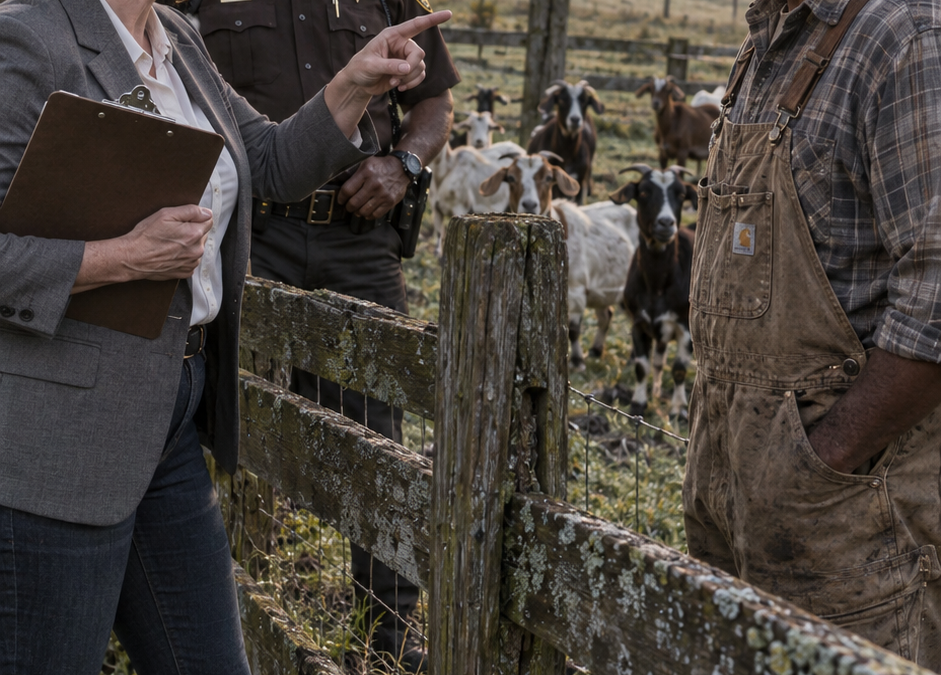
The HOA president stood beside my fence, gave me fourteen days to remove eight goats from land my family had owned since 1947, and warned that if I refused, she would call animal control and law enforcement to have them taken away.
She had no idea that her subdivision ended well before my property line, that my 212 acres were legally zoned for agriculture, or that every deed, survey, and county record she should have checked was already sitting in a filing cabinet inside my house.
And when she threatened to bring the county into it, there was one detail she never bothered to learn about the man running that department—and by the time the truth reached a courtroom, her goats complaint was the smallest problem the HOA had left.
My name is Ellis Callaway.
I was fifty-four years old when Diane Coulter first appeared at my fence wearing a gray blazer that looked like it had never been exposed to damp pasture air.
Fog was lifting off the creek bottom.
The cedar posts were dark with moisture.
Behind me, eight Nubian does and one wether moved lazily through the pen, nosing at wet grass and occasionally bumping shoulders the way goats do when absolutely nothing in the world seems urgent.
Diane, on the other hand, had brought urgency with her.
“Your animals are in violation of Ridgecrest Estates community standards,” she said.
She held a clipboard against her chest.
“You have fourteen days to remove them from the premises, or we will contact animal control and pursue enforcement action.”
I looked at her.
Then at the goats.
Then at the old fence between us.
That fence had been repaired dozens of times, but some of the cedar posts had been cut by my grandfather from this property decades earlier.
Diane apparently saw a visual nuisance.
I saw family history.
“I appreciate you letting me know,” I said.
She blinked.
That was not the response she had expected.
“Mr. Callaway, I want to be certain you understand that this is an official HOA enforcement matter.”
“I understand what you’re saying.”
Her eyes narrowed slightly.
“And you’ll comply?”
“I said I understand what you’re saying.”
I did not mention the deed.
I did not mention the agricultural zoning.
I did not mention the survey.
And I certainly did not mention Chief Raymond Callaway, my uncle, who had spent thirty-one years in county law enforcement and the last nine heading the Millhaven County Sheriff’s Department.
Raymond knew those acres better than Diane knew the road she had driven in on.
He had eaten Sunday dinner at my grandmother’s table.
He had helped my father repair fences.
He had walked the creek with me when we were young.
If Diane wanted to involve law enforcement, she was welcome to make that phone call.
But before any of that happened, I wanted something more important than family connections.
I wanted the record.
So when Diane drove away, I went inside and found the deed.
The Callaway land had never belonged to Ridgecrest Estates.
Not one acre.
My grandfather, Amos Callaway, bought the original eighty acres in 1947.
He was not a wealthy man.
In fact, wealth had almost nothing to do with the way he thought about land.
His family had lost their farm during a drought years earlier, and according to my father, Amos never fully recovered from watching somebody else’s name replace his family’s on property that had once seemed permanent.
When he came to Millhaven County, he carried that lesson with him.
He bought eighty acres from a timber company that had cut the valuable trees and decided the land was no longer worth much.
Amos disagreed.
There was creek bottom.
Pasture.
Second-growth timber.
And a limestone ridge on the western side that caught the last sunlight every evening.
He paid for the property in installments.
Every payment receipt went into a tin box.
No exceptions.
When he died in 1979, that box still sat on a kitchen shelf beside an old coffee can and an almanac.
Inside the deed, Amos left a handwritten note for my father.
It said:
Do not sell what cannot be replaced.
My father listened.
He purchased forty adjoining acres in 1963.
Another thirty-two in 1971.
Other adjustments eventually brought the property to 212 acres.
When my father died, title passed through my mother.
Then, in 2004, the full parcel transferred to me under Instrument No. 2004-CR0881.
Clear title.
No HOA covenant.
No restrictive declaration.
No deed condition requiring approval from Ridgecrest Estates.
That should have ended the matter before it began.
But Ridgecrest Estates did not exist when Amos bought the land.
It did not exist when my father expanded it.
It did not exist when I grew up repairing fences there.
The subdivision appeared in 2009, when Hargrove Properties bought approximately sixty acres east of us and developed 214 houses, a clubhouse, a swimming pool, and a private road system.
The Ridgecrest Estates Homeowners Association incorporated the following year.
Its job was simple enough.
Manage Ridgecrest Estates.
Its lots.
Its common property.
Its covenants.
That was all.
Then Diane Coulter became board president in 2018.
From what I learned later, Diane took the position with the intensity some people reserve for elected office.
She had an HOA badge.
A clipboard.
A late-model SUV.
She attended property-management seminars.
She chaired meetings with printed agendas.
And apparently, sometime before she ever spoke to me, she decided my goats had become a Ridgecrest Estates problem.
There was only one difficulty.
They were not in Ridgecrest Estates.
The goat pen sat roughly sixty yards inside my property.
Not sixty yards from my house.
Sixty yards inside my boundary.
My acreage was zoned agricultural.
County regulations specifically allowed livestock on parcels of five acres or more.
I had 212.
My eight does and one wether were healthy.
Their enclosure was clean.
I had built it myself using treated lumber and welded wire.
The corner posts were sunk in concrete.
The gate hung level.
There was water.
Shade.
Shelter.
No county official had ever cited me for anything involving those animals.
The first HOA letter arrived by certified mail in March.
It listed three supposed violations.
Unauthorized livestock.
Failure to meet Ridgecrest Estates aesthetic standards.
Creation of a nuisance condition affecting neighboring property.
The fine was $400.
Payment due within fourteen days.
I sat at my kitchen table reading it.
Then I read it again.
There was no citation to a county ordinance.
No deed restriction.
No easement.
No instrument connecting my parcel to their development.
It was simply Ridgecrest Estates letterhead followed by the assumption that because Diane had written something, I was obligated to obey it.
I did not respond immediately.
Instead, I placed the letter in a folder.
I wrote the date on the tab.
That habit came from my father.
He believed problems became easier when you stopped treating them as emotions and started treating them as records.
Then I called Gerald Pruitt.
Gerald farmed north of me.
He was seventy-one and had lived in Millhaven County long enough to know what people were doing before they admitted they were doing it.
“Diane’s been talking about your goats for months,” he told me.
“Talking where?”
“Board meetings.”
“What is she saying?”
“That they’re damaging the appearance of their western boundary.”
I looked out the kitchen window.
“My goats are damaging somebody else’s boundary?”
Gerald chuckled once.
“That’s what she’s saying.”
Then he told me something more useful.
Diane had posted a photograph of my fence on a Ridgecrest Estates social media page.
The caption said:
Working to resolve this eyesore for our community.
“Did you see it yourself?” I asked.
“Yes.”
“Did you save it?”
“Yes.”
Of course he had.
Gerald Pruitt had been keeping receipts before people started using that phrase metaphorically.
“Print it for me.”
“Already did.”
Three weeks later, a second certified letter arrived.
The fine had doubled to $800.
There was now another alleged violation:
Failure to respond to official HOA correspondence.
I laughed at that one.
Not because it was funny.
Because somebody had apparently decided that ignoring an invalid demand created a second valid demand.
Then I reached the paragraph that mattered.
Ridgecrest Estates HOA reserves the right to enforce community standards on all properties within or adjacent to the Ridgecrest Estates planned community, including properties whose owners have not formally acknowledged HOA jurisdiction.
I read the sentence four times.
Adjacent.
That was their theory.
Not covenant.
Not agreement.
Not annexation.
Adjacent.
If that theory were correct, every HOA in America could govern whatever property happened to sit beside it.
A farm.
A church.
A commercial parcel.
A public park.
Another subdivision.
All because those properties were nearby.
I put the second letter beside the first.
Then I called Patricia Wren.
Patricia had practiced agricultural and real-property law in Millhaven County for twenty-two years.
I remembered her from a zoning hearing years earlier because she had been the only lawyer in the room who seemed uninterested in hearing herself speak.
Her questions were short.
Specific.
And devastating when somebody did not have an answer.
I brought her both HOA letters.
My deed.
A county map.
And a copy of Ridgecrest Estates’ CC&Rs that I had downloaded from county records.
Patricia read everything.
She underlined the word adjacent in Diane’s letter.
Then she turned to the CC&Rs.
Section 1, Paragraph 2 defined Ridgecrest Estates as all lots and common areas contained within the planned community shown in Plat Book 44, pages 112 through 118.
Patricia tapped the paragraph.
“Their jurisdiction ends here.”
I nodded.
She tapped my deed.
“Your property isn’t here.”
“No.”
“Never has been?”
“No.”
“No annexation?”
“No.”
“No voluntary submission?”
“No.”
“No recorded restrictive covenant?”
“No.”
She removed her glasses.
“Then this is not complicated.”
She held up Diane’s letter.
“This is a letter.”
Then she held up my deed.
“This is ownership.”
That distinction would eventually decide everything.
But Patricia did not recommend suing immediately.
Instead, she gave me four assignments.
Current boundary survey.
Certified deed chain back to 1947.
Certified Ridgecrest Estates plat.
Written statement from somebody with direct long-term knowledge of the fence and property boundary.
“Why all four?” I asked.
“Because right now, you know you’re right.”
She slid the documents back toward me.
“I want to make it impossible for anyone else to pretend they don’t know you’re right.”
The survey came first.
Dale Hutchins had been surveying Millhaven County for thirty years.
His father had done the same work before him.
Dale arrived early one morning while fog still covered the creek bottom.
He walked the property for two days.
I joined him along the eastern boundary.
He located monuments.
Set iron pins.
Compared his readings against the older metes-and-bounds descriptions.
At three points near Ridgecrest Estates, he showed me where my fence stood relative to the actual property line.
Fourteen feet inside at the closest point.
Thirty-one feet inside at the farthest.
That surprised even me.
For years, I had known the fence was on my side.
I had not realized how conservatively my father had positioned some sections.
Dale smiled.
“Your fence isn’t even close enough for them to argue over.”
He filed the survey with the county.
I obtained a certified copy.
Next came the deed chain.
I spent two afternoons at the Register of Deeds office.
Loretta, who had worked there thirty years, pulled the records.
Instrument No. 1947-AC0214.
Amos Callaway’s original purchase.
Then the 1963 acquisition.
Transfer after my father’s death.
Finally, 2004-CR0881.
Every conveyance properly executed.
Every recording complete.
No gaps.
No competing ownership.
No Ridgecrest Estates anything.
Loretta stacked the certified copies.
“That’s about as clean as they come,” she said.
The third document was the Ridgecrest Estates plat.
Plat Book 44, pages 112 through 118.
It showed every residential lot.
Street.
Common area.
And exterior boundary.
Between Ridgecrest Estates and my land sat a county road right-of-way dating to 1938.
At no point did their recorded plat cross into my acreage.
They were nearby.
That was all.
Adjacent had done a remarkable amount of work in Diane’s imagination.
In property law, it did none.
Gerald supplied the final piece.
He came to my house one Saturday holding a notarized statement he had typed himself.
It described four decades of observing the property.
The historical fence.
The former pasture before Ridgecrest Estates was built.
And Diane’s activity near my property.
Attached was her social media post with my fence photograph.
Working to resolve this eyesore for our community.
Gerald had printed the posting date on the reverse side.
“I think that’ll do,” he said.
“It’ll do.”
I took the full file to Patricia.
She arranged everything across her conference table.
Survey.
Deeds.
Plat.
Gerald’s affidavit.
HOA correspondence.
County agricultural zoning.
For nearly twenty minutes she said nothing.
Finally she leaned back.
“They have no colorable claim.”
I waited.
“There is no recorded instrument extending their HOA to your parcel. No covenant. No deed restriction. No easement. No jurisdiction.”
She picked up the first fine letter.
“This is unenforceable.”
The second.
“Also unenforceable.”
Then the paragraph threatening animal control.
“And the county permits livestock on your parcel.”
I nodded.
Patricia continued.
“They’re demanding money you don’t owe based on authority they don’t have.”
That afternoon, she drafted a formal notice.
Certified mail.
Return receipt requested.
It identified my parcel by instrument number.
Listed the deed chain.
Cited Dale’s survey.
Referenced Ridgecrest Estates’ own plat.
Quoted its CC&Rs.
And cited the county agricultural ordinance.
The conclusion was simple.
Ridgecrest Estates possessed no authority over my property.
The $1,200 in accumulated fines was rejected.
Any additional enforcement attempt would be treated as interference with my property rights.
Nine days later, the signed return receipt came back.
Then everything became quiet.
Gerald eventually heard that Ridgecrest Estates’ attorney had reviewed Patricia’s notice.
The lawyer apparently told the board exactly what Patricia had told me.
Their position had no legal merit.
Around the same time, Diane’s social media post vanished.
That could have ended it.
It should have.
Instead, Diane started looking for another angle.
Through people in town, I learned she had contacted the county assessor.
A title company.
Eventually a private title-search firm.
She was searching for a cloud on the Callaway title.
An old easement.
A missed covenant.
Anything that might justify the authority she had already claimed.
She found nothing.
That should tell you something about institutional overreach.
Sometimes people discover they are wrong and correct themselves.
Other times, they discover they are wrong and begin searching for evidence that will somehow make them retroactively right.
Diane belonged to the second category.
Around that time, Uncle Raymond stopped by.
I had not called him about the HOA.
I did not need to.
Millhaven County was not large enough for a dispute involving the Callaway name to remain invisible forever.
Raymond leaned against my kitchen counter while I made coffee.
He was older than my father had been when he died, but he still carried himself like the deputy I remembered from childhood.
“You got yourself an HOA now?” he asked.
“No.”
He smiled.
“That isn’t what I’m hearing.”
“They think they’re my HOA.”
“That seems inconvenient.”
“For them.”
He laughed.
Then his expression changed.
“I heard somebody mentioned calling us about livestock.”
“Diane did.”
Raymond nodded slowly.
“And?”
“And nothing.”
“Good.”
I looked at him.
“You sound disappointed.”
“No. I’m relieved.”
He took the coffee I handed him.
“If that woman calls my department, she’ll get treated exactly like anybody else. We check jurisdiction. We check county law. We document the complaint.”
“I know.”
“And your goats are legal.”
“I know that too.”
He pointed at me with the cup.
“Then don’t turn me into part of your property case.”
I smiled.
“I wasn’t planning to.”
“Good.”
That was why I had not mentioned Raymond to Diane.
Family was family.
Law was law.
I did not need my uncle’s badge to defend land my deed already protected.
But knowing Diane had threatened to summon a department headed by a man who had personally repaired my grandfather’s fence years earlier did add a certain irony.
The real battle arrived through lawyers.
Instead of withdrawing its claims, Ridgecrest Estates hired an Austin property attorney named Strickland.
His response argued that the HOA possessed implied authority over adjacent properties when their use materially affected the character of the planned community.
That sentence fascinated Patricia.
She read it twice.
Then called me.
“They’re going forward.”
“On what?”
“Apparently on the theory that if your property affects their residents, they get to regulate you.”
“Is that a thing?”
“No.”
“Then why file it?”
“Because lawyers sometimes get paid to make the best argument available, not a good one.”
The HOA cited three cases.
Patricia read all three.
None involved anything like our facts.
Each dispute concerned parties connected through a recorded covenant or common development scheme.
I shared nothing with Ridgecrest Estates.
Not a declaration.
Not a plat.
Not a subdivision.
Not an easement.
Nothing.
So Patricia filed for declaratory judgment.
We asked the court to determine that Ridgecrest Estates HOA possessed no authority over Parcel 2004-CR0881.
We sought a permanent injunction preventing further fines, notices, or enforcement attempts.
We asked for attorney’s fees.
And we attached the record.
The hearing was scheduled for the second Tuesday in June.
I arrived at the Millhaven County Courthouse at 8:30 that morning wearing a dark wool blazer that had belonged to my father.
The June air was already warm.
I carried a banker’s box.
Inside were the original deed.
Certified deed chain.
Survey.
Recorded HOA plat.
Gerald’s affidavit.
County zoning regulations.
Both HOA letters.
Everything.
Diane was already there.
She sat beside Strickland.
And yes, she had brought the clipboard.
For some reason, seeing it on the counsel table made me feel calmer.
The clipboard had been part of the performance from the beginning.
The documents in my box were something else entirely.
Judge Clara Fitch took the bench at exactly nine.
She had been a county judge for fourteen years and had a reputation for impatience with arguments that confused volume with substance.
Strickland went first.
He argued for roughly twenty minutes.
Community character.
Reasonable expectations.
External impacts.
Adjacent land.
Planned-community principles.
He used adjacent seven times.
I counted.
His argument was polished.
If you had not seen the documents, it might even have sounded persuasive.
That is the danger of legal-sounding language.
It can make an unsupported claim appear temporarily respectable.
Then Patricia stood.
She displayed the Ridgecrest Estates plat.
“Your Honor, this is the recorded development.”
She pointed to the boundary.
“Ridgecrest Estates ends here.”
Then Dale’s survey.
“This is Mr. Callaway’s parcel.”
Another line.
“The fence itself is between fourteen and thirty-one feet inside his surveyed property.”
Then the county right-of-way.
“Between the two recorded properties is an additional public right-of-way.”
She displayed the CC&Rs.
“The association’s declaration defines its jurisdiction as the lots and common property shown in Plat Book 44, pages 112 through 118.”
She paused.
“Mr. Callaway’s property does not appear in those pages.”
Judge Fitch looked at Strickland.
Patricia continued.
“There is no declaration binding Mr. Callaway. No deed restriction. No annexation. No easement. No voluntary submission. No recorded instrument connecting Parcel 2004-CR0881 to Ridgecrest Estates.”
Then came the line I still remember.
“Proximity is not jurisdiction.”
Patricia sat down.
Judge Fitch looked at Strickland.
“Counsel, identify for me the recorded instrument that gives Ridgecrest Estates authority over Mr. Callaway’s land.”
Strickland began explaining implied authority.
Judge Fitch interrupted.
“I asked for an instrument.”
He paused.
“There is no separate instrument, Your Honor.”
“Then what property interest does your client possess?”
“Our position is that—”
“What property interest?”
Another pause.
“The HOA is asserting an implied enforcement interest arising from the effect of the adjacent land use upon community character.”
Judge Fitch wrote something.
“So none.”
Strickland tried again.
“The association’s position—”
“I understand the position.”
She looked down at the documents.
“I am asking for its legal source.”
He had none.
The ruling came that afternoon.
Judge Fitch found that Ridgecrest Estates possessed no legal authority over my parcel.
Recorded or implied.
The $1,200 in HOA fines were void.
The notices were unenforceable.
The association was permanently prohibited from issuing future fines, violation notices, or enforcement actions against me or my property.
Then Judge Fitch turned to attorney’s fees.
She awarded $11,400.
Payable by the HOA.
The association had pursued a claim without a colorable legal foundation.
Finally, Judge Fitch said something that sounded so much like my grandfather that for a second I forgot where I was.
“The record is clear.”
She paused.
“It has always been clear.”
That was it.
No shouting.
No dramatic confession.
No police raid.
No goats being hauled away.
No need for Chief Raymond Callaway to arrive in uniform and rescue me from anything.
The law had done exactly what it was supposed to do once somebody forced everyone to read the documents.
Afterward, Patricia and I packed the banker’s box.
I placed every document back in order.
Diane did not approach me.
I did not approach her.
Outside, Patricia shook my hand.
“If they don’t pay within sixty days, call me.”
“They’ll pay.”
“They probably will.”
I drove home along the county road.
Past Ridgecrest Estates.
Past the stone entrance.
Past the western edge Diane had once called an eyesore.
The old Callaway fence was exactly where it had been that morning.
Exactly where it had been the previous year.
And long before that.
The goats were grazing when I pulled into the drive.
One of the Nubian does lifted her head.
Looked at me.
Then went back to eating.
I laughed.
Months of certified mail.
Surveyors.
Lawyers.
Court filings.
Thousands of dollars in fees.
And the animals responsible for starting the whole thing had no idea anything had happened.
I leaned on the fence.
The creek moved below me.
Late sunlight reached the limestone ridge.
My grandfather used to stand there after work and watch shadows stretch across the valley.
My father told me Amos rarely spoke during those moments.
He just watched.
I think I understand why now.
When you have worked hard enough to know a piece of ground, sometimes there is nothing useful to say about it.
It is simply there.
That evening, I took the court judgment into the back bedroom.
Opened the filing cabinet.
And found the folder.
First HOA letter.
Second letter.
Gerald’s printed social media post.
Survey.
Deed chain.
Plat.
Patricia’s notice.
Court filings.
Judgment.
I placed Judge Fitch’s order at the back.
Then I saw my grandfather’s tin box in the bottom drawer.
I opened it.
There were the receipts.
Thin paper.
Faded ink.
Installment payments from 1947.
Amos had saved every one because he understood something I had spent months relearning.
A man who cannot prove what belongs to him can eventually find himself arguing with somebody who claims it does not.
Confidence is cheap.
Paperwork is patient.
I held one receipt under the light.
Then returned it carefully.
The next Sunday, Raymond came for dinner.
My daughter was there.
A few relatives.
Nothing formal.
Halfway through the meal, Raymond looked toward the window.
“You still got those dangerous goats?”
“Unfortunately.”
“Any uprisings?”
“Not yet.”
He nodded.
“Keep us advised.”
Everyone laughed.
Then my daughter asked him whether Diane had ever actually called his department.
Raymond wiped his mouth with a napkin.
“She made an inquiry.”
I looked at him.
“You never told me that.”
“You didn’t ask.”
“What happened?”
“One of the deputies checked the zoning.”
“And?”
Raymond shrugged.
“He told her livestock was permitted.”
My daughter started laughing.
Raymond continued.
“She asked whether we could remove the animals as a nuisance.”
“What did he say?”
“That she’d need evidence of an actual criminal or county ordinance violation.”
“And then?”
“She mentioned the HOA rules.”
I already knew what came next.
Raymond smiled.
“He told her we’re not HOA enforcement.”
That was the closest law enforcement ever came to becoming part of the case.
No favors.
No family intervention.
No dramatic use of influence.
Just jurisdiction.
Diane called the county because she assumed authority would support authority.
Instead, the deputy checked the law.
That was enough.
I preferred it that way.
If Raymond had personally stepped in, Diane could have spent the next five years telling people I won because my uncle ran the department.
I did not.
I won because my deed was older than Ridgecrest Estates.
Because my land was outside its plat.
Because my livestock was lawful.
Because Dale Hutchins surveyed the boundary.
Because Loretta produced an unbroken deed chain.
Because Gerald preserved evidence.
Because Patricia asked the correct questions.
And because when Judge Fitch asked the HOA attorney for the source of his client’s authority, he had nothing to put on the table.
Diane’s mistake was not disliking goats.
People are allowed to dislike goats.
They smell like goats.
They climb on things.
They can be loud.
They will investigate absolutely anything you leave within reach of their mouths.
If Ridgecrest Estates residents preferred manicured landscaping and chlorine-blue swimming pools, that was their choice.
Their mistake was believing preference created jurisdiction.
It did not.
A homeowners association is powerful only where its governing documents legally reach.
Past that line, it is simply another organization with opinions.
That difference can become difficult for people to see when they spend years enforcing rules successfully inside their own boundaries.
Authority becomes habitual.
Habit becomes confidence.
Then somebody forgets to ask where the line ends.
Diane forgot.
My grandfather never did.
Neither did my father.
And because they had taught me to keep records, I did not either.
Years later, the fence still stands.
Some original cedar posts remain.
Others I have replaced.
The pen is still sixty yards inside my land.
The goats changed over time, as livestock does.
But we kept Nubians.
My daughter, grown now, still insists they were worth every minute of trouble.
I tell her the goats were never the trouble.
The trouble was a piece of paper sent by somebody who had not read the other pieces of paper that came before it.
Instrument 1947-AC0214.
Instrument 2004-CR0881.
Plat Book 44.
Dale Hutchins’s survey.
Those documents did not suddenly become true when Judge Fitch ruled.
They had always been true.
The court simply forced Ridgecrest Estates to acknowledge them.
Sometimes I walk to the limestone ridge near sunset.
The valley looks much as it did when I was young.
Different houses in the distance.
More traffic.
Ridgecrest Estates lights glowing to the east.
But the creek still follows the same bottom.
The pasture still slopes toward it.
The cedar line still catches wind before the rest of the property does.
And when the light is right, I can almost picture Amos standing there.
A man who once watched his family lose land.
Then spent the rest of his life making sure his children would never have to guess what belonged to them.
He kept receipts.
My father kept folders.
I kept both.
Diane brought a clipboard.
In the end, that difference mattered.
Because authority does not come from sounding official.
It does not come from a badge printed by an HOA management company.
It does not come from a certified letter.
It does not come from saying adjacent often enough that people stop asking what the word actually means.
Authority comes from law.
Ownership comes from title.
And boundaries come from the record.
Diane threatened to call law enforcement because of my goats.
She did not know the man heading the county department was my uncle.
But that was never what defeated her.
What defeated her was far less dramatic.
A deed.
A survey.
A plat.
And one question from a judge:
“Where is the instrument that gives you authority over his land?”
There wasn’t one.
There never had been.
And all the confidence in Ridgecrest Estates could not create one after the fact.








