𝗣𝗔𝗥𝗧 𝟮 HOA KAREN STOOD IN FRONT OF MY BULLDOZER—THEN THE SHERIFF MADE HER REMOVE EVERY BARRIER HERSELF
𝗣𝗔𝗥𝗧 𝟮
The box was exactly where I remembered it.
Bottom drawer.
Metal filing cabinet.
Behind old equipment manuals and tax receipts.
Inside were deeds, maps, letters, and one agreement with a faded developer logo.
I opened it on the barn desk.
The language was simple.
Temporary construction access.
Eighteen months.
No transfer of ownership.
No permanent easement.
No successor rights.
Expiration date:
Fourteen years earlier.
I read it twice.
Then I called Laurel Bennett.
Laurel was a licensed county surveyor.
She had worked boundary disputes, farm subdivisions, right-of-way disagreements, and enough rural-access fights to have almost no patience left for confident people with inaccurate maps.
She came the following morning.
I handed her everything.
“I want this checked from scratch.”
“You don’t trust your own deed?”
“I trust the deed.”
“Then?”
“I want somebody else to confirm it before I make a move.”
She nodded.
“Smart.”
Laurel spent two days going through county records.
Current parcel map.
Original deed.
Subdivision plat.
Easement registry.
Tax map.
Developer filings.
Then she walked Old Quarry Road with survey equipment.
When she finished, she stood beside my truck.
“Regina is wrong.”
“How wrong?”
“All the way.”
“No easement?”
“None.”
“HOA ownership?”
“No.”
“Shared access?”
“No.”
“Temporary agreement?”
“Expired exactly when yours says it did.”
She pointed toward several HOA signs.
“And those?”
“What about them?”
“Some are between eighteen and twenty-seven feet inside your parcel.”
I looked at the nearest one.
HOA PROPERTY
I laughed once.
“That one too?”
“Especially that one.”
That same week, I saw the newest Stonehaven newsletter.
Someone had left a copy at the diner.
Inside was a glossy community map.
Old Quarry Road was shaded the same color as Stonehaven common areas.
No boundary line.
No note.
No disclaimer.
To anyone looking at the page, the road appeared to belong to the HOA.
I sent it to Laurel.
She called me five minutes later.
“This isn’t a county map.”
“I know.”
“Who made it?”
“Stonehaven.”
“That line doesn’t exist on any official plat.”
“I know.”
“Then why print it?”
That was the question.
The answer came from Felicia Crane.
Stonehaven treasurer.
She called me one evening.
“Mr. Langford?”
“Yes.”
“Can we meet somewhere?”
“Why?”
“I don’t want Regina knowing yet.”
That got my attention.
We met at a diner off County Route 6.
Felicia arrived with a folder.
She looked nervous.
“I think this is bigger than the road.”
She slid a proposal across the table.
STONEHAVEN PRIVATE ACCESS IMPROVEMENT PROJECT
Assessment per household:
$1,850.
Total expected:
Just over $66,000.
I read farther.
New gate.
Lighting.
Decorative stone entrance.
Road resurfacing.
Electronic access.
All on Old Quarry Road.
I looked up.
“She plans to build an entrance on my land?”
“Yes.”
“Does the board know the road isn’t yours?”
“She says it is ours.”
“Did anyone check?”
Felicia looked embarrassed.
“No.”
“Where did the map come from?”
“She hired a graphic-design company.”
I leaned back.
“So the legal basis is Adobe Illustrator.”
Felicia almost smiled.
“She told residents this would become Stonehaven’s premium north entrance.”
“Premium.”
“Yes.”
“On my ranch.”
“Yes.”
“Without asking me.”
She nodded.
That explained everything.
Regina wasn’t defending a road.
She had built a capital project around property she didn’t own.
If I proved the road was mine, the $66,000 assessment collapsed.
So did the entrance plan.
So did her credibility.
I had my attorney send a certified letter.
Forty-eight hours.
Remove every barrier.
Stop representing Old Quarry Road as HOA property.
Attached:
Deed.
Temporary agreement.
Expiration date.
Laurel’s preliminary findings.
Regina replied within hours.
One sentence.
Your private survey does not supersede the authority of the Stonehaven Ridge Homeowners Association.
I showed Laurel.
She read it.
Then looked at me.
“Does she think an HOA outranks the county land records?”
“Apparently.”
“That’s ambitious.”
The next morning, more barriers appeared.
Not fewer.
More.
Fourteen sawhorse barricades.
Eight concrete planters.
Three chains.
Reflective stakes.
Orange fence.
One huge sign:
AUTHORIZED HOA ACCESS ONLY
And a rolling steel gate anchored into fresh concrete.
Russell, one of my ranch hands, stood beside me staring.
“She built Fort Stonehaven.”
“Looks like it.”
“Want the dozer?”
“No.”
He looked at me.
“That machine would clear this in thirty seconds.”
“I know.”
“Then?”
I took out my phone.
“Pictures.”
Regina was building a scene.
I was building a record.
Every barrier.
Every coordinate.
Every sign.
Every chain.
Date.
Time.
Location.
Laurel returned to set fresh markers.
Regina arrived within minutes.
She walked straight toward us.
“What are you doing?”
Laurel didn’t look up.
“Survey work.”
“Not on HOA property.”
“This isn’t HOA property.”
“I am ordering you to leave.”
Laurel finally turned.
“You don’t have authority over my county survey permit.”
Regina pointed at an orange flag.
“Remove that.”
“No.”
Regina stepped forward.
Grabbed it.
Pulled it out of the ground.
Laurel took a photo.
Regina froze.
“What are you doing?”
“Documenting interference.”
Regina still held the flag.
“My association does not recognize this marker.”
Laurel calmly replanted it.
“My instruments do.”
My dashboard camera captured the whole thing.
Another piece of evidence.
Another gift from Regina.
The weather forecast worsened.
Rain was coming again.
My drainage ditch remained blocked from equipment access.
That changed the dispute.
This was no longer about annoyance.
My pasture could flood.
So my attorney filed for an emergency injunction.
The judge reviewed:
Deed.
Survey.
Temporary agreement.
Photographs.
Obstructions.
Weather risk.
The order came quickly.
Stonehaven Ridge was instructed to:
Stop obstructing Old Quarry Road.
Add no new barriers.
Leave survey markers alone.
Allow unimpeded passage for my equipment.
A certified copy was served at the HOA office.
I assumed that was the end.
I underestimated Regina.
The following morning, I drove the D6 back toward the road.
The injunction was on the passenger seat.
When I rounded the bend, I stopped.
Fresh barricades.
Installed overnight.
Regina stood behind them.
Phone mounted on a fence.
Live stream running.
Several residents gathered nearby.
Before I fully stopped, she walked straight into the path of the bulldozer.
Arms spread.
I throttled down.
She shouted:
“Go ahead!”
I stared through the windshield.
“Move.”
“This is HOA property.”
“You have a court order.”
“I don’t recognize your interpretation of it.”
“It isn’t my interpretation.”
She moved closer to the blade.
“You want through? Make me move.”
There it was.
The video she wanted.
If I rolled forward, even one foot, she would have the image.
Huge bulldozer.
Woman in front of it.
No context needed.
I took my hand off the controls.
Shut the engine down.
Silence.
Regina turned toward her phone.
“You see that? He knows he is trespassing.”
I pulled the key.
Climbed down.
Reached into the cab.
Took out a manila folder.
Walked toward her.
“Did Stonehaven receive the court order yesterday?”
Her expression changed.
Barely.
But enough.
“Talk to our attorney.”
“That wasn’t the question.”
“We dispute the order.”
“No. You dispute the property line.”
“Same thing.”
“No.”
Then I heard tires on gravel.
Two patrol cruisers came up the road.
Sheriff Owen Barrett stepped out of the first.
Owen was fifty-five, broad-shouldered, calm, and known throughout the county for giving people more patience than they deserved.
Regina hurried toward him.
“Sheriff, arrest this man.”
Owen looked at her.
“For what?”
“Trespassing.”
He looked past her.
Saw the bulldozer.
Then the chains.
Concrete blocks.
Gate.
Signs.
He pointed.
“Who put those there?”
Regina answered immediately.
“I did.”
I almost smiled.
Owen didn’t.
“You personally authorized these barriers?”
“Yes.”
“All of them?”
“Yes.”
She said it proudly.
Owen walked back to his cruiser.
Opened a folder.
Pulled out a certified copy of the injunction.
He read part aloud.
The association was prohibited from blocking access.
Prohibited from installing new obstructions.
Prohibited from interfering with my equipment.
He looked at Regina.
“This was served yesterday.”
“Our attorney disagrees with the survey.”
“That isn’t relevant to what I’m asking.”
“This road belongs to Stonehaven.”
“The judge’s order says you cannot block it while the dispute is before the court.”
“We don’t recognize—”
Owen raised one hand.
“Stop.”
He wasn’t loud.
He didn’t need to be.
“If your attorney wants to challenge this order, your attorney goes back to the judge.”
Regina crossed her arms.
“You don’t understand the history.”
“I don’t need to.”
He held up the order.
“My job is not to hold a property trial on a dirt road.”
She pointed toward the barriers.
“Those were installed before we received anything.”
I pulled out my phone.
“Some weren’t.”
Regina looked at me.
I opened timestamped photographs.
Fresh barricades.
Today.
6:24 a.m.
Concrete blocks.
Today.
6:31.
New chain.
Today.
6:42.
Deputy Miles Fenwick had arrived in the second cruiser.
He checked video from a nearby driveway camera.
“Sheriff.”
Owen looked over.
“HOA truck came through at 6:12.”
Regina’s mouth tightened.
Then Felicia appeared.
She had been standing with residents.
Folder in hand.
“Owen.”
Regina turned.
“Felicia, don’t.”
Felicia ignored her.
She gave Owen an email.
From Regina.
Sent the night before.
The line that mattered:
Add enough barriers that his machine cannot pass regardless of whatever paperwork the court issued.
Owen read it.
Then again.
He looked at Regina.
“Did you write this?”
She stared at Felicia.
“This is confidential association communication.”
“That wasn’t my question.”
“She had no right to give you that.”
“Did you write it?”
Regina said nothing.
Nobody had to.
The email header answered for her.
Owen folded the page.
“Everything comes down.”
Regina laughed.
“You cannot be serious.”
“I am.”
“This is HOA equipment.”
“Then remove it.”
“Our maintenance crew can handle it later.”
“No.”
She stared.
“What do you mean no?”
“You were ordered not to block this road.”
“We need time.”
“You had time.”
Owen pointed toward the closest sign.
“Remove it.”
Regina looked around.
Neighbors.
Deputies.
Laurel.
Felicia.
Me.
Her audience had changed.
“I am not doing manual labor on the side of a road.”
Owen nodded.
“Fine.”
Her expression brightened.
Then he continued.
“I’ll document your refusal and send it to the judge.”
Silence.
“That will include the served order, the new barriers, your admission that you authorized them, the security-camera timestamp, and this email.”
Regina’s face changed.
“You’re threatening me.”
“No.”
He tapped the order.
“I’m explaining what gets written down.”
She pulled out her phone.
Called the HOA attorney.
Put him on speaker.
She started quickly.
“Owen Barrett is trying to force me to physically dismantle HOA property—”
The attorney interrupted.
“Regina.”
She stopped.
“Did you receive the injunction?”
“Yes, but—”
“Does it say the road must remain unobstructed?”
“Yes.”
“Were new barriers installed after service?”
She looked around.
“Yes.”
A long pause.
“Remove them.”
Regina’s mouth opened.
“Excuse me?”
“Remove them now.”
“We can appeal.”
“Later.”
“These barriers protect—”
“Regina.”
His voice sharpened.
“Stop obstructing the road.”
The call ended.
She stood there.
Still.
Then looked at the maintenance crew.
“You. Start moving these.”
Nobody moved.
One man cleared his throat.
“Ma’am, you sent us written instructions not to touch anything without your authorization.”
“I am authorizing it.”
“We need it in writing.”
Her face went red.
Owen said:
“Write it.”
She refused.
I later learned Regina had locked the HOA maintenance shed that morning and kept the only working key.
She had also told staff that the barriers were under her personal control.
The trap she built for me had folded around her instead.
Owen pointed toward the sign.
PRIVATE COMMUNITY
“Start there.”
Regina stared at him.
He waited.
Deputy Fenwick opened his notebook.
Started writing.
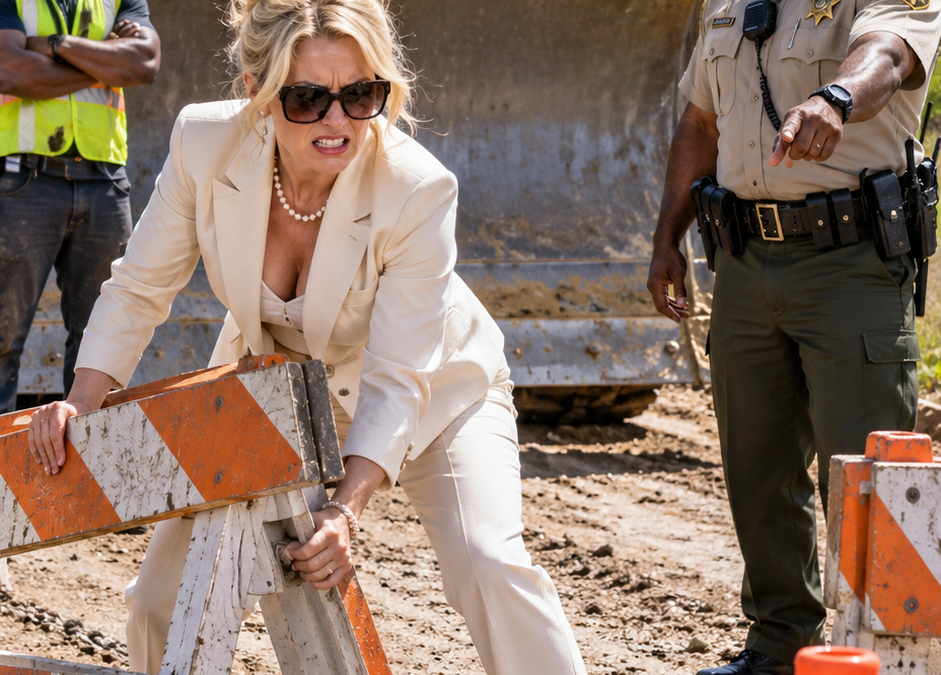
That moved her.
She walked to the sign.
Grabbed the post.
Pulled.
Nothing.
It was deep.
She pulled harder.
The post came loose suddenly, spraying dirt onto her pants.
Nobody laughed.
That made it worse.
She carried the sign toward neutral ground.
Set it down.
Owen pointed.
“Next.”
The first chain came off.
Then another.
Then the orange fencing.
Regina’s jacket came off.
Then her sunglasses.
Then the polished confidence.
She dragged a sawhorse aside.
Then another.
The sun climbed.
Dust stuck to her shoes.
Residents gathered farther down the road.
Phones came out.
Nobody needed a livestream anymore.
The scene was already doing its own reporting.
I stayed beside the bulldozer.
Said nothing.
Regina looked over at me once.
“You enjoying this?”
“No.”
“You wanted this.”
“No.”
“Then why are you standing there?”
“Waiting for my road.”
That silenced her.
She pulled another stake.
Beneath one HOA sign sat a fresh survey marker.
LANGFORD PARCEL
Laurel pointed.
“That’s the boundary.”
Regina glared.
Laurel shrugged.
“I didn’t put your sign there.”
The next barrier came down.
A resident called out:
“Why did we pay for these?”
Regina ignored him.
Another resident asked:
“What about the assessment?”
She stopped.
Felicia answered instead.
“That’s a good question.”
Regina spun.
“Felicia.”
Felicia took out the budget sheet.
“The board proposed charging every household $1,850 for the north entrance project.”
Murmurs spread.
One man said:
“North entrance?”
Another:
“What north entrance?”
Felicia held up the proposal.
“New gate. Road upgrades. Stone entrance. Lighting.”
Someone asked:
“On this road?”
“Yes.”
The residents looked at me.
Then at Regina.
I said:
“The road is mine.”
A woman near the back frowned.
“Did the HOA know that?”
Felicia answered carefully.
“Regina said it belonged to Stonehaven.”
Regina snapped:
“Because it does.”
Laurel held up her survey.
“No.”
Another resident:
“How much money?”
Felicia answered.
“About sixty-six thousand dollars if fully assessed.”
That changed the mood immediately.
Residents can tolerate a surprising amount of board nonsense until the sentence contains a dollar sign.
One man stepped forward.
“Did we already pay anything?”
Felicia hesitated.
“Yes.”
“How much?”
“Not the assessment.”
“What?”
“A contractor deposit.”
Regina stopped pulling the chain.
Felicia opened another document.
“Forty-one thousand eight hundred dollars.”
Someone swore.
Regina turned.
“That contract is part of a larger infrastructure package.”
“For land we don’t own?” somebody shouted.
She tried to recover.
“The road ownership remains disputed.”
Laurel answered:
“No. It doesn’t.”
Felicia continued.
“The deposit is non-refundable.”
That landed hard.
The new entrance project wasn’t an idea.
Regina had already committed HOA money.
$41,800.
On a gate project built around my land.
A board member asked:
“Did we vote on that?”
Felicia looked at him.
“Not in the form it was signed.”
Regina pointed at her.
“You are violating your fiduciary duty by discussing confidential negotiations.”
Felicia’s voice stayed calm.
“I think spending forty-one thousand dollars on someone else’s land is the fiduciary problem.”
Even Owen looked away for a second.
Possibly to hide a reaction.
Regina returned to the barriers.
One by one.
Orange sawhorse.
Concrete planter.
Steel stake.
Chain.
Sign.
Fence.
Every object had been placed to demonstrate authority.
Now each one had to be removed in front of the people she had tried to impress.
One planter was too heavy to move alone.
Owen did not demand anything unsafe.
Maintenance workers helped after Regina signed written authorization.
The rolling steel gate was worse.
She had anchored it into concrete.
The frame was too heavy.
Owen required her to unlock it.
Release the chain.
Pull the retaining pins.
Remove everything she could safely manage.
County workers assisted with the steel sections after that.
Fair.
Accountability is not supposed to become injury.
The final sign read:
STONEHAVEN PRIVATE ROAD
NO FARM EQUIPMENT
I stood beside my Caterpillar.
Regina picked the sign up.
For a second, she looked at it.
Then at me.
Then carried it beyond the boundary.
Owen turned toward Laurel.
“Road clear?”
She checked her equipment.
Walked several points.
Looked back.
“Completely.”
Owen looked at me.
“You good?”
I nodded.
“Thank you.”
He stepped aside.
I climbed into the D6.
Turned the key.
Diesel thunder returned.
Regina stood outside the property line.
For the first time.
I eased forward.
Passed the exact spot where she had stood with her arms spread.
I didn’t honk.
Didn’t wave.
Didn’t touch a single HOA item.
I drove straight to the drainage ditch.
And worked.
That mattered.
I had never wanted revenge.
I wanted access.
I cleared the blocked channel.
Cut the slope.
Opened the water path.
Reinforced the bank.
By late afternoon, the ditch was functioning.
The next storm could come.
My pasture had somewhere to drain.
That was the entire reason I had been there in the first place.
The financial fight moved indoors that evening.
Stonehaven called an emergency board meeting.
Felicia presented the numbers.
$41,800 contractor deposit.
Barrier purchases.
Concrete planters.
Signage.
Legal fees.
Survey response costs.
Potential $66,000 resident assessment.
Possible refund obligations.
The meeting was packed.
Regina entered still dusty from the road.
She sat at the head of the table.
Nobody looked impressed anymore.
She opened with:
“Today, Stonehaven suffered an unprecedented attack on association autonomy.”
One resident interrupted.
“Did Travis put up the barriers?”
She stopped.
“What?”
“Did he put them there?”
“No.”
“Did he spend our money on them?”
“No.”
“Did he sign the gate contract?”
“No.”
“Did he ignore a judge?”
Regina’s face tightened.
“The injunction was based on inaccurate information.”
Another homeowner spoke.
“Did you obey it?”
Silence.
Felicia projected the email.
ADD ENOUGH BARRIERS THAT HIS MACHINE CANNOT PASS REGARDLESS OF WHATEVER PAPERWORK THE COURT ISSUED.
The room went still.
Regina stood.
“That was taken out of context.”
Someone laughed.
Not kindly.
“What context makes that better?”
She shifted.
“We were protecting community infrastructure.”
I stood near the back.
I hadn’t intended to speak.
Then she pointed at me.
“This entire crisis was manufactured by a hostile commercial operator.”
I raised my hand.
“I’m a rancher.”
She stared.
“You own heavy equipment.”
“So does the county.”
“You intentionally escalated this.”
“No.”
I took out one envelope.
Old certified mail.
Sent months earlier.
Before the barricades.
Before Laurel.
Before the injunction.
My original notice informing Stonehaven that Old Quarry Road was Langford property.
Delivery confirmation attached.
Regina’s signature.
I handed it to Felicia.
She projected that too.
One homeowner read the date aloud.
Months before.
He looked at Regina.
“You knew?”
Regina didn’t answer.
“You signed for this.”
She said:
“I receive a lot of correspondence.”
“Did you read it?”
No answer.
Laurel’s survey appeared next.
Then the expired eighteen-month developer agreement.
Then the official plat.
There was nothing left.
The board called a vote.
Regina objected.
She demanded more time.
She said the bylaws required deliberation.
Again, fascinating.
The woman who had treated a court injunction as optional had suddenly developed deep respect for procedure.
The board disagreed.
She was removed as president that night.
Signing authority suspended.
Contract authority revoked.
Association records ordered returned.
Financial review authorized.
Regina sat there while the votes were counted.
I almost felt sorry for her.
Almost.
But then I remembered her standing in front of my bulldozer.
Not because she was confused.
Because she knew.
That was the difference.
She had been warned.
She had the letter.
The survey.
The court order.
Still she kept going.
Owen had not removed her from office.
I hadn’t.
Her own neighbors did.
That made the ending much cleaner.
The investigation into the north entrance project continued.
The $41,800 contractor deposit became a serious problem.
The contractor had already ordered materials.
Some could be repurposed.
Some could not.
The board negotiated.
Lost money.
Residents demanded a full accounting.
The proposed $66,000 assessment was cancelled.
Any early payments were refunded.
Regina blamed me.
Again.
I ignored her.
Weeks passed.
The pasture dried.
The repaired drainage channel held.
Then another large storm came.
I stood near the fence and watched water move through the ditch exactly where it was supposed to.
No flooding.
No washed fence.
No cattle standing in mud.
That was my victory.
Not Regina pulling signs.
Not the board vote.
Not the cancelled assessment.
Water flowing correctly.
Quietly.
Old Quarry Road changed too.
The HOA signs disappeared.
No chains.
No gates.
No concrete.
No decorative planters pretending to be property law.
I installed one sign.
Plain.
Wooden.
PRIVATE RANCH ROAD
LANGFORD PROPERTY
ACCESS BY PERMISSION
No logo.
No threat.
No paragraph.
Just the truth.
Regina drove by several weeks later.
I was checking fence.
Her car slowed.
Stopped short of the property line.
She looked at the sign.
For a long time.
I didn’t walk over.
Didn’t wave.
Didn’t say anything.
Eventually she turned around.
Left.
She never crossed.
Owen stopped by during a patrol not long afterward.
He rolled his window down.
“Road looks wider.”
“It hasn’t changed.”
“Feels wider.”
I smiled.
“Less HOA furniture.”
He laughed.
“Forty pounds of signage can really tighten a road.”
“Apparently.”
He looked toward the ditch.
“Drainage holding?”
“Perfect.”
“Good.”
Then he said something I remembered.
“People think a sheriff settles ownership.”
“You didn’t.”
“No.”
He tapped the steering wheel.
“Paper settles ownership. Courts settle disputes. I just make sure people follow what the paper says.”
“That seemed difficult enough.”
He smiled.
“Some days.”
The internal audit at Stonehaven eventually found Regina had approved several additional expenses tied to the entrance project before the board had received complete information.
Design fees.
Engineering concepts.
Vendor retainers.
Survey sketches that were not official surveys.
Graphic work for the fake community map.
She had built an entire project around a premise nobody had independently verified.
Old Quarry Road belonged to Stonehaven.
It didn’t.
Everything after that was expensive decoration around a false assumption.
Residents asked how nobody caught it earlier.
Felicia answered honestly.
“We trusted her.”
That was the dangerous part.
Not corruption in some dramatic movie sense.
Trust without verification.
Regina spoke confidently.
People assumed somebody else had checked.
The board saw polished maps.
They assumed county records matched.
They saw project language.
They assumed legal counsel had reviewed it.
They saw budgets.
They assumed ownership had been confirmed.
Nobody wanted to be the difficult person asking:
“Do we actually own the land?”
Until I did.
Stonehaven rewrote its rules.
Major land-use projects required an independent title review.
Capital contracts above a certain amount required full-board approval.
Related maps had to come from recorded sources.
No president could sign a large project deposit alone.
Assessment notices required supporting documentation.
Felicia stayed as treasurer.
She became far less quiet.
Good.
At one later meeting, a resident apparently complained that the new approval process was too slow.
Felicia answered:
“Slow is cheaper than building a gate on Travis Langford’s ranch.”
Nobody argued.
My life returned to normal.
Cattle.
Fence.
Equipment.
Rain.
Dry seasons.
Mud.
The D6 went back to work where it belonged.
Every now and then, somebody asked about the story.
Usually they had seen a short video.
Regina pulling a sign.
Regina dragging a chain.
Regina standing dusty beside the road.
Those clips traveled around Cedar Bluff for months.
People loved the humiliation.
I understood why.
But the videos were not the important part.
The important part happened before the sheriff arrived.
I stopped the bulldozer.
That’s the decision that saved me.
If I had pushed one barrier aside, Regina would have had her story.
Bulldozer attacks HOA property.
Rancher threatens president.
Heavy machine used during property dispute.
She could have clipped out everything else.
The deed wouldn’t be visible in the video.
The survey wouldn’t appear.
The expired agreement wouldn’t appear.
Just machine versus woman.
Instead, I turned off the engine.
That took away the story she wanted.
Then I gave her the story she created herself.
Court order.
New barriers.
Written email.
Sheriff.
Removal.
Her own hands.
People sometimes mistake restraint for weakness.
Regina did.
When I backed away the first morning, she thought she had beaten me.
When I refused to bulldoze her barriers, she thought I was afraid.
When I waited for the survey, she thought delay meant uncertainty.
When I went to court, she called it escalation.
When I called the sheriff, she called it harassment.
Everything I did calmly, she interpreted as inability.
Until the moment someone with a badge read the order aloud.
Then patience stopped looking weak.
It looked prepared.
Months later, I found one of the old orange HOA stakes near the edge of the ditch.
Probably overlooked during cleanup.
I pulled it out.
Russell saw me.
“Souvenir?”
“No.”
“Could hang it in the barn.”
“No.”
“Write Regina’s name on it.”
“No.”
He grinned.
“You’re no fun.”
I threw it in the scrap pile.
I didn’t need a trophy.
The road was open.
That was enough.
Stonehaven eventually completed a different entrance project.
On land they actually owned.
Imagine that.
The new board hired a surveyor first.
Then an attorney.
Then an engineer.
Then a contractor.
In that order.
Felicia called me afterward.
“You would be proud.”
“Why?”
“We verified the parcel.”
“Revolutionary.”
“We even have a deed.”
“Careful. You’ll spoil people.”
She laughed.
Then said:
“Regina moved.”
That caught me.
“Out of Stonehaven?”
“Yes.”
“When?”
“Last week.”
I looked toward Old Quarry Road.
“Where?”
“Don’t know.”
I didn’t ask.
Her life wasn’t my concern.
She had spent months making mine hers.
I wasn’t returning the favor.
What stayed with me was the first confrontation.
Regina standing there.
Arms spread.
Bulldozer idling.
Camera running.
She was so certain physical presence could turn a false claim into a real boundary.
She believed I had two options.
Back down.
Or push through.
She never imagined the third.
Stop.
Document.
Wait.
Let the law catch up.
That was what beat her.
Not horsepower.
My Caterpillar D6 weighs tens of thousands of pounds.
Its blade can move trees.
Rock.
Soil.
Concrete.
But the most powerful thing I carried that morning weighed maybe two pounds.
A folder.
Deed.
Survey.
Court order.
Photographs.
Certified letters.
That folder moved Regina farther than the bulldozer ever needed to.
Years later, Old Quarry Road still looks almost exactly the same.
Dirt.
Grass.
Ruts after rain.
Dust in summer.
No decorative entrance.
No Stonehaven gate.
No HOA planters.
My sign stands near the county highway.
Simple.
Private ranch road.
Nothing more.
And every time I drive the D6 past that spot, I remember Regina standing in the middle of the road telling me I would have to move her if I wanted through.
In the end, I never touched her.
Never threatened her.
Never moved one barrier with the dozer.
I didn’t need to.
The sheriff read the order.
The neighbors read the documents.
The board read the budget.
And Regina Blackwell spent that morning dismantling the physical version of her own lie.
Sign by sign.
Chain by chain.
Barrier by barrier.
Until Old Quarry Road was clear again.
Exactly as it had been before she decided a homeowners association newsletter could rewrite a deed.
And that was the part she never understood.
She thought she was standing in front of a bulldozer.
She was really standing in front of thirty-two years of ownership records.
The machine could stop.
The records didn’t.
Have you finished reading the story and want to read it again?
HOA KAREN STOOD IN FRONT OF MY BULLDOZER—THEN THE SHERIFF MADE HER REMOVE EVERY BARRIER HERSELF
She stood in front of my bulldozer and dared me to move.
She had chained off a road my family had owned for decades.
Twenty minutes later, she was the one dragging every barrier away while the whole neighborhood watched.
My name is Travis Langford.
I own 310 acres of pasture, timber, and rough hillside outside Stonehaven Ridge.
I am forty-six years old, and before I settled into full-time ranching, I spent nearly twenty years in grading and excavation.
Bulldozers.
Drainage.
Road cuts.
Slope stabilization.
Property access.
I spent enough years working around dirt and deeds to learn two things.
Water always finds the lowest point.
And property lines do not move because somebody puts up a sign.
That second lesson became surprisingly important after Regina Blackwell took over the Stonehaven Ridge Homeowners Association.
Stonehaven sat east of my ranch.
It was built long after my family had already been working that ground.
The subdivision was neat, expensive, landscaped, and full of houses designed to look rustic without requiring anybody to actually touch mud.
My ranch wasn’t like that.
We had cattle.
Old fencing.
Equipment sheds.
Timber roads.
And a narrow dirt lane called Old Quarry Road.
The road ran almost a mile from the county highway before reaching the back of my property.
The county plat showed it clearly.
Langford land.
Not HOA property.
Not shared property.
Not community access.
Mine.
Years earlier, when Stonehaven was still being developed, the original developer asked my father for temporary permission to use part of Old Quarry Road.
Construction trucks needed access.
Dad agreed.
The written agreement lasted eighteen months.
That was all.
No permanent easement.
No transfer of title.
No future HOA rights.
When the subdivision was finished, the developer left.
The temporary permission expired.
For years, nobody cared.
Then little signs began appearing.
STONEHAVEN RESIDENTS ONLY
Then:
HOA MAINTAINED ROAD
Then:
NO HEAVY EQUIPMENT BEYOND THIS POINT
I saw them.
I ignored them.
I still used the road.
Nobody stopped me.
I had no interest in starting a war over signs.
Then spring storms hit hard enough to tear open the drainage ditch along my north pasture.
If I didn’t clear it before the next storm, water would spread across grazing land, weaken fence posts, and turn several acres into mud.
I brought my Caterpillar D6 down Old Quarry Road one morning to fix it.
I had driven that route more times than I could count.
But that morning, I found a barricade.
Steel stakes.
Concrete blocks.
Orange fencing.
Chains.
And one new sign.
NO CONSTRUCTION TRAFFIC
Standing beside it all was Regina Blackwell.
Fifty-one.
Perfect jacket.
Clean boots.
Phone already in her hand.
Several HOA members stood behind her.
I idled the bulldozer to a stop.
She stepped closer.
“You cannot bring that machine through here.”
I leaned out of the cab.
“This is my road.”
“No, Travis. This is Stonehaven access.”
“It runs across my deed.”
“The association maintains it.”
“You put signs on it.”
“That is maintenance.”
I looked at the concrete barriers.
“This is trespassing.”
She lifted her phone.
“I am recording you.”
“Good.”
“If you move forward, I will call the sheriff.”
“Also good.”
Her expression changed.
“You think this is funny?”
“No.”
I looked at the road beneath me.
“I think you’re standing on land you don’t own.”
She pointed at the bulldozer.
“One inch forward and you’re trespassing on HOA property.”
I could have cleared the road in minutes.
That D6 could push concrete blocks aside like patio furniture.
But I also knew exactly what Regina wanted.
One video.
One clip of my bulldozer crushing an HOA barrier.
One dramatic shot she could post without the deed, the history, or the survey.
So I did the one thing she wasn’t expecting.
I shut the engine off.
Climbed down.
And went home.
Regina smiled as I left.
She thought I had surrendered.
What she did not know was that I was going back to the barn to find the box my father had kept for thirty years.
PART2
The box was exactly where I remembered it.
Bottom drawer.
Metal filing cabinet.
Behind old equipment manuals and tax receipts.
Inside were deeds, maps, letters, and one agreement with a faded developer logo.
I opened it on the barn desk.
The language was simple.
Temporary construction access.
Eighteen months.
No transfer of ownership.
No permanent easement.
No successor rights.
Expiration date:
Fourteen years earlier.
I read it twice.
Then I called Laurel Bennett.
Laurel was a licensed county surveyor.
She had worked boundary disputes, farm subdivisions, right-of-way disagreements, and enough rural-access fights to have almost no patience left for confident people with inaccurate maps.
She came the following morning.
I handed her everything.
“I want this checked from scratch.”
“You don’t trust your own deed?”
“I trust the deed.”
“Then?”
“I want somebody else to confirm it before I make a move.”
She nodded.
“Smart.”
Laurel spent two days going through county records.
Current parcel map.
Original deed.
Subdivision plat.
Easement registry.
Tax map.
Developer filings.
Then she walked Old Quarry Road with survey equipment.
When she finished, she stood beside my truck.
“Regina is wrong.”
“How wrong?”
“All the way.”
“No easement?”
“None.”
“HOA ownership?”
“No.”
“Shared access?”
“No.”
“Temporary agreement?”
“Expired exactly when yours says it did.”
She pointed toward several HOA signs.
“And those?”
“What about them?”
“Some are between eighteen and twenty-seven feet inside your parcel.”
I looked at the nearest one.
HOA PROPERTY
I laughed once.
“That one too?”
“Especially that one.”
That same week, I saw the newest Stonehaven newsletter.
Someone had left a copy at the diner.
Inside was a glossy community map.
Old Quarry Road was shaded the same color as Stonehaven common areas.
No boundary line.
No note.
No disclaimer.
To anyone looking at the page, the road appeared to belong to the HOA.
I sent it to Laurel.
She called me five minutes later.
“This isn’t a county map.”
“I know.”
“Who made it?”
“Stonehaven.”
“That line doesn’t exist on any official plat.”
“I know.”
“Then why print it?”
That was the question.
The answer came from Felicia Crane.
Stonehaven treasurer.
She called me one evening.
“Mr. Langford?”
“Yes.”
“Can we meet somewhere?”
“Why?”
“I don’t want Regina knowing yet.”
That got my attention.
We met at a diner off County Route 6.
Felicia arrived with a folder.
She looked nervous.
“I think this is bigger than the road.”
She slid a proposal across the table.
STONEHAVEN PRIVATE ACCESS IMPROVEMENT PROJECT
Assessment per household:
$1,850.
Total expected:
Just over $66,000.
I read farther.
New gate.
Lighting.
Decorative stone entrance.
Road resurfacing.
Electronic access.
All on Old Quarry Road.
I looked up.
“She plans to build an entrance on my land?”
“Yes.”
“Does the board know the road isn’t yours?”
“She says it is ours.”
“Did anyone check?”
Felicia looked embarrassed.
“No.”
“Where did the map come from?”
“She hired a graphic-design company.”
I leaned back.
“So the legal basis is Adobe Illustrator.”
Felicia almost smiled.
“She told residents this would become Stonehaven’s premium north entrance.”
“Premium.”
“Yes.”
“On my ranch.”
“Yes.”
“Without asking me.”
She nodded.
That explained everything.
Regina wasn’t defending a road.
She had built a capital project around property she didn’t own.
If I proved the road was mine, the $66,000 assessment collapsed.
So did the entrance plan.
So did her credibility.
I had my attorney send a certified letter.
Forty-eight hours.
Remove every barrier.
Stop representing Old Quarry Road as HOA property.
Attached:
Deed.
Temporary agreement.
Expiration date.
Laurel’s preliminary findings.
Regina replied within hours.
One sentence.
Your private survey does not supersede the authority of the Stonehaven Ridge Homeowners Association.
I showed Laurel.
She read it.
Then looked at me.
“Does she think an HOA outranks the county land records?”
“Apparently.”
“That’s ambitious.”
The next morning, more barriers appeared.
Not fewer.
More.
Fourteen sawhorse barricades.
Eight concrete planters.
Three chains.
Reflective stakes.
Orange fence.
One huge sign:
AUTHORIZED HOA ACCESS ONLY
And a rolling steel gate anchored into fresh concrete.
Russell, one of my ranch hands, stood beside me staring.
“She built Fort Stonehaven.”
“Looks like it.”
“Want the dozer?”
“No.”
He looked at me.
“That machine would clear this in thirty seconds.”
“I know.”
“Then?”
I took out my phone.
“Pictures.”
Regina was building a scene.
I was building a record.
Every barrier.
Every coordinate.
Every sign.
Every chain.
Date.
Time.
Location.
Laurel returned to set fresh markers.
Regina arrived within minutes.
She walked straight toward us.
“What are you doing?”
Laurel didn’t look up.
“Survey work.”
“Not on HOA property.”
“This isn’t HOA property.”
“I am ordering you to leave.”
Laurel finally turned.
“You don’t have authority over my county survey permit.”
Regina pointed at an orange flag.
“Remove that.”
“No.”
Regina stepped forward.
Grabbed it.
Pulled it out of the ground.
Laurel took a photo.
Regina froze.
“What are you doing?”
“Documenting interference.”
Regina still held the flag.
“My association does not recognize this marker.”
Laurel calmly replanted it.
“My instruments do.”
My dashboard camera captured the whole thing.
Another piece of evidence.
Another gift from Regina.
The weather forecast worsened.
Rain was coming again.
My drainage ditch remained blocked from equipment access.
That changed the dispute.
This was no longer about annoyance.
My pasture could flood.
So my attorney filed for an emergency injunction.
The judge reviewed:
Deed.
Survey.
Temporary agreement.
Photographs.
Obstructions.
Weather risk.
The order came quickly.
Stonehaven Ridge was instructed to:
Stop obstructing Old Quarry Road.
Add no new barriers.
Leave survey markers alone.
Allow unimpeded passage for my equipment.
A certified copy was served at the HOA office.
I assumed that was the end.
I underestimated Regina.
The following morning, I drove the D6 back toward the road.
The injunction was on the passenger seat.
When I rounded the bend, I stopped.
Fresh barricades.
Installed overnight.
Regina stood behind them.
Phone mounted on a fence.
Live stream running.
Several residents gathered nearby.
Before I fully stopped, she walked straight into the path of the bulldozer.
Arms spread.
I throttled down.
She shouted:
“Go ahead!”
I stared through the windshield.
“Move.”
“This is HOA property.”
“You have a court order.”
“I don’t recognize your interpretation of it.”
“It isn’t my interpretation.”
She moved closer to the blade.
“You want through? Make me move.”
There it was.
The video she wanted.
If I rolled forward, even one foot, she would have the image.
Huge bulldozer.
Woman in front of it.
No context needed.
I took my hand off the controls.
Shut the engine down.
Silence.
Regina turned toward her phone.
“You see that? He knows he is trespassing.”
I pulled the key.
Climbed down.
Reached into the cab.
Took out a manila folder.
Walked toward her.
“Did Stonehaven receive the court order yesterday?”
Her expression changed.
Barely.
But enough.
“Talk to our attorney.”
“That wasn’t the question.”
“We dispute the order.”
“No. You dispute the property line.”
“Same thing.”
“No.”
Then I heard tires on gravel.
Two patrol cruisers came up the road.
Sheriff Owen Barrett stepped out of the first.
Owen was fifty-five, broad-shouldered, calm, and known throughout the county for giving people more patience than they deserved.
Regina hurried toward him.
“Sheriff, arrest this man.”
Owen looked at her.
“For what?”
“Trespassing.”
He looked past her.
Saw the bulldozer.
Then the chains.
Concrete blocks.
Gate.
Signs.
He pointed.
“Who put those there?”
Regina answered immediately.
“I did.”
I almost smiled.
Owen didn’t.
“You personally authorized these barriers?”
“Yes.”
“All of them?”
“Yes.”
She said it proudly.
Owen walked back to his cruiser.
Opened a folder.
Pulled out a certified copy of the injunction.
He read part aloud.
The association was prohibited from blocking access.
Prohibited from installing new obstructions.
Prohibited from interfering with my equipment.
He looked at Regina.
“This was served yesterday.”
“Our attorney disagrees with the survey.”
“That isn’t relevant to what I’m asking.”
“This road belongs to Stonehaven.”
“The judge’s order says you cannot block it while the dispute is before the court.”
“We don’t recognize—”
Owen raised one hand.
“Stop.”
He wasn’t loud.
He didn’t need to be.
“If your attorney wants to challenge this order, your attorney goes back to the judge.”
Regina crossed her arms.
“You don’t understand the history.”
“I don’t need to.”
He held up the order.
“My job is not to hold a property trial on a dirt road.”
She pointed toward the barriers.
“Those were installed before we received anything.”
I pulled out my phone.
“Some weren’t.”
Regina looked at me.
I opened timestamped photographs.
Fresh barricades.
Today.
6:24 a.m.
Concrete blocks.
Today.
6:31.
New chain.
Today.
6:42.
Deputy Miles Fenwick had arrived in the second cruiser.
He checked video from a nearby driveway camera.
“Sheriff.”
Owen looked over.
“HOA truck came through at 6:12.”
Regina’s mouth tightened.
Then Felicia appeared.
She had been standing with residents.
Folder in hand.
“Owen.”
Regina turned.
“Felicia, don’t.”
Felicia ignored her.
She gave Owen an email.
From Regina.
Sent the night before.
The line that mattered:
Add enough barriers that his machine cannot pass regardless of whatever paperwork the court issued.
Owen read it.
Then again.
He looked at Regina.
“Did you write this?”
She stared at Felicia.
“This is confidential association communication.”
“That wasn’t my question.”
“She had no right to give you that.”
“Did you write it?”
Regina said nothing.
Nobody had to.
The email header answered for her.
Owen folded the page.
“Everything comes down.”
Regina laughed.
“You cannot be serious.”
“I am.”
“This is HOA equipment.”
“Then remove it.”
“Our maintenance crew can handle it later.”
“No.”
She stared.
“What do you mean no?”
“You were ordered not to block this road.”
“We need time.”
“You had time.”
Owen pointed toward the closest sign.
“Remove it.”
Regina looked around.
Neighbors.
Deputies.
Laurel.
Felicia.
Me.
Her audience had changed.
“I am not doing manual labor on the side of a road.”
Owen nodded.
“Fine.”
Her expression brightened.
Then he continued.
“I’ll document your refusal and send it to the judge.”
Silence.
“That will include the served order, the new barriers, your admission that you authorized them, the security-camera timestamp, and this email.”
Regina’s face changed.
“You’re threatening me.”
“No.”
He tapped the order.
“I’m explaining what gets written down.”
She pulled out her phone.
Called the HOA attorney.
Put him on speaker.
She started quickly.
“Owen Barrett is trying to force me to physically dismantle HOA property—”
The attorney interrupted.
“Regina.”
She stopped.
“Did you receive the injunction?”
“Yes, but—”
“Does it say the road must remain unobstructed?”
“Yes.”
“Were new barriers installed after service?”
She looked around.
“Yes.”
A long pause.
“Remove them.”
Regina’s mouth opened.
“Excuse me?”
“Remove them now.”
“We can appeal.”
“Later.”
“These barriers protect—”
“Regina.”
His voice sharpened.
“Stop obstructing the road.”
The call ended.
She stood there.
Still.
Then looked at the maintenance crew.
“You. Start moving these.”
Nobody moved.
One man cleared his throat.
“Ma’am, you sent us written instructions not to touch anything without your authorization.”
“I am authorizing it.”
“We need it in writing.”
Her face went red.
Owen said:
“Write it.”
She refused.
I later learned Regina had locked the HOA maintenance shed that morning and kept the only working key.
She had also told staff that the barriers were under her personal control.
The trap she built for me had folded around her instead.
Owen pointed toward the sign.
PRIVATE COMMUNITY
“Start there.”
Regina stared at him.
He waited.
Deputy Fenwick opened his notebook.
Started writing.
That moved her.
She walked to the sign.
Grabbed the post.
Pulled.
Nothing.
It was deep.
She pulled harder.
The post came loose suddenly, spraying dirt onto her pants.
Nobody laughed.
That made it worse.
She carried the sign toward neutral ground.
Set it down.
Owen pointed.
“Next.”
The first chain came off.
Then another.
Then the orange fencing.
Regina’s jacket came off.
Then her sunglasses.
Then the polished confidence.
She dragged a sawhorse aside.
Then another.
The sun climbed.
Dust stuck to her shoes.
Residents gathered farther down the road.
Phones came out.
Nobody needed a livestream anymore.
The scene was already doing its own reporting.
I stayed beside the bulldozer.
Said nothing.
Regina looked over at me once.
“You enjoying this?”
“No.”
“You wanted this.”
“No.”
“Then why are you standing there?”
“Waiting for my road.”
That silenced her.
She pulled another stake.
Beneath one HOA sign sat a fresh survey marker.
LANGFORD PARCEL
Laurel pointed.
“That’s the boundary.”
Regina glared.
Laurel shrugged.
“I didn’t put your sign there.”
The next barrier came down.
A resident called out:
“Why did we pay for these?”
Regina ignored him.
Another resident asked:
“What about the assessment?”
She stopped.
Felicia answered instead.
“That’s a good question.”
Regina spun.
“Felicia.”
Felicia took out the budget sheet.
“The board proposed charging every household $1,850 for the north entrance project.”
Murmurs spread.
One man said:
“North entrance?”
Another:
“What north entrance?”
Felicia held up the proposal.
“New gate. Road upgrades. Stone entrance. Lighting.”
Someone asked:
“On this road?”
“Yes.”
The residents looked at me.
Then at Regina.
I said:
“The road is mine.”
A woman near the back frowned.
“Did the HOA know that?”
Felicia answered carefully.
“Regina said it belonged to Stonehaven.”
Regina snapped:
“Because it does.”
Laurel held up her survey.
“No.”
Another resident:
“How much money?”
Felicia answered.
“About sixty-six thousand dollars if fully assessed.”
That changed the mood immediately.
Residents can tolerate a surprising amount of board nonsense until the sentence contains a dollar sign.
One man stepped forward.
“Did we already pay anything?”
Felicia hesitated.
“Yes.”
“How much?”
“Not the assessment.”
“What?”
“A contractor deposit.”
Regina stopped pulling the chain.
Felicia opened another document.
“Forty-one thousand eight hundred dollars.”
Someone swore.
Regina turned.
“That contract is part of a larger infrastructure package.”
“For land we don’t own?” somebody shouted.
She tried to recover.
“The road ownership remains disputed.”
Laurel answered:
“No. It doesn’t.”
Felicia continued.
“The deposit is non-refundable.”
That landed hard.
The new entrance project wasn’t an idea.
Regina had already committed HOA money.
$41,800.
On a gate project built around my land.
A board member asked:
“Did we vote on that?”
Felicia looked at him.
“Not in the form it was signed.”
Regina pointed at her.
“You are violating your fiduciary duty by discussing confidential negotiations.”
Felicia’s voice stayed calm.
“I think spending forty-one thousand dollars on someone else’s land is the fiduciary problem.”
Even Owen looked away for a second.
Possibly to hide a reaction.
Regina returned to the barriers.
One by one.
Orange sawhorse.
Concrete planter.
Steel stake.
Chain.
Sign.
Fence.
Every object had been placed to demonstrate authority.
Now each one had to be removed in front of the people she had tried to impress.
One planter was too heavy to move alone.
Owen did not demand anything unsafe.
Maintenance workers helped after Regina signed written authorization.
The rolling steel gate was worse.
She had anchored it into concrete.
The frame was too heavy.
Owen required her to unlock it.
Release the chain.
Pull the retaining pins.
Remove everything she could safely manage.
County workers assisted with the steel sections after that.
Fair.
Accountability is not supposed to become injury.
The final sign read:
STONEHAVEN PRIVATE ROAD
NO FARM EQUIPMENT
I stood beside my Caterpillar.
Regina picked the sign up.
For a second, she looked at it.
Then at me.
Then carried it beyond the boundary.
Owen turned toward Laurel.
“Road clear?”
She checked her equipment.
Walked several points.
Looked back.
“Completely.”
Owen looked at me.
“You good?”
I nodded.
“Thank you.”
He stepped aside.
I climbed into the D6.
Turned the key.
Diesel thunder returned.
Regina stood outside the property line.
For the first time.
I eased forward.
Passed the exact spot where she had stood with her arms spread.
I didn’t honk.
Didn’t wave.
Didn’t touch a single HOA item.
I drove straight to the drainage ditch.
And worked.
That mattered.
I had never wanted revenge.
I wanted access.
I cleared the blocked channel.
Cut the slope.
Opened the water path.
Reinforced the bank.
By late afternoon, the ditch was functioning.
The next storm could come.
My pasture had somewhere to drain.
That was the entire reason I had been there in the first place.
The financial fight moved indoors that evening.
Stonehaven called an emergency board meeting.
Felicia presented the numbers.
$41,800 contractor deposit.
Barrier purchases.
Concrete planters.
Signage.
Legal fees.
Survey response costs.
Potential $66,000 resident assessment.
Possible refund obligations.
The meeting was packed.
Regina entered still dusty from the road.
She sat at the head of the table.
Nobody looked impressed anymore.
She opened with:
“Today, Stonehaven suffered an unprecedented attack on association autonomy.”
One resident interrupted.
“Did Travis put up the barriers?”
She stopped.
“What?”
“Did he put them there?”
“No.”
“Did he spend our money on them?”
“No.”
“Did he sign the gate contract?”
“No.”
“Did he ignore a judge?”
Regina’s face tightened.
“The injunction was based on inaccurate information.”
Another homeowner spoke.
“Did you obey it?”
Silence.
Felicia projected the email.
ADD ENOUGH BARRIERS THAT HIS MACHINE CANNOT PASS REGARDLESS OF WHATEVER PAPERWORK THE COURT ISSUED.
The room went still.
Regina stood.
“That was taken out of context.”
Someone laughed.
Not kindly.
“What context makes that better?”
She shifted.
“We were protecting community infrastructure.”
I stood near the back.
I hadn’t intended to speak.
Then she pointed at me.
“This entire crisis was manufactured by a hostile commercial operator.”
I raised my hand.
“I’m a rancher.”
She stared.
“You own heavy equipment.”
“So does the county.”
“You intentionally escalated this.”
“No.”
I took out one envelope.
Old certified mail.
Sent months earlier.
Before the barricades.
Before Laurel.
Before the injunction.
My original notice informing Stonehaven that Old Quarry Road was Langford property.
Delivery confirmation attached.
Regina’s signature.
I handed it to Felicia.
She projected that too.
One homeowner read the date aloud.
Months before.
He looked at Regina.
“You knew?”
Regina didn’t answer.
“You signed for this.”
She said:
“I receive a lot of correspondence.”
“Did you read it?”
No answer.
Laurel’s survey appeared next.
Then the expired eighteen-month developer agreement.
Then the official plat.
There was nothing left.
The board called a vote.
Regina objected.
She demanded more time.
She said the bylaws required deliberation.
Again, fascinating.
The woman who had treated a court injunction as optional had suddenly developed deep respect for procedure.
The board disagreed.
She was removed as president that night.
Signing authority suspended.
Contract authority revoked.
Association records ordered returned.
Financial review authorized.
Regina sat there while the votes were counted.
I almost felt sorry for her.
Almost.
But then I remembered her standing in front of my bulldozer.
Not because she was confused.
Because she knew.
That was the difference.
She had been warned.
She had the letter.
The survey.
The court order.
Still she kept going.
Owen had not removed her from office.
I hadn’t.
Her own neighbors did.
That made the ending much cleaner.
The investigation into the north entrance project continued.
The $41,800 contractor deposit became a serious problem.
The contractor had already ordered materials.
Some could be repurposed.
Some could not.
The board negotiated.
Lost money.
Residents demanded a full accounting.
The proposed $66,000 assessment was cancelled.
Any early payments were refunded.
Regina blamed me.
Again.
I ignored her.
Weeks passed.
The pasture dried.
The repaired drainage channel held.
Then another large storm came.
I stood near the fence and watched water move through the ditch exactly where it was supposed to.
No flooding.
No washed fence.
No cattle standing in mud.
That was my victory.
Not Regina pulling signs.
Not the board vote.
Not the cancelled assessment.
Water flowing correctly.
Quietly.
Old Quarry Road changed too.
The HOA signs disappeared.
No chains.
No gates.
No concrete.
No decorative planters pretending to be property law.
I installed one sign.
Plain.
Wooden.
PRIVATE RANCH ROAD
LANGFORD PROPERTY
ACCESS BY PERMISSION
No logo.
No threat.
No paragraph.
Just the truth.
Regina drove by several weeks later.
I was checking fence.
Her car slowed.
Stopped short of the property line.
She looked at the sign.
For a long time.
I didn’t walk over.
Didn’t wave.
Didn’t say anything.
Eventually she turned around.
Left.
She never crossed.
Owen stopped by during a patrol not long afterward.
He rolled his window down.
“Road looks wider.”
“It hasn’t changed.”
“Feels wider.”
I smiled.
“Less HOA furniture.”
He laughed.
“Forty pounds of signage can really tighten a road.”
“Apparently.”
He looked toward the ditch.
“Drainage holding?”
“Perfect.”
“Good.”
Then he said something I remembered.
“People think a sheriff settles ownership.”
“You didn’t.”
“No.”
He tapped the steering wheel.
“Paper settles ownership. Courts settle disputes. I just make sure people follow what the paper says.”
“That seemed difficult enough.”
He smiled.
“Some days.”
The internal audit at Stonehaven eventually found Regina had approved several additional expenses tied to the entrance project before the board had received complete information.
Design fees.
Engineering concepts.
Vendor retainers.
Survey sketches that were not official surveys.
Graphic work for the fake community map.
She had built an entire project around a premise nobody had independently verified.
Old Quarry Road belonged to Stonehaven.
It didn’t.
Everything after that was expensive decoration around a false assumption.
Residents asked how nobody caught it earlier.
Felicia answered honestly.
“We trusted her.”
That was the dangerous part.
Not corruption in some dramatic movie sense.
Trust without verification.
Regina spoke confidently.
People assumed somebody else had checked.
The board saw polished maps.
They assumed county records matched.
They saw project language.
They assumed legal counsel had reviewed it.
They saw budgets.
They assumed ownership had been confirmed.
Nobody wanted to be the difficult person asking:
“Do we actually own the land?”
Until I did.
Stonehaven rewrote its rules.
Major land-use projects required an independent title review.
Capital contracts above a certain amount required full-board approval.
Related maps had to come from recorded sources.
No president could sign a large project deposit alone.
Assessment notices required supporting documentation.
Felicia stayed as treasurer.
She became far less quiet.
Good.
At one later meeting, a resident apparently complained that the new approval process was too slow.
Felicia answered:
“Slow is cheaper than building a gate on Travis Langford’s ranch.”
Nobody argued.
My life returned to normal.
Cattle.
Fence.
Equipment.
Rain.
Dry seasons.
Mud.
The D6 went back to work where it belonged.
Every now and then, somebody asked about the story.
Usually they had seen a short video.
Regina pulling a sign.
Regina dragging a chain.
Regina standing dusty beside the road.
Those clips traveled around Cedar Bluff for months.
People loved the humiliation.
I understood why.
But the videos were not the important part.
The important part happened before the sheriff arrived.
I stopped the bulldozer.
That’s the decision that saved me.
If I had pushed one barrier aside, Regina would have had her story.
Bulldozer attacks HOA property.
Rancher threatens president.
Heavy machine used during property dispute.
She could have clipped out everything else.
The deed wouldn’t be visible in the video.
The survey wouldn’t appear.
The expired agreement wouldn’t appear.
Just machine versus woman.
Instead, I turned off the engine.
That took away the story she wanted.
Then I gave her the story she created herself.
Court order.
New barriers.
Written email.
Sheriff.
Removal.
Her own hands.
People sometimes mistake restraint for weakness.
Regina did.
When I backed away the first morning, she thought she had beaten me.
When I refused to bulldoze her barriers, she thought I was afraid.
When I waited for the survey, she thought delay meant uncertainty.
When I went to court, she called it escalation.
When I called the sheriff, she called it harassment.
Everything I did calmly, she interpreted as inability.
Until the moment someone with a badge read the order aloud.
Then patience stopped looking weak.
It looked prepared.
Months later, I found one of the old orange HOA stakes near the edge of the ditch.
Probably overlooked during cleanup.
I pulled it out.
Russell saw me.
“Souvenir?”
“No.”
“Could hang it in the barn.”
“No.”
“Write Regina’s name on it.”
“No.”
He grinned.
“You’re no fun.”
I threw it in the scrap pile.
I didn’t need a trophy.
The road was open.
That was enough.
Stonehaven eventually completed a different entrance project.
On land they actually owned.
Imagine that.
The new board hired a surveyor first.
Then an attorney.
Then an engineer.
Then a contractor.
In that order.
Felicia called me afterward.
“You would be proud.”
“Why?”
“We verified the parcel.”
“Revolutionary.”
“We even have a deed.”
“Careful. You’ll spoil people.”
She laughed.
Then said:
“Regina moved.”
That caught me.
“Out of Stonehaven?”
“Yes.”
“When?”
“Last week.”
I looked toward Old Quarry Road.
“Where?”
“Don’t know.”
I didn’t ask.
Her life wasn’t my concern.
She had spent months making mine hers.
I wasn’t returning the favor.
What stayed with me was the first confrontation.
Regina standing there.
Arms spread.
Bulldozer idling.
Camera running.
She was so certain physical presence could turn a false claim into a real boundary.
She believed I had two options.
Back down.
Or push through.
She never imagined the third.
Stop.
Document.
Wait.
Let the law catch up.
That was what beat her.
Not horsepower.
My Caterpillar D6 weighs tens of thousands of pounds.
Its blade can move trees.
Rock.
Soil.
Concrete.
But the most powerful thing I carried that morning weighed maybe two pounds.
A folder.
Deed.
Survey.
Court order.
Photographs.
Certified letters.
That folder moved Regina farther than the bulldozer ever needed to.
Years later, Old Quarry Road still looks almost exactly the same.
Dirt.
Grass.
Ruts after rain.
Dust in summer.
No decorative entrance.
No Stonehaven gate.
No HOA planters.
My sign stands near the county highway.
Simple.
Private ranch road.
Nothing more.
And every time I drive the D6 past that spot, I remember Regina standing in the middle of the road telling me I would have to move her if I wanted through.
In the end, I never touched her.
Never threatened her.
Never moved one barrier with the dozer.
I didn’t need to.
The sheriff read the order.
The neighbors read the documents.
The board read the budget.
And Regina Blackwell spent that morning dismantling the physical version of her own lie.
Sign by sign.
Chain by chain.
Barrier by barrier.
Until Old Quarry Road was clear again.
Exactly as it had been before she decided a homeowners association newsletter could rewrite a deed.
And that was the part she never understood.
She thought she was standing in front of a bulldozer.
She was really standing in front of thirty-two years of ownership records.
The machine could stop.
The records didn’t.








