𝗙𝗨𝗟𝗟 𝗦𝗧𝗢𝗥𝗬 HOA Karen Spent $1.6 Million Building on My Land—Then the Certified Survey Arrived
𝗙𝗨𝗟𝗟 𝗦𝗧𝗢𝗥𝗬
Then about five years before the pavilion, the lot adjacent to Karen’s property changed hands.
The listing agent ordered an informal boundary sketch.
Not a survey.
Not a county-recorded plat.
Just a drafting-service drawing used to show approximate yard dimensions in marketing material.
That sketch was wrong.
By roughly eighteen to twenty-two feet.
The rear line had been shifted.
And the error swallowed most of my twenty-foot strip into what appeared to be adjacent HOA-controlled ground.
Karen saw that sketch.
Apparently believed it.
Maybe nobody told her what it was.
Maybe someone did and she liked the version it showed.
I don’t know.
What I know is that after that sale, HOA contractors started behaving differently.
Signs appeared along the strip.
Landscapers crossed it.
One crew trimmed my pin oaks without asking.
Another began maintaining part of the old garden area.
The first spring it happened, I wrote the board.
Certified mail.
Simple letter.
That parcel belongs to me.
Deed reference included.
Please stop maintenance activity until the boundary is clarified.
No reply.
The following year, I wrote again.
No reply.
I didn’t escalate.
That was my mistake.
I thought silence meant they were ignoring a minor dispute.
Instead, Karen treated my silence as weakness and her own silence as resolution.
Then came construction.
The architect designing the pavilion didn’t order a boundary survey.
The board didn’t require one.
The county permit application relied on the same bad sketch.
Nobody pulled the 1987 plat.
Nobody checked the deed.
Nobody checked the tax record.
They took an informal drawing and built $1.6 million around it.
Three days after Karen ordered me off the site, an HOA envelope arrived.
Bold word across the top:
VIOLATION
Two citations.
The first accused me of storing personal property on HOA-managed land.
My tools.
My old post fencing.
Things that had been sitting on my land for years.
The second:
INTERFERENCE WITH PERMITTED CONSTRUCTION ACTIVITY
That was for walking out and asking who owned the ground.
Total fine:
$500.
Fourteen days to pay.
I read the notice twice.
Then filed it.
An HOA fine isn’t a court judgment.
People forget that.
It feels official because it arrives on letterhead.
It has due dates.
Threats.
Account numbers.
Sometimes lawyers.
But none of that changes the underlying question.
Do they have authority?
That Thursday, I attended the board meeting.
Twelve folding chairs.
Eight residents.
Store-bought cookies nobody touched.
Karen at the front with two board members.
The official president was absent.
I sat through maintenance.
Landscaping.
Newsletter updates.
Then homeowner comments opened.
I raised my hand.
Karen looked at me.
“Yes?”
I held up the fine notice.
“I’d like to understand what recorded document establishes my rear parcel as HOA land.”
“Our records establish the boundary.”
“Which records?”
“The architect confirmed the site.”
“Using what survey?”
A pause.
Tiny.
But there.
“If you want to contest a fine, there’s a process.”
She lifted a binder.
“I can provide the form.”
“I’m not asking about the fine.”
She set the binder down.
“I’m asking which licensed surveyor established the boundary.”
Longer pause.
Then Karen addressed the room.
“This homeowner has used HOA land for personal storage for years. The board has been lenient.”
Lenient.
About my property.
“At this point,” she continued, “we have an obligation to enforce our boundaries.”
The board member on her left nodded.
The one on her right stared at the agenda.
I noticed a woman in the third row.
Margaret Ellis.
Widowed.
Quiet.
She had been fined repeatedly over a potted plant outside her front door.
She wasn’t looking at me.
She was watching Karen.
I wrote everything down.
Time.
Date.
Exact phrases.
No survey produced.
No deed produced.
No answer.
Then I thanked the board and left.
Eight days later, a lawyer’s letter arrived.
Now they were threatening quiet title.
A quiet-title action asks a judge to decide who owns disputed land.
The HOA letter made it sound as though that outcome was obvious.
It also reminded me that a lien could affect financing and title transfer.
I read it.
Then went to the filing cabinet.
Pulled my original deed.
Pulled the certified plat copy I had already ordered from the county.
Placed them side by side.
Same boundary.
Same strip.
Same dimensions.
Thirty-seven years of tax assessments lined up with both.
If Cedarwood wanted a quiet-title case, fine.
They could stand in front of a judge and explain why a 2019 marketing sketch outweighed a recorded plat from the 1980s.
But both sides would need a real survey.
I called three firms.
First:
Six-week backlog.
Second:
No residential work until fall.
Third:
Harmon & Associates.
“Two weeks,” the scheduler said.
“I’ll take it.”
I hired them.
I didn’t tell Karen.
Didn’t tell neighbors.
Didn’t tell the board.
I just waited.
Word still spread.
Four days after the meeting, Paul came to my driveway.
He lived six houses away.
He handed me a manila envelope.
“I heard you pushed back.”
Inside was an HOA lien notice.
Original violation:
Fence post allegedly 2.3 inches outside an approved location.
Two-point-three inches.
The original three-hundred-forty-dollar fine had compounded to eleven hundred before Paul even understood what was happening.
He paid because he had a refinance coming up.
Couldn’t risk the lien.
“I just thought you should know,” he said. “You’re not the only one.”
Two days later, Margaret came.
Plastic folder.
She had paid $2,400 in fines in eight months.
Original violation?
A patio umbrella left open after nine at night.
Outdoor fixture visibility standard.
She hadn’t known the rule existed.
The fine multiplied while she was dealing with a health problem.
By the time she tried to contest it, Karen told her the appeal window had closed.
“I didn’t want trouble.”
Margaret said it quietly.
Like the sentence had once made sense to her and no longer did.
Then Dale Hutchins showed up.
He changed things.
Dale had lived in Cedarwood twenty-two years.
General contractor.
Foundations.
Framing.
Site work.
He asked to walk the rear boundary with me.
We went out.
He studied the pavilion.
Didn’t speak for several minutes.
Looked at the foundation.
Looked at the trees.
Looked toward my fence.
Then crouched.
Pressed two fingers into the ground about eight feet from the pavilion.
“That’s wrong.”
“What?”
“The building.”
He stood.
“It’s too far over.”
He walked a few feet.
“I remember those orange survey caps.”
That got my attention.
“How?”
“I helped the Franklin place measure for a shed years ago. We used your marker for reference.”
He tapped the soil with his boot.
“It was here.”
Then pointed toward the pavilion.
“Not there.”
Dale wasn’t a surveyor.
But he knew construction.
He knew sites.
And he remembered the physical marker.
That afternoon, I drove to county records.
Asked for the original Cedarwood subdivision plat.
The clerk brought out a certified copy.
Surveyor’s seal still legible.
I stood at the counter.
Found my lot.
Found the rear line.
Then compared it to where the pavilion sat.
My stomach tightened.
The structure wasn’t barely across.
The entire building was wrong.
Depending on the wall, between eleven and nineteen feet inside my property.
Not one corner.
Not a porch.
Not an overhang.
The whole footprint.
I paid for certified copies.
Went home.
Then photographed everything.
Forty-one photographs.
Foundation.
Walls.
Distance to fence.
Removed marker locations.
Compacted soil.
I stayed entirely on my land.
That evening, I assembled the file.
Original deed.
Certified plat.
Tax records.
Forty-one photographs.
Paul’s lien paperwork.
Margaret’s fines.
My own violation.
Quiet-title threat.
Notes from Dale.
Then I wrote three words on the folder:
SURVEY PENDING — PROCEED
Harmon had already completed field measurements.
Final report:
Ten business days.
I had everything except the one document that would remove argument from the discussion.
Meanwhile, Karen finished the pavilion.
Six weeks after construction ended, she held a ribbon cutting.
Cream cardstock invitations.
Embossed logo.
GRAND OPENING — CEDARWOOD COMMUNITY PAVILION
I wasn’t invited personally.
The invitation was delivered like every other HOA notice.
I watched from my back window.
Maybe thirty residents.
Oversized scissors.
Champagne.
Photographer.
Karen gave a speech.
I couldn’t hear it.
Didn’t need to.
Her body language said enough.
She stood beside a $1.6 million building as though investment itself had transformed questionable ground into community property.
Four days later, the newsletter arrived.
Pavilion on the cover.
Caption:
A $1.6 MILLION INVESTMENT IN CEDARWOOD’S FUTURE, MADE POSSIBLE BY THE VISION AND LEADERSHIP OF YOUR HOA BOARD.
I clipped it.
Put it in the folder.
Then another certified envelope arrived.
This one from the HOA attorney.
Title:
BOUNDARY ACKNOWLEDGMENT AND EASEMENT CONFIRMATION
Four pages.
The language sounded cooperative.
It wasn’t.
They wanted me to sign a notarized statement acknowledging that the disputed strip belonged to the HOA.
Then grant them permanent rights over it.
In other words:
Erase my own ownership.
Voluntarily.
Forever.
Twenty-one days to sign.
Or Cedarwood would file quiet title.
I sat at the kitchen table looking at it.
Then called a property attorney.
He had been practicing in the county more than twenty years.
I brought him the entire file.
He read slowly.
No performance.
No outrage.
When he finished, he took off his glasses.
“Do not sign this.”
“I wasn’t going to.”
“Good.”
He tapped the proposed acknowledgment.
“They have the burden.”
“Quiet title?”
“Yes. They’re claiming ownership. They prove it.”
He picked up the county plat.
“Not with an architect’s site plan.”
Then the bad sketch.
“And certainly not with this.”
He looked at the photographs.
“Your survey is pending?”
“Yes.”
“If the survey confirms what this plat suggests, their case collapses.”
That was the moment certainty stopped being private.
Until then, I knew what I believed.
Now a lawyer who had spent twenty years handling land disputes was looking at the same evidence and reaching the same conclusion.
He sent the HOA one sentence.
My client declines to execute the proposed document and will respond to any further action through proper legal channels.
Nothing else.
No debate.
No explanation.
The letter arrived three days before their deadline.
Then Cedarwood went quiet.
No new violations.
No lawyer letters.
No calls.
At the same time, the Harmon survey truck appeared behind the neighborhood.
Karen saw it.
I know because I saw her standing at her back window.
Watching.
She smiled.
I think she believed the survey crew had been sent by the HOA or county to validate her pavilion.
She had no idea I’d hired them.
No idea what they’d measured.
No idea the document being drafted two towns away was about to define every inch beneath her $1.6 million celebration.
Before the report arrived, she called a special community meeting.
Notice mailed to all ninety-four homes.
BOUNDARY DISPUTE AND HOA PROPERTY RIGHTS UPDATE
Strongly encouraged attendance.
That wasn’t an update.
It was narrative control.
Karen could sense something shifting.
She didn’t know exactly what.
So she wanted the neighborhood assembled before the survey existed.
Friday.
Seven p.m.
Nearly sixty chairs filled.
Karen stood at the front.
Board members beside her.
HOA attorney against the wall.
Projector behind.
I sat in the back.
Yellow legal pad.
She opened confidently.
The HOA had followed all procedures.
The pavilion was properly designed.
Properly permitted.
The board had invested $1.6 million for generations of Cedarwood families.
Slide one:
Professional pavilion photograph.
Slide two:
Architect’s site plan.
Slide three:
The 2019 informal listing sketch.
Karen called it a boundary document.
It wasn’t.
Then she showed photographs of landscapers working along the strip.
Evidence, she said, of long-standing HOA management.
Then she mentioned my certified letters.
Not that they were ignored.
Only that I had raised objections the board had “managed.”
Finally:
“One homeowner has refused to cooperate and is threatening to undo a completed community project.”
Several heads turned toward me.
Karen continued.
“The board will not allow one person’s obstruction to hold this community hostage.”
Hostage.
I wrote the word.
Time.
Exact phrasing.
Her attorney nodded when she said it.
I wrote that too.
Another board member presented the legal timeline.
Quiet-title suit by end of month.
Four to six months.
Attorney confident.
Board confident.
Two residents offered cautious support.
Most people stayed silent.
Not agreement.
Survival.
I knew that silence.
Karen asked for questions.
I raised my hand.
She hesitated.
Then:
“Yes?”
“I have information I’d like to share.”
Her expression hardened.
“But not tonight.”
I reached into my folder.
Pulled out a plain manila envelope.
Held it briefly.
The HOA attorney straightened in his chair.
Then I set it on my knee.
Karen said:
“That’s not how this process works.”
“I know.”
“Then what are you doing?”
“Waiting.”
I smiled slightly.
“For the appropriate time.”
The meeting ended ten minutes later.
As I stood, I set the envelope on the folding table for a moment while gathering my legal pad.
Didn’t open it.
All three board members stared at it.
For the first time, nobody was looking at Karen.
They were looking at what she didn’t know.
The certified survey arrived Tuesday morning.
Brown courier envelope.
Signature required.
I carried it to the kitchen table.
Eleven pages.
Harmon & Associates.
Surveyor seal.
License number.
Field date.
Certification date.
Coordinates.
Boundary calls.
Photographs.
Findings.
I read the conclusion once.
Then again.
Minimum encroachment:
Eleven feet.
Maximum:
Nineteen feet.
Entire pavilion footprint located inside my recorded property boundary.
Every square foot.
Foundation.
Walls.
Mounted lighting.
Everything.
The surveyor had also filed a certified copy with the county recorder that morning.
No longer just my evidence.
Public record.
I called my attorney.
He sent notice immediately.
Certified survey completed and recorded.
HOA instructed to cease use of the encroaching structure pending resolution.
Copy enclosed.
Karen’s threatened quiet-title action was now staring at a licensed survey establishing the opposite of everything her architect’s sketch assumed.
The HOA lawyer asked for a meeting within forty-eight hours.
Same community room.
This time only six people.
Karen.
Two board members.
Her attorney.
My attorney.
Me.
No projector.
No audience.
No champagne.
I entered carrying the survey.
Before I sat, I placed it in the center of the table.
Seal facing up.
Karen’s lawyer reached for it first.
Read the front.
Checked the license.
Flipped to findings.
Then survey exhibit.
Karen leaned toward him.
“Our architect clearly established—”
He put a hand lightly on her forearm.
She stopped.
My attorney placed my original deed beside the survey.
Then the certified county plat.
Aligned.
Same direction.
Same boundary.
One board member leaned forward.
Compared them.
Looked at the survey.
Then the plat.
Then my deed.
“Those match.”
He said it quietly.
Nobody answered.
My attorney put down several photographs.
The depressions where my steel markers once stood.
He said:
“These appear to show removal of permanent boundary monuments during site preparation. The county inspector will need to be notified.”
Karen opened her mouth.
Her lawyer shook his head.
Tiny motion.
She saw it.
Then came Dale Hutchins’s signed statement.
General contractor.
Twenty-two years of local work.
Personal memory of the original orange-capped stake location.
Finally, my attorney placed the HOA permit application on the table.
Pointed to the document used as boundary authority.
The 2019 informal listing sketch.
Not a licensed survey.
Not recorded.
Not legally authoritative.
Karen’s attorney read it.
Then said:
“I need five minutes.”
He stepped into the lobby.
Through the glass, I watched him call somebody.
Three minutes.
Two nods.
Hung up.
Inside, nobody spoke.
Karen stared at the survey.
She hadn’t touched it.
For years, certainty had been her strongest tool.
You could hear it in meetings.
See it in letters.
Feel it when she walked onto someone’s porch with a violation.
Now certainty was leaking out of her face.
Slowly.
Her lawyer returned.
Sat.
Whispered to her.
Karen looked at me.
“This isn’t over.”
Her voice was controlled.
But slower.
Her attorney glanced at the survey.
Then at my attorney.
“Actually—”
He stopped.
Didn’t finish.
I leaned forward.
“I don’t want a courtroom.”
Karen stared.
“The land is mine. The survey confirms it. The county has the survey. What happens next is up to you.”
I did not say $1.6 million.
Nobody needed me to.
The number sat in the room like another person.
The next morning, Karen’s attorney called mine.
The HOA would not file quiet title.
That was it.
No apology.
No acknowledgment.
No concession.
Just:
No lawsuit.
The math had changed.
Within a week, a county inspector appeared.
I hadn’t requested him.
The recorder’s filing had triggered review because the certified survey showed a permitted structure crossing a private boundary.
The inspector carried the survey.
Measured.
Walked the foundation.
Spent forty minutes.
Then posted a notice on the pavilion door.
ENCROACHMENT VIOLATION
The HOA had two options.
Negotiate purchase of the encroached land at fair market value.
Or remove the portion of the structure crossing the legal property line.
I declined to sell.
Some people later told me that was vindictive.
It wasn’t.
That strip was mine.
Thirty-seven years.
Taxes.
Garden.
Trees.
Work.
Memory.
Someone spending $1.6 million on my land didn’t create an obligation for me to rescue them from their own failure to check title.
If you build on somebody else’s property, the answer isn’t automatically:
Fine, we’ll buy it afterward.
Sometimes the answer is:
Take it off.
The HOA notified its insurer.
Then held an emergency board meeting.
Karen was not included.
That was the first sign the board finally understood they had a problem larger than the pavilion.
Karen had personally presented the architect’s sketch as authoritative.
She approved the construction budget.
She had pushed the project.
And according to the financing structure, she had personally guaranteed part of the construction arrangement.
The board members who had spent years nodding were now reading.
Carefully.
They voted three to zero to review Karen’s personal responsibility.
Four days later, she resigned.
Two sentences.
“Personal reasons.”
No mention of the survey.
No mention of the building.
No mention of the number she had thrown at me on my own property:
We invested $1.6 million.
As though money were proof.
As though expense could turn trespass into ownership.
The pavilion had opened with champagne.
Six weeks later, parts of it had to come down.
The next community meeting was unlike any meeting Karen ever ran.
No slide deck.
No attorney against the wall.
No printed presentation.
Paul served as interim chair.
Around fifty residents came.
Margaret stood first.
Plastic folder in her hands.
She read every fine Karen’s board had charged her.
Date.
Violation.
Amount.
Payment.
Four minutes.
Then sat.
Paul presented his lien.
Another couple produced three years of notices.
Then an elderly man stood.
I didn’t recognize him.
He said he had driven to multiple HOA meetings over the years and sat in his car outside because he was afraid coming inside would put his property under scrutiny.
That silenced the room.
Paul announced an independent review of the last four years of HOA fines.
Every charge issued without authority or contrary to bylaws would be reversed.
Refunds where appropriate.
The residents voted.
Not one person opposed.
My $500 construction-interference fine disappeared that week.
The storage violation disappeared.
Legal expenses were addressed through the HOA’s insurance settlement.
Insurance also covered parts of the demolition and remediation required to pull the pavilion back inside Cedarwood’s actual property boundary.
Three weeks later, demolition crews returned.
Tuesday morning.
Same kind of equipment.
Different atmosphere.
No banner.
No oversized scissors.
No photographer.
They dismantled the encroaching sections.
Cut.
Removed.
Reframed.
Sealed.
Worked slowly.
Professionally.
Quietly.
I watched from my kitchen window.
When they finished, the pavilion still existed.
Most of it had been built on legitimate HOA property.
Only the portion crossing my land was removed.
That’s what I wanted.
I didn’t want the neighborhood to lose everything because Karen made a terrible decision.
I wanted my property restored.
After the crew left, I walked the rear line.
Harmon had reset the survey monuments during final site verification.
Bright orange caps.
Correct depth.
Correct location.
The same points I had known since 1987.
I crouched beside the nearest one.
Pressed my hand into the soil.
Solid.
The land around it wasn’t.
Construction equipment had compacted the old garden strip.
Gray soil.
Hard in places.
Rutted.
The pin oaks were gone.
All of them.
Removed during site preparation.
That loss bothered me more than the building.
I planted those oaks in 1994.
Six small trees.
Eight feet apart.
I watched them grow through every season for thirty years.
Storms.
Heat.
Ice.
One summer my wife tied ribbons to them for our daughter’s graduation party.
Another year we strung lights between two for Christmas because the grandchildren asked.
Karen saw them as landscaping in the way of a project.
To me, they were time.
You can’t sue someone into giving you thirty years of tree growth back.
So I ordered six saplings.
Four feet tall.
Balled and burlapped.
Same spacing.
Eight feet.
When they arrived, I planted them myself.
Started at the near survey marker.
Measured.
Dug.
Set.
Tamped.
Moved eight feet.
Repeated.
By the sixth tree, my back hurt.
My hands were dirty.
I was happier than I’d been in months.
They looked ridiculous compared with the old oaks.
Thin trunks.
Small crowns.
Barely enough shade for a rabbit.
But they were mine.
On my side of the line.
Where the old trees had stood.
That’s enough sometimes.
Not restoration.
Continuation.
The pavilion’s remaining entrance faced the HOA side.
The county violation notice stayed taped to the door for weeks.
Weather curled one corner.
Every morning I could see it from my property.
I never touched it.
Didn’t need to.
The board eventually repaired the exterior where demolition had cut the pavilion back.
Smaller footprint.
Still attractive.
Still useful.
People held gatherings there.
Children’s birthday parties.
Board meetings.
Holiday events.
That never bothered me.
The pavilion wasn’t the enemy.
The idea that Karen could take my property because she’d spent enough money on it was the problem.
There’s a difference.
A few months later, Paul came over.
He was carrying another folder.
I almost laughed.
“We need to talk about the rear strip.”
“What now?”
“Nothing bad.”
He opened the folder.
The new board wanted a written acknowledgment of the certified boundary.
Something permanent in HOA records.
I looked through it.
Legal description.
Survey reference.
County instrument number.
Statement that Cedarwood claimed no ownership beyond the recorded line.
I read every word.
Then signed.
Paul smiled.
“Karen would’ve hated this document.”
“Then it’s probably useful.”
He laughed.
We stood near the young oaks.
He looked at them.
“Same kind?”
“Same.”
“How long until they look like the old ones?”
“Thirty years.”
He winced.
“Sorry.”
“It isn’t your fault.”
That was true.
One of the hardest things in neighborhood disputes is resisting the urge to assign collective guilt.
Karen drove the project.
The board failed to check her.
The architect relied on the wrong source.
The county permit process failed to catch the boundary problem.
But the woman three streets over who wanted a place for her grandkids’ birthday party didn’t steal my land.
Neither did Paul.
Neither did Margaret.
Most homeowners didn’t even know there was a dispute until Karen told them I was holding the community hostage.
They had relied on their board.
The board had relied on certainty.
Certainty turned out to be a terrible substitute for measurement.
That’s why surveys exist.
Years ago, I thought survey markers were mostly practical.
Construction reference.
Fence line.
Sale documentation.
Now I look at those orange caps differently.
They are quiet things.
No voice.
No authority card.
No letterhead.
They just sit in the ground.
Year after year.
They don’t care who wins an HOA election.
Don’t care who has the nicest presentation.
Don’t care how much a building cost.
A legal boundary isn’t impressed by investment.
Karen could spend $1.6 million.
Ten million.
A hundred million.
If the foundation crossed the line, it crossed the line.
That was the part she never understood.
One afternoon, Margaret stopped while I was working near the garden.
She watched me turn soil.
“They’re refunding some of my money.”
“Good.”
“Not all.”
“Why?”
“Some of the fines were technically valid.”
She gave a small laugh.
“Apparently I really did leave the umbrella open too late.”
I smiled.
“You monster.”
She laughed harder.
Then looked toward the pavilion.
“I used to think she couldn’t be wrong.”
“Karen?”
Margaret nodded.
“Not because I thought she knew everything. Because everyone acted like she did.”
That sentence stayed with me.
Authority often grows in the space created by everyone else’s exhaustion.
Karen came prepared.
Other people had jobs.
Doctor appointments.
Children.
Illness.
Grief.
She had a binder.
They had lives.
So eventually she was the person who knew the rules.
Then the person who interpreted the rules.
Then the person who enforced them.
Then the person nobody questioned.
Until she built a million-dollar building across a recorded property line.
It took something that large to make everyone look.
But the smaller things had mattered too.
Paul’s fence post.
Margaret’s umbrella.
The elderly homeowners.
The liens.
Those weren’t separate from the pavilion.
They were practice.
Every unchallenged decision taught Karen she was entitled to the next one.
That’s why I stopped ignoring my own letters.
My first certified boundary notice had disappeared into the HOA office years before.
So had the second.
At the time, I thought their failure to respond was rude.
Later, I understood it was information.
People who know they’re right usually want to show you the document.
People who avoid the document may already suspect what it says.
Karen never once showed me a licensed survey.
Not at the construction site.
Not at the board meeting.
Not through the lawyer.
She showed me permits.
Site plans.
Sketches.
Maintenance photographs.
Everything except the one thing that actually answered the question.
Where is the line?
The morning the county inspector posted the encroachment notice, I stood far enough away not to interfere.
Karen wasn’t there.
That surprised me.
I expected her to come.
To argue.
To insist.
She didn’t.
Maybe her attorney had finally convinced her that there are moments when speaking only creates more evidence.
By then, the survey was public.
The boundary wasn’t an opinion anymore.
No amount of confidence could move it.
The new board eventually repealed the most aggressive fine schedule.
Not all standards disappeared.
Cedarwood was still an HOA.
People still had rules.
But violations required clearer notice.
Appeals had actual deadlines for both sides.
Fines stopped doubling automatically.
Liens required board review and independent legal confirmation.
No single board member could turn personal interpretation into a property-level penalty.
The biggest change, though, wasn’t written.
People started asking questions.
“What section says that?”
“Can we see the document?”
“Who approved this?”
“Is that recorded?”
Those questions would have made Karen furious.
I found them reassuring.
A neighborhood becomes healthier when ordinary people no longer feel disrespectful for asking the person in charge to prove what they’re saying.
About a year after the demolition, I attended a board meeting.
Not because I had an issue.
Just habit.
Paul chaired.
Margaret sat near the front.
A younger homeowner asked about changing the fence-color palette.
Discussion.
Nothing dramatic.
Then someone proposed extending landscaping behind the pavilion.
Paul said:
“Before we spend anything, get a certified boundary drawing.”
Half the room laughed.
So did I.
Paul looked toward the back.
“Learned that one.”
Good.
Lessons should become procedure.
Otherwise they’re only stories.
The young pin oaks made it through their first summer.
I watered them more than they needed.
Probably because I had thirty years of impatience compressed into one season.
By fall, the leaves turned.
Small crowns.
Bright color.
The old trees used to cover that entire strip in shade.
The new ones barely interrupted sunlight.
But each time I looked at them, I remembered that growth doesn’t care what you’ve lost.
It begins again anyway.
I rebuilt the garden too.
Didn’t restore the exact old layout.
Soil was different after compaction.
Drainage had changed.
I added compost.
Worked it deeper.
Let one corner rest.
The first tomato crop wasn’t good.
Second year was better.
That’s land.
You can damage it.
You can repair it.
But the repair becomes part of its history.
The same is true of people.
I was angrier after the pavilion than I liked admitting.
Not explosive anger.
Quieter.
The kind that makes you replay conversations.
I would remember Karen telling me:
We have invested $1.6 million.
And think of responses I could’ve given.
“You spent it on the wrong property.”
“Then you should have spent three thousand on a survey first.”
“Your budget doesn’t override my deed.”
I never said any of those.
I’m glad.
The survey said them better.
There is dignity in letting the right document do the humiliating.
It doesn’t shout.
It doesn’t insult.
It doesn’t need the last word.
It simply exists.
One evening, Dale Hutchins came over.
He stood by the orange marker.
“That’s where it was.”
“I know.”
“I knew I wasn’t crazy.”
“You weren’t.”
He laughed.
“Twenty years in construction and I was standing there thinking maybe my memory had moved a property line.”
He looked toward the pavilion.
“Whole damn building.”
“Most of it.”
“Still unbelievable.”
“People build before surveys more often than you’d think.”
“Not usually for $1.6 million.”
“That’s true.”
He nudged the steel cap lightly with his boot.
“This little thing beat all that.”
I looked at it.
“No.”
“What did?”
“The paperwork behind it.”
Marker matters because a licensed survey gives it meaning.
Deed matters because the county recognizes it.
Tax record matters because ownership has history.
No single piece won.
The consistency did.
Deed.
Plat.
Taxes.
Markers.
Survey.
Thirty-seven years pointing to the same answer.
Karen had one bad sketch.
That’s why the case never reached court.
Her attorney understood the comparison.
If Cedarwood had filed quiet title after the survey, they would’ve walked into court asking a judge to disregard a recorded deed, a certified plat, decades of assessments, and a fresh licensed survey—all in favor of an informal listing drawing.
No serious lawyer wants to make that argument if there’s any exit available.
So they took the exit.
Insurance.
Partial demolition.
Resignation.
Boundary acknowledgment.
Done.
I never learned exactly what happened between Karen and the insurer.
Didn’t ask.
There were rumors.
Personal liability discussions.
Questions about whether her representations to the board had exceeded normal authority.
Maybe some of that was true.
Maybe not.
I didn’t need it.
My goal had never been to destroy Karen.
My goal was to keep my land.
That’s another lesson people miss.
When conflict becomes public, spectators want punishment.
They want humiliation.
They want somebody ruined.
But property cases aren’t entertainment when you’re living them.
I didn’t want Karen homeless.
Didn’t want the HOA bankrupt.
Didn’t want neighbors paying thousands each because a board failed to order a survey.
I wanted the building off my property.
My legal fees covered.
Fines removed.
Boundary respected.
Once I had those things, I was finished.
Karen moved away about nine months after resigning.
At least that’s what someone told me.
I never saw a moving truck.
One day her car was there.
Eventually it wasn’t.
I felt less than I expected.
For months, she’d occupied a huge amount of my attention.
Then suddenly she became a person who used to live three streets over.
That’s healthy, I think.
People who harm you shouldn’t get permanent free rent in your head.
The pavilion still exists.
Smaller.
The rebuilt wall sits several feet inside the real HOA boundary now.
There is landscaping between it and my strip.
No HOA crew crosses the marker.
When maintenance workers come, they stay on their side.
Sometimes one will see me outside and wave.
I wave back.
No drama.
That’s what clear boundaries create.
Not hostility.
Peace.
A fence line is not an insult.
A survey isn’t aggression.
A deed isn’t selfishness.
The purpose of a boundary is to prevent every generation from having to fight the same argument again.
My original orange stakes did that for nearly four decades.
Until somebody pulled them out.
The replacements will outlive me.
That matters.
My grandson came over one Saturday.
He’s old enough now to ask questions but young enough to think every answer should be simple.
He pointed toward the pavilion.
“Is that the building they put in your yard?”
“Part of it.”
“Why?”
“They got the property line wrong.”
“How?”
“Nobody checked.”
He frowned.
“But there’s a marker.”
“There is now.”
“Wasn’t there before?”
“There was.”
“What happened?”
“Somebody removed it.”
He stared at the orange cap.
Then asked the question children ask when adults have made something unnecessarily complicated.
“Why didn’t they just put it back?”
I laughed.
“Eventually, they did.”
That was enough explanation.
Someday maybe he’ll understand the rest.
The lawyers.
The meetings.
The fines.
The certified mail.
The strange human tendency to defend a mistake more fiercely once we’ve spent money on it.
For now, he just understands that property has corners.
And corners should stay where they are.
I still keep the original file.
It’s thick now.
Violation notice.
Quiet-title threat.
Survey.
Photographs.
Newsletter clipping.
Insurance correspondence.
Settlement documents.
Boundary acknowledgment.
At the front is the cream-colored invitation to the ribbon cutting.
I could throw it away.
Probably should.
But sometimes documents deserve to stay together.
A record of how certainty grew.
Then collapsed.
The newsletter cover still makes me shake my head.
Karen smiling beside the ribbon.
A $1.6 million investment in the Cedarwood community made possible by vision and leadership.
She wasn’t wrong about the cost.
The lesson was expensive.
Just not in the way she expected.
If the board had hired Harmon & Associates before approving the plans, this entire story would’ve cost a few thousand dollars.
They could’ve shifted the pavilion twenty feet.
Saved the trees.
Saved the legal fees.
Saved demolition.
Saved Karen’s position.
Saved everyone months of conflict.
But surveying doesn’t photograph well in a newsletter.
Nobody cuts a ribbon when a boundary is confirmed.
Good due diligence is boring.
That’s why people skip it.
Until the boring thing becomes the only thing that matters.
Thirty-seven years ago, I watched a surveyor set two orange caps.
No champagne.
No board vote.
No architect.
No $1.6 million.
Just measurements.
Steel.
Dirt.
Those two little markers ended up mattering more than the entire pavilion project.
That’s land for you.
It rewards accuracy.
Eventually.
I turned sixty-three last winter.
The new oaks are taller now.
Still nothing like the originals.
Maybe they never will be in my lifetime.
That’s okay.
I don’t need to see them mature to know they’re planted correctly.
Sometimes ownership is like that.
You protect things you may not live long enough to fully enjoy.
Not because you’re possessive.
Because someone should preserve continuity.
I expect someday my property will belong to somebody else.
Maybe family.
Maybe a buyer.
Whoever it is, they’ll open the deed.
They’ll see the recorded survey.
They’ll walk the rear line.
They’ll find those orange caps.
And they won’t have to argue with Cedarwood about where the boundary sits.
That’s the real victory.
Not Karen resigning.
Not the pavilion getting cut back.
Not the fines refunded.
The argument itself is gone.
A good resolution removes the need for another fight.
One Tuesday afternoon, almost exactly two years after I first walked toward the construction site, I carried coffee to the rear boundary again.
Same two-minute walk.
Different sound.
No saws.
No forklifts.
Wind through leaves.
Someone inside the pavilion laughing.
My young oaks moving slightly in the breeze.
I stopped at the nearest marker.
The county inspector’s old violation notice had long since been removed from the pavilion door.
The wall where the demolition crew cut the building back had been finished so well you could barely tell anything happened.
If you didn’t know the story, you’d assume the pavilion had always been built that way.
That pleased me.
Scars don’t need to stay visible to remain lessons.
I looked down.
Orange cap.
Bright against the dirt.
Then across at the pavilion.
Twenty feet can be a lot of distance.
Enough for a garden.
Enough for six oak trees.
Enough to separate community property from private land.
Enough to turn a $1.6 million building into an encroachment.
Karen thought the size of the project made her position stronger.
The opposite was true.
The larger the mistake became, the less willing she was to admit it.
That’s how people get trapped by their own certainty.
They think:
We’ve already spent too much to be wrong.
So they spend more.
Defend harder.
Threaten louder.
File another notice.
Hire another lawyer.
At some point, the money invested stops being evidence that the decision was good.
It becomes evidence of how long nobody stopped to check.
I took a sip of coffee.
Someone opened the pavilion door.
A family came out carrying folding chairs.
They stayed on their side of the line.
Didn’t even look toward me.
Good.
I walked along the new oaks.
Checked the soil.
One needed water.
I went back for the hose.
Nobody told me I was on an active construction site.
Nobody threatened security.
Nobody held up a laminated permit.
Nobody told me $1.6 million mattered more than thirty-seven years of ownership.
Just land.
My land.
Exactly where the deed said it had always been.
Have you finished reading the story and want to read it again?
HOA Karen Spent $1.6 Million Building on My Land—Then the Certified Survey Arrived
The HOA spent $1.6 million building a community pavilion behind my house.
Then they fined me for walking onto the land beneath it.
Four days later, a certified survey was on its way.
My name is Walter Bennett, and for thirty-seven years I never had to explain to anyone where my backyard ended.
I knew.
The county knew.
The deed knew.
There were two orange-capped steel survey markers in the ground to prove it.
I had stood beside the original surveyor in August of 1987 when he drove those markers into the soil.
I watched him check the measurements against the recorded plat.
I watched him pull the tape.
I watched him set the corners.
From that day forward, whenever a contractor, landscaper, fence installer, or curious neighbor asked where my property line ran, I pointed to those markers.
Nobody questioned them.
Not until Karen Aldrich decided that thirty-seven years of recorded ownership mattered less than a sketch somebody had made for a real estate listing.
The first time I realized something serious was happening behind my house, I heard the saws.
They started in early March.
A week after the ground thawed.
For a while, I ignored them.
The HOA had talked about drainage repairs near the back of the neighborhood.
I had personally submitted drainage complaints three times in three years because heavy rain sometimes pooled near the rear lots.
So I assumed they were finally doing something useful.
Maybe a retaining wall.
Maybe stormwater work.
Maybe culvert repair.
I had no reason to imagine anyone would be stupid enough to pour a $1.6 million foundation without verifying the property line.
That assumption was mine.
I own it.
By late May, however, the construction noise was too large to ignore.
One Tuesday morning, I poured coffee into a travel mug and walked toward the back of my property.
From my rear door to the boundary took maybe two minutes.
The smell reached me first.
Fresh-cut lumber.
Then diesel.
Then the steady clatter of pneumatic nailers.
Whatever they were building, it wasn’t drainage.
I walked another twenty steps.
Then stopped.
There was a building where my land should have been.
Not a shed.
Not a gazebo.
A full pavilion complex.
Exterior walls.
Finished roof.
Mounted lighting.
Stone tile stacked on pallets.
A forklift moving material.
Landscaping crews working around the perimeter.
And above the entrance, stretched across scaffolding, a banner:
CEDARWOOD HOA COMMUNITY CENTER — ESTABLISHED 2024
I stared at it.
The structure sat on the strip of ground I’d owned since Ronald Reagan was president.
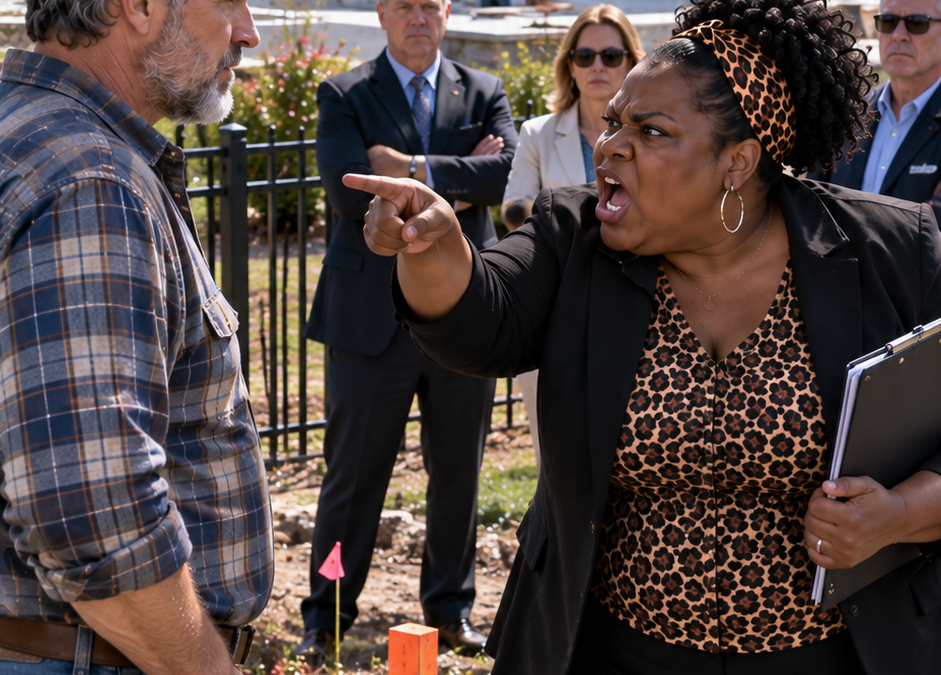
Before I could get closer, a woman wearing a hard hat at an angle stepped directly into my path.
Karen Aldrich.
She was sixty-something then, recently retired, and had spent the last several years turning the Cedarwood HOA into the closest thing our neighborhood had to a private government.
“This is an active construction site,” she said. “You need to leave.”
I looked behind her.
Workers were still installing trim.
Still drilling.
Still carrying material.
“I own this land.”
She smiled.
Not warmly.
It was the tired smile of someone who believed she’d already answered this question and was irritated that reality had brought it up again.
“Sir, this parcel falls within HOA boundaries.”
“It doesn’t.”
“We’ve been permitted since March.”
She lifted a laminated permit sheet.
There was a number in the upper-right corner.
County header.
Official-looking.
She held it just long enough for me to register that it existed.
Then pulled it back.
“Everything has been properly filed.”
A man in a yellow vest came over.
“Sir, you need to leave the site or we’re calling security.”
I didn’t argue.
Instead, I looked.
I’ve lived on that lot long enough to know distance the way some people know the layout of their own kitchen in the dark.
I looked at the pavilion’s near corner.
Then the row of pin oaks along the rear.
I planted those trees in 1994.
They had been saplings.
Eight feet apart.
Over the years, they became a privacy screen, then mature trees, then part of how I understood the shape of my property.
The pavilion was too far over.
Far too far.
I looked toward the ground where the survey marker should have been.
Nothing.
Walked several feet.
Still nothing.
The orange-capped steel corner markers were gone.
Both rear corners.
Pulled.
Where one had stood was a shallow depression partly filled with compacted construction debris.
I stared at it.
Then looked back at Karen.
She followed my eyes.
If she understood what I had just noticed, she didn’t show it.
“We’ve invested $1.6 million in this project,” she said. “For the benefit of the entire Cedarwood community.”
As if price could manufacture ownership.
“It’s been approved by the board, designed by a licensed architect, and properly permitted.”
“I want to see the boundary survey.”
“The site plan is on file.”
“That’s not what I asked.”
Her expression tightened.
“Our architect confirmed the site.”
“Architects don’t establish legal property boundaries.”
She lifted the clipboard.
“If you believe you have a grievance, you may submit it in writing.”
I looked again at the missing survey marker.
“What licensed surveyor established this boundary?”
Karen turned slightly toward the building.
“Sir, leave the site or I will call the police.”
I left.
Not because Karen was right.
Not because I doubted where the line was.
I left because I was sixty-one years old and had learned something useful over the years.
The person controlling the parking lot and the person holding the deed are not always the same person.
I walked home.
Didn’t slam a door.
Didn’t call the police.
Didn’t walk back with a shovel and start digging for the old markers.
I went into my study.
Opened the filing cabinet.
Behind thirty-seven years of property-tax statements was my original deed.
County recorder seal.
August 14, 1987.
Behind that was an old survey folder.
Inside it, a business card:
HARMON & ASSOCIATES
LICENSED LAND SURVEYORS
ESTABLISHED 1979
I put the card beside my coffee.
Then looked out the window at the pavilion roof.
Karen thought she was dealing with a confused homeowner.
A man who would look at a laminated permit, a hard hat, and a million-dollar building and decide the situation must already be settled.
What she didn’t understand was that I had owned that strip of land for nearly four decades.
Paid taxes on it for nearly four decades.
Maintained it.
Gardened on it.
Planted trees on it.
And in my filing cabinet were documents older than her entire relationship with Cedarwood.
If anyone on that board had bothered to pull the recorded plat before spending $1.6 million, the project would have stopped before the first shovel touched the ground.
PART2
Cedarwood was built in 1984.
Eighty-four single-family houses in the first phase.
Ten more added in 1986.
Ninety-four homes total.
Quiet suburban neighborhood.
Mature trees.
Wide sidewalks.
The kind of place people bought into because they expected to stay twenty or thirty years.
I closed on my lot in August of 1987.
I’ve lived there ever since.
I knew every awkward part of the property.
The low spot where rain collected after a summer storm.
The corner where grass never grew quite right.
The back strip where I kept a garden in the early years.
The line where the pin oaks stood.
Most important, I knew the rear boundary.
Two steel pins.
Orange caps.
Set by a licensed surveyor.
For thirty-six years, nobody disputed any of it.
Then Karen Aldrich moved into Cedarwood.
She arrived about six years before the pavilion mess.
Recently retired.
Organized.
Energetic.
The kind of person who came to HOA meetings with a binder while everyone else showed up with coffee and hopes of being home before eight.
In volunteer organizations, preparation can look a lot like authority.
Within eighteen months, she was on the board.
Within three years, she effectively ran it.
The official president was eighty-one and had held the title mostly because nobody else wanted it.
He deferred to Karen.
The other members followed him.
Soon the board wasn’t really a board.
It was Karen with people sitting beside her.
The first full year she controlled compliance, Cedarwood issued 214 violation notices.
Two hundred fourteen.
Grass a quarter inch above standard.
Wreaths left up after the approved holiday display period.
Cars parked at improper angles.
Outdoor furniture visible after certain hours.
Fines began at seventy-five dollars.
Then doubled if not corrected within fourteen days.
Two elderly homeowners ended up with liens.
One sold.
The other paid.
Nobody wanted to be next.
That changed the neighborhood.
People stopped questioning notices.
Stopped writing letters.
Stopped asking whether the rule really said what Karen claimed it said.
The safest strategy became:
Fix it.
Pay it.
Stay invisible.
I watched it happen.
For too long, I told myself it wasn’t my fight.
The twenty-foot strip behind my house had always been mine.
Garden.
Tools.
Trees.
Occasional storage.
Nothing unusual.
Then about five years before the pavilion, the lot adjacent to Karen’s property changed hands.
The listing agent ordered an informal boundary sketch.
Not a survey.
Not a county-recorded plat.
Just a drafting-service drawing used to show approximate yard dimensions in marketing material.
That sketch was wrong.
By roughly eighteen to twenty-two feet.
The rear line had been shifted.
And the error swallowed most of my twenty-foot strip into what appeared to be adjacent HOA-controlled ground.
Karen saw that sketch.
Apparently believed it.
Maybe nobody told her what it was.
Maybe someone did and she liked the version it showed.
I don’t know.
What I know is that after that sale, HOA contractors started behaving differently.
Signs appeared along the strip.
Landscapers crossed it.
One crew trimmed my pin oaks without asking.
Another began maintaining part of the old garden area.
The first spring it happened, I wrote the board.
Certified mail.
Simple letter.
That parcel belongs to me.
Deed reference included.
Please stop maintenance activity until the boundary is clarified.
No reply.
The following year, I wrote again.
No reply.
I didn’t escalate.
That was my mistake.
I thought silence meant they were ignoring a minor dispute.
Instead, Karen treated my silence as weakness and her own silence as resolution.
Then came construction.
The architect designing the pavilion didn’t order a boundary survey.
The board didn’t require one.
The county permit application relied on the same bad sketch.
Nobody pulled the 1987 plat.
Nobody checked the deed.
Nobody checked the tax record.
They took an informal drawing and built $1.6 million around it.
Three days after Karen ordered me off the site, an HOA envelope arrived.
Bold word across the top:
VIOLATION
Two citations.
The first accused me of storing personal property on HOA-managed land.
My tools.
My old post fencing.
Things that had been sitting on my land for years.
The second:
INTERFERENCE WITH PERMITTED CONSTRUCTION ACTIVITY
That was for walking out and asking who owned the ground.
Total fine:
$500.
Fourteen days to pay.
I read the notice twice.
Then filed it.
An HOA fine isn’t a court judgment.
People forget that.
It feels official because it arrives on letterhead.
It has due dates.
Threats.
Account numbers.
Sometimes lawyers.
But none of that changes the underlying question.
Do they have authority?
That Thursday, I attended the board meeting.
Twelve folding chairs.
Eight residents.
Store-bought cookies nobody touched.
Karen at the front with two board members.
The official president was absent.
I sat through maintenance.
Landscaping.
Newsletter updates.
Then homeowner comments opened.
I raised my hand.
Karen looked at me.
“Yes?”
I held up the fine notice.
“I’d like to understand what recorded document establishes my rear parcel as HOA land.”
“Our records establish the boundary.”
“Which records?”
“The architect confirmed the site.”
“Using what survey?”
A pause.
Tiny.
But there.
“If you want to contest a fine, there’s a process.”
She lifted a binder.
“I can provide the form.”
“I’m not asking about the fine.”
She set the binder down.
“I’m asking which licensed surveyor established the boundary.”
Longer pause.
Then Karen addressed the room.
“This homeowner has used HOA land for personal storage for years. The board has been lenient.”
Lenient.
About my property.
“At this point,” she continued, “we have an obligation to enforce our boundaries.”
The board member on her left nodded.
The one on her right stared at the agenda.
I noticed a woman in the third row.
Margaret Ellis.
Widowed.
Quiet.
She had been fined repeatedly over a potted plant outside her front door.
She wasn’t looking at me.
She was watching Karen.
I wrote everything down.
Time.
Date.
Exact phrases.
No survey produced.
No deed produced.
No answer.
Then I thanked the board and left.
Eight days later, a lawyer’s letter arrived.
Now they were threatening quiet title.
A quiet-title action asks a judge to decide who owns disputed land.
The HOA letter made it sound as though that outcome was obvious.
It also reminded me that a lien could affect financing and title transfer.
I read it.
Then went to the filing cabinet.
Pulled my original deed.
Pulled the certified plat copy I had already ordered from the county.
Placed them side by side.
Same boundary.
Same strip.
Same dimensions.
Thirty-seven years of tax assessments lined up with both.
If Cedarwood wanted a quiet-title case, fine.
They could stand in front of a judge and explain why a 2019 marketing sketch outweighed a recorded plat from the 1980s.
But both sides would need a real survey.
I called three firms.
First:
Six-week backlog.
Second:
No residential work until fall.
Third:
Harmon & Associates.
“Two weeks,” the scheduler said.
“I’ll take it.”
I hired them.
I didn’t tell Karen.
Didn’t tell neighbors.
Didn’t tell the board.
I just waited.
Word still spread.
Four days after the meeting, Paul came to my driveway.
He lived six houses away.
He handed me a manila envelope.
“I heard you pushed back.”
Inside was an HOA lien notice.
Original violation:
Fence post allegedly 2.3 inches outside an approved location.
Two-point-three inches.
The original three-hundred-forty-dollar fine had compounded to eleven hundred before Paul even understood what was happening.
He paid because he had a refinance coming up.
Couldn’t risk the lien.
“I just thought you should know,” he said. “You’re not the only one.”
Two days later, Margaret came.
Plastic folder.
She had paid $2,400 in fines in eight months.
Original violation?
A patio umbrella left open after nine at night.
Outdoor fixture visibility standard.
She hadn’t known the rule existed.
The fine multiplied while she was dealing with a health problem.
By the time she tried to contest it, Karen told her the appeal window had closed.
“I didn’t want trouble.”
Margaret said it quietly.
Like the sentence had once made sense to her and no longer did.
Then Dale Hutchins showed up.
He changed things.
Dale had lived in Cedarwood twenty-two years.
General contractor.
Foundations.
Framing.
Site work.
He asked to walk the rear boundary with me.
We went out.
He studied the pavilion.
Didn’t speak for several minutes.
Looked at the foundation.
Looked at the trees.
Looked toward my fence.
Then crouched.
Pressed two fingers into the ground about eight feet from the pavilion.
“That’s wrong.”
“What?”
“The building.”
He stood.
“It’s too far over.”
He walked a few feet.
“I remember those orange survey caps.”
That got my attention.
“How?”
“I helped the Franklin place measure for a shed years ago. We used your marker for reference.”
He tapped the soil with his boot.
“It was here.”
Then pointed toward the pavilion.
“Not there.”
Dale wasn’t a surveyor.
But he knew construction.
He knew sites.
And he remembered the physical marker.
That afternoon, I drove to county records.
Asked for the original Cedarwood subdivision plat.
The clerk brought out a certified copy.
Surveyor’s seal still legible.
I stood at the counter.
Found my lot.
Found the rear line.
Then compared it to where the pavilion sat.
My stomach tightened.
The structure wasn’t barely across.
The entire building was wrong.
Depending on the wall, between eleven and nineteen feet inside my property.
Not one corner.
Not a porch.
Not an overhang.
The whole footprint.
I paid for certified copies.
Went home.
Then photographed everything.
Forty-one photographs.
Foundation.
Walls.
Distance to fence.
Removed marker locations.
Compacted soil.
I stayed entirely on my land.
That evening, I assembled the file.
Original deed.
Certified plat.
Tax records.
Forty-one photographs.
Paul’s lien paperwork.
Margaret’s fines.
My own violation.
Quiet-title threat.
Notes from Dale.
Then I wrote three words on the folder:
SURVEY PENDING — PROCEED
Harmon had already completed field measurements.
Final report:
Ten business days.
I had everything except the one document that would remove argument from the discussion.
Meanwhile, Karen finished the pavilion.
Six weeks after construction ended, she held a ribbon cutting.
Cream cardstock invitations.
Embossed logo.
GRAND OPENING — CEDARWOOD COMMUNITY PAVILION
I wasn’t invited personally.
The invitation was delivered like every other HOA notice.
I watched from my back window.
Maybe thirty residents.
Oversized scissors.
Champagne.
Photographer.
Karen gave a speech.
I couldn’t hear it.
Didn’t need to.
Her body language said enough.
She stood beside a $1.6 million building as though investment itself had transformed questionable ground into community property.
Four days later, the newsletter arrived.
Pavilion on the cover.
Caption:
A $1.6 MILLION INVESTMENT IN CEDARWOOD’S FUTURE, MADE POSSIBLE BY THE VISION AND LEADERSHIP OF YOUR HOA BOARD.
I clipped it.
Put it in the folder.
Then another certified envelope arrived.
This one from the HOA attorney.
Title:
BOUNDARY ACKNOWLEDGMENT AND EASEMENT CONFIRMATION
Four pages.
The language sounded cooperative.
It wasn’t.
They wanted me to sign a notarized statement acknowledging that the disputed strip belonged to the HOA.
Then grant them permanent rights over it.
In other words:
Erase my own ownership.
Voluntarily.
Forever.
Twenty-one days to sign.
Or Cedarwood would file quiet title.
I sat at the kitchen table looking at it.
Then called a property attorney.
He had been practicing in the county more than twenty years.
I brought him the entire file.
He read slowly.
No performance.
No outrage.
When he finished, he took off his glasses.
“Do not sign this.”
“I wasn’t going to.”
“Good.”
He tapped the proposed acknowledgment.
“They have the burden.”
“Quiet title?”
“Yes. They’re claiming ownership. They prove it.”
He picked up the county plat.
“Not with an architect’s site plan.”
Then the bad sketch.
“And certainly not with this.”
He looked at the photographs.
“Your survey is pending?”
“Yes.”
“If the survey confirms what this plat suggests, their case collapses.”
That was the moment certainty stopped being private.
Until then, I knew what I believed.
Now a lawyer who had spent twenty years handling land disputes was looking at the same evidence and reaching the same conclusion.
He sent the HOA one sentence.
My client declines to execute the proposed document and will respond to any further action through proper legal channels.
Nothing else.
No debate.
No explanation.
The letter arrived three days before their deadline.
Then Cedarwood went quiet.
No new violations.
No lawyer letters.
No calls.
At the same time, the Harmon survey truck appeared behind the neighborhood.
Karen saw it.
I know because I saw her standing at her back window.
Watching.
She smiled.
I think she believed the survey crew had been sent by the HOA or county to validate her pavilion.
She had no idea I’d hired them.
No idea what they’d measured.
No idea the document being drafted two towns away was about to define every inch beneath her $1.6 million celebration.
Before the report arrived, she called a special community meeting.
Notice mailed to all ninety-four homes.
BOUNDARY DISPUTE AND HOA PROPERTY RIGHTS UPDATE
Strongly encouraged attendance.
That wasn’t an update.
It was narrative control.
Karen could sense something shifting.
She didn’t know exactly what.
So she wanted the neighborhood assembled before the survey existed.
Friday.
Seven p.m.
Nearly sixty chairs filled.
Karen stood at the front.
Board members beside her.
HOA attorney against the wall.
Projector behind.
I sat in the back.
Yellow legal pad.
She opened confidently.
The HOA had followed all procedures.
The pavilion was properly designed.
Properly permitted.
The board had invested $1.6 million for generations of Cedarwood families.
Slide one:
Professional pavilion photograph.
Slide two:
Architect’s site plan.
Slide three:
The 2019 informal listing sketch.
Karen called it a boundary document.
It wasn’t.
Then she showed photographs of landscapers working along the strip.
Evidence, she said, of long-standing HOA management.
Then she mentioned my certified letters.
Not that they were ignored.
Only that I had raised objections the board had “managed.”
Finally:
“One homeowner has refused to cooperate and is threatening to undo a completed community project.”
Several heads turned toward me.
Karen continued.
“The board will not allow one person’s obstruction to hold this community hostage.”
Hostage.
I wrote the word.
Time.
Exact phrasing.
Her attorney nodded when she said it.
I wrote that too.
Another board member presented the legal timeline.
Quiet-title suit by end of month.
Four to six months.
Attorney confident.
Board confident.
Two residents offered cautious support.
Most people stayed silent.
Not agreement.
Survival.
I knew that silence.
Karen asked for questions.
I raised my hand.
She hesitated.
Then:
“Yes?”
“I have information I’d like to share.”
Her expression hardened.
“But not tonight.”
I reached into my folder.
Pulled out a plain manila envelope.
Held it briefly.
The HOA attorney straightened in his chair.
Then I set it on my knee.
Karen said:
“That’s not how this process works.”
“I know.”
“Then what are you doing?”
“Waiting.”
I smiled slightly.
“For the appropriate time.”
The meeting ended ten minutes later.
As I stood, I set the envelope on the folding table for a moment while gathering my legal pad.
Didn’t open it.
All three board members stared at it.
For the first time, nobody was looking at Karen.
They were looking at what she didn’t know.
The certified survey arrived Tuesday morning.
Brown courier envelope.
Signature required.
I carried it to the kitchen table.
Eleven pages.
Harmon & Associates.
Surveyor seal.
License number.
Field date.
Certification date.
Coordinates.
Boundary calls.
Photographs.
Findings.
I read the conclusion once.
Then again.
Minimum encroachment:
Eleven feet.
Maximum:
Nineteen feet.
Entire pavilion footprint located inside my recorded property boundary.
Every square foot.
Foundation.
Walls.
Mounted lighting.
Everything.
The surveyor had also filed a certified copy with the county recorder that morning.
No longer just my evidence.
Public record.
I called my attorney.
He sent notice immediately.
Certified survey completed and recorded.
HOA instructed to cease use of the encroaching structure pending resolution.
Copy enclosed.
Karen’s threatened quiet-title action was now staring at a licensed survey establishing the opposite of everything her architect’s sketch assumed.
The HOA lawyer asked for a meeting within forty-eight hours.
Same community room.
This time only six people.
Karen.
Two board members.
Her attorney.
My attorney.
Me.
No projector.
No audience.
No champagne.
I entered carrying the survey.
Before I sat, I placed it in the center of the table.
Seal facing up.
Karen’s lawyer reached for it first.
Read the front.
Checked the license.
Flipped to findings.
Then survey exhibit.
Karen leaned toward him.
“Our architect clearly established—”
He put a hand lightly on her forearm.
She stopped.
My attorney placed my original deed beside the survey.
Then the certified county plat.
Aligned.
Same direction.
Same boundary.
One board member leaned forward.
Compared them.
Looked at the survey.
Then the plat.
Then my deed.
“Those match.”
He said it quietly.
Nobody answered.
My attorney put down several photographs.
The depressions where my steel markers once stood.
He said:
“These appear to show removal of permanent boundary monuments during site preparation. The county inspector will need to be notified.”
Karen opened her mouth.
Her lawyer shook his head.
Tiny motion.
She saw it.
Then came Dale Hutchins’s signed statement.
General contractor.
Twenty-two years of local work.
Personal memory of the original orange-capped stake location.
Finally, my attorney placed the HOA permit application on the table.
Pointed to the document used as boundary authority.
The 2019 informal listing sketch.
Not a licensed survey.
Not recorded.
Not legally authoritative.
Karen’s attorney read it.
Then said:
“I need five minutes.”
He stepped into the lobby.
Through the glass, I watched him call somebody.
Three minutes.
Two nods.
Hung up.
Inside, nobody spoke.
Karen stared at the survey.
She hadn’t touched it.
For years, certainty had been her strongest tool.
You could hear it in meetings.
See it in letters.
Feel it when she walked onto someone’s porch with a violation.
Now certainty was leaking out of her face.
Slowly.
Her lawyer returned.
Sat.
Whispered to her.
Karen looked at me.
“This isn’t over.”
Her voice was controlled.
But slower.
Her attorney glanced at the survey.
Then at my attorney.
“Actually—”
He stopped.
Didn’t finish.
I leaned forward.
“I don’t want a courtroom.”
Karen stared.
“The land is mine. The survey confirms it. The county has the survey. What happens next is up to you.”
I did not say $1.6 million.
Nobody needed me to.
The number sat in the room like another person.
The next morning, Karen’s attorney called mine.
The HOA would not file quiet title.
That was it.
No apology.
No acknowledgment.
No concession.
Just:
No lawsuit.
The math had changed.
Within a week, a county inspector appeared.
I hadn’t requested him.
The recorder’s filing had triggered review because the certified survey showed a permitted structure crossing a private boundary.
The inspector carried the survey.
Measured.
Walked the foundation.
Spent forty minutes.
Then posted a notice on the pavilion door.
ENCROACHMENT VIOLATION
The HOA had two options.
Negotiate purchase of the encroached land at fair market value.
Or remove the portion of the structure crossing the legal property line.
I declined to sell.
Some people later told me that was vindictive.
It wasn’t.
That strip was mine.
Thirty-seven years.
Taxes.
Garden.
Trees.
Work.
Memory.
Someone spending $1.6 million on my land didn’t create an obligation for me to rescue them from their own failure to check title.
If you build on somebody else’s property, the answer isn’t automatically:
Fine, we’ll buy it afterward.
Sometimes the answer is:
Take it off.
The HOA notified its insurer.
Then held an emergency board meeting.
Karen was not included.
That was the first sign the board finally understood they had a problem larger than the pavilion.
Karen had personally presented the architect’s sketch as authoritative.
She approved the construction budget.
She had pushed the project.
And according to the financing structure, she had personally guaranteed part of the construction arrangement.
The board members who had spent years nodding were now reading.
Carefully.
They voted three to zero to review Karen’s personal responsibility.
Four days later, she resigned.
Two sentences.
“Personal reasons.”
No mention of the survey.
No mention of the building.
No mention of the number she had thrown at me on my own property:
We invested $1.6 million.
As though money were proof.
As though expense could turn trespass into ownership.
The pavilion had opened with champagne.
Six weeks later, parts of it had to come down.
The next community meeting was unlike any meeting Karen ever ran.
No slide deck.
No attorney against the wall.
No printed presentation.
Paul served as interim chair.
Around fifty residents came.
Margaret stood first.
Plastic folder in her hands.
She read every fine Karen’s board had charged her.
Date.
Violation.
Amount.
Payment.
Four minutes.
Then sat.
Paul presented his lien.
Another couple produced three years of notices.
Then an elderly man stood.
I didn’t recognize him.
He said he had driven to multiple HOA meetings over the years and sat in his car outside because he was afraid coming inside would put his property under scrutiny.
That silenced the room.
Paul announced an independent review of the last four years of HOA fines.
Every charge issued without authority or contrary to bylaws would be reversed.
Refunds where appropriate.
The residents voted.
Not one person opposed.
My $500 construction-interference fine disappeared that week.
The storage violation disappeared.
Legal expenses were addressed through the HOA’s insurance settlement.
Insurance also covered parts of the demolition and remediation required to pull the pavilion back inside Cedarwood’s actual property boundary.
Three weeks later, demolition crews returned.
Tuesday morning.
Same kind of equipment.
Different atmosphere.
No banner.
No oversized scissors.
No photographer.
They dismantled the encroaching sections.
Cut.
Removed.
Reframed.
Sealed.
Worked slowly.
Professionally.
Quietly.
I watched from my kitchen window.
When they finished, the pavilion still existed.
Most of it had been built on legitimate HOA property.
Only the portion crossing my land was removed.
That’s what I wanted.
I didn’t want the neighborhood to lose everything because Karen made a terrible decision.
I wanted my property restored.
After the crew left, I walked the rear line.
Harmon had reset the survey monuments during final site verification.
Bright orange caps.
Correct depth.
Correct location.
The same points I had known since 1987.
I crouched beside the nearest one.
Pressed my hand into the soil.
Solid.
The land around it wasn’t.
Construction equipment had compacted the old garden strip.
Gray soil.
Hard in places.
Rutted.
The pin oaks were gone.
All of them.
Removed during site preparation.
That loss bothered me more than the building.
I planted those oaks in 1994.
Six small trees.
Eight feet apart.
I watched them grow through every season for thirty years.
Storms.
Heat.
Ice.
One summer my wife tied ribbons to them for our daughter’s graduation party.
Another year we strung lights between two for Christmas because the grandchildren asked.
Karen saw them as landscaping in the way of a project.
To me, they were time.
You can’t sue someone into giving you thirty years of tree growth back.
So I ordered six saplings.
Four feet tall.
Balled and burlapped.
Same spacing.
Eight feet.
When they arrived, I planted them myself.
Started at the near survey marker.
Measured.
Dug.
Set.
Tamped.
Moved eight feet.
Repeated.
By the sixth tree, my back hurt.
My hands were dirty.
I was happier than I’d been in months.
They looked ridiculous compared with the old oaks.
Thin trunks.
Small crowns.
Barely enough shade for a rabbit.
But they were mine.
On my side of the line.
Where the old trees had stood.
That’s enough sometimes.
Not restoration.
Continuation.
The pavilion’s remaining entrance faced the HOA side.
The county violation notice stayed taped to the door for weeks.
Weather curled one corner.
Every morning I could see it from my property.
I never touched it.
Didn’t need to.
The board eventually repaired the exterior where demolition had cut the pavilion back.
Smaller footprint.
Still attractive.
Still useful.
People held gatherings there.
Children’s birthday parties.
Board meetings.
Holiday events.
That never bothered me.
The pavilion wasn’t the enemy.
The idea that Karen could take my property because she’d spent enough money on it was the problem.
There’s a difference.
A few months later, Paul came over.
He was carrying another folder.
I almost laughed.
“We need to talk about the rear strip.”
“What now?”
“Nothing bad.”
He opened the folder.
The new board wanted a written acknowledgment of the certified boundary.
Something permanent in HOA records.
I looked through it.
Legal description.
Survey reference.
County instrument number.
Statement that Cedarwood claimed no ownership beyond the recorded line.
I read every word.
Then signed.
Paul smiled.
“Karen would’ve hated this document.”
“Then it’s probably useful.”
He laughed.
We stood near the young oaks.
He looked at them.
“Same kind?”
“Same.”
“How long until they look like the old ones?”
“Thirty years.”
He winced.
“Sorry.”
“It isn’t your fault.”
That was true.
One of the hardest things in neighborhood disputes is resisting the urge to assign collective guilt.
Karen drove the project.
The board failed to check her.
The architect relied on the wrong source.
The county permit process failed to catch the boundary problem.
But the woman three streets over who wanted a place for her grandkids’ birthday party didn’t steal my land.
Neither did Paul.
Neither did Margaret.
Most homeowners didn’t even know there was a dispute until Karen told them I was holding the community hostage.
They had relied on their board.
The board had relied on certainty.
Certainty turned out to be a terrible substitute for measurement.
That’s why surveys exist.
Years ago, I thought survey markers were mostly practical.
Construction reference.
Fence line.
Sale documentation.
Now I look at those orange caps differently.
They are quiet things.
No voice.
No authority card.
No letterhead.
They just sit in the ground.
Year after year.
They don’t care who wins an HOA election.
Don’t care who has the nicest presentation.
Don’t care how much a building cost.
A legal boundary isn’t impressed by investment.
Karen could spend $1.6 million.
Ten million.
A hundred million.
If the foundation crossed the line, it crossed the line.
That was the part she never understood.
One afternoon, Margaret stopped while I was working near the garden.
She watched me turn soil.
“They’re refunding some of my money.”
“Good.”
“Not all.”
“Why?”
“Some of the fines were technically valid.”
She gave a small laugh.
“Apparently I really did leave the umbrella open too late.”
I smiled.
“You monster.”
She laughed harder.
Then looked toward the pavilion.
“I used to think she couldn’t be wrong.”
“Karen?”
Margaret nodded.
“Not because I thought she knew everything. Because everyone acted like she did.”
That sentence stayed with me.
Authority often grows in the space created by everyone else’s exhaustion.
Karen came prepared.
Other people had jobs.
Doctor appointments.
Children.
Illness.
Grief.
She had a binder.
They had lives.
So eventually she was the person who knew the rules.
Then the person who interpreted the rules.
Then the person who enforced them.
Then the person nobody questioned.
Until she built a million-dollar building across a recorded property line.
It took something that large to make everyone look.
But the smaller things had mattered too.
Paul’s fence post.
Margaret’s umbrella.
The elderly homeowners.
The liens.
Those weren’t separate from the pavilion.
They were practice.
Every unchallenged decision taught Karen she was entitled to the next one.
That’s why I stopped ignoring my own letters.
My first certified boundary notice had disappeared into the HOA office years before.
So had the second.
At the time, I thought their failure to respond was rude.
Later, I understood it was information.
People who know they’re right usually want to show you the document.
People who avoid the document may already suspect what it says.
Karen never once showed me a licensed survey.
Not at the construction site.
Not at the board meeting.
Not through the lawyer.
She showed me permits.
Site plans.
Sketches.
Maintenance photographs.
Everything except the one thing that actually answered the question.
Where is the line?
The morning the county inspector posted the encroachment notice, I stood far enough away not to interfere.
Karen wasn’t there.
That surprised me.
I expected her to come.
To argue.
To insist.
She didn’t.
Maybe her attorney had finally convinced her that there are moments when speaking only creates more evidence.
By then, the survey was public.
The boundary wasn’t an opinion anymore.
No amount of confidence could move it.
The new board eventually repealed the most aggressive fine schedule.
Not all standards disappeared.
Cedarwood was still an HOA.
People still had rules.
But violations required clearer notice.
Appeals had actual deadlines for both sides.
Fines stopped doubling automatically.
Liens required board review and independent legal confirmation.
No single board member could turn personal interpretation into a property-level penalty.
The biggest change, though, wasn’t written.
People started asking questions.
“What section says that?”
“Can we see the document?”
“Who approved this?”
“Is that recorded?”
Those questions would have made Karen furious.
I found them reassuring.
A neighborhood becomes healthier when ordinary people no longer feel disrespectful for asking the person in charge to prove what they’re saying.
About a year after the demolition, I attended a board meeting.
Not because I had an issue.
Just habit.
Paul chaired.
Margaret sat near the front.
A younger homeowner asked about changing the fence-color palette.
Discussion.
Nothing dramatic.
Then someone proposed extending landscaping behind the pavilion.
Paul said:
“Before we spend anything, get a certified boundary drawing.”
Half the room laughed.
So did I.
Paul looked toward the back.
“Learned that one.”
Good.
Lessons should become procedure.
Otherwise they’re only stories.
The young pin oaks made it through their first summer.
I watered them more than they needed.
Probably because I had thirty years of impatience compressed into one season.
By fall, the leaves turned.
Small crowns.
Bright color.
The old trees used to cover that entire strip in shade.
The new ones barely interrupted sunlight.
But each time I looked at them, I remembered that growth doesn’t care what you’ve lost.
It begins again anyway.
I rebuilt the garden too.
Didn’t restore the exact old layout.
Soil was different after compaction.
Drainage had changed.
I added compost.
Worked it deeper.
Let one corner rest.
The first tomato crop wasn’t good.
Second year was better.
That’s land.
You can damage it.
You can repair it.
But the repair becomes part of its history.
The same is true of people.
I was angrier after the pavilion than I liked admitting.
Not explosive anger.
Quieter.
The kind that makes you replay conversations.
I would remember Karen telling me:
We have invested $1.6 million.
And think of responses I could’ve given.
“You spent it on the wrong property.”
“Then you should have spent three thousand on a survey first.”
“Your budget doesn’t override my deed.”
I never said any of those.
I’m glad.
The survey said them better.
There is dignity in letting the right document do the humiliating.
It doesn’t shout.
It doesn’t insult.
It doesn’t need the last word.
It simply exists.
One evening, Dale Hutchins came over.
He stood by the orange marker.
“That’s where it was.”
“I know.”
“I knew I wasn’t crazy.”
“You weren’t.”
He laughed.
“Twenty years in construction and I was standing there thinking maybe my memory had moved a property line.”
He looked toward the pavilion.
“Whole damn building.”
“Most of it.”
“Still unbelievable.”
“People build before surveys more often than you’d think.”
“Not usually for $1.6 million.”
“That’s true.”
He nudged the steel cap lightly with his boot.
“This little thing beat all that.”
I looked at it.
“No.”
“What did?”
“The paperwork behind it.”
Marker matters because a licensed survey gives it meaning.
Deed matters because the county recognizes it.
Tax record matters because ownership has history.
No single piece won.
The consistency did.
Deed.
Plat.
Taxes.
Markers.
Survey.
Thirty-seven years pointing to the same answer.
Karen had one bad sketch.
That’s why the case never reached court.
Her attorney understood the comparison.
If Cedarwood had filed quiet title after the survey, they would’ve walked into court asking a judge to disregard a recorded deed, a certified plat, decades of assessments, and a fresh licensed survey—all in favor of an informal listing drawing.
No serious lawyer wants to make that argument if there’s any exit available.
So they took the exit.
Insurance.
Partial demolition.
Resignation.
Boundary acknowledgment.
Done.
I never learned exactly what happened between Karen and the insurer.
Didn’t ask.
There were rumors.
Personal liability discussions.
Questions about whether her representations to the board had exceeded normal authority.
Maybe some of that was true.
Maybe not.
I didn’t need it.
My goal had never been to destroy Karen.
My goal was to keep my land.
That’s another lesson people miss.
When conflict becomes public, spectators want punishment.
They want humiliation.
They want somebody ruined.
But property cases aren’t entertainment when you’re living them.
I didn’t want Karen homeless.
Didn’t want the HOA bankrupt.
Didn’t want neighbors paying thousands each because a board failed to order a survey.
I wanted the building off my property.
My legal fees covered.
Fines removed.
Boundary respected.
Once I had those things, I was finished.
Karen moved away about nine months after resigning.
At least that’s what someone told me.
I never saw a moving truck.
One day her car was there.
Eventually it wasn’t.
I felt less than I expected.
For months, she’d occupied a huge amount of my attention.
Then suddenly she became a person who used to live three streets over.
That’s healthy, I think.
People who harm you shouldn’t get permanent free rent in your head.
The pavilion still exists.
Smaller.
The rebuilt wall sits several feet inside the real HOA boundary now.
There is landscaping between it and my strip.
No HOA crew crosses the marker.
When maintenance workers come, they stay on their side.
Sometimes one will see me outside and wave.
I wave back.
No drama.
That’s what clear boundaries create.
Not hostility.
Peace.
A fence line is not an insult.
A survey isn’t aggression.
A deed isn’t selfishness.
The purpose of a boundary is to prevent every generation from having to fight the same argument again.
My original orange stakes did that for nearly four decades.
Until somebody pulled them out.
The replacements will outlive me.
That matters.
My grandson came over one Saturday.
He’s old enough now to ask questions but young enough to think every answer should be simple.
He pointed toward the pavilion.
“Is that the building they put in your yard?”
“Part of it.”
“Why?”
“They got the property line wrong.”
“How?”
“Nobody checked.”
He frowned.
“But there’s a marker.”
“There is now.”
“Wasn’t there before?”
“There was.”
“What happened?”
“Somebody removed it.”
He stared at the orange cap.
Then asked the question children ask when adults have made something unnecessarily complicated.
“Why didn’t they just put it back?”
I laughed.
“Eventually, they did.”
That was enough explanation.
Someday maybe he’ll understand the rest.
The lawyers.
The meetings.
The fines.
The certified mail.
The strange human tendency to defend a mistake more fiercely once we’ve spent money on it.
For now, he just understands that property has corners.
And corners should stay where they are.
I still keep the original file.
It’s thick now.
Violation notice.
Quiet-title threat.
Survey.
Photographs.
Newsletter clipping.
Insurance correspondence.
Settlement documents.
Boundary acknowledgment.
At the front is the cream-colored invitation to the ribbon cutting.
I could throw it away.
Probably should.
But sometimes documents deserve to stay together.
A record of how certainty grew.
Then collapsed.
The newsletter cover still makes me shake my head.
Karen smiling beside the ribbon.
A $1.6 million investment in the Cedarwood community made possible by vision and leadership.
She wasn’t wrong about the cost.
The lesson was expensive.
Just not in the way she expected.
If the board had hired Harmon & Associates before approving the plans, this entire story would’ve cost a few thousand dollars.
They could’ve shifted the pavilion twenty feet.
Saved the trees.
Saved the legal fees.
Saved demolition.
Saved Karen’s position.
Saved everyone months of conflict.
But surveying doesn’t photograph well in a newsletter.
Nobody cuts a ribbon when a boundary is confirmed.
Good due diligence is boring.
That’s why people skip it.
Until the boring thing becomes the only thing that matters.
Thirty-seven years ago, I watched a surveyor set two orange caps.
No champagne.
No board vote.
No architect.
No $1.6 million.
Just measurements.
Steel.
Dirt.
Those two little markers ended up mattering more than the entire pavilion project.
That’s land for you.
It rewards accuracy.
Eventually.
I turned sixty-three last winter.
The new oaks are taller now.
Still nothing like the originals.
Maybe they never will be in my lifetime.
That’s okay.
I don’t need to see them mature to know they’re planted correctly.
Sometimes ownership is like that.
You protect things you may not live long enough to fully enjoy.
Not because you’re possessive.
Because someone should preserve continuity.
I expect someday my property will belong to somebody else.
Maybe family.
Maybe a buyer.
Whoever it is, they’ll open the deed.
They’ll see the recorded survey.
They’ll walk the rear line.
They’ll find those orange caps.
And they won’t have to argue with Cedarwood about where the boundary sits.
That’s the real victory.
Not Karen resigning.
Not the pavilion getting cut back.
Not the fines refunded.
The argument itself is gone.
A good resolution removes the need for another fight.
One Tuesday afternoon, almost exactly two years after I first walked toward the construction site, I carried coffee to the rear boundary again.
Same two-minute walk.
Different sound.
No saws.
No forklifts.
Wind through leaves.
Someone inside the pavilion laughing.
My young oaks moving slightly in the breeze.
I stopped at the nearest marker.
The county inspector’s old violation notice had long since been removed from the pavilion door.
The wall where the demolition crew cut the building back had been finished so well you could barely tell anything happened.
If you didn’t know the story, you’d assume the pavilion had always been built that way.
That pleased me.
Scars don’t need to stay visible to remain lessons.
I looked down.
Orange cap.
Bright against the dirt.
Then across at the pavilion.
Twenty feet can be a lot of distance.
Enough for a garden.
Enough for six oak trees.
Enough to separate community property from private land.
Enough to turn a $1.6 million building into an encroachment.
Karen thought the size of the project made her position stronger.
The opposite was true.
The larger the mistake became, the less willing she was to admit it.
That’s how people get trapped by their own certainty.
They think:
We’ve already spent too much to be wrong.
So they spend more.
Defend harder.
Threaten louder.
File another notice.
Hire another lawyer.
At some point, the money invested stops being evidence that the decision was good.
It becomes evidence of how long nobody stopped to check.
I took a sip of coffee.
Someone opened the pavilion door.
A family came out carrying folding chairs.
They stayed on their side of the line.
Didn’t even look toward me.
Good.
I walked along the new oaks.
Checked the soil.
One needed water.
I went back for the hose.
Nobody told me I was on an active construction site.
Nobody threatened security.
Nobody held up a laminated permit.
Nobody told me $1.6 million mattered more than thirty-seven years of ownership.
Just land.
My land.
Exactly where the deed said it had always been.








