𝗣𝗔𝗥𝗧 𝟮 HOA Karen Sold a Wedding Aboard My Private Yacht — Then the Coast Guard Arrived Before the Vows Were Finished
𝗣𝗔𝗥𝗧 𝟮
That was why the slip mattered.
And that was why Cheryl Bostwick wanted it.
Cheryl had been HOA president since 2019.
She also chaired the marina committee.
Technically, she had created the marina committee and then appointed herself chair.
Blonde hair that somehow never moved in Eastern Shore wind.
Coral lipstick.
Reading glasses on a beaded chain.
Clipboard always under one arm.
She carried it into rooms where nobody had asked her to write anything.
Outside the HOA, Cheryl ran a small wedding-planning company called Reach Events by Cheryl.
And to be fair, she faced a real problem.
The marina bulkhead was failing.
The original sheet piling from 1998 had rusted through in several areas.
An engineer estimated replacement at roughly $610,000.
Split among ninety-four households, that was more than six thousand dollars each.
Nobody wanted that assessment.
At the March HOA meeting, Cheryl stood in front of the board and announced she had an alternative.
“Amenity revenue.”
Her idea was to monetize the community’s waterfront.
Weddings.
Corporate gatherings.
Private events.
People applauded.
I remember sitting in the back and thinking that was an extraordinary number of weddings needed to pay for six hundred thousand dollars of steel.
But it was not my committee.
So I went home.
What I did not know then was that the paperwork Cheryl would later misuse had been sitting inside my own filing cabinet since 2010.
Every slipholder at Bayford Reach signed a marina license.
One clause required us to leave a vessel key and engine-start instructions with the harbor master.
That made sense.
Hurricanes come up the Chesapeake.
Owners travel.
If a named storm approaches and boats need to be moved quickly, somebody must be able to move them.
The language was specific.
The key was held solely for emergency relocation in advance of a named storm.
Our harbor master was Dale Kirby.
Seventy years old.
Retired waterman.
Hands like a pair of crab pots.
Worked part-time.
Kept his records in a spiral notebook secured with a rubber band because he did not trust the association computer.
I used to make fun of him for that.
I stopped later.
My trouble with Cheryl began small.
In April, I spent one Saturday sanding a friend’s fourteen-foot tender beside my slip.
Four hours.
Hand block.
One-twenty grit.
He wasn’t paying me.
He had rebuilt a compressor for me, and I was returning the favor.
The following Tuesday, I received a $150 HOA violation.
Commercial activity at a residential slip.
I wrote the board a polite letter.
Included photographs of my actual commercial shop on Sharp Street.
Explained that no money changed hands.
At the May meeting, the board voted four to one to void the violation.
Naen Puit, our treasurer, read my explanation aloud.
“This is a man sanding a rowboat.”
A few people laughed.
Cheryl did not.
She wrote something on her clipboard.
Eleven days later, a certified letter arrived.
FLEET STANDARDIZATION INITIATIVE.
The proposed marina rule limited all vessels to forty-five feet.
I read that number twice.
There were sixty-one slips.
Fifty-eight boats were under thirty-five feet.
Two were a little over forty.
One boat was longer than forty-five.
Mine.
The June meeting drew nineteen people.
Cheryl came prepared.
Handouts.
Charts.
A turquoise blazer.
“Oversized vessels place additional loads on aging marina infrastructure,” she said. “This isn’t personal. It’s engineering.”
Then she reached the actual purpose.
“Slip assignments will be adjusted to reflect the new standard. Slip 12 will become available for community use. Mr. Hollister will be reassigned to slip 39.”
I had brought a tide table.
“Slip 39 has three feet two inches at mean low.”
Cheryl looked at me.
“The committee reviewed the depths.”
“Margarite draws four feet one.”
Several people shifted in their chairs.
“You’d put her on the bottom twice a day.”
“The vessel can be relocated seasonally.”
“Where?”
She didn’t answer.
I continued.
“Slip 39 also has fifteen-amp service. Margarite runs a dehumidifier and two bilge pumps.”
“Everyone is sacrificing for the bulkhead.”
“This isn’t convenience, Cheryl. She’s a wooden hull.”
She gave me a thin smile.
“Not everyone’s boat sinks.”
The room went very still.
Naen asked to see my tide chart.
She read it slowly.
Then compared it with the HOA’s dredging report.
“Wade’s right,” she said. “North Row is three-two at mean low.”
Cheryl tried again.
“He can relocate.”
“Where?” I asked.
She had no answer.
Deep slips for a fifty-eight-foot boat were hard to find anywhere near us, especially during season.
The nearest realistic option was Georgetown.
Forty minutes by road.
Hours by water.
Then I brought up the deed.
“Slip 12 is appurtenant to my lot.”
Cheryl frowned.
“The association manages common amenities.”
“Managing isn’t owning.”
That was the whole issue.
When Bayford Reach was developed, specific slips had been legally attached to specific home lots.
The HOA could regulate reasonable marina use.
It could not casually detach my recorded slip because the president had discovered it photographed well at sunset.
The board voted three to two against Cheryl’s fleet standard.
She closed her binder.
“We’ll revisit this after legal review.”
In the parking lot, a neighbor I barely knew shook my hand.
Then he said, “She’s been talking about slip 12 since February.”
That was when I finally understood.
It wasn’t really about boat length.
Slip 12 had eight feet of water.
A long finger pier.
And from the clubhouse deck, Margarite sat directly in the background.
If you wanted to sell waterfront weddings at Bayford Reach, there was no better photograph.
Three weeks later, I was working aboard her when I heard a high buzzing noise.
A drone hovered forty feet off the starboard bow.
Camera pointed directly at Margarite.
It moved slowly down her hull.
Paused near the stern.
Returned toward the bow.
Then climbed toward the clubhouse.
I watched it go.
And forgot about it.
Three weeks later, I received an email from a woman named Priscilla.
She said she was the mother of a bride.
She wanted information about “the yacht” included with Bayford Reach’s October wedding package.
Did it have a bar?
Could photographers use the bow?
I read her message three times.
Then searched the Bayford Reach website.
There was a new section.
WATERFRONT EVENTS.
At the top of the page was Margarite.
Full-width drone photograph.
Afternoon light across the mahogany.
My varnish shining like jewelry.
Beneath it:
OUR COMMUNITY YACHT.
Further down were six more photographs.
And prices.
$4,000 for the grounds.
$9,500 for the premium waterfront package.
I sat inside my shop and became completely still.
That is how real anger works on me.
My hands stop moving.
I called Cheryl.
“Wade,” she answered.
“Take my boat off the website.”
“Those photographs show the marina.”
“They show my boat.”
“Marketing language.”
“The words say ‘our community yacht.'”
“It refers to the setting.”
“Take it down.”
“I’ll ask the website person to review the wording.”
Then she claimed she was entering a dead zone.
The call ended.
I took screenshots.
Every photograph.
Every caption.
The price package.
The booking form.
Date and time visible.
Then I archived the webpage using an independent internet archive service.
Ten days later, the wording changed.
“Our community yacht” became “the historic vessels of Bayford Reach.”
The photographs remained.
I thought I had protected myself.
Then somebody turned off my shore power.
It was late June.
Hot enough outside that the dock boards burned bare feet.
I stepped aboard one Friday evening and immediately knew something was wrong.
Silence.
A wooden boat connected to shore power has a background sound.
Hum of the dehumidifier.
Occasional bilge-pump cycle.
I had stopped consciously hearing it years earlier.
That evening, I heard its absence.
I opened the saloon door.
Heat and damp air hit me.
The smell was wet wool and metal.
I checked the dehumidifier.
Dead.
Moisture meter.
Overhead panels that had read fourteen percent in March now showed numbers approaching eighty.
Black mildew spots had begun blooming in the forward cabin.
Then I opened the bilge.
Water.
Not enough to sink her.
Enough to scare me.
At the dock pedestal, the breaker was off.
Orange tag.
Pedestals 10 through 14 shut down.
I found Dale in the harbor master’s shack doing a crossword puzzle.
“Who shut off my power?”
He put down the pencil.
“Tuesday.”
“Why?”
“Work order.”
“What work?”
He opened his spiral notebook.
“Cheryl said electrical inspection.”
“Who inspected it?”
Dale looked at me.
“Nobody.”
Three days.
More than sixty hours during one of the hottest weeks of summer.
I almost went straight to Cheryl’s house.
Got into my truck.
Started the engine.
Then sat there with the air conditioning blowing at me until I stopped thinking about what I wanted to say and started thinking about what I could prove six months later.
Instead, I called Rusty Delgaso.
Accredited marine surveyor.
Annapolis.
He came Sunday.
I paid him $650.
I wanted a professional, not a friend.
Rusty took moisture readings in twenty-two locations.
Photographed mildew.
Photographed his meter with every reading.
Then he crawled into the bilge.
When he came back up, he wasn’t joking anymore.
“Garboard’s weeping.”
“Where?”
“Starboard. Frames eighteen through twenty-six.”
“Bad?”
“Not yet.”
He wiped his forehead.
“But you dried an old plank in July. It moved.”
He stared at the hull.
“Old wood doesn’t forget that.”
His report ran eleven pages.
Cause consistent with loss of climate control.
I added it to my growing folder.
Screenshots.
Archived website.
Harbor-master work order.
Fuel-dock camera confirming no electrical inspector ever arrived.
Surveyor report.
By July, I had begun keeping paper the way frightened people keep bottled water.
The annual membership meeting was July 19.
Seventy-one owners attended.
The bulkhead estimate had everyone’s attention.
Cheryl gave a polished presentation.
Three funding options.
Her favorite was the amenity program.
Projected event revenue:
$41,000 that year.
$94,000 the following year.
When my three-minute open-forum slot came, I put the photograph of Margarite on the projector.
“This is the association website.”
I pointed.
“That’s my privately owned boat.”
Then I showed the original caption.
Our community yacht.
People murmured.
Next came the shore-power issue.
“Pedestal 12 was shut down for three days for an inspection that never occurred.”
I held up Rusty’s report.
“That caused measurable moisture damage and an opened seam.”
Then I sat.
Cheryl returned to the front.
She was rattled.
Only slightly.
But enough.
“The photographs were taken from association property,” she said. “And every slipholder’s license grants the association operational access to vessels for community purposes.”
I stared at her.
That was not what the license said.
“Can I read the clause?”
Naen immediately said, “Let him.”
I stood with my own copy.
“The association shall retain a vessel key and start code held solely for emergency relocation in advance of a named storm.”
I lowered the paper.
“That’s the entire clause.”
You could hear the clubhouse box fan.
Phones came up.
People started recording.
Cheryl’s neck turned red.
“The board has consistently interpreted the provision more broadly.”
Then she tried to move on.
Naen stopped her.
“About the projected event revenue.”
Cheryl looked toward her.
“Yes?”
“Has our insurance carrier approved commercial events?”
“Our policy covers association operations.”
“That’s not what I asked.”
Naen leaned forward.
“Does our policy cover members of the public attending commercial weddings on docks and private vessels?”
Cheryl said she would confirm.
The association’s insurance agent answered three days later.
No.
The policy did not contemplate commercial event operations.
It did not cover passengers aboard private vessels.
He specifically requested that the association stop marketing until coverage could be reviewed.
Naen forwarded the email to me.
Subject line:
FYI.
No body text.
From Naen, that was practically affection.
I thought Cheryl would stop.
That was my mistake.
Eleven days later, my own marine insurer sent a notice of intent to cancel.
Thirty days.
Pending investigation of undisclosed commercial use.
My broker, Tom Wexler, explained why.
“The HOA reported that you’re operating commercial charters from your residential slip.”
“They what?”
“They sent a violation notice.”
“The violation they sent was voided by the board.”
“That isn’t in the packet.”
Cheryl had taken her own losing citation and mailed it to my insurer as evidence.
She also complained to county code enforcement.
A county officer came to my commercial shop.
He inspected everything.
Found nothing.
Closed the file.
But the insurance issue terrified me in a way the HOA fines never had.
A fifty-eight-foot wooden boat without hull insurance is not merely uninsured.
It becomes almost impossible to keep.
A marina can reject it.
A yard may refuse to haul it.
No lender wants it.
No serious buyer can finance it.
Eleven years of work can become an unmovable liability because of one sentence in an underwriting file.
That night I called Cheryl.
I was not polite.
I said five words I am not proud of.
She hung up.
I sat on Margarite’s aft deck afterward with a beer I never drank.
Then I remembered her federal documentation.
Every documented vessel has a certificate.
Margarite’s endorsement said:
RECREATIONAL.
That means she cannot legally carry paying passengers.
She was not a charter boat.
Had never been one.
My tax returns showed zero charter revenue year after year because I repair boats.
I don’t sell rides.
I sent everything to Tom.
He called the next morning.
“This is what I needed.”
The county closed its investigation September 3.
No violation.
My policy was reinstated five days later.
“No lapse,” Tom told me.
Then he added:
“Whoever’s doing this isn’t done.”
He was right.
While all of this was happening, Reach Events by Cheryl signed a contract with Aubrey Pace and Tyler Machado.
September 20.
Sunset wedding.
Venue:
Bayford Reach Marina.
Ceremony aboard M/V Margarite.
Price:
$9,500.
Deposit:
$4,750.
I never saw the contract.
I never spoke with Aubrey or Tyler.
I never authorized a wedding.
On Thursday before the ceremony, I told Dale casually that I’d be in Annapolis Saturday buying fasteners.
That conversation has bothered me ever since.
Not because Dale did anything wrong.
Because Cheryl heard about it.
Saturday morning, while I was gone, she entered the harbor-master shack.
“Key to slip 12.”
Dale refused.
“It’s an emergency storm key.”
“The board approved the amenity program.”
“No storm.”
“The association has operational access.”
Dale still refused.
Cheryl reminded him who approved his hours.
Eventually, he handed over the key.
Then Dale did the most important thing anybody did that day.
He wrote it down.
11:04 a.m.
C. Bostwick signed out key/code slip 12. States board approved. No named storm.
D.K.
Ink.
Notebook.
Date.
At 1:30, a man named Denny Faucet arrived.
Thirty-one years old.
Cheryl had found him in a Facebook boating group.
Her post offered $400 cash for a captain comfortable operating a classic vessel during a four-hour sunset ceremony.
Denny had once held an OUPV six-pack license.
It had expired.
Even if it had been valid, it would have allowed six paying passengers.
Not thirty-four.
Margarite carried twelve life jackets because twelve was more people than I normally had aboard.
By 2:00, caterers were moving forty white folding chairs down the dock.
Then flowers.
Coolers.
An arch.
A string trio.
Somebody taped white organza to my varnished rail.
At 4:15, Denny started my engines.
Thirty-four guests.
Three vendors.
Cheryl.
Denny.
Thirty-nine people total.
At 5:52, I rounded the bathhouse.
At 5:54, Margarite left without me.
And at 5:55, I called Sector Maryland.
The Coast Guard watchstander answered.
I gave him Margarite’s official number.
Length.
Hull material.
Color.
Distinctive stern.
Estimated passenger count.
I told him there was a paid wedding underway.
That an unknown operator was at the helm.
That I was the documented owner.
That I had not authorized anyone to operate the boat.
He asked if anyone was in distress.
“No.”
“Do you know the operator’s credential status?”
“I don’t even know his name.”
Then I said the sentence that changed his tone.
“She’s federally documented recreational and they’re carrying passengers for hire.”
Brief silence.
“Sir, remain where you are.”
He asked for her position.
I could still see Margarite heading toward Swan Point.
I gave him a visual estimate.
Then I called Maryland Natural Resources Police.
Afterward, I sat on a dock box because my knees had started to feel unreliable.
At 6:31, a Coast Guard small boat came alongside Margarite off Swan Point.
I wasn’t aboard.
But wedding guests recorded everything.
Thirty-four people had phones.
Almost every one of those phones turned toward the orange stripe.
The string trio stopped in the middle of a phrase.
You can hear the cello die first.
A woman in a wedding dress stood on the aft deck holding her veil down in the prop wash.
The officiant had his book open.
He had apparently just reached:
“If anyone here objects—”
I wish I were making that part up.
A Coast Guard boarding officer stepped aboard.
He was young.
Calm.
No theatrics.
“Sir, who is the master of this vessel?”
Denny stood near my helm.
“I’m just driving.”
They counted people.
Then life jackets.
Thirty-nine people.
Twelve flotation devices.
They requested the vessel’s Certificate of Inspection.
There wasn’t one.
They asked Denny for his credential.
He produced an expired card.
Then they asked Cheryl who owned the vessel.
She gave them the same answer she had been giving everyone else all summer.
“The association has operational authority.”
That might work in a clubhouse.
It sounded different when spoken to a Coast Guard boarding officer standing on somebody else’s boat.
The voyage was terminated.
That is the actual term.
Not seized.
Nobody was arrested aboard.
No weapons came out.
No dramatic chase.
The Coast Guard determined the vessel could not legally continue carrying those passengers and ordered her back to a safe mooring.
Margarite returned at four knots.
Coast Guard boat off one quarter.
Natural Resources Police nearby.
Thirty-nine people seated in absolute silence.
Everyone at the marina watched.
So did the people standing on the clubhouse deck.
I waited at slip 12.
When the bow came near, a groomsman reached for the line.
He was holding it wrong.
I took it from him.
Cleated it myself.
Then the guests began leaving.
Cocktail dresses.
Suit jackets.
Wedding flowers.
Nobody looked at me.
The Coast Guard kept Margarite at the dock for approximately two hours while officers photographed, interviewed, counted, and documented.
At 9:40, an officer handed me the boarding report.
Then returned my vessel to me.
“Are you planning to pursue this?”
“Yes.”
Everyone eventually left.
The dock went quiet.
I boarded Margarite alone.
White organza remained taped to the bow rail.
Someone had spilled prosecco down the port side of the deckhouse.
Sticky liquid had gotten into a seam.
Rose petals clogged the scuppers.
A cooler had been placed directly on varnished mahogany and left a white heat ring.
I stood there looking at it.
People later treated the Coast Guard arrival as my victory.
It did not feel like victory.
It felt as if somebody had broken into my home, thrown a party in my kitchen, and expected me to be grateful that the police stopped it before dessert.
A bridesmaid posted video online that night.
COAST GUARD SEIZES WEDDING YACHT.
The word “seizes” was wrong.
It didn’t matter.
By Monday, hundreds of thousands of people had watched it.
Sunday morning, I went to the marina with a bucket.
For forty minutes, I picked rose petals out of the scuppers.
Around the ninth handful, I stopped.
Got a legal pad from my truck.
Sat on a dock box.
And started writing.
Evidence first.
Anger later.
My own phone video was backed up in three places.
The July HOA meeting recording was downloaded from the association portal.
Good thing.
It disappeared from the portal later that week.
Dale copied his notebook entry.
Wedding guests supplied video.
The Coast Guard boarding report was requested.
So was the Natural Resources Police incident report.
Then I hauled Margarite.
Rusty returned for another survey.
Once the travel lift raised her from the water, the damage became harder to pretend was ordinary maintenance.
The garboard seam that had been weeping in June had opened farther.
Daylight showed through in two places.
Fastenings around frames eighteen through twenty-six had worked inside their holes.
The sequence was obvious.
The June power shutdown dried an old wooden hull.
Then thirty-nine people were loaded onto her deck in September.
Old oak does not enjoy being dried, flexed, and overloaded in one summer.
Mildew remained in the forward cabin.
Sugar had dried into a deck seam.
The heat ring remained on the combing.
Rusty’s estimate:
$71,400.
I stared at that number inside my truck.
Some years I did not clear that much from my business.
Then I hired Ellen Fitz.
Maritime attorney in Annapolis.
$425 an hour.
$7,500 retainer.
During our first meeting, she read for nearly an hour without saying much.
Watching a lawyer silently read at $425 an hour is an experience I would not recommend.
Finally, she removed her glasses.
“This is a strong case.”
I exhaled.
“Good.”
“It will probably take more than a year.”
I stopped exhaling.
“And it will cost more than you expect.”
“How much?”
“Enough that you should decide now whether you’re prepared to finish.”
She leaned forward.
“Worst thing you can do is spend everything for nine months and then settle cheap because you can’t afford month ten.”
I liked her immediately.
She identified three issues.
First:
The key.
The marina agreement was conditional.
Emergency access existed solely in advance of a named storm.
September 20 had clear weather.
No named storm anywhere close.
Therefore, the condition allowing key use never existed.
Second:
Money.
Cheryl’s private LLC had accepted $4,750 toward a $9,500 wedding contract explicitly advertising my private vessel as the venue.
That was not confusion.
That was monetizing something she did not own.
And Cheryl had created a useful problem for herself months earlier.
She had personally fined me $150 for “commercial activity” because I sanded a friend’s rowboat for free.
Now she was selling a $9,500 commercial event aboard my vessel.
“Keep that citation,” Ellen said.
“I have it.”
“Good. We’re going to let her explain her own definition.”
Third:
Authority.
Cheryl kept saying the board approved the amenity-revenue program.
Ellen pulled every set of minutes.
The approval came from a four-person marina committee meeting on June 3.
No proper membership notice.
No board quorum.
Never ratified afterward.
Under Bayford Reach’s own bylaws, the authorization was void.
That mattered because HOA officers acting within their legitimate authority generally had association defense and insurance protection.
An officer using a void resolution to sell private property through her own LLC was different.
“Our job,” Ellen told me, “is to separate Cheryl from the association.”
“Why?”
“If she stays inside the association’s insurance, you’re fighting your own neighborhood for three years.”
“And if she doesn’t?”
“Then you’re fighting Cheryl.”
Nine days after the wedding, Ellen sent preservation letters to Cheryl, Reach Events, the HOA, and the management company.
Do not delete anything.
Meanwhile, I submitted a formal owner statement supporting the Coast Guard’s investigation.
A week later, Aubrey and Tyler came to see me.
They were the couple whose wedding had been stopped.
They were younger than I expected.
Aubrey looked angry and embarrassed.
“We didn’t know,” she said immediately.
“I know.”
“Our contract says the boat was included.”
“I know.”
Tyler held out a thumb drive.
Emails.
Texts.
Invoices.
Videos collected from guests.
They had already demanded their money back from Cheryl.
She offered them credit toward another event.
I still admire the optimism required to offer future wedding-planning services to people whose first wedding was boarded by federal officers.
Before they left, Aubrey asked:
“Is Margarite going to be okay?”
I looked through the shop door toward the yard.
“She will be.”
At that point, I wasn’t entirely certain.
But I intended to make the sentence true.
We filed suit in Kent County Circuit Court.
Defendants:
Cheryl Bostwick personally.
Reach Events by Cheryl LLC.
Bayford Reach Community Association.
Claims included conversion, trespass to chattels, negligence, and covenant violations.
The association remained in the case because of the June pedestal shutdown.
Whatever Cheryl had done individually, Bayford Reach employed the harbor master and controlled the electrical system.
If an association shut power to my slip based on a fake work order and damaged the boat, that belonged to the association.
The Coast Guard opened its own civil penalty proceeding.
Completely separate from my lawsuit.
Denny faced questions about operating an inspected-passenger-service-sized crowd with an expired credential.
Cheryl faced questions about arranging passenger-for-hire operations aboard a recreational vessel.
Tom sent the Coast Guard report to my underwriter.
My insurance file finally closed.
The original accusation had been:
Wade Hollister operates illegal commercial charters.
The federal boarding report effectively said:
No.
Cheryl Bostwick arranged a paid commercial voyage on Wade Hollister’s recreational vessel without his permission.
There is a satisfaction in being cleared by the exact agency with jurisdiction over the accusation.
Not joy.
Just relief.
Cheryl had defenses.
Real ones.
Her lawyer was not incompetent.
He argued that the marina agreement provided operational access.
That a community program had been approved.
That Dale voluntarily handed over the key.
That no lock had been broken.
That I had previously been cited for commercial activity at the slip.
And that Cheryl never touched the wheel.
She hired Denny, who told her he was a captain.
Her lawyer also asked me why, if protecting Margarite mattered so much, I had left the storm key in the harbor master’s office for fourteen years.
I had only one answer.
“Because I thought ‘storm key’ meant storms.”
The case lasted more than a year.
Most lawsuits are not dramatic.
They are email.
Thousands of pages of email.
Production requests.
Scheduling.
Depositions.
Documents arriving on Tuesdays when you are trying to finish a customer’s transom.
But every few months, something came loose.
First, the HOA meeting video.
Cheryl’s defense required the access clause to mean almost anything the association wanted it to mean.
But before litigation existed, she had publicly explained her interpretation.
“Operational access to member vessels for community purposes.”
Then I had read the actual sentence aloud.
Solely for emergency relocation in advance of a named storm.
Second, Dale’s notebook.
The defense could attack a seventy-year-old man’s memory.
It could not cross-examine ink.
11:04 a.m.
Key released.
No named storm.
Third, the June committee minutes.
No quorum.
No valid authorization.
Then came Denny’s Facebook messages.
Cheryl:
Need captain for classic vessel. Four-hour sunset ceremony.
Denny:
Boat’s like 58 feet? How many people?
Cheryl:
Small ceremony. Roughly 35 including vendors.
Denny accepted $400 cash.
Then, eleven months into litigation, we received Cheryl’s association email account because Ellen’s preservation letter had prevented it from disappearing.
Buried inside an August 28 thread with Cheryl’s assistant was one sentence.
It wasn’t dramatic.
That made it worse.
Don’t CC Wade on this one. He’ll say no. Then we’d have to unbook them.
I read it again.
And again.
For almost a year, Cheryl’s defense had been that she believed she had authority.
Maybe she did believe that generally.
But before taking the booking, she knew one fact perfectly well.
If she asked me, I would say no.
So she deliberately made sure nobody asked.
The association’s insurance carrier eventually denied personal coverage to Cheryl.
The June 3 authorization was void.
Commercial activity had been conducted through her own LLC.
She had acted beyond the insured scope of her HOA office.
That changed everything.
By then, homeowners had also had enough.
A petition gathered fifty-seven signatures out of ninety-four houses.
Cheryl was removed as president.
She attended the special meeting.
Sat in the second row.
Said nothing.
Naen took over.
I thought I would enjoy hearing Cheryl had lost the presidency.
I didn’t.
By then I was too tired.
My lawsuit still existed.
My boat was still damaged.
The yard bill kept arriving.
Cheryl’s deposition lasted nearly seven hours.
She wore a peach blazer.
Corrected the court reporter twice.
Never said she had been wrong.
She said she believed the access clause was broad.
She said the committee had approved commercial use.
She said Denny represented himself as properly licensed.
She said every dollar was intended to save the community from a huge bulkhead assessment.
On that last part, I think she believed herself.
That was one of the stranger things I learned.
People can do real damage while sincerely believing the end justifies the method.
Near the end, Ellen asked:
“Mrs. Bostwick, if I wanted to use your car during a paid event without telling you, whose permission would I need?”
Cheryl’s attorney objected.
Cheryl answered anyway.
“That’s not the same thing.”
That became the closest thing to an admission we ever received.
Settlement discussions failed twice.
Cheryl would pay money.
She would not sign an admission.
Ellen wanted an acknowledgment that private member property could not be used under that clause for commercial events.
I agreed.
A check alone would leave the next owner in the same position.
So we went to trial.
Two-day bench trial.
No jury.
Kent County Circuit Court.
I wore the only jacket I owned that didn’t smell like solvent.
The courtroom held maybe forty people.
Eleven seats were occupied.
Before anything dramatic could happen, the HDMI cable failed.
Six minutes of lawyers and staff crawling around a podium asking whether something was plugged in correctly.
That was my trial.
Eventually, the screen came alive.
Ellen’s first exhibit was Margarite’s federal Certificate of Documentation.
Official number.
Vessel name.
Endorsement:
RECREATIONAL.
Her expert was a retired Coast Guard warrant officer with thirty-one years in marine inspections.
He explained the law plainly.
A recreational vessel cannot carry passengers for hire.
A vessel carrying more than six paying passengers generally requires inspection and certification under the applicable passenger-vessel regime.
Margarite had never held such a certificate.
She was never designed to.
Bringing a seventy-year-old wooden yacht into that compliance structure would require reconstruction costing hundreds of thousands of dollars.
Then Ellen displayed the weather.
September 20.
Clear.
Seventy-eight degrees.
Southwest wind eight knots.
No named storm remotely close to Chesapeake Bay.
Beside it she displayed the slip license.
Solely for emergency relocation in advance of a named storm.
She said nothing for several seconds.
She didn’t need to.
Then Dale testified.
Navy windbreaker.
Hands folded in front of him.
The clerk asked his occupation.
“I tie up boats.”
Ellen handed him his spiral notebook.
He found the page.
Adjusted his glasses.
Read:
“11:04 a.m. Bostwick signed out key and code, slip 12. States board approved. No named storm. D.K.”
“Why did you write ‘no named storm’?”
“Because there wasn’t one.”
“Did you tell Mrs. Bostwick the key was for storms?”
“Yes.”
“What happened?”
“She said she’d take it up with me Monday.”
On cross-examination, Cheryl’s lawyer asked whether Dale gave her the key voluntarily.
“Yes.”
“Because she was your supervisor?”
Dale thought.
“I gave her the key because I figured she’d get it some way or another.”
He looked at the notebook.
“Then I wrote down what happened so somebody would know.”
That might have been the most important minute of the entire trial.
Next came the money.
The Pace-Machado wedding contract.
$9,500.
Venue:
Ceremony aboard M/V Margarite.
LLC bank statement.
$4,750 deposit cleared.
Then Cheryl’s April citation against me.
Commercial activity at residential slip.
$150.
Her own signature.
Ellen began:
“The association president fined Mr. Hollister for—”
Cheryl’s lawyer objected to her wording.
The judge sustained.
It didn’t matter.
The documents were already side by side.
Then the email appeared.
Don’t CC Wade on this one. He’ll say no. Then we’d have to unbook them.
Then my phone video.
Cheryl on the pier.
Guests aboard.
Stern line released.
My boat leaving without me.
Then one of the wedding guests’ videos.
The judge asked for the sound.
Cello.
Water.
Voices.
Then an engine approaching.
A calm Coast Guard officer:
“Sir, who’s the master of this vessel?”
The courtroom became completely still.
The judge watched it twice.
Rusty testified next.
The damages were the hardest part.
His June moisture readings mattered enormously because they had been taken months before anybody knew litigation was coming.
Twenty-two photographed locations.
March baseline around fourteen percent.
June readings drastically elevated.
Garboard seam weeping in June.
Open farther by October.
Fastener movement documented.
Cheryl’s attorney pushed him hard.
And he landed some points.
Margarite was an old wooden boat.
Maintenance would always be necessary.
Some refastening would eventually have been needed even without Cheryl.
Rusty admitted that.
Then the attorney asked whether he could separate damage caused by the June power shutdown from damage caused by September’s passenger load.
Rusty shook his head.
“No.”
The attorney almost smiled.
Rusty continued.
“Because they’re the same injury.”
The smile disappeared.
“You dry an old wooden hull. She moves. Then you put thirty-nine people on her deck after she’s moved. Those are not two unrelated things.”
The judge still discounted part of the refastening estimate for ordinary maintenance that would eventually have happened.
That was fair.
Then Cheryl testified.
Composed.
Consistent.
She believed the agreement granted access.
She believed the amenity program was approved.
She believed Denny was licensed.
She believed Bayford Reach needed the money.
I think some of that was true.
But belief was never the entire question.
When I testified, Cheryl’s lawyer asked me one final question.
“Mr. Hollister, the wedding ceremony itself would have taken perhaps twelve minutes.”
“Probably.”
“Why not simply allow them to finish rather than call federal authorities?”
I had thought about that question for over a year.
I could have talked about ownership.
Trespass.
Insurance.
Damage.
Cheryl.
Instead I said:
“There were thirty-nine people standing on a boat nobody was legally authorized to operate that way.”
Then I stopped.
The judge issued the basic ruling from the bench.
Written opinion followed weeks later.
The storm language meant what it said.
A named storm was a condition.
Not a suggestion.
Using the key without that condition was unauthorized.
The June 3 committee resolution was void under Bayford Reach’s own bylaws.
Cheryl had therefore acted outside the legitimate scope of her HOA position in arranging the commercial wedding.
Judgment against Cheryl Bostwick and Reach Events by Cheryl LLC:
$63,900.
Judgment against Bayford Reach Community Association for negligence connected with the shore-power shutdown:
$14,100.
Permanent injunction prohibiting the use of Margarite or her images for association or commercial purposes without my permission.
Partial attorney’s fees were awarded.
Not all.
I still spent roughly eleven thousand dollars of my own money.
There was no applause.
No gavel slammed dramatically.
Court adjourned.
We walked into the hallway.
People put on coats.
I remember Ellen asking how I felt.
I told her I wanted to check my bilge.
Four months later, the Coast Guard’s civil penalty decision arrived.
Plain envelope.
Two pages.
$17,500 against Cheryl.
$3,000 against Denny.
Denny apparently spent a long afternoon explaining his expired credential.
I never developed much anger toward him.
He was a young guy offered four hundred dollars cash to drive a beautiful old boat.
His mistake was failing to ask one essential question:
“Do you own it?”
Cheryl lost more than money.
She had already been removed from the board.
Reach Events by Cheryl eventually dissolved.
No court ordered that.
The market did.
On the Eastern Shore, weddings are a small world.
Venues know planners.
Photographers know caterers.
Everybody has seen everybody else’s posts.
And when somebody searches your name and the first thing they find is a wedding ceremony being stopped by the Coast Guard on a yacht you did not own, business becomes difficult.
Cheryl paid the judgment.
Partly through a home-equity line.
Her large SUV disappeared.
Later I started seeing her in a used RAV4 at the Food Lion.
She filed an appeal.
Then withdrew it.
She kept her house.
She kept her marriage.
She still lives at Bayford Reach.
Sometimes I pass her on the cove path.
I nod.
She doesn’t.
It’s been that way for years.
I’m comfortable with it.
The bulkhead was replaced.
In the end, the special assessment was $4,900 per household.
It passed unanimously.
The meeting lasted nineteen minutes.
Nobody had any fight left.
I paid mine on time.
That part still makes me laugh occasionally.
All of it—
The website.
The drone.
The fines.
The power outage.
The insurance complaint.
The wedding.
The Coast Guard.
The lawyers.
The lawsuit.
All of it had been one woman trying not to send a bill that eventually had to be sent anyway.
The marina agreement was rewritten.
Storm access requires written notice whenever possible.
Two signatures.
And the phrase NAMED STORM appears in bold.
ONLY appears before it.
Naen sent me the draft.
“Anything missing?”
“No.”
Slip 12 was also permanently re-recorded with my property documentation so no future board could pretend it was a discretionary assignment.
That cost me about nine hundred dollars in title work.
Best nine hundred dollars I ever spent.
Margarite took longer.
She went into a heated shed the following March.
We opened the starboard side.
Eleven planks came off.
Frames eighteen through twenty-six were refastened.
Silicon bronze.
One at a time.
Same way I had done it years earlier.
Garboard seam recalked.
Cotton.
Seam compound.
Fairing.
The mildew came out with professional treatment and a miserable weekend involving vinegar, a shop vacuum, a headlamp, and language I would not use around children.
Then varnish.
Six coats.
Sand between every coat.
By coat four, mahogany begins doing something that is difficult to explain to people who have never worked it.
It stops looking like a surface.
It looks deep.
As if light enters the wood and doesn’t entirely come back.
Margarite returned to the water on May 22.
She wept for about thirty hours.
Normal for fresh wooden planking.
Then the seams swelled.
Water slowed.
Then stopped.
I spent most of that first night sitting on the dock with a flashlight watching the bilge pumps.
Old habits.
Aubrey and Tyler eventually married at her aunt’s property in Centerville.
Backyard wedding.
Ninety people.
They sent me a photograph.
I was glad for them.
The next summer, after Margarite was fully repaired, I contacted them.
It took me almost a year to decide I wanted to.
I offered them something.
Not because I owed it.
Not because they asked.
A vow renewal aboard Margarite.
At the dock.
Engines cold.
Twenty-two people.
No money.
No commercial voyage.
No movement.
Perfectly legal.
I would have allowed exactly that the first time if anyone had simply asked.
Dale wore a tie.
He stood at the bow holding a line that did not need holding because Dale Kirby cannot attend anything involving a boat without finding a line.
A child touched fresh brightwork.
The child’s mother apologized about six times.
I told her fingerprints come off.
The boat had survived worse.
They stood beneath a small arch.
Aubrey wore a simpler dress.
Tyler looked less terrified than he had in the Coast Guard video.
Then the officiant reached the familiar line.
“If anyone here objects—”
A silence followed.
Maybe two seconds.
Everybody knew the story.
People began looking at one another.
Then the whole boat laughed.
I laughed too.
It was the first time the memory of that September evening felt funny.
They left around nine.
I stayed behind.
Rag in my back pocket.
Dock lights glowing against the water.
Little Chesapeake chop tapping the transom.
There were rose petals in the scuppers again.
Almost exactly where they had been after Cheryl’s wedding.
I noticed them.
Reached down.
Then stopped.
The first time, I had spent forty minutes removing rose petals from a boat strangers had taken without asking.
This time, I left them overnight.
Because this time the people had been invited.
This time the engines had stayed cold.
This time nobody had sold my property, rewritten my rights, touched my keys, or convinced themselves that holding office gave them ownership over what another man had built.
I ran my hand along Margarite’s rail.
Eleven years of my work were beneath that varnish.
Two major refastenings.
Repairs.
Scars.
A few places where, if you knew exactly where to look, you could still tell something had happened.
That’s all right.
Old boats are like old people.
Survival leaves evidence.
The water moved gently beneath the stern.
Inside the cabin, the dehumidifier hummed.
A bilge pump cycled once.
Then silence again.
Normal silence.
The kind you trust.
I stood there looking across Bayford Reach toward the new bulkhead all ninety-four households had finally paid for.
Cheryl had been right about one thing.
The community did need it.
She had simply decided that needing something gave her permission to take whatever stood between her and the money.
It didn’t.
A clipboard did not make Margarite hers.
A committee vote did not make Margarite theirs.
A key intended for a hurricane did not become a wedding key because somebody needed a picturesque background.
And thirty-nine guests wearing good clothes did not transform an unauthorized commercial voyage into a community amenity.
Margarite belonged to me before the wedding.
She belonged to me when Cheryl watched her leave the dock.
She belonged to me when the Coast Guard came alongside.
And she belonged to me when I stood on her deck years later with rose petals at my feet and chose, for the first time, to leave them there until morning.
That choice was the difference.
Not the flowers.
Not the wedding.
Not even the boat.
Permission.
That was the entire fight.
And after everything it cost, I finally had mine back.
Have you finished reading the story and want to read it again?
HOA Karen Sold a Wedding Aboard My Private Yacht — Then the Coast Guard Arrived Before the Vows Were Finished
I came home to find thirty-nine strangers standing on the boat I had spent eleven years rebuilding.
The HOA president smiled from the dock and told me my yacht was now a “community amenity.”
Less than an hour later, a Coast Guard boat appeared behind the wedding party.
My name is Wade Hollister, and for most of my life I have believed that wood tells the truth.
Wood tells you when it is wet.
It tells you when it is dry.
It tells you when a fastener is beginning to work loose or when a plank has moved a fraction farther than it should.
If you know what to listen for, an old wooden boat will warn you long before she fails.
People are different.
People can smile while they damage something.
They can call theft an administrative decision.
They can put your property on a website, collect thousands of dollars for access to it, and convince themselves that because they wrote the rule, they must own whatever the rule touches.
I learned that lesson at 5:52 on a Saturday evening in September.
I had just returned from Annapolis with a cardboard box of silicon-bronze screws under one arm.
I rounded the corner of the Bayford Reach bathhouse and stopped.
There were people on my boat.
Not two people.
Not somebody checking a line.
Dozens.
Women in cocktail dresses.
Men wearing rented tuxedos.
White folding chairs covered the aft deck.
A floral arch had been tied near the saloon.
White organza was wrapped around the bow rail.
Somebody had taped it directly to varnish I had laid down by hand six months earlier.
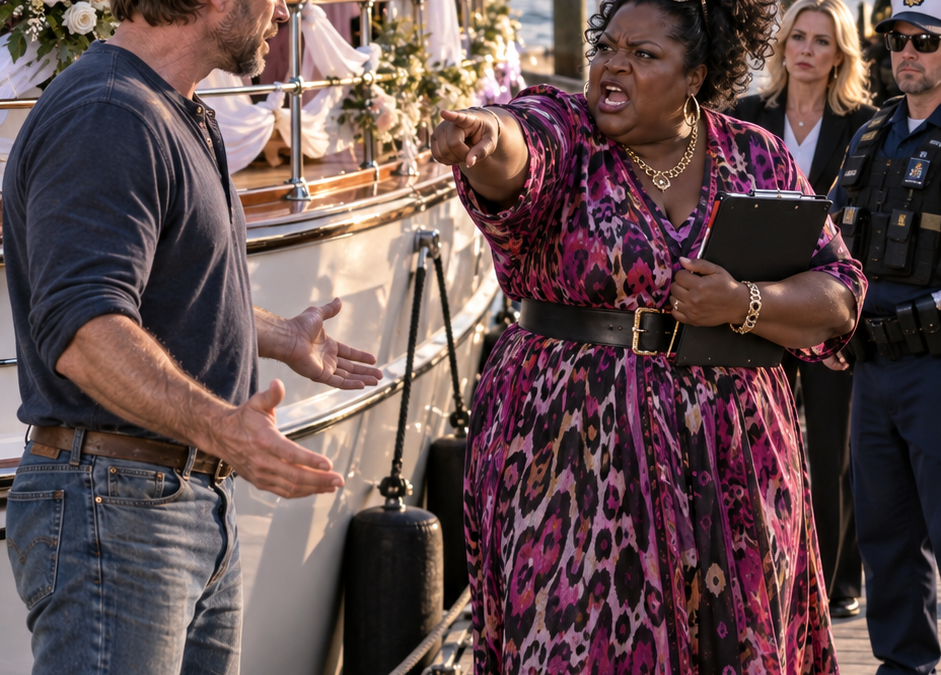
And standing on the finger pier with a clipboard was Cheryl Bostwick.
The president of our homeowners association.
She was waving a caterer’s van backward toward the ramp as though she had spent her whole life managing loading docks.
I stared at her.
Then at my boat.
Then back at her.
“Cheryl.”
She turned.
Her face showed irritation rather than surprise.
That told me almost everything.
“Wade.”
“What the hell is happening?”
She pointed toward the parking lot with her clipboard.
“Go home.”
For a second, I genuinely thought I had misheard.
“What?”
“Nobody needs your sawdust and your attitude at a wedding.”
I looked past her.
Both engines were running.
I knew their sound better than I knew my own truck.
Twin old Chryslers.
Low, uneven, wet burble.
Someone had started them and let them warm at idle.
On my boat.
Without me.
I stepped toward the pier.
“Kill the engines.”
Cheryl moved into my path.
“This is a scheduled community event.”
“That’s my boat.”
“Community amenities.”
“My boat.”
“Community amenities.”
I could feel my hands beginning to shake.
Not fear.
Something much worse for a man standing six feet from someone with a camera.
Anger.
I pulled my phone out and started recording.
That decision probably saved me later.
Because the other option was to put my hands on a sixty-two-year-old woman wearing a blazer, and I have been alive long enough to know exactly what that video would have looked like online.
A young man in a tuxedo leaned down and removed my spring line.
“Don’t touch that line,” I shouted.
He glanced at Cheryl.
She nodded.
He threw it aboard.
Then somebody released my stern line.
The boat eased away from the pier.
Fifty-eight feet and four inches of mahogany.
Eleven years of my life.
Every frame refastened by hand.
Every plank inspected.
Every bright surface sanded and varnished until my shoulder hurt.
And there she went.
Thirty-nine people aboard.
A stranger at the helm.
I stood on the pier holding a box of screws.
The boat turned toward the mouth of the cove.
I watched until she cleared the channel.
Then I called the Coast Guard.
To understand why that call mattered, you have to understand what Margarite was.
And what Cheryl had spent the previous six months doing to get her.
I live near Rock Hall, Maryland, on the upper Eastern Shore.
It is one of those places where the water decides what time your day begins.
Crab boats leave before dawn.
Diesels vibrate through bedroom floors.
At low tide the whole town smells faintly of marsh mud.
Old Bay somehow finds its way onto food nobody intended to season with it.
I run Hollister Boat Works on Sharp Street.
Two work bays.
A spray booth.
Access to a travel lift through the yard next door because the owner and I have trusted each other longer than most contracts last.
I was sixty-one when this happened.
I repair wooden boats.
That is a narrow profession populated mostly by stubborn men, stubborn customers, and boats that require both of them.
There are fewer people doing it every year.
That means I stay busy.
My home sits inside Bayford Reach, a ninety-four-house development built in the late 1990s around a dredged cove.
Sixty-one slips.
Most were shallow.
Fishing boats.
Center consoles.
A few pontoons.
I did not buy my house because I liked the house.
I bought it because the deed came with slip 12.
Eight feet of water at mean low.
Sixty-foot finger pier.
Deep enough for Margarite.
She is a 1953 Trumpy.
Fifty-eight feet four inches.
Mahogany planking over white-oak frames.
Twin gasoline engines.
A sheer line beautiful enough to make strangers stop walking.
I bought her in 2013 from a shed in Cambridge.
She had been sitting there for decades.
The garboard seam was open badly enough to put your fingers through.
Frames were tired.
Fasteners were gone.
Most sensible people would have walked away.
I didn’t.
For eleven years, I rebuilt her.
One silicon-bronze fastener at a time.
Sixty frames.
Planking.
Deck.
Brightwork.
Electrical.
Engines.
Six coats of varnish every season because Chesapeake sun eats varnish for breakfast.
By the time I finished, Margarite was worth more than my house.
That isn’t bragging.
My house is fourteen hundred square feet.
Margarite consumed eleven years.
Wooden boats are not objects in the way fiberglass boats are objects.
Wood moves.
It drinks.
It dries.
It swells.
If it stays too wet, it rots.
If it gets too dry, seams open.
Margarite lived on shore power at slip 12.
A dehumidifier ran below deck.
Two bilge pumps stood ready.
I checked moisture readings the way some men check blood pressure.
That was why the slip mattered.
And that was why Cheryl Bostwick wanted it.
Cheryl had been HOA president since 2019.
She also chaired the marina committee.
Technically, she had created the marina committee and then appointed herself chair.
Blonde hair that somehow never moved in Eastern Shore wind.
Coral lipstick.
Reading glasses on a beaded chain.
Clipboard always under one arm.
She carried it into rooms where nobody had asked her to write anything.
Outside the HOA, Cheryl ran a small wedding-planning company called Reach Events by Cheryl.
And to be fair, she faced a real problem.
The marina bulkhead was failing.
The original sheet piling from 1998 had rusted through in several areas.
An engineer estimated replacement at roughly $610,000.
Split among ninety-four households, that was more than six thousand dollars each.
Nobody wanted that assessment.
At the March HOA meeting, Cheryl stood in front of the board and announced she had an alternative.
“Amenity revenue.”
Her idea was to monetize the community’s waterfront.
Weddings.
Corporate gatherings.
Private events.
People applauded.
I remember sitting in the back and thinking that was an extraordinary number of weddings needed to pay for six hundred thousand dollars of steel.
But it was not my committee.
So I went home.
What I did not know then was that the paperwork Cheryl would later misuse had been sitting inside my own filing cabinet since 2010.
Every slipholder at Bayford Reach signed a marina license.
One clause required us to leave a vessel key and engine-start instructions with the harbor master.
That made sense.
Hurricanes come up the Chesapeake.
Owners travel.
If a named storm approaches and boats need to be moved quickly, somebody must be able to move them.
The language was specific.
The key was held solely for emergency relocation in advance of a named storm.
Our harbor master was Dale Kirby.
Seventy years old.
Retired waterman.
Hands like a pair of crab pots.
Worked part-time.
Kept his records in a spiral notebook secured with a rubber band because he did not trust the association computer.
I used to make fun of him for that.
I stopped later.
My trouble with Cheryl began small.
In April, I spent one Saturday sanding a friend’s fourteen-foot tender beside my slip.
Four hours.
Hand block.
One-twenty grit.
He wasn’t paying me.
He had rebuilt a compressor for me, and I was returning the favor.
The following Tuesday, I received a $150 HOA violation.
Commercial activity at a residential slip.
I wrote the board a polite letter.
Included photographs of my actual commercial shop on Sharp Street.
Explained that no money changed hands.
At the May meeting, the board voted four to one to void the violation.
Naen Puit, our treasurer, read my explanation aloud.
“This is a man sanding a rowboat.”
A few people laughed.
Cheryl did not.
She wrote something on her clipboard.
Eleven days later, a certified letter arrived.
FLEET STANDARDIZATION INITIATIVE.
The proposed marina rule limited all vessels to forty-five feet.
I read that number twice.
There were sixty-one slips.
Fifty-eight boats were under thirty-five feet.
Two were a little over forty.
One boat was longer than forty-five.
Mine.
The June meeting drew nineteen people.
Cheryl came prepared.
Handouts.
Charts.
A turquoise blazer.
“Oversized vessels place additional loads on aging marina infrastructure,” she said. “This isn’t personal. It’s engineering.”
Then she reached the actual purpose.
“Slip assignments will be adjusted to reflect the new standard. Slip 12 will become available for community use. Mr. Hollister will be reassigned to slip 39.”
I had brought a tide table.
“Slip 39 has three feet two inches at mean low.”
Cheryl looked at me.
“The committee reviewed the depths.”
“Margarite draws four feet one.”
Several people shifted in their chairs.
“You’d put her on the bottom twice a day.”
“The vessel can be relocated seasonally.”
“Where?”
She didn’t answer.
I continued.
“Slip 39 also has fifteen-amp service. Margarite runs a dehumidifier and two bilge pumps.”
“Everyone is sacrificing for the bulkhead.”
“This isn’t convenience, Cheryl. She’s a wooden hull.”
She gave me a thin smile.
“Not everyone’s boat sinks.”
The room went very still.
Naen asked to see my tide chart.
She read it slowly.
Then compared it with the HOA’s dredging report.
“Wade’s right,” she said. “North Row is three-two at mean low.”
Cheryl tried again.
“He can relocate.”
“Where?” I asked.
She had no answer.
Deep slips for a fifty-eight-foot boat were hard to find anywhere near us, especially during season.
The nearest realistic option was Georgetown.
Forty minutes by road.
Hours by water.
Then I brought up the deed.
“Slip 12 is appurtenant to my lot.”
Cheryl frowned.
“The association manages common amenities.”
“Managing isn’t owning.”
That was the whole issue.
When Bayford Reach was developed, specific slips had been legally attached to specific home lots.
The HOA could regulate reasonable marina use.
It could not casually detach my recorded slip because the president had discovered it photographed well at sunset.
The board voted three to two against Cheryl’s fleet standard.
She closed her binder.
“We’ll revisit this after legal review.”
In the parking lot, a neighbor I barely knew shook my hand.
Then he said, “She’s been talking about slip 12 since February.”
That was when I finally understood.
It wasn’t really about boat length.
Slip 12 had eight feet of water.
A long finger pier.
And from the clubhouse deck, Margarite sat directly in the background.
If you wanted to sell waterfront weddings at Bayford Reach, there was no better photograph.
Three weeks later, I was working aboard her when I heard a high buzzing noise.
A drone hovered forty feet off the starboard bow.
Camera pointed directly at Margarite.
It moved slowly down her hull.
Paused near the stern.
Returned toward the bow.
Then climbed toward the clubhouse.
I watched it go.
And forgot about it.
Three weeks later, I received an email from a woman named Priscilla.
She said she was the mother of a bride.
She wanted information about “the yacht” included with Bayford Reach’s October wedding package.
Did it have a bar?
Could photographers use the bow?
I read her message three times.
Then searched the Bayford Reach website.
There was a new section.
WATERFRONT EVENTS.
At the top of the page was Margarite.
Full-width drone photograph.
Afternoon light across the mahogany.
My varnish shining like jewelry.
Beneath it:
OUR COMMUNITY YACHT.
Further down were six more photographs.
And prices.
$4,000 for the grounds.
$9,500 for the premium waterfront package.
I sat inside my shop and became completely still.
That is how real anger works on me.
My hands stop moving.
I called Cheryl.
“Wade,” she answered.
“Take my boat off the website.”
“Those photographs show the marina.”
“They show my boat.”
“Marketing language.”
“The words say ‘our community yacht.'”
“It refers to the setting.”
“Take it down.”
“I’ll ask the website person to review the wording.”
Then she claimed she was entering a dead zone.
The call ended.
I took screenshots.
Every photograph.
Every caption.
The price package.
The booking form.
Date and time visible.
Then I archived the webpage using an independent internet archive service.
Ten days later, the wording changed.
“Our community yacht” became “the historic vessels of Bayford Reach.”
The photographs remained.
I thought I had protected myself.
Then somebody turned off my shore power.
It was late June.
Hot enough outside that the dock boards burned bare feet.
I stepped aboard one Friday evening and immediately knew something was wrong.
Silence.
A wooden boat connected to shore power has a background sound.
Hum of the dehumidifier.
Occasional bilge-pump cycle.
I had stopped consciously hearing it years earlier.
That evening, I heard its absence.
I opened the saloon door.
Heat and damp air hit me.
The smell was wet wool and metal.
I checked the dehumidifier.
Dead.
Moisture meter.
Overhead panels that had read fourteen percent in March now showed numbers approaching eighty.
Black mildew spots had begun blooming in the forward cabin.
Then I opened the bilge.
Water.
Not enough to sink her.
Enough to scare me.
At the dock pedestal, the breaker was off.
Orange tag.
Pedestals 10 through 14 shut down.
I found Dale in the harbor master’s shack doing a crossword puzzle.
“Who shut off my power?”
He put down the pencil.
“Tuesday.”
“Why?”
“Work order.”
“What work?”
He opened his spiral notebook.
“Cheryl said electrical inspection.”
“Who inspected it?”
Dale looked at me.
“Nobody.”
Three days.
More than sixty hours during one of the hottest weeks of summer.
I almost went straight to Cheryl’s house.
Got into my truck.
Started the engine.
Then sat there with the air conditioning blowing at me until I stopped thinking about what I wanted to say and started thinking about what I could prove six months later.
Instead, I called Rusty Delgaso.
Accredited marine surveyor.
Annapolis.
He came Sunday.
I paid him $650.
I wanted a professional, not a friend.
Rusty took moisture readings in twenty-two locations.
Photographed mildew.
Photographed his meter with every reading.
Then he crawled into the bilge.
When he came back up, he wasn’t joking anymore.
“Garboard’s weeping.”
“Where?”
“Starboard. Frames eighteen through twenty-six.”
“Bad?”
“Not yet.”
He wiped his forehead.
“But you dried an old plank in July. It moved.”
He stared at the hull.
“Old wood doesn’t forget that.”
His report ran eleven pages.
Cause consistent with loss of climate control.
I added it to my growing folder.
Screenshots.
Archived website.
Harbor-master work order.
Fuel-dock camera confirming no electrical inspector ever arrived.
Surveyor report.
By July, I had begun keeping paper the way frightened people keep bottled water.
The annual membership meeting was July 19.
Seventy-one owners attended.
The bulkhead estimate had everyone’s attention.
Cheryl gave a polished presentation.
Three funding options.
Her favorite was the amenity program.
Projected event revenue:
$41,000 that year.
$94,000 the following year.
When my three-minute open-forum slot came, I put the photograph of Margarite on the projector.
“This is the association website.”
I pointed.
“That’s my privately owned boat.”
Then I showed the original caption.
Our community yacht.
People murmured.
Next came the shore-power issue.
“Pedestal 12 was shut down for three days for an inspection that never occurred.”
I held up Rusty’s report.
“That caused measurable moisture damage and an opened seam.”
Then I sat.
Cheryl returned to the front.
She was rattled.
Only slightly.
But enough.
“The photographs were taken from association property,” she said. “And every slipholder’s license grants the association operational access to vessels for community purposes.”
I stared at her.
That was not what the license said.
“Can I read the clause?”
Naen immediately said, “Let him.”
I stood with my own copy.
“The association shall retain a vessel key and start code held solely for emergency relocation in advance of a named storm.”
I lowered the paper.
“That’s the entire clause.”
You could hear the clubhouse box fan.
Phones came up.
People started recording.
Cheryl’s neck turned red.
“The board has consistently interpreted the provision more broadly.”
Then she tried to move on.
Naen stopped her.
“About the projected event revenue.”
Cheryl looked toward her.
“Yes?”
“Has our insurance carrier approved commercial events?”
“Our policy covers association operations.”
“That’s not what I asked.”
Naen leaned forward.
“Does our policy cover members of the public attending commercial weddings on docks and private vessels?”
Cheryl said she would confirm.
The association’s insurance agent answered three days later.
No.
The policy did not contemplate commercial event operations.
It did not cover passengers aboard private vessels.
He specifically requested that the association stop marketing until coverage could be reviewed.
Naen forwarded the email to me.
Subject line:
FYI.
No body text.
From Naen, that was practically affection.
I thought Cheryl would stop.
That was my mistake.
Eleven days later, my own marine insurer sent a notice of intent to cancel.
Thirty days.
Pending investigation of undisclosed commercial use.
My broker, Tom Wexler, explained why.
“The HOA reported that you’re operating commercial charters from your residential slip.”
“They what?”
“They sent a violation notice.”
“The violation they sent was voided by the board.”
“That isn’t in the packet.”
Cheryl had taken her own losing citation and mailed it to my insurer as evidence.
She also complained to county code enforcement.
A county officer came to my commercial shop.
He inspected everything.
Found nothing.
Closed the file.
But the insurance issue terrified me in a way the HOA fines never had.
A fifty-eight-foot wooden boat without hull insurance is not merely uninsured.
It becomes almost impossible to keep.
A marina can reject it.
A yard may refuse to haul it.
No lender wants it.
No serious buyer can finance it.
Eleven years of work can become an unmovable liability because of one sentence in an underwriting file.
That night I called Cheryl.
I was not polite.
I said five words I am not proud of.
She hung up.
I sat on Margarite’s aft deck afterward with a beer I never drank.
Then I remembered her federal documentation.
Every documented vessel has a certificate.
Margarite’s endorsement said:
RECREATIONAL.
That means she cannot legally carry paying passengers.
She was not a charter boat.
Had never been one.
My tax returns showed zero charter revenue year after year because I repair boats.
I don’t sell rides.
I sent everything to Tom.
He called the next morning.
“This is what I needed.”
The county closed its investigation September 3.
No violation.
My policy was reinstated five days later.
“No lapse,” Tom told me.
Then he added:
“Whoever’s doing this isn’t done.”
He was right.
While all of this was happening, Reach Events by Cheryl signed a contract with Aubrey Pace and Tyler Machado.
September 20.
Sunset wedding.
Venue:
Bayford Reach Marina.
Ceremony aboard M/V Margarite.
Price:
$9,500.
Deposit:
$4,750.
I never saw the contract.
I never spoke with Aubrey or Tyler.
I never authorized a wedding.
On Thursday before the ceremony, I told Dale casually that I’d be in Annapolis Saturday buying fasteners.
That conversation has bothered me ever since.
Not because Dale did anything wrong.
Because Cheryl heard about it.
Saturday morning, while I was gone, she entered the harbor-master shack.
“Key to slip 12.”
Dale refused.
“It’s an emergency storm key.”
“The board approved the amenity program.”
“No storm.”
“The association has operational access.”
Dale still refused.
Cheryl reminded him who approved his hours.
Eventually, he handed over the key.
Then Dale did the most important thing anybody did that day.
He wrote it down.
11:04 a.m.
C. Bostwick signed out key/code slip 12. States board approved. No named storm.
D.K.
Ink.
Notebook.
Date.
At 1:30, a man named Denny Faucet arrived.
Thirty-one years old.
Cheryl had found him in a Facebook boating group.
Her post offered $400 cash for a captain comfortable operating a classic vessel during a four-hour sunset ceremony.
Denny had once held an OUPV six-pack license.
It had expired.
Even if it had been valid, it would have allowed six paying passengers.
Not thirty-four.
Margarite carried twelve life jackets because twelve was more people than I normally had aboard.
By 2:00, caterers were moving forty white folding chairs down the dock.
Then flowers.
Coolers.
An arch.
A string trio.
Somebody taped white organza to my varnished rail.
At 4:15, Denny started my engines.
Thirty-four guests.
Three vendors.
Cheryl.
Denny.
Thirty-nine people total.
At 5:52, I rounded the bathhouse.
At 5:54, Margarite left without me.
And at 5:55, I called Sector Maryland.
The Coast Guard watchstander answered.
I gave him Margarite’s official number.
Length.
Hull material.
Color.
Distinctive stern.
Estimated passenger count.
I told him there was a paid wedding underway.
That an unknown operator was at the helm.
That I was the documented owner.
That I had not authorized anyone to operate the boat.
He asked if anyone was in distress.
“No.”
“Do you know the operator’s credential status?”
“I don’t even know his name.”
Then I said the sentence that changed his tone.
“She’s federally documented recreational and they’re carrying passengers for hire.”
Brief silence.
“Sir, remain where you are.”
He asked for her position.
I could still see Margarite heading toward Swan Point.
I gave him a visual estimate.
Then I called Maryland Natural Resources Police.
Afterward, I sat on a dock box because my knees had started to feel unreliable.
At 6:31, a Coast Guard small boat came alongside Margarite off Swan Point.
I wasn’t aboard.
But wedding guests recorded everything.
Thirty-four people had phones.
Almost every one of those phones turned toward the orange stripe.
The string trio stopped in the middle of a phrase.
You can hear the cello die first.
A woman in a wedding dress stood on the aft deck holding her veil down in the prop wash.
The officiant had his book open.
He had apparently just reached:
“If anyone here objects—”
I wish I were making that part up.
A Coast Guard boarding officer stepped aboard.
He was young.
Calm.
No theatrics.
“Sir, who is the master of this vessel?”
Denny stood near my helm.
“I’m just driving.”
They counted people.
Then life jackets.
Thirty-nine people.
Twelve flotation devices.
They requested the vessel’s Certificate of Inspection.
There wasn’t one.
They asked Denny for his credential.
He produced an expired card.
Then they asked Cheryl who owned the vessel.
She gave them the same answer she had been giving everyone else all summer.
“The association has operational authority.”
That might work in a clubhouse.
It sounded different when spoken to a Coast Guard boarding officer standing on somebody else’s boat.
The voyage was terminated.
That is the actual term.
Not seized.
Nobody was arrested aboard.
No weapons came out.
No dramatic chase.
The Coast Guard determined the vessel could not legally continue carrying those passengers and ordered her back to a safe mooring.
Margarite returned at four knots.
Coast Guard boat off one quarter.
Natural Resources Police nearby.
Thirty-nine people seated in absolute silence.
Everyone at the marina watched.
So did the people standing on the clubhouse deck.
I waited at slip 12.
When the bow came near, a groomsman reached for the line.
He was holding it wrong.
I took it from him.
Cleated it myself.
Then the guests began leaving.
Cocktail dresses.
Suit jackets.
Wedding flowers.
Nobody looked at me.
The Coast Guard kept Margarite at the dock for approximately two hours while officers photographed, interviewed, counted, and documented.
At 9:40, an officer handed me the boarding report.
Then returned my vessel to me.
“Are you planning to pursue this?”
“Yes.”
Everyone eventually left.
The dock went quiet.
I boarded Margarite alone.
White organza remained taped to the bow rail.
Someone had spilled prosecco down the port side of the deckhouse.
Sticky liquid had gotten into a seam.
Rose petals clogged the scuppers.
A cooler had been placed directly on varnished mahogany and left a white heat ring.
I stood there looking at it.
People later treated the Coast Guard arrival as my victory.
It did not feel like victory.
It felt as if somebody had broken into my home, thrown a party in my kitchen, and expected me to be grateful that the police stopped it before dessert.
A bridesmaid posted video online that night.
COAST GUARD SEIZES WEDDING YACHT.
The word “seizes” was wrong.
It didn’t matter.
By Monday, hundreds of thousands of people had watched it.
Sunday morning, I went to the marina with a bucket.
For forty minutes, I picked rose petals out of the scuppers.
Around the ninth handful, I stopped.
Got a legal pad from my truck.
Sat on a dock box.
And started writing.
Evidence first.
Anger later.
My own phone video was backed up in three places.
The July HOA meeting recording was downloaded from the association portal.
Good thing.
It disappeared from the portal later that week.
Dale copied his notebook entry.
Wedding guests supplied video.
The Coast Guard boarding report was requested.
So was the Natural Resources Police incident report.
Then I hauled Margarite.
Rusty returned for another survey.
Once the travel lift raised her from the water, the damage became harder to pretend was ordinary maintenance.
The garboard seam that had been weeping in June had opened farther.
Daylight showed through in two places.
Fastenings around frames eighteen through twenty-six had worked inside their holes.
The sequence was obvious.
The June power shutdown dried an old wooden hull.
Then thirty-nine people were loaded onto her deck in September.
Old oak does not enjoy being dried, flexed, and overloaded in one summer.
Mildew remained in the forward cabin.
Sugar had dried into a deck seam.
The heat ring remained on the combing.
Rusty’s estimate:
$71,400.
I stared at that number inside my truck.
Some years I did not clear that much from my business.
Then I hired Ellen Fitz.
Maritime attorney in Annapolis.
$425 an hour.
$7,500 retainer.
During our first meeting, she read for nearly an hour without saying much.
Watching a lawyer silently read at $425 an hour is an experience I would not recommend.
Finally, she removed her glasses.
“This is a strong case.”
I exhaled.
“Good.”
“It will probably take more than a year.”
I stopped exhaling.
“And it will cost more than you expect.”
“How much?”
“Enough that you should decide now whether you’re prepared to finish.”
She leaned forward.
“Worst thing you can do is spend everything for nine months and then settle cheap because you can’t afford month ten.”
I liked her immediately.
She identified three issues.
First:
The key.
The marina agreement was conditional.
Emergency access existed solely in advance of a named storm.
September 20 had clear weather.
No named storm anywhere close.
Therefore, the condition allowing key use never existed.
Second:
Money.
Cheryl’s private LLC had accepted $4,750 toward a $9,500 wedding contract explicitly advertising my private vessel as the venue.
That was not confusion.
That was monetizing something she did not own.
And Cheryl had created a useful problem for herself months earlier.
She had personally fined me $150 for “commercial activity” because I sanded a friend’s rowboat for free.
Now she was selling a $9,500 commercial event aboard my vessel.
“Keep that citation,” Ellen said.
“I have it.”
“Good. We’re going to let her explain her own definition.”
Third:
Authority.
Cheryl kept saying the board approved the amenity-revenue program.
Ellen pulled every set of minutes.
The approval came from a four-person marina committee meeting on June 3.
No proper membership notice.
No board quorum.
Never ratified afterward.
Under Bayford Reach’s own bylaws, the authorization was void.
That mattered because HOA officers acting within their legitimate authority generally had association defense and insurance protection.
An officer using a void resolution to sell private property through her own LLC was different.
“Our job,” Ellen told me, “is to separate Cheryl from the association.”
“Why?”
“If she stays inside the association’s insurance, you’re fighting your own neighborhood for three years.”
“And if she doesn’t?”
“Then you’re fighting Cheryl.”
Nine days after the wedding, Ellen sent preservation letters to Cheryl, Reach Events, the HOA, and the management company.
Do not delete anything.
Meanwhile, I submitted a formal owner statement supporting the Coast Guard’s investigation.
A week later, Aubrey and Tyler came to see me.
They were the couple whose wedding had been stopped.
They were younger than I expected.
Aubrey looked angry and embarrassed.
“We didn’t know,” she said immediately.
“I know.”
“Our contract says the boat was included.”
“I know.”
Tyler held out a thumb drive.
Emails.
Texts.
Invoices.
Videos collected from guests.
They had already demanded their money back from Cheryl.
She offered them credit toward another event.
I still admire the optimism required to offer future wedding-planning services to people whose first wedding was boarded by federal officers.
Before they left, Aubrey asked:
“Is Margarite going to be okay?”
I looked through the shop door toward the yard.
“She will be.”
At that point, I wasn’t entirely certain.
But I intended to make the sentence true.
We filed suit in Kent County Circuit Court.
Defendants:
Cheryl Bostwick personally.
Reach Events by Cheryl LLC.
Bayford Reach Community Association.
Claims included conversion, trespass to chattels, negligence, and covenant violations.
The association remained in the case because of the June pedestal shutdown.
Whatever Cheryl had done individually, Bayford Reach employed the harbor master and controlled the electrical system.
If an association shut power to my slip based on a fake work order and damaged the boat, that belonged to the association.
The Coast Guard opened its own civil penalty proceeding.
Completely separate from my lawsuit.
Denny faced questions about operating an inspected-passenger-service-sized crowd with an expired credential.
Cheryl faced questions about arranging passenger-for-hire operations aboard a recreational vessel.
Tom sent the Coast Guard report to my underwriter.
My insurance file finally closed.
The original accusation had been:
Wade Hollister operates illegal commercial charters.
The federal boarding report effectively said:
No.
Cheryl Bostwick arranged a paid commercial voyage on Wade Hollister’s recreational vessel without his permission.
There is a satisfaction in being cleared by the exact agency with jurisdiction over the accusation.
Not joy.
Just relief.
Cheryl had defenses.
Real ones.
Her lawyer was not incompetent.
He argued that the marina agreement provided operational access.
That a community program had been approved.
That Dale voluntarily handed over the key.
That no lock had been broken.
That I had previously been cited for commercial activity at the slip.
And that Cheryl never touched the wheel.
She hired Denny, who told her he was a captain.
Her lawyer also asked me why, if protecting Margarite mattered so much, I had left the storm key in the harbor master’s office for fourteen years.
I had only one answer.
“Because I thought ‘storm key’ meant storms.”
The case lasted more than a year.
Most lawsuits are not dramatic.
They are email.
Thousands of pages of email.
Production requests.
Scheduling.
Depositions.
Documents arriving on Tuesdays when you are trying to finish a customer’s transom.
But every few months, something came loose.
First, the HOA meeting video.
Cheryl’s defense required the access clause to mean almost anything the association wanted it to mean.
But before litigation existed, she had publicly explained her interpretation.
“Operational access to member vessels for community purposes.”
Then I had read the actual sentence aloud.
Solely for emergency relocation in advance of a named storm.
Second, Dale’s notebook.
The defense could attack a seventy-year-old man’s memory.
It could not cross-examine ink.
11:04 a.m.
Key released.
No named storm.
Third, the June committee minutes.
No quorum.
No valid authorization.
Then came Denny’s Facebook messages.
Cheryl:
Need captain for classic vessel. Four-hour sunset ceremony.
Denny:
Boat’s like 58 feet? How many people?
Cheryl:
Small ceremony. Roughly 35 including vendors.
Denny accepted $400 cash.
Then, eleven months into litigation, we received Cheryl’s association email account because Ellen’s preservation letter had prevented it from disappearing.
Buried inside an August 28 thread with Cheryl’s assistant was one sentence.
It wasn’t dramatic.
That made it worse.
Don’t CC Wade on this one. He’ll say no. Then we’d have to unbook them.
I read it again.
And again.
For almost a year, Cheryl’s defense had been that she believed she had authority.
Maybe she did believe that generally.
But before taking the booking, she knew one fact perfectly well.
If she asked me, I would say no.
So she deliberately made sure nobody asked.
The association’s insurance carrier eventually denied personal coverage to Cheryl.
The June 3 authorization was void.
Commercial activity had been conducted through her own LLC.
She had acted beyond the insured scope of her HOA office.
That changed everything.
By then, homeowners had also had enough.
A petition gathered fifty-seven signatures out of ninety-four houses.
Cheryl was removed as president.
She attended the special meeting.
Sat in the second row.
Said nothing.
Naen took over.
I thought I would enjoy hearing Cheryl had lost the presidency.
I didn’t.
By then I was too tired.
My lawsuit still existed.
My boat was still damaged.
The yard bill kept arriving.
Cheryl’s deposition lasted nearly seven hours.
She wore a peach blazer.
Corrected the court reporter twice.
Never said she had been wrong.
She said she believed the access clause was broad.
She said the committee had approved commercial use.
She said Denny represented himself as properly licensed.
She said every dollar was intended to save the community from a huge bulkhead assessment.
On that last part, I think she believed herself.
That was one of the stranger things I learned.
People can do real damage while sincerely believing the end justifies the method.
Near the end, Ellen asked:
“Mrs. Bostwick, if I wanted to use your car during a paid event without telling you, whose permission would I need?”
Cheryl’s attorney objected.
Cheryl answered anyway.
“That’s not the same thing.”
That became the closest thing to an admission we ever received.
Settlement discussions failed twice.
Cheryl would pay money.
She would not sign an admission.
Ellen wanted an acknowledgment that private member property could not be used under that clause for commercial events.
I agreed.
A check alone would leave the next owner in the same position.
So we went to trial.
Two-day bench trial.
No jury.
Kent County Circuit Court.
I wore the only jacket I owned that didn’t smell like solvent.
The courtroom held maybe forty people.
Eleven seats were occupied.
Before anything dramatic could happen, the HDMI cable failed.
Six minutes of lawyers and staff crawling around a podium asking whether something was plugged in correctly.
That was my trial.
Eventually, the screen came alive.
Ellen’s first exhibit was Margarite’s federal Certificate of Documentation.
Official number.
Vessel name.
Endorsement:
RECREATIONAL.
Her expert was a retired Coast Guard warrant officer with thirty-one years in marine inspections.
He explained the law plainly.
A recreational vessel cannot carry passengers for hire.
A vessel carrying more than six paying passengers generally requires inspection and certification under the applicable passenger-vessel regime.
Margarite had never held such a certificate.
She was never designed to.
Bringing a seventy-year-old wooden yacht into that compliance structure would require reconstruction costing hundreds of thousands of dollars.
Then Ellen displayed the weather.
September 20.
Clear.
Seventy-eight degrees.
Southwest wind eight knots.
No named storm remotely close to Chesapeake Bay.
Beside it she displayed the slip license.
Solely for emergency relocation in advance of a named storm.
She said nothing for several seconds.
She didn’t need to.
Then Dale testified.
Navy windbreaker.
Hands folded in front of him.
The clerk asked his occupation.
“I tie up boats.”
Ellen handed him his spiral notebook.
He found the page.
Adjusted his glasses.
Read:
“11:04 a.m. Bostwick signed out key and code, slip 12. States board approved. No named storm. D.K.”
“Why did you write ‘no named storm’?”
“Because there wasn’t one.”
“Did you tell Mrs. Bostwick the key was for storms?”
“Yes.”
“What happened?”
“She said she’d take it up with me Monday.”
On cross-examination, Cheryl’s lawyer asked whether Dale gave her the key voluntarily.
“Yes.”
“Because she was your supervisor?”
Dale thought.
“I gave her the key because I figured she’d get it some way or another.”
He looked at the notebook.
“Then I wrote down what happened so somebody would know.”
That might have been the most important minute of the entire trial.
Next came the money.
The Pace-Machado wedding contract.
$9,500.
Venue:
Ceremony aboard M/V Margarite.
LLC bank statement.
$4,750 deposit cleared.
Then Cheryl’s April citation against me.
Commercial activity at residential slip.
$150.
Her own signature.
Ellen began:
“The association president fined Mr. Hollister for—”
Cheryl’s lawyer objected to her wording.
The judge sustained.
It didn’t matter.
The documents were already side by side.
Then the email appeared.
Don’t CC Wade on this one. He’ll say no. Then we’d have to unbook them.
Then my phone video.
Cheryl on the pier.
Guests aboard.
Stern line released.
My boat leaving without me.
Then one of the wedding guests’ videos.
The judge asked for the sound.
Cello.
Water.
Voices.
Then an engine approaching.
A calm Coast Guard officer:
“Sir, who’s the master of this vessel?”
The courtroom became completely still.
The judge watched it twice.
Rusty testified next.
The damages were the hardest part.
His June moisture readings mattered enormously because they had been taken months before anybody knew litigation was coming.
Twenty-two photographed locations.
March baseline around fourteen percent.
June readings drastically elevated.
Garboard seam weeping in June.
Open farther by October.
Fastener movement documented.
Cheryl’s attorney pushed him hard.
And he landed some points.
Margarite was an old wooden boat.
Maintenance would always be necessary.
Some refastening would eventually have been needed even without Cheryl.
Rusty admitted that.
Then the attorney asked whether he could separate damage caused by the June power shutdown from damage caused by September’s passenger load.
Rusty shook his head.
“No.”
The attorney almost smiled.
Rusty continued.
“Because they’re the same injury.”
The smile disappeared.
“You dry an old wooden hull. She moves. Then you put thirty-nine people on her deck after she’s moved. Those are not two unrelated things.”
The judge still discounted part of the refastening estimate for ordinary maintenance that would eventually have happened.
That was fair.
Then Cheryl testified.
Composed.
Consistent.
She believed the agreement granted access.
She believed the amenity program was approved.
She believed Denny was licensed.
She believed Bayford Reach needed the money.
I think some of that was true.
But belief was never the entire question.
When I testified, Cheryl’s lawyer asked me one final question.
“Mr. Hollister, the wedding ceremony itself would have taken perhaps twelve minutes.”
“Probably.”
“Why not simply allow them to finish rather than call federal authorities?”
I had thought about that question for over a year.
I could have talked about ownership.
Trespass.
Insurance.
Damage.
Cheryl.
Instead I said:
“There were thirty-nine people standing on a boat nobody was legally authorized to operate that way.”
Then I stopped.
The judge issued the basic ruling from the bench.
Written opinion followed weeks later.
The storm language meant what it said.
A named storm was a condition.
Not a suggestion.
Using the key without that condition was unauthorized.
The June 3 committee resolution was void under Bayford Reach’s own bylaws.
Cheryl had therefore acted outside the legitimate scope of her HOA position in arranging the commercial wedding.
Judgment against Cheryl Bostwick and Reach Events by Cheryl LLC:
$63,900.
Judgment against Bayford Reach Community Association for negligence connected with the shore-power shutdown:
$14,100.
Permanent injunction prohibiting the use of Margarite or her images for association or commercial purposes without my permission.
Partial attorney’s fees were awarded.
Not all.
I still spent roughly eleven thousand dollars of my own money.
There was no applause.
No gavel slammed dramatically.
Court adjourned.
We walked into the hallway.
People put on coats.
I remember Ellen asking how I felt.
I told her I wanted to check my bilge.
Four months later, the Coast Guard’s civil penalty decision arrived.
Plain envelope.
Two pages.
$17,500 against Cheryl.
$3,000 against Denny.
Denny apparently spent a long afternoon explaining his expired credential.
I never developed much anger toward him.
He was a young guy offered four hundred dollars cash to drive a beautiful old boat.
His mistake was failing to ask one essential question:
“Do you own it?”
Cheryl lost more than money.
She had already been removed from the board.
Reach Events by Cheryl eventually dissolved.
No court ordered that.
The market did.
On the Eastern Shore, weddings are a small world.
Venues know planners.
Photographers know caterers.
Everybody has seen everybody else’s posts.
And when somebody searches your name and the first thing they find is a wedding ceremony being stopped by the Coast Guard on a yacht you did not own, business becomes difficult.
Cheryl paid the judgment.
Partly through a home-equity line.
Her large SUV disappeared.
Later I started seeing her in a used RAV4 at the Food Lion.
She filed an appeal.
Then withdrew it.
She kept her house.
She kept her marriage.
She still lives at Bayford Reach.
Sometimes I pass her on the cove path.
I nod.
She doesn’t.
It’s been that way for years.
I’m comfortable with it.
The bulkhead was replaced.
In the end, the special assessment was $4,900 per household.
It passed unanimously.
The meeting lasted nineteen minutes.
Nobody had any fight left.
I paid mine on time.
That part still makes me laugh occasionally.
All of it—
The website.
The drone.
The fines.
The power outage.
The insurance complaint.
The wedding.
The Coast Guard.
The lawyers.
The lawsuit.
All of it had been one woman trying not to send a bill that eventually had to be sent anyway.
The marina agreement was rewritten.
Storm access requires written notice whenever possible.
Two signatures.
And the phrase NAMED STORM appears in bold.
ONLY appears before it.
Naen sent me the draft.
“Anything missing?”
“No.”
Slip 12 was also permanently re-recorded with my property documentation so no future board could pretend it was a discretionary assignment.
That cost me about nine hundred dollars in title work.
Best nine hundred dollars I ever spent.
Margarite took longer.
She went into a heated shed the following March.
We opened the starboard side.
Eleven planks came off.
Frames eighteen through twenty-six were refastened.
Silicon bronze.
One at a time.
Same way I had done it years earlier.
Garboard seam recalked.
Cotton.
Seam compound.
Fairing.
The mildew came out with professional treatment and a miserable weekend involving vinegar, a shop vacuum, a headlamp, and language I would not use around children.
Then varnish.
Six coats.
Sand between every coat.
By coat four, mahogany begins doing something that is difficult to explain to people who have never worked it.
It stops looking like a surface.
It looks deep.
As if light enters the wood and doesn’t entirely come back.
Margarite returned to the water on May 22.
She wept for about thirty hours.
Normal for fresh wooden planking.
Then the seams swelled.
Water slowed.
Then stopped.
I spent most of that first night sitting on the dock with a flashlight watching the bilge pumps.
Old habits.
Aubrey and Tyler eventually married at her aunt’s property in Centerville.
Backyard wedding.
Ninety people.
They sent me a photograph.
I was glad for them.
The next summer, after Margarite was fully repaired, I contacted them.
It took me almost a year to decide I wanted to.
I offered them something.
Not because I owed it.
Not because they asked.
A vow renewal aboard Margarite.
At the dock.
Engines cold.
Twenty-two people.
No money.
No commercial voyage.
No movement.
Perfectly legal.
I would have allowed exactly that the first time if anyone had simply asked.
Dale wore a tie.
He stood at the bow holding a line that did not need holding because Dale Kirby cannot attend anything involving a boat without finding a line.
A child touched fresh brightwork.
The child’s mother apologized about six times.
I told her fingerprints come off.
The boat had survived worse.
They stood beneath a small arch.
Aubrey wore a simpler dress.
Tyler looked less terrified than he had in the Coast Guard video.
Then the officiant reached the familiar line.
“If anyone here objects—”
A silence followed.
Maybe two seconds.
Everybody knew the story.
People began looking at one another.
Then the whole boat laughed.
I laughed too.
It was the first time the memory of that September evening felt funny.
They left around nine.
I stayed behind.
Rag in my back pocket.
Dock lights glowing against the water.
Little Chesapeake chop tapping the transom.
There were rose petals in the scuppers again.
Almost exactly where they had been after Cheryl’s wedding.
I noticed them.
Reached down.
Then stopped.
The first time, I had spent forty minutes removing rose petals from a boat strangers had taken without asking.
This time, I left them overnight.
Because this time the people had been invited.
This time the engines had stayed cold.
This time nobody had sold my property, rewritten my rights, touched my keys, or convinced themselves that holding office gave them ownership over what another man had built.
I ran my hand along Margarite’s rail.
Eleven years of my work were beneath that varnish.
Two major refastenings.
Repairs.
Scars.
A few places where, if you knew exactly where to look, you could still tell something had happened.
That’s all right.
Old boats are like old people.
Survival leaves evidence.
The water moved gently beneath the stern.
Inside the cabin, the dehumidifier hummed.
A bilge pump cycled once.
Then silence again.
Normal silence.
The kind you trust.
I stood there looking across Bayford Reach toward the new bulkhead all ninety-four households had finally paid for.
Cheryl had been right about one thing.
The community did need it.
She had simply decided that needing something gave her permission to take whatever stood between her and the money.
It didn’t.
A clipboard did not make Margarite hers.
A committee vote did not make Margarite theirs.
A key intended for a hurricane did not become a wedding key because somebody needed a picturesque background.
And thirty-nine guests wearing good clothes did not transform an unauthorized commercial voyage into a community amenity.
Margarite belonged to me before the wedding.
She belonged to me when Cheryl watched her leave the dock.
She belonged to me when the Coast Guard came alongside.
And she belonged to me when I stood on her deck years later with rose petals at my feet and chose, for the first time, to leave them there until morning.
That choice was the difference.
Not the flowers.
Not the wedding.
Not even the boat.
Permission.
That was the entire fight.
And after everything it cost, I finally had mine back.








