𝗙𝗨𝗟𝗟 𝗦𝗧𝗢𝗥𝗬 HOA Karen Sold $2.4M in Carbon Credits From My Land — Then the Sheriff Handcuffed Her at the Audit
PART2
Silven Meadow is not pretty in the way Overlook Heights understands beauty.
There are no clipped hedges.
No decorative stone borders.
No irrigation system.
No committee inspecting grass height with a ruler.
The HOA’s landscaping code was sixty pages long.
My meadow had one rule.
Leave it alone.
Overlook Heights sat above it on the northern ridge.
The subdivision had been built in the late nineties for people who wanted to “live in harmony with nature” without surrendering heated bathroom floors, three-car garages, or chemically perfect lawns.
The developers had removed thousands of mature trees, then named streets after them.
White Oak Terrace.
Sycamore View.
Cedar Preserve.
Nothing commemorates destruction quite like a tasteful bronze street sign.
The lawns were Kentucky bluegrass.
Two and a half inches high.
Exactly.
Synthetic fertilizer every two weeks.
Herbicides before weeds appeared.
Automated sprinklers often ran during rainstorms because ecological harmony apparently required Wi-Fi irrigation controllers.
Dandelions were violations.
Clover was practically sedition.
At the bottom of all that control was my meadow.
Two hundred acres of wetland.
Native sedges.
White oaks.
Peat.
Bog iron.
Seasonal pools.
Frogs loud enough in spring to make phone conversations impossible from my porch.
My mother, Clara Vance, had studied it for thirty years.
She was a wetland ecologist before people turned phrases like carbon sequestration into investment products.
She mapped water levels.
Measured root depths.
Collected soil cores.
Tracked birds.
Documented the way deep-rooted sedges pulled carbon into saturated soil where low oxygen slowed decomposition almost to a stop.
She taught me that the messiest-looking landscape was often doing the most work.
The HOA’s lawn roots went down inches.
Silven Meadow’s roots went down feet.
Twelve.
Fifteen.
Some more than twenty.
The meadow stored enormous quantities of carbon.
It filtered runoff from the subdivision.
It absorbed stormwater.
It protected the creek.
Victoria understood enough of that to realize it was valuable.
She simply skipped the inconvenient part about ownership.
Two weeks after our confrontation, I drove into Oak Haven for mail.
That was when I saw the billboard.
Thirty feet wide.
Dark reclaimed timber frame.
Glossy aerial photograph of my meadow.
Across the top:
OVERLOOK HEIGHTS — AMERICA’S FIRST NET-ZERO COMMUNITY
Underneath:
IN PARTNERSHIP WITH VANGUARD GREEN FUND, ZURICH
I pulled onto the shoulder.
Below the photograph, a graphic explained that Overlook Heights was offsetting its entire residential carbon footprint through “active stewardship” of the Silven Meadow Carbon Sink.
My meadow.
My mother’s research area.
My land.
According to the sign, Overlook Heights managed twelve thousand tons of annual carbon sequestration there.
Small print at the bottom read:
ALL CARBON SEQUESTRATION ASSETS MANAGED UNDER THE EXCLUSIVE ECOLOGICAL AUTHORITY OF THE OVERLOOK HEIGHTS HOA BOARD OF DIRECTORS.
Victoria Sterling, President.
I laughed.
Actually laughed.
A loud, ugly laugh inside the cab of my truck.
They had turned my wetland into a financial product so homeowners could heat five-thousand-square-foot houses and advertise carbon neutrality.
I photographed everything.
Then I drove home.
I am a surveyor by trade.
Boundaries are comforting to me.
A boundary either exists or it doesn’t.
A deed either conveys land or it doesn’t.
The great advantage of land law is that it is rarely impressed by charisma.
I wrote a formal notice.
Not a complaint.
Not an angry letter.
A notice of non-affiliation and demarcation of title.
I cited the original 1884 homestead grant.
The current county parcel number.
The chain of title.
The absence of any recorded covenant attaching Silven Meadow to Overlook Heights.
Then I wrote:
Any representation, transfer, sale, encumbrance, or monetization of environmental assets derived from Silven Meadow—including soil carbon, biomass carbon, wetland credits, hydrological credits, or related offsets—without written authorization from the owner constitutes fraudulent misrepresentation and a cloud upon title.
I sent copies by certified mail.
One to Victoria.
One to the HOA.
One to Vanguard Green Fund in Zurich.
Return receipt requested.
If this fell apart, nobody was going to say they had not been warned.
The monthly HOA town hall happened the following Thursday.
Technically, I wasn’t a member.
That had never stopped them from mailing me violation notices.
So I decided their meeting could survive my presence.
The clubhouse looked like a luxury ski lodge designed by people frightened of snow.
Glass.
Steel.
Cedar.
Geothermal floor heating.
Organic lavender diffusers.
About ninety homeowners sat in rows sipping wine from compostable cups.
Victoria stood at the front beneath a screen displaying a graph titled:
OVERLOOK HEIGHTS CARBON OFFSET DIVIDEND
She was glowing.
“…and the total twenty-year value of our agreement is $2.4 million.”
Applause.
I stayed near the back.
“The initial disbursement will allow us to complete the clubhouse expansion, modernize the tennis courts, install automated security gates, and reduce monthly dues by twenty percent.”
More applause.
“Doing well by doing good.”
That line got the loudest response.
I stepped into the aisle.
“Excuse me.”
The room quieted.
Victoria saw me.
Her laser pointer stopped moving.
“Julian.”
“Victoria.”
“This is a private association meeting.”
“You keep sending me HOA violations, so apparently our relationship is flexible.”
A few people laughed.
Victoria did not.
I walked toward the front.
“I’d like to talk about the $2.4 million.”
“We can discuss your concerns privately.”
“They’re not private.”
She gripped the pointer.
“Our attorneys are finalizing the valley ecological integration.”
“There is no valley ecological integration.”
A murmur started.
I faced the residents.
“Silven Meadow is privately owned.”
Several people frowned.
Victoria interrupted.
“Julian has disputed our ecological jurisdiction for some time.”
“No.”
I turned back toward her.
“I dispute your ownership.”
“That’s an oversimplification.”
“It’s difficult to simplify ownership further.”
I held up my certified deed.
“The HOA has sold carbon credits generated by soil on my property. You have represented to Vanguard Green Fund that you have management authority over land you do not own.”
An older man near the front raised his hand.
Arthur Pendleton.
Retired history teacher.
“Victoria, is there a deed transfer?”
She turned toward him.
“There is a recorded ecological boundary agreement.”
“Signed by whom?”
“Our legal counsel handled—”
“Signed by whom?”
Victoria’s face hardened.
I answered for her.
“Not me.”
Then I looked at the room.
“In thirty days, Vanguard’s auditors are coming here.”
Nobody moved.
“They will ask for soil cores.”
I pointed toward the window.
“From my meadow.”
“They will ask for title verification.”
I held up the deed.
“They will discover the HOA does not own the land backing the carbon credits.”
Someone near the middle whispered something about clawbacks.
I continued.
“When that happens, Vanguard will demand its money back.”
Victoria slapped the table.
“That is irresponsible speculation.”
“No.”
I looked at her.
“Selling carbon credits from somebody else’s property was irresponsible.”
A homeowner called:
“How much has already been paid?”
Victoria didn’t answer.
Another:
“Have we spent it?”
Her silence did more damage than anything I could have said.
I turned back toward the residents.
“If you’re being told this project will lower your dues, ask to see the title document.”
Then I looked at Victoria.
“Show them my signature.”
Her mouth tightened.
“This is not the appropriate forum.”
“It was appropriate when you announced $2.4 million.”
“Security.”
Two guards started toward me.
I rolled up my plat.
“I’m leaving.”
Before I reached the door, I stopped.
“One more thing.”
Victoria glared at me.
“I sent Vanguard a certified notice.”
Her face changed.
Barely.
But enough.
“They know there is a title dispute.”
Nobody applauded when I left.
Good.
I hadn’t gone there for applause.
Monday morning, I found a yellow envelope attached to my gate.
HOA violations.
Apparently, Silven Meadow was now an “unmanaged vegetation hazard.”
Fine:
$1,000 per day.
My truck blocking my own farm lane was an “obstruction of a shared ecological pathway.”
Another $1,000 per day.
Applied retroactively.
I called my attorney, Thomas Miller.
Thomas had spent forty years representing farmers against developers and had developed a profound spiritual belief in making arrogant people read their own deeds.
“They fined you?”
“Two thousand a day.”
He laughed.
“I’m glad you’re enjoying this.”
“I am.”
Then I told him what happened next.
A flatbed truck arrived.
Workers unloaded enormous concrete planter boxes across the dirt road connecting my property to the county highway.
Each weighed several tons.
They chained them together.
Gray.
Architectural.
Very tasteful.
Nothing says peaceful environmental stewardship like barricading a man inside his own land.
I watched through binoculars.
Photographed every worker.
Every truck plate.
Every placement.
Then I set up my transit.
The planter boxes were twelve feet inside a recorded agricultural right-of-way established in 1912.
I called Thomas again.
“They put them on the easement.”
“How far?”
“Twelve feet.”
He laughed again.
“You need better enemies.”
“I’d prefer none.”
“That’s unreasonable.”
He promised an emergency petition.
Temporary restraining order.
Immediate removal.
Damages.
Then I told him about the document I had found that morning.
His laughter stopped.
“What document?”
“A voluntary boundary merger.”
“Recorded?”
“Friday afternoon.”
“Signed by you?”
“That’s the interesting part.”
I had been checking the recorder portal every morning.
Some people read sports scores.
I read land filings.
The document purported to merge Silven Meadow into the HOA’s ecological management zone.
It contained a signature.
Not mine.
My mother’s.
Clara Vance.
Dead five years.
Thomas went silent.
“They used your mother’s signature?”
“Looks copied from an old tax filing.”
“Not your name?”
“No.”
“You are current title holder?”
“Sole owner.”
“Recorded probate?”
“Five years ago.”
“They forged a dead woman’s signature on a land document used to support an international financial transaction.”
“Yes.”
“Julian.”
“Yes?”
“That’s not an HOA dispute anymore.”
“I know.”
“That could be felony forgery. Filing false instruments. Fraud. Potentially wire fraud.”
“I know.”
“How much money?”
“$2.4 million contract value.”
Thomas exhaled.
“Do not touch anything.”
“Wasn’t planning to.”
“I’m calling the district attorney.”
The restraining order moved quickly.
The county judge ordered the access lane reopened.
The planter boxes disappeared at the HOA’s expense.
Their fines against me were suspended pending the title case.
I installed oak boundary posts.
Steel cable.
Red signs.
PRIVATE PROPERTY — ACTIVE TITLE LITIGATION
Victoria stood on the opposite ridge one afternoon watching through binoculars.
I raised my hammer in greeting.
She turned around.
The Vanguard audit was ten days away.
By then I had learned another uncomfortable fact.
The HOA had already received roughly $600,000 in progress funds.
They had spent much of it.
Clubhouse construction.
Marketing.
Consultants.
Attorneys.
That explained Victoria’s desperation.
The $2.4 million wasn’t theoretical anymore.
She had sold something she could not deliver and spent money secured by it.
September 30 arrived in cold rain.
At nine that morning, a black Mercedes van stopped outside the clubhouse.
Three people got out.
The man in front wore a charcoal overcoat and carried a metal equipment case.
Dr. Dieter Keller.
Chief environmental auditor for Vanguard Green Fund.
He was followed by two assistants carrying GPS equipment and soil samplers.
Victoria had prepared a welcome reception.
Banner.
Organic pastries.
Hot cider.
Several attorneys.
The entire HOA board.
I watched from the valley.
At 9:15, they started down the trail.
Keller walked.
Victoria had apparently offered golf carts.
He declined.
I liked him immediately.
Rain turned the trail into dark mud.
Victoria walked beside him talking constantly.
When they reached my stone boundary wall, they stopped.
I was waiting.
Deputy Sheriff Davies stood beside me.
Behind us sat my surveying transit.
The steel boundary cable crossed the lane.
Victoria’s face went white.
Then angry.
“Julian.”
“Victoria.”
She looked at Davies.
“What is this?”
“The boundary.”
“We have an international audit underway.”
“I noticed.”
“Move the cable.”
“No.”
Dr. Keller stepped forward.
“Mr. Vance?”
“Yes.”
“I received your letter.”
“Good.”
Victoria interrupted.
“Doctor, we have resolved the dispute. The boundary merger was recorded September eighteenth.”
Keller looked at me.
“Our legal department received a certified copy.”
“I know.”
Victoria smiled slightly.
“There.”
I reached into my coat.
“Then you’ll want this.”
I handed Keller a sealed county folder.
He opened it.
The rain tapped against umbrellas.
Inside was the recorder’s certified cancellation of the forged instrument.
A sworn forgery affidavit.
My mother’s death certificate.
My current deed.
And the district attorney’s preliminary filing notice.
Keller read silently.
One of the HOA attorneys moved closer.
Then another.
Victoria’s smile disappeared.
Keller looked up.
“You did not sign this boundary agreement?”
“No.”
“Clara Vance?”
“My mother.”
“Where is she?”
“Oak Haven Cemetery.”
Nobody said anything.
Victoria finally spoke.
“This is a clerical issue.”
I turned toward her.
“You filed a dead woman’s signature.”
“It was prepared by outside counsel.”
One of the lawyers immediately took two steps backward.
I nearly smiled.
Keller continued reading.
Victoria tried again.
“The intent of the parties was clear.”
“There were no parties,” I said. “There was you.”
“We can negotiate an easement.”
“With what money?”
She stared at me.
“The association has reserves.”
“No, it doesn’t.”
The board members turned toward her.
I continued.
“You’ve already spent roughly six hundred thousand dollars of Vanguard’s advance.”
A man from the board whispered:
“Victoria?”
She ignored him.
“You don’t have money to buy the meadow,” I said. “You never did.”
Keller shut the folder.
The metal clasp snapped loudly.
He looked at Victoria.
His expression had changed.
Not anger.
Something worse.
Disgust.
“Mrs. Sterling.”
She straightened.
“Yes?”
“You represented to our fund that Overlook Heights possessed exclusive legal management authority over the Silven Meadow carbon asset.”
“Our counsel—”
“You represented that title was verified.”
“We relied on—”
“You accepted funds.”
Victoria looked toward her attorneys.
Nobody rescued her.
Keller turned to his assistant.
“Cancel the remaining transfer.”
Victoria stepped forward.
“Doctor—”
“Immediately.”
The assistant opened his tablet.
Keller continued.
“Notify Zurich legal counsel to initiate clawback procedures on all funds already disbursed.”
Victoria’s voice rose.
“You cannot do this based on one hostile landowner’s complaint.”
Keller held up the county affidavit.
“This is not a complaint.”
He tapped it.
“This is a criminal forgery filing.”
“We can resolve this.”
“You cannot resolve ownership after selling the asset.”
“Please.”
That word sounded strange coming from Victoria.
I had never heard her use it honestly before.
Keller looked toward Overlook Heights above us.
Perfect lawns.
Large houses.
Decorative solar panels.
Then at my meadow.
“You marketed this community as net zero.”
Victoria said nothing.
“You sold environmental virtue based on property you did not control.”
Still nothing.
He looked directly at her.
“You wanted to save the planet without respecting your neighbor’s fence.”
I almost felt embarrassed for her.
Almost.
Then Deputy Davies stepped forward.
He opened the leather folder he had been holding.
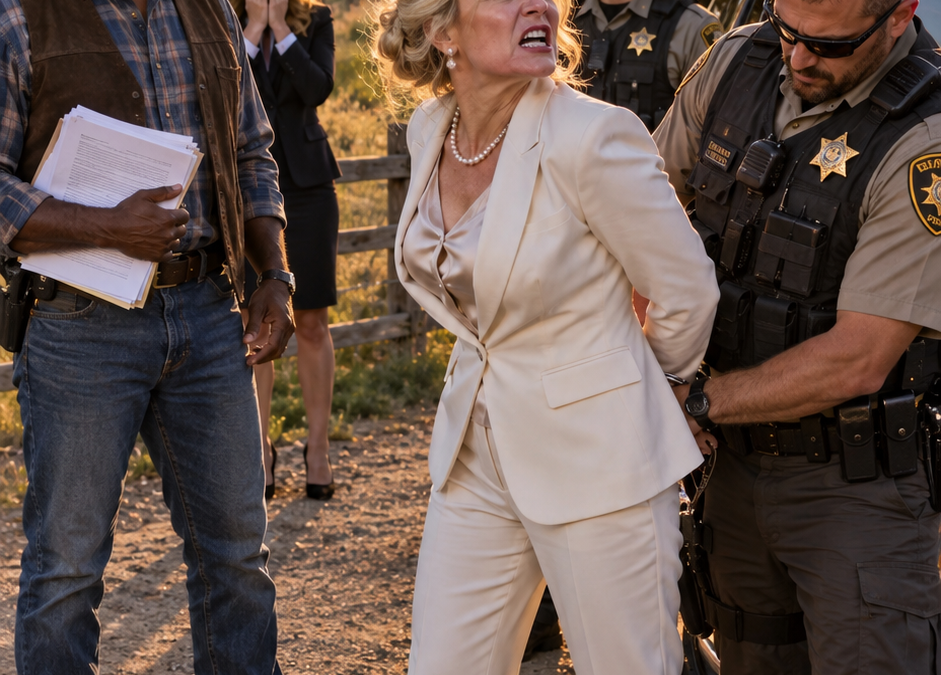
“Victoria Sterling.”
She turned.
Her face went blank.
“I have a warrant issued by the Oak Haven County District Court.”
Nobody moved.
“Charges include felony forgery, filing a false land record, and grand larceny related to the carbon-credit transaction.”
Victoria’s clipboard slipped from her hand.
It landed in the mud.
For some reason, that was the image I remembered most clearly afterward.
Not the handcuffs.
Not Keller.
Not the attorneys.
The clipboard.
Metallic.
Expensive.
Lying face-down in black wet soil.
Davies said:
“Turn around, please.”
Victoria stared at me.
There are moments when people expect you to say something profound.
I didn’t.
She turned.
The cuffs clicked shut.
The rain continued.
Keller’s assistants packed their equipment.
No soil cores were taken.
There was nothing to audit.
The asset backing the deal had never belonged to the seller.
As Davies walked Victoria toward the cruiser, she stopped once.
She looked across Silven Meadow.
For the first time since I had known her, she seemed to see it.
Not a carbon sink.
Not an asset class.
Not a line in an ESG presentation.
Land.
Land that belonged to somebody else.
I climbed into my truck.
Turned on the heater.
Poured coffee from my thermos.
And watched the sheriff’s lights disappear up the hill.
The aftermath was brutal.
Vanguard clawed back the funds.
The HOA’s remaining accounts could not cover everything.
The board collapsed.
A court-supervised interim committee took control.
Victoria posted her house as bail collateral.
Her corporate career ended almost overnight.
The grand net-zero project became a county joke.
Residents who had proudly placed green carbon-neutrality decals on their SUVs peeled them off.
The enormous billboard at the subdivision entrance came down.
For several days, only the wooden frame remained.
Then that disappeared too.
In its place, the county installed an ordinary sign:
OVERLOOK HEIGHTS SUBDIVISION
PLEASE DRIVE SLOWLY
Much better.
The homeowners were not innocent in every respect.
Many had applauded.
Many had enjoyed the promised lower dues without asking what asset produced them.
But most had also been lied to.
Unfortunately, fraud does not respect the distinction between gullibility and guilt when the bills arrive.
Each household received an emergency assessment.
Legal costs.
Restoration.
Title litigation.
Access damages.
The number was around twelve thousand dollars per home.
I received several angry emails blaming me.
That phase lasted about a week.
Then the criminal filings became public.
So did the forged signature.
It is difficult to maintain righteous anger at a property owner after learning your HOA president copied the signature of his dead mother.
My agricultural access road was fully restored.
The association paid for the planter removal.
The court awarded me damages for unauthorized entry, surveying attempts, and interference with the easement.
Eighteen thousand dollars.
A few weeks later, a station wagon pulled up near my gate.
Arthur Pendleton got out.
He had become interim HOA president.
He was wearing an old brown jacket.
No clipboard.
Promising start.
He carried an envelope.
“Julian.”
“Arthur.”
“I won’t keep you.”
“You’re fine.”
He handed it over.
Inside was a formal apology signed by the replacement board and the settlement check.
Arthur looked embarrassed.
“We should have asked harder questions.”
“Yes.”
“I’m not asking you to make us feel better.”
“Good.”
He smiled faintly.
“The old board got obsessed with the money.”
“And prestige.”
“And prestige.”
He looked toward the meadow.
“They convinced themselves they were protecting it.”
“No.”
Arthur glanced at me.
“They convinced themselves they were entitled to the credit for protecting it.”
He nodded slowly.
“That’s probably more accurate.”
We stood quietly.
Canada geese called from the flooded western flats.
The autumn sedges had turned bronze.
The creek ran high from the rain.
Arthur finally asked:
“Would you ever consider selling part of it?”
I looked at him.
He raised both hands.
“Not for development.”
“Good start.”
“Conservation park. Trails. Maybe an education area.”
“No.”
He laughed.
“Fair enough.”
“The meadow is already conserved.”
“I understand.”
“It doesn’t need a sign announcing that humans have agreed to let it continue existing.”
Arthur looked across the wetland.
“We’re trying to do better.”
“I know.”
“We’re revising the HOA environmental program.”
“Start with your lawns.”
He laughed again.
“I’ve already lost that argument twice.”
“Keep trying.”
He turned to leave.
Then paused.
“One thing.”
“What?”
“The residents asked whether you’d ever consider letting the community claim any carbon benefit informally.”
I stared at him.
He immediately smiled.
“I’m joking.”
“Good.”
“I’m learning.”
Arthur drove away.
I walked down toward the creek.
My mother’s old field notebooks still sat inside a cedar chest at home.
Sometimes I read them.
Not for technical reasons.
I already understand the meadow.
I read them because her handwriting makes the land feel less lonely.
She wrote one sentence near the end of her last journal:
Keep the concrete out of the mud, Julian. The mud is where the world’s heart beats.
Victoria had almost managed something stranger than concrete.
She tried to put ownership paperwork into the mud.
She wanted to take an ecosystem that had functioned for ten thousand years without her and convert its patience into a tradable certificate.
There is nothing inherently wrong with putting financial value on conservation.
Land survives for many reasons.
Sometimes economics helps.
But conservation based on theft is just theft wearing recycled-fiber stationery.
Victoria never understood the distinction.
She saw carbon.
Then money.
Then authority.
She skipped land.
She skipped history.
She skipped ownership.
Most importantly, she skipped the possibility that somebody might read the documents.
Her trial was scheduled for the spring.
I attended one preliminary hearing because Thomas insisted I should.
Victoria sat at the defense table wearing navy instead of safari beige.
No hard hat.
No clipboard.
She looked smaller.
Her attorney argued that she had relied on advisers.
The prosecutor produced emails.
Not good emails.
Messages in which Victoria discussed the need to “secure paper control” of Silven Meadow before Vanguard’s verification deadline.
One asked whether an “older title signature” could be used because “the present owner is obstructive.”
Thomas leaned toward me.
“That’s going to age poorly.”
“It already has.”
Another email asked the property manager whether the HOA could “create enough compliance pressure” through fines and access restrictions to force me into signing.
That was the planter strategy.
Written down.
I have always been amazed by the human urge to document misconduct using email.
Perhaps future archaeologists will conclude we worshiped evidence.
Victoria eventually accepted a plea arrangement.
The most serious charges remained.
Restitution.
A suspended sentence on some counts.
Probation.
A permanent prohibition against serving as an officer or fiduciary of a residential association.
That last part gave me more satisfaction than I expected.
Not because I wanted revenge.
Because there are some people who should never again receive a clipboard and the phrase at the board’s discretion.
Overlook Heights survived.
Of course it did.
Neighborhoods survive scandals better than the people who create them.
The clubhouse extension remained unfinished for almost a year.
Residents joked that it was Victoria’s Monument.
Eventually the new board completed only the essential repairs and canceled the rest.
The tennis courts did not get resurfaced.
The security gates were postponed.
Monthly dues did not decrease twenty percent.
Nobody died.
The world kept turning.
Something else changed.
The lawns.
Arthur finally won.
Not completely.
But enough.
The replacement board eliminated the mandatory fertilizer schedule.
Residents could use clover.
Native plants became permissible.
Dandelions stopped being treated like hostile foreign agents.
A stormwater consultant persuaded them to convert several decorative drainage areas into native swales.
One afternoon, I drove through Overlook Heights and saw a child crouched beside a patch of flowering clover watching bees.
The old board would probably have issued three violations.
Progress.
Real progress.
Not the kind requiring a Zurich investment committee.
I was invited to speak at one HOA meeting the following summer.
I declined.
Arthur called again.
“People want to understand the meadow.”
“Then walk down to the boundary and look at it.”
“Julian.”
“What?”
“We’re trying to rebuild trust.”
“So rebuild it.”
“You could help.”
“I did.”
Silence.
Then he laughed.
“Fair point.”
I eventually agreed to one condition.
No slideshow.
No fundraising.
No carbon credits.
No branding.
We met outside.
About forty residents came.
I showed them the stone wall.
The sedges.
The water line.
The peat.
I explained how wet soils preserve carbon.
How drainage releases it.
How native roots stabilize the system.
How the meadow filters runoff coming from their properties.
One man asked:
“So technically, our subdivision benefits from this land.”
“Yes.”
“Without paying you?”
“Yes.”
“That seems unfair.”
“No.”
He looked confused.
“Not every benefit has to become a transaction.”
That bothered several people.
I could see it.
Overlook Heights had spent decades translating everything into property values, dues, assessments, amenities, and returns.
The idea that something valuable could simply exist without being monetized felt suspicious.
A woman asked:
“Couldn’t you make money selling legitimate carbon credits?”
“Probably.”
“Why don’t you?”
“Because I don’t need to.”
Another resident said:
“But if conservation has economic value, doesn’t monetizing it help protect it?”
“Sometimes.”
I nodded toward the ridge.
“But the minute the money becomes more important than the thing being protected, people start doing what Victoria did.”
Nobody argued.
My meadow remained exactly what it had always been.
Unmanaged.
At least by suburban standards.
The sedges grew.
Birds nested.
Water moved.
Carbon accumulated.
The world continued doing work nobody had assigned it.
I used part of the settlement money to repair my truck.
That offended Thomas.
“You got eighteen thousand dollars and spent two thousand on a truck older than some associates in my office?”
“It runs.”
“So does tetanus.”
I also replaced several boundary markers.
Not because the old ones were unclear.
Because I wanted there to be no excuse.
Fresh survey monuments.
Recorded coordinates.
Updated signage.
Every corner unmistakable.
Victoria’s forged merger was formally expunged.
The title record now contained a permanent notation explaining why.
Ironically, her attempt to steal control of my land produced one of the clearest documented property records in the county.
That pleased me immensely.
My mother would have enjoyed it too.
She distrusted anyone who used the phrase everyone knows where the boundary is.
“Measure it,” she used to say.
So I did.
Every time.
That habit saved Silven Meadow.
Not anger.
Not intimidation.
Not some heroic courtroom speech.
Measurements.
Certified mail.
Recorded deeds.
Coordinates.
Return receipts.
Documents.
Victoria’s entire scheme depended on the idea that nobody would bother checking the boring things.
She was right about almost everyone.
She was wrong about me.
That was enough.
On a cold October evening, almost a year after the audit, I walked to the western boundary.
Frost had begun forming over the peat.
The grasses were rust-colored beneath the low sun.
Geese rested on the shallow pools.
Overlook Heights glowed above me.
Porch lights.
Kitchen windows.
A few solar panels catching the last light.
From that distance, the subdivision looked peaceful.
It probably was.
Arthur’s board had become almost painfully transparent.
Minutes posted online.
Contracts published.
Legal reviews disclosed.
No emergency executive sessions unless absolutely necessary.
Residents complained that meetings were longer.
Good.
Democracy, ownership, and accountability are often boring.
That is one of their best qualities.
The people most dangerous to those systems are usually the ones promising efficiency.
Victoria had been extremely efficient.
She turned private land into carbon credits without negotiating with the owner.
She turned nonexistent authority into marketing copy.
She turned forged paperwork into international financing.
She turned dissent into fines.
She turned a farm road into a hostage negotiation using decorative planters.
Very efficient.
Then the sheriff efficiently put handcuffs on her.
I still have the original Vanguard billboard photograph.
Sometimes Thomas asks why I keep it.
I tell him it makes me laugh.
The text underneath my meadow declared:
EXCLUSIVE ECOLOGICAL AUTHORITY OF THE OVERLOOK HEIGHTS HOA
That sentence existed for less than a month.
The meadow had existed for ten thousand years.
There is perspective in that.
Victoria believed the land became valuable when she found a market for its carbon.
My mother knew better.
The carbon had value because the land had been left wet.
The meadow had value because roots held soil together.
Because frogs laid eggs there.
Because storms slowed there.
Because water leaving suburban lawns arrived dirty and left cleaner.
Because nobody had drained it.
Nobody had paved it.
Nobody had put tennis courts on it.
Nobody had improved it.
The most valuable thing my family ever did to Silven Meadow was mostly nothing.
That was the lesson Victoria could never understand.
She needed every good thing to have a committee.
A brand.
A revenue projection.
An executive authority.
She could not imagine protection without control.
So she tried to control the one landscape in the valley that had survived specifically because people before her knew when to leave it alone.
And for all her speeches about stewardship, sustainability, and the future, she lost because of something embarrassingly old-fashioned.
A property line.
After Arthur delivered the settlement, he asked whether I felt vindicated.
I told him no.
That surprised him.
“You won.”
“I kept what was already mine.”
“That sounds like winning.”
“It feels more like correcting an accounting error.”
Arthur laughed.
Maybe that is all justice is sometimes.
Correcting the ledger.
Victoria sold $2.4 million in carbon credits she did not own.
The money went back.
Her authority disappeared.
The forged document disappeared from my title.
The road reopened.
The fines vanished.
The HOA paid for the damage.
The meadow stayed mine.
Ledger corrected.
I walked back toward my cabin as the sun disappeared behind the western ridge.
The air smelled like cold water and peat.
No lavender diffusers.
No organic wine.
No carbon-neutrality banners.
Just wet soil.
On my porch, I poured tea and opened one of my mother’s field journals.
Near the back was a map she had drawn of the meadow in 1994.
Every creek bend.
Every spring.
Every stand of sedge.
At the bottom she had written:
The land does not need us to give it value. It needs us to recognize the value already there.
I sat with that for a while.
Above the valley, lights came on one by one in Overlook Heights.
Somewhere up there, homeowners were still paying off the assessment their former president had created while promising to lower their dues.
Their expensive “net-zero” billboard was gone.
Their prestige project was gone.
Their Swiss investment deal was gone.
Victoria’s name had disappeared from the HOA website.
Silven Meadow remained.
No plaque.
No corporate sponsor.
No green investment logo.
Just two hundred acres of wet grass doing exactly what it had been doing long before Victoria Sterling discovered that carbon could be sold.
She thought she had found $2.4 million buried under my land.
What she actually found was the one thing her clipboard could never override.
The deed.
Have you finished reading the story and want to read it again?
HOA Karen Sold $2.4M in Carbon Credits From My Land — Then the Sheriff Handcuffed Her at the Audit
They were drilling into my meadow when I caught them.
The HOA claimed they owned the carbon beneath my land.
Then I discovered what they had filed behind my back.
“Lower the auger.”
Victoria Sterling didn’t even look at me.
She stood thirty feet inside my property line wearing a spotless white hard hat, a tailored canvas vest, and hiking boots so clean they looked as if they had been purchased on the drive over.
Beside her, a hydraulic soil auger was suspended above the wet black earth of Silven Meadow.
Two contractors waited beside the controls.
Victoria held a metallic clipboard against her chest.
“We need the core samples from plot S2 by noon,” she said.
One worker looked toward me.
Then toward Victoria.
Nobody moved.
“Lower the auger,” I repeated.
Victoria finally turned.
Her face arranged itself immediately into that expression I had come to know well—the soft, professionally concerned look of someone preparing to violate your rights while explaining that she was doing it for your benefit.
“Julian,” she said. “Good morning.”
“Get your equipment off my land.”
“We were hoping not to disturb you.”
“You brought a drilling rig into my meadow before eight in the morning.”
“We’re conducting baseline carbon measurements.”
“On my property.”
“For the entire valley.”
“That doesn’t make it yours.”
Her smile tightened.
Victoria Sterling was president of the Overlook Heights Homeowners Association.
She had spent twenty years in corporate human resources before discovering that HOA governance allowed her to combine her favorite things: committees, authority, and other people’s property.
She lowered her voice.
“Julian, this project protects the whole watershed. We’re three weeks from our Vanguard Green Fund audit. They need physical verification before the next investment tranche is released.”
“Not my problem.”
“This is bigger than either of us.”
“No. It’s exactly the size of both of us. You’re trespassing, and I’m telling you to leave.”
She sighed.
“Time is carbon, Julian. Carbon is capital.”
I almost admired that sentence.
My mother had spent thirty years studying the wetland below us.
Victoria had managed to turn ten thousand years of peat accumulation into something that sounded like a quarterly earnings call.
I walked to the hood of my old Ford F-250 and unrolled a certified plat map.
The county seal caught the morning light.
“This is the property boundary.”
Victoria glanced down.
“Julian—”
“Old stone wall. Creek crossing. Eastern rise. Everything south of that line is Silven Meadow.”
“We’ve discussed ecological integration.”
“No. You’ve discussed it. I’ve repeatedly told you no.”
“Overlook Heights is a unified ecosystem.”
I looked up.
“The valley may not recognize property lines, Victoria. The sheriff does.”
Her mouth flattened.
“The HOA charter gives us ecological management authority.”
“Over your subdivision.”
“Over the valley basin.”
“Your charter regulates two hundred fifty houses built on an old gravel quarry. It tells residents what shade of beige their garage doors can be. It does not give you jurisdiction over two hundred acres my family has owned since 1884.”
The contractors exchanged looks.
They were local.
They knew me.
I had surveyed farms belonging to half their families.
More importantly, they understood what a county-certified boundary looked like.
I tapped the map.
“If that auger touches this soil, I’m calling the sheriff.”
Victoria stepped closer.
“You’re being incredibly shortsighted.”
“Maybe.”
“We’re talking about $2.4 million in carbon credits.”
That was the first time she said the number out loud in front of me.
Two point four million dollars.
For carbon stored under land she did not own.
And judging by the urgency in her face, some portion of that money had already become very real.
“You sold credits from my meadow?”
“We are monetizing regional sequestration assets.”
“You sold credits from my meadow.”
“We are funding preservation.”
“You sold something you don’t own.”
Victoria’s corporate warmth disappeared.
“We have lawyers who handle technical objections like this.”
“Ownership isn’t a technical objection.”
“You cannot stand in the way of progress.”
“I’m not standing in the way of progress.”
I rolled the map shut.
“I’m standing on my land.”
She stared at me.
Then she turned toward the contractors.
“Pack up.”
Nobody argued.
The auger rose.
The tractor backed slowly toward the dirt lane.
Victoria paused beside her SUV.
“You’re making a terrible mistake.”
“I’ll survive.”
“We’ll have an administrative injunction by Monday.”
“I’ll make coffee.”
“You think this is funny?”
“No.”
I looked across Silven Meadow.
The sedges moved in the wind.
Dark water shimmered between the hummocks.
“This land survived ten thousand years without an HOA president. I like its chances.”
She drove away furious.
I stood alone in the tire tracks her crew had left behind.
At that moment, I believed the argument was about trespassing.
I was wrong.
Victoria Sterling had already done something far more serious than cross my boundary.
She had sold the environmental value of Silven Meadow to investors overseas.
And somewhere in the county recorder’s office, someone had created the paperwork that supposedly made that theft legal.
PART2
Silven Meadow is not pretty in the way Overlook Heights understands beauty.
There are no clipped hedges.
No decorative stone borders.
No irrigation system.
No committee inspecting grass height with a ruler.
The HOA’s landscaping code was sixty pages long.
My meadow had one rule.
Leave it alone.
Overlook Heights sat above it on the northern ridge.
The subdivision had been built in the late nineties for people who wanted to “live in harmony with nature” without surrendering heated bathroom floors, three-car garages, or chemically perfect lawns.
The developers had removed thousands of mature trees, then named streets after them.
White Oak Terrace.
Sycamore View.
Cedar Preserve.
Nothing commemorates destruction quite like a tasteful bronze street sign.
The lawns were Kentucky bluegrass.
Two and a half inches high.
Exactly.
Synthetic fertilizer every two weeks.
Herbicides before weeds appeared.
Automated sprinklers often ran during rainstorms because ecological harmony apparently required Wi-Fi irrigation controllers.
Dandelions were violations.
Clover was practically sedition.
At the bottom of all that control was my meadow.
Two hundred acres of wetland.
Native sedges.
White oaks.
Peat.
Bog iron.
Seasonal pools.
Frogs loud enough in spring to make phone conversations impossible from my porch.
My mother, Clara Vance, had studied it for thirty years.
She was a wetland ecologist before people turned phrases like carbon sequestration into investment products.
She mapped water levels.
Measured root depths.
Collected soil cores.
Tracked birds.
Documented the way deep-rooted sedges pulled carbon into saturated soil where low oxygen slowed decomposition almost to a stop.
She taught me that the messiest-looking landscape was often doing the most work.
The HOA’s lawn roots went down inches.
Silven Meadow’s roots went down feet.
Twelve.
Fifteen.
Some more than twenty.
The meadow stored enormous quantities of carbon.
It filtered runoff from the subdivision.
It absorbed stormwater.
It protected the creek.
Victoria understood enough of that to realize it was valuable.
She simply skipped the inconvenient part about ownership.
Two weeks after our confrontation, I drove into Oak Haven for mail.
That was when I saw the billboard.
Thirty feet wide.
Dark reclaimed timber frame.
Glossy aerial photograph of my meadow.
Across the top:
OVERLOOK HEIGHTS — AMERICA’S FIRST NET-ZERO COMMUNITY
Underneath:
IN PARTNERSHIP WITH VANGUARD GREEN FUND, ZURICH
I pulled onto the shoulder.
Below the photograph, a graphic explained that Overlook Heights was offsetting its entire residential carbon footprint through “active stewardship” of the Silven Meadow Carbon Sink.
My meadow.
My mother’s research area.
My land.
According to the sign, Overlook Heights managed twelve thousand tons of annual carbon sequestration there.
Small print at the bottom read:
ALL CARBON SEQUESTRATION ASSETS MANAGED UNDER THE EXCLUSIVE ECOLOGICAL AUTHORITY OF THE OVERLOOK HEIGHTS HOA BOARD OF DIRECTORS.
Victoria Sterling, President.
I laughed.
Actually laughed.
A loud, ugly laugh inside the cab of my truck.
They had turned my wetland into a financial product so homeowners could heat five-thousand-square-foot houses and advertise carbon neutrality.
I photographed everything.
Then I drove home.
I am a surveyor by trade.
Boundaries are comforting to me.
A boundary either exists or it doesn’t.
A deed either conveys land or it doesn’t.
The great advantage of land law is that it is rarely impressed by charisma.
I wrote a formal notice.
Not a complaint.
Not an angry letter.
A notice of non-affiliation and demarcation of title.
I cited the original 1884 homestead grant.
The current county parcel number.
The chain of title.
The absence of any recorded covenant attaching Silven Meadow to Overlook Heights.
Then I wrote:
Any representation, transfer, sale, encumbrance, or monetization of environmental assets derived from Silven Meadow—including soil carbon, biomass carbon, wetland credits, hydrological credits, or related offsets—without written authorization from the owner constitutes fraudulent misrepresentation and a cloud upon title.
I sent copies by certified mail.
One to Victoria.
One to the HOA.
One to Vanguard Green Fund in Zurich.
Return receipt requested.
If this fell apart, nobody was going to say they had not been warned.
The monthly HOA town hall happened the following Thursday.
Technically, I wasn’t a member.
That had never stopped them from mailing me violation notices.
So I decided their meeting could survive my presence.
The clubhouse looked like a luxury ski lodge designed by people frightened of snow.
Glass.
Steel.
Cedar.
Geothermal floor heating.
Organic lavender diffusers.
About ninety homeowners sat in rows sipping wine from compostable cups.
Victoria stood at the front beneath a screen displaying a graph titled:
OVERLOOK HEIGHTS CARBON OFFSET DIVIDEND
She was glowing.
“…and the total twenty-year value of our agreement is $2.4 million.”
Applause.
I stayed near the back.
“The initial disbursement will allow us to complete the clubhouse expansion, modernize the tennis courts, install automated security gates, and reduce monthly dues by twenty percent.”
More applause.
“Doing well by doing good.”
That line got the loudest response.
I stepped into the aisle.
“Excuse me.”
The room quieted.
Victoria saw me.
Her laser pointer stopped moving.
“Julian.”
“Victoria.”
“This is a private association meeting.”
“You keep sending me HOA violations, so apparently our relationship is flexible.”
A few people laughed.
Victoria did not.
I walked toward the front.
“I’d like to talk about the $2.4 million.”
“We can discuss your concerns privately.”
“They’re not private.”
She gripped the pointer.
“Our attorneys are finalizing the valley ecological integration.”
“There is no valley ecological integration.”
A murmur started.
I faced the residents.
“Silven Meadow is privately owned.”
Several people frowned.
Victoria interrupted.
“Julian has disputed our ecological jurisdiction for some time.”
“No.”
I turned back toward her.
“I dispute your ownership.”
“That’s an oversimplification.”
“It’s difficult to simplify ownership further.”
I held up my certified deed.
“The HOA has sold carbon credits generated by soil on my property. You have represented to Vanguard Green Fund that you have management authority over land you do not own.”
An older man near the front raised his hand.
Arthur Pendleton.
Retired history teacher.
“Victoria, is there a deed transfer?”
She turned toward him.
“There is a recorded ecological boundary agreement.”
“Signed by whom?”
“Our legal counsel handled—”
“Signed by whom?”
Victoria’s face hardened.
I answered for her.
“Not me.”
Then I looked at the room.
“In thirty days, Vanguard’s auditors are coming here.”
Nobody moved.
“They will ask for soil cores.”
I pointed toward the window.
“From my meadow.”
“They will ask for title verification.”
I held up the deed.
“They will discover the HOA does not own the land backing the carbon credits.”
Someone near the middle whispered something about clawbacks.
I continued.
“When that happens, Vanguard will demand its money back.”
Victoria slapped the table.
“That is irresponsible speculation.”
“No.”
I looked at her.
“Selling carbon credits from somebody else’s property was irresponsible.”
A homeowner called:
“How much has already been paid?”
Victoria didn’t answer.
Another:
“Have we spent it?”
Her silence did more damage than anything I could have said.
I turned back toward the residents.
“If you’re being told this project will lower your dues, ask to see the title document.”
Then I looked at Victoria.
“Show them my signature.”
Her mouth tightened.
“This is not the appropriate forum.”
“It was appropriate when you announced $2.4 million.”
“Security.”
Two guards started toward me.
I rolled up my plat.
“I’m leaving.”
Before I reached the door, I stopped.
“One more thing.”
Victoria glared at me.
“I sent Vanguard a certified notice.”
Her face changed.
Barely.
But enough.
“They know there is a title dispute.”
Nobody applauded when I left.
Good.
I hadn’t gone there for applause.
Monday morning, I found a yellow envelope attached to my gate.
HOA violations.
Apparently, Silven Meadow was now an “unmanaged vegetation hazard.”
Fine:
$1,000 per day.
My truck blocking my own farm lane was an “obstruction of a shared ecological pathway.”
Another $1,000 per day.
Applied retroactively.
I called my attorney, Thomas Miller.
Thomas had spent forty years representing farmers against developers and had developed a profound spiritual belief in making arrogant people read their own deeds.
“They fined you?”
“Two thousand a day.”
He laughed.
“I’m glad you’re enjoying this.”
“I am.”
Then I told him what happened next.
A flatbed truck arrived.
Workers unloaded enormous concrete planter boxes across the dirt road connecting my property to the county highway.
Each weighed several tons.
They chained them together.
Gray.
Architectural.
Very tasteful.
Nothing says peaceful environmental stewardship like barricading a man inside his own land.
I watched through binoculars.
Photographed every worker.
Every truck plate.
Every placement.
Then I set up my transit.
The planter boxes were twelve feet inside a recorded agricultural right-of-way established in 1912.
I called Thomas again.
“They put them on the easement.”
“How far?”
“Twelve feet.”
He laughed again.
“You need better enemies.”
“I’d prefer none.”
“That’s unreasonable.”
He promised an emergency petition.
Temporary restraining order.
Immediate removal.
Damages.
Then I told him about the document I had found that morning.
His laughter stopped.
“What document?”
“A voluntary boundary merger.”
“Recorded?”
“Friday afternoon.”
“Signed by you?”
“That’s the interesting part.”
I had been checking the recorder portal every morning.
Some people read sports scores.
I read land filings.
The document purported to merge Silven Meadow into the HOA’s ecological management zone.
It contained a signature.
Not mine.
My mother’s.
Clara Vance.
Dead five years.
Thomas went silent.
“They used your mother’s signature?”
“Looks copied from an old tax filing.”
“Not your name?”
“No.”
“You are current title holder?”
“Sole owner.”
“Recorded probate?”
“Five years ago.”
“They forged a dead woman’s signature on a land document used to support an international financial transaction.”
“Yes.”
“Julian.”
“Yes?”
“That’s not an HOA dispute anymore.”
“I know.”
“That could be felony forgery. Filing false instruments. Fraud. Potentially wire fraud.”
“I know.”
“How much money?”
“$2.4 million contract value.”
Thomas exhaled.
“Do not touch anything.”
“Wasn’t planning to.”
“I’m calling the district attorney.”
The restraining order moved quickly.
The county judge ordered the access lane reopened.
The planter boxes disappeared at the HOA’s expense.
Their fines against me were suspended pending the title case.
I installed oak boundary posts.
Steel cable.
Red signs.
PRIVATE PROPERTY — ACTIVE TITLE LITIGATION
Victoria stood on the opposite ridge one afternoon watching through binoculars.
I raised my hammer in greeting.
She turned around.
The Vanguard audit was ten days away.
By then I had learned another uncomfortable fact.
The HOA had already received roughly $600,000 in progress funds.
They had spent much of it.
Clubhouse construction.
Marketing.
Consultants.
Attorneys.
That explained Victoria’s desperation.
The $2.4 million wasn’t theoretical anymore.
She had sold something she could not deliver and spent money secured by it.
September 30 arrived in cold rain.
At nine that morning, a black Mercedes van stopped outside the clubhouse.
Three people got out.
The man in front wore a charcoal overcoat and carried a metal equipment case.
Dr. Dieter Keller.
Chief environmental auditor for Vanguard Green Fund.
He was followed by two assistants carrying GPS equipment and soil samplers.
Victoria had prepared a welcome reception.
Banner.
Organic pastries.
Hot cider.
Several attorneys.
The entire HOA board.
I watched from the valley.
At 9:15, they started down the trail.
Keller walked.
Victoria had apparently offered golf carts.
He declined.
I liked him immediately.
Rain turned the trail into dark mud.
Victoria walked beside him talking constantly.
When they reached my stone boundary wall, they stopped.
I was waiting.
Deputy Sheriff Davies stood beside me.
Behind us sat my surveying transit.
The steel boundary cable crossed the lane.
Victoria’s face went white.
Then angry.
“Julian.”
“Victoria.”
She looked at Davies.
“What is this?”
“The boundary.”
“We have an international audit underway.”
“I noticed.”
“Move the cable.”
“No.”
Dr. Keller stepped forward.
“Mr. Vance?”
“Yes.”
“I received your letter.”
“Good.”
Victoria interrupted.
“Doctor, we have resolved the dispute. The boundary merger was recorded September eighteenth.”
Keller looked at me.
“Our legal department received a certified copy.”
“I know.”
Victoria smiled slightly.
“There.”
I reached into my coat.
“Then you’ll want this.”
I handed Keller a sealed county folder.
He opened it.
The rain tapped against umbrellas.
Inside was the recorder’s certified cancellation of the forged instrument.
A sworn forgery affidavit.
My mother’s death certificate.
My current deed.
And the district attorney’s preliminary filing notice.
Keller read silently.
One of the HOA attorneys moved closer.
Then another.
Victoria’s smile disappeared.
Keller looked up.
“You did not sign this boundary agreement?”
“No.”
“Clara Vance?”
“My mother.”
“Where is she?”
“Oak Haven Cemetery.”
Nobody said anything.
Victoria finally spoke.
“This is a clerical issue.”
I turned toward her.
“You filed a dead woman’s signature.”
“It was prepared by outside counsel.”
One of the lawyers immediately took two steps backward.
I nearly smiled.
Keller continued reading.
Victoria tried again.
“The intent of the parties was clear.”
“There were no parties,” I said. “There was you.”
“We can negotiate an easement.”
“With what money?”
She stared at me.
“The association has reserves.”
“No, it doesn’t.”
The board members turned toward her.
I continued.
“You’ve already spent roughly six hundred thousand dollars of Vanguard’s advance.”
A man from the board whispered:
“Victoria?”
She ignored him.
“You don’t have money to buy the meadow,” I said. “You never did.”
Keller shut the folder.
The metal clasp snapped loudly.
He looked at Victoria.
His expression had changed.
Not anger.
Something worse.
Disgust.
“Mrs. Sterling.”
She straightened.
“Yes?”
“You represented to our fund that Overlook Heights possessed exclusive legal management authority over the Silven Meadow carbon asset.”
“Our counsel—”
“You represented that title was verified.”
“We relied on—”
“You accepted funds.”
Victoria looked toward her attorneys.
Nobody rescued her.
Keller turned to his assistant.
“Cancel the remaining transfer.”
Victoria stepped forward.
“Doctor—”
“Immediately.”
The assistant opened his tablet.
Keller continued.
“Notify Zurich legal counsel to initiate clawback procedures on all funds already disbursed.”
Victoria’s voice rose.
“You cannot do this based on one hostile landowner’s complaint.”
Keller held up the county affidavit.
“This is not a complaint.”
He tapped it.
“This is a criminal forgery filing.”
“We can resolve this.”
“You cannot resolve ownership after selling the asset.”
“Please.”
That word sounded strange coming from Victoria.
I had never heard her use it honestly before.
Keller looked toward Overlook Heights above us.
Perfect lawns.
Large houses.
Decorative solar panels.
Then at my meadow.
“You marketed this community as net zero.”
Victoria said nothing.
“You sold environmental virtue based on property you did not control.”
Still nothing.
He looked directly at her.
“You wanted to save the planet without respecting your neighbor’s fence.”
I almost felt embarrassed for her.
Almost.
Then Deputy Davies stepped forward.
He opened the leather folder he had been holding.
“Victoria Sterling.”
She turned.
Her face went blank.
“I have a warrant issued by the Oak Haven County District Court.”
Nobody moved.
“Charges include felony forgery, filing a false land record, and grand larceny related to the carbon-credit transaction.”
Victoria’s clipboard slipped from her hand.
It landed in the mud.
For some reason, that was the image I remembered most clearly afterward.
Not the handcuffs.
Not Keller.
Not the attorneys.
The clipboard.
Metallic.
Expensive.
Lying face-down in black wet soil.
Davies said:
“Turn around, please.”
Victoria stared at me.
There are moments when people expect you to say something profound.
I didn’t.
She turned.
The cuffs clicked shut.
The rain continued.
Keller’s assistants packed their equipment.
No soil cores were taken.
There was nothing to audit.
The asset backing the deal had never belonged to the seller.
As Davies walked Victoria toward the cruiser, she stopped once.
She looked across Silven Meadow.
For the first time since I had known her, she seemed to see it.
Not a carbon sink.
Not an asset class.
Not a line in an ESG presentation.
Land.
Land that belonged to somebody else.
I climbed into my truck.
Turned on the heater.
Poured coffee from my thermos.
And watched the sheriff’s lights disappear up the hill.
The aftermath was brutal.
Vanguard clawed back the funds.
The HOA’s remaining accounts could not cover everything.
The board collapsed.
A court-supervised interim committee took control.
Victoria posted her house as bail collateral.
Her corporate career ended almost overnight.
The grand net-zero project became a county joke.
Residents who had proudly placed green carbon-neutrality decals on their SUVs peeled them off.
The enormous billboard at the subdivision entrance came down.
For several days, only the wooden frame remained.
Then that disappeared too.
In its place, the county installed an ordinary sign:
OVERLOOK HEIGHTS SUBDIVISION
PLEASE DRIVE SLOWLY
Much better.
The homeowners were not innocent in every respect.
Many had applauded.
Many had enjoyed the promised lower dues without asking what asset produced them.
But most had also been lied to.
Unfortunately, fraud does not respect the distinction between gullibility and guilt when the bills arrive.
Each household received an emergency assessment.
Legal costs.
Restoration.
Title litigation.
Access damages.
The number was around twelve thousand dollars per home.
I received several angry emails blaming me.
That phase lasted about a week.
Then the criminal filings became public.
So did the forged signature.
It is difficult to maintain righteous anger at a property owner after learning your HOA president copied the signature of his dead mother.
My agricultural access road was fully restored.
The association paid for the planter removal.
The court awarded me damages for unauthorized entry, surveying attempts, and interference with the easement.
Eighteen thousand dollars.
A few weeks later, a station wagon pulled up near my gate.
Arthur Pendleton got out.
He had become interim HOA president.
He was wearing an old brown jacket.
No clipboard.
Promising start.
He carried an envelope.
“Julian.”
“Arthur.”
“I won’t keep you.”
“You’re fine.”
He handed it over.
Inside was a formal apology signed by the replacement board and the settlement check.
Arthur looked embarrassed.
“We should have asked harder questions.”
“Yes.”
“I’m not asking you to make us feel better.”
“Good.”
He smiled faintly.
“The old board got obsessed with the money.”
“And prestige.”
“And prestige.”
He looked toward the meadow.
“They convinced themselves they were protecting it.”
“No.”
Arthur glanced at me.
“They convinced themselves they were entitled to the credit for protecting it.”
He nodded slowly.
“That’s probably more accurate.”
We stood quietly.
Canada geese called from the flooded western flats.
The autumn sedges had turned bronze.
The creek ran high from the rain.
Arthur finally asked:
“Would you ever consider selling part of it?”
I looked at him.
He raised both hands.
“Not for development.”
“Good start.”
“Conservation park. Trails. Maybe an education area.”
“No.”
He laughed.
“Fair enough.”
“The meadow is already conserved.”
“I understand.”
“It doesn’t need a sign announcing that humans have agreed to let it continue existing.”
Arthur looked across the wetland.
“We’re trying to do better.”
“I know.”
“We’re revising the HOA environmental program.”
“Start with your lawns.”
He laughed again.
“I’ve already lost that argument twice.”
“Keep trying.”
He turned to leave.
Then paused.
“One thing.”
“What?”
“The residents asked whether you’d ever consider letting the community claim any carbon benefit informally.”
I stared at him.
He immediately smiled.
“I’m joking.”
“Good.”
“I’m learning.”
Arthur drove away.
I walked down toward the creek.
My mother’s old field notebooks still sat inside a cedar chest at home.
Sometimes I read them.
Not for technical reasons.
I already understand the meadow.
I read them because her handwriting makes the land feel less lonely.
She wrote one sentence near the end of her last journal:
Keep the concrete out of the mud, Julian. The mud is where the world’s heart beats.
Victoria had almost managed something stranger than concrete.
She tried to put ownership paperwork into the mud.
She wanted to take an ecosystem that had functioned for ten thousand years without her and convert its patience into a tradable certificate.
There is nothing inherently wrong with putting financial value on conservation.
Land survives for many reasons.
Sometimes economics helps.
But conservation based on theft is just theft wearing recycled-fiber stationery.
Victoria never understood the distinction.
She saw carbon.
Then money.
Then authority.
She skipped land.
She skipped history.
She skipped ownership.
Most importantly, she skipped the possibility that somebody might read the documents.
Her trial was scheduled for the spring.
I attended one preliminary hearing because Thomas insisted I should.
Victoria sat at the defense table wearing navy instead of safari beige.
No hard hat.
No clipboard.
She looked smaller.
Her attorney argued that she had relied on advisers.
The prosecutor produced emails.
Not good emails.
Messages in which Victoria discussed the need to “secure paper control” of Silven Meadow before Vanguard’s verification deadline.
One asked whether an “older title signature” could be used because “the present owner is obstructive.”
Thomas leaned toward me.
“That’s going to age poorly.”
“It already has.”
Another email asked the property manager whether the HOA could “create enough compliance pressure” through fines and access restrictions to force me into signing.
That was the planter strategy.
Written down.
I have always been amazed by the human urge to document misconduct using email.
Perhaps future archaeologists will conclude we worshiped evidence.
Victoria eventually accepted a plea arrangement.
The most serious charges remained.
Restitution.
A suspended sentence on some counts.
Probation.
A permanent prohibition against serving as an officer or fiduciary of a residential association.
That last part gave me more satisfaction than I expected.
Not because I wanted revenge.
Because there are some people who should never again receive a clipboard and the phrase at the board’s discretion.
Overlook Heights survived.
Of course it did.
Neighborhoods survive scandals better than the people who create them.
The clubhouse extension remained unfinished for almost a year.
Residents joked that it was Victoria’s Monument.
Eventually the new board completed only the essential repairs and canceled the rest.
The tennis courts did not get resurfaced.
The security gates were postponed.
Monthly dues did not decrease twenty percent.
Nobody died.
The world kept turning.
Something else changed.
The lawns.
Arthur finally won.
Not completely.
But enough.
The replacement board eliminated the mandatory fertilizer schedule.
Residents could use clover.
Native plants became permissible.
Dandelions stopped being treated like hostile foreign agents.
A stormwater consultant persuaded them to convert several decorative drainage areas into native swales.
One afternoon, I drove through Overlook Heights and saw a child crouched beside a patch of flowering clover watching bees.
The old board would probably have issued three violations.
Progress.
Real progress.
Not the kind requiring a Zurich investment committee.
I was invited to speak at one HOA meeting the following summer.
I declined.
Arthur called again.
“People want to understand the meadow.”
“Then walk down to the boundary and look at it.”
“Julian.”
“What?”
“We’re trying to rebuild trust.”
“So rebuild it.”
“You could help.”
“I did.”
Silence.
Then he laughed.
“Fair point.”
I eventually agreed to one condition.
No slideshow.
No fundraising.
No carbon credits.
No branding.
We met outside.
About forty residents came.
I showed them the stone wall.
The sedges.
The water line.
The peat.
I explained how wet soils preserve carbon.
How drainage releases it.
How native roots stabilize the system.
How the meadow filters runoff coming from their properties.
One man asked:
“So technically, our subdivision benefits from this land.”
“Yes.”
“Without paying you?”
“Yes.”
“That seems unfair.”
“No.”
He looked confused.
“Not every benefit has to become a transaction.”
That bothered several people.
I could see it.
Overlook Heights had spent decades translating everything into property values, dues, assessments, amenities, and returns.
The idea that something valuable could simply exist without being monetized felt suspicious.
A woman asked:
“Couldn’t you make money selling legitimate carbon credits?”
“Probably.”
“Why don’t you?”
“Because I don’t need to.”
Another resident said:
“But if conservation has economic value, doesn’t monetizing it help protect it?”
“Sometimes.”
I nodded toward the ridge.
“But the minute the money becomes more important than the thing being protected, people start doing what Victoria did.”
Nobody argued.
My meadow remained exactly what it had always been.
Unmanaged.
At least by suburban standards.
The sedges grew.
Birds nested.
Water moved.
Carbon accumulated.
The world continued doing work nobody had assigned it.
I used part of the settlement money to repair my truck.
That offended Thomas.
“You got eighteen thousand dollars and spent two thousand on a truck older than some associates in my office?”
“It runs.”
“So does tetanus.”
I also replaced several boundary markers.
Not because the old ones were unclear.
Because I wanted there to be no excuse.
Fresh survey monuments.
Recorded coordinates.
Updated signage.
Every corner unmistakable.
Victoria’s forged merger was formally expunged.
The title record now contained a permanent notation explaining why.
Ironically, her attempt to steal control of my land produced one of the clearest documented property records in the county.
That pleased me immensely.
My mother would have enjoyed it too.
She distrusted anyone who used the phrase everyone knows where the boundary is.
“Measure it,” she used to say.
So I did.
Every time.
That habit saved Silven Meadow.
Not anger.
Not intimidation.
Not some heroic courtroom speech.
Measurements.
Certified mail.
Recorded deeds.
Coordinates.
Return receipts.
Documents.
Victoria’s entire scheme depended on the idea that nobody would bother checking the boring things.
She was right about almost everyone.
She was wrong about me.
That was enough.
On a cold October evening, almost a year after the audit, I walked to the western boundary.
Frost had begun forming over the peat.
The grasses were rust-colored beneath the low sun.
Geese rested on the shallow pools.
Overlook Heights glowed above me.
Porch lights.
Kitchen windows.
A few solar panels catching the last light.
From that distance, the subdivision looked peaceful.
It probably was.
Arthur’s board had become almost painfully transparent.
Minutes posted online.
Contracts published.
Legal reviews disclosed.
No emergency executive sessions unless absolutely necessary.
Residents complained that meetings were longer.
Good.
Democracy, ownership, and accountability are often boring.
That is one of their best qualities.
The people most dangerous to those systems are usually the ones promising efficiency.
Victoria had been extremely efficient.
She turned private land into carbon credits without negotiating with the owner.
She turned nonexistent authority into marketing copy.
She turned forged paperwork into international financing.
She turned dissent into fines.
She turned a farm road into a hostage negotiation using decorative planters.
Very efficient.
Then the sheriff efficiently put handcuffs on her.
I still have the original Vanguard billboard photograph.
Sometimes Thomas asks why I keep it.
I tell him it makes me laugh.
The text underneath my meadow declared:
EXCLUSIVE ECOLOGICAL AUTHORITY OF THE OVERLOOK HEIGHTS HOA
That sentence existed for less than a month.
The meadow had existed for ten thousand years.
There is perspective in that.
Victoria believed the land became valuable when she found a market for its carbon.
My mother knew better.
The carbon had value because the land had been left wet.
The meadow had value because roots held soil together.
Because frogs laid eggs there.
Because storms slowed there.
Because water leaving suburban lawns arrived dirty and left cleaner.
Because nobody had drained it.
Nobody had paved it.
Nobody had put tennis courts on it.
Nobody had improved it.
The most valuable thing my family ever did to Silven Meadow was mostly nothing.
That was the lesson Victoria could never understand.
She needed every good thing to have a committee.
A brand.
A revenue projection.
An executive authority.
She could not imagine protection without control.
So she tried to control the one landscape in the valley that had survived specifically because people before her knew when to leave it alone.
And for all her speeches about stewardship, sustainability, and the future, she lost because of something embarrassingly old-fashioned.
A property line.
After Arthur delivered the settlement, he asked whether I felt vindicated.
I told him no.
That surprised him.
“You won.”
“I kept what was already mine.”
“That sounds like winning.”
“It feels more like correcting an accounting error.”
Arthur laughed.
Maybe that is all justice is sometimes.
Correcting the ledger.
Victoria sold $2.4 million in carbon credits she did not own.
The money went back.
Her authority disappeared.
The forged document disappeared from my title.
The road reopened.
The fines vanished.
The HOA paid for the damage.
The meadow stayed mine.
Ledger corrected.
I walked back toward my cabin as the sun disappeared behind the western ridge.
The air smelled like cold water and peat.
No lavender diffusers.
No organic wine.
No carbon-neutrality banners.
Just wet soil.
On my porch, I poured tea and opened one of my mother’s field journals.
Near the back was a map she had drawn of the meadow in 1994.
Every creek bend.
Every spring.
Every stand of sedge.
At the bottom she had written:
The land does not need us to give it value. It needs us to recognize the value already there.
I sat with that for a while.
Above the valley, lights came on one by one in Overlook Heights.
Somewhere up there, homeowners were still paying off the assessment their former president had created while promising to lower their dues.
Their expensive “net-zero” billboard was gone.
Their prestige project was gone.
Their Swiss investment deal was gone.
Victoria’s name had disappeared from the HOA website.
Silven Meadow remained.
No plaque.
No corporate sponsor.
No green investment logo.
Just two hundred acres of wet grass doing exactly what it had been doing long before Victoria Sterling discovered that carbon could be sold.
She thought she had found $2.4 million buried under my land.
What she actually found was the one thing her clipboard could never override.
The deed.








