HOA Karen Smashed My Legal Rain Barrel on My 4,000-Acre Ranch—and Sent Me an $800-a-Day Fine for the Damage
HOA Karen Smashed My Legal Rain Barrel on My 4,000-Acre Ranch—and Sent Me an $800-a-Day Fine for the Damage
She brought two workers onto my private ranch, ordered them to destroy my rainwater system, and then handed me the bill.
When I reminded her that my family had owned the land since 1921, HOA Karen laughed and told me “old papers” couldn’t stop community progress.
What she didn’t know was that every swing of those hammers was being recorded—and the broken barrel was about to become the smallest problem her HOA had.
“Your rain barrel is an unauthorized eyesore. We’re smashing it right now, and you will pay for the cleanup.”
Victoria Vale said it with the confidence of someone announcing a law instead of committing to a spectacularly bad decision.
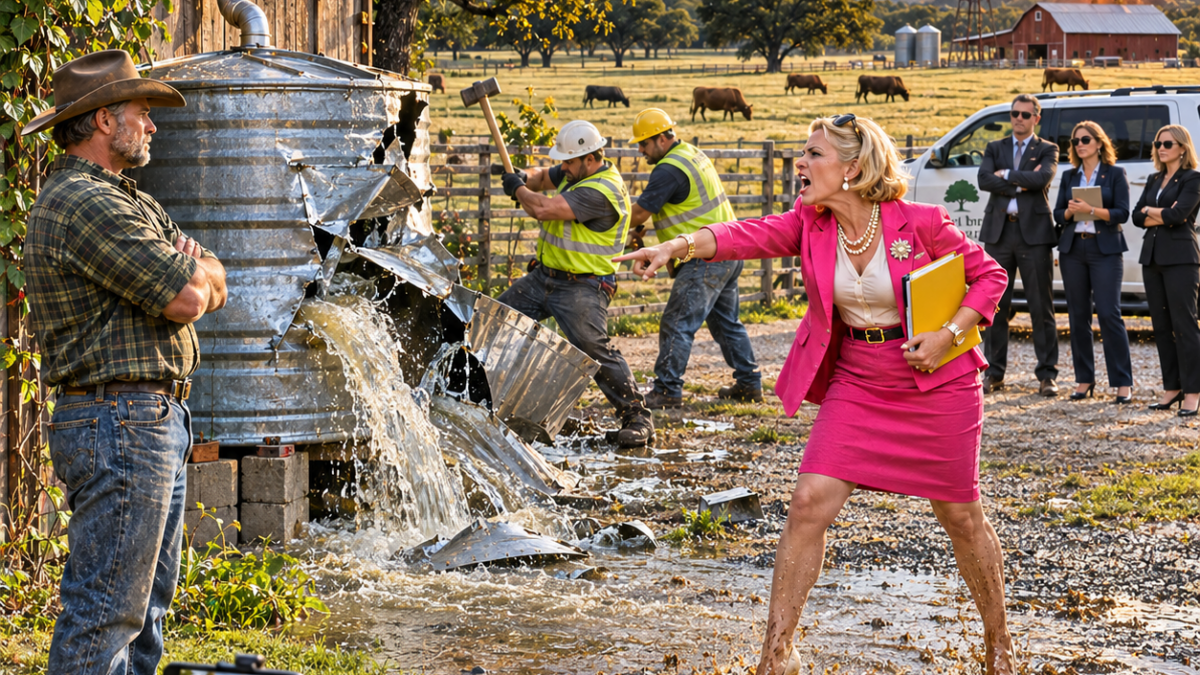
She stood in the middle of my farmyard wearing a bright pink blazer, a matching skirt, beige heels, pearl earrings, and oversized sunglasses balanced on her blonde bob. Behind her, two workers she had hired were already swinging heavy tools into the side of my rainwater tank.
The first impact dented the galvanized wall.
The second split a seam.
The third sent hundreds of gallons of collected rainwater bursting across the gravel.
Water rushed around Victoria’s expensive shoes.
One worker jumped backward.
Victoria didn’t.
She lifted her yellow HOA folder higher and shouted, “Keep going.”
I stood beside the equipment shed in an olive-green flannel shirt, faded jeans, work boots, and my father’s old cowboy hat.
I didn’t yell.
I didn’t charge toward them.
I simply watched.
That seemed to bother Victoria more than anger would have.
“Are you hearing me, Daniel?” she demanded.
“Perfectly.”
“Then you understand this structure violates Cedar Ridge aesthetic standards.”
I looked at the shattered tank.
“It’s three-quarters of a mile from Cedar Ridge.”
“It is visible from association property.”
“So are my cows.”
“Don’t be ridiculous.”
A sheet of metal collapsed inward with a loud clang.
The worker stopped.
“Ma’am,” he said, “this thing’s basically destroyed.”
Victoria nodded.
“Finish it.”
He looked toward me.
I could see doubt settling into his face.
I spoke calmly.
“I’m telling both of you, on camera, that you do not have permission to be here or damage anything else.”
Both workers immediately looked around.
Victoria did too.
That was when she noticed the security camera above the barn door.
Her expression changed for less than a second.
Then the arrogance returned.
“The HOA has enforcement authority.”
“Not here.”
“The board voted.”
“Still not here.”
She ripped a notice from her folder and slapped it against the broken barrel.
The wet paper slid sideways.
“Eight hundred dollars per day until the violation is corrected.”
I stared at her.
“You smashed it.”
“And now you’re required to remove the debris.”
One worker actually lowered his tool.
“Wait,” he said. “He has to pay because we broke it?”
Victoria glared at him.
“You are being paid to work, not interpret policy.”
He looked at me.
I looked at him.
Neither of us said anything.
The silence was enough.
Victoria stepped closer.
“This ranch may have existed before Cedar Ridge, but times change. Community standards evolve. You don’t get to create visual pollution just because your grandfather did things differently.”
“My grandfather didn’t own that barrel.”
“You know what I mean.”
“I really don’t.”
Behind her, water continued spreading across the gravel, running toward the orchard and soaking into the soil.
Victoria pointed toward the twisted metal.
“By tomorrow morning, I want every piece removed.”
I reached into the truck parked beside me and pulled out a thick brown folder.
For the first time, she hesitated.
“What is that?”
“Something you should have asked to see before hiring people to destroy my property.”
I removed a certified copy of the Mercer family’s original 1921 conveyance, the modern deed, a current parcel map, and the most recent county survey.
Victoria barely glanced at them.
Then she laughed.
“Old papers don’t stop modern community progress.”
I folded the documents again.
“No.”
I looked past her toward the bright orange survey marker ten feet from the ruined tank.
“But they do tell modern community progress where the property line is.”
Her smile thinned.
I slipped the papers back into the folder.
“Victoria, you should call your attorney tonight.”
“Is that a threat?”
“No.”
I looked at the broken barrel, the camera above the barn, and the two workers who had suddenly become very interested in leaving.
“It’s the last friendly advice you’re getting from me.”
part 2
My name is Daniel Mercer, though everyone who actually knows me calls me Dan. I was fifty-three when Victoria Vale decided a rain barrel on my ranch represented such a threat to civilization that it needed to be destroyed under HOA supervision.
The ranch covered just over four thousand acres.
My great-grandfather had started with far less in 1921, buying cattle ground, timber, two creeks, and a low valley that flooded every spring. My grandfather expanded it. My father kept it alive through drought, bad markets, and one winter that killed enough livestock to make him consider selling.
He never did.
Neither did I.
By the time Cedar Ridge Estates appeared along our eastern boundary, the Mercer family had already spent generations fixing fences, digging stock ponds, rebuilding barns, managing runoff, and learning exactly where water moved when the sky opened.
That detail would become important later.
The rain barrel Victoria destroyed was not decorative.
It was part of a small collection system attached to the equipment shed.
Rainwater flowed from the roof into screened gutters and then into a large galvanized tank I used for garden irrigation, washing equipment, and watering livestock when appropriate.
It reduced demand on our well.
It was legal.
It was useful.
And because it sat behind a barn and several hundred yards from the nearest public road, describing it as a neighborhood eyesore required either extraordinary eyesight or extraordinary imagination.
Victoria had both confidence and binoculars.
Her obsession started six weeks earlier.
I received a letter from Cedar Ridge accusing me of maintaining an “unapproved external water-storage structure affecting the visual harmony of adjacent residential parcels.”
I read it twice.
Then I gave it to my wife, Claire.
She read it once.
“What structure?”
“The rain tank.”
She looked through the kitchen window toward the equipment shed.
“You can barely see it from here.”
“I know.”
“And we live here.”
“I know.”
She handed the letter back.
“Maybe the HOA has satellites.”
That was Claire.
She could make me laugh at exactly the moment I wanted to throw something.
I called the management company listed on the notice and explained that Mercer Ranch was not part of Cedar Ridge.
The woman on the phone sounded relieved.
“I’ll note that.”
“Please do.”
I assumed the matter was finished.
Three days later, a second notice arrived.
This one came from Victoria personally.
It stated that although my property was “technically external” to Cedar Ridge, the HOA retained an interest in controlling visual conditions that affected neighborhood property values.
Technically external.
That phrase made my attorney laugh so hard she had to put down the phone.
Rachel Coleman had represented our family for years. She was the kind of lawyer who never raised her voice because she preferred making other people uncomfortable with silence.
“Dan,” she said, “there is no legal category called technically external.”
“I suspected.”
“Are there any recorded covenants?”
“No.”
“Easements?”
“Not for HOA regulation.”
“Any agreement with Cedar Ridge?”
“No.”
“Then they have the same authority over your rain barrel that you have over their swimming pool umbrellas.”
“I’ve always disliked those umbrellas.”
“Control yourself.”
Rachel recommended I respond once, in writing, then stop arguing.
So I did.
I sent a certified letter stating that Mercer Ranch was private property outside the Cedar Ridge declaration, that the HOA had no enforcement authority over my structures, and that representatives were not permitted to enter without consent.
Victoria signed for the letter herself.
The next week, she sent me a third violation notice.
This one threatened $800 per day.
That was when the situation became less funny.
Not because I intended to pay.
I didn’t.
But because official-looking paperwork frightens people.
That’s how abuse of authority often works.
It doesn’t depend on actual power.
It depends on the target assuming somebody must have checked.
If I had been older, alone, less informed, or afraid of legal expenses, I might have removed the tank just to make the letters stop.
Victoria counted on exhaustion.
Instead, I called Rachel.
She ordered a current title review and recommended a new boundary survey around the eastern farmyard.
Ben Thompson, the surveyor, arrived the following Monday.
He set bright orange markers across the property line and verified exactly what every recorded document already showed.
The rainwater tank was not slightly outside Cedar Ridge.
It was not near a disputed strip.
It sat more than eight hundred feet inside Mercer property.
When I told Ben why we needed the survey, he stared at the tank.
“Eight hundred feet?”
“Approximately.”
“And they say it violates their subdivision rules?”
“Yes.”
Ben removed his hat and scratched his head.
“That’s ambitious.”
“Victoria’s very ambitious.”
Two days later, she arrived with workers.
My cameras captured everything.
The workers had been told the barrel was an illegal structure on association-controlled property.
That fact mattered.
By nine o’clock the morning after the destruction, I had copies of the video saved in three locations.
Rachel had one.
The county had one.
I had one.
At nine-thirty, Rachel called.
“I watched the footage.”
“What do you think?”
“I think your rain barrel just became an expensive rain barrel.”
“How expensive?”
“Depends how cooperative they become.”
“I’m guessing not very.”
“That was my assumption.”
We drove to the county administrative building together.
Our goal was not to convince a county employee to decide a private-property damages case on the spot. Rachel was careful about that.
Instead, we wanted the record established.
We filed documentation showing the parcel boundaries, the survey, the existing water collection setup, and the unauthorized entry.
We also asked the planning and environmental departments to confirm whether the rainwater system violated any county rule.
It didn’t.
The tank had never required the type of approval Victoria claimed.
The shed drainage complied with local requirements.
The collected water was being used lawfully on the ranch.
A land-use inspector named Robert Haines reviewed the documents.
Robert had inspected one of our machine sheds years earlier.
He had gray hair, a mustache, and the weary patience of a man who had probably heard every version of “my cousin said I didn’t need a permit.”
He watched the security footage once.
Then again.
“Who’s the woman?”
“Victoria Vale.”
“Property owner?”
“Not mine.”
“HOA?”
“Yes.”
He paused the video at the moment the first worker struck the tank.
“She had your permission?”
“No.”
“Did the workers?”
“No.”
“You gave written notice before this?”
Rachel handed him the certified letter.
Robert read the delivery date.
Then looked at me.
“This is a civil matter in part, but I can inspect the location, verify the boundary and county compliance, and issue findings within our authority.”
“That’s all we’re asking.”
He scheduled the inspection for two days later.
By afternoon, Rachel had sent a formal cease-and-desist letter to Cedar Ridge.
It demanded that the HOA stop entering the ranch, stop issuing fines, preserve all records related to Victoria’s enforcement campaign, and replace the destroyed system or reimburse me for restoration.
The letter also demanded compensation for the lost stored water and professional expenses.
I thought the last part might be difficult to calculate.
Claire did not.
She had kept records.
My wife kept records of everything.
Water use.
Feed.
Garden irrigation.
Equipment maintenance.
If our house burned down, Claire could probably tell the insurance company how many paper towels were inside.
“Three hundred and eighty-six gallons,” she said.
“What?”
“That’s approximately how much stored rainwater was lost.”
“You know that?”
“The tank gauge was visible in yesterday’s photo.”
I stared at her.
She looked at me.
“What?”
“Nothing.”
“You married competence. Live with it.”
By Thursday afternoon, Robert arrived at the ranch.
So did Victoria.
She brought Preston Hale, the Cedar Ridge president, and two board members.
She also brought a local reporter.
That part was her mistake.
Victoria expected the inspection to validate her actions.
She had apparently told the reporter that Cedar Ridge was defending community standards against an “unregulated industrial water structure.”
When the reporter, Lisa Brennan, saw the broken remains of a single rain tank beside my equipment shed, she looked confused.
“This is the industrial structure?”
Victoria answered quickly.
“It was much more visually disruptive before destruction.”
Lisa looked around.
The nearest Cedar Ridge roofline was barely visible over the distant trees.
“How could residents see it?”
Victoria pointed toward a ridge.
“From upper balconies.”
Claire, standing beside me, whispered, “With a telescope.”
I pretended to cough.
Robert began with the survey markers.
He checked coordinates.
Reviewed county parcel data.
Examined the shed and drainage system.
Then he crouched beside one twisted section of galvanized metal.
“This was the tank?”
“Yes.”
“Capacity?”
“Five hundred gallons.”
“Any chemical storage?”
“No. Rainwater.”
“Pressure system?”
“No.”
“Pumped to livestock lines?”
“Occasionally transferred, but the tank itself was passive collection.”
Robert nodded.
Victoria stepped closer.
“Inspector, the issue is not simply construction compliance. The HOA determined the tank constituted visual blight.”
Robert looked at her.
“On whose parcel?”
“The community-adjacent parcel.”
He stared.
I could see Rachel trying not to smile.
Robert repeated the question.
“Who owns this parcel?”
Victoria’s lips tightened.
“Mr. Mercer.”
“Is it in your HOA?”
“Technically no.”
Claire whispered, “There’s that word again.”
Robert pointed toward the orange marker.
“This association boundary is over eight hundred feet east.”
Victoria lifted her folder.
“That doesn’t eliminate visual impact.”
“No. But it affects whether your association can enforce covenants here.”
“The board voted.”
Robert looked at Preston.
“Do your covenants include this property?”
Preston hesitated.
Victoria answered for him.
“Our counsel has recognized broader community-impact authority.”
Rachel stepped forward for the first time.
“I’d like the name of that attorney.”
Victoria blinked.
Rachel smiled politely.
“I represent Mr. Mercer.”
Preston looked at Victoria.
“You said counsel reviewed this.”
“He did.”
“Who?”
“This is not the time.”
Rachel’s smile widened slightly.
“It’s actually an excellent time.”
Lisa Brennan raised her microphone.
The two board members exchanged looks.
Robert returned to his inspection.
He reviewed the county water-management records on his tablet.
Then he addressed me.
“Your collection system was lawful as installed. I see no county code basis requiring removal.”
Victoria interrupted.
“That is not the same as HOA compliance.”
Robert looked at her.
“No. But this parcel isn’t in your HOA.”
Silence.
It was beautiful.
Victoria recovered.
“The community voted to remove the eyesore.”
“A community vote doesn’t transfer ownership.”
“The barrel affected property values.”
“That doesn’t create jurisdiction.”
“We acted in good faith.”
Rachel spoke quietly.
“After receiving certified notice that you had no permission to enter?”
Victoria’s face reddened.
Preston turned toward her.
“What certified notice?”
She didn’t answer.
Rachel took a copy from her folder.
“Delivered to Cedar Ridge management and signed for by Ms. Vale eleven days before the destruction.”
Preston read it.
His expression changed.
“You never gave this to the board.”
Victoria snapped, “It was an enforcement matter.”
“You told us Mercer had ignored all communication.”
“He did.”
I spoke.
“No. I told you to stay off my property.”
The reporter looked from Victoria to Preston.
Then toward the broken barrel.
The story had changed.
Robert concluded the site portion of his inspection and stated clearly that the county recognized Mercer Ranch as private property, the collection system had been lawful, and there was no county approval giving Cedar Ridge authority over my farmyard.
He also advised the HOA not to conduct further work on the parcel without permission.
Victoria’s folder shook slightly in her hand.
She tried one last time.
“So you’re ordering him to reinstall the barrel?”
Robert shook his head.
“I’m not adjudicating damages. That is between the parties or a court. I’m confirming there was no county violation requiring you to destroy it.”
Rachel nodded.
“That’s enough.”
It was.
The report that aired that evening lasted less than three minutes.
But three minutes was enough.
The footage showed the smashed tank.
It showed the survey marker.
It showed Robert explaining that Mercer Ranch was outside Cedar Ridge.
And it showed Victoria saying, “The board voted,” immediately before Rachel asked whether a board vote authorized destruction of private property.
By the next morning, Cedar Ridge residents were asking questions.
The most important question was not about my barrel.
It was about money.
Who paid the workers?
The answer was Cedar Ridge.
Who approved the expense?
Apparently Victoria.
Was there a board vote authorizing physical removal?
That answer became complicated.
Preston called me at nine-fifteen.
“Dan, this is Preston Hale.”
“I know.”
“I want to apologize for what happened.”
“That’s a start.”
“We are reviewing the situation.”
“Good.”
“Can I ask whether you intend to file suit immediately?”
“Talk to Rachel.”
“I have.”
“And?”
“She told me to talk to Rachel.”
He sighed.
“I deserve that.”
At least he had self-awareness.
Then he said, “There may have been a misunderstanding internally.”
“Your misunderstanding destroyed a five-hundred-gallon tank.”
“I know.”
“And sent me $800-a-day fines.”
“I know.”
“And told contractors I had no ownership rights on my own farm.”
A pause.
“I know.”
I respected that he didn’t argue.
“Then fix it.”
“We’re trying.”
“Try faster.”
That afternoon, the HOA’s attorney contacted Rachel.
His name was Samuel Brooks.
According to Rachel, his first sentence was, “I wish someone had called me before this happened.”
That told us plenty.
Samuel had never advised Cedar Ridge that it could regulate Mercer Ranch.
He had never reviewed the rain-barrel notices.
He had never authorized destruction.
He had never even seen my certified letter.
Victoria had been telling the board that legal review supported her actions when no legal review had occurred.
That transformed the issue.
Now it wasn’t simply an HOA making an incorrect property claim.
It was a governance problem.
A serious one.
The board held an emergency session Thursday evening.
Victoria attended.
So did the attorney.
So did nearly seventy residents.
I stayed home.
The dispute involved my property, but Cedar Ridge governance was their business.
Mrs. Bell, a resident who had become friendly with Claire, texted updates.
7:08 PM — VICTORIA BROUGHT THREE BINDERS.
7:13 PM — SHE IS READING THE AESTHETICS POLICY.
7:16 PM — ATTORNEY ASKED WHY.
7:18 PM — THIS IS AMAZING.
Claire sat on the porch beside me reading each message aloud.
At seven-twenty-seven:
PRESTON ASKED WHO APPROVED CONTRACTORS.
Seven-thirty-one:
VICTORIA SAYS SHE HAD PRESIDENTIAL SUPPORT.
Seven-thirty-three:
PRESTON LOOKS LIKE HE SWALLOWED A SCREWDRIVER.
At seven-forty:
ATTORNEY CONFIRMED HE NEVER APPROVED MERCER ENFORCEMENT.
I leaned back.
That was the moment I knew Victoria’s reign was finished.
At eight-eleven, Mrs. Bell sent one final message.
THEY REMOVED HER AS ENFORCEMENT CHAIR.
BOARD VOTE TOMORROW ON PRESIDENTIAL AUTHORITY.
I looked at Claire.
“She wasn’t president.”
“Apparently Preston delegated half the job to her.”
“That explains a lot.”
“What happens now?”
“Hopefully they buy me a rain barrel.”
They did more than that.
By the following afternoon, Cedar Ridge agreed in writing to withdraw every violation notice.
The fake $800-per-day fines disappeared.
The association acknowledged that Mercer Ranch was outside its declaration.
The HOA agreed to pay for replacement of my rainwater system, the lost stored water, the survey, and reasonable legal expenses.
The final reimbursement totaled a little over $8,500.
That number became a neighborhood joke.
Mrs. Bell later told Claire people had begun referring to expensive mistakes as “one rain barrel.”
“How much was your roof repair?”
“About half a rain barrel.”
“How much did the pool pump cost?”
“Almost a full rain barrel.”
I pretended not to enjoy that.
I enjoyed it.
The replacement tank arrived Monday.
Larger than the old one.
That was not revenge.
The original model was no longer available.
Still, I admit the new six-hundred-gallon tank looked magnificent.
The installation crew finished around noon.
I stood back admiring it.
Claire walked outside.
“You’re smiling at a water tank.”
“It’s a good tank.”
“It’s galvanized metal.”
“High-quality galvanized metal.”
“You need hobbies.”
“I own cattle.”
“That is work.”
“I argue with HOAs.”
“That is apparently your hobby.”
The legal dispute should have ended there.
But then the rain came.
To understand what happened next, you need to understand the land.
For decades, runoff from the ridge east of our farm had followed a shallow natural drainage toward a seasonal swale.
When Cedar Ridge was developed, engineers installed culverts, retaining walls, and stormwater structures intended to preserve that flow.
Most worked properly.
One did not.
The community center had been renovated two years earlier.
Its basement was expanded and finished for social events.
The HOA added decorative grading, a patio, and several retaining features around the structure.
According to later records, some of that work had been completed without the required drainage review.
I knew none of that at the time.
What I did know was that water had begun pooling near my eastern pasture during heavy storms.
I had complained twice.
Nothing happened.
After Victoria’s barrel stunt, Rachel advised me to document everything related to runoff.
So I hired a drainage engineer.
Not to retaliate.
Not to redirect water.
To make sure my property was protected.
His name was Lucas Grant.
He walked the eastern boundary, reviewed topography, photographed culverts, and studied the original subdivision drainage plan.
After two hours, he looked toward Cedar Ridge.
“Something changed over there.”
“What?”
“Water isn’t following the permitted route.”
“Can you tell why?”
“Not without seeing their side.”
He pointed toward a low area along my pasture.
“You’ve been receiving runoff that should be captured upstream.”
“Can I fix my side?”
“Yes, but carefully. Restore your own lawful drainage contours. Don’t artificially send water toward anyone else.”
That distinction mattered.
I followed it exactly.
We repaired a shallow swale on my property that had partially filled with sediment.
We cleared debris from an old ranch culvert.
We did not pump water toward Cedar Ridge.
We did not construct a ditch aimed at their building.
We simply restored drainage on our land so runoff could follow the natural and historically documented route.
Lucas filed his notes.
I kept copies.
Then came Saturday.
Cedar Ridge was holding its annual summer social in the community-center basement.
Mrs. Bell had invited Claire and me.
We declined.
Not because of hostility.
Because eighty people in a decorated basement with catered pasta sounded like punishment.
Around six that evening, dark clouds gathered over the western ridge.
By six-thirty, rain hammered the ranch roof.
The new tank began filling beautifully.
I stood in the barn doorway watching water flow through the downspout.
Claire came beside me.
“You look proud.”
“Listen to that.”
“It’s rain.”
“It’s storage.”
“Normal people hear weather.”
“Normal people waste roof runoff.”
She shook her head.
Then thunder rolled.
The storm intensified.
Within twenty minutes, the seasonal swales filled.
Water moved eastward and southward along the natural contour.
At seven-fifteen, my phone rang.
Gary Timmons.
He was on the Cedar Ridge board.
“Dan, are you doing something with drainage?”
“No.”
“Are you sure?”
“Yes.”
“We’ve got water coming toward the community center.”
“From where?”
“That’s what we’re trying to figure out.”
I looked outside.
“Gary, it’s raining three inches an hour.”
“I know.”
“Call your maintenance team.”
“We did.”
He hesitated.
“Did you change anything after the barrel incident?”
“We restored a clogged swale and culvert on my own land according to an engineer’s recommendation.”
Silence.
“Restored?”
“Yes.”
“To original drainage?”
“Yes.”
He muttered something I couldn’t hear.
“What?”
“I think we have a bigger problem.”
He was right.
The community-center basement began taking water around seven-thirty.
Not because I had secretly sent runoff toward it.
Because drainage features around the building were inadequate and partially blocked.
The finished basement sat lower than the surrounding grade.
An exterior drain had been improperly connected.
A retaining-wall outlet terminated near the foundation instead of carrying water to the approved storm system.
The storm exposed everything at once.
Residents attending the summer party had to move upstairs.
Tables got wet.
Decorations were ruined.
Several rugs were damaged.
The lights flickered and were shut down as a precaution.
Nobody was seriously hurt.
That mattered more than anything else.
The embarrassing part came when Victoria, who had attended despite losing her enforcement authority, apparently tried to direct emergency response.
Mrs. Bell later described the scene.
Victoria stood on a chair in cream slacks shouting, “Everyone remain calm,” while water spread across the tile below her.
Someone asked why she was on the chair.
She replied, “My shoes are suede.”
The story became legend.
By Sunday morning, Cedar Ridge had called the county.
Environmental staff arrived Monday.
So did a drainage inspector.
They reviewed the community-center renovation file.
Then they found discrepancies.
Some basement work had permits.
Some exterior grading work did not.
A drainage modification shown in contractor invoices was absent from approved plans.
A retaining feature had altered stormwater flow.
Several maintenance logs were incomplete.
None of that meant Victoria personally engineered the problem.
But records showed she had chaired the facilities committee during the renovation.
She had pushed to finish landscaping before the summer social season.
Emails showed her telling contractors that minor drainage paperwork could be “handled afterward.”
That phrase became her second great mistake.
The first had been “the board voted.”
The county ordered corrective work.
The community center basement closed temporarily.
The HOA had to hire an engineer and repair the drainage system.
Insurance covered portions of the interior damage, but not every expense.
Residents were furious.
Not because of one storm.
Because the barrel dispute had already taught them that Victoria tended to treat procedure as optional whenever procedure slowed her down.
Now they had another example.
At Tuesday’s board meeting, Preston resigned.
He stood in front of residents and admitted that he had delegated too much authority.
“I relied on people who sounded certain,” he said. “That was my responsibility.”
I respected him for saying it.
Then the board turned to Victoria.
Her remaining committee appointments were revoked.
She was prohibited from directing contractors.
She lost every position that gave her operational authority.
According to Mrs. Bell, Victoria sat in the front row wearing pink and looking like somebody had canceled monarchy.
The vote was unanimous.
She stood immediately.
“This community will regret removing the only person willing to enforce standards.”
Mrs. Bell called from the back, “We’ll risk it.”
The room laughed.
Victoria did not.
Gary Timmons became interim president.
His first policy change was simple.
No contractor work without documented authorization.
His second:
No enforcement action against property outside Cedar Ridge.
His third:
“All board members are encouraged to remember that owning a clipboard does not create jurisdiction.”
That line did not appear in the formal minutes.
It should have.
The basement remained closed for six weeks.
Engineers redesigned drainage around the community center.
A proper outlet system was installed.
The illegal or undocumented grading was corrected.
Stormwater began flowing where it was supposed to.
My eastern pasture stopped collecting runoff.
For the first time in years, a heavy rain didn’t leave a temporary pond near my fence.
Ironically, the entire situation improved both properties.
That was the difference between revenge and justice.
Revenge would have meant deliberately flooding Cedar Ridge.
That would have made me no better than Victoria.
Justice meant protecting my land, documenting the real problem, and letting professional inspections expose what had been done wrong.
The truth was less dramatic than sabotage.
It was also much harder for Victoria to blame on me.
She tried.
Of course she did.
Two weeks after the storm, she drove to the ranch.
She stopped outside my gate.
That was progress.
I was checking the new tank level when she called my name.
“Daniel.”
Nobody who liked me called me Daniel.
I walked toward the fence.
Victoria wore a white blouse and dark pants.
No blazer.
No folder.
Her blonde hair was perfectly arranged.
Some habits survived disaster.
“You caused that flooding.”
“No.”
“You changed your drainage.”
“I restored a permitted swale on my property after consulting an engineer.”
“You knew where the water would go.”
“I knew water would follow the documented natural drainage.”
“Toward Cedar Ridge.”
“Toward the storm system your developer was supposed to maintain.”
She stared at me.
“You’re playing with words.”
“No. I’m being precise.”
“The basement never flooded before.”
“And my pasture never ponded before your community-center work.”
That stopped her.
She looked toward the eastern ridge.
“You’re saying the HOA caused runoff onto your land?”
“The engineer says drainage changed after your renovation.”
She folded her arms.
“That proves nothing.”
“The county seems interested.”
Her jaw tightened.
“You enjoyed this.”
“No.”
“You enjoyed watching us fail.”
“I wasn’t at your party.”
“You knew what would happen.”
“I knew rain was forecast.”
“So you admit it.”
I laughed.
“Victoria, knowing rain exists is not a confession.”
She glared at me.
Then she looked toward the new rain tank.
“That’s bigger.”
“It is.”
“Of course it is.”
“They discontinued the old model.”
“Convenient.”
“You’re welcome to complain to the manufacturer.”
For half a second, I saw it.
The tiniest movement at the corner of her mouth.
Almost a smile.
Then she remembered she was angry.
“You made me look ridiculous.”
“No.”
“The workers. The cameras. The inspection. The meeting.”
“You ordered people to smash my property in front of a camera.”
“You could have stopped us.”
That was an interesting accusation.
“You mean physically?”
“You stood there.”
“I told you to stop.”
“You knew you had legal documents.”
“Yes.”
“You could have shown them before the barrel was destroyed.”
“I had already sent them.”
She said nothing.
“You signed for them.”
Still nothing.
I stepped closer to the fence.
“You want to know why I didn’t wrestle a hammer out of somebody’s hands?”
She looked at me.
“Because I wasn’t going to turn your bad decision into a dangerous confrontation.”
Her expression softened slightly.
“I told the workers clearly that they had no permission. I documented what happened. Then I used the law.”
“You wanted me punished.”
“I wanted you stopped.”
“There’s no difference.”
“There’s a huge difference.”
She shook her head.
“You people always say that after you win.”
“You people?”
“Property owners who think a deed makes them untouchable.”
I looked behind me at four thousand acres of work.
“A deed doesn’t make me untouchable. It tells you what you don’t own.”
She looked away.
Wind moved through the cottonwoods.
The new rain tank gleamed behind the shed.
For a while neither of us spoke.
Then Victoria said something I didn’t expect.
“I thought the barrel looked terrible.”
I laughed.
She turned sharply.
“I’m serious.”
“I know.”
“It looked industrial.”
“It is agricultural equipment.”
“Exactly.”
“You bought a house next to a four-thousand-acre ranch.”
“I bought into a luxury community.”
“Next to a ranch.”
“The realtor said pastoral views.”
I stared at her.
“Victoria, pastoral views come with actual agriculture.”
She sighed.
“I expected fences. Cattle. Maybe barns.”
“But not water tanks?”
“Not shiny ones.”
That was so absurd I started laughing again.
She tried not to.
Failed.
For the first time since I met Victoria Vale, we both stood there laughing at the same thing.
It lasted maybe five seconds.
Then she became serious again.
“I’m selling.”
I wasn’t surprised.
“When?”
“House goes on the market next month.”
“Because of all this?”
“Partly.”
She looked toward Cedar Ridge.
“I don’t think people want me there anymore.”
I could have said something cruel.
I didn’t.
“They don’t want you controlling them.”
“That’s the same thing.”
“No.”
She looked at me.
“No, it isn’t.”
I rested my hands on the top fence rail.
“People can dislike what you did without wanting you destroyed.”
She gave me a skeptical look.
“Mrs. Bell might disagree.”
I smiled.
“Mrs. Bell is complicated.”
Victoria almost laughed again.
Then she turned toward her SUV.
Before leaving, she stopped.
“Dan.”
That was the first time she called me that.
“Yes?”
“The barrel really was ugly.”
I looked back at the silver tank.
“It’s beautiful.”
“You’re hopeless.”
“Drive safe.”
She left.
Six months later, another family bought her house.
The new owner, Frank Dawson, introduced himself by walking to my gate and asking whether his wife could photograph the old barn from the road.
He asked.
That was all it took.
“Sure.”
He looked surprised.
“That easy?”
“That easy.”
Frank became a good neighbor.
He didn’t love every sound from the ranch.
Nobody enjoys hearing a tractor at six-thirty in the morning.
But he understood something Victoria never had.
Living beside working land means accepting that it works.
The new HOA board changed too.
Gary kept his promise to make Cedar Ridge boring.
Board meetings shifted toward budgets, insurance, road maintenance, landscaping, reserves, and actual association business.
No one tried to regulate my rain tank.
No one fined my cattle.
No one formed a committee to study the visual aggression of silos.
Mrs. Bell remained disappointed by that last part.
The basement reopened after repairs.
The first event was a community potluck.
Claire and I were invited.
We went.
Mostly because I wanted to see the drainage work.
Gary caught me staring at the foundation.
“Checking our homework?”
“Absolutely.”
“Engineer signed off.”
“Good.”
“County too.”
“Even better.”
Mrs. Bell walked over carrying a casserole.
“Dan, you should see the basement.”
“I’ve seen basements.”
“This one has trauma.”
Gary sighed.
“Please stop telling people the basement has trauma.”
“It does.”
We went downstairs.
Fresh drywall.
New flooring.
Improved drainage access.
No standing water.
No suede shoes on chairs.
Progress.
On one wall hung a framed photograph from the opening event.
The picture showed residents gathered around a ribbon.
Gary had written beneath it:
PERMITS FIRST. PARTY SECOND.
I approved.
The HOA’s total expenses from the drainage correction were significant.
More than the cost of my barrel.
Much more.
But none of it was a punishment I had engineered.
It was the price of correcting work that should have been done properly in the first place.
That distinction mattered to me.
My father had always believed revenge was lazy.
“Anybody can break something,” he used to say. “Try fixing it. That takes skill.”
As a kid, I thought he was talking about tractors.
Later I realized he meant almost everything.
The ranch taught the same lesson.
Land remembers shortcuts.
Skip erosion control, and a storm reminds you.
Ignore a fence, and cattle remind you.
Neglect a roof, and winter reminds you.
Ignore property boundaries, and eventually someone with a survey reminds you.
Victoria learned that lesson through one destroyed rain tank.
Cedar Ridge learned it through a wet basement.
I learned something too.
Calm is not weakness.
For years, I had believed confrontation required volume.
My father shouted when angry.
So did my grandfather.
I grew up thinking strength sounded loud.
But when Victoria stood in my yard ordering workers to smash my property, shouting would not have saved the tank.
Documentation did.
Restraint did.
Knowing when to step aside and let someone create evidence against themselves did.
Rachel once told me, “The best legal fact is often the one you didn’t have to argue into existence.”
Victoria had given us plenty.
The certified letter.
The security footage.
The contractor invoice.
The fake fines.
The board minutes.
The misleading statements about legal counsel.
Every piece existed because she was too certain to imagine anyone checking.
That certainty destroyed her authority.
Not me.
A year after the incident, the new rain tank was still beside the shed.
It had collected thousands of gallons by then.
Claire planted sunflowers near it.
That made the entire setup even more offensive to Cedar Ridge aesthetics, at least according to me.
One evening, Gary stopped by.
He stood looking at the tank.
“That thing caused a lot of trouble.”
“It sat here.”
“You know what I mean.”
“The woman caused trouble.”
“Fair.”
He tapped the metal with one finger.
“So this is the famous barrel.”
“Tank.”
“People call it the barrel.”
“They’re wrong.”
“Do you correct everyone?”
“Yes.”
“That sounds exhausting.”
“It’s agricultural integrity.”
Gary laughed.
Then he grew serious.
“I never thanked you.”
“For what?”
“For not suing us into oblivion.”
“I considered it.”
“I know.”
“Your board fixed the problem.”
“Eventually.”
“That mattered.”
He nodded.
“We reimbursed you, changed procedures, corrected the drainage, and removed Victoria’s authority.”
“Exactly.”
“You could have demanded more.”
“I wanted the trespass to stop.”
“It did.”
“I wanted my system replaced.”
“It was.”
“I wanted my costs covered.”
“They were.”
“I wanted the fake fines gone.”
“They’re gone.”
“Then what would more have accomplished?”
Gary thought about that.
“Revenge.”
“Maybe.”
“And you didn’t want revenge?”
I looked toward the eastern ridge.
“I wanted peace.”
He smiled.
“You got a six-hundred-gallon monument to it.”
“That I did.”
The ranch looked especially good at sunset.
That evening, cattle moved through the lower pasture.
Clouds burned orange above the hills.
Water dripped slowly from the collection pipe into the tank after a brief afternoon shower.
I could hear Claire calling from the porch.
Dinner.
I started toward the house.
Then I stopped and looked back.
The orange survey marker from the dispute was still in the grass.
I had never removed it.
Not because I needed it.
The boundary existed whether or not a plastic flag marked it.
I kept it because it reminded me how absurd the whole fight had been.
Eight hundred feet.
That’s how far inside my property the barrel sat.
Victoria crossed eight hundred feet of private ranch, walked past a survey marker, ignored a certified warning, hired workers, destroyed a lawful system, and then handed me a fine for the debris she created.
All because she thought the phrase “community standards” could carry her anywhere.
It couldn’t.
Authority has borders.
So does land.
So does patience.
Claire stepped outside.
“You coming?”
“Yeah.”
She followed my gaze.
“You’re looking at the tank again.”
“I’m appreciating infrastructure.”
“You need help.”
“Probably.”
She came beside me.
For a moment we watched the sunset.
Then she said, “Remember when Victoria said you’d pay for the cleanup?”
I smiled.
“I remember.”
“She wasn’t entirely wrong.”
I looked at her.
“How do you figure?”
“She paid with HOA money. Technically you were part of the cleanup process.”
“That is terrible logic.”
“I learned from Victoria.”
I laughed.
That was the final irony.
Victoria had wanted the rain barrel gone because she believed it damaged the community’s appearance.
Instead, her campaign became the reason Cedar Ridge examined its own governance, corrected an unsafe drainage problem, adopted stronger contractor controls, and learned to distinguish real authority from someone saying “the board voted” loudly enough.
My rainwater system ended up larger.
The ranch ended up better protected.
My eastern pasture drained properly.
Cedar Ridge got a safer community center.
Gary got a crash course in HOA governance.
Preston learned to read before signing.
Mrs. Bell gained enough stories to last the rest of her natural life.
And Victoria?
She moved away.
I heard through Frank that she bought a townhouse in another county.
No farm next door.
No cattle.
No barns.
No water tanks.
Probably for the best.
I sometimes wonder whether she joined that HOA.
Claire says there is no force on earth strong enough to stop her.
Maybe she did.
Maybe somewhere, right now, Victoria is explaining to a landscaping committee why a planter violates visual harmony.
I hope, for everyone’s sake, she has learned to read the property line first.
As for the broken original tank, I kept one piece.
A bent section about two feet long.
It hangs in my equipment barn beside a copy of Victoria’s first $800 violation notice.
Claire added a small brass plaque underneath.
It reads:
COMMUNITY PROGRESS.
Visitors ask about it.
I tell them the story.
Most laugh.
A few think I made it up.
I understand.
It sounds ridiculous.
But the ridiculous part was never the rain barrel.
The ridiculous part was believing power works because you announce it.
Victoria believed a blazer, a folder, and a board title gave her authority.
They didn’t.
The workers believed the HOA had verified ownership.
It hadn’t.
Preston believed Victoria had consulted counsel.
She hadn’t.
Residents believed the board knew what it was doing.
It didn’t.
Everything changed the moment people stopped assuming and started checking.
Check the deed.
Check the survey.
Check the permit.
Check the minutes.
Check the invoice.
Check the authority.
That is how arrogance becomes accountability.
No screaming required.
The barrel itself was replaceable.
The principle wasn’t.
My family had spent generations caring for that ranch.
Not because ownership made us kings.
Because ownership made us responsible.
Every fence.
Every tank.
Every acre.
Every creek.
Every sunset.
When I eventually hand that land to my children, I want them to understand that responsibility includes knowing when to share and knowing when to say no.
Neighbors can borrow equipment.
Kids can fish.
Families can walk certain trails.
People can photograph sunsets.
Those things happen because we choose to welcome them.
Permission matters precisely because generosity matters.
If everything becomes an entitlement, generosity disappears.
Victoria could never understand that.
She saw permission as weakness.
She saw kindness as precedent.
She saw silence as surrender.
And she saw an old metal rain tank as something she could destroy because nobody had physically stopped her.
She learned otherwise.
Not through vengeance.
Through consequences.
The replacement invoice.
The attorney letter.
The county inspection.
The withdrawn fines.
The reimbursement.
The emergency meeting.
The drainage review.
The loss of authority.
Those were consequences tied directly to choices.
That is what justice should look like.
Not destruction for destruction.
Correction.
Restitution.
Accountability.
Then peace.
These days, when rain starts tapping the barn roof, I sometimes walk outside just to hear it enter the tank.
Water runs through the gutters.
Drops through the screened inlet.
Hits metal with a hollow echo.
No drama.
No shouting.
No pink blazer.
Just rain doing what rain does.
I usually check the gauge.
Claire usually tells me I’m ridiculous.
She’s probably right.
But every gallon reminds me of something Victoria never understood until it cost her dearly.
She could call my barrel ugly.
She could hate it.
She could complain about it.
She could hold a meeting about it.
She could even persuade an entire board to vote against it.
But none of those things made it hers to destroy.
And that four-thousand-acre ranch?
It stayed exactly where my family left it.
Every fence.
Every field.
Every barn.
Every tank.
Every drop of rain.
Every inch of soil.
And every sunset Victoria once believed her HOA could regulate.
THE STORY ENDS HERE
HOA Karen Smashed My Legal Rain Barrel on My 4,000-Acre Ranch—and Sent Me an $800-a-Day Fine for the Damage
She brought two workers onto my private ranch, ordered them to destroy my rainwater system, and then handed me the bill.
When I reminded her that my family had owned the land since 1921, HOA Karen laughed and told me “old papers” couldn’t stop community progress.
What she didn’t know was that every swing of those hammers was being recorded—and the broken barrel was about to become the smallest problem her HOA had.
“Your rain barrel is an unauthorized eyesore. We’re smashing it right now, and you will pay for the cleanup.”
Victoria Vale said it with the confidence of someone announcing a law instead of committing to a spectacularly bad decision.
She stood in the middle of my farmyard wearing a bright pink blazer, a matching skirt, beige heels, pearl earrings, and oversized sunglasses balanced on her blonde bob. Behind her, two workers she had hired were already swinging heavy tools into the side of my rainwater tank.
The first impact dented the galvanized wall.
The second split a seam.
The third sent hundreds of gallons of collected rainwater bursting across the gravel.
Water rushed around Victoria’s expensive shoes.
One worker jumped backward.
Victoria didn’t.
She lifted her yellow HOA folder higher and shouted, “Keep going.”
I stood beside the equipment shed in an olive-green flannel shirt, faded jeans, work boots, and my father’s old cowboy hat.
I didn’t yell.
I didn’t charge toward them.
I simply watched.
That seemed to bother Victoria more than anger would have.
“Are you hearing me, Daniel?” she demanded.
“Perfectly.”
“Then you understand this structure violates Cedar Ridge aesthetic standards.”
I looked at the shattered tank.
“It’s three-quarters of a mile from Cedar Ridge.”
“It is visible from association property.”
“So are my cows.”
“Don’t be ridiculous.”
A sheet of metal collapsed inward with a loud clang.
The worker stopped.
“Ma’am,” he said, “this thing’s basically destroyed.”
Victoria nodded.
“Finish it.”
He looked toward me.
I could see doubt settling into his face.
I spoke calmly.
“I’m telling both of you, on camera, that you do not have permission to be here or damage anything else.”
Both workers immediately looked around.
Victoria did too.
That was when she noticed the security camera above the barn door.
Her expression changed for less than a second.
Then the arrogance returned.
“The HOA has enforcement authority.”
“Not here.”
“The board voted.”
“Still not here.”
She ripped a notice from her folder and slapped it against the broken barrel.
The wet paper slid sideways.
“Eight hundred dollars per day until the violation is corrected.”
I stared at her.
“You smashed it.”
“And now you’re required to remove the debris.”
One worker actually lowered his tool.
“Wait,” he said. “He has to pay because we broke it?”
Victoria glared at him.
“You are being paid to work, not interpret policy.”
He looked at me.
I looked at him.
Neither of us said anything.
The silence was enough.
Victoria stepped closer.
“This ranch may have existed before Cedar Ridge, but times change. Community standards evolve. You don’t get to create visual pollution just because your grandfather did things differently.”
“My grandfather didn’t own that barrel.”
“You know what I mean.”
“I really don’t.”
Behind her, water continued spreading across the gravel, running toward the orchard and soaking into the soil.
Victoria pointed toward the twisted metal.
“By tomorrow morning, I want every piece removed.”
I reached into the truck parked beside me and pulled out a thick brown folder.
For the first time, she hesitated.
“What is that?”
“Something you should have asked to see before hiring people to destroy my property.”
I removed a certified copy of the Mercer family’s original 1921 conveyance, the modern deed, a current parcel map, and the most recent county survey.
Victoria barely glanced at them.
Then she laughed.
“Old papers don’t stop modern community progress.”
I folded the documents again.
“No.”
I looked past her toward the bright orange survey marker ten feet from the ruined tank.
“But they do tell modern community progress where the property line is.”
Her smile thinned.
I slipped the papers back into the folder.
“Victoria, you should call your attorney tonight.”
“Is that a threat?”
“No.”
I looked at the broken barrel, the camera above the barn, and the two workers who had suddenly become very interested in leaving.
“It’s the last friendly advice you’re getting from me.”
part 2
My name is Daniel Mercer, though everyone who actually knows me calls me Dan. I was fifty-three when Victoria Vale decided a rain barrel on my ranch represented such a threat to civilization that it needed to be destroyed under HOA supervision.
The ranch covered just over four thousand acres.
My great-grandfather had started with far less in 1921, buying cattle ground, timber, two creeks, and a low valley that flooded every spring. My grandfather expanded it. My father kept it alive through drought, bad markets, and one winter that killed enough livestock to make him consider selling.
He never did.
Neither did I.
By the time Cedar Ridge Estates appeared along our eastern boundary, the Mercer family had already spent generations fixing fences, digging stock ponds, rebuilding barns, managing runoff, and learning exactly where water moved when the sky opened.
That detail would become important later.
The rain barrel Victoria destroyed was not decorative.
It was part of a small collection system attached to the equipment shed.
Rainwater flowed from the roof into screened gutters and then into a large galvanized tank I used for garden irrigation, washing equipment, and watering livestock when appropriate.
It reduced demand on our well.
It was legal.
It was useful.
And because it sat behind a barn and several hundred yards from the nearest public road, describing it as a neighborhood eyesore required either extraordinary eyesight or extraordinary imagination.
Victoria had both confidence and binoculars.
Her obsession started six weeks earlier.
I received a letter from Cedar Ridge accusing me of maintaining an “unapproved external water-storage structure affecting the visual harmony of adjacent residential parcels.”
I read it twice.
Then I gave it to my wife, Claire.
She read it once.
“What structure?”
“The rain tank.”
She looked through the kitchen window toward the equipment shed.
“You can barely see it from here.”
“I know.”
“And we live here.”
“I know.”
She handed the letter back.
“Maybe the HOA has satellites.”
That was Claire.
She could make me laugh at exactly the moment I wanted to throw something.
I called the management company listed on the notice and explained that Mercer Ranch was not part of Cedar Ridge.
The woman on the phone sounded relieved.
“I’ll note that.”
“Please do.”
I assumed the matter was finished.
Three days later, a second notice arrived.
This one came from Victoria personally.
It stated that although my property was “technically external” to Cedar Ridge, the HOA retained an interest in controlling visual conditions that affected neighborhood property values.
Technically external.
That phrase made my attorney laugh so hard she had to put down the phone.
Rachel Coleman had represented our family for years. She was the kind of lawyer who never raised her voice because she preferred making other people uncomfortable with silence.
“Dan,” she said, “there is no legal category called technically external.”
“I suspected.”
“Are there any recorded covenants?”
“No.”
“Easements?”
“Not for HOA regulation.”
“Any agreement with Cedar Ridge?”
“No.”
“Then they have the same authority over your rain barrel that you have over their swimming pool umbrellas.”
“I’ve always disliked those umbrellas.”
“Control yourself.”
Rachel recommended I respond once, in writing, then stop arguing.
So I did.
I sent a certified letter stating that Mercer Ranch was private property outside the Cedar Ridge declaration, that the HOA had no enforcement authority over my structures, and that representatives were not permitted to enter without consent.
Victoria signed for the letter herself.
The next week, she sent me a third violation notice.
This one threatened $800 per day.
That was when the situation became less funny.
Not because I intended to pay.
I didn’t.
But because official-looking paperwork frightens people.
That’s how abuse of authority often works.
It doesn’t depend on actual power.
It depends on the target assuming somebody must have checked.
If I had been older, alone, less informed, or afraid of legal expenses, I might have removed the tank just to make the letters stop.
Victoria counted on exhaustion.
Instead, I called Rachel.
She ordered a current title review and recommended a new boundary survey around the eastern farmyard.
Ben Thompson, the surveyor, arrived the following Monday.
He set bright orange markers across the property line and verified exactly what every recorded document already showed.
The rainwater tank was not slightly outside Cedar Ridge.
It was not near a disputed strip.
It sat more than eight hundred feet inside Mercer property.
When I told Ben why we needed the survey, he stared at the tank.
“Eight hundred feet?”
“Approximately.”
“And they say it violates their subdivision rules?”
“Yes.”
Ben removed his hat and scratched his head.
“That’s ambitious.”
“Victoria’s very ambitious.”
Two days later, she arrived with workers.
My cameras captured everything.
The workers had been told the barrel was an illegal structure on association-controlled property.
That fact mattered.
By nine o’clock the morning after the destruction, I had copies of the video saved in three locations.
Rachel had one.
The county had one.
I had one.
At nine-thirty, Rachel called.
“I watched the footage.”
“What do you think?”
“I think your rain barrel just became an expensive rain barrel.”
“How expensive?”
“Depends how cooperative they become.”
“I’m guessing not very.”
“That was my assumption.”
We drove to the county administrative building together.
Our goal was not to convince a county employee to decide a private-property damages case on the spot. Rachel was careful about that.
Instead, we wanted the record established.
We filed documentation showing the parcel boundaries, the survey, the existing water collection setup, and the unauthorized entry.
We also asked the planning and environmental departments to confirm whether the rainwater system violated any county rule.
It didn’t.
The tank had never required the type of approval Victoria claimed.
The shed drainage complied with local requirements.
The collected water was being used lawfully on the ranch.
A land-use inspector named Robert Haines reviewed the documents.
Robert had inspected one of our machine sheds years earlier.
He had gray hair, a mustache, and the weary patience of a man who had probably heard every version of “my cousin said I didn’t need a permit.”
He watched the security footage once.
Then again.
“Who’s the woman?”
“Victoria Vale.”
“Property owner?”
“Not mine.”
“HOA?”
“Yes.”
He paused the video at the moment the first worker struck the tank.
“She had your permission?”
“No.”
“Did the workers?”
“No.”
“You gave written notice before this?”
Rachel handed him the certified letter.
Robert read the delivery date.
Then looked at me.
“This is a civil matter in part, but I can inspect the location, verify the boundary and county compliance, and issue findings within our authority.”
“That’s all we’re asking.”
He scheduled the inspection for two days later.
By afternoon, Rachel had sent a formal cease-and-desist letter to Cedar Ridge.
It demanded that the HOA stop entering the ranch, stop issuing fines, preserve all records related to Victoria’s enforcement campaign, and replace the destroyed system or reimburse me for restoration.
The letter also demanded compensation for the lost stored water and professional expenses.
I thought the last part might be difficult to calculate.
Claire did not.
She had kept records.
My wife kept records of everything.
Water use.
Feed.
Garden irrigation.
Equipment maintenance.
If our house burned down, Claire could probably tell the insurance company how many paper towels were inside.
“Three hundred and eighty-six gallons,” she said.
“What?”
“That’s approximately how much stored rainwater was lost.”
“You know that?”
“The tank gauge was visible in yesterday’s photo.”
I stared at her.
She looked at me.
“What?”
“Nothing.”
“You married competence. Live with it.”
By Thursday afternoon, Robert arrived at the ranch.
So did Victoria.
She brought Preston Hale, the Cedar Ridge president, and two board members.
She also brought a local reporter.
That part was her mistake.
Victoria expected the inspection to validate her actions.
She had apparently told the reporter that Cedar Ridge was defending community standards against an “unregulated industrial water structure.”
When the reporter, Lisa Brennan, saw the broken remains of a single rain tank beside my equipment shed, she looked confused.
“This is the industrial structure?”
Victoria answered quickly.
“It was much more visually disruptive before destruction.”
Lisa looked around.
The nearest Cedar Ridge roofline was barely visible over the distant trees.
“How could residents see it?”
Victoria pointed toward a ridge.
“From upper balconies.”
Claire, standing beside me, whispered, “With a telescope.”
I pretended to cough.
Robert began with the survey markers.
He checked coordinates.
Reviewed county parcel data.
Examined the shed and drainage system.
Then he crouched beside one twisted section of galvanized metal.
“This was the tank?”
“Yes.”
“Capacity?”
“Five hundred gallons.”
“Any chemical storage?”
“No. Rainwater.”
“Pressure system?”
“No.”
“Pumped to livestock lines?”
“Occasionally transferred, but the tank itself was passive collection.”
Robert nodded.
Victoria stepped closer.
“Inspector, the issue is not simply construction compliance. The HOA determined the tank constituted visual blight.”
Robert looked at her.
“On whose parcel?”
“The community-adjacent parcel.”
He stared.
I could see Rachel trying not to smile.
Robert repeated the question.
“Who owns this parcel?”
Victoria’s lips tightened.
“Mr. Mercer.”
“Is it in your HOA?”
“Technically no.”
Claire whispered, “There’s that word again.”
Robert pointed toward the orange marker.
“This association boundary is over eight hundred feet east.”
Victoria lifted her folder.
“That doesn’t eliminate visual impact.”
“No. But it affects whether your association can enforce covenants here.”
“The board voted.”
Robert looked at Preston.
“Do your covenants include this property?”
Preston hesitated.
Victoria answered for him.
“Our counsel has recognized broader community-impact authority.”
Rachel stepped forward for the first time.
“I’d like the name of that attorney.”
Victoria blinked.
Rachel smiled politely.
“I represent Mr. Mercer.”
Preston looked at Victoria.
“You said counsel reviewed this.”
“He did.”
“Who?”
“This is not the time.”
Rachel’s smile widened slightly.
“It’s actually an excellent time.”
Lisa Brennan raised her microphone.
The two board members exchanged looks.
Robert returned to his inspection.
He reviewed the county water-management records on his tablet.
Then he addressed me.
“Your collection system was lawful as installed. I see no county code basis requiring removal.”
Victoria interrupted.
“That is not the same as HOA compliance.”
Robert looked at her.
“No. But this parcel isn’t in your HOA.”
Silence.
It was beautiful.
Victoria recovered.
“The community voted to remove the eyesore.”
“A community vote doesn’t transfer ownership.”
“The barrel affected property values.”
“That doesn’t create jurisdiction.”
“We acted in good faith.”
Rachel spoke quietly.
“After receiving certified notice that you had no permission to enter?”
Victoria’s face reddened.
Preston turned toward her.
“What certified notice?”
She didn’t answer.
Rachel took a copy from her folder.
“Delivered to Cedar Ridge management and signed for by Ms. Vale eleven days before the destruction.”
Preston read it.
His expression changed.
“You never gave this to the board.”
Victoria snapped, “It was an enforcement matter.”
“You told us Mercer had ignored all communication.”
“He did.”
I spoke.
“No. I told you to stay off my property.”
The reporter looked from Victoria to Preston.
Then toward the broken barrel.
The story had changed.
Robert concluded the site portion of his inspection and stated clearly that the county recognized Mercer Ranch as private property, the collection system had been lawful, and there was no county approval giving Cedar Ridge authority over my farmyard.
He also advised the HOA not to conduct further work on the parcel without permission.
Victoria’s folder shook slightly in her hand.
She tried one last time.
“So you’re ordering him to reinstall the barrel?”
Robert shook his head.
“I’m not adjudicating damages. That is between the parties or a court. I’m confirming there was no county violation requiring you to destroy it.”
Rachel nodded.
“That’s enough.”
It was.
The report that aired that evening lasted less than three minutes.
But three minutes was enough.
The footage showed the smashed tank.
It showed the survey marker.
It showed Robert explaining that Mercer Ranch was outside Cedar Ridge.
And it showed Victoria saying, “The board voted,” immediately before Rachel asked whether a board vote authorized destruction of private property.
By the next morning, Cedar Ridge residents were asking questions.
The most important question was not about my barrel.
It was about money.
Who paid the workers?
The answer was Cedar Ridge.
Who approved the expense?
Apparently Victoria.
Was there a board vote authorizing physical removal?
That answer became complicated.
Preston called me at nine-fifteen.
“Dan, this is Preston Hale.”
“I know.”
“I want to apologize for what happened.”
“That’s a start.”
“We are reviewing the situation.”
“Good.”
“Can I ask whether you intend to file suit immediately?”
“Talk to Rachel.”
“I have.”
“And?”
“She told me to talk to Rachel.”
He sighed.
“I deserve that.”
At least he had self-awareness.
Then he said, “There may have been a misunderstanding internally.”
“Your misunderstanding destroyed a five-hundred-gallon tank.”
“I know.”
“And sent me $800-a-day fines.”
“I know.”
“And told contractors I had no ownership rights on my own farm.”
A pause.
“I know.”
I respected that he didn’t argue.
“Then fix it.”
“We’re trying.”
“Try faster.”
That afternoon, the HOA’s attorney contacted Rachel.
His name was Samuel Brooks.
According to Rachel, his first sentence was, “I wish someone had called me before this happened.”
That told us plenty.
Samuel had never advised Cedar Ridge that it could regulate Mercer Ranch.
He had never reviewed the rain-barrel notices.
He had never authorized destruction.
He had never even seen my certified letter.
Victoria had been telling the board that legal review supported her actions when no legal review had occurred.
That transformed the issue.
Now it wasn’t simply an HOA making an incorrect property claim.
It was a governance problem.
A serious one.
The board held an emergency session Thursday evening.
Victoria attended.
So did the attorney.
So did nearly seventy residents.
I stayed home.
The dispute involved my property, but Cedar Ridge governance was their business.
Mrs. Bell, a resident who had become friendly with Claire, texted updates.
7:08 PM — VICTORIA BROUGHT THREE BINDERS.
7:13 PM — SHE IS READING THE AESTHETICS POLICY.
7:16 PM — ATTORNEY ASKED WHY.
7:18 PM — THIS IS AMAZING.
Claire sat on the porch beside me reading each message aloud.
At seven-twenty-seven:
PRESTON ASKED WHO APPROVED CONTRACTORS.
Seven-thirty-one:
VICTORIA SAYS SHE HAD PRESIDENTIAL SUPPORT.
Seven-thirty-three:
PRESTON LOOKS LIKE HE SWALLOWED A SCREWDRIVER.
At seven-forty:
ATTORNEY CONFIRMED HE NEVER APPROVED MERCER ENFORCEMENT.
I leaned back.
That was the moment I knew Victoria’s reign was finished.
At eight-eleven, Mrs. Bell sent one final message.
THEY REMOVED HER AS ENFORCEMENT CHAIR.
BOARD VOTE TOMORROW ON PRESIDENTIAL AUTHORITY.
I looked at Claire.
“She wasn’t president.”
“Apparently Preston delegated half the job to her.”
“That explains a lot.”
“What happens now?”
“Hopefully they buy me a rain barrel.”
They did more than that.
By the following afternoon, Cedar Ridge agreed in writing to withdraw every violation notice.
The fake $800-per-day fines disappeared.
The association acknowledged that Mercer Ranch was outside its declaration.
The HOA agreed to pay for replacement of my rainwater system, the lost stored water, the survey, and reasonable legal expenses.
The final reimbursement totaled a little over $8,500.
That number became a neighborhood joke.
Mrs. Bell later told Claire people had begun referring to expensive mistakes as “one rain barrel.”
“How much was your roof repair?”
“About half a rain barrel.”
“How much did the pool pump cost?”
“Almost a full rain barrel.”
I pretended not to enjoy that.
I enjoyed it.
The replacement tank arrived Monday.
Larger than the old one.
That was not revenge.
The original model was no longer available.
Still, I admit the new six-hundred-gallon tank looked magnificent.
The installation crew finished around noon.
I stood back admiring it.
Claire walked outside.
“You’re smiling at a water tank.”
“It’s a good tank.”
“It’s galvanized metal.”
“High-quality galvanized metal.”
“You need hobbies.”
“I own cattle.”
“That is work.”
“I argue with HOAs.”
“That is apparently your hobby.”
The legal dispute should have ended there.
But then the rain came.
To understand what happened next, you need to understand the land.
For decades, runoff from the ridge east of our farm had followed a shallow natural drainage toward a seasonal swale.
When Cedar Ridge was developed, engineers installed culverts, retaining walls, and stormwater structures intended to preserve that flow.
Most worked properly.
One did not.
The community center had been renovated two years earlier.
Its basement was expanded and finished for social events.
The HOA added decorative grading, a patio, and several retaining features around the structure.
According to later records, some of that work had been completed without the required drainage review.
I knew none of that at the time.
What I did know was that water had begun pooling near my eastern pasture during heavy storms.
I had complained twice.
Nothing happened.
After Victoria’s barrel stunt, Rachel advised me to document everything related to runoff.
So I hired a drainage engineer.
Not to retaliate.
Not to redirect water.
To make sure my property was protected.
His name was Lucas Grant.
He walked the eastern boundary, reviewed topography, photographed culverts, and studied the original subdivision drainage plan.
After two hours, he looked toward Cedar Ridge.
“Something changed over there.”
“What?”
“Water isn’t following the permitted route.”
“Can you tell why?”
“Not without seeing their side.”
He pointed toward a low area along my pasture.
“You’ve been receiving runoff that should be captured upstream.”
“Can I fix my side?”
“Yes, but carefully. Restore your own lawful drainage contours. Don’t artificially send water toward anyone else.”
That distinction mattered.
I followed it exactly.
We repaired a shallow swale on my property that had partially filled with sediment.
We cleared debris from an old ranch culvert.
We did not pump water toward Cedar Ridge.
We did not construct a ditch aimed at their building.
We simply restored drainage on our land so runoff could follow the natural and historically documented route.
Lucas filed his notes.
I kept copies.
Then came Saturday.
Cedar Ridge was holding its annual summer social in the community-center basement.
Mrs. Bell had invited Claire and me.
We declined.
Not because of hostility.
Because eighty people in a decorated basement with catered pasta sounded like punishment.
Around six that evening, dark clouds gathered over the western ridge.
By six-thirty, rain hammered the ranch roof.
The new tank began filling beautifully.
I stood in the barn doorway watching water flow through the downspout.
Claire came beside me.
“You look proud.”
“Listen to that.”
“It’s rain.”
“It’s storage.”
“Normal people hear weather.”
“Normal people waste roof runoff.”
She shook her head.
Then thunder rolled.
The storm intensified.
Within twenty minutes, the seasonal swales filled.
Water moved eastward and southward along the natural contour.
At seven-fifteen, my phone rang.
Gary Timmons.
He was on the Cedar Ridge board.
“Dan, are you doing something with drainage?”
“No.”
“Are you sure?”
“Yes.”
“We’ve got water coming toward the community center.”
“From where?”
“That’s what we’re trying to figure out.”
I looked outside.
“Gary, it’s raining three inches an hour.”
“I know.”
“Call your maintenance team.”
“We did.”
He hesitated.
“Did you change anything after the barrel incident?”
“We restored a clogged swale and culvert on my own land according to an engineer’s recommendation.”
Silence.
“Restored?”
“Yes.”
“To original drainage?”
“Yes.”
He muttered something I couldn’t hear.
“What?”
“I think we have a bigger problem.”
He was right.
The community-center basement began taking water around seven-thirty.
Not because I had secretly sent runoff toward it.
Because drainage features around the building were inadequate and partially blocked.
The finished basement sat lower than the surrounding grade.
An exterior drain had been improperly connected.
A retaining-wall outlet terminated near the foundation instead of carrying water to the approved storm system.
The storm exposed everything at once.
Residents attending the summer party had to move upstairs.
Tables got wet.
Decorations were ruined.
Several rugs were damaged.
The lights flickered and were shut down as a precaution.
Nobody was seriously hurt.
That mattered more than anything else.
The embarrassing part came when Victoria, who had attended despite losing her enforcement authority, apparently tried to direct emergency response.
Mrs. Bell later described the scene.
Victoria stood on a chair in cream slacks shouting, “Everyone remain calm,” while water spread across the tile below her.
Someone asked why she was on the chair.
She replied, “My shoes are suede.”
The story became legend.
By Sunday morning, Cedar Ridge had called the county.
Environmental staff arrived Monday.
So did a drainage inspector.
They reviewed the community-center renovation file.
Then they found discrepancies.
Some basement work had permits.
Some exterior grading work did not.
A drainage modification shown in contractor invoices was absent from approved plans.
A retaining feature had altered stormwater flow.
Several maintenance logs were incomplete.
None of that meant Victoria personally engineered the problem.
But records showed she had chaired the facilities committee during the renovation.
She had pushed to finish landscaping before the summer social season.
Emails showed her telling contractors that minor drainage paperwork could be “handled afterward.”
That phrase became her second great mistake.
The first had been “the board voted.”
The county ordered corrective work.
The community center basement closed temporarily.
The HOA had to hire an engineer and repair the drainage system.
Insurance covered portions of the interior damage, but not every expense.
Residents were furious.
Not because of one storm.
Because the barrel dispute had already taught them that Victoria tended to treat procedure as optional whenever procedure slowed her down.
Now they had another example.
At Tuesday’s board meeting, Preston resigned.
He stood in front of residents and admitted that he had delegated too much authority.
“I relied on people who sounded certain,” he said. “That was my responsibility.”
I respected him for saying it.
Then the board turned to Victoria.
Her remaining committee appointments were revoked.
She was prohibited from directing contractors.
She lost every position that gave her operational authority.
According to Mrs. Bell, Victoria sat in the front row wearing pink and looking like somebody had canceled monarchy.
The vote was unanimous.
She stood immediately.
“This community will regret removing the only person willing to enforce standards.”
Mrs. Bell called from the back, “We’ll risk it.”
The room laughed.
Victoria did not.
Gary Timmons became interim president.
His first policy change was simple.
No contractor work without documented authorization.
His second:
No enforcement action against property outside Cedar Ridge.
His third:
“All board members are encouraged to remember that owning a clipboard does not create jurisdiction.”
That line did not appear in the formal minutes.
It should have.
The basement remained closed for six weeks.
Engineers redesigned drainage around the community center.
A proper outlet system was installed.
The illegal or undocumented grading was corrected.
Stormwater began flowing where it was supposed to.
My eastern pasture stopped collecting runoff.
For the first time in years, a heavy rain didn’t leave a temporary pond near my fence.
Ironically, the entire situation improved both properties.
That was the difference between revenge and justice.
Revenge would have meant deliberately flooding Cedar Ridge.
That would have made me no better than Victoria.
Justice meant protecting my land, documenting the real problem, and letting professional inspections expose what had been done wrong.
The truth was less dramatic than sabotage.
It was also much harder for Victoria to blame on me.
She tried.
Of course she did.
Two weeks after the storm, she drove to the ranch.
She stopped outside my gate.
That was progress.
I was checking the new tank level when she called my name.
“Daniel.”
Nobody who liked me called me Daniel.
I walked toward the fence.
Victoria wore a white blouse and dark pants.
No blazer.
No folder.
Her blonde hair was perfectly arranged.
Some habits survived disaster.
“You caused that flooding.”
“No.”
“You changed your drainage.”
“I restored a permitted swale on my property after consulting an engineer.”
“You knew where the water would go.”
“I knew water would follow the documented natural drainage.”
“Toward Cedar Ridge.”
“Toward the storm system your developer was supposed to maintain.”
She stared at me.
“You’re playing with words.”
“No. I’m being precise.”
“The basement never flooded before.”
“And my pasture never ponded before your community-center work.”
That stopped her.
She looked toward the eastern ridge.
“You’re saying the HOA caused runoff onto your land?”
“The engineer says drainage changed after your renovation.”
She folded her arms.
“That proves nothing.”
“The county seems interested.”
Her jaw tightened.
“You enjoyed this.”
“No.”
“You enjoyed watching us fail.”
“I wasn’t at your party.”
“You knew what would happen.”
“I knew rain was forecast.”
“So you admit it.”
I laughed.
“Victoria, knowing rain exists is not a confession.”
She glared at me.
Then she looked toward the new rain tank.
“That’s bigger.”
“It is.”
“Of course it is.”
“They discontinued the old model.”
“Convenient.”
“You’re welcome to complain to the manufacturer.”
For half a second, I saw it.
The tiniest movement at the corner of her mouth.
Almost a smile.
Then she remembered she was angry.
“You made me look ridiculous.”
“No.”
“The workers. The cameras. The inspection. The meeting.”
“You ordered people to smash my property in front of a camera.”
“You could have stopped us.”
That was an interesting accusation.
“You mean physically?”
“You stood there.”
“I told you to stop.”
“You knew you had legal documents.”
“Yes.”
“You could have shown them before the barrel was destroyed.”
“I had already sent them.”
She said nothing.
“You signed for them.”
Still nothing.
I stepped closer to the fence.
“You want to know why I didn’t wrestle a hammer out of somebody’s hands?”
She looked at me.
“Because I wasn’t going to turn your bad decision into a dangerous confrontation.”
Her expression softened slightly.
“I told the workers clearly that they had no permission. I documented what happened. Then I used the law.”
“You wanted me punished.”
“I wanted you stopped.”
“There’s no difference.”
“There’s a huge difference.”
She shook her head.
“You people always say that after you win.”
“You people?”
“Property owners who think a deed makes them untouchable.”
I looked behind me at four thousand acres of work.
“A deed doesn’t make me untouchable. It tells you what you don’t own.”
She looked away.
Wind moved through the cottonwoods.
The new rain tank gleamed behind the shed.
For a while neither of us spoke.
Then Victoria said something I didn’t expect.
“I thought the barrel looked terrible.”
I laughed.
She turned sharply.
“I’m serious.”
“I know.”
“It looked industrial.”
“It is agricultural equipment.”
“Exactly.”
“You bought a house next to a four-thousand-acre ranch.”
“I bought into a luxury community.”
“Next to a ranch.”
“The realtor said pastoral views.”
I stared at her.
“Victoria, pastoral views come with actual agriculture.”
She sighed.
“I expected fences. Cattle. Maybe barns.”
“But not water tanks?”
“Not shiny ones.”
That was so absurd I started laughing again.
She tried not to.
Failed.
For the first time since I met Victoria Vale, we both stood there laughing at the same thing.
It lasted maybe five seconds.
Then she became serious again.
“I’m selling.”
I wasn’t surprised.
“When?”
“House goes on the market next month.”
“Because of all this?”
“Partly.”
She looked toward Cedar Ridge.
“I don’t think people want me there anymore.”
I could have said something cruel.
I didn’t.
“They don’t want you controlling them.”
“That’s the same thing.”
“No.”
She looked at me.
“No, it isn’t.”
I rested my hands on the top fence rail.
“People can dislike what you did without wanting you destroyed.”
She gave me a skeptical look.
“Mrs. Bell might disagree.”
I smiled.
“Mrs. Bell is complicated.”
Victoria almost laughed again.
Then she turned toward her SUV.
Before leaving, she stopped.
“Dan.”
That was the first time she called me that.
“Yes?”
“The barrel really was ugly.”
I looked back at the silver tank.
“It’s beautiful.”
“You’re hopeless.”
“Drive safe.”
She left.
Six months later, another family bought her house.
The new owner, Frank Dawson, introduced himself by walking to my gate and asking whether his wife could photograph the old barn from the road.
He asked.
That was all it took.
“Sure.”
He looked surprised.
“That easy?”
“That easy.”
Frank became a good neighbor.
He didn’t love every sound from the ranch.
Nobody enjoys hearing a tractor at six-thirty in the morning.
But he understood something Victoria never had.
Living beside working land means accepting that it works.
The new HOA board changed too.
Gary kept his promise to make Cedar Ridge boring.
Board meetings shifted toward budgets, insurance, road maintenance, landscaping, reserves, and actual association business.
No one tried to regulate my rain tank.
No one fined my cattle.
No one formed a committee to study the visual aggression of silos.
Mrs. Bell remained disappointed by that last part.
The basement reopened after repairs.
The first event was a community potluck.
Claire and I were invited.
We went.
Mostly because I wanted to see the drainage work.
Gary caught me staring at the foundation.
“Checking our homework?”
“Absolutely.”
“Engineer signed off.”
“Good.”
“County too.”
“Even better.”
Mrs. Bell walked over carrying a casserole.
“Dan, you should see the basement.”
“I’ve seen basements.”
“This one has trauma.”
Gary sighed.
“Please stop telling people the basement has trauma.”
“It does.”
We went downstairs.
Fresh drywall.
New flooring.
Improved drainage access.
No standing water.
No suede shoes on chairs.
Progress.
On one wall hung a framed photograph from the opening event.
The picture showed residents gathered around a ribbon.
Gary had written beneath it:
PERMITS FIRST. PARTY SECOND.
I approved.
The HOA’s total expenses from the drainage correction were significant.
More than the cost of my barrel.
Much more.
But none of it was a punishment I had engineered.
It was the price of correcting work that should have been done properly in the first place.
That distinction mattered to me.
My father had always believed revenge was lazy.
“Anybody can break something,” he used to say. “Try fixing it. That takes skill.”
As a kid, I thought he was talking about tractors.
Later I realized he meant almost everything.
The ranch taught the same lesson.
Land remembers shortcuts.
Skip erosion control, and a storm reminds you.
Ignore a fence, and cattle remind you.
Neglect a roof, and winter reminds you.
Ignore property boundaries, and eventually someone with a survey reminds you.
Victoria learned that lesson through one destroyed rain tank.
Cedar Ridge learned it through a wet basement.
I learned something too.
Calm is not weakness.
For years, I had believed confrontation required volume.
My father shouted when angry.
So did my grandfather.
I grew up thinking strength sounded loud.
But when Victoria stood in my yard ordering workers to smash my property, shouting would not have saved the tank.
Documentation did.
Restraint did.
Knowing when to step aside and let someone create evidence against themselves did.
Rachel once told me, “The best legal fact is often the one you didn’t have to argue into existence.”
Victoria had given us plenty.
The certified letter.
The security footage.
The contractor invoice.
The fake fines.
The board minutes.
The misleading statements about legal counsel.
Every piece existed because she was too certain to imagine anyone checking.
That certainty destroyed her authority.
Not me.
A year after the incident, the new rain tank was still beside the shed.
It had collected thousands of gallons by then.
Claire planted sunflowers near it.
That made the entire setup even more offensive to Cedar Ridge aesthetics, at least according to me.
One evening, Gary stopped by.
He stood looking at the tank.
“That thing caused a lot of trouble.”
“It sat here.”
“You know what I mean.”
“The woman caused trouble.”
“Fair.”
He tapped the metal with one finger.
“So this is the famous barrel.”
“Tank.”
“People call it the barrel.”
“They’re wrong.”
“Do you correct everyone?”
“Yes.”
“That sounds exhausting.”
“It’s agricultural integrity.”
Gary laughed.
Then he grew serious.
“I never thanked you.”
“For what?”
“For not suing us into oblivion.”
“I considered it.”
“I know.”
“Your board fixed the problem.”
“Eventually.”
“That mattered.”
He nodded.
“We reimbursed you, changed procedures, corrected the drainage, and removed Victoria’s authority.”
“Exactly.”
“You could have demanded more.”
“I wanted the trespass to stop.”
“It did.”
“I wanted my system replaced.”
“It was.”
“I wanted my costs covered.”
“They were.”
“I wanted the fake fines gone.”
“They’re gone.”
“Then what would more have accomplished?”
Gary thought about that.
“Revenge.”
“Maybe.”
“And you didn’t want revenge?”
I looked toward the eastern ridge.
“I wanted peace.”
He smiled.
“You got a six-hundred-gallon monument to it.”
“That I did.”
The ranch looked especially good at sunset.
That evening, cattle moved through the lower pasture.
Clouds burned orange above the hills.
Water dripped slowly from the collection pipe into the tank after a brief afternoon shower.
I could hear Claire calling from the porch.
Dinner.
I started toward the house.
Then I stopped and looked back.
The orange survey marker from the dispute was still in the grass.
I had never removed it.
Not because I needed it.
The boundary existed whether or not a plastic flag marked it.
I kept it because it reminded me how absurd the whole fight had been.
Eight hundred feet.
That’s how far inside my property the barrel sat.
Victoria crossed eight hundred feet of private ranch, walked past a survey marker, ignored a certified warning, hired workers, destroyed a lawful system, and then handed me a fine for the debris she created.
All because she thought the phrase “community standards” could carry her anywhere.
It couldn’t.
Authority has borders.
So does land.
So does patience.
Claire stepped outside.
“You coming?”
“Yeah.”
She followed my gaze.
“You’re looking at the tank again.”
“I’m appreciating infrastructure.”
“You need help.”
“Probably.”
She came beside me.
For a moment we watched the sunset.
Then she said, “Remember when Victoria said you’d pay for the cleanup?”
I smiled.
“I remember.”
“She wasn’t entirely wrong.”
I looked at her.
“How do you figure?”
“She paid with HOA money. Technically you were part of the cleanup process.”
“That is terrible logic.”
“I learned from Victoria.”
I laughed.
That was the final irony.
Victoria had wanted the rain barrel gone because she believed it damaged the community’s appearance.
Instead, her campaign became the reason Cedar Ridge examined its own governance, corrected an unsafe drainage problem, adopted stronger contractor controls, and learned to distinguish real authority from someone saying “the board voted” loudly enough.
My rainwater system ended up larger.
The ranch ended up better protected.
My eastern pasture drained properly.
Cedar Ridge got a safer community center.
Gary got a crash course in HOA governance.
Preston learned to read before signing.
Mrs. Bell gained enough stories to last the rest of her natural life.
And Victoria?
She moved away.
I heard through Frank that she bought a townhouse in another county.
No farm next door.
No cattle.
No barns.
No water tanks.
Probably for the best.
I sometimes wonder whether she joined that HOA.
Claire says there is no force on earth strong enough to stop her.
Maybe she did.
Maybe somewhere, right now, Victoria is explaining to a landscaping committee why a planter violates visual harmony.
I hope, for everyone’s sake, she has learned to read the property line first.
As for the broken original tank, I kept one piece.
A bent section about two feet long.
It hangs in my equipment barn beside a copy of Victoria’s first $800 violation notice.
Claire added a small brass plaque underneath.
It reads:
COMMUNITY PROGRESS.
Visitors ask about it.
I tell them the story.
Most laugh.
A few think I made it up.
I understand.
It sounds ridiculous.
But the ridiculous part was never the rain barrel.
The ridiculous part was believing power works because you announce it.
Victoria believed a blazer, a folder, and a board title gave her authority.
They didn’t.
The workers believed the HOA had verified ownership.
It hadn’t.
Preston believed Victoria had consulted counsel.
She hadn’t.
Residents believed the board knew what it was doing.
It didn’t.
Everything changed the moment people stopped assuming and started checking.
Check the deed.
Check the survey.
Check the permit.
Check the minutes.
Check the invoice.
Check the authority.
That is how arrogance becomes accountability.
No screaming required.
The barrel itself was replaceable.
The principle wasn’t.
My family had spent generations caring for that ranch.
Not because ownership made us kings.
Because ownership made us responsible.
Every fence.
Every tank.
Every acre.
Every creek.
Every sunset.
When I eventually hand that land to my children, I want them to understand that responsibility includes knowing when to share and knowing when to say no.
Neighbors can borrow equipment.
Kids can fish.
Families can walk certain trails.
People can photograph sunsets.
Those things happen because we choose to welcome them.
Permission matters precisely because generosity matters.
If everything becomes an entitlement, generosity disappears.
Victoria could never understand that.
She saw permission as weakness.
She saw kindness as precedent.
She saw silence as surrender.
And she saw an old metal rain tank as something she could destroy because nobody had physically stopped her.
She learned otherwise.
Not through vengeance.
Through consequences.
The replacement invoice.
The attorney letter.
The county inspection.
The withdrawn fines.
The reimbursement.
The emergency meeting.
The drainage review.
The loss of authority.
Those were consequences tied directly to choices.
That is what justice should look like.
Not destruction for destruction.
Correction.
Restitution.
Accountability.
Then peace.
These days, when rain starts tapping the barn roof, I sometimes walk outside just to hear it enter the tank.
Water runs through the gutters.
Drops through the screened inlet.
Hits metal with a hollow echo.
No drama.
No shouting.
No pink blazer.
Just rain doing what rain does.
I usually check the gauge.
Claire usually tells me I’m ridiculous.
She’s probably right.
But every gallon reminds me of something Victoria never understood until it cost her dearly.
She could call my barrel ugly.
She could hate it.
She could complain about it.
She could hold a meeting about it.
She could even persuade an entire board to vote against it.
But none of those things made it hers to destroy.
And that four-thousand-acre ranch?
It stayed exactly where my family left it.
Every fence.
Every field.
Every barn.
Every tank.
Every drop of rain.
Every inch of soil.
And every sunset Victoria once believed her HOA could regulate.








