HOA Karen Smashed My Hellcat on My Own Ranch Because It Was “Too Flashy”—She Thought Her Clipboard Made It Legal
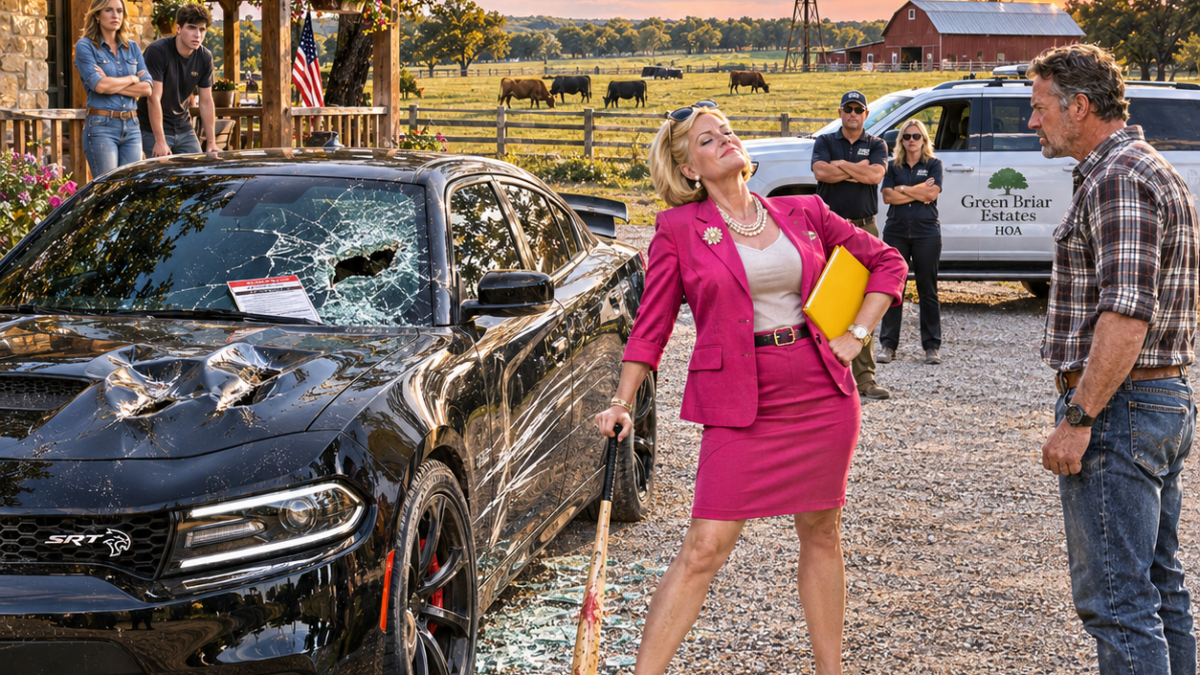
HOA Karen Smashed My Hellcat on My Own Ranch Because It Was “Too Flashy”—She Thought Her Clipboard Made It Legal
She called my dream car an eyesore, then destroyed it while it sat on land her HOA did not even own.
She believed a pink blazer, a yellow folder, and a board title gave her more authority than a property deed.
By sunset, my driveway looked like a crime scene—and HOA Karen was still smiling.
“Your Dodge Charger is an unauthorized eyesore, and I just took care of it for you.”
Those were the first words Victoria Mercer said when I stepped out of my ranch house that evening and saw what she had done to my brand-new black Dodge Charger SRT Hellcat.
For several seconds, I genuinely could not process what I was looking at. The car sat where I had parked it that morning, thirty feet from my front porch, except the driver-side window was shattered, the hood had three deep dents across it, and a pale silver scratch ran nearly the entire length of the passenger side. Broken safety glass glittered on the gravel like ice beneath the fading Texas sun. Victoria stood beside the damage with a baseball bat resting against one hip and a yellow HOA folder tucked proudly beneath her arm, as if she had just finished inspecting landscaping instead of destroying tens of thousands of dollars of private property.
She was wearing a bright pink blazer and matching skirt that looked absurdly expensive for someone standing in ranch dust. Her short blonde hair had survived the afternoon wind better than my windshield had survived her temper. She wore pearl earrings, oversized sunglasses on top of her head, and the expression of a woman who fully expected applause. A white SUV with the Green Briar Estates logo sat halfway across my cattle gate, and behind it stood two nervous-looking HOA volunteers who suddenly seemed deeply interested in the clouds.
I stopped halfway down the porch steps.
My hands went cold.
The Hellcat had taken me almost nine years to buy.
I had wanted one long before I could afford one. During deployment, I kept a photograph of a black Charger taped inside a metal locker, not because I imagined myself becoming rich, but because everybody needs some ordinary thing to picture when life becomes anything but ordinary. Some guys dreamed about boats. One friend wanted a cabin in Montana. Another swore he would eat breakfast at the same diner every morning until he was eighty.
I wanted a black Hellcat.
After coming home, however, wanting something and buying it were two different realities. My father’s health declined. The ranch needed fencing. A tractor transmission failed. Property taxes rose. Cattle prices swung. Every year I told myself, maybe next year.
Then, at fifty-one, after years of setting money aside and telling myself responsibility came first, I finally bought one.
And Victoria Mercer had spent one afternoon attacking it with a bat because she disliked how it looked.
“You did this?” I asked.
She actually laughed.
“Obviously.”
I walked another few steps toward the car. My boots crunched over shattered glass.
Victoria lifted the yellow folder and shook it at me. “I warned you three times, Daniel. This vehicle violates Green Briar’s revised aesthetic standards. Excessive horsepower, modified exhaust appearance, aggressive body styling, dark wheels, oversized hood vents—it’s completely inconsistent with the visual harmony of our community.”
I looked past her at the open pasture stretching nearly a mile behind my house.
Thirty-four cattle grazed beneath the sunset.
A windmill creaked near the south tank.
My nearest neighbor inside Green Briar Estates lived almost three-quarters of a mile east of me.
“My ranch isn’t in your community.”
She gave me the same smile people use when explaining something to a child they consider slow.
“We’ve been over this.”
“No,” I said. “You’ve talked. I’ve disagreed.”
“The board voted.”
“The board can vote that the moon owes dues. It doesn’t make it true.”
One of the HOA volunteers coughed into his fist. Victoria shot him a look sharp enough to make him turn away.
She opened her folder and pulled out a stack of papers. “As of Monday, Green Briar Estates prohibits vehicles that create visual disruption or negatively influence neighborhood property values. Your Charger qualifies under five separate provisions.”
“Those provisions apply to HOA members.”
“They apply to adjacent properties affecting community standards.”
“No, they don’t.”
“They do now.”
That sentence told me more than she probably intended.
I walked slowly around the car.
The rear quarter panel had been keyed. One side mirror hung crooked. A laminated HOA notice had been shoved beneath the damaged wiper. Across the top, in enormous red letters, somebody had printed FINAL ENFORCEMENT ACTION.
For a strange second, I almost laughed.
Not because any of it was funny.
Because the arrogance required to vandalize a man’s car and then leave paperwork explaining why was so extreme that my brain had trouble treating it as reality.
Victoria mistook my silence for surrender.
“I understand you’re upset,” she said, lowering her voice into the artificial tone she used at board meetings. “But responsible communities require consequences. You repeatedly ignored lawful notices. The board authorized self-help enforcement.”
“Self-help enforcement.”
“Correct.”
“So you personally came onto my ranch with a baseball bat.”
“To abate a violation.”
“And smashed my windows.”
“To neutralize the nuisance.”
“You dented the hood.”
“It was necessary.”
“You keyed both doors.”
She hesitated.
Then she lifted her chin. “Cosmetic correction.”
That was when I looked toward the corner of my barn.
A small black security camera pointed directly at us.
Then I looked toward the porch.
Another camera faced the driveway.
A third covered the gate.
And a fourth, mounted beneath the shop eave, had recorded the passenger side of the Charger from less than forty feet away.
Victoria followed my eyes.
Her expression changed.
Not much.
Just enough.
I reached into my pocket, pulled out my phone, and opened the ranch security app.
The afternoon recording was already stored in four synchronized feeds.
I selected the clearest angle.
There she was on-screen, walking through my gate at 4:17 p.m.
There she was circling the Charger.
There she was reading something from her folder.
And there she was raising the bat.
Victoria stopped breathing for a second.
I looked up from the phone.
“You should probably call your lawyer.”
Her confidence flickered.
Then headlights appeared beyond the cattle gate.
Two county patrol vehicles turned onto my ranch road.
Victoria tightened her grip on the yellow folder.
And for the first time that afternoon, HOA Karen looked as though she understood that the next vote would not belong to her board.
**part 2**
The first patrol SUV rolled to a stop near the barn, followed by a second vehicle that parked behind it. Deputy Marcus Hale stepped out of the lead unit. I knew Marcus casually, mostly because rural counties have a way of making strangers into familiar faces. He had handled a loose-cattle complaint on the county road two years earlier and once helped direct traffic when a hay trailer overturned near my north entrance. He was calm, methodical, and almost impossible to impress.
Victoria apparently considered that a challenge.
Before Marcus had even closed his door, she marched toward him holding her folder like diplomatic credentials.
“Officer, thank goodness,” she said. “I’m Victoria Mercer, president of the Green Briar Estates Homeowners Association. This gentleman is becoming hostile over an authorized compliance action.”
Marcus looked at me.
I was standing beside a car with smashed glass everywhere.
Then he looked at her.
She was holding a baseball bat.
His eyebrows moved maybe half an inch.
That was all.
“Ma’am,” he said, “put the bat on the ground.”
Her mouth fell open.
“I’m sorry?”
“The bat. Ground, please.”
“This is HOA property enforcement equipment.”
Even the second deputy looked confused.
Marcus repeated himself.
Victoria lowered the bat as if surrendering a royal scepter. “I hope you understand the context.”
“I’m hoping everybody stops talking for about thirty seconds so I can establish the context.”
That quieted her.
Almost.
Marcus asked who owned the Charger.
“I do.”
“Who damaged it?”
Victoria immediately answered, “The association conducted an abatement.”
Marcus looked at her.
“That wasn’t what I asked.”
She inhaled through her nose. “I performed the physical portion of the enforcement.”
“With the bat?”
“Among other tools.”
The second deputy turned his face away, but I could see the corners of his mouth moving.
Marcus walked around the Charger carefully, photographing the hood, windows, mirror, keyed doors, and glass. He asked me when I had last seen the vehicle undamaged. I told him shortly after noon. He asked when I discovered the damage. I gave him the time from my security alert.
Then I showed him the video.
We watched the first clip together.
Victoria arrived at the gate at 4:17.
She stood beside the sign reading PRIVATE RANCH—NO HOA ACCESS.
She read it.
Then she opened the unlocked pedestrian latch anyway.
One volunteer remained by the SUV. The other followed her for about twenty yards before apparently reconsidering his life choices and stopping.
The camera showed Victoria approaching the Charger, attaching three violation notices to the windshield, stepping back, and waiting.
Nobody came outside.
She checked her watch.
Then she removed a key from her purse.
Marcus paused the video.
He looked at her.
Victoria said, “You have to understand the chronology.”
“I understand the chronology so far.”
He resumed the recording.
The scratch across the passenger side sounded worse through the camera microphone than it had looked in person.
A long metallic shriek.
Victoria actually winced while watching herself do it.
Then came the bat.
The first strike hit the driver-side window.
The second hit the hood.
The third hit the rear glass.
By the fifth swing, one of the HOA volunteers could be seen backing toward the gate.
Marcus stopped the clip again.
“Did Mr. Cole give you permission to enter this property?”
“No, but HOA authority—”
“Did he give you permission to damage the car?”
“Of course not. That would defeat enforcement.”
Marcus stared at her for several seconds.
There is a special kind of silence used by people who are deciding whether an explanation is foolish enough to require clarification.
Victoria filled it.
“Our attorney has repeatedly advised that the association possesses broad nuisance-abatement authority.”
“Did your attorney tell you to smash windows with a baseball bat?”
“He approved decisive action.”
“Those exact words?”
“Well, not exactly.”
“Did he approve a baseball bat?”
“No.”
“A key?”
“No.”
“Property destruction?”
She said nothing.
Marcus nodded slowly. “That’s what I thought.”
Victoria’s young adult son, Evan, had apparently driven over after she called him earlier. He arrived while Marcus was still taking statements and stood near the gate looking pale and embarrassed. I felt bad for him. Whatever I thought of his mother, he had not damaged my car. I deliberately turned away when he covered his face with both hands.
Victoria, however, seemed more offended by embarrassment than by legal consequences.
“You cannot seriously be considering charges,” she said.
Marcus replied, “That decision isn’t based on your HOA title.”
“The vehicle itself is unlawful.”
“That’s a separate issue, assuming it’s an issue at all.”
“It lowers property values!”
Marcus glanced toward my house, barn, cattle pasture, and miles of ranchland.
“From where?”
She pointed east.
“Green Briar.”
Marcus followed her finger.
Nothing from the subdivision was visible except the top of one distant roof.
He looked back at her.
“Ma’am, unless that car is capable of lowering property values by radio transmission, I’m struggling to understand the emergency.”
The second deputy coughed suspiciously hard.
I looked down because I knew if I laughed, Victoria would somehow try to fine me for it.
She did not appreciate Marcus’s humor.
“Are you mocking the association?”
“No. I’m investigating property damage.”
“I expect professional respect.”
“I expect people not to hit cars with bats.”
That ended the debate.
The deputies separated us and took formal statements. I gave them copies of all four video angles directly from the security system. I also emailed the original notification logs showing when each camera had detected motion. Marcus photographed the warning signs at the gate and asked for documents establishing ownership of the ranch.
I had them.
That surprised Victoria.
It should not have.
My family had owned the property for forty-three years.
Green Briar Estates had existed for nine.
The subdivision had been carved out of former grazing land east of my property, but my ranch had never been included in its declaration, never subjected to its covenants, and never consented to annexation.
Victoria knew that because I had sent the documents to the board twice.
Her problem was not ignorance.
Her problem was that she believed repetition could manufacture authority.
The trouble had started six months earlier.
At first, it almost seemed harmless.
Green Briar had elected Victoria president after the previous board chair resigned. She campaigned on “restoring standards,” which sounded ordinary enough until people learned that her definition of standards included regulating patio furniture colors, basketball hoops, garage-door opening times, holiday-light brightness, and the number of decorative pumpkins allowed on front porches.
One homeowner received a warning because his pumpkins were “asymmetrically arranged.”
Another was cited because a garden gnome allegedly created “visual clutter inconsistent with neighborhood elegance.”
The gnome became famous.
Someone gave it a tiny sign reading FINE ME.
Victoria did.
Twenty-five dollars.
When I heard that story, I laughed.
I should have realized I would eventually become part of the same circus.
The first letter I received from Green Briar concerned my cattle.
It informed me that visible livestock produced “rural visual inconsistency” and requested that I install privacy fencing along approximately 2,100 feet of my eastern boundary.
I mailed back a copy of my deed and a polite note.
My property is not subject to Green Briar Estates restrictions.
Two weeks later, I received another letter.
This one called my barn “architecturally incompatible.”
Then came a notice about my tractor.
Then hay bales.
Then my windmill.
I started saving everything.
That habit came from the military and from my father, though each taught it differently.
The military taught me that if something matters, document it.
My father put it more simply.
“Paper beats memory.”
So I built a file.
Every letter.
Every envelope.
Every email.
Every photograph.
Every date.
When Victoria called, I wrote down what she said.
When she left a voicemail, I saved it.
When HOA volunteers appeared at my gate, I recorded them from the porch cameras.
For months, nothing truly dangerous happened.
It was annoying.
Absurd.
Occasionally hilarious.
Victoria once sent me a violation notice because my tractor was orange.
Not rusty.
Not leaking oil.
Orange.
Her letter claimed the color had “industrial visual characteristics inconsistent with residential serenity.”
I called the tractor dealership and asked whether John Deere offered a serenity package.
The salesman went silent.
Then he laughed so hard he had to put me on hold.
Still, I never assumed Victoria would cross the line from paperwork into physical destruction.
That was my mistake.
Three weeks before she attacked the Hellcat, I received the first vehicle notice.
The car had barely five hundred miles on it.
I had parked it near the barn after taking it into town for groceries.
The next morning, a white envelope was taped to my gate.
The notice accused me of maintaining a “highly aggressive performance vehicle visible from HOA-controlled areas.”
I stood there reading it twice.
Then I looked east toward Green Briar.
I could not even see the subdivision entrance from where I stood.
I called the HOA office.
Victoria answered.
“Green Briar Estates, office of community compliance.”
“This is Daniel Cole.”
Her voice changed immediately.
“Mr. Cole. Have you received our vehicle notice?”
“I have.”
“Good. Then we understand each other.”
“I don’t think we do.”
She sighed.
“What part is unclear?”
“The part where you think you regulate vehicles on property outside your HOA.”
“Our legal authority extends to external nuisances.”
“My parked car is not a nuisance.”
“It is visually disruptive.”
“To who?”
“Our residents.”
“Can they see it?”
“That is irrelevant.”
I remember smiling into the phone.
“It feels unusually relevant.”
Her voice hardened.
“The board does not need your sarcasm.”
“And I don’t need your notices.”
“You’re creating unnecessary conflict.”
“No, Victoria. You’re mailing rules to people who never agreed to them.”
“We’ll see about that.”
Then she hung up.
The second notice arrived six days later.
It imposed a $750 “external aesthetic impact assessment.”
I returned it marked DISPUTED—NO JURISDICTION.
The third notice threatened towing.
That one concerned me.
Not because I believed she had legal towing authority, but because people who are convinced they possess power sometimes behave as though consequences are imaginary.
I moved the Hellcat farther onto the ranch.
I also added another security camera.
That decision probably saved me thousands of dollars in litigation.
By the time Deputy Hale finished reviewing the recordings on the evening of the vandalism, the sunset had disappeared and the yard lights had come on.
Victoria was still arguing.
She had moved from confidence to technicalities.
“I did not intend criminal damage.”
Marcus looked at the broken windows.
“What did you intend?”
“Compliance.”
“With a bat?”
She closed her eyes.
“The bat was symbolic.”
“You swung it five times.”
“It became less symbolic.”
I bit the inside of my cheek.
Marcus remained professional, though I could tell even he was reaching the limits of his ability to treat her statements as serious legal arguments.
He asked Victoria whether she had anything in writing authorizing destruction of my vehicle.
She produced the board resolution.
I read it over his shoulder.
It authorized the HOA president to “take all lawful measures necessary to address unresolved exterior nuisance violations affecting Green Briar Estates.”
The important word was lawful.
Nothing in it authorized trespass.
Nothing authorized vandalism.
Nothing mentioned my ranch.
Nothing mentioned my car.
Marcus folded the paper and handed it back.
“This doesn’t say what you think it says.”
Victoria’s face reddened.
“It gives me enforcement discretion.”
“Lawful enforcement discretion.”
“Exactly.”
“Damaging someone’s car isn’t made lawful because you put the word enforcement in front of it.”
For the first time, she had no immediate answer.
Marcus spoke with the second deputy, then returned and explained that they had probable cause to take enforcement action based on the recordings, the visible damage, and her own admissions. The exact charging decision would ultimately go through the prosecutor’s office, and the dollar value of the damage would matter significantly under state law.
Victoria looked offended by the idea that actual law had entered the conversation.
“This is outrageous.”
I finally spoke.
“Yes.”
She turned toward me.
“I wasn’t talking to you.”
“I know.”
That irritated her even more.
When the deputies escorted her toward the patrol vehicle, she twisted around and pointed at me.
“You will regret escalating this.”
Marcus stopped walking.
“Ma’am.”
She ignored him.
“You think this is over because you have cameras? Green Briar has attorneys. We have insurance. We have enforcement mechanisms you don’t understand.”
Marcus opened the patrol door.
“Please stop helping the prosecution.”
The second deputy stared at the ground.
I laughed that time.
I could not help it.
Victoria climbed into the vehicle with the expression of someone being forced to travel economy after purchasing first class.
Her pink blazer disappeared behind the closing door.
The yellow HOA folder went with her.
The baseball bat stayed behind as evidence.
I stood beside my ruined Hellcat long after the deputies left.
That was when the humor disappeared.
I ran my fingertips carefully above the long scratch on the passenger door without touching it.
For months, I had imagined that car differently.
I remembered the first day I brought it home.
The salesman handed me the keys, and I sat behind the wheel for almost ten minutes before starting the engine.
Not because I did not know what to do.
Because I wanted to remember the moment.
People who have never spent years postponing something may not understand that feeling.
The car was not proof that I was wealthy.
I was not.
It was proof that sometimes patience eventually gives something back.
When I finally drove it onto the ranch, I parked beside the same porch where my father used to drink coffee every morning. He had been gone almost four years by then.
I remember wishing he could have seen it.
He would have complained about the fuel economy.
Then he would have asked for the keys.
Standing there beside shattered glass, I felt something deeper than anger.
I felt violated.
Victoria had not merely damaged an object.
She had walked onto the one place in the world where I felt completely at peace and decided her preferences outranked my ownership.
That mattered.
The next morning, I called my insurance company and then a performance-body specialist in Fort Worth recommended by the dealership.
The preliminary repair estimate was ugly.
New glass.
Bodywork.
Paint correction.
Mirror replacement.
Hood repair.
Interior cleaning because glass had scattered through the cabin.
Possible trim damage.
Potential water-seal concerns.
The first estimate came in at just over $22,000.
The final number would later rise.
I also called attorney Rachel Mendoza.
Rachel had handled a boundary dispute for a neighboring ranch family and had a reputation for doing something rare in civil law.
She listened before she spoke.
I explained everything.
She asked three questions.
“Are you inside the HOA?”
“No.”
“Did you ever sign anything agreeing to their covenants?”
“No.”
“Do you have the original video files?”
“Four angles.”
There was a pause.
Then she said, “Do not communicate directly with Victoria anymore.”
“That bad?”
“For her? Potentially.”
Rachel asked me to send every document Green Briar had mailed over the previous six months.
When she received the file, she called again.
“This is not just about the car.”
“I figured.”
“They’ve been attempting to assert regulatory authority over property outside their declaration. The vehicle destruction is dramatic, but the paper trail may be more important for stopping this permanently.”
That sentence changed my focus.
Until then, I had been thinking about the Hellcat.
Rachel was thinking about the ranch.
Two days later, she drove out with a legal assistant and spent almost three hours at my kitchen table.
We arranged the HOA correspondence chronologically.
Cattle notice.
Barn notice.
Tractor notice.
Windmill notice.
Vehicle notice.
Assessment.
Towing threat.
Then the so-called enforcement resolution.
Rachel kept tapping one document with her pen.
“Look at the language.”
I did.
GREEN BRIAR ESTATES COMMUNITY IMPACT ZONE.
“They invented a zone,” I said.
“Apparently.”
“Can they do that?”
“They can call something whatever they want. That doesn’t make it legally binding.”
She leaned back.
“The question is whether they have been using this language against anybody else.”
We found out quickly.
Within a week, four property owners east and north of Green Briar contacted Rachel after hearing about Victoria’s arrest.
None belonged to the HOA.
All had received notices.
One man had been fined for a metal workshop.
A widow named Eleanor Price had received repeated demands to repaint her mailbox because Green Briar considered the faded blue color visible from a subdivision walking path.
Another ranch owner had been threatened over trailers parked behind his barn.
And a retired mechanic named Carl Jennings had received a letter ordering him to remove a 1968 pickup from his property because it supposedly created “vehicular blight.”
Carl’s truck was fully restored.
It was worth more than Victoria’s SUV.
When I met him, he handed me the HOA letter and said, “They called this blight.”
He pointed toward the truck.
It gleamed like polished copper.
I stared at it.
“Maybe they’re allergic to horsepower.”
Carl nodded seriously.
“Could be.”
Then he grinned.
The story spread through the area faster than I expected.
I did not post anything online.
I did not need to.
Green Briar residents had already started talking.
One of the volunteers who had accompanied Victoria that afternoon resigned from the compliance committee and gave a written statement confirming that she had planned the confrontation in advance.
That statement mattered.
According to him, the original plan had been to photograph the car, place notices on it, and arrange for a towing company to issue a warning.
But the towing company refused.
The dispatcher had apparently asked for proof that the HOA had authority over my property.
Victoria had none.
That should have ended it.
Instead, she became furious.
At an emergency board meeting that afternoon, she allegedly said, “If contractors are too cowardly to enforce standards, I’ll enforce them myself.”
One board member objected.
Another left early.
Nobody formally approved property destruction.
Victoria went home.
Then she returned with a bat.
The board’s panic after her arrest was almost impressive.
Within forty-eight hours, Green Briar issued a public statement saying Victoria had acted outside the scope of her authority.
That wording amused Rachel.
“Interesting.”
“What?”
“They’re trying to create distance.”
“Can they?”
“They can try.”
The board removed Victoria as president pending investigation.
Then they suspended the entire external compliance program.
Then they claimed they had never intended the program to apply beyond lawful limits.
Rachel read that sentence aloud in my kitchen.
I nearly choked on my coffee.
“They mailed me six months of letters.”
“Yes.”
“They threatened towing.”
“Yes.”
“They created a community impact zone.”
“Yes.”
“And now they’re saying they never intended to regulate outside the HOA?”
Rachel smiled.
“Welcome to litigation.”
My criminal case involvement was simpler.
I was the complaining witness.
The prosecutor’s office reviewed the security footage, damage estimates, trespass evidence, and Victoria’s recorded statements to deputies. The actual criminal charge depended on the final assessed loss and applicable state thresholds, so Rachel warned me not to repeat dramatic labels I had heard neighbors using.
“Call it what it is,” she said. “Intentional property damage. Let the prosecutor choose the statute.”
That made sense.
I wanted justice.
I did not need exaggeration.
Victoria, meanwhile, hired a lawyer.
A serious one.
His first move was sensible.
He told her to stop talking publicly.
Her first move was to ignore him.
At the next Green Briar board meeting, she appeared during homeowner comments wearing a white blazer instead of pink and carrying a binder thick enough to stop a door.
Someone recorded the meeting.
Victoria declared herself the victim of a “coordinated anti-HOA intimidation campaign.”
A homeowner asked whether the campaign had forced her to bring a baseball bat onto my ranch.
The room erupted.
Victoria demanded order.
She was no longer president.
Nobody gave it to her.
Then Carl Jennings walked up to the microphone.
He did not live in Green Briar.
A resident had invited him.
Carl held up the letter calling his restored pickup vehicular blight.
“I drove my blight here tonight,” he said.
People laughed.
“It’s parked next to Mrs. Mercer’s SUV.”
More laughter.
“Mine won best restoration at the county show.”
By then Victoria looked physically offended by oxygen.
Carl continued.
“So if anybody wants to compare property values, I brought the appraisal.”
That video circulated for days.
I watched it once.
Then twice.
The third time, I showed it to Rachel.
She said, “Stop enjoying opposing evidence.”
“I’m not enjoying the evidence.”
“You’re smiling.”
“I’m enjoying Carl.”
The civil case took shape over the next several weeks.
My insurer covered much of the immediate repair process, but that did not erase Victoria’s potential responsibility. Rachel pursued the portions not covered, diminished-value issues where applicable, incidental losses, and claims related to intentional damage and trespass. She also sent formal demands regarding Green Briar’s repeated attempts to impose restrictions on my ranch.
The HOA hired separate counsel.
That lawyer, Thomas Avery, was much more careful than Victoria.
He called Rachel within days.
Their first conversation lasted nearly an hour.
Afterward, Rachel phoned me.
“They want to settle the jurisdiction issue.”
“What does that mean?”
“They’ll formally acknowledge your ranch is outside Green Briar, withdraw all notices, cancel every purported assessment, and agree not to attempt enforcement against your property.”
“That should have happened six months ago.”
“Yes.”
“What about the damage?”
“They’re taking the position that Victoria acted personally.”
“Convenient.”
“Very.”
The legal battle became less cinematic after that.
Movies make lawsuits look like courtroom speeches.
Real disputes are mostly documents.
Emails.
Depositions.
Photographs.
Repair invoices.
Insurance letters.
Recorded minutes.
Declarations.
Arguments about wording.
Deadlines.
More deadlines.
And lawyers asking questions they already know the answers to because they need the answers formally recorded.
But those quieter stages were where Victoria’s story started collapsing.
During her deposition, Rachel asked whether she believed my ranch belonged to Green Briar.
Victoria said the issue was “legally ambiguous.”
Rachel produced the recorded subdivision plat.
The boundary was not ambiguous.
She asked whether I had signed Green Briar’s covenants.
Victoria admitted I had not.
She asked whether the HOA had ever possessed a recorded easement granting enforcement authority over my property.
No.
Whether any court had issued an order allowing Green Briar to regulate the ranch.
No.
Whether any governmental agency had delegated nuisance enforcement to the HOA.
No.
Whether the board had authorized her to damage my Charger.
Victoria shifted in her chair.
“The board expected results.”
“That was not my question.”
“No.”
“Did the board authorize you to enter Mr. Cole’s ranch?”
“Not specifically.”
“Did the association attorney advise you to enter?”
“No.”
“Did the association attorney advise you to damage the vehicle?”
“No.”
“Did the association attorney advise you to bring a baseball bat?”
“No.”
Rachel paused.
“Whose idea was the bat?”
Victoria looked directly at her.
“Mine.”
That single word probably cost her more than the entire pink suit.
The funniest part came later.
Rachel asked why Victoria considered the Hellcat an aesthetic threat.
Victoria began explaining performance styling, black paint, hood vents, wheel design, and what she called “visual aggression.”
Rachel placed a photograph on the table.
It showed Victoria’s own SUV.
Large.
Black.
Tinted windows.
Twenty-two-inch wheels.
Chrome trim.
Rachel asked, “Would you describe your vehicle as visually aggressive?”
“No.”
“Why not?”
“It’s a luxury SUV.”
“So price changes aggression?”
“No.”
“Color?”
“No.”
“Wheel size?”
“No.”
“Hood design?”
“No.”
Rachel leaned forward.
“Then what exactly made Mr. Cole’s vehicle unacceptable?”
Victoria answered, “It looked like the kind of car people race.”
“Did you ever see Mr. Cole racing it?”
“No.”
“Did you ever measure excessive noise from it?”
“No.”
“Did you receive a verified complaint about noise?”
“I received concerns.”
“Written complaints?”
“No.”
“Emails?”
“No.”
“Names?”
“I don’t remember.”
“Dates?”
“I don’t remember.”
Rachel let the silence sit there.
Then she asked, “So the documented basis for destroying his car was that you disliked how it looked?”
Victoria’s lawyer objected.
But the damage was already done.
The Hellcat came back from the repair shop eleven weeks after the vandalism.
The shop had done beautiful work.
The paint matched perfectly.
The glass was new.
The dents were gone.
The keyed panels had been refinished.
The damaged mirror had been replaced.
The interior had been cleaned down to seams I did not know existed.
When the service manager pulled the car into the sunlight, I walked around it twice.
He handed me the keys.
“Better than when it arrived.”
“That’s not difficult.”
He smiled.
“Better than when you bought it.”
That might have been true.
I sat behind the wheel.
The cabin smelled new again.
For a moment I remembered the broken glass.
Then I pressed the ignition.
The engine came alive.
I laughed.
It was the first time since Victoria’s attack that the sound did not remind me of conflict.
It sounded like mine again.
I drove home slowly.
When I reached the ranch entrance, I noticed something attached to the fence.
A new sign.
Carl had installed it while I was gone.
It read:
VEHICULAR BLIGHT PARKING ONLY.
Underneath, in smaller letters:
GARDEN GNOMES WELCOME.
I called him.
“You’re an idiot.”
“Looks good, doesn’t it?”
“I’m leaving it up.”
“I knew you had taste.”
That sign stayed for six months.
Green Briar residents started taking pictures beside it.
One woman brought the famous fined garden gnome.
Someone placed it beneath the sign wearing tiny sunglasses.
Even Rachel took a photograph, though she made me promise never to use it in court.
The humor mattered more than I expected.
Anger can become heavy when you carry it too long.
The jokes reminded me that Victoria did not own the emotional meaning of what happened.
She had damaged my car.
She did not get to damage everything around it.
The criminal case resolved before the civil claims.
I will not pretend it happened with dramatic courtroom shouting.
It did not.
Her lawyer negotiated.
The prosecutor had strong evidence.
Victoria faced the reality that four video angles and her own statements made denial nearly impossible.
She ultimately accepted responsibility through the criminal process rather than forcing a trial, with penalties determined by the court under the applicable property-damage provisions.
She was ordered to comply with restitution obligations tied to the verified financial loss.
There were additional conditions.
She also had to stay off my property.
That part was unnecessary.
Victoria had developed a remarkable respect for my fence.
The first time I saw her after the case resolved was outside the county courthouse.
She stood near the steps wearing sunglasses despite an overcast sky.
Her attorney spoke quietly beside her.
I was walking toward the parking lot when she called my name.
“Daniel.”
Rachel touched my arm.
“You don’t have to stop.”
I did anyway.
Victoria approached but kept several feet between us.
For once, she had no folder.
No clipboard.
No notices.
No board members behind her.
She looked smaller without the administrative machinery.
“I hope you’re satisfied,” she said.
I considered that.
“No.”
She seemed surprised.
“You destroyed my property. You tried for months to claim authority you didn’t have. You threatened my ranch. You made other people afraid they had to obey rules they never agreed to. Watching you face consequences doesn’t make any of that satisfying.”
Her expression hardened.
“Then what do you want?”
“I wanted you to leave me alone.”
“That’s all?”
“That was always all.”
She looked toward the parking lot.
“My reputation is ruined.”
I did not answer.
“My neighbors treat me like I’m some kind of criminal.”
I still said nothing.
“I lost my board position.”
“That was the board’s decision.”
“My consulting firm terminated my contract.”
“That was their decision.”
She turned back toward me.
“You started all this.”
Rachel stepped forward slightly.
I shook my head.
“No, Victoria. You started it when you walked through my gate.”
That landed.
For several seconds, neither of us spoke.
Then she said something I never expected.
“I thought you would back down.”
There it was.
Not an apology.
Not remorse.
But truth.
I nodded.
“I know.”
She had never believed she was legally right.
Not completely.
She had believed pressure would work.
Letters.
Fines.
Threats.
Towing notices.
Board language.
Official-looking stationery.
She expected the appearance of authority to become authority if she pushed hard enough.
When none of that worked, she escalated.
And the moment she picked up that bat, the illusion collapsed.
The civil dispute settled several months later.
The exact financial terms were subject to confidentiality provisions in parts, but the important public components were clear.
Green Briar Estates formally acknowledged that my ranch was not subject to its declaration.
Every assessment issued against me was withdrawn.
Every violation notice was rescinded.
The association agreed not to enter my property for enforcement purposes without lawful authorization.
It discontinued the so-called Community Impact Zone.
Other non-member landowners received withdrawal letters as well.
The HOA also revised its enforcement policies and required actual legal review before asserting authority beyond recorded community boundaries.
As for Victoria, she bore substantial personal financial responsibility connected to the damage she caused.
Between insurance consequences, restitution obligations, legal fees, and civil exposure, destroying my Hellcat became far more expensive than simply disliking it.
The final repair-related figure alone was close to $28,000 when all documented damage and associated costs were counted.
She had spent less than ten minutes swinging a bat.
She spent months paying for those minutes.
That seemed fair.
Green Briar held new board elections.
I did not attend.
I had no interest in becoming involved in their internal politics.
But Carl attended as a guest.
Of course he did.
He called me afterward.
“They elected the pumpkin lady.”
“What pumpkin lady?”
“The woman Victoria fined for asymmetric pumpkins.”
I laughed.
“She ran?”
“Won by a landslide.”
“What was her platform?”
“Apparently not smashing cars.”
“Strong policy.”
Carl lowered his voice dramatically.
“She brought the gnome.”
I closed my eyes.
“Of course she did.”
According to Carl, the new president opened the meeting by placing the famous garden gnome on the table and announcing that Green Briar would return to “reasonable governance.”
Someone had taped a tiny paper badge to the gnome reading COMPLIANCE DIRECTOR.
That story reached me before the official apology did.
The written apology arrived two days later.
It acknowledged that prior communications sent to me had improperly suggested HOA authority over my ranch.
It expressed regret for the escalation.
It confirmed that no current or future HOA rule would be applied to my property absent a lawful recorded basis.
I read it once.
Then I placed it in my father’s old filing cabinet.
Paper beats memory.
Six months after the vandalism, Victoria listed her house.
I did not know why.
Maybe legal costs.
Maybe embarrassment.
Maybe she simply could not stand driving past neighbors who remembered the bat.
Her house sold quickly.
On moving day, I happened to be hauling fencing supplies along the county road when I saw the truck.
Victoria stood near the curb directing movers.
She noticed the Hellcat.
I noticed her noticing it.
The car was spotless.
Black paint shining.
Windows perfect.
Not a scratch anywhere.
I slowed for the intersection.
She stared at me.
I raised two fingers from the steering wheel.
Not a wave exactly.
Just acknowledgment.
Her expression tightened.
Then something ridiculous happened.
One of the movers rolled a hand truck down the driveway.
A cardboard box slipped sideways, hit the pavement, and burst open.
Yellow HOA folders scattered across the lawn.
Dozens of them.
Victoria froze.
The wind caught three.
One blew under the moving truck.
Another sailed into a hedge.
The third skittered directly into the street.
I pulled over because laughing while driving is irresponsible.
The mover chased the papers.
Victoria chased the mover.
Her expensive shoe sank into soft landscaping beside the curb.
She jerked it free, stumbled forward, and nearly lost her balance.
Nothing dangerous happened.
Nothing cruel.
It was simply the universe producing the most perfectly timed visual metaphor I had ever witnessed.
Months of paperwork.
Months of invented authority.
Months of yellow folders.
Now they were blowing down the road while she tried desperately to catch them.
Carl would later insist I should have helped.
I told him I had considered it.
“What stopped you?”
“I’m outside the Community Impact Zone.”
He laughed for almost a minute.
Victoria moved away that afternoon.
Green Briar became quieter afterward.
The new board removed several unnecessary rules and created a written complaint process requiring actual evidence before enforcement.
They stopped bothering surrounding landowners.
The pumpkin arrangement restrictions disappeared.
Garden gnomes returned.
Carl’s truck remained vehicular blight.
My cattle remained rurally inconsistent.
My tractor remained offensively orange.
And my Hellcat remained exactly where I wanted it.
Sometimes beside the barn.
Sometimes under the shade structure near the house.
Sometimes pointed toward an empty ranch road at sunset when I felt like driving with no destination.
People occasionally asked whether I regretted buying such an expensive car after what happened.
Never.
If anything, the experience changed what the car meant to me.
At first, it represented patience.
Something I had postponed until I could afford it without neglecting responsibilities.
After Victoria damaged it, it represented something else too.
Boundaries.
Not HOA boundaries.
Personal ones.
The line between somebody disliking your choices and believing they have the right to control them.
Most conflicts never become dramatic.
Most overreach begins with something small.
A letter.
A notice.
A demand phrased as a rule.
A person saying, “You have to,” when what they really mean is, “I want you to.”
That distinction matters.
I had not defeated Victoria because I was louder.
I was rarely louder.
I did not threaten her.
I did not retaliate against her property.
I did not stand outside her house.
I did not create a social-media campaign.
I saved documents.
I installed cameras.
I knew where my property lines were.
I hired competent counsel.
I let her own decisions become evidence.
That was enough.
The emotional part took longer.
For several months after the attack, whenever a vehicle slowed near my gate, I noticed.
Whenever I heard gravel crunch unexpectedly, I looked toward the driveway.
That bothered me more than I admitted.
The ranch had always been the place where I relaxed.
Victoria introduced suspicion into it.
Rachel once asked whether I wanted to pursue additional claims related to emotional distress.
I declined.
Not because the experience had been harmless.
Because I did not want my peace measured in legal arguments.
I wanted to rebuild it privately.
So I did.
I replaced the damaged gate latch.
I upgraded the security system.
I repainted part of the barn.
I fixed a section of fence I had been postponing.
I planted two live oaks near the driveway.
And one evening, about a year after Victoria first sent me that ridiculous vehicle notice, I parked the Hellcat near the western pasture and sat on the hood while the sun dropped toward the horizon.
The sky turned gold first.
Then orange.
Then deep purple.
Cattle moved slowly through the grass.
The windmill creaked.
Somewhere near the creek, a night bird called.
There were no HOA notices on my windshield.
No white SUV at the gate.
No pink blazer.
No yellow folder.
Just my land.
My car.
My evening.
Carl arrived ten minutes later in his restored 1968 pickup.
He parked beside me.
We sat without talking for a while.
Then he looked at the Hellcat.
“Still ugly.”
“Terrible.”
“Property values must be collapsing.”
“Catastrophic.”
He nodded toward his truck.
“Mine too.”
“Especially yours.”
We watched the sunset.
After a minute, Carl said, “You know what bothers people like Victoria most?”
“What?”
“They can’t understand why everybody doesn’t want the same life they do.”
I thought about that.
Maybe he was right.
Victoria had looked at my ranch and seen disorder because it did not resemble Green Briar.
She saw cattle instead of ornamental landscaping.
A metal barn instead of matching brick.
A tractor instead of a golf cart.
A Hellcat instead of an approved luxury crossover.
To her, difference itself was a violation.
That had been the heart of the conflict from the beginning.
Not noise.
Not safety.
Not property values.
Control.
She could tolerate almost anything as long as she had approved it.
I looked across four thousand acres that existed long before Green Briar Estates and would hopefully remain long after every current board member was gone.
“I think she picked the wrong ranch.”
Carl smiled.
“No.”
He pointed toward the Charger.
“She picked the wrong camera system.”
I laughed.
That was probably more accurate.
A few weeks later, Green Briar invited surrounding property owners to a community barbecue as part of what the new board called a neighborhood reset.
I almost declined.
Then I decided avoiding them would give Victoria more influence over my life than she deserved.
So I went.
I drove the Hellcat.
Not to make a statement.
Mostly.
When I pulled into the subdivision clubhouse parking lot, conversations stopped for about two seconds.
Then somebody applauded.
I wished they had not.
Then someone else joined.
Then Carl started clapping dramatically with both hands above his head.
“Stop,” I told him.
He clapped harder.
The former pumpkin offender, now HOA president, walked over laughing.
Her name was Susan Miller.
“I promise we are not issuing a vehicle citation.”
“I appreciate the restraint.”
She handed me a paper plate.
“No forms tonight.”
“Even better.”
Near the clubhouse entrance sat the garden gnome.
It now wore a tiny pink blazer.
I stared at it.
Susan followed my eyes.
“That was not my idea.”
“Carl?”
“Obviously.”
Carl appeared behind us.
“It needed historical context.”
I looked at him.
“You have too much free time.”
“I’m retired.”
Susan shook her head.
The barbecue was ordinary.
That was what made it meaningful.
People ate brisket.
Children played cornhole on the grass.
Neighbors argued about football.
Nobody discussed architectural harmony.
Nobody inspected wheel sizes.
Nobody measured pumpkin symmetry.
For the first time since Green Briar had started mailing me notices, the subdivision felt like what it should have been all along.
A collection of homes.
Not a tiny government at war with individuality.
Susan eventually asked whether I would consider giving the board feedback on its new external-property policy.
“I don’t belong to the HOA.”
“That’s exactly why I’m asking.”
I read the policy later.
It was one page.
Simple.
Green Briar would not issue violation notices, fines, threats, demands, or enforcement actions against property owners outside the recorded association unless a specific legal right existed and counsel confirmed it.
I called Susan.
“This policy is boring.”
She sounded worried.
“Is that bad?”
“No. It’s perfect.”
That was the final irony.
Good governance is usually boring.
No dramatic folders.
No invented zones.
No bat-wielding enforcement.
Just clearly defined authority and people respecting the limits of it.
Victoria had believed leadership meant making everyone feel her presence.
Susan understood that good leadership often meant people barely noticed the board existed.
Years later, the security clip remained backed up on two drives.
I did not watch it anymore.
There was no reason.
The damage had been repaired.
The legal issues had been resolved.
The ranch was protected.
But I never deleted it.
Not because I wanted revenge preserved in digital form.
Because it reminded me of something important.
At 4:17 that afternoon, Victoria walked through my gate convinced I would surrender.
At 4:26, she began destroying my car.
By the time I came outside, she believed the story was already finished.
She thought the broken windows were the ending.
She thought the scratches were proof of authority.
She thought humiliation would force me into compliance.
She never understood that consequences often begin at the exact moment an arrogant person believes they have won.
I did not need to smash anything in return.
I did not need to destroy her reputation.
I did not need to chase her out of the neighborhood.
All I had to do was preserve the truth long enough for other people to see it.
The cameras did that.
The documents did that.
The property records did that.
Her own words did that.
And eventually, the law did the rest.
Today the Hellcat still sits on my ranch.
It has more miles now.
A few ordinary rock chips.
One tiny scratch near the rear bumper that I caused myself backing too close to a tool cart.
That scratch makes me laugh.
Nobody fined me.
Nobody convened an emergency board meeting.
Nobody declared a community aesthetic crisis.
I simply touched it up.
That is how normal people handle imperfections.
Sometimes, around sunset, I drive out past the west pasture and open the throttle just enough to hear the engine echo across land my family has worked for decades.
The sound travels over cattle grass, fence lines, stock tanks, and the old windmill.
Then it disappears into open sky.
Green Briar is somewhere beyond the eastern ridge.
I rarely think about Victoria anymore.
But when I do, I remember her standing in my driveway in that bright pink blazer, one hand gripping a yellow folder, the other near the bat, staring at my phone as the security video played.
That was the moment everything changed.
Not when the deputies arrived.
Not when the board removed her.
Not when lawyers got involved.
Not when the court imposed consequences.
The real turning point happened when she realized the story belonged to evidence instead of her authority.
She had spent months trying to convince me that her title made her powerful.
In the end, four little cameras attached to an old ranch house proved otherwise.
My car came back.
My money came back through the legal process.
My property rights were formally recognized.
The neighboring landowners got their notices withdrawn.
Green Briar changed its policies.
And Victoria lost the one thing she had valued more than any rule she ever enforced.
Control.
She tried to make me ashamed of owning a car she did not approve of.
Instead, every dent she caused became part of the record against her.
She tried to use the HOA to make my ranch smaller.
Instead, the settlement drew the boundary more clearly than ever.
She tried to prove she could decide what belonged on my property.
In the end, the only thing permanently removed from the landscape was her authority.
The night she moved away, I drove the Hellcat home beneath a purple Texas sky.
I passed the Green Briar entrance without slowing.
Beyond it, porch lights flickered on one by one.
Ahead of me, my ranch gate stood open.
The ridiculous VEHICULAR BLIGHT sign was still hanging from the fence.
The garden gnome sat underneath it wearing sunglasses.
I parked beside the barn, stepped out, and listened as the engine ticked softly while cooling.
No shouting.
No notices.
No threats.
Just quiet.
I looked across the pasture toward the darkening horizon and thought about my father’s old rule.
Paper beats memory.
He had been right.
But I had learned another one.
Evidence beats arrogance.
And on my ranch, arrogance had finally run out of road.








