HOA Karen Sent Two Fake Cops to Fine My Wife Over a Rose Bush—Then One of Them Slapped Her
part 2
My name is Michael Hayes.
I was fifty-one that fall, married to Claire for twenty-three years, and living in Cedar Glen for almost eleven of them.
I did serve in the Navy.
I did earn the trident tattoo the short man noticed.
And I had spent enough time in difficult places to know that the worst thing you can do when adrenaline hits is convince yourself that being capable of violence means violence is your best option.
It almost never is.
By the time I left active service, I wanted less excitement, not more.
Claire wanted the same.
We bought our house at the end of a quiet cul-de-sac because the backyard backed into a greenbelt and the street had almost no through traffic.
The HOA existed when we moved in.
For the first several years, it was mostly harmless.
Dues paid for entrance landscaping, common-area lights, stormwater maintenance, and a small playground.
Board meetings were boring.
That was a good thing.
Then Karen Whitmore became president.
Karen was forty-seven when she first ran.
Blonde bob.
Large sunglasses.
Pearl earrings.
Always carrying a binder.
She had the unnerving ability to speak about paint samples as if national security depended on them.
At first, people thought her energy was useful.
The previous board had become sloppy.
Contracts renewed without bidding.
Common areas looked tired.
Storm drains needed maintenance.
Karen fixed things.
That bought her trust.
Then the letters started.
Trash bins left visible for three hours after pickup.
Mailboxes painted the wrong shade of black.
Holiday decorations installed before the approved date.
Children’s basketball hoops visible from the street.
Garden flags.
Patio umbrellas.
One neighbor received a warning because his dog barked during what Karen described as “community quiet restoration hours.”
Nobody knew what that meant.
Karen did.
She had written it.
Claire disliked her almost immediately.
Not because Claire opposed rules.
My wife is one of the most organized people alive.
She labels freezer containers.
She keeps tax receipts by quarter.
She once created a spreadsheet for Thanksgiving leftovers.
What bothered her was Karen’s tone.
The assumption that rules existed not to organize shared property but to establish obedience.
The rose bushes became an issue in early November.
Our house had four mature rose plants along the driveway.
The original homeowner planted them decades earlier.
Every fall, Claire pruned the dead wood.
That year, Karen sent a new landscaping bulletin requiring approval for “material exterior vegetation modifications visible from common areas.”
Claire read it at breakfast.
“Material vegetation modification?”
I looked over my coffee.
“Sounds painful.”
“It says pruning requires approval.”
“Major pruning?”
“All pruning.”
“That’s ridiculous.”
Claire highlighted a line.
“Photos required before and after.”
I laughed.
She didn’t.
“Karen is going to make people request permission to trim dead flowers.”
“Then don’t.”
Claire looked at me.
“What?”
“Don’t request permission.”
Her eyebrow rose.
“I like this version of you.”
“Our covenants don’t require approval for routine maintenance.”
“You read them?”
“After the mailbox incident.”
The mailbox incident involved Karen trying to fine Mr. Benson $350 because he replaced a rusted number plate with one nearly identical to the old one.
I helped him read the actual architectural rules.
The fine disappeared.
Karen remembered that.
Two weeks later, the board announced a new Community Compliance Initiative.
That was when the fake officers appeared.
Karen called them “community enforcement personnel.”
The board minutes described them as contract compliance inspectors.
Those descriptions were very different from how the men presented themselves.
They wore uniforms.
Badge-shaped emblems.
Radios.
Utility belts.
Their sedan had magnetic door signs.
CEDAR GLEN COMMUNITY ENFORCEMENT
From a distance, it looked official.
That was intentional.
The first time I saw them, they were standing outside Mrs. Ellison’s house photographing her recycling bins.
I walked over.
“Who are you guys?”
The taller man answered.
“Community enforcement.”
“Police?”
“No.”
“County?”
“No.”
“Code enforcement?”
“We work with the HOA.”
That answer told me everything.
“Private security?”
“Compliance.”
He said it like repeating the word made it a legal category.
I asked for company identification.
They gave me the name:
Harbor Civic Services.
I searched it later.
The company was registered six months earlier.
Its website advertised property patrol, HOA compliance observation, parking enforcement support, and community presence services.
No police powers.
No government authority.
Nothing inherently illegal about the business.
Private associations can hire people to document rule violations.
The problem was presentation.
They wanted residents to think twice before questioning them.
Mirrored sunglasses.
Badge patches.
Radios.
Official language.
Karen loved them.
Within weeks, complaints spread.
One resident said they entered his backyard after a gate had been left unlocked.
Another said they photographed through his garage window.
Mrs. Palmer, a seventy-year-old widow, told Claire one man followed her onto the porch when she refused to sign a violation acknowledgment.
Karen denied misconduct.
She said residents were hostile because they disliked accountability.
Then came our roses.
That afternoon Claire was trimming exactly three dead canes.
The guards arrived in their dented gray sedan.
Camera footage later showed them parking partly across our driveway.
They approached without knocking.
The short one—his name was Carl Denton—began filming.
The tall one was Marcus Lyle.
Claire asked them to leave.
Carl said they were conducting a compliance intervention.
She laughed.
He slapped her.
That was where the original problem ended and a much more serious one began.
When the sirens reached our street, Carl and Marcus started backing away.
“This isn’t over,” Carl said.
I stood between them and Claire.
“It is for today.”
“You broke association property.”
He pointed toward the clipboard pieces.
“You assaulted us.”
“You shoved me.”
Marcus had climbed out of the azaleas.
Leaves clung to his uniform.
His sunglasses were crooked.
“I’m pressing charges.”
“Good.”
He blinked.
“You keep saying that.”
“Because I want the police to hear everybody.”
A cruiser turned into the cul-de-sac.
Then another.
Red and blue lights painted the houses.
Neighbors came outside.
Carl suddenly became very interested in straightening his vest.
Marcus removed his mirrored glasses.
Officer Daniel Reyes stepped from the first cruiser.
Officer Keisha Monroe came from the second.
They looked at the crowd.
The broken clipboard.
Claire’s red cheek.
Marcus covered in leaves.
Me in flip-flops.
Reyes exhaled.
“All right. Nobody move. Somebody tell me why half the neighborhood is outside.”
Everyone started talking.
“They hit Claire.”
“They’re fake cops.”
“Michael threw one into the bushes.”
“He didn’t throw him.”
“They’ve been harassing people for weeks.”
“Karen sent them.”
Reyes raised both hands.
“One at a time.”
He looked at me.
“Sir, start.”
I nodded toward Claire.
“Two private HOA contractors came onto our property over landscaping. My wife told them to leave. The shorter man struck her. The taller one put his hand on me and shoved. I separated him. Nobody needs medical help that I know of.”
Reyes looked at Claire.
“Ma’am?”
“That’s accurate.”
Carl cut in.
“She was verbally abusive.”
Monroe looked at him.
“Did you hit her?”
“We used reasonable compliance contact.”
Reyes stared.
“What does that mean?”
Carl’s face changed.
Marcus interrupted.
“She laughed at us and things escalated.”
Monroe asked again.
“Did he hit her?”
Marcus glanced at Carl.
“Yes.”
Carl snapped, “Marcus.”
Reyes looked toward the houses.
“Any video?”
Half the street raised phones.
I pointed toward my garage.
“Three exterior cameras.”
June Ramirez called from her driveway.
“I got most of it.”
Claire looked at her.
“Of course you did.”
June grinned apologetically.
The officers separated everyone.
That mattered.
No joking.
No instant conclusions.
Reyes took Carl to one cruiser.
Monroe spoke with Marcus.
Another unit arrived.
Then EMS, because Claire’s cheek was swelling and the officers wanted the injury documented.
I sat beside her on our front steps while a medic checked her.
“You okay?”
“I’m furious.”
“Physically.”
“Yes.”
She looked at me.
“You?”
“I’m fine.”
“You scared them.”
“I didn’t mean to.”
“Yes, you did.”
“Maybe a little.”
She smiled despite the swelling.
Then stopped.
“Michael.”
“What?”
“You didn’t hit either of them?”
“No.”
“I saw Marcus go into the bushes.”
“He shoved me. I redirected him.”
“SEAL language.”
“Accurate language.”
She leaned against me.
“Thank you for not losing your mind.”
That hit harder than she intended.
Because for one second after Carl slapped her, I had wanted to.
Real police changed the temperature of the street.
Witnesses gave statements.
Video was copied.
Carl and Marcus produced their company credentials.
Their badges said COMPLIANCE OFFICER in tiny letters beneath a larger shield emblem.
Reyes photographed everything.
Then he asked Carl whether he had represented himself as law enforcement.
Carl said no.
Mrs. Benson yelled from across the street:
“You told me last Tuesday you could have my car impounded by county authority!”
Reyes turned.
“Ma’am, please come over and give a statement.”
Carl looked sick.
Then June spoke.
“They told my son interfering with an enforcement officer was an offense.”
Another statement.
Mrs. Palmer came outside.
“They said refusing to sign could result in legal detention.”
Another.
The story expanded right there on the pavement.
The assault against Claire was not necessarily the first legal problem.
It was simply the first moment enough people compared experiences at the same time.
Karen arrived twenty minutes later.
White SUV.
Pale lavender blouse beneath a cream jacket.
Clipboard.
Of course.
She parked near the police cars and marched toward Reyes.
“I’m Karen Whitmore, HOA president.”
He nodded.
“Okay.”
“These men are authorized representatives of Cedar Glen.”
“Authorized to do what?”
“Enforce community standards.”
“Physical enforcement?”
Karen hesitated.
“They’re trained to manage confrontational residents.”
Claire stood.
“Manage?”
I touched her arm.
She stayed quiet.
Reyes asked:
“Did you authorize them to make physical contact with residents?”
“No.”
Carl turned.
“Karen—”
She shot him a look.
That was the first crack.
He had believed she would defend him.
She was already building distance.
Reyes continued.
“What are their powers under your contract?”
Karen opened her binder.
“They can issue compliance citations, document violations, maintain order during enforcement interactions—”
“Can they detain people?”
“No.”
Marcus stared at her.
“You told us—”
Karen snapped, “Not now.”
Reyes heard it.
“What did she tell you?”
Marcus said nothing.
Carl stared at the pavement.
Monroe asked whether the HOA had issued these badge-style uniforms.
Karen said the contractor selected its own apparel.
Then Mr. Benson walked over carrying an HOA newsletter.
He pointed at a photograph.
Karen standing beside Carl and Marcus.
Caption:
OUR NEW COMMUNITY ENFORCEMENT OFFICERS WILL HELP ENSURE COMPLIANCE AND SAFETY.
Reyes read it.
Then looked at Karen.
“You call them officers?”
“That’s a generic term.”
Another crack.
Nobody was arrested that instant.
Real cases do not always move at the speed crowds want.
But Carl was cited and later booked on an assault allegation after review of the video and witness statements.
Marcus faced scrutiny over his conduct and the representations he made while working for the contractor.
The officers collected the fake-looking badges for documentation, not because wearing a badge shape was automatically illegal, but because context mattered.
What did they say?
What did they imply?
How did they use those symbols?
By sunset, our cul-de-sac looked almost normal again.
Almost.
The rose bush still sat beside the driveway.
Three trimmed branches.
One broken clipboard.
An entire neighborhood suddenly asking what authority Karen had actually hired.
The next morning, Claire made coffee.
Her cheek was bruised.
I hated looking at it.
“You keep staring.”
“I know.”
“Stop.”
“I’m trying.”
She opened her laptop.
“What are you doing?”
“Reading HOA minutes.”
I smiled.
“That’s romantic.”
“Karen came here yesterday and lied.”
“About?”
“What she authorized.”
I sat beside her.
The board had approved a $38,000 annual contract with Harbor Civic Services.
The motion authorized:
observation, documentation, parking support, and non-confrontational resident contact.
Non-confrontational.
That phrase mattered.
Nothing about detention.
Nothing about physical compliance.
Nothing about police-style enforcement.
Then Claire found emails.
Not private emails.
Board communications distributed through the resident portal.
Karen repeatedly referred to the contractors as “our officers.”
She wrote that they would “bring consequences directly to violators.”
In one post:
Residents should treat instructions from Community Enforcement Officers as they would any other safety directive.
Ambiguous.
Deliberately.
I contacted an attorney.
Not because I wanted a giant lawsuit.
Because the HOA needed to preserve records.
Contract.
Training materials.
Instructions.
Communications.
Complaints.
Incident reports.
The lawyer sent a preservation notice.
The board called an emergency meeting.
The clubhouse filled beyond capacity.
Claire sat beside me.
Her bruise had turned purple-yellow.
Karen sat at the front table.
No sunglasses.
Same binder.
She opened:
“Yesterday’s unfortunate confrontation has been widely mischaracterized.”
Someone laughed.
Karen looked up.
“This is serious.”
Claire whispered, “First accurate thing she’s said.”
Karen blamed Harbor Civic Services.
She said individual contractors violated instructions.
Then Marcus Lyle walked into the room.
He did not wear his uniform.
He carried a folder.
The entire room shifted.
Karen stared.
“You are not authorized to attend this executive matter.”
Board vice president Helen Morris spoke.
“This is an open membership meeting.”
Marcus sat.
Karen’s face tightened.
During public comments, Marcus stood.
“I was told by Mrs. Whitmore that residents who refused compliance could be physically blocked from continuing violations until they agreed to stop.”
The room erupted.
Karen shook her head.
“That is false.”
Marcus opened his folder.
“I have emails.”
Silence.
He read one.
If a resident becomes defiant, maintain physical control of the immediate area and do not allow them to continue prohibited activity until compliance is restored.
Sender:
Karen Whitmore.
Karen stood.
“That does not authorize assault.”
Marcus nodded.
“No.”
Then he read another.
Residents must believe enforcement personnel have real consequences behind them or the program fails. Appearance and command presence matter.
The room went quiet.
That sentence explained everything.
Appearance.
Command presence.
Not authority.
Appearance of authority.
Claire squeezed my hand beneath the table.
Mr. Benson stood next.
“They threatened to impound my car.”
Mrs. Palmer.
“They told me they could detain me.”
June played video of Carl telling her teenage son:
“Interfering with an officer can have consequences.”
Karen tried to interrupt.
Helen Morris stopped her.
“Let them finish.”
That was the moment Karen lost control of the room.
Not when I walked out of my garage.
Not when police arrived.
When the board stopped letting her decide which voices counted.
Harbor Civic Services terminated Carl immediately.
Marcus was suspended pending investigation.
The company’s owner attended the next meeting with counsel.
He claimed Karen had expanded expectations beyond the written contract.
The board asked for training records.
They were embarrassingly thin.
A one-day orientation.
HOA rules.
De-escalation video.
No legal authority training beyond a general instruction that employees were private contractors.
Yet residents had clearly been encouraged to perceive them as more.
The HOA’s insurance carrier became involved.
Then outside counsel.
Then the county prosecutor’s office reviewed allegations concerning impersonation-related conduct and the physical assault.
Again, I stayed out of charging decisions.
That was not my job.
I wanted a clean record.
Claire wanted more.
“Karen should resign.”
“Yes.”
“You sound calm.”
“I am calm.”
“No, you’re pretending to be calm because you think calm is morally superior.”
I looked at her.
“That was extremely specific.”
“I’ve been married to you twenty-three years.”
She touched her cheek.
“This happened because she created a system built on intimidation.”
“I know.”
“She can’t just blame Carl.”
“I know.”
“Then say something.”
So I did.
At the next meeting, I asked for five minutes.
I did not mention my military background.
I did not talk about protecting my family.
I did not tell the room I could have hurt those men.
That would have turned the entire issue into a story about me.
It wasn’t.
I stood beside Claire.
“When private contractors came onto my property, my wife was assaulted.”
The room went silent.
“The individual who struck her is responsible for his conduct.”
I looked toward Karen.
“But organizations are responsible for systems they create.”
Karen shifted.
“The question for this HOA is not whether you intended somebody to get slapped over a rose bush.”
I paused.
“The question is why any resident was placed in a situation where two private contractors believed they had enforcement power beyond documenting a violation.”
Nobody interrupted.
“If a rule is valid, cite it.”
“If a fine is authorized, issue it through the process.”
“If somebody disagrees, use the appeal procedure.”
I pointed toward the door.
“You do not send men in imitation law-enforcement uniforms onto private driveways to create fear.”
Karen raised a hand.
I kept going.
“And if this board cannot distinguish between community management and coercion, then this board should not be managing anybody.”
I sat.
No cheering.
I was grateful.
I did not want theater.
I wanted the members to vote.
A recall petition had already gathered enough signatures.
Karen fought it.
She sent newsletters.
Accused critics of exploiting Claire’s injury.
Said “anti-HOA activists” were trying to destabilize Cedar Glen.
June turned that phrase into a T-shirt.
Claire bought one.
I refused.
She bought me one anyway.
The recall meeting happened three weeks later.
Attendance was the largest in Cedar Glen history.
Karen spoke first.
She listed everything she had accomplished.
New landscaping.
Better reserves.
Lower vendor costs.
Playground repairs.
Stormwater improvements.
Much of it was true.
That made what followed harder.
People are rarely only one thing.
Karen had been effective.
She had also built an enforcement culture that crossed lines.
Helen Morris spoke next.
“Good work does not create unlimited authority.”
That sentence carried the room.
The vote removed Karen from the presidency.
Not unanimously.
Some people still supported her.
That mattered.
Reality is cleaner when villains lose by one hundred percent.
Real communities are messier.
Karen received forty-one percent of the vote.
Fifty-nine percent removed her.
Enough.
She gathered her binder.
Walked toward the door.
Then stopped beside Claire.
“I never told him to hit you.”
Claire looked at her.
“I believe you.”
Karen seemed surprised.
Then Claire added:
“You just created a system where he thought he could.”
Karen left without answering.
The new board terminated the Community Enforcement program entirely.
Private contractors could still be hired for actual security at events or common facilities.
But compliance returned to written notices, hearings, appeals, and ordinary property-management procedures.
No badges.
No “officers.”
No intimidation patrol.
The board also created a resident bill of process.
Not a grand legal document.
Just internal rules.
Notice had to identify the exact covenant.
Evidence had to be available.
Residents had appeal rights.
No contractor could enter private property without consent except under genuine emergency circumstances recognized by law.
Violations could not be enforced through physical confrontation.
Obvious rules.
But sometimes obvious rules need to be written after somebody proves why.
Carl’s assault case moved separately.
Claire gave a statement.
Video supported it.
Witnesses supported it.
He eventually resolved the criminal matter through the court process and faced consequences that included probation, mandatory counseling, and restrictions tied to his employment.
I did not attend every hearing.
I attended when Claire wanted me beside her.
Marcus cooperated with investigators and with the civil process.
His case was different.
He had shoved me.
I had redirected him.
Video showed that clearly.
He lost his position with Harbor Civic.
Months later, he wrote us a letter.
Claire opened it first.
“He apologized.”
“For what?”
“All of it.”
I read it.
Marcus said he had taken the job because it paid better than warehouse work.
He liked the uniform.
Liked residents listening.
Liked being called officer.
That honesty bothered me more than a polished excuse would have.
He wrote:
I started acting like the uniform made me something it didn’t.
I kept that sentence.
Not because I forgave everything immediately.
Because it was the clearest explanation of the entire mess.
Symbols are powerful.
Uniforms.
Badges.
Clipboards.
Titles.
People treat them as shortcuts.
Instead of asking, “What authority does this person actually have?” we ask, “Do they look like someone I should obey?”
Karen understood that instinct.
She exploited it.
The HOA settled our civil claim without a dramatic lawsuit.
Claire’s medical costs.
Damage to property.
Legal expenses.
Written acknowledgment that the contractors exceeded lawful and contractual authority.
Written apology.
More importantly, the association agreed to publish the scope of every future enforcement role.
No ambiguity.
That mattered more to me than money.
For months afterward, neighbors came to our door.
Some apologized for staying behind curtains.
Mr. Benson stood on the porch holding a pie.
“I should’ve come out sooner.”
“You’re seventy-three.”
“Still.”
“You called police?”
“Yes.”
“That helped.”
He looked surprised.
“You knew?”
“Dispatch record.”
He smiled.
“Chocolate pie.”
“You’re forgiven.”
Mrs. Palmer came with flowers.
June came with nothing because June had apparently decided friendship exempted her from gifts.
She did, however, bring a printed screenshot of the fake officers running toward their car.
Claire refused to hang it.
I secretly thought it was funny.
We compromised.
It went in a drawer.
The roses survived.
That became Claire’s favorite part.
The entire fight started because she removed three dead branches.
By spring, the plants exploded with blooms.
Red.
Pink.
Cream.
The biggest display we’d had in years.
Claire stood beside them one morning.
“Think I need approval?”
“Absolutely.”
She looked at me.
“I’m going inside.”
“Wait.”
“What?”
“I need before-and-after photos.”
She threw a gardening glove at me.
Life became normal again.
That was the real victory.
Not Karen losing the presidency.
Not Carl standing before a judge.
Not the HOA changing policy.
Normal.
Claire pruning without looking over her shoulder.
Me opening the garage without expecting uniforms.
Neighbors talking across driveways without wondering whether somebody was documenting them.
Cedar Glen became boring.
I loved boring.
Helen Morris became interim president.
She lasted six months before begging someone else to run.
“Why?” I asked.
“Everyone emails me.”
“That’s the job.”
“They email about mailbox fonts.”
“Democracy.”
“I hate you.”
The permanent president was a retired accountant named Gregory Lewis.
Gregory’s greatest quality was that nobody could imagine making a dramatic story about him.
He read minutes.
Asked for legal review.
Sent polite notices.
Held hearings.
When residents won appeals, he shrugged.
Karen considered that weakness.
I considered it government working at exactly the level a homeowners association should occupy.
Claire eventually joined the landscape committee.
That surprised me.
I found out when a meeting reminder appeared on our refrigerator.
“You joined the HOA machine?”
“I’m infiltrating.”
“You’re choosing mulch.”
“Power begins somewhere.”
She helped rewrite the landscaping guideline.
Routine pruning required no approval.
Removing mature trees did.
Major structural landscaping changes did.
Rose maintenance did not.
At the meeting where the board adopted it, June leaned toward me.
“Historic.”
“Absolutely.”
“Claire Mercer has liberated the roses.”
“Please never say that again.”
She posted it online anyway.
A year after the slap, Claire and I stood in the driveway on the exact date.
Not intentionally.
We were putting Christmas decorations away.
She touched her cheek.
The bruise had vanished eleven months earlier.
“You remember?”
“Yes.”
“Of course you do.”
“I remember the sound.”
She looked at me.
For a while neither of us spoke.
Then she asked:
“Were you scared you were going to hurt them?”
I answered honestly.
“Yes.”
“Which one?”
“Both.”
She looked down.
“I’ve always wondered.”
“Why never ask?”
“I knew.”
The silence between us changed.
I sat on the edge of the driveway.
She sat beside me.
“In the garage,” I said, “when I saw him hit you, there was one second where all the old training came back wrong.”
“Wrong?”
“Like the problem was a threat and the threat needed to disappear.”
She listened.
“Then I saw phones.”
“That stopped you?”
“Partly.”
“What else?”
“You.”
She smiled faintly.
“You were still standing.”
“I’m tough.”
“You are.”
I looked toward the rose bushes.
“I realized protecting you didn’t mean punishing them.”
That was the truth.
People tell stories about veterans as though our value lies in being dangerous.
Mine didn’t.
The most useful thing I learned from dangerous work was how expensive loss of control can become.
Anybody can become angry.
Discipline is deciding what anger does next.
I was not perfect that afternoon.
I broke the clipboard.
I moved Marcus harder than I needed to.
I felt satisfaction when they were afraid.
I’m not proud of every second.
But I am grateful I stopped there.
The cameras showed enough.
The witnesses showed enough.
Real police handled the rest.
Years later, I gave a talk at a veterans’ community group about civilian conflict.
Not because I was an expert.
Because someone had heard the neighborhood story and asked.
I said something that surprised even me:
“The hardest transition from military life isn’t learning you’re less powerful. It’s learning your power has different responsibilities.”
Someone asked what I meant.
“In uniform, training tells you what mission you’re in.”
I paused.
“At home, nobody announces the mission.”
A man slaps your wife.
Your body says one thing.
The law says another.
Your conscience says another.
Your future self is standing somewhere you cannot see yet, asking you not to ruin his life because of ten seconds of rage.
That is discipline.
The Cedar Glen incident eventually became an example for other HOAs in our county.
Property-management attorneys circulated guidance.
Avoid law-enforcement-like insignia.
Clearly identify private contractors.
Do not imply detention powers.
Do not physically confront residents over covenant violations.
Again:
Obvious.
Yet useful.
Harbor Civic Services rebranded a year later.
I have no idea whether that was because of us.
Their new website explicitly said:
PRIVATE COMPLIANCE OBSERVERS — NOT LAW ENFORCEMENT.
Good.
Marcus apparently found work in logistics.
Carl disappeared from our world.
Karen remained in Cedar Glen another two years.
We saw her at the grocery store.
At the mailbox kiosk.
Walking her dog.
At first she avoided Claire.
Then one afternoon they ended up alone near the community garden.
I was not there.
Claire told me later.
Karen said:
“I’m sorry you were hurt.”
Claire asked:
“Are you sorry about the system?”
Karen apparently went quiet.
Then said:
“I thought people stopped respecting rules.”
Claire answered:
“Maybe they stopped respecting you.”
Sharp.
Very Claire.
Karen did not argue.
She moved the following summer.
No dramatic exit.
Moving truck.
For-sale sign.
Then another family bought the house.
They had two kids and a golden retriever that barked during whatever Karen used to call quiet restoration hours.
Nobody complained.
One evening, years later, Mr. Benson and I sat on his porch.
He was eighty by then.
He pointed toward our driveway.
“You know that night made you a legend.”
“I hate that.”
“You’re Mr. Navy to half the kids.”
“I hate that more.”
He laughed.
“You did put a man in the azaleas.”
“He put himself most of the way there.”
“That’s not how I tell it.”
“I know.”
Stories grow.
That bothered me at first.
Neighbors turned the confrontation into comedy.
Two fake cops.
Retired SEAL.
Broken clipboard.
Bushes.
Sirens.
People liked the shape.
But over time, I started correcting one part whenever I heard it.
I did not “teach those men a lesson.”
The evidence did.
Claire did when she gave her statement.
June did when she saved her video.
Mr. Benson did when he admitted prior threats.
Mrs. Palmer did when she described being intimidated.
Marcus did when he produced Karen’s emails.
The board did when it voted.
Police did when they treated the incident as evidence instead of entertainment.
The court did when it reviewed what Carl had done.
That was the real story.
If it had been only me frightening two men away, nothing would have changed.
Karen would have called me violent.
Carl would have called Claire aggressive.
Neighbors would have whispered.
The system would remain.
Documentation turned one ugly afternoon into accountability.
That became important to me.
I kept copies of everything.
Not obsessively.
Enough.
The original HOA notice.
Photos of Claire’s injury.
Police report.
Settlement agreement.
Board policy changes.
One broken piece of the clipboard.
Claire found that last item.
“You kept this?”
“Yes.”
“Why?”
“Evidence.”
“The case ended six years ago.”
“Historical evidence.”
“You’re sentimental.”
“I’m not.”
“You kept a broken clipboard.”
She was right.
I threw it away.
Mostly because she was smiling too much.
The trident tattoo remained.
Of course.
For years after the incident, people who heard the story sometimes stared at it differently.
As if the tattoo had solved the problem.
It didn’t.
Carl saw it and still stayed.
Marcus saw it and still shoved me.
Symbols don’t stop bad decisions.
Choices do.
The choice to call real police.
The choice not to chase them.
The choice to let video speak.
The choice for neighbors to stop whispering and start giving statements.
The choice for a board to admit its program had gone wrong.
Those mattered.
I still believe in community rules.
That surprises people.
Cedar Glen has shared property.
Drainage.
Entrance signs.
Playground equipment.
Architectural covenants.
Rules help maintain those things.
But rules have to know their size.
A homeowners association is not a police department.
A compliance contractor is not a cop.
A violation letter is not a warrant.
A board president is not a judge.
And a person standing on your driveway with a badge-shaped patch does not gain authority simply because his shirt says enforcement.
That distinction cost Cedar Glen thousands of dollars and one bruised cheek to learn.
I wish it had cost less.
On our twentieth Christmas in the house, Claire decorated the rose bushes with tiny warm-white lights.
Technically, the old Karen-era rule required cool white.
The rule had been repealed years before.
I stood in the driveway.
“Those lights look noncompliant.”
Claire did not turn.
“I know where you sleep.”
“Threatening an enforcement officer?”
“You’re not an officer.”
“Excellent answer.”
She laughed.
The street looked different from Karen’s days.
Some houses had colored lights.
Some had none.
One had an inflatable Santa nearly ten feet tall.
Another neighbor decorated a giant skeleton left over from Halloween and put a Santa hat on it.
Karen would have exploded.
Gregory Lewis drove past.
Slowed.
Looked at the skeleton.
Then kept driving.
Perfect leadership.
June walked over carrying wine.
She looked at the roses.
“Remember when these almost started a neighborhood war?”
“They didn’t.”
“Michael, somebody slapped Claire.”
“Fair.”
Claire came over.
“I freed the roses.”
June pointed.
“See? She agrees.”
“I never agreed.”
“You’re outnumbered.”
We stood there beneath the porch lights.
No fake uniforms.
No clipboards.
No patrol sedan.
Just neighbors.
That was what I had wanted eleven years earlier when we bought the house.
Not victory.
Not legend.
Not being the man people called when the HOA did something stupid.
A quiet street.
A wife I loved.
Roses.
Somewhere around nine, a real police cruiser drove slowly through the cul-de-sac.
Routine patrol.
The officer waved.
I waved back.
June said, “Think he knows?”
“Knows what?”
“That you’re the terrifying rose-bush vigilante?”
I stared at her.
Claire laughed so hard she spilled her wine.
Later that night, after everyone left, I checked the front door.
Old habit.
Claire was in the kitchen.
I looked through the window toward the driveway.
The place where Carl stood.
The place where Marcus landed in the azaleas.
The place where police lights flashed.
Nothing remained.
Even the azaleas had grown back thicker.
That felt appropriate.
Places heal faster than people sometimes.
But people heal too.
Claire no longer touched her cheek when we talked about it.
I no longer felt the same rush of anger hearing the slap in my memory.
The story became something that happened to us.
Not something still happening.
Before bed, Claire asked:
“If it happened again, would you do anything differently?”
I thought.
“I’d keep the clipboard intact.”
She laughed.
“Seriously.”
“Yes.”
“What?”
“I’d tell you to go inside sooner.”
“I wouldn’t.”
“I know.”
“And you?”
“I’d call police before stepping between them.”
She looked surprised.
“Really?”
“Yes.”
“Why?”
“Because I know now the cameras had everything.”
She nodded.
“That’s growth.”
“Also my knee is worse.”
“There he is.”
We turned off the lights.
The street disappeared into darkness.
The roses sat beneath the window.
Quiet.
Ordinary.
Free from enforcement.
People like Karen believe power comes from making everyone afraid to say no.
People like Carl believe a uniform can fill the space where real authority should be.
People like Marcus discover too late that confidence borrowed from somebody else disappears the second responsibility arrives.
I learned something too.
Protecting your family does not always mean becoming the strongest person in the driveway.
Sometimes it means becoming the calmest.
Standing between danger and the person you love.
Calling witnesses.
Preserving evidence.
Refusing to let anger give the other side the story they need.
Then stepping aside when real authority arrives.
The trident on my forearm never made those men wrong.
The law did.
Claire’s injury did.
Their own words did.
The cameras did.
The witnesses did.
Their fake authority collapsed because eventually somebody asked them to prove it.
They couldn’t.
That was the part I remembered most.
Not Marcus stumbling into the azaleas.
Not Carl’s broken clipboard.
Not neighbors clapping.
The moment Officer Reyes stood in our driveway and asked a plain question:
“What exactly are you authorized to do?”
Everything stopped.
Carl looked at Karen.
Karen looked at the contract.
Marcus looked at the ground.
Nobody had a good answer.
That is how counterfeit power usually ends.
Not with a bigger threat.
With scrutiny.
Years later, the roses still bloom every spring.
Claire still trims them without asking permission.
Nobody has slapped her again.
Nobody has tried to issue a citation.
And every time I see the new growth where she cut those three dead branches, I remember how absurd the whole thing was.
An HOA president wanted control over a rose bush.
She hired men who wanted to look like police.
One of them thought a badge-shaped patch gave him permission to touch my wife.
For a few seconds, the street nearly became something none of us could take back.
Then people started recording.
Then real police arrived.
Then paperwork was opened.
Then truth became harder to manipulate.
Karen lost her presidency.
The fake enforcement program disappeared.
The HOA rewrote its rules.
Claire kept her roses.
And I learned that the most important line I defended that day wasn’t my driveway.
It was the line between having strength and abusing it.
Karen crossed hers.
Her contractors crossed theirs.
I almost crossed mine.
I’m grateful I didn’t.
Because in the end, the loudest thing on that street wasn’t the slap, the sirens, the cheering neighbors, or the crack of a cheap clipboard hitting concrete.
It was a simple fact everyone finally understood:
No clipboard, badge, uniform, HOA title, or confident voice can create authority that was never legally there.
𝗧𝗛𝗘 𝗘𝗡𝗗
HOA Karen Sent Two Fake Cops to Fine My Wife Over a Rose Bush—Then One of Them Slapped Her
HOA Karen sent two men in fake enforcement uniforms onto my driveway because my wife trimmed a rose bush without asking permission.
They strutted onto our property with cheap badges and clipboards, but the situation changed the second one of them raised his hand and struck her across the face.
Neither man knew what the trident tattoo on my forearm meant, and neither understood that the real danger to them wasn’t me—it was the cameras, witnesses, and actual police already on the way.
The slap sounded louder than it should have.
Maybe because our cul-de-sac had gone quiet.
Maybe because every neighbor who had been pretending not to watch suddenly stopped breathing at the same time.
Or maybe because when somebody lays a hand on the person you love, your mind captures the sound differently.
I was in the garage with a half-empty bottle of water when I heard it.
Claire had been standing near the rose bed beside our driveway, pruning dead branches before the first hard frost. Those roses had been there longer than most of the houses on our street. She had kept them alive through three hurricanes, one brutal drought, and a weeklong blackout that killed half the landscaping in the neighborhood.
Apparently, none of that mattered to the two men who walked onto our property wearing black polyester uniforms with silver plastic badges.
They called themselves Community Compliance Officers.
They were not police.
They were not licensed code officers.
They were not county employees.
They were two private contractors hired by our HOA president, Karen Whitmore, to make people afraid of landscaping rules.
The shorter one had a mustache so thin it looked drawn on.
The taller man wore mirrored aviators and carried himself like somebody had once told him that standing with his feet wide apart made him intimidating.
Both carried clipboards.
Both had radios clipped to their belts.
Both wore patches saying:
CEDAR GLEN COMMUNITY ENFORCEMENT
Claire had laughed when they told her she needed HOA permission to prune her own rose bush.
That laugh changed everything.
“You think this is funny?” the short one asked.
Claire looked at his fake badge.
“A little.”
“You’ve been warned.”
“About roses?”
“About unauthorized exterior modifications.”
“I cut three dead branches.”
“You altered landscaping visible from common property.”
She looked at our front lawn.
Then at the street.
Then back at him.
“My house is not common property.”
He pointed at her.
“You need to learn some respect.”
Claire’s smile disappeared.
“Take your finger out of my face.”
That should have been the moment they left.
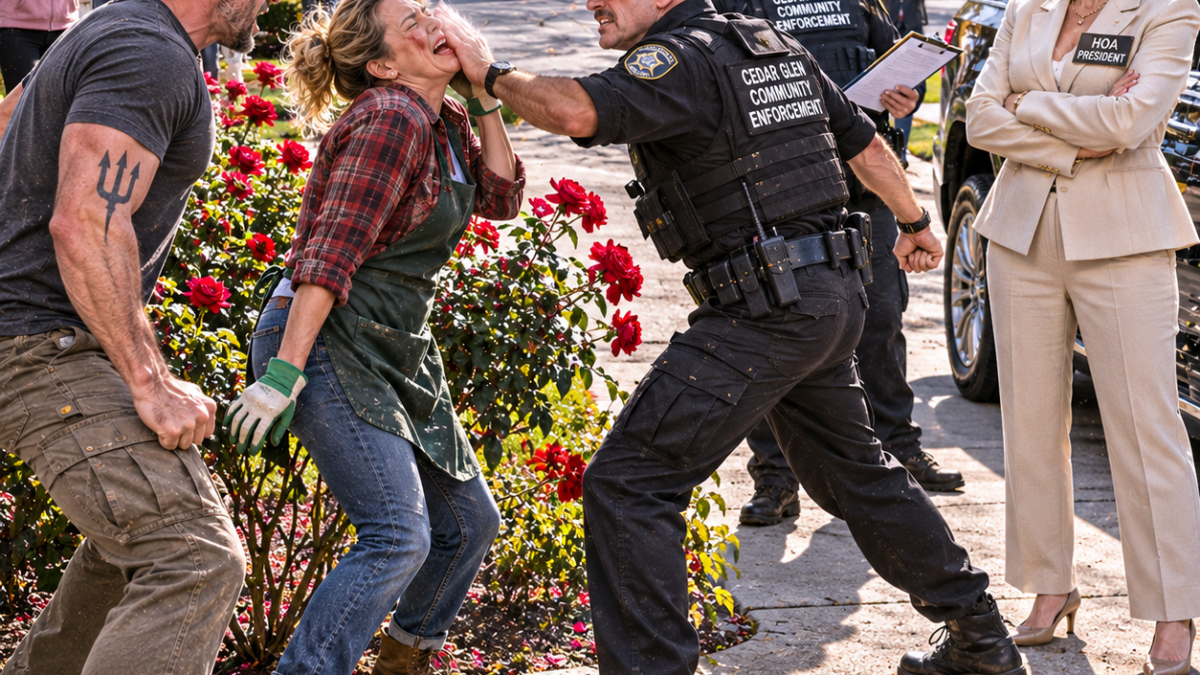
Instead, he slapped her.
Open hand.
Right cheek.
Her head turned.
The pruning shears fell onto the grass.
I was already moving before I realized I had dropped my water bottle.
My flip-flops slapped against the concrete as I stepped out of the garage.
Neither man noticed me immediately.
The taller one was still lecturing Claire.
“Now maybe you’ll understand we’re serious.”
My shadow reached them first.
The short one turned.
He smirked.
I remember that smirk.
Not because it lasted long.
Because it showed he genuinely believed he had the right to stand on my driveway after striking my wife.
“What are you going to do?” he asked.
I did not answer.
My hands stayed open.
My voice stayed low.
“Step away from her.”
He looked me over.
Faded T-shirt.
Board shorts.
Flip-flops.
Gray beginning at my temples.
Nothing impressive.
Then his eyes reached my left forearm.
The trident tattoo.
His expression changed.
It was subtle.
But I saw it.
The taller man saw it too.
“You military?” he asked.
“That doesn’t matter.”
The short one recovered first.
“We are authorized HOA enforcement.”
“Leave.”
“Your wife committed a violation.”
“Leave.”
“We have the right to issue citations on association property.”
“You’re standing on mine.”
The short man lifted the clipboard.
“Sir, if you interfere with an enforcement action, you can be cited as well.”
Claire stood behind me, one hand against her cheek.
I looked at her.
“You okay?”
She nodded.
“Did he hit you?”
“Yes.”
The short man snapped, “She became verbally aggressive.”
I looked back at him.
“That wasn’t my question.”
The taller man shifted his stance.
“We should probably keep this professional.”
“You should probably leave.”
Neither moved.
Behind curtains across the street, faces appeared.
Phones rose.
Mr. Benson stood behind his screen door in a bathrobe.
The Ramirez family had gathered at their front window.
Two houses down, someone had stepped onto a porch.
The short man seemed to notice the audience.
His confidence returned.
He pointed his clipboard toward me.
“You’re obstructing authorized officers.”
“No.”
“We will report you.”
“Good.”
He blinked.
“Good?”
“Call the police.”
That unsettled him.
I continued.
“Tell them exactly where you are.”
The taller man looked at his partner.
The short one tightened his grip on the clipboard.
“We don’t need police.”
“You just assaulted my wife.”
“That was corrective physical contact.”
For the first time, I almost lost control.
Not because of the words.
Because of how casually he said them.
I took one slow step forward.
“Say that again.”
The taller man stepped between us.
His hand landed against my chest.
“Back up.”
I looked down at his hand.
Then at him.
“Take your hand off me.”
He shoved.
Not hard enough to injure me.
Hard enough to make his intention clear.
My body reacted before anger could.
I caught his wrist, turned my hips, and redirected his momentum away from Claire.
He stumbled sideways into the edge of the azalea bed.
No punch.
No kick.
No attempt to hurt him.
Just distance.
The shorter man raised his clipboard like a shield and rushed forward.
I stripped it from his hands.
The plastic snapped when it hit the concrete between us.
He froze.
So did I.
Because somewhere beyond the houses, sirens had started getting louder.
And for the first time that afternoon, the two men pretending to represent the law realized the actual law was coming.
part 2
My name is Michael Hayes.
I was fifty-one that fall, married to Claire for twenty-three years, and living in Cedar Glen for almost eleven of them.
I did serve in the Navy.
I did earn the trident tattoo the short man noticed.
And I had spent enough time in difficult places to know that the worst thing you can do when adrenaline hits is convince yourself that being capable of violence means violence is your best option.
It almost never is.
By the time I left active service, I wanted less excitement, not more.
Claire wanted the same.
We bought our house at the end of a quiet cul-de-sac because the backyard backed into a greenbelt and the street had almost no through traffic.
The HOA existed when we moved in.
For the first several years, it was mostly harmless.
Dues paid for entrance landscaping, common-area lights, stormwater maintenance, and a small playground.
Board meetings were boring.
That was a good thing.
Then Karen Whitmore became president.
Karen was forty-seven when she first ran.
Blonde bob.
Large sunglasses.
Pearl earrings.
Always carrying a binder.
She had the unnerving ability to speak about paint samples as if national security depended on them.
At first, people thought her energy was useful.
The previous board had become sloppy.
Contracts renewed without bidding.
Common areas looked tired.
Storm drains needed maintenance.
Karen fixed things.
That bought her trust.
Then the letters started.
Trash bins left visible for three hours after pickup.
Mailboxes painted the wrong shade of black.
Holiday decorations installed before the approved date.
Children’s basketball hoops visible from the street.
Garden flags.
Patio umbrellas.
One neighbor received a warning because his dog barked during what Karen described as “community quiet restoration hours.”
Nobody knew what that meant.
Karen did.
She had written it.
Claire disliked her almost immediately.
Not because Claire opposed rules.
My wife is one of the most organized people alive.
She labels freezer containers.
She keeps tax receipts by quarter.
She once created a spreadsheet for Thanksgiving leftovers.
What bothered her was Karen’s tone.
The assumption that rules existed not to organize shared property but to establish obedience.
The rose bushes became an issue in early November.
Our house had four mature rose plants along the driveway.
The original homeowner planted them decades earlier.
Every fall, Claire pruned the dead wood.
That year, Karen sent a new landscaping bulletin requiring approval for “material exterior vegetation modifications visible from common areas.”
Claire read it at breakfast.
“Material vegetation modification?”
I looked over my coffee.
“Sounds painful.”
“It says pruning requires approval.”
“Major pruning?”
“All pruning.”
“That’s ridiculous.”
Claire highlighted a line.
“Photos required before and after.”
I laughed.
She didn’t.
“Karen is going to make people request permission to trim dead flowers.”
“Then don’t.”
Claire looked at me.
“What?”
“Don’t request permission.”
Her eyebrow rose.
“I like this version of you.”
“Our covenants don’t require approval for routine maintenance.”
“You read them?”
“After the mailbox incident.”
The mailbox incident involved Karen trying to fine Mr. Benson $350 because he replaced a rusted number plate with one nearly identical to the old one.
I helped him read the actual architectural rules.
The fine disappeared.
Karen remembered that.
Two weeks later, the board announced a new Community Compliance Initiative.
That was when the fake officers appeared.
Karen called them “community enforcement personnel.”
The board minutes described them as contract compliance inspectors.
Those descriptions were very different from how the men presented themselves.
They wore uniforms.
Badge-shaped emblems.
Radios.
Utility belts.
Their sedan had magnetic door signs.
CEDAR GLEN COMMUNITY ENFORCEMENT
From a distance, it looked official.
That was intentional.
The first time I saw them, they were standing outside Mrs. Ellison’s house photographing her recycling bins.
I walked over.
“Who are you guys?”
The taller man answered.
“Community enforcement.”
“Police?”
“No.”
“County?”
“No.”
“Code enforcement?”
“We work with the HOA.”
That answer told me everything.
“Private security?”
“Compliance.”
He said it like repeating the word made it a legal category.
I asked for company identification.
They gave me the name:
Harbor Civic Services.
I searched it later.
The company was registered six months earlier.
Its website advertised property patrol, HOA compliance observation, parking enforcement support, and community presence services.
No police powers.
No government authority.
Nothing inherently illegal about the business.
Private associations can hire people to document rule violations.
The problem was presentation.
They wanted residents to think twice before questioning them.
Mirrored sunglasses.
Badge patches.
Radios.
Official language.
Karen loved them.
Within weeks, complaints spread.
One resident said they entered his backyard after a gate had been left unlocked.
Another said they photographed through his garage window.
Mrs. Palmer, a seventy-year-old widow, told Claire one man followed her onto the porch when she refused to sign a violation acknowledgment.
Karen denied misconduct.
She said residents were hostile because they disliked accountability.
Then came our roses.
That afternoon Claire was trimming exactly three dead canes.
The guards arrived in their dented gray sedan.
Camera footage later showed them parking partly across our driveway.
They approached without knocking.
The short one—his name was Carl Denton—began filming.
The tall one was Marcus Lyle.
Claire asked them to leave.
Carl said they were conducting a compliance intervention.
She laughed.
He slapped her.
That was where the original problem ended and a much more serious one began.
When the sirens reached our street, Carl and Marcus started backing away.
“This isn’t over,” Carl said.
I stood between them and Claire.
“It is for today.”
“You broke association property.”
He pointed toward the clipboard pieces.
“You assaulted us.”
“You shoved me.”
Marcus had climbed out of the azaleas.
Leaves clung to his uniform.
His sunglasses were crooked.
“I’m pressing charges.”
“Good.”
He blinked.
“You keep saying that.”
“Because I want the police to hear everybody.”
A cruiser turned into the cul-de-sac.
Then another.
Red and blue lights painted the houses.
Neighbors came outside.
Carl suddenly became very interested in straightening his vest.
Marcus removed his mirrored glasses.
Officer Daniel Reyes stepped from the first cruiser.
Officer Keisha Monroe came from the second.
They looked at the crowd.
The broken clipboard.
Claire’s red cheek.
Marcus covered in leaves.
Me in flip-flops.
Reyes exhaled.
“All right. Nobody move. Somebody tell me why half the neighborhood is outside.”
Everyone started talking.
“They hit Claire.”
“They’re fake cops.”
“Michael threw one into the bushes.”
“He didn’t throw him.”
“They’ve been harassing people for weeks.”
“Karen sent them.”
Reyes raised both hands.
“One at a time.”
He looked at me.
“Sir, start.”
I nodded toward Claire.
“Two private HOA contractors came onto our property over landscaping. My wife told them to leave. The shorter man struck her. The taller one put his hand on me and shoved. I separated him. Nobody needs medical help that I know of.”
Reyes looked at Claire.
“Ma’am?”
“That’s accurate.”
Carl cut in.
“She was verbally abusive.”
Monroe looked at him.
“Did you hit her?”
“We used reasonable compliance contact.”
Reyes stared.
“What does that mean?”
Carl’s face changed.
Marcus interrupted.
“She laughed at us and things escalated.”
Monroe asked again.
“Did he hit her?”
Marcus glanced at Carl.
“Yes.”
Carl snapped, “Marcus.”
Reyes looked toward the houses.
“Any video?”
Half the street raised phones.
I pointed toward my garage.
“Three exterior cameras.”
June Ramirez called from her driveway.
“I got most of it.”
Claire looked at her.
“Of course you did.”
June grinned apologetically.
The officers separated everyone.
That mattered.
No joking.
No instant conclusions.
Reyes took Carl to one cruiser.
Monroe spoke with Marcus.
Another unit arrived.
Then EMS, because Claire’s cheek was swelling and the officers wanted the injury documented.
I sat beside her on our front steps while a medic checked her.
“You okay?”
“I’m furious.”
“Physically.”
“Yes.”
She looked at me.
“You?”
“I’m fine.”
“You scared them.”
“I didn’t mean to.”
“Yes, you did.”
“Maybe a little.”
She smiled despite the swelling.
Then stopped.
“Michael.”
“What?”
“You didn’t hit either of them?”
“No.”
“I saw Marcus go into the bushes.”
“He shoved me. I redirected him.”
“SEAL language.”
“Accurate language.”
She leaned against me.
“Thank you for not losing your mind.”
That hit harder than she intended.
Because for one second after Carl slapped her, I had wanted to.
Real police changed the temperature of the street.
Witnesses gave statements.
Video was copied.
Carl and Marcus produced their company credentials.
Their badges said COMPLIANCE OFFICER in tiny letters beneath a larger shield emblem.
Reyes photographed everything.
Then he asked Carl whether he had represented himself as law enforcement.
Carl said no.
Mrs. Benson yelled from across the street:
“You told me last Tuesday you could have my car impounded by county authority!”
Reyes turned.
“Ma’am, please come over and give a statement.”
Carl looked sick.
Then June spoke.
“They told my son interfering with an enforcement officer was an offense.”
Another statement.
Mrs. Palmer came outside.
“They said refusing to sign could result in legal detention.”
Another.
The story expanded right there on the pavement.
The assault against Claire was not necessarily the first legal problem.
It was simply the first moment enough people compared experiences at the same time.
Karen arrived twenty minutes later.
White SUV.
Pale lavender blouse beneath a cream jacket.
Clipboard.
Of course.
She parked near the police cars and marched toward Reyes.
“I’m Karen Whitmore, HOA president.”
He nodded.
“Okay.”
“These men are authorized representatives of Cedar Glen.”
“Authorized to do what?”
“Enforce community standards.”
“Physical enforcement?”
Karen hesitated.
“They’re trained to manage confrontational residents.”
Claire stood.
“Manage?”
I touched her arm.
She stayed quiet.
Reyes asked:
“Did you authorize them to make physical contact with residents?”
“No.”
Carl turned.
“Karen—”
She shot him a look.
That was the first crack.
He had believed she would defend him.
She was already building distance.
Reyes continued.
“What are their powers under your contract?”
Karen opened her binder.
“They can issue compliance citations, document violations, maintain order during enforcement interactions—”
“Can they detain people?”
“No.”
Marcus stared at her.
“You told us—”
Karen snapped, “Not now.”
Reyes heard it.
“What did she tell you?”
Marcus said nothing.
Carl stared at the pavement.
Monroe asked whether the HOA had issued these badge-style uniforms.
Karen said the contractor selected its own apparel.
Then Mr. Benson walked over carrying an HOA newsletter.
He pointed at a photograph.
Karen standing beside Carl and Marcus.
Caption:
OUR NEW COMMUNITY ENFORCEMENT OFFICERS WILL HELP ENSURE COMPLIANCE AND SAFETY.
Reyes read it.
Then looked at Karen.
“You call them officers?”
“That’s a generic term.”
Another crack.
Nobody was arrested that instant.
Real cases do not always move at the speed crowds want.
But Carl was cited and later booked on an assault allegation after review of the video and witness statements.
Marcus faced scrutiny over his conduct and the representations he made while working for the contractor.
The officers collected the fake-looking badges for documentation, not because wearing a badge shape was automatically illegal, but because context mattered.
What did they say?
What did they imply?
How did they use those symbols?
By sunset, our cul-de-sac looked almost normal again.
Almost.
The rose bush still sat beside the driveway.
Three trimmed branches.
One broken clipboard.
An entire neighborhood suddenly asking what authority Karen had actually hired.
The next morning, Claire made coffee.
Her cheek was bruised.
I hated looking at it.
“You keep staring.”
“I know.”
“Stop.”
“I’m trying.”
She opened her laptop.
“What are you doing?”
“Reading HOA minutes.”
I smiled.
“That’s romantic.”
“Karen came here yesterday and lied.”
“About?”
“What she authorized.”
I sat beside her.
The board had approved a $38,000 annual contract with Harbor Civic Services.
The motion authorized:
observation, documentation, parking support, and non-confrontational resident contact.
Non-confrontational.
That phrase mattered.
Nothing about detention.
Nothing about physical compliance.
Nothing about police-style enforcement.
Then Claire found emails.
Not private emails.
Board communications distributed through the resident portal.
Karen repeatedly referred to the contractors as “our officers.”
She wrote that they would “bring consequences directly to violators.”
In one post:
Residents should treat instructions from Community Enforcement Officers as they would any other safety directive.
Ambiguous.
Deliberately.
I contacted an attorney.
Not because I wanted a giant lawsuit.
Because the HOA needed to preserve records.
Contract.
Training materials.
Instructions.
Communications.
Complaints.
Incident reports.
The lawyer sent a preservation notice.
The board called an emergency meeting.
The clubhouse filled beyond capacity.
Claire sat beside me.
Her bruise had turned purple-yellow.
Karen sat at the front table.
No sunglasses.
Same binder.
She opened:
“Yesterday’s unfortunate confrontation has been widely mischaracterized.”
Someone laughed.
Karen looked up.
“This is serious.”
Claire whispered, “First accurate thing she’s said.”
Karen blamed Harbor Civic Services.
She said individual contractors violated instructions.
Then Marcus Lyle walked into the room.
He did not wear his uniform.
He carried a folder.
The entire room shifted.
Karen stared.
“You are not authorized to attend this executive matter.”
Board vice president Helen Morris spoke.
“This is an open membership meeting.”
Marcus sat.
Karen’s face tightened.
During public comments, Marcus stood.
“I was told by Mrs. Whitmore that residents who refused compliance could be physically blocked from continuing violations until they agreed to stop.”
The room erupted.
Karen shook her head.
“That is false.”
Marcus opened his folder.
“I have emails.”
Silence.
He read one.
If a resident becomes defiant, maintain physical control of the immediate area and do not allow them to continue prohibited activity until compliance is restored.
Sender:
Karen Whitmore.
Karen stood.
“That does not authorize assault.”
Marcus nodded.
“No.”
Then he read another.
Residents must believe enforcement personnel have real consequences behind them or the program fails. Appearance and command presence matter.
The room went quiet.
That sentence explained everything.
Appearance.
Command presence.
Not authority.
Appearance of authority.
Claire squeezed my hand beneath the table.
Mr. Benson stood next.
“They threatened to impound my car.”
Mrs. Palmer.
“They told me they could detain me.”
June played video of Carl telling her teenage son:
“Interfering with an officer can have consequences.”
Karen tried to interrupt.
Helen Morris stopped her.
“Let them finish.”
That was the moment Karen lost control of the room.
Not when I walked out of my garage.
Not when police arrived.
When the board stopped letting her decide which voices counted.
Harbor Civic Services terminated Carl immediately.
Marcus was suspended pending investigation.
The company’s owner attended the next meeting with counsel.
He claimed Karen had expanded expectations beyond the written contract.
The board asked for training records.
They were embarrassingly thin.
A one-day orientation.
HOA rules.
De-escalation video.
No legal authority training beyond a general instruction that employees were private contractors.
Yet residents had clearly been encouraged to perceive them as more.
The HOA’s insurance carrier became involved.
Then outside counsel.
Then the county prosecutor’s office reviewed allegations concerning impersonation-related conduct and the physical assault.
Again, I stayed out of charging decisions.
That was not my job.
I wanted a clean record.
Claire wanted more.
“Karen should resign.”
“Yes.”
“You sound calm.”
“I am calm.”
“No, you’re pretending to be calm because you think calm is morally superior.”
I looked at her.
“That was extremely specific.”
“I’ve been married to you twenty-three years.”
She touched her cheek.
“This happened because she created a system built on intimidation.”
“I know.”
“She can’t just blame Carl.”
“I know.”
“Then say something.”
So I did.
At the next meeting, I asked for five minutes.
I did not mention my military background.
I did not talk about protecting my family.
I did not tell the room I could have hurt those men.
That would have turned the entire issue into a story about me.
It wasn’t.
I stood beside Claire.
“When private contractors came onto my property, my wife was assaulted.”
The room went silent.
“The individual who struck her is responsible for his conduct.”
I looked toward Karen.
“But organizations are responsible for systems they create.”
Karen shifted.
“The question for this HOA is not whether you intended somebody to get slapped over a rose bush.”
I paused.
“The question is why any resident was placed in a situation where two private contractors believed they had enforcement power beyond documenting a violation.”
Nobody interrupted.
“If a rule is valid, cite it.”
“If a fine is authorized, issue it through the process.”
“If somebody disagrees, use the appeal procedure.”
I pointed toward the door.
“You do not send men in imitation law-enforcement uniforms onto private driveways to create fear.”
Karen raised a hand.
I kept going.
“And if this board cannot distinguish between community management and coercion, then this board should not be managing anybody.”
I sat.
No cheering.
I was grateful.
I did not want theater.
I wanted the members to vote.
A recall petition had already gathered enough signatures.
Karen fought it.
She sent newsletters.
Accused critics of exploiting Claire’s injury.
Said “anti-HOA activists” were trying to destabilize Cedar Glen.
June turned that phrase into a T-shirt.
Claire bought one.
I refused.
She bought me one anyway.
The recall meeting happened three weeks later.
Attendance was the largest in Cedar Glen history.
Karen spoke first.
She listed everything she had accomplished.
New landscaping.
Better reserves.
Lower vendor costs.
Playground repairs.
Stormwater improvements.
Much of it was true.
That made what followed harder.
People are rarely only one thing.
Karen had been effective.
She had also built an enforcement culture that crossed lines.
Helen Morris spoke next.
“Good work does not create unlimited authority.”
That sentence carried the room.
The vote removed Karen from the presidency.
Not unanimously.
Some people still supported her.
That mattered.
Reality is cleaner when villains lose by one hundred percent.
Real communities are messier.
Karen received forty-one percent of the vote.
Fifty-nine percent removed her.
Enough.
She gathered her binder.
Walked toward the door.
Then stopped beside Claire.
“I never told him to hit you.”
Claire looked at her.
“I believe you.”
Karen seemed surprised.
Then Claire added:
“You just created a system where he thought he could.”
Karen left without answering.
The new board terminated the Community Enforcement program entirely.
Private contractors could still be hired for actual security at events or common facilities.
But compliance returned to written notices, hearings, appeals, and ordinary property-management procedures.
No badges.
No “officers.”
No intimidation patrol.
The board also created a resident bill of process.
Not a grand legal document.
Just internal rules.
Notice had to identify the exact covenant.
Evidence had to be available.
Residents had appeal rights.
No contractor could enter private property without consent except under genuine emergency circumstances recognized by law.
Violations could not be enforced through physical confrontation.
Obvious rules.
But sometimes obvious rules need to be written after somebody proves why.
Carl’s assault case moved separately.
Claire gave a statement.
Video supported it.
Witnesses supported it.
He eventually resolved the criminal matter through the court process and faced consequences that included probation, mandatory counseling, and restrictions tied to his employment.
I did not attend every hearing.
I attended when Claire wanted me beside her.
Marcus cooperated with investigators and with the civil process.
His case was different.
He had shoved me.
I had redirected him.
Video showed that clearly.
He lost his position with Harbor Civic.
Months later, he wrote us a letter.
Claire opened it first.
“He apologized.”
“For what?”
“All of it.”
I read it.
Marcus said he had taken the job because it paid better than warehouse work.
He liked the uniform.
Liked residents listening.
Liked being called officer.
That honesty bothered me more than a polished excuse would have.
He wrote:
I started acting like the uniform made me something it didn’t.
I kept that sentence.
Not because I forgave everything immediately.
Because it was the clearest explanation of the entire mess.
Symbols are powerful.
Uniforms.
Badges.
Clipboards.
Titles.
People treat them as shortcuts.
Instead of asking, “What authority does this person actually have?” we ask, “Do they look like someone I should obey?”
Karen understood that instinct.
She exploited it.
The HOA settled our civil claim without a dramatic lawsuit.
Claire’s medical costs.
Damage to property.
Legal expenses.
Written acknowledgment that the contractors exceeded lawful and contractual authority.
Written apology.
More importantly, the association agreed to publish the scope of every future enforcement role.
No ambiguity.
That mattered more to me than money.
For months afterward, neighbors came to our door.
Some apologized for staying behind curtains.
Mr. Benson stood on the porch holding a pie.
“I should’ve come out sooner.”
“You’re seventy-three.”
“Still.”
“You called police?”
“Yes.”
“That helped.”
He looked surprised.
“You knew?”
“Dispatch record.”
He smiled.
“Chocolate pie.”
“You’re forgiven.”
Mrs. Palmer came with flowers.
June came with nothing because June had apparently decided friendship exempted her from gifts.
She did, however, bring a printed screenshot of the fake officers running toward their car.
Claire refused to hang it.
I secretly thought it was funny.
We compromised.
It went in a drawer.
The roses survived.
That became Claire’s favorite part.
The entire fight started because she removed three dead branches.
By spring, the plants exploded with blooms.
Red.
Pink.
Cream.
The biggest display we’d had in years.
Claire stood beside them one morning.
“Think I need approval?”
“Absolutely.”
She looked at me.
“I’m going inside.”
“Wait.”
“What?”
“I need before-and-after photos.”
She threw a gardening glove at me.
Life became normal again.
That was the real victory.
Not Karen losing the presidency.
Not Carl standing before a judge.
Not the HOA changing policy.
Normal.
Claire pruning without looking over her shoulder.
Me opening the garage without expecting uniforms.
Neighbors talking across driveways without wondering whether somebody was documenting them.
Cedar Glen became boring.
I loved boring.
Helen Morris became interim president.
She lasted six months before begging someone else to run.
“Why?” I asked.
“Everyone emails me.”
“That’s the job.”
“They email about mailbox fonts.”
“Democracy.”
“I hate you.”
The permanent president was a retired accountant named Gregory Lewis.
Gregory’s greatest quality was that nobody could imagine making a dramatic story about him.
He read minutes.
Asked for legal review.
Sent polite notices.
Held hearings.
When residents won appeals, he shrugged.
Karen considered that weakness.
I considered it government working at exactly the level a homeowners association should occupy.
Claire eventually joined the landscape committee.
That surprised me.
I found out when a meeting reminder appeared on our refrigerator.
“You joined the HOA machine?”
“I’m infiltrating.”
“You’re choosing mulch.”
“Power begins somewhere.”
She helped rewrite the landscaping guideline.
Routine pruning required no approval.
Removing mature trees did.
Major structural landscaping changes did.
Rose maintenance did not.
At the meeting where the board adopted it, June leaned toward me.
“Historic.”
“Absolutely.”
“Claire Mercer has liberated the roses.”
“Please never say that again.”
She posted it online anyway.
A year after the slap, Claire and I stood in the driveway on the exact date.
Not intentionally.
We were putting Christmas decorations away.
She touched her cheek.
The bruise had vanished eleven months earlier.
“You remember?”
“Yes.”
“Of course you do.”
“I remember the sound.”
She looked at me.
For a while neither of us spoke.
Then she asked:
“Were you scared you were going to hurt them?”
I answered honestly.
“Yes.”
“Which one?”
“Both.”
She looked down.
“I’ve always wondered.”
“Why never ask?”
“I knew.”
The silence between us changed.
I sat on the edge of the driveway.
She sat beside me.
“In the garage,” I said, “when I saw him hit you, there was one second where all the old training came back wrong.”
“Wrong?”
“Like the problem was a threat and the threat needed to disappear.”
She listened.
“Then I saw phones.”
“That stopped you?”
“Partly.”
“What else?”
“You.”
She smiled faintly.
“You were still standing.”
“I’m tough.”
“You are.”
I looked toward the rose bushes.
“I realized protecting you didn’t mean punishing them.”
That was the truth.
People tell stories about veterans as though our value lies in being dangerous.
Mine didn’t.
The most useful thing I learned from dangerous work was how expensive loss of control can become.
Anybody can become angry.
Discipline is deciding what anger does next.
I was not perfect that afternoon.
I broke the clipboard.
I moved Marcus harder than I needed to.
I felt satisfaction when they were afraid.
I’m not proud of every second.
But I am grateful I stopped there.
The cameras showed enough.
The witnesses showed enough.
Real police handled the rest.
Years later, I gave a talk at a veterans’ community group about civilian conflict.
Not because I was an expert.
Because someone had heard the neighborhood story and asked.
I said something that surprised even me:
“The hardest transition from military life isn’t learning you’re less powerful. It’s learning your power has different responsibilities.”
Someone asked what I meant.
“In uniform, training tells you what mission you’re in.”
I paused.
“At home, nobody announces the mission.”
A man slaps your wife.
Your body says one thing.
The law says another.
Your conscience says another.
Your future self is standing somewhere you cannot see yet, asking you not to ruin his life because of ten seconds of rage.
That is discipline.
The Cedar Glen incident eventually became an example for other HOAs in our county.
Property-management attorneys circulated guidance.
Avoid law-enforcement-like insignia.
Clearly identify private contractors.
Do not imply detention powers.
Do not physically confront residents over covenant violations.
Again:
Obvious.
Yet useful.
Harbor Civic Services rebranded a year later.
I have no idea whether that was because of us.
Their new website explicitly said:
PRIVATE COMPLIANCE OBSERVERS — NOT LAW ENFORCEMENT.
Good.
Marcus apparently found work in logistics.
Carl disappeared from our world.
Karen remained in Cedar Glen another two years.
We saw her at the grocery store.
At the mailbox kiosk.
Walking her dog.
At first she avoided Claire.
Then one afternoon they ended up alone near the community garden.
I was not there.
Claire told me later.
Karen said:
“I’m sorry you were hurt.”
Claire asked:
“Are you sorry about the system?”
Karen apparently went quiet.
Then said:
“I thought people stopped respecting rules.”
Claire answered:
“Maybe they stopped respecting you.”
Sharp.
Very Claire.
Karen did not argue.
She moved the following summer.
No dramatic exit.
Moving truck.
For-sale sign.
Then another family bought the house.
They had two kids and a golden retriever that barked during whatever Karen used to call quiet restoration hours.
Nobody complained.
One evening, years later, Mr. Benson and I sat on his porch.
He was eighty by then.
He pointed toward our driveway.
“You know that night made you a legend.”
“I hate that.”
“You’re Mr. Navy to half the kids.”
“I hate that more.”
He laughed.
“You did put a man in the azaleas.”
“He put himself most of the way there.”
“That’s not how I tell it.”
“I know.”
Stories grow.
That bothered me at first.
Neighbors turned the confrontation into comedy.
Two fake cops.
Retired SEAL.
Broken clipboard.
Bushes.
Sirens.
People liked the shape.
But over time, I started correcting one part whenever I heard it.
I did not “teach those men a lesson.”
The evidence did.
Claire did when she gave her statement.
June did when she saved her video.
Mr. Benson did when he admitted prior threats.
Mrs. Palmer did when she described being intimidated.
Marcus did when he produced Karen’s emails.
The board did when it voted.
Police did when they treated the incident as evidence instead of entertainment.
The court did when it reviewed what Carl had done.
That was the real story.
If it had been only me frightening two men away, nothing would have changed.
Karen would have called me violent.
Carl would have called Claire aggressive.
Neighbors would have whispered.
The system would remain.
Documentation turned one ugly afternoon into accountability.
That became important to me.
I kept copies of everything.
Not obsessively.
Enough.
The original HOA notice.
Photos of Claire’s injury.
Police report.
Settlement agreement.
Board policy changes.
One broken piece of the clipboard.
Claire found that last item.
“You kept this?”
“Yes.”
“Why?”
“Evidence.”
“The case ended six years ago.”
“Historical evidence.”
“You’re sentimental.”
“I’m not.”
“You kept a broken clipboard.”
She was right.
I threw it away.
Mostly because she was smiling too much.
The trident tattoo remained.
Of course.
For years after the incident, people who heard the story sometimes stared at it differently.
As if the tattoo had solved the problem.
It didn’t.
Carl saw it and still stayed.
Marcus saw it and still shoved me.
Symbols don’t stop bad decisions.
Choices do.
The choice to call real police.
The choice not to chase them.
The choice to let video speak.
The choice for neighbors to stop whispering and start giving statements.
The choice for a board to admit its program had gone wrong.
Those mattered.
I still believe in community rules.
That surprises people.
Cedar Glen has shared property.
Drainage.
Entrance signs.
Playground equipment.
Architectural covenants.
Rules help maintain those things.
But rules have to know their size.
A homeowners association is not a police department.
A compliance contractor is not a cop.
A violation letter is not a warrant.
A board president is not a judge.
And a person standing on your driveway with a badge-shaped patch does not gain authority simply because his shirt says enforcement.
That distinction cost Cedar Glen thousands of dollars and one bruised cheek to learn.
I wish it had cost less.
On our twentieth Christmas in the house, Claire decorated the rose bushes with tiny warm-white lights.
Technically, the old Karen-era rule required cool white.
The rule had been repealed years before.
I stood in the driveway.
“Those lights look noncompliant.”
Claire did not turn.
“I know where you sleep.”
“Threatening an enforcement officer?”
“You’re not an officer.”
“Excellent answer.”
She laughed.
The street looked different from Karen’s days.
Some houses had colored lights.
Some had none.
One had an inflatable Santa nearly ten feet tall.
Another neighbor decorated a giant skeleton left over from Halloween and put a Santa hat on it.
Karen would have exploded.
Gregory Lewis drove past.
Slowed.
Looked at the skeleton.
Then kept driving.
Perfect leadership.
June walked over carrying wine.
She looked at the roses.
“Remember when these almost started a neighborhood war?”
“They didn’t.”
“Michael, somebody slapped Claire.”
“Fair.”
Claire came over.
“I freed the roses.”
June pointed.
“See? She agrees.”
“I never agreed.”
“You’re outnumbered.”
We stood there beneath the porch lights.
No fake uniforms.
No clipboards.
No patrol sedan.
Just neighbors.
That was what I had wanted eleven years earlier when we bought the house.
Not victory.
Not legend.
Not being the man people called when the HOA did something stupid.
A quiet street.
A wife I loved.
Roses.
Somewhere around nine, a real police cruiser drove slowly through the cul-de-sac.
Routine patrol.
The officer waved.
I waved back.
June said, “Think he knows?”
“Knows what?”
“That you’re the terrifying rose-bush vigilante?”
I stared at her.
Claire laughed so hard she spilled her wine.
Later that night, after everyone left, I checked the front door.
Old habit.
Claire was in the kitchen.
I looked through the window toward the driveway.
The place where Carl stood.
The place where Marcus landed in the azaleas.
The place where police lights flashed.
Nothing remained.
Even the azaleas had grown back thicker.
That felt appropriate.
Places heal faster than people sometimes.
But people heal too.
Claire no longer touched her cheek when we talked about it.
I no longer felt the same rush of anger hearing the slap in my memory.
The story became something that happened to us.
Not something still happening.
Before bed, Claire asked:
“If it happened again, would you do anything differently?”
I thought.
“I’d keep the clipboard intact.”
She laughed.
“Seriously.”
“Yes.”
“What?”
“I’d tell you to go inside sooner.”
“I wouldn’t.”
“I know.”
“And you?”
“I’d call police before stepping between them.”
She looked surprised.
“Really?”
“Yes.”
“Why?”
“Because I know now the cameras had everything.”
She nodded.
“That’s growth.”
“Also my knee is worse.”
“There he is.”
We turned off the lights.
The street disappeared into darkness.
The roses sat beneath the window.
Quiet.
Ordinary.
Free from enforcement.
People like Karen believe power comes from making everyone afraid to say no.
People like Carl believe a uniform can fill the space where real authority should be.
People like Marcus discover too late that confidence borrowed from somebody else disappears the second responsibility arrives.
I learned something too.
Protecting your family does not always mean becoming the strongest person in the driveway.
Sometimes it means becoming the calmest.
Standing between danger and the person you love.
Calling witnesses.
Preserving evidence.
Refusing to let anger give the other side the story they need.
Then stepping aside when real authority arrives.
The trident on my forearm never made those men wrong.
The law did.
Claire’s injury did.
Their own words did.
The cameras did.
The witnesses did.
Their fake authority collapsed because eventually somebody asked them to prove it.
They couldn’t.
That was the part I remembered most.
Not Marcus stumbling into the azaleas.
Not Carl’s broken clipboard.
Not neighbors clapping.
The moment Officer Reyes stood in our driveway and asked a plain question:
“What exactly are you authorized to do?”
Everything stopped.
Carl looked at Karen.
Karen looked at the contract.
Marcus looked at the ground.
Nobody had a good answer.
That is how counterfeit power usually ends.
Not with a bigger threat.
With scrutiny.
Years later, the roses still bloom every spring.
Claire still trims them without asking permission.
Nobody has slapped her again.
Nobody has tried to issue a citation.
And every time I see the new growth where she cut those three dead branches, I remember how absurd the whole thing was.
An HOA president wanted control over a rose bush.
She hired men who wanted to look like police.
One of them thought a badge-shaped patch gave him permission to touch my wife.
For a few seconds, the street nearly became something none of us could take back.
Then people started recording.
Then real police arrived.
Then paperwork was opened.
Then truth became harder to manipulate.
Karen lost her presidency.
The fake enforcement program disappeared.
The HOA rewrote its rules.
Claire kept her roses.
And I learned that the most important line I defended that day wasn’t my driveway.
It was the line between having strength and abusing it.
Karen crossed hers.
Her contractors crossed theirs.
I almost crossed mine.
I’m grateful I didn’t.
Because in the end, the loudest thing on that street wasn’t the slap, the sirens, the cheering neighbors, or the crack of a cheap clipboard hitting concrete.
It was a simple fact everyone finally understood:
No clipboard, badge, uniform, HOA title, or confident voice can create authority that was never legally there.








