HOA Karen Sent Six Armed Guards to Take My Dogs—Then Learned Why I Was Really Living Beside Her Green Belt
part 2
My name is Silas Kane.
I spent nine years as a military working-dog handler.
The last four were attached to a joint task force whose exact designation is not something I repeat casually.
I worked with dogs that searched buildings where people wanted us dead.
Dogs that found explosives hidden beneath floors.
Dogs that could distinguish between a threat and a terrified civilian faster than some humans I served beside.
Ranger and Vesper came from that world.
They were federally owned working animals temporarily assigned into my custody under a reassignment and evaluation arrangement connected to a broader federal inquiry.
That sentence sounds cleaner than reality.
Reality was long days, classified paperwork, layered permissions, and enough interagency bureaucracy to make a person nostalgic for combat zones.
Ranger was seven.
Vesper six.
Both had been through more than anyone on Laurel Hollow Court could have guessed.
They were not attack dogs.
They were not weapons waiting for a command.
They were highly disciplined working animals whose greatest skill was control.
That distinction would eventually destroy Karen Ashby’s complaint.
But the dogs were not why I had moved to Hawthorne Bend.
Priya Ostrander was.
Eighteen months before the confrontation in my driveway, she called me.
We had worked around each other years earlier.
She had since moved into federal investigative work involving financial fraud, land manipulation, and coordinated schemes using local administrative systems to pressure property owners.
“How do you feel about doing something slow?” she asked.
I laughed.
“From you? That sounds threatening.”
“Quiet assignment.”
“Meaning?”
“Move somewhere.”
“And?”
“Live there.”
“That’s it?”
“Watch.”
I stopped laughing.
“What am I watching?”
She sent me a secure file later.
Four residential developments across two states.
Different HOA boards.
Different management companies.
Different developers.
Same pattern.
A major development or rezoning project approached a critical stage.
One parcel stood in the way.
Then the owner of that parcel experienced sudden HOA pressure.
Noise complaints.
Animal complaints.
Architectural violations.
Claims of unsafe use.
Lien threats.
Code enforcement.
Lawsuits.
Two owners settled and left.
A third lost his property after years of litigation.
The fourth effectively disappeared from public records.
No forwarding address.
No subsequent property filings.
No known legal action.
Nothing Priya had could yet prove one central actor controlled all four cases.
What she had was pattern.
And one name recurring indirectly around the edges.
Preston Vance Merrick.
Corporate attorney.
Consultant.
Specialist in something his professional materials called community compliance restructuring.
I read that phrase twice.
“That’s real?”
Priya laughed.
“Unfortunately.”
“What does he actually do?”
“We think he turns local administrative pressure into leverage for land acquisition.”
“Think?”
“Proving is different from knowing.”
Then she showed me Hawthorne Bend.
Four hundred acres behind the western green belt.
Filed for rezoning under Larchmont Corridor Holdings LLC.
No obvious Merrick name.
Several shell entities.
A planning application that had somehow remained in preliminary review far longer than similar projects.
One likely reason:
The proposed commercial access corridor cut through the conservation strip behind Laurel Hollow Court.
And the cleanest route intersected land interests tied to several private lots, including the gray house at the end of the cul-de-sac.
My house.
Priya needed somebody inside.
Not an undercover officer pretending to be someone else.
That wasn’t what I was.
I bought the property legally through a holding company.
I actually lived there.
I simply didn’t advertise the federal investigation running parallel to my ordinary life.
For eleven months, I watched.
Survey crews appeared twice.
Soil technicians came once.
Unmarked vehicles photographed the green belt.
A management consultant met Karen Ashby repeatedly at the clubhouse.
Rezoning documents shifted.
Then nothing.
No public hearing.
No open HOA discussion.
No direct offer to me.
Karen herself barely spoke to me.
That mattered later.
At the time, she seemed exactly like the HOA president everyone expected.
Organized.
Persistent.
Deeply invested in curb appeal.
Karen had lived in Hawthorne Bend for nine years.
She loved the community.
That wasn’t sarcasm.
She genuinely did.
She attended every event.
Organized food drives.
Remembered children’s names.
Negotiated pool repairs.
Managed landscaping complaints.
And carried a clipboard everywhere.
People called her before calling the management company because Karen always answered.
That made her useful.
It also made her vulnerable.
People who need to feel essential can be controlled by anyone clever enough to convince them a crisis requires exactly their kind of dedication.
I did not understand that yet.
Two days after the driveway confrontation, a certified dangerous-animal complaint arrived.
The document was impressive.
Professionally written.
Detailed.
Specific.
And almost certainly fictional.
Incident time: 8:47 a.m.
Location: Green Belt Trail behind Laurel Hollow Court.
Two large canines allegedly advanced toward a resident in a threatening manner, forcing the resident to retreat and seek assistance.
Complainant identity withheld under “resident privacy provisions.”
I searched the Hawthorne Bend covenants.
No privacy provision matching the cited authority existed.
Then I walked the supposed incident route.
The section of green belt behind my house did not connect directly to the public trail network.
There were two realistic access points.
My backyard.
And the backyard belonging to my next-door neighbor, Harold Voss.
Harold was visiting his daughter in Charleston that entire week.
There was no plausible way for an ordinary resident to be standing where the complaint claimed without crossing private property.
The fictional witness had a location problem.
I called Priya.
“They’re moving faster.”
“You surprised?”
“Yes.”
“Why?”
“Because the rezoning application isn’t ready.”
“Then either a deadline changed or someone above Karen got nervous.”
“Which?”
Priya sighed.
“HOA boards rarely invent urgency by themselves.”
I waited.
“Someone hands it to them.”
That sentence became the spine of everything that followed.
I started building a timeline.
Survey activity.
Planning filings.
HOA meetings.
Consultant visits.
Security complaints.
Property records.
Then the county animal-services petition appeared.
Emergency temporary removal order requested.
That part got under my skin.
More than I wanted to admit.
Ranger and Vesper had bite and aggression histories consisting of exactly zero incidents outside sanctioned working contexts.
The possibility that fabricated paperwork could result in their removal, quarantine, or even destruction under a local ordinance designed for genuinely dangerous animals sat inside me like a hot stone.
For ten minutes, I let myself be furious.
Then I stopped.
Rage is useful in small doses.
After that, it starts stealing attention.
The county required an independent temperament evaluation before any emergency removal could proceed.
That procedural safeguard saved us.
Dr. Renata Okafor conducted the assessment.
Thirty-one years of animal behavior work.
No interest in neighborhood politics.
No patience for performance.
Ranger and Vesper went through controlled stranger approaches.
Sudden-noise exposure.
Food proximity.
Handler separation.
Environmental distraction.
Their responses were exactly what I expected.
Alert.
Controlled.
Stable.
Dr. Okafor was writing notes when Karen Ashby arrived.
That was the first time we had really stood near each other.
She walked toward the restricted evaluation area despite a county employee telling her twice to remain behind the line.
Karen wore a pale lavender coat and carried the same leather folder she used at HOA meetings.
She stared at Ranger.
Then Vesper.
“These are the animals that attacked a resident.”
She spoke loudly enough for everyone nearby.
Dr. Okafor looked up.
“Ma’am, please step back.”
“I have a right to observe.”
“You have a right to remain outside the assessment area.”
Karen moved closer.
Ranger’s ears rose.
Vesper shifted her weight.
Neither moved beyond that.
Karen stared harder.
Almost challenging them.
I understood what she wanted.
A bark.
A lunge.
A growl.
Anything she could point to later.
Dr. Okafor understood too.
“Mrs. Ashby.”
Karen looked at her.
“If you continue attempting to provoke the animals during a formal behavioral evaluation, I will document that conduct in my report.”
Karen froze.
For four seconds, she stood staring at two dogs who refused to become the animals she needed them to be.
Then she walked away.
I watched her face.
I had expected satisfaction.
Malice.
The smugness of someone enjoying control.
Instead, I saw fear.
Not fear of Ranger.
Fear of failure.
That distinction bothered me.
Karen reached her car and immediately made a phone call.
Dr. Okafor finished writing.
Her preliminary conclusion was unequivocal.
“Exceptional impulse control. No behavioral indicators consistent with the alleged incident.”
“Thank you.”
“Don’t thank me. Thank your dogs.”
I looked at Ranger.
He yawned.
“Very heroic.”
Dr. Okafor almost smiled.
The formal report would take three days.
Three days turned out to matter.
That evening, Priya called.
“I found Merrick.”
I sat down.
“Directly?”
“Not quite.”
She explained that Larchmont Corridor Holdings traced through three corporate layers to registered agents connected with a law firm in the state capital.
Hollis, Merrick & Bradden.
Preston Merrick wasn’t technically a named partner on the relevant filings.
Contract counsel.
Outside compliance.
Never appearing in the public Hawthorne Bend materials.
“Careful,” I said.
“Very.”
“Connection to other cases?”
“Four.”
My stomach tightened.
“Same firm?”
“Different entities. Similar structure.”
“Same enforcement pattern?”
“Yes.”
Then Priya went quiet.
“What?”
“The fourth owner.”
“The one who disappeared?”
“Still nothing. Eight months after pressure started, he drops out of the property record. No later address. No civil filings. Nothing we can connect to Merrick.”
“You think something happened.”
“I think not knowing bothers me.”
It bothered me too.
“This is bigger than the dogs,” she said.
“I know.”
“No, Silas. Understand what I’m saying. The dogs are the opening move.”
I looked down.
Vesper was asleep beside my desk.
Ranger lay by the door.
“If the hearing fails?”
“Merrick escalates.”
She was right.
County hearing day arrived Thursday.
Janice Felt, the hearing officer, sat behind a long scarred table beneath fluorescent lights.
Karen arrived with a folder thick enough to suggest insecurity.
Two rows behind her sat a man I had never seen.
Silver hair.
Expensive suit without obvious branding.
Average face.
The kind of man who looked designed to be forgotten.
He carried a legal pad.
He never wrote on it.
I knew before anyone introduced him.
Preston Merrick.
Some people attend hearings to participate.
Others attend to supervise.
Preston watched Karen the way a director watches an actor perform lines he already knows.
Karen testified first.
Her version was smooth.
Too smooth.
People describing frightening events usually remember emotionally.
They jump.
Correct themselves.
Miss details.
Karen’s story had no rough edges.
At 8:47.
Near the green belt.
Two dogs.
Unnamed resident.
Threatening advance.
Retreat.
Immediate report.
My attorney, Odalis Ferron, stood.
Odalis never rushed anything.
She cross-examined like someone unraveling a sweater one thread at a time.
“Mrs. Ashby, you stated the complainant’s identity is confidential under HOA policy.”
“Yes.”
“Please identify the covenant provision.”
Karen opened her binder.
Paused.
Turned pages.
Another pause.
“I don’t have the number immediately.”
“Take your time.”
She couldn’t find it.
Because it didn’t exist.
Odalis moved on.
“How would a resident access the location where you say this occurred?”
“Through the green belt trail.”
“From which public entry?”
Karen hesitated.
“I’d have to verify the exact access point.”
Odalis placed the property map on the display.
“There is no public access point to that section, correct?”
Karen looked at it.
The room went quiet.
Dr. Okafor’s report came next.
Exceptional restraint.
Zero indicators supporting the alleged aggression.
Then the line about an observer attempting provocative proximity during formal assessment.
Janice Felt looked at Karen.
Karen looked down.
The emergency removal request was denied.
“Insufficient grounds,” Felt said. “The complaint contains material inconsistencies, and the independent evaluation is unambiguous.”
For one moment, I thought we had won something.
Then I watched Preston Merrick stand.
He crossed behind Karen during recess.
Bent slightly.
Whispered something.
Her relief disappeared.
Fear returned.
That told me the hearing had never been the end.
Outside in the marble hallway, Dale Pruitt waited near the elevators.
He looked like he had not slept.
“You need to hear something.”
I stopped.
Four days earlier, this man had stood in my driveway demanding my dogs.
Now he kept looking down the hallway toward Karen and Merrick.
“My camera was running.”
“What camera?”
“Body camera.”
“You’re private security.”
“Old habit.”
He swallowed.
“The morning we came to your house, I never turned it off.”
I felt something inside me become very still.
“What does it have?”
“About eleven seconds.”
“Of what?”
“The call.”
I didn’t celebrate.
I asked, “Why now?”
Pruitt looked at the floor.
“Because four days ago I believed what they told me.”
He looked at Ranger.
“I thought you were dangerous. Thought the dogs were dangerous.”
“And now?”
“I saw Karen at the evaluation.”
He rubbed a hand over his face.
“I spent nine years wearing a real badge before I screwed that up. I know what it looks like when somebody is trying to create probable cause after deciding the outcome.”
“What exactly did your camera capture?”
Pruitt lowered his voice.
Four minutes before his security trucks turned onto Laurel Hollow Court, Karen had been in the clubhouse parking lot speaking to Preston.
Pruitt stood nearby.
Karen’s voice could be heard clearly.
“I don’t feel right about this, Preston. What if there isn’t a real complaint?”
Then Preston.
Six words.
“We need this parcel clean, Karen.”
Not safe.
Not controlled.
Not compliant.
Clean.
Language from a land transaction.
I looked across the hallway.
Karen stood with Preston.
For the first time, I considered that she might not fully understand what she had been helping him do.
That didn’t absolve her.
She had signed the complaint.
Repeated lies.
Tried to provoke my dogs.
But somebody had been feeding her urgency.
Priya’s sentence returned.
Boards don’t invent urgency.
Somebody hands it to them.
Pruitt agreed to preserve the recording through formal channels.
Odalis insisted.
No copies passed privately.
No social media.
No dramatic reveal.
Chain of custody first.
Proof before theater.
I thought that audio might end the fight.
Instead, the following morning, I was arrested.
Two sheriff’s deputies waited for me in the same marble hallway.
“Silas Kane?”
“Yes.”
“You’re under arrest for impersonating a federal officer and unlawful possession of government property.”
For one second, I thought I had misheard.
Then I saw Preston Merrick standing farther down the corridor.
Legal pad in hand.
Writing this time.
The allegations claimed my federal credentials were fraudulent.
Ranger and Vesper were supposedly improperly held government assets.
It was clever.
Not because it was true.
Because disproving it required time.
Records.
Calls.
Verification.
Delay.
Exactly what Preston needed.
I spent six hours in a holding cell.
The first hour made me angry.
The second made me understand.
The dogs had failed as leverage.
So Preston changed me from victim to suspect.
If the tactic worked, even briefly, county officials would stop listening to my allegations.
Neighbors would question my credibility.
The rezoning clock could move.
That was the play.
Odalis arrived.
Then Priya.
She wore a plain gray suit.
The booking room changed the moment she showed credentials.
She formally identified herself as case officer overseeing an eighteen-month federal investigation involving coordinated fraud and land manipulation across five residential developments.
Five.
Hawthorne Bend was not an isolated dispute.
I was not simply a former handler living anonymously.
My placement in Hawthorne Bend had been part of that inquiry.
My federal status and custodial authority regarding Ranger and Vesper had been documented before I moved in.
Priya looked at the booking sergeant.
“His credentials have been independently verified for eleven months.”
The man stared at the paperwork.
Priya continued.
“You are holding a federal investigative asset on allegations originating from a private attorney who appears to have a financial conflict in the same land matter under active investigation.”
The impersonation case collapsed quickly after proper verification.
Charges dropped.
Dogs returned.
No dramatic apology.
Just paperwork correcting paperwork.
But Preston was gone by then.
He left the courthouse around the time of my arrest.
No one knew where.
Priya sat across from me in a conference room.
“He’ll distance himself.”
“From Karen.”
“Yes.”
“From Larchmont.”
“Yes.”
“And show up somewhere else.”
“Unless we tie the instructions directly to him.”
“We have Pruitt.”
“We have eleven seconds.”
“And Karen?”
Priya looked at me.
“That depends on what Karen decides she is.”
That evening I went to Karen’s house.
Odalis later told me this was reckless.
She was correct.
Karen opened the door before I knocked twice.
She looked exhausted.
No clipboard.
No polished HOA expression.
“I know what he told you.”
I said nothing.
She stepped back.
I entered.
Her living room looked curated rather than lived in.
Perfect pillows.
Perfect shelves.
Perfect photographs.
Karen sat across from me.
“I thought you were operating an illegal breeding operation.”
I stared at her.
She continued.
“Preston came through the management company almost two years ago. Compliance restructuring.”
“That phrase again.”
“He said there were liability concerns near the green belt. Dangerous dogs. Commercial activity. Insurance exposure.”
“You never checked.”
Her face tightened.
“No.”
“You spent eighteen months targeting someone you never bothered to investigate.”
“Yes.”
It surprised me how quickly she admitted it.
“I believed him because he made me feel like I was protecting Hawthorne Bend.”
“That doesn’t make what you did legal.”
“I know.”
“You tried to get federal working dogs seized.”
“I know.”
“You lied in a county proceeding.”
Her eyes filled.
“I know.”
I didn’t soften.
Not yet.
“Then why keep going once you suspected?”
Karen looked toward her hands.
“Because if I asked the question out loud, I’d have to admit I had already begun to suspect the answer.”
That sentence was more honest than anything I had heard from her.
She told me the call happened exactly as Pruitt described.
Three days before the driveway confrontation, doubts had started.
She asked Preston for the original resident complaint.
He kept delaying.
The morning of the enforcement action, she confronted him.
“What if there’s no complaint?”
His answer:
“We need this parcel clean.”
That was when she knew safety was not the real objective.
“And you sent Pruitt anyway.”
She closed her eyes.
“Yes.”
“Why?”
“Because I was already too far in.”
“That is not a defense.”
“I know.”
She looked at me.
“It’s the truth.”
For eighteen months, Preston had controlled which violations Karen prioritized.
Which homeowners were “high risk.”
Which compliance language appeared in letters.
He drafted portions of enforcement documents.
Presented himself as protecting property values.
He deliberately isolated her from board members likely to question unusual legal tactics.
Karen kept records.
Calendar notes.
Emails.
Drafts.
She had all of it.
“Why tell me now?”
She laughed once without humor.
“Because when you got arrested, I finally understood what I had become.”
Silence.
“He told me you were dangerous.”
“I was in handcuffs because he lied.”
“Yes.”
“He would have done the same to you.”
“I know.”
Karen stood.
She walked to a desk.
Removed a thick binder.
“I already called a lawyer.”
“Good.”
“And the federal number from the business card your attorney gave the board.”
“Priya?”
“I assume.”
She handed me the binder.
I didn’t take it.
“Give it to your lawyer. Let them coordinate.”
Karen looked almost relieved.
“I’m done protecting him.”
That decision changed everything.
Eleven days later, the case moved into a federal proceeding far removed from the little county animal-services hearing where it began.
Evidence from five developments came together.
LLCs.
Rezoning applications.
Enforcement campaigns.
Legal invoices.
Residents targeted near critical access corridors.
Karen’s emails.
Pruitt’s audio.
Dr. Okafor’s report.
My arrest records.
Preston’s drafted complaint language.
Patterns repeated with small variations across multiple states.
Preston Vance Merrick sat at the defense table.
For the first time since I had seen him, he no longer looked forgettable.
His own voice played through the courtroom.
Karen:
“What if there isn’t a real complaint?”
Preston:
“We need this parcel clean.”
Eleven seconds.
That was all.
Eleven seconds did not prove the entire case alone.
Cases that large do not work that way.
But those eleven seconds connected Preston directly to an enforcement action he had spent months trying to keep off paper.
Karen’s sworn statement supplied context.
Her records showed repeated coordination.
Federal investigators connected Merrick’s language to complaint templates from earlier developments.
Pruitt’s testimony established how the order traveled from Karen to security.
Dr. Okafor’s assessment showed the supposed safety justification had no factual foundation.
Land records showed the motive.
The green belt behind Laurel Hollow Court sat over the only practical access corridor for the four-hundred-acre Larchmont project.
My parcel complicated it.
Remove me, pressure the property, weaken conservation protections, and the development economics changed dramatically.
Federal financial analysis estimated roughly eleven million dollars in commercial development value depended on securing the corridor and removing the obstacles around it.
Eleven million dollars.
That was what somebody had decided made my home disposable.
Ranger disposable.
Vesper disposable.
My reputation disposable.
Possibly my freedom too.
Preston’s defense argued that he had merely been an aggressive advocate pursuing legitimate development objectives.
His attorney insisted the phrase “clean parcel” was ordinary transactional language.
The problem was context.
A fake dog complaint.
The timing.
The scripted enforcement.
The fabricated privacy rule.
The later impersonation allegation.
The repeated pattern across prior developments.
The line between aggressive legal advocacy and coordinated fraud became impossible to blur once every piece sat in the same record.
Karen testified.
I watched her walk to the witness stand.
Months earlier, I would have imagined feeling satisfaction.
I didn’t.
She looked smaller.
Not physically.
Morally.
Like someone finally seeing the distance between the person she believed herself to be and the things she had actually done.
She did not ask for sympathy.
That mattered.
She described Preston’s influence.
Her own failures.
The moment she understood the complaint might be false.
Her decision to send Pruitt anyway.
The hearing.
The attempted provocation.
My arrest.
She admitted every part that made her look terrible.
That was the first useful thing she had done for Hawthorne Bend in months.
Preston was eventually convicted on charges including fraud, conspiracy, and witness tampering connected with the broader pattern.
The exact legal outcomes differed across the five developments.
Not every allegation became a conviction.
Not every mystery was solved.
But the structure he had used to make ordinary homeowners disappear beneath administrative pressure finally became visible.
Larchmont Corridor Holdings and related entities were dissolved through federal action.
The Hawthorne Bend rezoning proposal was withdrawn.
The green belt remained protected under the conservation restrictions that had been there all along.
Karen resigned as HOA president the same week she completed her testimony.
Prosecutors did not charge her criminally.
That angered some neighbors.
I understood why.
She had done real harm.
But investigators had to decide what outcome best served the larger case.
Karen had been manipulated.
She had also chosen not to ask questions when asking questions would have cost her the heroic role Preston had built for her.
Both things were true.
Her cooperation exposed conduct affecting multiple communities.
The government treated her as a critical witness.
I learned to accept that legal justice is not the same thing as emotional symmetry.
Sometimes the person who hurt you most directly receives less punishment than the person who built the machinery behind them.
That can feel unfair.
It can also be necessary.
Dale Pruitt left Hawthorne Bend Security.
Before he resigned, he came to my house.
Alone.
No uniform.
Ranger watched him from the porch.
Pruitt stayed near the sidewalk.
“I owe you an apology.”
“Yes.”
That answer surprised him.
He had probably expected me to make it easier.
I didn’t.
He looked toward Ranger.
“I followed orders I should have questioned.”
“Yes.”
“I believed people because they had titles.”
“Yes.”
“You going to make me say the whole thing?”
“If you want the apology to mean something.”
He nodded.
“I used authority I didn’t have to pressure a resident based on a complaint I hadn’t verified.”
I waited.
“And I was willing to take two animals I didn’t understand because somebody told me policy mattered more than evidence.”
“That’s closer.”
Pruitt almost smiled.
“I deserved that.”
“Yes.”
He told me he had accepted a job with a county oversight agency.
“Why?”
“Because apparently I need to spend the second half of my career learning what the first half should’ve taught me.”
I respected that.
Not enough to forget.
Enough to believe people can become more useful after failure if they stop defending it.
Hawthorne Bend changed too.
The board conducted an outside review.
Karen’s enforcement practices were examined.
Several violations issued under Preston’s “compliance restructuring” recommendations were reversed.
Residents demanded outside counsel disclose conflicts.
Major land-use issues required open board discussion.
Anonymous safety complaints could still be submitted, but enforcement now required independent corroboration before extraordinary action.
Nobody named the rule after Ranger or Vesper.
Thank God.
Mrs. Odum suggested it.
I threatened to move.
She laughed.
For the first time since I moved in, people started approaching me.
Not aggressively.
Curiously.
“You were really a military dog handler?”
“Yes.”
“Are the dogs dangerous?”
“All dogs can be dangerous.”
“That isn’t what I asked.”
“Then ask a better question.”
The neighborhood eventually learned that Ranger loved tennis balls more than dignity.
Vesper was terrified of the automatic sprinkler behind Mrs. Odum’s house.
The child who rode a bicycle at the end of the cul-de-sac became one of their favorite people.
That image stayed with me.
Ranger and Vesper lying in grass while a kid circled slowly on a bicycle.
Six months earlier, six armed men had surrounded them because someone had typed the word aggressive into a complaint.
Words matter.
But evidence matters more.
Priya’s investigation concluded months later.
We met for coffee outside the city.
“So,” she said. “How do you feel about doing something slow again?”
“No.”
“You didn’t even ask.”
“No.”
“You’re difficult.”
“Yes.”
She smiled.
I looked out the window.
“Did we ever find the fourth homeowner?”
Her smile disappeared.
“No.”
That bothered me.
Still does.
Not every story closes neatly.
Sometimes justice arrives late enough that somebody has already lost too much.
We knew Preston’s network had been involved in pressure around that man’s property.
We did not know exactly what happened afterward.
Maybe he left voluntarily.
Maybe he changed his name.
Maybe something worse happened.
I don’t pretend knowledge where none exists.
That absence became a reminder.
We stopped Hawthorne Bend before it became another missing chapter.
That matters.
People sometimes ask why Ranger and Vesper were assigned to me if the investigation was primarily about land fraud.
The answer is less glamorous than they expect.
They were legitimate federal assets in transition.
My background made me qualified to handle them.
Their presence also gave the investigation an authentic pressure point.
Preston’s pattern relied on finding something local institutions could weaponize.
Dogs were predictable.
Noise.
Breed restrictions.
Liability.
Fear.
We never fabricated any conflict.
We simply existed.
Merrick supplied the lie.
That distinction became important when defense attorneys later suggested the operation had entrapped him.
It hadn’t.
No one asked Karen to file a false complaint.
No one told Merrick to manufacture a resident.
No one forced Hawthorne Bend Security to arrive with six guards.
No one ordered Preston to fabricate an impersonation allegation after losing the animal hearing.
Those were choices.
The investigation documented them.
That’s the difference between watching someone reveal themselves and creating the crime you want to find.
Karen struggled with that concept after everything ended.
One afternoon, months later, I saw her near the Hawthorne Bend clubhouse.
She no longer held any office.
She looked toward me.
“Silas.”
“Karen.”
She hesitated.
“Do you hate me?”
People ask that question when they want a clean emotional verdict.
I didn’t have one.
“No.”
She seemed surprised.
“I was prepared for yes.”
“That would’ve been easier.”
She looked toward the green belt.
“I thought I was protecting this place.”
“I know.”
“Does that make it worse?”
“Sometimes.”
She flinched.
I continued.
“You wanted to be right badly enough that you stopped checking.”
Karen nodded.
“I know that now.”
“Preston understood you.”
“That sounds insulting.”
“It is.”
She almost smiled.
Then her eyes watered.
“I keep thinking about the dogs.”
“Why?”
“Because I stood at that fence trying to make them react.”
I said nothing.
“They were more disciplined than I was.”
“Yes.”
That answer hurt her.
It was true.
She looked at me.
“Do you think people like me can come back from something like that?”
I thought about Dale Pruitt.
About Priya.
About my own career.
About mistakes I had made in places without cameras.
“Depends what you mean by come back.”
“Be trusted again.”
“That isn’t yours to decide.”
She looked down.
“You earn the chance. Other people decide whether they give it.”
Karen nodded.
That was the last serious conversation we had.
She moved away the following year.
Not dramatically.
No humiliation parade.
No neighborhood celebration.
A moving truck arrived.
Her house sold.
A new family moved in.
Hawthorne Bend continued.
That is another thing abusive leaders misunderstand.
The community is not the person controlling it.
It survives them.
The green belt remains behind my house.
The rezoning signs never went up.
No bulldozers arrived.
The conservation easement is still recorded.
Sometimes I walk Ranger and Vesper along the allowed section of trail.
People wave now.
I sometimes wave back.
Training changes.
Not all habits need to become permanent.
Ranger retired first.
His hips started showing age.
He still moved fast when motivated by food, which I considered evidence of selective disability.
Vesper stayed active longer.
Both eventually transitioned into permanent retirement arrangements with me.
The paperwork was substantial.
I signed every page gladly.
For years, they had belonged technically to systems larger than any one person.
Then one afternoon, a document arrived confirming what my heart had already decided.
Mine.
I sat on the porch with Ranger’s head against my boot.
“You finally became a pet.”
He ignored me.
Probably offended.
The neighborhood child who used to ride circles at the cul-de-sac grew older.
One day she asked why Ranger always watched me.
“Because that was his job.”
“What’s his job now?”
I looked at him asleep in the sun.
“Retirement.”
“He’s bad at it.”
“Very.”
She looked toward Vesper.
“Were they really in the military?”
“Yes.”
“Did they save people?”
“Yes.”
“Did they bite bad guys?”
I laughed.
“Sometimes kids ask easier questions.”
She considered that.
“Did they save you?”
That one wasn’t easy.
“Yes.”
Not in the way she meant.
They saved me by reminding me what discipline looks like when people around you are losing theirs.
The morning Pruitt surrounded me, Ranger and Vesper had every reason to react to tension.
They didn’t.
At the county evaluation, Karen tried to provoke them.
They didn’t.
When I was arrested, they waited.
When the case ended, they moved on faster than any human involved.
Animals don’t rehearse resentment.
That is one advantage they have over us.
The eleven seconds became famous inside the case.
Not publicly.
Among investigators.
Eleven seconds of audio.
Priya called it “the hinge.”
Pruitt hated that.
He said it made him sound heroic.
He wasn’t.
Neither was Karen.
Neither was I.
The truth is less comfortable.
Pruitt almost helped ruin me.
Karen almost succeeded in getting my dogs taken.
I participated in an investigation that relied on waiting while a pattern escalated.
Everybody involved had moments where a different decision could have prevented harm earlier.
The case turned because, eventually, enough people chose differently.
Pruitt kept the recording.
Karen told the truth.
Dr. Okafor refused intimidation.
Odalis insisted on procedure.
Priya kept pulling corporate filings after easier theories would have satisfied most people.
Those choices mattered.
Justice is often built from people changing direction before it’s too late.
Not saints.
Not superheroes.
People deciding the next action will be better than the last.
Preston never did.
That was his defining failure.
Every obstacle became something to remove.
Every homeowner became a variable.
Every board became a tool.
Every complaint became leverage.
He did not see people.
He saw friction.
Once you start thinking that way, almost anything can feel justified.
A false dog complaint is just paperwork.
A lien is just leverage.
An arrest is just delay.
A displaced homeowner is just a resolved parcel.
That is why his recorded words mattered so much.
“We need this parcel clean.”
Clean.
As though a man, two animals, and a home were stains on a development map.
That phrase still bothers me.
Because it is how systems become cruel without anybody announcing cruelty.
Sanitize the language.
Resident becomes obstacle.
Home becomes parcel.
Pressure becomes compliance.
Removal becomes restructuring.
Destroy enough meaning and eventually nobody notices what the verbs are doing to actual people.
My house was never simply Parcel 18C.
It was where I fed Ranger after surgery.
Where Vesper slept beside the heater during storms.
Where Mrs. Odum left banana bread even though she claimed she didn’t like me.
Where a kid learned that working dogs can be gentle.
Where six men once stood in a half circle believing policy mattered more than questions.
Hawthorne Bend was never simply an access corridor.
It was people’s kitchens.
Mortgages.
Children.
Retirements.
Fences.
Marriages.
Lives.
Preston’s genius was converting all of that into geometry.
His failure was forgetting geometry still belongs to someone.
The new HOA president was Russell Dean.
Quiet man.
Accountant.
Terrified of conflict.
Exactly what Hawthorne Bend needed.
His first board meeting lasted three hours because he refused to approve anything until every member had the supporting documents.
People complained.
He said, “Good.”
I liked him.
He asked whether I wanted to join the board.
“No.”
“Expected.”
“Why ask?”
“Procedure.”
That made me laugh.
The board changed the green belt policy too.
Any proposal affecting conservation land required homeowner notice, outside legal review, and public presentation before the HOA could take a position.
The rezoning application had taught them the danger of closed-door “consultants.”
Preston’s consulting contract had never been presented clearly to residents.
That became impossible under the new rules.
No policy prevents every abuse.
People who want power will always test edges.
But transparency makes edges harder to move quietly.
That was enough.
One year after the driveway confrontation, I woke before eight.
Made coffee.
Walked outside.
No security trucks.
No complaint.
Ranger followed slowly.
Vesper bounded past him.
The morning was cool.
Mrs. Odum was watering plants.
She waved.
I waved back.
She shouted, “Look at that! Progress!”
I regretted it immediately.
Ranger lay beside the driveway.
Vesper watched a squirrel.
I looked toward the green belt.
Trees.
Grass.
Nothing dramatic.
Exactly what conservation land should look like.
I thought about the first morning.
Six men.
Two trucks.
Cold coffee.
Eleven seconds.
A fake complaint.
An entire hidden system behind it.
At the time, I thought the question was whether they could take my dogs.
It wasn’t.
The deeper question was how far ordinary institutions could be pushed when nobody stopped to verify the story they were being handed.
Security trusted Karen.
Karen trusted Preston.
The management company trusted outside counsel.
County animal services received paperwork that looked official.
Deputies later received a criminal allegation that looked official.
Every individual piece depended on somebody assuming the previous person had checked.
That is how a lie becomes infrastructure.
No single person has to believe the whole thing.
They only have to process their part.
Pruitt taught me that.
He didn’t wake up wanting to fabricate evidence.
He received an order.
He followed it.
Then another.
Then suddenly he was standing in a marble hallway realizing obedience had carried him somewhere he no longer recognized.
Karen’s path was longer.
Eighteen months.
One “urgent” recommendation at a time.
That frightened me more than Preston.
People like Preston exist.
They always will.
The real danger is the number of ordinary people willing to become their hands because the story feels righteous enough.
Protect children.
Protect property values.
Protect neighborhood safety.
Protect the community.
Those words are not bad.
That is why they work.
You can hide a great deal behind noble language if nobody asks who benefits.
Priya once asked what I would tell Hawthorne Bend residents if I had to reduce the entire case to one sentence.
I thought about it.
“Ask who benefits from your fear.”
She nodded.
“Good.”
“What would you say?”
She smiled.
“Read the attachments.”
Also good.
I still have the original dangerous-animal notice.
Odalis told me to keep it.
I did.
The fictional resident.
The fabricated privacy provision.
The precise 8:47 timestamp.
It looks absurd now.
At the time, it was dangerous because it wore the language of procedure.
That lesson stayed with me.
Official-looking paper can still lie.
A badge can be misused.
A board can be wrong.
A lawyer can be corrupt.
A federal agent can make mistakes.
Authority is not proof.
Evidence is.
Process matters because people do not magically become trustworthy when given titles.
Sometimes process is the only thing standing between one person’s certainty and another person’s life.
Karen hated that lesson.
Then she became evidence for it.
Pruitt lived it.
I did too.
I had spent years in environments where fast decisions saved lives.
Hawthorne Bend taught me a different discipline.
Slow down.
Check.
Document.
Wait.
Let the lie overextend.
Not every fight is won by moving first.
Sometimes the person hurting you is counting on your anger because anger gives them something easier to describe than the truth.
That was why I kept my coffee in my hand that first morning.
Why I didn’t shout.
Why I didn’t order Ranger or Vesper forward.
Why I let Pruitt make the call.
Why I photographed rather than threatened.
Why Odalis insisted evidence move through channels.
Why Priya waited eighteen months.
Patience is not passivity.
Sometimes patience is pressure applied in the only direction a lie cannot survive.
Toward the record.
Years later, Ranger died first.
Old age.
Nothing dramatic.
He stopped eating much.
The veterinarian came to the house.
I sat with him on the floor.
Vesper lay nearby.
I won’t make that moment prettier than it was.
It hurt.
He had stood beside me in places I don’t talk about.
He had crossed my driveway the morning six men came.
He had remained still while every human around him made the situation more complicated than it needed to be.
When it was over, I buried him on the far side of the yard near the green belt.
Not inside the conservation easement.
I checked.
Some habits become permanent.
Vesper lasted another two years.
By then she slept more than she worked.
Mrs. Odum brought treats.
The neighborhood kid, no longer a child, visited before leaving for college.
“You’ll take care of Silas, right?” she told Vesper.
Vesper looked at her.
Then at me.
“She seems unconvinced,” I said.
The girl hugged her anyway.
After Vesper was gone, the house felt too quiet.
I considered moving.
Priya asked whether the assignment had poisoned the place for me.
“No.”
“Then why?”
“Too much memory.”
She nodded.
“That’s different.”
I stayed.
The gray house eventually became simply my house.
Not surveillance position.
Not Parcel 18C.
Not operational placement.
Home.
Maybe that was the final thing Preston failed to take.
Not land.
Meaning.
I kept living there until the entire scheme became something that happened once rather than something still happening every morning.
That took time.
One evening, I walked to the edge of the green belt.
The sun was low.
Kids were somewhere down the street.
A lawn mower ran.
Ordinary noise.
I thought about Karen Ashby.
People still asked whether she was a villain.
I never knew how to answer cleanly.
She did bad things.
Knowingly, eventually.
She lied.
She used authority carelessly.
She tried to provoke my dogs after doubts already existed.
She continued because admitting the truth would have required admitting her identity as community protector had been manipulated.
Those choices belong to her.
But Preston selected her because he understood something she did not.
She needed to matter.
He turned that need into an instrument.
That does not make her innocent.
It makes the story useful.
Real harm is often delivered by people who think they are doing good.
That is exactly why intentions cannot be the final test of authority.
Facts have to matter.
Evidence has to matter.
Limits have to matter.
Karen eventually understood that.
Too late for me to trust her.
Not too late for her testimony to stop Preston from doing the same thing somewhere else.
I can live with that.
Legal justice rarely gives you the emotional ending you imagine while you’re angry.
Preston went to prison.
Karen did not.
Pruitt rebuilt a career.
The HOA survived.
The development died.
The green belt remained.
Ranger and Vesper lived the rest of their lives with me.
No one came to seize them again.
That is enough.
More than enough.
The image I return to is still the first one.
Not the courtroom.
Not Preston hearing his own voice.
Not Karen resigning.
My driveway.
Six men.
Cold coffee.
Two dogs running silently from the side door.
Ranger left.
Vesper right.
Then stillness.
Eleven seconds.
Every man there knew instinctively that something about the scene they had been given did not fit.
Some ignored that feeling.
One eventually didn’t.
That difference changed everything.
People like Preston depend on the moment between doubt and obedience.
They win when doubt stays private.
When the employee says nothing.
When the board member stays quiet.
When the neighbor closes the curtain.
When the security guard deletes the recording.
When the woman who knows the story is false keeps repeating it because she has already repeated it too many times to stop.
Our case turned because people finally stopped.
Pruitt kept eleven seconds.
Karen admitted what she had done.
Priya kept digging.
Dr. Okafor wrote exactly what she observed.
Odalis forced every claim back toward evidence.
Those acts were smaller than Preston’s scheme.
Together, they were stronger.
That is what I learned in Hawthorne Bend.
Power likes spectacle.
Truth often looks like paperwork.
A body-camera file.
A survey.
A timestamp.
An evaluation report.
An email nobody thought mattered.
A sentence somebody forgot was being recorded.
“We need this parcel clean.”
Six words.
A multimillion-dollar scheme reduced to the language it had been hiding from everyone.
My parcel was never dirty.
It had a house.
Two dogs.
One stubborn man.
That was all.
And sometimes that is all it takes to stop a large machine.
One ordinary person refusing to disappear simply because someone else’s map would look cleaner without him.
𝗧𝗛𝗘 𝗘𝗡𝗗
HOA Karen Sent Six Armed Guards to Take My Dogs—Then Learned Why I Was Really Living Beside Her Green Belt
HOA Karen Ashby sent six armed security guards to surround me in my own driveway over a dangerous-dog complaint that had never happened. What she didn’t know was that Ranger and Vesper weren’t ordinary pets, and I wasn’t the anonymous logistics consultant she thought she could pressure out of Hawthorne Bend. By the time eleven seconds of forgotten body-camera audio surfaced, her fake complaint had become the loose thread connecting a quiet HOA enforcement campaign to four hundred acres, five developments, and a man who had spent years destroying anyone who stood in the wrong place.
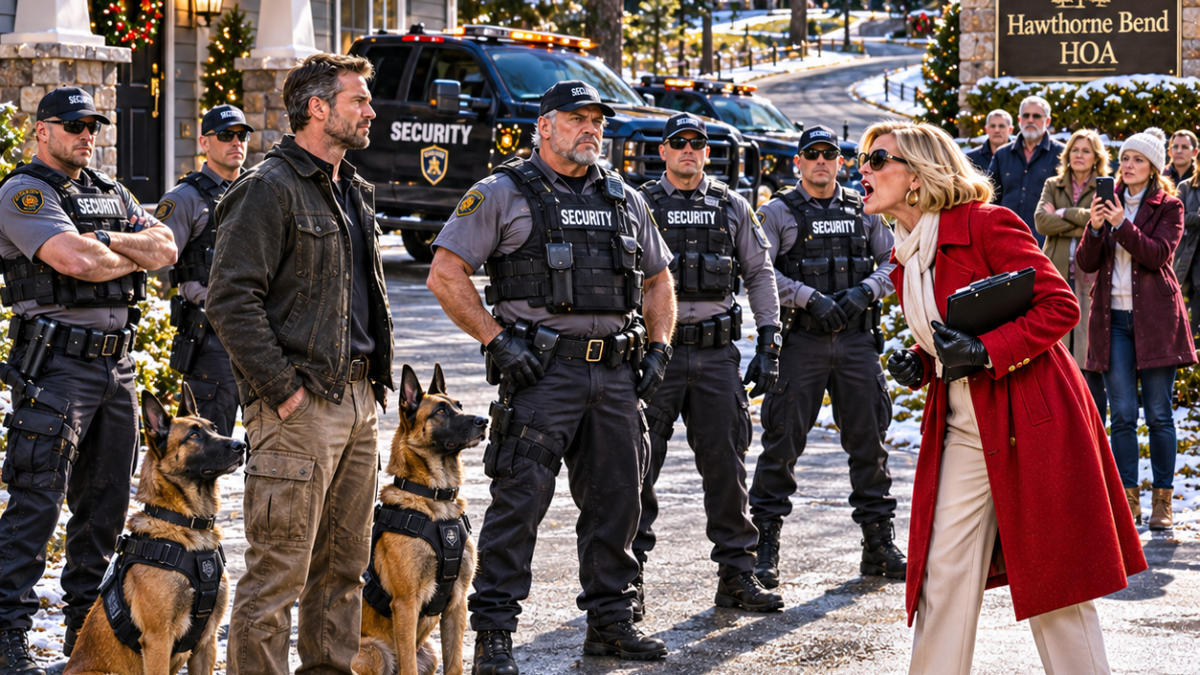
Six men surrounded me on Laurel Hollow Court before nine in the morning, and not one of them knew what I used to do for a living. Two Hawthorne Bend security trucks blocked the end of my driveway while the men spread into a loose semicircle, leaving exactly enough distance between themselves to look professional without admitting they had come expecting trouble. Their uniforms were private security issue—dark gray shirts, utility belts, radios, patches that looked intentionally close to law enforcement without actually being law enforcement. The lead man was Dale Pruitt, a former county deputy with a barrel chest, a square jaw, and the posture of somebody who had spent enough years hearing “yes, sir” that he had forgotten the difference between authority and obedience. I stood in the middle of my driveway holding a mug of coffee that was already cooling in my hand.
“Sir, we’ve had a complaint.”
I looked at him.
“About what?”
“Aggressive animals off leash. Threatening behavior near the green belt.”
My dogs were inside the house.
They had been inside all morning.
“I think somebody gave you bad information.”
Pruitt stepped closer.
The five men behind him tightened the semicircle.
“We’re going to need to secure the animals while this gets investigated.”
“Under what authority?”
“Board policy.”
That was the moment the morning stopped being ridiculous and became interesting.
Hawthorne Bend was an HOA.
It managed landscaping, architectural standards, the clubhouse pool, community trails, trash rules, and enough mailbox regulations to make an adult question civilization.
It did not maintain an animal-control unit.
It certainly did not need six armed private guards to collect two dogs based on an unnamed complaint.
I took a slow sip of coffee.
“Where exactly did this alleged incident happen?”
“Green Belt Trail.”
“What time?”
“Eight forty-seven.”
Very specific.
“Who reported it?”
“Resident confidentiality.”
That was not an answer.
Pruitt had one hand resting near his belt.
Not gripping anything.
Just resting.
He wanted me to notice.
I did.
Then I whistled.
One low note.
Then another.
The side door of my gray house swung open.
Ranger came first.
Vesper half a stride behind him.
Two Belgian Malinois moving low and fast, neither barking, neither hesitating.
They crossed the lawn.
Split without command.
Ranger planted himself at my left.
Vesper at my right.
Both sat.
Both looked forward.
Every man in front of me stopped moving.
Not because they were afraid of dogs.
Security officers see dogs constantly.
They stopped because of how Ranger and Vesper moved.
No frantic pulling.
No territorial barking.
No confusion.
They formed around me the way they had been trained to form around a handler hundreds of times.
The youngest guard stared at them.
“Those aren’t pets.”
“No.”
Pruitt’s hand moved away from his belt.
The silence lasted eleven seconds.
I counted.
Counting is another habit that stays with you after you’ve learned it in places where forgetting details can become expensive.
Then Pruitt spoke.
“Doesn’t matter what they are. HOA Resolution 114 prohibits aggressive breed types over forty pounds without registration. Hand over the leashes.”
I looked toward Mrs. Odum’s house across the cul-de-sac.
Her curtains were moving.
A delivery driver had stopped his van in the street and was already filming.
Good.
Witnesses.
I looked back at Pruitt.
“You should call whoever sent you.”
His jaw tightened.
“Why?”
“Because you’re about to do something you won’t be able to explain later.”
He stared at me for several seconds.
Then stepped away and made a call.
I couldn’t hear the voice on the other end.
I watched his shoulders instead.
They changed.
At first he stood straight.
Then slightly hunched.
Listening.
Questioning something.
Finally accepting it.
He returned.
“We’re filing a formal dangerous-animal report with the county.”
“Based on what evidence?”
“The resident complaint.”
“Which resident?”
“Confidential.”
There was that word again.
Confidential.
Ranger’s ears shifted toward Pruitt.
Vesper remained motionless.
I nodded once.
“Then file it.”
Pruitt looked almost disappointed that I hadn’t argued.
The six men climbed into their trucks.
They drove away.
I stood in my driveway until the peeling Hawthorne Bend Security decals disappeared around the corner.
Then I looked down at Ranger.
He looked back at me.
“Yeah,” I said. “I know.”
Vesper stood and moved toward the house.
I followed.
Eleven months earlier, I had moved into that gray house under an LLC that did not carry my name.
To Hawthorne Bend, I was Silas Kane, forty-one years old, remote logistics consultant, paid cash, kept to myself, owned two intense-looking dogs, and apparently lacked normal neighborhood social skills.
All of that was true.
None of it was the truth.
The real reason I lived at the end of Laurel Hollow Court sat behind my backyard.
Four hundred acres of undeveloped land.
A conservation green belt.
One buried rezoning application.
And an access corridor somebody needed badly enough to invent a dangerous-dog attack that had never happened.
That morning, for the first time in eleven months, I opened the locked drawer in my study and removed the federal case file Priya Ostrander had given me before I moved in.
Whatever had been moving quietly behind Hawthorne Bend had finally decided patience was over.
So was mine.
part 2
My name is Silas Kane.
I spent nine years as a military working-dog handler.
The last four were attached to a joint task force whose exact designation is not something I repeat casually.
I worked with dogs that searched buildings where people wanted us dead.
Dogs that found explosives hidden beneath floors.
Dogs that could distinguish between a threat and a terrified civilian faster than some humans I served beside.
Ranger and Vesper came from that world.
They were federally owned working animals temporarily assigned into my custody under a reassignment and evaluation arrangement connected to a broader federal inquiry.
That sentence sounds cleaner than reality.
Reality was long days, classified paperwork, layered permissions, and enough interagency bureaucracy to make a person nostalgic for combat zones.
Ranger was seven.
Vesper six.
Both had been through more than anyone on Laurel Hollow Court could have guessed.
They were not attack dogs.
They were not weapons waiting for a command.
They were highly disciplined working animals whose greatest skill was control.
That distinction would eventually destroy Karen Ashby’s complaint.
But the dogs were not why I had moved to Hawthorne Bend.
Priya Ostrander was.
Eighteen months before the confrontation in my driveway, she called me.
We had worked around each other years earlier.
She had since moved into federal investigative work involving financial fraud, land manipulation, and coordinated schemes using local administrative systems to pressure property owners.
“How do you feel about doing something slow?” she asked.
I laughed.
“From you? That sounds threatening.”
“Quiet assignment.”
“Meaning?”
“Move somewhere.”
“And?”
“Live there.”
“That’s it?”
“Watch.”
I stopped laughing.
“What am I watching?”
She sent me a secure file later.
Four residential developments across two states.
Different HOA boards.
Different management companies.
Different developers.
Same pattern.
A major development or rezoning project approached a critical stage.
One parcel stood in the way.
Then the owner of that parcel experienced sudden HOA pressure.
Noise complaints.
Animal complaints.
Architectural violations.
Claims of unsafe use.
Lien threats.
Code enforcement.
Lawsuits.
Two owners settled and left.
A third lost his property after years of litigation.
The fourth effectively disappeared from public records.
No forwarding address.
No subsequent property filings.
No known legal action.
Nothing Priya had could yet prove one central actor controlled all four cases.
What she had was pattern.
And one name recurring indirectly around the edges.
Preston Vance Merrick.
Corporate attorney.
Consultant.
Specialist in something his professional materials called community compliance restructuring.
I read that phrase twice.
“That’s real?”
Priya laughed.
“Unfortunately.”
“What does he actually do?”
“We think he turns local administrative pressure into leverage for land acquisition.”
“Think?”
“Proving is different from knowing.”
Then she showed me Hawthorne Bend.
Four hundred acres behind the western green belt.
Filed for rezoning under Larchmont Corridor Holdings LLC.
No obvious Merrick name.
Several shell entities.
A planning application that had somehow remained in preliminary review far longer than similar projects.
One likely reason:
The proposed commercial access corridor cut through the conservation strip behind Laurel Hollow Court.
And the cleanest route intersected land interests tied to several private lots, including the gray house at the end of the cul-de-sac.
My house.
Priya needed somebody inside.
Not an undercover officer pretending to be someone else.
That wasn’t what I was.
I bought the property legally through a holding company.
I actually lived there.
I simply didn’t advertise the federal investigation running parallel to my ordinary life.
For eleven months, I watched.
Survey crews appeared twice.
Soil technicians came once.
Unmarked vehicles photographed the green belt.
A management consultant met Karen Ashby repeatedly at the clubhouse.
Rezoning documents shifted.
Then nothing.
No public hearing.
No open HOA discussion.
No direct offer to me.
Karen herself barely spoke to me.
That mattered later.
At the time, she seemed exactly like the HOA president everyone expected.
Organized.
Persistent.
Deeply invested in curb appeal.
Karen had lived in Hawthorne Bend for nine years.
She loved the community.
That wasn’t sarcasm.
She genuinely did.
She attended every event.
Organized food drives.
Remembered children’s names.
Negotiated pool repairs.
Managed landscaping complaints.
And carried a clipboard everywhere.
People called her before calling the management company because Karen always answered.
That made her useful.
It also made her vulnerable.
People who need to feel essential can be controlled by anyone clever enough to convince them a crisis requires exactly their kind of dedication.
I did not understand that yet.
Two days after the driveway confrontation, a certified dangerous-animal complaint arrived.
The document was impressive.
Professionally written.
Detailed.
Specific.
And almost certainly fictional.
Incident time: 8:47 a.m.
Location: Green Belt Trail behind Laurel Hollow Court.
Two large canines allegedly advanced toward a resident in a threatening manner, forcing the resident to retreat and seek assistance.
Complainant identity withheld under “resident privacy provisions.”
I searched the Hawthorne Bend covenants.
No privacy provision matching the cited authority existed.
Then I walked the supposed incident route.
The section of green belt behind my house did not connect directly to the public trail network.
There were two realistic access points.
My backyard.
And the backyard belonging to my next-door neighbor, Harold Voss.
Harold was visiting his daughter in Charleston that entire week.
There was no plausible way for an ordinary resident to be standing where the complaint claimed without crossing private property.
The fictional witness had a location problem.
I called Priya.
“They’re moving faster.”
“You surprised?”
“Yes.”
“Why?”
“Because the rezoning application isn’t ready.”
“Then either a deadline changed or someone above Karen got nervous.”
“Which?”
Priya sighed.
“HOA boards rarely invent urgency by themselves.”
I waited.
“Someone hands it to them.”
That sentence became the spine of everything that followed.
I started building a timeline.
Survey activity.
Planning filings.
HOA meetings.
Consultant visits.
Security complaints.
Property records.
Then the county animal-services petition appeared.
Emergency temporary removal order requested.
That part got under my skin.
More than I wanted to admit.
Ranger and Vesper had bite and aggression histories consisting of exactly zero incidents outside sanctioned working contexts.
The possibility that fabricated paperwork could result in their removal, quarantine, or even destruction under a local ordinance designed for genuinely dangerous animals sat inside me like a hot stone.
For ten minutes, I let myself be furious.
Then I stopped.
Rage is useful in small doses.
After that, it starts stealing attention.
The county required an independent temperament evaluation before any emergency removal could proceed.
That procedural safeguard saved us.
Dr. Renata Okafor conducted the assessment.
Thirty-one years of animal behavior work.
No interest in neighborhood politics.
No patience for performance.
Ranger and Vesper went through controlled stranger approaches.
Sudden-noise exposure.
Food proximity.
Handler separation.
Environmental distraction.
Their responses were exactly what I expected.
Alert.
Controlled.
Stable.
Dr. Okafor was writing notes when Karen Ashby arrived.
That was the first time we had really stood near each other.
She walked toward the restricted evaluation area despite a county employee telling her twice to remain behind the line.
Karen wore a pale lavender coat and carried the same leather folder she used at HOA meetings.
She stared at Ranger.
Then Vesper.
“These are the animals that attacked a resident.”
She spoke loudly enough for everyone nearby.
Dr. Okafor looked up.
“Ma’am, please step back.”
“I have a right to observe.”
“You have a right to remain outside the assessment area.”
Karen moved closer.
Ranger’s ears rose.
Vesper shifted her weight.
Neither moved beyond that.
Karen stared harder.
Almost challenging them.
I understood what she wanted.
A bark.
A lunge.
A growl.
Anything she could point to later.
Dr. Okafor understood too.
“Mrs. Ashby.”
Karen looked at her.
“If you continue attempting to provoke the animals during a formal behavioral evaluation, I will document that conduct in my report.”
Karen froze.
For four seconds, she stood staring at two dogs who refused to become the animals she needed them to be.
Then she walked away.
I watched her face.
I had expected satisfaction.
Malice.
The smugness of someone enjoying control.
Instead, I saw fear.
Not fear of Ranger.
Fear of failure.
That distinction bothered me.
Karen reached her car and immediately made a phone call.
Dr. Okafor finished writing.
Her preliminary conclusion was unequivocal.
“Exceptional impulse control. No behavioral indicators consistent with the alleged incident.”
“Thank you.”
“Don’t thank me. Thank your dogs.”
I looked at Ranger.
He yawned.
“Very heroic.”
Dr. Okafor almost smiled.
The formal report would take three days.
Three days turned out to matter.
That evening, Priya called.
“I found Merrick.”
I sat down.
“Directly?”
“Not quite.”
She explained that Larchmont Corridor Holdings traced through three corporate layers to registered agents connected with a law firm in the state capital.
Hollis, Merrick & Bradden.
Preston Merrick wasn’t technically a named partner on the relevant filings.
Contract counsel.
Outside compliance.
Never appearing in the public Hawthorne Bend materials.
“Careful,” I said.
“Very.”
“Connection to other cases?”
“Four.”
My stomach tightened.
“Same firm?”
“Different entities. Similar structure.”
“Same enforcement pattern?”
“Yes.”
Then Priya went quiet.
“What?”
“The fourth owner.”
“The one who disappeared?”
“Still nothing. Eight months after pressure started, he drops out of the property record. No later address. No civil filings. Nothing we can connect to Merrick.”
“You think something happened.”
“I think not knowing bothers me.”
It bothered me too.
“This is bigger than the dogs,” she said.
“I know.”
“No, Silas. Understand what I’m saying. The dogs are the opening move.”
I looked down.
Vesper was asleep beside my desk.
Ranger lay by the door.
“If the hearing fails?”
“Merrick escalates.”
She was right.
County hearing day arrived Thursday.
Janice Felt, the hearing officer, sat behind a long scarred table beneath fluorescent lights.
Karen arrived with a folder thick enough to suggest insecurity.
Two rows behind her sat a man I had never seen.
Silver hair.
Expensive suit without obvious branding.
Average face.
The kind of man who looked designed to be forgotten.
He carried a legal pad.
He never wrote on it.
I knew before anyone introduced him.
Preston Merrick.
Some people attend hearings to participate.
Others attend to supervise.
Preston watched Karen the way a director watches an actor perform lines he already knows.
Karen testified first.
Her version was smooth.
Too smooth.
People describing frightening events usually remember emotionally.
They jump.
Correct themselves.
Miss details.
Karen’s story had no rough edges.
At 8:47.
Near the green belt.
Two dogs.
Unnamed resident.
Threatening advance.
Retreat.
Immediate report.
My attorney, Odalis Ferron, stood.
Odalis never rushed anything.
She cross-examined like someone unraveling a sweater one thread at a time.
“Mrs. Ashby, you stated the complainant’s identity is confidential under HOA policy.”
“Yes.”
“Please identify the covenant provision.”
Karen opened her binder.
Paused.
Turned pages.
Another pause.
“I don’t have the number immediately.”
“Take your time.”
She couldn’t find it.
Because it didn’t exist.
Odalis moved on.
“How would a resident access the location where you say this occurred?”
“Through the green belt trail.”
“From which public entry?”
Karen hesitated.
“I’d have to verify the exact access point.”
Odalis placed the property map on the display.
“There is no public access point to that section, correct?”
Karen looked at it.
The room went quiet.
Dr. Okafor’s report came next.
Exceptional restraint.
Zero indicators supporting the alleged aggression.
Then the line about an observer attempting provocative proximity during formal assessment.
Janice Felt looked at Karen.
Karen looked down.
The emergency removal request was denied.
“Insufficient grounds,” Felt said. “The complaint contains material inconsistencies, and the independent evaluation is unambiguous.”
For one moment, I thought we had won something.
Then I watched Preston Merrick stand.
He crossed behind Karen during recess.
Bent slightly.
Whispered something.
Her relief disappeared.
Fear returned.
That told me the hearing had never been the end.
Outside in the marble hallway, Dale Pruitt waited near the elevators.
He looked like he had not slept.
“You need to hear something.”
I stopped.
Four days earlier, this man had stood in my driveway demanding my dogs.
Now he kept looking down the hallway toward Karen and Merrick.
“My camera was running.”
“What camera?”
“Body camera.”
“You’re private security.”
“Old habit.”
He swallowed.
“The morning we came to your house, I never turned it off.”
I felt something inside me become very still.
“What does it have?”
“About eleven seconds.”
“Of what?”
“The call.”
I didn’t celebrate.
I asked, “Why now?”
Pruitt looked at the floor.
“Because four days ago I believed what they told me.”
He looked at Ranger.
“I thought you were dangerous. Thought the dogs were dangerous.”
“And now?”
“I saw Karen at the evaluation.”
He rubbed a hand over his face.
“I spent nine years wearing a real badge before I screwed that up. I know what it looks like when somebody is trying to create probable cause after deciding the outcome.”
“What exactly did your camera capture?”
Pruitt lowered his voice.
Four minutes before his security trucks turned onto Laurel Hollow Court, Karen had been in the clubhouse parking lot speaking to Preston.
Pruitt stood nearby.
Karen’s voice could be heard clearly.
“I don’t feel right about this, Preston. What if there isn’t a real complaint?”
Then Preston.
Six words.
“We need this parcel clean, Karen.”
Not safe.
Not controlled.
Not compliant.
Clean.
Language from a land transaction.
I looked across the hallway.
Karen stood with Preston.
For the first time, I considered that she might not fully understand what she had been helping him do.
That didn’t absolve her.
She had signed the complaint.
Repeated lies.
Tried to provoke my dogs.
But somebody had been feeding her urgency.
Priya’s sentence returned.
Boards don’t invent urgency.
Somebody hands it to them.
Pruitt agreed to preserve the recording through formal channels.
Odalis insisted.
No copies passed privately.
No social media.
No dramatic reveal.
Chain of custody first.
Proof before theater.
I thought that audio might end the fight.
Instead, the following morning, I was arrested.
Two sheriff’s deputies waited for me in the same marble hallway.
“Silas Kane?”
“Yes.”
“You’re under arrest for impersonating a federal officer and unlawful possession of government property.”
For one second, I thought I had misheard.
Then I saw Preston Merrick standing farther down the corridor.
Legal pad in hand.
Writing this time.
The allegations claimed my federal credentials were fraudulent.
Ranger and Vesper were supposedly improperly held government assets.
It was clever.
Not because it was true.
Because disproving it required time.
Records.
Calls.
Verification.
Delay.
Exactly what Preston needed.
I spent six hours in a holding cell.
The first hour made me angry.
The second made me understand.
The dogs had failed as leverage.
So Preston changed me from victim to suspect.
If the tactic worked, even briefly, county officials would stop listening to my allegations.
Neighbors would question my credibility.
The rezoning clock could move.
That was the play.
Odalis arrived.
Then Priya.
She wore a plain gray suit.
The booking room changed the moment she showed credentials.
She formally identified herself as case officer overseeing an eighteen-month federal investigation involving coordinated fraud and land manipulation across five residential developments.
Five.
Hawthorne Bend was not an isolated dispute.
I was not simply a former handler living anonymously.
My placement in Hawthorne Bend had been part of that inquiry.
My federal status and custodial authority regarding Ranger and Vesper had been documented before I moved in.
Priya looked at the booking sergeant.
“His credentials have been independently verified for eleven months.”
The man stared at the paperwork.
Priya continued.
“You are holding a federal investigative asset on allegations originating from a private attorney who appears to have a financial conflict in the same land matter under active investigation.”
The impersonation case collapsed quickly after proper verification.
Charges dropped.
Dogs returned.
No dramatic apology.
Just paperwork correcting paperwork.
But Preston was gone by then.
He left the courthouse around the time of my arrest.
No one knew where.
Priya sat across from me in a conference room.
“He’ll distance himself.”
“From Karen.”
“Yes.”
“From Larchmont.”
“Yes.”
“And show up somewhere else.”
“Unless we tie the instructions directly to him.”
“We have Pruitt.”
“We have eleven seconds.”
“And Karen?”
Priya looked at me.
“That depends on what Karen decides she is.”
That evening I went to Karen’s house.
Odalis later told me this was reckless.
She was correct.
Karen opened the door before I knocked twice.
She looked exhausted.
No clipboard.
No polished HOA expression.
“I know what he told you.”
I said nothing.
She stepped back.
I entered.
Her living room looked curated rather than lived in.
Perfect pillows.
Perfect shelves.
Perfect photographs.
Karen sat across from me.
“I thought you were operating an illegal breeding operation.”
I stared at her.
She continued.
“Preston came through the management company almost two years ago. Compliance restructuring.”
“That phrase again.”
“He said there were liability concerns near the green belt. Dangerous dogs. Commercial activity. Insurance exposure.”
“You never checked.”
Her face tightened.
“No.”
“You spent eighteen months targeting someone you never bothered to investigate.”
“Yes.”
It surprised me how quickly she admitted it.
“I believed him because he made me feel like I was protecting Hawthorne Bend.”
“That doesn’t make what you did legal.”
“I know.”
“You tried to get federal working dogs seized.”
“I know.”
“You lied in a county proceeding.”
Her eyes filled.
“I know.”
I didn’t soften.
Not yet.
“Then why keep going once you suspected?”
Karen looked toward her hands.
“Because if I asked the question out loud, I’d have to admit I had already begun to suspect the answer.”
That sentence was more honest than anything I had heard from her.
She told me the call happened exactly as Pruitt described.
Three days before the driveway confrontation, doubts had started.
She asked Preston for the original resident complaint.
He kept delaying.
The morning of the enforcement action, she confronted him.
“What if there’s no complaint?”
His answer:
“We need this parcel clean.”
That was when she knew safety was not the real objective.
“And you sent Pruitt anyway.”
She closed her eyes.
“Yes.”
“Why?”
“Because I was already too far in.”
“That is not a defense.”
“I know.”
She looked at me.
“It’s the truth.”
For eighteen months, Preston had controlled which violations Karen prioritized.
Which homeowners were “high risk.”
Which compliance language appeared in letters.
He drafted portions of enforcement documents.
Presented himself as protecting property values.
He deliberately isolated her from board members likely to question unusual legal tactics.
Karen kept records.
Calendar notes.
Emails.
Drafts.
She had all of it.
“Why tell me now?”
She laughed once without humor.
“Because when you got arrested, I finally understood what I had become.”
Silence.
“He told me you were dangerous.”
“I was in handcuffs because he lied.”
“Yes.”
“He would have done the same to you.”
“I know.”
Karen stood.
She walked to a desk.
Removed a thick binder.
“I already called a lawyer.”
“Good.”
“And the federal number from the business card your attorney gave the board.”
“Priya?”
“I assume.”
She handed me the binder.
I didn’t take it.
“Give it to your lawyer. Let them coordinate.”
Karen looked almost relieved.
“I’m done protecting him.”
That decision changed everything.
Eleven days later, the case moved into a federal proceeding far removed from the little county animal-services hearing where it began.
Evidence from five developments came together.
LLCs.
Rezoning applications.
Enforcement campaigns.
Legal invoices.
Residents targeted near critical access corridors.
Karen’s emails.
Pruitt’s audio.
Dr. Okafor’s report.
My arrest records.
Preston’s drafted complaint language.
Patterns repeated with small variations across multiple states.
Preston Vance Merrick sat at the defense table.
For the first time since I had seen him, he no longer looked forgettable.
His own voice played through the courtroom.
Karen:
“What if there isn’t a real complaint?”
Preston:
“We need this parcel clean.”
Eleven seconds.
That was all.
Eleven seconds did not prove the entire case alone.
Cases that large do not work that way.
But those eleven seconds connected Preston directly to an enforcement action he had spent months trying to keep off paper.
Karen’s sworn statement supplied context.
Her records showed repeated coordination.
Federal investigators connected Merrick’s language to complaint templates from earlier developments.
Pruitt’s testimony established how the order traveled from Karen to security.
Dr. Okafor’s assessment showed the supposed safety justification had no factual foundation.
Land records showed the motive.
The green belt behind Laurel Hollow Court sat over the only practical access corridor for the four-hundred-acre Larchmont project.
My parcel complicated it.
Remove me, pressure the property, weaken conservation protections, and the development economics changed dramatically.
Federal financial analysis estimated roughly eleven million dollars in commercial development value depended on securing the corridor and removing the obstacles around it.
Eleven million dollars.
That was what somebody had decided made my home disposable.
Ranger disposable.
Vesper disposable.
My reputation disposable.
Possibly my freedom too.
Preston’s defense argued that he had merely been an aggressive advocate pursuing legitimate development objectives.
His attorney insisted the phrase “clean parcel” was ordinary transactional language.
The problem was context.
A fake dog complaint.
The timing.
The scripted enforcement.
The fabricated privacy rule.
The later impersonation allegation.
The repeated pattern across prior developments.
The line between aggressive legal advocacy and coordinated fraud became impossible to blur once every piece sat in the same record.
Karen testified.
I watched her walk to the witness stand.
Months earlier, I would have imagined feeling satisfaction.
I didn’t.
She looked smaller.
Not physically.
Morally.
Like someone finally seeing the distance between the person she believed herself to be and the things she had actually done.
She did not ask for sympathy.
That mattered.
She described Preston’s influence.
Her own failures.
The moment she understood the complaint might be false.
Her decision to send Pruitt anyway.
The hearing.
The attempted provocation.
My arrest.
She admitted every part that made her look terrible.
That was the first useful thing she had done for Hawthorne Bend in months.
Preston was eventually convicted on charges including fraud, conspiracy, and witness tampering connected with the broader pattern.
The exact legal outcomes differed across the five developments.
Not every allegation became a conviction.
Not every mystery was solved.
But the structure he had used to make ordinary homeowners disappear beneath administrative pressure finally became visible.
Larchmont Corridor Holdings and related entities were dissolved through federal action.
The Hawthorne Bend rezoning proposal was withdrawn.
The green belt remained protected under the conservation restrictions that had been there all along.
Karen resigned as HOA president the same week she completed her testimony.
Prosecutors did not charge her criminally.
That angered some neighbors.
I understood why.
She had done real harm.
But investigators had to decide what outcome best served the larger case.
Karen had been manipulated.
She had also chosen not to ask questions when asking questions would have cost her the heroic role Preston had built for her.
Both things were true.
Her cooperation exposed conduct affecting multiple communities.
The government treated her as a critical witness.
I learned to accept that legal justice is not the same thing as emotional symmetry.
Sometimes the person who hurt you most directly receives less punishment than the person who built the machinery behind them.
That can feel unfair.
It can also be necessary.
Dale Pruitt left Hawthorne Bend Security.
Before he resigned, he came to my house.
Alone.
No uniform.
Ranger watched him from the porch.
Pruitt stayed near the sidewalk.
“I owe you an apology.”
“Yes.”
That answer surprised him.
He had probably expected me to make it easier.
I didn’t.
He looked toward Ranger.
“I followed orders I should have questioned.”
“Yes.”
“I believed people because they had titles.”
“Yes.”
“You going to make me say the whole thing?”
“If you want the apology to mean something.”
He nodded.
“I used authority I didn’t have to pressure a resident based on a complaint I hadn’t verified.”
I waited.
“And I was willing to take two animals I didn’t understand because somebody told me policy mattered more than evidence.”
“That’s closer.”
Pruitt almost smiled.
“I deserved that.”
“Yes.”
He told me he had accepted a job with a county oversight agency.
“Why?”
“Because apparently I need to spend the second half of my career learning what the first half should’ve taught me.”
I respected that.
Not enough to forget.
Enough to believe people can become more useful after failure if they stop defending it.
Hawthorne Bend changed too.
The board conducted an outside review.
Karen’s enforcement practices were examined.
Several violations issued under Preston’s “compliance restructuring” recommendations were reversed.
Residents demanded outside counsel disclose conflicts.
Major land-use issues required open board discussion.
Anonymous safety complaints could still be submitted, but enforcement now required independent corroboration before extraordinary action.
Nobody named the rule after Ranger or Vesper.
Thank God.
Mrs. Odum suggested it.
I threatened to move.
She laughed.
For the first time since I moved in, people started approaching me.
Not aggressively.
Curiously.
“You were really a military dog handler?”
“Yes.”
“Are the dogs dangerous?”
“All dogs can be dangerous.”
“That isn’t what I asked.”
“Then ask a better question.”
The neighborhood eventually learned that Ranger loved tennis balls more than dignity.
Vesper was terrified of the automatic sprinkler behind Mrs. Odum’s house.
The child who rode a bicycle at the end of the cul-de-sac became one of their favorite people.
That image stayed with me.
Ranger and Vesper lying in grass while a kid circled slowly on a bicycle.
Six months earlier, six armed men had surrounded them because someone had typed the word aggressive into a complaint.
Words matter.
But evidence matters more.
Priya’s investigation concluded months later.
We met for coffee outside the city.
“So,” she said. “How do you feel about doing something slow again?”
“No.”
“You didn’t even ask.”
“No.”
“You’re difficult.”
“Yes.”
She smiled.
I looked out the window.
“Did we ever find the fourth homeowner?”
Her smile disappeared.
“No.”
That bothered me.
Still does.
Not every story closes neatly.
Sometimes justice arrives late enough that somebody has already lost too much.
We knew Preston’s network had been involved in pressure around that man’s property.
We did not know exactly what happened afterward.
Maybe he left voluntarily.
Maybe he changed his name.
Maybe something worse happened.
I don’t pretend knowledge where none exists.
That absence became a reminder.
We stopped Hawthorne Bend before it became another missing chapter.
That matters.
People sometimes ask why Ranger and Vesper were assigned to me if the investigation was primarily about land fraud.
The answer is less glamorous than they expect.
They were legitimate federal assets in transition.
My background made me qualified to handle them.
Their presence also gave the investigation an authentic pressure point.
Preston’s pattern relied on finding something local institutions could weaponize.
Dogs were predictable.
Noise.
Breed restrictions.
Liability.
Fear.
We never fabricated any conflict.
We simply existed.
Merrick supplied the lie.
That distinction became important when defense attorneys later suggested the operation had entrapped him.
It hadn’t.
No one asked Karen to file a false complaint.
No one told Merrick to manufacture a resident.
No one forced Hawthorne Bend Security to arrive with six guards.
No one ordered Preston to fabricate an impersonation allegation after losing the animal hearing.
Those were choices.
The investigation documented them.
That’s the difference between watching someone reveal themselves and creating the crime you want to find.
Karen struggled with that concept after everything ended.
One afternoon, months later, I saw her near the Hawthorne Bend clubhouse.
She no longer held any office.
She looked toward me.
“Silas.”
“Karen.”
She hesitated.
“Do you hate me?”
People ask that question when they want a clean emotional verdict.
I didn’t have one.
“No.”
She seemed surprised.
“I was prepared for yes.”
“That would’ve been easier.”
She looked toward the green belt.
“I thought I was protecting this place.”
“I know.”
“Does that make it worse?”
“Sometimes.”
She flinched.
I continued.
“You wanted to be right badly enough that you stopped checking.”
Karen nodded.
“I know that now.”
“Preston understood you.”
“That sounds insulting.”
“It is.”
She almost smiled.
Then her eyes watered.
“I keep thinking about the dogs.”
“Why?”
“Because I stood at that fence trying to make them react.”
I said nothing.
“They were more disciplined than I was.”
“Yes.”
That answer hurt her.
It was true.
She looked at me.
“Do you think people like me can come back from something like that?”
I thought about Dale Pruitt.
About Priya.
About my own career.
About mistakes I had made in places without cameras.
“Depends what you mean by come back.”
“Be trusted again.”
“That isn’t yours to decide.”
She looked down.
“You earn the chance. Other people decide whether they give it.”
Karen nodded.
That was the last serious conversation we had.
She moved away the following year.
Not dramatically.
No humiliation parade.
No neighborhood celebration.
A moving truck arrived.
Her house sold.
A new family moved in.
Hawthorne Bend continued.
That is another thing abusive leaders misunderstand.
The community is not the person controlling it.
It survives them.
The green belt remains behind my house.
The rezoning signs never went up.
No bulldozers arrived.
The conservation easement is still recorded.
Sometimes I walk Ranger and Vesper along the allowed section of trail.
People wave now.
I sometimes wave back.
Training changes.
Not all habits need to become permanent.
Ranger retired first.
His hips started showing age.
He still moved fast when motivated by food, which I considered evidence of selective disability.
Vesper stayed active longer.
Both eventually transitioned into permanent retirement arrangements with me.
The paperwork was substantial.
I signed every page gladly.
For years, they had belonged technically to systems larger than any one person.
Then one afternoon, a document arrived confirming what my heart had already decided.
Mine.
I sat on the porch with Ranger’s head against my boot.
“You finally became a pet.”
He ignored me.
Probably offended.
The neighborhood child who used to ride circles at the cul-de-sac grew older.
One day she asked why Ranger always watched me.
“Because that was his job.”
“What’s his job now?”
I looked at him asleep in the sun.
“Retirement.”
“He’s bad at it.”
“Very.”
She looked toward Vesper.
“Were they really in the military?”
“Yes.”
“Did they save people?”
“Yes.”
“Did they bite bad guys?”
I laughed.
“Sometimes kids ask easier questions.”
She considered that.
“Did they save you?”
That one wasn’t easy.
“Yes.”
Not in the way she meant.
They saved me by reminding me what discipline looks like when people around you are losing theirs.
The morning Pruitt surrounded me, Ranger and Vesper had every reason to react to tension.
They didn’t.
At the county evaluation, Karen tried to provoke them.
They didn’t.
When I was arrested, they waited.
When the case ended, they moved on faster than any human involved.
Animals don’t rehearse resentment.
That is one advantage they have over us.
The eleven seconds became famous inside the case.
Not publicly.
Among investigators.
Eleven seconds of audio.
Priya called it “the hinge.”
Pruitt hated that.
He said it made him sound heroic.
He wasn’t.
Neither was Karen.
Neither was I.
The truth is less comfortable.
Pruitt almost helped ruin me.
Karen almost succeeded in getting my dogs taken.
I participated in an investigation that relied on waiting while a pattern escalated.
Everybody involved had moments where a different decision could have prevented harm earlier.
The case turned because, eventually, enough people chose differently.
Pruitt kept the recording.
Karen told the truth.
Dr. Okafor refused intimidation.
Odalis insisted on procedure.
Priya kept pulling corporate filings after easier theories would have satisfied most people.
Those choices mattered.
Justice is often built from people changing direction before it’s too late.
Not saints.
Not superheroes.
People deciding the next action will be better than the last.
Preston never did.
That was his defining failure.
Every obstacle became something to remove.
Every homeowner became a variable.
Every board became a tool.
Every complaint became leverage.
He did not see people.
He saw friction.
Once you start thinking that way, almost anything can feel justified.
A false dog complaint is just paperwork.
A lien is just leverage.
An arrest is just delay.
A displaced homeowner is just a resolved parcel.
That is why his recorded words mattered so much.
“We need this parcel clean.”
Clean.
As though a man, two animals, and a home were stains on a development map.
That phrase still bothers me.
Because it is how systems become cruel without anybody announcing cruelty.
Sanitize the language.
Resident becomes obstacle.
Home becomes parcel.
Pressure becomes compliance.
Removal becomes restructuring.
Destroy enough meaning and eventually nobody notices what the verbs are doing to actual people.
My house was never simply Parcel 18C.
It was where I fed Ranger after surgery.
Where Vesper slept beside the heater during storms.
Where Mrs. Odum left banana bread even though she claimed she didn’t like me.
Where a kid learned that working dogs can be gentle.
Where six men once stood in a half circle believing policy mattered more than questions.
Hawthorne Bend was never simply an access corridor.
It was people’s kitchens.
Mortgages.
Children.
Retirements.
Fences.
Marriages.
Lives.
Preston’s genius was converting all of that into geometry.
His failure was forgetting geometry still belongs to someone.
The new HOA president was Russell Dean.
Quiet man.
Accountant.
Terrified of conflict.
Exactly what Hawthorne Bend needed.
His first board meeting lasted three hours because he refused to approve anything until every member had the supporting documents.
People complained.
He said, “Good.”
I liked him.
He asked whether I wanted to join the board.
“No.”
“Expected.”
“Why ask?”
“Procedure.”
That made me laugh.
The board changed the green belt policy too.
Any proposal affecting conservation land required homeowner notice, outside legal review, and public presentation before the HOA could take a position.
The rezoning application had taught them the danger of closed-door “consultants.”
Preston’s consulting contract had never been presented clearly to residents.
That became impossible under the new rules.
No policy prevents every abuse.
People who want power will always test edges.
But transparency makes edges harder to move quietly.
That was enough.
One year after the driveway confrontation, I woke before eight.
Made coffee.
Walked outside.
No security trucks.
No complaint.
Ranger followed slowly.
Vesper bounded past him.
The morning was cool.
Mrs. Odum was watering plants.
She waved.
I waved back.
She shouted, “Look at that! Progress!”
I regretted it immediately.
Ranger lay beside the driveway.
Vesper watched a squirrel.
I looked toward the green belt.
Trees.
Grass.
Nothing dramatic.
Exactly what conservation land should look like.
I thought about the first morning.
Six men.
Two trucks.
Cold coffee.
Eleven seconds.
A fake complaint.
An entire hidden system behind it.
At the time, I thought the question was whether they could take my dogs.
It wasn’t.
The deeper question was how far ordinary institutions could be pushed when nobody stopped to verify the story they were being handed.
Security trusted Karen.
Karen trusted Preston.
The management company trusted outside counsel.
County animal services received paperwork that looked official.
Deputies later received a criminal allegation that looked official.
Every individual piece depended on somebody assuming the previous person had checked.
That is how a lie becomes infrastructure.
No single person has to believe the whole thing.
They only have to process their part.
Pruitt taught me that.
He didn’t wake up wanting to fabricate evidence.
He received an order.
He followed it.
Then another.
Then suddenly he was standing in a marble hallway realizing obedience had carried him somewhere he no longer recognized.
Karen’s path was longer.
Eighteen months.
One “urgent” recommendation at a time.
That frightened me more than Preston.
People like Preston exist.
They always will.
The real danger is the number of ordinary people willing to become their hands because the story feels righteous enough.
Protect children.
Protect property values.
Protect neighborhood safety.
Protect the community.
Those words are not bad.
That is why they work.
You can hide a great deal behind noble language if nobody asks who benefits.
Priya once asked what I would tell Hawthorne Bend residents if I had to reduce the entire case to one sentence.
I thought about it.
“Ask who benefits from your fear.”
She nodded.
“Good.”
“What would you say?”
She smiled.
“Read the attachments.”
Also good.
I still have the original dangerous-animal notice.
Odalis told me to keep it.
I did.
The fictional resident.
The fabricated privacy provision.
The precise 8:47 timestamp.
It looks absurd now.
At the time, it was dangerous because it wore the language of procedure.
That lesson stayed with me.
Official-looking paper can still lie.
A badge can be misused.
A board can be wrong.
A lawyer can be corrupt.
A federal agent can make mistakes.
Authority is not proof.
Evidence is.
Process matters because people do not magically become trustworthy when given titles.
Sometimes process is the only thing standing between one person’s certainty and another person’s life.
Karen hated that lesson.
Then she became evidence for it.
Pruitt lived it.
I did too.
I had spent years in environments where fast decisions saved lives.
Hawthorne Bend taught me a different discipline.
Slow down.
Check.
Document.
Wait.
Let the lie overextend.
Not every fight is won by moving first.
Sometimes the person hurting you is counting on your anger because anger gives them something easier to describe than the truth.
That was why I kept my coffee in my hand that first morning.
Why I didn’t shout.
Why I didn’t order Ranger or Vesper forward.
Why I let Pruitt make the call.
Why I photographed rather than threatened.
Why Odalis insisted evidence move through channels.
Why Priya waited eighteen months.
Patience is not passivity.
Sometimes patience is pressure applied in the only direction a lie cannot survive.
Toward the record.
Years later, Ranger died first.
Old age.
Nothing dramatic.
He stopped eating much.
The veterinarian came to the house.
I sat with him on the floor.
Vesper lay nearby.
I won’t make that moment prettier than it was.
It hurt.
He had stood beside me in places I don’t talk about.
He had crossed my driveway the morning six men came.
He had remained still while every human around him made the situation more complicated than it needed to be.
When it was over, I buried him on the far side of the yard near the green belt.
Not inside the conservation easement.
I checked.
Some habits become permanent.
Vesper lasted another two years.
By then she slept more than she worked.
Mrs. Odum brought treats.
The neighborhood kid, no longer a child, visited before leaving for college.
“You’ll take care of Silas, right?” she told Vesper.
Vesper looked at her.
Then at me.
“She seems unconvinced,” I said.
The girl hugged her anyway.
After Vesper was gone, the house felt too quiet.
I considered moving.
Priya asked whether the assignment had poisoned the place for me.
“No.”
“Then why?”
“Too much memory.”
She nodded.
“That’s different.”
I stayed.
The gray house eventually became simply my house.
Not surveillance position.
Not Parcel 18C.
Not operational placement.
Home.
Maybe that was the final thing Preston failed to take.
Not land.
Meaning.
I kept living there until the entire scheme became something that happened once rather than something still happening every morning.
That took time.
One evening, I walked to the edge of the green belt.
The sun was low.
Kids were somewhere down the street.
A lawn mower ran.
Ordinary noise.
I thought about Karen Ashby.
People still asked whether she was a villain.
I never knew how to answer cleanly.
She did bad things.
Knowingly, eventually.
She lied.
She used authority carelessly.
She tried to provoke my dogs after doubts already existed.
She continued because admitting the truth would have required admitting her identity as community protector had been manipulated.
Those choices belong to her.
But Preston selected her because he understood something she did not.
She needed to matter.
He turned that need into an instrument.
That does not make her innocent.
It makes the story useful.
Real harm is often delivered by people who think they are doing good.
That is exactly why intentions cannot be the final test of authority.
Facts have to matter.
Evidence has to matter.
Limits have to matter.
Karen eventually understood that.
Too late for me to trust her.
Not too late for her testimony to stop Preston from doing the same thing somewhere else.
I can live with that.
Legal justice rarely gives you the emotional ending you imagine while you’re angry.
Preston went to prison.
Karen did not.
Pruitt rebuilt a career.
The HOA survived.
The development died.
The green belt remained.
Ranger and Vesper lived the rest of their lives with me.
No one came to seize them again.
That is enough.
More than enough.
The image I return to is still the first one.
Not the courtroom.
Not Preston hearing his own voice.
Not Karen resigning.
My driveway.
Six men.
Cold coffee.
Two dogs running silently from the side door.
Ranger left.
Vesper right.
Then stillness.
Eleven seconds.
Every man there knew instinctively that something about the scene they had been given did not fit.
Some ignored that feeling.
One eventually didn’t.
That difference changed everything.
People like Preston depend on the moment between doubt and obedience.
They win when doubt stays private.
When the employee says nothing.
When the board member stays quiet.
When the neighbor closes the curtain.
When the security guard deletes the recording.
When the woman who knows the story is false keeps repeating it because she has already repeated it too many times to stop.
Our case turned because people finally stopped.
Pruitt kept eleven seconds.
Karen admitted what she had done.
Priya kept digging.
Dr. Okafor wrote exactly what she observed.
Odalis forced every claim back toward evidence.
Those acts were smaller than Preston’s scheme.
Together, they were stronger.
That is what I learned in Hawthorne Bend.
Power likes spectacle.
Truth often looks like paperwork.
A body-camera file.
A survey.
A timestamp.
An evaluation report.
An email nobody thought mattered.
A sentence somebody forgot was being recorded.
“We need this parcel clean.”
Six words.
A multimillion-dollar scheme reduced to the language it had been hiding from everyone.
My parcel was never dirty.
It had a house.
Two dogs.
One stubborn man.
That was all.
And sometimes that is all it takes to stop a large machine.
One ordinary person refusing to disappear simply because someone else’s map would look cleaner without him.








