HOA Karen Sent Six Armed Guards and a Bulldozer Onto My Farm—She Had No Idea Who She Had Just Put in the Mud
part 2
Mercer Ridge Farm was never supposed to be connected to my career.
That was why I loved it.
Two hundred sixty acres of pasture, timber, water, barns, and rolling ground sitting outside the eastern edge of Brier Glenn Estates.
Evelyn and I bought it before her appointment to the federal bench and before my work at the Bureau became the kind that consumed entire weeks.
Nobody in Brier Glenn knew much about us.
They assumed I traveled for corporate work.
They knew Evelyn was an attorney.
Neither assumption was entirely false.
Incomplete, yes.
But not false.
We never lied about who we were.
We simply did not introduce ourselves with titles.
The farm was where titles stopped mattering.
I repaired fencing there.
Evelyn grew tomatoes.
We argued over whether the west porch needed repainting.
On Saturdays, I cleaned irrigation filters and she walked the reservoir trail with coffee.
Brier Glenn had been developed more than a decade after Mercer Ridge was first recorded as a separate agricultural parcel.
County maps showed the boundary clearly.
Our eastern fence was not approximate.
It followed a surveyed line.
For years, the HOA respected that.
Then Mara Whitcom became president.
Her first letter sounded polite.
That was probably why I underestimated it.
Brier Glenn, she wrote, needed several “community compatibility adjustments” from adjacent properties.
She wanted us to remove part of our eastern fence.
Open a private service road for residents.
Provide HOA access to the reservoir feeding our irrigation system.
And discontinue use of an equipment barn she described as inconsistent with community standards.
I read the letter at the kitchen table.
Evelyn was beside me reviewing briefs.
“Did we secretly buy an HOA?” I asked.
She looked over.
“Not unless you signed something without reading it.”
“I’m hurt you think that’s possible.”
“I’ve seen you sign restaurant receipts.”
“Different standard.”
I wrote back three sentences.
Mercer Ridge Farm is privately owned and lies outside Brier Glenn Estates. The association holds no governing authority over the property. Please direct any claim of ownership or access to counsel with supporting recorded documents.
That should have been the end.
Instead, Mara replied within a week.
The tone changed completely.
Her second letter claimed a newly discovered survey showed seventy-one acres along our eastern boundary had been “absorbed into” Brier Glenn through an agreement executed years earlier.
She attached documents.
Evelyn read them first.
She was halfway through the second page when she stopped.
“What?”
“This case number is wrong.”
“How wrong?”
“Not even the structure this court system uses.”
She examined the county recorder’s seal.
“This format was retired years before the date shown.”
Then she reached the signature page.
The farm’s previous owner was supposedly a signatory.
Evelyn pulled up our closing file.
Then county obituary records.
She stared at me.
“He died two years before this document says he signed.”
I leaned back.
“So fraud?”
“Maybe.”
“Forgery?”
“Maybe.”
“You sound cautious.”
“I am cautious.”
She slid the documents back across the table.
“Don’t accuse her yet.”
“Why?”
“Because right now she thinks we’re stupid.”
“That’s good?”
“Very.”
Evelyn had spent enough years watching bad litigants destroy themselves with unnecessary words.
“Once she realizes we’re looking for fraud, she’ll stop putting things in writing.”
So we saved everything.
Every letter.
Email.
Voicemail.
Attachment.
Envelope.
Mara escalated.
She claimed our eastern road was now “shared association infrastructure.”
She demanded reservoir inspection rights.
She ordered us to open the gate within seventy-two hours.
Then, on a gray afternoon, I saw the six black SUVs.
They were parked outside our eastern boundary.
Engines idling.
Company logo:
HOLLIS PROTECTIVE SERVICES.
Behind them sat a bulldozer.
I photographed the scene.
Evelyn met me on the porch that evening.
“Still think this is about the fence?”
“No.”
“What do you think it’s about?”
“I don’t know.”
I looked toward the reservoir.
“But nobody brings a bulldozer to a conversation they expect to lose.”
We slept badly.
Monday morning, they cut the gate.
The confrontation followed.
Once Mara left, we made ourselves boring.
That was deliberate.
I contacted Celia.
She removed me entirely from operational involvement.
An independent team handled anything touching federal jurisdiction.
I gave statements the same way any victim would.
No internal searches.
No investigative decisions.
No private briefings beyond what victims were entitled to receive.
Evelyn filed formal recusal notices through the appropriate channels before any related case could ever reach her.
She would not sign anything.
Rule on anything.
Speak to prosecutors privately.
Recommend a judge.
Nothing.
That restraint later mattered more than either of us understood.
Mara’s first defense was exactly what you would expect.
Powerful federal couple attacks innocent HOA.
She sent residents an emergency bulletin.
According to her version, I had threatened security personnel by brandishing federal authority.
Evelyn had used her judicial status to intimidate the board.
The HOA had merely been conducting a lawful survey.
The bulldozer was supposedly there for site stabilization.
The guards had reacted to “aggressive resistance.”
Then a video appeared online.
It showed the moment Dwayne discovered my credentials.
Conveniently missing everything before it.
No forced entry.
No cut gate.
No Evelyn in the mud.
No knee on my shoulder.
No bulldozer advancing.
I watched the clip once.
Then turned it off.
Evelyn sat beside me.
“She thinks this helps.”
“It will with some people.”
“Does that bother you?”
“Yes.”
“Good.”
I looked at her.
“Why do you keep saying things like that?”
“Because if you stopped caring what people thought, I’d worry about you.”
The county recorder’s office completed its first review within days.
No seventy-one acres had ever been transferred.
No merger.
No annexation.
No boundary adjustment.
The official Brier Glenn plat had never included Mercer Ridge.
Several documents Mara called historical had been filed electronically only eight months earlier.
Their formatting had been manipulated to make them look older.
One alleged easement carried the dead owner’s signature.
Document examiners later confirmed it was forged.
The fake emergency possession order was even worse.
No valid case number.
No judge’s signature.
No proper certification.
No matching docket.
No lawful court ever issued it.
Evelyn would eventually explain all of that under oath.
But long before the courtroom, another piece changed the scale of the case.
Audio.
One of our security cameras near the barn captured Mara speaking quietly to Preston on the morning of the assault.
Her voice was low.
But clear enough.
“Once the bank closes on the financing, nobody can unwind this.”
That sentence moved the investigation far beyond trespass.
Celia’s team began tracing the financing.
What they found stunned even me.
Brier Glenn was preparing what it called Phase Four.
Ninety-six additional homes.
Roads.
Utilities.
Amenities.
Projected value exceeding forty million dollars.
The expansion required three assets located on our farm.
Our eastern access road.
A water line beneath it.
The reservoir supplying irrigation and reserve capacity.
Without those three things, the county infrastructure requirements could not be met.
No access route.
Insufficient water.
No viable development.
Yet the HOA had represented to a lending bank that it already controlled those rights.
The bank had approved tens of millions in financing based on the submission.
I remember sitting on the porch when our attorney explained the broad outline.
“So Mara wasn’t trying to steal seventy-one acres because she liked our pasture.”
Evelyn looked toward the reservoir.
“She needed infrastructure.”
“More than land.”
“Yes.”
A forged boundary was only one piece.
If Brier Glenn controlled the road, water line, and reservoir, Phase Four worked on paper.
Without them, the financial model collapsed.
Investigators traced the fraudulent filing back nearly a year.
Long before our first HOA letter.
The letters were not the beginning.
They were the pressure phase.
Mara had already built the lie.
She was trying to force reality to match it.
Then Russell Keane came forward.
Russell had been Brier Glenn’s treasurer until six months earlier.
Most residents thought he resigned because of health issues.
The truth was uglier.
He had questioned expansion spending.
Vendor contracts.
Unexplained consulting invoices.
Mara pushed him out.
Russell had kept copies of records he was legally entitled to retain.
When he saw the edited video portraying me as the aggressor, he contacted an attorney.
His files changed everything.
Emails.
Bank statements.
Board packets.
Invoices.
He had organized them by date.
In one message, Mara wrote to Preston:
Once Mercer’s land appears inside the HOA boundary on paper, reality eventually catches up.
Another email discussed paying a survey consultant to “correct” coordinates that did not match the expansion plan.
Correct.
That was the word she used.
Not falsify.
Not move.
Correct.
As though reality had made the mistake.
Then investigators found that Preston transmitted several of the altered documents electronically to the bank’s lending division across state lines.
Now there was a digital trail.
Time stamps.
Servers.
Attachments.
Versions.
People often imagine fraud as mysterious.
Sometimes it is.
Sometimes it is an email with a bad idea written plainly because everybody involved has become comfortable enough to stop fearing the future.
Russell’s files also exposed payments.
Hundreds of thousands of dollars flowed to a company called Whitcom Development Consulting.
It looked independent.
It wasn’t.
The beneficial owner was Mara.
Contractors tied to Phase Four paid that company.
Consulting fees.
Project coordination.
Advisory compensation.
Words that sounded respectable until viewed beside forged property rights supporting the project.
Hollis Protective Services had also received unusual payments labeled:
LAND COMPLIANCE ENFORCEMENT.
I had to read that phrase twice.
Apparently pinning two landowners in the mud while a bulldozer approached their barn was “compliance.”
Dwayne Hollis hired his own attorney.
Smartest decision he made.
Preston did the same.
Then they stopped acting like a team.
Dwayne realized Mara might let him absorb responsibility for the physical confrontation.
Preston realized forged filings bearing his professional fingerprints could end his career.
Mara realized both men knew enough to hurt her.
Their alliance began collapsing.
Then she made another mistake.
She called an emergency board meeting and told staff to destroy what she called old drafts.
Delete personal emails.
Clean project folders.
But investigators had already secured much of the same material from cloud systems and third-party providers.
Deleting a local copy did not erase the history.
It only created another question.
Why delete it?
I was repairing fence when the search happened.
A line of government vehicles passed the farm.
No sirens.
No lights.
They turned toward Brier Glenn.
Evelyn came outside.
We watched.
“That’s them,” I said.
“Yes.”
“Feels strange.”
“It should.”
“Why?”
“Because it’s not ours.”
She was right.
The investigation no longer belonged to us.
That afternoon Celia Hartwell entered Brier Glenn’s clubhouse with a warrant signed by a judge who had no connection to Evelyn.
The team seized computers within the warrant’s scope.
Phones.
Expansion files.
Property maps.
They found multiple versions.
One true.
One including our seventy-one acres.
One prepared for residents.
One prepared for the lender.
In Mara’s office safe they found Phase Four planning documents.
Nearly every major transportation route relied on Mercer Ridge.
Without our land, the plan was not just difficult.
It was commercially broken.
Dwayne began cooperating.
He told investigators Mara described Evelyn and me as “farmers with money” who would fold once the security team made the confrontation physical.
He produced texts.
One instruction stood out.
Take phones immediately. Do not allow recording once entry begins.
That was important because Mara later claimed the detention had been spontaneous.
It wasn’t.
Confiscating our phones was planned.
Preston tried blaming Mara for the documents.
Mara blamed Preston for drafting them.
Then investigators showed Preston an email where he himself questioned the authenticity of an easement before Mara told him to proceed.
Good faith became difficult to argue after that.
The bank froze remaining disbursements.
Contractors stopped work.
The insurer opened an investigation.
Phase Four died almost overnight.
That created another group of victims.
Brier Glenn homeowners.
Many had bought believing the expansion would increase values and fund amenities.
They had paid assessments.
Trusted presentations.
Now they were staring at a project built partly on property the HOA never controlled.
Some residents blamed us at first.
I understood why.
When somebody has spent months telling you one story, truth feels like disruption.
Mara tried to capitalize on that.
She proposed a special assessment to fund the HOA’s legal defense.
That failed.
Badly.
At the meeting, one longtime resident stood.
I later saw the recording.
“We stopped being represented by this board the moment somebody decided our neighbor’s land was just an obstacle.”
That sentence mattered.
Not because it helped me.
Because it showed the community was separating itself from Mara.
The civil title case came first.
A judge named Miriam Rourke presided.
No connection to Evelyn.
That fact went on the record.
Evelyn sat in the gallery.
Then on the witness stand.
Not as a judge.
As a victim.
Mara’s attorney asked how Evelyn knew the possession order was fake.
Evelyn explained calmly.
Wrong case numbering.
Obsolete formatting.
Missing clerk certification.
Invalid seal.
No jurisdictional language.
No authentic judicial signature.
Dates inconsistent with public records.
Then the court system’s own records confirmed no such case existed.
“Could a non-lawyer have recognized these problems?” counsel asked.
“Some of them.”
“Could an average HOA president?”
“I don’t know what Mrs. Whitcom knew.”
Evelyn never overreached.
That made her devastating.
She stated facts.
Nothing more.
I testified next.
Mara’s attorney focused on my FBI employment.
“You had law-enforcement training?”
“Yes.”
“You had credentials?”
“Yes.”
“You could have asserted federal authority over the guards?”
“No.”
He paused.
“You’re an FBI agent.”
“I was a private citizen standing on my own farm.”
“You could have arrested them.”
“Not simply because I was angry.”
“Yet they detained you.”
“Yes.”
“So why not use your authority?”
“Because a federal badge is not personal ownership over every dispute I happen to experience.”
The courtroom went quiet.
That answer later appeared in news coverage.
I wish it hadn’t.
I wasn’t trying to make a statement.
I was explaining something basic.
Power is not permission.
That was the mistake Mara made from the start.
The county surveyor testified.
The recorder testified.
The chain of title remained intact.
No seventy-one-acre transfer.
No association ownership.
The alleged easement was fraudulent.
The judge ruled clearly.
Mercer Ridge Farm had never belonged to Brier Glenn.
Not one disputed acre.
The HOA had no right to enter.
No right to control the road.
No right to the reservoir.
No right to the water line.
Civilly, the ownership question ended.
Criminally, things were beginning.
Celia Hartwell waited outside the courthouse.
Not because I had asked her.
I hadn’t.
The case against Mara rested on independent evidence.
Bank records.
Emails.
Witness testimony.
Forged documents.
Electronic transmissions.
Obstruction evidence.
False statements.
The alleged misuse of property rights to obtain financing.
State prosecutors had their own concerns.
Trespass.
Property destruction.
Unlawful restraint.
Assault-related conduct from the farm invasion.
Mara was taken into custody without spectacle.
No dramatic raid.
No agents dragging her from the clubhouse.
She had spent months manufacturing theater.
The justice system gave her paperwork.
Preston faced charges tied to preparing and transmitting fraudulent documents.
The state bar opened disciplinary proceedings.
His legal career collapsed quickly.
Dwayne’s cooperation reduced his exposure, but Hollis Protective Services lost contracts and eventually licensing critical to its operation.
He later told investigators something I never forgot.
“I never asked why an HOA needed six armed men and a bulldozer for a property dispute.”
That should have been the first question.
It became his last lesson.
Brier Glenn removed Mara as president.
By then, it was almost symbolic.
The board ordered a multi-year financial audit.
More discrepancies surfaced.
The insurer declined coverage for intentional misconduct.
The bank canceled Phase Four.
Brier Glenn sold other expansion property to cover obligations and stabilize finances.
Some homeowners lost money.
That bothered me.
Not because we caused it.
Because ordinary families had paid for leadership they trusted and ended up financing decisions they never understood.
Evelyn and I kept our civil requests narrow.
Repair our gate.
Pay for documented damage.
Compensate us for the barn damage and security destruction.
Remove fraudulent filings connected to our property.
Permanent injunction against HOA entry without permission.
That was it.
No attempt to bankrupt Brier Glenn.
No punitive campaign against residents.
No demand that the association cease to exist.
People asked why.
Because neighbors were not Mara.
A community should not be destroyed because its president believed authority had no border.
Months later, our front gate was rebuilt.
I installed the sign myself.
MERCER RIDGE FARM
PRIVATE PROPERTY
Nothing about the FBI.
Nothing about Evelyn.
Nothing about Mara.
Evelyn walked down the drive while I tightened the last bolt.
She stopped in the exact place where a guard had forced her into the mud.
For a moment neither of us spoke.
Then she looked toward Brier Glenn.
“Think they know where their authority ends now?”
In the distance, workers were removing a sign.
PHASE FOUR COMING SOON.
I watched them load it into a truck.
“Yes.”
“You sound certain.”
“They have maps now.”
She laughed.
“We had maps before.”
“Good point.”
She leaned against the gate.
“You ever wish you’d shown them your credentials immediately?”
I thought about it.
“When they put us down?”
“Yes.”
“Of course.”
“What stopped you?”
“Three guns.”
“That too.”
I looked toward the barn.
“And because I didn’t want my job to become the reason they stopped.”
She understood.
I wanted them to stop because they were wrong.
Not because I was FBI.
That distinction may sound philosophical until you’re the person with the badge.
Then it becomes practical.
If I had turned a private land dispute into a personal display of federal power, every investigation afterward would have carried that shadow.
Mara tried anyway.
She said we abused our positions.
But we had removed ourselves before she could build the argument.
That was Evelyn’s instinct.
No shortcuts.
No favors.
No revenge.
We let procedure be boring.
Boring saved the case.
The new Brier Glenn board eventually asked to meet.
They came to our house.
Four residents.
No security.
No attorneys.
The interim president was a retired accountant named Ellen Price.
She carried a folder.
When Evelyn opened the door, Ellen stayed on the porch.
“May we come in?”
That tiny question almost made me smile.
“Yes.”
We sat at the kitchen table.
Ellen apologized.
Not theatrically.
She said the board had reviewed the historical record and could find no justification for anything done to Mercer Ridge.
She asked whether there was any path toward normal relations.
I looked at Evelyn.
Then back at Ellen.
“Respect the fence.”
“That simple?”
“That simple.”
“And if we need something?”
“Ask.”
“What if you say no?”
“Then the answer is no.”
She nodded.
“Fair.”
That was more productive than every letter Mara ever sent.
Granting another person the right to say no is the beginning of almost every real agreement.
Mara never understood that.
To her, refusal was obstruction.
Boundary was disobedience.
Ownership was negotiable if her project was important enough.
That mindset created the entire disaster.
The criminal cases took time.
Real cases do.
Hearings.
Motions.
Expert reports.
Document authentication.
Bank records.
Electronic trails.
Witnesses.
Evelyn and I were not present for much of it.
That was intentional.
I went back to work.
She went back to chambers.
At home, we repaired fencing.
The reservoir still needed maintenance.
The same pump Mara wanted control over clogged with sediment one afternoon and cost me six hours I will never get back.
Ordinary problems returned.
I welcomed them.
There is something deeply comforting about a broken irrigation valve after you’ve spent months thinking about fraudulent financing.
Russell Keane visited once.
He looked older than when I first met him.
“I should have come forward earlier.”
“Probably.”
He gave a sad smile.
“You’re not going to make me feel better?”
“No.”
“I appreciate that.”
We stood near the reservoir.
He explained how gradually Mara changed.
At first she was effective.
Solved complaints.
Negotiated vendor contracts.
Improved landscaping.
Residents trusted her because she got things done.
Then nobody questioned her because questioning the person who always solves problems feels ungrateful.
“By the time I noticed the finances,” Russell said, “the board had stopped reviewing her decisions.”
“That sounds dangerous.”
“It was comfortable.”
That answer stayed with me.
Abuse of authority rarely begins at full scale.
It grows inside convenience.
Somebody handles everything.
Nobody reads.
Nobody challenges.
Then one day six armed guards are standing on a neighboring farm and everybody wonders how leadership got there.
The final financial investigation confirmed payments to Mara’s consulting company.
Preston’s electronic submissions became central evidence.
The false boundary filings.
Bank representations.
Forgery.
Attempts to destroy records.
Everything fit together.
Mara had used an HOA as a vehicle for a development scheme whose financing depended on assets she did not own.
My land was not collateral.
But she treated it as if enough signatures could make it collateral.
In the end, the expansion disappeared.
The glossy drawings came down.
Brier Glenn remained.
Smaller than promised.
More cautious.
Residents elected a new board.
They published financial reports.
Major contracts required independent review.
Conflicts of interest had to be disclosed.
Security vendors could not be used for property enforcement without legal authorization.
And no boundary could be “updated” internally without matching actual recorded ownership.
Again, obvious.
The most expensive rules are often the ones written after somebody proves the obvious was not obvious enough.
Evelyn returned fully to her judicial work.
She refused interviews.
A reporter once asked her whether being physically restrained had changed how she viewed defendants alleging abuse by private security.
She answered only:
“Every case depends on its evidence.”
That was Evelyn.
Never turning personal experience into universal certainty.
I tried to do the same.
My work continued.
Some colleagues knew what happened.
Most were respectful enough not to turn it into office mythology.
Celia Hartwell treated me exactly the same as before.
The first time I saw her after the arrests, she asked about a completely unrelated case.
No congratulations.
No dramatic handshake.
Later, as I left, she said:
“You did the right thing stepping out.”
“That was Evelyn’s idea.”
“Of course it was.”
Then she smiled.
“That’s why judges marry agents. Somebody has to think.”
I never told Evelyn Celia said that.
Actually, I did.
Bad decision.
The fraudulent possession order stayed in a drawer in my study after the case ended.
Not framed.
Not displayed.
Folded beside the original HOA letters.
Sometimes I looked at it.
The paper was ordinary.
The typography almost convincing.
The seal impressive if you didn’t know what to check.
That was what disturbed me.
Fraud rarely announces itself as fraud.
It borrows the appearance of normal authority.
A stamp.
A signature.
A legal phrase.
A confident person telling you resistance is pointless.
Mara’s most effective weapon was never the bulldozer.
It was certainty.
She sounded certain.
She looked certain.
She hired people who believed certainty meant legitimacy.
Dwayne saw a document and a contract.
The bulldozer operator saw a work order.
Preston saw a project.
The bank saw collateral paperwork.
Board members saw expansion maps.
Everyone saw one piece.
Almost nobody stopped to ask whether the foundation beneath those pieces was real.
Evelyn did.
She read the date.
The dead man’s signature.
The seal.
The case number.
Small details.
The case turned on small details.
People always remember the badge falling from my jacket.
They remember the judge’s credentials.
That makes a good story.
But our professions were not what defeated Mara.
The dead man’s signature mattered more.
The recorder’s history mattered more.
The bank emails mattered more.
Russell’s records mattered more.
Dwayne’s texts mattered more.
The camera audio mattered more.
That was justice.
Not powerful people revealing themselves.
Evidence surviving powerful lies.
One evening, about a year after the confrontation, Evelyn and I walked the eastern fence.
The sun was dropping behind the reservoir.
Brier Glenn’s rooftops caught orange light.
No construction beyond them.
Phase Four had become grass again.
Evelyn stopped near the section of fence Mara wanted removed.
“Do you remember what she said?”
“Which time?”
“When she told us the bank had already accepted everything.”
“Yes.”
“She really thought that meant it was irreversible.”
“She thought completion creates legitimacy.”
Evelyn nodded.
“Courts see that all the time.”
“What?”
“People who think if they do something fast enough, the law will have to accept it afterward.”
I kicked a stone off the path.
“Reality catching up to paperwork.”
“Exactly.”
That was Mara’s theory.
Put our land inside the HOA map.
Use that map in financing.
Start construction.
Spend money.
Create enough momentum that nobody would dare unwind it.
She underestimated something basic.
Wrong does not become right because fixing it becomes expensive.
It only becomes expensive wrong.
Brier Glenn eventually stabilized financially.
That mattered to us.
Residents should not lose homes because of someone else’s fraud.
The association sold some unrelated expansion land.
Reduced spending.
Renegotiated contracts.
Recovered money through litigation where possible.
Homeowners absorbed some pain.
But the community survived.
Ellen Price sent us a Christmas card that year.
No HOA logo.
Just a handwritten note.
Thank you for giving us the chance to become neighbors again.
Evelyn put it on the mantel.
I stared.
“You like HOA mail now?”
“Don’t push it.”
We laughed.
On the anniversary of the invasion, I woke before sunrise.
Not intentionally.
My body remembered.
I walked outside.
Cold air.
Mist near the pasture.
The gate stood intact.
No SUVs.
No armed security.
No bulldozer.
For a few minutes I could almost hear that morning again.
Metal breaking.
Engines.
Mara ordering strangers forward.
Evelyn’s voice telling her the paper wasn’t real.
Then I looked toward the barn.
Still standing.
That was the simplest outcome.
The building existed.
The reservoir existed.
The road existed.
Our deed existed.
Mara had tried to turn physical facts into negotiable assumptions.
She failed.
I went back inside.
Evelyn was making coffee.
“You went to the gate.”
“Maybe.”
“You do that every year?”
“This is the second year.”
“So yes.”
I poured coffee.
“You followed me into the mud.”
She raised an eyebrow.
“I was pushed.”
“Details.”
“Federal judges care about details.”
“So I’ve heard.”
She handed me a mug.
Then her expression softened.
“You ever think about selling?”
The question surprised me.
“Because of what happened?”
“Because now everybody knows where we live.”
That was true.
Our quiet anonymity was gone.
Local residents knew what we did.
So did reporters.
For a while, strangers drove by.
Curiosity eventually faded.
I looked through the kitchen window at the pasture.
“No.”
“Why?”
“Then Mara would still be deciding what happens to the farm.”
Evelyn nodded.
That was enough.
We kept Mercer Ridge.
Not as defiance.
As continuity.
The reservoir was dredged two years later.
We rebuilt the equipment barn roof.
The eastern road was resurfaced.
I planted windbreak trees near the Brier Glenn boundary.
Every improvement was permitted correctly where required.
Every survey recorded.
Every agreement checked.
Maybe I became more obsessive.
Evelyn would say yes.
But when you watch somebody manufacture ownership on paper, you develop respect for organized files.
The new HOA once asked for temporary access to inspect drainage near their fence.
Ellen called.
Did not send security.
Did not send a resolution.
Called.
“Grant, can our engineer cross about fifty feet onto your side Thursday?”
“What time?”
“Ten.”
“Who?”
She gave names.
“Insurance?”
She emailed proof.
“Fine.”
“Thank you.”
They arrived.
Inspected.
Left.
No drama.
That was how adults solved shared problems.
It made Mara’s war seem even more absurd.
Years later, Dwayne wrote me a letter.
I did not expect that.
He apologized.
No excuses.
He said losing his company forced him to confront how often he had treated contracts as substitutes for judgment.
Mara paid him.
Mara showed documents.
Mara said the land belonged to the HOA.
He never checked.
Then he wrote:
The moment I should have left was when she told us to take your phones.
He was right.
I answered once.
Short.
I told him accountability mattered more than apologies, but I appreciated that he understood what went wrong.
We never spoke again.
Preston lost his license.
That consequence seemed almost inevitable after the evidence became public.
An attorney can make mistakes.
Good-faith errors happen.
But emails showing him questioning authenticity and proceeding anyway destroyed the innocent explanation.
Mara’s final outcome was more complicated and less theatrical than people expected.
Multiple charges.
Federal and state proceedings.
Financial penalties.
Restitution.
Loss of position.
Loss of influence.
The development empire she imagined collapsed.
I did not attend every hearing.
I attended when required.
Otherwise, I stayed away.
I had no interest in watching a person fall simply because she had tried to hurt me.
Justice does not improve when you enjoy suffering.
That was something I had to remind myself.
Because I did have anger.
A lot of it.
There were nights when I remembered Evelyn’s wrist under that guard’s boot and wanted every possible consequence imposed on everyone involved.
Then I would remember what Evelyn told me at the kitchen table.
No shortcuts.
No favors.
If we bent rules to punish Mara, we became evidence for her defense.
Restraint was not mercy.
It was discipline.
That became the lesson I carried away from the entire case.
People assume authority means the ability to act.
Often authority means knowing when you must not.
I had a badge.
I did not use it to settle my property dispute.
Evelyn had judicial power.
She removed herself completely.
Celia had federal authority.
She built the case through independent evidence.
Judge Rourke had jurisdiction over the civil dispute.
She ruled from the record.
That sequence mattered.
Mara believed power meant making people obey.
The people who stopped her understood power meant remaining inside lawful limits even when stepping outside them would be easier.
One autumn evening, I was repairing the same fence line where the black SUVs had first appeared.
Ellen walked up from Brier Glenn.
She stopped at the boundary.
“Can I cross?”
I smiled.
“Yes.”
She stepped over.
Held out a folder.
“What now?”
“New stormwater plan.”
I groaned.
She laughed.
“Relax. It stays on our land.”
“Good start.”
“We wanted you to review one section near the reservoir because runoff might affect both sides.”
I opened the drawing.
Proper survey.
Correct boundary.
No seventy-one acres magically relocated.
I pointed.
“This swale needs to move about ten feet.”
“Why?”
“Otherwise water collects here.”
She took a note.
No argument.
No board resolution declaring gravity unfair.
We stood there talking for twenty minutes.
As she left, Ellen looked back.
“Hard to imagine Mara standing here with a bulldozer.”
“I can imagine it pretty well.”
“Sorry.”
“Don’t be.”
She paused.
“What?”
“Just don’t repeat it.”
She smiled.
“Fair.”
That evening Evelyn and I walked to the reservoir.
The light was low.
Water calm.
For years, that reservoir had been a maintenance responsibility.
Then Mara turned it into a development asset.
Then investigators called it collateral.
Then attorneys called it disputed infrastructure.
Eventually, it became water again.
I liked that.
Most valuable things in life become exhausting once other people start giving them titles.
Farm.
Collateral.
Expansion corridor.
Infrastructure package.
Judicial victim.
Federal witness.
Take away the labels and the world becomes simpler.
Land.
Water.
Fence.
Home.
Those were enough.
At the rebuilt gate, I installed a small metal plaque beneath the farm name.
No warning.
No threat.
Just the parcel reference and a notation that the property was privately owned outside Brier Glenn Estates.
Evelyn saw it.
“You put the parcel number on the gate?”
“Yes.”
“That is the most FBI thing you’ve ever done at home.”
“It is practical.”
“It is deeply unattractive.”
“Function over form.”
“You married a judge. You should know better.”
We compromised.
She planted flowers around it.
The plaque stayed.
That became Mercer Ridge after Mara.
Not fortified.
Not angry.
Just clear.
Our boundary was respected.
Brier Glenn rebuilt.
The farm stayed quiet.
And the fake possession order remained in my drawer.
Sometimes new agents asked about the story.
Most expected me to say the moment my badge appeared was when everything changed.
I corrected them.
“The badge changed the guards.”
“What changed the case?”
“The paperwork.”
They usually looked disappointed.
People prefer dramatic answers.
But the truth is less cinematic.
Mara lost because she left records.
A dead man’s signature.
A fake court number.
An altered map.
A bank submission.
An email to Preston.
A consultant payment.
A deletion request.
A body camera.
A text ordering phones confiscated.
One fact after another.
No single piece did everything.
Together, they did.
That is how real accountability usually arrives.
Not as thunder.
As accumulation.
Five years after the bulldozer morning, I stood at the gate before dawn.
Evelyn came out carrying two coffees.
“You planning to stare at dirt all morning?”
“Maybe.”
She handed me a cup.
The eastern sky was turning pale.
Brier Glenn lights glowed in the distance.
The community looked peaceful.
“So,” she said, “if Mara had simply asked for access to the road years ago, what would you have said?”
“No.”
Evelyn laughed.
“Immediate?”
“For a ninety-six-home development? Absolutely.”
“What about temporary construction access?”
“Depends.”
“So negotiation was possible.”
“About some things.”
She nodded.
“That’s what makes the whole thing absurd.”
Yes.
Mara never tested whether cooperation was possible.
She skipped straight to entitlement.
Then to paperwork.
Then coercion.
Then armed men.
She treated no as the beginning of resistance instead of the end of a request.
That was the first mistake.
Everything after grew from it.
The sun cleared the ridge.
Eighty acres of pasture lit gold.
The barn stood exactly where the bulldozer had almost reached it.
I thought about the moment Dwayne’s knee pressed my shoulder into mud.
How close anger came to becoming action.
How easily six armed men and one frightened property owner could have turned a fraudulent paper dispute into something irreversible.
That frightened me more than losing land.
The case became famous for the wrong reason.
“FBI agent and federal judge targeted by HOA.”
Catchy.
But titles are not the lesson.
If Evelyn had been a schoolteacher and I had been a mechanic, Mara’s conduct would have been just as wrong.
If nobody on that property carried credentials, the deed would still be the deed.
The forged order would still be fake.
The guards would still have no right to assault landowners.
The bank would still have been deceived.
Our professions made Mara’s miscalculation more dramatic.
They did not create our rights.
That is the part I always insisted people understand.
The land was ours before anyone knew what we did for work.
It remained ours after.
Evelyn finished her coffee.
“Ready?”
“For?”
“Breakfast.”
I took one last look at Brier Glenn.
A work truck moved slowly through its streets.
No Phase Four sign.
No construction cranes.
No security convoy.
Just a neighborhood.
Good.
That was what it should have been.
I closed the gate.
The latch clicked.
Evelyn started walking back toward the house.
I followed.
Behind us, Mercer Ridge Farm stretched across 260 acres exactly as it had before Mara’s first letter arrived.
Not because I was FBI.
Not because Evelyn was a judge.
Not because powerful friends rescued us.
Because someone finally compared the story on paper with the truth on the ground.
And the truth had never moved an inch.
𝗧𝗛𝗘 𝗘𝗡𝗗
HOA Karen Sent Six Armed Guards and a Bulldozer Onto My Farm—She Had No Idea Who She Had Just Put in the Mud
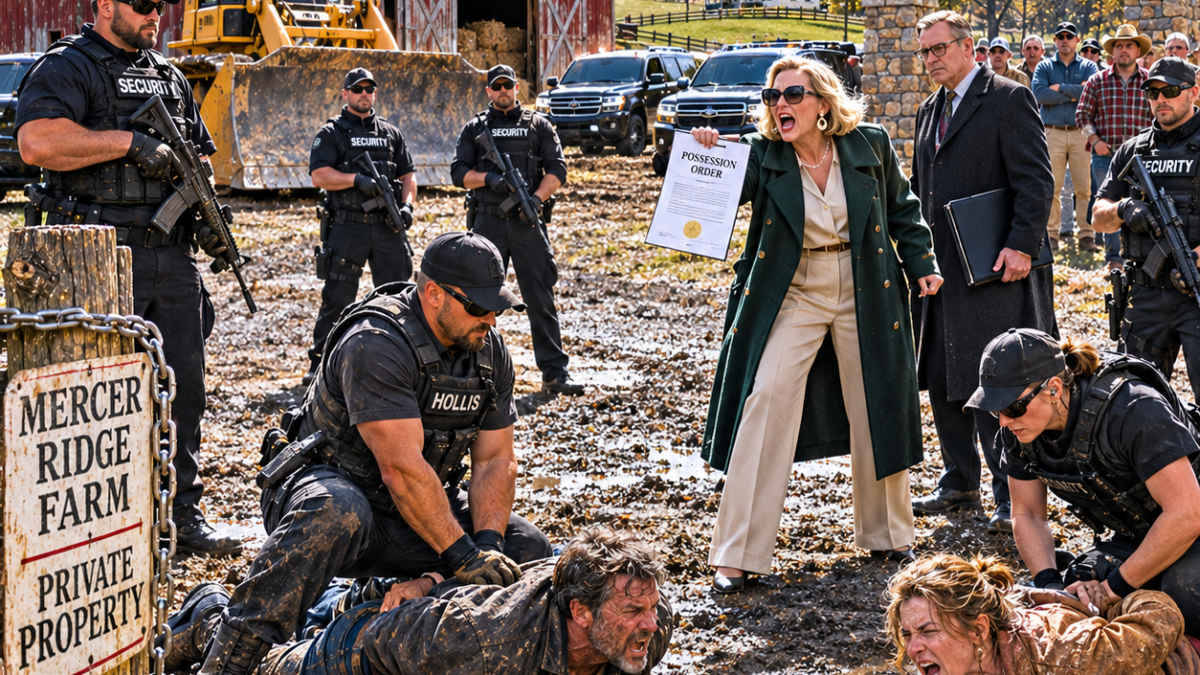
HOA Karen arrived with six armed security men, a fake possession order, and a bulldozer she intended to use on a barn that had never belonged to her.
Her guards forced my wife and me into the mud while she announced that 260 acres of our farm were now HOA property and that resistance would only make things worse.
She thought she was frightening two ordinary landowners into surrender, but the deeper problem was not who my wife and I were—it was what she had already admitted while the cameras were still recording.
The first thing I felt was a knee driving my left shoulder into wet soil.
The second was Evelyn hitting the ground beside me.
“Don’t put your hands on my wife.”
I said it once.
Clearly.
The man pinning me laughed.
His name was Dwayne Hollis. I knew that because HOLLIS was stitched over the chest pocket of his tactical vest, and because when you spend enough years in my line of work, you learn to catalogue details before deciding what any of them mean.
Six black SUVs sat inside the broken gate of Mercer Ridge Farm.
Two had dashboard cameras.
One had a temporary plate beginning with 8L.
Three men carried visible sidearms.
One had a body camera clipped near his shoulder.
Another stood beside Evelyn with his boot planted close enough to her wrist that I could see mud pushed against her skin.
And fifty yards behind all of them, a bulldozer idled in front of my storage barn.
Mara Whitcom stood between the vehicles wearing a dark green coat and leather gloves, holding what she called an emergency possession order.
She was president of the Brier Glenn Estates Homeowners Association.
My farm was not part of Brier Glenn.
It never had been.
That morning, apparently, she had decided recorded property law was merely an inconvenience.
“Your association has no authority here,” Evelyn said.
Even facedown in the grass, she sounded calmer than almost anyone I knew.
Mara sneered.
“You already had seventy-two hours.”
“For what?” Evelyn asked.
“To vacate association land.”
“This isn’t association land.”
Mara lifted the paper.
“A court disagrees.”
Evelyn turned her head enough to look at it.
“No court issued that.”
Mara laughed.
“And you know that from twenty feet away?”
“Yes.”
That answer irritated her.
“What are you, some kind of lawyer?”
Evelyn looked at her for a long moment.
“Yes.”
Mara waved one gloved hand dismissively.
“Then you should know better than to interfere with an active possession order.”
I almost smiled despite the knee in my shoulder.
Evelyn practiced law, technically.
That was one way of describing it.
But neither of us had any intention of telling Mara more than she needed to know.
Not yet.
The trouble had started weeks earlier with letters about my eastern fence.
Then came claims that seventy-one acres of my farm had somehow been annexed into Brier Glenn years ago.
Then a demand for access to the road running past my reservoir.
Then restrictions on my pump station.
Then threats.
We had saved everything.
The fake-looking survey.
The strange case numbers.
The county seal in a style that hadn’t been used in years.
The signature of a former owner on a document supposedly executed two years after he died.
Mara thought our silence meant fear.
It had meant documentation.
Now one of Dwayne’s men had my phone.
Another was blocking Evelyn from the house.
And Mara had brought heavy equipment.
The bulldozer driver revved the engine.
I stopped thinking about property law.
I started thinking about distances.
The barn was forty-eight yards away.
The nearest armed guard stood six feet to my right.
Dwayne’s knee was controlling my shoulder, but not both arms.
The guard beside Evelyn had his hand too close to his holster.
None of that meant I planned to fight.
It meant I needed to know exactly how bad things could become if somebody else decided to.
“Who authorized you to detain us?” I asked.
Dwayne leaned closer.
“Out here, you’re not giving orders.”
“I asked a question.”
Mara answered for him.
“The HOA has the right to detain trespassers.”
“On whose land?”
“Our land.”
Evelyn looked at Mara.
“Who signed your possession order?”
Mara pointed toward a man standing beside the lead SUV.
Preston Vale.
The HOA’s longtime attorney.
He had said almost nothing since entering the property.
Hands in his coat pockets.
Eyes moving between Mara, the bulldozer, and the paper.
Evelyn studied him.
“Mr. Vale?”
He didn’t answer.
Mara did.
“The bank accepted the documents. The county processed the filing. Financing is approved. This expansion is happening whether you understand that or not.”
That sentence changed everything for me.
Bank.
Financing.
Filed documents.
Until that moment, I still allowed for the possibility that this was an extreme HOA land dispute built on fabricated local paperwork.
Now Mara had just told me those same documents had been used to obtain financing.
If she was telling the truth, somebody had taken questionable ownership documents and put them in front of a lender.
Maybe a very large lender.
The bulldozer started forward.
Evelyn raised her voice.
“If you demolish that barn during an active title dispute, everyone participating may be personally liable.”
Mara didn’t even turn.
“Proceed.”
The blade lowered.
Then the guard crouched near me noticed something that had slipped halfway out of the inside pocket of my jacket.
A leather credential case.
He picked it up.
Opened it.
His face changed.
“Sir?”
Dwayne looked down.
“What?”
The guard held out the case.
Dwayne took it.
For the first time that morning, his expression lost its practiced certainty.
Inside the case was my identification.
Federal Bureau of Investigation.
Dwayne stared at it.
Then at me.
“Why didn’t you say you were FBI?”
I turned my head enough to meet his eyes.
“Because I told you to leave my property.”
Nobody moved.
I continued.
“My job didn’t make that instruction more valid.”
Mara stepped closer.
“That’s fake.”
Dwayne looked at her.
“It doesn’t look fake.”
“He’s trying to intimidate you.”
“I’m lying facedown in mud.”
The absurdity apparently escaped her.
“Hold him until local law enforcement verifies it.”
Then another guard picked up Evelyn’s bag.
She had dropped it when they pushed her down.
A wallet had fallen partly open.
He lifted an identification card.
Read it.
Then read it again.
“Mr. Hollis.”
Dwayne turned.
The guard handed him the card.
Preston Vale saw it from several feet away.
I watched the blood drain from his face.
Across the top:
UNITED STATES DISTRICT COURT
Below it:
THE HONORABLE EVELYN MERCER
Mara stared.
“No.”
Evelyn slowly lifted her face from the mud.
“Yes.”
“You’re a federal judge?”
“I am.”
Mara took a step backward.
Evelyn’s voice remained level.
“And before you misunderstand what that means, I will never preside over any matter arising from what happened here.”
She paused.
“But I will be available as a witness.”
That was the first moment I saw real fear in Preston Vale.
Not because Evelyn had judicial power over him.
She didn’t.
She would recuse herself from anything touching this incident.
He understood that immediately.
What terrified him was that he had apparently allowed a fake court order to be waved in front of a federal judge who could explain every defect on the page from memory.
Mara lunged toward the document lying in the grass.
“Give me that.”
“Don’t touch it,” I said.
She froze.
Not because I sounded threatening.
Because I didn’t.
I had spent too many years learning that the calmest sentence in a chaotic scene is often the one people remember.
Mara looked at Dwayne.
“Pull back.”
His knee came off my shoulder.
Evelyn was released.
The bulldozer stopped ten feet from the barn.
Mara pointed toward the vehicles.
“Everybody out.”
I pushed myself upright.
Mud covered my coat.
Evelyn’s sleeve was torn.
One guard had left a red mark around her wrist.
I wanted consequences.
Immediately.
Instead, I said one thing.
“Do not destroy anything on your way out.”
Mara spun.
“Is that a threat?”
“No.”
I looked at the cameras on the SUVs.
“It’s advice you’re going to wish you followed.”
Within minutes, the security vehicles were retreating through the gate.
The bulldozer reversed away from the barn.
Preston left without looking at either of us.
Mara was last.
She stared at me through the open SUV door.
“You think your badge protects you.”
“No.”
I glanced at the broken gate.
“The deed does.”
Then she drove away.
Only after every vehicle disappeared did I take out what remained of my phone and call my supervisor.
I described the incident from beginning to end.
Then I made the most important request of my career.
“I’m the victim here. I want no operational role in whatever comes next.”
Special Agent in Charge Celia Hartwell answered immediately.
“Agreed.”
Evelyn stood beside me, mud drying on her coat.
“And I recuse from everything,” she said.
I nodded.
That was how we chose to fight.
Not with my badge.
Not with her robe.
With evidence.
And by the time the people who actually handled the investigation began pulling on the first thread, Mara’s seventy-one-acre lie had already become something much larger than either of us imagined.
part 2
Mercer Ridge Farm was never supposed to be connected to my career.
That was why I loved it.
Two hundred sixty acres of pasture, timber, water, barns, and rolling ground sitting outside the eastern edge of Brier Glenn Estates.
Evelyn and I bought it before her appointment to the federal bench and before my work at the Bureau became the kind that consumed entire weeks.
Nobody in Brier Glenn knew much about us.
They assumed I traveled for corporate work.
They knew Evelyn was an attorney.
Neither assumption was entirely false.
Incomplete, yes.
But not false.
We never lied about who we were.
We simply did not introduce ourselves with titles.
The farm was where titles stopped mattering.
I repaired fencing there.
Evelyn grew tomatoes.
We argued over whether the west porch needed repainting.
On Saturdays, I cleaned irrigation filters and she walked the reservoir trail with coffee.
Brier Glenn had been developed more than a decade after Mercer Ridge was first recorded as a separate agricultural parcel.
County maps showed the boundary clearly.
Our eastern fence was not approximate.
It followed a surveyed line.
For years, the HOA respected that.
Then Mara Whitcom became president.
Her first letter sounded polite.
That was probably why I underestimated it.
Brier Glenn, she wrote, needed several “community compatibility adjustments” from adjacent properties.
She wanted us to remove part of our eastern fence.
Open a private service road for residents.
Provide HOA access to the reservoir feeding our irrigation system.
And discontinue use of an equipment barn she described as inconsistent with community standards.
I read the letter at the kitchen table.
Evelyn was beside me reviewing briefs.
“Did we secretly buy an HOA?” I asked.
She looked over.
“Not unless you signed something without reading it.”
“I’m hurt you think that’s possible.”
“I’ve seen you sign restaurant receipts.”
“Different standard.”
I wrote back three sentences.
Mercer Ridge Farm is privately owned and lies outside Brier Glenn Estates. The association holds no governing authority over the property. Please direct any claim of ownership or access to counsel with supporting recorded documents.
That should have been the end.
Instead, Mara replied within a week.
The tone changed completely.
Her second letter claimed a newly discovered survey showed seventy-one acres along our eastern boundary had been “absorbed into” Brier Glenn through an agreement executed years earlier.
She attached documents.
Evelyn read them first.
She was halfway through the second page when she stopped.
“What?”
“This case number is wrong.”
“How wrong?”
“Not even the structure this court system uses.”
She examined the county recorder’s seal.
“This format was retired years before the date shown.”
Then she reached the signature page.
The farm’s previous owner was supposedly a signatory.
Evelyn pulled up our closing file.
Then county obituary records.
She stared at me.
“He died two years before this document says he signed.”
I leaned back.
“So fraud?”
“Maybe.”
“Forgery?”
“Maybe.”
“You sound cautious.”
“I am cautious.”
She slid the documents back across the table.
“Don’t accuse her yet.”
“Why?”
“Because right now she thinks we’re stupid.”
“That’s good?”
“Very.”
Evelyn had spent enough years watching bad litigants destroy themselves with unnecessary words.
“Once she realizes we’re looking for fraud, she’ll stop putting things in writing.”
So we saved everything.
Every letter.
Email.
Voicemail.
Attachment.
Envelope.
Mara escalated.
She claimed our eastern road was now “shared association infrastructure.”
She demanded reservoir inspection rights.
She ordered us to open the gate within seventy-two hours.
Then, on a gray afternoon, I saw the six black SUVs.
They were parked outside our eastern boundary.
Engines idling.
Company logo:
HOLLIS PROTECTIVE SERVICES.
Behind them sat a bulldozer.
I photographed the scene.
Evelyn met me on the porch that evening.
“Still think this is about the fence?”
“No.”
“What do you think it’s about?”
“I don’t know.”
I looked toward the reservoir.
“But nobody brings a bulldozer to a conversation they expect to lose.”
We slept badly.
Monday morning, they cut the gate.
The confrontation followed.
Once Mara left, we made ourselves boring.
That was deliberate.
I contacted Celia.
She removed me entirely from operational involvement.
An independent team handled anything touching federal jurisdiction.
I gave statements the same way any victim would.
No internal searches.
No investigative decisions.
No private briefings beyond what victims were entitled to receive.
Evelyn filed formal recusal notices through the appropriate channels before any related case could ever reach her.
She would not sign anything.
Rule on anything.
Speak to prosecutors privately.
Recommend a judge.
Nothing.
That restraint later mattered more than either of us understood.
Mara’s first defense was exactly what you would expect.
Powerful federal couple attacks innocent HOA.
She sent residents an emergency bulletin.
According to her version, I had threatened security personnel by brandishing federal authority.
Evelyn had used her judicial status to intimidate the board.
The HOA had merely been conducting a lawful survey.
The bulldozer was supposedly there for site stabilization.
The guards had reacted to “aggressive resistance.”
Then a video appeared online.
It showed the moment Dwayne discovered my credentials.
Conveniently missing everything before it.
No forced entry.
No cut gate.
No Evelyn in the mud.
No knee on my shoulder.
No bulldozer advancing.
I watched the clip once.
Then turned it off.
Evelyn sat beside me.
“She thinks this helps.”
“It will with some people.”
“Does that bother you?”
“Yes.”
“Good.”
I looked at her.
“Why do you keep saying things like that?”
“Because if you stopped caring what people thought, I’d worry about you.”
The county recorder’s office completed its first review within days.
No seventy-one acres had ever been transferred.
No merger.
No annexation.
No boundary adjustment.
The official Brier Glenn plat had never included Mercer Ridge.
Several documents Mara called historical had been filed electronically only eight months earlier.
Their formatting had been manipulated to make them look older.
One alleged easement carried the dead owner’s signature.
Document examiners later confirmed it was forged.
The fake emergency possession order was even worse.
No valid case number.
No judge’s signature.
No proper certification.
No matching docket.
No lawful court ever issued it.
Evelyn would eventually explain all of that under oath.
But long before the courtroom, another piece changed the scale of the case.
Audio.
One of our security cameras near the barn captured Mara speaking quietly to Preston on the morning of the assault.
Her voice was low.
But clear enough.
“Once the bank closes on the financing, nobody can unwind this.”
That sentence moved the investigation far beyond trespass.
Celia’s team began tracing the financing.
What they found stunned even me.
Brier Glenn was preparing what it called Phase Four.
Ninety-six additional homes.
Roads.
Utilities.
Amenities.
Projected value exceeding forty million dollars.
The expansion required three assets located on our farm.
Our eastern access road.
A water line beneath it.
The reservoir supplying irrigation and reserve capacity.
Without those three things, the county infrastructure requirements could not be met.
No access route.
Insufficient water.
No viable development.
Yet the HOA had represented to a lending bank that it already controlled those rights.
The bank had approved tens of millions in financing based on the submission.
I remember sitting on the porch when our attorney explained the broad outline.
“So Mara wasn’t trying to steal seventy-one acres because she liked our pasture.”
Evelyn looked toward the reservoir.
“She needed infrastructure.”
“More than land.”
“Yes.”
A forged boundary was only one piece.
If Brier Glenn controlled the road, water line, and reservoir, Phase Four worked on paper.
Without them, the financial model collapsed.
Investigators traced the fraudulent filing back nearly a year.
Long before our first HOA letter.
The letters were not the beginning.
They were the pressure phase.
Mara had already built the lie.
She was trying to force reality to match it.
Then Russell Keane came forward.
Russell had been Brier Glenn’s treasurer until six months earlier.
Most residents thought he resigned because of health issues.
The truth was uglier.
He had questioned expansion spending.
Vendor contracts.
Unexplained consulting invoices.
Mara pushed him out.
Russell had kept copies of records he was legally entitled to retain.
When he saw the edited video portraying me as the aggressor, he contacted an attorney.
His files changed everything.
Emails.
Bank statements.
Board packets.
Invoices.
He had organized them by date.
In one message, Mara wrote to Preston:
Once Mercer’s land appears inside the HOA boundary on paper, reality eventually catches up.
Another email discussed paying a survey consultant to “correct” coordinates that did not match the expansion plan.
Correct.
That was the word she used.
Not falsify.
Not move.
Correct.
As though reality had made the mistake.
Then investigators found that Preston transmitted several of the altered documents electronically to the bank’s lending division across state lines.
Now there was a digital trail.
Time stamps.
Servers.
Attachments.
Versions.
People often imagine fraud as mysterious.
Sometimes it is.
Sometimes it is an email with a bad idea written plainly because everybody involved has become comfortable enough to stop fearing the future.
Russell’s files also exposed payments.
Hundreds of thousands of dollars flowed to a company called Whitcom Development Consulting.
It looked independent.
It wasn’t.
The beneficial owner was Mara.
Contractors tied to Phase Four paid that company.
Consulting fees.
Project coordination.
Advisory compensation.
Words that sounded respectable until viewed beside forged property rights supporting the project.
Hollis Protective Services had also received unusual payments labeled:
LAND COMPLIANCE ENFORCEMENT.
I had to read that phrase twice.
Apparently pinning two landowners in the mud while a bulldozer approached their barn was “compliance.”
Dwayne Hollis hired his own attorney.
Smartest decision he made.
Preston did the same.
Then they stopped acting like a team.
Dwayne realized Mara might let him absorb responsibility for the physical confrontation.
Preston realized forged filings bearing his professional fingerprints could end his career.
Mara realized both men knew enough to hurt her.
Their alliance began collapsing.
Then she made another mistake.
She called an emergency board meeting and told staff to destroy what she called old drafts.
Delete personal emails.
Clean project folders.
But investigators had already secured much of the same material from cloud systems and third-party providers.
Deleting a local copy did not erase the history.
It only created another question.
Why delete it?
I was repairing fence when the search happened.
A line of government vehicles passed the farm.
No sirens.
No lights.
They turned toward Brier Glenn.
Evelyn came outside.
We watched.
“That’s them,” I said.
“Yes.”
“Feels strange.”
“It should.”
“Why?”
“Because it’s not ours.”
She was right.
The investigation no longer belonged to us.
That afternoon Celia Hartwell entered Brier Glenn’s clubhouse with a warrant signed by a judge who had no connection to Evelyn.
The team seized computers within the warrant’s scope.
Phones.
Expansion files.
Property maps.
They found multiple versions.
One true.
One including our seventy-one acres.
One prepared for residents.
One prepared for the lender.
In Mara’s office safe they found Phase Four planning documents.
Nearly every major transportation route relied on Mercer Ridge.
Without our land, the plan was not just difficult.
It was commercially broken.
Dwayne began cooperating.
He told investigators Mara described Evelyn and me as “farmers with money” who would fold once the security team made the confrontation physical.
He produced texts.
One instruction stood out.
Take phones immediately. Do not allow recording once entry begins.
That was important because Mara later claimed the detention had been spontaneous.
It wasn’t.
Confiscating our phones was planned.
Preston tried blaming Mara for the documents.
Mara blamed Preston for drafting them.
Then investigators showed Preston an email where he himself questioned the authenticity of an easement before Mara told him to proceed.
Good faith became difficult to argue after that.
The bank froze remaining disbursements.
Contractors stopped work.
The insurer opened an investigation.
Phase Four died almost overnight.
That created another group of victims.
Brier Glenn homeowners.
Many had bought believing the expansion would increase values and fund amenities.
They had paid assessments.
Trusted presentations.
Now they were staring at a project built partly on property the HOA never controlled.
Some residents blamed us at first.
I understood why.
When somebody has spent months telling you one story, truth feels like disruption.
Mara tried to capitalize on that.
She proposed a special assessment to fund the HOA’s legal defense.
That failed.
Badly.
At the meeting, one longtime resident stood.
I later saw the recording.
“We stopped being represented by this board the moment somebody decided our neighbor’s land was just an obstacle.”
That sentence mattered.
Not because it helped me.
Because it showed the community was separating itself from Mara.
The civil title case came first.
A judge named Miriam Rourke presided.
No connection to Evelyn.
That fact went on the record.
Evelyn sat in the gallery.
Then on the witness stand.
Not as a judge.
As a victim.
Mara’s attorney asked how Evelyn knew the possession order was fake.
Evelyn explained calmly.
Wrong case numbering.
Obsolete formatting.
Missing clerk certification.
Invalid seal.
No jurisdictional language.
No authentic judicial signature.
Dates inconsistent with public records.
Then the court system’s own records confirmed no such case existed.
“Could a non-lawyer have recognized these problems?” counsel asked.
“Some of them.”
“Could an average HOA president?”
“I don’t know what Mrs. Whitcom knew.”
Evelyn never overreached.
That made her devastating.
She stated facts.
Nothing more.
I testified next.
Mara’s attorney focused on my FBI employment.
“You had law-enforcement training?”
“Yes.”
“You had credentials?”
“Yes.”
“You could have asserted federal authority over the guards?”
“No.”
He paused.
“You’re an FBI agent.”
“I was a private citizen standing on my own farm.”
“You could have arrested them.”
“Not simply because I was angry.”
“Yet they detained you.”
“Yes.”
“So why not use your authority?”
“Because a federal badge is not personal ownership over every dispute I happen to experience.”
The courtroom went quiet.
That answer later appeared in news coverage.
I wish it hadn’t.
I wasn’t trying to make a statement.
I was explaining something basic.
Power is not permission.
That was the mistake Mara made from the start.
The county surveyor testified.
The recorder testified.
The chain of title remained intact.
No seventy-one-acre transfer.
No association ownership.
The alleged easement was fraudulent.
The judge ruled clearly.
Mercer Ridge Farm had never belonged to Brier Glenn.
Not one disputed acre.
The HOA had no right to enter.
No right to control the road.
No right to the reservoir.
No right to the water line.
Civilly, the ownership question ended.
Criminally, things were beginning.
Celia Hartwell waited outside the courthouse.
Not because I had asked her.
I hadn’t.
The case against Mara rested on independent evidence.
Bank records.
Emails.
Witness testimony.
Forged documents.
Electronic transmissions.
Obstruction evidence.
False statements.
The alleged misuse of property rights to obtain financing.
State prosecutors had their own concerns.
Trespass.
Property destruction.
Unlawful restraint.
Assault-related conduct from the farm invasion.
Mara was taken into custody without spectacle.
No dramatic raid.
No agents dragging her from the clubhouse.
She had spent months manufacturing theater.
The justice system gave her paperwork.
Preston faced charges tied to preparing and transmitting fraudulent documents.
The state bar opened disciplinary proceedings.
His legal career collapsed quickly.
Dwayne’s cooperation reduced his exposure, but Hollis Protective Services lost contracts and eventually licensing critical to its operation.
He later told investigators something I never forgot.
“I never asked why an HOA needed six armed men and a bulldozer for a property dispute.”
That should have been the first question.
It became his last lesson.
Brier Glenn removed Mara as president.
By then, it was almost symbolic.
The board ordered a multi-year financial audit.
More discrepancies surfaced.
The insurer declined coverage for intentional misconduct.
The bank canceled Phase Four.
Brier Glenn sold other expansion property to cover obligations and stabilize finances.
Some homeowners lost money.
That bothered me.
Not because we caused it.
Because ordinary families had paid for leadership they trusted and ended up financing decisions they never understood.
Evelyn and I kept our civil requests narrow.
Repair our gate.
Pay for documented damage.
Compensate us for the barn damage and security destruction.
Remove fraudulent filings connected to our property.
Permanent injunction against HOA entry without permission.
That was it.
No attempt to bankrupt Brier Glenn.
No punitive campaign against residents.
No demand that the association cease to exist.
People asked why.
Because neighbors were not Mara.
A community should not be destroyed because its president believed authority had no border.
Months later, our front gate was rebuilt.
I installed the sign myself.
MERCER RIDGE FARM
PRIVATE PROPERTY
Nothing about the FBI.
Nothing about Evelyn.
Nothing about Mara.
Evelyn walked down the drive while I tightened the last bolt.
She stopped in the exact place where a guard had forced her into the mud.
For a moment neither of us spoke.
Then she looked toward Brier Glenn.
“Think they know where their authority ends now?”
In the distance, workers were removing a sign.
PHASE FOUR COMING SOON.
I watched them load it into a truck.
“Yes.”
“You sound certain.”
“They have maps now.”
She laughed.
“We had maps before.”
“Good point.”
She leaned against the gate.
“You ever wish you’d shown them your credentials immediately?”
I thought about it.
“When they put us down?”
“Yes.”
“Of course.”
“What stopped you?”
“Three guns.”
“That too.”
I looked toward the barn.
“And because I didn’t want my job to become the reason they stopped.”
She understood.
I wanted them to stop because they were wrong.
Not because I was FBI.
That distinction may sound philosophical until you’re the person with the badge.
Then it becomes practical.
If I had turned a private land dispute into a personal display of federal power, every investigation afterward would have carried that shadow.
Mara tried anyway.
She said we abused our positions.
But we had removed ourselves before she could build the argument.
That was Evelyn’s instinct.
No shortcuts.
No favors.
No revenge.
We let procedure be boring.
Boring saved the case.
The new Brier Glenn board eventually asked to meet.
They came to our house.
Four residents.
No security.
No attorneys.
The interim president was a retired accountant named Ellen Price.
She carried a folder.
When Evelyn opened the door, Ellen stayed on the porch.
“May we come in?”
That tiny question almost made me smile.
“Yes.”
We sat at the kitchen table.
Ellen apologized.
Not theatrically.
She said the board had reviewed the historical record and could find no justification for anything done to Mercer Ridge.
She asked whether there was any path toward normal relations.
I looked at Evelyn.
Then back at Ellen.
“Respect the fence.”
“That simple?”
“That simple.”
“And if we need something?”
“Ask.”
“What if you say no?”
“Then the answer is no.”
She nodded.
“Fair.”
That was more productive than every letter Mara ever sent.
Granting another person the right to say no is the beginning of almost every real agreement.
Mara never understood that.
To her, refusal was obstruction.
Boundary was disobedience.
Ownership was negotiable if her project was important enough.
That mindset created the entire disaster.
The criminal cases took time.
Real cases do.
Hearings.
Motions.
Expert reports.
Document authentication.
Bank records.
Electronic trails.
Witnesses.
Evelyn and I were not present for much of it.
That was intentional.
I went back to work.
She went back to chambers.
At home, we repaired fencing.
The reservoir still needed maintenance.
The same pump Mara wanted control over clogged with sediment one afternoon and cost me six hours I will never get back.
Ordinary problems returned.
I welcomed them.
There is something deeply comforting about a broken irrigation valve after you’ve spent months thinking about fraudulent financing.
Russell Keane visited once.
He looked older than when I first met him.
“I should have come forward earlier.”
“Probably.”
He gave a sad smile.
“You’re not going to make me feel better?”
“No.”
“I appreciate that.”
We stood near the reservoir.
He explained how gradually Mara changed.
At first she was effective.
Solved complaints.
Negotiated vendor contracts.
Improved landscaping.
Residents trusted her because she got things done.
Then nobody questioned her because questioning the person who always solves problems feels ungrateful.
“By the time I noticed the finances,” Russell said, “the board had stopped reviewing her decisions.”
“That sounds dangerous.”
“It was comfortable.”
That answer stayed with me.
Abuse of authority rarely begins at full scale.
It grows inside convenience.
Somebody handles everything.
Nobody reads.
Nobody challenges.
Then one day six armed guards are standing on a neighboring farm and everybody wonders how leadership got there.
The final financial investigation confirmed payments to Mara’s consulting company.
Preston’s electronic submissions became central evidence.
The false boundary filings.
Bank representations.
Forgery.
Attempts to destroy records.
Everything fit together.
Mara had used an HOA as a vehicle for a development scheme whose financing depended on assets she did not own.
My land was not collateral.
But she treated it as if enough signatures could make it collateral.
In the end, the expansion disappeared.
The glossy drawings came down.
Brier Glenn remained.
Smaller than promised.
More cautious.
Residents elected a new board.
They published financial reports.
Major contracts required independent review.
Conflicts of interest had to be disclosed.
Security vendors could not be used for property enforcement without legal authorization.
And no boundary could be “updated” internally without matching actual recorded ownership.
Again, obvious.
The most expensive rules are often the ones written after somebody proves the obvious was not obvious enough.
Evelyn returned fully to her judicial work.
She refused interviews.
A reporter once asked her whether being physically restrained had changed how she viewed defendants alleging abuse by private security.
She answered only:
“Every case depends on its evidence.”
That was Evelyn.
Never turning personal experience into universal certainty.
I tried to do the same.
My work continued.
Some colleagues knew what happened.
Most were respectful enough not to turn it into office mythology.
Celia Hartwell treated me exactly the same as before.
The first time I saw her after the arrests, she asked about a completely unrelated case.
No congratulations.
No dramatic handshake.
Later, as I left, she said:
“You did the right thing stepping out.”
“That was Evelyn’s idea.”
“Of course it was.”
Then she smiled.
“That’s why judges marry agents. Somebody has to think.”
I never told Evelyn Celia said that.
Actually, I did.
Bad decision.
The fraudulent possession order stayed in a drawer in my study after the case ended.
Not framed.
Not displayed.
Folded beside the original HOA letters.
Sometimes I looked at it.
The paper was ordinary.
The typography almost convincing.
The seal impressive if you didn’t know what to check.
That was what disturbed me.
Fraud rarely announces itself as fraud.
It borrows the appearance of normal authority.
A stamp.
A signature.
A legal phrase.
A confident person telling you resistance is pointless.
Mara’s most effective weapon was never the bulldozer.
It was certainty.
She sounded certain.
She looked certain.
She hired people who believed certainty meant legitimacy.
Dwayne saw a document and a contract.
The bulldozer operator saw a work order.
Preston saw a project.
The bank saw collateral paperwork.
Board members saw expansion maps.
Everyone saw one piece.
Almost nobody stopped to ask whether the foundation beneath those pieces was real.
Evelyn did.
She read the date.
The dead man’s signature.
The seal.
The case number.
Small details.
The case turned on small details.
People always remember the badge falling from my jacket.
They remember the judge’s credentials.
That makes a good story.
But our professions were not what defeated Mara.
The dead man’s signature mattered more.
The recorder’s history mattered more.
The bank emails mattered more.
Russell’s records mattered more.
Dwayne’s texts mattered more.
The camera audio mattered more.
That was justice.
Not powerful people revealing themselves.
Evidence surviving powerful lies.
One evening, about a year after the confrontation, Evelyn and I walked the eastern fence.
The sun was dropping behind the reservoir.
Brier Glenn’s rooftops caught orange light.
No construction beyond them.
Phase Four had become grass again.
Evelyn stopped near the section of fence Mara wanted removed.
“Do you remember what she said?”
“Which time?”
“When she told us the bank had already accepted everything.”
“Yes.”
“She really thought that meant it was irreversible.”
“She thought completion creates legitimacy.”
Evelyn nodded.
“Courts see that all the time.”
“What?”
“People who think if they do something fast enough, the law will have to accept it afterward.”
I kicked a stone off the path.
“Reality catching up to paperwork.”
“Exactly.”
That was Mara’s theory.
Put our land inside the HOA map.
Use that map in financing.
Start construction.
Spend money.
Create enough momentum that nobody would dare unwind it.
She underestimated something basic.
Wrong does not become right because fixing it becomes expensive.
It only becomes expensive wrong.
Brier Glenn eventually stabilized financially.
That mattered to us.
Residents should not lose homes because of someone else’s fraud.
The association sold some unrelated expansion land.
Reduced spending.
Renegotiated contracts.
Recovered money through litigation where possible.
Homeowners absorbed some pain.
But the community survived.
Ellen Price sent us a Christmas card that year.
No HOA logo.
Just a handwritten note.
Thank you for giving us the chance to become neighbors again.
Evelyn put it on the mantel.
I stared.
“You like HOA mail now?”
“Don’t push it.”
We laughed.
On the anniversary of the invasion, I woke before sunrise.
Not intentionally.
My body remembered.
I walked outside.
Cold air.
Mist near the pasture.
The gate stood intact.
No SUVs.
No armed security.
No bulldozer.
For a few minutes I could almost hear that morning again.
Metal breaking.
Engines.
Mara ordering strangers forward.
Evelyn’s voice telling her the paper wasn’t real.
Then I looked toward the barn.
Still standing.
That was the simplest outcome.
The building existed.
The reservoir existed.
The road existed.
Our deed existed.
Mara had tried to turn physical facts into negotiable assumptions.
She failed.
I went back inside.
Evelyn was making coffee.
“You went to the gate.”
“Maybe.”
“You do that every year?”
“This is the second year.”
“So yes.”
I poured coffee.
“You followed me into the mud.”
She raised an eyebrow.
“I was pushed.”
“Details.”
“Federal judges care about details.”
“So I’ve heard.”
She handed me a mug.
Then her expression softened.
“You ever think about selling?”
The question surprised me.
“Because of what happened?”
“Because now everybody knows where we live.”
That was true.
Our quiet anonymity was gone.
Local residents knew what we did.
So did reporters.
For a while, strangers drove by.
Curiosity eventually faded.
I looked through the kitchen window at the pasture.
“No.”
“Why?”
“Then Mara would still be deciding what happens to the farm.”
Evelyn nodded.
That was enough.
We kept Mercer Ridge.
Not as defiance.
As continuity.
The reservoir was dredged two years later.
We rebuilt the equipment barn roof.
The eastern road was resurfaced.
I planted windbreak trees near the Brier Glenn boundary.
Every improvement was permitted correctly where required.
Every survey recorded.
Every agreement checked.
Maybe I became more obsessive.
Evelyn would say yes.
But when you watch somebody manufacture ownership on paper, you develop respect for organized files.
The new HOA once asked for temporary access to inspect drainage near their fence.
Ellen called.
Did not send security.
Did not send a resolution.
Called.
“Grant, can our engineer cross about fifty feet onto your side Thursday?”
“What time?”
“Ten.”
“Who?”
She gave names.
“Insurance?”
She emailed proof.
“Fine.”
“Thank you.”
They arrived.
Inspected.
Left.
No drama.
That was how adults solved shared problems.
It made Mara’s war seem even more absurd.
Years later, Dwayne wrote me a letter.
I did not expect that.
He apologized.
No excuses.
He said losing his company forced him to confront how often he had treated contracts as substitutes for judgment.
Mara paid him.
Mara showed documents.
Mara said the land belonged to the HOA.
He never checked.
Then he wrote:
The moment I should have left was when she told us to take your phones.
He was right.
I answered once.
Short.
I told him accountability mattered more than apologies, but I appreciated that he understood what went wrong.
We never spoke again.
Preston lost his license.
That consequence seemed almost inevitable after the evidence became public.
An attorney can make mistakes.
Good-faith errors happen.
But emails showing him questioning authenticity and proceeding anyway destroyed the innocent explanation.
Mara’s final outcome was more complicated and less theatrical than people expected.
Multiple charges.
Federal and state proceedings.
Financial penalties.
Restitution.
Loss of position.
Loss of influence.
The development empire she imagined collapsed.
I did not attend every hearing.
I attended when required.
Otherwise, I stayed away.
I had no interest in watching a person fall simply because she had tried to hurt me.
Justice does not improve when you enjoy suffering.
That was something I had to remind myself.
Because I did have anger.
A lot of it.
There were nights when I remembered Evelyn’s wrist under that guard’s boot and wanted every possible consequence imposed on everyone involved.
Then I would remember what Evelyn told me at the kitchen table.
No shortcuts.
No favors.
If we bent rules to punish Mara, we became evidence for her defense.
Restraint was not mercy.
It was discipline.
That became the lesson I carried away from the entire case.
People assume authority means the ability to act.
Often authority means knowing when you must not.
I had a badge.
I did not use it to settle my property dispute.
Evelyn had judicial power.
She removed herself completely.
Celia had federal authority.
She built the case through independent evidence.
Judge Rourke had jurisdiction over the civil dispute.
She ruled from the record.
That sequence mattered.
Mara believed power meant making people obey.
The people who stopped her understood power meant remaining inside lawful limits even when stepping outside them would be easier.
One autumn evening, I was repairing the same fence line where the black SUVs had first appeared.
Ellen walked up from Brier Glenn.
She stopped at the boundary.
“Can I cross?”
I smiled.
“Yes.”
She stepped over.
Held out a folder.
“What now?”
“New stormwater plan.”
I groaned.
She laughed.
“Relax. It stays on our land.”
“Good start.”
“We wanted you to review one section near the reservoir because runoff might affect both sides.”
I opened the drawing.
Proper survey.
Correct boundary.
No seventy-one acres magically relocated.
I pointed.
“This swale needs to move about ten feet.”
“Why?”
“Otherwise water collects here.”
She took a note.
No argument.
No board resolution declaring gravity unfair.
We stood there talking for twenty minutes.
As she left, Ellen looked back.
“Hard to imagine Mara standing here with a bulldozer.”
“I can imagine it pretty well.”
“Sorry.”
“Don’t be.”
She paused.
“What?”
“Just don’t repeat it.”
She smiled.
“Fair.”
That evening Evelyn and I walked to the reservoir.
The light was low.
Water calm.
For years, that reservoir had been a maintenance responsibility.
Then Mara turned it into a development asset.
Then investigators called it collateral.
Then attorneys called it disputed infrastructure.
Eventually, it became water again.
I liked that.
Most valuable things in life become exhausting once other people start giving them titles.
Farm.
Collateral.
Expansion corridor.
Infrastructure package.
Judicial victim.
Federal witness.
Take away the labels and the world becomes simpler.
Land.
Water.
Fence.
Home.
Those were enough.
At the rebuilt gate, I installed a small metal plaque beneath the farm name.
No warning.
No threat.
Just the parcel reference and a notation that the property was privately owned outside Brier Glenn Estates.
Evelyn saw it.
“You put the parcel number on the gate?”
“Yes.”
“That is the most FBI thing you’ve ever done at home.”
“It is practical.”
“It is deeply unattractive.”
“Function over form.”
“You married a judge. You should know better.”
We compromised.
She planted flowers around it.
The plaque stayed.
That became Mercer Ridge after Mara.
Not fortified.
Not angry.
Just clear.
Our boundary was respected.
Brier Glenn rebuilt.
The farm stayed quiet.
And the fake possession order remained in my drawer.
Sometimes new agents asked about the story.
Most expected me to say the moment my badge appeared was when everything changed.
I corrected them.
“The badge changed the guards.”
“What changed the case?”
“The paperwork.”
They usually looked disappointed.
People prefer dramatic answers.
But the truth is less cinematic.
Mara lost because she left records.
A dead man’s signature.
A fake court number.
An altered map.
A bank submission.
An email to Preston.
A consultant payment.
A deletion request.
A body camera.
A text ordering phones confiscated.
One fact after another.
No single piece did everything.
Together, they did.
That is how real accountability usually arrives.
Not as thunder.
As accumulation.
Five years after the bulldozer morning, I stood at the gate before dawn.
Evelyn came out carrying two coffees.
“You planning to stare at dirt all morning?”
“Maybe.”
She handed me a cup.
The eastern sky was turning pale.
Brier Glenn lights glowed in the distance.
The community looked peaceful.
“So,” she said, “if Mara had simply asked for access to the road years ago, what would you have said?”
“No.”
Evelyn laughed.
“Immediate?”
“For a ninety-six-home development? Absolutely.”
“What about temporary construction access?”
“Depends.”
“So negotiation was possible.”
“About some things.”
She nodded.
“That’s what makes the whole thing absurd.”
Yes.
Mara never tested whether cooperation was possible.
She skipped straight to entitlement.
Then to paperwork.
Then coercion.
Then armed men.
She treated no as the beginning of resistance instead of the end of a request.
That was the first mistake.
Everything after grew from it.
The sun cleared the ridge.
Eighty acres of pasture lit gold.
The barn stood exactly where the bulldozer had almost reached it.
I thought about the moment Dwayne’s knee pressed my shoulder into mud.
How close anger came to becoming action.
How easily six armed men and one frightened property owner could have turned a fraudulent paper dispute into something irreversible.
That frightened me more than losing land.
The case became famous for the wrong reason.
“FBI agent and federal judge targeted by HOA.”
Catchy.
But titles are not the lesson.
If Evelyn had been a schoolteacher and I had been a mechanic, Mara’s conduct would have been just as wrong.
If nobody on that property carried credentials, the deed would still be the deed.
The forged order would still be fake.
The guards would still have no right to assault landowners.
The bank would still have been deceived.
Our professions made Mara’s miscalculation more dramatic.
They did not create our rights.
That is the part I always insisted people understand.
The land was ours before anyone knew what we did for work.
It remained ours after.
Evelyn finished her coffee.
“Ready?”
“For?”
“Breakfast.”
I took one last look at Brier Glenn.
A work truck moved slowly through its streets.
No Phase Four sign.
No construction cranes.
No security convoy.
Just a neighborhood.
Good.
That was what it should have been.
I closed the gate.
The latch clicked.
Evelyn started walking back toward the house.
I followed.
Behind us, Mercer Ridge Farm stretched across 260 acres exactly as it had before Mara’s first letter arrived.
Not because I was FBI.
Not because Evelyn was a judge.
Not because powerful friends rescued us.
Because someone finally compared the story on paper with the truth on the ground.
And the truth had never moved an inch.








