HOA Karen Sent Her Teen Son to Destroy My Ranch Truck Because I Wouldn’t Join Her HOA — She Thought I’d Pay by Sunset
**part 2**
The recording had started twenty-three minutes before I returned from the south pasture.
Karen’s white SUV came through my open work gate at 4:07 p.m. She parked beside the truck, stepped out with Dylan, and immediately began pointing toward my house, barn, and equipment as if she were conducting an inspection she had authority to perform.
The camera microphone picked up almost every word.
Dylan’s voice came first.
“Mom, he said no. We should just leave.”
Karen turned toward him.
“No. People like him only understand consequences.”
I watched Karen’s eyes lock on the phone in my hand.
The recorded version of her walked to the back of her SUV and opened the cargo hatch.
Then she pulled out the baseball bat.
Dylan had not brought it.
She had.
On the recording, she handed it to him.
“Put a dent in the hood.”
Dylan hesitated.
Karen pointed toward the truck.
“Do it.”
Back in my driveway, the real Dylan closed his eyes.
Karen lunged toward my phone.
I stepped backward before she could grab it.
“You recorded a private conversation!” she shouted.
“On my private property.”
“That’s illegal.”
“No, it isn’t,” I said. “And that camera isn’t exactly hiding.”
She looked toward it again as though she wanted to sue the camera personally.
The recording continued.
Dylan struck the hood once.
He stopped.
Karen waved both arms.
“Again.”
He hit it a second time.
Then the side mirror.
Karen walked around the pickup inspecting his work like a contractor checking a remodeling project.
At one point, she took a key from her purse and dragged it herself along the passenger door.
That mattered.
A lot.
Because the story she would later try to tell was that her son had “lost his temper” and she had arrived too late to stop him.
The camera showed the opposite.
She planned it.
She encouraged it.
And she personally participated.
I closed the video.
Karen’s voice dropped.
“You don’t understand what you’re doing.”
“I think I understand it pretty well.”
“This could create problems for you.”
I looked at my truck.
“That sentence would’ve worked better before you wrecked my pickup.”
She stepped closer.
“I’m HOA president.”
“And?”
“I represent two hundred and fourteen homeowners.”
“Are all two hundred and fourteen of them hiding in your blazer?”
Dylan made a noise that sounded suspiciously like a laugh disguised as a cough.
Karen spun toward him.
“This is not funny.”
“No, ma’am,” he muttered.
She turned back to me.
“You are going to delete that video.”
“No.”
“You’re going to sign the membership document.”
“No.”
“And you are absolutely not calling the police.”
I held up my phone.
“I already did.”
The silence afterward was beautiful.
Karen blinked.
“You what?”
“They should be here any minute.”
Her mouth opened.
Closed.
Opened again.
For three months, Karen had spoken to me as if every conversation were a meeting she chaired. Suddenly she looked like somebody had misplaced the agenda.
She hurried toward Dylan.
“Get in the SUV.”
He did not move.
“Dylan. Now.”
I stepped sideways, not blocking either of them but making one thing clear.
“I wouldn’t leave.”
Karen pointed at me.
“You cannot detain us.”
“I’m not detaining anybody. I’m suggesting that driving away after what your camera performance just documented might not improve the situation.”
“That is intimidation.”
“No. Intimidation was bringing your kid onto my ranch with a bat because I wouldn’t pay dues I don’t owe.”
Dylan lowered the bat to the ground.
It clanged against the gravel.
Then he quietly said, “Mom, we should stay.”
Karen stared at him as if he had defected to another country.
Two sheriff’s cruisers rolled through my gate about four minutes later.
Deputy Maria Alvarez stepped out of the first one, followed by Deputy Collins. I knew Alvarez slightly. In ranch country, deputies end up helping with everything from stolen trailers to loose cattle to arguments over fence lines, and she had once been out to Mercer Ranch after somebody cut a padlock on our north gate.
She looked at the truck.
Then at the bat.
Then at Karen.
“Everybody keep your hands where we can see them.”
Karen immediately walked toward her.
“Officer, thank goodness. I’m Karen Whitmore, president of Cedar Ridge Estates. This man is refusing lawful HOA obligations and has become extremely hostile.”
Alvarez stared at her.
Then looked at me.
“Jack?”
“I’ve got video.”
Karen cut in.
“He unlawfully recorded us.”
Alvarez held up one hand.
“Ma’am, please stop talking over everyone.”
It might have been the first time anybody had told Karen that in years.
Her expression suggested it hurt physically.
I handed Alvarez my phone and showed her the relevant clips.
She watched silently.
Collins photographed the truck.
When the video reached Karen taking the key to the passenger door, Alvarez looked up.
“Ms. Whitmore, is that you?”
Karen crossed her arms.
“The HOA has enforcement rights.”
“That wasn’t my question.”
“This property affects Cedar Ridge.”
“That wasn’t my question either.”
Karen took a breath.
“My son caused most of the damage.”
Dylan looked at her.
I will never forget his expression.
Until that moment, he had looked embarrassed.
Now he looked betrayed.
Alvarez noticed too.
“You’re saying your son did this on his own?”
“He’s a teenager. Teenagers make poor choices.”
Dylan spoke before she could continue.
“You gave me the bat.”
Karen snapped her head toward him.
“Dylan.”
“You told me to hit it.”
“Stop talking.”
“You said he’d sign if we scared him.”
“Dylan!”
Alvarez stepped between them.
“Ma’am, do not instruct him about what to say.”
Karen looked around the yard and seemed to realize her audience had changed.
Her HOA title meant nothing here.
Her folder meant nothing.
Her threats meant nothing.
There were only damaged property, recorded statements, two deputies, and a teenage boy who was beginning to understand that his mother planned to let him absorb the consequences for a decision she had orchestrated.
Alvarez separated us and took statements individually.
I told her everything.
The first HOA notice had arrived three months earlier.
It demanded $420 in monthly dues.
I had called the Cedar Ridge management office and explained that Mercer Ranch was not subject to its declaration.
Two weeks later, another notice arrived.
Then another.
Karen eventually came in person.
She claimed that because my eastern access road briefly crossed alongside the subdivision boundary, I received “community benefits” and therefore had a duty to contribute.
I told her that was nonsense.
She increased the demand.
Four hundred twenty dollars became eighteen hundred.
Then six thousand.
Then twelve.
By that afternoon, Karen’s folder claimed I owed twenty-four thousand dollars in dues, penalties, enforcement costs, “community stabilization assessments,” and something called an “external property integration fee.”
Deputy Alvarez actually paused when I said that.
“External property what?”
I handed her one of Karen’s notices.
She read it twice.
“I’ve never seen this before.”
“Neither had my attorney.”
Karen, standing twenty feet away with Collins, heard me.
“Your attorney is wrong!”
Alvarez turned.
“Ms. Whitmore.”
Karen folded her arms again.
“I am simply correcting misinformation.”
“Please don’t.”
That was when the wind returned.
A particularly strong gust snatched the top page from Karen’s folder and carried it through the open corral gate.
The paper floated for several glorious seconds before landing in a water trough.
One of my steers leaned over and began licking it.
Dylan stared.
I stared.
Deputy Collins looked down at his boots.
Karen shrieked, “That is an official HOA document!”
The steer continued chewing.
Collins cleared his throat.
“I don’t think he’s subject to the covenants, ma’am.”
Even Alvarez smiled at that.
Karen did not.
By sunset, the deputies had enough information to treat the incident as far more than a neighborhood argument.
Dylan was seventeen, so his case would be handled under juvenile procedures rather than as some television-style public spectacle. Alvarez explained that plainly. He would not be “convicted on the driveway.” The evidence would go to the appropriate prosecutor, and decisions about charging and disposition would be made through the legal process.
Karen’s situation was different.
The video showed her bringing the bat onto my property, directing the damage, participating herself, and threatening additional damage unless I paid money she claimed I owed.
Her own words created most of her problems.
Deputies took statements, preserved copies of the footage, collected the bat as evidence, photographed my truck, and contacted a supervisor.
Karen spent nearly an hour insisting the HOA gave her authority to “perform corrective enforcement.”
No one could persuade her that this phrase did not mean anything.
Eventually she said something even worse.
“If he had simply paid me, none of this would have happened.”
Alvarez stared at her.
“Paid you?”
“The HOA.”
“You said paid me.”
“I meant the association.”
“Okay.”
Karen finally asked the question she should have asked three months earlier.
“Can’t this just be handled civilly?”
Alvarez looked at the truck.
Then at the bat.
Then at the video on her tablet.
“That decision is no longer entirely yours.”
Karen was taken to the county sheriff’s office for booking and questioning after a supervisor consulted with the prosecutor on call. Dylan was taken into juvenile custody according to local procedure and released later to his father, who arrived looking like a man who had just discovered his family had been struck by a meteor wearing a pink blazer.
His name was Mark.
He walked up to me before leaving.
“I’m sorry.”
“You didn’t do it.”
“No,” he said quietly. “But I should’ve known something was wrong.”
Dylan stood beside him, staring at the ground.
Then he looked at me.
“Mr. Mercer?”
“Yeah?”
“I’m sorry about your truck.”
Karen, seated in the back of the cruiser twenty yards away, saw him talking to me and started shouting through the closed window.
We could not hear a word.
Mark looked over.
Then back at me.
“For once,” he said, “that may be an advantage.”
I almost smiled.
But after they left, I stood alone in my driveway beside the Ford and felt the humor drain out of the evening.
The broken glass crunched beneath my boots.
My reflection stared back at me from what remained of the window.
I was angry.
Of course I was angry.
But underneath that anger was something heavier.
Violation.
People who have never lived on a ranch sometimes think ownership is simply a deed and a fence. It is not. Land becomes part of your daily rhythm. You know where water sits after a hard rain. You know which gate drags in August. You know which pasture catches the first light in winter. You know where your father stopped his truck when he wanted to watch a storm roll in.
Mercer Ranch was not an investment property to me.
It was family history measured in acres.
Karen had walked onto it believing none of that mattered because she had printed a logo at the top of a letter.
The next morning, I called my attorney, Rachel Bennett.
Rachel had handled agricultural property cases for almost twenty years. She was calm, methodical, and had the kind of personality that became more dangerous the quieter she spoke.
I emailed her every HOA notice.
Every envelope.
Every text Karen had sent.
Every camera clip.
She called me forty minutes later.
“Jack.”
“Yeah?”
“Do you have coffee?”
“That bad?”
“That good.”
I sat down.
Rachel began with the simplest fact.
An HOA’s authority generally comes from recorded covenants, declarations, and other governing documents attached to specific property. It does not magically expand because the HOA president thinks neighboring land should contribute.
Rachel had already pulled the county property records.
Mercer Ranch was not listed in the Cedar Ridge declaration.
No amendment annexed it.
No deed restriction placed it under the association.
No membership agreement bore my signature.
No recorded document gave Cedar Ridge assessment authority over my ranch.
Nothing.
“They’ve been billing a nonmember,” Rachel said.
“Karen’s been billing a nonmember.”
“That distinction may become important.”
She told me not to communicate with Karen directly.
Then she sent a preservation letter to Cedar Ridge Estates HOA, its management company, and its attorney demanding that they retain board minutes, emails, account records, enforcement policies, correspondence involving Mercer Ranch, and any communications concerning efforts to bring outside property into the association.
That letter changed everything.
By noon, the HOA’s attorney called Rachel.
By two o’clock, the management company called.
By five, three Cedar Ridge board members had apparently learned for the first time that their president had been sending twenty-four-thousand-dollar demands to a ranch that was not part of the association.
The next morning, a certified letter arrived at my house.
Not from Karen.
From the board.
It stated that Cedar Ridge was “reviewing the circumstances surrounding recent communications.”
That was corporate language for:
What in the world has Karen done?
Rachel advised me not to celebrate.
“People become unpredictable when they realize their authority was imaginary.”
She was right.
Karen was released pending further proceedings and immediately began trying to rewrite history.
She sent an email to Cedar Ridge residents claiming she had been conducting a “good-faith boundary compliance initiative.”
She described the damage to my truck as “an unfortunate spontaneous incident involving a distressed juvenile.”
She did not mention the bat came from her SUV.
She did not mention the key in her hand.
She did not mention telling Dylan to “put a dent in the hood.”
Most importantly, she claimed I had “provoked” the confrontation by refusing multiple attempts at mediation.
One of the homeowners forwarded the email to me.
I forwarded it to Rachel.
Rachel forwarded it to the HOA’s attorney.
The HOA’s attorney apparently forwarded it to God, because within twenty minutes Karen’s access to the association’s official email system was suspended.
The board scheduled an emergency meeting.
Before that meeting happened, however, Karen made one final mistake.
She came back to my ranch.
Not all the way onto the property.
She parked outside the gate.
I saw her SUV while feeding cattle around seven in the morning.
She stood beside it holding a cardboard box.
Her pink blazer was gone.
She wore a gray sweater and dark pants.
For the first time, she looked less like a dictator and more like somebody who had been awake for three straight nights searching the internet for “can an HOA president go to jail.”
I drove the utility vehicle toward the gate but stayed inside my property.
“What do you want?”
She raised both hands.
“I’m not trespassing.”
“Good start.”
“I want to resolve this.”
“My attorney handles that.”
“Jack, please.”
That word surprised me.
Please.
Karen Whitmore had finally discovered it.
She held up the box.
“I brought the files.”
“What files?”
“All the Mercer Ranch files.”
I stared at her.
“There are enough files to require a box?”
She did not answer.
That was answer enough.
“Give them to Rachel.”
“I can’t.”
“Why?”
“Because some of these documents were never approved by the board.”
I said nothing.
Karen looked toward the road.
Then back at me.
“This got out of hand.”
“You brought a bat.”
“I didn’t expect Dylan to do that much damage.”
“You told him to hit the truck.”
“I was angry.”
“You keyed it yourself.”
She exhaled.
“Fine. I made mistakes.”
“That’s a creative plural.”
Her eyes hardened for a second, and I saw the old Karen fighting to come back.
Then she remembered where that version of herself had gotten her.
She lowered her voice.
“If you drop the complaint, I’ll withdraw every assessment.”
“You never had the right to issue them.”
“I’ll make sure the board confirms that.”
“They’re already doing that.”
“I can compensate you privately.”
“For the truck?”
“For everything.”
I looked at the box.
“What’s really in there, Karen?”
She tightened her grip.
“Nothing important.”
“Then why bring it?”
Her silence lasted three seconds.
I knew.
Maybe not exactly.
But I knew there was more.
I called Rachel from the gate.
Karen left before Rachel answered.
She took the box with her.
That turned out to be another mistake.
Because the preservation letter had already been delivered.
By then, deleting, hiding, destroying, or manipulating relevant association records could create consequences far beyond a simple dispute over dues.
Rachel moved quickly.
She filed suit seeking a declaration that Mercer Ranch was not subject to Cedar Ridge’s governing documents, an injunction preventing the HOA or its agents from attempting future assessments or enforcement against the ranch, and damages arising from the property destruction and related conduct.
She also sought immediate court protection against further contact or interference.
The judge did not decide the entire dispute on the first day.
That is not how real courts work.
But the documentation was straightforward enough that temporary relief came quickly.
Until further order, Cedar Ridge and Karen were prohibited from entering Mercer Ranch for enforcement purposes, interfering with my property, or attempting collection of the disputed HOA charges.
Karen’s twenty-four-thousand-dollar balance vanished from my mailbox almost overnight.
But the lawsuit revealed something I had not expected.
I had not been the only one.
Two families owned small acreage tracts just north of Cedar Ridge.
Neither tract was inside the subdivision.
Both had received letters from Karen.
One couple had paid nearly $3,000 because they believed the notices were legitimate.
An elderly widower had received threats that Cedar Ridge could place a lien on his land unless he signed an “association integration agreement.”
Rachel found him through documents produced by the management company.
His name was Harold Evans.
He was seventy-six years old.
He had lived on his property for thirty-eight years.
When I called him, he sounded embarrassed.
“I thought I had missed something when the subdivision went in,” he told me.
“You didn’t.”
“They kept sending legal-looking papers.”
“I know.”
“I paid because I didn’t want to lose the place.”
That conversation changed the case for me.
Until then, part of me had wanted only three things.
Fix my truck.
Keep Karen off my ranch.
Make sure she never sent me another ridiculous bill.
After speaking with Harold, that was no longer enough.
This was not one arrogant woman losing her temper.
It was a pattern.
Karen had discovered that official letterhead frightened people.
So she kept using it.
The Cedar Ridge board discovered the same thing a few days later.
Rachel obtained meeting minutes showing that Karen had repeatedly proposed expanding “financial participation” by neighboring landowners.
The board had rejected formal annexation because annexation required actual legal procedures, property-owner consent in the relevant circumstances, and recorded documentation.
Karen did not like that answer.
So she invented her own process.
She called it the External Property Integration Program.
There was no such program in the bylaws.
No board vote authorized it.
No attorney approved it.
No recorded declaration created it.
Karen simply designed a form, added the association logo, and began mailing demands.
When board treasurer Paul Jenkins testified later, Rachel asked him one question that became my favorite line of the entire case.
“Mr. Jenkins, what legal authority did Cedar Ridge have to charge Mr. Mercer an external property integration fee?”
Paul adjusted his glasses.
“None that I’m aware of.”
“Was the fee approved by the board?”
“No.”
“Was the program approved by the board?”
“No.”
“Did you know it existed?”
Paul looked toward Karen.
“No.”
Karen whispered something furiously to her lawyer.
The judge looked over his glasses.
“Ms. Whitmore, please allow your counsel to handle the talking.”
I nearly looked behind me to see whether Deputy Alvarez had entered the courtroom.
Apparently telling Karen not to interrupt had become a countywide tradition.
The criminal side moved separately.
Dylan’s case was handled through the juvenile system.
I was asked what outcome I wanted.
I surprised some people by saying I did not want to destroy the kid’s future.
He had done serious property damage.
He needed consequences.
But the recordings made something else equally clear.
His mother had pressured him.
He resisted at first.
He asked to leave.
He stopped several times.
And when the police arrived, Karen immediately tried to shift responsibility onto him.
So when the prosecutor discussed a resolution involving restitution obligations, counseling, supervised community service, and other juvenile-court conditions, I did not object.
I asked only that whatever happened make him understand that being ordered to do something wrong did not make it right.
Months later, Dylan sent me a handwritten letter.
He did not ask me to forgive him.
That impressed me more than an apology that demanded one.
He wrote that he had spent years watching his mother treat rules as weapons. He had started believing authority meant whoever shouted the loudest.
Then he wrote:
“I should have put the bat down.”
I kept that letter.
Karen’s case was harder for her to escape.
Her own statements were everywhere.
My cameras had her directing the damage.
Deputy body-camera footage captured her asserting that I could have prevented the incident by paying.
Emails showed her escalating demands against nonmembers.
HOA records showed she lacked authorization.
Witnesses described similar pressure tactics.
Her attorney eventually stopped arguing that she had legal authority and began arguing that she had genuinely, though mistakenly, believed she did.
Rachel called that the “I sincerely believed I was queen” defense.
She only said it in her office.
Probably wisely.
Karen ultimately accepted a negotiated criminal resolution rather than gamble on trial. The exact counts and penalties were determined under state law, but her plea formally acknowledged her role in causing and participating in the property damage and in the conduct surrounding the threats.
There were financial consequences.
There were probationary conditions.
There was an order to stay away from my property.
And there was a court record she could not erase with an HOA newsletter.
The civil case continued.
My Ford turned out to be more expensive to repair than anyone initially expected.
The visible dents were only part of it.
The side damage affected multiple panels, the window mechanism was ruined, the mirror assembly had to be replaced, paint had to be blended across adjacent surfaces, and the hood required major work.
Because I used the truck daily for ranch operations, I also had documented loss-of-use expenses.
I rented another heavy-duty pickup.
I kept every receipt.
Rachel loved receipts.
“Anger makes great television,” she told me. “Receipts make great exhibits.”
By the time repair costs, rental expenses, other documented losses, and legal claims were placed on the table, the numbers were substantial.
Karen’s lawyer wanted a confidential settlement.
I did not care about confidentiality.
I cared about accuracy.
The HOA’s insurer, the association, and Karen’s personal counsel spent weeks arguing over who was responsible for what.
That fight was not mine.
I had not created it.
Eventually, the financial settlement related to my truck, loss of use, and other compensable claims reached roughly thirty-two thousand dollars.
The important difference was that no judge simply invented “punitive damages plus attorney fees” on the driveway the night of the incident.
The money came after estimates, documentation, negotiation, litigation, insurance questions, and legal review.
Slow justice is less dramatic than television justice.
But it has one advantage.
It leaves paper trails.
The declaratory portion of my lawsuit was even more satisfying.
Cedar Ridge formally acknowledged that Mercer Ranch was not subject to its declaration.
The twenty-four thousand dollars Karen claimed I owed was declared unenforceable.
The association agreed it would not attempt future assessments against my ranch absent a valid legal basis.
The court entered permanent relief protecting the property from the type of unauthorized enforcement Karen had attempted.
Harold received his money back.
So did the other family who had paid.
Cedar Ridge also adopted new procedures requiring board approval and legal review before any enforcement communication could be sent to properties whose membership status was uncertain.
That was the part Karen hated most.
Not the money.
Not the criminal case.
Not even the truck.
She hated that her name became the reason the HOA had to create a written policy essentially saying:
Please verify that someone belongs to the HOA before demanding money from them.
The emergency board meeting where she lost the presidency became neighborhood legend.
I did not attend in person.
Rachel advised me to stay out of internal association politics.
But several residents later described what happened, and the official minutes confirmed the important parts.
The meeting room was packed.
Karen arrived expecting to defend herself.
Instead, the board had its attorney present.
A projector displayed the recorded declaration map.
Mercer Ranch sat outside the Cedar Ridge boundary.
Clearly.
Completely.
Undeniably.
One homeowner reportedly pointed at the map and asked, “So how did Jack owe us twenty-four thousand dollars?”
Karen answered, “He benefited from proximity.”
Someone in the back said, “So does the gas station.”
Then another homeowner asked whether the gas station should expect a bill.
The room broke into laughter.
Karen did not.
She tried to argue that strong leadership sometimes required “creative enforcement.”
That phrase appeared in the meeting minutes.
It may be the funniest sentence ever produced by an HOA.
Then the board attorney explained that “creative enforcement” was not a recognized source of legal authority.
The board voted to remove Karen as president.
The vote was not close.
According to Paul Jenkins, Karen demanded a recount.
There were seven board members.
She had received one vote.
Her own.
The attorney had to explain that voting twice would not improve the situation.
That story traveled through Cedar Ridge faster than a grass fire in August.
Within forty-eight hours, the association issued a formal letter to residents acknowledging that Karen had acted beyond her authority in matters involving outside properties.
The board apologized directly to me, Harold, and the other affected landowners.
I accepted the apology.
Not because I suddenly liked HOAs.
And not because I believed everyone on that board was innocent.
Some had been too willing to let Karen run things without oversight.
But several genuinely had not known what she was doing.
And unlike Karen, they admitted it.
That difference mattered.
People sometimes ask whether revenge felt good.
I suppose it depends on what you call revenge.
Watching Karen lose her title?
A little.
Watching the fake fees disappear?
Absolutely.
Seeing my truck restored?
That felt better.
But the moment that stayed with me happened several months later.
I was replacing a section of fence near the eastern pasture when a pickup stopped on the public road.
Dylan stepped out.
His father was driving.
Mark stayed by the truck.
Dylan approached the fence but did not cross it.
“Mr. Mercer?”
I leaned on the post driver.
“What’s up?”
He held something in his hand.
A new side mirror.
Not for my truck.
A cheap replacement mirror for an old farm utility vehicle parked nearby that had been cracked long before I met him.
“I know your Ford is already fixed,” he said. “I just… wanted to bring something useful.”
I stared at him.
“You buy that?”
“Yes, sir.”
“With your money?”
“Yes, sir.”
“Why?”
He shrugged.
“I’ve been working weekends.”
I could have embarrassed him.
I could have reminded him of every swing of that bat.
I could have told him to leave.
Instead, I opened the gate.
“Ever replaced a truck mirror?”
“No.”
“You’re about to learn.”
Mark raised an eyebrow from the road.
I pointed at him.
“You too.”
For two hours, the three of us fought with rusted bolts, bad instructions, and a wiring connector designed by somebody who clearly hated ranchers.
Dylan dropped a socket into the dirt.
Mark lost a screw.
I installed the bracket backward.
At one point, Dylan looked at me and said, “I thought you knew how to do this.”
“I own cattle,” I said. “That does not make me a mechanic.”
He laughed.
It was the first time I had heard him laugh without immediately checking whether his mother would punish him for it.
When we finished, the mirror worked.
Mostly.
It vibrated slightly at idle.
I called that character.
Before leaving, Dylan apologized again.
This time I told him something my father once told me.
“You don’t prove you’re sorry by saying it longer. You prove it by behaving differently.”
He nodded.
Then he left.
Karen never apologized.
Not really.
She sent one settlement statement claiming she regretted that “a disagreement concerning community expectations escalated.”
Rachel read it aloud in her office.
Then she looked at me.
“Apparently the baseball bat was a disagreement.”
I laughed harder than I should have.
Karen’s employment situation also unraveled.
She worked in a regional administrative position where professional judgment mattered. Once the public court records, HOA dispute, and criminal resolution became known, she was placed on leave.
Several months later, she was no longer employed there.
I do not know every internal reason, and I never pretended to.
Maybe the case was the deciding factor.
Maybe it exposed other problems.
Either way, the woman who had threatened my livelihood over invented HOA dues discovered that reputations have consequences too.
Six months after the incident, a FOR SALE sign appeared outside her Cedar Ridge house.
I saw it while driving past on my way to the feed store.
Someone had added three tiny decorative flags around the sign.
For a moment, I wondered whether the HOA had approved their dimensions.
Then I decided some questions were better left unanswered.
Her house sold that winter.
Karen moved away.
No parade marked the occasion.
No crowd stood at the gate cheering.
Real life rarely gives you that kind of ending.
She simply disappeared from the neighborhood she had once ruled like a private kingdom.
Cedar Ridge changed after she left.
The new president was a retired accountant named Denise Harper.
The first time she introduced herself, she stood outside my gate and asked permission before stepping onto the property.
That alone made her seem revolutionary.
“I wanted to apologize personally,” she said.
“The board already did.”
“I know. But this should never have happened.”
“No disagreement there.”
She looked toward the cattle.
“For the record, we have no intention of annexing your ranch.”
“Good.”
“Also, I checked.”
“Checked what?”
“Our bylaws.”
I waited.
“There is no external property integration program.”
I smiled.
“I had begun to suspect that.”
She laughed.
Then she handed me her business card.
“If the association ever creates a problem involving your boundary, call me.”
“I have Rachel.”
Denise paused.
“That is probably more frightening.”
“She’ll appreciate hearing that.”
Over the following year, I repaired more than my truck.
I replaced two security cameras with newer models.
I upgraded the gate.
I reorganized the equipment yard.
And for reasons I cannot fully explain, I finally repainted the old barn my father had been telling me to repaint since 2011.
Maybe after months of dealing with Karen’s invented authority, I wanted to make the ranch look exactly the way I wanted simply because I could.
Blue-gray siding.
White trim.
No architectural review committee.
No paint approval.
No seven-member color board.
Just me, a ladder, two hired hands, and an embarrassing amount of paint on my jeans.
When Denise drove past one afternoon, she slowed down.
I pointed at the barn.
“Should I submit a color request?”
She rolled down her window.
“I’m calling code enforcement.”
For half a second, I stared at her.
Then she laughed and drove away.
I had to admit Cedar Ridge leadership had improved.
The Ford came back from the body shop looking better than it had before Karen touched it.
New paint.
New glass.
New mirror.
Perfect hood.
The shop even polished the headlights.
The first evening I drove it home, I parked in the same place where the damage had happened.
The sunset looked almost identical to that afternoon months earlier.
Orange light across the pasture.
Purple along the ridge.
Cattle moving slowly toward water.
I shut off the engine and sat there for a while.
My father used to say land teaches patience because nothing important happens as quickly as you want it to.
Rain comes when it comes.
Calves arrive on their schedule.
Fences fail at the worst time.
Courts move slowly.
Truth sometimes moves slowly too.
But slow does not mean weak.
Karen believed power meant forcing people to obey before they had time to question her.
She printed threats.
Invented fees.
Borrowed the authority of an HOA she did not own.
Used her own son as an instrument of intimidation.
And eventually stepped so far beyond every legitimate boundary that the evidence became impossible to explain away.
I never had to scream louder than she did.
I never threatened her house.
I never damaged her car.
I never stood outside Cedar Ridge demanding revenge.
I saved the letters.
I kept the video.
I preserved the timestamps.
I pulled the deed.
I hired a lawyer.
I let the deputies document the truck.
I kept the repair estimates.
I kept the rental receipts.
I let her emails speak for themselves.
Karen’s entire strategy depended on people reacting emotionally before checking whether she actually had authority.
The best revenge was refusing to play that game.
She wanted a frightened rancher.
She got a documented record.
She wanted twenty-four thousand dollars.
Her conduct ended up costing far more.
She wanted to expand her power.
She lost the position that gave her any.
And she wanted her son to teach me a lesson.
Instead, he learned one.
Months after Karen left Cedar Ridge, I received one final envelope from the HOA.
I almost threw it away without opening it.
Old habits.
Inside was not a violation.
It was a copy of the association’s updated enforcement policy.
Someone had highlighted one sentence:
“Before issuing any assessment, demand, compliance notice, or enforcement action, the Association shall confirm that the subject property is legally subject to the governing declaration.”
Below it, Denise had written by hand:
“We call this the Mercer Rule.”
I laughed so loudly one of my ranch hands came into the kitchen to see what was wrong.
“Nothing,” I told him.
“For once, absolutely nothing.”
I folded the letter and put it in the same cabinet where I kept the original twenty-four-thousand-dollar demand.
They belonged together.
One represented what happens when authority becomes arrogance.
The other represented what happens when arrogance finally meets evidence.
Years of ranching had taught me that gates matter.
A good gate tells you where one property ends and another begins.
Karen had spent months pretending that boundary did not apply to her.
The law eventually reminded her otherwise.
So did the board.
So did the sheriff.
So did a courtroom.
And somewhere along the way, even her own son stopped believing that being told to cross a line made crossing it acceptable.
That mattered more to me than seeing Karen embarrassed.
Because humiliation fades.
A lesson can last.
I still drive that Ford.
There is one tiny imperfection on the passenger side where the new paint catches sunset differently from the original finish.
The body shop offered to redo it.
I told them not to.
Sometimes I see that faint change in the light and remember Karen standing in my driveway in that ridiculous pink blazer, announcing with complete confidence that destroying my property would make me surrender.
She believed she had already won.
That may be the funniest part of all.
Because while she was standing there telling me how powerful she was, four cameras were recording every word.
The ranch was never hers.
The truck was never hers.
My money was never hers.
And the authority she was so proud of turned out to be the one thing she never actually possessed.
Mercer Ranch remained exactly where it had been before Cedar Ridge existed.
Four thousand acres.
Every pasture.
Every fence.
Every gate.
Every sunset.
Mine.
And the last HOA bill Karen ever sent me?
I framed it.
Not because I owed it.
Because I wanted one souvenir from the day an HOA Karen tried to charge me twenty-four thousand dollars for the privilege of being threatened on my own land—and accidentally created the evidence that ended her little kingdom instead.
THE STORY ENDS HERE
HOA Karen Sent Her Teen Son to Destroy My Ranch Truck Because I Wouldn’t Join Her HOA — She Thought I’d Pay by Sunset
She used her own teenage son to threaten me over HOA dues I never owed.
My truck was sitting in pieces before she realized my ranch had been recording everything.
And the most dangerous thing she brought onto my property wasn’t the baseball bat—it was her arrogance.
“Your truck looks like that because you refused to cooperate.”
That was the first thing Karen Whitmore said to me as I walked out of my equipment barn and saw what was left of my pickup.
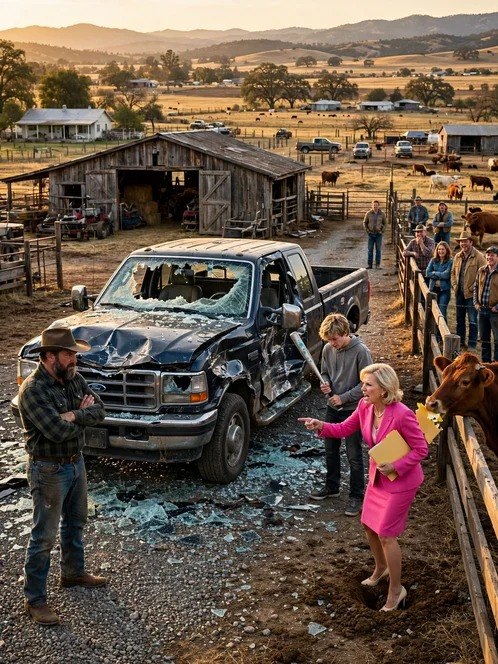
The late-afternoon sun was dropping behind the western ridge of my ranch, turning four thousand acres of pasture, cedar breaks, and dry creek beds the color of copper. Normally, that hour was my favorite part of the day. The cattle settled down. The wind cooled. The long shadows made even an old barbed-wire fence look peaceful. But there was nothing peaceful about the scene waiting in my driveway.
My dark blue Ford F-250 had a shattered driver-side window, two deep dents across the hood, a broken side mirror, and a pale scratch running almost the full length of the passenger side. Glass glittered across the gravel like ice.
Beside it stood Karen.
She had dressed for the occasion as if she were appearing at a campaign fundraiser instead of trespassing on a working ranch. Bright pink blazer. Matching skirt. Cream-colored heels that had no business being within twenty miles of cattle. Her short blond hair had somehow survived the prairie wind without moving an inch. Under one arm, she carried the same yellow HOA folder she had been waving at me for the better part of three months.
Standing several feet behind her was her son, Dylan.
He looked about seventeen. Maybe six feet tall, but at that moment he seemed to be trying to make himself smaller. He held an aluminum baseball bat loosely at his side.
There were tiny blue paint chips on it.
The same blue as my truck.
I stopped about twenty feet away.
Karen smiled.
Not nervously.
Not apologetically.
She smiled like a woman who believed she had finally explained something to a particularly slow employee.
“My son just destroyed your pickup truck,” she said. “Now you will join the HOA and pay the fees, or next time we’ll make the lesson more expensive.”
For several seconds, I honestly wondered whether I had heard her correctly.
I was fifty-three years old. I had negotiated livestock contracts, fought through droughts, buried my father, watched cattle prices rise and collapse, and once spent eighteen straight hours trying to save a barn during a grass fire. I had met drunks, thieves, crooked contractors, and one county inspector who could turn a three-minute conversation about drainage into a forty-page document.
But I had never met anyone who confessed to destroying thousands of dollars of property before I even asked what happened.
Karen tapped the yellow folder against her palm.
“You were warned, Jack.”
My name is Jack Mercer.
My family had owned Mercer Ranch for three generations. The ranch existed before Karen’s subdivision, Cedar Ridge Estates, existed. It existed before the road leading into Cedar Ridge had pavement. My grandfather had bought the first section when half the county was still grazing land.
Cedar Ridge had been built along our eastern boundary about twelve years earlier.
And despite what Karen kept insisting, my ranch had never been part of it.
I looked at Dylan.
His eyes met mine for half a second before dropping to the gravel.
Karen noticed.
“Stand up straight,” she snapped at him.
Then she faced me again.
“You’ve received six notices. You owe twenty-four thousand dollars in dues, late fees, compliance assessments, and administrative penalties.”
“No,” I said.
Her eyebrows lifted.
It was amazing how much outrage she could pack into one facial expression.
“No?”
“No.”
“I’m giving you one final opportunity.”
I glanced toward my truck.
“You already gave me your final opportunity?”
“That damage is the consequence of refusing community standards.”
“Karen, I raise cattle.”
“So?”
“I don’t live in your community.”
“You are adjacent to the community.”
“So is the county road.”
Her lips tightened.
“That kind of sarcasm is exactly why we’ve reached this point.”
I almost laughed.
Not because anything about the truck was funny. That truck was my workhorse. I used it to haul feed, check fence lines, pull trailers, carry mineral blocks, and get through creek bottoms after rain. But there was something almost impressive about Karen’s ability to stand on somebody else’s four-thousand-acre ranch and accuse the owner of having an attitude problem.
Behind her, Dylan shifted his feet.
Karen thrust the folder toward me.
“Sign the membership acknowledgment. Pay the initial twelve thousand tonight, and I may persuade the board to waive part of the accumulated penalties.”
“May?”
“You should be grateful I’m negotiating.”
A gust of wind swept across the yard.
One sheet slipped from her folder, cartwheeled across the gravel, and lodged against a fence post.
Karen chased it three steps before one of her cream heels sank directly into a fresh patch of mud beside the stock trough.
She froze.
I looked at the sky.
Dylan bit his lower lip.
“Not one word,” Karen said without turning around.
“I didn’t say anything.”
“You were going to.”
She pulled her heel free with an unpleasant sucking sound, straightened her blazer, and tried to recover what remained of her authority.
“I know people at the county,” she said. “I know lawyers. I know code enforcement. Cedar Ridge property values affect this entire area, and I will not let one stubborn rancher damage the investment of two hundred families.”
I stared at her.
Then I looked toward the corner of the equipment barn.
A small black camera sat beneath the eave.
Another camera covered the fuel tanks.
A third watched the gate.
The fourth pointed almost directly at the truck.
Karen followed my eyes.
Her confidence faded by perhaps five percent.
Just enough for me to notice.
“What are those?” she asked.
“Cameras.”
“I can see that.”
“Then why’d you ask?”
Her jaw flexed.
I reached into my pocket and pulled out my phone.
Dylan’s face changed immediately.
Karen’s did not.
Not yet.
I opened the security application.
Four camera feeds appeared.
Each one carried a timestamp.
Each one recorded in high-definition video with audio because six months earlier we had caught somebody stealing diesel from one of our tanks and I had upgraded the entire system.
I scrolled backward.
Karen watched my thumb move across the screen.
“You’re bluffing,” she said.
I looked up at her.
“No, Karen.”
For the first time since I had known her, she said nothing.
The ranch went strangely quiet around us. Even the wind seemed to drop.
I found the file I wanted.
Not the one showing the truck.
An earlier recording.
One Karen had no idea existed.
I turned the phone toward her.
Dylan stared at the screen.
Karen’s eyes narrowed.
Then I pressed play.
And before the first sentence had even finished, every bit of color disappeared from her face.
**part 2**
The recording had started twenty-three minutes before I returned from the south pasture.
Karen’s white SUV came through my open work gate at 4:07 p.m. She parked beside the truck, stepped out with Dylan, and immediately began pointing toward my house, barn, and equipment as if she were conducting an inspection she had authority to perform.
The camera microphone picked up almost every word.
Dylan’s voice came first.
“Mom, he said no. We should just leave.”
Karen turned toward him.
“No. People like him only understand consequences.”
I watched Karen’s eyes lock on the phone in my hand.
The recorded version of her walked to the back of her SUV and opened the cargo hatch.
Then she pulled out the baseball bat.
Dylan had not brought it.
She had.
On the recording, she handed it to him.
“Put a dent in the hood.”
Dylan hesitated.
Karen pointed toward the truck.
“Do it.”
Back in my driveway, the real Dylan closed his eyes.
Karen lunged toward my phone.
I stepped backward before she could grab it.
“You recorded a private conversation!” she shouted.
“On my private property.”
“That’s illegal.”
“No, it isn’t,” I said. “And that camera isn’t exactly hiding.”
She looked toward it again as though she wanted to sue the camera personally.
The recording continued.
Dylan struck the hood once.
He stopped.
Karen waved both arms.
“Again.”
He hit it a second time.
Then the side mirror.
Karen walked around the pickup inspecting his work like a contractor checking a remodeling project.
At one point, she took a key from her purse and dragged it herself along the passenger door.
That mattered.
A lot.
Because the story she would later try to tell was that her son had “lost his temper” and she had arrived too late to stop him.
The camera showed the opposite.
She planned it.
She encouraged it.
And she personally participated.
I closed the video.
Karen’s voice dropped.
“You don’t understand what you’re doing.”
“I think I understand it pretty well.”
“This could create problems for you.”
I looked at my truck.
“That sentence would’ve worked better before you wrecked my pickup.”
She stepped closer.
“I’m HOA president.”
“And?”
“I represent two hundred and fourteen homeowners.”
“Are all two hundred and fourteen of them hiding in your blazer?”
Dylan made a noise that sounded suspiciously like a laugh disguised as a cough.
Karen spun toward him.
“This is not funny.”
“No, ma’am,” he muttered.
She turned back to me.
“You are going to delete that video.”
“No.”
“You’re going to sign the membership document.”
“No.”
“And you are absolutely not calling the police.”
I held up my phone.
“I already did.”
The silence afterward was beautiful.
Karen blinked.
“You what?”
“They should be here any minute.”
Her mouth opened.
Closed.
Opened again.
For three months, Karen had spoken to me as if every conversation were a meeting she chaired. Suddenly she looked like somebody had misplaced the agenda.
She hurried toward Dylan.
“Get in the SUV.”
He did not move.
“Dylan. Now.”
I stepped sideways, not blocking either of them but making one thing clear.
“I wouldn’t leave.”
Karen pointed at me.
“You cannot detain us.”
“I’m not detaining anybody. I’m suggesting that driving away after what your camera performance just documented might not improve the situation.”
“That is intimidation.”
“No. Intimidation was bringing your kid onto my ranch with a bat because I wouldn’t pay dues I don’t owe.”
Dylan lowered the bat to the ground.
It clanged against the gravel.
Then he quietly said, “Mom, we should stay.”
Karen stared at him as if he had defected to another country.
Two sheriff’s cruisers rolled through my gate about four minutes later.
Deputy Maria Alvarez stepped out of the first one, followed by Deputy Collins. I knew Alvarez slightly. In ranch country, deputies end up helping with everything from stolen trailers to loose cattle to arguments over fence lines, and she had once been out to Mercer Ranch after somebody cut a padlock on our north gate.
She looked at the truck.
Then at the bat.
Then at Karen.
“Everybody keep your hands where we can see them.”
Karen immediately walked toward her.
“Officer, thank goodness. I’m Karen Whitmore, president of Cedar Ridge Estates. This man is refusing lawful HOA obligations and has become extremely hostile.”
Alvarez stared at her.
Then looked at me.
“Jack?”
“I’ve got video.”
Karen cut in.
“He unlawfully recorded us.”
Alvarez held up one hand.
“Ma’am, please stop talking over everyone.”
It might have been the first time anybody had told Karen that in years.
Her expression suggested it hurt physically.
I handed Alvarez my phone and showed her the relevant clips.
She watched silently.
Collins photographed the truck.
When the video reached Karen taking the key to the passenger door, Alvarez looked up.
“Ms. Whitmore, is that you?”
Karen crossed her arms.
“The HOA has enforcement rights.”
“That wasn’t my question.”
“This property affects Cedar Ridge.”
“That wasn’t my question either.”
Karen took a breath.
“My son caused most of the damage.”
Dylan looked at her.
I will never forget his expression.
Until that moment, he had looked embarrassed.
Now he looked betrayed.
Alvarez noticed too.
“You’re saying your son did this on his own?”
“He’s a teenager. Teenagers make poor choices.”
Dylan spoke before she could continue.
“You gave me the bat.”
Karen snapped her head toward him.
“Dylan.”
“You told me to hit it.”
“Stop talking.”
“You said he’d sign if we scared him.”
“Dylan!”
Alvarez stepped between them.
“Ma’am, do not instruct him about what to say.”
Karen looked around the yard and seemed to realize her audience had changed.
Her HOA title meant nothing here.
Her folder meant nothing.
Her threats meant nothing.
There were only damaged property, recorded statements, two deputies, and a teenage boy who was beginning to understand that his mother planned to let him absorb the consequences for a decision she had orchestrated.
Alvarez separated us and took statements individually.
I told her everything.
The first HOA notice had arrived three months earlier.
It demanded $420 in monthly dues.
I had called the Cedar Ridge management office and explained that Mercer Ranch was not subject to its declaration.
Two weeks later, another notice arrived.
Then another.
Karen eventually came in person.
She claimed that because my eastern access road briefly crossed alongside the subdivision boundary, I received “community benefits” and therefore had a duty to contribute.
I told her that was nonsense.
She increased the demand.
Four hundred twenty dollars became eighteen hundred.
Then six thousand.
Then twelve.
By that afternoon, Karen’s folder claimed I owed twenty-four thousand dollars in dues, penalties, enforcement costs, “community stabilization assessments,” and something called an “external property integration fee.”
Deputy Alvarez actually paused when I said that.
“External property what?”
I handed her one of Karen’s notices.
She read it twice.
“I’ve never seen this before.”
“Neither had my attorney.”
Karen, standing twenty feet away with Collins, heard me.
“Your attorney is wrong!”
Alvarez turned.
“Ms. Whitmore.”
Karen folded her arms again.
“I am simply correcting misinformation.”
“Please don’t.”
That was when the wind returned.
A particularly strong gust snatched the top page from Karen’s folder and carried it through the open corral gate.
The paper floated for several glorious seconds before landing in a water trough.
One of my steers leaned over and began licking it.
Dylan stared.
I stared.
Deputy Collins looked down at his boots.
Karen shrieked, “That is an official HOA document!”
The steer continued chewing.
Collins cleared his throat.
“I don’t think he’s subject to the covenants, ma’am.”
Even Alvarez smiled at that.
Karen did not.
By sunset, the deputies had enough information to treat the incident as far more than a neighborhood argument.
Dylan was seventeen, so his case would be handled under juvenile procedures rather than as some television-style public spectacle. Alvarez explained that plainly. He would not be “convicted on the driveway.” The evidence would go to the appropriate prosecutor, and decisions about charging and disposition would be made through the legal process.
Karen’s situation was different.
The video showed her bringing the bat onto my property, directing the damage, participating herself, and threatening additional damage unless I paid money she claimed I owed.
Her own words created most of her problems.
Deputies took statements, preserved copies of the footage, collected the bat as evidence, photographed my truck, and contacted a supervisor.
Karen spent nearly an hour insisting the HOA gave her authority to “perform corrective enforcement.”
No one could persuade her that this phrase did not mean anything.
Eventually she said something even worse.
“If he had simply paid me, none of this would have happened.”
Alvarez stared at her.
“Paid you?”
“The HOA.”
“You said paid me.”
“I meant the association.”
“Okay.”
Karen finally asked the question she should have asked three months earlier.
“Can’t this just be handled civilly?”
Alvarez looked at the truck.
Then at the bat.
Then at the video on her tablet.
“That decision is no longer entirely yours.”
Karen was taken to the county sheriff’s office for booking and questioning after a supervisor consulted with the prosecutor on call. Dylan was taken into juvenile custody according to local procedure and released later to his father, who arrived looking like a man who had just discovered his family had been struck by a meteor wearing a pink blazer.
His name was Mark.
He walked up to me before leaving.
“I’m sorry.”
“You didn’t do it.”
“No,” he said quietly. “But I should’ve known something was wrong.”
Dylan stood beside him, staring at the ground.
Then he looked at me.
“Mr. Mercer?”
“Yeah?”
“I’m sorry about your truck.”
Karen, seated in the back of the cruiser twenty yards away, saw him talking to me and started shouting through the closed window.
We could not hear a word.
Mark looked over.
Then back at me.
“For once,” he said, “that may be an advantage.”
I almost smiled.
But after they left, I stood alone in my driveway beside the Ford and felt the humor drain out of the evening.
The broken glass crunched beneath my boots.
My reflection stared back at me from what remained of the window.
I was angry.
Of course I was angry.
But underneath that anger was something heavier.
Violation.
People who have never lived on a ranch sometimes think ownership is simply a deed and a fence. It is not. Land becomes part of your daily rhythm. You know where water sits after a hard rain. You know which gate drags in August. You know which pasture catches the first light in winter. You know where your father stopped his truck when he wanted to watch a storm roll in.
Mercer Ranch was not an investment property to me.
It was family history measured in acres.
Karen had walked onto it believing none of that mattered because she had printed a logo at the top of a letter.
The next morning, I called my attorney, Rachel Bennett.
Rachel had handled agricultural property cases for almost twenty years. She was calm, methodical, and had the kind of personality that became more dangerous the quieter she spoke.
I emailed her every HOA notice.
Every envelope.
Every text Karen had sent.
Every camera clip.
She called me forty minutes later.
“Jack.”
“Yeah?”
“Do you have coffee?”
“That bad?”
“That good.”
I sat down.
Rachel began with the simplest fact.
An HOA’s authority generally comes from recorded covenants, declarations, and other governing documents attached to specific property. It does not magically expand because the HOA president thinks neighboring land should contribute.
Rachel had already pulled the county property records.
Mercer Ranch was not listed in the Cedar Ridge declaration.
No amendment annexed it.
No deed restriction placed it under the association.
No membership agreement bore my signature.
No recorded document gave Cedar Ridge assessment authority over my ranch.
Nothing.
“They’ve been billing a nonmember,” Rachel said.
“Karen’s been billing a nonmember.”
“That distinction may become important.”
She told me not to communicate with Karen directly.
Then she sent a preservation letter to Cedar Ridge Estates HOA, its management company, and its attorney demanding that they retain board minutes, emails, account records, enforcement policies, correspondence involving Mercer Ranch, and any communications concerning efforts to bring outside property into the association.
That letter changed everything.
By noon, the HOA’s attorney called Rachel.
By two o’clock, the management company called.
By five, three Cedar Ridge board members had apparently learned for the first time that their president had been sending twenty-four-thousand-dollar demands to a ranch that was not part of the association.
The next morning, a certified letter arrived at my house.
Not from Karen.
From the board.
It stated that Cedar Ridge was “reviewing the circumstances surrounding recent communications.”
That was corporate language for:
What in the world has Karen done?
Rachel advised me not to celebrate.
“People become unpredictable when they realize their authority was imaginary.”
She was right.
Karen was released pending further proceedings and immediately began trying to rewrite history.
She sent an email to Cedar Ridge residents claiming she had been conducting a “good-faith boundary compliance initiative.”
She described the damage to my truck as “an unfortunate spontaneous incident involving a distressed juvenile.”
She did not mention the bat came from her SUV.
She did not mention the key in her hand.
She did not mention telling Dylan to “put a dent in the hood.”
Most importantly, she claimed I had “provoked” the confrontation by refusing multiple attempts at mediation.
One of the homeowners forwarded the email to me.
I forwarded it to Rachel.
Rachel forwarded it to the HOA’s attorney.
The HOA’s attorney apparently forwarded it to God, because within twenty minutes Karen’s access to the association’s official email system was suspended.
The board scheduled an emergency meeting.
Before that meeting happened, however, Karen made one final mistake.
She came back to my ranch.
Not all the way onto the property.
She parked outside the gate.
I saw her SUV while feeding cattle around seven in the morning.
She stood beside it holding a cardboard box.
Her pink blazer was gone.
She wore a gray sweater and dark pants.
For the first time, she looked less like a dictator and more like somebody who had been awake for three straight nights searching the internet for “can an HOA president go to jail.”
I drove the utility vehicle toward the gate but stayed inside my property.
“What do you want?”
She raised both hands.
“I’m not trespassing.”
“Good start.”
“I want to resolve this.”
“My attorney handles that.”
“Jack, please.”
That word surprised me.
Please.
Karen Whitmore had finally discovered it.
She held up the box.
“I brought the files.”
“What files?”
“All the Mercer Ranch files.”
I stared at her.
“There are enough files to require a box?”
She did not answer.
That was answer enough.
“Give them to Rachel.”
“I can’t.”
“Why?”
“Because some of these documents were never approved by the board.”
I said nothing.
Karen looked toward the road.
Then back at me.
“This got out of hand.”
“You brought a bat.”
“I didn’t expect Dylan to do that much damage.”
“You told him to hit the truck.”
“I was angry.”
“You keyed it yourself.”
She exhaled.
“Fine. I made mistakes.”
“That’s a creative plural.”
Her eyes hardened for a second, and I saw the old Karen fighting to come back.
Then she remembered where that version of herself had gotten her.
She lowered her voice.
“If you drop the complaint, I’ll withdraw every assessment.”
“You never had the right to issue them.”
“I’ll make sure the board confirms that.”
“They’re already doing that.”
“I can compensate you privately.”
“For the truck?”
“For everything.”
I looked at the box.
“What’s really in there, Karen?”
She tightened her grip.
“Nothing important.”
“Then why bring it?”
Her silence lasted three seconds.
I knew.
Maybe not exactly.
But I knew there was more.
I called Rachel from the gate.
Karen left before Rachel answered.
She took the box with her.
That turned out to be another mistake.
Because the preservation letter had already been delivered.
By then, deleting, hiding, destroying, or manipulating relevant association records could create consequences far beyond a simple dispute over dues.
Rachel moved quickly.
She filed suit seeking a declaration that Mercer Ranch was not subject to Cedar Ridge’s governing documents, an injunction preventing the HOA or its agents from attempting future assessments or enforcement against the ranch, and damages arising from the property destruction and related conduct.
She also sought immediate court protection against further contact or interference.
The judge did not decide the entire dispute on the first day.
That is not how real courts work.
But the documentation was straightforward enough that temporary relief came quickly.
Until further order, Cedar Ridge and Karen were prohibited from entering Mercer Ranch for enforcement purposes, interfering with my property, or attempting collection of the disputed HOA charges.
Karen’s twenty-four-thousand-dollar balance vanished from my mailbox almost overnight.
But the lawsuit revealed something I had not expected.
I had not been the only one.
Two families owned small acreage tracts just north of Cedar Ridge.
Neither tract was inside the subdivision.
Both had received letters from Karen.
One couple had paid nearly $3,000 because they believed the notices were legitimate.
An elderly widower had received threats that Cedar Ridge could place a lien on his land unless he signed an “association integration agreement.”
Rachel found him through documents produced by the management company.
His name was Harold Evans.
He was seventy-six years old.
He had lived on his property for thirty-eight years.
When I called him, he sounded embarrassed.
“I thought I had missed something when the subdivision went in,” he told me.
“You didn’t.”
“They kept sending legal-looking papers.”
“I know.”
“I paid because I didn’t want to lose the place.”
That conversation changed the case for me.
Until then, part of me had wanted only three things.
Fix my truck.
Keep Karen off my ranch.
Make sure she never sent me another ridiculous bill.
After speaking with Harold, that was no longer enough.
This was not one arrogant woman losing her temper.
It was a pattern.
Karen had discovered that official letterhead frightened people.
So she kept using it.
The Cedar Ridge board discovered the same thing a few days later.
Rachel obtained meeting minutes showing that Karen had repeatedly proposed expanding “financial participation” by neighboring landowners.
The board had rejected formal annexation because annexation required actual legal procedures, property-owner consent in the relevant circumstances, and recorded documentation.
Karen did not like that answer.
So she invented her own process.
She called it the External Property Integration Program.
There was no such program in the bylaws.
No board vote authorized it.
No attorney approved it.
No recorded declaration created it.
Karen simply designed a form, added the association logo, and began mailing demands.
When board treasurer Paul Jenkins testified later, Rachel asked him one question that became my favorite line of the entire case.
“Mr. Jenkins, what legal authority did Cedar Ridge have to charge Mr. Mercer an external property integration fee?”
Paul adjusted his glasses.
“None that I’m aware of.”
“Was the fee approved by the board?”
“No.”
“Was the program approved by the board?”
“No.”
“Did you know it existed?”
Paul looked toward Karen.
“No.”
Karen whispered something furiously to her lawyer.
The judge looked over his glasses.
“Ms. Whitmore, please allow your counsel to handle the talking.”
I nearly looked behind me to see whether Deputy Alvarez had entered the courtroom.
Apparently telling Karen not to interrupt had become a countywide tradition.
The criminal side moved separately.
Dylan’s case was handled through the juvenile system.
I was asked what outcome I wanted.
I surprised some people by saying I did not want to destroy the kid’s future.
He had done serious property damage.
He needed consequences.
But the recordings made something else equally clear.
His mother had pressured him.
He resisted at first.
He asked to leave.
He stopped several times.
And when the police arrived, Karen immediately tried to shift responsibility onto him.
So when the prosecutor discussed a resolution involving restitution obligations, counseling, supervised community service, and other juvenile-court conditions, I did not object.
I asked only that whatever happened make him understand that being ordered to do something wrong did not make it right.
Months later, Dylan sent me a handwritten letter.
He did not ask me to forgive him.
That impressed me more than an apology that demanded one.
He wrote that he had spent years watching his mother treat rules as weapons. He had started believing authority meant whoever shouted the loudest.
Then he wrote:
“I should have put the bat down.”
I kept that letter.
Karen’s case was harder for her to escape.
Her own statements were everywhere.
My cameras had her directing the damage.
Deputy body-camera footage captured her asserting that I could have prevented the incident by paying.
Emails showed her escalating demands against nonmembers.
HOA records showed she lacked authorization.
Witnesses described similar pressure tactics.
Her attorney eventually stopped arguing that she had legal authority and began arguing that she had genuinely, though mistakenly, believed she did.
Rachel called that the “I sincerely believed I was queen” defense.
She only said it in her office.
Probably wisely.
Karen ultimately accepted a negotiated criminal resolution rather than gamble on trial. The exact counts and penalties were determined under state law, but her plea formally acknowledged her role in causing and participating in the property damage and in the conduct surrounding the threats.
There were financial consequences.
There were probationary conditions.
There was an order to stay away from my property.
And there was a court record she could not erase with an HOA newsletter.
The civil case continued.
My Ford turned out to be more expensive to repair than anyone initially expected.
The visible dents were only part of it.
The side damage affected multiple panels, the window mechanism was ruined, the mirror assembly had to be replaced, paint had to be blended across adjacent surfaces, and the hood required major work.
Because I used the truck daily for ranch operations, I also had documented loss-of-use expenses.
I rented another heavy-duty pickup.
I kept every receipt.
Rachel loved receipts.
“Anger makes great television,” she told me. “Receipts make great exhibits.”
By the time repair costs, rental expenses, other documented losses, and legal claims were placed on the table, the numbers were substantial.
Karen’s lawyer wanted a confidential settlement.
I did not care about confidentiality.
I cared about accuracy.
The HOA’s insurer, the association, and Karen’s personal counsel spent weeks arguing over who was responsible for what.
That fight was not mine.
I had not created it.
Eventually, the financial settlement related to my truck, loss of use, and other compensable claims reached roughly thirty-two thousand dollars.
The important difference was that no judge simply invented “punitive damages plus attorney fees” on the driveway the night of the incident.
The money came after estimates, documentation, negotiation, litigation, insurance questions, and legal review.
Slow justice is less dramatic than television justice.
But it has one advantage.
It leaves paper trails.
The declaratory portion of my lawsuit was even more satisfying.
Cedar Ridge formally acknowledged that Mercer Ranch was not subject to its declaration.
The twenty-four thousand dollars Karen claimed I owed was declared unenforceable.
The association agreed it would not attempt future assessments against my ranch absent a valid legal basis.
The court entered permanent relief protecting the property from the type of unauthorized enforcement Karen had attempted.
Harold received his money back.
So did the other family who had paid.
Cedar Ridge also adopted new procedures requiring board approval and legal review before any enforcement communication could be sent to properties whose membership status was uncertain.
That was the part Karen hated most.
Not the money.
Not the criminal case.
Not even the truck.
She hated that her name became the reason the HOA had to create a written policy essentially saying:
Please verify that someone belongs to the HOA before demanding money from them.
The emergency board meeting where she lost the presidency became neighborhood legend.
I did not attend in person.
Rachel advised me to stay out of internal association politics.
But several residents later described what happened, and the official minutes confirmed the important parts.
The meeting room was packed.
Karen arrived expecting to defend herself.
Instead, the board had its attorney present.
A projector displayed the recorded declaration map.
Mercer Ranch sat outside the Cedar Ridge boundary.
Clearly.
Completely.
Undeniably.
One homeowner reportedly pointed at the map and asked, “So how did Jack owe us twenty-four thousand dollars?”
Karen answered, “He benefited from proximity.”
Someone in the back said, “So does the gas station.”
Then another homeowner asked whether the gas station should expect a bill.
The room broke into laughter.
Karen did not.
She tried to argue that strong leadership sometimes required “creative enforcement.”
That phrase appeared in the meeting minutes.
It may be the funniest sentence ever produced by an HOA.
Then the board attorney explained that “creative enforcement” was not a recognized source of legal authority.
The board voted to remove Karen as president.
The vote was not close.
According to Paul Jenkins, Karen demanded a recount.
There were seven board members.
She had received one vote.
Her own.
The attorney had to explain that voting twice would not improve the situation.
That story traveled through Cedar Ridge faster than a grass fire in August.
Within forty-eight hours, the association issued a formal letter to residents acknowledging that Karen had acted beyond her authority in matters involving outside properties.
The board apologized directly to me, Harold, and the other affected landowners.
I accepted the apology.
Not because I suddenly liked HOAs.
And not because I believed everyone on that board was innocent.
Some had been too willing to let Karen run things without oversight.
But several genuinely had not known what she was doing.
And unlike Karen, they admitted it.
That difference mattered.
People sometimes ask whether revenge felt good.
I suppose it depends on what you call revenge.
Watching Karen lose her title?
A little.
Watching the fake fees disappear?
Absolutely.
Seeing my truck restored?
That felt better.
But the moment that stayed with me happened several months later.
I was replacing a section of fence near the eastern pasture when a pickup stopped on the public road.
Dylan stepped out.
His father was driving.
Mark stayed by the truck.
Dylan approached the fence but did not cross it.
“Mr. Mercer?”
I leaned on the post driver.
“What’s up?”
He held something in his hand.
A new side mirror.
Not for my truck.
A cheap replacement mirror for an old farm utility vehicle parked nearby that had been cracked long before I met him.
“I know your Ford is already fixed,” he said. “I just… wanted to bring something useful.”
I stared at him.
“You buy that?”
“Yes, sir.”
“With your money?”
“Yes, sir.”
“Why?”
He shrugged.
“I’ve been working weekends.”
I could have embarrassed him.
I could have reminded him of every swing of that bat.
I could have told him to leave.
Instead, I opened the gate.
“Ever replaced a truck mirror?”
“No.”
“You’re about to learn.”
Mark raised an eyebrow from the road.
I pointed at him.
“You too.”
For two hours, the three of us fought with rusted bolts, bad instructions, and a wiring connector designed by somebody who clearly hated ranchers.
Dylan dropped a socket into the dirt.
Mark lost a screw.
I installed the bracket backward.
At one point, Dylan looked at me and said, “I thought you knew how to do this.”
“I own cattle,” I said. “That does not make me a mechanic.”
He laughed.
It was the first time I had heard him laugh without immediately checking whether his mother would punish him for it.
When we finished, the mirror worked.
Mostly.
It vibrated slightly at idle.
I called that character.
Before leaving, Dylan apologized again.
This time I told him something my father once told me.
“You don’t prove you’re sorry by saying it longer. You prove it by behaving differently.”
He nodded.
Then he left.
Karen never apologized.
Not really.
She sent one settlement statement claiming she regretted that “a disagreement concerning community expectations escalated.”
Rachel read it aloud in her office.
Then she looked at me.
“Apparently the baseball bat was a disagreement.”
I laughed harder than I should have.
Karen’s employment situation also unraveled.
She worked in a regional administrative position where professional judgment mattered. Once the public court records, HOA dispute, and criminal resolution became known, she was placed on leave.
Several months later, she was no longer employed there.
I do not know every internal reason, and I never pretended to.
Maybe the case was the deciding factor.
Maybe it exposed other problems.
Either way, the woman who had threatened my livelihood over invented HOA dues discovered that reputations have consequences too.
Six months after the incident, a FOR SALE sign appeared outside her Cedar Ridge house.
I saw it while driving past on my way to the feed store.
Someone had added three tiny decorative flags around the sign.
For a moment, I wondered whether the HOA had approved their dimensions.
Then I decided some questions were better left unanswered.
Her house sold that winter.
Karen moved away.
No parade marked the occasion.
No crowd stood at the gate cheering.
Real life rarely gives you that kind of ending.
She simply disappeared from the neighborhood she had once ruled like a private kingdom.
Cedar Ridge changed after she left.
The new president was a retired accountant named Denise Harper.
The first time she introduced herself, she stood outside my gate and asked permission before stepping onto the property.
That alone made her seem revolutionary.
“I wanted to apologize personally,” she said.
“The board already did.”
“I know. But this should never have happened.”
“No disagreement there.”
She looked toward the cattle.
“For the record, we have no intention of annexing your ranch.”
“Good.”
“Also, I checked.”
“Checked what?”
“Our bylaws.”
I waited.
“There is no external property integration program.”
I smiled.
“I had begun to suspect that.”
She laughed.
Then she handed me her business card.
“If the association ever creates a problem involving your boundary, call me.”
“I have Rachel.”
Denise paused.
“That is probably more frightening.”
“She’ll appreciate hearing that.”
Over the following year, I repaired more than my truck.
I replaced two security cameras with newer models.
I upgraded the gate.
I reorganized the equipment yard.
And for reasons I cannot fully explain, I finally repainted the old barn my father had been telling me to repaint since 2011.
Maybe after months of dealing with Karen’s invented authority, I wanted to make the ranch look exactly the way I wanted simply because I could.
Blue-gray siding.
White trim.
No architectural review committee.
No paint approval.
No seven-member color board.
Just me, a ladder, two hired hands, and an embarrassing amount of paint on my jeans.
When Denise drove past one afternoon, she slowed down.
I pointed at the barn.
“Should I submit a color request?”
She rolled down her window.
“I’m calling code enforcement.”
For half a second, I stared at her.
Then she laughed and drove away.
I had to admit Cedar Ridge leadership had improved.
The Ford came back from the body shop looking better than it had before Karen touched it.
New paint.
New glass.
New mirror.
Perfect hood.
The shop even polished the headlights.
The first evening I drove it home, I parked in the same place where the damage had happened.
The sunset looked almost identical to that afternoon months earlier.
Orange light across the pasture.
Purple along the ridge.
Cattle moving slowly toward water.
I shut off the engine and sat there for a while.
My father used to say land teaches patience because nothing important happens as quickly as you want it to.
Rain comes when it comes.
Calves arrive on their schedule.
Fences fail at the worst time.
Courts move slowly.
Truth sometimes moves slowly too.
But slow does not mean weak.
Karen believed power meant forcing people to obey before they had time to question her.
She printed threats.
Invented fees.
Borrowed the authority of an HOA she did not own.
Used her own son as an instrument of intimidation.
And eventually stepped so far beyond every legitimate boundary that the evidence became impossible to explain away.
I never had to scream louder than she did.
I never threatened her house.
I never damaged her car.
I never stood outside Cedar Ridge demanding revenge.
I saved the letters.
I kept the video.
I preserved the timestamps.
I pulled the deed.
I hired a lawyer.
I let the deputies document the truck.
I kept the repair estimates.
I kept the rental receipts.
I let her emails speak for themselves.
Karen’s entire strategy depended on people reacting emotionally before checking whether she actually had authority.
The best revenge was refusing to play that game.
She wanted a frightened rancher.
She got a documented record.
She wanted twenty-four thousand dollars.
Her conduct ended up costing far more.
She wanted to expand her power.
She lost the position that gave her any.
And she wanted her son to teach me a lesson.
Instead, he learned one.
Months after Karen left Cedar Ridge, I received one final envelope from the HOA.
I almost threw it away without opening it.
Old habits.
Inside was not a violation.
It was a copy of the association’s updated enforcement policy.
Someone had highlighted one sentence:
“Before issuing any assessment, demand, compliance notice, or enforcement action, the Association shall confirm that the subject property is legally subject to the governing declaration.”
Below it, Denise had written by hand:
“We call this the Mercer Rule.”
I laughed so loudly one of my ranch hands came into the kitchen to see what was wrong.
“Nothing,” I told him.
“For once, absolutely nothing.”
I folded the letter and put it in the same cabinet where I kept the original twenty-four-thousand-dollar demand.
They belonged together.
One represented what happens when authority becomes arrogance.
The other represented what happens when arrogance finally meets evidence.
Years of ranching had taught me that gates matter.
A good gate tells you where one property ends and another begins.
Karen had spent months pretending that boundary did not apply to her.
The law eventually reminded her otherwise.
So did the board.
So did the sheriff.
So did a courtroom.
And somewhere along the way, even her own son stopped believing that being told to cross a line made crossing it acceptable.
That mattered more to me than seeing Karen embarrassed.
Because humiliation fades.
A lesson can last.
I still drive that Ford.
There is one tiny imperfection on the passenger side where the new paint catches sunset differently from the original finish.
The body shop offered to redo it.
I told them not to.
Sometimes I see that faint change in the light and remember Karen standing in my driveway in that ridiculous pink blazer, announcing with complete confidence that destroying my property would make me surrender.
She believed she had already won.
That may be the funniest part of all.
Because while she was standing there telling me how powerful she was, four cameras were recording every word.
The ranch was never hers.
The truck was never hers.
My money was never hers.
And the authority she was so proud of turned out to be the one thing she never actually possessed.
Mercer Ranch remained exactly where it had been before Cedar Ridge existed.
Four thousand acres.
Every pasture.
Every fence.
Every gate.
Every sunset.
Mine.
And the last HOA bill Karen ever sent me?
I framed it.
Not because I owed it.
Because I wanted one souvenir from the day an HOA Karen tried to charge me twenty-four thousand dollars for the privilege of being threatened on my own land—and accidentally created the evidence that ended her little kingdom instead.








