HOA Karen Sent Fake Officers to Search My House at Dawn—Then the Sheriff Read the Judge’s Name
part 2
Seven months earlier, I had bought the farmhouse because I wanted to be left alone.
That was genuinely the whole plan.
The house was nearly one hundred years old.
The porch roof sagged.
The wiring belonged in a museum.
Blackberry vines had swallowed half the back garden.
One bedroom smelled faintly of mouse nests no matter what I cleaned.
I loved it.
Four-point-three acres.
Old oaks.
A shed.
A narrow gravel road.
No clubhouse.
No pool committee.
No architectural review board.
I paid $318,000.
Before closing, I did what auditors do.
I read everything.
Title chain.
Recorded deed.
Parcel history.
Restrictions.
Easements.
Subdivision records.
The farmhouse parcel had been split and recorded long before Ashford Pines existed.
No declaration attached it to the HOA.
No covenant.
No membership agreement.
Nothing.
Ashford Pines later developed around my property on two sides.
Its stone mailboxes stopped at my fence.
Its rules stopped there too.
Three weeks after I moved in, Priscilla Thorne sent me a registration notice.
Four hundred fifty dollars.
Fence color correction.
Front-door color correction.
Required backyard inspection.
I thought it was a mistake.
I mailed back a copy of my deed and a short letter.
My parcel is outside the association. Please update your records.
I assumed that would end it.
Instead, Priscilla arrived at my gate that Sunday.
She wore a quilted vest and carried a clipboard.
“Your backyard requires inspection.”
“No.”
Her expression barely changed.
“We inspect all surrounding properties for neighborhood consistency.”
“Mine isn’t part of your neighborhood.”
“Every property around here answers to me eventually.”
I remember that sentence because it sounded too ridiculous to be threatening.
“Mine won’t.”
She stared past me toward the farmhouse.
Then she smiled.
“We’ll see.”
After that came the fines.
Three hundred dollars for trash cans.
Seven hundred fifty for repairing the porch roof without HOA approval.
A demand that I remove the camera facing the road.
A warning about my mailbox.
Then landscaping.
Then parking.
None applied.
I paid nothing.
But I kept everything.
Every envelope.
Every date.
Every signature.
One folder.
PRISCILLA.
That habit ended up saving me more than once.
About four months after I moved in, Eloise Farrow called.
She was the woman who sold me the farmhouse.
Sixty-eight.
Sharp eyes.
Soft voice.
She had once served as bookkeeper for Ashford Pines.
When I mentioned the fines, she went quiet.
Then she asked something odd.
“Have you remodeled the back study yet?”
“No.”
“The built-ins?”
“Still there.”
“Don’t touch them.”
“Why?”
“Can I come over tonight?”
She arrived after dark.
No small talk.
She walked directly into the study and pressed the lower panel of the built-in cabinet.
A hidden hinge released.
Behind the panel was a narrow compartment.
Inside sat a blue metal box.
I looked at her.
“Eloise?”
She sat down.
“When I kept the association’s books, I started seeing payments that made no sense.”
“How long ago?”
“Fourteen months before I resigned.”
She opened the box.
Copies.
Invoices.
Payment schedules.
Board summaries.
Vendor lists.
Transfer records.
“I made copies because Priscilla wouldn’t show the original contracts.”
“Why hide them here?”
“Because this house belonged to my sister before me. Nobody in the association knew about this compartment.”
I picked up the top folder.
ASHFORD PINES EMERGENCY RETAINING WALL FUND
$1,700,000
That got my attention.
The association had levied a special assessment on homeowners after erosion problems developed along the eastern slope.
The threat was real.
Mud had already moved behind two homes.
Families paid because they believed retaining walls and drainage work were necessary.
According to the files in the box, most of the project had been paid.
According to the ground outside, almost nothing had been built.
I spent three evenings reviewing the records.
The old professional reflex came back quickly.
Vendor names were similar.
Consulting firms.
Material-management companies.
Construction-administration companies.
Invoices were vague.
Amounts were high.
Payment approvals repeated the same signature.
Priscilla Thorne.
I drove to the eastern slope.
No retaining wall.
No drainage rebuild.
Just old survey stakes.
Rusted temporary fencing.
Erosion.
Back at home, I cross-referenced the companies.
One connected back to a business tied to Priscilla.
Not enough to accuse her publicly.
Enough to ask questions.
I contacted Ruthie Bledsoe.
Former school administrator.
Board member.
One of the few people who had voted against part of the spending plan.
She confirmed that Priscilla had refused requests for original contracts.
Homeowners received glossy summaries.
Progress photographs.
General descriptions.
When anyone asked for details, Priscilla said permits were pending.
I called Eloise.
“We need an independent audit.”
“Yes.”
We contacted the county auditor’s office.
Not Facebook.
Not the neighborhood rumor mill.
The auditor.
We scheduled a formal handover of the original records.
Then word somehow reached Priscilla.
She called an emergency HOA meeting.
Her version of the story was simple.
An outsider had stolen confidential association records and was attempting to sabotage Ashford Pines.
I attended as Ruthie’s invited guest.
Priscilla ordered security to remove me before I sat down.
At the door, I turned toward the room.
“If every dollar was spent properly, an independent audit should protect the association.”
Nobody answered.
But several residents looked at one another.
Priscilla’s face changed.
“I will use every legal remedy available to recover association property.”
She looked directly at me.
That was the first moment I understood she was not trying to defend the accounting.
She was trying to recover the records.
That night, she called Tucker Fenn.
His company held the Ashford Pines security contract.
According to later testimony, she told him she needed an emergency inspection conducted at my house Thursday morning.
He asked whether she had legal authority.
She said the paperwork was handled.
Then she gave him a sealed envelope containing a black USB drive.
“Find the blue box first.”
That was her instruction.
“If it isn’t there, make sure the police find this.”
Tucker should have walked out.
He didn’t.
Wednesday evening, Priscilla gathered Tucker, Levi, and Dustin inside the HOA office.
On the conference table was a fake search warrant.
Case number.
County seal.
Judge’s signature.
My address.
Authorization to search every room, locked cabinet, computer, storage device, and document connected to Ashford Pines.
No court had issued it.
She had apparently copied an old warrant from another dispute, changed the target information, and reused the seal.
She also reused the judge’s signature.
Judge Amos Belridge.
The problem was that Judge Belridge had been dead eleven months.
Priscilla either did not notice or believed nobody else would.
The plan relied on fear.
Three uniforms at dawn.
Star patches.
An official-looking warrant.
A homeowner who would hopefully panic.
Tucker would pressure me.
Levi would control the hallway.
Dustin would search the study.
If they found the blue box, they would take it.
If they did not, Dustin would hide the USB drive beneath my desk.
Then Priscilla intended to report that I had stolen association data.
That was what the sheriff had not known when he first arrived.
But he was about to.
Franklin placed the warrant on the hood of his cruiser.
Deputy Eliza Cantrell called the court clerk.
No case number.
No warrant.
No judicial order authorizing entry into my home.
Franklin put one finger beside the signature.
“Judge Amos Belridge died eleven months ago.”
Priscilla reached for the paper.
Franklin kept his hand over it.
“This says he signed it yesterday.”
Her expression changed.
Not much.
Enough.
“A legal consultant prepared that.”
“Who?”
“I don’t know the individual.”
“Who gave it to you?”
“My office received it.”
“From whom?”
She said nothing.
Franklin turned toward Tucker.
“Step away from the door.”
Then toward the other two.
“Everyone stays where they are.”
Priscilla’s voice rose.
“Why aren’t you arresting him?”
Franklin looked at her.
“For what?”
“Obstruction.”
“Obstruction of what lawful process?”
She pointed at the warrant.
“The search.”
Franklin’s voice remained level.
“There is no search.”
The entire morning changed in that sentence.
Five minutes earlier, Priscilla was issuing orders.
Now people were asking her questions.
Franklin turned toward Tucker.
“Private security cannot execute a search warrant.”
“We have a special community enforcement contract,” Priscilla said.
Franklin stared at her.
“A security contract does not make your guards deputies.”
Tucker raised his hands.
“She gave us the document.”
Priscilla spun toward him.
“Tucker.”
“She planned all of this.”
Dustin looked at him.
Levi immediately said, “I want to explain what happened.”
Eliza separated all three.
Different areas of the driveway.
No talking to one another.
No coordinated stories.
I handed Franklin my phone.
He watched the footage.
Tucker threatening to remove the lock.
Priscilla signaling toward the door.
My 911 call.
Levi suggesting they wait for real deputies.
Priscilla ordering them not to leave.
Franklin watched each angle.
Then the court clerk reconfirmed.
Nothing lawful existed.
Franklin walked to Priscilla.
“You’re being detained while we sort out a forged judicial document and attempted unlawful entry.”
Her face went red.
“You cannot do this.”
“Ma’am—”
“I run this entire community.”
Franklin looked at her for several seconds.
“You run a homeowners association.”
He nodded toward the county road.
“Not the county.”
Eliza moved toward her.
Priscilla turned on me.
“You set this up.”
I shook my head.
“You brought a fake warrant to my house.”
The neighbors had started gathering.
Robes.
Jogging clothes.
Phones in hand.
Everyone saw her placed in the patrol car.
As Eliza guided her away, Priscilla twisted toward Dustin.
“Don’t say a word about the office.”
Franklin heard her.
So did I.
He looked at Eliza.
“Write that down.”
Time.
Exact wording.
Dustin went pale.
Then he said, “I have something.”
Eliza put on gloves.
Opened his tool bag.
Removed the sealed envelope.
Inside was the black USB drive.
“What is it?” Franklin asked.
Dustin stared at the gravel.
“We weren’t only supposed to search.”
Franklin waited.
“We were supposed to leave something.”
That sentence changed the case from reckless to deliberate.
Later that morning, I sat inside the sheriff’s office.
Deed.
Fines.
Letters.
Everything spread out.
Franklin noticed what I had noticed.
During the previous three weeks, Priscilla’s notices had stopped talking about paint.
Trash cans.
Fence color.
They all demanded access to my study.
They referred to “association records believed to be unlawfully retained.”
Franklin pointed to one.
“This isn’t an HOA dispute anymore.”
“No.”
“Where’s the blue box?”
“County auditor.”
He looked up.
“What?”
I handed him the receipt.
3:40 p.m. the previous day.
Eloise and I had delivered the original records.
Document count.
Signatures.
Time stamp.
Priscilla had sent three men to break into a house searching for evidence that had already been transferred into official custody.
In another interview room, Dustin explained the USB.
If the blue box was gone, he was supposed to tape the drive beneath my desk.
Then Priscilla would report suspected theft of confidential HOA data.
Tucker insisted he knew nothing about planting anything.
Levi contradicted him.
He had heard Priscilla tell Dustin that police needed to find the drive if the records were missing.
Levi also saved a work message from Tucker.
Priority target: blue archive box.
Not fence inspection.
Not safety.
Not covenant enforcement.
Financial records.
The drive went to digital forensics.
So did the guards’ phones.
Eloise gave her statement.
She described invoices for materials never delivered.
A management company with no employees.
Payments approved without supporting work.
Construction costs with no construction.
Franklin called the district attorney.
Dana Larkins.
The fake warrant had become part of a possible evidence-recovery and concealment scheme.
Then Eliza found something on the USB.
A file created less than twelve hours before the attempted entry.
RALSTON EVIDENCE PACKAGE FINAL.
Inside was a fabricated narrative claiming I had stolen HOA data and used it to threaten board members.
At the bottom:
Deliver after search. Use if original records cannot be recovered.
Franklin read it twice.
Then he leaned back.
“She didn’t just want your evidence.”
“No.”
“She wanted to make you the evidence.”
That was exactly it.
Two days later, Priscilla made bond.
Ashford Pines divided almost immediately.
Some residents were furious.
Their dues had paid the security company used to threaten a man who was not even an HOA member.
Others defended her.
She had been president for years.
She controlled meetings.
Managed vendors.
Approved projects.
People had trusted her.
Her attorney released a statement claiming she had believed the warrant was genuine.
Then she started telling residents that I was an outsider exploiting paperwork errors.
She asked the board to pay her legal defense from HOA funds.
Ruthie objected.
“Show me the board resolution authorizing a search of Bennett Ralston’s home.”
No resolution.
No vote.
No minutes.
No legal opinion.
Nothing.
Her request for HOA defense money died immediately.
That mattered.
For the first time, board members were checking her authority before following it.
I had my own problems.
The front lock was damaged.
The frame splintered where Tucker used the pry bar.
Two consulting clients delayed contracts after hearing that my name was connected to an HOA data theft investigation.
One asked me directly whether I was a suspect.
That was when I understood how effective Priscilla’s backup plan could have been.
Plant one drive.
File one complaint.
Create doubt.
She did not need to prove I was guilty immediately.
She only needed to make other people uncertain.
I hired a civil attorney.
Demanded written retractions.
Documented lost income.
Repairs.
Legal costs.
But I stayed out of neighborhood arguments.
No angry posts.
No leaking documents.
No retaliation.
The blue box contained homeowners’ personal financial information.
I never released it publicly.
Evidence is not ammunition for revenge.
It belongs where it can be verified.
Ruthie changed too.
She admitted she had suspected problems years earlier.
“I should have demanded the audit.”
“Why didn’t you?”
“Because she always sounded certain.”
That phrase followed the entire case.
Priscilla sounded certain.
Ruthie and several directors called a special board meeting.
They preserved association records.
Suspended Priscilla’s individual access to accounts.
Ordered independent financial review.
Then Ruthie found a deletion request.
The day before the attempted search, Priscilla instructed the bookkeeping office to erase an old payment schedule tied to Thorn Civic Restoration.
Investigators compared the name with state filings.
Thorn Civic Restoration was connected directly to Priscilla.
Money from the retaining-wall fund had flowed into it.
Then moved again.
Investment accounts.
Personal assets.
The financial crimes unit expanded its work.
Subpoenas.
Bank records.
Vendor records.
Accounting files.
Contracts.
The $1.7 million trail came into focus slowly.
Some money paid for legitimate work.
A survey.
Engineering.
Preliminary services.
But large amounts were billed for work that did not exist.
Retaining wall construction with no retaining wall.
Drainage work never performed.
Management fees without employees.
Material costs without delivery records.
The black USB drive became even more damaging.
Forensics showed the fake files were created hours before the raid.
Templates matched files on HOA office computers.
Investigators lawfully imaged those systems.
Earlier versions of the fabricated “evidence” existed under Priscilla’s user account.
The digital trail matched Dustin’s statement.
Matched Levi’s.
Matched Tucker’s message.
The entire plan became visible.
If blue box found:
remove records.
If blue box missing:
plant USB.
Then accuse Bennett.
Redirect investigation.
Every branch failed.
The original records were already with county auditors.
The planted drive never entered my home.
The man carrying it confessed what it was for.
The files themselves pointed back to the HOA office.
Priscilla had built evidence to bury me.
Instead, she built evidence against herself.
Tucker resisted longest.
For weeks, he claimed he believed he was conducting legitimate security work.
Then his attorney saw the porch footage.
The messages.
His own men.
His account changed.
Priscilla had told him the goal was the financial records.
Get them before Bennett could hand them over.
The supposed warrant was how she made the job feel legal.
Investigators compared his statements against call records and printed documents.
Then they found the spreadsheet.
Two columns.
REPORTED SPENDING.
ACTUAL TRANSFERS.
The first matched what residents had been shown.
The second showed substantially larger payments to Priscilla-connected entities.
Several entries labeled retaining wall construction had funded unrelated expenses.
Eloise and I were asked to verify our copies against the recovered digital records.
One transaction code matched the last page in the blue box.
The page Priscilla seemed most desperate to recover.
Dana Larkins authorized additional charges based on the evidence the investigation had developed.
I did not celebrate.
I had spent months wanting this woman out of my life.
What I wanted most was not prison.
It was the restoration of reality.
My property was outside the HOA.
The records were real.
The money trail deserved investigation.
The warrant was fake.
Those facts mattered more to me than how dramatic the punishment became.
Ashford Pines called a special meeting.
The community room was packed.
I was invited to speak but could not vote.
I was not a member.
Priscilla entered with her attorney.
Same composed posture.
But people who once greeted her now looked away.
Ruthie presented the audit findings carefully.
No exaggeration.
No assumption of criminal guilt beyond what the court had decided.
Just what the independent financial review showed.
Invoices without documentation.
Projects marked paid but incomplete.
Companies tied to leadership.
Retaining wall missing.
Money gone.
Residents started murmuring.
Some had paid thousands into the special assessment.
One man stood.
“My wife took money out of retirement for that wall.”
Priscilla tried to redirect.
“This crisis began when an outsider removed confidential records.”
My turn came.
I carried three things.
My deed.
Her fines.
The sheriff’s report.
I placed the deed down first.
“My property is outside Ashford Pines.”
Then the fines.
“These were issued anyway.”
Then the sheriff’s report.
“This is what happened when I would not surrender documents.”
I did not give a speech.
I played the security footage.
Tucker at my door.
Pry bar.
Priscilla signaling forward.
Her voice demanding my arrest.
The fake warrant.
When the video ended, silence filled the room.
Priscilla stood.
“I was protecting the community.”
I looked at her.
“No.”
She glared at me.
“You used the community’s name to frighten people who trusted you.”
The board conducted the removal process according to its bylaws.
Valid ballots.
Counted properly.
Priscilla lost overwhelmingly.
The interim board immediately placed financial accounts under multiple-signature controls.
Tucker’s security contract was suspended.
Later terminated.
Independent forensic audit approved unanimously.
As people left, Priscilla approached me with her attorney several steps behind.
“You destroyed everything I built.”
Her voice shook.
I looked at her.
“No.”
She waited.
“I opened the door so everyone could see what you built it with.”
She had no answer.
Weeks later, a preliminary criminal hearing laid out the forged warrant.
The attempted entry.
The USB plan.
The financial records.
Dustin testified.
Levi testified.
Tucker sat facing the video of himself threatening my lock.
Dana told the court this was not a simple disagreement between a homeowner and an HOA.
It was the deliberate borrowing of judicial authority to intimidate a citizen and interfere with evidence.
The judge ordered the case forward.
Priscilla left without an association to command.
Ten months after the morning she stood across my road smiling, her criminal trial reached its final stage.
I attended only portions.
The prosecution built the case the way good cases are built.
Piece by piece.
The fake warrant.
Judge Belridge’s dead signature.
The court clerk.
Security footage.
The guards’ testimony.
The black USB drive.
Digital forensics.
HOA computers.
Bank records.
Vendor records.
The blue-box copies.
The original documents already held by county auditors.
Every independent source supported another.
Priscilla’s attorney argued she had been misled.
That she was guilty of poor management, not deliberate fraud.
That advisers created the warrant.
That guards misunderstood their roles.
That financial transactions were legitimate association business.
But her own messages kept appearing.
Her signatures.
Her user account.
Her instructions.
The plan to plant evidence.
The jury found her guilty.
The court sentenced her to seven years in prison and ordered restitution through the lawful recovery process.
Assets connected to diverted association money were used where legally available to satisfy those obligations.
Tucker faced separate consequences for his role.
Dustin and Levi were held accountable according to what investigators established about each man’s conduct, with their cooperation becoming part of that record.
The security company lost the HOA contract and faced its own legal review.
My civil case ended separately.
Eighty-six thousand dollars.
Repairs.
Lost consulting income.
Legal costs.
But the most important paragraph was not the settlement amount.
It was a written acknowledgment.
My property stood entirely outside Ashford Pines HOA authority.
Every fine withdrawn.
No right to inspect.
No right to demand entry.
No HOA control over my land.
I read that paragraph more times than the dollar figure.
Money repairs a door.
Boundaries repair peace.
The retaining wall finally started construction after the new board rebuilt financial controls.
Real crews.
Real permits.
Real invoices.
Residents received transparent reports.
Independent auditor.
Multiple signatures.
Actual photographs tied to actual locations.
Funny how boring legitimate management looks compared with corruption.
No dramatic envelopes.
No secret raids.
Just work.
One crisp autumn morning, I was pulling blackberry roots from the garden when Eloise came up the drive.
She carried the final audit report.
“Residents wanted you to have a copy.”
“I already know enough.”
“You should read the ending.”
I wiped my hands.
She handed it over.
The association had recovered part of the diverted money.
Other amounts were tied to restitution and asset recovery.
The retaining-wall account had been restructured.
The new board formally recognized the limits of HOA jurisdiction.
Eloise looked at the house.
“You almost tore out those cabinets.”
“I know.”
“If you’d started a week earlier—”
“Then you would’ve found somewhere else.”
She smiled.
“Maybe.”
I thought about the blue box.
A little metal container hidden behind old wood.
Priscilla spent months trying to control my property because she believed evidence still sat inside it.
The irony was that the house itself never mattered to her.
The HOA fines were camouflage.
Fence color.
Roof approval.
Trash cans.
Cameras.
All excuses to normalize the idea that she had authority to enter.
Once people accepted that premise, asking for the study would feel like one more inspection.
I never accepted it.
That is what frustrated her.
She could not convert repetition into consent.
Sheriff Franklin drove past while Eloise and I were standing near the porch.
He slowed.
Rolled down the window.
“Everything settled?”
I looked at the new deadbolt.
“Better than ever.”
He nodded toward it.
“No more search warrants, I hope.”
I laughed.
“Only if a real judge signs one.”
Franklin smiled.
Raised two fingers.
Drove on.
That evening, I sat in the study.
The hidden compartment remained open.
Empty now.
I never sealed it.
Maybe because it reminded me that houses remember things.
Not mystically.
Physically.
Old hinges.
Hidden spaces.
Marks where people repaired damage.
The front-door frame still showed a faint difference in color where Tucker’s pry bar splintered it.
I could have replaced the whole frame.
I chose not to.
Not as a trophy.
As a reminder.
Priscilla had arrived believing authority could be manufactured from appearance.
Three uniforms.
A blue seal.
A judge’s signature.
A title.
A threat.
Most people at six fourteen in the morning would have seen those things and opened the door.
That was the plan.
Not legal power.
Psychological power.
There is a difference.
Real authority withstands verification.
Fake authority depends on speed.
“Open now.”
“Don’t call anyone.”
“Don’t read.”
“Don’t ask.”
“Don’t verify.”
Priscilla needed me frightened before I could think.
Instead, I asked one question.
Which judge signed it?
Everything after that followed from verification.
The court had no warrant.
The judge was dead.
The guards were private.
The HOA had no jurisdiction.
The USB was manufactured.
The records were already with auditors.
The money trail existed independently.
Truth was not one dramatic revelation.
It was a series of boring checks.
That is how I spent my career auditing construction fraud.
Follow the invoice.
Call the vendor.
Verify the delivery.
Check the date.
Compare the signature.
Look at the ground.
Does the wall exist?
In Ashford Pines, it did not.
That might be the entire story in one question.
Does the wall exist?
Residents paid $1.7 million because they believed someone had built safety infrastructure.
Glossy reports said yes.
Payments said yes.
Priscilla said yes.
The hillside said no.
A hillside does not care about PowerPoint.
Neither does a dead judge’s signature.
The facts were there.
People had simply trusted the summary instead of checking the source.
I do not blame every Ashford Pines resident for that.
Communities run on some level of trust.
You cannot personally audit every landscaping bill.
You elect people.
Hire managers.
Delegate.
But trust is not the same as surrender.
When someone refuses every request for original documents, that is not leadership.
When one person controls information, vendors, spending, enforcement, and security, questions become necessary.
Ruthie learned that.
She told me months later, “I kept thinking someone else would challenge her.”
“So did everyone.”
“I knew numbers didn’t feel right.”
“But?”
“She made every question feel like disloyalty.”
That is another form of control.
Priscilla did not only frighten outsiders.
She trained residents to equate scrutiny with betrayal.
You do not need forged warrants to build that kind of culture.
You only need certainty.
Enough confidence.
Enough repetition.
Enough public embarrassment aimed at anyone who disagrees.
Eventually people stop asking.
Until something breaks.
In our case, what broke was not my door.
It was the illusion.
The moment Franklin said Judge Belridge had been dead eleven months, the performance collapsed.
No one could un-hear it.
No one could pretend the paper was legitimate afterward.
Then every other claim became available for review.
That is why I never regretted refusing the door.
Even though the chain bent.
Even though Tucker damaged the frame.
Even though my business took a hit.
If I had opened it, they might have found nothing and planted the drive.
Then police would arrive later.
Priscilla would point toward fabricated evidence.
Maybe investigators would still uncover the truth eventually.
But the road would have been longer.
Instead, she recorded herself directing the operation outside my house.
She handed the fake warrant to the real sheriff personally.
She brought the lie directly to the person best positioned to verify it.
That was her fatal mistake.
Confidence again.
She believed she had controlled the paper so completely that nobody would check.
The irony is that I never trapped her.
I did not know the guards were coming.
I did not know about the USB.
I did not know she copied Judge Belridge’s signature.
I only did what I had done for seven months.
I refused to accept unsupported authority.
She created everything else.
A year after the trial, Ashford Pines held an open community meeting about the completed retaining wall.
Ruthie invited me.
I almost declined.
Then Eloise told me to go.
“You started this.”
“No. Priscilla did.”
“Then finish it.”
I attended.
The eastern slope looked different.
Concrete.
Drainage.
Engineered retaining structures.
Actual work.
The board displayed the contracts on a screen.
Vendor names.
Amounts.
Change orders.
Photos tied to dates.
Residents asked questions.
Nobody became defensive.
One man asked why a drainage item cost twelve thousand more than budgeted.
The treasurer explained the soil condition and produced the change-order backup.
That was governance.
Not perfect.
Not glamorous.
Transparent enough to survive a question.
Afterward, a woman approached me.
I recognized her from the morning Priscilla was arrested.
She had been standing across the road in a robe.
“I believed her.”
I nodded.
“She was convincing.”
“I thought you were just refusing to cooperate.”
“That’s what she wanted you to think.”
The woman looked embarrassed.
“I’m sorry.”
“You don’t owe me anything.”
“I do.”
“No. Just ask more questions next time.”
She smiled.
“Believe me, we do now.”
That was enough.
I never joined the board.
Never wanted to.
Ashford Pines was not my HOA.
That remained the point.
My land did not need to become part of their community for us to coexist.
We could be neighbors without shared governance.
That boundary became easier after everything.
The new board stopped sending notices.
No inspectors.
No registration fees.
No arguments about my porch.
A few residents waved when they passed.
Some stopped by occasionally.
Life became ordinary.
That was the real reward.
Not headlines.
Not prison sentences.
Ordinary.
Coffee in the morning without pounding at the door.
Working in the garden.
Taking consulting calls.
Fixing the porch properly.
No one watching from a black SUV.
The house finally became what I bought it to be.
Quiet.
Private.
Mine.
People sometimes ask whether I kept Priscilla’s original fine letters.
I did.
The folder still sits in the filing cabinet.
PRISCILLA.
Inside are seven months of escalation.
Mailbox.
Fence.
Roof.
Trash cans.
Camera.
Inspection demands.
Study access.
Records.
Warrant.
When you read them in sequence, you can see the pretext disappearing.
At first she pretended this was about HOA standards.
By the end, she no longer cared about paint colors.
She wanted a blue box.
That is how abuse of authority often reveals itself.
The stated reason changes.
The demand remains.
Give me access.
Give me control.
Give me the records.
Give me the right to decide what happens next.
The title is only the costume.
The objective is control.
Priscilla believed being HOA president made her bigger than boundaries.
Property boundaries.
Board authority.
Financial controls.
Law enforcement authority.
Judicial authority.
Eventually even reality.
She forged a dead judge’s signature because she had stopped understanding the difference between looking official and being lawful.
Seven years in prison did not come from one argument over a farmhouse.
It came from the chain of decisions underneath it.
The warrant.
The attempted entry.
The plan to remove evidence.
The plan to fabricate evidence.
The money.
The companies.
The records.
Each piece had its own proof.
Each consequence came from that proof.
That is why I never tell this story as “I defeated an HOA Karen.”
I did not defeat anyone.
I refused a door.
The sheriff read a document.
Auditors followed numbers.
Digital specialists examined files.
Residents checked spending.
A jury evaluated evidence.
The system worked because people finally stopped accepting Priscilla’s summaries.
They looked underneath.
Sometimes justice is dramatic.
Handcuffs.
Courtrooms.
Verdicts.
But most of the work is unremarkable.
A county clerk answering a phone.
A timestamp.
A backup server.
A receipt showing documents were delivered at 3:40 p.m.
An old newspaper obituary proving a judge could not have signed a warrant yesterday.
Those are the details that hold the world together.
Not speeches.
Details.
I still have the coffee mug from that morning.
Small chip on the rim.
Nothing special.
Sometimes I think about how close I came to spilling it when Tucker hit the door.
I had expected that Thursday to be quiet.
I planned to answer emails, prune blackberry vines, and maybe repair the cabinet door in the study.
Instead, three men in fake authority uniforms arrived before sunrise because an HOA president believed fear would do what law could not.
She was wrong.
Fear works best when nobody checks.
I checked.
That was enough.
One autumn evening, years later, I locked the front door and stood on the porch.
The new deadbolt turned smoothly.
No chain rattling.
No damaged frame.
Across the road, the spot where Priscilla parked her SUV was empty.
Leaves moved through the oaks.
Someone farther down in Ashford Pines was mowing a lawn.
I thought about Franklin’s joke.
Only if a real judge signs one.
Then I looked back at the house.
Old farmhouse.
Sagging porch repaired.
Garden alive again.
Study cabinets still crooked.
Exactly what I wanted.
Priscilla once believed a forged signature could give her permission to enter every room.
In the end, that signature did the opposite.
It opened every question she had spent years trying to keep closed.
And I never had to fight the three men she sent.
I only had to keep my door locked long enough for the real sheriff to read the paper she was so proud to hand him.
𝗧𝗛𝗘 𝗘𝗡𝗗
HOA Karen Sent Fake Officers to Search My House at Dawn—Then the Sheriff Read the Judge’s Name
The HOA Karen next door sent three uniformed security guards to my farmhouse at 6:14 in the morning with what looked like a county search warrant authorizing them to break into every locked room in my home.
She stood across the road smiling while they threatened to pry open my door, certain that an official seal, a judge’s signature, and enough fear would make me surrender the records she desperately wanted.
Then the real sheriff arrived, read one line on her warrant, and asked why a judge who had been dead for eleven months had supposedly signed it yesterday.
The coffee maker had barely started hissing when the first blow hit my front door.
Not a knock.
A blow.
Heavy enough to rattle the glass beside the frame.
I froze in the kitchen with one hand around my mug and listened.
A second strike.
Then a third.
“Mr. Ralston! Open the door!”
I set the coffee down.
My name is Bennett Ralston. At the time, I was fifty-four years old, lived alone in an old farmhouse outside Blackstone Hollow, Tennessee, and had spent almost twenty years auditing construction contracts for developers, counties, insurers, and anyone else who needed someone willing to stare at invoices until the numbers admitted what had happened.
I was not a police officer.
I was not a lawyer.
I was not brave in the theatrical sense.
I simply had a strong dislike for documents that tried to bully people into moving faster than their judgment.
That morning, every instinct I had learned over two decades told me not to open the door.
I picked up my phone and opened the security application.
Four camera feeds appeared.
Three men in dark blue uniforms stood on my porch.
Not sheriff’s deputies.
Not county police.
Private uniforms.
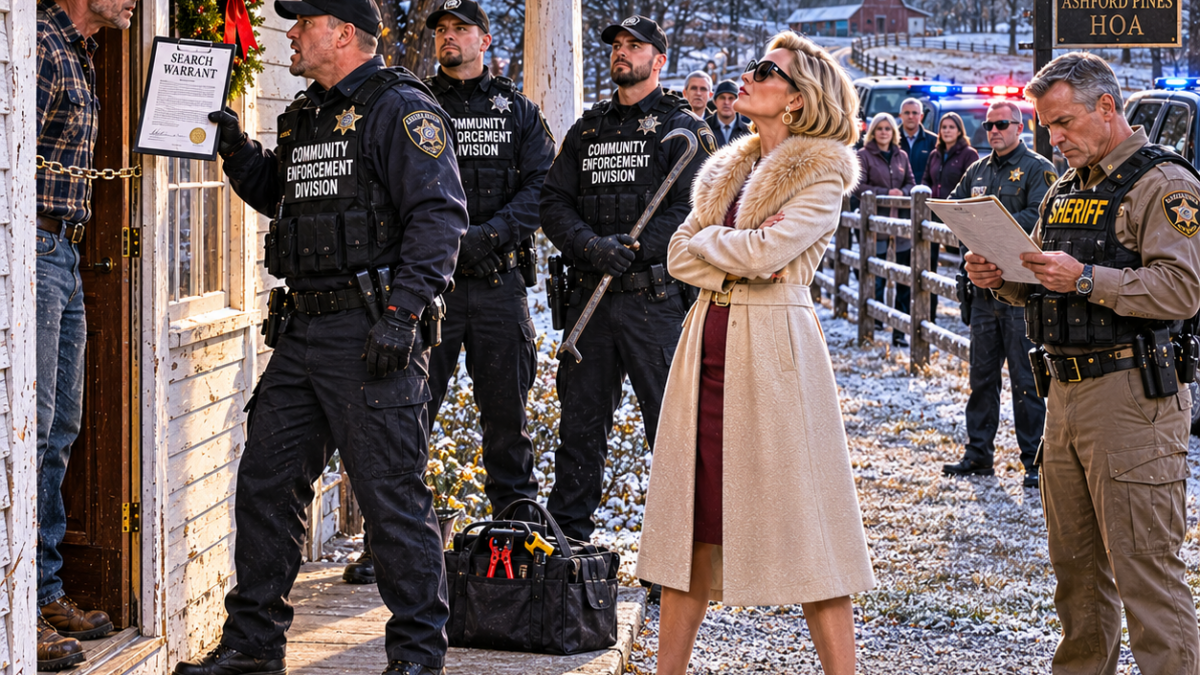
The man in front was broad and thick through the shoulders. A silver star-shaped patch was sewn above the words COMMUNITY ENFORCEMENT DIVISION. His name tag read TUCKER FENN.
Behind him stood two others.
Levi Grady.
Dustin Fleet.
Dustin carried a heavy canvas tool bag.
Across the road, parked at an angle where she could see my front porch perfectly, sat a black SUV.
Priscilla Thorne was behind the wheel.
HOA president.
Ashford Pines.
My neighbor in geography only.
Not in jurisdiction.
I opened the front door four inches and left the brass security chain locked.
Tucker immediately shoved a sheet of paper toward the gap.
“County search warrant.”
He tapped the blue seal near the top.
“Open the door. We are authorized to search every room.”
I looked at the paper.
Official formatting.
County header.
Case number.
Judge’s signature.
The kind of document that could make an ordinary person panic before breakfast.
“Which agency are you with?” I asked.
“Community Enforcement.”
“That’s not a county department.”
“Open the door.”
“What law-enforcement agency issued this warrant?”
Tucker did not answer.
Instead, he pointed down the hallway behind me.
“We need the key to the study at the rear of the house.”
That sentence changed everything.
Nobody outside my property should have known the back study was locked.
Nobody should have known there was a steel filing cabinet inside it.
I looked over Tucker’s shoulder.
Priscilla got out of her SUV.
Silver hair.
Dark sunglasses.
Camel-colored coat.
Perfectly calm.
She walked to the edge of my gravel drive but did not step onto the porch.
“Bennett,” she called. “You’ve ignored every violation notice this association has sent.”
“My property is not in your association.”
“That argument is over.”
She raised her voice enough that two neighbors opening their garage doors could hear.
“Cooperation is no longer optional.”
I looked at her.
“According to whom?”
“The court.”
She pointed at the paper in Tucker’s hand.
“If you resist, you’ll be in handcuffs before breakfast.”
I almost laughed.
Almost.
Instead, I said what I had said to her for seven months.
“My deed predates Ashford Pines. There are no HOA covenants attached to my parcel. You have no authority here.”
Her smile was thin.
“Property lines don’t protect people who have something to hide.”
Tucker leaned into the door.
The chain snapped tight with a hard metallic crack.
I stepped backward rather than pushing against him.
That mattered.
I did not want video showing me shoving anyone.
I dialed 911.
“My name is Bennett Ralston. Three private security guards are threatening to force entry into my home using what they claim is a county search warrant.”
The dispatcher asked whether they were armed.
“I don’t see firearms. One has a tool bag. Another is pushing against the door.”
I gave the address.
Then I opened the cloud backup on my camera system and pushed all four live feeds to an independent server.
Whatever happened next would not depend on the recorder in my house surviving.
Outside, Priscilla raised two fingers.
A tiny motion.
Dustin glanced at her.
Tucker opened the tool bag and removed a flat steel pry bar.
“If the door is not open in thirty seconds, we’ll take the lock off.”
I stayed in the hallway.
“Before you do that, tell me which judge signed the warrant.”
Tucker frowned.
Then he turned the paper toward the morning light.
“Judge Amos Belridge.”
Something inside me went still.
I knew the name.
Anyone who followed county news knew the name.
Judge Amos Belridge had died the previous winter.
Cancer.
Eleven months earlier.
His obituary had run on the front page of the county paper.
I did not tell Tucker.
I did not tell Priscilla.
I stepped farther from the door.
And waited.
The sirens started at the bottom of the hill.
Priscilla smiled.
Actually smiled.
She believed the real sheriff was coming to finish what she had started.
She took the warrant from Tucker and walked toward the first patrol car like a woman carrying proof of victory.
Sheriff Franklin Eddings stepped out.
Gray at the temples.
Thirty years in law enforcement written into the way he moved—slow enough not to create mistakes, fast enough to stop other people from making them.
Priscilla shoved the document toward him.
“Sheriff, I expect Mr. Ralston arrested for interfering with a lawful search.”
Franklin took the paper.
He did not look at me.
Did not look at Tucker.
He read the first half.
Then his eyes reached the signature line.
He stopped.
For three seconds, nobody spoke.
Then he looked at Priscilla.
“Ma’am.”
Her smile weakened.
“Where exactly did you get this warrant?”
part 2
Seven months earlier, I had bought the farmhouse because I wanted to be left alone.
That was genuinely the whole plan.
The house was nearly one hundred years old.
The porch roof sagged.
The wiring belonged in a museum.
Blackberry vines had swallowed half the back garden.
One bedroom smelled faintly of mouse nests no matter what I cleaned.
I loved it.
Four-point-three acres.
Old oaks.
A shed.
A narrow gravel road.
No clubhouse.
No pool committee.
No architectural review board.
I paid $318,000.
Before closing, I did what auditors do.
I read everything.
Title chain.
Recorded deed.
Parcel history.
Restrictions.
Easements.
Subdivision records.
The farmhouse parcel had been split and recorded long before Ashford Pines existed.
No declaration attached it to the HOA.
No covenant.
No membership agreement.
Nothing.
Ashford Pines later developed around my property on two sides.
Its stone mailboxes stopped at my fence.
Its rules stopped there too.
Three weeks after I moved in, Priscilla Thorne sent me a registration notice.
Four hundred fifty dollars.
Fence color correction.
Front-door color correction.
Required backyard inspection.
I thought it was a mistake.
I mailed back a copy of my deed and a short letter.
My parcel is outside the association. Please update your records.
I assumed that would end it.
Instead, Priscilla arrived at my gate that Sunday.
She wore a quilted vest and carried a clipboard.
“Your backyard requires inspection.”
“No.”
Her expression barely changed.
“We inspect all surrounding properties for neighborhood consistency.”
“Mine isn’t part of your neighborhood.”
“Every property around here answers to me eventually.”
I remember that sentence because it sounded too ridiculous to be threatening.
“Mine won’t.”
She stared past me toward the farmhouse.
Then she smiled.
“We’ll see.”
After that came the fines.
Three hundred dollars for trash cans.
Seven hundred fifty for repairing the porch roof without HOA approval.
A demand that I remove the camera facing the road.
A warning about my mailbox.
Then landscaping.
Then parking.
None applied.
I paid nothing.
But I kept everything.
Every envelope.
Every date.
Every signature.
One folder.
PRISCILLA.
That habit ended up saving me more than once.
About four months after I moved in, Eloise Farrow called.
She was the woman who sold me the farmhouse.
Sixty-eight.
Sharp eyes.
Soft voice.
She had once served as bookkeeper for Ashford Pines.
When I mentioned the fines, she went quiet.
Then she asked something odd.
“Have you remodeled the back study yet?”
“No.”
“The built-ins?”
“Still there.”
“Don’t touch them.”
“Why?”
“Can I come over tonight?”
She arrived after dark.
No small talk.
She walked directly into the study and pressed the lower panel of the built-in cabinet.
A hidden hinge released.
Behind the panel was a narrow compartment.
Inside sat a blue metal box.
I looked at her.
“Eloise?”
She sat down.
“When I kept the association’s books, I started seeing payments that made no sense.”
“How long ago?”
“Fourteen months before I resigned.”
She opened the box.
Copies.
Invoices.
Payment schedules.
Board summaries.
Vendor lists.
Transfer records.
“I made copies because Priscilla wouldn’t show the original contracts.”
“Why hide them here?”
“Because this house belonged to my sister before me. Nobody in the association knew about this compartment.”
I picked up the top folder.
ASHFORD PINES EMERGENCY RETAINING WALL FUND
$1,700,000
That got my attention.
The association had levied a special assessment on homeowners after erosion problems developed along the eastern slope.
The threat was real.
Mud had already moved behind two homes.
Families paid because they believed retaining walls and drainage work were necessary.
According to the files in the box, most of the project had been paid.
According to the ground outside, almost nothing had been built.
I spent three evenings reviewing the records.
The old professional reflex came back quickly.
Vendor names were similar.
Consulting firms.
Material-management companies.
Construction-administration companies.
Invoices were vague.
Amounts were high.
Payment approvals repeated the same signature.
Priscilla Thorne.
I drove to the eastern slope.
No retaining wall.
No drainage rebuild.
Just old survey stakes.
Rusted temporary fencing.
Erosion.
Back at home, I cross-referenced the companies.
One connected back to a business tied to Priscilla.
Not enough to accuse her publicly.
Enough to ask questions.
I contacted Ruthie Bledsoe.
Former school administrator.
Board member.
One of the few people who had voted against part of the spending plan.
She confirmed that Priscilla had refused requests for original contracts.
Homeowners received glossy summaries.
Progress photographs.
General descriptions.
When anyone asked for details, Priscilla said permits were pending.
I called Eloise.
“We need an independent audit.”
“Yes.”
We contacted the county auditor’s office.
Not Facebook.
Not the neighborhood rumor mill.
The auditor.
We scheduled a formal handover of the original records.
Then word somehow reached Priscilla.
She called an emergency HOA meeting.
Her version of the story was simple.
An outsider had stolen confidential association records and was attempting to sabotage Ashford Pines.
I attended as Ruthie’s invited guest.
Priscilla ordered security to remove me before I sat down.
At the door, I turned toward the room.
“If every dollar was spent properly, an independent audit should protect the association.”
Nobody answered.
But several residents looked at one another.
Priscilla’s face changed.
“I will use every legal remedy available to recover association property.”
She looked directly at me.
That was the first moment I understood she was not trying to defend the accounting.
She was trying to recover the records.
That night, she called Tucker Fenn.
His company held the Ashford Pines security contract.
According to later testimony, she told him she needed an emergency inspection conducted at my house Thursday morning.
He asked whether she had legal authority.
She said the paperwork was handled.
Then she gave him a sealed envelope containing a black USB drive.
“Find the blue box first.”
That was her instruction.
“If it isn’t there, make sure the police find this.”
Tucker should have walked out.
He didn’t.
Wednesday evening, Priscilla gathered Tucker, Levi, and Dustin inside the HOA office.
On the conference table was a fake search warrant.
Case number.
County seal.
Judge’s signature.
My address.
Authorization to search every room, locked cabinet, computer, storage device, and document connected to Ashford Pines.
No court had issued it.
She had apparently copied an old warrant from another dispute, changed the target information, and reused the seal.
She also reused the judge’s signature.
Judge Amos Belridge.
The problem was that Judge Belridge had been dead eleven months.
Priscilla either did not notice or believed nobody else would.
The plan relied on fear.
Three uniforms at dawn.
Star patches.
An official-looking warrant.
A homeowner who would hopefully panic.
Tucker would pressure me.
Levi would control the hallway.
Dustin would search the study.
If they found the blue box, they would take it.
If they did not, Dustin would hide the USB drive beneath my desk.
Then Priscilla intended to report that I had stolen association data.
That was what the sheriff had not known when he first arrived.
But he was about to.
Franklin placed the warrant on the hood of his cruiser.
Deputy Eliza Cantrell called the court clerk.
No case number.
No warrant.
No judicial order authorizing entry into my home.
Franklin put one finger beside the signature.
“Judge Amos Belridge died eleven months ago.”
Priscilla reached for the paper.
Franklin kept his hand over it.
“This says he signed it yesterday.”
Her expression changed.
Not much.
Enough.
“A legal consultant prepared that.”
“Who?”
“I don’t know the individual.”
“Who gave it to you?”
“My office received it.”
“From whom?”
She said nothing.
Franklin turned toward Tucker.
“Step away from the door.”
Then toward the other two.
“Everyone stays where they are.”
Priscilla’s voice rose.
“Why aren’t you arresting him?”
Franklin looked at her.
“For what?”
“Obstruction.”
“Obstruction of what lawful process?”
She pointed at the warrant.
“The search.”
Franklin’s voice remained level.
“There is no search.”
The entire morning changed in that sentence.
Five minutes earlier, Priscilla was issuing orders.
Now people were asking her questions.
Franklin turned toward Tucker.
“Private security cannot execute a search warrant.”
“We have a special community enforcement contract,” Priscilla said.
Franklin stared at her.
“A security contract does not make your guards deputies.”
Tucker raised his hands.
“She gave us the document.”
Priscilla spun toward him.
“Tucker.”
“She planned all of this.”
Dustin looked at him.
Levi immediately said, “I want to explain what happened.”
Eliza separated all three.
Different areas of the driveway.
No talking to one another.
No coordinated stories.
I handed Franklin my phone.
He watched the footage.
Tucker threatening to remove the lock.
Priscilla signaling toward the door.
My 911 call.
Levi suggesting they wait for real deputies.
Priscilla ordering them not to leave.
Franklin watched each angle.
Then the court clerk reconfirmed.
Nothing lawful existed.
Franklin walked to Priscilla.
“You’re being detained while we sort out a forged judicial document and attempted unlawful entry.”
Her face went red.
“You cannot do this.”
“Ma’am—”
“I run this entire community.”
Franklin looked at her for several seconds.
“You run a homeowners association.”
He nodded toward the county road.
“Not the county.”
Eliza moved toward her.
Priscilla turned on me.
“You set this up.”
I shook my head.
“You brought a fake warrant to my house.”
The neighbors had started gathering.
Robes.
Jogging clothes.
Phones in hand.
Everyone saw her placed in the patrol car.
As Eliza guided her away, Priscilla twisted toward Dustin.
“Don’t say a word about the office.”
Franklin heard her.
So did I.
He looked at Eliza.
“Write that down.”
Time.
Exact wording.
Dustin went pale.
Then he said, “I have something.”
Eliza put on gloves.
Opened his tool bag.
Removed the sealed envelope.
Inside was the black USB drive.
“What is it?” Franklin asked.
Dustin stared at the gravel.
“We weren’t only supposed to search.”
Franklin waited.
“We were supposed to leave something.”
That sentence changed the case from reckless to deliberate.
Later that morning, I sat inside the sheriff’s office.
Deed.
Fines.
Letters.
Everything spread out.
Franklin noticed what I had noticed.
During the previous three weeks, Priscilla’s notices had stopped talking about paint.
Trash cans.
Fence color.
They all demanded access to my study.
They referred to “association records believed to be unlawfully retained.”
Franklin pointed to one.
“This isn’t an HOA dispute anymore.”
“No.”
“Where’s the blue box?”
“County auditor.”
He looked up.
“What?”
I handed him the receipt.
3:40 p.m. the previous day.
Eloise and I had delivered the original records.
Document count.
Signatures.
Time stamp.
Priscilla had sent three men to break into a house searching for evidence that had already been transferred into official custody.
In another interview room, Dustin explained the USB.
If the blue box was gone, he was supposed to tape the drive beneath my desk.
Then Priscilla would report suspected theft of confidential HOA data.
Tucker insisted he knew nothing about planting anything.
Levi contradicted him.
He had heard Priscilla tell Dustin that police needed to find the drive if the records were missing.
Levi also saved a work message from Tucker.
Priority target: blue archive box.
Not fence inspection.
Not safety.
Not covenant enforcement.
Financial records.
The drive went to digital forensics.
So did the guards’ phones.
Eloise gave her statement.
She described invoices for materials never delivered.
A management company with no employees.
Payments approved without supporting work.
Construction costs with no construction.
Franklin called the district attorney.
Dana Larkins.
The fake warrant had become part of a possible evidence-recovery and concealment scheme.
Then Eliza found something on the USB.
A file created less than twelve hours before the attempted entry.
RALSTON EVIDENCE PACKAGE FINAL.
Inside was a fabricated narrative claiming I had stolen HOA data and used it to threaten board members.
At the bottom:
Deliver after search. Use if original records cannot be recovered.
Franklin read it twice.
Then he leaned back.
“She didn’t just want your evidence.”
“No.”
“She wanted to make you the evidence.”
That was exactly it.
Two days later, Priscilla made bond.
Ashford Pines divided almost immediately.
Some residents were furious.
Their dues had paid the security company used to threaten a man who was not even an HOA member.
Others defended her.
She had been president for years.
She controlled meetings.
Managed vendors.
Approved projects.
People had trusted her.
Her attorney released a statement claiming she had believed the warrant was genuine.
Then she started telling residents that I was an outsider exploiting paperwork errors.
She asked the board to pay her legal defense from HOA funds.
Ruthie objected.
“Show me the board resolution authorizing a search of Bennett Ralston’s home.”
No resolution.
No vote.
No minutes.
No legal opinion.
Nothing.
Her request for HOA defense money died immediately.
That mattered.
For the first time, board members were checking her authority before following it.
I had my own problems.
The front lock was damaged.
The frame splintered where Tucker used the pry bar.
Two consulting clients delayed contracts after hearing that my name was connected to an HOA data theft investigation.
One asked me directly whether I was a suspect.
That was when I understood how effective Priscilla’s backup plan could have been.
Plant one drive.
File one complaint.
Create doubt.
She did not need to prove I was guilty immediately.
She only needed to make other people uncertain.
I hired a civil attorney.
Demanded written retractions.
Documented lost income.
Repairs.
Legal costs.
But I stayed out of neighborhood arguments.
No angry posts.
No leaking documents.
No retaliation.
The blue box contained homeowners’ personal financial information.
I never released it publicly.
Evidence is not ammunition for revenge.
It belongs where it can be verified.
Ruthie changed too.
She admitted she had suspected problems years earlier.
“I should have demanded the audit.”
“Why didn’t you?”
“Because she always sounded certain.”
That phrase followed the entire case.
Priscilla sounded certain.
Ruthie and several directors called a special board meeting.
They preserved association records.
Suspended Priscilla’s individual access to accounts.
Ordered independent financial review.
Then Ruthie found a deletion request.
The day before the attempted search, Priscilla instructed the bookkeeping office to erase an old payment schedule tied to Thorn Civic Restoration.
Investigators compared the name with state filings.
Thorn Civic Restoration was connected directly to Priscilla.
Money from the retaining-wall fund had flowed into it.
Then moved again.
Investment accounts.
Personal assets.
The financial crimes unit expanded its work.
Subpoenas.
Bank records.
Vendor records.
Accounting files.
Contracts.
The $1.7 million trail came into focus slowly.
Some money paid for legitimate work.
A survey.
Engineering.
Preliminary services.
But large amounts were billed for work that did not exist.
Retaining wall construction with no retaining wall.
Drainage work never performed.
Management fees without employees.
Material costs without delivery records.
The black USB drive became even more damaging.
Forensics showed the fake files were created hours before the raid.
Templates matched files on HOA office computers.
Investigators lawfully imaged those systems.
Earlier versions of the fabricated “evidence” existed under Priscilla’s user account.
The digital trail matched Dustin’s statement.
Matched Levi’s.
Matched Tucker’s message.
The entire plan became visible.
If blue box found:
remove records.
If blue box missing:
plant USB.
Then accuse Bennett.
Redirect investigation.
Every branch failed.
The original records were already with county auditors.
The planted drive never entered my home.
The man carrying it confessed what it was for.
The files themselves pointed back to the HOA office.
Priscilla had built evidence to bury me.
Instead, she built evidence against herself.
Tucker resisted longest.
For weeks, he claimed he believed he was conducting legitimate security work.
Then his attorney saw the porch footage.
The messages.
His own men.
His account changed.
Priscilla had told him the goal was the financial records.
Get them before Bennett could hand them over.
The supposed warrant was how she made the job feel legal.
Investigators compared his statements against call records and printed documents.
Then they found the spreadsheet.
Two columns.
REPORTED SPENDING.
ACTUAL TRANSFERS.
The first matched what residents had been shown.
The second showed substantially larger payments to Priscilla-connected entities.
Several entries labeled retaining wall construction had funded unrelated expenses.
Eloise and I were asked to verify our copies against the recovered digital records.
One transaction code matched the last page in the blue box.
The page Priscilla seemed most desperate to recover.
Dana Larkins authorized additional charges based on the evidence the investigation had developed.
I did not celebrate.
I had spent months wanting this woman out of my life.
What I wanted most was not prison.
It was the restoration of reality.
My property was outside the HOA.
The records were real.
The money trail deserved investigation.
The warrant was fake.
Those facts mattered more to me than how dramatic the punishment became.
Ashford Pines called a special meeting.
The community room was packed.
I was invited to speak but could not vote.
I was not a member.
Priscilla entered with her attorney.
Same composed posture.
But people who once greeted her now looked away.
Ruthie presented the audit findings carefully.
No exaggeration.
No assumption of criminal guilt beyond what the court had decided.
Just what the independent financial review showed.
Invoices without documentation.
Projects marked paid but incomplete.
Companies tied to leadership.
Retaining wall missing.
Money gone.
Residents started murmuring.
Some had paid thousands into the special assessment.
One man stood.
“My wife took money out of retirement for that wall.”
Priscilla tried to redirect.
“This crisis began when an outsider removed confidential records.”
My turn came.
I carried three things.
My deed.
Her fines.
The sheriff’s report.
I placed the deed down first.
“My property is outside Ashford Pines.”
Then the fines.
“These were issued anyway.”
Then the sheriff’s report.
“This is what happened when I would not surrender documents.”
I did not give a speech.
I played the security footage.
Tucker at my door.
Pry bar.
Priscilla signaling forward.
Her voice demanding my arrest.
The fake warrant.
When the video ended, silence filled the room.
Priscilla stood.
“I was protecting the community.”
I looked at her.
“No.”
She glared at me.
“You used the community’s name to frighten people who trusted you.”
The board conducted the removal process according to its bylaws.
Valid ballots.
Counted properly.
Priscilla lost overwhelmingly.
The interim board immediately placed financial accounts under multiple-signature controls.
Tucker’s security contract was suspended.
Later terminated.
Independent forensic audit approved unanimously.
As people left, Priscilla approached me with her attorney several steps behind.
“You destroyed everything I built.”
Her voice shook.
I looked at her.
“No.”
She waited.
“I opened the door so everyone could see what you built it with.”
She had no answer.
Weeks later, a preliminary criminal hearing laid out the forged warrant.
The attempted entry.
The USB plan.
The financial records.
Dustin testified.
Levi testified.
Tucker sat facing the video of himself threatening my lock.
Dana told the court this was not a simple disagreement between a homeowner and an HOA.
It was the deliberate borrowing of judicial authority to intimidate a citizen and interfere with evidence.
The judge ordered the case forward.
Priscilla left without an association to command.
Ten months after the morning she stood across my road smiling, her criminal trial reached its final stage.
I attended only portions.
The prosecution built the case the way good cases are built.
Piece by piece.
The fake warrant.
Judge Belridge’s dead signature.
The court clerk.
Security footage.
The guards’ testimony.
The black USB drive.
Digital forensics.
HOA computers.
Bank records.
Vendor records.
The blue-box copies.
The original documents already held by county auditors.
Every independent source supported another.
Priscilla’s attorney argued she had been misled.
That she was guilty of poor management, not deliberate fraud.
That advisers created the warrant.
That guards misunderstood their roles.
That financial transactions were legitimate association business.
But her own messages kept appearing.
Her signatures.
Her user account.
Her instructions.
The plan to plant evidence.
The jury found her guilty.
The court sentenced her to seven years in prison and ordered restitution through the lawful recovery process.
Assets connected to diverted association money were used where legally available to satisfy those obligations.
Tucker faced separate consequences for his role.
Dustin and Levi were held accountable according to what investigators established about each man’s conduct, with their cooperation becoming part of that record.
The security company lost the HOA contract and faced its own legal review.
My civil case ended separately.
Eighty-six thousand dollars.
Repairs.
Lost consulting income.
Legal costs.
But the most important paragraph was not the settlement amount.
It was a written acknowledgment.
My property stood entirely outside Ashford Pines HOA authority.
Every fine withdrawn.
No right to inspect.
No right to demand entry.
No HOA control over my land.
I read that paragraph more times than the dollar figure.
Money repairs a door.
Boundaries repair peace.
The retaining wall finally started construction after the new board rebuilt financial controls.
Real crews.
Real permits.
Real invoices.
Residents received transparent reports.
Independent auditor.
Multiple signatures.
Actual photographs tied to actual locations.
Funny how boring legitimate management looks compared with corruption.
No dramatic envelopes.
No secret raids.
Just work.
One crisp autumn morning, I was pulling blackberry roots from the garden when Eloise came up the drive.
She carried the final audit report.
“Residents wanted you to have a copy.”
“I already know enough.”
“You should read the ending.”
I wiped my hands.
She handed it over.
The association had recovered part of the diverted money.
Other amounts were tied to restitution and asset recovery.
The retaining-wall account had been restructured.
The new board formally recognized the limits of HOA jurisdiction.
Eloise looked at the house.
“You almost tore out those cabinets.”
“I know.”
“If you’d started a week earlier—”
“Then you would’ve found somewhere else.”
She smiled.
“Maybe.”
I thought about the blue box.
A little metal container hidden behind old wood.
Priscilla spent months trying to control my property because she believed evidence still sat inside it.
The irony was that the house itself never mattered to her.
The HOA fines were camouflage.
Fence color.
Roof approval.
Trash cans.
Cameras.
All excuses to normalize the idea that she had authority to enter.
Once people accepted that premise, asking for the study would feel like one more inspection.
I never accepted it.
That is what frustrated her.
She could not convert repetition into consent.
Sheriff Franklin drove past while Eloise and I were standing near the porch.
He slowed.
Rolled down the window.
“Everything settled?”
I looked at the new deadbolt.
“Better than ever.”
He nodded toward it.
“No more search warrants, I hope.”
I laughed.
“Only if a real judge signs one.”
Franklin smiled.
Raised two fingers.
Drove on.
That evening, I sat in the study.
The hidden compartment remained open.
Empty now.
I never sealed it.
Maybe because it reminded me that houses remember things.
Not mystically.
Physically.
Old hinges.
Hidden spaces.
Marks where people repaired damage.
The front-door frame still showed a faint difference in color where Tucker’s pry bar splintered it.
I could have replaced the whole frame.
I chose not to.
Not as a trophy.
As a reminder.
Priscilla had arrived believing authority could be manufactured from appearance.
Three uniforms.
A blue seal.
A judge’s signature.
A title.
A threat.
Most people at six fourteen in the morning would have seen those things and opened the door.
That was the plan.
Not legal power.
Psychological power.
There is a difference.
Real authority withstands verification.
Fake authority depends on speed.
“Open now.”
“Don’t call anyone.”
“Don’t read.”
“Don’t ask.”
“Don’t verify.”
Priscilla needed me frightened before I could think.
Instead, I asked one question.
Which judge signed it?
Everything after that followed from verification.
The court had no warrant.
The judge was dead.
The guards were private.
The HOA had no jurisdiction.
The USB was manufactured.
The records were already with auditors.
The money trail existed independently.
Truth was not one dramatic revelation.
It was a series of boring checks.
That is how I spent my career auditing construction fraud.
Follow the invoice.
Call the vendor.
Verify the delivery.
Check the date.
Compare the signature.
Look at the ground.
Does the wall exist?
In Ashford Pines, it did not.
That might be the entire story in one question.
Does the wall exist?
Residents paid $1.7 million because they believed someone had built safety infrastructure.
Glossy reports said yes.
Payments said yes.
Priscilla said yes.
The hillside said no.
A hillside does not care about PowerPoint.
Neither does a dead judge’s signature.
The facts were there.
People had simply trusted the summary instead of checking the source.
I do not blame every Ashford Pines resident for that.
Communities run on some level of trust.
You cannot personally audit every landscaping bill.
You elect people.
Hire managers.
Delegate.
But trust is not the same as surrender.
When someone refuses every request for original documents, that is not leadership.
When one person controls information, vendors, spending, enforcement, and security, questions become necessary.
Ruthie learned that.
She told me months later, “I kept thinking someone else would challenge her.”
“So did everyone.”
“I knew numbers didn’t feel right.”
“But?”
“She made every question feel like disloyalty.”
That is another form of control.
Priscilla did not only frighten outsiders.
She trained residents to equate scrutiny with betrayal.
You do not need forged warrants to build that kind of culture.
You only need certainty.
Enough confidence.
Enough repetition.
Enough public embarrassment aimed at anyone who disagrees.
Eventually people stop asking.
Until something breaks.
In our case, what broke was not my door.
It was the illusion.
The moment Franklin said Judge Belridge had been dead eleven months, the performance collapsed.
No one could un-hear it.
No one could pretend the paper was legitimate afterward.
Then every other claim became available for review.
That is why I never regretted refusing the door.
Even though the chain bent.
Even though Tucker damaged the frame.
Even though my business took a hit.
If I had opened it, they might have found nothing and planted the drive.
Then police would arrive later.
Priscilla would point toward fabricated evidence.
Maybe investigators would still uncover the truth eventually.
But the road would have been longer.
Instead, she recorded herself directing the operation outside my house.
She handed the fake warrant to the real sheriff personally.
She brought the lie directly to the person best positioned to verify it.
That was her fatal mistake.
Confidence again.
She believed she had controlled the paper so completely that nobody would check.
The irony is that I never trapped her.
I did not know the guards were coming.
I did not know about the USB.
I did not know she copied Judge Belridge’s signature.
I only did what I had done for seven months.
I refused to accept unsupported authority.
She created everything else.
A year after the trial, Ashford Pines held an open community meeting about the completed retaining wall.
Ruthie invited me.
I almost declined.
Then Eloise told me to go.
“You started this.”
“No. Priscilla did.”
“Then finish it.”
I attended.
The eastern slope looked different.
Concrete.
Drainage.
Engineered retaining structures.
Actual work.
The board displayed the contracts on a screen.
Vendor names.
Amounts.
Change orders.
Photos tied to dates.
Residents asked questions.
Nobody became defensive.
One man asked why a drainage item cost twelve thousand more than budgeted.
The treasurer explained the soil condition and produced the change-order backup.
That was governance.
Not perfect.
Not glamorous.
Transparent enough to survive a question.
Afterward, a woman approached me.
I recognized her from the morning Priscilla was arrested.
She had been standing across the road in a robe.
“I believed her.”
I nodded.
“She was convincing.”
“I thought you were just refusing to cooperate.”
“That’s what she wanted you to think.”
The woman looked embarrassed.
“I’m sorry.”
“You don’t owe me anything.”
“I do.”
“No. Just ask more questions next time.”
She smiled.
“Believe me, we do now.”
That was enough.
I never joined the board.
Never wanted to.
Ashford Pines was not my HOA.
That remained the point.
My land did not need to become part of their community for us to coexist.
We could be neighbors without shared governance.
That boundary became easier after everything.
The new board stopped sending notices.
No inspectors.
No registration fees.
No arguments about my porch.
A few residents waved when they passed.
Some stopped by occasionally.
Life became ordinary.
That was the real reward.
Not headlines.
Not prison sentences.
Ordinary.
Coffee in the morning without pounding at the door.
Working in the garden.
Taking consulting calls.
Fixing the porch properly.
No one watching from a black SUV.
The house finally became what I bought it to be.
Quiet.
Private.
Mine.
People sometimes ask whether I kept Priscilla’s original fine letters.
I did.
The folder still sits in the filing cabinet.
PRISCILLA.
Inside are seven months of escalation.
Mailbox.
Fence.
Roof.
Trash cans.
Camera.
Inspection demands.
Study access.
Records.
Warrant.
When you read them in sequence, you can see the pretext disappearing.
At first she pretended this was about HOA standards.
By the end, she no longer cared about paint colors.
She wanted a blue box.
That is how abuse of authority often reveals itself.
The stated reason changes.
The demand remains.
Give me access.
Give me control.
Give me the records.
Give me the right to decide what happens next.
The title is only the costume.
The objective is control.
Priscilla believed being HOA president made her bigger than boundaries.
Property boundaries.
Board authority.
Financial controls.
Law enforcement authority.
Judicial authority.
Eventually even reality.
She forged a dead judge’s signature because she had stopped understanding the difference between looking official and being lawful.
Seven years in prison did not come from one argument over a farmhouse.
It came from the chain of decisions underneath it.
The warrant.
The attempted entry.
The plan to remove evidence.
The plan to fabricate evidence.
The money.
The companies.
The records.
Each piece had its own proof.
Each consequence came from that proof.
That is why I never tell this story as “I defeated an HOA Karen.”
I did not defeat anyone.
I refused a door.
The sheriff read a document.
Auditors followed numbers.
Digital specialists examined files.
Residents checked spending.
A jury evaluated evidence.
The system worked because people finally stopped accepting Priscilla’s summaries.
They looked underneath.
Sometimes justice is dramatic.
Handcuffs.
Courtrooms.
Verdicts.
But most of the work is unremarkable.
A county clerk answering a phone.
A timestamp.
A backup server.
A receipt showing documents were delivered at 3:40 p.m.
An old newspaper obituary proving a judge could not have signed a warrant yesterday.
Those are the details that hold the world together.
Not speeches.
Details.
I still have the coffee mug from that morning.
Small chip on the rim.
Nothing special.
Sometimes I think about how close I came to spilling it when Tucker hit the door.
I had expected that Thursday to be quiet.
I planned to answer emails, prune blackberry vines, and maybe repair the cabinet door in the study.
Instead, three men in fake authority uniforms arrived before sunrise because an HOA president believed fear would do what law could not.
She was wrong.
Fear works best when nobody checks.
I checked.
That was enough.
One autumn evening, years later, I locked the front door and stood on the porch.
The new deadbolt turned smoothly.
No chain rattling.
No damaged frame.
Across the road, the spot where Priscilla parked her SUV was empty.
Leaves moved through the oaks.
Someone farther down in Ashford Pines was mowing a lawn.
I thought about Franklin’s joke.
Only if a real judge signs one.
Then I looked back at the house.
Old farmhouse.
Sagging porch repaired.
Garden alive again.
Study cabinets still crooked.
Exactly what I wanted.
Priscilla once believed a forged signature could give her permission to enter every room.
In the end, that signature did the opposite.
It opened every question she had spent years trying to keep closed.
And I never had to fight the three men she sent.
I only had to keep my door locked long enough for the real sheriff to read the paper she was so proud to hand him.








