𝗙𝗨𝗟𝗟 𝗦𝗧𝗢𝗥𝗬 HOA Karen Sent Fake Officers to My House and They Broke My Pregnant Wife’s Arm—Then Their Fake Authority Collapsed on Camera
PART 2
My name is Zach Harper.
At the time, Emma and I had lived in that house for six years.
I had built half the back deck myself.
Replaced the kitchen cabinets.
Installed the fence.
Planted the maple near the driveway.
It wasn’t an impressive house.
It was ours.
That distinction mattered more than Karen Langley ever understood.
Karen had become president of Pine Hollow Estates three years earlier.
Our neighborhood technically had an HOA, but Pine Hollow had always been quiet before she took over.
Annual dues.
Common landscaping.
Snow removal.
Pool maintenance.
Normal things.
Then Karen decided the HOA needed “professional standards.”
The phrase sounded harmless.
It wasn’t.
Letters started coming.
Grass height.
Trash-can visibility.
Holiday decorations.
Driveway stains.
Mailbox paint.
A lawn-treatment disclosure form I had never heard of.
Emma once received a notice because the wreath on our front door supposedly extended beyond the approved seasonal-display period by forty-eight hours.
I laughed.
Emma didn’t.
“People like this get worse when everyone laughs instead of saying no.”
She was right.
The letters became weekly.
One claimed our mailbox replacement had never been approved.
I had replaced a rotten wooden post with an identical wooden post.
Same height.
Same color.
Same mailbox.
Another complained that Bruno’s barking exceeded community noise limits.
Bruno rarely barked.
Another demanded documentation for lawn chemicals.
I didn’t use lawn chemicals.
Each time, I responded in writing.
Each time, the HOA either withdrew the complaint or ignored my response and generated another one.
Then Karen introduced what she called the Pine Hollow Compliance Patrol.
Two men.
Dark shirts.
Cheap badges.
A used Crown Victoria.
They began driving through the neighborhood twice a day.
At first, everyone joked.
Fake cops.
Mall-security leftovers.
Neighborhood Batman.
Then they started knocking on doors.
Photographing yards.
Blocking driveways.
Standing close when people argued.
One older homeowner told me a patrolman had threatened to tow her son’s truck because it remained overnight in her driveway without a temporary vehicle permit.
Another man said one of them had demanded identification when he walked his own dog after ten at night.
I asked the board whether the patrol company was licensed.
No direct answer.
I asked what authority allowed them to detain anyone.
Karen sent a four-paragraph reply about community safety.
That should have told me everything.
The week before they came to my house, I received a notice saying our property was under “enhanced compliance review.”
Emma read it at the kitchen counter.
“What does that mean?”
“Nothing legal.”
“That wasn’t what I asked.”
“I know.”
She looked toward the front window.
“I don’t like them driving past.”
I had noticed too.
The Crown Victoria slowed in front of our house several times a day.
Sometimes the passenger held up a phone.
Once, Bruno started growling before the car even appeared.
That dog had better instincts than I did.
I installed another exterior camera.
Then another.
Doorbell.
Driveway.
Front porch.
Side yard.
Not because I expected an attack.
Because if Karen wanted to turn ordinary life into an enforcement file, I wanted my own record.
That decision saved us.
The man with the baton had just knocked my phone away when the taller one grabbed the front of my jacket.
“You failed to submit your lawn-treatment form.”
“What?”
“And your mailbox replacement was never approved.”
He pulled me closer.
“That puts your property in noncompliance.”
“My wife’s arm is broken.”
“Then she should have cooperated.”
That sentence changed me.
Not into a killer.
Not into some action-movie version of myself.
Into a man who understood that reasoning with these two had ended.
Emma was behind me.
Injured.
Pregnant.
Bruno snarling.
Two men between us and the driveway.
One holding a baton.
The other now carrying heavy zip ties from the open trunk of their car.
“You’re under arrest,” the skinny one announced.
“For what?”
“Noncompliance and obstruction.”
“You are not police.”
“We have delegated authority.”
“From Karen?”
“From the association.”
He pointed at the ground.
“On your knees.”
I raised both hands slightly.
“Do not come any closer to my wife.”
The taller man smirked.
“What are you going to do?”
I watched his eyes.
The baton.
The zip ties.
Emma trying to stand with one arm pressed against her body.
I carried a Glock 19 legally.
Usually on longer drives.
Sometimes around the property if I had been working late.
That day it was inside my jacket.
I did not want to touch it.
I need that clear.
A gun does not make a bad situation simple.
It makes every mistake permanent.
I backed toward Emma.
“Stay where you are.”
The man with the baton advanced.
“Down.”
“No.”
He lifted the baton.
I drew.
Kept the muzzle down initially.
“Stop.”
Everything changed.
The taller man’s expression shifted.
The skinny one froze.
For perhaps one second, I thought they understood.
Then the man with the baton lunged.
I fired.
The shot hit him low in the leg.
He went down.
The taller man moved toward me with the zip ties still in one hand.
I fired again.
He dropped backward against the Crown Victoria, clutching his shoulder.
Then silence.
Not real silence.
Bruno barking.
Emma gasping.
My ears ringing.
A car alarm somewhere down the street.
But the confrontation had stopped.
I did not empty the magazine.
Did not walk toward them.
Did not fire after they fell.
I moved backward to Emma.
The Glock stayed pointed toward the ground until I could see both men were no longer advancing.
“Emma.”
She looked at me.
Her face was gray.
“The baby.”
“I know.”
“He moved.”
“Good.”
Her injured arm was swelling.
I set the pistol on the concrete several feet away once I was confident neither man was reaching for a weapon.
Then I retrieved my phone from the hedge.
Screen cracked.
Still working.
“Emergency services.”
“My name is Zach Harper. Two men came onto my property posing as HOA enforcement. One assaulted my pregnant wife and broke her arm. I fired in defense after they continued advancing. Both men are injured. Send police and medical.”
The dispatcher asked where the gun was.
“On the ground.”
“Do not touch it.”
“I won’t.”
“Are the men still a threat?”
“They’re down.”
“Any other weapons?”
“One has a baton. There are zip ties. I don’t know what else they have.”
“Stay where officers can see your hands when they arrive.”
“I understand.”
Emma sat against the porch.
I found a clean towel and used it to support her injured arm without trying to straighten it.
The source story had me tying a tourniquet around a broken arm.
That would have made no sense unless she was bleeding heavily.
She wasn’t.
Her injury needed immobilization and paramedics.
So I supported it.
Kept her still.
Watched her breathing.
“Talk to me.”
“It hurts.”
“I know.”
“I’m going to kill Karen.”
Despite everything, I laughed once.
“No, you’re not.”
“That woman sent these idiots.”
“We don’t know that yet.”
Emma stared at me.
“Zach.”
“Fine. We strongly suspect it.”
Bruno stood between us and the two men.
Hackles raised.
I clipped his leash to the porch post.
The skinny man moaned from the grass.
“Help.”
“Ambulance is coming.”
“You shot me.”
“You broke my wife’s arm.”
He stopped talking.
Sirens came closer.
When the first sheriff’s cruiser turned onto our street, I stepped away from the weapon and raised both hands.
Deputies came out fast.
Real uniforms.
Real markings.
Real training.
“Hands up!”
“They’re up.”
“Move away from the gun!”
I did.
“Face away!”
I did.
“Hands behind your head!”
I did.
The cuffs went on.
That part offended some people when they later heard the story.
It shouldn’t.
Deputies arrived at a scene with two gunshot victims, a firearm on the ground, and a man saying he fired it.
They did not know me.
They did not know the truth yet.
Temporary restraint was not betrayal.
It was procedure.
“She’s pregnant,” I said.
“Paramedics are moving to her.”
“Her arm is broken.”
“We see her.”
One deputy went to Emma.
Another secured the Glock.
Two more moved toward the injured men.
The taller fake officer immediately began shouting.
“He attacked us!”
The deputy ignored him while checking for weapons.
“We’re HOA officers.”
“What agency?”
“Pine Hollow.”
The deputy looked at him.
“That’s an HOA.”
“We’re enforcement.”
“Do you have state security credentials?”
Silence.
The deputy removed the plastic badge from his vest.
Turned it over.
No identification.
No agency number.
Nothing.
Another deputy retrieved the taped baton.
Zip ties.
Cheap radio.
The Crown Victoria registration came back private.
No security company.
No government connection.
The cuffs on my wrists remained.
Fine.
I cared about Emma.
Paramedics loaded her onto a stretcher.
She reached for me with her good hand.
“Zach.”
“I’m here.”
“The baby?”
“They’re checking.”
“Come with me.”
I looked toward the deputy.
He nodded.
“We’ll get you there as soon as we finish securing the scene.”
I wanted to argue.
Didn’t.
A sergeant approached.
“Mr. Harper, do you have exterior cameras?”
“Yes.”
“How many?”
“Four covering this area.”
His expression changed slightly.
“Do they record audio?”
“Two do.”
“Where is the storage?”
“Local recorder and cloud backup.”
“Anyone else have access?”
“My wife.”
“Do not delete anything.”
“I won’t.”
That footage became the spine of the case.
From the driveway camera:
The unmarked Crown Victoria arriving.
The men approaching.
From the porch camera:
The first man grabbing Emma.
Her attempt to pull away.
The twisting motion.
Her collapse.
From the doorbell microphone:
“Stop resisting.”
“She’s pregnant.”
Then the baton striking my wrist.
My phone flying.
The fake section thirty-eight B.
Their claim that I was under arrest.
My repeated statements that they were on private property.
Most important:
The moments before I fired.
I backed toward Emma.
Warned them to stop.
The baton rose.
The man advanced.
The second moved with restraints.
Two controlled shots.
Then no more firing.
No pursuit.
No standing over anyone threatening them.
No triumphant speech.
Just me moving back to my wife.
The footage did not make what happened good.
It made what happened clear.
Emma’s hospital evaluation showed a fracture in the forearm with significant soft-tissue injury.
The baby was monitored for several hours.
His heart rate remained stable.
That was the moment I finally cried.
Not at the house.
Not in the patrol car.
In a hospital hallway after an obstetric nurse said:
“He looks good.”
I leaned against the wall.
My legs stopped working properly.
A detective stood ten feet away waiting to interview me.
He looked down the corridor and pretended not to notice.
I respected him for that.
The two men survived.
One needed surgery on his leg.
The other had a shoulder injury but no major vascular damage.
Their identities came back with histories that made the situation uglier.
Neither was licensed as a police officer.
Neither held authority to arrest people over HOA violations.
One had previous complaints involving intimidation.
The other had been connected to a dispute involving fake collection fees in another county.
The HOA had hired them through a vaguely named “community compliance services” arrangement.
Who authorized that contract became the next question.
Karen Langley.
Pine Hollow HOA president.
At first, she denied everything.
She released an email to homeowners that evening.
The association had hired independent compliance representatives solely for documentation and voluntary homeowner education.
They were not authorized to use force.
They were not authorized to arrest.
Karen claimed she had no knowledge that the men carried restraints or weapons.
I read the email from beside Emma’s hospital bed.
She looked over.
“Liar.”
“Probably.”
“You always say probably.”
“Because I like evidence.”
She gave me a tired smile.
“Your most annoying quality.”
The evidence came quickly.
Investigators seized the men’s phones.
On one were messages from Karen.
HARPER PROPERTY IS PRIORITY.
HE WILL ARGUE.
DO NOT ALLOW HIM TO DERAIL THE INSPECTION.
Another:
IF THEY REFUSE TO COOPERATE, HOLD THEM UNTIL COMPLIANCE PAPERWORK IS COMPLETED.
Then:
THE WIFE IS USUALLY HOME. SHE’S EASIER TO DEAL WITH.
I read that line once.
Then handed the page back to my attorney.
I could not read it twice.
Karen’s attorney argued that “hold them” meant remain at the scene and continue conversation.
Prosecutors disagreed.
The men had been given restraints.
Fake badges.
A baton.
A vehicle light.
Uniform-style clothing.
Written HOA forms titled ENFORCEMENT ACTION REPORT.
One form included boxes labeled:
SUBJECT COMPLIANT.
SUBJECT DETAINED.
POLICE REFERRAL REQUIRED.
That was difficult to explain as homeowner education.
Then investigators found invoices.
The HOA had paid for “enhanced compliance patrol services.”
Karen had approved the expense without a full board vote.
She had presented it later as general security.
Several board members said they believed the contractors were only photographing violations and serving notices.
One board member, Linda Brooks, provided emails showing she had asked Karen whether the men were licensed.
Karen replied:
THEY HAVE ALL NECESSARY AUTHORITY FOR COMMUNITY ENFORCEMENT.
No license attached.
No legal opinion.
Just confidence.
The neighborhood changed overnight.
People who had been afraid to challenge Karen started talking.
An elderly couple said one of the same men had entered their backyard without permission.
A single mother said they had blocked her driveway over unpaid fines.
Another homeowner described being told he could be “taken to the compliance office” if he refused to sign an acknowledgment.
Nobody had gone that far.
Not until my house.
That is what disturbed me most.
They had been escalating in small steps.
No one step looked insane enough to stop the whole program.
A knock.
A photograph.
A threat.
Blocking a driveway.
Taking an ID.
Standing too close.
Touching an arm.
Then my porch.
Emma’s bone breaking.
The system had been training itself to cross lines.
Three weeks later, I entered court as a witness.
Not defendant.
The prosecutors had reviewed the shooting evidence, including video, physical evidence, witness statements, and forensic findings.
They concluded the shots occurred during an immediate confrontation in which Emma had already suffered serious injury and the men continued advancing with a baton and restraints.
That did not make the shooting emotionally easy for me.
It made the legal question clearer.
I testified to everything.
No embellishment.
No heroic description.
I told the jury I had been afraid.
That mattered.
People expect men in self-defense stories to say they were calm.
I wasn’t.
I was terrified.
My pregnant wife was on the ground.
I did not know whether our baby was injured.
Two men had already demonstrated they were willing to hurt her.
They claimed authority that didn’t exist.
One raised a baton.
The other had restraints.
I believed the threat was continuing.
That was the truth.
The defense tried to make the HOA dispute sound legitimate.
“You had received violation notices?”
“Yes.”
“So there was an ongoing conflict.”
“Yes.”
“You were angry with the association.”
“Sometimes.”
“You disliked the enforcement officers.”
“I didn’t know who they were before they came to my house.”
“You knew the HOA had compliance rules.”
“Yes.”
“And you chose not to comply.”
“With notices I disputed through the HOA process.”
“Your dog was barking.”
“He is a dog.”
A few people smiled.
The judge did not.
The attorney continued.
“You introduced a firearm into a neighborhood disagreement.”
“No.”
I looked at him.
“Your clients broke my pregnant wife’s arm before I drew anything.”
Silence.
He changed direction.
The porch footage ended most of the remaining argument.
Video is cruel to bad narratives.
The man claiming Emma attacked him first could be seen grabbing her.
The man claiming I charged him could be seen moving toward me.
The fake codes were audible.
So was the statement:
“You are under arrest for noncompliance and disrespect toward an HOA enforcement officer.”
The jury heard it twice.
The prosecution also introduced Karen’s messages.
Her instructions.
Her claims of authority.
The fake detention form.
The contract.
The invoices.
The two men faced charges arising from the assault, unlawful restraint, criminal impersonation, trespass, and related conduct.
Karen faced separate charges connected to conspiracy, solicitation of unlawful enforcement activity, fraudulent representations of authority, and financial misconduct discovered during the investigation.
The cases did not all resolve on the same day.
That is important.
Real justice is slower than stories.
Hearings.
Motions.
Evidence challenges.
Expert testimony.
Medical records.
Phone extraction.
Board minutes.
Insurance fights.
Civil claims.
Months passed.
Emma’s arm healed gradually.
The cast came off.
Then physical therapy.
She regained most of her motion.
Cold weather still bothered her.
She refused to admit it for almost a year.
Our son was born two months after the attack.
Joshua Harper.
Seven pounds, six ounces.
Healthy.
Loud.
Furious about being removed from the only home he had ever known.
The first night after we brought him home, snow covered the yard.
Bruno slept beside the fireplace.
Emma sat wrapped in a thick sweater.
I stood near the window holding Joshua against my chest.
His entire hand barely fit around my finger.
I looked toward the porch.
That same porch.
For weeks, I had avoided looking directly at the step where Emma fell.
Now snow covered it.
Emma came beside me.
“You okay?”
“No.”
She smiled.
“Good answer.”
I looked at Joshua.
“I keep thinking about what could have happened.”
“So do I.”
“What if—”
“Don’t.”
I stopped.
She rested her head against my shoulder.
“We’re here.”
That became our rule.
We’re here.
Not everything was restored.
Her arm hurt.
I had nightmares about the sound.
Bruno barked at Crown Victorias for months.
But we were there.
Karen’s presidency did not survive.
The board suspended her shortly after investigators served records requests.
Homeowners held a recall vote.
She lost overwhelmingly.
An outside management company took temporary control while financial records were reviewed.
The compliance patrol ended immediately.
No more badges.
No more uniforms.
No more Crown Victoria.
The HOA eventually adopted a written policy explicitly prohibiting private contractors from representing themselves as police or claiming detention authority.
It was absurd that such a policy needed to exist.
Apparently it did.
Civil claims followed.
Emma sued over her injury.
I brought claims related to trespass, assault-related damages, and the HOA’s role in creating the enforcement program.
The HOA’s insurer disputed portions of coverage because the contractors’ conduct fell outside what had been represented in the policy applications.
That became its own fight.
Again:
Documents.
What was disclosed?
Who hired whom?
What authority was promised?
What conduct was authorized?
Karen had spent years treating paperwork like a weapon against homeowners.
In the end, paperwork became the thing that separated her story from reality.
The two men were convicted on serious charges.
Their sentences reflected the assault, false claims of authority, and unlawful restraint.
Karen’s case took longer.
Several financial issues appeared during the investigation.
Some unrelated to my property.
Unauthorized payments.
Compliance fees.
Vendor relationships.
Her lawyer tried hard to portray her as an overzealous volunteer who trusted the wrong contractors.
Then prosecutors produced the messages.
THE WIFE IS USUALLY HOME. SHE’S EASIER TO DEAL WITH.
That line followed her everywhere.
She ultimately faced criminal consequences based on conduct the state could actually prove, not every accusation angry residents made.
I appreciated that distinction.
People wanted everything pinned on her.
Every bad fine.
Every rude letter.
Every neighbor dispute.
That would have been emotionally satisfying.
It would not have been justice.
Justice requires limits too.
Some board members were removed but not charged.
Some employees were witnesses.
Some homeowners had supported Karen because they believed the reports she gave them.
Not everyone standing near wrongdoing is equally responsible for it.
That lesson mattered to me because I had nearly killed two men.
I could not spend the rest of my life believing complexity was weakness.
When sentencing finally came for the primary attackers, Emma attended with me.
Her arm was out of the cast.
She wore a dark blue sweater.
Joshua stayed with my mother.
The defense attorney spoke about remorse.
Confusion.
Financial desperation.
Bad judgment.
Then one of the men asked to address Emma.
The judge allowed it.
He stood.
Couldn’t look at her at first.
“I was told you were dangerous.”
Emma said nothing.
“I thought your husband had threatened the HOA.”
Still nothing.
“I didn’t mean to break your arm.”
Emma’s jaw tightened.
Finally:
“You meant to grab me.”
He looked down.
“Yes.”
“You meant to make me obey.”
No answer.
“That is what you should be sorry for.”
He nodded.
Emma sat.
I squeezed her hand.
Afterward, reporters waited outside.
We ignored them.
One shouted:
“Mr. Harper, do you feel vindicated?”
I stopped.
I shouldn’t have.
But the question irritated me.
“No.”
The microphones moved closer.
“My wife still has pain in her arm.”
Nobody spoke.
“My son was exposed to a medical emergency before he was born. Two men were shot. Families were damaged. A neighborhood spent months terrified of people wearing fake authority.”
I looked at the cameras.
“Vindication is not the word.”
Then we left.
The new Pine Hollow board eventually asked me to attend a meeting.
I didn’t want to.
Emma did.
“You should go.”
“Why?”
“So you stop treating the clubhouse like enemy territory.”
“I don’t.”
“You do.”
She was right.
So I went.
No Karen.
No fake officers.
No enforcement uniforms.
Just homeowners.
Folding chairs.
Bad coffee.
A projector that took fifteen minutes to connect.
The new president began by apologizing.
Not dramatically.
“We failed to supervise a program created in our name.”
That was enough.
Then she reviewed reforms.
Licensed vendors only.
Legal review before any security contract.
No restraint authority.
No police-style uniforms.
No badges that could reasonably be mistaken for law enforcement.
Body cameras if any future security patrol was used.
Resident complaint procedure.
Board vote recorded for enforcement contracts.
Financial reporting.
Most importantly:
Security was for protection of common property.
Not punishment of homeowners.
I listened.
Then an older resident raised his hand.
“What happens when somebody refuses to follow HOA rules?”
The president answered:
“We use the procedures in the governing documents.”
“And if they still refuse?”
“Court, if necessary.”
He frowned.
“So we can’t force them?”
She looked toward me.
Then back at him.
“We were never supposed to.”
That sentence was worth the meeting.
Our own relationship with the HOA became boring again.
Dues.
Pool schedule.
Snow.
Landscaping.
A notice about repainting common fencing.
No one threatened to arrest me over lawn treatment.
One year after the attack, I replaced the porch railing.
The old one wasn’t damaged.
I simply wanted something different.
Emma stood behind me while I removed it.
“You know you’re changing perfectly good wood.”
“I know.”
“This is therapy disguised as carpentry.”
“Probably.”
“You want help?”
“No.”
She helped anyway.
We worked until sunset.
When it was done, she sat on the same step where she had fallen.
Joshua was inside asleep.
Bruno lay beside her.
She held out her repaired arm.
“Still works.”
“Mostly.”
“Enough to slap you.”
“That’s reassuring.”
She smiled.
Then became serious.
“Do you ever regret drawing the gun?”
I stopped.
People had asked me that publicly.
Never like this.
“Yes.”
Her expression changed.
“You do?”
“I regret that the situation reached a point where I believed I had to.”
She waited.
“I don’t regret protecting you.”
“That’s different.”
“Yes.”
I sat beside her.
“I don’t want Joshua growing up hearing a story about his father solving problems with a gun.”
“He won’t.”
“He’ll hear it somewhere.”
“Then we tell him the real version.”
“What’s the real version?”
Emma thought.
“His parents kept telling people to leave them alone until two men refused.”
I laughed softly.
“That’s terrible storytelling.”
“It’s accurate.”
Accuracy became important to us.
The Internet eventually found the case.
Of course it did.
People simplified it.
Pregnant wife attacked.
Husband shoots fake HOA cops.
Justice wins.
Some called me a hero.
Some called me reckless.
Some argued about firearms.
Some argued about HOAs.
Few understood what I thought the real story was.
The danger began long before anyone touched Emma.
It began when Pine Hollow allowed people to speak as though “HOA authority” was a magic phrase.
Nobody asked:
What authority?
Over whom?
For what?
Who licensed these people?
Who reviewed the contract?
Who told them they could touch residents?
Who decided a lawn form justified confrontation?
Authority becomes dangerous when the answer to every question is simply:
Because we said so.
Karen believed procedure was whatever she declared it to be.
The fake officers believed confidence could replace credentials.
The system around them tolerated small abuses because each one was easier to endure than fight.
Then they met Emma.
And the lie became physical.
That is why the new rules mattered.
Not because rules can prevent every bad person.
Because clear limits make it harder for bad people to hide inside ambiguity.
Years passed.
Joshua learned to walk.
Then run.
Then climb everything he shouldn’t.
Bruno grew gray around the muzzle.
Emma regained enough strength in her arm to carry grocery bags again, though I still reached for them automatically.
She complained.
“I’m not made of glass.”
“I know.”
“Then stop.”
“I’m trying.”
“No, you’re not.”
She was right.
Some fear becomes habit.
One fall afternoon, Joshua asked why there was a camera above the porch.
“For safety.”
“From bad guys?”
“Sometimes.”
“From HOA guys?”
Emma nearly spit out her coffee.
I stared at him.
“Who told you about HOA guys?”
“Grandma.”
Of course.
I crouched.
“Most HOA people are just neighbors doing boring volunteer work.”
“But bad ones came here.”
“Yes.”
“Did you shoot them?”
Emma closed her eyes.
There it was.
I had known that day would come.
“I hurt two men because they were hurting your mom and I believed they were going to keep hurting us.”
“Were they bad?”
“They did bad things.”
“Did you win?”
I looked at Emma.
Then back at him.
“No.”
He frowned.
“But Mommy got better.”
“Yes.”
“And the bad guys went away.”
“Yes.”
“That’s winning.”
Children like simple math.
Adults shouldn’t.
“Sometimes everyone loses something even when the right thing happens afterward.”
He clearly did not understand.
That was okay.
Someday.
He ran outside to play.
Emma looked at me.
“That went well.”
“Your mother is banned from unsupervised storytelling.”
“Good luck.”
We laughed.
That was another kind of recovery.
Being able to laugh about something adjacent to the pain without laughing at the pain itself.
Pine Hollow changed too.
The HOA remained.
Karen did not.
A few years later, a new family moved into her old house.
They had no idea about the history.
The husband introduced himself at the pool.
When I told him which house was ours, he said:
“Oh, you’re the guy.”
Emma groaned.
I smiled.
“What guy?”
He immediately regretted speaking.
“Never mind.”
“Excellent answer.”
The neighborhood became ordinary again.
People complained about pool hours.
Dog waste.
Holiday lights.
Speeding teenagers.
Exactly the sort of problems neighbors should be annoyed about.
Once, the new board fined me thirty dollars because my trash cans remained visible after the permitted collection window.
The notice was correct.
I had forgotten them.
Emma framed it.
“See?”
She hung it in my workshop.
“Justice.”
“I hate you.”
“No, you don’t.”
I paid the thirty dollars.
That matters too.
The lesson was never that HOA rules are illegitimate.
We had agreed to some rules when we bought there.
The lesson was that rules have boundaries.
Process has boundaries.
Authority has boundaries.
A trash-can fine is not an arrest warrant.
A mailbox rule does not authorize a baton.
A board president cannot transform contractors into police by calling them enforcement officers.
And a homeowner disputing a rule does not lose the protection of ordinary law.
Karen blurred those distinctions because every blur increased her power.
The legal aftermath forced Pine Hollow to sharpen them again.
I kept the damaged phone.
The one knocked from my hand.
Cracked corner.
Scratch across the screen.
It still worked.
Emma asked why I didn’t replace it immediately.
“I did replace it.”
“Then throw this one out.”
“No.”
“Why?”
“Evidence.”
“The case ended three years ago.”
“Sentimental evidence.”
“That’s worse.”
Maybe.
I also kept the original HOA notice about our mailbox.
Not because it was important.
Because it was absurd.
It reminds me how the story began.
MAILBOX REPLACEMENT — NO ARCHITECTURAL APPROVAL ON FILE.
A rotten post.
That was it.
People like Karen rarely begin with something obviously monstrous.
They begin with tiny control.
Small enough to seem silly.
Small enough that resisting makes you look unreasonable.
Then another.
Then another.
Eventually the habit of obedience matters more than the rule.
When someone finally says no, the system reacts as if no itself is the violation.
That was what happened to us.
We were not attacked because our grass was wrong.
We were attacked because months of petty enforcement had failed to make us afraid.
Karen escalated until the coercion became visible.
Then the law could finally see what neighbors had been feeling for years.
I wish it had happened differently.
I wish an audit had stopped Karen.
Or a board vote.
Or an attorney.
Or one of those fake officers asking himself whether a pregnant woman needed to be grabbed over a lawn form.
Anything.
I would trade every headline, every settlement, every legal victory for Emma never hearing that crack in her arm.
That is the part revenge stories usually leave out.
Victory doesn’t refund pain.
The court can sentence someone.
Money can pay medical bills.
Rules can change.
But there is no legal remedy that returns one ordinary Tuesday afternoon exactly as it was before a stranger stepped out of a blue Crown Victoria.
Justice is not time travel.
It is what we build afterward.
For us, that meant therapy.
Physical for Emma.
Some psychological for both of us.
Better cameras.
A dog who eventually stopped barking at blue sedans.
A child born healthy.
A neighborhood learning to question authority before obeying it.
And a husband learning that protecting his family also meant refusing to romanticize the worst day of our lives.
Years later, Emma and I sat on the porch after Joshua’s birthday.
He had turned six.
Balloons still hung from the railing.
Cake crumbs everywhere.
Bruno had died the previous winter.
That empty spot beside the steps still hurt.
Emma looked toward the driveway.
“Remember the strawberry gum?”
“What?”
“In your truck.”
I smiled.
“Yeah.”
“You talked about that all the time afterward.”
“I did?”
“Every time someone asked about the day.”
I thought about it.
“I guess I wanted something normal at the beginning.”
She nodded.
“Something before.”
“Yes.”
She took my hand.
Her injured arm was almost normal now.
Only a slight stiffness.
“What do you remember first?”
I asked.
She considered the question.
“You.”
“Me?”
“You yelling that I was pregnant.”
I laughed softly.
“Very observant.”
“I remember thinking, no kidding.”
We sat quietly.
Then she said:
“I don’t remember the crack anymore.”
I turned.
“What?”
“I know it happened.”
She touched her forearm.
“But I can’t hear it in my head now.”
For years, I had assumed we both carried the same sound.
She didn’t anymore.
I envied her.
Then realized maybe one day I wouldn’t either.
That was hope.
Not dramatic.
Not courtroom justice.
Just memory losing its sharpest edge.
The final legal paperwork arrived long before that conversation.
Restitution orders.
Civil settlement documents.
Board reforms.
Licensing findings.
Medical reimbursements.
Karen’s criminal disposition.
All filed.
Stamped.
Archived.
I put copies into a banker’s box.
Then the box moved from my office to a closet.
Then from the closet to a storage shelf.
I stopped opening it.
That was another sign of recovery.
Evidence is powerful when danger is active.
Eventually, keeping it within reach every day lets the danger remain active too.
One afternoon, Joshua found the fake HOA badge among copied evidence photographs.
“Is this real?”
“No.”
“Looks real.”
“That was the problem.”
He studied it.
“How do you know a badge is real?”
“Sometimes you don’t just by looking.”
“Then what do you do?”
“Ask questions.”
“What questions?”
“Name. Agency. Why they’re there. What authority they have. And if you’re a kid, you get a trusted adult.”
He nodded.
Then asked:
“Can I have a badge?”
“No.”
“Why?”
“Because your mother would divorce me.”
From the kitchen:
“Correct.”
Life.
Normal life.
That was what remained after all the legal drama ended.
And normal life turned out to be the thing I had fought hardest to protect.
The last time I saw Karen in person was outside a courthouse during one of the final civil hearings.
She looked smaller.
No board binder.
No HOA badge.
No crowd around her.
She saw me.
“Zach.”
I stopped.
Emma had gone ahead to the parking lot.
Karen looked at my hands.
Maybe she remembered the shooting.
Maybe I imagined it.
“I never told them to break her arm.”
“I know.”
She looked surprised.
“You believe me?”
“I believe you didn’t write that sentence.”
Her shoulders lowered slightly.
Then I continued.
“You told them they had authority they didn’t have.”
She looked away.
“You told them we were hostile.”
No response.
“You gave them forms saying people could be detained.”
“They weren’t supposed to—”
“You built the room they operated inside, Karen.”
She looked back.
“They made their own choices.”
“Yes.”
“So did you.”
“Yes.”
Neither of us escaped that truth.
She asked:
“Do you regret it?”
I knew what she meant.
The gun.
The shots.
I answered carefully.
“I regret everything that put me in a position where I believed firing was necessary.”
“That isn’t an answer.”
“It’s the only honest one.”
She nodded.
Then:
“I lost everything.”
I looked toward the parking lot.
Emma waited beside our car.
“No.”
Karen frowned.
“You still have whatever you choose to become after this.”
Her eyes narrowed.
“You giving me advice?”
“No.”
I walked away.
I meant it.
Accountability should not require believing another human being is incapable of becoming anything except the worst thing she did.
That belief would have poisoned me.
I had spent too long fighting people who wanted to reduce others to labels.
Violator.
Noncompliant.
Problem resident.
Fake officer.
Criminal.
Sometimes those labels describe conduct.
They should not replace the whole person.
That did not mean forgiveness.
It meant boundaries again.
Karen’s punishment belonged to the court.
My healing belonged to me.
Years after the attack, Pine Hollow replaced the clubhouse sign.
The new board asked residents for suggestions.
Emma submitted one as a joke:
ASK BEFORE ACTING.
They didn’t choose it.
Probably wise.
But they did add a short resident-rights page to the HOA website.
It included a sentence I liked.
Association personnel and vendors have no law-enforcement authority.
Simple.
Almost embarrassingly obvious.
Sometimes the most important reforms are.
The Crown Victoria disappeared long ago.
Auctioned after evidence holds ended.
I don’t know who bought it.
I hope they removed the yellow light.
The porch camera is newer.
The maple by the driveway is taller.
Joshua rides his bicycle beneath it.
The mailbox is still the replacement Karen complained about.
Same wooden post.
Still standing.
Sometimes I look at it and laugh.
That stupid mailbox survived Karen.
Our family did too.
If people ask me now what the story was about, I don’t say self-defense.
I don’t say guns.
I don’t even say HOA abuse.
I say false authority.
Because false authority only works when everyone around it decides not to question the costume.
Karen created the title.
The contractors created the look.
The badges created the impression.
The shouted codes created urgency.
The baton created fear.
For months, that was enough.
Then they touched Emma.
The performance encountered reality.
A real broken bone.
Real cameras.
Real 911 call.
Real sheriff’s deputies.
Real medical records.
Real prosecutors.
Real court.
The fake authority could not survive contact with institutions that actually had to prove where their power came from.
That is the lesson I want Joshua to understand when he is older.
Not:
Your father had a gun.
Not:
Your father beat bad men.
Not:
Never let anyone tell you what to do.
Those are childish lessons.
The real lesson is harder.
Respect legitimate authority.
Question claimed authority.
Know the difference.
And when someone has power, make sure the power has rules.
Because the scariest person in our story was not the man holding the baton.
It was the person who taught him that putting on a uniform meant he no longer had to ask whether what he was doing was lawful.
One winter morning, years later, snow covered our street.
Emma stood at the window holding coffee.
Joshua was outside building something that looked nothing like a snowman despite his insistence.
I came beside her.
Her arm rested comfortably against mine.
“Quiet,” she said.
“Dangerously quiet.”
“Don’t.”
I smiled.
A delivery truck stopped.
The driver placed a box on the porch.
Bruno wasn’t there to bark anymore.
Joshua ran toward it.
Emma opened the door.
“Leave the package alone!”
“Why?”
“Because it’s mine.”
“What’s in it?”
“None of your business.”
He stopped.
Then looked at me.
“Dad?”
“Listen to your mother.”
He groaned.
Normal.
Perfectly normal.
I looked toward the porch step where everything had happened.
There was no stain.
No mark.
No sign.
Time had covered it better than snow ever could.
Emma touched my hand.
“You okay?”
“Yeah.”
This time it was true.
I thought about the fake badge.
The taped baton.
The Crown Victoria.
Karen’s emails.
The courthouse.
Joshua’s first night home.
All of it felt farther away.
Still real.
No longer present.
That was justice too.
Not only that the people responsible faced consequences.
That eventually they stopped owning space inside our ordinary mornings.
I picked up my coffee.
Joshua shouted from outside.
“Dad! Look!”
His snow structure collapsed.
He blamed gravity.
Emma laughed.
I went outside.
Behind me, the same mailbox stood by the driveway.
The same house.
The same porch.
The same property HOA Karen once treated like territory she could control by sending men in fake uniforms.
She had been wrong.
Not because I was stronger.
Not because I had a firearm.
Not because a judge eventually agreed with us.
She was wrong before any of that happened.
She was wrong the moment she decided another family’s fear could substitute for her lack of authority.
And when her fake officers finally crossed our porch and turned that lie into violence, the truth did not need to shout.
It only needed the cameras to keep recording.
𝗧𝗛𝗘 𝗘𝗡𝗗
HOA Karen Sent Fake Officers to My House and They Broke My Pregnant Wife’s Arm—Then Their Fake Authority Collapsed on Camera
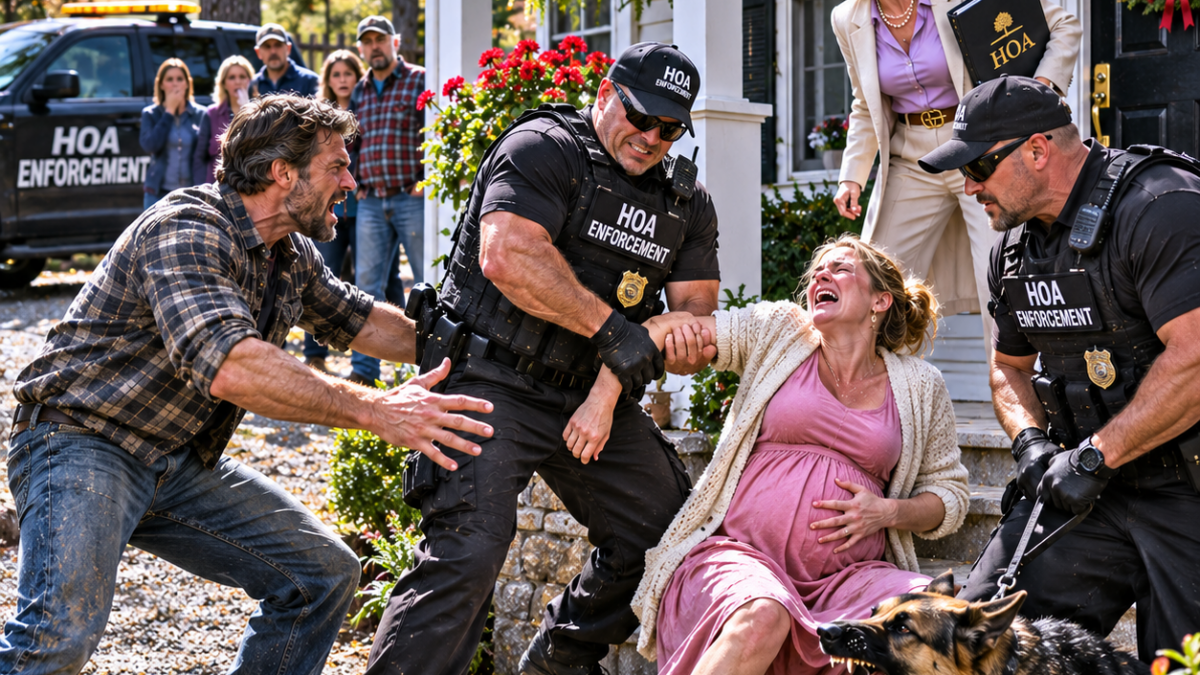
HOA Karen had spent months sending us petty violation letters, but the morning her fake “enforcement officers” grabbed my eight-month-pregnant wife and broke her arm, the dispute stopped being about lawns and mailboxes. The men thought uniforms, plastic badges, and shouted codes would make me freeze while they dragged my family around my own porch. What they did not understand was that every second of their attack was being recorded—and once the real police arrived, the costume they called authority was about to become evidence.
The sound Emma made when her arm broke was quieter than I would have imagined.
That is what I remember most.
Not a scream like in a movie.
Not some dramatic cry that stopped the world.
A short, breathless sound.
Almost disbelief.
Then the crack.
I had just stepped away from my Ford F-150 when the blue Crown Victoria stopped hard at the curb. No official markings. No government plates. Just a cheap yellow light stuck to the roof and two men in dark uniforms climbing out like they had rehearsed the entrance.
Emma was sitting on our front steps with Bruno, our German Shepherd, one hand resting on her stomach.
Eight months pregnant.
Our son had already become a personality before he was even born. He kicked whenever Emma drank orange juice, became restless when she tried sleeping on her left side, and somehow seemed to know every time I put my hand on her belly because he would go still.
That afternoon, everything had been normal.
An Amazon box on the porch.
Dust on my truck.
The smell of strawberry bubblegum from the piece Emma had stuck beside the passenger air vent that morning.
Then one of the men pointed toward our house.
“Get back inside.”
I turned.
“What?”
The taller one wore a black polo shirt under a tactical vest. A rectangular patch on the chest read HOA ENFORCEMENT.
Nothing else.
No agency.
No city.
No county.
No name.
The other man carried a wooden baton wrapped in black tape.
He pointed toward Bruno.
“Unrestrained animal. Noise violation. Property compliance inspection.”
Bruno was attached to a leash.
Emma was holding it.
I looked around for a marked security vehicle.
Nothing.
“Who are you?”
The taller man stepped toward the porch.
“You’ve received notices.”
“That wasn’t my question.”
Behind me, Emma stood.
She moved carefully these days.
One hand on her belly.
One on the porch rail.
Bruno’s growl deepened.
The man with the baton reached for her.
I saw it happen.
Still didn’t believe it.
His fingers closed around her forearm.
“Hey!”
Emma pulled back.
He twisted.
Her body turned the wrong direction.
Then the crack.
Emma dropped to one knee.
Bruno exploded forward.
I grabbed the leash before he reached the man.
Emma’s other hand immediately covered her stomach.
Her face had gone white.
“My arm.”
The man did not apologize.
Did not step away.
He tightened his grip.
“Stop resisting.”
“She’s pregnant!”
I moved toward him.
The second man shoved his hand into my chest.
“Stand back.”
“Get your hands off my wife.”
“You are interfering with HOA enforcement.”
“You don’t have enforcement authority here.”
“We absolutely do.”
He said it with the confidence of someone reading from a script.
Behind him, the first man released Emma only after she had collapsed against the porch step.
Her injured arm hung strangely.
Tears ran down her face.
She wasn’t crying loudly.
That somehow made it worse.
I pulled my phone out.
“I’m calling 911.”
The baton hit my wrist.
My phone flew into the hedge.
The man pointed the taped end toward my chest.
“Unauthorized recording of an enforcement action.”
For one second, I forgot Emma’s pain because what he said was so absurd.
“Unauthorized what?”
“Section thirty-eight B.”
“There is no section thirty-eight B.”
“You want another violation?”
I stared at him.
The whole thing snapped into focus.
Fake badge.
Fake police language.
Fake radio.
Fake code.
Real violence.
These men were not mistaken.
They were performing authority.
And HOA Karen had taught them that performance was enough.
PART 2
My name is Zach Harper.
At the time, Emma and I had lived in that house for six years.
I had built half the back deck myself.
Replaced the kitchen cabinets.
Installed the fence.
Planted the maple near the driveway.
It wasn’t an impressive house.
It was ours.
That distinction mattered more than Karen Langley ever understood.
Karen had become president of Pine Hollow Estates three years earlier.
Our neighborhood technically had an HOA, but Pine Hollow had always been quiet before she took over.
Annual dues.
Common landscaping.
Snow removal.
Pool maintenance.
Normal things.
Then Karen decided the HOA needed “professional standards.”
The phrase sounded harmless.
It wasn’t.
Letters started coming.
Grass height.
Trash-can visibility.
Holiday decorations.
Driveway stains.
Mailbox paint.
A lawn-treatment disclosure form I had never heard of.
Emma once received a notice because the wreath on our front door supposedly extended beyond the approved seasonal-display period by forty-eight hours.
I laughed.
Emma didn’t.
“People like this get worse when everyone laughs instead of saying no.”
She was right.
The letters became weekly.
One claimed our mailbox replacement had never been approved.
I had replaced a rotten wooden post with an identical wooden post.
Same height.
Same color.
Same mailbox.
Another complained that Bruno’s barking exceeded community noise limits.
Bruno rarely barked.
Another demanded documentation for lawn chemicals.
I didn’t use lawn chemicals.
Each time, I responded in writing.
Each time, the HOA either withdrew the complaint or ignored my response and generated another one.
Then Karen introduced what she called the Pine Hollow Compliance Patrol.
Two men.
Dark shirts.
Cheap badges.
A used Crown Victoria.
They began driving through the neighborhood twice a day.
At first, everyone joked.
Fake cops.
Mall-security leftovers.
Neighborhood Batman.
Then they started knocking on doors.
Photographing yards.
Blocking driveways.
Standing close when people argued.
One older homeowner told me a patrolman had threatened to tow her son’s truck because it remained overnight in her driveway without a temporary vehicle permit.
Another man said one of them had demanded identification when he walked his own dog after ten at night.
I asked the board whether the patrol company was licensed.
No direct answer.
I asked what authority allowed them to detain anyone.
Karen sent a four-paragraph reply about community safety.
That should have told me everything.
The week before they came to my house, I received a notice saying our property was under “enhanced compliance review.”
Emma read it at the kitchen counter.
“What does that mean?”
“Nothing legal.”
“That wasn’t what I asked.”
“I know.”
She looked toward the front window.
“I don’t like them driving past.”
I had noticed too.
The Crown Victoria slowed in front of our house several times a day.
Sometimes the passenger held up a phone.
Once, Bruno started growling before the car even appeared.
That dog had better instincts than I did.
I installed another exterior camera.
Then another.
Doorbell.
Driveway.
Front porch.
Side yard.
Not because I expected an attack.
Because if Karen wanted to turn ordinary life into an enforcement file, I wanted my own record.
That decision saved us.
The man with the baton had just knocked my phone away when the taller one grabbed the front of my jacket.
“You failed to submit your lawn-treatment form.”
“What?”
“And your mailbox replacement was never approved.”
He pulled me closer.
“That puts your property in noncompliance.”
“My wife’s arm is broken.”
“Then she should have cooperated.”
That sentence changed me.
Not into a killer.
Not into some action-movie version of myself.
Into a man who understood that reasoning with these two had ended.
Emma was behind me.
Injured.
Pregnant.
Bruno snarling.
Two men between us and the driveway.
One holding a baton.
The other now carrying heavy zip ties from the open trunk of their car.
“You’re under arrest,” the skinny one announced.
“For what?”
“Noncompliance and obstruction.”
“You are not police.”
“We have delegated authority.”
“From Karen?”
“From the association.”
He pointed at the ground.
“On your knees.”
I raised both hands slightly.
“Do not come any closer to my wife.”
The taller man smirked.
“What are you going to do?”
I watched his eyes.
The baton.
The zip ties.
Emma trying to stand with one arm pressed against her body.
I carried a Glock 19 legally.
Usually on longer drives.
Sometimes around the property if I had been working late.
That day it was inside my jacket.
I did not want to touch it.
I need that clear.
A gun does not make a bad situation simple.
It makes every mistake permanent.
I backed toward Emma.
“Stay where you are.”
The man with the baton advanced.
“Down.”
“No.”
He lifted the baton.
I drew.
Kept the muzzle down initially.
“Stop.”
Everything changed.
The taller man’s expression shifted.
The skinny one froze.
For perhaps one second, I thought they understood.
Then the man with the baton lunged.
I fired.
The shot hit him low in the leg.
He went down.
The taller man moved toward me with the zip ties still in one hand.
I fired again.
He dropped backward against the Crown Victoria, clutching his shoulder.
Then silence.
Not real silence.
Bruno barking.
Emma gasping.
My ears ringing.
A car alarm somewhere down the street.
But the confrontation had stopped.
I did not empty the magazine.
Did not walk toward them.
Did not fire after they fell.
I moved backward to Emma.
The Glock stayed pointed toward the ground until I could see both men were no longer advancing.
“Emma.”
She looked at me.
Her face was gray.
“The baby.”
“I know.”
“He moved.”
“Good.”
Her injured arm was swelling.
I set the pistol on the concrete several feet away once I was confident neither man was reaching for a weapon.
Then I retrieved my phone from the hedge.
Screen cracked.
Still working.
“Emergency services.”
“My name is Zach Harper. Two men came onto my property posing as HOA enforcement. One assaulted my pregnant wife and broke her arm. I fired in defense after they continued advancing. Both men are injured. Send police and medical.”
The dispatcher asked where the gun was.
“On the ground.”
“Do not touch it.”
“I won’t.”
“Are the men still a threat?”
“They’re down.”
“Any other weapons?”
“One has a baton. There are zip ties. I don’t know what else they have.”
“Stay where officers can see your hands when they arrive.”
“I understand.”
Emma sat against the porch.
I found a clean towel and used it to support her injured arm without trying to straighten it.
The source story had me tying a tourniquet around a broken arm.
That would have made no sense unless she was bleeding heavily.
She wasn’t.
Her injury needed immobilization and paramedics.
So I supported it.
Kept her still.
Watched her breathing.
“Talk to me.”
“It hurts.”
“I know.”
“I’m going to kill Karen.”
Despite everything, I laughed once.
“No, you’re not.”
“That woman sent these idiots.”
“We don’t know that yet.”
Emma stared at me.
“Zach.”
“Fine. We strongly suspect it.”
Bruno stood between us and the two men.
Hackles raised.
I clipped his leash to the porch post.
The skinny man moaned from the grass.
“Help.”
“Ambulance is coming.”
“You shot me.”
“You broke my wife’s arm.”
He stopped talking.
Sirens came closer.
When the first sheriff’s cruiser turned onto our street, I stepped away from the weapon and raised both hands.
Deputies came out fast.
Real uniforms.
Real markings.
Real training.
“Hands up!”
“They’re up.”
“Move away from the gun!”
I did.
“Face away!”
I did.
“Hands behind your head!”
I did.
The cuffs went on.
That part offended some people when they later heard the story.
It shouldn’t.
Deputies arrived at a scene with two gunshot victims, a firearm on the ground, and a man saying he fired it.
They did not know me.
They did not know the truth yet.
Temporary restraint was not betrayal.
It was procedure.
“She’s pregnant,” I said.
“Paramedics are moving to her.”
“Her arm is broken.”
“We see her.”
One deputy went to Emma.
Another secured the Glock.
Two more moved toward the injured men.
The taller fake officer immediately began shouting.
“He attacked us!”
The deputy ignored him while checking for weapons.
“We’re HOA officers.”
“What agency?”
“Pine Hollow.”
The deputy looked at him.
“That’s an HOA.”
“We’re enforcement.”
“Do you have state security credentials?”
Silence.
The deputy removed the plastic badge from his vest.
Turned it over.
No identification.
No agency number.
Nothing.
Another deputy retrieved the taped baton.
Zip ties.
Cheap radio.
The Crown Victoria registration came back private.
No security company.
No government connection.
The cuffs on my wrists remained.
Fine.
I cared about Emma.
Paramedics loaded her onto a stretcher.
She reached for me with her good hand.
“Zach.”
“I’m here.”
“The baby?”
“They’re checking.”
“Come with me.”
I looked toward the deputy.
He nodded.
“We’ll get you there as soon as we finish securing the scene.”
I wanted to argue.
Didn’t.
A sergeant approached.
“Mr. Harper, do you have exterior cameras?”
“Yes.”
“How many?”
“Four covering this area.”
His expression changed slightly.
“Do they record audio?”
“Two do.”
“Where is the storage?”
“Local recorder and cloud backup.”
“Anyone else have access?”
“My wife.”
“Do not delete anything.”
“I won’t.”
That footage became the spine of the case.
From the driveway camera:
The unmarked Crown Victoria arriving.
The men approaching.
From the porch camera:
The first man grabbing Emma.
Her attempt to pull away.
The twisting motion.
Her collapse.
From the doorbell microphone:
“Stop resisting.”
“She’s pregnant.”
Then the baton striking my wrist.
My phone flying.
The fake section thirty-eight B.
Their claim that I was under arrest.
My repeated statements that they were on private property.
Most important:
The moments before I fired.
I backed toward Emma.
Warned them to stop.
The baton rose.
The man advanced.
The second moved with restraints.
Two controlled shots.
Then no more firing.
No pursuit.
No standing over anyone threatening them.
No triumphant speech.
Just me moving back to my wife.
The footage did not make what happened good.
It made what happened clear.
Emma’s hospital evaluation showed a fracture in the forearm with significant soft-tissue injury.
The baby was monitored for several hours.
His heart rate remained stable.
That was the moment I finally cried.
Not at the house.
Not in the patrol car.
In a hospital hallway after an obstetric nurse said:
“He looks good.”
I leaned against the wall.
My legs stopped working properly.
A detective stood ten feet away waiting to interview me.
He looked down the corridor and pretended not to notice.
I respected him for that.
The two men survived.
One needed surgery on his leg.
The other had a shoulder injury but no major vascular damage.
Their identities came back with histories that made the situation uglier.
Neither was licensed as a police officer.
Neither held authority to arrest people over HOA violations.
One had previous complaints involving intimidation.
The other had been connected to a dispute involving fake collection fees in another county.
The HOA had hired them through a vaguely named “community compliance services” arrangement.
Who authorized that contract became the next question.
Karen Langley.
Pine Hollow HOA president.
At first, she denied everything.
She released an email to homeowners that evening.
The association had hired independent compliance representatives solely for documentation and voluntary homeowner education.
They were not authorized to use force.
They were not authorized to arrest.
Karen claimed she had no knowledge that the men carried restraints or weapons.
I read the email from beside Emma’s hospital bed.
She looked over.
“Liar.”
“Probably.”
“You always say probably.”
“Because I like evidence.”
She gave me a tired smile.
“Your most annoying quality.”
The evidence came quickly.
Investigators seized the men’s phones.
On one were messages from Karen.
HARPER PROPERTY IS PRIORITY.
HE WILL ARGUE.
DO NOT ALLOW HIM TO DERAIL THE INSPECTION.
Another:
IF THEY REFUSE TO COOPERATE, HOLD THEM UNTIL COMPLIANCE PAPERWORK IS COMPLETED.
Then:
THE WIFE IS USUALLY HOME. SHE’S EASIER TO DEAL WITH.
I read that line once.
Then handed the page back to my attorney.
I could not read it twice.
Karen’s attorney argued that “hold them” meant remain at the scene and continue conversation.
Prosecutors disagreed.
The men had been given restraints.
Fake badges.
A baton.
A vehicle light.
Uniform-style clothing.
Written HOA forms titled ENFORCEMENT ACTION REPORT.
One form included boxes labeled:
SUBJECT COMPLIANT.
SUBJECT DETAINED.
POLICE REFERRAL REQUIRED.
That was difficult to explain as homeowner education.
Then investigators found invoices.
The HOA had paid for “enhanced compliance patrol services.”
Karen had approved the expense without a full board vote.
She had presented it later as general security.
Several board members said they believed the contractors were only photographing violations and serving notices.
One board member, Linda Brooks, provided emails showing she had asked Karen whether the men were licensed.
Karen replied:
THEY HAVE ALL NECESSARY AUTHORITY FOR COMMUNITY ENFORCEMENT.
No license attached.
No legal opinion.
Just confidence.
The neighborhood changed overnight.
People who had been afraid to challenge Karen started talking.
An elderly couple said one of the same men had entered their backyard without permission.
A single mother said they had blocked her driveway over unpaid fines.
Another homeowner described being told he could be “taken to the compliance office” if he refused to sign an acknowledgment.
Nobody had gone that far.
Not until my house.
That is what disturbed me most.
They had been escalating in small steps.
No one step looked insane enough to stop the whole program.
A knock.
A photograph.
A threat.
Blocking a driveway.
Taking an ID.
Standing too close.
Touching an arm.
Then my porch.
Emma’s bone breaking.
The system had been training itself to cross lines.
Three weeks later, I entered court as a witness.
Not defendant.
The prosecutors had reviewed the shooting evidence, including video, physical evidence, witness statements, and forensic findings.
They concluded the shots occurred during an immediate confrontation in which Emma had already suffered serious injury and the men continued advancing with a baton and restraints.
That did not make the shooting emotionally easy for me.
It made the legal question clearer.
I testified to everything.
No embellishment.
No heroic description.
I told the jury I had been afraid.
That mattered.
People expect men in self-defense stories to say they were calm.
I wasn’t.
I was terrified.
My pregnant wife was on the ground.
I did not know whether our baby was injured.
Two men had already demonstrated they were willing to hurt her.
They claimed authority that didn’t exist.
One raised a baton.
The other had restraints.
I believed the threat was continuing.
That was the truth.
The defense tried to make the HOA dispute sound legitimate.
“You had received violation notices?”
“Yes.”
“So there was an ongoing conflict.”
“Yes.”
“You were angry with the association.”
“Sometimes.”
“You disliked the enforcement officers.”
“I didn’t know who they were before they came to my house.”
“You knew the HOA had compliance rules.”
“Yes.”
“And you chose not to comply.”
“With notices I disputed through the HOA process.”
“Your dog was barking.”
“He is a dog.”
A few people smiled.
The judge did not.
The attorney continued.
“You introduced a firearm into a neighborhood disagreement.”
“No.”
I looked at him.
“Your clients broke my pregnant wife’s arm before I drew anything.”
Silence.
He changed direction.
The porch footage ended most of the remaining argument.
Video is cruel to bad narratives.
The man claiming Emma attacked him first could be seen grabbing her.
The man claiming I charged him could be seen moving toward me.
The fake codes were audible.
So was the statement:
“You are under arrest for noncompliance and disrespect toward an HOA enforcement officer.”
The jury heard it twice.
The prosecution also introduced Karen’s messages.
Her instructions.
Her claims of authority.
The fake detention form.
The contract.
The invoices.
The two men faced charges arising from the assault, unlawful restraint, criminal impersonation, trespass, and related conduct.
Karen faced separate charges connected to conspiracy, solicitation of unlawful enforcement activity, fraudulent representations of authority, and financial misconduct discovered during the investigation.
The cases did not all resolve on the same day.
That is important.
Real justice is slower than stories.
Hearings.
Motions.
Evidence challenges.
Expert testimony.
Medical records.
Phone extraction.
Board minutes.
Insurance fights.
Civil claims.
Months passed.
Emma’s arm healed gradually.
The cast came off.
Then physical therapy.
She regained most of her motion.
Cold weather still bothered her.
She refused to admit it for almost a year.
Our son was born two months after the attack.
Joshua Harper.
Seven pounds, six ounces.
Healthy.
Loud.
Furious about being removed from the only home he had ever known.
The first night after we brought him home, snow covered the yard.
Bruno slept beside the fireplace.
Emma sat wrapped in a thick sweater.
I stood near the window holding Joshua against my chest.
His entire hand barely fit around my finger.
I looked toward the porch.
That same porch.
For weeks, I had avoided looking directly at the step where Emma fell.
Now snow covered it.
Emma came beside me.
“You okay?”
“No.”
She smiled.
“Good answer.”
I looked at Joshua.
“I keep thinking about what could have happened.”
“So do I.”
“What if—”
“Don’t.”
I stopped.
She rested her head against my shoulder.
“We’re here.”
That became our rule.
We’re here.
Not everything was restored.
Her arm hurt.
I had nightmares about the sound.
Bruno barked at Crown Victorias for months.
But we were there.
Karen’s presidency did not survive.
The board suspended her shortly after investigators served records requests.
Homeowners held a recall vote.
She lost overwhelmingly.
An outside management company took temporary control while financial records were reviewed.
The compliance patrol ended immediately.
No more badges.
No more uniforms.
No more Crown Victoria.
The HOA eventually adopted a written policy explicitly prohibiting private contractors from representing themselves as police or claiming detention authority.
It was absurd that such a policy needed to exist.
Apparently it did.
Civil claims followed.
Emma sued over her injury.
I brought claims related to trespass, assault-related damages, and the HOA’s role in creating the enforcement program.
The HOA’s insurer disputed portions of coverage because the contractors’ conduct fell outside what had been represented in the policy applications.
That became its own fight.
Again:
Documents.
What was disclosed?
Who hired whom?
What authority was promised?
What conduct was authorized?
Karen had spent years treating paperwork like a weapon against homeowners.
In the end, paperwork became the thing that separated her story from reality.
The two men were convicted on serious charges.
Their sentences reflected the assault, false claims of authority, and unlawful restraint.
Karen’s case took longer.
Several financial issues appeared during the investigation.
Some unrelated to my property.
Unauthorized payments.
Compliance fees.
Vendor relationships.
Her lawyer tried hard to portray her as an overzealous volunteer who trusted the wrong contractors.
Then prosecutors produced the messages.
THE WIFE IS USUALLY HOME. SHE’S EASIER TO DEAL WITH.
That line followed her everywhere.
She ultimately faced criminal consequences based on conduct the state could actually prove, not every accusation angry residents made.
I appreciated that distinction.
People wanted everything pinned on her.
Every bad fine.
Every rude letter.
Every neighbor dispute.
That would have been emotionally satisfying.
It would not have been justice.
Justice requires limits too.
Some board members were removed but not charged.
Some employees were witnesses.
Some homeowners had supported Karen because they believed the reports she gave them.
Not everyone standing near wrongdoing is equally responsible for it.
That lesson mattered to me because I had nearly killed two men.
I could not spend the rest of my life believing complexity was weakness.
When sentencing finally came for the primary attackers, Emma attended with me.
Her arm was out of the cast.
She wore a dark blue sweater.
Joshua stayed with my mother.
The defense attorney spoke about remorse.
Confusion.
Financial desperation.
Bad judgment.
Then one of the men asked to address Emma.
The judge allowed it.
He stood.
Couldn’t look at her at first.
“I was told you were dangerous.”
Emma said nothing.
“I thought your husband had threatened the HOA.”
Still nothing.
“I didn’t mean to break your arm.”
Emma’s jaw tightened.
Finally:
“You meant to grab me.”
He looked down.
“Yes.”
“You meant to make me obey.”
No answer.
“That is what you should be sorry for.”
He nodded.
Emma sat.
I squeezed her hand.
Afterward, reporters waited outside.
We ignored them.
One shouted:
“Mr. Harper, do you feel vindicated?”
I stopped.
I shouldn’t have.
But the question irritated me.
“No.”
The microphones moved closer.
“My wife still has pain in her arm.”
Nobody spoke.
“My son was exposed to a medical emergency before he was born. Two men were shot. Families were damaged. A neighborhood spent months terrified of people wearing fake authority.”
I looked at the cameras.
“Vindication is not the word.”
Then we left.
The new Pine Hollow board eventually asked me to attend a meeting.
I didn’t want to.
Emma did.
“You should go.”
“Why?”
“So you stop treating the clubhouse like enemy territory.”
“I don’t.”
“You do.”
She was right.
So I went.
No Karen.
No fake officers.
No enforcement uniforms.
Just homeowners.
Folding chairs.
Bad coffee.
A projector that took fifteen minutes to connect.
The new president began by apologizing.
Not dramatically.
“We failed to supervise a program created in our name.”
That was enough.
Then she reviewed reforms.
Licensed vendors only.
Legal review before any security contract.
No restraint authority.
No police-style uniforms.
No badges that could reasonably be mistaken for law enforcement.
Body cameras if any future security patrol was used.
Resident complaint procedure.
Board vote recorded for enforcement contracts.
Financial reporting.
Most importantly:
Security was for protection of common property.
Not punishment of homeowners.
I listened.
Then an older resident raised his hand.
“What happens when somebody refuses to follow HOA rules?”
The president answered:
“We use the procedures in the governing documents.”
“And if they still refuse?”
“Court, if necessary.”
He frowned.
“So we can’t force them?”
She looked toward me.
Then back at him.
“We were never supposed to.”
That sentence was worth the meeting.
Our own relationship with the HOA became boring again.
Dues.
Pool schedule.
Snow.
Landscaping.
A notice about repainting common fencing.
No one threatened to arrest me over lawn treatment.
One year after the attack, I replaced the porch railing.
The old one wasn’t damaged.
I simply wanted something different.
Emma stood behind me while I removed it.
“You know you’re changing perfectly good wood.”
“I know.”
“This is therapy disguised as carpentry.”
“Probably.”
“You want help?”
“No.”
She helped anyway.
We worked until sunset.
When it was done, she sat on the same step where she had fallen.
Joshua was inside asleep.
Bruno lay beside her.
She held out her repaired arm.
“Still works.”
“Mostly.”
“Enough to slap you.”
“That’s reassuring.”
She smiled.
Then became serious.
“Do you ever regret drawing the gun?”
I stopped.
People had asked me that publicly.
Never like this.
“Yes.”
Her expression changed.
“You do?”
“I regret that the situation reached a point where I believed I had to.”
She waited.
“I don’t regret protecting you.”
“That’s different.”
“Yes.”
I sat beside her.
“I don’t want Joshua growing up hearing a story about his father solving problems with a gun.”
“He won’t.”
“He’ll hear it somewhere.”
“Then we tell him the real version.”
“What’s the real version?”
Emma thought.
“His parents kept telling people to leave them alone until two men refused.”
I laughed softly.
“That’s terrible storytelling.”
“It’s accurate.”
Accuracy became important to us.
The Internet eventually found the case.
Of course it did.
People simplified it.
Pregnant wife attacked.
Husband shoots fake HOA cops.
Justice wins.
Some called me a hero.
Some called me reckless.
Some argued about firearms.
Some argued about HOAs.
Few understood what I thought the real story was.
The danger began long before anyone touched Emma.
It began when Pine Hollow allowed people to speak as though “HOA authority” was a magic phrase.
Nobody asked:
What authority?
Over whom?
For what?
Who licensed these people?
Who reviewed the contract?
Who told them they could touch residents?
Who decided a lawn form justified confrontation?
Authority becomes dangerous when the answer to every question is simply:
Because we said so.
Karen believed procedure was whatever she declared it to be.
The fake officers believed confidence could replace credentials.
The system around them tolerated small abuses because each one was easier to endure than fight.
Then they met Emma.
And the lie became physical.
That is why the new rules mattered.
Not because rules can prevent every bad person.
Because clear limits make it harder for bad people to hide inside ambiguity.
Years passed.
Joshua learned to walk.
Then run.
Then climb everything he shouldn’t.
Bruno grew gray around the muzzle.
Emma regained enough strength in her arm to carry grocery bags again, though I still reached for them automatically.
She complained.
“I’m not made of glass.”
“I know.”
“Then stop.”
“I’m trying.”
“No, you’re not.”
She was right.
Some fear becomes habit.
One fall afternoon, Joshua asked why there was a camera above the porch.
“For safety.”
“From bad guys?”
“Sometimes.”
“From HOA guys?”
Emma nearly spit out her coffee.
I stared at him.
“Who told you about HOA guys?”
“Grandma.”
Of course.
I crouched.
“Most HOA people are just neighbors doing boring volunteer work.”
“But bad ones came here.”
“Yes.”
“Did you shoot them?”
Emma closed her eyes.
There it was.
I had known that day would come.
“I hurt two men because they were hurting your mom and I believed they were going to keep hurting us.”
“Were they bad?”
“They did bad things.”
“Did you win?”
I looked at Emma.
Then back at him.
“No.”
He frowned.
“But Mommy got better.”
“Yes.”
“And the bad guys went away.”
“Yes.”
“That’s winning.”
Children like simple math.
Adults shouldn’t.
“Sometimes everyone loses something even when the right thing happens afterward.”
He clearly did not understand.
That was okay.
Someday.
He ran outside to play.
Emma looked at me.
“That went well.”
“Your mother is banned from unsupervised storytelling.”
“Good luck.”
We laughed.
That was another kind of recovery.
Being able to laugh about something adjacent to the pain without laughing at the pain itself.
Pine Hollow changed too.
The HOA remained.
Karen did not.
A few years later, a new family moved into her old house.
They had no idea about the history.
The husband introduced himself at the pool.
When I told him which house was ours, he said:
“Oh, you’re the guy.”
Emma groaned.
I smiled.
“What guy?”
He immediately regretted speaking.
“Never mind.”
“Excellent answer.”
The neighborhood became ordinary again.
People complained about pool hours.
Dog waste.
Holiday lights.
Speeding teenagers.
Exactly the sort of problems neighbors should be annoyed about.
Once, the new board fined me thirty dollars because my trash cans remained visible after the permitted collection window.
The notice was correct.
I had forgotten them.
Emma framed it.
“See?”
She hung it in my workshop.
“Justice.”
“I hate you.”
“No, you don’t.”
I paid the thirty dollars.
That matters too.
The lesson was never that HOA rules are illegitimate.
We had agreed to some rules when we bought there.
The lesson was that rules have boundaries.
Process has boundaries.
Authority has boundaries.
A trash-can fine is not an arrest warrant.
A mailbox rule does not authorize a baton.
A board president cannot transform contractors into police by calling them enforcement officers.
And a homeowner disputing a rule does not lose the protection of ordinary law.
Karen blurred those distinctions because every blur increased her power.
The legal aftermath forced Pine Hollow to sharpen them again.
I kept the damaged phone.
The one knocked from my hand.
Cracked corner.
Scratch across the screen.
It still worked.
Emma asked why I didn’t replace it immediately.
“I did replace it.”
“Then throw this one out.”
“No.”
“Why?”
“Evidence.”
“The case ended three years ago.”
“Sentimental evidence.”
“That’s worse.”
Maybe.
I also kept the original HOA notice about our mailbox.
Not because it was important.
Because it was absurd.
It reminds me how the story began.
MAILBOX REPLACEMENT — NO ARCHITECTURAL APPROVAL ON FILE.
A rotten post.
That was it.
People like Karen rarely begin with something obviously monstrous.
They begin with tiny control.
Small enough to seem silly.
Small enough that resisting makes you look unreasonable.
Then another.
Then another.
Eventually the habit of obedience matters more than the rule.
When someone finally says no, the system reacts as if no itself is the violation.
That was what happened to us.
We were not attacked because our grass was wrong.
We were attacked because months of petty enforcement had failed to make us afraid.
Karen escalated until the coercion became visible.
Then the law could finally see what neighbors had been feeling for years.
I wish it had happened differently.
I wish an audit had stopped Karen.
Or a board vote.
Or an attorney.
Or one of those fake officers asking himself whether a pregnant woman needed to be grabbed over a lawn form.
Anything.
I would trade every headline, every settlement, every legal victory for Emma never hearing that crack in her arm.
That is the part revenge stories usually leave out.
Victory doesn’t refund pain.
The court can sentence someone.
Money can pay medical bills.
Rules can change.
But there is no legal remedy that returns one ordinary Tuesday afternoon exactly as it was before a stranger stepped out of a blue Crown Victoria.
Justice is not time travel.
It is what we build afterward.
For us, that meant therapy.
Physical for Emma.
Some psychological for both of us.
Better cameras.
A dog who eventually stopped barking at blue sedans.
A child born healthy.
A neighborhood learning to question authority before obeying it.
And a husband learning that protecting his family also meant refusing to romanticize the worst day of our lives.
Years later, Emma and I sat on the porch after Joshua’s birthday.
He had turned six.
Balloons still hung from the railing.
Cake crumbs everywhere.
Bruno had died the previous winter.
That empty spot beside the steps still hurt.
Emma looked toward the driveway.
“Remember the strawberry gum?”
“What?”
“In your truck.”
I smiled.
“Yeah.”
“You talked about that all the time afterward.”
“I did?”
“Every time someone asked about the day.”
I thought about it.
“I guess I wanted something normal at the beginning.”
She nodded.
“Something before.”
“Yes.”
She took my hand.
Her injured arm was almost normal now.
Only a slight stiffness.
“What do you remember first?”
I asked.
She considered the question.
“You.”
“Me?”
“You yelling that I was pregnant.”
I laughed softly.
“Very observant.”
“I remember thinking, no kidding.”
We sat quietly.
Then she said:
“I don’t remember the crack anymore.”
I turned.
“What?”
“I know it happened.”
She touched her forearm.
“But I can’t hear it in my head now.”
For years, I had assumed we both carried the same sound.
She didn’t anymore.
I envied her.
Then realized maybe one day I wouldn’t either.
That was hope.
Not dramatic.
Not courtroom justice.
Just memory losing its sharpest edge.
The final legal paperwork arrived long before that conversation.
Restitution orders.
Civil settlement documents.
Board reforms.
Licensing findings.
Medical reimbursements.
Karen’s criminal disposition.
All filed.
Stamped.
Archived.
I put copies into a banker’s box.
Then the box moved from my office to a closet.
Then from the closet to a storage shelf.
I stopped opening it.
That was another sign of recovery.
Evidence is powerful when danger is active.
Eventually, keeping it within reach every day lets the danger remain active too.
One afternoon, Joshua found the fake HOA badge among copied evidence photographs.
“Is this real?”
“No.”
“Looks real.”
“That was the problem.”
He studied it.
“How do you know a badge is real?”
“Sometimes you don’t just by looking.”
“Then what do you do?”
“Ask questions.”
“What questions?”
“Name. Agency. Why they’re there. What authority they have. And if you’re a kid, you get a trusted adult.”
He nodded.
Then asked:
“Can I have a badge?”
“No.”
“Why?”
“Because your mother would divorce me.”
From the kitchen:
“Correct.”
Life.
Normal life.
That was what remained after all the legal drama ended.
And normal life turned out to be the thing I had fought hardest to protect.
The last time I saw Karen in person was outside a courthouse during one of the final civil hearings.
She looked smaller.
No board binder.
No HOA badge.
No crowd around her.
She saw me.
“Zach.”
I stopped.
Emma had gone ahead to the parking lot.
Karen looked at my hands.
Maybe she remembered the shooting.
Maybe I imagined it.
“I never told them to break her arm.”
“I know.”
She looked surprised.
“You believe me?”
“I believe you didn’t write that sentence.”
Her shoulders lowered slightly.
Then I continued.
“You told them they had authority they didn’t have.”
She looked away.
“You told them we were hostile.”
No response.
“You gave them forms saying people could be detained.”
“They weren’t supposed to—”
“You built the room they operated inside, Karen.”
She looked back.
“They made their own choices.”
“Yes.”
“So did you.”
“Yes.”
Neither of us escaped that truth.
She asked:
“Do you regret it?”
I knew what she meant.
The gun.
The shots.
I answered carefully.
“I regret everything that put me in a position where I believed firing was necessary.”
“That isn’t an answer.”
“It’s the only honest one.”
She nodded.
Then:
“I lost everything.”
I looked toward the parking lot.
Emma waited beside our car.
“No.”
Karen frowned.
“You still have whatever you choose to become after this.”
Her eyes narrowed.
“You giving me advice?”
“No.”
I walked away.
I meant it.
Accountability should not require believing another human being is incapable of becoming anything except the worst thing she did.
That belief would have poisoned me.
I had spent too long fighting people who wanted to reduce others to labels.
Violator.
Noncompliant.
Problem resident.
Fake officer.
Criminal.
Sometimes those labels describe conduct.
They should not replace the whole person.
That did not mean forgiveness.
It meant boundaries again.
Karen’s punishment belonged to the court.
My healing belonged to me.
Years after the attack, Pine Hollow replaced the clubhouse sign.
The new board asked residents for suggestions.
Emma submitted one as a joke:
ASK BEFORE ACTING.
They didn’t choose it.
Probably wise.
But they did add a short resident-rights page to the HOA website.
It included a sentence I liked.
Association personnel and vendors have no law-enforcement authority.
Simple.
Almost embarrassingly obvious.
Sometimes the most important reforms are.
The Crown Victoria disappeared long ago.
Auctioned after evidence holds ended.
I don’t know who bought it.
I hope they removed the yellow light.
The porch camera is newer.
The maple by the driveway is taller.
Joshua rides his bicycle beneath it.
The mailbox is still the replacement Karen complained about.
Same wooden post.
Still standing.
Sometimes I look at it and laugh.
That stupid mailbox survived Karen.
Our family did too.
If people ask me now what the story was about, I don’t say self-defense.
I don’t say guns.
I don’t even say HOA abuse.
I say false authority.
Because false authority only works when everyone around it decides not to question the costume.
Karen created the title.
The contractors created the look.
The badges created the impression.
The shouted codes created urgency.
The baton created fear.
For months, that was enough.
Then they touched Emma.
The performance encountered reality.
A real broken bone.
Real cameras.
Real 911 call.
Real sheriff’s deputies.
Real medical records.
Real prosecutors.
Real court.
The fake authority could not survive contact with institutions that actually had to prove where their power came from.
That is the lesson I want Joshua to understand when he is older.
Not:
Your father had a gun.
Not:
Your father beat bad men.
Not:
Never let anyone tell you what to do.
Those are childish lessons.
The real lesson is harder.
Respect legitimate authority.
Question claimed authority.
Know the difference.
And when someone has power, make sure the power has rules.
Because the scariest person in our story was not the man holding the baton.
It was the person who taught him that putting on a uniform meant he no longer had to ask whether what he was doing was lawful.
One winter morning, years later, snow covered our street.
Emma stood at the window holding coffee.
Joshua was outside building something that looked nothing like a snowman despite his insistence.
I came beside her.
Her arm rested comfortably against mine.
“Quiet,” she said.
“Dangerously quiet.”
“Don’t.”
I smiled.
A delivery truck stopped.
The driver placed a box on the porch.
Bruno wasn’t there to bark anymore.
Joshua ran toward it.
Emma opened the door.
“Leave the package alone!”
“Why?”
“Because it’s mine.”
“What’s in it?”
“None of your business.”
He stopped.
Then looked at me.
“Dad?”
“Listen to your mother.”
He groaned.
Normal.
Perfectly normal.
I looked toward the porch step where everything had happened.
There was no stain.
No mark.
No sign.
Time had covered it better than snow ever could.
Emma touched my hand.
“You okay?”
“Yeah.”
This time it was true.
I thought about the fake badge.
The taped baton.
The Crown Victoria.
Karen’s emails.
The courthouse.
Joshua’s first night home.
All of it felt farther away.
Still real.
No longer present.
That was justice too.
Not only that the people responsible faced consequences.
That eventually they stopped owning space inside our ordinary mornings.
I picked up my coffee.
Joshua shouted from outside.
“Dad! Look!”
His snow structure collapsed.
He blamed gravity.
Emma laughed.
I went outside.
Behind me, the same mailbox stood by the driveway.
The same house.
The same porch.
The same property HOA Karen once treated like territory she could control by sending men in fake uniforms.
She had been wrong.
Not because I was stronger.
Not because I had a firearm.
Not because a judge eventually agreed with us.
She was wrong before any of that happened.
She was wrong the moment she decided another family’s fear could substitute for her lack of authority.
And when her fake officers finally crossed our porch and turned that lie into violence, the truth did not need to shout.
It only needed the cameras to keep recording.








