HOA Karen Sent Fake Officers to Drag Me Out of My Lake Cabin—She Had No Idea How Much Evidence I’d Already Collected
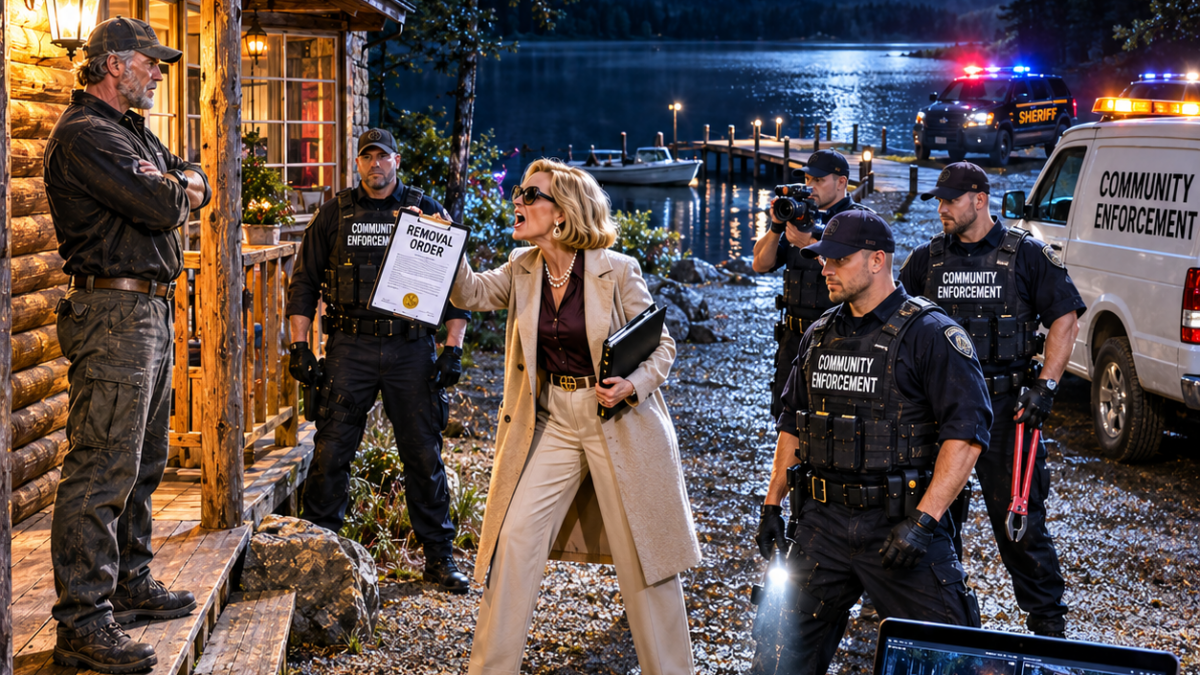
part 2
My name is Logan Pierce.
I retired after fifteen years in the military.
People always want details when they hear that.
Where?
What unit?
What missions?
I usually disappoint them.
Some things belong to the men who were there.
Some memories don’t improve because strangers hear them.
The part that mattered was simpler.
I spent enough years around instability to stop romanticizing it.
When I left, I wanted peace.
Not isolation.
Not silence.
Peace.
The kind where you wake up and the loudest argument in your day is whether you should put another log on the fire.
Willowbrook Lake seemed like that place.
The cabin was modest.
Two bedrooms.
A weathered deck.
Small dock.
Pines running down toward the water.
At sunrise, fog rolled across the surface so slowly it looked alive.
I called the place Alpha Rest Station.
At first, it was a joke.
Every year, three guys I had served with came out for a reunion.
Carter.
Wade.
Griffin.
We would grill too much food, drink beer on the dock, tell stories we had all heard before, and laugh hard enough to embarrass ourselves.
The name stuck.
For three weeks, Alpha Rest Station gave me everything I had hoped for.
Then the envelope arrived.
Cream paper.
Heavy stock.
HOA letterhead.
WILLOWBROOK LAKE COMMUNITY HOMEOWNERS ASSOCIATION.
Mandatory orientation.
Seventy-two hours.
Signed:
Rosalyn Thornfield
HOA President.
No welcome.
No introduction.
Just an order.
I attended because ignoring organizations rarely makes them disappear.
Thursday.
7:00 p.m.
Community center.
Rosalyn sat behind a folding table with a binder in front of her.
Silver hair pulled tight.
Navy blazer.
Pale blue eyes that seemed disappointed by everything they looked at.
“Mr. Pierce.”
“Mrs. Thornfield.”
“Take a seat.”
Not please.
I sat.
She opened the binder.
“Mailbox placement. Two inches beyond approved position.”
I waited.
“Cabin exterior inconsistent with community aesthetic.”
I waited.
“Landscaping excessively naturalistic.”
That one almost got me.
“My trees are too tree-like?”
She didn’t smile.
“We maintain standards.”
“I’ve reviewed my permits. Everything was approved.”
“County approval does not replace community requirements.”
She turned a page.
Then looked up.
“I understand you had a military career.”
“Yes.”
“Civilian communities operate differently.”
“I’ve noticed.”
“We follow rules here.”
The way she said rules told me the discussion wasn’t about rules at all.
Then she slid another document toward me.
Emergency Community Standards.
Ratified three days after I moved in.
No outdoor equipment visible from road.
No gatherings larger than four people.
No vehicles in driveways overnight.
No temporary recreational equipment.
Several provisions mapped almost perfectly onto my life.
I looked at her.
“When was this voted on?”
“This week.”
“Where are the minutes?”
“They will be distributed.”
“Vote count?”
“Mr. Pierce, orientation is not a cross-examination.”
“I’m asking how the rule became a rule.”
She picked up her phone.
Then took a photograph of me.
“For the record.”
Something in my spine tightened.
Not because the camera frightened me.
Because the behavior felt familiar.
Build a file.
Establish a narrative.
Define the problem before the target understands the game.
The next morning, the first fine arrived.
$500.
No appeal instructions.
No hearing.
No supporting vote.
Then I checked the email header.
The message wasn’t coming from an HOA-managed account.
It traced back to an email infrastructure connected to Lake View Properties Development.
I stared at the screen.
Why would a real estate development company be sending HOA enforcement notices?
That question became the first loose thread.
Rosalyn responded to scrutiny by increasing pressure.
Monday:
Noise violation.
Coffee on my deck.
Apparently brewing coffee outdoors disturbed the ecosystem.
Tuesday:
Waste disposal timing.
Trash can outside too early.
Wednesday:
Unauthorized water consumption.
I lived beside a lake.
Thursday:
Bird feeder.
Excessive cardinal activity.
I wish I had invented that.
She fined me for birds.
The penalties climbed.
Five hundred.
Seven hundred fifty.
Twelve hundred.
Eighteen hundred.
I stopped reading them emotionally.
I read them technically.
Bylaws.
Recorded amendments.
Minutes.
Rules.
Half the violations did not exist.
Some rules had never been properly adopted.
Others appeared nowhere outside Rosalyn’s notices.
So I answered with six pages.
Property law.
Statutes.
Requests for evidence.
Requests for meeting records.
Requests for the legal basis of each fine.
And one phrase repeated twice:
Selective enforcement.
Certified mail.
Delivery confirmation.
No response.
Instead, she called a community meeting.
Agenda:
DISRUPTIVE RESIDENT THREATENING COMMUNITY SAFETY.
That was me.
Twenty residents attended.
Rosalyn presented a slide deck.
Photographs.
Charts.
Violations.
One image showed me trimming a tree while snow covered the ground.
She claimed it documented something I had done that month.
It was September.
I opened my tablet.
Pulled weather records.
Then stood.
“This photograph was taken in January.”
Rosalyn stared at me.
I pointed toward the screen.
“We haven’t had snow in eight months.”
Someone laughed.
Not loudly.
Enough.
Then I pulled county property records.
“In the last twenty-four months, Lake View Properties has purchased twelve homes around Willowbrook.”
The room shifted.
Rosalyn said:
“That has nothing to do with—”
“Every sale was preceded by escalating HOA enforcement.”
People started looking at one another.
A woman near the aisle raised her hand.
“My neighbor sold to Lake View after months of fines.”
Another man spoke.
“They threatened the Hendersons over shutters.”
Rosalyn tried to call for order.
The room was no longer hers.
That was when I realized I wasn’t the first target.
I was simply the one who had started comparing dates.
Two nights later, somebody slashed all four of my truck tires.
Not punctures.
Ruined.
At the same time, every exterior camera feed went offline.
Six hours.
Static.
Then restored.
No system update.
No storm.
No outage.
That changed the situation.
Harassment had become sabotage.
My attorney, Adriana Cruz, called the next morning.
“Logan, I found Rosalyn.”
“Where?”
“Inside Lake View’s business network.”
My hand tightened around the phone.
“Doing what?”
“Consulting. Planning. Strategic redevelopment.”
Rosalyn’s name appeared in documents connected to multiple redevelopment proposals.
Including land around Willowbrook.
The HOA president who claimed to care about preserving neighborhood character was advising the company buying houses after her organization pressured owners.
The contradiction was too large to ignore.
Then the surveillance started becoming obvious.
Same SUV.
Same sedan.
Tinted windows.
Parked at odd hours.
One morning I ran before dawn.
The SUV’s headlights shut off as I passed.
Three nights later, a drone crashed into a pine tree near my yard.
The SD card survived.
Twelve hours of footage.
My cabin.
Dock.
Vehicle.
Porch.
Me.
That was when I visited Harold and Lillian Murphy.
They had lived three houses down for fifteen years.
Harold opened the door.
Looked at me.
Then said:
“You found out.”
It wasn’t a question.
Inside, Lillian pulled out a spiral notebook.
Four years of sales.
Twelve lakefront homes.
Dates.
Fines.
Threats.
Offers.
Sales.
Almost every pattern ended with Lake View Properties.
“Rosalyn didn’t start this yesterday,” Lillian said.
Harold stared at the table.
“We let her scare us.”
“You didn’t know.”
“We knew enough.”
Then Robert Whitmore confronted me outside.
Tall.
Mid-fifties.
Angry.
“You’ve been here three weeks and already turned everyone against each other.”
“No.”
“Fines are going up because of you.”
“No.”
“You think you’re some kind of hero?”
“No.”
He stepped closer.
“You made Rosalyn angry. People here know what happens when that woman gets angry.”
That sentence told me everything.
The community wasn’t orderly.
It was afraid.
That night, I sat on the dock asking myself whether any of this was worth it.
Then the porch lights died.
Whole cabin.
No power.
I called the electric utility.
Account active.
No authorized disconnect.
Then the water stopped.
Water authority said the same.
No shutoff from them.
Somebody had manipulated access through a local process or physical system.
I documented it.
Then my phone rang.
Unknown number.
Distorted voice.
“Stop digging or you’ll get hurt.”
Click.
That was when I stopped wondering whether leaving would restore peace.
People willing to cut utilities and make threats do not become reasonable because you surrender.
I called Joey Brennan.
Former military intelligence analyst.
Now private investigator.
“Send me everything,” he said.
I did.
While Joey dug through corporate records, I went door to door.
Slowly.
No speeches.
No petition.
Just questions.
Harold and Lillian gave me copies of fine letters.
Emails.
Old HOA minutes.
Sale histories.
Others came forward.
Meredith Lane.
The Scott family.
A retired nurse.
A widower.
People had been fined for trellises.
Decorative frogs.
Grandchildren’s bicycles.
Seasonal decorations.
Mailbox paint.
Some violations were technically real.
Many others weren’t.
The pattern was what mattered.
Pressure increased until the owner stopped fighting.
Then Lake View appeared.
Robert still defended Rosalyn.
“You’re destroying the neighborhood.”
“You had submission.”
“We had order.”
“You had fear.”
He had no answer.
Days later, Joey called.
“Logan, I found the project.”
He sent files.
THORNFIELD LAKESIDE.
Luxury redevelopment.
Gated resort.
Private docks.
Spa facility.
Multi-million-dollar homes.
Twelve properties already acquired.
Others marked for pressure.
Then my parcel.
HIGH PRIORITY — PIERCE.
The internal strategy document was worse.
Initiate emergency fines.
Accelerate violation letters.
Use legal ambiguity to drive settlements.
Create discomfort.
Disrupt utilities.
Surveillance schedule.
Coffee times.
Mail delivery.
Movement.
Even the dog’s barking pattern.
I stared at the file.
This wasn’t an HOA getting carried away.
It was acquisition strategy wearing HOA clothing.
Another ledger showed payments to unlicensed contractors for what Lake View called “property management disruption services.”
Joey traced one account to cash payments associated with people hired for off-book work.
Potentially the same kind of people who had been watching the cabin.
That was when I stopped thinking about one homeowner versus one president.
We had a community-wide problem.
I printed three copies of everything.
One for Adriana.
One for secure storage.
One for the neighbors.
That weekend, I held a meeting at Alpha Rest Station.
No projector.
No podium.
Chairs on grass.
At first twelve people came.
Then twenty.
Then nearly thirty.
People talked.
Not me.
Them.
That was the important part.
One woman cried while describing how she had paid a fine she couldn’t afford because Rosalyn threatened a lien.
A man admitted he told his wife to stop complaining because he was afraid.
Harold apologized to his neighbors for staying silent.
Then my phone rang.
Unknown number.
I answered on speaker.
“We know where you sleep.”
Click.
The entire yard went quiet.
I looked around.
Nobody could pretend anymore.
That was the night Carter, Wade, and Griffin agreed to stay with me.
Not to fight.
To witness.
To make sure no allegation could later be rewritten.
We coordinated with my attorney.
Made sure law enforcement knew about the threats.
Improved recording coverage.
Set up redundant alerts.
No hidden weapons.
No injury devices.
No traps.
Just lights, cameras, alarms, remote speakers, and enough independent recording that nobody could erase what happened.
Then I created the impression that the cabin was empty.
That decision makes people uncomfortable when I describe it.
It should.
I knew somebody was watching.
I also knew we already had repeated threats.
We were not trying to lure innocent people.
We were trying to preserve evidence if the people threatening me returned.
They did.
The four men who arrived that first night panicked as soon as they realized the property was occupied and every movement was being recorded.
We used warning speakers.
Floodlights.
Alarm audio.
Nothing physically harmful.
One man ran toward the trees.
Another abandoned paperwork.
The driver reversed badly and struck Harold’s mailbox.
Then they fled.
We did not chase them.
We called police.
Real police.
Detective Garrett Foster arrived with patrol officers.
He watched the footage.
Looked at the fake uniforms.
Bogus papers.
Cheap radios.
Then said:
“In twenty years, I’ve seen plenty of stupid crimes. This may be one of the most documented.”
The four men were stopped several miles away.
Still wearing parts of the costumes.
Inside the van, investigators found property maps.
Photographs of me.
Rosalyn Thornfield’s business card.
Instructions.
A prepaid phone recovered at the scene became even more important once detectives obtained lawful access to its contents.
It contained recordings tied to Rosalyn.
Her voice.
“Get him out of that cabin.”
Another recording:
“Use whatever means necessary.”
Cash-payment evidence followed.
Adriana called.
“This stopped being a neighborhood dispute a long time ago.”
Rosalyn responded with television.
Press conference.
Pearls.
Concerned expression.
She called me a dangerous veteran.
Claimed military weapons were being stored in the community.
Claimed families were afraid.
Some media repeated it.
My legal equipment became a “weapons stockpile.”
Old photographs became “combat obsession.”
My refusal to leave became aggression.
The fake raid barely appeared in the first stories.
That hurt.
Not because strangers believed her.
Because neighbors did.
A mailbox near my property was spray-painted.
Someone left a dead bird on my porch.
People who had spoken quietly in support stopped looking at me.
Adriana called.
“You’re winning the evidence and losing the narrative.”
“So what?”
“Juries are made of people.”
I knew.
Her advice was to stay silent.
Let the case work.
Maybe she was right.
But silence had been Rosalyn’s greatest asset for years.
So I recorded one video.
No editing.
No dramatic music.
Me sitting on the dock.
Lake behind me.
I said:
“I’m not asking anyone to believe me because I wore a uniform.”
Then I showed the cabin.
“My tires were destroyed.”
I held up the records.
“My utilities were interfered with.”
I showed the police report number.
“People impersonating enforcement officers came to my property with false papers.”
I looked into the camera.
“If you think I’m dangerous, ask why I’m the person telling everyone to call actual law enforcement.”
Then I said what mattered.
“A community isn’t one president. It isn’t one board. It isn’t a fine letter. A community is neighbors willing to ask whether the thing being done in their name is right.”
I uploaded it.
The response shocked me.
Thousands of views.
Then tens of thousands.
Then more.
Messages from homeowners in other states.
People with similar stories.
Local media began checking the records instead of repeating Rosalyn’s press statements.
The narrative shifted.
Rosalyn tried again.
Commentators discussed my military background.
Some openly speculated about whether trauma made me unstable.
That part hurt in a way the fines never did.
Using service as evidence of dangerousness was cheap.
But I refused to argue with television hosts.
Adriana filed evidence.
Forty-seven pages.
Audio.
Video.
Corporate records.
Payment logs.
Property history.
The four fake officers agreed to cooperate.
They admitted being paid to scare a supposed squatter out of a cabin.
Rosalyn faced serious criminal allegations.
Then I made a mistake that Adriana still reminds me about.
I posted publicly that original evidence would be reviewed at Alpha Rest Station over the weekend.
That statement was not true.
Nothing important existed in only one place.
Multiple secure backups already existed.
The goal was to see whether whoever remained loyal to Rosalyn would act on the belief.
Adriana hated the idea.
Law enforcement was informed.
We did not intend confrontation.
Still, looking back, I would not recommend repeating it.
A legal case should not depend on provoking another offense.
But Rosalyn’s people came anyway.
Same kind of van.
Same costume equipment.
Same fake paperwork.
This time law enforcement was already aware of the risk.
The men attempted entry.
Our cameras captured them.
The property lights activated.
The loudspeakers warned them they were trespassing and being recorded.
They panicked.
One dropped a phone.
Another dropped his papers.
The van struck the rebuilt mailbox.
Again, we did not pursue.
Again, the police stopped them nearby.
Again, the evidence came with them.
Messages.
Payment receipts.
Property maps.
Voice recordings.
One recording captured Rosalyn saying:
“If he’s gone by morning, you get a bonus.”
Another:
“If not, improvise.”
That was devastating.
Not because it was dramatic.
Because it corroborated everything else.
Detective Foster later called the operation absurd.
Also dangerous.
I agreed.
Amateurs pretending to be officers are still capable of getting someone killed.
The second group cooperated quickly.
They had answered an advertisement for private security work.
Paid cash.
Told to frighten a squatter.
Given my address.
Given photographs.
Given fake authority.
The person giving the instructions was Rosalyn.
She still denied it.
She stood before cameras and called everything fabricated.
Deepfake.
Smear campaign.
Unstable veteran.
Then Detective Foster asked the community to attend a public briefing.
The Willowbrook community center filled.
Same room where Rosalyn had first ordered me to sit.
Same plastic chairs.
Same projector.
Different atmosphere.
Harold and Lillian sat in the front.
Robert Whitmore stood near the wall.
Rosalyn arrived in black.
Pearls.
Silk scarf.
Perfect posture.
Foster walked to the front.
No long introduction.
“Tonight I am going to play evidence from an active investigation. It has been authenticated through the investigative process. Some details remain subject to court proceedings.”
Then he played the first audio.
Rosalyn:
“Make sure the homeowner’s gone.”
The room became still.
Next recording.
“If he’s still there, scare him.”
Then:
“I don’t want the cops involved.”
People turned toward her.
She stared at Foster.
Payment evidence followed.
Property maps.
Security instructions.
Video of the fake officers arriving.
The room reacted with disbelief.
Some people laughed when one intruder complained about dogs that weren’t actually there.
I didn’t.
Watching frightened people behave stupidly is funny only until you remember what they came to do.
Foster explained that the recovered phone connected directly to communications involving Rosalyn.
The hired men had confessed.
The voice had been authenticated.
Then Robert Whitmore stood.
I expected him to defend her.
Instead, he looked ashamed.
“You made me part of this.”
Rosalyn stared at him.
“You told us Logan was destroying the community. You told us fighting you would bring chaos.”
His voice broke.
“It was you.”
Another resident stood.
“You made my wife cry over hydrangeas.”
Then another.
And another.
Meredith.
The Scotts.
Lillian.
People who had spent years speaking quietly began speaking in front of everyone.
Harold rose last.
Eighty-three years old.
Slowly.
He looked at Rosalyn.
“You didn’t lead this neighborhood.”
Silence.
“You ruled it.”
Rosalyn finally cracked.
“You don’t understand what I was protecting.”
Foster answered.
“Property values?”
“Yes!”
He looked toward the residents.
“Investigators have evidence that pressured properties were being acquired below market through entities connected to the redevelopment project.”
That was the sentence that ended her remaining support.
Not because anyone suddenly understood every criminal charge.
Because they understood motive.
Their fines had not protected the neighborhood.
The fines helped clear it.
Officers arrested Rosalyn in connection with the conspiracy and related offenses already supported by the investigation.
I did not smile.
I thought I would.
For weeks, I imagined what vindication might feel like.
Instead, when the cuffs closed, I felt tired.
Then quiet.
Six months later, Willowbrook was a different place.
Not perfect.
Real communities never are.
But fear stopped being the operating system.
Harold Murphy became HOA president.
Unanimous vote.
His first meeting had no projector.
No performance.
Flannel shirt.
Warm cider.
He opened with one sentence.
“We don’t run this place with fear anymore.”
The bylaws changed.
No fines without notice and an appeal process.
No manufactured emergency rules without proper procedure.
No surveillance used as personal enforcement.
Term limits.
Open financial records.
Meeting transparency.
Documented votes.
Lake View Properties collapsed under investigation and litigation surrounding the development scheme.
Assets associated with the wrongdoing were frozen or addressed through the legal process.
Restitution followed for affected owners where the courts and settlements supported it.
Some families who had sold under pressure received compensation.
A few returned to the area.
The Johnson family came back one spring.
Their daughter rode a new bicycle up the road.
Neighbors stood outside waving.
That mattered more than I expected.
Rosalyn eventually received a prison sentence arising from the conspiracy, fraud, and impersonation-related scheme described in the prosecution.
Five years.
I did not attend every proceeding.
I didn’t need to.
The final result was no longer mine to control.
The justice system had the evidence.
The neighborhood had its voice.
I had Alpha Rest Station.
Carter, Wade, Griffin, and I continued meeting there.
But the place changed.
It became more than reunion property.
We started helping homeowners understand documentation.
Not tactical response.
Not confrontation.
Paper.
How to read bylaws.
How to confirm whether a rule was properly adopted.
How to distinguish HOA authority from municipal authority.
How to preserve communications.
When to call an attorney.
When to call actual police.
How to resist intimidation without escalating into danger.
We called the project Alpha Defense Academy.
The name was slightly dramatic.
Carter insisted.
Our first popular video was called:
How to Spot a Land Grab Disguised as an HOA Violation.
It spread far beyond Willowbrook.
Texas.
Oregon.
Georgia.
Canada.
Messages came from people saying:
I thought I was the only one.
That became the reason we kept doing it.
Not revenge.
Restoration.
I had spent years learning how groups use pressure to shape behavior.
Rosalyn taught me that those skills mattered in peaceful places too, just differently.
The answer to HOA abuse was not military strategy.
It was disciplined skepticism.
Verify.
Document.
Stay calm.
Do not let official-looking language replace legal authority.
And never assume the loudest person in the room has the most lawful power.
A year after Rosalyn’s arrest, the four of us sat on the dock.
Carter opened a beer.
Wade worked the grill.
Griffin watched a heron move along the shoreline.
The lake was orange beneath the sunset.
Nobody spoke for a while.
Then Griffin said:
“When we were overseas, I used to imagine places like this.”
“Willowbrook?”
“Not Willowbrook specifically.”
“Good.”
“Quiet neighborhoods. Barbecues. People complaining about grass instead of incoming fire.”
Carter laughed.
“Didn’t expect the grass people to be this dangerous.”
Wade shook his head.
“Different kind of danger.”
He was right.
Rosalyn never had an army.
She had stationery.
Meetings.
Fines.
Fear.
Selective rules.
A network of people who assumed somebody else had verified what she was doing.
That can be enough.
Especially when the people being targeted feel isolated.
She won twelve times before she chose me.
Not because those twelve owners were weak.
Because every one of them believed they were alone.
That was the secret.
The system worked only while neighbors remained separated.
Harold knew about his fines.
Lillian knew about the sales.
The Scotts knew about their violations.
Meredith knew about hers.
I knew about my metadata.
Nobody had the entire picture.
Rosalyn did.
Then we compared notes.
That was when her advantage disappeared.
People call what happened a fight.
I don’t anymore.
A fight suggests two sides with equal claims.
Rosalyn did not have a lawful right to force people out of their homes for a development project.
The homeowners were not fighting to dominate her.
They were trying to stop being dominated.
That’s different.
The hardest part for me was realizing military experience did not automatically give me the right instincts for civilian conflict.
In uniform, immediate threats sometimes require immediate action.
At Willowbrook, restraint mattered more.
Every time Rosalyn escalated, my first useful response was documentation.
When the fines arrived:
Records.
When the photo was fake:
Weather data.
When Lake View appeared:
County transactions.
When the drone crashed:
SD card.
When utilities disappeared:
Utility confirmations.
When the threat call arrived:
Recording.
When fake officers came:
Police.
When Rosalyn went on television:
Evidence.
That was the pattern that worked.
Not intimidation.
Not violence.
Process.
I wish I could say I followed that perfectly.
I didn’t.
The public bait message before the second attempted raid was reckless in hindsight.
Adriana told me so.
Detective Foster told me so.
Carter told me so after the fact, which was rich considering he had agreed to help monitor the property.
If I could redo that part, I would let law enforcement handle the next move without giving Rosalyn’s people anything to react to.
You can be right about the threat and still choose a bad tactic.
That matters.
People sometimes tell these stories as though the protagonist was correct about everything because the antagonist was corrupt.
Real life isn’t that clean.
I was angry.
I took risks.
I nearly let the conflict become too much of my identity.
The part I am proud of is that when people came onto my land, nobody was hurt.
They left.
They talked.
They became witnesses.
That was better than any fantasy of crushing them.
Even the fake officers were eventually useful to the truth.
Several testified.
They admitted they had been hired with cash.
Told I was a squatter.
Told the HOA had lawful authority.
Some understood quickly that Rosalyn had used them.
Others understood only when detectives explained the charges.
I didn’t forgive them automatically.
But I also didn’t need them destroyed.
Responsibility belongs to everybody in proportion to their choices.
That was another lesson Willowbrook had forgotten under Rosalyn.
She made residents feel responsible for things she controlled.
Then claimed no responsibility for what she ordered.
The new board reversed that culture.
Harold refused to impose a fine during his first three months.
Not because nobody violated anything.
Because he wanted the enforcement process rebuilt first.
At one meeting, somebody complained about a boat trailer left too long in a driveway.
Harold asked:
“What does the bylaw say?”
A board member read it.
“Was notice sent?”
“No.”
“Then send notice.”
The resident fixed it.
No humiliation.
No emergency meeting.
No surveillance.
Problem solved.
That sounds unremarkable.
It was revolutionary.
Willowbrook residents had forgotten rules could exist without fear.
Property values recovered too.
Rosalyn had always used that phrase as justification.
Property values.
She said uniform shutters protected values.
Bird feeders threatened values.
Old trucks threatened values.
People who questioned her threatened values.
In the end, the biggest threat to Willowbrook’s reputation had been the corruption itself.
Once that was exposed and corrected, buyers trusted the community more.
Not because every mailbox matched.
Because records were open.
People knew the rules.
Families weren’t terrified of surprise fines.
Turns out transparency is attractive.
Who knew?
The cabin changed as well.
I kept the name Alpha Rest Station.
But the joke meant something different.
At first, it had meant a retired soldier’s place to stop.
Later, it became a place where frightened homeowners could sit on the dock and talk without feeling stupid.
We had visitors sometimes.
A couple facing a disputed lien.
A widow confused by a threatening compliance letter.
A veteran convinced his HOA hated his flag.
Not every story involved corruption.
That was important too.
Sometimes the HOA was right.
Sometimes the homeowner had signed restrictions and simply never read them.
Sometimes both sides had terrible communication.
We told people the same thing.
Start with documents.
Don’t assume you’re right because you’re angry.
Don’t assume they’re right because they have letterhead.
Facts first.
That philosophy saved us from becoming the thing we hated.
Power can seduce people even when they acquire it while fighting someone else’s abuse.
I had neighbors encouraging me to run for HOA president.
Absolutely not.
Harold asked once.
I told him:
“I didn’t retire from one chain of command to join another.”
He laughed.
But the real reason was deeper.
I didn’t want Willowbrook’s lesson to become:
We just needed a stronger man in charge.
No.
We needed a structure where no single person could become Rosalyn again.
Term limits.
Open books.
Appeals.
Recorded votes.
Independent review.
Authority narrow enough that personality mattered less.
Good systems do not require heroes.
That was the goal.
One evening, Lillian brought her old notebook to the cabin.
The one containing the twelve pressured sales.
She placed it on the table.
“What should I do with this?”
“Keep it.”
“For what?”
“History.”
She shook her head.
“I hate looking at it.”
I understood.
“Then give it to Harold for the association records.”
She thought about it.
“Official archive?”
“If they’ll take it.”
Harold did.
The notebook went into Willowbrook’s permanent governance file with copies of the investigation materials that were appropriate for community records.
Not as a trophy.
A warning.
Institutions forget.
That’s how patterns return.
People leave.
New boards arrive.
Someone says:
Why do we need this appeal process?
Why do we publish all these records?
Why can’t the president act faster in emergencies?
Then history becomes relevant.
Because once, faster meant invented fines.
Once, emergency meant rules created to target a cabin.
Once, security meant hired impersonators.
Once, community standards became a land-acquisition tool.
The safeguards existed because somebody had abused their absence.
I learned to appreciate boring rules.
Another surprise.
My old life trained me to value contingency planning.
Willowbrook taught me the civilian version.
Checks and balances.
Less exciting.
Same purpose.
Prevent one bad decision from becoming disaster.
Robert Whitmore eventually apologized.
It took him months.
He came down to the dock carrying no gift.
No elaborate speech.
Just himself.
“I was wrong.”
I looked at him.
“About what?”
“All of it.”
“That narrows nothing.”
He almost smiled.
“I knew Rosalyn was cruel.”
I waited.
“I defended her because I was afraid of becoming the next target.”
There it was.
The truth.
“Why tell me?”
“Because Harold says we can’t rebuild trust if nobody admits what they did.”
“That sounds like Harold.”
Robert sat beside me.
“I called you dangerous.”
“Yes.”
“I told people you were making everything worse.”
“Yes.”
“I knew people were being pressured.”
“Yes.”
He looked toward the water.
“I’m ashamed.”
I didn’t rescue him from the feeling.
Shame isn’t always useless.
Sometimes it tells you where responsibility begins.
Finally, I said:
“What are you going to do differently?”
He nodded.
That was the right question.
Robert later joined the finance oversight committee.
He became annoyingly suspicious of every contract.
I considered that progress.
Harold joked that we had created a monster.
I said:
“A documented monster.”
The Johnson family returned almost two years after selling.
They didn’t recover their original house.
Someone else lived there.
But restitution helped them purchase another home near the lake.
The day their daughter rode her bicycle down Willowbrook Drive, Lillian cried.
She denied it.
Everyone saw.
That moment complicated the idea of justice for me.
The Johnsons could not get back the months they spent displaced.
They couldn’t erase the humiliation of leaving under pressure.
Money helped.
Coming back helped.
Neither rewrote history.
Justice is not reversal.
It’s correction.
As much as possible.
Then life moves forward carrying the scar.
My truck still had four replacement tires because somebody destroyed the originals.
The dock still creaked in the same place.
Some nights I still checked the driveway camera twice.
The threat changed me.
Pretending otherwise would be dishonest.
But the change stopped controlling me.
That’s the difference.
At first, every unfamiliar car made me tense.
Then fewer.
Every drone.
Then fewer.
Every unexpected envelope.
Eventually, an envelope became mail again.
That took time.
Peace isn’t restored by verdict.
It’s restored by repetition.
Morning coffee.
Dock.
Birds.
Work.
Friends.
Dinner.
Sleep.
Again.
Again.
Again.
Until ordinary life becomes stronger than the memory of being watched.
One morning, I filled the bird feeder.
Cardinals arrived.
Three of them.
I stood there laughing.
Carter asked why.
“Excessive cardinal activity.”
He stared at me.
“What?”
“Long story.”
He looked at the birds.
“Fine them.”
“Five hundred each.”
We laughed.
That was the first time one of Rosalyn’s violations became funny instead of infuriating.
Another marker of recovery.
Alpha Defense Academy grew slowly.
We refused to become an anti-HOA rage channel.
That would have been easy.
Anger gets clicks.
We focused on verification.
When an HOA is acting lawfully, we said so.
When a homeowner misunderstood a covenant, we said so.
When enforcement looked selective, we showed people how to ask for records.
Our most common advice was boring:
Read what you signed.
Check county records.
Request meeting minutes.
Preserve correspondence.
Do not trespass.
Do not threaten.
Do not impersonate law enforcement.
Call an attorney when property rights are genuinely at stake.
Call police when criminal conduct occurs.
People sometimes wrote:
But what if they won’t listen?
Then build the record.
That was the lesson.
Rosalyn’s downfall began long before the arrest.
It began the moment her confident statements stopped disappearing after meetings and started existing beside timestamps.
Her January photograph mislabeled as September.
Lake View purchases.
Email metadata.
Lillian’s notebook.
Utility records.
Drone footage.
Threat calls.
Payment records.
Fake officers.
The burner phone.
One fact could be dismissed.
Twenty related facts could not.
That is why corrupt systems hate records.
Memory can be intimidated.
Documents are less cooperative.
One afternoon, Adriana visited the cabin.
We sat outside.
She handed me a final folder.
“What’s this?”
“Remaining case material you asked for.”
“I didn’t ask.”
“You’re a terrible client.”
“Expensive opinion.”
She smiled.
The folder contained the final property-related orders confirming my ownership and resolving the remaining disputed HOA assessments.
The fines were gone.
The bogus enforcement record was gone.
The cabin was mine on paper exactly as it had been before Rosalyn tried to make paper say otherwise.
I put the folder inside.
Then returned without it.
“You’re not reading it?”
“Already know what it says.”
Adriana looked toward the lake.
“You realize you nearly made this much harder than it needed to be.”
“The second surveillance setup.”
“Yes.”
“I know.”
“You’re supposed to argue.”
“I learned.”
She looked genuinely disappointed.
“Where’s the fun in that?”
The truth was I had spent enough time thinking about the moment those men came toward my cabin.
People online loved it.
Fake officers terrified by lights and recorded warnings.
The ridiculous van.
The dropped clipboard.
The mailbox.
It made a good story.
But every time people laughed, I remembered how easily it could have become something else.
One man could have believed the fake authority strongly enough to push farther.
One could have carried a real weapon.
One deputy could have arrived without knowing who was who.
One panic decision.
Then Willowbrook wouldn’t be a story about documentation and reform.
It would be tragedy.
That is why we changed how we taught the incident.
The lesson was not:
Make intruders panic.
The lesson was:
Do not improvise confrontations when lawful authorities can handle them.
Use visibility.
Distance.
Communication.
Evidence.
Safe exits.
Then let police do police work.
Experience made me good at staying composed.
It did not make me immune to bad judgment.
That’s an important distinction.
Years after Rosalyn, a homeowner from another state emailed us.
His HOA had sent a threatening letter over a fence.
He was furious.
Wanted to confront the president publicly.
I looked at the documents.
The rule was valid.
His fence really did violate a recorded covenant he had signed when buying the house.
I called him.
He sounded disappointed.
“So they’re right?”
“On this issue, yes.”
“But they’ve been jerks.”
“That can also be true.”
“What do I do?”
“Fix the fence or use the appeal process.”
There was a long silence.
“This isn’t what I expected you to say.”
“Then you misunderstood what we do.”
That conversation made me proud.
If Rosalyn had taught me only to distrust authority, she would have damaged me permanently.
The real lesson was to verify authority.
Sometimes it’s false.
Sometimes it’s real.
Your feelings don’t decide.
Evidence does.
Willowbrook’s new board learned the same thing.
Residents became more involved.
Which meant meetings got longer.
Harold complained endlessly.
“You people wanted democracy.”
He said it while twenty residents argued over dock-light colors.
“This is what democracy looks like.”
Someone told him to stop being dramatic.
I sat in the back laughing.
That kind of conflict didn’t scare anybody.
Nobody feared losing a house because they disagreed.
Nobody looked over their shoulder after voting no.
That’s healthy disagreement.
Rosalyn had called silence harmony.
Harold understood better.
A community isn’t peaceful because nobody argues.
It’s peaceful when people can argue without fear.
That might be the most important thing Willowbrook recovered.
Eventually, Harold stepped down.
Term limit.
His own rule.
Residents wanted him to stay.
He refused.
“If I start deciding rules don’t apply because people like me, we’ve learned nothing.”
Lillian looked so proud of him I thought she might cry again.
The new president was Meredith Lane.
Former trellis criminal.
Her first act was jokingly requesting amnesty for decorative garden structures.
Approved unanimously.
Life had moved forward.
Rosalyn became history.
Lake View’s redevelopment proposal disappeared.
Some of the purchased properties were sold.
Others became tangled in legal proceedings before eventually returning to normal private ownership.
The grand Thornfield Lakeside project never happened.
No exclusive spa.
No luxury compound.
No private development swallowing the shoreline.
Willowbrook stayed Willowbrook.
Messy.
Ordinary.
Human.
That’s what Rosalyn claimed she wanted to protect.
She almost destroyed it trying to monetize it.
There is irony in that.
One year turned into two.
Then three.
My annual reunion at Alpha Rest Station remained.
Carter still overcooked steaks.
Wade still brought too much gear for a weekend.
Griffin still sketched ideas no one requested.
The first night each year, we sat on the dock.
Sometimes somebody mentioned Rosalyn.
Usually as a joke.
Then the conversation moved on.
That was how I knew she had finally lost.
Not prison.
Not the dissolved company.
Not the restitution.
Irrelevance.
People who crave control want to live in your head even after they’re gone.
One day you realize you haven’t thought about them in weeks.
That’s freedom.
I kept one thing from the entire mess.
The original HOA orientation letter.
Mandatory meeting within seventy-two hours.
Rosalyn’s precise signature at the bottom.
I kept it because it was almost funny.
Every disaster begins looking smaller than it becomes.
A letter.
A meeting.
A mailbox complaint.
Excessive cardinals.
Had I paid the first fine and moved on, maybe the pressure would still have escalated.
Maybe I would have sold.
Maybe Lake View would have completed the project.
Maybe Harold and Lillian would still be afraid to speak at meetings.
You can’t know.
That’s another trap.
People want one perfect point where everything could have been prevented.
Real events don’t work like that.
Rosalyn made hundreds of choices.
I made dozens.
Neighbors made theirs.
Investigators.
Attorneys.
Developers.
Guards.
The outcome was the accumulation.
That is why accountability mattered.
Rosalyn was responsible for what she directed.
The men she hired were responsible for what they chose to do.
Board members were responsible for what they approved or ignored.
Residents were responsible for what they did once they learned the truth.
I was responsible for staying within the law even when anger told me it would be easier not to.
Nobody gets to outsource conscience.
Not to an HOA president.
Not to a commander.
Not to a client.
Not to a uniform.
Maybe that’s the one lesson from my old life that transferred perfectly.
Orders do not erase responsibility.
Neither does fear.
At sunset one evening, I stood at the end of the dock.
No cameras in my hand.
No phone.
No binder.
Just water.
Fog began forming near the far shoreline.
A heron lifted from the reeds.
Behind me, Carter shouted something about dinner.
I ignored him for another minute.
When I first bought the cabin, I thought peace meant nothing happening.
I was wrong.
Peace isn’t the absence of conflict.
It’s knowing conflict doesn’t own you.
Rosalyn took my quiet for a while.
She made me watch windows.
Check cars.
Read metadata.
Listen for drones.
Question neighbors.
She made Alpha Rest Station feel like a position that had to be defended.
Then the truth came out.
The community changed.
The law handled what belonged to the law.
And slowly, the cabin became a cabin again.
That was the part I cared about most.
I went back toward the porch.
Wade handed me a plate.
Carter lifted his bottle.
“To excessive cardinal activity.”
I laughed.
Griffin looked confused.
“You still haven’t told him?”
“Some stories need context.”
The four of us sat near the fire.
No tactical lights.
No radios.
No one watching the tree line.
Just friends.
Willowbrook lights reflected across the lake.
Behind those lights were people who had once been afraid of one woman with too much control.
Now they had open meetings.
Audits.
Appeals.
Term limits.
Rules that required actual authority.
Not perfect.
Better.
Rosalyn had spent years convincing people that community meant obedience.
She was wrong.
Community was Harold keeping records when he was scared.
Lillian writing down sales.
Neighbors comparing letters.
Adriana filing
𝗧𝗛𝗘 𝗘𝗡𝗗
HOA Karen Sent Fake Officers to Drag Me Out of My Lake Cabin—She Had No Idea How Much Evidence I’d Already Collected
HOA Karen Rosalyn Thornfield spent weeks inventing fines, cutting off my utilities, and watching my cabin because she needed me gone before a lakefront development deal could move forward.
When intimidation failed, she paid four men in fake uniforms to arrive after midnight with bogus papers and orders to remove me from my own home.
She thought one retired soldier living alone would panic when strangers crossed his dock, but by then I had stopped treating her like an annoying HOA president and started treating every move she made as evidence.
At 2:08 in the morning, a flashlight moved across my dock.
I was sitting in darkness twenty feet away, watching the same beam appear on three different security feeds.
One man came from the water side.
Two moved up the gravel drive.
The fourth stayed near a white panel van with a busted headlight and a pair of cheap magnetic emergency lights stuck crookedly to the roof.
None of them were police.
That was clear before they reached the porch.
Their uniforms didn’t match.
Their badges reflected like plastic.
One man carried a clipboard with a stack of official-looking paper.
Another had a black-painted training marker that he held as though he hoped distance would make it look like something more serious.
They moved badly.
Too much whispering.
Too much staring at the house.
Too much hesitation for men who supposedly had legal authority to be there.
Then the tallest one spoke.
“Target appears unoccupied.”
Target.
Not homeowner.
Not Mr. Pierce.
Target.
My stomach tightened.
I could hear my old friend Carter breathing through the earpiece.
“Logan?”
“I see them.”
“You want law enforcement notified now?”
“Already done.”
That part mattered.
I had no intention of turning my cabin into a battlefield.
No matter how much Rosalyn wanted the story to end with the dangerous veteran losing control, she wasn’t getting it.
Everything on the property was being recorded.
Exterior cameras.
Backup cameras.
Audio from the dock.
A second storage feed off-site.
And somewhere beyond the ridge, real deputies were moving toward Willowbrook Lake.
The men just didn’t know it yet.
The one with the clipboard stepped onto the porch.
He unfolded a sheet.
“Mr. Pierce!”
No answer.
He tried again.
“Willowbrook Community Enforcement!”
I nearly laughed.
Three weeks earlier I probably would have.
That was before the fines.
Before my truck tires were cut down to the steel.
Before my power and water disappeared even though both utility companies swore they had never authorized a shutoff.
Before the drone crashed in my yard carrying twelve hours of footage of my porch, my dock, my truck, and me.
Before the anonymous phone call.
Stop digging or you’ll get hurt.
Before Joey Brennan found the internal development files.
Before Harold and Lillian Murphy opened a folder containing four years of harassment records.
Before I learned that twelve lakefront owners had been pushed until they sold.
And before I saw my name listed inside a development document under two words that still made my blood run cold.
HIGH PRIORITY.
By 2:08 that morning, I knew this wasn’t about a mailbox.
It wasn’t about landscaping.
It wasn’t even about an HOA.
It was about land.
My land.
The last stretch of shoreline Rosalyn’s development partners needed to complete a luxury redevelopment project she had been quietly helping assemble while pretending she was protecting neighborhood character.
The man on the porch reached for the door.
I heard Wade’s voice through the comms.
“Still no visible law-enforcement markings.”
“I know.”
“Deputies?”
“On the way.”
The man tried the handle.
Locked.
Then he pulled something from his pocket and started working at the latch.
Carter whispered, almost offended, “Is that a butter knife?”
“Looks like one.”
“Professional.”
“Stay focused.”
The man at the dock swept his light toward the windows.
Another started photographing the property.
The driver remained by the van.
Then the tall one unfolded the paperwork again.
“Mr. Pierce, we have an emergency removal authorization. Failure to cooperate will result in immediate physical removal from the premises.”
I felt something old try to wake up inside me.
Not fear.
Training.
The part of your mind that begins measuring distance, movement, exits, hands.
I shut it down.
These men were not soldiers.
They were not an enemy unit.
They were four frightened idiots being paid to act like authority.
I wasn’t going to turn them into casualties for Rosalyn’s benefit.
I wanted them alive.
Unhurt.
Talking.
Preferably to detectives.
The loudspeaker above the porch activated.
My voice carried across the yard.
“You are on private property. No valid court order authorizing your entry exists. Real law enforcement has been notified. Every person on this property is being recorded. You may leave through the driveway now.”
All four men froze.
The man with the clipboard looked toward the van.
The one on the dock whispered something I couldn’t hear.
Then the driver shouted:
“It’s just a recording.”
He was wrong.
I spoke again.
“The individual standing beside the dock should stop moving toward the cabin. The individual at the porch should put down the document and step away from the door. Nobody here is preventing you from leaving.”
This time, they understood someone was watching live.
Their confidence disappeared almost instantly.
The clipboard man backed down one step.
Then another.
The tall man cursed.
“Keep going!”
That told me which one was in charge.
Or at least which one believed he was.
He moved toward the side of the cabin.
A motion light came on.
Then another.
Every person on the property became clearly visible.
No hidden trap.
No attack.
Just illumination.
They had come expecting darkness.
Instead, the yard looked like a parking lot.
The dock camera captured two faces.
The driveway camera captured a third.
The fourth man looked directly into a lens and swore.
Then he reached up like he intended to smash it.
My voice came over the speaker again.
“Damaging the camera will not erase the recording.”
His hand stopped.
Carter gave a quiet laugh.
“Smartest decision anyone’s made tonight.”
I didn’t answer.
Because I was watching the clipboard man.
He had dropped one sheet.
Wind caught it.
The page slid across the porch.
On the top, visible under the floodlight, was the Willowbrook Lake Community HOA logo.
At the bottom was a signature.
Rosalyn Thornfield.
And beneath that, in bold:
EMERGENCY PROPERTY RECOVERY AUTHORIZATION.
There was no such thing.
I knew because my attorney had spent the past week searching court systems, property records, HOA documents, and county filings for anything that could possibly give Rosalyn the right to remove me.
There was nothing.
No warrant.
No court order.
No sheriff action.
No foreclosure.
No lien judgment.
No legal transfer.
Nothing.
Just paper.
That was her favorite weapon.
Paper.
She used it because most people were frightened by anything with a seal.
I wasn’t frightened anymore.
I was tired.
And tired had finally become useful.
The tall man took another step toward the cabin.
Then stopped.
A siren sounded somewhere beyond the trees.
A real one.
Far away.
But coming closer.
The driver turned toward the road.
“What the hell is that?”
The tall man looked at him.
Then at the house.
Then at the other two.
And for the first time that night, I saw the exact moment all four began wondering whether Rosalyn Thornfield had lied to them too.
That was the moment I knew the night was already ending differently than she had planned.
part 2
My name is Logan Pierce.
I retired after fifteen years in the military.
People always want details when they hear that.
Where?
What unit?
What missions?
I usually disappoint them.
Some things belong to the men who were there.
Some memories don’t improve because strangers hear them.
The part that mattered was simpler.
I spent enough years around instability to stop romanticizing it.
When I left, I wanted peace.
Not isolation.
Not silence.
Peace.
The kind where you wake up and the loudest argument in your day is whether you should put another log on the fire.
Willowbrook Lake seemed like that place.
The cabin was modest.
Two bedrooms.
A weathered deck.
Small dock.
Pines running down toward the water.
At sunrise, fog rolled across the surface so slowly it looked alive.
I called the place Alpha Rest Station.
At first, it was a joke.
Every year, three guys I had served with came out for a reunion.
Carter.
Wade.
Griffin.
We would grill too much food, drink beer on the dock, tell stories we had all heard before, and laugh hard enough to embarrass ourselves.
The name stuck.
For three weeks, Alpha Rest Station gave me everything I had hoped for.
Then the envelope arrived.
Cream paper.
Heavy stock.
HOA letterhead.
WILLOWBROOK LAKE COMMUNITY HOMEOWNERS ASSOCIATION.
Mandatory orientation.
Seventy-two hours.
Signed:
Rosalyn Thornfield
HOA President.
No welcome.
No introduction.
Just an order.
I attended because ignoring organizations rarely makes them disappear.
Thursday.
7:00 p.m.
Community center.
Rosalyn sat behind a folding table with a binder in front of her.
Silver hair pulled tight.
Navy blazer.
Pale blue eyes that seemed disappointed by everything they looked at.
“Mr. Pierce.”
“Mrs. Thornfield.”
“Take a seat.”
Not please.
I sat.
She opened the binder.
“Mailbox placement. Two inches beyond approved position.”
I waited.
“Cabin exterior inconsistent with community aesthetic.”
I waited.
“Landscaping excessively naturalistic.”
That one almost got me.
“My trees are too tree-like?”
She didn’t smile.
“We maintain standards.”
“I’ve reviewed my permits. Everything was approved.”
“County approval does not replace community requirements.”
She turned a page.
Then looked up.
“I understand you had a military career.”
“Yes.”
“Civilian communities operate differently.”
“I’ve noticed.”
“We follow rules here.”
The way she said rules told me the discussion wasn’t about rules at all.
Then she slid another document toward me.
Emergency Community Standards.
Ratified three days after I moved in.
No outdoor equipment visible from road.
No gatherings larger than four people.
No vehicles in driveways overnight.
No temporary recreational equipment.
Several provisions mapped almost perfectly onto my life.
I looked at her.
“When was this voted on?”
“This week.”
“Where are the minutes?”
“They will be distributed.”
“Vote count?”
“Mr. Pierce, orientation is not a cross-examination.”
“I’m asking how the rule became a rule.”
She picked up her phone.
Then took a photograph of me.
“For the record.”
Something in my spine tightened.
Not because the camera frightened me.
Because the behavior felt familiar.
Build a file.
Establish a narrative.
Define the problem before the target understands the game.
The next morning, the first fine arrived.
$500.
No appeal instructions.
No hearing.
No supporting vote.
Then I checked the email header.
The message wasn’t coming from an HOA-managed account.
It traced back to an email infrastructure connected to Lake View Properties Development.
I stared at the screen.
Why would a real estate development company be sending HOA enforcement notices?
That question became the first loose thread.
Rosalyn responded to scrutiny by increasing pressure.
Monday:
Noise violation.
Coffee on my deck.
Apparently brewing coffee outdoors disturbed the ecosystem.
Tuesday:
Waste disposal timing.
Trash can outside too early.
Wednesday:
Unauthorized water consumption.
I lived beside a lake.
Thursday:
Bird feeder.
Excessive cardinal activity.
I wish I had invented that.
She fined me for birds.
The penalties climbed.
Five hundred.
Seven hundred fifty.
Twelve hundred.
Eighteen hundred.
I stopped reading them emotionally.
I read them technically.
Bylaws.
Recorded amendments.
Minutes.
Rules.
Half the violations did not exist.
Some rules had never been properly adopted.
Others appeared nowhere outside Rosalyn’s notices.
So I answered with six pages.
Property law.
Statutes.
Requests for evidence.
Requests for meeting records.
Requests for the legal basis of each fine.
And one phrase repeated twice:
Selective enforcement.
Certified mail.
Delivery confirmation.
No response.
Instead, she called a community meeting.
Agenda:
DISRUPTIVE RESIDENT THREATENING COMMUNITY SAFETY.
That was me.
Twenty residents attended.
Rosalyn presented a slide deck.
Photographs.
Charts.
Violations.
One image showed me trimming a tree while snow covered the ground.
She claimed it documented something I had done that month.
It was September.
I opened my tablet.
Pulled weather records.
Then stood.
“This photograph was taken in January.”
Rosalyn stared at me.
I pointed toward the screen.
“We haven’t had snow in eight months.”
Someone laughed.
Not loudly.
Enough.
Then I pulled county property records.
“In the last twenty-four months, Lake View Properties has purchased twelve homes around Willowbrook.”
The room shifted.
Rosalyn said:
“That has nothing to do with—”
“Every sale was preceded by escalating HOA enforcement.”
People started looking at one another.
A woman near the aisle raised her hand.
“My neighbor sold to Lake View after months of fines.”
Another man spoke.
“They threatened the Hendersons over shutters.”
Rosalyn tried to call for order.
The room was no longer hers.
That was when I realized I wasn’t the first target.
I was simply the one who had started comparing dates.
Two nights later, somebody slashed all four of my truck tires.
Not punctures.
Ruined.
At the same time, every exterior camera feed went offline.
Six hours.
Static.
Then restored.
No system update.
No storm.
No outage.
That changed the situation.
Harassment had become sabotage.
My attorney, Adriana Cruz, called the next morning.
“Logan, I found Rosalyn.”
“Where?”
“Inside Lake View’s business network.”
My hand tightened around the phone.
“Doing what?”
“Consulting. Planning. Strategic redevelopment.”
Rosalyn’s name appeared in documents connected to multiple redevelopment proposals.
Including land around Willowbrook.
The HOA president who claimed to care about preserving neighborhood character was advising the company buying houses after her organization pressured owners.
The contradiction was too large to ignore.
Then the surveillance started becoming obvious.
Same SUV.
Same sedan.
Tinted windows.
Parked at odd hours.
One morning I ran before dawn.
The SUV’s headlights shut off as I passed.
Three nights later, a drone crashed into a pine tree near my yard.
The SD card survived.
Twelve hours of footage.
My cabin.
Dock.
Vehicle.
Porch.
Me.
That was when I visited Harold and Lillian Murphy.
They had lived three houses down for fifteen years.
Harold opened the door.
Looked at me.
Then said:
“You found out.”
It wasn’t a question.
Inside, Lillian pulled out a spiral notebook.
Four years of sales.
Twelve lakefront homes.
Dates.
Fines.
Threats.
Offers.
Sales.
Almost every pattern ended with Lake View Properties.
“Rosalyn didn’t start this yesterday,” Lillian said.
Harold stared at the table.
“We let her scare us.”
“You didn’t know.”
“We knew enough.”
Then Robert Whitmore confronted me outside.
Tall.
Mid-fifties.
Angry.
“You’ve been here three weeks and already turned everyone against each other.”
“No.”
“Fines are going up because of you.”
“No.”
“You think you’re some kind of hero?”
“No.”
He stepped closer.
“You made Rosalyn angry. People here know what happens when that woman gets angry.”
That sentence told me everything.
The community wasn’t orderly.
It was afraid.
That night, I sat on the dock asking myself whether any of this was worth it.
Then the porch lights died.
Whole cabin.
No power.
I called the electric utility.
Account active.
No authorized disconnect.
Then the water stopped.
Water authority said the same.
No shutoff from them.
Somebody had manipulated access through a local process or physical system.
I documented it.
Then my phone rang.
Unknown number.
Distorted voice.
“Stop digging or you’ll get hurt.”
Click.
That was when I stopped wondering whether leaving would restore peace.
People willing to cut utilities and make threats do not become reasonable because you surrender.
I called Joey Brennan.
Former military intelligence analyst.
Now private investigator.
“Send me everything,” he said.
I did.
While Joey dug through corporate records, I went door to door.
Slowly.
No speeches.
No petition.
Just questions.
Harold and Lillian gave me copies of fine letters.
Emails.
Old HOA minutes.
Sale histories.
Others came forward.
Meredith Lane.
The Scott family.
A retired nurse.
A widower.
People had been fined for trellises.
Decorative frogs.
Grandchildren’s bicycles.
Seasonal decorations.
Mailbox paint.
Some violations were technically real.
Many others weren’t.
The pattern was what mattered.
Pressure increased until the owner stopped fighting.
Then Lake View appeared.
Robert still defended Rosalyn.
“You’re destroying the neighborhood.”
“You had submission.”
“We had order.”
“You had fear.”
He had no answer.
Days later, Joey called.
“Logan, I found the project.”
He sent files.
THORNFIELD LAKESIDE.
Luxury redevelopment.
Gated resort.
Private docks.
Spa facility.
Multi-million-dollar homes.
Twelve properties already acquired.
Others marked for pressure.
Then my parcel.
HIGH PRIORITY — PIERCE.
The internal strategy document was worse.
Initiate emergency fines.
Accelerate violation letters.
Use legal ambiguity to drive settlements.
Create discomfort.
Disrupt utilities.
Surveillance schedule.
Coffee times.
Mail delivery.
Movement.
Even the dog’s barking pattern.
I stared at the file.
This wasn’t an HOA getting carried away.
It was acquisition strategy wearing HOA clothing.
Another ledger showed payments to unlicensed contractors for what Lake View called “property management disruption services.”
Joey traced one account to cash payments associated with people hired for off-book work.
Potentially the same kind of people who had been watching the cabin.
That was when I stopped thinking about one homeowner versus one president.
We had a community-wide problem.
I printed three copies of everything.
One for Adriana.
One for secure storage.
One for the neighbors.
That weekend, I held a meeting at Alpha Rest Station.
No projector.
No podium.
Chairs on grass.
At first twelve people came.
Then twenty.
Then nearly thirty.
People talked.
Not me.
Them.
That was the important part.
One woman cried while describing how she had paid a fine she couldn’t afford because Rosalyn threatened a lien.
A man admitted he told his wife to stop complaining because he was afraid.
Harold apologized to his neighbors for staying silent.
Then my phone rang.
Unknown number.
I answered on speaker.
“We know where you sleep.”
Click.
The entire yard went quiet.
I looked around.
Nobody could pretend anymore.
That was the night Carter, Wade, and Griffin agreed to stay with me.
Not to fight.
To witness.
To make sure no allegation could later be rewritten.
We coordinated with my attorney.
Made sure law enforcement knew about the threats.
Improved recording coverage.
Set up redundant alerts.
No hidden weapons.
No injury devices.
No traps.
Just lights, cameras, alarms, remote speakers, and enough independent recording that nobody could erase what happened.
Then I created the impression that the cabin was empty.
That decision makes people uncomfortable when I describe it.
It should.
I knew somebody was watching.
I also knew we already had repeated threats.
We were not trying to lure innocent people.
We were trying to preserve evidence if the people threatening me returned.
They did.
The four men who arrived that first night panicked as soon as they realized the property was occupied and every movement was being recorded.
We used warning speakers.
Floodlights.
Alarm audio.
Nothing physically harmful.
One man ran toward the trees.
Another abandoned paperwork.
The driver reversed badly and struck Harold’s mailbox.
Then they fled.
We did not chase them.
We called police.
Real police.
Detective Garrett Foster arrived with patrol officers.
He watched the footage.
Looked at the fake uniforms.
Bogus papers.
Cheap radios.
Then said:
“In twenty years, I’ve seen plenty of stupid crimes. This may be one of the most documented.”
The four men were stopped several miles away.
Still wearing parts of the costumes.
Inside the van, investigators found property maps.
Photographs of me.
Rosalyn Thornfield’s business card.
Instructions.
A prepaid phone recovered at the scene became even more important once detectives obtained lawful access to its contents.
It contained recordings tied to Rosalyn.
Her voice.
“Get him out of that cabin.”
Another recording:
“Use whatever means necessary.”
Cash-payment evidence followed.
Adriana called.
“This stopped being a neighborhood dispute a long time ago.”
Rosalyn responded with television.
Press conference.
Pearls.
Concerned expression.
She called me a dangerous veteran.
Claimed military weapons were being stored in the community.
Claimed families were afraid.
Some media repeated it.
My legal equipment became a “weapons stockpile.”
Old photographs became “combat obsession.”
My refusal to leave became aggression.
The fake raid barely appeared in the first stories.
That hurt.
Not because strangers believed her.
Because neighbors did.
A mailbox near my property was spray-painted.
Someone left a dead bird on my porch.
People who had spoken quietly in support stopped looking at me.
Adriana called.
“You’re winning the evidence and losing the narrative.”
“So what?”
“Juries are made of people.”
I knew.
Her advice was to stay silent.
Let the case work.
Maybe she was right.
But silence had been Rosalyn’s greatest asset for years.
So I recorded one video.
No editing.
No dramatic music.
Me sitting on the dock.
Lake behind me.
I said:
“I’m not asking anyone to believe me because I wore a uniform.”
Then I showed the cabin.
“My tires were destroyed.”
I held up the records.
“My utilities were interfered with.”
I showed the police report number.
“People impersonating enforcement officers came to my property with false papers.”
I looked into the camera.
“If you think I’m dangerous, ask why I’m the person telling everyone to call actual law enforcement.”
Then I said what mattered.
“A community isn’t one president. It isn’t one board. It isn’t a fine letter. A community is neighbors willing to ask whether the thing being done in their name is right.”
I uploaded it.
The response shocked me.
Thousands of views.
Then tens of thousands.
Then more.
Messages from homeowners in other states.
People with similar stories.
Local media began checking the records instead of repeating Rosalyn’s press statements.
The narrative shifted.
Rosalyn tried again.
Commentators discussed my military background.
Some openly speculated about whether trauma made me unstable.
That part hurt in a way the fines never did.
Using service as evidence of dangerousness was cheap.
But I refused to argue with television hosts.
Adriana filed evidence.
Forty-seven pages.
Audio.
Video.
Corporate records.
Payment logs.
Property history.
The four fake officers agreed to cooperate.
They admitted being paid to scare a supposed squatter out of a cabin.
Rosalyn faced serious criminal allegations.
Then I made a mistake that Adriana still reminds me about.
I posted publicly that original evidence would be reviewed at Alpha Rest Station over the weekend.
That statement was not true.
Nothing important existed in only one place.
Multiple secure backups already existed.
The goal was to see whether whoever remained loyal to Rosalyn would act on the belief.
Adriana hated the idea.
Law enforcement was informed.
We did not intend confrontation.
Still, looking back, I would not recommend repeating it.
A legal case should not depend on provoking another offense.
But Rosalyn’s people came anyway.
Same kind of van.
Same costume equipment.
Same fake paperwork.
This time law enforcement was already aware of the risk.
The men attempted entry.
Our cameras captured them.
The property lights activated.
The loudspeakers warned them they were trespassing and being recorded.
They panicked.
One dropped a phone.
Another dropped his papers.
The van struck the rebuilt mailbox.
Again, we did not pursue.
Again, the police stopped them nearby.
Again, the evidence came with them.
Messages.
Payment receipts.
Property maps.
Voice recordings.
One recording captured Rosalyn saying:
“If he’s gone by morning, you get a bonus.”
Another:
“If not, improvise.”
That was devastating.
Not because it was dramatic.
Because it corroborated everything else.
Detective Foster later called the operation absurd.
Also dangerous.
I agreed.
Amateurs pretending to be officers are still capable of getting someone killed.
The second group cooperated quickly.
They had answered an advertisement for private security work.
Paid cash.
Told to frighten a squatter.
Given my address.
Given photographs.
Given fake authority.
The person giving the instructions was Rosalyn.
She still denied it.
She stood before cameras and called everything fabricated.
Deepfake.
Smear campaign.
Unstable veteran.
Then Detective Foster asked the community to attend a public briefing.
The Willowbrook community center filled.
Same room where Rosalyn had first ordered me to sit.
Same plastic chairs.
Same projector.
Different atmosphere.
Harold and Lillian sat in the front.
Robert Whitmore stood near the wall.
Rosalyn arrived in black.
Pearls.
Silk scarf.
Perfect posture.
Foster walked to the front.
No long introduction.
“Tonight I am going to play evidence from an active investigation. It has been authenticated through the investigative process. Some details remain subject to court proceedings.”
Then he played the first audio.
Rosalyn:
“Make sure the homeowner’s gone.”
The room became still.
Next recording.
“If he’s still there, scare him.”
Then:
“I don’t want the cops involved.”
People turned toward her.
She stared at Foster.
Payment evidence followed.
Property maps.
Security instructions.
Video of the fake officers arriving.
The room reacted with disbelief.
Some people laughed when one intruder complained about dogs that weren’t actually there.
I didn’t.
Watching frightened people behave stupidly is funny only until you remember what they came to do.
Foster explained that the recovered phone connected directly to communications involving Rosalyn.
The hired men had confessed.
The voice had been authenticated.
Then Robert Whitmore stood.
I expected him to defend her.
Instead, he looked ashamed.
“You made me part of this.”
Rosalyn stared at him.
“You told us Logan was destroying the community. You told us fighting you would bring chaos.”
His voice broke.
“It was you.”
Another resident stood.
“You made my wife cry over hydrangeas.”
Then another.
And another.
Meredith.
The Scotts.
Lillian.
People who had spent years speaking quietly began speaking in front of everyone.
Harold rose last.
Eighty-three years old.
Slowly.
He looked at Rosalyn.
“You didn’t lead this neighborhood.”
Silence.
“You ruled it.”
Rosalyn finally cracked.
“You don’t understand what I was protecting.”
Foster answered.
“Property values?”
“Yes!”
He looked toward the residents.
“Investigators have evidence that pressured properties were being acquired below market through entities connected to the redevelopment project.”
That was the sentence that ended her remaining support.
Not because anyone suddenly understood every criminal charge.
Because they understood motive.
Their fines had not protected the neighborhood.
The fines helped clear it.
Officers arrested Rosalyn in connection with the conspiracy and related offenses already supported by the investigation.
I did not smile.
I thought I would.
For weeks, I imagined what vindication might feel like.
Instead, when the cuffs closed, I felt tired.
Then quiet.
Six months later, Willowbrook was a different place.
Not perfect.
Real communities never are.
But fear stopped being the operating system.
Harold Murphy became HOA president.
Unanimous vote.
His first meeting had no projector.
No performance.
Flannel shirt.
Warm cider.
He opened with one sentence.
“We don’t run this place with fear anymore.”
The bylaws changed.
No fines without notice and an appeal process.
No manufactured emergency rules without proper procedure.
No surveillance used as personal enforcement.
Term limits.
Open financial records.
Meeting transparency.
Documented votes.
Lake View Properties collapsed under investigation and litigation surrounding the development scheme.
Assets associated with the wrongdoing were frozen or addressed through the legal process.
Restitution followed for affected owners where the courts and settlements supported it.
Some families who had sold under pressure received compensation.
A few returned to the area.
The Johnson family came back one spring.
Their daughter rode a new bicycle up the road.
Neighbors stood outside waving.
That mattered more than I expected.
Rosalyn eventually received a prison sentence arising from the conspiracy, fraud, and impersonation-related scheme described in the prosecution.
Five years.
I did not attend every proceeding.
I didn’t need to.
The final result was no longer mine to control.
The justice system had the evidence.
The neighborhood had its voice.
I had Alpha Rest Station.
Carter, Wade, Griffin, and I continued meeting there.
But the place changed.
It became more than reunion property.
We started helping homeowners understand documentation.
Not tactical response.
Not confrontation.
Paper.
How to read bylaws.
How to confirm whether a rule was properly adopted.
How to distinguish HOA authority from municipal authority.
How to preserve communications.
When to call an attorney.
When to call actual police.
How to resist intimidation without escalating into danger.
We called the project Alpha Defense Academy.
The name was slightly dramatic.
Carter insisted.
Our first popular video was called:
How to Spot a Land Grab Disguised as an HOA Violation.
It spread far beyond Willowbrook.
Texas.
Oregon.
Georgia.
Canada.
Messages came from people saying:
I thought I was the only one.
That became the reason we kept doing it.
Not revenge.
Restoration.
I had spent years learning how groups use pressure to shape behavior.
Rosalyn taught me that those skills mattered in peaceful places too, just differently.
The answer to HOA abuse was not military strategy.
It was disciplined skepticism.
Verify.
Document.
Stay calm.
Do not let official-looking language replace legal authority.
And never assume the loudest person in the room has the most lawful power.
A year after Rosalyn’s arrest, the four of us sat on the dock.
Carter opened a beer.
Wade worked the grill.
Griffin watched a heron move along the shoreline.
The lake was orange beneath the sunset.
Nobody spoke for a while.
Then Griffin said:
“When we were overseas, I used to imagine places like this.”
“Willowbrook?”
“Not Willowbrook specifically.”
“Good.”
“Quiet neighborhoods. Barbecues. People complaining about grass instead of incoming fire.”
Carter laughed.
“Didn’t expect the grass people to be this dangerous.”
Wade shook his head.
“Different kind of danger.”
He was right.
Rosalyn never had an army.
She had stationery.
Meetings.
Fines.
Fear.
Selective rules.
A network of people who assumed somebody else had verified what she was doing.
That can be enough.
Especially when the people being targeted feel isolated.
She won twelve times before she chose me.
Not because those twelve owners were weak.
Because every one of them believed they were alone.
That was the secret.
The system worked only while neighbors remained separated.
Harold knew about his fines.
Lillian knew about the sales.
The Scotts knew about their violations.
Meredith knew about hers.
I knew about my metadata.
Nobody had the entire picture.
Rosalyn did.
Then we compared notes.
That was when her advantage disappeared.
People call what happened a fight.
I don’t anymore.
A fight suggests two sides with equal claims.
Rosalyn did not have a lawful right to force people out of their homes for a development project.
The homeowners were not fighting to dominate her.
They were trying to stop being dominated.
That’s different.
The hardest part for me was realizing military experience did not automatically give me the right instincts for civilian conflict.
In uniform, immediate threats sometimes require immediate action.
At Willowbrook, restraint mattered more.
Every time Rosalyn escalated, my first useful response was documentation.
When the fines arrived:
Records.
When the photo was fake:
Weather data.
When Lake View appeared:
County transactions.
When the drone crashed:
SD card.
When utilities disappeared:
Utility confirmations.
When the threat call arrived:
Recording.
When fake officers came:
Police.
When Rosalyn went on television:
Evidence.
That was the pattern that worked.
Not intimidation.
Not violence.
Process.
I wish I could say I followed that perfectly.
I didn’t.
The public bait message before the second attempted raid was reckless in hindsight.
Adriana told me so.
Detective Foster told me so.
Carter told me so after the fact, which was rich considering he had agreed to help monitor the property.
If I could redo that part, I would let law enforcement handle the next move without giving Rosalyn’s people anything to react to.
You can be right about the threat and still choose a bad tactic.
That matters.
People sometimes tell these stories as though the protagonist was correct about everything because the antagonist was corrupt.
Real life isn’t that clean.
I was angry.
I took risks.
I nearly let the conflict become too much of my identity.
The part I am proud of is that when people came onto my land, nobody was hurt.
They left.
They talked.
They became witnesses.
That was better than any fantasy of crushing them.
Even the fake officers were eventually useful to the truth.
Several testified.
They admitted they had been hired with cash.
Told I was a squatter.
Told the HOA had lawful authority.
Some understood quickly that Rosalyn had used them.
Others understood only when detectives explained the charges.
I didn’t forgive them automatically.
But I also didn’t need them destroyed.
Responsibility belongs to everybody in proportion to their choices.
That was another lesson Willowbrook had forgotten under Rosalyn.
She made residents feel responsible for things she controlled.
Then claimed no responsibility for what she ordered.
The new board reversed that culture.
Harold refused to impose a fine during his first three months.
Not because nobody violated anything.
Because he wanted the enforcement process rebuilt first.
At one meeting, somebody complained about a boat trailer left too long in a driveway.
Harold asked:
“What does the bylaw say?”
A board member read it.
“Was notice sent?”
“No.”
“Then send notice.”
The resident fixed it.
No humiliation.
No emergency meeting.
No surveillance.
Problem solved.
That sounds unremarkable.
It was revolutionary.
Willowbrook residents had forgotten rules could exist without fear.
Property values recovered too.
Rosalyn had always used that phrase as justification.
Property values.
She said uniform shutters protected values.
Bird feeders threatened values.
Old trucks threatened values.
People who questioned her threatened values.
In the end, the biggest threat to Willowbrook’s reputation had been the corruption itself.
Once that was exposed and corrected, buyers trusted the community more.
Not because every mailbox matched.
Because records were open.
People knew the rules.
Families weren’t terrified of surprise fines.
Turns out transparency is attractive.
Who knew?
The cabin changed as well.
I kept the name Alpha Rest Station.
But the joke meant something different.
At first, it had meant a retired soldier’s place to stop.
Later, it became a place where frightened homeowners could sit on the dock and talk without feeling stupid.
We had visitors sometimes.
A couple facing a disputed lien.
A widow confused by a threatening compliance letter.
A veteran convinced his HOA hated his flag.
Not every story involved corruption.
That was important too.
Sometimes the HOA was right.
Sometimes the homeowner had signed restrictions and simply never read them.
Sometimes both sides had terrible communication.
We told people the same thing.
Start with documents.
Don’t assume you’re right because you’re angry.
Don’t assume they’re right because they have letterhead.
Facts first.
That philosophy saved us from becoming the thing we hated.
Power can seduce people even when they acquire it while fighting someone else’s abuse.
I had neighbors encouraging me to run for HOA president.
Absolutely not.
Harold asked once.
I told him:
“I didn’t retire from one chain of command to join another.”
He laughed.
But the real reason was deeper.
I didn’t want Willowbrook’s lesson to become:
We just needed a stronger man in charge.
No.
We needed a structure where no single person could become Rosalyn again.
Term limits.
Open books.
Appeals.
Recorded votes.
Independent review.
Authority narrow enough that personality mattered less.
Good systems do not require heroes.
That was the goal.
One evening, Lillian brought her old notebook to the cabin.
The one containing the twelve pressured sales.
She placed it on the table.
“What should I do with this?”
“Keep it.”
“For what?”
“History.”
She shook her head.
“I hate looking at it.”
I understood.
“Then give it to Harold for the association records.”
She thought about it.
“Official archive?”
“If they’ll take it.”
Harold did.
The notebook went into Willowbrook’s permanent governance file with copies of the investigation materials that were appropriate for community records.
Not as a trophy.
A warning.
Institutions forget.
That’s how patterns return.
People leave.
New boards arrive.
Someone says:
Why do we need this appeal process?
Why do we publish all these records?
Why can’t the president act faster in emergencies?
Then history becomes relevant.
Because once, faster meant invented fines.
Once, emergency meant rules created to target a cabin.
Once, security meant hired impersonators.
Once, community standards became a land-acquisition tool.
The safeguards existed because somebody had abused their absence.
I learned to appreciate boring rules.
Another surprise.
My old life trained me to value contingency planning.
Willowbrook taught me the civilian version.
Checks and balances.
Less exciting.
Same purpose.
Prevent one bad decision from becoming disaster.
Robert Whitmore eventually apologized.
It took him months.
He came down to the dock carrying no gift.
No elaborate speech.
Just himself.
“I was wrong.”
I looked at him.
“About what?”
“All of it.”
“That narrows nothing.”
He almost smiled.
“I knew Rosalyn was cruel.”
I waited.
“I defended her because I was afraid of becoming the next target.”
There it was.
The truth.
“Why tell me?”
“Because Harold says we can’t rebuild trust if nobody admits what they did.”
“That sounds like Harold.”
Robert sat beside me.
“I called you dangerous.”
“Yes.”
“I told people you were making everything worse.”
“Yes.”
“I knew people were being pressured.”
“Yes.”
He looked toward the water.
“I’m ashamed.”
I didn’t rescue him from the feeling.
Shame isn’t always useless.
Sometimes it tells you where responsibility begins.
Finally, I said:
“What are you going to do differently?”
He nodded.
That was the right question.
Robert later joined the finance oversight committee.
He became annoyingly suspicious of every contract.
I considered that progress.
Harold joked that we had created a monster.
I said:
“A documented monster.”
The Johnson family returned almost two years after selling.
They didn’t recover their original house.
Someone else lived there.
But restitution helped them purchase another home near the lake.
The day their daughter rode her bicycle down Willowbrook Drive, Lillian cried.
She denied it.
Everyone saw.
That moment complicated the idea of justice for me.
The Johnsons could not get back the months they spent displaced.
They couldn’t erase the humiliation of leaving under pressure.
Money helped.
Coming back helped.
Neither rewrote history.
Justice is not reversal.
It’s correction.
As much as possible.
Then life moves forward carrying the scar.
My truck still had four replacement tires because somebody destroyed the originals.
The dock still creaked in the same place.
Some nights I still checked the driveway camera twice.
The threat changed me.
Pretending otherwise would be dishonest.
But the change stopped controlling me.
That’s the difference.
At first, every unfamiliar car made me tense.
Then fewer.
Every drone.
Then fewer.
Every unexpected envelope.
Eventually, an envelope became mail again.
That took time.
Peace isn’t restored by verdict.
It’s restored by repetition.
Morning coffee.
Dock.
Birds.
Work.
Friends.
Dinner.
Sleep.
Again.
Again.
Again.
Until ordinary life becomes stronger than the memory of being watched.
One morning, I filled the bird feeder.
Cardinals arrived.
Three of them.
I stood there laughing.
Carter asked why.
“Excessive cardinal activity.”
He stared at me.
“What?”
“Long story.”
He looked at the birds.
“Fine them.”
“Five hundred each.”
We laughed.
That was the first time one of Rosalyn’s violations became funny instead of infuriating.
Another marker of recovery.
Alpha Defense Academy grew slowly.
We refused to become an anti-HOA rage channel.
That would have been easy.
Anger gets clicks.
We focused on verification.
When an HOA is acting lawfully, we said so.
When a homeowner misunderstood a covenant, we said so.
When enforcement looked selective, we showed people how to ask for records.
Our most common advice was boring:
Read what you signed.
Check county records.
Request meeting minutes.
Preserve correspondence.
Do not trespass.
Do not threaten.
Do not impersonate law enforcement.
Call an attorney when property rights are genuinely at stake.
Call police when criminal conduct occurs.
People sometimes wrote:
But what if they won’t listen?
Then build the record.
That was the lesson.
Rosalyn’s downfall began long before the arrest.
It began the moment her confident statements stopped disappearing after meetings and started existing beside timestamps.
Her January photograph mislabeled as September.
Lake View purchases.
Email metadata.
Lillian’s notebook.
Utility records.
Drone footage.
Threat calls.
Payment records.
Fake officers.
The burner phone.
One fact could be dismissed.
Twenty related facts could not.
That is why corrupt systems hate records.
Memory can be intimidated.
Documents are less cooperative.
One afternoon, Adriana visited the cabin.
We sat outside.
She handed me a final folder.
“What’s this?”
“Remaining case material you asked for.”
“I didn’t ask.”
“You’re a terrible client.”
“Expensive opinion.”
She smiled.
The folder contained the final property-related orders confirming my ownership and resolving the remaining disputed HOA assessments.
The fines were gone.
The bogus enforcement record was gone.
The cabin was mine on paper exactly as it had been before Rosalyn tried to make paper say otherwise.
I put the folder inside.
Then returned without it.
“You’re not reading it?”
“Already know what it says.”
Adriana looked toward the lake.
“You realize you nearly made this much harder than it needed to be.”
“The second surveillance setup.”
“Yes.”
“I know.”
“You’re supposed to argue.”
“I learned.”
She looked genuinely disappointed.
“Where’s the fun in that?”
The truth was I had spent enough time thinking about the moment those men came toward my cabin.
People online loved it.
Fake officers terrified by lights and recorded warnings.
The ridiculous van.
The dropped clipboard.
The mailbox.
It made a good story.
But every time people laughed, I remembered how easily it could have become something else.
One man could have believed the fake authority strongly enough to push farther.
One could have carried a real weapon.
One deputy could have arrived without knowing who was who.
One panic decision.
Then Willowbrook wouldn’t be a story about documentation and reform.
It would be tragedy.
That is why we changed how we taught the incident.
The lesson was not:
Make intruders panic.
The lesson was:
Do not improvise confrontations when lawful authorities can handle them.
Use visibility.
Distance.
Communication.
Evidence.
Safe exits.
Then let police do police work.
Experience made me good at staying composed.
It did not make me immune to bad judgment.
That’s an important distinction.
Years after Rosalyn, a homeowner from another state emailed us.
His HOA had sent a threatening letter over a fence.
He was furious.
Wanted to confront the president publicly.
I looked at the documents.
The rule was valid.
His fence really did violate a recorded covenant he had signed when buying the house.
I called him.
He sounded disappointed.
“So they’re right?”
“On this issue, yes.”
“But they’ve been jerks.”
“That can also be true.”
“What do I do?”
“Fix the fence or use the appeal process.”
There was a long silence.
“This isn’t what I expected you to say.”
“Then you misunderstood what we do.”
That conversation made me proud.
If Rosalyn had taught me only to distrust authority, she would have damaged me permanently.
The real lesson was to verify authority.
Sometimes it’s false.
Sometimes it’s real.
Your feelings don’t decide.
Evidence does.
Willowbrook’s new board learned the same thing.
Residents became more involved.
Which meant meetings got longer.
Harold complained endlessly.
“You people wanted democracy.”
He said it while twenty residents argued over dock-light colors.
“This is what democracy looks like.”
Someone told him to stop being dramatic.
I sat in the back laughing.
That kind of conflict didn’t scare anybody.
Nobody feared losing a house because they disagreed.
Nobody looked over their shoulder after voting no.
That’s healthy disagreement.
Rosalyn had called silence harmony.
Harold understood better.
A community isn’t peaceful because nobody argues.
It’s peaceful when people can argue without fear.
That might be the most important thing Willowbrook recovered.
Eventually, Harold stepped down.
Term limit.
His own rule.
Residents wanted him to stay.
He refused.
“If I start deciding rules don’t apply because people like me, we’ve learned nothing.”
Lillian looked so proud of him I thought she might cry again.
The new president was Meredith Lane.
Former trellis criminal.
Her first act was jokingly requesting amnesty for decorative garden structures.
Approved unanimously.
Life had moved forward.
Rosalyn became history.
Lake View’s redevelopment proposal disappeared.
Some of the purchased properties were sold.
Others became tangled in legal proceedings before eventually returning to normal private ownership.
The grand Thornfield Lakeside project never happened.
No exclusive spa.
No luxury compound.
No private development swallowing the shoreline.
Willowbrook stayed Willowbrook.
Messy.
Ordinary.
Human.
That’s what Rosalyn claimed she wanted to protect.
She almost destroyed it trying to monetize it.
There is irony in that.
One year turned into two.
Then three.
My annual reunion at Alpha Rest Station remained.
Carter still overcooked steaks.
Wade still brought too much gear for a weekend.
Griffin still sketched ideas no one requested.
The first night each year, we sat on the dock.
Sometimes somebody mentioned Rosalyn.
Usually as a joke.
Then the conversation moved on.
That was how I knew she had finally lost.
Not prison.
Not the dissolved company.
Not the restitution.
Irrelevance.
People who crave control want to live in your head even after they’re gone.
One day you realize you haven’t thought about them in weeks.
That’s freedom.
I kept one thing from the entire mess.
The original HOA orientation letter.
Mandatory meeting within seventy-two hours.
Rosalyn’s precise signature at the bottom.
I kept it because it was almost funny.
Every disaster begins looking smaller than it becomes.
A letter.
A meeting.
A mailbox complaint.
Excessive cardinals.
Had I paid the first fine and moved on, maybe the pressure would still have escalated.
Maybe I would have sold.
Maybe Lake View would have completed the project.
Maybe Harold and Lillian would still be afraid to speak at meetings.
You can’t know.
That’s another trap.
People want one perfect point where everything could have been prevented.
Real events don’t work like that.
Rosalyn made hundreds of choices.
I made dozens.
Neighbors made theirs.
Investigators.
Attorneys.
Developers.
Guards.
The outcome was the accumulation.
That is why accountability mattered.
Rosalyn was responsible for what she directed.
The men she hired were responsible for what they chose to do.
Board members were responsible for what they approved or ignored.
Residents were responsible for what they did once they learned the truth.
I was responsible for staying within the law even when anger told me it would be easier not to.
Nobody gets to outsource conscience.
Not to an HOA president.
Not to a commander.
Not to a client.
Not to a uniform.
Maybe that’s the one lesson from my old life that transferred perfectly.
Orders do not erase responsibility.
Neither does fear.
At sunset one evening, I stood at the end of the dock.
No cameras in my hand.
No phone.
No binder.
Just water.
Fog began forming near the far shoreline.
A heron lifted from the reeds.
Behind me, Carter shouted something about dinner.
I ignored him for another minute.
When I first bought the cabin, I thought peace meant nothing happening.
I was wrong.
Peace isn’t the absence of conflict.
It’s knowing conflict doesn’t own you.
Rosalyn took my quiet for a while.
She made me watch windows.
Check cars.
Read metadata.
Listen for drones.
Question neighbors.
She made Alpha Rest Station feel like a position that had to be defended.
Then the truth came out.
The community changed.
The law handled what belonged to the law.
And slowly, the cabin became a cabin again.
That was the part I cared about most.
I went back toward the porch.
Wade handed me a plate.
Carter lifted his bottle.
“To excessive cardinal activity.”
I laughed.
Griffin looked confused.
“You still haven’t told him?”
“Some stories need context.”
The four of us sat near the fire.
No tactical lights.
No radios.
No one watching the tree line.
Just friends.
Willowbrook lights reflected across the lake.
Behind those lights were people who had once been afraid of one woman with too much control.
Now they had open meetings.
Audits.
Appeals.
Term limits.
Rules that required actual authority.
Not perfect.
Better.
Rosalyn had spent years convincing people that community meant obedience.
She was wrong.
Community was Harold keeping records when he was scared.
Lillian writing down sales.
Neighbors comparing letters.
Adriana filing








