HOA Karen Sent Fake Officers to Arrest Me on My Own Ranch—Then Learned Who She Had Handcuffed
part 2
My name is Daniel Cross.
I was fifty-three years old when Pinewood Ridge Estates decided my ranch needed to disappear.
I owned forty acres of cedar, pasture, hay ground, cattle pens, a crooked barn, two wells, one spring-fed pond, and enough Texas dust to coat anything left outside longer than thirty seconds.
My grandfather started the place.
My father expanded it.
I stayed.
People who knew only my professional life never understood why.
I had a law degree from the University of Texas.
I had spent twenty-six years as a prosecutor, most of them handling serious criminal matters involving fraud, organized theft, public corruption, and violent offenders.
I could have lived in Austin.
I could have bought something modern with climate-controlled parking and a kitchen large enough to prepare meals nobody had time to eat.
Instead, I drove home to a ranch where one barn door never closed properly unless you lifted it by the hinge.
I preferred that.
The land knew me before any courtroom did.
My grandfather’s boots had walked those fence lines.
My father’s hands had replaced the bolts on the same gates I still repaired.
The cedar windbreak along the western edge had been planted before I was born.
To somebody looking at county appraisal records, it was forty acres.
To me, it was a family ledger.
That is why Victoria’s first mistake wasn’t threatening me.
It was assuming I thought about the land in the same terms she did.
Pinewood Ridge Estates appeared beyond my southern boundary after a developer bought former grazing land and turned it into what the brochures called elevated Texas living.
Large modern houses.
Clean lines.
Stone facades.
Imported landscaping.
Decorative ponds.
Matching mailboxes.
The houses were expensive.
The HOA dues were impressive.
The entrance monument alone probably cost more than my first house.
I didn’t care.
People are allowed to like things I don’t.
I had no objection to new neighbors.
My problem began when the new neighbors decided the old land should change for them.
Victoria Hayes became HOA president almost immediately.
She was polished.
Smart.
Disciplined.
And absolutely convinced that competence in one area of life entitled her to control every other area she could see.
The first Sunday she came to my ranch, she wore polished boots that had never met manure and carried a clipboard as if the county had appointed her to something.
A man from the board stood beside her.
“Mr. Cross?”
“Yes.”
“Victoria Hayes. Pinewood Ridge HOA president.”
“I know.”
She smiled.
“We’re beginning an initiative to improve visual consistency along our shared perimeter.”
I looked at the fence.
“My fence?”
“Your fencing. Barn. Livestock visibility.”
I waited.
“The cattle bother your residents?”
“Some residents feel the rural appearance conflicts with the community’s aesthetic environment.”
I looked over her shoulder toward Pinewood Ridge.
Then back at her.
“The cows were here before your mailboxes.”
The board member beside her looked down.
Victoria did not.
She glanced at my clothes.
Dusty jeans.
Work shirt.
Boots.
Then she said the sentence that told me exactly who she thought I was.
“People like you don’t always understand zoning law, Mr. Cross.”
I smiled.
Small.
Slow.
“People like me?”
She realized the phrasing but did not apologize.
“Land-use regulations can be complicated.”
“That’s true.”
“We’ve consulted professionals.”
“Good.”
“So once you review our guidelines, I think you’ll understand.”
“Your HOA doesn’t govern this parcel.”
“Our community borders it.”
“Adjacent isn’t included.”
Her smile tightened.
“The county maps place your property within what we’re calling a visual improvement zone.”
“What the HOA calls something isn’t what the county calls it.”
The man beside her touched her elbow.
She ignored him.
“We’d appreciate your cooperation.”
“You have my cooperation as a neighbor.”
“Excellent.”
“Not my submission as a member.”
The smile disappeared.
That was the first day she tested the fence.
Three days later, a drone appeared.
It hovered above the barn.
Then the feed pen.
Then the southern pasture.
Next morning, another.
Then volunteers photographing my structures from the roadside.
Measuring wheels.
Cameras.
Notes.
Letters followed.
Non-standard fencing.
Livestock odor.
Visual disharmony.
Potential property-value impact.
I kept every one.
At first, because they amused me.
Then because they stopped being funny.
One morning, two men arrived in a white pickup with what appeared to be county markings.
Orange vests.
Clipboards.
One said they were with the county structure-and-safety division investigating an unsafe barn and livestock exposure complaint.
I asked for paperwork.
He handed me a packet.
Wrong seal.
Wrong form structure.
No proper identifying information.
Blank signature box.
I had prosecuted falsification cases long enough to know what legitimate government paperwork looked like.
This wasn’t it.
“You boys actually county employees?”
“Contracted inspection support.”
“Through which county department?”
Silence.
The second man glanced toward the truck.
Then the first said:
“We’re contracted through Pinewood Ridge.”
There it was.
I folded the packet.
The taller man reached for it.
“I need that back.”
“No.”
“Sir—”
“It was delivered to me as an official notice.”
“We need it.”
“I imagine you do.”
I let them finish taking photographs.
That might sound strange.
Why allow trespass?
Why not order them off immediately?
Because I had something more useful than anger.
A camera on my barn.
Another above the equipment shed.
Their truck on video.
Their statements.
The false paperwork in my pocket.
When they left, I logged everything.
Then I added four trail cameras.
By midnight, my ranch had better documentation than most small businesses.
A week later, Earl Madsen at the county records office called.
Earl had guarded land filings since dinosaurs finished their title searches.
“Daniel, come in.”
“What did you find?”
“Something you aren’t going to enjoy.”
He spread three documents across a counter.
Development blueprint.
Annexation proposal.
Preliminary plat.
My land appeared inside it.
Not accurately.
My southern boundary had moved.
My barn had vanished.
My pond was labeled PHASE FOUR WATER FEATURE.
A proposed utility connection crossed my well.
I stared at the map.
“Who filed this?”
Earl pointed toward the submission page.
Victoria Hayes.
Pinewood Ridge HOA.
Below it:
Lone Star Horizon Development Group.
My professional instincts took over.
“Official county plat?”
“No.”
“Recorded?”
“No.”
“Submitted as supporting material?”
“Yes.”
“Source?”
“Private.”
I looked closer.
The altered boundary was not random.
Moving the line north gave Pinewood Ridge control over the cleanest expansion route.
My land wasn’t just ugly to Victoria.
It was useful.
That changed everything.
I asked Earl for certified copies of every legitimate document.
Then I called Raymond Oaks, my private attorney.
He met me that afternoon.
Raymond was sixty-two and built like a man who had spent three decades winning arguments without needing to raise his voice.
He read the maps.
Then read them again.
“This isn’t just HOA overreach.”
“No.”
“Do you think the developer knows the boundaries are wrong?”
“I don’t know.”
“Good answer.”
“I hate good answers.”
“They keep lawyers employed.”
We agreed on one thing.
Don’t accuse the developer yet.
Follow the money.
Find the communications.
Find who created the maps.
Find what Victoria receives if my property becomes available.
The answer came to my mailbox in the form of Nathan Porter.
Nathan was a Pinewood Ridge board member.
Thin.
Nervous.
Wrinkled polo.
He looked like he had been arguing with himself for three days and losing.
“You Daniel Cross?”
“Yes.”
“My name is Nathan Porter.”
“I know.”
That surprised him.
“You’re on the board.”
“Yes.”
“What do you want?”
He looked over his shoulder.
Then held out a USB drive.
“I brought you something.”
I didn’t take it.
“What?”
“Emails. Meeting notes. Developer payments. Draft annexation documents.”
I watched him.
“And?”
“A memo about you.”
“What kind?”
His face tightened.
“She calls you a non-compliant obstruction.”
I felt something cold move through me.
“Keep going.”
Nathan swallowed.
“There was a meeting yesterday.”
“Who attended?”
“Victoria. Enforcement committee. Two people from the developer side.”
“Names?”
He gave them.
“What happened?”
“Someone asked whether they should really keep escalating.”
“And?”
Nathan looked at me.
“Victoria said, ‘He won’t comply, so we’ll handle him.’”
I took the USB.
“Why give this to me?”
“Because I thought this was an HOA.”
“It is.”
“No.”
His voice shook.
“I mean I thought it was lawns and dues. Architecture. Pool repairs.”
He rubbed his forehead.
“Then developer money started coming in. Strategic reimbursements. Consulting credits. Whatever they call them.”
“Amounts?”
“Six figures.”
“For what?”
“I don’t know.”
“Yes, you do.”
He closed his eyes.
“To get the land.”
There it was.
The why.
I told Nathan to get his own lawyer.
Then I told him something else.
“Do not delete anything.”
“I won’t.”
“Do not forward anything else informally.”
“Why?”
“Because if this becomes a criminal matter, I want the evidence preserved properly.”
He stared at me.
“You really are a lawyer.”
“Among other things.”
“What do I do?”
“Tell the truth.”
He exhaled.
“I should’ve done that earlier.”
“Yes.”
I did not absolve him.
He didn’t ask me to.
That night, Raymond and I reviewed the material with a forensic specialist.
Emails tied Victoria to development planning.
Draft maps.
Pressure strategies.
References to compliance leverage.
A payment structure showing that if the expansion assembled successfully, money would flow into HOA discretionary accounts and consulting channels.
Enough for investigation.
Not enough yet for me to declare a criminal enterprise from my porch.
Then came the midnight visit.
Three men.
Tactical gear.
HOA COMMUNITY ENFORCEMENT.
By then, I had already sent copies of the most serious material to the appropriate investigative channels.
I had also told Sheriff Alvarez I was concerned somebody might attempt physical enforcement.
He arranged extra patrol.
My cameras stayed on.
That was why he reached my ranch quickly after the men cuffed me.
And that was why, when Victoria called demanding I be “brought in,” the night became evidence instead of rumor.
The three men were detained and questioned.
None were law-enforcement officers.
None were deputized.
None had authority to conduct what they called a community arrest.
One admitted Victoria had told them I was interfering with HOA property and could be detained under community rules.
Another had received written talking points through an encrypted group chat.
That chat was preserved.
Victoria did appear voluntarily at the sheriff’s office the next morning.
With counsel.
Her lawyer immediately stopped her from making the kind of statements she had made on the phone.
That was smart.
By then, however, the investigation was no longer dependent on her talking.
Nathan gave a formal statement.
The USB materials were collected and authenticated through proper process.
Search warrants followed for specific records.
Financial subpoenas.
Developer communications.
HOA servers.
Contractor invoices.
The fake inspection packet was traced to a vendor that had been paid through an HOA consulting account.
The altered development exhibits came from a design firm working from instructions supplied by Pinewood Ridge’s expansion committee.
The underlying county boundaries themselves had never changed.
That distinction mattered.
Victoria had not magically forged the official county land records.
She had used altered private exhibits and preliminary planning submissions to create the appearance that annexation and access were more settled than they actually were.
Still serious.
Less theatrical.
More provable.
Investigators also found something I had suspected.
Victoria was not merely chasing landscaping harmony.
A successful land assembly would trigger consulting compensation and reimbursements connected to the expansion effort.
The exact structure was complicated.
The motive was not.
Money.
Control.
And a belief that I would eventually become tired enough to sell.
The problem was that Victoria had spent months escalating while leaving records.
Drones.
Emails.
False inspection activity.
Boundary exhibits.
Harassment directives.
Physical enforcement.
And finally three men putting actual cuffs on me.
The prosecution had to be handled carefully.
I could not prosecute my own case.
That would have been absurd.
The criminal matter was assigned outside my chain of command and reviewed for conflicts.
I became a witness.
A victim.
A records source.
Nothing more.
That distinction was important.
People at Pinewood Ridge assumed my position meant I could simply indict Victoria myself.
I could not.
And even if I could have, I would not have wanted to.
Justice gets weaker when one person is investigator, victim, prosecutor, and judge.
So I stepped back.
That was harder than confronting the fake officers.
I had spent twenty-six years controlling cases.
Now I had to trust other prosecutors.
Megan enjoyed that far too much.
“See?”
“See what?”
“How annoying you are when you say, ‘Let the process work.’”
“I never sound like that.”
“You absolutely sound like that.”
She was right.
The preliminary hearing months later was crowded.
Not because the case involved the most serious crime Texas had ever seen.
Because people love seeing institutions that look untouchable forced to explain themselves.
Victoria arrived in a crimson suit.
Perfect hair.
Perfect makeup.
Lawyer beside her.
She looked exactly like the woman who once stood at my fence and told me people like me didn’t understand zoning law.
I wore a charcoal suit.
No cowboy hat.
No work shirt.
My professional identification remained where it belonged.
Victoria saw me.
Her face changed.
She whispered something to counsel.
I heard none of it.
The state presented the case.
Not me.
That matters.
The prosecutor introduced the altered development materials.
The financial communications.
Nathan’s authenticated statements.
The contractor evidence.
The fake inspection packet.
The recorded communications.
The video of the men restraining me.
Victoria’s phone call.
The defense challenged intent.
They argued aggressive negotiation.
Misunderstood HOA authority.
Poor legal advice.
Contractor mistakes.
The court did not need to decide guilt that day.
Only whether sufficient evidence existed to proceed.
It did.
Far more damaging than any dramatic speech was one audio recording from an HOA committee meeting.
Victoria’s voice.
“If Cross won’t agree voluntarily, we create pressure points.”
Another board member:
“What kind?”
“Compliance. Inspections. Access. Whatever legally moves him.”
That line alone was not criminal.
Then another recording surfaced.
A later meeting.
After the false inspectors.
After the altered maps.
Victoria:
“He has to become too expensive to keep fighting.”
That one landed differently.
Then financial documents showed success payments.
Then the midnight detention.
Pattern became harder to explain as coincidence.
The court ordered the criminal case forward.
Additional review moved toward organized-fraud theories involving the developer participants, though prosecutors were careful not to call everything “RICO” simply because several people were involved.
That word makes good television.
Real organized-crime cases require specific statutory elements.
Some conduct fit conspiracy and fraud theories more cleanly.
That was enough.
Lone Star Horizon Development Group lawyered up.
Employees began cooperating.
One project manager produced emails showing Victoria had repeatedly pushed for “boundary normalization” around my parcel despite survey objections.
Another produced a message from a development executive:
If Cross won’t sell, HOA pressure needs to resolve before financing.
There it was.
Not a movie confession.
A business email.
Cold.
Ordinary.
More damaging because of it.
Nathan testified too.
He admitted signing documents he had not fully read.
He admitted staying silent when he saw the maps didn’t match older records.
He admitted fear.
“I thought if I challenged Victoria, she’d target my house next.”
The prosecutor asked, “Why did you eventually come forward?”
Nathan looked toward me.
“Because I heard people talking about handling him like he wasn’t a neighbor anymore.”
That mattered.
Abuse becomes easier when the target stops being a person.
Problem parcel.
Non-compliant obstruction.
Visual issue.
Access conflict.
Human language disappears first.
Then rights become easier to ignore.
Victoria did not collapse dramatically in court.
She fought.
Her attorney challenged every inference.
That was his job.
But documents are patient.
Emails do not care how expensive the suit is.
Video does not become embarrassed.
Metadata does not respond to intimidation.
The altered evidence tied back to Pinewood Ridge.
The enforcement instructions tied back to Victoria.
The contractor records tied back to HOA accounts.
The money tied back to the expansion.
The detention tied back to her call.
Eventually, the case resolved.
Victoria entered a negotiated plea to multiple state offenses connected to fraud, falsified filings, conspiracy, and unlawful detention conduct.
Other participants faced separate charges and civil exposure according to what investigators could prove against them.
The developer settled certain civil claims while its individual actors dealt with their own criminal matters.
The expansion plan was withdrawn.
My land remained exactly where the county records had always said it was.
No Phase Four water feature.
No shared utility well.
No visual improvement zone.
Forty acres.
Cross family.
Same fence.
Same crooked barn.
Civil litigation followed.
That case focused on what criminal court does not always repair.
Property interference.
Trespass.
Harassment.
Cost of restoring damaged areas.
Emotional harm.
Attorney fees where available.
The HOA’s insurer became involved.
So did the developer’s carriers.
Settlement discussions lasted months.
I refused one clause that would have prevented me from discussing publicly available facts.
They revised it.
The final agreement compensated the proven losses and required Pinewood Ridge to formally acknowledge that my ranch was outside HOA jurisdiction.
That written acknowledgment meant more to me than the money.
The new HOA board filed it in its records.
They also adopted a boundary policy.
Before any enforcement action involving property near but outside the subdivision, the association had to verify jurisdiction through actual recorded documents.
Imagine that.
Read the deed before threatening someone.
Revolutionary.
Victoria resigned before sentencing.
She was barred under the final disposition from serving in certain HOA governance roles for a defined period and faced restitution, supervision, and other court-imposed conditions.
Some residents thought it was too lenient.
Others thought public disgrace was enough.
I stopped caring which emotion people preferred.
My goal was never to make Victoria suffer forever.
My goal was to make sure she could never again point at my land and turn preference into authority.
That happened.
The fake enforcement men learned a harder lesson.
A tactical vest does not create police powers.
Handcuffs do not create jurisdiction.
Being told something is legal does not make it legal.
The man who had led the midnight detention eventually testified that Victoria had assured them the HOA charter gave them detention authority.
The prosecutor asked him whether he had ever read the charter.
“No.”
“Did you consult an attorney?”
“No.”
“Did you ask a sheriff’s deputy?”
“No.”
“Did you verify you had legal authority to handcuff Mr. Cross?”
Silence.
“No.”
That answer explained the entire night.
He wanted authority to be true because wearing it felt good.
Victoria wanted jurisdiction to be true because owning my land would make her expansion easier.
The developer wanted the boundary problem to disappear because financing hates uncertainty.
Everybody wanted reality to become more convenient.
The deed refused.
The survey refused.
The cameras refused.
The bank records refused.
Eventually, the courts did too.
Pinewood Ridge residents were left to clean up a community that had spent too long treating Victoria’s confidence as governance.
A seventy-two-year-old homeowner named Frank Wilkes came to my gate after one hearing.
I remembered him.
Months earlier, he had stood quietly while Victoria described my barn as visual disharmony.
Now he removed his hat.
“Mr. Cross.”
“Daniel.”
He looked toward the ranch.
“We owe you an apology.”
“You didn’t put cuffs on me.”
“No.”
He stared at the ground.
“But we let her turn you into something you weren’t.”
I waited.
“She kept telling us you were unreasonable.”
“I probably am sometimes.”
He almost smiled.
“She said you hated the neighborhood.”
“I don’t.”
“She said you wanted us gone.”
“I don’t care where you live.”
He nodded.
“That might be the nicest thing anybody’s said about us lately.”
I laughed.
Frank looked back toward Pinewood Ridge.
“We were afraid of her.”
“I know.”
“That’s not an excuse.”
“No.”
That answer surprised him.
People often expect victims to relieve other people’s guilt.
Sometimes guilt should stay long enough to teach something.
Then I added:
“But knowing it now gives you a chance to do better.”
He nodded.
The new board did.
Not perfectly.
No board does anything perfectly.
But they published meeting minutes.
Disclosed developer contacts.
Banned private “community enforcement” from using restraints or impersonating public authority.
Required real county documentation before claiming land-use jurisdiction.
Most importantly, residents started showing up.
Abusive leadership depends heavily on empty chairs.
Victoria had discovered that.
The fewer people attended, the easier it became to treat silence as consent.
The first post-Victoria annual meeting was standing room only.
I did not attend.
I wasn’t a member.
Megan did convince me to attend the neighborhood barbecue six months later.
That was different.
Pinewood Ridge residents came to the ranch.
Kids toured the cattle pens.
One little girl asked why the barn leaned.
“Because my father built one side straight and apparently lost interest halfway through.”
She considered that.
“Can you fix it?”
“Yes.”
“Why don’t you?”
I looked at Megan.
She was smiling.
“Tradition.”
The girl accepted that.
Children understand irrational family attachment better than HOAs.
Nathan Porter came too.
He had resigned from the board after cooperating.
He stood near the fence holding a paper plate and looking uncomfortable.
“You all right?” I asked.
“Still feel like everybody knows.”
“They do.”
“Helpful.”
“You wanted honesty.”
“Not this much.”
We watched children feed apple slices to a steer.
Nathan spoke quietly.
“I should’ve come to you months earlier.”
“Yes.”
He looked at me.
“You really don’t soften anything.”
“Courtroom habit.”
He nodded.
“I kept telling myself I wasn’t doing anything.”
“That’s how passive complicity works.”
He winced.
“Sorry.”
“You asked.”
“No, I mean about everything.”
I looked at him.
He had risked a lot by bringing that USB.
That did not erase what came before.
But people are not balance sheets.
You don’t subtract one good act from six bad and declare moral profit.
You decide what to do next.
“You helped stop it.”
Nathan swallowed.
“Does that make us even?”
“No.”
He laughed nervously.
Then I smiled.
“It makes today better than yesterday.”
That was enough.
My life returned to something close to normal.
Before dawn, coffee.
Cattle complaining.
Fence repair.
Drive to the city when work required it.
Come home.
Duke on the porch.
The drone activity stopped completely.
The fake inspectors vanished.
The altered annexation disappeared from active planning.
Lone Star Horizon eventually pursued another project somewhere else under different leadership and far stricter scrutiny.
My pond remained a pond.
I sometimes walked beside it and imagined the words PHASE FOUR WATER FEATURE floating above it.
That still made me laugh.
Earl from the county records office retired two years later.
At his retirement dinner, I bought him a framed copy of the legitimate plat.
He stared at it.
“You know how many deeds I’ve handled?”
“Thousands.”
“And this is what you bring me?”
“You saved my pond.”
“I saved paperwork.”
“Same thing.”
He shook his head.
“Lawyers.”
“Clerks.”
We drank coffee.
That is the kind of justice I prefer remembering.
Not handcuffs.
Not courtrooms.
People who did their jobs correctly before anybody knew how important the job would become.
Earl preserved the records.
Nathan preserved the emails.
My cameras preserved the trespass.
Sheriff Alvarez preserved the scene.
Investigators preserved the financial trail.
Every person who refused to let evidence disappear made the next person’s job easier.
That is how legal justice is actually built.
Quietly.
Sequentially.
One reliable piece at a time.
Years after the case, a young prosecutor asked me what Victoria’s biggest mistake had been.
“The cuffs?” he guessed.
“No.”
“The fake inspectors?”
“No.”
“The maps?”
“Closer.”
He looked frustrated.
“What, then?”
“She stopped asking whether she had the right.”
He waited.
I explained.
At the beginning, Victoria might have thought she had influence over neighboring property.
She could have checked.
She didn’t.
Then she thought drones and visual surveys were justified.
Could have checked.
Didn’t.
Fake inspectors.
Boundary exhibits.
Developer pressure.
Private enforcement.
Every step created another opportunity to stop.
Instead, each previous act became the justification for the next.
People rarely wake up one morning and decide to build a criminal conspiracy from scratch.
They rationalize one shortcut.
Then protect it with another.
Then need a third to explain the second.
Eventually three men are putting a prosecutor in handcuffs on his own ranch while everybody still insists it’s community management.
That’s what escalation looks like from inside.
Normal.
Until someone outside finally names it.
I kept the handcuffs.
Not the actual pair.
Those became evidence and later returned to whoever legally owned them.
I bought an identical model.
Hung them in my office below the fake county inspection notice.
Megan objected.
“You are developing a very strange decorating style.”
“Legal history.”
“It’s creepy.”
“Educational.”
“It’s creepy and educational.”
Fair.
Above them is a photograph of my grandfather beside the southern fence.
1956 or 1957.
Before he officially bought the parcel.
Hat crooked.
Shirt sleeves rolled.
He looks young enough to believe land stays yours simply because you work hard.
I know better now.
Land stays yours because work and law meet.
You maintain the fence.
And you record the deed.
You know the boundary.
And you defend it when somebody redraws the line.
Tradition matters.
Paper matters too.
My grandfather understood that.
That’s why the title was clean.
That’s why the survey worked.
That’s why Victoria’s invented maps never became reality.
There is something deeply satisfying about an eighty-year-old legal description outlasting a multimillion-dollar presentation deck.
Not flashy.
Durable.
Like the barn.
The barn is still crooked.
The HOA once demanded I alter it.
After the lawsuit, the new board sent a formal letter confirming Pinewood Ridge had no authority over it.
I framed that letter too.
Megan gave up on the office.
One Sunday, years later, Victoria contacted me.
Email.
No dramatic return.
No threat.
Subject:
Apology.
I stared at it for a long time before opening.
The message was short.
She said she had spent years confusing control with leadership.
She said she had convinced herself the expansion would improve Pinewood Ridge and that anyone resisting it must therefore be acting against the community.
She apologized for the harassment.
The fake inspections.
The detention.
She did not ask me to forgive her.
That was the smartest thing in the email.
I read it twice.
Then archived it.
Megan asked whether I’d answer.
“No.”
“Why?”
“I don’t know what I’d say.”
“Thank you?”
“For what?”
“Apologizing.”
I looked toward the pasture.
“An apology can be useful without becoming a conversation.”
Megan nodded.
“You’ve gotten less argumentative.”
“Age.”
“No. Fear.”
“Of what?”
“Me.”
Also fair.
I never saw Victoria again.
That suited me.
Forgiveness, if it happened, did not require access.
That is another boundary people misunderstand.
You can stop being angry without inviting someone back into your life.
You can accept that they changed without volunteering to test whether the change is permanent.
You can wish them no harm and still keep the gate closed.
My father would have understood.
He believed fences were not insults.
They were clarity.
This side is mine to maintain.
That side is yours.
If we need to cross, we ask.
Simple principles become profound only after somebody spends hundreds of thousands of dollars trying to avoid them.
The ranch never became part of Pinewood Ridge.
The developer never obtained my parcel.
No annexation.
No shared utility.
No Phase Four water feature.
The cattle remained visible.
Occasionally they smelled like cattle.
People survived.
Some Pinewood Ridge residents even started buying beef directly from us.
One man who had complained about livestock odor eventually became one of our most regular customers.
Carlos thought that was funny enough to mention every single time the man picked up an order.
“Smell okay today?”
The customer took it well.
Communities heal through small embarrassments.
Not proclamations.
The biggest change was that people started talking across the fence instead of about it.
That made almost every dispute easier.
Dust?
Call me.
Truck blocking something?
Call.
Tree leaning toward the subdivision?
Call.
No violation letter.
No drone.
No “visual improvement initiative.”
Just neighbors.
Turns out most problems do not require an enforcement committee.
When people ask whether I regret letting the three fake officers cuff me, I answer carefully.
I did not want to be assaulted.
I did not need to “let” anything happen for a case to exist.
They chose to restrain me.
I chose not to escalate physically once they did.
That distinction matters.
I knew cameras were running.
I knew Sheriff Alvarez was nearby.
I understood the legal consequences more clearly than they did.
Most people should not try to recreate that situation.
Safety first.
Call legitimate law enforcement.
Do not provoke unlawful detention for the sake of evidence.
That night, I made the best decision I could inside a bad situation.
Compliance kept everybody alive.
Documentation preserved what happened.
That is enough.
Duke grew old.
White around the muzzle.
Slow on cold mornings.
He had barked behind me the night I was cuffed as though sheer volume might fix Texas property law.
Years later, he preferred sleeping beneath the kitchen table.
I would look at him and remember the porch.
Three men.
Black vests.
Metal cuffs.
Sheriff lights crossing the cedar trees.
Victoria’s voice on speaker.
Get him off that property before morning.
She had been so certain the ranch was the obstacle.
Eventually I realized something.
The obstacle was never the ranch.
It was consent.
She had a development plan.
I had the right to say no.
That was the entire conflict.
Everything after that was an attempt to make my no disappear.
Visual rules.
Pressure.
Fake officials.
Boundary manipulation.
Money.
Enforcement.
Handcuffs.
All because one person with a plan could not tolerate another person having a veto over his own property.
That is why property rights matter beyond money.
They are the legal form of consent.
This is mine.
You may offer.
I may refuse.
That no cannot become invalid merely because somebody’s project depends on yes.
Victoria forgot that.
The developer encouraged her to forget.
The law reminded them both.
I still work cases.
Fewer now.
Younger prosecutors handle most courtroom battles.
I spend more time reviewing strategy, teaching, and occasionally explaining to ambitious twenty-eight-year-olds that dramatic closing arguments do not repair weak evidence.
“Documents first,” I tell them.
They roll their eyes.
Then lose one case and become believers.
The Pinewood Ridge file became an example I use privately when teaching evidence.
Not names.
Not details.
The lesson.
Don’t build the case you want.
Build the case the record supports.
I could have called Victoria a racketeer the day Earl showed me the map.
Would have felt great.
Might have been wrong.
Instead, we investigated.
Some conduct fit fraud.
Some conspiracy.
Some falsification.
Some unlawful restraint.
The developer conduct had its own elements.
Precision is not weakness.
Precision is how justice survives appeal.
That is one thing revenge stories usually get wrong.
The most satisfying accusation is not necessarily the strongest one.
You don’t need to call someone the worst possible thing.
You need to prove exactly what they did.
Victoria suffered more from the accurate record than she ever would have from my anger.
That principle carried me through twenty-six years.
It carried me through Pinewood Ridge too.
On the anniversary of the midnight detention, I sat on the porch with coffee.
No ceremony.
I did not mark the date intentionally.
I only noticed because the security app surfaced an old clip.
Three men walking up my drive.
For a moment, I watched.
Then paused the video.
Duke was younger.
I looked younger.
The ranch looked the same.
I deleted the reminder from the app.
Not the evidence archive.
That stays.
But I did not need my phone turning memory into an anniversary.
The case was over.
The land was quiet.
Peace deserves room.
I walked the southern fence.
Morning light caught the cedar posts.
Beyond them, Pinewood Ridge roofs reflected the sun.
Nothing about the view felt threatening anymore.
They had their neighborhood.
I had my ranch.
No winner’s flag.
No enemy line.
Just a boundary everyone finally understood.
That was what I had wanted from the beginning.
Victoria came to my fence carrying a clipboard and told me people like me did not understand zoning law.
Months later, she sat in court while prosecutors explained exactly which laws her actions had crossed.
People like stories because symmetry feels good.
I admit this one had some.
But the sentence I remember most is not anything I said in court.
It is what Sheriff Alvarez told one of the fake officers when the man insisted the HOA had authorized him.
“Authority doesn’t come from the person who tells you to act. It comes from the law that allows the act.”
I wrote that down later.
It belongs beside Deed Book 29 in spirit.
We live in a world full of people handing out titles.
President.
Director.
Officer.
Compliance manager.
Security.
Consultant.
Prosecutor.
Sheriff.
None of those words should end a question.
They should start one.
What can you lawfully do?
Where does your authority stop?
What protects the person on the other side?
If Victoria had asked those questions, Pinewood Ridge might have gained a neighbor instead of a criminal investigation.
If her “enforcement officers” had asked, they might have saved themselves years of consequences.
If Nathan had asked earlier, maybe months of harassment would never have happened.
If I had assumed my professional status made me immune, I could have made mistakes too.
Boundaries protect everybody.
Not only ranchers.
Not only homeowners.
Everybody.
That is why I still repair my own fence when I can.
Not because I cannot afford help.
Because walking that boundary reminds me of something law books sometimes make too complicated.
Responsibility begins where entitlement ends.
The fence tells me what I owe.
The deed tells me what I own.
The law tells everyone else what neither side may take.
One evening, close to sunset, I hung my hat on the same nail my father used.
Made coffee even though it was too late for coffee.
Walked outside.
Cattle moved across the pasture.
Duke slept near the steps.
The crooked barn threw a long shadow.
Past the southern fence, the lights of Pinewood Ridge began coming on one house at a time.
Families cooking dinner.
Children doing homework.
People living ordinary lives inside a neighborhood I once thought would always feel hostile.
It didn’t anymore.
Victoria was gone.
The expansion scheme was gone.
The fake officers were gone.
What remained were neighbors.
Land.
Records.
And the silence I had known before any of them arrived.
I took a drink.
The coffee was too strong.
Exactly right.
People sometimes ask what I whispered to the men who cuffed me.
They expect something clever.
Something cinematic.
I tell them the truth.
“You just kidnapped a state prosecutor.”
It wasn’t a threat.
It wasn’t even the most important fact.
The most important fact was simpler.
They had restrained a citizen without lawful authority.
My title did not make that wrong.
It only made their mistake easier for them to understand.
That distinction is the reason I never tell the story as “the day HOA Karen messed with the wrong prosecutor.”
She messed with the wrong idea.
She believed power could replace consent.
It cannot.
She believed paperwork could replace ownership.
It cannot.
She believed uniforms could replace lawful authority.
They cannot.
She believed money could make an old boundary disappear.
It could not.
And she believed a quiet rancher would eventually surrender because fighting her looked expensive.
That was the last thing she got wrong.
I did not defend the ranch with fists.
I did not defend it with a gun.
I defended it with the same things that had protected people in every courtroom I had respected.
Records.
Witnesses.
Procedure.
Patience.
Truth.
The fence still stands.
The barn is still crooked.
The pond is still mine.
And every time the sun settles behind the cedar ridge, the land looks exactly the way it did before Victoria Hayes ever decided it needed to become something else.
That is enough justice for me.
𝗧𝗛𝗘 𝗘𝗡𝗗
HOA Karen Sent Fake Officers to Arrest Me on My Own Ranch—Then Learned Who She Had Handcuffed
HOA Karen Victoria Hayes thought three men in tactical vests and metal handcuffs could frighten me off forty acres my family had held for three generations. She had already sent drones, fake inspectors, forged boundary documents, and an entire campaign of “community enforcement” because my ranch stood in the way of a development plan she wanted badly enough to stop caring where the law ended. What she never bothered to learn was that the dusty cattle rancher she ordered restrained on his own porch had spent twenty-six years prosecuting people who made the same mistake she was about to make.
The steel cuffs locked around my wrists at 12:14 in the morning.
I remember the exact time because the security camera above my porch caught everything, and because when you spend most of your adult life building criminal cases, you develop an almost unhealthy relationship with timestamps.
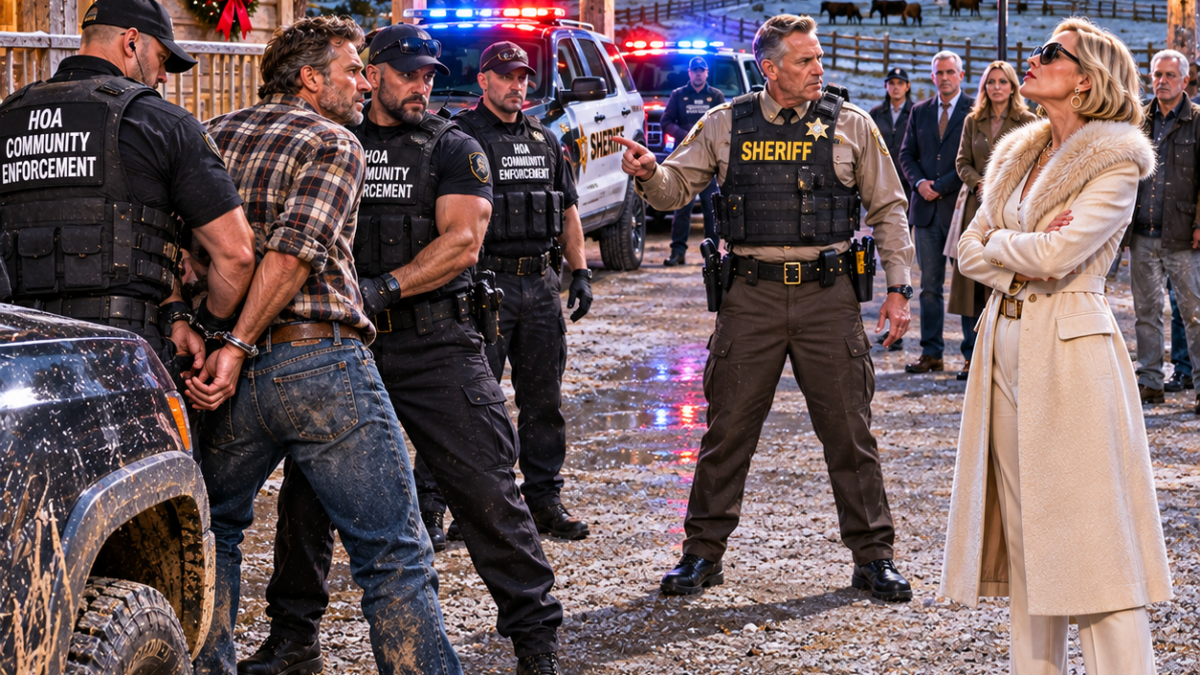
Three men had come through my gate wearing black tactical pants, body armor, radios, and patches reading HOA COMMUNITY ENFORCEMENT in white block letters. Their equipment was good enough to look serious from fifty feet away and ridiculous from five. Real handcuffs. Real batons. Real radios. No legitimate law-enforcement authority behind any of it.
The man leading them shoved me against the hood of my pickup.
“Hands behind your back.”
I gave them my hands.
Not because they were entitled to them.
Because I wanted every choice to belong to them.
My shoulder hit warm metal.
One cuff closed.
Then the other.
Behind me, Duke barked from the porch hard enough to rattle the screen door.
“Easy,” I said.
The leader tightened his grip on my shoulder.
“Keep your mouth shut.”
I smelled cheap coffee on his breath.
I could have ended the encounter differently.
There was a firearm locked inside the house.
There was another secured in my truck.
I had spent decades around officers, investigators, prosecutors, defendants, fugitives, and men who believed intimidation worked because nobody had ever forced them to explain themselves under oath.
I knew exactly what these three were doing.
And I knew exactly what resisting would give them.
So I stayed still.
One of them searched my jacket.
Another opened the rear door of their black SUV.
The leader said, “Daniel Cross, you are under community arrest for interference with Pinewood Ridge operations.”
Community arrest.
Even with my face against the truck, I nearly laughed.
“Under what statute?”
“HOA charter.”
“That isn’t a statute.”
He pushed me harder.
“You were warned.”
I turned my head just enough to look at him.
“No. You were.”
He hesitated.
That was the first crack.
Men impersonating authority usually expect two responses.
Fear.
Or anger.
Calm bothers them.
Calm suggests the person in restraints knows something they don’t.
The leader recovered.
“Move.”
He started guiding me toward the SUV.
I took three steps.
Then stopped.
He pulled my arm.
“Keep moving.”
I leaned close enough that only he could hear me.
“You boys have made one serious mistake.”
His grip tightened.
“What’s that?”
I lowered my voice.
“You just kidnapped a state prosecutor.”
His hand went slack.
Not completely.
Enough.
Behind him, the second man froze with his radio halfway to his mouth.
The third looked at me.
Then at the leader.
“You’re lying.”
“I wish I were.”
The leader stepped back.
“Victoria said you were just some rancher.”
“I am a rancher.”
Wind moved through the cedar trees.
Duke barked again.
I looked toward the road.
“I’m also a senior state prosecutor in the criminal division.”
Nobody spoke.
The leader swallowed.
Then he made the worst decision available to him.
He tried to act tougher.
“Doesn’t matter. You’re on HOA-controlled land.”
“No.”
“The board authorized—”
“No.”
“We have legal authority to detain—”
“No.”
Each answer made him angrier.
Each answer made the other two less certain.
Then headlights appeared at the end of my driveway.
Fast.
Red and blue followed.
The leader turned.
A sheriff’s cruiser came through the gate and stopped hard enough to throw gravel across the shoulder.
Sheriff Tom Alvarez stepped out.
He had known me for seventeen years.
He took one look at me in cuffs.
Then at the three men.
His face became very still.
“What,” he said, “do you think you’re doing?”
The leader raised both hands slightly.
“Sheriff, we’re conducting a community enforcement detention.”
Alvarez stared at him.
“A what?”
“We have authority under the Pinewood Ridge charter.”
Alvarez walked closer.
“No, you don’t.”
“We were told—”
“I don’t care what you were told.”
He pointed toward me.
“Take those cuffs off him.”
The smaller guard reached for the key.
His hands were shaking now.
The cuffs came loose.
I rolled my wrists.
Red marks already circled the skin.
Alvarez looked at them.
Then back at the men.
“Put your restraints, batons, and radios on the ground.”
Nobody moved.
His voice changed.
“Now.”
They obeyed.
The night went quiet except for Duke’s growl and the ticking engine of the cruiser.
Then a phone rang.
The leader checked the screen.
I could see the name from where I stood.
VICTORIA HAYES.
He answered.
Before he could speak, her voice came through loudly enough for all of us to hear.
“Why isn’t he in the vehicle yet?”
The leader went pale.
Victoria continued.
“Do you understand what this delay is costing us? Get him off that property before morning.”
Sheriff Alvarez held out his hand.
“Give me the phone.”
The leader did.
“Mrs. Hayes?”
Silence.
“This is Sheriff Alvarez.”
More silence.
He looked at me.
Then at the three men.
“Don’t go anywhere tomorrow morning.”
Victoria finally spoke.
“Sheriff, there seems to be a misunderstanding.”
Alvarez smiled without warmth.
“No, ma’am. I think for the first time, we’re beginning to understand each other perfectly.”
He disconnected.
I looked down at the bruises beginning to appear around my wrists.
For weeks, Victoria had been trying to turn my land into a problem.
Now she had finally given me something I could use.
Not a violation notice.
Not a drone.
Not a fake survey.
Not another anonymous complaint.
Three witnesses.
Metal cuffs.
A recorded phone call.
And an unlawful detention on a ranch whose boundary she had been trying to erase for months.
That was when the fight stopped being about my fence.
part 2
My name is Daniel Cross.
I was fifty-three years old when Pinewood Ridge Estates decided my ranch needed to disappear.
I owned forty acres of cedar, pasture, hay ground, cattle pens, a crooked barn, two wells, one spring-fed pond, and enough Texas dust to coat anything left outside longer than thirty seconds.
My grandfather started the place.
My father expanded it.
I stayed.
People who knew only my professional life never understood why.
I had a law degree from the University of Texas.
I had spent twenty-six years as a prosecutor, most of them handling serious criminal matters involving fraud, organized theft, public corruption, and violent offenders.
I could have lived in Austin.
I could have bought something modern with climate-controlled parking and a kitchen large enough to prepare meals nobody had time to eat.
Instead, I drove home to a ranch where one barn door never closed properly unless you lifted it by the hinge.
I preferred that.
The land knew me before any courtroom did.
My grandfather’s boots had walked those fence lines.
My father’s hands had replaced the bolts on the same gates I still repaired.
The cedar windbreak along the western edge had been planted before I was born.
To somebody looking at county appraisal records, it was forty acres.
To me, it was a family ledger.
That is why Victoria’s first mistake wasn’t threatening me.
It was assuming I thought about the land in the same terms she did.
Pinewood Ridge Estates appeared beyond my southern boundary after a developer bought former grazing land and turned it into what the brochures called elevated Texas living.
Large modern houses.
Clean lines.
Stone facades.
Imported landscaping.
Decorative ponds.
Matching mailboxes.
The houses were expensive.
The HOA dues were impressive.
The entrance monument alone probably cost more than my first house.
I didn’t care.
People are allowed to like things I don’t.
I had no objection to new neighbors.
My problem began when the new neighbors decided the old land should change for them.
Victoria Hayes became HOA president almost immediately.
She was polished.
Smart.
Disciplined.
And absolutely convinced that competence in one area of life entitled her to control every other area she could see.
The first Sunday she came to my ranch, she wore polished boots that had never met manure and carried a clipboard as if the county had appointed her to something.
A man from the board stood beside her.
“Mr. Cross?”
“Yes.”
“Victoria Hayes. Pinewood Ridge HOA president.”
“I know.”
She smiled.
“We’re beginning an initiative to improve visual consistency along our shared perimeter.”
I looked at the fence.
“My fence?”
“Your fencing. Barn. Livestock visibility.”
I waited.
“The cattle bother your residents?”
“Some residents feel the rural appearance conflicts with the community’s aesthetic environment.”
I looked over her shoulder toward Pinewood Ridge.
Then back at her.
“The cows were here before your mailboxes.”
The board member beside her looked down.
Victoria did not.
She glanced at my clothes.
Dusty jeans.
Work shirt.
Boots.
Then she said the sentence that told me exactly who she thought I was.
“People like you don’t always understand zoning law, Mr. Cross.”
I smiled.
Small.
Slow.
“People like me?”
She realized the phrasing but did not apologize.
“Land-use regulations can be complicated.”
“That’s true.”
“We’ve consulted professionals.”
“Good.”
“So once you review our guidelines, I think you’ll understand.”
“Your HOA doesn’t govern this parcel.”
“Our community borders it.”
“Adjacent isn’t included.”
Her smile tightened.
“The county maps place your property within what we’re calling a visual improvement zone.”
“What the HOA calls something isn’t what the county calls it.”
The man beside her touched her elbow.
She ignored him.
“We’d appreciate your cooperation.”
“You have my cooperation as a neighbor.”
“Excellent.”
“Not my submission as a member.”
The smile disappeared.
That was the first day she tested the fence.
Three days later, a drone appeared.
It hovered above the barn.
Then the feed pen.
Then the southern pasture.
Next morning, another.
Then volunteers photographing my structures from the roadside.
Measuring wheels.
Cameras.
Notes.
Letters followed.
Non-standard fencing.
Livestock odor.
Visual disharmony.
Potential property-value impact.
I kept every one.
At first, because they amused me.
Then because they stopped being funny.
One morning, two men arrived in a white pickup with what appeared to be county markings.
Orange vests.
Clipboards.
One said they were with the county structure-and-safety division investigating an unsafe barn and livestock exposure complaint.
I asked for paperwork.
He handed me a packet.
Wrong seal.
Wrong form structure.
No proper identifying information.
Blank signature box.
I had prosecuted falsification cases long enough to know what legitimate government paperwork looked like.
This wasn’t it.
“You boys actually county employees?”
“Contracted inspection support.”
“Through which county department?”
Silence.
The second man glanced toward the truck.
Then the first said:
“We’re contracted through Pinewood Ridge.”
There it was.
I folded the packet.
The taller man reached for it.
“I need that back.”
“No.”
“Sir—”
“It was delivered to me as an official notice.”
“We need it.”
“I imagine you do.”
I let them finish taking photographs.
That might sound strange.
Why allow trespass?
Why not order them off immediately?
Because I had something more useful than anger.
A camera on my barn.
Another above the equipment shed.
Their truck on video.
Their statements.
The false paperwork in my pocket.
When they left, I logged everything.
Then I added four trail cameras.
By midnight, my ranch had better documentation than most small businesses.
A week later, Earl Madsen at the county records office called.
Earl had guarded land filings since dinosaurs finished their title searches.
“Daniel, come in.”
“What did you find?”
“Something you aren’t going to enjoy.”
He spread three documents across a counter.
Development blueprint.
Annexation proposal.
Preliminary plat.
My land appeared inside it.
Not accurately.
My southern boundary had moved.
My barn had vanished.
My pond was labeled PHASE FOUR WATER FEATURE.
A proposed utility connection crossed my well.
I stared at the map.
“Who filed this?”
Earl pointed toward the submission page.
Victoria Hayes.
Pinewood Ridge HOA.
Below it:
Lone Star Horizon Development Group.
My professional instincts took over.
“Official county plat?”
“No.”
“Recorded?”
“No.”
“Submitted as supporting material?”
“Yes.”
“Source?”
“Private.”
I looked closer.
The altered boundary was not random.
Moving the line north gave Pinewood Ridge control over the cleanest expansion route.
My land wasn’t just ugly to Victoria.
It was useful.
That changed everything.
I asked Earl for certified copies of every legitimate document.
Then I called Raymond Oaks, my private attorney.
He met me that afternoon.
Raymond was sixty-two and built like a man who had spent three decades winning arguments without needing to raise his voice.
He read the maps.
Then read them again.
“This isn’t just HOA overreach.”
“No.”
“Do you think the developer knows the boundaries are wrong?”
“I don’t know.”
“Good answer.”
“I hate good answers.”
“They keep lawyers employed.”
We agreed on one thing.
Don’t accuse the developer yet.
Follow the money.
Find the communications.
Find who created the maps.
Find what Victoria receives if my property becomes available.
The answer came to my mailbox in the form of Nathan Porter.
Nathan was a Pinewood Ridge board member.
Thin.
Nervous.
Wrinkled polo.
He looked like he had been arguing with himself for three days and losing.
“You Daniel Cross?”
“Yes.”
“My name is Nathan Porter.”
“I know.”
That surprised him.
“You’re on the board.”
“Yes.”
“What do you want?”
He looked over his shoulder.
Then held out a USB drive.
“I brought you something.”
I didn’t take it.
“What?”
“Emails. Meeting notes. Developer payments. Draft annexation documents.”
I watched him.
“And?”
“A memo about you.”
“What kind?”
His face tightened.
“She calls you a non-compliant obstruction.”
I felt something cold move through me.
“Keep going.”
Nathan swallowed.
“There was a meeting yesterday.”
“Who attended?”
“Victoria. Enforcement committee. Two people from the developer side.”
“Names?”
He gave them.
“What happened?”
“Someone asked whether they should really keep escalating.”
“And?”
Nathan looked at me.
“Victoria said, ‘He won’t comply, so we’ll handle him.’”
I took the USB.
“Why give this to me?”
“Because I thought this was an HOA.”
“It is.”
“No.”
His voice shook.
“I mean I thought it was lawns and dues. Architecture. Pool repairs.”
He rubbed his forehead.
“Then developer money started coming in. Strategic reimbursements. Consulting credits. Whatever they call them.”
“Amounts?”
“Six figures.”
“For what?”
“I don’t know.”
“Yes, you do.”
He closed his eyes.
“To get the land.”
There it was.
The why.
I told Nathan to get his own lawyer.
Then I told him something else.
“Do not delete anything.”
“I won’t.”
“Do not forward anything else informally.”
“Why?”
“Because if this becomes a criminal matter, I want the evidence preserved properly.”
He stared at me.
“You really are a lawyer.”
“Among other things.”
“What do I do?”
“Tell the truth.”
He exhaled.
“I should’ve done that earlier.”
“Yes.”
I did not absolve him.
He didn’t ask me to.
That night, Raymond and I reviewed the material with a forensic specialist.
Emails tied Victoria to development planning.
Draft maps.
Pressure strategies.
References to compliance leverage.
A payment structure showing that if the expansion assembled successfully, money would flow into HOA discretionary accounts and consulting channels.
Enough for investigation.
Not enough yet for me to declare a criminal enterprise from my porch.
Then came the midnight visit.
Three men.
Tactical gear.
HOA COMMUNITY ENFORCEMENT.
By then, I had already sent copies of the most serious material to the appropriate investigative channels.
I had also told Sheriff Alvarez I was concerned somebody might attempt physical enforcement.
He arranged extra patrol.
My cameras stayed on.
That was why he reached my ranch quickly after the men cuffed me.
And that was why, when Victoria called demanding I be “brought in,” the night became evidence instead of rumor.
The three men were detained and questioned.
None were law-enforcement officers.
None were deputized.
None had authority to conduct what they called a community arrest.
One admitted Victoria had told them I was interfering with HOA property and could be detained under community rules.
Another had received written talking points through an encrypted group chat.
That chat was preserved.
Victoria did appear voluntarily at the sheriff’s office the next morning.
With counsel.
Her lawyer immediately stopped her from making the kind of statements she had made on the phone.
That was smart.
By then, however, the investigation was no longer dependent on her talking.
Nathan gave a formal statement.
The USB materials were collected and authenticated through proper process.
Search warrants followed for specific records.
Financial subpoenas.
Developer communications.
HOA servers.
Contractor invoices.
The fake inspection packet was traced to a vendor that had been paid through an HOA consulting account.
The altered development exhibits came from a design firm working from instructions supplied by Pinewood Ridge’s expansion committee.
The underlying county boundaries themselves had never changed.
That distinction mattered.
Victoria had not magically forged the official county land records.
She had used altered private exhibits and preliminary planning submissions to create the appearance that annexation and access were more settled than they actually were.
Still serious.
Less theatrical.
More provable.
Investigators also found something I had suspected.
Victoria was not merely chasing landscaping harmony.
A successful land assembly would trigger consulting compensation and reimbursements connected to the expansion effort.
The exact structure was complicated.
The motive was not.
Money.
Control.
And a belief that I would eventually become tired enough to sell.
The problem was that Victoria had spent months escalating while leaving records.
Drones.
Emails.
False inspection activity.
Boundary exhibits.
Harassment directives.
Physical enforcement.
And finally three men putting actual cuffs on me.
The prosecution had to be handled carefully.
I could not prosecute my own case.
That would have been absurd.
The criminal matter was assigned outside my chain of command and reviewed for conflicts.
I became a witness.
A victim.
A records source.
Nothing more.
That distinction was important.
People at Pinewood Ridge assumed my position meant I could simply indict Victoria myself.
I could not.
And even if I could have, I would not have wanted to.
Justice gets weaker when one person is investigator, victim, prosecutor, and judge.
So I stepped back.
That was harder than confronting the fake officers.
I had spent twenty-six years controlling cases.
Now I had to trust other prosecutors.
Megan enjoyed that far too much.
“See?”
“See what?”
“How annoying you are when you say, ‘Let the process work.’”
“I never sound like that.”
“You absolutely sound like that.”
She was right.
The preliminary hearing months later was crowded.
Not because the case involved the most serious crime Texas had ever seen.
Because people love seeing institutions that look untouchable forced to explain themselves.
Victoria arrived in a crimson suit.
Perfect hair.
Perfect makeup.
Lawyer beside her.
She looked exactly like the woman who once stood at my fence and told me people like me didn’t understand zoning law.
I wore a charcoal suit.
No cowboy hat.
No work shirt.
My professional identification remained where it belonged.
Victoria saw me.
Her face changed.
She whispered something to counsel.
I heard none of it.
The state presented the case.
Not me.
That matters.
The prosecutor introduced the altered development materials.
The financial communications.
Nathan’s authenticated statements.
The contractor evidence.
The fake inspection packet.
The recorded communications.
The video of the men restraining me.
Victoria’s phone call.
The defense challenged intent.
They argued aggressive negotiation.
Misunderstood HOA authority.
Poor legal advice.
Contractor mistakes.
The court did not need to decide guilt that day.
Only whether sufficient evidence existed to proceed.
It did.
Far more damaging than any dramatic speech was one audio recording from an HOA committee meeting.
Victoria’s voice.
“If Cross won’t agree voluntarily, we create pressure points.”
Another board member:
“What kind?”
“Compliance. Inspections. Access. Whatever legally moves him.”
That line alone was not criminal.
Then another recording surfaced.
A later meeting.
After the false inspectors.
After the altered maps.
Victoria:
“He has to become too expensive to keep fighting.”
That one landed differently.
Then financial documents showed success payments.
Then the midnight detention.
Pattern became harder to explain as coincidence.
The court ordered the criminal case forward.
Additional review moved toward organized-fraud theories involving the developer participants, though prosecutors were careful not to call everything “RICO” simply because several people were involved.
That word makes good television.
Real organized-crime cases require specific statutory elements.
Some conduct fit conspiracy and fraud theories more cleanly.
That was enough.
Lone Star Horizon Development Group lawyered up.
Employees began cooperating.
One project manager produced emails showing Victoria had repeatedly pushed for “boundary normalization” around my parcel despite survey objections.
Another produced a message from a development executive:
If Cross won’t sell, HOA pressure needs to resolve before financing.
There it was.
Not a movie confession.
A business email.
Cold.
Ordinary.
More damaging because of it.
Nathan testified too.
He admitted signing documents he had not fully read.
He admitted staying silent when he saw the maps didn’t match older records.
He admitted fear.
“I thought if I challenged Victoria, she’d target my house next.”
The prosecutor asked, “Why did you eventually come forward?”
Nathan looked toward me.
“Because I heard people talking about handling him like he wasn’t a neighbor anymore.”
That mattered.
Abuse becomes easier when the target stops being a person.
Problem parcel.
Non-compliant obstruction.
Visual issue.
Access conflict.
Human language disappears first.
Then rights become easier to ignore.
Victoria did not collapse dramatically in court.
She fought.
Her attorney challenged every inference.
That was his job.
But documents are patient.
Emails do not care how expensive the suit is.
Video does not become embarrassed.
Metadata does not respond to intimidation.
The altered evidence tied back to Pinewood Ridge.
The enforcement instructions tied back to Victoria.
The contractor records tied back to HOA accounts.
The money tied back to the expansion.
The detention tied back to her call.
Eventually, the case resolved.
Victoria entered a negotiated plea to multiple state offenses connected to fraud, falsified filings, conspiracy, and unlawful detention conduct.
Other participants faced separate charges and civil exposure according to what investigators could prove against them.
The developer settled certain civil claims while its individual actors dealt with their own criminal matters.
The expansion plan was withdrawn.
My land remained exactly where the county records had always said it was.
No Phase Four water feature.
No shared utility well.
No visual improvement zone.
Forty acres.
Cross family.
Same fence.
Same crooked barn.
Civil litigation followed.
That case focused on what criminal court does not always repair.
Property interference.
Trespass.
Harassment.
Cost of restoring damaged areas.
Emotional harm.
Attorney fees where available.
The HOA’s insurer became involved.
So did the developer’s carriers.
Settlement discussions lasted months.
I refused one clause that would have prevented me from discussing publicly available facts.
They revised it.
The final agreement compensated the proven losses and required Pinewood Ridge to formally acknowledge that my ranch was outside HOA jurisdiction.
That written acknowledgment meant more to me than the money.
The new HOA board filed it in its records.
They also adopted a boundary policy.
Before any enforcement action involving property near but outside the subdivision, the association had to verify jurisdiction through actual recorded documents.
Imagine that.
Read the deed before threatening someone.
Revolutionary.
Victoria resigned before sentencing.
She was barred under the final disposition from serving in certain HOA governance roles for a defined period and faced restitution, supervision, and other court-imposed conditions.
Some residents thought it was too lenient.
Others thought public disgrace was enough.
I stopped caring which emotion people preferred.
My goal was never to make Victoria suffer forever.
My goal was to make sure she could never again point at my land and turn preference into authority.
That happened.
The fake enforcement men learned a harder lesson.
A tactical vest does not create police powers.
Handcuffs do not create jurisdiction.
Being told something is legal does not make it legal.
The man who had led the midnight detention eventually testified that Victoria had assured them the HOA charter gave them detention authority.
The prosecutor asked him whether he had ever read the charter.
“No.”
“Did you consult an attorney?”
“No.”
“Did you ask a sheriff’s deputy?”
“No.”
“Did you verify you had legal authority to handcuff Mr. Cross?”
Silence.
“No.”
That answer explained the entire night.
He wanted authority to be true because wearing it felt good.
Victoria wanted jurisdiction to be true because owning my land would make her expansion easier.
The developer wanted the boundary problem to disappear because financing hates uncertainty.
Everybody wanted reality to become more convenient.
The deed refused.
The survey refused.
The cameras refused.
The bank records refused.
Eventually, the courts did too.
Pinewood Ridge residents were left to clean up a community that had spent too long treating Victoria’s confidence as governance.
A seventy-two-year-old homeowner named Frank Wilkes came to my gate after one hearing.
I remembered him.
Months earlier, he had stood quietly while Victoria described my barn as visual disharmony.
Now he removed his hat.
“Mr. Cross.”
“Daniel.”
He looked toward the ranch.
“We owe you an apology.”
“You didn’t put cuffs on me.”
“No.”
He stared at the ground.
“But we let her turn you into something you weren’t.”
I waited.
“She kept telling us you were unreasonable.”
“I probably am sometimes.”
He almost smiled.
“She said you hated the neighborhood.”
“I don’t.”
“She said you wanted us gone.”
“I don’t care where you live.”
He nodded.
“That might be the nicest thing anybody’s said about us lately.”
I laughed.
Frank looked back toward Pinewood Ridge.
“We were afraid of her.”
“I know.”
“That’s not an excuse.”
“No.”
That answer surprised him.
People often expect victims to relieve other people’s guilt.
Sometimes guilt should stay long enough to teach something.
Then I added:
“But knowing it now gives you a chance to do better.”
He nodded.
The new board did.
Not perfectly.
No board does anything perfectly.
But they published meeting minutes.
Disclosed developer contacts.
Banned private “community enforcement” from using restraints or impersonating public authority.
Required real county documentation before claiming land-use jurisdiction.
Most importantly, residents started showing up.
Abusive leadership depends heavily on empty chairs.
Victoria had discovered that.
The fewer people attended, the easier it became to treat silence as consent.
The first post-Victoria annual meeting was standing room only.
I did not attend.
I wasn’t a member.
Megan did convince me to attend the neighborhood barbecue six months later.
That was different.
Pinewood Ridge residents came to the ranch.
Kids toured the cattle pens.
One little girl asked why the barn leaned.
“Because my father built one side straight and apparently lost interest halfway through.”
She considered that.
“Can you fix it?”
“Yes.”
“Why don’t you?”
I looked at Megan.
She was smiling.
“Tradition.”
The girl accepted that.
Children understand irrational family attachment better than HOAs.
Nathan Porter came too.
He had resigned from the board after cooperating.
He stood near the fence holding a paper plate and looking uncomfortable.
“You all right?” I asked.
“Still feel like everybody knows.”
“They do.”
“Helpful.”
“You wanted honesty.”
“Not this much.”
We watched children feed apple slices to a steer.
Nathan spoke quietly.
“I should’ve come to you months earlier.”
“Yes.”
He looked at me.
“You really don’t soften anything.”
“Courtroom habit.”
He nodded.
“I kept telling myself I wasn’t doing anything.”
“That’s how passive complicity works.”
He winced.
“Sorry.”
“You asked.”
“No, I mean about everything.”
I looked at him.
He had risked a lot by bringing that USB.
That did not erase what came before.
But people are not balance sheets.
You don’t subtract one good act from six bad and declare moral profit.
You decide what to do next.
“You helped stop it.”
Nathan swallowed.
“Does that make us even?”
“No.”
He laughed nervously.
Then I smiled.
“It makes today better than yesterday.”
That was enough.
My life returned to something close to normal.
Before dawn, coffee.
Cattle complaining.
Fence repair.
Drive to the city when work required it.
Come home.
Duke on the porch.
The drone activity stopped completely.
The fake inspectors vanished.
The altered annexation disappeared from active planning.
Lone Star Horizon eventually pursued another project somewhere else under different leadership and far stricter scrutiny.
My pond remained a pond.
I sometimes walked beside it and imagined the words PHASE FOUR WATER FEATURE floating above it.
That still made me laugh.
Earl from the county records office retired two years later.
At his retirement dinner, I bought him a framed copy of the legitimate plat.
He stared at it.
“You know how many deeds I’ve handled?”
“Thousands.”
“And this is what you bring me?”
“You saved my pond.”
“I saved paperwork.”
“Same thing.”
He shook his head.
“Lawyers.”
“Clerks.”
We drank coffee.
That is the kind of justice I prefer remembering.
Not handcuffs.
Not courtrooms.
People who did their jobs correctly before anybody knew how important the job would become.
Earl preserved the records.
Nathan preserved the emails.
My cameras preserved the trespass.
Sheriff Alvarez preserved the scene.
Investigators preserved the financial trail.
Every person who refused to let evidence disappear made the next person’s job easier.
That is how legal justice is actually built.
Quietly.
Sequentially.
One reliable piece at a time.
Years after the case, a young prosecutor asked me what Victoria’s biggest mistake had been.
“The cuffs?” he guessed.
“No.”
“The fake inspectors?”
“No.”
“The maps?”
“Closer.”
He looked frustrated.
“What, then?”
“She stopped asking whether she had the right.”
He waited.
I explained.
At the beginning, Victoria might have thought she had influence over neighboring property.
She could have checked.
She didn’t.
Then she thought drones and visual surveys were justified.
Could have checked.
Didn’t.
Fake inspectors.
Boundary exhibits.
Developer pressure.
Private enforcement.
Every step created another opportunity to stop.
Instead, each previous act became the justification for the next.
People rarely wake up one morning and decide to build a criminal conspiracy from scratch.
They rationalize one shortcut.
Then protect it with another.
Then need a third to explain the second.
Eventually three men are putting a prosecutor in handcuffs on his own ranch while everybody still insists it’s community management.
That’s what escalation looks like from inside.
Normal.
Until someone outside finally names it.
I kept the handcuffs.
Not the actual pair.
Those became evidence and later returned to whoever legally owned them.
I bought an identical model.
Hung them in my office below the fake county inspection notice.
Megan objected.
“You are developing a very strange decorating style.”
“Legal history.”
“It’s creepy.”
“Educational.”
“It’s creepy and educational.”
Fair.
Above them is a photograph of my grandfather beside the southern fence.
1956 or 1957.
Before he officially bought the parcel.
Hat crooked.
Shirt sleeves rolled.
He looks young enough to believe land stays yours simply because you work hard.
I know better now.
Land stays yours because work and law meet.
You maintain the fence.
And you record the deed.
You know the boundary.
And you defend it when somebody redraws the line.
Tradition matters.
Paper matters too.
My grandfather understood that.
That’s why the title was clean.
That’s why the survey worked.
That’s why Victoria’s invented maps never became reality.
There is something deeply satisfying about an eighty-year-old legal description outlasting a multimillion-dollar presentation deck.
Not flashy.
Durable.
Like the barn.
The barn is still crooked.
The HOA once demanded I alter it.
After the lawsuit, the new board sent a formal letter confirming Pinewood Ridge had no authority over it.
I framed that letter too.
Megan gave up on the office.
One Sunday, years later, Victoria contacted me.
Email.
No dramatic return.
No threat.
Subject:
Apology.
I stared at it for a long time before opening.
The message was short.
She said she had spent years confusing control with leadership.
She said she had convinced herself the expansion would improve Pinewood Ridge and that anyone resisting it must therefore be acting against the community.
She apologized for the harassment.
The fake inspections.
The detention.
She did not ask me to forgive her.
That was the smartest thing in the email.
I read it twice.
Then archived it.
Megan asked whether I’d answer.
“No.”
“Why?”
“I don’t know what I’d say.”
“Thank you?”
“For what?”
“Apologizing.”
I looked toward the pasture.
“An apology can be useful without becoming a conversation.”
Megan nodded.
“You’ve gotten less argumentative.”
“Age.”
“No. Fear.”
“Of what?”
“Me.”
Also fair.
I never saw Victoria again.
That suited me.
Forgiveness, if it happened, did not require access.
That is another boundary people misunderstand.
You can stop being angry without inviting someone back into your life.
You can accept that they changed without volunteering to test whether the change is permanent.
You can wish them no harm and still keep the gate closed.
My father would have understood.
He believed fences were not insults.
They were clarity.
This side is mine to maintain.
That side is yours.
If we need to cross, we ask.
Simple principles become profound only after somebody spends hundreds of thousands of dollars trying to avoid them.
The ranch never became part of Pinewood Ridge.
The developer never obtained my parcel.
No annexation.
No shared utility.
No Phase Four water feature.
The cattle remained visible.
Occasionally they smelled like cattle.
People survived.
Some Pinewood Ridge residents even started buying beef directly from us.
One man who had complained about livestock odor eventually became one of our most regular customers.
Carlos thought that was funny enough to mention every single time the man picked up an order.
“Smell okay today?”
The customer took it well.
Communities heal through small embarrassments.
Not proclamations.
The biggest change was that people started talking across the fence instead of about it.
That made almost every dispute easier.
Dust?
Call me.
Truck blocking something?
Call.
Tree leaning toward the subdivision?
Call.
No violation letter.
No drone.
No “visual improvement initiative.”
Just neighbors.
Turns out most problems do not require an enforcement committee.
When people ask whether I regret letting the three fake officers cuff me, I answer carefully.
I did not want to be assaulted.
I did not need to “let” anything happen for a case to exist.
They chose to restrain me.
I chose not to escalate physically once they did.
That distinction matters.
I knew cameras were running.
I knew Sheriff Alvarez was nearby.
I understood the legal consequences more clearly than they did.
Most people should not try to recreate that situation.
Safety first.
Call legitimate law enforcement.
Do not provoke unlawful detention for the sake of evidence.
That night, I made the best decision I could inside a bad situation.
Compliance kept everybody alive.
Documentation preserved what happened.
That is enough.
Duke grew old.
White around the muzzle.
Slow on cold mornings.
He had barked behind me the night I was cuffed as though sheer volume might fix Texas property law.
Years later, he preferred sleeping beneath the kitchen table.
I would look at him and remember the porch.
Three men.
Black vests.
Metal cuffs.
Sheriff lights crossing the cedar trees.
Victoria’s voice on speaker.
Get him off that property before morning.
She had been so certain the ranch was the obstacle.
Eventually I realized something.
The obstacle was never the ranch.
It was consent.
She had a development plan.
I had the right to say no.
That was the entire conflict.
Everything after that was an attempt to make my no disappear.
Visual rules.
Pressure.
Fake officials.
Boundary manipulation.
Money.
Enforcement.
Handcuffs.
All because one person with a plan could not tolerate another person having a veto over his own property.
That is why property rights matter beyond money.
They are the legal form of consent.
This is mine.
You may offer.
I may refuse.
That no cannot become invalid merely because somebody’s project depends on yes.
Victoria forgot that.
The developer encouraged her to forget.
The law reminded them both.
I still work cases.
Fewer now.
Younger prosecutors handle most courtroom battles.
I spend more time reviewing strategy, teaching, and occasionally explaining to ambitious twenty-eight-year-olds that dramatic closing arguments do not repair weak evidence.
“Documents first,” I tell them.
They roll their eyes.
Then lose one case and become believers.
The Pinewood Ridge file became an example I use privately when teaching evidence.
Not names.
Not details.
The lesson.
Don’t build the case you want.
Build the case the record supports.
I could have called Victoria a racketeer the day Earl showed me the map.
Would have felt great.
Might have been wrong.
Instead, we investigated.
Some conduct fit fraud.
Some conspiracy.
Some falsification.
Some unlawful restraint.
The developer conduct had its own elements.
Precision is not weakness.
Precision is how justice survives appeal.
That is one thing revenge stories usually get wrong.
The most satisfying accusation is not necessarily the strongest one.
You don’t need to call someone the worst possible thing.
You need to prove exactly what they did.
Victoria suffered more from the accurate record than she ever would have from my anger.
That principle carried me through twenty-six years.
It carried me through Pinewood Ridge too.
On the anniversary of the midnight detention, I sat on the porch with coffee.
No ceremony.
I did not mark the date intentionally.
I only noticed because the security app surfaced an old clip.
Three men walking up my drive.
For a moment, I watched.
Then paused the video.
Duke was younger.
I looked younger.
The ranch looked the same.
I deleted the reminder from the app.
Not the evidence archive.
That stays.
But I did not need my phone turning memory into an anniversary.
The case was over.
The land was quiet.
Peace deserves room.
I walked the southern fence.
Morning light caught the cedar posts.
Beyond them, Pinewood Ridge roofs reflected the sun.
Nothing about the view felt threatening anymore.
They had their neighborhood.
I had my ranch.
No winner’s flag.
No enemy line.
Just a boundary everyone finally understood.
That was what I had wanted from the beginning.
Victoria came to my fence carrying a clipboard and told me people like me did not understand zoning law.
Months later, she sat in court while prosecutors explained exactly which laws her actions had crossed.
People like stories because symmetry feels good.
I admit this one had some.
But the sentence I remember most is not anything I said in court.
It is what Sheriff Alvarez told one of the fake officers when the man insisted the HOA had authorized him.
“Authority doesn’t come from the person who tells you to act. It comes from the law that allows the act.”
I wrote that down later.
It belongs beside Deed Book 29 in spirit.
We live in a world full of people handing out titles.
President.
Director.
Officer.
Compliance manager.
Security.
Consultant.
Prosecutor.
Sheriff.
None of those words should end a question.
They should start one.
What can you lawfully do?
Where does your authority stop?
What protects the person on the other side?
If Victoria had asked those questions, Pinewood Ridge might have gained a neighbor instead of a criminal investigation.
If her “enforcement officers” had asked, they might have saved themselves years of consequences.
If Nathan had asked earlier, maybe months of harassment would never have happened.
If I had assumed my professional status made me immune, I could have made mistakes too.
Boundaries protect everybody.
Not only ranchers.
Not only homeowners.
Everybody.
That is why I still repair my own fence when I can.
Not because I cannot afford help.
Because walking that boundary reminds me of something law books sometimes make too complicated.
Responsibility begins where entitlement ends.
The fence tells me what I owe.
The deed tells me what I own.
The law tells everyone else what neither side may take.
One evening, close to sunset, I hung my hat on the same nail my father used.
Made coffee even though it was too late for coffee.
Walked outside.
Cattle moved across the pasture.
Duke slept near the steps.
The crooked barn threw a long shadow.
Past the southern fence, the lights of Pinewood Ridge began coming on one house at a time.
Families cooking dinner.
Children doing homework.
People living ordinary lives inside a neighborhood I once thought would always feel hostile.
It didn’t anymore.
Victoria was gone.
The expansion scheme was gone.
The fake officers were gone.
What remained were neighbors.
Land.
Records.
And the silence I had known before any of them arrived.
I took a drink.
The coffee was too strong.
Exactly right.
People sometimes ask what I whispered to the men who cuffed me.
They expect something clever.
Something cinematic.
I tell them the truth.
“You just kidnapped a state prosecutor.”
It wasn’t a threat.
It wasn’t even the most important fact.
The most important fact was simpler.
They had restrained a citizen without lawful authority.
My title did not make that wrong.
It only made their mistake easier for them to understand.
That distinction is the reason I never tell the story as “the day HOA Karen messed with the wrong prosecutor.”
She messed with the wrong idea.
She believed power could replace consent.
It cannot.
She believed paperwork could replace ownership.
It cannot.
She believed uniforms could replace lawful authority.
They cannot.
She believed money could make an old boundary disappear.
It could not.
And she believed a quiet rancher would eventually surrender because fighting her looked expensive.
That was the last thing she got wrong.
I did not defend the ranch with fists.
I did not defend it with a gun.
I defended it with the same things that had protected people in every courtroom I had respected.
Records.
Witnesses.
Procedure.
Patience.
Truth.
The fence still stands.
The barn is still crooked.
The pond is still mine.
And every time the sun settles behind the cedar ridge, the land looks exactly the way it did before Victoria Hayes ever decided it needed to become something else.
That is enough justice for me.








