HOA Karen Sent Fake Cops to My Ranch at Midnight—Then Tried to Cut Through My Gate
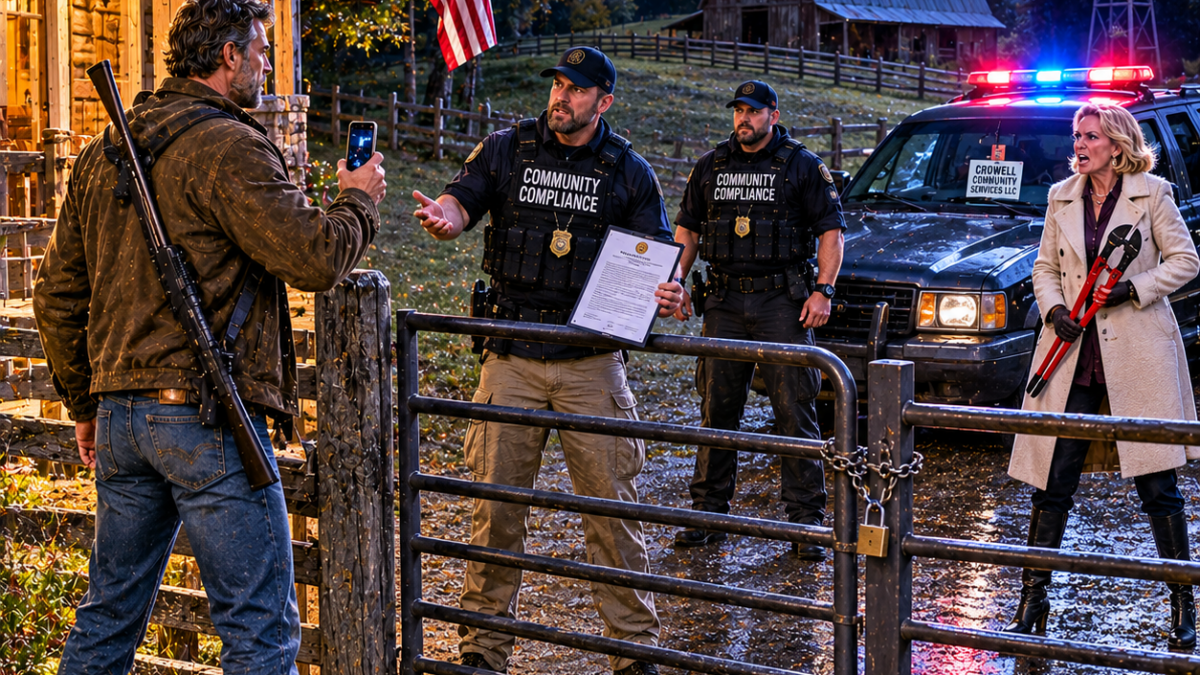
part 2
I bought the property because I wanted exactly the kind of life Lydia Crowell couldn’t understand.
Open sky.
A barn.
Enough land to keep tools, hay, firewood, and equipment without asking a committee whether the color palette matched somebody’s landscaping plan.
Maple Grove sat just beyond my eastern fence line.
Beautiful development.
Big entrance monument.
Stone mailboxes.
Perfect yards.
Plenty of good people.
And more rules than a military barracks.
My deed had been one of the reasons I bought where I did.
The parcel was outside Maple Grove.
No HOA declaration.
No covenant.
No membership.
No architectural committee.
No assessment obligation.
Nothing.
The first time Lydia showed up, she pretended she was being neighborly.
Pastel blazer.
Spray tan.
Clipboard.
Perfect suburban smile.
“We’ve noticed some overgrown brush near the community boundary.”
I looked behind me.
“That’s my fence line.”
“Exactly.”
“And?”
“Maple Grove prefers a cleaner transition between managed and unmanaged property.”
I laughed.
“Then Maple Grove can clean its side.”
Her smile tightened.
“We’d really like you to consider joining the association voluntarily.”
“No.”
“You haven’t heard the benefits.”
“I’ve heard enough.”
That should have ended it.
Instead, three days later I found a note under my gate latch.
Clear brush within ten days or risk penalties.
No signature.
I burned it with scrap wood.
Then came the official letters.
Noise violation for using a chainsaw.
Structural concern over stacked lumber.
Visual nuisance because my utility trailer could be seen from the road.
Every letter ended the same way.
Failure to comply may result in enforcement.
That word bothered me.
Enforcement.
Against what?
A man who never signed up for your rules?
I ignored the first few.
Then Lydia confronted me while I was unloading lumber for the barn.
I had spent months planning that barn.
Simple pole structure.
Tools.
Hay.
Workshop.
County permit approved.
Inspector already signed off on the foundation work.
Lydia marched across the edge of the driveway.
“Unapproved structure.”
I kept unloading lumber.
“Approved by the county.”
“Not by Maple Grove.”
“Good thing I don’t live in Maple Grove.”
“This violates Section 14.”
I leaned against the tailgate.
“Ma’am, Section 14 can say I have to paint the moon beige. It still doesn’t apply over here.”
Her eyes narrowed.
“We’ll see.”
After that, paperwork became warfare.
Certified letters.
Inspection demands.
Compliance notices.
A fake invoice tucked under my truck’s windshield at the grocery store.
I started documenting.
Not because I was scared.
Because construction teaches you something very early:
If it isn’t documented, somebody will eventually claim it never happened.
So I installed cameras.
Gate camera.
Doorbell camera.
Two motion-triggered game cameras.
Another overlooking the barn.
Everything uploaded automatically.
That was how I caught Maple Grove board members wandering near my fence with clipboards.
How I recorded one landscaper Lydia sent to “inspect drainage.”
How I caught another man saying quietly:
“She said he’d cave by now.”
I saved every clip.
Every letter.
Every envelope.
Every date.
Eventually neighbors started talking to me.
Evan lived on the property next to mine.
Rough around the edges.
Usually drinking something straight from the carton instead of using a glass.
But honest.
Mara lived inside Maple Grove.
Retired nurse.
Sharp tongue.
Wheelchair ramp at her house because her late husband had needed one.
Lydia once fined her because the ramp railing was not painted the approved shade.
Mara paid it.
Then hated herself for paying.
“You know she does this to everybody,” Mara told me one afternoon.
“No.”
“Not the fake fines outside the HOA. The pressure. The threats. People just give up.”
“Why?”
“Because fighting her becomes a second job.”
That sentence stayed with me.
Lydia’s real weapon was exhaustion.
Most people are busy.
Work.
Kids.
Bills.
Health.
Nobody wants to spend three months arguing over a mailbox.
So she pushed until surrender became cheaper than resistance.
My advantage was that I was stubborn.
And I already understood permits, records, and documentation.
The fake cops changed everything.
The morning after Mitch and Dale visited, I went frame by frame through the footage.
Faces.
Vehicle.
Partial plate.
Parking pass.
Crowell Community Services LLC.
I searched the state business registry.
There it was.
Registered to Lydia Crowell.
Mailing address:
Her Maple Grove home.
Business purpose:
Property compliance services.
Status:
Suspended.
I stared at the screen.
She had not even tried to hide it.
I called Ramos.
“You need to see something.”
He came by that afternoon.
I gave him copies.
Not originals.
Camera stills.
LLC filing.
Parking pass.
Partial plate.
Ramos leaned back.
“This is getting more serious.”
“What are you thinking?”
“I’m thinking we let detectives decide what charges fit. But fake badges plus fake authority plus an LLC connected to the HOA president is not something we’re ignoring.”
“Think she’ll come back?”
He looked at me.
“You know her better than I do.”
I did.
“She’ll come back.”
Ramos nodded.
“Then don’t bait her.”
That was important.
The original story people later told made it sound like I designed some elaborate sting.
I didn’t.
I made my property clearer.
Nothing more.
I laminated a copy of the county parcel map.
Posted a simple notice:
PRIVATE PROPERTY
NOT SUBJECT TO MAPLE GROVE HOA
ALL OFFICIAL INSPECTIONS MUST BE VERIFIED THROUGH COUNTY CODE ENFORCEMENT
I also added the phone number for county code enforcement.
No insults.
No threats.
No fake legal language.
Just facts.
I repositioned the cameras.
Better license-plate angle.
Better audio.
I checked the backup system twice.
Then I told Evan and Mara:
“If anything happens, don’t come onto my property.”
Mara frowned.
“I can still film.”
“From your side.”
“Fine.”
Evan grinned.
“I’ve got a lawn chair.”
“Don’t turn this into entertainment.”
“Too late.”
Three days passed.
Then, just before sunset, my phone buzzed.
Motion detected.
I looked.
Mitch.
Dale.
And Lydia.
She came in person.
White SUV.
Pastel blazer.
Phone in hand.
Mitch carried bolt cutters.
Dale held another official-looking document.
I called Ramos before walking outside.
“They’re back.”
“Stay behind the gate.”
“I am.”
“Units are nearby.”
“Understood.”
When I stepped into view, Lydia immediately raised her phone.
“Open this gate.”
“No.”
“You are obstructing a lawful inspection.”
“No.”
“Section 14 grants us access.”
I pointed toward the laminated parcel map.
“This property is outside Maple Grove.”
She barely looked at it.
“Community bylaws supersede your stubborn interpretation.”
I almost smiled.
“My interpretation?”
I held up the county confirmation.
“This came from the government that actually regulates my property.”
She jabbed a finger toward me.
“You think you’re clever.”
“No, ma’am.”
I looked at the paper.
“I think I can read.”
Across the road, neighbors came outside.
Evan stood by his truck filming.
Mara sat on her porch with iced tea.
Several Maple Grove residents watched from farther down.
Lydia noticed the audience.
That made her more aggressive.
“Open the gate.”
“No.”
“Mitch.”
He swallowed.
Lydia looked at him.
“Do it.”
He lifted the bolt cutters.
That moment was captured from four angles.
He placed the jaws around the chain.
Metal touched metal.
Then blue lights appeared behind them.
No sirens at first.
Just two real patrol cars rolling quietly into position.
Then the lights came alive.
Red.
Blue.
White.
“SHERIFF’S OFFICE! STEP AWAY FROM THE GATE!”
Mitch dropped the cutters so fast they bounced in the gravel.
Dale nearly dropped his paperwork.
Lydia spun around.
Deputy Ramos stepped out.
Real badge.
Real uniform.
Real authority.
“Hands visible.”
Mitch raised his hands.
Dale did too.
Lydia started talking immediately.
“Deputy, thank God. This property owner is interfering with an authorized community inspection.”
Ramos did not even look at me.
He walked toward Mitch.
“Badge.”
Mitch hesitated.
“Badge. Now.”
He removed it.
Ramos examined it.
Then the vest.
“Who issued this?”
“We’re contracted community enforcement.”
“You’re not law enforcement.”
“We know.”
“Then why are you carrying a badge designed to look like one?”
Mitch said nothing.
Ramos looked toward the bolt cutters.
“Why were you cutting a private gate?”
“HOA authorization.”
He turned toward Lydia.
“You authorize that?”
She lifted her chin.
“Maple Grove has enforcement rights over nonconforming properties affecting the community.”
“No, it doesn’t.”
“You don’t understand our bylaws.”
Ramos actually laughed once.
“Your bylaws don’t override state property law.”
Dale tried handing him the document.
“This authorizes inspection.”
Ramos read the first page.
Then the second.
He held it toward another deputy.
“County form?”
The deputy shook his head.
“No.”
Ramos looked at Lydia.
“Where did this come from?”
“Our compliance office.”
“Which is your LLC?”
Her eyes narrowed.
“That is a separate matter.”
“It isn’t separate anymore.”
Mitch and Dale were separated.
One deputy collected the bolt cutters.
Another photographed the fake badges.
Another documented the gate.
Everything was slower than Lydia wanted.
That was good.
Then Ramos looked toward me.
“You touched anything?”
“No.”
“Anybody cross the gate?”
“No.”
“Good.”
He turned back to Lydia.
“You’re staying here while we sort this out.”
“You cannot detain me.”
“I’m investigating an attempted unlawful entry involving people previously reported for impersonating officers.”
“I’m the HOA president.”
Ramos stared at her.
“That’s not a law-enforcement rank.”
Behind us, somebody laughed.
Lydia’s face flushed.
Mitch broke first.
“She told us it was legal.”
Lydia whipped around.
“Do not speak.”
Ramos looked at him.
“You’re free to speak.”
“She said county enforcement knew about it.”
“Did you call county enforcement?”
“No.”
“Why not?”
Mitch looked ashamed.
“She said we didn’t need to.”
Dale started talking too.
They had been paid through Crowell Community Services.
They were told to carry badges.
They were told residents complied faster if the team looked official.
They were told the paperwork had legal effect.
Ramos looked toward the fake cruiser.
“Search warrant isn’t automatic here. Secure the vehicle pending appropriate process.”
The investigation continued.
Eventually the vehicle was lawfully examined.
What officers found made Lydia’s problem worse.
More badges.
Cheap handcuffs.
Preprinted compliance notices.
HOA letterhead.
Copies of fake inspection forms.
Blank citation templates.
Everything designed around one idea:
Look official enough that people obey before asking questions.
That was Lydia’s entire business model.
Mitch and Dale were booked based on the conduct investigators documented and the charges prosecutors believed applied.
Lydia’s situation took longer.
She had not worn the badge.
She had not personally held the bolt cutters.
But the paper trail pointed toward her.
Emails.
LLC filings.
Payments.
Instructions.
Security contracts.
Ramos told me that night:
“Don’t expect everything to happen today.”
“I don’t.”
“Good.”
“I’ve worked construction twenty years. Nothing happens today.”
He laughed.
Then he became serious.
“You did the right thing staying behind the gate.”
“I had help.”
“You had cameras.”
“Same thing.”
He smiled.
“Tonight? Pretty close.”
The next forty-eight hours changed Maple Grove.
Residents learned that Crowell Community Services LLC had received HOA funds.
The treasurer began reviewing payments.
Some residents recognized Mitch and Dale from previous “compliance visits.”
Mara called me.
“You’re not going to believe this.”
“Try me.”
“Those two came to my house last year.”
“What?”
“Different shirts. Same faces.”
“Did they threaten you?”
“They told me the wheelchair ramp could be removed if I didn’t pay the violation.”
My stomach tightened.
“Do you have anything?”
“Doorbell footage.”
“Save it.”
That was the beginning.
More residents came forward.
A family fined over an RV.
Another over boat storage.
One couple charged repeatedly for paint colors that changed every time they complied.
Several payments had gone not directly to Maple Grove, but through entities tied to Crowell Community Services.
What looked like petty HOA tyranny started looking like a revenue stream.
The Maple Grove board held an emergency meeting.
I was not a member.
I attended only because residents asked me to provide evidence about what happened on my property.
The clubhouse was packed.
Lydia arrived as though she still controlled the room.
Clipboard.
Perfect hair.
Same pastel blazer.
She sat in the president’s chair.
Then the shouting began.
“You hired fake cops!”
“Where did our dues go?”
“Why was Crowell Community Services being paid?”
“Did you collect fines through your own company?”
Lydia hit the table with her clipboard.
“Order!”
Nobody became quiet.
That was the first visible sign that her authority was finished.
The treasurer, a nervous man who had spent years agreeing with her, cleared his throat.
“I’ve reviewed the security payments.”
Lydia stared at him.
He kept going.
“Several transfers to Crowell Community Services do not correspond to board-approved vendor contracts.”
The room erupted.
“That’s false,” Lydia snapped.
The treasurer held up copies.
“These are bank records.”
“You’re taking them out of context.”
Evan stood from the second row.
He had printed emails.
“You wrote this.”
He read:
Have Mitch and Dale enforce inspections. Collect fines on site where possible.
Lydia stood.
“Those were drafts.”
Someone in the back shouted:
“Draft fake cops?”
The room exploded with laughter.
Lydia’s face turned crimson.
I did not laugh.
Watching a person lose power can be satisfying.
Watching an institution realize it handed too much power to one person is more important.
Three board members resigned that night.
Not because all three were criminals.
Because they admitted they had stopped questioning Lydia.
They had let her sign contracts.
Approve enforcement spending.
Control communications.
Define emergencies.
One person had become the shortcut for everything.
The membership initiated removal under the bylaws.
The vote was overwhelming.
Lydia Crowell was no longer HOA president.
She left the clubhouse holding the same clipboard she brought in.
But nobody moved aside for her anymore.
Legal consequences followed separately.
Mitch and Dale faced charges connected to impersonation and trespass.
Their cooperation mattered.
They gave investigators messages.
Payment records.
Instructions.
They explained how Lydia told them to behave.
She wanted confidence.
No hesitation.
No long explanations.
Flash the badge.
Use words like probable cause.
Use words like enforcement.
Mention detention if homeowners resisted.
Most people would comply.
That sentence made me angrier than anything else.
Most people would comply.
She had built the system around ordinary people not knowing the difference between an HOA rule and state authority.
Residents were not stupid.
They were busy.
A fake badge at night creates fear.
A person wearing tactical gear says you’re being detained, your first instinct may not be to ask whether his LLC registration is active.
Lydia knew that.
She exploited it.
The financial review widened.
Crowell Community Services had received HOA payments disguised under categories such as community safety, compliance support, emergency inspection coordination, and security consulting.
Some fines residents paid were routed through accounts associated with the LLC rather than normal HOA collection procedures.
Attorneys took over.
Insurers became involved.
Auditors arrived.
I filed a civil claim for trespass, harassment, interference with property rights, and damages connected to the repeated campaign.
I was not alone.
Mara filed.
Other homeowners challenged old fines.
A group of families pursued claims involving assessments and enforcement payments.
I did not call it revenge.
I wanted documentation.
I wanted the association to admit where its power ended.
I wanted people who had paid under false pressure to get their money back where the records supported it.
And I wanted nobody wearing a costume-store badge showing up at my gate again.
Discovery produced more evidence than anyone expected.
Emails.
Contracts.
Vendor arrangements.
Fine schedules.
Internal discussions about “resistant properties.”
Some board members had known Lydia was aggressive.
Few understood how far she had gone.
One email from Lydia to Mitch said:
People respond to uniforms. Don’t over-explain.
Another:
If they ask about authority, cite Section 14 and refer questions to me.
Another:
The goal is compliance, not debate.
That one belonged on a plaque.
It explained everything.
Compliance, not debate.
Lydia did not want people informed.
Informed people ask what rule applies.
What covenant.
What deed.
What agency.
What law.
She wanted speed.
Fear.
Performance.
By the time the legal cases began settling, Maple Grove had no appetite left for defending her methods.
The association agreed to reforms.
Independent financial audit.
Multiple approvals for large expenditures.
No private security operation without legal review.
No contractor permitted to present itself as law enforcement.
Clear separation between HOA fines and outside vendor payments.
Review of prior enforcement actions.
Restitution where improper fines could be documented.
Board term limits.
Conflict-of-interest disclosures.
Actual governance.
Boring governance.
The best kind.
My own settlement covered the costs I had incurred and enough of the disruption that I finally finished the barn.
I remember standing inside it after the concrete cured.
Steel roof overhead.
Fresh posts.
Workbench along the west wall.
Hay storage in the rear.
Exactly the kind of structure Lydia claimed would destroy the area’s character.
Sunlight came through the open doors.
I could see Maple Grove beyond the fence.
Nothing had collapsed.
Property values did not vanish.
The sky did not fall.
A barn existed outside their subdivision.
Civilization survived.
I mounted a small brass plaque on my gate.
Two words.
BRING A WARRANT.
Ramos saw it.
He laughed.
“You know an actual county inspector probably doesn’t need a warrant to stand outside your gate and ask questions.”
“It’s a joke.”
“Just checking.”
“I’ve learned to verify.”
“Good answer.”
We stood beside his cruiser.
Then he said something I remembered.
“You handled it right.”
“I was stubborn.”
“Same thing sometimes.”
“No.”
I looked at the camera above the gate.
“Right would have been easier if Lydia never started.”
Ramos nodded.
“Fair.”
He drove away.
The neighborhood changed after Lydia.
Not overnight.
People who spend years being cautious do not become outspoken in a week.
But Maple Grove meetings became different.
Residents asked for invoices.
They asked what authority supported fines.
They asked whether vendors were related to board members.
They asked to see contracts.
One woman demanded copies of the bylaws before voting.
That might not sound revolutionary.
At Maple Grove, it was.
Evan eventually served as interim board chair.
He hated meetings.
Which made him strangely good at running them.
“Can we fix the pothole and go home?” became his governing philosophy.
Mara attended every meeting.
Usually with tea.
Never without questions.
I did not join Maple Grove.
People kept suggesting it.
Absolutely not.
I liked them better as neighbors.
That was another lesson Lydia never understood.
Community does not require control.
The barbecue at my property proved it.
After the barn was finished, I invited everyone who had helped.
Evan ran the grill.
Mara retold Lydia’s arrest badly enough that even Ramos, who stopped by off duty, had to correct half the details.
Kids ran through the grass.
People brought potato salad, cornbread, ribs, pie.
Nobody checked whether my patio furniture matched approved colors.
Nobody measured my lawn.
Nobody cared that the barn was visible.
We were more of a community that evening than Maple Grove had been under Lydia’s rule for years.
Because people were there voluntarily.
That matters.
Lydia had confused obedience with unity.
They are not the same.
Months later, I received the final audit summary.
I sat on the porch and read it slowly.
Improper vendor relationships.
Weak controls.
Unsupported expenditures.
Questionable fine collections.
Failure to disclose conflicts.
The words were dry.
They should be.
Financial accountability does not need dramatic language.
The report also showed something uncomfortable.
Lydia had not done everything alone.
Not everyone around her was corrupt.
Some were lazy.
Some intimidated.
Some trusted her too much.
Some preferred not to ask because asking created conflict.
That was how the system lasted.
Power rarely survives because one person is uniquely strong.
It survives because everyone else decides resistance is inconvenient.
That bothered me.
Because I had done the same thing at first.
The first letter went into the fire pit.
I laughed.
Second one too.
I assumed she would get bored.
Maybe if I had documented earlier, other residents would have spoken earlier.
Maybe not.
I stopped blaming myself for things I could not know.
But I learned.
Every strange notice now goes into a folder.
Every contract gets read.
Every boundary claim gets checked.
Not because I expect another Lydia.
Because peace of mind is easier to keep when you know where your rights actually come from.
The county deed.
The law.
The recorded boundary.
Not the loudest person holding a clipboard.
A year after everything happened, I was standing near the barn when a car stopped beside my gate.
An older couple got out.
I recognized them vaguely from Maple Grove.
The husband pointed at the brass plaque.
“Bring a warrant?”
I smiled.
“Long story.”
“We know the story.”
His wife handed me an envelope.
Inside was a refund notice from the HOA.
They had recovered money from fines Lydia collected against their RV.
“I wanted you to see this,” she said.
“Why me?”
“Because we paid for three years thinking we had no choice.”
I looked at the letter.
“You got it back.”
“Some.”
She smiled.
“But more important, they admitted it was wrong.”
That was the part I understood.
Money matters.
Acknowledgment matters differently.
Before leaving, the man looked toward Maple Grove.
“We should’ve fought sooner.”
I shook my head.
“You fought when you had the information.”
He nodded.
Then they left.
I kept thinking about the phrase.
When you had the information.
Lydia’s strength came from information imbalance.
She knew the rules she was inventing.
Everyone else only saw pieces.
A notice.
A fine.
A badge.
A warning.
Once people compared notes, the illusion collapsed.
Mara’s ramp fine.
Evan’s emails.
My fake cops.
The RV penalties.
Crowell Community Services.
The same pattern everywhere.
That is why transparency matters.
Bad authority isolates.
It tells every target:
This is just your problem.
You’re the difficult one.
Everyone else complies.
You’re alone.
The moment people talk, patterns appear.
That was what happened to Lydia.
She did not lose because I had a rifle.
She did not lose because I was fearless.
I wasn’t.
The first midnight encounter rattled me more than I admitted.
Two strangers wearing badges on your land after dark changes the way your body hears every engine afterward.
For several weeks, any vehicle slowing near the gate made me look up.
The rifle did nothing to fix that.
The cameras did.
The records did.
Ramos did.
Neighbors did.
Facts did.
That is why I eventually stopped telling the story the way some people wanted to hear it.
They wanted:
Rancher stands down fake cops with rifle.
That’s not what happened.
I never pointed it.
Never threatened anyone with it.
The decisive moment was me putting a phone call on speaker.
“Can you confirm that agency?”
No such agency exists.
One question.
One answer.
The whole performance cracked.
Real authority welcomes verification.
If a deputy comes to my property now, I can ask his name.
His agency.
Why he’s there.
If there is an order, I can ask to see it.
He may still have lawful authority even if I don’t like the answer.
But he can identify its source.
Lydia’s men could not.
That’s the difference.
Fake authority says:
Don’t ask.
Open now.
Comply now.
Sign now.
Pay now.
Real authority can survive ten more seconds of scrutiny.
The story became local legend for a while.
I hated that.
People driving past wanted pictures of the plaque.
One guy asked me to pose with a rifle.
I told him to leave.
That was not the message.
The message was boring.
Check your deed.
Record harassment.
Call actual authorities.
Don’t let someone else’s urgency become your panic.
Most of all, don’t confuse confidence with jurisdiction.
Lydia was confident.
Very confident.
At the second confrontation, she stood in front of county-confirmed property records and said they meant nothing.
Think about that.
A person can become so comfortable controlling small things that reality starts feeling optional.
She controlled mailbox colors.
Landscaping.
Parking.
Sheds.
Then contractors.
Then security spending.
Eventually she believed the border itself was negotiable.
The county disagreed.
The law disagreed.
My deed disagreed.
The cameras disagreed.
The neighbors finally disagreed.
Her title only worked as long as everybody treated it as larger than it was.
After she was removed, the title returned to its proper size.
HOA president.
Not mayor.
Not judge.
Not sheriff.
Not property owner of everything visible from the clubhouse.
Just an elected officer of a private association with specific responsibilities to specific members.
That is useful authority.
Limited authority is not weak.
It is legitimate.
Lydia never understood that.
The new board did.
A few years later, Maple Grove needed drainage work near my eastern boundary.
Evan called me.
“Can our engineer inspect the ditch from your side?”
I almost laughed.
“You asking permission?”
“Crazy concept.”
“When?”
“Tuesday morning.”
“Send me his name.”
“I will.”
“Sure.”
Tuesday came.
Engineer arrived.
County credentials.
Map.
I opened the gate.
Nobody needed bolt cutters.
Nobody needed fake badges.
Nobody needed Section 14.
Drainage got fixed.
That might be the most satisfying ending of all.
Not Lydia moving away.
Not the lawsuits.
Not the fake cops in handcuffs.
A normal person asked permission.
I said yes.
Work got done.
That is what power-hungry people never understand.
Respect is often faster than coercion.
They simply cannot tolerate the possibility of hearing no.
Lydia eventually sold her house.
I watched the moving truck go through Maple Grove’s entrance one morning.
I felt almost nothing.
No urge to wave.
No victory speech.
No satisfaction in her losing a home.
Her leaving was simply the final evidence that the fight was over.
Rumors said she moved to another county.
I never checked.
I did not want to know.
There is a point where justice turns unhealthy if you keep following someone after they no longer affect your life.
I had my land.
Barn.
Neighbors.
Peace.
That was enough.
I left the brass plaque.
BRING A WARRANT.
Mostly because it made Mara laugh every time she passed.
Eventually someone from the county jokingly asked whether I would accept a permit instead.
I told him:
“Depends who signed it.”
He laughed.
Then showed me.
That was the new joke.
Show me.
Not because I distrusted everyone.
Because verification had become a kind of freedom.
You do not have to fear authority when you understand how to check whether it is real.
Years later, I still wake early.
Coffee on the porch.
Dogs running the fence.
Barn doors open to morning sun.
Maple Grove visible beyond the trees.
No clipboard army.
No fake cruiser.
No taped plates.
No threat letters.
Cameras still blink quietly above the gate.
I rarely check them now.
Most nights they record deer.
Delivery trucks.
Evan’s dog escaping again.
Ordinary life.
Exactly what I wanted when I bought the property.
Sometimes people ask whether I regret buying next to an HOA.
No.
Maple Grove itself was never the enemy.
Most residents became friends.
The problem was one person who confused stewardship with ownership.
Lydia believed rules existed to prove she was powerful.
The new board understood rules were supposed to keep power predictable.
That distinction changed everything.
The final time Ramos stopped by, he leaned against his cruiser and looked at the finished barn.
“Turned out nice.”
“County approved.”
“You sure?”
“I have the permit framed inside.”
He laughed.
Then he pointed toward the gate plaque.
“Still keeping that?”
“Absolutely.”
He shook his head.
“You know what you did right?”
“What?”
“You didn’t let them choose the story.”
I thought about that.
He continued.
“They wanted it to be armed angry property owner versus community inspectors.”
“Yeah.”
“You made it fake officers, fake paperwork, cameras, and records.”
“I just stayed put.”
“Exactly.”
After he left, I understood what he meant.
Lydia wanted every conflict framed around me being difficult.
Uncooperative.
Hostile.
Anti-community.
That’s how bullies survive.
They define resistance as misconduct.
If I had exploded, threatened people, swung the rifle, chased them down the road, she could have used that.
Instead, I stood behind my gate.
Asked questions.
Recorded.
Called the sheriff.
When she returned, I did it again.
Her own behavior defined the story.
Not mine.
That is why the evidence held.
You do not beat fake authority by becoming chaotic.
You beat it by making it explain itself.
What agency?
What law?
What warrant?
What boundary?
What contract?
What vote?
What authorization?
Again and again, Lydia’s answer eventually became:
Because I said so.
That is where her empire ended.
No law.
No jurisdiction.
No hidden power.
Just a woman with a clipboard standing outside someone else’s gate.
The barn still stands.
Every nail.
Every post.
The project she tried hardest to stop became the place where neighbors gather every fall.
We barbecue there.
Store hay.
Fix equipment.
Mara still tells the story badly.
Evan still adds details that never happened.
According to him, there were six patrol cars.
There were two.
According to Mara, Lydia dropped to her knees when Ramos arrived.
She did not.
She mostly yelled.
I let them embellish.
The legal record contains the boring truth.
That’s enough for me.
One evening after everyone left, I sat inside the barn doorway watching the sun go down beyond Maple Grove.
The brass plaque caught the last light.
I remembered the first note under the gate latch.
Clear the brush.
Ten days.
Or else.
Such a small beginning.
That’s what struck me.
Lydia’s downfall did not begin when fake cops arrived.
It began when she decided someone else’s boundary did not deserve respect.
Everything after that was escalation.
A letter.
A fine.
An inspection.
A contractor.
A fake badge.
Bolt cutters.
Once you convince yourself the other person’s rights are an obstacle rather than a limit, each next step becomes easier.
Until somebody says:
No.
Not angrily.
Not violently.
Just clearly.
No.
My land was never hers.
My barn was never hers to approve.
My gate was never hers to cut.
My neighbors were never her subjects.
And the law was never a costume she could put on hired men because real authority would not give her the answer she wanted.
The fake cruiser is long gone.
Crowell Community Services disappeared.
The old fines were reviewed.
Improper ones were refunded.
Maple Grove survived.
The barn survived.
The neighborhood improved.
And I finally got what I had bought that acreage for in the first place.
Peace.
Not silence.
Real peace.
The kind that comes from knowing exactly where the line is—and knowing everyone around you finally understands they cannot cross it just because they brought a clipboard, a badge-shaped piece of metal, or the word “HOA” printed in bold letters.
𝗧𝗛𝗘 𝗘𝗡𝗗
HOA Karen Sent Fake Cops to My Ranch at Midnight—Then Tried to Cut Through My Gate
The HOA Karen next door spent months pretending her subdivision rules somehow extended onto my acreage, even though my deed said otherwise in language a child could understand.
When fines and fake inspections failed, she sent two men in crooked badges and tactical-looking uniforms to my gate after midnight, claiming they had legal authority to enter my property.
They expected fear to open the gate for them, but by the time Lydia Crowell finally arrived with bolt cutters and another fake order, every camera was already recording and the real sheriff’s deputies were less than a mile away.
It was just after midnight when blue-and-red lights flashed across my bedroom wall.
For one confused second, I thought a sheriff’s cruiser had pulled into the drive. Then I looked through the front window and knew immediately that something was wrong. The vehicle sitting outside my gate was an old sedan dressed up to resemble a patrol car, but the details fell apart the longer you looked. The paint was faded. One door panel did not quite match the rest of the body. The light bar looked aftermarket. The rear plate was half-covered in black tape. Even the reflective striping seemed crooked.
Two men climbed out.
Their uniforms were worse.
Dark shirts, mismatched pants, cheap tactical vests, badges clipped at odd angles. One vest had the words COMMUNITY COMPLIANCE UNIT printed across the front.
There was no such law-enforcement agency in our county.
I knew that much without checking.
I’d lived on that acreage long enough to know every deputy who regularly worked our side of the county, and I’d spent twenty years in construction dealing with inspectors, permit offices, zoning departments, and enough actual government bureaucracy to recognize when somebody was pretending.
My phone was already recording by the time I stepped onto the porch.
I did have a rifle slung safely across my shoulder because it had been beside me after I finished checking the lower pasture earlier that evening. The chamber was empty, the action open, the muzzle pointed at the ground, and I never touched it once during the confrontation. Looking back, the cameras mattered far more than the rifle ever could.
The taller man approached first.
“Sir, we’re with Community Compliance.”
“Which department?”
He flashed the badge so quickly I could barely see it.
“HOA enforcement.”
That almost made me laugh.
Instead, I stayed behind my locked gate.
“What HOA?”
“Maple Grove.”
“My land isn’t in Maple Grove.”
“We have an order.”
The second man pulled a crumpled sheet of paper from his pocket and slapped it against the steel bars.
At the top was some kind of clip-art seal.
Below it:
STRUCTURAL CODE VIOLATION — SECTION 14.
I leaned close enough for the gate camera to capture the page.
Wrong county heading.
Wrong inspection language.
No case number I recognized.
No judge.
No agency contact information.
No warrant.
“What’s your name?”
The taller one hesitated.
“Mitch.”
“Last name?”
Another hesitation.
“Wright.”
The other man said, “Sir, we’re not here to argue.”
“Good. Then tell me what agency employs you.”
“Community Compliance.”
“That’s not an agency.”
Mitch’s jaw tightened.
“Open the gate.”
“No.”
“You are out of compliance with HOA structural rules.”
“I’m not in your HOA.”
“We don’t need a warrant on HOA-controlled land.”
I looked past him at the old oak tree just inside my fence.
Then at the barn posts rising behind it.
Then at the property marker the county surveyor had set years earlier.
“This isn’t HOA-controlled land.”
“That’s not your decision.”
That sentence told me exactly what kind of night this was going to become.
I pulled out my phone.
Mitch frowned.
“What are you doing?”
“Calling somebody whose badge I recognize.”
I dialed 911 and put the call on speaker.
The dispatcher answered.
“911. What’s your emergency?”
“I have two men at my private gate claiming to be officers from something called the Community Compliance Unit. They’re wearing badges and saying they have authority to enter under an HOA order. Can you confirm whether that agency exists in this county?”
Silence for a moment.
Then the dispatcher answered.
“Sir, there is no county law-enforcement agency by that name.”
Mitch’s face changed.
The other man looked toward their car.
“Stay on the line,” the dispatcher continued. “Deputies are being sent to your address.”
Mitch snatched the fake citation back.
“This isn’t necessary.”
“You came to my gate after midnight dressed like cops.”
“We’re contracted.”
“By whom?”
Neither answered.
Then I noticed something hanging from their rearview mirror.
A laminated parking pass.
Even from twenty feet away, my camera zoom could make out the words.
CROWELL COMMUNITY SERVICES LLC.
Crowell.
Lydia Crowell.
President of Maple Grove HOA.
The woman who had spent months telling me that my land would eventually fall under her rules whether I liked it or not.
Mitch turned toward the car.
“You’ll regret making this difficult.”
I smiled.
“No.”
I glanced up at the blinking red camera mounted above the gate.
“I think you’re the ones who are going to regret tonight.”
He froze for half a second.
Then both men got into the fake cruiser and tore away, gravel spraying behind them.
I watched their taillights disappear.
The dispatcher stayed on the line until real patrol headlights appeared twenty minutes later.
Deputy Ramos stepped out.
I had seen him around town plenty of times.
Real uniform.
Real badge.
Real county cruiser.
The difference was almost embarrassing.
I showed him the footage.
He replayed the moment Mitch flashed the badge.
Then the fake citation.
Then the taped plate.
Then the parking pass.
Ramos leaned closer to the screen.
“Freeze that.”
I did.
CROWELL COMMUNITY SERVICES LLC.
He looked at me.
“That name mean anything?”
“HOA president is Lydia Crowell.”
Ramos sat back.
“Keep the original footage.”
“I have cloud backups.”
“Good.”
He watched the video again.
Then he gave me the advice that would shape everything that happened next.
“If they come back, don’t try to handle them yourself.”
“I don’t plan to.”
“Call us.”
“I will.”
“Keep your cameras running.”
I looked toward the dark road where the fake cruiser had disappeared.
“Deputy, I don’t think tonight was the end of it.”
Ramos followed my gaze.
“Neither do I.”
part 2
I bought the property because I wanted exactly the kind of life Lydia Crowell couldn’t understand.
Open sky.
A barn.
Enough land to keep tools, hay, firewood, and equipment without asking a committee whether the color palette matched somebody’s landscaping plan.
Maple Grove sat just beyond my eastern fence line.
Beautiful development.
Big entrance monument.
Stone mailboxes.
Perfect yards.
Plenty of good people.
And more rules than a military barracks.
My deed had been one of the reasons I bought where I did.
The parcel was outside Maple Grove.
No HOA declaration.
No covenant.
No membership.
No architectural committee.
No assessment obligation.
Nothing.
The first time Lydia showed up, she pretended she was being neighborly.
Pastel blazer.
Spray tan.
Clipboard.
Perfect suburban smile.
“We’ve noticed some overgrown brush near the community boundary.”
I looked behind me.
“That’s my fence line.”
“Exactly.”
“And?”
“Maple Grove prefers a cleaner transition between managed and unmanaged property.”
I laughed.
“Then Maple Grove can clean its side.”
Her smile tightened.
“We’d really like you to consider joining the association voluntarily.”
“No.”
“You haven’t heard the benefits.”
“I’ve heard enough.”
That should have ended it.
Instead, three days later I found a note under my gate latch.
Clear brush within ten days or risk penalties.
No signature.
I burned it with scrap wood.
Then came the official letters.
Noise violation for using a chainsaw.
Structural concern over stacked lumber.
Visual nuisance because my utility trailer could be seen from the road.
Every letter ended the same way.
Failure to comply may result in enforcement.
That word bothered me.
Enforcement.
Against what?
A man who never signed up for your rules?
I ignored the first few.
Then Lydia confronted me while I was unloading lumber for the barn.
I had spent months planning that barn.
Simple pole structure.
Tools.
Hay.
Workshop.
County permit approved.
Inspector already signed off on the foundation work.
Lydia marched across the edge of the driveway.
“Unapproved structure.”
I kept unloading lumber.
“Approved by the county.”
“Not by Maple Grove.”
“Good thing I don’t live in Maple Grove.”
“This violates Section 14.”
I leaned against the tailgate.
“Ma’am, Section 14 can say I have to paint the moon beige. It still doesn’t apply over here.”
Her eyes narrowed.
“We’ll see.”
After that, paperwork became warfare.
Certified letters.
Inspection demands.
Compliance notices.
A fake invoice tucked under my truck’s windshield at the grocery store.
I started documenting.
Not because I was scared.
Because construction teaches you something very early:
If it isn’t documented, somebody will eventually claim it never happened.
So I installed cameras.
Gate camera.
Doorbell camera.
Two motion-triggered game cameras.
Another overlooking the barn.
Everything uploaded automatically.
That was how I caught Maple Grove board members wandering near my fence with clipboards.
How I recorded one landscaper Lydia sent to “inspect drainage.”
How I caught another man saying quietly:
“She said he’d cave by now.”
I saved every clip.
Every letter.
Every envelope.
Every date.
Eventually neighbors started talking to me.
Evan lived on the property next to mine.
Rough around the edges.
Usually drinking something straight from the carton instead of using a glass.
But honest.
Mara lived inside Maple Grove.
Retired nurse.
Sharp tongue.
Wheelchair ramp at her house because her late husband had needed one.
Lydia once fined her because the ramp railing was not painted the approved shade.
Mara paid it.
Then hated herself for paying.
“You know she does this to everybody,” Mara told me one afternoon.
“No.”
“Not the fake fines outside the HOA. The pressure. The threats. People just give up.”
“Why?”
“Because fighting her becomes a second job.”
That sentence stayed with me.
Lydia’s real weapon was exhaustion.
Most people are busy.
Work.
Kids.
Bills.
Health.
Nobody wants to spend three months arguing over a mailbox.
So she pushed until surrender became cheaper than resistance.
My advantage was that I was stubborn.
And I already understood permits, records, and documentation.
The fake cops changed everything.
The morning after Mitch and Dale visited, I went frame by frame through the footage.
Faces.
Vehicle.
Partial plate.
Parking pass.
Crowell Community Services LLC.
I searched the state business registry.
There it was.
Registered to Lydia Crowell.
Mailing address:
Her Maple Grove home.
Business purpose:
Property compliance services.
Status:
Suspended.
I stared at the screen.
She had not even tried to hide it.
I called Ramos.
“You need to see something.”
He came by that afternoon.
I gave him copies.
Not originals.
Camera stills.
LLC filing.
Parking pass.
Partial plate.
Ramos leaned back.
“This is getting more serious.”
“What are you thinking?”
“I’m thinking we let detectives decide what charges fit. But fake badges plus fake authority plus an LLC connected to the HOA president is not something we’re ignoring.”
“Think she’ll come back?”
He looked at me.
“You know her better than I do.”
I did.
“She’ll come back.”
Ramos nodded.
“Then don’t bait her.”
That was important.
The original story people later told made it sound like I designed some elaborate sting.
I didn’t.
I made my property clearer.
Nothing more.
I laminated a copy of the county parcel map.
Posted a simple notice:
PRIVATE PROPERTY
NOT SUBJECT TO MAPLE GROVE HOA
ALL OFFICIAL INSPECTIONS MUST BE VERIFIED THROUGH COUNTY CODE ENFORCEMENT
I also added the phone number for county code enforcement.
No insults.
No threats.
No fake legal language.
Just facts.
I repositioned the cameras.
Better license-plate angle.
Better audio.
I checked the backup system twice.
Then I told Evan and Mara:
“If anything happens, don’t come onto my property.”
Mara frowned.
“I can still film.”
“From your side.”
“Fine.”
Evan grinned.
“I’ve got a lawn chair.”
“Don’t turn this into entertainment.”
“Too late.”
Three days passed.
Then, just before sunset, my phone buzzed.
Motion detected.
I looked.
Mitch.
Dale.
And Lydia.
She came in person.
White SUV.
Pastel blazer.
Phone in hand.
Mitch carried bolt cutters.
Dale held another official-looking document.
I called Ramos before walking outside.
“They’re back.”
“Stay behind the gate.”
“I am.”
“Units are nearby.”
“Understood.”
When I stepped into view, Lydia immediately raised her phone.
“Open this gate.”
“No.”
“You are obstructing a lawful inspection.”
“No.”
“Section 14 grants us access.”
I pointed toward the laminated parcel map.
“This property is outside Maple Grove.”
She barely looked at it.
“Community bylaws supersede your stubborn interpretation.”
I almost smiled.
“My interpretation?”
I held up the county confirmation.
“This came from the government that actually regulates my property.”
She jabbed a finger toward me.
“You think you’re clever.”
“No, ma’am.”
I looked at the paper.
“I think I can read.”
Across the road, neighbors came outside.
Evan stood by his truck filming.
Mara sat on her porch with iced tea.
Several Maple Grove residents watched from farther down.
Lydia noticed the audience.
That made her more aggressive.
“Open the gate.”
“No.”
“Mitch.”
He swallowed.
Lydia looked at him.
“Do it.”
He lifted the bolt cutters.
That moment was captured from four angles.
He placed the jaws around the chain.
Metal touched metal.
Then blue lights appeared behind them.
No sirens at first.
Just two real patrol cars rolling quietly into position.
Then the lights came alive.
Red.
Blue.
White.
“SHERIFF’S OFFICE! STEP AWAY FROM THE GATE!”
Mitch dropped the cutters so fast they bounced in the gravel.
Dale nearly dropped his paperwork.
Lydia spun around.
Deputy Ramos stepped out.
Real badge.
Real uniform.
Real authority.
“Hands visible.”
Mitch raised his hands.
Dale did too.
Lydia started talking immediately.
“Deputy, thank God. This property owner is interfering with an authorized community inspection.”
Ramos did not even look at me.
He walked toward Mitch.
“Badge.”
Mitch hesitated.
“Badge. Now.”
He removed it.
Ramos examined it.
Then the vest.
“Who issued this?”
“We’re contracted community enforcement.”
“You’re not law enforcement.”
“We know.”
“Then why are you carrying a badge designed to look like one?”
Mitch said nothing.
Ramos looked toward the bolt cutters.
“Why were you cutting a private gate?”
“HOA authorization.”
He turned toward Lydia.
“You authorize that?”
She lifted her chin.
“Maple Grove has enforcement rights over nonconforming properties affecting the community.”
“No, it doesn’t.”
“You don’t understand our bylaws.”
Ramos actually laughed once.
“Your bylaws don’t override state property law.”
Dale tried handing him the document.
“This authorizes inspection.”
Ramos read the first page.
Then the second.
He held it toward another deputy.
“County form?”
The deputy shook his head.
“No.”
Ramos looked at Lydia.
“Where did this come from?”
“Our compliance office.”
“Which is your LLC?”
Her eyes narrowed.
“That is a separate matter.”
“It isn’t separate anymore.”
Mitch and Dale were separated.
One deputy collected the bolt cutters.
Another photographed the fake badges.
Another documented the gate.
Everything was slower than Lydia wanted.
That was good.
Then Ramos looked toward me.
“You touched anything?”
“No.”
“Anybody cross the gate?”
“No.”
“Good.”
He turned back to Lydia.
“You’re staying here while we sort this out.”
“You cannot detain me.”
“I’m investigating an attempted unlawful entry involving people previously reported for impersonating officers.”
“I’m the HOA president.”
Ramos stared at her.
“That’s not a law-enforcement rank.”
Behind us, somebody laughed.
Lydia’s face flushed.
Mitch broke first.
“She told us it was legal.”
Lydia whipped around.
“Do not speak.”
Ramos looked at him.
“You’re free to speak.”
“She said county enforcement knew about it.”
“Did you call county enforcement?”
“No.”
“Why not?”
Mitch looked ashamed.
“She said we didn’t need to.”
Dale started talking too.
They had been paid through Crowell Community Services.
They were told to carry badges.
They were told residents complied faster if the team looked official.
They were told the paperwork had legal effect.
Ramos looked toward the fake cruiser.
“Search warrant isn’t automatic here. Secure the vehicle pending appropriate process.”
The investigation continued.
Eventually the vehicle was lawfully examined.
What officers found made Lydia’s problem worse.
More badges.
Cheap handcuffs.
Preprinted compliance notices.
HOA letterhead.
Copies of fake inspection forms.
Blank citation templates.
Everything designed around one idea:
Look official enough that people obey before asking questions.
That was Lydia’s entire business model.
Mitch and Dale were booked based on the conduct investigators documented and the charges prosecutors believed applied.
Lydia’s situation took longer.
She had not worn the badge.
She had not personally held the bolt cutters.
But the paper trail pointed toward her.
Emails.
LLC filings.
Payments.
Instructions.
Security contracts.
Ramos told me that night:
“Don’t expect everything to happen today.”
“I don’t.”
“Good.”
“I’ve worked construction twenty years. Nothing happens today.”
He laughed.
Then he became serious.
“You did the right thing staying behind the gate.”
“I had help.”
“You had cameras.”
“Same thing.”
He smiled.
“Tonight? Pretty close.”
The next forty-eight hours changed Maple Grove.
Residents learned that Crowell Community Services LLC had received HOA funds.
The treasurer began reviewing payments.
Some residents recognized Mitch and Dale from previous “compliance visits.”
Mara called me.
“You’re not going to believe this.”
“Try me.”
“Those two came to my house last year.”
“What?”
“Different shirts. Same faces.”
“Did they threaten you?”
“They told me the wheelchair ramp could be removed if I didn’t pay the violation.”
My stomach tightened.
“Do you have anything?”
“Doorbell footage.”
“Save it.”
That was the beginning.
More residents came forward.
A family fined over an RV.
Another over boat storage.
One couple charged repeatedly for paint colors that changed every time they complied.
Several payments had gone not directly to Maple Grove, but through entities tied to Crowell Community Services.
What looked like petty HOA tyranny started looking like a revenue stream.
The Maple Grove board held an emergency meeting.
I was not a member.
I attended only because residents asked me to provide evidence about what happened on my property.
The clubhouse was packed.
Lydia arrived as though she still controlled the room.
Clipboard.
Perfect hair.
Same pastel blazer.
She sat in the president’s chair.
Then the shouting began.
“You hired fake cops!”
“Where did our dues go?”
“Why was Crowell Community Services being paid?”
“Did you collect fines through your own company?”
Lydia hit the table with her clipboard.
“Order!”
Nobody became quiet.
That was the first visible sign that her authority was finished.
The treasurer, a nervous man who had spent years agreeing with her, cleared his throat.
“I’ve reviewed the security payments.”
Lydia stared at him.
He kept going.
“Several transfers to Crowell Community Services do not correspond to board-approved vendor contracts.”
The room erupted.
“That’s false,” Lydia snapped.
The treasurer held up copies.
“These are bank records.”
“You’re taking them out of context.”
Evan stood from the second row.
He had printed emails.
“You wrote this.”
He read:
Have Mitch and Dale enforce inspections. Collect fines on site where possible.
Lydia stood.
“Those were drafts.”
Someone in the back shouted:
“Draft fake cops?”
The room exploded with laughter.
Lydia’s face turned crimson.
I did not laugh.
Watching a person lose power can be satisfying.
Watching an institution realize it handed too much power to one person is more important.
Three board members resigned that night.
Not because all three were criminals.
Because they admitted they had stopped questioning Lydia.
They had let her sign contracts.
Approve enforcement spending.
Control communications.
Define emergencies.
One person had become the shortcut for everything.
The membership initiated removal under the bylaws.
The vote was overwhelming.
Lydia Crowell was no longer HOA president.
She left the clubhouse holding the same clipboard she brought in.
But nobody moved aside for her anymore.
Legal consequences followed separately.
Mitch and Dale faced charges connected to impersonation and trespass.
Their cooperation mattered.
They gave investigators messages.
Payment records.
Instructions.
They explained how Lydia told them to behave.
She wanted confidence.
No hesitation.
No long explanations.
Flash the badge.
Use words like probable cause.
Use words like enforcement.
Mention detention if homeowners resisted.
Most people would comply.
That sentence made me angrier than anything else.
Most people would comply.
She had built the system around ordinary people not knowing the difference between an HOA rule and state authority.
Residents were not stupid.
They were busy.
A fake badge at night creates fear.
A person wearing tactical gear says you’re being detained, your first instinct may not be to ask whether his LLC registration is active.
Lydia knew that.
She exploited it.
The financial review widened.
Crowell Community Services had received HOA payments disguised under categories such as community safety, compliance support, emergency inspection coordination, and security consulting.
Some fines residents paid were routed through accounts associated with the LLC rather than normal HOA collection procedures.
Attorneys took over.
Insurers became involved.
Auditors arrived.
I filed a civil claim for trespass, harassment, interference with property rights, and damages connected to the repeated campaign.
I was not alone.
Mara filed.
Other homeowners challenged old fines.
A group of families pursued claims involving assessments and enforcement payments.
I did not call it revenge.
I wanted documentation.
I wanted the association to admit where its power ended.
I wanted people who had paid under false pressure to get their money back where the records supported it.
And I wanted nobody wearing a costume-store badge showing up at my gate again.
Discovery produced more evidence than anyone expected.
Emails.
Contracts.
Vendor arrangements.
Fine schedules.
Internal discussions about “resistant properties.”
Some board members had known Lydia was aggressive.
Few understood how far she had gone.
One email from Lydia to Mitch said:
People respond to uniforms. Don’t over-explain.
Another:
If they ask about authority, cite Section 14 and refer questions to me.
Another:
The goal is compliance, not debate.
That one belonged on a plaque.
It explained everything.
Compliance, not debate.
Lydia did not want people informed.
Informed people ask what rule applies.
What covenant.
What deed.
What agency.
What law.
She wanted speed.
Fear.
Performance.
By the time the legal cases began settling, Maple Grove had no appetite left for defending her methods.
The association agreed to reforms.
Independent financial audit.
Multiple approvals for large expenditures.
No private security operation without legal review.
No contractor permitted to present itself as law enforcement.
Clear separation between HOA fines and outside vendor payments.
Review of prior enforcement actions.
Restitution where improper fines could be documented.
Board term limits.
Conflict-of-interest disclosures.
Actual governance.
Boring governance.
The best kind.
My own settlement covered the costs I had incurred and enough of the disruption that I finally finished the barn.
I remember standing inside it after the concrete cured.
Steel roof overhead.
Fresh posts.
Workbench along the west wall.
Hay storage in the rear.
Exactly the kind of structure Lydia claimed would destroy the area’s character.
Sunlight came through the open doors.
I could see Maple Grove beyond the fence.
Nothing had collapsed.
Property values did not vanish.
The sky did not fall.
A barn existed outside their subdivision.
Civilization survived.
I mounted a small brass plaque on my gate.
Two words.
BRING A WARRANT.
Ramos saw it.
He laughed.
“You know an actual county inspector probably doesn’t need a warrant to stand outside your gate and ask questions.”
“It’s a joke.”
“Just checking.”
“I’ve learned to verify.”
“Good answer.”
We stood beside his cruiser.
Then he said something I remembered.
“You handled it right.”
“I was stubborn.”
“Same thing sometimes.”
“No.”
I looked at the camera above the gate.
“Right would have been easier if Lydia never started.”
Ramos nodded.
“Fair.”
He drove away.
The neighborhood changed after Lydia.
Not overnight.
People who spend years being cautious do not become outspoken in a week.
But Maple Grove meetings became different.
Residents asked for invoices.
They asked what authority supported fines.
They asked whether vendors were related to board members.
They asked to see contracts.
One woman demanded copies of the bylaws before voting.
That might not sound revolutionary.
At Maple Grove, it was.
Evan eventually served as interim board chair.
He hated meetings.
Which made him strangely good at running them.
“Can we fix the pothole and go home?” became his governing philosophy.
Mara attended every meeting.
Usually with tea.
Never without questions.
I did not join Maple Grove.
People kept suggesting it.
Absolutely not.
I liked them better as neighbors.
That was another lesson Lydia never understood.
Community does not require control.
The barbecue at my property proved it.
After the barn was finished, I invited everyone who had helped.
Evan ran the grill.
Mara retold Lydia’s arrest badly enough that even Ramos, who stopped by off duty, had to correct half the details.
Kids ran through the grass.
People brought potato salad, cornbread, ribs, pie.
Nobody checked whether my patio furniture matched approved colors.
Nobody measured my lawn.
Nobody cared that the barn was visible.
We were more of a community that evening than Maple Grove had been under Lydia’s rule for years.
Because people were there voluntarily.
That matters.
Lydia had confused obedience with unity.
They are not the same.
Months later, I received the final audit summary.
I sat on the porch and read it slowly.
Improper vendor relationships.
Weak controls.
Unsupported expenditures.
Questionable fine collections.
Failure to disclose conflicts.
The words were dry.
They should be.
Financial accountability does not need dramatic language.
The report also showed something uncomfortable.
Lydia had not done everything alone.
Not everyone around her was corrupt.
Some were lazy.
Some intimidated.
Some trusted her too much.
Some preferred not to ask because asking created conflict.
That was how the system lasted.
Power rarely survives because one person is uniquely strong.
It survives because everyone else decides resistance is inconvenient.
That bothered me.
Because I had done the same thing at first.
The first letter went into the fire pit.
I laughed.
Second one too.
I assumed she would get bored.
Maybe if I had documented earlier, other residents would have spoken earlier.
Maybe not.
I stopped blaming myself for things I could not know.
But I learned.
Every strange notice now goes into a folder.
Every contract gets read.
Every boundary claim gets checked.
Not because I expect another Lydia.
Because peace of mind is easier to keep when you know where your rights actually come from.
The county deed.
The law.
The recorded boundary.
Not the loudest person holding a clipboard.
A year after everything happened, I was standing near the barn when a car stopped beside my gate.
An older couple got out.
I recognized them vaguely from Maple Grove.
The husband pointed at the brass plaque.
“Bring a warrant?”
I smiled.
“Long story.”
“We know the story.”
His wife handed me an envelope.
Inside was a refund notice from the HOA.
They had recovered money from fines Lydia collected against their RV.
“I wanted you to see this,” she said.
“Why me?”
“Because we paid for three years thinking we had no choice.”
I looked at the letter.
“You got it back.”
“Some.”
She smiled.
“But more important, they admitted it was wrong.”
That was the part I understood.
Money matters.
Acknowledgment matters differently.
Before leaving, the man looked toward Maple Grove.
“We should’ve fought sooner.”
I shook my head.
“You fought when you had the information.”
He nodded.
Then they left.
I kept thinking about the phrase.
When you had the information.
Lydia’s strength came from information imbalance.
She knew the rules she was inventing.
Everyone else only saw pieces.
A notice.
A fine.
A badge.
A warning.
Once people compared notes, the illusion collapsed.
Mara’s ramp fine.
Evan’s emails.
My fake cops.
The RV penalties.
Crowell Community Services.
The same pattern everywhere.
That is why transparency matters.
Bad authority isolates.
It tells every target:
This is just your problem.
You’re the difficult one.
Everyone else complies.
You’re alone.
The moment people talk, patterns appear.
That was what happened to Lydia.
She did not lose because I had a rifle.
She did not lose because I was fearless.
I wasn’t.
The first midnight encounter rattled me more than I admitted.
Two strangers wearing badges on your land after dark changes the way your body hears every engine afterward.
For several weeks, any vehicle slowing near the gate made me look up.
The rifle did nothing to fix that.
The cameras did.
The records did.
Ramos did.
Neighbors did.
Facts did.
That is why I eventually stopped telling the story the way some people wanted to hear it.
They wanted:
Rancher stands down fake cops with rifle.
That’s not what happened.
I never pointed it.
Never threatened anyone with it.
The decisive moment was me putting a phone call on speaker.
“Can you confirm that agency?”
No such agency exists.
One question.
One answer.
The whole performance cracked.
Real authority welcomes verification.
If a deputy comes to my property now, I can ask his name.
His agency.
Why he’s there.
If there is an order, I can ask to see it.
He may still have lawful authority even if I don’t like the answer.
But he can identify its source.
Lydia’s men could not.
That’s the difference.
Fake authority says:
Don’t ask.
Open now.
Comply now.
Sign now.
Pay now.
Real authority can survive ten more seconds of scrutiny.
The story became local legend for a while.
I hated that.
People driving past wanted pictures of the plaque.
One guy asked me to pose with a rifle.
I told him to leave.
That was not the message.
The message was boring.
Check your deed.
Record harassment.
Call actual authorities.
Don’t let someone else’s urgency become your panic.
Most of all, don’t confuse confidence with jurisdiction.
Lydia was confident.
Very confident.
At the second confrontation, she stood in front of county-confirmed property records and said they meant nothing.
Think about that.
A person can become so comfortable controlling small things that reality starts feeling optional.
She controlled mailbox colors.
Landscaping.
Parking.
Sheds.
Then contractors.
Then security spending.
Eventually she believed the border itself was negotiable.
The county disagreed.
The law disagreed.
My deed disagreed.
The cameras disagreed.
The neighbors finally disagreed.
Her title only worked as long as everybody treated it as larger than it was.
After she was removed, the title returned to its proper size.
HOA president.
Not mayor.
Not judge.
Not sheriff.
Not property owner of everything visible from the clubhouse.
Just an elected officer of a private association with specific responsibilities to specific members.
That is useful authority.
Limited authority is not weak.
It is legitimate.
Lydia never understood that.
The new board did.
A few years later, Maple Grove needed drainage work near my eastern boundary.
Evan called me.
“Can our engineer inspect the ditch from your side?”
I almost laughed.
“You asking permission?”
“Crazy concept.”
“When?”
“Tuesday morning.”
“Send me his name.”
“I will.”
“Sure.”
Tuesday came.
Engineer arrived.
County credentials.
Map.
I opened the gate.
Nobody needed bolt cutters.
Nobody needed fake badges.
Nobody needed Section 14.
Drainage got fixed.
That might be the most satisfying ending of all.
Not Lydia moving away.
Not the lawsuits.
Not the fake cops in handcuffs.
A normal person asked permission.
I said yes.
Work got done.
That is what power-hungry people never understand.
Respect is often faster than coercion.
They simply cannot tolerate the possibility of hearing no.
Lydia eventually sold her house.
I watched the moving truck go through Maple Grove’s entrance one morning.
I felt almost nothing.
No urge to wave.
No victory speech.
No satisfaction in her losing a home.
Her leaving was simply the final evidence that the fight was over.
Rumors said she moved to another county.
I never checked.
I did not want to know.
There is a point where justice turns unhealthy if you keep following someone after they no longer affect your life.
I had my land.
Barn.
Neighbors.
Peace.
That was enough.
I left the brass plaque.
BRING A WARRANT.
Mostly because it made Mara laugh every time she passed.
Eventually someone from the county jokingly asked whether I would accept a permit instead.
I told him:
“Depends who signed it.”
He laughed.
Then showed me.
That was the new joke.
Show me.
Not because I distrusted everyone.
Because verification had become a kind of freedom.
You do not have to fear authority when you understand how to check whether it is real.
Years later, I still wake early.
Coffee on the porch.
Dogs running the fence.
Barn doors open to morning sun.
Maple Grove visible beyond the trees.
No clipboard army.
No fake cruiser.
No taped plates.
No threat letters.
Cameras still blink quietly above the gate.
I rarely check them now.
Most nights they record deer.
Delivery trucks.
Evan’s dog escaping again.
Ordinary life.
Exactly what I wanted when I bought the property.
Sometimes people ask whether I regret buying next to an HOA.
No.
Maple Grove itself was never the enemy.
Most residents became friends.
The problem was one person who confused stewardship with ownership.
Lydia believed rules existed to prove she was powerful.
The new board understood rules were supposed to keep power predictable.
That distinction changed everything.
The final time Ramos stopped by, he leaned against his cruiser and looked at the finished barn.
“Turned out nice.”
“County approved.”
“You sure?”
“I have the permit framed inside.”
He laughed.
Then he pointed toward the gate plaque.
“Still keeping that?”
“Absolutely.”
He shook his head.
“You know what you did right?”
“What?”
“You didn’t let them choose the story.”
I thought about that.
He continued.
“They wanted it to be armed angry property owner versus community inspectors.”
“Yeah.”
“You made it fake officers, fake paperwork, cameras, and records.”
“I just stayed put.”
“Exactly.”
After he left, I understood what he meant.
Lydia wanted every conflict framed around me being difficult.
Uncooperative.
Hostile.
Anti-community.
That’s how bullies survive.
They define resistance as misconduct.
If I had exploded, threatened people, swung the rifle, chased them down the road, she could have used that.
Instead, I stood behind my gate.
Asked questions.
Recorded.
Called the sheriff.
When she returned, I did it again.
Her own behavior defined the story.
Not mine.
That is why the evidence held.
You do not beat fake authority by becoming chaotic.
You beat it by making it explain itself.
What agency?
What law?
What warrant?
What boundary?
What contract?
What vote?
What authorization?
Again and again, Lydia’s answer eventually became:
Because I said so.
That is where her empire ended.
No law.
No jurisdiction.
No hidden power.
Just a woman with a clipboard standing outside someone else’s gate.
The barn still stands.
Every nail.
Every post.
The project she tried hardest to stop became the place where neighbors gather every fall.
We barbecue there.
Store hay.
Fix equipment.
Mara still tells the story badly.
Evan still adds details that never happened.
According to him, there were six patrol cars.
There were two.
According to Mara, Lydia dropped to her knees when Ramos arrived.
She did not.
She mostly yelled.
I let them embellish.
The legal record contains the boring truth.
That’s enough for me.
One evening after everyone left, I sat inside the barn doorway watching the sun go down beyond Maple Grove.
The brass plaque caught the last light.
I remembered the first note under the gate latch.
Clear the brush.
Ten days.
Or else.
Such a small beginning.
That’s what struck me.
Lydia’s downfall did not begin when fake cops arrived.
It began when she decided someone else’s boundary did not deserve respect.
Everything after that was escalation.
A letter.
A fine.
An inspection.
A contractor.
A fake badge.
Bolt cutters.
Once you convince yourself the other person’s rights are an obstacle rather than a limit, each next step becomes easier.
Until somebody says:
No.
Not angrily.
Not violently.
Just clearly.
No.
My land was never hers.
My barn was never hers to approve.
My gate was never hers to cut.
My neighbors were never her subjects.
And the law was never a costume she could put on hired men because real authority would not give her the answer she wanted.
The fake cruiser is long gone.
Crowell Community Services disappeared.
The old fines were reviewed.
Improper ones were refunded.
Maple Grove survived.
The barn survived.
The neighborhood improved.
And I finally got what I had bought that acreage for in the first place.
Peace.
Not silence.
Real peace.
The kind that comes from knowing exactly where the line is—and knowing everyone around you finally understands they cannot cross it just because they brought a clipboard, a badge-shaped piece of metal, or the word “HOA” printed in bold letters.








