HOA Karen Sent Fake Cops to My Door—She Had No Idea the FBI Had Been Watching Them for Months
part 2
My name is Hayes Tolmage.
For twenty-eight years, I was a Special Agent with the Federal Bureau of Investigation.
Most of my career involved one subject in one form or another.
Power.
Who has it.
Who thinks they have it.
Who borrows the appearance of it.
And what happens when the person on the receiving end does not know the difference.
I worked civil-rights investigations.
Police impersonation.
Excessive force.
Corrupt public officials.
Law-enforcement officers who forgot restraint was part of the job.
Private citizens who put on uniforms and assumed fear would do the rest.
Some cases were complicated.
Most began simply.
One person with authority.
One person without it.
One moment where somebody decided nobody would ever question them.
I retired in 2022.
The morning after closing my last case, I walked out of the Tampa Field Office without ceremony.
I had already told everyone I didn’t want one.
Camille Mortonson ignored me and put a sheet cake in the conference room anyway.
It said:
TRY NOT TO INVESTIGATE YOUR NEIGHBORS.
Everybody laughed.
I should have taken it as a warning.
Estelle and I moved full-time into Bayou Pines Estates in eastern Manatee County.
Florida palms.
Stucco houses.
Heated lap pool.
Clubhouse.
Landscaped medians.
A gatehouse that existed mostly so visitors could wait behind somebody who had forgotten their access code.
The neighborhood was exactly the kind of quiet I thought I wanted.
Estelle had spent thirty-two years as a pediatric nurse at Sarasota Memorial.
She was sixty.
Patient in ways I had never learned to be.
She made key lime pie every Thursday whether anyone deserved pie or not.
She walked with me at sunrise.
Again near sunset.
We had been married long enough to recognize each other’s silences.
Three years before Sentinel came into our lives, our daughter Annalie died of pancreatic cancer.
Thirty-six.
Too young for any sentence containing the word died.
She had been an art teacher.
Seventh-grade ceramics.
The kind of teacher whose former students still sent photographs of mugs they had made fifteen years earlier.
Her husband Beck worked offshore.
Twenty-eight-day rotations on a Gulf platform.
After Annalie died, their daughter May spent most of her time with us while Beck worked.
May was fourteen when this story reached its worst point.
Smart.
Sarcastic.
More perceptive than adults enjoyed.
She had her mother’s habit of laughing into her sleeve.
Her mother’s ceramic mugs sat along our kitchen windowsill.
I entered retirement wanting exactly three things.
Fish.
Restore a 1972 Jeep Wagoneer.
Drive May to tennis.
That lasted four months.
The first thing Estelle told me about Sentinel came after a pool committee meeting.
She walked into the kitchen.
Put her bag down.
Did not remove her shoes.
That was how I knew something had happened.
“Hayes.”
“What?”
“You know Reuben Halverson?”
“Of course.”
“Three security men pulled him out of his Cadillac at the gate.”
I stared at her.
“For what?”
“His radio.”
I thought I had misheard.
“What?”
“They said it violated the HOA noise rule.”
“Did he threaten them?”
“No.”
“Refuse to identify himself?”
“No.”
“Try to drive through?”
“No.”
“Then why was he out of the car?”
Estelle looked at me.
“They took him out.”
Reuben Halverson was eighty-one.
Retired pipe fitter.
Vietnam veteran.
Walked with a cane after two knee replacements.
I found him that afternoon.
He sat at his kitchen table with both hands around a glass of water.
“They put cuffs on me, Hayes.”
“Did they say police?”
“They said constable.”
“Show me.”
He had photographed the citation.
Sentinel Estate Protection.
Private security.
Uniform patch almost identical in shape and color to a sheriff’s patch.
Badge:
CONSTABLE.
There is no Florida private HOA constable authority.
No private community “constable” office empowered to detain homeowners over stereo volume.
I drove to the front gate.
One Sentinel employee stood near the security cart.
Navy uniform.
Baton.
Taser.
Cuffs.
Badge.
A resident approaching from fifty feet away could easily believe he was public law enforcement.
That mattered.
I went home.
Opened a folder.
Case one:
Reuben Halverson.
Then I called Camille Mortonson.
She had been one of the best agents on my squad.
After I retired, she eventually took over the field office leadership role I had left behind.
“Camille.”
“Hayes.”
“I need an appointment.”
“What did you do?”
“I retired into a problem.”
She laughed.
Then heard my voice.
“Come in Monday.”
I spent six weeks talking to residents.
Not interrogating.
Talking.
Estelle helped.
People trusted her.
Twelve elderly homeowners agreed to speak.
Stopped.
Detained.
Cuffed.
Threatened.
Fined.
Each had believed, at least initially, that Sentinel employees were police.
The fines ranged from hundreds to thousands.
One woman had been told she could be “booked through county processing” if she refused to pay an HOA parking penalty.
No county processing existed.
I brought the first folder to Camille in September 2023.
Twelve incidents.
Photographs.
Citations.
Statements.
Uniform images.
Camille read everything.
Then closed the folder.
“The owner is Spencer Vorhees.”
“You know him?”
“Former Highway Patrol.”
“What happened?”
“Decertified after an excessive-force case.”
“What kind?”
“He stepped on a restrained man’s wrist.”
I sat back.
“Civil case?”
“Settled.”
“Criminal?”
“No.”
“Federal?”
“We looked. Not enough then.”
I pointed at the folder.
“How about now?”
Camille looked at it.
“Bring me everything else.”
So I did.
Fourteen additional incidents.
Then more.
By October, the FBI had a formal predicate.
By December, six agents were working the case.
By February, the investigation had spread beyond Bayou Pines.
Sentinel held contracts at multiple gated communities across Sarasota, Manatee, and DeSoto County areas.
Different HOAs.
Same uniforms.
Same detention style.
Same language.
HOA enforcement presented as if it carried public authority.
Then the financial side appeared.
Sentinel billed associations for special security assessments.
Large amounts.
Millions over several years.
Investigators traced portions through related companies and accounts tied to Spencer and Carlen.
The services billed did not always match the work supposedly performed.
By March, fraud and racketeering theories were no longer speculative.
But Camille had a problem.
Victims were afraid.
Rightfully.
Many were elderly.
Some lived alone.
Several had already been threatened.
One told us:
“I’ll testify after I sell.”
Another:
“I can’t afford for them to come back.”
A third refused even to put her name on a federal statement.
That angered me.
Not at the residents.
At the system Sentinel had created.
Fear strong enough that people would rather surrender rights than describe what had happened.
I went to Camille.
“I’ll testify.”
She stared at me.
“You already are.”
“No. I mean if they target me.”
“Hayes.”
“I’ll refuse the next fine.”
“No.”
“Why?”
“Because you’re retired.”
“So?”
“Because your idea of retirement apparently involves becoming bait in your own civil-rights case.”
I smiled.
She did not.
Eventually, we agreed on something more disciplined.
I would not manufacture a confrontation.
I would not invite force.
I would simply stop paying fines I believed were fabricated and preserve every contact.
If Sentinel chose to escalate, the FBI would document it.
That distinction mattered to both of us.
And to Estelle.
The first fine arrived three weeks later.
$8,500.
Nonconforming landscape elements.
The “nonconforming” plants had been on our property since before we bought it.
Same palms.
Same shell border.
Same beds.
I challenged the fine through normal HOA procedure.
No meaningful response.
Second fine:
$12,400.
Third:
$18,700.
Then daily penalties.
Total above $42,000.
Each notice arrived by hand.
Sentinel employees delivered some in uniform.
Carlen called twice.
“Hayes, I think we can resolve this.”
“How?”
“Come to my office.”
“Send me the basis for the fines.”
“We’ve already done that.”
“No. You’ve sent me numbers.”
She lowered her voice.
“People who cooperate rarely find these things difficult.”
That sentence became evidence.
I wrote it down immediately.
Then Sentinel approached May.
That ended my patience.
She was outside her school after tennis.
Two Sentinel employees pulled up in a marked vehicle.
One called her by name.
“May Marston?”
She turned.
“Tell your grandfather he’s making things difficult for your family.”
Fourteen years old.
Child.
School property.
No legitimate HOA purpose.
May stared at the man.
Then said:
“My grandfather worked for the FBI for twenty-eight years. I think you’re the problem.”
Then she walked directly to her math teacher.
Mrs. Honeycutt.
Nineteen years in the teachers’ union.
Brother who had been a county prosecutor.
Not easily intimidated.
She called me before May did.
I called Camille immediately.
“They approached May.”
Silence.
Then:
“Give me ten minutes.”
By morning, surveillance had intensified.
An unmarked FBI vehicle took position on a cooperating neighbor’s property.
My home-security coverage expanded.
The bureau coordinated with its own legal channels.
May was never used as bait.
That is important.
Nobody asked a fourteen-year-old to participate in an operation.
We briefed her because she lived in the house.
We gave her a safe-room plan.
We gave her a panic alarm.
And when intelligence later suggested Sentinel planned a physical enforcement visit, we moved her out before contact.
The final notice arrived in late May.
Bayou Pines letterhead.
Carlen’s signature.
Total claimed fines:
$63,400.
Then a new sentence.
The HOA supposedly reserved the right to authorize private enforcement personnel to enter property and “effectuate physical compliance.”
I pulled the recorded covenants.
Read them twice.
No such clause.
My attorney, Wyn Castayano, called.
“Carlen signed this?”
“Yes.”
“Then keep it protected.”
“Already scanned.”
“She has just memorialized intent to send private personnel onto your property under authority that does not exist.”
“That’s what I thought.”
“Hayes.”
“Yes?”
“Do not play hero.”
I laughed.
“I’m sixty-two.”
“That is not reassuring.”
The FBI now had reason to believe Sentinel might attempt direct physical enforcement.
At the same time, another piece of evidence arrived.
Theron Aley.
Seventy-six.
Retired federal magistrate judge.
He lived two houses away.
One afternoon he came across my lawn carrying an accordion file.
“Hayes.”
“Theron.”
“I’ve been keeping something.”
That sentence from a retired federal magistrate will ruin your afternoon.
He placed the file on my patio table.
“Six deaths.”
I stared at him.
“What?”
“Sentinel encounters.”
He opened the first file.
Wilburn Hendricks.
Seventy-four.
Retired engineer.
Cardiac arrest after being detained over an unleashed Yorkie.
Witness statement mentioned Taser use.
Autopsy did not.
Medical examiner:
Dr. Garner Vorhees.
Spencer’s brother.
Second case.
Another elderly resident.
Collapsed after detention.
Same medical examiner.
Third.
Same.
Theron had spent two years collecting records.
Not because he had proof of murder.
Because the pattern disturbed him.
He had tried local channels.
Got nowhere.
He feared putting his own family at risk.
Now he handed the material to me.
I called Camille before dinner.
“Get another team.”
She was silent while I summarized.
Then:
“Hayes, if this is real, everything changes.”
“I know.”
“We need independent medical review.”
“Yes.”
“Exhumation orders.”
“Yes.”
“And nobody assumes a homicide until the evidence says homicide.”
“Agreed.”
That is how investigations work when they matter.
You do not leap because the pattern is frightening.
You verify.
Orders were sought.
Medical records preserved.
Witnesses reinterviewed.
The scope expanded again.
At that point, Camille made the decision.
If Sentinel came to my property, the operation would prioritize safety first and evidence second.
Not the other way around.
Nobody was going to allow them to beat me for ninety seconds simply because the camera angle looked better.
The FBI would intervene the moment a clear unlawful physical escalation began.
I agreed.
Estelle insisted.
May was moved out before the expected contact.
On the morning Sentinel arrived, I was working on my Jeep.
That part was real.
I had the hood open.
Fourteen-millimeter wrench.
Sweat already on my back.
No performance needed.
The golf cart pulled in at 8:02.
Four men.
They entered without permission.
I told them to leave.
The lead man announced an HOA enforcement order.
I told him no such authority existed.
He called it an HOA arrest.
I said:
“There is no such thing.”
Then he hit me.
The FBI moved.
That was enough.
No staged suffering.
No need to “earn” the case by taking additional blows.
His choice had already supplied what prosecutors needed.
By noon, the coordinated enforcement actions had spread.
Spencer Vorhees arrested.
Carlen arrested.
Sentinel personnel detained across multiple communities.
Search warrants executed.
Records seized.
The medical-examiner investigation separated into its own track with state and federal involvement.
The FBI did not declare murder because a retired agent had a suspicious folder.
They investigated.
Months later, some of those suspicions became evidence.
Autopsy reviews.
Witness statements.
Medical findings.
Financial connections.
Certain deaths were reclassified.
Others remained less certain.
That distinction mattered to the families.
It mattered to me.
People deserve truth, not emotionally satisfying certainty.
Six weeks after the assault, a public commission hearing took place in Tallahassee.
Hundreds attended.
Residents from multiple affected communities.
Victims.
Families.
Press.
Estelle sat behind me.
May beside her.
Beck had flown in from offshore.
For the first time since Annalie died, all of us sat together in a place where her absence felt physically visible.
One empty seat’s worth.
The Attorney General’s office summarized the cases.
Federal civil-rights charges.
Fraud.
Conspiracy.
Money laundering.
State impersonation statutes.
Licensing violations.
Then the video played.
My driveway.
Sentinel uniform.
My warning.
The baton.
The Taser.
The FBI response.
The room became still.
Not because what happened to me was worse than what happened to the other victims.
Because my case was captured cleanly enough that people finally understood what elderly residents had been describing for years.
When the footage ended, Senator Loretta Pickering asked whether I wanted to speak.
I had not prepared anything.
I stood anyway.
“My name is Hayes Tolmage.”
My voice sounded steady.
“I spent twenty-eight years investigating people who used uniforms to create authority they did not possess or abused authority they actually had.”
I looked toward the gallery.
“Sentinel’s victims are not here because they misunderstood security policy.”
I paused.
“They are here because private actors learned that if a badge looks convincing enough, many decent people will obey before they ask who issued it.”
Then I read six names.
Not all six deaths were ultimately proved criminal.
That distinction would come later.
At the hearing, they were six people whose deaths deserved independent scrutiny.
Wilburn Hendricks.
Julia Cordy.
Marvin Quist.
Beatrice Lindemann.
Hollister Pike.
Dorothea Halpern.
When I sat down, Theron spoke.
His file.
His efforts to get attention.
Missing details.
Witnesses.
Families.
For fourteen minutes, nobody interrupted him.
The regulatory outcome came quickly.
Sentinel lost its ability to operate.
Licensing actions followed.
Attorneys connected to unlawful enforcement language faced professional scrutiny.
The criminal cases took longer.
Much longer.
That is another thing television lies about.
Large conspiracy cases do not end the week after arrest.
Discovery.
Motions.
Experts.
Cooperators.
Plea negotiations.
Trials.
Sentencing.
Years can pass.
Spencer Vorhees eventually received a lengthy federal sentence for civil-rights offenses, conspiracy, racketeering-related conduct, and offenses connected to proved victim harm.
Carlen received a substantial sentence for conspiracy, fraud, and money-laundering conduct.
Dr. Garner Vorhees faced criminal consequences for false official records and obstruction tied to autopsy practices.
Sentinel personnel received sentences ranging widely based on their own conduct.
Some cooperated.
Some did not.
Some had physically assaulted residents.
Others mainly carried out intimidation.
The law distinguished.
It should.
Several HOA officials across affected developments faced criminal or civil consequences where evidence showed knowing participation.
Others resigned or were removed without criminal charges because negligence, cowardice, and bad governance are not automatically felonies.
That distinction made some residents angry.
I understood.
But justice loses legitimacy when punishment outruns proof.
Civil claims produced significant compensation.
Victims and families received restitution and settlement funds.
Sentinel corporate assets and personal assets tied to the scheme were pursued.
A larger fund was eventually created from remaining settlement structures and charitable contributions.
Estelle suggested the name.
Annalie Tolmage Civil Rights Project.
I almost said no.
I did not want our daughter turned into branding.
Estelle understood before I explained.
“This isn’t about branding.”
“What is it about?”
“May.”
I looked at her.
“And every family that doesn’t have someone like Camille to call.”
That settled it.
The project provided legal support to Florida residents facing police impersonation, private-security abuse, unlawful detention, and similar civil-rights problems.
No income test.
Toll-free hotline.
Retired prosecutors.
Civil-rights lawyers.
Former investigators.
Theron joined the board.
So did Camille after leaving government years later.
Wyn joined.
Mara Donnelly joined too.
Estelle insisted there be at least one person on the board who had never worn a badge.
She was right.
The first year produced more calls than we expected.
Some were misunderstandings.
Some were legitimate private-security disputes that belonged in civil court.
Some were frightening.
A few likely prevented serious violence.
I learned something from that.
People are often not looking for someone to storm in and save them.
They want someone to tell them:
This badge is real.
This one isn’t.
This person has authority.
This one doesn’t.
Call here.
Document this.
Do not sign that.
Do not resist physically.
You have options.
Fear shrinks when the map becomes clear.
Bayou Pines changed too.
The HOA reorganized.
New rules.
No private “constable” language.
No security uniforms designed to resemble public police.
No restraints except where legitimate licensed security lawfully acted under circumstances recognized by law.
No HOA-created detention powers.
The new president was Reuben Halverson.
Eighty-one.
The man who had been dragged from his Cadillac over a radio.
His first day in office, he sent me a card.
Hayes,
We are sorry.
We are starting over.
The gate is open.
Come have coffee.
I framed it.
It hangs beside Annalie’s graduation photograph.
Reuben did not become a perfect president.
Nobody does.
Within six months he was already complaining that residents expected him to solve irrigation disputes like a federal judge.
I told him that was leadership.
He told me to go fishing.
I did.
Beck eventually left offshore work.
Too many weeks away from May.
He moved closer.
Heavy-equipment mechanic.
Now he had dinner with her most nights.
May remained with us often.
Families after loss do not always rearrange neatly.
Sometimes a child has more than one home.
That can be okay.
On her fifteenth birthday, she announced at breakfast:
“I think I’m going to law school.”
Estelle looked at me.
I looked at her.
Neither of us encouraged it.
May frowned.
“What?”
“Nothing.”
“You both look horrified.”
“I was hoping you’d become a marine biologist.”
“I hate fish.”
“You eat fish.”
“That isn’t the same thing.”
She stabbed a pancake.
“I want to do civil-rights law.”
My chest tightened.
“Because of this?”
“Partly.”
“That’s not enough reason.”
“I know.”
She looked toward Annalie’s mugs in the window.
“Mom used to tell me if something makes people scared to speak, somebody needs to know how to make them heard.”
That sounded exactly like our daughter.
Estelle reached across and squeezed May’s hand.
I looked down at my coffee.
Retirement finally became smaller again.
The Wagoneer got restored.
Eventually.
It took longer because I discovered that fifty-year-old wiring does not care about federal credentials.
I fish Back Creek.
Estelle and I walk mornings.
Some evenings we pass the gatehouse.
The Sentinel decals are gone.
The old private-security booth was converted into a normal visitor desk.
No batons.
No fake badges.
No CONSTABLE.
Sometimes residents still stop me.
Older people especially.
They want to tell me stories.
A guard once threatened them.
A board member pushed too far.
A contractor claimed authority.
I listen.
Then I ask the same questions.
What happened?
What do you have?
Who witnessed it?
What was said?
What is documented?
Because outrage is a beginning.
Evidence is what allows institutions to move.
That lesson became even more important after the Sentinel case because people started romanticizing what happened at my house.
Some called me brave for allowing the confrontation.
I correct them.
I did not “let” a man hit me as a stunt.
I cooperated with an investigation.
He chose violence.
The FBI intervened.
That is different.
Nobody should put themselves in physical danger hoping a camera will turn abuse into a better case.
The goal is not to become evidence.
The goal is to survive long enough to give it.
I tell people that explicitly.
Call real law enforcement if you’re in immediate danger.
Do not confront armed impersonators if retreat is possible.
Record from safety where lawful.
Preserve documents.
Get names.
License plates.
Video.
Witnesses.
Then let legitimate investigators do their jobs.
I had unusual advantages.
Twenty-eight years of experience.
Connections.
Resources.
A bureau that already had a case.
Most residents do not.
That is why Annalie’s project exists.
The real first hero of the Sentinel investigation was not me anyway.
It was Reuben.
He told Estelle what happened.
Then agreed to let us document it.
The second was every elderly resident who sat at our kitchen table even though they were afraid.
The third was Theron, holding that file for two years until he finally believed someone would listen.
The fourth was Estelle.
Nobody mentions her enough.
She interviewed victims.
Remembered details I missed.
Kept May steady.
Let federal agents turn our retirement home into a surveillance site.
Watched me get hit in the front yard.
Then sat beside me afterward with ice on my shoulder and never once said:
I told you so.
She should have.
One evening after everything ended, we walked Bayou Drive.
Sunset turned the retention pond orange.
I asked:
“Were you scared?”
She laughed.
“Hayes.”
“I mean that morning.”
She stopped.
“Of course I was scared.”
“You didn’t look scared.”
“I was inside the house where nobody could see me.”
I waited.
She looked toward the place in the yard where I had gone down.
“I was not scared they would kill you.”
“That’s reassuring.”
“I was scared you would survive and decide you still had one more case left in you.”
I smiled.
“Fair.”
She took my hand.
“You don’t get to keep volunteering your body as evidence.”
“I didn’t.”
She gave me the look.
“Not another word.”
We kept walking.
That was marriage.
The six deaths remained the hardest part.
Some cases became prosecutable.
Some questions stayed unresolved.
Families wanted certainty the system could not always provide.
That was painful.
Especially for Wilburn Hendricks’s widow, Roslyn.
She had spent two years trying to convince officials that her husband’s death followed a Sentinel detention.
When she finally received an independent finding supporting parts of what witnesses had described, she did not celebrate.
She cried.
“I knew I wasn’t crazy.”
That sentence broke something in me.
Institutions fail people twice when they ignore harm.
First the harm happens.
Then the victim is forced to wonder whether their own memory counts.
The civil-rights project put that sentence on a wall in our intake room.
Not her name.
Just the words.
I knew I wasn’t crazy.
Every lawyer who joins sees it.
Carlen Vorhees became the figure residents remembered most because she was visible.
HOA Karen.
Blonde.
Polished.
Community events.
Holiday committee.
Friendly voice.
But Spencer had built Sentinel.
Carlen helped make it financially and politically possible.
That distinction mattered.
She had not simply been an annoying HOA president.
Evidence showed she participated in a system that billed residents, helped sustain Sentinel contracts, and used association authority to direct enforcement pressure.
She was not punished because she was unpleasant.
She was punished for what prosecutors could prove.
That’s another distinction I care about.
People tell HOA stories and sometimes start believing bad personality is criminal evidence.
It isn’t.
Arrogance isn’t a felony.
Being rude isn’t a conspiracy.
Wearing expensive clothes doesn’t prove corruption.
Records do.
Money transfers do.
Instructions do.
False filings do.
Coordinated conduct does.
When those existed, prosecutors acted.
When they didn’t, they didn’t.
That precision protected the case from becoming what Sentinel always claimed it was:
A vendetta.
It wasn’t.
I never prosecuted anyone.
Camille did not prosecute anyone.
Independent federal prosecutors handled the case.
Judges made rulings.
Juries or plea agreements decided outcomes.
That mattered.
I had spent my career watching people destroy legitimate investigations by making themselves too central.
The Sentinel case was never Hayes Tolmage versus Carlen Vorhees.
It was the United States and the State of Florida examining conduct affecting dozens of people.
I was one witness.
That perspective kept me sane.
May had a harder time with it.
For a while, she hated Carlen personally.
Fourteen-year-old hatred is pure.
No nuance.
She found a photograph of Carlen online once and wrote LIAR across it.
Estelle saw.
She didn’t yell.
She sat beside May.
“Your mother would not want you giving this woman that much room inside you.”
May cried.
“I hate what they did to Grandpa.”
“I do too.”
“They could have killed him.”
“Yes.”
“So why shouldn’t I hate her?”
Estelle thought for a moment.
“Because hatred is rent.”
May looked confused.
“Every day you hate someone, you let them keep a room in your head.”
“That sounds like Grandma philosophy.”
“It is.”
“Is it free?”
“No. You still have to clean your bedroom.”
May laughed through tears.
The photograph disappeared.
Years later, she told me she remembered that conversation more clearly than the arrests.
That gave me hope.
Annalie’s absence slowly changed too.
At first, everything reminded us she was gone.
Then some things began reminding us she had been here.
Her mugs.
May’s laugh.
A pottery bowl.
A photograph.
The Civil Rights Project.
I worried the project would make grief public.
Instead, it gave grief work.
Not a cure.
Work.
Sometimes that is enough.
The first client the project helped was a seventy-three-year-old woman whose gated community contractor had threatened her with “county detention” over unpaid parking assessments.
No police authority existed.
Our lawyers got involved early.
The contractor backed down.
No cuffs.
No confrontation.
No viral video.
Perfect outcome.
I kept that file.
Case one.
Not because it was dramatic.
Because nothing dramatic happened.
Good systems prevent spectacle.
That is what Sentinel never understood.
They needed spectacle.
Uniforms.
Lights.
Batons.
Badges.
Fear.
Real authority does not need most of that.
The older I get, the more suspicious I become of people who need you to see power before they explain it.
A legitimate officer can name the agency.
Show credentials.
Explain authority.
A real warrant has a court.
A real detention has law behind it.
A private HOA rule does not become criminal law because someone laminates it.
A badge does not become public authority because it shines.
A uniform does not become government because the patch looks close enough at a distance.
Those seem like simple truths.
Reuben taught me they are not.
He was eighty-one.
Two tours in Vietnam.
Union pipe fitter.
Not a foolish man.
Three men surrounded his car wearing what looked like police uniforms.
He believed them.
Most people would.
That is why impersonation is dangerous.
It weaponizes society’s willingness to cooperate with lawful authority.
Sentinel understood that.
They profited from the hesitation before doubt.
The moment when an elderly person thinks:
Maybe I should just do what they say.
That is where the crime lived.
Not in the fabric.
In the trust.
The day Sentinel’s license was permanently revoked, Theron and I sat outside the Tallahassee chamber.
He looked exhausted.
“You know what I keep thinking?”
“What?”
“If I’d sent that letter in 2022.”
I understood immediately.
“Don’t.”
“Hayes—”
“Don’t.”
“Somebody might still be alive.”
“Maybe.”
He looked at me.
“That isn’t comforting.”
“It isn’t supposed to be.”
I put a hand on his shoulder.
“You acted when you believed you could protect the evidence and your family.”
“I waited.”
“Yes.”
“So did they.”
That one hurt.
We sat quietly.
Eventually I said:
“Regret can make you believe the alternative timeline is a fact.”
Theron looked at me.
“That sounds like something a judge would say.”
“Probably why I stole it from one.”
He laughed once.
“Who?”
“You.”
He shook his head.
That was the closest either of us came to forgiving ourselves for the cases that arrived too late.
Spencer’s sentencing drew cameras.
Carlen’s did too.
I attended neither.
People were surprised.
I had no desire to watch.
Sentencing is for the court.
Not revenge.
I read the transcripts later.
Spencer apologized.
Maybe sincerely.
Maybe strategically.
I don’t know.
Carlen said she had convinced herself every special assessment and enforcement expansion was necessary to protect property values and safety.
Then at some point, she said, she stopped distinguishing between protecting the community and protecting the system she and Spencer had built.
That sentence sounded true.
It did not erase anything.
But truth after wrongdoing still matters.
Reuben became a strange HOA president.
He refused to wear a blazer.
Meetings started late because he talked to everybody in the parking lot.
He published every contract.
Every security invoice.
Every legal bill.
Every fine.
Residents complained about information overload.
He told them:
“Good.”
One resident asked why the association needed to post the security company’s licensing information every year.
Reuben answered:
“Because I got dragged out of a Cadillac by men whose badges were fake.”
Nobody asked again.
Bayou Pines became boring.
That is the highest compliment I can give an HOA.
Pool maintenance.
Irrigation.
Roof standards.
Reserve studies.
No fake constables.
No tactical carts.
No elderly people in handcuffs.
Boring is success.
I finally finished the Wagoneer restoration in March.
Dark green.
Wood trim.
Carburetor rebuilt twice because I refused to admit I had adjusted it wrong the first time.
May sat in the passenger seat for the first drive.
“You know this thing has no useful safety features.”
“It has seat belts.”
“Those are not impressive anymore.”
“You’re very critical for someone getting a free ride.”
She looked at me.
“Mom would’ve loved this.”
My throat tightened.
“Yes.”
We drove toward Myakka.
Windows down.
No destination.
At a red light, she said:
“Grandpa?”
“Yeah?”
“If I become a lawyer, do I have to wear ugly suits?”
“That depends.”
“On what?”
“How good you are.”
“That makes no sense.”
“Exactly.”
She rolled her eyes.
Annalie used to do the same thing.
For a second, the car contained three generations.
That was enough.
Sometimes people ask whether I miss the FBI.
I miss people.
I miss Camille.
I miss the work on good days.
I do not miss believing every phone call after midnight might change someone else’s life.
The Sentinel case taught me that retirement does not mean immunity from responsibility.
It also taught me responsibility does not require returning to the job.
The Civil Rights Project carries work I no longer need to carry alone.
That matters.
One afternoon, a caller reached our hotline.
Eighty-four-year-old man.
Private community in central Florida.
A security officer had threatened arrest over landscaping fines.
The intake lawyer asked whether the guard had physically touched him.
“No.”
“Did he show a government badge?”
“No.”
“Did he claim police authority?”
“He said the HOA could have me detained.”
The lawyer contacted the association.
Sent state-law guidance.
Requested written confirmation of the security company’s authority.
The association backed down within forty-eight hours.
Nobody went to jail.
Nobody got hit.
Nobody needed an FBI surveillance van.
That case made me happier than Spencer’s sentence.
Because a person stayed safe.
That is what justice looks like after you’ve seen enough spectacle.
Prevention.
The morning of my sixty-fifth birthday, Estelle and I walked at sunrise.
We passed the spot in the yard where Sentinel hit me.
Grass looked normal.
No scar in the ground.
My shoulder still ached sometimes in cold weather.
Florida cold, which means sixty degrees and everyone acts betrayed.
Estelle pointed toward the lawn.
“Do you remember?”
“Unfortunately.”
She squeezed my hand.
“What do you remember first?”
I thought.
“Your face.”
She looked surprised.
“You were behind the window.”
“I know.”
“You looked furious.”
“I was.”
“Not scared?”
“Both.”
We walked a few more steps.
“What do you remember?”
She answered immediately.
“The second before the agents turned the corner.”
“Why?”
“Because I didn’t know they would make it in time.”
That stopped me.
All those months, I had remembered the arrival.
She remembered the waiting.
Ninety seconds from the kitchen must have felt different.
I kissed her forehead.
“Sorry.”
“For what?”
“For making you wait.”
She nodded.
“Accepted.”
That was Estelle.
No performance.
No wasted words.
May eventually stopped calling Sentinel “fake cops.”
She called them impersonators.
More precise.
I liked that.
Language matters.
Fake cops sounds almost childish.
Impersonating law enforcement is criminal conduct with victims.
HOA abuse sounds like petty rule disputes until somebody is restrained.
Security overreach sounds administrative until an eighty-one-year-old man cries in his driveway.
Words can shrink harm.
They can enlarge it too.
That is why we trained the project’s intake lawyers to describe facts before labels.
What did the person wear?
What did they say?
What authority did they claim?
What did they do?
Who hired them?
What was documented?
Let the law supply the label later.
The Sentinel files still exist.
Boxes now.
Digital archives.
Thousands of pages.
Sometimes universities ask for access for research after privacy review.
I support that.
People should understand how systems drift.
Sentinel did not become abusive overnight.
First, uniforms became more official-looking.
Then badges.
Then stronger language.
Then restraints.
Then detentions.
Then violence.
HOA boards accepted it because residents complied.
Residents complied because Sentinel looked official.
Money grew.
Authority grew.
Fear grew.
Every successful bluff became justification for the next one.
That progression is worth studying because it happens elsewhere.
Not always with HOAs.
Anywhere appearance substitutes for lawful authority.
The first question should always be:
What gives you the right to do this?
Not shouted.
Not defiantly if you’re unsafe.
Asked.
Documented.
Verified.
The answer matters.
Carlen never had a good one.
Neither did Spencer.
They had contracts.
Money.
Uniforms.
Board resolutions.
None of those created the public authority they implied.
That was the center of the case.
Not that private security is inherently wrong.
It isn’t.
Private security performs legitimate work every day.
The problem was deception.
Force.
Unlawful detention.
And systems designed to make people believe resistance itself was illegal.
That is different.
On the anniversary of Annalie’s death, we do not hold a fundraiser.
We do not make speeches.
Estelle bakes pie.
Beck comes over.
May usually brings flowers.
We sit together.
That is enough.
The project bearing Annalie’s name operates the rest of the year.
I once worried she would hate having her name attached to something so serious.
Estelle disagreed.
“She taught middle school.”
“So?”
“She spent her life defending children from systems they didn’t understand.”
Fair point.
May agrees with her grandmother.
Always dangerous.
The Annalie Tolmage Civil Rights Project has outgrown us now.
That is good.
Organizations should not depend forever on the people who started them.
We built governance.
Audits.
Outside counsel.
No family control.
No “Hayes knows best.”
I insisted.
After Sentinel, the last thing I wanted was an organization named after my daughter becoming another place where one person’s certainty replaced process.
Power needs fences too.
Especially good power.
Maybe that is the final lesson.
I spent decades investigating people who believed authority was proof of virtue.
It is not.
Government authority can be abused.
Private authority can be abused.
HOA authority can be abused.
Federal authority can be abused.
The answer is not no authority.
The answer is lawful authority with limits.
Records.
Oversight.
Appeal.
Transparency.
Consequences.
I used to think retirement meant I would finally stop thinking in those terms.
Then Reuben cried in his Cadillac.
Then Theron opened his file.
Then Sentinel came up my driveway.
Some lessons follow you home.
The difference now is I don’t carry them alone.
Camille carried part.
Theron carried part.
Estelle carried more than anyone.
May carries something forward I wish she didn’t have to carry, but she does it with more grace than I had at fourteen.
Reuben carries his through every boring HOA meeting.
Roslyn Hendricks carries her husband’s name into rooms where nobody used to listen.
That is how institutions change.
Not one hero.
Enough people refusing silence at the same time.
The morning after the Sentinel arrests, May came home.
She ran from Beck’s truck before it stopped fully.
I was standing on the porch with my arm in a sling.
She reached me.
Stopped.
Looked at the bruises.
Then punched me lightly in the good shoulder.
“Ow.”
“You’re stupid.”
“Fair.”
“Grandma said you’re okay.”
“I am.”
“She also said you aren’t allowed to do that again.”
“Apparently.”
May hugged me.
Hard.
Then whispered:
“Did we get them?”
I held her.
“No.”
She pulled back.
“What?”
“The evidence got them.”
She frowned.
“That sounds like an old FBI answer.”
“It is.”
“Did it work?”
“Yes.”
“Then fine.”
We went inside.
Her mother’s mugs were still on the windowsill.
Estelle had made key lime pie.
Outside, the Sentinel golf cart was gone.
The street looked ordinary again.
That is the image I prefer.
Not the takedown.
Not the arrests.
Not the hearing.
My granddaughter eating pie in a kitchen where nobody in a fake uniform would ever again tell her that fear was the same thing as law.
Years later, when people ask what I remember most about the morning four men came up my driveway, they expect me to say the baton.
Or the Taser.
Or eleven FBI agents moving in.
I remember something else.
The second before the first man swung.
I had told him clearly:
You do not have authority to do this.
He knew I had challenged the thing holding his entire role together.
Not his baton.
Not his badge.
The belief that nobody would ask.
He swung because questions are dangerous to people whose power depends on appearance.
That is why I still tell people to document.
Not because every dispute becomes federal.
Most won’t.
Not because every HOA is corrupt.
Most aren’t.
But because rights are easier to defend when facts survive the moment.
Photograph.
Save.
Write it down.
Get the report number.
Keep the email.
Ask who issued the order.
Verify the license.
Then let real institutions work.
The law is often slower than anger.
Slower than fear.
Slower than the story you wish would happen.
But when it has evidence, it can become very difficult to stop.
Sentinel spent years hiding behind uniforms.
Carlen spent years hiding behind board authority.
Spencer hid money behind companies and contracts.
Garner hid questions inside official autopsy language.
None of it stayed hidden forever.
Not because one retired agent was tougher than all of them.
Because enough people kept records.
Reuben.
Theron.
Roslyn.
Estelle.
Victims whose names never reached television.
Agents.
Prosecutors.
Medical experts.
Accountants.
Neighbors.
The truth was distributed among them.
The case succeeded when those pieces finally met.
These days, I drive May to tennis in the restored Wagoneer.
She complains about the air conditioning.
I tell her windows are air conditioning.
She tells me I am ancient.
Estelle makes pie.
Beck comes for breakfast.
Bayou Pines argues about pool furniture.
Reuben sends HOA meeting agendas too long for anyone to enjoy.
My life is small again.
The way I wanted.
And every morning when I walk past the place in the yard where the baton knocked me down, I think about Reuben Halverson.
Eighty-one.
Handcuffed beside his Cadillac because his radio was too loud.
He was the beginning.
Not me.
If he had stayed silent, maybe Sentinel would have continued longer.
If Estelle had dismissed his story, maybe I would never have opened that first folder.
If Camille had said private security was not an FBI matter, maybe Theron would still be holding six death files alone.
That is how close systems come to failing completely.
One person choosing not to listen.
And that is how they recover.
One person deciding to.
The last document in my office is not a warrant.
Not a federal indictment.
Not a photograph of Spencer Vorhees in handcuffs.
It is Reuben’s card.
We are sorry.
We are starting over.
The gate is open.
Come for coffee.
I keep it next to Annalie.
Because after all the arrests, money, hearings, and years of investigation, that is what justice was supposed to make possible.
An open gate.
A safe street.
A grandfather driving his granddaughter to tennis.
A retired nurse baking pie.
And a neighborhood finally understanding that no amount of stitched-on fabric, flashing lights, or invented titles can turn private intimidation into lawful authority.
Uniforms can imitate power.
Fear can imitate obedience.
But neither can imitate the law forever.𝗧𝗛𝗘 𝗘𝗡𝗗
HOA Karen Sent Fake Cops to My Door—She Had No Idea the FBI Had Been Watching Them for Months
HOA Karen Carlen Vorhees built her neighborhood empire around men wearing fake police badges, private handcuffs, and just enough authority-looking theater to make elderly residents obey before they had time to ask questions. For nearly two years, she and her husband’s “security company” used fear, fabricated fines, and staged enforcement to control people who thought they were dealing with real law enforcement. What Carlen did not know was that the sixty-two-year-old grandfather she finally targeted had spent twenty-eight years in the FBI investigating exactly the kind of people who confuse a uniform with permission to hurt somebody.
The first baton caught the back of my shoulder before I finished saying the word leave.
The impact was not sharp.
It was heavy.
A deep, blunt shock that drove my left knee into the St. Augustine grass beside the driveway.
I remember the smell before the pain.
Cut grass.
Hot Florida air.
Engine oil from the open hood of my old Jeep.
Then the metallic taste that comes when your body suddenly decides every system needs to be awake at once.
“Stay down.”
The man saying it wore a navy uniform with a shoulder patch that looked enough like a sheriff’s insignia to fool someone at twenty feet.
He carried a baton.
Taser.
Handcuffs.
A silver badge stamped CONSTABLE.
Florida has no private HOA constables.
I had known that for almost a year.
He knew I knew it.
That was why the baton had come down.
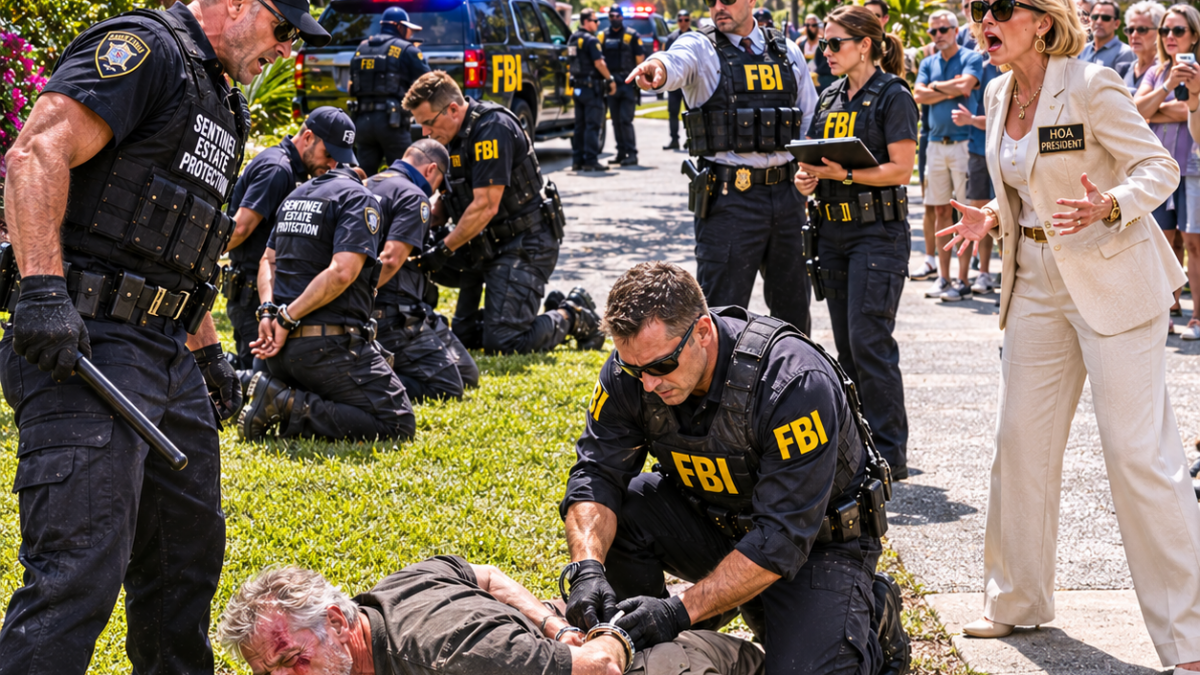
Behind him, three more men were moving up my driveway from a golf cart with a blue strobe light on top.
Their shirts read SENTINEL ESTATE PROTECTION.
One had already drawn a Taser.
The other two held batons.
All four had entered my property after I had clearly told them I did not consent.
My security cameras were recording.
The FBI surveillance van two houses away was recording.
A second surveillance team was positioned outside the subdivision.
And eleven federal agents were already moving.
The man above me did not know any of that.
To him, I was Hayes Tolmage.
Sixty-two.
Retired.
Grandfather.
The difficult homeowner who had accumulated more than sixty-three thousand dollars in HOA fines for landscaping that had not changed since I bought the house.
He did not know I had spent twenty-eight years with the Federal Bureau of Investigation.
He did not know I had retired as Special Agent in Charge of the Tampa Field Office.
He did not know most of my career had involved civil-rights violations, police impersonation, abuse under color of law, and men who believed a badge made violence lawful.
And he had no idea that his employer had been the subject of a federal investigation for months.
“Hands behind your back.”
I stayed on one knee.
“My hands are visible.”
“Behind your back.”
“I do not consent to detention.”
He grabbed my left arm.
My shoulder screamed.
I repeated myself, slowly enough for every microphone to catch it.
“I am not resisting. I do not consent. You do not have lawful authority to detain me.”
The second man raised the Taser.
The leader looked toward him.
“Do it.”
The probes hit me high in the chest.
For a fraction of a second, there was no pain.
Only white.
Then every muscle contracted at once.
I went onto my back.
The Florida sky turned sideways.
The Taser stopped.
I heard my wife scream from inside the house.
Then the leader bent over me with cuffs.
That was when the sound came.
Not a siren.
Not at first.
Tires.
Fast.
Controlled.
The dark blue Explorer came around the curve at the end of Bayou Drive and stopped hard enough to bounce once on its suspension.
Doors opened.
“FBI! HANDS UP!”
Everything changed.
The man holding the cuffs froze.
The Taser hit the grass.
Another baton fell beside it.
Special Agent Dustin Crane came up my driveway with his badge visible and sidearm held low, three agents moving behind him.
“Drop everything. On the ground. Now.”
The Sentinel men looked at each other.
I knew that look.
I had seen it on suspects for thirty years.
The moment when the performance ends and the person realizes the room contains someone with actual authority.
A second vehicle rounded the corner.
Eight more agents.
The four Sentinel men were disarmed and restrained within seconds.
Special Agent Mara Donnelly knelt beside me.
“Hayes?”
“I’m conscious.”
“Chest?”
“Taser.”
“Shoulder?”
“Baton.”
“Head?”
“No.”
She kept one hand behind my back while another agent called paramedics.
Across the yard, Dustin was reading the Sentinel men their rights.
The leader turned his head toward me.
For the first time, there was fear in his face.
Not because I had threatened him.
I hadn’t.
Not because I had fought.
I hadn’t.
Because he finally understood that the uniform he had trusted was a costume.
And real law had just arrived.
Inside the house, my wife Estelle stood behind the glass door with one hand pressed over her mouth.
Our granddaughter May was not there.
That was the one thing I had insisted on.
Fourteen years old.
Freckles.
Tennis racket usually leaning against her bedroom wall.
Her mother had died three years earlier.
May had already lost enough.
She did not need to watch men beat her grandfather in the front yard.
So she was seventy miles away with family in Bradenton.
Safe.
Exactly where she needed to be.
At 8:04 that morning, another FBI team knocked on a house three miles away.
Spencer Vorhees opened the door.
Former Florida Highway Patrol trooper.
Owner of Sentinel Estate Protection.
Husband of Bayou Pines HOA president Carlen Vorhees.
He was arrested on federal charges.
At 8:06, agents entered the HOA office.
Carlen was sitting behind her desk drinking iced coffee.
She had signed the latest enforcement notice herself.
She was arrested too.
By 8:30, dozens of Sentinel personnel and several HOA officials across multiple Florida communities were either detained, arrested, or being interviewed as part of coordinated federal and state actions.
And the reason all of it was happening had not begun with me.
It had begun with an eighty-one-year-old man named Reuben Halverson crying beside his Cadillac because three fake officers had handcuffed him over a car radio.
That was the first case I put into a folder.
By the end, there were twenty-four folders.
And six dead people.
part 2
My name is Hayes Tolmage.
For twenty-eight years, I was a Special Agent with the Federal Bureau of Investigation.
Most of my career involved one subject in one form or another.
Power.
Who has it.
Who thinks they have it.
Who borrows the appearance of it.
And what happens when the person on the receiving end does not know the difference.
I worked civil-rights investigations.
Police impersonation.
Excessive force.
Corrupt public officials.
Law-enforcement officers who forgot restraint was part of the job.
Private citizens who put on uniforms and assumed fear would do the rest.
Some cases were complicated.
Most began simply.
One person with authority.
One person without it.
One moment where somebody decided nobody would ever question them.
I retired in 2022.
The morning after closing my last case, I walked out of the Tampa Field Office without ceremony.
I had already told everyone I didn’t want one.
Camille Mortonson ignored me and put a sheet cake in the conference room anyway.
It said:
TRY NOT TO INVESTIGATE YOUR NEIGHBORS.
Everybody laughed.
I should have taken it as a warning.
Estelle and I moved full-time into Bayou Pines Estates in eastern Manatee County.
Florida palms.
Stucco houses.
Heated lap pool.
Clubhouse.
Landscaped medians.
A gatehouse that existed mostly so visitors could wait behind somebody who had forgotten their access code.
The neighborhood was exactly the kind of quiet I thought I wanted.
Estelle had spent thirty-two years as a pediatric nurse at Sarasota Memorial.
She was sixty.
Patient in ways I had never learned to be.
She made key lime pie every Thursday whether anyone deserved pie or not.
She walked with me at sunrise.
Again near sunset.
We had been married long enough to recognize each other’s silences.
Three years before Sentinel came into our lives, our daughter Annalie died of pancreatic cancer.
Thirty-six.
Too young for any sentence containing the word died.
She had been an art teacher.
Seventh-grade ceramics.
The kind of teacher whose former students still sent photographs of mugs they had made fifteen years earlier.
Her husband Beck worked offshore.
Twenty-eight-day rotations on a Gulf platform.
After Annalie died, their daughter May spent most of her time with us while Beck worked.
May was fourteen when this story reached its worst point.
Smart.
Sarcastic.
More perceptive than adults enjoyed.
She had her mother’s habit of laughing into her sleeve.
Her mother’s ceramic mugs sat along our kitchen windowsill.
I entered retirement wanting exactly three things.
Fish.
Restore a 1972 Jeep Wagoneer.
Drive May to tennis.
That lasted four months.
The first thing Estelle told me about Sentinel came after a pool committee meeting.
She walked into the kitchen.
Put her bag down.
Did not remove her shoes.
That was how I knew something had happened.
“Hayes.”
“What?”
“You know Reuben Halverson?”
“Of course.”
“Three security men pulled him out of his Cadillac at the gate.”
I stared at her.
“For what?”
“His radio.”
I thought I had misheard.
“What?”
“They said it violated the HOA noise rule.”
“Did he threaten them?”
“No.”
“Refuse to identify himself?”
“No.”
“Try to drive through?”
“No.”
“Then why was he out of the car?”
Estelle looked at me.
“They took him out.”
Reuben Halverson was eighty-one.
Retired pipe fitter.
Vietnam veteran.
Walked with a cane after two knee replacements.
I found him that afternoon.
He sat at his kitchen table with both hands around a glass of water.
“They put cuffs on me, Hayes.”
“Did they say police?”
“They said constable.”
“Show me.”
He had photographed the citation.
Sentinel Estate Protection.
Private security.
Uniform patch almost identical in shape and color to a sheriff’s patch.
Badge:
CONSTABLE.
There is no Florida private HOA constable authority.
No private community “constable” office empowered to detain homeowners over stereo volume.
I drove to the front gate.
One Sentinel employee stood near the security cart.
Navy uniform.
Baton.
Taser.
Cuffs.
Badge.
A resident approaching from fifty feet away could easily believe he was public law enforcement.
That mattered.
I went home.
Opened a folder.
Case one:
Reuben Halverson.
Then I called Camille Mortonson.
She had been one of the best agents on my squad.
After I retired, she eventually took over the field office leadership role I had left behind.
“Camille.”
“Hayes.”
“I need an appointment.”
“What did you do?”
“I retired into a problem.”
She laughed.
Then heard my voice.
“Come in Monday.”
I spent six weeks talking to residents.
Not interrogating.
Talking.
Estelle helped.
People trusted her.
Twelve elderly homeowners agreed to speak.
Stopped.
Detained.
Cuffed.
Threatened.
Fined.
Each had believed, at least initially, that Sentinel employees were police.
The fines ranged from hundreds to thousands.
One woman had been told she could be “booked through county processing” if she refused to pay an HOA parking penalty.
No county processing existed.
I brought the first folder to Camille in September 2023.
Twelve incidents.
Photographs.
Citations.
Statements.
Uniform images.
Camille read everything.
Then closed the folder.
“The owner is Spencer Vorhees.”
“You know him?”
“Former Highway Patrol.”
“What happened?”
“Decertified after an excessive-force case.”
“What kind?”
“He stepped on a restrained man’s wrist.”
I sat back.
“Civil case?”
“Settled.”
“Criminal?”
“No.”
“Federal?”
“We looked. Not enough then.”
I pointed at the folder.
“How about now?”
Camille looked at it.
“Bring me everything else.”
So I did.
Fourteen additional incidents.
Then more.
By October, the FBI had a formal predicate.
By December, six agents were working the case.
By February, the investigation had spread beyond Bayou Pines.
Sentinel held contracts at multiple gated communities across Sarasota, Manatee, and DeSoto County areas.
Different HOAs.
Same uniforms.
Same detention style.
Same language.
HOA enforcement presented as if it carried public authority.
Then the financial side appeared.
Sentinel billed associations for special security assessments.
Large amounts.
Millions over several years.
Investigators traced portions through related companies and accounts tied to Spencer and Carlen.
The services billed did not always match the work supposedly performed.
By March, fraud and racketeering theories were no longer speculative.
But Camille had a problem.
Victims were afraid.
Rightfully.
Many were elderly.
Some lived alone.
Several had already been threatened.
One told us:
“I’ll testify after I sell.”
Another:
“I can’t afford for them to come back.”
A third refused even to put her name on a federal statement.
That angered me.
Not at the residents.
At the system Sentinel had created.
Fear strong enough that people would rather surrender rights than describe what had happened.
I went to Camille.
“I’ll testify.”
She stared at me.
“You already are.”
“No. I mean if they target me.”
“Hayes.”
“I’ll refuse the next fine.”
“No.”
“Why?”
“Because you’re retired.”
“So?”
“Because your idea of retirement apparently involves becoming bait in your own civil-rights case.”
I smiled.
She did not.
Eventually, we agreed on something more disciplined.
I would not manufacture a confrontation.
I would not invite force.
I would simply stop paying fines I believed were fabricated and preserve every contact.
If Sentinel chose to escalate, the FBI would document it.
That distinction mattered to both of us.
And to Estelle.
The first fine arrived three weeks later.
$8,500.
Nonconforming landscape elements.
The “nonconforming” plants had been on our property since before we bought it.
Same palms.
Same shell border.
Same beds.
I challenged the fine through normal HOA procedure.
No meaningful response.
Second fine:
$12,400.
Third:
$18,700.
Then daily penalties.
Total above $42,000.
Each notice arrived by hand.
Sentinel employees delivered some in uniform.
Carlen called twice.
“Hayes, I think we can resolve this.”
“How?”
“Come to my office.”
“Send me the basis for the fines.”
“We’ve already done that.”
“No. You’ve sent me numbers.”
She lowered her voice.
“People who cooperate rarely find these things difficult.”
That sentence became evidence.
I wrote it down immediately.
Then Sentinel approached May.
That ended my patience.
She was outside her school after tennis.
Two Sentinel employees pulled up in a marked vehicle.
One called her by name.
“May Marston?”
She turned.
“Tell your grandfather he’s making things difficult for your family.”
Fourteen years old.
Child.
School property.
No legitimate HOA purpose.
May stared at the man.
Then said:
“My grandfather worked for the FBI for twenty-eight years. I think you’re the problem.”
Then she walked directly to her math teacher.
Mrs. Honeycutt.
Nineteen years in the teachers’ union.
Brother who had been a county prosecutor.
Not easily intimidated.
She called me before May did.
I called Camille immediately.
“They approached May.”
Silence.
Then:
“Give me ten minutes.”
By morning, surveillance had intensified.
An unmarked FBI vehicle took position on a cooperating neighbor’s property.
My home-security coverage expanded.
The bureau coordinated with its own legal channels.
May was never used as bait.
That is important.
Nobody asked a fourteen-year-old to participate in an operation.
We briefed her because she lived in the house.
We gave her a safe-room plan.
We gave her a panic alarm.
And when intelligence later suggested Sentinel planned a physical enforcement visit, we moved her out before contact.
The final notice arrived in late May.
Bayou Pines letterhead.
Carlen’s signature.
Total claimed fines:
$63,400.
Then a new sentence.
The HOA supposedly reserved the right to authorize private enforcement personnel to enter property and “effectuate physical compliance.”
I pulled the recorded covenants.
Read them twice.
No such clause.
My attorney, Wyn Castayano, called.
“Carlen signed this?”
“Yes.”
“Then keep it protected.”
“Already scanned.”
“She has just memorialized intent to send private personnel onto your property under authority that does not exist.”
“That’s what I thought.”
“Hayes.”
“Yes?”
“Do not play hero.”
I laughed.
“I’m sixty-two.”
“That is not reassuring.”
The FBI now had reason to believe Sentinel might attempt direct physical enforcement.
At the same time, another piece of evidence arrived.
Theron Aley.
Seventy-six.
Retired federal magistrate judge.
He lived two houses away.
One afternoon he came across my lawn carrying an accordion file.
“Hayes.”
“Theron.”
“I’ve been keeping something.”
That sentence from a retired federal magistrate will ruin your afternoon.
He placed the file on my patio table.
“Six deaths.”
I stared at him.
“What?”
“Sentinel encounters.”
He opened the first file.
Wilburn Hendricks.
Seventy-four.
Retired engineer.
Cardiac arrest after being detained over an unleashed Yorkie.
Witness statement mentioned Taser use.
Autopsy did not.
Medical examiner:
Dr. Garner Vorhees.
Spencer’s brother.
Second case.
Another elderly resident.
Collapsed after detention.
Same medical examiner.
Third.
Same.
Theron had spent two years collecting records.
Not because he had proof of murder.
Because the pattern disturbed him.
He had tried local channels.
Got nowhere.
He feared putting his own family at risk.
Now he handed the material to me.
I called Camille before dinner.
“Get another team.”
She was silent while I summarized.
Then:
“Hayes, if this is real, everything changes.”
“I know.”
“We need independent medical review.”
“Yes.”
“Exhumation orders.”
“Yes.”
“And nobody assumes a homicide until the evidence says homicide.”
“Agreed.”
That is how investigations work when they matter.
You do not leap because the pattern is frightening.
You verify.
Orders were sought.
Medical records preserved.
Witnesses reinterviewed.
The scope expanded again.
At that point, Camille made the decision.
If Sentinel came to my property, the operation would prioritize safety first and evidence second.
Not the other way around.
Nobody was going to allow them to beat me for ninety seconds simply because the camera angle looked better.
The FBI would intervene the moment a clear unlawful physical escalation began.
I agreed.
Estelle insisted.
May was moved out before the expected contact.
On the morning Sentinel arrived, I was working on my Jeep.
That part was real.
I had the hood open.
Fourteen-millimeter wrench.
Sweat already on my back.
No performance needed.
The golf cart pulled in at 8:02.
Four men.
They entered without permission.
I told them to leave.
The lead man announced an HOA enforcement order.
I told him no such authority existed.
He called it an HOA arrest.
I said:
“There is no such thing.”
Then he hit me.
The FBI moved.
That was enough.
No staged suffering.
No need to “earn” the case by taking additional blows.
His choice had already supplied what prosecutors needed.
By noon, the coordinated enforcement actions had spread.
Spencer Vorhees arrested.
Carlen arrested.
Sentinel personnel detained across multiple communities.
Search warrants executed.
Records seized.
The medical-examiner investigation separated into its own track with state and federal involvement.
The FBI did not declare murder because a retired agent had a suspicious folder.
They investigated.
Months later, some of those suspicions became evidence.
Autopsy reviews.
Witness statements.
Medical findings.
Financial connections.
Certain deaths were reclassified.
Others remained less certain.
That distinction mattered to the families.
It mattered to me.
People deserve truth, not emotionally satisfying certainty.
Six weeks after the assault, a public commission hearing took place in Tallahassee.
Hundreds attended.
Residents from multiple affected communities.
Victims.
Families.
Press.
Estelle sat behind me.
May beside her.
Beck had flown in from offshore.
For the first time since Annalie died, all of us sat together in a place where her absence felt physically visible.
One empty seat’s worth.
The Attorney General’s office summarized the cases.
Federal civil-rights charges.
Fraud.
Conspiracy.
Money laundering.
State impersonation statutes.
Licensing violations.
Then the video played.
My driveway.
Sentinel uniform.
My warning.
The baton.
The Taser.
The FBI response.
The room became still.
Not because what happened to me was worse than what happened to the other victims.
Because my case was captured cleanly enough that people finally understood what elderly residents had been describing for years.
When the footage ended, Senator Loretta Pickering asked whether I wanted to speak.
I had not prepared anything.
I stood anyway.
“My name is Hayes Tolmage.”
My voice sounded steady.
“I spent twenty-eight years investigating people who used uniforms to create authority they did not possess or abused authority they actually had.”
I looked toward the gallery.
“Sentinel’s victims are not here because they misunderstood security policy.”
I paused.
“They are here because private actors learned that if a badge looks convincing enough, many decent people will obey before they ask who issued it.”
Then I read six names.
Not all six deaths were ultimately proved criminal.
That distinction would come later.
At the hearing, they were six people whose deaths deserved independent scrutiny.
Wilburn Hendricks.
Julia Cordy.
Marvin Quist.
Beatrice Lindemann.
Hollister Pike.
Dorothea Halpern.
When I sat down, Theron spoke.
His file.
His efforts to get attention.
Missing details.
Witnesses.
Families.
For fourteen minutes, nobody interrupted him.
The regulatory outcome came quickly.
Sentinel lost its ability to operate.
Licensing actions followed.
Attorneys connected to unlawful enforcement language faced professional scrutiny.
The criminal cases took longer.
Much longer.
That is another thing television lies about.
Large conspiracy cases do not end the week after arrest.
Discovery.
Motions.
Experts.
Cooperators.
Plea negotiations.
Trials.
Sentencing.
Years can pass.
Spencer Vorhees eventually received a lengthy federal sentence for civil-rights offenses, conspiracy, racketeering-related conduct, and offenses connected to proved victim harm.
Carlen received a substantial sentence for conspiracy, fraud, and money-laundering conduct.
Dr. Garner Vorhees faced criminal consequences for false official records and obstruction tied to autopsy practices.
Sentinel personnel received sentences ranging widely based on their own conduct.
Some cooperated.
Some did not.
Some had physically assaulted residents.
Others mainly carried out intimidation.
The law distinguished.
It should.
Several HOA officials across affected developments faced criminal or civil consequences where evidence showed knowing participation.
Others resigned or were removed without criminal charges because negligence, cowardice, and bad governance are not automatically felonies.
That distinction made some residents angry.
I understood.
But justice loses legitimacy when punishment outruns proof.
Civil claims produced significant compensation.
Victims and families received restitution and settlement funds.
Sentinel corporate assets and personal assets tied to the scheme were pursued.
A larger fund was eventually created from remaining settlement structures and charitable contributions.
Estelle suggested the name.
Annalie Tolmage Civil Rights Project.
I almost said no.
I did not want our daughter turned into branding.
Estelle understood before I explained.
“This isn’t about branding.”
“What is it about?”
“May.”
I looked at her.
“And every family that doesn’t have someone like Camille to call.”
That settled it.
The project provided legal support to Florida residents facing police impersonation, private-security abuse, unlawful detention, and similar civil-rights problems.
No income test.
Toll-free hotline.
Retired prosecutors.
Civil-rights lawyers.
Former investigators.
Theron joined the board.
So did Camille after leaving government years later.
Wyn joined.
Mara Donnelly joined too.
Estelle insisted there be at least one person on the board who had never worn a badge.
She was right.
The first year produced more calls than we expected.
Some were misunderstandings.
Some were legitimate private-security disputes that belonged in civil court.
Some were frightening.
A few likely prevented serious violence.
I learned something from that.
People are often not looking for someone to storm in and save them.
They want someone to tell them:
This badge is real.
This one isn’t.
This person has authority.
This one doesn’t.
Call here.
Document this.
Do not sign that.
Do not resist physically.
You have options.
Fear shrinks when the map becomes clear.
Bayou Pines changed too.
The HOA reorganized.
New rules.
No private “constable” language.
No security uniforms designed to resemble public police.
No restraints except where legitimate licensed security lawfully acted under circumstances recognized by law.
No HOA-created detention powers.
The new president was Reuben Halverson.
Eighty-one.
The man who had been dragged from his Cadillac over a radio.
His first day in office, he sent me a card.
Hayes,
We are sorry.
We are starting over.
The gate is open.
Come have coffee.
I framed it.
It hangs beside Annalie’s graduation photograph.
Reuben did not become a perfect president.
Nobody does.
Within six months he was already complaining that residents expected him to solve irrigation disputes like a federal judge.
I told him that was leadership.
He told me to go fishing.
I did.
Beck eventually left offshore work.
Too many weeks away from May.
He moved closer.
Heavy-equipment mechanic.
Now he had dinner with her most nights.
May remained with us often.
Families after loss do not always rearrange neatly.
Sometimes a child has more than one home.
That can be okay.
On her fifteenth birthday, she announced at breakfast:
“I think I’m going to law school.”
Estelle looked at me.
I looked at her.
Neither of us encouraged it.
May frowned.
“What?”
“Nothing.”
“You both look horrified.”
“I was hoping you’d become a marine biologist.”
“I hate fish.”
“You eat fish.”
“That isn’t the same thing.”
She stabbed a pancake.
“I want to do civil-rights law.”
My chest tightened.
“Because of this?”
“Partly.”
“That’s not enough reason.”
“I know.”
She looked toward Annalie’s mugs in the window.
“Mom used to tell me if something makes people scared to speak, somebody needs to know how to make them heard.”
That sounded exactly like our daughter.
Estelle reached across and squeezed May’s hand.
I looked down at my coffee.
Retirement finally became smaller again.
The Wagoneer got restored.
Eventually.
It took longer because I discovered that fifty-year-old wiring does not care about federal credentials.
I fish Back Creek.
Estelle and I walk mornings.
Some evenings we pass the gatehouse.
The Sentinel decals are gone.
The old private-security booth was converted into a normal visitor desk.
No batons.
No fake badges.
No CONSTABLE.
Sometimes residents still stop me.
Older people especially.
They want to tell me stories.
A guard once threatened them.
A board member pushed too far.
A contractor claimed authority.
I listen.
Then I ask the same questions.
What happened?
What do you have?
Who witnessed it?
What was said?
What is documented?
Because outrage is a beginning.
Evidence is what allows institutions to move.
That lesson became even more important after the Sentinel case because people started romanticizing what happened at my house.
Some called me brave for allowing the confrontation.
I correct them.
I did not “let” a man hit me as a stunt.
I cooperated with an investigation.
He chose violence.
The FBI intervened.
That is different.
Nobody should put themselves in physical danger hoping a camera will turn abuse into a better case.
The goal is not to become evidence.
The goal is to survive long enough to give it.
I tell people that explicitly.
Call real law enforcement if you’re in immediate danger.
Do not confront armed impersonators if retreat is possible.
Record from safety where lawful.
Preserve documents.
Get names.
License plates.
Video.
Witnesses.
Then let legitimate investigators do their jobs.
I had unusual advantages.
Twenty-eight years of experience.
Connections.
Resources.
A bureau that already had a case.
Most residents do not.
That is why Annalie’s project exists.
The real first hero of the Sentinel investigation was not me anyway.
It was Reuben.
He told Estelle what happened.
Then agreed to let us document it.
The second was every elderly resident who sat at our kitchen table even though they were afraid.
The third was Theron, holding that file for two years until he finally believed someone would listen.
The fourth was Estelle.
Nobody mentions her enough.
She interviewed victims.
Remembered details I missed.
Kept May steady.
Let federal agents turn our retirement home into a surveillance site.
Watched me get hit in the front yard.
Then sat beside me afterward with ice on my shoulder and never once said:
I told you so.
She should have.
One evening after everything ended, we walked Bayou Drive.
Sunset turned the retention pond orange.
I asked:
“Were you scared?”
She laughed.
“Hayes.”
“I mean that morning.”
She stopped.
“Of course I was scared.”
“You didn’t look scared.”
“I was inside the house where nobody could see me.”
I waited.
She looked toward the place in the yard where I had gone down.
“I was not scared they would kill you.”
“That’s reassuring.”
“I was scared you would survive and decide you still had one more case left in you.”
I smiled.
“Fair.”
She took my hand.
“You don’t get to keep volunteering your body as evidence.”
“I didn’t.”
She gave me the look.
“Not another word.”
We kept walking.
That was marriage.
The six deaths remained the hardest part.
Some cases became prosecutable.
Some questions stayed unresolved.
Families wanted certainty the system could not always provide.
That was painful.
Especially for Wilburn Hendricks’s widow, Roslyn.
She had spent two years trying to convince officials that her husband’s death followed a Sentinel detention.
When she finally received an independent finding supporting parts of what witnesses had described, she did not celebrate.
She cried.
“I knew I wasn’t crazy.”
That sentence broke something in me.
Institutions fail people twice when they ignore harm.
First the harm happens.
Then the victim is forced to wonder whether their own memory counts.
The civil-rights project put that sentence on a wall in our intake room.
Not her name.
Just the words.
I knew I wasn’t crazy.
Every lawyer who joins sees it.
Carlen Vorhees became the figure residents remembered most because she was visible.
HOA Karen.
Blonde.
Polished.
Community events.
Holiday committee.
Friendly voice.
But Spencer had built Sentinel.
Carlen helped make it financially and politically possible.
That distinction mattered.
She had not simply been an annoying HOA president.
Evidence showed she participated in a system that billed residents, helped sustain Sentinel contracts, and used association authority to direct enforcement pressure.
She was not punished because she was unpleasant.
She was punished for what prosecutors could prove.
That’s another distinction I care about.
People tell HOA stories and sometimes start believing bad personality is criminal evidence.
It isn’t.
Arrogance isn’t a felony.
Being rude isn’t a conspiracy.
Wearing expensive clothes doesn’t prove corruption.
Records do.
Money transfers do.
Instructions do.
False filings do.
Coordinated conduct does.
When those existed, prosecutors acted.
When they didn’t, they didn’t.
That precision protected the case from becoming what Sentinel always claimed it was:
A vendetta.
It wasn’t.
I never prosecuted anyone.
Camille did not prosecute anyone.
Independent federal prosecutors handled the case.
Judges made rulings.
Juries or plea agreements decided outcomes.
That mattered.
I had spent my career watching people destroy legitimate investigations by making themselves too central.
The Sentinel case was never Hayes Tolmage versus Carlen Vorhees.
It was the United States and the State of Florida examining conduct affecting dozens of people.
I was one witness.
That perspective kept me sane.
May had a harder time with it.
For a while, she hated Carlen personally.
Fourteen-year-old hatred is pure.
No nuance.
She found a photograph of Carlen online once and wrote LIAR across it.
Estelle saw.
She didn’t yell.
She sat beside May.
“Your mother would not want you giving this woman that much room inside you.”
May cried.
“I hate what they did to Grandpa.”
“I do too.”
“They could have killed him.”
“Yes.”
“So why shouldn’t I hate her?”
Estelle thought for a moment.
“Because hatred is rent.”
May looked confused.
“Every day you hate someone, you let them keep a room in your head.”
“That sounds like Grandma philosophy.”
“It is.”
“Is it free?”
“No. You still have to clean your bedroom.”
May laughed through tears.
The photograph disappeared.
Years later, she told me she remembered that conversation more clearly than the arrests.
That gave me hope.
Annalie’s absence slowly changed too.
At first, everything reminded us she was gone.
Then some things began reminding us she had been here.
Her mugs.
May’s laugh.
A pottery bowl.
A photograph.
The Civil Rights Project.
I worried the project would make grief public.
Instead, it gave grief work.
Not a cure.
Work.
Sometimes that is enough.
The first client the project helped was a seventy-three-year-old woman whose gated community contractor had threatened her with “county detention” over unpaid parking assessments.
No police authority existed.
Our lawyers got involved early.
The contractor backed down.
No cuffs.
No confrontation.
No viral video.
Perfect outcome.
I kept that file.
Case one.
Not because it was dramatic.
Because nothing dramatic happened.
Good systems prevent spectacle.
That is what Sentinel never understood.
They needed spectacle.
Uniforms.
Lights.
Batons.
Badges.
Fear.
Real authority does not need most of that.
The older I get, the more suspicious I become of people who need you to see power before they explain it.
A legitimate officer can name the agency.
Show credentials.
Explain authority.
A real warrant has a court.
A real detention has law behind it.
A private HOA rule does not become criminal law because someone laminates it.
A badge does not become public authority because it shines.
A uniform does not become government because the patch looks close enough at a distance.
Those seem like simple truths.
Reuben taught me they are not.
He was eighty-one.
Two tours in Vietnam.
Union pipe fitter.
Not a foolish man.
Three men surrounded his car wearing what looked like police uniforms.
He believed them.
Most people would.
That is why impersonation is dangerous.
It weaponizes society’s willingness to cooperate with lawful authority.
Sentinel understood that.
They profited from the hesitation before doubt.
The moment when an elderly person thinks:
Maybe I should just do what they say.
That is where the crime lived.
Not in the fabric.
In the trust.
The day Sentinel’s license was permanently revoked, Theron and I sat outside the Tallahassee chamber.
He looked exhausted.
“You know what I keep thinking?”
“What?”
“If I’d sent that letter in 2022.”
I understood immediately.
“Don’t.”
“Hayes—”
“Don’t.”
“Somebody might still be alive.”
“Maybe.”
He looked at me.
“That isn’t comforting.”
“It isn’t supposed to be.”
I put a hand on his shoulder.
“You acted when you believed you could protect the evidence and your family.”
“I waited.”
“Yes.”
“So did they.”
That one hurt.
We sat quietly.
Eventually I said:
“Regret can make you believe the alternative timeline is a fact.”
Theron looked at me.
“That sounds like something a judge would say.”
“Probably why I stole it from one.”
He laughed once.
“Who?”
“You.”
He shook his head.
That was the closest either of us came to forgiving ourselves for the cases that arrived too late.
Spencer’s sentencing drew cameras.
Carlen’s did too.
I attended neither.
People were surprised.
I had no desire to watch.
Sentencing is for the court.
Not revenge.
I read the transcripts later.
Spencer apologized.
Maybe sincerely.
Maybe strategically.
I don’t know.
Carlen said she had convinced herself every special assessment and enforcement expansion was necessary to protect property values and safety.
Then at some point, she said, she stopped distinguishing between protecting the community and protecting the system she and Spencer had built.
That sentence sounded true.
It did not erase anything.
But truth after wrongdoing still matters.
Reuben became a strange HOA president.
He refused to wear a blazer.
Meetings started late because he talked to everybody in the parking lot.
He published every contract.
Every security invoice.
Every legal bill.
Every fine.
Residents complained about information overload.
He told them:
“Good.”
One resident asked why the association needed to post the security company’s licensing information every year.
Reuben answered:
“Because I got dragged out of a Cadillac by men whose badges were fake.”
Nobody asked again.
Bayou Pines became boring.
That is the highest compliment I can give an HOA.
Pool maintenance.
Irrigation.
Roof standards.
Reserve studies.
No fake constables.
No tactical carts.
No elderly people in handcuffs.
Boring is success.
I finally finished the Wagoneer restoration in March.
Dark green.
Wood trim.
Carburetor rebuilt twice because I refused to admit I had adjusted it wrong the first time.
May sat in the passenger seat for the first drive.
“You know this thing has no useful safety features.”
“It has seat belts.”
“Those are not impressive anymore.”
“You’re very critical for someone getting a free ride.”
She looked at me.
“Mom would’ve loved this.”
My throat tightened.
“Yes.”
We drove toward Myakka.
Windows down.
No destination.
At a red light, she said:
“Grandpa?”
“Yeah?”
“If I become a lawyer, do I have to wear ugly suits?”
“That depends.”
“On what?”
“How good you are.”
“That makes no sense.”
“Exactly.”
She rolled her eyes.
Annalie used to do the same thing.
For a second, the car contained three generations.
That was enough.
Sometimes people ask whether I miss the FBI.
I miss people.
I miss Camille.
I miss the work on good days.
I do not miss believing every phone call after midnight might change someone else’s life.
The Sentinel case taught me that retirement does not mean immunity from responsibility.
It also taught me responsibility does not require returning to the job.
The Civil Rights Project carries work I no longer need to carry alone.
That matters.
One afternoon, a caller reached our hotline.
Eighty-four-year-old man.
Private community in central Florida.
A security officer had threatened arrest over landscaping fines.
The intake lawyer asked whether the guard had physically touched him.
“No.”
“Did he show a government badge?”
“No.”
“Did he claim police authority?”
“He said the HOA could have me detained.”
The lawyer contacted the association.
Sent state-law guidance.
Requested written confirmation of the security company’s authority.
The association backed down within forty-eight hours.
Nobody went to jail.
Nobody got hit.
Nobody needed an FBI surveillance van.
That case made me happier than Spencer’s sentence.
Because a person stayed safe.
That is what justice looks like after you’ve seen enough spectacle.
Prevention.
The morning of my sixty-fifth birthday, Estelle and I walked at sunrise.
We passed the spot in the yard where Sentinel hit me.
Grass looked normal.
No scar in the ground.
My shoulder still ached sometimes in cold weather.
Florida cold, which means sixty degrees and everyone acts betrayed.
Estelle pointed toward the lawn.
“Do you remember?”
“Unfortunately.”
She squeezed my hand.
“What do you remember first?”
I thought.
“Your face.”
She looked surprised.
“You were behind the window.”
“I know.”
“You looked furious.”
“I was.”
“Not scared?”
“Both.”
We walked a few more steps.
“What do you remember?”
She answered immediately.
“The second before the agents turned the corner.”
“Why?”
“Because I didn’t know they would make it in time.”
That stopped me.
All those months, I had remembered the arrival.
She remembered the waiting.
Ninety seconds from the kitchen must have felt different.
I kissed her forehead.
“Sorry.”
“For what?”
“For making you wait.”
She nodded.
“Accepted.”
That was Estelle.
No performance.
No wasted words.
May eventually stopped calling Sentinel “fake cops.”
She called them impersonators.
More precise.
I liked that.
Language matters.
Fake cops sounds almost childish.
Impersonating law enforcement is criminal conduct with victims.
HOA abuse sounds like petty rule disputes until somebody is restrained.
Security overreach sounds administrative until an eighty-one-year-old man cries in his driveway.
Words can shrink harm.
They can enlarge it too.
That is why we trained the project’s intake lawyers to describe facts before labels.
What did the person wear?
What did they say?
What authority did they claim?
What did they do?
Who hired them?
What was documented?
Let the law supply the label later.
The Sentinel files still exist.
Boxes now.
Digital archives.
Thousands of pages.
Sometimes universities ask for access for research after privacy review.
I support that.
People should understand how systems drift.
Sentinel did not become abusive overnight.
First, uniforms became more official-looking.
Then badges.
Then stronger language.
Then restraints.
Then detentions.
Then violence.
HOA boards accepted it because residents complied.
Residents complied because Sentinel looked official.
Money grew.
Authority grew.
Fear grew.
Every successful bluff became justification for the next one.
That progression is worth studying because it happens elsewhere.
Not always with HOAs.
Anywhere appearance substitutes for lawful authority.
The first question should always be:
What gives you the right to do this?
Not shouted.
Not defiantly if you’re unsafe.
Asked.
Documented.
Verified.
The answer matters.
Carlen never had a good one.
Neither did Spencer.
They had contracts.
Money.
Uniforms.
Board resolutions.
None of those created the public authority they implied.
That was the center of the case.
Not that private security is inherently wrong.
It isn’t.
Private security performs legitimate work every day.
The problem was deception.
Force.
Unlawful detention.
And systems designed to make people believe resistance itself was illegal.
That is different.
On the anniversary of Annalie’s death, we do not hold a fundraiser.
We do not make speeches.
Estelle bakes pie.
Beck comes over.
May usually brings flowers.
We sit together.
That is enough.
The project bearing Annalie’s name operates the rest of the year.
I once worried she would hate having her name attached to something so serious.
Estelle disagreed.
“She taught middle school.”
“So?”
“She spent her life defending children from systems they didn’t understand.”
Fair point.
May agrees with her grandmother.
Always dangerous.
The Annalie Tolmage Civil Rights Project has outgrown us now.
That is good.
Organizations should not depend forever on the people who started them.
We built governance.
Audits.
Outside counsel.
No family control.
No “Hayes knows best.”
I insisted.
After Sentinel, the last thing I wanted was an organization named after my daughter becoming another place where one person’s certainty replaced process.
Power needs fences too.
Especially good power.
Maybe that is the final lesson.
I spent decades investigating people who believed authority was proof of virtue.
It is not.
Government authority can be abused.
Private authority can be abused.
HOA authority can be abused.
Federal authority can be abused.
The answer is not no authority.
The answer is lawful authority with limits.
Records.
Oversight.
Appeal.
Transparency.
Consequences.
I used to think retirement meant I would finally stop thinking in those terms.
Then Reuben cried in his Cadillac.
Then Theron opened his file.
Then Sentinel came up my driveway.
Some lessons follow you home.
The difference now is I don’t carry them alone.
Camille carried part.
Theron carried part.
Estelle carried more than anyone.
May carries something forward I wish she didn’t have to carry, but she does it with more grace than I had at fourteen.
Reuben carries his through every boring HOA meeting.
Roslyn Hendricks carries her husband’s name into rooms where nobody used to listen.
That is how institutions change.
Not one hero.
Enough people refusing silence at the same time.
The morning after the Sentinel arrests, May came home.
She ran from Beck’s truck before it stopped fully.
I was standing on the porch with my arm in a sling.
She reached me.
Stopped.
Looked at the bruises.
Then punched me lightly in the good shoulder.
“Ow.”
“You’re stupid.”
“Fair.”
“Grandma said you’re okay.”
“I am.”
“She also said you aren’t allowed to do that again.”
“Apparently.”
May hugged me.
Hard.
Then whispered:
“Did we get them?”
I held her.
“No.”
She pulled back.
“What?”
“The evidence got them.”
She frowned.
“That sounds like an old FBI answer.”
“It is.”
“Did it work?”
“Yes.”
“Then fine.”
We went inside.
Her mother’s mugs were still on the windowsill.
Estelle had made key lime pie.
Outside, the Sentinel golf cart was gone.
The street looked ordinary again.
That is the image I prefer.
Not the takedown.
Not the arrests.
Not the hearing.
My granddaughter eating pie in a kitchen where nobody in a fake uniform would ever again tell her that fear was the same thing as law.
Years later, when people ask what I remember most about the morning four men came up my driveway, they expect me to say the baton.
Or the Taser.
Or eleven FBI agents moving in.
I remember something else.
The second before the first man swung.
I had told him clearly:
You do not have authority to do this.
He knew I had challenged the thing holding his entire role together.
Not his baton.
Not his badge.
The belief that nobody would ask.
He swung because questions are dangerous to people whose power depends on appearance.
That is why I still tell people to document.
Not because every dispute becomes federal.
Most won’t.
Not because every HOA is corrupt.
Most aren’t.
But because rights are easier to defend when facts survive the moment.
Photograph.
Save.
Write it down.
Get the report number.
Keep the email.
Ask who issued the order.
Verify the license.
Then let real institutions work.
The law is often slower than anger.
Slower than fear.
Slower than the story you wish would happen.
But when it has evidence, it can become very difficult to stop.
Sentinel spent years hiding behind uniforms.
Carlen spent years hiding behind board authority.
Spencer hid money behind companies and contracts.
Garner hid questions inside official autopsy language.
None of it stayed hidden forever.
Not because one retired agent was tougher than all of them.
Because enough people kept records.
Reuben.
Theron.
Roslyn.
Estelle.
Victims whose names never reached television.
Agents.
Prosecutors.
Medical experts.
Accountants.
Neighbors.
The truth was distributed among them.
The case succeeded when those pieces finally met.
These days, I drive May to tennis in the restored Wagoneer.
She complains about the air conditioning.
I tell her windows are air conditioning.
She tells me I am ancient.
Estelle makes pie.
Beck comes for breakfast.
Bayou Pines argues about pool furniture.
Reuben sends HOA meeting agendas too long for anyone to enjoy.
My life is small again.
The way I wanted.
And every morning when I walk past the place in the yard where the baton knocked me down, I think about Reuben Halverson.
Eighty-one.
Handcuffed beside his Cadillac because his radio was too loud.
He was the beginning.
Not me.
If he had stayed silent, maybe Sentinel would have continued longer.
If Estelle had dismissed his story, maybe I would never have opened that first folder.
If Camille had said private security was not an FBI matter, maybe Theron would still be holding six death files alone.
That is how close systems come to failing completely.
One person choosing not to listen.
And that is how they recover.
One person deciding to.
The last document in my office is not a warrant.
Not a federal indictment.
Not a photograph of Spencer Vorhees in handcuffs.
It is Reuben’s card.
We are sorry.
We are starting over.
The gate is open.
Come for coffee.
I keep it next to Annalie.
Because after all the arrests, money, hearings, and years of investigation, that is what justice was supposed to make possible.
An open gate.
A safe street.
A grandfather driving his granddaughter to tennis.
A retired nurse baking pie.
And a neighborhood finally understanding that no amount of stitched-on fabric, flashing lights, or invented titles can turn private intimidation into lawful authority.
Uniforms can imitate power.
Fear can imitate obedience.
But neither can imitate the law forever.








