HOA Karen Sent Fake Cops to My Door Over a Flag and a Vegetable Garden—Then My Wife Pulled Into the Driveway With a Federal Badge
part 2
Three months earlier, I thought Delilah and I had found exactly what we wanted.
Milbrook Estates sat outside Denver far enough that the streets became quiet at night but close enough that Delilah could still reach her office without spending half her life commuting.
I had retired from the Army after twenty-four years.
Logistics.
Supply.
Transportation.
Procurement coordination.
Contingency planning.
Not glamorous, but I loved it.
My work was basically the art of preventing small administrative mistakes from becoming large operational disasters.
Retirement gave me different problems.
A garage workshop.
Raised garden beds.
An old pickup.
A grill.
A lawn I could mow without receiving a briefing first.
For the first few weeks, mornings felt almost unreal.
Coffee brewing in the kitchen.
Delilah’s boots crossing the hardwood floor while she got ready for work.
The garage smelling like pine after I ran boards through the planer.
Nobody calling about delayed shipments.
Nobody asking where twelve pallets had gone.
Then Vivian Blackwood appeared.
Third Tuesday after we moved in.
Clipboard.
White BMW.
Perfect blonde bob.
Navy blazer despite the heat.
She looked at my property the way a general inspects troops after already deciding somebody will fail.
“Mr. Dakota.”
“Mrs. Blackwood.”
“Vivian.”
“Marcus.”
She glanced toward my backyard.
“I’m afraid we need to discuss compliance.”
I had built three raised vegetable beds.
Cedar planks.
Level.
Neat.
Mulched around the edges.
Tomatoes.
Peppers.
Herbs.
Nothing visible from the street except the upper edges from one angle.
Vivian handed me a notice.
UNAUTHORIZED EXTERIOR STRUCTURES — $500.
I read it.
“What covenant?”
“Aesthetic consistency.”
“Which section?”
“You’ll find it in your governing documents.”
“I’ve read them.”
Her smile tightened.
“Then you’ll understand the importance of maintaining standards.”
I looked at the garden.
“You’re fining me five hundred dollars over tomatoes.”
“I’m fining you for unauthorized structures.”
Then she lowered her voice.
“If unresolved, violations can escalate.”
“How?”
“Additional fines. Collection. Potential lien consequences.”
There it was.
Lien.
The word HOA presidents love when they want ordinary disagreements to sound like foreclosure notices.
I thanked her.
She looked disappointed.
Probably expected an argument.
I went inside.
Read the declaration again.
Then the bylaws.
Then architectural guidelines.
The beds occupied a gray area at worst.
So I filed a dispute.
That should have been boring.
Instead, three days later I received another violation.
EXCESSIVE PATRIOTIC DISPLAY.
My offense was the American flag hanging near the front porch.
Standard dimensions.
Properly mounted.
Nothing unusual.
That made me start looking at other houses.
Seventeen American flags in Milbrook.
One larger than mine.
None had notices.
I asked around.
The Johnsons had received a similar flag violation.
Mr. Johnson was retired Air Force.
The Garcias had been repeatedly cited for landscaping despite keeping one of the best yards in the subdivision.
Mrs. Patterson, an elderly widow, had received warnings over a bird feeder supposedly attracting nuisance wildlife.
Meanwhile, two households friendly with Vivian parked boats in driveways despite clear restrictions.
Selective enforcement is difficult to prove from three anecdotes.
But patterns start somewhere.
That evening, Delilah read my notices.
She set the papers on the kitchen table.
“She either hasn’t read her own rules or she assumes you won’t challenge them.”
“Probably both.”
“Document everything.”
I smiled.
“Married to a marshal long enough and that’s your answer to everything.”
“Because it works.”
She was right.
So I started a binder.
Every notice.
Every email.
Photographs.
Dates.
Comparable houses.
Meeting records.
I also requested HOA minutes and financial documents through the procedures available to members.
Vivian’s response came three days later.
Instead of answering the substance of my request, she sent a letter warning that my property could become subject to enhanced inspections.
Then came the sentence that got my attention.
The association maintains strong relationships with local enforcement resources and will not hesitate to use all available measures.
I read it twice.
Not illegal by itself.
But strange.
Why would an HOA president invoke law-enforcement contacts over vegetables?
I asked neighbors.
Mrs. Patterson leaned across her fence.
“She’s done that before.”
“What?”
“Talked about police.”
“With who?”
“The Bakers. Parking dispute.”
I wrote it down.
The next escalation was an emergency board meeting concerning the “Dakota property.”
I wasn’t notified.
Mrs. Patterson told me while I was working outside.
“They came by asking whether you’ve caused noise problems.”
I stopped tightening a garden-bed bracket.
“Who?”
“One of Vivian’s people.”
“What did you say?”
“That you’ve been the best neighbor we’ve had in years.”
I smiled.
“Thank you.”
Then she leaned closer.
“She’s trying to build something against you.”
That was exactly what it looked like.
I didn’t storm into the meeting.
Twenty-four years in logistics taught me that angry people frequently provide information voluntarily if you allow them to think you’re behind.
Instead, I started examining the HOA’s finances.
One vendor kept appearing.
Milbrook Property Management Solutions.
Payments for:
Compliance consulting.
Property monitoring.
Special inspections.
Enhanced enforcement.
Nearly $15,000 initially visible in summaries.
I searched Colorado business records.
No obvious company matching the name.
No proper website.
No normal business footprint.
Then, one Wednesday night, I found a note under my windshield wiper.
White paper.
Block letters.
SOME NEIGHBORS DON’T BELONG HERE.
I photographed it.
Front and back.
Bagged it.
Recorded the date.
Then installed additional cameras.
Visible.
Lawful.
Covering my own entrances.
The board meeting went forward without me.
The next morning, Mrs. Patterson handed me a handwritten summary.
Four directors present.
My original violations upheld.
Another added:
FAILURE TO MAINTAIN COMMUNITY LANDSCAPE AESTHETICS.
Then:
ENHANCED COMPLIANCE MONITORING AUTHORIZED.
That phrase would come back later.
Monday morning, a man named Dave Morrison appeared at my door.
Polo.
Khakis.
Clipboard.
“Milbrook Property Management Solutions.”
That got my attention.
He said he had come to inspect my backyard structures.
“Show me your company credentials.”
He shifted.
“I work directly with Mrs. Blackwood.”
“Business license?”
“I don’t carry that.”
“Insurance certificate?”
“Not with me.”
“Contract showing authority to enter my property?”
His confidence slipped.
“I’ll need to speak with Mrs. Blackwood.”
“Good idea.”
He left.
The phone number he gave me eventually led not to a property-management company, but to a private security operation called Mile High Security Services.
Now the invoices looked different.
The HOA had apparently been describing security-related work as property-management consulting.
I requested detailed contracts.
Payment authorizations.
Meeting minutes.
Insurance records.
Vendor records.
Vivian answered through an attorney this time.
My request was supposedly too broad.
They offered summaries.
I wanted source documents.
After formal follow-up, the records eventually arrived.
A large box.
Three years.
Invoices.
Checks.
Meeting records.
Vendor authorizations.
By the time I finished sorting everything, the number associated with Mile High-related work was closer to $23,000.
The invoices said:
PROPERTY COMPLIANCE CONSULTING.
The service reports used different language.
ENFORCEMENT PRESENCE.
RESIDENT CONTACT.
COMPLIANCE INTERVENTION.
SECURITY RESPONSE.
That didn’t automatically equal fraud.
But it raised obvious questions about what the board thought it was buying.
Then I found about $8,000 in “emergency landscaping” charges I couldn’t match to any visible emergency landscaping project.
I stopped.
Recalculated.
Checked dates.
The more I looked, the less comfortable I became.
I did not announce that Vivian was embezzling.
That word requires evidence.
I did something more effective.
I showed homeowners the records.
Actual records.
The Johnsons.
Garcias.
Mrs. Patterson.
Several others.
“Here is what was paid.”
“Here is what the invoice says.”
“Here is the board authorization I can find.”
“Here is where I can’t match one to the other.”
People started asking their own questions.
Vivian responded by calling a neighborhood security meeting.
Her flyer warned about increasing crime, declining standards, and hostile residents undermining community safety.
Delilah read it over breakfast.
“She is turning your records request into a security threat.”
“Apparently spreadsheets are dangerous.”
“Only when people read them.”
The meeting was packed.
Vivian stood at the front in pearls and a navy blazer.
For fifteen minutes, she talked about safety.
Community values.
Aggressive homeowners.
Disruptive challenges to authority.
She never said my name.
She kept looking at me.
Finally, she said:
“Some residents seem more interested in making accusations than maintaining basic community standards.”
I stood.
“Since you brought up accusations, can we discuss the financial records?”
Her expression tightened.
“This is not the appropriate forum.”
“You called a meeting about community security.”
I opened my folder.
“The HOA paid roughly twenty-three thousand dollars to Mile High Security-related services over the last two years under descriptions including property-management consulting.”
People started whispering.
I continued.
“I have invoices and incident reports that don’t describe the work the same way.”
Vivian raised her voice.
“Those are authorized compliance services.”
“Then the board should be able to show the authorization.”
A homeowner asked:
“Twenty-three thousand for what?”
Another:
“Why were we told it was property management?”
Mr. Johnson spoke about the flag violation.
Mrs. Garcia mentioned her landscaping notices.
Then Roland Blackwood stood from the back.
Vivian’s husband.
“Vivian.”
She turned.
“Not now.”
“Yes. Now.”
The room quieted.
Roland looked uncomfortable.
“I’ve told you for months the liability is getting out of control.”
Vivian stared at him.
He continued.
“People are entitled to know what the association is spending.”
“Sit down.”
“No.”
That was the first time I saw the neighborhood realize Vivian’s control wasn’t as absolute as it looked.
Questions multiplied.
She eventually closed the meeting abruptly.
“This meeting is over.”
Then she left.
The following morning, Delilah told me something I did not expect.
Not because she had casually searched federal systems for my HOA opponent.
That would have been improper.
The name had reached her task force through a legitimate referral generated by information from the vendor and financial review that had gone to appropriate authorities.
When Vivian Blackwood’s identity was checked against federal fugitive records, an old warrant surfaced.
Different state.
Different address.
Different chapter of her life.
Financial crimes.
Tax-related fraud.
Business income concealed through property-management entities.
A real federal warrant had been active for years.
Delilah did not show me investigative details.
She told me only what she was permitted to tell me.
“Stay out of that part.”
“I wasn’t planning to arrest her.”
“Marcus.”
“Kidding.”
“This matters.”
“I know.”
She contacted her chain of command.
The warrant was verified.
Task-force coordination began.
That became important because I wanted no part of Vivian later claiming my HOA dispute had somehow manufactured her arrest.
Her warrant existed before she ever met me.
The paperwork existed.
The federal case existed.
Our tomatoes did not create it.
Meanwhile, Vivian escalated.
Certified letters.
More fines.
Threats of liens.
Then fake inspections.
The first man wore a hard hat and orange vest.
“City building inspector.”
He started measuring my fence.
“Identification?”
“I don’t need to show you identification.”
That alone told me almost everything.
I called the city planning department while he stood there.
No inspector dispatched.
No active inspection at my address.
When he heard that, he left.
My cameras captured his face and license plate.
The Johnsons later reported a “county health inspector” asking about compost they didn’t have.
The Garcias received a visit from someone claiming code enforcement authority over a fully permitted shed.
That changed the pattern.
Private security was one thing.
People falsely claiming government authority were another.
We documented.
The neighbors documented.
Reports went to local authorities.
Then Mrs. Patterson appeared with an envelope Roland had quietly given her.
Email correspondence.
Vivian to Mile High.
Previous approaches insufficient. Need more authoritative presence.
Mile High replied:
Enhanced services available. Uniformed presence. Official documentation.
Another line referenced full authority presentation.
I looked at Delilah.
“That sounds bad.”
“It sounds like something investigators need to see, not something you need to interpret publicly.”
So we sent it where it belonged.
Monday morning, somebody calling herself Sarah Mitchell from a legal-services company offered me $5,000 toward moving expenses if I would leave Milbrook.
“Vivian is offering me money to move?”
“She is offering an amicable resolution.”
“I own my house.”
“Continuing these disputes could become expensive.”
There it was.
Not quite an explicit threat.
Close enough to document carefully.
I declined.
Then came 2:15.
Three men.
Tactical gear.
Fake badges.
Fake HOA “warrant.”
My front door.
And Delilah arriving in the middle of it.
Local officers pulled in seconds after Vivian.
Delilah kept everyone where they were while the responding sergeant took control of the impersonation complaint.
That distinction mattered.
The three men had claimed they were police.
Local authorities investigated that.
Delilah’s federal role did not magically convert every false local badge into a federal offense.
But Vivian had another problem.
A properly verified federal arrest warrant.
A task-force supervisor arrived.
Identity was confirmed.
The warrant was confirmed.
Then Vivian was taken into federal custody.
Not because she fined me over vegetables.
Not because she disliked my flag.
Not because Delilah was my wife.
Because an existing warrant authorized it.
The contractors were separately detained and questioned by local law enforcement concerning the fake-police incident and related complaints.
The neighborhood gathered.
Of course they did.
Phones came out.
Mrs. Patterson stood on the lawn next door with both hands over her mouth.
Roland arrived later.
He didn’t look shocked.
He looked exhausted.
Vivian stood beside the federal vehicle while Delilah and another deputy handled the arrest process.
For once, she wasn’t giving orders.
Then a local reporter arrived.
I had known a journalist from my Army public-affairs days and had previously told her there were documented HOA financial questions worth examining, but I had never given her arrest timing because I didn’t know it.
News travels fast when police vehicles fill a suburban street.
She asked me what happened.
I kept it simple.
“Three men came to my home claiming police authority and demanding entry under what appears to be an HOA-generated document. Local officers are investigating that incident. Mrs. Blackwood’s federal matter is separate.”
That sentence mattered.
Separate.
The neighborhood wanted one giant story.
Reality had several.
The HOA governance dispute.
Vendor-payment questions.
Fake inspection complaints.
Impersonation allegations.
Vivian’s preexisting federal warrant.
Some connected.
Some merely colliding.
Investigators had to prove which was which.
That took months.
The HOA board met three days later.
Vivian’s chair was empty.
Roland attended but didn’t sit at the board table.
Mrs. Patterson spoke first.
“We need to stop pretending this is one difficult homeowner arguing with one difficult president.”
Nobody disagreed.
The board suspended all enhanced enforcement activity.
Mile High’s contract was terminated pending review.
An independent accountant was retained.
Outside counsel reviewed years of fines and vendor authorizations.
Every homeowner received notice that disputed violations from Vivian’s tenure could be reexamined.
The garden-bed fine disappeared.
So did my flag citation.
The Johnsons’ flag notice was rescinded.
Mrs. Garcia’s selective landscaping penalties were reviewed and largely withdrawn.
Mrs. Patterson immediately rehung the bird feeder.
“Rebellion,” she told me.
“Careful.”
“I’ve changed.”
“You’re seventy-two.”
“Exactly. Nothing left to lose.”
The independent audit found serious problems.
Some were bad governance.
Some were misleading accounting descriptions.
Some transactions required further investigation.
The $23,000 in security-related services had not been presented to homeowners in a way that clearly reflected the actual enforcement work performed.
The phantom landscaping charges produced additional questions.
Investigators later tied portions of the financial misconduct to Vivian and entities associated with the same broader pattern as her earlier fraud case.
Not every ugly invoice became a crime.
But enough transactions were supported by records, testimony, and financial tracing to become part of the larger case.
Roland cooperated.
That surprised many people.
It didn’t surprise me.
He looked like a man who had been living with a storm for years.
He turned over records.
Emails.
Account information.
Documents involving Vivian’s prior business activities.
Some HOA funds were eventually recovered through insurance, restitution, and asset recovery.
The total credited back to Milbrook ended up around $31,000 when everything was resolved.
That money did not magically make the neighborhood whole.
Trust takes longer.
The three security contractors faced consequences separately.
Two entered pleas to state charges connected to impersonating peace officers and unlawful entry-related conduct.
The third cooperated extensively and received a lesser disposition.
Their company lost the HOA contract and later ceased operating under the same enforcement model.
Vivian’s federal case was more serious.
The old warrant tied into a larger financial investigation involving concealed income, fraudulent deductions, shell entities, and property-management money.
Her Milbrook transactions created additional evidence.
After prolonged proceedings, she ultimately received an eight-year federal sentence on the combined financial case and was ordered to pay restitution.
Some local conduct remained part of separate resolutions.
That outcome took far longer than one dramatic afternoon in a driveway.
But the driveway was where Vivian lost control of the narrative.
She had spent years depending on appearances.
Official-looking letters.
Official-looking vendors.
Official-looking inspectors.
Official-looking uniforms.
Then three men wearing official-looking badges stood at my front door and met somebody carrying a real federal credential.
The difference wasn’t the shine of the badge.
It was the authority behind it.
Two weeks after Vivian’s arrest, Milbrook held an emergency election.
Mrs. Patterson ran for president.
I thought she was joking.
She wasn’t.
She won.
Mr. Johnson joined the board.
Mrs. Garcia joined too.
Their first meeting was one of the most satisfying boring meetings I had ever attended.
Mrs. Patterson sat at the front.
No pearls.
No theatrical binder.
Just reading glasses and a yellow legal pad.
“First item,” she said. “Vendor transparency.”
Every significant vendor contract now required full board approval.
No more vague consulting labels.
Invoices had to match contracted services.
Conflicts had to be disclosed.
Homeowners gained clearer access to financial records.
Enforcement procedures were rewritten.
Security personnel could not present themselves as government officers.
No contractor could enter private property merely because an HOA employee printed an authorization.
Any inspection beyond what governing documents clearly allowed required consent or proper legal process.
I raised my hand.
Mrs. Patterson looked at me.
“Yes, Marcus?”
“Can we put in writing that an HOA cannot issue criminal warrants?”
The room laughed.
She did not.
She wrote it down.
“I’m serious.”
“I know.”
Then she added language requiring legal review before any document used terms like warrant, seizure, government inspection, or law-enforcement action.
Good rule.
The board also created a modest community assistance program using a portion of recovered funds and ordinary budget allocations.
Not some grand veterans-only political project.
Something practical.
Emergency accessibility repairs.
Temporary help for elderly homeowners.
Small maintenance grants where safety was involved.
The first recipient was a disabled veteran who needed a safer front ramp.
The second was Mrs. Patterson herself after a storm damaged part of her roof.
She argued against taking the money.
The board voted without her.
I enjoyed that enormously.
Six months after Vivian disappeared from Milbrook, the neighborhood felt different.
The flags were still there.
So were my garden beds.
My tomatoes had survived the HOA crisis better than most of us.
Children rode bicycles down the street.
People actually stayed outside talking after sunset.
The security cameras I installed during the worst weeks remained.
Mostly they recorded package deliveries, squirrels, and Frank Garcia stealing tomatoes after I repeatedly told him he could simply ask.
Property values eventually improved too, although I never credited that to some magical twelve-percent surge caused by Vivian’s arrest.
Markets are more complicated than neighborhood revenge stories.
What did improve measurably was turnover.
Fewer residents wanted out.
More people attended meetings.
Financial statements were actually read.
That mattered more to me.
One Saturday, Roland knocked on my door.
I hadn’t seen him since the legal proceedings intensified.
He looked tired.
“Marcus.”
“Roland.”
“I owe you something.”
“You don’t.”
“Let me finish.”
I stepped outside.
He looked toward the garden.
“She hated those.”
“I know.”
“I never understood why.”
“Control.”
He nodded.
“Probably.”
Then he handed me an envelope.
Inside were copies of emails Vivian had written months before the fake-inspector campaign.
One line stood out.
Dakota is dangerous because he keeps asking for source documents. Stop giving him room to build a narrative.
I read it twice.
“She thought asking for invoices was dangerous.”
Roland looked at me.
“She thought questions were attacks.”
That sentence explained everything.
People who understand legitimate authority don’t fear questions.
They answer them.
Show the covenant.
Show the vote.
Show the invoice.
Show the permit.
Vivian’s power depended on nobody asking to see what supported it.
Once people did, she escalated.
More notices.
More threats.
Security contractors.
Fake inspectors.
Fake police.
Every escalation was an attempt to replace legitimacy with intimidation.
Eventually, intimidation became impossible to separate from evidence.
Roland looked toward my flag.
“I tried to get her to stop.”
“I know.”
“Not hard enough.”
I didn’t disagree.
He swallowed.
“That part is mine.”
Accountability isn’t always dramatic.
Sometimes it’s a man admitting he stayed quiet too long.
I shook his hand.
“Take care of yourself.”
He moved out several weeks later.
The next owner removed Vivian’s old landscaping and painted the front door blue.
Mrs. Patterson received three anonymous complaints about the color.
She brought them to the board.
Read the architectural guidelines.
Then announced:
“Blue is allowed.”
Meeting over.
I almost applauded.
About a year after everything happened, Delilah and I sat on the back deck eating burgers.
Same place I had been when the fake cops first came.
My raised beds were overflowing.
Delilah looked toward the security camera.
“You know you still check that thing every time a strange car slows down.”
“I do not.”
“You absolutely do.”
“Professional habit.”
“You are retired.”
“Former professional habit.”
She smiled.
Then became quiet.
“You ever think about how bad that day could’ve gone?”
I did.
Three armed men.
Fake authority.
Angry homeowner.
Closed door.
One misunderstanding.
One person reaching too quickly.
One weapon handled badly.
That was the part people skipped when retelling the story.
They liked the image of fake cops freezing when a federal marshal arrived.
The real lesson was how dangerous pretending to be law enforcement can become.
People make life-or-death decisions based on uniforms.
Badges.
Commands.
Words like police and warrant.
Impersonation isn’t funny when everyone involved may believe the next movement carries legal force.
“I think about it,” I said.
Delilah nodded.
“So do I.”
“What would you have done if they ran?”
“Let local units handle the chase unless there was an immediate federal basis or safety threat.”
“No dramatic tackle?”
She stared at me.
“You watch too much television.”
I laughed.
That was the thing about Delilah.
She never cared about the cinematic version.
Procedure mattered because procedure protects cases and people.
She had not arrested Vivian simply because she was my HOA enemy.
She had verified an existing federal warrant.
Supervisors coordinated.
Identity confirmed.
Separate local officers handled the fake-police incident.
Nobody blurred jurisdictions just because it made a better story.
That distinction ultimately made the case harder for Vivian to attack.
Months later, one of her lawyers tried anyway.
Retaliatory arrest.
Personal conflict.
Biased enforcement.
The record answered each argument.
Federal warrant predating our HOA dispute.
Task-force referral trail.
Supervisory approval.
Local officers controlling the impersonation scene.
Independent financial records.
Other homeowner witnesses.
Vendor emails.
Vivian’s own communications.
The evidence didn’t depend on my credibility alone.
That’s what strong cases look like.
I eventually started helping neighbors understand how to organize records.
Not legal advice.
Not investigations.
Just documentation.
Date.
Notice.
Response.
Rule cited.
Photograph.
Receipt.
Board minutes.
Sometimes people would come over furious.
“Tell me how to destroy my HOA.”
I always gave the same answer.
“Wrong goal.”
They’d stare.
“The goal is to make the record accurate.”
That’s less satisfying than revenge.
More useful.
One disabled veteran in a neighboring subdivision came to me about contractors targeting elderly and military homeowners with fake emergency-repair claims.
I helped him build a timeline and find the appropriate licensing and consumer-protection channels.
No secret sting.
No tactical operation.
Just documents.
He eventually got his money back.
That felt better than shouting at anyone.
The following summer, Milbrook held a community festival.
Food trucks.
Children’s games.
Local businesses.
A small veterans appreciation ceremony.
Scholarship fundraising.
Nothing revolutionary.
People simply enjoyed being together without worrying that Vivian would turn someone’s lawn chair into a $500 compliance emergency.
Mrs. Garcia found me near the grill.
“My daughter asked why everyone seems happier.”
“What did you tell her?”
“That people stopped being afraid of one another.”
I considered it.
“That’s probably better than the real explanation.”
“What is the real explanation?”
“Accounting controls.”
She laughed.
“Never say that to a child.”
Fair.
Later, Mrs. Patterson took the microphone.
I prepared for disaster.
She thanked volunteers.
Announced the scholarship total.
Then said:
“And if anyone sees Marcus Dakota attempting to run for this board, notify me immediately.”
Everyone laughed.
I pointed at her.
“Never.”
“Good.”
Delilah leaned toward me.
“She likes you.”
“Terrible way of showing it.”
“Sounds familiar.”
The sun went down.
Flags moved gently along the street.
My American flag was still where it had always been.
Same size.
Same pole.
No citation.
My garden still sat behind the house.
Same cedar beds Vivian once called unauthorized structures.
Tomatoes growing past the cages.
Basil spreading everywhere.
The things she had tried to use as evidence that I didn’t belong had outlasted her presidency.
That felt appropriate.
Still, I don’t tell the story as a victory over an HOA Karen.
Not really.
Vivian wasn’t defeated because Delilah carried a federal badge.
Vivian was defeated because evidence eventually caught up with authority that had never been legitimate.
Her old federal warrant came from conduct years before Milbrook.
Her HOA financial problems came from records.
The fake inspections came from witnesses and cameras.
The tactical team came with its own vehicles, uniforms, documents, and recorded statements.
Vivian kept manufacturing proof of what she was doing.
The badge simply forced everyone to stop pretending the situation was ordinary HOA enforcement.
That’s the part people miss.
Fake authority survives because most people don’t want trouble.
A man in a polo says he’s an inspector.
You let him measure.
Someone says they work for property management.
You answer questions.
A person with a clipboard says the board approved something.
You assume there was a vote.
Three men in black vests shout “Police.”
Your instinct is to open the door.
Most of civilization works because we trust signals of authority.
That trust is necessary.
It’s also vulnerable.
Vivian weaponized it.
Uniforms.
Official-looking forms.
Threatening language.
The phrase “law enforcement contacts.”
She created the appearance of consequences until people stopped asking whether consequences were lawful.
Then she met the one thing appearance cannot survive forever.
Verification.
Which agency?
Which statute?
Which board vote?
Which vendor?
Which invoice?
Which court?
Which warrant?
Every time we asked one of those questions, the story weakened.
That’s why documentation mattered more than confrontation.
There is one photograph I still keep.
Not Vivian in handcuffs.
Not the fake officers.
Not Delilah’s federal vehicle.
A picture of my original $500 garden-bed violation.
I framed it and hung it inside the garden shed.
Delilah thinks that’s petty.
She is correct.
Below it, I attached a photograph taken the following summer.
Three raised beds.
Tomatoes.
Peppers.
Basil.
Mrs. Patterson standing beside them holding a basket.
On the back I wrote:
STRUCTURES STILL STANDING.
Sometimes petty is harmless.
The security footage is different.
That stays stored with the legal records.
I rarely watch it.
I don’t need to.
I remember the pounding.
“Police! Open up!”
I remember watching their badges.
Remembering something was wrong.
Then hearing Delilah’s engine.
I remember the leader’s face when she identified herself.
Not fear exactly.
Recognition.
The moment a person pretending to represent authority encounters someone who knows precisely what authority looks like.
That was the beginning of the end.
Vivian arrived believing she would supervise an HOA enforcement action.
Instead, she walked into three overlapping realities she could no longer control.
Local officers evaluating men who had falsely claimed police authority.
Federal personnel verifying an outstanding warrant.
Neighbors holding documents showing years of questionable HOA conduct.
She could command a board meeting.
She could send letters.
She could hire contractors.
She could not order facts to change.
Years later, Delilah retired.
We stayed in Milbrook.
People ask why.
After all that, why not move?
Because the neighborhood was never Vivian.
The Johnsons weren’t Vivian.
The Garcias weren’t Vivian.
Mrs. Patterson definitely wasn’t Vivian, although she became equally capable of sending emails at strange hours.
Milbrook was the people who finally learned to ask questions together.
The place improved once everybody stopped confusing one president with the community itself.
That mattered.
Bad leadership shouldn’t get ownership of the place it harmed.
One December morning, I stood in the driveway clearing snow.
A new family had moved in across the street.
Their son came outside carrying a small American flag.
He stuck it into a planter beside the porch.
His mother noticed me looking.
“Is that allowed?”
I laughed.
“Absolutely.”
“You sure?”
“Very.”
She smiled.
I’d forgotten how strange that question used to feel.
Later that day, I walked past the clubhouse.
Mrs. Patterson had put a glass display case inside with old photographs of Milbrook.
One was taken at the first post-Vivian community festival.
Families.
Flags.
Food trucks.
Children.
No tactical guards.
No threatening notices.
No staged authority.
Just neighbors.
Under the photograph, a small card read:
COMMUNITY WORKS BEST WHEN RULES APPLY TO EVERYONE.
I stared at it.
Then found Mrs. Patterson in the office.
“You wrote this?”
“Yes.”
“It’s surprisingly restrained.”
“I can change it.”
“No.”
She smiled.
“Thought so.”
I headed home.
My driveway was empty.
No security van.
No black SUV.
No white BMW.
Just Delilah’s car and my pickup.
The garage door opened.
My workshop smelled like cedar again.
Exactly what I had wanted when we moved in.
Quiet.
Ordinary.
Free.
That is where the story really ends.
Not with handcuffs.
Not with news cameras.
Not with an eight-year sentence.
With normal life returning after somebody spent years making normal life feel conditional on obedience.
Vivian believed authority came from sounding official.
She printed forms.
Created vendor names.
Hired uniforms.
Invoked police connections.
Sent fake inspectors.
Eventually, she sent men to my door who actually shouted the word “Police.”
Every step relied on the same assumption.
Nobody would ask for proof.
She was wrong.
The raised beds remained.
The flag remained.
The homeowners remained.
The board remained.
Milbrook remained.
What disappeared was the system Vivian had built around fear.
And whenever I think back to that afternoon, I don’t remember the handcuffs first.
I remember a quieter moment.
Three men standing on my porch.
Delilah holding up her real federal credentials.
One of the fake officers staring at her badge.
And Vivian, still walking up the driveway, not yet understanding that the performance was over.
For months, she’d been telling the neighborhood that authority meant whatever she said it meant.
Then reality arrived in a government vehicle and asked for identification.
That was all it took.
Because fake authority can be loud.
It can wear tactical gear.
It can carry clipboards.
It can print the word WARRANT in capital letters.
But eventually, somebody asks the question Vivian should have feared from the beginning.
“Who gave you the legal right to do this?”
And once that question is answered honestly, costumes stop mattering.
𝗧𝗛𝗘 𝗘𝗡𝗗
HOA Karen Sent Fake Cops to My Door Over a Flag and a Vegetable Garden—Then My Wife Pulled Into the Driveway With a Federal Badge
HOA Karen Vivian Blackwood spent months turning petty violations into a private intimidation campaign because I refused to remove my garden beds and American flag.
By the time three armed men in tactical gear pounded on my door yelling “Police,” I already knew her HOA money had been flowing into a security company that specialized in making frightened homeowners obey.
What Vivian never knew was that the woman pulling into my driveway behind them was my wife—and the federal badge she carried was attached to a completely different problem Vivian had been running from for years.
The pounding on my front door started at 2:15 on a Monday afternoon.
Not knocking.
Pounding.
Three heavy impacts shook the glass beside the frame while a man’s voice cut through the house.
“Police! Open the door now!”
I was in the garage finishing a cedar shelf for my workshop when the first alert appeared on my phone. Front camera. Motion. Then another alert from the driveway camera. Then the side-yard camera.
I wiped sawdust from my hands and looked at the security monitor mounted above my workbench.
Three men stood on my porch.
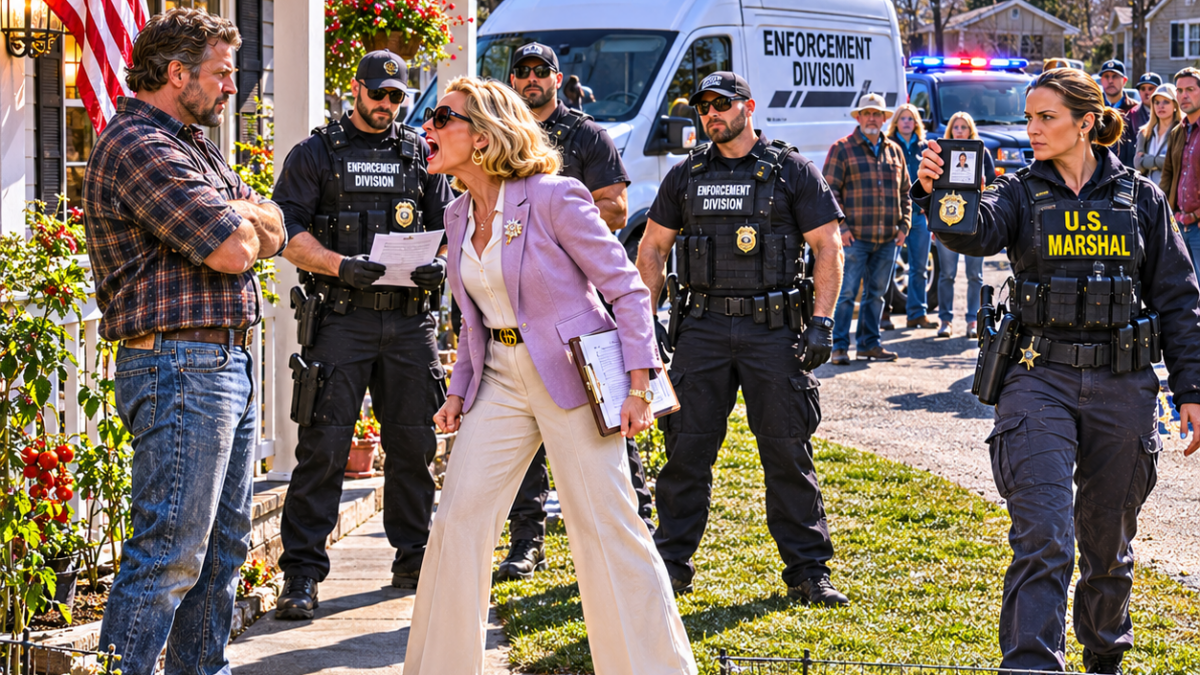
Black tactical pants. Black vests. Utility belts. Handcuffs. Radios. Silver badges clipped high on their chests.
A dark sedan and a white panel van blocked most of my driveway.
The SUV behind them had temporary magnetic decals on the doors.
ENFORCEMENT DIVISION.
No agency name.
No city.
No county.
No state seal.
That was the first thing that felt wrong.
The second was the way they positioned themselves.
One man stayed directly in front of the door. Another moved toward the side gate. The third kept glancing toward the cameras mounted beneath my roofline, then stepping just outside their obvious angle.
They had done something like this before.
“Mr. Dakota!” the man at the door shouted. “We have a warrant to inspect the property. Failure to cooperate may constitute obstruction.”
I didn’t move toward the door.
My name is Marcus Dakota. I had retired from the Army after twenty-four years in logistics coordination, which meant I spent a large part of my adult life dealing with people who believed confidence could substitute for paperwork.
It rarely could.
Real law enforcement officers identify their agency.
Real warrants come from courts.
Real officers don’t usually arrive carrying documents supplied by an HOA president who had spent the previous three months fining me over raised vegetable beds and a three-by-five-foot American flag.
I zoomed in on the lead man’s badge.
Generic eagle.
No department.
No badge number I could see.
I called my wife.
Delilah answered on the second ring.
“Hey.”
“Three men at the front door claiming police authority.”
Her voice changed instantly.
“What department?”
“They haven’t named one.”
“Uniforms?”
“Tactical. Generic enforcement patches.”
“Weapons?”
“At least two appear armed.”
“Do not open that door.”
“I wasn’t planning to.”
“Can you record?”
“Already am.”
“I’m about ten minutes away. Call local dispatch too. Give them exactly what you see.”
I did.
The pounding continued.
“We know you’re home!”
I stayed in the garage, where the interior door was locked, and spoke through the security intercom.
“Identify your agency.”
The man looked toward the camera.
“We’re conducting an official compliance inspection.”
“That is not an agency.”
“Sir, open the door.”
“Show the warrant to the camera.”
He lifted several sheets of paper for less than two seconds.
I caught the top line.
MILBROOK ESTATES PROPERTY ENFORCEMENT WARRANT
I almost laughed.
Milbrook Estates was my HOA.
Homeowners associations do many things.
They collect assessments.
Maintain common areas.
Enforce legitimate covenants through appropriate procedures.
What they do not have is their own criminal court issuing inspection warrants.
“Which judge signed it?” I asked.
The man didn’t answer.
Instead, his partner moved toward my side gate.
“Stay off the side yard,” I said through the speaker.
“Failure to comply is obstruction.”
I looked at the camera.
“Obstruction of what?”
Silence.
Then the leader slammed his fist against the door again.
That was when I heard the engine.
Low.
Familiar.
Coming fast enough to mean Delilah had already been closer than she thought.
The gray federal vehicle turned onto our street and stopped behind the white van.
The three men looked over.
Delilah stepped out.
She had been returning from task-force work, so she was still wearing her duty trousers, protective vest, and jacket. Her service weapon remained holstered. She did not draw it.
She did not shout.
She walked forward with one hand visible and the other opening her credentials.
“Gentlemen.”
The pounding stopped.
All three men turned.
Delilah held her badge where they could see it.
“Deputy U.S. Marshal Delilah Dakota. Keep your hands visible.”
The change was immediate.
The man at the side gate stopped moving.
The lead man’s shoulders dropped.
The third man looked at the others as though somebody had changed the rules halfway through the game.
Delilah stopped several yards from them.
“Which law-enforcement agency are you with?”
The leader swallowed.
“Local enforcement services.”
“That’s not a law-enforcement agency.”
“We’re conducting an authorized property inspection.”
“Are you police officers?”
No answer.
Delilah looked at the silver badges.
“Are you sworn peace officers?”
Still nothing.
She pointed toward the driveway.
“Do not leave. Local officers are already responding, and nobody needs to make this situation worse.”
I stepped from the garage, phone still recording.
The lead man looked at me.
Then at Delilah.
Then at the house.
His confidence had evaporated.
I held up my phone.
“For the record, these men have repeatedly identified themselves as police and claimed they possessed a warrant.”
Delilah looked toward their paper.
“I’d like to see that document.”
The leader did not hand it over.
He folded it.
That was mistake number one.
Then a white BMW X5 turned onto our street.
I recognized it instantly.
Vivian Blackwood.
HOA president.
The woman who had spent three months telling me my vegetable garden threatened property values.
The woman who had authorized thousands of dollars in payments to a security contractor disguised in HOA financial records as “property management consulting.”
The woman whose name appeared beneath almost every escalating enforcement order aimed at neighbors who challenged her.
She parked behind Delilah’s vehicle.
Got out.
Looked at the three tactical men.
Then at my wife.
Then at me.
And instead of turning around, Vivian marched directly into the driveway.
“What is the meaning of this?”
Delilah looked at her.
“Are you Vivian Blackwood?”
Vivian lifted her chin.
“I am the president of this homeowners association, and those men are conducting authorized compliance enforcement.”
The lead man’s face went pale.
Delilah’s eyes shifted toward him.
Then back to Vivian.
“Mrs. Blackwood, you may want to stop talking for a moment.”
Vivian actually laughed.
“You have no authority over HOA enforcement.”
That sentence would have been ridiculous enough by itself.
But Delilah had received another piece of information less than forty-eight hours earlier through official task-force channels—information she had never shared with Vivian, never used during our HOA dispute, and had been waiting to verify through the proper federal process.
A warrant.
Not an HOA warrant.
Not a neighborhood violation.
A real federal arrest warrant tied to an old financial-fraud case under Vivian Blackwood’s previous address.
Delilah looked down the street.
The first local patrol car was turning the corner.
Then she looked back at Vivian.
And I saw the exact moment my HOA president realized the people arriving were not there to enforce her rules.
part 2
Three months earlier, I thought Delilah and I had found exactly what we wanted.
Milbrook Estates sat outside Denver far enough that the streets became quiet at night but close enough that Delilah could still reach her office without spending half her life commuting.
I had retired from the Army after twenty-four years.
Logistics.
Supply.
Transportation.
Procurement coordination.
Contingency planning.
Not glamorous, but I loved it.
My work was basically the art of preventing small administrative mistakes from becoming large operational disasters.
Retirement gave me different problems.
A garage workshop.
Raised garden beds.
An old pickup.
A grill.
A lawn I could mow without receiving a briefing first.
For the first few weeks, mornings felt almost unreal.
Coffee brewing in the kitchen.
Delilah’s boots crossing the hardwood floor while she got ready for work.
The garage smelling like pine after I ran boards through the planer.
Nobody calling about delayed shipments.
Nobody asking where twelve pallets had gone.
Then Vivian Blackwood appeared.
Third Tuesday after we moved in.
Clipboard.
White BMW.
Perfect blonde bob.
Navy blazer despite the heat.
She looked at my property the way a general inspects troops after already deciding somebody will fail.
“Mr. Dakota.”
“Mrs. Blackwood.”
“Vivian.”
“Marcus.”
She glanced toward my backyard.
“I’m afraid we need to discuss compliance.”
I had built three raised vegetable beds.
Cedar planks.
Level.
Neat.
Mulched around the edges.
Tomatoes.
Peppers.
Herbs.
Nothing visible from the street except the upper edges from one angle.
Vivian handed me a notice.
UNAUTHORIZED EXTERIOR STRUCTURES — $500.
I read it.
“What covenant?”
“Aesthetic consistency.”
“Which section?”
“You’ll find it in your governing documents.”
“I’ve read them.”
Her smile tightened.
“Then you’ll understand the importance of maintaining standards.”
I looked at the garden.
“You’re fining me five hundred dollars over tomatoes.”
“I’m fining you for unauthorized structures.”
Then she lowered her voice.
“If unresolved, violations can escalate.”
“How?”
“Additional fines. Collection. Potential lien consequences.”
There it was.
Lien.
The word HOA presidents love when they want ordinary disagreements to sound like foreclosure notices.
I thanked her.
She looked disappointed.
Probably expected an argument.
I went inside.
Read the declaration again.
Then the bylaws.
Then architectural guidelines.
The beds occupied a gray area at worst.
So I filed a dispute.
That should have been boring.
Instead, three days later I received another violation.
EXCESSIVE PATRIOTIC DISPLAY.
My offense was the American flag hanging near the front porch.
Standard dimensions.
Properly mounted.
Nothing unusual.
That made me start looking at other houses.
Seventeen American flags in Milbrook.
One larger than mine.
None had notices.
I asked around.
The Johnsons had received a similar flag violation.
Mr. Johnson was retired Air Force.
The Garcias had been repeatedly cited for landscaping despite keeping one of the best yards in the subdivision.
Mrs. Patterson, an elderly widow, had received warnings over a bird feeder supposedly attracting nuisance wildlife.
Meanwhile, two households friendly with Vivian parked boats in driveways despite clear restrictions.
Selective enforcement is difficult to prove from three anecdotes.
But patterns start somewhere.
That evening, Delilah read my notices.
She set the papers on the kitchen table.
“She either hasn’t read her own rules or she assumes you won’t challenge them.”
“Probably both.”
“Document everything.”
I smiled.
“Married to a marshal long enough and that’s your answer to everything.”
“Because it works.”
She was right.
So I started a binder.
Every notice.
Every email.
Photographs.
Dates.
Comparable houses.
Meeting records.
I also requested HOA minutes and financial documents through the procedures available to members.
Vivian’s response came three days later.
Instead of answering the substance of my request, she sent a letter warning that my property could become subject to enhanced inspections.
Then came the sentence that got my attention.
The association maintains strong relationships with local enforcement resources and will not hesitate to use all available measures.
I read it twice.
Not illegal by itself.
But strange.
Why would an HOA president invoke law-enforcement contacts over vegetables?
I asked neighbors.
Mrs. Patterson leaned across her fence.
“She’s done that before.”
“What?”
“Talked about police.”
“With who?”
“The Bakers. Parking dispute.”
I wrote it down.
The next escalation was an emergency board meeting concerning the “Dakota property.”
I wasn’t notified.
Mrs. Patterson told me while I was working outside.
“They came by asking whether you’ve caused noise problems.”
I stopped tightening a garden-bed bracket.
“Who?”
“One of Vivian’s people.”
“What did you say?”
“That you’ve been the best neighbor we’ve had in years.”
I smiled.
“Thank you.”
Then she leaned closer.
“She’s trying to build something against you.”
That was exactly what it looked like.
I didn’t storm into the meeting.
Twenty-four years in logistics taught me that angry people frequently provide information voluntarily if you allow them to think you’re behind.
Instead, I started examining the HOA’s finances.
One vendor kept appearing.
Milbrook Property Management Solutions.
Payments for:
Compliance consulting.
Property monitoring.
Special inspections.
Enhanced enforcement.
Nearly $15,000 initially visible in summaries.
I searched Colorado business records.
No obvious company matching the name.
No proper website.
No normal business footprint.
Then, one Wednesday night, I found a note under my windshield wiper.
White paper.
Block letters.
SOME NEIGHBORS DON’T BELONG HERE.
I photographed it.
Front and back.
Bagged it.
Recorded the date.
Then installed additional cameras.
Visible.
Lawful.
Covering my own entrances.
The board meeting went forward without me.
The next morning, Mrs. Patterson handed me a handwritten summary.
Four directors present.
My original violations upheld.
Another added:
FAILURE TO MAINTAIN COMMUNITY LANDSCAPE AESTHETICS.
Then:
ENHANCED COMPLIANCE MONITORING AUTHORIZED.
That phrase would come back later.
Monday morning, a man named Dave Morrison appeared at my door.
Polo.
Khakis.
Clipboard.
“Milbrook Property Management Solutions.”
That got my attention.
He said he had come to inspect my backyard structures.
“Show me your company credentials.”
He shifted.
“I work directly with Mrs. Blackwood.”
“Business license?”
“I don’t carry that.”
“Insurance certificate?”
“Not with me.”
“Contract showing authority to enter my property?”
His confidence slipped.
“I’ll need to speak with Mrs. Blackwood.”
“Good idea.”
He left.
The phone number he gave me eventually led not to a property-management company, but to a private security operation called Mile High Security Services.
Now the invoices looked different.
The HOA had apparently been describing security-related work as property-management consulting.
I requested detailed contracts.
Payment authorizations.
Meeting minutes.
Insurance records.
Vendor records.
Vivian answered through an attorney this time.
My request was supposedly too broad.
They offered summaries.
I wanted source documents.
After formal follow-up, the records eventually arrived.
A large box.
Three years.
Invoices.
Checks.
Meeting records.
Vendor authorizations.
By the time I finished sorting everything, the number associated with Mile High-related work was closer to $23,000.
The invoices said:
PROPERTY COMPLIANCE CONSULTING.
The service reports used different language.
ENFORCEMENT PRESENCE.
RESIDENT CONTACT.
COMPLIANCE INTERVENTION.
SECURITY RESPONSE.
That didn’t automatically equal fraud.
But it raised obvious questions about what the board thought it was buying.
Then I found about $8,000 in “emergency landscaping” charges I couldn’t match to any visible emergency landscaping project.
I stopped.
Recalculated.
Checked dates.
The more I looked, the less comfortable I became.
I did not announce that Vivian was embezzling.
That word requires evidence.
I did something more effective.
I showed homeowners the records.
Actual records.
The Johnsons.
Garcias.
Mrs. Patterson.
Several others.
“Here is what was paid.”
“Here is what the invoice says.”
“Here is the board authorization I can find.”
“Here is where I can’t match one to the other.”
People started asking their own questions.
Vivian responded by calling a neighborhood security meeting.
Her flyer warned about increasing crime, declining standards, and hostile residents undermining community safety.
Delilah read it over breakfast.
“She is turning your records request into a security threat.”
“Apparently spreadsheets are dangerous.”
“Only when people read them.”
The meeting was packed.
Vivian stood at the front in pearls and a navy blazer.
For fifteen minutes, she talked about safety.
Community values.
Aggressive homeowners.
Disruptive challenges to authority.
She never said my name.
She kept looking at me.
Finally, she said:
“Some residents seem more interested in making accusations than maintaining basic community standards.”
I stood.
“Since you brought up accusations, can we discuss the financial records?”
Her expression tightened.
“This is not the appropriate forum.”
“You called a meeting about community security.”
I opened my folder.
“The HOA paid roughly twenty-three thousand dollars to Mile High Security-related services over the last two years under descriptions including property-management consulting.”
People started whispering.
I continued.
“I have invoices and incident reports that don’t describe the work the same way.”
Vivian raised her voice.
“Those are authorized compliance services.”
“Then the board should be able to show the authorization.”
A homeowner asked:
“Twenty-three thousand for what?”
Another:
“Why were we told it was property management?”
Mr. Johnson spoke about the flag violation.
Mrs. Garcia mentioned her landscaping notices.
Then Roland Blackwood stood from the back.
Vivian’s husband.
“Vivian.”
She turned.
“Not now.”
“Yes. Now.”
The room quieted.
Roland looked uncomfortable.
“I’ve told you for months the liability is getting out of control.”
Vivian stared at him.
He continued.
“People are entitled to know what the association is spending.”
“Sit down.”
“No.”
That was the first time I saw the neighborhood realize Vivian’s control wasn’t as absolute as it looked.
Questions multiplied.
She eventually closed the meeting abruptly.
“This meeting is over.”
Then she left.
The following morning, Delilah told me something I did not expect.
Not because she had casually searched federal systems for my HOA opponent.
That would have been improper.
The name had reached her task force through a legitimate referral generated by information from the vendor and financial review that had gone to appropriate authorities.
When Vivian Blackwood’s identity was checked against federal fugitive records, an old warrant surfaced.
Different state.
Different address.
Different chapter of her life.
Financial crimes.
Tax-related fraud.
Business income concealed through property-management entities.
A real federal warrant had been active for years.
Delilah did not show me investigative details.
She told me only what she was permitted to tell me.
“Stay out of that part.”
“I wasn’t planning to arrest her.”
“Marcus.”
“Kidding.”
“This matters.”
“I know.”
She contacted her chain of command.
The warrant was verified.
Task-force coordination began.
That became important because I wanted no part of Vivian later claiming my HOA dispute had somehow manufactured her arrest.
Her warrant existed before she ever met me.
The paperwork existed.
The federal case existed.
Our tomatoes did not create it.
Meanwhile, Vivian escalated.
Certified letters.
More fines.
Threats of liens.
Then fake inspections.
The first man wore a hard hat and orange vest.
“City building inspector.”
He started measuring my fence.
“Identification?”
“I don’t need to show you identification.”
That alone told me almost everything.
I called the city planning department while he stood there.
No inspector dispatched.
No active inspection at my address.
When he heard that, he left.
My cameras captured his face and license plate.
The Johnsons later reported a “county health inspector” asking about compost they didn’t have.
The Garcias received a visit from someone claiming code enforcement authority over a fully permitted shed.
That changed the pattern.
Private security was one thing.
People falsely claiming government authority were another.
We documented.
The neighbors documented.
Reports went to local authorities.
Then Mrs. Patterson appeared with an envelope Roland had quietly given her.
Email correspondence.
Vivian to Mile High.
Previous approaches insufficient. Need more authoritative presence.
Mile High replied:
Enhanced services available. Uniformed presence. Official documentation.
Another line referenced full authority presentation.
I looked at Delilah.
“That sounds bad.”
“It sounds like something investigators need to see, not something you need to interpret publicly.”
So we sent it where it belonged.
Monday morning, somebody calling herself Sarah Mitchell from a legal-services company offered me $5,000 toward moving expenses if I would leave Milbrook.
“Vivian is offering me money to move?”
“She is offering an amicable resolution.”
“I own my house.”
“Continuing these disputes could become expensive.”
There it was.
Not quite an explicit threat.
Close enough to document carefully.
I declined.
Then came 2:15.
Three men.
Tactical gear.
Fake badges.
Fake HOA “warrant.”
My front door.
And Delilah arriving in the middle of it.
Local officers pulled in seconds after Vivian.
Delilah kept everyone where they were while the responding sergeant took control of the impersonation complaint.
That distinction mattered.
The three men had claimed they were police.
Local authorities investigated that.
Delilah’s federal role did not magically convert every false local badge into a federal offense.
But Vivian had another problem.
A properly verified federal arrest warrant.
A task-force supervisor arrived.
Identity was confirmed.
The warrant was confirmed.
Then Vivian was taken into federal custody.
Not because she fined me over vegetables.
Not because she disliked my flag.
Not because Delilah was my wife.
Because an existing warrant authorized it.
The contractors were separately detained and questioned by local law enforcement concerning the fake-police incident and related complaints.
The neighborhood gathered.
Of course they did.
Phones came out.
Mrs. Patterson stood on the lawn next door with both hands over her mouth.
Roland arrived later.
He didn’t look shocked.
He looked exhausted.
Vivian stood beside the federal vehicle while Delilah and another deputy handled the arrest process.
For once, she wasn’t giving orders.
Then a local reporter arrived.
I had known a journalist from my Army public-affairs days and had previously told her there were documented HOA financial questions worth examining, but I had never given her arrest timing because I didn’t know it.
News travels fast when police vehicles fill a suburban street.
She asked me what happened.
I kept it simple.
“Three men came to my home claiming police authority and demanding entry under what appears to be an HOA-generated document. Local officers are investigating that incident. Mrs. Blackwood’s federal matter is separate.”
That sentence mattered.
Separate.
The neighborhood wanted one giant story.
Reality had several.
The HOA governance dispute.
Vendor-payment questions.
Fake inspection complaints.
Impersonation allegations.
Vivian’s preexisting federal warrant.
Some connected.
Some merely colliding.
Investigators had to prove which was which.
That took months.
The HOA board met three days later.
Vivian’s chair was empty.
Roland attended but didn’t sit at the board table.
Mrs. Patterson spoke first.
“We need to stop pretending this is one difficult homeowner arguing with one difficult president.”
Nobody disagreed.
The board suspended all enhanced enforcement activity.
Mile High’s contract was terminated pending review.
An independent accountant was retained.
Outside counsel reviewed years of fines and vendor authorizations.
Every homeowner received notice that disputed violations from Vivian’s tenure could be reexamined.
The garden-bed fine disappeared.
So did my flag citation.
The Johnsons’ flag notice was rescinded.
Mrs. Garcia’s selective landscaping penalties were reviewed and largely withdrawn.
Mrs. Patterson immediately rehung the bird feeder.
“Rebellion,” she told me.
“Careful.”
“I’ve changed.”
“You’re seventy-two.”
“Exactly. Nothing left to lose.”
The independent audit found serious problems.
Some were bad governance.
Some were misleading accounting descriptions.
Some transactions required further investigation.
The $23,000 in security-related services had not been presented to homeowners in a way that clearly reflected the actual enforcement work performed.
The phantom landscaping charges produced additional questions.
Investigators later tied portions of the financial misconduct to Vivian and entities associated with the same broader pattern as her earlier fraud case.
Not every ugly invoice became a crime.
But enough transactions were supported by records, testimony, and financial tracing to become part of the larger case.
Roland cooperated.
That surprised many people.
It didn’t surprise me.
He looked like a man who had been living with a storm for years.
He turned over records.
Emails.
Account information.
Documents involving Vivian’s prior business activities.
Some HOA funds were eventually recovered through insurance, restitution, and asset recovery.
The total credited back to Milbrook ended up around $31,000 when everything was resolved.
That money did not magically make the neighborhood whole.
Trust takes longer.
The three security contractors faced consequences separately.
Two entered pleas to state charges connected to impersonating peace officers and unlawful entry-related conduct.
The third cooperated extensively and received a lesser disposition.
Their company lost the HOA contract and later ceased operating under the same enforcement model.
Vivian’s federal case was more serious.
The old warrant tied into a larger financial investigation involving concealed income, fraudulent deductions, shell entities, and property-management money.
Her Milbrook transactions created additional evidence.
After prolonged proceedings, she ultimately received an eight-year federal sentence on the combined financial case and was ordered to pay restitution.
Some local conduct remained part of separate resolutions.
That outcome took far longer than one dramatic afternoon in a driveway.
But the driveway was where Vivian lost control of the narrative.
She had spent years depending on appearances.
Official-looking letters.
Official-looking vendors.
Official-looking inspectors.
Official-looking uniforms.
Then three men wearing official-looking badges stood at my front door and met somebody carrying a real federal credential.
The difference wasn’t the shine of the badge.
It was the authority behind it.
Two weeks after Vivian’s arrest, Milbrook held an emergency election.
Mrs. Patterson ran for president.
I thought she was joking.
She wasn’t.
She won.
Mr. Johnson joined the board.
Mrs. Garcia joined too.
Their first meeting was one of the most satisfying boring meetings I had ever attended.
Mrs. Patterson sat at the front.
No pearls.
No theatrical binder.
Just reading glasses and a yellow legal pad.
“First item,” she said. “Vendor transparency.”
Every significant vendor contract now required full board approval.
No more vague consulting labels.
Invoices had to match contracted services.
Conflicts had to be disclosed.
Homeowners gained clearer access to financial records.
Enforcement procedures were rewritten.
Security personnel could not present themselves as government officers.
No contractor could enter private property merely because an HOA employee printed an authorization.
Any inspection beyond what governing documents clearly allowed required consent or proper legal process.
I raised my hand.
Mrs. Patterson looked at me.
“Yes, Marcus?”
“Can we put in writing that an HOA cannot issue criminal warrants?”
The room laughed.
She did not.
She wrote it down.
“I’m serious.”
“I know.”
Then she added language requiring legal review before any document used terms like warrant, seizure, government inspection, or law-enforcement action.
Good rule.
The board also created a modest community assistance program using a portion of recovered funds and ordinary budget allocations.
Not some grand veterans-only political project.
Something practical.
Emergency accessibility repairs.
Temporary help for elderly homeowners.
Small maintenance grants where safety was involved.
The first recipient was a disabled veteran who needed a safer front ramp.
The second was Mrs. Patterson herself after a storm damaged part of her roof.
She argued against taking the money.
The board voted without her.
I enjoyed that enormously.
Six months after Vivian disappeared from Milbrook, the neighborhood felt different.
The flags were still there.
So were my garden beds.
My tomatoes had survived the HOA crisis better than most of us.
Children rode bicycles down the street.
People actually stayed outside talking after sunset.
The security cameras I installed during the worst weeks remained.
Mostly they recorded package deliveries, squirrels, and Frank Garcia stealing tomatoes after I repeatedly told him he could simply ask.
Property values eventually improved too, although I never credited that to some magical twelve-percent surge caused by Vivian’s arrest.
Markets are more complicated than neighborhood revenge stories.
What did improve measurably was turnover.
Fewer residents wanted out.
More people attended meetings.
Financial statements were actually read.
That mattered more to me.
One Saturday, Roland knocked on my door.
I hadn’t seen him since the legal proceedings intensified.
He looked tired.
“Marcus.”
“Roland.”
“I owe you something.”
“You don’t.”
“Let me finish.”
I stepped outside.
He looked toward the garden.
“She hated those.”
“I know.”
“I never understood why.”
“Control.”
He nodded.
“Probably.”
Then he handed me an envelope.
Inside were copies of emails Vivian had written months before the fake-inspector campaign.
One line stood out.
Dakota is dangerous because he keeps asking for source documents. Stop giving him room to build a narrative.
I read it twice.
“She thought asking for invoices was dangerous.”
Roland looked at me.
“She thought questions were attacks.”
That sentence explained everything.
People who understand legitimate authority don’t fear questions.
They answer them.
Show the covenant.
Show the vote.
Show the invoice.
Show the permit.
Vivian’s power depended on nobody asking to see what supported it.
Once people did, she escalated.
More notices.
More threats.
Security contractors.
Fake inspectors.
Fake police.
Every escalation was an attempt to replace legitimacy with intimidation.
Eventually, intimidation became impossible to separate from evidence.
Roland looked toward my flag.
“I tried to get her to stop.”
“I know.”
“Not hard enough.”
I didn’t disagree.
He swallowed.
“That part is mine.”
Accountability isn’t always dramatic.
Sometimes it’s a man admitting he stayed quiet too long.
I shook his hand.
“Take care of yourself.”
He moved out several weeks later.
The next owner removed Vivian’s old landscaping and painted the front door blue.
Mrs. Patterson received three anonymous complaints about the color.
She brought them to the board.
Read the architectural guidelines.
Then announced:
“Blue is allowed.”
Meeting over.
I almost applauded.
About a year after everything happened, Delilah and I sat on the back deck eating burgers.
Same place I had been when the fake cops first came.
My raised beds were overflowing.
Delilah looked toward the security camera.
“You know you still check that thing every time a strange car slows down.”
“I do not.”
“You absolutely do.”
“Professional habit.”
“You are retired.”
“Former professional habit.”
She smiled.
Then became quiet.
“You ever think about how bad that day could’ve gone?”
I did.
Three armed men.
Fake authority.
Angry homeowner.
Closed door.
One misunderstanding.
One person reaching too quickly.
One weapon handled badly.
That was the part people skipped when retelling the story.
They liked the image of fake cops freezing when a federal marshal arrived.
The real lesson was how dangerous pretending to be law enforcement can become.
People make life-or-death decisions based on uniforms.
Badges.
Commands.
Words like police and warrant.
Impersonation isn’t funny when everyone involved may believe the next movement carries legal force.
“I think about it,” I said.
Delilah nodded.
“So do I.”
“What would you have done if they ran?”
“Let local units handle the chase unless there was an immediate federal basis or safety threat.”
“No dramatic tackle?”
She stared at me.
“You watch too much television.”
I laughed.
That was the thing about Delilah.
She never cared about the cinematic version.
Procedure mattered because procedure protects cases and people.
She had not arrested Vivian simply because she was my HOA enemy.
She had verified an existing federal warrant.
Supervisors coordinated.
Identity confirmed.
Separate local officers handled the fake-police incident.
Nobody blurred jurisdictions just because it made a better story.
That distinction ultimately made the case harder for Vivian to attack.
Months later, one of her lawyers tried anyway.
Retaliatory arrest.
Personal conflict.
Biased enforcement.
The record answered each argument.
Federal warrant predating our HOA dispute.
Task-force referral trail.
Supervisory approval.
Local officers controlling the impersonation scene.
Independent financial records.
Other homeowner witnesses.
Vendor emails.
Vivian’s own communications.
The evidence didn’t depend on my credibility alone.
That’s what strong cases look like.
I eventually started helping neighbors understand how to organize records.
Not legal advice.
Not investigations.
Just documentation.
Date.
Notice.
Response.
Rule cited.
Photograph.
Receipt.
Board minutes.
Sometimes people would come over furious.
“Tell me how to destroy my HOA.”
I always gave the same answer.
“Wrong goal.”
They’d stare.
“The goal is to make the record accurate.”
That’s less satisfying than revenge.
More useful.
One disabled veteran in a neighboring subdivision came to me about contractors targeting elderly and military homeowners with fake emergency-repair claims.
I helped him build a timeline and find the appropriate licensing and consumer-protection channels.
No secret sting.
No tactical operation.
Just documents.
He eventually got his money back.
That felt better than shouting at anyone.
The following summer, Milbrook held a community festival.
Food trucks.
Children’s games.
Local businesses.
A small veterans appreciation ceremony.
Scholarship fundraising.
Nothing revolutionary.
People simply enjoyed being together without worrying that Vivian would turn someone’s lawn chair into a $500 compliance emergency.
Mrs. Garcia found me near the grill.
“My daughter asked why everyone seems happier.”
“What did you tell her?”
“That people stopped being afraid of one another.”
I considered it.
“That’s probably better than the real explanation.”
“What is the real explanation?”
“Accounting controls.”
She laughed.
“Never say that to a child.”
Fair.
Later, Mrs. Patterson took the microphone.
I prepared for disaster.
She thanked volunteers.
Announced the scholarship total.
Then said:
“And if anyone sees Marcus Dakota attempting to run for this board, notify me immediately.”
Everyone laughed.
I pointed at her.
“Never.”
“Good.”
Delilah leaned toward me.
“She likes you.”
“Terrible way of showing it.”
“Sounds familiar.”
The sun went down.
Flags moved gently along the street.
My American flag was still where it had always been.
Same size.
Same pole.
No citation.
My garden still sat behind the house.
Same cedar beds Vivian once called unauthorized structures.
Tomatoes growing past the cages.
Basil spreading everywhere.
The things she had tried to use as evidence that I didn’t belong had outlasted her presidency.
That felt appropriate.
Still, I don’t tell the story as a victory over an HOA Karen.
Not really.
Vivian wasn’t defeated because Delilah carried a federal badge.
Vivian was defeated because evidence eventually caught up with authority that had never been legitimate.
Her old federal warrant came from conduct years before Milbrook.
Her HOA financial problems came from records.
The fake inspections came from witnesses and cameras.
The tactical team came with its own vehicles, uniforms, documents, and recorded statements.
Vivian kept manufacturing proof of what she was doing.
The badge simply forced everyone to stop pretending the situation was ordinary HOA enforcement.
That’s the part people miss.
Fake authority survives because most people don’t want trouble.
A man in a polo says he’s an inspector.
You let him measure.
Someone says they work for property management.
You answer questions.
A person with a clipboard says the board approved something.
You assume there was a vote.
Three men in black vests shout “Police.”
Your instinct is to open the door.
Most of civilization works because we trust signals of authority.
That trust is necessary.
It’s also vulnerable.
Vivian weaponized it.
Uniforms.
Official-looking forms.
Threatening language.
The phrase “law enforcement contacts.”
She created the appearance of consequences until people stopped asking whether consequences were lawful.
Then she met the one thing appearance cannot survive forever.
Verification.
Which agency?
Which statute?
Which board vote?
Which vendor?
Which invoice?
Which court?
Which warrant?
Every time we asked one of those questions, the story weakened.
That’s why documentation mattered more than confrontation.
There is one photograph I still keep.
Not Vivian in handcuffs.
Not the fake officers.
Not Delilah’s federal vehicle.
A picture of my original $500 garden-bed violation.
I framed it and hung it inside the garden shed.
Delilah thinks that’s petty.
She is correct.
Below it, I attached a photograph taken the following summer.
Three raised beds.
Tomatoes.
Peppers.
Basil.
Mrs. Patterson standing beside them holding a basket.
On the back I wrote:
STRUCTURES STILL STANDING.
Sometimes petty is harmless.
The security footage is different.
That stays stored with the legal records.
I rarely watch it.
I don’t need to.
I remember the pounding.
“Police! Open up!”
I remember watching their badges.
Remembering something was wrong.
Then hearing Delilah’s engine.
I remember the leader’s face when she identified herself.
Not fear exactly.
Recognition.
The moment a person pretending to represent authority encounters someone who knows precisely what authority looks like.
That was the beginning of the end.
Vivian arrived believing she would supervise an HOA enforcement action.
Instead, she walked into three overlapping realities she could no longer control.
Local officers evaluating men who had falsely claimed police authority.
Federal personnel verifying an outstanding warrant.
Neighbors holding documents showing years of questionable HOA conduct.
She could command a board meeting.
She could send letters.
She could hire contractors.
She could not order facts to change.
Years later, Delilah retired.
We stayed in Milbrook.
People ask why.
After all that, why not move?
Because the neighborhood was never Vivian.
The Johnsons weren’t Vivian.
The Garcias weren’t Vivian.
Mrs. Patterson definitely wasn’t Vivian, although she became equally capable of sending emails at strange hours.
Milbrook was the people who finally learned to ask questions together.
The place improved once everybody stopped confusing one president with the community itself.
That mattered.
Bad leadership shouldn’t get ownership of the place it harmed.
One December morning, I stood in the driveway clearing snow.
A new family had moved in across the street.
Their son came outside carrying a small American flag.
He stuck it into a planter beside the porch.
His mother noticed me looking.
“Is that allowed?”
I laughed.
“Absolutely.”
“You sure?”
“Very.”
She smiled.
I’d forgotten how strange that question used to feel.
Later that day, I walked past the clubhouse.
Mrs. Patterson had put a glass display case inside with old photographs of Milbrook.
One was taken at the first post-Vivian community festival.
Families.
Flags.
Food trucks.
Children.
No tactical guards.
No threatening notices.
No staged authority.
Just neighbors.
Under the photograph, a small card read:
COMMUNITY WORKS BEST WHEN RULES APPLY TO EVERYONE.
I stared at it.
Then found Mrs. Patterson in the office.
“You wrote this?”
“Yes.”
“It’s surprisingly restrained.”
“I can change it.”
“No.”
She smiled.
“Thought so.”
I headed home.
My driveway was empty.
No security van.
No black SUV.
No white BMW.
Just Delilah’s car and my pickup.
The garage door opened.
My workshop smelled like cedar again.
Exactly what I had wanted when we moved in.
Quiet.
Ordinary.
Free.
That is where the story really ends.
Not with handcuffs.
Not with news cameras.
Not with an eight-year sentence.
With normal life returning after somebody spent years making normal life feel conditional on obedience.
Vivian believed authority came from sounding official.
She printed forms.
Created vendor names.
Hired uniforms.
Invoked police connections.
Sent fake inspectors.
Eventually, she sent men to my door who actually shouted the word “Police.”
Every step relied on the same assumption.
Nobody would ask for proof.
She was wrong.
The raised beds remained.
The flag remained.
The homeowners remained.
The board remained.
Milbrook remained.
What disappeared was the system Vivian had built around fear.
And whenever I think back to that afternoon, I don’t remember the handcuffs first.
I remember a quieter moment.
Three men standing on my porch.
Delilah holding up her real federal credentials.
One of the fake officers staring at her badge.
And Vivian, still walking up the driveway, not yet understanding that the performance was over.
For months, she’d been telling the neighborhood that authority meant whatever she said it meant.
Then reality arrived in a government vehicle and asked for identification.
That was all it took.
Because fake authority can be loud.
It can wear tactical gear.
It can carry clipboards.
It can print the word WARRANT in capital letters.
But eventually, somebody asks the question Vivian should have feared from the beginning.
“Who gave you the legal right to do this?”
And once that question is answered honestly, costumes stop mattering.








