HOA Karen Sent Fake Cops to Arrest Me in My Own Driveway—They Had No Idea Who They’d Cornered
part 2
My name is Daniel Mercer.
I had served as sheriff of Alder County for six years.
Before that, I spent eighteen years in the department working patrol, investigations, and eventually command.
I did not advertise it around Cedar Point.
Not because it was a secret.
Because my job already occupied enough of my life.
At home, I wanted to be Daniel.
Husband.
Father.
Neighbor.
Guy who forgot to bring the trash bin back from the curb.
Not Sheriff Mercer.
My wife, Emily, understood that better than anyone.
We had bought our house in Cedar Point eleven years earlier.
At the time, the HOA was exactly what a homeowners association should be.
Mostly boring.
It maintained the entrance landscaping.
Managed a small retention pond.
Paid for streetlights on two private lanes.
Handled architectural requests.
People complained about dues, voted on budgets, and then went home.
Nobody wore tactical clothing.
Nobody carried fake badges.
Nobody threatened arrest over landscaping.
Then Karen Bellamy became president.
Karen did not begin as a cartoon villain.
That mattered.
She was competent.
Organized.
Energetic.
The previous board had let maintenance slide.
Karen negotiated new landscaping contracts.
Repaired the community playground.
Improved reserve funding.
Got delinquent common-area repairs completed.
Residents liked that.
Competence builds trust.
Trust creates freedom.
And if nobody checks that freedom, sometimes it becomes something else.
The first sign was enforcement.
Karen believed the HOA had become too lenient.
Her phrase.
Too lenient.
She pushed through more inspections.
More notices.
More fines.
Some were legitimate.
A homeowner had built an unapproved shed inside a drainage easement.
Another had abandoned two broken vehicles in a shared parking area.
Those were real issues.
Then the scope expanded.
Trash cans visible after six p.m.
Basketball hoops.
Garden flags.
Fence stain.
Holiday decorations.
Children’s bicycles left outside.
Karen began treating every disagreement as defiance.
The board rarely challenged her because she always arrived with a binder and an explanation.
That was her talent.
She made authority sound inevitable.
My conflict with her began over something stupid.
A mailbox.
Our mailbox post rotted near the ground.
One Saturday I replaced it.
Same location.
Same height.
Nearly the same design.
Different wood.
Three days later:
ARCHITECTURAL MODIFICATION WITHOUT APPROVAL — $250.
I emailed Karen.
“This is maintenance.”
She replied:
All visible exterior changes require approval.
I checked the covenants.
They did not.
Routine repair did not require architectural review.
I sent her the relevant language.
She replied:
The board interprets this differently.
I asked when the board had voted on that interpretation.
No answer.
The fine disappeared.
But Karen remembered.
After that, I noticed our address appeared on inspection reports more often.
Fence.
Driveway.
Landscaping.
One warning claimed my unmarked county-issued vehicle violated restrictions on commercial vehicles because it had a radio antenna.
That one made Marcus Reed laugh for five straight minutes.
“Should I cite all the patrol cars too?” he asked.
“Probably.”
“Revenue.”
“Don’t encourage her.”
I could have walked into a board meeting wearing my sheriff’s uniform and ended most of the nonsense socially.
I refused.
My badge did not give me more rights as a homeowner than anyone else.
If an HOA rule was invalid against me, it should also be invalid against Ed Carson, Mrs. Wallace, or the twenty-two-year-old teacher who had just bought her first house.
I wanted the paperwork to decide.
Karen mistook that for weakness.
Then she created the Community Enforcement Program.
The board minutes said the association intended to hire a private compliance service to document violations and provide “resident contact support.”
I attended that meeting.
“Resident contact support?” I asked.
Karen looked irritated that I had come.
“Trained personnel who can address problems directly.”
“Security?”
“Compliance.”
“What powers?”
“They’ll have authority delegated by the association.”
“What does that mean?”
Karen folded her hands.
“Authority to enforce our governing documents.”
“Physical authority?”
“That depends on the situation.”
I looked around the table.
“Does HOA counsel approve this?”
Karen answered before the association attorney could.
“Our attorney has reviewed the concept.”
The attorney, a tired-looking man named Patrick Sloan, cleared his throat.
“I’ve reviewed the contract language concerning observation and notice delivery.”
I looked at him.
“Detention?”
“No.”
“Search?”
“No.”
“Physical removal?”
“No.”
Karen cut in.
“Nobody said anything about detention.”
I remembered that sentence later.
The contract went through.
The company was called Civic Shield Compliance.
Three contractors began appearing around Cedar Point.
Black vests.
Radios.
Badge-shaped insignia.
One called himself “Chief Enforcement Officer.”
I asked the company owner whether they were sworn peace officers.
“No.”
Licensed security?
“Yes, for certain functions.”
Law-enforcement authority?
“No.”
Then I asked the obvious question.
“Why do their patches look like police insignia?”
He said Karen had requested a professional appearance.
I documented the conversation.
Not because I was building a criminal case.
Because I knew what happens when people blur authority.
Eventually somebody believes the costume.
The first complaints arrived within two weeks.
Mrs. Wallace said an enforcement contractor stood in front of her car and refused to let her leave until she accepted a violation notice.
Ed Carson said two men threatened to tow his pickup from his driveway over an expired registration sticker even though the vehicle was on private property and the HOA rules addressed abandoned vehicles, not registration.
A teenager told his parents a contractor threatened to “detain” him for riding an electric scooter on the sidewalk.
I called Karen.
“Your contractors are using law-enforcement language.”
“They are authorized enforcement personnel.”
“They’re private contractors.”
“Residents need to understand instructions are serious.”
“Serious isn’t the same as police authority.”
“Daniel, you’re being territorial.”
“No.”
“You think because you’re sheriff, nobody else can enforce rules.”
“That is not what I said.”
She laughed.
“I know exactly what this is. You don’t like another authority operating in your neighborhood.”
“Karen.”
“Yes?”
“Do not let those men tell people they can arrest, detain, or search them.”
“They know their limits.”
The call ended.
Two days later, one of them showed Mrs. Wallace handcuffs.
That was when I notified our county attorney.
Not to open a criminal case.
To create a record.
I also contacted Patrick Sloan, HOA counsel.
He sounded alarmed.
“The contract does not authorize restraints.”
“Do they know that?”
“They should.”
“That wasn’t my question.”
He promised to speak with Karen.
The uniforms disappeared for three days.
Then came back with slightly different patches.
Instead of OFFICER, they now said COMMUNITY OFFICER.
That did not solve the underlying problem.
Then I received Karen’s violation package.
Seven thousand four hundred dollars.
Mailbox.
Fence trim.
Landscaping.
Parking.
Repeated administrative penalties.
Most rested on interpretations the board had never formally adopted.
I appealed.
The hearing was scheduled for the next month.
Karen apparently decided process was too slow.
The Friday before the fake arrest, she emailed me:
Continued refusal to comply may result in direct enforcement action.
I forwarded it to Patrick Sloan.
He replied:
I am not aware of any authorized physical enforcement action.
I saved that email.
Saturday morning, I drove to the hardware store.
When I returned, Karen’s black SUV was parked down the street.
Three Civic Shield men waited near my driveway.
The cameras on my house captured the entire arrival.
I later learned Karen had instructed them to serve what she called an administrative detention order.
There is no such HOA power.
No judge signed anything.
No court approved anything.
Karen created a two-page form herself.
At the top:
CEDAR POINT COMMUNITY ENFORCEMENT DETENTION NOTICE.
It accused me of repeated interference with association operations.
At the bottom was a signature line.
Not mine.
Theirs.
The tall man, Travis Cole, would later admit he questioned the form.
Karen told him:
“Sheriff Mercer is a resident here. On HOA property, his county title is irrelevant.”
The first half of that sentence was nearly true.
My job did not give me special HOA privileges.
The second half was the problem.
My driveway was not HOA common property.
More importantly, Karen had no power to arrest anyone anywhere.
The three men approached before I closed the truck door.
That brought us back to the patrol car.
Deputy Marcus Reed stood beside his cruiser.
“Sheriff?”
I nodded.
“Morning, Marcus.”
He looked at the three men.
Then at the handcuffs.
“Want to tell me what’s happening?”
Travis spoke first.
“We’re HOA security.”
The short man—Kyle—nodded rapidly.
“Community enforcement.”
Marcus looked at me.
I said:
“They put hands on me and attempted to detain me under an HOA document.”
Marcus’s expression changed.
“Anybody hurt?”
“No.”
“Weapons?”
“I haven’t seen firearms.”
Marcus looked at them.
“Keep your hands visible.”
Karen marched toward him.
“This is ridiculous.”
Marcus turned.
“Ma’am?”
“I’m HOA President Karen Bellamy.”
“Okay.”
“These men are carrying out authorized association enforcement.”
“Authorized by who?”
“The board.”
“Court order?”
“This is not a court matter.”
Marcus looked at the handcuffs.
“Then why are they trying to cuff somebody?”
Karen’s face tightened.
“Mr. Mercer refused to cooperate.”
“Sheriff Mercer?”
She rolled her eyes.
“He is not acting as sheriff.”
I spoke.
“That’s correct.”
Karen looked almost triumphant.
Then I continued.
“I’m standing on my own driveway as a homeowner.”
Marcus nodded.
“Which still doesn’t explain cuffs.”
The neighborhood had gone silent.
Phones remained raised.
Karen saw that.
Her tone changed.
“This has been misunderstood.”
Kyle looked at her.
“You told us to detain him.”
She turned.
“No. I told you to serve the enforcement notice.”
“You said if he refused—”
“Stop talking.”
Marcus raised one hand.
“No. Let him talk.”
Karen’s face flushed.
A second county unit arrived.
Deputy Lena Brooks stepped out.
Marcus asked her to separate the three men.
That was standard.
Get stories independently.
Preserve evidence.
Calm the scene.
I stepped back.
I did not issue orders.
That mattered.
A sheriff can be a victim.
A sheriff should not investigate his own victimization.
I called Undersheriff Rachel Nolan.
“I need you to take command of anything involving this incident.”
“Why?”
“Because I’m the complainant.”
“You okay?”
“Yes.”
“Emily?”
“Not here.”
“Good.”
Rachel arrived twenty minutes later.
By then Marcus had photographed the fake badges, handcuffs, uniforms, and detention notice.
Lena had spoken to Travis.
Kyle was crying.
The third man, Evan, had said almost nothing.
Karen stood beside her SUV making calls.
Rachel walked up to me.
“You’re done.”
“Excuse me?”
“You’re a witness now.”
“Fair.”
“Go stand with Emily when she gets here.”
“I hate you.”
“Good.”
That was Rachel.
Efficient.
Emily arrived.
She looked at the three contractors.
Then at me.
“You couldn’t go buy screws without getting arrested?”
“Attempted arrest.”
“Important distinction.”
Karen overheard.
“This isn’t funny.”
Emily looked at her.
“No, Karen. It isn’t.”
Karen looked away.
The deputies searched nobody without legal basis.
They asked for consent where appropriate.
Civic Shield’s men surrendered their work orders and credentials.
The detention form was photographed.
Their supervisor arrived with an attorney on speakerphone.
Then Rachel made the decision.
Based on witness statements, video already reviewed at the scene, physical contact, and the attempted use of restraints while claiming official authority, the three men were detained and later arrested on suspicion of offenses that included unlawful restraint and impersonation-related conduct, subject to the prosecutor’s review.
Karen was not arrested that morning.
People expected her to be.
I didn’t.
Cases require evidence.
Her bad judgment was obvious.
Her criminal responsibility needed proof.
That proof arrived from Civic Shield.
Travis decided quickly that loyalty to Karen was not worth jail.
His attorney provided emails.
Instructions.
Training materials.
One email from Karen read:
Residents must believe Community Enforcement can impose immediate consequences. A delayed letter does not create compliance.
Another:
If Mercer refuses to recognize your authority, place him in temporary restraint until the matter can be documented.
Patrick Sloan had never seen that message.
Neither had most of the board.
Then investigators found Karen had ordered Civic Shield to purchase handcuffs.
Association funds paid for them.
The invoice was coded:
Field compliance equipment.
Rachel called me after the finding.
“You still staying out?”
“Yes.”
“Good.”
“What does counsel think?”
“County attorney is reviewing.”
I hung up.
Emily looked across the kitchen table.
“You want her arrested.”
“I want the evidence followed.”
“That wasn’t my question.”
I sighed.
“Yes.”
“Because she embarrassed you?”
“No.”
“Because they grabbed you?”
“Partly.”
She waited.
I looked toward the window.
“Because if they’d chosen Mrs. Wallace instead, she might have gotten in the SUV.”
Emily’s expression changed.
That was the real issue.
They picked the wrong house by accident.
Not because I was more entitled to safety.
Because I knew instantly that their authority was fake.
Other residents might not.
That made me angrier than anything.
The county attorney opened a broader investigation.
Not because the victim was sheriff.
Because multiple residents reported similar conduct.
Mrs. Wallace provided doorbell footage.
Ed Carson provided audio of a contractor threatening impoundment.
The teenager’s parents had video.
Another homeowner, Luis Ramirez, produced a letter titled:
COMMUNITY SUMMONS.
It ordered him to appear before “Cedar Point Enforcement Tribunal.”
There was no tribunal.
Just Karen and two board allies sitting in the clubhouse.
Language matters.
She had built an imitation justice system inside an HOA.
Not a real government.
An imitation.
Summons.
Officers.
Detention.
Enforcement.
Tribunal.
Badge.
Every term made residents slightly more likely to believe resistance was illegal.
That was deliberate.
The board called an emergency meeting.
I did not sit at the front.
I sat beside Emily halfway back.
Karen entered carrying three binders.
She looked composed.
For the first fifteen minutes she presented charts.
Fine collections had increased.
Violation closure times improved.
Resident “compliance” reached ninety-two percent.
Then Helen Park, the board treasurer, asked:
“Were we told contractors were using handcuffs?”
Karen paused.
“The equipment was intended for exceptional situations.”
“Were we told?”
“I briefed the board on enhanced enforcement.”
“That is not an answer.”
The room murmured.
Patrick Sloan stood.
“For clarity, I never advised the association that it possessed detention authority.”
Karen looked furious.
“We are private property.”
“So?”
“Our rules allow enforcement.”
“Fines. Hearings. Liens when lawfully authorized and properly processed.”
He pointed toward the screen.
“Not arrests.”
Karen turned toward residents.
“This is being exaggerated because Daniel Mercer is sheriff.”
I remained seated.
She pointed at me.
“He flashed his badge to intimidate our personnel.”
Travis Cole was sitting near the side wall with his attorney.
He stood.
“No.”
Karen froze.
Travis continued.
“He showed his badge after I grabbed him and Kyle reached for cuffs.”
Karen said:
“You were supposed to serve a notice.”
“You told us to restrain him.”
“That’s false.”
Travis held up printed emails.
The room changed.
He read the message.
Temporary restraint.
Document refusal.
Maintain control.
Karen looked toward Patrick.
He looked back at her.
No rescue.
Ed Carson stood.
“So you built yourself a police department?”
“No.”
Mrs. Wallace:
“Then why did they tell me I could be detained?”
“I cannot answer for every contractor.”
Luis Ramirez held up his fake summons.
“Can you answer for this?”
Karen stared.
“Those are internal compliance notices.”
“It says failure to appear may result in enforcement detention.”
Someone behind him said:
“What the hell?”
The meeting became chaos.
Board members called for recess.
Karen refused.
She tried to continue.
Helen Park shut off Karen’s microphone.
That was probably the moment her presidency ended.
Not officially.
But emotionally.
The room stopped accepting her control.
A recall petition began that night.
Meanwhile, county investigators followed the records.
They found the fake enforcement program had cost Cedar Point more than sixty thousand dollars in six months.
Uniforms.
Radios.
Vehicle decals.
Private patrol hours.
“Compliance equipment.”
Karen had approved several expenditures under emergency administrative authority.
Some exceeded her delegated limits.
That became an audit issue.
Then came something worse.
Fine revenue.
Karen had repeatedly told the board that aggressive enforcement paid for itself.
But accounting showed thousands in “field settlement fees” had been collected directly by contractors.
Residents were told they could pay on the spot to avoid escalation.
Those payments had not all been properly recorded in HOA accounts.
Now the county prosecutor had questions about money too.
Civic Shield’s owner blamed Karen.
Karen blamed Civic Shield.
The board blamed both.
Residents blamed everybody.
I stayed out.
That became difficult when local news called.
Sheriff targeted by fake HOA cops.
Great headline.
Terrible situation.
I released one statement through the department:
“I was involved as a private property owner. Undersheriff Nolan has command of the investigation. Questions regarding potential charges should be directed to the county attorney.”
That was it.
Karen gave three interviews.
In one, she said:
“Sheriff Mercer used his badge to frighten community volunteers.”
The video contradicted her.
I did not respond.
In another:
“This is an attack on homeowner self-governance.”
No response.
Then:
“If Daniel Mercer had been an ordinary resident, none of this would have happened.”
That one stayed with me.
Because she was partly right.
If I had been ordinary in the way she meant—someone who did not know procedure, jurisdiction, or exactly what a legitimate arrest looked like—I might have been easier to frighten.
And that was the problem.
At the next HOA meeting, I finally spoke.
Five minutes.
No uniform.
No badge.
Just jeans and a blue shirt.
“I keep hearing that this happened because I’m sheriff.”
The room went quiet.
“It didn’t.”
I looked around.
“It became public because the people Karen sent recognized my credentials. But the underlying conduct happened before anybody knew what I did for a living.”
I pointed toward Mrs. Wallace.
“They threatened her.”
Toward Luis.
“They sent him a fake summons.”
Toward the teenager’s parents.
“They threatened their son with detention.”
Then toward Karen.
“The question is not why your contractors panicked when they saw my badge.”
I paused.
“The question is why any homeowner needed a badge to make them stop.”
Nobody spoke.
“That should bother every person in this room.”
Karen stared at me.
I continued.
“A homeowners association has real authority where the covenants and law give it authority.”
“Collect dues.”
“Maintain common property.”
“Enforce valid restrictions through lawful procedures.”
“An HOA is not a police department.”
“Your president is not a judge.”
“Your contractor is not a deputy.”
“A violation notice is not a warrant.”
“And a private company cannot manufacture arrest power because somebody printed OFFICER on a vest.”
I sat down.
No applause at first.
Then Mrs. Wallace began.
Others followed.
I wished they hadn’t.
I was not giving a campaign speech.
I was tired.
The recall vote happened two weeks later.
Karen lost.
Sixty-four percent voted to remove her.
Thirty-six percent supported her.
That number surprised some people.
Not me.
Karen had fixed real problems.
People remembered that.
Power rarely grows around a person who has never done anything useful.
The dangerous ones are often effective enough that people excuse what comes later.
Helen Park became interim president.
Her first act was terminating Cedar Point’s enforcement contract.
Second:
Every resident fine issued during the program went through independent review.
Third:
The board eliminated police-style terminology.
No community officers.
No summons.
No detention notices.
Contractors could document.
Nothing more.
The audit found twenty-eight fines unsupported by the governing documents.
Refunds followed.
Several field settlement payments were recovered or credited.
Civic Shield lost the contract.
Its licensing became a separate issue for regulators.
Travis cooperated fully.
Kyle did too after his attorney apparently explained how much trouble the videos could create.
Evan had barely participated and was treated differently.
That mattered.
Justice should distinguish conduct.
It should not flatten everyone into the same villain because the story sounds cleaner that way.
Karen’s own case moved slowly.
The prosecutor ultimately pursued charges supported by evidence tied to attempted unlawful detention and the use of misleading enforcement practices, while financial issues were handled through separate proceedings and civil recovery.
I testified when subpoenaed.
Nothing more.
The courtroom did not resemble the HOA clubhouse.
No cheering neighbors.
No speeches.
No Karen pounding a binder.
Documents.
Video.
Witnesses.
Emails.
The prosecution played the driveway footage.
Travis grabbed my arm.
Kyle reached toward the cuffs.
My badge came out.
Their faces changed.
Then Marcus Reed arrived.
The defense tried to make my badge the center of everything.
“You deliberately concealed that you were sheriff.”
“I didn’t conceal it.”
“You didn’t tell them.”
“They didn’t ask before touching me.”
“Wouldn’t revealing your identity earlier have prevented the confrontation?”
“Possibly.”
“Then why not?”
I looked at the attorney.
“Because a private contractor should not need to know a homeowner is sheriff before respecting the law.”
Silence.
He moved on.
That was the whole case in one question.
What happens when nobody special is standing in the driveway?
Karen had built a system dependent on fear.
Fear works best against people who believe the other side knows something they don’t.
Fake authority thrives in uncertainty.
Do they really have a right to tow my car?
Can they enter my backyard?
Can they detain me?
Can they charge me?
Maybe I should just cooperate.
That hesitation had become Karen’s enforcement tool.
My badge broke the illusion.
But the law—not my badge—proved the illusion had been false all along.
After the cases concluded, Cedar Point changed.
Not dramatically.
Better.
Boring.
Helen stayed president for one year.
Then a quiet accountant named Robert Mills took over.
Robert loved procedure.
Every board decision had a citation to the bylaws.
Every fine identified the exact covenant.
Hearings had written records.
Contractors wore polo shirts with PROPERTY SERVICES stitched across the chest.
No shields.
No badges.
No cuffs.
Residents could appeal.
People still lost appeals.
Valid rules remained valid.
That was fine.
I never wanted the HOA destroyed.
Common property still needed maintenance.
Stormwater still needed funding.
Neighbors still needed a process to resolve covenant disputes.
The answer to abused authority is not zero authority.
It is accountable authority.
Mrs. Wallace eventually joined the board.
I asked her why.
“So nobody ever tells me they can arrest me over hydrangeas again.”
“Strong platform.”
“I won by twenty votes.”
“Democracy.”
Luis Ramirez became chair of the architectural committee.
His first meeting lasted forty-three minutes.
Under Karen, meetings often lasted three hours.
“What’s your secret?” I asked.
“If the rules don’t prohibit it, I stop talking.”
Revolutionary.
Emily joined nothing.
Smartest person in the neighborhood.
She did, however, save the fake detention notice.
It sat in our home office drawer.
One evening I found her looking at it.
“Why keep that?”
She shrugged.
“Because it’s unbelievable.”
I picked it up.
It looked official enough at first glance.
Heavy paper.
Blue border.
HOA seal.
Formal language.
ADMINISTRATIVE DETENTION AUTHORIZATION.
No statute.
No judge.
No real authority.
Karen’s signature.
That was it.
I put it beside one of my department’s actual warrant forms.
The differences were almost embarrassing.
Court information.
Probable cause.
Judicial signature.
Scope.
Return requirements.
Legal limits.
An actual warrant was designed around accountability.
Karen’s form was designed around appearance.
That distinction mattered to me.
Years in law enforcement taught me that lawful authority is mostly limits.
When can you act?
Where?
Why?
For how long?
What evidence?
Who reviews it?
Karen believed authority meant freedom to act.
The law understands authority as permission within boundaries.
Opposite concepts.
Months after everything ended, Travis asked to meet me.
We sat in a diner outside town.
He no longer worked for Civic Shield.
“You hate me?”
“No.”
He looked surprised.
“I should’ve known.”
“Yes.”
“Karen made it sound legitimate.”
“I know.”
“She said her attorney approved the program.”
“I know.”
“I thought HOA private property gave us more power.”
“You should’ve checked.”
He nodded.
“That’s what everyone says.”
“They’re right.”
He stared at his coffee.
“When I grabbed your arm, I thought you were just another guy refusing instructions.”
“Would that have made it okay?”
“No.”
“Then stop focusing on my badge.”
He looked up.
That landed.
“You’re right.”
“Yes.”
“I hate that too.”
He smiled faintly.
Before leaving, he said:
“I’m working warehouse security now.”
“Good.”
“No cuffs.”
“Better.”
I wished him well.
Not because what he did was acceptable.
Because people should be allowed to learn after consequences.
Kyle never contacted me.
Karen remained in Cedar Point for another year.
We passed at the grocery store.
She ignored me.
Then one afternoon she confronted Emily near the mailbox kiosk.
Emily told me later.
Karen said:
“Your husband destroyed my reputation.”
Emily answered:
“No. Daniel gave you a chance to stop.”
Karen apparently laughed.
“You think he’s innocent?”
“Of what?”
“He knew who he was.”
Emily stared at her.
“Everyone knows who they are, Karen.”
That confused her.
Emily continued.
“The problem was you thought ordinary people deserved less protection.”
Karen walked away.
I married well.
When Karen eventually sold her house, there was no parade.
No celebration.
A moving truck came.
Boxes left.
The house went on the market.
A young family bought it.
Their first HOA request was permission to install a basketball goal.
Robert approved it.
Karen would have hated the location.
Life continued.
My relationship with neighbors changed too.
For a while, people treated me like some kind of local hero.
I hated it.
Children called me Sheriff Dan even when I was mowing the lawn.
Ed Carson once introduced me at a barbecue as:
“The man who arrested the HOA.”
“I arrested nobody.”
“Details.”
“Important details.”
He smiled.
“You ruin every story.”
Someone printed a meme of three fake officers facing my badge.
Emily saved that too.
Traitor.
Eventually the novelty died.
Good.
I returned to being the neighbor who sometimes forgot trash day.
That felt healthy.
At the department, we used the incident for training.
Not because it involved me.
Because it illustrated a real problem.
Private security can perform legitimate functions.
So can code inspectors.
So can HOA compliance personnel.
But uniforms and terminology must not intentionally create false governmental authority.
Deputies were reminded to slow such scenes down.
Verify identities.
Separate parties.
Determine actual legal authority.
Preserve video.
Avoid assuming the person with the most official-looking paperwork is right.
Marcus Reed taught part of the training.
He put a photograph of the fake badge on the projector.
Then a department badge.
“What’s the most important difference?”
A deputy answered:
“Ours is real.”
Marcus shook his head.
“That answer is how you end up in trouble.”
He pointed toward the screen.
“The difference is the authority behind it and the limits on that authority.”
I was proud of him.
Didn’t tell him.
Couldn’t let him get arrogant.
Two years later, Cedar Point held a neighborhood safety day.
Fire department.
EMS.
Sheriff’s office.
Kids climbed through vehicles.
I attended for an hour.
Robert Mills approached.
“We thought about inviting private security.”
I stared at him.
He laughed.
“Kidding.”
“Not funny.”
“Very funny.”
Near the playground, I saw a small table explaining how to identify official county personnel.
No fake police story.
No Karen.
Just useful information.
I liked that.
The best reforms outlive the scandal that created them.
Eventually people forget why the rule exists.
That’s okay.
As long as the rule stays good.
Emily and I stayed in the same house.
The mailbox survived.
I replaced it again years later.
This time I submitted no application.
Because routine replacement still did not require one.
Robert sent me a text.
Looks good.
That was the entire enforcement process.
One evening, Ed and I sat on his porch while the sun dropped behind the houses.
“You know what always bothered me?”
“What?”
“They weren’t scared until they saw your badge.”
I nodded.
“Me too.”
“Why?”
“Because before that, they thought grabbing a resident was acceptable.”
Ed looked toward the street.
“You think Karen knew exactly what she was doing?”
“Yes and no.”
“That’s helpful.”
“I think she convinced herself she was protecting the community.”
“That excuses it?”
“No.”
“Then why mention it?”
“Because people cause more damage when they believe their motives make limits optional.”
Ed thought about that.
“Meaning?”
“Karen didn’t wake up saying, ‘I’m going to build a fake police force.’”
“She kind of did.”
“Eventually.”
I laughed.
“But first she thought rules weren’t being respected.”
“Then?”
“She wanted faster compliance.”
“Then?”
“Uniforms.”
“Then badges.”
“Then cuffs.”
He nodded.
“Inches.”
“Exactly.”
That is how most authority problems grow.
Inches.
Nobody challenges the first small overreach because challenging it feels dramatic.
Then the next step seems normal compared to the last.
A clipboard.
A uniform.
A badge.
A threat.
A hand on your arm.
Handcuffs.
By the time somebody asks how things became absurd, everybody has been adjusting gradually for months.
That became my biggest lesson.
Stop the first unclear claim.
Ask the first question.
Where does this authority come from?
Show me.
Not angrily.
Not theatrically.
Just:
Show me.
If the answer exists, read it.
If it doesn’t, the conversation changes immediately.
Years after Karen left, I received a letter from a sheriff in another county.
Their department had heard about Cedar Point through a training association.
An HOA there had hired “community marshals.”
He wanted our policy materials.
I sent them.
A month later he emailed back.
No scandal.
No arrests.
The HOA changed the uniforms and rewrote the contract before problems occurred.
That made me happier than any courtroom result.
Prevention is less satisfying in stories.
Much better in life.
The fake detention notice eventually went into my department archive alongside training documents.
Emily objected.
“I wanted that.”
“You have a copy.”
“Original is funnier.”
“It’s evidence.”
“Case is closed.”
“Historical record.”
She narrowed her eyes.
“You’re sentimental.”
“I’m sheriff.”
“Those are not mutually exclusive.”
She was right again.
When my second term ended, I decided not to run again.
Six years had become eight.
Then ten.
Enough.
On my last day, Marcus Reed—now a sergeant—brought me the Cedar Point file.
“You keeping anything?”
“No.”
He held up a copy of the fake badge photograph.
“Not even this?”
“Absolutely not.”
“What about the detention order?”
“Archive.”
“Your old statement?”
“Archive.”
“Your badge?”
“That one I’m keeping.”
He smiled.
“Think the fake cops would recognize it now?”
“Marcus.”
“Sorry.”
I retired.
For the first time in decades, I really was just Daniel.
No radio at night.
No county phone.
No people calling because a cow wandered onto a highway.
It took adjustment.
One morning, I walked to the mailbox and saw a new compliance contractor checking landscaping farther down the street.
Polo shirt.
Name tag.
Clipboard.
No badge.
He smiled.
“Morning, Mr. Mercer.”
“Morning.”
He did not call me Sheriff.
Perfect.
Emily joined me outside.
“You watching him?”
“No.”
“You are.”
“Professional curiosity.”
“You’re retired.”
“Deeply ingrained professional curiosity.”
She laughed.
The contractor measured a setback.
Took a photograph.
Knocked on a door.
Waited.
Then left.
Boring.
Beautiful.
We walked back toward the house.
At the driveway, I remembered the three men standing there years earlier.
Travis grabbing me.
Kyle reaching for cuffs.
Karen filming.
The red and blue lights turning the corner.
For a long time, that memory centered on the moment my badge appeared.
It doesn’t anymore.
Now I think about everything before it.
Their confidence.
Their certainty that an ordinary homeowner had no choice.
That is where the real wrongdoing lived.
If the system only stopped because I happened to carry a real badge, then the system was still broken.
What mattered was what happened afterward.
Other residents spoke.
Records were examined.
Contracts were read.
The board changed.
Procedures were rewritten.
The fake authority disappeared for everyone.
Not just me.
Emily opened the front door.
“You coming?”
I looked once more at the driveway.
“Yeah.”
Inside, my retired sheriff’s badge sat in a wooden case on a shelf.
I rarely opened it.
It represented work I was proud of.
But the Cedar Point story had taught me not to worship symbols.
A badge is only meaningful because of the law, training, accountability, and public trust behind it.
Strip those away and it becomes metal.
Karen’s men learned that with their plastic shields.
Karen learned it with her binder.
And I learned it too.
Being the highest-ranking law-enforcement officer in the county did not give me the right to settle my private HOA dispute by command.
That was why I stepped aside.
That was why Rachel took control.
That was why the case survived.
Real authority accepts limits.
Fake authority runs from them.
The three men who entered my driveway kept telling me they were in charge.
They repeated it until they almost believed it themselves.
Then one patrol car turned the corner.
One deputy asked who authorized them.
One set of records was opened.
And the entire performance collapsed.
Not because my badge was shinier.
Because theirs had nothing lawful behind it.
That was the difference Karen never understood.
She thought power came from looking official enough that people stopped questioning you.
I had spent my career learning the opposite.
Lawful power begins when people are allowed to question you—and you can still show exactly where your authority comes from.
Karen could not.
Her contractors could not.
And once the neighborhood finally asked them to prove it, there was nothing left but plastic badges, toy cuffs, a fake detention notice, and three frightened men standing in somebody else’s driveway.
They came to arrest a homeowner.
They accidentally exposed an entire system built on pretending.
And in the end, that was far more important than the badge I happened to pull from my jacket.
𝗧𝗛𝗘 𝗘𝗡𝗗
HOA Karen Sent Fake Cops to Arrest Me in My Own Driveway—They Had No Idea Who They’d Cornered
HOA Karen sent three men in police-style uniforms onto my property and told them to arrest me for refusing to obey rules that did not apply to my land.
One grabbed my arm while another pulled out a pair of handcuffs, and every neighbor on the block started recording before I had even closed my truck door.
They kept insisting they were “the authority” right up until the sound of a real patrol car began rolling toward us from the end of the street.
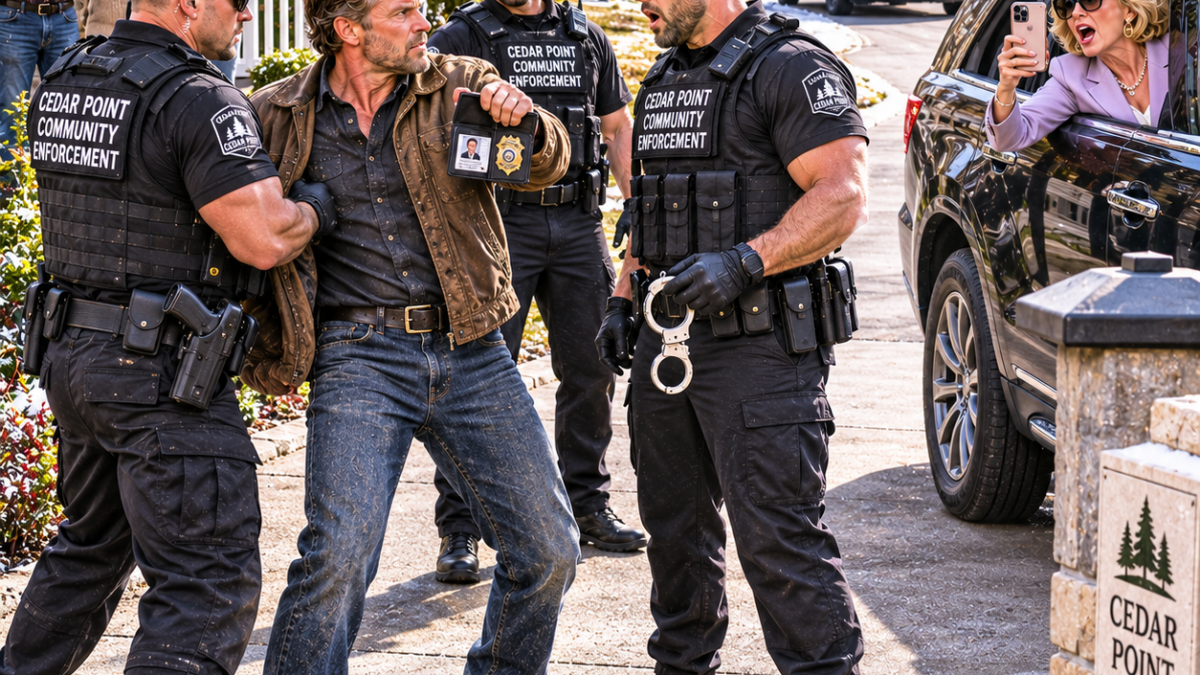
The first fake officer grabbed my left arm before I had even closed the truck door.
“Hands where we can see them.”
I looked down at his hand.
Then at the plastic shield clipped to his vest.
Then at the two men standing behind him.
All three wore black tactical-style shirts with CEDAR POINT COMMUNITY ENFORCEMENT printed across the chest. They had radios, utility belts, mirrored sunglasses, and badge-shaped pieces of plastic designed to look official from fifteen feet away.
The tallest one even carried handcuffs.
Cheap ones.
Nickel-plated.
The kind you could probably order online with free shipping.
He pointed at me.
“You’re under HOA arrest.”
I stared at him.
“Under what?”
“HOA arrest.”
Behind the curtains across the cul-de-sac, faces had already appeared.
My neighbor Ed Carson stepped onto his porch.
Two houses farther down, a teenager lifted his phone and started recording.
The fake officer holding my arm tightened his grip.
“You’ve repeatedly violated community regulations.”
“What regulation allows you to touch me?”
The tall one stepped closer.
“Don’t make this harder.”
I looked past them.
At the black SUV parked crookedly near the curb.
Tinted windows.
Engine running.
A woman sat in the passenger seat holding a phone horizontally.
Karen Bellamy.
President of Cedar Point Estates.
She was filming.
Of course she was.
That told me almost everything.
Karen had not sent these men to resolve a dispute.
She wanted footage.
She wanted me angry.
She wanted me resisting.
Maybe she wanted a clip she could play at the next HOA meeting while explaining that I was dangerous.
I looked back at the three men.
“I’m going to ask once. Let go of my arm.”
The short one laughed.
“Sir, you don’t give instructions here.”
I almost smiled.
That was an extraordinary sentence to hear while standing in my own driveway.
The tall man reached toward the handcuffs.
“Turn around.”
“No.”
“You’re being detained for noncompliance.”
“No, I’m not.”
He looked toward Karen’s SUV.
She lifted one hand.
A signal.
The man holding my arm pulled harder.
I did not resist.
Not yet.
“Who issued your authority?” I asked.
“The association.”
“Who issued your badge?”
“Cedar Point.”
“That wasn’t my question.”
His expression tightened.
A woman across the street shouted from her porch:
“They’re not police!”
The short man turned.
“Ma’am, go inside.”
She laughed.
“Make me.”
More phones appeared.
The three men were beginning to realize they had an audience they did not control.
The tall one pointed at me again.
“You have unpaid HOA violations exceeding seven thousand dollars.”
“My property is not subject to the covenant section you’re citing.”
“Karen says it is.”
“Karen is wrong.”
“That’s not for you to decide.”
Actually, I thought, it was very much for the recorded deed, the bylaws, and the county property records to decide.
But arguing HOA jurisdiction was no longer the important issue.
These men had crossed onto my driveway.
Grabbed me.
Claimed power to arrest me.
And now one was preparing to use handcuffs.
I slowly reached toward the inside of my jacket.
All three reacted.
Hands moved toward belts.
“Don’t,” the tall one barked.
I stopped.
“My identification is inside.”
“Hands out where we can see them.”
“You asked who I am.”
“We know who you are.”
“No.”
I looked directly at him.
“You know whose house Karen sent you to.”
That seemed to confuse him.
The short one looked toward the SUV.
Karen was still recording.
I could see her pale face through the windshield.
She looked impatient.
She expected the scene to be moving faster.
The tall fake officer nodded toward my jacket.
“Slowly.”
I reached inside with two fingers.
Pulled out a leather credential case.
Opened it.
The short man saw the badge first.
His face emptied.
The man holding my arm let go.
Not gradually.
Instantly.
As if my sleeve had become electrified.
The tall one stared.
His hand remained halfway to the cuffs.
“What is that?”
I held the credentials at chest height.
No dramatic movement.
No raised voice.
Just enough for them to read.
The short man whispered:
“Oh, man.”
The tall one snapped at him.
“Shut up.”
But his own voice had changed.
I looked at the man who had grabbed me.
“You boys sure you want to continue?”
Nobody answered.
From Ed Carson’s porch came a low whistle.
Another neighbor said:
“That’s a real badge.”
Karen opened the SUV door.
She stepped out wearing white slacks, a lavender blouse, oversized black sunglasses, and the expression of someone watching an expensive plan go off script.
“Do not let him intimidate you,” she shouted.
I looked toward her.
“Karen.”
“These officers are carrying out association enforcement.”
“Officers?”
“Yes.”
The tall man glanced at her.
That word no longer seemed to comfort him.
I closed the credential case.
Then I heard the siren.
Not loud.
Just one short electronic burst from the end of the street.
Red and blue light reflected across the white siding of the corner house.
A real county patrol car turned into the cul-de-sac.
The fake officers froze.
The short one looked at the cruiser.
Then at me.
Then at the badge in my hand.
“Who called them?”
I said nothing.
The patrol car rolled to a stop twenty feet away.
Deputy Marcus Reed stepped out.
His eyes moved from the three uniforms to Karen.
Then to me.
His posture changed immediately.
“Sheriff?”
The tall fake officer went completely still.
And Karen’s phone slowly lowered from her hand.
part 2
My name is Daniel Mercer.
I had served as sheriff of Alder County for six years.
Before that, I spent eighteen years in the department working patrol, investigations, and eventually command.
I did not advertise it around Cedar Point.
Not because it was a secret.
Because my job already occupied enough of my life.
At home, I wanted to be Daniel.
Husband.
Father.
Neighbor.
Guy who forgot to bring the trash bin back from the curb.
Not Sheriff Mercer.
My wife, Emily, understood that better than anyone.
We had bought our house in Cedar Point eleven years earlier.
At the time, the HOA was exactly what a homeowners association should be.
Mostly boring.
It maintained the entrance landscaping.
Managed a small retention pond.
Paid for streetlights on two private lanes.
Handled architectural requests.
People complained about dues, voted on budgets, and then went home.
Nobody wore tactical clothing.
Nobody carried fake badges.
Nobody threatened arrest over landscaping.
Then Karen Bellamy became president.
Karen did not begin as a cartoon villain.
That mattered.
She was competent.
Organized.
Energetic.
The previous board had let maintenance slide.
Karen negotiated new landscaping contracts.
Repaired the community playground.
Improved reserve funding.
Got delinquent common-area repairs completed.
Residents liked that.
Competence builds trust.
Trust creates freedom.
And if nobody checks that freedom, sometimes it becomes something else.
The first sign was enforcement.
Karen believed the HOA had become too lenient.
Her phrase.
Too lenient.
She pushed through more inspections.
More notices.
More fines.
Some were legitimate.
A homeowner had built an unapproved shed inside a drainage easement.
Another had abandoned two broken vehicles in a shared parking area.
Those were real issues.
Then the scope expanded.
Trash cans visible after six p.m.
Basketball hoops.
Garden flags.
Fence stain.
Holiday decorations.
Children’s bicycles left outside.
Karen began treating every disagreement as defiance.
The board rarely challenged her because she always arrived with a binder and an explanation.
That was her talent.
She made authority sound inevitable.
My conflict with her began over something stupid.
A mailbox.
Our mailbox post rotted near the ground.
One Saturday I replaced it.
Same location.
Same height.
Nearly the same design.
Different wood.
Three days later:
ARCHITECTURAL MODIFICATION WITHOUT APPROVAL — $250.
I emailed Karen.
“This is maintenance.”
She replied:
All visible exterior changes require approval.
I checked the covenants.
They did not.
Routine repair did not require architectural review.
I sent her the relevant language.
She replied:
The board interprets this differently.
I asked when the board had voted on that interpretation.
No answer.
The fine disappeared.
But Karen remembered.
After that, I noticed our address appeared on inspection reports more often.
Fence.
Driveway.
Landscaping.
One warning claimed my unmarked county-issued vehicle violated restrictions on commercial vehicles because it had a radio antenna.
That one made Marcus Reed laugh for five straight minutes.
“Should I cite all the patrol cars too?” he asked.
“Probably.”
“Revenue.”
“Don’t encourage her.”
I could have walked into a board meeting wearing my sheriff’s uniform and ended most of the nonsense socially.
I refused.
My badge did not give me more rights as a homeowner than anyone else.
If an HOA rule was invalid against me, it should also be invalid against Ed Carson, Mrs. Wallace, or the twenty-two-year-old teacher who had just bought her first house.
I wanted the paperwork to decide.
Karen mistook that for weakness.
Then she created the Community Enforcement Program.
The board minutes said the association intended to hire a private compliance service to document violations and provide “resident contact support.”
I attended that meeting.
“Resident contact support?” I asked.
Karen looked irritated that I had come.
“Trained personnel who can address problems directly.”
“Security?”
“Compliance.”
“What powers?”
“They’ll have authority delegated by the association.”
“What does that mean?”
Karen folded her hands.
“Authority to enforce our governing documents.”
“Physical authority?”
“That depends on the situation.”
I looked around the table.
“Does HOA counsel approve this?”
Karen answered before the association attorney could.
“Our attorney has reviewed the concept.”
The attorney, a tired-looking man named Patrick Sloan, cleared his throat.
“I’ve reviewed the contract language concerning observation and notice delivery.”
I looked at him.
“Detention?”
“No.”
“Search?”
“No.”
“Physical removal?”
“No.”
Karen cut in.
“Nobody said anything about detention.”
I remembered that sentence later.
The contract went through.
The company was called Civic Shield Compliance.
Three contractors began appearing around Cedar Point.
Black vests.
Radios.
Badge-shaped insignia.
One called himself “Chief Enforcement Officer.”
I asked the company owner whether they were sworn peace officers.
“No.”
Licensed security?
“Yes, for certain functions.”
Law-enforcement authority?
“No.”
Then I asked the obvious question.
“Why do their patches look like police insignia?”
He said Karen had requested a professional appearance.
I documented the conversation.
Not because I was building a criminal case.
Because I knew what happens when people blur authority.
Eventually somebody believes the costume.
The first complaints arrived within two weeks.
Mrs. Wallace said an enforcement contractor stood in front of her car and refused to let her leave until she accepted a violation notice.
Ed Carson said two men threatened to tow his pickup from his driveway over an expired registration sticker even though the vehicle was on private property and the HOA rules addressed abandoned vehicles, not registration.
A teenager told his parents a contractor threatened to “detain” him for riding an electric scooter on the sidewalk.
I called Karen.
“Your contractors are using law-enforcement language.”
“They are authorized enforcement personnel.”
“They’re private contractors.”
“Residents need to understand instructions are serious.”
“Serious isn’t the same as police authority.”
“Daniel, you’re being territorial.”
“No.”
“You think because you’re sheriff, nobody else can enforce rules.”
“That is not what I said.”
She laughed.
“I know exactly what this is. You don’t like another authority operating in your neighborhood.”
“Karen.”
“Yes?”
“Do not let those men tell people they can arrest, detain, or search them.”
“They know their limits.”
The call ended.
Two days later, one of them showed Mrs. Wallace handcuffs.
That was when I notified our county attorney.
Not to open a criminal case.
To create a record.
I also contacted Patrick Sloan, HOA counsel.
He sounded alarmed.
“The contract does not authorize restraints.”
“Do they know that?”
“They should.”
“That wasn’t my question.”
He promised to speak with Karen.
The uniforms disappeared for three days.
Then came back with slightly different patches.
Instead of OFFICER, they now said COMMUNITY OFFICER.
That did not solve the underlying problem.
Then I received Karen’s violation package.
Seven thousand four hundred dollars.
Mailbox.
Fence trim.
Landscaping.
Parking.
Repeated administrative penalties.
Most rested on interpretations the board had never formally adopted.
I appealed.
The hearing was scheduled for the next month.
Karen apparently decided process was too slow.
The Friday before the fake arrest, she emailed me:
Continued refusal to comply may result in direct enforcement action.
I forwarded it to Patrick Sloan.
He replied:
I am not aware of any authorized physical enforcement action.
I saved that email.
Saturday morning, I drove to the hardware store.
When I returned, Karen’s black SUV was parked down the street.
Three Civic Shield men waited near my driveway.
The cameras on my house captured the entire arrival.
I later learned Karen had instructed them to serve what she called an administrative detention order.
There is no such HOA power.
No judge signed anything.
No court approved anything.
Karen created a two-page form herself.
At the top:
CEDAR POINT COMMUNITY ENFORCEMENT DETENTION NOTICE.
It accused me of repeated interference with association operations.
At the bottom was a signature line.
Not mine.
Theirs.
The tall man, Travis Cole, would later admit he questioned the form.
Karen told him:
“Sheriff Mercer is a resident here. On HOA property, his county title is irrelevant.”
The first half of that sentence was nearly true.
My job did not give me special HOA privileges.
The second half was the problem.
My driveway was not HOA common property.
More importantly, Karen had no power to arrest anyone anywhere.
The three men approached before I closed the truck door.
That brought us back to the patrol car.
Deputy Marcus Reed stood beside his cruiser.
“Sheriff?”
I nodded.
“Morning, Marcus.”
He looked at the three men.
Then at the handcuffs.
“Want to tell me what’s happening?”
Travis spoke first.
“We’re HOA security.”
The short man—Kyle—nodded rapidly.
“Community enforcement.”
Marcus looked at me.
I said:
“They put hands on me and attempted to detain me under an HOA document.”
Marcus’s expression changed.
“Anybody hurt?”
“No.”
“Weapons?”
“I haven’t seen firearms.”
Marcus looked at them.
“Keep your hands visible.”
Karen marched toward him.
“This is ridiculous.”
Marcus turned.
“Ma’am?”
“I’m HOA President Karen Bellamy.”
“Okay.”
“These men are carrying out authorized association enforcement.”
“Authorized by who?”
“The board.”
“Court order?”
“This is not a court matter.”
Marcus looked at the handcuffs.
“Then why are they trying to cuff somebody?”
Karen’s face tightened.
“Mr. Mercer refused to cooperate.”
“Sheriff Mercer?”
She rolled her eyes.
“He is not acting as sheriff.”
I spoke.
“That’s correct.”
Karen looked almost triumphant.
Then I continued.
“I’m standing on my own driveway as a homeowner.”
Marcus nodded.
“Which still doesn’t explain cuffs.”
The neighborhood had gone silent.
Phones remained raised.
Karen saw that.
Her tone changed.
“This has been misunderstood.”
Kyle looked at her.
“You told us to detain him.”
She turned.
“No. I told you to serve the enforcement notice.”
“You said if he refused—”
“Stop talking.”
Marcus raised one hand.
“No. Let him talk.”
Karen’s face flushed.
A second county unit arrived.
Deputy Lena Brooks stepped out.
Marcus asked her to separate the three men.
That was standard.
Get stories independently.
Preserve evidence.
Calm the scene.
I stepped back.
I did not issue orders.
That mattered.
A sheriff can be a victim.
A sheriff should not investigate his own victimization.
I called Undersheriff Rachel Nolan.
“I need you to take command of anything involving this incident.”
“Why?”
“Because I’m the complainant.”
“You okay?”
“Yes.”
“Emily?”
“Not here.”
“Good.”
Rachel arrived twenty minutes later.
By then Marcus had photographed the fake badges, handcuffs, uniforms, and detention notice.
Lena had spoken to Travis.
Kyle was crying.
The third man, Evan, had said almost nothing.
Karen stood beside her SUV making calls.
Rachel walked up to me.
“You’re done.”
“Excuse me?”
“You’re a witness now.”
“Fair.”
“Go stand with Emily when she gets here.”
“I hate you.”
“Good.”
That was Rachel.
Efficient.
Emily arrived.
She looked at the three contractors.
Then at me.
“You couldn’t go buy screws without getting arrested?”
“Attempted arrest.”
“Important distinction.”
Karen overheard.
“This isn’t funny.”
Emily looked at her.
“No, Karen. It isn’t.”
Karen looked away.
The deputies searched nobody without legal basis.
They asked for consent where appropriate.
Civic Shield’s men surrendered their work orders and credentials.
The detention form was photographed.
Their supervisor arrived with an attorney on speakerphone.
Then Rachel made the decision.
Based on witness statements, video already reviewed at the scene, physical contact, and the attempted use of restraints while claiming official authority, the three men were detained and later arrested on suspicion of offenses that included unlawful restraint and impersonation-related conduct, subject to the prosecutor’s review.
Karen was not arrested that morning.
People expected her to be.
I didn’t.
Cases require evidence.
Her bad judgment was obvious.
Her criminal responsibility needed proof.
That proof arrived from Civic Shield.
Travis decided quickly that loyalty to Karen was not worth jail.
His attorney provided emails.
Instructions.
Training materials.
One email from Karen read:
Residents must believe Community Enforcement can impose immediate consequences. A delayed letter does not create compliance.
Another:
If Mercer refuses to recognize your authority, place him in temporary restraint until the matter can be documented.
Patrick Sloan had never seen that message.
Neither had most of the board.
Then investigators found Karen had ordered Civic Shield to purchase handcuffs.
Association funds paid for them.
The invoice was coded:
Field compliance equipment.
Rachel called me after the finding.
“You still staying out?”
“Yes.”
“Good.”
“What does counsel think?”
“County attorney is reviewing.”
I hung up.
Emily looked across the kitchen table.
“You want her arrested.”
“I want the evidence followed.”
“That wasn’t my question.”
I sighed.
“Yes.”
“Because she embarrassed you?”
“No.”
“Because they grabbed you?”
“Partly.”
She waited.
I looked toward the window.
“Because if they’d chosen Mrs. Wallace instead, she might have gotten in the SUV.”
Emily’s expression changed.
That was the real issue.
They picked the wrong house by accident.
Not because I was more entitled to safety.
Because I knew instantly that their authority was fake.
Other residents might not.
That made me angrier than anything.
The county attorney opened a broader investigation.
Not because the victim was sheriff.
Because multiple residents reported similar conduct.
Mrs. Wallace provided doorbell footage.
Ed Carson provided audio of a contractor threatening impoundment.
The teenager’s parents had video.
Another homeowner, Luis Ramirez, produced a letter titled:
COMMUNITY SUMMONS.
It ordered him to appear before “Cedar Point Enforcement Tribunal.”
There was no tribunal.
Just Karen and two board allies sitting in the clubhouse.
Language matters.
She had built an imitation justice system inside an HOA.
Not a real government.
An imitation.
Summons.
Officers.
Detention.
Enforcement.
Tribunal.
Badge.
Every term made residents slightly more likely to believe resistance was illegal.
That was deliberate.
The board called an emergency meeting.
I did not sit at the front.
I sat beside Emily halfway back.
Karen entered carrying three binders.
She looked composed.
For the first fifteen minutes she presented charts.
Fine collections had increased.
Violation closure times improved.
Resident “compliance” reached ninety-two percent.
Then Helen Park, the board treasurer, asked:
“Were we told contractors were using handcuffs?”
Karen paused.
“The equipment was intended for exceptional situations.”
“Were we told?”
“I briefed the board on enhanced enforcement.”
“That is not an answer.”
The room murmured.
Patrick Sloan stood.
“For clarity, I never advised the association that it possessed detention authority.”
Karen looked furious.
“We are private property.”
“So?”
“Our rules allow enforcement.”
“Fines. Hearings. Liens when lawfully authorized and properly processed.”
He pointed toward the screen.
“Not arrests.”
Karen turned toward residents.
“This is being exaggerated because Daniel Mercer is sheriff.”
I remained seated.
She pointed at me.
“He flashed his badge to intimidate our personnel.”
Travis Cole was sitting near the side wall with his attorney.
He stood.
“No.”
Karen froze.
Travis continued.
“He showed his badge after I grabbed him and Kyle reached for cuffs.”
Karen said:
“You were supposed to serve a notice.”
“You told us to restrain him.”
“That’s false.”
Travis held up printed emails.
The room changed.
He read the message.
Temporary restraint.
Document refusal.
Maintain control.
Karen looked toward Patrick.
He looked back at her.
No rescue.
Ed Carson stood.
“So you built yourself a police department?”
“No.”
Mrs. Wallace:
“Then why did they tell me I could be detained?”
“I cannot answer for every contractor.”
Luis Ramirez held up his fake summons.
“Can you answer for this?”
Karen stared.
“Those are internal compliance notices.”
“It says failure to appear may result in enforcement detention.”
Someone behind him said:
“What the hell?”
The meeting became chaos.
Board members called for recess.
Karen refused.
She tried to continue.
Helen Park shut off Karen’s microphone.
That was probably the moment her presidency ended.
Not officially.
But emotionally.
The room stopped accepting her control.
A recall petition began that night.
Meanwhile, county investigators followed the records.
They found the fake enforcement program had cost Cedar Point more than sixty thousand dollars in six months.
Uniforms.
Radios.
Vehicle decals.
Private patrol hours.
“Compliance equipment.”
Karen had approved several expenditures under emergency administrative authority.
Some exceeded her delegated limits.
That became an audit issue.
Then came something worse.
Fine revenue.
Karen had repeatedly told the board that aggressive enforcement paid for itself.
But accounting showed thousands in “field settlement fees” had been collected directly by contractors.
Residents were told they could pay on the spot to avoid escalation.
Those payments had not all been properly recorded in HOA accounts.
Now the county prosecutor had questions about money too.
Civic Shield’s owner blamed Karen.
Karen blamed Civic Shield.
The board blamed both.
Residents blamed everybody.
I stayed out.
That became difficult when local news called.
Sheriff targeted by fake HOA cops.
Great headline.
Terrible situation.
I released one statement through the department:
“I was involved as a private property owner. Undersheriff Nolan has command of the investigation. Questions regarding potential charges should be directed to the county attorney.”
That was it.
Karen gave three interviews.
In one, she said:
“Sheriff Mercer used his badge to frighten community volunteers.”
The video contradicted her.
I did not respond.
In another:
“This is an attack on homeowner self-governance.”
No response.
Then:
“If Daniel Mercer had been an ordinary resident, none of this would have happened.”
That one stayed with me.
Because she was partly right.
If I had been ordinary in the way she meant—someone who did not know procedure, jurisdiction, or exactly what a legitimate arrest looked like—I might have been easier to frighten.
And that was the problem.
At the next HOA meeting, I finally spoke.
Five minutes.
No uniform.
No badge.
Just jeans and a blue shirt.
“I keep hearing that this happened because I’m sheriff.”
The room went quiet.
“It didn’t.”
I looked around.
“It became public because the people Karen sent recognized my credentials. But the underlying conduct happened before anybody knew what I did for a living.”
I pointed toward Mrs. Wallace.
“They threatened her.”
Toward Luis.
“They sent him a fake summons.”
Toward the teenager’s parents.
“They threatened their son with detention.”
Then toward Karen.
“The question is not why your contractors panicked when they saw my badge.”
I paused.
“The question is why any homeowner needed a badge to make them stop.”
Nobody spoke.
“That should bother every person in this room.”
Karen stared at me.
I continued.
“A homeowners association has real authority where the covenants and law give it authority.”
“Collect dues.”
“Maintain common property.”
“Enforce valid restrictions through lawful procedures.”
“An HOA is not a police department.”
“Your president is not a judge.”
“Your contractor is not a deputy.”
“A violation notice is not a warrant.”
“And a private company cannot manufacture arrest power because somebody printed OFFICER on a vest.”
I sat down.
No applause at first.
Then Mrs. Wallace began.
Others followed.
I wished they hadn’t.
I was not giving a campaign speech.
I was tired.
The recall vote happened two weeks later.
Karen lost.
Sixty-four percent voted to remove her.
Thirty-six percent supported her.
That number surprised some people.
Not me.
Karen had fixed real problems.
People remembered that.
Power rarely grows around a person who has never done anything useful.
The dangerous ones are often effective enough that people excuse what comes later.
Helen Park became interim president.
Her first act was terminating Cedar Point’s enforcement contract.
Second:
Every resident fine issued during the program went through independent review.
Third:
The board eliminated police-style terminology.
No community officers.
No summons.
No detention notices.
Contractors could document.
Nothing more.
The audit found twenty-eight fines unsupported by the governing documents.
Refunds followed.
Several field settlement payments were recovered or credited.
Civic Shield lost the contract.
Its licensing became a separate issue for regulators.
Travis cooperated fully.
Kyle did too after his attorney apparently explained how much trouble the videos could create.
Evan had barely participated and was treated differently.
That mattered.
Justice should distinguish conduct.
It should not flatten everyone into the same villain because the story sounds cleaner that way.
Karen’s own case moved slowly.
The prosecutor ultimately pursued charges supported by evidence tied to attempted unlawful detention and the use of misleading enforcement practices, while financial issues were handled through separate proceedings and civil recovery.
I testified when subpoenaed.
Nothing more.
The courtroom did not resemble the HOA clubhouse.
No cheering neighbors.
No speeches.
No Karen pounding a binder.
Documents.
Video.
Witnesses.
Emails.
The prosecution played the driveway footage.
Travis grabbed my arm.
Kyle reached toward the cuffs.
My badge came out.
Their faces changed.
Then Marcus Reed arrived.
The defense tried to make my badge the center of everything.
“You deliberately concealed that you were sheriff.”
“I didn’t conceal it.”
“You didn’t tell them.”
“They didn’t ask before touching me.”
“Wouldn’t revealing your identity earlier have prevented the confrontation?”
“Possibly.”
“Then why not?”
I looked at the attorney.
“Because a private contractor should not need to know a homeowner is sheriff before respecting the law.”
Silence.
He moved on.
That was the whole case in one question.
What happens when nobody special is standing in the driveway?
Karen had built a system dependent on fear.
Fear works best against people who believe the other side knows something they don’t.
Fake authority thrives in uncertainty.
Do they really have a right to tow my car?
Can they enter my backyard?
Can they detain me?
Can they charge me?
Maybe I should just cooperate.
That hesitation had become Karen’s enforcement tool.
My badge broke the illusion.
But the law—not my badge—proved the illusion had been false all along.
After the cases concluded, Cedar Point changed.
Not dramatically.
Better.
Boring.
Helen stayed president for one year.
Then a quiet accountant named Robert Mills took over.
Robert loved procedure.
Every board decision had a citation to the bylaws.
Every fine identified the exact covenant.
Hearings had written records.
Contractors wore polo shirts with PROPERTY SERVICES stitched across the chest.
No shields.
No badges.
No cuffs.
Residents could appeal.
People still lost appeals.
Valid rules remained valid.
That was fine.
I never wanted the HOA destroyed.
Common property still needed maintenance.
Stormwater still needed funding.
Neighbors still needed a process to resolve covenant disputes.
The answer to abused authority is not zero authority.
It is accountable authority.
Mrs. Wallace eventually joined the board.
I asked her why.
“So nobody ever tells me they can arrest me over hydrangeas again.”
“Strong platform.”
“I won by twenty votes.”
“Democracy.”
Luis Ramirez became chair of the architectural committee.
His first meeting lasted forty-three minutes.
Under Karen, meetings often lasted three hours.
“What’s your secret?” I asked.
“If the rules don’t prohibit it, I stop talking.”
Revolutionary.
Emily joined nothing.
Smartest person in the neighborhood.
She did, however, save the fake detention notice.
It sat in our home office drawer.
One evening I found her looking at it.
“Why keep that?”
She shrugged.
“Because it’s unbelievable.”
I picked it up.
It looked official enough at first glance.
Heavy paper.
Blue border.
HOA seal.
Formal language.
ADMINISTRATIVE DETENTION AUTHORIZATION.
No statute.
No judge.
No real authority.
Karen’s signature.
That was it.
I put it beside one of my department’s actual warrant forms.
The differences were almost embarrassing.
Court information.
Probable cause.
Judicial signature.
Scope.
Return requirements.
Legal limits.
An actual warrant was designed around accountability.
Karen’s form was designed around appearance.
That distinction mattered to me.
Years in law enforcement taught me that lawful authority is mostly limits.
When can you act?
Where?
Why?
For how long?
What evidence?
Who reviews it?
Karen believed authority meant freedom to act.
The law understands authority as permission within boundaries.
Opposite concepts.
Months after everything ended, Travis asked to meet me.
We sat in a diner outside town.
He no longer worked for Civic Shield.
“You hate me?”
“No.”
He looked surprised.
“I should’ve known.”
“Yes.”
“Karen made it sound legitimate.”
“I know.”
“She said her attorney approved the program.”
“I know.”
“I thought HOA private property gave us more power.”
“You should’ve checked.”
He nodded.
“That’s what everyone says.”
“They’re right.”
He stared at his coffee.
“When I grabbed your arm, I thought you were just another guy refusing instructions.”
“Would that have made it okay?”
“No.”
“Then stop focusing on my badge.”
He looked up.
That landed.
“You’re right.”
“Yes.”
“I hate that too.”
He smiled faintly.
Before leaving, he said:
“I’m working warehouse security now.”
“Good.”
“No cuffs.”
“Better.”
I wished him well.
Not because what he did was acceptable.
Because people should be allowed to learn after consequences.
Kyle never contacted me.
Karen remained in Cedar Point for another year.
We passed at the grocery store.
She ignored me.
Then one afternoon she confronted Emily near the mailbox kiosk.
Emily told me later.
Karen said:
“Your husband destroyed my reputation.”
Emily answered:
“No. Daniel gave you a chance to stop.”
Karen apparently laughed.
“You think he’s innocent?”
“Of what?”
“He knew who he was.”
Emily stared at her.
“Everyone knows who they are, Karen.”
That confused her.
Emily continued.
“The problem was you thought ordinary people deserved less protection.”
Karen walked away.
I married well.
When Karen eventually sold her house, there was no parade.
No celebration.
A moving truck came.
Boxes left.
The house went on the market.
A young family bought it.
Their first HOA request was permission to install a basketball goal.
Robert approved it.
Karen would have hated the location.
Life continued.
My relationship with neighbors changed too.
For a while, people treated me like some kind of local hero.
I hated it.
Children called me Sheriff Dan even when I was mowing the lawn.
Ed Carson once introduced me at a barbecue as:
“The man who arrested the HOA.”
“I arrested nobody.”
“Details.”
“Important details.”
He smiled.
“You ruin every story.”
Someone printed a meme of three fake officers facing my badge.
Emily saved that too.
Traitor.
Eventually the novelty died.
Good.
I returned to being the neighbor who sometimes forgot trash day.
That felt healthy.
At the department, we used the incident for training.
Not because it involved me.
Because it illustrated a real problem.
Private security can perform legitimate functions.
So can code inspectors.
So can HOA compliance personnel.
But uniforms and terminology must not intentionally create false governmental authority.
Deputies were reminded to slow such scenes down.
Verify identities.
Separate parties.
Determine actual legal authority.
Preserve video.
Avoid assuming the person with the most official-looking paperwork is right.
Marcus Reed taught part of the training.
He put a photograph of the fake badge on the projector.
Then a department badge.
“What’s the most important difference?”
A deputy answered:
“Ours is real.”
Marcus shook his head.
“That answer is how you end up in trouble.”
He pointed toward the screen.
“The difference is the authority behind it and the limits on that authority.”
I was proud of him.
Didn’t tell him.
Couldn’t let him get arrogant.
Two years later, Cedar Point held a neighborhood safety day.
Fire department.
EMS.
Sheriff’s office.
Kids climbed through vehicles.
I attended for an hour.
Robert Mills approached.
“We thought about inviting private security.”
I stared at him.
He laughed.
“Kidding.”
“Not funny.”
“Very funny.”
Near the playground, I saw a small table explaining how to identify official county personnel.
No fake police story.
No Karen.
Just useful information.
I liked that.
The best reforms outlive the scandal that created them.
Eventually people forget why the rule exists.
That’s okay.
As long as the rule stays good.
Emily and I stayed in the same house.
The mailbox survived.
I replaced it again years later.
This time I submitted no application.
Because routine replacement still did not require one.
Robert sent me a text.
Looks good.
That was the entire enforcement process.
One evening, Ed and I sat on his porch while the sun dropped behind the houses.
“You know what always bothered me?”
“What?”
“They weren’t scared until they saw your badge.”
I nodded.
“Me too.”
“Why?”
“Because before that, they thought grabbing a resident was acceptable.”
Ed looked toward the street.
“You think Karen knew exactly what she was doing?”
“Yes and no.”
“That’s helpful.”
“I think she convinced herself she was protecting the community.”
“That excuses it?”
“No.”
“Then why mention it?”
“Because people cause more damage when they believe their motives make limits optional.”
Ed thought about that.
“Meaning?”
“Karen didn’t wake up saying, ‘I’m going to build a fake police force.’”
“She kind of did.”
“Eventually.”
I laughed.
“But first she thought rules weren’t being respected.”
“Then?”
“She wanted faster compliance.”
“Then?”
“Uniforms.”
“Then badges.”
“Then cuffs.”
He nodded.
“Inches.”
“Exactly.”
That is how most authority problems grow.
Inches.
Nobody challenges the first small overreach because challenging it feels dramatic.
Then the next step seems normal compared to the last.
A clipboard.
A uniform.
A badge.
A threat.
A hand on your arm.
Handcuffs.
By the time somebody asks how things became absurd, everybody has been adjusting gradually for months.
That became my biggest lesson.
Stop the first unclear claim.
Ask the first question.
Where does this authority come from?
Show me.
Not angrily.
Not theatrically.
Just:
Show me.
If the answer exists, read it.
If it doesn’t, the conversation changes immediately.
Years after Karen left, I received a letter from a sheriff in another county.
Their department had heard about Cedar Point through a training association.
An HOA there had hired “community marshals.”
He wanted our policy materials.
I sent them.
A month later he emailed back.
No scandal.
No arrests.
The HOA changed the uniforms and rewrote the contract before problems occurred.
That made me happier than any courtroom result.
Prevention is less satisfying in stories.
Much better in life.
The fake detention notice eventually went into my department archive alongside training documents.
Emily objected.
“I wanted that.”
“You have a copy.”
“Original is funnier.”
“It’s evidence.”
“Case is closed.”
“Historical record.”
She narrowed her eyes.
“You’re sentimental.”
“I’m sheriff.”
“Those are not mutually exclusive.”
She was right again.
When my second term ended, I decided not to run again.
Six years had become eight.
Then ten.
Enough.
On my last day, Marcus Reed—now a sergeant—brought me the Cedar Point file.
“You keeping anything?”
“No.”
He held up a copy of the fake badge photograph.
“Not even this?”
“Absolutely not.”
“What about the detention order?”
“Archive.”
“Your old statement?”
“Archive.”
“Your badge?”
“That one I’m keeping.”
He smiled.
“Think the fake cops would recognize it now?”
“Marcus.”
“Sorry.”
I retired.
For the first time in decades, I really was just Daniel.
No radio at night.
No county phone.
No people calling because a cow wandered onto a highway.
It took adjustment.
One morning, I walked to the mailbox and saw a new compliance contractor checking landscaping farther down the street.
Polo shirt.
Name tag.
Clipboard.
No badge.
He smiled.
“Morning, Mr. Mercer.”
“Morning.”
He did not call me Sheriff.
Perfect.
Emily joined me outside.
“You watching him?”
“No.”
“You are.”
“Professional curiosity.”
“You’re retired.”
“Deeply ingrained professional curiosity.”
She laughed.
The contractor measured a setback.
Took a photograph.
Knocked on a door.
Waited.
Then left.
Boring.
Beautiful.
We walked back toward the house.
At the driveway, I remembered the three men standing there years earlier.
Travis grabbing me.
Kyle reaching for cuffs.
Karen filming.
The red and blue lights turning the corner.
For a long time, that memory centered on the moment my badge appeared.
It doesn’t anymore.
Now I think about everything before it.
Their confidence.
Their certainty that an ordinary homeowner had no choice.
That is where the real wrongdoing lived.
If the system only stopped because I happened to carry a real badge, then the system was still broken.
What mattered was what happened afterward.
Other residents spoke.
Records were examined.
Contracts were read.
The board changed.
Procedures were rewritten.
The fake authority disappeared for everyone.
Not just me.
Emily opened the front door.
“You coming?”
I looked once more at the driveway.
“Yeah.”
Inside, my retired sheriff’s badge sat in a wooden case on a shelf.
I rarely opened it.
It represented work I was proud of.
But the Cedar Point story had taught me not to worship symbols.
A badge is only meaningful because of the law, training, accountability, and public trust behind it.
Strip those away and it becomes metal.
Karen’s men learned that with their plastic shields.
Karen learned it with her binder.
And I learned it too.
Being the highest-ranking law-enforcement officer in the county did not give me the right to settle my private HOA dispute by command.
That was why I stepped aside.
That was why Rachel took control.
That was why the case survived.
Real authority accepts limits.
Fake authority runs from them.
The three men who entered my driveway kept telling me they were in charge.
They repeated it until they almost believed it themselves.
Then one patrol car turned the corner.
One deputy asked who authorized them.
One set of records was opened.
And the entire performance collapsed.
Not because my badge was shinier.
Because theirs had nothing lawful behind it.
That was the difference Karen never understood.
She thought power came from looking official enough that people stopped questioning you.
I had spent my career learning the opposite.
Lawful power begins when people are allowed to question you—and you can still show exactly where your authority comes from.
Karen could not.
Her contractors could not.
And once the neighborhood finally asked them to prove it, there was nothing left but plastic badges, toy cuffs, a fake detention notice, and three frightened men standing in somebody else’s driveway.
They came to arrest a homeowner.
They accidentally exposed an entire system built on pretending.
And in the end, that was far more important than the badge I happened to pull from my jacket.








