HOA Karen Sent Fake ‘Cops’ Into My House to Handcuff Me—She Had No Idea I Was a U.S. Marshal
part 2
For several seconds, Densmore simply stared at the credentials in his hands.
I could see his mind moving.
Not thinking about the law.
Thinking about escape.
How to explain it.
How to downgrade it.
How to make what had just happened sound less serious than it was.
People do that when authority evaporates.
A minute earlier, he was telling me I no longer made decisions in my own house.
Now he was looking for permission to breathe.
The youngest man spoke first.
“Mark.”
Densmore ignored him.
“Mark, uncuff him.”
“I heard you.”
“Then do it.”
The second man already had his handcuff key out.
He unlocked my right wrist.
Then the left.
I rubbed the skin once but did not step toward anyone.
Densmore handed back my credentials.
“We didn’t know.”
I put the leather case in my front pocket this time.
“That is not the defense you think it is.”
“We were told you were a hostile homeowner.”
“By Cynthia Vale?”
Nobody answered.
“Was it Cynthia?”
The youngest nodded.
Densmore turned sharply.
“Shut up, Evan.”
Good.
Now I had a name.
I looked at Evan.
“Don’t listen to him. If you were given false information, this is the moment to stop making the problem worse.”
Densmore tried to regain control.
“This is an HOA dispute.”
“No.”
“It started as—”
“It stopped being an HOA dispute when you forced entry into my house and handcuffed me.”
“We believed we had authority.”
“Show me the authority.”
Densmore had nothing.
No warrant.
No county order.
No court document.
Not even a written trespass consent.
Just a printed work authorization from Ridgeview Heights.
I asked to see it.
He hesitated.
I waited.
Finally he pulled a folded sheet from an interior vest pocket.
RIDGEVIEW HEIGHTS COMMUNITY COMPLIANCE ACTION.
Target:
Daniel Mercer.
Action:
Interior inspection.
Detention authorized for noncooperation.
Property access authorized by executive board directive.
Approved:
Cynthia Vale, HOA President.
I read it twice.
“Who wrote this?”
“Cynthia’s office.”
“Does your company have a lawyer?”
Densmore did not answer.
“Do you have a state security license?”
“Yes.”
“Does your license authorize custodial arrest for HOA violations?”
Silence.
“Does it authorize entry into private residences without consent?”
Silence again.
I folded the document carefully.
“Nobody leaves.”
Densmore stiffened.
“You can’t hold us.”
I looked at him.
“Interesting choice of argument.”
Evan almost winced.
I pulled out my phone.
Densmore stepped forward.
“Who are you calling?”
“The sheriff’s department.”
“We can work this out.”
“No.”
“Daniel—”
“Marshal Mercer.”
His face tightened.
“Marshal Mercer, this can be handled without making it bigger than it needs to be.”
I stared at him.
“You put me in handcuffs.”
“That was a misunderstanding.”
“You said you intended to transport me to an HOA office.”
“We were following instructions.”
“Then whoever issued those instructions will probably want the opportunity to explain them.”
I called dispatch.
Because I was off duty and personally involved, I did not try to turn my living room into my own arrest scene.
That mattered.
I identified myself.
Gave my federal credentials.
Explained that three private security contractors had forced entry into my residence and restrained me.
Requested local deputies.
Then I did something Densmore clearly did not expect.
I told dispatch I was not asking for special treatment.
“I am the complainant. Send a supervisor.”
That distinction protected everyone.
Including me.
The youngest man, Evan, stepped away from the door and sat down on a dining chair.
He looked sick.
The second man introduced himself without being asked.
“Caleb Trent.”
I nodded.
Densmore glared at him.
Caleb ignored the glare.
“We thought you were subject to an enforcement order.”
“What enforcement order?”
“The HOA said you repeatedly refused legal inspections.”
“Did you verify my property was actually in Ridgeview?”
“No.”
“Did you verify Cynthia had authority to order detention?”
Caleb looked down.
“No.”
“Did anyone?”
Densmore snapped.
“Stop answering.”
I looked at him.
“You’re not in command anymore.”
His jaw flexed.
He shifted toward the doorway.
“Stay where you are.”
“You said you’re not arresting us.”
“I’m telling you not to leave a scene after I reported an unlawful entry and detention. The sheriff’s department will determine what happens next.”
He looked toward the door.
Then stopped.
Sirens arrived seven minutes later.
They felt much longer.
Two patrol vehicles pulled into my driveway.
Sergeant Alicia Monroe entered first, followed by Deputy Jason Pike.
Alicia knew me professionally.
That could create problems if handled poorly.
So the first thing I told her was:
“I’m the victim. Treat me like one. This is your scene.”
She nodded.
“Understood.”
Then she looked around.
Broken door latch.
Three tactical vests.
Handcuffs in Caleb’s hand.
My wrists turning red.
She pointed at the three men.
“Separate.”
Jason moved Densmore toward the porch.
Alicia put Evan in the kitchen.
Caleb stayed near the hallway.
Nobody got to coordinate stories.
My security system had recorded everything.
That became the most important fact in the house.
Four cameras.
Two interior.
Two exterior.
Audio.
Cloud backup.
I played the footage.
The initial knock.
Densmore’s claims.
The push against the door.
The latch breaking.
The entry.
The demand to inspect.
The handcuffing.
His statement:
We’re detaining you for obstruction of HOA business.
Then:
We’re taking you in for questioning.
Alicia watched twice.
When the video ended, she looked toward the porch.
“Does he always talk that much?”
“Apparently.”
The deputies collected the HOA authorization form.
Photographed the cuffs.
Documented the damaged latch.
Photographed my wrists.
Checked the men’s licenses.
That produced another problem.
Their company, Vale Community Protective Services, was licensed for basic private security.
Observe.
Report.
Patrol contracted common areas.
No peace-officer authority.
No general arrest powers beyond what ordinary state law might permit in narrow circumstances.
Certainly no authority to enter my house and detain me over HOA covenants.
Then Jason called Ridgeview Heights.
He asked to speak with Cynthia Vale.
Five minutes later, headlights turned into my driveway.
Of course she came.
Cynthia had never been able to resist controlling a scene.
She stepped out of a black Mercedes SUV wearing cream slacks, a lavender sweater, and a camel coat thrown over her shoulders.
She saw two sheriff’s vehicles.
Then Densmore sitting on my porch with an officer beside him.
Her pace slowed.
Alicia met her halfway down the drive.
“Are you Cynthia Vale?”
“I’m president of Ridgeview Heights.”
“Did you dispatch these men?”
“They’re contracted community enforcement.”
“Did you authorize them to enter Mr. Mercer’s residence?”
Cynthia looked toward me.
“He has been refusing compliance for months.”
“That wasn’t my question.”
Cynthia’s expression tightened.
“The board authorized inspection.”
“Did the board authorize physical detention?”
“They were supposed to ensure cooperation.”
“Yes or no?”
Cynthia hesitated.
I watched from the doorway.
The same thing happened to her that had happened to Densmore.
Authority sounds impressive until somebody asks for the exact source.
Cynthia pointed at me.
“This man has deliberately obstructed community governance.”
Alicia looked toward my house.
“Is his parcel part of Ridgeview Heights?”
“He is adjacent to it.”
“That wasn’t my question either.”
Cynthia exhaled sharply.
“The board has determined that his property falls within our expanded enforcement zone.”
Alicia stared at her.
“Is there a recorded covenant?”
“It’s a community planning issue.”
“Is there a recorded covenant?”
“No.”
“Membership agreement?”
“No.”
“Recorded annexation?”
“The board approved—”
“Ma’am.”
Alicia’s voice hardened.
“An HOA board vote does not turn private property into HOA property.”
Cynthia looked at me again.
“You did this.”
I almost laughed.
“You sent three men into my house.”
“You’ve been provoking this for months.”
“By refusing rules I never agreed to?”
Densmore spoke from the porch.
“Cynthia told us he was legally subject to enforcement.”
Her head snapped toward him.
“Do not discuss privileged operational instructions.”
Alicia looked from one to the other.
“That’s not how privilege works.”
That was the first crack.
The larger one came when Evan asked to speak privately.
He told Jason that the team had been briefed at the HOA office that afternoon.
Cynthia personally attended.
According to Evan, she said I had “a law enforcement background of some kind” but probably worked in courthouse administration.
That detail got my attention.
She knew enough to know I was connected to federal law enforcement.
Just not what I actually did.
Why?
The investigation that followed answered that question slowly.
And the answer had nothing to do with my fence.
For months, Cynthia had been trying to get my signature on something called an Adjacent Property Compliance Agreement.
It looked harmless.
Landscaping.
Fence continuity.
Architectural compatibility.
Buried on page six was language granting Ridgeview an inspection and emergency access right along a strip of my eastern property.
I refused to sign it.
I had told her attorney exactly why.
My eastern boundary connected Ridgeview Heights to a parcel of undeveloped land owned by Arbor Crest Development.
A second Ridgeview phase had been proposed.
Twenty-eight luxury homes.
One problem.
Emergency vehicle access.
The county wanted a secondary route.
My eastern strip was the cheapest option.
Cynthia had first tried to buy an easement.
I declined.
Then came the HOA letters.
I had assumed she was being petty.
Now the timeline looked different.
If she could make me accept HOA jurisdiction—even informally—she could later argue that the access provision was part of an enforcement settlement.
I did not know whether that argument would ever survive court.
The point was she wanted my signature.
The men inside my house had been ordered to take me to the HOA security office for “questioning.”
What happened there?
That became the next question.
Alicia secured the scene.
The three guards were taken in separately for interviews.
Densmore was arrested that night based on the evidence local investigators determined supported unlawful restraint, unlawful entry, and related offenses.
Caleb and Evan were also detained while their individual roles were sorted out.
I did not choose the charges.
That was important.
I provided evidence.
Law enforcement and prosecutors made charging decisions.
Cynthia left that night without cuffs.
People later asked why.
Because you do not arrest somebody simply because everyone in the driveway thinks she is awful.
Investigators needed evidence showing exactly what she ordered and what she knew.
I wanted a clean case.
The next morning, I repaired my front-door latch.
Not because I wanted to erase the scene.
Because I wanted my house secured.
Then I drove to the Marshals office.
My supervisor, Deputy Chief Raymond Foster, was already waiting.
“You okay?”
“Fine.”
“You get cuffed?”
“Yes.”
He stared at me.
“By HOA security.”
“Yes.”
He rubbed both hands over his face.
“I’ve been doing this twenty-seven years.”
“I know.”
“I thought I’d heard everything.”
“So did I.”
Then his expression became serious.
“Stay out of the investigation.”
“I intend to.”
“Good.”
“I’ll cooperate as victim and witness.”
“Good.”
“And if they try to turn this into some federal intimidation story—”
“They will.”
“They already started.”
Cynthia posted a statement that morning.
Ridgeview Heights condemns the misuse of federal credentials to interfere with lawful community enforcement.
I read it twice.
Then forwarded it to my attorney.
No public response.
No Facebook argument.
No statement through my office.
Evidence would answer.
Evan became the first guard to cooperate fully.
He told investigators that before leaving the HOA office, Cynthia had placed a folder on the table containing the compliance agreement I had refused to sign.
Densmore was allegedly instructed to take me to the security office and keep me there until I “understood the seriousness of the situation.”
Caleb corroborated part of it.
Then investigators obtained the company’s internal dispatch messages.
One from Densmore read:
Vale wants him brought in tonight. No more notices.
Another:
If Mercer resists, cuff and transport. Cynthia says board authority covers us.
A third message was worse.
Need agreement signed before county access review Friday.
There it was.
The deadline.
Friday.
County access review.
The reason Cynthia suddenly stopped sending letters and sent men instead.
Ridgeview Phase Two had a planning review scheduled the next morning.
Without my easement, Arbor Crest’s emergency-access plan had a major problem.
Cynthia needed my signature.
Not someday.
That night.
The HOA board was called into an emergency session two days later.
Not by Cynthia.
By treasurer Miriam Ross.
Miriam was sixty, retired from corporate accounting, and had spent most of her tenure believing Cynthia was simply aggressive.
Then she discovered something in the legal-expense account.
Ridgeview had paid Vale Community Protective Services $24,600 over six months.
The contract had been approved by Cynthia under “executive safety authority.”
No full board vote.
Additional payments were tied to “special adjacent compliance operations.”
Miriam searched further.
Cynthia had also been communicating directly with Arbor Crest Development.
Emails showed the developer had offered Ridgeview a substantial infrastructure contribution if the emergency-access problem could be solved before the Phase Two approval.
That alone was not illegal.
Developers negotiate infrastructure contributions all the time.
The problem was how Cynthia intended to solve it.
One email from her to an Arbor Crest representative read:
Mercer will sign once he understands continued resistance has consequences.
Another:
I am handling the compliance side personally. The board does not need the details until access is secured.
Miriam printed everything.
Then called the HOA attorney.
His name was Leonard Price.
Leonard reviewed the documents.
Then asked one question.
“Did the board ever authorize detention?”
“No.”
“Interior inspection?”
“No.”
“Transport?”
“No.”
“Did anyone tell Cynthia private security had police powers?”
“No.”
He closed the folder.
“Then we have a very serious problem.”
The Ridgeview board suspended Cynthia’s enforcement authority that afternoon.
She exploded.
I know because part of the meeting was later produced in discovery.
She accused Miriam of betrayal.
Called the board weak.
Insisted that letting “outsiders” ignore community standards would destroy property values.
Then Miriam asked:
“Daniel Mercer is not a member. What community standard did he violate?”
Cynthia answered:
“His property affects us.”
Miriam replied:
“That is not the same thing.”
Simple sentence.
Huge difference.
The county planning review happened Friday.
Arbor Crest presented the Phase Two plan.
The secondary emergency-access route crossed my property.
A county planner asked for the recorded easement.
Arbor Crest did not have one.
The representative said Ridgeview expected an agreement from the adjacent owner.
The planner looked at my attorney.
My attorney answered.
“No agreement exists.”
Phase Two was not approved in its proposed form.
Cynthia lost the deadline.
Then investigators found the recording.
Vale Community Protective Services had cameras inside its briefing room.
Cheap insurance system.
Cynthia apparently forgot about it.
The video showed her standing beside Densmore hours before the incident.
The compliance agreement was on the table.
Her voice was clear.
“Do not come back without his signature.”
Densmore asked:
“What if he refuses to come?”
Cynthia answered:
“Then make him understand he doesn’t have a choice.”
Nobody in the room asked what that meant legally.
That was the point.
Ambiguous language protects people until somebody acts on it.
Then the context matters.
The recording continued.
Caleb asked whether they could physically restrain a homeowner.
Cynthia replied:
“If he interferes with HOA enforcement, you’re authorized to detain.”
Densmore asked by whom.
She answered:
“By me.”
That became a very important two-word response.
By me.
Not a statute.
Not a judge.
Not police.
Not a covenant.
Her.
The HOA Karen who believed a title could manufacture arrest power.
The district attorney’s office reviewed the evidence.
Cynthia was eventually charged in connection with the plan based on the conduct prosecutors believed they could prove, including conspiracy-related and unlawful-restraint allegations under applicable state law.
I will not pretend every dramatic rumor around Ridgeview became a criminal charge.
It didn’t.
That is not how real justice works.
The strongest cases stay narrow.
Use what you can prove.
Do not inflate what you cannot.
My civil attorney filed separately.
Trespass.
False imprisonment.
Damage to the door.
Defamation arising from Cynthia’s public statements.
Interference with my property rights.
The HOA’s insurer got involved immediately.
That changed the board’s mood faster than any speech could have.
Insurance lawyers hate surprises.
Three unauthorized men handcuffing a nonmember inside his own house qualifies.
Ridgeview’s special meeting drew more than two hundred residents.
I did not attend initially.
I was not a member.
Then Miriam invited me to speak as the person whose home had been entered.
I agreed on one condition.
“No politics.”
She smiled tiredly.
“After this week, I’d pay extra for no politics.”
The clubhouse was packed.
Cynthia sat at the front with her attorney.
No sunglasses.
No smile.
I carried a thin folder.
Deed.
Parcel map.
Five months of HOA letters.
Photographs of my damaged door.
Nothing else.
Miriam opened by explaining the facts the board had verified.
My property was outside Ridgeview.
No recorded covenant.
No membership.
No annexation.
No authority to inspect the house.
No board vote authorizing detention.
No board vote authorizing forced transport.
Then she displayed the security-company invoice.
Residents murmured.
$24,600.
Association money.
One man stood.
“We paid for them to do this?”
Miriam answered carefully.
“Association funds paid the security contract. The board is still determining the extent of authorization.”
Cynthia stood.
“This is being distorted.”
Her attorney touched her sleeve.
She ignored him.
“Mr. Mercer has been hostile since the first notice.”
I looked at her.
“Because the first notice was issued to property you don’t govern.”
“You refused every attempt at cooperation.”
“I cooperated with the county. I cooperated with my deed. I cooperated with the recorded boundary.”
Several people laughed.
Cynthia flushed.
I did not enjoy embarrassing her.
But I was finished pretending her language had meaning.
She pointed at me.
“You used your federal status to intimidate our contractors.”
“No.”
“You threatened them with arrest.”
“No.”
“You showed your badge.”
“After they handcuffed me.”
The room went quiet.
I continued.
“I did not reveal my employment until after three men entered my residence without consent and placed me in restraints.”
A resident near the back called out:
“They actually cuffed him?”
Miriam nodded.
“Yes.”
I handed the board the incident report.
Then, with permission, the footage was played.
Not the entire video.
Only the relevant sequence.
Entry.
My demand for identification.
The grabbed arm.
Handcuffs.
Densmore saying:
We’re detaining you for obstruction of HOA business.
Then my credentials.
Then the silence.
The room reacted exactly the way my living room had.
Nobody spoke.
Cynthia stood there watching three men she hired discover that their authority was imaginary.
When the screen went dark, Miriam asked:
“Do you still believe this was legitimate HOA enforcement?”
Cynthia answered:
“I believe Mr. Mercer engineered the situation.”
I looked at her.
“How?”
She hesitated.
I waited.
“How did I engineer you sending three men into my house?”
No answer.
The board conducted its removal process under the bylaws.
I could not vote.
Did not want to.
The residents voted.
Cynthia lost by an overwhelming margin.
Her presidency ended that night.
But that was not the end of the legal process.
Densmore eventually changed his story.
At first he insisted he believed Cynthia had legal authority.
Then his attorney saw the briefing-room video.
The dispatch messages.
The HOA contract.
My home-security footage.
He admitted he had doubts.
He admitted he knew there was no warrant.
He admitted the plan was to pressure me into signing.
His cooperation reduced uncertainty around everyone else’s role.
Caleb cooperated too.
Evan had done so from the beginning.
None of them escaped responsibility entirely.
But the distinction mattered.
People should answer for what they actually did.
Not what makes the cleanest revenge fantasy.
Cynthia’s defense was predictable.
She had been misunderstood.
The men exceeded instructions.
The HOA was trying to protect residents.
She never intended anyone to be hurt.
She believed the adjacent property was subject to expanded community standards.
Every argument hit the same wall.
The deed.
She knew I was not a member.
My responses had told her repeatedly.
The county had confirmed it.
Her own attorney had warned the board months earlier that adjacent parcels could not be regulated without voluntary agreement.
Then another email surfaced.
Leonard Price had written:
Ridgeview cannot impose covenants, fines, inspection rights, or enforcement authority on the Mercer parcel absent recorded consent from the owner.
Cynthia replied:
Then we need him to consent.
Three weeks later, the compliance agreement appeared.
Months after that, Densmore entered my house.
The progression was difficult to dismiss as confusion.
The civil case settled before trial.
The terms required Ridgeview Heights and the security company to compensate me for the damaged property, legal expenses, and documented losses resulting from the incident.
More important was the declaratory language.
My parcel was not part of Ridgeview Heights.
No HOA rules applied.
No inspection rights existed.
No assessment authority existed.
No enforcement authority existed.
No easement existed unless I voluntarily granted one through a properly executed and recorded agreement.
I framed that page.
Not the check.
That page.
The criminal process took longer.
Cynthia ultimately faced legal consequences for her role according to the evidence and the charges prosecutors pursued.
Densmore faced consequences for the entry and restraint.
The other two men’s cooperation was considered separately.
Vale Community Protective Services lost its Ridgeview contract and faced licensing review.
The company eventually dissolved.
Ridgeview elected a new president.
Miriam Ross.
She had not wanted the position.
Which was probably why residents trusted her.
Her first official letter came to me by certified mail.
I opened it expecting legal language.
It contained three sentences.
Mr. Mercer, Ridgeview Heights formally acknowledges that your property is independent and outside association authority. We apologize for the conduct carried out in the association’s name. No future enforcement communication will be directed to your parcel unless you specifically request contact.
I read it twice.
Then put it beside the settlement order.
That was enough.
The Phase Two development did not disappear forever.
Arbor Crest redesigned the emergency access.
It cost more.
The road curved around another parcel the developer actually owned.
Engineering took longer.
Fewer lots fit.
The world did not end.
That was almost funny.
For months, Cynthia had treated my signature as though the entire future of Ridgeview depended on it.
Once she was gone, professionals solved the problem legally.
More expensive?
Yes.
Impossible?
No.
That is often what abusive people mean when they say there is “no alternative.”
They mean there is no cheaper alternative that respects your rights.
My house returned to normal slowly.
For several weeks, every hard knock made my body tense.
I hated that.
I had spent my career going into dangerous environments, escorting witnesses, arresting violent fugitives, standing beside people who had every reason to hurt me.
But those things happened while I was working.
The handcuffs in my hallway were different.
Home is supposed to be where the job stops.
Cynthia contaminated that for a while.
I changed the front door.
Not just the broken latch.
The entire door.
Solid oak.
Reinforced frame.
Better camera.
Not because I expected another HOA raid.
Because replacing it felt like reclaiming the entrance.
The old damaged latch stayed in a box in the garage for months.
Eventually I threw it away.
I did not need a souvenir.
One evening, about six months after the case settled, I sat in the same chair where the story began.
Same refrigerator hum.
Same clock.
Same oaks moving outside.
I poured another bourbon.
Then someone knocked.
Three soft taps.
I almost laughed.
When I opened the door, Miriam Ross stood on the porch carrying a folder and a loaf of banana bread.
I looked at the bread.
“Is that an HOA enforcement tool?”
She smiled.
“Absolutely. Failure to eat it within seven days will result in escalating penalties.”
I stepped aside.
“Come in.”
She stopped.
“Only if invited.”
That landed harder than she probably intended.
“You’re invited.”
She came inside.
The folder contained the final Ridgeview policy changes.
No contractor could conduct enforcement activity without written board authority.
No private security employee could represent themselves as possessing law-enforcement powers.
Any dispute involving a nonmember parcel required independent legal review before contact.
No president could approve special security operations alone.
Any property-access agreement required confirmation through county records.
Miriam sat across from me.
“I know policies don’t undo what happened.”
“No.”
“But maybe they stop the next version.”
“That’s the point.”
She looked around.
“I still can’t believe she sent them inside your house.”
“Neither could they, eventually.”
Miriam laughed.
Then she became serious.
“Why didn’t you tell anyone you were a marshal when the HOA started sending notices?”
“Why would I?”
“It might have scared them off.”
I shook my head.
“My job shouldn’t determine whether my property rights matter.”
She thought about that.
“That’s true.”
“If I had been a plumber, teacher, accountant, retired mechanic—same deed.”
“Same rights.”
“Exactly.”
That became the part of the story I cared about most.
People loved the badge reveal.
Whenever someone in the Marshals office retold the story, they dramatized that moment.
Three fake cops handcuff a marshal.
Credentials come out.
Everyone freezes.
Funny, in hindsight.
But the badge was never the point.
If I had been nobody they respected, what they did would still have been wrong.
That thought bothered me more than the cuffs.
Densmore said something after seeing my credentials.
We thought you were just some guy.
Just some guy.
That sentence stayed with me.
As though an ordinary homeowner could be intimidated.
Entered.
Restrained.
Transported.
Because nobody important would care.
The problem was not that they picked a federal marshal.
The problem was that they believed the plan was acceptable if they picked someone else.
That realization affected the investigation too.
Records from Vale Community Protective Services showed similar “compliance visits” at other Ridgeview homes.
Nothing as extreme as mine.
But enough.
Residents ordered outside to speak with security.
Cars temporarily blocked.
Threats of detention.
Claims that HOA enforcement had powers it did not actually possess.
One elderly homeowner admitted she paid almost four thousand dollars in disputed fines after two guards told her refusal could lead to arrest.
It couldn’t.
Another resident signed an inspection agreement because a guard claimed the association could enter without notice if he refused.
It couldn’t.
The pattern relied on confusion.
Most people do not know the exact limits of private security authority.
Cynthia understood that.
So did Densmore.
They occupied the gray space between uniforms and law.
The badge-shaped patches.
The tactical vests.
The radios.
The word ENFORCEMENT.
Everything was designed to make residents obey first and ask questions later.
My case destroyed that illusion.
Not because I was stronger.
Because I asked.
Identification?
Authority?
Warrant?
Statute?
Recorded covenant?
Every question made them weaker.
Fake authority hates specificity.
Real authority can tell you where it comes from.
I know my own authority has limits.
I cannot walk into a neighbor’s house because I dislike his fence.
I cannot arrest someone because his truck annoys me.
I cannot use federal credentials to settle my private property disagreements.
If anything, my badge imposes more responsibility to know when I do not have authority.
That was why I turned the case over immediately.
People with legitimate power are supposed to understand its boundaries.
Cynthia did not.
She treated the HOA presidency as a source of expandable jurisdiction.
First lawns.
Then fences.
Then adjacent parcels.
Then inspections.
Then detention.
There was no stopping point because nobody inside her circle forced her to define one.
Until my living room.
A year after the incident, I ran into Evan at a gas station.
He had left private security.
Worked for a warehouse logistics company.
He recognized me before I recognized him.
His face went pale.
“Marshal Mercer.”
“Evan.”
He glanced toward the door as if considering leaving.
Instead, he walked over.
“I’ve wanted to apologize.”
“You testified.”
“I know.”
“That mattered.”
“I still put cuffs on you.”
“You helped.”
“I shouldn’t have.”
“No.”
He looked ashamed.
“I really thought the paperwork meant something.”
“What paperwork?”
“The briefing sheet. Cynthia’s signature. Company authorization.”
“Did you ever ask who gave Cynthia arrest authority?”
He shook his head.
“That’s the part I can’t get over.”
I nodded.
“Then don’t forget it.”
He looked at me.
“Think I can ever get back into security?”
“That’s not my decision.”
“Would you?”
I considered.
“If you learned the right lesson.”
“What lesson?”
“Authority isn’t contagious.”
He frowned.
I explained.
“A client having authority over something doesn’t mean you inherit it. A company telling you something doesn’t make it law. A vest doesn’t create jurisdiction.”
He nodded slowly.
“Verify.”
“Exactly.”
We shook hands.
That felt more useful than hatred.
Densmore never apologized.
That was fine.
I did not need one.
Cynthia never apologized either.
Also fine.
Apologies matter when people understand what they did.
Forced apologies are another form of paperwork.
I preferred the recorded judgment.
Years passed.
Ridgeview Phase Two eventually opened.
Smaller than planned.
New access road.
New leadership.
Miriam invited me to the ribbon cutting as a joke.
I declined.
“Afraid we’ll annex you while you’re distracted?” she asked.
“Exactly.”
She laughed.
We became friendly neighbors.
Nothing more complicated.
Sometimes Ridgeview contacted me about shared drainage or storm cleanup along the boundary.
They asked.
I answered.
That tiny procedural difference prevented every kind of conflict Cynthia created.
Ask.
Not order.
Request.
Not demand.
Permission.
Not manufactured authority.
The world runs remarkably well when people remember those distinctions.
My front porch still has the camera.
The footage from that night sits archived on an encrypted drive.
I have never posted it publicly.
Never needed to.
A local reporter asked once.
I declined.
“Why?”
“Because the case is over.”
“It would get millions of views.”
“Probably.”
“People would love the badge reveal.”
“I know.”
“Then why not?”
I thought about Evan.
Caleb.
Even Densmore.
About their faces in that hallway.
About how easy it is to turn someone else’s worst decision into entertainment forever.
“The legal record is enough.”
The reporter looked disappointed.
I wasn’t.
Justice is not always improved by humiliation.
Cynthia lost power because evidence exposed what she had done.
That was enough for me.
One thing did change permanently.
I started teaching a short block during training sessions for younger deputies and marshals.
Not about HOA disputes.
About visual authority.
I would put up photographs.
Uniform.
Badge.
Vest.
Marked-looking vehicle.
Official letterhead.
Then ask:
“What legal power does this person actually have?”
The younger people often answered based on appearance.
Then we worked backward.
Agency?
Jurisdiction?
Commission?
Warrant?
Statute?
Court order?
Consent?
Actual authority?
The lesson came from my living room.
Do not confuse symbols with law.
People who intend harm love symbols because symbols save them the trouble of explaining themselves.
Cynthia had a title.
Densmore had a vest.
The paper had the word enforcement.
None of it mattered once someone asked the source.
That is why I remember the moment before I revealed my credentials more clearly than the reveal itself.
I was cuffed.
My wrists behind me.
Densmore smiling.
He believed the encounter was finished.
He believed he controlled the story.
Then I asked him to look at the identification in my pocket.
He almost refused.
That tiny moment contained everything.
Fake authority does not want information.
It wants compliance.
The badge did not magically create my rights.
It simply forced him to acknowledge that somebody in the room knew what rights already existed.
Sometimes I wonder what would have happened if I had not been a marshal.
Maybe the cameras would still have saved me.
Maybe local deputies would have arrived before they transported me.
Maybe I would have spent an hour inside a security office while Cynthia pushed papers across the table.
Maybe I would have signed something just to get home.
That possibility bothers me.
It is why the Ridgeview reforms mattered.
No one should need a federal badge to prevent an HOA contractor from kidnapping them under the label of compliance.
No one should need law-enforcement training to know a homeowners association cannot invent arrest powers.
No one should need a camera system to prove they were restrained inside their own house.
The system had to change.
It did.
Years later, I received a Christmas card from Miriam.
Front:
A perfectly landscaped suburban house.
Inside she had written:
No violations found. Miracles happen.
I laughed for five straight minutes.
I sent one back.
A photograph of my weathered fence.
Message:
Still unapproved.
She called me.
“You’re impossible.”
“Outside your jurisdiction.”
“Fair.”
That is where the story ended for me.
Not with handcuffs.
Not with arrests.
Not with Cynthia losing her presidency.
With a joke between neighbors who understood the boundary.
My property remained mine.
Ridgeview remained Ridgeview.
Their rules ended where my deed began.
Simple.
The peace I wanted returned eventually.
One evening, years after the incident, I sat in the living room again with a drink.
The refrigerator hummed.
Clock ticked.
Wind moved through the trees.
For several minutes, I listened.
No pounding.
No tactical vests.
No men telling me I had lost control of my own home.
Just stillness.
I thought about Cynthia’s entire strategy.
Letters first.
Then fines.
Then inspections.
Then the compliance agreement.
Then private enforcement.
Every escalation depended on one assumption:
That enough fake authority would eventually feel real.
She was wrong.
Authority does not become real because somebody prints it in bold letters.
A private guard does not become a police officer because his vest says ENFORCEMENT.
An HOA president does not gain jurisdiction because she says the word “board.”
A contract does not become voluntary because three men hold your arms while someone waits for your signature.
And a homeowner does not lose his rights because the people threatening him assume he’s “just some guy.”
I was a United States Marshal.
That made the reveal unforgettable.
But it was never why they were wrong.
They were wrong before I opened the credential case.
They were wrong when they crossed the threshold.
Wrong when they refused identification.
Wrong when they grabbed my arm.
Wrong when the first handcuff closed.
The badge only made them understand it faster.
That is the part I never let anyone forget.
They did not make a mistake because they handcuffed the wrong man.
They made a mistake because they believed there was a right man to handcuff without lawful authority in the first place.
And the night Cynthia Vale tried to turn an HOA title into police power was the night everyone around her finally learned the difference.
𝗧𝗛𝗘 𝗘𝗡𝗗
HOA Karen Sent Fake ‘Cops’ Into My House to Handcuff Me—She Had No Idea I Was a U.S. Marshal
The HOA Karen running the subdivision beside my property sent three men in tactical vests into my home after dark, claiming they had authority to detain me for “obstructing HOA business.”
They put me in handcuffs before they ever showed a badge, a warrant, or a single document proving they had the right to be inside my house.
Then I reached into my back pocket, opened my federal credential case, and watched three men realize they had just illegally restrained a United States Marshal.
The evening had been quiet enough that I could hear the refrigerator cycling from the living room. I had come home after a long day, changed into jeans and an old gray T-shirt, poured two fingers of bourbon into a short glass, and sat down expecting nothing more dramatic than the news playing softly in the background. Outside, a November wind moved through the oaks behind my property. The clock above the mantel ticked with the irritating precision of something you only notice when absolutely nothing else is happening. For ten minutes, my world felt almost perfectly still.
Then somebody pounded on the front door.
Not knocked.
Pounded.
Three hard impacts separated by barely a second.
I set the glass down.
Nobody I knew knocked like that.
My name is Daniel Mercer. At the time, I was forty-eight years old and had been with the United States Marshals Service long enough to develop a permanent suspicion of anyone who used urgency to keep another person from thinking. I had spent years around fugitives, witnesses, courthouse threats, protective operations, and people who thought intimidation became authority if delivered loudly enough.
At home, however, I was just Daniel.
No marked vehicle in the driveway.
No uniform.
No duty belt sitting beside the couch.
My credentials were in the leather case I carried every day, but unless you knew what I did for a living, there was nothing about my house that announced federal law enforcement.
That was intentional.
I wanted home to feel like home.
The pounding came again.
“Mr. Mercer!”
A male voice.
“Open the door.”
I walked into the entryway but did not immediately unlock it. Through the narrow side window, I saw three men standing beneath the porch light.
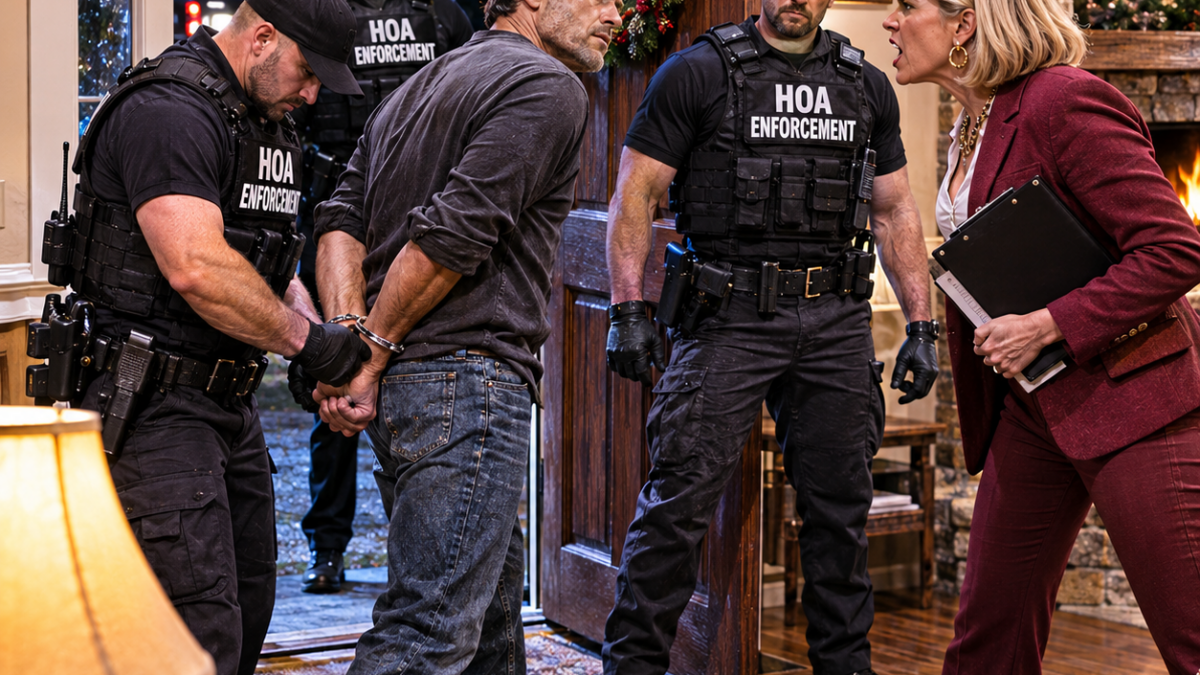
All three wore black pants and black tactical-style vests.
Across the chest, in large white letters:
HOA ENFORCEMENT.
No agency name.
No municipal seal.
No state identification.
No visible body cameras.
The man in front was tall, maybe six-two, early forties, sharp jaw, close-cropped hair. He held himself with the confidence of somebody accustomed to people stepping aside when he spoke. The other two stood slightly behind him, positioned in a way I recognized immediately.
Not casually.
One near the steps.
One near the door frame.
Spacing.
Control.
I unlocked the deadbolt but kept the security latch engaged and opened the door only several inches.
“What can I do for you?”
The leader leaned slightly toward the opening.
“Daniel Mercer?”
“Who are you?”
“We need to speak with you regarding multiple HOA property violations.”
I almost closed the door.
My property bordered an upscale development called Ridgeview Heights, but my parcel was not inside it. The house had existed fourteen years before Ridgeview was built. My deed contained no HOA covenant, no association membership, no architectural-control agreement, and no obligation to obey Ridgeview’s rules.
That had not stopped the HOA president, Cynthia Vale, from spending the previous five months trying to convince me otherwise.
Cynthia was fifty-two, blonde, polished, relentlessly confident, and constitutionally incapable of treating another person’s “no” as final.
It started with a letter complaining about the height of my backyard fence.
Then my utility trailer.
Then the color of my detached garage.
Then a demand that I pay an “adjacent property compliance contribution.”
I responded each time with the same thing.
A copy of my deed.
The county parcel map.
A polite statement:
My property is not part of Ridgeview Heights. Please remove me from your enforcement list.
Cynthia did not remove me.
Instead, the letters got more aggressive.
That evening, three men had apparently replaced stationery.
I looked at the leader.
“What violations?”
“You’ve ignored repeated compliance notices.”
“I’ve disputed notices from an HOA I don’t belong to.”
“That doesn’t change our instructions.”
“Who gave you those instructions?”
“The board.”
“Which board member?”
He hesitated just long enough for me to notice.
“President Vale authorized the enforcement action.”
There it was.
Cynthia.
I kept my voice neutral.
“Do you have identification?”
His expression shifted almost imperceptibly.
“We’re contracted enforcement officers.”
“That’s not what I asked.”
“We have authorization to inspect your property.”
“From whom?”
“The Ridgeview board.”
“That board has no jurisdiction over this house.”
The man behind him, younger than the other two, glanced toward the driveway.
The leader’s tone sharpened.
“Mr. Mercer, refusing inspection will be treated as obstruction of association business.”
I stared at him.
“Obstruction of association business?”
“Correct.”
“That’s not a criminal offense.”
He moved closer to the door.
“We’re not here to debate terminology.”
That sentence told me more than the vest did.
Legitimate authority survives specific questions.
Fake authority gets irritated by them.
I shifted slightly, keeping the door between us.
“Show me your credentials.”
“You don’t need to see credentials.”
“I do if you’re claiming legal authority to enter my home.”
“We’ve been authorized.”
“You keep saying that word.”
His jaw tightened.
I continued.
“Authorized to inspect what?”
“The interior and exterior premises.”
“Do you have a warrant?”
“No warrant is required for HOA compliance.”
“For the inside of my house?”
“We have board authority.”
I almost smiled.
“No, you don’t.”
Then the man on the right moved.
Fast.
He put one hand against the door.
The latch snapped tight.
“Sir, step aside.”
I looked directly at him.
“Remove your hand from my door.”
The leader said, “Last warning.”
“Mine too.”
For a moment, nobody moved.
Then the younger man stepped forward.
“Maybe we should call Cynthia.”
The leader shot him a look.
“We already have our orders.”
I had heard that phrase before.
Not usually from people whose evening ended well.
I started closing the door.
The man with his hand on it shoved back.
The latch tore out of the old wood frame with a sharp crack.
Suddenly the door was open.
Three men stepped inside.
My entire posture changed.
“Stop.”
They didn’t.
The leader entered first.
“We are conducting a compliance inspection.”
“Get out of my house.”
The second man remained near the front entrance.
The younger one moved into the hallway.
Their arrangement was no accident.
One controlled me.
One controlled the exit.
One controlled the interior.
I stepped backward but kept my hands visible.
“You have no legal authority to be inside this residence.”
The leader started looking around.
Living room.
Hallway.
Kitchen entrance.
Not like an HOA inspector.
Like someone searching.
That distinction mattered.
“What are you looking for?”
“Compliance issues.”
“What compliance issues are located inside my hallway?”
He ignored me.
The younger man opened the door to my small home office.
I raised my voice.
“Do not enter that room.”
He froze.
The leader turned.
“Mr. Mercer, failure to cooperate is why we’re here.”
“I want all three of you outside.”
“You don’t make that decision anymore.”
That was the moment the evening changed.
I studied the man carefully.
“What’s your name?”
He smiled.
“Mark Densmore.”
“Company?”
“Ridgeview Community Enforcement.”
“State security license number?”
His smile disappeared.
“You ask too many questions.”
“I get that a lot.”
The man closest to me stepped behind my right shoulder.
I heard the movement before I saw it.
I turned slightly.
He grabbed my wrist.
I pulled my arm inward instinctively.
“What are you doing?”
“Stop resisting.”
That phrase.
The leader said it too.
“Stop resisting.”
They moved together.
The first man twisted my right arm behind me.
The younger man caught my left wrist.
Cold metal closed around one wrist.
Then the other.
Handcuffs.
Actual handcuffs.
Inside my own home.
For perhaps two seconds, I felt pure disbelief.
Then training replaced disbelief.
I stopped struggling.
That surprised them.
People who do not understand physical control often mistake stillness for submission.
I controlled my breathing.
Counted positions.
Leader directly ahead.
Second man behind my right shoulder.
Youngest near the office door.
No visible firearms.
One expandable baton.
Possible pepper spray.
Handcuff key probably on leader or second man.
Front door open.
My phone still in my pocket.
Credentials in my rear wallet pocket.
My service weapon was secured upstairs, nowhere near the immediate encounter.
Good.
This did not need to become a gunfight.
“What exactly are you detaining me for?”
Densmore smirked.
“Obstruction of HOA business.”
“That’s still not a crime.”
“We’re taking you in for questioning.”
“Where?”
“Ridgeview security office.”
“You intend to transport me?”
“That’s correct.”
That was far more serious than they understood.
I looked at the youngest man.
He had gone pale.
He knew something was wrong.
Maybe not how wrong.
But enough.
I kept my voice controlled.
“Mark.”
“What?”
“I am going to reach toward my back pocket.”
The second man tightened his grip.
“No, you’re not.”
“You should let me.”
“Why?”
“Because there is identification in that pocket that you desperately need to see before you make one more decision.”
Densmore laughed.
“Nice try.”
I looked directly at him.
“This is the last professional courtesy you’re getting.”
Something in my tone reached him.
His smile faded.
He nodded at the man behind me.
“Check it.”
The man reached into my rear pocket and pulled out the leather credential case.
He flipped it open.
His expression changed instantly.
Not gradually.
Instantly.
He stared down.
Then at me.
Then down again.
Densmore frowned.
“What?”
The man did not answer.
He simply handed him the case.
Densmore opened it.
The badge caught the hallway light.
UNITED STATES MARSHAL.
The room became completely silent.
I watched the blood leave his face.
The youngest man whispered something that sounded very much like, “Oh, no.”
I held Densmore’s eyes.
“My name is Daniel Mercer.”
Nobody moved.
“I’m a Deputy United States Marshal.”
The man behind me released my arm.
I continued.
“And you have just entered my residence without consent, damaged my door, physically restrained me, placed me in handcuffs, and stated your intention to transport me against my will.”
Densmore’s mouth opened.
Nothing came out.
I kept my voice even.
“Take the cuffs off.”
part 2
For several seconds, Densmore simply stared at the credentials in his hands.
I could see his mind moving.
Not thinking about the law.
Thinking about escape.
How to explain it.
How to downgrade it.
How to make what had just happened sound less serious than it was.
People do that when authority evaporates.
A minute earlier, he was telling me I no longer made decisions in my own house.
Now he was looking for permission to breathe.
The youngest man spoke first.
“Mark.”
Densmore ignored him.
“Mark, uncuff him.”
“I heard you.”
“Then do it.”
The second man already had his handcuff key out.
He unlocked my right wrist.
Then the left.
I rubbed the skin once but did not step toward anyone.
Densmore handed back my credentials.
“We didn’t know.”
I put the leather case in my front pocket this time.
“That is not the defense you think it is.”
“We were told you were a hostile homeowner.”
“By Cynthia Vale?”
Nobody answered.
“Was it Cynthia?”
The youngest nodded.
Densmore turned sharply.
“Shut up, Evan.”
Good.
Now I had a name.
I looked at Evan.
“Don’t listen to him. If you were given false information, this is the moment to stop making the problem worse.”
Densmore tried to regain control.
“This is an HOA dispute.”
“No.”
“It started as—”
“It stopped being an HOA dispute when you forced entry into my house and handcuffed me.”
“We believed we had authority.”
“Show me the authority.”
Densmore had nothing.
No warrant.
No county order.
No court document.
Not even a written trespass consent.
Just a printed work authorization from Ridgeview Heights.
I asked to see it.
He hesitated.
I waited.
Finally he pulled a folded sheet from an interior vest pocket.
RIDGEVIEW HEIGHTS COMMUNITY COMPLIANCE ACTION.
Target:
Daniel Mercer.
Action:
Interior inspection.
Detention authorized for noncooperation.
Property access authorized by executive board directive.
Approved:
Cynthia Vale, HOA President.
I read it twice.
“Who wrote this?”
“Cynthia’s office.”
“Does your company have a lawyer?”
Densmore did not answer.
“Do you have a state security license?”
“Yes.”
“Does your license authorize custodial arrest for HOA violations?”
Silence.
“Does it authorize entry into private residences without consent?”
Silence again.
I folded the document carefully.
“Nobody leaves.”
Densmore stiffened.
“You can’t hold us.”
I looked at him.
“Interesting choice of argument.”
Evan almost winced.
I pulled out my phone.
Densmore stepped forward.
“Who are you calling?”
“The sheriff’s department.”
“We can work this out.”
“No.”
“Daniel—”
“Marshal Mercer.”
His face tightened.
“Marshal Mercer, this can be handled without making it bigger than it needs to be.”
I stared at him.
“You put me in handcuffs.”
“That was a misunderstanding.”
“You said you intended to transport me to an HOA office.”
“We were following instructions.”
“Then whoever issued those instructions will probably want the opportunity to explain them.”
I called dispatch.
Because I was off duty and personally involved, I did not try to turn my living room into my own arrest scene.
That mattered.
I identified myself.
Gave my federal credentials.
Explained that three private security contractors had forced entry into my residence and restrained me.
Requested local deputies.
Then I did something Densmore clearly did not expect.
I told dispatch I was not asking for special treatment.
“I am the complainant. Send a supervisor.”
That distinction protected everyone.
Including me.
The youngest man, Evan, stepped away from the door and sat down on a dining chair.
He looked sick.
The second man introduced himself without being asked.
“Caleb Trent.”
I nodded.
Densmore glared at him.
Caleb ignored the glare.
“We thought you were subject to an enforcement order.”
“What enforcement order?”
“The HOA said you repeatedly refused legal inspections.”
“Did you verify my property was actually in Ridgeview?”
“No.”
“Did you verify Cynthia had authority to order detention?”
Caleb looked down.
“No.”
“Did anyone?”
Densmore snapped.
“Stop answering.”
I looked at him.
“You’re not in command anymore.”
His jaw flexed.
He shifted toward the doorway.
“Stay where you are.”
“You said you’re not arresting us.”
“I’m telling you not to leave a scene after I reported an unlawful entry and detention. The sheriff’s department will determine what happens next.”
He looked toward the door.
Then stopped.
Sirens arrived seven minutes later.
They felt much longer.
Two patrol vehicles pulled into my driveway.
Sergeant Alicia Monroe entered first, followed by Deputy Jason Pike.
Alicia knew me professionally.
That could create problems if handled poorly.
So the first thing I told her was:
“I’m the victim. Treat me like one. This is your scene.”
She nodded.
“Understood.”
Then she looked around.
Broken door latch.
Three tactical vests.
Handcuffs in Caleb’s hand.
My wrists turning red.
She pointed at the three men.
“Separate.”
Jason moved Densmore toward the porch.
Alicia put Evan in the kitchen.
Caleb stayed near the hallway.
Nobody got to coordinate stories.
My security system had recorded everything.
That became the most important fact in the house.
Four cameras.
Two interior.
Two exterior.
Audio.
Cloud backup.
I played the footage.
The initial knock.
Densmore’s claims.
The push against the door.
The latch breaking.
The entry.
The demand to inspect.
The handcuffing.
His statement:
We’re detaining you for obstruction of HOA business.
Then:
We’re taking you in for questioning.
Alicia watched twice.
When the video ended, she looked toward the porch.
“Does he always talk that much?”
“Apparently.”
The deputies collected the HOA authorization form.
Photographed the cuffs.
Documented the damaged latch.
Photographed my wrists.
Checked the men’s licenses.
That produced another problem.
Their company, Vale Community Protective Services, was licensed for basic private security.
Observe.
Report.
Patrol contracted common areas.
No peace-officer authority.
No general arrest powers beyond what ordinary state law might permit in narrow circumstances.
Certainly no authority to enter my house and detain me over HOA covenants.
Then Jason called Ridgeview Heights.
He asked to speak with Cynthia Vale.
Five minutes later, headlights turned into my driveway.
Of course she came.
Cynthia had never been able to resist controlling a scene.
She stepped out of a black Mercedes SUV wearing cream slacks, a lavender sweater, and a camel coat thrown over her shoulders.
She saw two sheriff’s vehicles.
Then Densmore sitting on my porch with an officer beside him.
Her pace slowed.
Alicia met her halfway down the drive.
“Are you Cynthia Vale?”
“I’m president of Ridgeview Heights.”
“Did you dispatch these men?”
“They’re contracted community enforcement.”
“Did you authorize them to enter Mr. Mercer’s residence?”
Cynthia looked toward me.
“He has been refusing compliance for months.”
“That wasn’t my question.”
Cynthia’s expression tightened.
“The board authorized inspection.”
“Did the board authorize physical detention?”
“They were supposed to ensure cooperation.”
“Yes or no?”
Cynthia hesitated.
I watched from the doorway.
The same thing happened to her that had happened to Densmore.
Authority sounds impressive until somebody asks for the exact source.
Cynthia pointed at me.
“This man has deliberately obstructed community governance.”
Alicia looked toward my house.
“Is his parcel part of Ridgeview Heights?”
“He is adjacent to it.”
“That wasn’t my question either.”
Cynthia exhaled sharply.
“The board has determined that his property falls within our expanded enforcement zone.”
Alicia stared at her.
“Is there a recorded covenant?”
“It’s a community planning issue.”
“Is there a recorded covenant?”
“No.”
“Membership agreement?”
“No.”
“Recorded annexation?”
“The board approved—”
“Ma’am.”
Alicia’s voice hardened.
“An HOA board vote does not turn private property into HOA property.”
Cynthia looked at me again.
“You did this.”
I almost laughed.
“You sent three men into my house.”
“You’ve been provoking this for months.”
“By refusing rules I never agreed to?”
Densmore spoke from the porch.
“Cynthia told us he was legally subject to enforcement.”
Her head snapped toward him.
“Do not discuss privileged operational instructions.”
Alicia looked from one to the other.
“That’s not how privilege works.”
That was the first crack.
The larger one came when Evan asked to speak privately.
He told Jason that the team had been briefed at the HOA office that afternoon.
Cynthia personally attended.
According to Evan, she said I had “a law enforcement background of some kind” but probably worked in courthouse administration.
That detail got my attention.
She knew enough to know I was connected to federal law enforcement.
Just not what I actually did.
Why?
The investigation that followed answered that question slowly.
And the answer had nothing to do with my fence.
For months, Cynthia had been trying to get my signature on something called an Adjacent Property Compliance Agreement.
It looked harmless.
Landscaping.
Fence continuity.
Architectural compatibility.
Buried on page six was language granting Ridgeview an inspection and emergency access right along a strip of my eastern property.
I refused to sign it.
I had told her attorney exactly why.
My eastern boundary connected Ridgeview Heights to a parcel of undeveloped land owned by Arbor Crest Development.
A second Ridgeview phase had been proposed.
Twenty-eight luxury homes.
One problem.
Emergency vehicle access.
The county wanted a secondary route.
My eastern strip was the cheapest option.
Cynthia had first tried to buy an easement.
I declined.
Then came the HOA letters.
I had assumed she was being petty.
Now the timeline looked different.
If she could make me accept HOA jurisdiction—even informally—she could later argue that the access provision was part of an enforcement settlement.
I did not know whether that argument would ever survive court.
The point was she wanted my signature.
The men inside my house had been ordered to take me to the HOA security office for “questioning.”
What happened there?
That became the next question.
Alicia secured the scene.
The three guards were taken in separately for interviews.
Densmore was arrested that night based on the evidence local investigators determined supported unlawful restraint, unlawful entry, and related offenses.
Caleb and Evan were also detained while their individual roles were sorted out.
I did not choose the charges.
That was important.
I provided evidence.
Law enforcement and prosecutors made charging decisions.
Cynthia left that night without cuffs.
People later asked why.
Because you do not arrest somebody simply because everyone in the driveway thinks she is awful.
Investigators needed evidence showing exactly what she ordered and what she knew.
I wanted a clean case.
The next morning, I repaired my front-door latch.
Not because I wanted to erase the scene.
Because I wanted my house secured.
Then I drove to the Marshals office.
My supervisor, Deputy Chief Raymond Foster, was already waiting.
“You okay?”
“Fine.”
“You get cuffed?”
“Yes.”
He stared at me.
“By HOA security.”
“Yes.”
He rubbed both hands over his face.
“I’ve been doing this twenty-seven years.”
“I know.”
“I thought I’d heard everything.”
“So did I.”
Then his expression became serious.
“Stay out of the investigation.”
“I intend to.”
“Good.”
“I’ll cooperate as victim and witness.”
“Good.”
“And if they try to turn this into some federal intimidation story—”
“They will.”
“They already started.”
Cynthia posted a statement that morning.
Ridgeview Heights condemns the misuse of federal credentials to interfere with lawful community enforcement.
I read it twice.
Then forwarded it to my attorney.
No public response.
No Facebook argument.
No statement through my office.
Evidence would answer.
Evan became the first guard to cooperate fully.
He told investigators that before leaving the HOA office, Cynthia had placed a folder on the table containing the compliance agreement I had refused to sign.
Densmore was allegedly instructed to take me to the security office and keep me there until I “understood the seriousness of the situation.”
Caleb corroborated part of it.
Then investigators obtained the company’s internal dispatch messages.
One from Densmore read:
Vale wants him brought in tonight. No more notices.
Another:
If Mercer resists, cuff and transport. Cynthia says board authority covers us.
A third message was worse.
Need agreement signed before county access review Friday.
There it was.
The deadline.
Friday.
County access review.
The reason Cynthia suddenly stopped sending letters and sent men instead.
Ridgeview Phase Two had a planning review scheduled the next morning.
Without my easement, Arbor Crest’s emergency-access plan had a major problem.
Cynthia needed my signature.
Not someday.
That night.
The HOA board was called into an emergency session two days later.
Not by Cynthia.
By treasurer Miriam Ross.
Miriam was sixty, retired from corporate accounting, and had spent most of her tenure believing Cynthia was simply aggressive.
Then she discovered something in the legal-expense account.
Ridgeview had paid Vale Community Protective Services $24,600 over six months.
The contract had been approved by Cynthia under “executive safety authority.”
No full board vote.
Additional payments were tied to “special adjacent compliance operations.”
Miriam searched further.
Cynthia had also been communicating directly with Arbor Crest Development.
Emails showed the developer had offered Ridgeview a substantial infrastructure contribution if the emergency-access problem could be solved before the Phase Two approval.
That alone was not illegal.
Developers negotiate infrastructure contributions all the time.
The problem was how Cynthia intended to solve it.
One email from her to an Arbor Crest representative read:
Mercer will sign once he understands continued resistance has consequences.
Another:
I am handling the compliance side personally. The board does not need the details until access is secured.
Miriam printed everything.
Then called the HOA attorney.
His name was Leonard Price.
Leonard reviewed the documents.
Then asked one question.
“Did the board ever authorize detention?”
“No.”
“Interior inspection?”
“No.”
“Transport?”
“No.”
“Did anyone tell Cynthia private security had police powers?”
“No.”
He closed the folder.
“Then we have a very serious problem.”
The Ridgeview board suspended Cynthia’s enforcement authority that afternoon.
She exploded.
I know because part of the meeting was later produced in discovery.
She accused Miriam of betrayal.
Called the board weak.
Insisted that letting “outsiders” ignore community standards would destroy property values.
Then Miriam asked:
“Daniel Mercer is not a member. What community standard did he violate?”
Cynthia answered:
“His property affects us.”
Miriam replied:
“That is not the same thing.”
Simple sentence.
Huge difference.
The county planning review happened Friday.
Arbor Crest presented the Phase Two plan.
The secondary emergency-access route crossed my property.
A county planner asked for the recorded easement.
Arbor Crest did not have one.
The representative said Ridgeview expected an agreement from the adjacent owner.
The planner looked at my attorney.
My attorney answered.
“No agreement exists.”
Phase Two was not approved in its proposed form.
Cynthia lost the deadline.
Then investigators found the recording.
Vale Community Protective Services had cameras inside its briefing room.
Cheap insurance system.
Cynthia apparently forgot about it.
The video showed her standing beside Densmore hours before the incident.
The compliance agreement was on the table.
Her voice was clear.
“Do not come back without his signature.”
Densmore asked:
“What if he refuses to come?”
Cynthia answered:
“Then make him understand he doesn’t have a choice.”
Nobody in the room asked what that meant legally.
That was the point.
Ambiguous language protects people until somebody acts on it.
Then the context matters.
The recording continued.
Caleb asked whether they could physically restrain a homeowner.
Cynthia replied:
“If he interferes with HOA enforcement, you’re authorized to detain.”
Densmore asked by whom.
She answered:
“By me.”
That became a very important two-word response.
By me.
Not a statute.
Not a judge.
Not police.
Not a covenant.
Her.
The HOA Karen who believed a title could manufacture arrest power.
The district attorney’s office reviewed the evidence.
Cynthia was eventually charged in connection with the plan based on the conduct prosecutors believed they could prove, including conspiracy-related and unlawful-restraint allegations under applicable state law.
I will not pretend every dramatic rumor around Ridgeview became a criminal charge.
It didn’t.
That is not how real justice works.
The strongest cases stay narrow.
Use what you can prove.
Do not inflate what you cannot.
My civil attorney filed separately.
Trespass.
False imprisonment.
Damage to the door.
Defamation arising from Cynthia’s public statements.
Interference with my property rights.
The HOA’s insurer got involved immediately.
That changed the board’s mood faster than any speech could have.
Insurance lawyers hate surprises.
Three unauthorized men handcuffing a nonmember inside his own house qualifies.
Ridgeview’s special meeting drew more than two hundred residents.
I did not attend initially.
I was not a member.
Then Miriam invited me to speak as the person whose home had been entered.
I agreed on one condition.
“No politics.”
She smiled tiredly.
“After this week, I’d pay extra for no politics.”
The clubhouse was packed.
Cynthia sat at the front with her attorney.
No sunglasses.
No smile.
I carried a thin folder.
Deed.
Parcel map.
Five months of HOA letters.
Photographs of my damaged door.
Nothing else.
Miriam opened by explaining the facts the board had verified.
My property was outside Ridgeview.
No recorded covenant.
No membership.
No annexation.
No authority to inspect the house.
No board vote authorizing detention.
No board vote authorizing forced transport.
Then she displayed the security-company invoice.
Residents murmured.
$24,600.
Association money.
One man stood.
“We paid for them to do this?”
Miriam answered carefully.
“Association funds paid the security contract. The board is still determining the extent of authorization.”
Cynthia stood.
“This is being distorted.”
Her attorney touched her sleeve.
She ignored him.
“Mr. Mercer has been hostile since the first notice.”
I looked at her.
“Because the first notice was issued to property you don’t govern.”
“You refused every attempt at cooperation.”
“I cooperated with the county. I cooperated with my deed. I cooperated with the recorded boundary.”
Several people laughed.
Cynthia flushed.
I did not enjoy embarrassing her.
But I was finished pretending her language had meaning.
She pointed at me.
“You used your federal status to intimidate our contractors.”
“No.”
“You threatened them with arrest.”
“No.”
“You showed your badge.”
“After they handcuffed me.”
The room went quiet.
I continued.
“I did not reveal my employment until after three men entered my residence without consent and placed me in restraints.”
A resident near the back called out:
“They actually cuffed him?”
Miriam nodded.
“Yes.”
I handed the board the incident report.
Then, with permission, the footage was played.
Not the entire video.
Only the relevant sequence.
Entry.
My demand for identification.
The grabbed arm.
Handcuffs.
Densmore saying:
We’re detaining you for obstruction of HOA business.
Then my credentials.
Then the silence.
The room reacted exactly the way my living room had.
Nobody spoke.
Cynthia stood there watching three men she hired discover that their authority was imaginary.
When the screen went dark, Miriam asked:
“Do you still believe this was legitimate HOA enforcement?”
Cynthia answered:
“I believe Mr. Mercer engineered the situation.”
I looked at her.
“How?”
She hesitated.
I waited.
“How did I engineer you sending three men into my house?”
No answer.
The board conducted its removal process under the bylaws.
I could not vote.
Did not want to.
The residents voted.
Cynthia lost by an overwhelming margin.
Her presidency ended that night.
But that was not the end of the legal process.
Densmore eventually changed his story.
At first he insisted he believed Cynthia had legal authority.
Then his attorney saw the briefing-room video.
The dispatch messages.
The HOA contract.
My home-security footage.
He admitted he had doubts.
He admitted he knew there was no warrant.
He admitted the plan was to pressure me into signing.
His cooperation reduced uncertainty around everyone else’s role.
Caleb cooperated too.
Evan had done so from the beginning.
None of them escaped responsibility entirely.
But the distinction mattered.
People should answer for what they actually did.
Not what makes the cleanest revenge fantasy.
Cynthia’s defense was predictable.
She had been misunderstood.
The men exceeded instructions.
The HOA was trying to protect residents.
She never intended anyone to be hurt.
She believed the adjacent property was subject to expanded community standards.
Every argument hit the same wall.
The deed.
She knew I was not a member.
My responses had told her repeatedly.
The county had confirmed it.
Her own attorney had warned the board months earlier that adjacent parcels could not be regulated without voluntary agreement.
Then another email surfaced.
Leonard Price had written:
Ridgeview cannot impose covenants, fines, inspection rights, or enforcement authority on the Mercer parcel absent recorded consent from the owner.
Cynthia replied:
Then we need him to consent.
Three weeks later, the compliance agreement appeared.
Months after that, Densmore entered my house.
The progression was difficult to dismiss as confusion.
The civil case settled before trial.
The terms required Ridgeview Heights and the security company to compensate me for the damaged property, legal expenses, and documented losses resulting from the incident.
More important was the declaratory language.
My parcel was not part of Ridgeview Heights.
No HOA rules applied.
No inspection rights existed.
No assessment authority existed.
No enforcement authority existed.
No easement existed unless I voluntarily granted one through a properly executed and recorded agreement.
I framed that page.
Not the check.
That page.
The criminal process took longer.
Cynthia ultimately faced legal consequences for her role according to the evidence and the charges prosecutors pursued.
Densmore faced consequences for the entry and restraint.
The other two men’s cooperation was considered separately.
Vale Community Protective Services lost its Ridgeview contract and faced licensing review.
The company eventually dissolved.
Ridgeview elected a new president.
Miriam Ross.
She had not wanted the position.
Which was probably why residents trusted her.
Her first official letter came to me by certified mail.
I opened it expecting legal language.
It contained three sentences.
Mr. Mercer, Ridgeview Heights formally acknowledges that your property is independent and outside association authority. We apologize for the conduct carried out in the association’s name. No future enforcement communication will be directed to your parcel unless you specifically request contact.
I read it twice.
Then put it beside the settlement order.
That was enough.
The Phase Two development did not disappear forever.
Arbor Crest redesigned the emergency access.
It cost more.
The road curved around another parcel the developer actually owned.
Engineering took longer.
Fewer lots fit.
The world did not end.
That was almost funny.
For months, Cynthia had treated my signature as though the entire future of Ridgeview depended on it.
Once she was gone, professionals solved the problem legally.
More expensive?
Yes.
Impossible?
No.
That is often what abusive people mean when they say there is “no alternative.”
They mean there is no cheaper alternative that respects your rights.
My house returned to normal slowly.
For several weeks, every hard knock made my body tense.
I hated that.
I had spent my career going into dangerous environments, escorting witnesses, arresting violent fugitives, standing beside people who had every reason to hurt me.
But those things happened while I was working.
The handcuffs in my hallway were different.
Home is supposed to be where the job stops.
Cynthia contaminated that for a while.
I changed the front door.
Not just the broken latch.
The entire door.
Solid oak.
Reinforced frame.
Better camera.
Not because I expected another HOA raid.
Because replacing it felt like reclaiming the entrance.
The old damaged latch stayed in a box in the garage for months.
Eventually I threw it away.
I did not need a souvenir.
One evening, about six months after the case settled, I sat in the same chair where the story began.
Same refrigerator hum.
Same clock.
Same oaks moving outside.
I poured another bourbon.
Then someone knocked.
Three soft taps.
I almost laughed.
When I opened the door, Miriam Ross stood on the porch carrying a folder and a loaf of banana bread.
I looked at the bread.
“Is that an HOA enforcement tool?”
She smiled.
“Absolutely. Failure to eat it within seven days will result in escalating penalties.”
I stepped aside.
“Come in.”
She stopped.
“Only if invited.”
That landed harder than she probably intended.
“You’re invited.”
She came inside.
The folder contained the final Ridgeview policy changes.
No contractor could conduct enforcement activity without written board authority.
No private security employee could represent themselves as possessing law-enforcement powers.
Any dispute involving a nonmember parcel required independent legal review before contact.
No president could approve special security operations alone.
Any property-access agreement required confirmation through county records.
Miriam sat across from me.
“I know policies don’t undo what happened.”
“No.”
“But maybe they stop the next version.”
“That’s the point.”
She looked around.
“I still can’t believe she sent them inside your house.”
“Neither could they, eventually.”
Miriam laughed.
Then she became serious.
“Why didn’t you tell anyone you were a marshal when the HOA started sending notices?”
“Why would I?”
“It might have scared them off.”
I shook my head.
“My job shouldn’t determine whether my property rights matter.”
She thought about that.
“That’s true.”
“If I had been a plumber, teacher, accountant, retired mechanic—same deed.”
“Same rights.”
“Exactly.”
That became the part of the story I cared about most.
People loved the badge reveal.
Whenever someone in the Marshals office retold the story, they dramatized that moment.
Three fake cops handcuff a marshal.
Credentials come out.
Everyone freezes.
Funny, in hindsight.
But the badge was never the point.
If I had been nobody they respected, what they did would still have been wrong.
That thought bothered me more than the cuffs.
Densmore said something after seeing my credentials.
We thought you were just some guy.
Just some guy.
That sentence stayed with me.
As though an ordinary homeowner could be intimidated.
Entered.
Restrained.
Transported.
Because nobody important would care.
The problem was not that they picked a federal marshal.
The problem was that they believed the plan was acceptable if they picked someone else.
That realization affected the investigation too.
Records from Vale Community Protective Services showed similar “compliance visits” at other Ridgeview homes.
Nothing as extreme as mine.
But enough.
Residents ordered outside to speak with security.
Cars temporarily blocked.
Threats of detention.
Claims that HOA enforcement had powers it did not actually possess.
One elderly homeowner admitted she paid almost four thousand dollars in disputed fines after two guards told her refusal could lead to arrest.
It couldn’t.
Another resident signed an inspection agreement because a guard claimed the association could enter without notice if he refused.
It couldn’t.
The pattern relied on confusion.
Most people do not know the exact limits of private security authority.
Cynthia understood that.
So did Densmore.
They occupied the gray space between uniforms and law.
The badge-shaped patches.
The tactical vests.
The radios.
The word ENFORCEMENT.
Everything was designed to make residents obey first and ask questions later.
My case destroyed that illusion.
Not because I was stronger.
Because I asked.
Identification?
Authority?
Warrant?
Statute?
Recorded covenant?
Every question made them weaker.
Fake authority hates specificity.
Real authority can tell you where it comes from.
I know my own authority has limits.
I cannot walk into a neighbor’s house because I dislike his fence.
I cannot arrest someone because his truck annoys me.
I cannot use federal credentials to settle my private property disagreements.
If anything, my badge imposes more responsibility to know when I do not have authority.
That was why I turned the case over immediately.
People with legitimate power are supposed to understand its boundaries.
Cynthia did not.
She treated the HOA presidency as a source of expandable jurisdiction.
First lawns.
Then fences.
Then adjacent parcels.
Then inspections.
Then detention.
There was no stopping point because nobody inside her circle forced her to define one.
Until my living room.
A year after the incident, I ran into Evan at a gas station.
He had left private security.
Worked for a warehouse logistics company.
He recognized me before I recognized him.
His face went pale.
“Marshal Mercer.”
“Evan.”
He glanced toward the door as if considering leaving.
Instead, he walked over.
“I’ve wanted to apologize.”
“You testified.”
“I know.”
“That mattered.”
“I still put cuffs on you.”
“You helped.”
“I shouldn’t have.”
“No.”
He looked ashamed.
“I really thought the paperwork meant something.”
“What paperwork?”
“The briefing sheet. Cynthia’s signature. Company authorization.”
“Did you ever ask who gave Cynthia arrest authority?”
He shook his head.
“That’s the part I can’t get over.”
I nodded.
“Then don’t forget it.”
He looked at me.
“Think I can ever get back into security?”
“That’s not my decision.”
“Would you?”
I considered.
“If you learned the right lesson.”
“What lesson?”
“Authority isn’t contagious.”
He frowned.
I explained.
“A client having authority over something doesn’t mean you inherit it. A company telling you something doesn’t make it law. A vest doesn’t create jurisdiction.”
He nodded slowly.
“Verify.”
“Exactly.”
We shook hands.
That felt more useful than hatred.
Densmore never apologized.
That was fine.
I did not need one.
Cynthia never apologized either.
Also fine.
Apologies matter when people understand what they did.
Forced apologies are another form of paperwork.
I preferred the recorded judgment.
Years passed.
Ridgeview Phase Two eventually opened.
Smaller than planned.
New access road.
New leadership.
Miriam invited me to the ribbon cutting as a joke.
I declined.
“Afraid we’ll annex you while you’re distracted?” she asked.
“Exactly.”
She laughed.
We became friendly neighbors.
Nothing more complicated.
Sometimes Ridgeview contacted me about shared drainage or storm cleanup along the boundary.
They asked.
I answered.
That tiny procedural difference prevented every kind of conflict Cynthia created.
Ask.
Not order.
Request.
Not demand.
Permission.
Not manufactured authority.
The world runs remarkably well when people remember those distinctions.
My front porch still has the camera.
The footage from that night sits archived on an encrypted drive.
I have never posted it publicly.
Never needed to.
A local reporter asked once.
I declined.
“Why?”
“Because the case is over.”
“It would get millions of views.”
“Probably.”
“People would love the badge reveal.”
“I know.”
“Then why not?”
I thought about Evan.
Caleb.
Even Densmore.
About their faces in that hallway.
About how easy it is to turn someone else’s worst decision into entertainment forever.
“The legal record is enough.”
The reporter looked disappointed.
I wasn’t.
Justice is not always improved by humiliation.
Cynthia lost power because evidence exposed what she had done.
That was enough for me.
One thing did change permanently.
I started teaching a short block during training sessions for younger deputies and marshals.
Not about HOA disputes.
About visual authority.
I would put up photographs.
Uniform.
Badge.
Vest.
Marked-looking vehicle.
Official letterhead.
Then ask:
“What legal power does this person actually have?”
The younger people often answered based on appearance.
Then we worked backward.
Agency?
Jurisdiction?
Commission?
Warrant?
Statute?
Court order?
Consent?
Actual authority?
The lesson came from my living room.
Do not confuse symbols with law.
People who intend harm love symbols because symbols save them the trouble of explaining themselves.
Cynthia had a title.
Densmore had a vest.
The paper had the word enforcement.
None of it mattered once someone asked the source.
That is why I remember the moment before I revealed my credentials more clearly than the reveal itself.
I was cuffed.
My wrists behind me.
Densmore smiling.
He believed the encounter was finished.
He believed he controlled the story.
Then I asked him to look at the identification in my pocket.
He almost refused.
That tiny moment contained everything.
Fake authority does not want information.
It wants compliance.
The badge did not magically create my rights.
It simply forced him to acknowledge that somebody in the room knew what rights already existed.
Sometimes I wonder what would have happened if I had not been a marshal.
Maybe the cameras would still have saved me.
Maybe local deputies would have arrived before they transported me.
Maybe I would have spent an hour inside a security office while Cynthia pushed papers across the table.
Maybe I would have signed something just to get home.
That possibility bothers me.
It is why the Ridgeview reforms mattered.
No one should need a federal badge to prevent an HOA contractor from kidnapping them under the label of compliance.
No one should need law-enforcement training to know a homeowners association cannot invent arrest powers.
No one should need a camera system to prove they were restrained inside their own house.
The system had to change.
It did.
Years later, I received a Christmas card from Miriam.
Front:
A perfectly landscaped suburban house.
Inside she had written:
No violations found. Miracles happen.
I laughed for five straight minutes.
I sent one back.
A photograph of my weathered fence.
Message:
Still unapproved.
She called me.
“You’re impossible.”
“Outside your jurisdiction.”
“Fair.”
That is where the story ended for me.
Not with handcuffs.
Not with arrests.
Not with Cynthia losing her presidency.
With a joke between neighbors who understood the boundary.
My property remained mine.
Ridgeview remained Ridgeview.
Their rules ended where my deed began.
Simple.
The peace I wanted returned eventually.
One evening, years after the incident, I sat in the living room again with a drink.
The refrigerator hummed.
Clock ticked.
Wind moved through the trees.
For several minutes, I listened.
No pounding.
No tactical vests.
No men telling me I had lost control of my own home.
Just stillness.
I thought about Cynthia’s entire strategy.
Letters first.
Then fines.
Then inspections.
Then the compliance agreement.
Then private enforcement.
Every escalation depended on one assumption:
That enough fake authority would eventually feel real.
She was wrong.
Authority does not become real because somebody prints it in bold letters.
A private guard does not become a police officer because his vest says ENFORCEMENT.
An HOA president does not gain jurisdiction because she says the word “board.”
A contract does not become voluntary because three men hold your arms while someone waits for your signature.
And a homeowner does not lose his rights because the people threatening him assume he’s “just some guy.”
I was a United States Marshal.
That made the reveal unforgettable.
But it was never why they were wrong.
They were wrong before I opened the credential case.
They were wrong when they crossed the threshold.
Wrong when they refused identification.
Wrong when they grabbed my arm.
Wrong when the first handcuff closed.
The badge only made them understand it faster.
That is the part I never let anyone forget.
They did not make a mistake because they handcuffed the wrong man.
They made a mistake because they believed there was a right man to handcuff without lawful authority in the first place.
And the night Cynthia Vale tried to turn an HOA title into police power was the night everyone around her finally learned the difference.








