HOA Karen Sent Eight Armed Guards to Seize My Barn—She Didn’t Know I Already Had a Real Warrant With Her Name on It
part 2
My family had owned those forty-two acres before Black Ridge Estates existed.
Before the stone entrance signs.
Before the decorative lake.
Before the guardhouse.
Before people started paying thousands of dollars a year for the privilege of receiving letters about fence colors.
Holloway Ranch had been cattle land, hay ground, and equipment storage for three generations.
The eastern edge of my property ran beside a narrow service road connecting to the county highway.
That road became valuable only after Black Ridge announced a multimillion-dollar clubhouse expansion.
The HOA’s existing entrance was narrow.
Curved.
Poorly suited for heavy construction traffic.
My road was straight.
Wide enough.
And already graded for farm equipment.
Vanessa came to see me about nine months before the barn incident.
She arrived alone.
No guards.
No letters.
No threats.
She wore sunglasses and carried architectural drawings.
“Sheriff Holloway.”
“Vanessa.”
“I hope I’m not catching you at a bad time.”
“I’m fixing irrigation.”
“I’ll be quick.”
She unfolded a map across my truck hood.
The new clubhouse sat at the center.
A red line crossed my eastern road.
“We’d like temporary construction access.”
“For how long?”
“Approximately fourteen months.”
“No.”
She blinked.
“We’re prepared to compensate you.”
“No.”
“You didn’t even hear the number.”
“The road crosses two irrigation lines.”
“We’ll insure them.”
“Heavy trucks will pass twenty feet from my equipment shed.”
“We can install barriers.”
“The answer’s still no.”
Her smile tightened.
“Grant, this would help the entire community.”
“I don’t live in Black Ridge.”
“You live beside it.”
“Correct.”
“We can offer fifty thousand.”
“No.”
Seventy-five.
No.
One hundred.
No.
It was never about price.
The route made no sense for me.
The trucks would damage the road.
Complicate ranch traffic.
Threaten irrigation.
And put industrial vehicles beside a structure my father built.
Vanessa finally folded the plans.
“I think you’re making a mistake.”
“Maybe.”
“You might reconsider once construction starts.”
“I won’t.”
She left.
A week later, I received the first violation notice.
HOA COVENANT NONCOMPLIANCE — $18,400.
I laughed.
Literally.
I assumed somebody accidentally generated a notice against the wrong parcel.
I called Black Ridge.
Vanessa answered.
“This fine has my address.”
“It’s correct.”
“My land isn’t in the HOA.”
“Historical annexation records say otherwise.”
“What historical annexation?”
“You’ll receive documentation.”
I asked for the original recorded instrument.
She sent a scan.
Blurry edges.
No filing stamp.
No book number.
No page.
No county verification.
I drove to the recorder’s office.
Searched my name.
My father’s.
My grandfather’s.
Parcel number.
No annexation.
No HOA covenant.
Nothing.
I wrote Vanessa back.
County records contain no evidence that Holloway Ranch was ever annexed into Black Ridge Estates. Please withdraw the notice.
She didn’t.
Two weeks later:
$46,700.
Then:
$91,300.
Then:
$186,000.
Fines.
Legal fees.
Maintenance assessments.
Administrative penalties.
Numbers created faster than any legitimate obligation could accumulate.
A final letter arrived.
NOTICE OF COLLATERAL SEIZURE.
The HOA intended to seize my barn and equipment unless I paid within seventy-two hours.
Signed:
Vanessa Crowley.
That letter bothered me for a different reason.
By then I knew her paperwork was nonsense.
But she seemed too confident.
People don’t usually threaten to seize tractors unless the tactic has worked before.
So I called the recorder again.
Asked whether anyone else had reported strange HOA property claims.
The clerk hesitated.
Then said four other landowners near Black Ridge had complained about paperwork they didn’t recognize.
That changed everything.
I walked into the sheriff’s office carrying Vanessa’s seizure notice.
Tessa Vaughn was one of my best investigators.
Methodical.
Patient.
Unimpressed by titles.
I placed the notice on her desk.
“Don’t investigate my dispute.”
She looked up.
“What?”
“Find out how many others got one.”
She read the paper.
“This looks fake.”
“I know.”
“You want me handling something involving your property?”
“You’re not investigating me.”
“You’re the victim.”
“That’s why I’m telling DA Rourke today.”
Tessa leaned back.
“You think this is bigger?”
“I think Vanessa learned this trick somewhere.”
Within twenty-four hours, District Attorney Dean Rourke knew about my conflict.
We agreed Miles Danner would command anything operational.
I would provide evidence.
Nothing else.
No warrants.
No arrest decisions.
No interviews.
No strategy meetings unless necessary as the victim.
I wanted no future defense attorney standing in court saying Sheriff Grant Holloway used his department to punish a woman who annoyed him.
That separation became essential.
Tessa started quietly.
The first thing she found was Black Ridge Property Enforcement.
Vanessa had contracted Brock Fenner’s private security company.
Their uniforms were dark.
Badges shaped like shields.
Large lettering.
To a frightened homeowner at night, they looked close enough to law enforcement to create hesitation.
They delivered seizure notices.
Blocked driveways.
Locked gates.
Towed vehicles.
Stood outside buildings.
Three older cases stood out.
A workshop owner named Daniel Price lost two commercial generators after refusing a disputed assessment.
Another landowner, Marcus Neal, was locked out of his storage building for four days.
A third paid sixty-three thousand dollars after Vanessa threatened his only access road.
None of them had challenged the process deeply.
Daniel assumed the HOA had legal authority.
Marcus couldn’t afford counsel.
The third owner simply paid because losing road access would have destroyed his business.
Fear had been the enforcement mechanism.
Not law.
Vanessa called me during that investigation.
Official sheriff’s phone.
Recorded system.
“You have forty-eight hours.”
“For what?”
“Before the barn stops being your problem.”
“What court signed your order?”
She laughed.
“An HOA does not run to a judge every time a property owner refuses to comply.”
I wrote the exact sentence down.
Then forwarded the recording through proper channels.
That one line mattered.
Vanessa understood she had no court order.
She simply believed she did not need one.
But Tessa still needed proof the historical documents were manufactured.
That proof came from Paige Roston.
Black Ridge’s accountant.
She had resigned suddenly months earlier.
Tessa tracked her down.
Paige initially refused to meet.
Then agreed.
Then canceled.
Then called back.
Finally, she arrived at an attorney’s office carrying a hard drive.
She had copied internal files before resigning.
Not because she planned to expose Vanessa originally.
Because invoices stopped matching board approvals.
Dates shifted.
Documents appeared after the events they supposedly authorized.
One file was named:
HOLLOWAY ANNEXATION FINAL.
Metadata:
Created eleven days before I received it.
The “nineteen-year-old” historical annexation document was less than two weeks old.
No rediscovered archive.
No forgotten agreement.
Fabricated from scratch.
Tessa called me near midnight.
“This isn’t an HOA case anymore.”
“How bad?”
“Bad.”
“Do I need to know?”
“No.”
That answer made me trust her even more.
While Vanessa believed I was preparing to surrender, Tessa and Dean were building a case.
Then they discovered money.
Several settlement payments tied to property enforcement never entered the normal HOA operating account.
Instead, funds moved through a consulting firm connected to Vanessa.
Now the pattern had motive.
Fear homeowners.
Invent debt.
Seize property.
Force settlement.
Redirect money.
Dean took the evidence to Judge Miriam Whitlock.
Metadata.
Emails.
Bank records.
Paige’s sworn statement.
Security footage.
Recorded phone calls.
Other property owners.
The judge signed two orders.
Search warrant for Black Ridge offices and servers.
Arrest warrant for Vanessa.
The operation was scheduled for eight in the morning.
Controlled.
Public office.
No drama.
Then Vanessa arrived at my ranch before sunrise.
What none of us understood yet was why she was so desperate to get inside my barn.
At first, the equipment seemed obvious.
Tractors.
Generator.
Trailer.
Valuable assets.
But after she was arrested, I walked through the barn.
One old filing cabinet stood open.
Top drawer pulled halfway out.
Papers disturbed.
That didn’t make sense.
If the guards wanted equipment, why search files?
Tessa later reviewed the footage.
Two minutes after Brock cut the lock, one guard walked directly to the filing cabinet.
Skipped the tractors.
Skipped the generator.
Skipped everything worth towing.
He searched drawers.
When questioned, he admitted Vanessa gave him a photograph of a brown envelope.
Code:
BR17.
“Old HOA property record,” she called it.
“Minor importance.”
We searched the cabinet.
Found it behind a drawer.
The envelope had belonged to my father.
Inside was an old survey.
Decades old.
I had seen it before but never understood why Vanessa would care.
Tessa did.
The survey described the service road beside my eastern boundary.
More specifically, the easement used by a portion of Black Ridge.
It was conditional.
Restricted to light residential traffic.
No commercial construction.
No heavy trucking.
No industrial equipment.
No large-scale event access.
Vanessa’s clubhouse project needed that road.
Not just mine.
Another segment connecting into the development had use restrictions that made her construction plan almost impossible.
BR17 proved the project had no legal right to route heavy trucks the way Vanessa planned.
She needed that envelope gone.
Suddenly the fabricated annexation made sense.
If my ranch became “part of Black Ridge,” Vanessa could argue HOA rules governed the access.
If she could pressure me into membership, settlement, or surrender, she gained leverage over the road.
The fines were never the destination.
They were pressure.
The barn seizure was never primarily about my tractors.
She wanted the records inside.
Then the search team reached Black Ridge headquarters.
Paige remembered Vanessa had a private laptop locked in a safe behind the conference room.
The combination changed two days earlier.
The warrant covered the safe.
Inside the laptop was a spreadsheet.
ACQUISITION TARGETS.
Seventeen names.
Mine was one.
Columns included:
Estimated land value.
Outstanding debt.
Likelihood of legal resistance.
Access importance.
Probability of successful acquisition.
I stared at the report later through what could legally be disclosed to me.
Seventeen people.
This was not random HOA abuse.
It was strategy.
Find landowners near planned development.
Create financial pressure.
Use association paperwork to manufacture authority.
Push them to sell or surrender access.
Emails connected Vanessa with an outside developer.
If enough land and access rights were consolidated, a larger real estate deal would trigger.
A private company connected to Vanessa would earn substantial consulting compensation.
The puzzle finally closed.
She wasn’t protecting Black Ridge.
She was using it.
Brock Fenner began cooperating.
His lawyer advised him correctly.
The faster he established what he knew and what he did not, the better.
He surrendered phones.
Emails.
Work orders.
Six months of assignment logs.
Eleven addresses.
Most visits were just paperwork delivery.
Three involved real seizures.
Generators removed.
A gate chained.
An owner physically denied access.
Brock claimed Vanessa told him every operation had legal review.
Records showed otherwise.
Not one of those seizures had been independently verified.
Then body camera footage from my barn morning surfaced.
Before I stepped outside, Vanessa told Brock:
“If he resists, restrain him. I’ll handle the paperwork afterward.”
Afterward.
That word mattered.
You do not “handle paperwork afterward” if you genuinely believe the legal authority already exists.
Another guard voluntarily produced audio.
Vanessa explaining why eight uniforms mattered.
“Most people fold when enough men show up.”
There it was.
The entire system in one sentence.
Not lawful authority.
Appearance.
Volume.
Fear.
Dean Rourke structured the case around the pattern.
Paige’s metadata.
Brock’s logs.
My footage.
Dash cameras.
Financial records.
BR17.
The target spreadsheet.
Other victims.
Vanessa’s own recorded statements.
News spread.
Black Ridge residents started talking to one another.
A woman named Ellen Pierce had paid nearly thirty thousand dollars over an alleged fence violation.
Her paperwork used the same odd formatting as my fake annexation.
A retired teacher surrendered a boat trailer under a supposed seizure notice.
No court had ever issued it.
Another family had been threatened with a lien based on assessments tied to land outside the HOA boundary.
One person complaining can be dismissed.
Ten comparing documents become a pattern.
Vanessa’s attorney responded with the only strategy available.
I was abusing my power.
Sheriff targets HOA president after private property feud.
That argument had potential.
I knew it.
So I withdrew even further.
Miles retained all operational command.
Dean worked independently.
Judge Whitlock handled filings as required.
I remained witness and victim.
Vanessa apparently interpreted my disappearance as weakness.
Meanwhile, her own board started looking at finances.
The temporary treasurer found a hole inside the Capital Legal Reserve.
Hundreds of thousands transferred to consulting firms.
Two firms had almost no operating presence.
Another discovery hurt more.
Weeks before the enforcement campaign expanded, Vanessa pushed the board to buy significantly higher liability insurance.
She anticipated lawsuits.
Maybe not the exact case.
But exposure.
This wasn’t a woman who made one impulsive mistake.
She planned risk.
Then normalized the tactics.
The formal hearing eventually put two pages side by side.
Vanessa’s seizure notice.
And Judge Whitlock’s real warrant.
Dean asked the court to look closely.
Vanessa’s document:
No case number.
No judicial signature.
No court seal.
No sworn affidavit.
No defined scope.
No lawful issuing authority.
Only her title.
The warrant:
Judge.
Case number.
Probable cause affidavit.
Scope.
Signature.
Court seal.
Actual process.
One page imitated authority.
One page earned it.
Paige testified.
Her voice shook at first.
Then steadied.
She explained how board approvals had been backdated.
How invoices appeared before votes.
How files were renamed.
How she archived copies because she became afraid records might disappear.
Defense counsel asked why she waited.
Paige answered:
“Because I was scared.”
Simple.
Honest.
Then:
“I started saving things because I was more scared of staying silent.”
Tessa testified about metadata.
The so-called historic annexation file had been created eleven days before delivery.
Waltered formatting.
Copied signatures.
No official record.
Brock testified next.
Vanessa had personally told him to seize the barn.
Personally told him to restrain me.
Personally told him the legal paperwork was handled.
My security footage supported him.
Then came BR17.
The survey.
The motive.
Without the road, Vanessa’s clubhouse project needed a new access design.
More expensive.
Delayed.
Potentially impossible under the original schedule.
Then the target spreadsheet.
Seventeen names.
Seventeen people evaluated by financial vulnerability.
At that point, the defense could no longer plausibly describe me as an isolated personal enemy.
I was simply the target who happened to fight long enough for everyone else to be discovered.
Vanessa insisted everything she did served the community.
Dean did not argue about whether she believed herself.
He asked one question.
“If your authority over these properties was legitimate, why did you need to fabricate documents proving that authority existed?”
Silence.
There are courtroom questions designed to produce answers.
Then there are questions designed to reveal that no answer exists.
That was the second kind.
The consequences arrived slowly.
Vanessa lost the presidency first.
The Black Ridge board voted her out.
Then the property enforcement program was dissolved.
An outside audit began.
Every fine.
Every seizure.
Every settlement.
Every contract.
Landowners filed claims.
Some recovered property.
Others sought compensation.
Assets connected to the suspected scheme were frozen pending proceedings.
County prosecutors pursued the criminal matters supported by the evidence.
I attended only when required.
I did not need to watch Vanessa suffer.
That was not why I had spent my adult life in law enforcement.
If anything, the case embarrassed me.
Not personally.
Institutionally.
How many people had complied because Brock’s uniforms looked close enough to ours?
How many had seen a shield-shaped patch and assumed someone had checked legality?
How many had been too frightened to ask one sentence?
“What court signed this?”
I brought that question into training at the sheriff’s office.
Authority must be identified.
Verified.
Documented.
A uniform does not create it.
A confident voice does not create it.
Neither does a logo.
Judge Whitlock said something similar during later proceedings.
The danger, she observed, was not only dramatic violence.
It was the normalization of intimidation dressed as routine paperwork.
That line stayed with me.
Because Vanessa did not begin with eight guards.
She began with letters.
Then fines.
Then warning signs.
Then surveys.
Then “enforcement.”
Each step made the next seem slightly less outrageous.
By the time she arrived with tow trucks and bolt cutters, the people around her had become accustomed to thinking HOA authority was whatever Vanessa said it was.
That was how the system grew.
Not through one giant leap.
Through inches.
Civil court permanently declared the fabricated annexation void.
Holloway Ranch remained exactly what it had always been.
Private.
Outside Black Ridge.
BR17 was recognized as controlling evidence regarding the restricted easement.
Black Ridge could not use the route for the heavy commercial traffic Vanessa planned.
The clubhouse expansion had to be redesigned.
That cost money.
A lot of it.
Some residents were angry at me.
I understood.
They had been promised a new clubhouse.
Amenities.
Higher property values.
Now delays.
Redesign costs.
Legal bills.
But I never blocked a legal route.
I refused to surrender my land and documents to make an illegal plan convenient.
There is a difference.
Brock eventually met me after his company severed ties with Black Ridge.
No vest.
No guards.
Just jeans and an uncomfortable expression.
We stood outside my barn.
He looked at the new lock.
“I should’ve checked.”
“Yes.”
“I thought the attorney had.”
“You asked?”
“Vanessa said he had.”
“That’s not what I asked.”
Brock looked down.
“No.”
He rubbed his hands together.
“I’ve changed the company policy.”
“What policy?”
“Any property seizure requires independent verification from counsel who isn’t the client.”
“That should have existed before.”
“I know.”
“What about detention?”
“Never again unless we’re acting under clear lawful authority and within license.”
I nodded.
He waited.
I think he expected forgiveness.
I wasn’t ready to give it on command.
Finally he said, “I’m sorry.”
“I believe you.”
“That’s it?”
“That’s what I have.”
He accepted it.
Before leaving, Brock looked back at the barn.
“Why didn’t you tell us you were sheriff?”
“Would it have mattered?”
He took too long.
“That’s why.”
Months later, during one of Vanessa’s court appearances, she looked straight at me.
“If you weren’t sheriff, none of this would have happened.”
That sentence angered me more than almost anything else she ever said.
I stood.
Not because I wanted to speak.
Because the court allowed a response.
“You’re right about one thing.”
She looked almost satisfied.
“It shouldn’t have taken a sheriff.”
The room became quiet.
“Daniel Price shouldn’t have needed a sheriff to keep his generators.”
I continued.
“Marcus Neal shouldn’t have needed a sheriff to enter his own building. The retired teacher shouldn’t have needed a sheriff to keep her trailer. None of those people should have needed special titles or special connections just to make your organization respect property you didn’t own.”
Vanessa looked away.
“That’s the problem. You thought you failed because you picked the wrong victim.”
I shook my head.
“You failed because what you were doing was wrong no matter whose driveway you entered.”
That was the only time I spoke to her directly after the arrest.
The new Black Ridge board changed almost everything.
The enforcement division disappeared.
Private security no longer handled property disputes.
Outside counsel reviewed disputed liens.
Major fines required documented votes.
Conflicts of interest had to be disclosed.
Every historical annexation record was checked against county filings.
Most turned out legitimate.
A handful did not.
Those were corrected.
The board published audit summaries to residents.
Painful.
Necessary.
Vanessa’s consulting relationships became part of ongoing financial litigation.
Some money was recovered.
Some wasn’t.
The clubhouse project survived in a smaller form.
Different access.
Different schedule.
No use of my road.
I never wanted Black Ridge destroyed.
Most residents had done nothing to me.
They had simply trusted someone who spent years making herself indispensable.
That was their mistake.
Not their crime.
One morning, Tessa walked into my office carrying two plastic evidence sleeves.
“Question.”
“What?”
“You want these kept together?”
She placed them on my desk.
Vanessa’s seizure notice.
Judge Whitlock’s warrant.
Side by side.
One fake.
One real.
I looked at them.
“Yes.”
“Why?”
“Archive them together.”
“That’s oddly sentimental for you.”
“It’s training material.”
Tessa smiled.
“Of course.”
I tapped Vanessa’s page.
“This one is paper pretending to be authority.”
Then the warrant.
“This one is authority built from evidence.”
“Feels like a poster.”
“Don’t make it a poster.”
“I’m making it a poster.”
“Tessa.”
She laughed.
We archived them together.
Holloway Ranch returned to normal.
The barn lock got replaced.
The red HOA sticker came off my tractor.
I kept that too.
Not as a trophy.
As evidence.
My father’s filing cabinet was repaired.
BR17 went into a fireproof case.
A copy remained with counsel.
Another with the county record set where appropriate.
I no longer trusted a single envelope to hold an important truth.
Maybe Vanessa changed me more than I wanted.
I installed two additional cameras.
Updated gate lights.
Reinforced storage.
Miles teased me.
“You turning the ranch into Fort Holloway?”
“No.”
“You now have more cameras than the jail.”
“That is an exaggeration.”
“Barely.”
The ranch still felt like home.
That mattered.
One evening I stood near the eastern road watching a contractor from Black Ridge measure for their redesigned access.
This time he stayed on their side.
He waved.
I waved back.
Simple.
No guards.
No letters.
No forged history.
Eventually the interim HOA president came over.
Her name was Diane Keller.
She stopped at my fence.
“Sheriff?”
“Grant out here.”
She nodded.
“Grant.”
“What can I do for you?”
“We need to replace drainage near the boundary.”
“Okay.”
“The work might require entering about six feet onto your property for two days.”
“Send me the plan.”
She blinked.
“That’s it?”
“No.”
Her shoulders dropped.
“What else?”
“Insurance. Contractor names. Dates. Restoration terms.”
“Of course.”
“And then I’ll decide.”
She laughed.
“Fair.”
We wrote an access agreement.
Both sides signed.
Work finished.
No conflict.
It was so ordinary that it almost irritated me.
Vanessa could have asked.
Not for the construction road—I probably still would have refused.
But every dispute did not need to become war.
She made it war because she believed no was insubordination.
That was her fatal flaw.
Not greed alone.
Not fraud alone.
She could not imagine another person having final authority over something she wanted.
My land.
Daniel’s generators.
Marcus’s building.
The retired teacher’s trailer.
To Vanessa, everything was negotiable once enough pressure existed.
Law exists partly to stop that idea.
Years later, I still thought about Paige.
She came to the sheriff’s office once after the biggest proceedings were over.
Tessa invited her.
Paige seemed uncomfortable being praised.
“I just copied files.”
“No,” I said. “You preserved them.”
“Same thing.”
“No.”
She looked at me.
“If you hadn’t come forward, Vanessa might have destroyed the metadata trail.”
Paige stared at the floor.
“I should’ve done it sooner.”
“Maybe.”
She looked surprised.
People always expect reassurance.
Sometimes truth is kinder.
“But you did it.”
She nodded.
“I was afraid of losing my job.”
“That makes sense.”
“I lost it anyway.”
“I know.”
“Would you have done it sooner?”
I thought about that before answering.
“I’d like to say yes.”
That was the most honest thing I had.
Courage is easy when you imagine yourself having it.
Harder when the mortgage is real.
Paige’s patience and documentation mattered.
She became one of the most important witnesses.
Tessa once told me the case was won as much by accountants and metadata as by detectives.
I believed her.
That became another lesson.
Everybody remembers eight guards.
Nobody remembers file creation dates.
But the guards only proved Vanessa was willing to intimidate.
The metadata proved she manufactured history.
That was harder to explain away.
The final civil orders protecting the ranch were simple.
No HOA ownership.
No annexation.
No right of seizure.
Permanent recognition of the recorded boundaries.
Access restrictions enforced according to the original easement.
Compensation for documented damage.
Nothing dramatic.
Exactly what I wanted.
When people asked whether I felt victorious, I usually said no.
Victory sounds like two sides had equal claims and one prevailed.
Vanessa never had a claim to my barn.
She had paper she made herself.
There was nothing to win from her.
Only something to stop.
On the first anniversary of the arrest, I woke at 5:41 without an alarm.
Body memory.
I walked to the kitchen.
Looked at the cameras.
Empty road.
No convoy.
I made coffee.
Then walked to the barn.
The new lock hung from the door.
My hand rested on it.
For a moment I saw Brock’s cutters again.
Vanessa standing behind him.
Red seizure sticker.
Eight uniforms.
Then the memory passed.
I opened the barn.
Sunlight was beginning to reach the ridge.
Same tractor.
Same generator.
Same filing cabinets.
Everything ordinary.
I preferred ordinary.
Miles arrived around seven with breakfast sandwiches.
“You knew I’d be here?”
“You’re predictable.”
“I’m reflective.”
“You’re standing outside a barn before sunrise on the anniversary of somebody trying to steal it.”
“Reflective.”
He handed me coffee.
We sat on the loading step.
Miles looked toward Black Ridge.
“Think it’s over?”
“The case?”
“Everything.”
“No.”
He waited.
“People forget.”
“That dark?”
“Not dark.”
I took a sip.
“Just true.”
Systems need maintenance like fences.
You don’t build rules once and assume they protect themselves forever.
People stop reading.
Boards get comfortable.
Contractors start trusting titles instead of documents.
Then someone like Vanessa discovers that confidence can imitate authority for a very long time.
Miles nodded.
“So what do we do?”
“Keep checking.”
“That’s it?”
“That’s most of the job.”
He laughed.
“Terrible slogan.”
I looked at the barn.
“Worked here.”
Black Ridge eventually held its first board election after the scandal.
Turnout was almost every household.
People who had never attended meetings showed up.
They asked questions.
Lots of them.
Contracts.
Insurance.
Security.
Budget.
Conflict disclosures.
Vendor relationships.
The meetings became longer.
Diane Keller once complained jokingly that democracy was exhausting.
I told her that was probably a good sign.
The clubhouse expansion eventually restarted under a redesigned route.
Smaller project.
More expensive.
Legally accessible.
I drove past construction one afternoon.
Heavy trucks used a commercial access road built entirely on land Black Ridge had purchased properly.
Nobody crossed Holloway Ranch.
Nobody touched my irrigation.
The world did not end.
Residents still got a clubhouse.
It just cost more because the cheap route had depended on taking something that wasn’t theirs.
There’s a lesson in that too.
Illegal shortcuts often look cheap only because someone else is being forced to pay the real cost.
Vanessa wanted me to pay with my road.
Other landowners paid with equipment.
Others with money.
Black Ridge ultimately had to pay its own cost.
That was fairer.
One winter, Daniel Price—the workshop owner whose generators had been taken—came by.
His generators had eventually been returned after the court process.
One was damaged.
He received compensation.
He stood in my barn looking at the red seizure sticker I had kept.
“They put one like that on mine.”
“I know.”
“I thought it meant something.”
“So did most people.”
He looked embarrassed.
“I should’ve called a lawyer.”
“Maybe.”
“I paid taxes. Owned the building. Still let six guys tell me I had no choice.”
I shook my head.
“That’s what intimidation does.”
“You weren’t intimidated.”
“Yes, I was.”
He looked at me.
“You’re sheriff.”
“So?”
“You had deputies.”
“Not before I started asking questions.”
That was important.
People sometimes rewrote the story to make me fearless.
I wasn’t.
When Vanessa threatened seizure, I worried.
When I learned four other landowners had similar documents, I worried more.
When eight men rolled onto my property, I knew somebody could get hurt.
Fear isn’t failure.
Letting fear replace judgment is.
Daniel nodded.
“I wish I’d known that.”
“You know now.”
He left.
I added his story to the internal training session Tessa and I eventually gave deputies.
Not names.
Principle.
Private security is not police.
HOA notices are not warrants.
Civil debt does not authorize physical seizure absent lawful process.
Verify jurisdiction.
Verify court orders.
Slow the scene down.
Those rules sound basic.
Basic rules save people when the situation looks complicated.
The last time I saw Vanessa in person was during a final court appearance connected to the wider case.
She looked smaller.
Not physically.
The room no longer bent toward her when she entered.
No assistants.
No guards.
No board members.
No leather folder held like a weapon.
Just counsel.
She avoided my eyes until the hearing ended.
Then she looked at me once.
I felt no triumph.
What I felt was distance.
The kind that comes when somebody used to occupy too much space in your mind and finally stops.
That was freedom.
Not the warrant.
Not the arrest.
Not the HOA vote.
The moment her name became something I could go days without thinking about.
Life got quieter.
I ran cattle.
Fixed pumps.
Served as sheriff.
Argued with Miles about staffing.
Helped Tessa develop a property-fraud checklist.
Went home.
The eastern road stayed where it had always been.
Some evenings I walked it to the boundary marker.
The post itself was ugly.
Concrete.
Metal cap.
Survey number stamped into the top.
But I liked it.
Boundaries don’t need to be beautiful.
They need to be clear.
Vanessa hated clear boundaries because they limited her.
I had learned to respect them because they protected everyone.
Not just me.
Black Ridge’s line protected Black Ridge too.
They owned what was theirs.
I owned what was mine.
Cooperation happened in the space between.
That is how neighbors work.
One Christmas Eve, several years after the seizure attempt, Diane called.
“Grant?”
“Yeah?”
“We’re doing a toy drive at the clubhouse.”
“That sounds dangerous.”
“Very funny.”
“What do you need?”
“Parking overflow.”
I laughed.
Long enough that she started laughing too.
“Absolutely not your ranch.”
“Good answer.”
“We rented the church lot.”
“Smart.”
“I just wanted to ask whether the sheriff’s office could send somebody by because traffic gets bad.”
“I’ll put it on the schedule.”
“Thank you.”
After hanging up, I stood in my kitchen smiling.
That was what healthy authority sounded like.
Ask.
Explain.
Accept limits.
Nobody needed eight guards.
The morning after Christmas, I walked to the barn.
Snow covered the road.
A few tracks crossed the distant Black Ridge entrance.
Nothing came my way.
I opened the file cabinet.
BR17 sat inside its protective sleeve.
The brown envelope looked unimpressive.
Old paper.
Faded ink.
Yet Vanessa had sent eight men into my barn partly to make it disappear.
Because truth doesn’t have to look dramatic to be dangerous.
Sometimes it’s a thirty-year-old survey folded in a drawer.
Sometimes it’s metadata.
Sometimes a bank transfer.
Sometimes a woman named Paige deciding to copy one more file before resigning.
Sometimes a guard forgetting his body camera is running.
Sometimes a property owner asking:
“What court signed this?”
The people who abuse power depend on nobody asking that second question.
I closed the drawer.
Locked the cabinet.
Then looked at the red HOA sticker still preserved in the evidence folder.
SEIZED BY BLACK RIDGE HOA.
I remembered Vanessa telling me the barn would no longer be my problem.
She was right, eventually.
The barn stopped being a problem.
It became a barn again.
That was all I ever wanted.
I stepped outside.
The eastern horizon was brightening.
My gate stood closed.
No enforcement signs.
No tow trucks.
No uniforms.
The same boundary markers remained where my grandfather had known them.
Before Black Ridge.
Before Vanessa.
Before anyone decided a homeowners association could manufacture ownership by printing enough convincing paper.
I thought about the real warrant and the fake seizure notice archived side by side at the sheriff’s office.
Two pieces of paper.
Similar size.
Both filled with formal words.
Only one carried lawful authority.
The difference was not the paper.
The difference was everything behind it.
Evidence.
Sworn testimony.
Independent review.
A judge.
Defined limits.
Accountability.
Vanessa’s paper had none of that.
Only confidence.
For a while, confidence had been enough.
Not anymore.
I pulled the barn doors shut.
Locked them.
The new padlock clicked.
Then I started back toward the house as the sun came over the ridge.
Vanessa once told a courtroom that none of this would have happened if I had not been sheriff.
I still think about how wrong that sentence was.
Everything she did had already happened to people who weren’t sheriffs.
That was the point.
Daniel.
Marcus.
The retired teacher.
The other names on the spreadsheet.
Ordinary people.
People she believed would fold.
The only difference with me was that her system finally collided with enough evidence, enough witnesses, and enough lawful scrutiny to stop.
It should not require a badge for that to happen.
It should not require the “right victim.”
That became the most important lesson I carried out of the entire case.
Lawful power is not measured by how many people you can frighten.
It is measured by how carefully you respect the line beyond which your authority ends.
Vanessa never understood that line.
Mine happened to run forty-two acres wide.
And in the end, no forged notice, no eight-man security team, no tow truck, and no HOA president speaking loudly enough could move it even one inch.
𝗧𝗛𝗘 𝗘𝗡𝗗
HOA Karen Sent Eight Armed Guards to Seize My Barn—She Didn’t Know I Already Had a Real Warrant With Her Name on It
HOA Karen arrived before sunrise with eight armed guards, two tow trucks, bolt cutters, and a fake seizure notice she claimed gave her the right to empty my barn.
She thought I was just another rancher she could frighten with uniforms and paperwork, so she ordered her men to cut my lock and detain me if I resisted.
What she didn’t know was that I had spent the previous night watching a judge sign a real warrant—and her name was printed across the top.
At 5:41 in the morning, the motion alert on my phone woke me before the alarm.
I opened the security feed from the kitchen table and watched six vehicles crawl up my private road through the predawn dark.
Two black SUVs.
Two flatbeds.
Two tow trucks.
Eight men in matching dark uniforms.
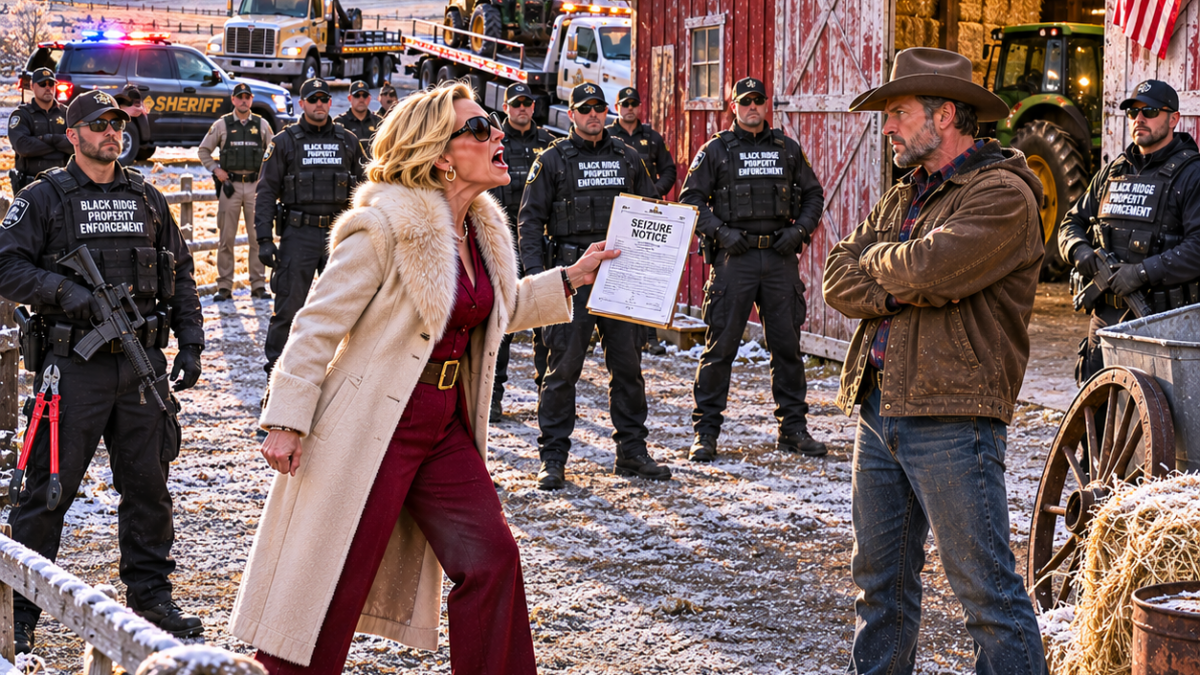
And behind them, stepping out of the last SUV as if she were arriving for a ribbon cutting instead of an unlawful seizure, was Vanessa Crowley.
President of the Black Ridge Estates Homeowners Association.
The woman who had spent the previous three months inventing fines against land that had never belonged to her organization.
The woman who had told me forty-eight hours earlier that my barn would “stop being my problem.”
The woman who had no idea that Judge Miriam Whitlock had signed a warrant less than six hours before.
Her warrant.
I stood in my kitchen wearing jeans, boots, and an old work jacket while the coffee maker hissed behind me.
My sheriff’s uniform was upstairs.
My badge sat on the counter beside a folder I had not planned to touch until eight o’clock.
That was when Undersheriff Miles Danner was scheduled to lead a controlled operation at Black Ridge’s HOA office.
Not me.
Miles.
That distinction mattered.
The investigation touched my land.
I was a victim.
From the moment investigator Tessa Vaughn showed me the evidence that Vanessa had targeted other property owners too, I had removed myself from operational command.
I had no intention of using my badge to settle a private dispute.
But Vanessa had moved first.
I called Miles.
He answered before the second ring.
“They’re here.”
“Who?”
“Crowley. Fenner. Eight guards. Tow trucks.”
A pause.
“You safe?”
“For now.”
“You want units?”
“Yes. No lights. No sirens.”
“Grant—”
“I want the cameras to catch everything before you arrive.”
“You planning to confront them?”
“I’m planning to tell them to leave.”
“That’s all?”
“That’s all.”
Miles knew me well enough to hear what I wasn’t saying.
“Stay out of the command role.”
“I will.”
“I mean it.”
“So do I.”
I ended the call.
Then I walked outside.
The sun had not cleared the ridge.
The barn lights cast long yellow shapes across the gravel.
My father built that barn when I was seventeen.
Every bolt in the west wall had been tightened by someone in my family.
My grandfather’s old welding bench still sat inside.
So did two tractors, a generator, a livestock trailer, irrigation pumps, and file cabinets filled with decades of land records.
Brock Fenner stepped in front of me about twenty feet from the barn doors.
He was large, mid-forties, with BLACK RIDGE PROPERTY ENFORCEMENT stamped across his vest in letters intentionally designed to look official.
He held up one hand.
“Stop there.”
I stopped.
“Why?”
“This property is under association control.”
“No, it isn’t.”
“We have a seizure authorization.”
“From what court?”
Brock looked toward Vanessa.
She strode forward carrying a stack of paper.
“Grant, you’ve had every opportunity to resolve this peacefully.”
“I asked you a question.”
She held the top page toward me.
“Read it yourself.”
I took it.
No court seal.
No docket number.
No judge.
No clerk certification.
No enforcement agency.
At the bottom:
AUTHORIZED BY: VANESSA CROWLEY, PRESIDENT, BLACK RIDGE ESTATES HOA.
I almost admired the confidence.
Almost.
I looked at Brock.
“Has anyone verified this with a court?”
Vanessa answered for him.
“He doesn’t need to explain anything to you.”
I kept my eyes on Brock.
“Did your company verify it?”
His jaw tightened.
Vanessa stepped between us.
“This is not a negotiation.”
“No?”
“No.”
She pointed toward the barn.
“The HOA is exercising its right to secure collateral against unpaid assessments totaling one hundred eighty-six thousand dollars.”
“My land isn’t in your HOA.”
“It is under the historical annexation.”
“No such annexation exists.”
“That argument has been exhausted.”
“By who?”
“By people who understand community law.”
I almost smiled.
“Which people?”
Her eyes sharpened.
“You’ve had seventy-two hours.”
Two guards began moving around me.
One carried chain.
Another rolled the towing rig closer to the barn entrance.
I could hear my cameras clicking faintly above the eaves as they switched into higher-frame recording.
Good.
Vanessa pointed toward me.
“If he interferes, restrain him.”
I looked directly at her.
“Say that again.”
She did.
“If Mr. Holloway interferes with the seizure, detain him.”
Brock looked uncomfortable.
That interested me.
“Your guards have lawful detention authority?”
Vanessa snapped, “Cut the lock.”
Brock hesitated.
Just long enough.
Then he placed the bolt cutters on the old barn padlock.
My father installed that lock bracket thirty-one years earlier.
The hardware itself wasn’t worth much.
Maybe thirty dollars.
But when the cutters snapped shut and the lock fell into the dirt, the sound landed differently.
I looked down.
Then back at Vanessa.
“You just crossed a line your lawyers are going to have a hard time explaining.”
She laughed.
“You think I’m afraid of a rancher?”
The barn doors opened.
One guard entered.
Another began reading serial numbers from my tractors.
Then a bright red sticker went onto the largest one.
SEIZED BY BLACK RIDGE HOA
I took out my phone.
Vanessa smiled.
“Call whoever you want.”
So I did.
“Miles.”
“Yeah?”
“Come in.”
Four words.
That was all.
Thirty seconds later, engines rolled up the road.
No lights.
No sirens.
Three sheriff’s vehicles came around the curve.
Brock turned.
His confidence disappeared.
Vanessa smiled.
Actually smiled.
“Good,” she said. “Now maybe your department can explain this to you.”
I walked back into the house.
For less than a minute.
When I returned, I wore my sheriff’s hat.
My silver star was clipped to my belt.
And the folder in my left hand carried the seal of Redstone County District Court.
Brock saw the badge first.
He turned toward Vanessa.
“That’s the sheriff.”
She spun around.
Her face changed.
I held up the folder.
“This is a legal order.”
Miles Danner stepped from the lead vehicle.
I spoke loudly enough for every camera to capture it.
“Undersheriff Danner has full command. I’m here as the property owner and a witness.”
Miles looked at Brock.
“Set the tools down.”
Brock immediately lowered the bolt cutters.
Two guards hesitated.
Vanessa shouted, “Do not abandon your positions!”
Miles looked at her.
“Which court issued your seizure order?”
She thrust the paper toward him.
He read it for maybe five seconds.
Then looked up.
“This isn’t a court order.”
“It is an HOA enforcement instrument.”
“That’s not the same thing.”
“You’re interfering with lawful association authority.”
Miles held out his hand.
I gave him the folder.
He opened the first page.
Then read the heading aloud.
STATE OF REDSTONE COUNTY v. VANESSA CROWLEY.
Vanessa stopped breathing for a second.
Miles continued.
“Arrest warrant signed by Judge Miriam Whitlock.”
The color drained from her face.
She stared at me.
“You did this.”
“No.”
“You used your office.”
“No.”
“This is revenge.”
Miles interrupted.
“Mrs. Crowley, you are under arrest pursuant to an independently issued warrant related to an ongoing investigation involving alleged document forgery, conspiracy to unlawfully seize private property, coercion, and interference with property records.”
She stepped backward.
“This is an HOA dispute.”
“It stopped being only that a while ago.”
She pointed at me.
“He orchestrated this!”
I finally answered.
“Your own files built the case.”
Vanessa turned toward Brock.
“Get me out of here.”
He didn’t move.
She tried again.
“Brock.”
Nothing.
Miles spoke.
“You are not leaving.”
Vanessa turned toward her SUV.
A deputy stepped into her path.
Then she started threatening badges.
Careers.
Lawsuits.
News coverage.
Political consequences.
Nobody responded.
Miles placed her in handcuffs.
I stood beside my broken barn lock and watched the woman who had arrived expecting my tractors to be hauled away get placed inside a patrol vehicle instead.
I didn’t smile.
Because this had never been about beating Vanessa Crowley.
It was about finally proving that the system she had built around fear was much bigger than one ranch.
And when the search team reached the Black Ridge clubhouse later that morning, they found the file that proved exactly how many people she had planned to do this to next.
part 2
My family had owned those forty-two acres before Black Ridge Estates existed.
Before the stone entrance signs.
Before the decorative lake.
Before the guardhouse.
Before people started paying thousands of dollars a year for the privilege of receiving letters about fence colors.
Holloway Ranch had been cattle land, hay ground, and equipment storage for three generations.
The eastern edge of my property ran beside a narrow service road connecting to the county highway.
That road became valuable only after Black Ridge announced a multimillion-dollar clubhouse expansion.
The HOA’s existing entrance was narrow.
Curved.
Poorly suited for heavy construction traffic.
My road was straight.
Wide enough.
And already graded for farm equipment.
Vanessa came to see me about nine months before the barn incident.
She arrived alone.
No guards.
No letters.
No threats.
She wore sunglasses and carried architectural drawings.
“Sheriff Holloway.”
“Vanessa.”
“I hope I’m not catching you at a bad time.”
“I’m fixing irrigation.”
“I’ll be quick.”
She unfolded a map across my truck hood.
The new clubhouse sat at the center.
A red line crossed my eastern road.
“We’d like temporary construction access.”
“For how long?”
“Approximately fourteen months.”
“No.”
She blinked.
“We’re prepared to compensate you.”
“No.”
“You didn’t even hear the number.”
“The road crosses two irrigation lines.”
“We’ll insure them.”
“Heavy trucks will pass twenty feet from my equipment shed.”
“We can install barriers.”
“The answer’s still no.”
Her smile tightened.
“Grant, this would help the entire community.”
“I don’t live in Black Ridge.”
“You live beside it.”
“Correct.”
“We can offer fifty thousand.”
“No.”
Seventy-five.
No.
One hundred.
No.
It was never about price.
The route made no sense for me.
The trucks would damage the road.
Complicate ranch traffic.
Threaten irrigation.
And put industrial vehicles beside a structure my father built.
Vanessa finally folded the plans.
“I think you’re making a mistake.”
“Maybe.”
“You might reconsider once construction starts.”
“I won’t.”
She left.
A week later, I received the first violation notice.
HOA COVENANT NONCOMPLIANCE — $18,400.
I laughed.
Literally.
I assumed somebody accidentally generated a notice against the wrong parcel.
I called Black Ridge.
Vanessa answered.
“This fine has my address.”
“It’s correct.”
“My land isn’t in the HOA.”
“Historical annexation records say otherwise.”
“What historical annexation?”
“You’ll receive documentation.”
I asked for the original recorded instrument.
She sent a scan.
Blurry edges.
No filing stamp.
No book number.
No page.
No county verification.
I drove to the recorder’s office.
Searched my name.
My father’s.
My grandfather’s.
Parcel number.
No annexation.
No HOA covenant.
Nothing.
I wrote Vanessa back.
County records contain no evidence that Holloway Ranch was ever annexed into Black Ridge Estates. Please withdraw the notice.
She didn’t.
Two weeks later:
$46,700.
Then:
$91,300.
Then:
$186,000.
Fines.
Legal fees.
Maintenance assessments.
Administrative penalties.
Numbers created faster than any legitimate obligation could accumulate.
A final letter arrived.
NOTICE OF COLLATERAL SEIZURE.
The HOA intended to seize my barn and equipment unless I paid within seventy-two hours.
Signed:
Vanessa Crowley.
That letter bothered me for a different reason.
By then I knew her paperwork was nonsense.
But she seemed too confident.
People don’t usually threaten to seize tractors unless the tactic has worked before.
So I called the recorder again.
Asked whether anyone else had reported strange HOA property claims.
The clerk hesitated.
Then said four other landowners near Black Ridge had complained about paperwork they didn’t recognize.
That changed everything.
I walked into the sheriff’s office carrying Vanessa’s seizure notice.
Tessa Vaughn was one of my best investigators.
Methodical.
Patient.
Unimpressed by titles.
I placed the notice on her desk.
“Don’t investigate my dispute.”
She looked up.
“What?”
“Find out how many others got one.”
She read the paper.
“This looks fake.”
“I know.”
“You want me handling something involving your property?”
“You’re not investigating me.”
“You’re the victim.”
“That’s why I’m telling DA Rourke today.”
Tessa leaned back.
“You think this is bigger?”
“I think Vanessa learned this trick somewhere.”
Within twenty-four hours, District Attorney Dean Rourke knew about my conflict.
We agreed Miles Danner would command anything operational.
I would provide evidence.
Nothing else.
No warrants.
No arrest decisions.
No interviews.
No strategy meetings unless necessary as the victim.
I wanted no future defense attorney standing in court saying Sheriff Grant Holloway used his department to punish a woman who annoyed him.
That separation became essential.
Tessa started quietly.
The first thing she found was Black Ridge Property Enforcement.
Vanessa had contracted Brock Fenner’s private security company.
Their uniforms were dark.
Badges shaped like shields.
Large lettering.
To a frightened homeowner at night, they looked close enough to law enforcement to create hesitation.
They delivered seizure notices.
Blocked driveways.
Locked gates.
Towed vehicles.
Stood outside buildings.
Three older cases stood out.
A workshop owner named Daniel Price lost two commercial generators after refusing a disputed assessment.
Another landowner, Marcus Neal, was locked out of his storage building for four days.
A third paid sixty-three thousand dollars after Vanessa threatened his only access road.
None of them had challenged the process deeply.
Daniel assumed the HOA had legal authority.
Marcus couldn’t afford counsel.
The third owner simply paid because losing road access would have destroyed his business.
Fear had been the enforcement mechanism.
Not law.
Vanessa called me during that investigation.
Official sheriff’s phone.
Recorded system.
“You have forty-eight hours.”
“For what?”
“Before the barn stops being your problem.”
“What court signed your order?”
She laughed.
“An HOA does not run to a judge every time a property owner refuses to comply.”
I wrote the exact sentence down.
Then forwarded the recording through proper channels.
That one line mattered.
Vanessa understood she had no court order.
She simply believed she did not need one.
But Tessa still needed proof the historical documents were manufactured.
That proof came from Paige Roston.
Black Ridge’s accountant.
She had resigned suddenly months earlier.
Tessa tracked her down.
Paige initially refused to meet.
Then agreed.
Then canceled.
Then called back.
Finally, she arrived at an attorney’s office carrying a hard drive.
She had copied internal files before resigning.
Not because she planned to expose Vanessa originally.
Because invoices stopped matching board approvals.
Dates shifted.
Documents appeared after the events they supposedly authorized.
One file was named:
HOLLOWAY ANNEXATION FINAL.
Metadata:
Created eleven days before I received it.
The “nineteen-year-old” historical annexation document was less than two weeks old.
No rediscovered archive.
No forgotten agreement.
Fabricated from scratch.
Tessa called me near midnight.
“This isn’t an HOA case anymore.”
“How bad?”
“Bad.”
“Do I need to know?”
“No.”
That answer made me trust her even more.
While Vanessa believed I was preparing to surrender, Tessa and Dean were building a case.
Then they discovered money.
Several settlement payments tied to property enforcement never entered the normal HOA operating account.
Instead, funds moved through a consulting firm connected to Vanessa.
Now the pattern had motive.
Fear homeowners.
Invent debt.
Seize property.
Force settlement.
Redirect money.
Dean took the evidence to Judge Miriam Whitlock.
Metadata.
Emails.
Bank records.
Paige’s sworn statement.
Security footage.
Recorded phone calls.
Other property owners.
The judge signed two orders.
Search warrant for Black Ridge offices and servers.
Arrest warrant for Vanessa.
The operation was scheduled for eight in the morning.
Controlled.
Public office.
No drama.
Then Vanessa arrived at my ranch before sunrise.
What none of us understood yet was why she was so desperate to get inside my barn.
At first, the equipment seemed obvious.
Tractors.
Generator.
Trailer.
Valuable assets.
But after she was arrested, I walked through the barn.
One old filing cabinet stood open.
Top drawer pulled halfway out.
Papers disturbed.
That didn’t make sense.
If the guards wanted equipment, why search files?
Tessa later reviewed the footage.
Two minutes after Brock cut the lock, one guard walked directly to the filing cabinet.
Skipped the tractors.
Skipped the generator.
Skipped everything worth towing.
He searched drawers.
When questioned, he admitted Vanessa gave him a photograph of a brown envelope.
Code:
BR17.
“Old HOA property record,” she called it.
“Minor importance.”
We searched the cabinet.
Found it behind a drawer.
The envelope had belonged to my father.
Inside was an old survey.
Decades old.
I had seen it before but never understood why Vanessa would care.
Tessa did.
The survey described the service road beside my eastern boundary.
More specifically, the easement used by a portion of Black Ridge.
It was conditional.
Restricted to light residential traffic.
No commercial construction.
No heavy trucking.
No industrial equipment.
No large-scale event access.
Vanessa’s clubhouse project needed that road.
Not just mine.
Another segment connecting into the development had use restrictions that made her construction plan almost impossible.
BR17 proved the project had no legal right to route heavy trucks the way Vanessa planned.
She needed that envelope gone.
Suddenly the fabricated annexation made sense.
If my ranch became “part of Black Ridge,” Vanessa could argue HOA rules governed the access.
If she could pressure me into membership, settlement, or surrender, she gained leverage over the road.
The fines were never the destination.
They were pressure.
The barn seizure was never primarily about my tractors.
She wanted the records inside.
Then the search team reached Black Ridge headquarters.
Paige remembered Vanessa had a private laptop locked in a safe behind the conference room.
The combination changed two days earlier.
The warrant covered the safe.
Inside the laptop was a spreadsheet.
ACQUISITION TARGETS.
Seventeen names.
Mine was one.
Columns included:
Estimated land value.
Outstanding debt.
Likelihood of legal resistance.
Access importance.
Probability of successful acquisition.
I stared at the report later through what could legally be disclosed to me.
Seventeen people.
This was not random HOA abuse.
It was strategy.
Find landowners near planned development.
Create financial pressure.
Use association paperwork to manufacture authority.
Push them to sell or surrender access.
Emails connected Vanessa with an outside developer.
If enough land and access rights were consolidated, a larger real estate deal would trigger.
A private company connected to Vanessa would earn substantial consulting compensation.
The puzzle finally closed.
She wasn’t protecting Black Ridge.
She was using it.
Brock Fenner began cooperating.
His lawyer advised him correctly.
The faster he established what he knew and what he did not, the better.
He surrendered phones.
Emails.
Work orders.
Six months of assignment logs.
Eleven addresses.
Most visits were just paperwork delivery.
Three involved real seizures.
Generators removed.
A gate chained.
An owner physically denied access.
Brock claimed Vanessa told him every operation had legal review.
Records showed otherwise.
Not one of those seizures had been independently verified.
Then body camera footage from my barn morning surfaced.
Before I stepped outside, Vanessa told Brock:
“If he resists, restrain him. I’ll handle the paperwork afterward.”
Afterward.
That word mattered.
You do not “handle paperwork afterward” if you genuinely believe the legal authority already exists.
Another guard voluntarily produced audio.
Vanessa explaining why eight uniforms mattered.
“Most people fold when enough men show up.”
There it was.
The entire system in one sentence.
Not lawful authority.
Appearance.
Volume.
Fear.
Dean Rourke structured the case around the pattern.
Paige’s metadata.
Brock’s logs.
My footage.
Dash cameras.
Financial records.
BR17.
The target spreadsheet.
Other victims.
Vanessa’s own recorded statements.
News spread.
Black Ridge residents started talking to one another.
A woman named Ellen Pierce had paid nearly thirty thousand dollars over an alleged fence violation.
Her paperwork used the same odd formatting as my fake annexation.
A retired teacher surrendered a boat trailer under a supposed seizure notice.
No court had ever issued it.
Another family had been threatened with a lien based on assessments tied to land outside the HOA boundary.
One person complaining can be dismissed.
Ten comparing documents become a pattern.
Vanessa’s attorney responded with the only strategy available.
I was abusing my power.
Sheriff targets HOA president after private property feud.
That argument had potential.
I knew it.
So I withdrew even further.
Miles retained all operational command.
Dean worked independently.
Judge Whitlock handled filings as required.
I remained witness and victim.
Vanessa apparently interpreted my disappearance as weakness.
Meanwhile, her own board started looking at finances.
The temporary treasurer found a hole inside the Capital Legal Reserve.
Hundreds of thousands transferred to consulting firms.
Two firms had almost no operating presence.
Another discovery hurt more.
Weeks before the enforcement campaign expanded, Vanessa pushed the board to buy significantly higher liability insurance.
She anticipated lawsuits.
Maybe not the exact case.
But exposure.
This wasn’t a woman who made one impulsive mistake.
She planned risk.
Then normalized the tactics.
The formal hearing eventually put two pages side by side.
Vanessa’s seizure notice.
And Judge Whitlock’s real warrant.
Dean asked the court to look closely.
Vanessa’s document:
No case number.
No judicial signature.
No court seal.
No sworn affidavit.
No defined scope.
No lawful issuing authority.
Only her title.
The warrant:
Judge.
Case number.
Probable cause affidavit.
Scope.
Signature.
Court seal.
Actual process.
One page imitated authority.
One page earned it.
Paige testified.
Her voice shook at first.
Then steadied.
She explained how board approvals had been backdated.
How invoices appeared before votes.
How files were renamed.
How she archived copies because she became afraid records might disappear.
Defense counsel asked why she waited.
Paige answered:
“Because I was scared.”
Simple.
Honest.
Then:
“I started saving things because I was more scared of staying silent.”
Tessa testified about metadata.
The so-called historic annexation file had been created eleven days before delivery.
Waltered formatting.
Copied signatures.
No official record.
Brock testified next.
Vanessa had personally told him to seize the barn.
Personally told him to restrain me.
Personally told him the legal paperwork was handled.
My security footage supported him.
Then came BR17.
The survey.
The motive.
Without the road, Vanessa’s clubhouse project needed a new access design.
More expensive.
Delayed.
Potentially impossible under the original schedule.
Then the target spreadsheet.
Seventeen names.
Seventeen people evaluated by financial vulnerability.
At that point, the defense could no longer plausibly describe me as an isolated personal enemy.
I was simply the target who happened to fight long enough for everyone else to be discovered.
Vanessa insisted everything she did served the community.
Dean did not argue about whether she believed herself.
He asked one question.
“If your authority over these properties was legitimate, why did you need to fabricate documents proving that authority existed?”
Silence.
There are courtroom questions designed to produce answers.
Then there are questions designed to reveal that no answer exists.
That was the second kind.
The consequences arrived slowly.
Vanessa lost the presidency first.
The Black Ridge board voted her out.
Then the property enforcement program was dissolved.
An outside audit began.
Every fine.
Every seizure.
Every settlement.
Every contract.
Landowners filed claims.
Some recovered property.
Others sought compensation.
Assets connected to the suspected scheme were frozen pending proceedings.
County prosecutors pursued the criminal matters supported by the evidence.
I attended only when required.
I did not need to watch Vanessa suffer.
That was not why I had spent my adult life in law enforcement.
If anything, the case embarrassed me.
Not personally.
Institutionally.
How many people had complied because Brock’s uniforms looked close enough to ours?
How many had seen a shield-shaped patch and assumed someone had checked legality?
How many had been too frightened to ask one sentence?
“What court signed this?”
I brought that question into training at the sheriff’s office.
Authority must be identified.
Verified.
Documented.
A uniform does not create it.
A confident voice does not create it.
Neither does a logo.
Judge Whitlock said something similar during later proceedings.
The danger, she observed, was not only dramatic violence.
It was the normalization of intimidation dressed as routine paperwork.
That line stayed with me.
Because Vanessa did not begin with eight guards.
She began with letters.
Then fines.
Then warning signs.
Then surveys.
Then “enforcement.”
Each step made the next seem slightly less outrageous.
By the time she arrived with tow trucks and bolt cutters, the people around her had become accustomed to thinking HOA authority was whatever Vanessa said it was.
That was how the system grew.
Not through one giant leap.
Through inches.
Civil court permanently declared the fabricated annexation void.
Holloway Ranch remained exactly what it had always been.
Private.
Outside Black Ridge.
BR17 was recognized as controlling evidence regarding the restricted easement.
Black Ridge could not use the route for the heavy commercial traffic Vanessa planned.
The clubhouse expansion had to be redesigned.
That cost money.
A lot of it.
Some residents were angry at me.
I understood.
They had been promised a new clubhouse.
Amenities.
Higher property values.
Now delays.
Redesign costs.
Legal bills.
But I never blocked a legal route.
I refused to surrender my land and documents to make an illegal plan convenient.
There is a difference.
Brock eventually met me after his company severed ties with Black Ridge.
No vest.
No guards.
Just jeans and an uncomfortable expression.
We stood outside my barn.
He looked at the new lock.
“I should’ve checked.”
“Yes.”
“I thought the attorney had.”
“You asked?”
“Vanessa said he had.”
“That’s not what I asked.”
Brock looked down.
“No.”
He rubbed his hands together.
“I’ve changed the company policy.”
“What policy?”
“Any property seizure requires independent verification from counsel who isn’t the client.”
“That should have existed before.”
“I know.”
“What about detention?”
“Never again unless we’re acting under clear lawful authority and within license.”
I nodded.
He waited.
I think he expected forgiveness.
I wasn’t ready to give it on command.
Finally he said, “I’m sorry.”
“I believe you.”
“That’s it?”
“That’s what I have.”
He accepted it.
Before leaving, Brock looked back at the barn.
“Why didn’t you tell us you were sheriff?”
“Would it have mattered?”
He took too long.
“That’s why.”
Months later, during one of Vanessa’s court appearances, she looked straight at me.
“If you weren’t sheriff, none of this would have happened.”
That sentence angered me more than almost anything else she ever said.
I stood.
Not because I wanted to speak.
Because the court allowed a response.
“You’re right about one thing.”
She looked almost satisfied.
“It shouldn’t have taken a sheriff.”
The room became quiet.
“Daniel Price shouldn’t have needed a sheriff to keep his generators.”
I continued.
“Marcus Neal shouldn’t have needed a sheriff to enter his own building. The retired teacher shouldn’t have needed a sheriff to keep her trailer. None of those people should have needed special titles or special connections just to make your organization respect property you didn’t own.”
Vanessa looked away.
“That’s the problem. You thought you failed because you picked the wrong victim.”
I shook my head.
“You failed because what you were doing was wrong no matter whose driveway you entered.”
That was the only time I spoke to her directly after the arrest.
The new Black Ridge board changed almost everything.
The enforcement division disappeared.
Private security no longer handled property disputes.
Outside counsel reviewed disputed liens.
Major fines required documented votes.
Conflicts of interest had to be disclosed.
Every historical annexation record was checked against county filings.
Most turned out legitimate.
A handful did not.
Those were corrected.
The board published audit summaries to residents.
Painful.
Necessary.
Vanessa’s consulting relationships became part of ongoing financial litigation.
Some money was recovered.
Some wasn’t.
The clubhouse project survived in a smaller form.
Different access.
Different schedule.
No use of my road.
I never wanted Black Ridge destroyed.
Most residents had done nothing to me.
They had simply trusted someone who spent years making herself indispensable.
That was their mistake.
Not their crime.
One morning, Tessa walked into my office carrying two plastic evidence sleeves.
“Question.”
“What?”
“You want these kept together?”
She placed them on my desk.
Vanessa’s seizure notice.
Judge Whitlock’s warrant.
Side by side.
One fake.
One real.
I looked at them.
“Yes.”
“Why?”
“Archive them together.”
“That’s oddly sentimental for you.”
“It’s training material.”
Tessa smiled.
“Of course.”
I tapped Vanessa’s page.
“This one is paper pretending to be authority.”
Then the warrant.
“This one is authority built from evidence.”
“Feels like a poster.”
“Don’t make it a poster.”
“I’m making it a poster.”
“Tessa.”
She laughed.
We archived them together.
Holloway Ranch returned to normal.
The barn lock got replaced.
The red HOA sticker came off my tractor.
I kept that too.
Not as a trophy.
As evidence.
My father’s filing cabinet was repaired.
BR17 went into a fireproof case.
A copy remained with counsel.
Another with the county record set where appropriate.
I no longer trusted a single envelope to hold an important truth.
Maybe Vanessa changed me more than I wanted.
I installed two additional cameras.
Updated gate lights.
Reinforced storage.
Miles teased me.
“You turning the ranch into Fort Holloway?”
“No.”
“You now have more cameras than the jail.”
“That is an exaggeration.”
“Barely.”
The ranch still felt like home.
That mattered.
One evening I stood near the eastern road watching a contractor from Black Ridge measure for their redesigned access.
This time he stayed on their side.
He waved.
I waved back.
Simple.
No guards.
No letters.
No forged history.
Eventually the interim HOA president came over.
Her name was Diane Keller.
She stopped at my fence.
“Sheriff?”
“Grant out here.”
She nodded.
“Grant.”
“What can I do for you?”
“We need to replace drainage near the boundary.”
“Okay.”
“The work might require entering about six feet onto your property for two days.”
“Send me the plan.”
She blinked.
“That’s it?”
“No.”
Her shoulders dropped.
“What else?”
“Insurance. Contractor names. Dates. Restoration terms.”
“Of course.”
“And then I’ll decide.”
She laughed.
“Fair.”
We wrote an access agreement.
Both sides signed.
Work finished.
No conflict.
It was so ordinary that it almost irritated me.
Vanessa could have asked.
Not for the construction road—I probably still would have refused.
But every dispute did not need to become war.
She made it war because she believed no was insubordination.
That was her fatal flaw.
Not greed alone.
Not fraud alone.
She could not imagine another person having final authority over something she wanted.
My land.
Daniel’s generators.
Marcus’s building.
The retired teacher’s trailer.
To Vanessa, everything was negotiable once enough pressure existed.
Law exists partly to stop that idea.
Years later, I still thought about Paige.
She came to the sheriff’s office once after the biggest proceedings were over.
Tessa invited her.
Paige seemed uncomfortable being praised.
“I just copied files.”
“No,” I said. “You preserved them.”
“Same thing.”
“No.”
She looked at me.
“If you hadn’t come forward, Vanessa might have destroyed the metadata trail.”
Paige stared at the floor.
“I should’ve done it sooner.”
“Maybe.”
She looked surprised.
People always expect reassurance.
Sometimes truth is kinder.
“But you did it.”
She nodded.
“I was afraid of losing my job.”
“That makes sense.”
“I lost it anyway.”
“I know.”
“Would you have done it sooner?”
I thought about that before answering.
“I’d like to say yes.”
That was the most honest thing I had.
Courage is easy when you imagine yourself having it.
Harder when the mortgage is real.
Paige’s patience and documentation mattered.
She became one of the most important witnesses.
Tessa once told me the case was won as much by accountants and metadata as by detectives.
I believed her.
That became another lesson.
Everybody remembers eight guards.
Nobody remembers file creation dates.
But the guards only proved Vanessa was willing to intimidate.
The metadata proved she manufactured history.
That was harder to explain away.
The final civil orders protecting the ranch were simple.
No HOA ownership.
No annexation.
No right of seizure.
Permanent recognition of the recorded boundaries.
Access restrictions enforced according to the original easement.
Compensation for documented damage.
Nothing dramatic.
Exactly what I wanted.
When people asked whether I felt victorious, I usually said no.
Victory sounds like two sides had equal claims and one prevailed.
Vanessa never had a claim to my barn.
She had paper she made herself.
There was nothing to win from her.
Only something to stop.
On the first anniversary of the arrest, I woke at 5:41 without an alarm.
Body memory.
I walked to the kitchen.
Looked at the cameras.
Empty road.
No convoy.
I made coffee.
Then walked to the barn.
The new lock hung from the door.
My hand rested on it.
For a moment I saw Brock’s cutters again.
Vanessa standing behind him.
Red seizure sticker.
Eight uniforms.
Then the memory passed.
I opened the barn.
Sunlight was beginning to reach the ridge.
Same tractor.
Same generator.
Same filing cabinets.
Everything ordinary.
I preferred ordinary.
Miles arrived around seven with breakfast sandwiches.
“You knew I’d be here?”
“You’re predictable.”
“I’m reflective.”
“You’re standing outside a barn before sunrise on the anniversary of somebody trying to steal it.”
“Reflective.”
He handed me coffee.
We sat on the loading step.
Miles looked toward Black Ridge.
“Think it’s over?”
“The case?”
“Everything.”
“No.”
He waited.
“People forget.”
“That dark?”
“Not dark.”
I took a sip.
“Just true.”
Systems need maintenance like fences.
You don’t build rules once and assume they protect themselves forever.
People stop reading.
Boards get comfortable.
Contractors start trusting titles instead of documents.
Then someone like Vanessa discovers that confidence can imitate authority for a very long time.
Miles nodded.
“So what do we do?”
“Keep checking.”
“That’s it?”
“That’s most of the job.”
He laughed.
“Terrible slogan.”
I looked at the barn.
“Worked here.”
Black Ridge eventually held its first board election after the scandal.
Turnout was almost every household.
People who had never attended meetings showed up.
They asked questions.
Lots of them.
Contracts.
Insurance.
Security.
Budget.
Conflict disclosures.
Vendor relationships.
The meetings became longer.
Diane Keller once complained jokingly that democracy was exhausting.
I told her that was probably a good sign.
The clubhouse expansion eventually restarted under a redesigned route.
Smaller project.
More expensive.
Legally accessible.
I drove past construction one afternoon.
Heavy trucks used a commercial access road built entirely on land Black Ridge had purchased properly.
Nobody crossed Holloway Ranch.
Nobody touched my irrigation.
The world did not end.
Residents still got a clubhouse.
It just cost more because the cheap route had depended on taking something that wasn’t theirs.
There’s a lesson in that too.
Illegal shortcuts often look cheap only because someone else is being forced to pay the real cost.
Vanessa wanted me to pay with my road.
Other landowners paid with equipment.
Others with money.
Black Ridge ultimately had to pay its own cost.
That was fairer.
One winter, Daniel Price—the workshop owner whose generators had been taken—came by.
His generators had eventually been returned after the court process.
One was damaged.
He received compensation.
He stood in my barn looking at the red seizure sticker I had kept.
“They put one like that on mine.”
“I know.”
“I thought it meant something.”
“So did most people.”
He looked embarrassed.
“I should’ve called a lawyer.”
“Maybe.”
“I paid taxes. Owned the building. Still let six guys tell me I had no choice.”
I shook my head.
“That’s what intimidation does.”
“You weren’t intimidated.”
“Yes, I was.”
He looked at me.
“You’re sheriff.”
“So?”
“You had deputies.”
“Not before I started asking questions.”
That was important.
People sometimes rewrote the story to make me fearless.
I wasn’t.
When Vanessa threatened seizure, I worried.
When I learned four other landowners had similar documents, I worried more.
When eight men rolled onto my property, I knew somebody could get hurt.
Fear isn’t failure.
Letting fear replace judgment is.
Daniel nodded.
“I wish I’d known that.”
“You know now.”
He left.
I added his story to the internal training session Tessa and I eventually gave deputies.
Not names.
Principle.
Private security is not police.
HOA notices are not warrants.
Civil debt does not authorize physical seizure absent lawful process.
Verify jurisdiction.
Verify court orders.
Slow the scene down.
Those rules sound basic.
Basic rules save people when the situation looks complicated.
The last time I saw Vanessa in person was during a final court appearance connected to the wider case.
She looked smaller.
Not physically.
The room no longer bent toward her when she entered.
No assistants.
No guards.
No board members.
No leather folder held like a weapon.
Just counsel.
She avoided my eyes until the hearing ended.
Then she looked at me once.
I felt no triumph.
What I felt was distance.
The kind that comes when somebody used to occupy too much space in your mind and finally stops.
That was freedom.
Not the warrant.
Not the arrest.
Not the HOA vote.
The moment her name became something I could go days without thinking about.
Life got quieter.
I ran cattle.
Fixed pumps.
Served as sheriff.
Argued with Miles about staffing.
Helped Tessa develop a property-fraud checklist.
Went home.
The eastern road stayed where it had always been.
Some evenings I walked it to the boundary marker.
The post itself was ugly.
Concrete.
Metal cap.
Survey number stamped into the top.
But I liked it.
Boundaries don’t need to be beautiful.
They need to be clear.
Vanessa hated clear boundaries because they limited her.
I had learned to respect them because they protected everyone.
Not just me.
Black Ridge’s line protected Black Ridge too.
They owned what was theirs.
I owned what was mine.
Cooperation happened in the space between.
That is how neighbors work.
One Christmas Eve, several years after the seizure attempt, Diane called.
“Grant?”
“Yeah?”
“We’re doing a toy drive at the clubhouse.”
“That sounds dangerous.”
“Very funny.”
“What do you need?”
“Parking overflow.”
I laughed.
Long enough that she started laughing too.
“Absolutely not your ranch.”
“Good answer.”
“We rented the church lot.”
“Smart.”
“I just wanted to ask whether the sheriff’s office could send somebody by because traffic gets bad.”
“I’ll put it on the schedule.”
“Thank you.”
After hanging up, I stood in my kitchen smiling.
That was what healthy authority sounded like.
Ask.
Explain.
Accept limits.
Nobody needed eight guards.
The morning after Christmas, I walked to the barn.
Snow covered the road.
A few tracks crossed the distant Black Ridge entrance.
Nothing came my way.
I opened the file cabinet.
BR17 sat inside its protective sleeve.
The brown envelope looked unimpressive.
Old paper.
Faded ink.
Yet Vanessa had sent eight men into my barn partly to make it disappear.
Because truth doesn’t have to look dramatic to be dangerous.
Sometimes it’s a thirty-year-old survey folded in a drawer.
Sometimes it’s metadata.
Sometimes a bank transfer.
Sometimes a woman named Paige deciding to copy one more file before resigning.
Sometimes a guard forgetting his body camera is running.
Sometimes a property owner asking:
“What court signed this?”
The people who abuse power depend on nobody asking that second question.
I closed the drawer.
Locked the cabinet.
Then looked at the red HOA sticker still preserved in the evidence folder.
SEIZED BY BLACK RIDGE HOA.
I remembered Vanessa telling me the barn would no longer be my problem.
She was right, eventually.
The barn stopped being a problem.
It became a barn again.
That was all I ever wanted.
I stepped outside.
The eastern horizon was brightening.
My gate stood closed.
No enforcement signs.
No tow trucks.
No uniforms.
The same boundary markers remained where my grandfather had known them.
Before Black Ridge.
Before Vanessa.
Before anyone decided a homeowners association could manufacture ownership by printing enough convincing paper.
I thought about the real warrant and the fake seizure notice archived side by side at the sheriff’s office.
Two pieces of paper.
Similar size.
Both filled with formal words.
Only one carried lawful authority.
The difference was not the paper.
The difference was everything behind it.
Evidence.
Sworn testimony.
Independent review.
A judge.
Defined limits.
Accountability.
Vanessa’s paper had none of that.
Only confidence.
For a while, confidence had been enough.
Not anymore.
I pulled the barn doors shut.
Locked them.
The new padlock clicked.
Then I started back toward the house as the sun came over the ridge.
Vanessa once told a courtroom that none of this would have happened if I had not been sheriff.
I still think about how wrong that sentence was.
Everything she did had already happened to people who weren’t sheriffs.
That was the point.
Daniel.
Marcus.
The retired teacher.
The other names on the spreadsheet.
Ordinary people.
People she believed would fold.
The only difference with me was that her system finally collided with enough evidence, enough witnesses, and enough lawful scrutiny to stop.
It should not require a badge for that to happen.
It should not require the “right victim.”
That became the most important lesson I carried out of the entire case.
Lawful power is not measured by how many people you can frighten.
It is measured by how carefully you respect the line beyond which your authority ends.
Vanessa never understood that line.
Mine happened to run forty-two acres wide.
And in the end, no forged notice, no eight-man security team, no tow truck, and no HOA president speaking loudly enough could move it even one inch.








