𝗙𝗨𝗟𝗟 𝗦𝗧𝗢𝗥𝗬 HOA KAREN SENT DEPUTIES TO MY FARM—THEN THE SHERIFF READ HER FAKE EASEMENT OUT LOUD IN FRONT OF EVERYONE
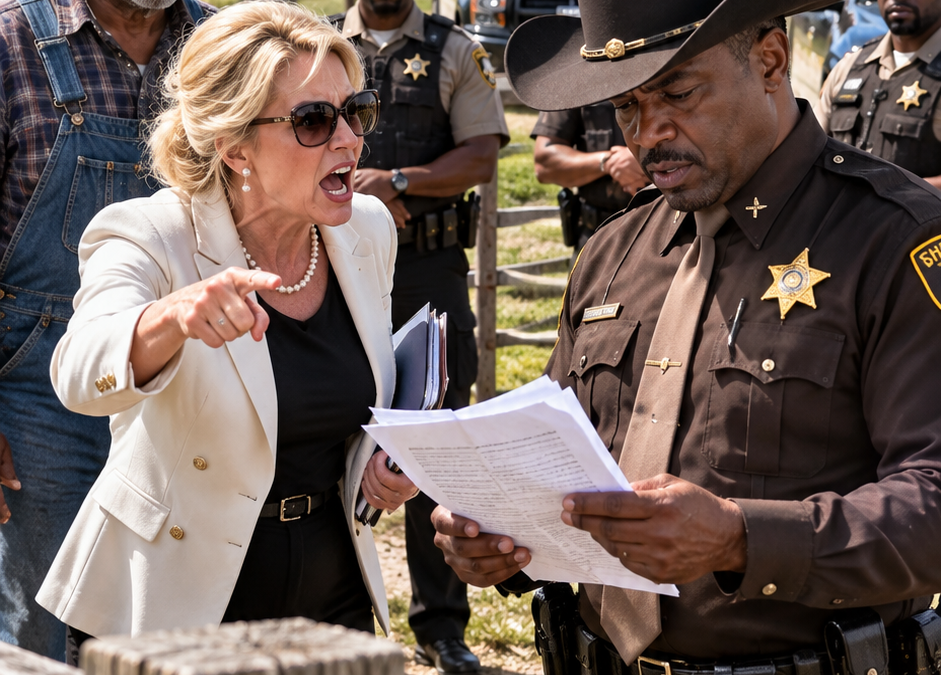
𝗣𝗔𝗥𝗧 𝟮
The envelope arrived by certified mail.
Silver Pines Homeowners Association.
Across the first page, in heavy type:
NOTICE OF OBSTRUCTION OF RECORDED ACCESS EASEMENT
I stood at my kitchen table reading it twice.
According to the letter, I was blocking a thirty-foot access corridor that had supposedly existed since 1998.
The association demanded that I remove my gate, relocate agricultural equipment, and provide contractors unrestricted access within seventy-two hours.
I almost laughed.
Then I reached the final paragraph.
If I refused, Silver Pines intended to request law-enforcement assistance.
That stopped being funny.
When I bought the farm, I paid for three separate title searches.
Some people thought that was excessive.
I did not.
Land problems have long memories.
An old handshake becomes a claimed easement.
A forgotten logging road becomes an access dispute.
A neighbor remembers his grandfather driving across one corner of a field fifty years earlier and suddenly believes that history created permanent rights.
I wanted none of that.
So three different examiners had reviewed the chain of title.
None found a Silver Pines easement.
I emailed the HOA requesting the document.
Three days later, another envelope arrived.
This one contained something much more elaborate.
Heavy paper.
County seal.
Notary block.
Instrument number.
Dense legal language.
The title read:
PERPETUAL ACCESS AND UTILITY EASEMENT
The supposed grantor was a previous owner of my farm.
The date was 1998.
The document described a thirty-foot corridor running roughly where Celeste wanted her road.
At first glance, it looked convincing.
Then I reached the final page.
A paragraph stated that the easement had been approved for “emergency enforcement assistance.”
Below that was a signature.
Wade Harland
County Sheriff
I sat back.
I knew Wade Harland.
Not personally enough to call him a friend, but we had spoken at agricultural meetings and county emergency-planning sessions.
And I had never heard of a sheriff approving private property easements.
Sheriffs enforce lawful orders.
They do not create property rights between HOAs and farmers.
I called Perry Caldwell.
Perry had worked in the county records office for nearly twenty years.
I drove the document to him that afternoon.
He adjusted his glasses and read it in silence.
“How old is this supposed to be?”
“Nineteen ninety-eight.”
He typed the instrument number.
His face changed.
“That’s interesting.”
“What?”
“This number exists.”
I leaned closer.
“For my property?”
“No.”
He turned the monitor.
The instrument number belonged to a mortgage release.
Different owner.
Different parcel.
Seventeen miles away.
I looked down at Celeste’s document.
“You’re sure?”
Perry gave me a look.
“This is my job.”
He searched my farm under every prior owner name.
Nothing.
He searched Silver Pines.
Nothing.
He checked cross-indexes.
Nothing.
“There is no recorded easement matching this document.”
“Could the number have been entered incorrectly?”
“Possible in theory.”
He tapped the page.
“But this isn’t a random typo.”
“Why?”
“Because the number they used is valid.”
He leaned back.
“If somebody wanted a fake document to survive a casual search, using a real instrument number would be smart. Somebody types it into the database, sees a valid county record, and maybe stops checking.”
That sent a chill through me.
Not because the forgery was brilliant.
Because it was deliberate.
I called Celeste.
“Your easement isn’t recorded.”
“According to whom?”
“The county.”
“County records are wrong all the time.”
“The instrument number belongs to a mortgage release seventeen miles away.”
Silence.
Then:
“That sounds like a clerical issue.”
“No.”
“You’re not qualified to determine that.”
“Perry Caldwell is.”
“Who?”
“The county title examiner.”
Another pause.
Celeste recovered quickly.
“We have our own legal review.”
“Then send me the attorney’s name.”
“I don’t need to provide you privileged information.”
“You’re asking law enforcement to enforce this.”
“We are asking you to respect an existing right.”
“An existing right with somebody else’s instrument number?”
Her voice hardened.
“Seventy-two hours, Grant.”
Then she hung up.
I did not move the gate.
I did not move the tractor.
I did not touch the farm road.
Instead I documented everything.
Photographs of the gate.
Photographs of the tractor.
Video of the disputed corridor.
Measurements from the barn.
Distances from the irrigation lines.
Copies of every email.
Copies of every certified envelope.
Copies of my deed and survey.
I checked my cameras.
That was when I found Celeste and Russell Boone standing outside my eastern fence.
Russell owned a local road-construction company.
His pickup was parked near Celeste’s SUV.
The audio from my camera was faint but usable.
Celeste pointed toward my barn.
I turned the volume higher.
Her voice came through.
“…once deputies make him open the gate, start immediately.”
I replayed it.
Then again.
Start immediately.
This was not a future proposal.
A contractor had already been hired.
Equipment had been scheduled.
Celeste was counting on deputies to create access before I could stop construction.
I saved the video in three locations.
Then I sent one copy to my attorney.
At 6:48 the next morning, engines woke me.
I stepped onto the porch.
Three sheriff’s cruisers were stopped at my gate.
Behind them came Celeste’s SUV.
Then Russell’s truck.
Then a flatbed trailer carrying a skid steer.
Then two vehicles belonging to Silver Pines board members.
I stared at the procession.
Celeste had turned a property dispute into theater.
She wanted witnesses.
Fine.
Deputy Nolan Briggs approached first.
“Mr. Mercer?”
“Yes.”
“We received a complaint that you’re obstructing a recorded emergency-access easement.”
Celeste appeared behind him.
“He’s been given repeated notice.”
Briggs lifted a hand.
“Mrs. Whitmore, give me a minute.”
“He has deliberately blocked—”
“I said give me a minute.”
She stopped.
I opened the gate enough to step through.
“Deputy, did anyone verify the recording number?”
Briggs looked at the folder in his hand.
“We were provided documentation.”
“That isn’t what I asked.”
Celeste stepped forward again.
“It has the county seal.”
I looked at Briggs.
“Did anybody check it?”
He hesitated.
“No.”
“Then before anyone touches my tractor, maybe you should.”
Celeste pointed toward the machine parked fifty feet inside my property.
“That tractor is sitting directly inside the easement corridor.”
“According to your fake paperwork.”
Her face changed.
“Careful.”
“Or what?”
“You’ve already been warned.”
I looked at Briggs.
“Do you have a court order requiring me to move anything?”
Silence.
Deputy Everett Shaw, standing several feet away, looked toward Briggs.
Briggs shook his head.
“No court order.”
“Then nobody moves my equipment.”
Celeste became visibly impatient.
“You don’t need a court order when an existing easement is being obstructed.”
“Maybe.”
I took out my folder.
“But first you need an easement.”
I handed Briggs my deed.
Survey.
Title commitment.
Perry’s email.
He read the first page.
Then the second.
I pointed to Celeste’s document.
“And you may want to look at the bottom.”
He did.
“Sheriff Harland?”
“Apparently.”
Celeste crossed her arms.
“It proves county recognition.”
I asked, “Since when does Sheriff Harland sign easements?”
Nobody answered.
Briggs stepped away.
“I’m calling him.”
Celeste seemed pleased by that.
“Good. He’ll clear this up.”
I almost told her to be careful what she wished for.
Instead I waited.
Russell began lowering the trailer ramps.
I looked at him.
“Don’t.”
He stopped.
Celeste turned.
“Russell, unload.”
I walked toward the fence.
“If that machine crosses my property line without lawful authority, every inch of it is being recorded.”
Russell looked at the cameras mounted on my barn.
Then at Celeste.
She said, “I’ll cover your legal expenses.”
Russell did not touch the controls.
Smart man.
Briggs returned.
“Sheriff Harland wants to see the document before anything happens.”
Celeste smiled again.
“Excellent.”
Residents had started gathering on the road.
Word traveled quickly in Silver Pines.
Within fifteen minutes, maybe a dozen people stood across the way.
Celeste used them immediately.
“This is exactly why communities need emergency access,” she said loudly. “One hostile landowner should not be allowed to endanger hundreds of families.”
I did not respond.
She wanted an argument.
I had documents.
Twenty minutes later, Wade Harland pulled up.
He stepped out alone.
No dramatic entrance.
No siren.
He walked to Briggs.
“Let me see it.”
Briggs handed him Celeste’s easement.
Harland started reading.
Page one.
Page two.
Page three.
His face remained blank.
Then he reached the final page.
I watched his posture change.
Barely.
But enough.
He looked at Celeste.
“Where did you get this?”
“Our archives.”
“Who found it?”
“Our administrative staff.”
“Which person?”
“I’d have to check.”
“Where is the original?”
“With our attorney.”
“Name?”
Celeste gave him one.
Harland looked at Briggs.
“Call records.”
Then he turned back toward Celeste.
“You said this document was recorded?”
“Yes.”
“And you want my deputies to enforce it?”
“Yes.”
“Today?”
“Yes.”
Harland waited.
“By moving Mr. Mercer’s tractor and opening his gate?”
“That is correct.”
Russell shifted beside his trailer.
The crowd grew quieter.
Dispatch called back.
Briggs listened.
Then walked to Harland.
“The instrument number belongs to a mortgage release.”
Celeste interrupted.
“Exactly what Grant has been claiming. It must be a recording error.”
Harland held up one finger.
She stopped.
Briggs continued.
“Property is on Hawthorne Creek Road. Seventeen-point-two miles away.”
Harland looked at Celeste.
“Not this farm.”
“No.”
“Not Silver Pines.”
“No.”
Celeste exhaled sharply.
“Old records contain mistakes.”
Harland ignored that.
Then he looked at me.
“Grant, do you object if I read this document aloud?”
“No.”
Celeste immediately said, “I do.”
Harland turned toward her.
“You brought this document to my office seeking public law-enforcement action.”
“It contains association legal information.”
“You asked deputies to use it to force entry onto his land in front of all these witnesses.”
Celeste said nothing.
Harland walked closer to the fence.
The residents across the road moved nearer.
“Since Mrs. Whitmore wants this enforced publicly,” he said, “everyone should understand exactly what we’re being asked to enforce.”
Then he began.
“Perpetual Access and Utility Easement…”
He read the date.
He read the name of the supposed former owner.
He read the legal description.
He read the thirty-foot corridor.
Celeste stood beside him with her arms crossed.
At first she looked satisfied.
Then Harland reached the section granting Silver Pines authority to request assistance from the sheriff’s department for removal of gates, fencing, vehicles, machinery, and other obstructions.
He stopped.
Looked at Celeste.
“My office cannot grant an HOA this authority.”
Celeste frowned.
“It’s already in the easement.”
“I understand what it says.”
“Then—”
“I’m telling you whoever wrote it put authority in my office that my office does not possess.”
The residents began whispering.
Harland continued.
Then he reached the signature block.
He read slowly.
“Approved and witnessed for emergency enforcement purposes…”
Pause.
“Wade Harland. County Sheriff.”
Celeste smiled.
“There.”
Harland looked at her.
“There what?”
“Your own signature.”
“That’s my name.”
“Exactly.”
“It is not my signature.”
Her smile disappeared.
Harland held the page up.
“Not even close.”
Celeste stared.
Then Harland delivered the part she had apparently never bothered checking.
“And in 1998, I wasn’t sheriff.”
Silence.
He continued.
“I wasn’t a deputy.”
Celeste blinked.
“I wasn’t employed by this sheriff’s office.”
Nobody across the road said a word.
Even Russell stopped moving.
Harland handed the page to Briggs.
“Confirm my employment start date.”
Briggs radioed it.
A minute later dispatch answered.
Harland repeated it for everyone.
He had joined the department years after the supposed easement date.
Celeste’s document contained the signature of a sheriff who did not yet exist as sheriff.
That should have ended it.
Harland was not finished.
He pointed to the notary block.
“Margaret Ellison.”
Briggs called records again.
Celeste said, “Surely we’re not going to investigate every historical clerical detail in front of the neighborhood.”
Harland looked at her.
“You asked us to use force based on this document.”
That shut her up.
Dispatch returned.
Margaret Ellison received her notary commission in 2004.
The easement was supposedly notarized in 1998.
Six years before she legally became a notary.
The crowd reacted louder this time.
Monica Vale, Silver Pines treasurer, stared at Celeste.
“What is going on?”
Celeste snapped, “Not now.”
Harland looked at Celeste.
“Did you personally provide this document to my deputies?”
“Yes.”
“For the purpose of making them clear Mr. Mercer’s property?”
She hesitated.
“Mrs. Whitmore.”
Her eyes moved toward the residents.
Harland repeated the question.
“Did you bring this here so my deputies would force access?”
“Yes.”
Harland folded the easement.
Then gave it to Briggs.
Celeste reached for it.
“That belongs to the association.”
“No.”
Her hand stopped.
“What do you mean, no?”
“It is evidence now.”
Her face went pale.
“I need to call counsel.”
“Call whoever you need.”
Harland pointed toward the gate.
“But nobody crosses this property line.”
Then toward Russell’s equipment.
“And nothing comes off that trailer.”
Deputies began photographing everything.
The gate.
My tractor.
Russell’s skid steer.
Celeste’s document.
The association vehicles.
The residents.
Russell slowly approached Harland.
“I need to give you something.”
Celeste turned.
“Russell.”
He ignored her.
He handed Harland a construction contract.
“I relied on what she told me.”
Harland opened it.
I moved close enough to see.
$284,000.
Not a survey.
Not an emergency assessment.
A two-lane paved road.
Eleven hundred feet through my farm.
Construction start:
That morning.
I looked at Russell.
“You were supposed to start today?”
“Yes.”
“As soon as deputies opened the gate?”
Russell looked uncomfortable.
“That was my understanding.”
Celeste stepped forward.
“He does not need to discuss internal contracts with Grant.”
Harland read farther.
Then he found the clause.
CLIENT WARRANTS THAT ALL PROPERTY ACCESS RIGHTS HAVE BEEN VERIFIED AND SECURED.
He looked at Celeste.
“You signed this?”
“Yes.”
“When?”
“Six weeks ago.”
“You warranted that the HOA had lawful access?”
“Our documentation supported that.”
“You mean this document?”
She did not answer.
That was when I understood the entire plan.
She had scheduled the contractor before resolving ownership.
She intended to arrive with deputies.
Use the forged easement to create the appearance of law-enforcement authority.
Get my gate opened.
Then send heavy equipment onto the farm before I could secure an injunction.
Once the roadbed was cut, irrigation lines broken, fencing removed, and grading underway, she would have created a physical fact that was far harder to reverse.
Build first.
Fight later.
Harland understood it too.
Then Monica stepped forward.
“Sheriff, the board never approved two hundred eighty-four thousand dollars.”
Every head turned toward her.
Celeste said sharply, “Monica.”
Monica ignored her.
“We approved eighteen thousand for an emergency access feasibility study.”
Harland looked at the contract.
“This says $284,000.”
“I know.”
Celeste said, “The executive committee authorized additional funds.”
“I’m the treasurer,” Monica answered. “There was no executive vote.”
Celeste’s face reddened.
Monica opened a folder.
“And ninety-two thousand dollars has already been paid.”
That landed harder than anything else.
Residents across the road began talking all at once.
Harland held up a hand.
“Paid to whom?”
“Boone Civil Construction.”
Russell nodded.
“Deposit.”
“Anything else?”
Monica hesitated.
“Yes.”
Celeste stepped toward her.
“Do not disclose privileged financial information.”
Monica stared at her.
“Privileged from whom? The people whose money it is?”
That ended Celeste’s control over Monica.
Russell unrolled his project plans.
“This is what I was given.”
We spread the plan across the hood of Briggs’s cruiser.
The road crossed my farm.
Then continued beyond Silver Pines.
Toward a vacant parcel on the opposite side.
I looked at it.
“This isn’t just emergency access.”
Nobody answered.
Russell tapped the extension.
“I was told phase two would continue here.”
Monica frowned.
“What phase two?”
Celeste said nothing.
The vacant parcel had been attracting interest from a developer.
I knew that much.
With no secondary road, the land had limited access.
With a paved connection through my farm and Silver Pines, its value could change dramatically.
Harland asked Celeste:
“Do you have a financial interest in that parcel?”
“No.”
“Relationship with the developer?”
“No.”
Monica looked at her.
“Are you sure?”
Celeste turned.
“What is that supposed to mean?”
Monica opened another email.
“I’ve seen his name in the payment records.”
The morning was getting bigger by the minute.
Harland stopped the roadside interrogation there.
“This gets handled properly.”
Nobody was arrested on the spot.
No dramatic handcuffs.
No shouting.
Instead, deputies preserved the forged document and took statements.
Russell loaded nothing.
His skid steer stayed on the trailer.
Celeste’s convoy eventually left the same way it had arrived.
Through Silver Pines’ real entrance.
My gate stayed closed.
The next day, County Surveyor Laurel Vance came to the farm.
I granted her access to every boundary she needed.
Celeste arrived with Silver Pines’ actual attorney.
His name was Martin Keene.
The first thing he told Harland was significant.
“I had never seen the alleged 1998 easement before this week.”
Celeste had previously told me HOA counsel reviewed it.
Now HOA counsel was saying the opposite.
Laurel pulled the original Silver Pines subdivision plat.
We spread it across a portable table.
She traced the recorded boundary.
Then the approved road system.
One entrance.
That was it.
No emergency corridor.
No secondary access.
No thirty-foot easement.
Then she found a notation.
She read it twice.
I leaned over.
NO VEHICULAR ACCESS PERMITTED ACROSS WESTERN AGRICULTURAL PARCEL.
My farm.
Not only did the original subdivision plat fail to give Silver Pines access across my land.
It expressly prohibited it.
Celeste said, “There may have been an amendment.”
Laurel looked at her.
“Recording number?”
“I don’t have it with me.”
“Date?”
“I’d need to check.”
“Book and page?”
Silence.
Laurel nodded.
“Then until you produce one, no amendment exists in the record.”
Perry continued examining the fake easement.
He eventually discovered its template.
Four years earlier, a different HOA had recorded a legitimate access agreement in another part of the county.
Somebody had copied the formatting.
Changed names.
Changed parcel descriptions.
Kept the legal structure.
Copied an official county stamp.
Inserted a real but unrelated instrument number.
Then added Sheriff Harland’s forged signature.
The digital file told an even more uncomfortable story.
Metadata identified the creating device as:
ASSOCIATION PRESIDENT LAPTOP
That did not by itself prove Celeste personally typed every word.
But investigators immediately requested preservation of the computer.
Celeste blamed a former property manager.
Then Monica found an email sent three days before I received the fake easement.
From Celeste.
It read:
Once Mercer sees an official recording, he’ll stop fighting the project.
Official recording.
Not legitimate easement.
Not confirmed title right.
An official-looking recording.
That distinction said almost everything.
Then came the money.
Silver Pines called an emergency meeting.
Monica invited me.
Technically, I had no right to attend as a member because I was not part of the association.
But I was the property owner whose land had been at the center of the scheme.
The board allowed it.
Celeste stood at the front.
For twenty minutes, she described the fabricated easement as an “administrative document containing technical inconsistencies.”
She never once used the word forged.
When she finished, I raised my hand.
She looked irritated.
“What?”
“Who authorized the $284,000 construction contract?”
“I did.”
“Under what authority?”
“The president possesses executive contracting authority.”
Monica opened the bylaws.
“No.”
Celeste glared at her.
Monica read the section aloud.
A president acting without full board approval could commit no more than:
$7,500.
The room became very still.
A board member asked:
“So how did you sign a $284,000 contract?”
Celeste answered:
“Emergency authority.”
Monica said, “The contract was signed six weeks before you declared an emergency.”
Another board member leaned forward.
“And ninety-two thousand is already gone?”
“Yes,” Monica answered.
Celeste interrupted.
“It was a legitimate deposit.”
“For a road we never approved?”
“You approved emergency access.”
“For eighteen thousand dollars.”
Celeste raised her voice.
“You all understood the project would evolve.”
“No,” Monica said. “You told us the land rights were already settled.”
Then she produced the email that destroyed what was left of Celeste’s defense.
A private developer had been negotiating over the vacant parcel behind Silver Pines.
Celeste had proposed something called an:
ACCESS FACILITATION FEE
Amount:
$175,000.
Payable upon completion of the road.
The room erupted.
One homeowner stood.
“Who gets that money?”
Celeste said, “It was intended to benefit community development.”
“That isn’t what I asked.”
Monica answered.
“The draft agreement names a consulting entity.”
“Whose?”
Monica looked at Celeste.
“That’s what we need to determine.”
Celeste finally lost her composure.
She slapped one hand against the table.
“I was trying to increase every property value in this neighborhood.”
A man in the second row spoke quietly.
“By forging the sheriff’s signature?”
Nobody defended her.
Not one person.
The board called an emergency vote.
Celeste was removed as president before the meeting ended.
When she walked into the parking lot, Deputy Briggs was waiting.
Not to enforce an HOA rule.
He carried paperwork related to the investigation into the forged document and its attempted use to compel law-enforcement action.
The irony was hard to miss.
Celeste had brought deputies to my farm believing uniforms would make her paperwork real.
Now the same department was investigating how its sheriff’s identity had ended up on a document created to take my land.
The fake easement was eventually declared void.
The county recorder placed a notation in the relevant records making clear that it held no legal authority.
Russell’s road contract was canceled.
Silver Pines absorbed cancellation costs.
The association reimbursed part of the legal expenses I had accumulated defending a title that should never have been questioned.
Any disturbed section of fence line had to be restored.
I added one condition.
No Silver Pines employee, contractor, surveyor, board member, or agent could enter my farm for association purposes without written permission from me in advance.
No exceptions.
They agreed.
A new boundary marker went in.
Beside it I installed a simple sign.
PRIVATE PROPERTY
NO HOA ACCESS
Monica became interim president.
To her credit, she did not pretend the board itself was blameless.
“We should have asked more questions,” she told me.
“Yes.”
“We trusted her.”
“Yes.”
“You really don’t soften things much, do you?”
“No.”
She laughed.
That was probably why we got along afterward.
Silver Pines changed its financial rules.
Major contracts required full board votes.
Large expenditures had to be disclosed.
No president could unilaterally approve a project costing hundreds of thousands of dollars.
Real-estate rights had to be verified through independent counsel.
No project involving property outside the subdivision could even reach a vote without certified title documentation.
Those rules sounded obvious.
They usually do after someone proves why they are necessary.
The investigation into Celeste continued.
The forged signature.
The false notary.
The county stamp.
The borrowed instrument number.
The attempt to use deputies as leverage.
The unauthorized expenditures.
The developer relationship.
The altered project description.
Her personal lawyer handled her defense.
Silver Pines refused to pay for it.
Months passed.
The road disappeared from every board agenda.
Russell’s equipment never crossed my gate.
My irrigation remained intact.
My barn remained exactly where it had always been.
The old dirt farm track stayed what it had always been.
A farm track.
Not a public road.
Not an HOA entrance.
Not an emergency corridor.
Mine.
The moment I remember most came later.
County workers arrived to set the permanent boundary monument.
No convoy.
No cruisers.
No angry contractors.
Just a survey crew.
Monica came.
A few Silver Pines residents came.
Sheriff Harland stopped by because the county had finalized its review of the disputed instrument.
Celeste appeared too.
Her attorney had arranged for her to collect documents connected with the ongoing proceedings.
She looked different.
Not physically.
Something in the way she carried herself.
No HOA badge.
No folder raised like a weapon.
No security people.
Nobody waiting for her instructions.
She watched the surveyor set the marker.
Then looked toward me.
“All of this over thirty feet of dirt.”
I shook my head.
“No.”
She folded her arms.
“That is literally what this dispute was about.”
“No.”
“Then what?”
“You claiming thirty feet of land that never belonged to you.”
She rolled her eyes.
“It would have benefited hundreds of people.”
“It still wasn’t yours.”
“The road would have raised property values.”
“Still wasn’t yours.”
“Emergency vehicles—”
“Still wasn’t yours.”
That was the thing Celeste never understood.
A good purpose does not manufacture ownership.
A board vote does not create an easement.
A contractor does not create an easement.
A county seal copied onto a document does not create an easement.
Even a sheriff standing beside your paperwork cannot create an easement that the landowner never granted.
Harland walked over holding a certified copy of the investigative finding.
Celeste noticed the photocopy of her fake easement attached behind it.
He turned to the final page.
Then pointed to the line bearing his name.
“Still the strangest part.”
Celeste said nothing.
Harland read it.
“Approved and witnessed for emergency enforcement purposes. Wade Harland, County Sheriff.”
He shook his head.
“You know what I never understood?”
Celeste looked at him.
“What?”
“Why use my name?”
She shrugged.
“It was on the template.”
Harland studied her.
“Maybe.”
Then he smiled without humor.
“But if your goal was to convince my department this was genuine, eventually somebody was always going to hand it to me.”
That was the fatal flaw.
Celeste had fabricated a document specifically to borrow the authority of the sheriff’s office.
She believed deputies would see Harland’s name and stop asking questions.
What she apparently never considered was that the document could eventually reach Harland himself.
And Wade Harland knew two things instantly.
He did not sign it.
And on the date it claimed he had signed it, he was not even a member of the sheriff’s office.
The fake notary date made things worse.
The stolen recording number made them worse again.
Then the construction contract.
The $92,000 deposit.
The $175,000 access arrangement.
Every layer Celeste had stacked to make herself appear more powerful eventually became another layer investigators could peel back.
I watched the survey crew finish setting the monument.
The marker sat precisely where the recorded boundary had always been.
No road crossed it.
No easement crossed it.
No HOA claim crossed it.
Celeste left before everyone else.
I felt no satisfaction watching her drive away.
People expect that part of stories like this.
The villain loses.
The landowner smiles.
Justice feels cinematic.
Real life was quieter.
I felt relieved.
That was enough.
I still had fences to repair.
Cattle to move.
Irrigation lines to check.
Hay equipment that did not care whether an HOA president had been removed.
The farm went back to being a farm.
And that was exactly what I wanted.
Months later, I sometimes saw Silver Pines residents driving past.
Most used the community’s main entrance without giving my property a second glance.
The entrance they had used for years.
The entrance Celeste claimed was suddenly inadequate.
The entrance that remained perfectly functional after her supposed emergency vanished.
One afternoon, Monica stopped by.
She stayed outside the gate.
That detail made me smile.
“Can I come in?”
“Yes.”
She entered.
We walked toward the barn.
“The new board voted on something last night.”
“What now?”
“No road.”
“Good vote.”
She smiled.
“We officially removed all references to a secondary farm access route from the capital plan.”
“Probably wise.”
“And we returned the remaining project funds.”
“How much?”
“Enough that homeowners are less angry.”
“That isn’t a number.”
“You really are impossible.”
I laughed.
She became serious.
“I wanted to thank you.”
“For what?”
“Not treating all of us like we were Celeste.”
I looked toward Silver Pines.
“You weren’t.”
“Some people signed things without reading.”
“Then maybe they’ll read next time.”
“Some approved budgets without asking questions.”
“Then maybe they’ll ask next time.”
Monica nodded.
“That’s basically what Harland said.”
“He’s smarter than he looks.”
“I’m telling him you said that.”
“Please don’t.”
She laughed.
Then left.
The years my family had spent on that land mattered to me.
But not in the sentimental way Celeste seemed to assume.
I did not believe ownership made me morally superior to anyone.
I did not hate subdivisions.
I did not resent development.
I understood why Silver Pines residents wanted better emergency access.
I understood why a second entrance could be useful.
Had they approached me honestly, maybe we could have discussed alternatives.
Maybe a different alignment.
Maybe limited emergency access somewhere farther from the barn.
Maybe a properly compensated easement structured to protect the farm.
Maybe I still would have said no.
That was my right too.
Celeste could not tolerate that final possibility.
She did not want negotiation.
Negotiation means the other person has the power to refuse.
She wanted inevitability.
That was why she needed the forged easement.
The county seal.
Harland’s name.
The contractor.
The skid steer.
The deputies.
The residents watching.
Every piece was designed to communicate one message:
This is already decided.
The most powerful thing I did that morning was refuse to accept that premise.
I did not yell.
Did not block cruisers.
Did not threaten anyone.
I handed Briggs my deed.
Then I asked him to verify hers.
That was enough.
Facts are inconvenient that way.
A forged instrument can look impressive until someone reads the instrument number.
A copied county stamp can look authoritative until someone checks the actual filing.
A fake signature can intimidate people until the person whose name was forged sees it.
An HOA president can look powerful until somebody opens the bylaws and reads the $7,500 spending limit beside a $284,000 contract.
Everything Celeste had built depended on people being too intimidated, rushed, or embarrassed to slow down and compare one piece of paper against another.
At 6:48 that morning, she had arrived expecting speed.
Deputies.
Contractor.
Equipment.
Crowd.
Pressure.
She wanted my gate open before doubt could catch up.
Instead, Sheriff Harland made everyone stop.
Then he did the one thing her entire plan could not survive.
He read.
He read the date.
The authority clause.
His own forged name.
The unrelated instrument number.
The impossible notary commission.
One paragraph after another.
By the time he finished, Celeste did not need anybody to accuse her of anything.
Her document had accused itself.
I still have a copy.
Not the original.
That remained evidence.
My copy sits inside a folder with the title report, Perry’s email, photographs from the morning, and the final county determination.
I rarely open it.
But I kept it for the same reason I keep old surveys and deeds.
Land remembers through paper.
And sometimes paper lies.
The difference matters.
One evening, months after the dispute ended, I drove the tractor along the eastern field.
The sun was dropping behind Silver Pines.
From the cab, I could see the roofs beyond the hedge.
The clubhouse.
The entrance road.
Cars moving in and out normally.
I stopped near the old dirt track.
The exact place Celeste’s road would have crossed.
Nothing had changed.
The soil was still packed hard from decades of farm equipment.
Grass grew along the edges.
My irrigation line ran beneath it.
The equipment barn stood undisturbed nearby.
No asphalt.
No painted lanes.
No HOA signs.
No traffic.
I looked toward the boundary marker.
Then toward the gate where three cruisers had once stood.
Celeste believed that morning would be remembered as the day Silver Pines finally forced open Grant Mercer’s farm.
Instead, people remembered Sheriff Wade Harland standing beside my fence, holding her own document in his hands, and reading the words she had hoped nobody would ever examine closely.
She had sent deputies to my property because she believed a fake easement would make her powerful.
What she never understood was that forged authority becomes most dangerous to the person using it the moment someone decides to verify it.
She put a county seal on a lie.
She attached a genuine filing number to property seventeen miles away.
She used a notary six years before that woman held a commission.
And finally, she forged the signature of Sheriff Wade Harland because she believed his name would frighten everyone into compliance.
Instead, she handed Wade Harland the easiest question he would ever answer.
“Is that your signature?”
No.
And with that one word, the road Celeste had already paid $92,000 to start building disappeared before the skid steer ever touched my soil.
Have you finished reading the story and want to read it again?
HOA KAREN SENT DEPUTIES TO MY FARM—THEN THE SHERIFF READ HER FAKE EASEMENT OUT LOUD IN FRONT OF EVERYONE
At 6:48 on a cold morning, three sheriff’s cruisers rolled through the entrance to my 186-acre farm while HOA President Celeste Whitmore stood behind them smiling, waving a county-stamped easement she claimed gave Silver Pines the right to bulldoze a thirty-foot road straight across my pasture.
I could have argued when she ordered the deputies to move my tractors, but instead I handed Deputy Nolan Briggs my original deed, pointed to the signature at the bottom of Celeste’s document, and asked one question nobody standing there could answer: since when did the county sheriff personally sign private HOA easements?
Twenty minutes later Sheriff Wade Harland arrived, gathered the deputies, contractors, board members, and watching residents beside my fence, and began reading Celeste’s supposedly legal easement aloud—and by the time he reached the third contradiction, the woman who had arrived expecting law enforcement to force open my gate finally understood that she had placed her forgery directly into the hands of the one man in the county guaranteed to recognize it.
My name is Grant Mercer.
For years, my farm had been one of those properties people drove past without paying much attention to.
One hundred eighty-six acres.
Pasture.
Hay fields.
An equipment barn.
An irrigation pond.
A gravel drive leading to a farmhouse my family had occupied for two generations.
The place sat beyond the manicured hedges of Silver Pines Estates, a gated subdivision built long after my family had already been working the land.
I never had a problem with Silver Pines.
They had their clubhouse.
Their swimming pool.
Their ornamental maples.
Their quarterly newsletters about mailbox colors and lawn standards.
I had cattle, irrigation pumps, tractors, mud, diesel, and enough broken fence posts to keep me busy every spring.
We existed beside each other without much trouble.
At least we had until Celeste Whitmore became HOA president.
Eight months after taking office, Celeste showed up at my front gate carrying a rolled site plan and the expression of someone delivering a decision rather than making a request.
“Mr. Mercer,” she said, “Silver Pines needs a secondary access road.”
I leaned against the gate.
“Then build one.”
She smiled.
“That is why I’m here.”
She unrolled the plan across the hood of her SUV.
A bright red line crossed eleven hundred feet of my property.
Thirty feet wide.
It passed within yards of my equipment barn, crossed irrigation lines I had installed myself, and followed an old dirt farm track that existed only so I could move machinery between fields.
Celeste tapped the red corridor.
“We would need a permanent easement here.”
“No.”
She looked up as though she had misheard me.
“We haven’t discussed compensation.”
“It isn’t about compensation.”
“This would increase emergency access for the entire community.”
“No.”
“Delivery vehicles could also—”
“No.”
Her smile tightened.
“Mr. Mercer, ownership does not necessarily mean you possess every possible right associated with the land.”
I stared at her.
Then I went inside.
When I returned, I carried my deed and the survey I had paid to have prepared when I bought the property.
I laid both across her hood.
“Show me the right I don’t own.”
She studied them.
There was no Silver Pines easement.
No public road.
No HOA right-of-way.
No emergency-access corridor.
Nothing.
Celeste rolled her plans back up.
“Maybe you simply haven’t located the correct paperwork.”
I should have dismissed that as arrogance.
Instead, something about the way she said it stayed with me.
Because Celeste did not sound uncertain.
She sounded like a woman who intended to make the paperwork appear.
Two weeks later, it did.
PART2
The envelope arrived by certified mail.
Silver Pines Homeowners Association.
Across the first page, in heavy type:
NOTICE OF OBSTRUCTION OF RECORDED ACCESS EASEMENT
I stood at my kitchen table reading it twice.
According to the letter, I was blocking a thirty-foot access corridor that had supposedly existed since 1998.
The association demanded that I remove my gate, relocate agricultural equipment, and provide contractors unrestricted access within seventy-two hours.
I almost laughed.
Then I reached the final paragraph.
If I refused, Silver Pines intended to request law-enforcement assistance.
That stopped being funny.
When I bought the farm, I paid for three separate title searches.
Some people thought that was excessive.
I did not.
Land problems have long memories.
An old handshake becomes a claimed easement.
A forgotten logging road becomes an access dispute.
A neighbor remembers his grandfather driving across one corner of a field fifty years earlier and suddenly believes that history created permanent rights.
I wanted none of that.
So three different examiners had reviewed the chain of title.
None found a Silver Pines easement.
I emailed the HOA requesting the document.
Three days later, another envelope arrived.
This one contained something much more elaborate.
Heavy paper.
County seal.
Notary block.
Instrument number.
Dense legal language.
The title read:
PERPETUAL ACCESS AND UTILITY EASEMENT
The supposed grantor was a previous owner of my farm.
The date was 1998.
The document described a thirty-foot corridor running roughly where Celeste wanted her road.
At first glance, it looked convincing.
Then I reached the final page.
A paragraph stated that the easement had been approved for “emergency enforcement assistance.”
Below that was a signature.
Wade Harland
County Sheriff
I sat back.
I knew Wade Harland.
Not personally enough to call him a friend, but we had spoken at agricultural meetings and county emergency-planning sessions.
And I had never heard of a sheriff approving private property easements.
Sheriffs enforce lawful orders.
They do not create property rights between HOAs and farmers.
I called Perry Caldwell.
Perry had worked in the county records office for nearly twenty years.
I drove the document to him that afternoon.
He adjusted his glasses and read it in silence.
“How old is this supposed to be?”
“Nineteen ninety-eight.”
He typed the instrument number.
His face changed.
“That’s interesting.”
“What?”
“This number exists.”
I leaned closer.
“For my property?”
“No.”
He turned the monitor.
The instrument number belonged to a mortgage release.
Different owner.
Different parcel.
Seventeen miles away.
I looked down at Celeste’s document.
“You’re sure?”
Perry gave me a look.
“This is my job.”
He searched my farm under every prior owner name.
Nothing.
He searched Silver Pines.
Nothing.
He checked cross-indexes.
Nothing.
“There is no recorded easement matching this document.”
“Could the number have been entered incorrectly?”
“Possible in theory.”
He tapped the page.
“But this isn’t a random typo.”
“Why?”
“Because the number they used is valid.”
He leaned back.
“If somebody wanted a fake document to survive a casual search, using a real instrument number would be smart. Somebody types it into the database, sees a valid county record, and maybe stops checking.”
That sent a chill through me.
Not because the forgery was brilliant.
Because it was deliberate.
I called Celeste.
“Your easement isn’t recorded.”
“According to whom?”
“The county.”
“County records are wrong all the time.”
“The instrument number belongs to a mortgage release seventeen miles away.”
Silence.
Then:
“That sounds like a clerical issue.”
“No.”
“You’re not qualified to determine that.”
“Perry Caldwell is.”
“Who?”
“The county title examiner.”
Another pause.
Celeste recovered quickly.
“We have our own legal review.”
“Then send me the attorney’s name.”
“I don’t need to provide you privileged information.”
“You’re asking law enforcement to enforce this.”
“We are asking you to respect an existing right.”
“An existing right with somebody else’s instrument number?”
Her voice hardened.
“Seventy-two hours, Grant.”
Then she hung up.
I did not move the gate.
I did not move the tractor.
I did not touch the farm road.
Instead I documented everything.
Photographs of the gate.
Photographs of the tractor.
Video of the disputed corridor.
Measurements from the barn.
Distances from the irrigation lines.
Copies of every email.
Copies of every certified envelope.
Copies of my deed and survey.
I checked my cameras.
That was when I found Celeste and Russell Boone standing outside my eastern fence.
Russell owned a local road-construction company.
His pickup was parked near Celeste’s SUV.
The audio from my camera was faint but usable.
Celeste pointed toward my barn.
I turned the volume higher.
Her voice came through.
“…once deputies make him open the gate, start immediately.”
I replayed it.
Then again.
Start immediately.
This was not a future proposal.
A contractor had already been hired.
Equipment had been scheduled.
Celeste was counting on deputies to create access before I could stop construction.
I saved the video in three locations.
Then I sent one copy to my attorney.
At 6:48 the next morning, engines woke me.
I stepped onto the porch.
Three sheriff’s cruisers were stopped at my gate.
Behind them came Celeste’s SUV.
Then Russell’s truck.
Then a flatbed trailer carrying a skid steer.
Then two vehicles belonging to Silver Pines board members.
I stared at the procession.
Celeste had turned a property dispute into theater.
She wanted witnesses.
Fine.
Deputy Nolan Briggs approached first.
“Mr. Mercer?”
“Yes.”
“We received a complaint that you’re obstructing a recorded emergency-access easement.”
Celeste appeared behind him.
“He’s been given repeated notice.”
Briggs lifted a hand.
“Mrs. Whitmore, give me a minute.”
“He has deliberately blocked—”
“I said give me a minute.”
She stopped.
I opened the gate enough to step through.
“Deputy, did anyone verify the recording number?”
Briggs looked at the folder in his hand.
“We were provided documentation.”
“That isn’t what I asked.”
Celeste stepped forward again.
“It has the county seal.”
I looked at Briggs.
“Did anybody check it?”
He hesitated.
“No.”
“Then before anyone touches my tractor, maybe you should.”
Celeste pointed toward the machine parked fifty feet inside my property.
“That tractor is sitting directly inside the easement corridor.”
“According to your fake paperwork.”
Her face changed.
“Careful.”
“Or what?”
“You’ve already been warned.”
I looked at Briggs.
“Do you have a court order requiring me to move anything?”
Silence.
Deputy Everett Shaw, standing several feet away, looked toward Briggs.
Briggs shook his head.
“No court order.”
“Then nobody moves my equipment.”
Celeste became visibly impatient.
“You don’t need a court order when an existing easement is being obstructed.”
“Maybe.”
I took out my folder.
“But first you need an easement.”
I handed Briggs my deed.
Survey.
Title commitment.
Perry’s email.
He read the first page.
Then the second.
I pointed to Celeste’s document.
“And you may want to look at the bottom.”
He did.
“Sheriff Harland?”
“Apparently.”
Celeste crossed her arms.
“It proves county recognition.”
I asked, “Since when does Sheriff Harland sign easements?”
Nobody answered.
Briggs stepped away.
“I’m calling him.”
Celeste seemed pleased by that.
“Good. He’ll clear this up.”
I almost told her to be careful what she wished for.
Instead I waited.
Russell began lowering the trailer ramps.
I looked at him.
“Don’t.”
He stopped.
Celeste turned.
“Russell, unload.”
I walked toward the fence.
“If that machine crosses my property line without lawful authority, every inch of it is being recorded.”
Russell looked at the cameras mounted on my barn.
Then at Celeste.
She said, “I’ll cover your legal expenses.”
Russell did not touch the controls.
Smart man.
Briggs returned.
“Sheriff Harland wants to see the document before anything happens.”
Celeste smiled again.
“Excellent.”
Residents had started gathering on the road.
Word traveled quickly in Silver Pines.
Within fifteen minutes, maybe a dozen people stood across the way.
Celeste used them immediately.
“This is exactly why communities need emergency access,” she said loudly. “One hostile landowner should not be allowed to endanger hundreds of families.”
I did not respond.
She wanted an argument.
I had documents.
Twenty minutes later, Wade Harland pulled up.
He stepped out alone.
No dramatic entrance.
No siren.
He walked to Briggs.
“Let me see it.”
Briggs handed him Celeste’s easement.
Harland started reading.
Page one.
Page two.
Page three.
His face remained blank.
Then he reached the final page.
I watched his posture change.
Barely.
But enough.
He looked at Celeste.
“Where did you get this?”
“Our archives.”
“Who found it?”
“Our administrative staff.”
“Which person?”
“I’d have to check.”
“Where is the original?”
“With our attorney.”
“Name?”
Celeste gave him one.
Harland looked at Briggs.
“Call records.”
Then he turned back toward Celeste.
“You said this document was recorded?”
“Yes.”
“And you want my deputies to enforce it?”
“Yes.”
“Today?”
“Yes.”
Harland waited.
“By moving Mr. Mercer’s tractor and opening his gate?”
“That is correct.”
Russell shifted beside his trailer.
The crowd grew quieter.
Dispatch called back.
Briggs listened.
Then walked to Harland.
“The instrument number belongs to a mortgage release.”
Celeste interrupted.
“Exactly what Grant has been claiming. It must be a recording error.”
Harland held up one finger.
She stopped.
Briggs continued.
“Property is on Hawthorne Creek Road. Seventeen-point-two miles away.”
Harland looked at Celeste.
“Not this farm.”
“No.”
“Not Silver Pines.”
“No.”
Celeste exhaled sharply.
“Old records contain mistakes.”
Harland ignored that.
Then he looked at me.
“Grant, do you object if I read this document aloud?”
“No.”
Celeste immediately said, “I do.”
Harland turned toward her.
“You brought this document to my office seeking public law-enforcement action.”
“It contains association legal information.”
“You asked deputies to use it to force entry onto his land in front of all these witnesses.”
Celeste said nothing.
Harland walked closer to the fence.
The residents across the road moved nearer.
“Since Mrs. Whitmore wants this enforced publicly,” he said, “everyone should understand exactly what we’re being asked to enforce.”
Then he began.
“Perpetual Access and Utility Easement…”
He read the date.
He read the name of the supposed former owner.
He read the legal description.
He read the thirty-foot corridor.
Celeste stood beside him with her arms crossed.
At first she looked satisfied.
Then Harland reached the section granting Silver Pines authority to request assistance from the sheriff’s department for removal of gates, fencing, vehicles, machinery, and other obstructions.
He stopped.
Looked at Celeste.
“My office cannot grant an HOA this authority.”
Celeste frowned.
“It’s already in the easement.”
“I understand what it says.”
“Then—”
“I’m telling you whoever wrote it put authority in my office that my office does not possess.”
The residents began whispering.
Harland continued.
Then he reached the signature block.
He read slowly.
“Approved and witnessed for emergency enforcement purposes…”
Pause.
“Wade Harland. County Sheriff.”
Celeste smiled.
“There.”
Harland looked at her.
“There what?”
“Your own signature.”
“That’s my name.”
“Exactly.”
“It is not my signature.”
Her smile disappeared.
Harland held the page up.
“Not even close.”
Celeste stared.
Then Harland delivered the part she had apparently never bothered checking.
“And in 1998, I wasn’t sheriff.”
Silence.
He continued.
“I wasn’t a deputy.”
Celeste blinked.
“I wasn’t employed by this sheriff’s office.”
Nobody across the road said a word.
Even Russell stopped moving.
Harland handed the page to Briggs.
“Confirm my employment start date.”
Briggs radioed it.
A minute later dispatch answered.
Harland repeated it for everyone.
He had joined the department years after the supposed easement date.
Celeste’s document contained the signature of a sheriff who did not yet exist as sheriff.
That should have ended it.
Harland was not finished.
He pointed to the notary block.
“Margaret Ellison.”
Briggs called records again.
Celeste said, “Surely we’re not going to investigate every historical clerical detail in front of the neighborhood.”
Harland looked at her.
“You asked us to use force based on this document.”
That shut her up.
Dispatch returned.
Margaret Ellison received her notary commission in 2004.
The easement was supposedly notarized in 1998.
Six years before she legally became a notary.
The crowd reacted louder this time.
Monica Vale, Silver Pines treasurer, stared at Celeste.
“What is going on?”
Celeste snapped, “Not now.”
Harland looked at Celeste.
“Did you personally provide this document to my deputies?”
“Yes.”
“For the purpose of making them clear Mr. Mercer’s property?”
She hesitated.
“Mrs. Whitmore.”
Her eyes moved toward the residents.
Harland repeated the question.
“Did you bring this here so my deputies would force access?”
“Yes.”
Harland folded the easement.
Then gave it to Briggs.
Celeste reached for it.
“That belongs to the association.”
“No.”
Her hand stopped.
“What do you mean, no?”
“It is evidence now.”
Her face went pale.
“I need to call counsel.”
“Call whoever you need.”
Harland pointed toward the gate.
“But nobody crosses this property line.”
Then toward Russell’s equipment.
“And nothing comes off that trailer.”
Deputies began photographing everything.
The gate.
My tractor.
Russell’s skid steer.
Celeste’s document.
The association vehicles.
The residents.
Russell slowly approached Harland.
“I need to give you something.”
Celeste turned.
“Russell.”
He ignored her.
He handed Harland a construction contract.
“I relied on what she told me.”
Harland opened it.
I moved close enough to see.
$284,000.
Not a survey.
Not an emergency assessment.
A two-lane paved road.
Eleven hundred feet through my farm.
Construction start:
That morning.
I looked at Russell.
“You were supposed to start today?”
“Yes.”
“As soon as deputies opened the gate?”
Russell looked uncomfortable.
“That was my understanding.”
Celeste stepped forward.
“He does not need to discuss internal contracts with Grant.”
Harland read farther.
Then he found the clause.
CLIENT WARRANTS THAT ALL PROPERTY ACCESS RIGHTS HAVE BEEN VERIFIED AND SECURED.
He looked at Celeste.
“You signed this?”
“Yes.”
“When?”
“Six weeks ago.”
“You warranted that the HOA had lawful access?”
“Our documentation supported that.”
“You mean this document?”
She did not answer.
That was when I understood the entire plan.
She had scheduled the contractor before resolving ownership.
She intended to arrive with deputies.
Use the forged easement to create the appearance of law-enforcement authority.
Get my gate opened.
Then send heavy equipment onto the farm before I could secure an injunction.
Once the roadbed was cut, irrigation lines broken, fencing removed, and grading underway, she would have created a physical fact that was far harder to reverse.
Build first.
Fight later.
Harland understood it too.
Then Monica stepped forward.
“Sheriff, the board never approved two hundred eighty-four thousand dollars.”
Every head turned toward her.
Celeste said sharply, “Monica.”
Monica ignored her.
“We approved eighteen thousand for an emergency access feasibility study.”
Harland looked at the contract.
“This says $284,000.”
“I know.”
Celeste said, “The executive committee authorized additional funds.”
“I’m the treasurer,” Monica answered. “There was no executive vote.”
Celeste’s face reddened.
Monica opened a folder.
“And ninety-two thousand dollars has already been paid.”
That landed harder than anything else.
Residents across the road began talking all at once.
Harland held up a hand.
“Paid to whom?”
“Boone Civil Construction.”
Russell nodded.
“Deposit.”
“Anything else?”
Monica hesitated.
“Yes.”
Celeste stepped toward her.
“Do not disclose privileged financial information.”
Monica stared at her.
“Privileged from whom? The people whose money it is?”
That ended Celeste’s control over Monica.
Russell unrolled his project plans.
“This is what I was given.”
We spread the plan across the hood of Briggs’s cruiser.
The road crossed my farm.
Then continued beyond Silver Pines.
Toward a vacant parcel on the opposite side.
I looked at it.
“This isn’t just emergency access.”
Nobody answered.
Russell tapped the extension.
“I was told phase two would continue here.”
Monica frowned.
“What phase two?”
Celeste said nothing.
The vacant parcel had been attracting interest from a developer.
I knew that much.
With no secondary road, the land had limited access.
With a paved connection through my farm and Silver Pines, its value could change dramatically.
Harland asked Celeste:
“Do you have a financial interest in that parcel?”
“No.”
“Relationship with the developer?”
“No.”
Monica looked at her.
“Are you sure?”
Celeste turned.
“What is that supposed to mean?”
Monica opened another email.
“I’ve seen his name in the payment records.”
The morning was getting bigger by the minute.
Harland stopped the roadside interrogation there.
“This gets handled properly.”
Nobody was arrested on the spot.
No dramatic handcuffs.
No shouting.
Instead, deputies preserved the forged document and took statements.
Russell loaded nothing.
His skid steer stayed on the trailer.
Celeste’s convoy eventually left the same way it had arrived.
Through Silver Pines’ real entrance.
My gate stayed closed.
The next day, County Surveyor Laurel Vance came to the farm.
I granted her access to every boundary she needed.
Celeste arrived with Silver Pines’ actual attorney.
His name was Martin Keene.
The first thing he told Harland was significant.
“I had never seen the alleged 1998 easement before this week.”
Celeste had previously told me HOA counsel reviewed it.
Now HOA counsel was saying the opposite.
Laurel pulled the original Silver Pines subdivision plat.
We spread it across a portable table.
She traced the recorded boundary.
Then the approved road system.
One entrance.
That was it.
No emergency corridor.
No secondary access.
No thirty-foot easement.
Then she found a notation.
She read it twice.
I leaned over.
NO VEHICULAR ACCESS PERMITTED ACROSS WESTERN AGRICULTURAL PARCEL.
My farm.
Not only did the original subdivision plat fail to give Silver Pines access across my land.
It expressly prohibited it.
Celeste said, “There may have been an amendment.”
Laurel looked at her.
“Recording number?”
“I don’t have it with me.”
“Date?”
“I’d need to check.”
“Book and page?”
Silence.
Laurel nodded.
“Then until you produce one, no amendment exists in the record.”
Perry continued examining the fake easement.
He eventually discovered its template.
Four years earlier, a different HOA had recorded a legitimate access agreement in another part of the county.
Somebody had copied the formatting.
Changed names.
Changed parcel descriptions.
Kept the legal structure.
Copied an official county stamp.
Inserted a real but unrelated instrument number.
Then added Sheriff Harland’s forged signature.
The digital file told an even more uncomfortable story.
Metadata identified the creating device as:
ASSOCIATION PRESIDENT LAPTOP
That did not by itself prove Celeste personally typed every word.
But investigators immediately requested preservation of the computer.
Celeste blamed a former property manager.
Then Monica found an email sent three days before I received the fake easement.
From Celeste.
It read:
Once Mercer sees an official recording, he’ll stop fighting the project.
Official recording.
Not legitimate easement.
Not confirmed title right.
An official-looking recording.
That distinction said almost everything.
Then came the money.
Silver Pines called an emergency meeting.
Monica invited me.
Technically, I had no right to attend as a member because I was not part of the association.
But I was the property owner whose land had been at the center of the scheme.
The board allowed it.
Celeste stood at the front.
For twenty minutes, she described the fabricated easement as an “administrative document containing technical inconsistencies.”
She never once used the word forged.
When she finished, I raised my hand.
She looked irritated.
“What?”
“Who authorized the $284,000 construction contract?”
“I did.”
“Under what authority?”
“The president possesses executive contracting authority.”
Monica opened the bylaws.
“No.”
Celeste glared at her.
Monica read the section aloud.
A president acting without full board approval could commit no more than:
$7,500.
The room became very still.
A board member asked:
“So how did you sign a $284,000 contract?”
Celeste answered:
“Emergency authority.”
Monica said, “The contract was signed six weeks before you declared an emergency.”
Another board member leaned forward.
“And ninety-two thousand is already gone?”
“Yes,” Monica answered.
Celeste interrupted.
“It was a legitimate deposit.”
“For a road we never approved?”
“You approved emergency access.”
“For eighteen thousand dollars.”
Celeste raised her voice.
“You all understood the project would evolve.”
“No,” Monica said. “You told us the land rights were already settled.”
Then she produced the email that destroyed what was left of Celeste’s defense.
A private developer had been negotiating over the vacant parcel behind Silver Pines.
Celeste had proposed something called an:
ACCESS FACILITATION FEE
Amount:
$175,000.
Payable upon completion of the road.
The room erupted.
One homeowner stood.
“Who gets that money?”
Celeste said, “It was intended to benefit community development.”
“That isn’t what I asked.”
Monica answered.
“The draft agreement names a consulting entity.”
“Whose?”
Monica looked at Celeste.
“That’s what we need to determine.”
Celeste finally lost her composure.
She slapped one hand against the table.
“I was trying to increase every property value in this neighborhood.”
A man in the second row spoke quietly.
“By forging the sheriff’s signature?”
Nobody defended her.
Not one person.
The board called an emergency vote.
Celeste was removed as president before the meeting ended.
When she walked into the parking lot, Deputy Briggs was waiting.
Not to enforce an HOA rule.
He carried paperwork related to the investigation into the forged document and its attempted use to compel law-enforcement action.
The irony was hard to miss.
Celeste had brought deputies to my farm believing uniforms would make her paperwork real.
Now the same department was investigating how its sheriff’s identity had ended up on a document created to take my land.
The fake easement was eventually declared void.
The county recorder placed a notation in the relevant records making clear that it held no legal authority.
Russell’s road contract was canceled.
Silver Pines absorbed cancellation costs.
The association reimbursed part of the legal expenses I had accumulated defending a title that should never have been questioned.
Any disturbed section of fence line had to be restored.
I added one condition.
No Silver Pines employee, contractor, surveyor, board member, or agent could enter my farm for association purposes without written permission from me in advance.
No exceptions.
They agreed.
A new boundary marker went in.
Beside it I installed a simple sign.
PRIVATE PROPERTY
NO HOA ACCESS
Monica became interim president.
To her credit, she did not pretend the board itself was blameless.
“We should have asked more questions,” she told me.
“Yes.”
“We trusted her.”
“Yes.”
“You really don’t soften things much, do you?”
“No.”
She laughed.
That was probably why we got along afterward.
Silver Pines changed its financial rules.
Major contracts required full board votes.
Large expenditures had to be disclosed.
No president could unilaterally approve a project costing hundreds of thousands of dollars.
Real-estate rights had to be verified through independent counsel.
No project involving property outside the subdivision could even reach a vote without certified title documentation.
Those rules sounded obvious.
They usually do after someone proves why they are necessary.
The investigation into Celeste continued.
The forged signature.
The false notary.
The county stamp.
The borrowed instrument number.
The attempt to use deputies as leverage.
The unauthorized expenditures.
The developer relationship.
The altered project description.
Her personal lawyer handled her defense.
Silver Pines refused to pay for it.
Months passed.
The road disappeared from every board agenda.
Russell’s equipment never crossed my gate.
My irrigation remained intact.
My barn remained exactly where it had always been.
The old dirt farm track stayed what it had always been.
A farm track.
Not a public road.
Not an HOA entrance.
Not an emergency corridor.
Mine.
The moment I remember most came later.
County workers arrived to set the permanent boundary monument.
No convoy.
No cruisers.
No angry contractors.
Just a survey crew.
Monica came.
A few Silver Pines residents came.
Sheriff Harland stopped by because the county had finalized its review of the disputed instrument.
Celeste appeared too.
Her attorney had arranged for her to collect documents connected with the ongoing proceedings.
She looked different.
Not physically.
Something in the way she carried herself.
No HOA badge.
No folder raised like a weapon.
No security people.
Nobody waiting for her instructions.
She watched the surveyor set the marker.
Then looked toward me.
“All of this over thirty feet of dirt.”
I shook my head.
“No.”
She folded her arms.
“That is literally what this dispute was about.”
“No.”
“Then what?”
“You claiming thirty feet of land that never belonged to you.”
She rolled her eyes.
“It would have benefited hundreds of people.”
“It still wasn’t yours.”
“The road would have raised property values.”
“Still wasn’t yours.”
“Emergency vehicles—”
“Still wasn’t yours.”
That was the thing Celeste never understood.
A good purpose does not manufacture ownership.
A board vote does not create an easement.
A contractor does not create an easement.
A county seal copied onto a document does not create an easement.
Even a sheriff standing beside your paperwork cannot create an easement that the landowner never granted.
Harland walked over holding a certified copy of the investigative finding.
Celeste noticed the photocopy of her fake easement attached behind it.
He turned to the final page.
Then pointed to the line bearing his name.
“Still the strangest part.”
Celeste said nothing.
Harland read it.
“Approved and witnessed for emergency enforcement purposes. Wade Harland, County Sheriff.”
He shook his head.
“You know what I never understood?”
Celeste looked at him.
“What?”
“Why use my name?”
She shrugged.
“It was on the template.”
Harland studied her.
“Maybe.”
Then he smiled without humor.
“But if your goal was to convince my department this was genuine, eventually somebody was always going to hand it to me.”
That was the fatal flaw.
Celeste had fabricated a document specifically to borrow the authority of the sheriff’s office.
She believed deputies would see Harland’s name and stop asking questions.
What she apparently never considered was that the document could eventually reach Harland himself.
And Wade Harland knew two things instantly.
He did not sign it.
And on the date it claimed he had signed it, he was not even a member of the sheriff’s office.
The fake notary date made things worse.
The stolen recording number made them worse again.
Then the construction contract.
The $92,000 deposit.
The $175,000 access arrangement.
Every layer Celeste had stacked to make herself appear more powerful eventually became another layer investigators could peel back.
I watched the survey crew finish setting the monument.
The marker sat precisely where the recorded boundary had always been.
No road crossed it.
No easement crossed it.
No HOA claim crossed it.
Celeste left before everyone else.
I felt no satisfaction watching her drive away.
People expect that part of stories like this.
The villain loses.
The landowner smiles.
Justice feels cinematic.
Real life was quieter.
I felt relieved.
That was enough.
I still had fences to repair.
Cattle to move.
Irrigation lines to check.
Hay equipment that did not care whether an HOA president had been removed.
The farm went back to being a farm.
And that was exactly what I wanted.
Months later, I sometimes saw Silver Pines residents driving past.
Most used the community’s main entrance without giving my property a second glance.
The entrance they had used for years.
The entrance Celeste claimed was suddenly inadequate.
The entrance that remained perfectly functional after her supposed emergency vanished.
One afternoon, Monica stopped by.
She stayed outside the gate.
That detail made me smile.
“Can I come in?”
“Yes.”
She entered.
We walked toward the barn.
“The new board voted on something last night.”
“What now?”
“No road.”
“Good vote.”
She smiled.
“We officially removed all references to a secondary farm access route from the capital plan.”
“Probably wise.”
“And we returned the remaining project funds.”
“How much?”
“Enough that homeowners are less angry.”
“That isn’t a number.”
“You really are impossible.”
I laughed.
She became serious.
“I wanted to thank you.”
“For what?”
“Not treating all of us like we were Celeste.”
I looked toward Silver Pines.
“You weren’t.”
“Some people signed things without reading.”
“Then maybe they’ll read next time.”
“Some approved budgets without asking questions.”
“Then maybe they’ll ask next time.”
Monica nodded.
“That’s basically what Harland said.”
“He’s smarter than he looks.”
“I’m telling him you said that.”
“Please don’t.”
She laughed.
Then left.
The years my family had spent on that land mattered to me.
But not in the sentimental way Celeste seemed to assume.
I did not believe ownership made me morally superior to anyone.
I did not hate subdivisions.
I did not resent development.
I understood why Silver Pines residents wanted better emergency access.
I understood why a second entrance could be useful.
Had they approached me honestly, maybe we could have discussed alternatives.
Maybe a different alignment.
Maybe limited emergency access somewhere farther from the barn.
Maybe a properly compensated easement structured to protect the farm.
Maybe I still would have said no.
That was my right too.
Celeste could not tolerate that final possibility.
She did not want negotiation.
Negotiation means the other person has the power to refuse.
She wanted inevitability.
That was why she needed the forged easement.
The county seal.
Harland’s name.
The contractor.
The skid steer.
The deputies.
The residents watching.
Every piece was designed to communicate one message:
This is already decided.
The most powerful thing I did that morning was refuse to accept that premise.
I did not yell.
Did not block cruisers.
Did not threaten anyone.
I handed Briggs my deed.
Then I asked him to verify hers.
That was enough.
Facts are inconvenient that way.
A forged instrument can look impressive until someone reads the instrument number.
A copied county stamp can look authoritative until someone checks the actual filing.
A fake signature can intimidate people until the person whose name was forged sees it.
An HOA president can look powerful until somebody opens the bylaws and reads the $7,500 spending limit beside a $284,000 contract.
Everything Celeste had built depended on people being too intimidated, rushed, or embarrassed to slow down and compare one piece of paper against another.
At 6:48 that morning, she had arrived expecting speed.
Deputies.
Contractor.
Equipment.
Crowd.
Pressure.
She wanted my gate open before doubt could catch up.
Instead, Sheriff Harland made everyone stop.
Then he did the one thing her entire plan could not survive.
He read.
He read the date.
The authority clause.
His own forged name.
The unrelated instrument number.
The impossible notary commission.
One paragraph after another.
By the time he finished, Celeste did not need anybody to accuse her of anything.
Her document had accused itself.
I still have a copy.
Not the original.
That remained evidence.
My copy sits inside a folder with the title report, Perry’s email, photographs from the morning, and the final county determination.
I rarely open it.
But I kept it for the same reason I keep old surveys and deeds.
Land remembers through paper.
And sometimes paper lies.
The difference matters.
One evening, months after the dispute ended, I drove the tractor along the eastern field.
The sun was dropping behind Silver Pines.
From the cab, I could see the roofs beyond the hedge.
The clubhouse.
The entrance road.
Cars moving in and out normally.
I stopped near the old dirt track.
The exact place Celeste’s road would have crossed.
Nothing had changed.
The soil was still packed hard from decades of farm equipment.
Grass grew along the edges.
My irrigation line ran beneath it.
The equipment barn stood undisturbed nearby.
No asphalt.
No painted lanes.
No HOA signs.
No traffic.
I looked toward the boundary marker.
Then toward the gate where three cruisers had once stood.
Celeste believed that morning would be remembered as the day Silver Pines finally forced open Grant Mercer’s farm.
Instead, people remembered Sheriff Wade Harland standing beside my fence, holding her own document in his hands, and reading the words she had hoped nobody would ever examine closely.
She had sent deputies to my property because she believed a fake easement would make her powerful.
What she never understood was that forged authority becomes most dangerous to the person using it the moment someone decides to verify it.
She put a county seal on a lie.
She attached a genuine filing number to property seventeen miles away.
She used a notary six years before that woman held a commission.
And finally, she forged the signature of Sheriff Wade Harland because she believed his name would frighten everyone into compliance.
Instead, she handed Wade Harland the easiest question he would ever answer.
“Is that your signature?”
No.
And with that one word, the road Celeste had already paid $92,000 to start building disappeared before the skid steer ever touched my soil.








