𝗙𝗨𝗟𝗟 𝗦𝗧𝗢𝗥𝗬 HOA Karen Sent a Cop to Seize My Ranch—She Didn’t Know the FBI Was Already Sitting at My Kitchen Table
𝗣𝗔𝗥𝗧 𝟮
I thought she was joking.
I waited for the smile.
It didn’t come.
“No, it doesn’t.”
“Our survey shows that it does.”
“My family owned this ranch sixty years before your subdivision existed.”
“That doesn’t necessarily determine current boundary obligations.”
I stared at her.
“My grandfather never joined an HOA.”
“The HOA didn’t exist then.”
“Exactly.”
She smiled.
Not warmth.
Patience.
Like I was behind.
“I’ll have the relevant material sent to you.”
“Don’t bother.”
“Mr. Crawford, I’m sure we can work this out.”
She returned to her Cadillac.
I watched her drive away.
The tires left tracks in my gravel.
For some reason, that bothered me more than the conversation.
Like she’d come to mark territory.
The first notice arrived eleven days later.
UNAPPROVED AGRICULTURAL STRUCTURES.
The violation was my barn.
The same barn that had stood on Crawford land since 1961.
I laughed.
Then threw the letter away.
A week later, another arrived.
Same logo.
Same violation.
Fine warning:
$250 per week.
I threw that away too.
Then the fines started.
Every Monday.
$250.
$500.
$750.
The balance grew.
Brenda’s signature appeared at the bottom of every notice.
By the end of the second month, the stack on my kitchen counter was nearly an inch thick.
I kept telling myself it was nonsense.
An HOA couldn’t fine land outside its own boundary.
That seemed too obvious to require a lawyer.
But paper has a strange power.
One letter looks stupid.
Ten letters begin to look official.
Twenty letters begin to make you wonder what somebody is building.
I called the county.
A woman listened patiently.
I explained the ranch.
The barn.
The notices.
The fact that I had never belonged to Ridgeline Estates.
“Sir,” she said, “HOA disputes are civil matters.”
“I’m not disputing anything. I’m telling you they’re claiming land outside their subdivision.”
“You’ll need to address that with the association or consult an attorney.”
I hung up.
The envelopes kept coming.
That’s when I understood that ignoring Brenda wasn’t making her disappear.
It was giving her uninterrupted time to create a record.
So I finally opened my filing cabinet.
At the bottom was a manila envelope.
My grandfather’s handwriting:
DEED — DO NOT LOSE.
The original deed was inside.
Paper yellowed at the edges.
Ink faded brown.
Eighty-five acres.
Metes and bounds.
No restrictions.
No covenants.
No association.
Nothing but property.
The following morning, I drove to the county recorder’s office.
Patty worked the desk.
She’d been there twenty years.
I gave her the deed.
Then Brenda’s violation notice.
“I need you to tell me whether I’m missing something.”
Patty pulled my parcel.
Then Ridgeline’s subdivision plat.
She looked between them.
“You’re not missing anything.”
“So I’m outside it?”
“Completely.”
She turned the monitor toward me.
My ranch outlined separately.
Ridgeline beside it.
“They share a property line. That’s all.”
“Never annexed?”
“No.”
“Never part of the declaration?”
“No.”
“Never subject to their HOA?”
“No.”
She printed a certified survey.
I drove home with it sitting on the passenger seat.
For the first time in months, I felt solid ground beneath me.
I believed documentation would end the problem.
That was my second mistake.
Ridgeline’s next board meeting was Thursday.
I arrived at seven.
The community center smelled like new carpet.
Fifteen residents sat in folding chairs.
Brenda sat behind a table with two board members.
She had a gavel.
Of course she had a gavel.
When she opened community business, I stood.
“My name is Kyle Crawford. I own the ranch adjoining Ridgeline Estates.”
Brenda’s expression changed slightly.
She hadn’t expected me.
“For three months, your HOA has been sending violation notices and fines to my property.”
“Mr. Crawford—”
“I brought documentation.”
I walked forward.
Placed my grandfather’s deed on the table.
Then the certified county survey.
“This ranch is not inside Ridgeline Estates. It never has been. These notices and fines are invalid.”
One board member picked up the survey.
He actually read it.
His eyebrows pulled together.
Then he looked at Brenda.
Brenda never touched it.
“Mr. Crawford, we’ve discussed this.”
“No. You told me your survey includes my land. The county says otherwise.”
“Our survey was prepared by a licensed professional.”
“So was theirs.”
“I’ll have counsel review your claim.”
“It’s not a claim.”
“In the meantime, the fines stand.”
I laughed once.
I couldn’t help it.
“You haven’t even looked at the document.”
Her eyes hardened.
“Next item.”
The board member holding my survey set it down immediately.
I picked up my papers and left.
Outside, I sat in my truck.
I still thought I had won.
Two weeks later, I received the lien notice.
$14,500.
Ridgeline Estates HOA had filed a claim against Crawford Ranch.
Authorized by Brenda Lawson, President.
I read it standing beside my mailbox.
Then again at the kitchen table.
Fourteen thousand five hundred dollars.
My family had owned that ranch free and clear for decades.
No mortgage.
No judgment.
No lien.
Now Brenda had put a cloud on my title.
I called Patty.
She confirmed it.
The document had been accepted for recording.
“How?”
“The recorder doesn’t adjudicate underlying validity, Kyle. We record properly submitted instruments.”
“She has no authority over my parcel.”
“I know.”
“You personally printed the map proving it.”
“I know.”
“Then why did you record her lien?”
Patty was quiet.
“Because that’s not the function of this office.”
That answer made me furious.
Not at her.
At the system.
Everybody’s job stopped exactly one inch before my problem began.
I examined the amount.
The weekly fines added up to roughly three thousand dollars.
The remaining eleven thousand-plus consisted of administrative assessments, legal expenses, processing fees, enforcement costs.
Services I’d never received.
Lawyers I had never heard from.
Assessments never authorized against my property.
That afternoon, sitting at the same table where my grandfather had once signed ranch paperwork, I finally admitted what I should have admitted sooner.
I needed a lawyer.
Glenn Harker worked above a hardware store in town.
His office was crowded with property files.
Coffee rings marked his desk.
I laid out everything.
Deed.
Survey.
Notices.
Lien.
He read silently.
Then removed his glasses.
“This lien cites HOA covenants.”
“Yes.”
“There aren’t any recorded against your parcel.”
“I know.”
He looked at me.
“No, Kyle. Listen carefully.”
His finger tapped Brenda’s filing.
“She filed a lien based on contractual authority that does not exist.”
“Meaning?”
“Meaning we’re past aggressive HOA behavior.”
He paused.
“This may be fraudulent.”
I sat very still.
Fraudulent.
There was a difference between thinking somebody was abusing power and hearing an attorney use the word fraud.
Harker turned to his computer.
“Let’s see if you’re the only one.”
He searched Brenda Lawson’s name across recorded filings.
Less than ten minutes later, he stopped.
“Kyle.”
“What?”
He rotated the screen.
Two more liens.
Both against properties adjoining Ridgeline Estates.
Neither parcel belonged to the HOA.
One:
$9,000.
Another:
$6,200.
Same pattern.
Violation notices.
Fines.
Lien.
Same signature.
Brenda Lawson.
Nearly thirty thousand dollars total.
“Who owns the nine-thousand-dollar property?”
Harker printed the filing.
“Edward and Carol Henderson.”
I knew the name.
Older couple.
Five acres south of the subdivision.
I called them from my truck.
Ed Henderson answered.
When I explained why I was calling, his voice changed.
“We paid.”
“What?”
“The lien.”
“All nine thousand?”
“Yes.”
“Why?”
Long pause.
“Brenda came to our house.”
I leaned against the steering wheel.
“What did she say?”
“That if we didn’t settle the balance, the HOA could initiate foreclosure.”
“She threatened to take your home?”
“She said people had lost homes before.”
“Had they?”
“I don’t know.”
“So you wrote the check.”
Another pause.
“My wife wrote it.”
His voice broke slightly.
“She cried while she did it.”
I looked out through my windshield.
Ed continued.
“We’re on a fixed income, Kyle. Nine thousand dollars isn’t something we just had.”
After we hung up, I sat beside the road for a long time.
That was the moment Brenda stopped being an irritating HOA president in my mind.
This was a scheme.
She was identifying properties outside her authority.
Creating violations.
Building balances.
Filing liens.
Then using fear to collect.
People who understood their rights resisted.
People who didn’t paid.
And because everything came on official letterhead, backed by recorded documents, most people assumed there had to be something legitimate underneath it.
I called Harker.
“What can we do?”
“Civil suit. Challenge the lien. False instrument claim. Damages.”
“How long?”
“Months.”
“And criminal?”
“County prosecutor could investigate.”
“How long?”
“Also months.”
I stared toward the Ridgeline entrance sign in the distance.
“What about the fact that she mailed all this?”
Harker became quiet.
Then I heard his chair creak.
“The notices came USPS?”
“I kept the envelopes.”
“All of them?”
“Yes.”
“She knowingly used the mail to further a scheme to obtain money through false representations…”
He stopped.
“What?”
“That potentially raises federal mail-fraud issues.”
“Federal as in—”
“Federal as in FBI.”
Nine days later, that sentence would become much less theoretical.
That night, I laid every document across my kitchen table.
The deed.
Certified survey.
Fourteen envelopes with postmarks.
Lien.
The two other lien filings.
Notes from my call with Ed.
At 11:15, I submitted an online complaint to the FBI.
Dates.
Amounts.
Names.
Pattern.
Everything.
Then I waited.
Brenda didn’t.
Nine days later, I came home and found a laminated notice zip-tied to my gate.
Red heading:
PROPERTY SUBJECT TO HOA ENFORCEMENT ACTION.
It stated that if I failed to comply within ten days, Ridgeline Estates would seize noncompliant structures.
Then came something new.
AUTHORIZED BY RIDGELINE ESTATES HOA IN PARTNERSHIP WITH COUNTY CODE ENFORCEMENT.
Case Number:
CE-2024-1187.
County formatting.
County-style seal.
Government language.
I drove directly to Harker.
He read it.
Then looked again.
“This is fake.”
“You’re sure?”
“Yes.”
He pointed to the phrase partnership with.
“County agencies don’t issue private enforcement authority this way.”
He searched the case number.
Nothing.
“CE-2024-1187 doesn’t exist.”
I felt something cold move through me.
“She invented a government case?”
“Yes.”
“She put the county seal on it.”
“Yes.”
“That’s got to be illegal.”
“Kyle, she fabricated a government enforcement document.”
He leaned forward.
“And I need to tell you something else.”
I waited.
“A colleague called me this morning. Local patrol officer named Dale Mercer has been asked to serve an enforcement order on a ranch.”
I already knew.
“This ranch.”
“Yes.”
I looked down at Brenda’s fake order.
“She gave this to a cop.”
“Apparently.”
“And he believes it.”
“Why wouldn’t he? It looks convincing.”
That scared me more than anything Brenda had done.
A fake HOA notice is one thing.
A fake lien is dangerous.
But Brenda had crossed into something else entirely.
She had manufactured paperwork designed to turn real government authority into her private weapon.
Harker’s voice hardened.
“Call the FBI field office. Now. Not the online form.”
I went home.
Sat at the table.
Called.
I gave the intake agent my complaint number.
Explained the fake enforcement order.
The invented case number.
The fact that a real law-enforcement officer had been given it.
Six minutes on hold.
Then a man’s voice.
“Mr. Crawford? Special Agent Caldwell.”
He already knew my complaint.
That surprised me.
Then he surprised me again.
“Your filing intersected with an inquiry we’re already conducting.”
“Into Brenda?”
“Into a broader pattern involving HOA-related fraud, fabricated enforcement actions, and liens against non-member property owners in multiple counties.”
I sat back.
“So this isn’t just Ridgeline?”
“I can’t discuss the full inquiry yet.”
“But you’ve seen similar conduct.”
“Yes.”
He asked whether he could come to the ranch.
“Thursday morning.”
I looked at the ten-day notice.
Thursday would be Day Nine.
“That works.”
For five days, every vehicle on the gravel road made me look up.
I kept feeding cattle.
Kept repairing fences.
Kept pretending routine still existed.
Meanwhile, I organized evidence.
Grandfather’s deed.
County survey.
Violation notices.
Lien.
Other lien filings.
Ed Henderson’s notarized statement.
Fake county order.
Everything arranged chronologically across the kitchen table.
On Tuesday, Walt stopped beside the south fence.
“You hear about the emergency HOA meeting?”
“No.”
“Last night.”
“About what?”
“You.”
I put down the fencing pliers.
“What happened?”
“Brenda told everybody you’re a threat to community values and immediate enforcement was necessary.”
“What did the board do?”
“Voted.”
“How many?”
“Three to nothing.”
I almost laughed.
“There are only three people on the board.”
“I know.”
Brenda was building a paper trail.
Resolution.
Vote.
Minutes.
Authorization.
Enough procedural-looking paper to make an unlawful seizure appear legitimate.
That afternoon, Harker called.
“Kyle, the timeline moved.”
“How?”
“Brenda contacted Mercer after the board meeting. She told him immediate enforcement had been authorized.”
“When’s he coming?”
“Thursday morning.”
I looked at the documents spread across my kitchen table.
“The FBI is coming Thursday morning.”
Silence.
“Well,” Harker said, “that could get interesting.”
I called Agent Caldwell.
“Brenda moved enforcement to Thursday. Officer Mercer is coming.”
“What time?”
“Morning.”
Caldwell paused only briefly.
“Don’t change anything.”
“What do you mean?”
“We’ll arrive early.”
“What happens if he comes while you’re here?”
“We handle it.”
His voice stayed calm.
“That’s our job.”
Wednesday night, I barely slept.
I listened to cattle moving outside.
Wind against the house.
Wood contracting in the cold.
I thought about Grandpa.
About Dad.
About the absurdity of everything.
Eighty-five acres bought in 1958.
And all it took to threaten possession was one determined woman, a printer, enough confidence, and a system where everybody assumed someone else had verified the paperwork.
By 5:30 Thursday morning, I was awake.
Cattle fed.
Coffee made.
Documents waiting.
At 8:15, an unmarked black SUV came up the gravel road.
Federal plates.
Two agents.
Caldwell was in his forties.
Dark jacket.
White shirt.
No tie.
Agent Rivera came with him carrying a briefcase and camera bag.
They showed credentials.
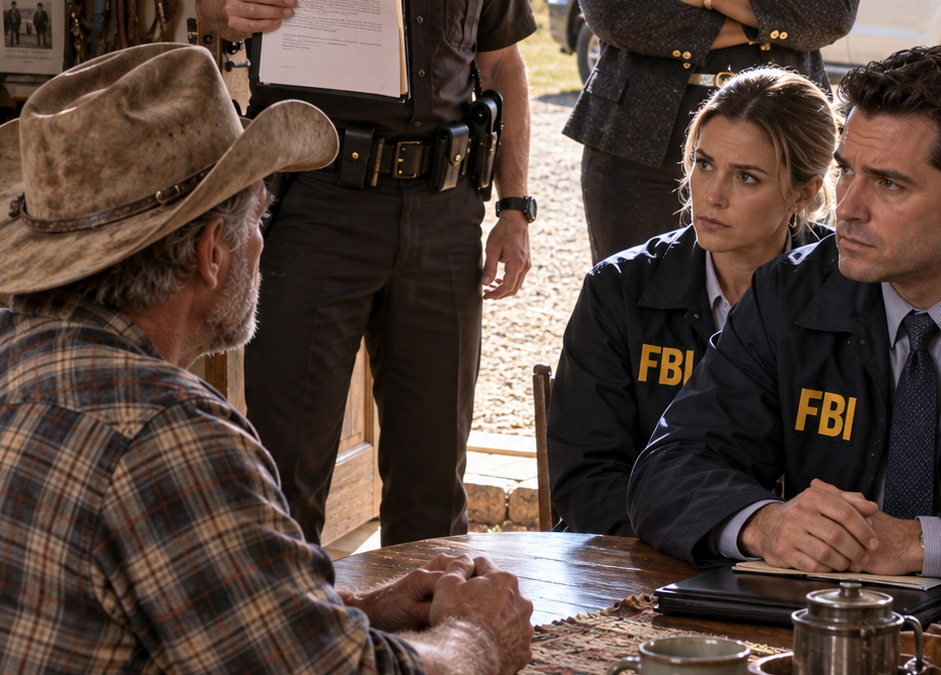
Then sat at my grandfather’s kitchen table.
For nearly two hours, I walked them through the case.
Caldwell wanted facts.
Not my theory.
Not my anger.
Facts.
“When did Brenda first approach you?”
“Four months ago.”
“Exact words?”
I told him.
Your property falls within our community boundary.
He wrote it down.
“What happened after you presented the county-certified survey?”
“Fines continued.”
“When was the lien filed?”
I gave the date.
Rivera photographed every document.
Front.
Back.
Envelope.
Postmark.
Signature.
They asked about the Hendersons.
Ed’s age.
Carol’s age.
Payment.
Threat.
They asked if Brenda personally said foreclosure.
I read Ed’s statement.
Caldwell underlined something.
Then we reached the fabricated enforcement notice.
He held it beside a verified county document.
“This case number was never issued.”
“Harker checked.”
“We checked independently too.”
Rivera added, “There is also no enforcement partnership between Ridgeline Estates and county code enforcement.”
“Nothing?”
“Nothing.”
Caldwell looked at the notice.
“Fabricated from top to bottom.”
Around ten that morning, Rivera was asking about the difference between the actual weekly fines and the $14,500 lien.
That’s when I heard tires.
Heavy tires.
Gravel crunching in the deliberate rhythm of a vehicle coming all the way to the house.
I stopped talking.
Caldwell stopped writing.
Rivera looked toward the window.
A marked county patrol car pulled behind the FBI SUV.
Officer Dale Mercer had arrived.
He got out holding papers.
Hand near his belt.
Purpose in his walk.
He passed the black SUV without looking closely.
Why would he?
Nobody had told him the FBI would be there.
He climbed the porch steps.
Three hard knocks.
Caldwell looked at me.
Small nod.
I opened the door.
Mercer stood there.
“Mr. Crawford, I’m here to execute the enforcement order on this property. The HOA board has authorized immediate seizure of the noncompliant structures. I’m going to need you to step—”
He stopped.
His eyes moved past my shoulder.
Into the kitchen.
Caldwell and Rivera were still seated at the table.
Federal credentials visible.
Documents everywhere.
Camera.
Evidence sleeves.
Mercer’s expression changed.
Caldwell stood.
Slowly.
No theatrics.
“Officer Mercer?”
Mercer’s hand dropped away from his belt.
“Yes?”
“Special Agent Caldwell, FBI.”
He showed credentials.
“This is Special Agent Rivera.”
Mercer stared at the badge.
Then at me.
Then at the table.
Caldwell continued.
“We’re conducting a federal investigation involving fraudulent HOA filings connected to this property and several others.”
The house became silent.
Clock over the stove.
Wind against the screen.
Nothing else.
Caldwell looked at the papers in Mercer’s hand.
“May I see that enforcement order?”
Mercer looked down.
For the first time, maybe really looked.
Then handed it over.
Caldwell carried it to the table.
Placed it beside the copy I had given him.
Same case number.
Same wording.
Same fake seal placement.
He compared them.
Then looked toward Rivera.
She nodded.
“Officer Mercer,” Caldwell said, “case CE-2024-1187 does not exist.”
Mercer’s face tightened.
“We verified that independently this morning.”
Caldwell tapped the document.
“There is no county enforcement action against Crawford Ranch.”
Mercer said nothing.
“There is no joint enforcement agreement between Ridgeline Estates HOA and county code enforcement.”
Still nothing.
“This document is fabricated.”
The anger appeared slowly on Mercer’s face.
Not aimed at us.
At the paper.
Then whoever gave it to him.
“Brenda Lawson gave me that personally.”
Caldwell opened his notebook.
“When?”
Mercer gave the date.
“What did she tell you?”
“That it was a county-authorized seizure order.”
“Those exact words?”
“She said county code enforcement had approved it and the HOA was authorized to proceed.”
“Did she describe any partnership?”
“Yes.”
“What?”
“She said Ridgeline had an enforcement partnership with the county.”
Caldwell wrote.
“What did she instruct you to do today?”
“Secure the property. Remove Mr. Crawford if necessary. Make sure the structures were turned over for enforcement.”
“And then?”
“Call her.”
Caldwell looked at him.
“Report back?”
“Yes.”
Mercer’s voice had gotten quieter.
“She told me to let her know when the property was clear.”
Rivera stood.
“Officer, I’d like you to see why we’re here.”
What followed felt almost surreal.
The man who had come to seize my property stood at my kitchen table while federal agents explained why the order in his hand was evidence.
Caldwell started with the deed.
“Crawford Ranch has been separately platted since 1958.”
Then the county survey.
“Ridgeline Estates shares a boundary. There is no overlap.”
Then the HOA declaration.
“No covenant binds this parcel.”
Then Brenda’s lien.
“Fourteen thousand five hundred dollars. Roughly three thousand in purported fines. More than eleven thousand in unsupported administrative charges.”
Then the other liens.
“Same president. Same pattern. Non-member properties.”
The Henderson statement.
“Seventy-one-year-old property owner. Nine thousand dollars paid after foreclosure threats.”
Mercer read part of it.
His jaw tightened further.
Then the fake order.
Caldwell held it up.
“This was designed to induce a government officer to exercise authority Brenda Lawson herself does not possess.”
Mercer looked toward me.
For the first time, there was nothing official in his expression.
Just a man.
“Mr. Crawford…”
He stopped.
Then started again.
“I owe you an apology.”
“You were given a fake document.”
“I still should’ve verified it.”
I didn’t answer immediately.
He looked around.
At my kitchen.
Old table.
Family photographs in the hallway.
The clock.
“This is your home. I came out here prepared to remove you based on something somebody printed to look official.”
His voice lowered.
“I’m sorry.”
I believed him.
Not because apologies fix much.
Because he looked sick.
Brenda had used him too.
“You believed somebody handed you a county order.”
“I should’ve called.”
“Yes.”
He nodded.
No excuses.
That mattered.
Caldwell interrupted gently.
“Officer Mercer, we’re going to need a formal statement.”
“You’ll get one.”
“Everything Ms. Lawson told you.”
“Fine.”
“Every document she gave you.”
“I’ll provide it.”
“Any texts?”
Mercer looked up.
“Yes.”
That changed the room.
“You have texts?”
“From her. Scheduling today.”
Rivera was already reaching for her phone.
“What do they say?”
Mercer unlocked his.
Read.
Need you at Crawford property Thursday AM. Board approved immediate enforcement. County order attached. Call me when you’ve secured premises.
Caldwell and Rivera looked at each other.
Mercer scrolled.
Another.
If he resists, remove him. We need this finished before weekend.
Nobody spoke for a moment.
Caldwell said, “Officer, don’t delete anything.”
“I won’t.”
Rivera stepped away and made a call.
I caught fragments.
Probable cause.
False instrument.
Induced law enforcement action.
Preservation.
Warrant request.
Then Mercer looked at me again.
“Was she at the property the first time?”
“Yes.”
“What did she say?”
I told him.
You don’t own anything out here anymore.
Mercer closed his eyes briefly.
“She knew what she was doing.”
Caldwell looked up from his notebook.
“That conclusion is ours to prove.”
Mercer nodded.
“Right.”
That was the difference between anger and an investigation.
Proof.
The next hour changed Brenda’s position more than the previous four months combined.
Mercer entered the ranch believing he was an officer executing an order.
He left as a witness in a federal investigation.
Before leaving, he removed the enforcement paperwork from his patrol folder.
Placed it into a clear evidence sleeve Rivera provided.
Signed across the seal.
Date.
Time.
Origin.
Then he drove away.
No seizure.
No vacating.
No Brenda smiling at the bottom of my driveway.
I stood on the porch watching dust settle.
Caldwell came beside me.
“You all right?”
“I don’t know yet.”
“Fair.”
“What happens now?”
“We keep working.”
“That order?”
“Void.”
“The lien?”
“Separate process, but we’re moving.”
I looked toward the barn.
“So nobody’s taking anything today.”
“No.”
I exhaled for what felt like the first time in months.
That afternoon, Brenda called.
I watched her name flash across my phone.
Didn’t answer.
She left voicemail.
Her tone was cheerful.
Professional.
“Kyle, this is Brenda. I’m checking to see whether this morning’s enforcement action has been completed. There seems to be some confusion. Please have Officer Mercer contact me with a status update.”
I played it twice.
Not because I enjoyed it.
Because by then I understood what evidence sounded like.
I forwarded the recording to Caldwell.
Friday morning, federal agents went to Brenda Lawson’s house.
I didn’t witness it.
Later, I read the reports.
Caldwell and Rivera knocked.
Brenda opened the door.
Federal warrant.
Search authorization for electronic devices, HOA records, financial records, correspondence, lien files, and documents related to purported county enforcement.
They seized computers.
Phone.
Files.
The printer she had used for HOA correspondence.
Electronic copies of the fabricated order.
Draft versions.
County seal graphics.
And communications showing she knew Crawford Ranch wasn’t inside Ridgeline before filing my lien.
That part mattered.
Because Brenda’s defense was always going to be mistake.
Boundary confusion.
Administrative misunderstanding.
But her own emails destroyed that.
One message to another board member, months before my first fine, said:
Crawford parcel remains outside recorded declaration. We can pressure voluntary compliance until boundary issue is cleaned up.
Pressure voluntary compliance.
Another message concerned the Hendersons.
They’ll pay if foreclosure is mentioned.
I read that line once.
Couldn’t read it again for a while.
The federal case expanded.
The government identified additional conduct outside Ridgeline.
Not every incident became a charge.
Not every ugly act is a federal crime.
But enough of it was documented to establish a deliberate pattern.
The criminal case focused on what prosecutors could prove cleanly.
Mailings.
Fraudulent filings.
False representations.
Use of a fabricated government document.
Inducing a law-enforcement officer to act on it.
Brenda was removed from the Ridgeline board almost immediately.
Technically, the remaining members held an emergency vote.
Nobody defended her.
The woman who had ruled those meetings with a gavel suddenly couldn’t get her own board to return calls.
The lien against my ranch was challenged.
Once federal evidence established that the underlying HOA authority didn’t exist, things moved quickly.
My $14,500 lien was released.
The Henderson lien was voided.
The third improper lien came off too.
When Patty called from the recorder’s office, she sounded relieved.
“Kyle?”
“Yes.”
“Your title is clear.”
I sat down.
“Say that again.”
“Lien released and corrective filing recorded. Crawford Ranch is clear.”
I looked around the kitchen.
“Thank you.”
“I didn’t do it.”
“You called.”
“Still.”
A few days later, Ed Henderson called.
The court had ordered restitution related to the money collected from him and Carol.
Nine thousand dollars.
Returned.
His voice shook.
“Check came.”
“Good.”
“Carol opened it.”
“Good.”
“She cried again.”
I smiled.
“Better reason this time?”
“Much better.”
He laughed softly.
Then became serious.
“Kyle, if you hadn’t called…”
“You wrote the statement.”
“Because you told me what she’d done wasn’t legal.”
“We both did our part.”
“No.”
He paused.
“We were embarrassed.”
“About what?”
“Paying.”
“Ed, that’s exactly why the scheme worked. You thought a government-backed organization was threatening your home.”
“My wife kept saying we should’ve known better.”
“You shouldn’t have had to know better.”
That sentence stayed with me.
People like Brenda survive by making victims believe they were foolish for being deceived.
But fraud is designed to fool people.
Otherwise, nobody would bother doing it.
Officer Mercer gave a six-page federal statement.
He turned over the original document Brenda had handed him.
Texts.
Call logs.
Notes.
Everything.
His department conducted an internal review.
He had failed to independently verify the order.
That was real.
He admitted it.
But investigators also found Brenda had deliberately formatted the order to resemble county paperwork and made explicit false statements about governmental approval.
He wasn’t charged.
He kept his job.
About a month later, Mercer called me.
“Mr. Crawford.”
“Kyle is fine.”
“Then Kyle.”
Pause.
“I wanted to apologize again.”
“You already did.”
“I know.”
I looked out the kitchen window.
“Do you still have that first conversation in your head?”
“All the time.”
“You told me you didn’t care about my grandfather.”
He went silent.
“I remember.”
“I know you were trying to keep control.”
“Still shouldn’t have said it.”
“No.”
Another silence.
Then I said, “We’re square.”
“You sure?”
“No.”
He laughed once.
Neither did I.
But I didn’t want to carry him.
Brenda was enough.
Ridgeline Estates elected a new president.
Donna Reeves.
Retired accountant.
First thing she did was hire an independent surveyor.
Not the developer’s surveyor.
Not anyone connected to Brenda.
The resulting boundary report confirmed exactly what Patty had shown me months earlier.
Crawford Ranch:
Independent parcel.
Outside Ridgeline.
No covenant obligations.
No HOA jurisdiction.
Donna sent me a one-page acknowledgement.
No legal jargon.
The Board of Ridgeline Estates Homeowners Association recognizes Crawford Ranch as an independent parcel not subject to the association’s governing documents, assessments, fines, liens, or enforcement authority.
I framed it.
Hung it beside Grandpa’s 1958 deed.
The old paper beside the new.
Sixty-six years between them.
One created the ranch.
The other simply confirmed what should never have needed confirming.
Brenda eventually entered a plea agreement rather than take every count to trial.
The exact federal charging structure changed during prosecution, the way these cases often do.
What mattered to me was what she admitted.
She had knowingly used false representations to obtain money and exert control over properties outside Ridgeline’s authority.
She had caused false documents to be sent through the mail.
She had fabricated enforcement material to create the appearance of county authority.
And she had knowingly provided that material to Officer Mercer to induce official action against Crawford Ranch.
At sentencing, Ed and Carol Henderson submitted a victim statement.
So did I.
I didn’t write about revenge.
I wrote about the kitchen table.
About my grandfather’s deed.
About four months of mail.
About the moment a uniformed officer walked toward my house carrying a lie made to look like law.
Because that was the part I wanted the judge to understand.
Brenda didn’t need to physically take my land to harm me.
She attacked the thing ownership depends on.
Certainty.
The belief that records mean something.
That signatures mean something.
That a county seal means something.
That when a police officer arrives with an order, somebody somewhere has made sure the order is real.
She exploited all of that.
The court ordered restitution.
Barred her from holding fiduciary positions in community associations during the relevant period of supervision.
Her federal sentence included custody and supervised release.
Ridgeline pursued its own civil remedies for money spent responding to the fraud.
I wasn’t interested in following every piece of it.
Eventually, I stopped checking.
That’s something people don’t tell you about conflict.
At first, you want to know everything.
Every motion.
Every hearing.
Every consequence.
Then one morning you realize you’ve given the person who harmed you enough days already.
You stop reading.
You go fix fence.
Crawford Ranch returned to being boring.
Which is the highest compliment I can give a ranch.
Cattle.
Mud.
Broken wire.
A water trough float sticking at the worst possible time.
Feed bills.
Storm damage.
Work.
Donna walked her dog on the Ridgeline side of the fence some mornings.
She waved.
I waved.
That was the correct relationship.
One day, she stopped.
“Kyle?”
“Yeah?”
“I’ve been meaning to ask something.”
“All right.”
“Do you want us to replace the boundary fence?”
“What’s wrong with it?”
“Nothing. I just thought given everything—”
“Donna.”
“Yes?”
“Leave the fence alone.”
She laughed.
“Fair enough.”
The barn Brenda called an unapproved agricultural structure is still standing.
Mostly original lumber.
I’ve replaced boards.
Roof panels.
A few posts.
But when I come up the road in late afternoon, the roofline looks the same as it did when Dad was alive.
Same as childhood.
Same as every photograph from the seventies.
The cattle don’t know Brenda’s name.
Don’t know what the FBI is.
Don’t care what a lien means.
They want water.
Grass.
Feed.
Quiet.
Some days, I envy them.
The kitchen table is clear now.
No envelopes.
No legal pads.
No evidence sleeves.
Just my coffee.
Sometimes mail.
Occasionally a feed catalog.
The pale ring from my father’s coffee cup is still there.
I used to think of it as damage.
Now I don’t.
I think of it as proof that somebody was here long enough to leave something behind.
One morning, months after everything ended, I opened the drawer where I’d stored Brenda’s first glossy Ridgeline folder.
I almost threw it away.
Then I stopped.
Not because I wanted a souvenir.
Because on the front was that polished community logo.
Stone pillars.
Green trees.
Ridgeline Estates.
Underneath:
Building Community Together.
I laughed.
Then I put it back.
Maybe one day I’ll throw it away.
Maybe not.
There’s another thing I kept.
The laminated fake enforcement order from my gate wasn’t returned to me.
It became evidence.
That’s fine.
I don’t need it.
I remember it.
I remember standing in my yard with the sun coming up behind the barn, reading an invented government case number and feeling, for a few minutes, like somebody could simply print enough authority to take my life apart.
And I remember Thursday morning.
Mercer walking through the doorway.
Seeing Agent Caldwell.
Seeing Agent Rivera.
Seeing the same fake paper already lying on the kitchen table.
I remember the moment his posture changed.
Not because the FBI was more intimidating than he was.
Because truth had finally entered the room before the lie did.
That’s what changed everything.
For months, Brenda had controlled the order in which people heard the story.
She told the board first.
She mailed residents first.
She filed paper first.
She talked to Mercer first.
By the time I answered, I sounded defensive.
That’s another thing fraud does.
It gets there first.
Thursday morning was different.
By the time Mercer arrived, the deed was already open.
The surveys were already certified.
The Henderson statement was already signed.
Federal agents had already verified the case number.
For once, Brenda’s story arrived second.
And without surprise on her side, it was just paper.
Bad paper.
I still walk the south boundary almost every morning.
The Ridgeline houses are visible beyond the fence.
Some homeowners have lived there long enough now that I know them by name.
A few buy eggs from Walt.
One buys hay from me.
Kids occasionally wave from bicycles.
The land hasn’t changed because Brenda is gone.
The subdivision didn’t disappear.
The ranch didn’t become some fortress.
We just returned to the obvious arrangement we should have had from the beginning.
Their side.
My side.
A fence in between.
Respect it.
There are days when I stand at the corner post where Brenda first handed me that folder and think about how small the beginning was.
One woman.
One glossy document.
A false boundary claim.
I could never have imagined federal agents sitting at Grandpa’s kitchen table four months later.
But schemes like hers rarely begin with the worst thing.
They test.
A notice.
Then another.
Fine.
Lien.
Threat.
Fake order.
Real cop.
Every time nobody stops them, the next step becomes easier.
That’s why the Hendersons matter to me as much as my ranch.
Brenda succeeded with them.
They paid.
And that success taught her she could go further.
By the time she reached me, she wasn’t testing authority anymore.
She believed she had learned how to manufacture it.
Print the right seal.
Use the right font.
Record enough documents.
Say “county authorized” confidently.
Put a police officer at the door.
Most people will step aside.
I almost did.
The only reason the story ended differently was that my grandfather kept a deed.
Patty printed a map.
Harker searched a database.
Ed Henderson was willing to admit he’d been scared.
Agent Caldwell read the complaint.
Mercer told the truth after he realized he’d been used.
No single person saved Crawford Ranch.
Evidence accumulated.
One piece at a time.
That’s probably less satisfying than saying one hero showed up and fixed everything.
But it’s the truth.
A deed by itself didn’t stop Brenda.
Neither did a certified survey.
Neither did my anger.
Neither did the FBI complaint the moment I filed it.
What stopped her was that eventually all the separate pieces reached the same table.
My grandfather’s table.
Funny place for a federal investigation.
But I’ve come to think Grandpa would have liked that.
He wasn’t a complicated man.
He didn’t trust fancy offices.
He trusted land records.
Fence lines.
Receipts.
Things written down properly.
If he’d been sitting there that Thursday morning, I can imagine him watching Mercer hand the fake order to Caldwell.
He probably wouldn’t have said much.
Maybe just:
“Should’ve checked the deed.”
Then he’d pour more coffee.
A few weeks after the new Ridgeline board sent its acknowledgement letter, I took it into the office.
I hung it beside the original deed.
Then stepped back.
1958 on the left.
Today on the right.
In between them was everything.
Grandpa.
Dad.
Me.
The barn.
The creek.
The cattle.
Sixty-six years of taxes.
Four months of fraudulent paperwork.
One federal investigation.
And a woman who believed she could erase a property line by pretending hard enough that it wasn’t there.
She couldn’t.
The line is still exactly where it was.
Sometimes that’s the entire victory.
Nothing moves.
Nothing changes hands.
Nobody takes the barn.
Nobody takes the house.
Nobody takes the dirt.
The ending is simply that the land remains where it always was.
Mine to care for.
Someday, maybe somebody else’s.
But not because Brenda Lawson printed a piece of paper.
That evening, after I hung the letter, I walked out to the barn.
Sun going down.
Cattle spread across the pasture.
Ridgeline’s streetlights beginning to come on beyond the fence.
I leaned against the barn door and looked back toward the farmhouse.
From there, I could see the kitchen window glowing.
Same window Grandma picked.
Same room where Dad drank coffee.
Same table where Grandpa handled ranch business.
Same table where two FBI agents sat while a police officer arrived to take everything away.
For the first time in months, nothing was waiting for me inside.
No violation.
No lien.
No attorney message.
No federal interview.
Just coffee to set up for morning.
I closed the barn.
Checked the gate.
Then walked home.
Eighty-five acres.
Three generations.
Still Crawford.
Have you finished reading the story and want to read it again?
HOA Karen Sent a Cop to Seize My Ranch—She Didn’t Know the FBI Was Already Sitting at My Kitchen Table
She sent a real cop to take my ranch using an order that looked official.
I had spent four months proving her HOA never owned a single inch of my land.
When he stepped through my front door that Thursday morning, he finally saw who had arrived before him.
Officer Dale Mercer didn’t knock the first time he came to Crawford Ranch.
He walked up my porch steps with a folder tucked beneath one arm, pointed toward my front door, and said, “Open it.”
Behind him, at the bottom of my gravel driveway, Brenda Lawson leaned against the side of her white SUV with her arms crossed.
She was smiling.
Not broadly.
Brenda rarely smiled broadly.
She had a way of letting one corner of her mouth rise just enough to tell you she believed the outcome had already been decided.
“Mr. Crawford,” Mercer said, “this property is subject to an HOA enforcement seizure. You need to vacate immediately.”
I looked from him to Brenda.
Then back to him.
“This is my ranch.”
He glanced down at the paper.
“I understand that.”
“No. I don’t think you do.”
I pointed toward the pasture.
“My grandfather bought this land in 1958. My father worked it after him. I inherited it when my father died.”
Mercer cut me off.
“I don’t care about your grandfather.”
The words landed harder than he probably intended.
He tapped the documents in his hand.
“According to this order, you’ve been noncompliant for more than a year. I’ve got authorization to secure the property.”
From the driveway, Brenda called out.
“I told you this would happen, Kyle.”
Her voice carried easily across the morning air.
My neighbor Walt was somewhere beyond the south fence. She knew he could hear.
That was part of the performance.
“You don’t own anything out here anymore,” she continued. “Not the barn. Not the fences. Not the ground under your feet. You had your chance.”
Three generations of Crawfords had worked that dirt.
My grandfather cleared the first pasture with borrowed machinery and his own hands.
My father strung miles of fence.
I’d spent half my life replacing the same posts storms and cattle eventually knocked crooked.
And now a woman who had lived next door for two years was standing in my driveway telling a uniformed officer to remove me from my home.
I could have shouted.
I wanted to.
Instead, I looked at the front door.
Then at Mercer.
And I stepped aside.
“Go ahead.”
He looked almost disappointed.
Maybe he’d expected resistance.
Maybe Brenda had told him I’d be dangerous.
He opened my door.
He didn’t know yet that the document in his hand was fake.
He didn’t know the case number printed across the top didn’t exist.
And he certainly didn’t know that, a few weeks later, he would walk up those same porch steps carrying another copy of that order—
only this time, two FBI agents would already be sitting at my kitchen table.
My name is Kyle Crawford.
I was forty-three when all of this happened.
Crawford Ranch is eighty-five acres of cattle ground, fencing, creek bottom, barn, and old farmhouse.
Nothing fancy.
Nothing anybody would put on the cover of a magazine.
To me, it was everything.
My grandfather bought it in 1958.
He cleared the land himself.
The barn went up in 1961 using lumber he hauled from two counties over because the local mill couldn’t get him what he wanted.
My father took over when Grandpa’s knees finally gave out.
When Dad died in 2020, the ranch came to me.
The farmhouse still had the kitchen my grandmother chose.
Same cabinets.
Same narrow window over the sink.
Same handmade table in the middle of the room.
That table had cigarette burns from the 1960s and a pale ring where my father’s coffee mug seemed to sit for forty years.
I drank my coffee there every morning.
Before sunrise.
Then I checked fences.
Fed cattle.
Looked at the creek.
Fixed whatever had broken overnight.
That was my life.
My grandfather used to say you didn’t really own land like ours.
“You take care of it long enough,” he told me once, “and maybe it’ll let the next one do the same.”
I understood what he meant after he died.
For most of my life, Crawford Ranch sat among open land.
Farms.
Pastures.
Scattered houses.
People waved.
If cattle got loose, somebody called.
If a storm dropped a tree across a road, three men showed up with saws before anyone asked.
Nobody needed an association to explain how to live near each other.
Then the Dawson farm sold.
A developer bought a large section in 2019.
Within two years, the old pasture had become Ridgeline Estates.
Forty-some houses.
Half-acre lots.
Paved streets.
Stone entrance pillars.
Decorative lighting.
Perfect lawns.
And a homeowners association.
Their property was theirs.
Mine was mine.
At least, that’s what I believed.
We shared a fence.
Nothing more.
The first time I met Brenda Lawson, she drove down my private gravel lane in a white Cadillac SUV.
I was repairing a section of wire along the Ridgeline boundary.
She stepped out wearing heels.
Heels.
On gravel.
That told me almost everything I needed to know about how long she planned to stand there.
“Mr. Crawford?”
“Yes.”
“Brenda Lawson. President of Ridgeline Estates HOA.”
She handed me a glossy folder.
Ridgeline’s logo was embossed on the front.
“I wanted to introduce myself and discuss your property.”
“What about it?”
“Your parcel falls within our community boundary.”
I thought she was joking.
I waited for the smile.
It didn’t come.
“No, it doesn’t.”
“Our survey shows that it does.”
“My family owned this ranch sixty years before your subdivision existed.”
“That doesn’t necessarily determine current boundary obligations.”
I stared at her.
“My grandfather never joined an HOA.”
“The HOA didn’t exist then.”
“Exactly.”
She smiled.
Not warmth.
Patience.
Like I was behind.
“I’ll have the relevant material sent to you.”
“Don’t bother.”
“Mr. Crawford, I’m sure we can work this out.”
She returned to her Cadillac.
I watched her drive away.
The tires left tracks in my gravel.
For some reason, that bothered me more than the conversation.
Like she’d come to mark territory.
The first notice arrived eleven days later.
UNAPPROVED AGRICULTURAL STRUCTURES.
The violation was my barn.
The same barn that had stood on Crawford land since 1961.
I laughed.
Then threw the letter away.
A week later, another arrived.
Same logo.
Same violation.
Fine warning:
$250 per week.
I threw that away too.
Then the fines started.
Every Monday.
$250.
$500.
$750.
The balance grew.
Brenda’s signature appeared at the bottom of every notice.
By the end of the second month, the stack on my kitchen counter was nearly an inch thick.
I kept telling myself it was nonsense.
An HOA couldn’t fine land outside its own boundary.
That seemed too obvious to require a lawyer.
But paper has a strange power.
One letter looks stupid.
Ten letters begin to look official.
Twenty letters begin to make you wonder what somebody is building.
I called the county.
A woman listened patiently.
I explained the ranch.
The barn.
The notices.
The fact that I had never belonged to Ridgeline Estates.
“Sir,” she said, “HOA disputes are civil matters.”
“I’m not disputing anything. I’m telling you they’re claiming land outside their subdivision.”
“You’ll need to address that with the association or consult an attorney.”
I hung up.
The envelopes kept coming.
That’s when I understood that ignoring Brenda wasn’t making her disappear.
It was giving her uninterrupted time to create a record.
So I finally opened my filing cabinet.
At the bottom was a manila envelope.
My grandfather’s handwriting:
DEED — DO NOT LOSE.
The original deed was inside.
Paper yellowed at the edges.
Ink faded brown.
Eighty-five acres.
Metes and bounds.
No restrictions.
No covenants.
No association.
Nothing but property.
The following morning, I drove to the county recorder’s office.
Patty worked the desk.
She’d been there twenty years.
I gave her the deed.
Then Brenda’s violation notice.
“I need you to tell me whether I’m missing something.”
Patty pulled my parcel.
Then Ridgeline’s subdivision plat.
She looked between them.
“You’re not missing anything.”
“So I’m outside it?”
“Completely.”
She turned the monitor toward me.
My ranch outlined separately.
Ridgeline beside it.
“They share a property line. That’s all.”
“Never annexed?”
“No.”
“Never part of the declaration?”
“No.”
“Never subject to their HOA?”
“No.”
She printed a certified survey.
I drove home with it sitting on the passenger seat.
For the first time in months, I felt solid ground beneath me.
I believed documentation would end the problem.
That was my second mistake.
Ridgeline’s next board meeting was Thursday.
I arrived at seven.
The community center smelled like new carpet.
Fifteen residents sat in folding chairs.
Brenda sat behind a table with two board members.
She had a gavel.
Of course she had a gavel.
When she opened community business, I stood.
“My name is Kyle Crawford. I own the ranch adjoining Ridgeline Estates.”
Brenda’s expression changed slightly.
She hadn’t expected me.
“For three months, your HOA has been sending violation notices and fines to my property.”
“Mr. Crawford—”
“I brought documentation.”
I walked forward.
Placed my grandfather’s deed on the table.
Then the certified county survey.
“This ranch is not inside Ridgeline Estates. It never has been. These notices and fines are invalid.”
One board member picked up the survey.
He actually read it.
His eyebrows pulled together.
Then he looked at Brenda.
Brenda never touched it.
“Mr. Crawford, we’ve discussed this.”
“No. You told me your survey includes my land. The county says otherwise.”
“Our survey was prepared by a licensed professional.”
“So was theirs.”
“I’ll have counsel review your claim.”
“It’s not a claim.”
“In the meantime, the fines stand.”
I laughed once.
I couldn’t help it.
“You haven’t even looked at the document.”
Her eyes hardened.
“Next item.”
The board member holding my survey set it down immediately.
I picked up my papers and left.
Outside, I sat in my truck.
I still thought I had won.
Two weeks later, I received the lien notice.
$14,500.
Ridgeline Estates HOA had filed a claim against Crawford Ranch.
Authorized by Brenda Lawson, President.
I read it standing beside my mailbox.
Then again at the kitchen table.
Fourteen thousand five hundred dollars.
My family had owned that ranch free and clear for decades.
No mortgage.
No judgment.
No lien.
Now Brenda had put a cloud on my title.
I called Patty.
She confirmed it.
The document had been accepted for recording.
“How?”
“The recorder doesn’t adjudicate underlying validity, Kyle. We record properly submitted instruments.”
“She has no authority over my parcel.”
“I know.”
“You personally printed the map proving it.”
“I know.”
“Then why did you record her lien?”
Patty was quiet.
“Because that’s not the function of this office.”
That answer made me furious.
Not at her.
At the system.
Everybody’s job stopped exactly one inch before my problem began.
I examined the amount.
The weekly fines added up to roughly three thousand dollars.
The remaining eleven thousand-plus consisted of administrative assessments, legal expenses, processing fees, enforcement costs.
Services I’d never received.
Lawyers I had never heard from.
Assessments never authorized against my property.
That afternoon, sitting at the same table where my grandfather had once signed ranch paperwork, I finally admitted what I should have admitted sooner.
I needed a lawyer.
Glenn Harker worked above a hardware store in town.
His office was crowded with property files.
Coffee rings marked his desk.
I laid out everything.
Deed.
Survey.
Notices.
Lien.
He read silently.
Then removed his glasses.
“This lien cites HOA covenants.”
“Yes.”
“There aren’t any recorded against your parcel.”
“I know.”
He looked at me.
“No, Kyle. Listen carefully.”
His finger tapped Brenda’s filing.
“She filed a lien based on contractual authority that does not exist.”
“Meaning?”
“Meaning we’re past aggressive HOA behavior.”
He paused.
“This may be fraudulent.”
I sat very still.
Fraudulent.
There was a difference between thinking somebody was abusing power and hearing an attorney use the word fraud.
Harker turned to his computer.
“Let’s see if you’re the only one.”
He searched Brenda Lawson’s name across recorded filings.
Less than ten minutes later, he stopped.
“Kyle.”
“What?”
He rotated the screen.
Two more liens.
Both against properties adjoining Ridgeline Estates.
Neither parcel belonged to the HOA.
One:
$9,000.
Another:
$6,200.
Same pattern.
Violation notices.
Fines.
Lien.
Same signature.
Brenda Lawson.
Nearly thirty thousand dollars total.
“Who owns the nine-thousand-dollar property?”
Harker printed the filing.
“Edward and Carol Henderson.”
I knew the name.
Older couple.
Five acres south of the subdivision.
I called them from my truck.
Ed Henderson answered.
When I explained why I was calling, his voice changed.
“We paid.”
“What?”
“The lien.”
“All nine thousand?”
“Yes.”
“Why?”
Long pause.
“Brenda came to our house.”
I leaned against the steering wheel.
“What did she say?”
“That if we didn’t settle the balance, the HOA could initiate foreclosure.”
“She threatened to take your home?”
“She said people had lost homes before.”
“Had they?”
“I don’t know.”
“So you wrote the check.”
Another pause.
“My wife wrote it.”
His voice broke slightly.
“She cried while she did it.”
I looked out through my windshield.
Ed continued.
“We’re on a fixed income, Kyle. Nine thousand dollars isn’t something we just had.”
After we hung up, I sat beside the road for a long time.
That was the moment Brenda stopped being an irritating HOA president in my mind.
This was a scheme.
She was identifying properties outside her authority.
Creating violations.
Building balances.
Filing liens.
Then using fear to collect.
People who understood their rights resisted.
People who didn’t paid.
And because everything came on official letterhead, backed by recorded documents, most people assumed there had to be something legitimate underneath it.
I called Harker.
“What can we do?”
“Civil suit. Challenge the lien. False instrument claim. Damages.”
“How long?”
“Months.”
“And criminal?”
“County prosecutor could investigate.”
“How long?”
“Also months.”
I stared toward the Ridgeline entrance sign in the distance.
“What about the fact that she mailed all this?”
Harker became quiet.
Then I heard his chair creak.
“The notices came USPS?”
“I kept the envelopes.”
“All of them?”
“Yes.”
“She knowingly used the mail to further a scheme to obtain money through false representations…”
He stopped.
“What?”
“That potentially raises federal mail-fraud issues.”
“Federal as in—”
“Federal as in FBI.”
Nine days later, that sentence would become much less theoretical.
That night, I laid every document across my kitchen table.
The deed.
Certified survey.
Fourteen envelopes with postmarks.
Lien.
The two other lien filings.
Notes from my call with Ed.
At 11:15, I submitted an online complaint to the FBI.
Dates.
Amounts.
Names.
Pattern.
Everything.
Then I waited.
Brenda didn’t.
Nine days later, I came home and found a laminated notice zip-tied to my gate.
Red heading:
PROPERTY SUBJECT TO HOA ENFORCEMENT ACTION.
It stated that if I failed to comply within ten days, Ridgeline Estates would seize noncompliant structures.
Then came something new.
AUTHORIZED BY RIDGELINE ESTATES HOA IN PARTNERSHIP WITH COUNTY CODE ENFORCEMENT.
Case Number:
CE-2024-1187.
County formatting.
County-style seal.
Government language.
I drove directly to Harker.
He read it.
Then looked again.
“This is fake.”
“You’re sure?”
“Yes.”
He pointed to the phrase partnership with.
“County agencies don’t issue private enforcement authority this way.”
He searched the case number.
Nothing.
“CE-2024-1187 doesn’t exist.”
I felt something cold move through me.
“She invented a government case?”
“Yes.”
“She put the county seal on it.”
“Yes.”
“That’s got to be illegal.”
“Kyle, she fabricated a government enforcement document.”
He leaned forward.
“And I need to tell you something else.”
I waited.
“A colleague called me this morning. Local patrol officer named Dale Mercer has been asked to serve an enforcement order on a ranch.”
I already knew.
“This ranch.”
“Yes.”
I looked down at Brenda’s fake order.
“She gave this to a cop.”
“Apparently.”
“And he believes it.”
“Why wouldn’t he? It looks convincing.”
That scared me more than anything Brenda had done.
A fake HOA notice is one thing.
A fake lien is dangerous.
But Brenda had crossed into something else entirely.
She had manufactured paperwork designed to turn real government authority into her private weapon.
Harker’s voice hardened.
“Call the FBI field office. Now. Not the online form.”
I went home.
Sat at the table.
Called.
I gave the intake agent my complaint number.
Explained the fake enforcement order.
The invented case number.
The fact that a real law-enforcement officer had been given it.
Six minutes on hold.
Then a man’s voice.
“Mr. Crawford? Special Agent Caldwell.”
He already knew my complaint.
That surprised me.
Then he surprised me again.
“Your filing intersected with an inquiry we’re already conducting.”
“Into Brenda?”
“Into a broader pattern involving HOA-related fraud, fabricated enforcement actions, and liens against non-member property owners in multiple counties.”
I sat back.
“So this isn’t just Ridgeline?”
“I can’t discuss the full inquiry yet.”
“But you’ve seen similar conduct.”
“Yes.”
He asked whether he could come to the ranch.
“Thursday morning.”
I looked at the ten-day notice.
Thursday would be Day Nine.
“That works.”
For five days, every vehicle on the gravel road made me look up.
I kept feeding cattle.
Kept repairing fences.
Kept pretending routine still existed.
Meanwhile, I organized evidence.
Grandfather’s deed.
County survey.
Violation notices.
Lien.
Other lien filings.
Ed Henderson’s notarized statement.
Fake county order.
Everything arranged chronologically across the kitchen table.
On Tuesday, Walt stopped beside the south fence.
“You hear about the emergency HOA meeting?”
“No.”
“Last night.”
“About what?”
“You.”
I put down the fencing pliers.
“What happened?”
“Brenda told everybody you’re a threat to community values and immediate enforcement was necessary.”
“What did the board do?”
“Voted.”
“How many?”
“Three to nothing.”
I almost laughed.
“There are only three people on the board.”
“I know.”
Brenda was building a paper trail.
Resolution.
Vote.
Minutes.
Authorization.
Enough procedural-looking paper to make an unlawful seizure appear legitimate.
That afternoon, Harker called.
“Kyle, the timeline moved.”
“How?”
“Brenda contacted Mercer after the board meeting. She told him immediate enforcement had been authorized.”
“When’s he coming?”
“Thursday morning.”
I looked at the documents spread across my kitchen table.
“The FBI is coming Thursday morning.”
Silence.
“Well,” Harker said, “that could get interesting.”
I called Agent Caldwell.
“Brenda moved enforcement to Thursday. Officer Mercer is coming.”
“What time?”
“Morning.”
Caldwell paused only briefly.
“Don’t change anything.”
“What do you mean?”
“We’ll arrive early.”
“What happens if he comes while you’re here?”
“We handle it.”
His voice stayed calm.
“That’s our job.”
Wednesday night, I barely slept.
I listened to cattle moving outside.
Wind against the house.
Wood contracting in the cold.
I thought about Grandpa.
About Dad.
About the absurdity of everything.
Eighty-five acres bought in 1958.
And all it took to threaten possession was one determined woman, a printer, enough confidence, and a system where everybody assumed someone else had verified the paperwork.
By 5:30 Thursday morning, I was awake.
Cattle fed.
Coffee made.
Documents waiting.
At 8:15, an unmarked black SUV came up the gravel road.
Federal plates.
Two agents.
Caldwell was in his forties.
Dark jacket.
White shirt.
No tie.
Agent Rivera came with him carrying a briefcase and camera bag.
They showed credentials.
Then sat at my grandfather’s kitchen table.
For nearly two hours, I walked them through the case.
Caldwell wanted facts.
Not my theory.
Not my anger.
Facts.
“When did Brenda first approach you?”
“Four months ago.”
“Exact words?”
I told him.
Your property falls within our community boundary.
He wrote it down.
“What happened after you presented the county-certified survey?”
“Fines continued.”
“When was the lien filed?”
I gave the date.
Rivera photographed every document.
Front.
Back.
Envelope.
Postmark.
Signature.
They asked about the Hendersons.
Ed’s age.
Carol’s age.
Payment.
Threat.
They asked if Brenda personally said foreclosure.
I read Ed’s statement.
Caldwell underlined something.
Then we reached the fabricated enforcement notice.
He held it beside a verified county document.
“This case number was never issued.”
“Harker checked.”
“We checked independently too.”
Rivera added, “There is also no enforcement partnership between Ridgeline Estates and county code enforcement.”
“Nothing?”
“Nothing.”
Caldwell looked at the notice.
“Fabricated from top to bottom.”
Around ten that morning, Rivera was asking about the difference between the actual weekly fines and the $14,500 lien.
That’s when I heard tires.
Heavy tires.
Gravel crunching in the deliberate rhythm of a vehicle coming all the way to the house.
I stopped talking.
Caldwell stopped writing.
Rivera looked toward the window.
A marked county patrol car pulled behind the FBI SUV.
Officer Dale Mercer had arrived.
He got out holding papers.
Hand near his belt.
Purpose in his walk.
He passed the black SUV without looking closely.
Why would he?
Nobody had told him the FBI would be there.
He climbed the porch steps.
Three hard knocks.
Caldwell looked at me.
Small nod.
I opened the door.
Mercer stood there.
“Mr. Crawford, I’m here to execute the enforcement order on this property. The HOA board has authorized immediate seizure of the noncompliant structures. I’m going to need you to step—”
He stopped.
His eyes moved past my shoulder.
Into the kitchen.
Caldwell and Rivera were still seated at the table.
Federal credentials visible.
Documents everywhere.
Camera.
Evidence sleeves.
Mercer’s expression changed.
Caldwell stood.
Slowly.
No theatrics.
“Officer Mercer?”
Mercer’s hand dropped away from his belt.
“Yes?”
“Special Agent Caldwell, FBI.”
He showed credentials.
“This is Special Agent Rivera.”
Mercer stared at the badge.
Then at me.
Then at the table.
Caldwell continued.
“We’re conducting a federal investigation involving fraudulent HOA filings connected to this property and several others.”
The house became silent.
Clock over the stove.
Wind against the screen.
Nothing else.
Caldwell looked at the papers in Mercer’s hand.
“May I see that enforcement order?”
Mercer looked down.
For the first time, maybe really looked.
Then handed it over.
Caldwell carried it to the table.
Placed it beside the copy I had given him.
Same case number.
Same wording.
Same fake seal placement.
He compared them.
Then looked toward Rivera.
She nodded.
“Officer Mercer,” Caldwell said, “case CE-2024-1187 does not exist.”
Mercer’s face tightened.
“We verified that independently this morning.”
Caldwell tapped the document.
“There is no county enforcement action against Crawford Ranch.”
Mercer said nothing.
“There is no joint enforcement agreement between Ridgeline Estates HOA and county code enforcement.”
Still nothing.
“This document is fabricated.”
The anger appeared slowly on Mercer’s face.
Not aimed at us.
At the paper.
Then whoever gave it to him.
“Brenda Lawson gave me that personally.”
Caldwell opened his notebook.
“When?”
Mercer gave the date.
“What did she tell you?”
“That it was a county-authorized seizure order.”
“Those exact words?”
“She said county code enforcement had approved it and the HOA was authorized to proceed.”
“Did she describe any partnership?”
“Yes.”
“What?”
“She said Ridgeline had an enforcement partnership with the county.”
Caldwell wrote.
“What did she instruct you to do today?”
“Secure the property. Remove Mr. Crawford if necessary. Make sure the structures were turned over for enforcement.”
“And then?”
“Call her.”
Caldwell looked at him.
“Report back?”
“Yes.”
Mercer’s voice had gotten quieter.
“She told me to let her know when the property was clear.”
Rivera stood.
“Officer, I’d like you to see why we’re here.”
What followed felt almost surreal.
The man who had come to seize my property stood at my kitchen table while federal agents explained why the order in his hand was evidence.
Caldwell started with the deed.
“Crawford Ranch has been separately platted since 1958.”
Then the county survey.
“Ridgeline Estates shares a boundary. There is no overlap.”
Then the HOA declaration.
“No covenant binds this parcel.”
Then Brenda’s lien.
“Fourteen thousand five hundred dollars. Roughly three thousand in purported fines. More than eleven thousand in unsupported administrative charges.”
Then the other liens.
“Same president. Same pattern. Non-member properties.”
The Henderson statement.
“Seventy-one-year-old property owner. Nine thousand dollars paid after foreclosure threats.”
Mercer read part of it.
His jaw tightened further.
Then the fake order.
Caldwell held it up.
“This was designed to induce a government officer to exercise authority Brenda Lawson herself does not possess.”
Mercer looked toward me.
For the first time, there was nothing official in his expression.
Just a man.
“Mr. Crawford…”
He stopped.
Then started again.
“I owe you an apology.”
“You were given a fake document.”
“I still should’ve verified it.”
I didn’t answer immediately.
He looked around.
At my kitchen.
Old table.
Family photographs in the hallway.
The clock.
“This is your home. I came out here prepared to remove you based on something somebody printed to look official.”
His voice lowered.
“I’m sorry.”
I believed him.
Not because apologies fix much.
Because he looked sick.
Brenda had used him too.
“You believed somebody handed you a county order.”
“I should’ve called.”
“Yes.”
He nodded.
No excuses.
That mattered.
Caldwell interrupted gently.
“Officer Mercer, we’re going to need a formal statement.”
“You’ll get one.”
“Everything Ms. Lawson told you.”
“Fine.”
“Every document she gave you.”
“I’ll provide it.”
“Any texts?”
Mercer looked up.
“Yes.”
That changed the room.
“You have texts?”
“From her. Scheduling today.”
Rivera was already reaching for her phone.
“What do they say?”
Mercer unlocked his.
Read.
Need you at Crawford property Thursday AM. Board approved immediate enforcement. County order attached. Call me when you’ve secured premises.
Caldwell and Rivera looked at each other.
Mercer scrolled.
Another.
If he resists, remove him. We need this finished before weekend.
Nobody spoke for a moment.
Caldwell said, “Officer, don’t delete anything.”
“I won’t.”
Rivera stepped away and made a call.
I caught fragments.
Probable cause.
False instrument.
Induced law enforcement action.
Preservation.
Warrant request.
Then Mercer looked at me again.
“Was she at the property the first time?”
“Yes.”
“What did she say?”
I told him.
You don’t own anything out here anymore.
Mercer closed his eyes briefly.
“She knew what she was doing.”
Caldwell looked up from his notebook.
“That conclusion is ours to prove.”
Mercer nodded.
“Right.”
That was the difference between anger and an investigation.
Proof.
The next hour changed Brenda’s position more than the previous four months combined.
Mercer entered the ranch believing he was an officer executing an order.
He left as a witness in a federal investigation.
Before leaving, he removed the enforcement paperwork from his patrol folder.
Placed it into a clear evidence sleeve Rivera provided.
Signed across the seal.
Date.
Time.
Origin.
Then he drove away.
No seizure.
No vacating.
No Brenda smiling at the bottom of my driveway.
I stood on the porch watching dust settle.
Caldwell came beside me.
“You all right?”
“I don’t know yet.”
“Fair.”
“What happens now?”
“We keep working.”
“That order?”
“Void.”
“The lien?”
“Separate process, but we’re moving.”
I looked toward the barn.
“So nobody’s taking anything today.”
“No.”
I exhaled for what felt like the first time in months.
That afternoon, Brenda called.
I watched her name flash across my phone.
Didn’t answer.
She left voicemail.
Her tone was cheerful.
Professional.
“Kyle, this is Brenda. I’m checking to see whether this morning’s enforcement action has been completed. There seems to be some confusion. Please have Officer Mercer contact me with a status update.”
I played it twice.
Not because I enjoyed it.
Because by then I understood what evidence sounded like.
I forwarded the recording to Caldwell.
Friday morning, federal agents went to Brenda Lawson’s house.
I didn’t witness it.
Later, I read the reports.
Caldwell and Rivera knocked.
Brenda opened the door.
Federal warrant.
Search authorization for electronic devices, HOA records, financial records, correspondence, lien files, and documents related to purported county enforcement.
They seized computers.
Phone.
Files.
The printer she had used for HOA correspondence.
Electronic copies of the fabricated order.
Draft versions.
County seal graphics.
And communications showing she knew Crawford Ranch wasn’t inside Ridgeline before filing my lien.
That part mattered.
Because Brenda’s defense was always going to be mistake.
Boundary confusion.
Administrative misunderstanding.
But her own emails destroyed that.
One message to another board member, months before my first fine, said:
Crawford parcel remains outside recorded declaration. We can pressure voluntary compliance until boundary issue is cleaned up.
Pressure voluntary compliance.
Another message concerned the Hendersons.
They’ll pay if foreclosure is mentioned.
I read that line once.
Couldn’t read it again for a while.
The federal case expanded.
The government identified additional conduct outside Ridgeline.
Not every incident became a charge.
Not every ugly act is a federal crime.
But enough of it was documented to establish a deliberate pattern.
The criminal case focused on what prosecutors could prove cleanly.
Mailings.
Fraudulent filings.
False representations.
Use of a fabricated government document.
Inducing a law-enforcement officer to act on it.
Brenda was removed from the Ridgeline board almost immediately.
Technically, the remaining members held an emergency vote.
Nobody defended her.
The woman who had ruled those meetings with a gavel suddenly couldn’t get her own board to return calls.
The lien against my ranch was challenged.
Once federal evidence established that the underlying HOA authority didn’t exist, things moved quickly.
My $14,500 lien was released.
The Henderson lien was voided.
The third improper lien came off too.
When Patty called from the recorder’s office, she sounded relieved.
“Kyle?”
“Yes.”
“Your title is clear.”
I sat down.
“Say that again.”
“Lien released and corrective filing recorded. Crawford Ranch is clear.”
I looked around the kitchen.
“Thank you.”
“I didn’t do it.”
“You called.”
“Still.”
A few days later, Ed Henderson called.
The court had ordered restitution related to the money collected from him and Carol.
Nine thousand dollars.
Returned.
His voice shook.
“Check came.”
“Good.”
“Carol opened it.”
“Good.”
“She cried again.”
I smiled.
“Better reason this time?”
“Much better.”
He laughed softly.
Then became serious.
“Kyle, if you hadn’t called…”
“You wrote the statement.”
“Because you told me what she’d done wasn’t legal.”
“We both did our part.”
“No.”
He paused.
“We were embarrassed.”
“About what?”
“Paying.”
“Ed, that’s exactly why the scheme worked. You thought a government-backed organization was threatening your home.”
“My wife kept saying we should’ve known better.”
“You shouldn’t have had to know better.”
That sentence stayed with me.
People like Brenda survive by making victims believe they were foolish for being deceived.
But fraud is designed to fool people.
Otherwise, nobody would bother doing it.
Officer Mercer gave a six-page federal statement.
He turned over the original document Brenda had handed him.
Texts.
Call logs.
Notes.
Everything.
His department conducted an internal review.
He had failed to independently verify the order.
That was real.
He admitted it.
But investigators also found Brenda had deliberately formatted the order to resemble county paperwork and made explicit false statements about governmental approval.
He wasn’t charged.
He kept his job.
About a month later, Mercer called me.
“Mr. Crawford.”
“Kyle is fine.”
“Then Kyle.”
Pause.
“I wanted to apologize again.”
“You already did.”
“I know.”
I looked out the kitchen window.
“Do you still have that first conversation in your head?”
“All the time.”
“You told me you didn’t care about my grandfather.”
He went silent.
“I remember.”
“I know you were trying to keep control.”
“Still shouldn’t have said it.”
“No.”
Another silence.
Then I said, “We’re square.”
“You sure?”
“No.”
He laughed once.
Neither did I.
But I didn’t want to carry him.
Brenda was enough.
Ridgeline Estates elected a new president.
Donna Reeves.
Retired accountant.
First thing she did was hire an independent surveyor.
Not the developer’s surveyor.
Not anyone connected to Brenda.
The resulting boundary report confirmed exactly what Patty had shown me months earlier.
Crawford Ranch:
Independent parcel.
Outside Ridgeline.
No covenant obligations.
No HOA jurisdiction.
Donna sent me a one-page acknowledgement.
No legal jargon.
The Board of Ridgeline Estates Homeowners Association recognizes Crawford Ranch as an independent parcel not subject to the association’s governing documents, assessments, fines, liens, or enforcement authority.
I framed it.
Hung it beside Grandpa’s 1958 deed.
The old paper beside the new.
Sixty-six years between them.
One created the ranch.
The other simply confirmed what should never have needed confirming.
Brenda eventually entered a plea agreement rather than take every count to trial.
The exact federal charging structure changed during prosecution, the way these cases often do.
What mattered to me was what she admitted.
She had knowingly used false representations to obtain money and exert control over properties outside Ridgeline’s authority.
She had caused false documents to be sent through the mail.
She had fabricated enforcement material to create the appearance of county authority.
And she had knowingly provided that material to Officer Mercer to induce official action against Crawford Ranch.
At sentencing, Ed and Carol Henderson submitted a victim statement.
So did I.
I didn’t write about revenge.
I wrote about the kitchen table.
About my grandfather’s deed.
About four months of mail.
About the moment a uniformed officer walked toward my house carrying a lie made to look like law.
Because that was the part I wanted the judge to understand.
Brenda didn’t need to physically take my land to harm me.
She attacked the thing ownership depends on.
Certainty.
The belief that records mean something.
That signatures mean something.
That a county seal means something.
That when a police officer arrives with an order, somebody somewhere has made sure the order is real.
She exploited all of that.
The court ordered restitution.
Barred her from holding fiduciary positions in community associations during the relevant period of supervision.
Her federal sentence included custody and supervised release.
Ridgeline pursued its own civil remedies for money spent responding to the fraud.
I wasn’t interested in following every piece of it.
Eventually, I stopped checking.
That’s something people don’t tell you about conflict.
At first, you want to know everything.
Every motion.
Every hearing.
Every consequence.
Then one morning you realize you’ve given the person who harmed you enough days already.
You stop reading.
You go fix fence.
Crawford Ranch returned to being boring.
Which is the highest compliment I can give a ranch.
Cattle.
Mud.
Broken wire.
A water trough float sticking at the worst possible time.
Feed bills.
Storm damage.
Work.
Donna walked her dog on the Ridgeline side of the fence some mornings.
She waved.
I waved.
That was the correct relationship.
One day, she stopped.
“Kyle?”
“Yeah?”
“I’ve been meaning to ask something.”
“All right.”
“Do you want us to replace the boundary fence?”
“What’s wrong with it?”
“Nothing. I just thought given everything—”
“Donna.”
“Yes?”
“Leave the fence alone.”
She laughed.
“Fair enough.”
The barn Brenda called an unapproved agricultural structure is still standing.
Mostly original lumber.
I’ve replaced boards.
Roof panels.
A few posts.
But when I come up the road in late afternoon, the roofline looks the same as it did when Dad was alive.
Same as childhood.
Same as every photograph from the seventies.
The cattle don’t know Brenda’s name.
Don’t know what the FBI is.
Don’t care what a lien means.
They want water.
Grass.
Feed.
Quiet.
Some days, I envy them.
The kitchen table is clear now.
No envelopes.
No legal pads.
No evidence sleeves.
Just my coffee.
Sometimes mail.
Occasionally a feed catalog.
The pale ring from my father’s coffee cup is still there.
I used to think of it as damage.
Now I don’t.
I think of it as proof that somebody was here long enough to leave something behind.
One morning, months after everything ended, I opened the drawer where I’d stored Brenda’s first glossy Ridgeline folder.
I almost threw it away.
Then I stopped.
Not because I wanted a souvenir.
Because on the front was that polished community logo.
Stone pillars.
Green trees.
Ridgeline Estates.
Underneath:
Building Community Together.
I laughed.
Then I put it back.
Maybe one day I’ll throw it away.
Maybe not.
There’s another thing I kept.
The laminated fake enforcement order from my gate wasn’t returned to me.
It became evidence.
That’s fine.
I don’t need it.
I remember it.
I remember standing in my yard with the sun coming up behind the barn, reading an invented government case number and feeling, for a few minutes, like somebody could simply print enough authority to take my life apart.
And I remember Thursday morning.
Mercer walking through the doorway.
Seeing Agent Caldwell.
Seeing Agent Rivera.
Seeing the same fake paper already lying on the kitchen table.
I remember the moment his posture changed.
Not because the FBI was more intimidating than he was.
Because truth had finally entered the room before the lie did.
That’s what changed everything.
For months, Brenda had controlled the order in which people heard the story.
She told the board first.
She mailed residents first.
She filed paper first.
She talked to Mercer first.
By the time I answered, I sounded defensive.
That’s another thing fraud does.
It gets there first.
Thursday morning was different.
By the time Mercer arrived, the deed was already open.
The surveys were already certified.
The Henderson statement was already signed.
Federal agents had already verified the case number.
For once, Brenda’s story arrived second.
And without surprise on her side, it was just paper.
Bad paper.
I still walk the south boundary almost every morning.
The Ridgeline houses are visible beyond the fence.
Some homeowners have lived there long enough now that I know them by name.
A few buy eggs from Walt.
One buys hay from me.
Kids occasionally wave from bicycles.
The land hasn’t changed because Brenda is gone.
The subdivision didn’t disappear.
The ranch didn’t become some fortress.
We just returned to the obvious arrangement we should have had from the beginning.
Their side.
My side.
A fence in between.
Respect it.
There are days when I stand at the corner post where Brenda first handed me that folder and think about how small the beginning was.
One woman.
One glossy document.
A false boundary claim.
I could never have imagined federal agents sitting at Grandpa’s kitchen table four months later.
But schemes like hers rarely begin with the worst thing.
They test.
A notice.
Then another.
Fine.
Lien.
Threat.
Fake order.
Real cop.
Every time nobody stops them, the next step becomes easier.
That’s why the Hendersons matter to me as much as my ranch.
Brenda succeeded with them.
They paid.
And that success taught her she could go further.
By the time she reached me, she wasn’t testing authority anymore.
She believed she had learned how to manufacture it.
Print the right seal.
Use the right font.
Record enough documents.
Say “county authorized” confidently.
Put a police officer at the door.
Most people will step aside.
I almost did.
The only reason the story ended differently was that my grandfather kept a deed.
Patty printed a map.
Harker searched a database.
Ed Henderson was willing to admit he’d been scared.
Agent Caldwell read the complaint.
Mercer told the truth after he realized he’d been used.
No single person saved Crawford Ranch.
Evidence accumulated.
One piece at a time.
That’s probably less satisfying than saying one hero showed up and fixed everything.
But it’s the truth.
A deed by itself didn’t stop Brenda.
Neither did a certified survey.
Neither did my anger.
Neither did the FBI complaint the moment I filed it.
What stopped her was that eventually all the separate pieces reached the same table.
My grandfather’s table.
Funny place for a federal investigation.
But I’ve come to think Grandpa would have liked that.
He wasn’t a complicated man.
He didn’t trust fancy offices.
He trusted land records.
Fence lines.
Receipts.
Things written down properly.
If he’d been sitting there that Thursday morning, I can imagine him watching Mercer hand the fake order to Caldwell.
He probably wouldn’t have said much.
Maybe just:
“Should’ve checked the deed.”
Then he’d pour more coffee.
A few weeks after the new Ridgeline board sent its acknowledgement letter, I took it into the office.
I hung it beside the original deed.
Then stepped back.
1958 on the left.
Today on the right.
In between them was everything.
Grandpa.
Dad.
Me.
The barn.
The creek.
The cattle.
Sixty-six years of taxes.
Four months of fraudulent paperwork.
One federal investigation.
And a woman who believed she could erase a property line by pretending hard enough that it wasn’t there.
She couldn’t.
The line is still exactly where it was.
Sometimes that’s the entire victory.
Nothing moves.
Nothing changes hands.
Nobody takes the barn.
Nobody takes the house.
Nobody takes the dirt.
The ending is simply that the land remains where it always was.
Mine to care for.
Someday, maybe somebody else’s.
But not because Brenda Lawson printed a piece of paper.
That evening, after I hung the letter, I walked out to the barn.
Sun going down.
Cattle spread across the pasture.
Ridgeline’s streetlights beginning to come on beyond the fence.
I leaned against the barn door and looked back toward the farmhouse.
From there, I could see the kitchen window glowing.
Same window Grandma picked.
Same room where Dad drank coffee.
Same table where Grandpa handled ranch business.
Same table where two FBI agents sat while a police officer arrived to take everything away.
For the first time in months, nothing was waiting for me inside.
No violation.
No lien.
No attorney message.
No federal interview.
Just coffee to set up for morning.
I closed the barn.
Checked the gate.
Then walked home.
Eighty-five acres.
Three generations.
Still Crawford.








