HOA Karen Sent 18 Armed Guards to Drag Me Off My Own Land—She Didn’t Know Who She Was Ordering Them to Confront
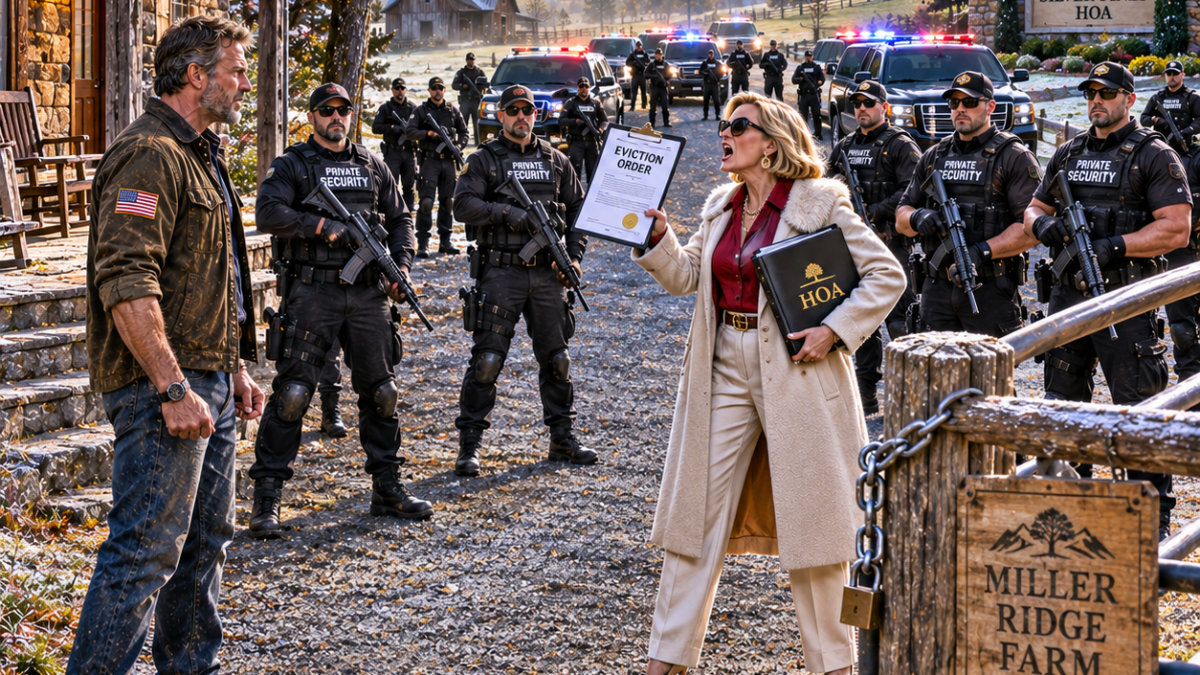
part 2
People later asked whether I knew I could handle eighteen men.
That was the wrong question.
I had no intention of handling eighteen men.
I had no intention of fighting anybody.
Numbers stop mattering when the goal is not to win a fight.
My goal was simpler.
Keep everyone alive.
Keep everyone visible.
Keep every action recorded.
Wait for law enforcement.
Years earlier, I had commanded a special operations unit.
I rarely spoke about it.
My medals stayed in a wooden box.
The only photograph on my wall showed six men in uniform with no caption.
I did not believe military service made me more important than anybody else.
If anything, it taught me how quickly pride gets people hurt.
Valerie had eighteen men.
Equipment.
Vehicles.
A fraudulent order.
A plan.
What she lacked was legitimate authority.
That weakness mattered more than anything I had learned in uniform.
Bryce ordered six guards toward the porch.
I backed inside.
No sudden motion.
No weapon.
No challenge.
The building had been adapted years earlier for rescue-training exercises, which meant internal access points could be isolated without trapping anyone in danger.
I closed one reinforced partition.
Two guards found themselves separated from the larger group.
They could still exit.
They simply could not continue toward me.
A younger guard named Wade Corbin noticed first.
He looked toward Bryce.
“This guy’s trained.”
Bryce snapped, “Keep moving.”
I used the outdoor speakers.
“You can all walk back through the gate. Nobody is stopping you.”
Valerie screamed from the lawn.
“Drag him out!”
That sentence went into the recording.
So did everything else.
The lights around the property shifted.
Not a trap.
Just illumination.
Suddenly, every person moving toward the house was clearly visible on multiple cameras.
The guards realized it too.
People behave differently when they know the footage is live.
One man lowered his baton slightly.
Another stepped back.
I kept speaking.
“No court order exists. Sheriff’s deputies are responding. Anybody who leaves now will be recorded leaving voluntarily.”
That word mattered.
Voluntarily.
I wanted them thinking like individuals.
Not a group.
Not Valerie’s force.
Individuals responsible for individual decisions.
Several hesitated.
Bryce tried to regain control.
He shouted that they had a lawful contract.
I answered through the speaker.
“A client contract is not a court order.”
One of the men near the barn looked through an open storage area.
He saw climbing equipment.
Medical gear.
Rescue maps.
Then he found the old photograph.
Grant Mercer.
Lieutenant Colonel.
Special Forces Detachment Commander.
Word moved quickly.
I could hear the tone change even before anyone told me what they had found.
Someone near the house whispered, “Sir, we should rethink this.”
Bryce shouted at him.
Valerie shouted at Bryce.
That told me who really controlled the operation.
Money.
Not command.
One guard separated from the group.
Mason Pike.
He was holding pepper spray but not raising it.
I stepped into view far enough for him to see both my hands.
“Mason.”
He looked startled.
“How do you know my name?”
“Contract roster.”
He swallowed.
“You don’t need to do this.”
“I’m working.”
“For how much?”
He didn’t answer.
“You’ve crossed a locked gate carrying restraints to enforce a fake eviction order. Whatever they’re paying you won’t make that legal.”
His baton lowered.
I continued.
“Walk to the gate.”
He stared toward Bryce.
Then Valerie.
Then back at me.
Finally, he dropped the baton.
Walked out.
One.
Not defeated.
Not captured.
Just finished.
That was exactly what I wanted.
Bryce hated it.
“One man walks and none of you get paid!”
Valerie shouted something even worse.
“No one gets a dollar unless Mercer is outside that gate!”
Several guards looked at her.
Now they understood.
This was not emergency property enforcement.
It was a paid removal.
Then she raised the offer.
Twenty-five thousand dollars to whoever dragged me out.
That sentence entered the recordings too.
I heard Elena’s voice through my earpiece.
“Grant.”
“I heard.”
“Sheriff is moving.”
“Good.”
“Do not give them an excuse.”
“I won’t.”
Valerie got into one of the SUVs and tried to push deeper toward the lower field.
Protective bollards prevented the vehicle from continuing into the training area.
She slammed the brakes.
Then screamed that I was holding them hostage.
I answered over the speaker.
“The outer gate remains open. Anyone may leave.”
Several guards turned and looked.
The gate was open.
Nothing was keeping them there.
That mattered later.
Bryce regrouped.
Tried sending people toward the generator.
The barn.
The road.
The house.
The more directions he gave, the less control he had.
I watched.
Waited.
Documented.
The men were beginning to realize every new order created another potential charge.
Property damage.
Trespass.
Interference with emergency communications.
Obstruction.
They had arrived thinking they were executing an official eviction.
Now they were standing on private land holding a piece of paper that looked more fraudulent with every passing minute.
One man near the generator shed made a dangerous mistake.
Everett Shaw.
He tried disabling equipment and damaged a fuel connection.
Smoke began filling part of the barn.
My thermal monitor showed heat where there shouldn’t have been any.
I moved immediately.
Not because Everett deserved rescue.
Because rescue does not begin with deciding who deserves it.
I pulled on protective equipment.
Entered through the opposite side.
Found him disoriented near the floor.
Got him out.
Fresh air.
First aid.
His breathing settled.
When he could speak, he looked toward the other guards.
“He saved me.”
Nobody answered.
Everett pointed toward Bryce.
“I’m done.”
Then he looked at me.
“I’m not touching you.”
Two guards walked away after him.
Then three more.
Valerie’s control was collapsing.
That was when she made the decision that changed everything.
She went to the back of her SUV.
Opened the cargo area.
Pulled out a handgun.
My drone captured it.
So did cameras on the south side.
Mara Ellison, an investigative reporter Elena had contacted after seeing the fake eviction order, was monitoring a lawful off-site feed.
She called the sheriff immediately.
I saw the weapon before Valerie reached the house.
I used the speaker.
“Valerie. The weapon is on camera. Place it on the ground.”
Every guard near her turned.
She froze.
For a moment, I thought embarrassment might stop her.
Then she raised the handgun and fired at a camera post.
The housing shattered.
Another camera captured the muzzle flash.
The entire situation changed in one sound.
Before the shot, some guards could still pretend they had entered a strange civil dispute under bad instructions.
After the shot, nobody could pretend.
Bryce shouted for everyone to get down.
Valerie shouted over him.
“Get Mercer!”
No one moved.
I stayed behind cover.
Kept distance.
Kept talking.
“Put the gun down.”
She fired again.
Missed.
My heart rate changed.
Training does not make you fearless.
Training tells you what fear is doing to your body.
My hands wanted to move faster than my judgment.
I forced them not to.
Valerie stepped into an open area near the barn.
A water-suppression line activated across the pavement.
The sudden spray knocked her balance sideways.
The handgun hit the mud.
I moved only far enough to kick it away.
Then backed off.
“You just turned a fraudulent eviction into an armed assault.”
She lunged toward the weapon.
Mason and Wade stepped between her and it.
Her own hired men.
“Ma’am, stop.”
“Move!”
“No.”
She stared at them.
For the first time that morning, Valerie Whitlock had given an order that nobody followed.
Bryce tried to blame her.
“I didn’t know she had a gun!”
I answered.
“You still brought eighteen armed guards through a locked gate with restraints and a fake eviction order.”
He looked toward the road.
Sheriff’s units were closer now.
But one of Silver Pines’ association vehicles had blocked the lower approach, forcing deputies to use another route.
That delay made Bryce panic.
Panic is more dangerous than confidence.
A confident person follows a plan.
A panicked person destroys one.
Eleven guards finally dropped their equipment and began walking toward the gate.
Hands visible.
Exactly as instructed.
Bryce and several holdouts remained.
Then Bryce grabbed Valerie.
Snatched up the handgun.
Pulled her toward an SUV.
Everything became quiet.
Not literally.
Engines.
People shouting.
Drone overhead.
But my perception narrowed.
Bryce was holding the weapon badly.
Too tightly.
Breathing too fast.
Eyes moving between vehicle, gate and road.
Valerie struggled against him.
I stood well away.
Hands open.
“Bryce.”
“Back off!”
“You don’t want to shoot her.”
“You don’t know what I want!”
“You want to leave.”
He said nothing.
“Your men already walked away.”
“Shut up!”
“You don’t know if that SUV has the keys.”
His eyes moved.
Small mistake.
“You haven’t checked your route.”
He looked toward the road.
Another mistake.
“You can hear the sheriff.”
Sirens.
Distant but closer.
“You have one decision left that helps you.”
He stared at me.
“What?”
“Put it down.”
The drone shifted behind him.
His attention broke for a fraction of a second.
I closed the distance only when the weapon angle moved safely away from Valerie.
Controlled his wrist.
Directed the muzzle toward the ground.
Bryce went down.
No striking.
No unnecessary force.
Just control.
Wade and Mason held position until deputies arrived.
I did not tie Bryce myself.
I had no interest in looking like his jailer.
His own men used the restraints they had brought.
Minutes later, Sheriff Owen Reic came through the outer gate with eight deputies.
I stepped back.
My role ended.
Owen took over.
Valerie immediately began shouting.
“He kidnapped us!”
Nobody answered her.
“He trapped my security team!”
Owen looked toward the open emergency exit.
Then the outer gate.
Then the footage already being shown by his deputy.
“Ma’am, stop talking for a minute.”
“He assaulted them!”
Everett raised a hand.
“No, Sheriff.”
Everyone turned.
“He pulled me out of smoke.”
Owen looked at me.
“Grant, did you use a firearm?”
“No.”
“Any weapon?”
“No.”
“Strike anyone?”
“I restrained one armed individual long enough for help to arrive.”
Serious injuries?
None.
Then Owen examined the eviction document.
His expression changed almost immediately.
The judge named on the signature line had retired years earlier.
The court address was outdated.
No case number.
No matching docket.
Valerie pointed toward Bryce.
“He brought that to me.”
Bryce laughed.
“Are you serious?”
Owen looked at him.
Bryce continued.
“She gave us the paperwork. She paid extra because she wanted this done before the courthouse opened.”
Valerie shouted at him.
Bryce shouted back.
Two people who had arrived as partners began accusing each other in front of deputies wearing body cameras.
Owen calmly collected everything.
Handgun.
Fake eviction papers.
Private security contract.
Guard body cameras.
Damaged-camera evidence.
Valerie’s phone under preservation procedures.
My security footage.
I turned over every file.
Nothing edited.
Nothing withheld.
No victory speech.
By sunrise, Valerie Whitlock was in custody.
But the story was only beginning.
The next few days revealed why she had been willing to go so far.
Silver Pines treasurer Preston Vale contacted Elena.
He had evidence.
Lots of it.
Emails between Valerie and the resort developer.
Maps.
Contracts.
Financial transfers.
A confidential agreement promising Valerie $2.4 million if she secured access through my property.
There it was.
The answer to the question I had asked weeks earlier.
Pretty house?
Or road?
Road.
Always the road.
The proposed resort expansion could not function under its existing traffic plan without crossing my land.
Valerie’s plan was to manufacture control.
Fine me.
Pressure me.
Create documents.
Pretend the HOA already had authority.
Then physically remove me before law enforcement could arrive and use staged paperwork and photographs to create the appearance that Silver Pines had taken lawful possession.
Once the locks were changed, she planned to label my property abandoned and unsafe.
Then start clearing the access corridor.
That was why a bulldozer had been scheduled.
It wasn’t enforcement.
It was theater.
The more evidence Elena uncovered, the worse it became.
The security operation had been paid using HOA funds residents never authorized.
Approximately $920,000 had been removed from the community repair fund through transactions tied to Valerie’s broader projects.
Additional money moved through shell entities.
One shell company was positioned to acquire interests connected to my property once I was pushed out.
Then Elena found a preliminary transfer agreement.
My signature appeared at the bottom.
Not my real signature.
I recognized the source immediately.
Months earlier, I had deliberately changed one small stroke when signing my final written response to the HOA.
Nothing dramatic.
Just enough that if that exact version appeared somewhere else, I would know where it came from.
The forged transfer contained the altered stroke.
My letter had been copied.
That linked the fake agreement directly back to material Silver Pines possessed.
Mara published the first major report.
Footage of eighteen guards entering my land.
Cameras being smashed.
Valerie ordering me removed.
The gunshot.
The surrender.
The story spread quickly.
I refused interviews about my military career.
Reporters wanted the former Special Forces commander angle.
Eighteen against one.
Retired soldier defeats private army.
I hated that framing.
Nobody had been defeated.
Most of those guards had been misled, underpaid and frightened.
Some had made serious choices they would answer for.
But they were not enemy troops.
I released one statement.
“No community organization has the right to turn itself into a private army.”
That was enough.
Then Silver Pines residents started talking.
An elderly man named Harold Briggs had paid almost $6,000 in fines he now believed were never lawfully approved.
A family had been threatened over a roof repair.
Others described dues increases that didn’t match meeting minutes.
Former board members reported being pressured to sign documents after decisions were already made.
Maintenance contracts had been steered toward a company connected to one of Valerie’s relatives.
Closed meetings.
Backdated minutes.
Changed records.
Threats.
Once fear breaks in one person, it often breaks in others.
Harold told his story.
Then twelve more families came forward.
Elena wanted me to sue the association.
I said yes under one condition.
“The people responsible pay.”
“The association itself may carry some legal responsibility.”
“I understand.”
“But?”
“I don’t want innocent homeowners bankrupted because Valerie stole from them too.”
Elena studied me.
“You’re making this harder.”
“I know.”
“Legally.”
“I know.”
She smiled.
“Fine.”
The legal strategy focused as much responsibility as possible on Valerie, her collaborators, the security company, and applicable insurance rather than using Silver Pines’ general membership as a convenient financial target.
That mattered to residents.
It mattered to me.
I wasn’t trying to conquer their neighborhood.
I wanted them free of the same abuse I had faced.
Valerie’s attorney responded by attacking my property.
Illegal compound.
Military traps.
Improvised detention cages.
Dangerous former soldier.
Prosecutors and inspectors visited the site.
They found rescue-training infrastructure.
Fire-suppression equipment.
Cameras.
Emergency exits.
Protective vehicle barriers.
Nothing designed to injure.
No hidden weapons.
No illegal traps.
No automatic restraint systems.
Every isolated space had a safe exit.
Every person had repeatedly been told they could leave.
That accusation died quickly.
Six months later, the formal hearing opened.
Valerie arrived in an expensive suit.
Perfect posture.
Same woman.
Different room.
Her lawyer described her as a community leader attempting to protect Silver Pines from a volatile former soldier.
Elena began with the deed.
My family owned the property decades before Silver Pines existed.
No recorded instrument had ever brought it under HOA jurisdiction.
Then the fake eviction.
No court docket.
Forged signature.
Retired judge.
Invalid seal.
Then the cameras.
Valerie ordering men to remove me.
Workers cutting the gate.
A guard destroying surveillance equipment.
The gun.
Her firing first.
Then the resort documents.
Thirty-six-million-dollar project.
My road shown as necessary access.
$2.4 million promised to Valerie if she secured it.
Then the financial records.
HOA money used to fund the security operation.
$920,000 missing from the repair fund.
Shell companies.
Then the forged transfer.
My copied signature.
It was not one dramatic clue.
It was layers.
That is what makes evidence powerful.
One fact can be explained.
Ten connected facts become harder to escape.
Bryce testified under a cooperation agreement.
Valerie had ordered body cameras turned off.
She wanted property cameras destroyed.
Locks changed.
Grant outside the gate before law enforcement arrived.
Then Mara presented audio from a closed board meeting supplied by Preston.
Valerie’s voice filled the courtroom.
“By the time officers show up, Mercer needs to be outside the gate and we need control of the house.”
Silence.
Complete silence.
When I testified, Valerie’s lawyer asked why I had not simply left.
“To avoid confrontation.”
“I was on my own land.”
“You knew eighteen men were coming.”
“I knew people might come.”
“And you chose to remain.”
“Yes.”
“Why?”
“Because trespassers don’t gain the right to decide whether an owner is allowed to remain on his own property.”
He changed direction.
“You used military training against ordinary security guards.”
“No.”
“You expect this court to believe your background played no role?”
“I used discipline.”
“To do what?”
“To make sure all eighteen people who entered my land were still alive and standing when Sheriff Reic arrived.”
He paused.
That answer was true.
That was why it worked.
Everett testified next.
He described the smoke in the barn.
Then me pulling him out.
Wade testified that everyone received repeated warnings and chances to leave.
Mason confirmed Valerie threatened to withhold pay from anyone who withdrew.
Sheriff Owen testified that he found no evidence I had initiated unnecessary force.
The court eventually ruled that Valerie and her closest collaborators bore personal responsibility for the central scheme.
Every HOA fine against me was dismissed.
My property was permanently confirmed outside Silver Pines authority.
The association was barred from claiming control over my road.
Valerie’s available personal assets were frozen under court orders.
The missing repair money was ordered restored through the appropriate judgments and recovery proceedings.
The forged-document and financial matters were referred for further criminal investigation.
The sitting board was dissolved.
New election.
Open process.
No Valerie.
Outside the courthouse, Mara found me.
“Grant, how does it feel to defeat eighteen armed guards?”
I shook my head.
“I didn’t defeat them.”
“But you stopped them.”
“Valerie lost before any of them reached my porch.”
“How?”
“She convinced herself enough money could make fake authority real.”
That was the whole story.
A year later, Silver Pines looked physically almost the same.
Same homes.
Same pine trees.
Same entrance.
Everything else was different.
Open board meetings.
Audited finances.
Clear fine procedures.
No closed-door rule changes.
The new board reviewed three years of questionable penalties.
Nearly $400,000 in improper or unsupported fees were refunded or credited.
Residents finally received financial statements that matched real accounts.
Preston resigned.
He had helped uncover Valerie.
He had also stayed silent too long.
Both things were true.
Bryce lost his security license.
His cooperation reduced his consequences.
It did not erase them.
Mason and Wade eventually joined several former guards in creating a small security consulting firm based around one rule:
Client instructions never outrank the law.
Wade told me that himself when he visited months later.
We stood beside the barn.
He looked embarrassed.
“I needed money.”
“I understand.”
“I didn’t ask enough questions.”
“No.”
“I believed the paperwork.”
“You wanted to.”
He looked down.
“Probably.”
I didn’t tell him everything was fine.
It wasn’t.
He had crossed my fence with restraints.
But people do not become permanently useless because they make one serious mistake.
“Grant, do you forgive me?”
“No.”
He looked surprised.
“Not yet.”
I opened the barn door.
“But you can still learn.”
He became one of the first participants in the disaster-response training program I eventually built there.
That project came from my court compensation.
I could have expanded the house.
Built a larger garage.
Bought more land.
Instead, I converted the barn.
Fire response.
Search-and-rescue drills.
Wilderness preparedness.
De-escalation.
Disaster communications.
Security ethics.
Wildfire planning.
The first class filled almost immediately.
Firefighters.
Volunteer rescue teams.
Landowners.
Private security professionals.
People who had read Mara’s reporting and wanted to understand what had actually happened.
I always started the course the same way.
“You’re not here to learn how to beat somebody.”
Then I pointed toward the training field.
“You’re here to learn how not to make a bad situation worse.”
That was what Valerie never understood.
Escalation feels like control until everybody loses control at once.
Everett came back too.
He still remembered waking up outside the barn.
“You could’ve left me in there.”
“No.”
“I had just broken into your property.”
“Yes.”
“Why?”
“Because you were unconscious in smoke.”
He shook his head.
“You make that sound obvious.”
“It should be.”
That became another principle in the program.
Rescue is not a reward for good behavior.
You save the person first.
Accountability comes afterward.
The resort project collapsed.
Investors discovered that critical access assumptions rested on fraudulent paperwork.
The developer withdrew rather than continue under growing scrutiny.
The thirty-six-million-dollar dream that had started the entire mess disappeared almost quietly compared with everything else.
Valerie was eventually convicted on charges tied to document forgery, embezzlement, conspiracy involving the unlawful seizure attempt, armed assault, and the organized intrusion.
Her assets were liquidated through the legal process to satisfy restitution and judgments.
The woman who once stood at my gate telling me Silver Pines would leave me no choice eventually stood in a courtroom where her preferences did not control anything.
I took no pleasure in that image.
People don’t believe me when I say that.
But by then, Valerie was no longer the point.
The land was safe.
The road was mine.
Residents had their money being restored.
The new board was functioning.
The rest belonged to the justice system.
One morning, I repaired the front gate.
Same gate Bryce’s people had cut.
Sheriff Owen came by for the first large rescue drill.
He watched me replace the damaged hardware.
“You’re not upgrading it?”
“To what?”
“Higher gate. More steel.”
“No.”
“After eighteen people came through?”
“The gate wasn’t the problem.”
Owen smiled.
“What was?”
“People who believed paper gave them the right to cut it.”
I installed a new sign.
PRIVATE PROPERTY
EMERGENCY RESPONDERS WELCOME
Owen read it.
“That’s an interesting combination.”
“Not really.”
“How so?”
“Private doesn’t mean hostile.”
That was another lesson Valerie never understood.
A boundary is not aggression.
A locked gate does not mean you hate the people outside it.
Private property can still welcome rescue crews.
Neighbors.
Volunteers.
People invited in.
The right to exclude is meaningful because so is the right to invite.
Silver Pines held its first open-air election under the new board structure at the bottom of the hill.
Residents voted themselves.
No Valerie presiding.
No closed session deciding everything first.
I watched from a distance.
Somebody asked whether I wanted to run for a board position.
I laughed.
“My land isn’t in Silver Pines.”
“You could advise.”
“No.”
“Why?”
“Because you don’t need another person telling you what to do.”
They needed governance.
Not another ruler.
I turned back toward the training field.
That evening, after everyone left, I opened the wooden box in my house.
Old medals.
Command coin.
Photograph.
Six men standing together.
Men I had once led through actual danger.
Real operations.
Real consequences.
For years, I thought that part of my life existed separately from the man who now owned forty-two quiet acres and taught rescue skills on weekends.
Valerie connected them in a way I never expected.
Not because I fought eighteen men.
Because I didn’t.
Years earlier, I had been trained to make decisions under pressure where force was sometimes unavoidable.
That morning, everything I had learned had to work in reverse.
Slow the problem.
Create distance.
Give people exits.
Break group momentum.
Reduce fear.
Keep records.
Use force only when a weapon leaves no safer alternative.
Then stop immediately.
That was harder than anger.
Anger is fast.
Discipline is slow.
Wade eventually began teaching new security trainees at the barn.
I heard him tell one group:
“The most dangerous thing that morning wasn’t Grant Mercer.”
They looked at him.
“It was the fact that all of us had stopped asking whether the order was legal.”
I didn’t interrupt.
He continued.
“We saw uniforms. Paperwork. Money. A client acting confident. We thought somebody else had checked.”
That sentence stayed with me.
Somebody else had checked.
That is how bad authority survives.
Everyone assumes verification happened somewhere above them.
The guard assumes the manager checked.
The manager assumes the client checked.
The client says the lawyer checked.
The board assumes the president checked.
Eventually, eighteen men walk across a private boundary carrying zip ties because nobody wants to be the first person to say:
Show me the court order.
Valerie counted on that.
She built an empire out of people not checking.
Residents didn’t check fines.
Board members didn’t check contracts.
Security guards didn’t check court records.
Investors didn’t check access rights.
Once people started checking, her empire disappeared.
Not all at once.
Document by document.
The fake eviction.
The resort map.
The hidden payment.
The repair fund.
The shell companies.
The copied signature.
The body-camera order.
The board recording.
Each piece stripped away one layer of authority until nothing remained except what she had actually possessed from the beginning.
A title.
Nothing more.
One afternoon, Harold Briggs came to the training center.
He was the elderly Silver Pines homeowner who had paid almost six thousand dollars in questionable fines.
He brought an envelope.
Inside was a reimbursement check from the association.
He stared at it.
“They gave it back.”
“Good.”
“I never thought they would.”
He sat quietly.
Then said, “Why didn’t I fight?”
I knew that question.
People ask it after abusive systems collapse.
As though fear becomes shame once the danger is gone.
“You thought they had authority.”
“They sent official notices.”
“Exactly.”
“I should have called a lawyer.”
“Maybe.”
“I should’ve stood up.”
“Maybe.”
He looked at me.
“You did.”
“I had advantages you didn’t.”
He frowned.
“What advantages?”
“Documents. Cameras. An attorney I trusted. A sheriff I could call. Experience staying calm when people try to control the room.”
I handed the check back.
“Don’t punish yourself for not being somebody else.”
He nodded slowly.
That conversation mattered more to me than most interviews.
People love stories where one strong person stands alone against corruption.
But real justice becomes meaningful only when the system changes for people who aren’t trained, wealthy, connected, or unusually calm.
I didn’t want Silver Pines to require another Grant Mercer.
I wanted a seventy-eight-year-old homeowner to receive a valid fine only when the board had actual authority and proper records.
I wanted minutes available.
Audits real.
Votes recorded.
Appeals possible.
That was victory.
Not eighteen men surrendering.
Not Valerie in handcuffs.
Procedure.
One year after the invasion, the gate looked almost exactly as it had before.
Repaired hinge.
New lock.
Same road.
Sometimes I stood there before sunrise.
Not because I was afraid they would return.
Because sunrise on that ridge had always been beautiful and I had almost let Valerie turn that hour into something ugly forever.
I refused.
The property remained a place where volunteers trained.
Dogs ran search patterns.
Firefighters practiced rural extraction.
Landowners learned wildfire planning.
Young security officers learned when to say no to clients.
The gate opened for all of them.
Permission.
That word mattered.
Mara returned once to write a follow-up.
She stood near the fence.
“You know what people still talk about?”
“What?”
“Eighteen armed guards.”
“Of course.”
“They want to know how one man stopped them.”
“I didn’t.”
She laughed.
“You always say that.”
“Because it’s true.”
“They surrendered.”
“Yes.”
“Bryce went down.”
“He had a gun.”
“Valerie was arrested.”
“By the sheriff.”
She looked at me.
“Then what did you do?”
I thought about it.
“I gave everybody time to make a better decision.”
She stopped writing.
“That’s your answer?”
“Yes.”
“Not very dramatic.”
“Neither is staying alive.”
She smiled.
The follow-up article used that line.
I pretended not to care.
Elena framed it.
She hung it in my office against my wishes.
Some endings are not satisfying in the way people expect.
I never got back the morning before sunrise when my land was quiet.
I never completely forgot Valerie’s gunshot.
I never stopped remembering the faces of men who realized halfway through that they might go to prison for a job they had accepted without asking enough questions.
But memory stopped feeling like danger.
It became instruction.
That was probably the military part of me.
Pain becomes useful only after you learn something from it.
The largest lesson was simple.
Power and authority are not the same.
Power is eighteen guards.
Authority is a valid warrant.
Power is money.
Authority is ownership recorded in a deed.
Power is a president shouting orders.
Authority is a court examining evidence.
Power can break a lock.
Authority determines whether the person who broke it had any right to be there.
Valerie had power for years.
People obeyed because fighting her was expensive.
She mistook obedience for legitimacy.
Then she came to my gate.
I did not give her the thing she needed most.
Fear.
That exposed everything.
Not because I was fearless.
I wasn’t.
The moment she pulled the handgun, I felt fear.
The moment Bryce used her as a shield, I felt fear.
When my lower-road camera showed the sheriff delayed, I felt fear.
Anyone who says training removes fear has never been trained properly.
Training gives fear somewhere to go.
Breathing.
Observation.
Decision.
Restraint.
That was the difference.
Valerie was ruled by panic once control disappeared.
I was not.
That’s why nobody died.
Years after the case, I still kept my old command coin in the wooden box.
I didn’t display it in the training barn.
My students did not need mythology.
They needed judgment.
One night, Wade asked about it.
“You really commanded Special Forces?”
“Yes.”
“How many operations?”
“Enough.”
“Why don’t you talk about it?”
“Because it isn’t why you should listen to me.”
He looked confused.
“Then why should we?”
I pointed toward the open training field.
“Because I’ve made enough mistakes to know what not to repeat.”
That answer disappointed him.
Good.
People who want heroes are easily manipulated by confidence.
Valerie understood that.
She presented herself like somebody who could not be questioned.
I wanted my trainees to question me.
If I gave a bad instruction, I wanted somebody to say so.
Especially if it involved another person’s rights.
The best thing Wade’s new security company adopted was not tactical training.
It was a refusal protocol.
Any guard could stop an operation if presented with credible evidence that a client’s order lacked legal authority.
No retaliation.
No lost wages for requesting verification.
Supervisor review required.
Simple.
That policy came from one morning when eighteen people wished somebody had asked the question earlier.
One Christmas, Silver Pines invited me to its community meeting.
I declined at first.
Then Harold called.
“We’re not asking you to join the board.”
“Good.”
“We want you to talk about property rights.”
“No.”
“Grant.”
“I’m not a lawyer.”
“Then talk about responsibility.”
That I could do.
I stood before residents who once lived under Valerie’s rules.
No dramatic speech.
I told them the same thing I told trainees.
“Any organization becomes dangerous when members stop asking where its authority comes from.”
A woman in the second row raised her hand.
“What if questioning the board makes you a target?”
“Then you have already learned something important about that board.”
Another resident asked how to know whether a fine was legitimate.
“Request the rule.”
Another asked about closed meetings.
“Read your governing documents.”
Another asked what to do if the president threatens legal action.
“Get independent legal advice.”
Boring answers.
Useful ones.
Afterward, Harold shook my hand.
“That’s what we needed years ago.”
“Probably.”
“Would you have listened?”
I smiled.
“Probably not.”
He laughed.
Silver Pines recovered.
Slowly.
Trust is slower than landscaping.
The community repair fund was restored.
Audits published.
Contracts reviewed.
Several old vendors were replaced.
Board minutes posted.
People learned to attend meetings because silence no longer felt inevitable.
The resort land eventually sold to someone else.
No giant expansion.
No road across my property.
Just forest behind the ridge.
I liked it better that way.
One fall afternoon, I stood at the gate while maple leaves moved across the road.
Sheriff Owen stopped his cruiser.
“You still haven’t made the gate bigger.”
“No.”
“I’m disappointed.”
“You keep hoping for a fortress?”
“Media promised me one.”
“Media lies.”
He leaned against the cruiser.
“Do you ever wish you’d just left that morning?”
“No.”
He nodded.
“Even knowing what happened?”
“Yes.”
“Why?”
I looked toward the house.
“Because leaving wouldn’t have prevented Valerie from doing it again to somebody else.”
Owen considered that.
“Maybe.”
“Also because it was my home.”
“That too.”
He started toward the cruiser.
Then stopped.
“Grant.”
“Yeah?”
“You know you got lucky.”
I looked at him.
“Yes.”
That mattered.
People sometimes tell the story as though I had everything under control.
I didn’t.
Valerie brought a gun I did not know existed.
Everett created smoke accidentally.
Bryce panicked.
The sheriff was delayed.
Any one of those variables could have gone differently.
Discipline reduces risk.
It does not create certainty.
That was another reason I hated people romanticizing the morning.
It wasn’t a game.
It was nineteen people standing inside a situation created by one woman’s greed where a single bad second could have destroyed several lives.
The fact everyone survived was not proof the confrontation had been safe.
It was proof we were fortunate enough to escape the consequences of how unsafe it had become.
That lesson became part of every class.
Avoid the confrontation before it happens.
Verify authority.
Use courts.
Call law enforcement.
Document.
Do not turn property disputes into tactical operations.
No client’s pride is worth somebody’s life.
Eventually, the media stopped calling.
Valerie became a name in court records.
Bryce moved out of state after completing his sentence and losing his license.
Preston faded from neighborhood politics.
Mara went on to other investigations.
Elena remained my attorney and continued charging me an offensive amount of money to tell me not to do stupid things.
Owen still visited the training center.
Life became ordinary.
That was the reward.
One quiet evening, I walked to the gate after the final rescue drill of the season.
The last truck left.
Wade waved from the driver’s seat.
The road became still.
I closed the steel gate.
Not because I feared anyone outside it.
Because training was over.
My land was still my land.
The latch clicked.
I stood there for a moment with one hand resting on the metal.
Months earlier, eighteen strangers had cut through that entrance believing numbers gave them authority.
They were wrong.
Valerie believed money gave her authority.
Wrong.
Bryce believed a client’s contract gave him authority.
Wrong.
I had once commanded men whose authority came with legal orders, accountability, oversight and consequences.
That experience taught me how serious legitimate power should feel.
Valerie treated power like theater.
Uniforms.
Weapons.
Vehicles.
Documents.
Threats.
She bought the appearance of command and believed appearance would become reality if she moved fast enough.
It didn’t.
The law caught up.
The documents caught up.
The cameras caught up.
The people she controlled began thinking for themselves.
And the whole thing collapsed.
I opened the wooden box one final time that night.
Command coin.
Old photograph.
Decorations I rarely touched.
I held the coin for a moment.
Then returned it.
That chapter of my life had taught me how to lead people into danger.
The morning Valerie came to my home taught me something harder.
Sometimes leadership means making sure nobody follows an order far enough to ruin their life.
Eighteen guards entered my property.
All eighteen left alive.
Several eventually rebuilt their careers.
One man I pulled from smoke later helped other homeowners testify.
Two created better security policies.
The neighborhood replaced its corrupt board.
Residents recovered money.
My road remained mine.
The resort vanished.
And I never once had to become the violent man Valerie expected me to be.
That was the part I was proud of.
Not surviving eighteen people.
Not controlling the property.
Not the military background.
Control of myself.
Because Valerie’s final strategy depended on one thing.
She needed me angry.
She needed footage of the dangerous veteran.
The unstable homeowner.
The man she could point at after the fact and say, See? We had no choice.
I never gave her that footage.
What the cameras showed instead was an HOA president crossing a private boundary with armed guards, fake documents, restraints and eventually a handgun.
They showed warnings.
Exits.
Surrenders.
A rescue.
A sheriff arriving.
And one quiet homeowner still standing where he had every legal right to stand.
Years later, Wade described that morning to a class.
He said, “Grant beat eighteen men without beating anybody.”
I corrected him.
“No.”
Everyone looked at me.
“I waited long enough for eighteen men to realize they were following the wrong person.”
That was closer.
Outside the barn, the evening light crossed the ridge.
Down below, Silver Pines residents were gathering for another open board meeting.
Their votes.
Their minutes.
Their money.
Their responsibility.
I watched for a few seconds.
Then turned away.
I didn’t want to lead Silver Pines.
I never wanted control over anybody else’s home.
I wanted only what I had asked for from Valerie in the beginning.
Leave my land outside your authority.
Respect the deed.
Ask before crossing the line.
The steel gate closed behind me.
Not from fear.
Not from revenge.
Because it was evening.
Because the training field was empty.
Because private land still belonged to its owner.
And because after everything Valerie Whitlock tried to manufacture with money, uniforms, fake seals and eighteen armed men, the simplest truth had survived every one of them.
Her title never gave her ownership.
Her paperwork never gave her a court.
Her guards never gave her authority.
And her rage never gave her the right to remove a man from his own home.
She brought eighteen men because she believed force could replace law.
She lost because law was the one thing she never bothered to bring.
𝗧𝗛𝗘 𝗘𝗡𝗗
HOA Karen Sent 18 Armed Guards to Drag Me Off My Own Land—She Didn’t Know Who She Was Ordering Them to Confront
HOA Karen Valerie Whitlock sent eighteen armed private guards across my fence before sunrise with zip ties, fake eviction papers, and orders to drag me off land my family had owned for more than seventy years.
She thought one quiet homeowner would panic once enough uniforms stepped onto his porch.
What she never bothered to learn was that I had spent part of my former life commanding men through situations far more dangerous than anything she could buy with HOA money.
At 4:47 in the morning, six dark SUVs rolled up my private road with their headlights off.
I watched them from the kitchen window.
No coffee.
No panic.
No weapon in my hand.
Just the glow from the security monitor reflecting against the glass and the faint shape of the ridge beyond it.
The vehicles stopped thirty yards outside my gate.
Eighteen heat signatures.
Two more near the rear SUV.
One of them was Valerie.
Even through thermal imaging, I recognized the way she stood slightly behind everyone else.
That was Valerie Whitlock’s favorite position.
Close enough to command.
Far enough to avoid consequence.
I had noticed it weeks earlier when she came to my gate with two board members and announced that my stone house, my flagpole, my radio mast, and my private rescue field were lowering the property values of Silver Pines.
I had listened.
Then I asked her one question.
“Do you want a prettier house, Valerie, or do you want my road?”
She stopped smiling.
That told me more than any answer could have.
Silver Pines sat below my forty-two acres like a polished advertisement for mountain living. Stone entrance. Private roads. Decorative pines. Million-dollar homes built in neat arcs across the hillside.
My property was different.
My family had owned it more than seventy years.
The house was old stone.
The barn leaned slightly toward the north pasture.
My access road connected directly to the state highway.
A small reservoir sat behind the trees.
The lower field had been licensed for volunteer rescue and wilderness-response training.
And none of it belonged to Silver Pines.
The HOA didn’t exist when my grandfather first fenced the ridge.
It didn’t exist when my father repaired the north wall.
It didn’t exist when I inherited the property.
Valerie knew that.
She simply hated it.
She had sent five notices that year.
Repaint the house in an approved color.
Remove the flagpole.
Remove the communications tower.
Pay $18,400 in retroactive community dues.
Open the road for “association use.”
Sign an agreement bringing my property under Silver Pines governance.
I answered each notice the same way.
Deed.
Survey.
County record.
No HOA jurisdiction.
No dues.
No easement.
No authority.
Then I closed the envelope.
Valerie responded by becoming louder.
What she never said in those notices was why my road mattered.
A development group was preparing a thirty-six-million-dollar resort expansion behind Silver Pines.
There was one serious problem.
Access.
The proposed resort needed a direct route through the lower ridge.
My ridge.
My road.
Without it, the traffic plan failed.
Without the traffic plan, county approval became much harder.
Valerie offered to buy my property at a fraction of market value.
I declined.
Her voice changed immediately.
“You don’t understand what you’re standing in the way of.”
“I understand exactly.”
“The association can make this extremely difficult for you.”
“I’m sure you can try.”
“You will not win this.”
I looked toward the camera above the gate.
Then back at her.
“Anything else?”
She drove away furious.
My camera kept everything.
Three days later, an envelope appeared at my house bearing the Silver Pines seal.
EMERGENCY EVICTION ORDER.
Twenty-four hours to surrender the property.
Private security authorized to remove occupants.
I read the first page.
Then the second.
Five problems jumped out almost immediately.
No case number.
No judge properly identified.
An outdated courthouse address.
A seal that didn’t match current county documents.
Language pretending a private security company possessed enforcement authority.
I photographed everything and sent it to Elena Marlowe, my property attorney and an old friend.
She called within an hour.
“Grant, this is fake.”
“I know.”
“No, I mean completely fake. There is no case.”
“I know.”
“There is no order.”
“I know.”
“You need to leave the property tonight.”
“No.”
There was a long silence.
“You expected me to say that?”
“Yes.”
“I’m not going to fight anybody.”
“That isn’t the only danger.”
“I know.”
“Grant.”
“Elena, if I leave and they enter, change the locks, stage photographs and start claiming possession, we spend months untangling the story they create.”
“You think that’s what they want?”
“I know that’s what they want.”
I called Sheriff Owen Reic.
No trespass had occurred yet.
No one could arrest people for a future crime based solely on my prediction.
Owen agreed to route patrol units nearby before dawn.
I promised him one thing.
“I will not initiate force.”
Then I walked my property.
Checked cameras.
Backup power.
Flood lighting.
Remote gates.
Emergency communication equipment.
The same systems I used for rescue training.
Nothing designed to injure.
Everything designed to observe, separate, warn and document.
At 4:47 the SUVs arrived.
Valerie stepped out wearing a white coat and carrying a folder.
The gate was cut.
The first guards crossed.
My loudspeaker activated automatically.
“You are entering private property without consent. This property is under continuous video recording. No valid court order authorizing your entry exists. You may leave through the gate at any time.”
One guard looked up.
Another smashed the nearest camera with a baton.
He had no idea how many other angles were recording him.
I stepped onto my porch.
Empty hands.
Visible.
A man in tactical clothing moved ahead of the others.
Bryce Talbot.
Owner of the private security company Valerie had hired.
He held up the fake order.
“Grant Mercer, kneel and place your hands where I can see them.”
I looked at the paper.
Then at him.
“No.”
Behind him, Valerie smiled.
“Your time is over, Grant.”
I didn’t answer her.
I looked at the men.
Some looked aggressive.
Some looked confused.
Several kept glancing at one another.
Paid security is not a military unit.
Fear moves differently through people who don’t know why they’re standing on somebody else’s property.
Bryce raised his voice.
“Last warning.”
I looked toward his group.
Then said calmly, “Before you start whatever you think this is, ask yourself why your employer ordered your body cameras turned off.”
Several heads turned.
Bryce froze for half a second.
Valerie’s smile disappeared.
That was the first crack.
And before the morning ended, it would split everything she had built.
part 2
People later asked whether I knew I could handle eighteen men.
That was the wrong question.
I had no intention of handling eighteen men.
I had no intention of fighting anybody.
Numbers stop mattering when the goal is not to win a fight.
My goal was simpler.
Keep everyone alive.
Keep everyone visible.
Keep every action recorded.
Wait for law enforcement.
Years earlier, I had commanded a special operations unit.
I rarely spoke about it.
My medals stayed in a wooden box.
The only photograph on my wall showed six men in uniform with no caption.
I did not believe military service made me more important than anybody else.
If anything, it taught me how quickly pride gets people hurt.
Valerie had eighteen men.
Equipment.
Vehicles.
A fraudulent order.
A plan.
What she lacked was legitimate authority.
That weakness mattered more than anything I had learned in uniform.
Bryce ordered six guards toward the porch.
I backed inside.
No sudden motion.
No weapon.
No challenge.
The building had been adapted years earlier for rescue-training exercises, which meant internal access points could be isolated without trapping anyone in danger.
I closed one reinforced partition.
Two guards found themselves separated from the larger group.
They could still exit.
They simply could not continue toward me.
A younger guard named Wade Corbin noticed first.
He looked toward Bryce.
“This guy’s trained.”
Bryce snapped, “Keep moving.”
I used the outdoor speakers.
“You can all walk back through the gate. Nobody is stopping you.”
Valerie screamed from the lawn.
“Drag him out!”
That sentence went into the recording.
So did everything else.
The lights around the property shifted.
Not a trap.
Just illumination.
Suddenly, every person moving toward the house was clearly visible on multiple cameras.
The guards realized it too.
People behave differently when they know the footage is live.
One man lowered his baton slightly.
Another stepped back.
I kept speaking.
“No court order exists. Sheriff’s deputies are responding. Anybody who leaves now will be recorded leaving voluntarily.”
That word mattered.
Voluntarily.
I wanted them thinking like individuals.
Not a group.
Not Valerie’s force.
Individuals responsible for individual decisions.
Several hesitated.
Bryce tried to regain control.
He shouted that they had a lawful contract.
I answered through the speaker.
“A client contract is not a court order.”
One of the men near the barn looked through an open storage area.
He saw climbing equipment.
Medical gear.
Rescue maps.
Then he found the old photograph.
Grant Mercer.
Lieutenant Colonel.
Special Forces Detachment Commander.
Word moved quickly.
I could hear the tone change even before anyone told me what they had found.
Someone near the house whispered, “Sir, we should rethink this.”
Bryce shouted at him.
Valerie shouted at Bryce.
That told me who really controlled the operation.
Money.
Not command.
One guard separated from the group.
Mason Pike.
He was holding pepper spray but not raising it.
I stepped into view far enough for him to see both my hands.
“Mason.”
He looked startled.
“How do you know my name?”
“Contract roster.”
He swallowed.
“You don’t need to do this.”
“I’m working.”
“For how much?”
He didn’t answer.
“You’ve crossed a locked gate carrying restraints to enforce a fake eviction order. Whatever they’re paying you won’t make that legal.”
His baton lowered.
I continued.
“Walk to the gate.”
He stared toward Bryce.
Then Valerie.
Then back at me.
Finally, he dropped the baton.
Walked out.
One.
Not defeated.
Not captured.
Just finished.
That was exactly what I wanted.
Bryce hated it.
“One man walks and none of you get paid!”
Valerie shouted something even worse.
“No one gets a dollar unless Mercer is outside that gate!”
Several guards looked at her.
Now they understood.
This was not emergency property enforcement.
It was a paid removal.
Then she raised the offer.
Twenty-five thousand dollars to whoever dragged me out.
That sentence entered the recordings too.
I heard Elena’s voice through my earpiece.
“Grant.”
“I heard.”
“Sheriff is moving.”
“Good.”
“Do not give them an excuse.”
“I won’t.”
Valerie got into one of the SUVs and tried to push deeper toward the lower field.
Protective bollards prevented the vehicle from continuing into the training area.
She slammed the brakes.
Then screamed that I was holding them hostage.
I answered over the speaker.
“The outer gate remains open. Anyone may leave.”
Several guards turned and looked.
The gate was open.
Nothing was keeping them there.
That mattered later.
Bryce regrouped.
Tried sending people toward the generator.
The barn.
The road.
The house.
The more directions he gave, the less control he had.
I watched.
Waited.
Documented.
The men were beginning to realize every new order created another potential charge.
Property damage.
Trespass.
Interference with emergency communications.
Obstruction.
They had arrived thinking they were executing an official eviction.
Now they were standing on private land holding a piece of paper that looked more fraudulent with every passing minute.
One man near the generator shed made a dangerous mistake.
Everett Shaw.
He tried disabling equipment and damaged a fuel connection.
Smoke began filling part of the barn.
My thermal monitor showed heat where there shouldn’t have been any.
I moved immediately.
Not because Everett deserved rescue.
Because rescue does not begin with deciding who deserves it.
I pulled on protective equipment.
Entered through the opposite side.
Found him disoriented near the floor.
Got him out.
Fresh air.
First aid.
His breathing settled.
When he could speak, he looked toward the other guards.
“He saved me.”
Nobody answered.
Everett pointed toward Bryce.
“I’m done.”
Then he looked at me.
“I’m not touching you.”
Two guards walked away after him.
Then three more.
Valerie’s control was collapsing.
That was when she made the decision that changed everything.
She went to the back of her SUV.
Opened the cargo area.
Pulled out a handgun.
My drone captured it.
So did cameras on the south side.
Mara Ellison, an investigative reporter Elena had contacted after seeing the fake eviction order, was monitoring a lawful off-site feed.
She called the sheriff immediately.
I saw the weapon before Valerie reached the house.
I used the speaker.
“Valerie. The weapon is on camera. Place it on the ground.”
Every guard near her turned.
She froze.
For a moment, I thought embarrassment might stop her.
Then she raised the handgun and fired at a camera post.
The housing shattered.
Another camera captured the muzzle flash.
The entire situation changed in one sound.
Before the shot, some guards could still pretend they had entered a strange civil dispute under bad instructions.
After the shot, nobody could pretend.
Bryce shouted for everyone to get down.
Valerie shouted over him.
“Get Mercer!”
No one moved.
I stayed behind cover.
Kept distance.
Kept talking.
“Put the gun down.”
She fired again.
Missed.
My heart rate changed.
Training does not make you fearless.
Training tells you what fear is doing to your body.
My hands wanted to move faster than my judgment.
I forced them not to.
Valerie stepped into an open area near the barn.
A water-suppression line activated across the pavement.
The sudden spray knocked her balance sideways.
The handgun hit the mud.
I moved only far enough to kick it away.
Then backed off.
“You just turned a fraudulent eviction into an armed assault.”
She lunged toward the weapon.
Mason and Wade stepped between her and it.
Her own hired men.
“Ma’am, stop.”
“Move!”
“No.”
She stared at them.
For the first time that morning, Valerie Whitlock had given an order that nobody followed.
Bryce tried to blame her.
“I didn’t know she had a gun!”
I answered.
“You still brought eighteen armed guards through a locked gate with restraints and a fake eviction order.”
He looked toward the road.
Sheriff’s units were closer now.
But one of Silver Pines’ association vehicles had blocked the lower approach, forcing deputies to use another route.
That delay made Bryce panic.
Panic is more dangerous than confidence.
A confident person follows a plan.
A panicked person destroys one.
Eleven guards finally dropped their equipment and began walking toward the gate.
Hands visible.
Exactly as instructed.
Bryce and several holdouts remained.
Then Bryce grabbed Valerie.
Snatched up the handgun.
Pulled her toward an SUV.
Everything became quiet.
Not literally.
Engines.
People shouting.
Drone overhead.
But my perception narrowed.
Bryce was holding the weapon badly.
Too tightly.
Breathing too fast.
Eyes moving between vehicle, gate and road.
Valerie struggled against him.
I stood well away.
Hands open.
“Bryce.”
“Back off!”
“You don’t want to shoot her.”
“You don’t know what I want!”
“You want to leave.”
He said nothing.
“Your men already walked away.”
“Shut up!”
“You don’t know if that SUV has the keys.”
His eyes moved.
Small mistake.
“You haven’t checked your route.”
He looked toward the road.
Another mistake.
“You can hear the sheriff.”
Sirens.
Distant but closer.
“You have one decision left that helps you.”
He stared at me.
“What?”
“Put it down.”
The drone shifted behind him.
His attention broke for a fraction of a second.
I closed the distance only when the weapon angle moved safely away from Valerie.
Controlled his wrist.
Directed the muzzle toward the ground.
Bryce went down.
No striking.
No unnecessary force.
Just control.
Wade and Mason held position until deputies arrived.
I did not tie Bryce myself.
I had no interest in looking like his jailer.
His own men used the restraints they had brought.
Minutes later, Sheriff Owen Reic came through the outer gate with eight deputies.
I stepped back.
My role ended.
Owen took over.
Valerie immediately began shouting.
“He kidnapped us!”
Nobody answered her.
“He trapped my security team!”
Owen looked toward the open emergency exit.
Then the outer gate.
Then the footage already being shown by his deputy.
“Ma’am, stop talking for a minute.”
“He assaulted them!”
Everett raised a hand.
“No, Sheriff.”
Everyone turned.
“He pulled me out of smoke.”
Owen looked at me.
“Grant, did you use a firearm?”
“No.”
“Any weapon?”
“No.”
“Strike anyone?”
“I restrained one armed individual long enough for help to arrive.”
Serious injuries?
None.
Then Owen examined the eviction document.
His expression changed almost immediately.
The judge named on the signature line had retired years earlier.
The court address was outdated.
No case number.
No matching docket.
Valerie pointed toward Bryce.
“He brought that to me.”
Bryce laughed.
“Are you serious?”
Owen looked at him.
Bryce continued.
“She gave us the paperwork. She paid extra because she wanted this done before the courthouse opened.”
Valerie shouted at him.
Bryce shouted back.
Two people who had arrived as partners began accusing each other in front of deputies wearing body cameras.
Owen calmly collected everything.
Handgun.
Fake eviction papers.
Private security contract.
Guard body cameras.
Damaged-camera evidence.
Valerie’s phone under preservation procedures.
My security footage.
I turned over every file.
Nothing edited.
Nothing withheld.
No victory speech.
By sunrise, Valerie Whitlock was in custody.
But the story was only beginning.
The next few days revealed why she had been willing to go so far.
Silver Pines treasurer Preston Vale contacted Elena.
He had evidence.
Lots of it.
Emails between Valerie and the resort developer.
Maps.
Contracts.
Financial transfers.
A confidential agreement promising Valerie $2.4 million if she secured access through my property.
There it was.
The answer to the question I had asked weeks earlier.
Pretty house?
Or road?
Road.
Always the road.
The proposed resort expansion could not function under its existing traffic plan without crossing my land.
Valerie’s plan was to manufacture control.
Fine me.
Pressure me.
Create documents.
Pretend the HOA already had authority.
Then physically remove me before law enforcement could arrive and use staged paperwork and photographs to create the appearance that Silver Pines had taken lawful possession.
Once the locks were changed, she planned to label my property abandoned and unsafe.
Then start clearing the access corridor.
That was why a bulldozer had been scheduled.
It wasn’t enforcement.
It was theater.
The more evidence Elena uncovered, the worse it became.
The security operation had been paid using HOA funds residents never authorized.
Approximately $920,000 had been removed from the community repair fund through transactions tied to Valerie’s broader projects.
Additional money moved through shell entities.
One shell company was positioned to acquire interests connected to my property once I was pushed out.
Then Elena found a preliminary transfer agreement.
My signature appeared at the bottom.
Not my real signature.
I recognized the source immediately.
Months earlier, I had deliberately changed one small stroke when signing my final written response to the HOA.
Nothing dramatic.
Just enough that if that exact version appeared somewhere else, I would know where it came from.
The forged transfer contained the altered stroke.
My letter had been copied.
That linked the fake agreement directly back to material Silver Pines possessed.
Mara published the first major report.
Footage of eighteen guards entering my land.
Cameras being smashed.
Valerie ordering me removed.
The gunshot.
The surrender.
The story spread quickly.
I refused interviews about my military career.
Reporters wanted the former Special Forces commander angle.
Eighteen against one.
Retired soldier defeats private army.
I hated that framing.
Nobody had been defeated.
Most of those guards had been misled, underpaid and frightened.
Some had made serious choices they would answer for.
But they were not enemy troops.
I released one statement.
“No community organization has the right to turn itself into a private army.”
That was enough.
Then Silver Pines residents started talking.
An elderly man named Harold Briggs had paid almost $6,000 in fines he now believed were never lawfully approved.
A family had been threatened over a roof repair.
Others described dues increases that didn’t match meeting minutes.
Former board members reported being pressured to sign documents after decisions were already made.
Maintenance contracts had been steered toward a company connected to one of Valerie’s relatives.
Closed meetings.
Backdated minutes.
Changed records.
Threats.
Once fear breaks in one person, it often breaks in others.
Harold told his story.
Then twelve more families came forward.
Elena wanted me to sue the association.
I said yes under one condition.
“The people responsible pay.”
“The association itself may carry some legal responsibility.”
“I understand.”
“But?”
“I don’t want innocent homeowners bankrupted because Valerie stole from them too.”
Elena studied me.
“You’re making this harder.”
“I know.”
“Legally.”
“I know.”
She smiled.
“Fine.”
The legal strategy focused as much responsibility as possible on Valerie, her collaborators, the security company, and applicable insurance rather than using Silver Pines’ general membership as a convenient financial target.
That mattered to residents.
It mattered to me.
I wasn’t trying to conquer their neighborhood.
I wanted them free of the same abuse I had faced.
Valerie’s attorney responded by attacking my property.
Illegal compound.
Military traps.
Improvised detention cages.
Dangerous former soldier.
Prosecutors and inspectors visited the site.
They found rescue-training infrastructure.
Fire-suppression equipment.
Cameras.
Emergency exits.
Protective vehicle barriers.
Nothing designed to injure.
No hidden weapons.
No illegal traps.
No automatic restraint systems.
Every isolated space had a safe exit.
Every person had repeatedly been told they could leave.
That accusation died quickly.
Six months later, the formal hearing opened.
Valerie arrived in an expensive suit.
Perfect posture.
Same woman.
Different room.
Her lawyer described her as a community leader attempting to protect Silver Pines from a volatile former soldier.
Elena began with the deed.
My family owned the property decades before Silver Pines existed.
No recorded instrument had ever brought it under HOA jurisdiction.
Then the fake eviction.
No court docket.
Forged signature.
Retired judge.
Invalid seal.
Then the cameras.
Valerie ordering men to remove me.
Workers cutting the gate.
A guard destroying surveillance equipment.
The gun.
Her firing first.
Then the resort documents.
Thirty-six-million-dollar project.
My road shown as necessary access.
$2.4 million promised to Valerie if she secured it.
Then the financial records.
HOA money used to fund the security operation.
$920,000 missing from the repair fund.
Shell companies.
Then the forged transfer.
My copied signature.
It was not one dramatic clue.
It was layers.
That is what makes evidence powerful.
One fact can be explained.
Ten connected facts become harder to escape.
Bryce testified under a cooperation agreement.
Valerie had ordered body cameras turned off.
She wanted property cameras destroyed.
Locks changed.
Grant outside the gate before law enforcement arrived.
Then Mara presented audio from a closed board meeting supplied by Preston.
Valerie’s voice filled the courtroom.
“By the time officers show up, Mercer needs to be outside the gate and we need control of the house.”
Silence.
Complete silence.
When I testified, Valerie’s lawyer asked why I had not simply left.
“To avoid confrontation.”
“I was on my own land.”
“You knew eighteen men were coming.”
“I knew people might come.”
“And you chose to remain.”
“Yes.”
“Why?”
“Because trespassers don’t gain the right to decide whether an owner is allowed to remain on his own property.”
He changed direction.
“You used military training against ordinary security guards.”
“No.”
“You expect this court to believe your background played no role?”
“I used discipline.”
“To do what?”
“To make sure all eighteen people who entered my land were still alive and standing when Sheriff Reic arrived.”
He paused.
That answer was true.
That was why it worked.
Everett testified next.
He described the smoke in the barn.
Then me pulling him out.
Wade testified that everyone received repeated warnings and chances to leave.
Mason confirmed Valerie threatened to withhold pay from anyone who withdrew.
Sheriff Owen testified that he found no evidence I had initiated unnecessary force.
The court eventually ruled that Valerie and her closest collaborators bore personal responsibility for the central scheme.
Every HOA fine against me was dismissed.
My property was permanently confirmed outside Silver Pines authority.
The association was barred from claiming control over my road.
Valerie’s available personal assets were frozen under court orders.
The missing repair money was ordered restored through the appropriate judgments and recovery proceedings.
The forged-document and financial matters were referred for further criminal investigation.
The sitting board was dissolved.
New election.
Open process.
No Valerie.
Outside the courthouse, Mara found me.
“Grant, how does it feel to defeat eighteen armed guards?”
I shook my head.
“I didn’t defeat them.”
“But you stopped them.”
“Valerie lost before any of them reached my porch.”
“How?”
“She convinced herself enough money could make fake authority real.”
That was the whole story.
A year later, Silver Pines looked physically almost the same.
Same homes.
Same pine trees.
Same entrance.
Everything else was different.
Open board meetings.
Audited finances.
Clear fine procedures.
No closed-door rule changes.
The new board reviewed three years of questionable penalties.
Nearly $400,000 in improper or unsupported fees were refunded or credited.
Residents finally received financial statements that matched real accounts.
Preston resigned.
He had helped uncover Valerie.
He had also stayed silent too long.
Both things were true.
Bryce lost his security license.
His cooperation reduced his consequences.
It did not erase them.
Mason and Wade eventually joined several former guards in creating a small security consulting firm based around one rule:
Client instructions never outrank the law.
Wade told me that himself when he visited months later.
We stood beside the barn.
He looked embarrassed.
“I needed money.”
“I understand.”
“I didn’t ask enough questions.”
“No.”
“I believed the paperwork.”
“You wanted to.”
He looked down.
“Probably.”
I didn’t tell him everything was fine.
It wasn’t.
He had crossed my fence with restraints.
But people do not become permanently useless because they make one serious mistake.
“Grant, do you forgive me?”
“No.”
He looked surprised.
“Not yet.”
I opened the barn door.
“But you can still learn.”
He became one of the first participants in the disaster-response training program I eventually built there.
That project came from my court compensation.
I could have expanded the house.
Built a larger garage.
Bought more land.
Instead, I converted the barn.
Fire response.
Search-and-rescue drills.
Wilderness preparedness.
De-escalation.
Disaster communications.
Security ethics.
Wildfire planning.
The first class filled almost immediately.
Firefighters.
Volunteer rescue teams.
Landowners.
Private security professionals.
People who had read Mara’s reporting and wanted to understand what had actually happened.
I always started the course the same way.
“You’re not here to learn how to beat somebody.”
Then I pointed toward the training field.
“You’re here to learn how not to make a bad situation worse.”
That was what Valerie never understood.
Escalation feels like control until everybody loses control at once.
Everett came back too.
He still remembered waking up outside the barn.
“You could’ve left me in there.”
“No.”
“I had just broken into your property.”
“Yes.”
“Why?”
“Because you were unconscious in smoke.”
He shook his head.
“You make that sound obvious.”
“It should be.”
That became another principle in the program.
Rescue is not a reward for good behavior.
You save the person first.
Accountability comes afterward.
The resort project collapsed.
Investors discovered that critical access assumptions rested on fraudulent paperwork.
The developer withdrew rather than continue under growing scrutiny.
The thirty-six-million-dollar dream that had started the entire mess disappeared almost quietly compared with everything else.
Valerie was eventually convicted on charges tied to document forgery, embezzlement, conspiracy involving the unlawful seizure attempt, armed assault, and the organized intrusion.
Her assets were liquidated through the legal process to satisfy restitution and judgments.
The woman who once stood at my gate telling me Silver Pines would leave me no choice eventually stood in a courtroom where her preferences did not control anything.
I took no pleasure in that image.
People don’t believe me when I say that.
But by then, Valerie was no longer the point.
The land was safe.
The road was mine.
Residents had their money being restored.
The new board was functioning.
The rest belonged to the justice system.
One morning, I repaired the front gate.
Same gate Bryce’s people had cut.
Sheriff Owen came by for the first large rescue drill.
He watched me replace the damaged hardware.
“You’re not upgrading it?”
“To what?”
“Higher gate. More steel.”
“No.”
“After eighteen people came through?”
“The gate wasn’t the problem.”
Owen smiled.
“What was?”
“People who believed paper gave them the right to cut it.”
I installed a new sign.
PRIVATE PROPERTY
EMERGENCY RESPONDERS WELCOME
Owen read it.
“That’s an interesting combination.”
“Not really.”
“How so?”
“Private doesn’t mean hostile.”
That was another lesson Valerie never understood.
A boundary is not aggression.
A locked gate does not mean you hate the people outside it.
Private property can still welcome rescue crews.
Neighbors.
Volunteers.
People invited in.
The right to exclude is meaningful because so is the right to invite.
Silver Pines held its first open-air election under the new board structure at the bottom of the hill.
Residents voted themselves.
No Valerie presiding.
No closed session deciding everything first.
I watched from a distance.
Somebody asked whether I wanted to run for a board position.
I laughed.
“My land isn’t in Silver Pines.”
“You could advise.”
“No.”
“Why?”
“Because you don’t need another person telling you what to do.”
They needed governance.
Not another ruler.
I turned back toward the training field.
That evening, after everyone left, I opened the wooden box in my house.
Old medals.
Command coin.
Photograph.
Six men standing together.
Men I had once led through actual danger.
Real operations.
Real consequences.
For years, I thought that part of my life existed separately from the man who now owned forty-two quiet acres and taught rescue skills on weekends.
Valerie connected them in a way I never expected.
Not because I fought eighteen men.
Because I didn’t.
Years earlier, I had been trained to make decisions under pressure where force was sometimes unavoidable.
That morning, everything I had learned had to work in reverse.
Slow the problem.
Create distance.
Give people exits.
Break group momentum.
Reduce fear.
Keep records.
Use force only when a weapon leaves no safer alternative.
Then stop immediately.
That was harder than anger.
Anger is fast.
Discipline is slow.
Wade eventually began teaching new security trainees at the barn.
I heard him tell one group:
“The most dangerous thing that morning wasn’t Grant Mercer.”
They looked at him.
“It was the fact that all of us had stopped asking whether the order was legal.”
I didn’t interrupt.
He continued.
“We saw uniforms. Paperwork. Money. A client acting confident. We thought somebody else had checked.”
That sentence stayed with me.
Somebody else had checked.
That is how bad authority survives.
Everyone assumes verification happened somewhere above them.
The guard assumes the manager checked.
The manager assumes the client checked.
The client says the lawyer checked.
The board assumes the president checked.
Eventually, eighteen men walk across a private boundary carrying zip ties because nobody wants to be the first person to say:
Show me the court order.
Valerie counted on that.
She built an empire out of people not checking.
Residents didn’t check fines.
Board members didn’t check contracts.
Security guards didn’t check court records.
Investors didn’t check access rights.
Once people started checking, her empire disappeared.
Not all at once.
Document by document.
The fake eviction.
The resort map.
The hidden payment.
The repair fund.
The shell companies.
The copied signature.
The body-camera order.
The board recording.
Each piece stripped away one layer of authority until nothing remained except what she had actually possessed from the beginning.
A title.
Nothing more.
One afternoon, Harold Briggs came to the training center.
He was the elderly Silver Pines homeowner who had paid almost six thousand dollars in questionable fines.
He brought an envelope.
Inside was a reimbursement check from the association.
He stared at it.
“They gave it back.”
“Good.”
“I never thought they would.”
He sat quietly.
Then said, “Why didn’t I fight?”
I knew that question.
People ask it after abusive systems collapse.
As though fear becomes shame once the danger is gone.
“You thought they had authority.”
“They sent official notices.”
“Exactly.”
“I should have called a lawyer.”
“Maybe.”
“I should’ve stood up.”
“Maybe.”
He looked at me.
“You did.”
“I had advantages you didn’t.”
He frowned.
“What advantages?”
“Documents. Cameras. An attorney I trusted. A sheriff I could call. Experience staying calm when people try to control the room.”
I handed the check back.
“Don’t punish yourself for not being somebody else.”
He nodded slowly.
That conversation mattered more to me than most interviews.
People love stories where one strong person stands alone against corruption.
But real justice becomes meaningful only when the system changes for people who aren’t trained, wealthy, connected, or unusually calm.
I didn’t want Silver Pines to require another Grant Mercer.
I wanted a seventy-eight-year-old homeowner to receive a valid fine only when the board had actual authority and proper records.
I wanted minutes available.
Audits real.
Votes recorded.
Appeals possible.
That was victory.
Not eighteen men surrendering.
Not Valerie in handcuffs.
Procedure.
One year after the invasion, the gate looked almost exactly as it had before.
Repaired hinge.
New lock.
Same road.
Sometimes I stood there before sunrise.
Not because I was afraid they would return.
Because sunrise on that ridge had always been beautiful and I had almost let Valerie turn that hour into something ugly forever.
I refused.
The property remained a place where volunteers trained.
Dogs ran search patterns.
Firefighters practiced rural extraction.
Landowners learned wildfire planning.
Young security officers learned when to say no to clients.
The gate opened for all of them.
Permission.
That word mattered.
Mara returned once to write a follow-up.
She stood near the fence.
“You know what people still talk about?”
“What?”
“Eighteen armed guards.”
“Of course.”
“They want to know how one man stopped them.”
“I didn’t.”
She laughed.
“You always say that.”
“Because it’s true.”
“They surrendered.”
“Yes.”
“Bryce went down.”
“He had a gun.”
“Valerie was arrested.”
“By the sheriff.”
She looked at me.
“Then what did you do?”
I thought about it.
“I gave everybody time to make a better decision.”
She stopped writing.
“That’s your answer?”
“Yes.”
“Not very dramatic.”
“Neither is staying alive.”
She smiled.
The follow-up article used that line.
I pretended not to care.
Elena framed it.
She hung it in my office against my wishes.
Some endings are not satisfying in the way people expect.
I never got back the morning before sunrise when my land was quiet.
I never completely forgot Valerie’s gunshot.
I never stopped remembering the faces of men who realized halfway through that they might go to prison for a job they had accepted without asking enough questions.
But memory stopped feeling like danger.
It became instruction.
That was probably the military part of me.
Pain becomes useful only after you learn something from it.
The largest lesson was simple.
Power and authority are not the same.
Power is eighteen guards.
Authority is a valid warrant.
Power is money.
Authority is ownership recorded in a deed.
Power is a president shouting orders.
Authority is a court examining evidence.
Power can break a lock.
Authority determines whether the person who broke it had any right to be there.
Valerie had power for years.
People obeyed because fighting her was expensive.
She mistook obedience for legitimacy.
Then she came to my gate.
I did not give her the thing she needed most.
Fear.
That exposed everything.
Not because I was fearless.
I wasn’t.
The moment she pulled the handgun, I felt fear.
The moment Bryce used her as a shield, I felt fear.
When my lower-road camera showed the sheriff delayed, I felt fear.
Anyone who says training removes fear has never been trained properly.
Training gives fear somewhere to go.
Breathing.
Observation.
Decision.
Restraint.
That was the difference.
Valerie was ruled by panic once control disappeared.
I was not.
That’s why nobody died.
Years after the case, I still kept my old command coin in the wooden box.
I didn’t display it in the training barn.
My students did not need mythology.
They needed judgment.
One night, Wade asked about it.
“You really commanded Special Forces?”
“Yes.”
“How many operations?”
“Enough.”
“Why don’t you talk about it?”
“Because it isn’t why you should listen to me.”
He looked confused.
“Then why should we?”
I pointed toward the open training field.
“Because I’ve made enough mistakes to know what not to repeat.”
That answer disappointed him.
Good.
People who want heroes are easily manipulated by confidence.
Valerie understood that.
She presented herself like somebody who could not be questioned.
I wanted my trainees to question me.
If I gave a bad instruction, I wanted somebody to say so.
Especially if it involved another person’s rights.
The best thing Wade’s new security company adopted was not tactical training.
It was a refusal protocol.
Any guard could stop an operation if presented with credible evidence that a client’s order lacked legal authority.
No retaliation.
No lost wages for requesting verification.
Supervisor review required.
Simple.
That policy came from one morning when eighteen people wished somebody had asked the question earlier.
One Christmas, Silver Pines invited me to its community meeting.
I declined at first.
Then Harold called.
“We’re not asking you to join the board.”
“Good.”
“We want you to talk about property rights.”
“No.”
“Grant.”
“I’m not a lawyer.”
“Then talk about responsibility.”
That I could do.
I stood before residents who once lived under Valerie’s rules.
No dramatic speech.
I told them the same thing I told trainees.
“Any organization becomes dangerous when members stop asking where its authority comes from.”
A woman in the second row raised her hand.
“What if questioning the board makes you a target?”
“Then you have already learned something important about that board.”
Another resident asked how to know whether a fine was legitimate.
“Request the rule.”
Another asked about closed meetings.
“Read your governing documents.”
Another asked what to do if the president threatens legal action.
“Get independent legal advice.”
Boring answers.
Useful ones.
Afterward, Harold shook my hand.
“That’s what we needed years ago.”
“Probably.”
“Would you have listened?”
I smiled.
“Probably not.”
He laughed.
Silver Pines recovered.
Slowly.
Trust is slower than landscaping.
The community repair fund was restored.
Audits published.
Contracts reviewed.
Several old vendors were replaced.
Board minutes posted.
People learned to attend meetings because silence no longer felt inevitable.
The resort land eventually sold to someone else.
No giant expansion.
No road across my property.
Just forest behind the ridge.
I liked it better that way.
One fall afternoon, I stood at the gate while maple leaves moved across the road.
Sheriff Owen stopped his cruiser.
“You still haven’t made the gate bigger.”
“No.”
“I’m disappointed.”
“You keep hoping for a fortress?”
“Media promised me one.”
“Media lies.”
He leaned against the cruiser.
“Do you ever wish you’d just left that morning?”
“No.”
He nodded.
“Even knowing what happened?”
“Yes.”
“Why?”
I looked toward the house.
“Because leaving wouldn’t have prevented Valerie from doing it again to somebody else.”
Owen considered that.
“Maybe.”
“Also because it was my home.”
“That too.”
He started toward the cruiser.
Then stopped.
“Grant.”
“Yeah?”
“You know you got lucky.”
I looked at him.
“Yes.”
That mattered.
People sometimes tell the story as though I had everything under control.
I didn’t.
Valerie brought a gun I did not know existed.
Everett created smoke accidentally.
Bryce panicked.
The sheriff was delayed.
Any one of those variables could have gone differently.
Discipline reduces risk.
It does not create certainty.
That was another reason I hated people romanticizing the morning.
It wasn’t a game.
It was nineteen people standing inside a situation created by one woman’s greed where a single bad second could have destroyed several lives.
The fact everyone survived was not proof the confrontation had been safe.
It was proof we were fortunate enough to escape the consequences of how unsafe it had become.
That lesson became part of every class.
Avoid the confrontation before it happens.
Verify authority.
Use courts.
Call law enforcement.
Document.
Do not turn property disputes into tactical operations.
No client’s pride is worth somebody’s life.
Eventually, the media stopped calling.
Valerie became a name in court records.
Bryce moved out of state after completing his sentence and losing his license.
Preston faded from neighborhood politics.
Mara went on to other investigations.
Elena remained my attorney and continued charging me an offensive amount of money to tell me not to do stupid things.
Owen still visited the training center.
Life became ordinary.
That was the reward.
One quiet evening, I walked to the gate after the final rescue drill of the season.
The last truck left.
Wade waved from the driver’s seat.
The road became still.
I closed the steel gate.
Not because I feared anyone outside it.
Because training was over.
My land was still my land.
The latch clicked.
I stood there for a moment with one hand resting on the metal.
Months earlier, eighteen strangers had cut through that entrance believing numbers gave them authority.
They were wrong.
Valerie believed money gave her authority.
Wrong.
Bryce believed a client’s contract gave him authority.
Wrong.
I had once commanded men whose authority came with legal orders, accountability, oversight and consequences.
That experience taught me how serious legitimate power should feel.
Valerie treated power like theater.
Uniforms.
Weapons.
Vehicles.
Documents.
Threats.
She bought the appearance of command and believed appearance would become reality if she moved fast enough.
It didn’t.
The law caught up.
The documents caught up.
The cameras caught up.
The people she controlled began thinking for themselves.
And the whole thing collapsed.
I opened the wooden box one final time that night.
Command coin.
Old photograph.
Decorations I rarely touched.
I held the coin for a moment.
Then returned it.
That chapter of my life had taught me how to lead people into danger.
The morning Valerie came to my home taught me something harder.
Sometimes leadership means making sure nobody follows an order far enough to ruin their life.
Eighteen guards entered my property.
All eighteen left alive.
Several eventually rebuilt their careers.
One man I pulled from smoke later helped other homeowners testify.
Two created better security policies.
The neighborhood replaced its corrupt board.
Residents recovered money.
My road remained mine.
The resort vanished.
And I never once had to become the violent man Valerie expected me to be.
That was the part I was proud of.
Not surviving eighteen people.
Not controlling the property.
Not the military background.
Control of myself.
Because Valerie’s final strategy depended on one thing.
She needed me angry.
She needed footage of the dangerous veteran.
The unstable homeowner.
The man she could point at after the fact and say, See? We had no choice.
I never gave her that footage.
What the cameras showed instead was an HOA president crossing a private boundary with armed guards, fake documents, restraints and eventually a handgun.
They showed warnings.
Exits.
Surrenders.
A rescue.
A sheriff arriving.
And one quiet homeowner still standing where he had every legal right to stand.
Years later, Wade described that morning to a class.
He said, “Grant beat eighteen men without beating anybody.”
I corrected him.
“No.”
Everyone looked at me.
“I waited long enough for eighteen men to realize they were following the wrong person.”
That was closer.
Outside the barn, the evening light crossed the ridge.
Down below, Silver Pines residents were gathering for another open board meeting.
Their votes.
Their minutes.
Their money.
Their responsibility.
I watched for a few seconds.
Then turned away.
I didn’t want to lead Silver Pines.
I never wanted control over anybody else’s home.
I wanted only what I had asked for from Valerie in the beginning.
Leave my land outside your authority.
Respect the deed.
Ask before crossing the line.
The steel gate closed behind me.
Not from fear.
Not from revenge.
Because it was evening.
Because the training field was empty.
Because private land still belonged to its owner.
And because after everything Valerie Whitlock tried to manufacture with money, uniforms, fake seals and eighteen armed men, the simplest truth had survived every one of them.
Her title never gave her ownership.
Her paperwork never gave her a court.
Her guards never gave her authority.
And her rage never gave her the right to remove a man from his own home.
She brought eighteen men because she believed force could replace law.
She lost because law was the one thing she never bothered to bring.








