𝗣𝗔𝗥𝗧 𝟮 HOA Karen Rewrote the Meeting Minutes Overnight — She Forgot I Hired a Court Reporter
𝗣𝗔𝗥𝗧 𝟮
The meeting took place on a damp Tuesday night.
Fifty residents packed into the Oakridge Glen community hall.
The fluorescent lights buzzed overhead.
Rain tapped lightly against the windows.
People were nervous.
Three thousand five hundred dollars might have been an inconvenience to the lawyers and surgeons in the larger homes near the ridge.
For several retired couples, it was the difference between an ordinary month and a frightening one.
I knew Margaret Ellison had recently lost her husband.
I knew Harold Pierce lived mostly on Social Security and a small aerospace pension.
I knew other residents were paying for medication, helping adult children, supporting grandchildren.
Evelyn knew too.
She simply regarded money differently when it belonged to other people.
She sat behind the board table with two loyal directors and Brenda Lawson, the association secretary.
Brenda was a quiet woman in her early sixties who had taken minutes for years.
Beside Evelyn sat David Mercer, the HOA’s outside attorney.
He looked uncomfortable before the meeting even started.
That should have told Evelyn something.
But Evelyn had spent fifteen years interpreting discomfort around her as respect.
“We have a full agenda,” she announced.
Her voice came through the cheap microphone with a hollow metallic ring.
“So member comments will be strictly limited to two minutes.”
Murmurs.
She ignored them.
“The board has completed a comprehensive review of the Sundoi drainage stabilization project and is prepared to vote tonight.”
I stood.
Martha stood with me.
Evelyn’s eyes immediately went to the stenograph machine.
“Mr. Thorne.”
“Good evening.”
She looked at Martha.
“Who is your companion?”
“This is Martha Lyndon.”
Martha gave a small nod.
“She is a certified court reporter.”
Evelyn blinked.
“For what purpose?”
“To make a verbatim record.”
Her face changed by less than an inch.
But I noticed.
People in my line of work notice small changes.
I had trained in digital legal forensics before beginning a court-reporting apprenticeship myself.
I understood metadata, timestamps, document alteration, chain of custody.
More importantly, I understood that people who preferred summaries usually disliked transcripts.
Evelyn smiled.
“Oh, Elliot.”
The microphone amplified her laugh.
“You do have a flair for drama.”
“I’m trying to avoid it.”
“This is an HOA meeting, not a federal trial.”
“I know.”
“We have an official secretary.”
“I know.”
“Brenda records the minutes.”
“I’m sure she does.”
Evelyn’s smile thinned.
“Then your stenographer is unnecessary.”
“Martha is here because the board is considering a special assessment exceeding twenty percent of the annual operating budget and an easement affecting deeded private property.”
I took a laminated statute card from my folder.
“State civil code permits members to record open association meetings so long as the recording does not disrupt proceedings.”
Evelyn looked toward David.
He leaned close and whispered.
Her expression deteriorated.
“Fine.”
She waved one hand toward the side wall.
“She can sit there.”
Martha sat.
Opened her machine.
Placed her fingers over the keys.
Evelyn looked directly at her.
“She may not speak.”
Martha didn’t react.
“She wasn’t planning to.”
“And whatever she produces will not replace the official minutes.”
“No one said it would.”
Evelyn cleared her throat.
“Then perhaps we can stop performing legal theater and proceed.”
That phrase would become funny later.
At the time, nobody laughed.
She introduced the drainage project.
The slides were polished.
Blue arrows showed runoff patterns.
A rendering showed a landscaped retention pond surrounded by ornamental grasses.
Another showed a paved walking path curving around it.
The project looked less like stormwater infrastructure and more like a resort feature.
Then came the cost.
“One hundred eighty thousand dollars.”
A man in the second row raised his hand.
“Wasn’t the preliminary estimate under a hundred?”
“The scope evolved.”
“How?”
“Engineering realities.”
“What realities?”
“Please save questions for the comment period.”
She moved to the assessment.
“Three thousand five hundred dollars per household, payable over two installments.”
Margaret shifted behind me.
I heard her whisper:
“Oh, God.”
Then Evelyn announced the contractor.
“Sterling & Sons Environmental Solutions.”
I stood again when member comments opened.
“Mrs. Sterling.”
“Two minutes, Elliot.”
“I’ll be concise.”
I opened the bylaws.
“Article Eight, Section Three requires three independent bids for any contract above fifty thousand dollars.”
Evelyn’s jaw tightened.
“Sterling & Sons was selected after professional review.”
“Where are the other bids?”
“The board reviewed regional alternatives.”
“Where are the bids?”
“You’re repeating yourself.”
“Because you’re not answering.”
A few residents murmured agreement.
Evelyn looked toward them.
Silence returned.
I continued.
“Sterling & Sons is owned by Charles Sterling.”
“So?”
“Your brother-in-law.”
Her face flushed.
“I fail to see the relevance.”
That was such a remarkable sentence that even Martha looked up for half a second.
“It’s a $180,000 no-bid contract to a close relative.”
“Charles’s company is independently operated.”
“Family relationships don’t disappear because somebody files incorporation papers.”
David shifted in his chair.
I looked toward him.
“Has the board obtained a written conflict-of-interest opinion?”
David opened his mouth.
Evelyn answered first.
“The board does not need permission from every resident to hire competent professionals.”
“I didn’t ask that.”
She leaned forward.
“Elliot, I have run this association for fifteen years.”
“I know.”
“I built this community.”
“Developers built it.”
Her eyes narrowed.
“You understand what I mean.”
“I understand you’ve been president for a long time.”
That got a few nervous laughs.
Evelyn had no sense of humor when she was the subject.
She pointed her pen toward me.
“The board has absolute authority to protect association property.”
“My land is not association property.”
“We need the easement for drainage.”
“You asked for an easement. I declined.”
“We can compel compliance where community safety is affected.”
“Not through a historical structure covenant.”
I held up another document.
“My grandfather’s cedar shed is protected by a county preservation covenant recorded in 1972.”
Evelyn exhaled sharply.
“Your shed is an aging wooden structure.”
“It’s protected.”
“It is in the path of necessary infrastructure.”
“Then redesign the infrastructure.”
“That would increase costs.”
“Then get three bids.”
Her composure snapped.
It happened quickly.
One second she was the polished association president.
The next she was simply angry.
“I do not care about your technicalities.”
The room became very quiet.
Behind me, Martha’s fingers accelerated.
Evelyn kept going.
“I don’t care about your independent bids. My brother-in-law’s company is the best contractor for the job, and we are going to use them.”
David whispered:
“Evelyn—”
She ignored him.
“The board has the authority to approve this project tonight.”
“Not in violation of the bylaws.”
“The board interprets the bylaws.”
“Convenient.”
She stood.
“And as for your shed, if you refuse to sign the easement by Friday, I will authorize a five-hundred-dollar-per-day noncompliance fine.”
Several people gasped.
I stared at her.
“On what provision?”
“Failure to cooperate with community infrastructure requirements.”
“That provision doesn’t exist.”
“It will be enforced.”
“You can’t invent fines from the podium.”
“I can enforce this association’s governing authority.”
She pointed at me.
“We will file a lien if necessary.”
David whispered more urgently.
“Evelyn, stop.”
She didn’t.
“We will take your land, Elliot.”
Nobody moved.
Her voice echoed.
“And there is nothing your little court-reporter friend in the corner can do to stop us.”
Martha kept typing.
I looked at Evelyn.
“The record has been made.”
She smiled.
“The board’s record is what matters.”
There it was.
The whole philosophy.
Not what happened.
What was written afterward.
Evelyn called for a motion.
One board member moved to approve the contract.
The other seconded.
Three votes.
Contract approved.
Assessment approved.
Evelyn struck the gavel.
“Meeting adjourned.”
Residents stood slowly.
Nobody looked relieved.
Margaret was crying.
Harold remained seated, staring at the floor.
Evelyn walked past me while people gathered coats.
“Friday morning,” she said.
“For what?”
“The easement.”
“No.”
Her smile returned.
“Then Charles’s excavator may have to make the decision for you.”
I looked toward Martha.
Martha closed her machine.
“The transcript should be ready tomorrow.”
Evelyn glanced at us.
“Have a lovely evening.”
I did.
Because I knew something she didn’t.
A stenographic record is not a memory.
It is not a summary.
It does not care which version sounds better the next morning.
At 9:00 a.m., the HOA portal sent an alert.
OFFICIAL SPECIAL MEETING MINUTES — APPROVED
Gary Owens was sitting at my kitchen table when it arrived.
Gary was seventy, retired from the IRS, and had spent four decades tracing financial fraud through spreadsheets complicated enough to make normal people abandon arithmetic entirely.
He wore reading glasses low on his nose and approached administrative dishonesty with the enthusiasm some retired men reserve for fishing.
“Fast,” he said.
“Evelyn doesn’t sleep when there’s history to improve.”
I opened the PDF.
The first page looked ordinary.
Attendance.
Call to order.
Treasurer’s report.
Then we reached member comments.
Gary stopped drinking his coffee.
“Well.”
I read aloud.
“Member Elliot Thorne raised procedural questions concerning the Sundoi stabilization project.”
Gary looked at me.
“Procedural questions?”
“Apparently.”
I continued.
“The board clarified that Sterling & Sons Environmental Solutions had been chosen after a thorough independent review of multiple regional firms.”
Gary leaned closer.
“That didn’t happen.”
“No.”
“The board further confirmed that no conflict of interest exists because the contractor is an entirely independent corporate entity with no familial relationship to any board member.”
Gary removed his glasses.
“No familial relationship?”
“Apparently Charles Sterling became unrelated overnight.”
“That must have been a difficult family meeting.”
I kept reading.
“Following full discussion, members present expressed broad and enthusiastic support for the project and special assessment.”
Gary stared at me.
“Margaret was crying.”
“I remember.”
“Harold called it legalized robbery on his way out.”
“Also remember.”
“No mention?”
“None.”
The threat against my property was gone too.
No $500 daily fine.
No lien.
No promise to “take” my land.
Instead:
The board advised Mr. Thorne that continued failure to execute routine easement documentation might necessitate standard compliance procedures.
Routine.
Standard.
Polite.
Evelyn had taken a public threat and washed it until it looked like customer service.
Gary leaned back.
“That’s not selective minutes.”
“No.”
“She rewrote the meeting.”
“Yes.”
He looked almost impressed.
“She gave herself clean bidding procedures, removed the family relationship, invented homeowner support, and converted a threat into administrative guidance.”
“She’s ambitious.”
Gary tapped the page.
“If this ends up in court, these minutes become Exhibit One for the HOA.”
“I know.”
“She knows too.”
“That’s why she did it.”
I downloaded the PDF.
Then I opened my forensic software.
Gary watched.
“What are you looking for?”
“Mistakes.”
“Text?”
“People like Evelyn are careful with text.”
I zoomed into page two.
“Computers are less flattering.”
I ran font analysis.
Most of the document used Times New Roman.
Standard HOA template.
But several paragraphs appeared differently.
Gary squinted.
“They look the same.”
“Almost.”
I highlighted the suspicious sections.
Font:
Calibri.
Gary slowly smiled.
“No.”
“Yes.”
“She pasted them in.”
“Looks like it.”
I opened the metadata.
Original author:
Brenda Lawson.
Creation time:
11:32 p.m.
Last modified:
2:41 a.m.
Editing account:
E. STERLING — IPAD
Gary whistled.
“She did this at 2:41 in the morning?”
“She really wanted us enthusiastic.”
Then I found the digital approval block.
Secretary certification:
BRENDA LAWSON
Authentication event:
Administrative override.
User:
E. STERLING SUPERADMIN
Gary stopped smiling.
“She signed Brenda’s name.”
“It appears so.”
“That’s forgery.”
“It could be.”
“Could?”
“We need Brenda to state she didn’t authorize it.”
“You think she will?”
“I think Brenda has spent fifteen years sitting quietly beside Evelyn.”
“That doesn’t answer me.”
“No.”
I closed the metadata window.
“And we still have one problem.”
“What?”
“Evelyn can call all of this formatting.”
Gary looked offended on behalf of forensic science.
“Formatting?”
“She can say the PDF generator converted fonts. She can say Brenda asked her to correct language. She can say the signature override was routine administrative procedure.”
“She’d be lying.”
“That has not discouraged her yet.”
Gary pointed toward the screen.
“So what makes it undeniable?”
My phone vibrated.
Email.
Martha Lyndon.
I opened the attachment.
Certified transcript.
Official license number.
Digital certification.
Every speaker identified.
Every statement reproduced verbatim.
Gary read over my shoulder.
We reached Evelyn’s words.
I don’t care about your technicalities, and I don’t care about your independent bids.
Gary exhaled.
Then:
My brother-in-law’s company is the best, and we are going to use them.
Then:
We will take your land, Elliot.
Gary leaned back.
“There.”
“Yes.”
“That’s it.”
I looked at the two files.
The official minutes.
The sworn transcript.
Reality on the right.
Evelyn’s preferred version on the left.
Gary asked:
“What now?”
“We do nothing publicly.”
He frowned.
“Nothing?”
“For a while.”
“She’s threatening your property.”
“I know.”
“She thinks she won.”
“I know.”
“And you want to let her think that?”
“Yes.”
Gary’s expression slowly changed.
He understood.
“Quiet game.”
“Quiet game.”
For two weeks, I became invisible.
Evelyn interpreted silence exactly as I hoped she would.
As surrender.
Sterling & Sons moved equipment near the eastern boundary.
Two dump trucks.
An excavator.
Orange barriers.
Charles Sterling visited twice.
Once he stood beside the machine looking toward my shed.
I waved.
He didn’t.
Bright orange violation notices appeared on my gate.
FAILURE TO EXECUTE REQUIRED EASEMENT.
Then:
NOTICE OF DAILY COMPLIANCE PENALTIES.
Then:
FINAL WARNING BEFORE LIEN ACTION.
I saved everything.
Meanwhile, Gary and I visited neighbors.
No social media campaigns.
No dramatic group messages.
No anonymous posts.
Just doors.
Documents.
Conversations.
Margaret was first.
Her house smelled like cinnamon tea and old books.
She sat across from us in the living room.
I placed the official minutes on the coffee table.
Then Martha’s transcript.
“What am I looking at?”
“This is what the HOA says happened.”
She read.
Her mouth tightened.
“This says residents supported the assessment.”
“Yes.”
“I didn’t.”
“I know.”
“I never said anything in favor of it.”
“I know.”
She looked at the transcript.
I had highlighted Evelyn’s comments.
Margaret read them slowly.
Then she reread the official minutes.
Her hands began trembling.
“She wrote that we agreed.”
“Yes.”
“I sat there crying.”
“I know.”
“My heating bill is going up this winter.”
Gary spoke gently.
“She changed the record so future readers would believe there was broad support.”
Margaret looked at me.
“That’s not minutes.”
“No.”
“That’s propaganda.”
“Exactly.”
She signed the recall petition.
Harold Pierce was next.
Retired aerospace engineer.
He was less emotionally interested in the wording.
Then I showed him the metadata.
His eyes sharpened.
“Calibri?”
“Yes.”
“In a Times document?”
“Yes.”
He enlarged the character comparison.
“Different kerning.”
“Correct.”
“Different embedded font set.”
“Yes.”
He looked almost delighted.
“She left digital fingerprints.”
“Several.”
I showed him the 2:41 a.m. save event.
Then the administrative override attaching Brenda’s name.
Harold leaned back.
“This is not an accidental edit.”
“No.”
“She modified specific liability-related paragraphs after the secretary created the file.”
“That’s what it shows.”
He signed.
Arthur Bell signed next.
Arthur had spent thirty years as a police captain.
Massive shoulders.
Gray mustache.
Very little patience for nonsense.
He read Evelyn’s threat to use the lien process against me.
Then compared it with the sanitized minutes.
“She intended to use this false record in an enforcement action.”
“That’s my concern.”
Arthur dropped the transcript onto the counter.
“That’s fraud.”
“I agree.”
“And if she files the lien?”
“Then it gets worse.”
Arthur looked at me carefully.
“You’re waiting for her to do it.”
“I’m not encouraging her.”
“But you’re not warning her.”
“She was warned at the meeting.”
Arthur smiled without humor.
“Fair enough.”
He signed.
House by house.
Thirty signatures.
Then thirty-seven.
Then forty-two.
More than enough under the bylaws to force a recall meeting.
We did not file immediately.
First, I sent a formal records request.
I asked for the original audio recording.
Brenda’s handwritten notes.
Draft minutes.
Emails between Evelyn and Charles Sterling.
Bid documents.
Engineering evaluations.
Any conflict-of-interest disclosures.
Two days later, Evelyn emailed me personally.
Mr. Thorne, your request is denied.
I kept reading.
The records are under administrative review and unavailable for member inspection.
Then:
The published board minutes constitute the sole recognized record.
And finally:
Continued harassment of administrative staff may result in member misconduct fines.
Gary was with me when I received it.
He read the email.
“She denied a statutory inspection request.”
“Yes.”
“In writing.”
“Yes.”
“She’s incredibly cooperative for somebody committing fraud.”
“I appreciate organization.”
That gave us the third layer.
Spoken words.
Altered minutes.
Intentional concealment after the fact.
Then Evelyn escalated.
A process server arrived on a Monday morning.
I opened the door.
“Elliot Thorne?”
“Yes.”
He handed me a thick envelope.
“Have a good morning.”
I did not.
Inside was an HOA lien notice and intent to foreclose.
Fourteen thousand dollars in accumulated fines.
Unpaid special assessment.
Failure to execute the easement.
Ten days to cure.
After that, nonjudicial foreclosure proceedings.
I read it twice.
Then called Gary.
“She filed.”
Silence.
“The lien?”
“Yes.”
“Using the minutes?”
“Yes.”
Gary exhaled.
“Well.”
“What?”
“She finally upgraded herself from stupid to useful.”
I took everything to my uncle Robert.
Robert Vance was my mother’s older brother and had practiced property law for more than thirty years.
His office smelled like leather, paper, and dust.
A grandfather clock ticked in the corner.
He read the lien.
Then the meeting minutes.
Then the transcript.
Then the metadata report.
Finally Brenda’s preliminary affidavit.
Brenda had contacted me privately two days earlier.
She had not approved the final minutes.
She had not inserted the altered paragraphs.
She had not authorized Evelyn to sign her name.
Robert put down the papers.
“She actually filed a lien with this.”
“Yes.”
“Beautiful.”
“That wasn’t my reaction.”
He smiled.
“I mean legally.”
“Of course.”
“She used a falsified corporate record to support a cloud on title.”
“I know.”
“Threatened foreclosure.”
“Yes.”
“On a parcel with separate historical protections.”
“Yes.”
“And the easement is still unsigned.”
“Yes.”
Robert leaned back.
“Elliot, I’ve had clients spend years trying to prove intent.”
He tapped the lien.
“She mailed you hers.”
He already had a complaint drafted.
Declaratory relief.
Injunctive relief.
Slander of title.
Breach of fiduciary duty.
Fraud.
Unlawful enforcement.
Request for immediate suspension of the lien.
“What about the criminal side?”
Robert opened another folder.
“I sent the transcript, metadata report, Brenda’s affidavit, and records-denial email to the district attorney’s real-estate fraud unit.”
“When?”
“Friday.”
“You didn’t tell me.”
“You sleep badly enough.”
“Response?”
“They’re interested.”
“How interested?”
“They assigned a detective.”
My stomach tightened slightly.
Until then, everything had felt procedural.
Serious, but procedural.
A detective changed the temperature.
“Who?”
“Thomas Vance.”
I looked at him.
“Related?”
“Distantly.”
“That seems awkward.”
“He won’t handle anything improperly.”
“I know.”
Robert folded his hands.
“Do not contact Evelyn.”
“I wasn’t planning to.”
“Do not warn Charles.”
“No.”
“Do not argue about the lien publicly.”
“Understood.”
“The annual meeting is Thursday?”
“Yes.”
He smiled.
“Excellent.”
I knew that smile.
“Why excellent?”
“She thinks the lien puts you on defense.”
“It doesn’t?”
“No.”
Robert tapped Martha’s transcript.
“This does.”
Tuesday afternoon, a superior court judge signed a temporary restraining order.
The lien was frozen.
All fines related to the easement were suspended.
The HOA was prohibited from entering my property.
No demolition.
No construction.
No excavation.
Evelyn was ordered to appear Monday to explain the enforcement action.
We said nothing publicly.
At nearly the same time, Detective Vance was working the criminal file.
I did not know how far it had progressed.
Robert deliberately kept me insulated.
“Chain of custody matters,” he said.
“So does surprise?”
“That too.”
Thursday night arrived cold and clear.
The clubhouse parking lot overflowed.
Nearly every homeowner came.
One hundred twenty seats.
Almost all occupied.
Evelyn had arranged catering.
Wine.
Small appetizers.
A giant projector screen.
The stage looked prepared for a corporate awards banquet.
Evelyn sat in the center in a pristine white suit.
To her right sat David.
He looked significantly less comfortable than he had at the previous meeting.
Brenda was absent.
That did not help Evelyn’s appearance.
At seven sharp, she tapped the microphone.
“Good evening, neighbors.”
No response.
She smiled anyway.
“We have had a tremendous year.”
Gary whispered beside me:
“That’s one word.”
Evelyn continued.
“Our property values remain among the strongest in the county.”
Slide.
Graphs.
Percentage increases.
Then the retention pond rendering.
“As you know, the board approved the Sundoi stabilization project.”
She smiled toward the crowd.
“Despite unfortunate resistance from one individual, all relevant legal issues have been resolved.”
I felt Gary shift.
I did not move.
“The necessary boundary rights have been secured, and work is scheduled to begin tomorrow.”
That was false.
Not misleading.
Not optimistic.
False.
The court order in my jacket specifically prohibited it.
Evelyn continued.
“This project demonstrates what can happen when a community stands together in unanimous support.”
Nobody applauded.
The silence became noticeable.
Evelyn’s smile weakened.
“Now we’ll open our member comment period.”
I stood.
She saw me.
Something in her face sharpened.
“Mr. Thorne.”
“Mrs. Sterling.”
“If you intend to revisit the easement, I will remind you that enforcement proceedings are already underway.”
“I’m aware.”
“Then sit down.”
“No.”
Murmurs.
I walked toward the center microphone.
Evelyn raised her voice.
“You have two minutes.”
“I won’t need much longer.”
I plugged a small wireless transmitter into the AV console.
The screen behind Evelyn went black.
She spun around.
“What are you doing?”
Then two documents appeared side by side.
Left:
OAKRIDGE GLEN HOA — OFFICIAL MINUTES
Right:
CERTIFIED VERBATIM TRANSCRIPT — MARTHA LYNDON, CSR
The room went silent.
Evelyn stood.
“Turn that off.”
David stared at the screen.
“Mr. Thorne, what exactly—”
“I’m presenting the record.”
Evelyn slammed her palm onto the table.
“The official minutes are the record.”
“That’s what you wrote in your email.”
She froze.
I enlarged the first disputed paragraph.
The minutes claimed multiple independent contractor bids.
Then the transcript.
I read Evelyn’s own words:
“I don’t care about your independent bids.”
Someone near the front whispered:
“Oh, my God.”
Next.
The minutes said there was no family relationship between the board and contractor.
Transcript:
“My brother-in-law’s company is the best, and we are going to use them.”
The room erupted.
“Charles is her brother-in-law?”
“She said there wasn’t a relationship.”
“She lied.”
Evelyn seized the gavel.
“This presentation is fraudulent.”
I raised one hand.
“Please look at the certification.”
Martha was seated near the back again.
Same machine.
Same calm expression.
Her transcript carried her state certification number.
Digital signature.
Verification seal.
Evelyn pointed toward her.
“That woman is being paid by him.”
Martha did not respond.
She simply continued recording.
I advanced the slide.
Official minutes:
Routine compliance procedures may be required.
Transcript:
“If you do not sign the easement agreement by Friday, the board will levy a five-hundred-dollar-a-day noncompliance fine, file a lien, and we will take your land.”
The crowd exploded.
Margaret stood.
“You wrote that we supported this!”
Evelyn banged the gavel.
“Sit down!”
“I never supported it!”
“Order!”
“You wrote that I did!”
Other residents stood.
Harold shouted:
“Show them the metadata!”
I did.
The next slide displayed the font analysis.
Times New Roman.
Then Calibri.
The altered paragraphs glowed in a different overlay.
Gary stood.
“The fabricated sections were pasted into the secretary’s document after midnight.”
I displayed the metadata.
CREATED: B. LAWSON — 11:32 P.M.
MODIFIED: E. STERLING IPAD — 2:41 A.M.
A sound moved through the room.
Not quite a gasp.
Something lower.
Anger discovering structure.
Evelyn’s face turned red.
“Digital metadata can be manipulated.”
“Correct.”
She latched onto it.
“There. He admits it.”
“That’s why I didn’t rely on metadata alone.”
I displayed Brenda’s sworn affidavit.
Evelyn stopped moving.
Brenda stated that she prepared the original draft.
She had not inserted the disputed paragraphs.
She had not approved the final version.
She had not authorized Evelyn to attach her digital signature.
David stood slowly.
He took off his glasses.
“Evelyn.”
She ignored him.
I changed slides.
Evelyn’s email denying my records request appeared.
Then the lien.
Fourteen thousand dollars.
Foreclosure threat.
The room became quiet again.
I spoke slowly.
“After altering the minutes, the board used those altered minutes to impose fines and file a lien against my property.”
Evelyn shouted:
“He refused a lawful easement!”
“No easement exists.”
“It is necessary infrastructure.”
“That does not make it lawful.”
“You are endangering this entire neighborhood.”
“No.”
I looked toward the screen.
“You endangered your position.”
Evelyn turned toward David.
“Tell them.”
He remained standing.
“David.”
He looked at the transcript.
Then Brenda’s affidavit.
Then the metadata.
Then the lien.
His face had gone pale.
“Mrs. Sterling.”
“What?”
“I was not provided this material.”
“It’s fabricated.”
“The transcript?”
“Yes.”
David looked toward Martha.
“Ms. Lyndon?”
Martha finally spoke.
“Yes?”
“Did you personally prepare and certify that transcript?”
“Yes.”
“From your contemporaneous stenographic notes?”
“Yes.”
“Is it accurate to the best of your professional ability?”
“Yes.”
“Would you testify to that under oath?”
“Yes.”
Martha’s answers were so calm they sounded almost cruel.
David turned back toward Evelyn.
“I must advise the board that a certified transcript from a licensed court reporter carries substantial evidentiary weight.”
“You represent us.”
“I represent the association.”
“I am the association president.”
“You are not the association.”
That sentence changed the room.
Evelyn stared at him.
David continued.
“I also must advise that altering official corporate minutes and using those altered minutes to support a lien may constitute fraud.”
“It was an administrative correction.”
“Did Brenda authorize it?”
Silence.
“Evelyn?”
“She was unavailable.”
“That’s not what I asked.”
“You work for us.”
David closed his laptop.
“My firm cannot continue representation if association officers are actively concealing material facts from counsel.”
“What are you saying?”
“I am withdrawing from representation of the current board, subject to the appropriate notice procedures.”
The room erupted again.
Evelyn’s own attorney began packing his briefcase.
For the first time all night, she looked scared.
I clicked once more.
The court order appeared.
Stamped.
Signed.
Filed that afternoon.
“This is the temporary restraining order issued by Superior Court.”
Evelyn stared.
“The lien is frozen.”
Her mouth opened.
“The fines are suspended.”
She looked at David.
“The HOA is prohibited from entering my property.”
She gripped the edge of the table.
“And you are ordered to appear Monday morning to explain why the association used disputed, altered records to cloud title to my homestead.”
Evelyn’s voice came out thin.
“You sued the HOA?”
“No.”
I looked directly at her.
“I sued the people who used the HOA to seize my land.”
Then the rear doors opened.
The sound was not dramatic by itself.
Just glass doors swinging wide.
But everyone turned.
Three men entered.
Two uniformed county deputies.
One man in a dark suit carrying a leather folder.
Detective Thomas Vance.
He walked down the center aisle.
Nobody spoke.
Evelyn watched him approach.
The confidence drained from her face completely.
Detective Vance stopped below the stage.
“Evelyn Sterling?”
She didn’t answer.
“Mrs. Sterling?”
“Yes.”
He opened the folder.
“I’m Detective Vance with the county district attorney’s white-collar and real-estate fraud unit.”
Evelyn looked toward David.
He was no longer beside her.
“I have a warrant for your arrest.”
Someone behind me whispered:
“No way.”
The detective continued.
“Charges include forgery of corporate records, fraudulent use of electronic signatures, and theft by false pretenses related to association funds and lien enforcement.”
Evelyn stood.
“This is absurd.”
The deputies climbed the steps.
“I am the elected president of this association.”
Detective Vance remained expressionless.
“That does not affect the warrant.”
“This is a private governance matter.”
“No.”
“The board approved everything.”
“That will be reviewed.”
“David!”
David did not look at her.
“You cannot arrest me because some boy dislikes a meeting record.”
Detective Vance glanced toward the screen.
“I’m not arresting you because Mr. Thorne dislikes anything.”
He held up the warrant.
“A judge reviewed the evidence.”
Evelyn backed one step.
“This is political.”
“No, ma’am.”
Another step.
“This is retaliation.”
“No.”
Her hand reached toward her chair.
One deputy spoke calmly.
“Mrs. Sterling, turn around.”
She looked across the room.
One hundred twenty residents.
No one came forward.
Not one.
The same people who had allowed her to dominate meetings for fifteen years simply watched.
Her kingdom ended in silence.
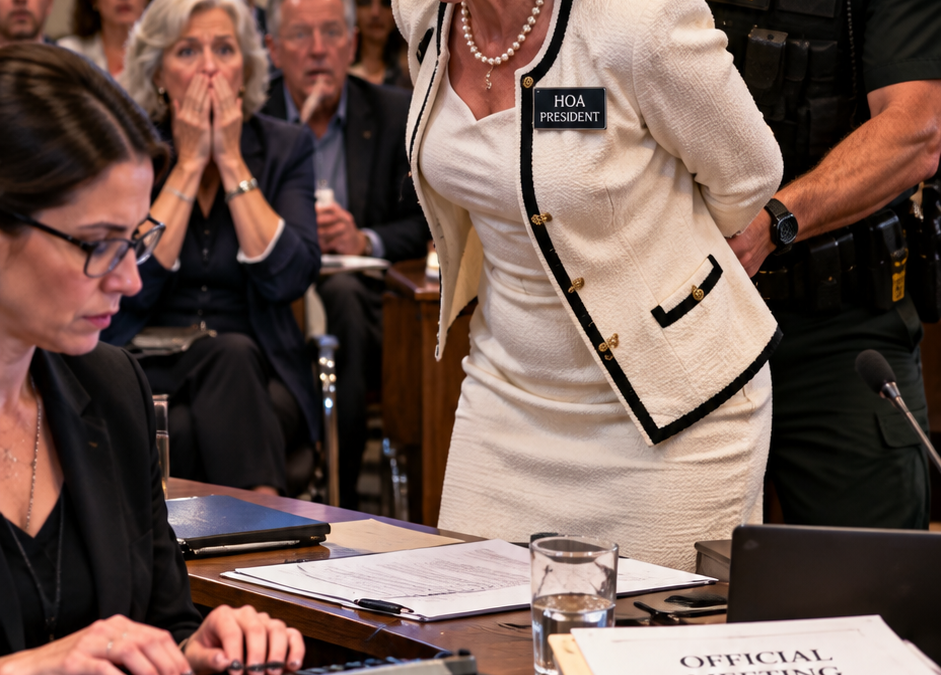
She turned.
The deputy placed one wrist behind her back.
Then the other.
The cuffs closed.
A clean metallic click.
I heard it from halfway across the room.
Evelyn began crying.
Not loudly.
Just sudden, shocked tears.
The perfect white suit wrinkled where the deputy held her elbow.
As they led her toward the aisle, she looked at me.
“You did this.”
I shook my head.
“No.”
She stopped.
The deputy guided her forward.
“You did.”
“I hired a court reporter.”
That was all.
She had done everything else herself.
Gary walked toward the stage after the doors closed.
The hall remained silent.
He picked up the microphone.
“Well.”
A few nervous laughs.
He looked toward the abandoned board table.
“I believe the bylaws require an emergency officer election whenever the presidency becomes vacant.”
The laughter grew.
“And while we are here, I move that the Sterling & Sons contract be suspended immediately pending full independent review.”
Hands went up before anyone even formally called the vote.
Someone shouted:
“Cancel it!”
Another:
“Refund the assessment!”
Margaret stood.
“And no more family contracts!”
That got applause.
Real applause.
Not Evelyn’s kind.
The project was frozen that night.
Within seventy-two hours, an independent engineering firm reviewed the drainage problem.
Their conclusion was devastating in its simplicity.
The neighborhood did need some stormwater improvements.
It did not need a $180,000 decorative retention pond.
It did not need an infinity-edge water feature.
It did not require my land.
It did not require demolition of my shed.
A conventional drainage swale, two culverts, and a modest retention basin entirely within HOA common property would solve the actual runoff problem.
Estimated cost:
$61,000.
Three independent bids later, the final contract came in at $58,400.
No special assessment was needed.
The existing reserve fund covered it.
The funniest part?
Sterling & Sons submitted a bid after the board reopened competition.
One hundred forty-nine thousand dollars.
They were not selected.
Charles Sterling sent an angry letter accusing the new board of unfair procurement practices.
Gary framed it.
The $3,500 assessment was rescinded.
Residents who had already paid received refunds.
Margaret brought me a pie.
I told her she didn’t need to.
She said:
“Yes, I do.”
It was apple.
Excellent pie.
The civil case moved faster than I expected.
Once the transcript, metadata, Brenda’s affidavit, and court order entered the record, the HOA’s insurance carrier hired independent counsel.
That lawyer reviewed the documents for perhaps three days.
Then the carrier issued a reservation-of-rights letter.
Translation:
The insurer might protect innocent association members.
It had very little interest in paying for Evelyn’s intentional fraud.
The board formally disavowed her actions.
Every fine against me disappeared.
The lien was released.
The title office recorded the release and attached the court order to the file.
My property was clean again.
Robert pursued damages for the attempted wrongful foreclosure.
I told him I didn’t care about money.
He looked at me as though I had insulted his profession.
“Elliot.”
“What?”
“Damages are how courts write apologies.”
“That sounds like something attorneys tell themselves.”
“Correct. It is also occasionally true.”
We settled.
The association’s new board paid my legal costs from a combination of recovered contractor deposits and insurance funds.
The individual misconduct claims against Evelyn remained separate.
My shed stayed exactly where it had been since 1965.
The criminal case was uglier.
Investigators found more than the altered minutes.
Evelyn had been routing smaller maintenance contracts toward companies connected to friends and relatives for years.
Nothing individually dramatic.
Eight thousand here.
Twelve there.
Consulting fees.
Landscaping contracts.
Emergency repairs that somehow never required competing bids.
The Sundoi project was merely the first one large enough to attract attention.
Gary helped investigators understand the financial records.
He enjoyed this far too much.
One evening he came to my house carrying three binders.
“What is that?”
“Vendor history.”
“You’re retired.”
“I remain emotionally employed.”
He found a pattern.
Contracts below the bidding threshold repeatedly split into smaller invoices.
A $54,000 landscaping project appeared as three $18,000 work orders.
A $63,000 security upgrade became separate “phases.”
A $72,000 clubhouse renovation was divided into materials, consulting, and implementation.
All technically below the amount requiring three competitive bids.
All awarded to connected vendors.
“Structuring,” Gary said.
“For HOA contracts?”
“Same instinct as money laundering.”
He smiled.
“Different wardrobe.”
The prosecutor added those records to the investigation.
Charles Sterling was interviewed.
His lawyer advised him to stop giving interviews very quickly.
Brenda resigned as secretary.
Not because she had done anything wrong.
Because she had spent years watching Evelyn control the board and had finally realized how close silence had brought her to becoming part of the fraud.
She came to my house one afternoon.
“I should have stopped her sooner.”
“You gave the affidavit.”
“After she used my name.”
“You still gave it.”
“I was scared.”
“I know.”
She looked toward my shed.
“She hated that thing.”
“I’m aware.”
“Do you know why?”
“I assumed aesthetics.”
Brenda shook her head.
“She hated that you kept winning.”
I laughed.
“What?”
“Every time she sent you a violation, you answered with a deed, statute, survey, or old county record. You never yelled. You never begged.”
“That irritated her?”
“It terrified her.”
“Why?”
“Because people like Evelyn can manage anger.”
Brenda looked at me.
“They don’t know what to do with documentation.”
That might have been the most accurate thing anyone said throughout the entire ordeal.
The recall election happened three weeks later even though Evelyn had already been removed from office following her arrest.
Residents wanted the vote anyway.
Symbolism mattered.
The result was 112 votes to remove her.
Two against.
Six abstentions.
Nobody admitted to the two.
Gary spent several days joking that Evelyn still had either two loyalists or one loyalist who owned two properties.
A completely new board took office.
Arthur became president.
Margaret became secretary.
Harold chaired finance oversight.
There is something deeply satisfying about watching the very people a tyrant dismissed as passive retirees become the ones who dismantle her system line by line.
The first resolution required competitive bids.
The second prohibited contracts involving close relatives of board members without disclosure and independent review.
The third required audio recording of every open meeting.
Margaret added a fourth.
Full draft minutes had to be posted for member review before final approval.
I attended that vote.
Arthur looked toward me.
“Any objection?”
“No.”
Gary raised his hand.
“One suggestion.”
Arthur sighed.
“Of course.”
“Use one font.”
The room laughed for nearly a minute.
Even I did.
Evelyn eventually entered a plea.
Forgery.
Attempted fraudulent lien enforcement.
Misuse of association records.
Several lesser financial counts were resolved through restitution and probation conditions.
She avoided prison after repaying significant amounts and accepting restrictions.
Some residents were disappointed.
I wasn’t.
The punishment I cared about was simpler.
She was permanently prohibited from serving as an officer, director, manager, or fiduciary of a homeowners association in the state during the term imposed by the court.
No board.
No gavel.
No super-admin password.
No rewriting minutes at 2:41 in the morning.
Charles Sterling’s company lost Oakridge Glen’s business entirely.
The county also reviewed his licensing history after investigators discovered some work had been billed outside the classification covered by his contractor license.
He blamed Evelyn.
Evelyn blamed Charles.
Their family holidays, I imagine, became less efficient.
David’s law firm remained association counsel under the new board after conducting an internal review.
David personally apologized to residents at the first meeting after the arrest.
“I should have challenged the process sooner.”
Arthur asked:
“Why didn’t you?”
David looked toward the floor.
“Because Mrs. Sterling had been president so long that procedural irregularities began to feel normal.”
Harold said from the audience:
“That is precisely when lawyers are supposed to become uncomfortable.”
David nodded.
“You’re right.”
No argument.
I respected him more for that than anything he had done before.
The drainage project was completed the following spring.
Sixty thousand dollars.
No easement across my land.
No decorative pond.
No infinity edge.
No demolished shed.
Just culverts and a properly graded basin.
It worked.
The first heavy storm sent water exactly where the new engineer predicted.
Gary and I stood under umbrellas watching it.
“So,” he said, “you mean runoff can be controlled without stealing somebody’s property?”
“Apparently engineering has advanced.”
“Remarkable.”
My shed survived another winter.
I repaired the western roof edge myself.
Replaced two cedar boards.
Oiled the old hinges.
Inside, my grandfather’s workbench still stood against the back wall.
His pencil marks remained along one beam.
Measurements.
Dates.
Small notes.
Nothing dramatic.
Just evidence that somebody had been there.
That mattered more to me after Evelyn.
Maybe because the whole dispute had ultimately been about records.
Who gets to say what happened?
Evelyn thought authority answered that question.
I learned something different.
Records are not powerful because an official person creates them.
They are powerful because they can be checked.
A deed against a map.
Minutes against a transcript.
A digital signature against metadata.
An invoice against a bank statement.
Words against what fifty people actually heard.
Truth survives best when it has witnesses.
Martha became something of a neighborhood celebrity.
She hated that.
Residents invited her to a barbecue the following summer.
Arthur presented her with a small plaque.
She stared at it.
“What am I supposed to do with this?”
“Accept our gratitude.”
“I did my job.”
Margaret hugged her.
Martha tolerated it.
Barely.
I asked afterward whether she had ever expected the meeting to become evidence in a criminal case.
“No.”
“Were you surprised by Evelyn’s speech?”
“Not especially.”
“Really?”
Martha packed her stenograph into its case.
“I spent thirty years in court.”
“So?”
“People say extraordinary things when they believe they control the room.”
That stayed with me.
Evelyn had believed exactly that.
She controlled the microphone.
The agenda.
The board.
The official minutes.
The portal.
The fines.
The lien system.
For fifteen years, that had been enough.
Every challenge entered a process she supervised.
Every complaint became a paragraph she summarized.
Every objection became a sentence she could soften.
Then one night, Martha sat in the corner.
Suddenly Evelyn no longer owned what had been said.
That was the whole case.
Not the Calibri font.
Not the metadata.
Not even the forged signature.
Those proved the alteration.
But the transcript destroyed the excuse.
Evelyn could say the minutes were abbreviated.
She could say Brenda made a mistake.
She could say formatting changed automatically.
She could say I misunderstood.
What she could not say was that she had never spoken the words.
They were there.
Every syllable.
Certified.
Timed.
Preserved.
My favorite moment came months later.
Not the arrest.
Not the canceled contract.
Not the refunds.
A regular HOA meeting.
Nothing special.
Thirty residents.
Arthur at the front.
Margaret taking minutes.
A small digital recorder sat openly on the table.
One homeowner complained about drainage near her driveway.
Arthur listened.
Harold asked a financial question.
Someone proposed replacing three dead trees near the entrance.
They argued for fifteen minutes about species.
Oak versus maple.
It was wonderfully boring.
Then a resident asked whether the draft minutes from the previous month had been corrected.
Margaret nodded.
“Yes. Mr. Lewis requested that his objection to the landscaping expense be included more accurately.”
She looked toward Mr. Lewis.
“Did the revision reflect your comment?”
He nodded.
“Yes.”
“Good.”
Then they moved on.
That was it.
No battle.
No retaliation.
No threat.
A resident said the record was wrong.
The secretary corrected it.
I sat in the back and almost laughed.
Evelyn had treated correction as rebellion.
The new board treated it as bookkeeping.
That difference was worth more than any court judgment.
I still live on the same three acres.
The elderberries are taller.
The driveway remains gravel.
Arthur once joked that the HOA might pave it for me as a peace offering.
I told him that would restart hostilities.
He believed me.
The shed still leans west.
County preservation staff inspected it during the lawsuit and confirmed its protected status.
I framed that letter inside.
Not because I need it.
Because I know my enemy.
Paper.
That supposedly passive medium Evelyn thought she could rewrite.
There is irony in the fact that paper defeated her.
A certified transcript.
A court order.
A deed.
A sworn affidavit.
A lien release.
A recall petition.
Hundreds of ordinary pages.
No shouting required.
No dramatic sabotage.
No midnight retaliation.
Just records.
Gary still visits every Thursday.
He brings coffee.
Sometimes documents nobody asked him to review.
Once he arrived with the HOA’s new vendor policy marked in red ink.
“You know you’re not on the board,” I said.
“I know.”
“Then why are you editing this?”
“Because Section Seven is weak.”
“You need a hobby.”
“This is my hobby.”
Margaret occasionally joins us.
Arthur too.
It has become a strange little tradition.
The four people Evelyn once regarded as background noise now sit at my kitchen table discussing budgets, storm drains, insurance renewals, and whether the association really needs a professional holiday-lighting contractor.
Usually we decide no.
Oakridge Glen changed.
Not completely.
People still care too much about lawns.
Someone recently filed a complaint about a purple front door.
There are limits to human progress.
But meetings changed.
Residents attend.
They ask questions.
Contracts are posted.
Minutes are reviewed.
Nobody uses the phrase supreme authority.
The first time Arthur heard a new homeowner call the board “the authority,” he corrected him.
“We’re administrators.”
I liked that.
Small distinction.
Huge difference.
As for Evelyn, she sold her house about eight months after sentencing.
The listing photographs were immaculate.
Cream furniture.
Perfect landscaping.
Everything staged beautifully.
The description called the neighborhood:
A TRANQUIL COMMUNITY KNOWN FOR STRONG RESIDENT INVOLVEMENT.
I nearly choked on coffee.
The house sat for ninety-two days.
Then sold below the original asking price.
Gary tracked it.
Of course he did.
“You know Zillow isn’t evidence,” I told him.
“It’s emotionally persuasive.”
Evelyn moved two counties away.
Someone later told Margaret she had joined the architectural committee of a condominium association.
That rumor lasted three days before another resident found the court restriction online.
She was removed before the first meeting.
I did not cause that.
Public records did.
Again.
There are people who say the ending should have made me feel sorry for her.
I understand the instinct.
Humiliation is unpleasant to watch.
Even when somebody built the stage herself.
And there were moments when I remembered Evelyn as a person rather than an antagonist.
A woman who had probably once volunteered because nobody else wanted to.
Someone who may have started by organizing landscaping, then budgets, then meetings.
Authority accumulates slowly.
So does entitlement.
Maybe the first time she changed a minor sentence in the minutes, she told herself it was clarity.
Maybe the first vendor connected to a friend truly was the best option.
Maybe the first procedural shortcut saved everybody time.
Then a decade passed.
No one challenged her.
Convenience hardened into privilege.
Privilege hardened into certainty.
By the time I brought Martha into that meeting, Evelyn did not believe she was breaking rules.
She believed she was the source of the rules.
That was why she said everything openly.
Why hide what you think you have the right to do?
She told fifty people she didn’t care about competitive bids.
She admitted the contractor was family.
She threatened fines.
She promised a lien.
She promised to take my property.
Then she went home and rewrote the minutes because somewhere inside her, beneath all that confidence, she still understood that the truth looked terrible on paper.
That contradiction destroyed her.
If she had genuinely believed her conduct was lawful, she would have left the minutes alone.
She didn’t.
At 2:41 in the morning, she opened Brenda’s file.
She found the dangerous parts.
She replaced them.
She attached Brenda’s name.
Then she published the version she wished had happened.
That single act turned arrogance into evidence.
The following year, on the anniversary of the meeting, Gary sent me a text at 2:41 a.m.
HAPPY CALIBRI DAY.
I blocked him until breakfast.
He considered that censorship.
I considered it sleep.
Martha retired fully not long afterward.
At her retirement dinner, she gave me a copy of the first page of the transcript.
Not the dramatic section.
Just the opening.
Date.
Location.
Appearances.
Ordinary information.
At the bottom she had written:
Accuracy is rarely exciting until someone needs it.
I framed that too.
It hangs inside the cedar shed beside the preservation letter.
Sometimes I sit there in the evening.
Rain on the roof.
Elderberry branches against the siding.
My grandfather’s old hand plane still in the cabinet.
I think about how close the building came to disappearing.
If I had signed Evelyn’s easement because fighting seemed exhausting, it would be gone.
If Margaret had stayed silent because she was afraid of the assessment, nothing would have changed.
If Brenda had refused the affidavit, Evelyn could have blamed her.
If David had defended the board instead of the association, the case would have become harder.
If Martha had not been in that back corner, Evelyn’s minutes might have remained the easiest version for a judge to read.
That is how abuses survive.
Not because everybody agrees.
Because enough people decide that objecting is too inconvenient.
Evelyn depended on inconvenience.
She made resistance expensive.
Fines.
Letters.
Deadlines.
Legal language.
She expected the average homeowner to calculate that peace was cheaper than truth.
For years, she was right.
Then she chose the wrong meeting.
She chose the wrong contract.
She chose the wrong piece of land.
Most importantly, she chose the wrong night to believe that spoken words disappear when the microphone turns off.
They don’t.
Not always.
The $180,000 family contract was canceled.
The $3,500 assessment was refunded.
The foreclosure lien was erased.
My title was restored.
My grandfather’s shed remained standing.
The board was replaced.
The bylaws were strengthened.
Residents gained access to records.
And Evelyn Sterling lost the only thing she had valued more than control over other people’s property.
Control over the story.
That was the part she never got back.
Every time someone searched the case, the same transcript appeared.
Every time the association discussed procurement reform, her name came up.
Every time a board member suggested shortening debate, somebody joked:
“Careful. We’ve still got recorders.”
Her rewritten minutes survived less than twenty-four hours before we downloaded them.
Martha’s transcript will survive for decades.
Evelyn believed the official version of history belonged to whoever held the pen.
She was wrong.
History belongs to the record that can survive comparison.
And when the handcuffs closed around her wrists in the same room where she had once told me that whatever she said was the only truth that mattered, I finally understood why she had laughed when Martha walked in with that little black machine.
She thought it was a toy.
It turned out to be the one thing in Oakridge Glen she couldn’t rewrite.








