HOA Karen Put a Gate Across My Father’s Road and Told Me I Needed Her Permission to Enter My Own Land
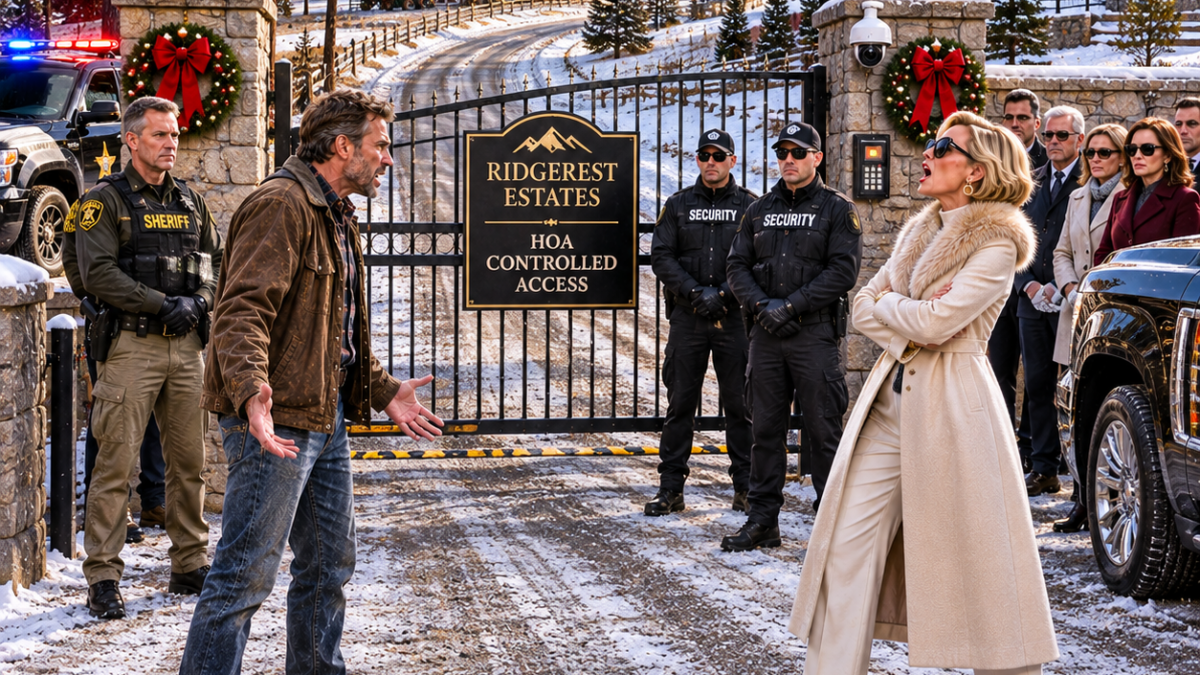
part 2
I barely slept.
My father had been stubborn in ways that could drive a family insane, but he was predictable.
He labeled everything.
Kept tax receipts from years nobody needed tax receipts anymore.
Saved tractor manuals after selling the tractor.
Wrote dates on the backs of photographs.
If he had signed away control of the most important road on the property, there should have been paperwork.
More importantly, there should have been an argument.
Dad didn’t surrender anything quietly.
The next morning, I drove to the Ridgerest management office.
Lorraine seemed prepared for me.
She sat behind a wide desk with floor-to-ceiling windows overlooking the subdivision and slid a thick folder across the polished surface before I had fully sat down.
“There.”
I opened it.
The first document was titled:
CONSENT TO ANNEXATION AND ROAD MAINTENANCE COVENANT
Dated 2019.
At the bottom appeared a signature.
Russell Whitaker.
According to the document, my father had agreed to place Whitaker Road under Ridgerest jurisdiction, allow the HOA to control vehicle entry, permit construction of access infrastructure, accept maintenance fees, and bind future owners.
In other words, if the document was genuine, Lorraine’s position was far stronger than I wanted to admit.
She leaned back.
“Your father understood that Ridgerest’s growth benefited the entire western side of the area.”
I didn’t answer.
I kept reading.
Something felt wrong.
Then I found the first problem.
My father’s full legal name was Russell Everett Whitaker.
It appeared that way on deeds.
Taxes.
Bank records.
Military papers.
Insurance policies.
Everything.
The consent document said:
Russell Edward Whitaker.
Small difference.
But Dad would have noticed.
I turned the page.
Second problem.
The legal description used Ridgerest’s internal lot-numbering system.
My father never described his property that way.
His deed used metes-and-bounds language tied to survey monuments.
Third problem.
The road was called West Ridge Access Road.
Dad never called it that.
Not once.
To him, it was Whitaker Road.
I looked at Lorraine.
“I want a copy.”
She reached across the desk and pulled the folder back.
“Document requests need to go through counsel.”
“You just showed it to me.”
“You’ve reviewed it.”
“I want a copy.”
“Our attorney will handle formal production.”
That was the moment my suspicion became real.
If she was confident in the document, why did she suddenly care whether I possessed it?
Then she slid a different form toward me.
“If you need immediate access, there is a temporary solution.”
I read it.
It required me to provide my license plate, request entry twenty-four hours in advance, accept HOA gate procedures, and acknowledge association management authority.
I pushed it back.
“No.”
“You said you need access.”
“I said I own the property.”
“This is how access is managed now.”
“I’m not signing something that says I recognize your authority while I’m disputing your authority.”
Her smile disappeared.
“You are making this harder than necessary.”
“No. Whoever built that gate did that.”
She stared at me.
“Your father understood reality better than you do.”
That sentence stayed with me.
I left the office and called Elise Marlowe.
Elise was a real-estate attorney I had been referred to through a family friend.
I expected a thirty-minute consultation.
We talked for almost two hours.
She listened.
Reviewed photographs.
Read my deed copy.
Looked at the HOA map.
Then I told her about the 2019 covenant.
Her expression changed.
“That document is recorded?”
“I don’t know.”
“Then that’s the first question.”
We drove to the county recorder’s office.
The answer was worse than I hoped.
The 2019 document was there.
Recorded.
Officially indexed.
That didn’t make it valid automatically, but it meant the HOA hadn’t simply created an internal memo.
Somebody had placed the instrument into the public land records.
Elise pulled the original 1983 deed.
We stood over the copy together.
There it was.
A forty-foot-wide strip running from the public road all the way into the Whitaker parcel.
Not an easement.
Not a shared access right.
The land beneath Whitaker Road itself belonged to the parcel.
Elise traced the description with one finger.
“If this chain still holds, your family didn’t merely possess a right to use that road.”
“We owned it.”
“Exactly.”
I thought about the concrete posts.
The cameras.
Buried power.
Gate controls.
“If they never acquired title…”
“They built all of that on your land.”
She looked at me.
“Before we say anything stronger than that, we need a certified survey.”
“Why?”
“Because an old deed tells us legal history. A licensed surveyor gives us a current location we can defend under oath.”
She was right.
Then she found another record.
An Access Improvement Declaration filed by Ridgerest.
It expanded the HOA’s claimed management authority over the same road.
I stared at it.
“So this didn’t stop in 2019.”
“No.”
“What have they been doing with the road?”
That question changed everything.
Because once Elise started investigating Ridgerest’s expansion history, we found the money.
Over the previous three years, the HOA had helped market eleven new residential lots on the western side of the development.
One feature appeared repeatedly in promotional materials:
PRIVATE SECURED WESTERN ACCESS
That access was Whitaker Road.
Worse, a developer had paid Ridgerest approximately $310,000 for rights associated with using that western route in the expansion plan.
The HOA had also been collecting annual gate fees and road-maintenance charges from residents using it.
I drove back to the public end of the road one afternoon and watched.
Every few minutes, another Ridgerest vehicle passed through the gate.
They were using a connector lane inside the development that tied directly into Whitaker Road.
Families.
Contractors.
Delivery vans.
Residents.
The road had become part of their transportation network.
My father’s land had been monetized.
Vernon eventually came outside.
“You need to stop recording HOA facilities.”
I pointed toward my feet.
“I’m standing on the public right-of-way.”
“You’re harassing staff.”
“Have you ever actually seen a deed showing Ridgerest owns the ground under that gate?”
He said nothing.
Not defensively.
Not angrily.
Nothing.
That silence was the first crack.
Two days later, Lorraine sent me a formal violation notice.
Apparently I had violated “community access regulations” by filming, questioning guards, and interfering with HOA security.
Fine:
$2,500.
I called Elise.
She read it.
Then laughed.
“You’re not even a member.”
“Lorraine says I am.”
“She says your parcel was annexed.”
“Same thing.”
“No. And even if the covenant eventually survives review, issuing fines while the underlying membership status is disputed is aggressive.”
“What do we do?”
“Nothing impulsive.”
That became Elise’s favorite sentence.
It was also the least satisfying.
I needed access to the farmhouse.
With help from a neighboring property owner, I used an old farm trail that reached the rear of the parcel without crossing the main gate.
It took almost an hour.
When I finally stepped inside Dad’s house, the smell hit me first.
Dust.
Wood.
Old coffee.
Machine oil drifting in from the workshop.
Almost nothing had changed.
His boots were still near the mudroom.
A jacket hung from the same hook.
The kitchen calendar still showed the month before he went into the hospital.
For the first time since the gate dispute began, the anger disappeared.
I just missed him.
I had come home intending to sort tools, empty drawers, and decide whether to sell.
Instead, I was trying to prove my dead father had not signed away his own road.
I started searching.
Desk drawers.
File cabinets.
Tax folders.
Insurance boxes.
Nothing.
Then I remembered the steel storage locker in the workshop.
Dad built it when I was a teenager.
Behind one drawer was a shallow hidden compartment.
He used to keep cash there until I found it at seventeen.
He moved the cash.
Apparently he kept using the compartment.
Inside was a metal document tube.
I unscrewed the cap.
Surveys.
Letters.
Certified-mail receipts.
Photographs.
Almost twenty years of correspondence.
One envelope stopped me cold.
Dated 2007.
Addressed to Ridgerest Estates Homeowners Association.
Across the front, in Dad’s handwriting:
KEEP FOREVER
My hands went still.
The letter inside was a response to an early proposal from Ridgerest seeking use of Whitaker Road as a secondary exit.
Dad’s answer was direct.
No.
He refused any gate.
Any toll.
Any association control.
Any permanent access.
Another letter from 2011 repeated the refusal.
Then another collection of certified receipts.
Boundary photographs.
Survey records.
The original deed.
And language that could not have been clearer.
The forty-foot strip belonged exclusively to the Whitaker parcel.
No outside association had authority to install gate infrastructure without written consent.
I sat down on Dad’s workbench stool.
For years, I had teased him about never throwing paper away.
He kept receipts for bolts purchased in 1996.
He kept warranties after the companies disappeared.
He kept duplicates of survey maps.
Now I understood.
Dad had known something was happening.
He just hadn’t told me.
I called Elise.
“You need to come out here.”
She arrived before dark.
I spread the documents across the kitchen table.
She read the 2007 letter.
Then 2011.
Then the deed.
Then the tax records.
Dad had continued paying property taxes attributable to the road through 2025.
Elise looked at me.
“If the county never transferred the strip and the survey confirms the gate sits inside the historic boundary, Ridgerest has a very serious problem.”
“What about the 2019 consent?”
“That is the document keeping their argument alive.”
“So we prove it’s wrong.”
“We prove what we can prove.”
She tapped the letters.
“These help enormously.”
Before we left, I found one more receipt.
Dad had personally paid more than $8,000 for road repairs.
I held it up.
“If Ridgerest owned and maintained the road, why was he still paying for repairs?”
Elise smiled slightly.
“Exactly.”
Lorraine escalated before the surveyor even arrived.
A new notice appeared on Dad’s farmhouse door.
UNLAWFUL OCCUPANCY OF HOA-COVENANTED PARCEL
Fine balance:
$6,750.
Deadline:
Seventy-two hours to sign an updated access agreement or face indefinite suspension.
I photographed it.
Sent it to Elise.
She sent a formal demand requiring Ridgerest to stop obstructing me, stop issuing fines, preserve all records, and produce every document related to the alleged annexation.
Lorraine rejected the demand in less than two hours.
The next morning, surveyor Mason Greer met us near the gate.
Mason was exactly the kind of man I wanted measuring land.
Quiet.
Methodical.
No interest in neighborhood politics.
He started by locating historic boundary monuments.
The first marker was buried under brush.
The second took longer.
He measured.
Checked.
Measured again.
Then a third time.
Finally, he turned toward us.
“The gate isn’t near the Whitaker boundary.”
My chest tightened.
“How far?”
“Approximately seventeen feet inside it.”
I looked at Lorraine’s sign.
The cameras.
The control box.
The concrete.
All of it.
“Inside my property?”
“Yes.”
He continued surveying.
It got worse.
Two security cameras.
Control housing.
Fence sections.
More than one hundred feet of buried electrical conduit.
All inside the Whitaker parcel.
Lorraine arrived while Mason was driving marker stakes.
Four guards came with her.
“Stop immediately.”
Mason looked up.
“I’m conducting a licensed boundary survey for the landowner.”
“This is HOA property.”
He went back to work.
Lorraine turned to Vernon.
“Pull those stakes.”
I stepped between them.
“Do not touch survey markers.”
Her face hardened.
“You have no authority here.”
I pointed to Mason.
“He does.”
“The association does not recognize this survey.”
“Then get your own.”
“This land belongs to Ridgerest.”
“Prove it.”
She called the sheriff.
Again.
This time Sheriff Calvin Rhodes arrived personally with Deputy Tate.
Lorraine spoke first.
Trespassing.
Interference.
Unauthorized surveying.
Harassment.
Then Calvin reviewed the deed.
Mason’s credentials.
The preliminary boundary map.
Dad’s tax records.
He looked toward the gate.
Then back at Lorraine.
“I don’t have a basis to remove Mr. Whitaker or his surveyor from this location.”
Lorraine stared.
“This is HOA land.”
Calvin’s answer landed in front of every guard.
“You have not established that.”
She pulled out a copy of the 2019 consent.
“This proves it.”
Elise stepped forward.
“Sheriff, please note that document in your report.”
Lorraine smiled.
She thought Elise had helped her.
I knew Elise well enough by then to know the opposite was true.
She wanted the document fixed in the official record.
Preserved.
Identifiable.
Impossible to quietly replace later.
Mason completed the survey.
His final conclusion was unambiguous.
One hundred percent of the main gate foundation sat inside Whitaker property.
Elise filed for emergency court relief.
At the same time, Ridgerest was compelled to begin producing records.
Hundreds of pages arrived.
Minutes.
Emails.
Management files.
Contracts.
Scanned deeds.
Buried among them was a scan of the original 2019 consent form.
Elise called me late that evening.
“Grant, look at the notary block.”
I opened the file.
A notary name.
Commission number.
Date.
“What?”
“I checked the commission.”
“And?”
“It expired fourteen months before the date shown on this document.”
I sat back.
“So it’s forged.”
“Stop.”
“Elise—”
“An expired notary commission does not automatically prove the signature is forged.”
“Then what does it prove?”
“That we need a much deeper investigation.”
She was right.
Again.
We sent verified samples of Dad’s signature to a forensic document examiner.
Tax returns.
Bank documents.
Original deed.
Insurance forms.
Documents signed across decades.
Meanwhile, Elise traced the recording history.
Dad had not personally filed the 2019 consent.
Neither had a Whitaker attorney.
Neither had anyone from my family.
The filer was a representative of Ridgerest’s management company.
That didn’t prove fraud by itself.
But it added another question.
Then the preliminary handwriting analysis arrived.
Multiple inconsistencies.
Not enough for Elise to make a dramatic accusation in court.
Enough to keep digging.
She pulled 2019 board records.
One entry caught her attention:
WESTERN ACCESS ACQUISITION — EXECUTIVE SESSION
No meaningful public detail.
Three months later, the Whitaker consent appeared in county records.
Six months after that, the developer agreement worth $310,000 was completed.
Then I found something in construction records that made even Elise go quiet.
The gate drawings had been ordered before the date Dad supposedly signed the consent.
They were planning infrastructure before they supposedly had authorization.
Lorraine’s explanation shifted.
Dad had verbally agreed.
No witnesses.
No letters.
No meeting minutes showing consent.
Nothing explaining why a man who had supposedly agreed kept mailing certified objections.
Then Elise found my father’s 2020 letter.
Another demand that Ridgerest stop encroaching on Whitaker property.
Received by Lorraine’s office.
Signed for.
That was devastating.
Because even if Lorraine wanted to argue she believed the 2019 consent was valid, she could not credibly say she had never known Dad continued objecting afterward.
The county investigative authority was notified about the suspicious notarization.
Sheriff Rhodes began treating the matter as something potentially larger than a civil boundary dispute.
Lorraine responded by escalating.
Again.
Two additional concrete barriers appeared in front of the gate.
Security doubled to six guards.
A new sign went up:
GRANT WHITAKER — ENTRY PROHIBITED BY HOA ORDER
Elise stared at the photograph.
“She is doing this after receiving the survey?”
“Yes.”
“After our demand letter?”
“Yes.”
“After notice of the court filing?”
“Yes.”
“She is making our case easier.”
That didn’t make me feel better.
I drove out with Elise.
Recorded everything.
Lorraine stood behind the barricade.
I kept the camera on her.
“Lorraine, did you authorize these additional barriers?”
“Yes.”
“You received the certified survey showing the original gate lies inside the Whitaker parcel?”
“Your survey does not change HOA authority.”
“You’re continuing to block access despite that survey?”
“Yes.”
No hesitation.
That recording became one of the most useful pieces of evidence we had.
Because now she had admitted knowledge.
This was no longer a situation where someone could say the HOA had innocently relied on an outdated map.
The court scheduled an expedited hearing.
Ridgerest’s attorney built their argument around one thing.
The 2019 consent.
Elise built ours around everything else.
1983 deed.
2007 refusal.
2011 refusal.
2020 cease-and-desist letter.
Tax payments.
Road repair invoices.
Certified survey.
Expired notary commission.
Recording history.
Preliminary signature concerns.
The judge did not resolve the entire ownership case that day.
He didn’t need to.
He issued temporary relief.
Ridgerest was barred from blocking my access.
No further fines.
No alteration of physical evidence.
No additional construction.
And I was entitled to pass through Whitaker Road without delay once the order was served.
I exhaled for what felt like the first time in weeks.
Then Lorraine made the worst decision of the entire dispute.
Somehow, she learned the ruling before the sheriff arrived to serve it.
She told Vernon the gate was to remain closed under all circumstances.
Even if Sheriff Rhodes personally showed up holding the signed order.
The following morning, I drove toward Whitaker Road.
Elise followed in her car.
Behind her came two sheriff’s vehicles.
We moved slowly.
No theatrics.
No sirens.
Just a line of vehicles headed toward the gate that had kept me from my father’s house since the day I returned.
Lorraine was already there.
Six guards stood near her.
The gate stayed shut.
Sheriff Rhodes got out carrying the certified order.
Vernon approached him.
“Sir, I’m instructed not to open the gate.”
Calvin held up the document.
“I’m here to serve a court order.”
Lorraine stepped forward.
“The HOA intends to appeal.”
Elise answered.
“There is no stay.”
Lorraine turned toward Vernon.
“Keep it closed.”
Calvin handed him the order.
“Read it.”
Vernon did.
Slowly.
Then he looked at Lorraine.
“You told us this land belongs to the HOA outright.”
“It does.”
“This says ownership is disputed and Mr. Whitaker cannot be obstructed.”
“I pay your salary.”
Vernon stared at her.
Then shook his head.
“You do not pay me enough to defy a judge.”
I almost smiled.
Vernon turned toward the gate technician.
“Open it.”
Lorraine lunged toward the control panel.
Calvin stepped calmly between her and the equipment.
“Don’t turn a civil dispute into something else.”
She stopped.
The gate began to move.
Motor humming.
Steel lifting.
For the first time since I came home, Whitaker Road opened for me.
No badge.
No application.
No twenty-four-hour notice.
No permission from Lorraine Beckett.
I drove through.
The moment should have felt triumphant.
Instead, I almost cried.
Because halfway down the road, I saw the barn exactly as I remembered it.
The tin roof.
Workshop.
Trees.
Dad’s mailbox leaning slightly toward the ditch.
All the things that had existed before Lorraine’s gate made me feel like a stranger on my own land.
I stopped near the workshop.
Put both hands on the steering wheel.
And whispered:
“I’m home, Dad.”
The larger breakthrough came minutes later.
Vernon asked to speak privately with Elise and Sheriff Rhodes.
He held a small external drive.
Lorraine watched from a distance.
Vernon explained that the security team archived instructions concerning gate operations.
Over time, he had begun preserving certain emails separately because some orders from Lorraine made him uncomfortable.
One email was devastating.
Sent before the 2019 consent surfaced.
Lorraine had written to a management representative that:
Whitaker never signed the original access proposal.
Then:
Western Road needs to be secured before the developer closes.
I read the email twice.
My hands started shaking.
Not because I was surprised anymore.
Because Dad had been right all along.
Another email instructed staff not to provide the Whitaker family with copies of documents until legal counsel approved disclosure.
Then came the file history.
The original consent document had been created on a computer inside Ridgerest’s management office.
Not delivered electronically by my father.
Not created by my father’s attorney.
Not originating from any Whitaker device anyone could identify.
Lorraine stood thirty yards away watching Vernon hand over the drive.
That was the first moment I saw her understand what was happening.
This was no longer one property owner arguing with one HOA president.
Her own enforcement system had begun producing evidence against the story she had ordered everyone to believe.
Sheriff Rhodes instructed her to remain available for investigators.
From there, paperwork did most of the damage.
Dad had refused Ridgerest repeatedly.
The developer needed western access.
The association needed legal control of Whitaker Road to deliver what it promised.
A consent form appeared at exactly the right time.
The developer paid $310,000.
The gate was built.
Fees flowed.
The road became an HOA amenity on internal maps.
Then Dad died.
I returned.
Lorraine tried to pressure me into accepting the arrangement by making access conditional on signing new paperwork.
A senior board member eventually turned over minutes from the 2019 executive session.
Dad was described as:
THE REMAINING OBSTACLE TO WESTERN ACCESS.
Not a partner.
Not a consenting landowner.
An obstacle.
There was no mention that he had agreed to anything.
Financial records showed significant portions of the developer payment were used for the gate, cameras, connector road, consulting expenses, and other HOA projects.
That created a problem for more people than Lorraine.
If Ridgerest never possessed the western access rights it sold, then the association had accepted a large payment for something it did not own.
The developer’s attorneys became involved.
The HOA’s insurer became involved.
Board members started hiring their own counsel.
Lorraine blamed the management company.
Then Elise produced emails carrying Lorraine’s own name.
Her own account.
Her own language.
The 2020 certified letter from Dad made things even worse.
It had been delivered directly to Lorraine’s office.
At the next hearing, the judge read it himself.
Then looked at Ridgerest’s attorney.
“Was Mrs. Beckett aware of this letter?”
The attorney asked for time to confer with his client.
Lorraine sat several tables away.
Silent.
I found myself thinking about the first morning at the gate.
Her smile.
You need my permission to pass through.
Now she was sitting in court while a judge read my father’s refusal.
The temporary orders stayed in place.
My access remained unrestricted.
Ridgerest was barred from collecting additional gate or road fees tied to Whitaker Road during litigation.
The developer was formally notified that the rights it had paid for were disputed.
That same week, Ridgerest’s board called an emergency meeting.
Lorraine was suspended from her leadership role pending internal and external investigations.
I thought that would feel like the ending.
It didn’t.
Because temporary access wasn’t enough.
I didn’t want my right to drive home resting forever on an emergency order that another board might challenge.
I wanted the title fixed.
Permanently.
Elise agreed.
She filed for quiet title.
Permanent injunction.
Damages.
Removal of the gate infrastructure.
The final hearing was less dramatic than people imagine courtroom battles should be.
No shouting.
No surprise witness running through the doors.
Elise simply built the story in chronological order.
My family purchased the sixty-eight-acre property, including the forty-foot road strip.
Dad refused Ridgerest’s first access proposal.
He refused again.
Ridgerest needed western access for expansion.
A questionable consent appeared.
Dad formally objected again.
Dad paid for road repairs personally.
Ridgerest expanded its claimed authority.
Dad was still paying taxes on the road.
Then Mason took the stand.
He explained the survey.
Boundary monuments.
Measurements.
Coordinates.
Historical descriptions.
Current field conditions.
The gate didn’t straddle the property line.
It wasn’t accidentally a few inches over.
The main foundation sat approximately seventeen feet inside Whitaker property.
Every piece of the primary access system depended on land Ridgerest did not own.
Then came Dad’s letters.
Then the emails.
Then Lorraine’s statement:
Whitaker never signed the original access proposal.
The HOA’s attorney tried an alternative argument.
Years of continuous use, he said, had created some form of implied or prescriptive right even if the 2019 paperwork failed.
Elise answered simply.
Continuous use is not the same as uncontested use.
Dad had objected in writing.
Repeatedly.
For more than a decade.
The record showed protest after protest.
Certified letters.
Maintenance payments.
Boundary records.
There was nothing peaceful or unopposed about Ridgerest’s use.
The judge took a recess.
When we returned, I could barely feel my hands.
Then he ruled.
The 2019 annexation document had not created a valid ownership or control claim over the Whitaker parcel.
Title to Whitaker Road belonged to me through the unbroken Whitaker chain of ownership beginning in 1983.
Ridgerest Estates HOA was permanently barred from controlling my access.
No badges.
No permission forms.
No HOA entry approvals.
No fines.
No HOA restrictions on the sixty-eight acres.
No gate rebuilt on Whitaker land.
No future sale of Whitaker Road access rights to developers.
No description of the road as HOA common property.
Then came the part I had wanted since the first morning.
The HOA was ordered to remove its gate.
Its cameras.
Its control hardware.
Its buried electrical conduit.
Its barriers.
And restore the entrance.
At Ridgerest’s expense.
Other claims for legal expenses, obstruction damages, and unauthorized construction costs would continue to be resolved under the judgment.
But the most important sentence was already there.
The Whitaker parcel had not legally become part of Ridgerest Estates.
Ever.
That language mattered more than money.
Because twenty years from now, I didn’t want another HOA president finding an old internal map and starting the same argument.
I wanted the answer attached permanently to the land record.
After court, Lorraine walked toward the exit.
No cream blazer this time.
No clipboard.
No security detail.
I could have said nothing.
I almost did.
Then I spoke.
“My father already told you no.”
She stopped.
Didn’t turn immediately.
“He told Ridgerest no in 2007.”
Still nothing.
“Then again in 2011.”
Lorraine turned.
For once, she looked tired instead of powerful.
I continued.
“You assumed he was gone and nobody else would remember.”
Her jaw tightened.
I expected anger.
Instead, she said nothing.
Then walked away.
That was the last time Lorraine Beckett ever ordered anyone to open or close a gate on my land.
A month later, I stood beside Whitaker Road while a construction crew dismantled the access system.
Ridgerest paid.
Court order.
The cameras came down first.
Then the card reader.
Keypad.
Control housing.
Electrical conduit was pulled from the trench.
The steel posts took longer.
Concrete had been poured deep.
One worker shook his head.
“Whoever built this expected it to stay forever.”
“So did they.”
The two additional barriers Lorraine had installed were loaded onto a flatbed.
Then the main gate itself was lifted away.
For the first time, the entrance looked open.
Vernon showed up during the removal.
He no longer worked for Lorraine.
The new board had retained him temporarily to assist with the transition because he knew the gate system.
He walked over.
“Grant.”
“Vernon.”
“I owe you an apology.”
“You followed the paperwork you were given.”
“I still stopped you.”
“You were hired to stop unauthorized vehicles.”
He looked toward the disappearing gate.
“I should’ve asked more questions.”
“So should a lot of people.”
He extended his hand.
I shook it.
Before leaving, he said something I respected.
“Your dad must’ve been stubborn.”
I smiled.
“You have no idea.”
The investigation into the 2019 document continued separately.
That process was no longer mine to control.
The developer pursued reimbursement over the access rights Ridgerest had sold.
The board’s internal review removed Lorraine permanently from the presidency.
Several governance policies changed.
Real-estate transactions required independent title verification.
No single officer could represent association ownership without supporting records.
Major access agreements required outside counsel.
None of that restored the years Dad spent fighting quietly.
But maybe it prevented the next family from inheriting the same mess.
The new Ridgerest board contacted me after the judgment.
Three members came to the farmhouse.
No lawyers at first.
No threats.
No security.
They sat at Dad’s kitchen table.
The interim president, Nora Jennings, spoke carefully.
“We would like to discuss whether Ridgerest can continue using Whitaker Road under a legitimate agreement.”
I looked at Elise.
She said nothing.
Nora continued.
“We would pay annual access fees.”
“How much?”
She gave me a number.
It was significant.
They would maintain the road.
Carry insurance.
Limit vehicles.
Indemnify me for specified risks.
Everything Ridgerest should have negotiated decades earlier.
I listened.
Then said no.
Nora looked surprised.
“Is the amount insufficient?”
“It isn’t about the amount.”
“Then why refuse?”
I looked toward the workshop.
Because that decision already had an answer.
My father had given it.
No.
No.
Still no.
I had spent months proving his answer had never changed.
I wasn’t going to turn around and sell the road because Ridgerest finally learned how to ask politely.
“My father decided this.”
Nora nodded slowly.
“I understand.”
“They have another legitimate entrance.”
“Yes.”
“It adds a few minutes.”
“Yes.”
“Then use it.”
She closed the folder.
No argument.
No Karen speech about community needs.
Just:
“Thank you for hearing us.”
That was what respect looked like.
Some Ridgerest residents were unhappy.
Their western shortcut disappeared.
Morning commutes grew longer.
Delivery routes changed.
A few approached me directly.
One man accused me of punishing homeowners for decisions they didn’t make.
I understood the frustration.
But I showed him the boundary map.
Then Dad’s letters.
Then the court order.
He stared.
“So the HOA never owned it?”
“No.”
“But we paid gate fees.”
“To the HOA.”
“And the developer paid them for this road?”
“Yes.”
He looked back toward the eastern entrance.
“That’s insane.”
“It wasn’t your fault.”
He looked at me.
“Still sucks.”
“That part I understand.”
He left.
I didn’t enjoy inconveniencing families.
But ownership rights don’t become illegitimate because correcting a mistake is inconvenient.
Ridgerest had built years of expectations around access that never belonged to them.
The solution wasn’t requiring me to continue surrendering land.
The solution was for Ridgerest to reorganize around what it actually owned.
I restored the entrance.
Not perfectly.
Some scars remained.
Two faint concrete patches marked where the gate foundations had been cut away.
I could have excavated them completely.
Instead, I left them.
Not as trophies.
As reminders.
I installed one small metal sign.
WHITAKER ROAD
PRIVATE PROPERTY
NO HOA AUTHORITY
Frankly, Dad would have hated the last line.
He would have said the deed already said it.
But I liked making things easy for future security guards.
Then I went into the workshop.
The metal document tube was still on the bench.
I opened it.
Dad’s letters.
Certified receipts.
Old survey.
Original deed copy.
Tax records.
Every piece of paper he had kept when the rest of us probably would have thrown half away.
I added three things.
Mason’s certified survey.
The permanent injunction.
The quiet-title judgment.
Then I sealed the tube.
Placed it back inside the hidden compartment.
For years, I thought Dad kept paperwork because he distrusted everyone.
I used to tease him.
“You’ve got receipts older than I am.”
“Paper remembers better than people.”
That was one of his sayings.
At the time, I thought it was another version of his paranoia.
Now I understood.
Land is memory written in legal descriptions.
People move.
Boards change.
Presidents resign.
Neighbors die.
Internal maps get redesigned.
But if you have the original deed, surveys, letters, receipts, and recorded history, someone has to work much harder to rewrite the truth.
Lorraine almost succeeded because repetition creates normality.
For seven years, Ridgerest residents drove through the gate.
Paid fees.
Used the connector road.
Saw HOA cameras.
Showed badges.
The longer it continued, the more legitimate it looked.
New homeowners probably never asked whether the land beneath the gate belonged to the association.
Why would they?
The gate existed.
The guard existed.
The bill existed.
The HOA map existed.
The access fee existed.
Everything looked official.
That was the danger.
A false claim repeated through enough bureaucracy can start feeling more real than the original boundary.
Dad’s paperwork interrupted that transformation.
His refusal letters proved Ridgerest’s use had never been peaceful acceptance.
His repair invoices proved he continued acting like the owner.
His tax payments proved the county still treated the strip as Whitaker property.
His 2020 letter proved he continued objecting even after the so-called consent.
The documents did what Dad couldn’t do after his death.
They testified.
That thought hit me hardest one night after the case was over.
I was sitting alone at the kitchen table.
Dad’s chair across from me.
For months, I had been angry he never told me how serious the dispute was.
Why hadn’t he called?
Why hadn’t he asked for help?
Why did I learn about the gate after he was gone?
Then I found an unfinished letter in another folder.
Not to the HOA.
To me.
He never mailed it.
It was only half a page.
He wrote that Ridgerest had been “pushing again.”
He wrote that he had “all the old papers.”
Then:
No need dragging you home for something I can still handle.
That sentence broke me.
Because it sounded exactly like him.
Dad never wanted to be a burden.
Even when cancer arrived, he waited too long before telling me how tired he had become.
He believed protecting family meant carrying things alone.
I wished he hadn’t.
I wished I’d been there.
Not because I could have magically solved Ridgerest before 2019.
Because he shouldn’t have had to stand against them alone.
I folded the letter.
Put it with the others.
Then sat there until after midnight.
That changed the meaning of the lawsuit for me.
At first, it was about anger.
Then access.
Then ownership.
Eventually, it became about finishing something Dad had spent years refusing to surrender.
Not revenge.
Completion.
The next spring, I decided to keep the property.
That surprised everyone, including me.
When I first returned, my plan had been to sort the estate and probably sell.
Sixty-eight acres required maintenance.
The farmhouse needed work.
The barn roof wasn’t going to repair itself.
I had a job in another state.
A life elsewhere.
But after spending months defending the land, selling it immediately felt wrong.
So I changed my plans.
I moved back temporarily.
Then temporary became permanent.
I repaired the workshop.
Repainted the barn.
Fixed drainage along Whitaker Road.
Rebuilt a section of fence.
Found my old bicycle in the loft, rusted beyond practical use.
Kept it anyway.
Sometimes Ridgerest homeowners waved when they passed the boundary.
Some didn’t.
That was fine.
I didn’t need them to like me.
I needed the line to remain where the deed said it belonged.
Nora, the new HOA president, eventually became someone I could speak with normally.
One afternoon she called.
“Grant, we’re planning utility work near the eastern boundary.”
“Does it touch mine?”
“No, but contractors may stage equipment close.”
“Send me the plan.”
She did.
I reviewed it.
No problem.
I wrote back:
Approved for temporary staging within the marked area only.
She replied:
Thank you.
That was it.
No crisis.
No lawsuit.
No sheriff.
No gate.
One email asked permission.
One email gave permission.
Amazing how peaceful property relations become when nobody starts by stealing the answer.
A year after the gate came down, Sheriff Rhodes stopped by.
He was off duty.
He leaned against his truck and looked toward the entrance.
“Looks better.”
“Less expensive.”
He laughed.
“You know Lorraine used to call our office every time somebody challenged her.”
“That doesn’t surprise me.”
“Most of it was parking and noise.”
“She liked uniforms.”
“She liked authority.”
He looked at me.
“Difference.”
“What?”
“Between liking authority and respecting it.”
That stayed with me.
Lorraine loved authority when she believed it belonged to her.
HOA title.
Security guards.
Fines.
Access cards.
Maps.
Legal language.
But when a court order contradicted her, she told Vernon to keep the gate closed anyway.
That was the moment the disguise disappeared.
She didn’t believe in rules.
She believed in control.
Dad was almost the opposite.
He hated being told what to do, but he respected documents.
The deed mattered even when it restricted him.
Survey lines mattered even when the fence wasn’t where he wished it was.
Neighbor easements mattered because they were recorded.
He understood ownership came with limits.
Lorraine understood limits only when they applied to somebody else.
Maybe that was why they could never have reached an informal peace.
One morning in June, I stood near the entrance while a county crew resurfaced part of the public road.
A younger worker looked at my sign.
“NO HOA AUTHORITY.”
He laughed.
“Story there?”
“Long one.”
“Bad HOA?”
“Bad paperwork.”
He smiled.
“Worse.”
He had no idea how right he was.
The entire conflict had begun because the association created a version of history powerful enough to operate for years.
An internal map.
A recorded consent.
A gate.
Fees.
Developer contract.
Security instructions.
If Dad hadn’t kept originals, I don’t know how long it would have taken to untangle.
Maybe we still would have won.
Maybe.
But the fight would have been harder.
That was the lesson I started telling everyone who asked.
If you own land, know your boundaries.
Keep your survey.
Keep your deed.
Save written objections.
Keep certified-mail receipts.
If someone asks for an easement and you refuse, preserve the refusal.
If a neighbor builds near the line, photograph it.
Not because you expect war.
Because memories die.
Paper doesn’t, if you protect it.
Several years later, a new Ridgerest resident knocked on my door.
Young guy.
Maybe thirty.
His name was Aaron.
He had recently bought one of the western houses.
“Mr. Whitaker?”
“Grant.”
“Can I ask you about the road?”
“Sure.”
“My closing packet references an old western-access amenity.”
I sighed.
Not again.
Then he added quickly:
“The title company said it’s terminated.”
“Correct.”
“I was just curious what happened.”
I invited him inside.
Made coffee.
Showed him the survey.
The court order.
The old Ridgerest map.
He stared at the gate location on the photographs.
“They actually built all that on your property?”
“Yes.”
“And sold access?”
“Yes.”
He shook his head.
“My agent said there used to be a shortcut.”
“There was.”
“Do you hate us?”
That surprised me.
“No.”
“You sued the HOA.”
“I sued the association over my land.”
“Different?”
“Very.”
I pointed toward his house on the map.
“You bought your property from someone who bought it from someone else. You weren’t at the 2019 executive session.”
He nodded.
“So no grudge?”
“No.”
“Can I hike across your western field?”
I laughed.
“That’s a different question.”
He smiled.
“Worth asking.”
We eventually worked out a limited footpath permission for several neighbors.
Not a permanent easement.
Not an HOA right.
A simple revocable agreement.
Dad might have said no.
Maybe.
But that was now my decision.
That mattered too.
Honoring Dad’s refusal didn’t mean freezing every choice forever.
It meant protecting the thing he had actually refused: surrendering ownership and control of Whitaker Road.
Once that was secure, generosity became possible.
That’s another lesson Lorraine never understood.
People are more willing to share when they know sharing won’t be transformed into entitlement.
If you take without permission, you teach owners to close gates.
If you ask, sometimes they open them.
One autumn evening, I found myself repairing fence near the entrance.
Sunset turned the gravel gold.
The two concrete patches from the old gate were still visible.
I could have covered them.
Didn’t.
They reminded me where the barrier stood.
Not because I needed anger.
Because memory matters.
Six years away had convinced Ridgerest that the Whitaker family was finished.
Dad was old.
I was gone.
The developer wanted access.
The HOA wanted money.
A piece of private road became convenient.
Somebody created paperwork.
Then infrastructure followed.
Then fees.
Then years.
Soon the lie had fences, electricity, cameras, guards, and a $310,000 transaction supporting it.
That is how dangerous false authority becomes.
It builds physical evidence around itself.
People see concrete and assume ownership.
They see guards and assume jurisdiction.
They see official maps and assume boundaries.
They see recorded documents and assume authenticity.
Sometimes all of those things can still be wrong.
The truth was buried in a steel locker.
Dad’s handwriting.
KEEP FOREVER.
He knew.
Maybe not every detail.
Maybe not how far Ridgerest would go.
But he understood one thing clearly.
He understood that if someone keeps testing your boundary, you preserve every refusal.
I still think about Lorraine sometimes.
Not with the fury I once felt.
Mostly with disbelief.
What if she had stopped the first morning I came home?
What if she had said:
“Grant, ownership is disputed. Let’s pause access control while lawyers review the records.”
The gate might still have come down.
The developer dispute still might have surfaced.
But she would not have turned herself into the face of the entire scheme.
Instead, each time evidence contradicted her, she escalated.
Survey?
More guards.
Demand letter?
More fines.
Court filing?
Concrete barriers.
Court order?
Keep the gate closed.
She treated retreat as weakness until she had nowhere left to retreat.
That was her undoing.
Not my cleverness.
Evidence plus her refusal to stop.
The best thing Elise ever did was keep me from matching her behavior.
Every time I wanted to tear down the gate myself, Elise said no.
Every time I wanted to confront guards, she said document.
Every time I wanted to accuse Lorraine publicly of forgery before the evidence was complete, she said wait.
It was infuriating.
It was also why the case became stronger instead of messier.
I never damaged the gate.
Never removed survey markers.
Never threatened security.
Never pretended the sheriff could decide title on the roadside.
We went to court.
Got temporary relief.
Then permanent relief.
The process was slower than anger.
But permanent.
That’s what I wanted.
Not a viral moment.
A judgment nobody could reverse with a new internal map.
On the anniversary of Dad’s death, I drove Whitaker Road before sunrise.
No reason.
I just wanted to.
The road was damp from overnight rain.
Trees had begun turning.
Where the old gate once stood, the entrance remained open.
I slowed.
The concrete patches passed beneath the truck.
Then the farmhouse appeared through the trees.
I parked near the workshop.
Inside, I opened the steel locker.
Pulled out the document tube.
I didn’t read everything.
Just the first 2007 letter.
Dad’s language was blunt.
No HOA access.
No gate.
No outside control.
Then his signature.
Russell Everett Whitaker.
Not Edward.
Everett.
I ran my thumb over the copy.
“You were stubborn,” I said.
The workshop stayed quiet.
“You were right.”
I put the letter back.
Added one more item to the tube.
A photograph.
Not legal evidence.
Just a picture of Whitaker Road after the gate came down.
Open gravel.
Trees.
Barn in the distance.
On the back, I wrote:
Open again.
Then the date.
Dad would have approved of the labeling.
Probably criticized my handwriting.
I sealed the tube.
Locked the compartment.
Went outside.
The morning sun had reached the barn roof.
For the first time since probate, I felt like the property wasn’t a problem I inherited.
It was home.
That was what Lorraine nearly stole from me.
Not sixty-eight acres.
Not just a road.
Belonging.
The first day I returned, three guards stood between me and my father’s house and treated me like an outsider.
They had uniforms.
Cameras.
Concrete.
A polished sign.
I had grief, a truck, and a name none of them recognized.
For a moment, authority looked entirely one-sided.
But Dad had left me something stronger.
Chain of title.
Survey history.
Receipts.
Letters.
Tax records.
Certified mail.
Evidence.
That was the real inheritance.
The land mattered.
The proof protected it.
Years later, whenever I drive Whitaker Road, nobody stops me.
No badge.
No access request.
No call to an HOA president.
Visitors I invite use the road.
Contractors I hire use it.
Emergency personnel use it when needed.
Ridgerest uses its own legitimate entrance.
Everyone knows where the line is.
That’s peace.
Not everyone agreeing.
Everyone knowing what they control and what they don’t.
Sometimes new residents still ask why my little roadside sign says NO HOA AUTHORITY.
I usually smile.
“Long story.”
If they really want to know, I tell them.
About the gate.
Lorraine.
The fake certainty.
The map.
Dad’s hidden tube.
The survey marker seventeen feet beyond where Ridgerest wanted the boundary to be.
The expired notary commission.
The email saying Whitaker never signed.
The court order.
Vernon refusing to defy a judge.
The gate coming down.
Then I always end with the same thing.
My father said no in 2007.
The HOA spent years pretending his answer could be replaced by enough paperwork, enough concrete, and enough confidence.
It couldn’t.
Lorraine thought the strongest thing on Whitaker Road was the steel gate she built across it.
She was wrong.
The strongest thing was a dead man’s handwritten refusal sitting inside a metal tube.
Because steel can be cut.
Concrete can be removed.
Cameras can come down.
Maps can be redrawn.
Titles can change.
Presidents can lie.
But when the original record is preserved carefully enough, the truth has a way of outlasting all of them.
The last time I drove past the old gate location that winter, snow had settled over the concrete scars.
For a moment, you could barely see where the barrier had stood.
I slowed anyway.
Not because I expected anyone to stop me.
Because nobody did.
I looked down Whitaker Road toward the barn.
Then the workshop.
Then the house Dad had spent forty-three years protecting.
No uniforms.
No cameras.
No Lorraine Beckett.
Just open road.
I pressed the accelerator gently.
And for the first time since coming home, I drove all the way to my father’s front door without asking a single person for permission.








