HOA Karen Poured a Clubhouse Foundation on My Ranch and Claimed the Acre Was Hers—She Thought a Board Vote Beat My Deed
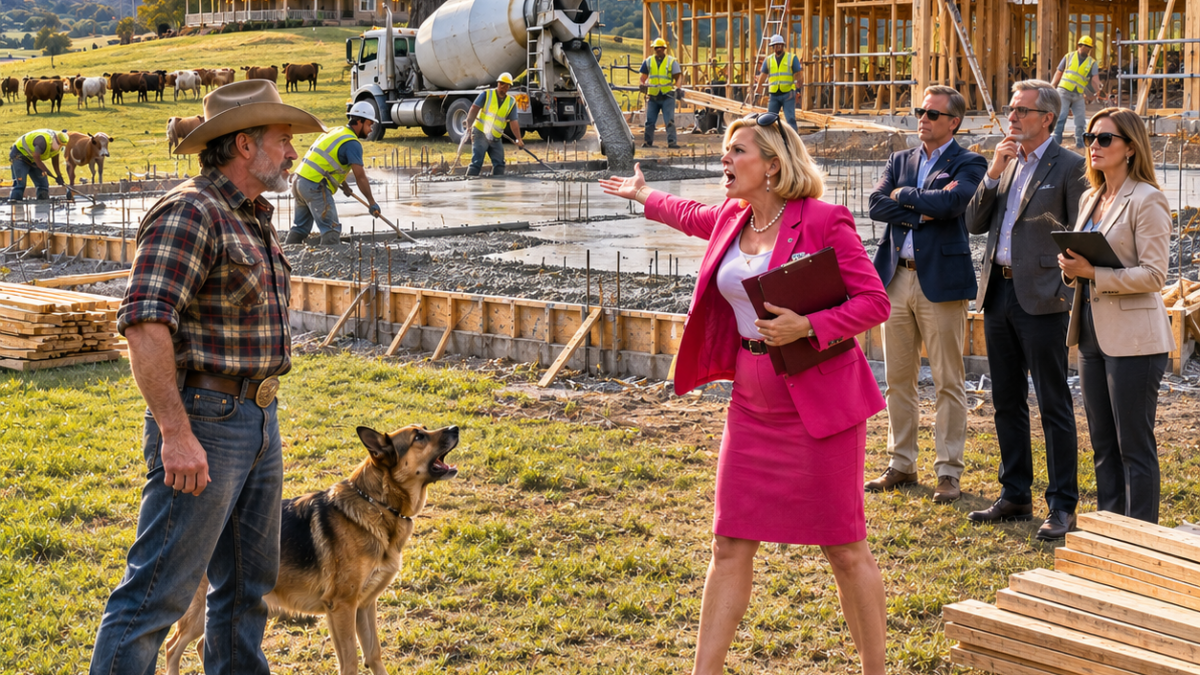
HOA Karen Poured a Clubhouse Foundation on My Ranch and Claimed the Acre Was Hers—She Thought a Board Vote Beat My Deed
She poured concrete on land my family had owned for generations and told me the HOA had “officially taken it.”
By the time I reached the pasture, walls were already going up and Karen was posing for pictures beside them.
What she did not understand was that land does not change owners because a committee raises its hands.
“This acre is officially HOA property now. We’re building our clubhouse right here, and there’s nothing you can do about it.”
Victoria Mercer said those words while standing in the middle of my pasture as a concrete truck poured another gray ribbon into wooden foundation forms behind her.
For a few seconds, I simply stared.
The western sky was turning gold over four thousand acres my family had worked for generations. Cattle grazed farther down the slope. My old windmill turned slowly in the evening breeze. And in the exact place where my grandfather used to check fence posts every morning, six contractors were building a luxury clubhouse I had never approved, on land I had never sold, for an HOA I did not belong to.
Victoria stood in the middle of it all wearing a bright pink blazer, matching skirt, and pink silk scarf. Her short blonde hair somehow looked untouched by the dust. A yellow HOA folder was tucked beneath one arm while she pointed toward the construction with the confidence of a woman unveiling a hospital wing.
“There’ll be a pool deck on the south side,” she told three Green Briar Estates board members. “Event space here. Outdoor kitchen there. We’ll finally have the facility this community deserves.”
One board member noticed me first.
His smile disappeared.
Victoria turned.
“Daniel.”
She said my name the way someone might address a delivery driver who had arrived at the wrong house.
I stepped through the grass in faded jeans, boots, and a dark brown flannel shirt. I stopped twenty feet from the freshly poured foundation.
“What are you doing?”
She smiled.
“Improving unused space.”
“This isn’t unused space.”
“Technically, it was.”
“It’s pasture.”
“It wasn’t developed.”
“That doesn’t make it yours.”
Her expression sharpened.
“The HOA approved acquisition of this acre last month.”
I looked at the concrete truck.
Then at the wooden framing stacked beside it.
Then at the orange survey stakes I had placed after a professional boundary survey two years earlier. One of those stakes stood less than three feet from the new foundation.
“You approved acquisition?”
“Unanimously.”
“Who sold it to you?”
She gave a small laugh.
“That isn’t how community expansion works.”
I almost admired the confidence.
Almost.
Victoria opened her folder and pulled out a document labeled GREEN BRIAR SHARED DEVELOPMENT RESOLUTION.
“You ignored our development assessments for five months,” she said. “You refused every opportunity to cooperate. So the board exercised its right to incorporate the parcel for community benefit.”
I stared at her.
“You think unpaid invoices transferred ownership of my land?”
“They demonstrated nonparticipation.”
“I’m not a participant.”
“You’re adjacent.”
“That isn’t the same thing.”
“It is under our revised standards.”
Behind her, a worker fired a nail gun.
The crack echoed across my pasture.
Something inside me went very still.
I turned toward my truck.
Victoria mistook that for defeat.
“I knew you’d eventually be reasonable.”
I opened the passenger door, reached behind the seat, and pulled out a thick document envelope.
Her smile faded slightly.
I walked back toward her, holding a century of recorded family ownership in my hand.
And before I said another word, I noticed something on the foundation plan clipped to her folder that made me realize this was much worse than a stupid HOA mistake.
part 2
The plan did not just show the clubhouse.
It showed an access road.
A parking lot.
A pool.
A stormwater trench.
And a utility corridor running straight across another section of my ranch.
I took the plan from Victoria before she could pull it away.
“You planning to take more than one acre?”
She snatched at the paper. “Give me that.”
I held it out of reach.
One of the board members, a nervous accountant named Martin Bell, stepped closer.
“Victoria, what is he talking about?”
She ignored him.
I pointed at the drawing.
“This road starts on Green Briar property, crosses my eastern pasture, enters this acre, then continues toward my stock pond.”
“It’s an easement.”
“No, it isn’t.”
“It will be.”
Martin looked at her.
“Will be?”
Victoria’s jaw tightened.
“The board approved future infrastructure access.”
Martin stared at the plan.
“I thought we were building on association open space.”
“You are.”
He looked at me.
I shook my head.
“No, you’re not.”
The concrete truck engine rumbled behind us.
Workers kept moving because nobody had told them to stop.
I walked to the nearest foreman.
“Who hired you?”
He removed his hard hat.
“Green Briar Estates.”
“Did they show you proof they owned the parcel?”
He glanced toward Victoria.
“She provided plans and authorization.”
“County permit?”
He hesitated.
That told me enough.
Victoria came marching over.
“Do not interfere with my contractors.”
“They’re standing on my ranch.”
“They are working under HOA authority.”
I opened the document envelope.
Inside were copies of my current recorded deed, the recorded legal description, the most recent professional survey, historical chain-of-title documents, and a certified copy of the original family conveyance dating back to 1921.
The oldest document was yellowed and fragile enough that I normally kept it stored securely, but I had been reviewing old ranch records that week because my attorney and I were preparing an agricultural conservation filing. By pure coincidence, the packet was already in my truck.
I handed Victoria the current deed first.
She barely looked at it.
“Old paperwork doesn’t stop modern community planning.”
“It was recorded three years ago.”
She flipped the page.
“That’s not what I mean.”
I handed her the survey.
It showed every boundary line.
The acre beneath her expensive heels was comfortably inside my ranch.
Not near the line.
Not disputed.
Inside.
One board member stepped closer.
“Victoria, this shows—”
“I can read a survey.”
“Then read it.”
She glared at me.
I pointed toward the orange markers.
“Those stakes are the same coordinates.”
She looked at them.
Something changed in her face.
Not fear yet.
Calculation.
Victoria had spent enough time around HOA paperwork to recognize when a document might become inconvenient.
She closed the folder.
“The board’s decision supersedes your private survey.”
“No.”
“The HOA has authority to expand common-use facilities.”
“On land it owns.”
“We voted to incorporate the parcel.”
“You cannot vote yourselves somebody else’s property.”
“Daniel, this argument is becoming tiresome.”
I laughed once.
Not because it was funny.
Because I could not believe she had said it.
“You’re pouring concrete on my ranch, and you’re tired of the argument?”
Martin looked increasingly uncomfortable.
Another board member, Susan Pike, quietly stepped away and pulled out her phone.
Victoria saw her.
“Who are you calling?”
“Our attorney.”
“No need.”
“I think there is.”
Victoria lowered her voice.
“Susan, we discussed this.”
“We discussed unused association land.”
“It is functionally association land.”
“What does that mean?”
“It means the community has treated it as shared open space for years.”
I turned toward Susan.
“No, they haven’t.”
Victoria answered for me.
“Residents walk near it.”
“Near it.”
“Children ride bicycles on the boundary road.”
“The county road.”
“Residents enjoy the view.”
I stared at her.
“You just claimed ownership because people can see my pasture?”
Martin rubbed his forehead.
The foreman was now listening.
So were the workers.
Victoria realized she was losing the room.
Her voice became sharper.
“The homeowners association has invested substantial funds into planning this clubhouse. Contracts have been signed. Deposits have been paid. The membership voted overwhelmingly. Construction has begun. This project will not be stopped because one property owner suddenly produces antique papers.”
I held up the current deed.
“This document is newer than your blazer.”
One of the workers laughed.
Victoria turned so fast the ends of her scarf whipped sideways.
“Who laughed?”
Nobody answered.
That was the first moment I understood something important.
Victoria did not merely think she had legal authority.
She thought embarrassment was a form of authority.
If she could keep everyone around her uncomfortable enough, she believed they would eventually surrender.
I had seen that personality before.
Different uniform.
Different setting.
Same instinct.
Make noise.
Create urgency.
Act certain.
Force everyone else to react.
I stopped reacting.
I took out my phone.
Victoria crossed her arms.
“Calling the sheriff?”
“County planning office.”
Her eyebrows rose.
“You’re wasting their time.”
“Maybe.”
I dialed the after-hours code enforcement number posted on the county website.
A recorded message gave me an emergency construction complaint option.
I left my information, parcel number, and a concise description.
Unpermitted commercial-scale construction on private agricultural property by a third party claiming HOA authority.
Then I called Rachel Mendoza.
Rachel had been my attorney for several years, mostly for ranch leases, easement questions, and one ugly boundary dispute with a utility contractor. She answered on the fourth ring.
“Daniel?”
“I need you to hear something before you decide I’m joking.”
“That sentence never improves my evening.”
“An HOA is building a clubhouse in my pasture.”
Silence.
Then, “Say that again.”
“They poured a foundation.”
More silence.
“On your deeded ranch?”
“Yes.”
“The Green Briar HOA?”
“Yes.”
“Victoria Mercer?”
“Yes.”
Rachel sighed.
“Of course it’s Victoria.”
I looked at her standing twenty yards away, issuing instructions to contractors like a general who had misplaced the war.
Rachel continued.
“Do not touch the construction. Do not move equipment. Photograph everything. Get the contractor’s name, license information, vehicles, and anyone present. Tell them clearly they do not have your permission to be there. Do not physically interfere.”
“Understood.”
“Send me the survey and deed.”
“Already have both.”
“Daniel?”
“Yeah?”
“How much concrete?”
I looked at the foundation.
“Enough to ruin your mood.”
“My mood was already ruined at clubhouse.”
She hung up.
I spent the next forty minutes documenting everything.
Concrete forms.
Mixer trucks.
Stacks of lumber.
Electrical conduit.
Temporary fencing.
Survey markers.
Worker trucks.
The access path they had cut through grass.
The exact position of the foundation relative to my recorded boundary.
I photographed the clubhouse plans when Victoria was not looking.
I also recorded a short video stating the date, time, location, and that I had expressly denied permission for construction to continue.
Then I approached the foreman.
His name was Luis Ramirez.
He looked less defensive now.
“Mr. Cole,” he said, “I want you to know we were told this parcel belonged to the association.”
“I believe you.”
That seemed to surprise him.
“I’m not blaming your crew for relying on paperwork you were given. But now I’m telling you directly: I own this ground, and you don’t have my permission to build here.”
Luis nodded.
“I’m calling my office.”
Victoria appeared almost immediately.
“What are you doing?”
“Verifying title.”
“You already verified title.”
“With documents you supplied.”
“And those documents are valid.”
Luis looked at my survey.
“Do you have a deed showing the HOA owns this acre?”
Victoria lifted her folder.
“We have a board resolution.”
“That’s not what he asked.”
She looked at me.
“You are intentionally disrupting contracted work.”
“Yes.”
She blinked.
I continued.
“Because you are intentionally contracting work on my land.”
Luis stepped away to make his call.
Victoria followed him.
“Mr. Ramirez, your company will be liable for breach if you stop.”
He turned.
“With respect, ma’am, I’m much more concerned about building on land you don’t own.”
That landed harder than anything I had said.
Her cheeks flushed.
The workers began shutting down equipment.
Victoria raised her voice.
“Nobody leaves!”
Everybody kept shutting down.
One worker unplugged a compressor.
Another climbed down from the framing.
The concrete truck operator folded the chute back into place.
Victoria stood in the middle of the pasture ordering people to work while, one by one, they stopped listening.
There was something almost Shakespearean about it.
Except Shakespeare rarely included a woman in beige heels yelling at a cement mixer.
By the time darkness settled over the ranch, the site was quiet.
The damage remained.
Fresh concrete sat where grass had been that morning.
Dozens of holes had been drilled.
Temporary utility trenches scarred the pasture.
A grading machine had scraped away topsoil.
Victoria finally left at 8:12 p.m.
She did not apologize.
Instead, she gave me a final warning.
“If you force the HOA to delay this project, the financial consequences will be significant.”
“For you?”
“For everyone.”
“I’m not everyone.”
“You are part of the greater community.”
“No. I own land beside it.”
“That distinction is becoming obsolete.”
I looked around at four thousand acres.
“Not tonight.”
She drove away.
I stood beside the construction site under portable work lights and felt my anger finally arrive.
Until then, I had been too focused on facts.
But once the engines stopped, I saw what they had actually done.
My grandfather had taught me to ride a horse in that pasture.
My father had once camped there with me during a meteor shower because he said a boy should see a sky without electric lights at least once.
Years later, after Dad died, I sometimes walked that same ground before sunrise because it was one of the few places where grief felt quiet instead of heavy.
Now there was a concrete slab in it.
Not because of a road project.
Not because of eminent domain.
Not because I had sold anything.
Because a woman with an HOA title had decided empty grass looked available.
I went home after midnight.
Rachel called at 6:30 the next morning.
“I pulled the county records.”
“And?”
“There is no deed transfer.”
“I know.”
“No annexation.”
“I know.”
“No recorded covenant attaching your parcel.”
“I know.”
“No easement for their access road.”
“That one I really know.”
“And no building permit for the parcel number.”
I sat up.
“Nothing?”
“Nothing.”
“What permit did the contractor think they had?”
“I’m finding out.”
By eight, Rachel had drafted a formal cease-and-desist notice to Green Briar Estates, every board member individually, the contractor, the engineering company listed on the site plan, and the HOA’s management firm.
The letter was professional.
Rachel’s letters were always professional.
That made them terrifying.
It stated that construction was occurring on privately owned agricultural property without consent, title, easement, covenant authority, or recorded annexation. It demanded immediate cessation, preservation of all documents and communications, disclosure of every contractor and consultant involved, and a written plan addressing removal and restoration.
It also warned against altering records.
Victoria replied twenty-three minutes later.
Not through counsel.
Personally.
Her email consisted of four paragraphs explaining that the HOA’s authority came from “community necessity,” “historical use,” “collective benefit,” and “member approval.”
Rachel called me.
“She just sent this to me.”
“I saw it.”
“Did she copy the entire board?”
“Yes.”
“And the property management company?”
“Yes.”
“And the contractor?”
“Yes.”
“Daniel?”
“Yeah?”
“I like her.”
“You do?”
“She documents everything.”
By noon, the county planning office sent an inspector.
His name was Aaron Schultz.
He arrived in a white county pickup and walked the site with a tablet.
I gave him the recorded deed, parcel map, and survey.
Luis, the contractor foreman, returned with a representative from his company.
Victoria also arrived.
Of course she did.
She had changed outfits.
The pink blazer was still there, but now she wore white pants and oversized sunglasses.
She also brought two Green Briar board members and a local freelance reporter who had apparently been invited to cover the “future community clubhouse.”
Victoria began speaking to the reporter before the inspector had finished checking the parcel.
“This project represents responsible growth,” she said. “Green Briar residents have waited years for a facility that reflects our community’s quality.”
The reporter looked toward the silent construction site.
“Why is nobody working?”
“Routine administrative review.”
I almost admired her stamina.
Aaron walked toward us.
He removed his sunglasses.
“Who is representing the property owner?”
“I am.”
“Mr. Cole?”
“Yes.”
He nodded.
Then he turned toward Victoria.
“And you represent Green Briar Estates?”
“I’m the president.”
“Do you have recorded title to this parcel?”
“The association exercised development rights.”
“That wasn’t my question.”
Victoria opened her folder.
“The board passed Resolution 24-17 authorizing incorporation of this acre.”
Aaron took the resolution.
He read it.
Then he looked at her.
“This is an internal HOA resolution.”
“Yes.”
“It doesn’t convey title.”
“It establishes community authority.”
“No.”
Her smile vanished.
Aaron continued.
“County records show this parcel is part of Mr. Cole’s ranch. There’s no deed to Green Briar, no recorded annexation, no covenant attachment, and no permit issued for construction on this parcel.”
Victoria looked toward the reporter.
Then back at Aaron.
“That cannot be correct.”
“It is.”
“We submitted plans.”
“You submitted preliminary plans under a different parcel reference.”
Luis turned toward his company representative.
That was new.
I stepped closer.
“What different parcel?”
Aaron looked at his tablet.
“The application appears to reference Green Briar common tract C.”
Victoria said quickly, “That was an administrative placeholder.”
Aaron stared at her.
“You cannot use another parcel number as a placeholder for construction.”
“The planning staff knew the intent.”
“No, they didn’t.”
Susan Pike, the board member who had called the HOA attorney the evening before, spoke quietly.
“Victoria, why was common tract C listed?”
Victoria ignored her.
Aaron continued.
“There is no active permit authorizing work here. Effective immediately, all construction activity is stopped.”
The reporter raised her camera.
Victoria’s face changed.
She moved toward Aaron.
“The clubhouse is already half-built.”
“I can see that.”
“You cannot stop a project after this level of investment.”
“I just did.”
“We have contractual deadlines.”
“That is between you and your contractors.”
“The community voted.”
Aaron closed his tablet.
“Votes don’t transfer privately owned land.”
For the first time since this began, Victoria looked genuinely shaken.
Not defeated.
Shaken.
There is a difference.
Defeated people sometimes accept reality.
Shaken people like Victoria usually attack harder.
She pointed toward my pasture.
“This land has functioned as community open space for years.”
I answered.
“No, it hasn’t.”
“Our residents walk along it.”
“They trespass occasionally.”
“They have recreational expectations.”
“Expectations aren’t deeds.”
The reporter lowered her camera slightly to hide a smile.
Aaron posted a STOP WORK notice on the wooden frame.
Then another at the site entrance.
He instructed the contractor that no further work could occur until county review was complete.
He also explained that demolition itself would require coordination because nobody was going to compound the problem by tearing out concrete without an approved restoration plan.
That detail mattered.
Real life is rarely as simple as “remove everything tomorrow.”
The county wanted erosion controls.
Utility trenches had to be inspected.
Any buried conduit needed to be documented.
Concrete removal equipment had to enter without damaging the surrounding pasture.
Rachel later told me that Aaron’s caution probably saved us from another argument.
Victoria would have happily turned a bad construction project into a bad demolition project and called the second disaster compliance.
The news segment aired that evening.
It was short.
Less than two minutes.
But the visual was devastating.
A half-built clubhouse.
A stop-work notice.
My cattle behind it.
Victoria in pink.
And Aaron saying, calmly, that county records did not show HOA ownership of the parcel.
Green Briar residents began asking questions immediately.
The biggest question was not whether the HOA owned my acre.
By then, that answer was becoming obvious.
The biggest question was money.
How much had Victoria spent?
The first number I heard was $180,000.
Then $240,000.
Then nearly $400,000 in commitments.
Nobody seemed sure.
That uncertainty triggered the emergency board meeting.
Rachel advised me not to attend.
“You’re becoming a legal issue for them,” she said. “Let them talk without you.”
Susan later told me what happened.
The clubhouse project had been Victoria’s signature proposal.
For nearly a year, she had argued Green Briar needed a luxury amenity center to compete with newer subdivisions.
The HOA already owned common tract C near the entrance, but that parcel had drainage problems and limited space.
Engineering estimates to build there were expensive.
Then Victoria discovered my eastern pasture.
Flat.
Dry.
Beautiful view.
Easy road access if you ignored the inconvenient fact that the road, land, and access rights were not hers.
She began describing the acre as “underutilized perimeter space.”
That phrase slowly became “shared perimeter land.”
Then “community expansion area.”
Then “future HOA parcel.”
Nobody could identify the exact meeting when she stopped describing what she wanted and started describing it as something the HOA already possessed.
That transition mattered.
Because once language changed, assumptions followed.
The board approved design money.
Then engineering money.
Then a construction deposit.
Victoria presented documents suggesting the parcel was available for community development.
Some board members asked questions.
She answered them confidently.
Others trusted her.
That did not excuse them.
But it explained how absurdity became policy.
The next morning, Green Briar’s attorney contacted Rachel.
His name was Thomas Avery.
Unlike Victoria, he did not pretend an HOA resolution could function as a deed.
He got directly to the point.
“We appear to have a serious problem.”
Rachel replied, “You do.”
He asked for copies of my title documents.
Rachel sent them.
He asked for the survey.
She sent that too.
He asked whether I would agree not to file suit for forty-eight hours while the association investigated.
Rachel called me.
“What do you want?”
“My land restored.”
“Yes.”
“My costs paid.”
“Yes.”
“And I want every fake development fee withdrawn.”
Rachel paused.
“How many?”
“Twelve thousand six hundred dollars total.”
“You never mentioned that number.”
“I thought the invoices were comedy.”
“Send them.”
The invoices started five months earlier.
Green Briar had billed me a monthly “Shared Development Contribution” even though I was not a member.
The first invoice was $2,100.
I mailed it back.
The second included a late fee.
I ignored it.
By month five, the association claimed I owed $12,600 plus administrative charges.
Victoria had apparently used those unpaid invoices during board discussions as evidence that I had “failed to participate in joint development obligations.”
Rachel read all five.
Then she laughed.
Actually laughed.
“This is spectacular.”
“Legally?”
“No. Narratively.”
The HOA’s internal investigation accelerated.
Emails began surfacing.
Victoria had written to the property manager three months earlier:
Cole’s refusal should not delay community progress. Once the board formally designates the parcel for shared use, his private objection becomes secondary.
Another email said:
We cannot allow one ranch owner to hold 312 families hostage over obsolete boundary expectations.
Obsolete boundary expectations.
That phrase became famous.
Carl Jennings, my neighbor from three miles north, printed it on a coffee mug.
He brought it to my house.
I stared at it.
“Where did you get this?”
“My daughter makes custom mugs.”
“You had this made overnight?”
“Justice moves fast.”
On the other side, the mug said:
DEEDS: NOW OBSOLETE.
I kept it.
The humor helped because the situation itself was not funny.
The contractor filed claims against Green Briar for losses related to suspension and misrepresentation.
The engineering firm wanted clarification about parcel ownership.
Residents demanded financial records.
The property management company distanced itself.
The HOA’s insurance carrier began asking questions about whether intentional acts and known title disputes fell within coverage.
And Victoria kept talking.
Her attorney eventually told her to stop.
She did not.
At an emergency board meeting, she reportedly stood in front of nearly two hundred residents and declared that I was exploiting “technicalities from 1921.”
Susan interrupted.
“A deed is not a technicality.”
Victoria snapped back.
“It’s old.”
Someone in the audience said, “So are you, but we still recognize you.”
The room exploded.
According to Susan, Victoria stood there in stunned silence while the board struggled to restore order.
I felt slightly guilty when I heard that.
Slightly.
The board suspended Victoria as president that night.
The vote was six to one.
Victoria voted against.
That was the one.
Rachel called me after Susan confirmed the result.
“She voted against her own suspension?”
“Yes.”
“Consistency matters.”
The association appointed Susan interim president.
Her first official act was to withdraw every development invoice sent to me.
Her second was to issue a written acknowledgment that my ranch was outside Green Briar’s recorded boundaries.
Her third was to authorize direct negotiations over restoration.
That was when the conflict shifted.
The question was no longer whether Green Briar owned my acre.
They did not.
The question was how to undo what Victoria had done.
Concrete removal sounds simple until you are trying to restore agricultural land.
The slab and footings had to be broken carefully.
Reinforcing steel had to be removed.
Trenches filled.
Compacted soil loosened.
Topsoil replaced.
Drainage restored.
Debris hauled away.
Ruts repaired.
Grass reseeded.
The construction entrance had to be removed.
A section of my pasture fence had been taken down without permission and needed reconstruction.
I also wanted soil testing where construction materials had been stored.
Green Briar initially proposed a basic cleanup.
I rejected it.
“You don’t get to convert my pasture into a construction site and then leave me a lawn.”
Rachel smiled.
“That sentence may appear in a letter.”
It did.
We hired an independent agricultural restoration consultant.
He documented existing grass composition, drainage patterns, soil compaction, and likely restoration costs.
He also found something that made me angrier than the clubhouse.
A mature pecan tree near the foundation had suffered root-zone damage from grading equipment.
My grandfather planted that tree.
Victoria had not cut it down, but machinery had compacted the soil around it and severed several surface roots.
The arborist could not guarantee it would survive.
I stood beside that tree longer than I stood beside the concrete.
That was the moment the case stopped being abstract.
Concrete could be removed.
Money could be repaid.
But a tree planted by my grandfather could not be replaced by writing a check.
Rachel understood immediately.
“We document it.”
“I don’t want money for the tree.”
“I know.”
“I want them to fix what they can.”
“We’ll make that part of the restoration demand.”
The arborist designed a treatment plan.
Soil aeration.
Root-zone protection.
Mulching.
Monitoring.
No heavy equipment within the defined radius.
Green Briar agreed.
The pecan survived.
It still stands there today.
That mattered more to me than almost anything else in the settlement.
Demolition began three weeks after the stop-work order.
This time, I had final approval over the access route and restoration method.
A different contractor handled the removal.
Victoria was prohibited by the board from participating.
She came anyway.
Not onto my land.
She stood on the county road beyond the fence wearing sunglasses and holding her phone.
Carl arrived in his pickup with the DEEDS: NOW OBSOLETE mug.
“You planned this?”
“I brought coffee.”
“You brought theater.”
“That too.”
The excavator lifted the first section of broken concrete.
Victoria watched from the road.
Carl raised his mug toward her.
I grabbed his arm.
“Don’t.”
“I was just hydrating.”
“You were weaponizing ceramics.”
He looked offended.
“Freedom of beverage.”
I laughed despite myself.
The clubhouse disappeared piece by piece.
Framing first.
Then forms.
Then slab.
Then footings.
Then conduit.
Every load was photographed.
Every disturbed area measured.
The restoration contractor replaced topsoil and regraded the acre to its original drainage pattern.
They reseeded with the same pasture mix used elsewhere on the ranch.
For several weeks, the area looked raw.
Brown earth instead of grass.
Then green began returning.
Slowly.
Unevenly.
Honestly.
That suited me.
Healing usually looks worse before it looks complete.
The legal resolution took longer.
Rachel filed claims seeking restoration costs, attorney fees where recoverable, damages tied to unauthorized entry and construction, and declaratory relief confirming the HOA had no authority over the ranch.
Green Briar wanted settlement.
So did I.
I had no interest in spending two years in litigation if the core issues could be resolved properly.
But I refused confidentiality on the property-boundary acknowledgment.
Rachel agreed.
“That part needs to remain clear.”
The final agreement required Green Briar to formally recognize that my ranch was not part of the association, withdraw every invoice and purported assessment, reimburse agreed legal and professional costs, fund complete restoration, and adopt procedures preventing future enforcement against nonmember property without recorded legal authority.
They also paid for continued monitoring of the pecan tree.
The monetary terms were not the part I cared about most.
The recorded acknowledgment was.
The HOA filed documentation confirming it claimed no ownership interest in the disputed acre.
That document went into the county records.
Victoria’s board vote had tried to turn fiction into title.
The settlement turned reality into something even she could not rewrite.
There were consequences inside Green Briar too.
An independent financial review found that Victoria had bypassed normal controls during the clubhouse project.
She had pressured the management company to issue development invoices to me.
She had characterized my parcel as available without obtaining a title opinion.
She had authorized deposits before final permit verification.
She had also approved preliminary work beyond the acre itself, including the proposed access and utility corridor shown on the plan I saw the first evening.
That discovery made several board members furious.
Martin Bell resigned.
In his resignation letter, he admitted he should have demanded recorded proof of ownership before approving money.
I respected that.
Not because resignation fixed anything.
Because responsibility begins when people stop explaining why something was someone else’s fault.
Victoria did not resign.
She was removed permanently.
The board voted to bar her from committee leadership for the remainder of her current term.
At the meeting, she demanded five minutes to defend herself.
She used twenty-two.
Susan eventually cut off her microphone.
Victoria kept talking.
The room could not hear her.
She continued anyway.
That video circulated through Green Briar for months.
People called it “the silent speech.”
Carl watched it at my kitchen table.
“She talks better muted.”
“That’s cruel.”
“It’s accurate.”
Her downfall became humiliating because she refused every opportunity to leave with dignity.
She blamed the contractor.
Then the property manager.
Then the county.
Then “antiquated agricultural interests.”
Then me.
At one meeting, she claimed the entire dispute had resulted from my “unwillingness to participate in regional modernization.”
Susan asked one question.
“Did he ever agree to give us his acre?”
Victoria replied, “That’s an oversimplification.”
Susan said, “No, Victoria. It’s the whole issue.”
The residents applauded.
That ended her influence faster than any legal letter.
The neighborhood had finally understood the trick.
Victoria’s power depended on turning simple questions into complicated ones.
Do we own the land?
No.
Did Daniel agree?
No.
Did we have a permit?
No.
Did a board vote change any of those answers?
No.
Everything else was decoration.
Several months later, the county closed its enforcement file after restoration was verified.
Aaron returned for the final inspection.
We walked the pasture together.
The new grass had taken root.
The fence was repaired.
The access path was gone.
The pecan tree showed healthy new growth.
Aaron checked his notes.
“Looks good.”
I nodded.
“Better.”
He looked toward the spot where the clubhouse had stood.
“You planning to build anything here?”
“Eventually.”
“Permit first?”
I stared at him.
He smiled.
I laughed.
“Yes, Aaron. Permit first.”
My original plan had been to expand the barn on that acre.
After everything that happened, I considered changing locations.
For a while, the place felt contaminated by the argument.
Then I realized that would give Victoria one final decision over my land.
So the following spring, I hired an architect.
A legitimate one.
I got engineering plans.
I submitted the correct parcel number.
I applied for the permit.
I waited.
The county approved it.
Then I built the barn.
Nothing luxurious.
Nothing flashy.
A practical agricultural building with equipment storage, a small workshop, feed space, and covered bays.
Brown metal siding.
Green roof.
Wide sliding doors.
Exactly what belonged there.
On the day the frame went up, Carl arrived carrying a folding chair.
“What are you doing?”
“Watching progress.”
“You’ve seen a barn built.”
“Not on former HOA headquarters.”
I pointed toward the road.
“Go home.”
He unfolded the chair.
“No.”
The barn took four months.
Every time I passed the permit board posted beside the entrance, I smiled.
Not because permits are exciting.
Because lawful construction is wonderfully boring.
No secret crews.
No fake development zones.
No dramatic resolutions.
No pink blazer.
Just plans, approvals, invoices, inspections, and work on land owned by the person who ordered it.
Susan visited once during construction.
She stood outside the fence.
She did not enter until I waved her through.
That small gesture meant more than she probably realized.
“Looks good,” she said.
“Thanks.”
“Green Briar residents are going to see the roof.”
“I’m devastated.”
She laughed.
“We’re not regulating it.”
“Progress.”
She handed me an envelope.
Inside was a formal letter confirming the HOA had completed all obligations under the settlement.
At the bottom, beneath Susan’s signature, someone had written in pen:
No board vote was taken regarding your barn.
I looked up.
“Carl?”
“Obviously.”
He had apparently convinced Susan to add it.
The man had become impossible.
Years have passed since Victoria tried to build her clubhouse.
People sometimes ask me why I kept so much paperwork.
The answer is simple.
Because property rights are boring right up until somebody decides they are optional.
My family had owned that ranch for generations.
But history alone did not protect it.
Documents did.
Surveys did.
Recorded deeds did.
County records did.
Photographs did.
Emails did.
Professional advice did.
And perhaps most importantly, refusing to be intimidated by confident nonsense did.
Victoria’s biggest weapon had never been her board position.
It was certainty.
She spoke as though every statement were already decided.
“The acre is ours.”
“The board approved it.”
“The project is official.”
“The community voted.”
“The construction cannot be stopped.”
None of those sentences contained legal authority.
They just sounded like they did.
That distinction cost Green Briar hundreds of thousands of dollars.
It cost Victoria her position.
It cost her reputation.
And it nearly cost my grandfather’s pecan tree.
One evening, long after the new barn was finished, I walked out to that tree.
The sun was dropping low.
The sky turned orange near the horizon and purple above it.
Cattle moved slowly across the pasture.
The barn cast a long shadow across the grass.
You could no longer tell where the clubhouse foundation had been.
That was what I wanted.
Not a monument to the fight.
Not a plaque.
Not some permanent reminder of Victoria.
Grass.
Normal grass.
The kind my grandfather walked through.
I rested one hand against the pecan trunk.
Its bark was rough and warm from the day.
A new branch had grown on the western side.
For months, experts had warned me that damage might not appear immediately.
Trees can take time to show stress.
Apparently, they can take time to show recovery too.
I understood that.
The ranch had recovered faster than I had.
For a while after the construction invasion, I became suspicious whenever I saw unfamiliar vehicles near the eastern boundary.
I checked cameras more often.
I locked gates I had rarely locked before.
That bothered me.
The ranch had always felt open.
Victoria made me feel like I had to defend it.
Eventually, that feeling faded.
The gates stayed.
The cameras stayed.
But the anxiety did not.
That was the final restoration nobody could put into a settlement agreement.
Peace returning.
A year after the barn was completed, Green Briar held its annual neighborhood picnic.
Susan invited me.
I declined.
Then Carl called.
“You have to come.”
“No.”
“They’re unveiling something.”
“That sentence guarantees I’m not coming.”
“It’s funny.”
“No.”
“It involves obsolete boundary expectations.”
I hung up.
He called back.
“Coward.”
I went.
At the entrance to Green Briar’s actual common tract C, the HOA had installed a small community pavilion.
On land it owned.
With permits.
Susan stood beside it laughing when I arrived.
“This is the replacement clubhouse?”
“Pavilion.”
“Smaller.”
“Much.”
“Cheaper.”
“Extremely.”
“Legal?”
She pointed at a framed copy of the permit displayed inside.
“Painfully.”
Carl appeared carrying his coffee mug.
On the pavilion wall hung a tasteful plaque.
It listed the board members and construction date.
Nothing unusual.
Then I noticed a tiny brass plate beneath it.
PROPERTY LINE VERIFIED BEFORE CONSTRUCTION.
I stared at Susan.
She shook her head.
“Carl donated that.”
He looked proud.
I laughed until my face hurt.
That tiny plate may have been the best ending possible.
Not revenge.
Institutional memory.
Green Briar had learned something.
Maybe not every resident.
Maybe not forever.
But enough.
Ask first.
Verify title.
Respect boundaries.
Do not confuse collective enthusiasm with ownership.
And never let Victoria Mercer near a concrete truck.
Victoria herself moved away about eighteen months after the clubhouse disaster.
I heard she sold her house and relocated to another development two counties over.
Carl immediately asked whether we should warn them.
“No.”
“Community service.”
“No.”
“Anonymous letter?”
“No.”
He sighed.
“You’re no fun.”
I never saw Victoria again.
That was fine with me.
I did hear one final story.
According to Susan, when Victoria’s moving truck arrived, the driver parked partly on Green Briar’s decorative grass near the clubhouse pavilion.
A resident joked that she should issue him a landscaping violation.
Victoria did not laugh.
Apparently everyone else did.
There was something fitting about that.
For years, she had turned minor inconveniences into administrative emergencies.
By the end, her own neighbors could not hear the word violation without thinking of her.
That was a punishment no judge needed to impose.
Reputation is sometimes just the echo of your own behavior.
Today, the acre looks the way it should.
The barn sits on the northern half.
The southern section remains pasture.
The pecan tree stands near the fence.
There is no pool.
No event deck.
No HOA parking lot.
No utility corridor.
No community access road.
Just ranch.
My ranch.
Four thousand acres is a lot of land.
But that dispute taught me something strange.
Ownership can become intensely personal at the scale of one acre.
That single acre held my grandfather’s footsteps.
My father’s memories.
My plans.
My cattle.
My tree.
To Victoria, it looked empty.
That was her fundamental mistake.
She believed unused meant unclaimed.
She believed quiet meant undefended.
She believed old meant irrelevant.
She believed authority could be created by confidence.
And she believed I would look at a half-built structure and decide resistance had become too inconvenient.
I think about that sometimes when I stand outside the barn at sunset.
If I had arrived one week later, the clubhouse might have been nearly finished.
If I had assumed the HOA surely had some legal right I did not understand, I might have hesitated.
If I had reacted angrily instead of documenting everything, Victoria might have turned the story into a personality conflict.
Instead, the issue stayed simple.
Whose land?
Mine.
Who authorized construction?
Not me.
What recorded right did Green Briar possess?
None.
Everything else followed from those facts.
There is satisfaction in that simplicity.
Not the loud kind.
Not vengeance.
Something quieter.
The satisfaction of watching a person who treated paperwork like a weapon finally discover that real paperwork works both directions.
Victoria had folders.
I had records.
She had resolutions.
I had a deed.
She had board minutes.
I had a survey.
She had opinions.
I had a property line.
The county did not care which one of us spoke louder.
Neither did the title record.
And that, more than anything, was why she lost.
One evening, Carl parked beside the barn and handed me a new mug.
I looked at it suspiciously.
“What now?”
“Anniversary gift.”
On one side, it said:
THIS ACRE IS OFFICIALLY HOA PROPERTY.
I groaned.
Then I turned it around.
The other side said:
NO, IT ISN’T.
I laughed.
“You need a hobby.”
“This is my hobby.”
I poured coffee into it.
We sat outside the barn while the sky darkened.
Cattle moved beyond the fence.
The pecan leaves stirred in the breeze.
No machinery.
No reporters.
No lawyers.
No inspectors.
No board votes.
Carl raised his mug.
“To obsolete boundaries.”
I raised mine.
“To permits.”
He looked offended.
“Boring.”
“Exactly.”
That was the lesson Victoria never understood.
Good boundaries are boring.
Good governance is boring.
Good title records are boring.
Permits are boring.
Surveys are boring.
Until somebody ignores them.
Then boring things become shields.
She came onto my land convinced her authority was modern and my ownership was outdated.
She poured concrete first and planned to argue later.
She believed construction itself would become leverage.
Once enough money was spent, she assumed everyone would accept the result because undoing it would be inconvenient.
She was wrong.
The concrete came out.
The clubhouse disappeared.
The invoices vanished.
The supposed development rights vanished.
Her presidency vanished.
The acre remained.
Years later, that is what matters.
Not her humiliation.
Not the news clip.
Not the silent board-meeting speech.
Not even Carl’s ridiculous mugs.
The land remained.
The tree remained.
The family line remained.
The pasture recovered.
And when I finally built something there, I built what I wanted, where I wanted, after following the rules that actually applied.
Sometimes I stand at the barn doors in the evening and look across the ranch while the last sunlight burns orange along the horizon.
The wind moves through the grass in long waves.
The same grass Victoria once called underutilized.
The same land she called community property.
The same acre she believed she could acquire with a vote.
There is no sign explaining what happened.
I never put one up.
I do not need one.
The deed says enough.
And every sunset over that pasture says the rest.
THE STORY ENDS HERE
HOA Karen Poured a Clubhouse Foundation on My Ranch and Claimed the Acre Was Hers—She Thought a Board Vote Beat My Deed
She poured concrete on land my family had owned for generations and told me the HOA had “officially taken it.”
By the time I reached the pasture, walls were already going up and Karen was posing for pictures beside them.
What she did not understand was that land does not change owners because a committee raises its hands.
“This acre is officially HOA property now. We’re building our clubhouse right here, and there’s nothing you can do about it.”
Victoria Mercer said those words while standing in the middle of my pasture as a concrete truck poured another gray ribbon into wooden foundation forms behind her.
For a few seconds, I simply stared.
The western sky was turning gold over four thousand acres my family had worked for generations. Cattle grazed farther down the slope. My old windmill turned slowly in the evening breeze. And in the exact place where my grandfather used to check fence posts every morning, six contractors were building a luxury clubhouse I had never approved, on land I had never sold, for an HOA I did not belong to.
Victoria stood in the middle of it all wearing a bright pink blazer, matching skirt, and pink silk scarf. Her short blonde hair somehow looked untouched by the dust. A yellow HOA folder was tucked beneath one arm while she pointed toward the construction with the confidence of a woman unveiling a hospital wing.
“There’ll be a pool deck on the south side,” she told three Green Briar Estates board members. “Event space here. Outdoor kitchen there. We’ll finally have the facility this community deserves.”
One board member noticed me first.
His smile disappeared.
Victoria turned.
“Daniel.”
She said my name the way someone might address a delivery driver who had arrived at the wrong house.
I stepped through the grass in faded jeans, boots, and a dark brown flannel shirt. I stopped twenty feet from the freshly poured foundation.
“What are you doing?”
She smiled.
“Improving unused space.”
“This isn’t unused space.”
“Technically, it was.”
“It’s pasture.”
“It wasn’t developed.”
“That doesn’t make it yours.”
Her expression sharpened.
“The HOA approved acquisition of this acre last month.”
I looked at the concrete truck.
Then at the wooden framing stacked beside it.
Then at the orange survey stakes I had placed after a professional boundary survey two years earlier. One of those stakes stood less than three feet from the new foundation.
“You approved acquisition?”
“Unanimously.”
“Who sold it to you?”
She gave a small laugh.
“That isn’t how community expansion works.”
I almost admired the confidence.
Almost.
Victoria opened her folder and pulled out a document labeled GREEN BRIAR SHARED DEVELOPMENT RESOLUTION.
“You ignored our development assessments for five months,” she said. “You refused every opportunity to cooperate. So the board exercised its right to incorporate the parcel for community benefit.”
I stared at her.
“You think unpaid invoices transferred ownership of my land?”
“They demonstrated nonparticipation.”
“I’m not a participant.”
“You’re adjacent.”
“That isn’t the same thing.”
“It is under our revised standards.”
Behind her, a worker fired a nail gun.
The crack echoed across my pasture.
Something inside me went very still.
I turned toward my truck.
Victoria mistook that for defeat.
“I knew you’d eventually be reasonable.”
I opened the passenger door, reached behind the seat, and pulled out a thick document envelope.
Her smile faded slightly.
I walked back toward her, holding a century of recorded family ownership in my hand.
And before I said another word, I noticed something on the foundation plan clipped to her folder that made me realize this was much worse than a stupid HOA mistake.
part 2
The plan did not just show the clubhouse.
It showed an access road.
A parking lot.
A pool.
A stormwater trench.
And a utility corridor running straight across another section of my ranch.
I took the plan from Victoria before she could pull it away.
“You planning to take more than one acre?”
She snatched at the paper. “Give me that.”
I held it out of reach.
One of the board members, a nervous accountant named Martin Bell, stepped closer.
“Victoria, what is he talking about?”
She ignored him.
I pointed at the drawing.
“This road starts on Green Briar property, crosses my eastern pasture, enters this acre, then continues toward my stock pond.”
“It’s an easement.”
“No, it isn’t.”
“It will be.”
Martin looked at her.
“Will be?”
Victoria’s jaw tightened.
“The board approved future infrastructure access.”
Martin stared at the plan.
“I thought we were building on association open space.”
“You are.”
He looked at me.
I shook my head.
“No, you’re not.”
The concrete truck engine rumbled behind us.
Workers kept moving because nobody had told them to stop.
I walked to the nearest foreman.
“Who hired you?”
He removed his hard hat.
“Green Briar Estates.”
“Did they show you proof they owned the parcel?”
He glanced toward Victoria.
“She provided plans and authorization.”
“County permit?”
He hesitated.
That told me enough.
Victoria came marching over.
“Do not interfere with my contractors.”
“They’re standing on my ranch.”
“They are working under HOA authority.”
I opened the document envelope.
Inside were copies of my current recorded deed, the recorded legal description, the most recent professional survey, historical chain-of-title documents, and a certified copy of the original family conveyance dating back to 1921.
The oldest document was yellowed and fragile enough that I normally kept it stored securely, but I had been reviewing old ranch records that week because my attorney and I were preparing an agricultural conservation filing. By pure coincidence, the packet was already in my truck.
I handed Victoria the current deed first.
She barely looked at it.
“Old paperwork doesn’t stop modern community planning.”
“It was recorded three years ago.”
She flipped the page.
“That’s not what I mean.”
I handed her the survey.
It showed every boundary line.
The acre beneath her expensive heels was comfortably inside my ranch.
Not near the line.
Not disputed.
Inside.
One board member stepped closer.
“Victoria, this shows—”
“I can read a survey.”
“Then read it.”
She glared at me.
I pointed toward the orange markers.
“Those stakes are the same coordinates.”
She looked at them.
Something changed in her face.
Not fear yet.
Calculation.
Victoria had spent enough time around HOA paperwork to recognize when a document might become inconvenient.
She closed the folder.
“The board’s decision supersedes your private survey.”
“No.”
“The HOA has authority to expand common-use facilities.”
“On land it owns.”
“We voted to incorporate the parcel.”
“You cannot vote yourselves somebody else’s property.”
“Daniel, this argument is becoming tiresome.”
I laughed once.
Not because it was funny.
Because I could not believe she had said it.
“You’re pouring concrete on my ranch, and you’re tired of the argument?”
Martin looked increasingly uncomfortable.
Another board member, Susan Pike, quietly stepped away and pulled out her phone.
Victoria saw her.
“Who are you calling?”
“Our attorney.”
“No need.”
“I think there is.”
Victoria lowered her voice.
“Susan, we discussed this.”
“We discussed unused association land.”
“It is functionally association land.”
“What does that mean?”
“It means the community has treated it as shared open space for years.”
I turned toward Susan.
“No, they haven’t.”
Victoria answered for me.
“Residents walk near it.”
“Near it.”
“Children ride bicycles on the boundary road.”
“The county road.”
“Residents enjoy the view.”
I stared at her.
“You just claimed ownership because people can see my pasture?”
Martin rubbed his forehead.
The foreman was now listening.
So were the workers.
Victoria realized she was losing the room.
Her voice became sharper.
“The homeowners association has invested substantial funds into planning this clubhouse. Contracts have been signed. Deposits have been paid. The membership voted overwhelmingly. Construction has begun. This project will not be stopped because one property owner suddenly produces antique papers.”
I held up the current deed.
“This document is newer than your blazer.”
One of the workers laughed.
Victoria turned so fast the ends of her scarf whipped sideways.
“Who laughed?”
Nobody answered.
That was the first moment I understood something important.
Victoria did not merely think she had legal authority.
She thought embarrassment was a form of authority.
If she could keep everyone around her uncomfortable enough, she believed they would eventually surrender.
I had seen that personality before.
Different uniform.
Different setting.
Same instinct.
Make noise.
Create urgency.
Act certain.
Force everyone else to react.
I stopped reacting.
I took out my phone.
Victoria crossed her arms.
“Calling the sheriff?”
“County planning office.”
Her eyebrows rose.
“You’re wasting their time.”
“Maybe.”
I dialed the after-hours code enforcement number posted on the county website.
A recorded message gave me an emergency construction complaint option.
I left my information, parcel number, and a concise description.
Unpermitted commercial-scale construction on private agricultural property by a third party claiming HOA authority.
Then I called Rachel Mendoza.
Rachel had been my attorney for several years, mostly for ranch leases, easement questions, and one ugly boundary dispute with a utility contractor. She answered on the fourth ring.
“Daniel?”
“I need you to hear something before you decide I’m joking.”
“That sentence never improves my evening.”
“An HOA is building a clubhouse in my pasture.”
Silence.
Then, “Say that again.”
“They poured a foundation.”
More silence.
“On your deeded ranch?”
“Yes.”
“The Green Briar HOA?”
“Yes.”
“Victoria Mercer?”
“Yes.”
Rachel sighed.
“Of course it’s Victoria.”
I looked at her standing twenty yards away, issuing instructions to contractors like a general who had misplaced the war.
Rachel continued.
“Do not touch the construction. Do not move equipment. Photograph everything. Get the contractor’s name, license information, vehicles, and anyone present. Tell them clearly they do not have your permission to be there. Do not physically interfere.”
“Understood.”
“Send me the survey and deed.”
“Already have both.”
“Daniel?”
“Yeah?”
“How much concrete?”
I looked at the foundation.
“Enough to ruin your mood.”
“My mood was already ruined at clubhouse.”
She hung up.
I spent the next forty minutes documenting everything.
Concrete forms.
Mixer trucks.
Stacks of lumber.
Electrical conduit.
Temporary fencing.
Survey markers.
Worker trucks.
The access path they had cut through grass.
The exact position of the foundation relative to my recorded boundary.
I photographed the clubhouse plans when Victoria was not looking.
I also recorded a short video stating the date, time, location, and that I had expressly denied permission for construction to continue.
Then I approached the foreman.
His name was Luis Ramirez.
He looked less defensive now.
“Mr. Cole,” he said, “I want you to know we were told this parcel belonged to the association.”
“I believe you.”
That seemed to surprise him.
“I’m not blaming your crew for relying on paperwork you were given. But now I’m telling you directly: I own this ground, and you don’t have my permission to build here.”
Luis nodded.
“I’m calling my office.”
Victoria appeared almost immediately.
“What are you doing?”
“Verifying title.”
“You already verified title.”
“With documents you supplied.”
“And those documents are valid.”
Luis looked at my survey.
“Do you have a deed showing the HOA owns this acre?”
Victoria lifted her folder.
“We have a board resolution.”
“That’s not what he asked.”
She looked at me.
“You are intentionally disrupting contracted work.”
“Yes.”
She blinked.
I continued.
“Because you are intentionally contracting work on my land.”
Luis stepped away to make his call.
Victoria followed him.
“Mr. Ramirez, your company will be liable for breach if you stop.”
He turned.
“With respect, ma’am, I’m much more concerned about building on land you don’t own.”
That landed harder than anything I had said.
Her cheeks flushed.
The workers began shutting down equipment.
Victoria raised her voice.
“Nobody leaves!”
Everybody kept shutting down.
One worker unplugged a compressor.
Another climbed down from the framing.
The concrete truck operator folded the chute back into place.
Victoria stood in the middle of the pasture ordering people to work while, one by one, they stopped listening.
There was something almost Shakespearean about it.
Except Shakespeare rarely included a woman in beige heels yelling at a cement mixer.
By the time darkness settled over the ranch, the site was quiet.
The damage remained.
Fresh concrete sat where grass had been that morning.
Dozens of holes had been drilled.
Temporary utility trenches scarred the pasture.
A grading machine had scraped away topsoil.
Victoria finally left at 8:12 p.m.
She did not apologize.
Instead, she gave me a final warning.
“If you force the HOA to delay this project, the financial consequences will be significant.”
“For you?”
“For everyone.”
“I’m not everyone.”
“You are part of the greater community.”
“No. I own land beside it.”
“That distinction is becoming obsolete.”
I looked around at four thousand acres.
“Not tonight.”
She drove away.
I stood beside the construction site under portable work lights and felt my anger finally arrive.
Until then, I had been too focused on facts.
But once the engines stopped, I saw what they had actually done.
My grandfather had taught me to ride a horse in that pasture.
My father had once camped there with me during a meteor shower because he said a boy should see a sky without electric lights at least once.
Years later, after Dad died, I sometimes walked that same ground before sunrise because it was one of the few places where grief felt quiet instead of heavy.
Now there was a concrete slab in it.
Not because of a road project.
Not because of eminent domain.
Not because I had sold anything.
Because a woman with an HOA title had decided empty grass looked available.
I went home after midnight.
Rachel called at 6:30 the next morning.
“I pulled the county records.”
“And?”
“There is no deed transfer.”
“I know.”
“No annexation.”
“I know.”
“No recorded covenant attaching your parcel.”
“I know.”
“No easement for their access road.”
“That one I really know.”
“And no building permit for the parcel number.”
I sat up.
“Nothing?”
“Nothing.”
“What permit did the contractor think they had?”
“I’m finding out.”
By eight, Rachel had drafted a formal cease-and-desist notice to Green Briar Estates, every board member individually, the contractor, the engineering company listed on the site plan, and the HOA’s management firm.
The letter was professional.
Rachel’s letters were always professional.
That made them terrifying.
It stated that construction was occurring on privately owned agricultural property without consent, title, easement, covenant authority, or recorded annexation. It demanded immediate cessation, preservation of all documents and communications, disclosure of every contractor and consultant involved, and a written plan addressing removal and restoration.
It also warned against altering records.
Victoria replied twenty-three minutes later.
Not through counsel.
Personally.
Her email consisted of four paragraphs explaining that the HOA’s authority came from “community necessity,” “historical use,” “collective benefit,” and “member approval.”
Rachel called me.
“She just sent this to me.”
“I saw it.”
“Did she copy the entire board?”
“Yes.”
“And the property management company?”
“Yes.”
“And the contractor?”
“Yes.”
“Daniel?”
“Yeah?”
“I like her.”
“You do?”
“She documents everything.”
By noon, the county planning office sent an inspector.
His name was Aaron Schultz.
He arrived in a white county pickup and walked the site with a tablet.
I gave him the recorded deed, parcel map, and survey.
Luis, the contractor foreman, returned with a representative from his company.
Victoria also arrived.
Of course she did.
She had changed outfits.
The pink blazer was still there, but now she wore white pants and oversized sunglasses.
She also brought two Green Briar board members and a local freelance reporter who had apparently been invited to cover the “future community clubhouse.”
Victoria began speaking to the reporter before the inspector had finished checking the parcel.
“This project represents responsible growth,” she said. “Green Briar residents have waited years for a facility that reflects our community’s quality.”
The reporter looked toward the silent construction site.
“Why is nobody working?”
“Routine administrative review.”
I almost admired her stamina.
Aaron walked toward us.
He removed his sunglasses.
“Who is representing the property owner?”
“I am.”
“Mr. Cole?”
“Yes.”
He nodded.
Then he turned toward Victoria.
“And you represent Green Briar Estates?”
“I’m the president.”
“Do you have recorded title to this parcel?”
“The association exercised development rights.”
“That wasn’t my question.”
Victoria opened her folder.
“The board passed Resolution 24-17 authorizing incorporation of this acre.”
Aaron took the resolution.
He read it.
Then he looked at her.
“This is an internal HOA resolution.”
“Yes.”
“It doesn’t convey title.”
“It establishes community authority.”
“No.”
Her smile vanished.
Aaron continued.
“County records show this parcel is part of Mr. Cole’s ranch. There’s no deed to Green Briar, no recorded annexation, no covenant attachment, and no permit issued for construction on this parcel.”
Victoria looked toward the reporter.
Then back at Aaron.
“That cannot be correct.”
“It is.”
“We submitted plans.”
“You submitted preliminary plans under a different parcel reference.”
Luis turned toward his company representative.
That was new.
I stepped closer.
“What different parcel?”
Aaron looked at his tablet.
“The application appears to reference Green Briar common tract C.”
Victoria said quickly, “That was an administrative placeholder.”
Aaron stared at her.
“You cannot use another parcel number as a placeholder for construction.”
“The planning staff knew the intent.”
“No, they didn’t.”
Susan Pike, the board member who had called the HOA attorney the evening before, spoke quietly.
“Victoria, why was common tract C listed?”
Victoria ignored her.
Aaron continued.
“There is no active permit authorizing work here. Effective immediately, all construction activity is stopped.”
The reporter raised her camera.
Victoria’s face changed.
She moved toward Aaron.
“The clubhouse is already half-built.”
“I can see that.”
“You cannot stop a project after this level of investment.”
“I just did.”
“We have contractual deadlines.”
“That is between you and your contractors.”
“The community voted.”
Aaron closed his tablet.
“Votes don’t transfer privately owned land.”
For the first time since this began, Victoria looked genuinely shaken.
Not defeated.
Shaken.
There is a difference.
Defeated people sometimes accept reality.
Shaken people like Victoria usually attack harder.
She pointed toward my pasture.
“This land has functioned as community open space for years.”
I answered.
“No, it hasn’t.”
“Our residents walk along it.”
“They trespass occasionally.”
“They have recreational expectations.”
“Expectations aren’t deeds.”
The reporter lowered her camera slightly to hide a smile.
Aaron posted a STOP WORK notice on the wooden frame.
Then another at the site entrance.
He instructed the contractor that no further work could occur until county review was complete.
He also explained that demolition itself would require coordination because nobody was going to compound the problem by tearing out concrete without an approved restoration plan.
That detail mattered.
Real life is rarely as simple as “remove everything tomorrow.”
The county wanted erosion controls.
Utility trenches had to be inspected.
Any buried conduit needed to be documented.
Concrete removal equipment had to enter without damaging the surrounding pasture.
Rachel later told me that Aaron’s caution probably saved us from another argument.
Victoria would have happily turned a bad construction project into a bad demolition project and called the second disaster compliance.
The news segment aired that evening.
It was short.
Less than two minutes.
But the visual was devastating.
A half-built clubhouse.
A stop-work notice.
My cattle behind it.
Victoria in pink.
And Aaron saying, calmly, that county records did not show HOA ownership of the parcel.
Green Briar residents began asking questions immediately.
The biggest question was not whether the HOA owned my acre.
By then, that answer was becoming obvious.
The biggest question was money.
How much had Victoria spent?
The first number I heard was $180,000.
Then $240,000.
Then nearly $400,000 in commitments.
Nobody seemed sure.
That uncertainty triggered the emergency board meeting.
Rachel advised me not to attend.
“You’re becoming a legal issue for them,” she said. “Let them talk without you.”
Susan later told me what happened.
The clubhouse project had been Victoria’s signature proposal.
For nearly a year, she had argued Green Briar needed a luxury amenity center to compete with newer subdivisions.
The HOA already owned common tract C near the entrance, but that parcel had drainage problems and limited space.
Engineering estimates to build there were expensive.
Then Victoria discovered my eastern pasture.
Flat.
Dry.
Beautiful view.
Easy road access if you ignored the inconvenient fact that the road, land, and access rights were not hers.
She began describing the acre as “underutilized perimeter space.”
That phrase slowly became “shared perimeter land.”
Then “community expansion area.”
Then “future HOA parcel.”
Nobody could identify the exact meeting when she stopped describing what she wanted and started describing it as something the HOA already possessed.
That transition mattered.
Because once language changed, assumptions followed.
The board approved design money.
Then engineering money.
Then a construction deposit.
Victoria presented documents suggesting the parcel was available for community development.
Some board members asked questions.
She answered them confidently.
Others trusted her.
That did not excuse them.
But it explained how absurdity became policy.
The next morning, Green Briar’s attorney contacted Rachel.
His name was Thomas Avery.
Unlike Victoria, he did not pretend an HOA resolution could function as a deed.
He got directly to the point.
“We appear to have a serious problem.”
Rachel replied, “You do.”
He asked for copies of my title documents.
Rachel sent them.
He asked for the survey.
She sent that too.
He asked whether I would agree not to file suit for forty-eight hours while the association investigated.
Rachel called me.
“What do you want?”
“My land restored.”
“Yes.”
“My costs paid.”
“Yes.”
“And I want every fake development fee withdrawn.”
Rachel paused.
“How many?”
“Twelve thousand six hundred dollars total.”
“You never mentioned that number.”
“I thought the invoices were comedy.”
“Send them.”
The invoices started five months earlier.
Green Briar had billed me a monthly “Shared Development Contribution” even though I was not a member.
The first invoice was $2,100.
I mailed it back.
The second included a late fee.
I ignored it.
By month five, the association claimed I owed $12,600 plus administrative charges.
Victoria had apparently used those unpaid invoices during board discussions as evidence that I had “failed to participate in joint development obligations.”
Rachel read all five.
Then she laughed.
Actually laughed.
“This is spectacular.”
“Legally?”
“No. Narratively.”
The HOA’s internal investigation accelerated.
Emails began surfacing.
Victoria had written to the property manager three months earlier:
Cole’s refusal should not delay community progress. Once the board formally designates the parcel for shared use, his private objection becomes secondary.
Another email said:
We cannot allow one ranch owner to hold 312 families hostage over obsolete boundary expectations.
Obsolete boundary expectations.
That phrase became famous.
Carl Jennings, my neighbor from three miles north, printed it on a coffee mug.
He brought it to my house.
I stared at it.
“Where did you get this?”
“My daughter makes custom mugs.”
“You had this made overnight?”
“Justice moves fast.”
On the other side, the mug said:
DEEDS: NOW OBSOLETE.
I kept it.
The humor helped because the situation itself was not funny.
The contractor filed claims against Green Briar for losses related to suspension and misrepresentation.
The engineering firm wanted clarification about parcel ownership.
Residents demanded financial records.
The property management company distanced itself.
The HOA’s insurance carrier began asking questions about whether intentional acts and known title disputes fell within coverage.
And Victoria kept talking.
Her attorney eventually told her to stop.
She did not.
At an emergency board meeting, she reportedly stood in front of nearly two hundred residents and declared that I was exploiting “technicalities from 1921.”
Susan interrupted.
“A deed is not a technicality.”
Victoria snapped back.
“It’s old.”
Someone in the audience said, “So are you, but we still recognize you.”
The room exploded.
According to Susan, Victoria stood there in stunned silence while the board struggled to restore order.
I felt slightly guilty when I heard that.
Slightly.
The board suspended Victoria as president that night.
The vote was six to one.
Victoria voted against.
That was the one.
Rachel called me after Susan confirmed the result.
“She voted against her own suspension?”
“Yes.”
“Consistency matters.”
The association appointed Susan interim president.
Her first official act was to withdraw every development invoice sent to me.
Her second was to issue a written acknowledgment that my ranch was outside Green Briar’s recorded boundaries.
Her third was to authorize direct negotiations over restoration.
That was when the conflict shifted.
The question was no longer whether Green Briar owned my acre.
They did not.
The question was how to undo what Victoria had done.
Concrete removal sounds simple until you are trying to restore agricultural land.
The slab and footings had to be broken carefully.
Reinforcing steel had to be removed.
Trenches filled.
Compacted soil loosened.
Topsoil replaced.
Drainage restored.
Debris hauled away.
Ruts repaired.
Grass reseeded.
The construction entrance had to be removed.
A section of my pasture fence had been taken down without permission and needed reconstruction.
I also wanted soil testing where construction materials had been stored.
Green Briar initially proposed a basic cleanup.
I rejected it.
“You don’t get to convert my pasture into a construction site and then leave me a lawn.”
Rachel smiled.
“That sentence may appear in a letter.”
It did.
We hired an independent agricultural restoration consultant.
He documented existing grass composition, drainage patterns, soil compaction, and likely restoration costs.
He also found something that made me angrier than the clubhouse.
A mature pecan tree near the foundation had suffered root-zone damage from grading equipment.
My grandfather planted that tree.
Victoria had not cut it down, but machinery had compacted the soil around it and severed several surface roots.
The arborist could not guarantee it would survive.
I stood beside that tree longer than I stood beside the concrete.
That was the moment the case stopped being abstract.
Concrete could be removed.
Money could be repaid.
But a tree planted by my grandfather could not be replaced by writing a check.
Rachel understood immediately.
“We document it.”
“I don’t want money for the tree.”
“I know.”
“I want them to fix what they can.”
“We’ll make that part of the restoration demand.”
The arborist designed a treatment plan.
Soil aeration.
Root-zone protection.
Mulching.
Monitoring.
No heavy equipment within the defined radius.
Green Briar agreed.
The pecan survived.
It still stands there today.
That mattered more to me than almost anything else in the settlement.
Demolition began three weeks after the stop-work order.
This time, I had final approval over the access route and restoration method.
A different contractor handled the removal.
Victoria was prohibited by the board from participating.
She came anyway.
Not onto my land.
She stood on the county road beyond the fence wearing sunglasses and holding her phone.
Carl arrived in his pickup with the DEEDS: NOW OBSOLETE mug.
“You planned this?”
“I brought coffee.”
“You brought theater.”
“That too.”
The excavator lifted the first section of broken concrete.
Victoria watched from the road.
Carl raised his mug toward her.
I grabbed his arm.
“Don’t.”
“I was just hydrating.”
“You were weaponizing ceramics.”
He looked offended.
“Freedom of beverage.”
I laughed despite myself.
The clubhouse disappeared piece by piece.
Framing first.
Then forms.
Then slab.
Then footings.
Then conduit.
Every load was photographed.
Every disturbed area measured.
The restoration contractor replaced topsoil and regraded the acre to its original drainage pattern.
They reseeded with the same pasture mix used elsewhere on the ranch.
For several weeks, the area looked raw.
Brown earth instead of grass.
Then green began returning.
Slowly.
Unevenly.
Honestly.
That suited me.
Healing usually looks worse before it looks complete.
The legal resolution took longer.
Rachel filed claims seeking restoration costs, attorney fees where recoverable, damages tied to unauthorized entry and construction, and declaratory relief confirming the HOA had no authority over the ranch.
Green Briar wanted settlement.
So did I.
I had no interest in spending two years in litigation if the core issues could be resolved properly.
But I refused confidentiality on the property-boundary acknowledgment.
Rachel agreed.
“That part needs to remain clear.”
The final agreement required Green Briar to formally recognize that my ranch was not part of the association, withdraw every invoice and purported assessment, reimburse agreed legal and professional costs, fund complete restoration, and adopt procedures preventing future enforcement against nonmember property without recorded legal authority.
They also paid for continued monitoring of the pecan tree.
The monetary terms were not the part I cared about most.
The recorded acknowledgment was.
The HOA filed documentation confirming it claimed no ownership interest in the disputed acre.
That document went into the county records.
Victoria’s board vote had tried to turn fiction into title.
The settlement turned reality into something even she could not rewrite.
There were consequences inside Green Briar too.
An independent financial review found that Victoria had bypassed normal controls during the clubhouse project.
She had pressured the management company to issue development invoices to me.
She had characterized my parcel as available without obtaining a title opinion.
She had authorized deposits before final permit verification.
She had also approved preliminary work beyond the acre itself, including the proposed access and utility corridor shown on the plan I saw the first evening.
That discovery made several board members furious.
Martin Bell resigned.
In his resignation letter, he admitted he should have demanded recorded proof of ownership before approving money.
I respected that.
Not because resignation fixed anything.
Because responsibility begins when people stop explaining why something was someone else’s fault.
Victoria did not resign.
She was removed permanently.
The board voted to bar her from committee leadership for the remainder of her current term.
At the meeting, she demanded five minutes to defend herself.
She used twenty-two.
Susan eventually cut off her microphone.
Victoria kept talking.
The room could not hear her.
She continued anyway.
That video circulated through Green Briar for months.
People called it “the silent speech.”
Carl watched it at my kitchen table.
“She talks better muted.”
“That’s cruel.”
“It’s accurate.”
Her downfall became humiliating because she refused every opportunity to leave with dignity.
She blamed the contractor.
Then the property manager.
Then the county.
Then “antiquated agricultural interests.”
Then me.
At one meeting, she claimed the entire dispute had resulted from my “unwillingness to participate in regional modernization.”
Susan asked one question.
“Did he ever agree to give us his acre?”
Victoria replied, “That’s an oversimplification.”
Susan said, “No, Victoria. It’s the whole issue.”
The residents applauded.
That ended her influence faster than any legal letter.
The neighborhood had finally understood the trick.
Victoria’s power depended on turning simple questions into complicated ones.
Do we own the land?
No.
Did Daniel agree?
No.
Did we have a permit?
No.
Did a board vote change any of those answers?
No.
Everything else was decoration.
Several months later, the county closed its enforcement file after restoration was verified.
Aaron returned for the final inspection.
We walked the pasture together.
The new grass had taken root.
The fence was repaired.
The access path was gone.
The pecan tree showed healthy new growth.
Aaron checked his notes.
“Looks good.”
I nodded.
“Better.”
He looked toward the spot where the clubhouse had stood.
“You planning to build anything here?”
“Eventually.”
“Permit first?”
I stared at him.
He smiled.
I laughed.
“Yes, Aaron. Permit first.”
My original plan had been to expand the barn on that acre.
After everything that happened, I considered changing locations.
For a while, the place felt contaminated by the argument.
Then I realized that would give Victoria one final decision over my land.
So the following spring, I hired an architect.
A legitimate one.
I got engineering plans.
I submitted the correct parcel number.
I applied for the permit.
I waited.
The county approved it.
Then I built the barn.
Nothing luxurious.
Nothing flashy.
A practical agricultural building with equipment storage, a small workshop, feed space, and covered bays.
Brown metal siding.
Green roof.
Wide sliding doors.
Exactly what belonged there.
On the day the frame went up, Carl arrived carrying a folding chair.
“What are you doing?”
“Watching progress.”
“You’ve seen a barn built.”
“Not on former HOA headquarters.”
I pointed toward the road.
“Go home.”
He unfolded the chair.
“No.”
The barn took four months.
Every time I passed the permit board posted beside the entrance, I smiled.
Not because permits are exciting.
Because lawful construction is wonderfully boring.
No secret crews.
No fake development zones.
No dramatic resolutions.
No pink blazer.
Just plans, approvals, invoices, inspections, and work on land owned by the person who ordered it.
Susan visited once during construction.
She stood outside the fence.
She did not enter until I waved her through.
That small gesture meant more than she probably realized.
“Looks good,” she said.
“Thanks.”
“Green Briar residents are going to see the roof.”
“I’m devastated.”
She laughed.
“We’re not regulating it.”
“Progress.”
She handed me an envelope.
Inside was a formal letter confirming the HOA had completed all obligations under the settlement.
At the bottom, beneath Susan’s signature, someone had written in pen:
No board vote was taken regarding your barn.
I looked up.
“Carl?”
“Obviously.”
He had apparently convinced Susan to add it.
The man had become impossible.
Years have passed since Victoria tried to build her clubhouse.
People sometimes ask me why I kept so much paperwork.
The answer is simple.
Because property rights are boring right up until somebody decides they are optional.
My family had owned that ranch for generations.
But history alone did not protect it.
Documents did.
Surveys did.
Recorded deeds did.
County records did.
Photographs did.
Emails did.
Professional advice did.
And perhaps most importantly, refusing to be intimidated by confident nonsense did.
Victoria’s biggest weapon had never been her board position.
It was certainty.
She spoke as though every statement were already decided.
“The acre is ours.”
“The board approved it.”
“The project is official.”
“The community voted.”
“The construction cannot be stopped.”
None of those sentences contained legal authority.
They just sounded like they did.
That distinction cost Green Briar hundreds of thousands of dollars.
It cost Victoria her position.
It cost her reputation.
And it nearly cost my grandfather’s pecan tree.
One evening, long after the new barn was finished, I walked out to that tree.
The sun was dropping low.
The sky turned orange near the horizon and purple above it.
Cattle moved slowly across the pasture.
The barn cast a long shadow across the grass.
You could no longer tell where the clubhouse foundation had been.
That was what I wanted.
Not a monument to the fight.
Not a plaque.
Not some permanent reminder of Victoria.
Grass.
Normal grass.
The kind my grandfather walked through.
I rested one hand against the pecan trunk.
Its bark was rough and warm from the day.
A new branch had grown on the western side.
For months, experts had warned me that damage might not appear immediately.
Trees can take time to show stress.
Apparently, they can take time to show recovery too.
I understood that.
The ranch had recovered faster than I had.
For a while after the construction invasion, I became suspicious whenever I saw unfamiliar vehicles near the eastern boundary.
I checked cameras more often.
I locked gates I had rarely locked before.
That bothered me.
The ranch had always felt open.
Victoria made me feel like I had to defend it.
Eventually, that feeling faded.
The gates stayed.
The cameras stayed.
But the anxiety did not.
That was the final restoration nobody could put into a settlement agreement.
Peace returning.
A year after the barn was completed, Green Briar held its annual neighborhood picnic.
Susan invited me.
I declined.
Then Carl called.
“You have to come.”
“No.”
“They’re unveiling something.”
“That sentence guarantees I’m not coming.”
“It’s funny.”
“No.”
“It involves obsolete boundary expectations.”
I hung up.
He called back.
“Coward.”
I went.
At the entrance to Green Briar’s actual common tract C, the HOA had installed a small community pavilion.
On land it owned.
With permits.
Susan stood beside it laughing when I arrived.
“This is the replacement clubhouse?”
“Pavilion.”
“Smaller.”
“Much.”
“Cheaper.”
“Extremely.”
“Legal?”
She pointed at a framed copy of the permit displayed inside.
“Painfully.”
Carl appeared carrying his coffee mug.
On the pavilion wall hung a tasteful plaque.
It listed the board members and construction date.
Nothing unusual.
Then I noticed a tiny brass plate beneath it.
PROPERTY LINE VERIFIED BEFORE CONSTRUCTION.
I stared at Susan.
She shook her head.
“Carl donated that.”
He looked proud.
I laughed until my face hurt.
That tiny plate may have been the best ending possible.
Not revenge.
Institutional memory.
Green Briar had learned something.
Maybe not every resident.
Maybe not forever.
But enough.
Ask first.
Verify title.
Respect boundaries.
Do not confuse collective enthusiasm with ownership.
And never let Victoria Mercer near a concrete truck.
Victoria herself moved away about eighteen months after the clubhouse disaster.
I heard she sold her house and relocated to another development two counties over.
Carl immediately asked whether we should warn them.
“No.”
“Community service.”
“No.”
“Anonymous letter?”
“No.”
He sighed.
“You’re no fun.”
I never saw Victoria again.
That was fine with me.
I did hear one final story.
According to Susan, when Victoria’s moving truck arrived, the driver parked partly on Green Briar’s decorative grass near the clubhouse pavilion.
A resident joked that she should issue him a landscaping violation.
Victoria did not laugh.
Apparently everyone else did.
There was something fitting about that.
For years, she had turned minor inconveniences into administrative emergencies.
By the end, her own neighbors could not hear the word violation without thinking of her.
That was a punishment no judge needed to impose.
Reputation is sometimes just the echo of your own behavior.
Today, the acre looks the way it should.
The barn sits on the northern half.
The southern section remains pasture.
The pecan tree stands near the fence.
There is no pool.
No event deck.
No HOA parking lot.
No utility corridor.
No community access road.
Just ranch.
My ranch.
Four thousand acres is a lot of land.
But that dispute taught me something strange.
Ownership can become intensely personal at the scale of one acre.
That single acre held my grandfather’s footsteps.
My father’s memories.
My plans.
My cattle.
My tree.
To Victoria, it looked empty.
That was her fundamental mistake.
She believed unused meant unclaimed.
She believed quiet meant undefended.
She believed old meant irrelevant.
She believed authority could be created by confidence.
And she believed I would look at a half-built structure and decide resistance had become too inconvenient.
I think about that sometimes when I stand outside the barn at sunset.
If I had arrived one week later, the clubhouse might have been nearly finished.
If I had assumed the HOA surely had some legal right I did not understand, I might have hesitated.
If I had reacted angrily instead of documenting everything, Victoria might have turned the story into a personality conflict.
Instead, the issue stayed simple.
Whose land?
Mine.
Who authorized construction?
Not me.
What recorded right did Green Briar possess?
None.
Everything else followed from those facts.
There is satisfaction in that simplicity.
Not the loud kind.
Not vengeance.
Something quieter.
The satisfaction of watching a person who treated paperwork like a weapon finally discover that real paperwork works both directions.
Victoria had folders.
I had records.
She had resolutions.
I had a deed.
She had board minutes.
I had a survey.
She had opinions.
I had a property line.
The county did not care which one of us spoke louder.
Neither did the title record.
And that, more than anything, was why she lost.
One evening, Carl parked beside the barn and handed me a new mug.
I looked at it suspiciously.
“What now?”
“Anniversary gift.”
On one side, it said:
THIS ACRE IS OFFICIALLY HOA PROPERTY.
I groaned.
Then I turned it around.
The other side said:
NO, IT ISN’T.
I laughed.
“You need a hobby.”
“This is my hobby.”
I poured coffee into it.
We sat outside the barn while the sky darkened.
Cattle moved beyond the fence.
The pecan leaves stirred in the breeze.
No machinery.
No reporters.
No lawyers.
No inspectors.
No board votes.
Carl raised his mug.
“To obsolete boundaries.”
I raised mine.
“To permits.”
He looked offended.
“Boring.”
“Exactly.”
That was the lesson Victoria never understood.
Good boundaries are boring.
Good governance is boring.
Good title records are boring.
Permits are boring.
Surveys are boring.
Until somebody ignores them.
Then boring things become shields.
She came onto my land convinced her authority was modern and my ownership was outdated.
She poured concrete first and planned to argue later.
She believed construction itself would become leverage.
Once enough money was spent, she assumed everyone would accept the result because undoing it would be inconvenient.
She was wrong.
The concrete came out.
The clubhouse disappeared.
The invoices vanished.
The supposed development rights vanished.
Her presidency vanished.
The acre remained.
Years later, that is what matters.
Not her humiliation.
Not the news clip.
Not the silent board-meeting speech.
Not even Carl’s ridiculous mugs.
The land remained.
The tree remained.
The family line remained.
The pasture recovered.
And when I finally built something there, I built what I wanted, where I wanted, after following the rules that actually applied.
Sometimes I stand at the barn doors in the evening and look across the ranch while the last sunlight burns orange along the horizon.
The wind moves through the grass in long waves.
The same grass Victoria once called underutilized.
The same land she called community property.
The same acre she believed she could acquire with a vote.
There is no sign explaining what happened.
I never put one up.
I do not need one.
The deed says enough.
And every sunset over that pasture says the rest.








