𝗣𝗔𝗥𝗧 𝟮 HOA Karen Ordered Me to Tear Out My Dam Over a $400 Fine — Then Her Neighborhood Learned What It Had Been Holding Back for 22 Years
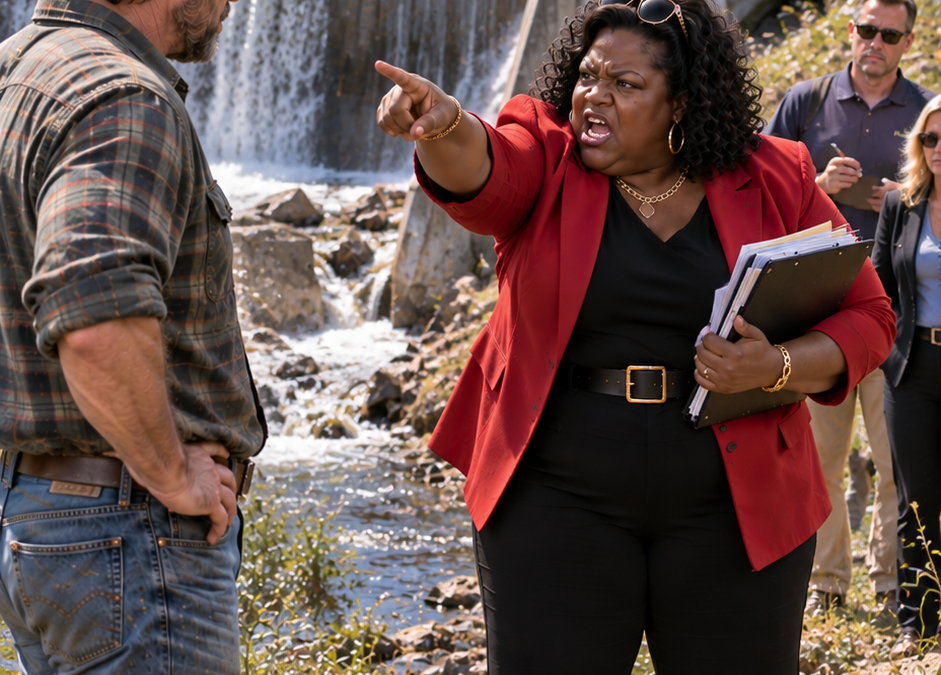
𝗣𝗔𝗥𝗧 𝟮
The county inspected construction.
The permit number went into the concrete.
And since then, the low basin had remained dry through storms that would once have pushed water across it.
Twenty-two years later, that basin was Creekside Ridge.
Sixty-two houses.
A clubhouse.
Parking lot.
Drainage channels.
Thirty-four homes directly inside the historic downstream flow path.
The people living there had no idea why their yards stayed dry.
There was never a reason for them to know.
Good infrastructure is usually invisible when it works.
I looked down at Karen’s orange-bordered notice.
Four hundred dollars.
Thirty days.
Unauthorized decorative water feature.
I could fight it.
I would win.
My parcel was outside the HOA boundary.
The structure was county permitted.
The HOA had no authority over it.
Karen’s trespass gave me another claim.
The problem was time.
A court fight might take six months.
Maybe eight.
Attorneys.
Hearings.
Filings.
All while Karen accumulated seventy-five dollars per day and began lien procedures.
That was one option.
The second was simpler.
She had put the removal demand in writing.
She had photographed the permit number.
She had explicitly told me she did not need to check with the county.
And she had never once asked what the dam protected.
In my filing cabinet was an engineering assessment from twenty-two years earlier containing one sentence that mattered more than her entire bylaw book:
Removal of the structure without replacement drainage controls would increase downstream flow at the basin exit by approximately 340 percent during rainfall events exceeding 1.5 inches per hour.
Three hundred forty percent.
The report identified the protected area.
The same land now occupied by Creekside Ridge.
Karen had just fined me $400 for the structure protecting her own neighborhood.
She did not know it.
I folded the notice along its original crease.
Put it in my shirt pocket.
Looked at the water.
Then went inside and made coffee.
That probably sounds anticlimactic.
People expect rage when somebody walks onto your property and threatens you.
I’ve owned land long enough to learn that rage mostly helps the person standing across from you.
Paper helps you.
Dates help you.
Permits help you.
I set the notice on the kitchen table.
Then pulled out my property file.
I bought the eleven acres in the early 2000s.
Mostly pasture.
Natural creek through the lower third.
At the time, the downstream basin was scrub timber, fields, and a small cluster of homes.
The second wet spring after I moved in showed me the problem.
I watched water leave my property faster than the lower channel could carry it.
That’s when the hydrologist came.
The original assessment was still clean after twenty-two years.
Eight pages.
Maps.
Calculations.
Projected discharge rates.
Downstream risk zones.
I turned to the final section.
There it was.
The structure was not ornamental.
It was not a pond feature.
It was flood infrastructure.
The report recommended that it never be altered or removed without county environmental review.
I placed the engineering report beside the county permit.
Then Karen’s violation notice.
The contrast was almost insulting.
One document represented licensed engineering, county review, inspection, and two decades of successful operation.
The other said:
$400.
Remove decorative water feature.
Karen had been president only six months.
I knew that because Creekside Ridge sometimes mailed me its newsletter by mistake.
I wasn’t a member.
My property sat upstream and outside the subdivision.
But whoever maintained the mailing database had included my address years earlier.
The previous board had apparently been ordinary.
Karen ran on “restoring standards.”
Within sixty days, citations tripled.
She increased base fines.
Shortened cure periods.
Accelerated lien threats.
A retired schoolteacher got fined over a wind chime.
A young couple got threatened with a lien because a contractor couldn’t repair their cracked driveway inside Karen’s ten-day deadline.
An elderly man had a mobility ramp on his front steps.
Karen called it unauthorized construction.
He needed it to get into his own house.
The ramp had existed three years.
That told me something about her.
Some people use authority because they need order.
Others need compliance.
Karen needed compliance.
My property had only been mentioned by the HOA once before.
Two years earlier, a branch from one of my trees hung over an HOA common drainage easement.
They sent a polite letter.
I trimmed it.
Done.
Then Karen took over.
Apparently, she reviewed satellite images.
On those images, the dam was visible upstream.
Concrete structure.
Not approved by the HOA.
In her mind, that was enough.
She built a violation file before ever asking why it was there.
So I did not call her.
I waited for the monthly board meeting.
Second Thursday.
Clubhouse.
Fluorescent lights.
Folding chairs.
Whiteboard with the HOA logo in one corner.
I arrived seven minutes early.
Fourteen residents were already seated.
Karen sat at the front with two board members.
One man around sixty.
One younger woman.
An assistant worked from a laptop beside them.
That detail mattered.
Minutes were being recorded.
The first forty minutes were boring.
Parking.
Pool schedule.
Drainage complaint.
Karen ran the room efficiently.
Every issue ended the same way.
Karen stated a position.
The board agreed.
Matter closed.
Then homeowner comments began.
I raised my hand.
She recognized me immediately.
“Mr. Caldwell, you are not a Creekside Ridge homeowner.”
“No.”
“Then this forum isn’t generally open to you.”
“You sent an enforcement order to my property.”
A pause.
“Three minutes.”
I stood.
No speech.
No anger.
“This structure is not decorative.”
Karen watched.
“It is a county-permitted Class 2 flood mitigation structure constructed twenty-two years ago.”
No reaction.
“Licensed contractor. County inspection. Final approval.”
I recited the permit number.
“The permit is active. The structure predates Creekside Ridge. My property is outside your legal boundary.”
Karen folded her hands.
“Anything else?”
“The HOA has no authority to order removal.”
I sat.
She waited a moment before responding.
Then:
“Thank you, Mr. Caldwell.”
She looked toward the room.
“The association’s governing documents extend enforcement authority to structures that affect the appearance, drainage environment, or character of the community.”
I almost smiled.
“The structure was erected without HOA approval.”
“It was built before Creekside Ridge existed.”
“That doesn’t change its current impact.”
“What impact?”
She ignored the question.
“Unauthorized structures remain unauthorized regardless of age.”
A man near the back spoke carefully.
“What does the dam actually do?”
Karen didn’t look at him.
“That is not relevant to the compliance issue.”
The man stopped.
That answer told me everything.
Not relevant.
She ordered a flood-control dam demolished without considering flood control relevant.
Then she called the vote.
Three hands.
Unanimous.
Removal order upheld.
$400 base fine.
$75 per day after deadline.
Lien authorized if unresolved at ninety days.
I wrote down the date.
Vote.
Names.
Then looked at the projected slide behind Karen.
Violation Case CR-2024-047 — Upstream Property Structure
Four photographs.
Every one had been taken inside my property.
From the creek bank.
During her trespass.
Timestamp visible.
Karen had entered evidence of her own unauthorized entry into the official HOA meeting record.
I photographed the screen.
Said nothing.
In the parking lot, two people approached.
The first was the man who asked about the dam.
“I hope you fight her.”
He kept his voice low.
Like Karen might be listening from inside.
The second was a woman around forty.
She just nodded at me.
Then left.
I understood both.
The neighborhood had learned to survive by not attracting her attention.
I drove home.
At that point I had everything needed to fight.
Permit.
Hydrology report.
Boundary documents.
Photographs.
Meeting record.
Trespass.
I could have handed it to my attorney the next morning and ended this in court.
Instead, I called a contractor.
Before I did anything irreversible, though, I spent a week looking at Karen’s pattern.
Not because I needed more evidence against her.
Because I wanted to be certain I wasn’t mistaking arrogance for something else.
I spoke with three residents.
The first was a man in his late sixties.
His wife had owned the same wind chime since they moved into Creekside Ridge eleven years earlier.
Karen fined them $200 four weeks after becoming president.
Unapproved exterior modification.
They paid.
Took it down.
Two weeks later, Karen returned and photographed the empty hook.
The second household belonged to a young family.
Their driveway cracked.
They scheduled a repair.
Contractor couldn’t begin for three weeks.
Karen’s deadline was ten days.
She threatened a lien.
They paid a $340 “processing fee” to suspend enforcement until repairs were completed.
Never got the fee back.
The third homeowner was gone.
Her former neighbor told me she had sold below asking price because she couldn’t take the notices anymore.
Dog violation.
Flagpole two inches too high.
Fence color.
Every month something new.
“She just wanted out,” he said.
I wrote everything down.
Then called the county water authority.
I intended only to confirm my permit status.
The woman on the phone found it quickly.
“Active.”
“Any compliance issues?”
“None.”
“Any open reviews?”
Pause.
“Actually, we had an inquiry recently.”
“From whom?”
“A homeowners association.”
My hand stopped moving.
“Creekside Ridge?”
“Yes.”
“When?”
“About three weeks ago.”
That was before the board meeting.
“What did they ask?”
“Whether the county had jurisdiction over removal of the structure.”
“And what did you tell them?”
She read from the response.
Valid Class 2 permit.
Removal requires environmental review and written county authorization.
Any party directing unauthorized removal could be exposed to liability under county drainage regulations.
“Who did you send that to?”
“The HOA board president.”
“Karen Whitmore?”
“Yes.”
That changed everything.
Karen had known.
Not everything.
Maybe she still didn’t understand the 340 percent figure.
But she knew the county said removal required review.
She had received that warning before the vote.
Then concealed it from the board.
I requested certified copies of the HOA inquiry and the county response.
They arrived two days later.
I spread them across the kitchen table.
HOA inquiry.
County warning.
Permit.
Hydrology report.
Maintenance logs.
Meeting minutes.
Photo of Karen’s trespass slide.
I reread the engineering paragraph.
340 percent.
Thirty-four residential lots.
Clubhouse parking.
Common drainage area.
Then I checked the long-range weather forecast.
A slow-moving rain system was developing.
Maybe three weeks away.
Projected accumulation:
One and a half to two and a half inches over forty-eight hours.
Nothing extraordinary.
The kind of rain we had seen many times.
The kind of rain the dam had handled quietly for twenty-two years.
The following Tuesday, certified mail arrived.
Not from Karen.
Law firm.
County seat.
Eight-page civil complaint.
Creekside Ridge HOA sought an injunction compelling me to remove the unauthorized structure.
That was the escalation.
A fine is one thing.
A court order is another.
If a judge ordered removal and I refused, I wasn’t dealing with seventy-five dollars a day.
I was dealing with contempt.
I called my attorney.
We met the next morning.
He had already read the filing.
Three lines on his yellow legal pad.
“You’re going to win,” he said.
“Eventually.”
“Eventually.”
“How long?”
“Four to eight months.”
“Cost?”
He named a number.
I didn’t like it.
He continued.
“The HOA lacks jurisdiction. County permit controls. Your parcel is outside their boundary. The undisclosed county advisory is bad for them. The trespass is a counterclaim.”
“Option two.”
He studied me.
“You already know option two.”
“Say it anyway.”
“You comply.”
I nodded.
“Voluntarily.”
“Licensed contractor.”
“Document everything.”
“Notify HOA counsel.”
“Notify the court.”
He leaned back.
“Then their injunction request becomes moot pending completion.”
“And downstream consequences?”
“If flooding occurs from a structure they ordered removed after the county explicitly warned them not to proceed without environmental review—”
He stopped.
I finished it.
“That’s their chain.”
“Potentially.”
He looked at me carefully.
“Daniel, I need to ask you something.”
“Go ahead.”
“Are you doing this because you want the neighborhood flooded?”
“No.”
“Are you hoping houses get damaged?”
“No.”
That answer mattered.
“I want the written order followed exactly.”
He nodded.
“The ethical and legal line is documentation and compliance. You don’t interfere with water. You don’t create conditions. You remove the structure they ordered removed, through licensed professionals, and you notify the relevant agencies.”
“Correct.”
He knew me eleven years.
He could tell I had already decided.
“Draft it.”
He picked up his pen.
The compliance notice went to HOA counsel that Thursday.
I agreed to remove the structure by the HOA deadline.
Licensed contractor.
Full work order.
Completion certificate.
Copies to counsel.
Copies filed with the court.
The HOA’s attorney responded within forty-eight hours.
Civil complaint held in abeyance pending confirmed removal.
A neighbor later told me Karen read the letter during a board session.
Apparently she smiled.
“I knew he’d comply.”
Satisfied.
That was the word my neighbor used.
The contractor came Friday.
He had worked on my creek before.
He walked the dam.
Checked the outlet.
Looked downstream.
Then looked at me.
“You want this gone?”
“That’s the order.”
“This isn’t decorative.”
“I know.”
“It’s controlling flow.”
“I know.”
He looked downhill again.
“You’re sure?”
“I need a written work order showing full removal to natural channel grade.”
He was quiet.
Then:
“And a completion certificate?”
“Yes.”
He nodded.
“I’ll write it.”
Work began Tuesday.
Concrete saw.
Excavator.
Hauling truck.
Three days.
Thursday afternoon, the structure that had regulated my creek for twenty-two years was gone.
Open channel.
Natural grade.
No headwall.
No controlled outlet.
No permit number stamped in concrete.
The creek looked ordinary.
That was the disturbing part.
Nothing dramatic happened.
Dry season.
Low water.
A person who didn’t know the property could have stood there and thought:
See?
Didn’t need that dam at all.
I photographed the site.
Before.
During.
After.
Saved the contractor’s invoices.
Work order.
Completion certificate.
Then checked the weather.
Nine days.
Rain system still coming.
One and a half to two and a half inches.
The next morning, I called county drainage.
“My Class 2 structure has been removed.”
Silence.
“Removed by whom?”
“Licensed contractor.”
“Under county authorization?”
“No.”
Longer silence.
“Under Creekside Ridge HOA enforcement order.”
I gave her the case number.
“My attorney notified their counsel and the court.”
“Mr. Caldwell, can you spell the board president’s name?”
I did.
“Please log this call.”
“I absolutely will.”
Ten days after removal, Karen held a community session.
Not a formal board meeting.
No minutes.
No agenda.
Just an email:
COMMUNITY UPDATE.
A neighbor texted me.
I went.
Twelve people.
Karen stood at the front.
Her board behind her.
No assistant.
No laptop.
No official minutes.
“As many of you have noticed,” she began, “the upstream structure subject to our recent enforcement action has now been removed.”
She paused.
“This was a long-standing compliance issue previous boards failed to address.”
Nobody spoke.
“I’m pleased to report the owner complied following formal proceedings.”
A man raised his hand.
“What was the structure?”
Karen barely paused.
“A decorative water feature.”
I watched the younger board member glance toward me.
Karen continued.
“It had been installed on adjacent property without HOA review.”
Then moved on.
Decorative water feature.
She now had twelve witnesses hearing her describe a permitted flood-control structure that way ten days after ordering its demolition.
I didn’t correct her.
I stood.
Picked up my folder.
Left.
The weather service issued the rainfall advisory Friday morning.
Slow-moving system.
One and a half to two and a half inches over forty-eight hours.
Not severe weather.
No tornado watch.
No tropical storm.
Just ordinary sustained rain.
The dam had handled storms like it for more than two decades.
Rain started Friday evening.
I sat on my back porch watching the creek rise.
Water moved faster than it used to.
Without the structure, the current accelerated toward the property exit.
At nine, I took a photograph.
Timestamp.
Location data.
Then went to bed.
Saturday morning, rain continued.
I drove through Creekside Ridge around 8:30.
Windows up.
No stops.
The lower third of the clubhouse parking lot had standing water.
Two or three inches.
Drainage channels were full and moving hard.
Behind the lowest row of houses, water collected against fences.
No homes flooded yet.
But the basin was beginning to behave the way it had before the dam existed.
I drove to the end of the street.
Turned around.
Went home.
I did not knock on doors.
Did not call Karen.
Did not warn the board.
That sounds harsh until you remember:
I had warned them.
The county had warned them.
The hydrology report existed.
They ordered removal anyway.
My responsibility had been to comply safely with the written demand.
I had.
Sunday morning:
Seventeen homeowners called the HOA emergency line.
By afternoon, Karen reportedly stopped answering.
At 6:55 Sunday evening, I walked into the clubhouse.
Forty people.
Every chair full.
Residents against walls.
People sitting on window ledges.
Industrial fan humming near the storage room.
The clubhouse itself had taken water through the east foundation.
Wet towels sat in a pile.
Karen started at seven.
She looked controlled.
I’ll give her that.
“This community has experienced an unforeseen drainage event.”
Unforeseen.
“Caused by unusually heavy rainfall combined with inadequate county infrastructure.”
There it was.
County infrastructure.
“The board has already prepared a request for emergency review.”
She told everyone not to worry.
The board was handling it.
I raised my hand.
She saw me immediately.
“Mr. Caldwell, you are not a Creekside Ridge resident.”
“No.”
I stood.
“But I’m the property owner you ordered to remove the upstream structure.”
The room quieted.
I held up the original orange-bordered violation notice.
“Your written order.”
I walked forward.
Opened my folder.
First document:
County permit.
I read the permit number.
Classification.
Approval date.
Inspector signoff.
Then turned the sheet toward the room.
“This authorized construction and maintenance of the dam your board ordered removed.”
Someone behind me breathed out sharply.
Karen started:
“Our bylaws—”
I held up the next document.
“Engineering assessment.”
Eight pages.
Twenty-two years old.
I found the marked paragraph.
Read:
“Removal of this structure without replacement drainage controls would expose the downstream basin to a projected flow increase of approximately three hundred forty percent during rainfall events exceeding one and a half inches per hour.”
I put it beside the permit.
“The downstream basin in this report is where your subdivision now stands.”
From the middle of the room:
“Three hundred forty percent?”
Same man from the earlier session.
Not a question.
Karen responded.
“The county’s drainage infrastructure—”
“The county warned you.”
That changed the room.
I pulled out the advisory letter.
Date.
Three days before the board vote.
Addressed directly to Karen.
I read the relevant paragraph.
Valid Class 2 permit.
Removal requires county environmental review.
Unauthorized removal creates drainage liability.
Then set it in front of the board.
“This was sent to the board president before you voted.”
The younger board member reached out.
Picked it up.
Read slowly.
Everyone watched him.
When he finished, he set it down.
Then pushed his chair several inches away from Karen.
“Karen.”
She looked at him.
“We voted on this.”
“The letter was still under legal review.”
“We voted on this.”
Same words.
Same volume.
That second repetition did more damage than shouting ever could.
The woman beside him put down her pen.
I added the final documents.
Contractor work order.
Completion certificate.
“I complied fully with your written removal demand.”
Then:
“I also notified county drainage immediately after removal.”
I closed the folder.
“You’ll probably want copies of all of this when you contact your insurance carrier.”
That sentence finally broke the room open.
Several people began talking at once.
One woman asked Karen when she received the county letter.
Another asked whether the board’s attorney had ever seen it.
Someone near the back wanted to know whether the HOA had flood insurance.
The man who had repeated “340 percent” asked:
“What does three hundred forty percent do to thirty-four houses?”
Karen tried to explain.
County infrastructure.
Pending legal review.
HOA jurisdiction.
Each explanation required another explanation.
The younger board member said nothing.
He sat with both hands flat on the table.
The county opened a formal review within two weeks.
I didn’t request it.
They already had the removal notification.
The emergency meeting and resident complaints moved it forward.
Six weeks later, the determination arrived.
I opened it at the kitchen table.
Coffee beside me.
The county found:
Creekside Ridge HOA had ordered removal of a valid Class 2 flood mitigation structure.
The structure sat on private property outside HOA jurisdiction.
The board president had received written notice that county environmental approval was required.
The board proceeded anyway.
Removal constituted unauthorized alteration of permitted drainage infrastructure.
Responsibility for the modification and resulting downstream effects rested with the party issuing the enforcement order.
The HOA’s lawsuit against me was dismissed with prejudice two weeks later.
My $400 fine was voided.
The county restored the permit status.
Then issued a mandatory reconstruction order.
Same design.
Same function.
One hundred twenty days.
Cost charged to the party responsible for ordering removal.
Final restoration bill:
Approximately $47,000.
That was just the dam.
Four homeowners filed flood-damage claims.
The HOA’s insurance carrier reviewed everything.
County warning.
Meeting record.
Karen’s undisclosed letter.
Removal order.
County finding.
The carrier disputed coverage because the board had knowingly acted outside its authority after receiving regulatory notice.
Now the association had:
Legal fees.
Dam reconstruction.
Flood claims.
Coverage dispute.
Emergency drainage work.
All tied to one orange-bordered sheet.
$400.
There is something almost mathematical about bad authority.
A small decision expands when nobody checks it.
One fine becomes a vote.
The vote becomes a lawsuit.
The lawsuit becomes demolition.
Demolition becomes flooding.
Flooding becomes claims.
Claims become insurance problems.
All because nobody in charge wanted to ask the first question.
What does the dam do?
Residents called a vote to remove Karen within thirty days.
I did not attend.
It wasn’t my association.
They removed her.
Two other board members resigned soon afterward.
An interim board replaced them.
People who had spent six months paying fines and keeping their heads down.
The man who had repeated the 340 percent figure became vice chair.
Their first new policy was one sentence:
No enforcement action affecting land or structures outside the recorded HOA boundary could proceed without written confirmation from the relevant county authority.
One sentence.
Would have prevented everything.
The dam took eleven weeks to rebuild.
The same contractor who removed it returned.
There was something fitting about that.
Forms went up.
Rebar.
Concrete.
Outlet.
Wing walls.
County plans followed exactly.
When the headwall cured, the inspector came out.
Checked elevations.
Measured.
Signed.
A new permit number was stenciled into the concrete.
Four inches tall.
Same place as before.
I watched the water settle.
Even during partial operation, the difference was obvious.
Flow slowed.
Spread.
Released through the outlet at the rate the lower channel could actually handle.
The creek found its old rhythm again.
Controlled.
Patient.
By then, the neighborhood felt different.
No orange notices came to my mailbox.
Nobody entered my property.
Nobody photographed anything without asking.
My gate stayed shut when I left it shut.
I replanted disturbed soil along the creek bank.
Native grasses.
A few willows.
Nothing dramatic.
Just repair.
The folder containing the entire dispute went into the fireproof box in my hallway closet.
I considered framing Karen’s original $400 violation.
The orange border.
Case number.
The words:
UNAUTHORIZED DECORATIVE WATER FEATURE.
I decided not to.
I didn’t need it on the wall.
The rebuilt dam was enough.
Early one summer morning, I walked down before the day got hot.
Water came off the upper property.
Met the concrete.
Spread across the face.
Dropped through the controlled outlet.
Continued toward Creekside Ridge at a manageable rate.
Same sound it had made for twenty-two years.
Behind those trees were sixty-two houses.
Most people living in them would probably never think about my dam again.
That was fine.
Flood infrastructure isn’t supposed to be interesting.
It’s supposed to work.
I stood at the creek bank and thought about Karen’s first visit.
Her phone.
Clipboard.
Assistant.
Open gate.
The way she photographed the permit number without understanding it.
The way she smiled when I asked whether she’d checked with the county.
I don’t need to.
Those four words were the whole story.
Not the rain.
Not the lawsuit.
Not even the flood.
The disaster began when someone with authority decided knowledge was optional.
Karen did not need to know what the structure did.
She did not need to know who permitted it.
She did not need to know what happened downstream.
She only needed to know that it had never received HOA approval.
Once she accepted that logic, everything else followed.
Residents had learned similar lessons with wind chimes and driveways and mobility ramps.
Most of those mistakes had been small enough that people could pay and move on.
Mine wasn’t.
Water doesn’t care about HOA bylaws.
It doesn’t recognize board votes.
It doesn’t stop because a president declares a flood-control structure decorative.
It follows grade.
Volume.
Velocity.
Gravity.
Those rules had existed before Creekside Ridge.
They would exist after it.
Twenty-two years earlier, an engineer calculated what the creek would do.
Three hundred forty percent.
Karen could ignore the report.
She could not make the number disappear.
I put one hand on the top of the new headwall.
Concrete still looked lighter than the old structure.
In another few seasons it would weather.
Moss would start in the shaded sections.
Maintenance markings would return each spring.
Eventually, it would look like it had always been there.
I was fine with that.
The best outcome wasn’t revenge.
It wasn’t Karen losing her position.
It wasn’t the $400 fine being voided.
It wasn’t even watching a county letter use words like “outside jurisdiction.”
The best outcome was boring.
A quiet creek.
Dry homes.
A closed gate.
No clipboard.
No argument.
No one paying attention.
Just water going where twenty-two years of engineering said it should go.
I stood there until the sun reached the creek.
Then walked back toward the house.
Behind me, the dam held the flow.
Downstream, Creekside Ridge stayed dry.
And this time, everybody knew why.
Have you finished reading the story and want to read it again?
HOA Karen Ordered Me to Tear Out My Dam Over a $400 Fine — Then Her Neighborhood Learned What It Had Been Holding Back for 22 Years
She fined me $400 and ordered my dam removed within thirty days.
I told her it was county-permitted flood protection, and she voted to tear it out anyway.
Three weeks after I complied, water started collecting in the yards of the people she claimed she was protecting.
My name is Daniel Caldwell, and the first time Karen Whitmore walked onto my land, she didn’t bother knocking.
I came around the bend above the creek and saw her forty feet from the dam.
Phone raised.
Taking pictures.
A man I didn’t recognize stood behind her with a clipboard under his arm.
My gate was open.
That bothered me before anything else did.
I stopped at the top of the path and looked at it.
The gate had been latched when I left that morning.
There was no public access through my property.
No HOA easement.
No reason for anybody connected with Creekside Ridge to be walking along my creek bank.
I headed downhill.
Karen didn’t turn until I was about fifteen feet away.
“Mr. Caldwell.”
She said my name like she’d already placed it under a violation number.
“That’s me.”
I looked toward the open gate.
“You’re on private property.”
She did not apologize.
She did not explain how she had entered.
Instead, she reached into her stack of papers and pulled out an orange-bordered notice.
“This is a formal violation issued by the Creekside Ridge Homeowners Association.”
She held it toward me between two fingers.
Not offered.
Issued.
I took it.
She continued.
“The structure behind you has been classified as unauthorized construction under HOA Bylaw Section Fourteen, Subsection C.”
I looked over my shoulder at the dam.
Concrete headwall.
Wing walls.
Controlled outlet.
Twenty-two years old.
“You have thirty days to remove it.”
I looked back at her.
“Excuse me?”
“Failure to comply will result in a four-hundred-dollar base fine. After thirty days, additional penalties accrue at seventy-five dollars per day.”
The man with the clipboard wrote something.
Karen continued.
“If unresolved within ninety days, the association will proceed with lien enforcement.”
I unfolded the notice.
Unauthorized decorative water feature.
That was how she had described it.
Decorative.
I almost laughed.
Instead I asked:
“Did you check the county permit?”
She gave me a small smile.
Patient.
Professional.
The smile of somebody who believes the answer is already obvious.
“This is an HOA compliance matter.”
“So that’s a no?”
“The county does not determine whether a structure complies with HOA standards.”
“You might want to check.”
“We don’t need to.”
Then she turned away from me and resumed taking photographs.
I watched her move along the bank.
Headwall.
Wing wall.
Outlet.
Maintenance markings.
Everything.
At one point, her assistant pointed toward the front of the structure.
Stamped directly into the concrete were four-inch characters identifying the county permit.
She photographed them.
Zoomed in.
Captured them clearly.
And still had no idea what she was looking at.
A Class 2 Flood Mitigation Permit.
Issued twenty-two years earlier.
Inspected.
Approved.
Signed off by the county water authority.
A permit tied to an eight-page civil hydrology assessment explaining exactly what would happen downstream if the structure disappeared.
Karen photographed the permit number herself.
Then spent another two minutes documenting what she believed was an HOA violation.
Neither of them asked what the dam did.
Neither asked why it had been built.
Neither asked what was downstream.
They had arrived with the answer already written.
Karen finished.
Her assistant capped his pen.
She gave me one final look.
“Thirty days, Mr. Caldwell.”
Then she walked through my gate.
The man followed.
Neither closed it.
I stood beside the creek listening to the water.
Controlled.
Steady.
Exactly the way it had run for more than two decades.
Water came from the higher elevation of my property, collected into the creek, met the structure, spread, slowed, then discharged through the lower channel at a managed rate.
I knew what the creek looked like with the dam.
More importantly, I knew what it looked like without it.
I had owned those eleven acres before the structure existed.
In my third year there, we got two and a half inches of rain in one afternoon.
I stood on the same bank and watched runoff accelerate through the natural channel.
The downstream drainage basin could not carry it.
Water spread across the low ground.
Back then, there were maybe a dozen houses below me.
Lawns flooded.
Culverts overwhelmed.
Nothing catastrophic.
But enough to make the problem obvious.
So I hired a hydrologist.
Not an HOA landscaper.
Not a handyman.
A licensed civil hydrologist.
He surveyed the creek.
Measured grade.
Modeled flow.
Calculated storm events.
Then wrote a recommendation:
Build a regulated flood-control structure at the narrow point above the lower drainage basin.
I filed for a county permit.
Received it.
Hired a licensed contractor.
The county inspected construction.
The permit number went into the concrete.
And since then, the low basin had remained dry through storms that would once have pushed water across it.
Twenty-two years later, that basin was Creekside Ridge.
Sixty-two houses.
A clubhouse.
Parking lot.
Drainage channels.
Thirty-four homes directly inside the historic downstream flow path.
The people living there had no idea why their yards stayed dry.
There was never a reason for them to know.
Good infrastructure is usually invisible when it works.
I looked down at Karen’s orange-bordered notice.
Four hundred dollars.
Thirty days.
Unauthorized decorative water feature.
I could fight it.
I would win.
My parcel was outside the HOA boundary.
The structure was county permitted.
The HOA had no authority over it.
Karen’s trespass gave me another claim.
The problem was time.
A court fight might take six months.
Maybe eight.
Attorneys.
Hearings.
Filings.
All while Karen accumulated seventy-five dollars per day and began lien procedures.
That was one option.
The second was simpler.
She had put the removal demand in writing.
She had photographed the permit number.
She had explicitly told me she did not need to check with the county.
And she had never once asked what the dam protected.
In my filing cabinet was an engineering assessment from twenty-two years earlier containing one sentence that mattered more than her entire bylaw book:
Removal of the structure without replacement drainage controls would increase downstream flow at the basin exit by approximately 340 percent during rainfall events exceeding 1.5 inches per hour.
Three hundred forty percent.
The report identified the protected area.
The same land now occupied by Creekside Ridge.
Karen had just fined me $400 for the structure protecting her own neighborhood.
She did not know it.
I folded the notice along its original crease.
Put it in my shirt pocket.
Looked at the water.
Then went inside and made coffee.
That probably sounds anticlimactic.
People expect rage when somebody walks onto your property and threatens you.
I’ve owned land long enough to learn that rage mostly helps the person standing across from you.
Paper helps you.
Dates help you.
Permits help you.
I set the notice on the kitchen table.
Then pulled out my property file.
I bought the eleven acres in the early 2000s.
Mostly pasture.
Natural creek through the lower third.
At the time, the downstream basin was scrub timber, fields, and a small cluster of homes.
The second wet spring after I moved in showed me the problem.
I watched water leave my property faster than the lower channel could carry it.
That’s when the hydrologist came.
The original assessment was still clean after twenty-two years.
Eight pages.
Maps.
Calculations.
Projected discharge rates.
Downstream risk zones.
I turned to the final section.
There it was.
The structure was not ornamental.
It was not a pond feature.
It was flood infrastructure.
The report recommended that it never be altered or removed without county environmental review.
I placed the engineering report beside the county permit.
Then Karen’s violation notice.
The contrast was almost insulting.
One document represented licensed engineering, county review, inspection, and two decades of successful operation.
The other said:
$400.
Remove decorative water feature.
Karen had been president only six months.
I knew that because Creekside Ridge sometimes mailed me its newsletter by mistake.
I wasn’t a member.
My property sat upstream and outside the subdivision.
But whoever maintained the mailing database had included my address years earlier.
The previous board had apparently been ordinary.
Karen ran on “restoring standards.”
Within sixty days, citations tripled.
She increased base fines.
Shortened cure periods.
Accelerated lien threats.
A retired schoolteacher got fined over a wind chime.
A young couple got threatened with a lien because a contractor couldn’t repair their cracked driveway inside Karen’s ten-day deadline.
An elderly man had a mobility ramp on his front steps.
Karen called it unauthorized construction.
He needed it to get into his own house.
The ramp had existed three years.
That told me something about her.
Some people use authority because they need order.
Others need compliance.
Karen needed compliance.
My property had only been mentioned by the HOA once before.
Two years earlier, a branch from one of my trees hung over an HOA common drainage easement.
They sent a polite letter.
I trimmed it.
Done.
Then Karen took over.
Apparently, she reviewed satellite images.
On those images, the dam was visible upstream.
Concrete structure.
Not approved by the HOA.
In her mind, that was enough.
She built a violation file before ever asking why it was there.
So I did not call her.
I waited for the monthly board meeting.
Second Thursday.
Clubhouse.
Fluorescent lights.
Folding chairs.
Whiteboard with the HOA logo in one corner.
I arrived seven minutes early.
Fourteen residents were already seated.
Karen sat at the front with two board members.
One man around sixty.
One younger woman.
An assistant worked from a laptop beside them.
That detail mattered.
Minutes were being recorded.
The first forty minutes were boring.
Parking.
Pool schedule.
Drainage complaint.
Karen ran the room efficiently.
Every issue ended the same way.
Karen stated a position.
The board agreed.
Matter closed.
Then homeowner comments began.
I raised my hand.
She recognized me immediately.
“Mr. Caldwell, you are not a Creekside Ridge homeowner.”
“No.”
“Then this forum isn’t generally open to you.”
“You sent an enforcement order to my property.”
A pause.
“Three minutes.”
I stood.
No speech.
No anger.
“This structure is not decorative.”
Karen watched.
“It is a county-permitted Class 2 flood mitigation structure constructed twenty-two years ago.”
No reaction.
“Licensed contractor. County inspection. Final approval.”
I recited the permit number.
“The permit is active. The structure predates Creekside Ridge. My property is outside your legal boundary.”
Karen folded her hands.
“Anything else?”
“The HOA has no authority to order removal.”
I sat.
She waited a moment before responding.
Then:
“Thank you, Mr. Caldwell.”
She looked toward the room.
“The association’s governing documents extend enforcement authority to structures that affect the appearance, drainage environment, or character of the community.”
I almost smiled.
“The structure was erected without HOA approval.”
“It was built before Creekside Ridge existed.”
“That doesn’t change its current impact.”
“What impact?”
She ignored the question.
“Unauthorized structures remain unauthorized regardless of age.”
A man near the back spoke carefully.
“What does the dam actually do?”
Karen didn’t look at him.
“That is not relevant to the compliance issue.”
The man stopped.
That answer told me everything.
Not relevant.
She ordered a flood-control dam demolished without considering flood control relevant.
Then she called the vote.
Three hands.
Unanimous.
Removal order upheld.
$400 base fine.
$75 per day after deadline.
Lien authorized if unresolved at ninety days.
I wrote down the date.
Vote.
Names.
Then looked at the projected slide behind Karen.
Violation Case CR-2024-047 — Upstream Property Structure
Four photographs.
Every one had been taken inside my property.
From the creek bank.
During her trespass.
Timestamp visible.
Karen had entered evidence of her own unauthorized entry into the official HOA meeting record.
I photographed the screen.
Said nothing.
In the parking lot, two people approached.
The first was the man who asked about the dam.
“I hope you fight her.”
He kept his voice low.
Like Karen might be listening from inside.
The second was a woman around forty.
She just nodded at me.
Then left.
I understood both.
The neighborhood had learned to survive by not attracting her attention.
I drove home.
At that point I had everything needed to fight.
Permit.
Hydrology report.
Boundary documents.
Photographs.
Meeting record.
Trespass.
I could have handed it to my attorney the next morning and ended this in court.
Instead, I called a contractor.
Before I did anything irreversible, though, I spent a week looking at Karen’s pattern.
Not because I needed more evidence against her.
Because I wanted to be certain I wasn’t mistaking arrogance for something else.
I spoke with three residents.
The first was a man in his late sixties.
His wife had owned the same wind chime since they moved into Creekside Ridge eleven years earlier.
Karen fined them $200 four weeks after becoming president.
Unapproved exterior modification.
They paid.
Took it down.
Two weeks later, Karen returned and photographed the empty hook.
The second household belonged to a young family.
Their driveway cracked.
They scheduled a repair.
Contractor couldn’t begin for three weeks.
Karen’s deadline was ten days.
She threatened a lien.
They paid a $340 “processing fee” to suspend enforcement until repairs were completed.
Never got the fee back.
The third homeowner was gone.
Her former neighbor told me she had sold below asking price because she couldn’t take the notices anymore.
Dog violation.
Flagpole two inches too high.
Fence color.
Every month something new.
“She just wanted out,” he said.
I wrote everything down.
Then called the county water authority.
I intended only to confirm my permit status.
The woman on the phone found it quickly.
“Active.”
“Any compliance issues?”
“None.”
“Any open reviews?”
Pause.
“Actually, we had an inquiry recently.”
“From whom?”
“A homeowners association.”
My hand stopped moving.
“Creekside Ridge?”
“Yes.”
“When?”
“About three weeks ago.”
That was before the board meeting.
“What did they ask?”
“Whether the county had jurisdiction over removal of the structure.”
“And what did you tell them?”
She read from the response.
Valid Class 2 permit.
Removal requires environmental review and written county authorization.
Any party directing unauthorized removal could be exposed to liability under county drainage regulations.
“Who did you send that to?”
“The HOA board president.”
“Karen Whitmore?”
“Yes.”
That changed everything.
Karen had known.
Not everything.
Maybe she still didn’t understand the 340 percent figure.
But she knew the county said removal required review.
She had received that warning before the vote.
Then concealed it from the board.
I requested certified copies of the HOA inquiry and the county response.
They arrived two days later.
I spread them across the kitchen table.
HOA inquiry.
County warning.
Permit.
Hydrology report.
Maintenance logs.
Meeting minutes.
Photo of Karen’s trespass slide.
I reread the engineering paragraph.
340 percent.
Thirty-four residential lots.
Clubhouse parking.
Common drainage area.
Then I checked the long-range weather forecast.
A slow-moving rain system was developing.
Maybe three weeks away.
Projected accumulation:
One and a half to two and a half inches over forty-eight hours.
Nothing extraordinary.
The kind of rain we had seen many times.
The kind of rain the dam had handled quietly for twenty-two years.
The following Tuesday, certified mail arrived.
Not from Karen.
Law firm.
County seat.
Eight-page civil complaint.
Creekside Ridge HOA sought an injunction compelling me to remove the unauthorized structure.
That was the escalation.
A fine is one thing.
A court order is another.
If a judge ordered removal and I refused, I wasn’t dealing with seventy-five dollars a day.
I was dealing with contempt.
I called my attorney.
We met the next morning.
He had already read the filing.
Three lines on his yellow legal pad.
“You’re going to win,” he said.
“Eventually.”
“Eventually.”
“How long?”
“Four to eight months.”
“Cost?”
He named a number.
I didn’t like it.
He continued.
“The HOA lacks jurisdiction. County permit controls. Your parcel is outside their boundary. The undisclosed county advisory is bad for them. The trespass is a counterclaim.”
“Option two.”
He studied me.
“You already know option two.”
“Say it anyway.”
“You comply.”
I nodded.
“Voluntarily.”
“Licensed contractor.”
“Document everything.”
“Notify HOA counsel.”
“Notify the court.”
He leaned back.
“Then their injunction request becomes moot pending completion.”
“And downstream consequences?”
“If flooding occurs from a structure they ordered removed after the county explicitly warned them not to proceed without environmental review—”
He stopped.
I finished it.
“That’s their chain.”
“Potentially.”
He looked at me carefully.
“Daniel, I need to ask you something.”
“Go ahead.”
“Are you doing this because you want the neighborhood flooded?”
“No.”
“Are you hoping houses get damaged?”
“No.”
That answer mattered.
“I want the written order followed exactly.”
He nodded.
“The ethical and legal line is documentation and compliance. You don’t interfere with water. You don’t create conditions. You remove the structure they ordered removed, through licensed professionals, and you notify the relevant agencies.”
“Correct.”
He knew me eleven years.
He could tell I had already decided.
“Draft it.”
He picked up his pen.
The compliance notice went to HOA counsel that Thursday.
I agreed to remove the structure by the HOA deadline.
Licensed contractor.
Full work order.
Completion certificate.
Copies to counsel.
Copies filed with the court.
The HOA’s attorney responded within forty-eight hours.
Civil complaint held in abeyance pending confirmed removal.
A neighbor later told me Karen read the letter during a board session.
Apparently she smiled.
“I knew he’d comply.”
Satisfied.
That was the word my neighbor used.
The contractor came Friday.
He had worked on my creek before.
He walked the dam.
Checked the outlet.
Looked downstream.
Then looked at me.
“You want this gone?”
“That’s the order.”
“This isn’t decorative.”
“I know.”
“It’s controlling flow.”
“I know.”
He looked downhill again.
“You’re sure?”
“I need a written work order showing full removal to natural channel grade.”
He was quiet.
Then:
“And a completion certificate?”
“Yes.”
He nodded.
“I’ll write it.”
Work began Tuesday.
Concrete saw.
Excavator.
Hauling truck.
Three days.
Thursday afternoon, the structure that had regulated my creek for twenty-two years was gone.
Open channel.
Natural grade.
No headwall.
No controlled outlet.
No permit number stamped in concrete.
The creek looked ordinary.
That was the disturbing part.
Nothing dramatic happened.
Dry season.
Low water.
A person who didn’t know the property could have stood there and thought:
See?
Didn’t need that dam at all.
I photographed the site.
Before.
During.
After.
Saved the contractor’s invoices.
Work order.
Completion certificate.
Then checked the weather.
Nine days.
Rain system still coming.
One and a half to two and a half inches.
The next morning, I called county drainage.
“My Class 2 structure has been removed.”
Silence.
“Removed by whom?”
“Licensed contractor.”
“Under county authorization?”
“No.”
Longer silence.
“Under Creekside Ridge HOA enforcement order.”
I gave her the case number.
“My attorney notified their counsel and the court.”
“Mr. Caldwell, can you spell the board president’s name?”
I did.
“Please log this call.”
“I absolutely will.”
Ten days after removal, Karen held a community session.
Not a formal board meeting.
No minutes.
No agenda.
Just an email:
COMMUNITY UPDATE.
A neighbor texted me.
I went.
Twelve people.
Karen stood at the front.
Her board behind her.
No assistant.
No laptop.
No official minutes.
“As many of you have noticed,” she began, “the upstream structure subject to our recent enforcement action has now been removed.”
She paused.
“This was a long-standing compliance issue previous boards failed to address.”
Nobody spoke.
“I’m pleased to report the owner complied following formal proceedings.”
A man raised his hand.
“What was the structure?”
Karen barely paused.
“A decorative water feature.”
I watched the younger board member glance toward me.
Karen continued.
“It had been installed on adjacent property without HOA review.”
Then moved on.
Decorative water feature.
She now had twelve witnesses hearing her describe a permitted flood-control structure that way ten days after ordering its demolition.
I didn’t correct her.
I stood.
Picked up my folder.
Left.
The weather service issued the rainfall advisory Friday morning.
Slow-moving system.
One and a half to two and a half inches over forty-eight hours.
Not severe weather.
No tornado watch.
No tropical storm.
Just ordinary sustained rain.
The dam had handled storms like it for more than two decades.
Rain started Friday evening.
I sat on my back porch watching the creek rise.
Water moved faster than it used to.
Without the structure, the current accelerated toward the property exit.
At nine, I took a photograph.
Timestamp.
Location data.
Then went to bed.
Saturday morning, rain continued.
I drove through Creekside Ridge around 8:30.
Windows up.
No stops.
The lower third of the clubhouse parking lot had standing water.
Two or three inches.
Drainage channels were full and moving hard.
Behind the lowest row of houses, water collected against fences.
No homes flooded yet.
But the basin was beginning to behave the way it had before the dam existed.
I drove to the end of the street.
Turned around.
Went home.
I did not knock on doors.
Did not call Karen.
Did not warn the board.
That sounds harsh until you remember:
I had warned them.
The county had warned them.
The hydrology report existed.
They ordered removal anyway.
My responsibility had been to comply safely with the written demand.
I had.
Sunday morning:
Seventeen homeowners called the HOA emergency line.
By afternoon, Karen reportedly stopped answering.
At 6:55 Sunday evening, I walked into the clubhouse.
Forty people.
Every chair full.
Residents against walls.
People sitting on window ledges.
Industrial fan humming near the storage room.
The clubhouse itself had taken water through the east foundation.
Wet towels sat in a pile.
Karen started at seven.
She looked controlled.
I’ll give her that.
“This community has experienced an unforeseen drainage event.”
Unforeseen.
“Caused by unusually heavy rainfall combined with inadequate county infrastructure.”
There it was.
County infrastructure.
“The board has already prepared a request for emergency review.”
She told everyone not to worry.
The board was handling it.
I raised my hand.
She saw me immediately.
“Mr. Caldwell, you are not a Creekside Ridge resident.”
“No.”
I stood.
“But I’m the property owner you ordered to remove the upstream structure.”
The room quieted.
I held up the original orange-bordered violation notice.
“Your written order.”
I walked forward.
Opened my folder.
First document:
County permit.
I read the permit number.
Classification.
Approval date.
Inspector signoff.
Then turned the sheet toward the room.
“This authorized construction and maintenance of the dam your board ordered removed.”
Someone behind me breathed out sharply.
Karen started:
“Our bylaws—”
I held up the next document.
“Engineering assessment.”
Eight pages.
Twenty-two years old.
I found the marked paragraph.
Read:
“Removal of this structure without replacement drainage controls would expose the downstream basin to a projected flow increase of approximately three hundred forty percent during rainfall events exceeding one and a half inches per hour.”
I put it beside the permit.
“The downstream basin in this report is where your subdivision now stands.”
From the middle of the room:
“Three hundred forty percent?”
Same man from the earlier session.
Not a question.
Karen responded.
“The county’s drainage infrastructure—”
“The county warned you.”
That changed the room.
I pulled out the advisory letter.
Date.
Three days before the board vote.
Addressed directly to Karen.
I read the relevant paragraph.
Valid Class 2 permit.
Removal requires county environmental review.
Unauthorized removal creates drainage liability.
Then set it in front of the board.
“This was sent to the board president before you voted.”
The younger board member reached out.
Picked it up.
Read slowly.
Everyone watched him.
When he finished, he set it down.
Then pushed his chair several inches away from Karen.
“Karen.”
She looked at him.
“We voted on this.”
“The letter was still under legal review.”
“We voted on this.”
Same words.
Same volume.
That second repetition did more damage than shouting ever could.
The woman beside him put down her pen.
I added the final documents.
Contractor work order.
Completion certificate.
“I complied fully with your written removal demand.”
Then:
“I also notified county drainage immediately after removal.”
I closed the folder.
“You’ll probably want copies of all of this when you contact your insurance carrier.”
That sentence finally broke the room open.
Several people began talking at once.
One woman asked Karen when she received the county letter.
Another asked whether the board’s attorney had ever seen it.
Someone near the back wanted to know whether the HOA had flood insurance.
The man who had repeated “340 percent” asked:
“What does three hundred forty percent do to thirty-four houses?”
Karen tried to explain.
County infrastructure.
Pending legal review.
HOA jurisdiction.
Each explanation required another explanation.
The younger board member said nothing.
He sat with both hands flat on the table.
The county opened a formal review within two weeks.
I didn’t request it.
They already had the removal notification.
The emergency meeting and resident complaints moved it forward.
Six weeks later, the determination arrived.
I opened it at the kitchen table.
Coffee beside me.
The county found:
Creekside Ridge HOA had ordered removal of a valid Class 2 flood mitigation structure.
The structure sat on private property outside HOA jurisdiction.
The board president had received written notice that county environmental approval was required.
The board proceeded anyway.
Removal constituted unauthorized alteration of permitted drainage infrastructure.
Responsibility for the modification and resulting downstream effects rested with the party issuing the enforcement order.
The HOA’s lawsuit against me was dismissed with prejudice two weeks later.
My $400 fine was voided.
The county restored the permit status.
Then issued a mandatory reconstruction order.
Same design.
Same function.
One hundred twenty days.
Cost charged to the party responsible for ordering removal.
Final restoration bill:
Approximately $47,000.
That was just the dam.
Four homeowners filed flood-damage claims.
The HOA’s insurance carrier reviewed everything.
County warning.
Meeting record.
Karen’s undisclosed letter.
Removal order.
County finding.
The carrier disputed coverage because the board had knowingly acted outside its authority after receiving regulatory notice.
Now the association had:
Legal fees.
Dam reconstruction.
Flood claims.
Coverage dispute.
Emergency drainage work.
All tied to one orange-bordered sheet.
$400.
There is something almost mathematical about bad authority.
A small decision expands when nobody checks it.
One fine becomes a vote.
The vote becomes a lawsuit.
The lawsuit becomes demolition.
Demolition becomes flooding.
Flooding becomes claims.
Claims become insurance problems.
All because nobody in charge wanted to ask the first question.
What does the dam do?
Residents called a vote to remove Karen within thirty days.
I did not attend.
It wasn’t my association.
They removed her.
Two other board members resigned soon afterward.
An interim board replaced them.
People who had spent six months paying fines and keeping their heads down.
The man who had repeated the 340 percent figure became vice chair.
Their first new policy was one sentence:
No enforcement action affecting land or structures outside the recorded HOA boundary could proceed without written confirmation from the relevant county authority.
One sentence.
Would have prevented everything.
The dam took eleven weeks to rebuild.
The same contractor who removed it returned.
There was something fitting about that.
Forms went up.
Rebar.
Concrete.
Outlet.
Wing walls.
County plans followed exactly.
When the headwall cured, the inspector came out.
Checked elevations.
Measured.
Signed.
A new permit number was stenciled into the concrete.
Four inches tall.
Same place as before.
I watched the water settle.
Even during partial operation, the difference was obvious.
Flow slowed.
Spread.
Released through the outlet at the rate the lower channel could actually handle.
The creek found its old rhythm again.
Controlled.
Patient.
By then, the neighborhood felt different.
No orange notices came to my mailbox.
Nobody entered my property.
Nobody photographed anything without asking.
My gate stayed shut when I left it shut.
I replanted disturbed soil along the creek bank.
Native grasses.
A few willows.
Nothing dramatic.
Just repair.
The folder containing the entire dispute went into the fireproof box in my hallway closet.
I considered framing Karen’s original $400 violation.
The orange border.
Case number.
The words:
UNAUTHORIZED DECORATIVE WATER FEATURE.
I decided not to.
I didn’t need it on the wall.
The rebuilt dam was enough.
Early one summer morning, I walked down before the day got hot.
Water came off the upper property.
Met the concrete.
Spread across the face.
Dropped through the controlled outlet.
Continued toward Creekside Ridge at a manageable rate.
Same sound it had made for twenty-two years.
Behind those trees were sixty-two houses.
Most people living in them would probably never think about my dam again.
That was fine.
Flood infrastructure isn’t supposed to be interesting.
It’s supposed to work.
I stood at the creek bank and thought about Karen’s first visit.
Her phone.
Clipboard.
Assistant.
Open gate.
The way she photographed the permit number without understanding it.
The way she smiled when I asked whether she’d checked with the county.
I don’t need to.
Those four words were the whole story.
Not the rain.
Not the lawsuit.
Not even the flood.
The disaster began when someone with authority decided knowledge was optional.
Karen did not need to know what the structure did.
She did not need to know who permitted it.
She did not need to know what happened downstream.
She only needed to know that it had never received HOA approval.
Once she accepted that logic, everything else followed.
Residents had learned similar lessons with wind chimes and driveways and mobility ramps.
Most of those mistakes had been small enough that people could pay and move on.
Mine wasn’t.
Water doesn’t care about HOA bylaws.
It doesn’t recognize board votes.
It doesn’t stop because a president declares a flood-control structure decorative.
It follows grade.
Volume.
Velocity.
Gravity.
Those rules had existed before Creekside Ridge.
They would exist after it.
Twenty-two years earlier, an engineer calculated what the creek would do.
Three hundred forty percent.
Karen could ignore the report.
She could not make the number disappear.
I put one hand on the top of the new headwall.
Concrete still looked lighter than the old structure.
In another few seasons it would weather.
Moss would start in the shaded sections.
Maintenance markings would return each spring.
Eventually, it would look like it had always been there.
I was fine with that.
The best outcome wasn’t revenge.
It wasn’t Karen losing her position.
It wasn’t the $400 fine being voided.
It wasn’t even watching a county letter use words like “outside jurisdiction.”
The best outcome was boring.
A quiet creek.
Dry homes.
A closed gate.
No clipboard.
No argument.
No one paying attention.
Just water going where twenty-two years of engineering said it should go.
I stood there until the sun reached the creek.
Then walked back toward the house.
Behind me, the dam held the flow.
Downstream, Creekside Ridge stayed dry.
And this time, everybody knew why.








