HOA Karen Ordered Me to Tear Down My Gazebo and Threatened $1,200-a-Day Fines—She Thought My Backyard Belonged to Her
**part 2**
I stepped directly into his path.
Not aggressively.
Not dramatically.
I simply stood there.
The contractor stopped.
He was probably in his late forties, broad-shouldered, sunburned, with a company logo stitched above his shirt pocket. He glanced from me to Karen with the expression of a man who had just realized the person who hired him might have left out a few details.
“You the homeowner?” he asked.
“I am.”
He looked toward Karen.
“She said the association owns the common parcel behind the subdivision.”
Karen immediately interrupted.
“It is functionally common property because it affects our visual corridor.”
The contractor blinked.
I blinked.
Even Emma looked impressed.
“Functionally common property?” I asked.
Karen lifted her chin.
“You know exactly what I mean.”
“No,” the contractor said slowly. “I actually don’t.”
That was the first crack.
Small, but visible.
I asked him whether Karen had shown him a deed, easement, court order, demolition authorization, or written consent from the property owner.
He looked at Karen again.
“She gave us a work order.”
“A work order from whom?”
“The HOA.”
“Did the HOA show you that it owns this parcel?”
His silence answered for him.
Karen snapped her folder open again.
“The association’s authority is established through our governing documents.”
“Great,” I said. “Show him.”
She pulled out a copy of the subdivision rules.
I recognized the first page because Karen had mailed me the same packet two months earlier after complaining that my barn light was “too rural.”
I had mailed it back.
She handed the packet to the contractor.
He read the address at the top.
Then he looked toward the subdivision entrance several hundred yards east.
“This says Willow Crest Homeowners Association.”
“Yes.”
He pointed at my mailbox.
“That says 714 County Route Eight.”
Karen’s face hardened.
“The addresses are irrelevant.”
“They’re pretty relevant to me,” he said.
I liked him immediately.
Karen took two quick steps toward the gazebo and stabbed her finger at the roof.
“That structure is visible from Willow Crest. That makes it subject to architectural review.”
I couldn’t help myself.
“So if I can see your house from my barn, do I get to approve your curtains?”
Ethan made a choking sound behind me.
Claire turned away.
Even the second contractor smiled.
Karen did not.
“This is not funny.”
“No,” I said. “Hiring strangers to dismantle somebody else’s property definitely isn’t funny.”
That took some wind out of her.
I pulled out my phone and started recording openly.
“State your name, please.”
She stared at the camera.
“You know my name.”
“I do. I’d like the recording to know it too.”
“You do not have permission to record me.”
“We’re outside.”
She looked at the contractors.
“Begin the work.”
Neither moved.
That was the second crack.
The first contractor removed his gloves.
“Ma’am, I’m going to need proof you have authority before we touch anything.”
“I hired you.”
“That proves you can hire me. It doesn’t prove you can authorize demolition.”
Karen’s cheeks began turning almost the same shade as her blazer.
“You will be paid.”
“That’s not really the part worrying me anymore.”
I almost felt sorry for her.
Almost.
Then she made the mistake of pushing harder.
She pointed at me and announced, loudly enough for my family and both contractors to hear, “This homeowner has accumulated more than fourteen thousand dollars in penalties and is currently in serious default.”
That was completely false.
I had never paid dues because I had never belonged to her association.
I had never signed HOA covenants.
No declaration affecting my parcel appeared in my title history.
My land had been in my family long before Willow Crest existed.
But Karen had apparently decided repetition could transform fiction into law.
I lowered my phone slightly.
“Fourteen thousand?”
“As of this morning.”
“The papers you just posted say twelve hundred a day.”
“Previous enforcement amounts were already outstanding.”
“For what?”
She started listing them.
Barn color.
Fence style.
Mailbox height.
Exterior lighting.
Visible utility trailer.
Agricultural equipment storage.
I stared at her in disbelief.
“You fined me for owning a tractor?”
“For visible storage of machinery.”
“It’s a ranch.”
“The community doesn’t consider that an excuse.”
“The community bought houses next to a ranch.”
“Which is why cooperation is essential.”
One of the contractors turned away, pretending to inspect his truck while his shoulders shook.
Karen noticed.
“Is something amusing?”
“No, ma’am.”
“It certainly appears so.”
He coughed.
“Dust.”
There was no dust.
The grass was still damp from irrigation.
Karen turned back to me and held out her hand.
“You have two choices. Sign this compliance agreement and begin removal tonight, or the penalties continue and the board proceeds with a lien.”
She offered me a document.
I didn’t take it.
Instead I said, “You’re threatening a lien against a parcel that isn’t part of your HOA.”
“It is part of the greater Willow Crest community.”
“That’s not a legal description.”
“It is the reality.”
That sentence told me everything.
Karen didn’t care what the records said.
She cared what she believed she ought to control.
I had dealt with people like that before. They usually mistook hesitation for weakness, politeness for surrender, and paperwork with a logo for actual authority.
My father used to say, “A bully loves a boundary until someone measures it.”
I had spent most of my life measuring boundaries.
Literally.
The west line of our property followed an old irrigation ditch. The southern edge ran along a section marker established before World War II. The eastern line—the one closest to Willow Crest—was documented through surveys going back generations.
And the gazebo sat comfortably inside it.
Very comfortably.
But I still hadn’t shown Karen anything.
Not yet.
I told the contractors they were not authorized to enter farther onto my property and that any attempt to damage the gazebo would be documented and reported.
The older contractor nodded.
“That’s fair.”
Karen spun toward him.
“I am your client.”
He shrugged.
“And he’s the property owner.”
“You don’t know that.”
He pointed toward me.
“He seems pretty confident.”
“So am I.”
The contractor looked at the pink heel she had buried in my lawn ten minutes earlier.
“Sure.”
Emma had to walk away.
I watched her disappear behind the gazebo, shoulders shaking with silent laughter.
Karen heard it.
Her humiliation was starting to outweigh her judgment.
She pulled out her phone and called someone from the HOA board.
“Robert, they’re refusing to proceed.”
She listened.
“No, the homeowner is obstructing enforcement.”
Another pause.
“No, I do not need his permission. That is the entire purpose of HOA authority.”
The contractor raised his eyebrows at me.
I said nothing.
Karen paced while talking, then stepped directly onto the wet strip where one of my sprinkler heads sat flush with the grass.
The timer clicked.
I heard it.
So did Ethan.
His eyes widened.
A second later, the sprinkler rose from the ground and sent a fan of water across the lawn.
Karen jumped backward with a shriek.
The spray caught the bottom of her skirt, one sleeve of her pink blazer, and most of her yellow folder.
She stood frozen, dripping, while everyone else fought for survival.
Even I failed.
I laughed.
Not cruelly.
Not loudly.
But I laughed.
Karen stared at me as water ran from one corner of her folder.
“You did that intentionally.”
“The sprinklers come on at six thirty.”
“You sabotaged me.”
“With irrigation?”
“This is harassment.”
“You trespassed into my sprinkler schedule.”
The contractor turned his entire body away.
He was done pretending now.
Karen stormed toward the patio, leaving dark footprints across the stone.
Her dignity had taken a hit.
Her authority was about to take a much larger one.
She finally ended her phone call and jabbed a wet finger toward the gazebo.
“You have until tomorrow morning. After that, we will take every legal step available.”
I nodded.
“Good.”
That answer confused her.
“Good?”
“Yes.”
“I just told you we are escalating.”
“I heard you.”
“Then why are you smiling?”
Because while she had been giving speeches, I had sent three photographs and a short message to someone I trusted.
My attorney.
David Mercer had handled our family’s property work for nearly fifteen years. He had reviewed the gazebo permit before I built it. He had also laughed the first time I showed him an HOA letter addressed to me.
Not because he took the threat lightly.
Because legally, it was bizarre.
Willow Crest had been developed from land that once belonged to the Peterson family east of ours. The developer had recorded declarations that applied to specific lots shown on a subdivision plat.
My parcel wasn’t one of them.
Never had been.
There was no annexation document.
No signed covenant.
No recorded amendment bringing my land into the association.
No easement granting the HOA control over structures.
Nothing.
A board vote could not magically expand recorded property boundaries.
At least not in any courthouse I had ever heard of.
Karen collected the soggy pages she could salvage and ordered the contractors back to their SUV.
Before leaving, the older one walked over to me.
Quietly, he said, “For what it’s worth, I’m sorry. We were told this was association-owned land and the homeowner had already lost an appeal.”
“That’s what she told you?”
“Word for word.”
I nodded.
“Would you be willing to put that in writing?”
He looked toward Karen.
She was trying to wipe mud off one heel with an HOA violation notice.
Then he smiled.
“Yeah. I think I would.”
That turned out to matter.
A lot.
By seven fifteen, Karen’s vehicles were gone.
My family returned to dinner.
But the mood had changed.
Ethan asked whether the HOA could really take the house.
Claire asked whether we would have to destroy the gazebo.
Emma didn’t ask anything at first.
She simply leaned against the railing and looked across the pasture as the last orange edge of sunlight disappeared behind the cottonwoods.
“They know this place matters to you,” she finally said.
I sat beside her.
“That’s why they picked it.”
She looked at me.
“You think this is about the gazebo?”
“No.”
I had suspected for months that the structure was only an excuse.
Willow Crest had grown quickly.
Property values had climbed.
Several houses near our eastern boundary now advertised “unobstructed pastoral views.”
The irony was obvious.
They wanted the view of my ranch.
They just didn’t want the rancher controlling it.
Karen had previously asked whether I would sell a strip of land for a walking trail.
I declined.
Then came complaints about my fence.
Then my barn.
Then my equipment.
Then the gazebo.
Every demand pushed the same idea.
My property should serve their neighborhood.
Without them paying for it.
The next morning, David arrived at eight twenty carrying two cups of coffee and a document tube.
He stepped out of his truck, looked at the gazebo, and said, “Still standing.”
“So far.”
“Disappointing.”
I laughed.
He handed me coffee.
“I was hoping to see the revolutionary structure threatening civilization.”
I pointed toward the cedar posts.
“There she is.”
David walked around it.
“Terrifying.”
“Roof is apparently incompatible.”
“With what?”
“Modern progress.”
“That cedar stain is practically an act of rebellion.”
We sat at my patio table and laid out everything.
The HOA notices.
My county building permit.
Tax maps.
Title records.
The original family grant.
A later survey.
Recorded subdivision plats.
The contractor’s written statement, which he had emailed me at six forty that morning.
David read that statement twice.
Then his expression lost its humor.
“She represented that your appeals were exhausted?”
“Yes.”
“You never appealed anything.”
“I’m not a member.”
“Exactly.”
He tapped the paper.
“And she represented that the HOA had authority to enter and remove the structure?”
“Yes.”
“She hired a demolition contractor based on that representation?”
“Yes.”
He leaned back.
“That changes the temperature.”
I asked what he meant.
David explained that sending meaningless violation letters was one thing. Attempting to exercise control over property outside the association could create much more serious exposure. Depending on what Karen and the board did next, we could be looking at trespass, interference with property rights, potentially wrongful lien activity if they recorded anything, and claims for damage if contractors touched the structure.
More importantly, we could stop them before that happened.
He drafted a cease-and-desist demand that morning.
It was not dramatic.
Good legal letters rarely are.
It identified my parcel by legal description, referenced the recorded chain of title, cited the permit number, demanded withdrawal of all fines and notices, prohibited further entry without permission, and warned the HOA against filing any lien or attempting physical removal.
David sent it to the HOA’s registered agent, board members, management company, and insurance contact.
Karen responded in thirty-eight minutes.
Not through counsel.
Personally.
Her email was six paragraphs long and included the sentence:
“The HOA cannot allow obsolete land records to interfere with the evolving needs of a modern planned community.”
David printed it.
Then he stared at me.
“I want to frame this.”
“Is it good?”
“It is astonishing.”
“So that’s good?”
“For us? Extremely.”
That afternoon, we went to the county planning office.
The permit technician pulled my file.
Everything was there.
Application.
Site plan.
Inspection records.
Final approval.
The gazebo had been fully permitted.
The county map showed the same thing our title records showed.
My property remained outside the Willow Crest subdivision.
The technician frowned at the HOA notice.
“They’re ordering demolition?”
“Yes.”
“Under whose authority?”
“That’s what we’re trying to determine.”
She brought in a senior inspector named Luis Ramirez.
Luis was a quiet man in his fifties who read everything before speaking.
He examined the notice.
Then the permit.
Then the parcel map.
Then he asked one question.
“Did they physically enter the property?”
“Yes.”
“Did contractors bring demolition equipment?”
“Yes.”
His eyebrows lifted.
“They start work?”
“No.”
“Good.”
He told us the county could confirm the permit and zoning status but could not adjudicate every private HOA dispute on the spot. That would be a civil matter if the association insisted it had covenant authority.
I respected that answer.
It was real.
It was also enough.
Because Luis agreed to conduct a site verification and issue written confirmation that the gazebo complied with county requirements.
Meanwhile, David prepared a petition for temporary injunctive relief.
We did not file it immediately.
We gave the HOA one final opportunity to retreat.
They did the opposite.
At nine twelve the following morning, Karen sent another message.
“Inspection scheduled Thursday. Media will be present. Failure to comply will constitute deliberate defiance.”
Media.
I called David.
“She invited reporters.”
There was a pause.
Then he said, “That is incredibly generous of her.”
Thursday arrived clear and bright.
By ten o’clock, two local news vehicles were parked near my driveway.
Karen had invited them.
She had apparently pitched the dispute as a story about an HOA fighting a “dangerous trend of unregulated structures damaging community standards.”
Dangerous trend.
My gazebo had porch swings.
Karen arrived in a white SUV this time.
She wore another pink blazer, though slightly darker than the first one, perhaps because the original had lost its war against irrigation.
Three board members followed her.
So did the HOA property manager.
Then came Luis from the county.
David stood beside me.
Emma had wisely brought coffee.
Karen immediately began giving an interview near my fence.
“Our board has an obligation to protect property values,” she told the reporter. “When individuals refuse to follow reasonable community standards, enforcement becomes necessary.”
The reporter glanced toward my barn.
“Is the ranch part of your HOA?”
Karen paused for less than a second.
“It exists within the community environment.”
That was not an answer.
The reporter knew it.
David knew it.
I definitely knew it.
Luis walked toward us with a tablet.
Karen hurried over.
“You’re the county inspector?”
“Yes.”
“Excellent. I assume you’ll confirm the structure lacks proper community authorization.”
Luis looked at her.
“I’m here to review county records.”
“The community authorization is the issue.”
“I don’t work for your HOA.”
Her smile slipped slightly.
He walked around the gazebo, checked measurements, examined the permit sticker inside one roof beam, compared the site plan to his tablet, and photographed the setback from my property line.
Karen followed him like a nervous tour guide.
“The design is inconsistent.”
Luis said nothing.
“The roof pitch violates our architectural standard.”
Nothing.
“The stain color was never submitted.”
Nothing.
“The structure can be seen from three association lots.”
Luis finally stopped.
“Ma’am, please let me complete the inspection.”
“I am providing context.”
“I have plenty.”
Emma lowered her coffee cup so Karen wouldn’t see her smile.
After twenty minutes, Luis returned to the patio.
“The county permit is valid,” he said. “The structure passed inspection when completed. I see no county code violation requiring removal.”
Karen immediately jumped in.
“That is separate from HOA authority.”
David nodded.
“You’re correct.”
Karen looked triumphant.
For about two seconds.
David continued.
“So let’s discuss HOA authority.”
He removed a large sheet from the document tube and unfolded it across the patio table.
It was the recorded subdivision plat.
Then he placed my current deed beside it.
Then the historic grant.
Then the county parcel map.
The reporter moved closer.
Karen stopped smiling.
David pointed to the subdivision boundary.
“Willow Crest ends here.”
His finger moved west.
“Mr. Harper’s property begins here.”
Then to the gazebo location.
“This structure is here.”
There was a clear gap.
Not inches.
Not feet.
A legal boundary.
A recorded one.
Karen crossed her arms.
“Those are outdated documents.”
David slid forward a certified title report dated that week.
“This one isn’t.”
She said nothing.
He placed another document beside it.
“No recorded declaration encumbers the Harper parcel. No annexation amendment includes it. No covenant signed by the owner exists. No easement grants the HOA architectural control. No common-area designation includes this land.”
Karen looked toward the property manager.
The manager suddenly became fascinated by his shoes.
David turned to Karen.
“So I’ll ask directly. What recorded instrument gives your association authority over this gazebo?”
She stared at him.
“The board voted.”
“A board vote cannot annex land.”
“The community has relied on consistent visual standards for years.”
“That does not annex land either.”
“The gazebo affects property values.”
“That doesn’t annex land.”
“It is visible from association homes.”
“That definitely doesn’t annex land.”
The reporter lowered her microphone because she was trying not to laugh.
Karen’s face flushed.
“There must be an easement.”
David nodded.
“Show us.”
“I don’t carry title archives.”
“We checked them.”
“You may have missed something.”
“We checked the county recorder.”
“The board’s legal file—”
“Your association attorney emailed me last night.”
That silenced everyone.
Karen’s head snapped toward David.
“What?”
David pulled out another page.
“Your counsel acknowledged that he has located no recorded instrument placing Mr. Harper’s parcel within Willow Crest.”
The property manager closed his eyes.
One board member whispered something that sounded like, “Oh, God.”
Karen turned to him.
“You knew?”
He looked miserable.
“We discussed the boundary issue two years ago.”
“Not conclusively.”
“We were told not to enforce west of County Route Eight.”
Her expression changed.
That was the moment the story became more than a misunderstanding.
Karen had known there was a problem with jurisdiction.
Maybe not every detail.
But enough.
She had pushed forward anyway.
Luis finished his written field note and handed me a copy.
“The gazebo is compliant with county requirements.”
Karen tried one last time.
“The HOA’s aesthetic concerns still exist.”
Luis shrugged.
“They may exist. Your authority doesn’t.”
It was the cleanest sentence spoken all day.
The reporter immediately asked Karen whether she would withdraw the fines.
Karen stared at the camera.
“We will review all information with counsel.”
David stepped closer.
“Your counsel has already reviewed it.”
“We will conduct our own review.”
“You have until five p.m. today to confirm withdrawal.”
She glared at him.
“Or what?”
David’s voice remained calm.
“Then we file.”
“What exactly are you filing?”
“An action seeking declaratory and injunctive relief, recovery of appropriate costs, and any additional remedies supported by the association’s conduct. If you attempt to record a lien after receiving actual notice that this parcel is outside your jurisdiction, we will address that too.”
Karen finally seemed to understand that this was no longer a neighborhood argument.
She was creating evidence.
In front of cameras.
Her next move should have been silence.
Instead, she pointed at me.
“He built that gazebo specifically to provoke the neighborhood.”
I almost admired the creativity.
“I built it for my mother.”
That stopped her.
The reporter looked at me.
I had not intended to explain.
But suddenly every camera was pointed my direction.
So I did.
I told them how my mother loved sunsets.
How she had spent the last year of her life sitting on our porch because walking to the pasture had become too difficult.
How she had once told me I should build a place where our family could gather after she was gone.
I explained how my father helped set the posts.
How my children planted jasmine.
How the first dinner we held there happened on what would have been my mother’s birthday.
I didn’t raise my voice.
I didn’t need to.
When I finished, nobody spoke for several seconds.
Even Karen looked uncomfortable.
Then she recovered.
“Sentiment does not override community policy.”
That sentence aired on the evening news.
I don’t think Karen understood how devastating it sounded until much later.
By four thirty that afternoon, the HOA’s lawyer sent David a formal notice suspending all enforcement activity against my property.
Suspending.
Not withdrawing.
David rejected it.
At four fifty-eight, a second email arrived.
All alleged fines were rescinded.
All violation notices were withdrawn.
The HOA acknowledged that it had no current recorded covenant authority over my parcel.
And the board agreed that no representative, contractor, or agent of the HOA would enter my property without permission.
Karen did not sign the letter.
The association attorney did.
That should have ended it.
But Karen had one more surprise waiting for herself.
The following week, Emma received a call from a woman named Megan.
Megan was getting married that Saturday.
She sounded embarrassed.
“Mr. Harper, I think there’s been a misunderstanding.”
“There have been several lately.”
She laughed nervously.
“Our wedding package includes photographs at the Willow Crest gazebo.”
I looked through the kitchen window.
My gazebo sat glowing in the afternoon sunlight.
“There is no Willow Crest gazebo.”
Silence.
Then she said, “The wooden one by the ranch.”
“That’s my gazebo.”
Another silence.
A much longer one.
“You own it?”
“Yes.”
“The HOA said it was a community scenic feature.”
I closed my eyes.
Of course they had.
Apparently, while Karen had been trying to force me to demolish the gazebo for contaminating neighborhood aesthetics, the HOA’s events committee had also been advertising it to residents as a premium wedding photography location.
I asked Megan to email me the package.
She did.
There it was.
“Golden Hour Portrait Session – Rustic Gazebo Overlook.”
My gazebo.
My pasture.
My sunset.
They had even used a photograph taken from outside my fence.
Emma read the page twice.
Then she sat down and started laughing so hard she cried.
“They want it destroyed Monday through Friday and photographed on Saturday.”
I shook my head.
“Apparently it becomes aesthetically acceptable when somebody pays a wedding fee.”
The HOA had charged Megan four hundred dollars for the photography add-on.
That changed my reaction.
The bride had done nothing wrong.
She had trusted what the association told her.
I called her back.
“You can use the gazebo.”
She sounded relieved.
“Thank you.”
“One condition.”
“Anything.”
“Karen does not step onto my property.”
Megan laughed.
“I think I can live with that.”
Saturday arrived warm and clear.
The sunset was expected to be spectacular.
Around five thirty, the wedding party walked from the community clubhouse toward the ranch gate.
The photographer came first.
Then Megan and her husband.
Then six bridesmaids.
Then several family members.
And finally, twenty yards behind them, Karen.
Pink blazer.
Yellow folder.
Apparently she had learned nothing about wardrobe symbolism.
I stood at the gate.
Megan waved.
Karen did not.
She walked toward me with the confidence of someone attempting to pretend national television had not recently documented her legal humiliation.
“We need access for the scheduled photography session.”
“Megan has access.”
Karen frowned.
“The HOA package includes staff supervision.”
“No.”
“I coordinate events.”
“Not here.”
“You cannot disrupt a member wedding because of a personal disagreement.”
“This isn’t a personal disagreement.”
She lowered her voice.
“Jack, don’t make a scene.”
I looked behind her.
Thirty wedding guests were watching.
A photographer was holding two cameras.
Emma stood beside the gazebo.
My father sat beneath it wearing his best western shirt.
“If there’s a scene,” I said, “I’m pretty sure I won’t be the one making it.”
Karen stepped toward the gate.
I closed it.
Not slammed.
Just closed.
Click.
She stared at the latch.
“You’re serious.”
“Very.”
Megan approached.
“Karen, it’s fine. Mr. Harper gave us permission.”
Karen forced a smile.
“I arranged this.”
“No,” Megan said. “You charged us for something the HOA doesn’t own.”
That landed hard.
Several guests murmured.
Karen’s eyes flicked toward them.
“This is not the appropriate time.”
Megan crossed her arms.
“I found out four days before my wedding that the location I paid for belongs to someone else.”
“We corrected the misunderstanding.”
“Mr. Harper corrected it.”
Karen’s smile vanished.
The photographer looked at me.
“Should we go?”
“Come on in.”
I opened the gate.
Megan entered.
Her husband followed.
The wedding party followed.
Karen stepped forward with them.
I raised one hand.
“Not you.”
She froze.
The photographer nearly walked into a fence post because he was looking at her instead of where he was going.
Karen’s voice dropped.
“You are humiliating me.”
“I’m enforcing a property boundary.”
“That’s childish.”
“You’re familiar with boundaries now. I thought you’d appreciate the consistency.”
Someone behind her snorted.
Karen turned.
Nobody admitted responsibility.
For the next forty minutes, she stood outside the gate while the wedding party took photographs at the gazebo she had ordered destroyed.
The sky delivered exactly what my mother used to love.
Orange near the horizon.
Purple above it.
Soft gold spilling through the cedar beams.
Megan and her husband stood beneath the roof while the photographer captured them against the pasture.
Emma brought lemonade.
My father told the groom a story about how he had nearly dropped one of the gazebo beams on my foot during construction.
Everyone laughed.
Outside the gate, Karen paced.
At one point, she tried standing behind a decorative shrub so she wouldn’t appear in the photographs.
The shrub was about three feet tall.
Karen was five foot six.
It did not work.
Several guests began taking pictures of her.
By Monday morning, those pictures were circulating in the neighborhood.
One showed the newlyweds smiling beneath the gazebo in the foreground.
Far behind them, Karen could be seen standing outside my closed gate, arms crossed, staring like an exiled monarch.
Someone captioned it:
“Community aesthetic specialist observes approved scenery from legal distance.”
I did not create that caption.
I wish I had.
The humor only accelerated what was already happening inside the board.
Residents began asking questions.
Why had association money been spent pursuing fines against land outside the HOA?
Why had contractors been hired?
Why had the board threatened a lien?
Why had a wedding fee been charged for access to private property?
Why had Karen claimed the ranch was subject to HOA rules when the association attorney apparently knew otherwise?
The treasurer demanded an emergency meeting.
Karen tried to postpone it.
The other directors refused.
David advised me not to turn the meeting into a spectacle.
So naturally, I wore my cleanest flannel shirt.
The clubhouse was packed.
I sat near the back with Emma.
Karen sat at the front behind a folding table.
For once, she was not wearing pink.
She had chosen navy blue.
It did not help.
The treasurer opened with a financial report.
More than six thousand dollars had been spent on legal consultation, contractor deposits, property-management time, certified notices, and enforcement administration related to my parcel.
Six thousand dollars.
To regulate land they didn’t control.
Then Megan stood.
She asked about the four hundred dollars charged for the gazebo photography package.
The events chair looked horrified.
“We thought that area was under association control.”
“Who told you that?”
Everyone looked at Karen.
She adjusted her papers.
“Our understanding of the property boundary was evolving.”
A man in the second row raised his hand.
“I’ve lived here eleven years. The ranch has always been outside the subdivision.”
Applause broke out.
Karen tapped the microphone.
“Please maintain order.”
That made the applause louder.
Another homeowner stood.
“You sent me a newsletter last year telling residents not to enter the ranch because it was private property.”
That was beautiful.
Karen froze.
David leaned toward me.
“Please tell me someone has that newsletter.”
Three people raised copies.
I nearly hugged them.
The board secretary read the relevant sentence aloud.
“Residents are reminded that the Harper ranch west of County Route Eight is privately owned and is not part of Willow Crest common property.”
The room exploded.
Not violently.
Just noise.
Questions.
Laughter.
Angry voices.
Somebody near the back shouted, “So when did his private property magically become yours?”
Karen tried to answer.
She couldn’t.
The board attorney finally stepped forward.
His expression suggested he wanted to be anywhere else.
He confirmed that the ranch was outside the association’s recorded jurisdiction.
He confirmed that no enforceable HOA lien could be imposed based on the notices Karen had issued.
He confirmed that the board had received prior legal caution about enforcement beyond subdivision boundaries.
Then came the sentence that ended Karen’s presidency.
“In my opinion, the association should never have authorized physical entry or proposed removal of the structure without documented property rights.”
Silence.
The vice president asked whether Karen had informed the full board of that advice.
She said she had summarized it.
He asked to see her summary.
She said she did not have it.
The secretary did.
Her meeting notes showed Karen had described counsel’s concern as “technical hesitation that should not interfere with enforcement objectives.”
Technical hesitation.
David whispered, “I may frame that one too.”
The vice president called for an executive discussion.
Residents objected.
The attorney clarified that personnel and privileged matters would need a closed session, but any formal board action would return to open session.
Forty-three minutes later, the directors came back.
Karen’s face told us before anyone spoke.
The vice president made the motion.
Karen Whitmore was removed as board president effective immediately.
The vote was four to one.
Karen cast the one.
That detail spread through Willow Crest faster than anything else.
She had voted against removing herself.
I suppose consistency matters.
The board appointed an interim president and announced several corrective measures.
All improper notices against my property were formally voided.
The HOA would reimburse the wedding couple’s gazebo fee.
The association would cover my documented expenses related to responding to the unauthorized enforcement attempt as part of a negotiated resolution.
Entry onto non-HOA property would require verified authority.
No contractor could be hired for removal work without legal review of ownership.
And future enforcement notices had to identify the specific covenant and recorded property basis supporting jurisdiction.
Those were sensible reforms.
They should never have been necessary.
But that is often how rules improve.
Somebody abuses discretion so badly that everyone finally realizes discretion needed boundaries.
Karen remained seated after the meeting adjourned.
Most residents walked past without speaking to her.
A few former supporters stopped briefly.
Their conversations were quiet.
None appeared pleasant.
Emma squeezed my hand.
“We should go.”
I nodded.
As we reached the door, Karen called my name.
“Jack.”
I turned.
She walked toward me slowly.
Without the microphone, folder, cameras, or contractors, she seemed smaller.
Not physically.
Just less certain.
“You enjoyed this.”
I considered the accusation.
“No.”
She laughed bitterly.
“Please.”
“I enjoyed the sprinkler.”
Emma coughed.
Karen glared at her.
I continued.
“I enjoyed keeping my gazebo. I enjoyed watching Megan get her photographs. And I’ll admit watching you stand outside that gate was memorable.”
Her jaw tightened.
“But I didn’t enjoy paying a lawyer because you wouldn’t read a deed. I didn’t enjoy my daughter asking whether we could lose our home. I didn’t enjoy strangers arriving with tools because you told them you had authority you didn’t have.”
Karen looked away.
“You embarrassed me in front of the entire community.”
“You did that.”
“I was trying to protect property values.”
“No. You were trying to control something because you could see it.”
“That gazebo changes the character of the area.”
“It’s cedar and stone, Karen. Not an oil refinery.”
She almost smiled.
Almost.
Then it disappeared.
“You could have cooperated.”
“With what?”
“The community.”
“I have neighbors. I cooperate with them every day. I lend equipment. I plow snow. I’ve pulled two Willow Crest cars out of ditches. Emma brings meals when families are sick. My father helped repair your clubhouse fence after that windstorm.”
She said nothing.
“Community isn’t obedience,” I said. “And leadership isn’t deciding that everything you can point at belongs to you.”
That was the last real conversation we ever had.
The legal side ended quietly.
That surprised some people.
They expected a dramatic courtroom showdown.
Real legal victories are often less cinematic than the conflict that creates them.
Once the records were undeniable and the association’s insurance carrier became involved, everyone suddenly developed an intense interest in reasonable settlement.
The HOA signed a written agreement confirming that my parcel was outside its jurisdiction under the existing recorded documents.
It agreed not to issue future enforcement demands without a valid legal basis.
My attorney fees and other documented costs were reimbursed.
The wedding couple received compensation and a refund.
The contractor’s deposit was resolved without blame to the workers, who had stopped before causing damage.
Most importantly, nothing was ever recorded against my title.
No lien.
No cloud.
No new fight.
Karen resigned from the board entirely about three weeks later.
For a while, I would see her SUV pass on County Route Eight.
She stopped looking toward the ranch.
Six months later, a FOR SALE sign appeared in front of her house.
By spring, she was gone.
I never learned exactly where she moved.
I hoped, for the sake of everyone in her new neighborhood, that she chose somewhere without architectural committees.
The gazebo stayed.
Of course it stayed.
My father celebrated his seventy-fifth birthday there beneath strands of warm lights.
Claire graduated college the following year and held a small dinner beneath the same roof.
Ethan proposed to his girlfriend beside the west railing at sunset, which meant Emma cried for nearly an hour and then denied crying at all.
The jasmine Claire planted eventually climbed one entire corner post.
Every year, it blooms a little higher.
The strangest part is what happened between the ranch and Willow Crest afterward.
Without Karen turning every difference into a confrontation, the relationship improved.
The new board president came to see me one afternoon.
He stopped at the gate.
He didn’t enter.
That mattered.
He waved.
I walked over.
“My name’s Daniel,” he said.
“I know.”
“I wanted to apologize properly.”
“The board already did.”
“I mean neighbor to neighbor.”
I appreciated that.
He explained that the association wanted to replace the damaged fence line along the road and asked whether I would review the survey before the work began.
Asked.
Not ordered.
I said yes.
We ended up spending an hour walking the boundary.
He brought a survey.
I brought mine.
The lines matched.
No threats.
No fines.
No pink blazer.
Just two property owners making sure a fence went in the correct place.
Amazing what civilization can accomplish.
Months later, Willow Crest held a summer picnic.
Daniel called Emma and asked whether residents could hire me to host a sunset photography hour at the gazebo.
Not claim it.
Not advertise it without permission.
Hire me.
I agreed.
We charged a small amount that went toward maintaining the structure, and I required every visitor to stay within the designated area.
The first evening, several families walked through the gate.
Some I knew.
Others I didn’t.
Children chased fireflies near the garden.
Older couples sat on the benches.
People watched the sun lower behind the pasture.
Nobody argued about roof pitch.
Nobody measured the stain color.
Nobody declared an aesthetic emergency.
My father sat beside me and watched them.
After a while, he nodded toward the gazebo.
“Your mother would’ve liked this.”
I looked at the orange sky.
“Yeah.”
“She would’ve liked the fight too.”
I laughed.
“No, she wouldn’t.”
He smiled.
“She married me. She liked a little trouble.”
That sounded exactly like him.
The sunlight dropped lower.
The cedar beams turned gold.
For years, I had thought of property rights as paperwork.
Deeds.
Surveys.
Permits.
Recorded instruments.
Boundaries.
That fight changed the way I saw them.
The documents mattered because they protected something human.
A place where my father could sit.
A place where my children could celebrate.
A place tied to my mother’s memory.
A place where strangers could become neighbors as long as they entered through the gate instead of pretending the gate didn’t exist.
Karen believed authority came from sounding certain.
She had the folder.
The title.
The board vote.
The contractors.
The fines.
She spoke louder than everyone else, and for a while, that made people assume she must have been right.
But confidence is not ownership.
A committee vote is not a deed.
A violation notice is not a court order.
And a person does not gain authority over your property simply because she has decided your property would look better under her control.
The last time I thought about Karen seriously was on a cool October evening.
Emma and I were sitting beneath the gazebo after dinner.
No guests.
No cameras.
No lawyers.
Just us.
The sunset was fading from orange to dark purple.
A breeze moved through the jasmine.
Emma leaned against me.
“You know what I still can’t believe?”
“What?”
“She charged twelve hundred dollars a day.”
I laughed.
“That bothered you more than the demolition?”
“No. I just wonder how she picked the number.”
“Probably looked official.”
“Why not eleven hundred?”
“Not authoritative enough.”
“Thirteen hundred?”
“Too aggressive.”
She nodded thoughtfully.
“Twelve hundred. The perfect amount of imaginary power.”
I nearly spilled my coffee.
Then the sprinklers came on.
The same ones that had soaked Karen’s pink blazer months earlier.
Emma looked toward the lawn.
“So many memories.”
“I should put up a plaque.”
She laughed.
“What would it say?”
I thought for a moment.
Then I looked at the gazebo.
“Private property. Please respect the boundary.”
Emma shook her head.
“Too serious.”
“Fine. How about ‘Warning: irrigation system does not recognize HOA presidents’?”
She laughed so loudly my father heard her from the house.
That was the kind of ending I preferred.
Not revenge for the sake of cruelty.
Not watching somebody suffer.
Just consequences.
Karen tried to use rules that didn’t apply.
She was stopped by records she should have checked.
She tried to humiliate me publicly.
Her own public statements exposed her.
She tried to tear down the gazebo.
The gazebo became the place everyone wanted photographed.
She tried to portray herself as the guardian of community standards.
Her own community removed her from leadership.
And through all of it, the gazebo never moved an inch.
It is still there today.
Same cedar beams.
Same stone base.
Same roof Karen called an eyesore.
Same west-facing view.
The ranch remains mine.
Every fence line.
Every field.
Every structure built within the law.
Every sunset that reaches across the pasture.
And whenever the evening light turns the gazebo gold, I sometimes remember Karen standing in my yard with that yellow folder, confidently announcing that I had until morning to destroy it.
She thought the important thing was how loudly she could issue an order.
What mattered was whether she ever had the right to give one.
She didn’t.
And in the end, that single fact was stronger than every fine, threat, board vote, contractor, camera, and pink blazer she could bring through my gate.
THE STORY ENDS HERE
# HOA Karen Ordered Me to Tear Down My Gazebo and Threatened $1,200-a-Day Fines—She Thought My Backyard Belonged to Her
She threatened to fine me $1,200 every single day until I destroyed something I had built with my own hands.
Then HOA Karen announced that if I refused, she would make sure I “lost the property.”
What she did not understand was that her pink blazer, yellow folder, and entire board were standing on a legal boundary they should never have crossed.
“Your gazebo is an unauthorized structure, and it violates every community aesthetic standard we have.”
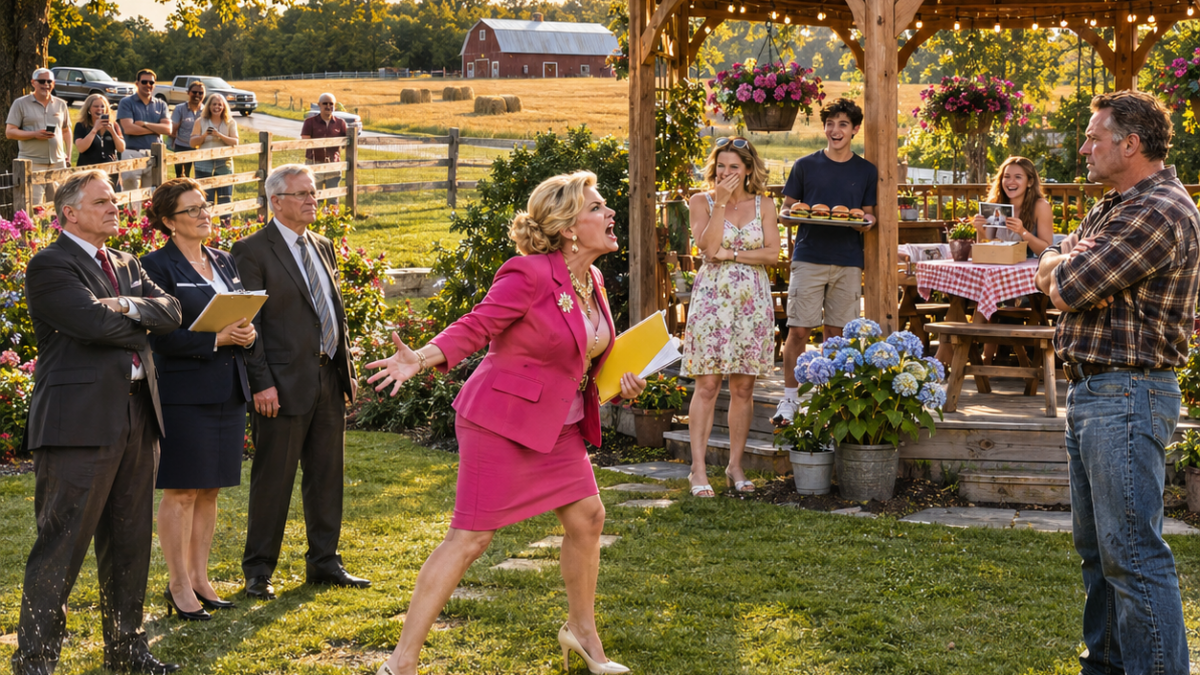
Those were the first words out of Karen Whitmore’s mouth when she marched into my backyard at six seventeen on a Saturday evening.
Not hello.
Not excuse me.
Not even a question about whether she had permission to walk through my side gate.
She simply appeared beside the stone path like she had been appointed governor of my land, one hand gripping a yellow HOA folder and the other pointing dramatically toward the cedar gazebo I had spent most of the previous spring building.
The setting sun behind her made the whole thing almost absurdly theatrical. Karen wore a bright pink blazer, matching skirt, cream-colored heels, and enough gold jewelry to make every movement sparkle. Her blonde hair looked stiff enough to survive a tornado. The only thing ruining her entrance was the fact that one of her heels had already sunk halfway into the soft grass beside my sprinkler line.
She pretended not to notice.
I did.
So did my wife, Emma.
She covered her mouth with her lemonade glass, and I knew exactly what she was trying not to do.
Laugh.
Karen yanked her heel free with a wet sucking sound and continued as though nothing had happened.
“This structure has been classified as visually incompatible with the community,” she said. “The board voted last month. It must be removed immediately.”
Behind me, my son Ethan was carrying a tray of burgers toward the picnic table. My daughter Claire was sitting with Emma under the gazebo, sorting through old photographs for my father’s upcoming seventy-fifth birthday. We had planned a simple family dinner that evening.
Karen had apparently planned a demolition hearing.
I looked past her toward my side gate.
“You came through there?”
“Yes.”
“Without asking?”
Her face tightened.
“As HOA president, I have inspection privileges.”
“On HOA property, maybe.”
“This entire neighborhood falls under our community standards.”
I looked around slowly.
My property stretched well beyond the backyard. Past the garden was a hay field glowing gold in the evening light. Beyond that stood a line of cottonwoods planted by my grandfather. My barn roof was visible another hundred yards west. The subdivision Karen represented sat east of my land, beyond a split-rail fence and a county road.
My house had been there decades before the first cul-de-sac existed.
Karen knew that.
Or at least she should have.
She opened her yellow folder with a sharp snap and removed three sheets of paper.
“Violation one,” she announced. “Unapproved exterior structure. Violation two, nonconforming roof material. Violation three, visual obstruction affecting neighborhood uniformity.”
She slapped the papers against one of the gazebo posts.
I stared at them.
At the top was the HOA logo.
At the bottom, in bold lettering, was the amount.
$1,200 PER DAY UNTIL COMPLIANCE.
I actually read it twice because I thought I had misunderstood.
“Per day?”
“That is correct.”
Emma stood up behind me.
“You’re charging twelve hundred dollars a day for a gazebo?”
Karen smiled with the calm confidence of somebody explaining gravity to a child.
“It is not a charge. It is an enforcement penalty.”
“That makes it sound much more reasonable,” I said.
Ethan coughed into his fist.
Karen glanced at him, annoyed, then turned back to me.
“You have until eight o’clock tomorrow morning to begin demolition.”
I looked at my watch.
“So you’re giving me less than fourteen hours.”
“You have been warned.”
“No, I haven’t.”
“We mailed notices.”
“To whom?”
“Your residence.”
I nodded toward my mailbox fifty yards away.
“You mean the mailbox with a different street name than your subdivision?”
Her jaw tightened again.
I walked to the gazebo and pulled one of the notices off the post.
Karen nearly gasped.
“Do not remove official HOA documents.”
“You attached them to my property.”
“They are enforcement notices.”
“Then hand them to me.”
“I am documenting the violation.”
She raised her phone and started taking pictures.
One of me.
One of the gazebo.
One of the roof.
Then, for reasons I still don’t understand, she photographed my grill.
Maybe she planned to regulate hamburgers next.
I folded the notice once and slipped it into my shirt pocket.
“What happens if I don’t tear it down?”
Karen’s expression changed.
That was when the performance became something darker.
“The board can escalate enforcement.”
“How?”
“Additional penalties.”
“And?”
“A lien.”
Emma stopped smiling.
Karen noticed.
Her own smile widened.
“And if necessary,” she continued, “we will pursue every available remedy regarding continued occupancy.”
I stared at her.
“Continued occupancy?”
“If an owner refuses to comply with binding community rules, there are consequences.”
“You’re threatening to evict me from my own house?”
“I’m explaining policy.”
There are moments when anger arrives hot and immediate.
This wasn’t one of them.
Mine came cold.
Because that gazebo wasn’t just lumber and roofing.
I had built it after my mother died.
She had loved sunsets. During the last year of her life, when she could no longer walk comfortably to the west pasture, she would sit on our back porch and tell me that someday I should build a place where the whole family could gather and watch the sky change.
I began drawing the plans three months after we buried her.
Every cedar beam had passed through my hands.
My father helped set the first posts.
Emma picked the stone.
Claire planted jasmine along the south railing.
And now a woman who had walked into my yard without permission was standing beneath my mother’s favorite evening sky, telling me to destroy it before breakfast.
Karen closed her folder.
“The board is done negotiating.”
I looked toward the county road.
A dark SUV had just slowed near my driveway.
Then another vehicle appeared behind it.
Karen followed my eyes and gave a satisfied little smile.
“I thought you might be difficult,” she said. “So I brought people who understand compliance.”
The first SUV turned into my driveway.
Two men wearing contractor vests stepped out.
One opened the rear hatch.
Inside were pry bars, saws, heavy gloves, and a stack of orange cones.
Emma came beside me.
“Jack.”
“I see them.”
Karen stepped closer.
“You had your chance.”
I looked at the men, then at the gazebo, then back at Karen.
And while she stood there smiling as if she had already won, I reached into my pocket for my phone.
“Before anybody touches one piece of wood,” I said, “you might want to be very certain whose property you’re standing on.”
Karen laughed.
Then one of the contractors started walking toward the gazebo.
**part 2**
I stepped directly into his path.
Not aggressively.
Not dramatically.
I simply stood there.
The contractor stopped.
He was probably in his late forties, broad-shouldered, sunburned, with a company logo stitched above his shirt pocket. He glanced from me to Karen with the expression of a man who had just realized the person who hired him might have left out a few details.
“You the homeowner?” he asked.
“I am.”
He looked toward Karen.
“She said the association owns the common parcel behind the subdivision.”
Karen immediately interrupted.
“It is functionally common property because it affects our visual corridor.”
The contractor blinked.
I blinked.
Even Emma looked impressed.
“Functionally common property?” I asked.
Karen lifted her chin.
“You know exactly what I mean.”
“No,” the contractor said slowly. “I actually don’t.”
That was the first crack.
Small, but visible.
I asked him whether Karen had shown him a deed, easement, court order, demolition authorization, or written consent from the property owner.
He looked at Karen again.
“She gave us a work order.”
“A work order from whom?”
“The HOA.”
“Did the HOA show you that it owns this parcel?”
His silence answered for him.
Karen snapped her folder open again.
“The association’s authority is established through our governing documents.”
“Great,” I said. “Show him.”
She pulled out a copy of the subdivision rules.
I recognized the first page because Karen had mailed me the same packet two months earlier after complaining that my barn light was “too rural.”
I had mailed it back.
She handed the packet to the contractor.
He read the address at the top.
Then he looked toward the subdivision entrance several hundred yards east.
“This says Willow Crest Homeowners Association.”
“Yes.”
He pointed at my mailbox.
“That says 714 County Route Eight.”
Karen’s face hardened.
“The addresses are irrelevant.”
“They’re pretty relevant to me,” he said.
I liked him immediately.
Karen took two quick steps toward the gazebo and stabbed her finger at the roof.
“That structure is visible from Willow Crest. That makes it subject to architectural review.”
I couldn’t help myself.
“So if I can see your house from my barn, do I get to approve your curtains?”
Ethan made a choking sound behind me.
Claire turned away.
Even the second contractor smiled.
Karen did not.
“This is not funny.”
“No,” I said. “Hiring strangers to dismantle somebody else’s property definitely isn’t funny.”
That took some wind out of her.
I pulled out my phone and started recording openly.
“State your name, please.”
She stared at the camera.
“You know my name.”
“I do. I’d like the recording to know it too.”
“You do not have permission to record me.”
“We’re outside.”
She looked at the contractors.
“Begin the work.”
Neither moved.
That was the second crack.
The first contractor removed his gloves.
“Ma’am, I’m going to need proof you have authority before we touch anything.”
“I hired you.”
“That proves you can hire me. It doesn’t prove you can authorize demolition.”
Karen’s cheeks began turning almost the same shade as her blazer.
“You will be paid.”
“That’s not really the part worrying me anymore.”
I almost felt sorry for her.
Almost.
Then she made the mistake of pushing harder.
She pointed at me and announced, loudly enough for my family and both contractors to hear, “This homeowner has accumulated more than fourteen thousand dollars in penalties and is currently in serious default.”
That was completely false.
I had never paid dues because I had never belonged to her association.
I had never signed HOA covenants.
No declaration affecting my parcel appeared in my title history.
My land had been in my family long before Willow Crest existed.
But Karen had apparently decided repetition could transform fiction into law.
I lowered my phone slightly.
“Fourteen thousand?”
“As of this morning.”
“The papers you just posted say twelve hundred a day.”
“Previous enforcement amounts were already outstanding.”
“For what?”
She started listing them.
Barn color.
Fence style.
Mailbox height.
Exterior lighting.
Visible utility trailer.
Agricultural equipment storage.
I stared at her in disbelief.
“You fined me for owning a tractor?”
“For visible storage of machinery.”
“It’s a ranch.”
“The community doesn’t consider that an excuse.”
“The community bought houses next to a ranch.”
“Which is why cooperation is essential.”
One of the contractors turned away, pretending to inspect his truck while his shoulders shook.
Karen noticed.
“Is something amusing?”
“No, ma’am.”
“It certainly appears so.”
He coughed.
“Dust.”
There was no dust.
The grass was still damp from irrigation.
Karen turned back to me and held out her hand.
“You have two choices. Sign this compliance agreement and begin removal tonight, or the penalties continue and the board proceeds with a lien.”
She offered me a document.
I didn’t take it.
Instead I said, “You’re threatening a lien against a parcel that isn’t part of your HOA.”
“It is part of the greater Willow Crest community.”
“That’s not a legal description.”
“It is the reality.”
That sentence told me everything.
Karen didn’t care what the records said.
She cared what she believed she ought to control.
I had dealt with people like that before. They usually mistook hesitation for weakness, politeness for surrender, and paperwork with a logo for actual authority.
My father used to say, “A bully loves a boundary until someone measures it.”
I had spent most of my life measuring boundaries.
Literally.
The west line of our property followed an old irrigation ditch. The southern edge ran along a section marker established before World War II. The eastern line—the one closest to Willow Crest—was documented through surveys going back generations.
And the gazebo sat comfortably inside it.
Very comfortably.
But I still hadn’t shown Karen anything.
Not yet.
I told the contractors they were not authorized to enter farther onto my property and that any attempt to damage the gazebo would be documented and reported.
The older contractor nodded.
“That’s fair.”
Karen spun toward him.
“I am your client.”
He shrugged.
“And he’s the property owner.”
“You don’t know that.”
He pointed toward me.
“He seems pretty confident.”
“So am I.”
The contractor looked at the pink heel she had buried in my lawn ten minutes earlier.
“Sure.”
Emma had to walk away.
I watched her disappear behind the gazebo, shoulders shaking with silent laughter.
Karen heard it.
Her humiliation was starting to outweigh her judgment.
She pulled out her phone and called someone from the HOA board.
“Robert, they’re refusing to proceed.”
She listened.
“No, the homeowner is obstructing enforcement.”
Another pause.
“No, I do not need his permission. That is the entire purpose of HOA authority.”
The contractor raised his eyebrows at me.
I said nothing.
Karen paced while talking, then stepped directly onto the wet strip where one of my sprinkler heads sat flush with the grass.
The timer clicked.
I heard it.
So did Ethan.
His eyes widened.
A second later, the sprinkler rose from the ground and sent a fan of water across the lawn.
Karen jumped backward with a shriek.
The spray caught the bottom of her skirt, one sleeve of her pink blazer, and most of her yellow folder.
She stood frozen, dripping, while everyone else fought for survival.
Even I failed.
I laughed.
Not cruelly.
Not loudly.
But I laughed.
Karen stared at me as water ran from one corner of her folder.
“You did that intentionally.”
“The sprinklers come on at six thirty.”
“You sabotaged me.”
“With irrigation?”
“This is harassment.”
“You trespassed into my sprinkler schedule.”
The contractor turned his entire body away.
He was done pretending now.
Karen stormed toward the patio, leaving dark footprints across the stone.
Her dignity had taken a hit.
Her authority was about to take a much larger one.
She finally ended her phone call and jabbed a wet finger toward the gazebo.
“You have until tomorrow morning. After that, we will take every legal step available.”
I nodded.
“Good.”
That answer confused her.
“Good?”
“Yes.”
“I just told you we are escalating.”
“I heard you.”
“Then why are you smiling?”
Because while she had been giving speeches, I had sent three photographs and a short message to someone I trusted.
My attorney.
David Mercer had handled our family’s property work for nearly fifteen years. He had reviewed the gazebo permit before I built it. He had also laughed the first time I showed him an HOA letter addressed to me.
Not because he took the threat lightly.
Because legally, it was bizarre.
Willow Crest had been developed from land that once belonged to the Peterson family east of ours. The developer had recorded declarations that applied to specific lots shown on a subdivision plat.
My parcel wasn’t one of them.
Never had been.
There was no annexation document.
No signed covenant.
No recorded amendment bringing my land into the association.
No easement granting the HOA control over structures.
Nothing.
A board vote could not magically expand recorded property boundaries.
At least not in any courthouse I had ever heard of.
Karen collected the soggy pages she could salvage and ordered the contractors back to their SUV.
Before leaving, the older one walked over to me.
Quietly, he said, “For what it’s worth, I’m sorry. We were told this was association-owned land and the homeowner had already lost an appeal.”
“That’s what she told you?”
“Word for word.”
I nodded.
“Would you be willing to put that in writing?”
He looked toward Karen.
She was trying to wipe mud off one heel with an HOA violation notice.
Then he smiled.
“Yeah. I think I would.”
That turned out to matter.
A lot.
By seven fifteen, Karen’s vehicles were gone.
My family returned to dinner.
But the mood had changed.
Ethan asked whether the HOA could really take the house.
Claire asked whether we would have to destroy the gazebo.
Emma didn’t ask anything at first.
She simply leaned against the railing and looked across the pasture as the last orange edge of sunlight disappeared behind the cottonwoods.
“They know this place matters to you,” she finally said.
I sat beside her.
“That’s why they picked it.”
She looked at me.
“You think this is about the gazebo?”
“No.”
I had suspected for months that the structure was only an excuse.
Willow Crest had grown quickly.
Property values had climbed.
Several houses near our eastern boundary now advertised “unobstructed pastoral views.”
The irony was obvious.
They wanted the view of my ranch.
They just didn’t want the rancher controlling it.
Karen had previously asked whether I would sell a strip of land for a walking trail.
I declined.
Then came complaints about my fence.
Then my barn.
Then my equipment.
Then the gazebo.
Every demand pushed the same idea.
My property should serve their neighborhood.
Without them paying for it.
The next morning, David arrived at eight twenty carrying two cups of coffee and a document tube.
He stepped out of his truck, looked at the gazebo, and said, “Still standing.”
“So far.”
“Disappointing.”
I laughed.
He handed me coffee.
“I was hoping to see the revolutionary structure threatening civilization.”
I pointed toward the cedar posts.
“There she is.”
David walked around it.
“Terrifying.”
“Roof is apparently incompatible.”
“With what?”
“Modern progress.”
“That cedar stain is practically an act of rebellion.”
We sat at my patio table and laid out everything.
The HOA notices.
My county building permit.
Tax maps.
Title records.
The original family grant.
A later survey.
Recorded subdivision plats.
The contractor’s written statement, which he had emailed me at six forty that morning.
David read that statement twice.
Then his expression lost its humor.
“She represented that your appeals were exhausted?”
“Yes.”
“You never appealed anything.”
“I’m not a member.”
“Exactly.”
He tapped the paper.
“And she represented that the HOA had authority to enter and remove the structure?”
“Yes.”
“She hired a demolition contractor based on that representation?”
“Yes.”
He leaned back.
“That changes the temperature.”
I asked what he meant.
David explained that sending meaningless violation letters was one thing. Attempting to exercise control over property outside the association could create much more serious exposure. Depending on what Karen and the board did next, we could be looking at trespass, interference with property rights, potentially wrongful lien activity if they recorded anything, and claims for damage if contractors touched the structure.
More importantly, we could stop them before that happened.
He drafted a cease-and-desist demand that morning.
It was not dramatic.
Good legal letters rarely are.
It identified my parcel by legal description, referenced the recorded chain of title, cited the permit number, demanded withdrawal of all fines and notices, prohibited further entry without permission, and warned the HOA against filing any lien or attempting physical removal.
David sent it to the HOA’s registered agent, board members, management company, and insurance contact.
Karen responded in thirty-eight minutes.
Not through counsel.
Personally.
Her email was six paragraphs long and included the sentence:
“The HOA cannot allow obsolete land records to interfere with the evolving needs of a modern planned community.”
David printed it.
Then he stared at me.
“I want to frame this.”
“Is it good?”
“It is astonishing.”
“So that’s good?”
“For us? Extremely.”
That afternoon, we went to the county planning office.
The permit technician pulled my file.
Everything was there.
Application.
Site plan.
Inspection records.
Final approval.
The gazebo had been fully permitted.
The county map showed the same thing our title records showed.
My property remained outside the Willow Crest subdivision.
The technician frowned at the HOA notice.
“They’re ordering demolition?”
“Yes.”
“Under whose authority?”
“That’s what we’re trying to determine.”
She brought in a senior inspector named Luis Ramirez.
Luis was a quiet man in his fifties who read everything before speaking.
He examined the notice.
Then the permit.
Then the parcel map.
Then he asked one question.
“Did they physically enter the property?”
“Yes.”
“Did contractors bring demolition equipment?”
“Yes.”
His eyebrows lifted.
“They start work?”
“No.”
“Good.”
He told us the county could confirm the permit and zoning status but could not adjudicate every private HOA dispute on the spot. That would be a civil matter if the association insisted it had covenant authority.
I respected that answer.
It was real.
It was also enough.
Because Luis agreed to conduct a site verification and issue written confirmation that the gazebo complied with county requirements.
Meanwhile, David prepared a petition for temporary injunctive relief.
We did not file it immediately.
We gave the HOA one final opportunity to retreat.
They did the opposite.
At nine twelve the following morning, Karen sent another message.
“Inspection scheduled Thursday. Media will be present. Failure to comply will constitute deliberate defiance.”
Media.
I called David.
“She invited reporters.”
There was a pause.
Then he said, “That is incredibly generous of her.”
Thursday arrived clear and bright.
By ten o’clock, two local news vehicles were parked near my driveway.
Karen had invited them.
She had apparently pitched the dispute as a story about an HOA fighting a “dangerous trend of unregulated structures damaging community standards.”
Dangerous trend.
My gazebo had porch swings.
Karen arrived in a white SUV this time.
She wore another pink blazer, though slightly darker than the first one, perhaps because the original had lost its war against irrigation.
Three board members followed her.
So did the HOA property manager.
Then came Luis from the county.
David stood beside me.
Emma had wisely brought coffee.
Karen immediately began giving an interview near my fence.
“Our board has an obligation to protect property values,” she told the reporter. “When individuals refuse to follow reasonable community standards, enforcement becomes necessary.”
The reporter glanced toward my barn.
“Is the ranch part of your HOA?”
Karen paused for less than a second.
“It exists within the community environment.”
That was not an answer.
The reporter knew it.
David knew it.
I definitely knew it.
Luis walked toward us with a tablet.
Karen hurried over.
“You’re the county inspector?”
“Yes.”
“Excellent. I assume you’ll confirm the structure lacks proper community authorization.”
Luis looked at her.
“I’m here to review county records.”
“The community authorization is the issue.”
“I don’t work for your HOA.”
Her smile slipped slightly.
He walked around the gazebo, checked measurements, examined the permit sticker inside one roof beam, compared the site plan to his tablet, and photographed the setback from my property line.
Karen followed him like a nervous tour guide.
“The design is inconsistent.”
Luis said nothing.
“The roof pitch violates our architectural standard.”
Nothing.
“The stain color was never submitted.”
Nothing.
“The structure can be seen from three association lots.”
Luis finally stopped.
“Ma’am, please let me complete the inspection.”
“I am providing context.”
“I have plenty.”
Emma lowered her coffee cup so Karen wouldn’t see her smile.
After twenty minutes, Luis returned to the patio.
“The county permit is valid,” he said. “The structure passed inspection when completed. I see no county code violation requiring removal.”
Karen immediately jumped in.
“That is separate from HOA authority.”
David nodded.
“You’re correct.”
Karen looked triumphant.
For about two seconds.
David continued.
“So let’s discuss HOA authority.”
He removed a large sheet from the document tube and unfolded it across the patio table.
It was the recorded subdivision plat.
Then he placed my current deed beside it.
Then the historic grant.
Then the county parcel map.
The reporter moved closer.
Karen stopped smiling.
David pointed to the subdivision boundary.
“Willow Crest ends here.”
His finger moved west.
“Mr. Harper’s property begins here.”
Then to the gazebo location.
“This structure is here.”
There was a clear gap.
Not inches.
Not feet.
A legal boundary.
A recorded one.
Karen crossed her arms.
“Those are outdated documents.”
David slid forward a certified title report dated that week.
“This one isn’t.”
She said nothing.
He placed another document beside it.
“No recorded declaration encumbers the Harper parcel. No annexation amendment includes it. No covenant signed by the owner exists. No easement grants the HOA architectural control. No common-area designation includes this land.”
Karen looked toward the property manager.
The manager suddenly became fascinated by his shoes.
David turned to Karen.
“So I’ll ask directly. What recorded instrument gives your association authority over this gazebo?”
She stared at him.
“The board voted.”
“A board vote cannot annex land.”
“The community has relied on consistent visual standards for years.”
“That does not annex land either.”
“The gazebo affects property values.”
“That doesn’t annex land.”
“It is visible from association homes.”
“That definitely doesn’t annex land.”
The reporter lowered her microphone because she was trying not to laugh.
Karen’s face flushed.
“There must be an easement.”
David nodded.
“Show us.”
“I don’t carry title archives.”
“We checked them.”
“You may have missed something.”
“We checked the county recorder.”
“The board’s legal file—”
“Your association attorney emailed me last night.”
That silenced everyone.
Karen’s head snapped toward David.
“What?”
David pulled out another page.
“Your counsel acknowledged that he has located no recorded instrument placing Mr. Harper’s parcel within Willow Crest.”
The property manager closed his eyes.
One board member whispered something that sounded like, “Oh, God.”
Karen turned to him.
“You knew?”
He looked miserable.
“We discussed the boundary issue two years ago.”
“Not conclusively.”
“We were told not to enforce west of County Route Eight.”
Her expression changed.
That was the moment the story became more than a misunderstanding.
Karen had known there was a problem with jurisdiction.
Maybe not every detail.
But enough.
She had pushed forward anyway.
Luis finished his written field note and handed me a copy.
“The gazebo is compliant with county requirements.”
Karen tried one last time.
“The HOA’s aesthetic concerns still exist.”
Luis shrugged.
“They may exist. Your authority doesn’t.”
It was the cleanest sentence spoken all day.
The reporter immediately asked Karen whether she would withdraw the fines.
Karen stared at the camera.
“We will review all information with counsel.”
David stepped closer.
“Your counsel has already reviewed it.”
“We will conduct our own review.”
“You have until five p.m. today to confirm withdrawal.”
She glared at him.
“Or what?”
David’s voice remained calm.
“Then we file.”
“What exactly are you filing?”
“An action seeking declaratory and injunctive relief, recovery of appropriate costs, and any additional remedies supported by the association’s conduct. If you attempt to record a lien after receiving actual notice that this parcel is outside your jurisdiction, we will address that too.”
Karen finally seemed to understand that this was no longer a neighborhood argument.
She was creating evidence.
In front of cameras.
Her next move should have been silence.
Instead, she pointed at me.
“He built that gazebo specifically to provoke the neighborhood.”
I almost admired the creativity.
“I built it for my mother.”
That stopped her.
The reporter looked at me.
I had not intended to explain.
But suddenly every camera was pointed my direction.
So I did.
I told them how my mother loved sunsets.
How she had spent the last year of her life sitting on our porch because walking to the pasture had become too difficult.
How she had once told me I should build a place where our family could gather after she was gone.
I explained how my father helped set the posts.
How my children planted jasmine.
How the first dinner we held there happened on what would have been my mother’s birthday.
I didn’t raise my voice.
I didn’t need to.
When I finished, nobody spoke for several seconds.
Even Karen looked uncomfortable.
Then she recovered.
“Sentiment does not override community policy.”
That sentence aired on the evening news.
I don’t think Karen understood how devastating it sounded until much later.
By four thirty that afternoon, the HOA’s lawyer sent David a formal notice suspending all enforcement activity against my property.
Suspending.
Not withdrawing.
David rejected it.
At four fifty-eight, a second email arrived.
All alleged fines were rescinded.
All violation notices were withdrawn.
The HOA acknowledged that it had no current recorded covenant authority over my parcel.
And the board agreed that no representative, contractor, or agent of the HOA would enter my property without permission.
Karen did not sign the letter.
The association attorney did.
That should have ended it.
But Karen had one more surprise waiting for herself.
The following week, Emma received a call from a woman named Megan.
Megan was getting married that Saturday.
She sounded embarrassed.
“Mr. Harper, I think there’s been a misunderstanding.”
“There have been several lately.”
She laughed nervously.
“Our wedding package includes photographs at the Willow Crest gazebo.”
I looked through the kitchen window.
My gazebo sat glowing in the afternoon sunlight.
“There is no Willow Crest gazebo.”
Silence.
Then she said, “The wooden one by the ranch.”
“That’s my gazebo.”
Another silence.
A much longer one.
“You own it?”
“Yes.”
“The HOA said it was a community scenic feature.”
I closed my eyes.
Of course they had.
Apparently, while Karen had been trying to force me to demolish the gazebo for contaminating neighborhood aesthetics, the HOA’s events committee had also been advertising it to residents as a premium wedding photography location.
I asked Megan to email me the package.
She did.
There it was.
“Golden Hour Portrait Session – Rustic Gazebo Overlook.”
My gazebo.
My pasture.
My sunset.
They had even used a photograph taken from outside my fence.
Emma read the page twice.
Then she sat down and started laughing so hard she cried.
“They want it destroyed Monday through Friday and photographed on Saturday.”
I shook my head.
“Apparently it becomes aesthetically acceptable when somebody pays a wedding fee.”
The HOA had charged Megan four hundred dollars for the photography add-on.
That changed my reaction.
The bride had done nothing wrong.
She had trusted what the association told her.
I called her back.
“You can use the gazebo.”
She sounded relieved.
“Thank you.”
“One condition.”
“Anything.”
“Karen does not step onto my property.”
Megan laughed.
“I think I can live with that.”
Saturday arrived warm and clear.
The sunset was expected to be spectacular.
Around five thirty, the wedding party walked from the community clubhouse toward the ranch gate.
The photographer came first.
Then Megan and her husband.
Then six bridesmaids.
Then several family members.
And finally, twenty yards behind them, Karen.
Pink blazer.
Yellow folder.
Apparently she had learned nothing about wardrobe symbolism.
I stood at the gate.
Megan waved.
Karen did not.
She walked toward me with the confidence of someone attempting to pretend national television had not recently documented her legal humiliation.
“We need access for the scheduled photography session.”
“Megan has access.”
Karen frowned.
“The HOA package includes staff supervision.”
“No.”
“I coordinate events.”
“Not here.”
“You cannot disrupt a member wedding because of a personal disagreement.”
“This isn’t a personal disagreement.”
She lowered her voice.
“Jack, don’t make a scene.”
I looked behind her.
Thirty wedding guests were watching.
A photographer was holding two cameras.
Emma stood beside the gazebo.
My father sat beneath it wearing his best western shirt.
“If there’s a scene,” I said, “I’m pretty sure I won’t be the one making it.”
Karen stepped toward the gate.
I closed it.
Not slammed.
Just closed.
Click.
She stared at the latch.
“You’re serious.”
“Very.”
Megan approached.
“Karen, it’s fine. Mr. Harper gave us permission.”
Karen forced a smile.
“I arranged this.”
“No,” Megan said. “You charged us for something the HOA doesn’t own.”
That landed hard.
Several guests murmured.
Karen’s eyes flicked toward them.
“This is not the appropriate time.”
Megan crossed her arms.
“I found out four days before my wedding that the location I paid for belongs to someone else.”
“We corrected the misunderstanding.”
“Mr. Harper corrected it.”
Karen’s smile vanished.
The photographer looked at me.
“Should we go?”
“Come on in.”
I opened the gate.
Megan entered.
Her husband followed.
The wedding party followed.
Karen stepped forward with them.
I raised one hand.
“Not you.”
She froze.
The photographer nearly walked into a fence post because he was looking at her instead of where he was going.
Karen’s voice dropped.
“You are humiliating me.”
“I’m enforcing a property boundary.”
“That’s childish.”
“You’re familiar with boundaries now. I thought you’d appreciate the consistency.”
Someone behind her snorted.
Karen turned.
Nobody admitted responsibility.
For the next forty minutes, she stood outside the gate while the wedding party took photographs at the gazebo she had ordered destroyed.
The sky delivered exactly what my mother used to love.
Orange near the horizon.
Purple above it.
Soft gold spilling through the cedar beams.
Megan and her husband stood beneath the roof while the photographer captured them against the pasture.
Emma brought lemonade.
My father told the groom a story about how he had nearly dropped one of the gazebo beams on my foot during construction.
Everyone laughed.
Outside the gate, Karen paced.
At one point, she tried standing behind a decorative shrub so she wouldn’t appear in the photographs.
The shrub was about three feet tall.
Karen was five foot six.
It did not work.
Several guests began taking pictures of her.
By Monday morning, those pictures were circulating in the neighborhood.
One showed the newlyweds smiling beneath the gazebo in the foreground.
Far behind them, Karen could be seen standing outside my closed gate, arms crossed, staring like an exiled monarch.
Someone captioned it:
“Community aesthetic specialist observes approved scenery from legal distance.”
I did not create that caption.
I wish I had.
The humor only accelerated what was already happening inside the board.
Residents began asking questions.
Why had association money been spent pursuing fines against land outside the HOA?
Why had contractors been hired?
Why had the board threatened a lien?
Why had a wedding fee been charged for access to private property?
Why had Karen claimed the ranch was subject to HOA rules when the association attorney apparently knew otherwise?
The treasurer demanded an emergency meeting.
Karen tried to postpone it.
The other directors refused.
David advised me not to turn the meeting into a spectacle.
So naturally, I wore my cleanest flannel shirt.
The clubhouse was packed.
I sat near the back with Emma.
Karen sat at the front behind a folding table.
For once, she was not wearing pink.
She had chosen navy blue.
It did not help.
The treasurer opened with a financial report.
More than six thousand dollars had been spent on legal consultation, contractor deposits, property-management time, certified notices, and enforcement administration related to my parcel.
Six thousand dollars.
To regulate land they didn’t control.
Then Megan stood.
She asked about the four hundred dollars charged for the gazebo photography package.
The events chair looked horrified.
“We thought that area was under association control.”
“Who told you that?”
Everyone looked at Karen.
She adjusted her papers.
“Our understanding of the property boundary was evolving.”
A man in the second row raised his hand.
“I’ve lived here eleven years. The ranch has always been outside the subdivision.”
Applause broke out.
Karen tapped the microphone.
“Please maintain order.”
That made the applause louder.
Another homeowner stood.
“You sent me a newsletter last year telling residents not to enter the ranch because it was private property.”
That was beautiful.
Karen froze.
David leaned toward me.
“Please tell me someone has that newsletter.”
Three people raised copies.
I nearly hugged them.
The board secretary read the relevant sentence aloud.
“Residents are reminded that the Harper ranch west of County Route Eight is privately owned and is not part of Willow Crest common property.”
The room exploded.
Not violently.
Just noise.
Questions.
Laughter.
Angry voices.
Somebody near the back shouted, “So when did his private property magically become yours?”
Karen tried to answer.
She couldn’t.
The board attorney finally stepped forward.
His expression suggested he wanted to be anywhere else.
He confirmed that the ranch was outside the association’s recorded jurisdiction.
He confirmed that no enforceable HOA lien could be imposed based on the notices Karen had issued.
He confirmed that the board had received prior legal caution about enforcement beyond subdivision boundaries.
Then came the sentence that ended Karen’s presidency.
“In my opinion, the association should never have authorized physical entry or proposed removal of the structure without documented property rights.”
Silence.
The vice president asked whether Karen had informed the full board of that advice.
She said she had summarized it.
He asked to see her summary.
She said she did not have it.
The secretary did.
Her meeting notes showed Karen had described counsel’s concern as “technical hesitation that should not interfere with enforcement objectives.”
Technical hesitation.
David whispered, “I may frame that one too.”
The vice president called for an executive discussion.
Residents objected.
The attorney clarified that personnel and privileged matters would need a closed session, but any formal board action would return to open session.
Forty-three minutes later, the directors came back.
Karen’s face told us before anyone spoke.
The vice president made the motion.
Karen Whitmore was removed as board president effective immediately.
The vote was four to one.
Karen cast the one.
That detail spread through Willow Crest faster than anything else.
She had voted against removing herself.
I suppose consistency matters.
The board appointed an interim president and announced several corrective measures.
All improper notices against my property were formally voided.
The HOA would reimburse the wedding couple’s gazebo fee.
The association would cover my documented expenses related to responding to the unauthorized enforcement attempt as part of a negotiated resolution.
Entry onto non-HOA property would require verified authority.
No contractor could be hired for removal work without legal review of ownership.
And future enforcement notices had to identify the specific covenant and recorded property basis supporting jurisdiction.
Those were sensible reforms.
They should never have been necessary.
But that is often how rules improve.
Somebody abuses discretion so badly that everyone finally realizes discretion needed boundaries.
Karen remained seated after the meeting adjourned.
Most residents walked past without speaking to her.
A few former supporters stopped briefly.
Their conversations were quiet.
None appeared pleasant.
Emma squeezed my hand.
“We should go.”
I nodded.
As we reached the door, Karen called my name.
“Jack.”
I turned.
She walked toward me slowly.
Without the microphone, folder, cameras, or contractors, she seemed smaller.
Not physically.
Just less certain.
“You enjoyed this.”
I considered the accusation.
“No.”
She laughed bitterly.
“Please.”
“I enjoyed the sprinkler.”
Emma coughed.
Karen glared at her.
I continued.
“I enjoyed keeping my gazebo. I enjoyed watching Megan get her photographs. And I’ll admit watching you stand outside that gate was memorable.”
Her jaw tightened.
“But I didn’t enjoy paying a lawyer because you wouldn’t read a deed. I didn’t enjoy my daughter asking whether we could lose our home. I didn’t enjoy strangers arriving with tools because you told them you had authority you didn’t have.”
Karen looked away.
“You embarrassed me in front of the entire community.”
“You did that.”
“I was trying to protect property values.”
“No. You were trying to control something because you could see it.”
“That gazebo changes the character of the area.”
“It’s cedar and stone, Karen. Not an oil refinery.”
She almost smiled.
Almost.
Then it disappeared.
“You could have cooperated.”
“With what?”
“The community.”
“I have neighbors. I cooperate with them every day. I lend equipment. I plow snow. I’ve pulled two Willow Crest cars out of ditches. Emma brings meals when families are sick. My father helped repair your clubhouse fence after that windstorm.”
She said nothing.
“Community isn’t obedience,” I said. “And leadership isn’t deciding that everything you can point at belongs to you.”
That was the last real conversation we ever had.
The legal side ended quietly.
That surprised some people.
They expected a dramatic courtroom showdown.
Real legal victories are often less cinematic than the conflict that creates them.
Once the records were undeniable and the association’s insurance carrier became involved, everyone suddenly developed an intense interest in reasonable settlement.
The HOA signed a written agreement confirming that my parcel was outside its jurisdiction under the existing recorded documents.
It agreed not to issue future enforcement demands without a valid legal basis.
My attorney fees and other documented costs were reimbursed.
The wedding couple received compensation and a refund.
The contractor’s deposit was resolved without blame to the workers, who had stopped before causing damage.
Most importantly, nothing was ever recorded against my title.
No lien.
No cloud.
No new fight.
Karen resigned from the board entirely about three weeks later.
For a while, I would see her SUV pass on County Route Eight.
She stopped looking toward the ranch.
Six months later, a FOR SALE sign appeared in front of her house.
By spring, she was gone.
I never learned exactly where she moved.
I hoped, for the sake of everyone in her new neighborhood, that she chose somewhere without architectural committees.
The gazebo stayed.
Of course it stayed.
My father celebrated his seventy-fifth birthday there beneath strands of warm lights.
Claire graduated college the following year and held a small dinner beneath the same roof.
Ethan proposed to his girlfriend beside the west railing at sunset, which meant Emma cried for nearly an hour and then denied crying at all.
The jasmine Claire planted eventually climbed one entire corner post.
Every year, it blooms a little higher.
The strangest part is what happened between the ranch and Willow Crest afterward.
Without Karen turning every difference into a confrontation, the relationship improved.
The new board president came to see me one afternoon.
He stopped at the gate.
He didn’t enter.
That mattered.
He waved.
I walked over.
“My name’s Daniel,” he said.
“I know.”
“I wanted to apologize properly.”
“The board already did.”
“I mean neighbor to neighbor.”
I appreciated that.
He explained that the association wanted to replace the damaged fence line along the road and asked whether I would review the survey before the work began.
Asked.
Not ordered.
I said yes.
We ended up spending an hour walking the boundary.
He brought a survey.
I brought mine.
The lines matched.
No threats.
No fines.
No pink blazer.
Just two property owners making sure a fence went in the correct place.
Amazing what civilization can accomplish.
Months later, Willow Crest held a summer picnic.
Daniel called Emma and asked whether residents could hire me to host a sunset photography hour at the gazebo.
Not claim it.
Not advertise it without permission.
Hire me.
I agreed.
We charged a small amount that went toward maintaining the structure, and I required every visitor to stay within the designated area.
The first evening, several families walked through the gate.
Some I knew.
Others I didn’t.
Children chased fireflies near the garden.
Older couples sat on the benches.
People watched the sun lower behind the pasture.
Nobody argued about roof pitch.
Nobody measured the stain color.
Nobody declared an aesthetic emergency.
My father sat beside me and watched them.
After a while, he nodded toward the gazebo.
“Your mother would’ve liked this.”
I looked at the orange sky.
“Yeah.”
“She would’ve liked the fight too.”
I laughed.
“No, she wouldn’t.”
He smiled.
“She married me. She liked a little trouble.”
That sounded exactly like him.
The sunlight dropped lower.
The cedar beams turned gold.
For years, I had thought of property rights as paperwork.
Deeds.
Surveys.
Permits.
Recorded instruments.
Boundaries.
That fight changed the way I saw them.
The documents mattered because they protected something human.
A place where my father could sit.
A place where my children could celebrate.
A place tied to my mother’s memory.
A place where strangers could become neighbors as long as they entered through the gate instead of pretending the gate didn’t exist.
Karen believed authority came from sounding certain.
She had the folder.
The title.
The board vote.
The contractors.
The fines.
She spoke louder than everyone else, and for a while, that made people assume she must have been right.
But confidence is not ownership.
A committee vote is not a deed.
A violation notice is not a court order.
And a person does not gain authority over your property simply because she has decided your property would look better under her control.
The last time I thought about Karen seriously was on a cool October evening.
Emma and I were sitting beneath the gazebo after dinner.
No guests.
No cameras.
No lawyers.
Just us.
The sunset was fading from orange to dark purple.
A breeze moved through the jasmine.
Emma leaned against me.
“You know what I still can’t believe?”
“What?”
“She charged twelve hundred dollars a day.”
I laughed.
“That bothered you more than the demolition?”
“No. I just wonder how she picked the number.”
“Probably looked official.”
“Why not eleven hundred?”
“Not authoritative enough.”
“Thirteen hundred?”
“Too aggressive.”
She nodded thoughtfully.
“Twelve hundred. The perfect amount of imaginary power.”
I nearly spilled my coffee.
Then the sprinklers came on.
The same ones that had soaked Karen’s pink blazer months earlier.
Emma looked toward the lawn.
“So many memories.”
“I should put up a plaque.”
She laughed.
“What would it say?”
I thought for a moment.
Then I looked at the gazebo.
“Private property. Please respect the boundary.”
Emma shook her head.
“Too serious.”
“Fine. How about ‘Warning: irrigation system does not recognize HOA presidents’?”
She laughed so loudly my father heard her from the house.
That was the kind of ending I preferred.
Not revenge for the sake of cruelty.
Not watching somebody suffer.
Just consequences.
Karen tried to use rules that didn’t apply.
She was stopped by records she should have checked.
She tried to humiliate me publicly.
Her own public statements exposed her.
She tried to tear down the gazebo.
The gazebo became the place everyone wanted photographed.
She tried to portray herself as the guardian of community standards.
Her own community removed her from leadership.
And through all of it, the gazebo never moved an inch.
It is still there today.
Same cedar beams.
Same stone base.
Same roof Karen called an eyesore.
Same west-facing view.
The ranch remains mine.
Every fence line.
Every field.
Every structure built within the law.
Every sunset that reaches across the pasture.
And whenever the evening light turns the gazebo gold, I sometimes remember Karen standing in my yard with that yellow folder, confidently announcing that I had until morning to destroy it.
She thought the important thing was how loudly she could issue an order.
What mattered was whether she ever had the right to give one.
She didn’t.
And in the end, that single fact was stronger than every fine, threat, board vote, contractor, camera, and pink blazer she could bring through my gate.








