HOA Karen Ordered a Fire Hydrant Removed for Her Luxury Entrance—Then the Fire Marshal Asked for One Number
part 2
My name is Calvin Rhodes.
I bought the last house on the east side of Redwood Crest eleven years earlier because nobody else wanted the lot.
It sat right beside the main entrance where headlights swept across the front windows at night, delivery trucks slowed near my mailbox, and every contractor entering the neighborhood knew exactly where I lived.
I liked it.
I’ve always preferred being at the edge of things.
Close enough to belong.
Far enough to breathe.
The front of my lot carried a utility easement that most of the neighborhood never thought about.
It had been recorded before Redwood Crest existed, back when the hillside was still agricultural land and the county was extending water mains toward new schools.
Under that strip of grass ran a municipal main.
On top of that main sat the hydrant.
Painted bright red.
Ugly, if your definition of beauty requires public safety equipment to match landscaping.
It had been there before the subdivision.
Before the clubhouse.
Before the stone mailbox monuments.
Before Blythe Carrington ever heard the phrase “architectural consistency.”
The developer had built around it.
That was what competent developers did.
Blythe had recently won her second term as HOA president.
Her campaign centered on one subject.
Property values.
In Redwood Crest, property values are less a financial concept than a religion.
Blythe’s signature project was a redesigned main entrance.
Cut limestone.
Twin monument pillars.
Bronze plaque.
Uplighting.
Ornamental pear trees in symmetrical rows.
A low stone wall.
New landscaping.
She brought foam-board renderings to the March meeting.
Thirty of us sat under fluorescent lights while she clicked through slides.
“This entrance,” she announced, “will finally reflect the caliber of the community.”
Then she showed the eastern side.
Paused.
Her mouth tightened.
“The only remaining obstacle is an ugly red lump of iron right in the middle of the design.”
Several residents laughed.
I raised my hand.
Blythe recognized me reluctantly.
“The red lump of iron is a public fire hydrant.”
She smiled.
“Yes, Calvin. We know what a hydrant is.”
“Apparently not enough.”
A few people chuckled.
I kept going.
“It sits on a recorded utility easement over a municipal main. The HOA doesn’t own it. Any relocation requires approval from the water authority and fire district.”
That took maybe twenty seconds.
Blythe looked me up and down.
I had come directly from helping a neighbor repair a fence.
Work clothes.
Dust.
Tools still in the truck.
“Calvin,” she said, “fixing fences doesn’t make you an engineer.”
That got a laugh.
Not from everyone.
Enough.
Graham Pike, our community manager, suddenly found the tabletop fascinating.
I could have corrected her.
I could have said:
Actually, I spent nineteen years working municipal water operations.
I could have explained that I had coordinated with fire prevention divisions on dozens of developments.
I could have told her that I had authority over hundreds of miles of distribution main during my career.
I didn’t.
Because credentials weren’t necessary to ask a simple question.
Where is the permit?
So I sat down.
I assumed somebody would call the county.
Nobody did.
The next morning, I walked outside at 6:15 in slippers with coffee in my hand.
Fresh white paint surrounded the hydrant.
Utility marking.
Excavation layout.
The marks continued toward the centerline.
My coffee stopped halfway to my mouth.
White paint means proposed excavation.
And the layout wasn’t just around the hydrant.
It crossed toward the main.
I went inside.
Changed into boots.
At eight, a contractor’s pickup arrived.
Nolan Beckett stepped out.
I knew his company.
Good reputation.
Hardscape, retaining walls, landscaping, monument entrances.
He had been in business for years.
I introduced myself.
“I’m Calvin. Property behind the easement.”
“Nolan.”
“I know.”
I pointed toward the hydrant.
“Do you have water authority authorization?”
His hesitation told me everything.
Then he showed me his work order.
One page.
Redwood Crest letterhead.
REMOVAL AND RELOCATION OF EXISTING HYDRANT OBSTRUCTION — ENTRANCE IMPROVEMENT PHASE ONE
One signature.
Blythe Carrington.
President.
No permit number.
No water authority approval.
No fire district approval.
No county case reference.
Nothing.
“Nolan, this isn’t a utility permit.”
“The association told me everything was handled.”
“What are you doing with the branch?”
He glanced toward the markings.
“Expose the barrel. Remove it. Cut and cap.”
I watched his face as he said it.
Cut and cap.
He heard the problem too.
“That isn’t relocation.”
He sighed.
“That’s my scope.”
“Who’s installing the replacement hydrant?”
No answer.
That was how I knew there was no replacement hydrant.
The word relocation existed only on Blythe’s paper.
The actual work order removed a supply point.
Permanently.
I found Blythe an hour later beside the landscape architect.
I told her everything again.
Municipal main.
Recorded easement.
Fire-flow implications.
Required approvals.
She listened.
Then said:
“I run this association. You just live in it.”
That sentence probably told me more about her than anything else she ever said.
I reminded her that the frontage easement was not HOA common property.
She became colder.
“The entrance project was approved. I’m not allowing one resident with opinions to hold the schedule hostage.”
Then she turned to Nolan.
“Remove it before Friday.”
That afternoon, I photographed everything.
The next morning, Wednesday, I sent an email to the full board.
Graham.
Nolan.
Blythe.
Six sentences.
No adjectives.
Public infrastructure.
Recorded easement.
No permit seen.
Fire district coordination required.
Potential fire-flow issue.
Request:
Please provide the permit number authorizing removal of the hydrant.
I attached photographs.
Sent it at 7:40 a.m.
Then saved the email.
Blythe never provided a permit number.
Instead, she turned me into the problem.
Thursday afternoon, every household received a notice.
The entrance project was allegedly being delayed by “interference from a resident.”
That resident had supposedly harassed vendors.
Obstructed approved work.
Made unfounded permitting claims.
Jeopardized an $11,000 project deposit.
My name wasn’t included.
Didn’t need to be.
Everybody knew the hydrant sat in front of my house.
Two days later, I received a $400 fine.
INTERFERENCE WITH HOA CONTRACTORS AND VENDORS
Four hundred dollars.
For asking a contractor whether he had a permit.
The April meeting was packed.
People attend HOA meetings when they smell blood.
Blythe opened with the entrance renderings.
Then moved to the “compliance matter.”
My email.
She read it aloud theatrically.
When she reached the phrase fire protection system, she looked over the page.
“Apparently Mr. Rhodes now believes he’s the fire department.”
A few people laughed.
Smaller laugh this time.
When the floor opened, I stood.
I did not defend myself against the harassment accusation.
Vague accusations get stronger when you chase them.
I asked the same thing I had asked in writing.
“Give me the permit number.”
Silence.
Blythe looked at her folder.
Then Graham.
Then the room.
“Permitting is an administrative issue being handled by staff and the contractor. I’m not turning this meeting into a paperwork seminar.”
Then she moved to garage-door wreaths.
That’s when I knew.
There wasn’t a permit.
Not delayed.
Not pending.
Not misplaced.
It didn’t exist.
That weekend, I went to the county records office and requested the original Redwood Crest subdivision file.
Nearly a thousand dollars in reproduction and archive costs later, I had everything.
Original plats.
Drainage calculations.
Utility drawings.
Fire protection plan.
And there, on the approved fire plan, sat my hydrant.
Not some leftover asset developers forgot to remove.
A designated existing public supply point.
The developer had been allowed to count it toward required fire coverage.
That mattered.
Because hydrant placement isn’t decorative.
Coverage is calculated.
Distance.
Available flow.
Main size.
Loop configuration.
Building classification.
The eastern zone depended heavily on that supply point.
I traced the coverage radius.
Clubhouse.
Fitness center.
Pool mechanical building.
HOA office.
Future expansion area.
My stomach dropped.
Removing that hydrant didn’t merely change landscaping.
It altered the conditions under which parts of Redwood Crest had been approved.
I copied everything.
Then waited.
Friday morning, the excavator arrived.
The rest you already know.
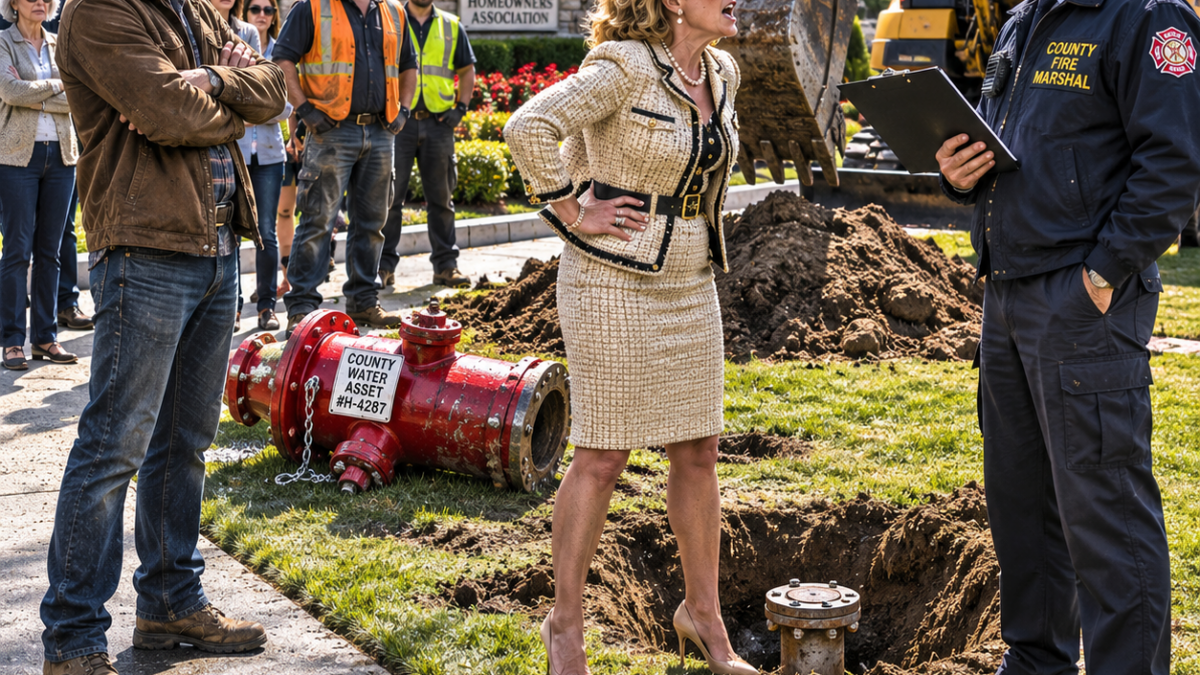
At 11:52, the hydrant lay in my grass.
At 12:09, my email went out.
At 3:40, Everett Sloan arrived.
Blythe recovered from her silence fast.
She introduced herself again.
Explained that the hydrant had been located in HOA common area.
Said the board had approved relocation.
Said residents had supported the entrance project.
Said the hydrant was simply being moved to preserve the design.
Everett listened.
Then asked again:
“Permit number.”
Blythe looked toward Graham.
“Graham handles documentation.”
Graham pulled out his tablet.
Scrolled.
Scrolled longer.
Nobody spoke.
Eventually, Everett turned toward Nolan.
“What authorization are you working under?”
Nolan handed him Blythe’s signed page.
Everett read it.
Front.
Back.
Then looked over his glasses.
“This is a homeowner association work order.”
“Yes.”
“Where is the fire district authorization?”
Blythe answered immediately.
“The contractor represented that permitting was within his scope.”
Nolan’s jaw tightened.
Six weeks of I run this association.
One question from the fire marshal and suddenly everything belonged to the contractor.
Nolan spoke clearly.
“I was instructed in writing that the association had private infrastructure authority over improvements inside its common area and that outside approval wasn’t necessary.”
Everett wrote that down.
Didn’t react.
Didn’t lecture.
Competent officials rarely need speeches.
He measured the frontage.
Photographed the hydrant.
Checked the capped stub.
Located the auxiliary valve.
Pulled up mapping.
Called someone.
Thirty minutes later, a regional water authority truck arrived.
Dana Holloway stepped out wearing a hard hat and reflective vest.
Laptop bag over one shoulder.
She and Everett spread the subdivision plan across the hood.
Then Dana inspected the stub.
I recognized the expression.
Utility-engineer fatigue.
The look you get when someone has created a problem that should never have existed.
Blythe approached.
Started again.
“Common area—”
Dana cut her off.
“That hydrant is a public appurtenance connected to a municipal distribution main.”
Blythe stopped.
Dana continued.
“It is inventoried in our asset system. The easement is recorded in favor of the water authority. Redwood Crest HOA does not own the hydrant, barrel, branch, valve, or main.”
Blythe stared.
Dana pointed toward the red hydrant lying in the grass.
“You had no more authority to remove that than you would have to remove a traffic signal.”
That was the first real turning point.
Blythe looked across the grass at me.
I could see the realization.
Municipal main.
Recorded easement.
Fire-flow coverage.
I had used those exact words.
Meeting.
Email.
Driveway.
Contractor.
She had spent weeks treating them as nonsense from a man who fixed fences.
Now a fire marshal and utility engineer were saying the same things.
But Everett didn’t order immediate reinstallation.
What he did was worse for her.
He turned toward Graham.
“How many structures in Redwood Crest currently operate under this subdivision’s fire compliance certification?”
Graham looked confused.
I understood immediately.
Everett explained.
Fire protection planning is part of development approval.
Hydrant locations.
Spacing.
Available flow.
Access.
Coverage.
Certificates of occupancy depend on approved conditions remaining materially intact.
Remove a supply point and the issue becomes larger than the hydrant.
Not because paperwork is offended.
Because the water isn’t where the approved plan says it is.
Dana placed the coverage overlay on the truck hood.
Everyone leaned in.
Inside the affected radius:
Clubhouse.
Fitness center.
Pool equipment building.
HOA office.
And the active clubhouse expansion project.
Half-framed.
Inspection scheduled the following week.
Blythe stared.
“You cannot shut down an entire project over one hydrant.”
Everett answered quietly.
“I’m not shutting down a project over a hydrant, ma’am. You removed an approved fire protection component from the system these buildings are certified under. I’m responding to that.”
He issued a stop-work order on the entrance project.
No additional excavation.
No footings.
No vertical construction.
Then he suspended the active permit on the clubhouse expansion pending restoration of the approved supply point or an acceptable interim measure.
The clubhouse, fitness center, and association office could not continue normal occupancy without either restored compliance or approved temporary mitigation.
Fire watch was one option.
Logged patrols.
All operating hours.
At association expense.
He was careful about residential homes.
No one was being thrown out.
No houses condemned.
No families displaced.
That narrowness destroyed Blythe’s ability to call him unreasonable.
Then Everett turned toward me.
“Sir, you filed the complaint?”
“Yes.”
“Walk this frontage with me.”
So I did.
I showed him the approximate main alignment.
The auxiliary valve.
Explained why the original branch isolation mattered.
Explained that the subdivision had counted the hydrant toward eastern coverage.
I gave him the asset number without checking the tag.
Everett stopped walking.
Looked at me.
“You’ve done this before.”
“Nineteen years.”
“Doing what?”
“Municipal water operations.”
Behind us, silence.
I explained.
Field operations supervisor.
Later, project coordination.
Developers.
Water authority.
Fire prevention.
Infrastructure conflicts.
Dana looked up from her laptop.
“Calvin Rhodes?”
I looked at her.
She named a pump-station rehabilitation project from nine years earlier.
I laughed.
“You were on that?”
“We argued about bypass sequencing for four months.”
“You were wrong.”
She smiled.
“You’re still annoying.”
Then she returned to her laptop.
That thirty-second exchange did more damage to Blythe’s confidence than anything I had said deliberately.
She approached.
Voice suddenly reasonable.
“If you knew all this, why didn’t you say so clearly from the beginning?”
I had been angry for six weeks.
That was the moment I expected to finally lose my temper.
I didn’t.
“I did.”
She stared.
“At the March meeting, I told you it was a public hydrant on a recorded easement. You told me fixing fences didn’t make me an engineer.”
Nothing.
“I told you again when the markings appeared.”
Nothing.
“I emailed the whole board Wednesday morning asking for the permit number.”
Nothing.
“You responded by telling the neighborhood I was interfering with contractors and fining me $400.”
Her jaw tightened.
“I told Nolan twice. The second time was twenty minutes before his crew broke the flange.”
Still nothing.
“I said it every way a person can say it.”
Then I gave her the sentence I had been carrying around for weeks.
“You didn’t need better information. You needed it not to come from me.”
Blythe looked away.
Graham finally raised his head.
He told Everett he would provide the full project correspondence file.
That file changed everything.
Within two days, the board had read it.
Eleven days before the excavation, Graham had emailed Blythe:
Hydrant appears on county mapping rather than association asset records. We should verify with the fire district first.
Blythe replied nine minutes later:
We don’t need another bureaucrat telling us where to put our entrance.
That email ended every excuse.
Nobody could say the contractor had deceived her.
Nobody could say Graham failed to warn her.
Nobody could say I surprised the county.
Written warning.
Written refusal.
Signed work order.
Same folder.
Same person.
Everett requested the entire entrance project file.
Everything.
Architectural drawings.
Civil plan.
Landscape package.
Change orders.
Contractor scope.
Vendor correspondence.
When an inspector says everything, it means the problem has stopped being one hydrant.
Four days later, we discovered the second major issue.
The revised entrance drawing narrowed the clear throat between the stone pillars to eighteen feet three inches.
Required unobstructed fire apparatus width:
Twenty feet.
That alone was bad.
Then came the turning radius.
Redwood Crest’s entrance curved immediately after the monument.
The county ladder truck was thirty-nine feet long.
It did not care about Blythe’s symmetry.
According to the revised design, the apparatus could not complete the turn without risking contact with one of the stone pillars.
These were not lightweight decorative columns.
Cut limestone.
Reinforced footings.
Thirty inches square at the base.
If completed as revised, Redwood Crest would have narrowed its primary fire apparatus entrance below acceptable dimensions.
And the architect’s original drawing?
Twenty-two-foot throat.
Hydrant preserved.
Protective bollard.
Landscape bed formed around it.
The design had been correct.
Originally.
At the emergency board meeting, the architect explained what changed.
Blythe had requested improved symmetry.
Greater monument prominence.
Both pillars moved inward.
The hydrant then occupied the exact location where the east pillar needed to sit.
The architect had been told the association was “handling” the utility conflict separately.
There it was.
The hydrant wasn’t merely ugly.
It interfered with symmetry.
Move the pillars outward and the hydrant could stay.
Move the pillars outward and the entrance would remain wide.
But the pillars would no longer sit where Blythe wanted them aesthetically.
So the public infrastructure became the obstacle.
The total entrance contract was about $180,000.
Now all of it stopped.
Nolan submitted claims for demobilization.
Standby.
Materials.
Restocking.
Custom-cut limestone.
New design work was needed.
New plan review.
The hydrant itself had to be restored by a qualified water-system contractor.
Valve coordination.
Pressure test.
Inspection.
Flow test.
Meanwhile, the clubhouse expansion permit remained suspended.
The association paid for a licensed fire watch.
Two people.
Hourly logs.
Every hour the clubhouse or fitness center was open.
Nineteen days.
The money added quickly.
Graham stopped defending Blythe sometime during the first week.
He didn’t attack her either.
He simply answered questions.
Completely.
With documents attached.
That was enough.
One afternoon, Blythe confronted me in the clubhouse parking lot.
“You did all of this because you hate this association.”
Everett happened to be nearby loading papers into his SUV.
I looked at Blythe.
“No.”
“You’ve been waiting for something like this.”
“No.”
“You enjoy embarrassing me.”
I shook my head.
“I did this because somebody who doesn’t own a water main shouldn’t be ordering it cut.”
Everett heard.
He didn’t comment.
Instead, he walked toward the entrance and attached a bright orange stop-work placard to the temporary fencing.
Directly below Blythe’s beautiful foam-board rendering.
The rendering and the stop-work notice stayed together for eleven days.
Every morning I drove past them.
The fantasy above.
The consequence below.
The emergency board meeting took place on a Thursday.
We were allowed to use the clubhouse only because the required fire watch was stationed at the entrance with a clipboard and radio.
Nobody missed the symbolism.
Every resident walked past a man being paid to sit there because the HOA president had removed the very infrastructure protecting the building she used to conduct meetings.
The room felt different from March.
Nobody laughed when I entered.
A woman I barely knew saved me a chair.
Graham presented the numbers.
Hydrant restoration.
Utility coordination.
Main inspection.
Valve inspection.
Entrance redesign.
New plan review.
Contractor standby.
Demobilization.
Material restocking.
Fire watch.
Engineering.
Legal review.
Several times the original $11,000 deposit risk Blythe had blamed on me.
And that still didn’t include whatever the insurer might decide after reviewing an email where the president explicitly rejected fire-district verification.
But the room wasn’t angriest about money.
It was angry about authority.
The board had approved an entrance improvement concept.
It had not approved narrowing the fire lane.
It had not approved removing public infrastructure.
It had not approved bypassing county review.
Graham confirmed that the pillar relocation had been executed through a presidential change order.
The hydrant removal?
Same.
Blythe’s signature.
Not a board vote.
She stood.
“This situation was escalated unnecessarily by a resident with a personal grievance.”
Murmurs.
She continued.
“Had concerns been brought to the board through appropriate channels instead of running directly to the county—”
I stood.
Put one page on the projector.
My Wednesday email.
7:40 a.m.
Full board.
Graham.
Contractor.
Photographs.
Permit request.
Above it, I placed the timestamp from the hydrant photograph.
11:52 a.m.
Nine days later.
I didn’t give a speech.
I had learned something over nineteen years of meetings.
The person who talks longest usually has the least to show.
I looked at the board.
“You can hate how I talk to you.”
Then at Blythe.
“But you cannot say nobody warned you.”
I sat down.
Nobody clapped.
I’m glad.
This wasn’t theater anymore.
The board voted.
First motion:
Revoke unilateral presidential authority over infrastructure approvals, major change orders, and vendor work orders.
Passed.
Second:
Require recorded board majority approval for future work affecting common infrastructure.
Passed.
Third:
Open an internal review of the entrance project and related presidential approvals.
Passed.
Fourth:
Rescind my $400 fine.
Unanimous.
Fifth:
Correct the neighborhood notice that had accused me of contractor interference.
Unanimous.
That one mattered more than I expected.
Not because I needed everyone to apologize.
Because the same machinery used to accuse me was finally being required to correct the record.
Blythe sat in a folding chair.
Nobody arrested her.
Nobody dragged her out.
No handcuffs.
No police confrontation.
That would have been easier to dramatize.
Reality hit harder.
For two terms, she had used process comfortably against other people.
Notices.
Fines.
Change orders.
Presidential signatures.
Meeting control.
Now the same process turned around.
Motion.
Vote.
Document.
Review.
Insurance.
Compliance.
She had to sit there while the system processed her conduct.
Quietly.
Procedurally.
Inescapably.
Five weeks after removal, the hydrant came back.
The restoration contractor coordinated with the water authority.
They excavated the capped branch.
Removed the temporary cap.
Installed a new barrel.
Current breakaway flange.
Proper bolts.
Compacted backfill.
Pressure testing.
Dana Holloway ran the flow test.
I stood across the street watching the gauge.
“Good?” I asked.
She looked at me.
“You know it’s good.”
“I like hearing other people say it.”
She smiled.
“Eastern zone meets modeled coverage.”
Report filed.
The next week, a crew painted the hydrant.
Fresh municipal red.
So bright it almost looked ridiculous.
That was the point.
Fire hydrants are not supposed to disappear into landscaping.
Everett returned.
Checked clearance.
Verified the restoration.
Signed the documentation.
The clubhouse expansion permit was released.
The entrance project resumed later.
Different design.
The pillars now sit farther apart.
Twenty-two feet six inches of clear throat.
Monument wall slightly behind them.
Seven ornamental pears on each side instead of nine.
The hydrant remains inside a shallow river-rock bed with a low protective steel bollard on the traffic side.
Almost exactly like the architect’s first design.
Before Blythe demanded symmetry.
And here’s the part that makes me laugh now.
The entrance looks better.
The wider opening gives the stone room to breathe.
The wall looks more substantial because it isn’t squeezed between oversized pillars.
The landscaping feels less forced.
Several residents have said so.
Nobody says it to Blythe.
I walked down there the morning after the hydrant was painted.
Coffee in hand.
The same way I had walked out for the newspaper when I first noticed the excavation marks.
I stood beside it.
Red paint still fresh.
The entrance behind it finished.
For three months, that piece of iron had consumed more of my life than it deserved.
Blythe came out of the HOA office.
She looked different.
No architect.
No folder.
No rolled rendering.
She stopped several feet away.
“You look pleased with yourself.”
I looked at the hydrant.
“No.”
She waited.
“I just like things that matter being where they belong.”
Blythe didn’t answer.
Then she walked to her car.
Her name came off the president’s placard at the next election.
She didn’t run again.
Marjorie Collins replaced her.
Retired schoolteacher.
Reads every document twice.
Calls the county before approving anything complicated.
Sometimes she calls when she absolutely does not need to.
I like her enormously.
Under Marjorie, the HOA meetings became boring.
Budgets.
Landscaping.
Reserve studies.
Roof maintenance.
People complained.
I enjoyed every minute.
Boring governance is underrated.
One evening, months after everything ended, Graham stopped by my house.
He stood near the hydrant.
“I owe you an apology.”
“For what?”
“The fine.”
“You didn’t issue it.”
“I processed it.”
“You were doing your job.”
He shook his head.
“I knew something was off.”
I waited.
“That email I sent Blythe about verifying with the district?”
“I saw it.”
“I should’ve pushed harder.”
“Probably.”
He nodded.
“I kept thinking she would call them eventually.”
“So did I.”
“I didn’t want to undermine the president.”
I looked at the hydrant.
“There’s a difference between undermining authority and checking whether authority exists.”
He nodded slowly.
“Learned that.”
So had half the neighborhood.
Afterward, people began asking more questions.
Not hostile questions.
Specific ones.
Where is the rule?
Who approved this?
Is that common property?
Do we need a permit?
Did counsel review it?
Some board members initially found that annoying.
Good.
Governance should survive questions.
Blythe’s entire problem had grown because too many people treated certainty as expertise.
She spoke confidently.
So residents assumed she had checked.
Contractors assumed management handled permits.
Management assumed leadership had legal authority.
Board members assumed somebody else reviewed the change order.
Everybody assumed.
Until an excavator removed a public hydrant.
The following year, the entrance landscape committee proposed replacing one of the ornamental pears.
Marjorie emailed me.
Calvin, tree is nowhere near the hydrant. I checked. Still want you to look at the plan?
I replied:
No.
Thirty seconds later:
Are you sure?
Yes, Marjorie.
County says we’re fine.
I laughed.
Blythe would have hated her.
Which meant we had probably chosen well.
People occasionally asked why I never told everyone about my municipal background sooner.
The answer is simple.
I shouldn’t have needed to.
If a forty-seven-year-old homeowner says:
“That appears to be public infrastructure. Where’s the permit?”
The response should not depend on whether he used to run field operations.
Either there is a permit or there isn’t.
Either the HOA owns the hydrant or it doesn’t.
Either the fire district approved the work or it didn’t.
My résumé was irrelevant to Blythe’s obligation.
That’s what bothered me most about her question afterward.
If you knew all of this, why didn’t you tell me?
I did.
She meant:
Why didn’t you tell me you were somebody I should have listened to?
That is a very different question.
She had decided I was a man who repaired fences.
Therefore my warning counted less.
Dana wore a utility vest.
Everett wore a badge.
Their warnings counted.
Same facts.
Different clothing.
I spent nineteen years watching exactly that mistake happen on job sites.
A laborer notices something.
Ignored.
Inspector notices the same thing.
Everything stops.
A maintenance worker raises a concern.
Dismissed.
Engineer repeats it.
Emergency meeting.
Titles can be useful.
They shouldn’t determine whether reality exists.
The hydrant didn’t care who I had been.
The water main didn’t care whether Blythe respected my background.
Fire apparatus dimensions didn’t change because her rendering looked beautiful.
Ground conditions do not negotiate with confidence.
That became the sentence I remembered most.
The ground doesn’t care how confident you sound.
One summer evening, I sat on my porch watching sunset hit the new limestone entrance.
The stone turned gold.
The ornamental pears had begun filling out.
The hydrant stood near the grass.
Red.
Obvious.
Exactly where it belonged.
My neighbor Frank—different Frank from every neighborhood story, because apparently retirement produces men named Frank who enjoy other people’s problems—walked by.
He pointed at the entrance.
“Looks expensive.”
“It was.”
“Worth it?”
“Ask the HOA.”
“How much did the whole mistake cost?”
“More than anyone wanted.”
He looked toward the hydrant.
“All because of that?”
“No.”
He waited.
“All because somebody thought that was hers to remove.”
He nodded.
“Same difference.”
It wasn’t.
The hydrant was never the real problem.
Ownership was.
Authority was.
Blythe believed HOA presidency gave her a broad kind of power.
The board approved the entrance.
Therefore she could alter the design.
She altered the design.
Therefore she could solve obstacles.
The hydrant was an obstacle.
Therefore she could order it removed.
Every step felt logical inside her own chain of assumptions.
The problem was the first assumption.
The HOA’s authority stopped before the water system began.
No board vote could extend it.
No landscaping plan could extend it.
No presidential signature could extend it.
That is the nature of jurisdiction.
You can be extremely powerful inside your lane.
Step outside it and your title becomes decoration.
Years earlier, while I still worked municipal operations, I had a young engineer ask me how he should deal with a developer who kept pushing back against a utility easement.
I told him:
“You don’t need to win the argument. Show him where the line is.”
At the time, I meant a line on a plan.
Later, I understood it more broadly.
Most authority disputes come down to lines.
Property line.
Easement line.
Right-of-way line.
Fire lane.
Jurisdiction.
Scope.
The person who understands where the line is usually doesn’t need to shout.
Blythe shouted because she believed lines could move when her position required it.
The hydrant stayed because they couldn’t.
A couple years after the incident, Dana invited me to speak informally at a regional utility training session.
I said no at first.
Then she told me the topic.
“Public infrastructure conflicts with private development.”
I laughed.
“You’re using my HOA story.”
“Anonymized.”
“It won’t stay anonymous.”
“Probably not.”
I went.
The room was full of utility supervisors, inspectors, contractors, and young engineers.
I showed them the original entrance drawing.
Then the revised drawing.
Then the hydrant photo lying in the grass.
Then the coverage overlay.
No names.
No neighborhood.
One young engineer raised his hand.
“Why would the contractor cut the hydrant without a permit?”
“Because he had a signed work order from the party paying him and was told authority existed.”
“Shouldn’t he have verified?”
“Yes.”
“So everyone failed?”
“Pretty much.”
That was important.
It would have been easy to tell the story as Blythe versus me.
Reality was broader.
Blythe made the decision.
But Nolan should have verified.
Graham should have stopped processing without authorization.
The architect should have insisted on documentation before accepting the utility conflict as solved.
Board members should have asked what changed between concept approval and construction.
Systems fail because multiple people decide not to own the question.
Blythe’s signature was the spark.
The structure around her supplied the oxygen.
After the session, a contractor came up.
“Ever have the temptation to let them build the whole entrance wrong?”
“Yes.”
“Would’ve been funnier.”
“No.”
He smiled.
“Why not?”
“Because a ladder truck might someday need to get through it.”
That was the difference between revenge and responsibility.
I wanted Blythe to learn a lesson.
I did not want that lesson taught during a fire.
I was relieved the county stopped the work before the stone pillars were installed.
If the entrance had been built to eighteen feet three inches, the consequence might not have shown up during a meeting.
It might have shown up at two in the morning with smoke pouring out of the clubhouse while a ladder truck tried to turn through a gate designed around symmetry.
That’s what kept me from feeling triumphant.
We got lucky.
Not because the hydrant was removed.
Because the problem was caught before something real tested the system.
I told Blythe that once.
Months after she lost the presidency, I saw her near the mailboxes.
No clipboard.
She looked tired.
“Calvin.”
“Blythe.”
She stared toward the entrance.
“They made it too wide.”
I laughed.
“It’s twenty-two-six.”
“It looks open.”
“That’s generally useful for an entrance.”
“You always have to have the last word.”
“No.”
She looked at me.
“Then why are you smiling?”
“Because you’re complaining about twenty-two feet when the ladder truck wanted twenty.”
For a second, I thought she’d walk away.
Instead, she sighed.
“I didn’t know.”
That surprised me.
“About the apparatus width?”
“About all of it.”
I didn’t make it easy.
“You were told.”
She looked down.
“I didn’t believe you.”
“I know.”
“You enjoyed proving me wrong.”
“No.”
She looked up.
“I don’t believe that.”
“I enjoyed watching the hydrant go back.”
“That is not the same thing.”
“Exactly.”
She considered that.
Then said:
“I thought you were trying to stop the entrance.”
“I was trying to stop you from cutting public infrastructure.”
“I understand that now.”
I nodded.
She left.
That was probably the closest thing to an apology I ever got.
It was enough.
The entrance aged well.
Trees grew.
Stone weathered.
Lighting systems got upgraded.
The bronze plaque needed polishing every few years.
The hydrant remained red.
Nobody attempted to hide it with shrubs.
Nobody painted it stone-colored.
Nobody placed decorative fencing around it.
The fire district maintained required clearance.
Every time somebody proposed entrance work, the hydrant appeared on the drawing.
Highlighted.
Clearly labeled:
EXISTING PUBLIC FIRE HYDRANT — DO NOT DISTURB
I asked Marjorie who added the bold text.
She said:
“Everyone.”
Fair.
My $400 fine stayed rescinded.
The neighborhood correction remained in the official minutes.
I kept the original violation notice in a file drawer.
Not because I was angry.
Because it makes me laugh.
INTERFERENCE WITH ASSOCIATION CONTRACTORS.
My interference consisted of asking:
“Do you have a permit?”
Turns out that was the most useful sentence anyone asked during the whole project.
If Nolan had answered yes and shown a legitimate permit, the story would have ended.
If Blythe had answered no and paused the work, the story would have ended.
If Graham’s warning had been followed, the story would have ended.
Instead, each missing answer pushed the project one step closer to the excavator.
That taught me something even after nineteen years in the field.
People often imagine disasters begin with huge mistakes.
Sometimes they begin with a tiny question nobody wants to answer.
Where’s the permit?
Who owns that?
Who approved this?
Is that public infrastructure?
Does the fire truck fit?
Simple questions.
Expensive answers when asked too late.
I retired early because my body had started making decisions my mind didn’t agree with.
Back surgery.
Then my brother’s funeral in the same month.
After that, I didn’t want responsibility for hundreds of miles of pipe anymore.
I wanted a quiet house.
A porch.
Small projects.
Neighbors who needed fences fixed.
Redwood Crest seemed perfect.
For years, it was.
Then Blythe mistook quiet for ignorance.
That’s another common mistake.
People build biographies from appearances.
Work boots.
Pickup truck.
Old house near the entrance.
Man with tools.
They decide what you know.
What you don’t.
Who matters.
Who doesn’t.
Blythe wasn’t punished because she underestimated my résumé.
She was punished because she believed she didn’t need to check facts from someone she considered beneath her.
The consequences would have been identical if I had never worked one day in utilities.
The hydrant would still be public.
The easement would still exist.
The fire-flow model would still matter.
The apparatus width would still be twenty feet.
That’s the real lesson.
Expertise helped me recognize the danger.
The law and infrastructure records made me right.
There is a difference.
One autumn morning, I came outside and found a new homeowner standing near the hydrant with his son.
The boy was maybe six.
He pointed.
“Dad, why is that thing red?”
His father laughed.
“So firefighters can find it.”
The boy looked at me.
“Is it yours?”
“No.”
“Whose is it?”
“The water authority’s.”
“But it’s in your yard.”
“Still theirs.”
He frowned.
Six-year-old struggling with easements.
I smiled.
“Sometimes people own the ground, and somebody else has a legal right to put something important on it.”
He thought about that.
Then said:
“That’s weird.”
“It is.”
His father looked at me.
“You know a lot about that hydrant?”
I laughed.
“Unfortunately.”
After they left, I stood there thinking about how simple the answer sounded.
Not mine.
Not HOA property.
Public infrastructure.
If Blythe had accepted those three ideas, none of the rest would have happened.
No $400 fine.
No stop-work order.
No suspended clubhouse permit.
No fire watch.
No contractor claims.
No redesign.
No internal review.
No lost presidency.
She wanted a cleaner entrance.
She ended up creating a case study in why authority needs boundaries.
The final board review never turned into some dramatic prosecution.
It didn’t need to.
They found enough procedural failure to permanently change how Redwood Crest approved major work.
No president could independently sign infrastructure-related change orders anymore.
Projects touching utilities required documented verification.
Major design revisions had to return to the board.
Outside permits had to be included in the project file before mobilization.
Contractors loved that less.
I loved it.
Boring process again.
Years later, Marjorie retired from the board.
Her replacement was a younger guy named Eric.
First week as president, he came to my house.
I opened the door.
He held a folder.
I stared.
“Should I be worried?”
“No.”
He laughed.
“I wanted to ask about the entrance irrigation.”
“What about it?”
“We’re replacing the controller.”
“Good.”
“Utility company marked the area.”
“Good.”
“Fire district isn’t involved.”
“Even better.”
He held up the permit.
“I brought this because everyone told me you’d ask.”
I laughed.
“Learning organization.”
“Traumatized organization.”
“Same outcome.”
He walked back toward the entrance.
That made me happier than any humiliation Blythe suffered.
The culture changed.
Not perfect.
Never perfect.
People still made mistakes.
But “check first” had replaced “we’re the HOA.”
That’s what good consequences should do.
They should make the next mistake less likely.
One evening near the anniversary of the original excavation, I sat on my porch.
Late sun turned the limestone entrance golden.
The ornamental pears moved lightly in the wind.
Cars came and went.
The hydrant stood in its little river-rock bed.
Red.
Ugly.
Essential.
I thought about Blythe’s first presentation.
An ugly red lump of iron.
There are things in communities that are ugly because their job is more important than appearance.
Hydrants.
Utility cabinets.
Storm drains.
Fire lanes.
Access widths.
Transformers.
They interrupt architectural renderings because infrastructure does not exist to flatter design.
Good design works around it.
That’s what the architect had done the first time.
The first plan was compliant.
Wide.
Functional.
Hydrant protected.
Blythe changed it because she wanted symmetry.
Then every problem after that became an effort to force reality back into the rendering.
That was the mistake.
You cannot redesign reality by declaring the obstacle illegitimate.
Not the main.
Not the hydrant.
Not the fire truck.
Not the easement.
Not the permit.
Reality wins eventually.
The only question is how expensive you make the process.
Blythe made it very expensive.
For everybody.
Including herself.
When people ask me whether I hated her, I say no.
I disliked what she did.
I hated being publicly mocked.
I hated the fine.
I hated watching a crew cut a public hydrant after I knew what it served.
But hatred would imply I wanted her destroyed.
I didn’t.
I wanted her stopped.
There’s a difference.
She lost the presidency.
She lost unilateral authority.
She lost the argument.
That was enough.
I never wanted criminal charges.
There weren’t any.
Nobody was dragged away.
Nobody screamed in handcuffs.
That would have turned a governance failure into spectacle.
What happened instead was better.
She had to sit in the same clubhouse where residents once laughed at me and watch documents appear one by one.
My warning email.
Graham’s warning.
Her response.
Her work order.
The fire-flow plan.
The revised entrance drawing.
The contractor costs.
The fire-watch invoices.
The motion revoking her authority.
There was nowhere to hide inside that chronology.
No villain speech could beat it.
The paperwork was enough.
That is legal justice more often than people realize.
Not dramatic.
Documentary.
A person claims authority.
Records define the boundary.
A person denies receiving a warning.
Timestamp.
A person blames a contractor.
Email.
A person says a project was board-approved.
Minutes.
A person says nobody could have known.
Original plan.
Evidence doesn’t need attitude.
It survives after attitude runs out.
I still keep the original subdivision fire plan.
The county has copies.
The HOA has copies.
I don’t need mine.
I keep it anyway.
Old habits.
On the same shelf is my old municipal field badge.
For years, nobody in Redwood Crest knew I had it.
Sometimes I look at the badge and think about Blythe telling me fixing fences didn’t make me an engineer.
She was right about one thing.
I wasn’t an engineer.
Never claimed to be.
I was operations.
The people who worked with the systems after engineers finished drawing them.
The people who opened valves.
Tested flow.
Coordinated shutdowns.
Watched what happened when drawings met dirt.
The distinction mattered to me.
Not because one title was better.
Because expertise isn’t magic.
I didn’t need to be an engineer to know cutting a municipal hydrant without authorization was reckless.
Anyone could have asked the same question.
Anyone should have.
That’s the piece I try to remember when the story gets told around Redwood Crest.
People like making me secretly powerful.
Former water supervisor takes down arrogant HOA president.
It’s cleaner.
More satisfying.
But the truth is more important.
Blythe didn’t lose because I had hidden credentials.
She lost because facts remained facts regardless of who said them.
I just recognized them sooner.
The last time I saw her before she sold her house, she was walking near the entrance.
The hydrant had been repainted recently.
She stopped beside it.
I was across the road checking my mailbox.
For several seconds, neither of us spoke.
Then she said:
“They could have moved it.”
I smiled.
“With a proper design and authorization? Possibly.”
She looked surprised.
“You admit that?”
“Of course.”
“So this entire thing—”
“Was never about keeping the hydrant exactly there forever.”
Her expression changed.
“It was about how you tried to move it.”
She looked at the entrance.
“If I’d applied?”
“The fire district would’ve reviewed coverage.”
“And if they approved another location?”
“Then they’d coordinate it.”
She was quiet.
“All this because I skipped a permit?”
“No.”
I walked closer.
“Because you were told you needed one and decided your title meant you didn’t.”
That landed.
She nodded slightly.
Then left.
I never saw her again.
Sometimes I wonder whether she understood the difference.
I hope so.
The following Christmas, Redwood Crest decorated the entrance.
Warm lights along the limestone.
Wreath on the monument wall.
Small uplights beneath the pear trees.
Someone wrapped a red bow around the hydrant.
I stood there looking at it.
Marjorie pulled up.
“Problem?”
“No.”
“Fire district approve the bow?”
I laughed.
“You’re joking.”
She smiled.
“Mostly.”
“Keep clearance around the outlets.”
“Already checked.”
Of course she had.
I went home.
Sat on my porch.
Looked toward the entrance.
For the first time, the hydrant looked almost festive.
It remained bright red.
Visible.
Accessible.
Useful.
Nobody tried to hide it.
That seemed like a fitting ending.
Blythe wanted the hydrant removed because it ruined the image she wanted Redwood Crest to present.
What she never understood was that a functioning community is not a rendering.
It’s infrastructure.
Records.
Limits.
People asking inconvenient questions.
Officials checking plans.
Contractors refusing unsafe instructions.
Boards requiring votes.
And leaders understanding that authority ends somewhere.
I spent nineteen years learning exactly where mine stopped.
Blythe never bothered learning where hers did.
That difference cost Redwood Crest months of delays, contractor claims, professional fees, fire watch, redesign, reinspection, and a great deal of trust.
But the community recovered.
The hydrant returned.
The clubhouse project finished.
The entrance was built correctly.
Her name disappeared from the president’s placard.
Life moved on.
The hydrant did not.
And most evenings, when I sit on my porch and look down toward that entrance, I can still see it standing at the edge of the grass.
Bright red.
Almost offensively visible.
Exactly where something important should be.
Blythe Carrington thought power meant giving an order and watching the world rearrange itself around her.
She signed one page and believed concrete, water, law, fire code, easements, contractors, and reality would all fall into line.
They didn’t.
Because real authority doesn’t live in a clipboard.
It doesn’t live in how loudly someone says “approved.”
It lives in records.
Jurisdiction.
Permits.
Code.
Recorded easements.
And knowing exactly where your power stops.
Blythe wanted the hydrant gone so her gate would look better.
In the end, the hydrant is still standing.
The entrance is wider.
The neighborhood is safer.
And the only thing that permanently disappeared was her name from the office marked HOA PRESIDENT.








