HOA Karen Locked Three Fire Engines Outside While My House Burned—Then Sent Me an $18,640 Bill for Breaking Her Gate
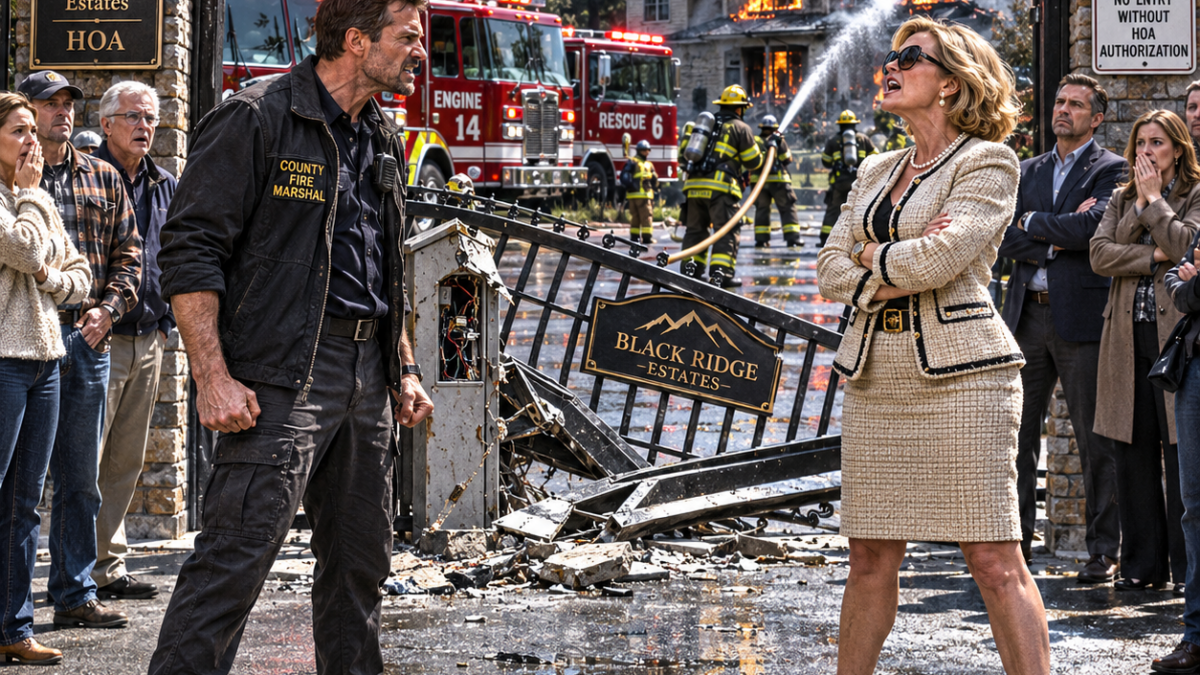
part 2
By the next morning, the Mercer house was a black frame beneath a gray winter sky.
The chimney remained standing.
Almost nothing else looked like home.
Elise and I walked the perimeter with an investigator from the state.
She held my hand when we reached what had been the living room.
I recognized a piece of the cast-iron stove.
The dining table was gone.
My father had built that table when Elise and I bought the house.
Oak.
Heavy enough that it took four people to move.
I stood looking at a pile of burned joists where it had been.
Elise squeezed my hand.
“Don’t.”
“What?”
“Don’t decide what everything means today.”
That was Elise.
An engineer even in grief.
Do not certify the structure until you inspect it.
Do not declare the loss before you know what remains.
I nodded.
Then I did the most difficult professional thing I have ever done.
I recused myself.
As county fire marshal, I had legal authority to investigate fires in my jurisdiction.
Not this one.
Not my home.
Not my loss.
If I handled the origin investigation, Valerie could accuse me of using a badge to settle a property dispute.
She would have been wrong.
But she would have been able to say it.
And in a case involving a private HOA, a blocked emergency response, and a homeowner who happened to be the county fire marshal, credibility was going to matter almost as much as evidence.
So I signed the recusal.
The State Fire Investigation Unit took control.
Lead investigator: Laurel Briggs.
Laurel had a reputation for two things.
She moved slowly.
She rarely repeated a question.
People who lied to her tended to fill silence with information they had never intended to give.
Her first walkthrough bothered her.
The structure had burned too quickly.
The HOA had already suggested an electrical malfunction.
But the visible fire spread did not line up comfortably with the panel.
Laurel said almost nothing about it to me.
That was another reason I trusted her.
She wasn’t giving the homeowner theories.
She was building a case.
While she worked, Elise and I tried to understand what we still owned.
Insurance calls.
Temporary housing.
Inventory forms.
Photographs.
Clothes.
Medication.
Passports.
Things you never think about until somebody asks whether they survived a fire.
Then a Black Ridge employee arrived carrying an envelope.
For one stupid second, I thought maybe the HOA had sent something decent.
An apology.
Temporary assistance.
A note saying the board regretted the delay.
Elise opened it.
Then laughed.
Not because it was funny.
Because sometimes disbelief comes out sounding like laughter.
“What?”
She handed it to me.
Invoice.
$18,640.
Barrier repair.
Debris cleanup.
Landscaping violation.
The landscaping violation was apparently based on our burned house being harmful to community visual standards.
I read the sentence twice.
Then set the paper down.
Elise said, “They invoiced us because our house burned.”
“Yes.”
“And because firefighters broke the gate.”
“Yes.”
“While trying to reach our burning house.”
“Yes.”
She stared at me.
“I need you to tell me I’m misunderstanding something.”
“You’re not.”
That invoice told me what Valerie was doing.
She wasn’t simply being cruel.
She was building a narrative.
The irresponsible party was going to be me.
County firefighters had ignored private procedures.
My department destroyed expensive HOA equipment.
The burned property created visual problems.
The HOA was the victim of an overreacting government official.
The following day, Valerie sent the entire community a message blaming county firefighters for refusing to comply with Black Ridge emergency access procedure.
I said nothing publicly.
Laurel requested the entrance-camera footage.
Black Ridge replied that a technical malfunction had erased it.
She requested gate-access logs.
Different system.
Different vendor.
Same miraculous failure.
The retention period, the HOA claimed, had expired.
Conveniently.
Two independent systems had both lost data from the same critical morning.
I had spent twenty years in fire service.
Laurel had spent longer investigating people who believed “technical malfunction” was an explanation.
Neither of us said what we were thinking.
We didn’t have to.
Near the end of the week, Laurel asked me to come to the state lab.
She placed an evidence bag on the table.
Inside was dark soil and burned material taken from beside the garage wall.
“Preliminary chemical result,” she said.
I waited.
“Ignitable liquid residue.”
I felt something inside me go cold.
Not electrical.
Not accidental.
Not an overloaded circuit.
Somebody had applied accelerant beside my house.
Elise wasn’t inside.
Thank God.
But whoever did it could not have guaranteed that.
Maybe I had returned early.
Maybe a neighbor had been visiting.
Maybe a firefighter had entered before structural failure.
Arson does not stay obedient to the person who lights it.
Laurel watched my face.
“Grant.”
“I’m fine.”
“No, you’re not.”
“I know.”
She slid the bag away.
“Which is why you’re not investigating this.”
“I know.”
That was when the story moved backward six days.
Six days before the fire, I had inspected the Black Ridge clubhouse.
The inspection came from a formal complaint.
I expected minor issues.
Exit lighting.
Blocked storage.
Maybe expired extinguishers.
Instead, I found a cluster of violations that made me uncomfortable.
The emergency gate lacked a compliant override.
A designated fire lane behind the clubhouse was routinely used for parking.
One sprinkler zone had been disabled for months.
Propane cylinders were being stored improperly.
Then I found the reserve water problem.
Black Ridge maintained a dedicated emergency water tank designed to support fire apparatus if hydrant capacity became insufficient.
At least, that was what the approved fire-protection plan said.
The tank had been repurposed.
Landscaping irrigation.
Decorative plantings.
Clubhouse grounds.
Water meant for emergency fire response was helping keep expensive grass green.
I documented everything.
Issued a correction notice.
Set deadlines.
Then explained that if critical access and suppression systems were not restored, the clubhouse could be closed to occupancy.
Valerie reacted immediately.
“This is private property.”
“The clubhouse is private.”
“Then the county does not get to dictate how our assets are used.”
“The fire code does.”
“You’re threatening our residents.”
“I’m telling you the emergency gate must open for emergency vehicles.”
“We have security.”
“Security is not a fire-suppression system.”
She stood from the conference table.
“We have a major gala scheduled.”
“Then correct the violations before the gala.”
Her face went red.
“You are not shutting down this clubhouse over landscaping water.”
“No. I am telling you your emergency reserve has been diverted.”
Travis Bellamy stood near the back.
Head of Black Ridge security.
Large man.
Former private contractor.
Rarely spoke.
As I walked toward the exit, I heard Valerie mutter something to him.
“Someone needs to teach that man what private means.”
I heard it.
I dismissed it.
People say ugly things during enforcement disputes.
If every angry business owner who threatened an inspector actually followed through, nobody would work code enforcement.
Now my house was gone.
And the sentence sounded different.
Laurel began examining motive.
The gala wasn’t merely a holiday fundraiser.
It was central to Valerie’s campaign to remain board president.
The renovated clubhouse was her showcase.
If I closed it before the event, residents would start asking questions.
Why hadn’t the emergency systems been maintained?
Why was the fire reserve being used elsewhere?
Why would restoring it cost so much?
Those questions eventually led to money.
But first, Laurel needed to determine who had access to the gate.
Four administrative users.
Valerie.
Travis.
Two others.
Then we found another piece.
Three days before the fire, Valerie had contacted my office asking me to remove the emergency-gate deficiency from my official report.
I refused.
Two days later, Black Ridge filed a formal complaint against me alleging selective enforcement and harassment.
The county rejected it.
The next morning, my house burned.
Still circumstantial.
Still not enough.
Then a traffic camera outside Black Ridge gave Laurel the first hard break.
Seventeen minutes before smoke was reported, a Black Ridge security utility vehicle turned toward the service road leading to my home.
Driver clearly visible.
Travis Bellamy.
He had told investigators he spent the morning at the clubhouse.
Now there was video proving he lied.
Laurel brought Mason Pritchard back.
“Who ordered manual lockdown?”
“I don’t remember.”
“Who told you to hold the engines?”
“I don’t know.”
“Who chained the west gate?”
“I had nothing to do with that.”
Laurel didn’t argue.
She put the dispatch timeline in front of him.
9:14.
First public fire report.
9:15.
Engine Fourteen at the gate.
9:16.
Black Ridge security confirms the address belongs to Grant Mercer.
9:18.
Owen warns the gate will be forced.
9:22.
Rescue Six breaches.
Mason stared at the page.
He knew exactly what eight minutes meant.
So did I.
Valerie called an emergency HOA meeting before Mason changed his story.
Elise and I attended.
I wore jeans.
No uniform.
No badge.
Valerie stood at the front and told residents I was using my personal tragedy to launch a government attack against Black Ridge.
I could feel people watching me.
Waiting to see whether the fire marshal would become the angry homeowner Valerie needed me to be.
I didn’t.
When she finished, I asked one question.
“Who ordered the gate locked?”
Valerie answered smoothly.
“Security made an independent decision.”
Travis nodded.
Mason sat in the back.
His face changed.
Small movement.
Eyes down.
Jaw tight.
After the meeting, he asked to speak with Laurel privately.
Then the wall cracked.
Mason said when Engine Fourteen arrived, he reached for the gate control.
Travis radioed him.
“Hold them.”
Mason argued.
“There’s an active structure fire.”
Travis answered that Mrs. Concincaid wanted nobody through until she arrived.
Then Mason reported the address.
“It’s Mercer’s house.”
Travis answered:
“She knows.”
Mason repeated that detail twice.
He needed Laurel to understand.
Valerie knew.
She knew whose house was burning.
And the gate stayed closed.
The HOA hired attorneys.
Filed complaints.
Accused me of abuse of authority.
Retaliation.
Conflict of interest.
Destruction of private property.
Then somebody released edited video to residents showing Owen arguing at the gate.
The clip was cut to make it appear as though firefighters had ignored alternative access and chosen confrontation.
Some residents believed it.
That hurt more than I expected.
Not because they doubted me.
Because they had watched smoke rise over our house and still accepted a story in which the broken gate mattered more than what was behind it.
I had one obvious way to answer.
Use my authority.
Shut the clubhouse.
Issue enforcement actions.
Make Valerie regret every word.
I refused.
I transferred every Black Ridge enforcement decision to the deputy fire marshal.
No signature from me.
No closure order from me.
No penalty from me.
If the clubhouse was shut, it would happen through inspectors who had not lost a home.
If the HOA was fined, somebody else would sign it.
Valerie wanted revenge to be my motive.
I took revenge out of the process.
Laurel later told me it was one of the most useful decisions I made.
Meanwhile, investigators examined the video file Black Ridge had voluntarily provided.
Metadata showed it had been exported and edited the morning after the fire.
Not original footage.
Someone had manipulated evidence before giving it to investigators.
Then Audrey Fallon asked for a meeting.
HOA treasurer.
Quiet woman.
Always seemed uncomfortable around Valerie.
She arrived carrying a laptop and a folder.
Her hands shook.
“Grant, there’s something you don’t know.”
Laurel sat across from her.
“What?”
Audrey swallowed.
“The emergency reserve.”
Black Ridge once held approximately $640,000 in its fire and emergency reserve account.
Most of it was gone.
Over two years, money had been shifted into clubhouse renovation.
Landscaping.
Security equipment.
Executive entertainment.
Projects Valerie had personally approved.
Audrey had signed some transfers.
She believed Valerie when told the money would be replaced before the next audit.
“Temporary internal borrowing,” Audrey said.
Her eyes filled.
“I knew it was wrong to keep moving it. I didn’t understand how wrong.”
Laurel asked, “Why tell us now?”
Audrey looked at me.
“Because his house burned while our emergency water account was empty.”
I didn’t say anything.
She continued.
“I have not slept.”
I believed her.
That surprised me.
Maybe it shouldn’t have.
Guilt looks different from defiance.
Audrey looked like a person carrying something she desperately wanted to put down.
Valerie never did.
She continued sending community statements.
Political attack.
Government overreach.
Disgruntled marshal.
Personal vendetta.
Then the final lab report arrived.
Incendiary fire.
Arson.
Official classification.
We had a crime.
Now investigators needed the person.
Laurel obtained Travis’s vehicle telematics.
8:46 a.m.—leaves clubhouse.
8:51—arrives behind Mercer residence.
8:58—stationary.
9:03—leaves.
9:11—first fire call.
Then the fuel record.
That morning, Travis bought a small gasoline container on the HOA card.
He said it was for maintenance equipment.
Investigators checked.
The equipment he named had not been used.
Laurel brought him in.
I stayed out of the interview.
That mattered to me.
I did not want my face in the room when he decided whether to tell the truth.
Laurel put three documents on the table.
Telematics.
Fuel receipt.
Lab report.
Travis broke.
He admitted going to my property.
Admitted applying accelerant.
Claimed he never intended the entire house to burn.
Then he said Valerie told him to “make Mercer regret shutting them down.”
No direct order to burn.
No explicit instruction.
That alone might not have tied Valerie legally to the arson.
Then Travis described what happened after the flame grew.
He called Valerie.
Told her the fire was larger than expected.
She did not tell him to call 911.
According to Travis, she asked how long until the structure was fully involved.
Then sirens approached.
Valerie ordered the gate locked.
That was no longer anger after the fact.
That was a decision during an active emergency.
Investigators needed corroboration.
Travis gave them another lead.
Black Ridge kept full radio traffic and gate-control records on a local administrative server.
Laurel obtained a warrant.
Before investigators arrived, Valerie called for emergency IT service.
The server disappeared.
Not shut down.
Gone.
Audrey confirmed the board had never approved relocation.
Now we had possible obstruction on top of the fire.
But Valerie made a technical mistake.
She understood the local server.
She didn’t understand the vendor.
Black Ridge’s security software retained thirty days of cloud backups.
Investigators recovered them.
Almost everything.
The timeline became exact.
9:10:34—smoke alert reaches Black Ridge console.
9:11:08—Travis calls Valerie.
9:12:17—Valerie logs into the gate-control app from her device.
9:13:02—main gate enters manual lock.
9:13:49—western service gate enters secure mode.
9:14:11—Engine Fourteen appears on entrance camera.
9:15:26—Mason requests permission to open.
9:15:41—request denied.
Administrator account:
VK-01.
Valerie Concincaid.
Then the radio recording.
Mason:
“County engines are at the gate.”
Travis:
“Hold.”
Mason:
“It’s Mercer’s house.”
A pause.
Then Valerie’s voice in the background.
“I know whose house it is.”
Laurel played that recording for me in her office.
I stared at the table.
People asked later whether I felt rage.
I didn’t.
Not then.
I felt something emptier.
A house can burn from an impulsive act.
A person can panic.
Make a terrible decision.
But listening to that recording meant accepting something colder.
Valerie had been given a second opportunity.
Whatever she knew before ignition, whatever she told Travis, once the fire engines reached the gate she had a chance to let them pass.
Open the barrier.
Let the professionals work.
Maybe save part of the house.
Maybe protect firefighters from a worse interior condition.
She chose not to.
She turned delay into punishment.
Cloud data also contained financial records.
More than half a million dollars diverted from emergency reserves.
The inspection I conducted six days before the fire threatened to force immediate spending the HOA could not make without revealing why the money was missing.
Motive became visible.
Not one thing.
Several.
Gala.
Election.
Reputation.
Financial concealment.
Fire code exposure.
Then investigators searched the Black Ridge administrative office.
I did not join.
Elise and I watched from across the street.
Government vehicles outside the clubhouse.
Investigators inside.
Valerie stormed toward Laurel.
“This is private HOA property!”
Laurel held up the warrant.
No argument.
No speech.
Just paper.
That was the difference between Valerie’s authority and real legal authority.
One depended on people being intimidated.
The other came with a judge’s signature.
Investigators left carrying computers, radios, financial ledgers, storage devices, gate-control equipment, Valerie’s HOA phone, and shredded records recovered from a disposal bin.
Audrey gave them financial passwords.
The accounting software told the same story she had.
Emergency money moved into renovation.
Landscaping.
Security.
Spending timed to avoid dues increases before an election.
Then forensic technicians reconstructed the shredded documents.
Early financial statements showed the true reserve.
Later versions presented to residents showed altered figures.
The changes were deliberate.
Someone had not merely spent the money.
Someone had worked to conceal the spending.
Then investigators recovered text messages between Valerie and Travis from days before my fire.
Valerie:
He thinks that badge makes him untouchable.
Travis:
Want me to handle it?
Valerie:
Simply make the inspection problem go away.
Not a direct command to commit arson.
Important distinction.
But context matters.
Telematics.
Fuel.
Accelerant.
Gate lockdown.
Radio traffic.
Financial motive.
Evidence destruction.
And then the final audio.
Travis’s phone had accidentally retained extra voicemail audio after he failed to properly disconnect a call.
His voice:
“Fire department’s coming.”
Valerie:
“Can the gate hold them?”
Travis:
“For a few minutes.”
Valerie:
“Then give me a few minutes.”
Travis asked what happened when crews forced entry.
Her answer:
“By then it won’t matter.”
That recording changed everything.
Travis negotiated a plea.
Agreed to testify.
Mason testified.
Audrey cooperated.
The case stopped depending on whether people believed Grant Mercer or Valerie Concincaid.
That was the victory I wanted most.
Not public opinion.
Evidence.
At a pretrial hearing, Valerie’s defense attorney tried the obvious strategy.
Make me the angry fire marshal.
“You want Mrs. Concincaid punished, don’t you?”
I looked at him.
“I want the record accurate.”
“Because it was your house.”
“No.”
He raised an eyebrow.
“No?”
“Because the next house may belong to someone who doesn’t have a fire marshal standing outside the gate asking why the engines were stopped.”
The room became very quiet.
I wasn’t trying to make a speech.
But it was true.
Eight minutes and forty-one seconds mattered to me because I watched my house disappear during them.
Professionally, they mattered for a larger reason.
Fire is exponential.
A room involved at minute one is not the same fire at minute eight.
A window failing changes ventilation.
A door opening changes flow.
A roof void igniting changes everything.
Emergency access isn’t ceremonial.
A gate is not decoration during a fire.
It is either open or it is stealing time.
Valerie treated the gate like a lever of authority.
She decided who passed.
When.
Under whose approval.
Then the system she built recorded every command.
Every login.
Every denial.
The machinery of control became the machinery of evidence.
Travis pleaded guilty to offenses directly tied to setting the fire.
Valerie faced broader charges connected to the conspiracy, deliberate emergency-response delay, obstruction, evidence tampering, and associated financial misconduct.
I attended only when required.
I did not sit in the front row every day.
I did not stare at her.
Elise and I had another job.
Rebuilding.
That became our revenge, if you want to call it that.
But revenge is probably the wrong word.
Rebuilding was refusal.
Refusal to let Valerie decide where our life ended.
Elise designed the new house herself.
She was a structural engineer, and once she moved from grief into drawings, something in her came back alive.
Fire-resistant exterior assemblies.
Improved compartmentation.
Better defensible space.
A sprinkler system above minimum requirement.
She gave me pages of options.
I asked for one thing.
“My office.”
“What about it?”
“I want the window facing the front road.”
She understood immediately.
“The gate.”
“Yes.”
She didn’t tell me that was unhealthy.
Didn’t tell me I needed to let go.
She simply adjusted the plan.
The trial concluded months later.
Valerie was convicted on charges reflecting her role in the conspiracy, the intentional emergency-response delay, and later concealment efforts.
Travis received a separate sentence after his guilty plea and cooperation.
Audrey resigned as treasurer but continued assisting the financial audit.
The old Black Ridge board collapsed.
Not because I demanded its destruction.
Because enough evidence surfaced that trust could not survive unchanged.
Black Ridge was placed under transitional court-supervised management while financial and governance problems were repaired.
People expected me to advocate dissolving the association.
I didn’t.
The neighborhood still needed roads.
Common-property maintenance.
Snow removal.
Insurance.
Actual governance.
Destroying an institution because bad people controlled it would have punished residents who had already lost money.
I wanted Black Ridge fixed.
Specifically where it had failed.
The emergency rules changed first.
No HOA approval for emergency responders.
None.
The gates were redesigned to open automatically when authenticated emergency signals approached.
No guard could override that function on a board member’s verbal order.
Fire lanes received recurring inspection.
The emergency reserve became subject to annual independent audit.
Gate-command logs were stored outside direct HOA control.
No convenient deletion.
No disappearing local server.
Every closure recorded.
Permanent.
The $18,640 invoice sent to Elise and me vanished.
Nobody ever mentioned it again.
Civil claims and insurance eventually assigned financial responsibility for the property loss according to the findings of the investigation.
I never became rich.
There was no cartoon-sized payout.
No free mansion.
We dealt with insurance.
Lawyers.
Depreciation.
Rebuilding costs.
Receipts.
Loss schedules.
Exactly the tedious process anybody faces after a catastrophic fire.
Some things were compensated.
Others were irreplaceable.
My father’s table did not come back because an insurer wrote a check.
Our original wedding album didn’t become less burned because somebody accepted liability.
Justice and restoration are not the same thing.
That was one of the hardest truths Elise and I learned.
The law can identify who caused damage.
It can punish.
It can order payment.
It can change rules.
It cannot return nineteen years to the rooms where you lived them.
We rebuilt anyway.
Almost one year after the fire, I stood in my new home office with coffee.
Same property.
Different house.
Outside, the road curved toward the Black Ridge gate.
Elise walked in.
“You’re watching it again.”
“No.”
She stood beside me.
A siren sounded in the distance.
Ambulance.
We both looked.
The vehicle appeared beyond the trees.
Still several hundred feet from the entrance.
The gate lifted.
Smooth.
Immediate.
No guard running outside.
No clipboard.
No phone call.
No HOA president.
The ambulance passed without slowing.
Elise looked at me.
“You’re definitely watching the gate.”
I kept my eyes on the road.
The ambulance disappeared around the curve.
Then I smiled.
“I’m watching it work.”
She rested her head against my shoulder.
That moment meant more to me than the verdict.
Maybe that sounds strange.
It shouldn’t.
Courtrooms punish what happened.
Systems determine whether it happens again.
Black Ridge could not give me back eight minutes and forty-one seconds.
But it could make sure the next ambulance never lost them.
I kept one printed dispatch timeline in the bottom drawer of my desk.
Elise asked once why.
“Anger?”
“No.”
“Then what?”
“Memory.”
Not memory of Valerie.
Memory of the gap between policy and reality.
Before my fire, Black Ridge had an emergency protocol.
It sounded official.
Private Property Emergency Protocol.
People respected it because it had capital letters.
But nobody had tested the fundamental question.
What happens when the procedure conflicts with the emergency?
The answer should have been obvious.
Emergency wins.
Instead, the protocol became a weapon because it gave the wrong person discretionary control.
Other counties heard about the case.
Fire officials called.
Private developments asked for copies of the new Black Ridge access standards.
I reviewed protocols with municipalities that had gated communities.
We talked about automatic override.
Credentialed responder access.
Redundant systems.
Independent logging.
Guard training.
Simple rules.
Never place a private person between emergency apparatus and an active incident.
That was the professional legacy I could live with.
My worst morning became a template somebody else might use to avoid theirs.
Mason eventually left private security.
He applied to the county emergency communications center.
When I heard, I had mixed feelings.
He kept the gate closed.
That fact remained.
But he also told investigators the truth when staying silent would have been easier.
People are more complicated than the worst minute of their life.
I did not recommend him.
I did not oppose him.
He went through the normal process.
Months later, I saw him in the communications building.
He looked older.
“Marshal.”
“Mason.”
He hesitated.
“I’m sorry.”
I could have made him repeat it.
Could have told him eight minutes.
Could have described the roof.
Instead, I asked one question.
“If that call came in today, what would you do?”
“Open the gate.”
“Before asking?”
“Yes.”
“Before calling a supervisor?”
“Yes.”
“Good.”
That was all.
Audrey rebuilt her standing more slowly.
She appeared at every financial-recovery hearing.
Answered every question.
No excuses.
No speeches about being manipulated.
If somebody asked why she signed transfers, she said she trusted the wrong explanation.
If they asked whether she should have checked, she said yes.
Transparency is not dramatic.
But over time, people trusted her more than they trusted most of the officials who claimed they had never made mistakes.
Valerie never gave residents that kind of honesty.
Maybe she couldn’t.
Maybe admitting one thing threatened the entire identity she had built around being in control.
I stopped trying to understand her.
Motives matter in court.
Afterward, they can become a trap.
If Elise and I had spent years asking why Valerie hated me enough to let our house burn, she would have remained in the center of our lives long after losing the legal power she abused.
We had already given her enough.
So we stopped.
Not all at once.
One ordinary day at a time.
We bought furniture.
Hung photographs.
Argued about kitchen shelves.
Elise planted two maples.
I told her one was too close to the walkway.
She told me she had designed bridges and could probably manage a tree.
I lost that argument.
It felt good.
Normal arguments are gifts after catastrophe.
For months, I woke at sounds.
Truck brakes.
Security alarms.
Sirens.
The smell of wood smoke at a neighbor’s fire pit could send my body back to that gate before my brain caught up.
Elise noticed.
Never made it a big thing.
She would simply touch my arm.
“Here.”
One word.
Here.
New house.
Safe room.
Open gate.
Here.
Eventually, the reactions softened.
The first anniversary was difficult.
The second less so.
By the third, I could tell the story professionally without hearing my own roof collapsing in the background.
People often focused on the arson.
I understood why.
Fire is dramatic.
Gasoline.
Telematics.
Voicemail.
Trial.
But to me, the central act remained the gate.
Travis created the fire.
Valerie still had a decision after that.
Open.
Or hold.
She chose hold.
That choice transformed an already terrible crime into something even colder.
That was why the new Black Ridge rules mattered so much.
We removed that decision from people.
No president.
No guard.
No manager.
No person needing permission.
Emergency signal received?
Gate opens.
Mechanical.
Automatic.
Boring.
Perfect.
The first time I attended a Black Ridge board meeting after transitional management ended, the new president was a retired nurse named Helen Ward.
She started by reading the emergency-access report.
Five pages.
Testing logs.
Response times.
Automatic override status.
Nobody applauded.
Nobody needed to.
Then the treasurer presented the reserve balance.
Real number.
Independent audit.
No hidden transfers.
I sat beside Elise in the back.
She whispered, “You look happy.”
“I’m listening to an HOA meeting about gate maintenance.”
“That is not an answer.”
“I’m extremely happy.”
She smiled.
The clubhouse eventually reopened after every violation was corrected.
Emergency water restored.
Sprinkler zone active.
Fire lane cleared.
Propane storage fixed.
Gate override rebuilt.
The gala Valerie had fought so desperately to protect never happened.
Black Ridge held another fundraiser the following year.
Smaller.
No political speeches.
Part of the proceeds went into the emergency reserve.
I didn’t attend.
Not because I objected.
Because Elise and I had dinner plans.
That was progress too.
A life cannot remain organized around the worst person who entered it.
One summer afternoon, I was replacing a smoke detector battery when Elise came into my office holding the old $18,640 invoice.
She had found it in a file box.
“Why do we still have this?”
I took it.
Barrier repair.
Debris cleanup.
Landscaping violation.
I remembered the morning she laughed reading it.
“Evidence habit.”
“The case is over.”
“I know.”
“Then?”
I thought about keeping it.
Framing it.
Making it a joke.
Instead, I tore it in half.
Then again.
Dropped it into recycling.
Elise raised an eyebrow.
“That easy?”
“No.”
I looked toward the gate.
“But finished.”
The one document I kept was the dispatch timeline.
Not because Valerie wrote it.
Because nobody did.
Machines and dispatch systems captured it.
9:14.
9:15.
9:22.
Eight minutes and forty-one seconds.
No rhetoric.
No opinion.
Just time.
Time is the least dramatic witness and often the most honest.
Valerie had spent months trying to control the story.
Private property.
Unauthorized emergency entry.
Government retaliation.
Selective enforcement.
Damaged HOA assets.
But narratives weaken when timestamps arrive.
When did smoke alert?
When did she log in?
When did the gate lock?
When did Engine Fourteen arrive?
When did Mason request opening?
Who denied it?
When did crews breach?
Facts reduced the argument until almost nothing was left.
That was what legal justice looked like from where I stood.
Not a perfect speech.
Not a villain confessing.
Not one spectacular piece of evidence.
A chain.
Lab chemistry.
Vehicle movement.
Fuel transaction.
Cloud logs.
Radio recordings.
Board finances.
Backup metadata.
Witness testimony.
One accidental voicemail.
Each piece independent enough to survive if another was challenged.
That is what made the final case strong.
Not emotion.
Redundancy.
I sometimes speak to younger fire inspectors now.
The story comes up.
Usually somebody asks, “What would you have done differently?”
Professionally?
I would have escalated the Black Ridge access violation faster.
I believed a written correction notice would be enough.
I underestimated the danger of an emergency gate without automatic override.
Personally?
I don’t know.
People like hindsight because it creates the illusion that tragedy was predictable.
Most of it wasn’t.
I could not have known Travis would come to my house.
I could not have known Valerie would turn a code inspection into a personal campaign.
What I could control came afterward.
Recuse.
Preserve evidence.
Do not retaliate.
Let independent people work.
Correct the system.
Those decisions mattered.
Especially recusal.
Valerie’s defense spent months trying to make me the story.
Imagine how much easier that would have been if I had personally signed the clubhouse closure.
Personally collected evidence.
Personally questioned guards.
Personally issued penalties.
Instead, when her lawyer called me vindictive, the record showed I had repeatedly removed myself from decisions where my personal loss could create a conflict.
That is something people misunderstand about restraint.
Restraint can feel weak in the moment.
Often, it becomes strength later.
The most satisfying thing I did in that entire case was not confront Valerie.
It was refuse to give her an excuse.
Elise understood that before I did.
The night after the fire, we were in a hotel room wearing donated clothes.
I couldn’t sleep.
I said, “I should shut their clubhouse tomorrow.”
She looked at me.
“Should the county shut it?”
“Yes.”
“Then let someone else sign it.”
I stared at her.
She continued.
“You want the rules to matter when they protect you?”
“Yes.”
“Then they have to matter when you’re angry too.”
That woman has saved me from myself more times than any fire crew ever has.
Years later, Black Ridge’s gates still stand.
Same entrance.
Different hardware.
Different meaning.
Children ride bikes past them.
Residents wave at guards.
Delivery drivers stop when they need directions.
Most people probably don’t think about emergency override.
Good.
Safety systems work best when ordinary people rarely have to think about them.
But every month, the gates are tested.
Documented.
Verified.
And every emergency command is stored where no HOA president can erase it.
That is the part I care about.
Not whether people remember Valerie.
Whether the gate opens.
One winter morning, another ambulance approached.
I happened to be outside clearing snow.
I heard it before seeing it.
The barrier lifted automatically.
The ambulance passed.
Maybe six seconds from detection to entry.
I checked my watch without meaning to.
Old habits.
A neighbor named Peter stood nearby with a shovel.
“What?”
“Nothing.”
“You timed it.”
“I did not.”
“You absolutely timed it.”
I smiled.
“Six seconds.”
He shook his head.
“You fire guys are strange.”
“Probably.”
Six seconds.
Not eight minutes.
That was enough to improve my entire morning.
Sometimes justice becomes boring infrastructure.
I think that is the best version.
Courtrooms end.
News stories fade.
People move.
Boards change.
But a properly designed gate keeps opening for strangers you will never meet.
That is a better legacy than revenge.
Elise and I stayed on the same land.
People asked why.
Why rebuild where somebody tried to destroy us?
Because it was ours.
Because the fire did not make the soil guilty.
Because leaving solely because Valerie had made the place painful would have given her one final decision over our lives.
We chose to stay.
The new house does not resemble the old one exactly.
That was Elise’s decision.
“You don’t rebuild memory,” she told me. “You build forward.”
The new front door is slate blue.
That part I insisted on.
She pretended not to notice.
One evening, I stood at the window with coffee.
The gate visible in the distance.
Elise came beside me.
“Watching?”
“No.”
“Liar.”
I laughed.
A service truck approached.
Gate opened.
Closed behind it.
Normal.
“Maybe a little.”
She slipped her hand into mine.
The fire took objects.
Photographs.
Furniture.
Walls.
Time.
Valerie stole eight minutes and forty-one seconds that nobody can return.
But she did not get the final meaning of those minutes.
She wanted them to prove she controlled the gate.
Instead, they became the reason no one at Black Ridge would ever control emergency access that way again.
That reversal mattered to me.
Power is sometimes nothing more than the ability to delay another person.
Make them ask.
Make them wait.
Make them prove they deserve passage.
Valerie loved that kind of power.
A barrier.
An authorization.
A private protocol.
A board title.
A password.
In the end, every one of those tools became evidence against her.
The gate log recorded her login.
The radio preserved her voice.
The server preserved her commands.
The financial software preserved her transfers.
The backup system preserved what she thought had disappeared.
Control left fingerprints everywhere.
That was her mistake.
She believed authority meant nobody could question the record.
Real authority survives review.
Hers didn’t.
When I think about that morning now, I no longer begin with the flames.
I begin with the engines.
Three of them.
Stopped behind steel.
Firefighters ready.
Equipment ready.
Water ready.
A house burning.
And one human decision standing between them.
That is why I kept the timeline.
That is why I teach the case.
That is why Black Ridge’s gate opens automatically.
A barrier can be useful.
It can keep traffic controlled.
Protect private roads.
Create security.
But the moment somebody turns it into a personal weapon during an emergency, it stops being security.
It becomes danger.
My father used to say fire does not care who owns the building.
I say something similar now.
Fire does not care who owns the gate.
Neither should the ambulance.
Neither should the engine.
When the sirens come, open it.
Everything else can be argued about afterward.
That is the rule Black Ridge finally learned.
It cost us a house.
It cost residents hundreds of thousands in missing reserves and legal consequences.
It cost people careers.
Freedom.
Trust.
It should never have cost any of that.
The rule was simple from the beginning.
Emergency vehicles do not wait for HOA permission.
One evening near Christmas, almost exactly four years after the fire, Elise hung a wreath on our slate-blue front door.
I stood back.
“Crooked.”
“It’s not.”
“Left side is low.”
“You’re a fire marshal, not an architect.”
“You’re the architect.”
“Structural engineer.”
“Same complaint department.”
She adjusted it one inch.
“Happy?”
“Yes.”
She stepped beside me.
Snow moved lightly across the yard.
Far away, the Black Ridge entrance lights came on automatically.
Nothing dramatic.
Just warm white bulbs.
I could see the gate.
A car entered.
Barrier rose.
Barrier fell.
Elise followed my eyes.
“You know what I think?”
“What?”
“You’re always going to watch that gate.”
“Probably.”
“Does it still bother you?”
I thought before answering.
“No.”
That surprised both of us.
“What does it do?”
I looked toward the road.
“Reminds me.”
“Of Valerie?”
“No.”
“Of the fire?”
“Not exactly.”
“Then what?”
I watched another vehicle approach.
Gate open.
Vehicle through.
Gate down.
“The system works now.”
Elise smiled.
“That sounds very romantic.”
“I’m trying.”
“You’re terrible at it.”
She took my arm.
We went inside.
Behind us, the gate kept doing the one thing it should have done from the beginning.
Getting out of the way when it mattered.
I could rebuild a house.
I could replace furniture.
I could reconstruct some photographs from relatives’ copies.
I could live with an imperfect insurance settlement.
I could even live with never knowing what every burned object looked like before it disappeared.
What I could never recover was eight minutes and forty-one seconds.
So I stopped trying.
Instead, I made sure nobody at Black Ridge could steal them again.
That became enough.
Not forgiveness.
Not forgetting.
Something better.
A record that told the truth.
A system that changed because of it.
And a gate that finally understood what Valerie never did:
When lives and homes are on the other side, nobody needs HOA Karen’s permission to pass.
𝗧𝗛𝗘 𝗘𝗡𝗗
HOA Karen Locked Three Fire Engines Outside While My House Burned—Then Sent Me an $18,640 Bill for Breaking Her Gate
HOA Karen Valerie Concincaid locked three fire engines outside Black Ridge Estates while my house burned less than a quarter mile away, then billed me for the barrier firefighters had to destroy to reach it.
She thought calling the neighborhood “private property” gave her the power to decide when emergency crews were allowed inside.
What she did not know was that eight minutes and forty-one seconds at that gate were about to become the most important evidence in a case far larger than one burned house.
The first thing I saw was the smoke.
Not the flames.
Not the engines.
Not Valerie.
The smoke.
A thick black column bent east over the pines, dark enough to stain the December sky, and for one long second my brain refused to connect it with the address flashing on the screen mounted beside my radio.
Mercer residence.
My residence.
My house.
I was finishing a commercial fire-safety inspection on the far side of the county when the call came in. The dispatcher’s voice stayed professional, but after twenty years in fire service, you learn what people sound like when they recognize a name.
“Grant, confirm you copied the address.”
“I copied.”
“Engine Fourteen, Engine Twenty-Two, Rescue Six responding.”
I was already moving.
My wife, Elise, had left hours earlier for a structural engineering meeting in town.
That was the first fact I held onto.
Elise wasn’t inside.
Nobody was trapped.
No child.
No neighbor.
No firefighter.
Not yet.
That should have made the rest easier.
It didn’t.
A house is lumber and wire until it becomes the place where two people spend nineteen years becoming themselves.
Ours had the slate-blue front door Elise painted two summers earlier because she said the old brown made the house look like it was holding its breath.
The dining table had been built by my father.
Our wedding photographs were in the hallway.
Elise kept rolled architectural drawings in the guest-room closet despite promising every January she would organize them.
There was a dent in the kitchen baseboard from the time I dropped a cast-iron Dutch oven ten years earlier.
A house gathers ordinary evidence that you existed.
And somewhere beyond that smoke were nineteen years of ours.
I reached Black Ridge Estates three minutes after the first apparatus.
Three minutes too late to see the beginning.
Early enough to see something I will remember for the rest of my life.
Engine Fourteen was stopped outside the main gate.
Engine Twenty-Two behind it.
Rescue Six angled toward the shoulder.
All three sirens were running.
None were moving.
The steel entrance barrier was lowered across the road.
Two Black Ridge security utility vehicles had been parked behind it sideways, creating a second obstruction.
Battalion Chief Owen Maddox stood on Engine Fourteen’s running board shouting toward a young security guard.
“Raise the gate!”
The guard’s name was Mason Pritchard.
I knew him by sight.
Maybe twenty-five.
Thin.
Always polite when I conducted inspections.
That morning, he looked terrified.
“I need HOA authorization!”
Owen stared at him.
“What?”
“Black Ridge private emergency protocol requires confirmation before county vehicles enter!”
Owen pointed at the engine.
“That siren is your confirmation!”
Mason did not move.
Somebody tried the western service entrance.
Chained.
Fresh padlock.
By the time I rolled to a stop behind Rescue Six, flame was already showing above the tree line.
My flame.
My roof.
I got out.
Every instinct in my body wanted to start giving orders.
I didn’t.
That mattered.
I was the county fire marshal.
But this was my home.
My property.
My wife’s life stacked inside those walls.
I had no business directing the suppression response.
Owen was incident commander.
So I forced myself to remain outside his chain of command.
“What do you need from me?”
“Nothing,” he said. “Stay back.”
Then he turned toward his crew.
“Prepare to force it.”
Eight minutes and forty-one seconds.
That number lives in my head because my brain started timing before I consciously decided to.
Firefighters do that.
Seconds matter.
At first arrival, structures can still be compartmentalized.
Windows can still hold.
Rooms can still be separated by intact doors and walls.
Then heat compounds.
Flashover.
Roof involvement.
Structural failure.
Eight minutes is an eternity when a building is feeding itself to fire.
At 9:22, Rescue Six finally drove into the barrier.
Steel screamed.
The gate assembly twisted.
The arm broke loose.
The first engine surged through.
Then the second.
Then Rescue Six.
I watched them disappear toward my house.
I followed at a distance.
By the time I reached my driveway, the roof was mostly gone.
Fire had pushed through the second floor.
Windows were black openings.
The front door Elise painted was somewhere behind steam and smoke.
Crews hit the structure hard.
They did everything they could.
But the difference between arriving at the house and sitting behind a decorative private gate had already been paid in flame.
That was when Valerie Concincaid arrived.
Black SUV.
Designer sunglasses.
Hair untouched by the chaos.
She stepped out and looked toward the entrance.
Not my house.
The gate.
The broken gate.
She walked straight toward me.
“Do you have any idea what that barrier cost?”
I stared at her.
She crossed her arms.
“Your department destroyed private association property.”
Behind her, firefighters were pulling ceiling with pike poles inside what remained of my home.
I looked toward them.
Then back at her.
“You blocked three fire engines.”
“They should have waited for authorization.”
I thought I had misheard her.
“Say that again.”
“The security protocol exists for a reason.”
“My house was burning.”
“Grant, this is private property.”
I almost laughed.
Not because anything was funny.
Because I had heard that phrase from her six days earlier.
Private property.
She said it like two words could override every fire code, emergency statute, life-safety requirement, and piece of common sense in Pennsylvania.
I did not argue.
That surprised her.
Instead, I looked past her.
At Mason.
He stood near one of the damaged security vehicles with his head down.
Not angry.
Not defensive.
Ashamed.
He would not meet my eyes.
I filed that away.
Then the dispatch supervisor walked over.
“Grant.”
Something in his expression changed my focus.
“What?”
He lowered his voice.
“Black Ridge security had an internal smoke call before 911 got the first public call.”
I stared at him.
“How far before?”
“We’re pulling exact time.”
“Who called?”
“Not sure yet.”
I looked toward the gate.
Toward Mason.
Toward Valerie.
If Black Ridge security already knew there was smoke near my house before county dispatch knew there was a fire, then the closed barrier wasn’t merely a security misunderstanding that happened at the worst possible time.
Somebody knew.
And somebody still decided the engines should wait.
That was when I stopped watching my house burn.
I started watching the gate.
part 2
By the next morning, the Mercer house was a black frame beneath a gray winter sky.
The chimney remained standing.
Almost nothing else looked like home.
Elise and I walked the perimeter with an investigator from the state.
She held my hand when we reached what had been the living room.
I recognized a piece of the cast-iron stove.
The dining table was gone.
My father had built that table when Elise and I bought the house.
Oak.
Heavy enough that it took four people to move.
I stood looking at a pile of burned joists where it had been.
Elise squeezed my hand.
“Don’t.”
“What?”
“Don’t decide what everything means today.”
That was Elise.
An engineer even in grief.
Do not certify the structure until you inspect it.
Do not declare the loss before you know what remains.
I nodded.
Then I did the most difficult professional thing I have ever done.
I recused myself.
As county fire marshal, I had legal authority to investigate fires in my jurisdiction.
Not this one.
Not my home.
Not my loss.
If I handled the origin investigation, Valerie could accuse me of using a badge to settle a property dispute.
She would have been wrong.
But she would have been able to say it.
And in a case involving a private HOA, a blocked emergency response, and a homeowner who happened to be the county fire marshal, credibility was going to matter almost as much as evidence.
So I signed the recusal.
The State Fire Investigation Unit took control.
Lead investigator: Laurel Briggs.
Laurel had a reputation for two things.
She moved slowly.
She rarely repeated a question.
People who lied to her tended to fill silence with information they had never intended to give.
Her first walkthrough bothered her.
The structure had burned too quickly.
The HOA had already suggested an electrical malfunction.
But the visible fire spread did not line up comfortably with the panel.
Laurel said almost nothing about it to me.
That was another reason I trusted her.
She wasn’t giving the homeowner theories.
She was building a case.
While she worked, Elise and I tried to understand what we still owned.
Insurance calls.
Temporary housing.
Inventory forms.
Photographs.
Clothes.
Medication.
Passports.
Things you never think about until somebody asks whether they survived a fire.
Then a Black Ridge employee arrived carrying an envelope.
For one stupid second, I thought maybe the HOA had sent something decent.
An apology.
Temporary assistance.
A note saying the board regretted the delay.
Elise opened it.
Then laughed.
Not because it was funny.
Because sometimes disbelief comes out sounding like laughter.
“What?”
She handed it to me.
Invoice.
$18,640.
Barrier repair.
Debris cleanup.
Landscaping violation.
The landscaping violation was apparently based on our burned house being harmful to community visual standards.
I read the sentence twice.
Then set the paper down.
Elise said, “They invoiced us because our house burned.”
“Yes.”
“And because firefighters broke the gate.”
“Yes.”
“While trying to reach our burning house.”
“Yes.”
She stared at me.
“I need you to tell me I’m misunderstanding something.”
“You’re not.”
That invoice told me what Valerie was doing.
She wasn’t simply being cruel.
She was building a narrative.
The irresponsible party was going to be me.
County firefighters had ignored private procedures.
My department destroyed expensive HOA equipment.
The burned property created visual problems.
The HOA was the victim of an overreacting government official.
The following day, Valerie sent the entire community a message blaming county firefighters for refusing to comply with Black Ridge emergency access procedure.
I said nothing publicly.
Laurel requested the entrance-camera footage.
Black Ridge replied that a technical malfunction had erased it.
She requested gate-access logs.
Different system.
Different vendor.
Same miraculous failure.
The retention period, the HOA claimed, had expired.
Conveniently.
Two independent systems had both lost data from the same critical morning.
I had spent twenty years in fire service.
Laurel had spent longer investigating people who believed “technical malfunction” was an explanation.
Neither of us said what we were thinking.
We didn’t have to.
Near the end of the week, Laurel asked me to come to the state lab.
She placed an evidence bag on the table.
Inside was dark soil and burned material taken from beside the garage wall.
“Preliminary chemical result,” she said.
I waited.
“Ignitable liquid residue.”
I felt something inside me go cold.
Not electrical.
Not accidental.
Not an overloaded circuit.
Somebody had applied accelerant beside my house.
Elise wasn’t inside.
Thank God.
But whoever did it could not have guaranteed that.
Maybe I had returned early.
Maybe a neighbor had been visiting.
Maybe a firefighter had entered before structural failure.
Arson does not stay obedient to the person who lights it.
Laurel watched my face.
“Grant.”
“I’m fine.”
“No, you’re not.”
“I know.”
She slid the bag away.
“Which is why you’re not investigating this.”
“I know.”
That was when the story moved backward six days.
Six days before the fire, I had inspected the Black Ridge clubhouse.
The inspection came from a formal complaint.
I expected minor issues.
Exit lighting.
Blocked storage.
Maybe expired extinguishers.
Instead, I found a cluster of violations that made me uncomfortable.
The emergency gate lacked a compliant override.
A designated fire lane behind the clubhouse was routinely used for parking.
One sprinkler zone had been disabled for months.
Propane cylinders were being stored improperly.
Then I found the reserve water problem.
Black Ridge maintained a dedicated emergency water tank designed to support fire apparatus if hydrant capacity became insufficient.
At least, that was what the approved fire-protection plan said.
The tank had been repurposed.
Landscaping irrigation.
Decorative plantings.
Clubhouse grounds.
Water meant for emergency fire response was helping keep expensive grass green.
I documented everything.
Issued a correction notice.
Set deadlines.
Then explained that if critical access and suppression systems were not restored, the clubhouse could be closed to occupancy.
Valerie reacted immediately.
“This is private property.”
“The clubhouse is private.”
“Then the county does not get to dictate how our assets are used.”
“The fire code does.”
“You’re threatening our residents.”
“I’m telling you the emergency gate must open for emergency vehicles.”
“We have security.”
“Security is not a fire-suppression system.”
She stood from the conference table.
“We have a major gala scheduled.”
“Then correct the violations before the gala.”
Her face went red.
“You are not shutting down this clubhouse over landscaping water.”
“No. I am telling you your emergency reserve has been diverted.”
Travis Bellamy stood near the back.
Head of Black Ridge security.
Large man.
Former private contractor.
Rarely spoke.
As I walked toward the exit, I heard Valerie mutter something to him.
“Someone needs to teach that man what private means.”
I heard it.
I dismissed it.
People say ugly things during enforcement disputes.
If every angry business owner who threatened an inspector actually followed through, nobody would work code enforcement.
Now my house was gone.
And the sentence sounded different.
Laurel began examining motive.
The gala wasn’t merely a holiday fundraiser.
It was central to Valerie’s campaign to remain board president.
The renovated clubhouse was her showcase.
If I closed it before the event, residents would start asking questions.
Why hadn’t the emergency systems been maintained?
Why was the fire reserve being used elsewhere?
Why would restoring it cost so much?
Those questions eventually led to money.
But first, Laurel needed to determine who had access to the gate.
Four administrative users.
Valerie.
Travis.
Two others.
Then we found another piece.
Three days before the fire, Valerie had contacted my office asking me to remove the emergency-gate deficiency from my official report.
I refused.
Two days later, Black Ridge filed a formal complaint against me alleging selective enforcement and harassment.
The county rejected it.
The next morning, my house burned.
Still circumstantial.
Still not enough.
Then a traffic camera outside Black Ridge gave Laurel the first hard break.
Seventeen minutes before smoke was reported, a Black Ridge security utility vehicle turned toward the service road leading to my home.
Driver clearly visible.
Travis Bellamy.
He had told investigators he spent the morning at the clubhouse.
Now there was video proving he lied.
Laurel brought Mason Pritchard back.
“Who ordered manual lockdown?”
“I don’t remember.”
“Who told you to hold the engines?”
“I don’t know.”
“Who chained the west gate?”
“I had nothing to do with that.”
Laurel didn’t argue.
She put the dispatch timeline in front of him.
9:14.
First public fire report.
9:15.
Engine Fourteen at the gate.
9:16.
Black Ridge security confirms the address belongs to Grant Mercer.
9:18.
Owen warns the gate will be forced.
9:22.
Rescue Six breaches.
Mason stared at the page.
He knew exactly what eight minutes meant.
So did I.
Valerie called an emergency HOA meeting before Mason changed his story.
Elise and I attended.
I wore jeans.
No uniform.
No badge.
Valerie stood at the front and told residents I was using my personal tragedy to launch a government attack against Black Ridge.
I could feel people watching me.
Waiting to see whether the fire marshal would become the angry homeowner Valerie needed me to be.
I didn’t.
When she finished, I asked one question.
“Who ordered the gate locked?”
Valerie answered smoothly.
“Security made an independent decision.”
Travis nodded.
Mason sat in the back.
His face changed.
Small movement.
Eyes down.
Jaw tight.
After the meeting, he asked to speak with Laurel privately.
Then the wall cracked.
Mason said when Engine Fourteen arrived, he reached for the gate control.
Travis radioed him.
“Hold them.”
Mason argued.
“There’s an active structure fire.”
Travis answered that Mrs. Concincaid wanted nobody through until she arrived.
Then Mason reported the address.
“It’s Mercer’s house.”
Travis answered:
“She knows.”
Mason repeated that detail twice.
He needed Laurel to understand.
Valerie knew.
She knew whose house was burning.
And the gate stayed closed.
The HOA hired attorneys.
Filed complaints.
Accused me of abuse of authority.
Retaliation.
Conflict of interest.
Destruction of private property.
Then somebody released edited video to residents showing Owen arguing at the gate.
The clip was cut to make it appear as though firefighters had ignored alternative access and chosen confrontation.
Some residents believed it.
That hurt more than I expected.
Not because they doubted me.
Because they had watched smoke rise over our house and still accepted a story in which the broken gate mattered more than what was behind it.
I had one obvious way to answer.
Use my authority.
Shut the clubhouse.
Issue enforcement actions.
Make Valerie regret every word.
I refused.
I transferred every Black Ridge enforcement decision to the deputy fire marshal.
No signature from me.
No closure order from me.
No penalty from me.
If the clubhouse was shut, it would happen through inspectors who had not lost a home.
If the HOA was fined, somebody else would sign it.
Valerie wanted revenge to be my motive.
I took revenge out of the process.
Laurel later told me it was one of the most useful decisions I made.
Meanwhile, investigators examined the video file Black Ridge had voluntarily provided.
Metadata showed it had been exported and edited the morning after the fire.
Not original footage.
Someone had manipulated evidence before giving it to investigators.
Then Audrey Fallon asked for a meeting.
HOA treasurer.
Quiet woman.
Always seemed uncomfortable around Valerie.
She arrived carrying a laptop and a folder.
Her hands shook.
“Grant, there’s something you don’t know.”
Laurel sat across from her.
“What?”
Audrey swallowed.
“The emergency reserve.”
Black Ridge once held approximately $640,000 in its fire and emergency reserve account.
Most of it was gone.
Over two years, money had been shifted into clubhouse renovation.
Landscaping.
Security equipment.
Executive entertainment.
Projects Valerie had personally approved.
Audrey had signed some transfers.
She believed Valerie when told the money would be replaced before the next audit.
“Temporary internal borrowing,” Audrey said.
Her eyes filled.
“I knew it was wrong to keep moving it. I didn’t understand how wrong.”
Laurel asked, “Why tell us now?”
Audrey looked at me.
“Because his house burned while our emergency water account was empty.”
I didn’t say anything.
She continued.
“I have not slept.”
I believed her.
That surprised me.
Maybe it shouldn’t have.
Guilt looks different from defiance.
Audrey looked like a person carrying something she desperately wanted to put down.
Valerie never did.
She continued sending community statements.
Political attack.
Government overreach.
Disgruntled marshal.
Personal vendetta.
Then the final lab report arrived.
Incendiary fire.
Arson.
Official classification.
We had a crime.
Now investigators needed the person.
Laurel obtained Travis’s vehicle telematics.
8:46 a.m.—leaves clubhouse.
8:51—arrives behind Mercer residence.
8:58—stationary.
9:03—leaves.
9:11—first fire call.
Then the fuel record.
That morning, Travis bought a small gasoline container on the HOA card.
He said it was for maintenance equipment.
Investigators checked.
The equipment he named had not been used.
Laurel brought him in.
I stayed out of the interview.
That mattered to me.
I did not want my face in the room when he decided whether to tell the truth.
Laurel put three documents on the table.
Telematics.
Fuel receipt.
Lab report.
Travis broke.
He admitted going to my property.
Admitted applying accelerant.
Claimed he never intended the entire house to burn.
Then he said Valerie told him to “make Mercer regret shutting them down.”
No direct order to burn.
No explicit instruction.
That alone might not have tied Valerie legally to the arson.
Then Travis described what happened after the flame grew.
He called Valerie.
Told her the fire was larger than expected.
She did not tell him to call 911.
According to Travis, she asked how long until the structure was fully involved.
Then sirens approached.
Valerie ordered the gate locked.
That was no longer anger after the fact.
That was a decision during an active emergency.
Investigators needed corroboration.
Travis gave them another lead.
Black Ridge kept full radio traffic and gate-control records on a local administrative server.
Laurel obtained a warrant.
Before investigators arrived, Valerie called for emergency IT service.
The server disappeared.
Not shut down.
Gone.
Audrey confirmed the board had never approved relocation.
Now we had possible obstruction on top of the fire.
But Valerie made a technical mistake.
She understood the local server.
She didn’t understand the vendor.
Black Ridge’s security software retained thirty days of cloud backups.
Investigators recovered them.
Almost everything.
The timeline became exact.
9:10:34—smoke alert reaches Black Ridge console.
9:11:08—Travis calls Valerie.
9:12:17—Valerie logs into the gate-control app from her device.
9:13:02—main gate enters manual lock.
9:13:49—western service gate enters secure mode.
9:14:11—Engine Fourteen appears on entrance camera.
9:15:26—Mason requests permission to open.
9:15:41—request denied.
Administrator account:
VK-01.
Valerie Concincaid.
Then the radio recording.
Mason:
“County engines are at the gate.”
Travis:
“Hold.”
Mason:
“It’s Mercer’s house.”
A pause.
Then Valerie’s voice in the background.
“I know whose house it is.”
Laurel played that recording for me in her office.
I stared at the table.
People asked later whether I felt rage.
I didn’t.
Not then.
I felt something emptier.
A house can burn from an impulsive act.
A person can panic.
Make a terrible decision.
But listening to that recording meant accepting something colder.
Valerie had been given a second opportunity.
Whatever she knew before ignition, whatever she told Travis, once the fire engines reached the gate she had a chance to let them pass.
Open the barrier.
Let the professionals work.
Maybe save part of the house.
Maybe protect firefighters from a worse interior condition.
She chose not to.
She turned delay into punishment.
Cloud data also contained financial records.
More than half a million dollars diverted from emergency reserves.
The inspection I conducted six days before the fire threatened to force immediate spending the HOA could not make without revealing why the money was missing.
Motive became visible.
Not one thing.
Several.
Gala.
Election.
Reputation.
Financial concealment.
Fire code exposure.
Then investigators searched the Black Ridge administrative office.
I did not join.
Elise and I watched from across the street.
Government vehicles outside the clubhouse.
Investigators inside.
Valerie stormed toward Laurel.
“This is private HOA property!”
Laurel held up the warrant.
No argument.
No speech.
Just paper.
That was the difference between Valerie’s authority and real legal authority.
One depended on people being intimidated.
The other came with a judge’s signature.
Investigators left carrying computers, radios, financial ledgers, storage devices, gate-control equipment, Valerie’s HOA phone, and shredded records recovered from a disposal bin.
Audrey gave them financial passwords.
The accounting software told the same story she had.
Emergency money moved into renovation.
Landscaping.
Security.
Spending timed to avoid dues increases before an election.
Then forensic technicians reconstructed the shredded documents.
Early financial statements showed the true reserve.
Later versions presented to residents showed altered figures.
The changes were deliberate.
Someone had not merely spent the money.
Someone had worked to conceal the spending.
Then investigators recovered text messages between Valerie and Travis from days before my fire.
Valerie:
He thinks that badge makes him untouchable.
Travis:
Want me to handle it?
Valerie:
Simply make the inspection problem go away.
Not a direct command to commit arson.
Important distinction.
But context matters.
Telematics.
Fuel.
Accelerant.
Gate lockdown.
Radio traffic.
Financial motive.
Evidence destruction.
And then the final audio.
Travis’s phone had accidentally retained extra voicemail audio after he failed to properly disconnect a call.
His voice:
“Fire department’s coming.”
Valerie:
“Can the gate hold them?”
Travis:
“For a few minutes.”
Valerie:
“Then give me a few minutes.”
Travis asked what happened when crews forced entry.
Her answer:
“By then it won’t matter.”
That recording changed everything.
Travis negotiated a plea.
Agreed to testify.
Mason testified.
Audrey cooperated.
The case stopped depending on whether people believed Grant Mercer or Valerie Concincaid.
That was the victory I wanted most.
Not public opinion.
Evidence.
At a pretrial hearing, Valerie’s defense attorney tried the obvious strategy.
Make me the angry fire marshal.
“You want Mrs. Concincaid punished, don’t you?”
I looked at him.
“I want the record accurate.”
“Because it was your house.”
“No.”
He raised an eyebrow.
“No?”
“Because the next house may belong to someone who doesn’t have a fire marshal standing outside the gate asking why the engines were stopped.”
The room became very quiet.
I wasn’t trying to make a speech.
But it was true.
Eight minutes and forty-one seconds mattered to me because I watched my house disappear during them.
Professionally, they mattered for a larger reason.
Fire is exponential.
A room involved at minute one is not the same fire at minute eight.
A window failing changes ventilation.
A door opening changes flow.
A roof void igniting changes everything.
Emergency access isn’t ceremonial.
A gate is not decoration during a fire.
It is either open or it is stealing time.
Valerie treated the gate like a lever of authority.
She decided who passed.
When.
Under whose approval.
Then the system she built recorded every command.
Every login.
Every denial.
The machinery of control became the machinery of evidence.
Travis pleaded guilty to offenses directly tied to setting the fire.
Valerie faced broader charges connected to the conspiracy, deliberate emergency-response delay, obstruction, evidence tampering, and associated financial misconduct.
I attended only when required.
I did not sit in the front row every day.
I did not stare at her.
Elise and I had another job.
Rebuilding.
That became our revenge, if you want to call it that.
But revenge is probably the wrong word.
Rebuilding was refusal.
Refusal to let Valerie decide where our life ended.
Elise designed the new house herself.
She was a structural engineer, and once she moved from grief into drawings, something in her came back alive.
Fire-resistant exterior assemblies.
Improved compartmentation.
Better defensible space.
A sprinkler system above minimum requirement.
She gave me pages of options.
I asked for one thing.
“My office.”
“What about it?”
“I want the window facing the front road.”
She understood immediately.
“The gate.”
“Yes.”
She didn’t tell me that was unhealthy.
Didn’t tell me I needed to let go.
She simply adjusted the plan.
The trial concluded months later.
Valerie was convicted on charges reflecting her role in the conspiracy, the intentional emergency-response delay, and later concealment efforts.
Travis received a separate sentence after his guilty plea and cooperation.
Audrey resigned as treasurer but continued assisting the financial audit.
The old Black Ridge board collapsed.
Not because I demanded its destruction.
Because enough evidence surfaced that trust could not survive unchanged.
Black Ridge was placed under transitional court-supervised management while financial and governance problems were repaired.
People expected me to advocate dissolving the association.
I didn’t.
The neighborhood still needed roads.
Common-property maintenance.
Snow removal.
Insurance.
Actual governance.
Destroying an institution because bad people controlled it would have punished residents who had already lost money.
I wanted Black Ridge fixed.
Specifically where it had failed.
The emergency rules changed first.
No HOA approval for emergency responders.
None.
The gates were redesigned to open automatically when authenticated emergency signals approached.
No guard could override that function on a board member’s verbal order.
Fire lanes received recurring inspection.
The emergency reserve became subject to annual independent audit.
Gate-command logs were stored outside direct HOA control.
No convenient deletion.
No disappearing local server.
Every closure recorded.
Permanent.
The $18,640 invoice sent to Elise and me vanished.
Nobody ever mentioned it again.
Civil claims and insurance eventually assigned financial responsibility for the property loss according to the findings of the investigation.
I never became rich.
There was no cartoon-sized payout.
No free mansion.
We dealt with insurance.
Lawyers.
Depreciation.
Rebuilding costs.
Receipts.
Loss schedules.
Exactly the tedious process anybody faces after a catastrophic fire.
Some things were compensated.
Others were irreplaceable.
My father’s table did not come back because an insurer wrote a check.
Our original wedding album didn’t become less burned because somebody accepted liability.
Justice and restoration are not the same thing.
That was one of the hardest truths Elise and I learned.
The law can identify who caused damage.
It can punish.
It can order payment.
It can change rules.
It cannot return nineteen years to the rooms where you lived them.
We rebuilt anyway.
Almost one year after the fire, I stood in my new home office with coffee.
Same property.
Different house.
Outside, the road curved toward the Black Ridge gate.
Elise walked in.
“You’re watching it again.”
“No.”
She stood beside me.
A siren sounded in the distance.
Ambulance.
We both looked.
The vehicle appeared beyond the trees.
Still several hundred feet from the entrance.
The gate lifted.
Smooth.
Immediate.
No guard running outside.
No clipboard.
No phone call.
No HOA president.
The ambulance passed without slowing.
Elise looked at me.
“You’re definitely watching the gate.”
I kept my eyes on the road.
The ambulance disappeared around the curve.
Then I smiled.
“I’m watching it work.”
She rested her head against my shoulder.
That moment meant more to me than the verdict.
Maybe that sounds strange.
It shouldn’t.
Courtrooms punish what happened.
Systems determine whether it happens again.
Black Ridge could not give me back eight minutes and forty-one seconds.
But it could make sure the next ambulance never lost them.
I kept one printed dispatch timeline in the bottom drawer of my desk.
Elise asked once why.
“Anger?”
“No.”
“Then what?”
“Memory.”
Not memory of Valerie.
Memory of the gap between policy and reality.
Before my fire, Black Ridge had an emergency protocol.
It sounded official.
Private Property Emergency Protocol.
People respected it because it had capital letters.
But nobody had tested the fundamental question.
What happens when the procedure conflicts with the emergency?
The answer should have been obvious.
Emergency wins.
Instead, the protocol became a weapon because it gave the wrong person discretionary control.
Other counties heard about the case.
Fire officials called.
Private developments asked for copies of the new Black Ridge access standards.
I reviewed protocols with municipalities that had gated communities.
We talked about automatic override.
Credentialed responder access.
Redundant systems.
Independent logging.
Guard training.
Simple rules.
Never place a private person between emergency apparatus and an active incident.
That was the professional legacy I could live with.
My worst morning became a template somebody else might use to avoid theirs.
Mason eventually left private security.
He applied to the county emergency communications center.
When I heard, I had mixed feelings.
He kept the gate closed.
That fact remained.
But he also told investigators the truth when staying silent would have been easier.
People are more complicated than the worst minute of their life.
I did not recommend him.
I did not oppose him.
He went through the normal process.
Months later, I saw him in the communications building.
He looked older.
“Marshal.”
“Mason.”
He hesitated.
“I’m sorry.”
I could have made him repeat it.
Could have told him eight minutes.
Could have described the roof.
Instead, I asked one question.
“If that call came in today, what would you do?”
“Open the gate.”
“Before asking?”
“Yes.”
“Before calling a supervisor?”
“Yes.”
“Good.”
That was all.
Audrey rebuilt her standing more slowly.
She appeared at every financial-recovery hearing.
Answered every question.
No excuses.
No speeches about being manipulated.
If somebody asked why she signed transfers, she said she trusted the wrong explanation.
If they asked whether she should have checked, she said yes.
Transparency is not dramatic.
But over time, people trusted her more than they trusted most of the officials who claimed they had never made mistakes.
Valerie never gave residents that kind of honesty.
Maybe she couldn’t.
Maybe admitting one thing threatened the entire identity she had built around being in control.
I stopped trying to understand her.
Motives matter in court.
Afterward, they can become a trap.
If Elise and I had spent years asking why Valerie hated me enough to let our house burn, she would have remained in the center of our lives long after losing the legal power she abused.
We had already given her enough.
So we stopped.
Not all at once.
One ordinary day at a time.
We bought furniture.
Hung photographs.
Argued about kitchen shelves.
Elise planted two maples.
I told her one was too close to the walkway.
She told me she had designed bridges and could probably manage a tree.
I lost that argument.
It felt good.
Normal arguments are gifts after catastrophe.
For months, I woke at sounds.
Truck brakes.
Security alarms.
Sirens.
The smell of wood smoke at a neighbor’s fire pit could send my body back to that gate before my brain caught up.
Elise noticed.
Never made it a big thing.
She would simply touch my arm.
“Here.”
One word.
Here.
New house.
Safe room.
Open gate.
Here.
Eventually, the reactions softened.
The first anniversary was difficult.
The second less so.
By the third, I could tell the story professionally without hearing my own roof collapsing in the background.
People often focused on the arson.
I understood why.
Fire is dramatic.
Gasoline.
Telematics.
Voicemail.
Trial.
But to me, the central act remained the gate.
Travis created the fire.
Valerie still had a decision after that.
Open.
Or hold.
She chose hold.
That choice transformed an already terrible crime into something even colder.
That was why the new Black Ridge rules mattered so much.
We removed that decision from people.
No president.
No guard.
No manager.
No person needing permission.
Emergency signal received?
Gate opens.
Mechanical.
Automatic.
Boring.
Perfect.
The first time I attended a Black Ridge board meeting after transitional management ended, the new president was a retired nurse named Helen Ward.
She started by reading the emergency-access report.
Five pages.
Testing logs.
Response times.
Automatic override status.
Nobody applauded.
Nobody needed to.
Then the treasurer presented the reserve balance.
Real number.
Independent audit.
No hidden transfers.
I sat beside Elise in the back.
She whispered, “You look happy.”
“I’m listening to an HOA meeting about gate maintenance.”
“That is not an answer.”
“I’m extremely happy.”
She smiled.
The clubhouse eventually reopened after every violation was corrected.
Emergency water restored.
Sprinkler zone active.
Fire lane cleared.
Propane storage fixed.
Gate override rebuilt.
The gala Valerie had fought so desperately to protect never happened.
Black Ridge held another fundraiser the following year.
Smaller.
No political speeches.
Part of the proceeds went into the emergency reserve.
I didn’t attend.
Not because I objected.
Because Elise and I had dinner plans.
That was progress too.
A life cannot remain organized around the worst person who entered it.
One summer afternoon, I was replacing a smoke detector battery when Elise came into my office holding the old $18,640 invoice.
She had found it in a file box.
“Why do we still have this?”
I took it.
Barrier repair.
Debris cleanup.
Landscaping violation.
I remembered the morning she laughed reading it.
“Evidence habit.”
“The case is over.”
“I know.”
“Then?”
I thought about keeping it.
Framing it.
Making it a joke.
Instead, I tore it in half.
Then again.
Dropped it into recycling.
Elise raised an eyebrow.
“That easy?”
“No.”
I looked toward the gate.
“But finished.”
The one document I kept was the dispatch timeline.
Not because Valerie wrote it.
Because nobody did.
Machines and dispatch systems captured it.
9:14.
9:15.
9:22.
Eight minutes and forty-one seconds.
No rhetoric.
No opinion.
Just time.
Time is the least dramatic witness and often the most honest.
Valerie had spent months trying to control the story.
Private property.
Unauthorized emergency entry.
Government retaliation.
Selective enforcement.
Damaged HOA assets.
But narratives weaken when timestamps arrive.
When did smoke alert?
When did she log in?
When did the gate lock?
When did Engine Fourteen arrive?
When did Mason request opening?
Who denied it?
When did crews breach?
Facts reduced the argument until almost nothing was left.
That was what legal justice looked like from where I stood.
Not a perfect speech.
Not a villain confessing.
Not one spectacular piece of evidence.
A chain.
Lab chemistry.
Vehicle movement.
Fuel transaction.
Cloud logs.
Radio recordings.
Board finances.
Backup metadata.
Witness testimony.
One accidental voicemail.
Each piece independent enough to survive if another was challenged.
That is what made the final case strong.
Not emotion.
Redundancy.
I sometimes speak to younger fire inspectors now.
The story comes up.
Usually somebody asks, “What would you have done differently?”
Professionally?
I would have escalated the Black Ridge access violation faster.
I believed a written correction notice would be enough.
I underestimated the danger of an emergency gate without automatic override.
Personally?
I don’t know.
People like hindsight because it creates the illusion that tragedy was predictable.
Most of it wasn’t.
I could not have known Travis would come to my house.
I could not have known Valerie would turn a code inspection into a personal campaign.
What I could control came afterward.
Recuse.
Preserve evidence.
Do not retaliate.
Let independent people work.
Correct the system.
Those decisions mattered.
Especially recusal.
Valerie’s defense spent months trying to make me the story.
Imagine how much easier that would have been if I had personally signed the clubhouse closure.
Personally collected evidence.
Personally questioned guards.
Personally issued penalties.
Instead, when her lawyer called me vindictive, the record showed I had repeatedly removed myself from decisions where my personal loss could create a conflict.
That is something people misunderstand about restraint.
Restraint can feel weak in the moment.
Often, it becomes strength later.
The most satisfying thing I did in that entire case was not confront Valerie.
It was refuse to give her an excuse.
Elise understood that before I did.
The night after the fire, we were in a hotel room wearing donated clothes.
I couldn’t sleep.
I said, “I should shut their clubhouse tomorrow.”
She looked at me.
“Should the county shut it?”
“Yes.”
“Then let someone else sign it.”
I stared at her.
She continued.
“You want the rules to matter when they protect you?”
“Yes.”
“Then they have to matter when you’re angry too.”
That woman has saved me from myself more times than any fire crew ever has.
Years later, Black Ridge’s gates still stand.
Same entrance.
Different hardware.
Different meaning.
Children ride bikes past them.
Residents wave at guards.
Delivery drivers stop when they need directions.
Most people probably don’t think about emergency override.
Good.
Safety systems work best when ordinary people rarely have to think about them.
But every month, the gates are tested.
Documented.
Verified.
And every emergency command is stored where no HOA president can erase it.
That is the part I care about.
Not whether people remember Valerie.
Whether the gate opens.
One winter morning, another ambulance approached.
I happened to be outside clearing snow.
I heard it before seeing it.
The barrier lifted automatically.
The ambulance passed.
Maybe six seconds from detection to entry.
I checked my watch without meaning to.
Old habits.
A neighbor named Peter stood nearby with a shovel.
“What?”
“Nothing.”
“You timed it.”
“I did not.”
“You absolutely timed it.”
I smiled.
“Six seconds.”
He shook his head.
“You fire guys are strange.”
“Probably.”
Six seconds.
Not eight minutes.
That was enough to improve my entire morning.
Sometimes justice becomes boring infrastructure.
I think that is the best version.
Courtrooms end.
News stories fade.
People move.
Boards change.
But a properly designed gate keeps opening for strangers you will never meet.
That is a better legacy than revenge.
Elise and I stayed on the same land.
People asked why.
Why rebuild where somebody tried to destroy us?
Because it was ours.
Because the fire did not make the soil guilty.
Because leaving solely because Valerie had made the place painful would have given her one final decision over our lives.
We chose to stay.
The new house does not resemble the old one exactly.
That was Elise’s decision.
“You don’t rebuild memory,” she told me. “You build forward.”
The new front door is slate blue.
That part I insisted on.
She pretended not to notice.
One evening, I stood at the window with coffee.
The gate visible in the distance.
Elise came beside me.
“Watching?”
“No.”
“Liar.”
I laughed.
A service truck approached.
Gate opened.
Closed behind it.
Normal.
“Maybe a little.”
She slipped her hand into mine.
The fire took objects.
Photographs.
Furniture.
Walls.
Time.
Valerie stole eight minutes and forty-one seconds that nobody can return.
But she did not get the final meaning of those minutes.
She wanted them to prove she controlled the gate.
Instead, they became the reason no one at Black Ridge would ever control emergency access that way again.
That reversal mattered to me.
Power is sometimes nothing more than the ability to delay another person.
Make them ask.
Make them wait.
Make them prove they deserve passage.
Valerie loved that kind of power.
A barrier.
An authorization.
A private protocol.
A board title.
A password.
In the end, every one of those tools became evidence against her.
The gate log recorded her login.
The radio preserved her voice.
The server preserved her commands.
The financial software preserved her transfers.
The backup system preserved what she thought had disappeared.
Control left fingerprints everywhere.
That was her mistake.
She believed authority meant nobody could question the record.
Real authority survives review.
Hers didn’t.
When I think about that morning now, I no longer begin with the flames.
I begin with the engines.
Three of them.
Stopped behind steel.
Firefighters ready.
Equipment ready.
Water ready.
A house burning.
And one human decision standing between them.
That is why I kept the timeline.
That is why I teach the case.
That is why Black Ridge’s gate opens automatically.
A barrier can be useful.
It can keep traffic controlled.
Protect private roads.
Create security.
But the moment somebody turns it into a personal weapon during an emergency, it stops being security.
It becomes danger.
My father used to say fire does not care who owns the building.
I say something similar now.
Fire does not care who owns the gate.
Neither should the ambulance.
Neither should the engine.
When the sirens come, open it.
Everything else can be argued about afterward.
That is the rule Black Ridge finally learned.
It cost us a house.
It cost residents hundreds of thousands in missing reserves and legal consequences.
It cost people careers.
Freedom.
Trust.
It should never have cost any of that.
The rule was simple from the beginning.
Emergency vehicles do not wait for HOA permission.
One evening near Christmas, almost exactly four years after the fire, Elise hung a wreath on our slate-blue front door.
I stood back.
“Crooked.”
“It’s not.”
“Left side is low.”
“You’re a fire marshal, not an architect.”
“You’re the architect.”
“Structural engineer.”
“Same complaint department.”
She adjusted it one inch.
“Happy?”
“Yes.”
She stepped beside me.
Snow moved lightly across the yard.
Far away, the Black Ridge entrance lights came on automatically.
Nothing dramatic.
Just warm white bulbs.
I could see the gate.
A car entered.
Barrier rose.
Barrier fell.
Elise followed my eyes.
“You know what I think?”
“What?”
“You’re always going to watch that gate.”
“Probably.”
“Does it still bother you?”
I thought before answering.
“No.”
That surprised both of us.
“What does it do?”
I looked toward the road.
“Reminds me.”
“Of Valerie?”
“No.”
“Of the fire?”
“Not exactly.”
“Then what?”
I watched another vehicle approach.
Gate open.
Vehicle through.
Gate down.
“The system works now.”
Elise smiled.
“That sounds very romantic.”
“I’m trying.”
“You’re terrible at it.”
She took my arm.
We went inside.
Behind us, the gate kept doing the one thing it should have done from the beginning.
Getting out of the way when it mattered.
I could rebuild a house.
I could replace furniture.
I could reconstruct some photographs from relatives’ copies.
I could live with an imperfect insurance settlement.
I could even live with never knowing what every burned object looked like before it disappeared.
What I could never recover was eight minutes and forty-one seconds.
So I stopped trying.
Instead, I made sure nobody at Black Ridge could steal them again.
That became enough.
Not forgiveness.
Not forgetting.
Something better.
A record that told the truth.
A system that changed because of it.
And a gate that finally understood what Valerie never did:
When lives and homes are on the other side, nobody needs HOA Karen’s permission to pass.








