𝙍𝙚𝙖𝙙𝙈𝙤𝙧𝙚👉 HOA Karen Locked Me Out of My Own Farm—Then a Federal Convoy Pulled Up Behind Me
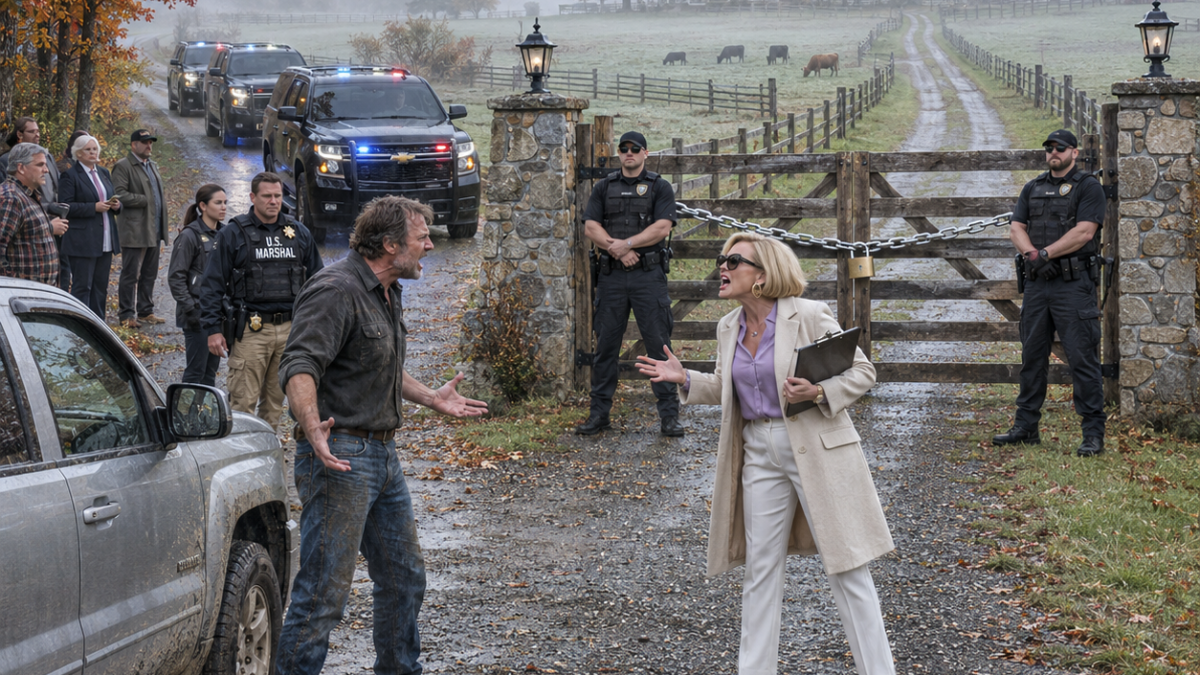
PART 2
The memory card disappeared into an evidence bag before I could get a closer look.
“Can we check it?” I asked.
“Not here.”
The marshal looked back at the guards.
“Stay with us.”
We drove deeper into the property.
The convoy spread out.
One SUV ahead.
One behind me.
Another following the eastern fence line.
I had driven that farm road hundreds of times.
I knew every low spot.
Every rut.
Where the pond overflowed after spring rain.
Where the cattle liked to stand when the sun was high.
Where Grandpa once flipped a tractor and refused to tell Grandma until he had already dragged it upright.
That morning, every familiar place felt wrong.
The horses stood near the north fence watching the vehicles.
The tobacco barn looked unchanged.
The farmhouse sat quiet beneath the oaks.
Then we reached the east field.
I stopped my truck.
Part of the fence was gone.
Not damaged.
Removed.
The posts had been pulled cleanly from the ground.
Someone had opened a path wide enough for trucks.
I got out.
“That’s my fence.”
The marshal studied the soil.
Tracks crossed the field directly toward the old concrete foundation.
We followed.
I noticed a cigarette butt.
Plastic zip ties.
A strip of yellow caution tape.
Then metal stakes.
One.
Another twenty feet away.
Then another.
Survey points.
But they were not marking the legal edge of the farm.
They were marking positions well inside it.
The marshal crouched beside one.
“This isn’t a normal residential survey setup.”
“What is it?”
“I don’t know yet.”
An agent approached carrying a tablet.
“We checked the county database.”
The marshal stood.
“And?”
“No approved survey exists for this parcel.”
My mouth went dry.
“So whoever placed these had no permission.”
“That’s what it looks like.”
I turned toward the old foundation.
For eleven years, I had treated the slab as useless history.
A leftover industrial base from the days when my grandfather grew tobacco and processed part of the crop on site.
I had never done more than mow around it.
Now I noticed several rectangular patches along one edge.
New concrete.
Different color.
I stepped closer.
“Those weren’t there before.”
The marshal looked at me.
“You’re certain?”
“I grew up here.”
At the far end of the slab, an agent cleared weeds away.
Underneath was a steel access cover.
I had never seen it.
The cover was old.
The padlock was not.
Bright metal.
Fresh.
The marshal had the scene photographed before anyone touched it.
Tracks.
Fence.
Stakes.
Concrete patches.
Access cover.
Lock.
Then the lock was cut.
Cold air rose from below.
A narrow concrete stairway disappeared into darkness.
I moved toward it.
“Stay back,” the marshal said.
She descended with two agents.
I waited above.
My phone rang again.
Emily.
“I’m at the east field.”
“What did you find?”
“I don’t know yet.”
“Daniel, listen. The person who called me said Redstone Ridge had filed an emergency access request.”
“For my farm?”
“Yes.”
“Why?”
“They claimed there was a safety issue underground.”
I looked at the open stairwell.
“Emily.”
“What?”
“They were telling the truth about one part.”
Silence.
“There is something underground.”
“What?”
The marshal appeared at the top of the stairwell.
Her expression had changed.
Not panic.
Concern.
“Mr. Miller, we need to talk.”
“What is it?”
“There’s a communications room under your property.”
I stared at her.
“A what?”
She handed me a photograph.
Concrete chamber.
Metal racks.
Fiber-optic cable.
Power equipment.
Network hardware.
Old cabinets.
Newer electronics.
Maps covered one wall.
County roads.
Parcel lines.
The subdivision.
My farm.
Then I saw red circles.
Twelve properties.
Mine marked separately.
Number thirteen.
“What is this?”
“We don’t know yet.”
“Who built it?”
“That’s what we’re determining.”
The equipment wasn’t improvised.
Nobody had dragged it underground last weekend.
Some of it looked old.
Some looked recent.
Someone had been using that room.
Maybe for months.
Maybe longer.
The marshal zoomed in on one of the maps.
A county seal appeared in the corner.
“We need the county surveyor.”
Marcus Bell arrived forty minutes later.
White county truck.
Hard survey case.
Silver hair.
Permanent squint.
He had worked in county surveying for twenty-seven years.
He saw the field stakes first.
“These aren’t ours.”
“You’re sure?”
“Completely.”
Then he saw the underground entrance.
His face changed.
“Where did you find that?”
“Under my farm.”
He looked at the marshal.
“I’ve seen plans for this.”
My chest tightened.
“What plans?”
Marcus hesitated.
“I was asked to review a boundary package about three months ago.”
“By Redstone Ridge?”
He looked at me.
“Yes.”
“What did they want?”
“A proposed utility corridor.”
“Across my land?”
“Yes.”
“Did you approve it?”
“No.”
“Why?”
He opened his hard case.
Two maps went onto the hood of my truck.
First:
Official parcel survey.
Second:
Redstone Ridge submission.
The difference was obvious.
Their version moved my eastern boundary nearly four hundred feet west.
Four hundred feet.
Enough to put the underground facility outside my legal property.
“They changed my boundary.”
Marcus shook his head.
“Technically, they manipulated the coordinate reference.”
“That means?”
“They used an older legitimate reference point and tied it to the wrong control marker. The map looks believable until you compare it with the current network.”
“So they made my farm smaller.”
“Yes.”
He looked toward the concrete opening.
“And that room sits in the portion they claimed wasn’t yours.”
The locked gate suddenly made complete sense.
If I had reached the east field first, I might have discovered the underground operation.
If whoever controlled it still needed time to remove something, I was the one person they could not afford to have walking around.
The marshal folded the altered map.
“We need the original survey records.”
“I can retrieve them,” Marcus said.
“No. Tell us where they are. We’ll handle retrieval.”
Marcus became uncomfortable.
“There’s something else.”
“What?”
“The boundary review request didn’t originate with Redstone Ridge.”
I felt my jaw tighten.
“Then who requested it?”
Marcus looked directly at me.
“The homeowners association.”
For a few seconds, I said nothing.
“The HOA has no authority over my farm.”
“I know.”
“Why were they asking the county to review my boundary?”
“Because someone was trying to establish that part of your farm wasn’t actually part of your farm.”
The sentence was absurd.
And strategic.
If the eastern boundary disappeared on paper, then the underground room could appear to sit outside my land.
Road access could appear legitimate.
Construction could proceed.
I would become a neighbor interfering with somebody else’s project instead of the landowner whose property was being used.
The marshal looked toward the farmhouse.
“Your grandfather kept records?”
“Everything.”
“Then we start there.”
Grandpa had been dead eighteen years.
His upstairs office still smelled like cedar, old paper, and machine oil.
I hadn’t opened some drawers since his funeral.
Receipts.
Tax documents.
Pencils.
Weather notes.
Tractor parts lists.
Then a locked drawer.
“I don’t have the key.”
Marcus tapped the underside of the desk.
“Old furniture sometimes has a secondary latch.”
I reached beneath it.
Metal.
Click.
The drawer loosened.
Inside was a leather folder.
No label.
I opened it.
The first page contained one handwritten sentence.
If anyone ever claims the eastern field isn’t ours, ask them why they need what is underneath it.
I read it three times.
Grandpa had known.
Not about Margaret.
Not Redstone Ridge.
But about something beneath the field.
The next page held a photograph.
Grandpa standing beside the tobacco barn with two men.
Behind them, an old military-style utility truck.
Date on the back:
June 17, 1987.
Beneath it:
They came back for the equipment.
The doorbell rang.
Everyone froze.
A man in a dark gray suit stood outside.
No badge.
No uniform.
Folder in hand.
I opened the door halfway.
“Can I help you?”
“Thomas Vane. Counsel for Redstone Ridge.”
The marshal stepped beside me.
His smile disappeared.
“I need to speak privately with Mr. Miller.”
“No.”
He looked toward the federal vehicles.
“That’s unfortunate.”
He opened his folder.
“Your farm is subject to an emergency access order.”
“Who issued it?”
“The county.”
Marcus stepped forward.
“That order is invalid.”
Vane looked at him.
“I wouldn’t say that unless you reviewed the updated survey.”
Marcus laughed once.
No humor.
“I reviewed the original.”
Vane’s expression shifted.
Fear.
Tiny.
Then gone.
“The original is no longer controlling.”
The marshal took the paper.
“Daniel, don’t sign anything.”
“I wasn’t going to.”
Vane closed his folder.
“You have no idea what you’re standing in the middle of.”
“You’re right.”
I lifted Grandpa’s photograph.
“But I’m learning.”
Vane looked at it.
His entire face went still.
He recognized someone.
Before I could ask who, his phone rang.
“Vane.”
He listened.
Then turned toward the east field.
“What do you mean the system is still active?”
Every person in the room heard him.
He realized too late.
Ended the call.
The marshal stepped forward.
“Who was that?”
Silence.
“Mr. Vane.”
He looked at the photograph.
Then at me.
Then toward the field.
“They were supposed to be gone.”
Those four words changed the entire investigation.
The underground room wasn’t simply abandoned equipment.
Someone expected it to be empty.
Someone expected the system to be dead.
And whoever called Vane had just discovered otherwise.
The marshal asked for an explanation.
He refused.
Attorney-client privilege.
No arrest.
No obligation.
Then she used a phrase that caught him off guard.
“If you knowingly participated in unauthorized activity involving federal property, your exposure could be much greater than a land dispute.”
Vane’s eyes narrowed.
“Federal property?”
The marshal said nothing.
That reaction told us something.
He had not known the whole history.
Federal agents spent the next several hours documenting the underground chamber.
I stayed outside.
Hard drives came up.
Network equipment.
Paper records.
Old military communications hardware.
Then a dusty metal case.
Inside were photographs from the 1980s.
Grandpa appeared in several.
Same two men.
An older investigator named Robert Hayes eventually joined me on the porch.
Silver hair.
Quiet voice.
Tired eyes.
“Your grandfather wasn’t involved in anything criminal.”
“How do you know?”
“We found original records.”
He opened the metal case.
During the Cold War, the federal government had temporarily leased part of my family’s land for a communications relay project.
Classified agreement.
Limited term.
When the project ended, equipment was supposed to be removed.
Some of it wasn’t.
Years later, a private contractor gained access.
That contractor eventually became part of a corporate chain connected to Redstone Ridge.
“They found the facility?”
“Yes.”
“And didn’t report it.”
“No.”
“What did they do?”
“Restored it.”
I looked toward the field.
“For what?”
Hayes handed me another photograph.
The communications system had been repurposed.
Not military.
Not government.
Encrypted traffic related to property transactions.
Survey files.
Development plans.
Payment instructions.
Land records.
The old relay room had become a hidden coordination hub.
The altered survey of my farm wasn’t an isolated trick.
Properties around Redstone Ridge had been targeted.
Some owners pressured to sell.
Some offered strange prices.
Some discovered boundary problems after construction began.
The HOA was used as the public face.
Notices.
Security.
Access restrictions.
Claims of authority.
Enough noise to make private owners question themselves while the people behind the scenes moved land records, money, and development rights.
“Why my farm?” I asked.
Hayes showed me the road plan.
The future access road ran directly over the underground chamber.
Once construction started, the old facility would be destroyed.
Evidence inside it would disappear.
“They needed you out long enough to clear the room.”
I stared at the map.
“So the locked gate wasn’t meant to take the farm permanently.”
“Not that morning.”
“They needed time.”
“Yes.”
That was Margaret Sloan’s role.
The HOA president.
Sixty-one.
Wealthy.
Polished.
Charity events.
Neighborhood committees.
A reputation for being calm and organized.
By the next afternoon, federal investigators had messages from her phone.
KEEP MILLER AWAY FROM THE EAST FIELD UNTIL FRIDAY.
Another:
HIS ACCESS MUST REMAIN RESTRICTED UNTIL THE TRANSFER IS COMPLETE.
Margaret initially claimed she believed my land had legally become part of a development corridor.
Then investigators found financial transfers.
Money tied to a Redstone Ridge-connected company had moved into an account controlled through a family trust associated with her.
The HOA had not accidentally crossed a line.
Margaret had been paid to help control access.
That hurt more than I expected.
Not because I had ever trusted her personally.
Because HOAs talk constantly about community.
Property values.
Safety.
Shared responsibility.
Margaret had used all of that language to make private coercion look administrative.
The next morning, the county suspended Redstone Ridge development permits.
Several officials were placed on administrative leave pending investigation.
Margaret resigned as HOA president.
Thomas Vane stopped sending me legal notices.
A week later, I entered the county courthouse.
No convoy.
No broken gate.
Just property owners, lawyers, reporters, investigators, and stacks of paper.
The county filed emergency proceedings addressing the fraudulent documents and affected parcels.
Redstone Ridge argued that it had relied on county records in good faith.
Then Marcus Bell testified.
Official map.
Altered map.
Reference points.
Control markers.
Coordinates.
No drama.
No shouting.
Just math.
The judge compared both.
“Which map accurately describes Mr. Miller’s property?”
“The original.”
Redstone Ridge’s attorney objected.
“Basis?”
He hesitated.
“Technical grounds.”
“Overruled.”
Marcus explained how the coordinate system had been manipulated.
Once he showed the actual reference network, the altered boundary collapsed.
Then Thomas Vane testified.
By then, relationships inside Redstone Ridge had started breaking apart.
He admitted receiving the altered survey.
Admitted delivering the emergency access order.
Denied knowing the underground room existed.
Then prosecutors showed him Grandpa’s 1987 photograph.
“Do you recognize either man?”
He said nothing.
A second photo appeared.
Thirty years later.
Same man.
At a Redstone Ridge event.
“Who is he?”
Vane swallowed.
“The founder of Redstone Ridge.”
The courtroom went completely quiet.
The development company had not stumbled onto an abandoned facility recently.
Its roots reached back to people connected to the site decades earlier.
The judge issued an injunction.
The fraudulent survey was invalidated.
Emergency access order canceled.
Development permits remained suspended.
Every property affected by similar boundary manipulation went under review.
Then the court ordered the HOA to preserve and produce records related to access restrictions.
Emails.
Board notes.
Security contracts.
Financial records.
Instructions to the guards.
The very paperwork Margaret used to keep me outside became evidence.
Months passed.
The criminal investigation continued.
Some people were charged.
Other matters remained under review.
Redstone Ridge lost the development rights it had been claiming.
The HOA replaced its board.
County officials faced separate scrutiny.
I learned not to celebrate every headline.
Legal processes move at different speeds.
An investigation isn’t a conviction.
A suspended permit isn’t the same as a permanent ruling.
A suspicious payment isn’t automatically a proven crime.
I had watched too many people manipulate paperwork to start manipulating language myself.
My focus stayed on the farm.
The fence was rebuilt.
The broken gate replaced.
I kept the old steel chain.
People thought that was strange.
I didn’t keep it because I enjoyed remembering the morning.
I kept it because I never wanted to forget what it felt like to be sitting outside land I legally owned while a stranger told me I needed permission to go home.
One Saturday, I drove alone to the east field.
No agents followed.
No guards.
No survey crew.
The underground facility had been secured under federal control.
Orange markers were gone.
Truck tracks disappeared beneath new grass.
My horses grazed near the northern fence.
The tobacco barn leaned slightly the way it always had.
I stood near the old foundation.
Grandpa’s photograph was in my jacket.
For years, I believed he left me eighty-six acres.
That wasn’t entirely true.
He left me a warning.
He knew people had once wanted what lay under that field.
He knew boundaries only protect you if somebody keeps the record.
That was why he wrote everything.
Why the old survey remained.
Why the note stayed hidden in the desk.
Why he kept the photograph.
I used to think his habit of saving papers was old-man stubbornness.
Now I understood.
Memory fades.
Corporate names change.
Officials retire.
Developments arrive.
Maps get redrawn.
A family record can become the only surviving witness to what happened on a piece of land thirty years earlier.
A few weeks later, the same marshal who had ordered the gate opened came back.
No convoy.
Just one vehicle.
She stood on the porch and handed me an envelope.
Inside was a copy of the final property determination.
My land was recognized exactly as recorded by my family.
Eastern field.
Farmhouse.
Private road.
Gate.
Everything.
I read the pages slowly.
Then walked outside.
The replacement gate stood open.
No chain.
No guards.
No sign telling me access was restricted.
Only the road.
Home.
The marshal stood beside me.
“You okay?”
“Yeah.”
“You don’t sound convinced.”
I looked toward the field.
“The first morning you showed up, I thought you were here because someone finally believed me.”
She waited.
“I understand now you were here because the investigation had already reached something bigger.”
She nodded.
“Your property was part of it.”
“Still feels strange.”
“It usually does.”
I smiled faintly.
“Thank you.”
She looked toward the gate.
“Keep better locks.”
I laughed.
“That worked great last time.”
She smiled.
Then left.
Emily came by that evening.
We sat on the porch.
“You planning to keep the farm?”
“Of course.”
“After all this?”
“Especially after all this.”
She looked toward the east.
“I still can’t believe there was a communications room underneath it.”
“Neither can I.”
“Grandpa knew.”
“Some of it.”
“What do you think he would say?”
I thought for a while.
“Probably complain that I didn’t check the desk drawer sooner.”
She laughed.
That sounded right.
The new HOA board eventually sent me a formal letter.
Not a demand.
An apology.
It acknowledged that private security had been placed at my gate without lawful authority.
That the farm was never part of the subdivision.
That the former board had participated in access restrictions unsupported by the HOA governing documents.
The letter also promised that future boards would not claim authority outside recorded HOA property.
I read it twice.
Then put it in Grandpa’s folder.
I didn’t frame it.
Didn’t post it.
Didn’t send a copy to Margaret.
By then, I had stopped needing her reaction.
Margaret’s fall from authority had already happened.
She lost the presidency.
Lost the ability to use HOA guards.
Lost the administrative cover that once made her orders look legitimate.
Investigators handled the rest.
That was enough for me.
Neighbors from the subdivision started approaching me differently.
Before the scandal, most people barely knew who I was.
Afterward, some treated me like I had exposed their HOA.
I hadn’t.
Their own records did.
A man named Paul came to the farm one Saturday.
He lived near the subdivision entrance.
“I voted for Margaret twice.”
I nodded.
“She always seemed organized.”
“I’m sure she was.”
“You angry at us?”
“No.”
He seemed surprised.
“Why not?”
“Did you lock my gate?”
“No.”
“Alter my survey?”
“No.”
“Take money?”
“No.”
He looked down.
“We should’ve asked more questions.”
“Then ask them now.”
That became my answer whenever homeowners apologized.
Ask questions now.
Read maps now.
Check money now.
Don’t spend the next ten years feeling guilty about not knowing something someone worked hard to hide.
The county survey office changed procedures too.
Boundary submissions tied to development access received independent coordinate verification.
Historic control points had to be reconciled against current networks.
High-risk parcel changes required additional review.
Marcus told me he had been arguing for some of those changes for years.
“Nothing gets attention like federal investigators in your parking lot.”
“I noticed.”
He came out once to confirm replacement fence markers.
We stood beside the east boundary.
“Four hundred feet,” I said.
He shook his head.
“That’s a lot of land to lose on paper.”
“Almost enough to hide a communications bunker.”
“Exactly enough.”
We both laughed.
Dark humor.
But humor meant the place belonged to ordinary life again.
The underground site remained restricted for a long time.
Eventually, much of the newer unauthorized equipment was removed as evidence.
Older government components were handled under federal procedures.
I never got a complete inventory.
Didn’t need one.
What mattered to me was that no private development company had access anymore.
No HOA officer had a key.
No county order could appear without scrutiny.
One morning, workers came to the farm with legitimate federal documentation.
They stopped at the gate.
Called me.
Waited.
That tiny detail almost made me emotional.
They waited.
I drove down.
Checked the paperwork.
Opened the gate myself.
The difference between authority and arrogance can be that simple.
One asks you to verify.
The other tells you verification is unnecessary.
Thomas Vane became one of the stranger figures in the whole story.
He had walked into my house acting like I should fear his folder.
By the time the case advanced, he was cooperating in parts of the investigation.
Not because he suddenly became noble.
Because the people above him began protecting themselves.
He had records.
Emails.
Instructions.
And he realized his clients had allowed him to carry documents that exposed him personally.
The last time I saw him, we passed outside a courthouse conference room.
He stopped.
“You know I didn’t create the original survey.”
“I know.”
“I didn’t know what was underground.”
“I believe that.”
He looked surprised.
“But you delivered the order.”
“Yes.”
“You told me my original survey no longer controlled.”
He looked away.
“I relied on what I was given.”
“That’s the problem.”
He looked at me again.
“You think lawyers shouldn’t rely on clients?”
“I think everybody should stop relying exactly where the consequences become irreversible.”
He didn’t answer.
Neither of us needed another argument.
Redstone Ridge eventually became a name people spoke in the past tense.
Projects stopped.
Contracts unraveled.
Investors fought.
Properties were reviewed.
The grand expansion never happened as planned.
The access road across my east field never existed.
Grass grew over the place where engineers had drawn it.
That gave me satisfaction.
Not the company failing.
The road failing.
Maps have psychological power.
Once you see a thick black line labeled FUTURE ACCESS ROAD, part of your mind begins treating it as real.
Trees become “future roadway.”
Fence becomes “temporary obstruction.”
Farm becomes “development corridor.”
People become “holdouts.”
I learned to reject that language.
A road isn’t a road because somebody draws it.
A transfer isn’t a transfer because somebody drafts it.
An easement isn’t an easement because somebody copies your signature.
A boundary is not flexible because powerful people need it moved.
There was a board meeting months later where the new HOA invited neighboring landowners to discuss future relationships.
I attended.
Margaret was gone.
No stone fountain slideshow.
No glossy development brochure.
Just folding chairs and coffee.
The board president opened by saying:
“We’d like to start by acknowledging where our authority ends.”
I nearly applauded.
They reviewed the subdivision boundary.
Actual boundary.
Recorded.
They discussed drainage near the county road.
Trail maintenance.
Shared concerns.
Nothing on my farm.
Afterward, the president approached.
“We’d like your contact information in case a future project could affect your boundary.”
“You already have it.”
“I mean so we ask first.”
That word again.
Ask.
I gave him my number.
The meeting lasted ninety minutes.
No federal convoy required.
One year later, I replaced the old Miller Farm sign.
The original had started splitting after decades of weather.
I couldn’t throw it away.
I hung it inside the equipment shed.
Then I made a new sign from white oak.
MILLER FARM.
EST. 1949.
Below it, smaller:
PRIVATE PROPERTY.
The subdivision was still visible in the distance.
Roofs.
Streetlights.
The ridiculous horse fountain near the entrance.
I didn’t hate those people.
Most of them had no idea what Margaret was doing.
The neighborhood itself wasn’t the enemy.
The problem was a handful of people confusing institutional convenience with ownership.
That distinction mattered.
If I had spent the rest of my life hating every person behind those gates, Margaret would still be controlling part of my thinking.
I refused.
My farm returned to being a farm.
Fence repairs.
Hay.
Equipment.
Mud.
A leaking hydraulic line on the tractor that cost too much.
A horse that developed an expensive talent for finding weak sections of fencing.
Normal problems.
Beautiful problems.
Sometimes I drove past the east field and remembered the federal SUVs.
The broken gate.
The memory card.
The concrete stairway.
But the memory changed over time.
At first it made me angry.
Then nervous.
Eventually it became a warning.
Not everything threatening your property arrives with a bulldozer.
Sometimes it arrives as coordinates.
A revised map.
A legal notice.
A security contract.
A line in an HOA email.
Paper can take land long before machinery touches it.
That lesson made me obsessive about records.
Updated surveys.
Digitized copies.
Deed stored safely.
Boundary photographs.
Historical documents scanned.
Grandpa’s folder in a fireproof safe.
Copies with my attorney.
Copies with Emily.
She teased me.
“You preparing for another secret bunker?”
“No.”
“Alien landing?”
“Maybe.”
She laughed.
But she understood.
The most important record was Grandpa’s handwritten sentence.
If anyone ever claims the eastern field isn’t ours, ask them why they need what is underneath it.
I framed that one.
Not because of the bunker.
Because it captured the way he thought.
Ownership isn’t only possession.
It’s curiosity.
If someone suddenly insists your land isn’t yours, ask why that matters to them.
If the answer is vague, keep asking.
If they tell you the boundary changed, ask who changed it.
If they show a signature, check whether you signed it.
If an HOA claims authority, ask where the authority is recorded.
If a county order appears, verify the issuing office.
Questions are cheap.
Silence can become very expensive.
People later called my case unusual.
It was.
Most farm boundary disputes don’t involve hidden communications centers.
Most HOA disputes don’t involve federal marshals.
Most altered surveys don’t connect to encrypted land transactions.
But underneath the unusual details was something ordinary.
Someone wanted property.
The owner said no.
So instead of negotiating honestly, they tried to make the owner’s rights look smaller.
That happens in a thousand forms.
Pressure.
Paperwork.
Deadlines.
Public narratives.
“Community needs.”
“Safety.”
“Progress.”
“Economic development.”
All of those things can be legitimate.
None automatically erase ownership.
That was the part I cared about.
Not the secret room.
Not the convoy.
The line.
The boundary.
The simple legal fact that my farm stayed mine even when people with money and influence wanted the map to say otherwise.
A reporter once asked whether I felt like I “beat” Margaret Sloan.
I hated the phrasing.
“I didn’t beat her.”
“She resigned.”
“Yes.”
“Her messages became evidence.”
“Yes.”
“Her HOA lost authority.”
“It never had authority over my farm.”
He paused.
“Then what happened?”
“The records caught up with the story.”
He looked disappointed.
Maybe he wanted a better quote.
That was the truth.
Margaret’s version moved faster at first.
Security guards at the gate.
Emergency orders.
Boundary changes.
Development deadlines.
Her story had momentum.
Mine had documents.
Momentum looks powerful until it reaches something it cannot move.
The recorded survey was that thing.
Grandpa’s papers.
County control points.
My deed.
Federal records.
Once those lined up, no amount of HOA confidence could shift eighty-six acres west or east.
The farm outlasted the narrative.
One autumn morning, almost exactly a year after the gate incident, fog returned.
Same pale layer across the road.
Same wet grass.
Same cold air.
I drove the F-250 toward the entrance.
For half a second, seeing the gate through fog brought everything back.
The guards.
Chain.
Black SUVs.
The marshal.
Then I noticed the gate was open.
I slowed anyway.
Old habit.
The new oak sign stood above it.
MILLER FARM.
I drove through.
No one stopped me.
No one asked for identification.
No one told me I needed permission.
The road curved toward the farmhouse.
Sunlight began cutting through the fog.
The horses stood near the fence.
The tobacco barn appeared between the trees.
Then the east field.
Quiet.
I parked near the old foundation.
The federal restriction markers were still farther away, but the immediate ground had been restored.
Grass covered most of the truck ruts.
I walked to the place where that orange survey stake had stood.
Nothing there.
I thought about how close they came.
If the federal team had arrived a week later, perhaps the room would have been emptied.
If I had accepted the forged easement, the road might have been built.
If Marcus had approved the altered coordinates without checking, my official boundary could have become harder to challenge.
If Grandpa hadn’t kept records, investigators would still have found plenty.
But the historical chain would have been weaker.
Everything depended on people doing small things correctly.
Marcus comparing reference systems.
My grandfather saving documents.
The marshal treating the scene as evidence.
Emily passing along that strange county call.
Investigators checking accounts.
Judges reading maps.
That was how justice looked from where I stood.
Not one heroic act.
A chain of people refusing shortcuts.
I knelt and picked up a small piece of rusted metal from the grass.
Probably old farm hardware.
For one second I thought about keeping it with the broken chain.
Then I tossed it into the truck bed.
Not everything had to become evidence.
The farm was allowed to be ordinary again.
That evening, Emily came for dinner.
We sat on the porch while the sun disappeared.
“You still keeping the old chain?”
“Yes.”
“You’re weird.”
“I know.”
“What are you going to do with it?”
“Nothing.”
“That’s very healthy.”
I smiled.
She looked toward the gate.
“You know what’s strange?”
“What?”
“They locked you out because they thought it bought them time.”
“I know.”
“And instead it brought the marshals straight through.”
I nodded.
“They chose the worst possible morning.”
“No.”
She looked at me.
“What?”
“They chose the wrong gate.”
Emily laughed.
But I meant something deeper.
They had spent years manipulating people who felt isolated.
Property owners pressured one by one.
Different boundary disputes.
Different offers.
Different notices.
Different excuses.
Then they reached a gate belonging to someone already talking to investigators.
They locked it.
That single act turned a quiet fraud scheme into a physical scene federal agents could stand in front of.
Two guards.
One chain.
One owner.
One question.
Why are you stopping him from entering land he owns?
Everything came after.
The last document I received related directly to the property was almost boring.
Final corrected parcel record.
Updated county database.
No fraudulent corridor.
No altered boundary.
No emergency access note.
Just the legal description my family had relied on for generations.
I printed it.
Put one copy in the safe.
One in the truck.
One with my attorney.
Emily asked whether I planned to tattoo the coordinates on my arm.
I considered it.
Then decided that might be excessive.
Mostly.
Years from now, the underground room will probably become just another strange story attached to Miller Farm.
Some future owner might stand in the east field and wonder why the old foundation was once protected by federal evidence markers.
Maybe they’ll hear rumors.
Cold War relay.
Development fraud.
Altered surveys.
HOA corruption.
They might exaggerate it.
Stories do that.
That is why I wrote my own account.
Dates.
Names.
Maps.
What I saw.
What I knew.
What I didn’t know at the time.
No heroics added.
No facts improved for drama.
Grandpa would have approved.
He wrote everything down too.
I added my account to his leather folder.
On the first page, beneath his sentence about the eastern field, I wrote one of my own.
They tried to move the boundary.
The land never moved.
That was the whole story in seven words.
Margaret could move guards.
Redstone Ridge could move money.
Somebody could move coordinates.
County officials could move paperwork.
Investors could move deadlines.
But the farm remained exactly where it had always been.
The east field was still east.
The creek still crossed the south corner.
The farmhouse still faced the oaks.
The road still began at the wooden gate.
And I still drove home without asking anybody’s permission.
One Saturday near the end of autumn, I replaced a hinge on the gate.
Nothing dramatic.
Just maintenance.
The new hinge squeaked.
I tightened it.
Opened the gate.
Closed it.
Opened it again.
Smooth.
I stood with one hand resting on the wood.
For a second, I remembered the marshal telling the guard:
“So is his.”
Private property.
His.
Mine.
Not because I was powerful.
Not because my family had federal connections.
Not because a convoy arrived.
Because ownership had been recorded long before anyone decided it was inconvenient.
The people behind Redstone Ridge believed paperwork could erase that.
Margaret believed an HOA order could enforce it.
The guards believed the chain meant something.
Then the real documents arrived.
And the chain broke.
I looked across the pasture.
The sun was low.
Fog beginning to gather near the creek.
Everything quiet.
Sometimes justice arrives with sirens.
Sometimes with a judge.
Sometimes with a federal seal.
Mine arrived in all those forms eventually.
But the moment I remember most is much simpler.
A new gate standing open.
A road leading toward the house.
And nobody left at the entrance pretending they owned the key.
𝗧𝗛𝗘 𝗘𝗡𝗗
HOA Karen Locked Me Out of My Own Farm—Then a Federal Convoy Pulled Up Behind Me
HOA Karen Margaret Sloan put private guards at my gate and told them I needed permission to enter the eighty-six acres my family had owned for generations. I might have assumed it was another ridiculous HOA power play if three black federal SUVs hadn’t stopped behind my truck while I was still staring at the chain across my own road. Six minutes later, I realized Margaret wasn’t trying to keep me away from the subdivision at all—she was trying to keep me from seeing what somebody had been doing on my land.
The first thing I saw that morning was the chain.
Heavy steel.
Fresh padlock.
Pulled tight across the gate to Miller Farm.
The second thing I saw was the federal convoy in my rearview mirror.
Three black SUVs sat in a perfectly straight line behind my silver Ford F-250, headlights cutting through the pale October fog that had settled along the county road. Their engines were running. Nobody honked. Nobody got out. Nobody flashed a badge.
For a few seconds, the only sound was my diesel idling.
Then one of the two private security guards beside my gate stepped forward and rested his hand on the chain.
“You’re not coming through.”
I looked at him.
Then at the wooden sign over the entrance.
MILLER FARM.
My grandfather burned those letters into oak when I was twelve.
I had driven under that sign almost every week for eleven years.
“My name is on the gate.”
The younger guard shifted his weight.
“We were instructed not to let you enter.”
“By who?”
He hesitated.
“The homeowners association.”
I almost laughed.
There was no HOA on my farm.
No declaration.
No covenant.
No membership.
No clubhouse.
No community pool.
No decorative fountain.
The nearest planned subdivision sat almost three miles away behind brick columns and manicured landscaping. My property was eighty-six acres of pasture, tobacco barn, equipment sheds, pond, farmhouse, creek bottom, and one private access road that had belonged to my family longer than the subdivision had existed.
I lowered my window farther.
“You understand you’re standing in front of private property that does not belong to your HOA.”
The older guard glanced toward the SUVs.
“We have written instructions.”
“That doesn’t answer the question.”
Before he could respond, the driver’s door of the first black SUV opened.
A tall woman stepped out wearing a navy suit, plain white shirt, dark shoes, and a badge clipped beneath her jacket.
She walked toward my truck without hurry.
“Mr. Miller?”
“Yes.”
“Stay in the vehicle.”
My stomach tightened.
“Who are you?”
“United States Marshals Service.”
That changed the morning.
I had spent almost six hours in a federal office in Louisville three days earlier answering questions about Redstone Ridge Development.
I had never worked for Redstone Ridge.
Never signed a contract with them.
Never sold them an easement.
Never agreed to let them cross my farm.
Yet investigators had shown me a document carrying what looked like my signature at the bottom of a proposed access agreement.
It wasn’t mine.
The forged easement gave Redstone Ridge the right to run a future road across the eastern edge of my property.
That road mattered because the company planned nearly two hundred new homes, a private clubhouse, and a major subdivision expansion.
Their engineers claimed the development stayed outside my boundary.
Federal investigators disagreed.
So did I.
The marshal stopped beside my truck and looked toward the guards.
“Open the gate.”
The older guard shook his head.
“I can’t.”
She didn’t raise her voice.
“You can.”
“I was ordered—”
“Then you were given very bad instructions.”
The younger guard stepped closer.
“You don’t understand. This is private property.”
The marshal looked directly at him.
“So is his.”
Nobody spoke.
Fog moved through the pasture beyond the gate.
The marshal removed a folded document from inside her jacket.
She didn’t hand it over.
She held it where both guards could see the seal.
“I have federal authorization to enter this property.”
The older guard stared at the document.
Then at me.
Then back toward the farm.
That was when I noticed his fear.
It wasn’t fear of the marshal.
It wasn’t fear of getting detained.
He kept looking beyond the gate.
Toward the east field.
I felt my hands tighten around the steering wheel.
My phone rang.
My sister Emily.
“Daniel, where are you?”
“At the farm.”
Silence.
Then her voice changed.
“Don’t go inside.”
I looked toward the marshal.
“Why?”
“I got a call from somebody at the county office.”
“What did they say?”
“They said there was an emergency inspection.”
“Inspection of what?”
“They wouldn’t tell me.”
The older guard was now speaking rapidly into a radio.
Emily continued.
“They asked whether you’d seen the east field.”
I stopped breathing for a second.
“The east field?”
“Yes.”
The east field held almost nothing.
An abandoned irrigation shed.
A drainage ditch.
An old concrete foundation from a tobacco-processing operation my grandfather shut down decades earlier.
That was it.
At least, that was what I believed.
The marshal returned to her SUV.
“We’re going through.”
I looked toward the locked gate.
“They won’t open it.”
She looked at the guards.
“They don’t have to.”
The first SUV moved.
Slowly.
Straight toward the chain.
The older guard stared.
Then jumped aside.
Metal screamed.
The chain snapped.
One gatepost twisted.
The gate crashed into wet grass.
The second SUV followed.
Then the third.
The marshal lowered her window.
“Drive behind us.”
I put my truck in gear.
As I crossed through the broken entrance, I saw something beside the road.
Fresh tire tracks.
Not mine.
Not tractor tires.
Truck tires.
They curved toward the east field.
Beside them stood a bright orange survey marker.
New.
Very new.
I stopped.
The marshal stopped too.
She stepped out.
“That wasn’t there yesterday,” I said.
“You’re sure?”
“I know this farm.”
A second marshal walked over and bent near the marker.
Something black sat half-buried in the wet grass.
He picked it up.
A small plastic case.
Inside was a memory card.
The marshal looked at me.
Then toward the east field.
“Mr. Miller,” she said quietly, “I think we just found the reason they didn’t want you through that gate.”
I looked back at the two private guards still standing beside the damaged entrance.
Neither one was watching us.
Both were staring toward the same distant patch of ground.
And for the first time that morning, I understood the gate had never been about keeping me away from them.
It was about keeping me away from whatever was already inside.
PART 2
The memory card disappeared into an evidence bag before I could get a closer look.
“Can we check it?” I asked.
“Not here.”
The marshal looked back at the guards.
“Stay with us.”
We drove deeper into the property.
The convoy spread out.
One SUV ahead.
One behind me.
Another following the eastern fence line.
I had driven that farm road hundreds of times.
I knew every low spot.
Every rut.
Where the pond overflowed after spring rain.
Where the cattle liked to stand when the sun was high.
Where Grandpa once flipped a tractor and refused to tell Grandma until he had already dragged it upright.
That morning, every familiar place felt wrong.
The horses stood near the north fence watching the vehicles.
The tobacco barn looked unchanged.
The farmhouse sat quiet beneath the oaks.
Then we reached the east field.
I stopped my truck.
Part of the fence was gone.
Not damaged.
Removed.
The posts had been pulled cleanly from the ground.
Someone had opened a path wide enough for trucks.
I got out.
“That’s my fence.”
The marshal studied the soil.
Tracks crossed the field directly toward the old concrete foundation.
We followed.
I noticed a cigarette butt.
Plastic zip ties.
A strip of yellow caution tape.
Then metal stakes.
One.
Another twenty feet away.
Then another.
Survey points.
But they were not marking the legal edge of the farm.
They were marking positions well inside it.
The marshal crouched beside one.
“This isn’t a normal residential survey setup.”
“What is it?”
“I don’t know yet.”
An agent approached carrying a tablet.
“We checked the county database.”
The marshal stood.
“And?”
“No approved survey exists for this parcel.”
My mouth went dry.
“So whoever placed these had no permission.”
“That’s what it looks like.”
I turned toward the old foundation.
For eleven years, I had treated the slab as useless history.
A leftover industrial base from the days when my grandfather grew tobacco and processed part of the crop on site.
I had never done more than mow around it.
Now I noticed several rectangular patches along one edge.
New concrete.
Different color.
I stepped closer.
“Those weren’t there before.”
The marshal looked at me.
“You’re certain?”
“I grew up here.”
At the far end of the slab, an agent cleared weeds away.
Underneath was a steel access cover.
I had never seen it.
The cover was old.
The padlock was not.
Bright metal.
Fresh.
The marshal had the scene photographed before anyone touched it.
Tracks.
Fence.
Stakes.
Concrete patches.
Access cover.
Lock.
Then the lock was cut.
Cold air rose from below.
A narrow concrete stairway disappeared into darkness.
I moved toward it.
“Stay back,” the marshal said.
She descended with two agents.
I waited above.
My phone rang again.
Emily.
“I’m at the east field.”
“What did you find?”
“I don’t know yet.”
“Daniel, listen. The person who called me said Redstone Ridge had filed an emergency access request.”
“For my farm?”
“Yes.”
“Why?”
“They claimed there was a safety issue underground.”
I looked at the open stairwell.
“Emily.”
“What?”
“They were telling the truth about one part.”
Silence.
“There is something underground.”
“What?”
The marshal appeared at the top of the stairwell.
Her expression had changed.
Not panic.
Concern.
“Mr. Miller, we need to talk.”
“What is it?”
“There’s a communications room under your property.”
I stared at her.
“A what?”
She handed me a photograph.
Concrete chamber.
Metal racks.
Fiber-optic cable.
Power equipment.
Network hardware.
Old cabinets.
Newer electronics.
Maps covered one wall.
County roads.
Parcel lines.
The subdivision.
My farm.
Then I saw red circles.
Twelve properties.
Mine marked separately.
Number thirteen.
“What is this?”
“We don’t know yet.”
“Who built it?”
“That’s what we’re determining.”
The equipment wasn’t improvised.
Nobody had dragged it underground last weekend.
Some of it looked old.
Some looked recent.
Someone had been using that room.
Maybe for months.
Maybe longer.
The marshal zoomed in on one of the maps.
A county seal appeared in the corner.
“We need the county surveyor.”
Marcus Bell arrived forty minutes later.
White county truck.
Hard survey case.
Silver hair.
Permanent squint.
He had worked in county surveying for twenty-seven years.
He saw the field stakes first.
“These aren’t ours.”
“You’re sure?”
“Completely.”
Then he saw the underground entrance.
His face changed.
“Where did you find that?”
“Under my farm.”
He looked at the marshal.
“I’ve seen plans for this.”
My chest tightened.
“What plans?”
Marcus hesitated.
“I was asked to review a boundary package about three months ago.”
“By Redstone Ridge?”
He looked at me.
“Yes.”
“What did they want?”
“A proposed utility corridor.”
“Across my land?”
“Yes.”
“Did you approve it?”
“No.”
“Why?”
He opened his hard case.
Two maps went onto the hood of my truck.
First:
Official parcel survey.
Second:
Redstone Ridge submission.
The difference was obvious.
Their version moved my eastern boundary nearly four hundred feet west.
Four hundred feet.
Enough to put the underground facility outside my legal property.
“They changed my boundary.”
Marcus shook his head.
“Technically, they manipulated the coordinate reference.”
“That means?”
“They used an older legitimate reference point and tied it to the wrong control marker. The map looks believable until you compare it with the current network.”
“So they made my farm smaller.”
“Yes.”
He looked toward the concrete opening.
“And that room sits in the portion they claimed wasn’t yours.”
The locked gate suddenly made complete sense.
If I had reached the east field first, I might have discovered the underground operation.
If whoever controlled it still needed time to remove something, I was the one person they could not afford to have walking around.
The marshal folded the altered map.
“We need the original survey records.”
“I can retrieve them,” Marcus said.
“No. Tell us where they are. We’ll handle retrieval.”
Marcus became uncomfortable.
“There’s something else.”
“What?”
“The boundary review request didn’t originate with Redstone Ridge.”
I felt my jaw tighten.
“Then who requested it?”
Marcus looked directly at me.
“The homeowners association.”
For a few seconds, I said nothing.
“The HOA has no authority over my farm.”
“I know.”
“Why were they asking the county to review my boundary?”
“Because someone was trying to establish that part of your farm wasn’t actually part of your farm.”
The sentence was absurd.
And strategic.
If the eastern boundary disappeared on paper, then the underground room could appear to sit outside my land.
Road access could appear legitimate.
Construction could proceed.
I would become a neighbor interfering with somebody else’s project instead of the landowner whose property was being used.
The marshal looked toward the farmhouse.
“Your grandfather kept records?”
“Everything.”
“Then we start there.”
Grandpa had been dead eighteen years.
His upstairs office still smelled like cedar, old paper, and machine oil.
I hadn’t opened some drawers since his funeral.
Receipts.
Tax documents.
Pencils.
Weather notes.
Tractor parts lists.
Then a locked drawer.
“I don’t have the key.”
Marcus tapped the underside of the desk.
“Old furniture sometimes has a secondary latch.”
I reached beneath it.
Metal.
Click.
The drawer loosened.
Inside was a leather folder.
No label.
I opened it.
The first page contained one handwritten sentence.
If anyone ever claims the eastern field isn’t ours, ask them why they need what is underneath it.
I read it three times.
Grandpa had known.
Not about Margaret.
Not Redstone Ridge.
But about something beneath the field.
The next page held a photograph.
Grandpa standing beside the tobacco barn with two men.
Behind them, an old military-style utility truck.
Date on the back:
June 17, 1987.
Beneath it:
They came back for the equipment.
The doorbell rang.
Everyone froze.
A man in a dark gray suit stood outside.
No badge.
No uniform.
Folder in hand.
I opened the door halfway.
“Can I help you?”
“Thomas Vane. Counsel for Redstone Ridge.”
The marshal stepped beside me.
His smile disappeared.
“I need to speak privately with Mr. Miller.”
“No.”
He looked toward the federal vehicles.
“That’s unfortunate.”
He opened his folder.
“Your farm is subject to an emergency access order.”
“Who issued it?”
“The county.”
Marcus stepped forward.
“That order is invalid.”
Vane looked at him.
“I wouldn’t say that unless you reviewed the updated survey.”
Marcus laughed once.
No humor.
“I reviewed the original.”
Vane’s expression shifted.
Fear.
Tiny.
Then gone.
“The original is no longer controlling.”
The marshal took the paper.
“Daniel, don’t sign anything.”
“I wasn’t going to.”
Vane closed his folder.
“You have no idea what you’re standing in the middle of.”
“You’re right.”
I lifted Grandpa’s photograph.
“But I’m learning.”
Vane looked at it.
His entire face went still.
He recognized someone.
Before I could ask who, his phone rang.
“Vane.”
He listened.
Then turned toward the east field.
“What do you mean the system is still active?”
Every person in the room heard him.
He realized too late.
Ended the call.
The marshal stepped forward.
“Who was that?”
Silence.
“Mr. Vane.”
He looked at the photograph.
Then at me.
Then toward the field.
“They were supposed to be gone.”
Those four words changed the entire investigation.
The underground room wasn’t simply abandoned equipment.
Someone expected it to be empty.
Someone expected the system to be dead.
And whoever called Vane had just discovered otherwise.
The marshal asked for an explanation.
He refused.
Attorney-client privilege.
No arrest.
No obligation.
Then she used a phrase that caught him off guard.
“If you knowingly participated in unauthorized activity involving federal property, your exposure could be much greater than a land dispute.”
Vane’s eyes narrowed.
“Federal property?”
The marshal said nothing.
That reaction told us something.
He had not known the whole history.
Federal agents spent the next several hours documenting the underground chamber.
I stayed outside.
Hard drives came up.
Network equipment.
Paper records.
Old military communications hardware.
Then a dusty metal case.
Inside were photographs from the 1980s.
Grandpa appeared in several.
Same two men.
An older investigator named Robert Hayes eventually joined me on the porch.
Silver hair.
Quiet voice.
Tired eyes.
“Your grandfather wasn’t involved in anything criminal.”
“How do you know?”
“We found original records.”
He opened the metal case.
During the Cold War, the federal government had temporarily leased part of my family’s land for a communications relay project.
Classified agreement.
Limited term.
When the project ended, equipment was supposed to be removed.
Some of it wasn’t.
Years later, a private contractor gained access.
That contractor eventually became part of a corporate chain connected to Redstone Ridge.
“They found the facility?”
“Yes.”
“And didn’t report it.”
“No.”
“What did they do?”
“Restored it.”
I looked toward the field.
“For what?”
Hayes handed me another photograph.
The communications system had been repurposed.
Not military.
Not government.
Encrypted traffic related to property transactions.
Survey files.
Development plans.
Payment instructions.
Land records.
The old relay room had become a hidden coordination hub.
The altered survey of my farm wasn’t an isolated trick.
Properties around Redstone Ridge had been targeted.
Some owners pressured to sell.
Some offered strange prices.
Some discovered boundary problems after construction began.
The HOA was used as the public face.
Notices.
Security.
Access restrictions.
Claims of authority.
Enough noise to make private owners question themselves while the people behind the scenes moved land records, money, and development rights.
“Why my farm?” I asked.
Hayes showed me the road plan.
The future access road ran directly over the underground chamber.
Once construction started, the old facility would be destroyed.
Evidence inside it would disappear.
“They needed you out long enough to clear the room.”
I stared at the map.
“So the locked gate wasn’t meant to take the farm permanently.”
“Not that morning.”
“They needed time.”
“Yes.”
That was Margaret Sloan’s role.
The HOA president.
Sixty-one.
Wealthy.
Polished.
Charity events.
Neighborhood committees.
A reputation for being calm and organized.
By the next afternoon, federal investigators had messages from her phone.
KEEP MILLER AWAY FROM THE EAST FIELD UNTIL FRIDAY.
Another:
HIS ACCESS MUST REMAIN RESTRICTED UNTIL THE TRANSFER IS COMPLETE.
Margaret initially claimed she believed my land had legally become part of a development corridor.
Then investigators found financial transfers.
Money tied to a Redstone Ridge-connected company had moved into an account controlled through a family trust associated with her.
The HOA had not accidentally crossed a line.
Margaret had been paid to help control access.
That hurt more than I expected.
Not because I had ever trusted her personally.
Because HOAs talk constantly about community.
Property values.
Safety.
Shared responsibility.
Margaret had used all of that language to make private coercion look administrative.
The next morning, the county suspended Redstone Ridge development permits.
Several officials were placed on administrative leave pending investigation.
Margaret resigned as HOA president.
Thomas Vane stopped sending me legal notices.
A week later, I entered the county courthouse.
No convoy.
No broken gate.
Just property owners, lawyers, reporters, investigators, and stacks of paper.
The county filed emergency proceedings addressing the fraudulent documents and affected parcels.
Redstone Ridge argued that it had relied on county records in good faith.
Then Marcus Bell testified.
Official map.
Altered map.
Reference points.
Control markers.
Coordinates.
No drama.
No shouting.
Just math.
The judge compared both.
“Which map accurately describes Mr. Miller’s property?”
“The original.”
Redstone Ridge’s attorney objected.
“Basis?”
He hesitated.
“Technical grounds.”
“Overruled.”
Marcus explained how the coordinate system had been manipulated.
Once he showed the actual reference network, the altered boundary collapsed.
Then Thomas Vane testified.
By then, relationships inside Redstone Ridge had started breaking apart.
He admitted receiving the altered survey.
Admitted delivering the emergency access order.
Denied knowing the underground room existed.
Then prosecutors showed him Grandpa’s 1987 photograph.
“Do you recognize either man?”
He said nothing.
A second photo appeared.
Thirty years later.
Same man.
At a Redstone Ridge event.
“Who is he?”
Vane swallowed.
“The founder of Redstone Ridge.”
The courtroom went completely quiet.
The development company had not stumbled onto an abandoned facility recently.
Its roots reached back to people connected to the site decades earlier.
The judge issued an injunction.
The fraudulent survey was invalidated.
Emergency access order canceled.
Development permits remained suspended.
Every property affected by similar boundary manipulation went under review.
Then the court ordered the HOA to preserve and produce records related to access restrictions.
Emails.
Board notes.
Security contracts.
Financial records.
Instructions to the guards.
The very paperwork Margaret used to keep me outside became evidence.
Months passed.
The criminal investigation continued.
Some people were charged.
Other matters remained under review.
Redstone Ridge lost the development rights it had been claiming.
The HOA replaced its board.
County officials faced separate scrutiny.
I learned not to celebrate every headline.
Legal processes move at different speeds.
An investigation isn’t a conviction.
A suspended permit isn’t the same as a permanent ruling.
A suspicious payment isn’t automatically a proven crime.
I had watched too many people manipulate paperwork to start manipulating language myself.
My focus stayed on the farm.
The fence was rebuilt.
The broken gate replaced.
I kept the old steel chain.
People thought that was strange.
I didn’t keep it because I enjoyed remembering the morning.
I kept it because I never wanted to forget what it felt like to be sitting outside land I legally owned while a stranger told me I needed permission to go home.
One Saturday, I drove alone to the east field.
No agents followed.
No guards.
No survey crew.
The underground facility had been secured under federal control.
Orange markers were gone.
Truck tracks disappeared beneath new grass.
My horses grazed near the northern fence.
The tobacco barn leaned slightly the way it always had.
I stood near the old foundation.
Grandpa’s photograph was in my jacket.
For years, I believed he left me eighty-six acres.
That wasn’t entirely true.
He left me a warning.
He knew people had once wanted what lay under that field.
He knew boundaries only protect you if somebody keeps the record.
That was why he wrote everything.
Why the old survey remained.
Why the note stayed hidden in the desk.
Why he kept the photograph.
I used to think his habit of saving papers was old-man stubbornness.
Now I understood.
Memory fades.
Corporate names change.
Officials retire.
Developments arrive.
Maps get redrawn.
A family record can become the only surviving witness to what happened on a piece of land thirty years earlier.
A few weeks later, the same marshal who had ordered the gate opened came back.
No convoy.
Just one vehicle.
She stood on the porch and handed me an envelope.
Inside was a copy of the final property determination.
My land was recognized exactly as recorded by my family.
Eastern field.
Farmhouse.
Private road.
Gate.
Everything.
I read the pages slowly.
Then walked outside.
The replacement gate stood open.
No chain.
No guards.
No sign telling me access was restricted.
Only the road.
Home.
The marshal stood beside me.
“You okay?”
“Yeah.”
“You don’t sound convinced.”
I looked toward the field.
“The first morning you showed up, I thought you were here because someone finally believed me.”
She waited.
“I understand now you were here because the investigation had already reached something bigger.”
She nodded.
“Your property was part of it.”
“Still feels strange.”
“It usually does.”
I smiled faintly.
“Thank you.”
She looked toward the gate.
“Keep better locks.”
I laughed.
“That worked great last time.”
She smiled.
Then left.
Emily came by that evening.
We sat on the porch.
“You planning to keep the farm?”
“Of course.”
“After all this?”
“Especially after all this.”
She looked toward the east.
“I still can’t believe there was a communications room underneath it.”
“Neither can I.”
“Grandpa knew.”
“Some of it.”
“What do you think he would say?”
I thought for a while.
“Probably complain that I didn’t check the desk drawer sooner.”
She laughed.
That sounded right.
The new HOA board eventually sent me a formal letter.
Not a demand.
An apology.
It acknowledged that private security had been placed at my gate without lawful authority.
That the farm was never part of the subdivision.
That the former board had participated in access restrictions unsupported by the HOA governing documents.
The letter also promised that future boards would not claim authority outside recorded HOA property.
I read it twice.
Then put it in Grandpa’s folder.
I didn’t frame it.
Didn’t post it.
Didn’t send a copy to Margaret.
By then, I had stopped needing her reaction.
Margaret’s fall from authority had already happened.
She lost the presidency.
Lost the ability to use HOA guards.
Lost the administrative cover that once made her orders look legitimate.
Investigators handled the rest.
That was enough for me.
Neighbors from the subdivision started approaching me differently.
Before the scandal, most people barely knew who I was.
Afterward, some treated me like I had exposed their HOA.
I hadn’t.
Their own records did.
A man named Paul came to the farm one Saturday.
He lived near the subdivision entrance.
“I voted for Margaret twice.”
I nodded.
“She always seemed organized.”
“I’m sure she was.”
“You angry at us?”
“No.”
He seemed surprised.
“Why not?”
“Did you lock my gate?”
“No.”
“Alter my survey?”
“No.”
“Take money?”
“No.”
He looked down.
“We should’ve asked more questions.”
“Then ask them now.”
That became my answer whenever homeowners apologized.
Ask questions now.
Read maps now.
Check money now.
Don’t spend the next ten years feeling guilty about not knowing something someone worked hard to hide.
The county survey office changed procedures too.
Boundary submissions tied to development access received independent coordinate verification.
Historic control points had to be reconciled against current networks.
High-risk parcel changes required additional review.
Marcus told me he had been arguing for some of those changes for years.
“Nothing gets attention like federal investigators in your parking lot.”
“I noticed.”
He came out once to confirm replacement fence markers.
We stood beside the east boundary.
“Four hundred feet,” I said.
He shook his head.
“That’s a lot of land to lose on paper.”
“Almost enough to hide a communications bunker.”
“Exactly enough.”
We both laughed.
Dark humor.
But humor meant the place belonged to ordinary life again.
The underground site remained restricted for a long time.
Eventually, much of the newer unauthorized equipment was removed as evidence.
Older government components were handled under federal procedures.
I never got a complete inventory.
Didn’t need one.
What mattered to me was that no private development company had access anymore.
No HOA officer had a key.
No county order could appear without scrutiny.
One morning, workers came to the farm with legitimate federal documentation.
They stopped at the gate.
Called me.
Waited.
That tiny detail almost made me emotional.
They waited.
I drove down.
Checked the paperwork.
Opened the gate myself.
The difference between authority and arrogance can be that simple.
One asks you to verify.
The other tells you verification is unnecessary.
Thomas Vane became one of the stranger figures in the whole story.
He had walked into my house acting like I should fear his folder.
By the time the case advanced, he was cooperating in parts of the investigation.
Not because he suddenly became noble.
Because the people above him began protecting themselves.
He had records.
Emails.
Instructions.
And he realized his clients had allowed him to carry documents that exposed him personally.
The last time I saw him, we passed outside a courthouse conference room.
He stopped.
“You know I didn’t create the original survey.”
“I know.”
“I didn’t know what was underground.”
“I believe that.”
He looked surprised.
“But you delivered the order.”
“Yes.”
“You told me my original survey no longer controlled.”
He looked away.
“I relied on what I was given.”
“That’s the problem.”
He looked at me again.
“You think lawyers shouldn’t rely on clients?”
“I think everybody should stop relying exactly where the consequences become irreversible.”
He didn’t answer.
Neither of us needed another argument.
Redstone Ridge eventually became a name people spoke in the past tense.
Projects stopped.
Contracts unraveled.
Investors fought.
Properties were reviewed.
The grand expansion never happened as planned.
The access road across my east field never existed.
Grass grew over the place where engineers had drawn it.
That gave me satisfaction.
Not the company failing.
The road failing.
Maps have psychological power.
Once you see a thick black line labeled FUTURE ACCESS ROAD, part of your mind begins treating it as real.
Trees become “future roadway.”
Fence becomes “temporary obstruction.”
Farm becomes “development corridor.”
People become “holdouts.”
I learned to reject that language.
A road isn’t a road because somebody draws it.
A transfer isn’t a transfer because somebody drafts it.
An easement isn’t an easement because somebody copies your signature.
A boundary is not flexible because powerful people need it moved.
There was a board meeting months later where the new HOA invited neighboring landowners to discuss future relationships.
I attended.
Margaret was gone.
No stone fountain slideshow.
No glossy development brochure.
Just folding chairs and coffee.
The board president opened by saying:
“We’d like to start by acknowledging where our authority ends.”
I nearly applauded.
They reviewed the subdivision boundary.
Actual boundary.
Recorded.
They discussed drainage near the county road.
Trail maintenance.
Shared concerns.
Nothing on my farm.
Afterward, the president approached.
“We’d like your contact information in case a future project could affect your boundary.”
“You already have it.”
“I mean so we ask first.”
That word again.
Ask.
I gave him my number.
The meeting lasted ninety minutes.
No federal convoy required.
One year later, I replaced the old Miller Farm sign.
The original had started splitting after decades of weather.
I couldn’t throw it away.
I hung it inside the equipment shed.
Then I made a new sign from white oak.
MILLER FARM.
EST. 1949.
Below it, smaller:
PRIVATE PROPERTY.
The subdivision was still visible in the distance.
Roofs.
Streetlights.
The ridiculous horse fountain near the entrance.
I didn’t hate those people.
Most of them had no idea what Margaret was doing.
The neighborhood itself wasn’t the enemy.
The problem was a handful of people confusing institutional convenience with ownership.
That distinction mattered.
If I had spent the rest of my life hating every person behind those gates, Margaret would still be controlling part of my thinking.
I refused.
My farm returned to being a farm.
Fence repairs.
Hay.
Equipment.
Mud.
A leaking hydraulic line on the tractor that cost too much.
A horse that developed an expensive talent for finding weak sections of fencing.
Normal problems.
Beautiful problems.
Sometimes I drove past the east field and remembered the federal SUVs.
The broken gate.
The memory card.
The concrete stairway.
But the memory changed over time.
At first it made me angry.
Then nervous.
Eventually it became a warning.
Not everything threatening your property arrives with a bulldozer.
Sometimes it arrives as coordinates.
A revised map.
A legal notice.
A security contract.
A line in an HOA email.
Paper can take land long before machinery touches it.
That lesson made me obsessive about records.
Updated surveys.
Digitized copies.
Deed stored safely.
Boundary photographs.
Historical documents scanned.
Grandpa’s folder in a fireproof safe.
Copies with my attorney.
Copies with Emily.
She teased me.
“You preparing for another secret bunker?”
“No.”
“Alien landing?”
“Maybe.”
She laughed.
But she understood.
The most important record was Grandpa’s handwritten sentence.
If anyone ever claims the eastern field isn’t ours, ask them why they need what is underneath it.
I framed that one.
Not because of the bunker.
Because it captured the way he thought.
Ownership isn’t only possession.
It’s curiosity.
If someone suddenly insists your land isn’t yours, ask why that matters to them.
If the answer is vague, keep asking.
If they tell you the boundary changed, ask who changed it.
If they show a signature, check whether you signed it.
If an HOA claims authority, ask where the authority is recorded.
If a county order appears, verify the issuing office.
Questions are cheap.
Silence can become very expensive.
People later called my case unusual.
It was.
Most farm boundary disputes don’t involve hidden communications centers.
Most HOA disputes don’t involve federal marshals.
Most altered surveys don’t connect to encrypted land transactions.
But underneath the unusual details was something ordinary.
Someone wanted property.
The owner said no.
So instead of negotiating honestly, they tried to make the owner’s rights look smaller.
That happens in a thousand forms.
Pressure.
Paperwork.
Deadlines.
Public narratives.
“Community needs.”
“Safety.”
“Progress.”
“Economic development.”
All of those things can be legitimate.
None automatically erase ownership.
That was the part I cared about.
Not the secret room.
Not the convoy.
The line.
The boundary.
The simple legal fact that my farm stayed mine even when people with money and influence wanted the map to say otherwise.
A reporter once asked whether I felt like I “beat” Margaret Sloan.
I hated the phrasing.
“I didn’t beat her.”
“She resigned.”
“Yes.”
“Her messages became evidence.”
“Yes.”
“Her HOA lost authority.”
“It never had authority over my farm.”
He paused.
“Then what happened?”
“The records caught up with the story.”
He looked disappointed.
Maybe he wanted a better quote.
That was the truth.
Margaret’s version moved faster at first.
Security guards at the gate.
Emergency orders.
Boundary changes.
Development deadlines.
Her story had momentum.
Mine had documents.
Momentum looks powerful until it reaches something it cannot move.
The recorded survey was that thing.
Grandpa’s papers.
County control points.
My deed.
Federal records.
Once those lined up, no amount of HOA confidence could shift eighty-six acres west or east.
The farm outlasted the narrative.
One autumn morning, almost exactly a year after the gate incident, fog returned.
Same pale layer across the road.
Same wet grass.
Same cold air.
I drove the F-250 toward the entrance.
For half a second, seeing the gate through fog brought everything back.
The guards.
Chain.
Black SUVs.
The marshal.
Then I noticed the gate was open.
I slowed anyway.
Old habit.
The new oak sign stood above it.
MILLER FARM.
I drove through.
No one stopped me.
No one asked for identification.
No one told me I needed permission.
The road curved toward the farmhouse.
Sunlight began cutting through the fog.
The horses stood near the fence.
The tobacco barn appeared between the trees.
Then the east field.
Quiet.
I parked near the old foundation.
The federal restriction markers were still farther away, but the immediate ground had been restored.
Grass covered most of the truck ruts.
I walked to the place where that orange survey stake had stood.
Nothing there.
I thought about how close they came.
If the federal team had arrived a week later, perhaps the room would have been emptied.
If I had accepted the forged easement, the road might have been built.
If Marcus had approved the altered coordinates without checking, my official boundary could have become harder to challenge.
If Grandpa hadn’t kept records, investigators would still have found plenty.
But the historical chain would have been weaker.
Everything depended on people doing small things correctly.
Marcus comparing reference systems.
My grandfather saving documents.
The marshal treating the scene as evidence.
Emily passing along that strange county call.
Investigators checking accounts.
Judges reading maps.
That was how justice looked from where I stood.
Not one heroic act.
A chain of people refusing shortcuts.
I knelt and picked up a small piece of rusted metal from the grass.
Probably old farm hardware.
For one second I thought about keeping it with the broken chain.
Then I tossed it into the truck bed.
Not everything had to become evidence.
The farm was allowed to be ordinary again.
That evening, Emily came for dinner.
We sat on the porch while the sun disappeared.
“You still keeping the old chain?”
“Yes.”
“You’re weird.”
“I know.”
“What are you going to do with it?”
“Nothing.”
“That’s very healthy.”
I smiled.
She looked toward the gate.
“You know what’s strange?”
“What?”
“They locked you out because they thought it bought them time.”
“I know.”
“And instead it brought the marshals straight through.”
I nodded.
“They chose the worst possible morning.”
“No.”
She looked at me.
“What?”
“They chose the wrong gate.”
Emily laughed.
But I meant something deeper.
They had spent years manipulating people who felt isolated.
Property owners pressured one by one.
Different boundary disputes.
Different offers.
Different notices.
Different excuses.
Then they reached a gate belonging to someone already talking to investigators.
They locked it.
That single act turned a quiet fraud scheme into a physical scene federal agents could stand in front of.
Two guards.
One chain.
One owner.
One question.
Why are you stopping him from entering land he owns?
Everything came after.
The last document I received related directly to the property was almost boring.
Final corrected parcel record.
Updated county database.
No fraudulent corridor.
No altered boundary.
No emergency access note.
Just the legal description my family had relied on for generations.
I printed it.
Put one copy in the safe.
One in the truck.
One with my attorney.
Emily asked whether I planned to tattoo the coordinates on my arm.
I considered it.
Then decided that might be excessive.
Mostly.
Years from now, the underground room will probably become just another strange story attached to Miller Farm.
Some future owner might stand in the east field and wonder why the old foundation was once protected by federal evidence markers.
Maybe they’ll hear rumors.
Cold War relay.
Development fraud.
Altered surveys.
HOA corruption.
They might exaggerate it.
Stories do that.
That is why I wrote my own account.
Dates.
Names.
Maps.
What I saw.
What I knew.
What I didn’t know at the time.
No heroics added.
No facts improved for drama.
Grandpa would have approved.
He wrote everything down too.
I added my account to his leather folder.
On the first page, beneath his sentence about the eastern field, I wrote one of my own.
They tried to move the boundary.
The land never moved.
That was the whole story in seven words.
Margaret could move guards.
Redstone Ridge could move money.
Somebody could move coordinates.
County officials could move paperwork.
Investors could move deadlines.
But the farm remained exactly where it had always been.
The east field was still east.
The creek still crossed the south corner.
The farmhouse still faced the oaks.
The road still began at the wooden gate.
And I still drove home without asking anybody’s permission.
One Saturday near the end of autumn, I replaced a hinge on the gate.
Nothing dramatic.
Just maintenance.
The new hinge squeaked.
I tightened it.
Opened the gate.
Closed it.
Opened it again.
Smooth.
I stood with one hand resting on the wood.
For a second, I remembered the marshal telling the guard:
“So is his.”
Private property.
His.
Mine.
Not because I was powerful.
Not because my family had federal connections.
Not because a convoy arrived.
Because ownership had been recorded long before anyone decided it was inconvenient.
The people behind Redstone Ridge believed paperwork could erase that.
Margaret believed an HOA order could enforce it.
The guards believed the chain meant something.
Then the real documents arrived.
And the chain broke.
I looked across the pasture.
The sun was low.
Fog beginning to gather near the creek.
Everything quiet.
Sometimes justice arrives with sirens.
Sometimes with a judge.
Sometimes with a federal seal.
Mine arrived in all those forms eventually.
But the moment I remember most is much simpler.
A new gate standing open.
A road leading toward the house.
And nobody left at the entrance pretending they owned the key.








