HOA Karen Locked Me Out of My 186-Acre Family Farm—Then Three Federal SUVs Rolled Up Behind Me
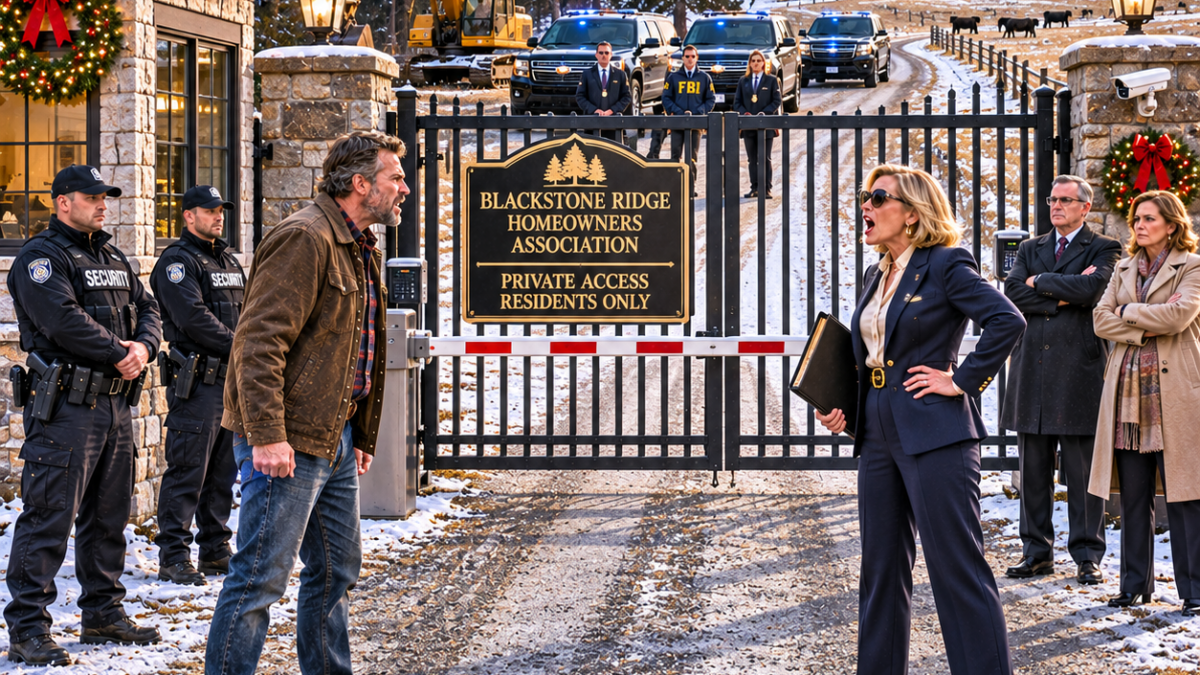
part 2
Two cameras had been bolted onto my utility poles.
Almost four hundred feet of old fencing had been removed.
The wooden McKenna Ridge Farm sign was gone.
And across my eastern pasture, bright orange survey stakes formed a perfectly straight corridor approximately sixty feet wide.
Cormac stepped out of his SUV and looked toward them.
“Those yours?”
“No.”
I pulled up my parcel map.
The stakes ran from the new gate through some of the most usable ground on my farm toward the far boundary.
Beyond that boundary sat undeveloped land recently connected to a proposed expansion of Blackstone Ridge.
I walked twenty yards into the pasture.
Then another twenty.
The alignment became obvious.
The HOA did not want my gate.
It wanted my land to become a road.
Cormac came up beside me.
“Anything about that connected to the federal matter?”
“I don’t know.”
He nodded.
“Then don’t guess.”
That was one of the reasons I respected him.
He never let suspicion turn itself into fact simply because the suspicion made sense.
His job remained my safety as a witness.
The land fight belonged somewhere else unless evidence connected them.
That evening, after the marshals confirmed the property was secure, I walked the staked corridor by myself.
Forty-one orange stakes.
Precise intervals.
Professional placement.
Someone had spent time on this.
They knew where they wanted the road.
They had not built first and measured later.
They had measured first.
That meant the gate was not an impulsive HOA stunt.
It was infrastructure for a plan.
The next morning, I started with public records.
Meridian Crown Development had filed concept plans for Blackstone Ridge Phase Two.
Dozens of high-end homes.
Mountain-view lots.
Private amenities.
The development had one major weakness.
Access.
The existing road network approached the parcel from the wrong direction and would require expensive grading and engineering to support the additional traffic.
The proposed western access corridor solved that.
I enlarged the county planning attachment.
The line crossed my farm.
Exactly where the orange stakes sat.
I kept digging.
Six weeks earlier, Blackstone Ridge meeting minutes referenced an “anticipated access rights payment.”
Amount:
$1,100,000.
No landowner named.
No parcel identified.
Just a payment connected to development access.
I sat back.
Lorraine had promised her HOA more than a million dollars for delivering a road she did not own.
I called Paige Hollister.
Paige had served as Blackstone Ridge treasurer for years.
She answered reluctantly.
“Silas, I don’t think I should be discussing board business with you.”
“Did Lorraine tell the board the HOA owned McKenna Farm Road?”
Silence.
“Paige?”
“She said we had access rights.”
“Did you ever see the deed?”
“I saw a legal summary.”
“From whom?”
“Meridian Crown’s counsel.”
“Did you see the original recorded easement?”
Another silence.
“No.”
Then I asked about the gate.
Paige exhaled.
“$184,000.”
I nearly dropped the pen.
“For what?”
“Gate system, security contract, guard shack, cameras, survey work, site preparation, legal costs.”
“From HOA reserves?”
“Yes.”
“Was there a full membership vote?”
“No.”
“Full board?”
She hesitated.
“Lorraine used emergency infrastructure authority.”
I almost laughed.
“Emergency?”
“She said the access corridor had to be secured before closing.”
There it was again.
Closing.
“Closing with Meridian?”
Paige said nothing.
She did not need to.
That evening, Lorraine emailed me.
I was ordered to vacate “association-controlled territory” within twenty-four hours.
She threatened to tow my truck if I used the gate without permission.
I forwarded the email to my attorney, Daniel Reeves.
Then I called Russell Fenner, a licensed county surveyor.
“I need the road surveyed.”
“Boundary dispute?”
“More than that.”
“How precise?”
“Precise enough that nobody can argue where the gate is standing.”
Russell arrived the next morning.
Tripod.
GPS unit.
County data.
Field book.
Within twenty minutes, Lorraine arrived too.
Dean and two guards came with her.
“You don’t have authorization to survey association property,” she told Russell.
Russell looked at me.
“Who hired me?”
“I did.”
He turned back to her.
“That’s my authorization.”
Lorraine produced Meridian Crown’s map.
Russell barely glanced at it.
“I don’t establish boundaries from developer concept drawings.”
He worked from the recorded legal description.
County survey control.
Existing brass monuments.
My deed.
Historical parcel data.
Lorraine followed him for hours.
At one point, she actually tried standing in front of his equipment.
Russell moved the tripod ten feet and continued.
By midafternoon, he began placing markers.
One beside the guard shack.
One along the turnaround.
Then one almost directly beneath the automated gate motor.
Dean watched the last stake go in.
His expression changed.
Lorraine saw it.
“What does that mean?”
Russell closed his field book.
“It means your gate is on Mr. McKenna’s parcel.”
She stared at him.
“That’s impossible.”
“No.”
“The association owns this corridor.”
“Not according to the county control points.”
She pointed toward the guard shack.
“That structure cost tens of thousands of dollars.”
Russell shrugged.
“I’m a surveyor. Cost doesn’t move a boundary.”
The full result was worse for Blackstone Ridge than I expected.
The road belonged to me.
The gate belonged physically on my parcel because they had built it there without permission.
The guard shack was on my land.
Most of the paved turnaround was on my land.
The cameras were mounted on my utility poles.
The new fencing interfered with my boundary.
Then Russell examined the recording number on Lorraine’s supposed access easement.
He frowned.
“This number belongs to an easement.”
Lorraine smiled.
I waited.
Russell continued.
“Half a mile away.”
Her smile vanished.
The actual recorded easement covered another stretch of land entirely.
The copy Lorraine had been showing people contained legal-description language that did not match the county original.
I did not accuse her of altering it.
Not then.
I told everyone present the same thing.
“Preserve the document exactly as it is.”
Lorraine’s face flushed.
“This survey means nothing.”
“It means enough to me,” Dean said quietly.
She turned toward him.
“Lock the gate.”
Dean blinked.
“What?”
“Mr. McKenna is leaving. Lock it afterward. If he returns, do not allow him through.”
Dean looked at the marker almost underneath his boot.
“Are you sure?”
“That’s your job.”
I pulled out my phone.
Started recording.
Lorraine noticed.
She looked directly at Dean.
“Lock the gate.”
He did.
But I learned later that Dean also made a decision of his own.
He quietly preserved copies of the guard-shack security footage.
That afternoon, Daniel called.
“Meridian Crown plans to close the access agreement within forty-eight hours.”
“Can we stop it?”
“We’re filing for emergency relief.”
“How quickly?”
“Quickly enough if the judge agrees there’s immediate risk.”
That night my kitchen table disappeared beneath paper.
Deed.
Survey.
Gate photographs.
Lorraine’s access notice.
The altered-looking easement copy.
Meridian concept plan.
Blackstone minutes.
The $1.1 million reference.
I had just spent three days in federal proceedings watching lawyers dismantle a fraud structure by checking what official-looking documents actually rested on.
Now the same pattern seemed to be sitting in my kitchen.
Somebody wanted appearance to outrun verification.
Build the gate.
Hire guards.
Install cameras.
Call the corridor HOA property.
Then sign the development contract before I could slow it down.
Afterward, I would be the one forced to prove how the road had been taken.
Physical control first.
Court fight second.
Daniel filed for emergency injunctive relief.
We asked the court to bar Blackstone Ridge from selling or transferring any claimed access across my land, obstructing my use of the farm road, modifying fencing, or conducting further construction pending a full hearing.
Lorraine responded politically.
She called an emergency HOA meeting.
The message to residents described me as a hostile neighboring landowner trying to sabotage a transaction that would bring $1.1 million into Blackstone Ridge.
She did not mention Russell’s survey.
Did not mention the gate was sitting inside my parcel.
Did not explain the questionable easement description.
And certainly did not mention that Meridian Crown’s name was familiar to me from federal testimony.
I attended.
Lorraine tried to keep me out because I was not an association member.
Paige spoke up.
“He’s the landowner whose access we’re supposedly selling.”
That was difficult to argue with.
They gave me three minutes.
I used less.
First, I placed the recorded deed on the table.
Then Russell’s survey.
Then a photograph of the gate with the boundary location marked.
Finally, I looked at Lorraine.
“Show everyone the original recorded document giving this association ownership or access rights over McKenna Farm Road.”
She held up a photocopy.
“Original.”
“Our attorney has verified the copy.”
“Who is the attorney?”
She shifted.
“The relevant legal team.”
A board member frowned.
“Name?”
Lorraine started talking about confidentiality.
People in the room began whispering.
An older woman named Martha Keene raised her hand.
She had lived in Blackstone Ridge since the first homes were built.
“Why haven’t we seen any of this before?”
Lorraine replied that the matter had been under legal review.
Martha looked unconvinced.
Paige looked worse.
She had a folder of financial records on her lap and was holding it tightly enough to bend the corners.
Then Lorraine made the mistake that mattered most.
Someone asked whether the Meridian closing would be delayed pending the survey dispute.
“No.”
I looked at her.
“You’re still signing tomorrow?”
“The transaction will proceed.”
“Even after you’ve been shown a licensed survey saying the gate and road are on my property?”
Her chin lifted.
“The survey does not change my decision.”
The secretary wrote the statement into the meeting minutes.
Word for word.
That sentence later mattered far more than any insult she could have thrown at me.
Because it established a point in time.
Before the meeting, Lorraine could claim she trusted someone else’s information.
After the meeting, she had been formally shown contrary evidence.
And she announced she would proceed anyway.
As residents filed out, Dean caught me in the parking lot.
He looked around before speaking.
“Mr. McKenna.”
“Yeah?”
“You might want to ask how she knew you were gone.”
I stopped.
“What?”
“The gate installation.”
“What about it?”
“Started the morning you left.”
I stared at him.
My federal testimony schedule had not been public.
“How did she know?”
Dean shook his head.
“I’m not saying I know. I’m saying she knew exactly when you wouldn’t be here.”
That changed everything.
I called Cormac.
He listened.
Then said the same thing he always said.
“Don’t jump ahead.”
“I know.”
“Your property case is still your property case.”
“I know.”
“But if a protected witness’s travel schedule was compromised, that is a separate security concern.”
He documented it.
I sent the information to Daniel.
Then Paige called me.
Her voice was different.
“I found emails.”
We met at Daniel’s office.
She brought printed copies and digital backups.
The first email was from Lorraine to Gavin Prescott, a Meridian Crown representative.
Sent two days before I left for federal testimony.
McKenna will be unavailable through Thursday. Install Wednesday. He will not return before closing. Preparations complete.
I read it twice.
A second message was worse.
Once physical control is established, McKenna will have to fight the association through court instead of stopping the project.
Nobody spoke for several seconds.
There it was.
The strategy.
Not mistaken ownership.
Not innocent reliance on bad paperwork.
Take the road while I am gone.
Force me into court afterward.
Paige had more.
The supposed easement carried a signature from a former owner who had already sold the relevant property before the document’s stated date.
The notarization came from a notary whose commission had expired by then.
Daniel looked at the pages.
“Preserve originals. Preserve metadata. Do not write on anything.”
Then Paige slid over the payment spreadsheet.
The $1.1 million from Meridian Crown was divided into categories.
$700,000 to Blackstone Ridge’s general fund.
$250,000 designated infrastructure administration.
$150,000 to Wexler Community Strategies.
I looked at Paige.
“Wexler?”
She nodded.
“Registered address belongs to Lorraine’s brother.”
“Did the board know?”
“No.”
“Did you?”
“No.”
I did not accuse Lorraine of criminal conduct.
That was not my job.
But I understood why Daniel’s face hardened.
“A judge sees this tomorrow.”
The next morning was supposed to be Meridian Crown’s celebration.
Tables appeared near the clubhouse.
Banners.
Press materials.
A stack of unsigned contracts.
Residents gathered expecting the HOA to announce its million-dollar windfall.
I was returning from Daniel’s office.
Cormac and the marshal detail were still accompanying me because the federal security concerns had not fully resolved.
This time Lorraine knew we were coming.
Dean was standing in the guard shack when she ordered him to lower the barrier.
He looked at her.
“No.”
She froze.
“What did you say?”
“I’m not blocking those vehicles again.”
“That’s your job.”
“The survey says the gate is on his property.”
“You work for the association.”
“Not anymore.”
Dean removed his radio.
Set it on the desk.
“I quit.”
Residents nearby heard him.
So did Gavin Prescott.
Gavin slowly stepped away from the signing tables.
Lorraine went into the guard shack herself.
Pressed the control.
The gate lowered.
When our convoy arrived, I stopped.
I did not touch the barrier.
Cormac stepped out.
By then, Daniel had sent me the emergency order signed by Judge Meredith Langford.
It prohibited the HOA from obstructing my established access while the property dispute proceeded.
Cormac again made clear he was not acting as my civil enforcement officer.
County deputies were already coming.
When they arrived, one deputy read the order.
Lorraine crossed her arms.
“This gate belongs to the association.”
The deputy looked at the order.
“Ma’am, raise it.”
She argued.
He read the operative language again.
Finally, Lorraine pressed the control.
The gate rose.
The same residents who had arrived expecting a million-dollar celebration watched my truck pass beneath it.
I stopped just inside.
Rolled down the window.
“Tomorrow, a judge can decide whose gate this is.”
Then I drove home.
Dean caught up with me later.
He handed me a small storage drive.
“Local guard footage.”
I looked at him.
“Why?”
“Because she told me to delete clips.”
I said nothing.
“I didn’t.”
The footage covered nearly everything.
Lorraine overseeing removal of my original wooden gate.
Lorraine ordering the HOA sign installed.
A guard asking whether the landowner had signed permission.
Lorraine answering:
“By the time McKenna gets back, it’ll be settled.”
Another clip showed her telling guards to block my truck specifically.
Another captured her acknowledging that legal documents were still being finalized after construction had already started.
Then came the most damaging clip.
Lorraine and Gavin standing near the gate.
Her voice was clear.
“Once we control the road, McKenna loses all leverage.”
I replayed it.
Then stopped.
There is a moment in disputes like this when anger fades because the evidence becomes stronger than emotion.
That was mine.
The full hearing drew more people than I expected.
Blackstone Ridge residents filled the courtroom.
Lorraine came with an attorney and a massive binder.
Daniel leaned toward me.
“Thickness isn’t evidence.”
I almost smiled.
Judge Langford began with the property record.
Not community benefit.
Not development potential.
Not the HOA’s million-dollar promise.
Ownership.
She asked for the original recorded easement.
Lorraine’s side produced a scan.
“Original?”
They did not have one.
Russell testified.
He explained the county control points.
The legal description.
The location of the gate.
The guard shack.
The road.
The discrepancy between the actual recorded easement and the version used by Blackstone Ridge.
Then the judge asked Lorraine a direct question.
“Did you receive the survey results before continuing to obstruct Mr. McKenna’s access?”
Lorraine paused.
“Yes.”
“Did you continue?”
“Yes, because—”
The judge raised one hand.
That was enough.
Daniel introduced the HOA meeting minutes.
The survey does not change my decision.
Then Paige’s emails.
Then Dean’s footage.
The atmosphere changed.
You could feel residents behind us realizing they had not been watching a complicated misunderstanding.
They had been watching someone establish physical control first and plan to sort out ownership later.
Judge Langford did not decide every damages question that day.
She did something more immediately important.
She expanded the injunction.
Blackstone Ridge could not obstruct me.
Could not sell or transfer disputed access rights.
Could not alter the road, gate, fencing, or corridor.
Could not continue development work on my land.
All relevant electronic and financial records had to be preserved.
Meridian Crown had to halt preparations involving the corridor.
The $1.1 million agreement did not close.
Not one signature.
Outside the courthouse, reporters covering the broader federal fraud investigation noticed Meridian Crown’s name.
Questions started flying.
Lorraine said nothing.
Gavin said less.
Then the HOA’s liability insurer called Paige.
They wanted everything.
Especially evidence showing when Lorraine first learned the association’s ownership claim was disputed.
Why?
Because knowing conduct could affect coverage.
That was when consequences became personal.
Lorraine began blaming people.
First Dean.
She claimed he had independently decided to block me.
The camera footage destroyed that immediately.
Then Paige.
Lorraine claimed the treasurer approved the expenditures.
The minutes showed Lorraine invoking emergency authority before full board review.
Then Meridian Crown.
She said Gavin’s company supplied the easement and she trusted the documentation.
Gavin hired separate counsel.
His interests and hers stopped being aligned.
Then an old technical file surfaced.
Months before the gate project, another surveyor working with Meridian Crown had warned that no recorded Blackstone Ridge access existed across the McKenna parcel.
That warning had been forwarded to Lorraine.
Months earlier.
Daniel read the email date.
Then the construction date.
Judge Langford later did the same.
No shouting.
No speech.
Just dates.
Warning first.
Construction later.
She knew.
That fact became nearly impossible to escape.
At the subsequent civil hearing, the court ruled on the property issues.
McKenna Farm Road belonged to me under the recorded parcel documents.
Blackstone Ridge had failed to establish a valid easement at the location it claimed.
The steel gate, guard shack, cameras, and related improvements had been placed on my property without authorization.
The HOA was ordered to remove them within a defined period.
Damaged fencing and grading had to be restored.
Demonstrated damages and legal costs were addressed through the order.
Questions involving altered documents and the financial arrangement connected to Lorraine’s family-linked consulting company were referred separately for review by the appropriate authorities.
That separation mattered.
The civil judge determined ownership and remedies supported by the property record.
Other agencies could decide whether separate conduct justified other consequences.
No one needed to invent a dramatic charge simply because Lorraine was unpopular.
The paperwork was damaging enough.
Blackstone Ridge called an emergency membership meeting.
This time I did not attend.
I was not part of their HOA.
It was their reckoning.
Paige later told me what happened.
She stood in front of the residents and read the numbers.
$184,000 spent on the gate, security, surveys, cameras, legal work, and preparation.
The promised $1.1 million never arrived.
Now there were removal costs.
Restoration costs.
Legal bills.
Potential damages.
An insurance dispute.
An independent financial review.
Residents had been promised a windfall.
They got an invoice.
The board removed Lorraine as president.
She walked out while people who had once trusted her asked questions she could no longer answer with a title and a confident voice.
Dean attended from the back.
He told me later he felt no satisfaction.
Only relief.
“I almost let her make me the guy who locked a man away from his own house.”
“You stopped.”
“Late.”
“But you stopped.”
That mattered to me.
People like to divide everyone into villains and heroes once a conflict ends.
Reality is messier.
Dean made the wrong decision initially because he trusted the person paying him.
Then evidence changed.
He changed.
Paige trusted Lorraine’s summaries for too long.
Then she started reading the source documents.
She changed.
Residents believed the development would benefit them.
Then they saw the real cost.
They changed.
Lorraine kept receiving new information.
She did not change.
That was the difference.
About a month later, a construction crew returned to McKenna Ridge.
This time they came with my written permission and the court order.
The steel barrier was disconnected.
Cameras removed.
The automated gate lifted from its hinges.
The guard shack came off its foundation.
A truck hauled away the BLACKSTONE RIDGE HOA sign.
I stood beside the road watching.
No celebration.
No champagne.
No applause.
Just machinery undoing a mistake.
Dean came too.
Out of uniform.
Hands in his pockets.
“I’m sorry.”
I looked toward the workers.
“For what part?”
“The first day.”
“You had documents.”
“I also had doubts.”
I nodded.
“Next time listen sooner.”
He laughed once.
“Fair.”
We watched the gate rise onto the flatbed.
When the truck pulled away, the road looked wider than I remembered.
Russell returned afterward.
Fresh markers.
Clear boundary.
Nothing decorative.
Nothing ambiguous.
I installed a new gate.
Plain steel ranch gate.
Manual latch.
No cameras reading license plates.
No security booth.
No stone columns.
Above it went a simple sign.
MCKENNA RIDGE FARM
PRIVATE PROPERTY
Cormac Avery visited one last time after his federal protective assignment ended.
He stood beside the new gate.
“At least you have the only key now.”
I smiled.
“I always had the key.”
He looked at me.
I nodded toward the road.
“Other people just thought changing the lock changed who owned it.”
Cormac laughed.
Then he drove away.
The broader federal investigation I had testified in continued on its own track.
I rarely discussed it.
The overlap with Meridian Crown became something for investigators and attorneys to sort out based on actual evidence, not gossip.
That was important to me.
Lorraine’s actions were enough.
I did not need to attach every bad thing in the world to her.
The property case taught me something I thought I already knew.
Paper matters.
But paper does not become truth because it has a stamp.
A uniform matters.
But a uniform does not create authority over whatever happens to be in front of it.
A gate matters.
But a gate does not transfer title.
Confidence matters.
Maybe more than it should.
Lorraine had built an entire strategy around confidence.
She said the association owned the road.
People assumed somebody had checked.
She said Meridian’s documents were valid.
People assumed lawyers had verified them.
She said emergency authority allowed the spending.
People assumed the board had approved it.
She said my access was restricted.
Security guards obeyed.
She said $1.1 million was coming.
Residents celebrated before the contract was signed.
Every step depended on somebody deciding not to ask the next obvious question.
Show me.
Show me the deed.
Show me the easement.
Show me the board vote.
Show me the original.
Show me where the road is.
Show me who owns the soil under the gate.
That is all I did.
My family did not keep McKenna Ridge for three generations by winning arguments.
We kept records.
Paid taxes.
Marked boundaries.
Fixed fences.
And when necessary, checked what somebody else claimed against what the county actually recorded.
The first winter after the gate came down, I drove home during a light snow.
No guards.
No cameras.
The old gravel road curved exactly where it had always curved.
I stopped near the spot where the guard shack had stood.
Grass was still thin around the former foundation.
The repair crew had restored the grade, but land remembers disturbance longer than paperwork does.
I got out.
Walked to the fence.
Across the boundary, Blackstone Ridge looked ordinary.
Porch lights.
Cars.
People coming home from work.
Children’s bicycles under garage lights.
Three hundred residents who had spent months living inside a scandal most of them never asked for.
I never hated them.
Some had believed Lorraine.
Some had repeated things about me that were not true.
Some assumed a farmer standing in the way of a million-dollar deal was simply stubborn.
Then the records came out.
Most reconsidered.
Several neighbors eventually stopped by.
One man brought a pie his wife baked.
Another apologized for calling me selfish during the first HOA meeting.
Martha Keene, the retired teacher, came down the road carrying a folder.
“I wanted to see the survey.”
I laughed.
“You don’t trust the judge?”
“I taught civics for thirty-four years. I trust documents I can read.”
I showed her.
She traced the boundary line.
“So the gate really was entirely on your land.”
“Yes.”
She shook her head.
“She sounded so certain.”
That sentence explained more than anything else.
Lorraine sounded certain.
People confuse certainty with knowledge.
Especially when certainty comes from someone holding office.
HOA president.
Developer representative.
Security supervisor.
Attorney.
Inspector.
Any title can make a statement feel heavier than it is.
That does not mean titles are meaningless.
Authority matters.
But good authority knows where it ends.
Cormac never once claimed federal power over my property dispute.
He could have frightened everyone by waving his badge around.
He did not.
He limited himself to witness protection.
Roman handled local law enforcement questions.
Russell handled surveying.
Judge Langford handled the property injunction.
My attorney handled the litigation.
Paige handled HOA finances.
Each person stayed inside their lane.
Lorraine did not.
She treated HOA office as land authority.
Land authority as development authority.
Development opportunity as emergency power.
Emergency power as permission to spend reserves.
And permission to spend as permission to build on my farm.
Once one boundary disappeared in her mind, every other boundary became negotiable too.
That is how she ended up standing in a guard shack manually lowering a gate against a court order while her own security chief resigned.
Not because the conflict suddenly became absurd.
Because it had always been absurd.
The documents finally made everyone see it.
Meridian Crown redesigned Phase Two.
The alternative access route was longer.
More expensive.
Required engineering they had hoped to avoid.
But it did not cross my land.
That was the price of building on property you actually control.
The $1.1 million HOA payment disappeared.
So did the $150,000 consulting allocation connected to Wexler Community Strategies.
The new Blackstone board began an independent audit.
Paige stayed through the transition.
She told me it might take months to reconstruct every authorization under Lorraine.
“Residents are angry about the cost.”
“They should be.”
“Some want shortcuts.”
I shook my head.
“Shortcuts are why you’re doing the audit.”
The new board changed its rules.
No single president could approve a major land transaction.
Large reserve expenditures required documented board authorization.
Original property records had to be independently verified.
Developer representations were not enough.
Any project touching neighboring property required survey confirmation before work began.
Slow.
Boring.
Exactly the point.
Good governance is often boring.
Bad governance photographs better.
Lorraine’s gate looked impressive.
My replacement did not.
Hers had cameras, automated controls, uniforms, stonework.
Mine had hinges.
One lock.
My key.
Guess which one rested on legal ownership.
Months later, I saw Lorraine once.
Outside a lawyer’s office.
She looked tired.
No entourage.
No sunglasses.
She saw me and walked over.
“You destroyed that development.”
I almost kept walking.
Then I stopped.
“No.”
“The road issue killed Phase Two.”
“The road was never yours.”
“The community lost over a million dollars.”
“The community was promised money for selling access it didn’t own.”
Her jaw tightened.
“You could have negotiated.”
“Before or after you locked me out?”
“We were trying to create value.”
“For whom?”
That stopped her.
I thought about the consulting line item.
One hundred fifty thousand dollars.
I did not accuse her.
The review process would determine whatever it determined.
Instead, I asked the simplest question.
“Why didn’t you ask me?”
She looked away.
I knew the answer.
Because I might have said no.
That was unacceptable to her.
Everything else followed from that.
The fake certainty.
The timing.
The gate installed while I was away.
The plan to force me into court.
Physical possession as leverage.
People like Lorraine often say they believe in negotiation.
What they mean is negotiation as long as the other person eventually agrees.
Real consent includes no.
My no was not a planning obstacle.
It was my right.
That idea sounds obvious until enough money sits on the other side of it.
A year later, Blackstone Ridge Phase Two finally moved forward under a different configuration.
Fewer lots.
Different road.
Higher development costs.
Some residents complained.
Others said the new board had done the right thing.
I did not care.
I was not anti-development.
People can build on land they own.
They can improve their neighborhoods.
They can negotiate road access.
They can make offers.
What they cannot do is decide another person’s property is inefficiently located and then manufacture authority to take it.
That distinction was the whole case.
I went back to farming.
Up before sunrise.
Cattle.
Hay.
Equipment.
Fence repairs.
The same rhythms my family had known long before Blackstone Ridge existed.
Sometimes I drove past the fresh boundary markers Russell installed.
I never removed them.
They were not pretty.
Bright caps.
Survey numbers.
Small reminders that invisible legal lines become very visible when somebody decides to ignore them.
Dean stopped by one spring.
He was working security somewhere else.
He brought coffee.
We sat on the tailgate of my truck.
“You ever think about installing cameras again?”
“No.”
“After all that?”
“I have cameras near the house.”
“I mean at the gate.”
I looked toward the road.
“People know where the line is now.”
He smiled.
“For a while.”
That was true.
Memory fades.
Boards change.
Developers arrive.
Documents get buried.
I eventually added one small plaque beneath the McKenna Ridge sign.
NO HOA AUTHORITY BEYOND THIS POINT.
Dean laughed when he saw it.
“Subtle.”
“I tried subtle.”
The truth was, I did not put it there for Lorraine.
I put it there for whoever came next.
Boundary disputes are rarely about dirt alone.
They are about assumptions.
Who gets to decide.
Who gets to enter.
Who gets to promise.
Who gets to say no.
My grandfather never imagined an HOA when he cleared the eastern pasture.
My father never imagined a million-dollar development corridor when he strung the northern fence.
But they understood boundaries.
They closed gates.
They asked before crossing neighbors’ fields.
They shook hands when agreements were made.
They recorded the important ones.
That culture sounds old-fashioned until somebody spends $184,000 building a security checkpoint on the wrong farm.
Then old-fashioned starts looking intelligent.
One evening near the end of summer, I walked to the ridge above the road.
From there, I could see almost everything.
Blackstone Ridge.
My cattle.
The line where Phase Two construction had finally begun farther east.
The alternate access road cutting around the hillside.
More expensive.
Longer.
Legal.
I thought about Lorraine’s original plan.
Take my road while I was away.
Establish physical control.
Force me to fight afterward.
It might have worked against someone else.
That unsettled me more than anything.
Not because I was smarter.
I wasn’t.
I happened to come home with three federal SUVs behind me.
That broke the image Lorraine had carefully constructed.
Four guards and an automated gate feel powerful until another form of authority arrives and asks what law supports the barrier.
The marshals did not give me ownership.
I already had ownership.
They did not win my property case.
The deed did.
The survey did.
The county records did.
The injunction did.
But their arrival created the first crack in Lorraine’s performance.
Dean hesitated.
Residents noticed.
Lorraine panicked.
Then people began asking questions.
That was the chain reaction.
Authority built on confidence is strongest when nobody pauses.
Once people pause, everything changes.
Maybe you should open the gate.
Cormac’s first afternoon there stayed with me because of how ordinary his words were.
No shouting.
No weapon drawn.
No dramatic threat.
Just a question nobody had asked Lorraine before:
What legal authority supports what you’re doing?
She never had a good answer.
Everything after that was documentation.
That is how I remember the whole thing now.
Not as the day federal vehicles “defeated” an HOA gate.
They didn’t.
The gate opened because a security guard decided he would not escalate an unsupported property dispute into obstruction of a protective detail.
Then the land records did the deeper work.
Months later, Cormac stopped by one final time.
He stood outside the new gate.
Looked at the simple latch.
“Feels different.”
“It is.”
“No guards.”
“No.”
“No cameras.”
“Not theirs.”
He nodded.
“You ever think all this started because someone wanted a shortcut through a pasture?”
“Money does strange things to maps.”
He laughed.
Then his expression turned serious.
“You handled it better than most people would.”
I shook my head.
“I almost didn’t.”
He waited.
“The first afternoon, when Lorraine said I couldn’t enter, I wanted to drive through the steel.”
“Would’ve been expensive.”
“Would’ve been stupid.”
“That too.”
I looked down the road.
“Instead, I let everybody keep talking.”
Cormac nodded.
“People reveal a lot when they think they’ve already won.”
That might have been the best summary anyone gave me.
Lorraine thought she had won before I came home.
That was why she built the gate.
Why she put up the sign.
Why she hired guards.
Why she told residents the money was coming.
Why she planned a public closing.
She needed the outcome to feel inevitable.
If I saw the gate and accepted it, even temporarily, the physical world would support her version.
McKenna no longer controls the road.
Blackstone does.
Meridian has access.
The deal can close.
Everything depended on me reacting to steel as if steel were law.
It wasn’t.
It was steel.
Very expensive steel.
Placed on the wrong land.
The final court order sits in a file cabinet in my office.
I rarely look at it.
The deed is there too.
Russell’s survey.
Paige’s emails.
Dean’s footage archive.
The gate invoice.
The HOA minutes.
Evidence of a terrible plan reduced to folders.
Sometimes that seems strange.
For months, those documents controlled my sleep.
Now they gather dust.
That’s what a good ending looks like.
Not permanent excitement.
Boredom.
Normal life.
You finish the fight so you can stop thinking about it.
I wake up now worried about hay prices.
Broken pumps.
A calf with a bad leg.
Whether the western fence needs replacing before winter.
Real farm problems.
I prefer them.
They are honest.
Lorraine once stood in front of that enormous automated gate and told me I had lost the right to cross the road to the farm my grandfather built.
She believed ownership could be manufactured by moving quickly enough while I was gone.
Build the barrier.
Control the access.
Sign the contract.
Collect the money.
Let me fight afterward.
What she learned was that possession and ownership are not the same thing.
Neither are confidence and authority.
Neither are paperwork and truth.
I still close my gate at night.
The latch makes a simple metal sound.
Sometimes I think about Cormac’s last visit.
“At least you hold the only key.”
He was wrong in the best possible way.
I had always held it.
Lorraine never took ownership.
She only changed the lock and hoped I would believe that meant something.
I didn’t.
And once everyone else started checking the records, neither did they.
𝗧𝗛𝗘 𝗘𝗡𝗗
HOA Karen Locked Me Out of My 186-Acre Family Farm—Then Three Federal SUVs Rolled Up Behind Me
The HOA Karen next door waited until I left town for three days, ripped out the gate my family had used for decades, and replaced it with a steel checkpoint guarded by four men who said I no longer had permission to reach my own house.
She believed an expensive gate, a stamped document, and enough confidence could turn my private farm road into HOA property before I had time to fight back.
What Lorraine Wexler did not know was that I was coming home from testifying in a federal fraud investigation—and three black government SUVs were already following me around the bend.
The afternoon light was dropping low over the hills when I turned onto McKenna Farm Road and realized somebody had changed the entrance to my life.
I had driven that gravel approach so many thousands of times that I knew every rut, every drainage dip, every old oak leaning toward the ditch. My grandfather had cleared the first pasture beyond it by hand. My father set most of the northern fence posts when he was younger than I was now. I had opened and closed the same wooden gate for twenty years, sometimes before sunrise, sometimes after midnight, sometimes with snow pushing against the bumper of my truck.
That gate was gone.
In its place stood a black steel structure that looked like the entrance to a private resort.
Automated barrier.
Stone-faced columns.
License-plate cameras.
A newly built guard shack.
Four uniformed security guards.
And above everything, in letters large enough to see from the last bend:
BLACKSTONE RIDGE HOMEOWNERS ASSOCIATION
PRIVATE ACCESS — RESIDENTS ONLY
I stopped my truck.
For a moment, I honestly wondered whether exhaustion had caught up with me.
My name is Silas McKenna. McKenna Ridge Farm covers one hundred eighty-six acres that have been in my family for three generations. I raise cattle, cut hay, repair my own equipment when possible, and generally prefer solving problems with tools rather than meetings. I had spent the previous three days in a federal courthouse giving testimony as a witness in a real estate fraud investigation. The threats connected to that case had become serious enough that the U.S. Marshals Service insisted on escorting me home.
I had asked them to stay back.
About a quarter mile back, to be exact.
I did not want black federal SUVs following me through the gate like I was arriving at some crime scene.
I wanted to get home.
Feed the cattle.
Drink coffee.
Maybe sleep twelve hours.
Instead, I was staring at a security checkpoint built on the only road to my farmhouse.
I stepped out.
Four guards moved toward me before I had fully closed the door.
The lead man was broad-shouldered, maybe forty-five, with a name patch reading DEAN STRICKLAND.
“Identification and residency verification.”
I looked at him.
“I’m sorry?”
“Identification. We need to confirm you’re authorized to enter.”
I glanced past him toward my own pasture.
“You’re asking whether I’m authorized to enter McKenna Ridge Farm?”
He checked a tablet.
“That’s correct.”
“I own McKenna Ridge Farm.”
He looked down.
“Name?”
“Silas McKenna.”
That got a reaction.
Not fear.
Recognition.
His thumb stopped moving.
Then he turned the tablet slightly away.
“Mr. McKenna, your access has been restricted.”
“By whom?”
He handed me a printed notice.
Blackstone Ridge letterhead.
My name.
My road.
My property.
At the bottom was the signature of Lorraine Wexler, HOA president.
The document announced that Blackstone Ridge had taken permanent control of the road corridor under an “Access Rights Agreement” and that I was no longer authorized to cross the gate without association permission.
I read it twice.
Then I looked at Dean.
“Where is Lorraine?”
He pointed toward a white SUV approaching from the subdivision side.
Of course.
Lorraine Wexler stepped out wearing a tailored navy suit, dark sunglasses, and the composed expression of a woman arriving at a meeting whose outcome she believed had already been decided.
She did not seem surprised to see me.
That was the first detail that bothered me.
The second was the timing.
I had been gone exactly three days.
The third was the gate.
Nobody installs something this elaborate accidentally.
Lorraine stopped on the other side of the barrier.
“Silas.”
“Lorraine.”
“You were notified that the association was formalizing control of this corridor.”
“No. You sent me letters claiming your neighborhood needed access improvements.”
“The matter progressed.”
I held up her notice.
“You built a gate on my road.”
“The association acquired the access rights.”
“From whom?”
“Meridian Crown Development.”
That name changed everything.
I went quiet.
Meridian Crown had surfaced repeatedly during the federal testimony I had just given.
Not as the only company under scrutiny.
Not as something I was prepared to accuse of anything on the side of a road.
But enough that hearing Lorraine say the name while standing in front of a gate blocking my farm made the back of my neck go cold.
She mistook my silence for intimidation.
“You no longer have the right to use this road without association authorization.”
“My family owns the road.”
“Not anymore.”
“Show me.”
She pulled a stamped document from a leather folder.
It claimed Meridian Crown had transferred access rights to Blackstone Ridge.
I scanned it.
Something about the legal description looked wrong, but I was too tired and too angry to trust a first impression.
“Open the gate.”
“No.”
“That road leads to my house.”
“The association controls it.”
“Open it.”
She smiled faintly.
“If you attempt to force entry, security will contact law enforcement.”
I almost laughed.
Then engines rolled up behind me.
Lorraine’s smile weakened.
The first black SUV came around the bend.
Then the second.
Then the third.
Federal plates.
Dark glass.
The vehicles stopped behind my pickup.
Deputy U.S. Marshal Cormac Avery stepped from the lead SUV.
Cormac had spent three days saying very little and noticing everything. He walked forward without touching his weapon.
He showed his credentials to Dean.
“Why is the protective detail for a federal witness being denied access to that witness’s residence?”
Lorraine stepped in immediately.
“This is a private HOA property matter.”
Cormac looked at me.
“Your residence is through this gate?”
“Yes.”
Then at Lorraine.
“Is Mr. McKenna under arrest?”
“No.”
“Is there a court order prohibiting him from entering his residence?”
“No, but—”
“Is your security team detaining him?”
“Of course not.”
Cormac turned toward Dean.
“Then under what authority are you preventing him from proceeding?”
Dean looked toward Lorraine.
“The association owns the gate.”
Cormac checked the coordinates on his handheld device.
I said quietly, “Even that is disputed.”
Lorraine planted herself beside the control panel.
“This gate stays closed.”
Cormac’s expression did not change.
He was not there to decide who owned my road.
He made that clear.
He was there to deliver a protected witness safely to the residence listed in the federal case file.
That task was not going to be suspended because an HOA president had erected a barrier during my testimony.
He looked at Dean.
“Raise the gate.”
Dean looked at Lorraine.
She shook her head.
Cormac spoke again.
Calmly.
“I would think very carefully before deliberately obstructing a federal protective detail over a property dispute you personally have not verified.”
Dean stared at the control panel.
Then at the three SUVs.
Then at me.
He pressed the release.
The barrier rose.
Lorraine shouted, “Close that gate!”
Too late.
The first federal SUV rolled through.
Then mine.
Then the other two.
I looked once in the mirror.
Lorraine stood beneath a sign claiming my road as HOA property while every guard she hired watched me drive through it.
I did not feel victorious.
Because the moment I crossed that gate and saw what had been done beyond it, I understood the steel barrier was only the beginning.
part 2
Two cameras had been bolted onto my utility poles.
Almost four hundred feet of old fencing had been removed.
The wooden McKenna Ridge Farm sign was gone.
And across my eastern pasture, bright orange survey stakes formed a perfectly straight corridor approximately sixty feet wide.
Cormac stepped out of his SUV and looked toward them.
“Those yours?”
“No.”
I pulled up my parcel map.
The stakes ran from the new gate through some of the most usable ground on my farm toward the far boundary.
Beyond that boundary sat undeveloped land recently connected to a proposed expansion of Blackstone Ridge.
I walked twenty yards into the pasture.
Then another twenty.
The alignment became obvious.
The HOA did not want my gate.
It wanted my land to become a road.
Cormac came up beside me.
“Anything about that connected to the federal matter?”
“I don’t know.”
He nodded.
“Then don’t guess.”
That was one of the reasons I respected him.
He never let suspicion turn itself into fact simply because the suspicion made sense.
His job remained my safety as a witness.
The land fight belonged somewhere else unless evidence connected them.
That evening, after the marshals confirmed the property was secure, I walked the staked corridor by myself.
Forty-one orange stakes.
Precise intervals.
Professional placement.
Someone had spent time on this.
They knew where they wanted the road.
They had not built first and measured later.
They had measured first.
That meant the gate was not an impulsive HOA stunt.
It was infrastructure for a plan.
The next morning, I started with public records.
Meridian Crown Development had filed concept plans for Blackstone Ridge Phase Two.
Dozens of high-end homes.
Mountain-view lots.
Private amenities.
The development had one major weakness.
Access.
The existing road network approached the parcel from the wrong direction and would require expensive grading and engineering to support the additional traffic.
The proposed western access corridor solved that.
I enlarged the county planning attachment.
The line crossed my farm.
Exactly where the orange stakes sat.
I kept digging.
Six weeks earlier, Blackstone Ridge meeting minutes referenced an “anticipated access rights payment.”
Amount:
$1,100,000.
No landowner named.
No parcel identified.
Just a payment connected to development access.
I sat back.
Lorraine had promised her HOA more than a million dollars for delivering a road she did not own.
I called Paige Hollister.
Paige had served as Blackstone Ridge treasurer for years.
She answered reluctantly.
“Silas, I don’t think I should be discussing board business with you.”
“Did Lorraine tell the board the HOA owned McKenna Farm Road?”
Silence.
“Paige?”
“She said we had access rights.”
“Did you ever see the deed?”
“I saw a legal summary.”
“From whom?”
“Meridian Crown’s counsel.”
“Did you see the original recorded easement?”
Another silence.
“No.”
Then I asked about the gate.
Paige exhaled.
“$184,000.”
I nearly dropped the pen.
“For what?”
“Gate system, security contract, guard shack, cameras, survey work, site preparation, legal costs.”
“From HOA reserves?”
“Yes.”
“Was there a full membership vote?”
“No.”
“Full board?”
She hesitated.
“Lorraine used emergency infrastructure authority.”
I almost laughed.
“Emergency?”
“She said the access corridor had to be secured before closing.”
There it was again.
Closing.
“Closing with Meridian?”
Paige said nothing.
She did not need to.
That evening, Lorraine emailed me.
I was ordered to vacate “association-controlled territory” within twenty-four hours.
She threatened to tow my truck if I used the gate without permission.
I forwarded the email to my attorney, Daniel Reeves.
Then I called Russell Fenner, a licensed county surveyor.
“I need the road surveyed.”
“Boundary dispute?”
“More than that.”
“How precise?”
“Precise enough that nobody can argue where the gate is standing.”
Russell arrived the next morning.
Tripod.
GPS unit.
County data.
Field book.
Within twenty minutes, Lorraine arrived too.
Dean and two guards came with her.
“You don’t have authorization to survey association property,” she told Russell.
Russell looked at me.
“Who hired me?”
“I did.”
He turned back to her.
“That’s my authorization.”
Lorraine produced Meridian Crown’s map.
Russell barely glanced at it.
“I don’t establish boundaries from developer concept drawings.”
He worked from the recorded legal description.
County survey control.
Existing brass monuments.
My deed.
Historical parcel data.
Lorraine followed him for hours.
At one point, she actually tried standing in front of his equipment.
Russell moved the tripod ten feet and continued.
By midafternoon, he began placing markers.
One beside the guard shack.
One along the turnaround.
Then one almost directly beneath the automated gate motor.
Dean watched the last stake go in.
His expression changed.
Lorraine saw it.
“What does that mean?”
Russell closed his field book.
“It means your gate is on Mr. McKenna’s parcel.”
She stared at him.
“That’s impossible.”
“No.”
“The association owns this corridor.”
“Not according to the county control points.”
She pointed toward the guard shack.
“That structure cost tens of thousands of dollars.”
Russell shrugged.
“I’m a surveyor. Cost doesn’t move a boundary.”
The full result was worse for Blackstone Ridge than I expected.
The road belonged to me.
The gate belonged physically on my parcel because they had built it there without permission.
The guard shack was on my land.
Most of the paved turnaround was on my land.
The cameras were mounted on my utility poles.
The new fencing interfered with my boundary.
Then Russell examined the recording number on Lorraine’s supposed access easement.
He frowned.
“This number belongs to an easement.”
Lorraine smiled.
I waited.
Russell continued.
“Half a mile away.”
Her smile vanished.
The actual recorded easement covered another stretch of land entirely.
The copy Lorraine had been showing people contained legal-description language that did not match the county original.
I did not accuse her of altering it.
Not then.
I told everyone present the same thing.
“Preserve the document exactly as it is.”
Lorraine’s face flushed.
“This survey means nothing.”
“It means enough to me,” Dean said quietly.
She turned toward him.
“Lock the gate.”
Dean blinked.
“What?”
“Mr. McKenna is leaving. Lock it afterward. If he returns, do not allow him through.”
Dean looked at the marker almost underneath his boot.
“Are you sure?”
“That’s your job.”
I pulled out my phone.
Started recording.
Lorraine noticed.
She looked directly at Dean.
“Lock the gate.”
He did.
But I learned later that Dean also made a decision of his own.
He quietly preserved copies of the guard-shack security footage.
That afternoon, Daniel called.
“Meridian Crown plans to close the access agreement within forty-eight hours.”
“Can we stop it?”
“We’re filing for emergency relief.”
“How quickly?”
“Quickly enough if the judge agrees there’s immediate risk.”
That night my kitchen table disappeared beneath paper.
Deed.
Survey.
Gate photographs.
Lorraine’s access notice.
The altered-looking easement copy.
Meridian concept plan.
Blackstone minutes.
The $1.1 million reference.
I had just spent three days in federal proceedings watching lawyers dismantle a fraud structure by checking what official-looking documents actually rested on.
Now the same pattern seemed to be sitting in my kitchen.
Somebody wanted appearance to outrun verification.
Build the gate.
Hire guards.
Install cameras.
Call the corridor HOA property.
Then sign the development contract before I could slow it down.
Afterward, I would be the one forced to prove how the road had been taken.
Physical control first.
Court fight second.
Daniel filed for emergency injunctive relief.
We asked the court to bar Blackstone Ridge from selling or transferring any claimed access across my land, obstructing my use of the farm road, modifying fencing, or conducting further construction pending a full hearing.
Lorraine responded politically.
She called an emergency HOA meeting.
The message to residents described me as a hostile neighboring landowner trying to sabotage a transaction that would bring $1.1 million into Blackstone Ridge.
She did not mention Russell’s survey.
Did not mention the gate was sitting inside my parcel.
Did not explain the questionable easement description.
And certainly did not mention that Meridian Crown’s name was familiar to me from federal testimony.
I attended.
Lorraine tried to keep me out because I was not an association member.
Paige spoke up.
“He’s the landowner whose access we’re supposedly selling.”
That was difficult to argue with.
They gave me three minutes.
I used less.
First, I placed the recorded deed on the table.
Then Russell’s survey.
Then a photograph of the gate with the boundary location marked.
Finally, I looked at Lorraine.
“Show everyone the original recorded document giving this association ownership or access rights over McKenna Farm Road.”
She held up a photocopy.
“Original.”
“Our attorney has verified the copy.”
“Who is the attorney?”
She shifted.
“The relevant legal team.”
A board member frowned.
“Name?”
Lorraine started talking about confidentiality.
People in the room began whispering.
An older woman named Martha Keene raised her hand.
She had lived in Blackstone Ridge since the first homes were built.
“Why haven’t we seen any of this before?”
Lorraine replied that the matter had been under legal review.
Martha looked unconvinced.
Paige looked worse.
She had a folder of financial records on her lap and was holding it tightly enough to bend the corners.
Then Lorraine made the mistake that mattered most.
Someone asked whether the Meridian closing would be delayed pending the survey dispute.
“No.”
I looked at her.
“You’re still signing tomorrow?”
“The transaction will proceed.”
“Even after you’ve been shown a licensed survey saying the gate and road are on my property?”
Her chin lifted.
“The survey does not change my decision.”
The secretary wrote the statement into the meeting minutes.
Word for word.
That sentence later mattered far more than any insult she could have thrown at me.
Because it established a point in time.
Before the meeting, Lorraine could claim she trusted someone else’s information.
After the meeting, she had been formally shown contrary evidence.
And she announced she would proceed anyway.
As residents filed out, Dean caught me in the parking lot.
He looked around before speaking.
“Mr. McKenna.”
“Yeah?”
“You might want to ask how she knew you were gone.”
I stopped.
“What?”
“The gate installation.”
“What about it?”
“Started the morning you left.”
I stared at him.
My federal testimony schedule had not been public.
“How did she know?”
Dean shook his head.
“I’m not saying I know. I’m saying she knew exactly when you wouldn’t be here.”
That changed everything.
I called Cormac.
He listened.
Then said the same thing he always said.
“Don’t jump ahead.”
“I know.”
“Your property case is still your property case.”
“I know.”
“But if a protected witness’s travel schedule was compromised, that is a separate security concern.”
He documented it.
I sent the information to Daniel.
Then Paige called me.
Her voice was different.
“I found emails.”
We met at Daniel’s office.
She brought printed copies and digital backups.
The first email was from Lorraine to Gavin Prescott, a Meridian Crown representative.
Sent two days before I left for federal testimony.
McKenna will be unavailable through Thursday. Install Wednesday. He will not return before closing. Preparations complete.
I read it twice.
A second message was worse.
Once physical control is established, McKenna will have to fight the association through court instead of stopping the project.
Nobody spoke for several seconds.
There it was.
The strategy.
Not mistaken ownership.
Not innocent reliance on bad paperwork.
Take the road while I am gone.
Force me into court afterward.
Paige had more.
The supposed easement carried a signature from a former owner who had already sold the relevant property before the document’s stated date.
The notarization came from a notary whose commission had expired by then.
Daniel looked at the pages.
“Preserve originals. Preserve metadata. Do not write on anything.”
Then Paige slid over the payment spreadsheet.
The $1.1 million from Meridian Crown was divided into categories.
$700,000 to Blackstone Ridge’s general fund.
$250,000 designated infrastructure administration.
$150,000 to Wexler Community Strategies.
I looked at Paige.
“Wexler?”
She nodded.
“Registered address belongs to Lorraine’s brother.”
“Did the board know?”
“No.”
“Did you?”
“No.”
I did not accuse Lorraine of criminal conduct.
That was not my job.
But I understood why Daniel’s face hardened.
“A judge sees this tomorrow.”
The next morning was supposed to be Meridian Crown’s celebration.
Tables appeared near the clubhouse.
Banners.
Press materials.
A stack of unsigned contracts.
Residents gathered expecting the HOA to announce its million-dollar windfall.
I was returning from Daniel’s office.
Cormac and the marshal detail were still accompanying me because the federal security concerns had not fully resolved.
This time Lorraine knew we were coming.
Dean was standing in the guard shack when she ordered him to lower the barrier.
He looked at her.
“No.”
She froze.
“What did you say?”
“I’m not blocking those vehicles again.”
“That’s your job.”
“The survey says the gate is on his property.”
“You work for the association.”
“Not anymore.”
Dean removed his radio.
Set it on the desk.
“I quit.”
Residents nearby heard him.
So did Gavin Prescott.
Gavin slowly stepped away from the signing tables.
Lorraine went into the guard shack herself.
Pressed the control.
The gate lowered.
When our convoy arrived, I stopped.
I did not touch the barrier.
Cormac stepped out.
By then, Daniel had sent me the emergency order signed by Judge Meredith Langford.
It prohibited the HOA from obstructing my established access while the property dispute proceeded.
Cormac again made clear he was not acting as my civil enforcement officer.
County deputies were already coming.
When they arrived, one deputy read the order.
Lorraine crossed her arms.
“This gate belongs to the association.”
The deputy looked at the order.
“Ma’am, raise it.”
She argued.
He read the operative language again.
Finally, Lorraine pressed the control.
The gate rose.
The same residents who had arrived expecting a million-dollar celebration watched my truck pass beneath it.
I stopped just inside.
Rolled down the window.
“Tomorrow, a judge can decide whose gate this is.”
Then I drove home.
Dean caught up with me later.
He handed me a small storage drive.
“Local guard footage.”
I looked at him.
“Why?”
“Because she told me to delete clips.”
I said nothing.
“I didn’t.”
The footage covered nearly everything.
Lorraine overseeing removal of my original wooden gate.
Lorraine ordering the HOA sign installed.
A guard asking whether the landowner had signed permission.
Lorraine answering:
“By the time McKenna gets back, it’ll be settled.”
Another clip showed her telling guards to block my truck specifically.
Another captured her acknowledging that legal documents were still being finalized after construction had already started.
Then came the most damaging clip.
Lorraine and Gavin standing near the gate.
Her voice was clear.
“Once we control the road, McKenna loses all leverage.”
I replayed it.
Then stopped.
There is a moment in disputes like this when anger fades because the evidence becomes stronger than emotion.
That was mine.
The full hearing drew more people than I expected.
Blackstone Ridge residents filled the courtroom.
Lorraine came with an attorney and a massive binder.
Daniel leaned toward me.
“Thickness isn’t evidence.”
I almost smiled.
Judge Langford began with the property record.
Not community benefit.
Not development potential.
Not the HOA’s million-dollar promise.
Ownership.
She asked for the original recorded easement.
Lorraine’s side produced a scan.
“Original?”
They did not have one.
Russell testified.
He explained the county control points.
The legal description.
The location of the gate.
The guard shack.
The road.
The discrepancy between the actual recorded easement and the version used by Blackstone Ridge.
Then the judge asked Lorraine a direct question.
“Did you receive the survey results before continuing to obstruct Mr. McKenna’s access?”
Lorraine paused.
“Yes.”
“Did you continue?”
“Yes, because—”
The judge raised one hand.
That was enough.
Daniel introduced the HOA meeting minutes.
The survey does not change my decision.
Then Paige’s emails.
Then Dean’s footage.
The atmosphere changed.
You could feel residents behind us realizing they had not been watching a complicated misunderstanding.
They had been watching someone establish physical control first and plan to sort out ownership later.
Judge Langford did not decide every damages question that day.
She did something more immediately important.
She expanded the injunction.
Blackstone Ridge could not obstruct me.
Could not sell or transfer disputed access rights.
Could not alter the road, gate, fencing, or corridor.
Could not continue development work on my land.
All relevant electronic and financial records had to be preserved.
Meridian Crown had to halt preparations involving the corridor.
The $1.1 million agreement did not close.
Not one signature.
Outside the courthouse, reporters covering the broader federal fraud investigation noticed Meridian Crown’s name.
Questions started flying.
Lorraine said nothing.
Gavin said less.
Then the HOA’s liability insurer called Paige.
They wanted everything.
Especially evidence showing when Lorraine first learned the association’s ownership claim was disputed.
Why?
Because knowing conduct could affect coverage.
That was when consequences became personal.
Lorraine began blaming people.
First Dean.
She claimed he had independently decided to block me.
The camera footage destroyed that immediately.
Then Paige.
Lorraine claimed the treasurer approved the expenditures.
The minutes showed Lorraine invoking emergency authority before full board review.
Then Meridian Crown.
She said Gavin’s company supplied the easement and she trusted the documentation.
Gavin hired separate counsel.
His interests and hers stopped being aligned.
Then an old technical file surfaced.
Months before the gate project, another surveyor working with Meridian Crown had warned that no recorded Blackstone Ridge access existed across the McKenna parcel.
That warning had been forwarded to Lorraine.
Months earlier.
Daniel read the email date.
Then the construction date.
Judge Langford later did the same.
No shouting.
No speech.
Just dates.
Warning first.
Construction later.
She knew.
That fact became nearly impossible to escape.
At the subsequent civil hearing, the court ruled on the property issues.
McKenna Farm Road belonged to me under the recorded parcel documents.
Blackstone Ridge had failed to establish a valid easement at the location it claimed.
The steel gate, guard shack, cameras, and related improvements had been placed on my property without authorization.
The HOA was ordered to remove them within a defined period.
Damaged fencing and grading had to be restored.
Demonstrated damages and legal costs were addressed through the order.
Questions involving altered documents and the financial arrangement connected to Lorraine’s family-linked consulting company were referred separately for review by the appropriate authorities.
That separation mattered.
The civil judge determined ownership and remedies supported by the property record.
Other agencies could decide whether separate conduct justified other consequences.
No one needed to invent a dramatic charge simply because Lorraine was unpopular.
The paperwork was damaging enough.
Blackstone Ridge called an emergency membership meeting.
This time I did not attend.
I was not part of their HOA.
It was their reckoning.
Paige later told me what happened.
She stood in front of the residents and read the numbers.
$184,000 spent on the gate, security, surveys, cameras, legal work, and preparation.
The promised $1.1 million never arrived.
Now there were removal costs.
Restoration costs.
Legal bills.
Potential damages.
An insurance dispute.
An independent financial review.
Residents had been promised a windfall.
They got an invoice.
The board removed Lorraine as president.
She walked out while people who had once trusted her asked questions she could no longer answer with a title and a confident voice.
Dean attended from the back.
He told me later he felt no satisfaction.
Only relief.
“I almost let her make me the guy who locked a man away from his own house.”
“You stopped.”
“Late.”
“But you stopped.”
That mattered to me.
People like to divide everyone into villains and heroes once a conflict ends.
Reality is messier.
Dean made the wrong decision initially because he trusted the person paying him.
Then evidence changed.
He changed.
Paige trusted Lorraine’s summaries for too long.
Then she started reading the source documents.
She changed.
Residents believed the development would benefit them.
Then they saw the real cost.
They changed.
Lorraine kept receiving new information.
She did not change.
That was the difference.
About a month later, a construction crew returned to McKenna Ridge.
This time they came with my written permission and the court order.
The steel barrier was disconnected.
Cameras removed.
The automated gate lifted from its hinges.
The guard shack came off its foundation.
A truck hauled away the BLACKSTONE RIDGE HOA sign.
I stood beside the road watching.
No celebration.
No champagne.
No applause.
Just machinery undoing a mistake.
Dean came too.
Out of uniform.
Hands in his pockets.
“I’m sorry.”
I looked toward the workers.
“For what part?”
“The first day.”
“You had documents.”
“I also had doubts.”
I nodded.
“Next time listen sooner.”
He laughed once.
“Fair.”
We watched the gate rise onto the flatbed.
When the truck pulled away, the road looked wider than I remembered.
Russell returned afterward.
Fresh markers.
Clear boundary.
Nothing decorative.
Nothing ambiguous.
I installed a new gate.
Plain steel ranch gate.
Manual latch.
No cameras reading license plates.
No security booth.
No stone columns.
Above it went a simple sign.
MCKENNA RIDGE FARM
PRIVATE PROPERTY
Cormac Avery visited one last time after his federal protective assignment ended.
He stood beside the new gate.
“At least you have the only key now.”
I smiled.
“I always had the key.”
He looked at me.
I nodded toward the road.
“Other people just thought changing the lock changed who owned it.”
Cormac laughed.
Then he drove away.
The broader federal investigation I had testified in continued on its own track.
I rarely discussed it.
The overlap with Meridian Crown became something for investigators and attorneys to sort out based on actual evidence, not gossip.
That was important to me.
Lorraine’s actions were enough.
I did not need to attach every bad thing in the world to her.
The property case taught me something I thought I already knew.
Paper matters.
But paper does not become truth because it has a stamp.
A uniform matters.
But a uniform does not create authority over whatever happens to be in front of it.
A gate matters.
But a gate does not transfer title.
Confidence matters.
Maybe more than it should.
Lorraine had built an entire strategy around confidence.
She said the association owned the road.
People assumed somebody had checked.
She said Meridian’s documents were valid.
People assumed lawyers had verified them.
She said emergency authority allowed the spending.
People assumed the board had approved it.
She said my access was restricted.
Security guards obeyed.
She said $1.1 million was coming.
Residents celebrated before the contract was signed.
Every step depended on somebody deciding not to ask the next obvious question.
Show me.
Show me the deed.
Show me the easement.
Show me the board vote.
Show me the original.
Show me where the road is.
Show me who owns the soil under the gate.
That is all I did.
My family did not keep McKenna Ridge for three generations by winning arguments.
We kept records.
Paid taxes.
Marked boundaries.
Fixed fences.
And when necessary, checked what somebody else claimed against what the county actually recorded.
The first winter after the gate came down, I drove home during a light snow.
No guards.
No cameras.
The old gravel road curved exactly where it had always curved.
I stopped near the spot where the guard shack had stood.
Grass was still thin around the former foundation.
The repair crew had restored the grade, but land remembers disturbance longer than paperwork does.
I got out.
Walked to the fence.
Across the boundary, Blackstone Ridge looked ordinary.
Porch lights.
Cars.
People coming home from work.
Children’s bicycles under garage lights.
Three hundred residents who had spent months living inside a scandal most of them never asked for.
I never hated them.
Some had believed Lorraine.
Some had repeated things about me that were not true.
Some assumed a farmer standing in the way of a million-dollar deal was simply stubborn.
Then the records came out.
Most reconsidered.
Several neighbors eventually stopped by.
One man brought a pie his wife baked.
Another apologized for calling me selfish during the first HOA meeting.
Martha Keene, the retired teacher, came down the road carrying a folder.
“I wanted to see the survey.”
I laughed.
“You don’t trust the judge?”
“I taught civics for thirty-four years. I trust documents I can read.”
I showed her.
She traced the boundary line.
“So the gate really was entirely on your land.”
“Yes.”
She shook her head.
“She sounded so certain.”
That sentence explained more than anything else.
Lorraine sounded certain.
People confuse certainty with knowledge.
Especially when certainty comes from someone holding office.
HOA president.
Developer representative.
Security supervisor.
Attorney.
Inspector.
Any title can make a statement feel heavier than it is.
That does not mean titles are meaningless.
Authority matters.
But good authority knows where it ends.
Cormac never once claimed federal power over my property dispute.
He could have frightened everyone by waving his badge around.
He did not.
He limited himself to witness protection.
Roman handled local law enforcement questions.
Russell handled surveying.
Judge Langford handled the property injunction.
My attorney handled the litigation.
Paige handled HOA finances.
Each person stayed inside their lane.
Lorraine did not.
She treated HOA office as land authority.
Land authority as development authority.
Development opportunity as emergency power.
Emergency power as permission to spend reserves.
And permission to spend as permission to build on my farm.
Once one boundary disappeared in her mind, every other boundary became negotiable too.
That is how she ended up standing in a guard shack manually lowering a gate against a court order while her own security chief resigned.
Not because the conflict suddenly became absurd.
Because it had always been absurd.
The documents finally made everyone see it.
Meridian Crown redesigned Phase Two.
The alternative access route was longer.
More expensive.
Required engineering they had hoped to avoid.
But it did not cross my land.
That was the price of building on property you actually control.
The $1.1 million HOA payment disappeared.
So did the $150,000 consulting allocation connected to Wexler Community Strategies.
The new Blackstone board began an independent audit.
Paige stayed through the transition.
She told me it might take months to reconstruct every authorization under Lorraine.
“Residents are angry about the cost.”
“They should be.”
“Some want shortcuts.”
I shook my head.
“Shortcuts are why you’re doing the audit.”
The new board changed its rules.
No single president could approve a major land transaction.
Large reserve expenditures required documented board authorization.
Original property records had to be independently verified.
Developer representations were not enough.
Any project touching neighboring property required survey confirmation before work began.
Slow.
Boring.
Exactly the point.
Good governance is often boring.
Bad governance photographs better.
Lorraine’s gate looked impressive.
My replacement did not.
Hers had cameras, automated controls, uniforms, stonework.
Mine had hinges.
One lock.
My key.
Guess which one rested on legal ownership.
Months later, I saw Lorraine once.
Outside a lawyer’s office.
She looked tired.
No entourage.
No sunglasses.
She saw me and walked over.
“You destroyed that development.”
I almost kept walking.
Then I stopped.
“No.”
“The road issue killed Phase Two.”
“The road was never yours.”
“The community lost over a million dollars.”
“The community was promised money for selling access it didn’t own.”
Her jaw tightened.
“You could have negotiated.”
“Before or after you locked me out?”
“We were trying to create value.”
“For whom?”
That stopped her.
I thought about the consulting line item.
One hundred fifty thousand dollars.
I did not accuse her.
The review process would determine whatever it determined.
Instead, I asked the simplest question.
“Why didn’t you ask me?”
She looked away.
I knew the answer.
Because I might have said no.
That was unacceptable to her.
Everything else followed from that.
The fake certainty.
The timing.
The gate installed while I was away.
The plan to force me into court.
Physical possession as leverage.
People like Lorraine often say they believe in negotiation.
What they mean is negotiation as long as the other person eventually agrees.
Real consent includes no.
My no was not a planning obstacle.
It was my right.
That idea sounds obvious until enough money sits on the other side of it.
A year later, Blackstone Ridge Phase Two finally moved forward under a different configuration.
Fewer lots.
Different road.
Higher development costs.
Some residents complained.
Others said the new board had done the right thing.
I did not care.
I was not anti-development.
People can build on land they own.
They can improve their neighborhoods.
They can negotiate road access.
They can make offers.
What they cannot do is decide another person’s property is inefficiently located and then manufacture authority to take it.
That distinction was the whole case.
I went back to farming.
Up before sunrise.
Cattle.
Hay.
Equipment.
Fence repairs.
The same rhythms my family had known long before Blackstone Ridge existed.
Sometimes I drove past the fresh boundary markers Russell installed.
I never removed them.
They were not pretty.
Bright caps.
Survey numbers.
Small reminders that invisible legal lines become very visible when somebody decides to ignore them.
Dean stopped by one spring.
He was working security somewhere else.
He brought coffee.
We sat on the tailgate of my truck.
“You ever think about installing cameras again?”
“No.”
“After all that?”
“I have cameras near the house.”
“I mean at the gate.”
I looked toward the road.
“People know where the line is now.”
He smiled.
“For a while.”
That was true.
Memory fades.
Boards change.
Developers arrive.
Documents get buried.
I eventually added one small plaque beneath the McKenna Ridge sign.
NO HOA AUTHORITY BEYOND THIS POINT.
Dean laughed when he saw it.
“Subtle.”
“I tried subtle.”
The truth was, I did not put it there for Lorraine.
I put it there for whoever came next.
Boundary disputes are rarely about dirt alone.
They are about assumptions.
Who gets to decide.
Who gets to enter.
Who gets to promise.
Who gets to say no.
My grandfather never imagined an HOA when he cleared the eastern pasture.
My father never imagined a million-dollar development corridor when he strung the northern fence.
But they understood boundaries.
They closed gates.
They asked before crossing neighbors’ fields.
They shook hands when agreements were made.
They recorded the important ones.
That culture sounds old-fashioned until somebody spends $184,000 building a security checkpoint on the wrong farm.
Then old-fashioned starts looking intelligent.
One evening near the end of summer, I walked to the ridge above the road.
From there, I could see almost everything.
Blackstone Ridge.
My cattle.
The line where Phase Two construction had finally begun farther east.
The alternate access road cutting around the hillside.
More expensive.
Longer.
Legal.
I thought about Lorraine’s original plan.
Take my road while I was away.
Establish physical control.
Force me to fight afterward.
It might have worked against someone else.
That unsettled me more than anything.
Not because I was smarter.
I wasn’t.
I happened to come home with three federal SUVs behind me.
That broke the image Lorraine had carefully constructed.
Four guards and an automated gate feel powerful until another form of authority arrives and asks what law supports the barrier.
The marshals did not give me ownership.
I already had ownership.
They did not win my property case.
The deed did.
The survey did.
The county records did.
The injunction did.
But their arrival created the first crack in Lorraine’s performance.
Dean hesitated.
Residents noticed.
Lorraine panicked.
Then people began asking questions.
That was the chain reaction.
Authority built on confidence is strongest when nobody pauses.
Once people pause, everything changes.
Maybe you should open the gate.
Cormac’s first afternoon there stayed with me because of how ordinary his words were.
No shouting.
No weapon drawn.
No dramatic threat.
Just a question nobody had asked Lorraine before:
What legal authority supports what you’re doing?
She never had a good answer.
Everything after that was documentation.
That is how I remember the whole thing now.
Not as the day federal vehicles “defeated” an HOA gate.
They didn’t.
The gate opened because a security guard decided he would not escalate an unsupported property dispute into obstruction of a protective detail.
Then the land records did the deeper work.
Months later, Cormac stopped by one final time.
He stood outside the new gate.
Looked at the simple latch.
“Feels different.”
“It is.”
“No guards.”
“No.”
“No cameras.”
“Not theirs.”
He nodded.
“You ever think all this started because someone wanted a shortcut through a pasture?”
“Money does strange things to maps.”
He laughed.
Then his expression turned serious.
“You handled it better than most people would.”
I shook my head.
“I almost didn’t.”
He waited.
“The first afternoon, when Lorraine said I couldn’t enter, I wanted to drive through the steel.”
“Would’ve been expensive.”
“Would’ve been stupid.”
“That too.”
I looked down the road.
“Instead, I let everybody keep talking.”
Cormac nodded.
“People reveal a lot when they think they’ve already won.”
That might have been the best summary anyone gave me.
Lorraine thought she had won before I came home.
That was why she built the gate.
Why she put up the sign.
Why she hired guards.
Why she told residents the money was coming.
Why she planned a public closing.
She needed the outcome to feel inevitable.
If I saw the gate and accepted it, even temporarily, the physical world would support her version.
McKenna no longer controls the road.
Blackstone does.
Meridian has access.
The deal can close.
Everything depended on me reacting to steel as if steel were law.
It wasn’t.
It was steel.
Very expensive steel.
Placed on the wrong land.
The final court order sits in a file cabinet in my office.
I rarely look at it.
The deed is there too.
Russell’s survey.
Paige’s emails.
Dean’s footage archive.
The gate invoice.
The HOA minutes.
Evidence of a terrible plan reduced to folders.
Sometimes that seems strange.
For months, those documents controlled my sleep.
Now they gather dust.
That’s what a good ending looks like.
Not permanent excitement.
Boredom.
Normal life.
You finish the fight so you can stop thinking about it.
I wake up now worried about hay prices.
Broken pumps.
A calf with a bad leg.
Whether the western fence needs replacing before winter.
Real farm problems.
I prefer them.
They are honest.
Lorraine once stood in front of that enormous automated gate and told me I had lost the right to cross the road to the farm my grandfather built.
She believed ownership could be manufactured by moving quickly enough while I was gone.
Build the barrier.
Control the access.
Sign the contract.
Collect the money.
Let me fight afterward.
What she learned was that possession and ownership are not the same thing.
Neither are confidence and authority.
Neither are paperwork and truth.
I still close my gate at night.
The latch makes a simple metal sound.
Sometimes I think about Cormac’s last visit.
“At least you hold the only key.”
He was wrong in the best possible way.
I had always held it.
Lorraine never took ownership.
She only changed the lock and hoped I would believe that meant something.
I didn’t.
And once everyone else started checking the records, neither did they.








