HOA Karen Let Her Son Steal My Ranch ATV Because I Refused Her Fees — She Said Her Rules Beat My Property Rights
HOA Karen Let Her Son Steal My Ranch ATV Because I Refused Her Fees — She Said Her Rules Beat My Property Rights
She watched her teenage son drive away on my ATV and actually smiled.
Then she told me the HOA protected him from anything I could do.
What Karen did not know was that I had spent thirty years learning exactly where authority ends.
“My son can take whatever he wants from your property. He’s protected by the HOA, and you can’t do a damn thing about it.”
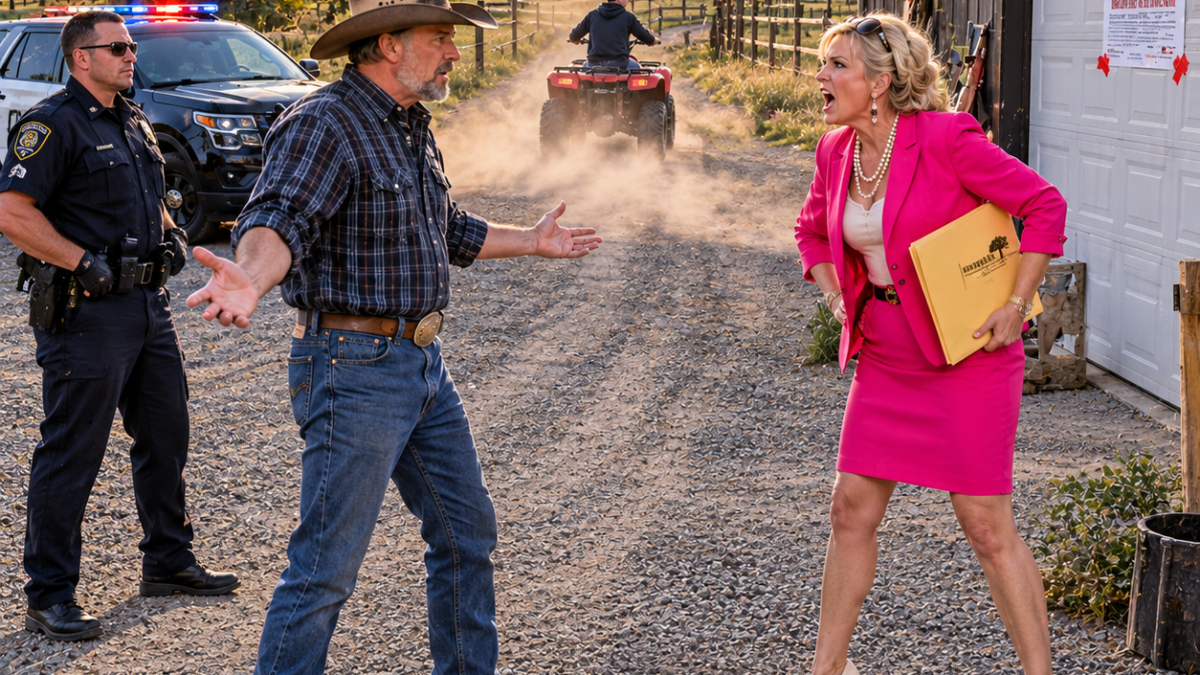
Karen Whitmore shouted that from the middle of my driveway while her seventeen-year-old son tore down the gravel road on my ATV, throwing a brown plume of dust into the orange evening light. The machine had been parked beside my equipment barn ten minutes earlier, keys in the ignition because I had been repairing fence along the north pasture and planned to head back out before dark.
Now it was disappearing toward the county road.
Karen stood beside me in a bright pink blazer, matching skirt, cream heels, and the expression of a woman who believed she had just won a legal argument by committing an offense loudly enough. Under one arm was her yellow Cedar Ridge Estates folder. A violation notice with the HOA logo had been taped crookedly across my garage door.
I read the top line.
UNAUTHORIZED VISIBLE EQUIPMENT — IMMEDIATE REMOVAL AUTHORIZED.
I looked back at her.
“Karen, did you just tell your son to take my ATV?”
“He removed a noncompliant hazard.”
“That wasn’t my question.”
She lifted her chin. “Yes.”
The arrogance of it almost impressed me.
My name is Jack Mercer. I was fifty-two years old, chief of police in the nearby town of Stone Creek, and owner of Mercer Ranch, four thousand acres my family had held long before Cedar Ridge Estates existed. I had spent nearly three decades in law enforcement, including fifteen years investigating everything from farm theft to organized vehicle fraud.
And on my day off, wearing faded jeans, a charcoal flannel shirt, dusty boots, and a cowboy hat, I was standing in my own driveway listening to an HOA president explain that her bylaws apparently outranked state property law.
“You need to surrender all keys for unapproved recreational equipment,” Karen said. “I gave you three notices.”
“It’s not recreational equipment.”
“It has four wheels.”
“So does your SUV.”
Her mouth tightened.
“That attitude is why enforcement became necessary.”
I looked down the road. Her son was already out of sight.
The ATV mattered to me. I had bought it years earlier after leaving active military service, before I joined Stone Creek PD. It had carried fencing wire, mineral blocks, veterinary supplies, and more exhausted ranch dogs than I could count. I used it nearly every day.
Karen tapped the folder against her palm.
“You’ll also need to sign the association acknowledgment. Once Mercer Ranch is formally integrated, we can waive some penalties.”
“My ranch isn’t in Cedar Ridge.”
“It’s visible from Cedar Ridge.”
“So is the moon.”
She glared at me.
I reached into my pocket.
For the first time, her confidence flickered.
“What are you doing?”
“Making a phone call.”
“To your lawyer?”
“No.”
I dialed dispatch.
Karen laughed.
“Go ahead. The police will tell you this is an HOA matter.”
The dispatcher answered.
“Stone Creek communications.”
“This is Chief Mercer.”
There was a pause.
“Chief? Thought you were off today.”
“I am. I need a unit at Mercer Ranch. Possible unauthorized taking of a motor vehicle. Juvenile involved. No emergency response.”
Karen’s smile vanished.
I gave the ATV description and direction of travel.
Then I ended the call.
She stared at me.
“You’re the chief?”
I slipped the phone back into my pocket.
“Karen, you’ve been sending me letters for four months.”
Her face went pale.
“You never thought to read the name?”
part 2
The first patrol unit reached my ranch eight minutes later.
Officer Daniel Ruiz stepped out, took one look at me, then at Karen, then at the empty tire tracks running through the dust.
“Chief?”
“Dan.”
“You all right?”
“I’m fine.”
He nodded toward Karen. “What happened?”
Before I could answer, she stepped forward as though the city had finally sent someone qualified to appreciate her position.
“I’m Karen Whitmore, president of Cedar Ridge Estates. This property has been repeatedly cited for unauthorized exterior equipment, and my son performed a lawful HOA removal after Mr. Mercer refused compliance.”
Ruiz blinked.
I had known Dan for nine years.
He had a remarkable ability to keep a straight face during difficult interviews.
That evening tested it.
“A lawful HOA removal?” he asked.
“Yes.”
“Of his ATV?”
“Yes.”
“From his ranch?”
“Yes.”
“By your son?”
“Yes.”
Ruiz glanced at me.
I said nothing.
Karen opened the yellow folder and pulled out several sheets of paper.
“It’s all documented. He received notice. The ATV was visible from community roads, it violated aesthetic standards, and Article Seven allows corrective action when owners refuse voluntary compliance.”
Ruiz read the first page.
Then he looked at the ranch house, the equipment barn, the cattle beyond the fence, and the four thousand acres stretching west toward the ridge.
“Ma’am, is this property in your HOA?”
Karen hesitated.
“It is functionally adjacent.”
“That isn’t what I asked.”
“It benefits from the community.”
Ruiz handed the paper back.
“Is the ranch legally subject to the Cedar Ridge declaration?”
Karen’s voice sharpened.
“That’s a technical distinction.”
“No,” I said. “That’s the entire distinction.”
A second unit arrived behind Ruiz, driven by Officer Lisa Morgan. I knew immediately that my presence made the situation sensitive. I was their chief. Any investigation involving my property needed clean handling, no favors, no appearance that I was directing my own officers toward a predetermined result.
I told both of them exactly that.
“Treat me like any other complainant. Call the county if you want outside supervision.”
Ruiz nodded. “Already thinking the same thing.”
He contacted the sheriff’s office and requested a deputy because the ATV had left city jurisdiction almost immediately after entering the county road system.
Karen overheard him.
“This is absurd,” she said. “You’re turning HOA enforcement into a police incident.”
I looked at her.
“You turned it into a police incident when you sent someone away with property you didn’t own.”
“He had permission.”
“From whom?”
“From me.”
“That’s the problem.”
Karen folded her arms.
“He’s my son.”
“That is not a deed.”
Officer Morgan asked Karen to remain by her vehicle while Ruiz took my statement. I explained the timeline from the moment Karen arrived.
She had driven through my open ranch gate shortly after five.
Her son Dylan followed in the passenger seat.
I had been loading fence staples into the ATV cargo box.
Karen approached with her yellow folder and slapped a violation notice against the garage door.
She told me the ATV was an “unauthorized exterior motorized unit.”
I told her Mercer Ranch was not part of Cedar Ridge.
She insisted the HOA had “expanded visual jurisdiction” over neighboring land affecting subdivision appearance.
I asked her where that authority was recorded.
She said it was “internal policy.”
I asked whether internal policy had somehow purchased my ATV.
That was when she told Dylan to take the keys.
I believed she was bluffing.
Dylan did too.
He stood near the ATV looking at his mother like he wished the earth would open underneath him.
“Mom, seriously?”
“Take it.”
“I don’t think—”
“I didn’t ask what you think.”
He looked at me.
I said, “Son, that machine belongs to me. Don’t touch it.”
Karen stepped between us.
“Do not intimidate my child.”
“I’m telling him not to take my property.”
“He is acting under my authority.”
Dylan hesitated.
Then Karen leaned toward him and said something quietly.
He climbed onto the ATV.
I could have physically stopped him.
I did not.
The machine was property.
A confrontation involving a teenager, an angry parent, and a vehicle was not worth creating a dangerous situation.
I stepped back.
Dylan started the engine.
Karen smiled.
Then he drove away.
Officer Ruiz wrote down everything without interrupting.
When I finished, he asked, “Any cameras?”
“Six.”
Karen heard that from twenty feet away.
Her head turned.
I pointed toward the barn roof.
One camera covered the driveway.
Another covered the garage.
Two covered the equipment yard.
One watched the front gate.
The sixth looked toward the county road.
Karen’s shoulders dropped perhaps half an inch.
“Those cameras record audio?” Ruiz asked.
“Yes.”
“Cloud backup?”
“Yes.”
That half inch became a full inch.
I handed Ruiz temporary access through my security app.
The video was even clearer than I expected.
Karen’s SUV arrived.
She stepped out.
She placed the notice.
She argued with me.
Then she told Dylan to take the ATV.
The microphones captured his refusal.
They also captured the quiet sentence she whispered afterward.
“If you don’t do this, I’m taking your truck away for a month.”
Ruiz replayed it.
Dylan climbed onto the ATV.
Karen called after him.
“Take it to our garage. I’ll deal with him.”
Then came her statement after he left.
“My son can take whatever he wants from your property. He’s protected by the HOA, and you can’t do anything about it.”
Ruiz paused the video.
Officer Morgan looked toward Karen.
Karen suddenly became very interested in something inside her folder.
A sheriff’s deputy arrived ten minutes later.
His name was Calvin Reeves.
We knew each other professionally but not well enough for anyone to reasonably suggest friendship or favoritism.
That helped.
Reeves reviewed the video, confirmed the ranch boundary on county mapping, and radioed another deputy farther east with the ATV description.
They located Dylan about twenty minutes later.
He had not hidden the machine.
He had driven it directly to Karen’s house in Cedar Ridge and parked it inside her detached garage.
That detail mattered.
He had not taken it for a joyride.
He had followed his mother’s instruction and delivered it to her property.
Reeves did not handcuff him in front of the neighborhood or treat him like a hardened criminal.
Dylan was seventeen.
The juvenile process existed for a reason.
His father, Mark Whitmore, was home by then and apparently knew nothing about what had happened.
Mark later told me the first thing he saw when he opened the garage was my mud-covered ATV sitting beside his lawn mower.
The second thing he saw was a sheriff’s cruiser entering his driveway.
The third was Dylan whispering, “Dad, Mom said it was legal.”
I almost felt sorry for the man.
Almost.
By seven that evening, the ATV was back on a county trailer headed toward my ranch so deputies could document it properly before returning it.
There was minor damage.
A bent rack.
A deep scratch along one side.
One broken plastic panel where Dylan apparently clipped a fence post entering Cedar Ridge.
Nothing catastrophic.
What interested investigators more was the paperwork inside Karen’s folder.
Her notice contained several claims that were not merely wrong.
They were invented.
It stated that Cedar Ridge Estates possessed “temporary seizure authority” over noncompliant equipment visible from association-maintained streets.
There was no citation to any declaration section.
No statutory reference.
No board resolution number.
Just Karen’s signature.
At the bottom, in bold letters, she had written:
FAILURE TO COMPLY MAY RESULT IN PROPERTY REMOVAL, EVICTION PROCEEDINGS, AND ASSESSMENT LIENS.
I read the sentence twice.
Then I called Rachel Bennett.
Rachel had been my attorney for years and had handled several land-use disputes involving the ranch.
When I told her Karen had threatened eviction from property outside the HOA, she was silent for a long moment.
Then she said, “Jack, please tell me you saved every letter.”
“I save everything.”
“I know. That’s why I like you.”
“You charge me by the hour.”
“That’s why I like you even more.”
The next morning, Rachel pulled the county records.
Mercer Ranch was not subject to Cedar Ridge Estates.
It never had been.
The recorded declaration covered the subdivision lots, private roads, common areas, drainage easements, and community facilities.
My property sat outside every one of those boundaries.
No amendment annexed my acreage.
No document gave Cedar Ridge authority over ranch vehicles.
No agreement allowed their board to regulate equipment on my land.
And there was certainly no provision allowing anyone to take property because it could be seen from the subdivision.
Rachel called the phrase “expanded visual jurisdiction” one of the more creative pieces of nonsense she had encountered that year.
“Can they regulate anything visible?” I asked.
“No.”
“What about my barn?”
“No.”
“My cattle?”
“No.”
“My tractor?”
“No.”
“My hat?”
“Unfortunately, your hat remains a matter of personal choice.”
I laughed.
Then she stopped joking.
“Jack, we need to preserve records immediately.”
Within hours, she sent formal preservation letters to Cedar Ridge, its management company, its insurance carrier, and its counsel.
The letters demanded retention of emails, texts, board minutes, enforcement logs, policy drafts, communications involving Mercer Ranch, and anything related to “temporary seizure authority,” “expanded visual jurisdiction,” or nonmember enforcement.
That phrase terrified them.
Not because preservation letters are dramatic.
Because they prevent convenient forgetting.
The HOA’s attorney called Rachel before lunch.
According to her, his first question was simple.
“What exactly did Karen do?”
Rachel sent him the video.
He called back twelve minutes later.
His second question was different.
“Does your client intend to sue the association?”
Rachel answered the way good lawyers do.
“My client intends to protect his rights.”
By that afternoon, the Cedar Ridge board scheduled an emergency meeting.
Karen was temporarily prohibited from sending enforcement communications on behalf of the association pending internal review.
She did not take that quietly.
At 4:16 p.m., she called me.
I did not answer.
At 4:18, she called again.
At 4:23, again.
At 4:31, she left a voicemail.
“Jack, this is becoming unnecessarily adversarial. I’m willing to discuss a reasonable return of the ATV matter if you stop involving outside agencies.”
A reasonable return.
The ATV was already back in my barn.
She apparently had not yet realized that.
At 4:45, she left another voicemail.
“The police should not be weaponized in private HOA disputes.”
I saved that one.
At 5:02, she sent a text.
WE CAN STILL RESOLVE THIS WITHOUT DESTROYING THE COMMUNITY.
I forwarded it to Rachel.
She replied with one sentence.
Do not engage.
That night, I parked the ATV beside the barn and inspected it under the floodlights.
There was dirt packed into the tires from Cedar Ridge.
The broken panel hung slightly loose.
The scratch ran beneath the seat.
It was not the most valuable machine I owned.
I had tractors worth more.
Trailers worth more.
A work truck worth more.
But seeing somebody else’s mud on that ATV made me angrier than I expected.
Ownership can sound abstract until someone treats your property as if your consent is irrelevant.
Karen had not simply taken a machine.
She had tried to teach me that “no” did not matter.
That bothered me more than the damage.
I had spent most of my adult life enforcing boundaries.
Search warrants.
Property rights.
Due process.
Probable cause.
Consent.
Authority.
Jurisdiction.
Those words mattered because without boundaries, power becomes personal.
Karen believed power was whatever she could persuade people to fear.
I believed power required lawful authority.
One of us was about to learn which version survived daylight.
Two days later, the juvenile investigator called.
Dylan had given a statement with his father and attorney present.
He admitted taking the ATV.
He admitted knowing it belonged to me.
He also said his mother told him Cedar Ridge was legally entitled to remove it.
He had questioned her twice.
She threatened to punish him if he refused.
That did not erase his responsibility.
But it changed how I viewed him.
The investigator asked whether I wanted the harshest possible outcome.
“No.”
There was a pause.
“You’re sure?”
“I want accountability. I don’t want to ruin a seventeen-year-old because his mother convinced him she had authority she didn’t have.”
“That’ll be part of our report.”
I asked whether Dylan had any prior record.
None.
No school disciplinary history involving theft.
No previous juvenile contacts.
No pattern of stealing.
Just one extremely bad afternoon and one mother who apparently treated her son like an unpaid enforcement department.
I told the investigator I would support a resolution focused on restitution, community service, counseling, and education if the prosecutor and juvenile court considered that appropriate.
Then I added one condition.
“I want him to understand that ‘my mother told me to’ doesn’t make taking somebody’s property legal.”
The investigator said, “I think he already does.”
Karen, however, seemed determined to understand nothing.
Three days after the ATV incident, Cedar Ridge held its emergency board meeting.
I did not attend.
Rachel did.
She called me afterward.
“You’re going to enjoy this.”
“I try not to enjoy legal disasters.”
“You will fail.”
The board had seven members.
Karen arrived carrying three binders.
Not one.
Three.
She apparently intended to prove that her actions were authorized.
The HOA attorney began by asking her to identify the recorded document giving Cedar Ridge enforcement authority over Mercer Ranch.
She cited Article Seven.
The attorney explained that Article Seven applied only to “Lots” as defined in the declaration.
Mercer Ranch was not a Lot.
Karen argued that the ranch was “visually integrated.”
The attorney asked where that phrase appeared in the declaration.
It did not.
Karen cited a policy she had written.
The attorney asked when the board approved it.
They had not.
She cited an executive decision.
The attorney asked whether she believed the HOA president could expand the association’s jurisdiction unilaterally.
Karen answered yes.
According to Rachel, the room became so quiet that someone’s phone vibrating on a folding table sounded like construction equipment.
Then the treasurer, Paul Jenkins, asked the question that apparently ended whatever support Karen still had.
“Karen, did you authorize your son to take Jack Mercer’s ATV?”
She replied, “I authorized corrective removal.”
Paul stared at her.
“That wasn’t the question.”
Karen repeated herself.
The board watched the security video.
No one spoke during the clip.
When Karen’s recorded voice said, “My son can take whatever he wants from your property,” one board member actually covered his face with both hands.
Then came the best part.
Karen insisted that the phrase had been “taken out of context.”
The attorney asked what context would make it better.
She had no answer.
The board suspended her as president that night pending a formal removal vote.
She was also barred from accessing the association’s letterhead, email account, enforcement database, and management portal.
Karen responded by demanding that the board reimburse her for “personal reputational damages.”
They declined.
Within forty-eight hours, Cedar Ridge sent me a certified letter.
It formally retracted every violation notice.
It acknowledged that Mercer Ranch was not within the association.
It confirmed that no assessment balance existed.
It stated that no HOA representative had authority to enter my property or remove equipment.
And it apologized.
I read the letter at my kitchen table.
Then I placed it beside Karen’s first notice.
That first notice had demanded $1,800 in “visual compatibility penalties.”
The second had demanded $4,200.
The third demanded $9,700.
By the time she took the ATV, Karen claimed I owed Cedar Ridge $18,450.
Rachel noticed something strange when comparing the statements.
The numbers did not follow any formula in the governing documents.
There was no standard fee schedule producing those amounts.
The late charges varied.
Administrative fees appeared randomly.
One month included something called a “Rural Aesthetic Impact Assessment.”
Another included a “Boundary Community Support Charge.”
Rachel called the HOA attorney.
“Where did these fees come from?”
He did not know.
That question widened the dispute.
The association produced records.
Karen had created a spreadsheet.
In it were six properties outside Cedar Ridge.
Mine was one.
The others included two small horse properties, a landscape contractor’s yard, a retired couple’s five-acre parcel, and an old farmhouse owned by a widow named Eleanor Price.
Every property was outside the HOA.
Every owner had received notices.
Three had paid money.
Eleanor had paid $2,600.
When Rachel told me that, I felt something inside me go cold.
I drove to Eleanor’s place the following Saturday.
She was seventy-four, sharp-minded, and embarrassed that she had paid.
“They made the letters look official,” she said.
“They were official HOA letters.”
“I thought maybe the subdivision had some agreement with the county.”
“It didn’t.”
“They threatened a lien.”
“On property they didn’t control.”
She nodded.
“I know that now.”
There was nothing funny about that.
Karen had found people who did not know the limits of HOA authority and used uncertainty as leverage.
A printed logo.
Legal-sounding phrases.
Deadlines.
Threats of liens.
Threats of eviction.
Most people do not have time to pull declarations and county records every time an official-looking envelope arrives.
They pay because they are afraid.
Karen understood fear.
That made what she had done to me look less like an impulsive tantrum and more like the moment she finally went too far.
Rachel amended our civil complaint.
We sought a declaratory judgment establishing that Mercer Ranch was outside Cedar Ridge jurisdiction.
We sought injunctive relief preventing further enforcement attempts.
We sought compensation for the ATV damage and related losses.
We also alleged wrongful interference based on Karen’s conduct and asked the court to address the association’s use of unauthorized collection notices.
The other affected property owners hired counsel as well.
Cedar Ridge’s insurance carrier became involved.
The board suddenly developed a deep appreciation for careful record keeping.
Karen developed a deep hatred of Rachel.
I learned that from another voicemail.
“She is manipulating you.”
Rachel listened to it in her office.
Then she smiled.
“Good.”
“You enjoy this too much.”
“No, Jack. I enjoy being blamed for reading documents.”
The court granted temporary injunctive relief early in the case.
Karen and Cedar Ridge were prohibited from entering Mercer Ranch for enforcement purposes, attempting to collect the disputed charges, removing property, or representing that Cedar Ridge possessed jurisdiction over my land unless and until they could establish a lawful basis.
They could not.
The recorded declaration remained stubbornly factual.
Karen’s lawyer tried a different approach.
He argued that she believed in good faith that Cedar Ridge had authority over neighboring properties that “materially affected the visual environment.”
The judge asked him whether belief created jurisdiction.
He said no.
The judge asked whether any recorded covenant supported Karen’s interpretation.
He said no.
The judge asked whether the board had adopted the policy.
He said no.
Then the judge looked at Karen.
She was sitting behind counsel in a navy blazer instead of pink.
Apparently someone had advised her that courtroom clothing should not resemble a highlighter.
She still looked furious.
The judge said, “Ms. Whitmore, homeowners associations exercise whatever authority the governing documents and applicable law actually provide. They do not obtain additional authority merely because an officer believes additional authority would be useful.”
Karen whispered something.
The judge stopped.
“Would you like to share that with the court?”
Her lawyer touched her arm.
“No, Your Honor.”
“Excellent.”
I looked down at my hands so I would not smile.
The criminal investigation moved separately.
Because Dylan was a juvenile, the details remained appropriately limited.
His case did not become public entertainment.
He entered a structured juvenile resolution involving restitution toward the ATV damage, community service, counseling, and supervision.
I agreed to participate in a restorative conference.
The meeting happened in a small county office with Dylan, Mark, a juvenile officer, and me.
Karen was not there.
Dylan looked exhausted.
He had lost weight.
He stared at the table.
“I knew it wasn’t mine,” he said.
I waited.
“I just thought she knew something I didn’t.”
“About the law?”
“About everything.”
That answer stayed with me.
He told me Karen had been using him for months.
Deliver this notice.
Photograph that fence.
Write down license plates.
Measure someone’s trash cans.
Take pictures of a shed.
She called it “helping the community.”
Dylan called it “keeping her from yelling.”
I did not need to ask which description was more accurate.
“Why did you take the ATV?” I asked.
He rubbed his palms together.
“Because she said you were bluffing. She said you were just some rancher trying to scare us.”
I raised an eyebrow.
“You didn’t know I was chief?”
He shook his head.
“I don’t read her letters.”
For some reason, that made me laugh.
He looked confused.
“Sorry,” I said. “That may be the healthiest thing anyone in your house was doing.”
Even Mark laughed.
Dylan smiled for half a second.
Then he became serious.
“I’m sorry.”
“I know.”
“I damaged it.”
“Yeah.”
“I’ll pay whatever the court says.”
“That matters.”
He nodded.
Then I said, “But I need you to remember something longer than you remember me.”
He looked up.
“Authority has limits. Your mom telling you she has power doesn’t mean she does. A badge doesn’t give me unlimited power either. A judge has limits. A mayor has limits. An HOA has limits. The person telling you to cross somebody else’s line should be able to show you why they’re allowed to.”
Dylan stared at me.
Then he nodded again.
“I should’ve stopped.”
“Yes.”
That was enough.
I never became his friend.
I never pretended taking the ATV was harmless.
But I stopped seeing him as the villain.
Karen noticed.
She hated it.
Weeks later, she confronted Mark in the Cedar Ridge clubhouse parking lot because he had allowed Dylan to cooperate with juvenile authorities.
Several residents witnessed the argument.
According to them, Karen accused Mark of “siding with Jack.”
Mark responded, “I’m siding with our son.”
That became the beginning of the end of their marriage.
I did not celebrate that.
Families breaking apart are not victories.
But I understood what Mark meant.
Karen had reached the point where loyalty meant accepting her version of reality even when video proved it false.
The formal board removal vote happened one month after the ATV incident.
This time, Karen came prepared with a PowerPoint presentation.
I wish I were making that up.
The first slide reportedly said:
PRESIDENTIAL AUTHORITY DURING COMMUNITY NONCOMPLIANCE EVENTS
The HOA attorney stopped her before slide two.
He explained that the meeting was not a seminar.
The board voted six to one to remove her.
Karen voted against removal.
Then she demanded to vote again as a homeowner.
The attorney explained that she did not receive two votes merely because she had lost one job during the meeting.
A resident in the back began laughing.
Then another.
Soon half the room was laughing.
Karen slammed her binder shut and announced that Cedar Ridge would collapse without her leadership.
Someone replied, “Can it collapse after dessert? We already ordered cookies.”
That became neighborhood legend.
Paul Jenkins took over temporarily.
His first official action was to suspend every nonmember enforcement file.
His second was to commission legal review of the letters Karen had sent.
His third was to remove the words “expanded visual jurisdiction” from the association server because nobody could explain what they meant.
Cedar Ridge eventually refunded money to all three outside property owners who had paid.
Eleanor received her $2,600 back.
She called me after the check cleared.
“I bought a new refrigerator.”
“That’s a good use of HOA money.”
“It was my money.”
“Even better.”
She laughed.
Then her voice softened.
“Thank you.”
I told her Rachel deserved the credit.
She disagreed.
“You didn’t let them scare you.”
That bothered me more than praise usually does.
I had not been easy to scare because I understood the system.
I knew how to pull public records.
I knew how investigations worked.
I knew when a threat sounded legitimate and when it sounded like nonsense printed in bold.
Eleanor did not.
Karen had counted on that difference.
The civil case moved toward settlement.
My ATV damage was documented at just under $4,000 including replacement body panels, rack repair, paint work, inspection, and loss of use while it was being held and repaired.
The larger issue involved the unlawful fee demands and interference with my property.
Rachel refused to let negotiations become theatrical.
She collected evidence.
The recorded declarations.
Survey maps.
Board minutes.
Karen’s emails.
The security video.
Body-camera recordings from the officers who responded.
Repair invoices.
The invented fee spreadsheet.
Communications with nonmember owners.
Karen’s texts discussing “forcing participation” from neighboring parcels.
One email was especially damaging.
She had written to another board member six weeks before the ATV incident:
“If outsiders won’t join voluntarily, we need to make noncompliance more expensive than membership.”
The board member had replied:
“We cannot assess properties outside the declaration.”
Karen answered:
“Then we need a more creative approach.”
Rachel printed that one in large font.
I asked why.
“Judges appreciate legibility.”
“You’re enjoying this again.”
“Immensely.”
The association’s insurer eventually agreed to resolve the claims involving Cedar Ridge.
Karen’s personal liability remained a separate fight because some of her conduct arguably fell outside authorized HOA duties.
I did not care which pocket paid which dollar as long as the affected people were made whole and the legal boundaries were clear.
My settlement covered the ATV repair and documented losses.
The outside owners recovered what they had paid.
The association agreed to adopt a formal verification policy before sending enforcement notices.
And the court entered permanent relief confirming Cedar Ridge had no authority over Mercer Ranch under its existing governing documents.
That sentence mattered more to me than money.
Karen had spent months telling me I belonged to her system.
Now the public record said otherwise.
Her separate criminal exposure was more complicated.
Prosecutors reviewed her role in directing Dylan, the representations she made, and her participation in taking possession of property through the HOA scheme.
I stayed out of charging decisions.
Being police chief made that especially important.
I requested that the county handle all prosecutorial communication involving my case and documented every contact.
Eventually, Karen entered a negotiated resolution involving the conduct surrounding the ATV and her threats.
There were court-imposed conditions.
Financial obligations.
No-contact provisions regarding my ranch.
And a requirement that she not act in any HOA enforcement capacity during the relevant period.
The exact legal labels mattered less to me than one simple fact.
Her title stopped being a shield.
There was no dramatic courtroom speech.
No judge pounding a gavel while thunder crashed outside.
Real consequences are usually quieter.
Paperwork.
Deadlines.
Court dates.
Insurance calls.
Recorded orders.
Checks.
Restrictions.
Public records.
But Karen discovered something people like her often learn too late.
Quiet consequences accumulate.
Her employer placed her on leave after learning about the public case.
I never contacted them.
I never asked anyone to fire her.
Months later, she no longer worked there.
The Cedar Ridge social circle she had dominated stopped inviting her to committee meetings.
The neighborhood newsletter stopped printing her columns.
Residents who once nodded politely when she approached began crossing the street.
Not because I asked them to.
Because they had seen the video.
There is something devastating about arrogance meeting playback.
Karen could reinterpret a conversation.
She could deny an intention.
She could blame misunderstanding.
But she could not make her recorded voice stop saying:
“My son can take whatever he wants from your property.”
That sentence followed her everywhere.
One afternoon, about four months after the incident, I was repairing a cattle guard near the main entrance when Mark’s pickup pulled over outside my gate.
Dylan was with him.
I walked over.
Mark rolled down the window.
“We’re not coming in without permission.”
“That already puts you ahead of your former household policy.”
Mark laughed.
Dylan looked embarrassed.
Then he pointed toward the bed of the pickup.
There were two new ATV tires inside.
“What’s that?”
“Mine,” he said.
“What do you mean?”
“I’ve been working at my uncle’s shop.”
“So?”
“So the juvenile officer approved me paying some restitution directly. I know the repair bill already got handled, but these match your model.”
I stared at him.
“You don’t owe me extra.”
“I know.”
“Then why buy them?”
He shrugged.
“Because I wanted to bring something useful instead of another apology.”
That was a good answer.
I opened the gate.
“Bring them in.”
We spent the next hour in the equipment barn.
Dylan helped mount one tire while Mark held the wheel.
He asked questions about the ranch.
Real questions.
Not surveillance questions.
How many cattle?
How long had the ranch been in the family?
How often did fences break?
How far could the ATV go on one tank?
At one point, he asked whether I still hated him.
I tightened a lug nut.
“I never hated you.”
“You probably should.”
“No. I was angry.”
“Same thing.”
“No, it isn’t.”
He thought about that.
Then I said, “I’ve arrested people I hated what they did without hating them. You learn the difference.”
He nodded.
A minute later, he dropped the socket.
It rolled under a workbench.
He crawled underneath, hit his head, and muttered something I pretended not to hear.
Mark looked at me.
“Restorative justice.”
I said, “Looks more like restorative concussion.”
Dylan shouted from under the bench, “I heard that.”
We laughed.
That was probably the moment I knew he was going to be all right.
Karen was not done embarrassing herself.
Her house went on the market two months later.
The listing described Cedar Ridge as a “peaceful, professionally managed community.”
Everyone in town found that sentence hilarious.
The FOR SALE sign appeared on a Thursday.
On Friday morning, Karen discovered somebody had placed a small toy ATV beside it.
No one knew who.
I did not ask.
She removed it.
The next day, another appeared.
Then another.
By Sunday, there were five toy ATVs arranged neatly around the sign.
Paul Jenkins sent a community email reminding residents not to harass anyone or place objects on private property.
The toys disappeared.
That was the correct response.
Still, I admit I laughed when I heard about it.
Karen sold the house that winter.
Before she left, she sent me one final letter.
It was not an apology.
It was four pages explaining that her intentions had always been to protect community values and that “certain individuals” had exploited a misunderstanding to undermine her leadership.
She never admitted taking my ATV was wrong.
She never admitted inventing authority.
She never mentioned Eleanor.
She never mentioned the money collected from nonmembers.
She never mentioned pressuring Dylan.
At the end, she wrote:
History will eventually recognize that I was trying to preserve standards.
I read that sentence twice.
Then I walked outside and fed it through the office shredder.
Some documents are evidence.
Some are garbage.
Knowing the difference matters.
Cedar Ridge changed after Karen left.
The new permanent president was Denise Harper, a retired accountant with a dry sense of humor and an almost religious devotion to recorded documents.
The first time Denise came to my ranch, she stopped outside the gate and called me.
“Jack, this is Denise from Cedar Ridge.”
“I know.”
“May I enter the property?”
I smiled.
“You called first?”
“That seemed fashionable.”
“Come on in.”
She drove to the barn and handed me a folder.
For one terrifying second, I thought the yellow paper had returned.
Then she opened it.
Inside was a copy of the HOA’s new jurisdiction verification policy.
Every enforcement file now required confirmation that the property was legally subject to the declaration before any demand could be issued.
No confirmation, no notice.
No board member could authorize removal of property.
No volunteer could enter outside land for enforcement purposes.
Any disputed boundary required review by counsel.
I read the policy.
“Seems reasonable.”
Denise nodded.
“We’ve named it internally.”
I looked at her.
“No.”
She smiled.
“The Mercer Protocol.”
I closed my eyes.
“Absolutely not.”
“It was unanimous.”
“I’m not joining your HOA.”
“You don’t have to. That’s literally the point.”
I laughed.
She looked toward my ATV.
“That the famous machine?”
“Unfortunately.”
“It looks ordinary.”
“Most constitutional crises do.”
She laughed so hard she had to lean against her SUV.
That was the difference between Denise and Karen.
Denise could laugh at authority.
Karen needed authority to make everyone else stop laughing.
The ranch went back to normal.
That sounds boring.
It was wonderful.
Cattle broke fences.
Pumps failed.
A windstorm tore tin from the hay shed.
One of my ranch hands backed a trailer into a water trough.
I spent two miserable hours fixing an irrigation valve while lying in mud.
Every one of those problems felt honest.
None arrived in a yellow HOA folder claiming my family land had somehow become someone else’s jurisdiction because it was visible from a decorative walking path.
The ATV returned to daily work.
I replaced the damaged panels.
The new tires Dylan brought lasted almost three years.
Every time I climbed onto the machine, I remembered the sight of him disappearing down the driveway with Karen standing behind him like a victorious general.
At the time, I had been furious.
Later, I saw the moment differently.
Karen believed victory meant forcing another person to move.
Take the ATV.
Send the notice.
Pay the fee.
Sign the paper.
Obey me.
She never understood that authority depending on fear collapses the moment somebody asks to see the legal basis.
I knew that because of my job.
But I also knew it because of the ranch.
My grandfather used to carry our deed copies in a metal box.
My father kept surveys rolled in cardboard tubes above his desk.
When I inherited the place, I digitized everything.
Deeds.
Boundary surveys.
Easements.
Water agreements.
Tax records.
Access documents.
Not because I expected an HOA president in pink to send her teenage son after an ATV.
Because land survives generations when people know exactly what they own.
Karen had relied on confidence.
I relied on records.
In the end, records won.
A year after the case closed, I received a Christmas card from Mark.
There was a picture of him and Dylan standing beside an old pickup.
Dylan had graduated high school and started community college while working part time at his uncle’s auto shop.
On the back, he wrote:
Still putting down things that aren’t mine.
Good habit.
I kept the card.
Not because the story ended perfectly.
It did not.
Karen lost her position.
Her marriage failed.
She moved away.
Her son had to work through the consequences of a decision he never should have made.
Several homeowners learned their association had been used in ways they never approved.
Eleanor spent months worrying that someone could have taken her home over fake fees.
None of that becomes harmless because the villain loses.
Justice does not rewind damage.
It draws a line after it.
That distinction mattered to me.
People asked whether I had enjoyed watching Karen fall.
Parts of it?
Yes.
I enjoyed the board attorney explaining jurisdiction to her.
I enjoyed hearing that her PowerPoint presentation died before slide two.
I enjoyed learning that someone had ordered cookies for the meeting where she lost office.
I enjoyed Denise calling the new policy the Mercer Protocol even though I told her not to.
But what satisfied me most was smaller.
Eleanor’s refunded money.
Dylan learning to question authority.
The permanent court order.
The association finally admitting where its fence line ended.
That was enough.
One summer evening, long after Karen had moved, I parked the ATV on the ridge above the west pasture.
The sunset spread across the sky in long bands of orange, purple, and gold.
From up there, Cedar Ridge looked tiny.
Rows of roofs.
Neat streets.
A clubhouse.
Decorative lamps.
Beyond it stretched Mercer Ranch.
Four thousand acres.
No gates except mine.
No HOA signs.
No pink blazer.
No yellow folder.
I thought back to Karen standing in my driveway telling me her son could take whatever he wanted because she said the HOA protected him.
There had been one tiny problem with her theory.
The law did not work that way.
Neither did property ownership.
Neither did police authority.
Neither did basic decency.
Her son could not take whatever he wanted.
She could not invent jurisdiction.
A letterhead could not create a lien.
A board title could not erase a deed.
And fear could not convert private property into community property simply because Karen wanted it.
She had mistaken intimidation for law.
That mistake cost her everything she valued most about herself.
Her office.
Her reputation.
Her control.
My ATV?
It stayed exactly where it belonged.
So did the ranch.
Every pasture.
Every barn.
Every gate.
Every fence.
Every machine.
Every sunset.
Mine.
And the last time Cedar Ridge ever contacted me about “visible equipment,” it was Denise calling to ask whether she could borrow my tractor after a storm dropped a tree across their entrance road.
I drove over personally.
When I arrived, Denise pointed toward the fallen tree.
“Does the HOA have authority to remove it?”
I looked around.
“Is the tree a member?”
She stared at me.
Then she laughed.
We hauled it away.
No violation notice.
No invented fee.
No seizure policy.
Just neighbors helping neighbors.
That was the community Karen had claimed she was protecting.
Ironically, it worked much better once she stopped running it.
THE STORY ENDS HERE
HOA Karen Let Her Son Steal My Ranch ATV Because I Refused Her Fees — She Said Her Rules Beat My Property Rights
She watched her teenage son drive away on my ATV and actually smiled.
Then she told me the HOA protected him from anything I could do.
What Karen did not know was that I had spent thirty years learning exactly where authority ends.
“My son can take whatever he wants from your property. He’s protected by the HOA, and you can’t do a damn thing about it.”
Karen Whitmore shouted that from the middle of my driveway while her seventeen-year-old son tore down the gravel road on my ATV, throwing a brown plume of dust into the orange evening light. The machine had been parked beside my equipment barn ten minutes earlier, keys in the ignition because I had been repairing fence along the north pasture and planned to head back out before dark.
Now it was disappearing toward the county road.
Karen stood beside me in a bright pink blazer, matching skirt, cream heels, and the expression of a woman who believed she had just won a legal argument by committing an offense loudly enough. Under one arm was her yellow Cedar Ridge Estates folder. A violation notice with the HOA logo had been taped crookedly across my garage door.
I read the top line.
UNAUTHORIZED VISIBLE EQUIPMENT — IMMEDIATE REMOVAL AUTHORIZED.
I looked back at her.
“Karen, did you just tell your son to take my ATV?”
“He removed a noncompliant hazard.”
“That wasn’t my question.”
She lifted her chin. “Yes.”
The arrogance of it almost impressed me.
My name is Jack Mercer. I was fifty-two years old, chief of police in the nearby town of Stone Creek, and owner of Mercer Ranch, four thousand acres my family had held long before Cedar Ridge Estates existed. I had spent nearly three decades in law enforcement, including fifteen years investigating everything from farm theft to organized vehicle fraud.
And on my day off, wearing faded jeans, a charcoal flannel shirt, dusty boots, and a cowboy hat, I was standing in my own driveway listening to an HOA president explain that her bylaws apparently outranked state property law.
“You need to surrender all keys for unapproved recreational equipment,” Karen said. “I gave you three notices.”
“It’s not recreational equipment.”
“It has four wheels.”
“So does your SUV.”
Her mouth tightened.
“That attitude is why enforcement became necessary.”
I looked down the road. Her son was already out of sight.
The ATV mattered to me. I had bought it years earlier after leaving active military service, before I joined Stone Creek PD. It had carried fencing wire, mineral blocks, veterinary supplies, and more exhausted ranch dogs than I could count. I used it nearly every day.
Karen tapped the folder against her palm.
“You’ll also need to sign the association acknowledgment. Once Mercer Ranch is formally integrated, we can waive some penalties.”
“My ranch isn’t in Cedar Ridge.”
“It’s visible from Cedar Ridge.”
“So is the moon.”
She glared at me.
I reached into my pocket.
For the first time, her confidence flickered.
“What are you doing?”
“Making a phone call.”
“To your lawyer?”
“No.”
I dialed dispatch.
Karen laughed.
“Go ahead. The police will tell you this is an HOA matter.”
The dispatcher answered.
“Stone Creek communications.”
“This is Chief Mercer.”
There was a pause.
“Chief? Thought you were off today.”
“I am. I need a unit at Mercer Ranch. Possible unauthorized taking of a motor vehicle. Juvenile involved. No emergency response.”
Karen’s smile vanished.
I gave the ATV description and direction of travel.
Then I ended the call.
She stared at me.
“You’re the chief?”
I slipped the phone back into my pocket.
“Karen, you’ve been sending me letters for four months.”
Her face went pale.
“You never thought to read the name?”
part 2
The first patrol unit reached my ranch eight minutes later.
Officer Daniel Ruiz stepped out, took one look at me, then at Karen, then at the empty tire tracks running through the dust.
“Chief?”
“Dan.”
“You all right?”
“I’m fine.”
He nodded toward Karen. “What happened?”
Before I could answer, she stepped forward as though the city had finally sent someone qualified to appreciate her position.
“I’m Karen Whitmore, president of Cedar Ridge Estates. This property has been repeatedly cited for unauthorized exterior equipment, and my son performed a lawful HOA removal after Mr. Mercer refused compliance.”
Ruiz blinked.
I had known Dan for nine years.
He had a remarkable ability to keep a straight face during difficult interviews.
That evening tested it.
“A lawful HOA removal?” he asked.
“Yes.”
“Of his ATV?”
“Yes.”
“From his ranch?”
“Yes.”
“By your son?”
“Yes.”
Ruiz glanced at me.
I said nothing.
Karen opened the yellow folder and pulled out several sheets of paper.
“It’s all documented. He received notice. The ATV was visible from community roads, it violated aesthetic standards, and Article Seven allows corrective action when owners refuse voluntary compliance.”
Ruiz read the first page.
Then he looked at the ranch house, the equipment barn, the cattle beyond the fence, and the four thousand acres stretching west toward the ridge.
“Ma’am, is this property in your HOA?”
Karen hesitated.
“It is functionally adjacent.”
“That isn’t what I asked.”
“It benefits from the community.”
Ruiz handed the paper back.
“Is the ranch legally subject to the Cedar Ridge declaration?”
Karen’s voice sharpened.
“That’s a technical distinction.”
“No,” I said. “That’s the entire distinction.”
A second unit arrived behind Ruiz, driven by Officer Lisa Morgan. I knew immediately that my presence made the situation sensitive. I was their chief. Any investigation involving my property needed clean handling, no favors, no appearance that I was directing my own officers toward a predetermined result.
I told both of them exactly that.
“Treat me like any other complainant. Call the county if you want outside supervision.”
Ruiz nodded. “Already thinking the same thing.”
He contacted the sheriff’s office and requested a deputy because the ATV had left city jurisdiction almost immediately after entering the county road system.
Karen overheard him.
“This is absurd,” she said. “You’re turning HOA enforcement into a police incident.”
I looked at her.
“You turned it into a police incident when you sent someone away with property you didn’t own.”
“He had permission.”
“From whom?”
“From me.”
“That’s the problem.”
Karen folded her arms.
“He’s my son.”
“That is not a deed.”
Officer Morgan asked Karen to remain by her vehicle while Ruiz took my statement. I explained the timeline from the moment Karen arrived.
She had driven through my open ranch gate shortly after five.
Her son Dylan followed in the passenger seat.
I had been loading fence staples into the ATV cargo box.
Karen approached with her yellow folder and slapped a violation notice against the garage door.
She told me the ATV was an “unauthorized exterior motorized unit.”
I told her Mercer Ranch was not part of Cedar Ridge.
She insisted the HOA had “expanded visual jurisdiction” over neighboring land affecting subdivision appearance.
I asked her where that authority was recorded.
She said it was “internal policy.”
I asked whether internal policy had somehow purchased my ATV.
That was when she told Dylan to take the keys.
I believed she was bluffing.
Dylan did too.
He stood near the ATV looking at his mother like he wished the earth would open underneath him.
“Mom, seriously?”
“Take it.”
“I don’t think—”
“I didn’t ask what you think.”
He looked at me.
I said, “Son, that machine belongs to me. Don’t touch it.”
Karen stepped between us.
“Do not intimidate my child.”
“I’m telling him not to take my property.”
“He is acting under my authority.”
Dylan hesitated.
Then Karen leaned toward him and said something quietly.
He climbed onto the ATV.
I could have physically stopped him.
I did not.
The machine was property.
A confrontation involving a teenager, an angry parent, and a vehicle was not worth creating a dangerous situation.
I stepped back.
Dylan started the engine.
Karen smiled.
Then he drove away.
Officer Ruiz wrote down everything without interrupting.
When I finished, he asked, “Any cameras?”
“Six.”
Karen heard that from twenty feet away.
Her head turned.
I pointed toward the barn roof.
One camera covered the driveway.
Another covered the garage.
Two covered the equipment yard.
One watched the front gate.
The sixth looked toward the county road.
Karen’s shoulders dropped perhaps half an inch.
“Those cameras record audio?” Ruiz asked.
“Yes.”
“Cloud backup?”
“Yes.”
That half inch became a full inch.
I handed Ruiz temporary access through my security app.
The video was even clearer than I expected.
Karen’s SUV arrived.
She stepped out.
She placed the notice.
She argued with me.
Then she told Dylan to take the ATV.
The microphones captured his refusal.
They also captured the quiet sentence she whispered afterward.
“If you don’t do this, I’m taking your truck away for a month.”
Ruiz replayed it.
Dylan climbed onto the ATV.
Karen called after him.
“Take it to our garage. I’ll deal with him.”
Then came her statement after he left.
“My son can take whatever he wants from your property. He’s protected by the HOA, and you can’t do anything about it.”
Ruiz paused the video.
Officer Morgan looked toward Karen.
Karen suddenly became very interested in something inside her folder.
A sheriff’s deputy arrived ten minutes later.
His name was Calvin Reeves.
We knew each other professionally but not well enough for anyone to reasonably suggest friendship or favoritism.
That helped.
Reeves reviewed the video, confirmed the ranch boundary on county mapping, and radioed another deputy farther east with the ATV description.
They located Dylan about twenty minutes later.
He had not hidden the machine.
He had driven it directly to Karen’s house in Cedar Ridge and parked it inside her detached garage.
That detail mattered.
He had not taken it for a joyride.
He had followed his mother’s instruction and delivered it to her property.
Reeves did not handcuff him in front of the neighborhood or treat him like a hardened criminal.
Dylan was seventeen.
The juvenile process existed for a reason.
His father, Mark Whitmore, was home by then and apparently knew nothing about what had happened.
Mark later told me the first thing he saw when he opened the garage was my mud-covered ATV sitting beside his lawn mower.
The second thing he saw was a sheriff’s cruiser entering his driveway.
The third was Dylan whispering, “Dad, Mom said it was legal.”
I almost felt sorry for the man.
Almost.
By seven that evening, the ATV was back on a county trailer headed toward my ranch so deputies could document it properly before returning it.
There was minor damage.
A bent rack.
A deep scratch along one side.
One broken plastic panel where Dylan apparently clipped a fence post entering Cedar Ridge.
Nothing catastrophic.
What interested investigators more was the paperwork inside Karen’s folder.
Her notice contained several claims that were not merely wrong.
They were invented.
It stated that Cedar Ridge Estates possessed “temporary seizure authority” over noncompliant equipment visible from association-maintained streets.
There was no citation to any declaration section.
No statutory reference.
No board resolution number.
Just Karen’s signature.
At the bottom, in bold letters, she had written:
FAILURE TO COMPLY MAY RESULT IN PROPERTY REMOVAL, EVICTION PROCEEDINGS, AND ASSESSMENT LIENS.
I read the sentence twice.
Then I called Rachel Bennett.
Rachel had been my attorney for years and had handled several land-use disputes involving the ranch.
When I told her Karen had threatened eviction from property outside the HOA, she was silent for a long moment.
Then she said, “Jack, please tell me you saved every letter.”
“I save everything.”
“I know. That’s why I like you.”
“You charge me by the hour.”
“That’s why I like you even more.”
The next morning, Rachel pulled the county records.
Mercer Ranch was not subject to Cedar Ridge Estates.
It never had been.
The recorded declaration covered the subdivision lots, private roads, common areas, drainage easements, and community facilities.
My property sat outside every one of those boundaries.
No amendment annexed my acreage.
No document gave Cedar Ridge authority over ranch vehicles.
No agreement allowed their board to regulate equipment on my land.
And there was certainly no provision allowing anyone to take property because it could be seen from the subdivision.
Rachel called the phrase “expanded visual jurisdiction” one of the more creative pieces of nonsense she had encountered that year.
“Can they regulate anything visible?” I asked.
“No.”
“What about my barn?”
“No.”
“My cattle?”
“No.”
“My tractor?”
“No.”
“My hat?”
“Unfortunately, your hat remains a matter of personal choice.”
I laughed.
Then she stopped joking.
“Jack, we need to preserve records immediately.”
Within hours, she sent formal preservation letters to Cedar Ridge, its management company, its insurance carrier, and its counsel.
The letters demanded retention of emails, texts, board minutes, enforcement logs, policy drafts, communications involving Mercer Ranch, and anything related to “temporary seizure authority,” “expanded visual jurisdiction,” or nonmember enforcement.
That phrase terrified them.
Not because preservation letters are dramatic.
Because they prevent convenient forgetting.
The HOA’s attorney called Rachel before lunch.
According to her, his first question was simple.
“What exactly did Karen do?”
Rachel sent him the video.
He called back twelve minutes later.
His second question was different.
“Does your client intend to sue the association?”
Rachel answered the way good lawyers do.
“My client intends to protect his rights.”
By that afternoon, the Cedar Ridge board scheduled an emergency meeting.
Karen was temporarily prohibited from sending enforcement communications on behalf of the association pending internal review.
She did not take that quietly.
At 4:16 p.m., she called me.
I did not answer.
At 4:18, she called again.
At 4:23, again.
At 4:31, she left a voicemail.
“Jack, this is becoming unnecessarily adversarial. I’m willing to discuss a reasonable return of the ATV matter if you stop involving outside agencies.”
A reasonable return.
The ATV was already back in my barn.
She apparently had not yet realized that.
At 4:45, she left another voicemail.
“The police should not be weaponized in private HOA disputes.”
I saved that one.
At 5:02, she sent a text.
WE CAN STILL RESOLVE THIS WITHOUT DESTROYING THE COMMUNITY.
I forwarded it to Rachel.
She replied with one sentence.
Do not engage.
That night, I parked the ATV beside the barn and inspected it under the floodlights.
There was dirt packed into the tires from Cedar Ridge.
The broken panel hung slightly loose.
The scratch ran beneath the seat.
It was not the most valuable machine I owned.
I had tractors worth more.
Trailers worth more.
A work truck worth more.
But seeing somebody else’s mud on that ATV made me angrier than I expected.
Ownership can sound abstract until someone treats your property as if your consent is irrelevant.
Karen had not simply taken a machine.
She had tried to teach me that “no” did not matter.
That bothered me more than the damage.
I had spent most of my adult life enforcing boundaries.
Search warrants.
Property rights.
Due process.
Probable cause.
Consent.
Authority.
Jurisdiction.
Those words mattered because without boundaries, power becomes personal.
Karen believed power was whatever she could persuade people to fear.
I believed power required lawful authority.
One of us was about to learn which version survived daylight.
Two days later, the juvenile investigator called.
Dylan had given a statement with his father and attorney present.
He admitted taking the ATV.
He admitted knowing it belonged to me.
He also said his mother told him Cedar Ridge was legally entitled to remove it.
He had questioned her twice.
She threatened to punish him if he refused.
That did not erase his responsibility.
But it changed how I viewed him.
The investigator asked whether I wanted the harshest possible outcome.
“No.”
There was a pause.
“You’re sure?”
“I want accountability. I don’t want to ruin a seventeen-year-old because his mother convinced him she had authority she didn’t have.”
“That’ll be part of our report.”
I asked whether Dylan had any prior record.
None.
No school disciplinary history involving theft.
No previous juvenile contacts.
No pattern of stealing.
Just one extremely bad afternoon and one mother who apparently treated her son like an unpaid enforcement department.
I told the investigator I would support a resolution focused on restitution, community service, counseling, and education if the prosecutor and juvenile court considered that appropriate.
Then I added one condition.
“I want him to understand that ‘my mother told me to’ doesn’t make taking somebody’s property legal.”
The investigator said, “I think he already does.”
Karen, however, seemed determined to understand nothing.
Three days after the ATV incident, Cedar Ridge held its emergency board meeting.
I did not attend.
Rachel did.
She called me afterward.
“You’re going to enjoy this.”
“I try not to enjoy legal disasters.”
“You will fail.”
The board had seven members.
Karen arrived carrying three binders.
Not one.
Three.
She apparently intended to prove that her actions were authorized.
The HOA attorney began by asking her to identify the recorded document giving Cedar Ridge enforcement authority over Mercer Ranch.
She cited Article Seven.
The attorney explained that Article Seven applied only to “Lots” as defined in the declaration.
Mercer Ranch was not a Lot.
Karen argued that the ranch was “visually integrated.”
The attorney asked where that phrase appeared in the declaration.
It did not.
Karen cited a policy she had written.
The attorney asked when the board approved it.
They had not.
She cited an executive decision.
The attorney asked whether she believed the HOA president could expand the association’s jurisdiction unilaterally.
Karen answered yes.
According to Rachel, the room became so quiet that someone’s phone vibrating on a folding table sounded like construction equipment.
Then the treasurer, Paul Jenkins, asked the question that apparently ended whatever support Karen still had.
“Karen, did you authorize your son to take Jack Mercer’s ATV?”
She replied, “I authorized corrective removal.”
Paul stared at her.
“That wasn’t the question.”
Karen repeated herself.
The board watched the security video.
No one spoke during the clip.
When Karen’s recorded voice said, “My son can take whatever he wants from your property,” one board member actually covered his face with both hands.
Then came the best part.
Karen insisted that the phrase had been “taken out of context.”
The attorney asked what context would make it better.
She had no answer.
The board suspended her as president that night pending a formal removal vote.
She was also barred from accessing the association’s letterhead, email account, enforcement database, and management portal.
Karen responded by demanding that the board reimburse her for “personal reputational damages.”
They declined.
Within forty-eight hours, Cedar Ridge sent me a certified letter.
It formally retracted every violation notice.
It acknowledged that Mercer Ranch was not within the association.
It confirmed that no assessment balance existed.
It stated that no HOA representative had authority to enter my property or remove equipment.
And it apologized.
I read the letter at my kitchen table.
Then I placed it beside Karen’s first notice.
That first notice had demanded $1,800 in “visual compatibility penalties.”
The second had demanded $4,200.
The third demanded $9,700.
By the time she took the ATV, Karen claimed I owed Cedar Ridge $18,450.
Rachel noticed something strange when comparing the statements.
The numbers did not follow any formula in the governing documents.
There was no standard fee schedule producing those amounts.
The late charges varied.
Administrative fees appeared randomly.
One month included something called a “Rural Aesthetic Impact Assessment.”
Another included a “Boundary Community Support Charge.”
Rachel called the HOA attorney.
“Where did these fees come from?”
He did not know.
That question widened the dispute.
The association produced records.
Karen had created a spreadsheet.
In it were six properties outside Cedar Ridge.
Mine was one.
The others included two small horse properties, a landscape contractor’s yard, a retired couple’s five-acre parcel, and an old farmhouse owned by a widow named Eleanor Price.
Every property was outside the HOA.
Every owner had received notices.
Three had paid money.
Eleanor had paid $2,600.
When Rachel told me that, I felt something inside me go cold.
I drove to Eleanor’s place the following Saturday.
She was seventy-four, sharp-minded, and embarrassed that she had paid.
“They made the letters look official,” she said.
“They were official HOA letters.”
“I thought maybe the subdivision had some agreement with the county.”
“It didn’t.”
“They threatened a lien.”
“On property they didn’t control.”
She nodded.
“I know that now.”
There was nothing funny about that.
Karen had found people who did not know the limits of HOA authority and used uncertainty as leverage.
A printed logo.
Legal-sounding phrases.
Deadlines.
Threats of liens.
Threats of eviction.
Most people do not have time to pull declarations and county records every time an official-looking envelope arrives.
They pay because they are afraid.
Karen understood fear.
That made what she had done to me look less like an impulsive tantrum and more like the moment she finally went too far.
Rachel amended our civil complaint.
We sought a declaratory judgment establishing that Mercer Ranch was outside Cedar Ridge jurisdiction.
We sought injunctive relief preventing further enforcement attempts.
We sought compensation for the ATV damage and related losses.
We also alleged wrongful interference based on Karen’s conduct and asked the court to address the association’s use of unauthorized collection notices.
The other affected property owners hired counsel as well.
Cedar Ridge’s insurance carrier became involved.
The board suddenly developed a deep appreciation for careful record keeping.
Karen developed a deep hatred of Rachel.
I learned that from another voicemail.
“She is manipulating you.”
Rachel listened to it in her office.
Then she smiled.
“Good.”
“You enjoy this too much.”
“No, Jack. I enjoy being blamed for reading documents.”
The court granted temporary injunctive relief early in the case.
Karen and Cedar Ridge were prohibited from entering Mercer Ranch for enforcement purposes, attempting to collect the disputed charges, removing property, or representing that Cedar Ridge possessed jurisdiction over my land unless and until they could establish a lawful basis.
They could not.
The recorded declaration remained stubbornly factual.
Karen’s lawyer tried a different approach.
He argued that she believed in good faith that Cedar Ridge had authority over neighboring properties that “materially affected the visual environment.”
The judge asked him whether belief created jurisdiction.
He said no.
The judge asked whether any recorded covenant supported Karen’s interpretation.
He said no.
The judge asked whether the board had adopted the policy.
He said no.
Then the judge looked at Karen.
She was sitting behind counsel in a navy blazer instead of pink.
Apparently someone had advised her that courtroom clothing should not resemble a highlighter.
She still looked furious.
The judge said, “Ms. Whitmore, homeowners associations exercise whatever authority the governing documents and applicable law actually provide. They do not obtain additional authority merely because an officer believes additional authority would be useful.”
Karen whispered something.
The judge stopped.
“Would you like to share that with the court?”
Her lawyer touched her arm.
“No, Your Honor.”
“Excellent.”
I looked down at my hands so I would not smile.
The criminal investigation moved separately.
Because Dylan was a juvenile, the details remained appropriately limited.
His case did not become public entertainment.
He entered a structured juvenile resolution involving restitution toward the ATV damage, community service, counseling, and supervision.
I agreed to participate in a restorative conference.
The meeting happened in a small county office with Dylan, Mark, a juvenile officer, and me.
Karen was not there.
Dylan looked exhausted.
He had lost weight.
He stared at the table.
“I knew it wasn’t mine,” he said.
I waited.
“I just thought she knew something I didn’t.”
“About the law?”
“About everything.”
That answer stayed with me.
He told me Karen had been using him for months.
Deliver this notice.
Photograph that fence.
Write down license plates.
Measure someone’s trash cans.
Take pictures of a shed.
She called it “helping the community.”
Dylan called it “keeping her from yelling.”
I did not need to ask which description was more accurate.
“Why did you take the ATV?” I asked.
He rubbed his palms together.
“Because she said you were bluffing. She said you were just some rancher trying to scare us.”
I raised an eyebrow.
“You didn’t know I was chief?”
He shook his head.
“I don’t read her letters.”
For some reason, that made me laugh.
He looked confused.
“Sorry,” I said. “That may be the healthiest thing anyone in your house was doing.”
Even Mark laughed.
Dylan smiled for half a second.
Then he became serious.
“I’m sorry.”
“I know.”
“I damaged it.”
“Yeah.”
“I’ll pay whatever the court says.”
“That matters.”
He nodded.
Then I said, “But I need you to remember something longer than you remember me.”
He looked up.
“Authority has limits. Your mom telling you she has power doesn’t mean she does. A badge doesn’t give me unlimited power either. A judge has limits. A mayor has limits. An HOA has limits. The person telling you to cross somebody else’s line should be able to show you why they’re allowed to.”
Dylan stared at me.
Then he nodded again.
“I should’ve stopped.”
“Yes.”
That was enough.
I never became his friend.
I never pretended taking the ATV was harmless.
But I stopped seeing him as the villain.
Karen noticed.
She hated it.
Weeks later, she confronted Mark in the Cedar Ridge clubhouse parking lot because he had allowed Dylan to cooperate with juvenile authorities.
Several residents witnessed the argument.
According to them, Karen accused Mark of “siding with Jack.”
Mark responded, “I’m siding with our son.”
That became the beginning of the end of their marriage.
I did not celebrate that.
Families breaking apart are not victories.
But I understood what Mark meant.
Karen had reached the point where loyalty meant accepting her version of reality even when video proved it false.
The formal board removal vote happened one month after the ATV incident.
This time, Karen came prepared with a PowerPoint presentation.
I wish I were making that up.
The first slide reportedly said:
PRESIDENTIAL AUTHORITY DURING COMMUNITY NONCOMPLIANCE EVENTS
The HOA attorney stopped her before slide two.
He explained that the meeting was not a seminar.
The board voted six to one to remove her.
Karen voted against removal.
Then she demanded to vote again as a homeowner.
The attorney explained that she did not receive two votes merely because she had lost one job during the meeting.
A resident in the back began laughing.
Then another.
Soon half the room was laughing.
Karen slammed her binder shut and announced that Cedar Ridge would collapse without her leadership.
Someone replied, “Can it collapse after dessert? We already ordered cookies.”
That became neighborhood legend.
Paul Jenkins took over temporarily.
His first official action was to suspend every nonmember enforcement file.
His second was to commission legal review of the letters Karen had sent.
His third was to remove the words “expanded visual jurisdiction” from the association server because nobody could explain what they meant.
Cedar Ridge eventually refunded money to all three outside property owners who had paid.
Eleanor received her $2,600 back.
She called me after the check cleared.
“I bought a new refrigerator.”
“That’s a good use of HOA money.”
“It was my money.”
“Even better.”
She laughed.
Then her voice softened.
“Thank you.”
I told her Rachel deserved the credit.
She disagreed.
“You didn’t let them scare you.”
That bothered me more than praise usually does.
I had not been easy to scare because I understood the system.
I knew how to pull public records.
I knew how investigations worked.
I knew when a threat sounded legitimate and when it sounded like nonsense printed in bold.
Eleanor did not.
Karen had counted on that difference.
The civil case moved toward settlement.
My ATV damage was documented at just under $4,000 including replacement body panels, rack repair, paint work, inspection, and loss of use while it was being held and repaired.
The larger issue involved the unlawful fee demands and interference with my property.
Rachel refused to let negotiations become theatrical.
She collected evidence.
The recorded declarations.
Survey maps.
Board minutes.
Karen’s emails.
The security video.
Body-camera recordings from the officers who responded.
Repair invoices.
The invented fee spreadsheet.
Communications with nonmember owners.
Karen’s texts discussing “forcing participation” from neighboring parcels.
One email was especially damaging.
She had written to another board member six weeks before the ATV incident:
“If outsiders won’t join voluntarily, we need to make noncompliance more expensive than membership.”
The board member had replied:
“We cannot assess properties outside the declaration.”
Karen answered:
“Then we need a more creative approach.”
Rachel printed that one in large font.
I asked why.
“Judges appreciate legibility.”
“You’re enjoying this again.”
“Immensely.”
The association’s insurer eventually agreed to resolve the claims involving Cedar Ridge.
Karen’s personal liability remained a separate fight because some of her conduct arguably fell outside authorized HOA duties.
I did not care which pocket paid which dollar as long as the affected people were made whole and the legal boundaries were clear.
My settlement covered the ATV repair and documented losses.
The outside owners recovered what they had paid.
The association agreed to adopt a formal verification policy before sending enforcement notices.
And the court entered permanent relief confirming Cedar Ridge had no authority over Mercer Ranch under its existing governing documents.
That sentence mattered more to me than money.
Karen had spent months telling me I belonged to her system.
Now the public record said otherwise.
Her separate criminal exposure was more complicated.
Prosecutors reviewed her role in directing Dylan, the representations she made, and her participation in taking possession of property through the HOA scheme.
I stayed out of charging decisions.
Being police chief made that especially important.
I requested that the county handle all prosecutorial communication involving my case and documented every contact.
Eventually, Karen entered a negotiated resolution involving the conduct surrounding the ATV and her threats.
There were court-imposed conditions.
Financial obligations.
No-contact provisions regarding my ranch.
And a requirement that she not act in any HOA enforcement capacity during the relevant period.
The exact legal labels mattered less to me than one simple fact.
Her title stopped being a shield.
There was no dramatic courtroom speech.
No judge pounding a gavel while thunder crashed outside.
Real consequences are usually quieter.
Paperwork.
Deadlines.
Court dates.
Insurance calls.
Recorded orders.
Checks.
Restrictions.
Public records.
But Karen discovered something people like her often learn too late.
Quiet consequences accumulate.
Her employer placed her on leave after learning about the public case.
I never contacted them.
I never asked anyone to fire her.
Months later, she no longer worked there.
The Cedar Ridge social circle she had dominated stopped inviting her to committee meetings.
The neighborhood newsletter stopped printing her columns.
Residents who once nodded politely when she approached began crossing the street.
Not because I asked them to.
Because they had seen the video.
There is something devastating about arrogance meeting playback.
Karen could reinterpret a conversation.
She could deny an intention.
She could blame misunderstanding.
But she could not make her recorded voice stop saying:
“My son can take whatever he wants from your property.”
That sentence followed her everywhere.
One afternoon, about four months after the incident, I was repairing a cattle guard near the main entrance when Mark’s pickup pulled over outside my gate.
Dylan was with him.
I walked over.
Mark rolled down the window.
“We’re not coming in without permission.”
“That already puts you ahead of your former household policy.”
Mark laughed.
Dylan looked embarrassed.
Then he pointed toward the bed of the pickup.
There were two new ATV tires inside.
“What’s that?”
“Mine,” he said.
“What do you mean?”
“I’ve been working at my uncle’s shop.”
“So?”
“So the juvenile officer approved me paying some restitution directly. I know the repair bill already got handled, but these match your model.”
I stared at him.
“You don’t owe me extra.”
“I know.”
“Then why buy them?”
He shrugged.
“Because I wanted to bring something useful instead of another apology.”
That was a good answer.
I opened the gate.
“Bring them in.”
We spent the next hour in the equipment barn.
Dylan helped mount one tire while Mark held the wheel.
He asked questions about the ranch.
Real questions.
Not surveillance questions.
How many cattle?
How long had the ranch been in the family?
How often did fences break?
How far could the ATV go on one tank?
At one point, he asked whether I still hated him.
I tightened a lug nut.
“I never hated you.”
“You probably should.”
“No. I was angry.”
“Same thing.”
“No, it isn’t.”
He thought about that.
Then I said, “I’ve arrested people I hated what they did without hating them. You learn the difference.”
He nodded.
A minute later, he dropped the socket.
It rolled under a workbench.
He crawled underneath, hit his head, and muttered something I pretended not to hear.
Mark looked at me.
“Restorative justice.”
I said, “Looks more like restorative concussion.”
Dylan shouted from under the bench, “I heard that.”
We laughed.
That was probably the moment I knew he was going to be all right.
Karen was not done embarrassing herself.
Her house went on the market two months later.
The listing described Cedar Ridge as a “peaceful, professionally managed community.”
Everyone in town found that sentence hilarious.
The FOR SALE sign appeared on a Thursday.
On Friday morning, Karen discovered somebody had placed a small toy ATV beside it.
No one knew who.
I did not ask.
She removed it.
The next day, another appeared.
Then another.
By Sunday, there were five toy ATVs arranged neatly around the sign.
Paul Jenkins sent a community email reminding residents not to harass anyone or place objects on private property.
The toys disappeared.
That was the correct response.
Still, I admit I laughed when I heard about it.
Karen sold the house that winter.
Before she left, she sent me one final letter.
It was not an apology.
It was four pages explaining that her intentions had always been to protect community values and that “certain individuals” had exploited a misunderstanding to undermine her leadership.
She never admitted taking my ATV was wrong.
She never admitted inventing authority.
She never mentioned Eleanor.
She never mentioned the money collected from nonmembers.
She never mentioned pressuring Dylan.
At the end, she wrote:
History will eventually recognize that I was trying to preserve standards.
I read that sentence twice.
Then I walked outside and fed it through the office shredder.
Some documents are evidence.
Some are garbage.
Knowing the difference matters.
Cedar Ridge changed after Karen left.
The new permanent president was Denise Harper, a retired accountant with a dry sense of humor and an almost religious devotion to recorded documents.
The first time Denise came to my ranch, she stopped outside the gate and called me.
“Jack, this is Denise from Cedar Ridge.”
“I know.”
“May I enter the property?”
I smiled.
“You called first?”
“That seemed fashionable.”
“Come on in.”
She drove to the barn and handed me a folder.
For one terrifying second, I thought the yellow paper had returned.
Then she opened it.
Inside was a copy of the HOA’s new jurisdiction verification policy.
Every enforcement file now required confirmation that the property was legally subject to the declaration before any demand could be issued.
No confirmation, no notice.
No board member could authorize removal of property.
No volunteer could enter outside land for enforcement purposes.
Any disputed boundary required review by counsel.
I read the policy.
“Seems reasonable.”
Denise nodded.
“We’ve named it internally.”
I looked at her.
“No.”
She smiled.
“The Mercer Protocol.”
I closed my eyes.
“Absolutely not.”
“It was unanimous.”
“I’m not joining your HOA.”
“You don’t have to. That’s literally the point.”
I laughed.
She looked toward my ATV.
“That the famous machine?”
“Unfortunately.”
“It looks ordinary.”
“Most constitutional crises do.”
She laughed so hard she had to lean against her SUV.
That was the difference between Denise and Karen.
Denise could laugh at authority.
Karen needed authority to make everyone else stop laughing.
The ranch went back to normal.
That sounds boring.
It was wonderful.
Cattle broke fences.
Pumps failed.
A windstorm tore tin from the hay shed.
One of my ranch hands backed a trailer into a water trough.
I spent two miserable hours fixing an irrigation valve while lying in mud.
Every one of those problems felt honest.
None arrived in a yellow HOA folder claiming my family land had somehow become someone else’s jurisdiction because it was visible from a decorative walking path.
The ATV returned to daily work.
I replaced the damaged panels.
The new tires Dylan brought lasted almost three years.
Every time I climbed onto the machine, I remembered the sight of him disappearing down the driveway with Karen standing behind him like a victorious general.
At the time, I had been furious.
Later, I saw the moment differently.
Karen believed victory meant forcing another person to move.
Take the ATV.
Send the notice.
Pay the fee.
Sign the paper.
Obey me.
She never understood that authority depending on fear collapses the moment somebody asks to see the legal basis.
I knew that because of my job.
But I also knew it because of the ranch.
My grandfather used to carry our deed copies in a metal box.
My father kept surveys rolled in cardboard tubes above his desk.
When I inherited the place, I digitized everything.
Deeds.
Boundary surveys.
Easements.
Water agreements.
Tax records.
Access documents.
Not because I expected an HOA president in pink to send her teenage son after an ATV.
Because land survives generations when people know exactly what they own.
Karen had relied on confidence.
I relied on records.
In the end, records won.
A year after the case closed, I received a Christmas card from Mark.
There was a picture of him and Dylan standing beside an old pickup.
Dylan had graduated high school and started community college while working part time at his uncle’s auto shop.
On the back, he wrote:
Still putting down things that aren’t mine.
Good habit.
I kept the card.
Not because the story ended perfectly.
It did not.
Karen lost her position.
Her marriage failed.
She moved away.
Her son had to work through the consequences of a decision he never should have made.
Several homeowners learned their association had been used in ways they never approved.
Eleanor spent months worrying that someone could have taken her home over fake fees.
None of that becomes harmless because the villain loses.
Justice does not rewind damage.
It draws a line after it.
That distinction mattered to me.
People asked whether I had enjoyed watching Karen fall.
Parts of it?
Yes.
I enjoyed the board attorney explaining jurisdiction to her.
I enjoyed hearing that her PowerPoint presentation died before slide two.
I enjoyed learning that someone had ordered cookies for the meeting where she lost office.
I enjoyed Denise calling the new policy the Mercer Protocol even though I told her not to.
But what satisfied me most was smaller.
Eleanor’s refunded money.
Dylan learning to question authority.
The permanent court order.
The association finally admitting where its fence line ended.
That was enough.
One summer evening, long after Karen had moved, I parked the ATV on the ridge above the west pasture.
The sunset spread across the sky in long bands of orange, purple, and gold.
From up there, Cedar Ridge looked tiny.
Rows of roofs.
Neat streets.
A clubhouse.
Decorative lamps.
Beyond it stretched Mercer Ranch.
Four thousand acres.
No gates except mine.
No HOA signs.
No pink blazer.
No yellow folder.
I thought back to Karen standing in my driveway telling me her son could take whatever he wanted because she said the HOA protected him.
There had been one tiny problem with her theory.
The law did not work that way.
Neither did property ownership.
Neither did police authority.
Neither did basic decency.
Her son could not take whatever he wanted.
She could not invent jurisdiction.
A letterhead could not create a lien.
A board title could not erase a deed.
And fear could not convert private property into community property simply because Karen wanted it.
She had mistaken intimidation for law.
That mistake cost her everything she valued most about herself.
Her office.
Her reputation.
Her control.
My ATV?
It stayed exactly where it belonged.
So did the ranch.
Every pasture.
Every barn.
Every gate.
Every fence.
Every machine.
Every sunset.
Mine.
And the last time Cedar Ridge ever contacted me about “visible equipment,” it was Denise calling to ask whether she could borrow my tractor after a storm dropped a tree across their entrance road.
I drove over personally.
When I arrived, Denise pointed toward the fallen tree.
“Does the HOA have authority to remove it?”
I looked around.
“Is the tree a member?”
She stared at me.
Then she laughed.
We hauled it away.
No violation notice.
No invented fee.
No seizure policy.
Just neighbors helping neighbors.
That was the community Karen had claimed she was protecting.
Ironically, it worked much better once she stopped running it.








