𝗣𝗔𝗥𝗧 𝟮 HOA Karen Kept Cutting Through My Ranch—So I Let Her Build the Trespass Case Against Herself
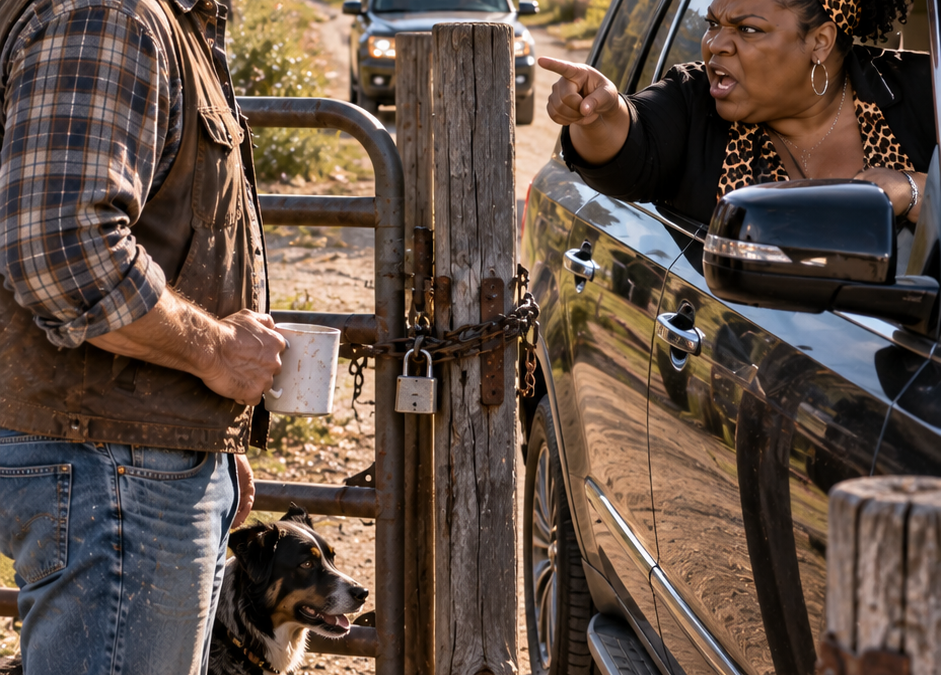
𝗣𝗔𝗥𝗧 𝟮
The way people talk about a dog that has bitten somebody but still lives next door.
There were stories everywhere.
Mr. and Mrs. Alderman lived on Maplewood Court.
He was eighty-one.
They hung small brass wind chimes on the rear porch.
Nothing elaborate.
A gift from their daughter before she died.
Karen classified them as an “unauthorized exterior audio installation.”
The cumulative fine eventually reached $2,400.
Mr. Alderman took the chimes down.
Paid.
His wife didn’t tell Karen what the chimes meant.
“She wouldn’t have cared,” Mrs. Alderman told me.
Then there was the Rodriguez family.
Four children.
One boy with a disability.
His therapist encouraged outdoor exercise.
They put a portable basketball hoop beside the driveway.
Karen called it a nonconforming recreational structure.
Seventy-two hours to remove it.
Mr. Rodriguez asked for extra time.
The HOA response was one sentence:
The association does not negotiate compliance timelines.
Tom Wakefield was a retired Marine.
He painted his shutters beige.
Wrong beige.
Not dramatically wrong.
One color number off the approved palette.
Fine:
$600.
He challenged it at a meeting.
Karen told him:
“This is not a forum for individual grievances.”
Then moved to the next agenda item.
Tom paid.
Later, he told me he almost listed his house.
That was how Karen governed.
Not through law.
Through exhaustion.
She didn’t have to win every argument.
She only had to make arguing more expensive than surrender.
Then came Route 9.
Eighteen months before I finally blocked her SUV, the county closed part of the road for construction.
Residents of Ridgefield had to take a longer detour.
Maybe eleven extra minutes.
Temporary.
Six weeks.
Karen discovered my ranch road connected the back edge of the subdivision to another county route.
A shortcut.
The first few times, I assumed she’d gotten confused.
Then she kept doing it.
Morning after morning.
When Route 9 reopened, Karen still used my road.
At some point, convenience became habit.
Habit became assumption.
Assumption became entitlement.
Four months before the morning at the gate, I went to her house.
Polite.
No lawyer.
No camera.
No threat.
I introduced myself.
Explained where the property line ran.
Asked her to stop using the ranch road.
Karen listened with the patient expression of someone waiting for a child to finish describing an imaginary problem.
“Your parcel is adjacent to HOA infrastructure.”
“Yes.”
“The access path has historically served the community.”
“No.”
“If you’d read your deed carefully, you’d understand it doesn’t function as purely private land.”
That almost made me laugh.
Because I had read my deed.
Twice.
Then three times.
I thanked her.
Went home.
And started listening.
Neighbors knew Karen was crossing the ranch.
Every person I mentioned it to had roughly the same reaction.
Small grimace.
Quick look around.
Then:
“Yeah. We’ve seen her.”
Nobody complained publicly.
That would mean becoming visible to Karen.
Visibility had a price in Ridgefield Crossing.
One neighbor mattered more than the rest.
Mrs. Chen.
Seventy-three.
Twelve years in the neighborhood.
She remembered birthdays.
Left tomatoes on porches.
Kept a kitchen calendar where she wrote down appointments, weather, visitors, little things she noticed.
Three dates were circled.
Beside each:
Karen’s black SUV through ranch gate — approx. 7:15 a.m.
“Why’d you write it down?”
Mrs. Chen shrugged.
“Didn’t look right.”
She copied the pages for me.
That same week, I pulled Ridgefield’s HOA documents.
Read the bylaws.
Read the covenants.
Read the maps.
I highlighted everything the board could do.
Then everything Karen claimed she could do but the documents never said.
That second list became longer.
At my kitchen table, I placed three things side by side.
My deed.
HOA bylaws.
Yellow legal pad.
The difference between Karen’s authority and Karen’s confidence took up most of a page.
Three days after I confronted her at the gate, she returned.
This time with backup.
I was replacing the bent lock when two doors slammed.
Karen came from the driver’s side.
Gerald Fisk got out of the passenger side.
HOA treasurer.
Co-signer on half the notices issued under Karen.
Gerald had perfected a particular kind of loyalty.
He almost never led.
He stood behind Karen and nodded.
Enough to turn one person’s opinion into what looked like board consensus.
I set down my wrench.
“I’m formally asking you not to use this road.”
Karen reached into her leather bag.
“I expected this.”
She produced a laminated document.
HOA letterhead.
Signatures.
Bold heading:
EMERGENCY COMMUNITY ACCESS CORRIDOR
DESIGNATED AND APPROVED BY THE HOA BOARD OF DIRECTORS
I read it.
Article Seven cited.
Community safety.
Emergency access.
Board resolution.
Karen’s signature.
Gerald’s signature.
Blue ink.
What it didn’t contain was more important.
No county seal.
No easement number.
No planning reference.
No recorded right-of-way.
No survey.
No government authorization.
Nothing connecting this document to any authority outside Karen’s boardroom.
I pulled out my phone.
Photographed both sides.
Karen watched.
Didn’t object.
She probably thought documentation meant compliance.
“The board voted on this Tuesday,” she said. “It is now official community policy.”
“Official for who?”
“Ridgefield Crossing.”
“This isn’t Ridgefield property.”
“If you lock this corridor, we’ll fine you five hundred dollars per day.”
Gerald nodded.
Karen continued.
“We’ll also file a lien.”
“Against my ranch.”
“Yes.”
“For violating HOA rules.”
“Yes.”
“I’m not in your HOA.”
She smiled.
“We have legal authority.”
I looked at the laminated notice.
Then at her.
“You told me the county agreed with this?”
“They do.”
“Which office?”
“This is a community safety issue. The appropriate people have been consulted.”
“So yes?”
“Yes.”
No hesitation.
I held up the notice.
“Can I keep this?”
That surprised her.
Then she almost smiled.
“You can have as many copies as you want.”
“Thank you.”
Gerald gave me his full name for my notes.
Karen did the same.
Then they got into the SUV.
Karen drove through my gate again.
Crossing number eight.
That night, the laminated notice sat beside my deed.
It looked better than the deed.
Clean.
Sharp.
Professional.
My deed had folds.
Coffee stains.
County stamps.
Age.
One of those documents looked like authority.
The other one was authority.
I called the county recorder.
“Any easement on my parcel?”
They would check.
Then I called Linda Reeves.
Old colleague.
County planning department.
Years earlier, before buying the ranch, I’d worked in land-management consulting.
Linda knew plats, variances, access petitions, development applications.
I gave her my parcel number.
“Has anyone ever applied for a community corridor across this land?”
“I’ll look.”
Next morning, I was at the recorder’s office before opening.
Doris helped me.
She printed the official plat.
Large-format.
Clear property lines.
Ridgefield Crossing on the west.
My ranch parcel on the east.
Karen’s supposed corridor?
Straight through the middle of my land.
Not near the boundary.
Not a shared strip.
Not ambiguous.
Mine.
No easement notation.
No dotted public-access line.
No shared-road language.
I asked:
“Has anybody filed an easement application?”
Doris checked.
“No.”
“Pending?”
“No.”
“Historic?”
“No.”
“Can I get that in writing?”
She printed a county letter.
Signed.
Dated.
No easement recorded, applied for, or approved.
Linda called the following afternoon.
Same answer from planning.
No application.
No corridor request.
No variance.
No preliminary inquiry.
Nothing.
She emailed confirmation from her county account.
Now I had two county offices saying Karen’s corridor did not exist.
I placed both confirmations beside her laminated resolution.
The trap wasn’t closed.
Not yet.
The trail camera kept working.
Fourteen crossings.
Same SUV.
Same plate.
Same gate.
Three dates from Mrs. Chen before I started recording.
Fourteen after.
I compared the recordings to Karen’s resolution date.
Nine crossings occurred before the board allegedly created the corridor.
That mattered.
For months, Karen had used the path with no written claim at all.
Then she created a board document to justify what she’d already been doing.
I wrote:
9 crossings before “corridor” designation.
Then underlined it.
I had also done something Karen had apparently forgotten.
After our first formal confrontation, I sent her certified mail.
CEASE AND DESIST.
Private property.
No permission granted.
No easement.
Stop entering.
Delivered.
Signed.
Karen’s own signature on the return receipt.
At the time, it felt almost bureaucratic.
A piece of paper.
Later, it became the center of everything.
Because Karen had another strategy.
I learned that the morning my chain disappeared.
I reached the gate and stopped.
The chain my father had used wasn’t hanging loose.
It wasn’t lying on the ground.
It was gone.
Cut.
A four-inch stub remained around the iron post.
Someone had installed a new combination padlock.
Brushed steel.
Brand new.
Not mine.
Below it, zip-tied to my gate:
COMMUNITY ACCESS CORRIDOR
INFRASTRUCTURE UNDER HOA MANAGEMENT
ACCESS CODE 4421
I didn’t touch anything.
Pictures first.
Cut chain.
Replacement lock.
Sign.
Fresh tire marks.
Then camera footage.
5:47 a.m.
Karen’s SUV.
Another person with her.
Build looked like Gerald.
Flashlight.
Bolt cutters.
Three minutes.
Then they drove through.
That changed the nature of the dispute.
Karen hadn’t simply trespassed.
She had physically taken control of my gate.
Cut my hardware.
Installed hers.
Declared my property HOA infrastructure.
I called the sheriff’s non-emergency number.
Deputy arrived within an hour.
Young.
Professional.
I showed him everything.
Deed.
Plat.
Gate.
Camera footage.
He took photographs.
Created an incident report.
Property damage.
Unauthorized alteration.
Trespass allegations.
He called it a civil matter pending review.
Expected.
But the county record now existed.
Then Karen arrived.
Of course she did.
Black SUV.
Leather tote.
Perfect composure.
She even knew the deputy.
“Morning, Jake.”
“Morning, ma’am.”
She looked at the new lock.
“The HOA assumed management responsibility for this corridor.”
The deputy said nothing.
“The prior lock created a community access hazard,” Karen explained. “We upgraded the hardware.”
Upgraded.
She had cut my chain and called it an upgrade.
“This is common infrastructure.”
I unfolded the official plat on my truck hood.
The deputy leaned over it.
His eyes tracked the property line.
Then the road.
Then my parcel.
He looked at Karen differently afterward.
Not hostile.
Just less convinced.
“Both sides should consult counsel,” he said.
Karen turned toward me.
“We already have.”
Then she finally told me the real strategy.
“Our attorney is filing for a prescriptive easement.”
I stayed still.
“Six months of open, continuous, visible use,” she continued. “No formal owner interference until recently.”
There it was.
Prescriptive easement.
A way someone can sometimes gain permanent access rights by using private property openly and adversely long enough without the owner successfully interrupting that use.
Karen had been building a record.
One commute at a time.
The extended shortcut hadn’t merely become a habit.
It had become a plan.
Use.
Keep using.
Create board paperwork.
Call it infrastructure.
Get signatures.
Claim the owner didn’t object soon enough.
Then ask a court to turn trespass into permanent access.
Karen thought she was months ahead.
She wasn’t.
I had already called David Hong.
Property litigator.
Fifteen years in county land disputes.
He had reviewed everything.
Deed.
Plat.
County letters.
Trail-camera footage.
HOA notice.
Most importantly:
My certified cease-and-desist.
When Karen signed for that letter, David said, the foundation of any “unopposed use” argument ended.
After formal written objection, every new crossing no longer strengthened her story.
It strengthened mine.
“She overplayed her hand,” David told me.
Four words.
That was the first time I smiled during the entire thing.
Karen’s law firm sent me a demand letter Tuesday.
Henderson & Clark.
Two pages.
Remove locks.
Stop interfering.
Sign an access agreement within fourteen days.
Otherwise, the HOA would seek a permanent prescriptive easement.
I put the letter on the kitchen table.
Their deadline didn’t scare me.
It confirmed everything.
Then the HOA announced an emergency community meeting.
Subject:
IMPORTANT SAFETY INFRASTRUCTURE MATTER.
The notice ended:
YOUR ATTENDANCE PROTECTS YOUR NEIGHBORHOOD.
Karen understood language.
She had trained residents for eight years to hear that sentence as:
Show up or be noticed.
Sixty-seven adults attended.
Clubhouse.
Folding chairs.
Projector.
Karen stood at the front in a blazer.
No notes.
First slide:
A map.
Subdivision.
My ranch road highlighted yellow.
“Secondary community access route.”
It looked official.
“This path has served Ridgefield Crossing for more than eighteen months,” Karen said.
“Residents use it regularly.”
Next slide:
My gate.
Father’s brand visible.
Caption:
ONE PROPERTY OWNER’S OBSTRUCTION.
“This isn’t about one man’s fence,” she said.
“This is about ninety-six families being held hostage to a personal grievance.”
I watched the crowd.
Some nodded.
Others looked down.
Mr. Rodriguez stared at the floor.
Tom Wakefield sat with arms crossed.
Mrs. Chen remained near the back.
Then Karen unveiled the petition.
Ninety-six signature lines.
Formal request for permanent community access.
“When we present this to the court,” she said, “it will demonstrate this is not merely a board position. This is the will of the community.”
Gerald signed first.
Without reading.
Then others.
Thirty-one signatures.
I didn’t blame most of them.
Signing cost nothing.
Refusing could make Karen remember your name.
I sat quietly.
Karen eventually looked at me.
“We’re glad you’re here.”
Small smile.
“I hope tonight clarifies the community’s position.”
I nodded.
Didn’t speak.
Mrs. Chen didn’t sign either.
At 8:40, the meeting ended.
Karen walked out carrying the petition like she’d won.
What she didn’t know was that the county had already sent its preliminary response.
No easement.
No corridor approval.
No county recognition.
The document sat on my kitchen table while Karen told sixty-seven people the county supported her.
That was the point where the trap stopped being theoretical.
Her attorney formally filed the easement matter.
The county response went to both sides.
Official letterhead.
No recorded easement.
No historical application.
No approval.
No county involvement in designating any community corridor across my land.
David called.
“Now we move.”
Our response included:
My deed.
Official plat.
County letters.
Certified cease-and-desist.
Karen’s signed delivery receipt.
Trail-camera log.
Fourteen crossings.
Photographs of the cut chain.
Replacement lock.
HOA sign.
Deputy incident report.
Mrs. Chen’s dated calendar entries.
But David agreed with something else.
Karen had made her case publicly.
If the truth only appeared months later in a courtroom, Ridgefield homeowners would continue thinking I was the man trying to block their “community road.”
The same residents deserved to see the records.
Ridgefield bylaws contained a provision Karen either forgot or assumed nobody would ever use.
Ten homeowners could petition for a special membership meeting involving board action.
We collected eleven signatures.
Tom Wakefield signed first.
The meeting was scheduled for Thursday.
Same clubhouse.
Same folding chairs.
Different atmosphere.
Seventy-three homeowners came.
More than Karen’s meeting.
Karen sat at the front.
Gerald beside her.
HOA attorney on the other side.
This time, I sat in the front row.
David stood beside the projector.
No speech.
First slide.
Official county plat.
Black lines.
Ridgefield boundary.
My ranch.
My road.
The supposed corridor running unmistakably through my parcel.
No easement.
No shared right.
No HOA property.
The room became still.
David waited.
Then Slide Two.
County confirmation letter.
NO EASEMENT RECORDED.
NO APPLICATION SUBMITTED.
NO APPROVAL GRANTED.
You could read the entire thing from the back row.
People shifted in their seats.
Karen stayed motionless.
But her face had changed.
Slide Three.
My certified cease-and-desist.
Delivery receipt.
Karen’s signature.
David finally spoke.
“For a prescriptive-easement theory to rely on unopposed use, continued use must occur without effective owner objection.”
He pointed.
“Mrs. Delacroy signed for Mr. Crawford’s formal written objection on March fourteenth.”
Then:
“Every documented crossing after that date occurred after written notice.”
Slide Four.
Trail-camera summary.
Fourteen crossings.
Date.
Time.
Thumbnail.
Black SUV.
License plate.
Five highlighted in red.
All after Karen received the cease-and-desist.
David didn’t dramatize it.
“Those crossings no longer support a claim of unchallenged use.”
He paused.
“They support a trespass record.”
Karen’s attorney put one hand on her forearm.
She pulled away.
Still didn’t speak.
Then Mrs. Chen stood.
No raised hand.
No permission.
“I saw her.”
Every head turned.
Mrs. Chen held up copies of her calendar.
“Three times.”
Her voice was steady.
“I wrote the dates down because it didn’t look right.”
Then she said something that mattered more than the dates.
“I didn’t say anything because I was afraid.”
The room changed.
Not loudly.
But permanently.
A man in plaid stood next.
“I saw the SUV too.”
Then a woman near the window.
“Me too. I assumed it was authorized because… well…”
She looked toward Karen.
“We assumed everything she did was authorized.”
That sentence hit harder than the legal documents.
Because that was Karen’s real power.
Assumption.
Karen began to rise.
Her attorney grabbed her arm again.
This time, firmer.
He whispered something.
She sat.
David addressed the board.
“The HOA can withdraw from the access claim tonight.”
Silence.
“I recommend you consider it.”
A woman in the fifth row stood.
“I move that the board rescind the emergency access corridor designation and withdraw all HOA involvement in the easement claim.”
“Second.”
Came immediately from behind her.
The board had to vote.
Three members voted yes.
Gerald abstained.
Karen abstained.
The motion passed.
No cheering.
Ridgefield wasn’t a cheering community.
Not yet.
But shoulders dropped.
Tom uncrossed his arms.
Mr. Rodriguez looked up.
Mrs. Chen sat straighter.
I walked to the front.
Placed two documents side by side.
Karen’s laminated corridor declaration.
Official county plat.
The first one:
Clean.
Professional.
Signed.
Blue ink.
HOA logo.
The second:
Plain black lines.
Parcel numbers.
County filing marks.
Nobody needed me to explain the difference.
The entire conflict was sitting on that table.
One document looked like authority.
The other was authority.
Karen stared at both.
Gerald put on his jacket.
Her attorney looked toward the wall.
That was the trap.
Not some mechanical device across the road.
Not spikes.
Not a locked chain meant to catch her.
Documentation.
Every time Karen drove through my gate, she created another entry.
Every time she threatened me, she put another claim in writing.
Every time she invented authority, I checked the real record.
She built the case because she believed nobody was building one.
Eleven days later, the county closed the prescriptive-easement filing.
No factual basis.
No recorded easement.
No approved corridor.
Claim denied.
David sent the final cease-and-desist.
This one referenced all fourteen recorded crossings.
Any future entry would be referred immediately as criminal trespass.
The sheriff reviewed our materials alongside the incident report from the morning Karen cut the chain.
Official trespass notification followed.
I did not ask for charges.
I wanted a line.
Clear.
Recorded.
Cross it again and nobody can pretend there was confusion.
Karen’s black SUV never entered my gate again.
Then homeowners received the quarterly HOA financial statement.
For the first time in years, people actually read it.
Legal expenses connected to the gate dispute:
$11,400.
Henderson & Clark.
Consultation.
Letters.
Easement preparation.
Meeting attendance.
Filings.
Eleven thousand four hundred dollars of community money spent chasing an access right that never existed.
That money had been intended for pool resurfacing.
The project had already been postponed twice.
Now it was delayed again.
And every homeowner who walked around the cracked pool deck knew why.
At the next ordinary board meeting, someone requested a detailed legal-expense accounting.
Unanimous approval.
Karen had to explain.
She stood.
Straightened her blazer.
Used familiar words.
Safety.
Infrastructure.
Board discretion.
Community access.
But those words sounded different after everyone had seen the plat.
Someone in the rear row said:
“Which corridor?”
Three people laughed.
Not cruelly.
It was the sound people make when something that frightened them yesterday suddenly looks absurd.
Karen did not seek another term as president.
She didn’t have the chance.
A removal motion came first.
Largest margin in Ridgefield history.
Gerald resigned as treasurer the same night.
Two board members who had signed Karen’s laminated corridor declaration never returned for another term.
Mrs. Chen ran.
Of course she did.
She had no campaign slogan.
No polished platform.
She knocked on doors.
Talked to people.
She told one neighbor:
“I have a calendar, and I think boards should write down what they do.”
She won by the widest margin any candidate had ever received.
The new board posted every HOA governing document online.
Unedited.
Bylaws.
Covenants.
Rules.
Plain-English explanation of what the board could do.
And what it could not.
Fines required written justification.
Mediation before escalation.
Major expenditures needed homeowner approval.
Nothing revolutionary.
Just rules behaving like rules instead of weapons.
The Rodriguez basketball hoop returned to the driveway.
Nobody complained.
The Aldermans put their wind chimes back.
I heard them one afternoon when I drove past.
Small brass notes moving in the wind.
Mrs. Alderman was on the porch.
She saw my truck.
Touched the chimes once.
Then waved.
I waved back.
That sound stayed with me.
Because Ridgefield had spent eight years becoming quiet for the wrong reason.
People weren’t peaceful.
They were cautious.
There’s a difference.
A good neighborhood is quiet because people are comfortable.
A frightened neighborhood is quiet because nobody wants to become the next target.
After Karen left the board, the silence changed.
The morning after the county formally closed the easement matter, I went out to the ranch gate before sunrise.
Same coffee.
Same gravel.
Same iron post.
My father’s brand beneath my hand.
No tire tracks.
No damaged lock.
No laminated sign.
I had repaired the latch assembly.
Replaced the chain.
Installed my padlock.
The road beyond the gate had already begun changing.
Karen’s tires had worn two tracks down the middle.
Without daily traffic, thin green grass started pushing back through the gravel edges.
Land does that.
Give it enough time without abuse and it starts remembering itself.
I stood there longer than necessary.
The trail camera remained mounted.
No motion event in twenty-three days.
I considered taking it down.
Didn’t.
Not because I was still waiting for Karen.
I wasn’t.
I left it because patience had nearly been mistaken for permission once.
I wanted a reminder.
A camera doesn’t argue.
Doesn’t interpret.
Doesn’t get intimidated at a board meeting.
It records.
Date.
Time.
Vehicle.
Crossing.
That’s all.
Later, people asked me about the “trap.”
They imagined something dramatic.
A chained gate.
A sheriff hiding behind a tree.
Some surprise lawsuit.
It wasn’t any of those things.
The trap was giving Karen exactly enough room to keep making choices.
She could’ve stopped after I visited her house.
Didn’t.
Could’ve stopped after I told her directly at the gate.
Didn’t.
Could’ve stopped after the cease-and-desist.
Didn’t.
Could’ve checked the county plat.
Didn’t.
Could’ve asked whether a real easement existed.
Didn’t.
Could’ve listened when the deputy saw the map.
Didn’t.
Could’ve withdrawn after her lawyer got involved.
Didn’t.
Instead, she cut my chain.
Installed her lock.
Created a fake corridor declaration.
Claimed county approval.
Filed for a prescriptive easement.
Collected signatures.
Spent $11,400 of other people’s money.
And drove through my property fourteen documented times.
Five after signing a letter telling her explicitly not to.
I didn’t force any of that.
I recorded it.
That was the whole trap.
Karen thought persistence was proof.
She had built a career inside Ridgefield on that principle.
Issue enough letters.
Repeat something often enough.
Make fighting expensive enough.
Eventually people surrender.
Then surrender becomes precedent.
Nobody notices that the original authority was never there.
It worked on wind chimes.
Basketball hoops.
Paint colors.
Parking.
Then she tried it on land.
Land records are less emotional than homeowners.
A county plat doesn’t care who the board president is.
A deed doesn’t get tired.
A certified-mail receipt doesn’t become intimidated when somebody raises their voice.
Those documents simply sit there.
Waiting.
After the new board took over, Mrs. Chen invited me to one meeting.
Only one.
“I want you to see something.”
“What?”
“You’ll know when you see it.”
I went.
Same clubhouse.
Same folding chairs.
But no raised platform.
No board members facing residents like judges.
Mrs. Chen sat at the same level as everyone else.
Agenda Item Three:
Resident Questions.
An older man asked why he had been fined two years earlier for an exterior light.
Mrs. Chen said:
“I don’t know.”
Then:
“We’ll pull the record.”
Not:
The board has spoken.
Not:
We’ve been through this.
Not:
Our attorney will contact you.
We’ll pull the record.
That may have been the healthiest sentence I’d ever heard spoken in that room.
The board eventually reviewed several old fines.
Not all disappeared.
Some rules were legitimate.
Some violations were real.
But residents got explanations.
Appeal rights.
Documentation.
That mattered.
I didn’t become anti-HOA after everything.
That surprised people.
Associations can serve a purpose.
Shared pools need maintenance.
Private roads need budgets.
Landscaping contracts need someone to sign them.
Communities need systems.
The danger begins when the people running those systems stop distinguishing between authority delegated to them and authority they wish they had.
Karen forgot the difference.
Or maybe she learned that most people didn’t know it either.
I saw her once after she left the board.
Grocery-store parking lot.
She was loading bags into the same black SUV.
For one second, I wondered if she’d see me.
She did.
Our eyes met.
No smile.
No confrontation.
She closed the rear hatch.
Got in.
Drove away.
On the public road.
I almost laughed.
Didn’t.
It wasn’t worth it.
My ranch didn’t become more mine because Karen lost.
That’s another thing people misunderstand.
The county denial didn’t give me the road.
The sheriff notice didn’t give me the gate.
The HOA vote didn’t give me the land.
It had been mine the entire time.
The legal process only forced everyone else to acknowledge a boundary that already existed.
That’s why I restored my father’s latch instead of replacing the whole gate.
I could have installed something new.
Automatic gate.
Keypad.
Camera system.
Steel columns.
Instead, I took the bent assembly to a welder.
Straightened it.
Reinforced the mounting points.
Then put it back exactly where Dad had welded it.
His brand still shows.
Double bar.
Weathered.
Older than Ridgefield Crossing.
Every morning, I run my hand across it.
Not sentimentality.
Maybe a little.
But mostly memory.
A boundary doesn’t need to be aggressive.
It only needs to be respected.
The path beyond the gate is quieter now.
I use it for ranch equipment.
Feed truck.
Tractor.
Sometimes I walk it.
Grass has grown through the old SUV ruts.
Not completely.
You can still see faint depressions where Karen drove.
Fourteen documented crossings.
Probably more before the camera.
Eventually they’ll disappear.
Ground heals.
People do too, sometimes.
Mrs. Chen still keeps her calendar.
I asked her once.
“You still writing down suspicious cars?”
She smiled.
“Everything.”
“Why?”
“So nobody tells me later I imagined it.”
Fair answer.
The Aldermans’ wind chimes are still on their porch.
The Rodriguez boy uses the basketball hoop.
Tom Wakefield repainted his shutters.
Same shade he got fined for.
Nobody has measured it.
The pool was eventually resurfaced too.
Took another year.
Residents approved the expense themselves.
They also added a new rule requiring any board legal action above a certain amount to receive membership approval.
Karen’s $11,400 mistake had taught people to look at budgets.
Funny how quickly democracy appears when people realize they’re paying for the lawyers.
I kept the laminated corridor notice.
It’s in a drawer with the county plat.
Sometimes people expect me to frame it.
I wouldn’t.
It doesn’t deserve wall space.
But I kept it because it represents the entire problem in one object.
Professional logo.
Blue signatures.
Bold heading.
Official language.
No authority.
Beside it sits the county plat.
Ugly black-and-white print.
No dramatic language.
No logo designed to impress anybody.
Just lines.
Numbers.
Recording information.
Truth doesn’t always look as expensive as the lie.
That lesson stayed with me.
I also kept the first certified-mail receipt.
Karen’s signature.
March fourteenth.
That one might be the most important paper of all.
Because the prescriptive-easement plan depended on a story.
She used the road.
Openly.
Continuously.
I didn’t object.
Therefore, over time, she gained rights.
The receipt destroyed the story.
I objected.
She knew.
Then she kept going.
Her own signature converted the narrative.
From:
We believed we had permission.
To:
We knew we didn’t.
That’s what David meant when he said she’d overplayed her hand.
The strongest cases are sometimes built from what the other person confidently does after receiving clear notice.
Karen believed no one would enforce the boundary.
That belief became her weakness.
One autumn morning, about a year after everything ended, I stood at the gate with coffee.
Fog lay low over the pasture.
The trail camera battery had finally died.
I noticed because the little indicator didn’t blink.
I took it down.
Turned it over in my hand.
Scratched plastic.
Dust along the seal.
For months, that camera had felt like a witness.
Now it was just equipment.
I carried it back toward the house.
Halfway there, I stopped.
Looked back.
Gate shut.
Chain relaxed.
No SUV.
No dust.
Nothing to record.
That felt good.
I put the camera in the barn instead of throwing it away.
Maybe I’ll use it for deer.
Maybe not.
At the end of the day, Karen had been right about one thing.
We had eventually “been through this.”
Just not when she first said it.
We went through the deed.
The plat.
The county records.
The planning database.
The certified letter.
The trail-camera timestamps.
The cut chain.
The false corridor designation.
The prescriptive-easement claim.
The sheriff’s report.
The community meeting.
All of it.
And when we were finished, the result was simple.
Her road wasn’t a road.
Her corridor wasn’t a corridor.
Her county approval wasn’t county approval.
Her permanent-access claim wasn’t permanent.
And my gate was exactly what I had said it was from the beginning.
My gate.
On my ranch.
At my boundary.
Karen kept driving through because she believed repetition could turn trespass into ownership.
Instead, every crossing gave me another timestamp.
Another photograph.
Another line in the record.
Fourteen times.
That’s the part I still think about whenever someone describes what I did as setting a trap.
I didn’t hide anything beneath the road.
I didn’t trick her into crossing.
I didn’t need to.
I told her to stop.
Then I documented what happened when she decided that my answer didn’t matter.
The trap was truth plus patience.
Karen drove into it all by herself.
Have you finished reading the story and want to read it again?
HOA Karen Kept Cutting Through My Ranch—So I Let Her Build the Trespass Case Against Herself
She kept driving through my ranch gate because she thought silence meant permission.
Then she cut my chain, replaced my lock, and declared my private road “HOA property.”
What she never realized was that every trip through that gate was becoming evidence.
The first thing I heard that morning was gravel.
Not a knock.
Not a phone call.
Just the slow crunch of tires rolling across land that belonged to me.
I was standing beside the ranch gate at six in the morning with coffee in one hand, checking the latch my father had welded onto the post twenty years earlier.
His brand was still stamped into the iron.
Two simple bars.
Nothing decorative.
But I could run my thumb across those raised marks and remember standing beside him as a kid while sparks bounced off his welding hood.
That gate wasn’t ornamental.
It marked a boundary.
Karen Delacroy treated it like a suggestion.
Her black SUV rolled through without slowing.
Window down.
Air conditioning humming.
One hand on the steering wheel.
She lifted two fingers toward me.
Move.
The way someone might wave aside a valet who had misunderstood where to park.
I stepped directly into the path.
She stopped.
Not abruptly.
Just enough.
Her expression wasn’t angry.
Not yet.
I was an inconvenience.
“This is the fastest route to the main road,” she said. “The HOA corridor map includes this access path. I have every right to use it.”
She said it the way people repeat something so often they stop checking whether it’s true.
I didn’t raise my voice.
“This is my gate.”
No reaction.
“My road.”
Still nothing.
“My property.”
Her eyes narrowed slightly.
“I’d appreciate it if you used the subdivision entrance.”
That changed her tone.
“If you lock this gate or interfere with access, the board will issue a violation notice.”
“A violation against what?”
She ignored that.
“And we’ll escalate the matter to the county.”
Then she added:
“We’ve been through this.”
We hadn’t.
Not once.
That was the first morning I had ever physically stepped in front of her vehicle.
But Karen’s strength had never depended on facts.
It depended on making people feel as though the argument had already happened and they had already lost.
I said nothing.
She eased forward.
I had to step aside.
Not because she accelerated.
She didn’t.
That would’ve been too obvious.
She moved slowly enough to make the message clear.
I am going through.
Whether you stand here or not.
Dust kicked against my boots.
The SUV continued past the old cedar, down the gravel path my father had used to move tractors between pastures, then disappeared toward the county road.
Karen never checked her mirror.
If she had, she might have noticed the small trail camera mounted on a fence post behind her.
I had installed it two weeks earlier.
She didn’t know.
She didn’t know a lot of things.
I looked down at the latch.
My padlock had been forced sideways.
The shackle wasn’t cut.
Someone had pried hard enough to bend the catch so the gate no longer stayed closed.
Fresh scratches scarred the iron.
I crouched.
Ran my hand over them.
That was the seventh time Karen had crossed my property in five weeks.
Seven trips.
Seven timestamps.
Seven recordings.
I hadn’t stopped her before because I was afraid.
I hadn’t stopped her because I was counting.
The difference matters.
Karen thought she was using a shortcut across land owned by a quiet rancher who didn’t understand how HOAs worked.
What she didn’t know was that I had already read my deed.
I had already pulled the subdivision plat.
And the gravel beneath her tires wasn’t HOA property.
It had never been HOA property.
I took a sip of coffee.
Cold.
Then looked down the road where her SUV had disappeared.
That morning, standing beside the damaged gate my father built, I decided the quiet part was over.
My ranch sat on the eastern edge of Ridgefield Crossing.
Ninety-six houses.
Uniform mailboxes.
Matching street signs.
Color-coded trash bins.
Decorative entrance stone.
And an HOA that operated less like a neighborhood association and more like a low-budget government nobody remembered electing.
My land touched the subdivision.
It was never part of it.
That fact wasn’t complicated.
County maps showed the line clearly.
My fence stood on my parcel.
My gate stood on my parcel.
The gravel road through it ran through the middle of my parcel.
The HOA boundary stopped at my fence.
Karen’s authority stopped there too.
At least legally.
Socially, she had spent eight years convincing Ridgefield Crossing there was no difference between the two.
Eight years as board president.
Eight years of fines.
Notices.
Warnings.
Threats.
People talked about Karen carefully.
The way people talk about a dog that has bitten somebody but still lives next door.
There were stories everywhere.
Mr. and Mrs. Alderman lived on Maplewood Court.
He was eighty-one.
They hung small brass wind chimes on the rear porch.
Nothing elaborate.
A gift from their daughter before she died.
Karen classified them as an “unauthorized exterior audio installation.”
The cumulative fine eventually reached $2,400.
Mr. Alderman took the chimes down.
Paid.
His wife didn’t tell Karen what the chimes meant.
“She wouldn’t have cared,” Mrs. Alderman told me.
Then there was the Rodriguez family.
Four children.
One boy with a disability.
His therapist encouraged outdoor exercise.
They put a portable basketball hoop beside the driveway.
Karen called it a nonconforming recreational structure.
Seventy-two hours to remove it.
Mr. Rodriguez asked for extra time.
The HOA response was one sentence:
The association does not negotiate compliance timelines.
Tom Wakefield was a retired Marine.
He painted his shutters beige.
Wrong beige.
Not dramatically wrong.
One color number off the approved palette.
Fine:
$600.
He challenged it at a meeting.
Karen told him:
“This is not a forum for individual grievances.”
Then moved to the next agenda item.
Tom paid.
Later, he told me he almost listed his house.
That was how Karen governed.
Not through law.
Through exhaustion.
She didn’t have to win every argument.
She only had to make arguing more expensive than surrender.
Then came Route 9.
Eighteen months before I finally blocked her SUV, the county closed part of the road for construction.
Residents of Ridgefield had to take a longer detour.
Maybe eleven extra minutes.
Temporary.
Six weeks.
Karen discovered my ranch road connected the back edge of the subdivision to another county route.
A shortcut.
The first few times, I assumed she’d gotten confused.
Then she kept doing it.
Morning after morning.
When Route 9 reopened, Karen still used my road.
At some point, convenience became habit.
Habit became assumption.
Assumption became entitlement.
Four months before the morning at the gate, I went to her house.
Polite.
No lawyer.
No camera.
No threat.
I introduced myself.
Explained where the property line ran.
Asked her to stop using the ranch road.
Karen listened with the patient expression of someone waiting for a child to finish describing an imaginary problem.
“Your parcel is adjacent to HOA infrastructure.”
“Yes.”
“The access path has historically served the community.”
“No.”
“If you’d read your deed carefully, you’d understand it doesn’t function as purely private land.”
That almost made me laugh.
Because I had read my deed.
Twice.
Then three times.
I thanked her.
Went home.
And started listening.
Neighbors knew Karen was crossing the ranch.
Every person I mentioned it to had roughly the same reaction.
Small grimace.
Quick look around.
Then:
“Yeah. We’ve seen her.”
Nobody complained publicly.
That would mean becoming visible to Karen.
Visibility had a price in Ridgefield Crossing.
One neighbor mattered more than the rest.
Mrs. Chen.
Seventy-three.
Twelve years in the neighborhood.
She remembered birthdays.
Left tomatoes on porches.
Kept a kitchen calendar where she wrote down appointments, weather, visitors, little things she noticed.
Three dates were circled.
Beside each:
Karen’s black SUV through ranch gate — approx. 7:15 a.m.
“Why’d you write it down?”
Mrs. Chen shrugged.
“Didn’t look right.”
She copied the pages for me.
That same week, I pulled Ridgefield’s HOA documents.
Read the bylaws.
Read the covenants.
Read the maps.
I highlighted everything the board could do.
Then everything Karen claimed she could do but the documents never said.
That second list became longer.
At my kitchen table, I placed three things side by side.
My deed.
HOA bylaws.
Yellow legal pad.
The difference between Karen’s authority and Karen’s confidence took up most of a page.
Three days after I confronted her at the gate, she returned.
This time with backup.
I was replacing the bent lock when two doors slammed.
Karen came from the driver’s side.
Gerald Fisk got out of the passenger side.
HOA treasurer.
Co-signer on half the notices issued under Karen.
Gerald had perfected a particular kind of loyalty.
He almost never led.
He stood behind Karen and nodded.
Enough to turn one person’s opinion into what looked like board consensus.
I set down my wrench.
“I’m formally asking you not to use this road.”
Karen reached into her leather bag.
“I expected this.”
She produced a laminated document.
HOA letterhead.
Signatures.
Bold heading:
EMERGENCY COMMUNITY ACCESS CORRIDOR
DESIGNATED AND APPROVED BY THE HOA BOARD OF DIRECTORS
I read it.
Article Seven cited.
Community safety.
Emergency access.
Board resolution.
Karen’s signature.
Gerald’s signature.
Blue ink.
What it didn’t contain was more important.
No county seal.
No easement number.
No planning reference.
No recorded right-of-way.
No survey.
No government authorization.
Nothing connecting this document to any authority outside Karen’s boardroom.
I pulled out my phone.
Photographed both sides.
Karen watched.
Didn’t object.
She probably thought documentation meant compliance.
“The board voted on this Tuesday,” she said. “It is now official community policy.”
“Official for who?”
“Ridgefield Crossing.”
“This isn’t Ridgefield property.”
“If you lock this corridor, we’ll fine you five hundred dollars per day.”
Gerald nodded.
Karen continued.
“We’ll also file a lien.”
“Against my ranch.”
“Yes.”
“For violating HOA rules.”
“Yes.”
“I’m not in your HOA.”
She smiled.
“We have legal authority.”
I looked at the laminated notice.
Then at her.
“You told me the county agreed with this?”
“They do.”
“Which office?”
“This is a community safety issue. The appropriate people have been consulted.”
“So yes?”
“Yes.”
No hesitation.
I held up the notice.
“Can I keep this?”
That surprised her.
Then she almost smiled.
“You can have as many copies as you want.”
“Thank you.”
Gerald gave me his full name for my notes.
Karen did the same.
Then they got into the SUV.
Karen drove through my gate again.
Crossing number eight.
That night, the laminated notice sat beside my deed.
It looked better than the deed.
Clean.
Sharp.
Professional.
My deed had folds.
Coffee stains.
County stamps.
Age.
One of those documents looked like authority.
The other one was authority.
I called the county recorder.
“Any easement on my parcel?”
They would check.
Then I called Linda Reeves.
Old colleague.
County planning department.
Years earlier, before buying the ranch, I’d worked in land-management consulting.
Linda knew plats, variances, access petitions, development applications.
I gave her my parcel number.
“Has anyone ever applied for a community corridor across this land?”
“I’ll look.”
Next morning, I was at the recorder’s office before opening.
Doris helped me.
She printed the official plat.
Large-format.
Clear property lines.
Ridgefield Crossing on the west.
My ranch parcel on the east.
Karen’s supposed corridor?
Straight through the middle of my land.
Not near the boundary.
Not a shared strip.
Not ambiguous.
Mine.
No easement notation.
No dotted public-access line.
No shared-road language.
I asked:
“Has anybody filed an easement application?”
Doris checked.
“No.”
“Pending?”
“No.”
“Historic?”
“No.”
“Can I get that in writing?”
She printed a county letter.
Signed.
Dated.
No easement recorded, applied for, or approved.
Linda called the following afternoon.
Same answer from planning.
No application.
No corridor request.
No variance.
No preliminary inquiry.
Nothing.
She emailed confirmation from her county account.
Now I had two county offices saying Karen’s corridor did not exist.
I placed both confirmations beside her laminated resolution.
The trap wasn’t closed.
Not yet.
The trail camera kept working.
Fourteen crossings.
Same SUV.
Same plate.
Same gate.
Three dates from Mrs. Chen before I started recording.
Fourteen after.
I compared the recordings to Karen’s resolution date.
Nine crossings occurred before the board allegedly created the corridor.
That mattered.
For months, Karen had used the path with no written claim at all.
Then she created a board document to justify what she’d already been doing.
I wrote:
9 crossings before “corridor” designation.
Then underlined it.
I had also done something Karen had apparently forgotten.
After our first formal confrontation, I sent her certified mail.
CEASE AND DESIST.
Private property.
No permission granted.
No easement.
Stop entering.
Delivered.
Signed.
Karen’s own signature on the return receipt.
At the time, it felt almost bureaucratic.
A piece of paper.
Later, it became the center of everything.
Because Karen had another strategy.
I learned that the morning my chain disappeared.
I reached the gate and stopped.
The chain my father had used wasn’t hanging loose.
It wasn’t lying on the ground.
It was gone.
Cut.
A four-inch stub remained around the iron post.
Someone had installed a new combination padlock.
Brushed steel.
Brand new.
Not mine.
Below it, zip-tied to my gate:
COMMUNITY ACCESS CORRIDOR
INFRASTRUCTURE UNDER HOA MANAGEMENT
ACCESS CODE 4421
I didn’t touch anything.
Pictures first.
Cut chain.
Replacement lock.
Sign.
Fresh tire marks.
Then camera footage.
5:47 a.m.
Karen’s SUV.
Another person with her.
Build looked like Gerald.
Flashlight.
Bolt cutters.
Three minutes.
Then they drove through.
That changed the nature of the dispute.
Karen hadn’t simply trespassed.
She had physically taken control of my gate.
Cut my hardware.
Installed hers.
Declared my property HOA infrastructure.
I called the sheriff’s non-emergency number.
Deputy arrived within an hour.
Young.
Professional.
I showed him everything.
Deed.
Plat.
Gate.
Camera footage.
He took photographs.
Created an incident report.
Property damage.
Unauthorized alteration.
Trespass allegations.
He called it a civil matter pending review.
Expected.
But the county record now existed.
Then Karen arrived.
Of course she did.
Black SUV.
Leather tote.
Perfect composure.
She even knew the deputy.
“Morning, Jake.”
“Morning, ma’am.”
She looked at the new lock.
“The HOA assumed management responsibility for this corridor.”
The deputy said nothing.
“The prior lock created a community access hazard,” Karen explained. “We upgraded the hardware.”
Upgraded.
She had cut my chain and called it an upgrade.
“This is common infrastructure.”
I unfolded the official plat on my truck hood.
The deputy leaned over it.
His eyes tracked the property line.
Then the road.
Then my parcel.
He looked at Karen differently afterward.
Not hostile.
Just less convinced.
“Both sides should consult counsel,” he said.
Karen turned toward me.
“We already have.”
Then she finally told me the real strategy.
“Our attorney is filing for a prescriptive easement.”
I stayed still.
“Six months of open, continuous, visible use,” she continued. “No formal owner interference until recently.”
There it was.
Prescriptive easement.
A way someone can sometimes gain permanent access rights by using private property openly and adversely long enough without the owner successfully interrupting that use.
Karen had been building a record.
One commute at a time.
The extended shortcut hadn’t merely become a habit.
It had become a plan.
Use.
Keep using.
Create board paperwork.
Call it infrastructure.
Get signatures.
Claim the owner didn’t object soon enough.
Then ask a court to turn trespass into permanent access.
Karen thought she was months ahead.
She wasn’t.
I had already called David Hong.
Property litigator.
Fifteen years in county land disputes.
He had reviewed everything.
Deed.
Plat.
County letters.
Trail-camera footage.
HOA notice.
Most importantly:
My certified cease-and-desist.
When Karen signed for that letter, David said, the foundation of any “unopposed use” argument ended.
After formal written objection, every new crossing no longer strengthened her story.
It strengthened mine.
“She overplayed her hand,” David told me.
Four words.
That was the first time I smiled during the entire thing.
Karen’s law firm sent me a demand letter Tuesday.
Henderson & Clark.
Two pages.
Remove locks.
Stop interfering.
Sign an access agreement within fourteen days.
Otherwise, the HOA would seek a permanent prescriptive easement.
I put the letter on the kitchen table.
Their deadline didn’t scare me.
It confirmed everything.
Then the HOA announced an emergency community meeting.
Subject:
IMPORTANT SAFETY INFRASTRUCTURE MATTER.
The notice ended:
YOUR ATTENDANCE PROTECTS YOUR NEIGHBORHOOD.
Karen understood language.
She had trained residents for eight years to hear that sentence as:
Show up or be noticed.
Sixty-seven adults attended.
Clubhouse.
Folding chairs.
Projector.
Karen stood at the front in a blazer.
No notes.
First slide:
A map.
Subdivision.
My ranch road highlighted yellow.
“Secondary community access route.”
It looked official.
“This path has served Ridgefield Crossing for more than eighteen months,” Karen said.
“Residents use it regularly.”
Next slide:
My gate.
Father’s brand visible.
Caption:
ONE PROPERTY OWNER’S OBSTRUCTION.
“This isn’t about one man’s fence,” she said.
“This is about ninety-six families being held hostage to a personal grievance.”
I watched the crowd.
Some nodded.
Others looked down.
Mr. Rodriguez stared at the floor.
Tom Wakefield sat with arms crossed.
Mrs. Chen remained near the back.
Then Karen unveiled the petition.
Ninety-six signature lines.
Formal request for permanent community access.
“When we present this to the court,” she said, “it will demonstrate this is not merely a board position. This is the will of the community.”
Gerald signed first.
Without reading.
Then others.
Thirty-one signatures.
I didn’t blame most of them.
Signing cost nothing.
Refusing could make Karen remember your name.
I sat quietly.
Karen eventually looked at me.
“We’re glad you’re here.”
Small smile.
“I hope tonight clarifies the community’s position.”
I nodded.
Didn’t speak.
Mrs. Chen didn’t sign either.
At 8:40, the meeting ended.
Karen walked out carrying the petition like she’d won.
What she didn’t know was that the county had already sent its preliminary response.
No easement.
No corridor approval.
No county recognition.
The document sat on my kitchen table while Karen told sixty-seven people the county supported her.
That was the point where the trap stopped being theoretical.
Her attorney formally filed the easement matter.
The county response went to both sides.
Official letterhead.
No recorded easement.
No historical application.
No approval.
No county involvement in designating any community corridor across my land.
David called.
“Now we move.”
Our response included:
My deed.
Official plat.
County letters.
Certified cease-and-desist.
Karen’s signed delivery receipt.
Trail-camera log.
Fourteen crossings.
Photographs of the cut chain.
Replacement lock.
HOA sign.
Deputy incident report.
Mrs. Chen’s dated calendar entries.
But David agreed with something else.
Karen had made her case publicly.
If the truth only appeared months later in a courtroom, Ridgefield homeowners would continue thinking I was the man trying to block their “community road.”
The same residents deserved to see the records.
Ridgefield bylaws contained a provision Karen either forgot or assumed nobody would ever use.
Ten homeowners could petition for a special membership meeting involving board action.
We collected eleven signatures.
Tom Wakefield signed first.
The meeting was scheduled for Thursday.
Same clubhouse.
Same folding chairs.
Different atmosphere.
Seventy-three homeowners came.
More than Karen’s meeting.
Karen sat at the front.
Gerald beside her.
HOA attorney on the other side.
This time, I sat in the front row.
David stood beside the projector.
No speech.
First slide.
Official county plat.
Black lines.
Ridgefield boundary.
My ranch.
My road.
The supposed corridor running unmistakably through my parcel.
No easement.
No shared right.
No HOA property.
The room became still.
David waited.
Then Slide Two.
County confirmation letter.
NO EASEMENT RECORDED.
NO APPLICATION SUBMITTED.
NO APPROVAL GRANTED.
You could read the entire thing from the back row.
People shifted in their seats.
Karen stayed motionless.
But her face had changed.
Slide Three.
My certified cease-and-desist.
Delivery receipt.
Karen’s signature.
David finally spoke.
“For a prescriptive-easement theory to rely on unopposed use, continued use must occur without effective owner objection.”
He pointed.
“Mrs. Delacroy signed for Mr. Crawford’s formal written objection on March fourteenth.”
Then:
“Every documented crossing after that date occurred after written notice.”
Slide Four.
Trail-camera summary.
Fourteen crossings.
Date.
Time.
Thumbnail.
Black SUV.
License plate.
Five highlighted in red.
All after Karen received the cease-and-desist.
David didn’t dramatize it.
“Those crossings no longer support a claim of unchallenged use.”
He paused.
“They support a trespass record.”
Karen’s attorney put one hand on her forearm.
She pulled away.
Still didn’t speak.
Then Mrs. Chen stood.
No raised hand.
No permission.
“I saw her.”
Every head turned.
Mrs. Chen held up copies of her calendar.
“Three times.”
Her voice was steady.
“I wrote the dates down because it didn’t look right.”
Then she said something that mattered more than the dates.
“I didn’t say anything because I was afraid.”
The room changed.
Not loudly.
But permanently.
A man in plaid stood next.
“I saw the SUV too.”
Then a woman near the window.
“Me too. I assumed it was authorized because… well…”
She looked toward Karen.
“We assumed everything she did was authorized.”
That sentence hit harder than the legal documents.
Because that was Karen’s real power.
Assumption.
Karen began to rise.
Her attorney grabbed her arm again.
This time, firmer.
He whispered something.
She sat.
David addressed the board.
“The HOA can withdraw from the access claim tonight.”
Silence.
“I recommend you consider it.”
A woman in the fifth row stood.
“I move that the board rescind the emergency access corridor designation and withdraw all HOA involvement in the easement claim.”
“Second.”
Came immediately from behind her.
The board had to vote.
Three members voted yes.
Gerald abstained.
Karen abstained.
The motion passed.
No cheering.
Ridgefield wasn’t a cheering community.
Not yet.
But shoulders dropped.
Tom uncrossed his arms.
Mr. Rodriguez looked up.
Mrs. Chen sat straighter.
I walked to the front.
Placed two documents side by side.
Karen’s laminated corridor declaration.
Official county plat.
The first one:
Clean.
Professional.
Signed.
Blue ink.
HOA logo.
The second:
Plain black lines.
Parcel numbers.
County filing marks.
Nobody needed me to explain the difference.
The entire conflict was sitting on that table.
One document looked like authority.
The other was authority.
Karen stared at both.
Gerald put on his jacket.
Her attorney looked toward the wall.
That was the trap.
Not some mechanical device across the road.
Not spikes.
Not a locked chain meant to catch her.
Documentation.
Every time Karen drove through my gate, she created another entry.
Every time she threatened me, she put another claim in writing.
Every time she invented authority, I checked the real record.
She built the case because she believed nobody was building one.
Eleven days later, the county closed the prescriptive-easement filing.
No factual basis.
No recorded easement.
No approved corridor.
Claim denied.
David sent the final cease-and-desist.
This one referenced all fourteen recorded crossings.
Any future entry would be referred immediately as criminal trespass.
The sheriff reviewed our materials alongside the incident report from the morning Karen cut the chain.
Official trespass notification followed.
I did not ask for charges.
I wanted a line.
Clear.
Recorded.
Cross it again and nobody can pretend there was confusion.
Karen’s black SUV never entered my gate again.
Then homeowners received the quarterly HOA financial statement.
For the first time in years, people actually read it.
Legal expenses connected to the gate dispute:
$11,400.
Henderson & Clark.
Consultation.
Letters.
Easement preparation.
Meeting attendance.
Filings.
Eleven thousand four hundred dollars of community money spent chasing an access right that never existed.
That money had been intended for pool resurfacing.
The project had already been postponed twice.
Now it was delayed again.
And every homeowner who walked around the cracked pool deck knew why.
At the next ordinary board meeting, someone requested a detailed legal-expense accounting.
Unanimous approval.
Karen had to explain.
She stood.
Straightened her blazer.
Used familiar words.
Safety.
Infrastructure.
Board discretion.
Community access.
But those words sounded different after everyone had seen the plat.
Someone in the rear row said:
“Which corridor?”
Three people laughed.
Not cruelly.
It was the sound people make when something that frightened them yesterday suddenly looks absurd.
Karen did not seek another term as president.
She didn’t have the chance.
A removal motion came first.
Largest margin in Ridgefield history.
Gerald resigned as treasurer the same night.
Two board members who had signed Karen’s laminated corridor declaration never returned for another term.
Mrs. Chen ran.
Of course she did.
She had no campaign slogan.
No polished platform.
She knocked on doors.
Talked to people.
She told one neighbor:
“I have a calendar, and I think boards should write down what they do.”
She won by the widest margin any candidate had ever received.
The new board posted every HOA governing document online.
Unedited.
Bylaws.
Covenants.
Rules.
Plain-English explanation of what the board could do.
And what it could not.
Fines required written justification.
Mediation before escalation.
Major expenditures needed homeowner approval.
Nothing revolutionary.
Just rules behaving like rules instead of weapons.
The Rodriguez basketball hoop returned to the driveway.
Nobody complained.
The Aldermans put their wind chimes back.
I heard them one afternoon when I drove past.
Small brass notes moving in the wind.
Mrs. Alderman was on the porch.
She saw my truck.
Touched the chimes once.
Then waved.
I waved back.
That sound stayed with me.
Because Ridgefield had spent eight years becoming quiet for the wrong reason.
People weren’t peaceful.
They were cautious.
There’s a difference.
A good neighborhood is quiet because people are comfortable.
A frightened neighborhood is quiet because nobody wants to become the next target.
After Karen left the board, the silence changed.
The morning after the county formally closed the easement matter, I went out to the ranch gate before sunrise.
Same coffee.
Same gravel.
Same iron post.
My father’s brand beneath my hand.
No tire tracks.
No damaged lock.
No laminated sign.
I had repaired the latch assembly.
Replaced the chain.
Installed my padlock.
The road beyond the gate had already begun changing.
Karen’s tires had worn two tracks down the middle.
Without daily traffic, thin green grass started pushing back through the gravel edges.
Land does that.
Give it enough time without abuse and it starts remembering itself.
I stood there longer than necessary.
The trail camera remained mounted.
No motion event in twenty-three days.
I considered taking it down.
Didn’t.
Not because I was still waiting for Karen.
I wasn’t.
I left it because patience had nearly been mistaken for permission once.
I wanted a reminder.
A camera doesn’t argue.
Doesn’t interpret.
Doesn’t get intimidated at a board meeting.
It records.
Date.
Time.
Vehicle.
Crossing.
That’s all.
Later, people asked me about the “trap.”
They imagined something dramatic.
A chained gate.
A sheriff hiding behind a tree.
Some surprise lawsuit.
It wasn’t any of those things.
The trap was giving Karen exactly enough room to keep making choices.
She could’ve stopped after I visited her house.
Didn’t.
Could’ve stopped after I told her directly at the gate.
Didn’t.
Could’ve stopped after the cease-and-desist.
Didn’t.
Could’ve checked the county plat.
Didn’t.
Could’ve asked whether a real easement existed.
Didn’t.
Could’ve listened when the deputy saw the map.
Didn’t.
Could’ve withdrawn after her lawyer got involved.
Didn’t.
Instead, she cut my chain.
Installed her lock.
Created a fake corridor declaration.
Claimed county approval.
Filed for a prescriptive easement.
Collected signatures.
Spent $11,400 of other people’s money.
And drove through my property fourteen documented times.
Five after signing a letter telling her explicitly not to.
I didn’t force any of that.
I recorded it.
That was the whole trap.
Karen thought persistence was proof.
She had built a career inside Ridgefield on that principle.
Issue enough letters.
Repeat something often enough.
Make fighting expensive enough.
Eventually people surrender.
Then surrender becomes precedent.
Nobody notices that the original authority was never there.
It worked on wind chimes.
Basketball hoops.
Paint colors.
Parking.
Then she tried it on land.
Land records are less emotional than homeowners.
A county plat doesn’t care who the board president is.
A deed doesn’t get tired.
A certified-mail receipt doesn’t become intimidated when somebody raises their voice.
Those documents simply sit there.
Waiting.
After the new board took over, Mrs. Chen invited me to one meeting.
Only one.
“I want you to see something.”
“What?”
“You’ll know when you see it.”
I went.
Same clubhouse.
Same folding chairs.
But no raised platform.
No board members facing residents like judges.
Mrs. Chen sat at the same level as everyone else.
Agenda Item Three:
Resident Questions.
An older man asked why he had been fined two years earlier for an exterior light.
Mrs. Chen said:
“I don’t know.”
Then:
“We’ll pull the record.”
Not:
The board has spoken.
Not:
We’ve been through this.
Not:
Our attorney will contact you.
We’ll pull the record.
That may have been the healthiest sentence I’d ever heard spoken in that room.
The board eventually reviewed several old fines.
Not all disappeared.
Some rules were legitimate.
Some violations were real.
But residents got explanations.
Appeal rights.
Documentation.
That mattered.
I didn’t become anti-HOA after everything.
That surprised people.
Associations can serve a purpose.
Shared pools need maintenance.
Private roads need budgets.
Landscaping contracts need someone to sign them.
Communities need systems.
The danger begins when the people running those systems stop distinguishing between authority delegated to them and authority they wish they had.
Karen forgot the difference.
Or maybe she learned that most people didn’t know it either.
I saw her once after she left the board.
Grocery-store parking lot.
She was loading bags into the same black SUV.
For one second, I wondered if she’d see me.
She did.
Our eyes met.
No smile.
No confrontation.
She closed the rear hatch.
Got in.
Drove away.
On the public road.
I almost laughed.
Didn’t.
It wasn’t worth it.
My ranch didn’t become more mine because Karen lost.
That’s another thing people misunderstand.
The county denial didn’t give me the road.
The sheriff notice didn’t give me the gate.
The HOA vote didn’t give me the land.
It had been mine the entire time.
The legal process only forced everyone else to acknowledge a boundary that already existed.
That’s why I restored my father’s latch instead of replacing the whole gate.
I could have installed something new.
Automatic gate.
Keypad.
Camera system.
Steel columns.
Instead, I took the bent assembly to a welder.
Straightened it.
Reinforced the mounting points.
Then put it back exactly where Dad had welded it.
His brand still shows.
Double bar.
Weathered.
Older than Ridgefield Crossing.
Every morning, I run my hand across it.
Not sentimentality.
Maybe a little.
But mostly memory.
A boundary doesn’t need to be aggressive.
It only needs to be respected.
The path beyond the gate is quieter now.
I use it for ranch equipment.
Feed truck.
Tractor.
Sometimes I walk it.
Grass has grown through the old SUV ruts.
Not completely.
You can still see faint depressions where Karen drove.
Fourteen documented crossings.
Probably more before the camera.
Eventually they’ll disappear.
Ground heals.
People do too, sometimes.
Mrs. Chen still keeps her calendar.
I asked her once.
“You still writing down suspicious cars?”
She smiled.
“Everything.”
“Why?”
“So nobody tells me later I imagined it.”
Fair answer.
The Aldermans’ wind chimes are still on their porch.
The Rodriguez boy uses the basketball hoop.
Tom Wakefield repainted his shutters.
Same shade he got fined for.
Nobody has measured it.
The pool was eventually resurfaced too.
Took another year.
Residents approved the expense themselves.
They also added a new rule requiring any board legal action above a certain amount to receive membership approval.
Karen’s $11,400 mistake had taught people to look at budgets.
Funny how quickly democracy appears when people realize they’re paying for the lawyers.
I kept the laminated corridor notice.
It’s in a drawer with the county plat.
Sometimes people expect me to frame it.
I wouldn’t.
It doesn’t deserve wall space.
But I kept it because it represents the entire problem in one object.
Professional logo.
Blue signatures.
Bold heading.
Official language.
No authority.
Beside it sits the county plat.
Ugly black-and-white print.
No dramatic language.
No logo designed to impress anybody.
Just lines.
Numbers.
Recording information.
Truth doesn’t always look as expensive as the lie.
That lesson stayed with me.
I also kept the first certified-mail receipt.
Karen’s signature.
March fourteenth.
That one might be the most important paper of all.
Because the prescriptive-easement plan depended on a story.
She used the road.
Openly.
Continuously.
I didn’t object.
Therefore, over time, she gained rights.
The receipt destroyed the story.
I objected.
She knew.
Then she kept going.
Her own signature converted the narrative.
From:
We believed we had permission.
To:
We knew we didn’t.
That’s what David meant when he said she’d overplayed her hand.
The strongest cases are sometimes built from what the other person confidently does after receiving clear notice.
Karen believed no one would enforce the boundary.
That belief became her weakness.
One autumn morning, about a year after everything ended, I stood at the gate with coffee.
Fog lay low over the pasture.
The trail camera battery had finally died.
I noticed because the little indicator didn’t blink.
I took it down.
Turned it over in my hand.
Scratched plastic.
Dust along the seal.
For months, that camera had felt like a witness.
Now it was just equipment.
I carried it back toward the house.
Halfway there, I stopped.
Looked back.
Gate shut.
Chain relaxed.
No SUV.
No dust.
Nothing to record.
That felt good.
I put the camera in the barn instead of throwing it away.
Maybe I’ll use it for deer.
Maybe not.
At the end of the day, Karen had been right about one thing.
We had eventually “been through this.”
Just not when she first said it.
We went through the deed.
The plat.
The county records.
The planning database.
The certified letter.
The trail-camera timestamps.
The cut chain.
The false corridor designation.
The prescriptive-easement claim.
The sheriff’s report.
The community meeting.
All of it.
And when we were finished, the result was simple.
Her road wasn’t a road.
Her corridor wasn’t a corridor.
Her county approval wasn’t county approval.
Her permanent-access claim wasn’t permanent.
And my gate was exactly what I had said it was from the beginning.
My gate.
On my ranch.
At my boundary.
Karen kept driving through because she believed repetition could turn trespass into ownership.
Instead, every crossing gave me another timestamp.
Another photograph.
Another line in the record.
Fourteen times.
That’s the part I still think about whenever someone describes what I did as setting a trap.
I didn’t hide anything beneath the road.
I didn’t trick her into crossing.
I didn’t need to.
I told her to stop.
Then I documented what happened when she decided that my answer didn’t matter.
The trap was truth plus patience.
Karen drove into it all by herself.








