𝗙𝗨𝗟𝗟 𝗦𝗧𝗢𝗥𝗬 HOA Karen Kept Cutting Through My Ranch Fence — She Never Saw the $120,000 Trap I Set for Her
𝗣𝗔𝗥𝗧 𝟮
The deed was recorded in Harland County on March 14, 2009.
I kept a certified copy in a manila folder inside the second drawer of the filing cabinet in my office.
Behind it were property-tax receipts dating back to 1987, survey plats, a photocopy of Elias’s original patent, and a hand-drawn map Raymond made in 1964 showing the fence lines as they stood then.
For years, those papers were simply family records.
Then Ridgeline Meadows arrived.
The development had begun north of us in 2003.
I watched it spread across land that had once belonged to the Peton family.
Coastal Ridge Properties had purchased roughly six hundred acres from them in 2001.
Within a few years, pasture became pavement.
Three hundred forty residential lots.
Underground utilities.
Curving roads with landscaped entrances.
A community center.
A manufactured pond they called Ridgeline Lake.
The Ridgeline Meadows Homeowners Association was organized in 2004, and its covenants, conditions, and restrictions were recorded that same year.
I read the CC&Rs once when I received a county notice.
They applied to the lots inside the recorded subdivision.
My ranch was not one of those lots.
The boundary was clear.
So I filed the notice away and went back to work.
For almost twenty years, that was the end of it.
What I did notice during those years was foot traffic.
There was an old section of fence along the creek bottom where one cedar post had rotted near the soil.
The wire sagged.
A person could step through without much trouble.
Every so often I found bootprints in the mud.
Flattened grass.
A candy wrapper caught in the wire.
I assumed people from the development were walking down to Callaway Creek.
I did not like it, but I had cattle farther south, the traffic seemed occasional, and repairing that section always fell behind something more urgent.
A broken pump.
A storm-damaged roof.
A tractor problem.
A sick calf.
What I did not understand was that the HOA had apparently interpreted my failure to stop those people as proof that the creek bottom somehow belonged to them.
That misunderstanding walked onto my land wearing a blazer in late June.
Diane photographed the fence from three angles.
She measured the gap with a collapsible ruler.
She photographed the path running down toward the creek.
She photographed the cottonwoods.
Then she found me farther along the line, where I was replacing a post.
After giving me the fourteen-day ultimatum, she waited.
I suppose she expected an argument.
Instead, I said, “I’ll look into it.”
She gave me the faint, satisfied smile of someone who hears surrender where none was offered.
“Good. We’d prefer voluntary compliance.”
Then she walked back toward her SUV.
I watched her go.
I was not angry.
Not yet.
Mostly, I was curious.
There is something strange about being told that land you have owned for decades belongs to somebody else.
If the claim is shouted across a fence, it is irritating.
If the claim is placed on official letterhead, signed, dated, and mailed certified, it becomes useful.
Three days later, the certified letter arrived.
It contained a formal violation notice.
A $200 fine.
And a citation to Ridgeline Meadows CC&Rs, Article 7, Section 3.
The provision dealt with encroachments on HOA common areas.
I made coffee that evening and sat at the kitchen table beneath the overhead light.
I read the section once.
Then again.
The language was straightforward.
It governed common property “within the recorded plat of Ridgeline Meadows Subdivision Unit One.”
Within the recorded plat.
I put down the HOA letter and went to my office.
The manila folder came out of the second drawer.
I spread my deed beside the violation notice.
Nothing matched.
The creek bottom was not inside the subdivision plat.
It was not even close enough to create a reasonable surveying dispute.
There was a county road right-of-way between the subdivision and my property, plus a parcel line that had been recorded since 1963.
Article 7, Section 3 had no more authority over my fence than it had over land in another county.
But Diane had now done something important.
She had put the HOA’s claim in writing.
I folded the letter back along its crease.
Then I looked out the kitchen window toward the dark line of cottonwoods.
I thought about all those footprints.
The sagging wire.
The wrappers.
The years of people walking through.
Maybe the $200 fine was not the important part.
Maybe the important part was that the HOA had apparently been treating my private creek bottom like a public amenity.
The following morning, I called Gerald Fitch.
Gerald had been surveying land in Harland County for thirty-one years.
He had done work for my father.
He kept old field notes in three-ring binders and could remember bearings from jobs completed decades earlier.
More importantly, he had little patience for people who tried to solve boundary questions without reading deeds.
“I need the eastern boundary surveyed,” I told him.
“Dispute?”
“Apparently.”
“With who?”
“Ridgeline Meadows HOA.”
There was a short silence.
Then Gerald said, “That subdivision is across the county road.”
“I know.”
Another silence.
Longer this time.
“All right,” he said. “I’ll pull the patent and the Henderson deed before we run anything.”
That was Gerald.
He did not ask why someone across the road thought they owned my creek.
He wanted the chain of title.
While his crew scheduled the fieldwork, I drove into town to the Harland County Courthouse.
Paty Wills worked in the recorder’s office.
She had been there twenty-two years and knew the filing system well enough to retrieve documents most people would have spent hours searching for.
I asked for the recorded plat of Ridgeline Meadows Subdivision Unit One.
Paty carried it to the light table and spread it flat.
We found the eastern boundary.
There it was.
Black ink.
Clear as a fence in snow.
The subdivision stopped at the county road.
My property began beyond the right-of-way.
At the location of the gap Diane had photographed, the distance from the HOA’s platted boundary to my fence was roughly 340 feet.
Paty looked at the plat.
Then at the deed description I had brought.
“Well,” she said, “those don’t overlap.”
“No.”
“Not even close.”
“No.”
She looked at me.
“So why are you here?”
I handed her the HOA violation letter.
She read the first page.
Her eyebrows rose.
“That’s ambitious.”
It was the closest thing to an opinion I ever heard Paty Wills give from behind that counter.
I ordered certified copies of the subdivision plat, my deed-chain entries, and the HOA’s recorded CC&Rs.
The copying fee was thirty-four dollars.
I put everything into a manila envelope and drove home.
That evening, I called Wallace Puit.
Wallace had handled my father’s probate in 2009.
His office sat over the Farm Bureau building on Harland’s main street.
The carpet had been old when I first met him and had not improved.
His shelves were crowded with property files, estate files, and enough county records to make the office feel more like an archive than a law practice.
I explained everything.
Diane.
The fence.
The letter.
The $200 fine.
The plat.
The deed.
Wallace listened without interrupting.
When I finished, he leaned back.
“They fined you two hundred dollars for a fence on your own land?”
“That seems to be the situation.”
“All right.”
He reached for the HOA letter.
“Let’s find out what they think they own.”
Over the next six weeks, we did exactly that.
And the answer was nothing.
No active easement.
No deed.
No access agreement.
No recorded instrument giving Ridgeline Meadows rights over Callaway Creek.
Gerald’s survey crew spent two full days on the eastern boundary.
They used GPS equipment and a total station.
At the northern corner, they located an old stone monument.
The stone Elias Rutledge had referenced in the 1924 patent was still there.
Nearly a century later.
Still readable.
Still where the record said it should be.
When Gerald delivered the final plat, it came rolled inside a cardboard tube with a three-page legal description.
The eastern line ran on a bearing of south 12 degrees, 15 minutes east.
Monuments marked the corners.
And the gap Diane had called “community property” was 338 feet west of the Ridgeline Meadows subdivision boundary.
Not three feet.
Not thirty-eight.
Three hundred thirty-eight.
Every inch of my fence was on my property.
I spread Gerald’s survey across my kitchen table beside the certified deed chain and Diane’s violation letter.
For the first time since this started, I smiled.
The paper was beginning to do its work.
But Wallace found something else.
Three days later, he called.
“James, come in.”
“What happened?”
“I found where their easement story probably came from.”
I drove into town.
Wallace had documents arranged across his desk.
In 1978, the Peton family—the people who once owned the land where Ridgeline Meadows would later be built—had granted Harland County a temporary access easement.
The county needed to maintain a drainage culvert.
The easement created a fifteen-foot corridor across part of the Peton property.
It expired by its own terms on December 31, 1983.
That should have been the end of it.
Except someone had misfiled a cross-reference.
The dead easement had been incorrectly associated with the parcel records connected to the creek-bottom section of my ranch.
Years later, during the 2002 and 2003 subdivision approval process, somebody working for Coastal Ridge Properties apparently discovered that reference.
Instead of retrieving and carefully reading the actual instrument, a title examiner or project employee had summarized it in an internal memorandum.
That memorandum suggested that creek-bottom access was covered by a recorded easement.
The memorandum survived.
The easement did not.
And sometime after Ridgeline Meadows was created, the HOA inherited the memo and began treating the sentence inside it as legal truth.
Wallace slid the original easement toward me.
“Read the description.”
I did.
It described the south boundary of the old Peton property.
Nothing about my ranch.
Nothing about Callaway Creek on my parcel.
Nothing corresponding to the Rutledge deed.
“So they actually believe this?” I asked.
“They probably do.”
“They think they have an easement.”
Wallace shook his head.
“They have a memorandum saying somebody once believed there was an easement.”
He tapped the original instrument.
“This is the easement.”
Then he tapped the expiration date.
“And it died in 1983.”
He pointed to the legal description.
“And even when it was alive, it was never on your property.”
I sat back.
All those years of people walking through my fence.
All the confidence in Diane’s voice.
The photographs.
The $200 fine.
The fourteen-day ultimatum.
Built on one careless reading of another careless reading of a misfiled document that had expired forty years earlier.
Wallace prepared a correction affidavit for the recorder’s office.
Then he drafted a formal response to Ridgeline Meadows.
Eleven pages.
The survey was attached.
So was the deed chain.
The original 1924 patent.
The subdivision plat.
The expired easement.
The correction affidavit.
Wallace’s legal memorandum walked through everything in chronological order.
The final demand was simple.
Withdraw the violation.
Cancel the fine.
Acknowledge in writing that the creek-bottom parcel belonged to me and was outside HOA jurisdiction.
Stop entering it.
Thirty days.
We mailed the packet certified to the HOA board, the management company, and the company’s registered agent.
Then we waited.
Thirty days passed.
No written response.
On day twenty-six, Carl Tipton, the HOA president, called.
“Mr. Rutledge, I think there’s been some confusion about the boundary.”
His voice was polite in a way that sounded rehearsed.
“Your attorney’s letter raised some questions.”
“That was the purpose.”
“We’re reviewing everything.”
“Good.”
“I hope we can resolve this amicably.”
“So do I.”
I looked out toward the creek.
“The terms are in Wallace’s letter.”
Carl cleared his throat.
“We’ll be in touch.”
They were not.
Instead, Roy Casper called me in early September.
Roy ran cattle on land east of mine.
He had known that fence for twenty years.
He was not a man who exaggerated.
“James,” he said, “you got anybody working down by the creek?”
“No.”
“You sure?”
“Yes.”
“Well, yesterday afternoon there was a truck near that bad section of fence.”
“What kind of truck?”
“HOA logo.”
I stopped moving.
Roy continued.
“Two men got out. Went through your fence. One had bolt cutters.”
“How long were they there?”
“Eleven minutes that I watched.”
“Did you get pictures?”
“Several.”
“Send them.”
The images reached my phone less than a minute later.
There was the truck.
There were the men.
There was my fence.
I called Wallace.
When I finished explaining, he went quiet.
Then he said, “That changes things.”
I drove to the creek bottom.
The opening had been widened.
The lower wire had been pulled farther aside.
On the nearest cedar post was a fresh crescent cut.
Someone had put a blade against it.
The weathered outer wood had been broken away, revealing pale cedar underneath.
They had tested the tool.
Then stopped.
I photographed everything.
Six angles of the cut.
The wire.
The flattened grass.
Bootprints.
Tire tracks near the road.
When I emailed the photographs, I wrote one sentence.
They came to the fence.
Wallace replied:
Good. Now we file.
His petition asked the Harland County District Court for a temporary restraining order and a permanent injunction.
The requested order would prohibit Ridgeline Meadows HOA, its employees, board members, contractors, and agents from entering my property, damaging the fence, enforcing the violation, or collecting the fine.
The filing contained everything.
Deeds.
Surveys.
Plat.
Expired easement.
Certified letters.
Return receipt.
Roy’s photographs.
Mine.
It also demanded damages for trespass and ongoing interference with my use of the property.
By then, the survey, title work, certified records, correction filing, and legal fees had cost me more than $14,000.
Then Wallace showed me the paragraph that changed the nature of the case.
Under the state trespass statute he was relying on, damages could be multiplied when entry was shown to be willful—when the person responsible knew they lacked authorization and went onto the land anyway.
The HOA had received our legal notice weeks before its truck appeared.
There was no longer an argument that they simply did not know.
The potential exposure could reach $120,000.
I read that number twice.
Then I looked at Wallace.
“File it.”
He did.
But I had already made another decision.
I knew an institution willing to send men toward a disputed fence after receiving an eleven-page legal notice was unlikely to stop because of one near miss.
They would come back.
So I spent $189 at the farm supply store.
For years, I had used trail cameras to watch deer and coyotes along the creek.
The newer units could send photographs directly to a phone.
I bought one with a cellular transmitter.
Twenty feet inside my boundary stood a cottonwood wide enough to hide it.
I mounted the camera against the bark and angled it toward the damaged section of fence and the approach from the county road.
I painted the casing a dull brown.
Unless somebody knew exactly where to look, it disappeared.
I told Wallace.
No one else.
Then I waited.
Eleven days later, at 7:43 on a Tuesday morning in mid-September, my phone buzzed.
I looked down.
Two men were stepping through my fence.
One carried bolt cutters.
The other carried an orange-flagged survey stake.
Behind them sat the white Ridgeline Meadows Expedition.
For several seconds I simply stared at the photograph.
There is a difference between believing someone will do something foolish and watching them do it.
Another image arrived.
The vehicle’s license plate was visible.
I called Wallace.
“They’re here.”
“You’re looking at them?”
“Trail camera.”
“Do not go down there.”
“I wasn’t planning to.”
“Call the sheriff. Let the camera keep running.”
I called the Harland County Sheriff’s Office and reported a trespass in progress.
I gave the dispatcher the address.
The vehicle.
The plate number.
Then I waited.
More photographs came in.
The men moved farther inside.
One cut the wire.
A clean opening about eighteen inches long.
Another photograph showed one of them near the cedar post.
A later frame showed fresh damage.
The other man drove the survey stake into the ground roughly eight feet inside my fence.
Twenty-two minutes after my call, a deputy arrived.
By then, the work crew had created all the evidence Wallace could have asked for.
The deputy photographed the damage.
Measured the location.
Documented the cut wire.
The post.
The stake.
Then he interviewed the men.
They identified themselves as contractors working for Ridgeline Meadows HOA.
And they had paperwork.
A work order.
Signed by Diane Coulter.
Director of Community Standards.
The order instructed them to clear an “encroachment” on HOA common property and mark the boundary for installation of a replacement fence.
It referenced Diane’s original June violation notice.
What it did not reference was the survey.
Or Wallace’s certified letter.
Or the recorded deed.
Or the original easement.
The HOA had been formally notified of all of those things forty-three days earlier.
Both contractors were cited for criminal trespass.
When Wallace obtained a copy of the work order, he amended our court petition.
There was no longer any question about whether the September entry had been accidental.
Someone in authority had ordered it.
In writing.
After notice.
Diane had signed her name to the evidence.
My $189 camera had simply made sure nobody could later pretend otherwise.
The first hearing took place in October in Courtroom Two of the Harland County District Court.
I arrived early.
The room smelled faintly of old varnish and paper.
Oak benches lined the gallery.
High windows let pale morning light fall across the floor.
Wallace arranged our documents on the table.
He always organized evidence chronologically.
Deed chain.
Plat.
Survey.
Easement.
Letters.
Photographs.
Work order.
Ridgeline Meadows’ lawyer arrived about twelve minutes later.
Dennis Farwell.
Pressed suit.
Rolling briefcase.
Easy confidence.
He shook Wallace’s hand.
Then his eyes drifted toward our table.
I watched him register the thickness of the file.
Just for a second, his expression changed.
Diane sat behind him.
Same professional blazer.
Same lanyard.
Carl Tipton sat beside her.
Neither of them looked at me.
Judge Patricia Gaines entered at nine.
She had been on the district bench fourteen years.
Wallace had told me one thing about her before the hearing.
“She reads.”
That mattered.
Judge Gaines sat down and opened the file.
She spent several seconds looking at the first page.
Then she raised her eyes toward Farwell.
“Counsel, what recorded instrument gives the respondent jurisdiction over Mr. Rutledge’s property?”
Farwell stood.
“Your Honor, Article Seven, Section Three of the Ridgeline Meadows covenants—”
“I asked for the recorded instrument establishing a property interest.”
He shifted.
“There is an easement referenced during the subdivision approval process.”
“Do you have it?”
“We have the memorandum identifying it.”
“That was not my question.”
Silence.
Farwell opened a folder.
“The HOA relied in good faith upon title information provided during development.”
Judge Gaines looked over her reading glasses.
“Has anyone verified that information against the recorded easement?”
Another silence.
“Not before the present dispute, Your Honor.”
Wallace stood.
“We have a certified copy.”
He walked forward.
The clerk handed it to the judge.
Then Wallace supplied the correction affidavit.
Gerald Fitch’s survey.
The subdivision plat.
The Rutledge deed chain.
The 1924 patent.
Judge Gaines read.
Nobody spoke.
I could hear paper moving.
Eventually, she looked up.
“The easement expired December thirty-first, 1983.”
“Yes, Your Honor,” Wallace said.
“And the legal description is for the former Peton parcel.”
“Yes.”
“Not Mr. Rutledge’s parcel.”
“Correct.”
She turned another page.
“The current survey places the disputed fence three hundred thirty-eight feet west of the Ridgeline Meadows subdivision boundary.”
“Yes.”
She looked toward Farwell.
“Then what is your client’s present legal basis for claiming this area as common property?”
Farwell started to answer.
Then stopped.
Diane no longer looked as composed as she had beside my fence in June.
Judge Gaines granted the temporary restraining order.
The HOA was prohibited from entering the property.
The $200 fine could not be enforced.
Nobody representing Ridgeline Meadows could touch the fence.
Then the judge addressed damages.
She noted that the court had evidence showing the HOA received written notice of my ownership claim before authorizing additional entry.
If proven at the permanent-injunction hearing, she said, those facts could support the enhanced-damages provision Wallace had cited.
Farwell requested thirty days to prepare.
The judge granted it.
Outside the courtroom, Wallace closed his folder.
I said, “You think they understand now?”
He looked toward the doors through which the HOA attorney had disappeared.
“They should have understood forty-three days ago.”
The permanent-injunction hearing took place in December.
This time, Ridgeline Meadows brought another attorney.
A property specialist from the county seat.
That told me more than anything Carl Tipton could have said.
For twenty minutes, the new lawyer argued that the HOA had acted under a genuine good-faith belief that it possessed an access right.
The board, he said, inherited the erroneous memorandum.
Management relied upon it.
Diane relied upon management records.
Mistakes had occurred, but mistakes were not the same as willful misconduct.
Judge Gaines listened.
When he finished, she asked one question.
“After receiving plaintiff’s certified letter and supporting title documents, did the HOA retain a title examiner to verify its supposed easement before authorizing the September entry?”
The lawyer paused.
“No, Your Honor.”
“Did it obtain a competing survey?”
“No.”
“Did it obtain a legal opinion establishing that the expired Peton easement applied to the Rutledge property?”
“No.”
“Then after being given a deed chain, a certified plat, a sealed survey, and a copy of the recorded easement, the HOA nevertheless authorized contractors to enter Mr. Rutledge’s land and alter his fence?”
The attorney looked down.
“Yes, Your Honor.”
There it was.
Months of letters.
Arguments.
Memoranda.
Lanyards.
Clipboards.
Reduced to one word.
Yes.
Judge Gaines issued the permanent injunction.
The original violation notice was vacated.
The $200 fine was void.
Ridgeline Meadows was ordered to file a written acknowledgement with the court and county recorder confirming that the Callaway Creek parcel was private property.
The HOA possessed no easement.
No access right.
No jurisdiction.
No ownership claim.
No authority to enforce its CC&Rs there.
Then came the damages.
The court found that the September trespass occurred after Ridgeline Meadows had received sufficient written notice of my ownership and of the defects in its easement theory.
The signed work order demonstrated authorization.
The trail-camera photographs established the entry.
The deputy’s report documented the damage.
The contractors’ statements connected their actions directly to the HOA.
The court applied the enhanced-damages provision to the willful trespass.
Total judgment:
$120,000.
Ridgeline Meadows HOA was ordered to pay within ninety days.
The order was entered on a Tuesday.
Wallace called that afternoon.
“I have the final order.”
I stood in my kitchen.
“All right.”
He read the operative section aloud.
His voice did not change when he reached the amount.
One hundred twenty thousand dollars.
When he finished, neither of us said anything for a few seconds.
Then Wallace said, “The paper did its work.”
I smiled.
“That sounds like something my grandfather would’ve said.”
“Your grandfather sounds like he understood real estate.”
“He understood fences.”
Wallace laughed quietly.
“In this county, that’s almost the same thing.”
After we hung up, I stood at the kitchen window.
December had stripped the cottonwoods bare.
Their branches reached gray against a pale sky.
Callaway Creek ran low and clear over limestone near the bend.
Nothing about the land looked different.
That was what struck me.
Court orders can sound enormous when read aloud.
One hundred twenty thousand dollars.
Permanent injunction.
Willful trespass.
Recorded acknowledgement.
But outside my window, the creek continued moving exactly where it had always moved.
The trees stood where they had always stood.
The ridge was still the ridge.
My family’s boundary had never moved.
Only someone else’s understanding of it had.
The following spring, I rebuilt the damaged section of fence.
Gerald Fitch came out one morning with his equipment.
We walked the eastern boundary together.
At every corner, he confirmed the monuments.
South 12 degrees, 15 minutes east.
Exactly as his recorded survey described it.
I had cut new cedar posts from the south ridge the previous fall.
From the same stand where Raymond had taken timber in the 1960s.
I split them myself and treated the ends with linseed oil.
They cured in the barn all winter.
When spring came, I started at the northern monument.
Set a post.
Tamped the soil.
Stretched the wire.
Drove the staples.
Then moved south.
It took three days.
No contractors.
No committee.
No clipboard.
Just cedar, wire, soil, a steel bar, and a hand hammer.
By the third afternoon, the last section stood tight.
No sag.
No gap.
No path through the middle.
Nothing inviting someone to imagine that silence meant permission.
Gerald stood beside me for a moment.
“You going to put up signs?”
“I already ordered them.”
“Private Property?”
“Yes.”
He nodded.
“Good.”
I looked along the new wire.
“I probably should’ve repaired that gap ten years ago.”
Gerald smiled.
“Maybe.”
Then he looked toward the development beyond the county road.
“But then you’d never know how expensive a hole in a fence could become.”
After he left, I stayed there.
Mallards had returned to the creek.
Fresh leaves were opening on the cottonwoods.
The air carried the smell of wet soil, cedar, and running water.
I rested one hand on the top strand.
I thought about Raymond.
About being eight years old behind him while he hammered staples.
About the sentence I had carried for most of my life without fully understanding it.
A man who knows where his land ends never has to argue about where it begins.
He had not meant there would never be conflict.
He had meant something more important.
When conflict came, certainty should come from evidence.
Not volume.
Not confidence.
Not a logo painted on a truck.
Diane Coulter had walked onto my property carrying every outward symbol of authority she could fit into one morning.
A title.
A badge.
A clipboard.
A camera.
A violation form.
A deadline.
Behind her stood a management company, an HOA board, lawyers, and years of institutional assumptions.
I had an old manila folder.
Inside it was a deed.
Behind that deed was a survey.
Behind that survey was a chain of title reaching back to 1924.
And underneath all of it was the land itself.
The mistake Ridgeline Meadows made was not simply misunderstanding an old easement.
People make mistakes.
Documents get misfiled.
Memoranda get copied.
Institutional errors survive because the next person assumes the previous person checked.
Their real mistake came later.
We showed them the record.
They had the opportunity to stop.
They could have called a title examiner.
They could have hired a surveyor.
They could have withdrawn a $200 fine and sent a short letter saying the matter had been corrected.
Instead, they sent men back with bolt cutters.
That decision transformed a bureaucratic error into willful trespass.
And once Diane signed the work order, she did something no amount of confidence could undo.
She created evidence.
I never had to shout at her.
I never had to stand at the gate and threaten anybody.
I never needed to cut off the road, block the HOA entrance, or engage in some dramatic confrontation.
I needed a deed.
A competent surveyor.
A careful lawyer.
Certified mail.
A $189 trail camera.
And enough patience to let people committed to a false claim put their decisions in writing.
That spring afternoon, I walked the finished fence from one end to the other.
At the cottonwood where I had mounted the camera, I stopped.
The camera was still there.
The bark had begun to grow around the mounting strap.
I removed it and held the little brown box in my hand.
It looked insignificant.
A plastic case.
A lens.
A cellular transmitter.
Nothing about it suggested $120,000.
But that was never really what it had cost Diane Coulter and Ridgeline Meadows.
The money came from their refusal to recognize something simpler.
My land had never been theirs.
The survey had said so.
The deed had said so.
The original easement had said so.
The county plat had said so.
They had simply believed their own authority mattered more than the record.
A few minutes later, I carried the camera back toward the house.
Behind me, the new fence ran straight through the green creek bottom.
The same boundary Raymond had walked.
The same land Earl had cared for.
The same ground Elias had fought to make permanent when permanence was about surviving winters in a dugout and cutting timber by hand.
Four generations.
A century of paper.
And one line in the earth that had never moved at all.
By sunset, the cedar posts threw long shadows across the grass.
I stood on the porch looking toward them and thought about how the whole fight had begun.
“You have fourteen days to remove that fence.”
Diane had been certain.
In the end, she was right about one thing.
Somebody’s claim was going to be removed.
It just wasn’t mine.
Have you finished reading the story and want to read it again?
The third time someone from Ridgeline Meadows came through my ranch fence, they did not know I could see them before their boots had taken ten steps onto my land.
Diane Coulter had spent months telling me that a boundary my family had owned for generations belonged to her HOA, and even after I put the deed, the survey, and nearly a century of land records in front of her, she still sent men back with bolt cutters.
What she never noticed was that by then I had stopped trying to convince her to stay off my property—and I had started waiting for her to make one mistake she could never explain away.
“You are trespassing on community property. You have fourteen days to remove that fence, or we will take it down ourselves.”
Diane said it with the calm certainty of someone reading words she had practiced in front of a mirror.
Measured.
Official.
Already convinced of the outcome.
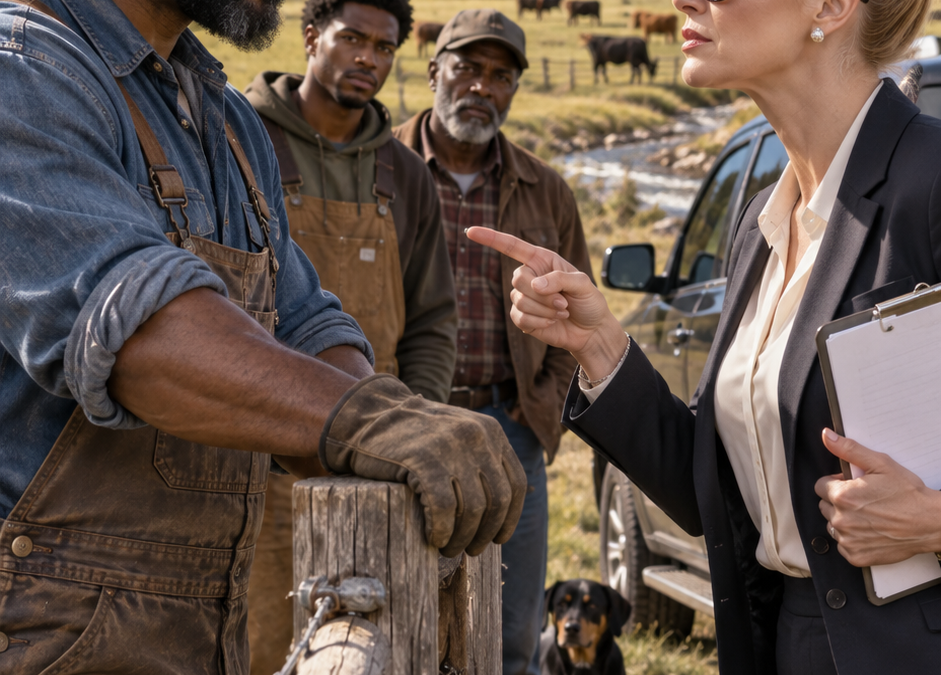
She stood ten feet inside my eastern boundary with a clipboard tucked against one arm, a laminated ID hanging from a lanyard around her neck, and a digital camera resting against the front of her charcoal blazer.
Behind her, a white SUV with the Ridgeline Meadows HOA logo idled near the county road, its air-conditioning running even though the June morning was still cool.
I looked down at the ground beneath her shoes.
That was what struck me first.
Not the clipboard.
Not the threat.
The ground.
She was standing on the same creek-bottom soil my family had been walking for generations.
My great-grandfather had taken title to the original homestead more than a century earlier.
My grandfather had built fence here with cedar posts he split himself.
My father had walked this line every morning until his knees became too painful to carry him that far.
And I had spent most of my adult life repairing, clearing, fencing, grazing, and paying taxes on it.
Diane Coulter knew none of that.
Or, more accurately, she had never bothered to find out.
She pointed toward the sagging section of wire near the cottonwoods.
“This is an unauthorized obstruction across HOA common property.”
I rested both hands on the post-hole digger I had been using.
“You’re sure about that?”
Her expression barely changed.
“We’ve reviewed our records.”
That sentence stayed with me.
Not because it frightened me.
Because I knew exactly how dangerous certainty becomes when it is built on bad paperwork.
My name is James Rutledge.
I am the fourth generation of my family to work this land in Harland County.
And standing there that morning, listening to a woman threaten to tear down my fence while standing on property recorded in my family’s name, I remembered something my grandfather Raymond told me when I was eight years old.
A man who knows where his land ends never has to argue about where it begins.
At the time, I thought he was teaching me about fences.
Decades later, Diane Coulter was about to teach me what he had really meant.
My great-grandfather, Elias Rutledge, came to Harland County in 1921 with a mule, a crosscut saw, and almost nothing else.
The land was not valuable then.
That was part of the reason he could get it.
Creek bottom.
Ridge timber.
Rocky soil.
Too difficult for easy farming and too far from anything important for anyone to imagine suburban houses spreading toward it someday.
Elias did not care about convenience.
He wanted permanence.
For his first three winters, he lived in a dugout cut into the south-facing ridge.
When the north wind came hard, he banked sod against the entrance and burned cedar scraps through the night.
Eventually, he built a two-room cedar-log house with a stone chimney.
That house still stands on the south end of my property.
By the time he finished it, he had cleared pasture, fenced part of the creek bottom, and completed the paperwork required for his land patent.
The patent was issued in 1924.
The property was described by metes and bounds beginning near the confluence of Callaway Creek and the North Fork, then running along the ridge before returning toward the water.
The survey defined 160 acres.
Not approximately.
Not according to local custom.
One hundred sixty acres, surveyed and recorded.
Elias passed the property to his son Raymond in 1951.
Raymond—my grandfather—expanded it.
In 1963, when the Henderson family sold an eighty-acre timber tract on the north side, he bought it.
He built the barn that still stands near the southern pasture.
He poured the concrete footings with a rented mixer and the help of neighboring farmers.
And he ran the fence along the creek bottom using cedar cut from his own ridge.
I can still picture him splitting posts with a froe and mallet.
When I was eight, I followed him down that line while he drove staples into cedar with a hand hammer.
He rarely wasted words.
That morning he stopped beside one of the posts and looked across the creek.
“James,” he said, “a man who knows where his land ends never has to argue with anyone about where it begins.”
Then he went back to hammering.
No speech.
No explanation.
I remembered the words because of the way he said them.
They did not sound like advice.
They sounded like something already settled.
My father, Earl Rutledge, took over the property in 1978.
He added another forty acres in 1991 after a county road-widening project left behind an irregular parcel nobody else wanted.
He paid $4,200 for it at a surplus auction.
Years later, I would realize that ugly remnant was one of the smartest purchases anyone in my family had ever made.
When Dad died in 2009, the property passed to me.
Two hundred forty acres in total.
The deed was recorded in Harland County on March 14, 2009.
I kept a certified copy in a manila folder inside the second drawer of the filing cabinet in my office.
Behind it were property-tax receipts dating back to 1987, survey plats, a photocopy of Elias’s original patent, and a hand-drawn map Raymond made in 1964 showing the fence lines as they stood then.
For years, those papers were simply family records.
Then Ridgeline Meadows arrived.
The development had begun north of us in 2003.
I watched it spread across land that had once belonged to the Peton family.
Coastal Ridge Properties had purchased roughly six hundred acres from them in 2001.
Within a few years, pasture became pavement.
Three hundred forty residential lots.
Underground utilities.
Curving roads with landscaped entrances.
A community center.
A manufactured pond they called Ridgeline Lake.
The Ridgeline Meadows Homeowners Association was organized in 2004, and its covenants, conditions, and restrictions were recorded that same year.
I read the CC&Rs once when I received a county notice.
They applied to the lots inside the recorded subdivision.
My ranch was not one of those lots.
The boundary was clear.
So I filed the notice away and went back to work.
For almost twenty years, that was the end of it.
What I did notice during those years was foot traffic.
There was an old section of fence along the creek bottom where one cedar post had rotted near the soil.
The wire sagged.
A person could step through without much trouble.
Every so often I found bootprints in the mud.
Flattened grass.
A candy wrapper caught in the wire.
I assumed people from the development were walking down to Callaway Creek.
I did not like it, but I had cattle farther south, the traffic seemed occasional, and repairing that section always fell behind something more urgent.
A broken pump.
A storm-damaged roof.
A tractor problem.
A sick calf.
What I did not understand was that the HOA had apparently interpreted my failure to stop those people as proof that the creek bottom somehow belonged to them.
That misunderstanding walked onto my land wearing a blazer in late June.
Diane photographed the fence from three angles.
She measured the gap with a collapsible ruler.
She photographed the path running down toward the creek.
She photographed the cottonwoods.
Then she found me farther along the line, where I was replacing a post.
After giving me the fourteen-day ultimatum, she waited.
I suppose she expected an argument.
Instead, I said, “I’ll look into it.”
She gave me the faint, satisfied smile of someone who hears surrender where none was offered.
“Good. We’d prefer voluntary compliance.”
Then she walked back toward her SUV.
I watched her go.
I was not angry.
Not yet.
Mostly, I was curious.
There is something strange about being told that land you have owned for decades belongs to somebody else.
If the claim is shouted across a fence, it is irritating.
If the claim is placed on official letterhead, signed, dated, and mailed certified, it becomes useful.
Three days later, the certified letter arrived.
It contained a formal violation notice.
A $200 fine.
And a citation to Ridgeline Meadows CC&Rs, Article 7, Section 3.
The provision dealt with encroachments on HOA common areas.
I made coffee that evening and sat at the kitchen table beneath the overhead light.
I read the section once.
Then again.
The language was straightforward.
It governed common property “within the recorded plat of Ridgeline Meadows Subdivision Unit One.”
Within the recorded plat.
I put down the HOA letter and went to my office.
The manila folder came out of the second drawer.
I spread my deed beside the violation notice.
Nothing matched.
The creek bottom was not inside the subdivision plat.
It was not even close enough to create a reasonable surveying dispute.
There was a county road right-of-way between the subdivision and my property, plus a parcel line that had been recorded since 1963.
Article 7, Section 3 had no more authority over my fence than it had over land in another county.
But Diane had now done something important.
She had put the HOA’s claim in writing.
I folded the letter back along its crease.
Then I looked out the kitchen window toward the dark line of cottonwoods.
I thought about all those footprints.
The sagging wire.
The wrappers.
The years of people walking through.
Maybe the $200 fine was not the important part.
Maybe the important part was that the HOA had apparently been treating my private creek bottom like a public amenity.
The following morning, I called Gerald Fitch.
Gerald had been surveying land in Harland County for thirty-one years.
He had done work for my father.
He kept old field notes in three-ring binders and could remember bearings from jobs completed decades earlier.
More importantly, he had little patience for people who tried to solve boundary questions without reading deeds.
“I need the eastern boundary surveyed,” I told him.
“Dispute?”
“Apparently.”
“With who?”
“Ridgeline Meadows HOA.”
There was a short silence.
Then Gerald said, “That subdivision is across the county road.”
“I know.”
Another silence.
Longer this time.
“All right,” he said. “I’ll pull the patent and the Henderson deed before we run anything.”
That was Gerald.
He did not ask why someone across the road thought they owned my creek.
He wanted the chain of title.
While his crew scheduled the fieldwork, I drove into town to the Harland County Courthouse.
Paty Wills worked in the recorder’s office.
She had been there twenty-two years and knew the filing system well enough to retrieve documents most people would have spent hours searching for.
I asked for the recorded plat of Ridgeline Meadows Subdivision Unit One.
Paty carried it to the light table and spread it flat.
We found the eastern boundary.
There it was.
Black ink.
Clear as a fence in snow.
The subdivision stopped at the county road.
My property began beyond the right-of-way.
At the location of the gap Diane had photographed, the distance from the HOA’s platted boundary to my fence was roughly 340 feet.
Paty looked at the plat.
Then at the deed description I had brought.
“Well,” she said, “those don’t overlap.”
“No.”
“Not even close.”
“No.”
She looked at me.
“So why are you here?”
I handed her the HOA violation letter.
She read the first page.
Her eyebrows rose.
“That’s ambitious.”
It was the closest thing to an opinion I ever heard Paty Wills give from behind that counter.
I ordered certified copies of the subdivision plat, my deed-chain entries, and the HOA’s recorded CC&Rs.
The copying fee was thirty-four dollars.
I put everything into a manila envelope and drove home.
That evening, I called Wallace Puit.
Wallace had handled my father’s probate in 2009.
His office sat over the Farm Bureau building on Harland’s main street.
The carpet had been old when I first met him and had not improved.
His shelves were crowded with property files, estate files, and enough county records to make the office feel more like an archive than a law practice.
I explained everything.
Diane.
The fence.
The letter.
The $200 fine.
The plat.
The deed.
Wallace listened without interrupting.
When I finished, he leaned back.
“They fined you two hundred dollars for a fence on your own land?”
“That seems to be the situation.”
“All right.”
He reached for the HOA letter.
“Let’s find out what they think they own.”
Over the next six weeks, we did exactly that.
And the answer was nothing.
No active easement.
No deed.
No access agreement.
No recorded instrument giving Ridgeline Meadows rights over Callaway Creek.
Gerald’s survey crew spent two full days on the eastern boundary.
They used GPS equipment and a total station.
At the northern corner, they located an old stone monument.
The stone Elias Rutledge had referenced in the 1924 patent was still there.
Nearly a century later.
Still readable.
Still where the record said it should be.
When Gerald delivered the final plat, it came rolled inside a cardboard tube with a three-page legal description.
The eastern line ran on a bearing of south 12 degrees, 15 minutes east.
Monuments marked the corners.
And the gap Diane had called “community property” was 338 feet west of the Ridgeline Meadows subdivision boundary.
Not three feet.
Not thirty-eight.
Three hundred thirty-eight.
Every inch of my fence was on my property.
I spread Gerald’s survey across my kitchen table beside the certified deed chain and Diane’s violation letter.
For the first time since this started, I smiled.
The paper was beginning to do its work.
But Wallace found something else.
Three days later, he called.
“James, come in.”
“What happened?”
“I found where their easement story probably came from.”
I drove into town.
Wallace had documents arranged across his desk.
In 1978, the Peton family—the people who once owned the land where Ridgeline Meadows would later be built—had granted Harland County a temporary access easement.
The county needed to maintain a drainage culvert.
The easement created a fifteen-foot corridor across part of the Peton property.
It expired by its own terms on December 31, 1983.
That should have been the end of it.
Except someone had misfiled a cross-reference.
The dead easement had been incorrectly associated with the parcel records connected to the creek-bottom section of my ranch.
Years later, during the 2002 and 2003 subdivision approval process, somebody working for Coastal Ridge Properties apparently discovered that reference.
Instead of retrieving and carefully reading the actual instrument, a title examiner or project employee had summarized it in an internal memorandum.
That memorandum suggested that creek-bottom access was covered by a recorded easement.
The memorandum survived.
The easement did not.
And sometime after Ridgeline Meadows was created, the HOA inherited the memo and began treating the sentence inside it as legal truth.
Wallace slid the original easement toward me.
“Read the description.”
I did.
It described the south boundary of the old Peton property.
Nothing about my ranch.
Nothing about Callaway Creek on my parcel.
Nothing corresponding to the Rutledge deed.
“So they actually believe this?” I asked.
“They probably do.”
“They think they have an easement.”
Wallace shook his head.
“They have a memorandum saying somebody once believed there was an easement.”
He tapped the original instrument.
“This is the easement.”
Then he tapped the expiration date.
“And it died in 1983.”
He pointed to the legal description.
“And even when it was alive, it was never on your property.”
I sat back.
All those years of people walking through my fence.
All the confidence in Diane’s voice.
The photographs.
The $200 fine.
The fourteen-day ultimatum.
Built on one careless reading of another careless reading of a misfiled document that had expired forty years earlier.
Wallace prepared a correction affidavit for the recorder’s office.
Then he drafted a formal response to Ridgeline Meadows.
Eleven pages.
The survey was attached.
So was the deed chain.
The original 1924 patent.
The subdivision plat.
The expired easement.
The correction affidavit.
Wallace’s legal memorandum walked through everything in chronological order.
The final demand was simple.
Withdraw the violation.
Cancel the fine.
Acknowledge in writing that the creek-bottom parcel belonged to me and was outside HOA jurisdiction.
Stop entering it.
Thirty days.
We mailed the packet certified to the HOA board, the management company, and the company’s registered agent.
Then we waited.
Thirty days passed.
No written response.
On day twenty-six, Carl Tipton, the HOA president, called.
“Mr. Rutledge, I think there’s been some confusion about the boundary.”
His voice was polite in a way that sounded rehearsed.
“Your attorney’s letter raised some questions.”
“That was the purpose.”
“We’re reviewing everything.”
“Good.”
“I hope we can resolve this amicably.”
“So do I.”
I looked out toward the creek.
“The terms are in Wallace’s letter.”
Carl cleared his throat.
“We’ll be in touch.”
They were not.
Instead, Roy Casper called me in early September.
Roy ran cattle on land east of mine.
He had known that fence for twenty years.
He was not a man who exaggerated.
“James,” he said, “you got anybody working down by the creek?”
“No.”
“You sure?”
“Yes.”
“Well, yesterday afternoon there was a truck near that bad section of fence.”
“What kind of truck?”
“HOA logo.”
I stopped moving.
Roy continued.
“Two men got out. Went through your fence. One had bolt cutters.”
“How long were they there?”
“Eleven minutes that I watched.”
“Did you get pictures?”
“Several.”
“Send them.”
The images reached my phone less than a minute later.
There was the truck.
There were the men.
There was my fence.
I called Wallace.
When I finished explaining, he went quiet.
Then he said, “That changes things.”
I drove to the creek bottom.
The opening had been widened.
The lower wire had been pulled farther aside.
On the nearest cedar post was a fresh crescent cut.
Someone had put a blade against it.
The weathered outer wood had been broken away, revealing pale cedar underneath.
They had tested the tool.
Then stopped.
I photographed everything.
Six angles of the cut.
The wire.
The flattened grass.
Bootprints.
Tire tracks near the road.
When I emailed the photographs, I wrote one sentence.
They came to the fence.
Wallace replied:
Good. Now we file.
His petition asked the Harland County District Court for a temporary restraining order and a permanent injunction.
The requested order would prohibit Ridgeline Meadows HOA, its employees, board members, contractors, and agents from entering my property, damaging the fence, enforcing the violation, or collecting the fine.
The filing contained everything.
Deeds.
Surveys.
Plat.
Expired easement.
Certified letters.
Return receipt.
Roy’s photographs.
Mine.
It also demanded damages for trespass and ongoing interference with my use of the property.
By then, the survey, title work, certified records, correction filing, and legal fees had cost me more than $14,000.
Then Wallace showed me the paragraph that changed the nature of the case.
Under the state trespass statute he was relying on, damages could be multiplied when entry was shown to be willful—when the person responsible knew they lacked authorization and went onto the land anyway.
The HOA had received our legal notice weeks before its truck appeared.
There was no longer an argument that they simply did not know.
The potential exposure could reach $120,000.
I read that number twice.
Then I looked at Wallace.
“File it.”
He did.
But I had already made another decision.
I knew an institution willing to send men toward a disputed fence after receiving an eleven-page legal notice was unlikely to stop because of one near miss.
They would come back.
So I spent $189 at the farm supply store.
For years, I had used trail cameras to watch deer and coyotes along the creek.
The newer units could send photographs directly to a phone.
I bought one with a cellular transmitter.
Twenty feet inside my boundary stood a cottonwood wide enough to hide it.
I mounted the camera against the bark and angled it toward the damaged section of fence and the approach from the county road.
I painted the casing a dull brown.
Unless somebody knew exactly where to look, it disappeared.
I told Wallace.
No one else.
Then I waited.
Eleven days later, at 7:43 on a Tuesday morning in mid-September, my phone buzzed.
I looked down.
Two men were stepping through my fence.
One carried bolt cutters.
The other carried an orange-flagged survey stake.
Behind them sat the white Ridgeline Meadows Expedition.
For several seconds I simply stared at the photograph.
There is a difference between believing someone will do something foolish and watching them do it.
Another image arrived.
The vehicle’s license plate was visible.
I called Wallace.
“They’re here.”
“You’re looking at them?”
“Trail camera.”
“Do not go down there.”
“I wasn’t planning to.”
“Call the sheriff. Let the camera keep running.”
I called the Harland County Sheriff’s Office and reported a trespass in progress.
I gave the dispatcher the address.
The vehicle.
The plate number.
Then I waited.
More photographs came in.
The men moved farther inside.
One cut the wire.
A clean opening about eighteen inches long.
Another photograph showed one of them near the cedar post.
A later frame showed fresh damage.
The other man drove the survey stake into the ground roughly eight feet inside my fence.
Twenty-two minutes after my call, a deputy arrived.
By then, the work crew had created all the evidence Wallace could have asked for.
The deputy photographed the damage.
Measured the location.
Documented the cut wire.
The post.
The stake.
Then he interviewed the men.
They identified themselves as contractors working for Ridgeline Meadows HOA.
And they had paperwork.
A work order.
Signed by Diane Coulter.
Director of Community Standards.
The order instructed them to clear an “encroachment” on HOA common property and mark the boundary for installation of a replacement fence.
It referenced Diane’s original June violation notice.
What it did not reference was the survey.
Or Wallace’s certified letter.
Or the recorded deed.
Or the original easement.
The HOA had been formally notified of all of those things forty-three days earlier.
Both contractors were cited for criminal trespass.
When Wallace obtained a copy of the work order, he amended our court petition.
There was no longer any question about whether the September entry had been accidental.
Someone in authority had ordered it.
In writing.
After notice.
Diane had signed her name to the evidence.
My $189 camera had simply made sure nobody could later pretend otherwise.
The first hearing took place in October in Courtroom Two of the Harland County District Court.
I arrived early.
The room smelled faintly of old varnish and paper.
Oak benches lined the gallery.
High windows let pale morning light fall across the floor.
Wallace arranged our documents on the table.
He always organized evidence chronologically.
Deed chain.
Plat.
Survey.
Easement.
Letters.
Photographs.
Work order.
Ridgeline Meadows’ lawyer arrived about twelve minutes later.
Dennis Farwell.
Pressed suit.
Rolling briefcase.
Easy confidence.
He shook Wallace’s hand.
Then his eyes drifted toward our table.
I watched him register the thickness of the file.
Just for a second, his expression changed.
Diane sat behind him.
Same professional blazer.
Same lanyard.
Carl Tipton sat beside her.
Neither of them looked at me.
Judge Patricia Gaines entered at nine.
She had been on the district bench fourteen years.
Wallace had told me one thing about her before the hearing.
“She reads.”
That mattered.
Judge Gaines sat down and opened the file.
She spent several seconds looking at the first page.
Then she raised her eyes toward Farwell.
“Counsel, what recorded instrument gives the respondent jurisdiction over Mr. Rutledge’s property?”
Farwell stood.
“Your Honor, Article Seven, Section Three of the Ridgeline Meadows covenants—”
“I asked for the recorded instrument establishing a property interest.”
He shifted.
“There is an easement referenced during the subdivision approval process.”
“Do you have it?”
“We have the memorandum identifying it.”
“That was not my question.”
Silence.
Farwell opened a folder.
“The HOA relied in good faith upon title information provided during development.”
Judge Gaines looked over her reading glasses.
“Has anyone verified that information against the recorded easement?”
Another silence.
“Not before the present dispute, Your Honor.”
Wallace stood.
“We have a certified copy.”
He walked forward.
The clerk handed it to the judge.
Then Wallace supplied the correction affidavit.
Gerald Fitch’s survey.
The subdivision plat.
The Rutledge deed chain.
The 1924 patent.
Judge Gaines read.
Nobody spoke.
I could hear paper moving.
Eventually, she looked up.
“The easement expired December thirty-first, 1983.”
“Yes, Your Honor,” Wallace said.
“And the legal description is for the former Peton parcel.”
“Yes.”
“Not Mr. Rutledge’s parcel.”
“Correct.”
She turned another page.
“The current survey places the disputed fence three hundred thirty-eight feet west of the Ridgeline Meadows subdivision boundary.”
“Yes.”
She looked toward Farwell.
“Then what is your client’s present legal basis for claiming this area as common property?”
Farwell started to answer.
Then stopped.
Diane no longer looked as composed as she had beside my fence in June.
Judge Gaines granted the temporary restraining order.
The HOA was prohibited from entering the property.
The $200 fine could not be enforced.
Nobody representing Ridgeline Meadows could touch the fence.
Then the judge addressed damages.
She noted that the court had evidence showing the HOA received written notice of my ownership claim before authorizing additional entry.
If proven at the permanent-injunction hearing, she said, those facts could support the enhanced-damages provision Wallace had cited.
Farwell requested thirty days to prepare.
The judge granted it.
Outside the courtroom, Wallace closed his folder.
I said, “You think they understand now?”
He looked toward the doors through which the HOA attorney had disappeared.
“They should have understood forty-three days ago.”
The permanent-injunction hearing took place in December.
This time, Ridgeline Meadows brought another attorney.
A property specialist from the county seat.
That told me more than anything Carl Tipton could have said.
For twenty minutes, the new lawyer argued that the HOA had acted under a genuine good-faith belief that it possessed an access right.
The board, he said, inherited the erroneous memorandum.
Management relied upon it.
Diane relied upon management records.
Mistakes had occurred, but mistakes were not the same as willful misconduct.
Judge Gaines listened.
When he finished, she asked one question.
“After receiving plaintiff’s certified letter and supporting title documents, did the HOA retain a title examiner to verify its supposed easement before authorizing the September entry?”
The lawyer paused.
“No, Your Honor.”
“Did it obtain a competing survey?”
“No.”
“Did it obtain a legal opinion establishing that the expired Peton easement applied to the Rutledge property?”
“No.”
“Then after being given a deed chain, a certified plat, a sealed survey, and a copy of the recorded easement, the HOA nevertheless authorized contractors to enter Mr. Rutledge’s land and alter his fence?”
The attorney looked down.
“Yes, Your Honor.”
There it was.
Months of letters.
Arguments.
Memoranda.
Lanyards.
Clipboards.
Reduced to one word.
Yes.
Judge Gaines issued the permanent injunction.
The original violation notice was vacated.
The $200 fine was void.
Ridgeline Meadows was ordered to file a written acknowledgement with the court and county recorder confirming that the Callaway Creek parcel was private property.
The HOA possessed no easement.
No access right.
No jurisdiction.
No ownership claim.
No authority to enforce its CC&Rs there.
Then came the damages.
The court found that the September trespass occurred after Ridgeline Meadows had received sufficient written notice of my ownership and of the defects in its easement theory.
The signed work order demonstrated authorization.
The trail-camera photographs established the entry.
The deputy’s report documented the damage.
The contractors’ statements connected their actions directly to the HOA.
The court applied the enhanced-damages provision to the willful trespass.
Total judgment:
$120,000.
Ridgeline Meadows HOA was ordered to pay within ninety days.
The order was entered on a Tuesday.
Wallace called that afternoon.
“I have the final order.”
I stood in my kitchen.
“All right.”
He read the operative section aloud.
His voice did not change when he reached the amount.
One hundred twenty thousand dollars.
When he finished, neither of us said anything for a few seconds.
Then Wallace said, “The paper did its work.”
I smiled.
“That sounds like something my grandfather would’ve said.”
“Your grandfather sounds like he understood real estate.”
“He understood fences.”
Wallace laughed quietly.
“In this county, that’s almost the same thing.”
After we hung up, I stood at the kitchen window.
December had stripped the cottonwoods bare.
Their branches reached gray against a pale sky.
Callaway Creek ran low and clear over limestone near the bend.
Nothing about the land looked different.
That was what struck me.
Court orders can sound enormous when read aloud.
One hundred twenty thousand dollars.
Permanent injunction.
Willful trespass.
Recorded acknowledgement.
But outside my window, the creek continued moving exactly where it had always moved.
The trees stood where they had always stood.
The ridge was still the ridge.
My family’s boundary had never moved.
Only someone else’s understanding of it had.
The following spring, I rebuilt the damaged section of fence.
Gerald Fitch came out one morning with his equipment.
We walked the eastern boundary together.
At every corner, he confirmed the monuments.
South 12 degrees, 15 minutes east.
Exactly as his recorded survey described it.
I had cut new cedar posts from the south ridge the previous fall.
From the same stand where Raymond had taken timber in the 1960s.
I split them myself and treated the ends with linseed oil.
They cured in the barn all winter.
When spring came, I started at the northern monument.
Set a post.
Tamped the soil.
Stretched the wire.
Drove the staples.
Then moved south.
It took three days.
No contractors.
No committee.
No clipboard.
Just cedar, wire, soil, a steel bar, and a hand hammer.
By the third afternoon, the last section stood tight.
No sag.
No gap.
No path through the middle.
Nothing inviting someone to imagine that silence meant permission.
Gerald stood beside me for a moment.
“You going to put up signs?”
“I already ordered them.”
“Private Property?”
“Yes.”
He nodded.
“Good.”
I looked along the new wire.
“I probably should’ve repaired that gap ten years ago.”
Gerald smiled.
“Maybe.”
Then he looked toward the development beyond the county road.
“But then you’d never know how expensive a hole in a fence could become.”
After he left, I stayed there.
Mallards had returned to the creek.
Fresh leaves were opening on the cottonwoods.
The air carried the smell of wet soil, cedar, and running water.
I rested one hand on the top strand.
I thought about Raymond.
About being eight years old behind him while he hammered staples.
About the sentence I had carried for most of my life without fully understanding it.
A man who knows where his land ends never has to argue about where it begins.
He had not meant there would never be conflict.
He had meant something more important.
When conflict came, certainty should come from evidence.
Not volume.
Not confidence.
Not a logo painted on a truck.
Diane Coulter had walked onto my property carrying every outward symbol of authority she could fit into one morning.
A title.
A badge.
A clipboard.
A camera.
A violation form.
A deadline.
Behind her stood a management company, an HOA board, lawyers, and years of institutional assumptions.
I had an old manila folder.
Inside it was a deed.
Behind that deed was a survey.
Behind that survey was a chain of title reaching back to 1924.
And underneath all of it was the land itself.
The mistake Ridgeline Meadows made was not simply misunderstanding an old easement.
People make mistakes.
Documents get misfiled.
Memoranda get copied.
Institutional errors survive because the next person assumes the previous person checked.
Their real mistake came later.
We showed them the record.
They had the opportunity to stop.
They could have called a title examiner.
They could have hired a surveyor.
They could have withdrawn a $200 fine and sent a short letter saying the matter had been corrected.
Instead, they sent men back with bolt cutters.
That decision transformed a bureaucratic error into willful trespass.
And once Diane signed the work order, she did something no amount of confidence could undo.
She created evidence.
I never had to shout at her.
I never had to stand at the gate and threaten anybody.
I never needed to cut off the road, block the HOA entrance, or engage in some dramatic confrontation.
I needed a deed.
A competent surveyor.
A careful lawyer.
Certified mail.
A $189 trail camera.
And enough patience to let people committed to a false claim put their decisions in writing.
That spring afternoon, I walked the finished fence from one end to the other.
At the cottonwood where I had mounted the camera, I stopped.
The camera was still there.
The bark had begun to grow around the mounting strap.
I removed it and held the little brown box in my hand.
It looked insignificant.
A plastic case.
A lens.
A cellular transmitter.
Nothing about it suggested $120,000.
But that was never really what it had cost Diane Coulter and Ridgeline Meadows.
The money came from their refusal to recognize something simpler.
My land had never been theirs.
The survey had said so.
The deed had said so.
The original easement had said so.
The county plat had said so.
They had simply believed their own authority mattered more than the record.
A few minutes later, I carried the camera back toward the house.
Behind me, the new fence ran straight through the green creek bottom.
The same boundary Raymond had walked.
The same land Earl had cared for.
The same ground Elias had fought to make permanent when permanence was about surviving winters in a dugout and cutting timber by hand.
Four generations.
A century of paper.
And one line in the earth that had never moved at all.
By sunset, the cedar posts threw long shadows across the grass.
I stood on the porch looking toward them and thought about how the whole fight had begun.
“You have fourteen days to remove that fence.”
Diane had been certain.
In the end, she was right about one thing.
Somebody’s claim was going to be removed.
It just wasn’t mine.








