𝗙𝗨𝗟𝗟 𝗦𝗧𝗢𝗥𝗬 HOA Karen Invented a $4,800 “Tax” on My Grandpa’s Yacht—Then My Federal-Law-Enforcement Family Sat in the Back Row
𝗙𝗨𝗟𝗟 𝗦𝗧𝗢𝗥𝗬
My grandfather bought Eleanor after my grandmother died.
He was seventy-one.
Everyone told him not to.
His friends thought he was too old.
My father thought the boat was too large.
The insurance agent thought he had lost his mind.
Grandpa listened politely to all of them.
Then bought it anyway.
He had worked around ships and docks most of his life.
Later, he spent years in federal maritime inspection.
He understood machinery.
Documentation.
Hull numbers.
Safety records.
Paper trails.
He named the yacht Eleanor before the first registration paperwork was finished.
My grandmother had been gone three months.
The first time I saw the boat, I was twenty-three.
Grandpa stood on the stern with one hand on the polished brass letters.
“She hated boats,” he told me.
I laughed.
“Then why name it after her?”
“Because now she has to come.”
That was him.
He documented the vessel with the United States Coast Guard.
Not because that magically placed Eleanor outside every private rule in America—it didn’t—but because federal documentation established her identity, ownership record, official number, and status independently from the HOA’s neighborhood paperwork.
Grandpa loved that.
He would run his thumb across the official number permanently marked inside the hull.
“She exists on paper where people can’t just pretend she doesn’t.”
I understood the sentence much better years later.
When he died, I inherited both the house and Eleanor.
I moved into Harborview Estates ten weeks before Diane’s orange notice appeared.
The boat had been sitting in the driveway for eight.
Temporarily.
I was arranging a marina slip.
The driveway was large enough.
The recorded covenants permitted short-term boat storage within certain dimensions during relocation or maintenance.
I knew because I had read them before accepting the property.
That is another thing my family did.
We read.
My father spent thirty-one years as a federal investigator.
My older sister became a federal prosecutor.
My uncle spent most of his career in financial-crimes enforcement at Treasury.
My grandfather inspected maritime operations.
I did not go into federal service.
I worked in compliance and risk management for logistics companies.
But I grew up around people who believed a document was either supported by authority or it wasn’t.
Letterhead did not impress them.
Seals did not impress them.
Titles did not impress them.
Authority had to come from somewhere.
Statute.
Contract.
Recorded agreement.
Delegation.
Jurisdiction.
Something real.
So the morning after Diane delivered the “tax,” I made another coffee and sat at Grandpa’s desk.
Then I pulled every relevant record I had.
Harborview’s recorded declaration.
CC&Rs.
Amendments.
Fee schedule.
House deed.
HOA disclosures from probate.
Boat documentation.
Temporary storage provisions.
Assessment authority.
I read slowly.
Not searching for what I wanted to find.
Searching for what existed.
There were dues.
There were special-assessment procedures.
There were late fees.
Architectural-review fees.
Transfer fees.
Certain enforcement costs.
There was nothing called an annual vessel tax.
Nothing allowing the board to assess privately owned personal property based on value.
Nothing authorizing a $4,800 charge merely because a boat sat inside a driveway.
Nothing allowing the president to invent a fee by declaration.
And nothing allowing a lien against a home based on an assessment that the declaration never authorized in the first place.
I wrote one sentence in a notebook.
No underlying authority.
Then another.
Ask for exact covenant.
I did not call Diane.
I did not call my father.
I did not call an attorney.
Not yet.
I started a folder.
Orange notice.
Photograph of where it had been attached.
Copy of recorded covenants.
Fee schedule.
Boat documentation.
Date.
Time.
Witnesses.
That afternoon, Frank walked past my driveway.
He slowed.
Looked at Eleanor.
Then looked at me.
For a moment, I thought he would stop.
He didn’t.
He kept going.
But the way he looked at the orange notice folder in my hand told me something.
He had seen paperwork like it before.
Eleven days later, Diane returned.
This time, she brought her son.
Tyler Whitlock.
Maybe twenty-eight.
Black polo shirt.
HARBORVIEW SECURITY stitched across the chest.
Harborview did not have a licensed security department.
I checked later.
Tyler was simply Diane’s son wearing a shirt.
He held a phone at chest height and recorded as they walked up.
“Mr. Reyes.”
Diane had upgraded from first names.
That meant paperwork.
“I’m serving the formal assessment.”
She held out cream-colored paper.
Heavy stock.
Embossed seal.
HOA crest.
NOTICE OF ASSESSMENT.
ANNUAL VESSEL TAX.
$4,800.
“Board voted unanimously.”
I took it.
“On a vessel tax?”
“On bringing Harborview assets into compliance.”
“What does that mean?”
“It means you owe forty-eight hundred dollars.”
Tyler stepped closer.
“You’re being recorded for noncompliance.”
I looked at him.
He angled the phone more directly at my face.
“Good,” I said.
He blinked.
Diane frowned.
I read the first paragraph.
Then asked the same question as before.
“Which recorded covenant authorizes this?”
Diane’s mouth tightened.
“It’s authorized by the board.”
“That isn’t what I asked.”
“The board interprets the governing documents.”
“Which provision gives you authority to impose a tax or assessment on privately owned personal property?”
The word tax bothered her.
I could tell.
“It is an association assessment.”
“Your document calls it a tax four times.”
Tyler’s camera was still recording.
Good.
Diane shifted tactics.
“I do not provide legal tutorials to every homeowner who believes he is special.”
“I’m asking for a citation.”
“You can read the letter.”
“I did.”
“Then pay it.”
“There’s no covenant cited.”
She stared at me.
Then said the line she must have used on a hundred people.
“You can read the assessment now or read the lien later. Either way, you’ll be reading something with my name on it.”
I nodded.
“That’s a good line.”
She didn’t know whether I was mocking her.
I wasn’t, exactly.
It was a good line.
Effective.
Memorable.
Designed to end arguments.
She had probably spent years refining it.
I folded the cream notice and held it at my side.
Diane looked disappointed.
She had expected anger.
“You have thirty days.”
“You said that last time.”
Tyler kept filming while they walked away.
He narrated quietly.
“Subject remains uncooperative.”
I almost thanked him.
Instead, I went inside and placed the cream letter on top of the orange one.
Two documents.
Same invented fee.
Same threat.
Still no covenant citation.
I started a new sheet.
Timeline.
That evening, I wrote down the names of everyone I had seen react strangely when Diane appeared.
Frank was first.
Three days later, he finally stopped at my driveway.
“You’re not paying it.”
Not a question.
“I haven’t found a legal basis for it.”
Frank turned his cap in his hands.
“I paid mine.”
“For a boat?”
“No.”
He glanced toward his house.
“Waterfront proximity assessment.”
I waited.
“One thousand one hundred dollars.”
“For what?”
“My back fence.”
“What was wrong with it?”
“Too close to the retention pond.”
“Did the association own the strip?”
He shrugged.
“She said they did.”
“Do you still have the notice?”
Frank’s eyes came up.
“Why?”
“Because I want to read it.”
He hesitated.
Then nodded.
His wife had died two years earlier.
The notice arrived a few months after the funeral.
Frank had not wanted a fight.
The letter mentioned lien rights.
He paid.
“Figured it was one of the rules I’d missed.”
He looked embarrassed saying it.
I hated that.
Not because Frank had done anything wrong.
Because people who get intimidated often blame themselves afterward.
He brought me the notice that evening.
Same orange paper.
Same crest.
Same signature.
No covenant citation.
WATERFRONT PROXIMITY FEE.
$1,100.
I searched the recorded declaration.
No such fee.
Frank introduced me to the Petersons.
Young couple.
Two children.
They had paid $600 for a “landscape compliance assessment.”
The alleged problem was a tree.
The recorded covenants did regulate landscaping.
But there was no separate $600 assessment matching Diane’s notice.
Then Anita Collins.
Nurse.
Worked long shifts.
She had a medical-supply company van issued by her employer.
Diane assessed a “luxury/commercial vehicle surcharge” for parking it in Anita’s own driveway.
No such charge existed in the fee schedule.
Four hundred fifty dollars.
Then Gloria Bennett.
Eighty-one.
Maybe five feet tall.
She pulled a notice from a kitchen drawer.
HOLIDAY DECOR REVIEW ASSESSMENT.
Four hundred dollars.
Her offense?
A wreath.
“It was too large,” she said.
“According to what?”
“Diane.”
“Was there a size limit in the covenants?”
Gloria looked at me.
“I never knew.”
There wasn’t.
By the end of the week, I had notices from six households.
I laid them side by side on Grandpa’s desk.
Orange.
Cream.
White.
Different invented names.
Same structure.
Assessment.
Deadline.
Late penalty.
Lien threat.
Diane’s signature.
Sometimes countersigned.
Sometimes not.
Then I put the actual recorded fee schedule beside them.
Nothing matched.
It was not one bad interpretation.
It was a system.
Diane had discovered something simple.
If you use official language, small dollar amounts, escalating deadlines, and the word lien, most people will not ask where the authority comes from.
They will pay to make the anxiety stop.
I sat there under Grandpa’s desk lamp looking at all those papers.
Then I pulled Eleanor’s documentation packet toward me.
I wanted to be careful.
A federally documented vessel is not magically immune from every valid HOA covenant.
If Harborview’s recorded declaration lawfully restricted boat storage, that could be enforceable depending on the facts.
But that was not what Diane had done.
She had not cited a storage violation.
She had invented a $4,800 annual property-style tax based on the existence of the vessel.
Then threatened to lien my home over it.
The federal documentation mattered because it reinforced what Eleanor was:
Separately documented personal property.
Not an HOA asset.
Not something Diane could simply declare taxable because it sat behind the neighborhood gate.
I closed the folder.
That was the night I decided I would not handle this privately.
Not because I wanted a spectacle.
Because secrecy was how Diane’s system survived.
Each homeowner believed his notice was personal.
Isolated.
Embarrassing.
Maybe legitimate.
Nobody compared paperwork.
Nobody asked whether Frank’s “waterfront assessment” and Gloria’s “wreath review” came from the same nonexistent authority.
I wanted the papers in one room.
Harborview held an open board meeting at the end of every month.
Diane ran them like ceremonies.
That would be the room.
I told Frank.
“Bring your notice.”
“You’re going to challenge her?”
“I’m going to ask her to show her work.”
He looked doubtful.
“She’s been doing this nine years.”
“That doesn’t make the fee exist.”
He gave a tired laugh.
“No.”
Then his face sobered.
“Just be careful.”
“I will.”
The thirty-day deadline expired on a Thursday.
Diane filed the lien that afternoon.
Or at least attempted to.
I found a copy wedged into my front door.
CLAIM OF LIEN.
HARBORVIEW ESTATES HOA.
$4,800.
UNPAID VESSEL ASSESSMENT.
For ten seconds, my stomach dropped.
I knew the debt was baseless.
That does not make the word lien feel harmless.
A lien can cloud title.
Interfere with sale.
Complicate refinancing.
Create attorney fees.
It changes your house from home into collateral in somebody else’s argument.
I stood in Grandpa’s entryway holding that paper and finally understood exactly why Frank had paid.
Why Gloria paid.
Why the Petersons paid.
Diane was not really selling rules.
She was selling relief from fear.
Pay me and the paper stops.
That was the product.
Then the feeling passed.
I read the lien again.
A lien is only as strong as the debt supporting it.
If the assessment did not exist under the governing documents, the lien did not become legitimate because Diane filed it.
In fact, filing made the situation worse for her.
Now the invented debt was in a more formal record.
Signed.
Dated.
Traceable.
I called an attorney.
Her name was Priya Farnham.
Everyone called her Fam.
Real estate and association disputes.
I explained the story.
She interrupted twice.
Once when I said “annual vessel tax.”
Again when I said Diane had filed a lien.
“She actually recorded it?”
“Yes.”
“Based only on this alleged vessel assessment?”
“Yes.”
“Do the covenants authorize it?”
“No.”
“You’re certain?”
“I read them twice.”
“Bring everything.”
I brought three folders.
Fam read in silence.
Actual declaration first.
Then fee schedule.
Then Diane’s notices.
Then neighbors’ notices.
Then lien.
Finally, boat documentation.
She leaned back.
“This is ugly.”
“For me?”
“For the association.”
She tapped the lien.
“This is the problem.”
“What about the notices?”
“They’re problems too. But this one reaches into title records based on an assessment I cannot presently identify any authority for.”
“Can it be removed?”
“Yes.”
“How fast?”
“That depends how stubborn they are.”
She looked through Frank’s notice.
Then Gloria’s.
“Did these people pay?”
“Yes.”
“All of them?”
“Everyone whose paper I have.”
Fam exhaled.
“This may be bigger than your boat.”
“I know.”
That evening, I called my father.
He answered on the third ring.
“You all right?”
“Yes.”
“You don’t call Thursday nights.”
“I have something strange.”
He listened.
I told him about Diane.
The tax.
Neighbors.
Lien.
My father said almost nothing until I finished.
Then:
“You have it all in writing?”
“Yes.”
“Originals?”
“Copies and originals.”
“Recordings?”
“Her son recorded at least one interaction. I recorded another.”
“Good.”
“Dad, I’m not asking you to call anybody.”
“I know.”
“My sister either.”
“I know.”
“My uncle—”
“Gabriel.”
“Yes?”
“Nobody in this family is going to abuse a badge because your HOA president is obnoxious.”
I smiled despite myself.
“I know.”
“Good.”
Then he paused.
“When is the board meeting?”
“Nine days.”
“We’ll come.”
I leaned back.
“For what?”
“To sit down.”
“That’s it?”
“That’s it.”
He laughed softly.
“You have paper. Let the paper work.”
Sunday dinner came first.
Dad.
My sister Elena.
Uncle Martin.
They arrived separately.
Nobody brought a badge.
Nobody talked about agencies over dinner.
We ate Grandpa’s old seafood stew recipe in the dining room while Eleanor sat outside under a cover.
After dessert, I put the notices on the table.
My father read slowly.
Elena faster.
Martin read the lien twice.
My sister tapped one paragraph.
“This language claims authority without citing the source.”
“I noticed.”
“Good.”
My uncle lined up the notices chronologically.
“Has anyone totaled how much residents paid?”
“Not yet.”
“Do that.”
Dad looked at me.
“What do you want out of this?”
The question mattered.
“Lien gone.”
“Obviously.”
“Refunds.”
“For you?”
“For everyone.”
He nodded.
“Anything else?”
“Rules that make them cite actual authority.”
My sister smiled slightly.
“That’s a better answer than revenge.”
“I considered revenge.”
“Normal.”
Dad folded the lien.
“Don’t announce what we do for a living unless she makes it relevant.”
“I don’t plan to.”
“Good.”
Then he pointed toward the stack.
“This is stronger than a family résumé.”
The night before the board meeting, Fam emailed me.
She had prepared a formal demand challenging the lien.
She advised me not to overstate the federal-vessel issue.
The real legal core was simpler.
No covenant authority.
No valid assessment.
No valid debt.
Therefore no legitimate lien.
That made the story cleaner.
More importantly, true.
I printed copies.
Frank contacted more neighbors.
By meeting night, I had documentation from eleven households.
Some fees were small.
$150.
$300.
Others over a thousand.
Different names.
Compliance assessment.
Administrative review fee.
Enhanced enforcement charge.
Special property-impact fee.
None appeared in the recorded schedule in the form Diane charged them.
At 6:40, I walked into the Harborview clubhouse.
The room smelled like floor polish and coffee.
Diane sat at the center table.
Nameplate.
Binder.
Gavel.
Tyler stood near the wall in the same black polo.
He was recording again.
Good.
Frank sat near the aisle.
Gloria beside him.
The Petersons.
Anita.
Others.
The room filled.
Then my family came in.
My father wore a gray windbreaker.
My sister carried a canvas tote.
Martin wore an old fishing jacket.
They sat in the back row.
Diane looked at them once.
Then away.
Just three older relatives.
Exactly what Dad wanted.
The meeting began.
Minutes.
Landscaping contract.
Trash collection.
Pool maintenance.
Diane ran everything with practiced efficiency.
Then she reached “compliance matters.”
Her posture changed slightly.
She enjoyed this part.
“I want to remind all homeowners that association assessments are not optional.”
Several people went still.
“One property owner has recently refused to satisfy a lawful assessment despite multiple notices.”
She did not say my name.
Didn’t need to.
“The association has therefore filed a lien.”
She looked around the room.
“This is not something we enjoy doing.”
I almost laughed.
“But the integrity of our community requires consistent enforcement.”
Then she delivered the motto.
“The association always collects.”
A few people clapped.
Not many.
Frank’s hands were shaking.
Gloria looked at the floor.
For one moment, I understood how Diane had held the neighborhood for nine years.
Rooms create gravity.
Everybody sees everybody else staying quiet.
Then quiet begins to look like agreement.
Agreement looks like proof.
Proof becomes authority.
Diane reached for her gavel.
Then she looked directly at me.
“Mr. Reyes, if you’d like to make a final statement for the record, I’ll allow it.”
She smiled.
She thought she was giving me rope.
I stood.
The chair scraped loudly.
The room quieted.
“Thank you.”
I opened my folder.
“Before I talk about my grandfather’s boat, I want to repeat something Diane has said twice tonight.”
I looked toward her.
“The association always collects.”
Her smile held.
“I think we should look at what it has been collecting.”
That changed her face slightly.
I held up the first orange notice.
“This was taped to my grandfather’s yacht.”
I read the title.
“Annual HOA tax. Forty-eight hundred dollars.”
Then I placed it on the table.
“Diane says this was authorized.”
“It was.”
“By what?”
“The board.”
“No. Which recorded covenant?”
She leaned back.
“We’ve already addressed this.”
“No, you haven’t.”
I turned toward the room.
“I pulled the recorded Harborview declaration from the county. I pulled every amendment. I pulled the fee schedule.”
I held up the copies.
“There is no annual vessel tax.”
Diane’s mouth opened.
I continued.
“There are valid HOA dues. There are valid special-assessment procedures. There are legitimate fees in these documents.”
I tapped the binder.
“This is not one of them.”
Diane raised her hand.
“You are intentionally misrepresenting—”
I looked at her.
“Which section?”
Silence.
“Give us the number.”
She stared at me.
Tyler lowered his phone slightly.
“One recorded covenant.”
The board member on Diane’s left started flipping through his copy.
Diane noticed.
Her voice sharpened.
“The board has interpretive authority over association assets.”
“Eleanor isn’t an association asset.”
“She is stored in Harborview.”
“My truck is stored in Harborview. My lawn mower is stored in Harborview. My coffee maker is stored in Harborview.”
A few people laughed nervously.
Diane’s face tightened.
“You know perfectly well that isn’t comparable.”
“Then cite the authority.”
She didn’t.
I lifted another sheet.
“Eleanor is also a federally documented vessel. That does not place her outside every valid private restriction, but it does make one thing very clear: she is separately documented private property. Diane cannot simply declare her a Harborview asset and invent a tax because she is sitting in a driveway.”
I laid the Coast Guard documentation beside the orange notice.
Then I picked up the lien.
“And this is what happened when I refused to pay.”
I read the heading.
“Claim of lien. Forty-eight hundred dollars. Unpaid vessel assessment.”
The room became quieter.
Diane shifted in her seat.
“The lien is lawful.”
“My attorney disagrees.”
“Your attorney doesn’t govern this association.”
“No.”
I looked around.
“Neither does Diane.”
That landed.
Then I turned toward Frank.
“Frank?”
He froze.
I nodded.
He stood.
Slowly.
Notice in hand.
“This is eleven hundred dollars.”
His voice shook.
“Waterfront proximity fee.”
I asked him:
“Frank, did you find that fee in the recorded covenants?”
“No.”
“Did Diane cite a section?”
“No.”
“Did you pay it?”
He looked toward Diane.
Then back at me.
“Yes.”
“Why?”
Frank’s jaw tightened.
“Because the letter said lien.”
That was the first real crack.
Gloria stood without being asked.
She raised her notice.
“Four hundred dollars.”
Diane snapped:
“Mrs. Bennett, please sit down.”
Gloria did not.
“For my Christmas wreath.”
The room stirred.
“Gloria,” Diane said.
“No.”
The word came out stronger than anyone expected.
Gloria looked at Diane.
“You’ve been saying no to us for nine years. You can listen now.”
I heard my sister inhale quietly in the back.
The Petersons stood.
Then Anita.
Then a man named Curtis from the far side of the room.
Then another woman.
Soon eight people were standing with notices.
I placed copies on the board table.
“None of these fee names appear in the recorded schedule.”
One board member picked up a notice.
The other leaned closer.
Diane reached for control.
“These are individual enforcement matters. They have nothing to do with Mr. Reyes’s refusal to comply.”
“They have everything to do with it.”
I opened the second folder.
“This is the actual recorded fee schedule.”
I passed copies to the board.
“Show me where any of these charges exist.”
Nobody spoke.
Diane’s voice rose.
“You moved here ten weeks ago.”
“Yes.”
“You think that gives you the right to audit nine years of board operations?”
“I didn’t audit you.”
I nodded toward the neighbors.
“They brought me the notices.”
“You encouraged insubordination.”
I almost smiled.
“They compared paperwork.”
“Who do you think you are?”
There it was.
Not a legal question.
A status question.
The one people ask when authority stops working.
“Who exactly are you, Mr. Reyes?”
I answered honestly.
“I’m a homeowner.”
I looked toward the room.
“Same as everyone else here.”
Then Diane’s eyes moved toward the back row.
She had noticed my family paying attention.
Maybe she thought they were lawyers.
Maybe witnesses.
“Are these people with you?”
“Yes.”
“Your attorneys?”
“No.”
My father stood.
Slowly.
He never hurried when a room was watching.
“I’m his father.”
Diane stared.
Dad continued.
“I spent thirty-one years as a federal investigator.”
The room went silent.
My sister stood next.
“I’m his sister.”
She did not give her job title immediately.
Diane looked from one to the other.
Elena said:
“I’m a federal prosecutor.”
My uncle stood last.
“Financial-crimes enforcement. Retired.”
Tyler lowered his phone completely.
Diane’s face changed.
Not dramatically.
That would have been easier.
It emptied.
The expression of somebody suddenly reviewing every sentence she had ever put on paper.
My father raised one hand slightly.
“Nobody here is being threatened with federal action.”
That mattered.
“We are not here in an official capacity.”
He looked around the room.
“We are family.”
Then toward Diane.
“My son asked us to sit in the back and watch.”
Diane swallowed.
Dad continued in the same calm voice.
“I’ll say one thing from experience.”
He pointed toward the notices on the table.
“If a person creates charges that are not authorized, demands payment, threatens people’s property, and records a lien based on one of those charges, the smartest thing that person can do is stop talking and get competent legal advice.”
No threat.
No badge.
No agency name.
Just advice.
Diane reached for her gavel.
Her hand trembled.
One of the board members beside her stood.
Not in support.
He physically moved away from the table.
“I didn’t know.”
Diane turned.
“What?”
He looked at the room.
“I voted for the vessel assessment because Diane told us counsel had approved it.”
I looked toward him.
“Did counsel?”
“I don’t know.”
Diane snapped:
“Mark, sit down.”
He didn’t.
“I never saw an opinion.”
The second board member spoke next.
“Neither did I.”
Diane stared at both of them.
Then at Tyler.
Then at the stack of notices.
The room was no longer tilted toward her.
That was the difference.
For nine years, she had been stronger because everybody had faced her individually.
Now they were all looking in the same direction.
Frank lifted his notice.
“I want my money back.”
Gloria said:
“So do I.”
Someone behind me said:
“How many of these did you send?”
Another:
“Where did the money go?”
Another:
“Who approved the fee schedule?”
Diane pounded the gavel once.
“Order.”
Nobody stopped.
Again.
“Order!”
The gavel sounded ridiculous now.
Wood on laminate.
Nothing more.
I looked at her.
“The association always collects.”
She stared at me.
I nodded toward the papers.
“You were right.”
Then quietly:
“Tonight it finally collected the receipts.”
I sat down.
That was all.
The meeting did not end cleanly.
Meetings like that never do.
People talked over one another.
Board members demanded an executive session.
Residents demanded records.
Tyler stopped filming at some point.
My sister noticed and quietly told me the earlier video was enough.
Diane attempted to adjourn.
Residents objected.
Finally, one board member made a motion to suspend all collection activity on disputed assessments pending legal review.
Seconded.
Passed.
Diane voted no.
Nobody cared.
Outside afterward, Frank stood beside me in the parking lot.
His hands were no longer shaking.
“I thought she was going to throw us out.”
“She couldn’t.”
“I know that now.”
He looked toward the clubhouse.
“I didn’t know it before.”
That sentence hurt more than I expected.
My father came over.
Frank recognized him from the meeting and straightened unconsciously.
Dad put out his hand.
“Frank?”
“Yes.”
“Glad you kept the notice.”
Frank laughed.
For the first time since I met him.
“Me too.”
The lien disappeared eleven days later.
Fam sent one demand letter.
The association’s counsel responded almost immediately.
The insurer became involved.
Once counsel reviewed the recorded covenants and the underlying “vessel assessment,” nobody wanted to defend the lien.
A release was filed.
My title cleared.
The $4,800 charge was rescinded.
Then came the larger review.
The board retained outside counsel.
Not Diane’s preferred lawyer.
Independent counsel.
They compared six years of assessments against the actual declaration and approved fee schedule.
The numbers got ugly.
Nineteen households had paid charges that the review concluded lacked adequate authorization under the recorded governing documents.
Some were outright inventions.
Others were enforcement charges imposed without required board approval.
Others had been mischaracterized as mandatory assessments.
Refunds were ordered.
Frank got $1,100.
Gloria got $400.
The Petersons got $600.
Anita received her vehicle charge back.
Dana from the next block—someone I had not even met during the original dispute—received nearly $900 from three separate notices.
Harborview paid from reserves.
Then the board turned toward Diane.
The insurer declined to treat all of her conduct as ordinary protected board activity.
Especially the lien.
Especially after discovering she had represented certain charges as formally authorized when no matching authority could be produced.
There were negotiations.
I was not part of them.
Nor did I want to be.
Diane eventually reimbursed a portion of the association’s legal expense connected to my lien dispute.
She was removed as president at a special meeting.
Not close.
The two directors who had sat beside her resigned beforehand.
Frank was nominated for the replacement board.
He refused twice.
Accepted the third time.
“You people are going to kill me,” he said.
Gloria replied:
“You’re already seventy-eight. Stop being dramatic.”
He took the seat.
The first reform passed by the new board fit on one line.
No fee, fine, assessment, or enforcement charge may be issued unless the notice cites the exact recorded covenant, bylaw provision, or duly adopted schedule authorizing it.
One sentence.
That was all it took.
Not “community tradition.”
Not “board discretion.”
Not “that’s how we’ve always done it.”
Show the source.
The second reform required two board members to approve liens.
The third created a no-cost resident appeal process.
The fourth required annual distribution of the actual fee schedule.
Harborview began becoming boring again.
That was a compliment.
Gloria hung an enormous wreath that December.
Ridiculous thing.
Red bow nearly the size of a car tire.
I walked past while she was putting it up.
“Think it’s compliant?” I asked.
She stood on her porch ladder and looked down.
“I hope not.”
We both laughed.
Nobody fined her.
Frank started waving when I saw him.
Anita parked her work van in her driveway.
The Peterson kids left bicycles on their lawn.
Normal neighborhood things.
Things people stop noticing until somebody spends years turning them into potential violations.
My family went home the morning after the meeting.
Dad stood beside Eleanor for several minutes.
He ran his hand over the brass letters.
“You cleaned these?”
“Yesterday.”
“Your grandfather would still say they’re dirty.”
“I know.”
Dad smiled.
Then looked at me.
“You did well.”
“Because you scared her?”
“We didn’t scare her.”
“You stood up and said federal investigator.”
“I answered a question.”
I laughed.
He became serious.
“You know what mattered?”
“The lien?”
“The paper.”
He tapped my folder.
“You didn’t need anybody’s badge.”
“I know.”
“That’s why we came.”
He held out his hand.
I shook it.
Then he pulled me into a quick hug anyway.
“My father would’ve liked how quiet you kept it.”
That was Dad’s whole speech.
We are not a speech family.
Spring came.
I finally got Eleanor into a marina slip.
The first trip out was clear and cold.
I spent the morning checking every system twice.
Fuel.
Cooling.
Electronics.
Lines.
Documentation.
Grandpa’s habits.
Before leaving the dock, I went below and found the official number permanently marked where he used to show it to me.
I ran my thumb across the digits.
“She’s on the federal books,” he used to say.
I smiled.
Not because the federal number had magically defeated Diane.
It hadn’t.
The truth was better.
Diane lost because she had invented authority she did not possess and documented the invention herself.
The vessel paperwork was one piece.
The recorded covenants were another.
The notices.
The lien.
Neighbors’ receipts.
Board records.
Everything lined up.
Paper against paper.
Real authority against costume authority.
The orange notice that started it all still sits in my desk.
I kept it.
Wrinkled now.
One corner still carries a faint adhesive mark from Eleanor’s hull.
ANNUAL HOA TAX.
$4,800.
Sometimes I look at it and think about how powerful it seemed the morning Diane attached it.
Official color.
Bold heading.
Deadline.
Threat.
At the time, Frank could barely look at me because he knew what followed.
More letters.
More money.
Lien.
Fear.
For nine years, those notices had worked because each homeowner encountered one alone.
That was Diane’s real advantage.
Isolation.
Gloria did not know about Frank.
Frank did not know about Anita.
Anita did not know about the Petersons.
Each person assumed:
Maybe I misunderstood.
Maybe I signed something.
Maybe everyone else knows the rule.
Maybe fighting costs more.
Then the papers entered one room.
And the pattern became visible.
Diane’s power did not disappear because my father had once carried a federal badge.
It disappeared because she could no longer keep everyone’s fear separate.
That distinction matters to me.
People later told the story differently.
The neighborhood version got exaggerated.
“Gabriel brought federal agents.”
Not really.
“His sister threatened prosecution.”
She didn’t.
“The Treasury came after Diane.”
No.
None of that happened.
My family attended a public meeting.
They identified themselves only after Diane demanded to know who they were.
Nobody opened a federal case.
Nobody raided Harborview.
Nobody needed to.
A competent real-estate attorney and the association’s own documents were enough.
That made the ending better.
Diane had spent years presenting herself as the highest authority in every room.
She was not defeated by a bigger authority kicking in the door.
She was defeated by being asked to cite the smaller authority she claimed to already have.
She couldn’t.
The new board invited me to attend one meeting six months later.
Frank sat near the center.
No gavel.
He said he refused to buy one.
“Bad history.”
They reviewed the revised fee schedule.
Every item had a citation beside it.
Transfer-processing fee.
Citation.
Late fee.
Citation.
Architectural application charge.
Citation.
Pool-key replacement.
Citation.
Boring.
Clear.
Exactly right.
At the end, Frank asked if I wanted to say anything.
“No.”
Gloria called from the second row:
“That’s never stopped you before.”
The room laughed.
I did too.
Then I stood.
“One thing.”
Frank leaned back.
“Of course.”
“Don’t let fear become part of the collection process again.”
The room quieted.
“If someone owes something valid, show them the rule. Give them time. Give them an appeal. If you cannot show where the authority comes from, don’t send the notice.”
Frank nodded.
“Fair.”
That was it.
No slogans.
No speeches.
Harborview moved on.
Diane sold her house the following year.
I saw the moving truck.
Didn’t walk over.
Didn’t need closure from her.
The neighborhood had already given me what mattered.
Not gratitude.
Not an apology.
Change.
The last time I saw Diane, I was cleaning Eleanor at the marina.
I heard my name.
Turned.
She stood at the top of the dock.
No clipboard.
No lanyard.
Just sunglasses and a handbag.
“I heard you kept the boat.”
“I did.”
She looked at Eleanor.
“You caused a lot of trouble over that thing.”
I almost corrected her.
Then decided to.
“You filed a lien over that thing.”
Her jaw tightened.
“The board supported me.”
“Until they read the documents.”
“That neighborhood became impossible after you arrived.”
“People started asking questions.”
“Exactly.”
For a second, we both understood the argument perfectly.
That was the entire conflict.
To Diane, questions were disorder.
To everyone else, questions were how the disorder had finally become visible.
She looked at the nameplate.
“Your grandmother?”
“Yes.”
“Pretty.”
That surprised me.
“Thank you.”
Diane turned to leave.
Then stopped.
“I still think the boat was too big for that driveway.”
I smiled.
“That one you might actually have had a covenant for.”
She looked back.
For half a second, I thought she might laugh.
She didn’t.
But almost.
Then she left.
I watched until she reached the parking lot.
Then went back to polishing the brass.
Grandpa had always used a soft cloth in small circles.
Never rush brass.
That was one of those strange rules old men leave behind.
I kept polishing until Eleanor caught the afternoon light.
There are stories where people like Diane lose everything.
Prison.
House.
Career.
Public humiliation.
That did not happen here.
She lost the board.
Paid money.
Moved.
Her reputation changed.
That was enough.
Consequences should fit what people actually do.
What mattered most was the people she had frightened got their money back.
The lien came off my home.
The fake fees stopped.
The board changed.
And a neighborhood learned that official language is not the same as lawful authority.
My grandfather would have understood that.
His entire working life revolved around inspection.
He used to say:
“Never trust paint where you need steel.”
Meaning appearances are easy.
Structure is harder.
Diane had paint.
Orange notices.
Cream letterhead.
Embossed seal.
Security shirt.
Gavel.
A binder thick enough to stop a door.
It all looked official.
Underneath, there was no steel.
No covenant.
No authorization.
No valid assessment.
Once people checked the structure, it collapsed.
I think about that every time I take Eleanor out.
Past the marina.
Past the breakwater.
Into open water.
Grandpa’s chair still sits at the helm.
I never replaced it.
The leather is cracked on one side.
The throttle handle has a worn patch where his palm rested.
Sometimes, when the weather is calm, I set the engines low and let the boat idle.
No HOA gate.
No clipboard.
No notices.
Just water.
That is usually when I remember the first morning.
Diane pressing orange paper against Eleanor’s hull.
Frank looking at the ground.
My coffee getting cold.
“We’ve taken houses over less than a boat.”
At the time, she probably believed that sentence proved how powerful she was.
Now I hear something else in it.
A confession.
She had spent years teaching people to fear what she might do instead of proving what she had the right to do.
The whole system survived on that difference.
Until one person kept the notice.
Then another.
Then another.
My family did not save me.
That matters too.
They taught me how not to panic.
How to keep originals.
How to distinguish a threat from authority.
How to let people commit themselves to paper before challenging them.
When they finally sat in that clubhouse, they were not weapons.
They were witnesses.
The real weapon was Diane’s own file.
Every notice.
Every signature.
Every invented fee.
Every sentence promising consequences.
The things she had used to make people feel powerless became the record that made her own position impossible to defend.
I still have Grandpa’s instruction written on an index card near the helm.
I found it in one of his maintenance folders after he died.
His handwriting was getting shaky by then.
Three lines.
Take care of Eleanor.
Check the fuel twice.
Never let anybody who hasn’t earned her tell you what she’s worth.
I followed all three.
The fuel part was easy.
The rest took longer.
But Eleanor is still mine.
The house is still mine.
Frank has his eleven hundred dollars back.
Gloria still hangs ridiculous wreaths.
Harborview still has an HOA.
It just has one that has to cite the rule before it sends the bill.
And the orange notice that once claimed I owed $4,800 for the privilege of owning my grandfather’s yacht?
It sits folded in a drawer.
First page of the thickest file Diane Whitlock ever created.
She just didn’t realize she was creating it for me.
Have you finished reading the story and want to read it again?
HOA Karen Invented a $4,800 “Tax” on My Grandpa’s Yacht—Then My Federal-Law-Enforcement Family Sat in the Back Row
She taped a $4,800 “HOA tax” directly onto my grandfather’s yacht.
Then she threatened to put a lien on the house if I refused to pay it.
What Diane Whitlock didn’t know was that nearly everyone coming to Sunday dinner at my place had spent a career investigating people who thought official-looking paper could turn a lie into law.
My name is Gabriel Reyes.
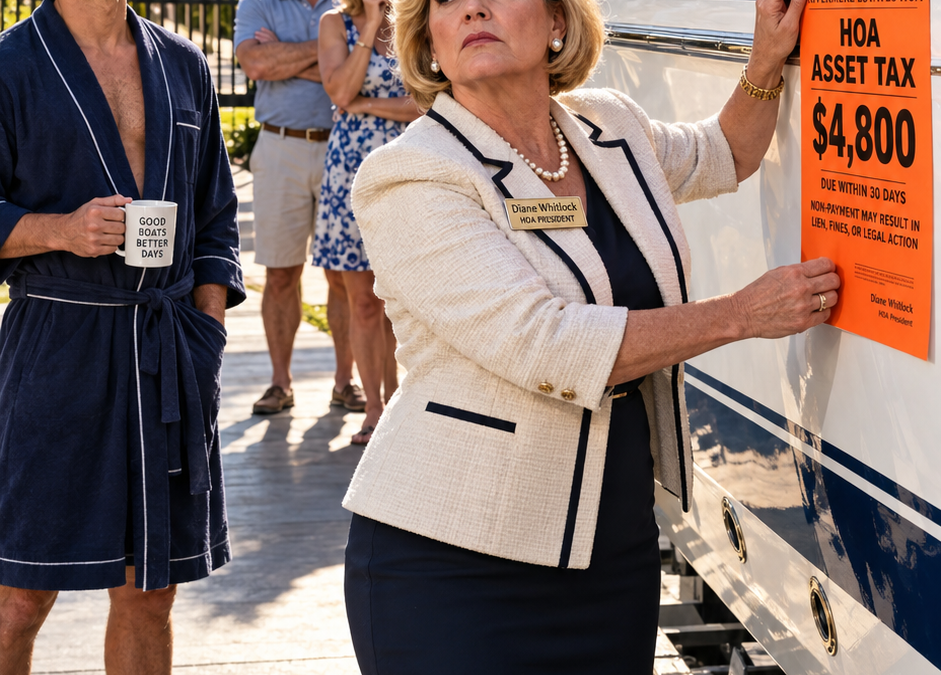
The first time Diane Whitlock touched Eleanor, I was standing in my kitchen pouring coffee.
Eleanor was my grandfather’s forty-two-foot yacht.
White hull.
Deep blue stripe.
Polished brass nameplate at the stern.
My grandmother’s name written across it in letters Grandpa had cleaned by hand every Sunday for nearly forty years.
When I stepped into the driveway that morning, Diane had one palm pressed flat against the hull.
In her other hand was a bright orange notice.
She smoothed it against the fiberglass like she was applying a parking ticket.
Two neighbors stood behind her.
Not beside her.
Behind her.
Audience positions.
Diane liked witnesses.
“Annual HOA asset tax,” she said.
She tapped the number printed halfway down the page.
“Four thousand eight hundred dollars.”
I stopped at the edge of the driveway.
Coffee in one hand.
Bathrobe tied badly.
Bare feet in old deck shoes.
Exactly the kind of appearance that tells somebody like Diane she has found the easier person in the conversation.
She looked at me and smiled.
“Due within thirty days.”
I took a sip of coffee.
“What exactly am I being taxed for?”
Her expression barely moved.
“The vessel.”
“You mean the boat?”
“I mean the forty-two-foot recreational vessel being stored in a Harborview driveway.”
She spoke slowly, as if I might need help understanding.
“You have two choices. Remove it from the community or pay the annual assessment.”
“Assessment or tax?”
“It’s the same thing for enforcement purposes.”
That answer interested me.
Not because it was convincing.
Because it wasn’t.
Behind her, the older man two houses down stared at the orange paper instead of at me.
I had seen him around.
Gray hair.
Baseball cap.
Always walking alone around sunset.
I didn’t know his name yet.
Later, I would learn it was Frank Delaney.
That morning, all I noticed was his face.
He looked embarrassed.
Not for Diane.
For me.
Or maybe for himself.
Diane folded her arms.
“You’re new here, Mr. Reyes, so I’m going to make this easy.”
“That’s considerate.”
“The association has authority over everything maintained or stored within Harborview.”
“Everything?”
“Everything behind these gates is subject to association regulation.”
Then she pointed toward Eleanor.
“If it adds value, creates visual impact, or affects community standards, it is assessable.”
I looked toward the orange notice.
“Where is that written?”
“In the governing rules.”
“Which rule?”
The question stopped her for half a second.
Then she smiled again.
“All of them.”
I nearly laughed.
She continued before I could.
“That’s why we have a board. That’s why I’m president.”
“And if I don’t pay?”
Her smile disappeared.
“We file a lien.”
“Against the yacht?”
“The property.”
“My house?”
“Yes.”
“For a boat fee?”
“For an unpaid association assessment.”
Then she leaned slightly closer.
“We have taken houses over less than a boat, Mr. Reyes.”
One of the neighbors behind her shifted his weight.
Diane heard it and raised her voice.
“People think HOA rules are optional until collection starts.”
Then she tapped Eleanor’s hull twice.
Right over my grandmother’s name.
Tap.
Tap.
“You’ll pay.”
She walked away.
The two neighbors followed.
Frank glanced back once.
I stood there in the quiet.
Coffee cooling in my hand.
The orange notice fluttering against the yacht.
For a moment, I felt something hot rise into my chest.
Not because of the money.
Because she had touched Eleanor like the boat belonged to her.
My grandfather had died eight weeks earlier.
The grief was still close enough that sometimes I would unlock the garage and expect to hear him cough behind me.
Or find one of his notes taped to a toolbox.
Or hear him complain that nobody knew how to coil a dock line anymore.
He had left me the Harborview house.
And Eleanor.
The boat came with keys, maintenance records, federal vessel documentation, old marina receipts, photographs, and one instruction he had repeated to me since childhood.
“Take care of Eleanor.”
Then, after a pause:
“And don’t let anybody who hasn’t earned her tell you what she’s worth.”
I walked over to the boat.
Carefully peeled the notice from the fiberglass.
Folded it once.
Then again.
I did not throw it away.
That was the first thing my family taught me about threatening documents.
Keep them.
Especially the stupid ones.
PART2
My grandfather bought Eleanor after my grandmother died.
He was seventy-one.
Everyone told him not to.
His friends thought he was too old.
My father thought the boat was too large.
The insurance agent thought he had lost his mind.
Grandpa listened politely to all of them.
Then bought it anyway.
He had worked around ships and docks most of his life.
Later, he spent years in federal maritime inspection.
He understood machinery.
Documentation.
Hull numbers.
Safety records.
Paper trails.
He named the yacht Eleanor before the first registration paperwork was finished.
My grandmother had been gone three months.
The first time I saw the boat, I was twenty-three.
Grandpa stood on the stern with one hand on the polished brass letters.
“She hated boats,” he told me.
I laughed.
“Then why name it after her?”
“Because now she has to come.”
That was him.
He documented the vessel with the United States Coast Guard.
Not because that magically placed Eleanor outside every private rule in America—it didn’t—but because federal documentation established her identity, ownership record, official number, and status independently from the HOA’s neighborhood paperwork.
Grandpa loved that.
He would run his thumb across the official number permanently marked inside the hull.
“She exists on paper where people can’t just pretend she doesn’t.”
I understood the sentence much better years later.
When he died, I inherited both the house and Eleanor.
I moved into Harborview Estates ten weeks before Diane’s orange notice appeared.
The boat had been sitting in the driveway for eight.
Temporarily.
I was arranging a marina slip.
The driveway was large enough.
The recorded covenants permitted short-term boat storage within certain dimensions during relocation or maintenance.
I knew because I had read them before accepting the property.
That is another thing my family did.
We read.
My father spent thirty-one years as a federal investigator.
My older sister became a federal prosecutor.
My uncle spent most of his career in financial-crimes enforcement at Treasury.
My grandfather inspected maritime operations.
I did not go into federal service.
I worked in compliance and risk management for logistics companies.
But I grew up around people who believed a document was either supported by authority or it wasn’t.
Letterhead did not impress them.
Seals did not impress them.
Titles did not impress them.
Authority had to come from somewhere.
Statute.
Contract.
Recorded agreement.
Delegation.
Jurisdiction.
Something real.
So the morning after Diane delivered the “tax,” I made another coffee and sat at Grandpa’s desk.
Then I pulled every relevant record I had.
Harborview’s recorded declaration.
CC&Rs.
Amendments.
Fee schedule.
House deed.
HOA disclosures from probate.
Boat documentation.
Temporary storage provisions.
Assessment authority.
I read slowly.
Not searching for what I wanted to find.
Searching for what existed.
There were dues.
There were special-assessment procedures.
There were late fees.
Architectural-review fees.
Transfer fees.
Certain enforcement costs.
There was nothing called an annual vessel tax.
Nothing allowing the board to assess privately owned personal property based on value.
Nothing authorizing a $4,800 charge merely because a boat sat inside a driveway.
Nothing allowing the president to invent a fee by declaration.
And nothing allowing a lien against a home based on an assessment that the declaration never authorized in the first place.
I wrote one sentence in a notebook.
No underlying authority.
Then another.
Ask for exact covenant.
I did not call Diane.
I did not call my father.
I did not call an attorney.
Not yet.
I started a folder.
Orange notice.
Photograph of where it had been attached.
Copy of recorded covenants.
Fee schedule.
Boat documentation.
Date.
Time.
Witnesses.
That afternoon, Frank walked past my driveway.
He slowed.
Looked at Eleanor.
Then looked at me.
For a moment, I thought he would stop.
He didn’t.
He kept going.
But the way he looked at the orange notice folder in my hand told me something.
He had seen paperwork like it before.
Eleven days later, Diane returned.
This time, she brought her son.
Tyler Whitlock.
Maybe twenty-eight.
Black polo shirt.
HARBORVIEW SECURITY stitched across the chest.
Harborview did not have a licensed security department.
I checked later.
Tyler was simply Diane’s son wearing a shirt.
He held a phone at chest height and recorded as they walked up.
“Mr. Reyes.”
Diane had upgraded from first names.
That meant paperwork.
“I’m serving the formal assessment.”
She held out cream-colored paper.
Heavy stock.
Embossed seal.
HOA crest.
NOTICE OF ASSESSMENT.
ANNUAL VESSEL TAX.
$4,800.
“Board voted unanimously.”
I took it.
“On a vessel tax?”
“On bringing Harborview assets into compliance.”
“What does that mean?”
“It means you owe forty-eight hundred dollars.”
Tyler stepped closer.
“You’re being recorded for noncompliance.”
I looked at him.
He angled the phone more directly at my face.
“Good,” I said.
He blinked.
Diane frowned.
I read the first paragraph.
Then asked the same question as before.
“Which recorded covenant authorizes this?”
Diane’s mouth tightened.
“It’s authorized by the board.”
“That isn’t what I asked.”
“The board interprets the governing documents.”
“Which provision gives you authority to impose a tax or assessment on privately owned personal property?”
The word tax bothered her.
I could tell.
“It is an association assessment.”
“Your document calls it a tax four times.”
Tyler’s camera was still recording.
Good.
Diane shifted tactics.
“I do not provide legal tutorials to every homeowner who believes he is special.”
“I’m asking for a citation.”
“You can read the letter.”
“I did.”
“Then pay it.”
“There’s no covenant cited.”
She stared at me.
Then said the line she must have used on a hundred people.
“You can read the assessment now or read the lien later. Either way, you’ll be reading something with my name on it.”
I nodded.
“That’s a good line.”
She didn’t know whether I was mocking her.
I wasn’t, exactly.
It was a good line.
Effective.
Memorable.
Designed to end arguments.
She had probably spent years refining it.
I folded the cream notice and held it at my side.
Diane looked disappointed.
She had expected anger.
“You have thirty days.”
“You said that last time.”
Tyler kept filming while they walked away.
He narrated quietly.
“Subject remains uncooperative.”
I almost thanked him.
Instead, I went inside and placed the cream letter on top of the orange one.
Two documents.
Same invented fee.
Same threat.
Still no covenant citation.
I started a new sheet.
Timeline.
That evening, I wrote down the names of everyone I had seen react strangely when Diane appeared.
Frank was first.
Three days later, he finally stopped at my driveway.
“You’re not paying it.”
Not a question.
“I haven’t found a legal basis for it.”
Frank turned his cap in his hands.
“I paid mine.”
“For a boat?”
“No.”
He glanced toward his house.
“Waterfront proximity assessment.”
I waited.
“One thousand one hundred dollars.”
“For what?”
“My back fence.”
“What was wrong with it?”
“Too close to the retention pond.”
“Did the association own the strip?”
He shrugged.
“She said they did.”
“Do you still have the notice?”
Frank’s eyes came up.
“Why?”
“Because I want to read it.”
He hesitated.
Then nodded.
His wife had died two years earlier.
The notice arrived a few months after the funeral.
Frank had not wanted a fight.
The letter mentioned lien rights.
He paid.
“Figured it was one of the rules I’d missed.”
He looked embarrassed saying it.
I hated that.
Not because Frank had done anything wrong.
Because people who get intimidated often blame themselves afterward.
He brought me the notice that evening.
Same orange paper.
Same crest.
Same signature.
No covenant citation.
WATERFRONT PROXIMITY FEE.
$1,100.
I searched the recorded declaration.
No such fee.
Frank introduced me to the Petersons.
Young couple.
Two children.
They had paid $600 for a “landscape compliance assessment.”
The alleged problem was a tree.
The recorded covenants did regulate landscaping.
But there was no separate $600 assessment matching Diane’s notice.
Then Anita Collins.
Nurse.
Worked long shifts.
She had a medical-supply company van issued by her employer.
Diane assessed a “luxury/commercial vehicle surcharge” for parking it in Anita’s own driveway.
No such charge existed in the fee schedule.
Four hundred fifty dollars.
Then Gloria Bennett.
Eighty-one.
Maybe five feet tall.
She pulled a notice from a kitchen drawer.
HOLIDAY DECOR REVIEW ASSESSMENT.
Four hundred dollars.
Her offense?
A wreath.
“It was too large,” she said.
“According to what?”
“Diane.”
“Was there a size limit in the covenants?”
Gloria looked at me.
“I never knew.”
There wasn’t.
By the end of the week, I had notices from six households.
I laid them side by side on Grandpa’s desk.
Orange.
Cream.
White.
Different invented names.
Same structure.
Assessment.
Deadline.
Late penalty.
Lien threat.
Diane’s signature.
Sometimes countersigned.
Sometimes not.
Then I put the actual recorded fee schedule beside them.
Nothing matched.
It was not one bad interpretation.
It was a system.
Diane had discovered something simple.
If you use official language, small dollar amounts, escalating deadlines, and the word lien, most people will not ask where the authority comes from.
They will pay to make the anxiety stop.
I sat there under Grandpa’s desk lamp looking at all those papers.
Then I pulled Eleanor’s documentation packet toward me.
I wanted to be careful.
A federally documented vessel is not magically immune from every valid HOA covenant.
If Harborview’s recorded declaration lawfully restricted boat storage, that could be enforceable depending on the facts.
But that was not what Diane had done.
She had not cited a storage violation.
She had invented a $4,800 annual property-style tax based on the existence of the vessel.
Then threatened to lien my home over it.
The federal documentation mattered because it reinforced what Eleanor was:
Separately documented personal property.
Not an HOA asset.
Not something Diane could simply declare taxable because it sat behind the neighborhood gate.
I closed the folder.
That was the night I decided I would not handle this privately.
Not because I wanted a spectacle.
Because secrecy was how Diane’s system survived.
Each homeowner believed his notice was personal.
Isolated.
Embarrassing.
Maybe legitimate.
Nobody compared paperwork.
Nobody asked whether Frank’s “waterfront assessment” and Gloria’s “wreath review” came from the same nonexistent authority.
I wanted the papers in one room.
Harborview held an open board meeting at the end of every month.
Diane ran them like ceremonies.
That would be the room.
I told Frank.
“Bring your notice.”
“You’re going to challenge her?”
“I’m going to ask her to show her work.”
He looked doubtful.
“She’s been doing this nine years.”
“That doesn’t make the fee exist.”
He gave a tired laugh.
“No.”
Then his face sobered.
“Just be careful.”
“I will.”
The thirty-day deadline expired on a Thursday.
Diane filed the lien that afternoon.
Or at least attempted to.
I found a copy wedged into my front door.
CLAIM OF LIEN.
HARBORVIEW ESTATES HOA.
$4,800.
UNPAID VESSEL ASSESSMENT.
For ten seconds, my stomach dropped.
I knew the debt was baseless.
That does not make the word lien feel harmless.
A lien can cloud title.
Interfere with sale.
Complicate refinancing.
Create attorney fees.
It changes your house from home into collateral in somebody else’s argument.
I stood in Grandpa’s entryway holding that paper and finally understood exactly why Frank had paid.
Why Gloria paid.
Why the Petersons paid.
Diane was not really selling rules.
She was selling relief from fear.
Pay me and the paper stops.
That was the product.
Then the feeling passed.
I read the lien again.
A lien is only as strong as the debt supporting it.
If the assessment did not exist under the governing documents, the lien did not become legitimate because Diane filed it.
In fact, filing made the situation worse for her.
Now the invented debt was in a more formal record.
Signed.
Dated.
Traceable.
I called an attorney.
Her name was Priya Farnham.
Everyone called her Fam.
Real estate and association disputes.
I explained the story.
She interrupted twice.
Once when I said “annual vessel tax.”
Again when I said Diane had filed a lien.
“She actually recorded it?”
“Yes.”
“Based only on this alleged vessel assessment?”
“Yes.”
“Do the covenants authorize it?”
“No.”
“You’re certain?”
“I read them twice.”
“Bring everything.”
I brought three folders.
Fam read in silence.
Actual declaration first.
Then fee schedule.
Then Diane’s notices.
Then neighbors’ notices.
Then lien.
Finally, boat documentation.
She leaned back.
“This is ugly.”
“For me?”
“For the association.”
She tapped the lien.
“This is the problem.”
“What about the notices?”
“They’re problems too. But this one reaches into title records based on an assessment I cannot presently identify any authority for.”
“Can it be removed?”
“Yes.”
“How fast?”
“That depends how stubborn they are.”
She looked through Frank’s notice.
Then Gloria’s.
“Did these people pay?”
“Yes.”
“All of them?”
“Everyone whose paper I have.”
Fam exhaled.
“This may be bigger than your boat.”
“I know.”
That evening, I called my father.
He answered on the third ring.
“You all right?”
“Yes.”
“You don’t call Thursday nights.”
“I have something strange.”
He listened.
I told him about Diane.
The tax.
Neighbors.
Lien.
My father said almost nothing until I finished.
Then:
“You have it all in writing?”
“Yes.”
“Originals?”
“Copies and originals.”
“Recordings?”
“Her son recorded at least one interaction. I recorded another.”
“Good.”
“Dad, I’m not asking you to call anybody.”
“I know.”
“My sister either.”
“I know.”
“My uncle—”
“Gabriel.”
“Yes?”
“Nobody in this family is going to abuse a badge because your HOA president is obnoxious.”
I smiled despite myself.
“I know.”
“Good.”
Then he paused.
“When is the board meeting?”
“Nine days.”
“We’ll come.”
I leaned back.
“For what?”
“To sit down.”
“That’s it?”
“That’s it.”
He laughed softly.
“You have paper. Let the paper work.”
Sunday dinner came first.
Dad.
My sister Elena.
Uncle Martin.
They arrived separately.
Nobody brought a badge.
Nobody talked about agencies over dinner.
We ate Grandpa’s old seafood stew recipe in the dining room while Eleanor sat outside under a cover.
After dessert, I put the notices on the table.
My father read slowly.
Elena faster.
Martin read the lien twice.
My sister tapped one paragraph.
“This language claims authority without citing the source.”
“I noticed.”
“Good.”
My uncle lined up the notices chronologically.
“Has anyone totaled how much residents paid?”
“Not yet.”
“Do that.”
Dad looked at me.
“What do you want out of this?”
The question mattered.
“Lien gone.”
“Obviously.”
“Refunds.”
“For you?”
“For everyone.”
He nodded.
“Anything else?”
“Rules that make them cite actual authority.”
My sister smiled slightly.
“That’s a better answer than revenge.”
“I considered revenge.”
“Normal.”
Dad folded the lien.
“Don’t announce what we do for a living unless she makes it relevant.”
“I don’t plan to.”
“Good.”
Then he pointed toward the stack.
“This is stronger than a family résumé.”
The night before the board meeting, Fam emailed me.
She had prepared a formal demand challenging the lien.
She advised me not to overstate the federal-vessel issue.
The real legal core was simpler.
No covenant authority.
No valid assessment.
No valid debt.
Therefore no legitimate lien.
That made the story cleaner.
More importantly, true.
I printed copies.
Frank contacted more neighbors.
By meeting night, I had documentation from eleven households.
Some fees were small.
$150.
$300.
Others over a thousand.
Different names.
Compliance assessment.
Administrative review fee.
Enhanced enforcement charge.
Special property-impact fee.
None appeared in the recorded schedule in the form Diane charged them.
At 6:40, I walked into the Harborview clubhouse.
The room smelled like floor polish and coffee.
Diane sat at the center table.
Nameplate.
Binder.
Gavel.
Tyler stood near the wall in the same black polo.
He was recording again.
Good.
Frank sat near the aisle.
Gloria beside him.
The Petersons.
Anita.
Others.
The room filled.
Then my family came in.
My father wore a gray windbreaker.
My sister carried a canvas tote.
Martin wore an old fishing jacket.
They sat in the back row.
Diane looked at them once.
Then away.
Just three older relatives.
Exactly what Dad wanted.
The meeting began.
Minutes.
Landscaping contract.
Trash collection.
Pool maintenance.
Diane ran everything with practiced efficiency.
Then she reached “compliance matters.”
Her posture changed slightly.
She enjoyed this part.
“I want to remind all homeowners that association assessments are not optional.”
Several people went still.
“One property owner has recently refused to satisfy a lawful assessment despite multiple notices.”
She did not say my name.
Didn’t need to.
“The association has therefore filed a lien.”
She looked around the room.
“This is not something we enjoy doing.”
I almost laughed.
“But the integrity of our community requires consistent enforcement.”
Then she delivered the motto.
“The association always collects.”
A few people clapped.
Not many.
Frank’s hands were shaking.
Gloria looked at the floor.
For one moment, I understood how Diane had held the neighborhood for nine years.
Rooms create gravity.
Everybody sees everybody else staying quiet.
Then quiet begins to look like agreement.
Agreement looks like proof.
Proof becomes authority.
Diane reached for her gavel.
Then she looked directly at me.
“Mr. Reyes, if you’d like to make a final statement for the record, I’ll allow it.”
She smiled.
She thought she was giving me rope.
I stood.
The chair scraped loudly.
The room quieted.
“Thank you.”
I opened my folder.
“Before I talk about my grandfather’s boat, I want to repeat something Diane has said twice tonight.”
I looked toward her.
“The association always collects.”
Her smile held.
“I think we should look at what it has been collecting.”
That changed her face slightly.
I held up the first orange notice.
“This was taped to my grandfather’s yacht.”
I read the title.
“Annual HOA tax. Forty-eight hundred dollars.”
Then I placed it on the table.
“Diane says this was authorized.”
“It was.”
“By what?”
“The board.”
“No. Which recorded covenant?”
She leaned back.
“We’ve already addressed this.”
“No, you haven’t.”
I turned toward the room.
“I pulled the recorded Harborview declaration from the county. I pulled every amendment. I pulled the fee schedule.”
I held up the copies.
“There is no annual vessel tax.”
Diane’s mouth opened.
I continued.
“There are valid HOA dues. There are valid special-assessment procedures. There are legitimate fees in these documents.”
I tapped the binder.
“This is not one of them.”
Diane raised her hand.
“You are intentionally misrepresenting—”
I looked at her.
“Which section?”
Silence.
“Give us the number.”
She stared at me.
Tyler lowered his phone slightly.
“One recorded covenant.”
The board member on Diane’s left started flipping through his copy.
Diane noticed.
Her voice sharpened.
“The board has interpretive authority over association assets.”
“Eleanor isn’t an association asset.”
“She is stored in Harborview.”
“My truck is stored in Harborview. My lawn mower is stored in Harborview. My coffee maker is stored in Harborview.”
A few people laughed nervously.
Diane’s face tightened.
“You know perfectly well that isn’t comparable.”
“Then cite the authority.”
She didn’t.
I lifted another sheet.
“Eleanor is also a federally documented vessel. That does not place her outside every valid private restriction, but it does make one thing very clear: she is separately documented private property. Diane cannot simply declare her a Harborview asset and invent a tax because she is sitting in a driveway.”
I laid the Coast Guard documentation beside the orange notice.
Then I picked up the lien.
“And this is what happened when I refused to pay.”
I read the heading.
“Claim of lien. Forty-eight hundred dollars. Unpaid vessel assessment.”
The room became quieter.
Diane shifted in her seat.
“The lien is lawful.”
“My attorney disagrees.”
“Your attorney doesn’t govern this association.”
“No.”
I looked around.
“Neither does Diane.”
That landed.
Then I turned toward Frank.
“Frank?”
He froze.
I nodded.
He stood.
Slowly.
Notice in hand.
“This is eleven hundred dollars.”
His voice shook.
“Waterfront proximity fee.”
I asked him:
“Frank, did you find that fee in the recorded covenants?”
“No.”
“Did Diane cite a section?”
“No.”
“Did you pay it?”
He looked toward Diane.
Then back at me.
“Yes.”
“Why?”
Frank’s jaw tightened.
“Because the letter said lien.”
That was the first real crack.
Gloria stood without being asked.
She raised her notice.
“Four hundred dollars.”
Diane snapped:
“Mrs. Bennett, please sit down.”
Gloria did not.
“For my Christmas wreath.”
The room stirred.
“Gloria,” Diane said.
“No.”
The word came out stronger than anyone expected.
Gloria looked at Diane.
“You’ve been saying no to us for nine years. You can listen now.”
I heard my sister inhale quietly in the back.
The Petersons stood.
Then Anita.
Then a man named Curtis from the far side of the room.
Then another woman.
Soon eight people were standing with notices.
I placed copies on the board table.
“None of these fee names appear in the recorded schedule.”
One board member picked up a notice.
The other leaned closer.
Diane reached for control.
“These are individual enforcement matters. They have nothing to do with Mr. Reyes’s refusal to comply.”
“They have everything to do with it.”
I opened the second folder.
“This is the actual recorded fee schedule.”
I passed copies to the board.
“Show me where any of these charges exist.”
Nobody spoke.
Diane’s voice rose.
“You moved here ten weeks ago.”
“Yes.”
“You think that gives you the right to audit nine years of board operations?”
“I didn’t audit you.”
I nodded toward the neighbors.
“They brought me the notices.”
“You encouraged insubordination.”
I almost smiled.
“They compared paperwork.”
“Who do you think you are?”
There it was.
Not a legal question.
A status question.
The one people ask when authority stops working.
“Who exactly are you, Mr. Reyes?”
I answered honestly.
“I’m a homeowner.”
I looked toward the room.
“Same as everyone else here.”
Then Diane’s eyes moved toward the back row.
She had noticed my family paying attention.
Maybe she thought they were lawyers.
Maybe witnesses.
“Are these people with you?”
“Yes.”
“Your attorneys?”
“No.”
My father stood.
Slowly.
He never hurried when a room was watching.
“I’m his father.”
Diane stared.
Dad continued.
“I spent thirty-one years as a federal investigator.”
The room went silent.
My sister stood next.
“I’m his sister.”
She did not give her job title immediately.
Diane looked from one to the other.
Elena said:
“I’m a federal prosecutor.”
My uncle stood last.
“Financial-crimes enforcement. Retired.”
Tyler lowered his phone completely.
Diane’s face changed.
Not dramatically.
That would have been easier.
It emptied.
The expression of somebody suddenly reviewing every sentence she had ever put on paper.
My father raised one hand slightly.
“Nobody here is being threatened with federal action.”
That mattered.
“We are not here in an official capacity.”
He looked around the room.
“We are family.”
Then toward Diane.
“My son asked us to sit in the back and watch.”
Diane swallowed.
Dad continued in the same calm voice.
“I’ll say one thing from experience.”
He pointed toward the notices on the table.
“If a person creates charges that are not authorized, demands payment, threatens people’s property, and records a lien based on one of those charges, the smartest thing that person can do is stop talking and get competent legal advice.”
No threat.
No badge.
No agency name.
Just advice.
Diane reached for her gavel.
Her hand trembled.
One of the board members beside her stood.
Not in support.
He physically moved away from the table.
“I didn’t know.”
Diane turned.
“What?”
He looked at the room.
“I voted for the vessel assessment because Diane told us counsel had approved it.”
I looked toward him.
“Did counsel?”
“I don’t know.”
Diane snapped:
“Mark, sit down.”
He didn’t.
“I never saw an opinion.”
The second board member spoke next.
“Neither did I.”
Diane stared at both of them.
Then at Tyler.
Then at the stack of notices.
The room was no longer tilted toward her.
That was the difference.
For nine years, she had been stronger because everybody had faced her individually.
Now they were all looking in the same direction.
Frank lifted his notice.
“I want my money back.”
Gloria said:
“So do I.”
Someone behind me said:
“How many of these did you send?”
Another:
“Where did the money go?”
Another:
“Who approved the fee schedule?”
Diane pounded the gavel once.
“Order.”
Nobody stopped.
Again.
“Order!”
The gavel sounded ridiculous now.
Wood on laminate.
Nothing more.
I looked at her.
“The association always collects.”
She stared at me.
I nodded toward the papers.
“You were right.”
Then quietly:
“Tonight it finally collected the receipts.”
I sat down.
That was all.
The meeting did not end cleanly.
Meetings like that never do.
People talked over one another.
Board members demanded an executive session.
Residents demanded records.
Tyler stopped filming at some point.
My sister noticed and quietly told me the earlier video was enough.
Diane attempted to adjourn.
Residents objected.
Finally, one board member made a motion to suspend all collection activity on disputed assessments pending legal review.
Seconded.
Passed.
Diane voted no.
Nobody cared.
Outside afterward, Frank stood beside me in the parking lot.
His hands were no longer shaking.
“I thought she was going to throw us out.”
“She couldn’t.”
“I know that now.”
He looked toward the clubhouse.
“I didn’t know it before.”
That sentence hurt more than I expected.
My father came over.
Frank recognized him from the meeting and straightened unconsciously.
Dad put out his hand.
“Frank?”
“Yes.”
“Glad you kept the notice.”
Frank laughed.
For the first time since I met him.
“Me too.”
The lien disappeared eleven days later.
Fam sent one demand letter.
The association’s counsel responded almost immediately.
The insurer became involved.
Once counsel reviewed the recorded covenants and the underlying “vessel assessment,” nobody wanted to defend the lien.
A release was filed.
My title cleared.
The $4,800 charge was rescinded.
Then came the larger review.
The board retained outside counsel.
Not Diane’s preferred lawyer.
Independent counsel.
They compared six years of assessments against the actual declaration and approved fee schedule.
The numbers got ugly.
Nineteen households had paid charges that the review concluded lacked adequate authorization under the recorded governing documents.
Some were outright inventions.
Others were enforcement charges imposed without required board approval.
Others had been mischaracterized as mandatory assessments.
Refunds were ordered.
Frank got $1,100.
Gloria got $400.
The Petersons got $600.
Anita received her vehicle charge back.
Dana from the next block—someone I had not even met during the original dispute—received nearly $900 from three separate notices.
Harborview paid from reserves.
Then the board turned toward Diane.
The insurer declined to treat all of her conduct as ordinary protected board activity.
Especially the lien.
Especially after discovering she had represented certain charges as formally authorized when no matching authority could be produced.
There were negotiations.
I was not part of them.
Nor did I want to be.
Diane eventually reimbursed a portion of the association’s legal expense connected to my lien dispute.
She was removed as president at a special meeting.
Not close.
The two directors who had sat beside her resigned beforehand.
Frank was nominated for the replacement board.
He refused twice.
Accepted the third time.
“You people are going to kill me,” he said.
Gloria replied:
“You’re already seventy-eight. Stop being dramatic.”
He took the seat.
The first reform passed by the new board fit on one line.
No fee, fine, assessment, or enforcement charge may be issued unless the notice cites the exact recorded covenant, bylaw provision, or duly adopted schedule authorizing it.
One sentence.
That was all it took.
Not “community tradition.”
Not “board discretion.”
Not “that’s how we’ve always done it.”
Show the source.
The second reform required two board members to approve liens.
The third created a no-cost resident appeal process.
The fourth required annual distribution of the actual fee schedule.
Harborview began becoming boring again.
That was a compliment.
Gloria hung an enormous wreath that December.
Ridiculous thing.
Red bow nearly the size of a car tire.
I walked past while she was putting it up.
“Think it’s compliant?” I asked.
She stood on her porch ladder and looked down.
“I hope not.”
We both laughed.
Nobody fined her.
Frank started waving when I saw him.
Anita parked her work van in her driveway.
The Peterson kids left bicycles on their lawn.
Normal neighborhood things.
Things people stop noticing until somebody spends years turning them into potential violations.
My family went home the morning after the meeting.
Dad stood beside Eleanor for several minutes.
He ran his hand over the brass letters.
“You cleaned these?”
“Yesterday.”
“Your grandfather would still say they’re dirty.”
“I know.”
Dad smiled.
Then looked at me.
“You did well.”
“Because you scared her?”
“We didn’t scare her.”
“You stood up and said federal investigator.”
“I answered a question.”
I laughed.
He became serious.
“You know what mattered?”
“The lien?”
“The paper.”
He tapped my folder.
“You didn’t need anybody’s badge.”
“I know.”
“That’s why we came.”
He held out his hand.
I shook it.
Then he pulled me into a quick hug anyway.
“My father would’ve liked how quiet you kept it.”
That was Dad’s whole speech.
We are not a speech family.
Spring came.
I finally got Eleanor into a marina slip.
The first trip out was clear and cold.
I spent the morning checking every system twice.
Fuel.
Cooling.
Electronics.
Lines.
Documentation.
Grandpa’s habits.
Before leaving the dock, I went below and found the official number permanently marked where he used to show it to me.
I ran my thumb across the digits.
“She’s on the federal books,” he used to say.
I smiled.
Not because the federal number had magically defeated Diane.
It hadn’t.
The truth was better.
Diane lost because she had invented authority she did not possess and documented the invention herself.
The vessel paperwork was one piece.
The recorded covenants were another.
The notices.
The lien.
Neighbors’ receipts.
Board records.
Everything lined up.
Paper against paper.
Real authority against costume authority.
The orange notice that started it all still sits in my desk.
I kept it.
Wrinkled now.
One corner still carries a faint adhesive mark from Eleanor’s hull.
ANNUAL HOA TAX.
$4,800.
Sometimes I look at it and think about how powerful it seemed the morning Diane attached it.
Official color.
Bold heading.
Deadline.
Threat.
At the time, Frank could barely look at me because he knew what followed.
More letters.
More money.
Lien.
Fear.
For nine years, those notices had worked because each homeowner encountered one alone.
That was Diane’s real advantage.
Isolation.
Gloria did not know about Frank.
Frank did not know about Anita.
Anita did not know about the Petersons.
Each person assumed:
Maybe I misunderstood.
Maybe I signed something.
Maybe everyone else knows the rule.
Maybe fighting costs more.
Then the papers entered one room.
And the pattern became visible.
Diane’s power did not disappear because my father had once carried a federal badge.
It disappeared because she could no longer keep everyone’s fear separate.
That distinction matters to me.
People later told the story differently.
The neighborhood version got exaggerated.
“Gabriel brought federal agents.”
Not really.
“His sister threatened prosecution.”
She didn’t.
“The Treasury came after Diane.”
No.
None of that happened.
My family attended a public meeting.
They identified themselves only after Diane demanded to know who they were.
Nobody opened a federal case.
Nobody raided Harborview.
Nobody needed to.
A competent real-estate attorney and the association’s own documents were enough.
That made the ending better.
Diane had spent years presenting herself as the highest authority in every room.
She was not defeated by a bigger authority kicking in the door.
She was defeated by being asked to cite the smaller authority she claimed to already have.
She couldn’t.
The new board invited me to attend one meeting six months later.
Frank sat near the center.
No gavel.
He said he refused to buy one.
“Bad history.”
They reviewed the revised fee schedule.
Every item had a citation beside it.
Transfer-processing fee.
Citation.
Late fee.
Citation.
Architectural application charge.
Citation.
Pool-key replacement.
Citation.
Boring.
Clear.
Exactly right.
At the end, Frank asked if I wanted to say anything.
“No.”
Gloria called from the second row:
“That’s never stopped you before.”
The room laughed.
I did too.
Then I stood.
“One thing.”
Frank leaned back.
“Of course.”
“Don’t let fear become part of the collection process again.”
The room quieted.
“If someone owes something valid, show them the rule. Give them time. Give them an appeal. If you cannot show where the authority comes from, don’t send the notice.”
Frank nodded.
“Fair.”
That was it.
No slogans.
No speeches.
Harborview moved on.
Diane sold her house the following year.
I saw the moving truck.
Didn’t walk over.
Didn’t need closure from her.
The neighborhood had already given me what mattered.
Not gratitude.
Not an apology.
Change.
The last time I saw Diane, I was cleaning Eleanor at the marina.
I heard my name.
Turned.
She stood at the top of the dock.
No clipboard.
No lanyard.
Just sunglasses and a handbag.
“I heard you kept the boat.”
“I did.”
She looked at Eleanor.
“You caused a lot of trouble over that thing.”
I almost corrected her.
Then decided to.
“You filed a lien over that thing.”
Her jaw tightened.
“The board supported me.”
“Until they read the documents.”
“That neighborhood became impossible after you arrived.”
“People started asking questions.”
“Exactly.”
For a second, we both understood the argument perfectly.
That was the entire conflict.
To Diane, questions were disorder.
To everyone else, questions were how the disorder had finally become visible.
She looked at the nameplate.
“Your grandmother?”
“Yes.”
“Pretty.”
That surprised me.
“Thank you.”
Diane turned to leave.
Then stopped.
“I still think the boat was too big for that driveway.”
I smiled.
“That one you might actually have had a covenant for.”
She looked back.
For half a second, I thought she might laugh.
She didn’t.
But almost.
Then she left.
I watched until she reached the parking lot.
Then went back to polishing the brass.
Grandpa had always used a soft cloth in small circles.
Never rush brass.
That was one of those strange rules old men leave behind.
I kept polishing until Eleanor caught the afternoon light.
There are stories where people like Diane lose everything.
Prison.
House.
Career.
Public humiliation.
That did not happen here.
She lost the board.
Paid money.
Moved.
Her reputation changed.
That was enough.
Consequences should fit what people actually do.
What mattered most was the people she had frightened got their money back.
The lien came off my home.
The fake fees stopped.
The board changed.
And a neighborhood learned that official language is not the same as lawful authority.
My grandfather would have understood that.
His entire working life revolved around inspection.
He used to say:
“Never trust paint where you need steel.”
Meaning appearances are easy.
Structure is harder.
Diane had paint.
Orange notices.
Cream letterhead.
Embossed seal.
Security shirt.
Gavel.
A binder thick enough to stop a door.
It all looked official.
Underneath, there was no steel.
No covenant.
No authorization.
No valid assessment.
Once people checked the structure, it collapsed.
I think about that every time I take Eleanor out.
Past the marina.
Past the breakwater.
Into open water.
Grandpa’s chair still sits at the helm.
I never replaced it.
The leather is cracked on one side.
The throttle handle has a worn patch where his palm rested.
Sometimes, when the weather is calm, I set the engines low and let the boat idle.
No HOA gate.
No clipboard.
No notices.
Just water.
That is usually when I remember the first morning.
Diane pressing orange paper against Eleanor’s hull.
Frank looking at the ground.
My coffee getting cold.
“We’ve taken houses over less than a boat.”
At the time, she probably believed that sentence proved how powerful she was.
Now I hear something else in it.
A confession.
She had spent years teaching people to fear what she might do instead of proving what she had the right to do.
The whole system survived on that difference.
Until one person kept the notice.
Then another.
Then another.
My family did not save me.
That matters too.
They taught me how not to panic.
How to keep originals.
How to distinguish a threat from authority.
How to let people commit themselves to paper before challenging them.
When they finally sat in that clubhouse, they were not weapons.
They were witnesses.
The real weapon was Diane’s own file.
Every notice.
Every signature.
Every invented fee.
Every sentence promising consequences.
The things she had used to make people feel powerless became the record that made her own position impossible to defend.
I still have Grandpa’s instruction written on an index card near the helm.
I found it in one of his maintenance folders after he died.
His handwriting was getting shaky by then.
Three lines.
Take care of Eleanor.
Check the fuel twice.
Never let anybody who hasn’t earned her tell you what she’s worth.
I followed all three.
The fuel part was easy.
The rest took longer.
But Eleanor is still mine.
The house is still mine.
Frank has his eleven hundred dollars back.
Gloria still hangs ridiculous wreaths.
Harborview still has an HOA.
It just has one that has to cite the rule before it sends the bill.
And the orange notice that once claimed I owed $4,800 for the privilege of owning my grandfather’s yacht?
It sits folded in a drawer.
First page of the thickest file Diane Whitlock ever created.
She just didn’t realize she was creating it for me.








