𝗣𝗔𝗥𝗧 𝟮 HOA Karen Hit Me With a $50,000 Fine—Then Her Own “Officer” Admitted Who Really Controlled Him
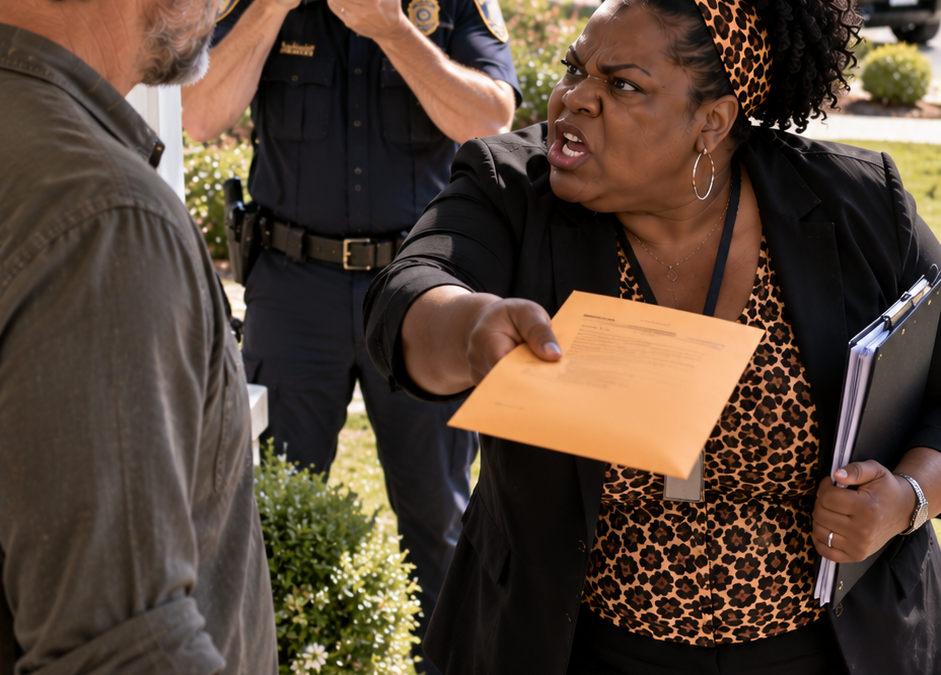
𝗣𝗔𝗥𝗧 𝟮
The font was suspiciously close to the county sheriff’s vehicle design.
Not identical.
Just close enough.
That was how Karen worked.
Never quite pretending something was government.
Just designing everything so that most people would assume it was.
She had made one mistake that morning.
She had aimed the performance at somebody who knew exactly how the machinery worked.
I moved into Brookstone Ridge two years earlier.
Ninety-six homes.
Uniform mailboxes.
Trimmed common areas.
Private streets.
Monthly HOA dues:
Four hundred dollars.
High, but not outrageous for what the association maintained.
I paid mine on time.
Always.
Before I bought the house, I read every page of the declaration.
Covenants.
Bylaws.
Amendments.
Architectural standards.
Fine procedures.
Voting rules.
That was occupational habit.
Most homeowners don’t read those documents.
I don’t blame them.
They’re dense.
Repetitive.
Usually written in a style that makes a normal person feel as if comprehension is something they’re failing at.
People sign.
Move in.
Assume whoever runs the association understands the rules.
Karen depended on that.
She had been president seven years.
Unopposed.
Not once had anyone seriously challenged her seat.
At first I assumed people liked her.
Then I started talking to neighbors.
Nobody liked Karen.
They feared what happened after she noticed you.
One man had casually mentioned running for president at a neighborhood barbecue.
Ten days later:
Grass violation.
Trash-bin violation.
Exterior-lighting violation.
Satellite-dish angle violation.
More than $1,000 in combined penalties.
He withdrew his interest in the election.
The fines disappeared.
Coincidence?
Maybe.
Except similar coincidences happened repeatedly.
Karen’s enforcement system was built on escalation.
First notice:
Small.
Fifty dollars.
Maybe a hundred.
Enough to annoy you.
Not enough to hire counsel.
Second notice:
Larger.
Third:
Larger still.
And if you challenged her publicly?
Todd appeared.
Todd had been hired eighteen months earlier.
The newsletter introduced him as:
Professional Compliance Officer Todd Benson.
Most homeowners stopped at the title.
Officer.
Uniform.
Marked vehicle.
Camera.
Clipboard.
Karen understood the psychology.
Parents teach children to respect uniforms.
Adults learn to cooperate with inspectors.
People see a badge and assume somebody somewhere has vetted the person wearing it.
Todd’s badge never said police.
Never said county.
Never said state.
It didn’t need to.
The implication did the work.
Mrs. Chen lived four doors down.
Seventy-one.
Widowed.
Quiet.
She had paid the HOA $3,200 over fourteen months.
Wind chime.
Garden hose left on grass overnight.
Flowerpots on the porch.
Karen called them “unauthorized container landscaping.”
Mrs. Chen paid every time.
“Why?” I asked her once.
She looked embarrassed.
“Because Todd came.”
“And?”
“He said the file would escalate.”
“Did he say he was law enforcement?”
“No.”
“County?”
“No.”
“Inspector?”
“He didn’t say.”
That was the genius of it.
Nobody lied directly.
They simply built a visual environment in which homeowners lied to themselves.
Across the street lived a young couple with two children.
Their kids had a basketball hoop.
Todd photographed it.
Two days later, violation notice.
They took it down.
Three blocks over, a disabled veteran named Richard allowed Todd into his garage because Karen’s notice described the visit as a “mandatory compliance inspection.”
Richard later asked me quietly:
“Was I required to let him in?”
“No.”
His face changed.
Nobody had told him.
That was the whole system.
Compliance first.
Questions never.
In my first two years, Karen had sent me eleven notices.
Total assessed penalties:
$4,100.
I paid none.
Every time, I responded within forty-eight hours.
One paragraph.
Specific citation.
Example:
Your notice cites Section 11.2 regarding storage containers. That provision expressly applies only to common areas. The photographed container is located within the enclosed rear yard of Lot 42. Please withdraw the assessment.
Fine disappeared.
No apology.
No explanation.
Next violation.
Same pattern.
I never told Karen I was a lawyer.
She never asked.
She probably assumed I was unusually annoying.
That suited me.
Because the moment people know you’re a lawyer, behavior changes.
Language becomes careful.
Records improve.
Bad decisions get filtered through counsel.
I wanted to see the system as ordinary homeowners saw it.
And after Todd said, “She’s my boss,” I finally understood the weakness in Karen’s machine.
It relied entirely on nobody asking the obvious questions.
Who employs you?
Who authorized this?
Where is the board vote?
What statute allows that amount?
Where is the recorded authority?
Questions are dangerous to systems built on implication.
PART2
Eight days after the first $50,000 notice, Todd returned.
Karen came with him.
So did Marcus Bell, one of the board members who usually sat beside Karen during meetings and said almost nothing.
Saturday.
Ten in the morning.
Perfect timing.
People outside washing cars.
Trimming hedges.
Walking dogs.
Karen wanted witnesses.
Not legal witnesses.
Social witnesses.
She wanted people to watch what happened when somebody resisted.
I stepped onto the porch before they reached the door.
Karen held another orange envelope.
“Second notice.”
I took it.
“The fifty-thousand-dollar assessment is now accruing at five hundred dollars per day.”
She spoke loudly.
Across the street, my neighbor stopped washing his truck.
“If this remains unresolved through Day Thirty, your total exposure will exceed sixty-one thousand dollars.”
Todd walked toward the edge of my front yard.
Raised his camera.
Click.
Left side.
Click.
Porch.
Click.
Door.
I stepped toward him.
“Todd.”
He stopped.
“Are you aware that repeated photography of private residential property for unsupported enforcement purposes may create a harassment issue under state HOA law?”
The camera dropped.
He looked at Karen.
She answered for him.
“We have full authority under Section Nine.”
“Which attorney reviewed that interpretation?”
Karen blinked.
“Our legal team.”
“Name?”
Silence.
“Bar number?”
Her jaw tightened.
“That’s not information you’re entitled to demand at your front door.”
“Then send it in writing.”
“You’ll receive whatever documentation is appropriate.”
“Good.”
I smiled faintly.
“You have twenty-two days.”
She didn’t like that.
Most people responded to Karen’s deadlines.
I had just given her one.
Karen turned.
Todd photographed the house again before leaving.
My phone recorded the entire exchange from my shirt pocket.
I went inside.
Opened the state HOA statute.
I had already tabbed it.
Fine limitation.
Maximum permitted fine for a single violation:
$2,500.
Karen’s initial fine:
$50,000.
Twenty times the cap.
Then I checked Section Nine.
The enforcement addendum Karen kept citing.
I had pulled the adoption minutes.
Vote:
Three to two.
Under Brookstone’s declaration, any amendment materially increasing enforcement powers required four of five board votes plus thirty days’ written notice to members.
Neither happened.
Section Nine had never been validly adopted.
Then I checked Todd.
The HOA charter required any salaried position above $40,000 to receive approval from four of five directors.
Todd’s hiring vote?
Three to two.
Again.
I wrote on a legal pad:
Karen’s enforcement system depends on:
- Invalid Section 9.
- Invalid Todd appointment.
- Statutorily excessive fine.
Then underlined it.
Three separate failures.
Same source.
Board procedure.
A system obsessed with enforcing other people’s compliance had repeatedly failed to comply with its own governing documents.
That evening, I walked to Mrs. Chen’s house.
She opened the door before I finished knocking.
Her kitchen table was already covered.
She had kept everything.
Three years of notices.
Emails.
Receipts.
A spiral notebook documenting Todd’s visits.
Date.
Time.
What he photographed.
What he said.
How long he stayed.
No lawyer had told her to do that.
She was simply careful.
We spent two hours reading.
The pattern was obvious.
First fine:
$50.
She paid.
Next:
$75.
Paid.
Then:
$200.
Paid.
$400.
$650.
$800.
$1,200.
Each successful payment taught Karen something.
Mrs. Chen would not fight.
The penalties grew.
“This one,” I said.
I held up a notice.
UNAUTHORIZED CONTAINER PLANT.
“That’s my geranium.”
“How long had it been there?”
“Six years.”
“And suddenly it became illegal?”
She shrugged.
I kept reading.
Wind chime.
Hose.
Porch decoration.
Garden edging.
By the end, Mrs. Chen had paid $3,200.
She looked toward the papers.
“So I didn’t have to pay them?”
I didn’t want to overpromise.
“Some may have been valid violations.”
Her expression fell slightly.
“But the way they were enforced? The amounts? The procedures?”
I shook my head.
“A lot of this has serious problems.”
She pressed her lips together.
Then called two neighbors.
The basketball-hoop family came first.
They brought emails.
Their violation cited:
Section 14(C).
I opened the governing documents.
Section 14 contained subsections A and B.
No C.
Karen had cited a rule that did not exist.
The third homeowner was David.
Fence-color violation.
$800.
He brought the approved color palette.
His paint matched exactly.
Three nearby fences were the same color.
Only David had been fined.
“When did you get this notice?”
“Two weeks after I questioned the dues increase.”
There it was again.
Not proof by itself.
But pattern.
I requested Brookstone’s financial records and employment contracts under the inspection rights available to homeowners.
Seventy-two hours later, Todd’s contract arrived.
Job title:
Community Standards Coordinator.
Salary:
$52,000.
Employer:
Brookstone Ridge Homeowners Association.
Supervisor:
Karen Whitmore, Board President.
Credentials:
None listed.
No government employment.
No security license.
No inspection certification.
No law-enforcement background.
He was exactly what he’d said.
Karen’s employee.
I turned to the original hiring minutes.
Three votes.
Two opposed.
Four required.
His position had never been validly created under the HOA’s own charter.
When I explained it at Mrs. Chen’s table, nobody spoke.
Finally she whispered:
“So all those times he came here…”
“He had whatever authority a properly authorized private HOA employee would have.”
She looked confused.
“But he wasn’t properly authorized.”
“No.”
“And he wasn’t an officer.”
“Not in any governmental sense.”
She stared at the folder.
“They made him look like one.”
“Yes.”
That was the part that hurt.
Not just the money.
The deception.
People had opened doors.
Allowed photographs.
Moved property.
Paid fines.
Because a costume had done what a legal instrument could not.
Mrs. Chen slid her folder toward me.
“Take it.”
“You sure?”
“I kept it because I thought someday somebody might need it.”
She looked at me.
“Maybe someday is now.”
Day Twenty-Two.
Certified mail.
County recorder.
I signed.
Carried the envelope inside.
Opened it.
Lien recorded against my property.
Original assessment:
$50,000.
Accrued daily charges:
$6,500.
Administrative enforcement fees:
$2,100.
Total:
$58,600.
Karen had crossed the line I was waiting for.
An HOA notice is private pressure.
A recorded lien touches public title.
It appears in title searches.
Refinancing.
Sales.
Estate transfers.
A false notice can be thrown away.
A wrongful lien requires formal removal.
Karen had converted a legally defective enforcement scheme into a recorded property claim.
I called a colleague.
He checked the filing independently.
“It’s there.”
“Good.”
He laughed.
“Good?”
“Yes.”
“You’ve always been strange.”
“Now I have a public-record injury.”
“That you do.”
Three days later, Karen called a community-wide meeting.
Forty-three homeowners showed up.
Largest turnout in years.
Todd stood near the entrance in uniform.
Camera absent.
Clipboard present.
Karen referred to me by lot number.
Lot 42.
She described the lien.
Fine.
Accrual.
“Enforcement integrity.”
“Community standards.”
“Legal obligation.”
Then I raised my hand.
“Madam President.”
She looked at me.
“Can you identify the board minutes authorizing the lien filed against Lot Forty-Two?”
She paused.
“Lien enforcement falls under standing board authority.”
“That wasn’t my question.”
The room changed.
“Which board vote authorized this specific filing?”
“Our legal counsel reviewed the action.”
“Name?”
No answer.
“Bar number?”
Her expression hardened.
“You will receive appropriate information through proper channels.”
“Then I’d like the minutes entered into the record when available.”
She moved to the next item.
Two board members exchanged a glance.
Sandra Miles.
Phil Brennan.
Both had voted against hiring Todd.
That mattered.
After the meeting, a couple approached me in the parking lot.
“We agree with you.”
The husband spoke quietly.
“But if Karen knows we’re involved, she’ll come after us.”
His wife nodded.
I understood.
“Give me your number.”
They did.
“I’m working on making sure there isn’t a next target.”
Two days later, Mrs. Chen called.
Her voice shook.
“Another notice came.”
“How much?”
“Eight thousand five hundred.”
“For what?”
“My porch railing.”
“What did you do?”
“I painted it.”
“When?”
“Last week.”
I closed my eyes.
Mrs. Chen had spoken to me.
Karen noticed.
Retaliation arrived.
The timing was too obvious to ignore.
Todd returned to my door two days later.
No camera.
Interesting.
He handed me a notice.
MANDATORY HOA COMPLIANCE PROPERTY ACCESS INSPECTION.
Scheduled Wednesday.
Cited Section 14.
I read it.
“Todd.”
“Yes?”
“Under what statute does the HOA have authority to enter the interior of my private property without consent?”
He looked at the paper.
“HOA regulations.”
“That is not a statute.”
Silence.
“What legal authority?”
He looked tired.
“I’m just delivering the notice.”
“I know.”
I handed nothing back.
“Thank you.”
He walked toward the SUV.
Before getting in, he stopped.
One hand on the roof.
Looked back at my house.
Not at me.
The uniform seemed different on him.
Same fabric.
Less certainty.
Then Karen’s actual attorney contacted me.
Real law firm.
Real bar number.
Real letterhead.
That letter was better.
Professional.
Careful.
It warned that resisting enforcement could increase attorney fees and expose me to court action.
A normal homeowner might have panicked.
I understood why.
Good legal writing is persuasive.
Even when the client’s underlying position is bad.
I opened my evidence folder.
Tab One:
State fine cap.
Tab Two:
Invalid Section Nine adoption.
Tab Three:
Todd’s employment contract.
Tab Four:
Invalid hiring vote.
Tab Five:
Mrs. Chen.
Tab Six:
Basketball family.
Tab Seven:
David.
Tab Eight:
$58,600 lien.
Everything still fit.
Then I submitted a formal grievance request under Section Six of Brookstone’s charter.
The board had twenty-one days to convene.
They ignored the request at first.
I sent another.
Then another.
Monday.
Nine a.m.
Formal hearing.
Six homeowners attended with me.
Mrs. Chen.
Basketball family.
David.
The parking-lot couple.
Sandra was already seated at the board table when I arrived.
One chair separated her from Karen.
That separation told me more than words would have.
Phil sat near Sandra.
Marcus came in behind Karen.
Todd sat by the door.
Uniform.
Badge.
Clipboard.
Then one final person entered.
County attorney’s office observer.
Quiet.
Notebook.
No participation.
Karen’s lawyer noticed him immediately.
Karen called the hearing to order.
I stood.
“Before we start, I think a proper introduction is overdue.”
Karen looked at me.
“My name is Daniel Mercer.”
I gave my full professional identification.
“I am a licensed real-estate attorney.”
Marcus looked up.
“Fourteen years in practice.”
Karen’s attorney turned toward her.
“Most of my work involves HOA governance, homeowner-rights disputes, lien litigation, and property-title issues.”
Silence.
Not dramatic silence.
Heavy silence.
The kind that changes pressure in a room.
Karen’s face did not move.
But her jaw tightened.
I took my phone from my pocket.
Connected it to a small speaker.
“I want to begin with a recording.”
Thirty seconds.
I pressed play.
My voice:
“Sir, who do you work for?”
Pause.
Todd:
“She’s my boss.”
I stopped playback.
No one moved.
Todd stared at his clipboard.
Karen stared at me.
I placed his employment contract on the table.
“Todd Benson’s actual job title is Community Standards Coordinator.”
I pointed.
“Salary: fifty-two thousand dollars per year.”
Then:
“Supervisor: Karen Whitmore.”
I looked around the room.
“No state license is listed.”
“No government employment.”
“No police authority.”
“No county-inspection appointment.”
“No security certification.”
“Todd is a private HOA employee.”
Karen’s attorney opened his mouth.
I raised one hand.
“Five items. Then you can respond.”
He sat back.
“First.”
State HOA statute.
“Maximum monetary fine for a single violation under the applicable provision: $2,500.”
I placed Karen’s notice beside it.
“My assessed fine: $50,000.”
Then:
“Twenty times the statutory ceiling.”
Karen shifted.
“The association characterized the amount as cumulative—”
I looked toward her.
“The document describes it as an assessment for cumulative violations but provides no valid individualized adjudications, no separate hearings, and no lawful basis for stacking to fifty thousand dollars without court involvement.”
I looked at the board.
“The fine is defective.”
“Second.”
Board minutes.
“Section Nine.”
Three-to-two vote.
Four required.
No homeowner notice.
“The enforcement amendment Karen cited on my porch was never validly adopted.”
Sandra began writing.
“Third.”
Todd’s hiring.
Contract.
Minutes.
Three-to-two vote.
Four required for any salaried position above $40,000.
“His position was never validly authorized under your own governing documents.”
Todd’s face changed.
He looked toward Karen.
Karen didn’t look back.
“Fourth.”
Recorded lien.
$58,600.
I laid the county filing on the table.
“This lien is based on a debt arising from an unlawful fine under an improperly adopted enforcement amendment and an enforcement structure never validly authorized.”
Then I turned toward the observer in the back.
“I am requesting immediate release of the lien and reserving all claims arising from a wrongful encumbrance.”
His pen moved.
Karen’s lawyer leaned toward her.
Whispered.
“Fifth.”
I placed four homeowner statements on the table.
“Mrs. Chen.”
“David.”
“Rodriguez family.”
“Additional homeowners.”
“These show a pattern.”
I explained the wind chime.
Geranium.
Nonexistent Section 14(C).
Approved fence color.
Retaliatory timing.
Unauthorized inspection claims.
Then I placed Karen’s neighborhood email on top.
THE HOA’S ENFORCEMENT PROCESS IS WORKING AS INTENDED.
Sent after I had already raised statutory objections.
“This is not one bad invoice.”
I closed the folder.
“This is a governance problem.”
Something snapped softly near the door.
Everyone looked.
Todd had unclipped his badge.
He placed it face-up on the empty chair beside him.
COMPLIANCE OFFICER.
Then folded his hands.
Karen stared.
Sandra raised her hand.
“I want something entered into the minutes.”
Karen’s eyes went toward her.
Sandra continued.
“I was not informed in advance that the lien against Lot Forty-Two would be filed.”
Karen spoke quickly.
“You were aware of the enforcement process.”
“I was not informed of the lien filing.”
Sandra looked at the secretary.
“Please record that.”
Phil spoke next.
“Same.”
Marcus stayed quiet.
Then:
“Same.”
Karen turned toward him.
His eyes remained on the documents.
For the first time, Karen was isolated at her own table.
“This has been standard process,” she said.
I answered calmly.
“The uniformed officer sent to my house admitted you’re his employer.”
“He is an HOA employee.”
“Exactly.”
“The state limits fines.”
“Our counsel interpreted—”
“Your board records show the amendment didn’t pass.”
“Our board has historically—”
“History doesn’t repair an invalid vote.”
She stopped.
Her attorney touched her arm.
This time she listened.
I requested a motion.
Void the $50,000 assessment.
Cancel all accrued charges.
Initiate immediate release of the lien.
Suspend all Todd-related enforcement operations pending independent legal review.
Sandra:
“Yes.”
Phil:
“Yes.”
Marcus stared at the table.
Then:
“Yes.”
Karen:
“No.”
The fifth director abstained.
Three to one.
Motion carried.
Karen’s face stayed composed.
But the room no longer belonged to her.
Ten days later, certified mail arrived.
Lien release.
County stamp.
Clean title.
I held the original encumbrance notice and the release side by side.
$58,600 on one.
Released on the other.
Then the county attorney’s review expanded.
Fourteen historical enforcement files were examined.
Nine contained penalties above the statutory cap or unsupported stacking.
Three board amendments—including Section Nine—were invalidated because the required voting procedures had not been followed.
Todd’s position was dissolved.
Not suspended.
Eliminated.
The HOA also commissioned an outside legal audit.
That was when the numbers started becoming visible.
Mrs. Chen’s history was worse than we first thought.
Additional penalties had been automatically drafted through assessment charges she hadn’t clearly understood.
Refund:
$9,200.
She called me when the check arrived.
“Daniel.”
“Yes?”
“It’s here.”
“What?”
“The refund.”
“How much?”
“Nine thousand two hundred.”
She said it again.
“It’s really here.”
“It was always your money.”
She was quiet.
“I know that now.”
The Rodriguez family received refunds too.
David’s fence fine was reversed.
So were several penalties issued immediately after residents questioned Karen publicly.
The patterns weren’t all identical.
Some legitimate violations remained.
That mattered.
This wasn’t about pretending every HOA rule was invalid.
It was about separating actual governance from intimidation.
Karen personally faced expenses tied to the wrongful lien.
Filing costs.
Release costs.
Administrative charges.
Legal expenses.
Roughly $4,400 directly assessed against her through the eventual settlement structure.
Her personal attorney bills reportedly exceeded $24,000.
She resigned before the emergency election.
Three sentences.
Health and personal reasons.
No apology.
No explanation.
Seven years as president ended on a letter nobody applauded.
Sandra became acting president.
Then ran in the first contested election Brookstone had seen in years.
Mrs. Chen ran for treasurer.
When she told me, I thought she was joking.
“Me?”
She pointed at herself.
“I am seventy-one.”
“So?”
“I grow tomatoes.”
“Excellent qualification.”
She laughed.
“I don’t know anything about boards.”
“You know how to keep records.”
She looked at me.
“That seems to be more than the last one knew.”
Mrs. Chen won by the largest margin of any candidate.
Sandra won president.
Marcus declined to run.
The remaining Karen ally stepped down.
The new board’s first month was almost aggressively boring.
They posted minutes.
Published governing documents.
Created an appeals calendar.
Required written citations for every violation.
No more surprise photographs.
No more doorstep intimidation.
No more uniforms.
No more “compliance division.”
Most importantly:
Before any fine above a modest threshold could escalate, homeowners had a hearing right.
Real hearing.
Written notice.
Evidence.
Chance to respond.
Procedure.
The kind of boring process people rarely appreciate until they’ve lived without it.
Todd disappeared for a few weeks.
Then one afternoon I saw the white SUV across the street.
He parked.
Got out.
Heat gun.
Plastic scraper.
He crouched by the driver’s door.
Started peeling the navy-and-gold decal.
BROOKSTONE RIDGE.
Then:
COMPLIANCE DIVISION.
The vinyl came away slowly.
Strip by strip.
When one side was bare, he moved to the other.
I watched from my driveway.
He finally noticed me.
Neither of us spoke.
When he finished, he stood back.
Just a white SUV.
No institutional costume.
No implication.
He nodded once.
I nodded back.
Then he drove away.
I didn’t hate Todd.
I couldn’t.
He had participated.
Absolutely.
He had accepted the uniform.
Taken the photographs.
Delivered notices.
But when I asked him the question that mattered, he answered truthfully.
Who do you work for?
She’s my boss.
That answer started everything.
Sometimes the person inside a bad system knows exactly what the system is.
They just don’t know the language to say it until somebody asks.
A week after the election, the basketball hoop returned.
No announcement.
No permission.
Dad rolled it down the driveway.
Kids started playing.
Ball hitting pavement.
That rhythmic hollow sound.
Bounce.
Bounce.
Bounce.
For years, it had been absent.
One afternoon, Mrs. Chen put her wind chime back.
I heard it before I noticed it.
A small metal sound in the breeze.
Across the street.
Ordinary.
That’s what changed most after Karen.
Ordinary things became ordinary again.
Geraniums.
Garden hoses.
Basketball hoops.
Holiday decorations.
People stopped photographing each other’s lives.
The subdivision still had rules.
Mailboxes remained uniform.
Lawns still got maintained.
Trash bins still had storage requirements.
Nobody turned Brookstone into chaos.
That was never the choice.
The choice wasn’t tyranny or disorder.
It was lawful governance or arbitrary control.
Karen had spent seven years convincing everyone those were the same thing.
They weren’t.
A neighbor I barely knew left a note in my mailbox.
Four lines.
Thank you.
We didn’t know we were allowed to ask questions.
We didn’t know we had rights.
We do now.
I kept it.
Not the $50,000 notice.
Not the lien release.
That note.
Because it explained the whole problem better than any statute.
People didn’t lack rights.
They lacked certainty that they were allowed to use them.
Karen’s greatest power had never been Section Nine.
It wasn’t Todd.
It wasn’t the uniform.
It wasn’t even the lien.
It was hesitation.
The few seconds between receiving an official-looking notice and thinking:
Maybe they’re right.
Most people stop there.
Pay.
Comply.
Move the hoop.
Remove the chime.
Let the inspector inside.
Because the risk of questioning authority feels larger than the cost of surrendering.
Karen understood that.
I understood something else.
Authority that cannot survive a basic question is usually not authority.
Show me the rule.
Show me the vote.
Show me the statute.
Show me the lien authority.
Who employs you?
Five questions.
That was all.
Months later, I opened my office drawer.
The orange envelope was still there.
Gold crest.
$50,000 printed across the page.
Beside it:
Lien release.
Official county stamp.
Nothing dramatic.
I placed them together.
Karen’s paper was visually impressive.
Heavy stock.
Embossed crest.
Large number.
The county release looked dull.
Government form.
Black ink.
Stamp.
Truth rarely puts as much effort into presentation.
It doesn’t need to.
Above my desk, I kept a yellow sticky note.
Four words.
She’s my boss.
Below it:
The date Todd said them.
People occasionally ask why I haven’t thrown it away.
Because it reminds me how the entire case began.
Not with a lawsuit.
Not with a courtroom.
Not with some brilliant legal strategy.
A man stood on my porch dressed to look more powerful than he was.
I asked:
“Who do you work for?”
He told me.
That answer pulled the first thread.
Once it moved, everything underneath started coming apart.
Karen’s authority.
Todd’s position.
Section Nine.
The $50,000 fine.
The $58,600 lien.
The retaliation.
The old penalties.
The entire enforcement culture.
Seven years of certainty reduced to board minutes nobody had bothered to read.
There’s one thing people often misunderstand when they hear this story.
They think I won because I’m a lawyer.
That helped.
Of course it did.
I knew where to look.
I understood procedure.
I wasn’t intimidated by legal language.
But the documents I used weren’t secret attorney tools.
The statute was public.
Board minutes were available to homeowners.
Todd’s employment contract could be requested.
Karen’s emails existed.
The lien was public record.
Mrs. Chen had her notices.
The basketball family had theirs.
Most of what exposed Karen had been sitting in ordinary people’s filing cabinets.
She survived because those people never put the pieces together.
Once they did, the system changed quickly.
That’s why the new board created a rule requiring all enforcement citations to include:
Exact covenant language.
Date of board adoption.
Appeal procedure.
Deadline.
Name and position of the person issuing the notice.
No invented subsections.
No vague “board authority.”
No mystery.
Mrs. Chen suggested one more addition.
A plain-English sentence:
You have the right to challenge this notice.
The board adopted it unanimously.
I smiled when I saw that.
Not because challenges should be encouraged for sport.
Because rights are useless when people don’t know they have them.
Brookstone Ridge is quieter now.
Not Karen quiet.
Different.
Before, people went indoors when her SUV came down the street.
Now people stand in driveways talking.
Someone started a community garden near the eastern common area.
Mrs. Chen runs the tomato section.
The Rodriguez children sometimes leave their basketball on the grass overnight.
Nobody cares.
David repainted his fence.
Same color.
Still approved.
Sandra sends quarterly financial summaries.
One page.
Income.
Expenses.
Legal costs.
Reserve balance.
Readable.
People actually open them.
At the first meeting after the reforms, only nineteen homeowners showed up.
Sandra apologized for the low attendance.
I told her:
“That’s probably a good sign.”
She frowned.
“How?”
“If people trust you, they don’t feel like they need to attend every meeting to protect themselves.”
She thought about that.
Then smiled.
Karen stayed in Brookstone for several months after resigning.
I saw her occasionally.
She didn’t wave.
Neither did I.
Eventually, a moving truck appeared outside her home.
House sold.
I never checked where she went.
I had no interest in following her.
Some people expected me to sue her personally for everything possible.
I didn’t.
We resolved my costs.
Cleared the lien.
Fixed the governance.
Recovered improper assessments where records justified recovery.
That was enough for me.
Not every conflict needs the maximum available punishment.
Sometimes the right ending is making sure the same thing cannot happen again.
The final time Todd spoke to me was almost a year later.
I was getting mail.
He pulled up in an ordinary sedan.
No uniform.
Jeans.
Button-down shirt.
He parked.
Walked over.
“I’ve wanted to say something.”
“Go ahead.”
“I should’ve told people.”
“Told them what?”
“That I wasn’t an officer.”
I looked at him.
“You never actually said you were.”
“I know.”
“That was the problem.”
He nodded.
“I liked how people treated me.”
That was honest.
“They listened.”
“I bet.”
“And Karen kept saying the appearance mattered.”
I said nothing.
Todd looked toward Mrs. Chen’s house.
“I never thought anyone would lose real money over it.”
“They did.”
“I know.”
Silence.
Then:
“I’m sorry.”
I believed him.
Maybe because he wasn’t asking me to absolve him.
He simply said it.
Before leaving, he laughed faintly.
“You know what’s strange?”
“What?”
“All of it started because you asked who I worked for.”
“Yes.”
“I thought it was a stupid question.”
“I know.”
He shook his head.
Then left.
I stood by the mailbox watching him drive away.
No decal.
No badge.
No camera.
Just a man.
That was the final illusion to disappear.
The HOA hadn’t needed an officer.
It had needed people to believe there was one.
Karen built the costume.
The neighborhood supplied the fear.
And for eighteen months, that combination worked.
Until somebody asked for proof.
I still have the orange envelope.
Maybe one day I’ll throw it out.
For now, it stays in the drawer.
Not as a trophy.
As a reminder.
Fifty thousand dollars.
Big bold type.
Gold crest.
Thirty-day deadline.
At first glance, terrifying.
Underneath?
Invalid fine.
Invalid amendment.
Invalid enforcement position.
Wrongful lien.
A number designed to make a homeowner panic before they asked what law actually allowed it.
Karen thought the size of the number was power.
She thought Todd’s uniform was power.
She thought seven years without opposition was power.
She thought nobody challenging her meant nobody could.
She was wrong about all four.
Real authority is less dramatic.
It’s a statute.
A vote recorded correctly.
A lien backed by a lawful debt.
A board following the documents it expects everyone else to follow.
Everything else is theater.
And theater only works while the audience believes it.
Karen came to my porch expecting me to see an officer.
I saw an employee.
She expected me to see a verdict.
I saw a piece of paper.
She expected fifty thousand dollars to frighten me into compliance.
Instead, it made me open the statute.
By the time the county removed the lien, neighbors had begun opening their own files.
That’s what ended her.
Not me.
Not one hearing.
Not one recording.
Ninety-six households finally asking the same question:
Prove it.
Once people learned to say those two words, Karen’s system had nowhere left to hide.
Have you finished reading the story and want to read it again?
HOA Karen Hit Me With a $50,000 Fine—Then Her Own “Officer” Admitted Who Really Controlled Him
Karen came to my door with a $50,000 fine and a uniformed “officer” taking pictures of my house.
She expected the badge, the camera, and the threat of a lien to make me panic.
Then I asked him one simple question, and his answer gave me the case I needed.
I didn’t open the door all the way.
There was no reason to.
A man I had never invited onto my property stood at the edge of my porch holding a digital camera with a long zoom lens.
Not a phone.
Not a casual snapshot.
A proper camera.
He moved from left to right with slow precision.
Front steps.
Porch rail.
Potted plant.
Door frame.
Window trim.
Click.
Click.
Click.
The way an investigator photographs evidence.
Except there was no investigation.
No warrant.
No county inspector.
No crime.
Just my house.
Behind him stood Karen Whitmore, president of the Brookstone Ridge Homeowners Association.
Blazer.
Gold HOA pin.
Leather folder.
Orange envelope.
She didn’t say good morning.
“This is your formal enforcement notice.”
She stepped forward without being invited.
I didn’t reach for the envelope.
So she pressed it flat against my chest.
Deliberate.
Personal.
“Fifty thousand dollars,” she said.
I looked at her.
“Excuse me?”
“Cumulative HOA violations.”
Her voice was steady.
“Due within thirty days.”
The camera clicked behind her.
“After that, the association initiates lien proceedings against the property.”
She said lien slowly enough to make sure I heard it.
I did.
I also noticed the man with the camera.
Khaki pants.
Navy uniform shirt.
Pressed.
Laminated badge clipped over his breast pocket.
COMPLIANCE OFFICER.
No county seal.
No state insignia.
No department name.
No license number.
Nothing identifying him as a government employee.
But from twenty feet away?
He looked official.
That was the point.
I looked directly at him.
“Sir.”
The camera stopped.
“Who do you work for?”
For the first time since I opened the door, he hesitated.
His lens dropped an inch.
He glanced at Karen.
Karen gave him a tiny nod.
He looked back at me.
“She’s my boss.”
Three words.
Karen didn’t react.
Neither did I.
Not outwardly.
But something inside me became very still.
I had spent fourteen years practicing real-estate and HOA law.
Fourteen years reviewing covenants, liens, enforcement actions, disputed assessments, board elections, architectural-control fights, and exactly the kind of intimidation Karen believed she was performing successfully on my porch.
I knew what legitimate enforcement looked like.
Real authority leaves fingerprints.
Docket numbers.
Statutory citations.
Recorded instruments.
Valid board votes.
Attorneys of record.
Government seals when government action is actually involved.
What Karen had just pressed into my chest had none of that.
Gold HOA crest.
Several paragraphs of aggressive language.
A bold number:
$50,000.
That was all.
Karen continued.
“We have full enforcement authority under Section Nine of the Compliance Addendum.”
I looked at the orange envelope.
“Todd will inspect your property weekly until the violations are cured.”
So his name was Todd.
Karen paused.
“You’re welcome to consult an attorney.”
She said it almost kindly.
That was the funniest part.
I nodded.
“I might do that.”
Her expression told me she thought I was bluffing.
I stepped inside.
Closed the door.
Then locked it.
For several seconds, I stood in the hallway.
Not angry.
Not scared.
Still.
There’s a kind of stillness you learn after enough years in law.
The understanding that the first emotional response is rarely the useful one.
I carried the envelope to my kitchen.
Opened it carefully.
Read everything.
Fine schedule.
Violation list.
Enforcement clause.
Signature block.
Karen Whitmore
Board President
Authorized Enforcement Representative
No attorney signature.
No court authority.
No state enforcement reference.
No statutory calculation explaining how they reached fifty thousand dollars.
I opened the voice memo app on my phone.
Pressed record.
Then spoke for my own file.
“Today, approximately 9:12 a.m., Karen Whitmore delivered a purported fifty-thousand-dollar HOA assessment at my residence. She was accompanied by an individual identifying himself visually as a compliance officer. When asked directly who employed him, he stated: ‘She’s my boss.’”
I stopped the recording.
Then I looked through the window.
Karen and Todd were walking back toward a white SUV.
Across both front doors, in navy and gold lettering:
BROOKSTONE RIDGE
COMPLIANCE DIVISION
The font was suspiciously close to the county sheriff’s vehicle design.
Not identical.
Just close enough.
That was how Karen worked.
Never quite pretending something was government.
Just designing everything so that most people would assume it was.
She had made one mistake that morning.
She had aimed the performance at somebody who knew exactly how the machinery worked.
I moved into Brookstone Ridge two years earlier.
Ninety-six homes.
Uniform mailboxes.
Trimmed common areas.
Private streets.
Monthly HOA dues:
Four hundred dollars.
High, but not outrageous for what the association maintained.
I paid mine on time.
Always.
Before I bought the house, I read every page of the declaration.
Covenants.
Bylaws.
Amendments.
Architectural standards.
Fine procedures.
Voting rules.
That was occupational habit.
Most homeowners don’t read those documents.
I don’t blame them.
They’re dense.
Repetitive.
Usually written in a style that makes a normal person feel as if comprehension is something they’re failing at.
People sign.
Move in.
Assume whoever runs the association understands the rules.
Karen depended on that.
She had been president seven years.
Unopposed.
Not once had anyone seriously challenged her seat.
At first I assumed people liked her.
Then I started talking to neighbors.
Nobody liked Karen.
They feared what happened after she noticed you.
One man had casually mentioned running for president at a neighborhood barbecue.
Ten days later:
Grass violation.
Trash-bin violation.
Exterior-lighting violation.
Satellite-dish angle violation.
More than $1,000 in combined penalties.
He withdrew his interest in the election.
The fines disappeared.
Coincidence?
Maybe.
Except similar coincidences happened repeatedly.
Karen’s enforcement system was built on escalation.
First notice:
Small.
Fifty dollars.
Maybe a hundred.
Enough to annoy you.
Not enough to hire counsel.
Second notice:
Larger.
Third:
Larger still.
And if you challenged her publicly?
Todd appeared.
Todd had been hired eighteen months earlier.
The newsletter introduced him as:
Professional Compliance Officer Todd Benson.
Most homeowners stopped at the title.
Officer.
Uniform.
Marked vehicle.
Camera.
Clipboard.
Karen understood the psychology.
Parents teach children to respect uniforms.
Adults learn to cooperate with inspectors.
People see a badge and assume somebody somewhere has vetted the person wearing it.
Todd’s badge never said police.
Never said county.
Never said state.
It didn’t need to.
The implication did the work.
Mrs. Chen lived four doors down.
Seventy-one.
Widowed.
Quiet.
She had paid the HOA $3,200 over fourteen months.
Wind chime.
Garden hose left on grass overnight.
Flowerpots on the porch.
Karen called them “unauthorized container landscaping.”
Mrs. Chen paid every time.
“Why?” I asked her once.
She looked embarrassed.
“Because Todd came.”
“And?”
“He said the file would escalate.”
“Did he say he was law enforcement?”
“No.”
“County?”
“No.”
“Inspector?”
“He didn’t say.”
That was the genius of it.
Nobody lied directly.
They simply built a visual environment in which homeowners lied to themselves.
Across the street lived a young couple with two children.
Their kids had a basketball hoop.
Todd photographed it.
Two days later, violation notice.
They took it down.
Three blocks over, a disabled veteran named Richard allowed Todd into his garage because Karen’s notice described the visit as a “mandatory compliance inspection.”
Richard later asked me quietly:
“Was I required to let him in?”
“No.”
His face changed.
Nobody had told him.
That was the whole system.
Compliance first.
Questions never.
In my first two years, Karen had sent me eleven notices.
Total assessed penalties:
$4,100.
I paid none.
Every time, I responded within forty-eight hours.
One paragraph.
Specific citation.
Example:
Your notice cites Section 11.2 regarding storage containers. That provision expressly applies only to common areas. The photographed container is located within the enclosed rear yard of Lot 42. Please withdraw the assessment.
Fine disappeared.
No apology.
No explanation.
Next violation.
Same pattern.
I never told Karen I was a lawyer.
She never asked.
She probably assumed I was unusually annoying.
That suited me.
Because the moment people know you’re a lawyer, behavior changes.
Language becomes careful.
Records improve.
Bad decisions get filtered through counsel.
I wanted to see the system as ordinary homeowners saw it.
And after Todd said, “She’s my boss,” I finally understood the weakness in Karen’s machine.
It relied entirely on nobody asking the obvious questions.
Who employs you?
Who authorized this?
Where is the board vote?
What statute allows that amount?
Where is the recorded authority?
Questions are dangerous to systems built on implication.
PART2
Eight days after the first $50,000 notice, Todd returned.
Karen came with him.
So did Marcus Bell, one of the board members who usually sat beside Karen during meetings and said almost nothing.
Saturday.
Ten in the morning.
Perfect timing.
People outside washing cars.
Trimming hedges.
Walking dogs.
Karen wanted witnesses.
Not legal witnesses.
Social witnesses.
She wanted people to watch what happened when somebody resisted.
I stepped onto the porch before they reached the door.
Karen held another orange envelope.
“Second notice.”
I took it.
“The fifty-thousand-dollar assessment is now accruing at five hundred dollars per day.”
She spoke loudly.
Across the street, my neighbor stopped washing his truck.
“If this remains unresolved through Day Thirty, your total exposure will exceed sixty-one thousand dollars.”
Todd walked toward the edge of my front yard.
Raised his camera.
Click.
Left side.
Click.
Porch.
Click.
Door.
I stepped toward him.
“Todd.”
He stopped.
“Are you aware that repeated photography of private residential property for unsupported enforcement purposes may create a harassment issue under state HOA law?”
The camera dropped.
He looked at Karen.
She answered for him.
“We have full authority under Section Nine.”
“Which attorney reviewed that interpretation?”
Karen blinked.
“Our legal team.”
“Name?”
Silence.
“Bar number?”
Her jaw tightened.
“That’s not information you’re entitled to demand at your front door.”
“Then send it in writing.”
“You’ll receive whatever documentation is appropriate.”
“Good.”
I smiled faintly.
“You have twenty-two days.”
She didn’t like that.
Most people responded to Karen’s deadlines.
I had just given her one.
Karen turned.
Todd photographed the house again before leaving.
My phone recorded the entire exchange from my shirt pocket.
I went inside.
Opened the state HOA statute.
I had already tabbed it.
Fine limitation.
Maximum permitted fine for a single violation:
$2,500.
Karen’s initial fine:
$50,000.
Twenty times the cap.
Then I checked Section Nine.
The enforcement addendum Karen kept citing.
I had pulled the adoption minutes.
Vote:
Three to two.
Under Brookstone’s declaration, any amendment materially increasing enforcement powers required four of five board votes plus thirty days’ written notice to members.
Neither happened.
Section Nine had never been validly adopted.
Then I checked Todd.
The HOA charter required any salaried position above $40,000 to receive approval from four of five directors.
Todd’s hiring vote?
Three to two.
Again.
I wrote on a legal pad:
Karen’s enforcement system depends on:
- Invalid Section 9.
- Invalid Todd appointment.
- Statutorily excessive fine.
Then underlined it.
Three separate failures.
Same source.
Board procedure.
A system obsessed with enforcing other people’s compliance had repeatedly failed to comply with its own governing documents.
That evening, I walked to Mrs. Chen’s house.
She opened the door before I finished knocking.
Her kitchen table was already covered.
She had kept everything.
Three years of notices.
Emails.
Receipts.
A spiral notebook documenting Todd’s visits.
Date.
Time.
What he photographed.
What he said.
How long he stayed.
No lawyer had told her to do that.
She was simply careful.
We spent two hours reading.
The pattern was obvious.
First fine:
$50.
She paid.
Next:
$75.
Paid.
Then:
$200.
Paid.
$400.
$650.
$800.
$1,200.
Each successful payment taught Karen something.
Mrs. Chen would not fight.
The penalties grew.
“This one,” I said.
I held up a notice.
UNAUTHORIZED CONTAINER PLANT.
“That’s my geranium.”
“How long had it been there?”
“Six years.”
“And suddenly it became illegal?”
She shrugged.
I kept reading.
Wind chime.
Hose.
Porch decoration.
Garden edging.
By the end, Mrs. Chen had paid $3,200.
She looked toward the papers.
“So I didn’t have to pay them?”
I didn’t want to overpromise.
“Some may have been valid violations.”
Her expression fell slightly.
“But the way they were enforced? The amounts? The procedures?”
I shook my head.
“A lot of this has serious problems.”
She pressed her lips together.
Then called two neighbors.
The basketball-hoop family came first.
They brought emails.
Their violation cited:
Section 14(C).
I opened the governing documents.
Section 14 contained subsections A and B.
No C.
Karen had cited a rule that did not exist.
The third homeowner was David.
Fence-color violation.
$800.
He brought the approved color palette.
His paint matched exactly.
Three nearby fences were the same color.
Only David had been fined.
“When did you get this notice?”
“Two weeks after I questioned the dues increase.”
There it was again.
Not proof by itself.
But pattern.
I requested Brookstone’s financial records and employment contracts under the inspection rights available to homeowners.
Seventy-two hours later, Todd’s contract arrived.
Job title:
Community Standards Coordinator.
Salary:
$52,000.
Employer:
Brookstone Ridge Homeowners Association.
Supervisor:
Karen Whitmore, Board President.
Credentials:
None listed.
No government employment.
No security license.
No inspection certification.
No law-enforcement background.
He was exactly what he’d said.
Karen’s employee.
I turned to the original hiring minutes.
Three votes.
Two opposed.
Four required.
His position had never been validly created under the HOA’s own charter.
When I explained it at Mrs. Chen’s table, nobody spoke.
Finally she whispered:
“So all those times he came here…”
“He had whatever authority a properly authorized private HOA employee would have.”
She looked confused.
“But he wasn’t properly authorized.”
“No.”
“And he wasn’t an officer.”
“Not in any governmental sense.”
She stared at the folder.
“They made him look like one.”
“Yes.”
That was the part that hurt.
Not just the money.
The deception.
People had opened doors.
Allowed photographs.
Moved property.
Paid fines.
Because a costume had done what a legal instrument could not.
Mrs. Chen slid her folder toward me.
“Take it.”
“You sure?”
“I kept it because I thought someday somebody might need it.”
She looked at me.
“Maybe someday is now.”
Day Twenty-Two.
Certified mail.
County recorder.
I signed.
Carried the envelope inside.
Opened it.
Lien recorded against my property.
Original assessment:
$50,000.
Accrued daily charges:
$6,500.
Administrative enforcement fees:
$2,100.
Total:
$58,600.
Karen had crossed the line I was waiting for.
An HOA notice is private pressure.
A recorded lien touches public title.
It appears in title searches.
Refinancing.
Sales.
Estate transfers.
A false notice can be thrown away.
A wrongful lien requires formal removal.
Karen had converted a legally defective enforcement scheme into a recorded property claim.
I called a colleague.
He checked the filing independently.
“It’s there.”
“Good.”
He laughed.
“Good?”
“Yes.”
“You’ve always been strange.”
“Now I have a public-record injury.”
“That you do.”
Three days later, Karen called a community-wide meeting.
Forty-three homeowners showed up.
Largest turnout in years.
Todd stood near the entrance in uniform.
Camera absent.
Clipboard present.
Karen referred to me by lot number.
Lot 42.
She described the lien.
Fine.
Accrual.
“Enforcement integrity.”
“Community standards.”
“Legal obligation.”
Then I raised my hand.
“Madam President.”
She looked at me.
“Can you identify the board minutes authorizing the lien filed against Lot Forty-Two?”
She paused.
“Lien enforcement falls under standing board authority.”
“That wasn’t my question.”
The room changed.
“Which board vote authorized this specific filing?”
“Our legal counsel reviewed the action.”
“Name?”
No answer.
“Bar number?”
Her expression hardened.
“You will receive appropriate information through proper channels.”
“Then I’d like the minutes entered into the record when available.”
She moved to the next item.
Two board members exchanged a glance.
Sandra Miles.
Phil Brennan.
Both had voted against hiring Todd.
That mattered.
After the meeting, a couple approached me in the parking lot.
“We agree with you.”
The husband spoke quietly.
“But if Karen knows we’re involved, she’ll come after us.”
His wife nodded.
I understood.
“Give me your number.”
They did.
“I’m working on making sure there isn’t a next target.”
Two days later, Mrs. Chen called.
Her voice shook.
“Another notice came.”
“How much?”
“Eight thousand five hundred.”
“For what?”
“My porch railing.”
“What did you do?”
“I painted it.”
“When?”
“Last week.”
I closed my eyes.
Mrs. Chen had spoken to me.
Karen noticed.
Retaliation arrived.
The timing was too obvious to ignore.
Todd returned to my door two days later.
No camera.
Interesting.
He handed me a notice.
MANDATORY HOA COMPLIANCE PROPERTY ACCESS INSPECTION.
Scheduled Wednesday.
Cited Section 14.
I read it.
“Todd.”
“Yes?”
“Under what statute does the HOA have authority to enter the interior of my private property without consent?”
He looked at the paper.
“HOA regulations.”
“That is not a statute.”
Silence.
“What legal authority?”
He looked tired.
“I’m just delivering the notice.”
“I know.”
I handed nothing back.
“Thank you.”
He walked toward the SUV.
Before getting in, he stopped.
One hand on the roof.
Looked back at my house.
Not at me.
The uniform seemed different on him.
Same fabric.
Less certainty.
Then Karen’s actual attorney contacted me.
Real law firm.
Real bar number.
Real letterhead.
That letter was better.
Professional.
Careful.
It warned that resisting enforcement could increase attorney fees and expose me to court action.
A normal homeowner might have panicked.
I understood why.
Good legal writing is persuasive.
Even when the client’s underlying position is bad.
I opened my evidence folder.
Tab One:
State fine cap.
Tab Two:
Invalid Section Nine adoption.
Tab Three:
Todd’s employment contract.
Tab Four:
Invalid hiring vote.
Tab Five:
Mrs. Chen.
Tab Six:
Basketball family.
Tab Seven:
David.
Tab Eight:
$58,600 lien.
Everything still fit.
Then I submitted a formal grievance request under Section Six of Brookstone’s charter.
The board had twenty-one days to convene.
They ignored the request at first.
I sent another.
Then another.
Monday.
Nine a.m.
Formal hearing.
Six homeowners attended with me.
Mrs. Chen.
Basketball family.
David.
The parking-lot couple.
Sandra was already seated at the board table when I arrived.
One chair separated her from Karen.
That separation told me more than words would have.
Phil sat near Sandra.
Marcus came in behind Karen.
Todd sat by the door.
Uniform.
Badge.
Clipboard.
Then one final person entered.
County attorney’s office observer.
Quiet.
Notebook.
No participation.
Karen’s lawyer noticed him immediately.
Karen called the hearing to order.
I stood.
“Before we start, I think a proper introduction is overdue.”
Karen looked at me.
“My name is Daniel Mercer.”
I gave my full professional identification.
“I am a licensed real-estate attorney.”
Marcus looked up.
“Fourteen years in practice.”
Karen’s attorney turned toward her.
“Most of my work involves HOA governance, homeowner-rights disputes, lien litigation, and property-title issues.”
Silence.
Not dramatic silence.
Heavy silence.
The kind that changes pressure in a room.
Karen’s face did not move.
But her jaw tightened.
I took my phone from my pocket.
Connected it to a small speaker.
“I want to begin with a recording.”
Thirty seconds.
I pressed play.
My voice:
“Sir, who do you work for?”
Pause.
Todd:
“She’s my boss.”
I stopped playback.
No one moved.
Todd stared at his clipboard.
Karen stared at me.
I placed his employment contract on the table.
“Todd Benson’s actual job title is Community Standards Coordinator.”
I pointed.
“Salary: fifty-two thousand dollars per year.”
Then:
“Supervisor: Karen Whitmore.”
I looked around the room.
“No state license is listed.”
“No government employment.”
“No police authority.”
“No county-inspection appointment.”
“No security certification.”
“Todd is a private HOA employee.”
Karen’s attorney opened his mouth.
I raised one hand.
“Five items. Then you can respond.”
He sat back.
“First.”
State HOA statute.
“Maximum monetary fine for a single violation under the applicable provision: $2,500.”
I placed Karen’s notice beside it.
“My assessed fine: $50,000.”
Then:
“Twenty times the statutory ceiling.”
Karen shifted.
“The association characterized the amount as cumulative—”
I looked toward her.
“The document describes it as an assessment for cumulative violations but provides no valid individualized adjudications, no separate hearings, and no lawful basis for stacking to fifty thousand dollars without court involvement.”
I looked at the board.
“The fine is defective.”
“Second.”
Board minutes.
“Section Nine.”
Three-to-two vote.
Four required.
No homeowner notice.
“The enforcement amendment Karen cited on my porch was never validly adopted.”
Sandra began writing.
“Third.”
Todd’s hiring.
Contract.
Minutes.
Three-to-two vote.
Four required for any salaried position above $40,000.
“His position was never validly authorized under your own governing documents.”
Todd’s face changed.
He looked toward Karen.
Karen didn’t look back.
“Fourth.”
Recorded lien.
$58,600.
I laid the county filing on the table.
“This lien is based on a debt arising from an unlawful fine under an improperly adopted enforcement amendment and an enforcement structure never validly authorized.”
Then I turned toward the observer in the back.
“I am requesting immediate release of the lien and reserving all claims arising from a wrongful encumbrance.”
His pen moved.
Karen’s lawyer leaned toward her.
Whispered.
“Fifth.”
I placed four homeowner statements on the table.
“Mrs. Chen.”
“David.”
“Rodriguez family.”
“Additional homeowners.”
“These show a pattern.”
I explained the wind chime.
Geranium.
Nonexistent Section 14(C).
Approved fence color.
Retaliatory timing.
Unauthorized inspection claims.
Then I placed Karen’s neighborhood email on top.
THE HOA’S ENFORCEMENT PROCESS IS WORKING AS INTENDED.
Sent after I had already raised statutory objections.
“This is not one bad invoice.”
I closed the folder.
“This is a governance problem.”
Something snapped softly near the door.
Everyone looked.
Todd had unclipped his badge.
He placed it face-up on the empty chair beside him.
COMPLIANCE OFFICER.
Then folded his hands.
Karen stared.
Sandra raised her hand.
“I want something entered into the minutes.”
Karen’s eyes went toward her.
Sandra continued.
“I was not informed in advance that the lien against Lot Forty-Two would be filed.”
Karen spoke quickly.
“You were aware of the enforcement process.”
“I was not informed of the lien filing.”
Sandra looked at the secretary.
“Please record that.”
Phil spoke next.
“Same.”
Marcus stayed quiet.
Then:
“Same.”
Karen turned toward him.
His eyes remained on the documents.
For the first time, Karen was isolated at her own table.
“This has been standard process,” she said.
I answered calmly.
“The uniformed officer sent to my house admitted you’re his employer.”
“He is an HOA employee.”
“Exactly.”
“The state limits fines.”
“Our counsel interpreted—”
“Your board records show the amendment didn’t pass.”
“Our board has historically—”
“History doesn’t repair an invalid vote.”
She stopped.
Her attorney touched her arm.
This time she listened.
I requested a motion.
Void the $50,000 assessment.
Cancel all accrued charges.
Initiate immediate release of the lien.
Suspend all Todd-related enforcement operations pending independent legal review.
Sandra:
“Yes.”
Phil:
“Yes.”
Marcus stared at the table.
Then:
“Yes.”
Karen:
“No.”
The fifth director abstained.
Three to one.
Motion carried.
Karen’s face stayed composed.
But the room no longer belonged to her.
Ten days later, certified mail arrived.
Lien release.
County stamp.
Clean title.
I held the original encumbrance notice and the release side by side.
$58,600 on one.
Released on the other.
Then the county attorney’s review expanded.
Fourteen historical enforcement files were examined.
Nine contained penalties above the statutory cap or unsupported stacking.
Three board amendments—including Section Nine—were invalidated because the required voting procedures had not been followed.
Todd’s position was dissolved.
Not suspended.
Eliminated.
The HOA also commissioned an outside legal audit.
That was when the numbers started becoming visible.
Mrs. Chen’s history was worse than we first thought.
Additional penalties had been automatically drafted through assessment charges she hadn’t clearly understood.
Refund:
$9,200.
She called me when the check arrived.
“Daniel.”
“Yes?”
“It’s here.”
“What?”
“The refund.”
“How much?”
“Nine thousand two hundred.”
She said it again.
“It’s really here.”
“It was always your money.”
She was quiet.
“I know that now.”
The Rodriguez family received refunds too.
David’s fence fine was reversed.
So were several penalties issued immediately after residents questioned Karen publicly.
The patterns weren’t all identical.
Some legitimate violations remained.
That mattered.
This wasn’t about pretending every HOA rule was invalid.
It was about separating actual governance from intimidation.
Karen personally faced expenses tied to the wrongful lien.
Filing costs.
Release costs.
Administrative charges.
Legal expenses.
Roughly $4,400 directly assessed against her through the eventual settlement structure.
Her personal attorney bills reportedly exceeded $24,000.
She resigned before the emergency election.
Three sentences.
Health and personal reasons.
No apology.
No explanation.
Seven years as president ended on a letter nobody applauded.
Sandra became acting president.
Then ran in the first contested election Brookstone had seen in years.
Mrs. Chen ran for treasurer.
When she told me, I thought she was joking.
“Me?”
She pointed at herself.
“I am seventy-one.”
“So?”
“I grow tomatoes.”
“Excellent qualification.”
She laughed.
“I don’t know anything about boards.”
“You know how to keep records.”
She looked at me.
“That seems to be more than the last one knew.”
Mrs. Chen won by the largest margin of any candidate.
Sandra won president.
Marcus declined to run.
The remaining Karen ally stepped down.
The new board’s first month was almost aggressively boring.
They posted minutes.
Published governing documents.
Created an appeals calendar.
Required written citations for every violation.
No more surprise photographs.
No more doorstep intimidation.
No more uniforms.
No more “compliance division.”
Most importantly:
Before any fine above a modest threshold could escalate, homeowners had a hearing right.
Real hearing.
Written notice.
Evidence.
Chance to respond.
Procedure.
The kind of boring process people rarely appreciate until they’ve lived without it.
Todd disappeared for a few weeks.
Then one afternoon I saw the white SUV across the street.
He parked.
Got out.
Heat gun.
Plastic scraper.
He crouched by the driver’s door.
Started peeling the navy-and-gold decal.
BROOKSTONE RIDGE.
Then:
COMPLIANCE DIVISION.
The vinyl came away slowly.
Strip by strip.
When one side was bare, he moved to the other.
I watched from my driveway.
He finally noticed me.
Neither of us spoke.
When he finished, he stood back.
Just a white SUV.
No institutional costume.
No implication.
He nodded once.
I nodded back.
Then he drove away.
I didn’t hate Todd.
I couldn’t.
He had participated.
Absolutely.
He had accepted the uniform.
Taken the photographs.
Delivered notices.
But when I asked him the question that mattered, he answered truthfully.
Who do you work for?
She’s my boss.
That answer started everything.
Sometimes the person inside a bad system knows exactly what the system is.
They just don’t know the language to say it until somebody asks.
A week after the election, the basketball hoop returned.
No announcement.
No permission.
Dad rolled it down the driveway.
Kids started playing.
Ball hitting pavement.
That rhythmic hollow sound.
Bounce.
Bounce.
Bounce.
For years, it had been absent.
One afternoon, Mrs. Chen put her wind chime back.
I heard it before I noticed it.
A small metal sound in the breeze.
Across the street.
Ordinary.
That’s what changed most after Karen.
Ordinary things became ordinary again.
Geraniums.
Garden hoses.
Basketball hoops.
Holiday decorations.
People stopped photographing each other’s lives.
The subdivision still had rules.
Mailboxes remained uniform.
Lawns still got maintained.
Trash bins still had storage requirements.
Nobody turned Brookstone into chaos.
That was never the choice.
The choice wasn’t tyranny or disorder.
It was lawful governance or arbitrary control.
Karen had spent seven years convincing everyone those were the same thing.
They weren’t.
A neighbor I barely knew left a note in my mailbox.
Four lines.
Thank you.
We didn’t know we were allowed to ask questions.
We didn’t know we had rights.
We do now.
I kept it.
Not the $50,000 notice.
Not the lien release.
That note.
Because it explained the whole problem better than any statute.
People didn’t lack rights.
They lacked certainty that they were allowed to use them.
Karen’s greatest power had never been Section Nine.
It wasn’t Todd.
It wasn’t the uniform.
It wasn’t even the lien.
It was hesitation.
The few seconds between receiving an official-looking notice and thinking:
Maybe they’re right.
Most people stop there.
Pay.
Comply.
Move the hoop.
Remove the chime.
Let the inspector inside.
Because the risk of questioning authority feels larger than the cost of surrendering.
Karen understood that.
I understood something else.
Authority that cannot survive a basic question is usually not authority.
Show me the rule.
Show me the vote.
Show me the statute.
Show me the lien authority.
Who employs you?
Five questions.
That was all.
Months later, I opened my office drawer.
The orange envelope was still there.
Gold crest.
$50,000 printed across the page.
Beside it:
Lien release.
Official county stamp.
Nothing dramatic.
I placed them together.
Karen’s paper was visually impressive.
Heavy stock.
Embossed crest.
Large number.
The county release looked dull.
Government form.
Black ink.
Stamp.
Truth rarely puts as much effort into presentation.
It doesn’t need to.
Above my desk, I kept a yellow sticky note.
Four words.
She’s my boss.
Below it:
The date Todd said them.
People occasionally ask why I haven’t thrown it away.
Because it reminds me how the entire case began.
Not with a lawsuit.
Not with a courtroom.
Not with some brilliant legal strategy.
A man stood on my porch dressed to look more powerful than he was.
I asked:
“Who do you work for?”
He told me.
That answer pulled the first thread.
Once it moved, everything underneath started coming apart.
Karen’s authority.
Todd’s position.
Section Nine.
The $50,000 fine.
The $58,600 lien.
The retaliation.
The old penalties.
The entire enforcement culture.
Seven years of certainty reduced to board minutes nobody had bothered to read.
There’s one thing people often misunderstand when they hear this story.
They think I won because I’m a lawyer.
That helped.
Of course it did.
I knew where to look.
I understood procedure.
I wasn’t intimidated by legal language.
But the documents I used weren’t secret attorney tools.
The statute was public.
Board minutes were available to homeowners.
Todd’s employment contract could be requested.
Karen’s emails existed.
The lien was public record.
Mrs. Chen had her notices.
The basketball family had theirs.
Most of what exposed Karen had been sitting in ordinary people’s filing cabinets.
She survived because those people never put the pieces together.
Once they did, the system changed quickly.
That’s why the new board created a rule requiring all enforcement citations to include:
Exact covenant language.
Date of board adoption.
Appeal procedure.
Deadline.
Name and position of the person issuing the notice.
No invented subsections.
No vague “board authority.”
No mystery.
Mrs. Chen suggested one more addition.
A plain-English sentence:
You have the right to challenge this notice.
The board adopted it unanimously.
I smiled when I saw that.
Not because challenges should be encouraged for sport.
Because rights are useless when people don’t know they have them.
Brookstone Ridge is quieter now.
Not Karen quiet.
Different.
Before, people went indoors when her SUV came down the street.
Now people stand in driveways talking.
Someone started a community garden near the eastern common area.
Mrs. Chen runs the tomato section.
The Rodriguez children sometimes leave their basketball on the grass overnight.
Nobody cares.
David repainted his fence.
Same color.
Still approved.
Sandra sends quarterly financial summaries.
One page.
Income.
Expenses.
Legal costs.
Reserve balance.
Readable.
People actually open them.
At the first meeting after the reforms, only nineteen homeowners showed up.
Sandra apologized for the low attendance.
I told her:
“That’s probably a good sign.”
She frowned.
“How?”
“If people trust you, they don’t feel like they need to attend every meeting to protect themselves.”
She thought about that.
Then smiled.
Karen stayed in Brookstone for several months after resigning.
I saw her occasionally.
She didn’t wave.
Neither did I.
Eventually, a moving truck appeared outside her home.
House sold.
I never checked where she went.
I had no interest in following her.
Some people expected me to sue her personally for everything possible.
I didn’t.
We resolved my costs.
Cleared the lien.
Fixed the governance.
Recovered improper assessments where records justified recovery.
That was enough for me.
Not every conflict needs the maximum available punishment.
Sometimes the right ending is making sure the same thing cannot happen again.
The final time Todd spoke to me was almost a year later.
I was getting mail.
He pulled up in an ordinary sedan.
No uniform.
Jeans.
Button-down shirt.
He parked.
Walked over.
“I’ve wanted to say something.”
“Go ahead.”
“I should’ve told people.”
“Told them what?”
“That I wasn’t an officer.”
I looked at him.
“You never actually said you were.”
“I know.”
“That was the problem.”
He nodded.
“I liked how people treated me.”
That was honest.
“They listened.”
“I bet.”
“And Karen kept saying the appearance mattered.”
I said nothing.
Todd looked toward Mrs. Chen’s house.
“I never thought anyone would lose real money over it.”
“They did.”
“I know.”
Silence.
Then:
“I’m sorry.”
I believed him.
Maybe because he wasn’t asking me to absolve him.
He simply said it.
Before leaving, he laughed faintly.
“You know what’s strange?”
“What?”
“All of it started because you asked who I worked for.”
“Yes.”
“I thought it was a stupid question.”
“I know.”
He shook his head.
Then left.
I stood by the mailbox watching him drive away.
No decal.
No badge.
No camera.
Just a man.
That was the final illusion to disappear.
The HOA hadn’t needed an officer.
It had needed people to believe there was one.
Karen built the costume.
The neighborhood supplied the fear.
And for eighteen months, that combination worked.
Until somebody asked for proof.
I still have the orange envelope.
Maybe one day I’ll throw it out.
For now, it stays in the drawer.
Not as a trophy.
As a reminder.
Fifty thousand dollars.
Big bold type.
Gold crest.
Thirty-day deadline.
At first glance, terrifying.
Underneath?
Invalid fine.
Invalid amendment.
Invalid enforcement position.
Wrongful lien.
A number designed to make a homeowner panic before they asked what law actually allowed it.
Karen thought the size of the number was power.
She thought Todd’s uniform was power.
She thought seven years without opposition was power.
She thought nobody challenging her meant nobody could.
She was wrong about all four.
Real authority is less dramatic.
It’s a statute.
A vote recorded correctly.
A lien backed by a lawful debt.
A board following the documents it expects everyone else to follow.
Everything else is theater.
And theater only works while the audience believes it.
Karen came to my porch expecting me to see an officer.
I saw an employee.
She expected me to see a verdict.
I saw a piece of paper.
She expected fifty thousand dollars to frighten me into compliance.
Instead, it made me open the statute.
By the time the county removed the lien, neighbors had begun opening their own files.
That’s what ended her.
Not me.
Not one hearing.
Not one recording.
Ninety-six households finally asking the same question:
Prove it.
Once people learned to say those two words, Karen’s system had nowhere left to hide.








