HOA Karen Hired Her Fake Cop Nephew to Terrorize My Family—Then He Put His Hands on My Wife
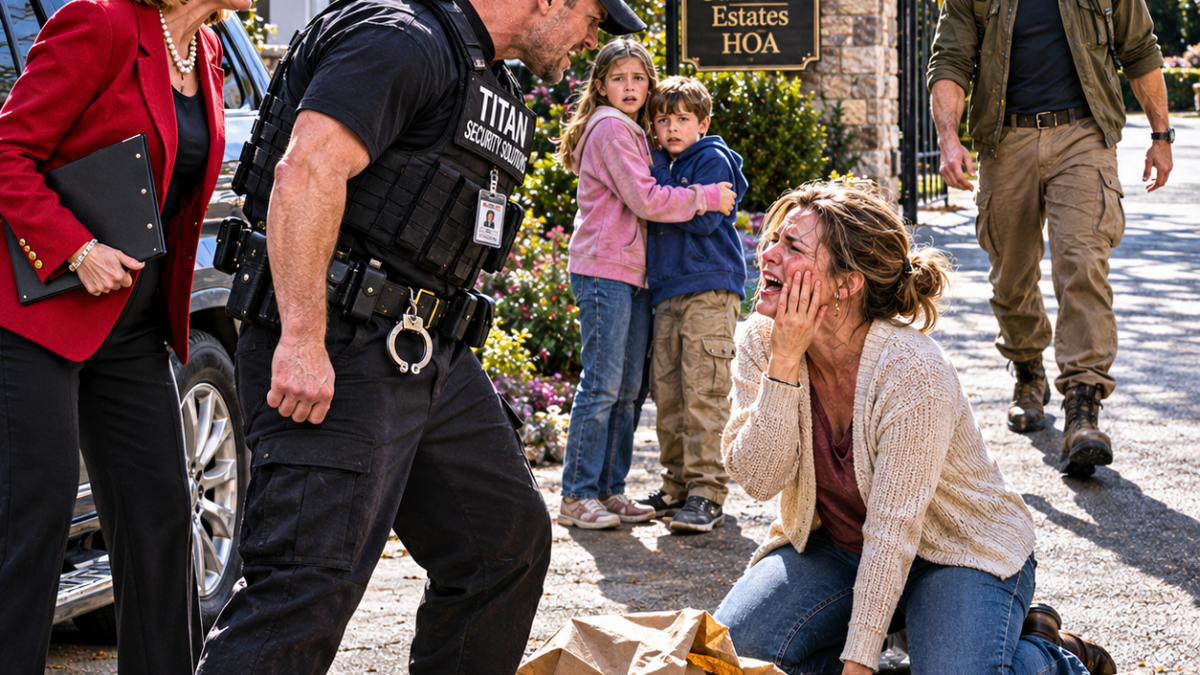
PART 2
Six months earlier, Oakwood Estates had looked like the answer to every question Sarah and I had been asking about where we wanted to raise Emma and Marcus.
Two hundred homes outside San Antonio.
Tree-lined streets.
Fresh mulch around the common areas.
Automatic sprinklers ticking at dawn.
A community pool.
Walking paths.
Kids riding bicycles between driveways while parents stood around grills on Friday nights.
The HOA dues were higher than I liked.
Three hundred fifty dollars a month.
But the neighborhood was maintained, the reserves looked healthy, and most residents seemed reasonable.
The Chens next door brought dumplings the evening we moved in.
Three houses down, the Rodriguez family invited us to a barbecue before we had even finished unpacking.
Mrs. Patterson, an elderly widow near the cul-de-sac, arrived with a handwritten list of plumbers, electricians, and mechanics she trusted.
Then Brenda Hartwell introduced herself.
Fifty-two.
Bleached blond bob.
Designer athletic clothes.
White BMW SUV.
HOA president.
Also a real estate agent.
She spoke with the polished warmth of somebody who had spent years selling homes and learning how to make every demand sound like helpful advice.
“Military family?”
“Yes.”
“We’re very proud of our service families here.”
“Glad to hear it.”
“We do find that transitioning into highly regulated civilian communities can take some adjustment.”
I looked at Sarah.
Sarah looked at me.
Neither of us laughed until Brenda was gone.
Two weeks later, the first violation notice appeared.
Zip-tied to our mailbox.
AMERICAN FLAG — UNAPPROVED SEASONAL DECORATION.
Fine:
$150.
Remove within forty-eight hours.
I read it twice.
The flag was small.
Mounted properly.
Not illuminated.
Not blocking anything.
Sarah called Brenda.
Politely.
Of course.
Sarah could tell a person he was being unreasonable in a tone that made him feel like she had offered soup.
Brenda did not soften.
“Community standards apply equally.”
Sarah said something about federal and state protections for displaying the American flag.
Brenda replied:
“Military families sometimes have difficulty adjusting to civilian expectations.”
That sentence bought Brenda a permanent place in my memory.
I removed the flag temporarily while I checked the governing documents.
Not because Brenda was right.
Because I wanted to know exactly what I had agreed to before I picked a fight.
That was my first mistake in Brenda’s eyes.
I read.
People like her depend on residents not reading.
Then Derek arrived.
Brenda introduced him as Oakwood’s new security contractor.
Twenty-eight.
Her nephew.
Unemployed before that, according to neighborhood gossip.
Failed the police academy twice.
I did not initially care about gossip.
What mattered was his behavior.
He drove a white pickup with magnetic signs reading TITAN SECURITY SOLUTIONS.
He wore a surplus-style uniform and a badge.
The first time he confronted me, I was washing my F-150.
“Commercial vehicle violation.”
I looked at the truck.
Then at him.
“It’s my personal vehicle.”
“Too large.”
“According to what?”
“My measurement.”
“It has veteran plates.”
“Doesn’t matter.”
“No commercial markings.”
“Still violates appearance standards.”
“Show me the rule.”
He gave me the same answer he would repeat for months.
“My measurement is what counts.”
Fine:
$200.
I disputed it.
The citation disappeared.
No apology.
Two weeks later:
Grass height.
$200.
Plus $50 daily until correction.
I measured the lawn.
Three and a quarter inches.
HOA limit:
Three and a half.
I photographed the ruler against the grass in six different places.
Sent it to the board.
Requested Derek’s measurement logs.
No response.
Then I asked for his security credentials.
That finally produced action.
Not documentation.
An emergency board meeting.
Tuesday.
Two in the afternoon.
Twenty-four hours’ notice.
I was at training.
Sarah went.
Brenda sat at the front of the clubhouse with four friendly board members.
Sarah brought photographs.
Lawn measurements.
Copies of prior notices.
A written request for Derek’s license information.
She explained that the citation lacked the measurements supposedly supporting it.
Then asked for a neutral reinspection.
Reasonable.
Brenda responded by proposing broader immediate-enforcement authority.
Not investigating Derek.
Not producing credentials.
Expanding his power.
The motion passed three to one.
Sarah called me afterward.
“They changed the rule.”
“What rule?”
“Basically all of them.”
The next afternoon, Derek returned wearing a new laminated badge.
Then came three citations within an hour.
Children’s bicycles visible.
$150.
Garden hose visible from street.
$150.
Welcome mat “misaligned.”
$150.
I wish I were joking.
We disputed them in writing.
Again.
Then Brenda moved the battle online.
The Oakwood neighborhood Facebook group became an unofficial courtroom.
“Some families do not understand community values.”
“Certain residents confuse military service with exemption from neighborhood standards.”
“Safety requires respect for enforcement personnel.”
Nobody named us.
Everybody knew.
Nancy, one of Brenda’s closest allies, wrote:
“Military people think rules don’t apply because they have guns.”
Sarah responded with photographs and documents.
Brenda’s supporters called her defensive.
One person accused her of “playing the military spouse card.”
That night, I finally stopped assuming Derek was merely incompetent.
I checked his company.
Titan Security Solutions.
No Texas business registration matching his operation.
No security license we could locate through the relevant state records.
No insurance certificate provided to residents.
No company contract in the HOA’s disclosed vendor list.
I called the state licensing office.
They had no record of Derek Hartwell operating the business he claimed.
That was the moment I became genuinely concerned.
An unlicensed man was driving through a two-hundred-home neighborhood wearing a badge and acting like a police officer.
I filed a written complaint.
Then requested HOA financial records.
Brenda responded by telling Derek to “handle” us.
I learned that later.
At the time, all we saw was escalation.
Every evening around six, Derek drove slowly past our house.
Sometimes twice.
Sometimes he parked across the street.
Engine running.
Smoking.
Watching our windows.
Emma asked:
“Why does the mean man sit there?”
She was twelve.
Marcus was nine.
I gave them the safest answer I could.
“He works for the HOA.”
“Is he police?”
“No.”
“Then why does he have a badge?”
Good question.
Soon Derek followed Sarah to the grocery store.
She would come out carrying milk and cereal and find him parked several rows away.
Watching.
If she approached, he claimed he was “monitoring community compliance.”
Oakwood was nowhere near the grocery store.
Then he approached our children at the school bus stop.
That changed everything.
Emma came home pale.
“Dad?”
“What happened?”
“The HOA man talked to us.”
“What did he say?”
She repeated it nearly word for word.
“Tell your parents your family is getting a reputation. Maybe you need a community more suitable for your lifestyle.”
Sarah put her hand on my arm.
That was probably wise.
I felt the kind of anger that makes a person’s hearing narrow.
“Did he touch you?”
“No.”
“Marcus?”
“No.”
“Did he follow you?”
“He drove away.”
I went into the garage.
Closed the door.
Then called my attorney.
That afternoon, we installed additional security cameras.
Driveway.
Front walk.
Side yard.
Back fence.
High-definition recording.
Audio where lawful.
Cloud backups.
Derek’s behavior transformed from rumor into timeline.
Drive-by.
Timestamp.
Parking across from us.
Timestamp.
Walking past the side fence.
Timestamp.
Following Sarah’s car from the neighborhood entrance.
Timestamp.
Once cameras appeared, he should have stopped.
Instead, he became more aggressive.
That was Derek’s defining weakness.
Every limit felt like humiliation to him.
The more evidence we collected, the more desperately he needed to demonstrate that evidence did not matter.
Meanwhile, Sarah made friends with the wife of Bob, the HOA treasurer.
Bob was one of Brenda’s reliable votes.
His wife was not.
Over coffee, she mentioned that Derek was supposedly earning around $3,000 a month.
For security.
That did not match the HOA records I had received.
No security line item.
No approved contract.
No board vote.
Instead, monthly payments appeared under maintenance and repairs.
Several were roughly $3,000.
Different descriptions.
Property monitoring.
Emergency maintenance.
Community support.
The payee information eventually traced back to Derek.
I called Bob.
Not accusatory.
“Did the board approve a security contract?”
Silence.
“I’d have to check.”
“You’re treasurer.”
More silence.
“What amount?”
“About three thousand monthly.”
His face changed when I showed him later.
He genuinely did not know.
That discovery opened another door.
If Brenda could hide Derek’s payments, what else was she hiding?
Our attorney sent a formal records demand.
While that moved, Derek confronted me in the driveway.
He blocked my truck.
Walked to the driver’s door.
“I need to search the vehicle.”
I stared at him.
“For what?”
“Contraband.”
I actually laughed.
“Warrant?”
“HOA enforcement doesn’t require one.”
“Badge number?”
He tapped the plastic badge.
“That isn’t a badge number.”
“You know what I mean.”
“Supervisor?”
“Brenda.”
“State license?”
His jaw flexed.
“I’m contracted enforcement.”
“No. You’re an HOA contractor.”
“Same authority.”
“No.”
I got out slowly.
Kept distance.
“Private contractors do not become police because an HOA pays them. You don’t get to search my truck.”
“You military people always think you’re special.”
I looked at the camera above the garage.
Then back at him.
“This conversation is being recorded.”
He drove away.
That recording became another piece.
Then neighbors started contacting us.
Mrs. Chen said Derek had demanded access to her backyard to inspect “foreign plant material.”
The Rodriguez family received noise complaints connected to traditional music during their daughter’s celebration.
Mrs. Patterson found Derek behind her house close to midnight claiming he was measuring a fence.
A younger mother said he followed her children while claiming to provide a “security escort.”
The pattern was ugly.
It also appeared selective.
Families Brenda liked received warnings.
Families she considered difficult received fines.
Minority families.
Military families.
Older homeowners.
People less likely to have money for lawyers.
Sarah created a shared spreadsheet.
Date.
Resident.
Incident.
Witnesses.
Photographs.
Citation number.
Outcome.
The list kept growing.
Then I had to leave for mandatory training.
The moment my truck disappeared from the driveway, Derek’s behavior got worse.
He began appearing near our property after dark.
Our cameras caught him walking near the bedroom side of the house with a flashlight.
Sarah called the police nonemergency line.
The first response was dismissive.
“Sounds like an HOA civil dispute.”
That phrase infuriated me more than almost anything Derek said.
A man creeping around a bedroom window at night is not transformed into a civil dispute because he carries a clipboard.
Sarah filed a report anyway.
Then Derek appeared at the children’s hospital.
Twice.
He tried to speak with Sarah during her shift about “official HOA business.”
Hospital security removed him.
Then banned him.
He filed a 911 report claiming there was a violent domestic disturbance at our house.
Police arrived.
They found Sarah helping Emma with algebra while Marcus practiced piano.
One responding officer questioned Derek.
Warned him about false emergency reports.
Derek responded that military families were “trained in deception.”
The officer wrote it down.
Thank God for people who write things down.
Derek had just created an official police report documenting his fixation.
Brenda finally realized he was becoming a liability.
Our cameras caught the two of them speaking beside her BMW in the clubhouse parking lot.
She told him to reduce enforcement temporarily.
Derek took that as betrayal.
His behavior became less predictable.
That was when I cut my training short and came home.
Family emergency leave.
Sarah did not know exactly when I would arrive.
Neither did Derek.
So when I turned onto our street early that afternoon and saw Sarah’s vehicle in the driveway, I parked behind the house.
I wanted to surprise her.
I slipped inside.
Started making lunch.
Then her car door opened again outside.
She had apparently realized she had left groceries in the cargo area.
Derek’s truck came down the street seconds later.
And I watched him slap her.
After he left, we called the police.
Sarah filed the assault report.
We provided footage.
Close view.
Clear audio.
No ambiguity.
Derek claiming enforcement authority.
Sarah carrying groceries.
His hand striking her.
The moment he stepped on the eggs after she fell.
That detail disturbed the detective.
Not legally significant by itself.
Emotionally revealing.
Derek was arrested on the assault case after review of the evidence.
He did not remain free to drive past our children every evening.
For the first time in months, our street became quiet.
Sarah sat at the kitchen table that night with ice against her cheek.
Emma and Marcus were asleep.
“I should’ve done more sooner,” I said.
“No.”
“I knew what he was.”
“We both knew.”
“I left.”
“You went to work.”
“I should’ve—”
“Jake.”
I stopped.
“You are not going to rewrite this until it becomes your fault.”
That was Sarah.
Even bruised, she could still diagnose people.
The assault triggered broader subpoenas and records requests.
The HOA financial file finally opened.
What investigators and our lawyers found made Derek’s three-thousand-dollar payments look small.
Money moved from pool reserves.
Landscaping accounts.
Community-event funds.
Emergency reserves.
Some payments went toward Brenda’s personal expenses.
Luxury travel.
Vehicle costs.
Legal bills from her divorce.
Personal services.
Derek’s expenses.
The total suspicious diversion eventually exceeded $75,000 over several years.
That number mattered.
So did documentation.
Receipts.
Bank statements.
Internal emails.
Vendor records.
Board minutes that did not match actual spending.
Sarah, home recovering from the assault, read the governing declaration from beginning to end.
One afternoon she called me into the kitchen.
“Read this.”
The provision required major enforcement programs of the type Brenda had created to receive approval from sixty percent of homeowners through the association’s prescribed process.
“Did they ever hold that vote?” Sarah asked.
“No.”
“Petition?”
“No.”
“Then where did Brenda get authority for this?”
“She didn’t.”
Sarah leaned back.
For months, we had been treating each citation as an individual abuse.
Now we understood the enforcement program itself had never been approved according to the governing documents.
The entire structure rested on Brenda saying it existed.
Then pretending repetition made it legitimate.
Neighbors learned about the assault.
They began comparing stories publicly.
The spreadsheet Sarah had created grew from a private record into the foundation of an accountability group.
Five households.
Then twelve.
Twenty-three.
Forty-seven.
People who had been embarrassed began speaking.
Mrs. Patterson described Derek demanding entry into her deceased husband’s workshop.
Mrs. Chen produced photographs of cultural decorations she removed after repeated citations.
The Rodriguez family showed notices about music and cooking odors.
A mother on Maple Street brought video of Derek following her children.
Even Brenda’s old allies became uncomfortable.
Nancy, who once wrote that military families believed rules did not apply to them, stopped defending Brenda.
Bob cooperated with the financial review.
The more records appeared, the harder it became to maintain the idea that Derek was simply one rogue contractor.
Then Derek began talking.
Sitting in county jail gave him time to reconsider family loyalty.
He had recordings.
Lots of them.
Apparently he had secretly recorded conversations with Brenda as insurance in case she ever blamed everything on him.
That was exactly what she tried to do.
Brenda issued a statement claiming Derek had exceeded his authority.
She had supposedly instructed him only to observe and report.
Derek’s recordings said otherwise.
Her voice:
“Make that military family understand they’re not welcome here.”
Another:
“Use whatever pressure you need. I want compliance.”
Another discussed targeting households she believed could be pressured easily.
The financial recordings were worse.
Brenda talked casually about moving HOA money between accounts because homeowners rarely audited the records carefully.
One recording referred to dues-paying residents as sheep.
That one reached the neighborhood quickly.
Her presidency did not survive it.
Before the recall vote even happened, eighty-nine percent of reachable homeowners had signed a petition demanding her removal or resignation.
Brenda tried one more strategy.
Smear us.
Anonymous social media accounts appeared.
Posts claimed I was unstable because of military service.
Flyers suggested combat veterans represented safety risks.
Fake online reviews targeted Sarah’s professional reputation.
Someone called the hospital claiming she was emotionally unstable around children.
That move failed spectacularly.
Sarah had worked there for years.
Parents knew her.
Nurses knew her.
Doctors knew her.
Hospital administration reported the harassment and publicly stood behind her.
Every attack generated more witnesses.
More metadata.
More screenshots.
More evidence.
Brenda’s desperation eventually became criminal in new ways.
She attempted to create backdated paperwork suggesting she had tried to fire Derek months earlier.
Investigators compared file creation dates.
Printer records.
Email histories.
The story did not hold.
Then she reported a break-in at her own house.
She claimed people connected to me had entered and left threatening messages referencing military tactics.
Police investigated.
Neighbor cameras showed no intruders.
The alleged threatening notes came from paper and writing instruments linked to Brenda’s own home.
Items supposedly stolen were later found moved elsewhere on the property.
That false report added another layer to the case.
Derek heard about it from jail.
Whatever loyalty remained disappeared.
He turned over even more audio.
More emails.
More instructions.
By then, Brenda was facing multiple investigations.
Financial.
Criminal.
HOA governance.
Real-estate licensing.
Civil litigation.
She attempted to leave Texas.
At Dallas Fort Worth International Airport, authorities stopped her carrying a large amount of cash and documents that raised additional concerns.
Her bail status changed.
The woman who once patrolled Oakwood in a white BMW telling neighbors how high their grass could grow was now answering to actual courts.
I didn’t celebrate.
Sarah didn’t either.
There was relief.
But no celebration.
Because our kids had spent months looking through windows before going outside.
Because Sarah still flinched when a white pickup slowed near the house.
Because Mrs. Chen had removed decorations she loved.
Because an elderly widow had been afraid inside her own backyard.
Because money could be returned.
Time could not.
The civil case moved alongside the criminal proceedings.
Our attorneys documented the assault.
Harassment.
Stalking incidents.
Financial harm.
Emotional distress.
Improper enforcement.
The HOA’s role.
Derek’s individual conduct.
Brenda’s conduct.
Other homeowners pursued their own claims.
We eventually resolved our civil case for approximately $175,000 plus attorney fees through the parties and applicable coverage or recovery mechanisms.
It was significant money.
It did not turn the experience into a profit.
Medical bills came out.
Legal expenses.
Security improvements.
Lost time.
Counseling.
The value of a settlement is not the same as the value of what happened.
I wish more people understood that.
Derek eventually entered a resolution that included incarceration, probationary restrictions, restitution obligations, and a prohibition on returning to security work.
He had started the entire situation wanting the image of authority.
The final legal orders specifically removed his ability to present himself that way again.
Brenda’s financial case became more serious.
The state proved a pattern of misused HOA funds and related conduct.
She ultimately received a prison sentence, restitution obligations, and extended supervision after release.
Her real-estate career collapsed.
Personal assets were used in recovery proceedings.
The white BMW disappeared.
The vanity plate disappeared.
The entire identity she had built around appearing successful and powerful dissolved into court filings.
Yet the most important vote in Oakwood was not a criminal verdict.
It happened inside the same community center where Brenda had once changed enforcement rules to protect Derek.
This time, the room was full.
Standing room.
Homeowners lined the walls.
Sarah sat beside me.
Still a faint discoloration along her cheek.
Brenda was already suspended.
The question was what Oakwood became next.
People wanted revenge.
Some wanted to dissolve the HOA.
Others wanted every fine issued under Brenda refunded immediately.
One man wanted a permanent ban on any security contractor.
Mrs. Chen stood.
“I don’t want revenge.”
The room quieted.
“I want receipts.”
That became the direction.
Audit everything.
Reconcile every dollar.
Review every fine.
Return money where enforcement lacked legal basis.
Publish vendor contracts.
Require board approval.
No secret payments.
No family contractors without disclosure.
No security program without licensing verification.
No harassment disguised as compliance.
Then someone nominated Sarah for interim president.
She stared at them.
“No.”
People laughed.
She looked at me.
“Absolutely not.”
I whispered:
“You’d be good.”
She turned.
“You don’t get a vote in this conversation.”
She accepted two days later.
Her first board meeting lasted four hours.
I attended the first ten minutes.
Then left.
Sarah did not need me there.
She removed the private-security program.
Suspended disputed fines.
Opened records.
Created an independent audit committee.
Put financial statements online for members.
Required recorded votes for major contracts.
Then she did something Brenda never would have done.
She created an appeal process.
Not because every homeowner would be right.
Because authority deserves review.
Oakwood did not become a lawless neighborhood.
Rules still existed.
Grass limits.
Parking.
Common areas.
Architectural review.
We still paid dues.
A year later, I received a legitimate violation notice because I left a trailer in the driveway longer than allowed.
I checked the rule.
The HOA was right.
I moved it.
Sarah laughed for ten minutes.
“Do you want me to call the president?”
“I hate you.”
“You married the president.”
“Terrible judgment.”
The neighborhood changed slowly.
Mrs. Chen put her red lanterns back.
The Rodriguez family hosted music at community events.
Mrs. Patterson’s grandchildren played in the yard where Derek once prowled with a flashlight.
The annual meeting stopped feeling like a courtroom.
Budget reports became boring.
Boring was beautiful.
We created a scholarship fund partly from recovered money and community donations.
Not named after us.
Not named after the case.
Just Oakwood families supporting children.
Emma and Marcus were recognized academically the first year.
I was proud.
Sarah cried.
Then denied crying.
Our story traveled farther than I expected.
Military-family organizations contacted us.
HOA reform groups asked Sarah to speak.
Other residents around Texas shared similar experiences with overreaching boards and unlicensed “security.”
What had happened at Oakwood was extreme.
But the mechanism wasn’t unique.
Fear of fines.
Ignorance of governing documents.
Reluctance to hire lawyers.
Board members who assume nobody reads statements.
Contractors wearing uniforms that imply more authority than they possess.
Sarah started speaking at workshops.
Her message was always less dramatic than mine.
“Read what you sign.”
“Ask for the rule.”
“Ask for the vote.”
“Ask for the contract.”
“Ask for the license.”
“If someone says they have authority, make them show where it comes from.”
She never called people enemies.
Never used military metaphors.
Never made herself the hero.
That made people trust her more.
Eventually, reform proposals reached state lawmakers.
The case became one of several cited examples in debates over HOA transparency, contractor oversight, financial disclosure, and homeowner protections.
Some reforms passed.
Others didn’t.
That was democracy.
Slow.
Messy.
Better than one HOA president deciding the law herself.
I eventually left active operational life completely.
Not because Brenda drove me out.
Because I had already been moving toward a different stage.
I began helping military families understand civilian legal systems.
Not as some commando teaching people how to fight HOAs.
As a man who had learned the value of boring paperwork.
That surprised everyone who knew me.
It surprised me most.
Years earlier, if you asked what I trusted, I might have said training.
Teamwork.
Preparation.
Discipline.
Now I would add:
Certified mail.
Meeting minutes.
Bank records.
Licensing databases.
Security footage.
People joke about bureaucracy until bureaucracy is the thing proving somebody lied.
That lesson came at a cost.
Sarah’s cheek healed within days.
The emotional bruise took longer.
For months, if Derek’s old model of pickup appeared on our street, she would go quiet.
Not panic.
Not freeze.
Just watch.
Emma noticed.
So did Marcus.
Children notice everything adults think they hide.
We found a counselor.
Family sessions.
At first I hated them.
Not because therapy bothered me.
Because sitting in a room and admitting I had been afraid felt harder than most physical training I had ever done.
The counselor asked:
“What were you afraid of?”
I answered:
“That I wouldn’t be home next time.”
Sarah looked at me.
That was the real thing.
Not that I couldn’t protect her.
That I could not always be there.
Military families learn to live inside that fact.
Deployment.
Training.
Duty.
Distance.
Brenda and Derek exploited it.
Derek got bolder when my truck disappeared.
He treated Sarah as the weaker target.
That knowledge haunted me.
The counselor made me say something else aloud.
Sarah had survived before I came home.
She filed reports.
Went to meetings.
Collected records.
Protected our children.
Built the spreadsheet.
Connected neighbors.
She did not need me to rescue her.
I needed to stop rewriting our story as though the Navy husband came home and saved everyone.
The truth was better.
My wife built half the case.
Maybe more.
That changed how I told the story.
When people asked about the slap, I stopped starting with what I did afterward.
I started with what Sarah did before.
She documented.
She kept calm.
She went to the board.
She called police.
She helped neighbors.
She read the covenants.
She found the sixty-percent provision.
She organized forty-seven families.
Then eighty-nine percent of the neighborhood backed reform.
That was not military planning.
That was nursing.
Observe.
Document.
Identify patterns.
Escalate appropriately.
Protect the vulnerable.
Turns out Sarah had been running operations her whole career.
She just called them patient care.
One evening, long after the court cases ended, we were sitting outside while Emma studied inside and Marcus played basketball in the driveway.
Sarah asked:
“You know what bothers me?”
“What?”
“That everyone remembers the slap.”
I looked at her.
“It was dramatic.”
“So were six months before that.”
“I know.”
“No, I mean the story gets reduced to one horrible second.”
She touched her cheek unconsciously.
“But Derek was dangerous before he hit me.”
“Yes.”
“And Brenda was corrupt before he hit me.”
“Yes.”
“And nobody cared enough.”
That was true.
Because small abuses are easy to normalize.
A bad citation.
One rude contractor.
One strange expense.
One board meeting scheduled when working people can’t attend.
One family treated differently.
One resident followed.
One child approached.
Each can be explained away.
Then something happens that cannot.
A slap.
An arrest.
A financial audit.
A camera clip.
People suddenly ask:
How did we get here?
The answer is usually:
Slowly.
Oakwood had not become unhealthy in one day.
Residents had been trained to give Brenda the benefit of the doubt because fighting her cost time.
Time is expensive.
Most people have jobs.
Children.
Illness.
Mortgages.
A $150 fine often feels cheaper than three evenings of research and a lawyer’s consultation.
Brenda knew that.
Her power was not the bylaws.
It was exhaustion.
That became the lesson Sarah taught best.
“Make accountability cheaper than silence.”
Oakwood’s reforms did that.
Documents online.
Appeals by email.
Quarterly reports.
Contract disclosure.
Recorded board votes.
Residents didn’t have to become amateur investigators to know where their dues went.
The system did not depend on everyone being vigilant every minute.
Good systems shouldn’t.
Derek left jail eventually.
He remained restricted from security work.
I heard he lived with family.
Worked low-wage jobs.
Complained to anyone who listened that military people had destroyed his life.
I had no interest in correcting him.
Some people need a villain.
If he wanted me, fine.
He stayed away from my family.
That was enough.
Brenda’s release came later.
Supervision.
Restitution.
Financial monitoring.
No real-estate comeback.
No HOA presidency.
No white BMW cruising Oakwood.
I saw her once after everything.
Grocery store.
Of course.
She was standing near produce.
I nearly walked away.
Then she saw me.
“Jake.”
“Brenda.”
No cameras.
No board.
No courtroom.
Just two people beside a display of oranges.
“I heard Sarah’s doing well.”
“She is.”
“The kids?”
“Good.”
She nodded.
“I never told Derek to hit her.”
I studied her.
“I know.”
Her face shifted.
“You do?”
“I heard the recordings.”
“I told him to pressure you.”
“Yes.”
“I didn’t mean—”
“Brenda.”
She stopped.
“You don’t get to control the exact shape of the thing after you create the conditions for it.”
Her eyes dropped.
“I lost everything.”
I could have said:
Good.
I didn’t.
“You lost a lot.”
“You think I deserved it.”
“I think courts decided what consequences you deserved.”
She looked at me.
“You always talk like that?”
“Sarah says it’s annoying.”
That almost made her smile.
Almost.
Then she said:
“I was scared.”
“Of what?”
“Losing control.”
That answer made more sense than anything she had ever said.
Because that was the entire story.
Derek feared being seen as powerless.
So he wore a badge.
Brenda feared losing control.
So she expanded enforcement.
Residents feared conflict.
So they paid fines.
I feared failing my family.
So I nearly turned every problem into something I personally had to defeat.
Fear was everywhere.
The difference was what people did with it.
“I hope you build something else,” I said.
She stared.
“Why would you say that?”
“Because Sarah taught me people are more useful when they stop being the worst thing they ever did.”
I walked away.
I did not forgive her.
Those are different things.
The first American flag Brenda fined us for eventually went back into the yard.
Same flag.
Same pole.
I could have turned it into a spectacle.
News cameras.
Veterans.
Big ceremony.
Didn’t.
One Saturday morning, Marcus helped me reinstall it.
He had grown almost as tall as Sarah.
He tightened the bracket.
“Is this the illegal flag?”
“No.”
“The famous flag?”
“No.”
“The Brenda flag?”
“Absolutely not.”
He laughed.
“Then what is it?”
“A flag.”
We raised it.
Done.
No speech.
Sarah watched from the porch.
Emma filmed ten seconds, then stopped.
That was enough.
The annual Oakwood community festival eventually included a small veterans ceremony.
But it wasn’t about us.
Military families.
Teachers.
Nurses.
First responders.
Neighbors.
Mrs. Chen sold dumplings.
The Rodriguezes brought music.
Mrs. Patterson sat beneath a tent complaining that everybody overcooked hamburgers.
Normal community.
The first year, I walked the old route Derek used to patrol.
Kids ran around me during a charity 5K.
I remembered his white pickup idling there.
Then a seven-year-old nearly knocked me over chasing his sister.
The memory disappeared under laughter.
That felt better than revenge.
Years later, Sarah became well known for HOA accountability work.
She completed additional legal training and started helping homeowners understand records requests and enforcement procedures.
I teased her.
“You became Brenda.”
She stared at me.
“I will hurt you.”
“Community standards.”
“Sleep outside.”
I laughed.
She didn’t.
Eventually she did.
Laugh, I mean.
Our marriage survived because humor returned.
That was another thing I underestimated.
When fear lives in a house, laughter becomes quieter.
Then one day it comes back.
At first carefully.
Then normally.
The smell I remember from that terrible afternoon is still milk on hot asphalt.
Not Derek’s cologne.
Not dust.
Milk.
For years, spilling milk in the driveway could pull me backward in time.
Then one summer, Marcus dropped an entire gallon while unloading groceries.
The jug burst.
White liquid spread everywhere.
I froze.
Sarah looked at me.
She knew.
Then Marcus said:
“Dad, don’t cry over it.”
Terrible joke.
I laughed so hard I had to sit on the tailgate.
Sarah laughed too.
Marcus had no idea why it was that funny.
Maybe he did.
Children grow up.
They learn the parts adults thought they had hidden.
That day, milk became milk again.
I think recovery works like that.
Not forgetting.
Reassigning meaning.
The same became true of uniforms.
For a while, Sarah hated private security.
Hospital guards.
Mall guards.
Anyone with a black polo and radio.
Then slowly, ordinary people replaced Derek in that image.
A hospital security officer who walked her safely to her car.
A licensed guard at a concert who helped Emma find a lost purse.
A security supervisor who politely asked for identification at an office.
Authority itself had not hurt us.
One man pretending authority was unlimited had.
That distinction mattered.
The civil settlement paid bills and funded part of our future.
We used some money for home security.
Some for counseling.
Some for Emma and Marcus.
A portion went toward the neighborhood scholarship fund.
Not because we wanted to be saints.
Because I didn’t want every dollar associated with that case to feel like compensation for pain.
Some of it needed to become something good.
Oakwood’s property values did eventually improve under transparent governance.
Not because of national publicity.
Because the association became predictable.
Buyers could see audited reserves.
Clear rules.
Stable dues.
Real meeting minutes.
No bizarre enforcement department.
No secret related-party contracts.
Boring governance is attractive.
Who knew?
The new board also created conflict-of-interest rules.
Family members of directors could not receive contracts without disclosure and independent approval.
Vendors had to prove insurance.
Licenses when required.
Competitive bids above certain thresholds.
Financial controls required multiple signatures.
People called the reforms excessive.
Then someone would say:
“Remember Derek.”
Motion passed.
Sometimes institutional memory is useful.
State lawmakers eventually used Oakwood and several other HOA scandals when considering broader reforms.
I testified once.
Not as a Navy SEAL.
Not as a celebrity victim.
As a homeowner.
I brought the first flag violation.
The $200 truck citation.
The grass-height notice.
Then the image of Sarah’s groceries spread across our driveway.
I placed them side by side.
One legislator asked:
“What is the connection?”
“Escalation.”
I explained.
“If residents have no practical way to challenge small abuses, the person abusing authority learns there is no cost.”
Another asked:
“Are you suggesting HOAs should lose enforcement power?”
“No.”
“Then what?”
“Make power auditable.”
That was Sarah’s phrase.
I stole it.
Licensing where licensing is required.
Clear notice.
Appeals.
Financial disclosure.
Limits on contractors.
No physical detention powers invented by board vote.
Nothing revolutionary.
Just boundaries.
The same thing we had been asking Brenda to respect from the beginning.
When the hearing ended, a veteran approached me.
Older.
Vietnam cap.
He shook my hand.
“SEAL?”
“Yes.”
“Thought so.”
“How?”
“You sit like you’re waiting for the door to explode.”
I laughed.
He became serious.
“My HOA’s fine. Good board.”
“Glad to hear it.”
“Don’t let people think they’re all crooks.”
“I don’t.”
“Good.”
That conversation stayed with me.
Anger loves categories.
Karen.
HOA.
Security.
Government.
Military.
Civilian.
Good.
Bad.
Reality doesn’t cooperate.
There were HOA board members who failed us.
There were others who helped.
A police dispatcher initially dismissed Sarah’s complaint.
Another officer documented Derek carefully and helped the case.
Derek was unlicensed and abusive.
Other private security professionals later treated our family with dignity.
My military service gave me discipline.
It also sometimes tempted me toward thinking every conflict needed an opponent.
Sarah corrected that.
Justice required distinctions.
Years after Oakwood changed, a new family moved into the house across from us.
Young couple.
Baby.
The husband knocked on our door one evening holding an HOA notice.
“You’re Jake, right?”
“Yes.”
“I was told you know about HOA stuff.”
Sarah yelled from the kitchen:
“Don’t encourage him.”
He showed me the paper.
Fence paint.
Wrong shade.
He looked genuinely worried.
“What should I do?”
“Check the approved color list.”
“That’s it?”
“If your color is wrong, repaint.”
He seemed disappointed.
“But aren’t HOA fines abusive?”
“Sometimes.”
“This one?”
I compared the paint sample.
Definitely wrong.
“This one appears boringly legitimate.”
Sarah called:
“Thirty-dollar trash can fine!”
“Not helping.”
The neighbor laughed.
He repainted the fence.
No lawsuit.
No scandal.
That interaction mattered almost as much to me as our victory over Brenda.
We had not survived one abusive HOA president just to become people who assumed every rule was tyranny.
Accountability cuts both ways.
Residents owe communities what they actually agreed to.
Boards owe residents only the authority they actually possess.
The trouble begins when either side invents more.
Emma eventually left for college.
Marcus followed a few years later.
Before Emma moved out, she found an old external hard drive labeled DEREK.
“What is this?”
“Old camera files.”
“Can I watch?”
“No.”
“I was there.”
“You were twelve.”
“Dad.”
I thought.
Then handed it to her.
She watched some.
Not the assault first.
Drive-bys.
Facebook screenshots.
Derek near the bus stop.
Finally the driveway.
She stopped before the slap.
“I remember Mom coming inside.”
I waited.
“I remember thinking you were going to kill him.”
My stomach tightened.
“Were you scared of me?”
She thought about it.
“No.”
Then:
“I was scared of what he was making you become.”
That hurt.
Because twelve-year-old Emma had seen something adults missed.
I had spent months imagining discipline meant I was unaffected.
Children saw the tension.
My silences.
The way I checked cameras.
The way I scanned streets.
“I’m sorry.”
“You didn’t do anything.”
“I brought that energy into the house.”
She shrugged.
“We all did.”
Then she smiled.
“Mom was scarier.”
“That is objectively true.”
We laughed.
She took the hard drive.
“Can I keep a copy?”
“Why?”
“Because someday you two are going to tell this story wrong.”
Fair.
She became our unofficial archivist.
Marcus wanted none of it.
His answer:
“Derek was an idiot. Brenda was a criminal. Can we move on?”
Also fair.
Families do not heal uniformly.
Some remember.
Some archive.
Some joke.
Some avoid.
All can be valid.
Sarah and I finally replaced the driveway concrete years later.
Not because of the assault.
Tree roots.
The old slab had cracked.
When contractors broke out the section where the groceries had fallen, I stood watching.
Sarah came outside.
“You doing that thing?”
“What thing?”
“Making normal construction symbolic.”
“No.”
“Yes.”
The jackhammer broke the slab.
Chunks lifted.
Loaded into a truck.
New concrete poured.
By evening, the driveway looked different.
Sarah stared at it.
“Okay.”
“What?”
“I admit this feels good.”
I smiled.
“Symbolism?”
“Shut up.”
The next morning, milk delivery from a local dairy arrived.
A glass bottle sat on the new concrete.
Sarah took a picture.
Sent it to me.
Caption:
RECLAIMED TERRITORY.
I saved it.
Brenda and Derek became less important with time.
That’s the ending nobody puts in dramatic videos.
The villain shrinks.
Not because you defeat them harder.
Because your life grows around the damage.
Children graduate.
Dogs age.
Work changes.
Neighbors move.
Trees get taller.
Paint fades.
Your wife laughs without touching the bruise that isn’t there anymore.
One day you realize you haven’t said the person’s name in months.
That is victory I trust.
The last official document connected to the case arrived after most of the public attention was gone.
A financial reconciliation from Oakwood.
Every disputed account reviewed.
Recovered money listed.
Restitution applied.
Vendor payments corrected.
Reserve balance restored.
At the bottom:
CERTIFIED BY INDEPENDENT AUDITOR.
Sarah read it.
“That’s beautiful.”
“You’ve become a very strange person.”
“Look at those reconciled balances.”
I laughed.
We framed nothing.
Filed it.
Closed the drawer.
That was the end.
Not Brenda being arrested.
Not Derek sentenced.
Not television interviews.
A balanced ledger.
A community that could account for its own money.
Because that was the thing Brenda assumed would never happen.
Someone would eventually add the numbers.
I still have the American flag.
The one from our second week in Oakwood.
Edges slightly faded.
It hangs now from the porch.
No special ceremony.
No spotlight.
No plaque saying HOA KAREN LOST.
Just a flag.
Occasionally a new neighbor asks whether the story about the $150 flag fine is true.
“Yes.”
“What did you do?”
“Paid nothing.”
“Seriously?”
“Seriously.”
Then they’ll ask:
“Were you angry?”
“Very.”
“What stopped you from going after them immediately?”
That answer changed over the years.
At first I said strategy.
Evidence.
Discipline.
Now I say:
“Sarah.”
Because she did.
Every time I wanted to turn Brenda and Derek into enemies, Sarah forced me to remember they were people operating inside systems.
If we fixed only the people, another person could abuse the same weakness.
So we fixed both.
The contractors left.
The president left.
The accounting system changed.
The appeals process changed.
Residents became involved.
Records became visible.
That lasted longer than revenge.
One October evening, we held the annual community gathering near the pool.
Children ran between tables.
Mrs. Chen brought dumplings.
Rodriguez family music played.
Nobody measured decibels.
Mrs. Patterson complained that the coffee was weak.
Sarah stood with me near the old clubhouse door.
“You know Brenda used to stand right there?”
“I know.”
“She’d hate this.”
“Why?”
“Too many uncontrolled cultural foods.”
I laughed.
Then looked around.
No uniforms.
No fake security pickup.
No family avoiding another.
Just neighbors.
“This is what she said she wanted.”
“What?”
“Community.”
Sarah looked at me.
“No. She wanted control.”
That was the distinction.
Community accepts that people disagree.
Control cannot.
Community asks for consent.
Control demands compliance.
Community has rules.
Control treats rules as weapons.
Brenda kept using the word values.
Oakwood’s values.
Community values.
Property values.
She talked about values so often that nobody asked what she personally valued most.
Control.
Once she lost it, everything else collapsed.
I used to think strength meant never being controlled.
Military training can feed that idea if you misunderstand it.
Real strength turned out to be more complicated.
Sometimes strength was Sarah sitting through an HOA meeting while I was gone.
Sometimes it was me not putting Derek through his truck when he blocked my driveway.
Sometimes it was Emma telling us what he said at the bus stop.
Sometimes it was Bob admitting he had signed records without reading enough.
Sometimes it was Nancy apologizing.
Sometimes it was a police officer writing down a ridiculous false-report complaint instead of laughing and forgetting.
Sometimes it was forty-seven families putting their names into a shared spreadsheet.
Nobody looked heroic doing any of those things.
Together, they changed everything.
That is the version I want remembered.
Not:
Navy SEAL destroys HOA Karen.
That makes a good thumbnail.
It makes a bad lesson.
My training helped me control my reaction.
It did not give me special property rights.
Sarah’s nursing career did not make assault against her worse than assault against anyone else.
Our flag did not make us more American than our neighbors.
We were not entitled to more protection because I served.
We were entitled to the same protection everyone should have.
That is what made Derek’s fake authority so dangerous.
He targeted people he believed would comply.
Immigrants.
Widows.
Military spouses alone at home.
Families with children.
People whose schedules made board meetings difficult.
Power searches for asymmetry.
Accountability reduces it.
The first thing I teach military families now is not how to “fight back.”
It is how to slow things down.
Ask for documents.
Don’t answer threats with threats.
Save emails.
Take photographs.
Request minutes.
Verify licensing.
Check whether fines follow the governing documents.
Call actual law enforcement when conduct becomes criminal.
Hire counsel when necessary.
Talk to neighbors.
Do not let an abusive authority isolate you.
And don’t assume a badge means anything until you know who issued it.
Derek’s laminated badge still exists somewhere in an evidence archive.
I never wanted it.
Never asked for it.
A reporter once asked whether I wished I had kept it as a trophy.
“No.”
“Why?”
“Because it was never worth anything.”
That was the point.
The badge had power only because people reacted to it.
Once state investigators checked the underlying reality, the plastic returned to being plastic.
One Saturday morning, long after the cases ended, Sarah and I drove through Oakwood with the windows down.
Fresh mulch.
Sprinklers.
Children.
Somebody grilling.
Exactly the smell and sound of the neighborhood we thought we bought six months before Brenda introduced herself.
We passed the corner where Derek used to park.
Empty.
The clubhouse.
Busy with a birthday party.
Mrs. Chen’s house.
Red lanterns.
Rodriguez home.
Music from the backyard.
Then ours.
American flag moving slightly in the wind.
Sarah turned to me.
“So.”
“So?”
“Was moving here a mistake?”
I considered it.
“Ask me before or after Brenda?”
“After everything.”
I parked.
Emma and Marcus were home visiting.
Cars crowded the driveway.
Sarah waited.
“No.”
She looked surprised.
“Really?”
“No.”
“Why?”
I looked around.
“Because this is home.”
She nodded.
Then:
“Very sentimental, Commander.”
“Don’t tell anybody.”
We went inside.
That night, after everyone left, I walked to the mailbox.
Same style Brenda once claimed needed approval.
I checked the mail.
Utility bill.
Veterans organization newsletter.
HOA envelope.
I laughed.
Opened it.
Annual budget notice.
Reserve contribution increase.
Two percent.
I read it at the curb.
Numbers balanced.
Audit attached online.
Board vote listed.
Sarah opened the front door.
“What is it?”
“HOA.”
She put her hands on her hips.
“Do I need to call the lawyers?”
“No.”
“Security?”
“No.”
“State police?”
“No.”
“What are you going to do?”
I folded the letter.
“Pay the dues.”
She smiled.
And that, more than anything, told me we had won.
Not because the HOA disappeared.
Because it became what it was supposed to be.
A boring organization managing shared property under agreed rules.
No dictator.
No fake cop.
No family contracts hidden as maintenance.
No fear.
Just homeowners arguing over budgets.
I walked back toward the house.
For a moment I remembered that afternoon years earlier.
Sarah standing among broken groceries.
Milk on the driveway.
Derek adjusting his fake badge.
“Next time, follow HOA rules.”
He had believed those words ended the discussion.
Instead, they began the record.
Camera footage.
Police report.
Licensing search.
Financial audit.
Neighbor statements.
Board minutes.
Bank transfers.
Audio recordings.
Court orders.
One piece at a time, every layer of borrowed authority came apart.
Brenda Hartwell wanted Oakwood to believe her office made her untouchable.
Derek Hartwell wanted a plastic badge to make him feared.
What ended them was far less dramatic.
People checked.
That is all.
They checked the license.
Checked the contract.
Checked the vote.
Checked the bank account.
Checked the camera.
Checked the messages.
Checked the bylaws.
Checked the story.
And once enough people checked, there was nowhere left for the lie to live.
Sarah still says the most important moment was not Derek being arrested.
Not Brenda losing the recall.
Not the settlement.
Not the audit.
She says it was the first Oakwood meeting after the reforms.
A homeowner stood up and challenged one of Sarah’s proposed policies.
Brenda would have shut him down.
Sarah listened.
Changed part of the proposal.
Then thanked him.
I asked later why that moment mattered.
“Because I disagreed with him.”
“So?”
“And he still got to speak.”
That is community.
Not obedience.
Years after HOA Karen Brenda Hartwell tried to turn Oakwood Estates into her private kingdom, that may be the most satisfying thing she accidentally taught us.
A good neighborhood is not one where everyone follows one powerful person.
It is one where no powerful person gets to decide alone what everyone else is allowed to become.
Derek once stood in our driveway convinced his badge made him authority.
Brenda sat in a clubhouse convinced her title made disagreement misconduct.
They both discovered the same thing.
Authority without accountability is only a costume.
And costumes come off very quickly once people start asking for the paperwork underneath.








