HOA Karen Hired Fake Cops to Smash My Work Truck on My Own Driveway—Then Threatened My Wife When We Refused to Leave
part 2
My name is Marcus Isabella.
I was thirty-four when Rebecca and I bought the house in Willowbrook Estates outside Phoenix.
I owned a diesel repair shop.
Nothing glamorous.
I spent most days under hoods, beside lifts, or leaning over engines built by manufacturers who seemed personally offended by anyone trying to reach the parts that failed most often.
My hands stayed stained no matter how much soap I used.
Rebecca taught third grade at Desert View Elementary.
She spent money on pencils and books for students whose parents couldn’t always afford them.
We were not rich.
We were not struggling in the dramatic way people imagine either.
We worked.
Saved.
Skipped vacations.
Kept old cars longer than we wanted.
For eight years we put money aside for a house.
Willowbrook Estates looked like the reward.
One hundred eighty homes.
Clean streets.
A pool.
Community landscaping.
Two-car garage.
Large enough driveway for my truck.
Monthly dues of $285.
More rules than I liked, but I read them before closing.
That mattered.
The vehicle restriction allowed light commercial trucks below eight thousand pounds.
Mine weighed approximately sixty-eight hundred.
The lettering for Chen’s Diesel Repair was small.
Professional.
Nothing offensive.
Fourteen days after we moved in, the first violation arrived.
COMMERCIAL VEHICLE VIOLATION.
Fine:
$150.
I assumed clerical error.
I pulled the covenant.
Highlighted the vehicle provision.
Printed the truck specifications.
Added a certified weight ticket.
Then appealed.
Three days later, the board response came back.
Aesthetic concerns override technical compliance.
I read the sentence twice.
Rebecca read it.
Then looked at me.
“Is that even a rule?”
“No.”
“Can they just say that?”
“They just did.”
“That’s not what I asked.”
“No.”
Then Constance Wickham came to our driveway.
Fifty-eight.
Retired insurance adjuster.
White Mercedes SUV.
Designer sunglasses large enough to shield her from evidence.
She walked toward us with a clipboard and the expression of someone arriving to explain why our existence required correction.
“Mr. Isabella.”
“Marcus.”
She looked at my truck.
Then my hands.
Then Rebecca’s Honda.
“Perhaps you don’t understand how civilized communities function.”
That was her opening line.
No hello.
No welcome.
Rebecca tried diplomacy.
“We could potentially move the truck behind the house if visibility is the concern.”
Constance smiled.
“Rules are rules, dear.”
I almost interrupted.
Rebecca squeezed my arm.
Then Constance added:
“Perhaps Willowbrook isn’t the correct fit for your situation.”
Situation.
The word landed strangely.
My business?
Our income?
My truck?
Us?
She made it sound as though the house had accidentally been sold to people who should have known better than to buy it.
The next fine was $500.
Repeat violation.
Attached to it was a notice saying enhanced patrols would begin through Municipal Security Services.
That phrase bothered me.
Municipal.
So I searched.
No municipal affiliation.
No county contract.
No Phoenix law-enforcement authority.
Municipal Security Services had been incorporated six months earlier.
Owner:
Leonard Wickham.
Constance’s brother-in-law.
That was interesting.
Then I found the reviews.
Twelve.
Every one of them terrible.
Illegal towing allegations.
Cash demands.
Private-driveway tickets.
Harassment.
People saying uniformed personnel acted like police without explaining that they were not.
I printed everything.
Rebecca sat beside me at the kitchen table.
“So we’re not dealing with a parking issue.”
“No.”
“What are we dealing with?”
“I don’t know yet.”
She looked at me.
“Then we find out.”
That was Rebecca.
Small woman.
Teacher.
Patient with children.
Absolutely vicious about unfairness.
Two days later, Municipal Security Services arrived for the first time.
White Crown Victoria.
Light bar.
Hutchkins and Morrison.
They told me to move my truck or face impoundment.
I asked for credentials.
They gave company badges.
I asked what law-enforcement agency commissioned them.
They changed the subject.
I photographed everything.
Vehicle plate.
Badges.
Uniform patches.
Faces.
Then I called the Phoenix Police non-emergency line.
The dispatcher checked.
Municipal Security Services had no police authority.
That was enough for me to stop treating them like aggressive parking enforcement.
The next afternoon, the situation escalated.
A tow truck appeared.
They hooked up my work truck while it sat inside my property.
Rebecca confronted them.
Phone recording.
I ended up paying $400 to retrieve the truck from a private lot because I needed it for work and didn’t have the luxury of waiting days while lawyers fought over release.
I kept the receipt.
Cash.
Minimal paperwork.
Another clue.
Then Constance arrived with what she called an architectural compliance inspection.
Same fake security people.
One man wearing a hard hat claiming to be a building inspector.
Rebecca called me from home.
“You need to come back.”
“Are you safe?”
“Yes.”
“Stay inside if they try to enter.”
“They’re already measuring things.”
I drove home.
Constance held up a paper with an HOA logo.
Highlighted paragraphs.
No court case.
No judge.
No county department.
“This authorizes interior garage inspection.”
“No, it doesn’t.”
“Refusal constitutes noncompliance.”
“Show me the warrant.”
“This is the authorization.”
“Show me the warrant.”
The fake inspector shifted.
I continued.
“Case number.”
Silence.
“Judge.”
Silence.
“Court.”
Nothing.
The performance collapsed under three questions.
Then a real county inspector arrived the next morning.
Dave Hullbrook.
Twenty years in zoning enforcement.
He was there because Constance had filed complaints alleging illegal automotive commercial activity at my home.
I showed him the garage.
Tools.
Ventilation.
Storage.
No customer vehicles.
No commercial repair business operating from the house.
He inspected everything.
Then said:
“Your setup is legal.”
“Thank you.”
“Business license is current.”
“Yes.”
“No zoning violation that I can see.”
“Good.”
He looked annoyed.
“This is the third complaint from the same source this month.”
Then Constance appeared.
Right on cue.
She marched up the driveway.
“Officer Hullbrook.”
He turned.
“Inspector.”
“Excuse me?”
“I’m Inspector Hullbrook.”
She gestured toward my garage.
“This man is clearly operating an illegal business.”
“No.”
“He stores commercial equipment.”
“He owns tools.”
“He has automotive fluids.”
“So do most garages.”
Constance’s face reddened.
Dave closed his tablet.
“Ma’am, repeated knowingly false complaints can create legal problems of their own. I suggest you stop using my department as an extension of a private dispute.”
I wish that ended it.
It didn’t.
People like Constance hear warnings as challenges.
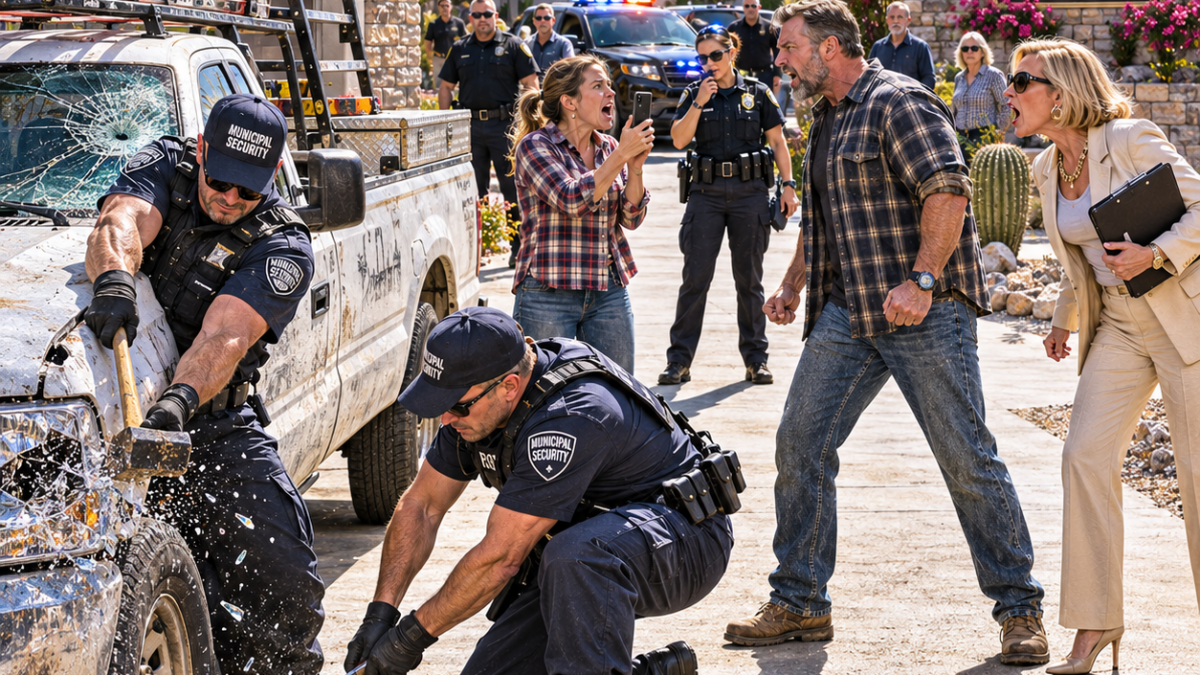
Then came the afternoon she sent Hutchkins and Morrison back to confront Rebecca.
That was the day they smashed my truck.
By the time Officers Santos and Kim finished checking their information, the situation had changed again.
Neither man held the type of license or authority they kept implying.
Hutchkins had an outstanding warrant related to unrelated financial offenses.
Morrison had a suspended driver’s license.
Neither had legitimate law-enforcement status.
Then neighbors started walking outside.
Mrs. Patterson from next door brought Ring footage.
The Johnsons had video from their window.
Mr. Kowalski, a retired Air Force veteran who lived near the corner, had recorded the confrontation too.
Suddenly, what had been our word against theirs became five camera angles.
Santos looked at me.
“Save every original file.”
“I will.”
“Don’t edit anything.”
“I won’t.”
“Get repair estimates.”
“Already planning to.”
Then Mr. Kowalski said something that changed the atmosphere.
“They’ve been doing this to other people.”
We all turned.
He nodded toward the fake patrol car.
“I’ve seen them tow vehicles from driveways.”
Mrs. Patterson said:
“They fined me last month.”
“For what?”
“Watering my plants before seven.”
I stared at her.
“That isn’t even in the covenant.”
“I know that now.”
That night, Rebecca sat on the couch with an ice pack against her forehead.
Stress headache.
I sat at the kitchen table.
Invoices.
Tow receipt.
Photos.
Videos.
HOA notices.
Municipal Security records.
Something did not fit.
Why spend this much effort on one truck?
Why escalate over a vehicle expressly allowed by the covenant?
Why hire Constance’s relative?
Why collect cash?
Why tow from private property?
So I followed the money.
Arizona HOA record-access law is more nuanced than people online like to pretend, but as an owner I was entitled to request a substantial amount of association financial information under the applicable rules and governing documents.
I submitted a written records request.
Three business days later, I had financial statements, contracts, and payment records.
The Municipal Security Services agreement appeared deep in the packet.
$2,400 per month.
Enhanced patrol services.
Then language allowing “necessary measures” to maintain community standards.
Broad enough to sound powerful.
Vague enough to be dangerous.
But the payments were only the beginning.
Marina Rodriguez, a CPA who lived three streets over, later helped me untangle the accounting.
There were payments tied to collected fines.
Consulting fees.
Invoices.
Transfers.
The more we mapped it, the more often Constance’s name appeared near money generated by enforcement.
One stream showed approximately $15,000 in benefits or payments linked to a system collecting substantially more from residents through the security arrangement.
Then I connected enforcement records with county property transfers.
That was when the real scheme appeared.
House after house receiving repeated violations.
Then sale.
Often below what neighbors expected.
Then purchase.
Buyer:
Willowbrook Holdings LLC.
Owner connected to Leonard Wickham.
I stared at the screen.
Then printed the ownership record.
Rebecca walked into the garage wearing pajamas and carrying coffee.
“You look like you haven’t slept.”
“I haven’t.”
“Good news or bad?”
I handed her the papers.
She read them.
Then read them again.
“So the people getting hammered with fines are selling.”
“Yes.”
“And Leonard’s company buys.”
“Yes.”
“Then flips them.”
“That’s what the records suggest.”
She sat down.
“This isn’t about our truck.”
“No.”
“Our house?”
“Probably.”
She was quiet.
Then said:
“They want us out.”
That was the first time either of us said it.
Not because we had proof of every element yet.
Because the pattern finally had a shape.
Working families.
Escalating fines.
Security intimidation.
Financial exhaustion.
Below-market purchase.
Resale.
The HOA wasn’t merely enforcing aesthetics.
Someone appeared to be using enforcement pressure to create acquisition opportunities.
I called David, an attorney connected to Mrs. Patterson’s family who handled HOA disputes.
He came over.
Reviewed the records.
Then told us to slow down.
“Do not call this RICO on television.”
“Why?”
“Because RICO is complicated, and yelling federal racketeering before investigators build a case makes people look ridiculous.”
I liked him immediately.
“What do we call it?”
“Evidence.”
That became our rule.
Evidence first.
Labels later.
David helped us preserve documents properly and contact the appropriate investigators.
Then Marina reviewed the finances.
She found duplicate billing.
Personal payments.
Unexplained invoices.
Money leaving reserve accounts.
Over six months, roughly $43,000 had moved through security-related charges while significantly less appeared to have been legitimately spent on the actual service described.
The numbers needed professional verification, but enough was wrong that nobody could dismiss it as a parking dispute.
Then Leonard approached me outside a grocery store.
I had my phone recording because by then I recorded nearly every interaction connected to Willowbrook.
He came up beside my truck.
“Marcus.”
“Leonard.”
“Nothing personal.”
That’s usually how personal things begin.
“Your family doesn’t fit this neighborhood.”
I said nothing.
“I can give you ten thousand dollars to drop your complaints and move somewhere more appropriate.”
“Why would I move?”
“Because enforcement is going to continue.”
“What enforcement?”
He smiled.
“Let’s not play games.”
I leaned against the truck.
“What happens if I don’t cooperate?”
He answered:
“Eventually people see reason.”
Then he started bragging.
Security operations in multiple communities.
Families eventually giving up.
Buyouts.
Expansion.
He thought he was intimidating me.
Instead, he was recording himself describing the business model.
When I played the audio for David, he closed his eyes.
“What?”
“Nothing.”
“That sounded like something.”
“Marcus, for once in your life, don’t say anything publicly.”
“I wasn’t going to.”
“You were absolutely going to.”
He knew me too well already.
The neighborhood began organizing quietly.
Mrs. Patterson shared footage.
The Johnsons shared their notices.
Mr. Kowalski documented security patrol behavior.
Marina kept analyzing finances.
Rebecca created a timeline.
Dates.
Fines.
Complaints.
Tow.
Property damage.
False inspections.
Government complaints.
Payments.
Property purchases.
Then Constance escalated again.
Flashlights through bedroom windows before dawn.
Ridiculous violation notices.
Mailbox measurements.
Noise complaints.
Oil stains.
Then a report to child-protection authorities claiming our property endangered children.
The bizarre part?
Rebecca and I did not have children.
A caseworker still had to follow procedure.
She arrived.
Inspected.
Realized quickly there was no factual basis for the allegations as described.
The waste of government resources became another documented piece of the retaliation pattern.
Rebecca’s health started suffering.
Blood pressure.
Headaches.
Sleep.
She took stress leave from teaching.
That was the part that changed my anger into something harder.
Damage to a truck is simple.
Headlight.
Mirror.
Tires.
Estimate.
Repair.
Stress is harder.
Rebecca started flinching when car doors slammed outside.
She had never done that before.
One night I woke at 3:00 a.m. and found her sitting at the kitchen table.
“What are you doing?”
“Couldn’t sleep.”
“Headache?”
She nodded.
I sat beside her.
“This house was supposed to make life easier.”
“I know.”
“Maybe Leonard’s right.”
Her face changed.
“You want to sell?”
“I want you sleeping.”
“No.”
“Rebecca—”
“No.”
She pointed toward the window.
“If we leave because they scared us, they do this to somebody else.”
I looked at her.
“That’s not our responsibility.”
“No.”
She took my hand.
“But this is our home.”
That ended the conversation.
Three days before the monthly meeting, Constance filed yet another county complaint.
A real inspector came.
Again.
No violation.
This time he warned her directly about continued misuse of complaint systems.
She drove away furious.
I watched her Mercedes disappear.
For the first time, I thought:
She’s losing control.
Then, one week before the meeting, the fake security operation made another attempt to tow my truck.
Early morning.
Multiple vehicles.
Crown Victoria.
Large tow truck.
Additional men.
Rebecca was preparing for a doctor’s appointment.
I was home.
Hutchkins approached the porch.
“Your husband’s vehicle is being impounded as an imminent community safety hazard.”
Rebecca held up her phone.
“No lawful order exists authorizing you to remove it.”
He gestured toward the tow operator.
The operator began positioning his equipment.
I had already called police.
Neighbors recorded.
Mrs. Patterson.
Johnsons.
Kowalski.
Everyone who once hid behind curtains was now preserving evidence.
That transformation mattered more than anything.
The tow operator paused when I asked:
“Do you have repossession paperwork?”
He looked toward Hutchkins.
Hutchkins said:
“We have HOA authorization.”
“That isn’t repossession paperwork.”
The operator looked uncomfortable.
Then real police arrived.
This time there was no ambiguity.
Officers separated everyone.
Reviewed what was happening.
The tow driver immediately said he had been paid for what he believed was a legal tow.
He had no court order.
No lender repossession authorization.
No municipal impound authority.
Hutchkins tried to leave.
He did not get far.
More neighbors came outside.
Then something happened I had not expected.
They started talking to police.
All of them.
Mrs. Patterson.
Mr. Kowalski.
The Johnsons.
Two families from the next street.
Stories poured out.
Threats.
Fines.
Cash payments.
Towing.
Fake inspections.
For months, Constance had benefited from isolation.
Each household thought it had a private problem.
Now the police were standing in the middle of the street hearing the same pattern from multiple addresses.
That was the beginning of the end.
The monthly HOA meeting happened three nights later.
Eighty-five residents packed into a room built for maybe fifty.
Hot.
Crowded.
Angry.
Constance entered with Leonard.
She still carried herself like president.
That fascinated me.
Some people can stand inside a collapsing building and still complain about the paint color.
She began a PowerPoint.
Enhanced Security Initiative.
Tripled security budget.
Additional enforcement personnel.
Expanded intervention powers.
She wanted the neighborhood to approve more of the very system investigators were already examining.
“Recent incidents demonstrate that certain residents require stronger encouragement.”
She looked toward me.
I almost admired the audacity.
After fifteen minutes, I raised my hand.
Under the meeting rules, owners had a short resident-comment period.
Constance looked annoyed.
“Five minutes, Mr. Isabella.”
“That’s all I need.”
I connected my laptop.
First slide.
TIMELINE.
Three months.
Violation notices.
Tow.
False inspection.
Government complaints.
Truck destruction.
Attempted tow.
Dates.
Photographs.
Case numbers.
Then the video.
Hutchkins raising the crowbar.
Smash.
First headlight.
People in the room gasped.
Second.
Side mirror.
Morrison cutting the tires.
Someone behind me said:
“Jesus.”
I looked at Constance.
She had stopped smiling.
Then Marina stood.
She had copies of the financial analysis.
She explained the security contract.
Payments.
Commissions and related financial benefits.
Questionable invoices.
Reserve-fund transfers requiring further investigation.
Not accusations pulled from Facebook.
Numbers.
Documents.
Dates.
Then I played Leonard’s grocery-store conversation.
His voice filled the community center.
“Your family doesn’t belong in this neighborhood.”
People turned toward him.
Then:
“I’m prepared to offer you ten thousand dollars to drop your complaints and move somewhere more suitable.”
Leonard stood.
“That’s edited.”
“No,” I said.
“It is.”
David spoke from the back.
“The original has already been preserved.”
Leonard moved toward the exit.
Then a woman sitting two rows behind him stood.
Sarah Mitchell.
An investigator who had been observing the meeting in connection with the broader inquiry.
She identified herself.
The exact criminal charges and jurisdiction ultimately depended on the evidence and prosecutors, but the message to the room was clear:
The security company, financial transfers, property acquisitions, impersonation conduct, and coordinated harassment were under formal investigation.
Real police entered shortly afterward in connection with outstanding matters involving Hutchkins and other conduct already documented.
The room erupted.
Not cheering exactly.
Anger.
Questions.
“How much did this cost us?”
“Who approved the contract?”
“Why was Leonard’s company hired?”
“Where are the reserve funds?”
Constance tried to regain control.
“Everyone needs to calm down!”
Nobody listened.
That was the true end of her presidency.
Not handcuffs.
Not headlines.
The moment people realized her authority existed only because they had been accepting it.
Mrs. Patterson stood.
“I move that Municipal Security Services be terminated immediately.”
Someone seconded.
The vote passed overwhelmingly.
Another motion removed Constance from the presidency according to the association’s procedures.
Another placed the finances under independent review.
Marina was asked to help oversee the transition.
Constance left the room crying.
I didn’t follow.
Did not taunt her.
Did not film her walking away.
Rebecca stood beside me.
“You okay?”
“Yeah.”
“No, you’re not.”
I looked at her.
“Neither are you.”
She smiled weakly.
“True.”
The legal consequences unfolded over the following weeks and months.
Not instantly.
Real cases don’t work like television.
Investigators had to verify records.
Trace accounts.
Interview residents.
Review property sales.
Confirm licensing.
Separate exaggeration from provable conduct.
Leonard eventually accepted a plea agreement in connection with the broader fraud scheme.
The source outcome placed his sentence at four years plus substantial restitution.
Constance received eighteen months and a lifetime prohibition from serving on an HOA board in Arizona.
Hutchkins and Morrison received prison sentences tied to their impersonation, property destruction, and attempted vehicle theft conduct.
Asset recovery returned money to affected residents across multiple communities.
Rebecca and I received compensation for the documented property damage, business losses, and medical impact created by the sustained harassment.
No amount felt like a jackpot.
The truck repair alone had represented only the visible damage.
The harder costs had been nights Rebecca didn’t sleep.
Days I left paying customers because someone was standing outside our home.
A teacher forced onto stress leave.
The feeling that every approaching vehicle might contain another ridiculous uniform.
Those things do not fit neatly into invoices.
Rebecca returned to school.
Slowly.
Her headaches stopped.
Blood pressure normalized.
The first day she went back, she stood in the kitchen holding her coffee.
“Nervous?”
“A little.”
“Want me to drive you?”
“No.”
“Are you sure?”
She smiled.
“Marcus.”
“What?”
“I teach eight-year-olds.”
“Fair.”
She kissed me.
Then left.
I stood at the window watching her Honda disappear down the street.
For the first time in months, I didn’t immediately check whether a white Crown Victoria was parked nearby.
That was progress.
My business recovered too.
Some people heard the story.
Customers came in.
A few because they genuinely needed diesel work.
A few because they wanted to support us.
I appreciated both.
But I didn’t want my shop becoming some shrine to HOA warfare.
I repaired engines.
That was enough.
The HOA changed dramatically.
Mrs. Patterson eventually became president.
If Constance ran meetings like military tribunals, Mrs. Patterson ran them like neighborhood dinners where accounting happened to break out.
The Johnson family handled social events.
Mr. Kowalski helped establish a legitimate neighborhood watch.
No fake badges.
No fake authority.
No vehicle seizures.
His first principle was simple:
Community safety observes and reports.
Police enforce criminal law.
That shouldn’t sound revolutionary.
At Willowbrook, it did.
Marina restructured financial reporting.
Monthly summaries.
Receipts.
Contract disclosure.
Multiple approvals for major expenditures.
Quarterly presentations.
HOA dues eventually decreased substantially because residents discovered how much money had been disappearing into unnecessary “security” and questionable services.
People always asked whether property values collapsed after enforcement loosened.
They didn’t.
They improved.
Families liked living where they did not fear surprise fines.
The houses still looked good.
People still maintained lawns.
Rules still existed.
The difference was due process.
That became the phrase Constance hated and Willowbrook finally understood.
Due process.
Notice.
Evidence.
Appeal.
A real vote.
No one person creating new authority because she disliked a truck.
My truck stayed in the driveway.
Logo visible.
Perfectly legal.
For several months, neighbors joked about it.
“Still lowering property values, Marcus?”
“Working on it.”
Someone put a tiny magnetic crown on the hood once.
Rebecca accused Mrs. Patterson.
Mrs. Patterson denied everything.
Poorly.
Eventually the truck stopped being symbolic.
It became a truck again.
That mattered.
I spent too much of the conflict seeing every ordinary object as evidence.
Mailbox.
Driveway.
Garage.
Camera.
Truck.
Once the case ended, I wanted objects to lose their legal meaning.
A mailbox should be where bills arrive.
A driveway should hold vehicles.
A garage should smell like motor oil.
A porch should be where your wife grades spelling tests.
That’s home.
The investigative reporting surrounding Willowbrook expanded beyond our case.
Jennifer Walsh produced a long report about fake security companies and HOA abuse.
It received awards.
Other communities began checking their own security contracts.
Some found nothing wrong.
Good.
Others found problems.
Better to discover them before people got hurt.
The broader public discussion eventually encouraged legislative proposals related to HOA transparency and private-security oversight.
I stayed careful whenever people credited our story with changing laws.
Laws happen because legislators, advocates, attorneys, homeowners, and voters do the work.
One mechanic with a damaged truck doesn’t rewrite a state code alone.
What we did was provide an example.
That was enough.
Then came the Community Justice Fund.
Mrs. Patterson proposed it.
Rebecca loved the idea.
I hated the name.
“Sounds like superheroes.”
“You own shirts with diesel logos on them.”
“That’s different.”
“It isn’t.”
The fund helped connect homeowners facing questionable HOA enforcement with legitimate legal information and professional resources.
Not every dispute was corruption.
We learned that quickly.
Some people called because their HOA told them to remove an RV from the street.
The covenant clearly prohibited RV parking.
Some wanted help because a board rejected a paint color they had contractually agreed to submit for approval.
We told them the truth.
We were not anti-HOA.
We were anti-fraud.
That distinction mattered.
If we became the people who assumed every board was evil, we would just be Constance facing the other direction.
The first serious case the fund supported involved an elderly couple elsewhere in Arizona dealing with another private security contractor whose authority appeared questionable.
This time, people knew what questions to ask early.
Licensing.
Contracts.
Records.
Money.
The dispute was addressed before it escalated into smashed headlights.
That made me prouder than television ever did.
Rebecca and I were invited onto national programs.
Sitting under studio lights felt ridiculous.
A makeup artist tried to powder my forehead.
I told her diesel mechanics are supposed to shine.
She did not laugh.
Rebecca did.
During one interview, the host asked:
“What made you realize you could beat the system?”
I corrected him.
“We didn’t beat the system.”
He looked surprised.
“The system helped us.”
“How?”
“Real police came. Real inspectors checked the garage. Real records exposed financial patterns. Real courts handled the criminal cases.”
I leaned forward.
“What hurt us was people pretending to be the system.”
That became the sentence people quoted.
I liked it because it was true.
Constance’s greatest trick was borrowing the appearance of legitimate authority.
HOA letterhead.
Police-style uniforms.
Fake inspection language.
Tow trucks.
Official words.
Most people don’t have time to research every threat.
We are busy.
Work.
Kids.
Bills.
Parents.
Health.
Someone arrives wearing a badge and says:
Move the truck.
Most people move it.
That does not make them weak.
It makes them normal.
Constance built a business model around normal people being too busy and scared to challenge fake authority.
Documentation broke that model.
But community broke it faster.
If only Rebecca and I had complained, Constance could call us difficult.
Once twelve families showed the same pattern, the narrative changed.
Once accounting showed money, motive appeared.
Once property records showed purchases, the truck stopped looking like the real issue.
Then everything connected.
That was the lesson I carried forward.
When something feels unfair, resist the temptation to begin with:
They’re criminals.
Begin with:
Show me the rule.
Show me the vote.
Show me the license.
Show me the contract.
Show me the invoice.
Show me the authority.
Bad systems hate specific questions.
Years later, I still had the first $150 violation notice in a drawer.
I found it while looking for tax records.
COMMERCIAL VEHICLE VIOLATION.
I laughed.
Rebecca looked over.
“What?”
I showed her.
She groaned.
“Burn it.”
“I was thinking frame it.”
“No.”
“Garage wall?”
“No.”
“Bathroom?”
“Marcus.”
I put it back.
Not because I treasured it.
Because it reminded me how small large abuses can look at the beginning.
One hundred fifty dollars.
Easier to pay.
Probably cheaper than appealing.
That is how it starts.
Then five hundred.
Then security patrol.
Then tow.
Then broken property.
Then a false complaint.
Each step normalizes the next.
Constance needed people to believe:
It’s only easier if you comply.
For years, they did.
Then we stopped.
Mrs. Patterson once told me she felt guilty.
“For what?”
“I saw them tow the Thompsons’ car last year.”
“What did you do?”
“Closed my curtains.”
I waited.
“I knew something was wrong.”
“You didn’t know the whole thing.”
“I knew enough.”
She looked ashamed.
I understood that feeling.
Fear creates shame afterward because hindsight makes the brave choice look obvious.
It rarely is.
“If you want to fix it,” I said, “don’t keep punishing yourself.”
“What should I do?”
“You’re HOA president.”
She laughed.
“Fair.”
She became the most irritatingly transparent president Willowbrook ever had.
Every invoice.
Every contract.
Every agenda.
People complained there were too many emails.
She considered that a compliment.
Mr. Kowalski changed too.
During the conflict, he had treated documentation almost like a military operation.
Afterward, he made himself deliberately boring.
Neighborhood watch met once a month.
No uniforms.
No badges.
Reflective vests marked VOLUNTEER.
If something looked suspicious, they called police.
Nobody chased anybody.
Nobody blocked cars.
Nobody “detained” teenagers.
One night I asked why he was so strict.
He said:
“Because people enjoy authority too much.”
Hard to argue.
Marina became the person everyone feared at budget meetings.
Not because she was mean.
Because she asked:
“Where’s the receipt?”
Repeatedly.
That four-word question saved Willowbrook more money than any security contractor ever did.
The financial recovery took years.
Restitution arrived in stages.
Some residents had clean proof.
Others had incomplete records.
Some properties had changed hands multiple times.
Not everyone recovered every dollar.
That’s the frustrating part people leave out of revenge stories.
Even when corrupt people are convicted, reality doesn’t rewind.
A family forced to move cannot receive the exact childhood years back.
A teacher who spent months unable to sleep doesn’t get those nights refunded.
A small business owner can recover documented income losses but not every lost opportunity.
Justice is not time travel.
It is accountability moving forward.
Rebecca taught me that.
One evening we were sitting on the porch.
Kids rode bicycles down the street.
She had spelling tests in her lap.
My truck sat in the driveway.
No one cared.
She said:
“You know what I miss?”
“What?”
“Nothing.”
I waited.
She smiled.
“I miss nothing happening.”
That hit me.
For months, every week had a new event.
Notice.
Tow.
Complaint.
Police.
Meeting.
Attorney.
Reporter.
Investigator.
Then suddenly:
Nothing.
Tuesday.
Dinner.
Wednesday.
Work.
Thursday.
Laundry.
Nothing had become luxury.
We sat there listening to neighborhood noise.
Someone grilling.
A dog barking.
Children arguing about a basketball.
That was the victory.
Not Constance’s sentence.
Not Leonard’s plea.
Not television.
Normal.
Constance eventually served the sentence described in the case outcome and remained barred from HOA leadership.
Leonard served his own term and restitution obligations.
Hutchkins and Morrison faced the consequences of their impersonation and property crimes.
I stopped following their lives afterward.
That surprised people.
“Don’t you want to know if Constance regrets it?”
No.
“Don’t you want an apology?”
Not really.
“Why?”
Because if my peace requires her remorse, she still controls it.
I wanted the law to work.
It did.
I wanted Willowbrook fixed.
It was improving.
I wanted Rebecca safe.
She was.
The rest belonged to Constance.
People sometimes asked whether I hated her.
For a while.
Absolutely.
Then hatred became exhausting.
Diesel engines don’t care whether your HOA president went to prison.
They still need repair.
Mortgage still arrives.
Rebecca still forgets to buy coffee until the container is empty.
Life moves.
I let it.
One summer, a new family bought the house across from us.
Young couple.
Two kids.
The father had a plumbing van.
Commercial lettering.
He looked nervous the first night.
Walked over.
“Hey, I heard there used to be rules about work vehicles.”
I looked at his van.
“What’s it weigh?”
He blinked.
“About sixty-five hundred pounds.”
“Read the covenant.”
“I did.”
“Then you’re fine.”
He smiled.
“That’s it?”
“That’s it.”
He looked toward my truck.
“I heard what happened to yours.”
“Old story.”
He nodded.
Then said:
“Thanks.”
I watched him walk home.
That interaction felt strangely important.
A working man parked a legal work vehicle in his own driveway.
Nothing happened.
No fine.
No fake cop.
No tow truck.
No crisis.
Sometimes systemic reform looks like nothing.
That’s the point.
My diesel shop expanded.
Not because of revenge.
Because customers came.
I hired another technician.
Then a service writer.
Eventually, I stopped turning every interview about the case into free advertising because Rebecca accused me of exploiting our trauma for transmission jobs.
She was right.
Probably.
The truck itself lasted another five years.
Then the transmission finally died.
People expected me to restore it forever because of what it represented.
I sold it.
Rebecca looked shocked.
“You sold the monument?”
“It’s a truck.”
“I thought it symbolized freedom.”
“It symbolizes three hundred thousand miles and a bad injector.”
She laughed.
I replaced it with a newer model.
Parked it in the same driveway.
Nobody cared.
That felt healthier.
The house changed too.
We painted.
Replaced some landscaping.
Added a bench near the front walkway.
Every time we made a change, I caught myself wondering what Constance would have said.
Then eventually stopped.
That was another milestone.
When the person who controlled you leaves, their voice often remains in your head longer than they remain in your life.
Is this allowed?
Will someone complain?
What if the board sees?
Fear becomes self-enforcement.
The new Willowbrook board had to undo that.
At meetings, homeowners kept asking permission for things that no rule actually prohibited.
Mrs. Patterson would say:
“Why are you asking me?”
People didn’t know.
They were used to asking.
Years of control train people into obedience even after the controller disappears.
That takes time to heal.
Rebecca understood it from teaching.
“If you punish kids for everything,” she told me, “eventually they stop making decisions.”
“Adults aren’t children.”
She gave me a look.
“Have you attended HOA meetings?”
Fair.
The Community Justice Fund developed education materials.
Not aggressive.
No “destroy your HOA” nonsense.
How to request records.
How to read covenants.
How to document selective enforcement.
How to verify a private security firm’s license.
When towing may require specific authority.
When to call law enforcement.
How to preserve original footage.
How to avoid escalating confrontation.
That last part became personal to me.
The afternoon Hutchkins smashed my headlights, I came very close to putting my phone down.
Very close.
I had no military training.
No law-enforcement background.
I was an angry mechanic watching two men intimidate my wife.
If I had rushed them, maybe I would have won a fistfight.
Maybe.
Maybe I would have been arrested too.
Maybe Rebecca would have gotten hurt.
Maybe the video would show everybody fighting and Constance could call the incident mutual aggression.
Instead, the camera showed exactly what happened.
They destroyed property.
We documented.
Police arrived.
Clean.
That mattered later.
Anger tells you immediate reaction feels powerful.
Evidence usually ages better.
I told that to every homeowner who contacted us.
Do not give someone the footage they need to rewrite the story.
Especially if they’re baiting you.
That principle spread beyond HOA disputes.
At my shop, an angry customer once threatened to sue because his truck still had an electrical fault after another company had butchered the wiring.
Young Marcus would have argued.
Older Marcus printed the diagnostic notes.
Showed photographs.
Explained.
Customer calmed down.
Rebecca laughed when I told her.
“Constance made you emotionally mature.”
“Take that back.”
“Never.”
I had to admit, some good came from something ugly.
Not enough to make it worth happening.
I hate when people say everything happens for a reason.
No.
Sometimes bad people make bad choices.
Then decent people build something useful afterward.
That’s different.
Willowbrook did that.
We didn’t become stronger because Constance had a secret noble purpose.
We became stronger because residents decided corruption would not be wasted.
Mrs. Patterson’s transparency.
Marina’s financial controls.
Kowalski’s legitimate watch.
The fund.
The reporting.
Those were choices made after harm.
That’s what gave the story value.
One anniversary of the truck incident, Rebecca and I sat on the porch.
She looked toward the driveway.
“You know what today is?”
“No.”
“You’re lying.”
“I genuinely don’t.”
“Three years since they smashed the headlights.”
I thought about it.
“Huh.”
She smiled.
“That’s good.”
“What?”
“You forgot.”
She was right.
For the first two years, I knew every date.
First fine.
First tow.
Fake inspection.
Truck damage.
Records request.
Meeting.
Arrest.
Sentencing.
Every anniversary felt like evidence.
Then time loosened its grip.
I forgot.
That was healing.
We watched a group of kids run past.
One shouted something about basketball.
Another complained.
Normal.
Rebecca rested her head against my shoulder.
“You think Willowbrook is good now?”
“Better.”
“That’s not what I asked.”
“No place is good all the time.”
“Mechanic answer.”
“Teacher question.”
She smiled.
Then pointed toward my new truck.
“Still ugly.”
“Legal.”
“Unfortunately.”
We sat there until sunset.
No patrol car.
No fake badge.
No one photographing our driveway.
I thought about the first day Constance said maybe Willowbrook wasn’t right for our situation.
She was correct in one way.
The Willowbrook she controlled was not right for us.
It wasn’t right for anyone.
So the neighborhood changed.
Not because we were special.
Because enough ordinary people became less afraid of one another than they were of the person exploiting them.
That is the piece I wish more people understood.
Corrupt small systems survive by dividing normal people.
The board member thinks the homeowner is difficult.
The homeowner thinks the neighbor complained.
The neighbor thinks security has real authority.
Security thinks the HOA lawyer approved it.
Everyone obeys a different version of the same lie.
The moment people compare documents, the illusion gets fragile.
That’s what happened.
Mrs. Patterson’s Ring footage.
Our videos.
Marina’s accounting.
County inspection records.
Leonard’s recording.
Property transfers.
Residents’ stories.
No single piece destroyed Constance.
Together they made denial impossible.
That is what real community justice looked like.
Not eighty-five people screaming at one woman.
Eighty-five people realizing they had access to the same facts.
The final legal documents stayed in a file cabinet in my garage.
I rarely opened them.
Once, a reporter asked to photograph them.
I declined.
“Why?”
“Because the ending isn’t the court paperwork.”
“What is?”
I pointed toward the street.
Two children were riding scooters.
Mrs. Patterson was watering roses.
Mr. Kowalski argued with a delivery driver about whether his address number was visible enough.
Rebecca sat on the porch grading worksheets.
My truck rested in the driveway.
Nobody cared.
“That.”
The reporter looked.
“Normal life?”
“Exactly.”
Constance thought power meant making everyone notice her.
The best result was a neighborhood that no longer needed to think about her.
Leonard thought money made people move.
The best result was families staying because they wanted to.
Hutchkins and Morrison thought uniforms made them officers.
The best result was residents learning to ask for actual credentials.
Every illusion collapsed into something ordinary.
That was enough.
People still send me messages about the case.
Usually the same question.
“What should I do if my HOA is harassing me?”
My answer is never exciting.
Read your governing documents.
Keep records.
Request the basis for the action.
Verify licenses.
Use official contact information for government agencies.
Talk to neighbors.
Get legal advice if property rights or major money are involved.
Call actual law enforcement if someone impersonates an officer, destroys property, threatens you, or attempts unlawful entry.
And stay calm enough that your own behavior does not become the distraction.
Nobody wants that answer.
They want:
Fight back.
Expose them.
Destroy them.
Real life is slower.
Documentation is boring until it becomes the thing that saves you.
Constance loved appearances.
My truck looked commercial.
Therefore, bad.
Her security guards looked official.
Therefore, authority.
Her PowerPoint looked organized.
Therefore, honest.
The accounting looked complicated.
Therefore, nobody would read it.
She built everything around how things looked.
We beat the scheme by asking what things actually were.
Truck:
Legal under the covenant.
Security company:
Private, unlicensed for what it claimed to do.
Tow:
Unsupported by lawful authority.
Inspection:
Fake.
County complaint:
Unfounded.
Financial arrangement:
Conflicted and suspicious enough to warrant investigation.
Property purchases:
Patterned.
The story became simple once appearances were removed.
That’s probably why mechanics make decent investigators.
A diesel engine doesn’t care what the dashboard says if the cylinder isn’t firing.
You trace the system.
Fuel.
Air.
Compression.
Electrical.
Find the failure.
Constance created a complicated noise.
We traced it.
At the bottom was money.
There usually is.
Years later, Willowbrook changed presidents again.
Mrs. Patterson stepped down voluntarily.
Term limits.
She hated them when they applied to her.
We reminded her they were her idea.
Marina became board president for one term.
Meetings got even more boring.
Spreadsheets.
Receipts.
Budget forecasts.
People complained.
I loved every minute.
Boring governance is underrated.
No secret security company.
No fake cops.
No midnight towing.
No retaliation.
One meeting spent forty minutes discussing pool umbrellas.
I leaned toward Rebecca.
“This is democracy.”
She whispered:
“This is hell.”
“Beautiful hell.”
“Shut up.”
We laughed quietly.
That moment would have been impossible under Constance.
Not the umbrellas.
The laughter.
Disagreement without fear.
That is what healthy communities do.
People argue about dumb things and go home.
No one loses a house.
No one gets watched.
No one gets fined because the president dislikes their job.
Freedom is often embarrassingly mundane.
I appreciate that now.
On warm evenings, Rebecca still grades papers on the porch.
I still come home smelling like diesel.
She still complains that I touch kitchen handles with dirty hands.
I still claim the grease is permanent.
She still doesn’t believe me.
Sometimes neighborhood kids stop to look at the truck.
One asked:
“Is that the one the fake cops smashed?”
“No.”
“What happened to that one?”
“Sold it.”
He looked disappointed.
“I thought it would be in a museum.”
“Kid, it was a work truck.”
He shrugged.
Stories turn objects into legends faster than life does.
To me, the truck mattered because Rebecca stood beside it and refused to be frightened.
Because neighbors came outside.
Because the cameras kept recording.
Because real officers showed up.
Because one damaged vehicle connected us to a larger pattern nobody had been willing to see.
Then it became a truck again.
I’m glad.
I don’t want monuments to fear.
I want memory.
There’s a difference.
Our Community Justice Fund office keeps one photograph on the wall.
Not my damaged truck.
Not Constance.
Not the arrests.
It’s a photograph from the first Willowbrook potluck after the new board took over.
Folding tables.
Paper plates.
Kids.
Old people.
Young families.
Mr. Kowalski wearing an apron that says LICENSED TO GRILL.
Mrs. Patterson pointing at someone off camera.
Rebecca laughing.
I’m holding a tray.
Nothing heroic.
That is the photograph I want associated with what happened.
Because the purpose of confronting corruption isn’t to remain in conflict forever.
It’s to make ordinary life possible again.
I learned that the hard way.
There were nights during the case when I imagined crushing Constance publicly.
I wanted humiliation.
I wanted the room to laugh at her.
I wanted her to feel what Rebecca felt when two men blocked her path home.
That anger was real.
But when the meeting finally came, watching her lose control didn’t feel as satisfying as I imagined.
It felt sad.
Not sympathy exactly.
Waste.
One woman had enough intelligence and organizational ability to run a community well.
Instead, she used those skills to manipulate people for money and status.
Leonard could have run a legitimate security business.
Instead, fraud.
Hutchkins and Morrison could have gotten regular jobs.
Instead, costumes.
So much effort spent building something rotten.
The community spent years cleaning it up.
That is the real cost of corruption.
Not just stolen dollars.
Wasted human energy.
People who should have been raising kids, fixing engines, teaching school, gardening, and arguing about pool umbrellas spent months hiring lawyers and saving video files because a few adults decided ordinary rules were not profitable enough.
That’s why accountability matters.
It sends a message beyond punishment.
Your scheme was not efficient.
You didn’t win.
You created damage that everybody else had to repair.
I have no dramatic ending beyond that.
No new villain.
No anonymous envelope.
No second HOA president waiting in the shadows.
Life did not need another sequel.
We had enough.
One Sunday morning, I walked outside with coffee.
Rebecca was already on the porch.
My truck sat in the driveway.
The sun was coming up over the roofs.
She looked at me.
“You working today?”
“No.”
“Good.”
“Why?”
“Because we’re doing nothing.”
I sat beside her.
“Nothing sounds expensive.”
“Free.”
“Suspicious.”
She nudged me.
Across the street, a kid rode a bicycle in circles.
Someone opened a garage.
A lawn sprinkler clicked.
No fake patrol car.
No clipboard.
No fine.
Just Willowbrook.
I looked at the driveway and remembered the broken headlights for maybe half a second.
Then the memory passed.
Rebecca handed me the newspaper.
That was it.
That was what winning looked like.
Not the sentence.
Not the restitution.
Not television.
Not the applause at the HOA meeting.
A work truck legally parked on private property while its owner drank coffee with his wife and nobody believed they had the right to smash it.
Constance had spent months teaching us what fake authority looked like.
Willowbrook eventually learned something better.
Real authority has limits.
Real rules can be shown.
Real police identify themselves.
Real inspectors have jurisdiction.
Real financial records can survive scrutiny.
And a real community does not need to frighten working people into obedience to hold itself together.
The last thing Rebecca said before we went inside was:
“You know, your truck really is ugly.”
I looked at her.
“Compliant.”
“Still ugly.”
“Legally ugly.”
She smiled.
I did too.
Then I left it exactly where it was.








