HOA Karen Hijacked My Ranch’s Solar Power to Charge Her Tesla—She Thought a Board Vote Made It Legal
**part 2**
I let Victoria talk for another six minutes.
That may sound strange. A woman was standing on my land charging her car from my private solar system, and instead of yanking out the cable, I stood there recording her explanation like I was interviewing her for a documentary. But forty years of ranching had taught me something important: when someone is confidently creating evidence against themselves, interruption is rarely helpful.
Victoria explained the entire theory.
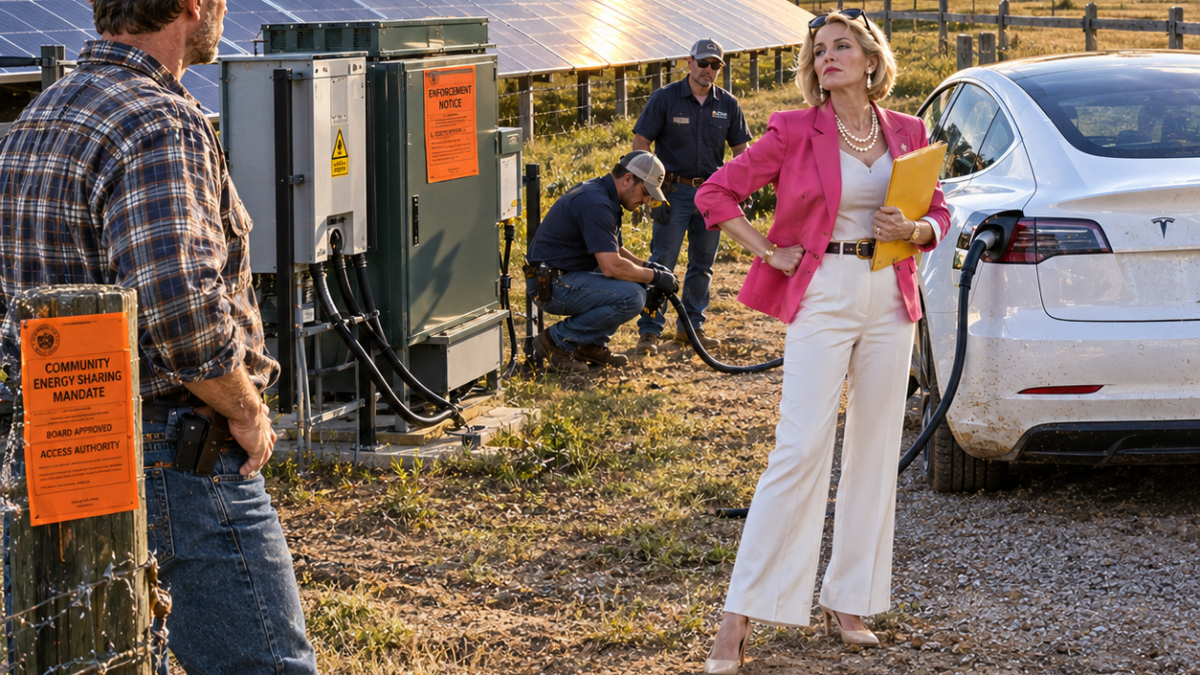
Willow Crest had adopted what she called a “Neighborhood Renewable Resource Equity Resolution.” The board claimed that private renewable systems visible from or adjacent to HOA property could be considered “community-adjacent sustainability assets.” According to Victoria, that gave the association authority to negotiate access, assess noncooperation, and, in her words, “implement temporary shared use when necessary.”
I asked one question.
“Does the resolution say you can enter private property without permission?”
She frowned.
“It says we can implement shared use.”
“That wasn’t what I asked.”
“You always reduce everything to technicalities.”
“Property lines are usually technical.”
She turned toward the workers.
“Continue monitoring the charge.”
The older worker, a man named Luis according to the patch on his jacket, looked increasingly uncomfortable.
“Ms. Vale,” he said, “I need to ask something.”
“What?”
“When you booked the job, you said this was HOA-owned solar equipment.”
“It serves the community.”
“That’s not the same thing.”
She stiffened.
“You were provided documentation.”
“I got a work order.”
“And the board resolution.”
Luis looked at me.
“Sir, are you saying this equipment belongs entirely to you?”
“Yes.”
“And you did not authorize us to open that cabinet?”
“No.”
His shoulders dropped.
He turned toward Victoria.
“We need to disconnect.”
“No.”
“We need to disconnect now.”
“I hired your company.”
“For a temporary EV charging connection on association-controlled equipment.”
“It is association-controlled.”
Luis pointed toward me.
“He says it isn’t.”
Victoria snapped her folder shut.
“He is refusing to recognize established community authority.”
Luis stared at her.
“I install electrical systems. I don’t establish community authority.”
I nearly smiled.
Victoria didn’t.
She stepped between him and the control cabinet.
“The connection remains.”
Luis looked toward his younger assistant.
“Kill the charger.”
Victoria’s voice rose.
“Do not touch it.”
The assistant froze.
For the first time that afternoon, Victoria and I agreed on something.
I didn’t want them touching it either.
Not yet.
I checked my phone.
The video was still recording.
“Luis,” I said, “would you mind stating who told you this equipment belonged to the HOA?”
Victoria whirled toward me.
“No. Absolutely not.”
Luis looked at her, then at me.
“Her work request said Willow Crest community solar field.”
Victoria’s face changed.
Only slightly.
But I saw it.
“So the work order identifies this as HOA property?”
“Yes.”
Victoria stepped forward.
“This conversation is irrelevant.”
“It’s becoming extremely relevant,” I said.
She pointed at me.
“You’re trying to intimidate contractors.”
“I’m standing on my own ranch.”
“You’re interfering with authorized work.”
“Authorized by who?”
“The board.”
“And the board owns what?”
“The community.”
I nodded toward the horizon.
“Which part?”
She seemed irritated by the question.
“Willow Crest.”
“Then why are you standing here?”
Her mouth opened.
Nothing came out.
Luis solved the moment for her.
“We’re disconnecting.”
He walked toward the Tesla.
Victoria followed.
“If you disconnect before the battery reaches eighty percent, I’ll dispute the invoice.”
Luis stopped and looked at her.
“Ma’am, I would rather lose an invoice than get dragged into a property dispute.”
“You are under contract.”
“And the contract was based on information that may not be accurate.”
Victoria’s jaw tightened.
“What are you implying?”
“I’m not implying anything.”
He pointed toward the equipment.
“I’m saying that panel has a private electrical permit sticker with Mr. Mercer’s name on it.”
Victoria finally looked.
The county permit label had been there for four years.
My name.
My parcel number.
My electrical permit.
My inspection date.
She stared at it for two seconds and then said the most Victoria thing possible.
“That sticker predates our sustainability policy.”
Luis blinked.
I looked down at the ground because if I made eye contact with him, one of us was going to laugh.
He unplugged the Tesla.
The charging light went dark.
Victoria spun toward me.
“This will be documented as obstruction.”
“Please do.”
“I will.”
“I’m counting on it.”
She marched toward her car.
Then she stopped and looked at the battery indicator through the window.
Sixty-four percent.
Apparently that offended her more than trespass offended me.
She turned back.
“You realize the board can increase fines.”
“You realize you’re forty yards inside my fence.”
“This gate was open.”
“It’s a ranch gate, not an invitation.”
“There was no private-property sign.”
I pointed behind her.
The sign was six feet wide.
**MERCER RANCH — PRIVATE AGRICULTURAL PROPERTY — AUTHORIZED ACCESS ONLY.**
Victoria stared at it.
Then she looked at me.
“That sign is not conspicuous from the driver’s side.”
Luis made a noise that sounded suspiciously like a cough.
She glared at him.
“You think this is funny?”
“No, ma’am.”
He absolutely did.
I didn’t blame him.
By then the sun had dropped below the ridge, and the temperature was falling fast. The ranch lights had started coming on automatically—barn exteriors first, then the equipment shed, then the lamps near the main house. Every one of them was powered partly by the system Victoria had just declared community property.
I watched her Tesla roll back toward my gate.
The two electricians followed in their van.
I waited until all three vehicles crossed onto the county road.
Then I closed the gate.
And locked it.
My attorney answered on the second ring.
Melissa Grant had handled land, water, and agricultural disputes for my family for almost fifteen years. She didn’t get excited easily. Ranch law teaches patience because nothing involving boundary records, easements, mineral rights, or old deeds ever improves when someone starts shouting.
I sent her the video first.
Then the HOA notices.
Then the resolution Victoria had held directly in front of my camera.
Melissa called me twelve minutes later.
“You didn’t edit this?”
“No.”
“She actually said the board vote gave them access?”
“Several times.”
“And the electrician says she represented the system as HOA property?”
“On camera.”
There was silence.
Then Melissa said, “I need you to photograph every cable connection, cabinet, lock, panel, tire track, and notice before touching anything.”
“They disconnected the Tesla.”
“I heard. Photograph everything anyway.”
“Already did.”
“Good.”
She paused.
“Anything damaged?”
“I don’t know yet.”
“Do not open the cabinet until an electrician inspects it.”
“That cabinet belongs to me.”
“I know. I’m protecting the evidence.”
I leaned against the kitchen counter.
“What are we dealing with?”
“At minimum? Trespass, unauthorized interference with private electrical equipment, false assertion of property authority, and potentially conversion or unjust enrichment regarding the electricity taken. If anything was damaged, we add that. If she knowingly misrepresented ownership to the contractor, that matters too.”
“The HOA called it energy sharing.”
Melissa laughed once.
“Did you share?”
“No.”
“Then they need a new verb.”
The following morning, she sent a cease-and-desist notice to the Willow Crest board, its management company, its insurer, and its attorney.
She also copied the county electrical department.
That last recipient mattered.
My solar system wasn’t a row of decorative panels feeding a small house. It was the heart of a carefully engineered ranch microgrid. The main array charged two battery banks that stabilized power for my home, workshop, cold storage, livestock wells, irrigation controls, and emergency backup systems.
I had spent years building it in phases.
The first panels went up after a summer storm knocked out utility power for two days and nearly left three hundred head of cattle without reliable well pumps. The second phase added batteries. The third expanded generation capacity enough to run refrigeration, workshop equipment, and most daytime ranch loads.
Every part had been permitted.
Every major modification inspected.
Every disconnect labeled.
Victoria had looked at thousands of dollars of equipment, seen sunlight, and apparently concluded the electricity was growing wild and needed community management.
At 9:20 that morning, the county electrical inspector called.
His name was Raymond Cole.
“I received your attorney’s letter,” he said.
“I figured.”
“She included photographs.”
“Yes.”
“Were those temporary EV cables connected downstream of your inverter?”
“That’s what it looks like.”
“Who opened the cabinet?”
“The contractors.”
“Did they alter wiring?”
“I haven’t touched it.”
“Good. Don’t.”
He arrived shortly after lunch with another inspector and an electrician I trusted, Marcus Reed.
Marcus had helped me install the final battery expansion two years earlier.
He stepped out of his truck, looked at the orange HOA notice taped across the solar shed door, and stopped.
“What is that?”
“Apparently civilization.”
He read it.
Then he looked at me.
“‘Community renewable resource noncooperation violation’?”
“That’s me.”
“You’ve become anti-sun?”
“Apparently.”
Marcus laughed.
Raymond did not.
He photographed everything.
Then he removed the cover from the service compartment and examined the temporary connection point.
The workers hadn’t permanently altered the system, which was good. But they had installed an adapter and breaker configuration that had never been approved for that use. Worse, the connection had bypassed one of my load-management controls.
Marcus leaned closer.
“Did they know this system prioritizes the well circuit?”
“I doubt they knew anything about the system.”
He nodded.
“If the ranch battery had been low enough, that EV load could have forced the controller to shed another circuit.”
“Which circuit?”
“Depends on the sequence.”
I already knew the answer.
The south pasture pump was high on the list of nonessential loads.
Nonessential on a configuration screen did not mean unimportant.
It meant the cattle had backup trough capacity long enough to tolerate a temporary interruption.
Still, the thought of Victoria draining power from a working agricultural system so her Tesla could reach eighty percent made something cold settle behind my ribs.
Until then, the situation had been absurd.
Now it was personal.
She hadn’t merely taken electricity.
She had interfered with infrastructure that kept animals watered and equipment running because she assumed anything she wanted must be available to her.
Raymond documented the unpermitted temporary alteration and issued a stop-work order preventing any further electrical modification until the situation was reviewed.
Then he asked me where the property boundary was.
I pointed east.
“Fence line to the survey marker, then south along the creek.”
“And Willow Crest?”
“Other side.”
“No shared utility easement?”
“No.”
“No recorded solar easement?”
“No.”
“Community energy agreement?”
“No.”
He looked at the orange notice again.
“Interesting.”
That afternoon, Victoria emailed me.
The subject line was:
**FORMAL NOTICE OF CONTINUED ENERGY OBSTRUCTION**
I forwarded it to Melissa without responding.
Three minutes later she called.
“She sent this after receiving my cease-and-desist.”
“Yes.”
“That’s generous.”
“Generous?”
“She keeps building my file for me.”
The email claimed that my refusal to allow shared renewable access demonstrated “hostile resistance to neighborhood sustainability goals.” It imposed a $500 daily fine and warned that the board might authorize further access “with or without owner cooperation.”
Melissa went silent after reading that sentence.
“What?” I asked.
“I’m deciding whether I’m angry as your lawyer or entertained as a human being.”
“Which one won?”
“Lawyer.”
She sent a preservation demand that afternoon.
All emails.
All texts.
All meeting minutes.
All work orders.
All contractor communications.
All documents relating to my ranch, my solar equipment, the supposed sustainability resolution, and any discussion of “shared use.”
Then she requested an emergency meeting with county planning and land records.
Victoria decided to hold a press event instead.
I wish I were joking.
Two days later, Ben Carter called me at eight in the morning.
“Ethan.”
“What?”
“Your favorite dictator is at the east field.”
I looked toward the locked gate.
“How?”
“Subdivision side. She’s got cameras.”
“Cameras?”
“Local station. Maybe two.”
I drove over.
Victoria was standing beside her Tesla near the fence, wearing the pink blazer again.
Behind her, three residents held small signs about green energy.
One read **SHARE THE SUN.**
I stopped my truck on my side of the fence and sat there for a moment, wondering how my life had reached a point where adults were protesting my refusal to donate electricity generated by equipment I owned.
Victoria saw me.
She smiled toward the television camera.
“Mr. Mercer has arrived.”
I climbed out.
A reporter approached the fence.
“Mr. Mercer, Ms. Vale says your solar array produces excess energy that could help reduce costs and emissions throughout the community. Why are you refusing to cooperate?”
“Because it’s private equipment on private ranchland.”
Victoria jumped in.
“Nobody is trying to seize his ranch.”
I looked at her.
“You drove onto it and plugged in your car.”
“That was a demonstration project.”
“You called the panels community property.”
“In the context of energy equity.”
“You fined me for not letting you take electricity.”
“For refusing reasonable access.”
The reporter turned toward Victoria.
“Does the HOA have a recorded agreement giving it access?”
Victoria smiled tightly.
“Our board has adopted a sustainability resolution.”
“That wasn’t the question,” I said.
Her eyes flashed.
Then another vehicle arrived.
County seal on the door.
Raymond Cole stepped out.
Behind him came Daniel Reeves from planning and land records.
Victoria’s smile returned.
Apparently she believed government officials had come to validate her.
“Excellent,” she said. “We can settle this publicly.”
Daniel walked toward the fence carrying a tablet.
“I’m happy to settle the boundary question.”
Victoria motioned toward the solar field.
“As you can see, the installation is immediately adjacent to our community.”
Daniel looked at the map.
“Yes.”
“So the HOA has a legitimate interest.”
“Interest and authority are different things.”
She frowned.
“Our board voted.”
Daniel zoomed in on the recorded subdivision plat.
“Your board can vote on matters within its legal authority.”
“This affects Willow Crest.”
“So does weather.”
Ben, standing fifteen feet behind me, laughed so loudly that the reporter turned around.
Victoria ignored him.
Daniel continued.
“This ranch is a separate parcel. It is not part of Willow Crest. There is no recorded declaration subjecting it to the HOA. No annexation. No supplemental covenant. No shared solar agreement. No utility easement granting your association access to this equipment.”
Victoria crossed her arms.
“That doesn’t account for modern sustainability standards.”
“Modern standards do not transfer property ownership.”
“The panels produce energy visible from the community.”
Daniel stared at her.
“I’m sorry?”
“They are clearly part of the visual environment.”
He looked at the solar array.
Then back at her.
“Visibility doesn’t create ownership.”
The reporter lowered her microphone slightly.
I could see she was trying not to react.
Victoria pulled a document from her folder.
“Here is the board resolution.”
Daniel read it.
“This is an internal HOA policy.”
“Yes.”
“It applies to your association.”
“It establishes community-adjacent renewable resource rights.”
“No, it says the HOA may seek voluntary partnerships with neighboring renewable-energy owners.”
Victoria froze.
I had not seen that part.
Melissa had.
She was standing behind me now, having arrived without my noticing.
She stepped forward.
“Would you read the next sentence, Mr. Reeves?”
Daniel did.
“‘Nothing in this resolution creates compulsory access rights or authority over nonmember property.’”
Nobody spoke.
Not me.
Not Ben.
Not the reporters.
Not even the people holding the **SHARE THE SUN** signs.
Victoria looked down at her copy.
Then at Daniel’s tablet.
“That language was advisory.”
Melissa stepped closer.
“It’s in the resolution.”
“The board intended broader authority.”
“Then the board should have written broader authority.”
Victoria’s face reddened.
“Our counsel approved the policy.”
A man behind the television crew said, “No, I didn’t.”
Everyone turned.
Martin Cho, Willow Crest’s attorney, walked toward us carrying a briefcase.
Victoria stared at him.
“Why are you here?”
“The board asked me to attend.”
“You work for the association.”
“Yes.”
“Then explain to them what we intended.”
Martin looked at her.
“I can explain what I advised.”
Her expression changed.
He opened his briefcase.
“I advised the board that any cooperative solar program involving neighboring parcels had to be voluntary and documented by written agreement. I specifically advised against entering nonmember property or connecting to private electrical systems without permission.”
Victoria’s voice hardened.
“We discussed emergency community need.”
“We discussed weather emergencies.”
“Exactly.”
“This was not one.”
“Electric rates are at record highs.”
Martin stared at her.
“That is not an emergency authorizing entry onto private land.”
Ben whispered behind me, “My coffee was expensive this morning. I may annex Starbucks.”
I elbowed him without looking.
Martin continued.
“The association did not own Mr. Mercer’s equipment. It did not have access rights. It did not have authority to fine him under the declaration.”
Victoria looked toward the cameras.
That was the instant she realized this wasn’t going to become her sustainability victory.
It was becoming her public autopsy.
Raymond Cole stepped forward next.
“The electrical connection was also unpermitted.”
Victoria looked at him.
“The contractors were licensed.”
“That doesn’t eliminate permit requirements or owner authorization.”
“They said it was safe.”
“They were given inaccurate ownership information.”
Her head snapped toward him.
“Who told you that?”
“The contractor.”
Melissa folded her arms.
“And we have the work order.”
Victoria stared at me.
For the first time since she had driven onto my ranch, she looked afraid.
Not frightened.
Cornered.
There’s a difference.
Frightened people look for safety.
Cornered people look for someone else to blame.
She found the workers.
“They misunderstood.”
Then the property manager.
“Management drafted the form.”
Then the board.
“The resolution was poorly written.”
Then me.
“And Mr. Mercer has been deliberately hostile from the beginning.”
I nodded.
“That one must be it.”
She pointed at me.
“You could have allowed one charge.”
“That’s your defense?”
“It was one vehicle.”
“It was my electricity.”
“Renewable electricity.”
I stared at her.
“Do you think the sun reimburses me for the panels?”
Ben turned away.
His shoulders were shaking.
One of the camera operators coughed into his sleeve.
Victoria heard both.
“This is not funny.”
No one answered.
Raymond handed her a copy of the stop-work order.
“No further electrical connection may be made to this installation without lawful authorization and required permits.”
She looked at the paper.
Then at her Tesla.
A bright orange notice had been placed under the windshield wiper documenting the prohibited work associated with the vehicle charging connection.
Victoria’s face tightened.
“You put a violation notice on my car?”
Raymond nodded.
“For the work site.”
“You cannot attach government paperwork to private property.”
The silence lasted half a second.
Then Ben made a sound I had never heard from another human being.
It was somewhere between a cough, a laugh, and a dying lawn mower.
He bent at the waist.
Even Melissa covered her mouth.
Victoria looked around.
“What?”
Nobody helped her.
Finally I said, “Nothing.”
She looked at the orange notice.
Then at the orange HOA notices she had taped across my solar equipment two days earlier.
Her eyes closed.
Just for a second.
The reporter asked the obvious question.
“Ms. Vale, isn’t that essentially what you did to Mr. Mercer’s equipment?”
Victoria walked toward her Tesla.
The interview was over.
The story aired that evening.
The station did not need dramatic editing.
Reality had already done the work.
The segment opened with Victoria saying, “The board has determined that renewable resources adjacent to our neighborhood must serve the broader community.”
Then it cut directly to Daniel Reeves saying, “Visibility does not create ownership.”
Then came Martin Cho.
“The association had no authority to access Mr. Mercer’s electrical system without permission.”
And finally the moment Victoria protested the government notice on her private car.
The reporter did not comment.
She simply cut to footage of Victoria’s HOA notice taped to my solar shed.
Ben called me after the broadcast.
“They didn’t even have to explain the joke.”
“Go to bed.”
“I’m recording it.”
“Of course you are.”
“My wife says I’m enjoying this too much.”
“She’s right.”
“I told her civic education is important.”
The next morning, Willow Crest woke up furious.
Not at me.
At the board.
The association’s online resident portal filled with questions.
Who authorized the contractor?
How much had the HOA paid?
Why was private property represented as community equipment?
Why were dues being used for a project the HOA attorney had explicitly said must be voluntary?
Who approved a $500-per-day fine against someone who wasn’t even an HOA member?
By noon, the property manager sent a message announcing an emergency board meeting.
By one o’clock, Victoria sent her own message.
She called the news story “misleading.”
That was mistake number one.
Then she claimed the contractor had acted independently.
Mistake number two.
Then she claimed my ranch had “historically benefited from Willow Crest infrastructure.”
Mistake number three.
Melissa read the email and called me.
“She cannot stop.”
“I’ve noticed.”
“She’s now suggesting your property owes the HOA compensation?”
“That’s what it sounds like.”
“For what?”
“I can see their streetlights from my north pasture.”
Melissa laughed.
Then she became serious.
“Do not reply. We have enough.”
The emergency board meeting was held that Friday evening.
Willow Crest’s clubhouse parking lot overflowed.
Residents parked along both sides of the entrance road.
Ben drove me over.
“You’re not taking your truck?”
“I’m trying not to look like I arrived for a showdown.”
“You’re wearing a cowboy hat.”
“It’s cold.”
“You own other hats.”
“Drive.”
Melissa met us inside.
The room was packed.
Victoria sat at the front table with four other directors, the property manager, Martin Cho, and a stack of yellow folders.
Her Tesla was visible through the clubhouse windows.
Someone had placed a small toy solar panel under its windshield wiper.
Victoria had not noticed yet.
Ben had.
I saw the idea enter his mind.
“No,” I whispered.
“I didn’t do it.”
“Don’t touch it.”
“I’m just appreciating community art.”
The board secretary called the meeting to order.
Victoria immediately tried to take control.
“I want to begin by correcting several false narratives being circulated regarding the Mercer property.”
Vice President Robert Mills interrupted.
“No.”
She turned toward him.
“Excuse me?”
“We’re beginning with the expenditure review.”
“I am president.”
“And this is a board meeting.”
“I set the agenda.”
“The majority amended it.”
She stared at him.
Then at the other directors.
Three of them avoided her eyes.
The treasurer, Janet Holloway, opened a binder.
“Invoice number 7841. GreenLine Electrical Services. Initial dispatch and temporary charging installation. Two thousand four hundred dollars.”
Murmurs moved through the room.
Janet continued.
“Cancellation and compliance review: eight hundred fifty dollars.”
More murmurs.
“Legal consultation relating to Mr. Mercer’s cease-and-desist: three thousand two hundred dollars to date.”
Someone in the audience said, “For charging her car?”
Victoria leaned into the microphone.
“The charging demonstration was symbolic.”
Janet looked at her.
“The invoice says the requested scope was to provide recurring EV access.”
Victoria stiffened.
“That was contingency planning.”
Janet lifted another document.
“The work order says, ‘Establish HOA-controlled charging point using community solar field.’”
The room went silent.
Martin Cho looked toward Victoria.
She looked at the property manager.
He immediately shook his head.
“I did not write that.”
Victoria said, “Someone had to describe the project.”
Robert asked, “Who described it?”
No answer.
Janet continued.
“The work order lists the property owner as Willow Crest Homeowners Association.”
All four directors looked at Victoria.
She picked up her folder.
“The field is directly adjacent to association property.”
“That isn’t an answer,” Robert said.
“I interpreted our sustainability authority.”
“Did you tell the contractor we owned the solar field?”
“I told them it was subject to community use.”
“The form says owner.”
“That is contractor terminology.”
The property manager leaned toward his microphone.
“I filled out the billing section. I did not fill out ownership.”
Victoria looked at him.
“You processed the request.”
“After you sent it.”
The room began buzzing.
Then Martin Cho spoke.
“I need to address counsel’s involvement.”
Victoria interrupted.
“Martin, we’ve already discussed this.”
“Yes.”
He opened a file.
“And because we discussed it, I retained my email.”
Her face went blank.
He read calmly.
“On October twenty-eighth, Ms. Vale asked whether the sustainability resolution could be used to require adjacent property owners to participate in HOA energy-sharing initiatives.”
He turned a page.
“I responded, quote: ‘No. Any program involving property outside the declaration must be voluntary. The association has no compulsory access or enforcement authority over neighboring parcels.’”
A low sound moved through the audience.
Victoria said, “That was before the board vote.”
Martin nodded.
“The board vote adopted the same limitation.”
She leaned forward.
“You’re taking language out of context.”
“I wrote the language.”
Someone laughed.
Victoria slammed her palm against the table.
“This isn’t entertainment.”
Robert looked at her.
“No. It’s governance.”
That quieted the room.
Janet presented the next record.
The $500 daily fine against me had never been approved by the board.
Victoria had directed management to issue it under what she called “presidential interim enforcement authority.”
The bylaws contained no such authority.
Then came the notices.
The board had authorized one letter inviting me to discuss possible voluntary cooperation.
Victoria transformed that letter into an enforcement demand.
She changed “request for discussion” to “notice of mandatory access.”
She replaced “voluntary energy partnership” with “community renewable obligation.”
And she added the fines herself.
I leaned toward Melissa.
“She really likes nouns.”
Melissa whispered, “Dictators usually do.”
Robert held up both versions.
“Victoria, why were these changes made?”
“To strengthen compliance.”
“With something voluntary?”
“To prevent obstruction.”
“Obstruction of something voluntary?”
She looked irritated.
“You’re playing word games.”
Martin said quietly, “Those words are the legal issue.”
The room was completely silent now.
For months, residents had tolerated Victoria because she was organized.
That was her great talent.
She arrived early.
She carried folders.
She remembered deadlines.
She knew paint codes by memory.
She could quote landscaping guidelines like scripture.
People mistook organization for competence.
Then they mistook competence for authority.
And Victoria eventually made the same mistake herself.
Robert opened public comment.
A man named Gary stood first.
“My HOA fine last month was for leaving my garage open forty-five minutes.”
Victoria responded immediately.
“The rules prohibit habitual garage-door exposure.”
Gary looked around.
“Habitual? It happened once.”
A woman stood next.
“I received a warning because my recycling bin was visible at 7:10 p.m.”
“Collection ended at six.”
“I work until six thirty.”
“That doesn’t change the rule.”
Another resident raised his hand.
“You measured my hedge.”
Victoria sighed.
“It was nine inches over maximum height.”
The man smiled.
“You measured the fake hedge around the electrical transformer.”
The room erupted.
Victoria looked at the property manager.
“Is that true?”
He stared at his notes.
“Yes.”
Ben whispered, “Protecting the community from dangerous artificial shrubbery.”
I nearly lost it.
Then an older woman stood.
“Victoria, last Christmas you sent me a notice because my reindeer decoration was facing sideways.”
“That distorted the intended visual presentation.”
The woman stared at her.
“It was blown by wind.”
“Then secure it.”
Laughter broke out again.
This time Victoria didn’t try to stop it.
Something had changed.
She could feel it.
The room no longer feared her folder.
That was the beginning of the end.
Robert made a motion to suspend Victoria’s enforcement authority pending an internal investigation.
She shot to her feet.
“You cannot strip authority from an elected president because residents don’t like enforcement.”
Martin answered.
“The bylaws permit the board to restrict delegated administrative functions.”
“This is a coup.”
Robert closed his binder.
“No. This is four directors reading the bylaws.”
The motion passed four to one.
Victoria remained standing.
Her face had lost color.
“You’re rewarding misconduct.”
Nobody answered.
Then Janet made a second motion.
Immediate withdrawal of every notice and fine issued against the Mercer ranch.
Four to one.
A third motion followed.
Formal acknowledgment that my ranch and solar system were outside Willow Crest jurisdiction.
Five to zero.
Even Victoria voted for that one.
She did it angrily, but she did it.
Then Robert looked toward me.
“Mr. Mercer, I believe your attorney requested the opportunity to address compensation.”
Melissa stood.
She didn’t grandstand.
That was one of the things I liked about her.
She simply explained the facts.
My electrical system had been accessed without permission.
Electricity had been consumed for Victoria’s personal vehicle.
I had incurred inspection costs, legal expenses, and technical evaluation expenses.
The system itself had fortunately suffered no permanent damage.
The amount of electricity taken was small compared with the legal issue, so we were not asking for some theatrical fortune.
We wanted reimbursement.
We wanted written assurances.
We wanted governance reform.
And we wanted a permanent record establishing that the HOA had no claim to my equipment.
Someone in the audience asked how much electricity Victoria had actually taken.
I checked the monitor report.
“Twenty-three kilowatt-hours.”
A man called out, “That’s it?”
I nodded.
“That’s it.”
Another person said, “We spent thousands of dollars in legal fees over twenty-three kilowatt-hours?”
Janet closed her eyes.
Ben whispered, “That’s one expensive Tesla charge.”
Victoria heard him.
“It was never about the electricity.”
I looked at her.
For once, we agreed.
“No,” I said. “It wasn’t.”
The room quieted.
“It was about whether you believed saying ‘community’ in front of something made it yours.”
She stared at me.
“You had excess capacity.”
“I also have extra hay in my barn.”
“That’s different.”
“Why?”
“Because electricity is a shared resource.”
“Not after it passes through equipment I bought and stored energy in batteries I own.”
“You benefited from public incentives.”
“So?”
“The public helped fund your system.”
I shook my head.
“No. I used an agricultural tax credit legally available when I expanded it. That doesn’t make my inverter your gas station.”
A few people laughed.
I continued.
“If I receive a farm equipment deduction, you don’t get to borrow my tractor.”
More laughter.
Victoria’s face hardened.
“You always make everything sound ridiculous.”
“Sometimes I don’t have to.”
That ended my part of the meeting.
The board accepted Melissa’s proposal for mediation.
I didn’t want a massive lawsuit.
Not because I was afraid of one.
Because most Willow Crest residents had done nothing to me.
An HOA settlement ultimately comes from insurance, reserves, or homeowner dues. I had no interest in punishing two hundred families because one president had confused environmental enthusiasm with property law.
Melissa agreed.
“Justice should solve the problem,” she told me afterward. “Not create three more.”
Within ten days, we reached written terms.
Willow Crest reimbursed my attorney fees connected to the incident, the electrician inspection, and the county review costs.
The association also paid compensation for the electricity taken and for unauthorized use of the system.
The dollar amount for the power itself was almost comically small.
Ben wanted me to frame the check.
I didn’t.
Melissa did.
The agreement formally recognized my ownership of the solar array and expressly denied any HOA right of access, control, energy allocation, or enforcement over the ranch.
No association officer, contractor, employee, or agent could enter for enforcement purposes without my written permission or another lawful basis.
The fines disappeared.
The notices disappeared.
The sustainability resolution was amended.
The phrase “community-adjacent sustainability assets” disappeared completely.
Apparently nobody wanted to hear it ever again.
The board also created a new rule requiring parcel verification before any enforcement action.
That seemed obvious.
Then again, so did not charging your Tesla from someone else’s ranch.
Victoria’s internal investigation continued.
The results came out three weeks later.
She had not taken money.
She had not personally profited beyond charging her own car.
She had not committed some giant financial fraud.
The truth was less dramatic and, in my opinion, more revealing.
She simply believed her position gave her more power than it did.
She repeatedly bypassed board approval.
She rewrote communications to make voluntary requests sound mandatory.
She presented proposals as adopted policy before final votes occurred.
She directed contractors based on her own interpretation of HOA authority.
She turned disagreements into violations because violations were easier to control than conversations.
That was Victoria.
She didn’t need money.
She wanted obedience.
The board removed her as president.
Technically, the bylaws allowed them to remove her from the officer position while she remained an elected director until the next membership vote.
She resigned from the board instead.
Her resignation letter was six pages.
Ben obtained a copy because, according to him, “democracy requires documentation.”
He read sections aloud in my kitchen while I tried to eat breakfast.
“‘My commitment to progressive community stewardship has been undermined by reactionary resistance to collective responsibility.’”
I took a sip of coffee.
“What does that mean?”
“He won’t let me charge my car on his ranch.”
“Pretty much.”
Ben kept reading.
“‘Certain individuals weaponized technical property distinctions.’”
I looked at him.
“Technical property distinctions?”
“You know. Ownership.”
I shook my head.
He flipped the page.
“This is my favorite: ‘I refuse to apologize for imagining a future in which renewable resources serve everyone.’”
“That sounds almost reasonable.”
“Until you remember she plugged her Tesla into your batteries.”
“There’s that.”
He folded the letter.
“I’m keeping this.”
“Of course you are.”
Winter moved in.
The ranch changed color.
Grass faded gold.
The cottonwoods near the creek dropped their leaves.
Sunlight came lower through the southern sky, but the panels kept producing.
On clear cold days, they actually performed beautifully.
Every morning I checked the system dashboard.
Battery state.
Pump load.
Barn circuits.
Weather forecast.
Generation.
Normal numbers.
Ordinary numbers.
Numbers I had nearly stopped appreciating before someone decided she owned them.
I thought about why the incident had made me so angry.
It wasn’t the twenty-three kilowatt-hours.
That amount of energy was trivial.
It wasn’t even the contractor bill or the notices.
It was the sight of that charging light blinking on Victoria’s Tesla while she stood beside it smiling.
That image stayed with me.
She hadn’t asked.
She hadn’t negotiated.
She hadn’t offered to pay.
She had decided that because my system had something she wanted and because she could invent a moral justification, consent no longer mattered.
That idea bothered me more than any fine.
My father had taught me that ownership carried responsibility.
If you owned cattle, you fed them.
If you owned land, you maintained it.
If you owned water rights, you respected downstream obligations.
If you owned equipment, you operated it safely.
Ownership wasn’t permission to act selfishly.
But community wasn’t permission to erase ownership either.
Those two truths had to coexist.
Victoria only believed the second one when it applied to her Tesla.
A month after the settlement, Robert Mills stopped at the ranch.
He was the new interim HOA president.
He parked outside the gate.
That alone told me things had changed.
I walked over.
“You could’ve driven in.”
“The sign says authorized access.”
“You’re authorized.”
“Still seemed polite to ask.”
I smiled.
“Already improving.”
He laughed.
Then he handed me a folder.
Not yellow.
Blue.
“That better not contain a sustainability resolution.”
“It contains an apology.”
“From you?”
“From the board.”
“I already got the settlement letter.”
“This is different.”
I opened it.
The board acknowledged that association processes had failed.
It apologized for the unauthorized entry, false enforcement notices, and disruption.
It also thanked me for resolving the dispute without pursuing broader claims that could have imposed additional costs on residents.
I read the last paragraph twice.
“That’s more than I expected.”
Robert nodded.
“We needed to say it.”
He looked toward the solar field.
“Victoria had one thing right.”
I raised an eyebrow.
“That sentence makes me nervous.”
“We should explore renewable-energy cooperation.”
I stared at him.
He immediately raised both hands.
“Voluntarily.”
“Good addition.”
“With contracts.”
“Better.”
“With actual utility engineers.”
“Now you’re getting somewhere.”
He explained that several Willow Crest homeowners wanted rooftop solar but couldn’t install enough capacity because of roof orientation and tree cover. Instead of trying to take mine, the association was considering a legitimate community solar subscription through a regional provider.
I nodded.
“That makes sense.”
“I thought you’d hate the idea.”
“I never hated sharing energy.”
Robert looked confused.
“You fought us pretty hard.”
“I fought someone taking energy.”
He thought about that.
“Fair.”
I pointed toward the array.
“If you’d come to me and asked whether there was a legal way to sell surplus power or cooperate during emergencies, I would’ve listened.”
“Seriously?”
“Of course.”
“Even after everything?”
“The system has excess generation during certain seasons. There are ways to structure agreements.”
Robert laughed.
“Victoria is going to hate hearing that.”
“Don’t tell her.”
He shook my hand and left.
That conversation amused me for days.
Victoria had managed to destroy the exact cooperation she claimed she wanted because she could not tolerate the idea of asking.
That may have been the most fitting part of the entire story.
Respect could have gotten her farther than authority ever did.
But respect requires admitting the other person has a choice.
Victoria hated choices she couldn’t control.
Spring came early.
The ranch turned green.
Calves appeared in the south pasture.
The irrigation system woke up.
Solar production climbed with longer days.
One afternoon, I was checking fence posts near the eastern boundary when I saw Victoria’s Tesla slow on the subdivision road.
She stopped.
For a moment, neither of us moved.
Then she lowered the window.
“Ethan.”
“Victoria.”
She looked toward the solar field.
“Still running?”
“Every day.”
“Battery system too?”
“Yep.”
She nodded.
There was an awkward silence.
Then she said, “I’m selling my house.”
I had heard.
Ben knew before she did, probably.
“Where are you going?”
“Scottsdale.”
“Arizona.”
“Yes.”
“Plenty of sun.”
She gave me a look.
I smiled.
“Sorry.”
“No, you’re not.”
“No.”
She looked down at her steering wheel.
“I saw the board’s new energy project.”
“The legitimate one?”
Her eyes narrowed.
“You enjoy that word.”
“More than ‘community-adjacent sustainability asset.’”
She almost smiled.
“I hated that phrase too.”
I stared at her.
“You wrote it.”
“I was under pressure.”
“From who?”
She thought about it.
Then, unexpectedly, she laughed.
“Fine. Me.”
That was probably the most honest thing she had ever said to me.
She stepped out of the Tesla and walked toward the fence.
She wasn’t carrying a folder.
That made her look strangely normal.
“I still think you could’ve handled it differently,” she said.
“I’m sure.”
“You embarrassed me.”
“I recorded you.”
“You let the news use it.”
“I didn’t invite them.”
She looked away.
“I did.”
“That’s true.”
“They were supposed to show a successful sustainability initiative.”
“And instead they showed you arguing with a county inspector about putting notices on private property.”
Her mouth tightened.
“Yes.”
I tried not to smile.
Failed.
She shook her head.
“I understand the irony.”
“Do you?”
“I’ve had six months to understand the irony.”
We stood quietly for a moment.
Then she looked toward my panels.
“I was wrong to enter your property.”
That surprised me.
I said nothing.
She continued.
“I was also wrong to tell the contractor the equipment was HOA-controlled.”
I waited.
“And?”
She sighed.
“And the fine was ridiculous.”
“Now we’re getting somewhere.”
“I still believe wealthy landowners should contribute more to local sustainability.”
“That’s a political opinion. You’re allowed to have it.”
“You don’t agree?”
“Sometimes I do.”
She looked genuinely confused.
“Then why did you fight me?”
“Because believing something should happen doesn’t mean you get to pretend it already became law.”
She stared at me.
I continued.
“You wanted cooperation. You skipped the part where you cooperate.”
Her expression softened.
Not much.
But enough.
“I suppose that’s fair.”
“Careful. Scottsdale may revoke your permit.”
She laughed once.
Then she walked back toward the Tesla.
Before getting in, she turned.
“I paid the association back for the electricity.”
“I heard.”
“And the contractor deposit.”
“I heard that too.”
“I didn’t want residents paying for my mistake.”
That earned some respect from me.
“Good.”
She nodded.
“Goodbye, Ethan.”
“Goodbye, Victoria.”
She drove away.
No dramatic music.
No crowd.
No humiliation.
Just a car disappearing down a road.
Her public defeat had already happened.
The quieter moment mattered more.
She had finally learned the sentence she refused to understand when she stood in my field holding that yellow folder.
I owned the system.
That didn’t make me selfish.
It made consent necessary.
Victoria moved two months later.
Willow Crest changed.
Not overnight.
Organizations rarely do.
But the board became quieter.
Not weaker.
Quieter.
Notices became shorter.
Meetings became less theatrical.
The property manager started verifying records before sending anything.
Robert joked that every new enforcement form should contain a checkbox reading:
**DO WE ACTUALLY CONTROL THIS PROPERTY?**
Martin Cho apparently told him that was unnecessary.
Ben thought it should be printed in red.
A year after the incident, Willow Crest launched its legitimate renewable-energy program through a licensed regional community-solar provider.
Residents could opt in.
Nobody was forced.
Nobody crossed my fence.
Nobody connected anything to my equipment.
And strangely enough, I ended up helping.
Robert asked whether I would attend one meeting and explain what I had learned from running an agricultural solar microgrid.
I almost said no.
Then I remembered why I built it.
Reliability.
Efficiency.
Independence.
Those were useful ideas.
So I went.
I stood in the same clubhouse where Victoria had once accused me of resisting progress.
I explained battery management, seasonal generation, load prioritization, maintenance costs, and why electrical infrastructure is more complicated than pointing at panels and saying, “free sunlight.”
Someone asked whether EV charging could be integrated into a community system.
“Yes,” I said.
“With planning.”
Ben raised his hand.
“Can I connect directly to Ethan’s house?”
“No.”
The room laughed.
He nodded solemnly.
“Just confirming the policy.”
Afterward, Robert walked me outside.
“You realize this is what Victoria wanted.”
I looked at him.
“No.”
He seemed surprised.
“She wanted renewable cooperation.”
“She wanted control.”
I pointed back toward the clubhouse.
“That was cooperation.”
He thought about it.
Then nodded.
“Fair.”
That difference stayed with me.
Control says, “You will.”
Cooperation asks, “Would you?”
One creates resistance.
The other creates possibilities.
My ranch kept producing power.
The panels paid for themselves faster than I expected.
I eventually expanded the battery bank again.
This time, when the county inspector came out, Raymond Cole looked at the new cabinet and smiled.
“No Tesla extension cords?”
“Not unless you brought one.”
“I drive a truck.”
“Then we’re safe.”
He signed the inspection.
I kept the original orange HOA notice.
It hangs inside the solar shed now.
Not because I’m bitter.
Because it reminds me how ridiculous confidence can become when nobody asks for proof.
Under it, Ben hung another sign without telling me.
I found it one morning while checking the inverter.
It said:
**COMMUNITY SUNLIGHT — PRIVATE EXTENSION CORDS**
I left it there.
Some lessons deserve a little humor.
The real lesson was written somewhere else.
In deeds.
In boundaries.
In contracts.
In consent.
A board can adopt rules.
A neighborhood can set standards for property legally subject to those rules.
An association can negotiate agreements.
It can advocate.
It can cooperate.
It can even build ambitious projects.
But a vote cannot manufacture ownership over somebody else’s land.
A resolution cannot turn private equipment into community property.
And confidence cannot replace authority.
Victoria had to learn that publicly.
Expensively.
And, for someone who had spent years acting like every notice she issued was a commandment, humiliatingly.
Sometimes I think back to that first evening.
The orange sunset.
The rows of dark panels.
Her pink blazer glowing against the field.
The green charging light blinking on her Tesla.
My phone warning that battery demand had increased.
Victoria smiling because she believed the argument was already over.
She had brought contractors.
Notices.
A board resolution.
A folder.
A title.
Everything that looked like power.
I had one old land grant, a monitoring log, a permit sticker, and the patience to let her talk.
That was enough.
Because the truth doesn’t become weaker when somebody speaks louder than it.
And property doesn’t change hands because somebody discovers a new phrase for taking it.
The following November, almost exactly a year after Victoria first crossed my fence, I was standing beside the solar shed watching the sun drop behind the western ridge.
Ben pulled up.
He parked beside the gate.
He had bought an electric pickup.
I knew what was coming before he opened the door.
He walked toward me carrying a charging cable.
“Ethan.”
“No.”
“You don’t even know what I’m asking.”
“Yes, I do.”
“I’m experiencing a renewable-energy emergency.”
“No.”
“My battery is at thirty-eight percent.”
“You live four minutes away.”
“That’s not the point.”
“What’s the point?”
He held up the cable.
“Community benefit obligation.”
I stared at him.
He managed to keep a straight face for maybe three seconds.
Then he broke.
I laughed too.
“Get out of here.”
“Can I at least have twenty-three kilowatt-hours?”
“You remembered the number?”
“I respect history.”
I started walking toward him.
He backed toward his truck.
“Don’t suppress sustainability!”
“Ben.”
“This feels like hostile resistance!”
I reached for the cable.
He ran.
For a man in his sixties, he moved surprisingly fast.
I stood there laughing while he climbed into his truck and drove toward Willow Crest.
The sun slipped lower.
My panels kept working.
The battery indicator stayed steady.
The water pumps ran.
The barn lights came on.
The ranch remained exactly what it had always been.
Mine to care for.
Mine to maintain.
Mine to share when I chose.
And mine to defend when someone decided choice was inconvenient.
Victoria thought her HOA vote had turned my solar panels into community property.
In the end, the board vote that mattered most was the one that stripped away the authority she had abused.
My system stayed where it belonged.
Her fines disappeared.
The contractors never returned.
The HOA paid what it owed.
And the next time Willow Crest wanted solar power, they did something Victoria had apparently considered impossible.
They asked.
That one word would have saved her thousands of dollars, months of embarrassment, her presidency, and one legendary television clip involving an orange notice on a Tesla.
But some people have to lose power before they understand what power actually is.
Victoria learned that lesson under four thousand acres of open sky.
And I never lost another watt to her again.








