HOA Karen Handcuffed Me on My Own Land—Then Her Fake Police Force Crossed a Line They Couldn’t Undo
PART 2
The gate started all of it.
At least, that was what Karen believed.
In reality, the gate simply gave her something visible to hate.
I had installed it in October.
Steel.
Industrial.
Functional.
No ornamental scrollwork.
No imitation stone columns.
No HOA-approved bronze lanterns.
A black-and-white sign sat in the center.
PRIVATE PROPERTY.
TRESPASSING PROHIBITED.
Sarah watched the crew finish the installation from our porch.
“You know this is going to bother them.”
I took a drink of coffee.
“I know.”
“You sound happy about that.”
“I’m happy about people understanding the property line.”
Whisper Pines sat roughly a mile and a half down the road.
The development had grown in phases over the previous decade.
Large homes.
Perfect hedges.
Decorative stone.
Private trails.
HOA newsletters printed on expensive paper as though municipal government had somehow been outsourced to a landscaping committee.
My land was older.
Private.
Separate deed.
No Whisper Pines covenant.
No association membership.
No agreement granting their board authority over my acreage.
We shared proximity.
Nothing more.
That had never stopped Karen.
The first visit came the morning after the gate went in.
I heard the electric whine of a golf cart before I saw it.
White.
Chrome wheels.
WHISPER PINES BOARD painted discreetly on the side.
Karen Vale stepped out first.
Late fifties.
Perfect blond bob.
Dark sunglasses.
Cream sweater.
White pants.
Clipboard.
Beside her climbed Troy Sutter.
Former mall security.
Self-appointed head of something Karen called Community Discipline.
His shirt carried an embroidered HOA OFFICER patch.
He wore a cheap metal badge.
Real handcuffs hung from his belt.
Karen looked at the gate like somebody had dumped a refrigerator in her swimming pool.
“Gabriel.”
“Karen.”
“These gates are visually aggressive.”
“They’re gates.”
“They affect the character of Whisper Pines.”
“They’re not in Whisper Pines.”
“The northern approach is part of the visual environment.”
“My deed isn’t visual environment.”
She gave me a tight smile.
“You’re being unnecessarily difficult.”
“No. I’m being accurate.”
Troy rested one elbow on the fence.
“The architectural committee will probably require modification.”
I looked at him.
“Which architectural committee?”
“Whisper Pines.”
“Then they can modify Whisper Pines.”
Karen’s jaw tightened.
“You’ll receive formal notice.”
“I look forward to adding it to the file.”
“What file?”
I smiled.
“The one you keep helping me build.”
She did not like that.
They left.
That evening, I checked the cameras.
Karen and Troy had spent another ten minutes at the gate after I walked away.
Photographs.
Video.
Flashlight scanning toward the workshop.
Karen zoomed in on landscaping near the drive.
Troy tugged at one of the gate bars.
I saved the footage.
The next morning, an email went out to Whisper Pines residents.
Someone on the board forwarded it to me.
COMMUNITY SAFETY ALERT.
A “noncompliant property adjacent to the northern perimeter” had erected “aggressive fortifications.”
Possible effects on property values.
Safety perception.
Neighborhood harmony.
The owner had allegedly refused “all communication.”
I had spoken to Karen twenty-four hours earlier.
That was when I understood she wasn’t writing to me.
She was writing a story for everyone else.
So I did nothing.
No Facebook reply.
No public statement.
No letter.
I adjusted my cameras.
Two nights later, motion alerts woke me around two.
Three men moved along the tree line.
Black clothing.
Dark vests.
COMMUNITY ENFORCEMENT patches.
Flashlights.
Zip ties.
One carried a stun device.
They did not knock.
Did not call.
Did not identify themselves.
They walked my fence line, photographed the gate, and tried to peer toward the workshop.
I stayed inside.
Recorded.
People later asked why I didn’t confront them.
Because confrontation is useful to people who need ambiguity.
Footage is useful to people who need proof.
By the end of that week, the activity became systematic.
A drone appeared over the property.
Black quadcopter.
Camera mounted beneath.
It circled the greenhouse.
Workshop.
Back porch.
Then flew toward Whisper Pines.
A white envelope appeared in my mailbox.
No stamp.
No return address.
Inside:
YOU THINK YOU’RE ABOVE OUR COMMUNITY?
FOR YOUR SAFETY, CONSIDER MOVING WHILE YOU STILL HAVE OPTIONS.
Sarah read it.
Her hands trembled.
“Gabe, this isn’t funny anymore.”
“I know.”
“You keep saying that.”
“I mean it.”
“Then call somebody.”
“I already have.”
That part mattered.
The source version of this story would have been easy to tell as though I secretly engineered some giant law-enforcement trap because I wanted revenge.
That is not how responsible authority works.
I had contacts.
Of course I did.
But because I was personally involved, I disclosed the harassment and evidence to independent investigators.
County prosecutor.
Sheriff’s office.
Separate state investigative personnel outside my direct chain on the matter.
My office counsel documented the conflict.
I would not personally direct arrests.
Would not sign warrants involving my own dispute.
Would not command an operation against Karen.
What I could do was preserve evidence.
So I did.
Triple backups.
Time stamps.
Exterior cameras.
Cloud storage.
Copies outside my home.
The more Karen escalated, the less I touched the case.
Then the HOA published its “Community Integrity Map.”
My land was shaded red.
ZONE OF DEGRADATION.
SURVEILLANCE CONCERN.
NONCOMPLIANT BORDER.
THREAT ADJACENCY INDEX.
Someone had even placed a cartoon-style barbed-wire symbol over my workshop.
Sarah stared at the PDF.
“They are insane.”
“No.”
She looked at me.
“They’re organized.”
“That’s worse.”
“Much.”
The map included photographs of my property.
Taken from angles that could only have come from the drone or trespassers.
The greenhouse.
Generator.
Workshop.
My grandchildren’s bicycles under the awning.
That changed how I felt.
People sometimes imagine prosecutors stop feeling anger because they work around misconduct.
The opposite is true.
You become very good at recognizing which anger is useful.
Fear for children is not useful evidence.
Photographs of children’s belongings taken during unauthorized surveillance are.
So I cataloged everything.
The next sign went beside the gate.
NOT AFFILIATED WITH WHISPER PINES HOA.
PRIVATE PROPERTY.
The following morning, red spray paint covered it.
COMMUNITY FIRST.
Saved.
Photographed.
Preserved.
Then one of the western tree cameras disappeared.
The footage showed a heavyset man in a dark vest cutting power to the corner, removing the camera, and walking away.
Troy’s build.
Not enough alone to prove identity.
Enough to add to the pattern.
The following weekend, three masked “community enforcement” men crossed the fence at two in the morning.
This time, camera coverage overlapped.
Troy approached the outer tool shed.
Locked.
He pulled the handle.
Again.
Then took out the stun device and drove it into the wooden door.
The electrical crack was loud enough for the microphone.
“That’ll scare him,” he said.
Then:
“He needs to learn who controls things out here.”
I watched live from my bedroom.
Not smiling.
Not anymore.
That clip went directly to investigators.
My note was short.
CRIMINAL TRESPASS.
ATTEMPTED ENTRY.
IMPERSONATION CONCERNS.
SUSPECT IDENTIFIABLE.
CONTINUING PATTERN.
The response was equally short.
RECEIVED.
DO NOT ENGAGE.
CONTINUE PRESERVATION.
That was where things stood the morning Karen decided to arrest me.
The Saturday had begun with pancakes.
My two grandsons chased each other with foam swords near the fire pit.
Sarah sat on the porch reading.
Clear mountain sky.
Cold enough for breath to show in the shadows.
Then two black SUVs entered my property.
Karen stepped out wearing a linen suit.
Troy wore his new enforcement commander vest.
Two additional guards followed.
Handcuffs.
Radios.
Tactical gear.
Karen announced my “arrest” loudly enough for the children to hear.
I asked whether she was certain.
She was.
That choice mattered.
Because every prior act could still be spun.
Trespass was inspection.
Drone flights were community monitoring.
Threat letters were anonymous.
The stolen camera might be blamed on unknown people.
But Karen standing on camera ordering my detention?
Troy physically cuffing me?
Transporting me off my property?
Taking me to an HOA facility?
That was no longer a gray dispute over boundary enforcement.
They took me to the clubhouse.
The “compliance office” occupied a converted meeting wing.
Cheap desks.
File cabinets.
Fake seals.
A small room with a folding chair and frosted glass.
Two dead cameras mounted in the corners for appearance.
Karen entered with a recorder.
She placed it on the table.
“State your name.”
“Gabriel Stone.”
“You have repeatedly violated Whisper Pines rules.”
“No.”
“Unauthorized gate.”
“Private property.”
“Surveillance.”
“My cameras.”
“Hostile signage.”
“My land.”
“Unapproved family gatherings.”
I looked at her.
“You arrested me over pancakes?”
Troy stood behind me.
Karen ignored the question.
“You are going to remove the gate.”
“No.”
“You will shut down the surveillance system.”
“No.”
“You will bring the property into compliance.”
“No.”
Her face tightened.
“You still think your title makes you untouchable.”
That was the first time she said anything suggesting she had finally learned who I was.
Maybe someone had searched.
Maybe she had known for days.
Maybe she believed it didn’t matter.
“I haven’t invoked my title once.”
“You think I don’t know?”
“I think you should stop talking.”
Troy leaned forward.
“Don’t threaten her.”
I turned my head.
“That wasn’t a threat.”
Karen lowered her voice.
“You’re going to sign an acknowledgment that Whisper Pines has enforcement rights over the northern perimeter.”
“No.”
“If you don’t, this becomes much worse.”
“For whom?”
She smiled.
“You.”
Then something hit the front entrance.
Hard.
One crash.
Then shouting.
Real commands.
“SHERIFF’S OFFICE!”
“HANDS VISIBLE!”
“DO NOT MOVE!”
Troy grabbed for his radio.
The compliance-room door opened almost immediately.
Two county tactical deputies entered.
Not my employees.
Not people I commanded.
The operation had been authorized through independent channels based on accumulated evidence and what investigators had now observed through the ongoing response.
One deputy saw the cuffs.
“Sir, stay seated.”
I did.
He unlocked them only after the room was secured.
Karen backed against a filing cabinet.
“What is this?”
Nobody answered her dramatically.
That is another difference between reality and fantasy.
Real operations do not stop so the victim can deliver a clever line.
Sheriff’s deputies separated people.
Weapons and restraint devices were secured.
Troy was handcuffed.
Karen was detained.
Other members of the so-called enforcement unit were placed under control.
Investigators began executing search authority that had been prepared independently.
I was taken outside.
An assistant county prosecutor met me there.
“You okay?”
“Yes.”
“Family?”
“Home.”
“You’re done here for now.”
“I understand.”
“You are a witness.”
“I understand.”
That was exactly what I wanted.
Not control.
Distance.
Investigators took over.
Inside the clubhouse they found uniforms.
Fake badges.
Zip ties.
Cuffs.
Stun devices.
Resident files.
Maps.
Photographs.
Lists identifying “noncooperative” households.
There were folders on people who did not legally belong to Whisper Pines.
My name appeared repeatedly.
So did names I recognized.
An elderly widower.
A retired nurse.
A family whose property sat just outside one phase of the subdivision.
A woman who had fought a landscaping citation for two years.
This wasn’t about me.
That realization changed the emotional center of the entire case.
Karen had not become abusive because I installed a gate.
The gate simply made me resist.
Other people had paid.
Signed.
Complied.
Moved cars.
Changed fences.
Removed gardens.
Accepted fines.
Karen’s machine had already been running.
The search uncovered financial ledgers.
Hundreds of thousands of dollars in “enforcement fees” and disciplinary payments accumulated over several years.
Some went through official HOA accounts.
Other collections appeared routed through reserve or enforcement funds that did not match normal reporting.
That triggered separate financial scrutiny.
Again, I stayed out.
My office personnel who would normally have touched certain state matters were screened appropriately because of my involvement.
Outside prosecutors handled relevant charging decisions.
County and federal investigators worked their own evidence.
The case did not need me steering it.
Evidence has momentum when enough of it exists.
Troy’s own files made things worse.
A storage device contained body-camera recordings.
Apparently some members of the patrol had recorded their enforcement rounds.
One showed Troy entering an older resident’s backyard.
Unauthorized garden plants.
Fine.
Threat of towing.
Another showed officers placing a boot on a resident’s vehicle while the homeowner was away.
Karen’s voice came through a radio in one clip.
“Hit them fast. They pay before they ask questions.”
That sentence ended a lot of debate.
Residents began speaking.
A retired nurse described being blocked in her driveway because her rose bushes were deemed overgrown.
Another resident produced receipts for repeated fines involving a seasonal wreath.
A widower showed notices threatening landscaping intervention after his wife died and he fell behind on yard work.
People compared paperwork.
That was the real collapse.
Not tactical deputies entering the clubhouse.
Neighbors realizing they had all been told slightly different versions of the same lie.
Karen’s authority depended on isolation.
Every resident believed his problem was individual.
His mailbox.
Her roses.
His car.
Her fence.
My gate.
Once the files came together, the pattern became visible.
Karen and Troy faced multiple criminal allegations arising from false imprisonment, impersonation, coercive enforcement practices, unlawful surveillance, financial conduct, and related conspiracy theories supported by the evidence.
I am deliberately careful with the language because charges, indictments, convictions, and civil findings are different things.
That distinction mattered to me even when I despised what I saw.
A person does not become guilty because the Internet hates her.
Evidence still has to survive court.
The civil side grew too.
Residents retained counsel.
Some challenged fines.
Others sought restitution.
Whisper Pines’ board fractured almost immediately.
Several directors claimed Karen had withheld enforcement details from them.
That claim needed scrutiny too.
Some truly did not know.
Others had signed expenditures.
Some voted for expansions in authority.
Responsibility had to be assigned based on records, not collective rage.
Karen resigned as president before the first major hearing.
Troy’s enforcement unit was disbanded.
The fake patrol vehicles disappeared.
The clubhouse compliance office was closed.
The first time Sarah and I drove past afterward, she pointed toward the dark windows.
“You miss your holding cell?”
“Very much.”
She laughed.
It was the first joke she had made about the arrest.
I looked at her.
“You okay?”
“No.”
Honest.
“I hated watching them take you.”
“I know.”
“The boys still talk about it.”
“I know.”
“You knew investigators were watching the escalation.”
“Yes.”
“You knew something might happen.”
“I knew there was a response plan if they crossed certain lines.”
“And you still let Troy put cuffs on you.”
“I didn’t let him.”
She looked at me.
“You held your wrists out.”
“I chose not to fight four armed-looking idiots in front of our grandsons.”
That stopped her.
“I would make the same choice again.”
She looked toward the road.
“I hate that you’re right.”
“So do I.”
The preliminary proceedings drew enormous public attention.
That part of the original story was unavoidable.
A sitting attorney general being handcuffed by HOA contractors on private land was absurd enough to become national news.
I hated most of the coverage.
HOA WAR.
SUBURBAN TYRANTS.
KAREN VERSUS THE LAW.
Memes.
Video edits.
My face.
Karen’s face.
Troy getting handcuffed.
People turned it into entertainment.
For the residents who had lost money, dignity, privacy, or years of peace, it wasn’t entertainment.
During testimony, I was asked why I didn’t simply crush the HOA legally after the first letter.
Because government is dangerous when officials use public power to solve personal problems.
That was my answer.
“I could not use the Attorney General’s office as my private law firm.”
The prosecutor asked:
“So what did you do?”
“I documented private conduct and reported suspected crimes through appropriate channels.”
“Why continue recording?”
“Because every step needed to stand without my title attached.”
“What do you mean?”
“If Karen Vale was wrong only because she happened to harass the Attorney General, then the system learned nothing.”
The courtroom went quiet.
“She had to be wrong because private citizens have rights too.”
That was the point.
My gate was legal whether I was Attorney General or unemployed.
Troy had no authority to abduct someone from private property whether that person prosecuted public corruption or repaired refrigerators.
Karen’s HOA could not invent police power because she found my landscaping offensive.
The identity of the victim should affect publicity.
Not legality.
The defense tried to argue provocation.
I installed an aggressive gate.
I refused HOA communication.
I used cameras.
I let tensions escalate.
“Did you deliberately antagonize Whisper Pines?”
“No.”
“You installed a sign citing trespass law.”
“Yes.”
“You increased surveillance.”
“After repeated trespassing.”
“You declined to remove the gate despite complaints.”
“Because they had no jurisdiction over it.”
“You could have compromised.”
“On what?”
“Aesthetic concerns.”
“On private land outside their association?”
He paused.
Then tried another approach.
“You could have identified yourself immediately as Utah’s Attorney General.”
“Yes.”
“But you didn’t.”
“No.”
“Why?”
“Because my job did not give my property more rights than my neighbor’s property.”
That answer made Karen look down.
The most revealing testimony came from Troy.
By then, he had begun cooperating.
He admitted Karen repeatedly told enforcement personnel that Whisper Pines had “quasi-governmental authority.”
He claimed he believed HOA officers could detain people violating community orders.
The prosecutor asked:
“Who trained you on arrest law?”
Troy looked embarrassed.
“No one formally.”
“Who told you you could use handcuffs?”
“Karen said counsel had approved physical compliance measures.”
“Did you see that legal opinion?”
“No.”
“Did you ever ask a sheriff’s deputy whether an HOA could arrest a nonmember on private land?”
“No.”
“Did you believe a board rule was superior to state criminal law?”
He hesitated.
“I thought the HOA had authority.”
That sentence followed him through every headline.
But I didn’t laugh.
Ignorance mixed with uniforms is not funny.
Karen’s financial records were harder for her to explain.
Payments.
Enforcement collections.
Related expenditures.
Resident lists.
Private surveillance.
The evidence supported both criminal prosecution and civil recovery efforts.
Eventually, after months of litigation and negotiated dispositions involving different defendants, Karen was convicted on serious charges tied to false imprisonment, fraud-related conduct, coercive enforcement, and conspiracy.
Troy received a lesser sentence after cooperating and turning over communications.
Other members of the patrol faced outcomes based on their individual involvement.
Some received probation.
Some lost security licensing.
Some settled civil claims.
A few board members were removed without criminal charges because investigators found poor judgment or negligent oversight rather than proof of criminal intent.
That distinction mattered.
I had spent a career fighting the idea that guilt should spread by proximity.
Whisper Pines itself survived.
That may surprise people.
The original telling wanted the HOA completely destroyed.
I actually preferred reform.
One hundred-plus homeowners still needed common-area maintenance.
Road contracts.
Snow removal.
Pool insurance.
Landscaping.
You don’t punish ordinary residents by burning down the legal structure they use for shared property unless a court determines dissolution is necessary.
Instead, an independent receiver and new board temporarily stabilized finances.
The fake enforcement program ended permanently.
No patrol uniforms.
No detention rooms.
No handcuffs.
No “community officers.”
Financial controls changed.
Outside audits.
Transparent fine procedures.
Real appeal rights.
No enforcement against property beyond recorded HOA boundaries.
Several residents received refunds or restitution through settlements and court-supervised processes.
The clubhouse stayed.
The little compliance room became storage.
Sarah loved that.
“What are they storing in your cell?”
“Pool noodles.”
“Perfect.”
The gate stayed too.
Steel.
Black.
Functional.
For a while, reporters drove past to photograph it.
One afternoon I caught a young man taking a selfie next to the PRIVATE PROPERTY sign.
“Can I help you?”
He jumped.
“I’m sorry. Are you Mr. Stone?”
“Yes.”
“This is the gate?”
“It is.”
“The famous gate?”
“It opens and closes.”
He looked disappointed.
I smiled.
“Most gates do.”
He left.
That was the problem with stories like mine.
People wanted the gate to become symbolic.
Karen versus freedom.
Government versus HOA.
Good versus evil.
Real life is messier.
Karen was not dangerous because she disliked a gate.
She became dangerous because she convinced herself that community benefit erased legal limits.
Troy was not dangerous because he wore a silly badge.
He became dangerous when he believed the badge meant he no longer needed to understand the law.
Residents were not weak because they paid fines.
Many had jobs.
Children.
Ill parents.
Mortgages.
They calculated that $200 was cheaper than a six-month dispute.
Systems like Karen’s depend on that calculation.
Not cowardice.
Exhaustion.
That lesson stayed with me.
After the case, state lawmakers did review HOA enforcement powers and transparency requirements.
I supported reforms carefully.
Not a revenge statute.
Not a law bearing my name.
Clear accounting.
Limits on security functions.
Better notice requirements.
Transparency around fines.
Disclosure of enforcement contractors.
Nothing that said:
This happened to Gabriel Stone, therefore every HOA is corrupt.
Bad legislation often begins as emotional retaliation.
I wanted the opposite of what Karen did.
Defined authority.
Sarah eventually asked whether I regretted installing the gate.
“No.”
“Not even a little?”
“No.”
“If we’d put in a pretty wood gate, maybe none of this happens.”
“Then somebody else gets fined over a birdhouse.”
She smiled.
“That’s annoyingly noble.”
“It isn’t noble.”
“What is it?”
“Karen already had a system. We just made it visible.”
That was true.
The enforcement ledger predated my gate.
The surveillance files predated my gate.
Resident complaints predated my gate.
Troy’s patrol existed before my gate.
We did not create the problem.
We became the resistance that produced enough evidence for other people to see it.
Six months later, mountain snow covered the road.
The steel gate looked almost gentle under white powder.
Sarah and I had our grandchildren again.
Pancakes.
Coffee.
A deer wandered near the greenhouse.
The younger boy pointed toward the gate.
“Is that where the bad police came?”
I looked at Sarah.
She waited.
“They weren’t police.”
He frowned.
“They had badges.”
“Some people can buy badges.”
“Then how do you know?”
That question stopped me.
I crouched beside him.
“A real officer should be able to tell you who they work for and what law gives them authority.”
He considered that.
“Like you?”
“Like me.”
“Are you police?”
“Sort of.”
Sarah laughed from the kitchen.
I continued.
“And even real officers have rules.”
“Why?”
“Because power without rules hurts people.”
He nodded like children do when they understand half of something and store the rest for later.
Then he went back to his pancakes.
I stood there thinking that maybe the entire case could be reduced to that conversation.
Power without rules hurts people.
Karen believed her purpose made limits optional.
Protect property values.
Protect neighborhood harmony.
Protect families.
Protect aesthetics.
Every abuse had a respectable noun attached to it.
The verbs were the problem.
Surveil.
Threaten.
Trespass.
Detain.
Coerce.
Take.
You can dress the nouns beautifully.
The verbs still matter.
One year after the arrest, I attended a Whisper Pines meeting.
Not as Attorney General.
Not as prosecutor.
Not even as a victim.
A resident invited Sarah and me to the annual community barbecue after the new board finished a governance session.
I almost declined.
Sarah said:
“We should go.”
“Why?”
“Because they need to stop seeing us as the people behind the scary gate.”
“We are the people behind the scary gate.”
“Put on a clean shirt.”
We went.
No tactical vests.
No compliance officers.
No Karen.
Families grilled hamburgers beside the clubhouse.
A retired teacher introduced herself.
“I voted for Karen twice.”
I nodded.
“She was very convincing.”
“I’m sure.”
“I believed you were dangerous.”
“That must be disappointing.”
She laughed nervously.
“I’m sorry.”
“You don’t owe me an apology for believing information your board gave you.”
“I should have checked.”
“Then check next time.”
She nodded.
That became the theme of the evening.
People did not need forgiveness from me.
They needed habits.
Read minutes.
Ask for contracts.
Verify authority.
Attend meetings.
Compare notes.
Do not assume confidence equals legality.
At one point I walked past the old compliance room.
The door was open.
Pool floats.
Card tables.
A broken Christmas decoration.
No chair.
No recorder.
No fake cameras.
Sarah appeared beside me.
“Thinking about your incarceration?”
“I had a difficult twelve minutes.”
“You’re impossible.”
“I’m coping.”
She took my hand.
For the first time, standing in that hallway did not make my shoulders tighten.
That mattered more than any meme.
My term as Attorney General eventually ended.
Public office always ends.
That is another reason officials should be careful with power.
If your rights depend on your title, they are not rights.
They are privileges.
I returned more fully to private life.
Consulting.
Teaching.
Time with Sarah.
Grandchildren.
The land.
The gate stayed.
People occasionally asked whether I missed having an office full of lawyers.
“No.”
“Security detail?”
“No.”
“Press access?”
“Absolutely not.”
The thing I appreciated most was walking from the porch to the workshop without somebody asking for comment.
One autumn morning, almost exactly like the morning the gate was installed, I carried coffee down the driveway.
Steel bars.
Cold sunlight.
Pine smell.
Sarah joined me.
“You know,” she said, “it still isn’t cute.”
“Good.”
“Still not HOA approved.”
“Better.”
She smiled.
“What are you going to do if the new board sends a letter?”
“Read it.”
“That’s it?”
“Probably.”
“No sting operation?”
“No.”
“No tactical team?”
“Sarah.”
She laughed.
We stood beside the gate.
Whisper Pines rooftops showed through the trees in the distance.
Quiet.
Ordinary.
That was what I wanted in the first place.
Not victory.
Not headlines.
Not seeing Karen in handcuffs.
Peace with a property line.
People misunderstand justice when they imagine satisfaction is the goal.
I felt no satisfaction watching Karen taken away.
Relief.
Yes.
Vindication.
Some.
But satisfaction?
No.
A woman had spent years using neighbors’ fear and confusion to build a private enforcement system.
Residents lost money.
Some lost sleep.
Some felt unsafe in their own homes.
My grandchildren watched me get taken away in cuffs.
Nothing about that becomes good simply because a judge later says you were right.
Justice does something more modest.
It stops the wrong thing.
It records responsibility.
It repairs what can be repaired.
It creates consequences strong enough that the system hopefully learns.
That was enough.
I kept one object from the entire case.
Not the newspaper.
Not a fake badge.
Not the cuffs.
One original HOA violation notice.
GATE NONCOMPLIANCE.
Thirty days to modify.
Architectural standards.
Issued by Karen Vale.
I keep it inside a drawer in my study.
Sometimes I use the blank backside to write grocery lists.
Sarah thinks that’s disrespectful to evidence.
I tell her the case is closed.
She tells me my handwriting is the real crime.
Life returned.
That was the best ending.
Years later, Troy wrote me.
A real letter.
No return address I recognized.
He apologized.
Not elegantly.
He said he had spent years wanting authority because he thought authority made people respect him.
Karen gave him a uniform.
Title.
Badge.
People stepped aside.
He mistook their uncertainty for respect.
Then he wrote:
You were the first person who looked at the badge and asked what law it came from.
I read that line twice.
I never responded.
Not because I hated him.
Because I didn’t know what response would improve it.
Sometimes people have to live with what they finally understand.
The gate was repainted last spring.
Same black.
New rust protection.
My older grandson helped.
He is tall enough now to reach the middle bars.
He asked:
“Grandpa, why didn’t you replace this thing after all that?”
“Why would I?”
“Because of Karen.”
I handed him the paintbrush.
“Karen didn’t own the gate.”
He thought about that.
“So we keep it because she lost?”
“No.”
I pointed toward the hinge.
“We keep it because it works.”
That answer seemed to disappoint him.
Children like symbolism.
Adults should be careful with it.
If I had replaced the gate with some giant monument celebrating victory, Karen would still be part of the property.
Every visitor would ask.
Every photograph would remember her.
Instead, the gate went back to being a gate.
Open.
Close.
Lock.
Unlock.
That’s what freedom usually looks like after the dramatic part ends.
Boring function.
The final time someone from Whisper Pines asked whether my land might ever join the HOA, I laughed.
The new president laughed too.
“I had to ask.”
“No.”
“Didn’t think so.”
“Anything else?”
“We’re updating our emergency contact list for neighboring properties.”
“That makes sense.”
“Can we have your number?”
“Yes.”
No threats.
No fake jurisdiction.
No demand.
One neighbor asking another for a phone number.
I gave it to him.
That was the relationship Karen could have had from the beginning.
If there had been a real fire, I would have opened the gate.
If a child wandered onto my land, I would have helped.
If the HOA needed temporary access for a legitimate emergency, they could have asked.
Boundaries do not prevent cooperation.
They make cooperation voluntary.
That was Karen’s deepest misunderstanding.
She believed voluntary meant weak.
That if she asked, somebody might say no.
So she replaced consent with authority.
When real authority didn’t exist, she manufactured the appearance of it.
Badge.
Uniform.
Map.
Notice.
Patrol car.
Holding room.
Handcuffs.
Each layer existed to make the previous lie feel more official.
Then one Saturday morning, Troy closed the final cuff.
And the appearance of authority became evidence of its absence.
That is the part I still think about.
They crossed the line because nobody in their circle knew how to stop.
Every escalation made the next one feel normal.
First a complaint.
Then a newsletter.
Then drone surveillance.
Then trespass.
Then threats.
Then fake officers.
Then restraints.
Nobody woke up one morning and said:
Let’s become a criminal organization.
They simply stopped asking whether they were allowed.
That is how petty power becomes dangerous.
Not all at once.
One unchallenged step at a time.
Karen Vale thought the gate was an insult because it told her something she hated hearing.
You stop here.
Not because I was Attorney General.
Not because I knew prosecutors.
Not because cameras watched.
Because my property began on one side and her authority ended on the other.
She spent months trying to erase that line.
In the end, the line never moved.
The gate remained.
Whisper Pines remained.
My family remained.
What disappeared was the illusion that Karen’s title allowed her to decide which boundaries counted.
One morning, Sarah and I stood beside that gate after fresh snow.
No reporters.
No deputies.
No HOA golf carts.
The mountains were pale against the sky.
She leaned against my shoulder.
“You got what you wanted.”
“What?”
“Quiet.”
I listened.
Wind in the pines.
A raven somewhere uphill.
Our grandson laughing from the porch.
Nothing else.
“Yeah.”
She smiled.
“Worth it?”
I looked at the gate.
Then at our house.
“No.”
She lifted her head.
“No?”
“I wish none of it happened.”
She understood.
I continued.
“But since it did, I’m glad we didn’t let them decide what it meant.”
That was the truth.
Karen wanted the story to be about a rogue property owner who refused community standards.
Then she wanted it to be about a dangerous man needing restraint.
The Internet later wanted it to be about an attorney general destroying an HOA.
All three versions missed something.
It was about limits.
Theirs.
Mine.
Government’s.
Private security’s.
HOA authority’s.
Property rights’.
Even my own anger.
The only people I trusted during that entire ordeal were the ones who understood that having power did not mean being allowed to use all of it.
That is the standard Karen never learned.
And that is why, every time I walk through that gate now, I barely think about her.
I think about Sarah.
My grandsons.
The property.
The ordinary morning I wanted all along.
The steel gate closes behind me with the same heavy click.
Still not decorative.
Still not HOA approved.
Still standing exactly where the deed says it can stand.
And that is enough.
Because HOA Karen once put handcuffs on me believing her board had finally proved who controlled the land.
Instead, those cuffs became the clearest evidence of what she never had.
Authority.
𝗧𝗛𝗘 𝗘𝗡𝗗
HOA Karen Handcuffed Me on My Own Land—Then Her Fake Police Force Crossed a Line They Couldn’t Undo
HOA Karen Vale spent weeks telling her neighborhood that my private gate, my cameras, and even my grandchildren were threats to the community she claimed to protect. Then she arrived on my land with men wearing fake enforcement badges, snapped handcuffs around my wrists, and announced that I was under arrest for violating HOA rules that had never applied to me. Karen thought the cuffs proved she finally controlled the situation, but every camera on my property was recording the moment her private little government crossed from harassment into something no board vote could explain away.
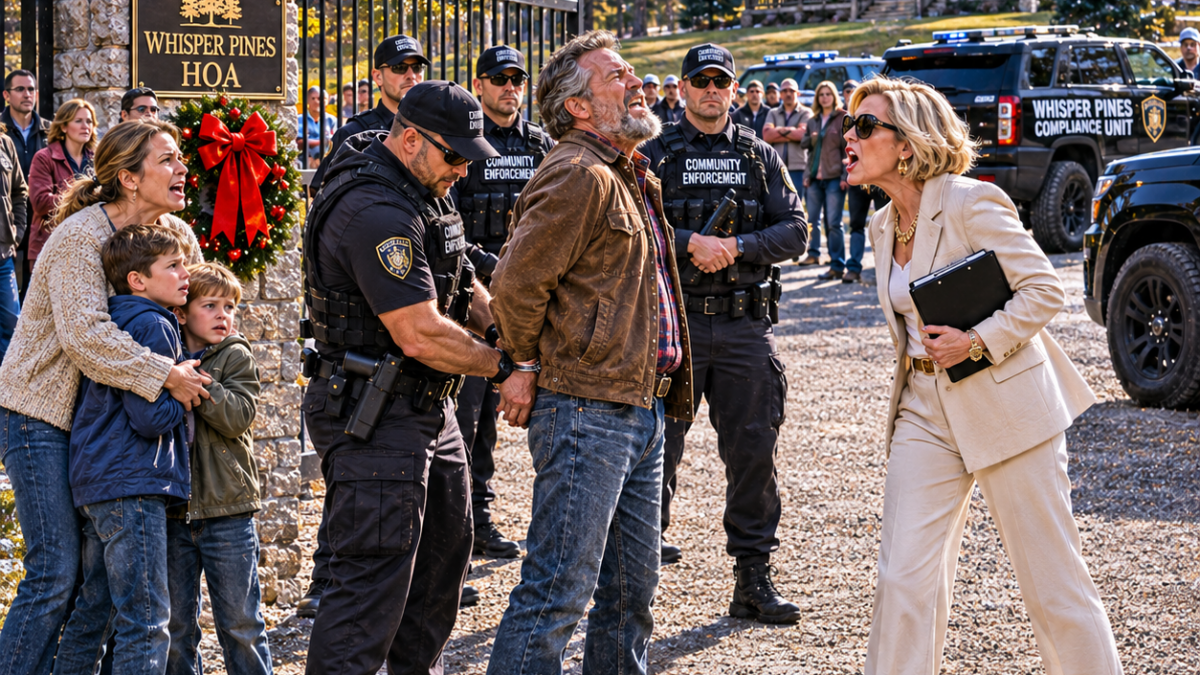
The handcuffs clicked shut at 9:14 on a Saturday morning while my two grandsons stood fifteen yards away clutching my wife’s legs.
That sound is what I remember most.
Not Karen Vale’s voice.
Not Troy Sutter’s ridiculous tactical vest.
Not the black SUVs with WHISPER PINES COMPLIANCE UNIT magnets slapped across the doors.
The cuffs.
One clean metallic click around my left wrist.
Then another around my right.
Troy gave them a little tug afterward, like he had watched someone do it on television and wanted to make sure the performance looked authentic.
“You’re coming with us.”
I looked down at the cuffs.
Then at him.
“You’re certain?”
Troy puffed his chest.
He had upgraded his uniform since the first time we met. Navy cargo pants. Black boots. Body armor carrier. Radio. Flashlight. Handcuff pouch. A silver badge stamped COMMUNITY ENFORCEMENT COMMANDER.
No state seal.
No county seal.
No law-enforcement agency.
Just confidence.
Behind him, Karen stood in a cream linen suit holding a manila folder.
“You were warned repeatedly, Gabriel.”
My wife Sarah stepped off the porch.
“Take those cuffs off him.”
I turned my head.
“Sarah.”
Her face was white with anger.
“Gabe, they cannot—”
“I know.”
My grandsons had stopped playing.
The younger one was holding a foam sword he had been chasing his brother with five minutes earlier.
Now he stared at Troy like the man had transformed from ridiculous into dangerous.
That was the moment my anger sharpened.
Not because the cuffs hurt.
Because the boys were watching adults pretend that a costume could become authority if you wore it confidently enough.
Karen opened her folder.
“Gabriel Stone, you are being detained for obstruction of community inspection, unauthorized structural additions, refusal to comply with HOA safety directives, surveillance misconduct, and repeated interference with officers of Whisper Pines.”
I almost smiled.
“Officers?”
Troy lifted the cuffs slightly.
“You think this is funny?”
“No.”
I looked directly at the camera mounted under the eave of my workshop.
“But I do think you should repeat everything slowly.”
Karen followed my eyes.
She knew about the cameras.
She had complained about them for weeks.
She also believed she had outmaneuvered them.
That was the arrogance I had been waiting for.
“You are not above this community,” she said.
“I’m not in your community.”
“You live adjacent to it.”
“Still not the same thing.”
“You have ignored every good-faith attempt to resolve this.”
“Your people trespassed on my land at two in the morning.”
Troy shoved one hand against my shoulder.
“Walk.”
I did.
No resistance.
No raised voice.
No attempt to pull away.
There were four men with Karen that morning.
Two of them wore zip ties on their belts.
One carried a stun device.
Troy had handcuffs.
Sarah was behind me with two frightened children.
Whatever satisfaction I might have gotten from dropping Troy into the gravel would have lasted three seconds and created three years of arguments about what happened next.
So I walked.
Karen pulled out her phone and began recording.
“This is how we deal with rogue violators,” she announced for her own video. “Nobody is above the standards that protect Whisper Pines.”
Sarah shouted my full name.
The version she only used when she was furious.
I looked back.
One nod.
That was all.
Troy opened the rear door of the SUV.
No cage.
No law-enforcement equipment.
Just leather seats and a pine-scented air freshener dangling from the mirror.
I sat down.
He slammed the door.
The vehicle started moving.
Not toward the sheriff’s office.
Not toward a police department.
Not toward a courthouse.
Toward the Whisper Pines clubhouse.
That confirmed what I already suspected.
This wasn’t an arrest.
It was an abduction wrapped in HOA vocabulary.
Karen Vale had just taken a private citizen from his own land under fake authority and transported him to a building she called a “compliance office.”
There was only one detail she still didn’t understand.
I was not a private citizen in quite the way she believed.
And three weeks earlier, after her people had begun trespassing, surveilling my home, and publishing photographs of my grandchildren’s bicycles, I had already disclosed the situation to people whose job was to investigate exactly this kind of escalation.
I had not directed that investigation.
I could not.
Not ethically.
Not legally.
Because my name is Gabriel Stone.
And at the time Karen Vale put fake police cuffs on me, I was serving as the Attorney General of Utah.
PART 2
The gate started all of it.
At least, that was what Karen believed.
In reality, the gate simply gave her something visible to hate.
I had installed it in October.
Steel.
Industrial.
Functional.
No ornamental scrollwork.
No imitation stone columns.
No HOA-approved bronze lanterns.
A black-and-white sign sat in the center.
PRIVATE PROPERTY.
TRESPASSING PROHIBITED.
Sarah watched the crew finish the installation from our porch.
“You know this is going to bother them.”
I took a drink of coffee.
“I know.”
“You sound happy about that.”
“I’m happy about people understanding the property line.”
Whisper Pines sat roughly a mile and a half down the road.
The development had grown in phases over the previous decade.
Large homes.
Perfect hedges.
Decorative stone.
Private trails.
HOA newsletters printed on expensive paper as though municipal government had somehow been outsourced to a landscaping committee.
My land was older.
Private.
Separate deed.
No Whisper Pines covenant.
No association membership.
No agreement granting their board authority over my acreage.
We shared proximity.
Nothing more.
That had never stopped Karen.
The first visit came the morning after the gate went in.
I heard the electric whine of a golf cart before I saw it.
White.
Chrome wheels.
WHISPER PINES BOARD painted discreetly on the side.
Karen Vale stepped out first.
Late fifties.
Perfect blond bob.
Dark sunglasses.
Cream sweater.
White pants.
Clipboard.
Beside her climbed Troy Sutter.
Former mall security.
Self-appointed head of something Karen called Community Discipline.
His shirt carried an embroidered HOA OFFICER patch.
He wore a cheap metal badge.
Real handcuffs hung from his belt.
Karen looked at the gate like somebody had dumped a refrigerator in her swimming pool.
“Gabriel.”
“Karen.”
“These gates are visually aggressive.”
“They’re gates.”
“They affect the character of Whisper Pines.”
“They’re not in Whisper Pines.”
“The northern approach is part of the visual environment.”
“My deed isn’t visual environment.”
She gave me a tight smile.
“You’re being unnecessarily difficult.”
“No. I’m being accurate.”
Troy rested one elbow on the fence.
“The architectural committee will probably require modification.”
I looked at him.
“Which architectural committee?”
“Whisper Pines.”
“Then they can modify Whisper Pines.”
Karen’s jaw tightened.
“You’ll receive formal notice.”
“I look forward to adding it to the file.”
“What file?”
I smiled.
“The one you keep helping me build.”
She did not like that.
They left.
That evening, I checked the cameras.
Karen and Troy had spent another ten minutes at the gate after I walked away.
Photographs.
Video.
Flashlight scanning toward the workshop.
Karen zoomed in on landscaping near the drive.
Troy tugged at one of the gate bars.
I saved the footage.
The next morning, an email went out to Whisper Pines residents.
Someone on the board forwarded it to me.
COMMUNITY SAFETY ALERT.
A “noncompliant property adjacent to the northern perimeter” had erected “aggressive fortifications.”
Possible effects on property values.
Safety perception.
Neighborhood harmony.
The owner had allegedly refused “all communication.”
I had spoken to Karen twenty-four hours earlier.
That was when I understood she wasn’t writing to me.
She was writing a story for everyone else.
So I did nothing.
No Facebook reply.
No public statement.
No letter.
I adjusted my cameras.
Two nights later, motion alerts woke me around two.
Three men moved along the tree line.
Black clothing.
Dark vests.
COMMUNITY ENFORCEMENT patches.
Flashlights.
Zip ties.
One carried a stun device.
They did not knock.
Did not call.
Did not identify themselves.
They walked my fence line, photographed the gate, and tried to peer toward the workshop.
I stayed inside.
Recorded.
People later asked why I didn’t confront them.
Because confrontation is useful to people who need ambiguity.
Footage is useful to people who need proof.
By the end of that week, the activity became systematic.
A drone appeared over the property.
Black quadcopter.
Camera mounted beneath.
It circled the greenhouse.
Workshop.
Back porch.
Then flew toward Whisper Pines.
A white envelope appeared in my mailbox.
No stamp.
No return address.
Inside:
YOU THINK YOU’RE ABOVE OUR COMMUNITY?
FOR YOUR SAFETY, CONSIDER MOVING WHILE YOU STILL HAVE OPTIONS.
Sarah read it.
Her hands trembled.
“Gabe, this isn’t funny anymore.”
“I know.”
“You keep saying that.”
“I mean it.”
“Then call somebody.”
“I already have.”
That part mattered.
The source version of this story would have been easy to tell as though I secretly engineered some giant law-enforcement trap because I wanted revenge.
That is not how responsible authority works.
I had contacts.
Of course I did.
But because I was personally involved, I disclosed the harassment and evidence to independent investigators.
County prosecutor.
Sheriff’s office.
Separate state investigative personnel outside my direct chain on the matter.
My office counsel documented the conflict.
I would not personally direct arrests.
Would not sign warrants involving my own dispute.
Would not command an operation against Karen.
What I could do was preserve evidence.
So I did.
Triple backups.
Time stamps.
Exterior cameras.
Cloud storage.
Copies outside my home.
The more Karen escalated, the less I touched the case.
Then the HOA published its “Community Integrity Map.”
My land was shaded red.
ZONE OF DEGRADATION.
SURVEILLANCE CONCERN.
NONCOMPLIANT BORDER.
THREAT ADJACENCY INDEX.
Someone had even placed a cartoon-style barbed-wire symbol over my workshop.
Sarah stared at the PDF.
“They are insane.”
“No.”
She looked at me.
“They’re organized.”
“That’s worse.”
“Much.”
The map included photographs of my property.
Taken from angles that could only have come from the drone or trespassers.
The greenhouse.
Generator.
Workshop.
My grandchildren’s bicycles under the awning.
That changed how I felt.
People sometimes imagine prosecutors stop feeling anger because they work around misconduct.
The opposite is true.
You become very good at recognizing which anger is useful.
Fear for children is not useful evidence.
Photographs of children’s belongings taken during unauthorized surveillance are.
So I cataloged everything.
The next sign went beside the gate.
NOT AFFILIATED WITH WHISPER PINES HOA.
PRIVATE PROPERTY.
The following morning, red spray paint covered it.
COMMUNITY FIRST.
Saved.
Photographed.
Preserved.
Then one of the western tree cameras disappeared.
The footage showed a heavyset man in a dark vest cutting power to the corner, removing the camera, and walking away.
Troy’s build.
Not enough alone to prove identity.
Enough to add to the pattern.
The following weekend, three masked “community enforcement” men crossed the fence at two in the morning.
This time, camera coverage overlapped.
Troy approached the outer tool shed.
Locked.
He pulled the handle.
Again.
Then took out the stun device and drove it into the wooden door.
The electrical crack was loud enough for the microphone.
“That’ll scare him,” he said.
Then:
“He needs to learn who controls things out here.”
I watched live from my bedroom.
Not smiling.
Not anymore.
That clip went directly to investigators.
My note was short.
CRIMINAL TRESPASS.
ATTEMPTED ENTRY.
IMPERSONATION CONCERNS.
SUSPECT IDENTIFIABLE.
CONTINUING PATTERN.
The response was equally short.
RECEIVED.
DO NOT ENGAGE.
CONTINUE PRESERVATION.
That was where things stood the morning Karen decided to arrest me.
The Saturday had begun with pancakes.
My two grandsons chased each other with foam swords near the fire pit.
Sarah sat on the porch reading.
Clear mountain sky.
Cold enough for breath to show in the shadows.
Then two black SUVs entered my property.
Karen stepped out wearing a linen suit.
Troy wore his new enforcement commander vest.
Two additional guards followed.
Handcuffs.
Radios.
Tactical gear.
Karen announced my “arrest” loudly enough for the children to hear.
I asked whether she was certain.
She was.
That choice mattered.
Because every prior act could still be spun.
Trespass was inspection.
Drone flights were community monitoring.
Threat letters were anonymous.
The stolen camera might be blamed on unknown people.
But Karen standing on camera ordering my detention?
Troy physically cuffing me?
Transporting me off my property?
Taking me to an HOA facility?
That was no longer a gray dispute over boundary enforcement.
They took me to the clubhouse.
The “compliance office” occupied a converted meeting wing.
Cheap desks.
File cabinets.
Fake seals.
A small room with a folding chair and frosted glass.
Two dead cameras mounted in the corners for appearance.
Karen entered with a recorder.
She placed it on the table.
“State your name.”
“Gabriel Stone.”
“You have repeatedly violated Whisper Pines rules.”
“No.”
“Unauthorized gate.”
“Private property.”
“Surveillance.”
“My cameras.”
“Hostile signage.”
“My land.”
“Unapproved family gatherings.”
I looked at her.
“You arrested me over pancakes?”
Troy stood behind me.
Karen ignored the question.
“You are going to remove the gate.”
“No.”
“You will shut down the surveillance system.”
“No.”
“You will bring the property into compliance.”
“No.”
Her face tightened.
“You still think your title makes you untouchable.”
That was the first time she said anything suggesting she had finally learned who I was.
Maybe someone had searched.
Maybe she had known for days.
Maybe she believed it didn’t matter.
“I haven’t invoked my title once.”
“You think I don’t know?”
“I think you should stop talking.”
Troy leaned forward.
“Don’t threaten her.”
I turned my head.
“That wasn’t a threat.”
Karen lowered her voice.
“You’re going to sign an acknowledgment that Whisper Pines has enforcement rights over the northern perimeter.”
“No.”
“If you don’t, this becomes much worse.”
“For whom?”
She smiled.
“You.”
Then something hit the front entrance.
Hard.
One crash.
Then shouting.
Real commands.
“SHERIFF’S OFFICE!”
“HANDS VISIBLE!”
“DO NOT MOVE!”
Troy grabbed for his radio.
The compliance-room door opened almost immediately.
Two county tactical deputies entered.
Not my employees.
Not people I commanded.
The operation had been authorized through independent channels based on accumulated evidence and what investigators had now observed through the ongoing response.
One deputy saw the cuffs.
“Sir, stay seated.”
I did.
He unlocked them only after the room was secured.
Karen backed against a filing cabinet.
“What is this?”
Nobody answered her dramatically.
That is another difference between reality and fantasy.
Real operations do not stop so the victim can deliver a clever line.
Sheriff’s deputies separated people.
Weapons and restraint devices were secured.
Troy was handcuffed.
Karen was detained.
Other members of the so-called enforcement unit were placed under control.
Investigators began executing search authority that had been prepared independently.
I was taken outside.
An assistant county prosecutor met me there.
“You okay?”
“Yes.”
“Family?”
“Home.”
“You’re done here for now.”
“I understand.”
“You are a witness.”
“I understand.”
That was exactly what I wanted.
Not control.
Distance.
Investigators took over.
Inside the clubhouse they found uniforms.
Fake badges.
Zip ties.
Cuffs.
Stun devices.
Resident files.
Maps.
Photographs.
Lists identifying “noncooperative” households.
There were folders on people who did not legally belong to Whisper Pines.
My name appeared repeatedly.
So did names I recognized.
An elderly widower.
A retired nurse.
A family whose property sat just outside one phase of the subdivision.
A woman who had fought a landscaping citation for two years.
This wasn’t about me.
That realization changed the emotional center of the entire case.
Karen had not become abusive because I installed a gate.
The gate simply made me resist.
Other people had paid.
Signed.
Complied.
Moved cars.
Changed fences.
Removed gardens.
Accepted fines.
Karen’s machine had already been running.
The search uncovered financial ledgers.
Hundreds of thousands of dollars in “enforcement fees” and disciplinary payments accumulated over several years.
Some went through official HOA accounts.
Other collections appeared routed through reserve or enforcement funds that did not match normal reporting.
That triggered separate financial scrutiny.
Again, I stayed out.
My office personnel who would normally have touched certain state matters were screened appropriately because of my involvement.
Outside prosecutors handled relevant charging decisions.
County and federal investigators worked their own evidence.
The case did not need me steering it.
Evidence has momentum when enough of it exists.
Troy’s own files made things worse.
A storage device contained body-camera recordings.
Apparently some members of the patrol had recorded their enforcement rounds.
One showed Troy entering an older resident’s backyard.
Unauthorized garden plants.
Fine.
Threat of towing.
Another showed officers placing a boot on a resident’s vehicle while the homeowner was away.
Karen’s voice came through a radio in one clip.
“Hit them fast. They pay before they ask questions.”
That sentence ended a lot of debate.
Residents began speaking.
A retired nurse described being blocked in her driveway because her rose bushes were deemed overgrown.
Another resident produced receipts for repeated fines involving a seasonal wreath.
A widower showed notices threatening landscaping intervention after his wife died and he fell behind on yard work.
People compared paperwork.
That was the real collapse.
Not tactical deputies entering the clubhouse.
Neighbors realizing they had all been told slightly different versions of the same lie.
Karen’s authority depended on isolation.
Every resident believed his problem was individual.
His mailbox.
Her roses.
His car.
Her fence.
My gate.
Once the files came together, the pattern became visible.
Karen and Troy faced multiple criminal allegations arising from false imprisonment, impersonation, coercive enforcement practices, unlawful surveillance, financial conduct, and related conspiracy theories supported by the evidence.
I am deliberately careful with the language because charges, indictments, convictions, and civil findings are different things.
That distinction mattered to me even when I despised what I saw.
A person does not become guilty because the Internet hates her.
Evidence still has to survive court.
The civil side grew too.
Residents retained counsel.
Some challenged fines.
Others sought restitution.
Whisper Pines’ board fractured almost immediately.
Several directors claimed Karen had withheld enforcement details from them.
That claim needed scrutiny too.
Some truly did not know.
Others had signed expenditures.
Some voted for expansions in authority.
Responsibility had to be assigned based on records, not collective rage.
Karen resigned as president before the first major hearing.
Troy’s enforcement unit was disbanded.
The fake patrol vehicles disappeared.
The clubhouse compliance office was closed.
The first time Sarah and I drove past afterward, she pointed toward the dark windows.
“You miss your holding cell?”
“Very much.”
She laughed.
It was the first joke she had made about the arrest.
I looked at her.
“You okay?”
“No.”
Honest.
“I hated watching them take you.”
“I know.”
“The boys still talk about it.”
“I know.”
“You knew investigators were watching the escalation.”
“Yes.”
“You knew something might happen.”
“I knew there was a response plan if they crossed certain lines.”
“And you still let Troy put cuffs on you.”
“I didn’t let him.”
She looked at me.
“You held your wrists out.”
“I chose not to fight four armed-looking idiots in front of our grandsons.”
That stopped her.
“I would make the same choice again.”
She looked toward the road.
“I hate that you’re right.”
“So do I.”
The preliminary proceedings drew enormous public attention.
That part of the original story was unavoidable.
A sitting attorney general being handcuffed by HOA contractors on private land was absurd enough to become national news.
I hated most of the coverage.
HOA WAR.
SUBURBAN TYRANTS.
KAREN VERSUS THE LAW.
Memes.
Video edits.
My face.
Karen’s face.
Troy getting handcuffed.
People turned it into entertainment.
For the residents who had lost money, dignity, privacy, or years of peace, it wasn’t entertainment.
During testimony, I was asked why I didn’t simply crush the HOA legally after the first letter.
Because government is dangerous when officials use public power to solve personal problems.
That was my answer.
“I could not use the Attorney General’s office as my private law firm.”
The prosecutor asked:
“So what did you do?”
“I documented private conduct and reported suspected crimes through appropriate channels.”
“Why continue recording?”
“Because every step needed to stand without my title attached.”
“What do you mean?”
“If Karen Vale was wrong only because she happened to harass the Attorney General, then the system learned nothing.”
The courtroom went quiet.
“She had to be wrong because private citizens have rights too.”
That was the point.
My gate was legal whether I was Attorney General or unemployed.
Troy had no authority to abduct someone from private property whether that person prosecuted public corruption or repaired refrigerators.
Karen’s HOA could not invent police power because she found my landscaping offensive.
The identity of the victim should affect publicity.
Not legality.
The defense tried to argue provocation.
I installed an aggressive gate.
I refused HOA communication.
I used cameras.
I let tensions escalate.
“Did you deliberately antagonize Whisper Pines?”
“No.”
“You installed a sign citing trespass law.”
“Yes.”
“You increased surveillance.”
“After repeated trespassing.”
“You declined to remove the gate despite complaints.”
“Because they had no jurisdiction over it.”
“You could have compromised.”
“On what?”
“Aesthetic concerns.”
“On private land outside their association?”
He paused.
Then tried another approach.
“You could have identified yourself immediately as Utah’s Attorney General.”
“Yes.”
“But you didn’t.”
“No.”
“Why?”
“Because my job did not give my property more rights than my neighbor’s property.”
That answer made Karen look down.
The most revealing testimony came from Troy.
By then, he had begun cooperating.
He admitted Karen repeatedly told enforcement personnel that Whisper Pines had “quasi-governmental authority.”
He claimed he believed HOA officers could detain people violating community orders.
The prosecutor asked:
“Who trained you on arrest law?”
Troy looked embarrassed.
“No one formally.”
“Who told you you could use handcuffs?”
“Karen said counsel had approved physical compliance measures.”
“Did you see that legal opinion?”
“No.”
“Did you ever ask a sheriff’s deputy whether an HOA could arrest a nonmember on private land?”
“No.”
“Did you believe a board rule was superior to state criminal law?”
He hesitated.
“I thought the HOA had authority.”
That sentence followed him through every headline.
But I didn’t laugh.
Ignorance mixed with uniforms is not funny.
Karen’s financial records were harder for her to explain.
Payments.
Enforcement collections.
Related expenditures.
Resident lists.
Private surveillance.
The evidence supported both criminal prosecution and civil recovery efforts.
Eventually, after months of litigation and negotiated dispositions involving different defendants, Karen was convicted on serious charges tied to false imprisonment, fraud-related conduct, coercive enforcement, and conspiracy.
Troy received a lesser sentence after cooperating and turning over communications.
Other members of the patrol faced outcomes based on their individual involvement.
Some received probation.
Some lost security licensing.
Some settled civil claims.
A few board members were removed without criminal charges because investigators found poor judgment or negligent oversight rather than proof of criminal intent.
That distinction mattered.
I had spent a career fighting the idea that guilt should spread by proximity.
Whisper Pines itself survived.
That may surprise people.
The original telling wanted the HOA completely destroyed.
I actually preferred reform.
One hundred-plus homeowners still needed common-area maintenance.
Road contracts.
Snow removal.
Pool insurance.
Landscaping.
You don’t punish ordinary residents by burning down the legal structure they use for shared property unless a court determines dissolution is necessary.
Instead, an independent receiver and new board temporarily stabilized finances.
The fake enforcement program ended permanently.
No patrol uniforms.
No detention rooms.
No handcuffs.
No “community officers.”
Financial controls changed.
Outside audits.
Transparent fine procedures.
Real appeal rights.
No enforcement against property beyond recorded HOA boundaries.
Several residents received refunds or restitution through settlements and court-supervised processes.
The clubhouse stayed.
The little compliance room became storage.
Sarah loved that.
“What are they storing in your cell?”
“Pool noodles.”
“Perfect.”
The gate stayed too.
Steel.
Black.
Functional.
For a while, reporters drove past to photograph it.
One afternoon I caught a young man taking a selfie next to the PRIVATE PROPERTY sign.
“Can I help you?”
He jumped.
“I’m sorry. Are you Mr. Stone?”
“Yes.”
“This is the gate?”
“It is.”
“The famous gate?”
“It opens and closes.”
He looked disappointed.
I smiled.
“Most gates do.”
He left.
That was the problem with stories like mine.
People wanted the gate to become symbolic.
Karen versus freedom.
Government versus HOA.
Good versus evil.
Real life is messier.
Karen was not dangerous because she disliked a gate.
She became dangerous because she convinced herself that community benefit erased legal limits.
Troy was not dangerous because he wore a silly badge.
He became dangerous when he believed the badge meant he no longer needed to understand the law.
Residents were not weak because they paid fines.
Many had jobs.
Children.
Ill parents.
Mortgages.
They calculated that $200 was cheaper than a six-month dispute.
Systems like Karen’s depend on that calculation.
Not cowardice.
Exhaustion.
That lesson stayed with me.
After the case, state lawmakers did review HOA enforcement powers and transparency requirements.
I supported reforms carefully.
Not a revenge statute.
Not a law bearing my name.
Clear accounting.
Limits on security functions.
Better notice requirements.
Transparency around fines.
Disclosure of enforcement contractors.
Nothing that said:
This happened to Gabriel Stone, therefore every HOA is corrupt.
Bad legislation often begins as emotional retaliation.
I wanted the opposite of what Karen did.
Defined authority.
Sarah eventually asked whether I regretted installing the gate.
“No.”
“Not even a little?”
“No.”
“If we’d put in a pretty wood gate, maybe none of this happens.”
“Then somebody else gets fined over a birdhouse.”
She smiled.
“That’s annoyingly noble.”
“It isn’t noble.”
“What is it?”
“Karen already had a system. We just made it visible.”
That was true.
The enforcement ledger predated my gate.
The surveillance files predated my gate.
Resident complaints predated my gate.
Troy’s patrol existed before my gate.
We did not create the problem.
We became the resistance that produced enough evidence for other people to see it.
Six months later, mountain snow covered the road.
The steel gate looked almost gentle under white powder.
Sarah and I had our grandchildren again.
Pancakes.
Coffee.
A deer wandered near the greenhouse.
The younger boy pointed toward the gate.
“Is that where the bad police came?”
I looked at Sarah.
She waited.
“They weren’t police.”
He frowned.
“They had badges.”
“Some people can buy badges.”
“Then how do you know?”
That question stopped me.
I crouched beside him.
“A real officer should be able to tell you who they work for and what law gives them authority.”
He considered that.
“Like you?”
“Like me.”
“Are you police?”
“Sort of.”
Sarah laughed from the kitchen.
I continued.
“And even real officers have rules.”
“Why?”
“Because power without rules hurts people.”
He nodded like children do when they understand half of something and store the rest for later.
Then he went back to his pancakes.
I stood there thinking that maybe the entire case could be reduced to that conversation.
Power without rules hurts people.
Karen believed her purpose made limits optional.
Protect property values.
Protect neighborhood harmony.
Protect families.
Protect aesthetics.
Every abuse had a respectable noun attached to it.
The verbs were the problem.
Surveil.
Threaten.
Trespass.
Detain.
Coerce.
Take.
You can dress the nouns beautifully.
The verbs still matter.
One year after the arrest, I attended a Whisper Pines meeting.
Not as Attorney General.
Not as prosecutor.
Not even as a victim.
A resident invited Sarah and me to the annual community barbecue after the new board finished a governance session.
I almost declined.
Sarah said:
“We should go.”
“Why?”
“Because they need to stop seeing us as the people behind the scary gate.”
“We are the people behind the scary gate.”
“Put on a clean shirt.”
We went.
No tactical vests.
No compliance officers.
No Karen.
Families grilled hamburgers beside the clubhouse.
A retired teacher introduced herself.
“I voted for Karen twice.”
I nodded.
“She was very convincing.”
“I’m sure.”
“I believed you were dangerous.”
“That must be disappointing.”
She laughed nervously.
“I’m sorry.”
“You don’t owe me an apology for believing information your board gave you.”
“I should have checked.”
“Then check next time.”
She nodded.
That became the theme of the evening.
People did not need forgiveness from me.
They needed habits.
Read minutes.
Ask for contracts.
Verify authority.
Attend meetings.
Compare notes.
Do not assume confidence equals legality.
At one point I walked past the old compliance room.
The door was open.
Pool floats.
Card tables.
A broken Christmas decoration.
No chair.
No recorder.
No fake cameras.
Sarah appeared beside me.
“Thinking about your incarceration?”
“I had a difficult twelve minutes.”
“You’re impossible.”
“I’m coping.”
She took my hand.
For the first time, standing in that hallway did not make my shoulders tighten.
That mattered more than any meme.
My term as Attorney General eventually ended.
Public office always ends.
That is another reason officials should be careful with power.
If your rights depend on your title, they are not rights.
They are privileges.
I returned more fully to private life.
Consulting.
Teaching.
Time with Sarah.
Grandchildren.
The land.
The gate stayed.
People occasionally asked whether I missed having an office full of lawyers.
“No.”
“Security detail?”
“No.”
“Press access?”
“Absolutely not.”
The thing I appreciated most was walking from the porch to the workshop without somebody asking for comment.
One autumn morning, almost exactly like the morning the gate was installed, I carried coffee down the driveway.
Steel bars.
Cold sunlight.
Pine smell.
Sarah joined me.
“You know,” she said, “it still isn’t cute.”
“Good.”
“Still not HOA approved.”
“Better.”
She smiled.
“What are you going to do if the new board sends a letter?”
“Read it.”
“That’s it?”
“Probably.”
“No sting operation?”
“No.”
“No tactical team?”
“Sarah.”
She laughed.
We stood beside the gate.
Whisper Pines rooftops showed through the trees in the distance.
Quiet.
Ordinary.
That was what I wanted in the first place.
Not victory.
Not headlines.
Not seeing Karen in handcuffs.
Peace with a property line.
People misunderstand justice when they imagine satisfaction is the goal.
I felt no satisfaction watching Karen taken away.
Relief.
Yes.
Vindication.
Some.
But satisfaction?
No.
A woman had spent years using neighbors’ fear and confusion to build a private enforcement system.
Residents lost money.
Some lost sleep.
Some felt unsafe in their own homes.
My grandchildren watched me get taken away in cuffs.
Nothing about that becomes good simply because a judge later says you were right.
Justice does something more modest.
It stops the wrong thing.
It records responsibility.
It repairs what can be repaired.
It creates consequences strong enough that the system hopefully learns.
That was enough.
I kept one object from the entire case.
Not the newspaper.
Not a fake badge.
Not the cuffs.
One original HOA violation notice.
GATE NONCOMPLIANCE.
Thirty days to modify.
Architectural standards.
Issued by Karen Vale.
I keep it inside a drawer in my study.
Sometimes I use the blank backside to write grocery lists.
Sarah thinks that’s disrespectful to evidence.
I tell her the case is closed.
She tells me my handwriting is the real crime.
Life returned.
That was the best ending.
Years later, Troy wrote me.
A real letter.
No return address I recognized.
He apologized.
Not elegantly.
He said he had spent years wanting authority because he thought authority made people respect him.
Karen gave him a uniform.
Title.
Badge.
People stepped aside.
He mistook their uncertainty for respect.
Then he wrote:
You were the first person who looked at the badge and asked what law it came from.
I read that line twice.
I never responded.
Not because I hated him.
Because I didn’t know what response would improve it.
Sometimes people have to live with what they finally understand.
The gate was repainted last spring.
Same black.
New rust protection.
My older grandson helped.
He is tall enough now to reach the middle bars.
He asked:
“Grandpa, why didn’t you replace this thing after all that?”
“Why would I?”
“Because of Karen.”
I handed him the paintbrush.
“Karen didn’t own the gate.”
He thought about that.
“So we keep it because she lost?”
“No.”
I pointed toward the hinge.
“We keep it because it works.”
That answer seemed to disappoint him.
Children like symbolism.
Adults should be careful with it.
If I had replaced the gate with some giant monument celebrating victory, Karen would still be part of the property.
Every visitor would ask.
Every photograph would remember her.
Instead, the gate went back to being a gate.
Open.
Close.
Lock.
Unlock.
That’s what freedom usually looks like after the dramatic part ends.
Boring function.
The final time someone from Whisper Pines asked whether my land might ever join the HOA, I laughed.
The new president laughed too.
“I had to ask.”
“No.”
“Didn’t think so.”
“Anything else?”
“We’re updating our emergency contact list for neighboring properties.”
“That makes sense.”
“Can we have your number?”
“Yes.”
No threats.
No fake jurisdiction.
No demand.
One neighbor asking another for a phone number.
I gave it to him.
That was the relationship Karen could have had from the beginning.
If there had been a real fire, I would have opened the gate.
If a child wandered onto my land, I would have helped.
If the HOA needed temporary access for a legitimate emergency, they could have asked.
Boundaries do not prevent cooperation.
They make cooperation voluntary.
That was Karen’s deepest misunderstanding.
She believed voluntary meant weak.
That if she asked, somebody might say no.
So she replaced consent with authority.
When real authority didn’t exist, she manufactured the appearance of it.
Badge.
Uniform.
Map.
Notice.
Patrol car.
Holding room.
Handcuffs.
Each layer existed to make the previous lie feel more official.
Then one Saturday morning, Troy closed the final cuff.
And the appearance of authority became evidence of its absence.
That is the part I still think about.
They crossed the line because nobody in their circle knew how to stop.
Every escalation made the next one feel normal.
First a complaint.
Then a newsletter.
Then drone surveillance.
Then trespass.
Then threats.
Then fake officers.
Then restraints.
Nobody woke up one morning and said:
Let’s become a criminal organization.
They simply stopped asking whether they were allowed.
That is how petty power becomes dangerous.
Not all at once.
One unchallenged step at a time.
Karen Vale thought the gate was an insult because it told her something she hated hearing.
You stop here.
Not because I was Attorney General.
Not because I knew prosecutors.
Not because cameras watched.
Because my property began on one side and her authority ended on the other.
She spent months trying to erase that line.
In the end, the line never moved.
The gate remained.
Whisper Pines remained.
My family remained.
What disappeared was the illusion that Karen’s title allowed her to decide which boundaries counted.
One morning, Sarah and I stood beside that gate after fresh snow.
No reporters.
No deputies.
No HOA golf carts.
The mountains were pale against the sky.
She leaned against my shoulder.
“You got what you wanted.”
“What?”
“Quiet.”
I listened.
Wind in the pines.
A raven somewhere uphill.
Our grandson laughing from the porch.
Nothing else.
“Yeah.”
She smiled.
“Worth it?”
I looked at the gate.
Then at our house.
“No.”
She lifted her head.
“No?”
“I wish none of it happened.”
She understood.
I continued.
“But since it did, I’m glad we didn’t let them decide what it meant.”
That was the truth.
Karen wanted the story to be about a rogue property owner who refused community standards.
Then she wanted it to be about a dangerous man needing restraint.
The Internet later wanted it to be about an attorney general destroying an HOA.
All three versions missed something.
It was about limits.
Theirs.
Mine.
Government’s.
Private security’s.
HOA authority’s.
Property rights’.
Even my own anger.
The only people I trusted during that entire ordeal were the ones who understood that having power did not mean being allowed to use all of it.
That is the standard Karen never learned.
And that is why, every time I walk through that gate now, I barely think about her.
I think about Sarah.
My grandsons.
The property.
The ordinary morning I wanted all along.
The steel gate closes behind me with the same heavy click.
Still not decorative.
Still not HOA approved.
Still standing exactly where the deed says it can stand.
And that is enough.
Because HOA Karen once put handcuffs on me believing her board had finally proved who controlled the land.
Instead, those cuffs became the clearest evidence of what she never had.
Authority.








