HOA Karen Had My Ranch Golf Cart Towed From My Own Land—Then Fined Me $900 a Day for Owning It
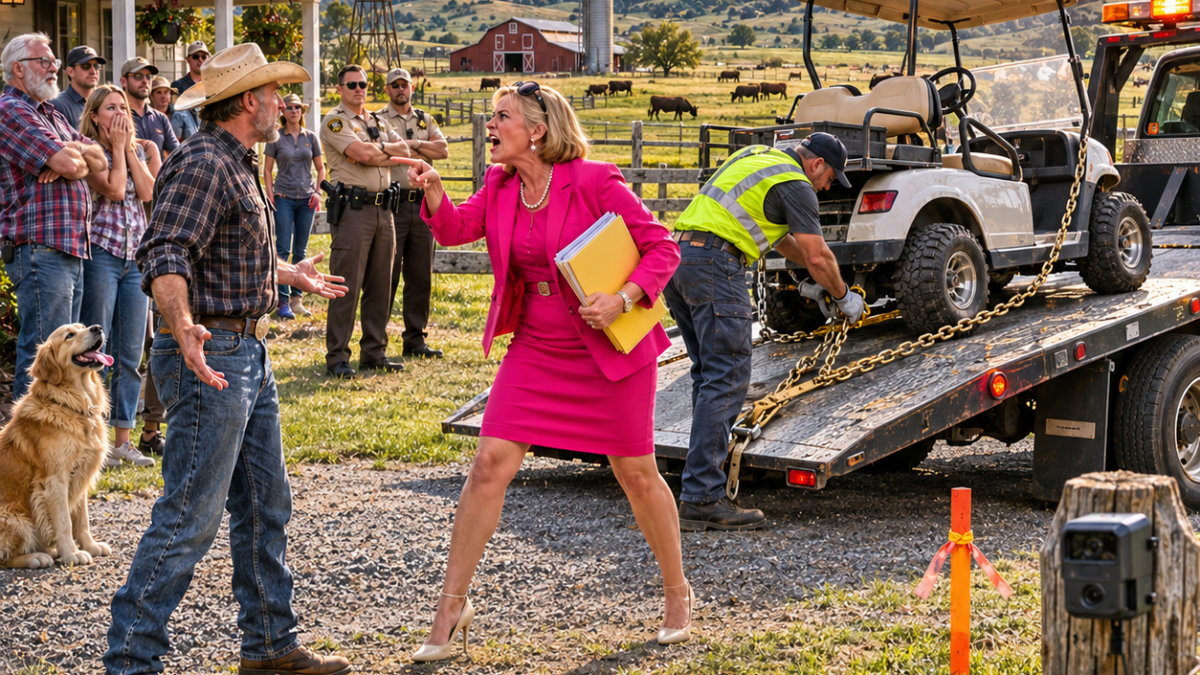
HOA Karen Had My Ranch Golf Cart Towed From My Own Land—Then Fined Me $900 a Day for Owning It
She ordered a tow truck onto my ranch, chained up my golf cart, and called the theft “community safety enforcement.”
Then HOA Karen handed me a $900-a-day fine for refusing to remove a vehicle that her own crew was already hauling away.
She thought the pink blazer, the board vote, and the tow truck made her powerful. She had no idea what her HOA depended on just beyond my property line.
“Your golf cart is an unauthorized vehicle, and we’re impounding it right now.”
Victoria Vale shouted those words beside a flatbed tow truck parked on my grass as heavy chains tightened beneath my white electric cart. The hydraulic bed groaned upward, lifting the front wheels while the setting sun washed the fairway, pasture, and distant cattle in amber light. Victoria stood beside the driver in a bright pink blazer and matching skirt, one hand gripping her yellow HOA folder while the other pointed toward my cart like she had personally captured an escaped criminal.
I stood thirty feet away in a charcoal flannel shirt, faded jeans, leather boots, and my old cowboy hat. “Victoria,” I said, “that cart is on my property.”
“It is visible from Cedar Ridge.”
“So is that cow.”
She glanced toward a black Angus heifer grazing beyond the fence. “Don’t be childish.”
“I’m not the one towing a golf cart because I can see it.”
The driver stopped operating the winch. He looked from Victoria to me. “Sir, is this your land?”
“Yes.”
Victoria stepped between us. “The HOA has jurisdiction over this recreational corridor. Continue.”
“It isn’t a recreational corridor,” I said. “It’s my ranch road.”
Victoria ripped a notice from her folder and slapped it onto the steering wheel before the cart moved farther up the bed. Bold red letters announced an $900 daily violation for an “unauthorized utility/recreational vehicle creating visual and safety impacts adjacent to association property.”
I read it once.
Then again.
“You’re fining me for the cart you’re taking?”
“You’ve had thirty days to remove it.”
“From my ranch?”
“From community view.”
The tow driver lowered his control pendant. “Ma’am, I was told this vehicle was on HOA property.”
“It effectively is.”
He frowned. “Effectively?”
Victoria’s eyes hardened. “You were hired to tow, not debate property law.”
That was when I noticed my driveway camera blinking above the equipment shed.
So did the driver.
I raised my voice just enough for the microphone to catch every word. “I do not consent to this tow. I do not consent to anyone removing property from Mercer Ranch. You have all been informed that this land is privately owned.”
The driver hesitated.
Victoria didn’t.
“The board voted. Proceed.”
The winch started again.
I walked to my pickup and removed a brown document case. Inside were certified copies of our current deed, a professional survey completed eleven days earlier, and the recorded chain of title beginning with my great-grandfather’s 1921 purchase.
Victoria barely looked.
“Old papers don’t stop modern community progress.”
I pointed toward a bright orange survey stake six feet from the tow truck’s rear tire.
“No. They just tell modern community progress where it needs to stop.”
Her smile narrowed.
“You think that scares me?”
“No.”
I closed the folder and looked at the cart rising onto the flatbed.
“But before that truck leaves, you should probably call your attorney.”
Victoria laughed.
The driver did not.
Then my phone buzzed.
It was my lawyer.
I looked at Victoria, answered the call, and said, “Rachel, they actually did it.”
part 2
My name is Daniel Mercer, although everyone who likes me calls me Dan. I was fifty-three when Victoria Vale decided my golf cart represented such an urgent threat to civilization that she needed a commercial tow truck to remove it from the middle of a four-thousand-acre cattle ranch.
The cart was a white electric utility model with a small cargo bed, off-road tires, headlights, and enough scratches along the passenger side to prove nobody had ever mistaken it for a luxury vehicle. I used it to inspect fence lines, haul tools, move feed buckets, check irrigation valves, and travel quietly between the house, barns, and nearby pastures. My knees appreciated it more every year.
It was not registered for public-road use.
It didn’t need to be.
I used it almost entirely on private ranch property.
Mercer Ranch had belonged to my family in one form or another since 1921. My great-grandfather started with cattle ground and timber. My grandfather added acreage. My father survived droughts, recessions, bad livestock markets, and one memorable tornado that redistributed half a machine shed across three counties.
By the time the land reached me, the ranch covered just over four thousand acres.
Cedar Ridge Golf Estates arrived much later.
A developer purchased property along our eastern boundary and built an upscale subdivision surrounding an eighteen-hole course. The western fairways ran close enough to my ranch that golfers occasionally sliced balls across the fence.
For years, the relationship was mostly friendly.
I returned golf balls.
They tolerated cattle noises.
Everybody survived.
Then Victoria moved in.
She bought a large house overlooking the fourteenth fairway, joined the HOA board within two months, and became president before the year was out.
She was capable, organized, relentless, and absolutely convinced that anything visible from Cedar Ridge fell under Cedar Ridge authority.
My cart first attracted her attention because I parked it near a service shed beside one of my ranch roads.
From the fourteenth fairway, golfers could see it between two cottonwoods.
Apparently visibility was destiny.
The first notice described the cart as an “unapproved motorized recreational object.”
I called the management office.
“This is Dan Mercer.”
“Yes, Mr. Mercer?”
“I received a vehicle violation.”
There was a pause.
“Which lot?”
“I don’t have a lot.”
Another pause.
“Could you give me your Cedar Ridge address?”
“I don’t have one.”
That pause lasted longer.
“I live on Mercer Ranch.”
“Oh.”
That single syllable contained more legal analysis than Victoria’s entire notice.
The property manager promised to correct the record.
Three days later, Victoria sent another notice personally.
She claimed my cart created “visual incompatibility with championship golf-course surroundings” and an “unregulated vehicular hazard near resident recreational space.”
I wrote back that the cart was eight hundred yards inside private ranch property and never entered Cedar Ridge roads or fairways.
Victoria responded with a six-paragraph letter explaining that “modern community standards cannot be defeated merely through technical boundaries.”
That sentence went directly to Rachel Coleman.
Rachel had been my attorney for nearly twelve years.
She read the letter over the phone.
Then said nothing.
“Rachel?”
“I’m trying to decide whether ‘technical boundaries’ means property lines.”
“I think so.”
“That is unfortunate.”
“For me?”
“For her.”
Rachel sent a formal response stating that Mercer Ranch was not subject to Cedar Ridge covenants, that my cart was located entirely on private property, and that association representatives were prohibited from entering without permission.
Victoria signed for the certified letter.
Then she increased the fine.
First $250 per day.
Then $500.
Finally $900.
I never paid a dollar.
What I did instead was hire a surveyor.
Ben Thompson spent two days confirming the eastern ranch boundary and marking the relevant portion with bright orange stakes.
There was no ambiguity.
No sliver.
No overlapping legal description.
No association easement that allowed Cedar Ridge to enforce vehicle restrictions.
The cart sat hundreds of yards beyond the recorded line.
Victoria received a copy of the survey.
Eleven days later, she hired a tow truck anyway.
Rachel was on the phone while the winch pulled my cart onto the flatbed.
“Is anyone threatening you?” she asked.
“No.”
“Anyone physically blocking you?”
“No.”
“Good. Don’t create a confrontation.”
“I wasn’t planning to.”
“Tell the driver clearly that the tow is unauthorized.”
“Already did.”
“Tell him the land is private.”
“Done.”
“Get the company name, plate, driver’s name if he provides it, and preserve video.”
“I’ve got four cameras.”
Rachel sighed.
“You ranchers install cameras like casinos.”
“Cows steal things.”
“Dan.”
“Kidding.”
Mostly.
The tow driver finally walked toward me.
His name was Dale Harris.
He was about forty-five, sunburned, broad-shouldered, and increasingly unhappy about the work order in his hand.
“Mr. Mercer, can I see your survey?”
I handed him a copy.
Victoria immediately stepped forward.
“You do not need to review his documents.”
Dale looked at her.
“With respect, ma’am, I absolutely do.”
She pointed at the truck. “The board authorized this tow.”
“What board?”
“Cedar Ridge HOA.”
Dale looked around at my barn, cattle pasture, equipment shed, and fencing.
“Where’s Cedar Ridge?”
Victoria pointed east.
“Beyond that tree line.”
He stared.
“Beyond the fence?”
“Yes.”
“The fence with the survey markers?”
Her mouth tightened.
Dale looked at me.
“How far are we from HOA property?”
“Roughly seven hundred and sixty feet at this point.”
He swore under his breath.
Victoria’s face flushed.
“You have a contract.”
“I have a work order claiming this vehicle was illegally parked in an association-controlled area.”
“It is.”
Dale held up the survey.
“Not according to this.”
Victoria snapped, “You are not a lawyer.”
“No, ma’am. I’m the guy who gets sued when somebody sends me to tow the wrong vehicle.”
That was the first moment I nearly laughed.
Victoria did not find him funny.
“The vehicle violates our safety code.”
Dale looked at the golf cart.
“Is it stolen?”
“No.”
“Abandoned?”
“No.”
“Blocking a fire lane?”
“No.”
“On your property?”
“It impacts our property.”
Dale rubbed the bridge of his nose.
“That wasn’t what I asked.”
I could see him mentally calculating how quickly he could get out of there.
Unfortunately, the cart was already fully secured.
He had a problem.
So did Victoria.
Rachel spoke through my phone.
“Dan, put me on speaker.”
I did.
Her voice came through clearly.
“My name is Rachel Coleman. I represent Mr. Mercer. Mr. Harris, I understand you were given information indicating the cart was located on HOA property?”
Dale nodded before remembering she couldn’t see him.
“Yes.”
“Mr. Mercer expressly objects to removal. He has provided you with a current survey?”
“Yes.”
“Please preserve your work order and all communications regarding this tow. I’m not asking you to decide title. I’m asking you not to rely blindly on a disputed HOA representation after receiving contrary documentation.”
Victoria stepped closer to the phone.
“This is intimidation.”
Rachel answered calmly.
“No, Ms. Vale. This is notice.”
That shut her up for approximately four seconds.
Then she said, “The vehicle is already impounded.”
I looked at Dale.
He looked at the cart.
Technically it was still sitting on his truck inside my ranch.
Rachel said, “Has the truck left Mr. Mercer’s property?”
“No,” Dale answered.
“Then perhaps everyone should avoid making the problem larger.”
Dale nodded.
“I agree.”
Victoria looked furious.
“I paid for a tow.”
“You paid for a tow based on information I’m no longer comfortable relying on.”
“You will complete the job.”
“No.”
She stared at him.
People like Victoria were accustomed to hearing disagreement from residents.
They were less accustomed to hearing it from contractors they believed they had purchased by the hour.
“Excuse me?”
Dale folded his arms.
“I said I’m not driving away with that cart until this gets clarified.”
Victoria pointed toward the truck.
“I am directing you to proceed.”
He looked at her.
“Then direct somebody else.”
That was humiliation number one.
It would not be the last.
The cart remained on the flatbed while Dale called his dispatcher.
Twenty minutes later, his company manager called him back.
The answer was simple.
Unload it.
Dale released the chains.
The hydraulic bed tilted.
My cart rolled back onto my grass.
Victoria watched as though somebody were reversing a coronation.
When the tires touched the ground, Dale handed me his card.
“I apologize for the situation.”
“You were given bad information.”
He looked at Victoria.
“That appears to be the case.”
She turned on me.
“This changes nothing.”
“It changed the location of my cart.”
“You still owe fines.”
“No.”
“You still violate community standards.”
“No.”
“The board will pursue this.”
“Good.”
That word bothered her.
She narrowed her eyes.
“You think this is funny?”
“Parts of it.”
“You’ll regret embarrassing me.”
“I didn’t hire the tow truck.”
She walked toward her SUV.
Her heel caught in one of the little holes left by a survey stake.
She stumbled, recovered, and looked around to see whether anyone noticed.
Dale noticed.
I noticed.
The camera definitely noticed.
None of us said anything.
That somehow made it worse.
By eight the next morning, Rachel had sent Cedar Ridge a formal cease-and-desist letter.
The subject line was exactly as professional as she was:
UNAUTHORIZED ATTEMPTED REMOVAL OF PRIVATE VEHICLE — DEMAND FOR IMMEDIATE WITHDRAWAL OF ENFORCEMENT ACTION.
Attached were the deed, survey, photographs, security footage stills, certified-mail receipts, and Dale’s work order.
The demand was straightforward.
Withdraw every fine.
Confirm Mercer Ranch was outside HOA jurisdiction.
Stop entering my property.
Pay the tow company directly so I did not incur any charge.
Reimburse my legal and survey expenses associated with defending against their repeated claims.
Preserve board emails, meeting minutes, management instructions, and communications with contractors.
That final request mattered.
Victoria apparently understood that too.
At ten-fifteen, Preston Hale called me.
Preston had served on Cedar Ridge’s board before Victoria and remained vice president under her leadership. He sold high-end real estate, wore expensive watches, and possessed the permanently exhausted voice of a man who had spent the previous year discovering what happens when confidence and governance become roommates.
“Dan.”
“Morning.”
“I heard about yesterday.”
“I assumed.”
“I’m trying to understand what happened.”
“Your president hired a tow truck to take my golf cart.”
“I understand that part.”
“Then you’re ahead of where you were yesterday.”
He sighed.
“Victoria told the board the cart was on a shared recreational access strip.”
“It isn’t.”
“I know that now.”
“She has had the survey for eleven days.”
Silence.
“You sent it to her?”
“Certified.”
Another silence.
“Did she tell you?”
“No.”
That was the first crack.
Preston asked me to email him the documents directly.
I did.
Twenty minutes later, he called back.
His voice had changed.
“Dan, this survey is pretty clear.”
“Yes.”
“The subdivision boundary doesn’t come close to where the cart was parked.”
“Yes.”
“And there’s no shared strip.”
“No.”
He exhaled slowly.
“I need to speak with counsel.”
“Strongly recommended.”
That afternoon, Cedar Ridge’s attorney, Samuel Brooks, called Rachel.
Samuel had represented the association for six years.
He had never advised Victoria that Cedar Ridge could regulate my cart.
He had never seen her $900-a-day notices.
He had never approved the tow.
He had never even been asked whether the HOA possessed authority over my ranch.
That turned a stupid dispute into a governance disaster.
Rachel called me immediately.
“You sitting down?”
“I’m fixing a gate.”
“Sit.”
I sat on the tailgate of my truck.
“Samuel says Victoria represented to the board that counsel had reviewed the boundary issue.”
“Did he?”
“No.”
“The towing?”
“No.”
“The fines?”
“No.”
“So she lied?”
“Careful.”
“Fine. She said something that wasn’t true.”
“Better.”
“Not as satisfying.”
“Law isn’t always satisfying.”
“Then why are you so cheerful?”
“Because Samuel wants to resolve this before his client’s insurer learns about it through a demand letter.”
That cheered me up too.
By five that afternoon, the HOA suspended all fines against me.
Not withdrew.
Suspended.
Rachel rejected that immediately.
“Suspended implies they might resume,” she said. “No.”
The next email used the word withdrawn.
Better.
Then something unexpected happened.
The towing fiasco led the board to review Victoria’s enforcement expenses.
They found contractor invoices.
Photography bills.
Signage.
Outside management charges.
Private security consultations.
And several legal “review” line items that were not actually legal review at all.
One entry simply described time Victoria had spent preparing materials for counsel.
She had apparently interpreted her own preparation time as evidence that a lawyer supported her conclusions.
Preston was furious.
So were residents when they found out.
An emergency meeting was scheduled for Friday night.
Claire and I did not attend.
It was their association.
Instead, we sat on our porch while cattle moved through the lower pasture.
Mrs. Bell, a Cedar Ridge resident and one of Claire’s friends, sent updates.
7:04 PM — SHE ARRIVED IN PINK.
7:09 PM — THREE BINDERS.
7:15 PM — PRESTON ASKED FOR THE LAWYER’S EMAIL.
7:17 PM — SHE SAYS “VERBAL GUIDANCE.”
7:19 PM — LAWYER IS HERE. THIS SHOULD BE GOOD.
I looked at Claire.
“Mrs. Bell enjoys suffering.”
“Only administrative suffering.”
Another message arrived.
7:24 PM — LAWYER SAYS HE NEVER GAVE GUIDANCE.
Then:
7:26 PM — COMPLETE SILENCE.
Then:
7:28 PM — VICTORIA SAID HE MUST HAVE FORGOTTEN.
Claire covered her mouth.
“Oh no.”
“What?”
“She accused the HOA attorney of forgetting his own advice.”
“That seems strategic.”
7:31 PM — LAWYER HAS EMAIL RECORDS.
I leaned back.
“Done.”
Claire nodded.
“Done.”
The meeting lasted two more hours.
Victoria argued that she had acted to protect residents from unauthorized vehicles, preserve course aesthetics, and enforce consistent standards.
A resident asked how a golf cart parked on a cattle ranch endangered golfers.
Victoria replied that uncontrolled vehicle visibility could encourage “informalized land-use expectations.”
Mrs. Bell texted:
NOBODY KNOWS WHAT THAT MEANS.
Neither did I.
Preston asked why the survey had not been circulated.
Victoria said she believed it was incomplete.
The surveyor’s stamp was on every page.
She said she intended to obtain a second opinion.
She never requested one.
The treasurer asked why $1,460 had been authorized for towing and enforcement preparation without a specific board vote.
Victoria said the expense fell within executive discretion.
Their bylaws apparently disagreed.
At ten-forty that night, Cedar Ridge’s board voted to remove Victoria as president pending formal governance review.
Four votes in favor.
One against.
Victoria cast the one against.
Mrs. Bell sent:
SHE VOTED TO KEEP HERSELF.
I replied:
AT LEAST SHE’S CONSISTENT.
Within forty-eight hours, Victoria had lost the presidency.
Preston became interim president.
His first official act was to send me a letter.
Not a violation notice.
An apology.
The association acknowledged that Mercer Ranch was not subject to Cedar Ridge’s covenants, that my golf cart had been parked on private property, and that the attempted tow lacked proper authority.
All fines were permanently canceled.
The HOA paid the towing company’s call-out fee.
It reimbursed my survey expense and reasonable attorney costs.
No lawsuit was necessary.
I considered that a win.
Victoria considered it a declaration of war.
She came to the ranch the following Monday.
This time she stopped at the gate.
Progress.
She wore white trousers and a pale blouse instead of pink.
No folder.
Even more progress.
I was plugging the cart into the charging station beside my equipment building when she walked up to the fence.
“You’re enjoying this.”
I looked over my shoulder.
“Charging the cart?”
“My removal.”
“Not really.”
She laughed bitterly.
“You expect me to believe that?”
“I enjoyed getting my property back.”
“We never actually took it.”
“You tried.”
“The tow driver refused.”
“Because you lied about where the cart was.”
Her jaw tightened.
“I relied on our understanding of the boundary.”
“You had the survey.”
“That survey was commissioned by you.”
“That’s how surveys usually work.”
“You knew I would challenge it.”
“You didn’t.”
“I intended to.”
“After towing?”
She had no answer.
I unplugged the charger.
Victoria looked at the charging station.
It was a commercial pedestal with four Level 2 outputs and a small weatherproof control cabinet.
“What is that?”
“Cart chargers.”
“All four?”
“Four connectors.”
She frowned.
“Why do you need four?”
“I don’t.”
She stared at me.
That was the moment the next problem entered the story.
To understand it, you need to understand how Cedar Ridge’s golf course operated.
The original developer had planned a cart-charging building near the maintenance facility.
That building was never completed.
Instead, during construction, the developer negotiated a private utility agreement with my father.
A transformer and charging bank were installed on Mercer property because our electrical service and location made it temporarily convenient.
Temporary became permanent.
For years, the golf-course operator paid us a modest monthly fee for access to the charging bank and electricity consumed through a dedicated meter.
The arrangement was contractual.
Not an easement granting general HOA rights.
Not ownership.
A license.
A boring commercial agreement that nobody thought much about because it worked.
When Cedar Ridge’s HOA later took over certain common-area operations, it inherited the service arrangement through the course management company.
Victoria apparently had no idea.
Neither did most residents.
But every evening, a portion of Cedar Ridge’s cart fleet was rotated through that charging bank.
Not every privately owned cart in the subdivision.
Not magically every cart on the course.
But enough of the HOA-maintained fleet that losing the station would create a serious operational headache.
Victoria looked from the pedestal to the service lane that ran toward Cedar Ridge maintenance property.
“You charge the course carts?”
“The management company does.”
“On your land?”
“Yes.”
“For how long?”
“About twelve years.”
Her face went very still.
“Why wasn’t I told?”
“Why would I tell you?”
“I was HOA president.”
“And?”
“This affects community operations.”
“It’s a private service contract.”
She stepped closer to the fence.
“Who owns the station?”
“I do.”
“The HOA pays you?”
“The operator pays under the agreement.”
“How much?”
“Not your business anymore.”
That one landed.
She stared at me for several seconds.
Then turned and walked away.
I should have known she would make one last attempt.
The next morning, Preston called.
“Dan, did Victoria speak to you yesterday?”
“Yes.”
“About the charger?”
“Yes.”
He sighed.
“She sent the board an email claiming the HOA may have acquired permanent rights to the charging station through historical use.”
I started laughing.
Preston waited.
“You done?”
“No.”
I kept laughing.
“Dan.”
“Sorry.”
I wiped my eyes.
“She’s trying prescriptive rights on a contractual charging license?”
“That’s apparently where we are.”
“You have the service agreement.”
“I found it this morning.”
“And?”
“It renews annually. Either party can terminate on ninety days’ notice.”
“Correct.”
“And rates can be renegotiated at renewal.”
“Correct.”
Another silence.
“You could terminate.”
“Yes.”
“Are you going to?”
“No.”
That surprised him.
“Why not?”
“Because your maintenance workers didn’t tow my cart.”
He was quiet.
“The residents didn’t tow my cart. The golf-course staff didn’t tow my cart. Victoria did.”
“Technically the HOA paid—”
“Preston.”
“Fair.”
I continued.
“I don’t punish everybody for one person’s mistake.”
He exhaled.
“I appreciate that.”
“But.”
There was always a but.
“The agreement renews next month.”
“I know.”
“The current rate is twelve years old.”
Another silence.
“How bad?”
“I’m having my accountant calculate market rates.”
Preston groaned.
“That bad.”
“It’s not revenge.”
“It feels a little like revenge.”
“It’s commercial reality.”
He laughed despite himself.
“Rachel teach you that phrase?”
“Maybe.”
The truth was that my father had kept the charging rate low because the original course manager was his friend.
Electricity costs had risen.
Maintenance had risen.
Insurance had risen.
The equipment itself needed upgrading.
For years, I had simply renewed without thinking about it.
Victoria’s stunt forced me to read the agreement carefully.
Sometimes arrogance has expensive side effects.
My accountant calculated a fair new service rate based on electricity, equipment depreciation, access, maintenance, and comparable commercial charging arrangements.
The increase was significant.
Not extortionate.
Not “premium because I hate you.”
Market-based.
The course operator negotiated.
We settled somewhere in the middle.
Cedar Ridge ended up paying more through its operations budget.
Residents were not thrilled.
Then Preston explained why the agreement had been ignored for twelve years and why the charging infrastructure needed modernization anyway.
They approved it.
Victoria absolutely lost her mind.
At the next association meeting, she accused the board of “rewarding Mercer for obstruction.”
Gary Timmons, now serving as vice president, answered.
“No. We’re paying for electricity.”
“We shouldn’t pay him anything.”
“Then build our own charging facility.”
“We should.”
Gary nodded.
“Great. The engineering estimate is $186,000.”
According to Mrs. Bell, Victoria sat down so quickly her chair squeaked.
The board eventually approved a long-term plan to construct its own charging infrastructure near the maintenance building.
That was sensible.
I supported it.
In the meantime, the service agreement continued.
And for the next two years, every time Cedar Ridge paid the monthly charging invoice, somebody apparently joked that the money was going to “Dan’s illegal golf cart empire.”
Claire found that hilarious.
I did not encourage it.
Much.
The cart itself came home from the towing incident with no real damage because Dale had stopped before leaving the property.
The HOA still paid for an inspection at Rachel’s insistence.
A mechanic checked the frame, suspension, steering, and battery enclosure.
Everything was fine.
I continued using it every day.
Fence checks.
Feed runs.
Tools.
I even drove it past the fourteen fairway more often than necessary.
Claire noticed.
“You’re doing that on purpose.”
“Doing what?”
“Parking where Victoria can see it.”
“That’s where the shed is.”
“You moved it twelve feet yesterday.”
“Better shade.”
“The sun was on the other side.”
I looked at her.
She smiled.
“Petty.”
“Efficient.”
“Petty.”
“Maybe a little.”
Victoria’s downfall inside Cedar Ridge continued after the towing dispute because residents began examining other enforcement decisions.
Most were not dramatic.
That was the point.
A hedge cited at two inches over height.
A holiday wreath left up five days beyond the permitted season.
A patio chair visible from a side street.
A truck parked overnight in a driveway despite a temporary mechanical problem.
Rules can be legitimate.
But Victoria had treated every rule as an opportunity to demonstrate control.
Without the presidency, those decisions received fresh scrutiny.
Some fines stood because the covenants genuinely supported them.
Others were reduced or withdrawn because procedures had been skipped.
The board established clearer hearing rights.
Enforcement notices had to cite actual covenant language.
No one could invent phrases like “community-impact jurisdiction” and treat them as law.
Mrs. Bell described the new system as “painfully adult.”
That was a compliment.
Six weeks after losing office, Victoria appeared at my gate again.
I was replacing a fence insulator.
She wore jeans.
That shocked me more than the tow truck.
“Dan.”
She had stopped calling me Daniel.
“Victoria.”
“I heard about the charging contract.”
“Most people have.”
“You increased the rate.”
“Yes.”
“Because of me.”
“No.”
“You expect me to believe the timing is coincidence?”
“The renewal date is in the contract.”
“You could have kept the old rate.”
“I could also sell cattle at 1997 prices.”
“That’s different.”
“Why?”
“Because this affects the community.”
“There’s that phrase.”
She folded her arms.
“I still think you’re punishing them.”
“If I wanted to punish the community, I’d terminate the agreement.”
She stared.
“You can?”
“Ninety days’ notice.”
Her expression changed.
“But you didn’t.”
“No.”
“Why?”
“Because the maintenance workers need to do their jobs.”
She looked toward Cedar Ridge.
“You could have caused chaos.”
“Probably.”
“You didn’t.”
“No.”
For once, Victoria had no argument prepared.
That created an odd silence.
Then she said, “I thought you hated me.”
“I don’t know you well enough to hate you.”
“That may be worse.”
“Probably.”
She almost smiled.
“You embarrassed me.”
“You embarrassed yourself.”
“There it is.”
“You hired a tow truck to remove a ranch vehicle from a ranch.”
“It was ugly.”
“It’s a golf cart.”
“It had mud on it.”
“It’s a ranch.”
“You could wash it.”
“You could stop looking at it.”
She laughed.
Actually laughed.
A small sound, unwilling but real.
I leaned against the fence.
“What happened to you, Victoria?”
Her smile vanished.
“What is that supposed to mean?”
“You’re intelligent.”
“I know.”
“Modest too.”
She glared at me.
“You understand contracts. You understand meetings. You understand procedure when it benefits you. So why did you think you could simply take something because you disliked seeing it?”
She looked away.
Wind moved through the grass between us.
Finally she said, “Because people kept letting me.”
That answer surprised me.
“What?”
“At first I asked.”
She looked toward the subdivision.
“Then I pushed. People complained, but they complied. Contractors followed instructions. Management sent letters. The board approved things because I had already organized them.”
“That doesn’t make it right.”
“I know that now.”
I said nothing.
She continued.
“Do you know how easy it is to start believing compliance means agreement?”
“Yes.”
“You do?”
“Cattle teach the same lesson.”
She stared at me.
“I’m being serious.”
“So am I.”
A cow can follow you because she trusts you, fears you, wants feed, or happens to be walking the same direction.
You don’t know which until she decides not to.
Victoria had spent a year mistaking compliance for consent.
My golf cart happened to be the cow that turned left.
She sighed.
“I’m selling the house.”
I looked at her.
“When?”
“Closing in two months.”
“Because of the board?”
“Because I don’t enjoy walking into a room where everyone remembers the tow-truck video.”
That video had become famous inside Cedar Ridge.
Especially the moment Dale asked, “Where’s Cedar Ridge?” and Victoria pointed beyond the trees.
Someone added subtitles.
Someone else added dramatic orchestral music.
I had nothing to do with either version.
Claire saved both.
“I’m sorry,” I said.
Victoria looked suspicious.
“You are?”
“I don’t think public humiliation is pleasant.”
“You laughed.”
“At the video?”
“Yes.”
“Everybody laughed.”
“It was a little funny.”
She stared.
I shrugged.
“You told a tow truck driver that private ranch land was ‘effectively’ HOA property.”
She covered her eyes for half a second.
“I hate that word now.”
“Effectively?”
“Yes.”
“Effectively, I understand.”
She pointed at me.
“That.”
I laughed.
So did she.
Two months later, Victoria sold her Cedar Ridge house.
The buyers were a young couple named Nathan and Laura Pierce.
Their first interaction with me happened when Nathan drove his golf cart down the edge of the course and stopped near my fence.
He did not cross.
“Mr. Mercer?”
“Dan.”
“I’m Nathan. We bought the Vale house.”
“My condolences.”
He laughed.
“We heard stories.”
“I’m sure you did.”
He pointed at my cart parked near the shed.
“So that’s the famous vehicle?”
“Unfortunately.”
“It looks normal.”
“Don’t say that too loudly.”
He laughed again.
Then he asked whether he could retrieve a golf ball that had landed inside my pasture.
Asked.
That was all.
“Sure.”
He climbed through the designated gate, retrieved the ball, thanked me, and left.
Simple.
That was what Victoria never understood.
Most conflicts disappear when people ask before they take.
The new Cedar Ridge board became almost aggressively boring.
Preston remained interim president only long enough to oversee the governance review.
Then Gary Timmons was elected.
Gary’s platform, if you could call it that, was one sentence:
“Let’s stop creating problems we have to hire lawyers to explain.”
He won overwhelmingly.
The HOA updated its contractor policy.
No towing from disputed property without ownership verification.
No enforcement against nonmembers without legal review.
No contractor permitted beyond association boundaries without written authorization.
No board president could individually authorize extraordinary enforcement expenditures.
Rachel read the amendments.
“They learned something.”
“Expensively.”
“That is how organizations usually learn.”
The course charging arrangement continued during construction of Cedar Ridge’s new facility.
My upgraded station became more reliable after the new contract funded replacement equipment.
The course operator paid invoices on time.
Nobody complained.
Well, almost nobody.
Mrs. Bell once drove past in her own cart and yelled, “LOOK, DAN! AN UNAUTHORIZED VEHICLE!”
I waved.
“$900 A DAY!”
She nearly drove into a bunker laughing.
Two years later, Cedar Ridge completed its own charging building.
The day it opened, Gary called me.
“Historic moment.”
“You leaving me?”
“We’re finally electrically independent.”
“I’m devastated.”
“We’re terminating the charging agreement under the ninety-day provision.”
“I assumed.”
“You’re taking this well.”
“I have cattle.”
“That seems unrelated.”
“Most things are less dramatic after cattle.”
He paused.
“Dan?”
“Yeah?”
“Thanks for not using that contract to hurt us.”
I knew what he meant.
I could have threatened termination during the dispute.
I could have demanded absurd rates.
I could have used Cedar Ridge’s operational dependence as leverage.
I didn’t.
The association’s mistake was not a license for me to make another one.
“You fixed your side,” I said.
“We tried.”
“That was enough.”
Gary laughed.
“Rachel says that’s not what lawyers call maximum leverage.”
“Rachel bills by the hour.”
“I heard that.”
When the ninety days expired, Cedar Ridge’s carts stopped using my charging station.
I converted two connectors for farm equipment and removed the other pair.
The old commercial arrangement ended without drama.
No revenge.
No sabotage.
No threats.
Just a contract reaching its natural conclusion.
That was more satisfying than any fantasy of trapping the HOA into paying me forever.
Victoria had believed power meant making people dependent on you.
I learned the opposite.
Real freedom is not needing the leverage.
A year after Cedar Ridge built its charging facility, I received a Christmas card.
The return address was from another county.
Inside was a photograph of Victoria standing beside a small townhouse.
No pink blazer.
She wore a blue sweater.
On the back she had written:
Dan—
My new HOA has a rule against visible golf carts.
I voted against it.
Don’t get sentimental.
—Victoria
I laughed so loudly Claire came into the kitchen.
“What happened?”
I handed her the card.
She read it.
Then laughed harder than I had.
“You changed her.”
“No.”
“Little bit.”
“Maybe the tow truck changed her.”
“We should send Dale a fruit basket.”
“Probably.”
I kept the card.
Right beside Preston’s apology and the original $900 violation notice.
People sometimes think justice requires an enemy to be destroyed.
I don’t.
Victoria lost the presidency.
She lost credibility.
She had to sit through a meeting where her own attorney contradicted her.
She watched a tow company refuse her order.
She saw every fine against me erased.
She moved away carrying the embarrassment of a mistake she had created entirely by herself.
That was enough.
Anything more would have become cruelty.
What mattered was what remained after she left.
The ranch remained mine.
The cart remained mine.
The HOA learned where its authority ended.
The charging relationship became fairer.
Then Cedar Ridge built infrastructure of its own and no longer needed mine.
Even Dale Harris became part of ranch history.
He stopped by months later while towing a broken tractor for one of my neighbors.
He saw the white cart parked outside the shed.
“Still got the criminal vehicle?”
“Unfortunately.”
“Any warrants?”
“Several aesthetic violations.”
He laughed.
Then looked toward Cedar Ridge.
“That lady gone?”
“Moved.”
“Good.”
“You know, you saved yourself a lawsuit that day.”
He shook his head.
“You saved me one.”
We both knew the truth.
The only reason that tow ended safely was because he stopped when the facts changed.
He could have become defensive.
Instead, he verified.
There’s dignity in that.
More than people realize.
I paid him to haul the tractor.
He charged me a fair price.
No community vote required.
The golf cart kept working.
Its battery pack lasted another three years before I finally replaced it.
The body gained more scratches.
The seats cracked.
One headlight developed condensation.
It became even more visually offensive.
I considered sending Victoria photographs.
Claire stopped me.
“Don’t torment the woman.”
“It’s agricultural documentation.”
“It’s petty.”
“Research.”
“No.”
She was right.
Mostly.
The replacement cart was also white.
I could have bought green.
White was on sale.
That is the official version.
The old cart now sits in my equipment barn.
I kept it after removing the batteries.
Sometimes the grandkids climb into it and pretend they’re driving.
Above the steering wheel, I framed Victoria’s violation notice.
UNAUTHORIZED VEHICLE.
$900 PER DAY.
Claire added a little brass plate beneath it.
EFFECTIVELY HOA PROPERTY.
I objected.
Weakly.
It stayed.
Every once in a while, someone new to the ranch sees the display and asks what happened.
I tell them the short version.
A homeowners association tried to tow my golf cart off my private ranch.
They believed seeing something gave them authority over it.
The tow driver checked the survey.
The attorney checked the law.
The board checked the emails.
And eventually everybody checked Victoria.
Most people laugh.
Then someone asks the same question.
“Why didn’t you just stop the tow yourself?”
Because that would have been easy.
Too easy.
I could have parked my truck in front of the flatbed.
I could have yelled.
I could have threatened.
I could have turned an administrative dispute into a physical confrontation.
Instead, I said no clearly.
I documented it.
I called my attorney.
I gave the contractor accurate information.
I let the process work.
That choice mattered.
Strength is not always the ability to prevent someone from making a mistake.
Sometimes it is the discipline to let them own the consequences of making it.
Victoria had every chance to stop.
She received my letter.
She received the survey.
She saw the boundary markers.
She heard my objection.
The tow driver questioned her.
My lawyer warned her.
She continued anyway.
That made the outcome hers.
Not mine.
The afternoon she ordered that tow, the sunset behind Cedar Ridge was one of the prettiest I’d seen all year.
Orange over the fairways.
Purple above the ridge.
Cattle moving slowly through grass.
A ridiculous white golf cart hanging halfway up a tow bed while a woman in a pink blazer declared herself guardian of community aesthetics.
At the time, I was furious.
Years later, I can appreciate the comedy.
Not because private-property abuse is funny.
Because arrogance eventually becomes ridiculous when reality refuses to cooperate.
Victoria believed the tow truck was proof of power.
Instead, it became evidence.
She believed the fine was leverage.
Instead, it became an exhibit.
She believed the board vote settled the question.
Instead, it forced the board to ask whether she had told them the truth.
She believed my charging station could become another HOA entitlement.
Instead, reading that contract taught everyone what permission actually looked like.
Written.
Limited.
Revocable.
Negotiated.
Mutual.
Everything her attempted tow had not been.
My father used to tell me property ownership was mostly a long list of things that needed repairing.
Fences.
Roofs.
Pumps.
Roads.
Equipment.
Relationships.
He was right.
The hardest thing to repair after a boundary dispute is trust.
Cedar Ridge repaired it slowly.
Gary started calling before contractors needed access near my land.
Course maintenance staff used marked gates.
Residents asked before retrieving golf balls.
I allowed the county trail group to use one section twice a year for a charity ride.
Nothing terrible happened.
Boundaries did not prevent cooperation.
They made cooperation possible.
That was the lesson Victoria missed.
“No” does not destroy community.
Ignoring “no” does.
One October evening, years after the tow incident, I drove the new cart along the ranch road beside the fourteenth fairway.
Gary was playing golf with Nathan Pierce.
Nathan sliced a ball over my fence.
He groaned.
Gary saw me.
“Dan!”
I stopped.
“Yeah?”
“Permission to retrieve a golf ball?”
I pretended to think about it.
Nathan looked worried.
Gary knew better.
“Application fee?” he asked.
“Nine hundred dollars per day.”
Nathan stared.
Gary started laughing.
Then Nathan understood and laughed too.
“Seriously,” he said, “can I grab it?”
“Go ahead.”
He crossed through the proper gate.
Retrieved the ball.
Closed the gate behind him.
“Thanks.”
“Anytime.”
That was it.
Fifteen seconds.
No attorney.
No survey.
No tow truck.
No board meeting.
No pink blazer.
Just one neighbor asking another.
As I drove away, Gary called after me.
“Nice unauthorized vehicle!”
I raised one hand without turning around.
The cart hummed quietly beneath me.
Beyond the fence, Cedar Ridge’s own charging building stood near its maintenance shed.
Beyond that, houses lined the fairway.
Beyond them, the evening sky burned orange.
Everything was where it belonged.
That mattered.
My ranch.
Their subdivision.
My cart.
Their carts.
My charging station.
Their new charging station.
My choices.
Their rules.
Different property.
Different authority.
Neighbors anyway.
There are people who believe boundaries separate us.
Sometimes they do.
But good boundaries also teach us how to meet without taking.
Victoria learned that lesson the expensive way.
She crossed a line because she believed authority made the line irrelevant.
Then the surveyor marked it.
The attorney explained it.
The tow driver respected it.
The board finally enforced it.
And I never had to move it an inch.
That may have been the most satisfying part.
I didn’t defeat Victoria by creating some brilliant trap.
I didn’t need hidden evidence from a government agency.
I didn’t need political connections.
I didn’t need to ruin her financially.
I needed a deed.
A survey.
A camera.
A written objection.
A competent attorney.
And enough patience not to become the person she was accusing me of being.
The law did not magically punish her.
The county did not declare me king of four thousand acres.
The inspector did not arrest an HOA board over a golf cart.
Real justice was quieter.
The tow stopped.
The fines vanished.
My costs were reimbursed.
The board corrected its procedures.
Victoria lost authority because people stopped trusting her judgment.
And the contract everyone had ignored for twelve years got renegotiated like an ordinary business agreement should have been.
That was enough.
More than enough.
Today, the golf-course subdivision is still there.
So is Mercer Ranch.
Cattle still graze near the fairway.
Golf balls still cross my fence.
The sunset still turns everything gold at the end of the day.
And somewhere inside my equipment barn sits that old white golf cart with the framed violation notice above its wheel.
Every time I see it, I remember Victoria pointing at it and declaring:
“We’re impounding it right now.”
She had a tow truck.
She had chains.
She had a board title.
She had official letterhead.
She had $900-a-day fines.
She had absolute confidence.
What she didn’t have was the one thing that mattered.
The right to take it.
THE STORY ENDS HERE
HOA Karen Had My Ranch Golf Cart Towed From My Own Land—Then Fined Me $900 a Day for Owning It
She ordered a tow truck onto my ranch, chained up my golf cart, and called the theft “community safety enforcement.”
Then HOA Karen handed me a $900-a-day fine for refusing to remove a vehicle that her own crew was already hauling away.
She thought the pink blazer, the board vote, and the tow truck made her powerful. She had no idea what her HOA depended on just beyond my property line.
“Your golf cart is an unauthorized vehicle, and we’re impounding it right now.”
Victoria Vale shouted those words beside a flatbed tow truck parked on my grass as heavy chains tightened beneath my white electric cart. The hydraulic bed groaned upward, lifting the front wheels while the setting sun washed the fairway, pasture, and distant cattle in amber light. Victoria stood beside the driver in a bright pink blazer and matching skirt, one hand gripping her yellow HOA folder while the other pointed toward my cart like she had personally captured an escaped criminal.
I stood thirty feet away in a charcoal flannel shirt, faded jeans, leather boots, and my old cowboy hat. “Victoria,” I said, “that cart is on my property.”
“It is visible from Cedar Ridge.”
“So is that cow.”
She glanced toward a black Angus heifer grazing beyond the fence. “Don’t be childish.”
“I’m not the one towing a golf cart because I can see it.”
The driver stopped operating the winch. He looked from Victoria to me. “Sir, is this your land?”
“Yes.”
Victoria stepped between us. “The HOA has jurisdiction over this recreational corridor. Continue.”
“It isn’t a recreational corridor,” I said. “It’s my ranch road.”
Victoria ripped a notice from her folder and slapped it onto the steering wheel before the cart moved farther up the bed. Bold red letters announced an $900 daily violation for an “unauthorized utility/recreational vehicle creating visual and safety impacts adjacent to association property.”
I read it once.
Then again.
“You’re fining me for the cart you’re taking?”
“You’ve had thirty days to remove it.”
“From my ranch?”
“From community view.”
The tow driver lowered his control pendant. “Ma’am, I was told this vehicle was on HOA property.”
“It effectively is.”
He frowned. “Effectively?”
Victoria’s eyes hardened. “You were hired to tow, not debate property law.”
That was when I noticed my driveway camera blinking above the equipment shed.
So did the driver.
I raised my voice just enough for the microphone to catch every word. “I do not consent to this tow. I do not consent to anyone removing property from Mercer Ranch. You have all been informed that this land is privately owned.”
The driver hesitated.
Victoria didn’t.
“The board voted. Proceed.”
The winch started again.
I walked to my pickup and removed a brown document case. Inside were certified copies of our current deed, a professional survey completed eleven days earlier, and the recorded chain of title beginning with my great-grandfather’s 1921 purchase.
Victoria barely looked.
“Old papers don’t stop modern community progress.”
I pointed toward a bright orange survey stake six feet from the tow truck’s rear tire.
“No. They just tell modern community progress where it needs to stop.”
Her smile narrowed.
“You think that scares me?”
“No.”
I closed the folder and looked at the cart rising onto the flatbed.
“But before that truck leaves, you should probably call your attorney.”
Victoria laughed.
The driver did not.
Then my phone buzzed.
It was my lawyer.
I looked at Victoria, answered the call, and said, “Rachel, they actually did it.”
part 2
My name is Daniel Mercer, although everyone who likes me calls me Dan. I was fifty-three when Victoria Vale decided my golf cart represented such an urgent threat to civilization that she needed a commercial tow truck to remove it from the middle of a four-thousand-acre cattle ranch.
The cart was a white electric utility model with a small cargo bed, off-road tires, headlights, and enough scratches along the passenger side to prove nobody had ever mistaken it for a luxury vehicle. I used it to inspect fence lines, haul tools, move feed buckets, check irrigation valves, and travel quietly between the house, barns, and nearby pastures. My knees appreciated it more every year.
It was not registered for public-road use.
It didn’t need to be.
I used it almost entirely on private ranch property.
Mercer Ranch had belonged to my family in one form or another since 1921. My great-grandfather started with cattle ground and timber. My grandfather added acreage. My father survived droughts, recessions, bad livestock markets, and one memorable tornado that redistributed half a machine shed across three counties.
By the time the land reached me, the ranch covered just over four thousand acres.
Cedar Ridge Golf Estates arrived much later.
A developer purchased property along our eastern boundary and built an upscale subdivision surrounding an eighteen-hole course. The western fairways ran close enough to my ranch that golfers occasionally sliced balls across the fence.
For years, the relationship was mostly friendly.
I returned golf balls.
They tolerated cattle noises.
Everybody survived.
Then Victoria moved in.
She bought a large house overlooking the fourteenth fairway, joined the HOA board within two months, and became president before the year was out.
She was capable, organized, relentless, and absolutely convinced that anything visible from Cedar Ridge fell under Cedar Ridge authority.
My cart first attracted her attention because I parked it near a service shed beside one of my ranch roads.
From the fourteenth fairway, golfers could see it between two cottonwoods.
Apparently visibility was destiny.
The first notice described the cart as an “unapproved motorized recreational object.”
I called the management office.
“This is Dan Mercer.”
“Yes, Mr. Mercer?”
“I received a vehicle violation.”
There was a pause.
“Which lot?”
“I don’t have a lot.”
Another pause.
“Could you give me your Cedar Ridge address?”
“I don’t have one.”
That pause lasted longer.
“I live on Mercer Ranch.”
“Oh.”
That single syllable contained more legal analysis than Victoria’s entire notice.
The property manager promised to correct the record.
Three days later, Victoria sent another notice personally.
She claimed my cart created “visual incompatibility with championship golf-course surroundings” and an “unregulated vehicular hazard near resident recreational space.”
I wrote back that the cart was eight hundred yards inside private ranch property and never entered Cedar Ridge roads or fairways.
Victoria responded with a six-paragraph letter explaining that “modern community standards cannot be defeated merely through technical boundaries.”
That sentence went directly to Rachel Coleman.
Rachel had been my attorney for nearly twelve years.
She read the letter over the phone.
Then said nothing.
“Rachel?”
“I’m trying to decide whether ‘technical boundaries’ means property lines.”
“I think so.”
“That is unfortunate.”
“For me?”
“For her.”
Rachel sent a formal response stating that Mercer Ranch was not subject to Cedar Ridge covenants, that my cart was located entirely on private property, and that association representatives were prohibited from entering without permission.
Victoria signed for the certified letter.
Then she increased the fine.
First $250 per day.
Then $500.
Finally $900.
I never paid a dollar.
What I did instead was hire a surveyor.
Ben Thompson spent two days confirming the eastern ranch boundary and marking the relevant portion with bright orange stakes.
There was no ambiguity.
No sliver.
No overlapping legal description.
No association easement that allowed Cedar Ridge to enforce vehicle restrictions.
The cart sat hundreds of yards beyond the recorded line.
Victoria received a copy of the survey.
Eleven days later, she hired a tow truck anyway.
Rachel was on the phone while the winch pulled my cart onto the flatbed.
“Is anyone threatening you?” she asked.
“No.”
“Anyone physically blocking you?”
“No.”
“Good. Don’t create a confrontation.”
“I wasn’t planning to.”
“Tell the driver clearly that the tow is unauthorized.”
“Already did.”
“Tell him the land is private.”
“Done.”
“Get the company name, plate, driver’s name if he provides it, and preserve video.”
“I’ve got four cameras.”
Rachel sighed.
“You ranchers install cameras like casinos.”
“Cows steal things.”
“Dan.”
“Kidding.”
Mostly.
The tow driver finally walked toward me.
His name was Dale Harris.
He was about forty-five, sunburned, broad-shouldered, and increasingly unhappy about the work order in his hand.
“Mr. Mercer, can I see your survey?”
I handed him a copy.
Victoria immediately stepped forward.
“You do not need to review his documents.”
Dale looked at her.
“With respect, ma’am, I absolutely do.”
She pointed at the truck. “The board authorized this tow.”
“What board?”
“Cedar Ridge HOA.”
Dale looked around at my barn, cattle pasture, equipment shed, and fencing.
“Where’s Cedar Ridge?”
Victoria pointed east.
“Beyond that tree line.”
He stared.
“Beyond the fence?”
“Yes.”
“The fence with the survey markers?”
Her mouth tightened.
Dale looked at me.
“How far are we from HOA property?”
“Roughly seven hundred and sixty feet at this point.”
He swore under his breath.
Victoria’s face flushed.
“You have a contract.”
“I have a work order claiming this vehicle was illegally parked in an association-controlled area.”
“It is.”
Dale held up the survey.
“Not according to this.”
Victoria snapped, “You are not a lawyer.”
“No, ma’am. I’m the guy who gets sued when somebody sends me to tow the wrong vehicle.”
That was the first moment I nearly laughed.
Victoria did not find him funny.
“The vehicle violates our safety code.”
Dale looked at the golf cart.
“Is it stolen?”
“No.”
“Abandoned?”
“No.”
“Blocking a fire lane?”
“No.”
“On your property?”
“It impacts our property.”
Dale rubbed the bridge of his nose.
“That wasn’t what I asked.”
I could see him mentally calculating how quickly he could get out of there.
Unfortunately, the cart was already fully secured.
He had a problem.
So did Victoria.
Rachel spoke through my phone.
“Dan, put me on speaker.”
I did.
Her voice came through clearly.
“My name is Rachel Coleman. I represent Mr. Mercer. Mr. Harris, I understand you were given information indicating the cart was located on HOA property?”
Dale nodded before remembering she couldn’t see him.
“Yes.”
“Mr. Mercer expressly objects to removal. He has provided you with a current survey?”
“Yes.”
“Please preserve your work order and all communications regarding this tow. I’m not asking you to decide title. I’m asking you not to rely blindly on a disputed HOA representation after receiving contrary documentation.”
Victoria stepped closer to the phone.
“This is intimidation.”
Rachel answered calmly.
“No, Ms. Vale. This is notice.”
That shut her up for approximately four seconds.
Then she said, “The vehicle is already impounded.”
I looked at Dale.
He looked at the cart.
Technically it was still sitting on his truck inside my ranch.
Rachel said, “Has the truck left Mr. Mercer’s property?”
“No,” Dale answered.
“Then perhaps everyone should avoid making the problem larger.”
Dale nodded.
“I agree.”
Victoria looked furious.
“I paid for a tow.”
“You paid for a tow based on information I’m no longer comfortable relying on.”
“You will complete the job.”
“No.”
She stared at him.
People like Victoria were accustomed to hearing disagreement from residents.
They were less accustomed to hearing it from contractors they believed they had purchased by the hour.
“Excuse me?”
Dale folded his arms.
“I said I’m not driving away with that cart until this gets clarified.”
Victoria pointed toward the truck.
“I am directing you to proceed.”
He looked at her.
“Then direct somebody else.”
That was humiliation number one.
It would not be the last.
The cart remained on the flatbed while Dale called his dispatcher.
Twenty minutes later, his company manager called him back.
The answer was simple.
Unload it.
Dale released the chains.
The hydraulic bed tilted.
My cart rolled back onto my grass.
Victoria watched as though somebody were reversing a coronation.
When the tires touched the ground, Dale handed me his card.
“I apologize for the situation.”
“You were given bad information.”
He looked at Victoria.
“That appears to be the case.”
She turned on me.
“This changes nothing.”
“It changed the location of my cart.”
“You still owe fines.”
“No.”
“You still violate community standards.”
“No.”
“The board will pursue this.”
“Good.”
That word bothered her.
She narrowed her eyes.
“You think this is funny?”
“Parts of it.”
“You’ll regret embarrassing me.”
“I didn’t hire the tow truck.”
She walked toward her SUV.
Her heel caught in one of the little holes left by a survey stake.
She stumbled, recovered, and looked around to see whether anyone noticed.
Dale noticed.
I noticed.
The camera definitely noticed.
None of us said anything.
That somehow made it worse.
By eight the next morning, Rachel had sent Cedar Ridge a formal cease-and-desist letter.
The subject line was exactly as professional as she was:
UNAUTHORIZED ATTEMPTED REMOVAL OF PRIVATE VEHICLE — DEMAND FOR IMMEDIATE WITHDRAWAL OF ENFORCEMENT ACTION.
Attached were the deed, survey, photographs, security footage stills, certified-mail receipts, and Dale’s work order.
The demand was straightforward.
Withdraw every fine.
Confirm Mercer Ranch was outside HOA jurisdiction.
Stop entering my property.
Pay the tow company directly so I did not incur any charge.
Reimburse my legal and survey expenses associated with defending against their repeated claims.
Preserve board emails, meeting minutes, management instructions, and communications with contractors.
That final request mattered.
Victoria apparently understood that too.
At ten-fifteen, Preston Hale called me.
Preston had served on Cedar Ridge’s board before Victoria and remained vice president under her leadership. He sold high-end real estate, wore expensive watches, and possessed the permanently exhausted voice of a man who had spent the previous year discovering what happens when confidence and governance become roommates.
“Dan.”
“Morning.”
“I heard about yesterday.”
“I assumed.”
“I’m trying to understand what happened.”
“Your president hired a tow truck to take my golf cart.”
“I understand that part.”
“Then you’re ahead of where you were yesterday.”
He sighed.
“Victoria told the board the cart was on a shared recreational access strip.”
“It isn’t.”
“I know that now.”
“She has had the survey for eleven days.”
Silence.
“You sent it to her?”
“Certified.”
Another silence.
“Did she tell you?”
“No.”
That was the first crack.
Preston asked me to email him the documents directly.
I did.
Twenty minutes later, he called back.
His voice had changed.
“Dan, this survey is pretty clear.”
“Yes.”
“The subdivision boundary doesn’t come close to where the cart was parked.”
“Yes.”
“And there’s no shared strip.”
“No.”
He exhaled slowly.
“I need to speak with counsel.”
“Strongly recommended.”
That afternoon, Cedar Ridge’s attorney, Samuel Brooks, called Rachel.
Samuel had represented the association for six years.
He had never advised Victoria that Cedar Ridge could regulate my cart.
He had never seen her $900-a-day notices.
He had never approved the tow.
He had never even been asked whether the HOA possessed authority over my ranch.
That turned a stupid dispute into a governance disaster.
Rachel called me immediately.
“You sitting down?”
“I’m fixing a gate.”
“Sit.”
I sat on the tailgate of my truck.
“Samuel says Victoria represented to the board that counsel had reviewed the boundary issue.”
“Did he?”
“No.”
“The towing?”
“No.”
“The fines?”
“No.”
“So she lied?”
“Careful.”
“Fine. She said something that wasn’t true.”
“Better.”
“Not as satisfying.”
“Law isn’t always satisfying.”
“Then why are you so cheerful?”
“Because Samuel wants to resolve this before his client’s insurer learns about it through a demand letter.”
That cheered me up too.
By five that afternoon, the HOA suspended all fines against me.
Not withdrew.
Suspended.
Rachel rejected that immediately.
“Suspended implies they might resume,” she said. “No.”
The next email used the word withdrawn.
Better.
Then something unexpected happened.
The towing fiasco led the board to review Victoria’s enforcement expenses.
They found contractor invoices.
Photography bills.
Signage.
Outside management charges.
Private security consultations.
And several legal “review” line items that were not actually legal review at all.
One entry simply described time Victoria had spent preparing materials for counsel.
She had apparently interpreted her own preparation time as evidence that a lawyer supported her conclusions.
Preston was furious.
So were residents when they found out.
An emergency meeting was scheduled for Friday night.
Claire and I did not attend.
It was their association.
Instead, we sat on our porch while cattle moved through the lower pasture.
Mrs. Bell, a Cedar Ridge resident and one of Claire’s friends, sent updates.
7:04 PM — SHE ARRIVED IN PINK.
7:09 PM — THREE BINDERS.
7:15 PM — PRESTON ASKED FOR THE LAWYER’S EMAIL.
7:17 PM — SHE SAYS “VERBAL GUIDANCE.”
7:19 PM — LAWYER IS HERE. THIS SHOULD BE GOOD.
I looked at Claire.
“Mrs. Bell enjoys suffering.”
“Only administrative suffering.”
Another message arrived.
7:24 PM — LAWYER SAYS HE NEVER GAVE GUIDANCE.
Then:
7:26 PM — COMPLETE SILENCE.
Then:
7:28 PM — VICTORIA SAID HE MUST HAVE FORGOTTEN.
Claire covered her mouth.
“Oh no.”
“What?”
“She accused the HOA attorney of forgetting his own advice.”
“That seems strategic.”
7:31 PM — LAWYER HAS EMAIL RECORDS.
I leaned back.
“Done.”
Claire nodded.
“Done.”
The meeting lasted two more hours.
Victoria argued that she had acted to protect residents from unauthorized vehicles, preserve course aesthetics, and enforce consistent standards.
A resident asked how a golf cart parked on a cattle ranch endangered golfers.
Victoria replied that uncontrolled vehicle visibility could encourage “informalized land-use expectations.”
Mrs. Bell texted:
NOBODY KNOWS WHAT THAT MEANS.
Neither did I.
Preston asked why the survey had not been circulated.
Victoria said she believed it was incomplete.
The surveyor’s stamp was on every page.
She said she intended to obtain a second opinion.
She never requested one.
The treasurer asked why $1,460 had been authorized for towing and enforcement preparation without a specific board vote.
Victoria said the expense fell within executive discretion.
Their bylaws apparently disagreed.
At ten-forty that night, Cedar Ridge’s board voted to remove Victoria as president pending formal governance review.
Four votes in favor.
One against.
Victoria cast the one against.
Mrs. Bell sent:
SHE VOTED TO KEEP HERSELF.
I replied:
AT LEAST SHE’S CONSISTENT.
Within forty-eight hours, Victoria had lost the presidency.
Preston became interim president.
His first official act was to send me a letter.
Not a violation notice.
An apology.
The association acknowledged that Mercer Ranch was not subject to Cedar Ridge’s covenants, that my golf cart had been parked on private property, and that the attempted tow lacked proper authority.
All fines were permanently canceled.
The HOA paid the towing company’s call-out fee.
It reimbursed my survey expense and reasonable attorney costs.
No lawsuit was necessary.
I considered that a win.
Victoria considered it a declaration of war.
She came to the ranch the following Monday.
This time she stopped at the gate.
Progress.
She wore white trousers and a pale blouse instead of pink.
No folder.
Even more progress.
I was plugging the cart into the charging station beside my equipment building when she walked up to the fence.
“You’re enjoying this.”
I looked over my shoulder.
“Charging the cart?”
“My removal.”
“Not really.”
She laughed bitterly.
“You expect me to believe that?”
“I enjoyed getting my property back.”
“We never actually took it.”
“You tried.”
“The tow driver refused.”
“Because you lied about where the cart was.”
Her jaw tightened.
“I relied on our understanding of the boundary.”
“You had the survey.”
“That survey was commissioned by you.”
“That’s how surveys usually work.”
“You knew I would challenge it.”
“You didn’t.”
“I intended to.”
“After towing?”
She had no answer.
I unplugged the charger.
Victoria looked at the charging station.
It was a commercial pedestal with four Level 2 outputs and a small weatherproof control cabinet.
“What is that?”
“Cart chargers.”
“All four?”
“Four connectors.”
She frowned.
“Why do you need four?”
“I don’t.”
She stared at me.
That was the moment the next problem entered the story.
To understand it, you need to understand how Cedar Ridge’s golf course operated.
The original developer had planned a cart-charging building near the maintenance facility.
That building was never completed.
Instead, during construction, the developer negotiated a private utility agreement with my father.
A transformer and charging bank were installed on Mercer property because our electrical service and location made it temporarily convenient.
Temporary became permanent.
For years, the golf-course operator paid us a modest monthly fee for access to the charging bank and electricity consumed through a dedicated meter.
The arrangement was contractual.
Not an easement granting general HOA rights.
Not ownership.
A license.
A boring commercial agreement that nobody thought much about because it worked.
When Cedar Ridge’s HOA later took over certain common-area operations, it inherited the service arrangement through the course management company.
Victoria apparently had no idea.
Neither did most residents.
But every evening, a portion of Cedar Ridge’s cart fleet was rotated through that charging bank.
Not every privately owned cart in the subdivision.
Not magically every cart on the course.
But enough of the HOA-maintained fleet that losing the station would create a serious operational headache.
Victoria looked from the pedestal to the service lane that ran toward Cedar Ridge maintenance property.
“You charge the course carts?”
“The management company does.”
“On your land?”
“Yes.”
“For how long?”
“About twelve years.”
Her face went very still.
“Why wasn’t I told?”
“Why would I tell you?”
“I was HOA president.”
“And?”
“This affects community operations.”
“It’s a private service contract.”
She stepped closer to the fence.
“Who owns the station?”
“I do.”
“The HOA pays you?”
“The operator pays under the agreement.”
“How much?”
“Not your business anymore.”
That one landed.
She stared at me for several seconds.
Then turned and walked away.
I should have known she would make one last attempt.
The next morning, Preston called.
“Dan, did Victoria speak to you yesterday?”
“Yes.”
“About the charger?”
“Yes.”
He sighed.
“She sent the board an email claiming the HOA may have acquired permanent rights to the charging station through historical use.”
I started laughing.
Preston waited.
“You done?”
“No.”
I kept laughing.
“Dan.”
“Sorry.”
I wiped my eyes.
“She’s trying prescriptive rights on a contractual charging license?”
“That’s apparently where we are.”
“You have the service agreement.”
“I found it this morning.”
“And?”
“It renews annually. Either party can terminate on ninety days’ notice.”
“Correct.”
“And rates can be renegotiated at renewal.”
“Correct.”
Another silence.
“You could terminate.”
“Yes.”
“Are you going to?”
“No.”
That surprised him.
“Why not?”
“Because your maintenance workers didn’t tow my cart.”
He was quiet.
“The residents didn’t tow my cart. The golf-course staff didn’t tow my cart. Victoria did.”
“Technically the HOA paid—”
“Preston.”
“Fair.”
I continued.
“I don’t punish everybody for one person’s mistake.”
He exhaled.
“I appreciate that.”
“But.”
There was always a but.
“The agreement renews next month.”
“I know.”
“The current rate is twelve years old.”
Another silence.
“How bad?”
“I’m having my accountant calculate market rates.”
Preston groaned.
“That bad.”
“It’s not revenge.”
“It feels a little like revenge.”
“It’s commercial reality.”
He laughed despite himself.
“Rachel teach you that phrase?”
“Maybe.”
The truth was that my father had kept the charging rate low because the original course manager was his friend.
Electricity costs had risen.
Maintenance had risen.
Insurance had risen.
The equipment itself needed upgrading.
For years, I had simply renewed without thinking about it.
Victoria’s stunt forced me to read the agreement carefully.
Sometimes arrogance has expensive side effects.
My accountant calculated a fair new service rate based on electricity, equipment depreciation, access, maintenance, and comparable commercial charging arrangements.
The increase was significant.
Not extortionate.
Not “premium because I hate you.”
Market-based.
The course operator negotiated.
We settled somewhere in the middle.
Cedar Ridge ended up paying more through its operations budget.
Residents were not thrilled.
Then Preston explained why the agreement had been ignored for twelve years and why the charging infrastructure needed modernization anyway.
They approved it.
Victoria absolutely lost her mind.
At the next association meeting, she accused the board of “rewarding Mercer for obstruction.”
Gary Timmons, now serving as vice president, answered.
“No. We’re paying for electricity.”
“We shouldn’t pay him anything.”
“Then build our own charging facility.”
“We should.”
Gary nodded.
“Great. The engineering estimate is $186,000.”
According to Mrs. Bell, Victoria sat down so quickly her chair squeaked.
The board eventually approved a long-term plan to construct its own charging infrastructure near the maintenance building.
That was sensible.
I supported it.
In the meantime, the service agreement continued.
And for the next two years, every time Cedar Ridge paid the monthly charging invoice, somebody apparently joked that the money was going to “Dan’s illegal golf cart empire.”
Claire found that hilarious.
I did not encourage it.
Much.
The cart itself came home from the towing incident with no real damage because Dale had stopped before leaving the property.
The HOA still paid for an inspection at Rachel’s insistence.
A mechanic checked the frame, suspension, steering, and battery enclosure.
Everything was fine.
I continued using it every day.
Fence checks.
Feed runs.
Tools.
I even drove it past the fourteen fairway more often than necessary.
Claire noticed.
“You’re doing that on purpose.”
“Doing what?”
“Parking where Victoria can see it.”
“That’s where the shed is.”
“You moved it twelve feet yesterday.”
“Better shade.”
“The sun was on the other side.”
I looked at her.
She smiled.
“Petty.”
“Efficient.”
“Petty.”
“Maybe a little.”
Victoria’s downfall inside Cedar Ridge continued after the towing dispute because residents began examining other enforcement decisions.
Most were not dramatic.
That was the point.
A hedge cited at two inches over height.
A holiday wreath left up five days beyond the permitted season.
A patio chair visible from a side street.
A truck parked overnight in a driveway despite a temporary mechanical problem.
Rules can be legitimate.
But Victoria had treated every rule as an opportunity to demonstrate control.
Without the presidency, those decisions received fresh scrutiny.
Some fines stood because the covenants genuinely supported them.
Others were reduced or withdrawn because procedures had been skipped.
The board established clearer hearing rights.
Enforcement notices had to cite actual covenant language.
No one could invent phrases like “community-impact jurisdiction” and treat them as law.
Mrs. Bell described the new system as “painfully adult.”
That was a compliment.
Six weeks after losing office, Victoria appeared at my gate again.
I was replacing a fence insulator.
She wore jeans.
That shocked me more than the tow truck.
“Dan.”
She had stopped calling me Daniel.
“Victoria.”
“I heard about the charging contract.”
“Most people have.”
“You increased the rate.”
“Yes.”
“Because of me.”
“No.”
“You expect me to believe the timing is coincidence?”
“The renewal date is in the contract.”
“You could have kept the old rate.”
“I could also sell cattle at 1997 prices.”
“That’s different.”
“Why?”
“Because this affects the community.”
“There’s that phrase.”
She folded her arms.
“I still think you’re punishing them.”
“If I wanted to punish the community, I’d terminate the agreement.”
She stared.
“You can?”
“Ninety days’ notice.”
Her expression changed.
“But you didn’t.”
“No.”
“Why?”
“Because the maintenance workers need to do their jobs.”
She looked toward Cedar Ridge.
“You could have caused chaos.”
“Probably.”
“You didn’t.”
“No.”
For once, Victoria had no argument prepared.
That created an odd silence.
Then she said, “I thought you hated me.”
“I don’t know you well enough to hate you.”
“That may be worse.”
“Probably.”
She almost smiled.
“You embarrassed me.”
“You embarrassed yourself.”
“There it is.”
“You hired a tow truck to remove a ranch vehicle from a ranch.”
“It was ugly.”
“It’s a golf cart.”
“It had mud on it.”
“It’s a ranch.”
“You could wash it.”
“You could stop looking at it.”
She laughed.
Actually laughed.
A small sound, unwilling but real.
I leaned against the fence.
“What happened to you, Victoria?”
Her smile vanished.
“What is that supposed to mean?”
“You’re intelligent.”
“I know.”
“Modest too.”
She glared at me.
“You understand contracts. You understand meetings. You understand procedure when it benefits you. So why did you think you could simply take something because you disliked seeing it?”
She looked away.
Wind moved through the grass between us.
Finally she said, “Because people kept letting me.”
That answer surprised me.
“What?”
“At first I asked.”
She looked toward the subdivision.
“Then I pushed. People complained, but they complied. Contractors followed instructions. Management sent letters. The board approved things because I had already organized them.”
“That doesn’t make it right.”
“I know that now.”
I said nothing.
She continued.
“Do you know how easy it is to start believing compliance means agreement?”
“Yes.”
“You do?”
“Cattle teach the same lesson.”
She stared at me.
“I’m being serious.”
“So am I.”
A cow can follow you because she trusts you, fears you, wants feed, or happens to be walking the same direction.
You don’t know which until she decides not to.
Victoria had spent a year mistaking compliance for consent.
My golf cart happened to be the cow that turned left.
She sighed.
“I’m selling the house.”
I looked at her.
“When?”
“Closing in two months.”
“Because of the board?”
“Because I don’t enjoy walking into a room where everyone remembers the tow-truck video.”
That video had become famous inside Cedar Ridge.
Especially the moment Dale asked, “Where’s Cedar Ridge?” and Victoria pointed beyond the trees.
Someone added subtitles.
Someone else added dramatic orchestral music.
I had nothing to do with either version.
Claire saved both.
“I’m sorry,” I said.
Victoria looked suspicious.
“You are?”
“I don’t think public humiliation is pleasant.”
“You laughed.”
“At the video?”
“Yes.”
“Everybody laughed.”
“It was a little funny.”
She stared.
I shrugged.
“You told a tow truck driver that private ranch land was ‘effectively’ HOA property.”
She covered her eyes for half a second.
“I hate that word now.”
“Effectively?”
“Yes.”
“Effectively, I understand.”
She pointed at me.
“That.”
I laughed.
So did she.
Two months later, Victoria sold her Cedar Ridge house.
The buyers were a young couple named Nathan and Laura Pierce.
Their first interaction with me happened when Nathan drove his golf cart down the edge of the course and stopped near my fence.
He did not cross.
“Mr. Mercer?”
“Dan.”
“I’m Nathan. We bought the Vale house.”
“My condolences.”
He laughed.
“We heard stories.”
“I’m sure you did.”
He pointed at my cart parked near the shed.
“So that’s the famous vehicle?”
“Unfortunately.”
“It looks normal.”
“Don’t say that too loudly.”
He laughed again.
Then he asked whether he could retrieve a golf ball that had landed inside my pasture.
Asked.
That was all.
“Sure.”
He climbed through the designated gate, retrieved the ball, thanked me, and left.
Simple.
That was what Victoria never understood.
Most conflicts disappear when people ask before they take.
The new Cedar Ridge board became almost aggressively boring.
Preston remained interim president only long enough to oversee the governance review.
Then Gary Timmons was elected.
Gary’s platform, if you could call it that, was one sentence:
“Let’s stop creating problems we have to hire lawyers to explain.”
He won overwhelmingly.
The HOA updated its contractor policy.
No towing from disputed property without ownership verification.
No enforcement against nonmembers without legal review.
No contractor permitted beyond association boundaries without written authorization.
No board president could individually authorize extraordinary enforcement expenditures.
Rachel read the amendments.
“They learned something.”
“Expensively.”
“That is how organizations usually learn.”
The course charging arrangement continued during construction of Cedar Ridge’s new facility.
My upgraded station became more reliable after the new contract funded replacement equipment.
The course operator paid invoices on time.
Nobody complained.
Well, almost nobody.
Mrs. Bell once drove past in her own cart and yelled, “LOOK, DAN! AN UNAUTHORIZED VEHICLE!”
I waved.
“$900 A DAY!”
She nearly drove into a bunker laughing.
Two years later, Cedar Ridge completed its own charging building.
The day it opened, Gary called me.
“Historic moment.”
“You leaving me?”
“We’re finally electrically independent.”
“I’m devastated.”
“We’re terminating the charging agreement under the ninety-day provision.”
“I assumed.”
“You’re taking this well.”
“I have cattle.”
“That seems unrelated.”
“Most things are less dramatic after cattle.”
He paused.
“Dan?”
“Yeah?”
“Thanks for not using that contract to hurt us.”
I knew what he meant.
I could have threatened termination during the dispute.
I could have demanded absurd rates.
I could have used Cedar Ridge’s operational dependence as leverage.
I didn’t.
The association’s mistake was not a license for me to make another one.
“You fixed your side,” I said.
“We tried.”
“That was enough.”
Gary laughed.
“Rachel says that’s not what lawyers call maximum leverage.”
“Rachel bills by the hour.”
“I heard that.”
When the ninety days expired, Cedar Ridge’s carts stopped using my charging station.
I converted two connectors for farm equipment and removed the other pair.
The old commercial arrangement ended without drama.
No revenge.
No sabotage.
No threats.
Just a contract reaching its natural conclusion.
That was more satisfying than any fantasy of trapping the HOA into paying me forever.
Victoria had believed power meant making people dependent on you.
I learned the opposite.
Real freedom is not needing the leverage.
A year after Cedar Ridge built its charging facility, I received a Christmas card.
The return address was from another county.
Inside was a photograph of Victoria standing beside a small townhouse.
No pink blazer.
She wore a blue sweater.
On the back she had written:
Dan—
My new HOA has a rule against visible golf carts.
I voted against it.
Don’t get sentimental.
—Victoria
I laughed so loudly Claire came into the kitchen.
“What happened?”
I handed her the card.
She read it.
Then laughed harder than I had.
“You changed her.”
“No.”
“Little bit.”
“Maybe the tow truck changed her.”
“We should send Dale a fruit basket.”
“Probably.”
I kept the card.
Right beside Preston’s apology and the original $900 violation notice.
People sometimes think justice requires an enemy to be destroyed.
I don’t.
Victoria lost the presidency.
She lost credibility.
She had to sit through a meeting where her own attorney contradicted her.
She watched a tow company refuse her order.
She saw every fine against me erased.
She moved away carrying the embarrassment of a mistake she had created entirely by herself.
That was enough.
Anything more would have become cruelty.
What mattered was what remained after she left.
The ranch remained mine.
The cart remained mine.
The HOA learned where its authority ended.
The charging relationship became fairer.
Then Cedar Ridge built infrastructure of its own and no longer needed mine.
Even Dale Harris became part of ranch history.
He stopped by months later while towing a broken tractor for one of my neighbors.
He saw the white cart parked outside the shed.
“Still got the criminal vehicle?”
“Unfortunately.”
“Any warrants?”
“Several aesthetic violations.”
He laughed.
Then looked toward Cedar Ridge.
“That lady gone?”
“Moved.”
“Good.”
“You know, you saved yourself a lawsuit that day.”
He shook his head.
“You saved me one.”
We both knew the truth.
The only reason that tow ended safely was because he stopped when the facts changed.
He could have become defensive.
Instead, he verified.
There’s dignity in that.
More than people realize.
I paid him to haul the tractor.
He charged me a fair price.
No community vote required.
The golf cart kept working.
Its battery pack lasted another three years before I finally replaced it.
The body gained more scratches.
The seats cracked.
One headlight developed condensation.
It became even more visually offensive.
I considered sending Victoria photographs.
Claire stopped me.
“Don’t torment the woman.”
“It’s agricultural documentation.”
“It’s petty.”
“Research.”
“No.”
She was right.
Mostly.
The replacement cart was also white.
I could have bought green.
White was on sale.
That is the official version.
The old cart now sits in my equipment barn.
I kept it after removing the batteries.
Sometimes the grandkids climb into it and pretend they’re driving.
Above the steering wheel, I framed Victoria’s violation notice.
UNAUTHORIZED VEHICLE.
$900 PER DAY.
Claire added a little brass plate beneath it.
EFFECTIVELY HOA PROPERTY.
I objected.
Weakly.
It stayed.
Every once in a while, someone new to the ranch sees the display and asks what happened.
I tell them the short version.
A homeowners association tried to tow my golf cart off my private ranch.
They believed seeing something gave them authority over it.
The tow driver checked the survey.
The attorney checked the law.
The board checked the emails.
And eventually everybody checked Victoria.
Most people laugh.
Then someone asks the same question.
“Why didn’t you just stop the tow yourself?”
Because that would have been easy.
Too easy.
I could have parked my truck in front of the flatbed.
I could have yelled.
I could have threatened.
I could have turned an administrative dispute into a physical confrontation.
Instead, I said no clearly.
I documented it.
I called my attorney.
I gave the contractor accurate information.
I let the process work.
That choice mattered.
Strength is not always the ability to prevent someone from making a mistake.
Sometimes it is the discipline to let them own the consequences of making it.
Victoria had every chance to stop.
She received my letter.
She received the survey.
She saw the boundary markers.
She heard my objection.
The tow driver questioned her.
My lawyer warned her.
She continued anyway.
That made the outcome hers.
Not mine.
The afternoon she ordered that tow, the sunset behind Cedar Ridge was one of the prettiest I’d seen all year.
Orange over the fairways.
Purple above the ridge.
Cattle moving slowly through grass.
A ridiculous white golf cart hanging halfway up a tow bed while a woman in a pink blazer declared herself guardian of community aesthetics.
At the time, I was furious.
Years later, I can appreciate the comedy.
Not because private-property abuse is funny.
Because arrogance eventually becomes ridiculous when reality refuses to cooperate.
Victoria believed the tow truck was proof of power.
Instead, it became evidence.
She believed the fine was leverage.
Instead, it became an exhibit.
She believed the board vote settled the question.
Instead, it forced the board to ask whether she had told them the truth.
She believed my charging station could become another HOA entitlement.
Instead, reading that contract taught everyone what permission actually looked like.
Written.
Limited.
Revocable.
Negotiated.
Mutual.
Everything her attempted tow had not been.
My father used to tell me property ownership was mostly a long list of things that needed repairing.
Fences.
Roofs.
Pumps.
Roads.
Equipment.
Relationships.
He was right.
The hardest thing to repair after a boundary dispute is trust.
Cedar Ridge repaired it slowly.
Gary started calling before contractors needed access near my land.
Course maintenance staff used marked gates.
Residents asked before retrieving golf balls.
I allowed the county trail group to use one section twice a year for a charity ride.
Nothing terrible happened.
Boundaries did not prevent cooperation.
They made cooperation possible.
That was the lesson Victoria missed.
“No” does not destroy community.
Ignoring “no” does.
One October evening, years after the tow incident, I drove the new cart along the ranch road beside the fourteenth fairway.
Gary was playing golf with Nathan Pierce.
Nathan sliced a ball over my fence.
He groaned.
Gary saw me.
“Dan!”
I stopped.
“Yeah?”
“Permission to retrieve a golf ball?”
I pretended to think about it.
Nathan looked worried.
Gary knew better.
“Application fee?” he asked.
“Nine hundred dollars per day.”
Nathan stared.
Gary started laughing.
Then Nathan understood and laughed too.
“Seriously,” he said, “can I grab it?”
“Go ahead.”
He crossed through the proper gate.
Retrieved the ball.
Closed the gate behind him.
“Thanks.”
“Anytime.”
That was it.
Fifteen seconds.
No attorney.
No survey.
No tow truck.
No board meeting.
No pink blazer.
Just one neighbor asking another.
As I drove away, Gary called after me.
“Nice unauthorized vehicle!”
I raised one hand without turning around.
The cart hummed quietly beneath me.
Beyond the fence, Cedar Ridge’s own charging building stood near its maintenance shed.
Beyond that, houses lined the fairway.
Beyond them, the evening sky burned orange.
Everything was where it belonged.
That mattered.
My ranch.
Their subdivision.
My cart.
Their carts.
My charging station.
Their new charging station.
My choices.
Their rules.
Different property.
Different authority.
Neighbors anyway.
There are people who believe boundaries separate us.
Sometimes they do.
But good boundaries also teach us how to meet without taking.
Victoria learned that lesson the expensive way.
She crossed a line because she believed authority made the line irrelevant.
Then the surveyor marked it.
The attorney explained it.
The tow driver respected it.
The board finally enforced it.
And I never had to move it an inch.
That may have been the most satisfying part.
I didn’t defeat Victoria by creating some brilliant trap.
I didn’t need hidden evidence from a government agency.
I didn’t need political connections.
I didn’t need to ruin her financially.
I needed a deed.
A survey.
A camera.
A written objection.
A competent attorney.
And enough patience not to become the person she was accusing me of being.
The law did not magically punish her.
The county did not declare me king of four thousand acres.
The inspector did not arrest an HOA board over a golf cart.
Real justice was quieter.
The tow stopped.
The fines vanished.
My costs were reimbursed.
The board corrected its procedures.
Victoria lost authority because people stopped trusting her judgment.
And the contract everyone had ignored for twelve years got renegotiated like an ordinary business agreement should have been.
That was enough.
More than enough.
Today, the golf-course subdivision is still there.
So is Mercer Ranch.
Cattle still graze near the fairway.
Golf balls still cross my fence.
The sunset still turns everything gold at the end of the day.
And somewhere inside my equipment barn sits that old white golf cart with the framed violation notice above its wheel.
Every time I see it, I remember Victoria pointing at it and declaring:
“We’re impounding it right now.”
She had a tow truck.
She had chains.
She had a board title.
She had official letterhead.
She had $900-a-day fines.
She had absolute confidence.
What she didn’t have was the one thing that mattered.
The right to take it.








