𝗙𝗨𝗟𝗟 𝗦𝗧𝗢𝗥𝗬 HOA Karen Had My 68-Year-Old Mother Dragged Into a Van—Then Tried to Take Her Land
part 2
My mother’s name is Ruth Pierce.
Before she became the woman HOA Karen Constance Aldrich decided was “confused,” she spent thirty-seven years working in public schools, most of them as a librarian.
Mom could remember which student had borrowed a book six months earlier without looking at the system.
She balanced her checking account to the penny.
She did her own taxes until I finally convinced her to let an accountant handle them.
She still beat me at Scrabble often enough that I stopped pretending I was tired when I lost.
She was not helpless.
She was not unstable.
She was not incapable of understanding her own property.
And she certainly was not a woman who needed two private guards to drag her into a van.
My father, Daniel Pierce, built their house in Willow Ridge thirty-one years earlier.
Back then there was no HOA.
No clubhouse.
No private security.
No stone monument at the entrance with WILLOW RIDGE carved into polished granite.
There were seven houses, an unpaved road, and more woods than people.
Dad bought twenty acres.
The house sat on eight.
The remaining twelve stretched behind it toward a low ridge and a drainage corridor that eventually connected with undeveloped land east of the neighborhood.
He loved those acres.
Not because they were valuable.
Because he had built something there with his own hands.
Vegetable garden.
Tool shed.
Apple trees.
A narrow trail through the woods.
An old bench beneath a maple where he and Mom sat after dinner.
When Dad died, Mom refused to leave.
I offered.
More than once.
“Nathan, you live three hours away.”
“I can move you closer.”
“To what?”
“Me.”
She smiled.
“That’s sweet.”
“Mom.”
“My husband built this house.”
“I know.”
“I intend to keep living in it.”
That ended the argument.
For years, Willow Ridge respected her.
Then the neighborhood expanded.
More houses.
More rules.
Eventually an HOA formed for newer sections.
Mom’s original property was complicated because portions predated the association and retained older recorded rights.
That never mattered much until Constance became president.
Constance Aldrich was the kind of woman who turned every interaction into procedure.
She wore pastel suits.
Carried a leather binder.
Spoke softly until somebody disagreed with her.
Then the softness became a blade.
Three months before Mom was taken, Constance knocked on her door.
Mom called me afterward.
“She wants the back land.”
“What back land?”
“The twelve acres.”
“Why?”
“She says it’s important for neighborhood connectivity.”
I sat upright.
“What exactly did she ask you to sign?”
“Nothing yet.”
“Did she make an offer?”
“Yes.”
“How much?”
Mom told me.
It was not insulting.
That was what concerned me.
People do not offer serious money for land they consider unnecessary.
“What did you say?”
“No.”
“Good.”
“I didn’t need your permission.”
“I know.”
“You sound disappointed.”
“I’m proud.”
She laughed.
Then Constance came back.
Higher offer.
Mom said no again.
Then the pressure started.
First violation:
Mailbox finish inconsistent with community standard.
Mom’s mailbox had been there twenty-six years.
Second:
Hydrangeas extending beyond approved landscape profile.
Dad planted them.
Third:
Porch lighting incompatible with nighttime aesthetic guidelines.
One porch light.
Yellow bulb.
Then noise complaints about her garden equipment.
Then claims she failed to remove leaves quickly enough.
Some notices cited HOA rules that did not appear to apply to her original parcel at all.
I told Mom to send me everything.
She did.
I created a folder.
I wish I had recognized the pattern sooner.
Constance wasn’t trying to collect fines.
She was building a narrative.
Difficult homeowner.
Noncompliant.
Aging.
Uncooperative.
Then the language changed.
One violation letter referenced “repeated confusion regarding community standards.”
Another stated that Mom had “demonstrated possible cognitive misunderstanding of property obligations.”
I called the management company.
“Who wrote this?”
“The board.”
“Is the HOA diagnosing residents now?”
“No, sir.”
“Then remove medical language from correspondence.”
They promised to review it.
Constance called Mom the next day.
Mom later told me Constance had sounded concerned.
Not angry.
That worried me more.
“Ruth, people are worried about you.”
“Who?”
“Neighbors.”
“Which neighbors?”
“I can’t violate their privacy.”
“You can violate mine?”
Constance apparently ignored that.
She suggested a wellness evaluation.
Mom declined.
Then came Carol Benton.
Carol lived across the street.
Retired accountant.
Widowed.
The human equivalent of a neighborhood security camera even before she installed actual ones.
She called me.
“Nathan, you know what they’re saying?”
“What?”
“That Ruth’s forgetting things.”
“Mom forgets where she leaves her reading glasses.”
“So do I, and I’m not signing over my house.”
“What exactly did you hear?”
“Constance told two board members your mother may not be competent to manage land decisions.”
That sentence stayed with me.
I called Mom.
“Have you signed anything recently?”
“No.”
“Anybody asked about power of attorney?”
“No.”
“Guardianship?”
She paused.
“Nathan, don’t be ridiculous.”
“I’m not.”
Mom sighed.
“I am not losing my mind.”
“I know.”
“You sound like you’re evaluating me.”
“I’m evaluating everyone else.”
She laughed.
Then her voice softened.
“I’m fine.”
I believed her.
Because she was.
But belief is not documentation.
That was my mistake.
I should have pushed harder then.
Medical evaluation.
Attorney review.
Formal challenge to HOA harassment.
Instead, I treated Constance like an aggressive neighborhood bureaucrat.
I underestimated her.
That changed on County Road 9.
Sheriff Walt Dempsey arrived minutes after we stopped the van.
Walt had known my parents for twenty years.
He walked straight toward Mom.
“Ruth?”
“I’m all right.”
He saw her wrist.
His jaw changed.
“Who did that?”
Mom looked toward Brock.
“He grabbed me when I held onto the porch railing.”
Walt turned away before answering.
That was probably wise.
The second guard was named Kyle Mercer.
Young.
Maybe twenty-seven.
He had been sitting beside Mom in the van.
Unlike Brock, he looked terrified.
FBI Special Agent Dana Whitlow arrived because the route and apparent destination created possible interstate implications, and because Tony had escalated the forged court document the moment he saw it.
Dana sat beside Kyle on the curb.
“You have one opportunity to start helping yourself,” she told him.
He began talking almost immediately.
“Mrs. Aldrich hired us.”
“For what?”
“Transport.”
“Under what authority?”
“She said the paperwork was legal.”
“Did you see a judge?”
“No.”
“Court clerk?”
“No.”
“Medical professional?”
“The doctor signed something.”
“What doctor?”
“Alan Strand.”
“Did he examine Ruth Pierce?”
Kyle looked at my mother.
Then down.
“No.”
Dana leaned closer.
“How do you know?”
“Because Mrs. Aldrich said he didn’t need to. She said they had records.”
“What records?”
“HOA complaints.”
I felt sick.
Violations about hydrangeas and porch lights had been converted into evidence of cognitive decline.
Dana continued.
“How much were you paid?”
“Five hundred each.”
“For transport?”
“Yes.”
“Where?”
“Silver Birch.”
“Which one?”
Kyle gave the location.
Dana looked at me.
Across the state line.
If the van had continued for another fifteen minutes, the situation would have become even more serious.
Mom sat inside Walt’s cruiser wrapped in a blanket.
I opened the door.
“You cold?”
“No.”
“Hurting?”
“My wrist.”
“Anywhere else?”
“My pride.”
I knelt beside her.
“Mom.”
“I told them no.”
“I know.”
“They came into the yard like I was dangerous.”
“I know.”
“Carol tried to help.”
“I know.”
She stared at me.
“I thought they were going to make everybody believe I was crazy.”
That sentence hurt more than the bruises.
I took her hand.
“They’re not.”
“You can’t promise that.”
“Yes, I can.”
She looked at me.
“Because this time they left a trail.”
We searched the van under proper authority.
The supposed court order.
Medical paperwork.
Admission documents for Silver Birch.
A prepared inventory form for Mom’s personal belongings.
A partially completed notice stating that Ruth Pierce had been placed under emergency protective supervision.
The time field had been left blank.
They were ready to fill it in after arrival.
Brock’s phone became evidence.
There were texts.
Constance:
Pick up at 2:30.
Do not argue on property.
Bring her directly to Silver Birch.
Lowell wants deed process started Monday.
Another message:
If Pierce’s son calls, tell him she was transported after medical review.
I read it twice.
My career had taught me not to confuse disturbing evidence with proof of every suspected offense.
But there was enough to move.
Walt looked at me.
“Where is Constance?”
“Clubhouse.”
“How do you know?”
“Because that’s where she always is when she thinks she’s winning.”
We did not storm the building like an action movie.
There were procedures.
Calls.
Jurisdiction.
Coordination.
But when we entered Willow Ridge, five black Suburbans and two sheriff’s vehicles attracted attention.
People came outside.
Carol stood on her porch.
She saw Mom in the passenger seat of my vehicle and started crying.
We stopped.
Mom got out.
Carol crossed the street.
They hugged.
Then Carol handed me her phone.
“Video.”
I sent the original to Dana through the evidence process.
Then I watched.
Brock and Kyle walking onto Mom’s lawn.
Mom standing near the hydrangeas.
Constance nowhere visible.
Brock showing paper.
Mom shaking her head.
Kyle taking her arm.
Mom pulling away.
Brock grabbing both wrists.
Mom shouting my name.
Carol yelling from across the street.
Brock and Kyle forcing Mom toward the van.
At one point, Mom grabbed the porch railing.
Brock pried her fingers loose.
I watched once.
That was enough.
When we reached the clubhouse, Constance was outside.
Red blazer.
Pearls.
Board members behind her.
Neighbors gathering on the lawn.
She saw Mom.
Then me.
“Nathan,” she said, as though we were arriving for a scheduled meeting. “I’m relieved your mother is safe.”
I stopped twenty feet away.
“You had two men drag her from her property.”
“She was transported under emergency authority.”
“Show me.”
Constance straightened.
“This is an HOA matter combined with medical necessity.”
“Show me the vote.”
Silence.
“Show me the minutes.”
Her expression tightened.
“The board acted under emergency provisions.”
“Show me the court filing.”
“We have counsel—”
“Show me the judge.”
Neighbors began whispering.
I didn’t raise my voice.
I had learned years earlier that questions become more powerful when the other person has to supply the noise.
Constance pointed toward Mom.
“She is not competent to make decisions involving property of this importance.”
Mom stepped forward.
“Excuse me?”
Constance ignored her.
“She has repeatedly failed to understand notices.”
I stared at Constance.
“You used HOA violation letters as evidence of incapacity?”
“That is an oversimplification.”
Carol walked onto the lawn.
“I have the video.”
Constance turned.
Carol held up her phone.
“You had them drag her.”
“I did no such thing.”
Carol played the recording.
Neighbors watched.
Two guards.
Mom.
The railing.
Her scream.
My name.
The crowd changed.
Until that moment, some people had probably believed this was another HOA dispute about land.
A deed.
An access route.
Money.
The video removed abstraction.
That was a grandmother being taken from her yard.
A woman beside me whispered, “Oh my God.”
Someone else said, “They told us she agreed.”
Constance’s face hardened.
“This video lacks context.”
Mom looked at her.
“What context makes dragging me into a van acceptable?”
Constance opened her mouth.
Nothing came.
A side door opened.
A man in a charcoal suit stepped outside.
Garrett Lowell.
Developer.
I recognized him from the proposal packets Mom had shown me.
He saw law enforcement.
Turned.
Started walking toward the parking lot.
Tony stepped into his path.
“Mr. Lowell?”
Garrett stopped.
“Yes?”
“We need to speak with you.”
“I have an appointment.”
“You can cancel it.”
Garrett glanced toward Constance.
That glance told Dana enough to notice.
Inside the clubhouse office, the first thing we saw was Constance’s binder.
Thick.
Tabbed.
Organized.
PROPERTY ACQUISITION.
RUTH PIERCE.
WELLNESS.
GUARDIANSHIP.
SILVER BIRCH.
I stared at those labels.
My mother had become a project.
Not a person.
A project.
Dana opened the Ruth Pierce section.
Purchase agreement.
Initial offer.
Revised offer.
Internal map showing Mom’s twelve acres as the only practical connection between Willow Ridge and Garrett Lowell’s proposed development.
Then another document.
A guardianship petition.
Petitioner:
Evan Aldrich.
Constance’s nephew.
The petition claimed Mom suffered progressive cognitive impairment and lacked the capacity to manage significant property decisions.
Supporting medical statement:
Dr. Alan Strand.
I looked at Dana.
“Mom never met him.”
Mom confirmed it.
Then we found the financial pages.
A consulting and acquisition agreement tied to the development.
If the land transferred and the expansion closed, a payment of $410,000 would flow through a consulting entity connected to Constance.
Garrett sat in a separate room answering questions.
His deal was no longer a neighborhood rumor.
It was paper.
Dana looked at me.
“We need financial records.”
“Get them.”
Brock’s phone rang again.
Constance’s earlier call log matched messages in the binder.
Then Kyle gave investigators one more piece.
“Dr. Strand signed Thursday.”
Dana asked, “Where?”
“At his clinic.”
“Did Mrs. Pierce attend?”
“No.”
“How did he evaluate her?”
Kyle looked miserable.
“He didn’t.”
The house Mom owned was one problem.
The twelve back acres were the reason.
Garrett’s development needed connectivity.
Without Mom’s land, the project required a much more expensive route.
Constance had tried money first.
Then pressure.
Then fines.
Then incapacity.
Then removal.
The pattern was suddenly visible from beginning to end.
Constance still insisted she had acted lawfully.
“You cannot arrest me for protecting a vulnerable resident.”
Dana looked at her.
“We are not arresting you for an HOA vote.”
Constance’s confidence flickered.
Dana continued.
“We are investigating a coordinated forced transport supported by apparently fraudulent legal and medical documents, tied to a property transaction.”
“I relied on professionals.”
“We’ll talk to them too.”
“I’m president of this community.”
Dana didn’t react.
“That is not immunity.”
The handcuffs closed around Constance’s wrists.
Her pearls moved when she inhaled.
Neighbors watched in silence.
Mom stood near me.
Constance looked directly at her.
“You don’t understand what you’ve cost this neighborhood.”
Mom answered before I could.
“No, Constance. You don’t understand what you tried to take.”
The next morning, investigators went to Dr. Alan Strand’s clinic.
He had signed an opinion stating Mom lacked decision-making capacity.
He had never examined her.
Never spoken with her.
Never reviewed her full medical history.
The materials he received consisted largely of selected HOA correspondence and a summary prepared through Constance’s side.
His legal problems became serious quickly.
So did his professional ones.
His license was suspended during the investigation process.
Garrett Lowell’s transaction records were subpoenaed.
Financial investigators traced communications with Constance.
The supposed $410,000 “consulting payment” became one of the central financial issues in the case.
The guardianship petition collapsed.
Evan Aldrich denied understanding what Constance intended.
His signature appeared on drafts.
Whether he understood enough to create criminal responsibility became a matter for prosecutors.
Mom hired Naomi Sharp.
Naomi was a property and elder-law attorney with the calmest courtroom voice I have ever heard.
The first time she met Mom, she asked one question.
“Mrs. Pierce, what do you want?”
Mom didn’t hesitate.
“My house.”
Naomi nodded.
“And?”
“My land.”
“And?”
“My name back.”
That last answer changed the case emotionally for me.
I had been focused on stopping Constance.
Mom was focused on something deeper.
For months, people had talked about her as if she were already disappearing.
Confused.
Unsafe.
Unfit.
Vulnerable.
A problem to be managed.
They were trying to take ownership of her identity before they took ownership of the land.
Naomi understood that.
She arranged a complete independent medical evaluation.
Not because Mom had anything to prove morally.
Because the legal record needed clean evidence.
Mom passed every cognitive assessment.
The evaluating physician found no basis for the incapacity claims.
Naomi filed aggressively to clear every guardianship-related entry.
She also challenged every HOA fine tied to the pressure campaign.
Some were outside HOA authority entirely.
Others had been selectively or procedurally enforced.
The pattern mattered.
Carol’s doorbell footage became critical.
So did Mom’s open phone call.
So did the location record.
So did the forged order.
So did Brock’s messages.
Nobody needed to exaggerate.
The truth was already ugly enough.
Constance initially pleaded not guilty.
Her attorney suggested she had relied on medical and legal professionals.
Then discovery expanded.
Emails.
Bank records.
Development communications.
The consulting agreement.
Draft guardianship papers.
Messages instructing security to move Mom before her son could interfere.
One message from Constance to Garrett was especially damaging.
Once Ruth is placed, Evan can execute under guardianship and we can clear the parcel issue before Pierce gets involved.
I read it in Naomi’s office.
Then I had to stand up and walk to the window.
My career had exposed me to people doing terrible things.
But seeing my mother’s life reduced to “the parcel issue” made me angrier than almost anything I had encountered professionally.
Naomi waited.
“You all right?”
“No.”
“Good.”
I looked at her.
She explained.
“Anger is appropriate. Just don’t let it choose your next move.”
That became the rule I followed.
Constance had used authority theatrically.
I would not.
Every action went through proper channels.
Every piece of evidence got preserved correctly.
Every accusation waited for proof.
That discipline mattered because Constance’s defense eventually tried to portray me as a federal officer using government power to settle a private family dispute.
The answer was the record.
I had not fabricated the location.
I had not created the doorbell footage.
I had not forged the court order.
I had not written the messages.
I had not signed the medical statement.
I had not created the $410,000 agreement.
My badge did not make those facts exist.
It simply meant I knew not to contaminate them.
Constance eventually changed her plea.
The evidence surrounding conspiracy, forged filings, and the forced transport left her with increasingly narrow options.
Garrett’s lawyers began negotiating separately.
Brock tried to minimize his role.
Kyle cooperated early and substantially.
Dr. Strand faced his own charges and professional proceedings.
The cases did not all resolve on the same day.
Real justice rarely arrives that neatly.
But the direction became clear.
Constance pleaded guilty to multiple felony offenses connected to the scheme.
Garrett admitted his role in the property conspiracy.
Brock was convicted on charges tied to the unlawful restraint and transport.
Dr. Strand’s false certification became part of a criminal case involving fraudulent documentation.
Kyle testified and received probation under a cooperation agreement.
The court imposed prison sentences on Constance, Brock, Garrett, and Strand, each according to the conduct proved against them and their respective agreements or convictions.
I attended Constance’s sentencing with Mom.
She wore a navy dress.
No pearls.
No red blazer.
The judge spoke for nearly twenty minutes.
He talked about abuse of authority.
He talked about property.
He talked about how guardianship and protective systems exist for people who genuinely need them and how manipulating those systems damages public trust far beyond one victim.
Then he looked at Constance.
“The most disturbing element is not simply that you wanted Mrs. Pierce’s land. It is that you attempted to convert disagreement into incapacity.”
Mom sat beside me.
Very still.
The judge continued.
“A competent adult said no. Rather than accept no, you tried to make her legally disappear.”
That sentence stayed with me.
Legally disappear.
That was exactly what they tried to do.
Not kill her.
Not physically erase her.
Something colder.
Make her signature invalid.
Make her choices irrelevant.
Make her home available for somebody else to manage.
Make the person disappear while leaving the body alive.
After the sentencing, reporters crowded the courthouse steps.
Mom hated cameras.
She had spent most of her career helping children find books, not microphones.
One reporter asked, “Mrs. Pierce, how do you feel now that the case is over?”
Mom smiled.
“Like a librarian who finally got to close a very long book.”
The quote appeared everywhere.
She pretended to be annoyed.
Secretly, she loved it.
The development deal died.
Without Mom’s twelve acres, Garrett’s original connection plan no longer worked economically.
Other investors backed away after the criminal case.
The property remained Mom’s.
Naomi added additional protections to her estate planning.
Nobody could ever again pretend a nephew, HOA officer, or self-appointed guardian had authority over the land without passing through an obvious legal wall.
Mom also executed updated powers of attorney naming me and an independent backup.
Her choice.
Her terms.
That distinction mattered.
Willow Ridge underwent its own reckoning.
Several board members resigned.
Some had known Constance was pressuring Mom.
None admitted knowing she intended the forced removal.
An independent review found that too much decision-making had been concentrated in the president’s office.
New elections were held.
Carol Benton ran reluctantly.
Mom nominated her anyway.
Carol became president.
The woman who had stood across the street screaming while two guards dragged Mom away now sat at the head of the board table.
Her first meeting lasted four hours.
People complained.
She told them democracy was inconvenient.
I liked her immediately more than I already had.
The bylaws were rewritten.
The HOA could not initiate or participate in any “wellness,” competency, guardianship, or protective process concerning a resident except through lawful public agencies and only in genuine emergencies requiring immediate contact with appropriate authorities.
No HOA employee or contractor could transport a resident without explicit consent or valid lawful authority.
Property negotiations involving board officers required conflict disclosures.
Major development agreements required homeowner review.
Private security authority was narrowed and clearly defined.
No more pretending a vest meant police power.
No more medical language in violation notices.
No more converting landscaping disputes into psychological evidence.
Those rules should never have been necessary.
Now they were written.
The fines against Mom disappeared.
Every one.
Her mailbox remained.
Her porch light remained.
The hydrangeas remained.
That became almost funny.
The plants Constance had cited as noncompliant exploded into bloom the following summer.
Purple and blue across the front walk.
Carol proposed putting a plaque beside them.
Mom threatened to resign from the neighborhood.
They compromised.
At the Willow Ridge entrance, beneath the new community sign, residents planted hydrangeas instead.
No plaque.
Everybody knew why.
The first time Mom saw them, she stopped the car.
“Oh, for heaven’s sake.”
“You hate them?”
“I hate being turned into a symbol.”
“You were a librarian. You should appreciate symbolism.”
She gave me a look.
“I raised you better.”
“No, you didn’t.”
She laughed.
That sound was the real ending for me.
Not handcuffs.
Not guilty pleas.
Not prison sentences.
My mother laughing again in the neighborhood that had tried to convince everyone she couldn’t think for herself.
Months after the case ended, she asked me to help clean Dad’s tool shed.
We found things neither of us remembered.
Rusty clamps.
An ancient extension cord.
Three jars of screws Dad had apparently intended to organize sometime before retirement.
Mom sat on a stool while I sorted tools.
“You almost made me move,” she said.
I stopped.
“What?”
“After your father died.”
“I suggested it.”
“You pushed.”
“I was worried.”
She looked at me.
“There’s a difference between worrying about someone and deciding for them.”
The sentence landed harder than she intended.
Maybe she did intend it.
“I know.”
“Do you?”
I sat across from her.
“More now.”
She nodded.
“That’s the part I hated most.”
“The van?”
“No.”
I waited.
“Everybody talking around me.”
Her eyes moved toward the window.
“Constance. The guards. The doctor. Even some neighbors. They talked about what was best for Ruth as if Ruth had already left the room.”
I didn’t know what to say.
Mom continued.
“Getting old doesn’t mean becoming a child.”
“I know.”
“Not everybody does.”
I reached for her hand.
She squeezed mine.
“Nathan, promise me something.”
“What?”
“If there ever comes a day when I really am confused, don’t pretend otherwise just because you love me.”
My throat tightened.
“Okay.”
“And don’t decide everything without me just because it’s easier.”
“I won’t.”
“Good.”
Then she pointed toward a box.
“Now throw out those extension cords before your father comes back to complain.”
That conversation changed how I understood the entire case.
For months, I thought the crime was about land.
Twelve acres.
Development access.
Money.
Kickbacks.
Those things mattered.
But at its center was consent.
Mom said no.
Constance decided no was a problem to eliminate.
Everything else followed.
The fines.
The rumors.
The medical statement.
The guardianship petition.
The van.
If Constance had accepted one competent woman’s right to say no, none of it would have happened.
Power becomes dangerous when it treats refusal as evidence that the person refusing must be incapable of understanding what is good for them.
I had seen versions of that in my career.
Constance gave it a suburban address and a leather binder.
The white van was eventually sold as part of Haskell Protective Services’ collapse.
I only know because Tony sent me the auction listing.
Subject line:
Need a family car?
I called him.
“You’re a terrible person.”
“You love me.”
“No.”
“Your mother likes me.”
“She has questionable judgment.”
“You may want to document that before the HOA hears.”
I laughed.
I hadn’t realized how long it had been since jokes about Willow Ridge felt possible.
Tony stayed close to Mom afterward.
So did Dana.
Walt checked in more often than necessary.
Carol essentially became family.
People sometimes assume traumatic events make communities permanently suspicious.
Sometimes the opposite happens.
Once people see how silence helped something terrible grow, they become louder for each other.
Willow Ridge changed.
Neighbors started attending meetings.
Not everybody.
This was still America.
But enough.
Board minutes actually got read.
Major votes drew questions.
Security contractors answered to written scopes.
The new board published contracts.
When someone proposed an expansion years later, Carol made sure the landowners involved were invited before a single rendering reached residents.
Mom attended that meeting.
She sat in the back knitting.
At one point, a consultant used the phrase “available corridor.”
Mom raised her hand.
“Available according to whom?”
The consultant corrected himself.
I nearly applauded.
Mom’s twelve acres remain undeveloped.
Mostly.
She eventually granted a narrow conservation easement along the drainage area and allowed a public walking path near one edge under an agreement Naomi drafted carefully.
That was Mom’s decision.
Not mine.
Not the HOA’s.
She surprised me when she did it.
“I thought you wanted nobody touching the land.”
“I wanted nobody taking it.”
“That’s different.”
“Very.”
The walking path became popular.
Children use it.
People walk dogs.
Mom sometimes sits on Dad’s old bench and watches families pass at a distance.
Nobody calls her difficult anymore.
At least not where she can hear.
Constance’s house sold after her conviction.
The new owners tore out a formal hedge she had once cited other residents for failing to match.
Carol called that poetic justice.
Mom said plants were innocent and should not be dragged into legal symbolism.
The woman has standards.
I remained with the Marshals Service for several more years.
People at work knew the story.
Most respected the boundary between Nathan the deputy and Nathan the son.
A few did not.
One new deputy asked what it felt like arriving with five Suburbans to save my mother.
I corrected him.
“I didn’t save her because I had Suburbans.”
He looked confused.
“Carol had a camera. Mom kept the call open. Tony moved fast. Kyle talked. Dana followed evidence. Walt protected the scene. Naomi cleaned up the legal damage.”
I paused.
“My badge didn’t save her.”
“What did?”
“She did.”
He looked more confused.
“She kept the phone open.”
That decision was pure Ruth Pierce.
Calm under pressure.
No dramatic scream for help after she realized screaming alone wouldn’t work.
She created evidence.
She knew her son would listen.
I asked her later why she didn’t hide the phone better.
“I did.”
“In your cardigan pocket?”
“Yes.”
“They could have found it.”
“They didn’t.”
“What if they had?”
She shrugged.
“Then I would have thought of something else.”
That is my mother.
Constance looked at sixty-eight and saw vulnerability.
She should have looked closer.
A year after the kidnapping, Mom hosted Christmas dinner.
Her house was packed.
Carol.
Tony.
Walt.
Dana stopped by briefly.
Naomi brought wine.
The hydrangeas outside were dormant beneath snow.
Dad’s old photographs still covered the hallway.
Nothing about the house looked conquered.
After dinner, Mom stood in the kitchen washing plates.
I took the towel.
“Sit down.”
“I am capable of washing dishes.”
“I know.”
“Then stop trying to institutionalize me.”
The kitchen went silent.
Then Mom started laughing.
Tony nearly choked.
Carol slapped the counter.
I stared at Mom.
“That is not funny.”
“It is extremely funny.”
“You were kidnapped.”
“Exactly. I earned the joke.”
I gave up.
Later, when everyone left, Mom and I sat on the porch swing with tea.
The back acres stretched into darkness.
Snow reflected faint light from the house.
For years, Dad and Mom had sat there together.
I remembered him teaching me to drive on the gravel lane.
I remembered Mom calling me in for dinner when I stayed outside too long.
I remembered leaving home, joining the service, building a life that always felt separate from Willow Ridge until one phone call made every mile between us disappear.
Mom rocked the swing gently.
“You know what your father would’ve done?”
“What?”
“Something stupid.”
I laughed.
“Probably.”
“He would’ve chased the van in his truck.”
“He would’ve lost a transmission.”
“He already lost two.”
We sat quietly.
Then Mom said, “I was scared.”
That was the first time she admitted it plainly.
I looked at her.
“In the van?”
“Yes.”
She wrapped both hands around the tea.
“I knew the paper was wrong. I knew Constance had no right. But for a moment I thought maybe none of that mattered because they were physically stronger and everybody on the street was just watching.”
My chest tightened.
“They didn’t know what to do.”
“I know.”
“That doesn’t make it right.”
“No.”
She looked toward Carol’s house.
“Carol did.”
“She did.”
“That’s why you need neighbors.”
I smiled.
“That sounds suspiciously like HOA propaganda.”
Mom elbowed me.
“You know what I mean.”
I did.
Power survives isolation.
Constance spent months separating Mom from credibility.
She told the board Mom was confused.
Told neighbors she was unstable.
Told security she was a patient.
Told a doctor what conclusion she needed.
Told a developer the land problem would soon disappear.
Every lie pushed Mom farther outside the circle of people whose voice counted.
Then Carol recorded the truth.
One camera reconnected my mother to everyone watching.
The open phone call connected her to me.
Kyle’s testimony connected the guards to Constance.
The binder connected Constance to Garrett.
The money connected motive to action.
The forged medical statement connected Dr. Strand.
Justice arrived because separate facts became a chain.
That is how most real cases work.
No single dramatic clue.
No genius speech.
Pieces.
Time stamps.
Calls.
Signatures.
Payments.
Videos.
The more Constance tried to control the narrative, the more records she created.
By the end, her own binder became one of the strongest witnesses against her.
I kept a copy of the first violation notice Mom received.
Mailbox finish.
I framed it.
Mom hated that too.
“You’re turning my house into a museum.”
“It’s evidence.”
“The case is over.”
“Historical evidence.”
“You were always dramatic.”
“I became a federal officer. What did you expect?”
She shook her head.
The mailbox still stands.
Same finish.
No one cares.
That may be the funniest part.
Constance nearly destroyed several lives over twelve acres and a development route, but she began by pretending a mailbox was the problem.
That is how abuse of authority often announces itself.
Not with something enormous.
With something petty enough that everyone feels foolish objecting.
Twenty-five dollars.
A warning letter.
A landscaping note.
A wellness suggestion.
A concerned conversation.
A private patrol.
One piece at a time, the extraordinary becomes ordinary.
Until two guards are dragging an elderly woman into a van and somebody is still calling it procedure.
That is why I stopped laughing at small abuses after Willow Ridge.
Not because every bad HOA letter leads to kidnapping.
Of course not.
Because unchecked authority learns from what people tolerate.
Constance learned that neighbors ignored minor overreach.
Then she escalated.
The answer is not paranoia.
It is documentation.
Ask questions.
Read the rule.
Keep the email.
Attend the meeting.
Request the minutes.
Know where private authority ends.
And when somebody starts using medical or legal language to silence a competent person who keeps saying no, take it seriously.
Mom’s garden became beautiful again after the case.
Not because it had changed.
Because she enjoyed it again.
For months, every time she saw someone slow near the house, she wondered whether they were watching her.
That took time to fade.
Trauma doesn’t disappear when a judge signs something.
The first time a white delivery van stopped outside after the kidnapping, Mom called me.
She sounded embarrassed.
“It’s just a package.”
“You okay?”
“Yes.”
“You don’t have to be embarrassed.”
“I’m not.”
“Mom.”
“Fine. A little.”
I stayed on the phone until it left.
Six months later, she stopped calling.
That was progress.
She also stopped keeping her curtains closed.
That was bigger.
One spring morning, I found her outside pruning the hydrangeas.
“Need help?”
“No.”
“You sure?”
“Nathan.”
“Right.”
I sat on the porch.
She worked.
Blue blossoms surrounded her.
For the first time, I understood why Dad planted them.
They made the old house look alive.
Constance saw them as a violation because she was looking for leverage.
Mom saw them as something her husband had chosen.
Two people can look at the same object and see completely different things.
Law exists to keep one person’s preference from becoming another person’s loss without authority.
That principle sounds dry until somebody ignores it.
The final development plan that replaced Garrett Lowell’s proposal went somewhere else.
Different route.
Different landowners.
Proper agreements.
Nobody had to be declared incompetent.
Nobody was kidnapped.
Apparently development can occur even when competent adults retain the right to say no.
Imagine that.
Willow Ridge’s new board became almost aggressively boring.
Carol considered that success.
Budgets.
Drainage.
Pool hours.
Snow removal.
Tree trimming.
No secret guardianships.
No private medical judgments.
At one annual meeting, someone complained that meetings had become dull.
Carol replied, “Good governance should bore you.”
Mom whispered, “Put that on the gate.”
They almost did.
Instead, the gate received a new sign with the neighborhood name and a row of hydrangeas beneath it.
Every time I drive through Willow Ridge, I think about the day that entrance became a roadblock.
Five Suburbans.
White van.
Sirens.
Brock’s face when I showed my badge.
People like that moment because it sounds cinematic.
The powerful son arrives.
The guards panic.
The mother is saved.
But the most important moment happened earlier.
Quietly.
Inside the van.
My mother slipping her phone into her cardigan.
Keeping the line open.
Refusing to let Constance control the only version of events anyone would hear.
That was the real beginning of the end.
Years later, Mom still lives in the house Dad built.
She is slower now.
So am I.
The porch swing creaks more.
Carol’s hair is completely gray.
Tony claims his knees can predict rain.
Willow Ridge has newer houses and younger families.
Most of them know the story only in pieces.
That is fine.
Mom never wanted to become neighborhood mythology.
She wanted her dignity.
She kept it.
Sometimes she walks the back twelve acres with a cane.
I go with her when I can.
Not because she needs supervision.
Because I like being there.
We stop at Dad’s bench.
She talks about him.
Once, she looked across the field and said, “Constance was right about one thing.”
I almost choked.
“What?”
“This land is valuable.”
“I know.”
“She thought the value was where a road could go.”
“What do you think it is?”
Mom looked toward the house.
“The fact that I get to decide.”
That was the whole case in one sentence.
Ownership is not simply having a name on a deed.
Liberty is not simply being physically free.
Dignity is having your no mean no while you are competent to say it.
Constance tried to take all three.
Land.
Freedom.
Voice.
She failed.
Not because I was a marshal.
Not because my team arrived in black vehicles.
Not because federal authority is stronger than HOA authority.
She failed because her scheme depended on everyone accepting her version before checking the facts.
Mom didn’t.
Carol didn’t.
Kyle eventually didn’t.
Dana didn’t.
Naomi didn’t.
The judge didn’t.
And once enough people stopped accepting the story, Constance’s power evaporated.
That is what I learned.
Abusive power rarely looks powerful once it has to explain itself line by line.
Who authorized the transport?
Where is the order?
Who signed it?
Who examined the patient?
Who benefits from the deed?
Where did the money go?
Why was the destination across the state line?
Why was the homeowner saying no?
Every question stripped away one layer.
By the end, the HOA presidency Constance had treated like a crown meant nothing.
Just a title on a past board roster.
Mom’s name remained on the deed.
That mattered.
Her medical record remained her own.
That mattered.
Her front door still opened onto the same porch.
Her hydrangeas still grew.
Her phone still sits beside her tea every evening.
Sometimes I call.
She answers.
“Are you checking whether I’ve been kidnapped?”
“Yes.”
“Very professional.”
“I try.”
“You know I’m capable of calling you myself.”
“I know.”
“Then stop hovering.”
“No.”
She sighs.
Then we talk anyway.
That is my favorite ending.
Not prison.
Not handcuffs.
Not headlines.
A phone call where my mother gets to choose whether she answers.
A home where nobody can remove her because she refused to sell.
A neighborhood where rules finally have boundaries.
And twelve acres behind the house where my father’s trees still stand because Ruth Pierce said no and, this time, the world was forced to listen.
𝗧𝗛𝗘 𝗘𝗡𝗗
HOA Karen Had My 68-Year-Old Mother Dragged Into a Van—Then Tried to Take Her Land
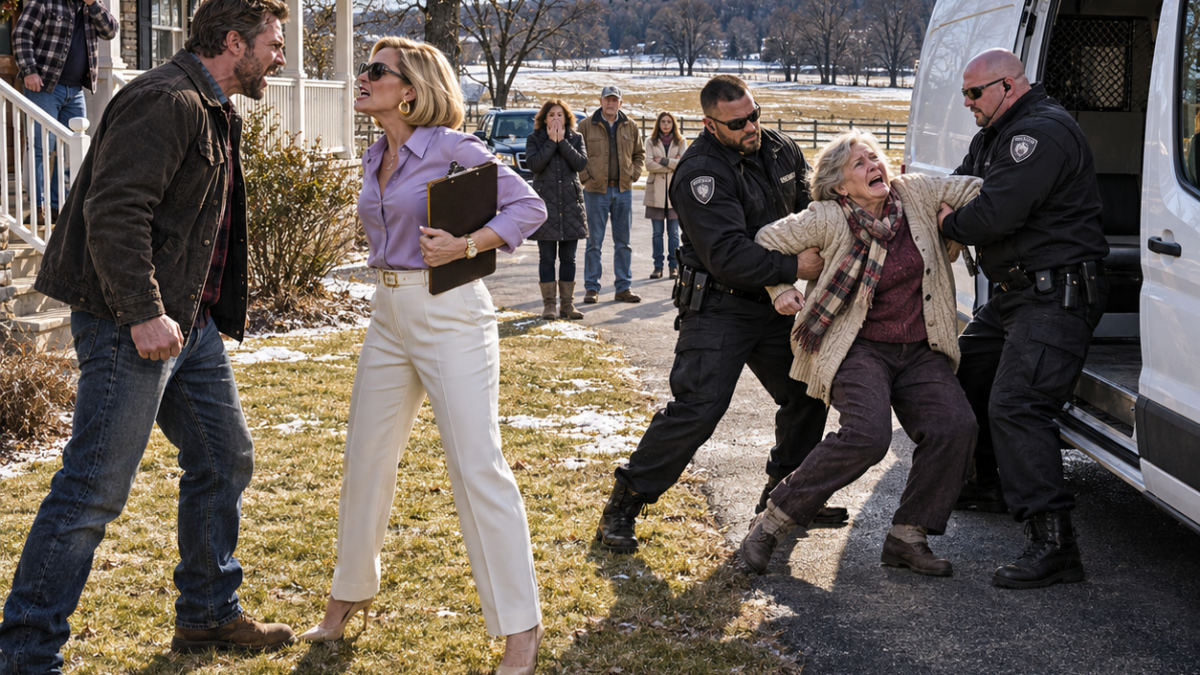
HOA Karen Constance Aldrich had two private guards drag my sixty-eight-year-old mother off her own lawn in broad daylight because Mom refused to sell twelve acres the HOA wanted for a new development. She had spent months building a paper trail designed to make my mother look confused, unstable, and incapable of managing her own affairs, and that afternoon she finally decided the paperwork was strong enough to turn into force. What Constance did not know was that my mother had left one phone call open in her cardigan pocket, and five minutes after the van started moving, every lie Constance had written was racing toward a roadblock with me.
“Wait. Please let me go. I don’t belong here.”
My mother’s voice came through my phone so softly that, for one terrible second, I thought I was hearing a recording.
Then a man answered her.
“Ma’am, this is for your own good.”
There was a scraping sound, a car door slamming, fabric shifting against the microphone.
My hand went cold around the phone.
“Mom?”
No answer.
“Mom, can you hear me?”
Nothing.
Then her voice again, farther away.
“Let go of my arm. I am not sick.”
I was sitting in my government SUV at a gas station off Interstate 84, halfway through a paper cup of coffee I had forgotten to drink. I had just finished a prisoner-transfer coordination call and was supposed to meet my team twenty miles east.
Instead, I heard my mother being taken.
My name is Nathan Pierce. I had spent eighteen years with the U.S. Marshals Service tracking fugitives, serving high-risk warrants, protecting witnesses, and walking into places where everybody else had already decided running was a better idea than staying.
I had heard people lie under pressure.
I had heard suspects bargain.
I had heard terrified witnesses whisper because they were afraid somebody in the next room might hear them breathing.
But nothing in those eighteen years prepared me for hearing my sixty-eight-year-old mother try to stay calm while strangers forced her into a vehicle.
“Mom,” I said again. “Don’t hang up.”
She didn’t answer.
She didn’t need to.
I knew exactly what she had done.
Years earlier, after my father died, I had shown her how to share her location with me. I told her it was for emergencies. She laughed and said the only emergency I would ever discover was that she had gone to the grocery store without telling me.
Now the phone was still connected.
And the location dot was moving.
I opened the map.
A red marker traveled south along County Road 9.
Fast.
My chest tightened.
Willow Ridge had only one practical road out.
If the vehicle continued south, it would hit the state line in less than twenty minutes.
I called Carol Benton.
Carol lived across the street from Mom and had been her closest neighbor for almost fifteen years.
She answered immediately.
“Nathan?”
“What happened?”
Her breath hitched.
“They took her.”
“Who?”
“Two men. Security uniforms. White van. Ruth was screaming your name.”
“Did you see Constance?”
“No. But Nathan—”
“What?”
“My doorbell camera got everything.”
Every instinct I had sharpened.
“Send it to me. Right now. Don’t edit it. Don’t post it. Keep the original.”
“I will.”
“Stay on your porch. Don’t go anywhere near the HOA clubhouse.”
“What are you going to do?”
I was already turning the ignition.
“I’m going to get my mother back.”
I called my partner, Tony Branson.
He had worked beside me long enough to know that when my voice went flat, I was already past panic.
“Send me location,” he said.
“That’s it?”
“That’s enough.”
“This involves my mother.”
“I know.”
“Tony—”
“Nathan, send the location.”
I did.
Three minutes later, five black Suburbans were moving.
Not because I had ordered some private rescue operation for my family.
Because the facts were already dangerous enough.
A sixty-eight-year-old woman had been forced into a vehicle.
There was no known arrest warrant.
No known medical transport authorization.
No known court-appointed guardian.
The vehicle was moving toward a state line.
And private security had removed her from property she legally owned while she was audibly objecting.
If there was legitimate authority behind any of that, we would find it.
If there wasn’t, everybody involved had just made a catastrophic decision.
The live location kept moving.
I could still hear the call.
My mother asked one of the men, “Where are you taking me?”
A male voice replied, “Silver Birch Transitional Care.”
“I never agreed to go there.”
“You don’t have to agree.”
“Show me the judge’s order.”
Silence.
Then another man laughed.
“Ma’am, you wouldn’t understand it.”
My grip tightened around the steering wheel.
That voice belonged to Brock Haskell.
I knew the name.
Not personally.
But I had seen it on paperwork.
Haskell Protective Services had started appearing around Willow Ridge three months earlier, after Constance Aldrich became HOA president.
Private patrols.
Parking enforcement.
“Community wellness checks.”
None of those things gave Brock Haskell the authority to put his hands on my mother.
The location marker passed Willow Ridge’s southern entrance.
I called Tony.
“Two minutes.”
“We’re ahead of you.”
“How?”
“You taught me to leave earlier than necessary.”
Under different circumstances, I might have laughed.
Then the live call shifted.
My mother’s breathing changed.
The van slowed.
A man in the front said, “What the hell?”
Brakes squealed.
Through the phone, I heard Brock swear.
Then came another sound.
A sound I had heard thousands of times in my career.
Sirens.
Mom went silent.
The red location dot stopped.
I reached the curve thirty seconds later.
Five black Suburbans formed a wall across County Road 9.
Emergency lights washed blue and red across fresh snow.
The white van sat crooked in the lane.
Doors opened.
My team stepped out.
I pulled in behind them and walked toward the driver’s side.
Brock lowered the window.
He was a large man with a shaved head and the kind of confidence that comes from spending years dealing with people who assume a uniform means authority.
“Private security,” he said immediately. “We’re transporting a patient under court order.”
I stopped beside the door.
“Finish.”
He blinked.
“What?”
“Tell me everything you think gives you legal authority to hold the woman in that van.”
His jaw tightened.
“She’s been declared medically incompetent.”
“By whom?”
“We have paperwork.”
“Show me.”
He reached toward the dashboard.
I took out my badge.
“Supervisory Deputy United States Marshal Nathan Pierce.”
His face changed.
I looked through the windshield.
“The woman in your van is my mother.”
The confidence disappeared.
Behind me, Tony walked toward the sliding door.
Brock raised one hand.
“You can’t interfere with—”
Tony opened it.
My mother sat between two security men.
Small.
Shaking.
Back straight.
Glasses still on.
Her cardigan had been pulled crooked at the shoulder.
She looked at me.
“Nathan.”
That one word nearly broke me.
I climbed into the van.
“I’m here.”
“I knew you would hear me.”
I pulled her toward me.
Then I saw her wrist.
Red finger marks circled the skin.
One spot was already darkening.
I stopped feeling anything except cold.
I stepped out.
Tony looked at me.
I nodded once toward the guards.
“Cuff them.”
The first pair of handcuffs closed.
Then another.
Brock started talking fast.
“This is authorized. We were hired by the HOA. She has a court order.”
Tony picked up the paper from the dashboard.
He studied it.
Then his expression changed.
“Nathan.”
“What?”
“No raised seal.”
He looked closer.
“Case number format is wrong.”
Another pause.
“And this signature is dated Sunday.”
I looked at him.
He lowered his voice.
“This thing looks forged.”
At that exact moment, Brock’s phone began buzzing inside his jacket.
Tony removed it.
The screen showed one name.
CONSTANCE ALDRICH.
I stared at it.
Then I pressed speaker.
Her voice filled the road.
“Why isn’t she at Silver Birch yet? Bring her in now.”
Nobody spoke.
Constance continued.
“Once she’s admitted, Lowell can finish the filing Monday morning. Do not bring her back to that house.”
The line went silent.
I looked at Brock.
His face had gone gray.
And that was the moment I knew my mother had not been taken because someone thought she needed help.
She had been removed because somebody needed her out of the way.
part 2
My mother’s name is Ruth Pierce.
Before she became the woman HOA Karen Constance Aldrich decided was “confused,” she spent thirty-seven years working in public schools, most of them as a librarian.
Mom could remember which student had borrowed a book six months earlier without looking at the system.
She balanced her checking account to the penny.
She did her own taxes until I finally convinced her to let an accountant handle them.
She still beat me at Scrabble often enough that I stopped pretending I was tired when I lost.
She was not helpless.
She was not unstable.
She was not incapable of understanding her own property.
And she certainly was not a woman who needed two private guards to drag her into a van.
My father, Daniel Pierce, built their house in Willow Ridge thirty-one years earlier.
Back then there was no HOA.
No clubhouse.
No private security.
No stone monument at the entrance with WILLOW RIDGE carved into polished granite.
There were seven houses, an unpaved road, and more woods than people.
Dad bought twenty acres.
The house sat on eight.
The remaining twelve stretched behind it toward a low ridge and a drainage corridor that eventually connected with undeveloped land east of the neighborhood.
He loved those acres.
Not because they were valuable.
Because he had built something there with his own hands.
Vegetable garden.
Tool shed.
Apple trees.
A narrow trail through the woods.
An old bench beneath a maple where he and Mom sat after dinner.
When Dad died, Mom refused to leave.
I offered.
More than once.
“Nathan, you live three hours away.”
“I can move you closer.”
“To what?”
“Me.”
She smiled.
“That’s sweet.”
“Mom.”
“My husband built this house.”
“I know.”
“I intend to keep living in it.”
That ended the argument.
For years, Willow Ridge respected her.
Then the neighborhood expanded.
More houses.
More rules.
Eventually an HOA formed for newer sections.
Mom’s original property was complicated because portions predated the association and retained older recorded rights.
That never mattered much until Constance became president.
Constance Aldrich was the kind of woman who turned every interaction into procedure.
She wore pastel suits.
Carried a leather binder.
Spoke softly until somebody disagreed with her.
Then the softness became a blade.
Three months before Mom was taken, Constance knocked on her door.
Mom called me afterward.
“She wants the back land.”
“What back land?”
“The twelve acres.”
“Why?”
“She says it’s important for neighborhood connectivity.”
I sat upright.
“What exactly did she ask you to sign?”
“Nothing yet.”
“Did she make an offer?”
“Yes.”
“How much?”
Mom told me.
It was not insulting.
That was what concerned me.
People do not offer serious money for land they consider unnecessary.
“What did you say?”
“No.”
“Good.”
“I didn’t need your permission.”
“I know.”
“You sound disappointed.”
“I’m proud.”
She laughed.
Then Constance came back.
Higher offer.
Mom said no again.
Then the pressure started.
First violation:
Mailbox finish inconsistent with community standard.
Mom’s mailbox had been there twenty-six years.
Second:
Hydrangeas extending beyond approved landscape profile.
Dad planted them.
Third:
Porch lighting incompatible with nighttime aesthetic guidelines.
One porch light.
Yellow bulb.
Then noise complaints about her garden equipment.
Then claims she failed to remove leaves quickly enough.
Some notices cited HOA rules that did not appear to apply to her original parcel at all.
I told Mom to send me everything.
She did.
I created a folder.
I wish I had recognized the pattern sooner.
Constance wasn’t trying to collect fines.
She was building a narrative.
Difficult homeowner.
Noncompliant.
Aging.
Uncooperative.
Then the language changed.
One violation letter referenced “repeated confusion regarding community standards.”
Another stated that Mom had “demonstrated possible cognitive misunderstanding of property obligations.”
I called the management company.
“Who wrote this?”
“The board.”
“Is the HOA diagnosing residents now?”
“No, sir.”
“Then remove medical language from correspondence.”
They promised to review it.
Constance called Mom the next day.
Mom later told me Constance had sounded concerned.
Not angry.
That worried me more.
“Ruth, people are worried about you.”
“Who?”
“Neighbors.”
“Which neighbors?”
“I can’t violate their privacy.”
“You can violate mine?”
Constance apparently ignored that.
She suggested a wellness evaluation.
Mom declined.
Then came Carol Benton.
Carol lived across the street.
Retired accountant.
Widowed.
The human equivalent of a neighborhood security camera even before she installed actual ones.
She called me.
“Nathan, you know what they’re saying?”
“What?”
“That Ruth’s forgetting things.”
“Mom forgets where she leaves her reading glasses.”
“So do I, and I’m not signing over my house.”
“What exactly did you hear?”
“Constance told two board members your mother may not be competent to manage land decisions.”
That sentence stayed with me.
I called Mom.
“Have you signed anything recently?”
“No.”
“Anybody asked about power of attorney?”
“No.”
“Guardianship?”
She paused.
“Nathan, don’t be ridiculous.”
“I’m not.”
Mom sighed.
“I am not losing my mind.”
“I know.”
“You sound like you’re evaluating me.”
“I’m evaluating everyone else.”
She laughed.
Then her voice softened.
“I’m fine.”
I believed her.
Because she was.
But belief is not documentation.
That was my mistake.
I should have pushed harder then.
Medical evaluation.
Attorney review.
Formal challenge to HOA harassment.
Instead, I treated Constance like an aggressive neighborhood bureaucrat.
I underestimated her.
That changed on County Road 9.
Sheriff Walt Dempsey arrived minutes after we stopped the van.
Walt had known my parents for twenty years.
He walked straight toward Mom.
“Ruth?”
“I’m all right.”
He saw her wrist.
His jaw changed.
“Who did that?”
Mom looked toward Brock.
“He grabbed me when I held onto the porch railing.”
Walt turned away before answering.
That was probably wise.
The second guard was named Kyle Mercer.
Young.
Maybe twenty-seven.
He had been sitting beside Mom in the van.
Unlike Brock, he looked terrified.
FBI Special Agent Dana Whitlow arrived because the route and apparent destination created possible interstate implications, and because Tony had escalated the forged court document the moment he saw it.
Dana sat beside Kyle on the curb.
“You have one opportunity to start helping yourself,” she told him.
He began talking almost immediately.
“Mrs. Aldrich hired us.”
“For what?”
“Transport.”
“Under what authority?”
“She said the paperwork was legal.”
“Did you see a judge?”
“No.”
“Court clerk?”
“No.”
“Medical professional?”
“The doctor signed something.”
“What doctor?”
“Alan Strand.”
“Did he examine Ruth Pierce?”
Kyle looked at my mother.
Then down.
“No.”
Dana leaned closer.
“How do you know?”
“Because Mrs. Aldrich said he didn’t need to. She said they had records.”
“What records?”
“HOA complaints.”
I felt sick.
Violations about hydrangeas and porch lights had been converted into evidence of cognitive decline.
Dana continued.
“How much were you paid?”
“Five hundred each.”
“For transport?”
“Yes.”
“Where?”
“Silver Birch.”
“Which one?”
Kyle gave the location.
Dana looked at me.
Across the state line.
If the van had continued for another fifteen minutes, the situation would have become even more serious.
Mom sat inside Walt’s cruiser wrapped in a blanket.
I opened the door.
“You cold?”
“No.”
“Hurting?”
“My wrist.”
“Anywhere else?”
“My pride.”
I knelt beside her.
“Mom.”
“I told them no.”
“I know.”
“They came into the yard like I was dangerous.”
“I know.”
“Carol tried to help.”
“I know.”
She stared at me.
“I thought they were going to make everybody believe I was crazy.”
That sentence hurt more than the bruises.
I took her hand.
“They’re not.”
“You can’t promise that.”
“Yes, I can.”
She looked at me.
“Because this time they left a trail.”
We searched the van under proper authority.
The supposed court order.
Medical paperwork.
Admission documents for Silver Birch.
A prepared inventory form for Mom’s personal belongings.
A partially completed notice stating that Ruth Pierce had been placed under emergency protective supervision.
The time field had been left blank.
They were ready to fill it in after arrival.
Brock’s phone became evidence.
There were texts.
Constance:
Pick up at 2:30.
Do not argue on property.
Bring her directly to Silver Birch.
Lowell wants deed process started Monday.
Another message:
If Pierce’s son calls, tell him she was transported after medical review.
I read it twice.
My career had taught me not to confuse disturbing evidence with proof of every suspected offense.
But there was enough to move.
Walt looked at me.
“Where is Constance?”
“Clubhouse.”
“How do you know?”
“Because that’s where she always is when she thinks she’s winning.”
We did not storm the building like an action movie.
There were procedures.
Calls.
Jurisdiction.
Coordination.
But when we entered Willow Ridge, five black Suburbans and two sheriff’s vehicles attracted attention.
People came outside.
Carol stood on her porch.
She saw Mom in the passenger seat of my vehicle and started crying.
We stopped.
Mom got out.
Carol crossed the street.
They hugged.
Then Carol handed me her phone.
“Video.”
I sent the original to Dana through the evidence process.
Then I watched.
Brock and Kyle walking onto Mom’s lawn.
Mom standing near the hydrangeas.
Constance nowhere visible.
Brock showing paper.
Mom shaking her head.
Kyle taking her arm.
Mom pulling away.
Brock grabbing both wrists.
Mom shouting my name.
Carol yelling from across the street.
Brock and Kyle forcing Mom toward the van.
At one point, Mom grabbed the porch railing.
Brock pried her fingers loose.
I watched once.
That was enough.
When we reached the clubhouse, Constance was outside.
Red blazer.
Pearls.
Board members behind her.
Neighbors gathering on the lawn.
She saw Mom.
Then me.
“Nathan,” she said, as though we were arriving for a scheduled meeting. “I’m relieved your mother is safe.”
I stopped twenty feet away.
“You had two men drag her from her property.”
“She was transported under emergency authority.”
“Show me.”
Constance straightened.
“This is an HOA matter combined with medical necessity.”
“Show me the vote.”
Silence.
“Show me the minutes.”
Her expression tightened.
“The board acted under emergency provisions.”
“Show me the court filing.”
“We have counsel—”
“Show me the judge.”
Neighbors began whispering.
I didn’t raise my voice.
I had learned years earlier that questions become more powerful when the other person has to supply the noise.
Constance pointed toward Mom.
“She is not competent to make decisions involving property of this importance.”
Mom stepped forward.
“Excuse me?”
Constance ignored her.
“She has repeatedly failed to understand notices.”
I stared at Constance.
“You used HOA violation letters as evidence of incapacity?”
“That is an oversimplification.”
Carol walked onto the lawn.
“I have the video.”
Constance turned.
Carol held up her phone.
“You had them drag her.”
“I did no such thing.”
Carol played the recording.
Neighbors watched.
Two guards.
Mom.
The railing.
Her scream.
My name.
The crowd changed.
Until that moment, some people had probably believed this was another HOA dispute about land.
A deed.
An access route.
Money.
The video removed abstraction.
That was a grandmother being taken from her yard.
A woman beside me whispered, “Oh my God.”
Someone else said, “They told us she agreed.”
Constance’s face hardened.
“This video lacks context.”
Mom looked at her.
“What context makes dragging me into a van acceptable?”
Constance opened her mouth.
Nothing came.
A side door opened.
A man in a charcoal suit stepped outside.
Garrett Lowell.
Developer.
I recognized him from the proposal packets Mom had shown me.
He saw law enforcement.
Turned.
Started walking toward the parking lot.
Tony stepped into his path.
“Mr. Lowell?”
Garrett stopped.
“Yes?”
“We need to speak with you.”
“I have an appointment.”
“You can cancel it.”
Garrett glanced toward Constance.
That glance told Dana enough to notice.
Inside the clubhouse office, the first thing we saw was Constance’s binder.
Thick.
Tabbed.
Organized.
PROPERTY ACQUISITION.
RUTH PIERCE.
WELLNESS.
GUARDIANSHIP.
SILVER BIRCH.
I stared at those labels.
My mother had become a project.
Not a person.
A project.
Dana opened the Ruth Pierce section.
Purchase agreement.
Initial offer.
Revised offer.
Internal map showing Mom’s twelve acres as the only practical connection between Willow Ridge and Garrett Lowell’s proposed development.
Then another document.
A guardianship petition.
Petitioner:
Evan Aldrich.
Constance’s nephew.
The petition claimed Mom suffered progressive cognitive impairment and lacked the capacity to manage significant property decisions.
Supporting medical statement:
Dr. Alan Strand.
I looked at Dana.
“Mom never met him.”
Mom confirmed it.
Then we found the financial pages.
A consulting and acquisition agreement tied to the development.
If the land transferred and the expansion closed, a payment of $410,000 would flow through a consulting entity connected to Constance.
Garrett sat in a separate room answering questions.
His deal was no longer a neighborhood rumor.
It was paper.
Dana looked at me.
“We need financial records.”
“Get them.”
Brock’s phone rang again.
Constance’s earlier call log matched messages in the binder.
Then Kyle gave investigators one more piece.
“Dr. Strand signed Thursday.”
Dana asked, “Where?”
“At his clinic.”
“Did Mrs. Pierce attend?”
“No.”
“How did he evaluate her?”
Kyle looked miserable.
“He didn’t.”
The house Mom owned was one problem.
The twelve back acres were the reason.
Garrett’s development needed connectivity.
Without Mom’s land, the project required a much more expensive route.
Constance had tried money first.
Then pressure.
Then fines.
Then incapacity.
Then removal.
The pattern was suddenly visible from beginning to end.
Constance still insisted she had acted lawfully.
“You cannot arrest me for protecting a vulnerable resident.”
Dana looked at her.
“We are not arresting you for an HOA vote.”
Constance’s confidence flickered.
Dana continued.
“We are investigating a coordinated forced transport supported by apparently fraudulent legal and medical documents, tied to a property transaction.”
“I relied on professionals.”
“We’ll talk to them too.”
“I’m president of this community.”
Dana didn’t react.
“That is not immunity.”
The handcuffs closed around Constance’s wrists.
Her pearls moved when she inhaled.
Neighbors watched in silence.
Mom stood near me.
Constance looked directly at her.
“You don’t understand what you’ve cost this neighborhood.”
Mom answered before I could.
“No, Constance. You don’t understand what you tried to take.”
The next morning, investigators went to Dr. Alan Strand’s clinic.
He had signed an opinion stating Mom lacked decision-making capacity.
He had never examined her.
Never spoken with her.
Never reviewed her full medical history.
The materials he received consisted largely of selected HOA correspondence and a summary prepared through Constance’s side.
His legal problems became serious quickly.
So did his professional ones.
His license was suspended during the investigation process.
Garrett Lowell’s transaction records were subpoenaed.
Financial investigators traced communications with Constance.
The supposed $410,000 “consulting payment” became one of the central financial issues in the case.
The guardianship petition collapsed.
Evan Aldrich denied understanding what Constance intended.
His signature appeared on drafts.
Whether he understood enough to create criminal responsibility became a matter for prosecutors.
Mom hired Naomi Sharp.
Naomi was a property and elder-law attorney with the calmest courtroom voice I have ever heard.
The first time she met Mom, she asked one question.
“Mrs. Pierce, what do you want?”
Mom didn’t hesitate.
“My house.”
Naomi nodded.
“And?”
“My land.”
“And?”
“My name back.”
That last answer changed the case emotionally for me.
I had been focused on stopping Constance.
Mom was focused on something deeper.
For months, people had talked about her as if she were already disappearing.
Confused.
Unsafe.
Unfit.
Vulnerable.
A problem to be managed.
They were trying to take ownership of her identity before they took ownership of the land.
Naomi understood that.
She arranged a complete independent medical evaluation.
Not because Mom had anything to prove morally.
Because the legal record needed clean evidence.
Mom passed every cognitive assessment.
The evaluating physician found no basis for the incapacity claims.
Naomi filed aggressively to clear every guardianship-related entry.
She also challenged every HOA fine tied to the pressure campaign.
Some were outside HOA authority entirely.
Others had been selectively or procedurally enforced.
The pattern mattered.
Carol’s doorbell footage became critical.
So did Mom’s open phone call.
So did the location record.
So did the forged order.
So did Brock’s messages.
Nobody needed to exaggerate.
The truth was already ugly enough.
Constance initially pleaded not guilty.
Her attorney suggested she had relied on medical and legal professionals.
Then discovery expanded.
Emails.
Bank records.
Development communications.
The consulting agreement.
Draft guardianship papers.
Messages instructing security to move Mom before her son could interfere.
One message from Constance to Garrett was especially damaging.
Once Ruth is placed, Evan can execute under guardianship and we can clear the parcel issue before Pierce gets involved.
I read it in Naomi’s office.
Then I had to stand up and walk to the window.
My career had exposed me to people doing terrible things.
But seeing my mother’s life reduced to “the parcel issue” made me angrier than almost anything I had encountered professionally.
Naomi waited.
“You all right?”
“No.”
“Good.”
I looked at her.
She explained.
“Anger is appropriate. Just don’t let it choose your next move.”
That became the rule I followed.
Constance had used authority theatrically.
I would not.
Every action went through proper channels.
Every piece of evidence got preserved correctly.
Every accusation waited for proof.
That discipline mattered because Constance’s defense eventually tried to portray me as a federal officer using government power to settle a private family dispute.
The answer was the record.
I had not fabricated the location.
I had not created the doorbell footage.
I had not forged the court order.
I had not written the messages.
I had not signed the medical statement.
I had not created the $410,000 agreement.
My badge did not make those facts exist.
It simply meant I knew not to contaminate them.
Constance eventually changed her plea.
The evidence surrounding conspiracy, forged filings, and the forced transport left her with increasingly narrow options.
Garrett’s lawyers began negotiating separately.
Brock tried to minimize his role.
Kyle cooperated early and substantially.
Dr. Strand faced his own charges and professional proceedings.
The cases did not all resolve on the same day.
Real justice rarely arrives that neatly.
But the direction became clear.
Constance pleaded guilty to multiple felony offenses connected to the scheme.
Garrett admitted his role in the property conspiracy.
Brock was convicted on charges tied to the unlawful restraint and transport.
Dr. Strand’s false certification became part of a criminal case involving fraudulent documentation.
Kyle testified and received probation under a cooperation agreement.
The court imposed prison sentences on Constance, Brock, Garrett, and Strand, each according to the conduct proved against them and their respective agreements or convictions.
I attended Constance’s sentencing with Mom.
She wore a navy dress.
No pearls.
No red blazer.
The judge spoke for nearly twenty minutes.
He talked about abuse of authority.
He talked about property.
He talked about how guardianship and protective systems exist for people who genuinely need them and how manipulating those systems damages public trust far beyond one victim.
Then he looked at Constance.
“The most disturbing element is not simply that you wanted Mrs. Pierce’s land. It is that you attempted to convert disagreement into incapacity.”
Mom sat beside me.
Very still.
The judge continued.
“A competent adult said no. Rather than accept no, you tried to make her legally disappear.”
That sentence stayed with me.
Legally disappear.
That was exactly what they tried to do.
Not kill her.
Not physically erase her.
Something colder.
Make her signature invalid.
Make her choices irrelevant.
Make her home available for somebody else to manage.
Make the person disappear while leaving the body alive.
After the sentencing, reporters crowded the courthouse steps.
Mom hated cameras.
She had spent most of her career helping children find books, not microphones.
One reporter asked, “Mrs. Pierce, how do you feel now that the case is over?”
Mom smiled.
“Like a librarian who finally got to close a very long book.”
The quote appeared everywhere.
She pretended to be annoyed.
Secretly, she loved it.
The development deal died.
Without Mom’s twelve acres, Garrett’s original connection plan no longer worked economically.
Other investors backed away after the criminal case.
The property remained Mom’s.
Naomi added additional protections to her estate planning.
Nobody could ever again pretend a nephew, HOA officer, or self-appointed guardian had authority over the land without passing through an obvious legal wall.
Mom also executed updated powers of attorney naming me and an independent backup.
Her choice.
Her terms.
That distinction mattered.
Willow Ridge underwent its own reckoning.
Several board members resigned.
Some had known Constance was pressuring Mom.
None admitted knowing she intended the forced removal.
An independent review found that too much decision-making had been concentrated in the president’s office.
New elections were held.
Carol Benton ran reluctantly.
Mom nominated her anyway.
Carol became president.
The woman who had stood across the street screaming while two guards dragged Mom away now sat at the head of the board table.
Her first meeting lasted four hours.
People complained.
She told them democracy was inconvenient.
I liked her immediately more than I already had.
The bylaws were rewritten.
The HOA could not initiate or participate in any “wellness,” competency, guardianship, or protective process concerning a resident except through lawful public agencies and only in genuine emergencies requiring immediate contact with appropriate authorities.
No HOA employee or contractor could transport a resident without explicit consent or valid lawful authority.
Property negotiations involving board officers required conflict disclosures.
Major development agreements required homeowner review.
Private security authority was narrowed and clearly defined.
No more pretending a vest meant police power.
No more medical language in violation notices.
No more converting landscaping disputes into psychological evidence.
Those rules should never have been necessary.
Now they were written.
The fines against Mom disappeared.
Every one.
Her mailbox remained.
Her porch light remained.
The hydrangeas remained.
That became almost funny.
The plants Constance had cited as noncompliant exploded into bloom the following summer.
Purple and blue across the front walk.
Carol proposed putting a plaque beside them.
Mom threatened to resign from the neighborhood.
They compromised.
At the Willow Ridge entrance, beneath the new community sign, residents planted hydrangeas instead.
No plaque.
Everybody knew why.
The first time Mom saw them, she stopped the car.
“Oh, for heaven’s sake.”
“You hate them?”
“I hate being turned into a symbol.”
“You were a librarian. You should appreciate symbolism.”
She gave me a look.
“I raised you better.”
“No, you didn’t.”
She laughed.
That sound was the real ending for me.
Not handcuffs.
Not guilty pleas.
Not prison sentences.
My mother laughing again in the neighborhood that had tried to convince everyone she couldn’t think for herself.
Months after the case ended, she asked me to help clean Dad’s tool shed.
We found things neither of us remembered.
Rusty clamps.
An ancient extension cord.
Three jars of screws Dad had apparently intended to organize sometime before retirement.
Mom sat on a stool while I sorted tools.
“You almost made me move,” she said.
I stopped.
“What?”
“After your father died.”
“I suggested it.”
“You pushed.”
“I was worried.”
She looked at me.
“There’s a difference between worrying about someone and deciding for them.”
The sentence landed harder than she intended.
Maybe she did intend it.
“I know.”
“Do you?”
I sat across from her.
“More now.”
She nodded.
“That’s the part I hated most.”
“The van?”
“No.”
I waited.
“Everybody talking around me.”
Her eyes moved toward the window.
“Constance. The guards. The doctor. Even some neighbors. They talked about what was best for Ruth as if Ruth had already left the room.”
I didn’t know what to say.
Mom continued.
“Getting old doesn’t mean becoming a child.”
“I know.”
“Not everybody does.”
I reached for her hand.
She squeezed mine.
“Nathan, promise me something.”
“What?”
“If there ever comes a day when I really am confused, don’t pretend otherwise just because you love me.”
My throat tightened.
“Okay.”
“And don’t decide everything without me just because it’s easier.”
“I won’t.”
“Good.”
Then she pointed toward a box.
“Now throw out those extension cords before your father comes back to complain.”
That conversation changed how I understood the entire case.
For months, I thought the crime was about land.
Twelve acres.
Development access.
Money.
Kickbacks.
Those things mattered.
But at its center was consent.
Mom said no.
Constance decided no was a problem to eliminate.
Everything else followed.
The fines.
The rumors.
The medical statement.
The guardianship petition.
The van.
If Constance had accepted one competent woman’s right to say no, none of it would have happened.
Power becomes dangerous when it treats refusal as evidence that the person refusing must be incapable of understanding what is good for them.
I had seen versions of that in my career.
Constance gave it a suburban address and a leather binder.
The white van was eventually sold as part of Haskell Protective Services’ collapse.
I only know because Tony sent me the auction listing.
Subject line:
Need a family car?
I called him.
“You’re a terrible person.”
“You love me.”
“No.”
“Your mother likes me.”
“She has questionable judgment.”
“You may want to document that before the HOA hears.”
I laughed.
I hadn’t realized how long it had been since jokes about Willow Ridge felt possible.
Tony stayed close to Mom afterward.
So did Dana.
Walt checked in more often than necessary.
Carol essentially became family.
People sometimes assume traumatic events make communities permanently suspicious.
Sometimes the opposite happens.
Once people see how silence helped something terrible grow, they become louder for each other.
Willow Ridge changed.
Neighbors started attending meetings.
Not everybody.
This was still America.
But enough.
Board minutes actually got read.
Major votes drew questions.
Security contractors answered to written scopes.
The new board published contracts.
When someone proposed an expansion years later, Carol made sure the landowners involved were invited before a single rendering reached residents.
Mom attended that meeting.
She sat in the back knitting.
At one point, a consultant used the phrase “available corridor.”
Mom raised her hand.
“Available according to whom?”
The consultant corrected himself.
I nearly applauded.
Mom’s twelve acres remain undeveloped.
Mostly.
She eventually granted a narrow conservation easement along the drainage area and allowed a public walking path near one edge under an agreement Naomi drafted carefully.
That was Mom’s decision.
Not mine.
Not the HOA’s.
She surprised me when she did it.
“I thought you wanted nobody touching the land.”
“I wanted nobody taking it.”
“That’s different.”
“Very.”
The walking path became popular.
Children use it.
People walk dogs.
Mom sometimes sits on Dad’s old bench and watches families pass at a distance.
Nobody calls her difficult anymore.
At least not where she can hear.
Constance’s house sold after her conviction.
The new owners tore out a formal hedge she had once cited other residents for failing to match.
Carol called that poetic justice.
Mom said plants were innocent and should not be dragged into legal symbolism.
The woman has standards.
I remained with the Marshals Service for several more years.
People at work knew the story.
Most respected the boundary between Nathan the deputy and Nathan the son.
A few did not.
One new deputy asked what it felt like arriving with five Suburbans to save my mother.
I corrected him.
“I didn’t save her because I had Suburbans.”
He looked confused.
“Carol had a camera. Mom kept the call open. Tony moved fast. Kyle talked. Dana followed evidence. Walt protected the scene. Naomi cleaned up the legal damage.”
I paused.
“My badge didn’t save her.”
“What did?”
“She did.”
He looked more confused.
“She kept the phone open.”
That decision was pure Ruth Pierce.
Calm under pressure.
No dramatic scream for help after she realized screaming alone wouldn’t work.
She created evidence.
She knew her son would listen.
I asked her later why she didn’t hide the phone better.
“I did.”
“In your cardigan pocket?”
“Yes.”
“They could have found it.”
“They didn’t.”
“What if they had?”
She shrugged.
“Then I would have thought of something else.”
That is my mother.
Constance looked at sixty-eight and saw vulnerability.
She should have looked closer.
A year after the kidnapping, Mom hosted Christmas dinner.
Her house was packed.
Carol.
Tony.
Walt.
Dana stopped by briefly.
Naomi brought wine.
The hydrangeas outside were dormant beneath snow.
Dad’s old photographs still covered the hallway.
Nothing about the house looked conquered.
After dinner, Mom stood in the kitchen washing plates.
I took the towel.
“Sit down.”
“I am capable of washing dishes.”
“I know.”
“Then stop trying to institutionalize me.”
The kitchen went silent.
Then Mom started laughing.
Tony nearly choked.
Carol slapped the counter.
I stared at Mom.
“That is not funny.”
“It is extremely funny.”
“You were kidnapped.”
“Exactly. I earned the joke.”
I gave up.
Later, when everyone left, Mom and I sat on the porch swing with tea.
The back acres stretched into darkness.
Snow reflected faint light from the house.
For years, Dad and Mom had sat there together.
I remembered him teaching me to drive on the gravel lane.
I remembered Mom calling me in for dinner when I stayed outside too long.
I remembered leaving home, joining the service, building a life that always felt separate from Willow Ridge until one phone call made every mile between us disappear.
Mom rocked the swing gently.
“You know what your father would’ve done?”
“What?”
“Something stupid.”
I laughed.
“Probably.”
“He would’ve chased the van in his truck.”
“He would’ve lost a transmission.”
“He already lost two.”
We sat quietly.
Then Mom said, “I was scared.”
That was the first time she admitted it plainly.
I looked at her.
“In the van?”
“Yes.”
She wrapped both hands around the tea.
“I knew the paper was wrong. I knew Constance had no right. But for a moment I thought maybe none of that mattered because they were physically stronger and everybody on the street was just watching.”
My chest tightened.
“They didn’t know what to do.”
“I know.”
“That doesn’t make it right.”
“No.”
She looked toward Carol’s house.
“Carol did.”
“She did.”
“That’s why you need neighbors.”
I smiled.
“That sounds suspiciously like HOA propaganda.”
Mom elbowed me.
“You know what I mean.”
I did.
Power survives isolation.
Constance spent months separating Mom from credibility.
She told the board Mom was confused.
Told neighbors she was unstable.
Told security she was a patient.
Told a doctor what conclusion she needed.
Told a developer the land problem would soon disappear.
Every lie pushed Mom farther outside the circle of people whose voice counted.
Then Carol recorded the truth.
One camera reconnected my mother to everyone watching.
The open phone call connected her to me.
Kyle’s testimony connected the guards to Constance.
The binder connected Constance to Garrett.
The money connected motive to action.
The forged medical statement connected Dr. Strand.
Justice arrived because separate facts became a chain.
That is how most real cases work.
No single dramatic clue.
No genius speech.
Pieces.
Time stamps.
Calls.
Signatures.
Payments.
Videos.
The more Constance tried to control the narrative, the more records she created.
By the end, her own binder became one of the strongest witnesses against her.
I kept a copy of the first violation notice Mom received.
Mailbox finish.
I framed it.
Mom hated that too.
“You’re turning my house into a museum.”
“It’s evidence.”
“The case is over.”
“Historical evidence.”
“You were always dramatic.”
“I became a federal officer. What did you expect?”
She shook her head.
The mailbox still stands.
Same finish.
No one cares.
That may be the funniest part.
Constance nearly destroyed several lives over twelve acres and a development route, but she began by pretending a mailbox was the problem.
That is how abuse of authority often announces itself.
Not with something enormous.
With something petty enough that everyone feels foolish objecting.
Twenty-five dollars.
A warning letter.
A landscaping note.
A wellness suggestion.
A concerned conversation.
A private patrol.
One piece at a time, the extraordinary becomes ordinary.
Until two guards are dragging an elderly woman into a van and somebody is still calling it procedure.
That is why I stopped laughing at small abuses after Willow Ridge.
Not because every bad HOA letter leads to kidnapping.
Of course not.
Because unchecked authority learns from what people tolerate.
Constance learned that neighbors ignored minor overreach.
Then she escalated.
The answer is not paranoia.
It is documentation.
Ask questions.
Read the rule.
Keep the email.
Attend the meeting.
Request the minutes.
Know where private authority ends.
And when somebody starts using medical or legal language to silence a competent person who keeps saying no, take it seriously.
Mom’s garden became beautiful again after the case.
Not because it had changed.
Because she enjoyed it again.
For months, every time she saw someone slow near the house, she wondered whether they were watching her.
That took time to fade.
Trauma doesn’t disappear when a judge signs something.
The first time a white delivery van stopped outside after the kidnapping, Mom called me.
She sounded embarrassed.
“It’s just a package.”
“You okay?”
“Yes.”
“You don’t have to be embarrassed.”
“I’m not.”
“Mom.”
“Fine. A little.”
I stayed on the phone until it left.
Six months later, she stopped calling.
That was progress.
She also stopped keeping her curtains closed.
That was bigger.
One spring morning, I found her outside pruning the hydrangeas.
“Need help?”
“No.”
“You sure?”
“Nathan.”
“Right.”
I sat on the porch.
She worked.
Blue blossoms surrounded her.
For the first time, I understood why Dad planted them.
They made the old house look alive.
Constance saw them as a violation because she was looking for leverage.
Mom saw them as something her husband had chosen.
Two people can look at the same object and see completely different things.
Law exists to keep one person’s preference from becoming another person’s loss without authority.
That principle sounds dry until somebody ignores it.
The final development plan that replaced Garrett Lowell’s proposal went somewhere else.
Different route.
Different landowners.
Proper agreements.
Nobody had to be declared incompetent.
Nobody was kidnapped.
Apparently development can occur even when competent adults retain the right to say no.
Imagine that.
Willow Ridge’s new board became almost aggressively boring.
Carol considered that success.
Budgets.
Drainage.
Pool hours.
Snow removal.
Tree trimming.
No secret guardianships.
No private medical judgments.
At one annual meeting, someone complained that meetings had become dull.
Carol replied, “Good governance should bore you.”
Mom whispered, “Put that on the gate.”
They almost did.
Instead, the gate received a new sign with the neighborhood name and a row of hydrangeas beneath it.
Every time I drive through Willow Ridge, I think about the day that entrance became a roadblock.
Five Suburbans.
White van.
Sirens.
Brock’s face when I showed my badge.
People like that moment because it sounds cinematic.
The powerful son arrives.
The guards panic.
The mother is saved.
But the most important moment happened earlier.
Quietly.
Inside the van.
My mother slipping her phone into her cardigan.
Keeping the line open.
Refusing to let Constance control the only version of events anyone would hear.
That was the real beginning of the end.
Years later, Mom still lives in the house Dad built.
She is slower now.
So am I.
The porch swing creaks more.
Carol’s hair is completely gray.
Tony claims his knees can predict rain.
Willow Ridge has newer houses and younger families.
Most of them know the story only in pieces.
That is fine.
Mom never wanted to become neighborhood mythology.
She wanted her dignity.
She kept it.
Sometimes she walks the back twelve acres with a cane.
I go with her when I can.
Not because she needs supervision.
Because I like being there.
We stop at Dad’s bench.
She talks about him.
Once, she looked across the field and said, “Constance was right about one thing.”
I almost choked.
“What?”
“This land is valuable.”
“I know.”
“She thought the value was where a road could go.”
“What do you think it is?”
Mom looked toward the house.
“The fact that I get to decide.”
That was the whole case in one sentence.
Ownership is not simply having a name on a deed.
Liberty is not simply being physically free.
Dignity is having your no mean no while you are competent to say it.
Constance tried to take all three.
Land.
Freedom.
Voice.
She failed.
Not because I was a marshal.
Not because my team arrived in black vehicles.
Not because federal authority is stronger than HOA authority.
She failed because her scheme depended on everyone accepting her version before checking the facts.
Mom didn’t.
Carol didn’t.
Kyle eventually didn’t.
Dana didn’t.
Naomi didn’t.
The judge didn’t.
And once enough people stopped accepting the story, Constance’s power evaporated.
That is what I learned.
Abusive power rarely looks powerful once it has to explain itself line by line.
Who authorized the transport?
Where is the order?
Who signed it?
Who examined the patient?
Who benefits from the deed?
Where did the money go?
Why was the destination across the state line?
Why was the homeowner saying no?
Every question stripped away one layer.
By the end, the HOA presidency Constance had treated like a crown meant nothing.
Just a title on a past board roster.
Mom’s name remained on the deed.
That mattered.
Her medical record remained her own.
That mattered.
Her front door still opened onto the same porch.
Her hydrangeas still grew.
Her phone still sits beside her tea every evening.
Sometimes I call.
She answers.
“Are you checking whether I’ve been kidnapped?”
“Yes.”
“Very professional.”
“I try.”
“You know I’m capable of calling you myself.”
“I know.”
“Then stop hovering.”
“No.”
She sighs.
Then we talk anyway.
That is my favorite ending.
Not prison.
Not handcuffs.
Not headlines.
A phone call where my mother gets to choose whether she answers.
A home where nobody can remove her because she refused to sell.
A neighborhood where rules finally have boundaries.
And twelve acres behind the house where my father’s trees still stand because Ruth Pierce said no and, this time, the world was forced to listen.








