𝗣𝗔𝗥𝗧 𝟮 HOA Karen Had My $150,000 Excavator Towed Off My Own Land—Then the Sheriff Read Her Signature Out Loud
𝗣𝗔𝗥𝗧 𝟮
The twelve-point-four acres Karen called “community land” had belonged to my family since my grandfather bought them in 1958.
Back then, Quarry Bend Road was mostly gravel.
There were fields, a creek that flooded every spring, and little else.
Hawthorne Bend Estates did not exist.
The subdivision came almost forty years later.
Beginning in 1996, developers built 188 homes around us.
Not beside us.
Around us.
My grandfather refused to sell.
The developer made several offers.
Granddad rejected every one.
So Hawthorne Bend grew around our parcel, leaving our acreage in the middle like a thumbprint somebody could not wipe from the glass.
Our gravel driveway ran east to Quarry Bend Road.
That driveway would eventually become more important than my excavator.
At the time, though, it was simply how we got home.
I ran Kingsbury Excavating from the property.
Two dump trucks.
A skid steer.
Trailers.
And the Caterpillar 320 my father bought in 2019.
It had been the last big purchase he ever made.
Dad treated tools differently from most people.
Everything he owned had his initials stamped somewhere on it.
DK.
He used a punch and hammer.
Wrenches.
Toolboxes.
Trailer frames.
The excavator.
Two little letters punched into steel.
He died three years after buying it.
Cancer.
Fast at the end.
When the estate was settled, I kept the machine.
Partly because I needed it.
Partly because it was his.
There was still a footing plan clipped behind the seat in the cab.
Dad had drawn it himself.
Thirty by sixty feet.
Shop building.
Doors on the east.
Measurements written in block capitals.
He had always intended to build it.
After he died, I decided I would.
The week Karen took the excavator, I had begun digging the footing.
But sentiment was not what made that machine vital.
I had an $86,000 site-preparation contract with Cobb Valley Storage.
The contract contained liquidated damages.
Twelve hundred dollars per day if I missed the completion deadline.
That Caterpillar was my production capacity.
Without it, I could not grade.
Could not trench.
Could not load efficiently.
Could not fulfill the Cobb Valley schedule.
Without the excavator, Kingsbury Excavating was basically a man with two trucks and promises he could not keep.
Karen Norbury became president of the Hawthorne Bend HOA fourteen months before the tow.
Before that, I had spoken to her twice.
Both conversations lasted maybe thirty seconds.
Then the letters began.
The first came in a white windowed envelope.
HAWTHORNE BEND ESTATES HOMEOWNERS ASSOCIATION.
It listed three violations.
Heavy equipment stored in open view.
Unapproved earthwork.
Failure to obtain architectural committee approval.
I read it twice.
Then I checked the address.
Mine.
I laughed.
I had never joined Hawthorne Bend.
Never paid dues.
Never voted.
Never attended a meeting.
My property was separately platted and separately taxed.
So I assumed somebody had made a clerical mistake.
I copied my deed.
Wrote a polite note.
My parcel is not included within Hawthorne Bend Estates and is not subject to the association’s covenants.
I mailed it back.
Nothing happened.
Six weeks later, another notice arrived.
Same violations.
New date.
Now there were fines attached.
I sent the deed again.
Certified mail.
Somebody signed for it.
Still no response.
That silence should have worried me more.
I assumed bureaucracy.
What it really meant was that Karen had already decided my deed didn’t matter.
The first person who told me what was actually happening was Dolores Ashbury.
Dolores had lived in Hawthorne Bend since the subdivision opened and knew everything that happened there, including things nobody had officially said yet.
She caught me at the end of my driveway one evening.
“You know what Karen wants, don’t you?”
I was loading chains into my truck.
“To complain about my equipment?”
Dolores shook her head.
“She wants your road.”
“My road?”
“Your driveway.”
Hawthorne Bend had one entrance.
One road in.
One road out.
Every year, according to Dolores, the fire marshal noted the lack of secondary emergency access.
The board had been discussing an east entrance.
Brick columns.
Monument sign.
Landscape lighting.
A second gate onto Quarry Bend Road.
There was only one problem.
My land sat between their loop road and Quarry Bend.
Specifically, my driveway did.
“She’s got renderings,” Dolores said.
“Renderings?”
“Framed.”
I laughed.
That was the mistake.
The night before Karen towed my excavator, I shut the machine down at 6:30.
I remember exactly where I left it.
Sixty feet inside the east property boundary.
Tracks square to the trench.
Bucket down.
Two survey pins between it and the nearest HOA lot.
There was no reasonable argument that I had accidentally crossed onto association land.
The next morning, the lowboy arrived.
After they took the machine, I photographed the company name on the tow truck.
Duval Heavy Haul & Recovery.
I called at 8:15.
A man named Kurt Duval answered.
I told him who I was.
There was a pause.
Then his tone changed.
“Machine’s here.”
“Where?”
“Our yard.”
“Has anybody touched it?”
“Just unloaded.”
“What does it cost to get it back?”
Another pause.
“Recovery is forty-eight fifty.”
“Forty-eight hundred and fifty dollars?”
“Yes.”
“And storage?”
“Three-ten a day.”
I stared across the empty field where my excavator had been.
“Three hundred ten dollars a day?”
“Yes, sir.”
“To store my own excavator on your gravel?”
Kurt didn’t answer that.
“Who ordered the tow?”
“The association.”
“Which person?”
“You’ll need to take that up with them.”
“Karen Norbury?”
Silence.
“Kurt?”
“You need to speak to the association.”
That told me enough.
Heavy-equipment recovery does not happen casually.
A fifty-thousand-pound excavator does not disappear because somebody calls and says they dislike where it is parked.
There had to be authorization.
Paper.
A signature.
So I drove to the Renshaw County Sheriff’s Office.
“I need to report stolen equipment.”
The woman behind the desk listened for less than a minute.
“If it was towed, sir, that’s civil.”
“It was towed from my property.”
“Then you’ll probably need an attorney.”
“They do not own the land.”
“That would be part of the civil dispute.”
I stood there feeling something I had never really understood before.
You can be absolutely certain you are right and still have nobody willing to do anything about it.
Then, while turning back toward her computer, she said something almost casually.
“The towing company should have filed the removal report.”
I stopped.
“What report?”
“Nonconsensual equipment removals have to be reported to us.”
“Why?”
“So when somebody reports property missing, we know where it went.”
“Can I see it?”
She looked at me.
“It’s public.”
I paid the copy fee.
Waited eleven minutes.
When the sheet came out of the printer, it was still warm.
Year.
Make.
Model.
Serial number.
Removal location.
Tow company.
Then I reached the requesting-party section.
HAWTHORNE BEND ESTATES HOA.
Below that was a signature.
Karen Norbury.
I knew the handwriting.
I had been receiving it in my mailbox for a year.
Hard downstroke on the K.
Odd break near the middle.
Same hand.
I called her from the parking lot.
“I have the tow report.”
No reaction.
“Your signature is on it.”
“I’m aware.”
No hesitation.
No denial.
Nothing.
“The board has abatement authority over covenant property,” she said.
“My land is not covenant property.”
“Your deed identifies ownership. It does not determine every restriction affecting the property.”
“I’ve sent you that deed twice.”
“And I’ve told you the board has jurisdiction.”
“No. You haven’t told me anything. You just kept sending fines.”
Then Karen said the sentence that changed everything.
“I have recorded documentation that says otherwise.”
I stopped.
“Recorded where?”
“County records.”
“What document?”
“You’re welcome to look for yourself.”
Then she added, “Preferably before embarrassing yourself further.”
She hung up.
Recorded documentation.
That bothered me all night.
Karen had not said board policy.
She had not said covenant interpretation.
She had said recorded.
Meaning something filed with the county.
Something attached to the chain of title.
Something I had somehow never seen.
The next morning, I found something else.
Karen had closed my driveway.
Two steel posts had been driven into the gravel near Quarry Bend Road.
A horizontal pipe spanned between them.
A sign hung from the center.
PRIVATE—HAWTHORNE BEND ESTATES.
NO UNAUTHORIZED ACCESS.
I stood there looking at it.
Then at the field.
Then toward the empty spot where the excavator belonged.
Even if I paid Duval that afternoon, a lowboy could not get through.
Karen had removed the machine.
Then blocked the route necessary to return it.
That was when I called Cobb Valley Storage.
I told their project manager I was going to start late.
He sounded sympathetic.
But contracts do not become sentimental because your problem is unfair.
“Our completion date still stands, Kellen.”
“I understand.”
“And damages?”
“I know.”
Day one began.
Twelve hundred dollars.
I went home and read the tow report again.
Slowly.
This time, I noticed the small print above Karen’s signature.
Four lines.
Certification.
By signing below, the requesting party certifies that he or she is the owner of the real property from which the equipment was removed or an agent expressly authorized by that owner to order the removal.
I read it three times.
Then I looked at the field above.
PROPERTY IDENTIFICATION.
Karen had handwritten my parcel number.
12-084.
The exact number on my tax card.
The parcel my grandfather bought in 1958.
And beneath the statement certifying ownership or owner authority was her signature.
Karen Norbury.
I sat back.
Until then, I had thought Karen had abused an HOA rule.
That paper was something different.
She had represented, in writing, on a form filed with law enforcement, that she either owned my property or had authority from whoever did.
That was not a complaint.
It was a factual certification.
I gathered everything.
The 1958 deed.
Grandfather to Dad.
Dad to me.
Tax records.
No HOA assessment.
The 2019 survey.
Then I walked outside with a tape.
From the survey marker to the tracks where the excavator had been sitting:
Sixty feet.
I measured twice.
Sixty feet inside my boundary.
No mistake.
I took the documents to Corus Danby, a local real-estate attorney whose office sat above a hardware store.
Danby read the tow form before reading anything else.
That told me something.
“You understand what she signed here?”
“I think so.”
“This isn’t a complaint.”
He tapped the page.
“It’s a representation of ownership authority.”
“She says she has recorded documentation.”
Danby leaned back.
“That is the thing we need.”
“Could she actually have something?”
His pause scared me more than I wanted to admit.
“Possibly.”
“My family has owned this since 1958.”
“That doesn’t mean nothing has been recorded later.”
“So what do we do?”
“We find whatever she thinks gives her jurisdiction.”
I returned to the sheriff’s office.
This time Deputy Emmett Brackenridge met me in a side room.
He placed Karen’s certification beside my deed.
He stared at them.
“One of these is wrong.”
“My deed has been recorded since 1958.”
He pointed at the tow report.
“I’m more interested in why she confidently wrote your parcel number and signed this.”
“She says she has recorded paper.”
Brackenridge nodded.
“Then find it.”
“And if there isn’t any?”
His eyes lifted.
“Then this gets much more interesting.”
The recorder’s office opened at eight the next morning.
I arrived before the doors.
Juny Falconrath had worked there for twenty-two years.
She entered parcel 12-084 and printed the index.
Every recorded document affecting my property.
Deeds.
Easements.
Mortgage.
Mortgage satisfaction.
Survey.
Then, near the bottom, something I had never seen.
March 2021.
DECLARATION OF ANNEXATION—HAWTHORNE BEND ESTATES.
My stomach dropped.
“Pull that.”
Juny did.
Four pages.
County stamp.
Recorder number.
Indexed directly against parcel 12-084.
The language was simple.
My property had supposedly been annexed into Hawthorne Bend Estates and made subject to its covenants, conditions, and restrictions.
I read it twice.
Then a third time.
Suddenly, Karen’s letters made sense.
The fines.
The architecture complaints.
The excavator.
The driveway.
She wasn’t improvising.
There was a recorded document saying I belonged to her association.
Juny turned to the signature page.
At the bottom was a name.
Karen Norbury.
Under it:
Successor Declarant.
I didn’t yet understand what that meant.
But Karen did.
When I returned to the sheriff’s office, she had already beaten me there.
Not physically.
With paper.
Her attorney had sent the same annexation document accompanied by a legal letter explaining that parcel 12-084 had been annexed into Hawthorne Bend and was therefore subject to HOA enforcement.
Brackenridge met me in the lobby.
“I read it.”
“It’s wrong.”
“Maybe.”
“It is wrong.”
“Kellen, yesterday I had a woman claiming authority over land you said wasn’t hers. Today I’ve got a recorded instrument saying the HOA has jurisdiction.”
“She can’t just record something and make it true.”
“I agree.”
“Then do something.”
“That’s what courts decide.”
He handed my folder back.
“Bring me something that destroys that annexation.”
I stared at him.
“My excavator is sitting in a tow yard.”
“I know.”
“Storage is three hundred ten dollars a day.”
“I know.”
“And you’re telling me to wait?”
“I’m telling you what I can legally do.”
That afternoon, Dolores called.
She had attended an HOA meeting.
“She called you a squatter.”
I thought I misheard.
“What?”
“Unauthorized occupant of the east parcel.”
I looked around my own kitchen.
Granddad’s cabinets.
Dad’s coffee cup.
The land tax bill sitting on the counter.
“She said I’m a squatter?”
“Those words.”
Then Dolores told me something worse.
Karen had convinced the board to assess the recovery and storage costs against “my HOA account.”
They were preparing to place a lien on the property.
Every day my excavator sat at Duval’s yard, Karen was building more debt against my own land.
Two days later, a certified letter arrived from Duval.
NOTICE OF INTENT TO SELL ABANDONED EQUIPMENT.
Auction date:
April 22.
Ten days.
Unless all towing and storage costs were paid.
I stood beside the mailbox reading it twice.
Ten days until somebody could buy Dad’s excavator at auction.
I went inside and put the numbers on paper.
$4,850 towing.
$310 per day storage.
Nearly $2,900 HOA fines.
$1,200 per day contract damages.
And $86,000 of contracted work I could not begin.
I could afford the towing bill if I had my machine working.
I could not work because I could not afford to surrender to a tow I believed was illegal.
It was a perfect circle.
Bess found me at the kitchen table around two in the morning several nights later.
Tow report.
Annexation.
Auction notice.
All spread in front of me.
She stood behind me for a moment.
“You keep reading that one.”
She pointed at the tow form.
“Because Karen signed it.”
“And whenever you challenge it, what does she show everybody?”
I looked at the annexation.
Bess tapped it.
“This.”
I didn’t answer.
“She isn’t defending the tow, Kellen. She’s defending the paper that supposedly gave her the right to order it.”
That was when I finally understood the real fight.
The excavator wasn’t the foundation.
The annexation was.
If the annexation fell, everything built on it collapsed.
The violations.
The fines.
The lien.
The driveway barrier.
The towing authority.
All of it.
So I stopped asking how Karen had taken my excavator.
I started asking how she had gotten my land annexed.
Juny printed Hawthorne Bend’s original declaration from 1996.
Sixty-one pages.
I read them at night.
Definitions.
Assessments.
Voting rights.
Architectural rules.
Enforcement powers.
Nothing.
The next day, another warning appeared on my truck.
UNAUTHORIZED USE OF ASSOCIATION ACCESS IMPROVEMENTS—$200 PER OCCURRENCE.
Karen had started charging me to drive down my own driveway.
I kept reading.
On the third night, I reached Article 12.
ANNEXATION OF ADDITIONAL PROPERTY.
I read one sentence.
Then again.
Then aloud.
Only the declarant could annex additional property.
Not the president.
Not the HOA board.
Not the residents.
The declarant.
The original developer.
Then came the second condition.
The annexation authority expired twenty years after the declaration was recorded.
Plus twenty.
I stared at the number.
Karen’s annexation had been recorded in 2021.
Five years after the power expired.
I called Juny first thing.
“What happened to Hawthorne Bend Development Company?”
She checked the state corporate records.
Twenty minutes later, she called back.
“Administratively dissolved in 2014.”
I sat down.
The company entitled to annex property had stopped existing in 2014.
The annexation power would have expired in 2016 anyway.
But my land supposedly entered the HOA in 2021.
Which left one question.
Who signed for the dead company?
I went back to the recorder.
Juny pulled the annexation.
This time, I studied every attached page.
There it was.
An assignment.
One dollar consideration.
The document purported to transfer the original developer’s declarant rights to:
Karen Norbury.
Personally.
Executed on behalf of Hawthorne Bend Development Company by:
Karen Norbury, Authorized Representative.
I stood at the counter staring.
Karen had signed on behalf of a company that had been dissolved seven years earlier.
She had assigned its powers to herself for one dollar.
Then she had used those expired powers to annex my property into the HOA.
Then she used that annexation to tow my excavator.
I brought everything to Danby.
He read quietly.
Then removed his glasses.
“This is void.”
“Meaning?”
“Not potentially invalid.”
He pointed at the assignment.
“Void.”
He counted on his fingers.
“The developer dissolved in 2014.”
Another finger.
“The annexation authority expired in 2016.”
Another.
“The assignment occurred in 2021.”
Then he pointed at Karen’s signature.
“And unless she somehow had legal authority to act for a nonexistent corporation—which I doubt very much—this document has multiple independent fatal defects.”
“So I was never annexed?”
“Not by this.”
“What does that make the tow?”
Danby looked at me.
“Now you take it back to the sheriff.”
Before I did, I wanted one more thing.
Karen’s defense was obvious.
I relied on recorded documents.
I believed they were valid.
So I returned to Kurt Duval.
This time I made a written request for the dispatch recording from April 8.
He gave it to me.
Ninety seconds.
Karen’s voice.
Calm.
Professional.
She gave the address.
Machine description.
Tow instructions.
Then the dispatcher asked:
“Property owner has authorized removal?”
Karen replied:
“The sheriff’s office has cleared it. Just send the truck.”
I listened again.
The sheriff’s office had never cleared anything.
They had not known my excavator was gone until I walked through their front door.
Wesley Odum, the operator who had loaded the Caterpillar, also gave me a statement.
He wrote that he asked Karen twice whether the property owner knew about the removal.
According to him, she told him it was cleared and handed him signed authorization.
I built one folder.
My deed.
Tax card.
Survey.
Tow certification.
Recorded annexation.
Original 1996 declaration.
Article 12.
State dissolution record.
One-dollar assignment.
Dispatch audio transcript.
Odum’s statement.
I delivered it personally to the sheriff’s office.
The auction was days away.
Karen learned about the file almost immediately.
Her attorney responded.
Karen, he argued, had not acted personally.
She had acted as HOA president.
She relied on board authorization and advice of counsel.
Any mistake belonged to the association.
That defense worried me.
If it was true, Karen could disappear inside the board.
Then Bernardine Wickham called.
She had been a Hawthorne Bend director for six years.
“Kellen?”
“Yes?”
“There was no vote.”
I stood up.
“What?”
“I checked every set of minutes.”
“About towing the excavator?”
“Nothing.”
“You’re sure?”
“I type the minutes.”
Then she went quiet.
“What I did find is where Karen told us the county had ordered the equipment removed.”
“When?”
“October.”
“The county never ordered anything.”
“I know that now.”
Her voice cracked slightly.
“That’s what she told us.”
Another director, Anel Puit, confirmed the same thing the following morning.
No board authorization.
No vote.
No discussion.
Karen had presented enforcement actions as if they came from somewhere else.
County.
Legal counsel.
Board.
Depending on which audience she was speaking to.
Two days before the scheduled auction, the sheriff called.
His name was Dorsey Valentine.
His voice was low and economical.
“Mr. Kingsbury?”
“Yes, sir.”
“I’ve read your file.”
I didn’t say anything.
“I’ve also reviewed Duval’s records.”
A pause.
“I spoke with association counsel.”
My grip tightened around the phone.
“Ten o’clock Monday. My office.”
“Monday is the twenty-first.”
“Yes.”
“The auction is Tuesday.”
“I’m aware.”
Then he added:
“Mrs. Norbury will be there.”
Karen arrived four minutes before ten.
Association attorney behind her.
She sat at the conference table and aligned her folder precisely with the edge.
She gave me one look.
Not nervous.
Annoyed.
Like I had made her attend an unnecessary meeting.
Sheriff Valentine sat across from her.
Deputy Brackenridge stood near the door.
Valentine began with the tow authorization.
He slid it toward Karen.
“That your signature?”
She barely looked down.
“Yes.”
“Read the certification above it.”
Karen read.
“Owner of the real property or agent authorized by the owner.”
“And parcel 12-084?”
“My handwriting.”
Valentine nodded.
Karen almost smiled.
“I signed as the authorized representative of the association with jurisdiction over annexed property.”
Valentine placed the 2021 annexation beside the tow report.
“Because of this?”
“Yes.”
“Then let’s look at why you believe that document gave you authority.”
He laid the 1996 declaration on the table.
One paragraph circled.
“Article 12.”
Karen’s eyes shifted.
Valentine continued.
“The right to annex additional property belonged exclusively to the declarant.”
“That is a legal interpretation.”
“It also expired twenty years from 1996.”
He looked at her.
“2016.”
Karen said nothing.
“This annexation was recorded in March 2021.”
“That is something a court can interpret.”
“Maybe.”
Valentine placed another page on the table.
“Secretary of State records.”
Karen looked down.
“Hawthorne Bend Development Company dissolved in 2014.”
The attorney beside her shifted.
Then Valentine placed down the assignment.
“This document transfers declarant rights from the dissolved corporation to you personally for one dollar.”
He tapped the signature.
“Executed for the corporation…”
Then looked directly at her.
“…by you.”
Karen’s chin rose.
“Sheriff, I acted as association president pursuant to board authorization and based upon advice of counsel.”
It was smooth.
Prepared.
Valentine opened another folder.
“These are your board minutes.”
Her face changed slightly.
“No board resolution authorizing the excavator removal.”
He turned a page.
“No vote.”
Another.
“No discussion.”
He looked at her.
“What I do see is you telling the board that the county ordered the equipment removed.”
“That was a summary.”
Valentine turned to the association attorney.
“Did you advise Mrs. Norbury to tow the excavator?”
The attorney took his time.
Then said:
“No.”
Karen looked at him.
He continued.
“My firm advised the association on assessments and violation procedures. We were not consulted concerning removal of heavy equipment from Mr. Kingsbury’s parcel.”
The room became completely quiet.
Valentine reached for a recorder.
He pressed play.
Karen’s own voice filled the room.
“The sheriff’s office has cleared it. Just send the truck.”
Nobody moved.
The recording ended.
Valentine clicked it off.
“We didn’t clear anything.”
Karen stared at him.
“Nobody in my office knew that excavator had been moved until Mr. Kingsbury reported it.”
The attorney stopped looking at Karen entirely.
Valentine folded his hands.
“A civil dispute means two parties have at least arguably valid competing claims.”
He pointed at the annexation.
“This doesn’t appear to have authority behind it.”
Then the assignment.
“This comes from a corporation that no longer existed.”
Then the minutes.
“The board didn’t authorize the tow.”
Then the attorney.
“Counsel didn’t advise it.”
Then the recorder.
“And you told the tow company we cleared it when we didn’t.”
He paused.
“Take all that away.”
His eyes stayed on Karen.
“What remains is a hundred-fifty-thousand-dollar excavator removed from a man’s property by somebody who did not own the land and was not authorized by the owner.”
Nobody spoke.
Then Valentine turned to a clean sheet on his legal pad.
“This is what happens today.”
Karen sat rigid.
“You will call Duval Heavy Haul.”
She blinked.
“You will pay the towing and storage charges yourself.”
“Sheriff—”
“Not association funds.”
Karen’s mouth closed.
“You will have Mr. Kingsbury’s excavator delivered back to parcel 12-084.”
He continued.
“You will remove the barrier from his driveway so the trailer can access the property.”
Karen looked at her attorney.
He did not rescue her.
“By six this evening,” Valentine said.
“I would need board authorization.”
Valentine shook his head.
“The board didn’t sign the tow authorization.”
He pointed at her.
“You did.”
Karen went completely still.
“And if the machine is not back on his property by six, I’ll send this file to the county attorney with a recommendation for prosecution involving property valued over one hundred thousand dollars.”
He leaned back.
“I would rather not spend my afternoon doing that.”
I had rehearsed speeches.
Dozens.
In my truck.
In the shower.
At two in the morning.
I had imagined telling Karen what the excavator meant to me.
What Dad meant.
What she had done to my business.
What it felt like to stand on family land while somebody treated me like a trespasser.
I said none of it.
There was nothing left to say.
Karen pulled out her phone.
She dialed Duval.
When somebody answered, she said:
“This is Karen Norbury. I need to release and redeliver the excavator from the Kingsbury tow.”
She listened.
Then looked at Valentine.
“What number?”
The sheriff gave it to her.
She read her credit card aloud.
Digit by digit.
Her voice got quieter with each group.
When she finished, Valentine tore a page from his pad.
“Go home, Mr. Kingsbury.”
He handed it to me.
“Be there when your machine arrives.”
I drove home.
I parked beside the trench Dad had marked.
Then I waited.
At 5:48, I heard air brakes.
The same sound that woke me two weeks earlier.
Only this time, my excavator was coming home.
Karen had already removed the padlock from the driveway barrier.
Duval required the paying party to be present for redelivery.
So she stood beside her car at the end of my drive.
Arms crossed.
Wind pulling at her jacket.
Wesley Odum backed the lowboy into the field.
Dropped the ramps.
Removed the chains.
Then the Caterpillar rolled down onto my land.
Steel tracks meeting dirt.
The sound hit me harder than I expected.
Odum pointed.
“Close to where it was.”
I took out my tape.
Two feet north.
He shrugged.
“You want me to reposition it?”
“No.”
“I’ll do it.”
I climbed into the cab.
Diesel.
Dust.
Old vinyl.
Everything smelled exactly the way it should.
Dad’s footing drawing was still clipped behind the seat.
The corners had curled from humidity while the machine sat outside at Duval’s yard.
I touched the paper.
Then started the engine.
The Caterpillar came alive beneath me.
I tracked two feet south.
Swung the boom.
Set the bucket beside Dad’s stakes.
Exactly where it had been.
Karen signed the redelivery form on the hood of her car.
She never looked at me.
Never apologized.
Never said a word.
She got into her car and drove around Hawthorne Bend’s loop.
That was the last time Karen Norbury ever stood on my property.
The bill she paid was $8,880.
Towing.
Storage.
Redelivery.
She tried to have the HOA reimburse her.
The association’s insurer, Bellwood Casualty, refused.
Their reasoning was painfully simple.
An officer acting outside board authorization was not acting within covered association duties.
Karen was on her own.
And my damages had only started.
Danby pursued the financial losses.
Project delays.
Business interruption.
Legal fees.
Damage caused by removing the excavator.
Association fines.
Interference with my access.
The Cobb Valley exposure.
Karen’s attorney negotiated.
It did not take long.
By then, there was no serious argument left about what she had done.
The board called a special meeting during the final week of April.
I did not attend.
Dolores did.
So did Bernardine Wickham and Anel Puit.
Dolores called afterward.
“How’d it go?” I asked.
“She brought the binder.”
Of course she had.
“And?”
“Didn’t help.”
The other four directors voted unanimously to remove Karen as president.
Rather than remain on the board as a regular director, she resigned entirely.
The annexation died next.
Danby filed an action asking the court to declare both the 2021 annexation and the one-dollar assignment void.
Hawthorne Bend did not contest it.
There was nothing credible to defend.
The court entered the order.
Juny Falconrath recorded it against parcel 12-084.
Cross-indexed.
Permanent.
Anyone pulling my chain of title from that point forward would see exactly what happened.
The fake annexation.
And the court order voiding it from inception.
My twelve-point-four acres stood outside Hawthorne Bend on paper exactly the way they had stood outside it in reality since 1958.
Cobb Valley eventually extended my project deadline.
I think part of that came from sympathy.
Most of it came from the fact that once I had my machine back, I worked like somebody trying to outrun a fire.
Long days.
Saturdays.
Early mornings.
I finished the site work in June.
All $86,000 paid.
No liquidated damages assessed.
Then I went back to the project that mattered more.
Dad’s shop.
The footing Karen’s tow crew damaged.
I cleaned the trench.
Reset the stakes.
Checked his drawing.
Thirty feet by sixty.
Doors east.
Exactly the way he had written it.
We poured the footing on a Saturday in late May.
Bess brought coffee out around seven in the morning.
Concrete trucks came one after another.
By noon, the forms were full.
I watched the crew screed the final section.
Then I cleaned the excavator bucket.
There were two bright gouges on the boom where the tow chains had rubbed through the paint.
Right beside Dad’s initials.
DK.
At first, I intended to repaint them.
I bought matching paint.
It is still sitting unopened on a shelf.
I changed my mind.
Dad’s initials were made with a hammer and a steel punch.
Karen’s scratches were made by chains.
Both belonged to the machine’s history now.
Sometimes I sit in the cab after finishing a job and look at those marks.
I think about how close I came to losing it.
Ten days from auction.
Maybe less by the time I understood the real problem.
And I think about how easy it would have been to surrender early.
Pay the tow.
Pay the fines.
Accept the annexation because it carried a recorder’s stamp.
Sell something to cover the losses.
Let Karen tell everybody the paper proved she had been right.
That is the dangerous thing about official-looking documents.
People assume somebody checked them.
The recorder records.
The tow company sees the recorded document.
The sheriff sees the recorded document.
The HOA attorney sees the recorded document.
Everybody assumes authority exists somewhere behind it.
But sometimes there is nothing behind it.
Sometimes there is just somebody confident enough to sign.
Karen Norbury had convinced herself that a four-page annexation could create the world she wanted.
Once my parcel became HOA property on paper, everything else became easier.
She could fine me.
Control my equipment.
Block my driveway.
Build the second entrance Dolores had warned me about.
Maybe eventually force a sale.
I understood that much later.
At first, I believed this was about appearance standards.
Then I believed it was about the excavator.
It was never really about either.
Karen wanted control of the only direct strip connecting Hawthorne Bend’s east side to Quarry Bend Road.
My land stood in the way.
She did not buy it.
She did not negotiate for it.
She did not convince me.
She tried to make paperwork say she already had it.
That confidence nearly worked.
The first time I walked into the sheriff’s office, they called it civil.
The second time, it was a title dispute.
Both responses made sense based on the paperwork in front of them.
The thing that changed everything was not anger.
Not threats.
Not me standing in the lobby demanding justice.
It was evidence.
One document after another.
The deed.
The tax card.
The survey.
The original declaration.
The expired annexation authority.
The dissolved corporation.
Karen’s assignment to herself.
The tow certification.
The board minutes.
The dispatch recording.
By the time Sheriff Valentine sat across from her, he did not need my version of events.
That was the part I respected most.
He never asked me to make a speech.
He made Karen read her own signature.
The truth was already sitting in front of her.
Years later, Hawthorne Bend still has one main entrance.
The fire marshal still mentions secondary access.
They eventually approached me properly.
A different board.
Different president.
They asked about purchasing an emergency access easement over part of my east side.
We talked.
Surveyors came out.
Engineers looked at drainage.
A lawyer drafted actual terms.
They paid market value.
And the agreement says exactly what everybody owns.
Exactly what everybody may use.
Exactly what everybody may not use.
That is how land rights are supposed to work.
Nobody has to steal anything.
Nobody has to invent authority.
Nobody has to tow a man’s excavator at sunrise.
The shop Dad designed is finished now.
Thirty by sixty.
Doors facing east.
His drawing hangs inside in a cheap frame above the workbench.
The Caterpillar parks beside it.
Some mornings, sunlight hits those chain scars on the boom before anything else.
You can see DK between them.
I still put my thumb against those letters from time to time.
Not because I think Dad can feel it.
Because I can.
He taught me most of what I know about equipment.
Measure twice.
Grease what moves.
Never trust a hydraulic leak.
And if a machine suddenly sounds different, stop before you find out why the expensive way.
But there is another lesson I learned without him.
Read every line.
Especially the small print.
Karen thought her greatest advantage was that I had never read Hawthorne Bend’s covenants.
She was right about that.
I hadn’t.
Why would I?
I did not belong to Hawthorne Bend.
But she forced me to read them.
All sixty-one pages.
And buried in Article 12 was the sentence that ended everything she had built.
Her authority had expired five years before she ever tried to use it.
The corporation whose power she claimed had ceased to exist seven years before she signed its name.
Her board had never authorized the tow.
Her attorney had never approved it.
The sheriff had never cleared it.
In the end, every layer she hid behind disappeared.
The HOA.
The board.
The lawyer.
The county.
The recorded annexation.
Until there was only Karen Norbury.
Her signature.
And my excavator.
That is why I left the chain marks on the boom.
They remind me of the morning I stood in unlaced boots watching a woman send my father’s machine away because she believed possession of a clipboard was the same thing as ownership.
They remind me of the two weeks when I almost lost my business because somebody else had managed to put a lie into the public record.
But mostly they remind me of the afternoon the machine came home.
Air brakes on Quarry Bend Road.
Lowboy backing through my gate.
Steel tracks touching Kingsbury dirt again.
I climbed into the cab.
Dad’s drawing was still there.
His initials were still on the boom.
The engine started on the first turn.
And after everything Karen had done to make twelve-point-four acres look like hers, the excavator ended exactly where it had begun.
On my land.
Have you finished reading the story and want to read it again?
HOA Karen Had My $150,000 Excavator Towed Off My Own Land—Then the Sheriff Read Her Signature Out Loud
She stole the machine my father left me and called it “HOA enforcement.”
Then she built a paper trail that made it look completely legal.
What Karen didn’t realize was that one signature would eventually force her to pay to bring every fifty thousand pounds of it back.
My name is Kellen Kingsbury, and the morning Karen Norbury took my excavator, I woke to the sound of air brakes outside my house.
Anybody who works around heavy equipment knows that sound.
It is not subtle.
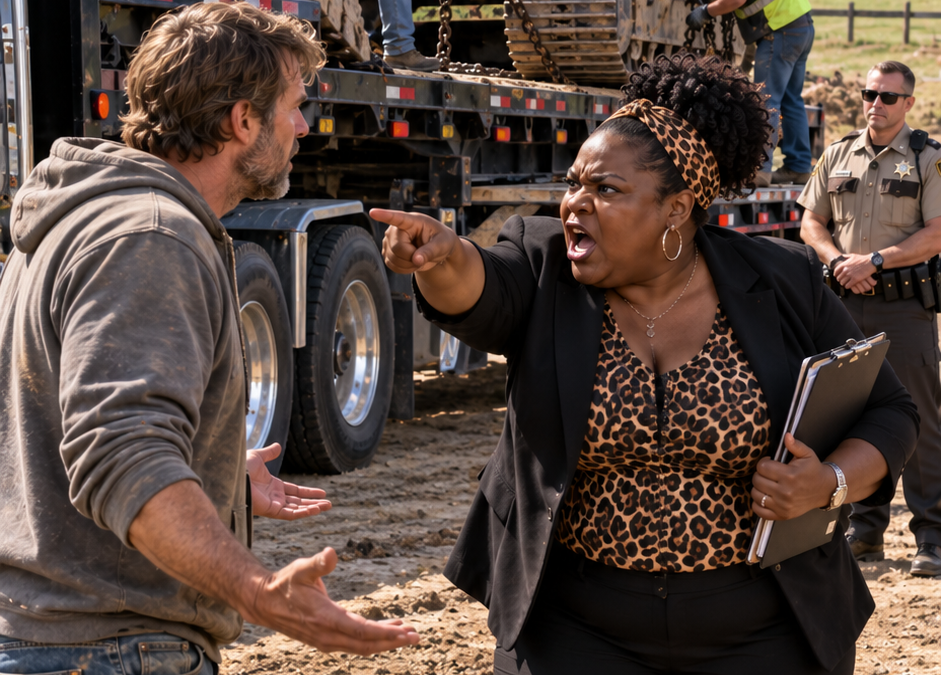
I came out of bed, shoved my feet into work boots without bothering to lace them, and ran across the field.
By the time I reached the east side of my property, a lowboy trailer was already backed into the field.
The ramps were down.
Two men were wrapping chains around my excavator.
And Karen Norbury was standing beside them with a clipboard.
“Stop!”
One of the operators looked toward me.
Karen lifted one hand.
Not toward him.
Toward me.
“Stay clear of the equipment.”
I stopped because for half a second I honestly believed I had heard her wrong.
“What?”
“You are not authorized to interfere.”
I looked at the Caterpillar 320 sitting sixty feet inside my property line.
Then at Karen.
“That is my machine.”
She tapped the clipboard against one of the hydraulic lines.
“Chain the boom.”
The operator hesitated.
Then lowered it.
The bucket dragged sideways through the footing trench I had spent two days excavating.
Soil collapsed into the cut.
One of the wooden stakes my father had set years earlier snapped beneath the bucket.
Karen watched the damage with the detached expression of somebody supervising garbage pickup.
“That footing is mine,” I said.
No reaction.
“That trench is mine.”
She finally looked at me.
“You are standing on my property.”
Her eyes went from my unlaced boots to my work shirt and back to my face.
“You parked construction equipment on community property.”
“Community property?”
“That is correct.”
I actually laughed.
Not because anything was funny.
Because sometimes your brain needs a second to catch up with what somebody is saying.
“This parcel has been in my family since 1958.”
Karen turned toward the trailer operator.
“Continue loading.”
I stepped forward.
She raised the clipboard.
“If you interfere with an authorized abatement, you will be responsible for the delay charge.”
“That machine is worth a hundred and fifty thousand dollars.”
Her expression didn’t change.
“Then you should have read the covenants before storing it here.”
“I’m not in your HOA.”
She had already turned away.
“Load it.”
The operator paused again.
Karen signed a sheet on her clipboard.
She tore it off.
Pressed it into his hand.
The man studied the paper.
Then he climbed into my excavator.
A minute later, my father’s machine crawled up somebody else’s trailer.
I stood in the dirt photographing everything I could.
Truck.
Trailer.
License plates.
Workers.
Karen.
The paper in her hand.
The tracks left by my excavator.
I watched the lowboy disappear toward Quarry Bend Road carrying the most important machine in my business.
At the time, I thought the worst thing Karen Norbury had done was tow my excavator.
I was wrong.
The most important thing she did that morning was sign her name.
PART2
The twelve-point-four acres Karen called “community land” had belonged to my family since my grandfather bought them in 1958.
Back then, Quarry Bend Road was mostly gravel.
There were fields, a creek that flooded every spring, and little else.
Hawthorne Bend Estates did not exist.
The subdivision came almost forty years later.
Beginning in 1996, developers built 188 homes around us.
Not beside us.
Around us.
My grandfather refused to sell.
The developer made several offers.
Granddad rejected every one.
So Hawthorne Bend grew around our parcel, leaving our acreage in the middle like a thumbprint somebody could not wipe from the glass.
Our gravel driveway ran east to Quarry Bend Road.
That driveway would eventually become more important than my excavator.
At the time, though, it was simply how we got home.
I ran Kingsbury Excavating from the property.
Two dump trucks.
A skid steer.
Trailers.
And the Caterpillar 320 my father bought in 2019.
It had been the last big purchase he ever made.
Dad treated tools differently from most people.
Everything he owned had his initials stamped somewhere on it.
DK.
He used a punch and hammer.
Wrenches.
Toolboxes.
Trailer frames.
The excavator.
Two little letters punched into steel.
He died three years after buying it.
Cancer.
Fast at the end.
When the estate was settled, I kept the machine.
Partly because I needed it.
Partly because it was his.
There was still a footing plan clipped behind the seat in the cab.
Dad had drawn it himself.
Thirty by sixty feet.
Shop building.
Doors on the east.
Measurements written in block capitals.
He had always intended to build it.
After he died, I decided I would.
The week Karen took the excavator, I had begun digging the footing.
But sentiment was not what made that machine vital.
I had an $86,000 site-preparation contract with Cobb Valley Storage.
The contract contained liquidated damages.
Twelve hundred dollars per day if I missed the completion deadline.
That Caterpillar was my production capacity.
Without it, I could not grade.
Could not trench.
Could not load efficiently.
Could not fulfill the Cobb Valley schedule.
Without the excavator, Kingsbury Excavating was basically a man with two trucks and promises he could not keep.
Karen Norbury became president of the Hawthorne Bend HOA fourteen months before the tow.
Before that, I had spoken to her twice.
Both conversations lasted maybe thirty seconds.
Then the letters began.
The first came in a white windowed envelope.
HAWTHORNE BEND ESTATES HOMEOWNERS ASSOCIATION.
It listed three violations.
Heavy equipment stored in open view.
Unapproved earthwork.
Failure to obtain architectural committee approval.
I read it twice.
Then I checked the address.
Mine.
I laughed.
I had never joined Hawthorne Bend.
Never paid dues.
Never voted.
Never attended a meeting.
My property was separately platted and separately taxed.
So I assumed somebody had made a clerical mistake.
I copied my deed.
Wrote a polite note.
My parcel is not included within Hawthorne Bend Estates and is not subject to the association’s covenants.
I mailed it back.
Nothing happened.
Six weeks later, another notice arrived.
Same violations.
New date.
Now there were fines attached.
I sent the deed again.
Certified mail.
Somebody signed for it.
Still no response.
That silence should have worried me more.
I assumed bureaucracy.
What it really meant was that Karen had already decided my deed didn’t matter.
The first person who told me what was actually happening was Dolores Ashbury.
Dolores had lived in Hawthorne Bend since the subdivision opened and knew everything that happened there, including things nobody had officially said yet.
She caught me at the end of my driveway one evening.
“You know what Karen wants, don’t you?”
I was loading chains into my truck.
“To complain about my equipment?”
Dolores shook her head.
“She wants your road.”
“My road?”
“Your driveway.”
Hawthorne Bend had one entrance.
One road in.
One road out.
Every year, according to Dolores, the fire marshal noted the lack of secondary emergency access.
The board had been discussing an east entrance.
Brick columns.
Monument sign.
Landscape lighting.
A second gate onto Quarry Bend Road.
There was only one problem.
My land sat between their loop road and Quarry Bend.
Specifically, my driveway did.
“She’s got renderings,” Dolores said.
“Renderings?”
“Framed.”
I laughed.
That was the mistake.
The night before Karen towed my excavator, I shut the machine down at 6:30.
I remember exactly where I left it.
Sixty feet inside the east property boundary.
Tracks square to the trench.
Bucket down.
Two survey pins between it and the nearest HOA lot.
There was no reasonable argument that I had accidentally crossed onto association land.
The next morning, the lowboy arrived.
After they took the machine, I photographed the company name on the tow truck.
Duval Heavy Haul & Recovery.
I called at 8:15.
A man named Kurt Duval answered.
I told him who I was.
There was a pause.
Then his tone changed.
“Machine’s here.”
“Where?”
“Our yard.”
“Has anybody touched it?”
“Just unloaded.”
“What does it cost to get it back?”
Another pause.
“Recovery is forty-eight fifty.”
“Forty-eight hundred and fifty dollars?”
“Yes.”
“And storage?”
“Three-ten a day.”
I stared across the empty field where my excavator had been.
“Three hundred ten dollars a day?”
“Yes, sir.”
“To store my own excavator on your gravel?”
Kurt didn’t answer that.
“Who ordered the tow?”
“The association.”
“Which person?”
“You’ll need to take that up with them.”
“Karen Norbury?”
Silence.
“Kurt?”
“You need to speak to the association.”
That told me enough.
Heavy-equipment recovery does not happen casually.
A fifty-thousand-pound excavator does not disappear because somebody calls and says they dislike where it is parked.
There had to be authorization.
Paper.
A signature.
So I drove to the Renshaw County Sheriff’s Office.
“I need to report stolen equipment.”
The woman behind the desk listened for less than a minute.
“If it was towed, sir, that’s civil.”
“It was towed from my property.”
“Then you’ll probably need an attorney.”
“They do not own the land.”
“That would be part of the civil dispute.”
I stood there feeling something I had never really understood before.
You can be absolutely certain you are right and still have nobody willing to do anything about it.
Then, while turning back toward her computer, she said something almost casually.
“The towing company should have filed the removal report.”
I stopped.
“What report?”
“Nonconsensual equipment removals have to be reported to us.”
“Why?”
“So when somebody reports property missing, we know where it went.”
“Can I see it?”
She looked at me.
“It’s public.”
I paid the copy fee.
Waited eleven minutes.
When the sheet came out of the printer, it was still warm.
Year.
Make.
Model.
Serial number.
Removal location.
Tow company.
Then I reached the requesting-party section.
HAWTHORNE BEND ESTATES HOA.
Below that was a signature.
Karen Norbury.
I knew the handwriting.
I had been receiving it in my mailbox for a year.
Hard downstroke on the K.
Odd break near the middle.
Same hand.
I called her from the parking lot.
“I have the tow report.”
No reaction.
“Your signature is on it.”
“I’m aware.”
No hesitation.
No denial.
Nothing.
“The board has abatement authority over covenant property,” she said.
“My land is not covenant property.”
“Your deed identifies ownership. It does not determine every restriction affecting the property.”
“I’ve sent you that deed twice.”
“And I’ve told you the board has jurisdiction.”
“No. You haven’t told me anything. You just kept sending fines.”
Then Karen said the sentence that changed everything.
“I have recorded documentation that says otherwise.”
I stopped.
“Recorded where?”
“County records.”
“What document?”
“You’re welcome to look for yourself.”
Then she added, “Preferably before embarrassing yourself further.”
She hung up.
Recorded documentation.
That bothered me all night.
Karen had not said board policy.
She had not said covenant interpretation.
She had said recorded.
Meaning something filed with the county.
Something attached to the chain of title.
Something I had somehow never seen.
The next morning, I found something else.
Karen had closed my driveway.
Two steel posts had been driven into the gravel near Quarry Bend Road.
A horizontal pipe spanned between them.
A sign hung from the center.
PRIVATE—HAWTHORNE BEND ESTATES.
NO UNAUTHORIZED ACCESS.
I stood there looking at it.
Then at the field.
Then toward the empty spot where the excavator belonged.
Even if I paid Duval that afternoon, a lowboy could not get through.
Karen had removed the machine.
Then blocked the route necessary to return it.
That was when I called Cobb Valley Storage.
I told their project manager I was going to start late.
He sounded sympathetic.
But contracts do not become sentimental because your problem is unfair.
“Our completion date still stands, Kellen.”
“I understand.”
“And damages?”
“I know.”
Day one began.
Twelve hundred dollars.
I went home and read the tow report again.
Slowly.
This time, I noticed the small print above Karen’s signature.
Four lines.
Certification.
By signing below, the requesting party certifies that he or she is the owner of the real property from which the equipment was removed or an agent expressly authorized by that owner to order the removal.
I read it three times.
Then I looked at the field above.
PROPERTY IDENTIFICATION.
Karen had handwritten my parcel number.
12-084.
The exact number on my tax card.
The parcel my grandfather bought in 1958.
And beneath the statement certifying ownership or owner authority was her signature.
Karen Norbury.
I sat back.
Until then, I had thought Karen had abused an HOA rule.
That paper was something different.
She had represented, in writing, on a form filed with law enforcement, that she either owned my property or had authority from whoever did.
That was not a complaint.
It was a factual certification.
I gathered everything.
The 1958 deed.
Grandfather to Dad.
Dad to me.
Tax records.
No HOA assessment.
The 2019 survey.
Then I walked outside with a tape.
From the survey marker to the tracks where the excavator had been sitting:
Sixty feet.
I measured twice.
Sixty feet inside my boundary.
No mistake.
I took the documents to Corus Danby, a local real-estate attorney whose office sat above a hardware store.
Danby read the tow form before reading anything else.
That told me something.
“You understand what she signed here?”
“I think so.”
“This isn’t a complaint.”
He tapped the page.
“It’s a representation of ownership authority.”
“She says she has recorded documentation.”
Danby leaned back.
“That is the thing we need.”
“Could she actually have something?”
His pause scared me more than I wanted to admit.
“Possibly.”
“My family has owned this since 1958.”
“That doesn’t mean nothing has been recorded later.”
“So what do we do?”
“We find whatever she thinks gives her jurisdiction.”
I returned to the sheriff’s office.
This time Deputy Emmett Brackenridge met me in a side room.
He placed Karen’s certification beside my deed.
He stared at them.
“One of these is wrong.”
“My deed has been recorded since 1958.”
He pointed at the tow report.
“I’m more interested in why she confidently wrote your parcel number and signed this.”
“She says she has recorded paper.”
Brackenridge nodded.
“Then find it.”
“And if there isn’t any?”
His eyes lifted.
“Then this gets much more interesting.”
The recorder’s office opened at eight the next morning.
I arrived before the doors.
Juny Falconrath had worked there for twenty-two years.
She entered parcel 12-084 and printed the index.
Every recorded document affecting my property.
Deeds.
Easements.
Mortgage.
Mortgage satisfaction.
Survey.
Then, near the bottom, something I had never seen.
March 2021.
DECLARATION OF ANNEXATION—HAWTHORNE BEND ESTATES.
My stomach dropped.
“Pull that.”
Juny did.
Four pages.
County stamp.
Recorder number.
Indexed directly against parcel 12-084.
The language was simple.
My property had supposedly been annexed into Hawthorne Bend Estates and made subject to its covenants, conditions, and restrictions.
I read it twice.
Then a third time.
Suddenly, Karen’s letters made sense.
The fines.
The architecture complaints.
The excavator.
The driveway.
She wasn’t improvising.
There was a recorded document saying I belonged to her association.
Juny turned to the signature page.
At the bottom was a name.
Karen Norbury.
Under it:
Successor Declarant.
I didn’t yet understand what that meant.
But Karen did.
When I returned to the sheriff’s office, she had already beaten me there.
Not physically.
With paper.
Her attorney had sent the same annexation document accompanied by a legal letter explaining that parcel 12-084 had been annexed into Hawthorne Bend and was therefore subject to HOA enforcement.
Brackenridge met me in the lobby.
“I read it.”
“It’s wrong.”
“Maybe.”
“It is wrong.”
“Kellen, yesterday I had a woman claiming authority over land you said wasn’t hers. Today I’ve got a recorded instrument saying the HOA has jurisdiction.”
“She can’t just record something and make it true.”
“I agree.”
“Then do something.”
“That’s what courts decide.”
He handed my folder back.
“Bring me something that destroys that annexation.”
I stared at him.
“My excavator is sitting in a tow yard.”
“I know.”
“Storage is three hundred ten dollars a day.”
“I know.”
“And you’re telling me to wait?”
“I’m telling you what I can legally do.”
That afternoon, Dolores called.
She had attended an HOA meeting.
“She called you a squatter.”
I thought I misheard.
“What?”
“Unauthorized occupant of the east parcel.”
I looked around my own kitchen.
Granddad’s cabinets.
Dad’s coffee cup.
The land tax bill sitting on the counter.
“She said I’m a squatter?”
“Those words.”
Then Dolores told me something worse.
Karen had convinced the board to assess the recovery and storage costs against “my HOA account.”
They were preparing to place a lien on the property.
Every day my excavator sat at Duval’s yard, Karen was building more debt against my own land.
Two days later, a certified letter arrived from Duval.
NOTICE OF INTENT TO SELL ABANDONED EQUIPMENT.
Auction date:
April 22.
Ten days.
Unless all towing and storage costs were paid.
I stood beside the mailbox reading it twice.
Ten days until somebody could buy Dad’s excavator at auction.
I went inside and put the numbers on paper.
$4,850 towing.
$310 per day storage.
Nearly $2,900 HOA fines.
$1,200 per day contract damages.
And $86,000 of contracted work I could not begin.
I could afford the towing bill if I had my machine working.
I could not work because I could not afford to surrender to a tow I believed was illegal.
It was a perfect circle.
Bess found me at the kitchen table around two in the morning several nights later.
Tow report.
Annexation.
Auction notice.
All spread in front of me.
She stood behind me for a moment.
“You keep reading that one.”
She pointed at the tow form.
“Because Karen signed it.”
“And whenever you challenge it, what does she show everybody?”
I looked at the annexation.
Bess tapped it.
“This.”
I didn’t answer.
“She isn’t defending the tow, Kellen. She’s defending the paper that supposedly gave her the right to order it.”
That was when I finally understood the real fight.
The excavator wasn’t the foundation.
The annexation was.
If the annexation fell, everything built on it collapsed.
The violations.
The fines.
The lien.
The driveway barrier.
The towing authority.
All of it.
So I stopped asking how Karen had taken my excavator.
I started asking how she had gotten my land annexed.
Juny printed Hawthorne Bend’s original declaration from 1996.
Sixty-one pages.
I read them at night.
Definitions.
Assessments.
Voting rights.
Architectural rules.
Enforcement powers.
Nothing.
The next day, another warning appeared on my truck.
UNAUTHORIZED USE OF ASSOCIATION ACCESS IMPROVEMENTS—$200 PER OCCURRENCE.
Karen had started charging me to drive down my own driveway.
I kept reading.
On the third night, I reached Article 12.
ANNEXATION OF ADDITIONAL PROPERTY.
I read one sentence.
Then again.
Then aloud.
Only the declarant could annex additional property.
Not the president.
Not the HOA board.
Not the residents.
The declarant.
The original developer.
Then came the second condition.
The annexation authority expired twenty years after the declaration was recorded.
Plus twenty.
I stared at the number.
Karen’s annexation had been recorded in 2021.
Five years after the power expired.
I called Juny first thing.
“What happened to Hawthorne Bend Development Company?”
She checked the state corporate records.
Twenty minutes later, she called back.
“Administratively dissolved in 2014.”
I sat down.
The company entitled to annex property had stopped existing in 2014.
The annexation power would have expired in 2016 anyway.
But my land supposedly entered the HOA in 2021.
Which left one question.
Who signed for the dead company?
I went back to the recorder.
Juny pulled the annexation.
This time, I studied every attached page.
There it was.
An assignment.
One dollar consideration.
The document purported to transfer the original developer’s declarant rights to:
Karen Norbury.
Personally.
Executed on behalf of Hawthorne Bend Development Company by:
Karen Norbury, Authorized Representative.
I stood at the counter staring.
Karen had signed on behalf of a company that had been dissolved seven years earlier.
She had assigned its powers to herself for one dollar.
Then she had used those expired powers to annex my property into the HOA.
Then she used that annexation to tow my excavator.
I brought everything to Danby.
He read quietly.
Then removed his glasses.
“This is void.”
“Meaning?”
“Not potentially invalid.”
He pointed at the assignment.
“Void.”
He counted on his fingers.
“The developer dissolved in 2014.”
Another finger.
“The annexation authority expired in 2016.”
Another.
“The assignment occurred in 2021.”
Then he pointed at Karen’s signature.
“And unless she somehow had legal authority to act for a nonexistent corporation—which I doubt very much—this document has multiple independent fatal defects.”
“So I was never annexed?”
“Not by this.”
“What does that make the tow?”
Danby looked at me.
“Now you take it back to the sheriff.”
Before I did, I wanted one more thing.
Karen’s defense was obvious.
I relied on recorded documents.
I believed they were valid.
So I returned to Kurt Duval.
This time I made a written request for the dispatch recording from April 8.
He gave it to me.
Ninety seconds.
Karen’s voice.
Calm.
Professional.
She gave the address.
Machine description.
Tow instructions.
Then the dispatcher asked:
“Property owner has authorized removal?”
Karen replied:
“The sheriff’s office has cleared it. Just send the truck.”
I listened again.
The sheriff’s office had never cleared anything.
They had not known my excavator was gone until I walked through their front door.
Wesley Odum, the operator who had loaded the Caterpillar, also gave me a statement.
He wrote that he asked Karen twice whether the property owner knew about the removal.
According to him, she told him it was cleared and handed him signed authorization.
I built one folder.
My deed.
Tax card.
Survey.
Tow certification.
Recorded annexation.
Original 1996 declaration.
Article 12.
State dissolution record.
One-dollar assignment.
Dispatch audio transcript.
Odum’s statement.
I delivered it personally to the sheriff’s office.
The auction was days away.
Karen learned about the file almost immediately.
Her attorney responded.
Karen, he argued, had not acted personally.
She had acted as HOA president.
She relied on board authorization and advice of counsel.
Any mistake belonged to the association.
That defense worried me.
If it was true, Karen could disappear inside the board.
Then Bernardine Wickham called.
She had been a Hawthorne Bend director for six years.
“Kellen?”
“Yes?”
“There was no vote.”
I stood up.
“What?”
“I checked every set of minutes.”
“About towing the excavator?”
“Nothing.”
“You’re sure?”
“I type the minutes.”
Then she went quiet.
“What I did find is where Karen told us the county had ordered the equipment removed.”
“When?”
“October.”
“The county never ordered anything.”
“I know that now.”
Her voice cracked slightly.
“That’s what she told us.”
Another director, Anel Puit, confirmed the same thing the following morning.
No board authorization.
No vote.
No discussion.
Karen had presented enforcement actions as if they came from somewhere else.
County.
Legal counsel.
Board.
Depending on which audience she was speaking to.
Two days before the scheduled auction, the sheriff called.
His name was Dorsey Valentine.
His voice was low and economical.
“Mr. Kingsbury?”
“Yes, sir.”
“I’ve read your file.”
I didn’t say anything.
“I’ve also reviewed Duval’s records.”
A pause.
“I spoke with association counsel.”
My grip tightened around the phone.
“Ten o’clock Monday. My office.”
“Monday is the twenty-first.”
“Yes.”
“The auction is Tuesday.”
“I’m aware.”
Then he added:
“Mrs. Norbury will be there.”
Karen arrived four minutes before ten.
Association attorney behind her.
She sat at the conference table and aligned her folder precisely with the edge.
She gave me one look.
Not nervous.
Annoyed.
Like I had made her attend an unnecessary meeting.
Sheriff Valentine sat across from her.
Deputy Brackenridge stood near the door.
Valentine began with the tow authorization.
He slid it toward Karen.
“That your signature?”
She barely looked down.
“Yes.”
“Read the certification above it.”
Karen read.
“Owner of the real property or agent authorized by the owner.”
“And parcel 12-084?”
“My handwriting.”
Valentine nodded.
Karen almost smiled.
“I signed as the authorized representative of the association with jurisdiction over annexed property.”
Valentine placed the 2021 annexation beside the tow report.
“Because of this?”
“Yes.”
“Then let’s look at why you believe that document gave you authority.”
He laid the 1996 declaration on the table.
One paragraph circled.
“Article 12.”
Karen’s eyes shifted.
Valentine continued.
“The right to annex additional property belonged exclusively to the declarant.”
“That is a legal interpretation.”
“It also expired twenty years from 1996.”
He looked at her.
“2016.”
Karen said nothing.
“This annexation was recorded in March 2021.”
“That is something a court can interpret.”
“Maybe.”
Valentine placed another page on the table.
“Secretary of State records.”
Karen looked down.
“Hawthorne Bend Development Company dissolved in 2014.”
The attorney beside her shifted.
Then Valentine placed down the assignment.
“This document transfers declarant rights from the dissolved corporation to you personally for one dollar.”
He tapped the signature.
“Executed for the corporation…”
Then looked directly at her.
“…by you.”
Karen’s chin rose.
“Sheriff, I acted as association president pursuant to board authorization and based upon advice of counsel.”
It was smooth.
Prepared.
Valentine opened another folder.
“These are your board minutes.”
Her face changed slightly.
“No board resolution authorizing the excavator removal.”
He turned a page.
“No vote.”
Another.
“No discussion.”
He looked at her.
“What I do see is you telling the board that the county ordered the equipment removed.”
“That was a summary.”
Valentine turned to the association attorney.
“Did you advise Mrs. Norbury to tow the excavator?”
The attorney took his time.
Then said:
“No.”
Karen looked at him.
He continued.
“My firm advised the association on assessments and violation procedures. We were not consulted concerning removal of heavy equipment from Mr. Kingsbury’s parcel.”
The room became completely quiet.
Valentine reached for a recorder.
He pressed play.
Karen’s own voice filled the room.
“The sheriff’s office has cleared it. Just send the truck.”
Nobody moved.
The recording ended.
Valentine clicked it off.
“We didn’t clear anything.”
Karen stared at him.
“Nobody in my office knew that excavator had been moved until Mr. Kingsbury reported it.”
The attorney stopped looking at Karen entirely.
Valentine folded his hands.
“A civil dispute means two parties have at least arguably valid competing claims.”
He pointed at the annexation.
“This doesn’t appear to have authority behind it.”
Then the assignment.
“This comes from a corporation that no longer existed.”
Then the minutes.
“The board didn’t authorize the tow.”
Then the attorney.
“Counsel didn’t advise it.”
Then the recorder.
“And you told the tow company we cleared it when we didn’t.”
He paused.
“Take all that away.”
His eyes stayed on Karen.
“What remains is a hundred-fifty-thousand-dollar excavator removed from a man’s property by somebody who did not own the land and was not authorized by the owner.”
Nobody spoke.
Then Valentine turned to a clean sheet on his legal pad.
“This is what happens today.”
Karen sat rigid.
“You will call Duval Heavy Haul.”
She blinked.
“You will pay the towing and storage charges yourself.”
“Sheriff—”
“Not association funds.”
Karen’s mouth closed.
“You will have Mr. Kingsbury’s excavator delivered back to parcel 12-084.”
He continued.
“You will remove the barrier from his driveway so the trailer can access the property.”
Karen looked at her attorney.
He did not rescue her.
“By six this evening,” Valentine said.
“I would need board authorization.”
Valentine shook his head.
“The board didn’t sign the tow authorization.”
He pointed at her.
“You did.”
Karen went completely still.
“And if the machine is not back on his property by six, I’ll send this file to the county attorney with a recommendation for prosecution involving property valued over one hundred thousand dollars.”
He leaned back.
“I would rather not spend my afternoon doing that.”
I had rehearsed speeches.
Dozens.
In my truck.
In the shower.
At two in the morning.
I had imagined telling Karen what the excavator meant to me.
What Dad meant.
What she had done to my business.
What it felt like to stand on family land while somebody treated me like a trespasser.
I said none of it.
There was nothing left to say.
Karen pulled out her phone.
She dialed Duval.
When somebody answered, she said:
“This is Karen Norbury. I need to release and redeliver the excavator from the Kingsbury tow.”
She listened.
Then looked at Valentine.
“What number?”
The sheriff gave it to her.
She read her credit card aloud.
Digit by digit.
Her voice got quieter with each group.
When she finished, Valentine tore a page from his pad.
“Go home, Mr. Kingsbury.”
He handed it to me.
“Be there when your machine arrives.”
I drove home.
I parked beside the trench Dad had marked.
Then I waited.
At 5:48, I heard air brakes.
The same sound that woke me two weeks earlier.
Only this time, my excavator was coming home.
Karen had already removed the padlock from the driveway barrier.
Duval required the paying party to be present for redelivery.
So she stood beside her car at the end of my drive.
Arms crossed.
Wind pulling at her jacket.
Wesley Odum backed the lowboy into the field.
Dropped the ramps.
Removed the chains.
Then the Caterpillar rolled down onto my land.
Steel tracks meeting dirt.
The sound hit me harder than I expected.
Odum pointed.
“Close to where it was.”
I took out my tape.
Two feet north.
He shrugged.
“You want me to reposition it?”
“No.”
“I’ll do it.”
I climbed into the cab.
Diesel.
Dust.
Old vinyl.
Everything smelled exactly the way it should.
Dad’s footing drawing was still clipped behind the seat.
The corners had curled from humidity while the machine sat outside at Duval’s yard.
I touched the paper.
Then started the engine.
The Caterpillar came alive beneath me.
I tracked two feet south.
Swung the boom.
Set the bucket beside Dad’s stakes.
Exactly where it had been.
Karen signed the redelivery form on the hood of her car.
She never looked at me.
Never apologized.
Never said a word.
She got into her car and drove around Hawthorne Bend’s loop.
That was the last time Karen Norbury ever stood on my property.
The bill she paid was $8,880.
Towing.
Storage.
Redelivery.
She tried to have the HOA reimburse her.
The association’s insurer, Bellwood Casualty, refused.
Their reasoning was painfully simple.
An officer acting outside board authorization was not acting within covered association duties.
Karen was on her own.
And my damages had only started.
Danby pursued the financial losses.
Project delays.
Business interruption.
Legal fees.
Damage caused by removing the excavator.
Association fines.
Interference with my access.
The Cobb Valley exposure.
Karen’s attorney negotiated.
It did not take long.
By then, there was no serious argument left about what she had done.
The board called a special meeting during the final week of April.
I did not attend.
Dolores did.
So did Bernardine Wickham and Anel Puit.
Dolores called afterward.
“How’d it go?” I asked.
“She brought the binder.”
Of course she had.
“And?”
“Didn’t help.”
The other four directors voted unanimously to remove Karen as president.
Rather than remain on the board as a regular director, she resigned entirely.
The annexation died next.
Danby filed an action asking the court to declare both the 2021 annexation and the one-dollar assignment void.
Hawthorne Bend did not contest it.
There was nothing credible to defend.
The court entered the order.
Juny Falconrath recorded it against parcel 12-084.
Cross-indexed.
Permanent.
Anyone pulling my chain of title from that point forward would see exactly what happened.
The fake annexation.
And the court order voiding it from inception.
My twelve-point-four acres stood outside Hawthorne Bend on paper exactly the way they had stood outside it in reality since 1958.
Cobb Valley eventually extended my project deadline.
I think part of that came from sympathy.
Most of it came from the fact that once I had my machine back, I worked like somebody trying to outrun a fire.
Long days.
Saturdays.
Early mornings.
I finished the site work in June.
All $86,000 paid.
No liquidated damages assessed.
Then I went back to the project that mattered more.
Dad’s shop.
The footing Karen’s tow crew damaged.
I cleaned the trench.
Reset the stakes.
Checked his drawing.
Thirty feet by sixty.
Doors east.
Exactly the way he had written it.
We poured the footing on a Saturday in late May.
Bess brought coffee out around seven in the morning.
Concrete trucks came one after another.
By noon, the forms were full.
I watched the crew screed the final section.
Then I cleaned the excavator bucket.
There were two bright gouges on the boom where the tow chains had rubbed through the paint.
Right beside Dad’s initials.
DK.
At first, I intended to repaint them.
I bought matching paint.
It is still sitting unopened on a shelf.
I changed my mind.
Dad’s initials were made with a hammer and a steel punch.
Karen’s scratches were made by chains.
Both belonged to the machine’s history now.
Sometimes I sit in the cab after finishing a job and look at those marks.
I think about how close I came to losing it.
Ten days from auction.
Maybe less by the time I understood the real problem.
And I think about how easy it would have been to surrender early.
Pay the tow.
Pay the fines.
Accept the annexation because it carried a recorder’s stamp.
Sell something to cover the losses.
Let Karen tell everybody the paper proved she had been right.
That is the dangerous thing about official-looking documents.
People assume somebody checked them.
The recorder records.
The tow company sees the recorded document.
The sheriff sees the recorded document.
The HOA attorney sees the recorded document.
Everybody assumes authority exists somewhere behind it.
But sometimes there is nothing behind it.
Sometimes there is just somebody confident enough to sign.
Karen Norbury had convinced herself that a four-page annexation could create the world she wanted.
Once my parcel became HOA property on paper, everything else became easier.
She could fine me.
Control my equipment.
Block my driveway.
Build the second entrance Dolores had warned me about.
Maybe eventually force a sale.
I understood that much later.
At first, I believed this was about appearance standards.
Then I believed it was about the excavator.
It was never really about either.
Karen wanted control of the only direct strip connecting Hawthorne Bend’s east side to Quarry Bend Road.
My land stood in the way.
She did not buy it.
She did not negotiate for it.
She did not convince me.
She tried to make paperwork say she already had it.
That confidence nearly worked.
The first time I walked into the sheriff’s office, they called it civil.
The second time, it was a title dispute.
Both responses made sense based on the paperwork in front of them.
The thing that changed everything was not anger.
Not threats.
Not me standing in the lobby demanding justice.
It was evidence.
One document after another.
The deed.
The tax card.
The survey.
The original declaration.
The expired annexation authority.
The dissolved corporation.
Karen’s assignment to herself.
The tow certification.
The board minutes.
The dispatch recording.
By the time Sheriff Valentine sat across from her, he did not need my version of events.
That was the part I respected most.
He never asked me to make a speech.
He made Karen read her own signature.
The truth was already sitting in front of her.
Years later, Hawthorne Bend still has one main entrance.
The fire marshal still mentions secondary access.
They eventually approached me properly.
A different board.
Different president.
They asked about purchasing an emergency access easement over part of my east side.
We talked.
Surveyors came out.
Engineers looked at drainage.
A lawyer drafted actual terms.
They paid market value.
And the agreement says exactly what everybody owns.
Exactly what everybody may use.
Exactly what everybody may not use.
That is how land rights are supposed to work.
Nobody has to steal anything.
Nobody has to invent authority.
Nobody has to tow a man’s excavator at sunrise.
The shop Dad designed is finished now.
Thirty by sixty.
Doors facing east.
His drawing hangs inside in a cheap frame above the workbench.
The Caterpillar parks beside it.
Some mornings, sunlight hits those chain scars on the boom before anything else.
You can see DK between them.
I still put my thumb against those letters from time to time.
Not because I think Dad can feel it.
Because I can.
He taught me most of what I know about equipment.
Measure twice.
Grease what moves.
Never trust a hydraulic leak.
And if a machine suddenly sounds different, stop before you find out why the expensive way.
But there is another lesson I learned without him.
Read every line.
Especially the small print.
Karen thought her greatest advantage was that I had never read Hawthorne Bend’s covenants.
She was right about that.
I hadn’t.
Why would I?
I did not belong to Hawthorne Bend.
But she forced me to read them.
All sixty-one pages.
And buried in Article 12 was the sentence that ended everything she had built.
Her authority had expired five years before she ever tried to use it.
The corporation whose power she claimed had ceased to exist seven years before she signed its name.
Her board had never authorized the tow.
Her attorney had never approved it.
The sheriff had never cleared it.
In the end, every layer she hid behind disappeared.
The HOA.
The board.
The lawyer.
The county.
The recorded annexation.
Until there was only Karen Norbury.
Her signature.
And my excavator.
That is why I left the chain marks on the boom.
They remind me of the morning I stood in unlaced boots watching a woman send my father’s machine away because she believed possession of a clipboard was the same thing as ownership.
They remind me of the two weeks when I almost lost my business because somebody else had managed to put a lie into the public record.
But mostly they remind me of the afternoon the machine came home.
Air brakes on Quarry Bend Road.
Lowboy backing through my gate.
Steel tracks touching Kingsbury dirt again.
I climbed into the cab.
Dad’s drawing was still there.
His initials were still on the boom.
The engine started on the first turn.
And after everything Karen had done to make twelve-point-four acres look like hers, the excavator ended exactly where it had begun.
On my land.








