HOA Karen Had Fake Officers Handcuff My Wife Over Christmas Lights—What I Did Next Cost Us Far More Than She Ever Could
part 2
My name is Thomas Hale.
Claire and I had lived in Coldwater Sack for eleven years.
The name sounded quaint when the realtor said it.
Coldwater Sack.
Twenty-four houses built around a shallow curve ending in a landscaped cul-de-sac with decorative stonework, identical street lamps, and maples that looked beautiful for approximately six days every October.
It was the sort of neighborhood designed to make unpredictability feel impolite.
Trimmed lawns.
Matching mailboxes.
Approved exterior colors.
Trash cans hidden after collection.
Cars mostly inside garages.
People waved.
Nobody stayed long enough to actually talk.
When we moved there, I liked that.
I worked in project scheduling for a manufacturing company.
Claire was a physical therapist.
We had two children by then, both old enough to be embarrassed by nearly everything we did and young enough to still come downstairs when they smelled pancakes.
I liked lists.
Budgets.
Calendars.
Well-made coffee.
Predictable weekends.
Claire liked turning ordinary things into rituals.
Birthdays.
Thanksgiving.
Christmas.
She made place cards when four people were coming to dinner.
She had labeled storage bins for ornaments.
She remembered which year every decoration entered the family.
Her father was where the exception lived.
His name was Walter Bennett.
Motorcycles were his religion.
Not in the costume sense.
Walter wasn’t a weekend rider who bought leather after retirement and spent Saturdays polishing a machine he was afraid to scratch.
He rode.
Long distance.
Rain.
Cold.
Mountain roads.
Desert.
Back highways.
The man measured years by trips.
Sturgis.
Blue Ridge.
Pacific Coast.
Arizona.
Maine.
He rebuilt engines at his own bench.
He could identify a Harley by exhaust note before it came around a corner.
When Claire was a teenager, he taught her to change oil before he taught her to parallel park.
When Walter died, he left her sixteen restored Harley-Davidsons and one unfinished project he had been working on for years.
Seventeen motorcycles.
Some valuable.
Some not.
All irreplaceable to Claire.
We rented a warehouse on the edge of town because there wasn’t enough room at home.
The place became something between storage and shrine.
Walter’s leather jacket hung on one wall.
Old photographs sat above the workbench.
Routes he had ridden were marked on a faded road atlas.
Every motorcycle had a story.
Claire could tell you which one stalled outside Albuquerque.
Which one Walter rebuilt after a deer collision.
Which one he rode the year Claire graduated college.
Which one still carried a scratch on the tank from the time he dropped it in a motel parking lot and lied about it for three years.
That collection mattered more to her than its market value.
That becomes important.
Because anger eventually convinced us to destroy the one thing our enemies could never have taken.
The police investigation into the fake officers moved slowly.
That frustrated me immediately.
The van plate was unreadable on our camera.
Faces were partially covered by hats and the porch angle.
The badges were generic.
No local agency recognized them.
We contacted the HOA management company the next morning.
They denied authorizing police action.
The board president, Karen Whitmore, called Claire personally.
I remember the conversation because Claire put it on speaker.
Karen had been HOA president eighteen months.
Mid-forties.
Blonde bob.
Gold earrings.
Soft voice.
The kind of woman who could make “non-compliance” sound like concern for your health.
“Claire, I was horrified to hear there was an incident.”
“Who sent them?”
“We’re still determining that.”
“They said community enforcement.”
“That doesn’t necessarily mean our association.”
“They came because of our Christmas lights.”
Karen paused.
“I can’t speak to what they believed.”
“What do you believe?”
Another pause.
“I believe decorative standards exist for a reason.”
I looked at Claire.
There it was.
Not an admission.
Something worse.
Moral distance.
Claire asked, “Were our lights allowed?”
“The board had received concerns about the display.”
“That isn’t what I asked.”
“Our enforcement vendor handles preliminary compliance matters.”
“Does your enforcement vendor use handcuffs?”
Silence.
Then Karen said, “I’m not comfortable discussing vendor protocols on an informal call.”
Claire ended it.
We hired an attorney.
Her name was Rebecca Stone.
She immediately sent preservation letters to the HOA, management company, known vendors, and anyone who might possess surveillance footage or communications.
“Do not threaten them,” she told us.
“I haven’t.”
“Do not contact the men if you identify them.”
“I won’t.”
“Do not post accusations online you cannot prove.”
I looked at her.
“Everyone keeps telling me what not to do.”
“Because angry clients make very creative mistakes.”
Claire gave me a look.
Rebecca noticed.
“I’m serious.”
“We understand.”
For a while, we did.
Mr. Donnelly’s camera captured part of the van entering the street.
Another neighbor had footage of it leaving.
A teenager across the cul-de-sac had recorded thirty seconds through a bedroom window after hearing voices.
Neighborhood groups lit up.
People asked questions.
Some had stories.
A couple claimed they’d been confronted by aggressive “compliance contractors” over parking.
One elderly man said two men had come onto his porch threatening to tow his daughter’s car while she was visiting.
Another family described somebody photographing through their side gate.
Nobody had been handcuffed before Claire.
That made us the case everyone suddenly cared about.
People supported us.
They brought food.
Signed statements.
Sent messages.
One neighbor proposed a class complaint against the HOA.
Another wanted television stations involved.
A local reporter contacted us.
Rebecca told us to be careful.
“Public pressure can be useful. It can also contaminate testimony and make everybody start remembering the version they read instead of the version they saw.”
That was good advice too.
We were surrounded by good advice.
That should have saved us.
It didn’t.
Because sensible plans have one weakness.
They move slowly.
Anger does not.
At night, after the kids went upstairs, Claire and I sat at the kitchen table talking about the porch.
Again.
And again.
The cuffs.
The laughter.
The men’s casualness.
The way they left.
Karen’s refusal to give a direct answer.
The investigation’s pace.
Every repetition polished the humiliation until it became something hard enough to carry around.
I started wanting spectacle.
That is the word.
Spectacle.
Not justice.
I did not admit that then.
I called it accountability.
Consequences.
A message.
But what I wanted was an image.
Something undeniable.
Something that would make those men feel small.
Something that would make Karen understand she had crossed the wrong family.
That thought should frighten me now.
It does.
At the time, it felt righteous.
The Harley collection became connected to that anger for reasons that made emotional sense and no rational sense at all.
Walter had represented independence.
Roads.
Noise.
Freedom.
Nobody telling him what color mailbox he could own.
The motorcycles felt like rebellion inherited in metal.
One night after another argument about how slowly everything was moving, I said:
“We should do something they can’t ignore.”
Claire stared at me.
“What does that mean?”
“I don’t know.”
“Yes, you do.”
I didn’t answer.
She looked toward the hallway where Walter’s old riding photograph hung.
“Thomas.”
“They embarrassed you.”
“I know.”
“They put you in cuffs.”
“I was there.”
“And now everybody tells us to wait.”
“What are you suggesting?”
I wish I could say I stopped there.
I didn’t.
The idea became specific over the following days.
Too specific.
Seventeen motorcycles.
Walter’s legacy.
Fire.
A public symbol of what humiliation had cost us.
Even typing those words in memory makes me ashamed.
The plan was insane because it confused destruction with communication.
But anger rarely asks whether symbolism will still look meaningful at an arraignment.
Claire resisted at first.
Then stopped arguing.
That silence became permission in my mind.
It wasn’t.
I know that now.
Consent born from exhaustion is not enthusiasm.
And if one person is the louder voice in a marriage while both are angry, “we decided” can hide a lot of imbalance.
I was driving that idea.
That is mine to own.
The night came in late December.
Cold.
Dry.
Clouds low.
We moved the motorcycles from the warehouse to an isolated lot at the edge of town.
I won’t describe the mechanics.
There is nothing instructive about what we did.
Nothing clever.
Nothing worth repeating.
We destroyed property that belonged to us because I had convinced myself sacrifice would look like power.
When the fire took hold, the effect was immediate.
Chrome reflected orange.
Paint blistered.
Tires collapsed.
Metal frames disappeared behind heat.
The sound was not cinematic.
It was ugly.
Popping.
Hissing.
Glass breaking.
Claire stood beside me.
Still.
The flames reflected in her eyes.
At first, I felt something horrifyingly close to relief.
There.
I thought.
Now the world will understand.
Now they’ll see what they did to us.
Then I looked at Claire.
She wasn’t watching Karen burn.
She wasn’t watching fake officers.
She was watching her father disappear.
One motorcycle after another.
Every road trip.
Every repair.
Every story.
Every fingerprint Walter had left on those machines.
Gone because I wanted a symbol.
“Claire.”
She didn’t answer.
“Claire, I’m sorry.”
She looked at me.
“What did we do?”
That was the first moment I understood.
Too late.
Then someone saw the glow.
Sirens arrived.
Real ones.
Police.
Fire department.
Ambulance staged nearby.
Blue and red light cut through the smoke.
There was no triumphant audience.
No neighbors cheering.
No villain arriving to confess.
Just firefighters risking themselves because two angry adults had created a fire where there should not have been one.
An officer found us nearby.
Soot on our clothing.
My hands shaking.
Evidence made the rest obvious.
The officer asked the question I had been dreading without knowing I was dreading it.
“Did you start this?”
I looked at Claire.
She looked at the burning motorcycles.
“Yes.”
We were detained.
Questioned.
Released only after the process had begun moving in a direction neither of us could control.
The next morning our names were online.
Not the fake officers.
Ours.
LOCAL COUPLE INVESTIGATED AFTER MOTORCYCLE FIRE.
Another outlet called it possible vigilante retaliation.
One website used the word “revenge.”
They were not wrong.
People who had cheered us online disappeared quickly.
Some called us heroes.
That was worse.
I remember reading comments from strangers saying the HOA deserved it.
They misunderstood.
The motorcycles did not belong to the HOA.
They belonged to Claire.
We had punished ourselves.
Rebecca Stone came to the house.
She did not yell.
I almost wished she had.
She put her briefcase on our kitchen table.
“Tell me exactly what happened.”
I did.
She listened.
Then asked Claire.
Claire confirmed it.
Rebecca closed her notebook.
“I’m going to represent you through the next steps, but I need something understood.”
We waited.
“What happened to Claire on the porch was wrong.”
Claire looked down.
Rebecca continued.
“What you did afterward is also wrong.”
I nodded.
“One does not legally cancel the other.”
“I know.”
“No. Right now you understand the sentence. I need you to understand what it means.”
She looked at me.
“The fact that someone humiliated your wife does not become a defense to creating a dangerous fire.”
I felt defensive immediately.
“We burned our own property.”
“And fire does not respect ownership lines.”
That shut me up.
“Firefighters had to respond. Other property could have been damaged. People could have been hurt.”
Claire started crying.
Rebecca softened.
“We deal with the facts we have. We don’t invent worse ones. Nobody was injured. That’s important. But don’t romanticize this.”
We didn’t.
Not after that.
The legal process was humiliating in ways revenge fantasies never include.
Booking photographs.
Court dates.
Bail conditions.
Insurance questions.
Fire-investigation reports.
Statements.
A judge asking why two employed adults with children believed destruction was a reasonable answer to intimidation.
There is no satisfying response to that question.
I tried one.
“We were angry.”
The judge said:
“So is almost everyone who stands before me.”
I never forgot that.
The consequences were real.
Fines.
Restitution associated with emergency response and damage connected to the incident.
Court costs.
Counseling requirements.
Insurance consequences.
Our attorney fees.
And the destruction of seventeen motorcycles, the value of which no legal order could restore.
The criminal case resolved without the dramatic prison story I once imagined for other people.
We accepted responsibility.
The court imposed conditions.
Counseling became part of our life.
So did explaining ourselves to our children.
That conversation was worse than court.
Our son, Ethan, was fourteen.
Our daughter, Molly, eleven.
We sat at the kitchen table.
The same table where Claire and I had discussed the plan.
I told them the truth.
Not every detail.
Enough.
Ethan looked at me.
“You burned Grandpa’s bikes?”
I swallowed.
“Yes.”
“Why?”
“Because I was angry.”
“At the men who hurt Mom?”
“Yes.”
“So why burn Grandpa’s stuff?”
There was no adult answer sophisticated enough to escape a child’s logic.
“I shouldn’t have.”
He pushed back his chair.
“That doesn’t make sense.”
“No.”
Molly started crying.
She had loved sitting on Walter’s motorcycles in the warehouse.
Claire reached for her.
Molly pulled away.
That hurt Claire more than anything the HOA had done.
For weeks, our house felt smaller.
No Christmas lights.
We took them down voluntarily the day after the incident.
Not because Karen won.
Because neither of us could look at them without remembering the cuffs.
The porch returned to darkness.
Meanwhile, something strange happened.
The investigation into the fake officers continued.
Our stupidity did not erase theirs.
That was one of the few mercies in the story.
Rebecca had preserved evidence before our fire.
Doorbell footage.
Neighbor statements.
HOA emails.
Vendor contracts.
The police report.
Our later criminal conduct made us imperfect witnesses.
It did not make the porch incident disappear.
Eventually, investigators identified the men as employees and subcontractors associated with a private compliance company hired through the HOA’s management structure.
None were police officers.
Their badges were private credentials.
Their claimed authority had been grossly exaggerated.
The man who cuffed Claire had no lawful basis to conduct a detention over decorative lights.
That mattered.
The HOA tried to distance itself.
Karen issued a statement saying the board had never authorized anyone to impersonate law enforcement.
Maybe technically true.
But emails produced during discovery showed Karen had repeatedly pushed the vendor to use “stronger field enforcement” against residents she considered chronic violators.
Our house appeared in one message.
Holiday display requires immediate correction. Resident likely to challenge authority. Send full team.
I read those words in Rebecca’s office.
My hands began shaking again.
“Full team.”
Rebecca nodded.
“So she knew they were coming?”
“She knew a team was being sent.”
“Did she tell them to cuff Claire?”
“We don’t have evidence of that.”
That distinction frustrated me.
It was also important.
We could prove what we could prove.
Nothing more.
Further communications showed Karen had been receiving complaints about the lights before the men arrived.
The supposed complaint source turned out to be another board member.
Not because the lights violated the seasonal rules.
Because Karen was trying to enforce an unpublished interpretation limiting exterior lighting intensity.
Our attorney found no valid board adoption of that standard before the incident.
So Claire had been right.
The lights were allowed under the written guidelines available to residents.
That should have felt like victory.
It didn’t.
By then, seventeen Harley-Davidsons were ash.
The compliance company lost its HOA contract.
Licensing regulators examined its practices.
The men involved in Claire’s restraint faced civil claims and legal consequences tied to unlawful detention and misrepresentation of authority.
The exact outcomes differed by individual.
One settled.
Another lost his license.
The lead employee faced more serious proceedings because of the physical restraint and the way he presented himself.
Karen came under enormous pressure inside Coldwater Sack.
Residents obtained emails.
Meeting minutes.
Vendor invoices.
Other complaints surfaced.
People who had once felt alone realized the pattern was broader.
The board eventually voted to remove Karen as president.
She remained a homeowner.
That was fine.
The neighborhood did not need exile.
It needed boundaries.
A new president, Melissa Grant, took over.
Her first board meeting was packed.
Claire and I attended.
That took courage for her.
More than people realized.
The same room contained neighbors who had discussed our criminal charges.
Some had defended us.
Some had condemned us.
Some had done both depending on the week.
Melissa began with a sentence I respected immediately.
“We are not here to decide whether anybody deserves humiliation.”
The room quieted.
“We are here to establish what authority this association has, what it does not have, and how we prevent another resident from being treated as if private community rules are criminal law.”
That was the conversation we should have had from the beginning.
The board terminated the enforcement vendor.
Future compliance visits required clear identification.
No badges designed to resemble government credentials.
No restraints.
No physical detention.
No references to “law enforcement.”
No entry onto private property without permission except where actual law allowed it.
Disputed violations had an appeal process.
Emergency situations went to public emergency services.
The Christmas-light rule was clarified.
Written standards only.
No unpublished interpretations.
Claire sat beside me listening.
I whispered:
“You were right about the lights.”
She didn’t smile.
“I know.”
That answer hurt.
Because being right had become such a small part of the story.
After the meeting, several neighbors approached us.
Mr. Donnelly hugged Claire.
Another woman apologized for supporting Karen.
A younger man said he had assumed the fake officers must have been real because they wore badges.
Claire replied:
“So did we.”
That was one of the deepest injuries.
We had trusted the appearance of lawful authority for several seconds.
Enough time for hands to become cuffs.
Our mistake afterward was trusting the appearance of righteous anger.
Same problem.
Different costume.
One looked like a badge.
The other looked like revenge.
Both asked us not to question what we wanted to believe.
Counseling forced me to examine that.
I hated counseling for the first month.
I treated sessions like depositions.
Answer the question.
Stay precise.
No unnecessary emotion.
Dr. Samuel Reed saw through it immediately.
“You want to turn this into a procedural error.”
“It was an error.”
“No. A calendar error is an error. You made a choice.”
“I know.”
“You keep saying that.”
“Because I do.”
“No. You know you committed the act. You haven’t explained why destroying your wife’s inheritance felt connected to protecting her.”
That shut me down.
For almost a minute.
Then I said:
“Because I couldn’t undo the porch.”
That was the first honest answer.
I could not make Claire unafraid.
Couldn’t remove the red marks.
Couldn’t unhear the men laughing.
Couldn’t restore the belief that our front door marked a boundary strangers would respect.
I needed action large enough to compete with helplessness.
The motorcycles were available.
Symbolic.
Powerful.
Expensive.
Loaded with emotional meaning.
So my anger turned them into a stage.
Dr. Reed asked:
“Whose meaning?”
I stared at him.
“What?”
“Whose symbol were those motorcycles?”
“Claire’s father’s.”
“Exactly.”
I had transformed Walter’s memory into material for my own revenge fantasy.
That realization took longer to forgive myself for than the charges.
Claire had her own counseling.
We did joint sessions too.
One evening she said something I had been afraid to ask.
“I didn’t want to burn them.”
I felt sick.
“You agreed.”
“No.”
“You didn’t stop me.”
“That isn’t the same thing.”
I looked at her.
She continued.
“You were so angry, Tom.”
“I never threatened you.”
“I know.”
“You could’ve said no.”
“I had just been handcuffed by strangers. I was barely sleeping. You kept talking about taking power back.”
Her eyes filled.
“I didn’t know how to tell you I didn’t want another fight.”
I lowered my head.
For months, I had told myself “we” had done it.
We moved the bikes.
We set the fire.
We accepted the consequences.
Legally, both of us participated.
Emotionally, responsibility was not identical.
I was the engine.
That mattered.
“I’m sorry.”
Claire nodded.
“I know.”
“No. I’m sorry for making silence mean yes.”
That was the apology she needed.
We sold what remained from the warehouse.
Spare parts.
Tools.
Some Walter memorabilia survived because it had been stored separately.
His jacket.
Helmet.
Road atlas.
A few photographs.
Claire kept those.
The burned motorcycles could not be restored.
Insurance would not magically pay us for intentionally destroying them.
Of course it wouldn’t.
That became another piece of the arithmetic.
Market value.
Sentimental value.
Legal cost.
Emergency cost.
Reputation.
None balanced.
The internet loved the story for approximately nine days.
Some posts called us heroes.
Others called us lunatics.
One headline reduced everything to:
COUPLE TORCHES MOTORCYCLE COLLECTION AFTER HOA DISPUTE.
Technically accurate.
Emotionally useless.
People argued about us without knowing Claire’s father.
Without seeing the porch.
Without seeing Molly cry when she learned Grandpa’s bikes were gone.
Without seeing Claire wake from sleep because she dreamed someone was grabbing her wrist again.
The spectacle I had wanted arrived.
It just didn’t belong to me.
That was another lesson.
Once you turn your pain into public theater, you lose control of what the audience thinks it means.
Strangers wanted us to be symbols.
Anti-HOA rebels.
Dangerous vigilantes.
Victims.
Criminals.
Idiots.
Heroes.
We were none of those things entirely.
We were two hurt people who had been wronged and then made a terrible decision.
That sentence took me months to say without adding “but.”
The “but” was poison.
Yes, the fake officers hurt us.
But we burned the motorcycles.
No.
Stop before but.
Two truths.
They wronged us.
We wronged ourselves and created risk for others.
Neither fact cancels the other.
Eventually, our criminal case closed.
Conditions completed.
Restitution paid.
Counseling finished formally, though we continued voluntarily.
The civil action related to Claire’s restraint resolved separately.
The compliance company paid damages under settlement terms.
The HOA contributed through its insurer after disputes about oversight and vendor conduct.
We did not become wealthy.
That was never the point.
The settlement reimbursed some losses tied to the original incident and recognized the harm done to Claire.
No amount could undo it.
Claire insisted on one thing.
No confidentiality clause preventing her from describing what happened to her.
The final agreement allowed her to speak about her own experience and public records.
She almost never did.
That surprised me.
After everything, I expected her to want everybody to know.
She didn’t.
“Why not?”
“Because I don’t want that night to be the most interesting thing about me.”
That was healthier than anything I had said for a year.
Karen resigned from the HOA board completely not long after.
I saw her once at the grocery store.
Produce aisle.
No clipboard.
No HOA meeting.
Just a woman choosing tomatoes.
She saw me.
Stopped.
For several seconds, neither of us spoke.
Then she said:
“Thomas.”
“Karen.”
“I heard you and Claire finished the case.”
“Yes.”
“I wanted to say I’m sorry.”
I waited.
“For what happened to her.”
“Do you mean sending the team?”
Her face tightened.
“I sent compliance.”
“You knew they presented themselves as enforcement.”
“I did not know they would use handcuffs.”
“That wasn’t my question.”
She looked down.
“No.”
I waited again.
She exhaled.
“I knew they wanted residents to believe they had more authority than ordinary contractors.”
There it was.
Small.
Precise.
Enough.
“And you were comfortable with that?”
“At the time.”
“Why?”
“Because people listened.”
I nodded.
That was probably the most honest answer Karen ever gave me.
She looked at the apples beside us.
“I thought order was the same thing as safety.”
“And?”
“It isn’t.”
“No.”
She looked back at me.
“I heard about the motorcycles.”
“Everyone did.”
“I never wanted that.”
For a second, anger returned.
Old.
Familiar.
I almost said:
You started it.
Instead, I remembered Dr. Reed.
Two truths.
“You didn’t make me burn them.”
Karen seemed surprised.
“No.”
“That was mine.”
She nodded.
“I’m still sorry.”
“So am I.”
That was the end of the conversation.
No hug.
No forgiveness ceremony.
No dramatic reconciliation.
She went one direction.
I went another.
That was enough.
The neighborhood changed slowly.
Coldwater Sack became less obsessed with anonymous compliance and more willing to talk.
Melissa’s board published rules clearly.
If somebody complained about lights, the actual rule got attached.
If no rule existed, the complaint did not become enforcement.
Contractors wore company identification.
Nobody carried badges.
The phrase “community enforcement” disappeared.
Good.
Authority should not need costume design.
The next Christmas, Claire did not decorate.
I didn’t ask.
Second Christmas, she put a wreath on the door.
Nothing else.
Third year, I came home and found a single strand of warm white bulbs along the railing.
No green.
No amber.
I stopped at the walkway.
Claire was inside watching.
I looked toward her.
She opened the door.
“You okay?”
I laughed softly.
“That’s my line.”
“Are you?”
“Yes.”
“Me too.”
I walked onto the porch.
The lights were simple.
Steady.
No blinking.
I touched the railing.
“Want help?”
“No.”
“Of course.”
She smiled.
That was the first Christmas the porch belonged to us again.
Walter’s surviving jacket hung in our hallway.
His road atlas eventually went into a shadow box with one photograph of him beside his favorite Harley.
Claire chose the picture.
Not the most polished bike.
Not the rarest.
One from 1989.
Walter standing beside a scratched black touring motorcycle, hair blown sideways, laughing at something outside the frame.
I asked why that one.
“He looks happy.”
She was right.
For years, the motorcycles had been objects containing memories.
After the fire, we had to discover something harder.
The memories existed without the objects.
Not perfectly.
Physical things matter.
I won’t insult grief by pretending otherwise.
But Walter was not destroyed because chrome melted.
His stories remained.
Claire remained.
The way she tightened a bolt exactly the way he taught her remained.
The phrase she used when an engine sounded wrong came from him.
Our children remembered riding on stationary motorcycles in the warehouse.
Those things survived my worst decision.
That didn’t absolve me.
It gave us somewhere to rebuild.
Ethan eventually forgave me enough to ask about Walter’s bikes again.
One Saturday we went through old photographs.
He pointed to a red Harley.
“Which one was that?”
“Your grandfather rode it to Colorado.”
“Did it burn?”
I swallowed.
“Yes.”
He nodded.
Then pointed to another.
“What about this one?”
“Yes.”
We continued.
After fifteen minutes, he said:
“Dad?”
“Yeah?”
“I was really mad at you.”
“I know.”
“I’m still kind of mad.”
“That’s fair.”
“But Mom says being mad forever is like paying for something every month after you already own it.”
I smiled.
“That sounds like your mother.”
“She said Grandpa would’ve called you an idiot.”
“That sounds like your grandfather.”
Ethan laughed.
Then so did I.
That afternoon did more for me than any court date.
Our children did not need a perfect father.
They needed one who could admit he had failed without converting failure into a performance of self-hatred.
That was another lesson counseling taught me.
Shame and accountability are not the same thing.
Shame says:
I am ruined.
Accountability says:
I did harm.
I owe repair.
Those sentences lead to very different futures.
For a long time, I wanted to punish myself because punishment felt morally clean.
Pay the fine.
Lose the bikes.
Endure the headlines.
Feel bad forever.
Done.
Repair was slower.
Listen to Claire.
Restore trust with the children.
Pay debts.
Show up.
Accept that neighbors had complicated opinions.
Stop rehearsing the porch every night.
Stop rehearsing the fire.
Learn to live in the middle where both things happened and neither defined every day afterward.
That was harder than revenge.
Years later, a new family moved into Karen’s old house.
They had two young children.
The father knocked on our door before their first Christmas.
“Hi. I’m Mark. This is probably a weird question.”
“Go ahead.”
“We were thinking of putting up lights.”
I stared at him.
He looked nervous.
“My realtor mentioned there was some history.”
I laughed.
“Put up your lights.”
“They’re allowed?”
“Read the current rules.”
“I did.”
“Then you already know.”
He smiled.
“Fair.”
A week later, their house was covered.
Not tasteful.
Not subtle.
Blue lights everywhere.
A giant glowing snowman.
Something projected moving stars onto the garage.
Claire stood beside me at our window.
“That’s terrible.”
“Absolutely.”
“Should we complain?”
I looked at her.
She smiled.
We both started laughing.
The laughter surprised me.
Not because it was funny.
Because the old fear was gone.
The fake officers eventually became footnotes in local reporting.
One tried to insist he genuinely believed the HOA had detention authority.
That defense did not go far.
Another cooperated.
The compliance company dissolved.
State regulators tightened scrutiny around deceptive security identification after several complaints—not only ours—came to light.
Coldwater Sack was one small example of a larger problem.
Private actors borrowing the appearance of public authority because people behave differently when they believe they are facing the government.
That was what happened to us.
The badges bought the men several seconds.
Confidence bought them more.
Our trust in ordinary social rules bought them enough to cuff Claire.
There is a lesson there, but it is not “fight anyone who claims authority.”
That can get people hurt.
The lesson is simpler.
Ask.
Agency.
Name.
Identification.
Warrant.
Legal authority.
And if you can safely do so, document.
Call actual law enforcement.
Do not let embarrassment turn into confrontation if retreat is available.
We learned the first half from the porch.
We learned the second half from the fire.
I wish we had only needed one lesson.
Sometimes people ask whether I still hate Karen.
No.
I don’t admire her.
I don’t trust the version of leadership she practiced.
But hate would give her too much space.
The men who cuffed Claire made choices.
Karen made choices.
I made choices.
That is the least satisfying and most useful version of the story.
Everybody owns their verbs.
Sent.
Grabbed.
Cuffed.
Burned.
Signed.
Paid.
Apologized.
Rebuilt.
You can spend years arguing about who started it.
Eventually, adulthood asks what you did after it started.
My answer is not one I am proud of.
But it is mine.
I destroyed seventeen motorcycles because I wanted visible consequences.
What I got were visible consequences.
Just not the ones I imagined.
Claire’s father’s collection became ash.
Police photographs.
Court exhibits.
News footage.
A cautionary headline.
That is the cruel symmetry I live with.
I wanted someone else to feel powerless.
The fire proved how powerless revenge can make the person holding the match.
There is no dramatic line that fixes that.
No courtroom victory.
No HOA election.
No settlement.
You simply learn.
Then keep learning.
The porch lights are up again now.
Claire changes them every few years.
Still meticulous.
Still steps back into the yard.
Still adjusts bulbs nobody else notices.
I still tell her nobody can tell.
She still tells me to make coffee.
Some rituals survive.
I am grateful for that.
One December evening, years after everything, I stood outside after she finished decorating.
The street was quiet.
Mr. Donnelly had moved away.
Different families lived in several houses.
The maples were taller.
Mailboxes had been replaced.
Coldwater Sack looked almost exactly the same and nothing like the place it had been that night.
Claire came outside carrying two mugs.
She handed me one.
“Too strong.”
“You always say that.”
“Because you always make it too strong.”
We stood beneath the lights.
Warm amber.
White.
A little green.
I looked at her wrist.
No marks.
Of course not.
Those bruises disappeared in days.
The memory took longer.
“What are you thinking about?” she asked.
“The bikes.”
She was quiet.
“Me too sometimes.”
“I’m sorry.”
“I know.”
“I wish I could undo it.”
“I know.”
We stood there.
Then she said:
“My dad would’ve hated what we did.”
“I know.”
“He also would’ve wanted to punch those guys.”
I laughed.
“That I believe.”
“He was complicated.”
“So are we.”
She leaned against me.
That was what I finally understood.
Justice is not the absence of anger.
Courage is not never wanting revenge.
Dignity is not pretending humiliation did not hurt.
The line appears later.
In what you choose to do with the feeling.
We crossed it.
We paid for it.
We came back.
If I could speak to the man I was on that first night, the man watching Claire stand under those porch lights with red marks around her wrists, I would not tell him to forgive.
Not then.
I would not tell him to calm down.
I would not insult his rage by pretending it was irrational.
I would tell him:
Preserve the footage.
Photograph her wrists.
Call the police.
Call the lawyer.
Find the other residents.
Demand records.
Expose the fake authority.
Take every lawful step available.
Then go home.
Sit beside your wife.
Listen to her.
Do not turn her humiliation into your performance.
Do not destroy something she loves because your anger needs a monument.
That last sentence is the one I needed.
The Harley collection was never ours to turn into a message.
It was memory.
I confused memory with ammunition.
That is the mistake I cannot make respectable.
The fake officers were wrong.
Karen was wrong.
The compliance system was wrong.
And we were wrong too.
All of those things can fit inside the same story.
That is what consequence taught me.
Moral arithmetic is not subtraction.
Their wrongdoing does not remove ours.
Our wrongdoing does not erase theirs.
Justice works only when both can be named without fear that admitting one will weaken the other.
Claire eventually received recognition for what happened to her.
The men were held accountable.
The HOA changed.
Karen lost the office she had abused.
Those outcomes mattered.
But none gave Walter’s motorcycles back.
None gave our children the version of us they believed existed before the fire.
We had to rebuild that ourselves.
Slowly.
Dinner by dinner.
Christmas by Christmas.
Apology by apology.
Sometimes that is what legal justice leaves behind after the court is finished.
Not triumph.
Work.
Repair.
The strange thing is that the lights now mean more to me than the motorcycles ever did.
Not because they are valuable.
Because they are fragile.
A few strands.
Thin wire.
Cheap bulbs.
They can be taken down in minutes.
Yet every December Claire puts them back.
Not as rebellion.
Not as proof.
Not to spite anybody.
Because she likes the way our house looks when it glows against a cold street.
That is enough.
Years ago, I thought power meant creating a spectacle nobody could ignore.
Now I think power is quieter.
Keeping your home.
Keeping your marriage.
Keeping your children’s trust after you damaged it.
Standing on the same porch where somebody humiliated you and discovering fear no longer owns the space.
Watching your wife straighten one crooked bulb and knowing the night belongs to her again.
That is the kind of revenge I understand now.
Not destruction.
Recovery.
The fake badges are gone.
Karen’s presidency is gone.
The burned motorcycles are gone.
The headlines are buried beneath newer scandals.
But every December, our porch lights return.
And when they come on, green, white, warm amber, blinking like tiny promises against the dark, I remember the night I believed fire could give us our dignity back.
I was wrong.
Fire only knew how to take.
We got our dignity back the slower way.
By telling the truth.
By accepting consequences.
By repairing what we could.
By living long enough to become more than the worst thing done to us—and more than the worst thing we did in response.
𝗧𝗛𝗘 𝗘𝗡𝗗
HOA Karen Had Fake Officers Handcuff My Wife Over Christmas Lights—What I Did Next Cost Us Far More Than She Ever Could
HOA Karen used four fake officers to humiliate my wife on our own porch because a string of Christmas lights offended the little kingdom she thought she controlled.
I wanted those men—and everyone who had empowered them—to feel the same fear and helplessness they had forced into my home.
Instead, one December night, I turned my wife’s most precious inheritance into a fire so large that it exposed the truth about revenge before any judge ever had to explain it to me.
I still remember the night my wife, Claire, decided our little cul-de-sac needed some old-fashioned Christmas cheer.
There was nothing rebellious about it.
That is the first thing I want understood.
She wasn’t trying to challenge the HOA. She wasn’t making a political statement. She wasn’t covering our roof in lasers, inflatable reindeer, flashing signs, speakers, or anything else a reasonable neighbor could call disruptive. Claire had simply spent two hours attaching small warm bulbs to the porch railing because decorating was the sort of thing she did with patience that bordered on ceremony.
Green.
Soft white.
Amber.
She measured the distance between every strand.
Stepped into the yard.
Squinted.
Moved three bulbs.
Stepped back again.
“You know nobody else can tell the difference,” I told her.
“I can.”
“That seems like a personal problem.”
She smiled without looking at me.
“Go make coffee.”
So I did.
By seven that evening, our house looked the way Claire wanted it to look: warm without being loud, bright without turning the street into a carnival. The lights blinked slowly against the December dark, and for a few hours the home we had spent eleven years paying for felt less like another beige suburban box and more like ours.
Two houses down, Mr. Donnelly stood near his window in a winter coat.
He raised a hand.
I raised mine.
Nothing felt dangerous.
That is another thing I remember.
How ordinary everything felt immediately before it stopped being ordinary.
The van arrived at 8:17.
White.
No company name.
No government markings.
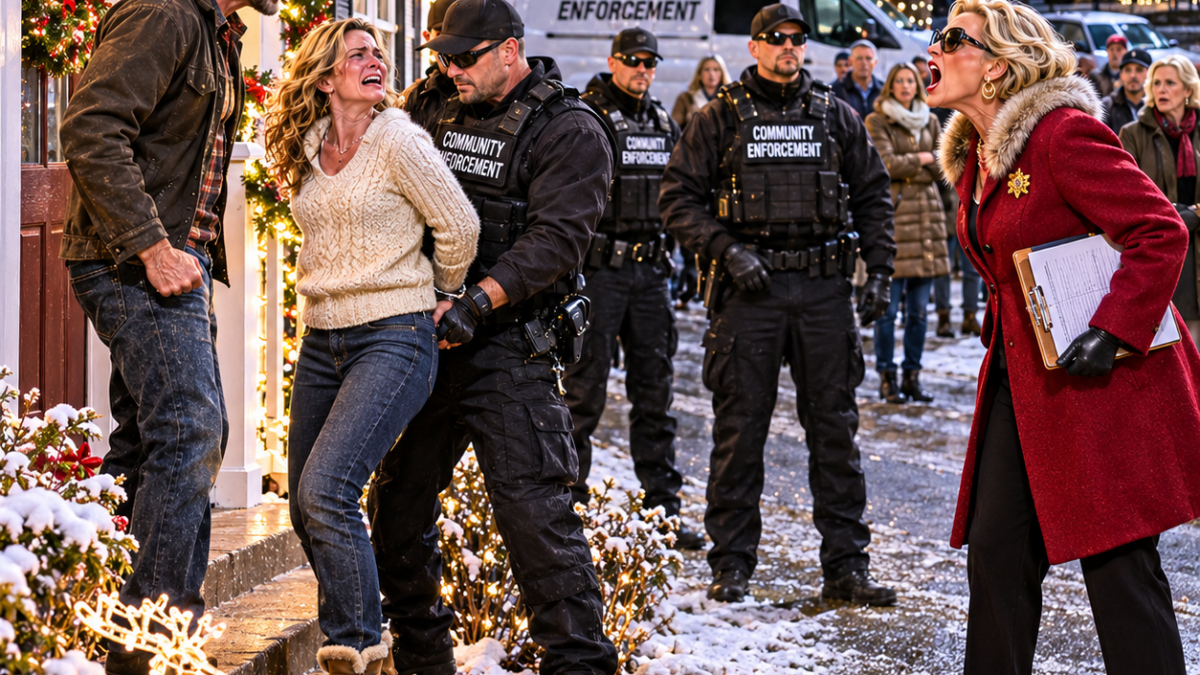
The kind of vehicle you could mistake for a plumber, contractor, delivery service, or municipal crew until four men stepped out wearing dark jackets and badges clipped near their belts.
One stayed near the driver’s door.
Three approached our porch.
Claire saw them first.
“Were we expecting someone?”
“No.”
I opened the front door.
The man in front had close-cropped hair, a thick neck, and the casual confidence of somebody accustomed to people becoming nervous when they saw metal on his belt.
“Property owner?”
“Yes.”
He looked at the lights.
“We’ve received notice of a compliance violation.”
“From whom?”
“Community enforcement.”
That phrase should have stopped the conversation immediately.
Instead, because the badges were visible and because his tone sounded official, my brain gave him several seconds of legitimacy he had not earned.
“What agency are you with?”
He ignored the question.
“These decorations are outside approved seasonal parameters.”
Claire stepped beside me.
“No, they’re not.”
The man finally looked at her.
“The display is non-compliant.”
“I checked the guidelines this afternoon. Decorative lighting is allowed through January thirty-first.”
He smiled.
Not kindly.
“Ma’am, take the lights down.”
Claire folded her arms.
“Show me the rule.”
The second man laughed.
“Here we go.”
I felt something inside me tighten.
“Who are you?”
The leader looked toward me.
“Sir, don’t make this difficult.”
“I’m asking for identification.”
“We’ve shown you identification.”
“You showed me a badge. I asked what agency.”
That changed him.
His face lost the bored expression.
“You’ve been notified.”
“By the HOA?”
No answer.
“Are you police?”
He stepped closer.
“Remove the decorations.”
Claire moved between us—not aggressively, simply because she was standing beside the railing he had gestured toward.
The second man grabbed her wrist.
Everything after that happened quickly enough that my memory still plays it in disconnected pieces.
Claire saying, “Don’t touch me.”
The first man telling her to calm down.
A metal cuff closing around her right wrist.
Her face changing.
Not panic exactly.
Shock.
The stunned expression of someone discovering that the rules she had believed protected ordinary people had suddenly vanished.
She wasn’t resisting.
She wasn’t threatening them.
She was standing on her own porch asking why strangers were touching her.
The second cuff closed.
“Take those off her.”
The leader looked at me.
“Back up.”
“She’s done nothing.”
“Sir.”
“Show me a warrant.”
He laughed.
Actually laughed.
Then said something about property management taking community safety seriously.
I pulled out my phone.
“I’m calling the police.”
For the first time, all four men became less comfortable.
The man holding Claire released her almost immediately.
The leader said, “You’ve received the warning.”
Then they left.
No citation.
No case number.
No arrest paperwork.
No names.
Just a white van disappearing through our cul-de-sac.
Claire stood under the porch lights with one hand around the red marks on her wrist.
I still hear myself asking:
“Are you okay?”
It was such a useless question.
She looked at me.
Fear.
Fury.
Humiliation.
And something worse than all three.
Disbelief.
Our house was supposed to be the safe place.
The boring place.
The place where nothing more dramatic happened than a broken sprinkler head or a neighbor complaining that somebody’s recycling bin had remained visible after noon.
Four strangers had just placed my wife in handcuffs because somebody wanted Christmas lights removed.
I called 911.
Real police arrived eleven minutes later.
They listened.
Photographed Claire’s wrists.
Took descriptions.
Asked about the van.
Asked whether the men identified an agency.
They hadn’t.
One officer looked at the badge description and shook his head.
“Private security, maybe.”
“Can private security handcuff someone over an HOA decoration?”
“Not like what you’re describing.”
Claire stood in the doorway wrapped in a blanket.
The lights kept blinking behind her.
Green.
White.
Amber.
The same lights that had looked cheerful an hour earlier now made the whole scene feel obscene.
The officer gave us a report number.
Told us to preserve doorbell footage.
Contact the HOA.
Avoid confrontation.
Good advice.
Responsible advice.
I followed it.
At first.
What I didn’t understand that night was how humiliation changes shape once the immediate danger is gone.
Fear becomes anger.
Anger becomes imagination.
And imagination, if you feed it long enough, begins convincing you that destruction can look like justice.
By Christmas week, I wasn’t thinking about filing complaints anymore.
I was thinking about making someone remember our name.
part 2
My name is Thomas Hale.
Claire and I had lived in Coldwater Sack for eleven years.
The name sounded quaint when the realtor said it.
Coldwater Sack.
Twenty-four houses built around a shallow curve ending in a landscaped cul-de-sac with decorative stonework, identical street lamps, and maples that looked beautiful for approximately six days every October.
It was the sort of neighborhood designed to make unpredictability feel impolite.
Trimmed lawns.
Matching mailboxes.
Approved exterior colors.
Trash cans hidden after collection.
Cars mostly inside garages.
People waved.
Nobody stayed long enough to actually talk.
When we moved there, I liked that.
I worked in project scheduling for a manufacturing company.
Claire was a physical therapist.
We had two children by then, both old enough to be embarrassed by nearly everything we did and young enough to still come downstairs when they smelled pancakes.
I liked lists.
Budgets.
Calendars.
Well-made coffee.
Predictable weekends.
Claire liked turning ordinary things into rituals.
Birthdays.
Thanksgiving.
Christmas.
She made place cards when four people were coming to dinner.
She had labeled storage bins for ornaments.
She remembered which year every decoration entered the family.
Her father was where the exception lived.
His name was Walter Bennett.
Motorcycles were his religion.
Not in the costume sense.
Walter wasn’t a weekend rider who bought leather after retirement and spent Saturdays polishing a machine he was afraid to scratch.
He rode.
Long distance.
Rain.
Cold.
Mountain roads.
Desert.
Back highways.
The man measured years by trips.
Sturgis.
Blue Ridge.
Pacific Coast.
Arizona.
Maine.
He rebuilt engines at his own bench.
He could identify a Harley by exhaust note before it came around a corner.
When Claire was a teenager, he taught her to change oil before he taught her to parallel park.
When Walter died, he left her sixteen restored Harley-Davidsons and one unfinished project he had been working on for years.
Seventeen motorcycles.
Some valuable.
Some not.
All irreplaceable to Claire.
We rented a warehouse on the edge of town because there wasn’t enough room at home.
The place became something between storage and shrine.
Walter’s leather jacket hung on one wall.
Old photographs sat above the workbench.
Routes he had ridden were marked on a faded road atlas.
Every motorcycle had a story.
Claire could tell you which one stalled outside Albuquerque.
Which one Walter rebuilt after a deer collision.
Which one he rode the year Claire graduated college.
Which one still carried a scratch on the tank from the time he dropped it in a motel parking lot and lied about it for three years.
That collection mattered more to her than its market value.
That becomes important.
Because anger eventually convinced us to destroy the one thing our enemies could never have taken.
The police investigation into the fake officers moved slowly.
That frustrated me immediately.
The van plate was unreadable on our camera.
Faces were partially covered by hats and the porch angle.
The badges were generic.
No local agency recognized them.
We contacted the HOA management company the next morning.
They denied authorizing police action.
The board president, Karen Whitmore, called Claire personally.
I remember the conversation because Claire put it on speaker.
Karen had been HOA president eighteen months.
Mid-forties.
Blonde bob.
Gold earrings.
Soft voice.
The kind of woman who could make “non-compliance” sound like concern for your health.
“Claire, I was horrified to hear there was an incident.”
“Who sent them?”
“We’re still determining that.”
“They said community enforcement.”
“That doesn’t necessarily mean our association.”
“They came because of our Christmas lights.”
Karen paused.
“I can’t speak to what they believed.”
“What do you believe?”
Another pause.
“I believe decorative standards exist for a reason.”
I looked at Claire.
There it was.
Not an admission.
Something worse.
Moral distance.
Claire asked, “Were our lights allowed?”
“The board had received concerns about the display.”
“That isn’t what I asked.”
“Our enforcement vendor handles preliminary compliance matters.”
“Does your enforcement vendor use handcuffs?”
Silence.
Then Karen said, “I’m not comfortable discussing vendor protocols on an informal call.”
Claire ended it.
We hired an attorney.
Her name was Rebecca Stone.
She immediately sent preservation letters to the HOA, management company, known vendors, and anyone who might possess surveillance footage or communications.
“Do not threaten them,” she told us.
“I haven’t.”
“Do not contact the men if you identify them.”
“I won’t.”
“Do not post accusations online you cannot prove.”
I looked at her.
“Everyone keeps telling me what not to do.”
“Because angry clients make very creative mistakes.”
Claire gave me a look.
Rebecca noticed.
“I’m serious.”
“We understand.”
For a while, we did.
Mr. Donnelly’s camera captured part of the van entering the street.
Another neighbor had footage of it leaving.
A teenager across the cul-de-sac had recorded thirty seconds through a bedroom window after hearing voices.
Neighborhood groups lit up.
People asked questions.
Some had stories.
A couple claimed they’d been confronted by aggressive “compliance contractors” over parking.
One elderly man said two men had come onto his porch threatening to tow his daughter’s car while she was visiting.
Another family described somebody photographing through their side gate.
Nobody had been handcuffed before Claire.
That made us the case everyone suddenly cared about.
People supported us.
They brought food.
Signed statements.
Sent messages.
One neighbor proposed a class complaint against the HOA.
Another wanted television stations involved.
A local reporter contacted us.
Rebecca told us to be careful.
“Public pressure can be useful. It can also contaminate testimony and make everybody start remembering the version they read instead of the version they saw.”
That was good advice too.
We were surrounded by good advice.
That should have saved us.
It didn’t.
Because sensible plans have one weakness.
They move slowly.
Anger does not.
At night, after the kids went upstairs, Claire and I sat at the kitchen table talking about the porch.
Again.
And again.
The cuffs.
The laughter.
The men’s casualness.
The way they left.
Karen’s refusal to give a direct answer.
The investigation’s pace.
Every repetition polished the humiliation until it became something hard enough to carry around.
I started wanting spectacle.
That is the word.
Spectacle.
Not justice.
I did not admit that then.
I called it accountability.
Consequences.
A message.
But what I wanted was an image.
Something undeniable.
Something that would make those men feel small.
Something that would make Karen understand she had crossed the wrong family.
That thought should frighten me now.
It does.
At the time, it felt righteous.
The Harley collection became connected to that anger for reasons that made emotional sense and no rational sense at all.
Walter had represented independence.
Roads.
Noise.
Freedom.
Nobody telling him what color mailbox he could own.
The motorcycles felt like rebellion inherited in metal.
One night after another argument about how slowly everything was moving, I said:
“We should do something they can’t ignore.”
Claire stared at me.
“What does that mean?”
“I don’t know.”
“Yes, you do.”
I didn’t answer.
She looked toward the hallway where Walter’s old riding photograph hung.
“Thomas.”
“They embarrassed you.”
“I know.”
“They put you in cuffs.”
“I was there.”
“And now everybody tells us to wait.”
“What are you suggesting?”
I wish I could say I stopped there.
I didn’t.
The idea became specific over the following days.
Too specific.
Seventeen motorcycles.
Walter’s legacy.
Fire.
A public symbol of what humiliation had cost us.
Even typing those words in memory makes me ashamed.
The plan was insane because it confused destruction with communication.
But anger rarely asks whether symbolism will still look meaningful at an arraignment.
Claire resisted at first.
Then stopped arguing.
That silence became permission in my mind.
It wasn’t.
I know that now.
Consent born from exhaustion is not enthusiasm.
And if one person is the louder voice in a marriage while both are angry, “we decided” can hide a lot of imbalance.
I was driving that idea.
That is mine to own.
The night came in late December.
Cold.
Dry.
Clouds low.
We moved the motorcycles from the warehouse to an isolated lot at the edge of town.
I won’t describe the mechanics.
There is nothing instructive about what we did.
Nothing clever.
Nothing worth repeating.
We destroyed property that belonged to us because I had convinced myself sacrifice would look like power.
When the fire took hold, the effect was immediate.
Chrome reflected orange.
Paint blistered.
Tires collapsed.
Metal frames disappeared behind heat.
The sound was not cinematic.
It was ugly.
Popping.
Hissing.
Glass breaking.
Claire stood beside me.
Still.
The flames reflected in her eyes.
At first, I felt something horrifyingly close to relief.
There.
I thought.
Now the world will understand.
Now they’ll see what they did to us.
Then I looked at Claire.
She wasn’t watching Karen burn.
She wasn’t watching fake officers.
She was watching her father disappear.
One motorcycle after another.
Every road trip.
Every repair.
Every story.
Every fingerprint Walter had left on those machines.
Gone because I wanted a symbol.
“Claire.”
She didn’t answer.
“Claire, I’m sorry.”
She looked at me.
“What did we do?”
That was the first moment I understood.
Too late.
Then someone saw the glow.
Sirens arrived.
Real ones.
Police.
Fire department.
Ambulance staged nearby.
Blue and red light cut through the smoke.
There was no triumphant audience.
No neighbors cheering.
No villain arriving to confess.
Just firefighters risking themselves because two angry adults had created a fire where there should not have been one.
An officer found us nearby.
Soot on our clothing.
My hands shaking.
Evidence made the rest obvious.
The officer asked the question I had been dreading without knowing I was dreading it.
“Did you start this?”
I looked at Claire.
She looked at the burning motorcycles.
“Yes.”
We were detained.
Questioned.
Released only after the process had begun moving in a direction neither of us could control.
The next morning our names were online.
Not the fake officers.
Ours.
LOCAL COUPLE INVESTIGATED AFTER MOTORCYCLE FIRE.
Another outlet called it possible vigilante retaliation.
One website used the word “revenge.”
They were not wrong.
People who had cheered us online disappeared quickly.
Some called us heroes.
That was worse.
I remember reading comments from strangers saying the HOA deserved it.
They misunderstood.
The motorcycles did not belong to the HOA.
They belonged to Claire.
We had punished ourselves.
Rebecca Stone came to the house.
She did not yell.
I almost wished she had.
She put her briefcase on our kitchen table.
“Tell me exactly what happened.”
I did.
She listened.
Then asked Claire.
Claire confirmed it.
Rebecca closed her notebook.
“I’m going to represent you through the next steps, but I need something understood.”
We waited.
“What happened to Claire on the porch was wrong.”
Claire looked down.
Rebecca continued.
“What you did afterward is also wrong.”
I nodded.
“One does not legally cancel the other.”
“I know.”
“No. Right now you understand the sentence. I need you to understand what it means.”
She looked at me.
“The fact that someone humiliated your wife does not become a defense to creating a dangerous fire.”
I felt defensive immediately.
“We burned our own property.”
“And fire does not respect ownership lines.”
That shut me up.
“Firefighters had to respond. Other property could have been damaged. People could have been hurt.”
Claire started crying.
Rebecca softened.
“We deal with the facts we have. We don’t invent worse ones. Nobody was injured. That’s important. But don’t romanticize this.”
We didn’t.
Not after that.
The legal process was humiliating in ways revenge fantasies never include.
Booking photographs.
Court dates.
Bail conditions.
Insurance questions.
Fire-investigation reports.
Statements.
A judge asking why two employed adults with children believed destruction was a reasonable answer to intimidation.
There is no satisfying response to that question.
I tried one.
“We were angry.”
The judge said:
“So is almost everyone who stands before me.”
I never forgot that.
The consequences were real.
Fines.
Restitution associated with emergency response and damage connected to the incident.
Court costs.
Counseling requirements.
Insurance consequences.
Our attorney fees.
And the destruction of seventeen motorcycles, the value of which no legal order could restore.
The criminal case resolved without the dramatic prison story I once imagined for other people.
We accepted responsibility.
The court imposed conditions.
Counseling became part of our life.
So did explaining ourselves to our children.
That conversation was worse than court.
Our son, Ethan, was fourteen.
Our daughter, Molly, eleven.
We sat at the kitchen table.
The same table where Claire and I had discussed the plan.
I told them the truth.
Not every detail.
Enough.
Ethan looked at me.
“You burned Grandpa’s bikes?”
I swallowed.
“Yes.”
“Why?”
“Because I was angry.”
“At the men who hurt Mom?”
“Yes.”
“So why burn Grandpa’s stuff?”
There was no adult answer sophisticated enough to escape a child’s logic.
“I shouldn’t have.”
He pushed back his chair.
“That doesn’t make sense.”
“No.”
Molly started crying.
She had loved sitting on Walter’s motorcycles in the warehouse.
Claire reached for her.
Molly pulled away.
That hurt Claire more than anything the HOA had done.
For weeks, our house felt smaller.
No Christmas lights.
We took them down voluntarily the day after the incident.
Not because Karen won.
Because neither of us could look at them without remembering the cuffs.
The porch returned to darkness.
Meanwhile, something strange happened.
The investigation into the fake officers continued.
Our stupidity did not erase theirs.
That was one of the few mercies in the story.
Rebecca had preserved evidence before our fire.
Doorbell footage.
Neighbor statements.
HOA emails.
Vendor contracts.
The police report.
Our later criminal conduct made us imperfect witnesses.
It did not make the porch incident disappear.
Eventually, investigators identified the men as employees and subcontractors associated with a private compliance company hired through the HOA’s management structure.
None were police officers.
Their badges were private credentials.
Their claimed authority had been grossly exaggerated.
The man who cuffed Claire had no lawful basis to conduct a detention over decorative lights.
That mattered.
The HOA tried to distance itself.
Karen issued a statement saying the board had never authorized anyone to impersonate law enforcement.
Maybe technically true.
But emails produced during discovery showed Karen had repeatedly pushed the vendor to use “stronger field enforcement” against residents she considered chronic violators.
Our house appeared in one message.
Holiday display requires immediate correction. Resident likely to challenge authority. Send full team.
I read those words in Rebecca’s office.
My hands began shaking again.
“Full team.”
Rebecca nodded.
“So she knew they were coming?”
“She knew a team was being sent.”
“Did she tell them to cuff Claire?”
“We don’t have evidence of that.”
That distinction frustrated me.
It was also important.
We could prove what we could prove.
Nothing more.
Further communications showed Karen had been receiving complaints about the lights before the men arrived.
The supposed complaint source turned out to be another board member.
Not because the lights violated the seasonal rules.
Because Karen was trying to enforce an unpublished interpretation limiting exterior lighting intensity.
Our attorney found no valid board adoption of that standard before the incident.
So Claire had been right.
The lights were allowed under the written guidelines available to residents.
That should have felt like victory.
It didn’t.
By then, seventeen Harley-Davidsons were ash.
The compliance company lost its HOA contract.
Licensing regulators examined its practices.
The men involved in Claire’s restraint faced civil claims and legal consequences tied to unlawful detention and misrepresentation of authority.
The exact outcomes differed by individual.
One settled.
Another lost his license.
The lead employee faced more serious proceedings because of the physical restraint and the way he presented himself.
Karen came under enormous pressure inside Coldwater Sack.
Residents obtained emails.
Meeting minutes.
Vendor invoices.
Other complaints surfaced.
People who had once felt alone realized the pattern was broader.
The board eventually voted to remove Karen as president.
She remained a homeowner.
That was fine.
The neighborhood did not need exile.
It needed boundaries.
A new president, Melissa Grant, took over.
Her first board meeting was packed.
Claire and I attended.
That took courage for her.
More than people realized.
The same room contained neighbors who had discussed our criminal charges.
Some had defended us.
Some had condemned us.
Some had done both depending on the week.
Melissa began with a sentence I respected immediately.
“We are not here to decide whether anybody deserves humiliation.”
The room quieted.
“We are here to establish what authority this association has, what it does not have, and how we prevent another resident from being treated as if private community rules are criminal law.”
That was the conversation we should have had from the beginning.
The board terminated the enforcement vendor.
Future compliance visits required clear identification.
No badges designed to resemble government credentials.
No restraints.
No physical detention.
No references to “law enforcement.”
No entry onto private property without permission except where actual law allowed it.
Disputed violations had an appeal process.
Emergency situations went to public emergency services.
The Christmas-light rule was clarified.
Written standards only.
No unpublished interpretations.
Claire sat beside me listening.
I whispered:
“You were right about the lights.”
She didn’t smile.
“I know.”
That answer hurt.
Because being right had become such a small part of the story.
After the meeting, several neighbors approached us.
Mr. Donnelly hugged Claire.
Another woman apologized for supporting Karen.
A younger man said he had assumed the fake officers must have been real because they wore badges.
Claire replied:
“So did we.”
That was one of the deepest injuries.
We had trusted the appearance of lawful authority for several seconds.
Enough time for hands to become cuffs.
Our mistake afterward was trusting the appearance of righteous anger.
Same problem.
Different costume.
One looked like a badge.
The other looked like revenge.
Both asked us not to question what we wanted to believe.
Counseling forced me to examine that.
I hated counseling for the first month.
I treated sessions like depositions.
Answer the question.
Stay precise.
No unnecessary emotion.
Dr. Samuel Reed saw through it immediately.
“You want to turn this into a procedural error.”
“It was an error.”
“No. A calendar error is an error. You made a choice.”
“I know.”
“You keep saying that.”
“Because I do.”
“No. You know you committed the act. You haven’t explained why destroying your wife’s inheritance felt connected to protecting her.”
That shut me down.
For almost a minute.
Then I said:
“Because I couldn’t undo the porch.”
That was the first honest answer.
I could not make Claire unafraid.
Couldn’t remove the red marks.
Couldn’t unhear the men laughing.
Couldn’t restore the belief that our front door marked a boundary strangers would respect.
I needed action large enough to compete with helplessness.
The motorcycles were available.
Symbolic.
Powerful.
Expensive.
Loaded with emotional meaning.
So my anger turned them into a stage.
Dr. Reed asked:
“Whose meaning?”
I stared at him.
“What?”
“Whose symbol were those motorcycles?”
“Claire’s father’s.”
“Exactly.”
I had transformed Walter’s memory into material for my own revenge fantasy.
That realization took longer to forgive myself for than the charges.
Claire had her own counseling.
We did joint sessions too.
One evening she said something I had been afraid to ask.
“I didn’t want to burn them.”
I felt sick.
“You agreed.”
“No.”
“You didn’t stop me.”
“That isn’t the same thing.”
I looked at her.
She continued.
“You were so angry, Tom.”
“I never threatened you.”
“I know.”
“You could’ve said no.”
“I had just been handcuffed by strangers. I was barely sleeping. You kept talking about taking power back.”
Her eyes filled.
“I didn’t know how to tell you I didn’t want another fight.”
I lowered my head.
For months, I had told myself “we” had done it.
We moved the bikes.
We set the fire.
We accepted the consequences.
Legally, both of us participated.
Emotionally, responsibility was not identical.
I was the engine.
That mattered.
“I’m sorry.”
Claire nodded.
“I know.”
“No. I’m sorry for making silence mean yes.”
That was the apology she needed.
We sold what remained from the warehouse.
Spare parts.
Tools.
Some Walter memorabilia survived because it had been stored separately.
His jacket.
Helmet.
Road atlas.
A few photographs.
Claire kept those.
The burned motorcycles could not be restored.
Insurance would not magically pay us for intentionally destroying them.
Of course it wouldn’t.
That became another piece of the arithmetic.
Market value.
Sentimental value.
Legal cost.
Emergency cost.
Reputation.
None balanced.
The internet loved the story for approximately nine days.
Some posts called us heroes.
Others called us lunatics.
One headline reduced everything to:
COUPLE TORCHES MOTORCYCLE COLLECTION AFTER HOA DISPUTE.
Technically accurate.
Emotionally useless.
People argued about us without knowing Claire’s father.
Without seeing the porch.
Without seeing Molly cry when she learned Grandpa’s bikes were gone.
Without seeing Claire wake from sleep because she dreamed someone was grabbing her wrist again.
The spectacle I had wanted arrived.
It just didn’t belong to me.
That was another lesson.
Once you turn your pain into public theater, you lose control of what the audience thinks it means.
Strangers wanted us to be symbols.
Anti-HOA rebels.
Dangerous vigilantes.
Victims.
Criminals.
Idiots.
Heroes.
We were none of those things entirely.
We were two hurt people who had been wronged and then made a terrible decision.
That sentence took me months to say without adding “but.”
The “but” was poison.
Yes, the fake officers hurt us.
But we burned the motorcycles.
No.
Stop before but.
Two truths.
They wronged us.
We wronged ourselves and created risk for others.
Neither fact cancels the other.
Eventually, our criminal case closed.
Conditions completed.
Restitution paid.
Counseling finished formally, though we continued voluntarily.
The civil action related to Claire’s restraint resolved separately.
The compliance company paid damages under settlement terms.
The HOA contributed through its insurer after disputes about oversight and vendor conduct.
We did not become wealthy.
That was never the point.
The settlement reimbursed some losses tied to the original incident and recognized the harm done to Claire.
No amount could undo it.
Claire insisted on one thing.
No confidentiality clause preventing her from describing what happened to her.
The final agreement allowed her to speak about her own experience and public records.
She almost never did.
That surprised me.
After everything, I expected her to want everybody to know.
She didn’t.
“Why not?”
“Because I don’t want that night to be the most interesting thing about me.”
That was healthier than anything I had said for a year.
Karen resigned from the HOA board completely not long after.
I saw her once at the grocery store.
Produce aisle.
No clipboard.
No HOA meeting.
Just a woman choosing tomatoes.
She saw me.
Stopped.
For several seconds, neither of us spoke.
Then she said:
“Thomas.”
“Karen.”
“I heard you and Claire finished the case.”
“Yes.”
“I wanted to say I’m sorry.”
I waited.
“For what happened to her.”
“Do you mean sending the team?”
Her face tightened.
“I sent compliance.”
“You knew they presented themselves as enforcement.”
“I did not know they would use handcuffs.”
“That wasn’t my question.”
She looked down.
“No.”
I waited again.
She exhaled.
“I knew they wanted residents to believe they had more authority than ordinary contractors.”
There it was.
Small.
Precise.
Enough.
“And you were comfortable with that?”
“At the time.”
“Why?”
“Because people listened.”
I nodded.
That was probably the most honest answer Karen ever gave me.
She looked at the apples beside us.
“I thought order was the same thing as safety.”
“And?”
“It isn’t.”
“No.”
She looked back at me.
“I heard about the motorcycles.”
“Everyone did.”
“I never wanted that.”
For a second, anger returned.
Old.
Familiar.
I almost said:
You started it.
Instead, I remembered Dr. Reed.
Two truths.
“You didn’t make me burn them.”
Karen seemed surprised.
“No.”
“That was mine.”
She nodded.
“I’m still sorry.”
“So am I.”
That was the end of the conversation.
No hug.
No forgiveness ceremony.
No dramatic reconciliation.
She went one direction.
I went another.
That was enough.
The neighborhood changed slowly.
Coldwater Sack became less obsessed with anonymous compliance and more willing to talk.
Melissa’s board published rules clearly.
If somebody complained about lights, the actual rule got attached.
If no rule existed, the complaint did not become enforcement.
Contractors wore company identification.
Nobody carried badges.
The phrase “community enforcement” disappeared.
Good.
Authority should not need costume design.
The next Christmas, Claire did not decorate.
I didn’t ask.
Second Christmas, she put a wreath on the door.
Nothing else.
Third year, I came home and found a single strand of warm white bulbs along the railing.
No green.
No amber.
I stopped at the walkway.
Claire was inside watching.
I looked toward her.
She opened the door.
“You okay?”
I laughed softly.
“That’s my line.”
“Are you?”
“Yes.”
“Me too.”
I walked onto the porch.
The lights were simple.
Steady.
No blinking.
I touched the railing.
“Want help?”
“No.”
“Of course.”
She smiled.
That was the first Christmas the porch belonged to us again.
Walter’s surviving jacket hung in our hallway.
His road atlas eventually went into a shadow box with one photograph of him beside his favorite Harley.
Claire chose the picture.
Not the most polished bike.
Not the rarest.
One from 1989.
Walter standing beside a scratched black touring motorcycle, hair blown sideways, laughing at something outside the frame.
I asked why that one.
“He looks happy.”
She was right.
For years, the motorcycles had been objects containing memories.
After the fire, we had to discover something harder.
The memories existed without the objects.
Not perfectly.
Physical things matter.
I won’t insult grief by pretending otherwise.
But Walter was not destroyed because chrome melted.
His stories remained.
Claire remained.
The way she tightened a bolt exactly the way he taught her remained.
The phrase she used when an engine sounded wrong came from him.
Our children remembered riding on stationary motorcycles in the warehouse.
Those things survived my worst decision.
That didn’t absolve me.
It gave us somewhere to rebuild.
Ethan eventually forgave me enough to ask about Walter’s bikes again.
One Saturday we went through old photographs.
He pointed to a red Harley.
“Which one was that?”
“Your grandfather rode it to Colorado.”
“Did it burn?”
I swallowed.
“Yes.”
He nodded.
Then pointed to another.
“What about this one?”
“Yes.”
We continued.
After fifteen minutes, he said:
“Dad?”
“Yeah?”
“I was really mad at you.”
“I know.”
“I’m still kind of mad.”
“That’s fair.”
“But Mom says being mad forever is like paying for something every month after you already own it.”
I smiled.
“That sounds like your mother.”
“She said Grandpa would’ve called you an idiot.”
“That sounds like your grandfather.”
Ethan laughed.
Then so did I.
That afternoon did more for me than any court date.
Our children did not need a perfect father.
They needed one who could admit he had failed without converting failure into a performance of self-hatred.
That was another lesson counseling taught me.
Shame and accountability are not the same thing.
Shame says:
I am ruined.
Accountability says:
I did harm.
I owe repair.
Those sentences lead to very different futures.
For a long time, I wanted to punish myself because punishment felt morally clean.
Pay the fine.
Lose the bikes.
Endure the headlines.
Feel bad forever.
Done.
Repair was slower.
Listen to Claire.
Restore trust with the children.
Pay debts.
Show up.
Accept that neighbors had complicated opinions.
Stop rehearsing the porch every night.
Stop rehearsing the fire.
Learn to live in the middle where both things happened and neither defined every day afterward.
That was harder than revenge.
Years later, a new family moved into Karen’s old house.
They had two young children.
The father knocked on our door before their first Christmas.
“Hi. I’m Mark. This is probably a weird question.”
“Go ahead.”
“We were thinking of putting up lights.”
I stared at him.
He looked nervous.
“My realtor mentioned there was some history.”
I laughed.
“Put up your lights.”
“They’re allowed?”
“Read the current rules.”
“I did.”
“Then you already know.”
He smiled.
“Fair.”
A week later, their house was covered.
Not tasteful.
Not subtle.
Blue lights everywhere.
A giant glowing snowman.
Something projected moving stars onto the garage.
Claire stood beside me at our window.
“That’s terrible.”
“Absolutely.”
“Should we complain?”
I looked at her.
She smiled.
We both started laughing.
The laughter surprised me.
Not because it was funny.
Because the old fear was gone.
The fake officers eventually became footnotes in local reporting.
One tried to insist he genuinely believed the HOA had detention authority.
That defense did not go far.
Another cooperated.
The compliance company dissolved.
State regulators tightened scrutiny around deceptive security identification after several complaints—not only ours—came to light.
Coldwater Sack was one small example of a larger problem.
Private actors borrowing the appearance of public authority because people behave differently when they believe they are facing the government.
That was what happened to us.
The badges bought the men several seconds.
Confidence bought them more.
Our trust in ordinary social rules bought them enough to cuff Claire.
There is a lesson there, but it is not “fight anyone who claims authority.”
That can get people hurt.
The lesson is simpler.
Ask.
Agency.
Name.
Identification.
Warrant.
Legal authority.
And if you can safely do so, document.
Call actual law enforcement.
Do not let embarrassment turn into confrontation if retreat is available.
We learned the first half from the porch.
We learned the second half from the fire.
I wish we had only needed one lesson.
Sometimes people ask whether I still hate Karen.
No.
I don’t admire her.
I don’t trust the version of leadership she practiced.
But hate would give her too much space.
The men who cuffed Claire made choices.
Karen made choices.
I made choices.
That is the least satisfying and most useful version of the story.
Everybody owns their verbs.
Sent.
Grabbed.
Cuffed.
Burned.
Signed.
Paid.
Apologized.
Rebuilt.
You can spend years arguing about who started it.
Eventually, adulthood asks what you did after it started.
My answer is not one I am proud of.
But it is mine.
I destroyed seventeen motorcycles because I wanted visible consequences.
What I got were visible consequences.
Just not the ones I imagined.
Claire’s father’s collection became ash.
Police photographs.
Court exhibits.
News footage.
A cautionary headline.
That is the cruel symmetry I live with.
I wanted someone else to feel powerless.
The fire proved how powerless revenge can make the person holding the match.
There is no dramatic line that fixes that.
No courtroom victory.
No HOA election.
No settlement.
You simply learn.
Then keep learning.
The porch lights are up again now.
Claire changes them every few years.
Still meticulous.
Still steps back into the yard.
Still adjusts bulbs nobody else notices.
I still tell her nobody can tell.
She still tells me to make coffee.
Some rituals survive.
I am grateful for that.
One December evening, years after everything, I stood outside after she finished decorating.
The street was quiet.
Mr. Donnelly had moved away.
Different families lived in several houses.
The maples were taller.
Mailboxes had been replaced.
Coldwater Sack looked almost exactly the same and nothing like the place it had been that night.
Claire came outside carrying two mugs.
She handed me one.
“Too strong.”
“You always say that.”
“Because you always make it too strong.”
We stood beneath the lights.
Warm amber.
White.
A little green.
I looked at her wrist.
No marks.
Of course not.
Those bruises disappeared in days.
The memory took longer.
“What are you thinking about?” she asked.
“The bikes.”
She was quiet.
“Me too sometimes.”
“I’m sorry.”
“I know.”
“I wish I could undo it.”
“I know.”
We stood there.
Then she said:
“My dad would’ve hated what we did.”
“I know.”
“He also would’ve wanted to punch those guys.”
I laughed.
“That I believe.”
“He was complicated.”
“So are we.”
She leaned against me.
That was what I finally understood.
Justice is not the absence of anger.
Courage is not never wanting revenge.
Dignity is not pretending humiliation did not hurt.
The line appears later.
In what you choose to do with the feeling.
We crossed it.
We paid for it.
We came back.
If I could speak to the man I was on that first night, the man watching Claire stand under those porch lights with red marks around her wrists, I would not tell him to forgive.
Not then.
I would not tell him to calm down.
I would not insult his rage by pretending it was irrational.
I would tell him:
Preserve the footage.
Photograph her wrists.
Call the police.
Call the lawyer.
Find the other residents.
Demand records.
Expose the fake authority.
Take every lawful step available.
Then go home.
Sit beside your wife.
Listen to her.
Do not turn her humiliation into your performance.
Do not destroy something she loves because your anger needs a monument.
That last sentence is the one I needed.
The Harley collection was never ours to turn into a message.
It was memory.
I confused memory with ammunition.
That is the mistake I cannot make respectable.
The fake officers were wrong.
Karen was wrong.
The compliance system was wrong.
And we were wrong too.
All of those things can fit inside the same story.
That is what consequence taught me.
Moral arithmetic is not subtraction.
Their wrongdoing does not remove ours.
Our wrongdoing does not erase theirs.
Justice works only when both can be named without fear that admitting one will weaken the other.
Claire eventually received recognition for what happened to her.
The men were held accountable.
The HOA changed.
Karen lost the office she had abused.
Those outcomes mattered.
But none gave Walter’s motorcycles back.
None gave our children the version of us they believed existed before the fire.
We had to rebuild that ourselves.
Slowly.
Dinner by dinner.
Christmas by Christmas.
Apology by apology.
Sometimes that is what legal justice leaves behind after the court is finished.
Not triumph.
Work.
Repair.
The strange thing is that the lights now mean more to me than the motorcycles ever did.
Not because they are valuable.
Because they are fragile.
A few strands.
Thin wire.
Cheap bulbs.
They can be taken down in minutes.
Yet every December Claire puts them back.
Not as rebellion.
Not as proof.
Not to spite anybody.
Because she likes the way our house looks when it glows against a cold street.
That is enough.
Years ago, I thought power meant creating a spectacle nobody could ignore.
Now I think power is quieter.
Keeping your home.
Keeping your marriage.
Keeping your children’s trust after you damaged it.
Standing on the same porch where somebody humiliated you and discovering fear no longer owns the space.
Watching your wife straighten one crooked bulb and knowing the night belongs to her again.
That is the kind of revenge I understand now.
Not destruction.
Recovery.
The fake badges are gone.
Karen’s presidency is gone.
The burned motorcycles are gone.
The headlines are buried beneath newer scandals.
But every December, our porch lights return.
And when they come on, green, white, warm amber, blinking like tiny promises against the dark, I remember the night I believed fire could give us our dignity back.
I was wrong.
Fire only knew how to take.
We got our dignity back the slower way.
By telling the truth.
By accepting consequences.
By repairing what we could.
By living long enough to become more than the worst thing done to us—and more than the worst thing we did in response.








