HOA Karen Had Fake Officers Handcuff My 17-Year-Old Daughter for Breaking Her Curfew—Then My Wife Stepped Outside With a Real Badge
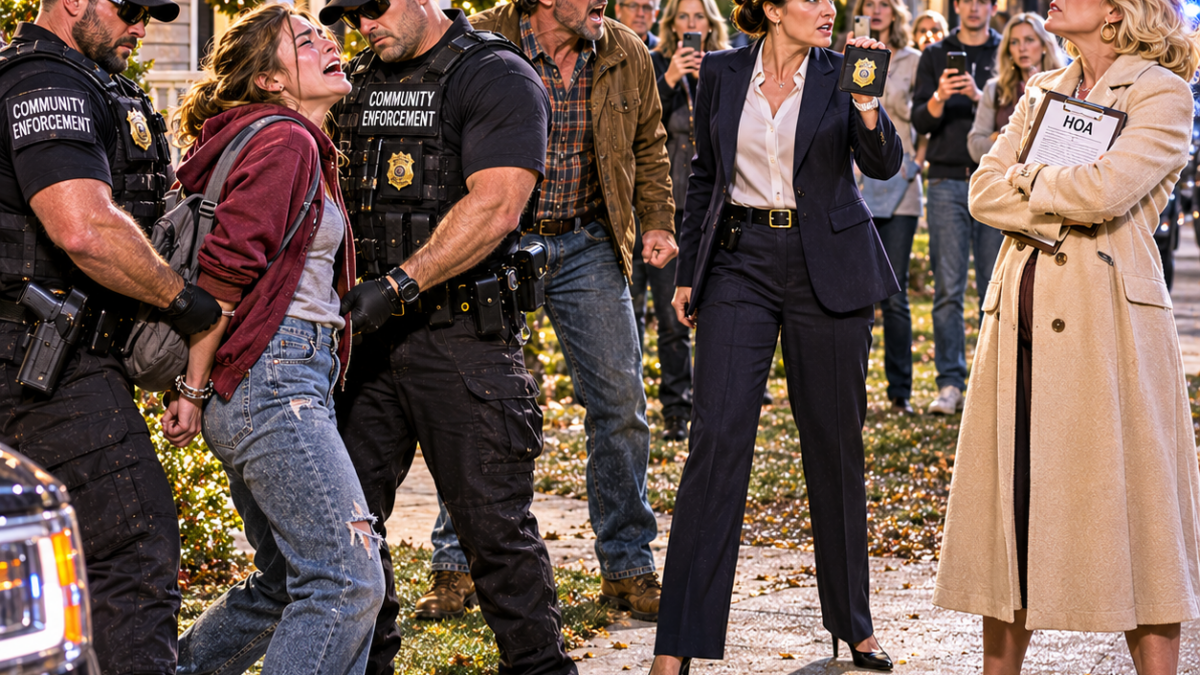
HOA Karen Had Fake Officers Handcuff My 17-Year-Old Daughter for Breaking Her Curfew—Then My Wife Stepped Outside With a Real Badge
HOA Karen decided our neighborhood needed its own “curfew enforcement,” then hired two men with plastic badges to stop my seventeen-year-old daughter on a public street and put her in handcuffs.
When my wife ran outside and saw grown men restraining our child in front of our own home, Karen smiled and threatened to fine us if we interfered.
What Karen did not know was that my wife was the county District Attorney—and the moment those fake officers touched our daughter, the HOA dispute stopped being about rules and became a real criminal investigation.
The night everything broke open began so quietly that I remember the sound of my daughter’s shoes before I remember the shouting.
It was a little after nine.
Cool fall air.
Porch light on.
Television low in the living room.
My wife, Rachel, was sitting at the dining table reading through a stack of work papers she had brought home. I was in the kitchen washing a coffee mug when I heard footsteps approaching from the direction of the neighborhood entrance.
Our daughter Emma was seventeen.
Smart.
Stubborn.
Funny when she wanted to be.
Capable of turning a five-minute conversation about homework into a constitutional argument.
She had been at her friend Claire’s house four blocks away and texted me fifteen minutes earlier.
Walking home.
I had sent back:
Love you. Be careful.
Then came a voice from outside.
“There she is.”
Another voice.
“Stop right there.”
I froze.
Emma shouted.
“What are you doing?”
The mug slipped from my hand into the sink.
Rachel looked up.
Then came a scream.
Not annoyance.
Not teenage outrage.
Fear.
We both moved at the same time.
I reached the front door first.
What I saw on the sidewalk in front of our house took my brain several seconds to process.
Emma’s backpack lay on the pavement.
One man had her left wrist twisted behind her back.
Another was closing a pair of cheap metal handcuffs around her right wrist.
They wore dark polo shirts with black pants and silver-colored badges clipped above their belts.
Not police uniforms.
Close enough at first glance to scare someone.
A flashlight beam swept across Emma’s face.
And standing three feet away, holding a clipboard beneath the streetlight, was Karen Holloway.
HOA president.
Blonde hair fixed perfectly.
Long beige coat.
Black sunglasses resting on top of her head despite the fact it was night.
She looked pleased.
Actually pleased.
“Good,” Karen said. “Now maybe these kids will understand the rules.”
Emma jerked against the man holding her.
“Dad!”
I was already moving.
“Take your hands off my daughter.”
The man holding her stepped back half a foot but kept his grip.
“Sir, stay back.”
“Who the hell are you?”
“Community enforcement.”
“That isn’t an answer.”
Karen moved between us.
“Mark, don’t engage him. We have authority.”
I looked at her.
“Authority to do what?”
Emma was crying now.
Not sobbing.
Angry tears.
Her face was red.
“Dad, they said I’m under arrest.”
My stomach dropped.
I looked at the men.
“Did you tell my daughter she was under arrest?”
The older one lifted his chin.
“She violated community curfew.”
“That isn’t what I asked.”
Karen snapped her clipboard shut.
“She has been warned repeatedly.”
I stared at her.
“There is no curfew.”
“There is now.”
Rachel came through the front door behind me.
She took one look at Emma.
Then stopped.
I’ve been married to Rachel for twenty years.
I have watched her argue murder motions.
Handle furious witnesses.
Stand in front of juries.
Tell grieving families things they never wanted to hear.
I had never seen her face look the way it did that night.
Not loud.
Not wild.
Controlled.
Which was much worse.
“Remove your hands from my child.”
The man holding Emma looked toward Karen.
Karen gave him a tiny shake of the head.
“Do not release her until the violation paperwork is completed.”
Rachel walked down the porch steps.
“I’m going to say this once.”
Karen stepped forward.
“Oh, please. Don’t make this dramatic. She was out after nine. We’ve had complaints. The HOA adopted enhanced youth safety rules last month.”
Rachel pointed at Emma.
“She is seventeen years old, walking home on a public street, and two adult men have put her in handcuffs.”
Karen’s expression hardened.
“This is official HOA law enforcement.”
I almost thought I had misheard her.
Rachel did not.
Karen continued.
“If you interfere, both of you will be fined for obstruction.”
Rachel reached inside her coat.
The two men tensed.
Then she pulled out her county credentials.
Held them under the streetlight.
The older man’s eyes went straight to the seal.
Rachel’s voice stayed completely level.
“My name is Rachel Collins.”
The man’s grip loosened.
Karen rolled her eyes.
“We know who you are.”
Rachel ignored her.
“I am the elected District Attorney for this county.”
The younger man dropped Emma’s backpack.
Rachel continued.
“You are not police officers.”
Neither man answered.
“You have restrained a minor. You represented yourselves as law enforcement. And unless one of you can show me a warrant, statutory authority, or actual peace-officer commission in the next five seconds, you will remove those cuffs.”
Karen laughed.
“You cannot use your office to override HOA rules.”
Rachel turned toward her.
“This is not an HOA issue anymore.”
The men looked at each other.
The younger one whispered:
“Karen?”
She snapped:
“Do your job.”
That was when headlights swept across the street.
A sheriff’s cruiser turned the corner.
Then another.
Karen smiled.
Actually smiled.
“Perfect.”
She pointed toward us.
“I called them. Now we’ll see who understands the law.”
The first cruiser stopped.
Sheriff Daniel Mercer stepped out.
He had worked with Rachel for years, but he didn’t walk toward her first.
He looked at Emma.
The cuffs.
The two men.
The fake-looking badges.
Karen.
Then he asked one simple question.
“Who here is actually law enforcement?”
And for the first time that night, nobody wearing one of Karen’s silver badges answered.
part 2
My name is Michael Collins.
At the time, I was forty-eight years old, a civil engineer by trade, husband to a prosecutor, father to a daughter who believed any household rule deserved at least one appeal, and reluctant resident of Maplewood Hills.
We had lived there twelve years.
When we moved in, Maplewood was exactly what we wanted.
Tree-lined streets.
A small pool.
A clubhouse nobody used enough.
Kids riding bikes after dinner.
Neighbors who waved without requiring committee approval.
Then Karen Holloway became HOA president.
Karen did not invent dysfunction.
She industrialized it.
At first, her changes were small.
More violation notices.
Stricter parking interpretation.
New rules about trash cans.
Then she started calling ordinary problems “community security concerns.”
A teenager skateboarding too late?
Security concern.
Children playing basketball after sunset?
Noise and safety concern.
A delivery van parked for fifteen minutes?
Traffic-control matter.
Some people thought Karen was annoying.
I thought she was dangerous because she had begun confusing private association authority with government power.
The first time she proposed a neighborhood curfew, Rachel laughed.
Not because youth safety was funny.
Because the proposal was ridiculous.
Karen introduced it during an HOA meeting in August.
Children under eighteen, she said, should not be outdoors in common areas after nine p.m. without a parent.
I raised my hand.
“What’s the enforcement mechanism?”
“Warnings initially.”
“And after that?”
“Fines.”
“Against whom?”
“The household.”
Rachel was beside me.
She leaned closer.
“She cannot create criminal detention authority.”
“I know.”
Karen continued.
“Repeat offenders may be referred to community enforcement.”
Rachel raised her hand.
Karen looked irritated.
“Yes, Rachel?”
“Define community enforcement.”
Karen smiled.
“We are reviewing security options.”
“Private security?”
“Professionals.”
“Licensed security?”
“We are exploring several options.”
Rachel leaned back.
“That means no.”
Karen’s jaw tightened.
“The board has authority to protect residents.”
“Within the governing documents.”
“We have broad safety powers.”
“Broad isn’t unlimited.”
Karen smiled.
“Not everyone here practices criminal law, Rachel.”
That line produced a strange silence.
Because everyone in Maplewood knew what Rachel did.
Karen knew too.
But Karen had a habit of speaking as if titles mattered only when they belonged to her.
Rachel didn’t argue.
She asked for the proposed rule in writing.
It arrived two weeks later.
MAPLEWOOD YOUTH SAFETY AND COMMUNITY ORDER POLICY
It prohibited unsupervised minors from using designated common areas between 9 p.m. and 5 a.m.
That was already questionable in scope.
But the version Karen started distributing said something broader.
It referred to “neighborhood grounds.”
Then “streets within Maplewood.”
Then “community jurisdiction.”
Those phrases mattered.
Because Maplewood’s streets were public.
The HOA did not own them.
Rachel sent an email to the board.
Short.
Professional.
She explained that the association could regulate common amenities within its lawful authority, but it could not create police powers over public streets or authorize private contractors to detain residents.
Karen replied:
Thank you for your personal opinion.
Rachel printed that email.
I asked why.
She shrugged.
“Habit.”
That habit became important.
The policy passed anyway.
Not unanimously.
Two board members opposed it.
One abstained.
Karen announced it as a major public-safety improvement.
Then the warnings started.
Emma received one because she sat on a bench near the clubhouse at 9:12 after walking Claire home.
She brought the paper inside.
“Am I grounded by the government now?”
I read it.
“No.”
“Karen says it’s official.”
“Karen says many things.”
Rachel read the notice.
No signature from licensed security.
No citation authority.
Just:
YOUTH CURFEW VIOLATION — FIRST WARNING
We sent a written objection.
No response.
A week later, the Johnsons’ sixteen-year-old son was stopped while walking his dog.
Two men in polo shirts asked for identification.
He refused.
His parents received a $250 fine for “failure to cooperate with community officers.”
That phrase bothered Rachel.
“Officers?”
She requested the security contract.
Karen delayed.
Then denied the first records request, claiming security procedures were confidential.
Another resident, Leonard Price, had been HOA treasurer for six years.
Quiet man.
Retired accountant.
The type who apologized before correcting your math.
He called me privately.
“Michael, something isn’t right.”
“What?”
“The security expenses.”
“What about them?”
“Karen has been approving checks.”
“Board-approved?”
“Some.”
“And the others?”
He lowered his voice.
“She says they’re emergency authority.”
“How much?”
“I don’t know yet.”
That was enough to make me start saving everything.
Not investigating.
Not playing detective.
Just documenting.
Emails.
Notices.
Meeting minutes.
Photographs of the men Karen called “community officers.”
Their badges bothered me.
Gold-colored plastic.
Generic star in the center.
Words around the edge:
MAPLEWOOD COMMUNITY ENFORCEMENT
No government identifier.
No license number.
No security company name.
Rachel told me:
“Do not confront them unless necessary. If they claim police powers, call the sheriff.”
That seemed simple.
Until Karen started acting as though the badges made the men real.
They began patrols.
SUV.
Magnetic decals.
Flashlights.
Radios.
They stopped teenagers.
Questioned guests.
Threatened homeowners with “detention for obstruction.”
Most people laughed at first.
Then one elderly resident told me a patrolman blocked her driveway until she answered questions about her grandson.
Another homeowner said one of them threatened to “write him up for resisting.”
Rachel became concerned enough to contact the sheriff professionally—not as district attorney directing a case, but simply to flag a potential public-safety issue.
Sheriff Mercer said the office had received two informal complaints but no formal report involving actual detention.
“Someone needs to document a specific incident,” he said.
Nobody wanted to be first.
That’s how bad authority grows.
Everyone thinks somebody else will challenge it.
Then people adapt.
Parents began telling teenagers to be home before nine even though the HOA had no police authority.
Not because they accepted Karen’s rule.
Because they didn’t want trouble.
Emma hated that.
“This is stupid.”
“Yes.”
“So why do I have to follow it?”
“You don’t have to follow an invalid arrest rule.”
“So I can stay out?”
“You still have parents.”
She rolled her eyes.
“Different dictatorship.”
“Exactly.”
We set our own household expectation.
Text us.
Tell us where you are.
Be sensible.
That night, Emma left Claire’s house around 8:50.
She texted.
She should have been home by nine.
Claire’s little brother got sick.
Emma helped clean up.
Then she started walking.
At 9:17, Karen was waiting near our block with the two men.
Later, we would learn why.
Emma had been singled out.
Not randomly.
Karen had sent a message earlier that evening:
Collins girl is out again. Make an example so residents understand enforcement is real.
That sentence eventually appeared in evidence.
But that night, all we knew was that our daughter had been placed in handcuffs.
Sheriff Mercer approached the two men slowly.
“Identification.”
The older one handed over his badge.
Mercer turned it in his hand.
Plastic backing.
Gold foil emblem.
No state seal.
No commission number.
“Who employs you?”
The man looked at Karen.
Karen answered.
“The association.”
Mercer looked at her.
“I asked him.”
The younger man finally spoke.
“We’re contractors.”
“For who?”
“Maplewood HOA.”
“Security company?”
Silence.
Mercer handed the fake badge to a deputy.
“Do either of you hold a peace officer commission?”
“No.”
“Are you licensed security?”
The older man hesitated.
“Contract security.”
“That wasn’t my question.”
Karen stepped forward.
“This is ridiculous. They are authorized community officers.”
Mercer looked at Emma.
“Who put the cuffs on her?”
The older man raised his hand reluctantly.
“Why?”
“Curfew violation.”
“Whose curfew?”
“HOA.”
Mercer stared at him.
Then at Karen.
Then back at him.
“An HOA fine is not an arrest warrant.”
Karen threw up her hands.
“She broke community law.”
Rachel closed her eyes.
Mercer said:
“There is no such thing as HOA criminal law.”
Karen pointed toward Rachel.
“She is interfering because that’s her daughter.”
Mercer nodded.
“Correct. Which is why she isn’t running this scene.”
That sentence mattered.
Rachel immediately stepped back.
She put one arm around Emma.
Then said:
“Sheriff, because my child is the victim, I am formally recusing myself from any prosecutorial decisions arising from this incident.”
Karen looked confused.
Mercer didn’t.
“Understood.”
Rachel continued.
“I’ll notify the chief deputy DA and request conflict counsel or a special prosecutor if charges are presented.”
That was how real authority worked.
Not by saying:
I’m the DA, therefore I control everything.
By recognizing when authority had limits.
Karen never understood that.
The deputies removed Emma’s handcuffs after photographing them.
They photographed her wrists.
Collected the fake badges.
Took possession of the cuffs with consent from the men.
Separated witnesses.
Neighbors had already begun gathering.
Phones everywhere.
Karen noticed.
“Stop recording me!”
Nobody stopped.
One deputy asked whether Karen had instructed the men to restrain Emma.
Karen answered:
“They were carrying out HOA policy.”
“Did you tell them to handcuff her?”
“I told them to enforce the rules.”
“That wasn’t my question.”
Her mouth tightened.
“They were trained.”
“By whom?”
Silence.
The older man looked at Karen.
Then said:
“She gave us scripts.”
Karen whipped around.
“Do not speak without counsel.”
Mercer raised one hand.
“Mrs. Holloway, stop instructing witnesses.”
That sentence was the first crack.
The men were not taken away simply because Rachel said “felony.”
The sheriff’s office did something much more damaging.
They investigated.
Emma gave a statement.
So did I.
Rachel gave hers as a witness and parent.
The two contractors were questioned separately.
Karen was interviewed separately.
Our front-door camera captured the final part of the detention.
Claire’s family had a camera capturing Emma leaving their street.
A neighbor across from us recorded the moment the men stopped her.
Another phone video captured Karen saying:
“Finally, we’re teaching these brats some respect.”
That clip spread across Maplewood before midnight.
The sheriff’s office asked everyone not to edit or delete originals.
By morning, Karen’s fake police program was the only thing anyone wanted to discuss.
Rachel went to work.
But not to prosecute.
The case had already become a conflict for her office.
Her own daughter was a victim.
Rachel notified the court administration and state prosecutorial coordinating office that morning.
Within days, an outside special prosecutor from a neighboring judicial district was assigned.
Karen later tried claiming Rachel had weaponized the DA’s office.
The recusal paperwork answered that.
Timestamped before charging decisions.
That was important.
The sheriff’s investigation expanded because of the two fake officers.
One of them, Mark Ellis, cooperated early.
He wasn’t a hardened criminal mastermind.
He was a part-time security contractor who had been paid cash for Maplewood patrol shifts.
Karen told him the HOA had “delegated detention authority.”
He believed enough of it to participate.
Not enough to save himself from consequences.
But enough to explain how the scheme worked.
Karen provided scripts.
The sheriff found copies.
Printed on Maplewood HOA letterhead.
STOP SUBJECT.
IDENTIFY VIOLATION.
DECLARE COMMUNITY DETENTION.
ADVISE OBSTRUCTION PENALTIES.
USE RESTRAINTS IF SUBJECT ATTEMPTS TO LEAVE.
When Rachel heard about the scripts, she went silent.
Then said:
“She wrote that?”
The investigator nodded.
Rachel shook her head.
An HOA president had written a fake arrest protocol.
The second contractor initially blamed Mark.
Then Mark produced text messages.
Karen:
Need both of you at west gate tonight.
Collins girl likely out past curfew.
Do not let parents interfere.
Make it visible.
That phrase mattered.
Make it visible.
The goal wasn’t safety.
It was spectacle.
Intimidation.
The sheriff obtained lawful process for relevant HOA records after the special prosecutor approved the application.
No dramatic “raid” based on Rachel’s anger.
A judge reviewed probable cause.
Then investigators searched specified HOA office and storage areas.
They found fake violation forms.
Blank “community detention reports.”
Boxes of generic badges.
Plastic handcuffs.
Patrol scripts.
Resident photographs.
Files tracking teenagers.
And financial records.
That’s where Leonard Price became central.
He had been right.
HOA money was missing.
Not millions.
Something more believable and therefore more damning.
Checks for “security consulting.”
Cash reimbursements.
Travel charges.
Hotel receipts.
Payments to a company associated with Karen’s cousin.
An account Karen called an “emergency compliance reserve.”
The board had never formally created it.
Leonard had signed several blank checks early in Karen’s presidency because she told him vendors needed same-day payment.
He regretted it immediately.
Then became afraid to challenge her.
“I should’ve stopped,” he told investigators.
But he didn’t hide what happened.
That cooperation mattered.
Other residents came forward.
Mr. Johnson showed records of a $1,000 fine issued after his daughter had friends on the driveway after nine.
Mrs. Feldman, a widowed teacher, brought letters threatening collection if she didn’t repaint shutters from cream to “Maplewood Beige.”
Another family had been charged security-response fees because their teenage son refused to provide a fake community officer with identification.
The pattern became larger than Emma.
That was the point where our anger changed.
At first, I wanted consequences because Karen had terrified my daughter.
Then I realized Emma was simply the incident Karen had finally pushed far enough to force everyone to look.
The special prosecutor charged only what the evidence supported.
False imprisonment-related counts.
Conspiracy tied to the detention scheme.
Unlawful impersonation conduct where provable.
Fraud-related charges connected to falsified security authority.
Financial crimes supported by the HOA records.
Karen was not charged with every terrible thing neighbors accused her of.
Good.
Criminal cases aren’t revenge collections.
They require proof.
The two fake officers faced separate cases.
Mark entered a plea agreement requiring cooperation.
The second man contested more of the allegations but was ultimately convicted on narrower counts tied to unlawful restraint and false representations of authority.
Karen fought everything.
Her lawyer claimed she believed the HOA possessed broad contractual authority.
The state responded with her own emails.
Her scripts.
Board minutes.
The absence of any adopted detention power.
Warnings from HOA counsel.
That last part surprised everyone.
Months before Emma was handcuffed, Maplewood’s attorney had sent Karen an email.
Private security may observe and report. They should not represent themselves as police, physically detain residents for covenant violations, or use restraints absent an independent lawful basis.
Karen replied:
Understood. We need stronger language so residents take compliance seriously.
Then she hired the men anyway.
At trial, that email hurt more than any angry witness.
Because it destroyed ignorance.
Karen had been told where the line was.
She crossed it deliberately.
Rachel did not sit at the prosecution table.
She sat beside me.
Parent.
Witness family.
Nothing more.
The special prosecutor, Anne Prescott, handled the case.
Emma testified.
I was proud of her and hated that she had to do it.
She walked to the witness stand wearing a dark blue dress and no makeup.
Her hands shook when she swore the oath.
Anne spoke gently.
“Emma, tell us what happened when you reached your street.”
Emma looked toward the jury.
“Two men blocked me.”
“What did they say?”
“That I was under arrest.”
“Did you believe they were police?”
“At first.”
“What happened next?”
“One grabbed my wrist.”
She swallowed.
“I tried to pull away.”
“Why?”
“Because I was scared.”
“Then?”
“He put my arm behind me and cuffed me.”
The courtroom was silent.
Anne asked:
“What did you think was happening?”
Emma’s voice cracked.
“I thought I was being kidnapped.”
I looked down.
Rachel squeezed my hand.
Emma continued.
“Karen was standing there smiling.”
Across the room, Karen stopped looking at her.
That detail was small.
Human.
More powerful than every dramatic accusation.
The defense tried to show that Emma knew the men were HOA security.
She answered honestly.
“I knew Karen said they were HOA. They were telling me I was arrested and couldn’t leave. I was seventeen. I didn’t know what they were allowed to do.”
Exactly.
Children should not need criminal-procedure training to walk home safely.
Leonard testified about the money.
Board members testified about what they had and had not approved.
The HOA attorney testified about the warning.
Mark testified about the scripts.
Then the prosecution displayed Karen’s handwritten training page.
Her handwriting.
Her notes.
Say “official detention.”
Do not say private security unless directly asked.
The jury saw it.
Karen saw them see it.
That’s when her entire defense began feeling impossible.
The special prosecutor’s closing argument was simple.
“This case is not about whether an HOA can make rules. It can.”
She paused.
“It is about what happens when someone decides rules are not enough and begins manufacturing powers she does not possess.”
No theatrics.
No speech about tyranny.
Just the line.
Karen had authority.
Limited authority.
She wanted more.
So she invented it.
The jury returned guilty verdicts on multiple counts, though not every charge.
That’s how real trials work.
The most serious convictions involved the conspiracy surrounding unlawful detention, fraud-related misuse of HOA processes, and financial misconduct proven through association records.
At sentencing, the judge did not give Karen fifteen years because she was disliked.
The court considered the statutory ranges, her role, the fact that a minor had been physically restrained, financial losses, the planning reflected in the scripts, and the number of residents affected.
Karen ultimately received a substantial prison sentence totaling more than a decade across the grouped offenses, with restitution obligations and additional conditions.
Mark received far less because he cooperated and had no prior record.
The other contractor received a separate sentence.
Rachel sat beside Emma during sentencing.
No victory smile.
No whispered celebration.
Just relief.
Karen’s son attended.
He cried.
That mattered too.
People who do terrible things still have families.
Justice doesn’t require enjoying every piece of their pain.
The HOA itself did not magically disappear because Karen was convicted.
Maplewood was a legal association attached to property covenants.
One criminal president could not erase that structure with handcuffs.
Instead, homeowners called a special election.
Karen had already been removed from office while charges were pending.
Leonard resigned as treasurer after helping reconstruct the finances.
Not because residents blamed him equally.
Because he said he needed to stop carrying the guilt of having signed papers without reading enough.
A neutral management company was hired temporarily.
Outside accountants audited the association.
The board rescinded the fake curfew policy.
All “community detention” procedures were voided.
Security contracts were terminated.
Improper fines were reviewed.
Many were refunded or credited.
Mrs. Feldman’s shutter penalty disappeared.
Mr. Johnson’s youth-curfew fine disappeared.
Every household received a written acknowledgment:
MAPLEWOOD HOA HAS NO CRIMINAL LAW-ENFORCEMENT AUTHORITY.
Frankly, I wanted that sentence engraved on the clubhouse.
Rachel said no.
Emma said yes.
The new board president was Mrs. Patterson.
Seventy-one.
Retired librarian.
Terrifying in an entirely different way.
She read every line of every contract.
The first security company that submitted a proposal included the phrase:
ENFORCEMENT OFFICER.
Mrs. Patterson crossed it out.
“They’re guards,” she said.
The vendor representative looked uncomfortable.
“They perform compliance support.”
“They observe and report.”
“Yes.”
“Then call them security guards.”
He changed the proposal.
I loved her immediately.
Emma’s recovery took longer than the HOA’s.
That’s the part stories usually rush.
Karen was arrested.
Court happened.
Rules changed.
But Emma still flinched when a dark SUV slowed near her.
She stopped walking home after dark for months.
Even when she knew intellectually nobody had authority to arrest her over an HOA rule, her body remembered those cuffs.
Rachel found a trauma counselor who worked with adolescents after frightening law-enforcement encounters.
Emma hated the idea.
Went anyway.
The first month, I drove her everywhere.
Then one evening she said:
“I’m walking to Claire’s.”
I looked at Rachel.
Rachel looked at me.
Neither of us spoke.
Emma rolled her eyes.
“You two are making it weird.”
“Text us.”
“I know.”
“Phone charged?”
“Dad.”
“Okay.”
She left.
I stood near the window like a lunatic.
Rachel came beside me.
“You’re worse than Karen.”
“That’s offensive.”
“Stop watching.”
“I’m looking at the landscaping.”
“You hate that shrub.”
“I’ve changed.”
She pulled me away from the window.
Emma came home at 9:23.
Walked straight up the street.
No one stopped her.
She opened the door.
“See?”
I hugged her.
She groaned.
“Dad.”
“Deal with it.”
Slowly, Maplewood felt like a neighborhood again.
Children stayed outside after dinner.
Teenagers sat near the pool without being photographed.
Parents stopped checking the HOA app every morning.
People began lingering on porches.
The whole place had spent years adjusting to Karen’s surveillance without realizing how abnormal it had become.
The old fake badges became evidence.
The fake detention reports stayed in court storage.
Emma’s broken pair of handcuffs was eventually released after the case.
She didn’t want them.
I understood.
One night, she asked me to throw them away.
I did.
No bonfire.
No symbolic public burning.
Just a trash bin.
Sometimes healing doesn’t need an audience.
The more important thing was what replaced them.
Nothing.
No badge.
No fake patrol.
No curfew enforcement.
Empty space where invented authority had been.
Rachel returned fully to normal work after the special prosecutor finished the conflict case.
People occasionally told her:
“You must have enjoyed taking Karen down.”
Rachel always corrected them.
“I didn’t prosecute her.”
“You were the DA.”
“I was also the victim’s mother.”
That answer taught half the neighborhood more about ethical authority than Karen ever had.
Rachel could have used her title to dominate the situation.
Instead, the first meaningful thing she did after protecting Emma was step away from prosecutorial control.
Karen had done the opposite.
Every time she found a limit, she invented a reason the limit didn’t apply.
That difference became the heart of the story for me.
Power isn’t proven by how much you can do.
Sometimes power is proven by knowing what you should not do.
A year after the incident, Maplewood held a community picnic.
Nothing fancy.
Grills.
Music.
Children everywhere.
Emma attended with Claire.
At nine fifteen, I checked the time without thinking.
Emma caught me.
“Don’t.”
“Didn’t say anything.”
“You looked at your watch.”
“I’m forty-nine. I look at clocks.”
She laughed.
Then walked away with her friends.
Karen’s old house had been sold by then.
New family.
Two children.
A dog that barked at everything.
Perfectly ordinary.
The property didn’t look evil.
That surprised me.
For years, Karen’s house had felt like headquarters.
Once she was gone, it was just siding and windows.
Places don’t create authority.
People do.
Systems either constrain them or fail to.
Maplewood had failed because too many board members let Karen say:
“I’ll handle it.”
Security.
Violations.
Money.
Meetings.
Youth enforcement.
Then nobody asked enough questions.
Why does an HOA need handcuffs?
Who approved badges?
Who authorized detention?
Why are teenagers being tracked?
Why are checks blank?
Where is the lawyer’s opinion?
Questions that sound embarrassingly obvious afterward.
That’s why the new board adopted a rule I liked.
Every major policy proposal required a section titled:
LEGAL AUTHORITY AND LIMITS
Not just what the HOA wanted to do.
Where the power came from.
And where it stopped.
Mrs. Patterson joked that Rachel should write every one.
Rachel refused.
“Hire your own attorney.”
Mrs. Patterson smiled.
“See? Boundaries.”
Exactly.
Leonard visited us about eighteen months later.
He had moved to another neighborhood.
He looked healthier.
“I wanted to apologize to Emma.”
We called her downstairs.
He stood awkwardly in the living room.
“I signed some of the checks that paid those men.”
Emma looked at him.
“You didn’t handcuff me.”
“No.”
“You didn’t tell them to?”
“No.”
“Then why are you apologizing?”
“Because I saw things I should have challenged earlier.”
Emma thought about that.
Then said:
“Okay.”
Leonard looked confused.
“Okay?”
“Apology accepted.”
That was our daughter.
Then she added:
“But don’t sign blank checks anymore.”
Leonard laughed for the first time since he arrived.
“I promise.”
After he left, Rachel looked at Emma.
“That was kind.”
Emma shrugged.
“He looked miserable.”
I said:
“You sound like your mother.”
“That is also offensive.”
Life kept moving.
Rachel won reelection.
Emma went to college the following year.
Not far.
Far enough.
On move-in day, I installed a small camera in her car.
She caught me.
“No.”
“It’s for parking.”
“No.”
“Dashcam.”
“Dad.”
Rachel watched us argue.
Finally, she said:
“Dashcam stays.”
Emma pointed.
“You’re both impossible.”
Family democracy.
Not perfect.
Still better than Karen’s.
The criminal case eventually became training material inside the sheriff’s office—not because HOA abuse was unique, but because impersonation involving private authority can escalate quickly.
Deputies were reminded to ask residents:
Who claimed law-enforcement authority?
What exactly was said?
Was movement physically restricted?
Were restraints used?
Were badges displayed?
Did the subject believe they were free to leave?
Those details mattered.
The case also taught Maplewood residents something uncomfortable.
Karen did not wake up one morning and jump directly from parking fines to handcuffing teenagers.
The escalation happened incrementally.
First:
More aggressive notices.
Then:
Security patrols.
Then:
“Community officers.”
Then:
Official-looking badges.
Then:
Commands.
Then:
Threats of detention.
Then:
Actual restraints.
Every previous step normalized the next.
That is how fake authority becomes dangerous.
Not because the lie is perfect.
Because people get used to it.
One evening, years later, Rachel and I walked through Maplewood after dinner.
We passed the same corner where Emma had been stopped.
No patrol car.
No Karen.
Just a kid on a skateboard and two teenagers laughing near a mailbox.
Rachel slowed.
“You think about it?”
“Every time.”
“Me too.”
We stood there.
I could still see Emma in my mind.
Wrist twisted.
Backpack falling.
Karen smiling.
The memory still made my chest tighten.
Rachel reached for my hand.
“I’ve prosecuted people who did worse things,” she said.
“I know.”
“This one felt different.”
“Because it was Emma.”
“Yes.”
Then she said something I had heard her tell victims’ families many times.
“The system isn’t supposed to feel personal.”
“But?”
“It always does to somebody.”
That was why recusal mattered.
That was why independent evidence mattered.
That was why the sheriff photographed the cuffs instead of simply taking Rachel’s word.
That was why the special prosecutor presented Karen’s own messages.
Because justice cannot become credible by replacing one person’s fake authority with another person’s unchecked real authority.
It has to survive scrutiny.
Karen’s system never could.
There was one question people kept asking me.
“Why didn’t you stop the men physically before Rachel came outside?”
The answer is simple.
I was about to.
If they had begun moving Emma away, I would have intervened.
But Rachel arrived within seconds.
Then the sheriff.
And once real law enforcement took control, the safest thing I could do was stay with my daughter and let evidence speak.
Standing by Emma did not require creating a second dangerous confrontation.
That’s another lesson Karen never understood.
Resisting abuse does not always mean escalating harder.
Sometimes it means refusing to comply while documenting everything and getting legitimate authority involved.
That night, Karen wanted chaos.
Chaos made her feel powerful.
What destroyed her was procedure.
Badge verification.
Witness separation.
Camera preservation.
Search warrants.
Board minutes.
Financial records.
Emails.
Recusal.
Independent prosecution.
Jury instructions.
Sentencing law.
Every boring safeguard that Karen thought she could skip eventually became the wall she couldn’t climb.
The fake officers had props.
Plastic badges.
Cheap cuffs.
Scripts.
Karen had a title.
HOA president.
Rachel had something different.
Real authority with real limits.
That distinction is why one system survived and the other collapsed.
Years later, Maplewood still has an HOA.
Some people assume I would rather it disappear completely.
I wouldn’t.
The pool still needs maintenance.
Common landscaping still needs funding.
Someone still has to negotiate insurance and repair the clubhouse roof.
HOAs are tools.
Tools aren’t moral.
People decide how they are used.
Karen tried turning ours into a government.
The new board turned it back into an association.
That is exactly where it belongs.
Emma came home from college one Thanksgiving and walked through the neighborhood with me.
We passed the clubhouse.
A small sign near the entrance read:
PRIVATE SECURITY PERSONNEL ARE NOT LAW ENFORCEMENT OFFICERS.
Emma stopped.
“Seriously?”
“New policy.”
“They really needed a sign?”
“Apparently.”
She laughed.
“Can I steal it?”
“No.”
“Why?”
“Because that would be an actual crime.”
“Dad.”
We kept walking.
When we reached the old corner, Emma stopped again.
For a second, she became seventeen in my mind.
Then she looked at me.
“I used to hate this street.”
“I know.”
“I don’t anymore.”
That meant more to me than Karen’s sentence.
More than the board election.
More than every news story.
Because Karen had tried to make our daughter feel powerless in her own neighborhood.
And eventually, Emma took that place back.
That’s the ending I remember.
Not Karen in court.
Not the fake badges on an evidence table.
Not the headlines.
My daughter walking the same street at night without looking over her shoulder.
That was justice too.
Quiet justice.
The kind nobody films.
Karen believed authority meant making people afraid to challenge you.
Rachel taught me the opposite.
Real authority can tolerate questions.
It can explain its source.
It can identify its limits.
It can step aside when fairness requires it.
Karen’s power ended the moment people stopped accepting “because I said so” as an answer.
The sheriff asked for credentials.
The special prosecutor asked for evidence.
The jury asked what Karen knew.
The board asked what it had actually approved.
Residents asked where their money went.
And every honest answer made Karen’s kingdom smaller.
Until there was nothing left except the person behind the clipboard.
No police powers.
No curfew jurisdiction.
No right to arrest.
No legitimate detention authority.
No magical immunity.
Just a woman who had spent years confusing obedience with consent.
The night Emma was handcuffed, Karen thought she had finally proven her system worked.
She had patrolmen.
Badges.
A policy.
A frightened teenager.
Neighbors watching.
Then my wife stepped outside.
Karen thought Rachel’s badge was the thing that destroyed her.
It wasn’t.
The badge only started the question.
What authority do you actually have?
Karen never had a legitimate answer.
And once that became clear, every fake rule, every counterfeit badge, every secret payment, every invented arrest script, and every threat she had used against Maplewood began collapsing under its own weight.
That’s why I don’t remember Karen’s final sentence as the most important moment.
I remember Sheriff Mercer holding one of those plastic badges beneath the streetlight.
He turned it over.
Looked at the cheap backing.
Then looked toward Karen.
She had spent years convincing people that piece of metal meant power.
The sheriff simply asked:
“Who issued this?”
Nobody answered.
That silence was the beginning of the end.
Because the truth about fake authority is simple.
It works only while nobody asks where it came from.
𝗧𝗛𝗘 𝗘𝗡𝗗
HOA Karen Had Fake Officers Handcuff My 17-Year-Old Daughter for Breaking Her Curfew—Then My Wife Stepped Outside With a Real Badge
HOA Karen decided our neighborhood needed its own “curfew enforcement,” then hired two men with plastic badges to stop my seventeen-year-old daughter on a public street and put her in handcuffs.
When my wife ran outside and saw grown men restraining our child in front of our own home, Karen smiled and threatened to fine us if we interfered.
What Karen did not know was that my wife was the county District Attorney—and the moment those fake officers touched our daughter, the HOA dispute stopped being about rules and became a real criminal investigation.
The night everything broke open began so quietly that I remember the sound of my daughter’s shoes before I remember the shouting.
It was a little after nine.
Cool fall air.
Porch light on.
Television low in the living room.
My wife, Rachel, was sitting at the dining table reading through a stack of work papers she had brought home. I was in the kitchen washing a coffee mug when I heard footsteps approaching from the direction of the neighborhood entrance.
Our daughter Emma was seventeen.
Smart.
Stubborn.
Funny when she wanted to be.
Capable of turning a five-minute conversation about homework into a constitutional argument.
She had been at her friend Claire’s house four blocks away and texted me fifteen minutes earlier.
Walking home.
I had sent back:
Love you. Be careful.
Then came a voice from outside.
“There she is.”
Another voice.
“Stop right there.”
I froze.
Emma shouted.
“What are you doing?”
The mug slipped from my hand into the sink.
Rachel looked up.
Then came a scream.
Not annoyance.
Not teenage outrage.
Fear.
We both moved at the same time.
I reached the front door first.
What I saw on the sidewalk in front of our house took my brain several seconds to process.
Emma’s backpack lay on the pavement.
One man had her left wrist twisted behind her back.
Another was closing a pair of cheap metal handcuffs around her right wrist.
They wore dark polo shirts with black pants and silver-colored badges clipped above their belts.
Not police uniforms.
Close enough at first glance to scare someone.
A flashlight beam swept across Emma’s face.
And standing three feet away, holding a clipboard beneath the streetlight, was Karen Holloway.
HOA president.
Blonde hair fixed perfectly.
Long beige coat.
Black sunglasses resting on top of her head despite the fact it was night.
She looked pleased.
Actually pleased.
“Good,” Karen said. “Now maybe these kids will understand the rules.”
Emma jerked against the man holding her.
“Dad!”
I was already moving.
“Take your hands off my daughter.”
The man holding her stepped back half a foot but kept his grip.
“Sir, stay back.”
“Who the hell are you?”
“Community enforcement.”
“That isn’t an answer.”
Karen moved between us.
“Mark, don’t engage him. We have authority.”
I looked at her.
“Authority to do what?”
Emma was crying now.
Not sobbing.
Angry tears.
Her face was red.
“Dad, they said I’m under arrest.”
My stomach dropped.
I looked at the men.
“Did you tell my daughter she was under arrest?”
The older one lifted his chin.
“She violated community curfew.”
“That isn’t what I asked.”
Karen snapped her clipboard shut.
“She has been warned repeatedly.”
I stared at her.
“There is no curfew.”
“There is now.”
Rachel came through the front door behind me.
She took one look at Emma.
Then stopped.
I’ve been married to Rachel for twenty years.
I have watched her argue murder motions.
Handle furious witnesses.
Stand in front of juries.
Tell grieving families things they never wanted to hear.
I had never seen her face look the way it did that night.
Not loud.
Not wild.
Controlled.
Which was much worse.
“Remove your hands from my child.”
The man holding Emma looked toward Karen.
Karen gave him a tiny shake of the head.
“Do not release her until the violation paperwork is completed.”
Rachel walked down the porch steps.
“I’m going to say this once.”
Karen stepped forward.
“Oh, please. Don’t make this dramatic. She was out after nine. We’ve had complaints. The HOA adopted enhanced youth safety rules last month.”
Rachel pointed at Emma.
“She is seventeen years old, walking home on a public street, and two adult men have put her in handcuffs.”
Karen’s expression hardened.
“This is official HOA law enforcement.”
I almost thought I had misheard her.
Rachel did not.
Karen continued.
“If you interfere, both of you will be fined for obstruction.”
Rachel reached inside her coat.
The two men tensed.
Then she pulled out her county credentials.
Held them under the streetlight.
The older man’s eyes went straight to the seal.
Rachel’s voice stayed completely level.
“My name is Rachel Collins.”
The man’s grip loosened.
Karen rolled her eyes.
“We know who you are.”
Rachel ignored her.
“I am the elected District Attorney for this county.”
The younger man dropped Emma’s backpack.
Rachel continued.
“You are not police officers.”
Neither man answered.
“You have restrained a minor. You represented yourselves as law enforcement. And unless one of you can show me a warrant, statutory authority, or actual peace-officer commission in the next five seconds, you will remove those cuffs.”
Karen laughed.
“You cannot use your office to override HOA rules.”
Rachel turned toward her.
“This is not an HOA issue anymore.”
The men looked at each other.
The younger one whispered:
“Karen?”
She snapped:
“Do your job.”
That was when headlights swept across the street.
A sheriff’s cruiser turned the corner.
Then another.
Karen smiled.
Actually smiled.
“Perfect.”
She pointed toward us.
“I called them. Now we’ll see who understands the law.”
The first cruiser stopped.
Sheriff Daniel Mercer stepped out.
He had worked with Rachel for years, but he didn’t walk toward her first.
He looked at Emma.
The cuffs.
The two men.
The fake-looking badges.
Karen.
Then he asked one simple question.
“Who here is actually law enforcement?”
And for the first time that night, nobody wearing one of Karen’s silver badges answered.
part 2
My name is Michael Collins.
At the time, I was forty-eight years old, a civil engineer by trade, husband to a prosecutor, father to a daughter who believed any household rule deserved at least one appeal, and reluctant resident of Maplewood Hills.
We had lived there twelve years.
When we moved in, Maplewood was exactly what we wanted.
Tree-lined streets.
A small pool.
A clubhouse nobody used enough.
Kids riding bikes after dinner.
Neighbors who waved without requiring committee approval.
Then Karen Holloway became HOA president.
Karen did not invent dysfunction.
She industrialized it.
At first, her changes were small.
More violation notices.
Stricter parking interpretation.
New rules about trash cans.
Then she started calling ordinary problems “community security concerns.”
A teenager skateboarding too late?
Security concern.
Children playing basketball after sunset?
Noise and safety concern.
A delivery van parked for fifteen minutes?
Traffic-control matter.
Some people thought Karen was annoying.
I thought she was dangerous because she had begun confusing private association authority with government power.
The first time she proposed a neighborhood curfew, Rachel laughed.
Not because youth safety was funny.
Because the proposal was ridiculous.
Karen introduced it during an HOA meeting in August.
Children under eighteen, she said, should not be outdoors in common areas after nine p.m. without a parent.
I raised my hand.
“What’s the enforcement mechanism?”
“Warnings initially.”
“And after that?”
“Fines.”
“Against whom?”
“The household.”
Rachel was beside me.
She leaned closer.
“She cannot create criminal detention authority.”
“I know.”
Karen continued.
“Repeat offenders may be referred to community enforcement.”
Rachel raised her hand.
Karen looked irritated.
“Yes, Rachel?”
“Define community enforcement.”
Karen smiled.
“We are reviewing security options.”
“Private security?”
“Professionals.”
“Licensed security?”
“We are exploring several options.”
Rachel leaned back.
“That means no.”
Karen’s jaw tightened.
“The board has authority to protect residents.”
“Within the governing documents.”
“We have broad safety powers.”
“Broad isn’t unlimited.”
Karen smiled.
“Not everyone here practices criminal law, Rachel.”
That line produced a strange silence.
Because everyone in Maplewood knew what Rachel did.
Karen knew too.
But Karen had a habit of speaking as if titles mattered only when they belonged to her.
Rachel didn’t argue.
She asked for the proposed rule in writing.
It arrived two weeks later.
MAPLEWOOD YOUTH SAFETY AND COMMUNITY ORDER POLICY
It prohibited unsupervised minors from using designated common areas between 9 p.m. and 5 a.m.
That was already questionable in scope.
But the version Karen started distributing said something broader.
It referred to “neighborhood grounds.”
Then “streets within Maplewood.”
Then “community jurisdiction.”
Those phrases mattered.
Because Maplewood’s streets were public.
The HOA did not own them.
Rachel sent an email to the board.
Short.
Professional.
She explained that the association could regulate common amenities within its lawful authority, but it could not create police powers over public streets or authorize private contractors to detain residents.
Karen replied:
Thank you for your personal opinion.
Rachel printed that email.
I asked why.
She shrugged.
“Habit.”
That habit became important.
The policy passed anyway.
Not unanimously.
Two board members opposed it.
One abstained.
Karen announced it as a major public-safety improvement.
Then the warnings started.
Emma received one because she sat on a bench near the clubhouse at 9:12 after walking Claire home.
She brought the paper inside.
“Am I grounded by the government now?”
I read it.
“No.”
“Karen says it’s official.”
“Karen says many things.”
Rachel read the notice.
No signature from licensed security.
No citation authority.
Just:
YOUTH CURFEW VIOLATION — FIRST WARNING
We sent a written objection.
No response.
A week later, the Johnsons’ sixteen-year-old son was stopped while walking his dog.
Two men in polo shirts asked for identification.
He refused.
His parents received a $250 fine for “failure to cooperate with community officers.”
That phrase bothered Rachel.
“Officers?”
She requested the security contract.
Karen delayed.
Then denied the first records request, claiming security procedures were confidential.
Another resident, Leonard Price, had been HOA treasurer for six years.
Quiet man.
Retired accountant.
The type who apologized before correcting your math.
He called me privately.
“Michael, something isn’t right.”
“What?”
“The security expenses.”
“What about them?”
“Karen has been approving checks.”
“Board-approved?”
“Some.”
“And the others?”
He lowered his voice.
“She says they’re emergency authority.”
“How much?”
“I don’t know yet.”
That was enough to make me start saving everything.
Not investigating.
Not playing detective.
Just documenting.
Emails.
Notices.
Meeting minutes.
Photographs of the men Karen called “community officers.”
Their badges bothered me.
Gold-colored plastic.
Generic star in the center.
Words around the edge:
MAPLEWOOD COMMUNITY ENFORCEMENT
No government identifier.
No license number.
No security company name.
Rachel told me:
“Do not confront them unless necessary. If they claim police powers, call the sheriff.”
That seemed simple.
Until Karen started acting as though the badges made the men real.
They began patrols.
SUV.
Magnetic decals.
Flashlights.
Radios.
They stopped teenagers.
Questioned guests.
Threatened homeowners with “detention for obstruction.”
Most people laughed at first.
Then one elderly resident told me a patrolman blocked her driveway until she answered questions about her grandson.
Another homeowner said one of them threatened to “write him up for resisting.”
Rachel became concerned enough to contact the sheriff professionally—not as district attorney directing a case, but simply to flag a potential public-safety issue.
Sheriff Mercer said the office had received two informal complaints but no formal report involving actual detention.
“Someone needs to document a specific incident,” he said.
Nobody wanted to be first.
That’s how bad authority grows.
Everyone thinks somebody else will challenge it.
Then people adapt.
Parents began telling teenagers to be home before nine even though the HOA had no police authority.
Not because they accepted Karen’s rule.
Because they didn’t want trouble.
Emma hated that.
“This is stupid.”
“Yes.”
“So why do I have to follow it?”
“You don’t have to follow an invalid arrest rule.”
“So I can stay out?”
“You still have parents.”
She rolled her eyes.
“Different dictatorship.”
“Exactly.”
We set our own household expectation.
Text us.
Tell us where you are.
Be sensible.
That night, Emma left Claire’s house around 8:50.
She texted.
She should have been home by nine.
Claire’s little brother got sick.
Emma helped clean up.
Then she started walking.
At 9:17, Karen was waiting near our block with the two men.
Later, we would learn why.
Emma had been singled out.
Not randomly.
Karen had sent a message earlier that evening:
Collins girl is out again. Make an example so residents understand enforcement is real.
That sentence eventually appeared in evidence.
But that night, all we knew was that our daughter had been placed in handcuffs.
Sheriff Mercer approached the two men slowly.
“Identification.”
The older one handed over his badge.
Mercer turned it in his hand.
Plastic backing.
Gold foil emblem.
No state seal.
No commission number.
“Who employs you?”
The man looked at Karen.
Karen answered.
“The association.”
Mercer looked at her.
“I asked him.”
The younger man finally spoke.
“We’re contractors.”
“For who?”
“Maplewood HOA.”
“Security company?”
Silence.
Mercer handed the fake badge to a deputy.
“Do either of you hold a peace officer commission?”
“No.”
“Are you licensed security?”
The older man hesitated.
“Contract security.”
“That wasn’t my question.”
Karen stepped forward.
“This is ridiculous. They are authorized community officers.”
Mercer looked at Emma.
“Who put the cuffs on her?”
The older man raised his hand reluctantly.
“Why?”
“Curfew violation.”
“Whose curfew?”
“HOA.”
Mercer stared at him.
Then at Karen.
Then back at him.
“An HOA fine is not an arrest warrant.”
Karen threw up her hands.
“She broke community law.”
Rachel closed her eyes.
Mercer said:
“There is no such thing as HOA criminal law.”
Karen pointed toward Rachel.
“She is interfering because that’s her daughter.”
Mercer nodded.
“Correct. Which is why she isn’t running this scene.”
That sentence mattered.
Rachel immediately stepped back.
She put one arm around Emma.
Then said:
“Sheriff, because my child is the victim, I am formally recusing myself from any prosecutorial decisions arising from this incident.”
Karen looked confused.
Mercer didn’t.
“Understood.”
Rachel continued.
“I’ll notify the chief deputy DA and request conflict counsel or a special prosecutor if charges are presented.”
That was how real authority worked.
Not by saying:
I’m the DA, therefore I control everything.
By recognizing when authority had limits.
Karen never understood that.
The deputies removed Emma’s handcuffs after photographing them.
They photographed her wrists.
Collected the fake badges.
Took possession of the cuffs with consent from the men.
Separated witnesses.
Neighbors had already begun gathering.
Phones everywhere.
Karen noticed.
“Stop recording me!”
Nobody stopped.
One deputy asked whether Karen had instructed the men to restrain Emma.
Karen answered:
“They were carrying out HOA policy.”
“Did you tell them to handcuff her?”
“I told them to enforce the rules.”
“That wasn’t my question.”
Her mouth tightened.
“They were trained.”
“By whom?”
Silence.
The older man looked at Karen.
Then said:
“She gave us scripts.”
Karen whipped around.
“Do not speak without counsel.”
Mercer raised one hand.
“Mrs. Holloway, stop instructing witnesses.”
That sentence was the first crack.
The men were not taken away simply because Rachel said “felony.”
The sheriff’s office did something much more damaging.
They investigated.
Emma gave a statement.
So did I.
Rachel gave hers as a witness and parent.
The two contractors were questioned separately.
Karen was interviewed separately.
Our front-door camera captured the final part of the detention.
Claire’s family had a camera capturing Emma leaving their street.
A neighbor across from us recorded the moment the men stopped her.
Another phone video captured Karen saying:
“Finally, we’re teaching these brats some respect.”
That clip spread across Maplewood before midnight.
The sheriff’s office asked everyone not to edit or delete originals.
By morning, Karen’s fake police program was the only thing anyone wanted to discuss.
Rachel went to work.
But not to prosecute.
The case had already become a conflict for her office.
Her own daughter was a victim.
Rachel notified the court administration and state prosecutorial coordinating office that morning.
Within days, an outside special prosecutor from a neighboring judicial district was assigned.
Karen later tried claiming Rachel had weaponized the DA’s office.
The recusal paperwork answered that.
Timestamped before charging decisions.
That was important.
The sheriff’s investigation expanded because of the two fake officers.
One of them, Mark Ellis, cooperated early.
He wasn’t a hardened criminal mastermind.
He was a part-time security contractor who had been paid cash for Maplewood patrol shifts.
Karen told him the HOA had “delegated detention authority.”
He believed enough of it to participate.
Not enough to save himself from consequences.
But enough to explain how the scheme worked.
Karen provided scripts.
The sheriff found copies.
Printed on Maplewood HOA letterhead.
STOP SUBJECT.
IDENTIFY VIOLATION.
DECLARE COMMUNITY DETENTION.
ADVISE OBSTRUCTION PENALTIES.
USE RESTRAINTS IF SUBJECT ATTEMPTS TO LEAVE.
When Rachel heard about the scripts, she went silent.
Then said:
“She wrote that?”
The investigator nodded.
Rachel shook her head.
An HOA president had written a fake arrest protocol.
The second contractor initially blamed Mark.
Then Mark produced text messages.
Karen:
Need both of you at west gate tonight.
Collins girl likely out past curfew.
Do not let parents interfere.
Make it visible.
That phrase mattered.
Make it visible.
The goal wasn’t safety.
It was spectacle.
Intimidation.
The sheriff obtained lawful process for relevant HOA records after the special prosecutor approved the application.
No dramatic “raid” based on Rachel’s anger.
A judge reviewed probable cause.
Then investigators searched specified HOA office and storage areas.
They found fake violation forms.
Blank “community detention reports.”
Boxes of generic badges.
Plastic handcuffs.
Patrol scripts.
Resident photographs.
Files tracking teenagers.
And financial records.
That’s where Leonard Price became central.
He had been right.
HOA money was missing.
Not millions.
Something more believable and therefore more damning.
Checks for “security consulting.”
Cash reimbursements.
Travel charges.
Hotel receipts.
Payments to a company associated with Karen’s cousin.
An account Karen called an “emergency compliance reserve.”
The board had never formally created it.
Leonard had signed several blank checks early in Karen’s presidency because she told him vendors needed same-day payment.
He regretted it immediately.
Then became afraid to challenge her.
“I should’ve stopped,” he told investigators.
But he didn’t hide what happened.
That cooperation mattered.
Other residents came forward.
Mr. Johnson showed records of a $1,000 fine issued after his daughter had friends on the driveway after nine.
Mrs. Feldman, a widowed teacher, brought letters threatening collection if she didn’t repaint shutters from cream to “Maplewood Beige.”
Another family had been charged security-response fees because their teenage son refused to provide a fake community officer with identification.
The pattern became larger than Emma.
That was the point where our anger changed.
At first, I wanted consequences because Karen had terrified my daughter.
Then I realized Emma was simply the incident Karen had finally pushed far enough to force everyone to look.
The special prosecutor charged only what the evidence supported.
False imprisonment-related counts.
Conspiracy tied to the detention scheme.
Unlawful impersonation conduct where provable.
Fraud-related charges connected to falsified security authority.
Financial crimes supported by the HOA records.
Karen was not charged with every terrible thing neighbors accused her of.
Good.
Criminal cases aren’t revenge collections.
They require proof.
The two fake officers faced separate cases.
Mark entered a plea agreement requiring cooperation.
The second man contested more of the allegations but was ultimately convicted on narrower counts tied to unlawful restraint and false representations of authority.
Karen fought everything.
Her lawyer claimed she believed the HOA possessed broad contractual authority.
The state responded with her own emails.
Her scripts.
Board minutes.
The absence of any adopted detention power.
Warnings from HOA counsel.
That last part surprised everyone.
Months before Emma was handcuffed, Maplewood’s attorney had sent Karen an email.
Private security may observe and report. They should not represent themselves as police, physically detain residents for covenant violations, or use restraints absent an independent lawful basis.
Karen replied:
Understood. We need stronger language so residents take compliance seriously.
Then she hired the men anyway.
At trial, that email hurt more than any angry witness.
Because it destroyed ignorance.
Karen had been told where the line was.
She crossed it deliberately.
Rachel did not sit at the prosecution table.
She sat beside me.
Parent.
Witness family.
Nothing more.
The special prosecutor, Anne Prescott, handled the case.
Emma testified.
I was proud of her and hated that she had to do it.
She walked to the witness stand wearing a dark blue dress and no makeup.
Her hands shook when she swore the oath.
Anne spoke gently.
“Emma, tell us what happened when you reached your street.”
Emma looked toward the jury.
“Two men blocked me.”
“What did they say?”
“That I was under arrest.”
“Did you believe they were police?”
“At first.”
“What happened next?”
“One grabbed my wrist.”
She swallowed.
“I tried to pull away.”
“Why?”
“Because I was scared.”
“Then?”
“He put my arm behind me and cuffed me.”
The courtroom was silent.
Anne asked:
“What did you think was happening?”
Emma’s voice cracked.
“I thought I was being kidnapped.”
I looked down.
Rachel squeezed my hand.
Emma continued.
“Karen was standing there smiling.”
Across the room, Karen stopped looking at her.
That detail was small.
Human.
More powerful than every dramatic accusation.
The defense tried to show that Emma knew the men were HOA security.
She answered honestly.
“I knew Karen said they were HOA. They were telling me I was arrested and couldn’t leave. I was seventeen. I didn’t know what they were allowed to do.”
Exactly.
Children should not need criminal-procedure training to walk home safely.
Leonard testified about the money.
Board members testified about what they had and had not approved.
The HOA attorney testified about the warning.
Mark testified about the scripts.
Then the prosecution displayed Karen’s handwritten training page.
Her handwriting.
Her notes.
Say “official detention.”
Do not say private security unless directly asked.
The jury saw it.
Karen saw them see it.
That’s when her entire defense began feeling impossible.
The special prosecutor’s closing argument was simple.
“This case is not about whether an HOA can make rules. It can.”
She paused.
“It is about what happens when someone decides rules are not enough and begins manufacturing powers she does not possess.”
No theatrics.
No speech about tyranny.
Just the line.
Karen had authority.
Limited authority.
She wanted more.
So she invented it.
The jury returned guilty verdicts on multiple counts, though not every charge.
That’s how real trials work.
The most serious convictions involved the conspiracy surrounding unlawful detention, fraud-related misuse of HOA processes, and financial misconduct proven through association records.
At sentencing, the judge did not give Karen fifteen years because she was disliked.
The court considered the statutory ranges, her role, the fact that a minor had been physically restrained, financial losses, the planning reflected in the scripts, and the number of residents affected.
Karen ultimately received a substantial prison sentence totaling more than a decade across the grouped offenses, with restitution obligations and additional conditions.
Mark received far less because he cooperated and had no prior record.
The other contractor received a separate sentence.
Rachel sat beside Emma during sentencing.
No victory smile.
No whispered celebration.
Just relief.
Karen’s son attended.
He cried.
That mattered too.
People who do terrible things still have families.
Justice doesn’t require enjoying every piece of their pain.
The HOA itself did not magically disappear because Karen was convicted.
Maplewood was a legal association attached to property covenants.
One criminal president could not erase that structure with handcuffs.
Instead, homeowners called a special election.
Karen had already been removed from office while charges were pending.
Leonard resigned as treasurer after helping reconstruct the finances.
Not because residents blamed him equally.
Because he said he needed to stop carrying the guilt of having signed papers without reading enough.
A neutral management company was hired temporarily.
Outside accountants audited the association.
The board rescinded the fake curfew policy.
All “community detention” procedures were voided.
Security contracts were terminated.
Improper fines were reviewed.
Many were refunded or credited.
Mrs. Feldman’s shutter penalty disappeared.
Mr. Johnson’s youth-curfew fine disappeared.
Every household received a written acknowledgment:
MAPLEWOOD HOA HAS NO CRIMINAL LAW-ENFORCEMENT AUTHORITY.
Frankly, I wanted that sentence engraved on the clubhouse.
Rachel said no.
Emma said yes.
The new board president was Mrs. Patterson.
Seventy-one.
Retired librarian.
Terrifying in an entirely different way.
She read every line of every contract.
The first security company that submitted a proposal included the phrase:
ENFORCEMENT OFFICER.
Mrs. Patterson crossed it out.
“They’re guards,” she said.
The vendor representative looked uncomfortable.
“They perform compliance support.”
“They observe and report.”
“Yes.”
“Then call them security guards.”
He changed the proposal.
I loved her immediately.
Emma’s recovery took longer than the HOA’s.
That’s the part stories usually rush.
Karen was arrested.
Court happened.
Rules changed.
But Emma still flinched when a dark SUV slowed near her.
She stopped walking home after dark for months.
Even when she knew intellectually nobody had authority to arrest her over an HOA rule, her body remembered those cuffs.
Rachel found a trauma counselor who worked with adolescents after frightening law-enforcement encounters.
Emma hated the idea.
Went anyway.
The first month, I drove her everywhere.
Then one evening she said:
“I’m walking to Claire’s.”
I looked at Rachel.
Rachel looked at me.
Neither of us spoke.
Emma rolled her eyes.
“You two are making it weird.”
“Text us.”
“I know.”
“Phone charged?”
“Dad.”
“Okay.”
She left.
I stood near the window like a lunatic.
Rachel came beside me.
“You’re worse than Karen.”
“That’s offensive.”
“Stop watching.”
“I’m looking at the landscaping.”
“You hate that shrub.”
“I’ve changed.”
She pulled me away from the window.
Emma came home at 9:23.
Walked straight up the street.
No one stopped her.
She opened the door.
“See?”
I hugged her.
She groaned.
“Dad.”
“Deal with it.”
Slowly, Maplewood felt like a neighborhood again.
Children stayed outside after dinner.
Teenagers sat near the pool without being photographed.
Parents stopped checking the HOA app every morning.
People began lingering on porches.
The whole place had spent years adjusting to Karen’s surveillance without realizing how abnormal it had become.
The old fake badges became evidence.
The fake detention reports stayed in court storage.
Emma’s broken pair of handcuffs was eventually released after the case.
She didn’t want them.
I understood.
One night, she asked me to throw them away.
I did.
No bonfire.
No symbolic public burning.
Just a trash bin.
Sometimes healing doesn’t need an audience.
The more important thing was what replaced them.
Nothing.
No badge.
No fake patrol.
No curfew enforcement.
Empty space where invented authority had been.
Rachel returned fully to normal work after the special prosecutor finished the conflict case.
People occasionally told her:
“You must have enjoyed taking Karen down.”
Rachel always corrected them.
“I didn’t prosecute her.”
“You were the DA.”
“I was also the victim’s mother.”
That answer taught half the neighborhood more about ethical authority than Karen ever had.
Rachel could have used her title to dominate the situation.
Instead, the first meaningful thing she did after protecting Emma was step away from prosecutorial control.
Karen had done the opposite.
Every time she found a limit, she invented a reason the limit didn’t apply.
That difference became the heart of the story for me.
Power isn’t proven by how much you can do.
Sometimes power is proven by knowing what you should not do.
A year after the incident, Maplewood held a community picnic.
Nothing fancy.
Grills.
Music.
Children everywhere.
Emma attended with Claire.
At nine fifteen, I checked the time without thinking.
Emma caught me.
“Don’t.”
“Didn’t say anything.”
“You looked at your watch.”
“I’m forty-nine. I look at clocks.”
She laughed.
Then walked away with her friends.
Karen’s old house had been sold by then.
New family.
Two children.
A dog that barked at everything.
Perfectly ordinary.
The property didn’t look evil.
That surprised me.
For years, Karen’s house had felt like headquarters.
Once she was gone, it was just siding and windows.
Places don’t create authority.
People do.
Systems either constrain them or fail to.
Maplewood had failed because too many board members let Karen say:
“I’ll handle it.”
Security.
Violations.
Money.
Meetings.
Youth enforcement.
Then nobody asked enough questions.
Why does an HOA need handcuffs?
Who approved badges?
Who authorized detention?
Why are teenagers being tracked?
Why are checks blank?
Where is the lawyer’s opinion?
Questions that sound embarrassingly obvious afterward.
That’s why the new board adopted a rule I liked.
Every major policy proposal required a section titled:
LEGAL AUTHORITY AND LIMITS
Not just what the HOA wanted to do.
Where the power came from.
And where it stopped.
Mrs. Patterson joked that Rachel should write every one.
Rachel refused.
“Hire your own attorney.”
Mrs. Patterson smiled.
“See? Boundaries.”
Exactly.
Leonard visited us about eighteen months later.
He had moved to another neighborhood.
He looked healthier.
“I wanted to apologize to Emma.”
We called her downstairs.
He stood awkwardly in the living room.
“I signed some of the checks that paid those men.”
Emma looked at him.
“You didn’t handcuff me.”
“No.”
“You didn’t tell them to?”
“No.”
“Then why are you apologizing?”
“Because I saw things I should have challenged earlier.”
Emma thought about that.
Then said:
“Okay.”
Leonard looked confused.
“Okay?”
“Apology accepted.”
That was our daughter.
Then she added:
“But don’t sign blank checks anymore.”
Leonard laughed for the first time since he arrived.
“I promise.”
After he left, Rachel looked at Emma.
“That was kind.”
Emma shrugged.
“He looked miserable.”
I said:
“You sound like your mother.”
“That is also offensive.”
Life kept moving.
Rachel won reelection.
Emma went to college the following year.
Not far.
Far enough.
On move-in day, I installed a small camera in her car.
She caught me.
“No.”
“It’s for parking.”
“No.”
“Dashcam.”
“Dad.”
Rachel watched us argue.
Finally, she said:
“Dashcam stays.”
Emma pointed.
“You’re both impossible.”
Family democracy.
Not perfect.
Still better than Karen’s.
The criminal case eventually became training material inside the sheriff’s office—not because HOA abuse was unique, but because impersonation involving private authority can escalate quickly.
Deputies were reminded to ask residents:
Who claimed law-enforcement authority?
What exactly was said?
Was movement physically restricted?
Were restraints used?
Were badges displayed?
Did the subject believe they were free to leave?
Those details mattered.
The case also taught Maplewood residents something uncomfortable.
Karen did not wake up one morning and jump directly from parking fines to handcuffing teenagers.
The escalation happened incrementally.
First:
More aggressive notices.
Then:
Security patrols.
Then:
“Community officers.”
Then:
Official-looking badges.
Then:
Commands.
Then:
Threats of detention.
Then:
Actual restraints.
Every previous step normalized the next.
That is how fake authority becomes dangerous.
Not because the lie is perfect.
Because people get used to it.
One evening, years later, Rachel and I walked through Maplewood after dinner.
We passed the same corner where Emma had been stopped.
No patrol car.
No Karen.
Just a kid on a skateboard and two teenagers laughing near a mailbox.
Rachel slowed.
“You think about it?”
“Every time.”
“Me too.”
We stood there.
I could still see Emma in my mind.
Wrist twisted.
Backpack falling.
Karen smiling.
The memory still made my chest tighten.
Rachel reached for my hand.
“I’ve prosecuted people who did worse things,” she said.
“I know.”
“This one felt different.”
“Because it was Emma.”
“Yes.”
Then she said something I had heard her tell victims’ families many times.
“The system isn’t supposed to feel personal.”
“But?”
“It always does to somebody.”
That was why recusal mattered.
That was why independent evidence mattered.
That was why the sheriff photographed the cuffs instead of simply taking Rachel’s word.
That was why the special prosecutor presented Karen’s own messages.
Because justice cannot become credible by replacing one person’s fake authority with another person’s unchecked real authority.
It has to survive scrutiny.
Karen’s system never could.
There was one question people kept asking me.
“Why didn’t you stop the men physically before Rachel came outside?”
The answer is simple.
I was about to.
If they had begun moving Emma away, I would have intervened.
But Rachel arrived within seconds.
Then the sheriff.
And once real law enforcement took control, the safest thing I could do was stay with my daughter and let evidence speak.
Standing by Emma did not require creating a second dangerous confrontation.
That’s another lesson Karen never understood.
Resisting abuse does not always mean escalating harder.
Sometimes it means refusing to comply while documenting everything and getting legitimate authority involved.
That night, Karen wanted chaos.
Chaos made her feel powerful.
What destroyed her was procedure.
Badge verification.
Witness separation.
Camera preservation.
Search warrants.
Board minutes.
Financial records.
Emails.
Recusal.
Independent prosecution.
Jury instructions.
Sentencing law.
Every boring safeguard that Karen thought she could skip eventually became the wall she couldn’t climb.
The fake officers had props.
Plastic badges.
Cheap cuffs.
Scripts.
Karen had a title.
HOA president.
Rachel had something different.
Real authority with real limits.
That distinction is why one system survived and the other collapsed.
Years later, Maplewood still has an HOA.
Some people assume I would rather it disappear completely.
I wouldn’t.
The pool still needs maintenance.
Common landscaping still needs funding.
Someone still has to negotiate insurance and repair the clubhouse roof.
HOAs are tools.
Tools aren’t moral.
People decide how they are used.
Karen tried turning ours into a government.
The new board turned it back into an association.
That is exactly where it belongs.
Emma came home from college one Thanksgiving and walked through the neighborhood with me.
We passed the clubhouse.
A small sign near the entrance read:
PRIVATE SECURITY PERSONNEL ARE NOT LAW ENFORCEMENT OFFICERS.
Emma stopped.
“Seriously?”
“New policy.”
“They really needed a sign?”
“Apparently.”
She laughed.
“Can I steal it?”
“No.”
“Why?”
“Because that would be an actual crime.”
“Dad.”
We kept walking.
When we reached the old corner, Emma stopped again.
For a second, she became seventeen in my mind.
Then she looked at me.
“I used to hate this street.”
“I know.”
“I don’t anymore.”
That meant more to me than Karen’s sentence.
More than the board election.
More than every news story.
Because Karen had tried to make our daughter feel powerless in her own neighborhood.
And eventually, Emma took that place back.
That’s the ending I remember.
Not Karen in court.
Not the fake badges on an evidence table.
Not the headlines.
My daughter walking the same street at night without looking over her shoulder.
That was justice too.
Quiet justice.
The kind nobody films.
Karen believed authority meant making people afraid to challenge you.
Rachel taught me the opposite.
Real authority can tolerate questions.
It can explain its source.
It can identify its limits.
It can step aside when fairness requires it.
Karen’s power ended the moment people stopped accepting “because I said so” as an answer.
The sheriff asked for credentials.
The special prosecutor asked for evidence.
The jury asked what Karen knew.
The board asked what it had actually approved.
Residents asked where their money went.
And every honest answer made Karen’s kingdom smaller.
Until there was nothing left except the person behind the clipboard.
No police powers.
No curfew jurisdiction.
No right to arrest.
No legitimate detention authority.
No magical immunity.
Just a woman who had spent years confusing obedience with consent.
The night Emma was handcuffed, Karen thought she had finally proven her system worked.
She had patrolmen.
Badges.
A policy.
A frightened teenager.
Neighbors watching.
Then my wife stepped outside.
Karen thought Rachel’s badge was the thing that destroyed her.
It wasn’t.
The badge only started the question.
What authority do you actually have?
Karen never had a legitimate answer.
And once that became clear, every fake rule, every counterfeit badge, every secret payment, every invented arrest script, and every threat she had used against Maplewood began collapsing under its own weight.
That’s why I don’t remember Karen’s final sentence as the most important moment.
I remember Sheriff Mercer holding one of those plastic badges beneath the streetlight.
He turned it over.
Looked at the cheap backing.
Then looked toward Karen.
She had spent years convincing people that piece of metal meant power.
The sheriff simply asked:
“Who issued this?”
Nobody answered.
That silence was the beginning of the end.
Because the truth about fake authority is simple.
It works only while nobody asks where it came from.








